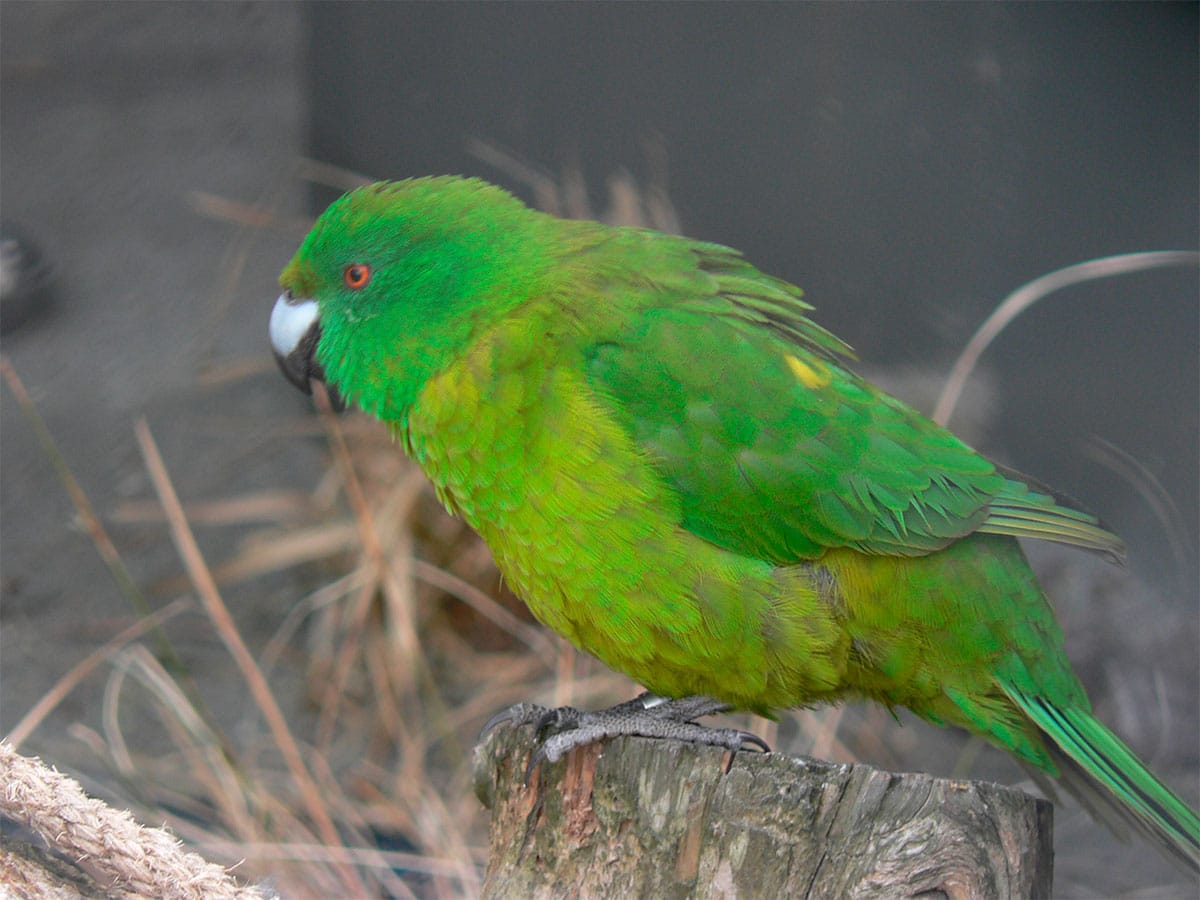
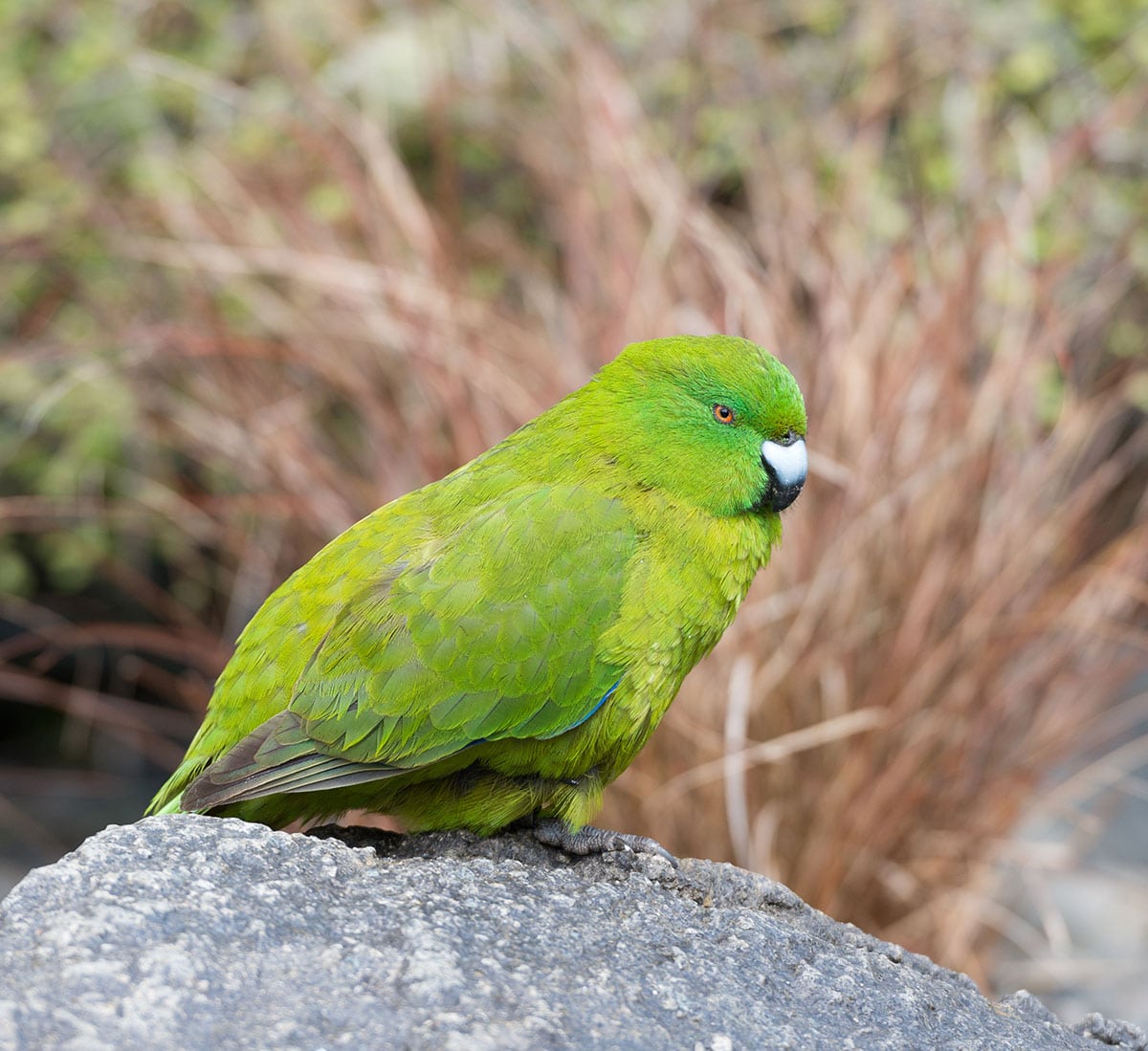
The Antipodes parakeet(Cyanoramphus unicolor) has a plumage brighter yellowish green, more yellowish on the hand down and sometimes with irregular yellow markings at the top. It is the only species that does not have color markings on head and tail. It is the largest of its kind.
The face and top are bright emerald green, and the contrast with the neck and the chest is more off.
At the top of the wings, the outer bands of the flight feather are blue, While the long tail It is green with fine yellow piping.
The great bill is silver-grey with dark end. The eyes are orange-red. The legs and feet are greyish.
Both sexes are identical. The female is slightly smaller than the male.
The young birds they are of tail shorter. The young people have the bill Pink White and the eyes light brown.
Habitat:
The Antipodes parakeet, usually, they prefer areas with tall grass (POA littorosa), areas of open scrub and sedges (Carex). Can also be seen in areas where thorny ferns grow (Polystichum vestitum) and the bushes (Coprosma antipode).
The birds are most common on steeper slopes and near water courses, alone or in small groups; They walk on the floor and climb among the branches as they seek food, normally during the morning and before nightfall.
These birds are very Meek and curious. When frightened, they disappear among the dense vegetation, keeping silent or giving a short alarm call. More than half of the day is spent sunbathing and grooming in protected areas. They bathe in small ponds and rest in burrows.
Reproduction:
The season of reproduction takes place between October and March. The Antipodes parakeetnest in soils with good drainage, a length of at least one meter. The nests is carved in fibrous peat, under the thick base of the tall grass vegetation. The nesting Chamber It is full of rootlets or fern scales.
The spawning occurs between November and January. The female lays 2-3 white eggs (5-6 in captivity). She carries out most of the duties of nesting, and incubates the eggs for a few 26 days. She cares for and feeds the chicks for nearly two weeks. The male contributes to breeding, feeding the female during this period, as well as feeding the young until their independence, at least two weeks after leaving the nest.
Food:
The diet main consists of leaves; an amount of crushed leaves, still attached to the plant, they are a distinctive sign of the power of the Antipodes parakeet. Also consume seeds, berries, the remains of penguins and petrels dead. They often enter into colonies of the Rockhopper Penguin (Eudyptes chrysocome) and of the Sclater's Penguin (Eudyptes sclateri) between the months of October and may, to feed on their eggs or dead young. It also feeds on the eggs and sometimes on the newborns of the same species.. (The sympatrico Red-crowned parakeet prevents competition by taking advantage of the niche that provide seeds, flowers, berries and small invertebrates.)
Distribution:
Endemic to the main island Antipodes, In addition to Bollons, Leeward, Inner Windward and Islands Archway.
The world's population of the Antipodes parakeet It is estimated between 2.000 and 3,000 specimens. Although common and stable within its range, the species is permanently at risk due to accidental introduction of predators, problem that could be fixed in no time.
Some birds are kept in captivity in New Zealand.
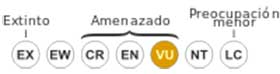
VULNERABLE.
"Antipodes parakeet" in captivity:
This stocky parakeet can live in community with species with similar characteristics.. It is usually outgoing, Active and depending on their way of breeding (natural or hand) and earlier experiences, It may be a trusted Parrot (hand raised or treated early), even being raised by their parents tends to be entrusted.
As a pet it could be good pet by his way of being cheerful and curious.
It is a rather nice parrot as vocalizations. It is not just loud. He likes to climb, There is no great need to crack and loves to be on the floor. enjoy the baths.
However, due to their vulnerability, is very rare poultry.
Alternative names:
– Antipodes Parakeet, Antipodes Green Parakeet, Antipodes Green Parrot, Antipodes Island Parakeet, Antipodes Island Parrot (English).
– Perruche des Antipodes, Kakariki des Antipodes, Perruche d’Antipodes (French).
– Einfarbsittich (German).
– Kakariki dos Antípodas (Portuguese).
– Perico de Antípodas, Perico de las Antípodas (español).
Parrots A Guide to the Parrots of the World – Tony Juniper & Mike Parr
Birdlife
Loromania
Photos Antipodean Parakeet:
(1) – Cyanoramphus unicolor at Wellington Zoo, Wellington, New Zealand by Peter Halasz. (User:Pengo) – Wikimedia
(2) – Cyanoramphus unicolor at Wellington Zoo, Wellington, New Zealand by Peter Halasz. (User:Pengo) – Wikimedia
(3) – Antipodes Island Parakeet, Auckland Zoo by russellstreet – Flickr
(4) – Antipodes Island parakeet (Cyanoramphus unicolor) by Chlidonias – zoochat
(5) – Antipodes Island parakeet (Cyanoramphus unicolor) by Chlidonias – zoochat
(6) – A painting of Antipodes Parakeet, also known as Antipodes Island Parakeet, (originally captioned «Platycercus unicolor Uniform Parrakeet») by Edward Lear 1812-1888 [Public domain], via Wikimedia Commons
▷ The world of Pets: Dogs, cats, birds, reptiles, amphibians
From between 13 and 15 cm in length and a weight between 25 and 31 g..
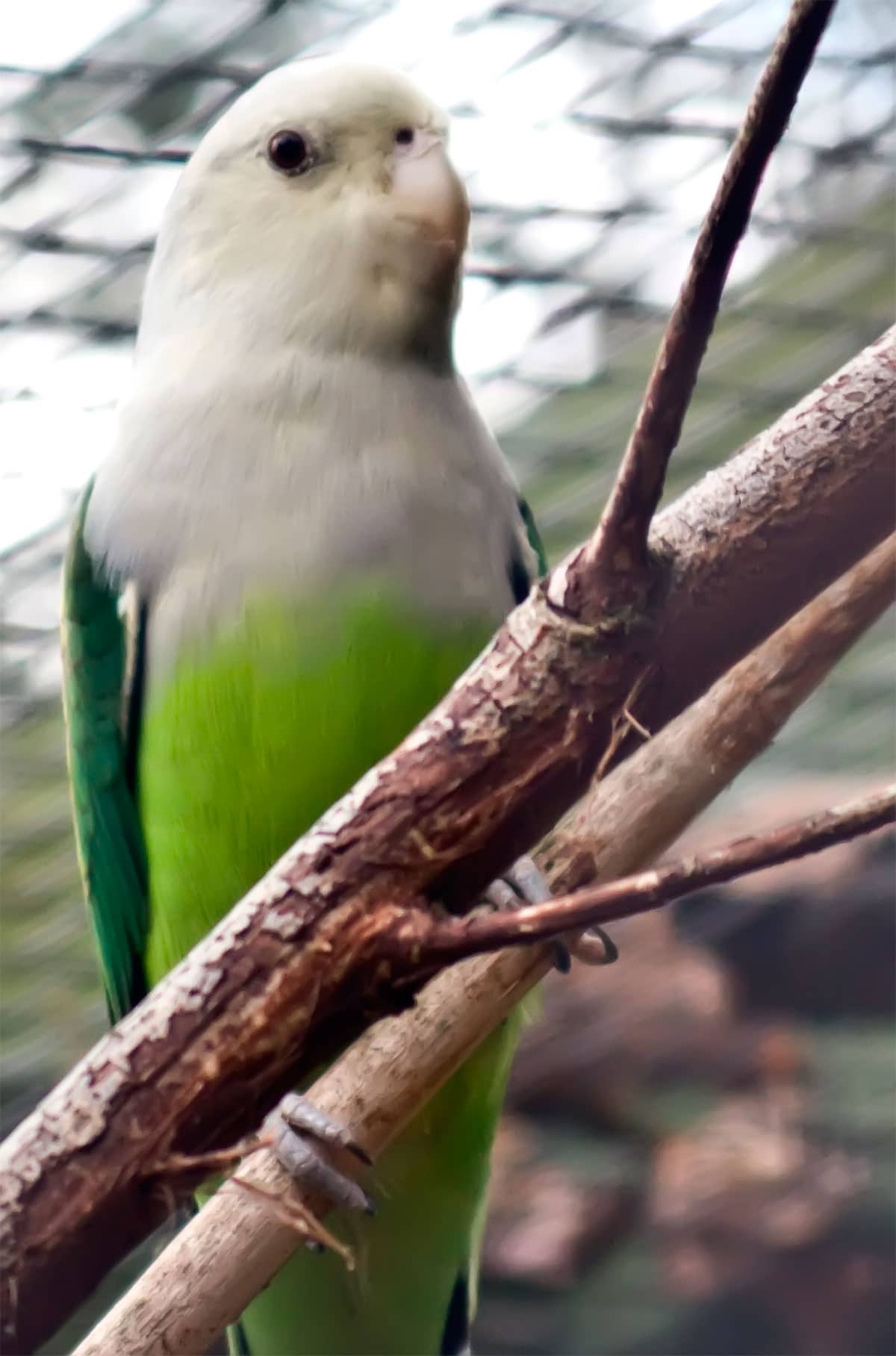
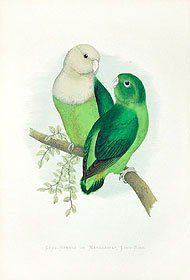
The Gray-headed Lovebird(Agapornis canus) has the head and the neck pale grey. Mantle and green scapulars; rump with a much brighter green than the rest of the tops. Upper, the wing-coverts green, alula dark. Flight feathers green above, darker towards tip and margins to the vane outer; grayish brown below. Under, the wing-coverts black. The throat to the top of the chest pale grey; low area chest up to the undertail- coverts pale yellowish green. Upper, the tail green, by bright side, with broad subterminal black band; undertail, the tail greenish-grey.
The upper jaw bluish white, the lower white pink; irises dark brown; legs pale grey.
The female has the head, neck and chest green; upperparts sometimes more brown than the male. Under, the wing-coverts green.
The immature adults resemble, but the gray hood the male is steeped in green, especially in the nape; bill yellow with black on the basis of upper jaw.
It notes that within the species Grey-headed Lovebird, given the presence of 2 subspecies, which are Agapornis canus canus (Gmelin); Agapornis canus ablectaneus (Bangs); However, not known no kind of mutation, What is something special in this genre, as usually, each species has different mutations, you change the color of its plumage.
Agapornis canus ablectaneus (Bangs, 1918) – Greener (less yellowish) below, head violet gray con held tinkles.
Agapornis canus canus (Gmelin, 1788) – The nominal species
Habitat:
In Madagascar They are in some wooded areas, palm savannas, forest edges, degraded forests, bush and farmland and rice paddies to altitudes 1.500 m. Use the clear in the dense forest along the mountainsides.
Observed in the vicinity of cities and towns and, often seen on the roads. Introduced populations show similar habitat preferences.
gregarious, usually in flocks of up to 50 birds, being able to concentrate in greater numbers in areas where food is abundant, sometimes it partnering with Madagascar Red Fody (Foudia madagascariensis), the Sakalava Weaver (Ploceus sakalava) or the Madagascar Munia (Lepidopygia nana). They often gather at communal roosts in the bare branches.
Sedentary.
Reproduction:
The nests of the Gray-headed Lovebird are treeholes; Inside the hole is lined with fragments of chewed leaves or wood chips and stalks of grass worn by females between body feathers.
Nesting They were recorded in the months of November and December in Madagascar. Probably they breed during the rainy season (November–April) in Comoros.
The laying is of 4-5 eggs, but up to eight they have been recorded in captivity.
The incubation, probably, the female performs single, lasts a few 23 days and the young leave the nest after about forty days.
Food:
The diet Gray-headed Lovebird consists, mainly, of grass seeds.
In Seychelles They have a preference for the crop pasto guinea (Megathyrsus maximus); in the Comoros islands by flower buds Stenotaphrum. They also eat rice out to dry around the villages and farms.
Distribution:
Madagascar It is the natural range of the Gray-headed Lovebird, where usually are common, especially in coastal regions, but today they are rare in eastern and absent or scarce in the central plateau.
In Seychelles, initially established extensively in Mahe but now confined to the suburbs around Victoria and some towns of the West Coast; small town, according to sources, in Silhouette.
Attempts to introduce them to other islands and in Africa have failed.
Subspecies distribution:
Agapornis canus ablectaneus (Bangs, 1918) – Arid lowlands of southwestern Madagascar, intergrades the species nominal about Beth kopaka and Ankavandra
Agapornis canus canus (Gmelin, 1788) – The nominal species
The size of the world population Gray-headed Lovebird It has not been quantified, but the species, according to sources, It common and it is generally Extended. (pit et to the. 1997).
The population is suspected to be stable in the absence of evidence of any reduction or substantial threats.
The species has undergone intense trade: from 1981 when it was listed in Appendix II of CITES, 107,829 wild-caught individuals They were recorded in international trade (UNEP-WCMC CITES Trade Database, January 2005).
After a total ban on exports from Madagascar, in recent years it has been possible to have some imported specimens.
,
"Gray-headed Lovebird" in captivity:
The Gray-headed Lovebird they are very rarely seen in captivity, Since this species it is not widespread today.
The Gray-headed Lovebird It is a pretty bird silent; active; often shy and elusive; Just get used to his caregiver patiently and in a gradual manner; newly imported birds, initially they are very susceptible; reared in aviaries not usually give complications; It hard chewer; enjoy bath; his voice is not too loud; communal aviary is not recommended because its something rowdiness; He tolerates only birds of the same species in large aviaries where you can implement your flight.
With regard to its longevity, they can live between 10 and 20 years.
Avibase
Parrots of the World – Forshaw Joseph M
Parrots A Guide to the Parrots of the World – Tony Juniper & Mike Parr
Birdlife
Photos:
(1) – A male Grey-headed Lovebird at Beale Park, Berkshire, England By Tony Austin (originally posted to Flickr as Parrot) [CC BY 2.0], via Wikimedia Commons
(2) – Grey-headed Lovebird, Ankarafantsika, Madagascar By Frank Vassen [CC BY 2.0], via Wikimedia Commons
(3) – Grey-headed Lovebird or Madagascar Lovebird By OPi@Toumoto(Opi @ Tomoto)-> http://opi.toumoto.net (Self-photographed) [GFDL or CC-BY-SA-3.0], via Wikimedia Commons
(4) – the whole family… by ZaR – ipernity
(5) – we Pedia
Origin: India, Bangladesh, China, Myanmar (Burma), Thailand
Character: shy
Life expectancy: ---
Height: Of 36 to 40 cm..
Content
Description:
Of 36 to 40 cm.. length and 120 g. of weight.
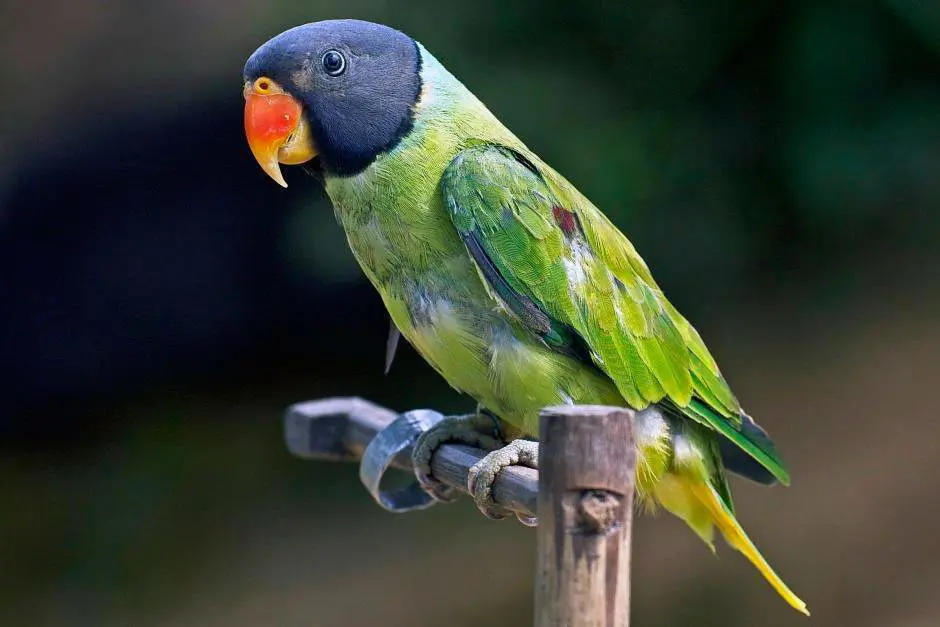
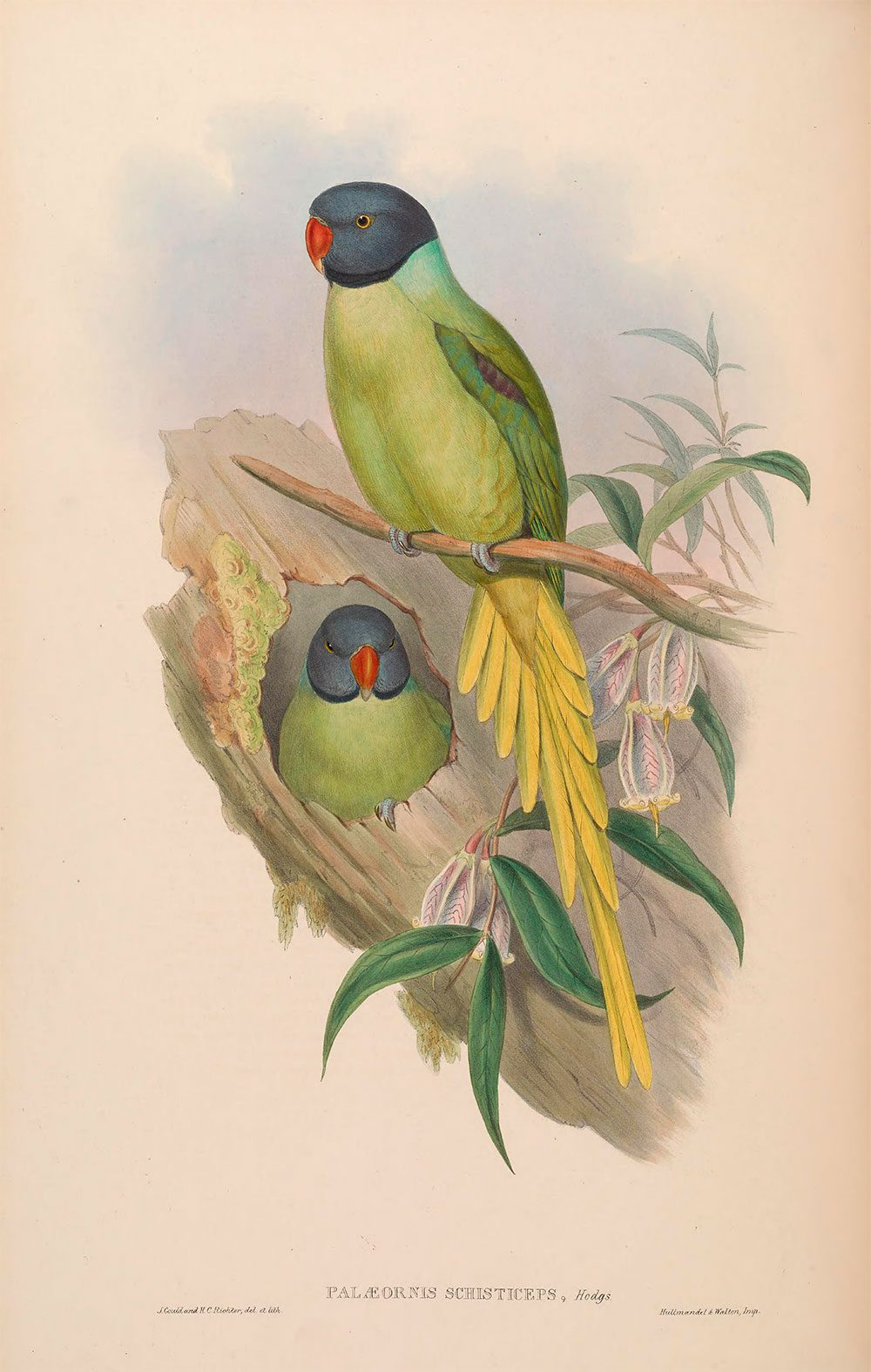
The Gray-headed Parakeet(Psittacula finschii) It is very similar to Slaty-headed Parakeet but smaller, with feathers tail longer, the head slightly paler, upperparts and more yellowish underwing-coverts darker blue-green.
The Gray-headed Parakeet(Psittacula finschii) has the forecrown, crown, lores and ear-coverts Grey Slate-blue; the chin and the lower part of the cheeks, black, It forming a narrow collar which marks a clear boundary between the head dark and a bright ring greenish blue on the back of the neck.
Nape brighter yellowish green, duller green fading in the rest of the upper region.
Upperwing-coverts green except for the brown of the inner coverts, that makes the effect of a distinctive patch on the shoulder; primaries Green with a narrow yellow margin on the vane outer; secondaries green.
Underwing-coverts dark bluish green. Underparts bright pale green. Uppertail lilac blue with pale yellow tips, outer feathers Greens with vane internal and yellow tips; undertail-coverts ochre-coloured.
upper jaw coral red to vermilion with yellow tip, lower jaw yellow; cere whitish; irises creamy white to yellow; legs greenish.
Sometimes considered the same species as the Slaty-headed Parakeet, but the lack of intergradation in a possible area of overlap in Bhutan and the northeast of the India (Arunachal Pradesh) suggests appropriate treatment as allospecies.
Similar to the Slaty-headed Parakeet. Frequents forests of oak, teak, cedar and pine, wooded hills and open farmland with tall trees. Move altitude between 650 and 3.800 m (in Yunnan, China), rarely drop below 250 m, usually at or near the mountainous terrain.
Mainly distributed in the forest Viet Nam, but, according to sources, laz away from growing areas and tolerant of lower and more open habitats.
In general, obsevadas in flocks or or small family groups, but also it is seen in larger numbers than in Burma.
Reproduction:
The breeding season in the central and southern Burma It covers the months January, February and March.
One nest four eggs was observed 12 meter high tree species Xylio dolabiformis.
The Gray-headed Parakeet It is distributed in the east of the Himalayas towards Indochina. They range from east to Bhutan towards Arunachal Pradesh and south through Nagaland, Assam (to the South of the rio Brahmaputra). Manipur, Mizoram and Bangladesh oriental (Sylhet and area of Chittagong). Through Burma (South of Tenasserim), al sur-oeste de China (center Sichuan and North of Yunnan), the mountainous districts of northern and southwestern Thailand, South of Laos, Kampuchea and Viet Nam, especially the western slopes of the central mountains.
Usually common and resident (in some places very common), but lacking in some areas and subject to local fluctuations and irregular appearances.
Recent decline in Thailand, where it is now rare in more accessible areas. Uncommon in China. Some seasonal altitudinal movements in some parts of the range. Very popular cage bird in some parts of the home territory.
The size of the world population Gray-headed Parakeet It has not been quantified, but the species, according to sources, is rare in China, Variable and elsewhere (pit et to the. 1997).
The population is suspected rapid decline because of continued habitat loss and trapping. Observations of local trends in some parts, within its range, support this suspicion, for example in Cambodia, at least since the early 1990 (F. Goes in some. 2013, T. Gray in litt. 2013, RJ Timmins in litt. 2013).
The Gray-headed Parakeet is being widely taken for the cage bird trade and is kept locally as a companion animal, for example, in Laos and China (JW Duckworth in litt. 2013, M. Zhang in some. 2013).
In China, poaching and illegal trade in this species continues: it was reported that in one village, each family has an individual of this species as a pet (M. Zhang in some. 2013).
The pressure at which it is subjected for his capture may also be contributing to the observed decrease in Cambodia (F. Goes in some. 2013).
Lowland forests Indochina They are under intense pressure, above all in Cambodia, because of the authorization for large-scale industrial agriculture. This particularly affects areas with evergreen or semi-evergreen forest, rather than forest deciduous, because the best conditions for growing (S. Mahood in some. 2013).
This species is dependent areas and forests with evergreens, whereby the effects of logging can seriously affect, especially since it is likely to depend on large trees for nesting. Habitats where large trees are scarce, as forests and hill areas with mixed forest deciduous, patches of evergreen forest and semi-evergreen forest, They are under particular pressure from logging, even for local use (S. Mahood in some. 2013).
It is expected that the loss of habitat Cambodia bring a devastating impact on this species over the next decade, although there may be a delay before the actual effects were observed in the population (H. Rainey in some. 2013).
Conservation Actions Underway:
The species is known to occur in some protected areas across its range, as in the Mondulkiri Protected Forest, Cambodia (T. Gray in litt. 2013).
"Gray-headed Parakeet" in captivity:
– Uncommon in captivity outside its range.
It is unclear how much spread among breeders, as often it was considered a subspecies of the more common Slaty-headed Parakeet. It is a very mountain bird resistant, at low temperatures is not a problem for them, However, must be protected facilities available to avoid sudden changes in temperature and drafts.
How other Psittacula, the Gray-headed Parakeet You need to nibble fresh branches, although it is not a destructive bird that could demolish a wooden aviary.
– Avibase
– Parrots of the World – Forshaw Joseph M
– Parrots A Guide to the Parrots of the World – Tony Juniper & Mike Parr
– Birdlife
– Photos:
(1) – Bird perched on a home made perch. Part of the tail appears to be missing by Vijay Anand Ismavel – Lynx
(2) – Gould, John, 1804-1881; Sharpe, Richard Bowdler, 1847-1909: Birds of Asia by John Gould [Public domain], via Wikimedia Commons
(3) – Finsch’s Parakeet Psittacula finschii by Raju Kasambe. Photo taken in Imphal Zoo, Manipur, India By Dr. Raju Kasambe (Own work) [CC BY-SA 4.0], via Wikimedia Commons
Of 41 cm.. in length and a weight that varies between 207 and 294 g..
The rare and beautiful Blue-headed Macaw(Primolius couloni), with its striking and vivid plumage green and blue, Unfortunately, now hardly seen in nature.
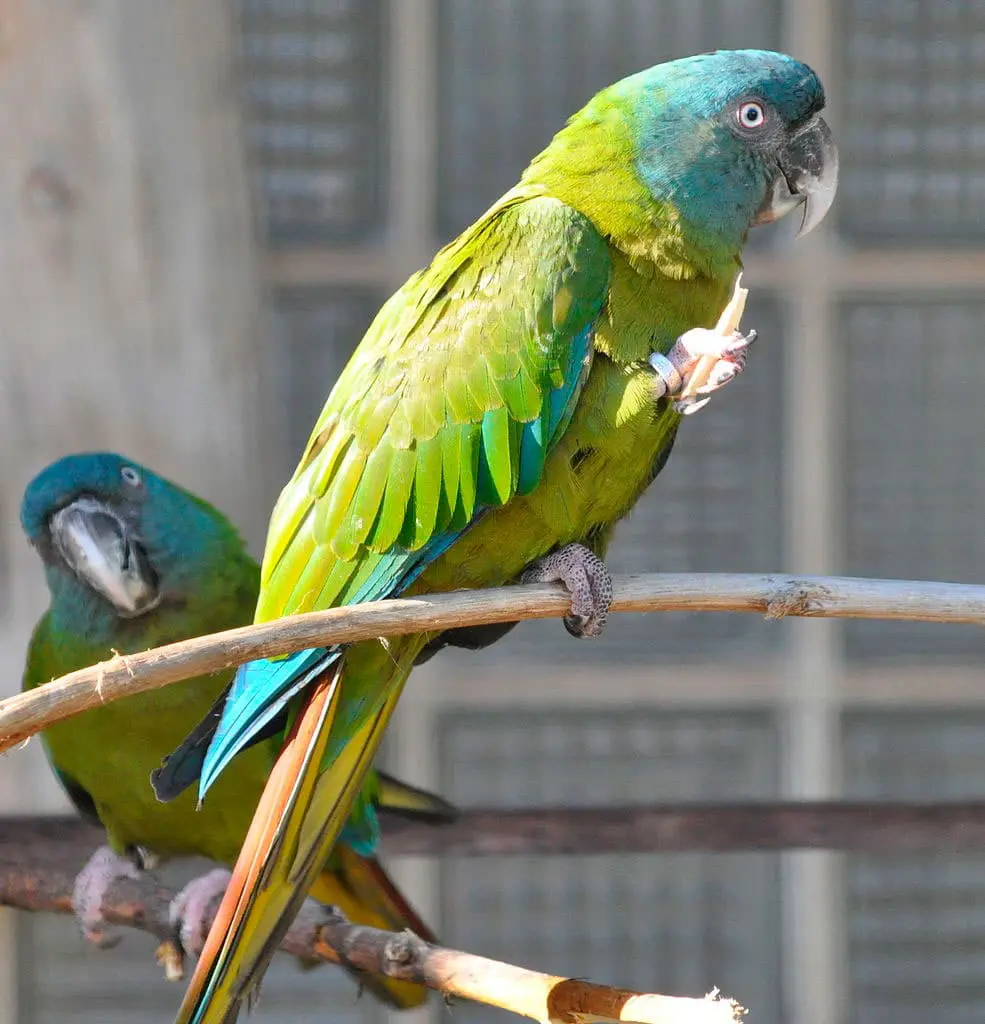
As its common name indicates, the head is blue, the forecrown with a narrow band of black color that will fade in blue on the area of the crown; the ear-coverts and both sides of the neck are blue, fading to green in the area of the nape. Upperparts olive green with light tint in the tail and in the uppertail-coverts. Small, large and medium-sized coverts green interiors; the large coverts Blue exterior. The flight feather are blue top (with a bit of green in high schools), by below, Yellow olive. Underparts green, slightly more yellow than the upper. The upper part of the tail is an intense Brown, while the underparts is yellowish-green.
The bill is black, Ivory at the end; the bare skin of the lores and the top of the cheeks it is gray with a bluish tint and crossed in front by very small lines of black feathers: the irises yellow; legs grayish pink.
Both sexes are similar, the male, possibly, largest average.
The immature with the irises dark. The bill is completely black and the legs more grey. The skin of the face and lores (area between the beak and eyes) is white. Depending on your age, have queues shorter.
NOTE:
In close relationship with the Yellow-collared Macaw (Primolius auricollis) and the Blue-winged Macaw (Primolius maracana); it has sometimes been considered congeneric with the latter. monotypic.
The Blue-headed Macaw distributed by humid tropical forests, at altitudes between 150 and 1,550 m. They prefer habitats altered or partially open, mainly in forest edges along rivers, in the clearings and in partially wooded areas surrounding; There are also records of these macaws in marshy areas of forest with Mauritia Palms.
This species prefers possibly the wooded foothills of lowlands.
He is not very sociable: The flocks with the largest number of individuals appear between June and October, usually traveling in pairs or groups of three individuals; apparently, not associated with the Chestnut-fronted Macaw.
Reproduction:
Known that the reproduction of these birds is correlated with the period of greatest abundance of food due to the breeding of pigeons (before and after leaving the nest) It requires a lot of energy expenditure.
There are no records of their reproductive period, However there has been during the months of April to June shown to the parents with their chicks and that in Peru, species Mauritia flexuosa "guaje" and Dipterix odorata "odorata" are key to its reproduction.
In captivity they reproduce couples chosen by them and have of two to three eggs, two chicks being generally viable.
Food:
The Blue-headed Macaw they feed mainly on seeds, mature and immature fruit, and flowers, occasionally supplemented with bark and other inputs.
Unlike many other birds, the parrots of the New world They seem to not be able to modify your diet to predominately insectivorous, reason why they are intimately linked to the patterns of flowering and fruit production (Brightsmith et to the, 2008). They have a strong dependency of the colpas clay.
Distribution:
Distributed by the Western basin of the amazon at the West end of Brazil (in Acre, from time to time), Peru Eastern and in the Northwest corner of Bolivia.
In Bolivia have been found in Peace and perhaps in the South of Beni with indications that the birds are distributed regularly to the South, in the Eastern foothills of the Andes to the South of Bolivia.
Local and erratic in its distribution, but apparently quite common in some places. Perhaps the enlargement of its range is fairly limited in the southwest of the Amazonia due to the degradation of forests.
Rare in captivity.
Conservation:
• Red List category of the UICN current: Vulnerable
• Population trend: Decreasing
Until recently it was considered quite common., but a review in 2006 by BirdLife International suggested that it was rare, with a decrease in the total population to the 1.000-2.500 individuals. Thus, has been placed in the category in danger of extinction in the 2007 (Red list of the UICN).
Parts of the distribution of this species are still little known, but Tobias and Brightsmith (2007) It has been suggested that the previous estimates were too low, with the most probable real number of 9.200 to 46.000 mature individuals. It is suggested that vulnerable could be a more appropriate category for this species.
The Blue-headed Macaw It is commonly found in the markets of Brazil, still valuable, prices above the 12.000 $, and in high demand due to their rarity.
OBJECTIVES:
Information about the actual state of conservation of the species. It also, This project, that is being conducted under a partnership with the Government of Peru, includes other project, in this case for the conservation of the Grey-cheeked Parakeet, classified as "endangered".
STRATEGIES:
The two projects include the definition of methods for determining the density of populations in key places, the evaluation of the level of the illegal trade in birds, and the promotion of the local social consciousness in relation to the illicit traffic of these species.
ACTIONS:
The field team is carrying out assessments of populations and habitat analysis, and at the same time they updated the assessment of the threats weighing on the two species. The general population trend of the Blue-headed Macaw is one very gradual decrease, but it seems that the species can withstand certain levels of their forest habitat change. By censuses in consecutive years, the population of the Grey-cheeked Parakeet It has not undergone further decline despite the severe fragmentation of the preferred dry forest.
"Blue-headed Macaw" in captivity:
Very rare in captivity.
Couples are formed according to the preferences of the copies, couples chosen by the breeder will not work. The diet is based on the seasonal fruits and vitamin supplements.
The Parque de las Leyendas Zoo in Peru, captive breeding, It has no objective reproduction but the exhibition of animals that are twelve in total. Births have been but manualâ studies have not been performed. In the month of March to April of the 2010, This project through the SERNANP with scientific staff of the aforementioned zoo, he carried out the biometric studies of this species and established the protocols for the reproduction studies.
Are no data about your longevity, Although similar species such as the Blue-winged Macaw have records having lived 31 years in captivity and having raised from the 6 years of age.
The illegal traffic This species is a serious problem that affects their conservation.
Alternative names:
– Blue-headed Macaw, Blue headed Macaw, Coulon’s Macaw (English).
– Ara de Coulon (French).
– Blaukopfara (German).
– maracanã-de-cabeça-azul (Portuguese).
– Guacamayo Cabeciazul, Maracaná de Cabeza Azul, Guacamaya cabeza azul (español).
– Parabachi cabeza azul (Colombia).
– Guacamayo de Cabeza Azúl (Peru).
– Avibase
– Parrots of the World – Forshaw Joseph M
– Parrots A Guide to the Parrots of the World – Tony Juniper & Mike Parr
– Birdlife
– Photos:
(1) – Blue-headed Macaw in the Walsrode Bird Park, Germany By Quartl (Own work) [CC BY-SA 3.0], via Wikimedia Commons
(2) – Blue-headed Macaw (also known as Coulon’s Macaw) in captivity at Walsrode Bird Park, Germany By Robert01 (Self-photographed) [CC BY-SA 3.0 of], via Wikimedia Commons
(3) – Blue-headed Macaw (Primolius couloni) at Jungle Island of Miami By DickDaniels (http://carolinabirds.org /) (Own work) [GFDL or CC BY-SA 4.0-3.0-2.5-2.0-1.0], via Wikimedia Commons
(4) – Moscow Zoo. Blue-headed Macaw (Ara couloni, syn. Primolius couloni) By Andrey Korzun (Kor!An) (Own work) [GFDL or CC BY-SA 3.0], via Wikimedia Commons
(5) – Ara couloni – Wikipedia
The Crimson-fronted Parakeet(Psittacara finschi) It is the only species of the genus Psittacara tail long with red color below the wing
.
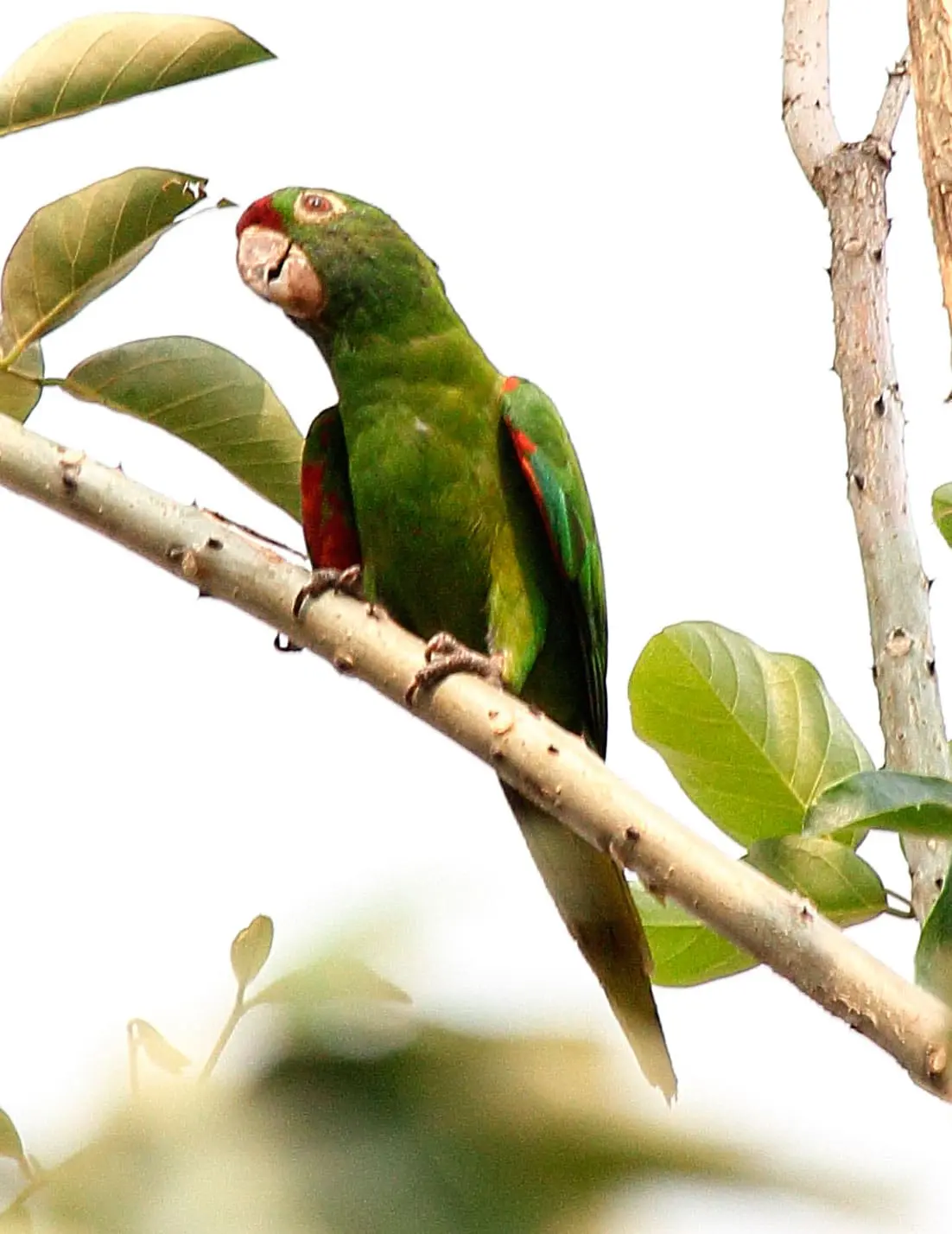
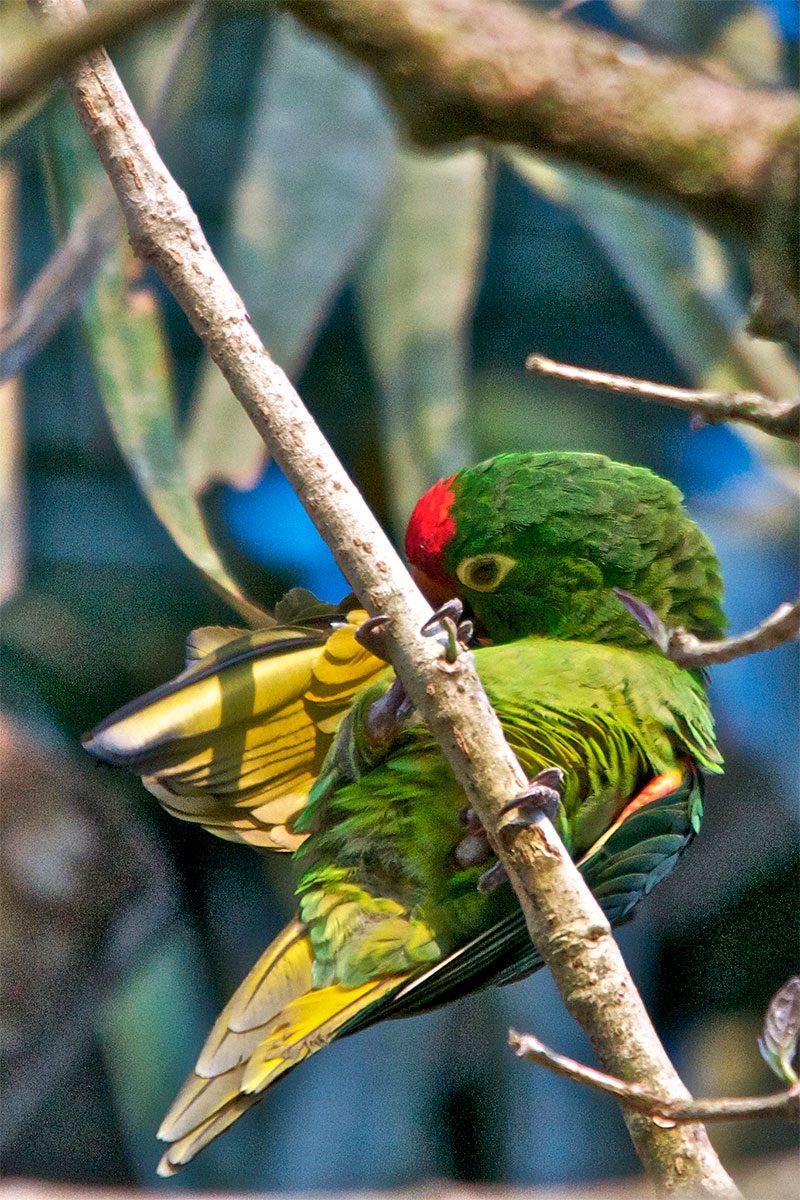
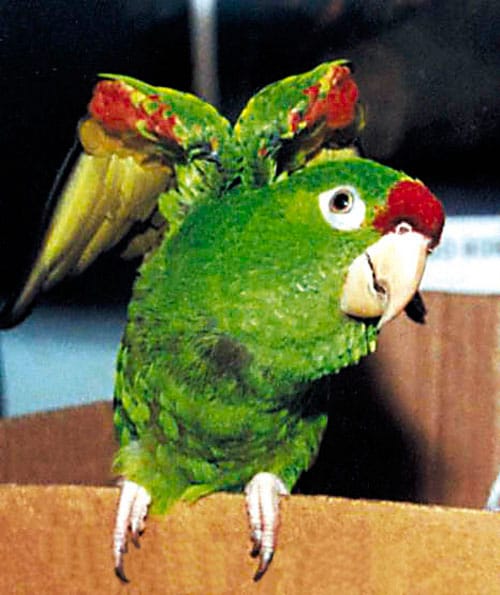
They have forecrown and the former area of the lores bright red; the head and the neck green color with the exception of some scattered red feathers. The upperparts and upperwing-coverts green, with some red feathers on the bend of wing. The flight feather green above, more dark towards the tips with a dye bluish light in them vane inner; then golden brown color. Lesser and medium underwing-coverts red, the largest yellow, other coverts pale green. The underparts pale green, sometimes with red at the bottom of the tibia. Upper, the tail grass-green, by down golden brown.
The irises is orange and the eye ring naked is whitish. The bill exhibits a color gray-tipped Horn and the legs off gray color.
It has no sexual dimorphism.
The immature There are very little or almost no red in the forecrown and lack of red color in the thigh or the neck. The lining of the wings is more Orange.
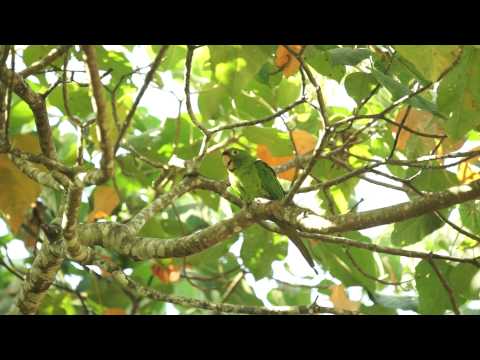
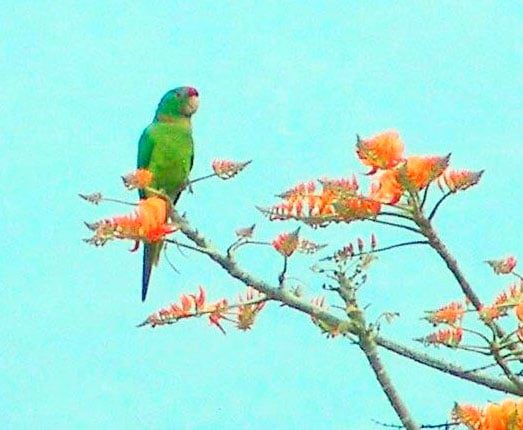
They inhabit tropical and subtropical envelope 1.400 metres in Costa Rica and 1.600 meters in the West of Panama, in areas with light trees or in fields with scattered trees, in secondary growth forests, edges of the forest, coffee plantations and nearby farmland. Irregular or seasonal in large forested areas.
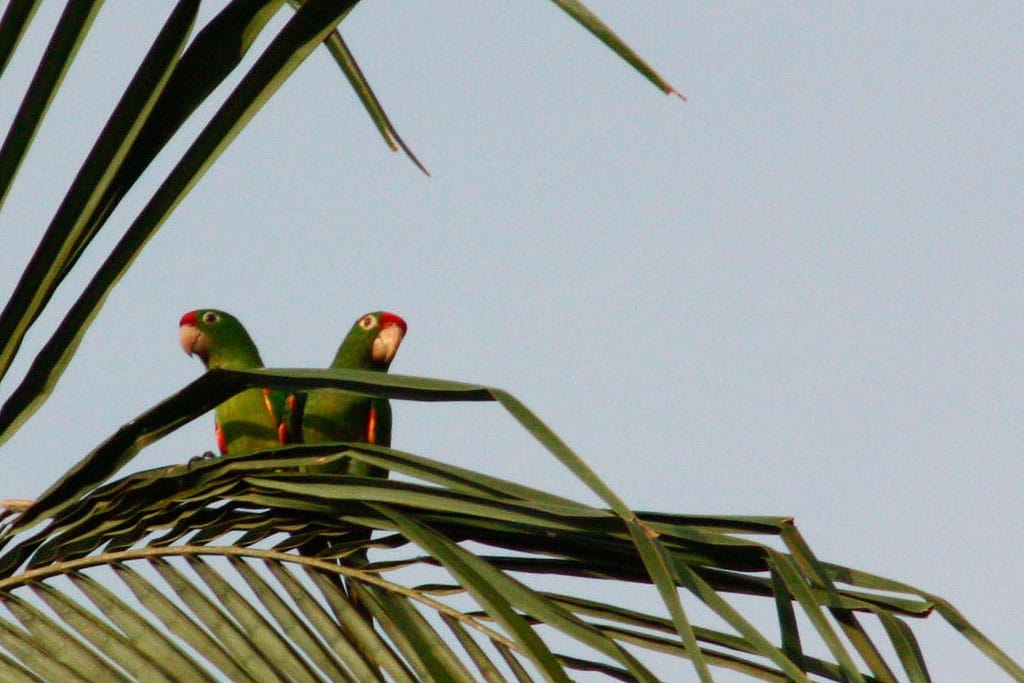
They are birds gregarious, usually observed in flocks of up to 30 Member, but up to several hundred birds can gather in roosts communal on the tops of the trees or palms. Roosts, at times near the cities.
Reproduction:
They located their nest in holes of various types: natural cavities, old holes of woodpeckers (F. Picidae), stumps of dead Palms. They can dig holes in rotten stumps or in masses of epiphytes.. Sometimes many couples may nest near each other.
The union of the pair of this species is particularly strong. The pairs isolate themselves from the group towards the end of July to nest.. With reproduce during the dry season and the rainy early. The female lays three or four eggs which are incubated during approximately 24 days. The juveniles they leave the nest to the 50 days of life.
Widely distributed in the South of Central America, from Nicaragua until Panama.
The species can be found in the southeast of Nicaragua to the South of the Rio Grande, and in Costa Rica mainly on the slope of the Caribbean, Although there are exemplary residents on the side of the peaceful, on Osa Peninsula, at the South-West end and seasonal visitors in the Guanacaste Cordillera, in the North and the central plateau around San Jose.
In Panama they come to the East, a unos 82°W, but it is probable that only seasonally in the lower Highlands of the Province of chiriqui.
Flocks of birds required extensive territories and the species occurs, apparently, in many areas, if only as a post-breeding visitor.
Very common or locally common with increasing numbers in Costa Rica and Panama, probably due to deforestation.
Maintained in captivity and internationally traded in small quantities.
Conservation:
State of conservation ⓘ
Minor Concern ⓘ(UICN)ⓘ
• Red List category of the UICN current: Least concern
• Population trend: Growing
The size of the world population of the Crimson-fronted Parakeet It has not been quantified, but this species is described as «quite common«.
You can be increasing their geographical range due to deforestation.
abundant on the slope of the Caribbean of Nicaragua. common and widespread in areas deforested over the slope of the Costa Rica Caribbean.
"Crimson-fronted Parakeet" in captivity:
Quite common in United States, less elsewhere.
Socialize easily with human, and can become a committed and loving companion. Es a Intelligent and lively, with easy to imitate the human voice and run different games and exercises. But, We must remember that it is a bird loud and the volume of their calls can get to be very annoying.
Alternative names:
– Crimson-fronted Parakeet, Crimson fronted Parakeet, Crimson-fronted Conure, Finsch’s Conure, Finsch’s Parakeet (English).
– Conure de Finsch, Perriche de Finsch, Perruche de Finsch (French).
– Veraguasittich (German).
– Aratinga-de-finsch (Portuguese).
– Aratinga de Finsch, Perico frentirrojo, Periquito de Pecho Rojo, Perico de Palmera (español).
– Perico frentirrojo (Costa Rica).
– Perico Frentirrojo (Nicaragua).
Parrots A Guide to the Parrots of the World – Tony Juniper & Mike Parr
Birdlife
Photos:
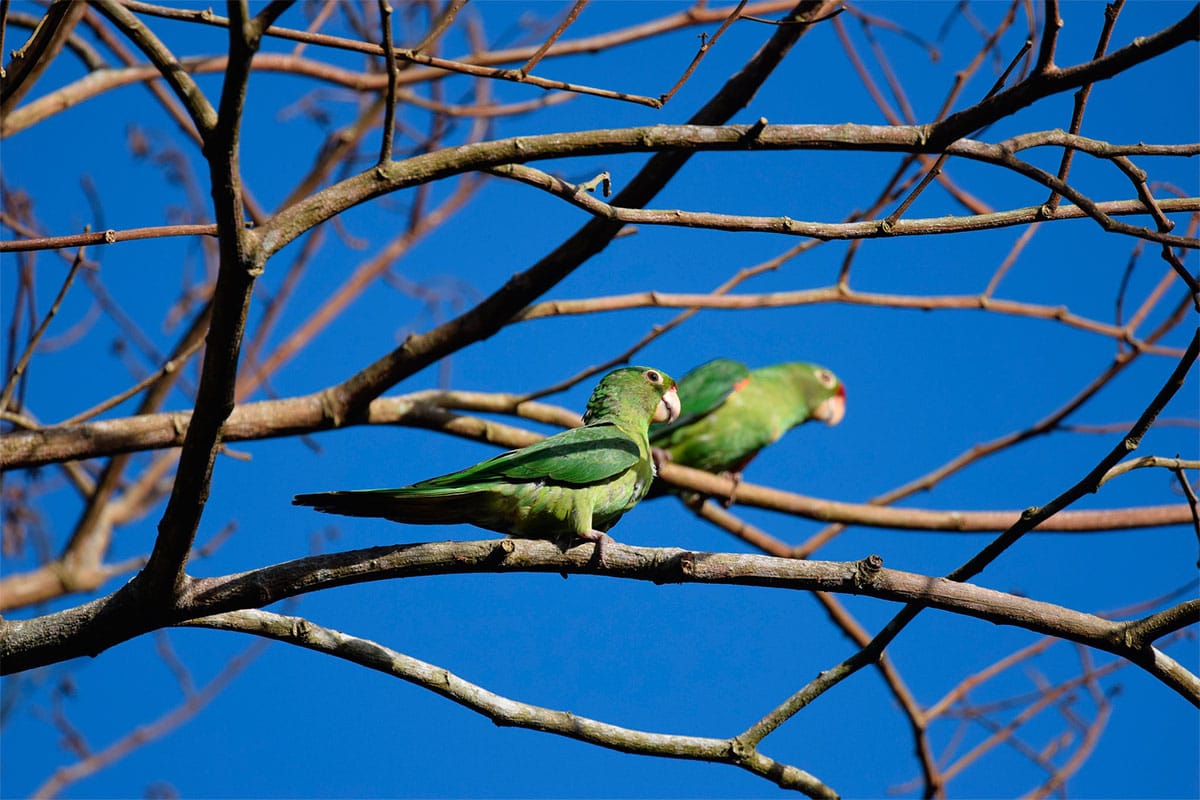
(1) – A Finsch’s Parakeet )also called Finsch’s Conure and Crimson-fronted Parakeet) in San José, Costa Rica By Dominic Sherony [CC BY-SA 2.0], via Wikimedia Commons
(2) – Perico frentirrojo juvenil, approximately 4 months of age, Panama City By Ricaurte (Own work) [Public domain], via Wikimedia Commons
(3) – Crimson-fronted Parakeet, also called Finsch’s Conure By Yazzieyazz (trabjo propioEnglish: own work) [Public domain], via Wikimedia Commons
(4) – Psittacara finschi en el parque nacional Henri Pittier, Venezuela By Roberto Galindo Deshays (Own work) [CC BY-SA 4.0], via Wikimedia Commons
(5) – Crimson-fronted Parakeet Costa Rica 2/15/16 Rancho Naturalistaby Andy Reago & Chrissy McClarren – Flickr
(6) – Crimson-fronted Parakeet by Brian Ralphs – Flickr
(7) – Crimson-fronted Parakeet Costa Rica 2/15/16 Rancho Naturalista by Andy Reago & Chrissy McClarren – Flickr
(8) – Aratinga finschi 06 Apr 2014 Costa Rica, San Lorenzo by Tom Benson – Flickr
(9) – Crimson-fronted parakeet by Charles Sharp – Flickr
(10) – Conurus finschii » = Psittacara finschi (Finsch’s Parakeet) by John Gerrard Keulemans [Public domain], via Wikimedia Commons
In flight notorious is the armpit red with yellow line at the end; Red patch in the belly. The tail is opaque red.
Was formerly considered as a subspecies of the Maroon-bellied Parakeet(Pyrrhura frontalis), of crown brown, darker underparts, and underwing-coverts especially red and yellow.
Bill black; eye ring naked white; irises brown. Tail long.
In Brazil only it is known in Mato Grosso from the South, where is limited to the mountain ranges of Bodoquena and Maracayu, in the Ecotone between the Planalto and the lowlands of the Pantanal, and along the taboco river in the municipality of Aquidauana. It has a very limited range in the Paraguay, from where records of the latter are confined to gallery forests along the apa river.
Conservation:
• Red List category of the UICN current: Near-threatened
• Population trend: Stable
The size of the world population Blaze-winged Parakeet It has not been quantified, but this species has been described as «rare«.
State of conservation ⓘ
Near Threatened ⓘ(UICN)ⓘ
This species is suspected that they have experienced a moderately rapid decline due to the extensive loss and degradation of its habitat range within. Now survive in a highly fragmented landscape. Its area of distribution in Brazil has suffered extensive forest loss and degradation through agricultural expansion and charcoal production. The forests of the North of Conception and those who are in Chaco, in the easternmost area of Paraguay, are coming under increasing pressure and have seen considerable deforestation in recent 10 years (R. Clay in litt., 2009).
There is one hybridization apparent with the Maroon-bellied Parakeet(Pyrrhura frontalis) observed in the apa river (R. Clay in litt., 2009).
The trade is apparently minimal (pit et to the., 1997).
"Blaze-winged Parakeet" in captivity:
These small parrots are very rare in captivity, Although its potential for pets is excellent. Are birds animated and soon procured confidence with its owner. They often enjoy bath and are not hard chewing. are mostly calm and they shall only be loud when they are excited. They can be aggressive toward other birds. Playful and curious and generally resistant.
Alternative names:
– Black-winged Parakeet, Black-winged Conure, Blaze winged Parakeet, Blaze-winged Conure, Blaze-winged Parakeet, Deville’s Conure (English).
– Conure de Deville, Perriche de Deville, Perruche de Deville (French).
– Devillesittich, Deville Sittich, Deville-Sittich (German).
– tiriba-fogo (Portuguese).
– Chiripepé ala anaranjada, Cotorra de Deville, Perico de Alas Naranjas, Periquito alianaranjado (español).
– Periquito alianaranjado (Bolivia).
– Chiripepé ala anaranjada (Paraguay).
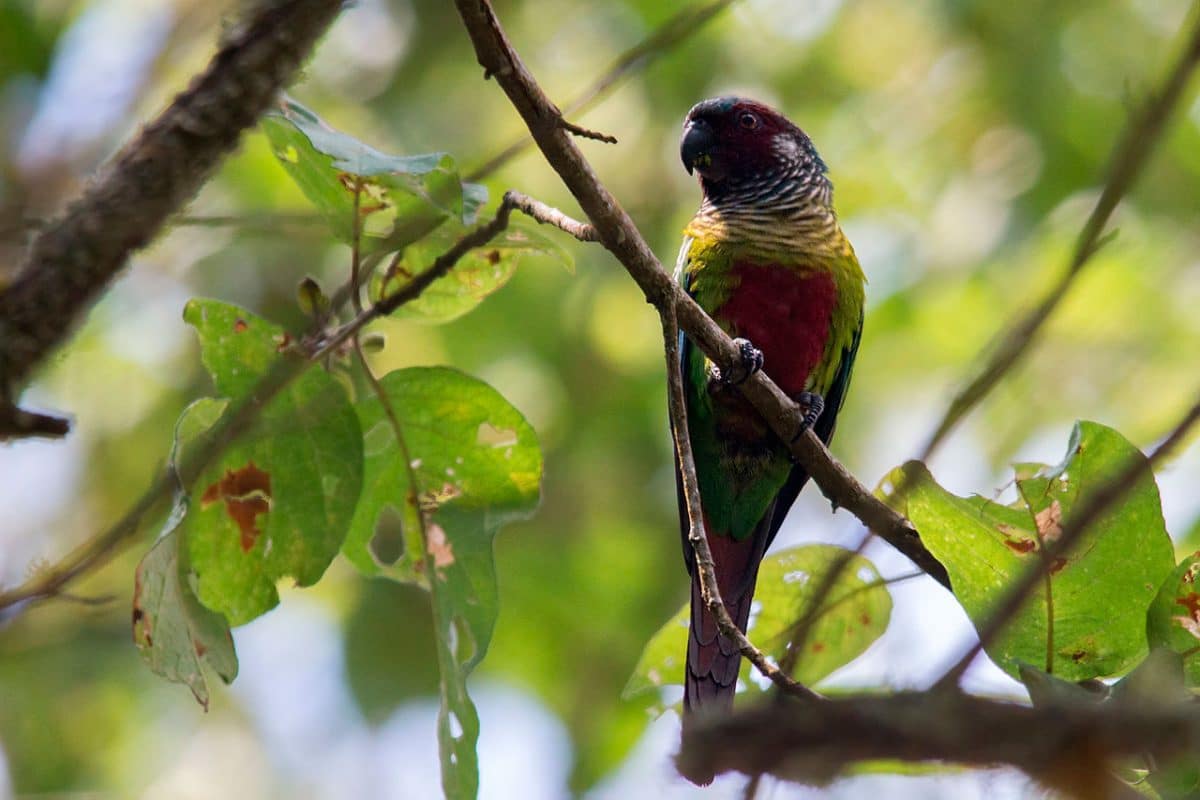
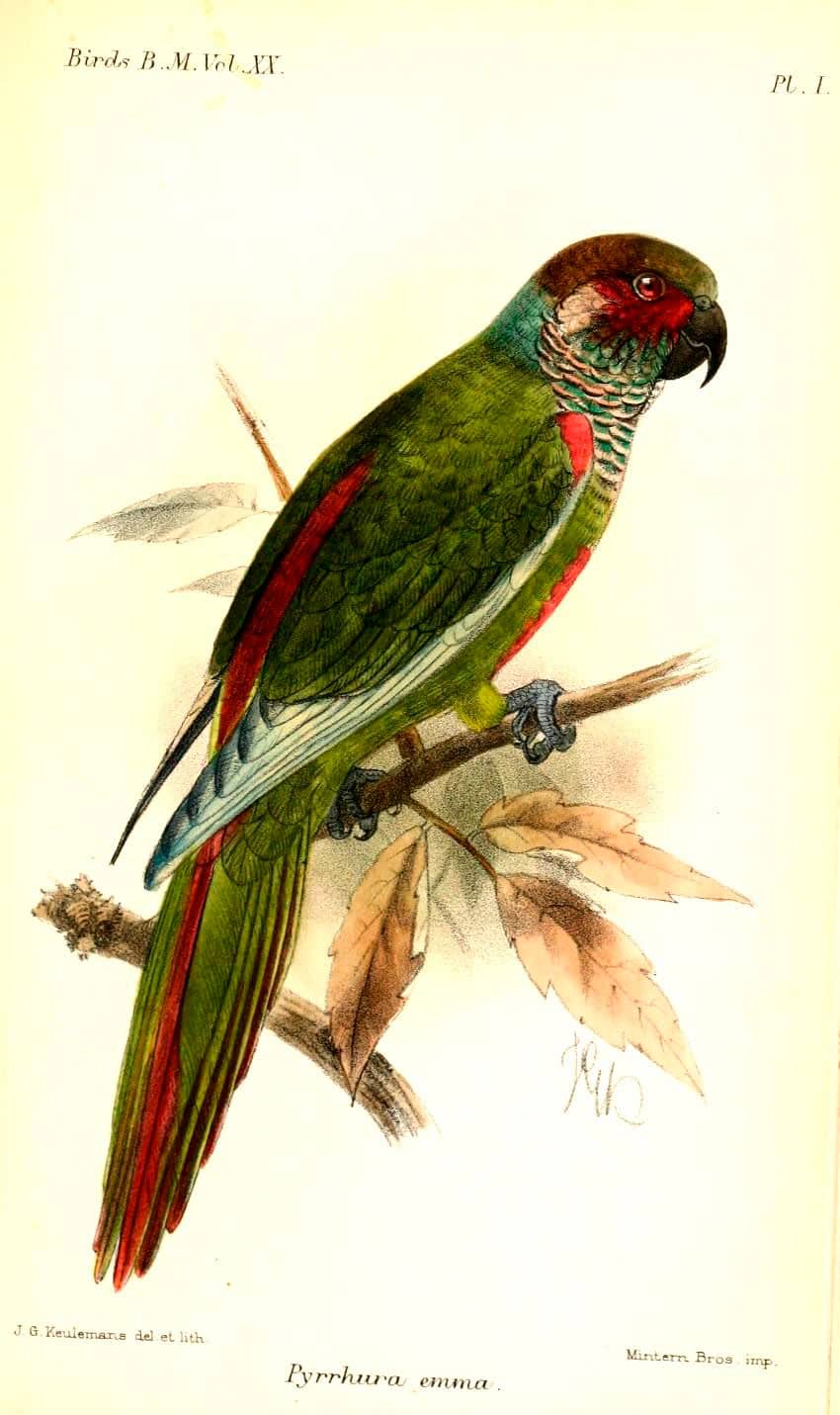
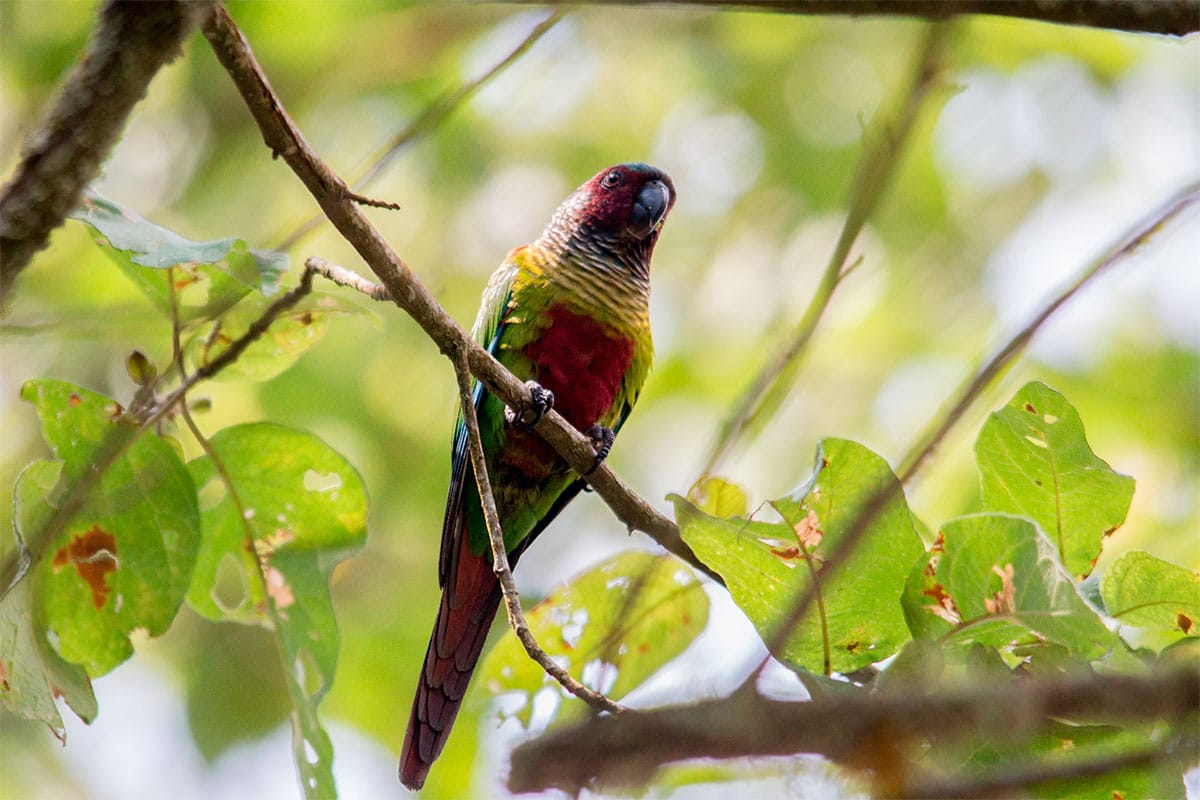
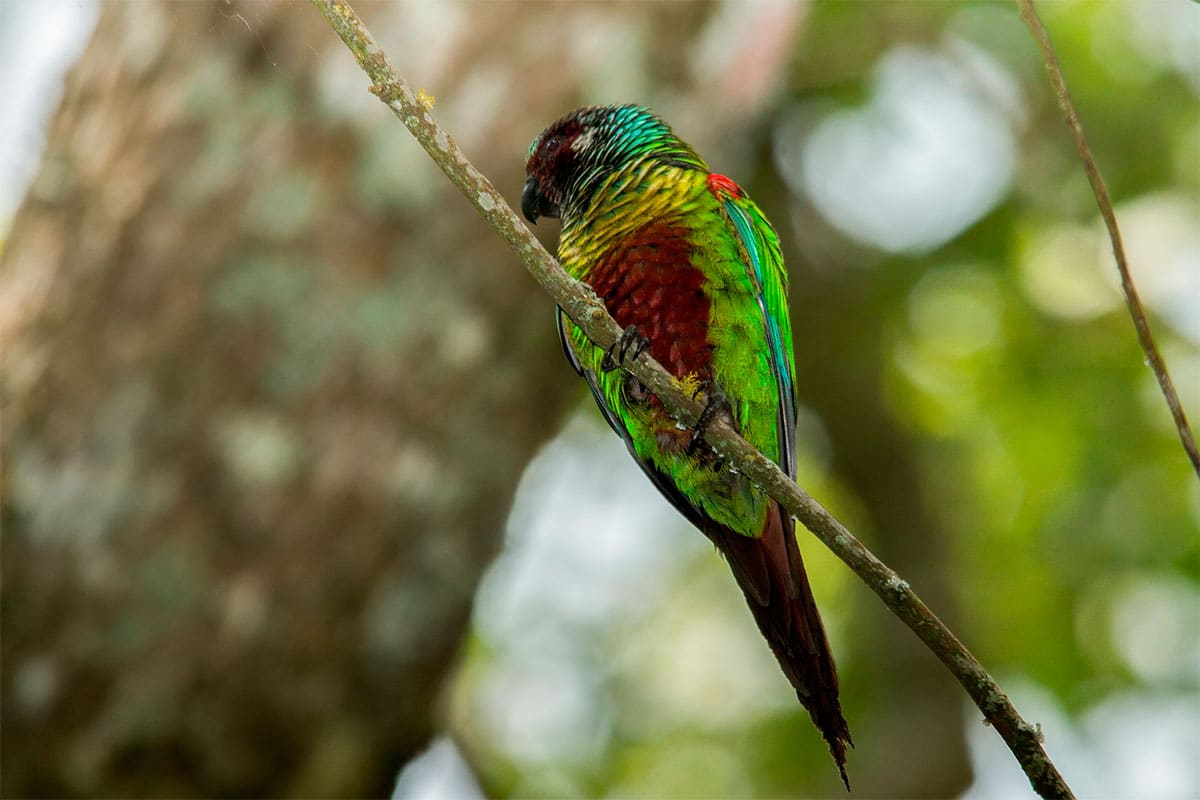
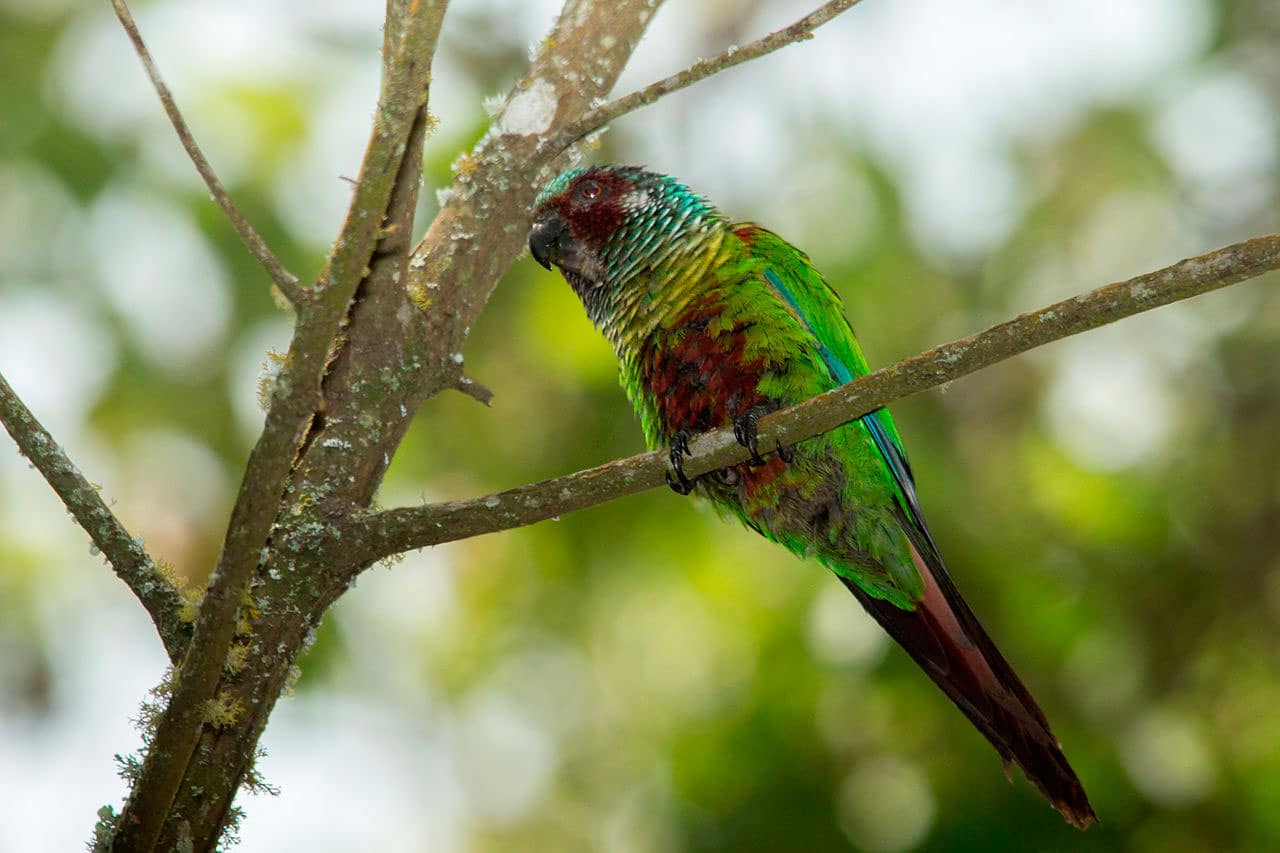
The Emma's Parakeet(Pyrrhura emma) is a bird, mostly, green, with blue in the wings, reddish-brown in rump, on tail and in the back; Scaled plumage chest yellowish color on a gray background olive; wings with red shoulder, inconspicuous.
The face red plum, while the pileum It is brown and gray forecrown blue. Abdomen with dark red stain, tail with green base, edge red and below all red.
Eye ring grey, cheeks red with white spot on ears. Bill dark. It has no sexual dimorphism.
They can be seen in hill forests in the coastal mountain range in Venezuela, in humid forests and edges as well as in adjacent clearings with sparse trees and groves (pit et to the., 1997).
Usually it moves in flocks, on quick flights up 25 specimens, before landing in the canopy.
Reproduction:
There is insufficient information regarding reproduction and feeding. Breeding season probably between May and July. Period of incubation: 24-25 days.
Food:
They have been observed eating flowers of Ochroma and nectar (Hilty 2003).
Distribution:
Size of its range (reproduction / resident): 88.300 km2
The Emma's Parakeet inhabits forested areas of the northern coastal range Venezuela, from Yacacuy and Carabobo until Miranda, and disjuntamente from Anzoátegui to Sucre and northern part of Monagas (Del Hoyo et al., 1997, Juniper and Parr 1998, Hilty 2003, Forshaw 2006).
It is mainly found at altitudes 250-1.700 m, but you can see at sea level in eastern Sucre (Hilty 2003), where is quite common (Hilty 2003, P. Boesman in a bit., 2006). Its distribution within this range is complex and disjoint, found especially in mountainous terrain at lower elevations (Hilty 2003).
Conservation:
• Current category of the Red List of the UICN: Least concern.
• Population trend: Decreasing.
Justification of the population
State of conservation ⓘ
Minor Concern ⓘ(UICN)ⓘ
Apparently, the population size of this species has not been quantified.
Justification of trend
The capture for trade and changes in land use may be causing a decrease in population of this species, although the trend has not been quantified, and none of these is considered serious threats to this species today(CJ Sharpe a slightly. 2014).
Conservation Actions Underway
They live in several national parks (P. Boesman in a bit., 2006), with a "substantial" population in the Guatopo National Park, Miranda (Juniper and Parr 1998, Hilty 2003).
Conservation Actions Proposed
Continue to monitor this species in the field and in trade.
Strengthen the network of protected areas within the range of this species.
"Emma's Parakeet" in captivity:
Very rare in captivity. Very intelligent, active and playful. They are very aggressive with other species. Price per couple: 400 EUR.
30 cm.. length and an approximate weight of 370 g..
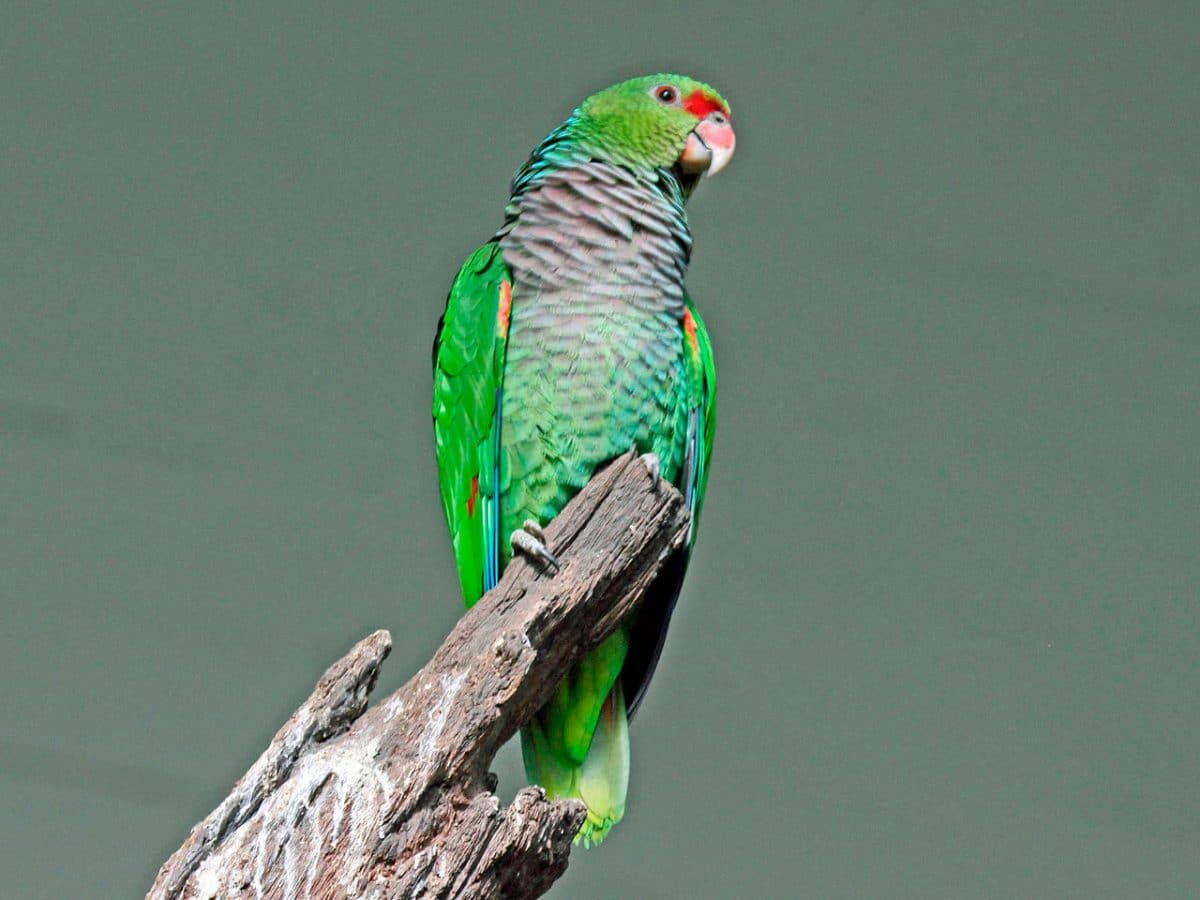
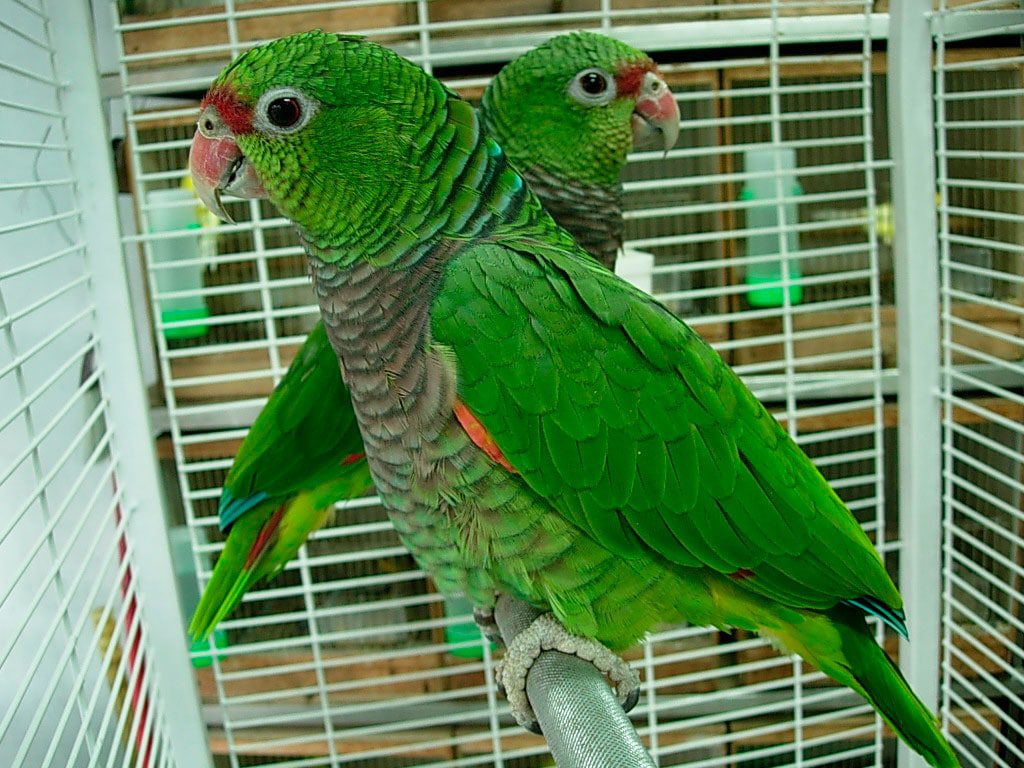
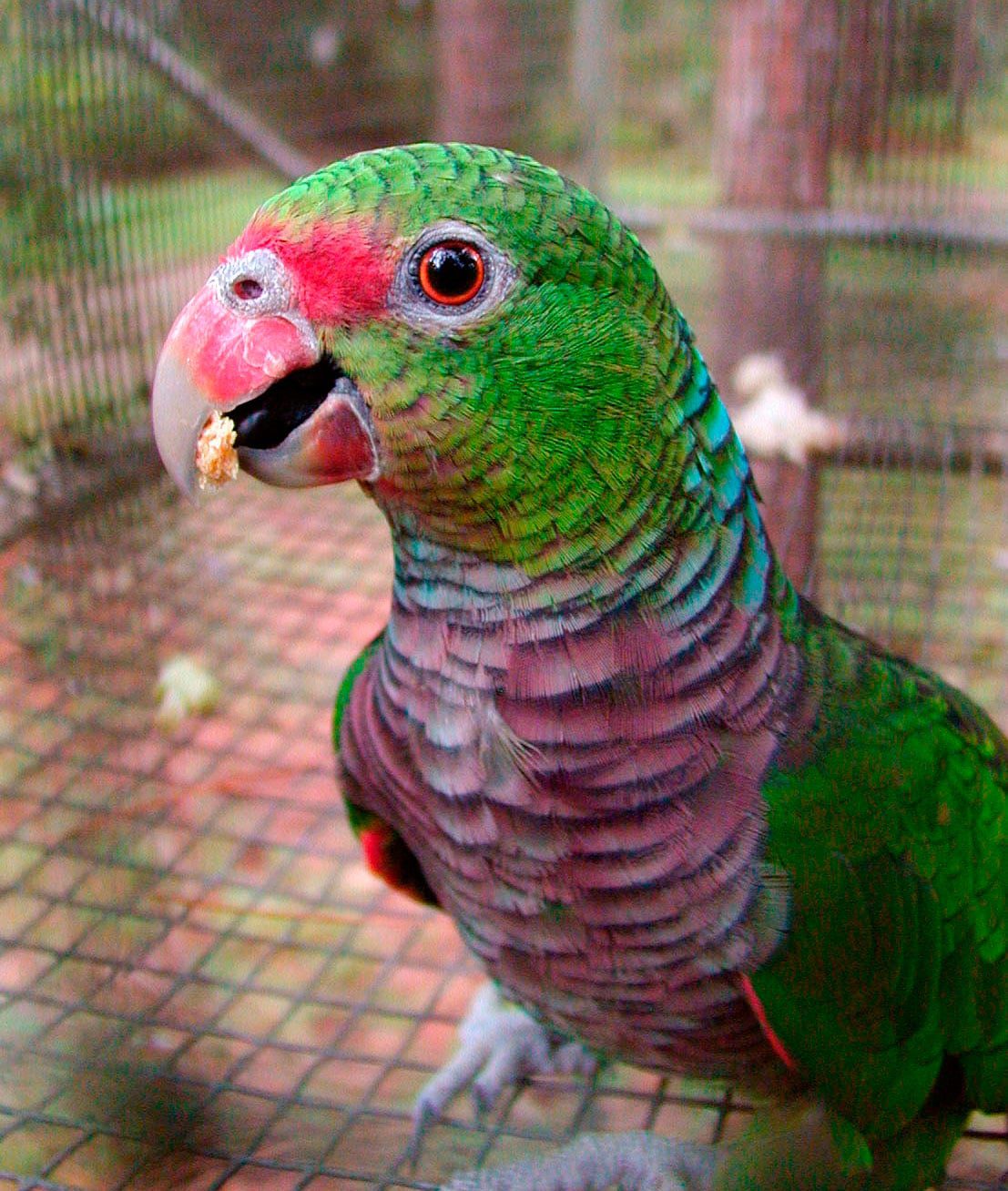
The Vinaceous Parrot(Amazona vinacea) has the lores and forecrown bright red; cheeks and crown green with black tips to some feathers head; elongated feathers on the sides of neck, the nape and the upper mantle, green at the base, subterminally light blue and black tip. The rest of the the mantle, back and scapulars, green with some feathers showing indistinct black tips; uppertail-coverts pale green.
Wing coverts green with red variable and / or yellow in leading edge of wing and the carpal area. Primaries pale bluish-green; Secondary green with blue tips, the base outerweb of the three outer secondaries, red, forming a small looking-glass. Under the wings, green. Throat and chest with shades that vary from strong wine brown to pale blue with a strong vinous diffusion; subterminal dark band at the tips of the feathers gives scalloping pattern; Belly green or yellowish green sometimes with vinous dissemination; undertail-coverts brighter yellowish green. Tail green with yellow green tip; the base lateral feathers in red innerwebs, in purple outerweb. The upper jaw It is red at the base with pale tip, horn-colored lower, reddish at the base; irises orange to reddish brown; legs grey.
Both sexes are similar. The immature It has the green suffusion in chest and the less extensive red on the head (confined to the base upper jaw).
Sound of the Vinaceous Parrot.
Habitat:
Video – "Vinaceous Parrot"
Purple-breasted Parrot in Itamonte - Minas Gerais, Brazil
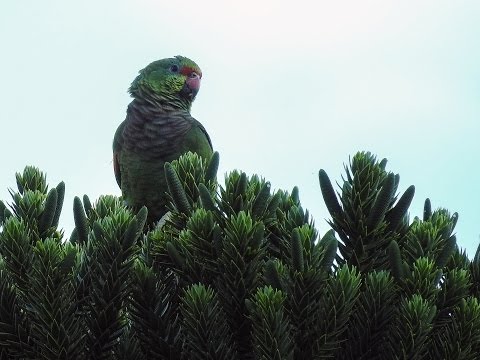
The Vinaceous Parrotinhabit in tropical and subtropical evergreen mixed forests; in the Brazil in humid coastal forests, in the East of Paraguay They can be found in forests Araucaria angustifolia and Euterpe edulis. The extent of the ecological dependence of this species on coniferous trees (Araucaria and Podocorpus) It is not clear, but the Araucaria angustifolia It is clearly important in Missions, Rio Grande do Sul and Santa Catarinaand possibly it was related to the previous distribution further north in southeast Brazil.
Mainly observed in the lowlands, but there are reports of birds seen in hills 1.500-2.000 meters in the southeast of Brazil, where the best forest remnants persist. Usually in pairs or small groups with larger meetings (up to approximately 30) in July-August. In pairs during breeding (usually around September).
Reproduction:
The Vinaceous Parrotnidifica in holes in large trees with obvious preference for the Araucaria angustifolia, including rarely cracks in the cliffs. With reproduce the May in loose colonies. breeding season during the months of September to January. Clutch 2-4 eggs.
After the breeding season (February to July), the species congregate in large groups and community shelters.
Food:
The specific foods of the Vinaceous Parrot include flowers and fruits of Euterpe edulis (which apparently it is important seasonally in East Paraguay), seeds of Araucaria angustifolia, fruits of cocoons of Achatocarpus and new leaves Eucalyptus and seeds of Pilocarpus. It has been reported damagor cause in crops of oranges, but with the current low density of this species, It is unlikely to produce a serious economic impact.
Distribution and status:
Size of its range (player / resident ): 1.230.000 km2
The Vinaceous Parrot It is endemic in Southeast South America.
There are some seasonal movements and post-breeding dispersal, possibly in relation to the food supply (for example, seed availability coniferous trees), with invasions scale reported in Paraguay in the past. Declines in the number of birds occur in Rio Grande do Sul January, with all its people disappeared by March and return in April for the rest of the year.
Formerly abundant and widespread but now there has been a contraction dramatic of its range and population, mainly due to the habitat destruction scale, the expansion of agriculture and floods caused by large hydroelectric dams. also trapped for a long time for bird trade.
Are distributed in several protected areas, but none is large enough to maintain a viable population. The former strongholds in eastern Paraguay They are subject to rapid deforestation, with a recent reduction in its scope and numbers and now probably confined only in Alto Paraná and Ganindeyu.
A census 2007 yielded a minimum of 253 copies in Argentina.
It is perhaps the Amazona more common in populations of Rio Grande do Sul, Santa Catarina and Paraná (several populations of more than 100 birds), in the South of Brazil, and the low number persists in Minas Gerais, Brazil and Sao Paulo, within an estimated total of 1.500-2.000 birds.
Conservation:
State of conservation ⓘ
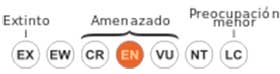
Endangered ⓘ(UICN)ⓘ
• Current category of the Red List of the UICN: In danger of extinction.
• Population trend: Decreasing.
• Population size: 600-1700.
Rationale for the Red List category
This species is classified as endangered due to recent population estimates Brazil They indicate that the world population is very small and has suffered a rapid decline due to loss and fragmentation of habitat, aggravated by the trade. It is necessary to clarify whether Brazilian subpopulations exceed 250 specimens.
Justification of the population
Based on estimates 1.500 to 2.000 individuals in Brazil (G. Bencke in some. 2009), 220-400 in Paraguay and 253 in Argentina (K. Cockle in some. 2009), it is estimated that the total population is within the range of 1.970 -2.650 individuals and is probably positioned within the band 1,000-2,499. This is equivalent to 667-1.666 mature individuals, rounded here to 600-1.700 mature individuals.
Justification of trend
rapid and continuous population decline is suspected because of the Poaching of nests, the habitat destruction and persecution as a pest Of crops.
Conservation Actions Underway
• CITES Appendix I and II and protected by the Brazilian legislation.
• Nationally considered Vulnerable in Brazil (Urben-Filho et al . 2008, MMA 2014), and Critically Endangered in Argentina and Paraguay.
• Small populations are found in numerous protected areas (Wege and Long 1995, F. Olmos in some ., 1999).
• In the Argentina, two young provincial parks are used by the species, but they offer only partial protection because parrots use habitat outside the park for most of its life cycle, including, critically, the reproduction.
• In the Argentine stronghold of the species between San Pedro and Saint Rose, environmental education is underway to reduce the capture of chicks, and the population has been monitored since 2005 (Selva de Pino Paraná in litt project., 2007).
• It has been achieved successful captive breeding.
Conservation Actions Proposed
• Monitor large populations (in March Argentina).
• Study reproductive biology and demography throughout the species' range and develop structured captive breeding programs to counter the high level of poaching of wild populations..
• Protect the general Carneiro (Santa Catarina), Itaipu (Alto Paraná), RNP Itabó Rivas (Canindeyú), Estancia Golondrina (Caaguazu) and forests outside reserves Rio de Janeiro (Snyder et to the ., 2000) and between San Pedro and Saint Rose in Missions.
• Invest in permanently trained park rangers and resolve land tenure problems in Brazilian and Paraguayan reserves. (F. Olmos in some ., 1999, Cockle et al. 2007).
• Apply laws against the trafficking of species on the roads that connect the Monte Pascoal National Park with South Brazil (Snyder et to the ., 2000), in places where the species is captured and at borders and ports Paraguay and Argentina.
• Increase local public awareness to reduce nest theft and promote conservation of nesting sites..
• In Argentina, provide technical support to promote soil conservation, to avoid clearing forests for crops on small farms.
The Vinaceous Parrot in captivity:
The Vinaceous Parrot noted for its easy to imitate the human voice, better and clearer than the Amazona aestiva. Small easily they learn to speak.
Two decades ago, before placement in the Appendix 1 CITES Convention, this species was available in aviculture. It never was imported to Europe in a large number, but nevertheless often it offered for sale. Its price was higher than other species of Amazona available at that time, because of its amazing looks and his talent as an imitator. As the trade in wild birds was coming to an end, the captive population decreased markedly. While this species has been willing to breed for those that provide adequate breeding and have enough individuals to allow natural selection of the mate., captive breeding has been very disappointing, considering the number of birds that were previously available.
In the current avicultura, it seems that there are still a significant number of birds kept in Europe. A survey of amazon parrots in the European zoos, made in 1993 and published in 1994 by the EAZA, he listed in 59 species Vinaceous Parrot conserved in 11 zoological collections: of this, only three, Loro Parque (Spain), Walsrode Bird Park (Germany) and Beauval (France), had recorded breeding successes. It's known, However, that a significant number of Vinaceous Parrot They are held by private poultry farmers Europe and if these owners are willing to work in cooperation with EEP plan that can be started for this species, then the known captive population Europe could be big, enough to be considered as a viable.
The population of this species in captivity is similar to that of other species of the genus Amazona. In Loro Parque a couple is kept in an aviary in the exhibition area of ​​the park, and several more couples are kept in breeding cages suspended in their breeding outside exhibition. Suspended breeding cages are approximately 300 cm long x 95 cm width and height. Each cage has the nest-box placed against the outer rear panel, and there is a cut in the wire hole to allow birds to enter the nest-box. With the nest located outside of the cage, this eliminates the need to enter the service or inspect the nest-box.
The feeding of these birds is done twice a day. To the 7 Morning receive their main dish containing a mixed salad prepared with the following elements: – Apple, pear, tomato, beet, Carrot, alfalfa, lettuce, Peppers, papaya and other fruits and vegetables seasonally available; In addition, They are also used, when available, various fruits that are grown in the park, as nopal cactus plants and berries palmera pindó (Syagrus romanzoffiana). A second smaller dish meal in the morning provides birds commercial pellets dietary, and during the breeding season each pair is also given segments of their own supplement "pie" that is made fresh every day. The evening meal is given to 3:00 pm, with a mixture of nuts, seeds and beans cooked.
The Vinaceous Parrot It was raised for the first time Loro Parque in 1990, when one pigeon was raised hand. The couple proved to be very unreliable when it came to the incubation their eggs, why he has always resorted to artificial incubation or host and breeding. This couple Vinaceous Parrot He received on subsequent occasions eggs more common species to give them the opportunity to prove that they are good parents, but so far they remain unreliable.
No offspring were produced in 1991, but the couple tried again in 1992, when he carried out another manually raising and other raised squab. In 1993, when the same pair joined again, the clutch of eggs was transferred to a pair of Red-crowned Parrot(Amazona viridigenalis), which they proved to be excellent foster parents and raised chicks born. The same technique was used in 1994, but only one egg clutch proved to be fertile and the chick was raised successfully by Red-crowned Parrot.
– Avibase
– Parrots of the World – Forshaw Joseph M
– Parrots A Guide to the Parrots of the World – Tony Juniper & Mike Parr
– Birdlife
– THE VINACEOUS AMAZON Amazona vinacea AT LORO PARQUE – First Published in The Avicultural Magazine Vol. 103 No. 2
– Photos:
(1) – Vinaceous-breasted Amazon (Amazona vinacea) – San Francisco Zoo, California By Dick Daniels (http://carolinabirds.org /) (Own work) [CC BY-SA 3.0 or GFDL], via Wikimedia Commons
(2) – Vinaceous Amazon in captivity at the Rare Species Foundation Programme, Florida, USA By derivative work: Snowmanradio (talk)Amazona_vinacea_-RSFP-8a.jpg: Ruth Rogers [CC BY 2.0 or CC BY 2.0], via Wikimedia Commons
(3) – Vinaceous Amazon at the Walsrode Bird Park, Germany By Quartl (Own work) [CC BY-SA 3.0], via Wikimedia Commons
(4) – Vinaceous Amazon; two in a cage By TJ Lin (originally posted to Flickr as Copy of DSCN3375) [CC BY-SA 2.0], via Wikimedia Commons
(5) – flying. Picture taken in Morretes By Leandro Govoni Lacerda (Own work) [CC BY-SA 4.0], via Wikimedia Commons
(6) – A Vinaceous-breasted Amazon at Parque das Aves, Foz do Iguaçu, Brazil By Kee Yip from Union City, California, USA (IMG_4509_P1040019) [CC BY 2.0], via Wikimedia Commons
(7) – Pigeons neck Amazone (Amazona vinacea) Shot in Palmitospark Gran Canaria By Martingloor (Own work) [CC BY-SA 4.0], via Wikimedia Commons
(8) – Vinaceous-breasted Amazon (Amazona vinacea) – San Francisco Zoo, California By Dick Daniels (http://carolinabirds.org /) (Own work) [CC BY-SA 3.0 or GFDL], via Wikimedia Commons
(9) – Amazone vineuse, Bioparc Doue-la-Fontaine By Melvin TOULLEC (Own work) [CC BY-SA 4.0], via Wikimedia Commons























.JPG)


.jpg)

_(15839019737)_(2).jpg)
.jpg)
_(15838677119)_(2).jpg)


.JPG)

