โ–ท The world of Pets: Dogs, cats, birds, reptiles, amphibians

Blue-fronted Lorikeet
Charmosyna toxopei

Content


Anatomy-parrots

Description

16 cm.. length.

Blue-fronted Lorikeet

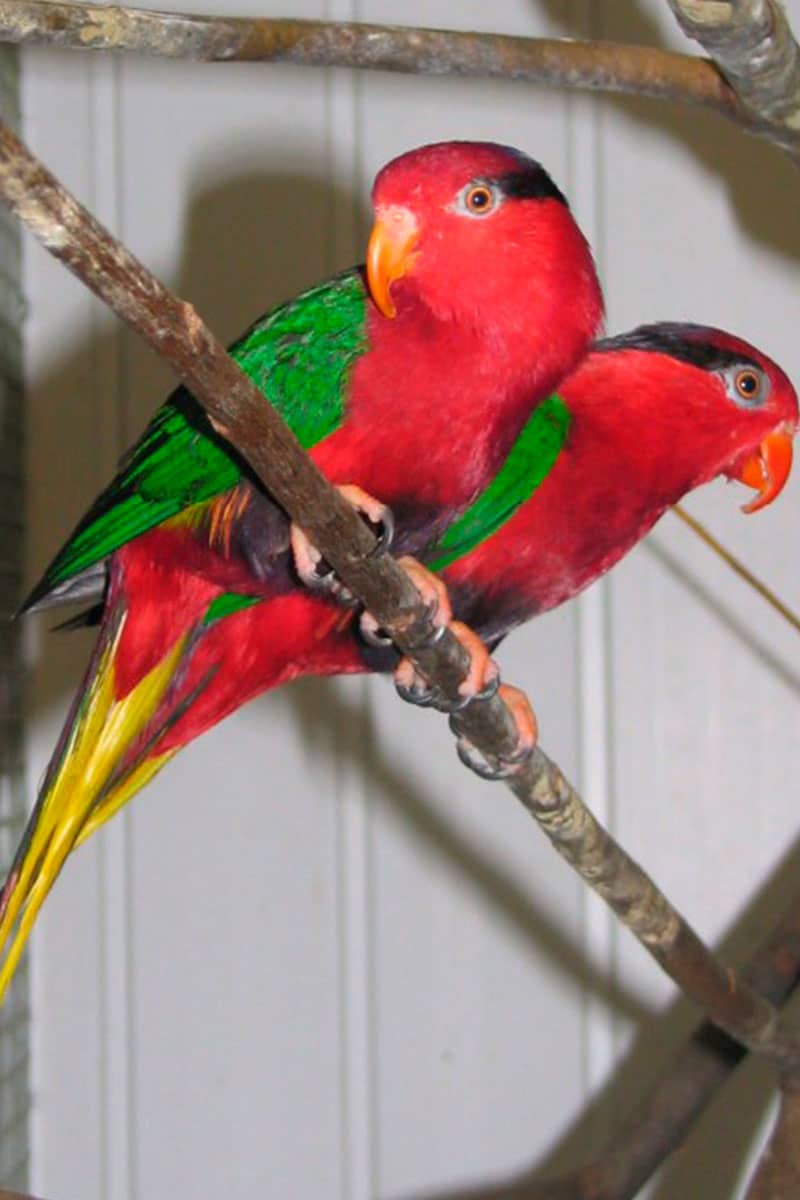
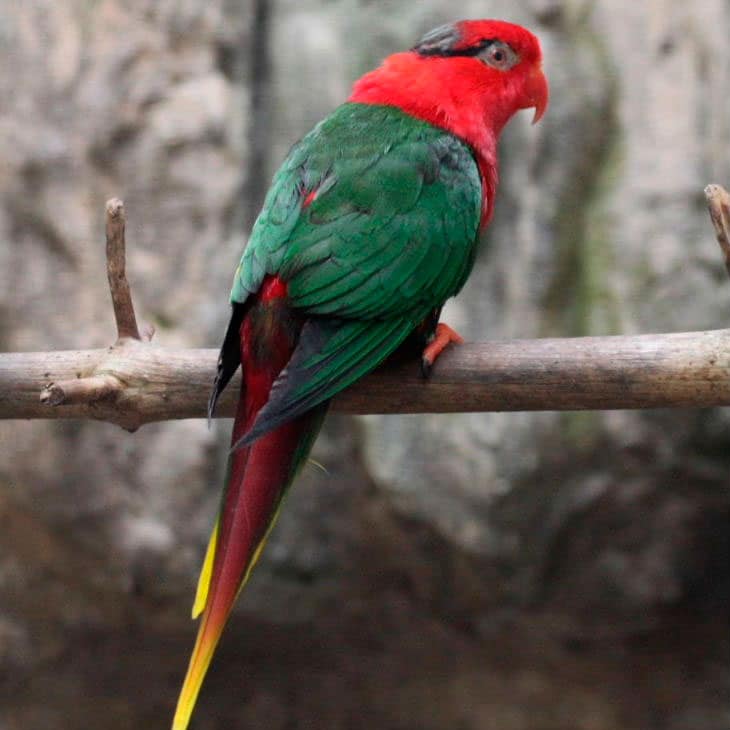
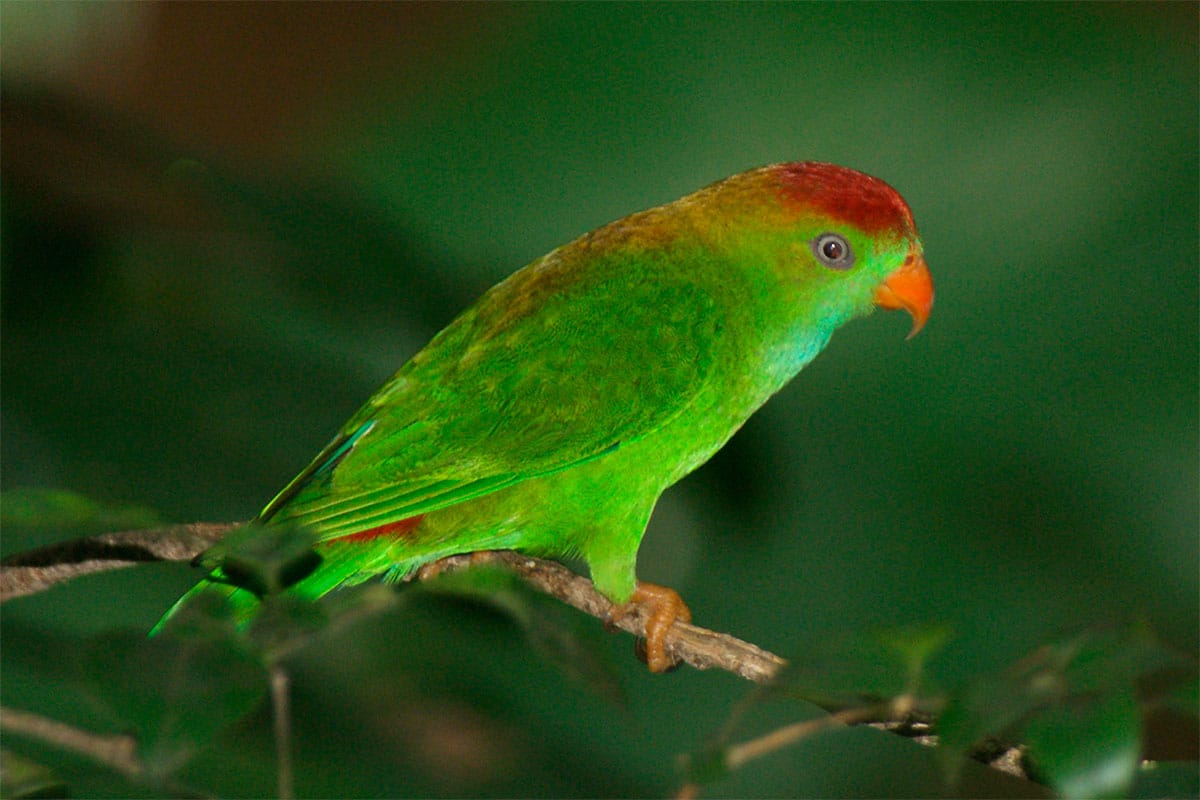
The forecrown of the Blue-fronted Lorikeet (Charmosyna toxopei) is bright green, the front of the crown, above the eyes is bright blue; rest of the head green. Upperparts green, bright in the rump. Wings Green with blackish inner feathers. The underwing-coverts green; flight feather Blackish with yellow band in the whole lower part of the secondaries. The underparts brighter yellowish green. Tail green, with red bases and blackish stain. The bill orange; the irises yellow orange; legs orange-red.

Habitat:

If recent observations were in fact of the Blue-fronted Lorikeet, species can be nomadic, moving from high to low altitude on the basis of the availability of food (like some other small parrots). This could explain the paucity of records, especially for a species already by itself it is distributed sparsely. The other possibility is that the birds are distributed only in the forested hills.

Interviews with local residents suggest that the species moved to the lowlands during the two annual seasons of heat, in March-April and August-November.

Reproduction:

There is no data.

Food:

The locals who live in the plateau frog They reported that the bird feeds on nectar and pollen from the trees in flower.

Distribution:

Endemic to Buru, Indonesian. Obviously, is a rare species, and virtually nothing is known of its State. The original specimens were collected in the wooded hills between 850 m and 1.000 m.

In 1980 the species was reported to be quite common in plantations, secondary and primary forest, but this record has been suggested as a reference to the Red-flanked Lorikeet (Charmosyna placentis) (the record of this species from Buru It is in fact wrong). In 1989 two flocks of five to six birds, supposedly this species, they were seen during a selective felling of forests to 600 meters on the Teluk Bara. There is also a report of 1993 of four small unidentified parakeets seen in the same area as the observations of 1.980. The species are now considered endangered by Birdlife International, although a thorough search must be carried out before its status can be fully determined. VULNERABLE.

Conservation:


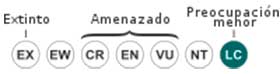
critical hazard

โ€ข Current IUCN Red List category: Critical Hazard

โ€ข Population trend: Decreasing

โ€ข Population size: 50-249 mature individuals

Although there are few records (confirmed or unconfirmed) of the species, It is suspected that it is declining due to loss of forests in the lowlands.

Most of the forests in the coastal lowlands of Buru have they been clarified, and much of the forest in the northern part of the island has been connected shape selective or degraded and fragmented by migratory agriculture, in such a way that only a few small patches of lowland primary forest remain. But, the island's gardens still contain many indigenous tree species. In 2010, There was at least one search operation on a large scale above Buru, located in the lowlands. But, extensive forests of mountain of the island remain largely without being scanned. The topography of the mountain range Kaplamandan is the hope that almost all of the montane forest is inaccessible to loggers (A. Gray in litt. 2010).

All of the original specimens were captured alive using lime, However, the species is not kept as a pet, does not seem to be listed. Have a distribution of mountain which is close to the maximum altitude within its distribution area, does this species is potentially susceptible to climate change (BirdLife International data not publ.).

"Blue-fronted Lorikeet" in captivity:

Not found in captivity.

Alternative names:

Blue-fronted Lorikeet, Blue fronted Lorikeet, Buru Lorikeet (ingles).
Lori de Buru (French).
Burolori, Burulori (German).
Lori de Buru (espaรฑol).

scientific classification:

Order: Psittaciformes
Family: Psittaculidae
Genus: Charmosyna
Scientific name: Charmosyna toxopei
Citation: (Siebers, 1930)
Protonimo: Hypocharmosyna toxopei

Images "Blue-fronted Lorikeet"

————————————————————————————————

ยซLori de Buruยป (Charmosyna toxopei)


Sources:

Avibase
– Parrots of the World โ€“ Forshaw Joseph M
– Parrots A Guide to the Parrots of the World – Tony Juniper & Mike Parr
– Birdlife

โ–ท The world of Pets: Dogs, cats, birds, reptiles, amphibians

Pygmy hanging parrot
Loriculus exilis

Pygmy hanging parrot

Content


Anatomy-parrots

Description

10 to 11 cm.. length.

Pygmy hanging parrot

The head of the Pygmy hanging parrot (Loriculus exilis) is green, brighter around the base of the bill and bathed in bluish green at the chin, the throat, the cheeks and the part front of it crown.

The underparts is green, with the rump and uppertail-coverts dark red (very extended below the tail); the sides and the base of the rump are greenish-yellow. Wings green. Under, the wings Turquoise with coverts green. Throat of color red bordered of blue pale and extending is about part superior of the chest; rest of the underparts green, slightly more clear that the upperparts. The tail, at the top, Green with yellowish tips; undertail, the tail is of a pale color green blue.

The bill coral red; irises yellow; legs oranges.

The females lack of the bib red (or have very small bib). Also have a reduced blue diffusion in the chest and irises brown.

The young birds they have a bib Red small, a bill yellowish brown, and a pale brown iris.

Habitat:

Usually little-known. It is distributed by forests, coastal mangroves, around the villages and in the open field, from the lowlands to the wooded hills to some 1.000 m, altitudes and in similar habitats to the of the Great hanging parrot.

The birds are found in groups of up to five copies, feeding in the canopy of figs or the trees in flower nectar; their power moves have been compared with the movements of crawling in the Pygmy Parrot Micropsitta. Larger flocks have been found in the mangroves during may, Although the species can reproduce twice a year, in February and August; it is not known if these represent post-breeding concentrations or nomadic groups.

Reproduction:

A hole in a dead palm tree is the only known record of a zone of nesting.

Food:

Feeds of figs or nectar.

Distribution:

Size of the area of distribution (reproduction / resident): 103.000 km2

Endemic to Sulawesi, where is located from the North, on Minahassa Peninsula, to the South.

Conservation:


Near-threatened


โ€ข Current IUCN Red List category: Near threatened

โ€ข Population trend: Decreasing

The size of the world population It has not been quantified, Although it is estimated at more than 10.000 specimens. The species is described as uncommon and rare.

There are no data on trends in the population, but the species is suspected to be decreasing at a moderately fast pace, due to degradation of the habitat.

"Pygmy hanging parrot" in captivity:

Very rare in captivity.

Alternative names:

Red-billed Hanging-Parrot, Celebes Lilliput Hanging-Parrot, Green Hanging Parrot, Green Hanging-Parrot, Lilliput Hanging-Parrot, Pygmy Hanging Parrot, Pygmy Hanging-Parrot, Red billed Hanging Parrot, Red-billed Hanging Parrot, Talabula Hanging-Parrot (ingles).
Coryllis vert (French).
Dรคumlingspapageichen, Dรคumlings-Papageichen (German).
Lorรญculo Exiguo (Portuguese).
Lorรญculo Exiguo (espaรฑol).

scientific classification:

Order: Psittaciformes
Family: Psittaculidae
Genus: Loriculus
Scientific name: Loriculus exilis
Citation: Schlegel, 1866
Protonimo: Loriculus exilis

Videos "Pygmy hanging parrot"

Videos "Pygmy hanging parrot"

————————————————————————————————

"Meager Parrot" (Loriculus exilis)


Sources:

Avibase
– Parrots of the World โ€“ Forshaw Joseph M
– Parrots A Guide to the Parrots of the World – Tony Juniper & Mike Parr
– Birdlife

Photos:

(1) – By Peter Waanders – Caged female has attracted wild male. lynx
(2) – Loriculus exilis by John Gerrard Keulemans [Public domain], via Wikimedia Commons

Sounds: Mike Nelson (Xeno-canto)

โ–ท The world of Pets: Dogs, cats, birds, reptiles, amphibians

Orange-breasted Fig-Parrot
Cyclopsitta gulielmitertii

Orange-breasted Fig-Parrot

Content


Anatomy-parrots

Description

11 to 13 cm.. length and a weight between 27 and 34 g..

The forecrown of the Orange-breasted Fig-Parrot (Cyclopsitta gulielmitertii), back of the crown and area behind the eyes are a deep blue; pale yellow the lores, throat and both sides of the head; black spot on the back of the cheek; Orange the top part of the abdomen; the interior of the wing-coverts Yellow-edged; wide bands of pale yellow under the wings. Bill blackish gray. The eyes dark brown.

The female similar to the male, but pale yellow on the front of the cheeks black and white on the back. Frontal of the cheeks bordered below green with blue stripe; the ear-coverts on both sides of neck, orange; underparts green.

The immature as females, but orange, Since the ear-coverts and sides neck to the area below, faced with the cheeks; chest male washed with orange-brown.

Subspecies description

Description of the 7 subspecies
  • Cyclopsitta gulielmitertii gulielmitertii

    (Schlegel, 1866) – The nominal


  • Cyclopsitta gulielmitertii nigrifrons

    (Reichenow, 1891) – 13 cm.. length. Area of the forecrown, crown and behind the eye, black. Female without chest Neither abdomen orange, cheeks white-yellowish color bordered by a blackish band. back of the cheeks and headphones feathers bright orange. Under black band greenish blue. The youth they are equal to adults.


  • Cyclopsitta gulielmitertii ramuensis

    (Neumann, 1915) – It is more small, of about 11 cm.., with the area of the forecrown, crown and behind the eye Black interspersed with dark blue, cheeks and headphones feathers whitish in colour. Breast and abdomen cream color. females as males but behind the eye and cheeks with a broad black patch interspersed with dark blue. Breast whitish interspersed with orange feathers. Abdomen brighter yellowish green. The youth equal to adults.


  • Cyclopsitta gulielmitertii amabilis

    (Reichenow, 1891) – It is more small, a few 11 cm.. Forehead, crown and rear of the eye matte black. Cheeks Black interspersed with dark blue. females similar to the males but with the patch from behind the eye Black interspersed with dark blue matte. Headphones feathers whitish. The juveniles as in adult females but with the upper part of the chest greener


  • Cyclopsitta gulielmitertii suavissima

    (Salvadori, 1876) – Smaller, a few 11 cm.., area of the forecrown, crown and behind the eye blue color, great patch on cheek black. Headphones feathers and cheeks white-yellowish color and chest and top of the abdomen reddish orange. The female It has a hue of different reddish orange and black spot of the cheek is Matt and interspersed with dark blue color. The youth adult females are, but marks of the head they are more off.


  • Cyclopsitta gulielmitertii fuscifrons

    (Salvadori, 1876) – As the diophthalma gulielmitertii suavissima but the area of the forecrown, crown and back of the eye, blackish brown. The females similar to the Cyclopsitta gulielmitertii suavissima but back of the cheeks, front and behind the eyes blackish brown. The youth as adult females.


  • Cyclopsitta gulielmitertii melanogenia

    (Rosenberg,HKB, 1866) – Of 11 cm.. length. The male is as the diophthalma gulielmitertii suavissima, the female also with the fused in light green Orange tones in the abdomen. The youth are like adults.

Habitat:

It is distributed in the rainforest, swamp forest, forest of Melaleuca , dense sheets and partially cleared areas from sea level to a 300 meters above sea level, rarely recorded in higher altitudes to the 800 m, the largest known altitude is 1.100 m.

They are usually in small groups assets of 6 to 10 individuals, whether it is flying above the treetops, or congregate where can feed on figs and other fruits in the canopy or plants at lower levels.

Bird feeding can be hard to spot, since they climb around the silent tree trunks, although they can pivot upside down as they feed, sometimes dropping food.

Reproduction:

The nests of the Orange-breasted Fig-Parrot found in arboreal termite, at the top of the trees of the forest. Up to three holes can be dug., and nesting they can be community. The nests also found at the base of a complex of epiphytes. There is little information available upon the breeding season, activity in apparent nests have been observed between the months of September and June. These sites can, However also, have been used to settle, and a record in January of a male regurgitating food near an entrance hole probably indicates breeding during that month at least..

Food:

The diet includes seeds of figs and other fruits, as well as small whole figs, nectar flower e insects occasional.

Distribution:

Widely distributed, abundant and easily observable in the lowland tropical rainforest, throughout much of New Guinea. The Orange-breasted Fig-Parrot most Western they are isolated, only seen in Salawati in the West of the islands of papua, and in the lowlands of theDoberai Peninsula, West Papua.

In other parts of New Guinea the range is continuous through the lowlands of the North of the eastern edge of Yellowfinch Bay around the memberamo river, throughout the region of the Sepik River and the lowlands of the Huon Peninsula, to Milne Bay, at the eastern end.

The range continues west through the southern lowlands of New Guinea through the Purari and Fly River regions to the southeastern lowlands of West Papua, on the 138 ยฐ E; also in the islas Aru.

The Orange-breasted Fig-Parrot seems to be more common in southern New Guinea in the North.

Subspecies distribution

Distribution of the 7 subspecies
  • Cyclopsitta gulielmitertii gulielmitertii

    : The nominal


  • Cyclopsitta gulielmitertii nigrifrons

    : North of New Guinea between Mamberamo and Sepik Rivers.


  • Cyclopsitta gulielmitertii ramuensis

    : District Ramu River, North of Papua New Guinea; It is thought that it may be a cross between the nigrifrons and the amabilis, therefore, probably not a valid subspecies.


  • Cyclopsitta gulielmitertii amabilis

    : Northwest of Papua New Guinea from peninsula Huon to Milne Bay.


  • Cyclopsitta gulielmitertii suavissima

    : Southwest of Papua New Guinea West of Gulf of Papua.


  • Cyclopsitta gulielmitertii fuscifrons

    : South of New Guinea between Mimika and Fly Rivers.


  • Cyclopsitta gulielmitertii melanogenia

    : Aru Islands, Indonesian.

Conservation:


minor concern


โ€ข Current IUCN Red List category: Least concern

โ€ข Population trend: Stable


The size of the world population It has not been quantified, due to the recent taxonomic divisions, Although it is estimated above 100,000 specimens.

The population suspected to be stable in the absence of evidence of any reduction or substantial threats.


"Orange-breasted Fig-Parrot" in captivity:

Rare in captivity.

Alternative names:

Orange-breasted Fig-Parrot, Blue-fronted Fig-parrot, Orange-breasted Fig Parrot, Orange-breasted Fig-Parrot (nominate), Orange-breasted Fig-Parrot (Orange-breasted) (ingles).
Psittacule ร  poitrine orange, Psittacule ร  poitrine orange (nominal), Psittacule ร  poitrine orange (nominale), Psittacule ร  poitrine orange (race nominale) (French).
Orangebrust-Zwergpapgei (German).
Cyclopsitta gulielmitertii (Portuguese).
Lorito de Pecho Naranja, Lorito Pechinaranja (espaรฑol).

scientific classification:

Order: Psittaciformes
Family: Psittaculidae
Scientific name: Cyclopsitta gulielmitertii
Citation: (Schlegel, 1866)
Protonimo: Psittacula gulielmi III

Images ยซOrange Breasted Parrotยป:

Videos "Orange-breasted Fig-Parrot"

————————————————————————————————

ยซOrange Breasted Parrotยป (Cyclopsitta gulielmitertii)


Sources:

Avibase
– Parrots of the World โ€“ Forshaw Joseph M
– Parrots A Guide to the Parrots of the World – Tony Juniper & Mike Parr
– Birdlife
– Loromania

Photos:

(1) – animalphotos
(2) – A female Orange-breasted Fig-parrot in the Walsrode Bird Park, Germany By Quartl (Own work) [CC BY-SA 3.0], via Wikimedia Commons
(3) – A male Orange-breasted Fig-parrot in the Walsrode Bird Park, Germany – ยซCyclopsitta gulielmitertii qtl1ยป by QuartlOwn work. Licensed under CC BY-SA 3.0 via Wikimedia Commons.
(4) – Birds-pet-wallpapers
(5) – animalphotos

Sounds: Frank Lambert (Xeno-canto)
โ–ท The world of Pets: Dogs, cats, birds, reptiles, amphibians

Green Racquet-tail
Prioniturus luconensis


Green Racquet-tail

Content

Description

29 cm.. length.

The Green Racquet-tail (Prioniturus luconensis) has the head of color green light, impregnated of green yellowish around them lores and the base of the bill. Mantle light green, slightly yellowish. Wings green; vane outer, the first three primaries green, impregnated blue; vane Dark internal, the more internal with pale inner edge. Wing feathers greenish yellow, underside of flight feather impregnated of blue dark. The underparts brighter yellowish green, more yellow in the undertail-coverts. Upper, the tail green, lateral feathers strongly impregnated dark bluish-green and dark-tipped; undertail, the tail bluish.

Bill grey bluish pale ; irises dark brown; legs grey.

The female has the rackets of the tail shorter.

The juveniles they do not have rackets on tail.

Habitat:

Previously reported in the strata media of the land low of forest primary, and in the nearby cornfields, mostly below 700 m. Recent records are from small groups of a maximum of seven birds that live most degraded or selectively, in exploited forests outside of settlements.

Reproduction:

Young have been observed in Luzon during the month of may. The nest It , apparently, a hollow tree. Little more is known about the habits of this rare Parrot.

Food:

The diet includes fruit, Tender corn, rice, seeds and flowers.

Distribution:

Size of the area of distribution (reproduction / resident): 93.500 km2

Endemic to Luzon and Marinduque, North of Philippines. Although the species was considered quite common at the end of the last century in the center of Luzon, seems to have suffered a rapid decline in recent years. Has not been registered in the Cordillera Central in this century, and now you can have their stronghold in the Sierra Madre, where it was reported to be generally rare or uncommon in the decade of 1990. It is rare in all currently considered Luzon except perhaps in the Subic Bay Naval Reserve Forest (Bataan, to the East of Manila). There are no recent records of Marinduque.

Conservation:


Endangered


โ€ข Current category of the Red List of the UICN: Danger

โ€ข Population trend: Decreasing

The population is in the band of 1,000 to 2,499 mature individuals.

The threats by the tala generalized and their captures to the trade of birds of cage, suggest that this species is experiencing a downhill fast in the population.

There is no national legislation to protect trade and hunting, Although this is often violated. It is currently known from two protected areas, the Bataan Natural Park / Subic Bay forest reserve and the Parque Natural del North Sierra Madre. Receive nominal protection in the Maria Aurora Memorial Park.

In captivity:

Parrot moderately loud, with nice voice. New birds are highly susceptible to diseases. Initially shy, but eventually he acclimatizes to the caregiver.

Practically unknown in captivity.

Alternative names:

Green Racquet-tail, Green Racket-tail, Green Racket-tailed Parrot, Green Racquet tail, Green Racquet-tail Parrot, Green Racquet-tailed Parrot, Green recket-tailed parrot, Green-crowned Racket-tailed Parrot, Green-headed Racket-tailed Parrot, Green-headed Racquet-tailed Parrot (ingles).
Palette verte, Perroquet ร  raquette verte (francรฉs).
Luzon-Spatelschwanzpapagei, Luzonpapagei (alemรกn).
Prioniturus luconensis (portuguรฉs).
Lorito momoto de Luzรณn, Lorito Momoto Verde, Lorito-momoto de Luzรณn (espaรฑol).

scientific classification:

Order: Psittaciformes
Family: Psittaculidae
Genus: Prioniturus
Scientific name: Prioniturus luconensis
Citation: Steere, 1890
Protonimo: Prioniturus Luconensis

Images "Green Racquet-tail"

Videos "Green Racquet-tail"

————————————————————————————————

ยซLuzon Motmock Parrotยป (Prioniturus luconensis)

Sources:

Avibase
– Parrots of the World โ€“ Forshaw Joseph M
– Parrots A Guide to the Parrots of the World – Tony Juniper & Mike Parr
– Birdlife

Photos:

(1) – By marco cooked – Forum of The European Ornithological Association

Sounds: Cedric MROCZKO (Xeno-canto)

โ–ท The world of Pets: Dogs, cats, birds, reptiles, amphibians

Superb parrot
Polytelis swainsonii

Superb parrot

Content


Anatomy-parrots

Description

40 cm.. length between 132 and 157 g. of weight.

The Superb parrot (Polytelis swainsonii) has the front, crown, Chin and throat of bright yellow; back of the bright green Crown with turquoise blue wash: headphones coverts and Lords, green. Bright green upper parts. Upper, the wings, bright green, with dark diffusion in the inner margins of the vane internal and blue diffusion in vane outer (fine yellow rear margin for flight feathers); bluish carpal edge: light blue primary coverts; primary elongated.

Wing of bright green feathers; bottom of blackish brown flight feathers. Underparts pale bright green, with thin bright red Ruff between throat yellow and green at the top of the chest. Upper, bright green tail, with dark elongated Central feathers Slightly bulbous tips. outer feathers with bluish edges vane outer. The lower part of the tail is black.

Bill, coral red; yellow-orange irises; Blackish legs.

The female is completely Green, with a bath pink Brown throat and with the headphones cinnamon and the Crown of blue-grey. The mantle is more off, more greenish Brown, contrasting with the Green rump and dark flight feathers. The underparts are paler, orange-red legs. She also has distinctive pink trim and pink tips to yellow vane internal bottom of the queue.

Yellow IRIS.

Immature as females but with Brown iris. Males attain adult plumage in about 12 months.

Habitat:

Superb parrot

A part of the population of the Superb parrot is migratory, wintering in the North of the breeding areas.

Habitat preferences of breeding populations vary slightly from east to west within the slopes of the Great dividing range and open areas in forests of eucalyptus, It is the dominant vegetation type. Here the species nests far from watercourses, and it uses a variety of tree species.
In the region of Riverina, to the West, birds breed almost exclusively on the banks of rivers, in forests of Eucalyptus camaldulensis, feeding on nearby forests of Eucalyptus bicolor, Eucalyptus melliodora and White Pino-CIPRES (Callitris columellaris).

They sometimes also found in farmland and villages.

The size of the flocks are usually small, but groups of up to 100 individuals have been recorded after the breeding season.

The superb Parrot feed in the trees, in the understory, and also in land, where can be accessible, feeding on spilled grain on the roadsides and keeping the company of the Yellow Rosella and Cockatoos.

Reproduction:

The breeding season of the Superb parrot is from September to November.
Male parade making small greetings and nodding his head. Both members of the couple make ritual exchanges of food.

The nest is usually a hollow, full of scrap wood, at the top of a tree dead or alive and a considerable height that is usually between 11 and 51 meters above the ground. The individual sites tend to be reused.

The Superb parrot, they often nest in colonies ranging up to six couples. Spawning contains 4 or 6 eggs which are incubated for at least 20 days. The chicks are altricial and leave the nest after 30 days.

Food:

The diet includes fruits and flowers of Acacia and eucalyptus, fruit shrubs (for example Exocarpos); seeds of crops, pastures, weeds and grasses

Distribution:

Size of the area of distribution (reproduction / resident): 95.300 km2

The Superb parrot they are endemic in Australia, where are distributed only in New South Wales and the north end of Victoria.

The species are concentrated in two main areas: on the South-West slope of the Great dividing range (regions of Cowra, Boorowa, Cootamundra and Yass), and in the area of Riverina, New Wales of the itsr. In the latter the range extends along the murrumbidgee river, from There is a to Darlington Point, Narrandera and Wagga Wagga.

Also found in the North of Goolgowi and the river lachlan, and in South, in the rivers Edward and Murray (Barham. Deniliquin, Tocumwal, Cobram, Getafe and Albury).

In the North of Victoria, concentrated along the rivers Goulburn and Ovens, and in the area of Barmah Forest.

Wandering birds occasionally appear more to the West, along the border of Victoria and New South Wales.

The Superb parrot, do not normally breed above 33ยฐ S, but at least part of the population disperses north to 33ยฐ S at the end of the breeding season.

These birds are found from April to August in the northeast of New South Wales from Gunnedah to Narrabri, Gilgandra and Coonamble, and between river systems to the West (Barwon, Namoi, Macquarie, Castlereagh, Marthaguy Creek).

Occasionally, alleged migratory birds, They fly to the West, about Tottenham and Hermidale.

Escapes have been recorded around Sydney and Melbourne.

A moderate number of captive.

Protected by law.

Conservation:


minor concern


โ€ข Current category of the Red List of the UICN: Least concern

โ€ข Population trend: Stable

Its population, apparently, fell in 1920 as an accidental effect of a poisoning by the crop protection.

A panel of experts considered that it was very likely that the population in 2010 exceeds the 10.000 mature individuals. The current estimate ranges in the Strip between 10.000 and 20.000 specimens.

The general trend of the population of the Superb parrot (Polytelis swainsonii) is uncertain, but there is no evidence of a continuous decline.

In Australia is also classified as vulnerable species the law of protection of the environment and conservation of the biodiversidadad of 1999. In addition, its conservation status varies between states., for example in the law of Victoria (1988) is considered to be threatened species.

"Superb parrot" in captivity:

Take it easy, relatively little aggressive with other birds, and very social.

Una muestra viviรณ 15,1 years in captivity. According to sources, these animals can live up to 24,2 years in captivity, It is possible to, but the source is not verified; the same study reported that these animals can reproduce in approximately 2 years of age in captivity.

Pretty common in captivity, above all in Australia.

Alternative names:

Superb Parrot, Barraband, Barraband Parakeet, Barraband Parrot, Green Leek, Scarlet-breasted Parrot (ingles).
Perruche de Barraband, Perruche Barraband, Perruche superbe (French).
Schildsittich (German).
Periquito-soberbo (Portuguese).
Perico Soberbio, Periquito de Barraband (espaรฑol).

scientific classification:

Order: Psittaciformes
Family: Psittaculidae
Genus: Polytelis
Scientific name: Polytelis swainsonii
Citation: (Desmarest, 1826)
Protonimo: Psittacus Swainsonii

Images ยซSuperb Parakeetยป:

Videos "Superb parrot"

————————————————————————————————

ยซSuperb Parakeetยป (Polytelis swainsonii)


Sources:

Avibase
– Parrots of the World โ€“ Forshaw Joseph M
– Parrots A Guide to the Parrots of the World – Tony Juniper & Mike Parr
– Birdlife
– The Animal Ageing and Longevity Database – Polytelis swainsonii

Photos:

(1) – By paulgear (Picasa Web Albums) [CC BY-SA 3.0], via Wikimedia Commons
(2) – Image Credit: Stuart Harris – Canberra Birds
(3) – Image Credit: Julian Robinson – Canberra Birds
(4) – Image Credit: Stuart Harris – Canberra Birds
(5) – Image Credit: Julian Robinson – Canberra Birds

Sounds: Ding Li Yong (Xeno-canto)

โ–ท The world of Pets: Dogs, cats, birds, reptiles, amphibians

Bluebonnet
Northiella haematogaster


Bluebonnet

Content


Anatomy-parrots

Description

28 cm. length and a weight between 74 and 105 g..

The Bluebonnet (Northiella haematogaster) they have the forecrown, lores and face, blue-violet color. The rest of the head, the chest, the layer, the back and rump It has a beautiful ochre mixed with yellow belly. The abdominal area It is covered by a large red spot.

The curvature of the wings is blue, most of the coverts are a key olive. The outermost feathers are purplish blue. The the wing lower and flight feather they are also blue-purple. The tail color is greenish bronze but the outer feathers they are blue-purple with white tips.
The bill grayish white is; the irises pale grey; legs grey.

The females they are more off, with less blue in the face and a pale bar on the wing .

The immature they resemble females, but the stain abdominal Red is more discrete. The immature plumage is lost after few months. The chicks have the bill yellow.

Subspecies description

  • Northiella haematogaster haematogaster

    (Gould 1838) – The nominal.


  • Northiella haematogaster haematorrhoa

    (Bonaparte 1856) – The curvature of the wing is turquoise blue and the blankets they are redheads. The underparts is red


  • Northiella haematogaster pallescens

    (Salvadori 1891) – The plumage It is similar to the nominal, but the underparts they are paler.


  • *

    Northiella haematogaster narethae

    (White,HL 1921) – The forecrown is blue, and has spots on the chest. The upperparts color is olive, the underparts is yellow with reddish color underneath the tail. Small outer covers red.

  • * A molecular study published in 2015 by Gaynor Dolman and Leo Joseph He confirmed the genetic isolation of the subspecies Northiella haematogaster narethae and recommended that it was restored as a separate species, the Naretha Bluebonnet (Northiella narethae)

Habitat:

The Bluebonnet frequent arid and semi-arid forests dominated by trees of the genus Myoporum, which are perennial shrubs and resistant to salt and drought.

They also appreciate the conifer and the casuarinas that you are home to colonies of caterpillars. They have a certain affection for the acacias and eucalyptus, especially if the weed is made up of small quenopodios.

The Bluebonnet they often visit the grassy plains, dry brush and trees lining the river. Sometimes they come to buildings, farms or small ponds.

In the South of its range, the removal of waste bags of Mallee, located on agricultural land, It seems to have had a very important influence.

The Bluebonnet they live in pairs or in small groups. When resent, loud disperse, but they remain on the ground a short distance from the trees. In the event of alarm, they raise the feathers of her eyebrows.

These birds are very enable, especially early in the morning when the boisterous groups are formed, just before his departure to feed. They are able to run very fast and have a very characteristic straight posture.. They are less active during the heat of the day, staying on the ground in silence.

The Western populations They seem to form larger groups, showing more sociability than the Eastern. They tend to get together with other species of parrots, such as the Mulga Parrot, Pale-headed Rosella and Mallee Ringneck.

During the spawning, the Bluebonnet carried out parades such as greetings with head, movements of the tail and eating ritual exchanges. They also have a ceremonial flight consisting of small flapping.

Reproduction:

The season of nesting extends from July to December, with some variations depending on the rains. The nest is located in a cavity in a tree, except in the subspecies narethae to use scrubby trees, being their favorite nesting place a nest on the ground in a crack in the base of a trunk. This subspecies usually gives preference to a tree of the genus acacia (Acacia papyrocarpa) family Fabaceae.

The spawning contains 4-7 eggs with one incubation lasts a few 19 days. The young chicks are born without feathers and remain in place of birth at least during 30 days.

Food:

The Bluebonnet consume mainly herbaceous seeds, of Atriplex hortensis, of coquia (Kochia scoparia), of bassia and some grown as garden plants.

Sometimes consume fruit, berries and acacia flowers, the mistletoe and the larvae of Lepidoptera that are attracted to the trunks of casuarinas.

When are juveniles, its menu consists mainly of seeds composed of helipterum, that you belong to the same family as sunflowers.

Distribution:

Endemic to Australia, where there are four populations, one of which is isolated in the southeast of Western Australia, from the West of the Nullarbor plain up close Kalgoorlie.

Birds belonging to this western race are also found in western Southern Australia, about Ooldea and Colon, but they are probably coming from exhausts. further east, the range of the species varies through the east of Southern Australia, from the West of Bordertown through Salt Creek, Adelaide, the northern parts of the Cape York Peninsula and Eyre, to the North across the basin of the Lake Eyre to the Simpson Desert, about Commonwealth Hill station (but largely absent from the Montes Flinders).

From the North of Southern Australia, extends to the South of Queensland to the West of the Great dividing range, reaching around to East of Windorah, Charleville, Mitchell and Goondiwindi.

In New South Wales found to the West of the Cordillera Central, and coming east of a line, More or less, that crosses Warialda, Orange and Wagga Wagga (record out of bounds east of Gunning).

In Victoria, from time to time, they arrive as far East as Rochester and Southeast of Bendigo and Beaufort.

The species is common within a suitable habitat.

The world population is probably superior to the 100.000 individuals, although the Western subspecies Nanthae You can have less than 5.000 specimens, having suffered for their catch in the past.

A small number of captivity.

Fully protected by law.

Subspecies distribution

Conservation:


minor concern


โ€ข Current category of the Red List of the UICN: Least concern

โ€ข Population Trend: Decreasing

In accordance with the Manual of the birds of the world (Handbook of the Birds of the World, HBW), the Bluebonnet they are not globally threatened. Son fairly common, except at the extremes of its range. But, the elucidation of native plants must be stopped if we want to preserve the food resources and nesting places.

The spread of the Common Starling (Sturnus vulgaris) It is a real danger in some areas. The subspecies Narethae is prized by poachers and the lots of beautiful feathers.

The proliferation of rabbits and Lagomorphs threatens the equilibrium of the habitat.

"Bluebonnet" in captivity:

The Bluebonnet they were classified for more than one hundred years within the genus Psephotus. On the basis of some essential differences with the species Psephotus, they are currently classified within the independent genre Northiella.

The parakeet more required by lovers of Australian parakeets, are likely to be the Bluebonnet, Although the subspecies Naretha is very rare and scarce. The Bluebonnet pure breed, they are virtually non-existent in Europe.

There are many Bluebonnet non-purebred, since they often interbreed with the of red-bellied (Northiella haematogaster haematorrhoa). The birds that have tones rojas in the coverts infracaudales non-purebred. Be very careful when making their acquisitions.

The first breeding success of the nominal species dates back to the year 1878, in France. With the subspecies of red-bellied (Northiella haematogaster haematorrhoa) also data from 1878, but this time in Belgium.

The first breeding results with the subspecies Northiella narethae they date from 1941 in Australia.

Are capricious in nature. The big problem is that of aggression since they are probably the most aggressive of all the Australian parakeets. Males, above all, they are the protagonists of this bad reputation. Therefore other birds not can be joined with the Bluebonnet, even larger birds.

The aggressiveness of the male reaches their own partner, the Aviary must take into account this, the female should be able to take refuge in case of attack. On the other hand, they are very animated and jugetones.

You spend much time on the ground looking for food, they are moderate rodents and are lovers of bath.

According to sources, a sample lived 15,3 years in captivity. In captivity, these animals have been known that they be reproduced in approximately 2 years of age.

Alternative names:

Bluebonnet, Blue Bonnet, Blue-Bonnet, Bluebonnet Parakeet, Bulloak Parrot, Common Bluebonnet, Common Bluebonnet Parrot, Crimson-bellied Parakeet, Crimson-bellied Parrot, Eastern or Western Bluebonnet, Little Bluebonnet, Naretha Bluebonnet, Naretha Parrot, Oak Parrot, Pallid Parrot, Red-bellied Bluebonnet, Red-vented Bluebonnet, Yellow-vented Bluebonnet, Yellow-vented Parrot (ingles).
Perruche ร  bonnet bleu, Bonnet bleu, Perruche ร  bonnet bleu ou P. de Nareth (French).
Blutbauchsittich (German).
Periquito-de-bluebonnet (Portuguese).
Perico Azul, Perico Cariazul (espaรฑol).

scientific classification:

Order: Psittaciformes
Family: Psittaculidae
Genus: Northiella
Scientific name: Northiella haematogaster
Citation: (Gould, 1838)
Protonimo: Platycercus haematogaster

โ€œBlue-faced Parakeetโ€ images:

Videos "Bluebonnet"

ยซBlue-faced Parakeetยป (Northiella haematogaster)

Sources:

  • Avibase
  • Parrots of the World โ€“ Forshaw Joseph M
  • Parrots A Guide to the Parrots of the World – Tony Juniper & Mike Parr
  • Birdlife

Photos:

(1) – To Blue Bonnett in the Cocoparra National Park (near Griffith), NSW, Australia By David Cook Wildlife Photography [CC BY-SA 2.0], via Wikimedia Commons
(2) – Bluebonnet (Northiella haematogaster) Birdsville Track, South AustraliaBy by Ron Knight – Flickr
(3) – Northiella haematogaster, Photo by Benjamint444 – Animalia Etymology of animal name
(4) – Bluebonnet/Blue Bonnet/Crimson-bellied Parrot – animalphotos
(5) – Blue Bonnet Fact Sheet 26 May 2011, Windorah. QLD – travelling-australia.info

Sounds: Frank Lambert (Xeno-canto)

โ–ท The world of Pets: Dogs, cats, birds, reptiles, amphibians

Antipodes parakeet
Cyanoramphus unicolor

Antipodes parakeet

Content


Anatomy-parrots

Description

32 cm.. of length and a weight of 130 g..

The Antipodes parakeet (Cyanoramphus unicolor) has a plumage brighter yellowish green, more yellowish on the hand down and sometimes with irregular yellow markings at the top. It is the only species that does not have color markings on head and tail. It is the largest of its kind.

The face and top are bright emerald green, and the contrast with the neck and the chest is more off.

At the top of the wings, the outer bands of the flight feather are blue, While the long tail It is green with fine yellow piping.

The great bill is silver-grey with dark end. The eyes are orange-red. The legs and feet are greyish.

Both sexes are identical. The female is slightly smaller than the male.

The young birds they are of tail shorter. The young people have the bill Pink White and the eyes light brown.

Habitat:

Antipodes parakeet

The Antipodes parakeet, usually, they prefer areas with tall grass (POA littorosa), areas of open scrub and sedges (Carex). Can also be seen in areas where thorny ferns grow (Polystichum vestitum) and the bushes (Coprosma antipode).

The birds are most common on steeper slopes and near water courses, alone or in small groups; They walk on the floor and climb among the branches as they seek food, normally during the morning and before nightfall.

These birds are very Meek and curious. When frightened, they disappear among the dense vegetation, keeping silent or giving a short alarm call. More than half of the day is spent sunbathing and grooming in protected areas. They bathe in small ponds and rest in burrows.

Reproduction:

The season of reproduction takes place between October and March. The Antipodes parakeet nest in soils with good drainage, a length of at least one meter. The nests is carved in fibrous peat, under the thick base of the tall grass vegetation. The nesting Chamber It is full of rootlets or fern scales.

The spawning occurs between November and January. The female lays 2-3 white eggs (5-6 in captivity). She carries out most of the duties of nesting, and incubates the eggs for a few 26 days. She cares for and feeds the chicks for nearly two weeks. The male contributes to breeding, feeding the female during this period, as well as feeding the young until their independence, at least two weeks after leaving the nest.

Food:

The diet main consists of leaves; an amount of crushed leaves, still attached to the plant, they are a distinctive sign of the power of the Antipodes parakeet. Also consume seeds, berries, the remains of penguins and petrels dead. They often enter into colonies of the Rockhopper Penguin (Eudyptes chrysocome) and of the Sclater's Penguin (Eudyptes sclateri) between the months of October and may, to feed on their eggs or dead young. It also feeds on the eggs and sometimes on the newborns of the same species.. (The sympatrico Red-crowned parakeet prevents competition by taking advantage of the niche that provide seeds, flowers, berries and small invertebrates.)

Distribution:

Endemic to the main island Antipodes, In addition to Bollons, Leeward, Inner Windward and Islands Archway.

Conservation:


Vulnerable


โ€ข Current Red List of UICN: Vulnerable

โ€ข Population trend: Stable

The world's population of the Antipodes parakeet It is estimated between 2.000 and 3,000 specimens. Although common and stable within its range, the species is permanently at risk due to accidental introduction of predators, problem that could be fixed in no time.

Some birds are kept in captivity in New Zealand.

VULNERABLE.

"Antipodes parakeet" in captivity:

This stocky parakeet can live in community with species with similar characteristics.. It is usually outgoing, Active and depending on their way of breeding (natural or hand) and earlier experiences, It may be a trusted Parrot (hand raised or treated early), even being raised by their parents tends to be entrusted.

As a pet it could be good pet by his way of being cheerful and curious.

It is a rather nice parrot as vocalizations. It is not just loud. He likes to climb, There is no great need to crack and loves to be on the floor. enjoy the baths.

However, due to their vulnerability, is very rare poultry.

Alternative names:

Antipodes Parakeet, Antipodes Green Parakeet, Antipodes Green Parrot, Antipodes Island Parakeet, Antipodes Island Parrot (English).
Perruche des Antipodes, Kakariki des Antipodes, Perruche d’Antipodes (French).
Einfarbsittich (German).
Kakariki dos Antรญpodas (Portuguese).
Perico de Antรญpodas, Perico de las Antรญpodas (espaรฑol).

scientific classification:

Edward Lear
Edward Lear

Order: Psittaciformes
Family: Psittaculidae
Genus: Cyanoramphus
Scientific name: Cyanoramphus unicolor
Citation: (Lear, 1831)
Protonimo: Platycercus unicolor

ยซAntipodean Parakeetยป Images:

Videos "Antipodes parakeet"

ยซAntipodean Parakeetยป (Cyanoramphus unicolor)

Sources:

  • Avibase
  • Parrots of the World โ€“ Forshaw Joseph M
  • Parrots A Guide to the Parrots of the World – Tony Juniper & Mike Parr
  • Birdlife
  • Loromania

  • Photos Antipodean Parakeet:

(1) – Cyanoramphus unicolor at Wellington Zoo, Wellington, New Zealand by Peter Halasz. (User:Pengo) – Wikimedia
(2) – Cyanoramphus unicolor at Wellington Zoo, Wellington, New Zealand by Peter Halasz. (User:Pengo) – Wikimedia
(3) – Antipodes Island Parakeet, Auckland Zoo by russellstreet – Flickr
(4) – Antipodes Island parakeet (Cyanoramphus unicolor) by Chlidonias – zoochat
(5) – Antipodes Island parakeet (Cyanoramphus unicolor) by Chlidonias – zoochat
(6) – A painting of Antipodes Parakeet, also known as Antipodes Island Parakeet, (originally captioned ยซPlatycercus unicolor Uniform Parrakeetยป) by Edward Lear 1812-1888 [Public domain], via Wikimedia Commons

โ–ท The world of Pets: Dogs, cats, birds, reptiles, amphibians

Gray-headed Lovebird
Agapornis canus


Gray-headed Lovebird

Content

Description:

Gray-headed Lovebird

From between 13 and 15 cm in length and a weight between 25 and 31 g..

The Gray-headed Lovebird (Agapornis canus) has the head and the neck pale grey. Mantle and green scapulars; rump with a much brighter green than the rest of the tops. Upper, the wing-coverts green, alula dark. Flight feathers green above, darker towards tip and margins to the vane outer; grayish brown below. Under, the wing-coverts black. The throat to the top of the chest pale grey; low area chest up to the undertail- coverts pale yellowish green. Upper, the tail green, by bright side, with broad subterminal black band; undertail, the tail greenish-grey.

The upper jaw bluish white, the lower white pink; irises dark brown; legs pale grey.

The female has the head, neck and chest green; upperparts sometimes more brown than the male. Under, the wing-coverts green.

The immature adults resemble, but the gray hood the male is steeped in green, especially in the nape; bill yellow with black on the basis of upper jaw.

Subspecies description:


It notes that within the species Grey-headed Lovebird, given the presence of 2 subspecies, which are Agapornis canus canus (Gmelin); Agapornis canus ablectaneus (Bangs); However, not known no kind of mutation, What is something special in this genre, as usually, each species has different mutations, you change the color of its plumage.

  • Agapornis canus ablectaneus (Bangs, 1918) – Greener (less yellowish) below, head violet gray con held tinkles.

  • Agapornis canus canus (Gmelin, 1788) – The nominal species

Habitat:

In Madagascar They are in some wooded areas, palm savannas, forest edges, degraded forests, bush and farmland and rice paddies to altitudes 1.500 m. Use the clear in the dense forest along the mountainsides.

Observed in the vicinity of cities and towns and, often seen on the roads. Introduced populations show similar habitat preferences.

gregarious, usually in flocks of up to 50 birds, being able to concentrate in greater numbers in areas where food is abundant, sometimes it partnering with Madagascar Red Fody (Foudia madagascariensis), the Sakalava Weaver (Ploceus sakalava) or the Madagascar Munia (Lepidopygia nana). They often gather at communal roosts in the bare branches.

Sedentary.

Reproduction:

The nests of the Gray-headed Lovebird are treeholes; Inside the hole is lined with fragments of chewed leaves or wood chips and stalks of grass worn by females between body feathers.

Nesting They were recorded in the months of November and December in Madagascar. Probably they breed during the rainy season (Novemberรขโ‚ฌโ€œApril) in Comoros.

The laying is of 4-5 eggs, but up to eight they have been recorded in captivity.

The incubation, probably, the female performs single, lasts a few 23 days and the young leave the nest after about forty days.

Food:

The diet Gray-headed Lovebird consists, mainly, of grass seeds.

In Seychelles They have a preference for the crop pasto guinea (Megathyrsus maximus); in the Comoros islands by flower buds Stenotaphrum. They also eat rice out to dry around the villages and farms.

Distribution:

Madagascar It is the natural range of the Gray-headed Lovebird, where usually are common, especially in coastal regions, but today they are rare in eastern and absent or scarce in the central plateau.

Introduced Comoros, Seychelles, Rodrigues, Meeting, Mauritius, Zanzibar and Mafia; apparently missing on the last three islands and only a small number on Rodrigues and Meeting, but widespread and generally common in Comoros.

In Seychelles, initially established extensively in Mahe but now confined to the suburbs around Victoria and some towns of the West Coast; small town, according to sources, in Silhouette.

Attempts to introduce them to other islands and in Africa have failed.

Subspecies distribution:

  • Agapornis canus ablectaneus (Bangs, 1918) – Arid lowlands of southwestern Madagascar, intergrades the species nominal about Beth kopaka and Ankavandra

  • Agapornis canus canus (Gmelin, 1788) – The nominal species

Conservation:


minor concern

โ€ข Current Red List of UICN: Least concern

โ€ข Population trend: Stable

The size of the world population Gray-headed Lovebird It has not been quantified, but the species, according to sources, It common and it is generally Extended. (pit et to the. 1997).

The population is suspected to be stable in the absence of evidence of any reduction or substantial threats.

The species has undergone intense trade: from 1981 when it was listed in Appendix II of CITES, 107,829 wild-caught individuals They were recorded in international trade (UNEP-WCMC CITES Trade Database, January 2005).

After a total ban on exports from Madagascar, in recent years it has been possible to have some imported specimens.
,

"Gray-headed Lovebird" in captivity:

The Gray-headed Lovebird they are very rarely seen in captivity, Since this species it is not widespread today.

The Gray-headed Lovebird It is a pretty bird silent; active; often shy and elusive; Just get used to his caregiver patiently and in a gradual manner; newly imported birds, initially they are very susceptible; reared in aviaries not usually give complications; It hard chewer; enjoy bath; his voice is not too loud; communal aviary is not recommended because its something rowdiness; He tolerates only birds of the same species in large aviaries where you can implement your flight.

With regard to its longevity, they can live between 10 and 20 years.

Alternative names:

Gray-headed Lovebird, Gray headed Lovebird, Grey headed Lovebird, Grey-headed Lovebird, Madagascar Lovebird (English).
Insรฉparable ร  tรชte grise, Insรฉparable cana (French).
Graukรถpfchen, Graukรถpchen (German).
Inseparรกvel-de-faces-cinzentas (Portuguese).
Inseparable de Cabeza Gris, Inseparable Malgache, Agapornis Cana, Inseparable de Madagascar (espaรฑol).


scientific classification:

Gmelin Johann Friedrich

Order: Psittaciformes
Family: Psittaculidae
Genus: Lovebirds
Scientific name: Agapornis canus
Citation: (Gmelin, JF, 1788)
Protonimo: Psittacus canus


ยซInseparable Malagasyยป images:

Videos "Gray-headed Lovebird"


Species of the genus Agapornis


Gray-headed Lovebird (Agapornis canus)


Sources:

Avibase
Parrots of the World โ€“ Forshaw Joseph M
Parrots A Guide to the Parrots of the World – Tony Juniper & Mike Parr
Birdlife

Photos:

(1) – A male Grey-headed Lovebird at Beale Park, Berkshire, England By Tony Austin (originally posted to Flickr as Parrot) [CC BY 2.0], via Wikimedia Commons
(2) – Grey-headed Lovebird, Ankarafantsika, Madagascar By Frank Vassen [CC BY 2.0], via Wikimedia Commons
(3) – Grey-headed Lovebird or Madagascar Lovebird By OPi@Toumoto(Opi @ Tomoto)-> http://opi.toumoto.net (Self-photographed) [GFDL or CC-BY-SA-3.0], via Wikimedia Commons
(4) – the whole family… by ZaR – ipernity
(5) – we Pedia

Sounds: Mike Nelson (Xeno-canto)