โ–ท The world of Pets: Dogs, cats, birds, reptiles, amphibians

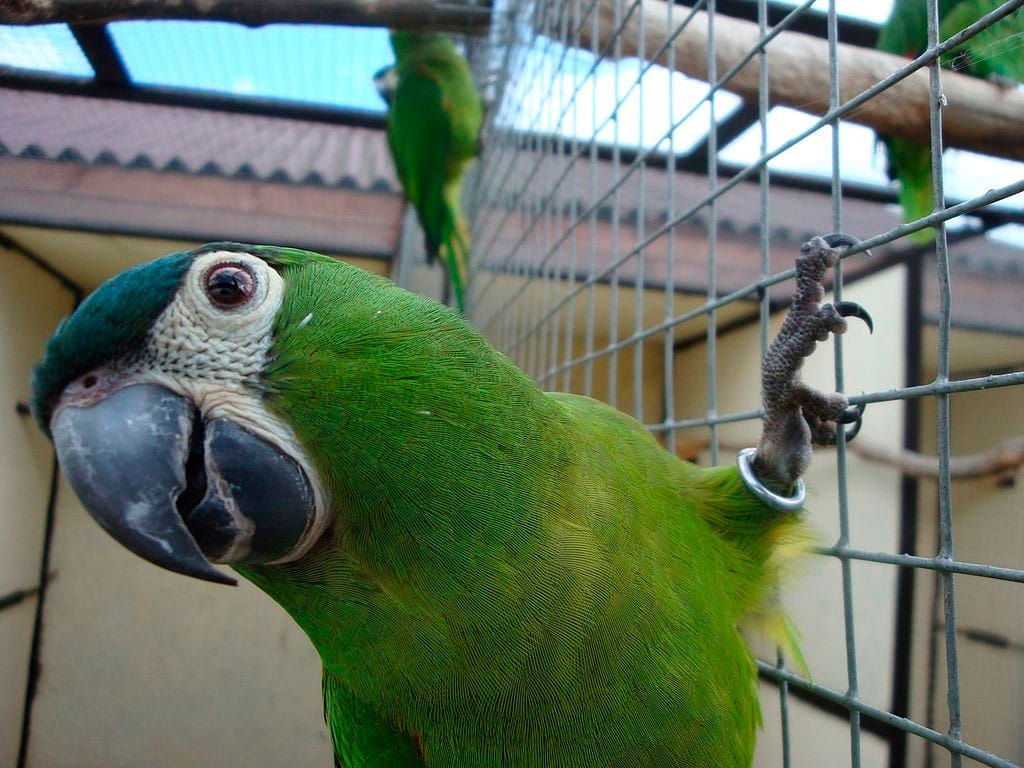
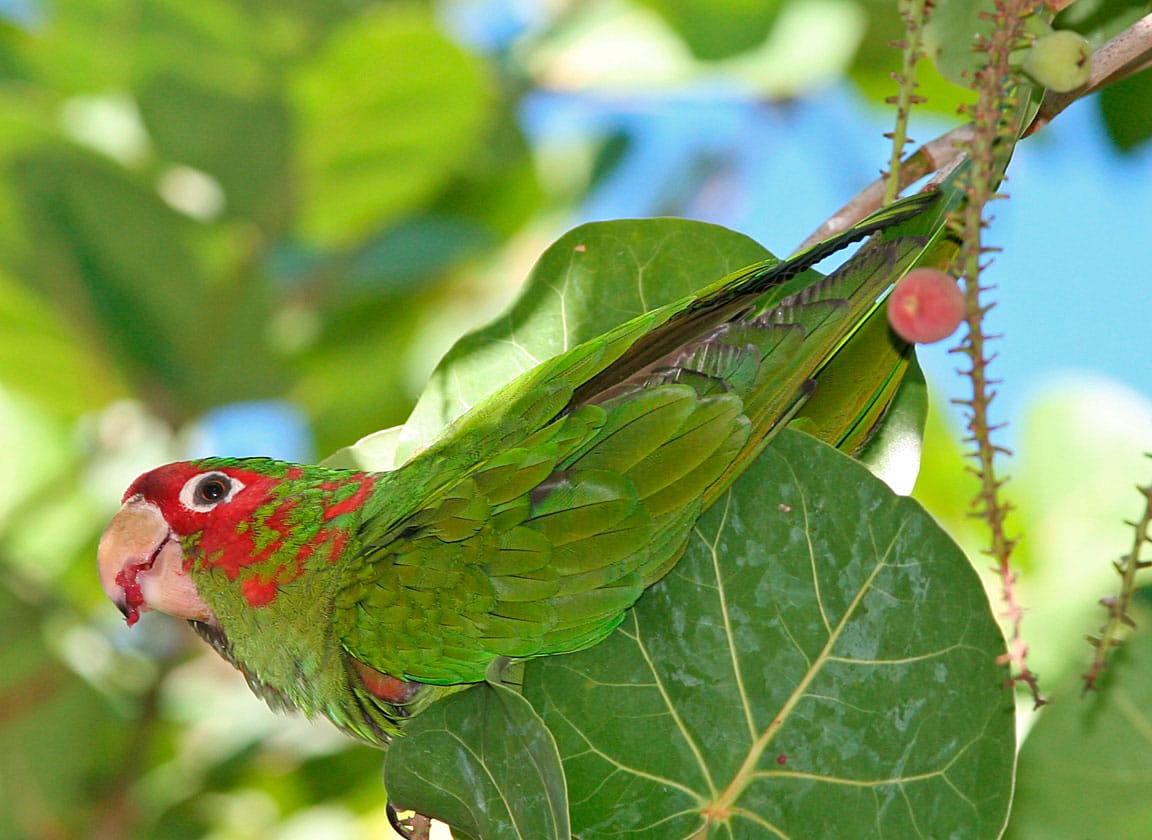
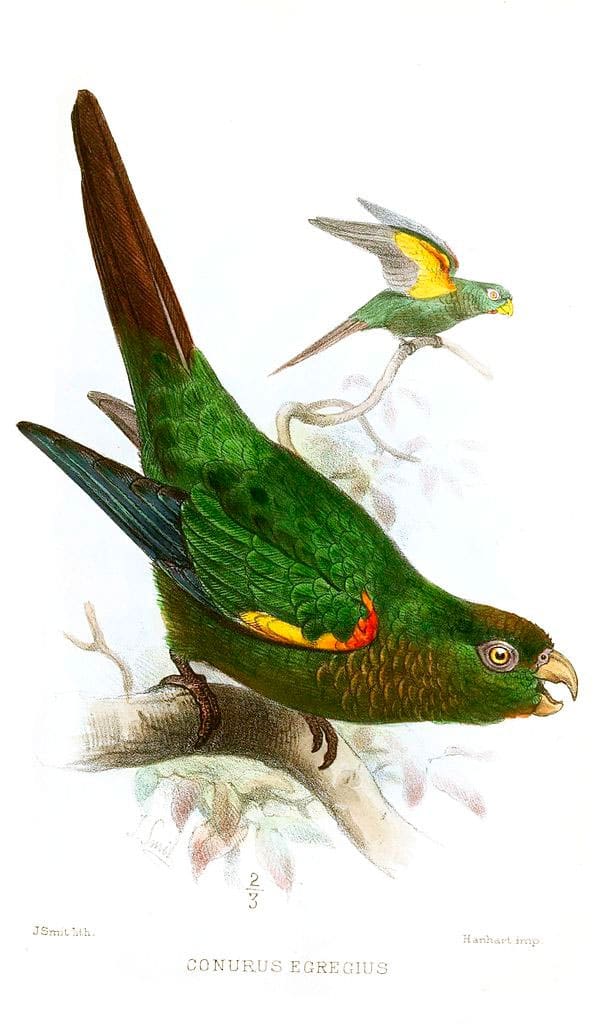
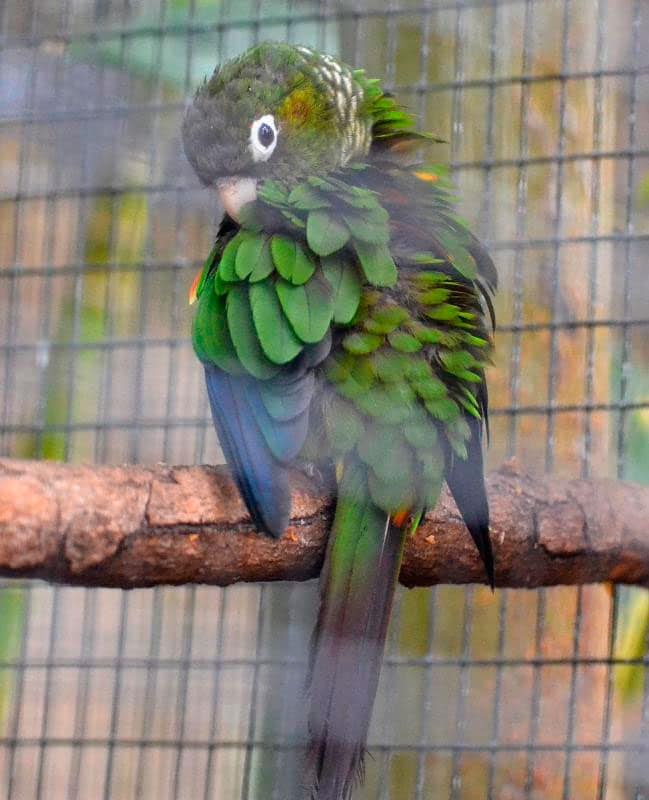
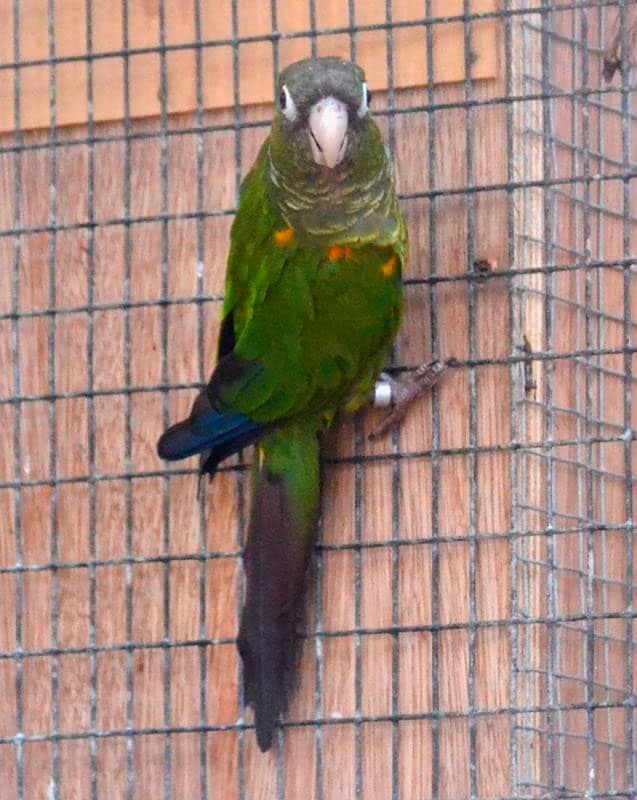
Socorro Parakeet
Psittacara brevipes


Aratinga de Socorro

Content

Description:


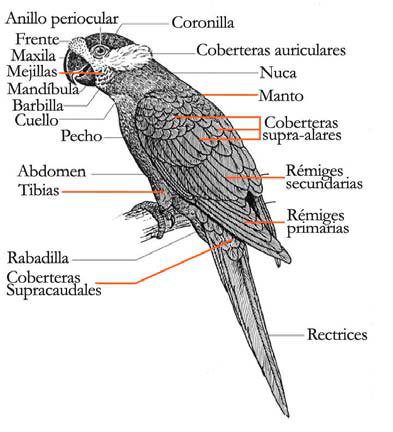
Anatomy-parrots

Approximately from 33 cm.. length, and a weight of 140 g.
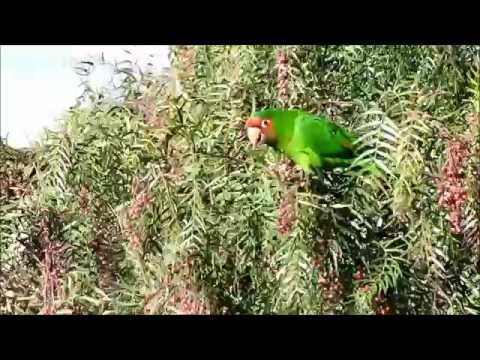
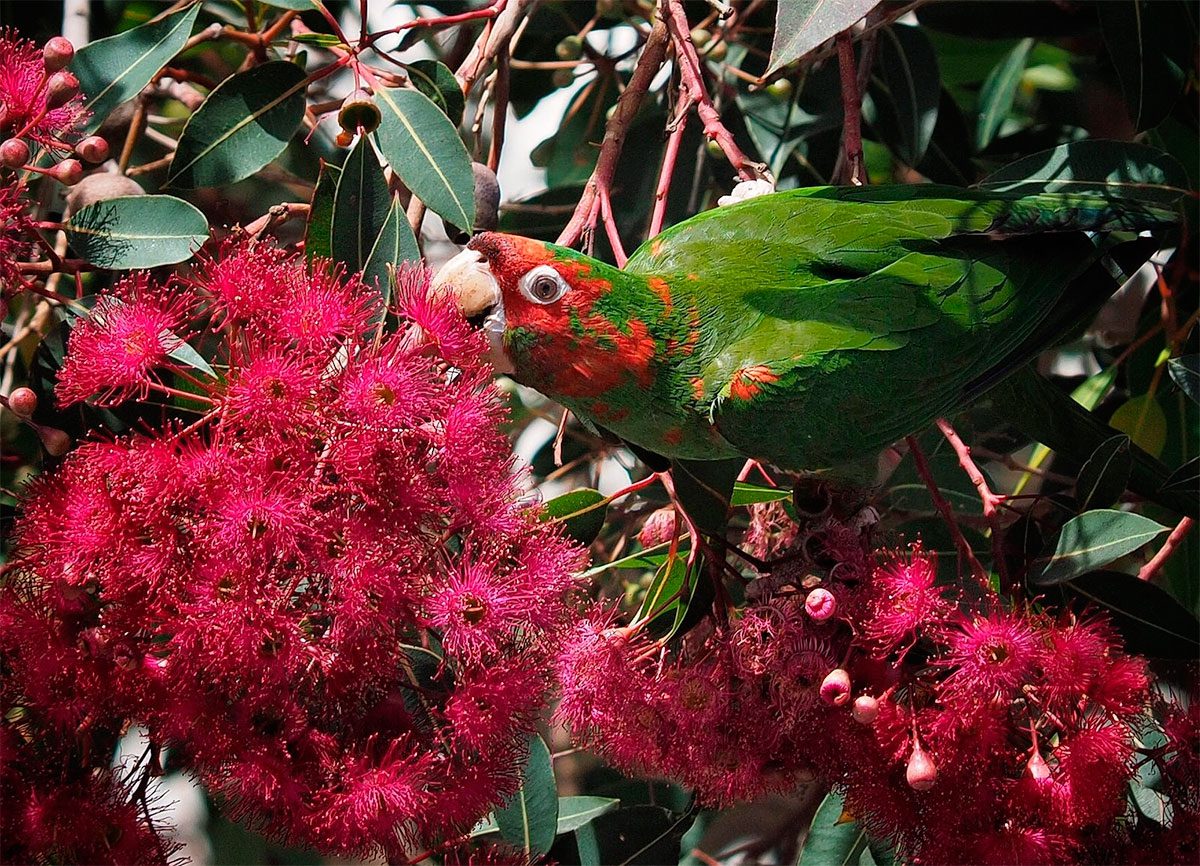
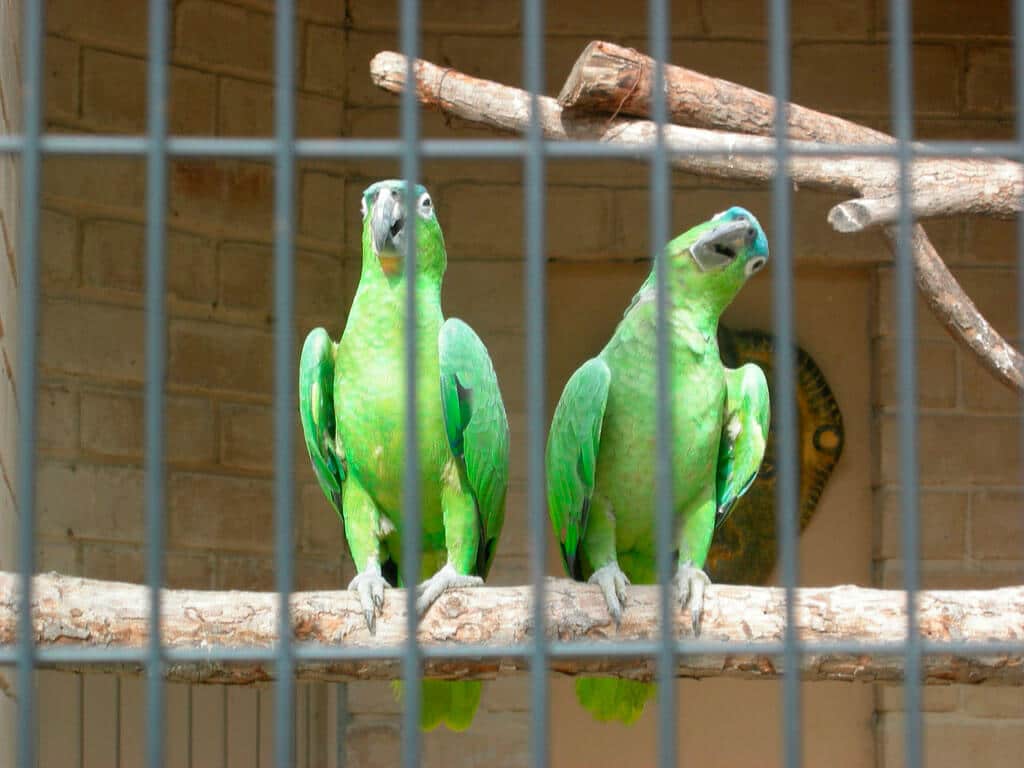
The Socorro Parakeet (Psittacara brevipes) is a medium Parrot with the plumage bright dark green, with the crown, the forecrown and lores grass-green, the sides of neck slightly brighter, the head and the neck, sometimes with one or more scattered feathers of orange-red. The upperparts are green grass, slightly brighter in the area of the rump. Upperwing-coverts herb with bluish green in the outside greater coverts. Primaries and secondaries Green in the part superior with tint blue in them vane outer; olive Oliva-Amarillo down. Underwing-coverts green. Underparts grass-green. Above, the tail dark green, by down color yellowish olive.

The bill color horn; eye ring pale beige; irises orange yellow or orange; legs yellowish brown.

Aratinga de Socorro

Gender-related differences are unknown although the immature has irises Brown color.

NOTE:

  • The Socorro Parakeet It is often considered a subspecies of the Green Parakeet. But, Howell and Webb They presented evidence that supports the separation of the species from the other subspecies of Aratinga holochlora. They found that the bill of the Socorro Parakeet is larger than, and noticed differences in the color of the skin of the eye ring, also has a Wing formula different, the tenth primary feather It is shorter than the seventh and Green Parakeet is the reverse. Both species also differ in the vocalization, calls of the Green Parakeet they are richer in harmonics that the of the Socorro Parakeet.

Habitat:

Most commonly observed in forests of species such as Bumelia socorrense, Guettarda insularis, Ilex socorroensis, with trees of at least 8 metres in height. Usually, above 500 m (especially on the South side of Socorro island), because in most of the rest of its distribution area, in the lower elevations, It has lost its vegetation preferred because of the sheep pasture.

Registered at low altitudes, 4 m, where the native forest (in canyons), near the sea level, especially in tall trees of Croton masonii, Conocarpus erecta and Ficus.

Usually, in flocks of up to 40 birds, rarely come to the 100 specimens. They gather in numerous flocks on the branches of the guayabillo, in smaller flocks (until 6) or only in pairs during the breeding season.

Son social, even there is care collective nests, They show strong fidelity to nesting sites, based on observations of re-use of nests.

Reproduction:

They nest in tree cavities, especially of the species Bumelia socorrense. the size of the clutch It is unknown, but the breeding It is thought that it can begin in the month of November. The young are altricial.

Food:

Registered foods include seeds trees Bumelia socorrense, Guettarda insularis, Ilex socorroensis and Psidium socorrense; pulp of fruits of Opuntia and Ficus cotinifoilia, especially in the season dry.

They aim to feed in the tips of the trees or the highest branches, Although also has observed them are home on the floor

Distribution:

Endemic, It is only in the Socorro island in the The Revillagigedo Islands archipelago off the West coast of Mexico. Estimated population in 400-500 birds in 1992 (approximately nine birds per kmยฒ of suitable habitat). considered common, but recent decreasepossible n due to loss of preferred habitat (still present in about 22% of the island) and the resulting erosion of the sheep that graze in excess. Predation by feral cats can also be a threat.

Conservation:

State of conservation โ“˜


Endangered Endangered โ“˜ (UICN)โ“˜

โ€ข Red List category of the UICN current: In danger of extinction

โ€ข Population trend: Decreasing

Threatened in the Mexican official standard NOM- 059-ECOL-2001, but in Danger of extinction in the NOM-O59-SEMARNAT-2006 that is not yet published. CITES Appendix II

The Socorro Parakeet (in danger of extinction; It is only in the Socorro island and this species the habitat destruction threatens, as well as the introduction of cats, sheep and rodents.

Estimated population in 400-500 birds in 1992.

"Socorro Parakeet" in captivity:

The species, unlike most continental psittacines, does not face problems of extracting pups for the pet market.

Alternative names:

Socorro Parakeet, Green Parakeet (Socorro), Socorro Conure (English).
Conure de Socorro, Perruche de Socorro (French).
Socorrosittich, Socorro-Grรผnsittich (German).
Periquito-de-socorro (Portuguese).
Aratinga de Socorro, Perico de Socorro, Perico mexicano (espaรฑol).
Perico de Socorro (Mexico).


scientific classification:

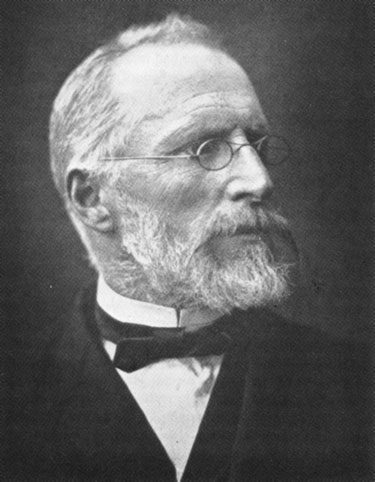
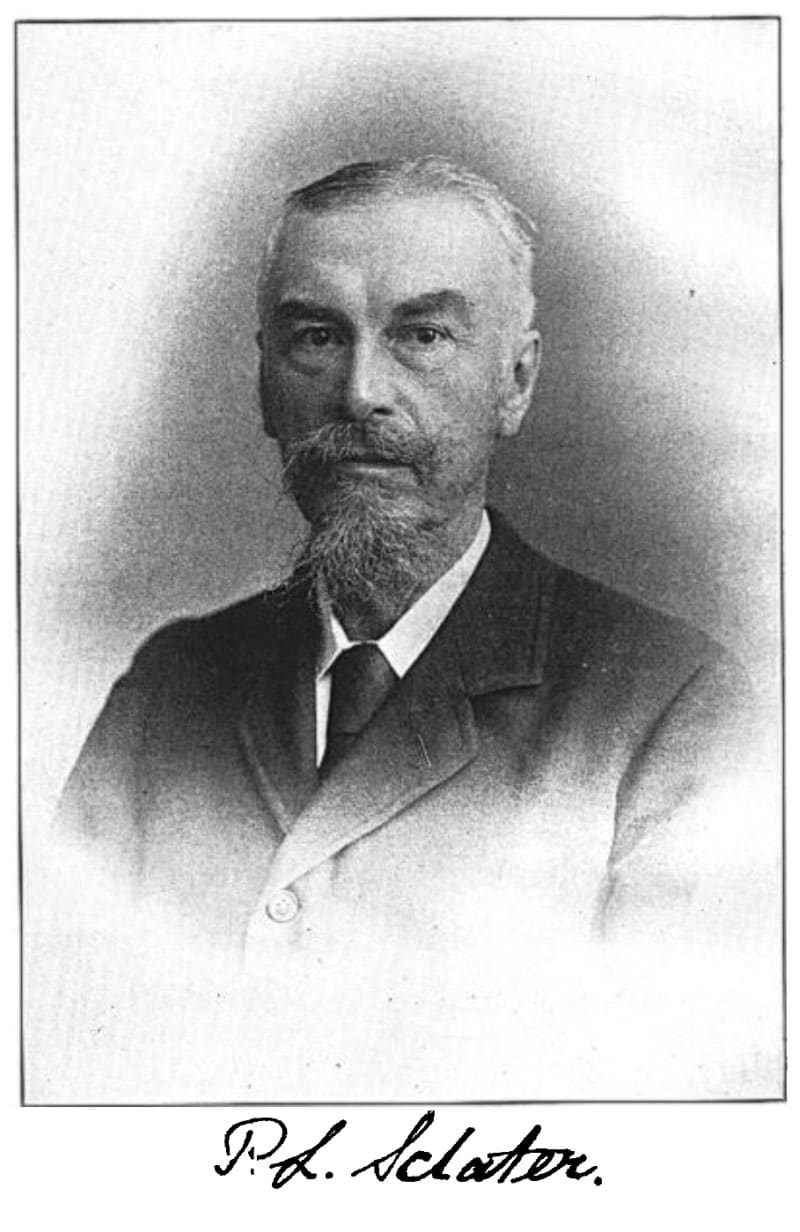
George Newbold Lawrence

Order: Psittaciformes
Family: Psittacidae
Genus: Psittacara
Scientific name: Psittacara brevipes
Citation: (Lawrence, 1871)
Protonimo: Conurus holochlorus var. brevipes


Species of the genus Psittacara

Sources:

Avibase
– Parrots of the World โ€“ Forshaw Joseph M
– Parrots A Guide to the Parrots of the World – Tony Juniper & Mike Parr
ยฉ CONABIO

Photos:

(1) – Revillagigedo Archipelago by CONANP
(2) – Photo: (c) Carlos Galindo-Leal, some rights reserved (CC BY-NC) – inaturalist.org

Sounds: Manuel Grosselet & Juan Cornejo / Africam Safari (Xeno-canto)

โ–ท The world of Pets: Dogs, cats, birds, reptiles, amphibians

Barred Parakeet
Bolborhynchus lineola

Catita Barrada

Content

Description:


Anatomy-parrots

They measure 17 cm. long and weigh between 47 and 55 g.
The Barred Parakeet (Bolborhynchus lineola) has a size similar to the of a Sparrow. The tail and wings they are pointed. Slightly different sexes: in males, the eyes they are brown, the eye ring grey, the bill and legs flesh-colored. The head and underparts they are bright green, with a tenuous beaming on the sides and the tail coverts. The wings they have very marked black bars at the shoulder and patch black(not always visible), the upperparts they are green with a beaming widely dispersed black in the nape and back.
The females and juveniles they present a beaming more pardo. A wide black border and dark green bottom; the irises Dark coffee and legs pink (Howell and Webb, 1995).

Subspecies description:

  • Bolborhynchus lineola lineola

    (Cassin, 1853) – The nominal


  • Bolborhynchus lineola tigrinus

    (Souance, 1856) – Dark green, Crown and bright green front and the rough black is more intense.

Habitat:

Rare and unpredictable. It lives in humid forests, subandinos and Andean cloud forests, open areas, from 900 at 2900m. They are nomads, with numerous flocks (150 or more individuals) following the fruition of the โ€œchusqueโ€ (This chusquea). In small groups or in pairs during the dry season in Central America.

Reproduced in elevations of 1500 meters or more and, like most parrots, they prefer to raise their chicks in a hollow tree or limb trunk. In the winter after the breeding season, the Barred Parakeet often descends to lowland forests. This season, Many feed on partially cleared areas, areas cultivated and in them sheets.

Registered at altitudes from 900 to 2.400 m. in Mexico; by under 1.500 m. in Honduras, Although below 600 After the playback meters; above 1.500 m especially in the West of Panama, although there are records there and in Costa Rica below the 600 m; between 900 and 1,500 m. in Venezuela, between 1,600 and 2,600 m. in Colombia, and until 2.900 m. in the South of Ecuador.

Little known about the habits of these small wild parrots. Since they are small, they like to live high in the treetops, and they are very well camouflaged in their environment, still very hard to see in nature. It also, they are not as noisy as other parrots, which makes them difficult to detect. Most frequently observed during the flight, because they often emit a chirp while flying, What can attract the attention of an observer of birds.

Reproduction:

It nests colonies, in tree hollows, Although you can to occur in crevices in Rocky escarpments, probably during the dry season in Costa Rica; during the month of December in Panama; July-August in Colombia.

Food:

Reported foods that make up their diet include Myrtis, Heliocarpus and Miconia, catkins of Cecropia and bamboo seeds; they occasionally forage in cultivated areas, where has observed them is consuming corn.

Distribution:

Distributed in South of Mexico to western Panama and separated by the Andes, from Venezuela until Peru.

In Mexico they can be observed on the Atlantic slope, in the Highlands of Veracruz, Oaxaca, Chiapas and possibly (There is only a record) in Warrior, also seen in the South of Guatemala (a record from time to time) and in the Highlands of Honduras, with a single bird observed in Nicaragua, specifically in Saint Mary of Ostuma; also registered in those areas mountain of Costa Rica (not seen in areas of the Northwest, for example in the Cordillera de Guanacaste) and in the West of Panama (apparently absent from Central and Eastern).

Distributed through them Andes, to the Northwest of Venezuela in the Federal District, Tรกchira and Merida; scattered locations of Colombia, in subtropical areas of the Western Andes, Central and Eastern and in the massif of Santa Marta; Ecuadorian Andes, with records recent in the South; Peruvian Andes, in Huanuco, Ayacucho and Cuzco, with birds, possibly of this species, observed in the North.

Scattered records, e irregular, as well as a strong nomadic tendency (movements perhaps related to bamboo planting) they indicate that their appearances may be continuous.

Apparently, is one local and rare species over much of its range, Although according to reports, is quite common in Honduras and even locally abundant in the Talamanca mountain range in Costa Rica.

Deforestation in parts of its range, Although these birds travel on cleared land and distributed (at least from time to time) in protected areas, which suggests a low risk population at present.

There is a captive specimens outside their countries of origin.

Subspecies distribution:

  • Bolborhynchus lineola lineola

    (Cassin, 1853) – The nominal


  • Bolborhynchus lineola tigrinus

    (Souance, 1856) – Mountains from northwestern Venezuela and Colombia to southern Peru

Conservation:

State of conservation โ“˜


minor concern Minor Concern โ“˜ (UICN)โ“˜

โ€ข Red List category of the UICN current: Least concern.

โ€ข Population trend: Stable.

Partners in Flight estimated the total population of Barred Parakeet in a number ranging from 50,000-499,999 individuals (A. Panjabi in litt., 2008).


The population This species is suspected of being stable in the absence of evidence of any reduction or substantial threats.


"Barred Parakeet" in captivity:

It is of a species that is has adapted well to the life in captivity, tough enough, its reproduction is expanding.

They are perfect apartment birds due to its arrangement and you need only basic things of life. Son kind and happy of being with the people, but they can be kept entertained with toys and swings when there is nobody around.

Is an Ave. moderately long-lived and if is of good health, Food and hygiene can live during 12 or 14 years.

Limited ability for speech.

They have developed many and striking mutations of color in poultry, including blue, olive, cobalt, Slate (or mauve), turquoise, lutino (bright yellow with red eyes), cremino, cinnamon, Silver, purple …

Alternative names:

Barred Parakeet, Catherine Parakeet, Lineolated Parakeet (English).
Toui catherine, Perruche catherine, Perruche rayรฉe (French).
Katharinasittich, Katharina Sittich (German).
Periquito-catarina (Portuguese).
Catita Barrada, Catita Manchada, Chocoyo Listado, Perico Barrado, Perico Listado, Perico rayado, Periquito Barrado, Periquito Listado, Periquito saraviado (espaรฑol).
Periquito Barrado (Colombia).
Perico Listado, Periquito listado (Costa Rica).
Perico rayado (Honduras).
Perico rayado (Mexico).
Chocoyo Listado (Nicaragua).
Perico Barrado (Peru).
Perico Barreteado (Venezuela).

scientific classification:

Order: Psittaciformes
Family: Psittacidae
Genus: Bolborhynchus
Scientific name: Bolborhynchus lineola
Citation: (Cassin, 1853)
Protonimo: Psittacula lineola

Images ยซCatita Barradaยป:

Videos "Barred Parakeet"


Species of the genus Bolborhynchus

Sources:

Avibase
– Parrots of the World โ€“ Forshaw Joseph M
– Parrots A Guide to the Parrots of the World – Tony Juniper & Mike Parr
– Birdlife

Photos:

(1) – A Barred Parakeet (also known as Lineolated Parakeet) in captivity By Timo Helgert (originally posted to Flickr as greenguy.) [CC BY 2.0], via Wikimedia Commons
(2) – Two pet Barred Parakeets (also known as Lineolated Parakeet) perching on a parasol By Lisa Lenscap (originally posted to Flickr as sistas) [CC BY-SA 2.0], via Wikimedia Commons
(3) – Barred Parakeet (Bolborhynchus lineola) also known as Lineolated Parakeet or Catherine Parakeet By Lisa Lenscap [CC BY-SA 2.0], via Wikimedia Commons
(4) – Perruche Catherine de couleur mauve By Weena (Own work) [GFDL, CC-BY-SA-3.0 or CC BY-SA 2.5-2.0-1.0], via Wikimedia Commons

Sounds:

โ–ท The world of Pets: Dogs, cats, birds, reptiles, amphibians

Speckle-faced Parrot
Pionus tumultuosus

Speckle-faced Parrot

Content


Anatomy-parrots

Description:

28 to 31 cm.. tall and around 250 g. weight.

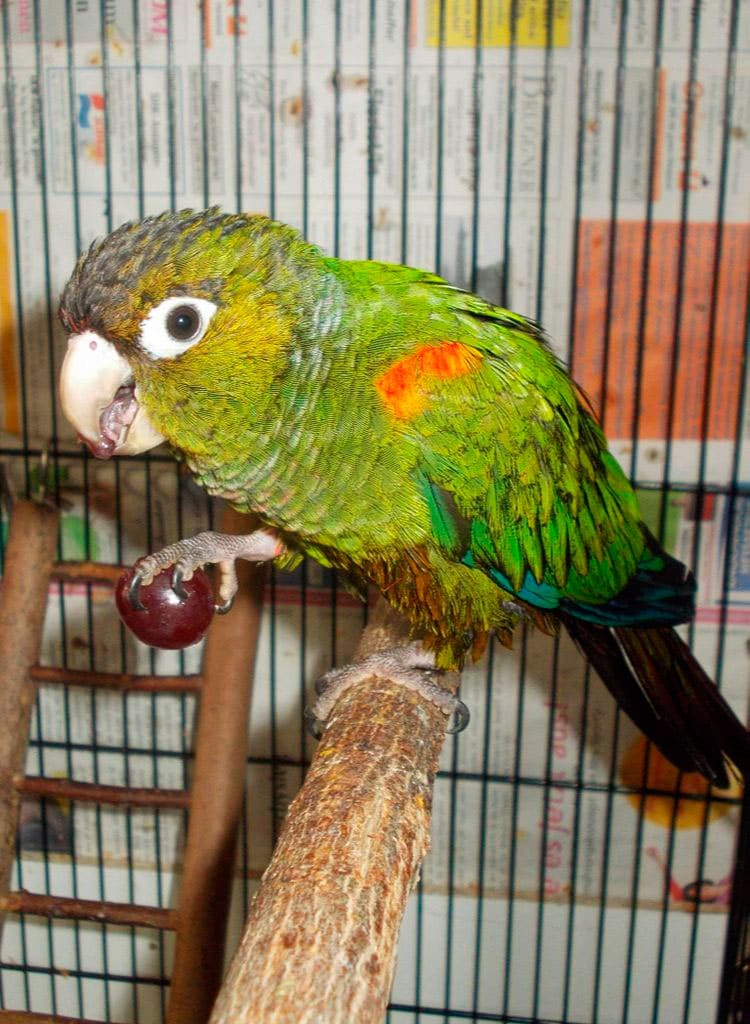
The Speckle-faced Parrot (Pionus tumultuosus) It is distinguishable by color from whitish crown up to the nape; base bill red rose, with forecrown redder. Cheeks whitish with a red and purple tinge towards the neck; purple chest.

Shoulder with thin strip yellow with reddish tint, inside base tail and crissum, red; the rest of the tail is green with blue on the outer feathers; under belly with red feathers with green edge.

ocula ringr greyish

The youth They have almost all head green and the wings, greenish yellow.

Taxonomic note:

The Speckle-faced Parrot It is probably the rarest and most controversial genre Pionus. It is sometimes divided into two species, in which case, the Pionus tumultuosus South is known as Speckle-faced Parrot, while the North, Pionus seniloides, They are known as White-capped Parrot (which leads to easy confusion with Pionus senilis).

Habitat:

Speckle-faced Parrot

It inhabits in Andean and sub-Andean cloud forests and forest edges, between 1600 and 3200 meters above sea level.
It is highly Nomad with temporal variations in terms of the number of individuals that can be registered in a locality.

Reproduction:

With reproduce In September. In captivity puts 4 eggs which incubated about 26 days. No other aspects of its reproductive biology are known..

Food:

It has been registered consuming fruits of Turpinia paniculata and are sometimes seen in large numbers feeding on maize crops in cultivated areas and banana plantations.

Distribution:

Its population is distributed in the southern Andes, from the center of Peru until Bolivia.

Size of the area of distribution (reproduction / resident): 329.000 km2

Conservation:


minor concern


โ€ข Current category of the Red List of the UICN: Least concern.

โ€ข Population trend: Decreasing.

Justification of the population

The size of the world population It has not been quantified, but this species is described as ยซquite common, but irregular distributionยป (Stotz et to the., 1996).

Justification of trend

It is suspected that the population is in decline due to the continuous habitat destruction.

"Speckle-faced Parrot" in captivity:

This species is virtually nonexistent in poultry farming. There is only a small collection, private property in the United States. The Fundaciรณn Loro Parque in Tenerife, Spain, It has some copies.
Most of the Speckle-faced Parrot imported to United States they were the victim of aspergillosis โ€“ probably caused by the stress suffered during the import process.

In captivity They were observed as the to intelligent species, inquisitive and sometimes shy and nervous. Will get used to their caregiver over time. You can interact with a person and jealously attacking others. Prone to obesity.

Alternative names:

Speckle-faced Parrot, Plum-crowned Parrot, Speckle-faced Parrot (Plum-crowned) (inglรฉs).
Pione pailletรฉe, Pione pourprรฉe (francรฉs).
Purpurstirnpapagei (alemรกn).
Curica-de-cara-manchada (portuguรฉs).
Cotorra Gorriblanca, Loro Rosado, Loro Tumultuoso (espaรฑol).


Clasificaciรณn cientรญfica:

Tschudi Johann Jakob von

Orden: Psittaciformes
Familia: Psittacidae
Genus: Pionus
Nombre cientรญfico: Pionus tumultuosus
Citation: (von Tschudi, 1844)
Protรณnimo: Psittacus tumultuosus


Imรกgenes ยซLoro tumultuosoยป:

Videos del "Loro tumultuoso"

ยซLoro tumultuosoยป (Pionus tumultuosus)

    Fuentes:

    Avibase
    – Parrots of the World โ€“ Forshaw Joseph M
    – Parrots A Guide to the Parrots of the World – Tony Juniper & Mike Par
    Birdlife
    – Libro Loros, Pericos y Guacamayas Neotropicales

    Fotos:

    (1) – Eduardo Nogueira
    (2) – Speckle-faced Parrot at La Merced Zoo By josecajacuri [CC BY-SA 2.0], via Wikimedia Commons
    (3) – Speckle-faced Parrot ยซPionus tumultuosusยป on the grounds of the Pueblo Hotel, Aguas Calientes by Carol FoilFlickr
    (4) – Speckle-faced Parrot ยซPionus tumultuosusยป on the grounds of the Pueblo Hotel, Aguas Calientes by Carol FoilFlickr
    (5) – Speckle-faced Parrot ยซPionus tumultuosusยป on the grounds of the Pueblo Hotel, Aguas Calientes by Carol FoilFlickr
    (6) – PIONUS TUMULTUOSUS By Allen, Edgar W.; Erxleben, J.; Hanhart, Michael; Hanhart, N; Keulemans, J. G.; Mintern Bros.; Rowley, George Dawson; Smith, J.; Walther, T. [CC BY 2.0 or Public domain], via Wikimedia Commons

    Sonidos: Sebastian K. Herzog

โ–ท The world of Pets: Dogs, cats, birds, reptiles, amphibians

Vulturine Parrot
Pyrilia vulturina

Vulturine Parrot

Content

Description:

23 cm.. length and a weight between 138-165 g..

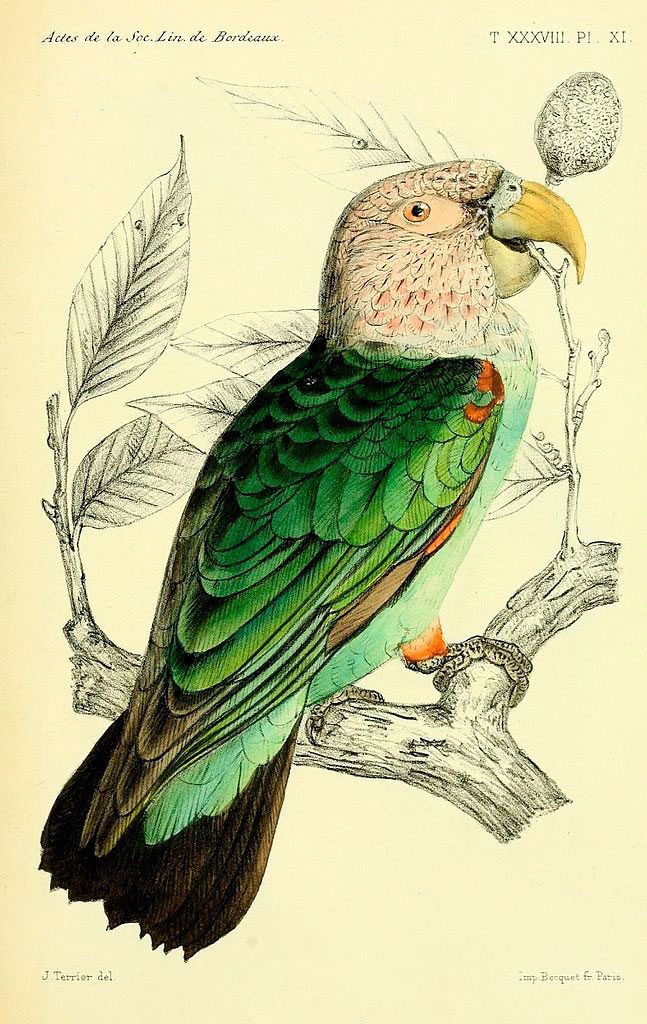
The Vulturine Parrot (Pyrilia vulturina) It is a small parrot with bare skin yellow orange and covered bristles pale hairlike, in the area that covers the forecrown and back of the crown, until the eyes; bare skin on lores, the cheeks and center of crown black and covered with bristles black hairlike; feathers on the sides of neck and in the part back from the crown, are yellow, forming a band bright contrasting with the black of the head bare; back of the neck, black; upperparts green.

carpal area and lesser upperwing-coverts, orange-yellow; outer median coverts with some blue; leading edge of wing, red; primary coverts blue; rest of the upper parts of the wings, green.

Primaries bluish-black with narrow bluish-green margins to outerweb. Under, the wings with coverts red; flight feather green with blackish tips. feathers throat and the chest, olive yellow with dark tips, giving a scalloped effect; belly green with bluish tint; undertail-coverts brighter yellowish green. Tail green with tips blue and outer feathers with yellow on base of innerwebs. Bill dark blackish-grey with patch pale yellow at the base of the upper jaw; cere yellowish-horn; irises brownish-orange; legs grey.

Both sexes are similar.

The head of the immature, fully feathered (except in the eye ring); greenish on the cheeks and yellow olive in the rest of the head with no collar yellow. The bend of wing and underwing-coverts, yellowish-orange; irises darker.

  • Sound of the Vulturine Parrot.

Habitat:

It inhabits in the rainforest of lowland formations vรกrzea (seasonally flooded forest), and the Mainland (without flooding). Gregarious.

Reproduction:

No details on the reproductive biology of this species.

Food:

diet includes fruit, seeds and berries taken in the forest canopy. Its bareheaded adaptation may be a high frugivore diet, to prevent the fruit pulp enmaraรฑara their feathers.

Distribution and status:

Size of its range (breeding/resident ): 1.030.000 km2

endemic to northeast Brazil, to the South of the amazon, from the eastern state of amazon, on the east bank of Madeira River, passing by For, to the south, up to the Serra do Cachimbo, extending eastward to the areas bordering northwest Maranhรฃo, in the region of the Gurupi River. May be restricted to areas around major rivers within this region, which would mean that the size of the range may be overestimated.

References in relation to its range to include Venezuela (lower basin Caura River) and Guyana, They are apparently wrong.

generally considered Rare, although undoubtedly they not have a lot of data due to the difficulty of observation of this species.

The continuing rapid deforestation throughout its range has had to contribute to a substantial decrease in the population Vulturine Parrot in the last decades.

They can be seen in protected forests in the west of its range, but illegal logging and colonization remain a threat even there.

Conservation:


Vulnerable


โ€ข Current category of the Red List of the UICN: Vulnerable.

โ€ข Population trend: Decreasing.

Rationale for the Red List category

Based on a model of future deforestation in the amazon basin and its dependence on primary forest and sensitivity to fragmentation, It is suspected that population of this species will decrease rapidly during the next three generations and, therefore, It has risen to Vulnerability.

Justification of the population

The population size World has not been quantified, but this species is described as ยซRareยป (Stotz et to the ., 1996).

Justification of trend

It is suspected that this species has lost 37,1-54,8% of habitat within its distribution over three generations (21 years) starting from a model of deforestation Amazon (Soares-Filho et to the ., 2006, Bird et to the ., 2011). Although the species may have some susceptibility to hunting and / or capture, also it appears to have some degree of tolerance habitat degradation (A. Lees in litt ., 2011). So, you suspect your population decline by 30-49% during three generations.

Conservation Actions Underway

โ€ข Is listed as Vulnerable nationally in Brazil (MMA 2014).

โ€ข No specific actions known.

Conservation Actions Proposed

โ€ข Expand the network of protected areas to effectively protect the IBA.

โ€ข Effectively manage existing and new protected areas and resources, using the emerging opportunities for financing the management of protected areas with the overall goal of reducing carbon emissions and maximize the conservation of biodiversity.

โ€ข It is also essential to conservation on private land, through the expansion of market pressures for proper land management and prevention of deforestation on land not suitable for agriculture (Soares-Filho et to the., 2006).

โ€ข Campaign against proposed changes to the Brazilian Forest Code that would lead to a decrease in the width of the areas of riparian forest protected as Permanent Preservation Areas (APPs), that function as vital corridors in fragmented landscapes.

"Vulturine Parrot" in captivity:

It is not found in aviculture; Probably they never stood outside Brazil.

Alternative names:

Vulturine Parrot (English).
Caรฏque vautourin (French).
Kahlkopfpapagei (German).
curica-urubu, papagaio-urubu, periquito d’anta, periquito-urubu, pirรญ-pirรญ, urubu-paraguรก (Portuguese).
Lorito Cabeza Zamuro, Lorito Vulturino (espaรฑol).

scientific classification:


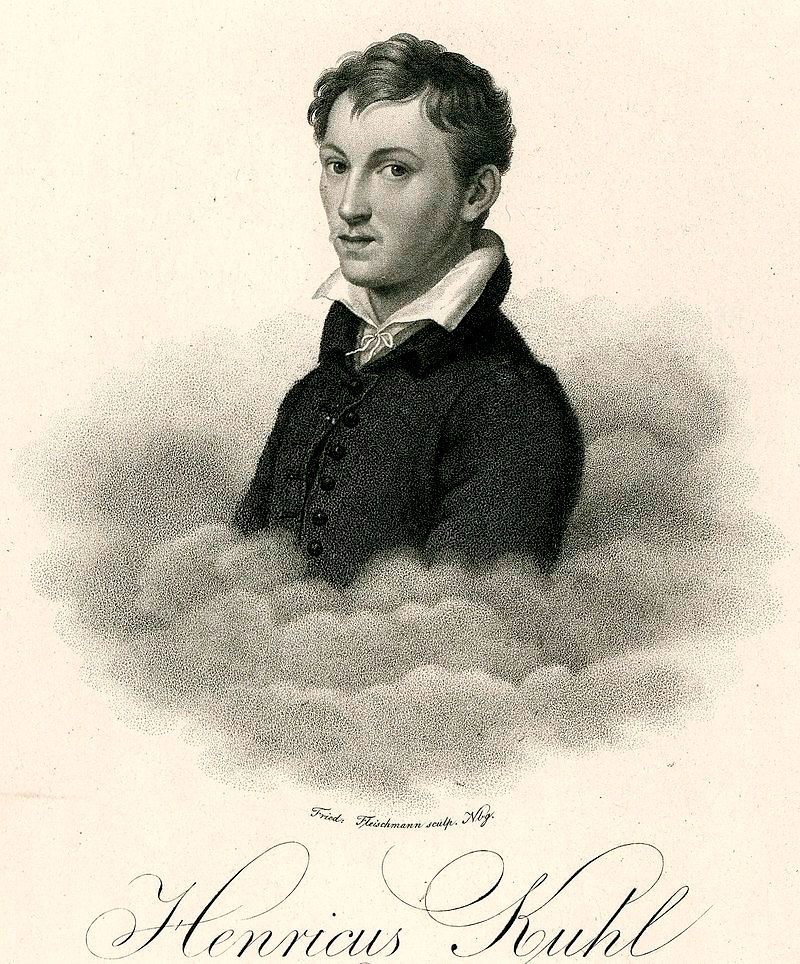
Kuhl, Heinrich
Heinrich Kuhl

Order: Psittaciformes
Family: Psittacidae
Genus: Pyrilia
Scientific name: Pyrilia vulturina
Citation: (Kuhl, 1820)
Protonimo: Psittacus vulturinus

Images "Lorito Vulturino":

 Vulturine Parrot

Videos Lorito Vulturino:

Pyrilia vulturina ( Curica Vulture)

"Lorito Vulturino" (Pyrilia vulturina)

Sources:

  • Avibase
  • Parrots of the World โ€“ Forshaw Joseph M
  • Parrots A Guide to the Parrots of the World – Tony Juniper & Mike Parr
  • Birdlife

  • Photos:

(1) – Pyrilia vulturina (adult and immature) – Imagen de Parrots A Guide to the Parrots of the World – Tony Juniper & Mike Parr
(2) – Pyrilia vulturina ( Curica Vulture) by victor castro

โ–ท The world of Pets: Dogs, cats, birds, reptiles, amphibians

Yellow-lored Parrot
Amazona xantholora

Yellow-lored Parrot

Content

Description:


Anatomy-parrots

25-28 cm.. length and 200-232 g. of weight.

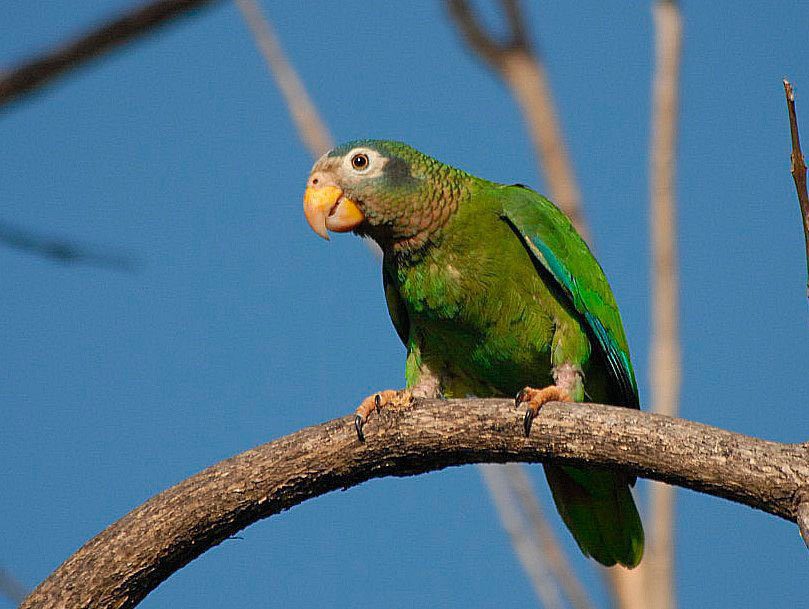
The Yellow-lored Parrot (Amazona xantholora) has the lores and a close frontal band, bright yellow; most of the forecrown and crown, are white; the back of the crown is blue; band wide around the eyes, including upper cheeks, bright red; ear-coverts dark gray.

Top green grass with prominent black tips on feathers giving a scalloped appearance, although uppertail-coverts are yellowish-green. Primary coverts red; remaining coberteras (especially smaller and medium), green with black tips. Flight feathers mostly blue with a green base at primaries. Under the wings, bluish green. Underparts green with black tips on breast feathers, although undertail-coverts are yellowish-green; at the top, the tail is green; below green with yellowish tip and the outer feathers red.

Yellow-lored Parrot

Bill yellow-horn; irises yellow; legs grey.

In this species sexual dimorphism. The female has the crown blue (nonwhite), little or no red around the eye, and primary coverts green. The immature They are like female but with lores paler yellow and crown pale blue.

  • Sound of the Yellow-lored Parrot.

Habitat:

Video – "Yellow-lored Parrot"

Yellow-lored Parrot (?)

In Yucatan, the Yellow-lored Parrot They live mostly in the tropical deciduous forest, probably avoiding dense rain forests. But, their exact preferences are unknown due to the difficulty of distinguishing the White-fronted Parrot (Amazona albifrons). Observed in pine forests and mixed forests of pines and oaks Quercus in the North of Belice, and pine forests in the highlands in Roatan.
They are distributed at altitudes between 100 and 250 m.
Usually views in flocks, to form communal roosts coming up 1.500 birds from roosting and dispersed in small herds forage.

Reproduction:

They lay their nests in tree cavities on agricultural land and around cornfields where dead trees have been left standing after forests have been cleared and burned. also can nest in cracks of trees, rock walls or termiteros.

It has been observed to Yellow-lored Parrot in breeding condition in March in the yucatan peninsula, and young in the nest in April-May Belice. The laying is of 1 to 3 eggs; the incubation similar in duration to that of White-fronted Parrot (Amazona albifrons), that is to say, of 25 to 28 days.

Food:

Foods reported include guilt of Acacia gaumeri, corn and citrus. The Yellow-lored Parrot They feed mainly in the treetops.

Distribution:

Size of its range (reproduction / resident): 157.000 kilometros2

The Yellow-lored Parrot It is found mainly in the Eastern and Central parts of the Yucatan Peninsula, Mexico, in Yucatan, Campeche and Quintana Roo; in the northern parts of Belice; and in the islands of Cozumel (Mexico) and possibly Roatan (Honduras), where the recent field work could not confirm its current (or previous) existence. Common to quite common in the East of Yucatan and in Cozumel, but considered quite rare in some other parts (especially at the edges) Mexican range. It is thought to be scarcer than the White-fronted Parrot (Amazona albifrons) with which it is closely related, although in some areas, the Yellow-lored Parrot it's more common, especially towards the center of its range.
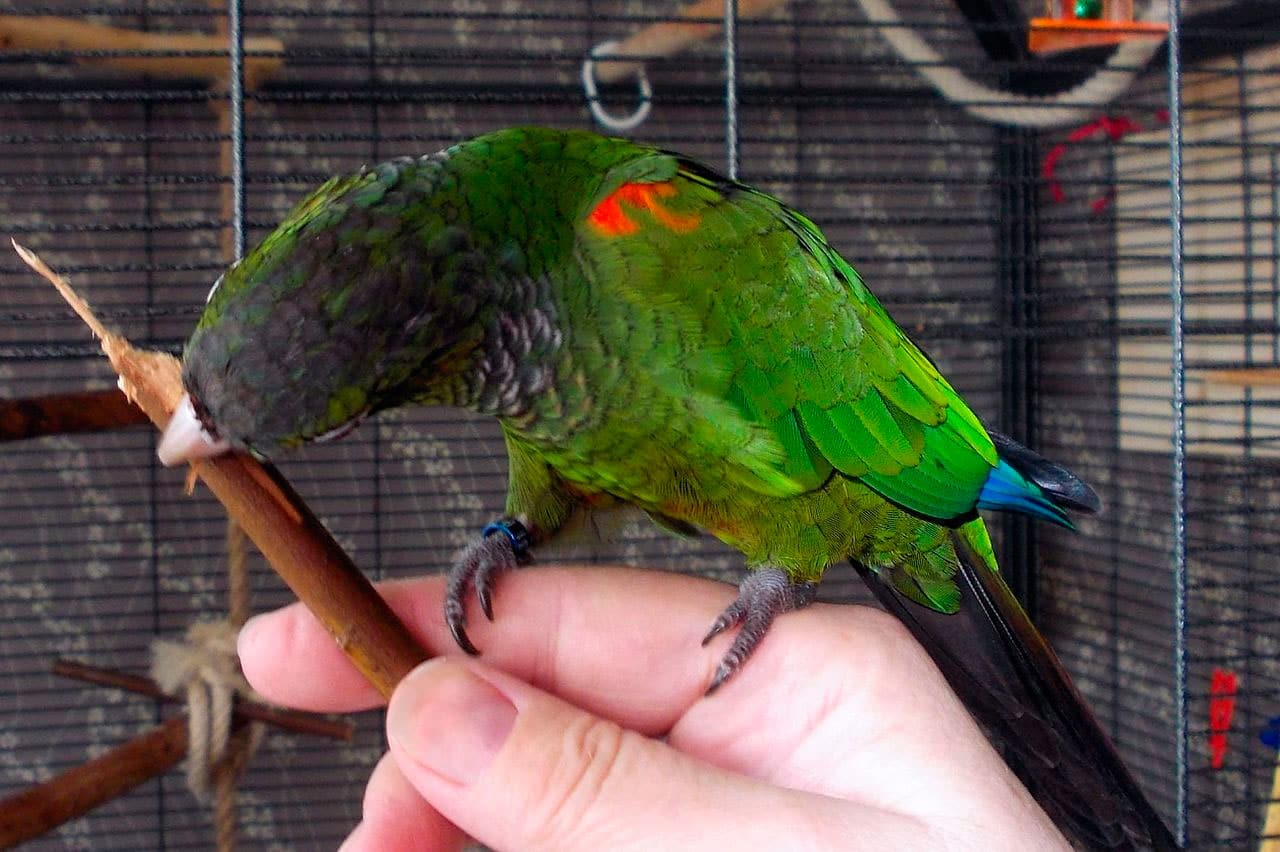
Live in several areas protected. Situation in Northern Belice unknown.

Conservation:

State of conservation โ“˜


minor concern Minor Concern โ“˜ (UICN)โ“˜

โ€ข Current category of the Red List of the UICN: Least concern.

โ€ข Population trend: Stable.

โ€ข Population size: 20,000-49,999.

  • Justification of the Red List of the Category

This species has a range very large, and therefore not approaching the thresholds for vulnerable under the criterion of size range (extent of occurrence <20.000 km2 combinan con un tamaรฑo gama disminuciรณn o fluctuante, hรกbitat medida / calidad, o de la poblaciรณn tamaรฑo y un pequeรฑo nรบmero de lugares o fragmentaciรณn severa). La population trend appears to be stable, and therefore the species does not approach the thresholds for Vulnerable according to the population trend criteria. (> 30% decrease of more than ten years or three generations). The population size It can be moderately small to large, but are not believed to approach the thresholds for Vulnerable based on population size criteria (<10.000 individuos maduros con una disminuciรณn continua estima en> 10% in ten years or three generations, or with a specific population structure). For these reasons, the species was evaluated as Least concern.

  • Population justification

Partners in Flight estimates the population at fewer than 50.000 individuals (A. they Panjabi a slightly. 2008), by what is placed in the band 20,000-49,999 individuals here.

  • Justification trend

The population suspected to be stable in the absence of evidence of any reduction or substantial threats.

  • Threats

The main threats to this species are the deforestation, the catch eggs and chicks directly from their nests, just like him illegal trade adult individuals. Moreover and, considering the differential distribution of this species within the Peninsula, You may think that areas are susceptible to drastic declines in these species (Beissinger and Snyder 1992).

The Yellow-lored Parrot in captivity:

Very rare in captivity. Convention CITES regulates international trade under the Appendix II (Species not necessarily threatened with extinction, but in which trade must be controlled in order to avoid utilization incompatible with their survival).

Alternative names:

Yellow Lored Amazon, Yellow lored Parrot, Yellow-faced Amazon, Yellow-lored Amazon, Yellow-lored Parrot, Yucatan Amazon, Yucatan Parrot (English).
Amazone du Yucatan, Amazone xantholore (French).
Goldflรผgelamazone, Goldzรผgelamazone (German).
Papagaio-de-iucatรฃ (Portuguese).
Amazona de Yucatรกn, Amazona Yucateca, Lora de Roatรกn, Loro Yucateco (espaรฑol).

scientific classification:

Order: Psittaciformes
Family: Psittacidae
Genus: Amazona
Scientific name: Amazona xantholora
Citation: (Gray, GR, 1859)
Protonimo: Chrysotis xantholora

Images Yellow-lored Parrot:


Species of the genus Amazona


Sources:

Avibase
– Parrots of the World โ€“ Forshaw Joseph M
– Parrots A Guide to the Parrots of the World – Tony Juniper & Mike Parr
Birdlife
Naturalist

Photos:

(1) – Amazon Yucatan, Mexico, Quintana Roo, Xcaret By philippe from FRANCE, You can search by name, by commission or family for birds and insects, using tags [CC BY-SA 2.0], via Wikimedia Commons
(2) – A female Yellow-lored Amazona also known as the Yucatan Amazona at Xcaret Eco Park, Quintana Roo, Mexico. By philippe from FRANCE, You can search by name, by commission or family for birds and insects, using tags [CC BY-SA 2.0], via Wikimedia Commons
(3) – Amazona species xantholora. His name is Poll By GuillermoPech (Own work) [CC BY-SA 4.0], via Wikimedia Commons
(4) – Yellow-lored Amazon By Andreas Mueller Pfgst (Picture yourself created) [GFDL or CC BY-SA 3.0], via Wikimedia Commons
(5) – Yellow-Lored Parrot by James DiedrickFlickr
(6) – Chrysotis xantholora = Amazona xantholora by Joseph Smit [Public domain], via Wikimedia Commons

Sounds: Oliver Komar, XC182833. accessible www.xeno-canto.org/182833

โ–ท The world of Pets: Dogs, cats, birds, reptiles, amphibians

Pfrimer's Parakeet
Pyrrhura pfrimeri

Pfrimer's Parakeet

Content

Description:

Pfrimer's Parakeet

22 to 23 cm.. length and an approximate weight of 80 g..

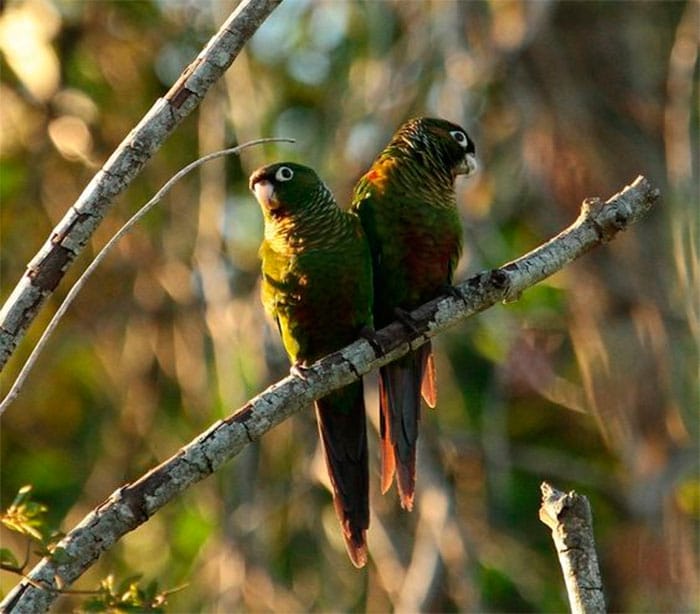
The Pfrimer's Parakeet (Pyrrhura pfrimeri) is a small psittacine of tail Long endemic Brazil very similar to Maroon-faced Parakeet (Pyrrhura leucotis), of which has recently been separated.

Its main color is green with bluish hues in primary rรฉmiges and reddish tones in the back, the belly and retrizes penas. The bend of wing They are reddish.
The neck It has clear blue feathers with lighter edges, giving the whole a scaled aspect. The sides of the face They are red while the crown and nape They are bluish. The bill It is black and tail red-blue color at the tips

It has no sexual dimorphism.

Taxonomic status:

It has often been considered a subspecies of the Maroon-faced Parakeet (Pyrrhura leucotis)Pyrrhura leucotis pfrimeri. The separation was made based on their distribution and the differences in habitat and plumage, I was the only member of the complex P. leucotis in which the light spot on ear-coverts It was very small. Recent mitochondrial DNA studies have confirmed this separate species status.

  • Sound of the Pfrimer's Parakeet.

Habitat:

Its distribution is restricted to the forests dry deciduous or semi-evergreen growing on limestone outcrops in the calcareous. This habitat type caatinga is an isolated island within the surrounding savannah closed. The forest caatinga typically has a closed canopy and dense understory with lianas and some cacti, particularly in disturbed areas. The species has been seen recently fragmented woodlots (Olmos et al., 1998), but according to reports they do not live far from the edge of the forest.

Social, usually they are seen in flocks of up 10 birds. Noisy and conspicuous when they fly above the canopy. Difficult to see while feeding or resting in foliage.

Reproduction:

We know very little about their reproductive habits.


Food:

They fly in flocks in search of fruits, seeds, flowers and larvae insects (wasps Family Agaonidae).


Distribution and status:

Size of its range (Widgets / Resident): 20.300 km2

It is located in the Brazilian states of Goiรกs, Tocantins and the northwestern tip of Minas Gerais, Brazil.

Conservation:

State of conservation โ“˜


Endangered Endangered โ“˜ (UICN)โ“˜

โ€ข Current category of the Red List of the UICN: In danger of extinction.

โ€ข Population trend: Decreasing.

โ€ข Population: 20,000-50,000.

Justification of the Red List of the Category

This species has a range very small highly fragmented and where habitat loss and degradation continue. For these reasons, It is classified as endangered.

Justification of the population

The total population is estimated to lie within the band 20,000-49,999 individuals (CA Bianchi in a little. 2006, 2007). The population density of the species has been estimated 11,7 individuals / km2 .

Justification trend

Given the rapid pace of deforestation within restricted range species, and its strong dependence on forest habitats suspected its population is declining rapidly (F. Olmos in some ., 2004).

Threats:

The main threat to this species is the deforestation driven selective logging, fires and conversion of habitat to pasture (Olmos et al . 1998). Dry wood Goiรกs He declined to be covering 15,8% of the region 1990 only the 5,8% in 1999, and less than 1% of the remaining fragments they were larger than 100 has (F. Olmos a slightly. 2007). There has been a reduction 66% habitat available in the last 31 years, with a current annual deforestation rate 2,1% (Bianchi 2010). Rapid deforestation is occurring within the range of the species to create pastures with widespread burning to improve poor pastures destroying the habitat of dry forest. It is mainly directed to logging forests durable normally used to make fence posts, and cement are starting to target areas of limestone outcroppings (CA Bianchi in a little . 2006, 2007). The species is rare while they recorded in the trade waves collections of exotic birds; This poses a potential threat (Olmos et al ., 1998). Population pressures increase as their range is close to the capital, Brasilia (Olmos et al ., 1998).

Conservation Actions Underway

In Brazil, previously considered vulnerable (Silveira y Straube 2008), but now legally designated as endangered national (MMA 2014) and protected by the Brazilian legislation. They are distributed within the proposal Terra Ronca State Park, but this has not yet been fully implemented. (CA Bianchi in a little . 2006, 2007). Downs Terra Ronca State Park now they appear to have been deforested, leaving only forest fragments outcrops of limestone karst (Willis in a little .). Other parts of the range are not protected. The species appears in the Brazil Red List as vulnerable and the IBAMA (Federal Environment Agency Brazil) is about to create a conservation group Small parrots understand all the Pyrrhura spp, and establishes conservation efforts. Brasilia zoological garden started a program of captive breeding in 2001 with 10 individuals, but none survived after six years (CA Bianchi in a little . 2006, 2007). There are very few known private poultry farmers who maintain the species in captivity (CA Bianchi in a little . 2006, 2007).

Conservation Actions Proposed

Determine the extent of habitat and current rates of deforestation remaining. Closely monitor the species in trade if demand increases.

"Pfrimer's Parakeet" in captivity:

Very rare.

It's a bird in danger of extinction; each captive specimen of this species that is capable of reproducing, must be placed in a well-managed captive breeding program and not sold as a pet, in order to ensure its long-term survival.

Alternative names:

Goias Parakeet, Pfrimer’s Conure, Pfrimer’s Parakeet (English).
Conure de Pfrimer (French).
Goiasittich, Pfrimers Sittich (German).
tiriba de Pfrimer, Tiriba-de-pfrimer, Tiriba-do-paranรฃ , ciganinha, barreirinha, chiriri e periquito-do-morro (Portuguese).
Cotorra de Goiรกs (espaรฑol).


scientific classification:

Alipio Ribeiro de Miranda, brazilian natural scientist

Order: Psittaciformes
Family: Psittacidae
Genus: Pyrrhura
Scientific name: Pyrrhura pfrimeri
Citation: Miranda-Ribeiro, 1920
Protonimo: Pyrrhura pfrimeri


Images Pfrimer's Parakeet:

Videos Cotorra de Goiรกs:

Pyrrhura pfrimeri by pyaf.net

Pfrimer's Parakeet (Pyrrhura pfrimeri)


Especies del gรฉnero Pyrrhura

Sources:

  • Avibase
  • Parrots of the World โ€“ Forshaw Joseph M
  • Parrots A Guide to the Parrots of the World – Tony Juniper & Mike Parr
  • Birdlife

Photos:

(1) – Pyrrhura pfrimeri by Lander Van NieuwenhuyseFlickr
(2) – Pyrrhura pfrimeri by Lander Van NieuwenhuyseFlickr
(3) – Pyrrhura pfrimeri by Lander Van NieuwenhuyseFlickr
(4) – Pyrrhura pfrimeri by pyaf.net
(5) – Tiriba-de-Pfrimer, ยซPyrrhura pfrimeriยป – Pfrimer's Parakeet by Clรกudia Brasileiro Martins
Brazilian Claudia Martins
(6) – Photo of Alipio de Miranda Ribeiro, brazilian natural scientist By File created by Flรกvio de Miranda Ribeiro (Picture taken by family) [CC BY-SA 3.0 or GFDL], via Wikimedia Commons
(7) – Parrots A Guide to the Parrots of the World – Tony Juniper & Mike Parr

โ–ท The world of Pets: Dogs, cats, birds, reptiles, amphibians

Seychelles Black Parrot
Coracopsis barklyi

Seychelles Black Parrot

Content


Anatomy-parrots

Description:

35-40 cm. length and 132-153 g. of weight.

The Seychelles Black Parrot (Coracopsis barklyi) They have a pale brown, less black than the plumage Black Parrot (Coracopsis nigra), but gray / blue reflections in the outer layers of the primary feathers; pale brown patches with slight pale streaks on the crown.

The tone becomes slightly paler in uppertail-coverts.

The underparts They are pale grayish brown. We can see some short lines in throat, while the chest and the belly show a diffuse pale obstruction. The tail is pale-grey.
The bill dark gray becomes paler during the breeding season. The eyes are dark brown, surrounded by a naked orbital gray area. Legs and feet are dark gray to bluish gray.

Both sexes are very similar.

Youth colorization:

Immature paler than adults with a yellowish tinge bill and tips of the feathers tail with pale gray.

Taxonomic status:

Formerly a subspecies of Black Parrot (Coracopsis nigra), originating from Madagascar. Parrots Gender Coracopsis only found in the Western Indian Ocean.

Habitat:

Seychelles Black Parrot

The Seychelles Black Parrot (Coracopsis barklyi) inhabits native and mixed woodland in Praslin, (Rocamora and Laboudallon 2013, A. Reuleaux y N. Bunbury a slightly. 2016). It is also found in cultivated areas and residential areas with gardens, habitats that are suitable feed (A. Reuleaux y N. Bunbury a slightly. 2016). They are usually seen alone or in pairs.

Reproduction:

Their main breeding areas They are in a forest dominated by endemic palms coco de mer (Lodoicea maldivica). The tree species nests in cavities primarily in mer coconut dead, but also registered that nests in cavities and other palms living trees broadleaf (Reuleaux et al. 2014to), with reproductive activity October to March (Rocamora and Laboudallon 2013, Reuleaux et al. 2014to). Preferred deep cavities of hollow logs of L. maldivica with a dense cover canopy over the entrance (Reuleaux et al. 2014to). The reproductive activity fluctuates widely between years (A. Reuleaux y N. Bunbury a slightly. 2016). In a study, the 53% of nests they were successful in 36 nesting attempts, with a 57% incipient year survival (Reuleaux et al. 2014to).

Food:

The Seychelles Black Parrot It feeds on a variety of plant species, most of which are endemic and native (Reuleaux et al. 2014b), mainly from the fruit pulp, seeds and buds, with occasional observations feeding on leaves, flowers, crusts and scale insects (Reuleaux et al. 2014b).

Distribution:

Extending its range (breeding/resident): 70 km2

The Seychelles Black Parrot (Coracopsis barklyi) reside in Praslin, with occasional records in Curieuse (to 1 km to the North of Praslin), Seychelles (Reuleaux et al. 2013).

No individual was detected in curious during spot counts over four days and during supplementary fieldwork, so it is assumed that there is no resident population there (Reuleaux et al. 2013).

Conservation:


Vulnerable


โ€ข Current category of the Red List of the UICN: Vulnerable.

โ€ข Population trend: Stable.

โ€ข Population size : 340-600 individuals.

Rationale for the Red List category

This newly divided species is listed as Vulnerable because, but it appears to be stable or possibly increasing, their population is still very small, and therefore it is at risk of stochastic events and human impacts.

Justification of the population

Count surveys conducted in Praslin points in 2010 and 2011 They found a density of 0.14-0.24 individuals / ha, as resultadi giving an estimate of the Total population 520-900 individuals (confidence intervals 95%) obtained through the distance sampling methodology (Reuleaux et al. 2013). After reviewing recent survey results, Rocamora and Laboudallon (2013) estimated total breeding population less than 200 couples, suggesting that there might be less than 400 mature individuals. Based on these data, it is assumed that there 340-600 mature individuals in the population.

Justification trend

They suspected that the population is stable the absence of evidence of any reduction or immediate threat. It is believed that the species has increased at least until the beginning of the century, but it is not clear if it is still increasing (Reuleaux et al. 2013, Rocamora and Laboudallon 2013).

Threats

It is believed that the decline of Seychelles Black Parrot before age 60 It was mainly due to predation by introduced rats and hunting conducted by settlers and farmers (Rocamora and Laboudallon 2013). Other causes of increased mortality include capture as pets and trade, and bycatch when targeting other species.

The most serious current threats for the species include diseases such as disease Beak and feather, continuous nest predation by rats and cats, competition from introduced species of birds for food and nesting sites, poaching of their main nesting tree (coco de mer), and habitat destruction caused by fires, with potential threats including persecution, pesticides, bats and kinship networks (Rocamora and Laboudallon 2013, Seychelles Islands Foundation in litt. 2014).

The forest fires They may represent the most serious threat to the species, with records since the beginning of the decade 1980 showing that approximately every 10 years a major fire occurs (The Seychelles Islands Foundation in litt. 2014). The availability of nesting cavities can be a limiting factor in years of very active reproduction, some females occupying suboptimal cavities.

Collection sea รขโ‚ฌโ€นรขโ‚ฌโ€นcoconuts probably reduce the area of รขโ‚ฌโ€นรขโ‚ฌโ€นpalm forest long term.

The presence of the Rose-ringed Parakeet (Psittacula krameri) in Mahe, one of which is registered Praslin, increases the risk of disease.

The impacts of introduced species causing nest predation and competition for nesting sites can not be serious enough to limit the population; However, mice are increasing in Praslin.

The crazy ants or zanconas ants (anoplolepis gracilipes) not appear to have impacted the species so far, probably because they use dead palms, where the appropriate cavities Seychelles Black Parrot.

Chicks predation by cats and dogs is probably limited, and post-harvest mortality is not currently a major concern. The persecution of the species by farmers is considered a minor threat.

Other risk factors for the species include their low genetic diversity and unexplained large fluctuations in reproductive activity of one station to another (Seychelles Islands Foundation in litt. 2014).

conservation actions

Conservation actions underway

The species is protected by law from 1966 (Rocamora and Laboudallon 2013). Endemic palms have been protected from 1991, and the restoration of native palm forest on Praslin and Curieuse is underway. The species is found in the Praslin National Park, created in 1979, and Vallรฉe de Mai It was declared a World Heritage Site in 1983. The Background islas Ferdinand curious y They are administered as nature reserves, but no official protection. Among 1983 and 2005 boxes were provided artificial nesting (Rocamora and Laboudallon 2013, A. Reuleaux y N. Bunbury a slightly. 2016).

In Vallรฉe de Mai there is a firebreak around the brood nucleus, but it is not guaranteed to work in the event of a large fire that can not be contained quickly (The Seychelles Islands Foundation in litt. 2014), However, It has only proved partially effective when a fire destroyed several hectares of breeding habitat high quality 2010 (A. Reuleaux y N. Bunbury a slightly. 2016). Poaching coco de mer nuts it being countered with increased security and a program regeneration, and they have carried out awareness activities to reduce the persecution by farmers. Measures are being taken to eradicate the presence of the Rose-ringed Parakeet (Psittacula krameri) and also they are conducting tests for the virus Psittacine Beak and Feather Disease Virus (The Seychelles Islands Foundation in litt. 2014).

In 2009 a national plan of action was drawn up for the species, It is including plans to introduce the species Silhouette, along with captive breeding in Frigate y North Island, if you can carry out a proper restoration and habitat management (reviewed by Rocamora and Laboudallon 2013). Other conservation identified for this species include control of introduced, the renovation and improvement of nests, population monitoring and public awareness campaigns (reviewed by Rocamora and Laboudallon 2013). Analysis using statistical models is intended to 2014, after annual counts have been made for three years without interruption, and conclusions on the trend of the species will be published from 1982 (G. Rocamora in litt. 2014). Repeating the remote sampling survey is scheduled at intervals 5-10 years (A. REuleaux y N. Bunbury a slightly. 2016).

Conservation Actions Proposed

Carry out further surveys to get a more accurate estimate population size and to monitor the demographic trend. Conduct research on the impacts of potential threats. Protect additional areas of native forest of palms. Suitable restore native habitats. Continue awareness activities to eliminate any residual persecution.

"Seychelles Black Parrot" in captivity:

This species is protected by law from 1966. No copy of Seychelles Black Parrot should be kept in captivity, unless it was under a controlled breeding program in order to reintroduce birds of this species to their habitat.

Alternative names:

Seychelles Black Parrot, Seychelles Lesser Vasa Parrot, Seychelles Parrot (English).
Vasa des Seychelles, Vaza des Seychelles (French).
Seychellenpapagei (German).
Seychelles Black Parrot (Portuguese).
Loro de Seychelles (espaรฑol).


scientific classification:

Newton Edward
Newton Edward

Order: Psittaciformes
Family: Psittaculidae
Genus: Coracopsis
Scientific name: Coracopsis barklyi
Citation: Newton, E, 1867
Protonimo: Coracopsis barklyi

ยซSeychelles parrotยป images:

Videos "Seychelles Black Parrot"

Seychelles Black Parrot (Coracopsis barklyi)

Sources:

Avibase
Parrots of the World โ€“ Forshaw Joseph M
Parrots A Guide to the Parrots of the World – Tony Juniper & Mike Parr
Birdlife

Photos:

(1) – Coracopsis barklyi (=Coracopsis nigra barklyi) by Joseph Wolf [Public domain], via Wikimedia Commons
(2) – Coracopsis barklyi By Post of Seychelles ([1]) [Public domain], via Wikimedia Commons

โ–ท The world of Pets: Dogs, cats, birds, reptiles, amphibians

Western Ground Parrot
Pezoporus flaviventris

Western Ground Parrot

Content


Anatomy-parrots
Video ยซWestern Ground Parakeetยป
Western Ground Parrot

Description:

30 cms. length between 105-110 g. of weight.

The Western Ground Parrot (Pezoporus flaviventris) It has mottled green back, underparts green and yellow, forecrown red. Tail long, with green stripes, Yellow and black poorly defined.

taxonomy:

A research team, directed by Stephen Murphy, studied taxonomy (discipline in charge of classifying living things) of the Eastern Ground Parrot (Pezoporus wallicus), an endemic species (exclusive geographic region) of fragmented coasts of southwest and southeast Australia. The researchers studied DNA from museum specimens from 160 years, and they concluded that the western population should be classified as a new species: Pezoporus flaviventris.

Habitat:

The Western Ground Parrot It is a bird that lives in soil and living in low heathland, dry or swampy near the coast. They are usually seen in habitat that has remained unburned for long periods of time. Mainly fly at dawn or dusk and feeds mainly on small seeds.

Reproduction:

It is one of the few parrots in the world that does not nest in a hole or cavity. Little else is known about the reproductive biology of the Western Ground Parrot

Food:

The Western Ground Parrot usually it feeds alone or with another parakeet. Seeds of various plants, especially of Sedge, for example, Mesomaelaena stygia ssp. stygia. Flower buds and flowers base, for example, the beaufortias, the dryandras and grevilleas, They are also important parts of the diet. It has been observed Western Ground Parrot semisuculentas feeding on leaves Daviesia pachyphylla. The diet is varied and uses the great diversity of habitat.

Distribution:

Historically, This species was found along the south west coast of Australia from Perth north to Geraldton and along the south coast east to Israelite Bay. But, It seems to have disappeared off the west coast of Western Australia in 1900.

Today only two locations are known from the extreme southwest of Western Australia: Fitzgerald River National Park and Cabo Arid National Park / Natural Reserve Nuytsland

Conservation:

โ€ข It is classified by the Australian government as a species in danger of extinction.

โ€ข Population trend: Decreasing.

โ€ข Population size : 100-110 individuals.

During an investigation (1), scientists found that the population of this new species had diminished quickly in the last 20 years, They are leaving only around 110 birds surviving in the wild, most of them in an Australian national park, so it is considered one of the rarest species in the world, so that the entry introduced predators (cats) National Park, could lead to the extinction of the species in a short time, so the need to implement is suggested Urgent conservation program for this new species described.

(1) – ยซTip(โ€˜9. S. A. Murphy, S. A., L. Joseph, A. H. Burbidge y J. Austin. โ€œA Cryptic and Critically Endangered Species Revealed by Mitochondrial DNA Analyses: the Western Ground Parrotโ€. Conservation Genetics, 12, (2010): 595-600.’

Threatened Species Strategy

The Western Ground Parrot is one of the 20 birds that the Australian Government has given priority in the allocation of resources to support the recovery effort species. The Western Ground Parrot It has a base of strong and growing support in the local community. An association between South Coast NRM, Friends of the Western Ground Parrot, the Department of Parks and Wildlife and the Perth Zoo It is working to prevent extinction.

The success of the population captive breeding recently established security will be key to the species, and management of wild cats and fires Cabo Arid National Park It will be essential for local recovery. With an estimated population of less than 150 individuals and a captive population of less than ten, we need to act.

The emergency actions include the protection of the wild population and creating a population secured in captivity. Opportunities to receive more support through National Planning Program, the local group management of natural resources and existing partnerships with Government of Western Australia and the Zoo of Perth They are likely to contribute to recovery.

The website Endangered Species Strategy It includes information on what is being done to support the recovery effort species. Understanding the habits of a partnership project of rare birds and reserved aims to benefit the species improve the behavior of captive birds, which may allow better management of wild populations.

Alternative names:

Ground Parrot (Western), Western Ground Parrot (English).
Kyloring (Aboriginal).
Perruche ร  ventre dorรฉ, Perruche ร  ventre dorรฉe, Perruche terrestre (de l’Ouest), Perruche terrestre (flaviventris) (French).
Westlicher Erdsittich (German).
Periquito Terrestre Occidental (Portuguese).
Perico Terrestre Occidental (espaรฑol).

scientific classification:

Alfred John North
Alfred John North

Order: Psittaciformes
Family: Psittaculidae
Gender: Pezoporus
Scientific name: Pezoporus flaviventris
Subpoena: North, 1911
Protonimo: Pezoporus flaviventris

Images ยซWestern Ground Parakeetยป:

Sources:

โ€ข Avibase
โ€ข Parrots of the World โ€“ Forshaw Joseph M
โ€ข Parrots A Guide to the Parrots of the World – Tony Juniper & Mike Parr
โ€ข Science and Development Magazine
โ€ข Department of the Environment (2018). Pezoporus flaviventris in Species Profile and Threats Database, Department of the Environment, Canberra. Available from: http://www.environment.gov.au/sprat.

Photos:

(1) – Feeding Western Ground Parrot….. the only photoโ€™s of this bird in the wild was taken in 2005 the day before my birthday, what a gift that was. This is from my field season the next year. No nest has been found since 1913. by Brent BarrettFlickr
(2) – Western Ground Parrot (Pezoporus flaviventris) by Brent Barrett from Dunedin, New Zealand [CC BY-SA 2.0 or CC BY-SA 2.0], via Wikimedia Commons
(3) – A Western Ground Parrot in Australia by Brent Barrett from Dunedin, New Zealand [CC BY-SA 2.0], via Wikimedia Commons
(4) – Stand and sing Western Ground Parrot (Pezoporus flaviventris) by Brent Barrett from Dunedin, New Zealand [CC BY-SA 2.0], via Wikimedia Commons
(5) – This is officially one of the rarest images in exhistence Pezoporus wallicus flaviventris by Brent BarrettFlickr