▷ The world of Pets: Dogs, cats, birds, reptiles, amphibians

Cockatiel
Nymphicus hollandicus


Cacatúa Ninfa

Content

Description

25-33 cm.. length and a weight between 80 and 100 grams approximately.
This small cockatoo is no doubt an of the bird's cage more common in the world.
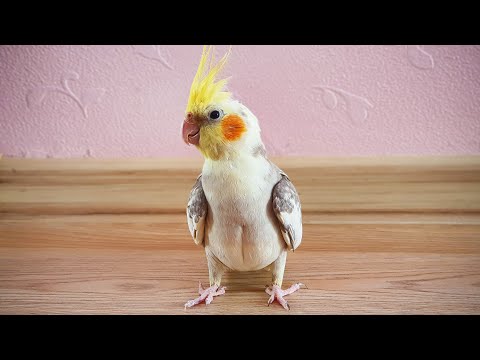
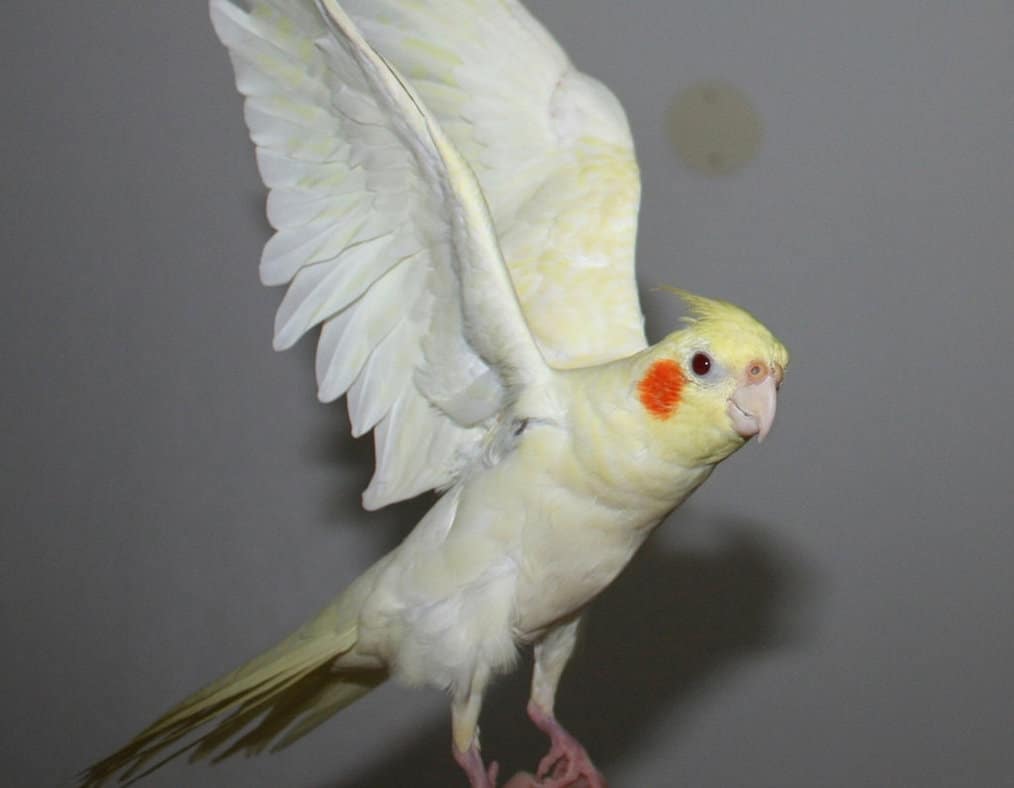
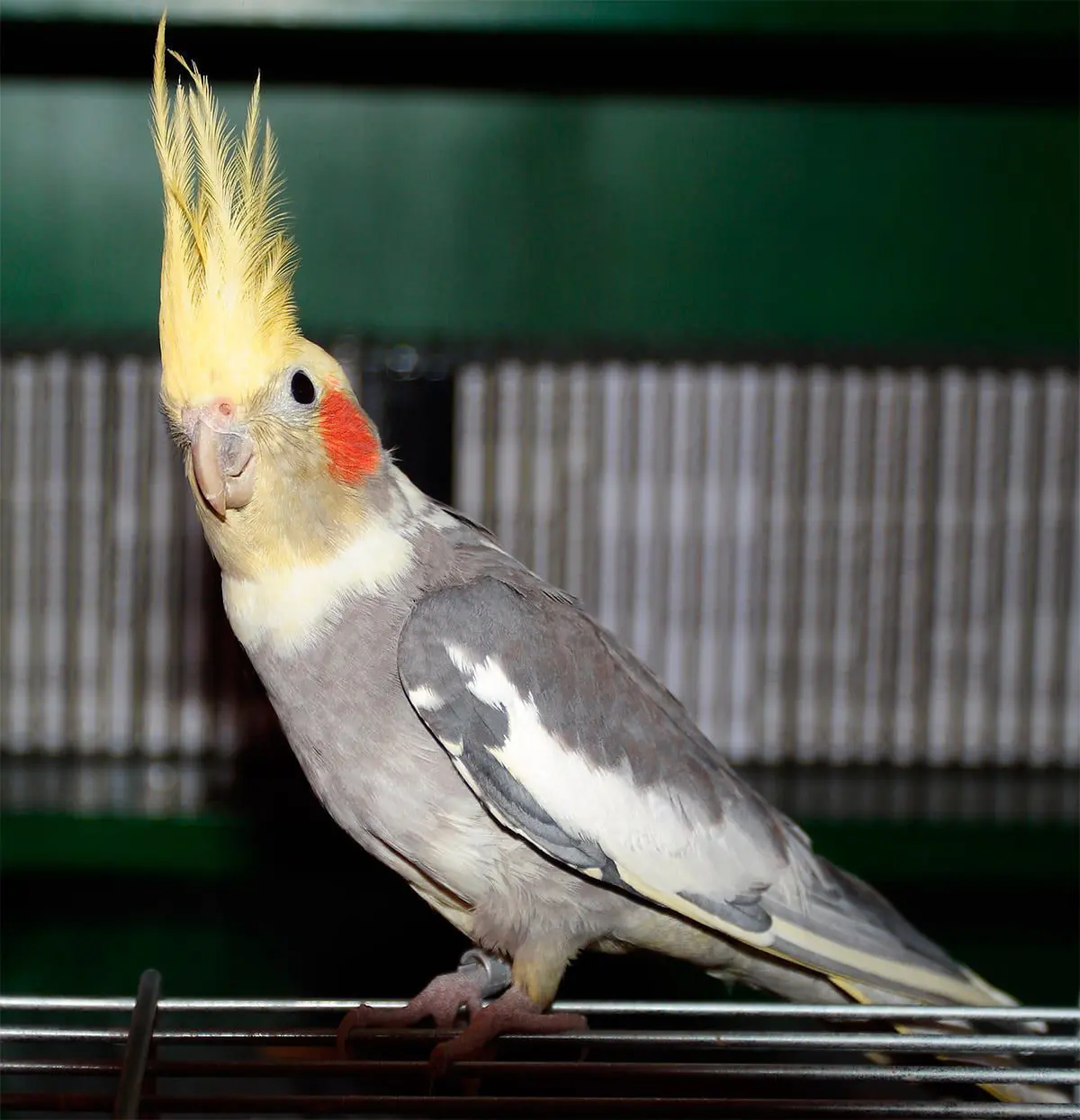
The Cockatiel (Nymphicus hollandicus) adult has the head and the basis of the crest yellow.
Stain handset is orange, paler on the back.
The neck and the long crest feathers are grey.
The upperparts are of color grey Pearl dark.
The wings are grey, but exhibit a white color in the covered and sides.
The underparts are a grey clear.
The tail varies from medium gray to dark gray, the base of the tail is paler.
The bill is grey, the irises dark brown.
The legs are grey-brown.

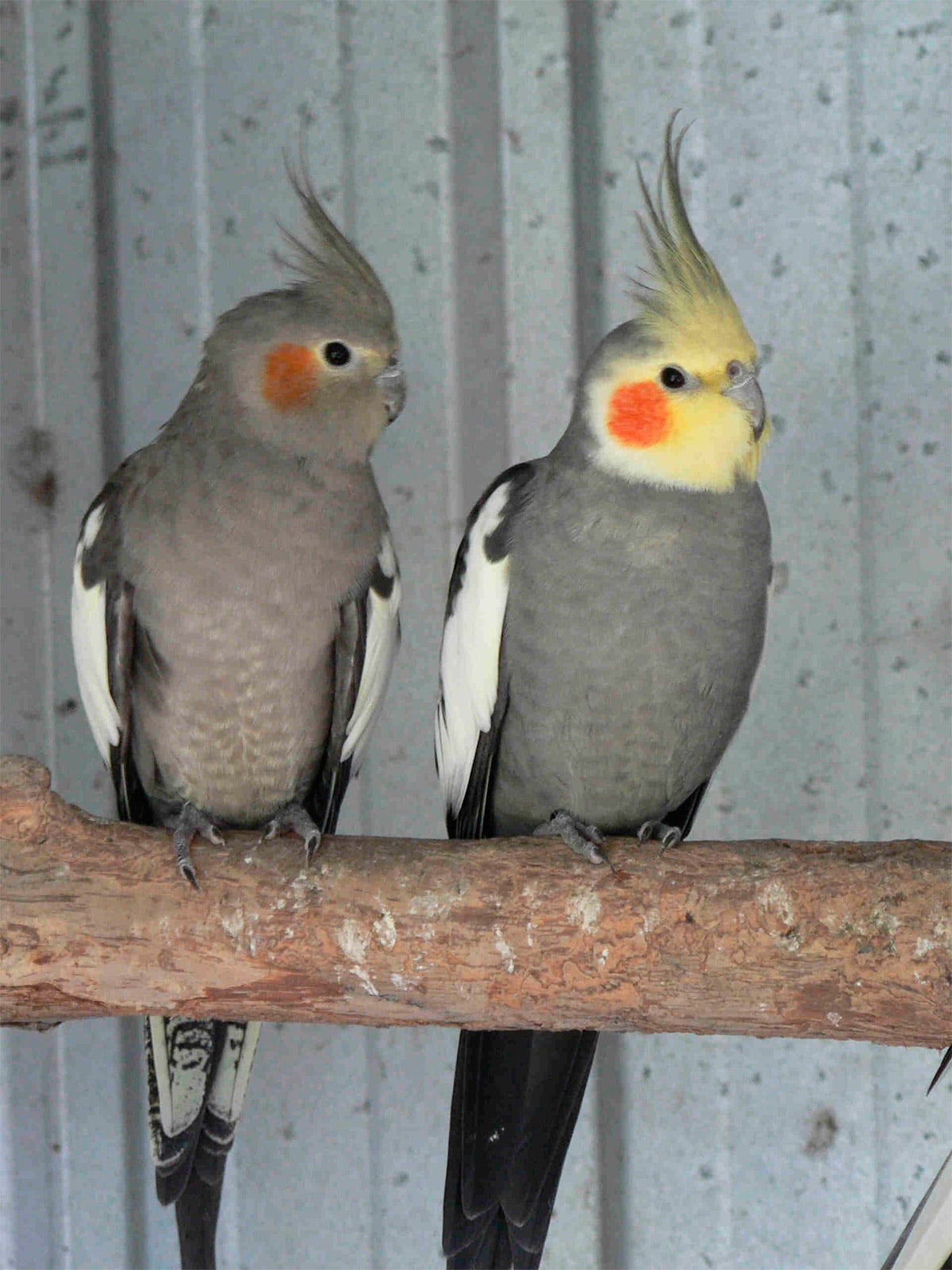
The female presents the stain handset duller, the tuft is less developed, In addition instead of the yellow, the head presents a yellowish grey with yellow dirty envelope the forecrown and a vaguely colorless gray general staining and staining is generally less intense.
The immature are much similar to the females, but have the tail shorter.

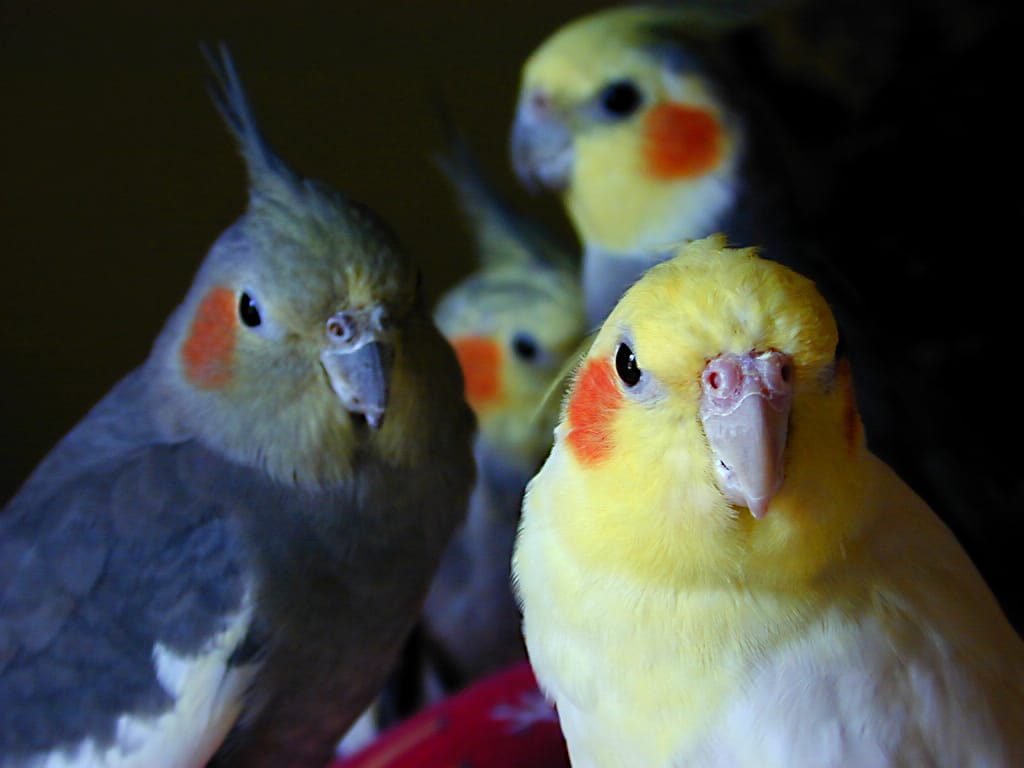
We find Pearl specimens in captivity, White, Gray and lutinos.

Habitat:

Video – "Cockatiel" (Nymphicus hollandicus)

Funny Parrot (Nymphicus Hollandicus)

The cockatoo Nymph they live in a wide variety of habitats, including open forests, small acacia forests that line the rivers and even stretches of Spinifex (Triodia) they are perennial and grow in semi-arid regions.

Also found in farmland, in the stubble and the orchards, as well as on the plains and along the roads.

In dry areas are observed in pairs or in groups of up to 100 individuals.

When feed, the groups contain an average of 27 Member. But, We have already seen demonstrations of almost 1.000 birds near landfills containing vegetable remainders of the rice milling.

Near the points of water, the cockatoo Nymph are often associated with the Budgerigar (Melopsittacus undulatus).

Estas Cockatoos eat twice a day: In the morning, shortly after the Sun, consuming around 2,72 grams of plant material. At night, about an hour and a half before the night, eating around a mass of 4,25 g., It is almost 7 grams for the whole day.

Son great travellers.
Outside of the nesting season, they form large gatherings around the planting of cereals.
As they feed on seeds, these birds need water and in times of drought, sometimes bands come to the coast.

All these movements are quite unpredictable, since they are related to the weather conditions and the State of the food resources. But, in the South of the continent, migrations are more regular: the birds come to nest during the austral spring and usually go away early in the new year.

Son gregarious and very social, so they need a wide repertoire of calls to communicate or express their feelings. They have a great power to imitate other birds.

Reproduction:

In the North, the reproduction is carried out between April and July, While in the South occurs in general from August to December.
The nest is located in a tree hollow whose bottom is padded with sawdust shavings. Most of the time, the nesting site is placed near a source of water in which poultry cooled daily.

The spawning has between 3 and 7 eggs they are incubated alternately by both parents for a few 20 days. 4 eggs are a normal litter. There will be several broods during the season. At birth, the chicks have a thick down comforter yellow. They receive their food mainly in the morning and in the evening.

Chicks they leave the nest after 3 to 4 weeks, but they remain within the family group, Depending on their parents for 1 month. After this time, they join large flocks that roam in search of food.

Food:

Consume a wide variety of small seeds He collected soil, including the cultivated fields of sorghum and sunflower. When they are abundant, local seed varieties are generally preferred to the seeds that come from crops.

Distribution:
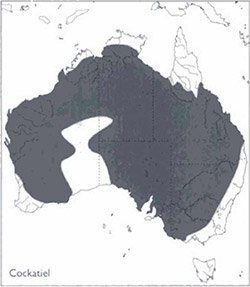
Distribucion Nymphicus hollandicus
Endemic to Australia. Its range covers a vast majority of the continent, except wet coastal areas. Also absent from the Cape York Peninsula, districts located more to the South in winter and areas located more to the North in the summer.

After heavy rainfall, large meetings can be set up in the center of the country where they are, usually, absent.

Conservation:

State of conservation ⓘ


minor concern Minor Concern ⓘ (UICN)ⓘ

– Current IUCN Red List category: Least concern.

– The population trend: Stable

This bird is very common and extended throughout the area. Probably its population grows, It has benefited from the facilities and artificial reservoirs for the development of agriculture.

Its population It is estimated in around a million of birds. The birds that sought to be introduced in the United States they have failed in their attempts to establish themselves in the wild.

In Australia, these small cockatoos are often persecuted for considering them pests for agriculture.

"Cockatiel" in captivity:

The Nymphs or Carolinas they are highly prized birds as pets by its docile nature and for being less demanding than the larger parrots. The nymphs they are perfectly suited to life in the home, they are easy to care for and if you homeschool them from small become companions adorable and very affectionate.

They generally live in pairs or in colonies, that is why it is very common to mate them, to be able to enjoy the birth of the offspring and their development.

They usually enjoy sharing their time with people and rather stick to their owners, Each bird has its personality, so you don't like all that take them into your hands. Males can sing and learn to mimic a few words, but they are much better to imitating sounds, as melodies, sirens or other birds singing. Females vocalize much less but tend to also be more caring.

The nymphs are birds Smart, of friendly character and practically does not present problems of behaviour. They are easily adapted to family life and learn to interact and communicate with people who love. If you've decided to adopt one of these cute birds, make sure you dedicate time to your training to get to have a great pet. This will help you create a strong emotional bond between you and you will also keep it entertaining, mentally active, healthy and happy.

Alternative names:

Cockatiel, Cockatoo Parrot, Crested Parrot, Quarrion, Weero (ingles).
Calopsitte élégante, Perruche calopsitte (French).
Nymphensittich (German).
Cocatiel (Portuguese).
Cacatúa Ninfa, Carolina, Ninfa (español).

scientific classification:

Order: Psittaciformes
Family: Cacatuidae
Scientific name: Nymphicus hollandicus
Genus: Nymphicus
Citation: (Kerr, 1792)
Protonimo: Psittacus hollandicus

Images Cockatoo Nymph:


Sources:
Avibase, elblogdemaskota
Photos: commons.wikimedia.org, huffingtonpost.com, optusnet.com.au, cockateil.NET, galleryhip.com
Sounds: Marc Anderson (Xeno-canto)
▷ The world of Pets: Dogs, cats, birds, reptiles, amphibians

Glossy black cockatoo
Calyptorhynchus lathami


Glossy black cockatoo

Content

Description

46 to 51 cm.. height and between 400 and 500 g. of weight.
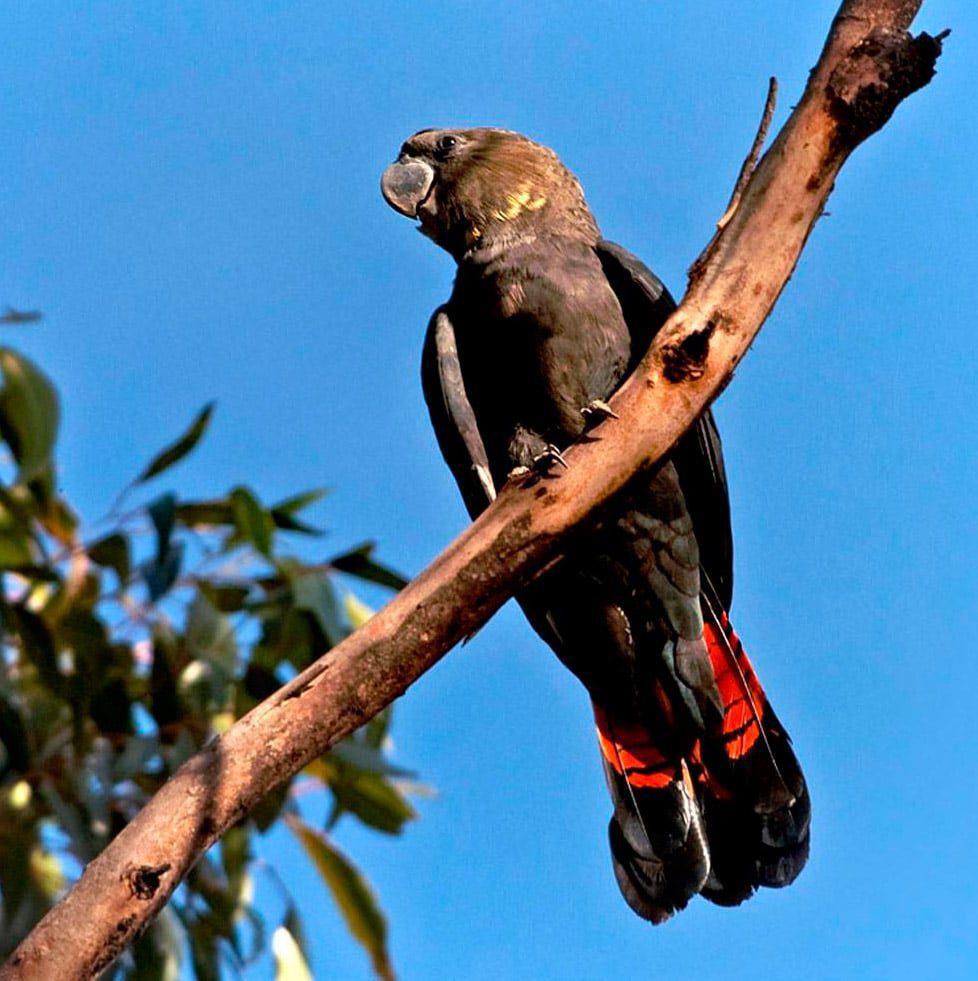
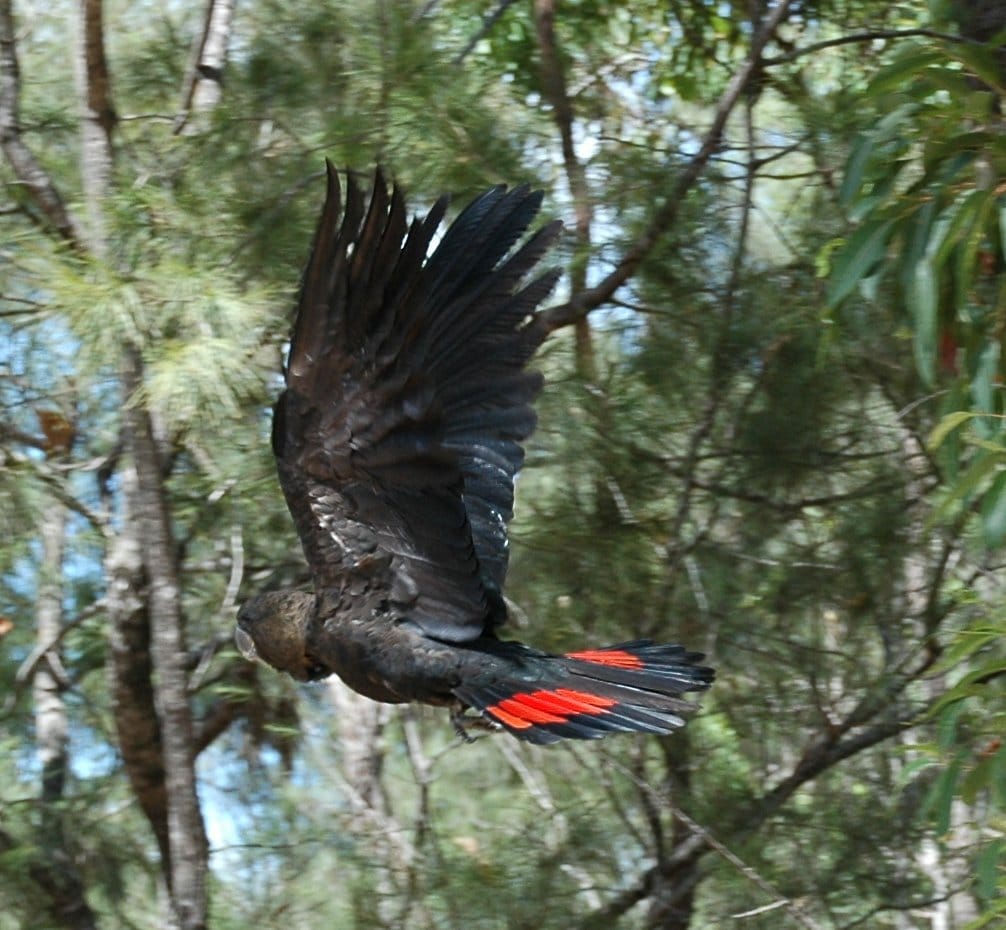
The Glossy black cockatoo (Calyptorhynchus lathami) is the smallest of the 5 black cockatoos and is restricted to the East coast of Australia (a population isolated also is reproduced in the Islands Kangaroo).
The male is brown-black color with a small crest rounded and bright Scarlet spots in the tail. The female shows spots irregular in color yellow in it head, The Scarlet patches in the tail they are permeated by narrow black bars and edges of pale yellow on the underparts of the wings.
The immature they are similar to the females, but they lack the yellow markings on the head and show different yellowish tones in the feathers, the chest and in the belly.

Subspecies description

  • Calyptorhynchus lathami lathami

    (Temminck, 1807) – The nominal.


  • Calyptorhynchus lathami halmaturinus

    (Mathews, 1912) – Medium-size ones 48 cm. length and 510 to 515 weight g, with a wing of approximately 90 cm.. The of adults they are mainly black, dark brown in the head, the neck and the bottom of the body, and Red panels (in males) or orange-red with bars Black (in females) on tail. The female adult is also conspicuous in the head. These patches are absent from most males., Although they can be expressed faintly in a few individuals (Higgins 1999).

    The immature are similar in appearance to the male adult, but have small stains yellow in it head; spots or bars yellow in the chest, belly and flanks; yellow or orange spots on the wing (mainly on the bottom); Red or orange-yellow panels with black bars at the tail; One bill pale grey (instead of dark); And a ring of skin around the eye pale grey (instead of grey dark) (Higgins 1999, L. Pedler 2007, com. Pers.).


  • Calyptorhynchus lathami erebus

    (Schodde & Mason,IJ, 1993) – The only difference with the nominal species resides in that has the bill shorter.

Habitat:

Video – "Glossy black cockatoo" (Calyptorhynchus lathami)

Glossy-black Cockatoo (Calyptorhynchus lathami ) HD Video clip 1/3

Areas forested frequently dominated by casuarinas of which are highly dependent for its food. These are small shrubs commonly known as the Sheoaks, wood for beef (Beefwood) or Australian pine. These shrubs are widespread in tropical and subtropical regions.

They are also distributed in open humid forests, difficult terrain where deforestation has not been too great. They have an imperative for natural tree cavities to nest.

Reproduction:

Forman couple during all the life. The couple has relationships throughout the year. This type of family of them parrots prefers to nest in cavities natural of the eucalyptus, whether dead or in full vitality. The nest usually placed at an altitude that ranges between the 3 and 30 meters above the ground. The cavity is filled with leaves and branches. Sometimes, together with other breeding pairs, they share the same tree year after year.

In New South Wales the season extends from March to August. The spawning It consists of a single egg white. It is the female that takes charge of most of the tasks.: It prepares the nest and incubates herself. Never leave the nest until the small is reached the age of one week. In most cases, the male provides the female with food and assistance until the young can fend for itself, normally four months which remains with them until the next breeding season.

Food:

It feeds almost exclusively on the seeds several species of She-oak (Casuarina and Allocasuarina). You can also sometimes eat larvae of wood-boring. They feed in threes, less frequently in pairs, small groups or flocks of up to 60 birds. They can be detected by the snapping of their beaks and the remains of the casuarina cones and twigs that fall.

Distribution:

Size distribution (reproduction / resident): 770.000 km2

The species is Rare Although widespread in suitable forests of the central coast and forest habitats of Queensland and in the interior of the southern plateaus and Plains of the Midwest's New South Wales, with a small population in the Riverina. There is an isolated population in the Kangaroo Island, South of Australia.

Subspecies distribution

  • Calyptorhynchus lathami lathami

    (Temminck, 1807) – The nominal.


  • Calyptorhynchus lathami halmaturinus

    (Mathews, 1912) – Kangaroo Island (South of Australia)


  • Calyptorhynchus lathami erebus

    (Schodde & Mason,IJ, 1993) – It is from Australia (the central eastern coastal area of Queensland)

Conservation:

State of conservation ⓘ


minor concern Minor Concern ⓘ (UICN)ⓘ

• Current category of the Red List of the UICN: Least concern.

• Population trend: Decreasing.

Like most parrot species, the Glossy black cockatoo is protected by the Convention on international trade in endangered species of Fauna and Flora Silvestres ( CITES ), with its inclusion in the list of the Appendix II of vulnerable species, What makes the import, the export and trade of animals captured in the wild is illegal.

Justification of the population

Garnett and Crowley (2000) estimated the size of the population in the following way: 12.000 individuals of the subspecies lathami, 70 breeding pairs of the subspecies halmaturinus (equivalent to 140 individuals) and 5.000 individuals of the subspecies erebus giving a total of 17.140 individuals.

Justification of trend

They suspected that the population is declining in general Since the largest subpopulation, lathami, It is slowly decreasing throughout its range. However it is believed that the subspecies Erebus is increasing and the subspecies halmaturinus It is increasing as a result of conservation efforts in the Island Ganguro (Garnett and Crowley 2000).

"Glossy black cockatoo" in captivity:

Like the other black cockatoos, the Glossy black cockatoo (Calyptorhynchus lathami) is extremely rare in the poultry. In Australia It has attained breed in captivity.

Alternative names:

Glossy Black-Cockatoo, Casuarina Cockatoo, Casuarine Cockatoo, Latham’s Cockatoo, Leach’s Black-Cockatoo, Leach’s Red-tailed Cockatoo, Nutcracker (English).
Cacatoès de Latham, Cacatoès noir étincelant (French).
Braunkopfkakadu (German).
Cacatua-preto-brilhante (Portuguese).

scientific classification:

Order: Psittaciformes
Family: Cacatuidae
Scientific name: Calyptorhynchus lathami
Genus: Calyptorhynchus
Citation: (Temminck, 1807)
Protonimo: Psittacus Lathami

Images Calyptorhynchus lathami:


Species of the genus Calyptorhynchus
  • Calyptorhynchus banksii
  • —- Calyptorhynchus banksii banksii
  • —- Calyptorhynchus banksii graptogyne
  • —- Calyptorhynchus banksii macrorhynchus
  • —- Calyptorhynchus banksii naso
  • —- Calyptorhynchus banksii samueli
  • Calyptorhynchus lathami
  • —- Calyptorhynchus lathami erebus
  • —- Calyptorhynchus lathami halmaturinus
  • —- Calyptorhynchus lathami lathami

  • Sources:
    Avibase
    – Parrots of the World – Forshaw Joseph M
    – Parrots A Guide to the Parrots of the World – Tony Juniper & Mike Parr
    – Birdlife

    Photos: commons.wikimedia.org, The Glossy Black Conservancy,

    Sounds: Nigel Jackett (Xeno-canto)

    ▷ The world of Pets: Dogs, cats, birds, reptiles, amphibians

    Gang-gang cockatoo
    Callocephalon fimbriatum


    Gang-gang cockatoo

    Content

    Description

    Of approximately 35 cm.. height and an average weight of 257 g.
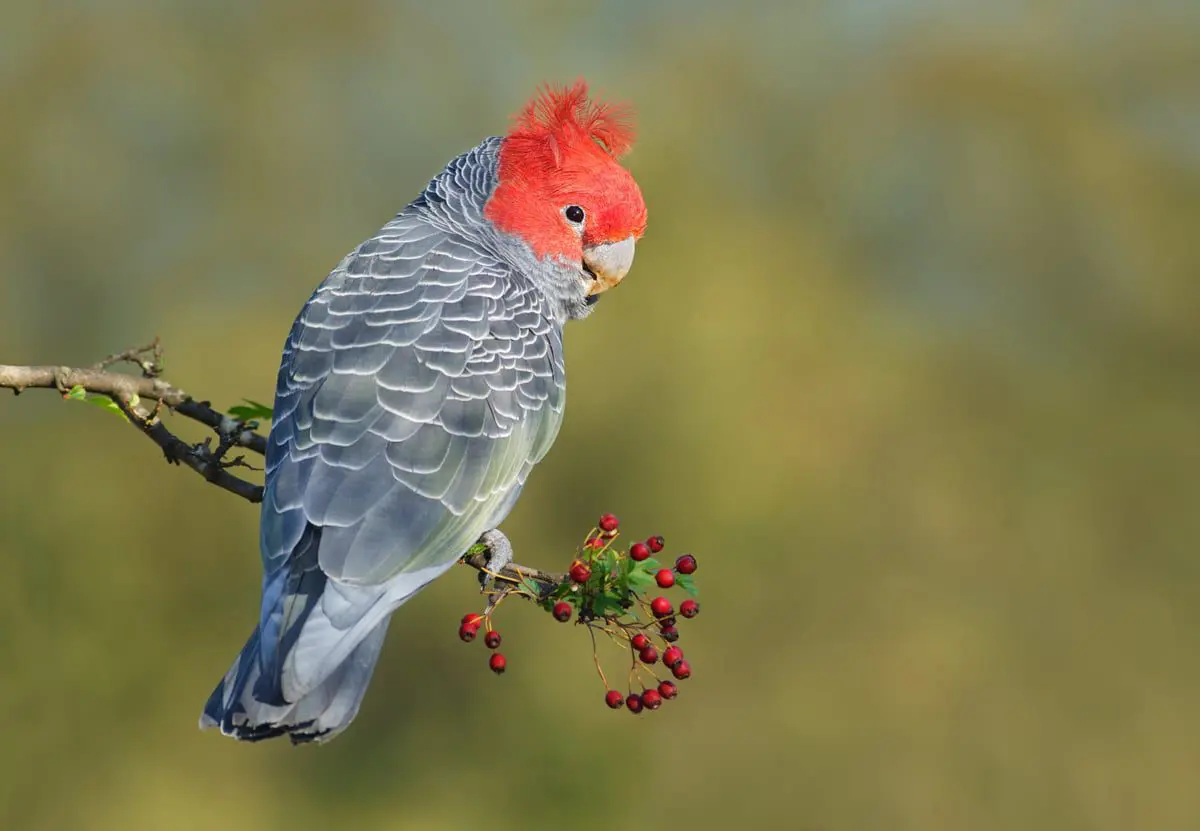
    The Gang-gang cockatoo (Callocephalon fimbriatum) it's a little cockatoo, robust, with one crest Dim, large wings wide, and tail short. Son gregarious but relatively calm.
    The males of the Gang-gang cockatoo they are immediately recognizable by their head and crest scarlet. The remaining plumage is slate grey.
    The females they have the head and crest grey. The feathers of the part inferior of the body are lined with green Orange and yellow, giving a scaly appearance. The tail also has stripes horizontal white. Otherwise, is identical to the male.

    The juveniles they are similar to the females, they differ in their top, the head Red and one crest shorter and less twisted.
    The Gang-gang cockatoo not can confuse it with other species of parrots. In flight, However, sometimes their shape resembles to the cacatúa Galah.

    Habitat:

    Video – "Gang-gang cockatoo" (Callocephalon fimbriatum)

    Gang- gang Cockatoo (Callocephalon fimbriatum)

    During the summer are found in the forests of mountain and areas with understory of shrubs dense. In Winter they will move to more dry and low altitudes, more open forests. They can often be seen along the roads and in parks and gardens in urban areas. They require high hollow trees for nest.

    Reproduction:

    Forman couples monogamous. The female chooses a hole in the right tree and both sexes prepare the nest for egg-laying. They line the sides of the hole with sawdust and chewing dust. Both sexes incubate the eggs and care for the young. Parents feed their young for four to six weeks after hatching. Feather.

    Family groups are commonly seen feeding together during the breeding season.. In some cases, nurseries will be formed’ where have several couples nested together, their young perch together in the same tree, While their parents seek for food.

    Food:

    With feed mainly seeds trees and shrubs, native and introduced, with a preference for the eucalyptus, beards and thorns. They also eat berries, fruit, dried fruits, insects and their larvae.

    They are mainly arboreal, they perch on the ground only to drink and forage among the fallen fruits or cones.

    They feed in flocks of up 60 birds out of breeding season. Feed in pairs or small family groups during the breeding season.

    They are able to use exotic plants as food in the urban areas.

    Distribution:

    Size distribution (reproduction / resident): 333.000 km2

    They are endemic to the South-East of Australia. They are widespread in the East of New South Wales, from the Central slopes and plateaus to the South Coast, along the northeastern regions of Victoria to Seymour, with some records in the East of Melbourne, mornington peninsula and Southwest Gippsland.
    Have also been introduced in the Kangaroo Island to the South of Australia.

    Conservation:

    State of conservation ⓘ


    minor concern Minor Concern ⓘ (UICN)ⓘ

    • Current category of the Red List of the UICN: Least concern.

    • Population trend: In increased.

    Is come affected negatively by deforestation and the removal of mature trees (potential breeding sites). A population is classified as threatened: in the Valley Cove Lane, New South Wales.

    The the rest of the population It is suspected that it may be increasing and now will spend the winter in the suburbs of Canberra.

    The world population are estimated at more of 20,000 individuals.

    "Gang-gang cockatoo" in captivity:

    It´s very rare in poultry and hard to find as a pet.

    Son Smart and playful, but they have a great tendency to suffer from software. They are very destructive for what need of abundant toys to not attack against the furniture of the House.

    When you get bored, they are often automutilan as a way to fight against boredom.

    Its life expectancy You can overcome the 60 years.

    Alternative names:

    Gang-gang Cockatoo, Cockatoo Corella, Helmeted Cockatoo, Red-crowned Cockatoo, Red-headed Parrot (English).
    Cacatoès à tête rouge, Cacatoès gang-gang (French).
    Helmkakadu, Helm-Kakadu (German).
    Cacatua-gang-gang (Portuguese).
    Cacatúa Gang Gang, Cacatúa Gang-gang (español).

    scientific classification:

    Order: Psittaciformes
    Family: Cacatuidae
    Scientific name: Callocephalon fimbriatum
    Genus: Callocephalon
    Citation: (Grant,JB, 1803)
    Protonimo: Psittacus fimbriatus

    Images Gang-gang Cockatoo:


    Sources:
    Avibase
    infoexoticos
    – Birdlife

    – Photos: Jan Wegener, Marbiz (Panoramio), papouch.webzdarma.cz, Benjamint444 (commons.wikimedia.org)

    – Sounds: (Xeno-canto)

    ▷ The world of Pets: Dogs, cats, birds, reptiles, amphibians

    Galah
    Eolophus roseicapilla


    Cacatúa Galah

    Content

    Description

    Measured around 35 centimeters and between 240 and 330 g. weight.
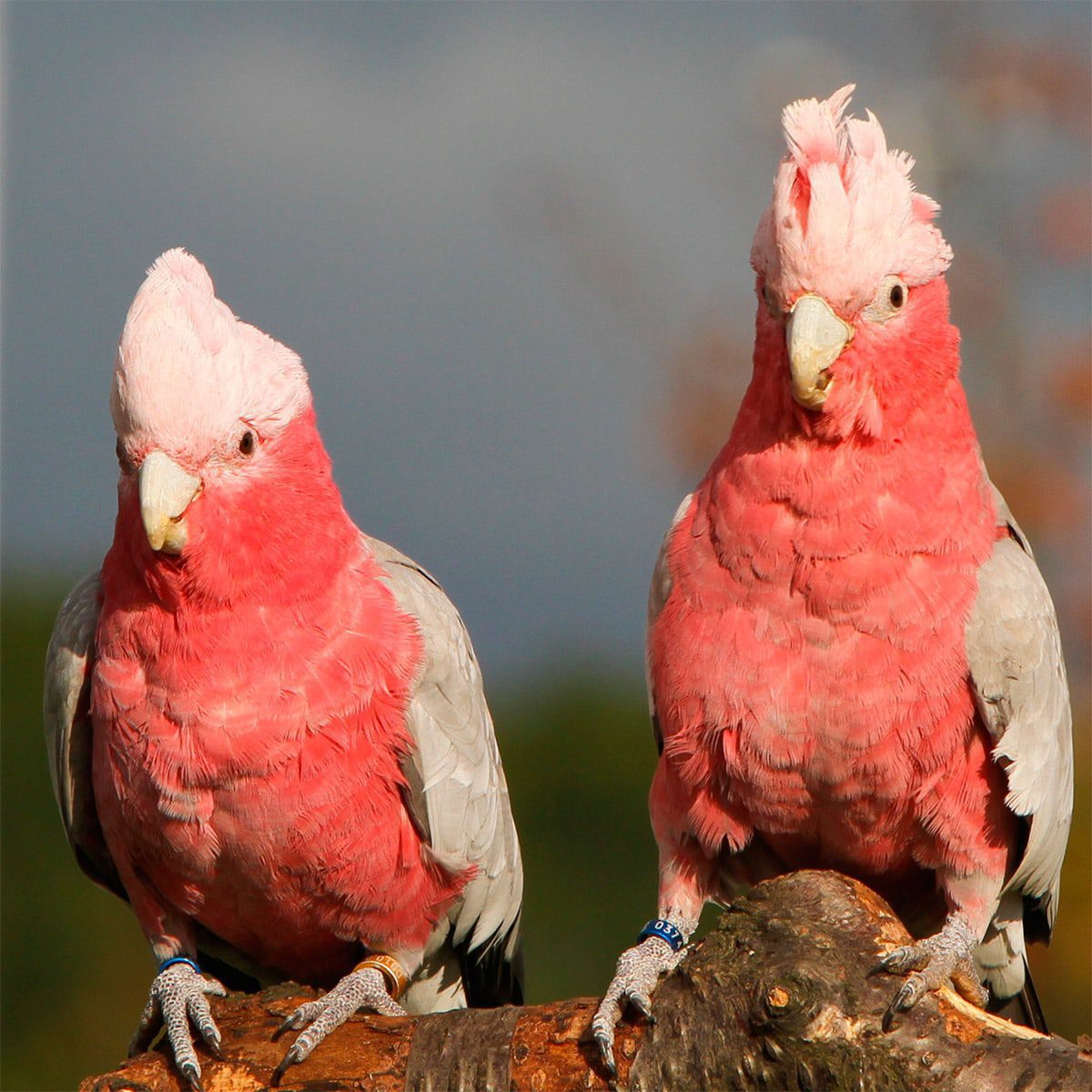
    In the Galah (Eolophus roseicapilla) adult, the front, the hoopoe and the cap they form a joint undercover pale pink in white which contrasts slightly with the back of the neck darker. The face, neck and underparts they are deep pink.
    The bottom of the flanks, the the thighs and mantas subcaudales are grey clear. The upperparts They show a grey pigeon which is slightly paler on the rump and in their flow rates. Tertiary they are grey and dark grey and medium the flight feather.
    The upper part of the tail It is pale grey with a darker terminal tips. The bottom of the tail is uniformly Brown.

    The bill is horn. The bare periophthalmic is greyish Red. The irises shows a dark brown hue. The legs are grey.

    The female is similar to fellow, outside of the irises red.

    The youth can distinguish is from the adults by their underparts grey infiltrated.

    Subspecies description

    • Eolophus roseicapilla roseicapilla:

      The species nominal


    • Eolophus roseicapilla albiceps:

      Differs from the nominal by their larger size, the crest whitish instead of pink, and eye ring Red instead of greyish white.


    • Eolophus roseicapilla kuhli:

      It has a plumage paler and a crest shorter.

    Habitat:

    Video – "Galah" (Eolophus roseicapilla)

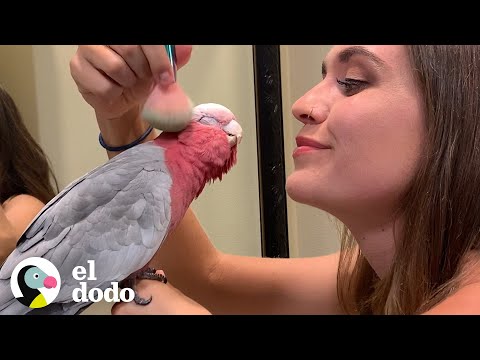
    Ave wants to do everything her human mom does I Soul Mates | the dodo

    In the North of its distribution area, the Galah frequent mountain forests, While much further South, most tend to live in the temperate forests of the lowlands.
    During the summer season, It is more common in high altitude forested areas., staying mainly in small cool and shady ravines, always near a river.

    In Winter, He moved to arid forests in more moderate altitudes. At this time of the year, also visit the parks and urban gardens.

    The Galah It is a bird of open areas, always avoiding the dense forests.

    During the nesting season they live in pairs or in small family groups, but the rest of the year, gather in large flocks where food resources are important. Sometimes can gather up to 1.000 birds in the pastures where they feed.

    They are sentinels responsible to give the alarm in case of danger.
    The power stations are separated by many miles of the rest areas.
    In the evening devoted to drinking and perform aerial stunts before joining the residence. Occasionally it can be active and noisy at night.

    Reproduction:

    In the North, the reproduction has place between February and June.

    During the courtship, the male Struts before his partner making bows, shaking his head, producing low notes and showing a repertoire of stunts.

    Most of the time, the nest is a natural cavity in a eucalyptus, between 2 and 20 meters above the ground.
    The cacatúa Galah You strum the bark of the trunk around the hole which is the entrance of the nest. This practice is sometimes so excessive that they cause the death of the tree. Cliffs can also be used as a place of nesting.

    The same couples usually are mate during all their life and are loyal to the same nesting sites for several consecutive years.

    The spawning includes 2-6 eggs. The female lays an egg every one or two days and the incubation period is about 25 days. Both parents incubate at the same time, and they provide assistance to young people. They feed their young every 3 hours, sounding his beak to regurgitate the food. The young remain in the nest during 7 u 8 weeks.

    While they are able to fly quickly when they come out of the nest, their survival rate is small. The first days after the flight, they return to the nest for the night. Shortly after, large nurseries are formed in which the parents continue to feed their young.

    From time to time, the Galah It has a second litter in a season.

    Food:

    Consume a wide variety of plants, such as oats or wheat seed or the other many herbaceous plants. In addition to that, They also eat insects and their larvae, berries, outbreaks, flowers and seeds of eucalyptus.

    They feed almost exclusively on Earth.

    Distribution:

    Size distribution (reproduction / resident): 14400000 km2

    endemic to Australia where it occupies the entire continent. Most of its population lives in the south-east of New Welsh of the South and in the State of Victoria. In other places, is less abundant.

    Subspecies distribution:

    • Eolophus roseicapilla roseicapilla:

      (Western Australia, South of the great desert of sand and probably in the Simpson Desert in the southern part of the territory of the North)


    • Eolophus roseicapilla albiceps:

      (Tasmania and Southeast of Australia, heading north to the 20 degrees latitude South and East)


    • Eolophus roseicapilla kuhli:

      (to the North of the of Australia, from the District of Kimberley to the cape york peninsula)

    Conservation:

    State of conservation ⓘ


    minor concern Minor Concern ⓘ (UICN)ⓘ

    • Current category of the Red List of the UICN: Least concern.

    • Population trend: In increased.

    Although it has a beneficial action stopping the spread of some weeds, the Galah have a considerable potential of destruction and is considered a pest in most of Australia.

    Crops, especially cereals, they suffer great losses each year. They often cause the destruction of the trees where they nest or establish their residences. The world population It is estimated in more than 5 millions of individuals and the number is constantly growing.

    This remarkable species not is protected in all the regions and can be killed if it causes too much agricultural loss.

    "Galah" in captivity:

    It´s very common in poultry around the world, for being one of the easiest cockatoos both to raise and to care for and for being highly demanded as a pet both for its physical appearance and for its more manageable character than that of other cockatoos. Her offspring should take into account the different subspecies, Therefore we will avoid possible hybridization between them.

    Son parrots extroverts, friendly, playful and affectionate. However, they are still cacatuidos, They therefore require more attention than other psittacine species to be happy animals. Its speaking ability is fairly high within the group of cockatoos, with males that better mimic. It is considered that it might also noisy, especially if you are bored or if it has been poorly educated or poorly maid, so you will have to always buy weaned and well socialized specimens. When they are young and still take porridge his voice is very unpleasant.

    They possess a behavior that is similar to the of the small Cockatiel. Males are more talkers and possess a strong character. The females., on the other hand, they are silent and less dominant. They are most appropriate, Therefore, to be adopted as pets.

    The males they may become aggressive in mating season.

    They have a high tendency to obesity, thing very significantly decreases their hope and quality of life, by what control seriously its diet, providing low number of fats and allowing to do much exercise.

    Its life expectancy formerly was around the 15-18 years, probably due to a bad diet popular ignorance of your requirements. Today there is talk of animals up to 40 years of life.

    If we opt for a cockatoo for the home, a pink may be the best alternative: less demanding than her sisters, slightly less noisy and, If we chose a female, We have the gentleness and docility secured.

    Its price market round the 1.000 €.

    Alternative names:

    Galah, Rose Cockatoo, Roseate Cockatoo, Rose-breasted Cockatoo, Willock (ingles).
    Cacatoès rosalbin, Galah (French).
    Rosakakadu (German).
    Cacatua-galah (Portuguese).
    Cacatúa Galah, Cacatúa Rosa (español).

    scientific classification:

    Order: Psittaciformes
    Family: Cacatuidae
    Scientific name: Eolophus roseicapilla
    Genus: Eolophus
    Citation: (Vieillot, 1817)
    Protonimo: cockatoo roseicapilla

    Images Galah Cockatoo:


    Sources:
    Avibase
    Oiseaux
    – kktwas
    faunatura

    Photos: de.wikipedia.org , commons.wikimedia.org, David Cook Wildlife Photography (kookr), Richard.fisher

    Sounds: nick talbot (Xeno-canto)

    ▷ The world of Pets: Dogs, cats, birds, reptiles, amphibians

    Pink cockatoo
    Cacatua leadbeateri

    Cacatúa Abanderada

    Content

    Description


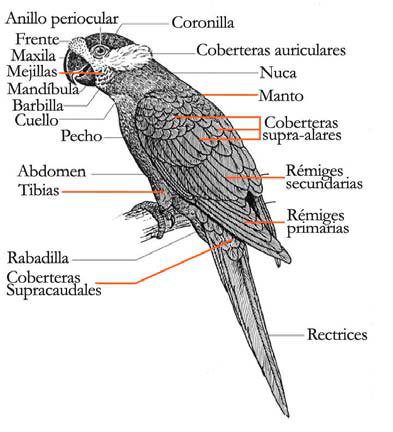
    Anatomy-parrots

    35 cm.. length and weighing approximately between 340 and 425 g.
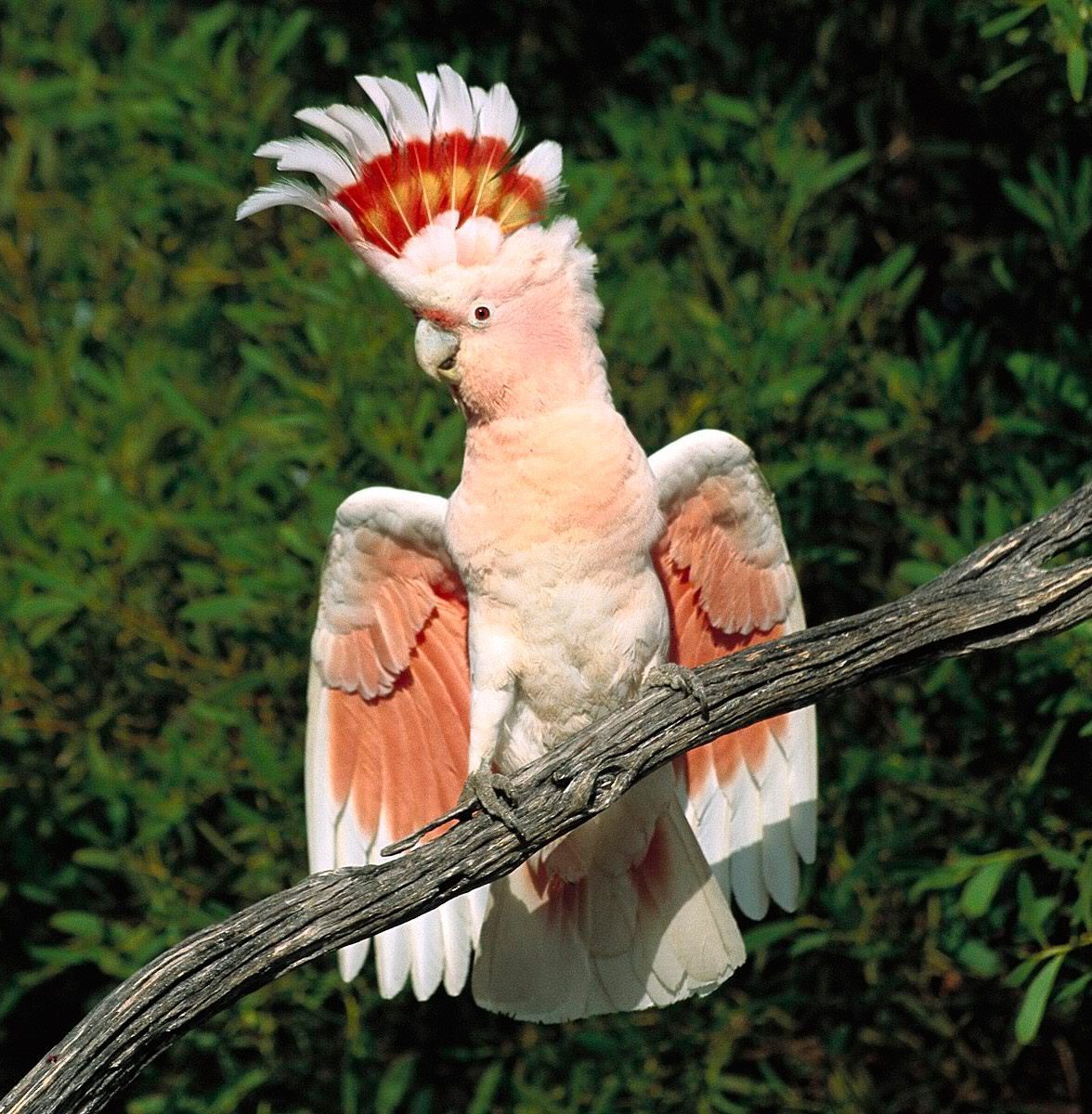
    The Pink cockatoo (Cacatua leadbeateri) is distinguishable by its spectacular Crest composed by 16 long feathers forward curved. These pens have a wide base with a slightly pink and yellow red-stained central part.

    The top ends of the crest are white. Another set of more rounded feathers grow over the eye, forming a white base when the crest is raised. The forecrown is spanned by a band thin and reddish.

    The face, neck and underparts are salmon, becoming is white in the coverts.
    The flight feather and tail are white with infiltration of salmon on the bottom.

    The bill is horn. The irises dark brown and legs grey.

    The female looks like your partner, but the head Pink salmon and underparts they are paler. The band Yellow that decorates the bill is brighter and wider. Upper belly It is white instead of Pink salmon. The irises are reddish-pink.

    The immature they are identical to the female. The frontal band is bright orange-red, the irises light brown.

    Description 2 subspecies

    • Cacatua leadbeateri leadbeateri

      (Vigors, 1831) – Nominal.


    • Cacatua leadbeateri mollis

      (Mathews, 1912) – Both similar to the kind adults nominal, but with the crest darker red, with little or no yellow. White Peak.

    Behavior:

    The couple is the basic social unit, but are maintained contact with other couples nonreproductive through the establishment of groups.

    Out of it breeding season, There are mainly small bands consisting of 10 to 50 birds. Major gatherings occur only during periods of drought or when food sources are abundant. In this case, There may be a few hundred individuals, among them, small Galah.

    Dormitories they are occupied exclusively outside the breeding season and the birds leave early at dawn.

    The Pink cockatoo they forage in trees and on the ground. But, This species is more arboreal that the Galah wave Little corella.

    When moving on the ground, He walks slowly to avoid the tall grass.

    In the Flock, a bird play always the role of Sentinel. It adopts a very careful attitude, it partially roughcast its crest and regularly pauses during which is very upright inspecting the surroundings.

    During the mid-day heat, it finds shelter in the foliage of the trees.. During the summer, rest period is longer.

    The paired birds they are always near each other. During periods of intense heat, This bird visit water points, even during the day. At sunset, they return to your bedroom.

    Habitat:

    Video – "Pink cockatoo" (Cacatua leadbeateri)

    Cockatoo leadbeateri _ Inkakakadu`s in Aktion

    Its population is distributed by a variety of forest habitats in arid or semi-arid areas.
    The species is closely related to the areas of «Mallee«.

    Found particularly in afforestation of cypress and eucalyptus, in mixed plots of eucalyptus and Casuarinas or near cliffs.
    Its presence in a place is largely also to the existence of a water fountain.
    On the other hand, shows a very weak attachment to the fragmented habitats that is no long.

    Reproduction:

    The nesting season running from August to December. Cockatoos return to their traditional nesting sites.

    The cavity for the nest receives improvements: the entrance is enlarged and covered with a layer of fresh chips placed at the bottom of the nest. The nests they are almost always far from one another, at a distance of 2 km.

    The spawning is between 2 and 5 eggs being deposited between 2 and 3 days. The incubation It made both parents, begins after the deposit of the third egg and lasts between 23 and 24 days.

    The chicks they remain at the bottom of the cavity during 57 days and are fed by the male and the female indistinctly. The family stays near the nest until the last hatchling leaves the nest., they will then join other family groups in the place where food resources are appropriate.

    On rare occasions, the Pink cockatoo is forced to eject a couple of Galah He started to lay eggs in their nest, but it can also happen that this form of parasitism is a success. In this case, the partner of the Pink cockatoo takes care of eggs and young after hatching. When are born, the young of the species Eolophus roseicapilla, they behave exactly like their hosts, ignoring the difference in origin.

    Food:

    With feed seed, herbs, cereals and often of melons (Cucumber myiocarpus). Also consume fresh local figs, pine cones, eucalyptus seeds, bulbs, dried fruits, estate, insects and larvae.

    During and after your meal, These birds biting branches and pieces of bark, causing a shower of timber crushed at the foot of the trees.

    During periods of intense heat, increase the frequency of his visits to water points.

    Distribution:

    Size of the area of distribution (reproduction / resident): 2,88 million km2

    endemic to Australia. Its main strongholds are in the southwest of Queensland where is quite extended and South of Australia, where is locally common.

    In other parts of the continent are very rare and scarce, going back to the vicinity of the Northern Territory and carrying out raids in Western Australia.

    Distribution 2 subspecies:

    • Cacatua leadbeateri leadbeateri

      (Vigors, 1831) – Nominal.


    • Cacatua leadbeateri mollis

      (Mathews, 1912) – Interior West and centre of Australia, towards the East, up to the eyre peninsula and the basin of the Lake Eyre, South of Australia.

    Conservation:

    Least concern (Red list 2006).

    • Listed as vulnerable by NSW national parks and wildlife.

    Threatened by the law of conservation of species (2005).

    Its distribution is very unequal, but only in the Centre - this actually is and South-East where they have widespread. In other parts of Australia, This species is declining due to the thinning of the habitat and its marketing as bird cage.

    Competition with the Galah's disability for nesting cavities may be a crucial problem in the future if this species continues to grow. The world population of the Pink cockatoo It is estimated in a little less than 20 000 birds. It is classified as near threatened.

    "Pink cockatoo" in captivity:

    It is a frequently held in captive animal in your Australia natal, but it is less known in other countries like ours. Its price in the market is very high, especially that of males, being one of the most expensive white cockatoos.

    Very noisy, with a great personality, playful and very active. It is very destructive, We must therefore provide toys and wood to gnaw, or otherwise you will satisfy with house furniture and other elements. Inactive animals, bored or stressed tend to yell a lot.

    Its life expectancy round between the 40 and 60 years of life.

    Alternative names:

    Pink Cockatoo, Leadbeater’s Cockatoo, Major Mitchell’s cackatoo (ingles).
    Cacatoès de Leadbeater, Cacatoès commandant Mitchell (French).
    Inkakakadu (German).
    Cacatua-rosa (Portuguese).
    Cacatúa Abanderada, Cacatúa Inca (español).

    scientific classification:

    Order: Psittaciformes
    Family: Cacatuidae
    Genus: Cockatoo
    Scientific name: Cacatua leadbeateri
    Citation: (Vigors, 1831)
    Protonimo: Plyctolophus Leadbeateri

    Images Flag-crested Cockatoo:


    Species of the genus Cacatua
  • Cacatua tenuirostris
  • Cacatua pastinator
  • —- Cacatua pastinator derbyi
  • —- Cacatua pastinator pastinator
  • Cacatua sanguinea
  • —- Cacatua sanguinea gymnopis
  • —- Cacatua sanguinea normantoni
  • —- Cacatua sanguinea sanguinea
  • —- Cacatua sanguinea transfreta
  • —- Cacatua sanguinea westralensis
  • Cacatua goffiniana
  • Cacatua ducorpsii
  • Cacatua haematuropygia
  • Cacatua galerita
  • —- Cacatua galerita eleonora
  • —- Cacatua galerita fitzroyi
  • —- Cacatua galerita galerita
  • —- Cacatua galerita triton
  • Cacatua ophthalmica
  • Cacatua sulphurea
  • —- Cacatua sulphurea abbotti
  • —- Cacatua sulphurea citrinocristata
  • —- Cacatua sulphurea parvula
  • —- Cacatua sulphurea sulphurea
  • Cacatua moluccensis
  • Cacatua alba

  • Sources:

    Avibase, infoexoticos, Oiseaux.NET

    – Photos: imagenesdeanimalessalvajes (Alexis Obninsk), David Cook Wildlife Photography, Wikimedia , parcodeipappagalli , Geoffrey Dabb

    – Sounds: Patrik Åberg (Xeno-canto)