▷ The world of Pets: Dogs, cats, birds, reptiles, amphibians

Western Ground Parrot
Pezoporus flaviventris

Western Ground Parrot

Content


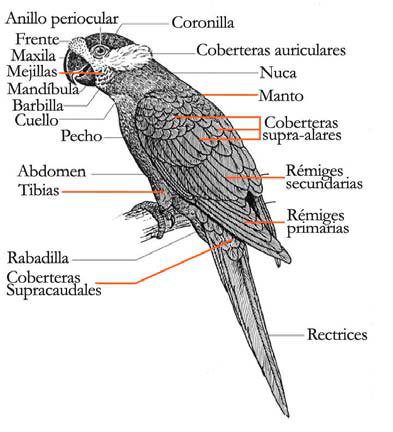
Anatomy-parrots
Video «Western Ground Parakeet»

Description:

30 cms. length between 105-110 g. of weight.

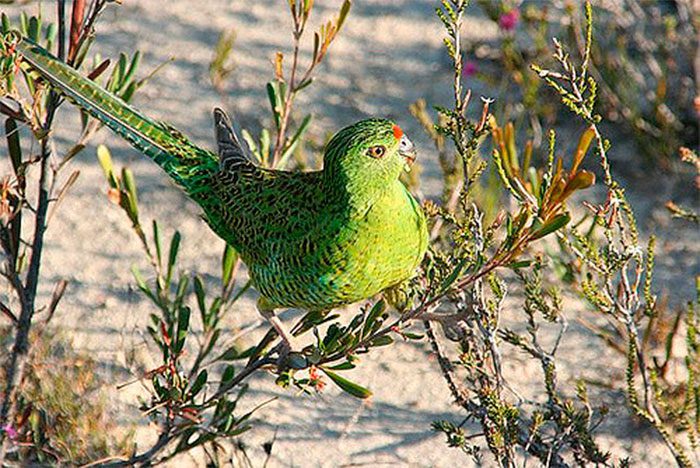
The Western Ground Parrot (Pezoporus flaviventris) It has mottled green back, underparts green and yellow, forecrown red. Tail long, with green stripes, Yellow and black poorly defined.

taxonomy:

A research team, directed by Stephen Murphy, studied taxonomy (discipline in charge of classifying living things) of the Eastern Ground Parrot (Pezoporus wallicus), an endemic species (exclusive geographic region) of fragmented coasts of southwest and southeast Australia. The researchers studied DNA from museum specimens from 160 years, and they concluded that the western population should be classified as a new species: Pezoporus flaviventris.

Habitat:

The Western Ground Parrot It is a bird that lives in soil and living in low heathland, dry or swampy near the coast. They are usually seen in habitat that has remained unburned for long periods of time. Mainly fly at dawn or dusk and feeds mainly on small seeds.

Reproduction:

It is one of the few parrots in the world that does not nest in a hole or cavity. Little else is known about the reproductive biology of the Western Ground Parrot

Food:

The Western Ground Parrot usually it feeds alone or with another parakeet. Seeds of various plants, especially of Sedge, for example, Mesomaelaena stygia ssp. stygia. Flower buds and flowers base, for example, the beaufortias, the dryandras and grevilleas, They are also important parts of the diet. It has been observed Western Ground Parrot semisuculentas feeding on leaves Daviesia pachyphylla. The diet is varied and uses the great diversity of habitat.

Distribution:

Historically, This species was found along the south west coast of Australia from Perth north to Geraldton and along the south coast east to Israelite Bay. But, It seems to have disappeared off the west coast of Western Australia in 1900.

Today only two locations are known from the extreme southwest of Western Australia: Fitzgerald River National Park and Cabo Arid National Park / Natural Reserve Nuytsland

Conservation:

• It is classified by the Australian government as a species in danger of extinction.

• Population trend: Decreasing.

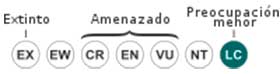
• Population size : 100-110 individuals.

During an investigation (1), scientists found that the population of this new species had diminished quickly in the last 20 years, They are leaving only around 110 birds surviving in the wild, most of them in an Australian national park, so it is considered one of the rarest species in the world, so that the entry introduced predators (cats) National Park, could lead to the extinction of the species in a short time, so the need to implement is suggested Urgent conservation program for this new species described.

(1) – «Tip(‘9. S. A. Murphy, S. A., L. Joseph, A. H. Burbidge y J. Austin. “A Cryptic and Critically Endangered Species Revealed by Mitochondrial DNA Analyses: the Western Ground Parrot”. Conservation Genetics, 12, (2010): 595-600.’

Threatened Species Strategy

The Western Ground Parrot is one of the 20 birds that the Australian Government has given priority in the allocation of resources to support the recovery effort species. The Western Ground Parrot It has a base of strong and growing support in the local community. An association between South Coast NRM, Friends of the Western Ground Parrot, the Department of Parks and Wildlife and the Perth Zoo It is working to prevent extinction.

The success of the population captive breeding recently established security will be key to the species, and management of wild cats and fires Cabo Arid National Park It will be essential for local recovery. With an estimated population of less than 150 individuals and a captive population of less than ten, we need to act.

The emergency actions include the protection of the wild population and creating a population secured in captivity. Opportunities to receive more support through National Planning Program, the local group management of natural resources and existing partnerships with Government of Western Australia and the Zoo of Perth They are likely to contribute to recovery.

The website Endangered Species Strategy It includes information on what is being done to support the recovery effort species. Understanding the habits of a partnership project of rare birds and reserved aims to benefit the species improve the behavior of captive birds, which may allow better management of wild populations.

Alternative names:

Ground Parrot (Western), Western Ground Parrot (English).
Kyloring (Aboriginal).
Perruche à ventre doré, Perruche à ventre dorée, Perruche terrestre (de l’Ouest), Perruche terrestre (flaviventris) (French).
Westlicher Erdsittich (German).
Periquito Terrestre Occidental (Portuguese).
Perico Terrestre Occidental (español).

scientific classification:

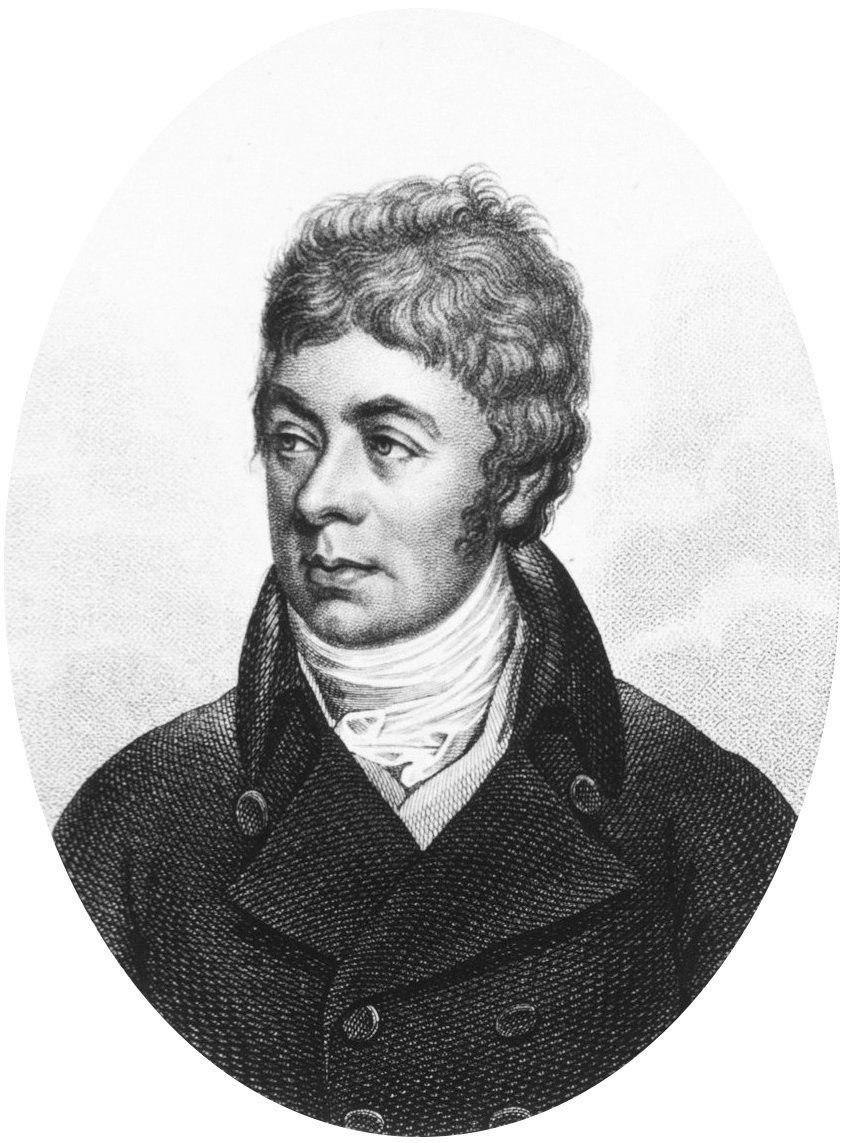
Alfred John North
Alfred John North

Order: Psittaciformes
Family: Psittaculidae
Gender: Pezoporus
Scientific name: Pezoporus flaviventris
Subpoena: North, 1911
Protonimo: Pezoporus flaviventris

Images «Western Ground Parakeet»:

Sources:

Avibase
• Parrots of the World – Forshaw Joseph M
• Parrots A Guide to the Parrots of the World – Tony Juniper & Mike Parr
• Science and Development Magazine
• Department of the Environment (2018). Pezoporus flaviventris in Species Profile and Threats Database, Department of the Environment, Canberra. Available from: http://www.environment.gov.au/sprat.

Photos:

(1) – Feeding Western Ground Parrot….. the only photo’s of this bird in the wild was taken in 2005 the day before my birthday, what a gift that was. This is from my field season the next year. No nest has been found since 1913. by Brent BarrettFlickr
(2) – Western Ground Parrot (Pezoporus flaviventris) by Brent Barrett from Dunedin, New Zealand [CC BY-SA 2.0 or CC BY-SA 2.0], via Wikimedia Commons
(3) – A Western Ground Parrot in Australia by Brent Barrett from Dunedin, New Zealand [CC BY-SA 2.0], via Wikimedia Commons
(4) – Stand and sing Western Ground Parrot (Pezoporus flaviventris) by Brent Barrett from Dunedin, New Zealand [CC BY-SA 2.0], via Wikimedia Commons
(5) – This is officially one of the rarest images in exhistence Pezoporus wallicus flaviventris by Brent BarrettFlickr

▷ The world of Pets: Dogs, cats, birds, reptiles, amphibians

Budgerigar
Melopsittacus undulatus


Common Budgie

Content

Description

18 cm. length and a weight between 22 and 32 g..
Periquito-Comun

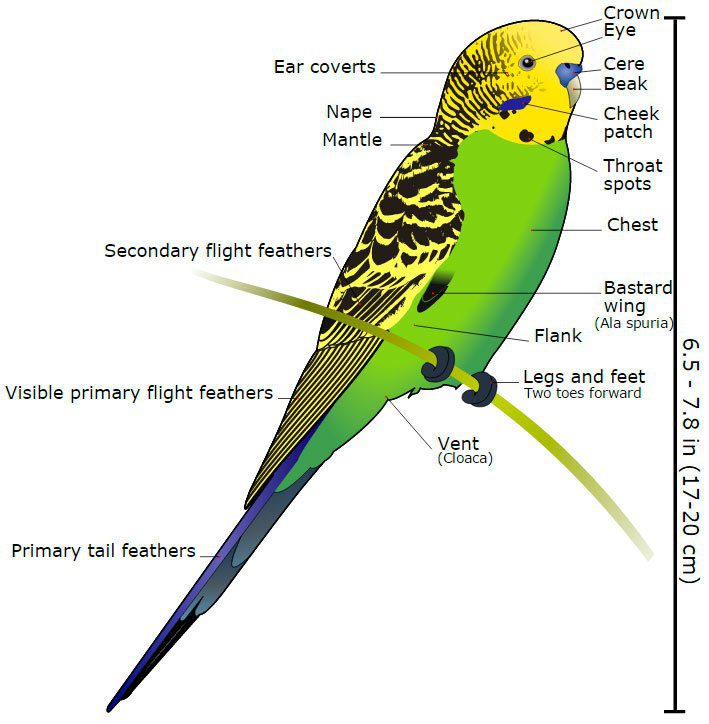
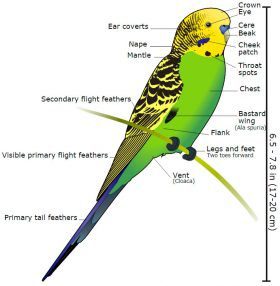
In the Budgerigar (Melopsittacus undulatus) of adults, the cere Blue contrasts with the frontal zone; the front of the face and throat are pale yellow. The latter is covered by a line of black dots. The area which is located below the cheeks it's purple.

The central part of the pileum extending from the rear of the eyes to neck It is covered with alternating thin black bands and bands of pale yellow. These bars are expanded on the the mantle and wing-coverts, forming a scaly effect.

The underparts, the area beneath the wings, the lower part of the back and rump create a beautiful pale green together. The tail is opaque blue tones with a central yellow stripe on the side feathers.

The female has a Brown wax.

The immature they are more turned off with bars on the front. The black spots on the throat they are absent.

Habitat:

The Budgerigar they are distributed by a wide variety of open habitats, including open forests, lightly wooded grasslands and savannas. Also appreciate the areas of Mallee, farmland, vegetation that grows along rivers, drought-adapted scrub and open plains. They come fitted with desert areas of Mulga (Acacia aneura). Although they are able to survive several days without water, These birds are never far from a water source.

In areas where fruit production is constant and in others where it is stable for very long periods, the movements of the Budgerigar they are easily predictable.

In the South end, Pilgrimages exist only in cases of prolonged drought and wandering parakeets return to their territory with the first rains and recolonize when river levels return to normal.

Reproduction:

The Budgerigar they build their nests of June to September in the North its area of distribution. They reproduce between August and January in the South. Nests can be installed at any time of the year after the rains fall. They establish a second brood as soon as conditions are favorable.

These parakeets usually nest in colonial way. The nest is located in a natural cavity in a tree, in a strain, an any fence post, or on a big fallen branch.

The female lays from 4 to 6 eggs and incubation lasts a few 18 days. The chicks remain in place of birth during 30 days before flying.

Food:

The Budgerigar It vegetarian, they eat herbs and seeds of quenopodios. Plants vary in categories and in proportions, according to which regions and times.

The East inside of Australia, These birds feed exclusively on seeds that are on the ground, While in the middle of the continent, There is more variety of plants to select. In the first case, grain size barely exceeds the 2 mm diameter and the second, more than 40 plant varieties make up the diet of these parakeets.

From time to time, the Budgerigar, they come in growing areas and take advantage of the ripe fruits.

Distribution:

The Budgerigar are distributed widely throughout the Interior of Australia, Although they are rare in the coastal districts of the This and the end South-West (absent of Tasmania, Arnhem Land and Cape York Peninsula).

The species may be of common to very abundant, but they are nomadic, and may change from year to year areas.

These parakeets, frequently, they burst from the arid zones to the more humid zones and there are temporary movements towards the south during the summer, but these changes may be affected by annual rainfall patterns.

We have introduced, without success, in a number of places around the world (or they have escaped from captivity and could not be) including South Africa, United Kingdom, Japan, Hong Kong, Puerto Rico, Brazil, Switzerland, Colombia, the Society Islands, New Zealand and Oman.

In the EE.UU. the species has managed to colonize Hawai and California (leaks also occur regularly in the city of New York City). In Florida a population was originally registered in the area of St. Petersburg, in the decade of 1950 and now has more of 3.000 individuals; These birds are mobile and have been recorded along the coast This of all the South from Jacksonville to Miami, and in the West everything Hudson to South of Fort Myers, from time to time go towards the North in Gainsville.

Parakeets, occasionally escaped, they may appear in Tasmania.

The world population is estimated at around 5.000,000 copies.

Conservation:


minor concern


• Current category of the Red List of the UICN: Least concern

• Population Trend: Growing

This species is not threatened at all, even they are abundant, and in some places where resources are good, countless flocks darken the sky, to cause branches to break from 4 centimeters in diameter, When large number of birds used them as support for their breaks.

Populations fluctuate widely depending on weather conditions.

Livestock living on farms in central Australia have caused Budgerigar they will benefit from new water supplies. Like this, the number of parakeets are constantly increasing.

These parakeets are the most well known psittacidas in the world.

"Budgerigar" in captivity:

This parakeet was discovered in 1805 and since then it has become the most popular captive bird in the world. While it is considered as domestic fowl, However, is a gregarious and instinctive animal, with the same needs that the parrots who freely roam the lands of Australia.

The Budgerigar It dynamic, curious, melodious and because of its small size, the beauty of their plumage and their entertaining behaviour, truly charming. This is what makes it a coveted bird. But, It is still a bird that needs to fly, play and socialize with their peers. Like any bird, It is sensitive to the social and environmental context. In fact, their real needs are too often overlooked, many parakeets suffer neglect or even abuse.

In captivity, the Budgerigar It is larger than its counterpart in nature. Measures of 20 to 25 cm. from head to tail and weighs between 30 and 45 g.. In addition to the colour of your coat, wild type, There are numerous mutations (other coat colors) associated with the increase in crossings and selections in certain genes, that translates into more spontaneous mutations.

The Budgerigar has two silent by year average, and the first moult occurs between the fourth and sixth month. The molt is complete renovation of the plumage of the bird. Pens fall to others push, includes your tube of keratin that parakeets will open with their beaks to release pen and relieve the irritation that engenders the same thrust. It can be more or less painful and intense. Some plucking is so fast that the bird may experience some difficulties during the flight.

Check the intensity of the change of the parakeet through black head tubes, tiredness and especially the number of feathers on the ground.

The feeding of the Budgerigar is based on the millet and the birdseed, Although it must be complemented with other seeds or vegetables (as the lettuce, Spinach, pepper, Carrot, corn). The fruits are also a good dietary supplement for these birds. Occasionally it can provide a little bread or biscuit, but always with caution that not give them anything very sweet. The avocado, the chocolate and the parsley they are deadly toxic for the Australian parakeets.

The the parakeet cage must be protected from the cold, a temperature between the 20-25 C. It must be of one sufficient size so you have freedom of movement and can exercise. The balusters must be arranged horizontally so that they can climb up them. The cage must be washed at least once a month with a disinfectant, change the water daily and clean the shells of the food. A cat litter tray can be placed to make their needs.
It is also important to let the parakeet out occasionally and fly freely around the room. Windows must be closed and curtains, because you can hit them.
Son very sociable birds and it is better to live with other parakeet. The best couple is formed by a male and a female. This will try to kill its companion if it is of the same gender.

With regard to its longevity, according to sources, these animals can come to live until 21 years in captivity. The same sources indicate that these parakeets suffer from a high incidence with respect to ovarian cancer.

Alternative names:

Budgerigar, Budgerygah, Budgie, Canary Parrot, Grass-Parakeet, Lovebird, Scalloped Parrot, Shell Parakeet, Shell Parrot, Undulated Parrot, Warbling Grass-Parrot, Zebra Parrot (ingles).
Perruche ondulée (French).
Wellensittich (German).
Periquito-australiano (Portuguese).
Periquito Australiano, Periquito Común, Cotorra Australiana, Cata Australiana (español).

scientific classification:

George Shaw


Order: Psittaciformes
Family: Psittaculidae
Genus: Budgerigar
Scientific name: Melopsittacus undulatus
Citation: (Shaw, 1805)
Protonimo: Psittacus undulatus

«Common Parakeet» Images:

Videos "Budgerigar"

————————————————————————————————

«Common Parakeet» (Melopsittacus undulatus)


Sources:

Avibase
– Parrots of the World – Forshaw Joseph M
– Parrots A Guide to the Parrots of the World – Tony Juniper & Mike Parr
– Birdlife

Photos:

(1) – Budgerigar at Zoo Atlanta, USA By TheSussman (Mike) (originally posted to Flickr as Parakeet) [CC BY 2.0], via Wikimedia Commons
(2) – Two budgerigar at Henry Doorly Zoo, USA By Jeff Coffman (originally posted to Flickr as DSC_1265) [CC BY 2.0], via Wikimedia Commons
(3) – male budgerigar. taken near Cameron’s Corner, Qld By Benjamint444 (Own work) [GFDL 1.2], via Wikimedia Commons
(4) – Detail shot of budgerigars head By Kirk (Own work) [CC BY-SA 3.0 or GFDL], via Wikimedia Commons
(5) – Melopsittacus undulatus flock, Karratha, Pilbara region, Western Australia By Jim Bendon from Karratha, Australia (budgies_4) [CC BY-SA 2.0], via Wikimedia Commons
(6) – By User Magnus Manske on en.wikipedia [Public domain], via Wikimedia Commons
(7) – Exterior diagram of a green budgerigar By ZooFari [CC BY-SA 3.0], via Wikimedia Commons

Sounds: Marc Anderson (Xeno-canto)

▷ The world of Pets: Dogs, cats, birds, reptiles, amphibians

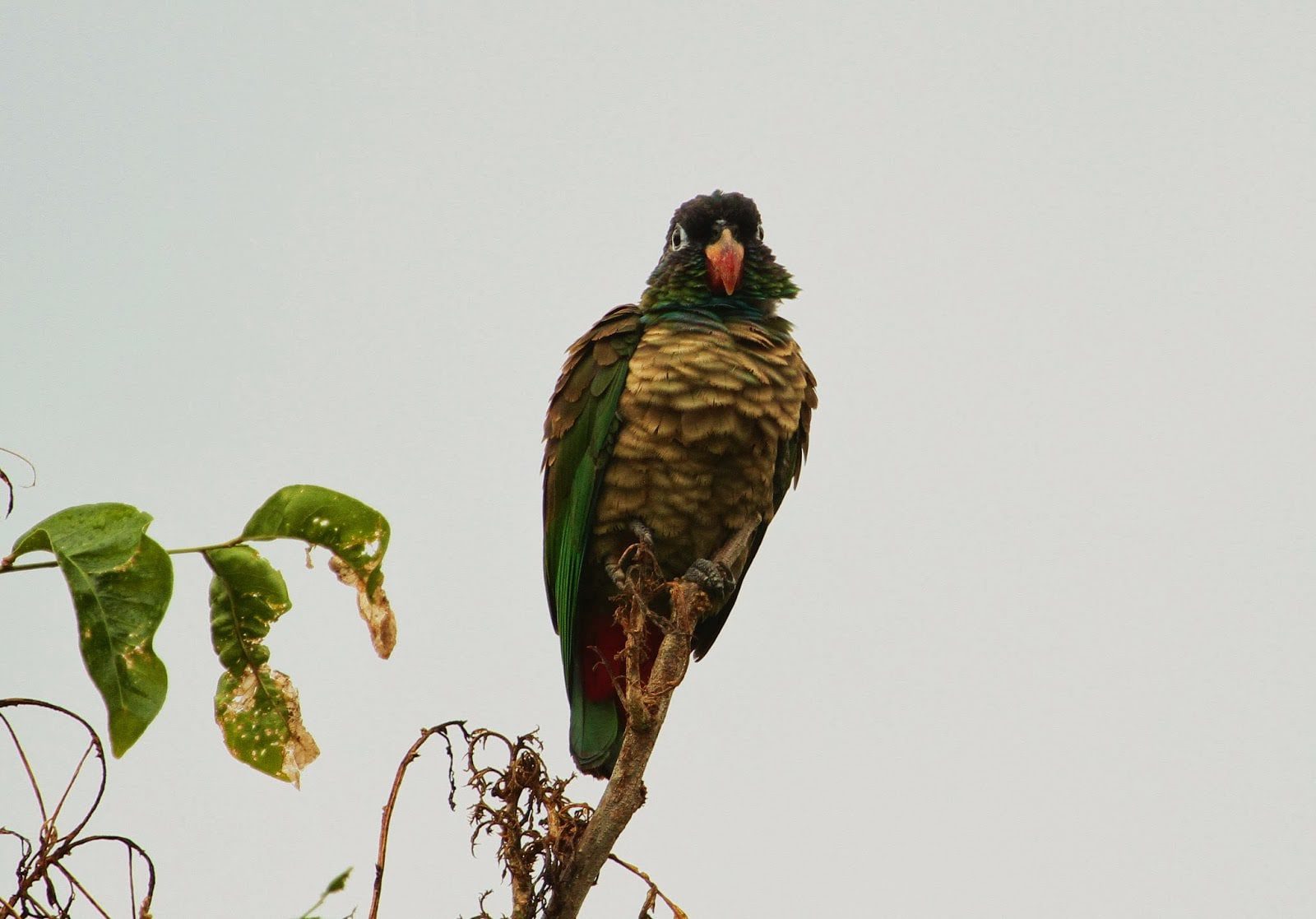
Red billed Parrot
Pionus sordidus

Tropicbird Parrot

Content


Anatomy-parrots

Description:

The Red billed Parrot (Pionus sordidus), of looking scruffy, has a length of 28 to 31 cm. and a weight between 255 and 275 g..

The subspecies Pionus sordidus corallinus, the most widespread, has the feathers of the forecrown, lores and behind the eyes, Green at the base and with blue edges widths; the cheeks, ear-coverts and the sides of the neck, mainly green with some blue narrow tips; the crown and rear of the neck, Green with edges blue narrow. Mantle and back pretty dull green with paler blue margins; rump and uppertail-coverts, of color green basally, more Brown olive distally. Coverts medium and small with wide olive green tips; the front edge of the wing ; coverts primary and higher and flight feather brightest which the parts superiores and others wing-coverts.

Under, the wings green; chin green; throat and upper breast with band broadband of color blue violet; belly green, Some birds with gray Suffusion; undertail-coverts crimson. Tail Green by the Center, Blue side; Red at the base.

Bill coral red, pale at the base of the upper jaw; cere dark grey; bare periophthalmic pale grey; Iris dark brown; legs pale grey.

Both sexes are similar. Immature sample undertail-coverts yellowish-green with some red marks; head green.

Subspecies description

Description 6 subspecies
  • Pionus sordidus antelius

    (Todd, 1947) – Similar to the nominal species but the feathers of the throat lack of edges blue and the center of the chest is in color pink.

  • Pionus sordidus corallinus

    (Bonaparte, 1854) – Described above.

  • Pionus sordidus mindoensis

    (Chapman, 1925) – Is as the subspecies Pionus sordidus corallinus, but of color green more beige, those edges blue of the feathers of the head are more narrow and the under wing-coverts not have them edges dark.

  • Pionus sordidus ponsi

    (Aveledo & Gines, 1950) – Throat of color blue violet almost solid. The chest and upperparts they are darker and greener that the of the nominal species, they lack clear margins to the feathers of the back and of the wing-coverts.

  • Pionus sordidus saturatus

    (Todd, 1915) – More dark and more green that it nominal species with the feathers of the upperparts lack of margins of color green olive. Less green in the throat and cheeks.

  • Pionus sordidus sordidus

    (Linnaeus, 1758) – Nominal. Much more Brown that the subspecies Pionus sordidus corallinus, with blue (turquoise) more reduced in the throat. Feathers in them upperparts with most distinctive pale margins.

Habitat:

Red billed Parrot

It is a very rare species. It inhabits in mountains of humid and semi-humid cloudy forests, edges of forest and partially deforested areas, between 200-2850 m, Although they are more frequent at altitudes of 500-1.500 m. They use areas of secondary growth, partially deforested with tall trees scattered and sometimes light forests on coffee plantations, being less frequent in dry areas.

Gregarious outside of breeding season; formations in flocks of up to 50 birds, sometimes more where the food is abundant. Children sleep in community.

Reproduction:

They nest in the cavity of the trees, sometimes in very degraded habitats. Birds in breeding attitude during the months of February-April in Colombia; It breeds in the months of April-June in Venezuela, January-may in Ecuador; Nest occupied in October in Bolivia. Laying three eggs in captivity.

Food:

Feeds of fruit, berries and seeds.

Distribution:

Size of the area of distribution (reproduction / resident): 169.000 km2

This species has a distribution batch through them land high in the North and West of South America, from Venezuela to the North of Bolivia. You can find in the North of Venezuela, in the mountains of Anzoátegui, Sucre, North of Monagas and apparently, of way to discontinuous, in the Highlands of the Federal District through the mountains coastal, to the West, until Lara and Falcon, then in the Sierra de Perija, Zulia and parts adjacent in Colombia, West to the foothills of Santa Marta in Magdalena, also locally in the Eastern Andes of Boyacá and Huila. Extends over the Western side of the Andes in Ecuador, from Pichincha until Gold and for all the East side to the northeast of Peru.

Although there are no records in the Eastern Andean slope, in the central and southern Peru, the range includes the Yungas North of Bolivia in Santa Cruz and Cochabamba.

common locally; apparently less numerous in the West of Ecuador and North of Bolivia, and probably in decline locally due to the deforestation (for example, in the Ecuador Western, North of Venezuela and Andes of Colombia).

A recent study not localized to the subspecies Pionus sordidus antelius in its area of distribution widely cleared, Although the subspecies can dwell in forests moderately disturbed.

Kept as pets locally although generally scarce in captivity.

Subspecies distribution

Distribution 6 subspecies

Conservation:


minor concern


• Current category of the Red List of the UICN: Least concern.

• Population trend: Decreasing.

Justification of the population

The size of the world population It has not been quantified, but this species is described as «quite common» (Stotz et to the., 1996).

Justification of trend

It is suspected that the population is in decline due to ongoing habitat destruction.

"Red billed Parrot" in captivity:

Very rare in captivity. In general, they are not so nervous in temperament as other parrots. They can learn to imitate.

Its diet in captivity It varied: fruits such as: Apple, orange, banana, granada, Cactus, they form approximately the 30 percent of the diet; vegetables such as: Carrot, celery, green beans, pea in the pod, fresh corn; Greens such as: chard, lettuce, dandelion, Aviary grass; millet; mixture of small seeds, such as: millet, birdseed, and small amounts of oats, buckwheat, safflower and hemp; soaked and sprouted sunflower seeds; beans, cooked legumes and boiled corn; hard cheese.

Alternative names:

Red-billed Parrot, Dusky parrot, Red billed Parrot, Sordid parrot (English).
Pione à bec rouge, Perroquet sordide (French).
Dunenkopfpapagei, Dunenkopf, Dunenkopf-Papagei (German).
Curica-de-bico-vermelho (Portuguese).
Cotorra Piquirroja, Loro de Pico Rojo, Loro Piquirrojo (español).
Cotorra piquiroja, Cotorra Piquirroja (Colombia).
Loro de Pico Rojo (Peru).
Perico Pico Rojo (Venezuela).

scientific classification:

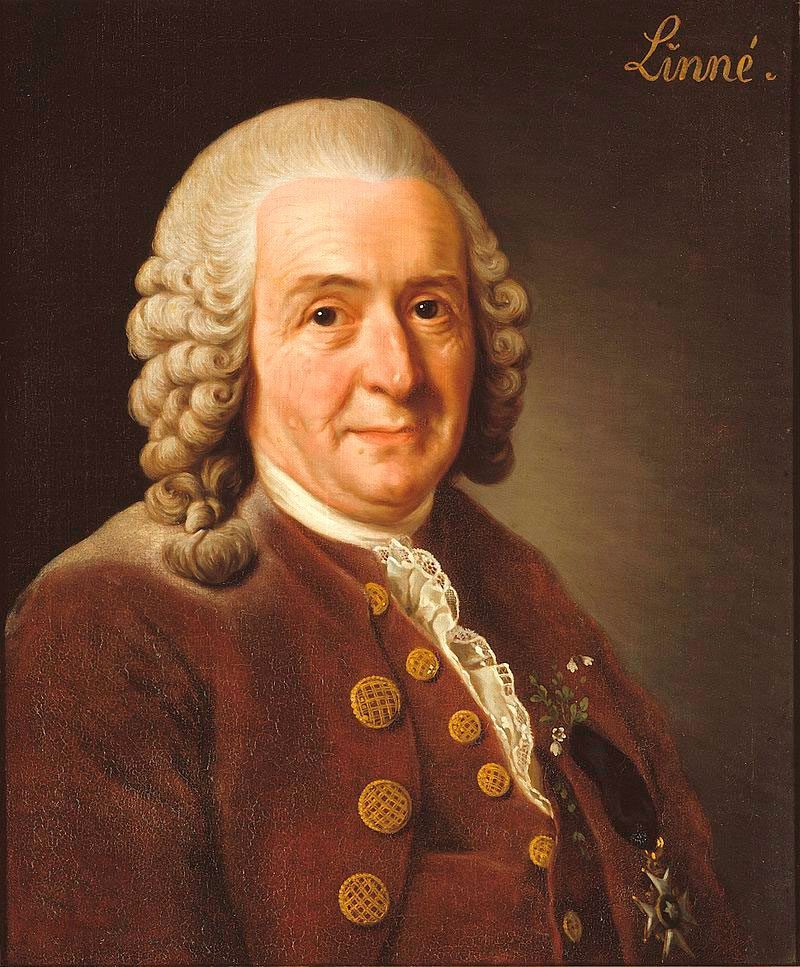
Carl Linnaeus
Carl Linnaeus

Order: Psittaciformes
Family: Psittacidae
Genus: Pionus
Scientific name: Pionus sordidus
Citation: (Linnaeus, 1758)
Protonimo: Psittacus sordidus


Images «Loro Piquirrojo»:

Videos "Red billed Parrot"

«Loro Piquirrojo» (Pionus sordidus)

Sources:

  • Avibase
  • Parrots of the World – Forshaw Joseph M
  • Parrots A Guide to the Parrots of the World – Tony Juniper & Mike Parr
  • Birdlife
  • Parrot Book, Parrots and macaws Neotropical

  • Photos:

(1) – Red-billed Parrot, Pionus s. sordidus, Perico Pico Rojo – Our beautiful world
(2) – Red-billed Parrot, Pionus s. sordidus, Perico Pico Rojo – Our beautiful world
(3) – Red-billed Parrot, Pionus s. sordidus, Perico Pico Rojo – Our beautiful world
(4) – Red-billed Parrot (also known ans the Red-billed Pionus); two captive By TJ Lin (originally posted to Flickr as coral-billed pionus) [CC BY-SA 2.0], via Wikimedia Commons
(5) – Red-billed-Parrot (Pionus sordidus), Pajaro Jumbo Reserve, NW Ecuador By Nomdeploom (Own work) [CC BY-SA 4.0], via Wikimedia Commons
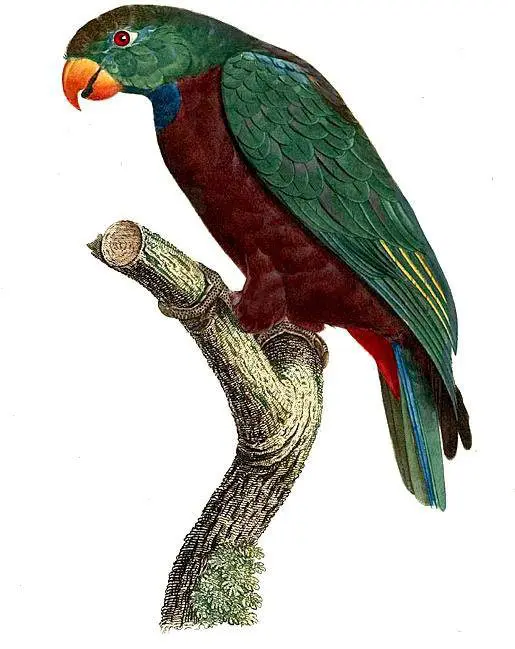
(6) – BARRABAND, Jacques (1767/8-1809) Le Perroquet brun [Red-billed Parrot (Pionus sordidus)] – Wikimedia

  • Sounds: Sebastian K. Herzog

▷ The world of Pets: Dogs, cats, birds, reptiles, amphibians

Red Lory
Eos bornea

Red Lory

Content

Description

31 cm.. length and an approximate weight of 170 gr.

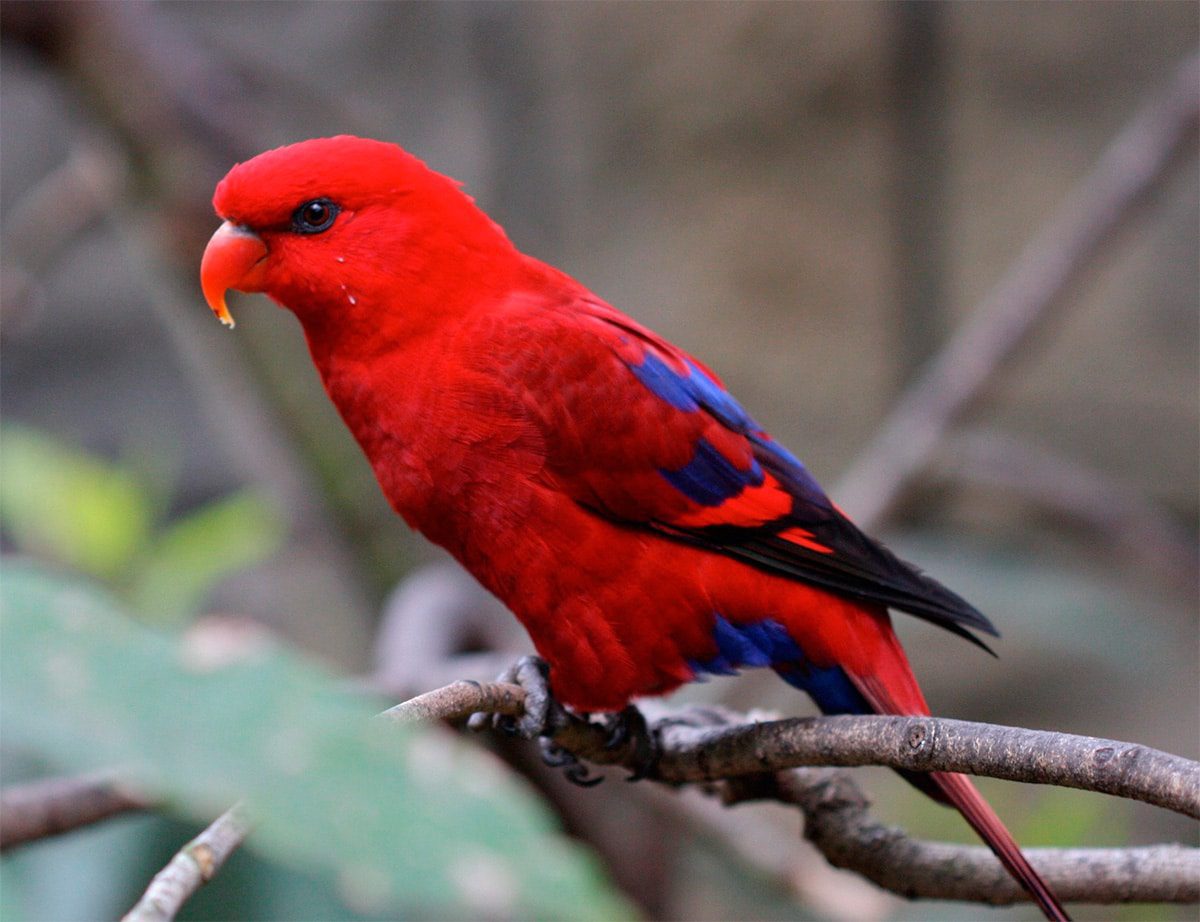
The head and the neck of the Red Lory (Eos bornea) are entirely of a deep red color.

In the adult the primary feathers are black with a large red mirror. The feathers tertiary and the coverts are of color blue. The joint of the feathers of the helmsman they are reddish-brown. The irises they are red, legs grayscale and the bill dark orange.

The immature they tend to be more off than their parents coloring. They show the feathers tertiary grey, lightly stained blue. The ear-coverts Sometimes it tinges of blue. Times, the area of the vent and the thighs it infiltrates with small stains blue. The feathers of the abdomen often carry some edges blue dark. They have the irises brown.

Not exists no sexual dimorphism visible although the males tend to be more corpulent that the females.

Description 2 subspecies

  • Eos bornea bornea

    (Linnaeus, 1758) – Nominal.


  • Eos bornea cyanonotha

    (Vieillot, 1818) – The Red of his plumage is much more dark almost brown.

Habitat:

They are mostly primary forests, in the wooded areas during regeneration, Forest Hills, coconut plantations, in abandoned gardens and mangroves.

They are mainly in coastal areas, What does not climb up to 900 m in the island of Ceram and up 1.800 m in the of Buru.

Throughout its area, the Red Lory are fairly common, However, some populations are more dispersed around the villages, since they are very cautious towards humans.

Behavior:

The Red Lory they live in pairs or in small groups, but sometimes you can observe large flocks of 50 individuals.

They are birds noisy and quite easy to observe, as they often fly above the canopy attracted by the red flowers of the tree of coral (Erythrina).

They have a fast and direct flight and when moving, make your buzz due to its quick flapping.

In the Kai Islands, their movements are common: all days, they cross the arm of sea that separates the different islands flying rapidly and at high altitude.

During the rest hours that occur at noon, the Red Lory they spend most of their time smoothing their feathers in the shade of a tree. Probably, This practice is designed to strengthen marital ties. Parties that enjoy priority are the head and neck; as you can not reach these areas with its beak, you will always need your partner collaboration. The "patient" that undergoes this preferential treatment seems to express a great sense of satisfaction.

Reproduction:

The couples begin to look for the location of the nest between the months of August and September. It is located high in a big tree.
In mid-December some young leaving the nest have observed.

As in all loris, the nesting period is very long and hard 7 to 9 weeks.

In captivity, the Red Lory puts 1 or 2 litters per year. Each spawning has usually 2 white eggs that are incubated for a period ranging from 24 to 26 days.

Food:

In their natural habitats, the Red Lory feed of nectar, pollen, fruits and insects of fashion casual.
Your food › seem to be them flowers of the trees of the species Eugenia and Erythrina.

All the Loris they have a language that is especially suited, with a brush tip made up of elongated papillae. This characteristic allows birds to collect pollen from flowers and compress it in a suitable way for swallowing.. They play an important role in the pollination of flowering plants and trees.

Distribution:

Size of the area of distribution (reproduction / resident): 57.900 km2

The Red Lory they have a very restricted distribution area. They live South of the Moluccan Islands, halfway between Sulawesi and the western end of New Guinea.

Distribution 2 subspecies:

Conservation:


minor concern


• Current IUCN Red List category: Least concern

• Population trend: Decreasing

This species has a very large range, and therefore not approaching the thresholds for Vulnerable according to the range size criterion.

The population is suspected of being in decline due to unsustainable levels of exploitation.

The species has undergone intense trade from 1981, When it began trading in Appendix II. 99.834 wild-caught specimens have been recorded in international trade, Although none from 2000 (UNEP-WCMC trade database, January 2005 CITES).

"Red Lory" in captivity:

This lori is considered one of the most widespread within poultry. It's an interesting bird, robust and easy of play, ideal for a start in the world of the loris. It also has a very attractive red color; It playful and is easy for tame.

It is a great conversationalist. Some have entire sentences in their vocabulary. Unfortunately, his voice is sometimes very strong, with a high sharp squeal. Most are docile, even at maturity. They can be prolific breeders and are fairly easy to find as hand-raised pets..

Too much protein in the diet can lead to gout., a type of arthritis that crystals are deposited in the joints. May be a bit uncomfortable due to liquid diet.

Alternative names:


Red Lory, Buru Red Lory (ingles).
Lori écarlate, Lori rouge (French).
Rotlori (German).
Lóris-vermelho (Portuguese).
Lori Rojo (español).

Carl Linnaeus
Carl Linnaeus

scientific classification:


Order: Psittaciformes
Family: Psittaculidae
Genus: Eos
Scientific name: Eos bornea
Citation: (Linnaeus, 1758)
Protonimo: Psittacus borneus


Images "Red Lori":

Videos "Red Lory"

——————————————————————————————————–

«Lori Rojo» (Eos bornea)


Sources:

Avibase
– BirdLife.org
– mundoexotics
Oiseaux.NET

Photos:

* A Red Lorry at Taronga Zoo, Sydney, Australia by Navin – wikimdia
* Red Lory (Eos bornea) looking upwards by shahram sharif – Wikimedia
* Red Lory (Eos bornea) at Singapore Zoo by Joost Rooijmans – Wikimedia
* Red Lory – KL Bird Park – Malaysia by diego_cue – Panoramio
* Moluccan Red Lory – Parrots Australia

Sounds: BAS van Balen (Xeno-canto)
▷ The world of Pets: Dogs, cats, birds, reptiles, amphibians

Blue-crowned Lorikeet
Vini australis


Blue-crowned Lorikeet

Content

Description

19 cm.. of length and a weight of 40 to 55 g..

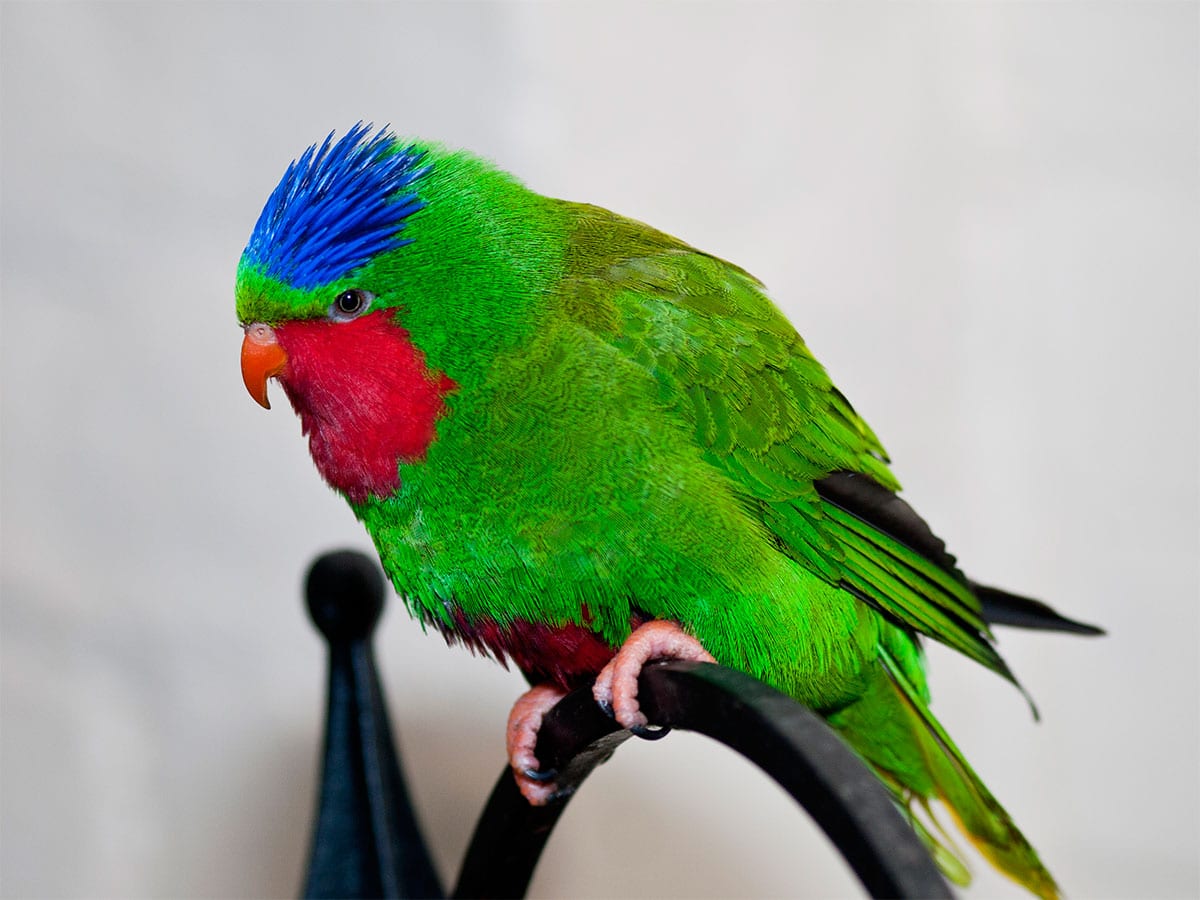
The Blue-crowned Lorikeet (Vini australis) has a plumage mostly green. The upper part of the head is dark blue with light blue streaks. The region of the windows of the nose, the cheeks, the ear-coverts, the neck and the abdomen They are red. the lower part of abdomen and the thighs they are purple blue. The back is green, the interior of the tail is yellowish-green. The irises is reddish brown. The legs are of color red and the bill is orange.

The youth are equal to adults, but with less red in the face and throat, little or none abdominal patch, stripes blue shorter in the crown, no purpura on the thighs, brown the eyes.

Habitat:

It is found in forests, coconut palms or any habitat where flowering trees; coastal mountains, gardens and agricultural areas. Nomad, sometimes traveling between the Islands.

Daily movements in search of food. Aggressive but gregarious, they often move in flocks of up to 12 individuals, except during the breeding season they live with their partners.

In Samoa it is common around villages and plantations and less common in moist forests, higher elevations in the rain forest and secondary growth.

Reproduction:

Nests in holes or hollows of trees, It has also been reported that they dig burrows in the banks of Earth, Although it has not confirmed. The laying is one or two white eggs. Breeding registered in June and August. In captivity the incubation It has been calculated in 23 days.

Food:

It feeds on nectar, pollen and red fruits. It particularly prefers Erythrina, Wild hibiscus and coconut.

Distribution:

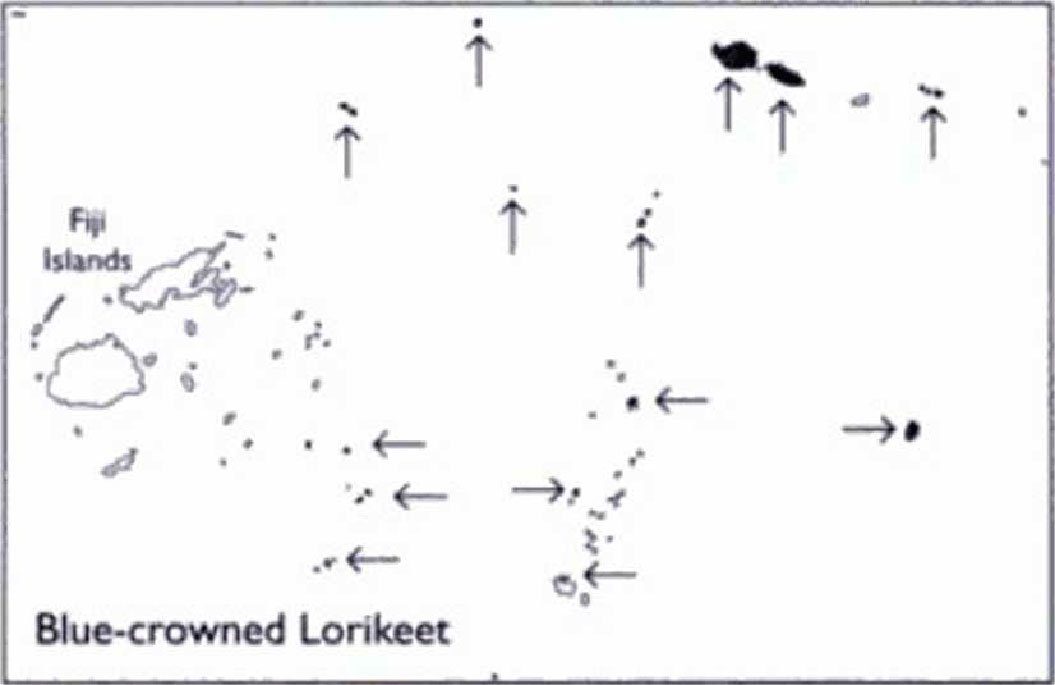
Samoa distribution of Lori
Extends over the archipelagos of Samoa, Tonga and LAU, distributed by Islands: Love, Futuha'a, Fulago, Futuna, Ha'afeva, You're young, Moce, Niue, Ofu, Olosega, Samoa, Salt, Tafahi, Say, Tofua, Tungua, Fire, It's cool, Varoa, I'm sorry and Voleva. In the past was also in ‘USA, Tongatapu and Mata-Utu but there it is extinct.

Conservation:


minor concern

– Current IUCN Red List category: Least concern.

– The population trend: Decreasing.

The world population It has not been quantified, but the species is informed that it is common in much of its restricted area of distribution.

The population is suspected to be in decline due to the predation by species invasive.

Still fairly common throughout its range, but it has become extinct on many islands and it is decreasing in Tonga (probably because of the rats).

"Blue-crowned Lorikeet" in captivity:

Like the others Vini lories, the Blue-crowned Lorikeet still quite rare in poultry farming, probably as a result of the protection they receive in their native South Pacific countries.

Alternative names:

Blue-crowned Lorikeet, Blue crowned Lorikeet, Blue-crowned Lory (ingles).
Lori fringillaire (French).
Blaukäppchen (German).
Loris Vini Australis (Portuguese).
Lori de Samoa (español).

scientific classification:

Order: Psittaciformes
Family: Psittaculidae
Genus: Vini
Scientific name: Vini australis
Citation: (Gmelin, 1788)
Protonimo: Psittacus australis

“Samoan lory” images:

Videos "Blue-crowned Lorikeet"

————————————————————————————————

"Samoan Lori" (Vini australis)


Sources:

Avibase
– Parrots of the World – Forshaw Joseph M
– Parrots A Guide to the Parrots of the World – Tony Juniper & Mike Parr
– BirdLife.org

Photos:

1 – «Vini australis-London Zoo, England-8a» by William Warby from London, England – Unknown-Tropical BirdUploaded by Snowmanradio. Licensed under CC BY 2.0 via Wikimedia Commons.
2 – «Vini australis-two on a perch-8a-4c» by Vini_australis_-two_on_a_perch-8a.jpg: TJ Lin – originally posted to Flickr as Dscn6140 and uploaded to commons at Vini_australis_-two_on_a_perch-8a.jpg. Licensed under CC BY-SA 2.0 via Wikimedia Commons.
3 – By Duncan Wright (Own work) [GFDL or CC BY-SA 3.0], via Wikimedia Commons
4 – By Steven G. Johnson on commons (same as unnormalized on flickr) (Dsc_0014uploaded by Snowmanradio) [CC BY-SA 2.0], via Wikimedia Commons
5- by Zambar – zoochat.com

Sounds: Samuel Jones (Xeno-canto)

▷ The world of Pets: Dogs, cats, birds, reptiles, amphibians

Pygmy Lorikeet
Charmosyna wilhelminae

Pygmy Lorikeet

Content


Anatomy-parrots

Description

The Pygmy Lorikeet (Charmosyna wilhelminae) has an approximate length of 13 cm.. and a weight of 20 g..

The head is green; the forecrown brighter yellowish green; crown dark purple, with broadcast Blue in them tips and color turquoise bright in the feathers of the nape; rear of the nape with wash of olive. Mantle green; low back and tail reddish color; at the top, the tail purple blue. The wings, by up green with parts internal of the flight feather Blackish and blackish the primary coverts. The wings below rosa-salmon; Tips from the flight feather blackish. The underparts Green yellowish with prominent veins on the chest. Upper, the tail green, Red at the base (normally hidden in the field); olive brown below with red and yellow tips on the base. The bill reddish orange-tipped yellow; cere color red pink; Grey the ring perioftalmico; irises yellow to orange-red; legs light grey.

Female lack of red on it rump and in the wings view in flight.
Immature generally more muted and upperparts slightly more Brown. Lacks blue at the tips of the feathers of the nape. Yellow stripes on the top of the chest less distinct or absent. The bill and the irises brown.

Habitat:

Mainly inhabits in humid forests and on the edge of forests, but also by forest savanna and established secondary vegetation. It is usually between the 1.000 meters of altitude and the 2.200 m, but in the South and around Port Moresby It is occasionally much closer to sea level, in the forests of lowlands. It forages in couples and small flocks of up to 20 birds in the trees in flower, often in the company of Goldie's Lorikeet and Fairy Lorikeet. Very Active When it feeds and, often difficult to identify due to its size and predominantly green plumage. It is not uncommon, but easily overlooked. and has been found in groups of up to 200 individuals. It has often been seen flying in mixed flocks above the canopy, where they can hardly be identified due to their small size.

Reproduction:

Breeding and nesting habits unknown.

Food:

Feeds of nectar and pollen.

Distribution:

Size of the area of distribution (reproduction / resident): 290.000 km2

North of New Guinea in Irian Java (Indonesian) and Papua New Guinea. The range of the Mountains Parotia on doberai peninsula, in the West of the island of New Guinea, through the cordillera central, the Huon Peninsula, and South-East of the mountain range of Owen Stanley. In the immediate vicinity of Port Moresby (for example, area Sogeri) There is little (but possibly regular between May and November).

The population world will think that is of less than 50.000 specimens and is considered to be stable. There are few in captivity.

Conservation:


minor concern


• Current IUCN Red List category: Least concern.

• Population trend: Stable.


The size of the world population It has not been quantified, but the species according to sources is generally very rare.

The population suspected to be stable in the absence of evidence of any reduction or substantial threats.


"Pygmy Lorikeet" in captivity:

Rare.

Alternative names:

Pygmy Lorikeet, Pygmy Streaked Lorikeet, Pygmy Streaked Lory, Wilhelmina’s Lorikeet, Wilhemina’s Lorikeet (ingles).
Lori de Wilhelmina (French).
Elfenlori (German).
Lori Pigmeo (español).

scientific classification:

Order: Psittaciformes
Family: Psittaculidae
Genus: Charmosyna
Scientific name: Charmosyna wilhelminae
Citation: (Meyer,AB, 1874)
Protonimo: Trichoglossus Wilhelminae

Images "Pygmy Lorikeet"

————————————————————————————————

«Lori Pygmy» (Charmosyna wilhelminae)


Sources:

Avibase
– Parrots of the World – Forshaw Joseph M
– Parrots A Guide to the Parrots of the World – Tony Juniper & Mike Parr
Birdlife

Photos:

1 – loromania

▷ The world of Pets: Dogs, cats, birds, reptiles, amphibians

Great hanging parrot
Loriculus stigmatus

Great hanging parrot

Content

Description

15 cm.. length between 28 and 35 g. of weight.

The head of the Great hanging parrot (Loriculus stigmatus) is bright green, with bright red crown ending in a clear line across the rear of the crown not extending over the nape.

Green upperparts, lightly impregnated with yellowish-orange in the mantle; rump and uppertail coverts dark crimson. green wings; edge of the carpal bones with small red mark. The underwings of turquoise blue with small green coverts. The lower parts of bright green with red stripe below the Chin and throat Center. Upper, the Green tail; light blue below.

the black beak; pale-yellow IRIS; Pink-Orange legs.

Females lack Red Crown and has a narrow red bib; Iris can be darker.

Young birds lack the Red Crown, It has a bib less clear and more yellowish, yellow edges of the Carpus, and in general a duller Green.

Subspecies

Slight differences in the degree of the orange-yellow colour in the mantle of some populations of the island are not considered sufficient to differentiate them.

    Loriculus stigmatus stigmatus : The nominal.

    Loriculus stigmatus croconotus

    Loriculus stigmatus quadricolor

Habitat:

Little is known about the ecology of the species.. Possible seasonal movements have been observed. According to reports, not found in old-growth forest and most common along forest edges, in the open field, and sometimes around urban centers, until 1.000 meters above sea level. Birds move usually alone or in pairs, whether it is flying above or feeding on the trees in flower. Nest-holes in thick bamboo have been recorded.

Reproduction:

Reproductive activity has been reported in February, from April to June, and in August and October
The Great hanging parrot nests in cavities. It usually lays three eggs. The female incubates the egg during 20 days and after hatching the chicks take time to develop 33 more days

Food:

The diet includes fruits and nectar.

Distribution:

common in Sulawesi, since the minahassa peninsula in the North, including Bangka and Islands Lembeh, to the South, also where in Muma and Button on the high seas. They are also found in the Togian Islands.

Of the three subspecies, including the nominal:

    Loriculus stigmatus stigmatus – Müller, S, 1843 – Celebes

    Loriculus stigmatus croconotus – Jany, 1955 – Buton Islands and Muna

    Loriculus stigmatus quadricolor – Walden, 1872 – Togian Islands.

Conservation:


minor concern


– Current IUCN Red List category: Least concern
– The population trend: Stable

The size of the world's population has not been quantified, Although it is estimated above 100.000 specimens. The species is reportedly common and widespread in most of its range. (pit et to the. 1997).

The population is suspected to be stable in the absence of evidence of any reduction or substantial threats.

"Great hanging parrot" in captivity:

Rare.

Alternative names:

Sulawesi Hanging-Parrot, Black-billed Hanging-Parrot, Celebes Hanging Parrot, Celebes Hanging-Parrot, Celebes Spotted Hanging-Parrot, Great Hanging Parrot, Maroon-rumped Hanging-Parrot, Red-capped Hanging-Parrot, Sulawesi Hanging Parrot (ingles).
Coryllis des Célèbes (French).
Rotplättchen, Rotlättchen (German).
Lorículo do Célebes (Portuguese).
Lorículo Celebiano, Lorículo de Célebes (español).

scientific classification:

Order: Psittaciformes
Family: Psittaculidae
Scientific name: Loriculus stigmatus
Citation: (Muller,S, 1843)
Protonimo: Psittacus (Psittacula) stigmatus

Images "Celebes Lorcle":

Videos "Great hanging parrot"

————————————————————————————————

Sources:

Avibase
– Parrots of the World – Forshaw Joseph M
– Parrots A Guide to the Parrots of the World – Tony Juniper & Mike Parr
– Birdlife

Photos:

(1) – By Lip Kee Yap [CC BY-SA 2.0], via Wikimedia Commons
(2) – male perched. by iggino – lynx
(3) – Birds-pet-wallpapers – link
(4) – male hanging by iggino – lynx
(5) – By F. Schulter – papageien.org

Sounds: Frank Lambert (Xeno-canto)

▷ The world of Pets: Dogs, cats, birds, reptiles, amphibians

Orange-breasted Fig-Parrot
Cyclopsitta gulielmitertii

Orange-breasted Fig-Parrot

Content


Anatomy-parrots

Description

11 to 13 cm.. length and a weight between 27 and 34 g..

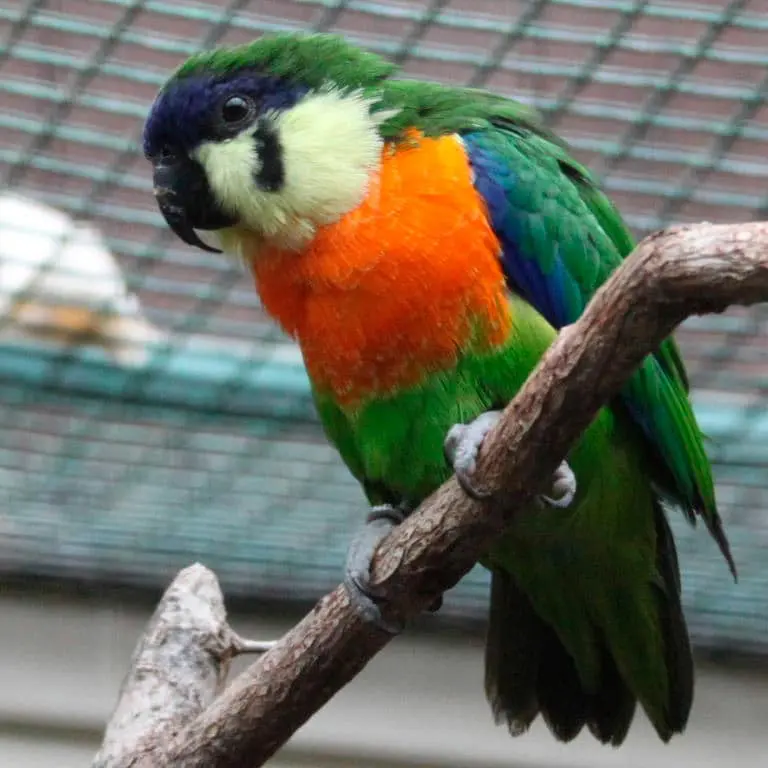
The forecrown of the Orange-breasted Fig-Parrot (Cyclopsitta gulielmitertii), back of the crown and area behind the eyes are a deep blue; pale yellow the lores, throat and both sides of the head; black spot on the back of the cheek; Orange the top part of the abdomen; the interior of the wing-coverts Yellow-edged; wide bands of pale yellow under the wings. Bill blackish gray. The eyes dark brown.

The female similar to the male, but pale yellow on the front of the cheeks black and white on the back. Frontal of the cheeks bordered below green with blue stripe; the ear-coverts on both sides of neck, orange; underparts green.

The immature as females, but orange, Since the ear-coverts and sides neck to the area below, faced with the cheeks; chest male washed with orange-brown.

Subspecies description

Description of the 7 subspecies
  • Cyclopsitta gulielmitertii gulielmitertii

    (Schlegel, 1866) – The nominal


  • Cyclopsitta gulielmitertii nigrifrons

    (Reichenow, 1891) – 13 cm.. length. Area of the forecrown, crown and behind the eye, black. Female without chest Neither abdomen orange, cheeks white-yellowish color bordered by a blackish band. back of the cheeks and headphones feathers bright orange. Under black band greenish blue. The youth they are equal to adults.


  • Cyclopsitta gulielmitertii ramuensis

    (Neumann, 1915) – It is more small, of about 11 cm.., with the area of the forecrown, crown and behind the eye Black interspersed with dark blue, cheeks and headphones feathers whitish in colour. Breast and abdomen cream color. females as males but behind the eye and cheeks with a broad black patch interspersed with dark blue. Breast whitish interspersed with orange feathers. Abdomen brighter yellowish green. The youth equal to adults.


  • Cyclopsitta gulielmitertii amabilis

    (Reichenow, 1891) – It is more small, a few 11 cm.. Forehead, crown and rear of the eye matte black. Cheeks Black interspersed with dark blue. females similar to the males but with the patch from behind the eye Black interspersed with dark blue matte. Headphones feathers whitish. The juveniles as in adult females but with the upper part of the chest greener


  • Cyclopsitta gulielmitertii suavissima

    (Salvadori, 1876) – Smaller, a few 11 cm.., area of the forecrown, crown and behind the eye blue color, great patch on cheek black. Headphones feathers and cheeks white-yellowish color and chest and top of the abdomen reddish orange. The female It has a hue of different reddish orange and black spot of the cheek is Matt and interspersed with dark blue color. The youth adult females are, but marks of the head they are more off.


  • Cyclopsitta gulielmitertii fuscifrons

    (Salvadori, 1876) – As the diophthalma gulielmitertii suavissima but the area of the forecrown, crown and back of the eye, blackish brown. The females similar to the Cyclopsitta gulielmitertii suavissima but back of the cheeks, front and behind the eyes blackish brown. The youth as adult females.


  • Cyclopsitta gulielmitertii melanogenia

    (Rosenberg,HKB, 1866) – Of 11 cm.. length. The male is as the diophthalma gulielmitertii suavissima, the female also with the fused in light green Orange tones in the abdomen. The youth are like adults.

Habitat:

It is distributed in the rainforest, swamp forest, forest of Melaleuca , dense sheets and partially cleared areas from sea level to a 300 meters above sea level, rarely recorded in higher altitudes to the 800 m, the largest known altitude is 1.100 m.

They are usually in small groups assets of 6 to 10 individuals, whether it is flying above the treetops, or congregate where can feed on figs and other fruits in the canopy or plants at lower levels.

Bird feeding can be hard to spot, since they climb around the silent tree trunks, although they can pivot upside down as they feed, sometimes dropping food.

Reproduction:

The nests of the Orange-breasted Fig-Parrot found in arboreal termite, at the top of the trees of the forest. Up to three holes can be dug., and nesting they can be community. The nests also found at the base of a complex of epiphytes. There is little information available upon the breeding season, activity in apparent nests have been observed between the months of September and June. These sites can, However also, have been used to settle, and a record in January of a male regurgitating food near an entrance hole probably indicates breeding during that month at least..

Food:

The diet includes seeds of figs and other fruits, as well as small whole figs, nectar flower e insects occasional.

Distribution:

Widely distributed, abundant and easily observable in the lowland tropical rainforest, throughout much of New Guinea. The Orange-breasted Fig-Parrot most Western they are isolated, only seen in Salawati in the West of the islands of papua, and in the lowlands of theDoberai Peninsula, West Papua.

In other parts of New Guinea the range is continuous through the lowlands of the North of the eastern edge of Yellowfinch Bay around the memberamo river, throughout the region of the Sepik River and the lowlands of the Huon Peninsula, to Milne Bay, at the eastern end.

The range continues west through the southern lowlands of New Guinea through the Purari and Fly River regions to the southeastern lowlands of West Papua, on the 138 ° E; also in the islas Aru.

The Orange-breasted Fig-Parrot seems to be more common in southern New Guinea in the North.

Subspecies distribution

Distribution of the 7 subspecies
  • Cyclopsitta gulielmitertii gulielmitertii

    : The nominal


  • Cyclopsitta gulielmitertii nigrifrons

    : North of New Guinea between Mamberamo and Sepik Rivers.


  • Cyclopsitta gulielmitertii ramuensis

    : District Ramu River, North of Papua New Guinea; It is thought that it may be a cross between the nigrifrons and the amabilis, therefore, probably not a valid subspecies.


  • Cyclopsitta gulielmitertii amabilis

    : Northwest of Papua New Guinea from peninsula Huon to Milne Bay.


  • Cyclopsitta gulielmitertii suavissima

    : Southwest of Papua New Guinea West of Gulf of Papua.


  • Cyclopsitta gulielmitertii fuscifrons

    : South of New Guinea between Mimika and Fly Rivers.


  • Cyclopsitta gulielmitertii melanogenia

    : Aru Islands, Indonesian.

Conservation:


minor concern


• Current IUCN Red List category: Least concern

• Population trend: Stable


The size of the world population It has not been quantified, due to the recent taxonomic divisions, Although it is estimated above 100,000 specimens.

The population suspected to be stable in the absence of evidence of any reduction or substantial threats.


"Orange-breasted Fig-Parrot" in captivity:

Rare in captivity.

Alternative names:

Orange-breasted Fig-Parrot, Blue-fronted Fig-parrot, Orange-breasted Fig Parrot, Orange-breasted Fig-Parrot (nominate), Orange-breasted Fig-Parrot (Orange-breasted) (ingles).
Psittacule à poitrine orange, Psittacule à poitrine orange (nominal), Psittacule à poitrine orange (nominale), Psittacule à poitrine orange (race nominale) (French).
Orangebrust-Zwergpapgei (German).
Cyclopsitta gulielmitertii (Portuguese).
Lorito de Pecho Naranja, Lorito Pechinaranja (español).

scientific classification:

Order: Psittaciformes
Family: Psittaculidae
Scientific name: Cyclopsitta gulielmitertii
Citation: (Schlegel, 1866)
Protonimo: Psittacula gulielmi III

Images «Orange Breasted Parrot»:

Videos "Orange-breasted Fig-Parrot"

————————————————————————————————

«Orange Breasted Parrot» (Cyclopsitta gulielmitertii)


Sources:

Avibase
– Parrots of the World – Forshaw Joseph M
– Parrots A Guide to the Parrots of the World – Tony Juniper & Mike Parr
– Birdlife
– Loromania

Photos:

(1) – animalphotos
(2) – A female Orange-breasted Fig-parrot in the Walsrode Bird Park, Germany By Quartl (Own work) [CC BY-SA 3.0], via Wikimedia Commons
(3) – A male Orange-breasted Fig-parrot in the Walsrode Bird Park, Germany – «Cyclopsitta gulielmitertii qtl1» by QuartlOwn work. Licensed under CC BY-SA 3.0 via Wikimedia Commons.
(4) – Birds-pet-wallpapers
(5) – animalphotos

Sounds: Frank Lambert (Xeno-canto)