▷ The world of Pets: Dogs, cats, birds, reptiles, amphibians

Red-fronted Lorikeet
Charmosyna rubronotata


Red-fronted Lorikeet

Content

Charmosyna rubronotata kordoana

Description

17 cm.. length and a weight between 30 and 35 g..

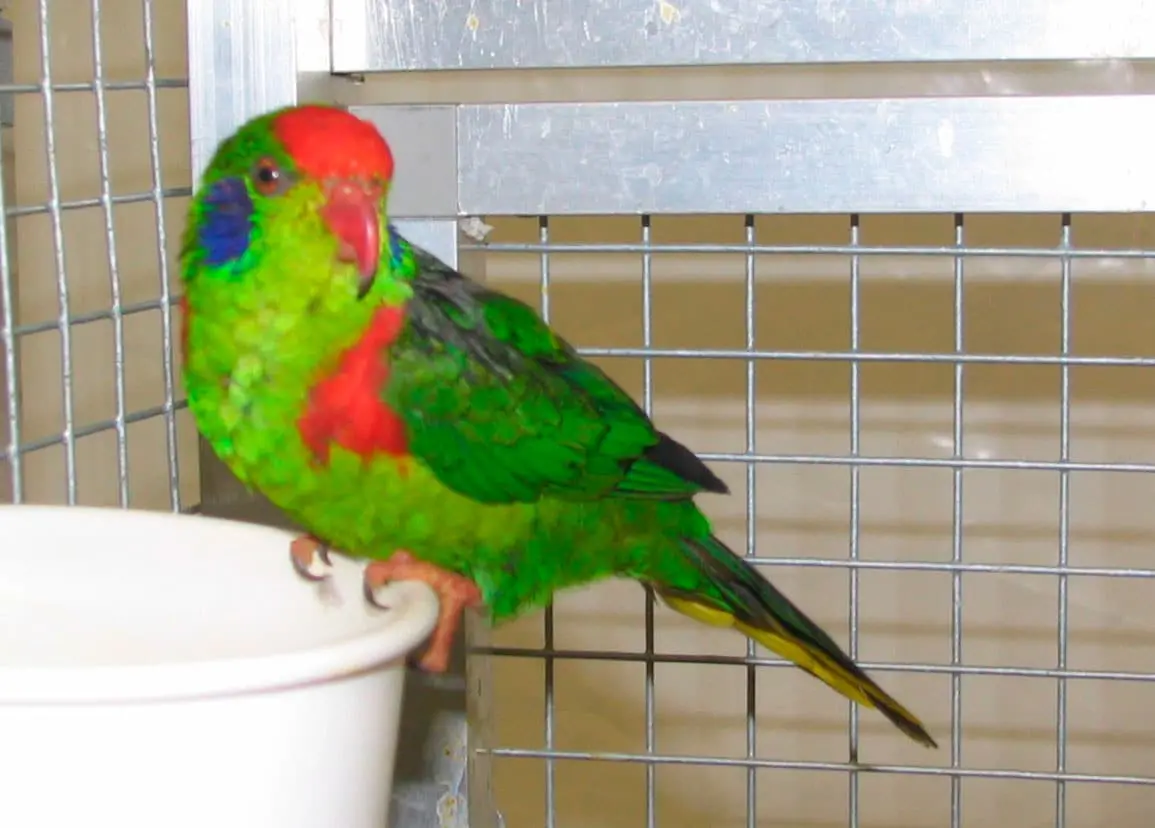
The front of the crown of the Red-fronted Lorikeet (Charmosyna rubronotata) is red; rest of the crown green; chin, the throat and headphones coverts, yellowish green with a prominent patch purple-blue in the center of the ear coverts. Upperparts green; lower part of the rump and tail coverts, matte red. Wings Green with a bit of yellow in the curve. Under, the wings red; flight feather blackish brown with a yellow stripe in the Center. The underparts yellowish green with prominent red blotch on the upper side of the chest; the thighs green. The tail above blackish brown with green piping; below, the tail Brown with wide yellow tips (except central pair) and Red covered in the base. The bill Red pink; cere pinkish; irises brown; legs Pink.

females lack of red color in the crown, in the marks of the chest and at the bottom of the wings (that are greenish yellow). ear patch It is replaced by streaks of greenish-yellow.

Description 2 subspecies

  • Charmosyna rubronotata kordoana

    (Meyer,AB, 1874) – Female is similar to the nominal. The male has the patch of the crown paler, extensive and blue; minus purple blue ear-coverts.


  • Charmosyna rubronotata rubronotata

    (Wallace, 1862) – Nominal.

Habitat:

It inhabits in the humid forests, edges of forests and plantations of coconut, Once in a while visit the trees and shrubs in open field. Are from the lowlands up to the 850 m. Usually found in small flocks of up to 10 birds flying over dense forest, or feeding on flowers in the canopy, sometimes with other parrots. Habits are similar to the of the Red-flanked Lorikeet.

Reproduction:

Nesting and breeding habits not described.

Food:

Feeds of pollen, nectar, flowers and seeds.

Distribution:

Size of the area of distribution (reproduction / resident): 417.000 km2

New Guinea in West Papua New (Indonesian) and Papua New Guinea. The range goes from East of Vogel-kop through Maprik, the lower reaches of the rivers Sepik and Ramu reaching Astrolabe Bay in the East. Also in Salawati in the islands of the West of papua and in Biak. The Red-fronted Lorikeet It is irregularly distributed throughout its area of distribution, but may be locally common in some areas. It seems to be less common than the Red-flanked Lorikeet, He replaced at higher altitudes, where the two species overlap.

Description 2 subspecies

Conservation:


minor concern


• Current IUCN Red List category: Least concern.

• Population trend: Stable.

The trend of the population seems to be stable, and therefore, the species does not approach the thresholds for Vulnerable according to the population trend criteria.

The world population It has not been quantified, It is believed that it is by the 100.000 specimens and stable.

The species is described as common to local scale.

"Red-fronted Lorikeet" in captivity:

There is no data on its breeding in captivity..

Alternative names:

Red-fronted Lorikeet, Red fronted Lorikeet, Red-fronted Blue-eared Lorikeet, Red-fronted Blue-eared Lory, Red-spotted Blue-eared Lorikeet, Red-spotted Lorikeet (ingles).
Lori à front rouge, Lori de Wallace, Loriquet à croupion rouge (French).
Rotstirnlori (German).
Lori de Frente Roja, Lori Frentirrojo (español).


scientific classification:
Alfred Russel Wallace

Order: Psittaciformes
Family: Psittaculidae
Scientific name: Charmosyna rubronotata
Citation: (Wallace, 1862)
Protonimo: Coriphilus rubronotatus


Images «Red-fronted Lory»:

————————————————————————————————

«Lori Frentirrojo» (Charmosyna rubronotata)


Sources:

Avibase
– Parrots of the World – Forshaw Joseph M
– Parrots A Guide to the Parrots of the World – Tony Juniper & Mike Parr
– Birdlife

Photos:

1 – Author iggino – lynx
2 – Charmosyna rubronotata kordoana by Biodiversity Heritage Library

Sounds: Katerina Sam (Tvardikova) – (Xeno-canto)
▷ The world of Pets: Dogs, cats, birds, reptiles, amphibians

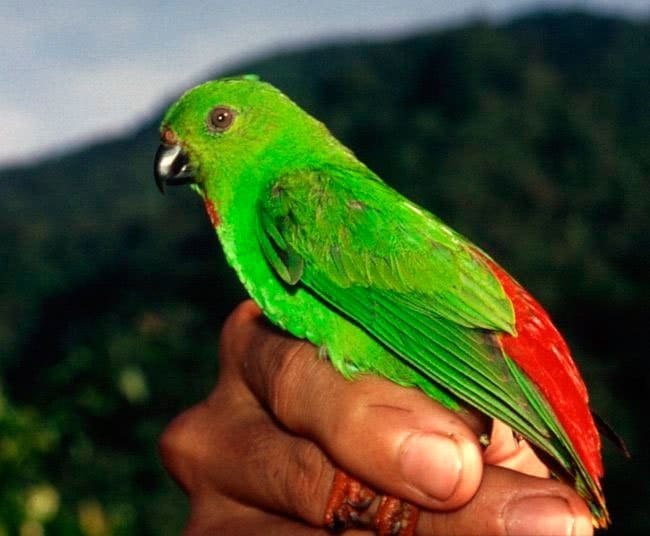
Sangihe hanging parrot
Loriculus catamene

Sangihe hanging parrot

Content


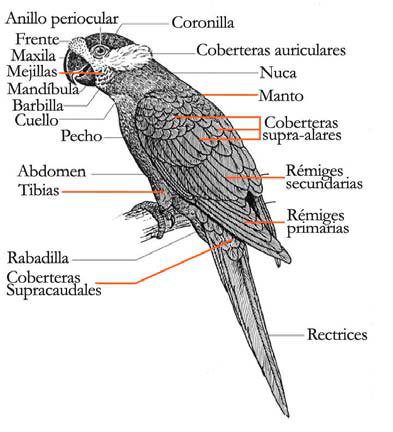
Anatomy-parrots

Description

12 to 13,5 cm.. length.

The Sangihe hanging parrot (Loriculus catamene) has the head Green with the front of the crown and the bib red. Upperparts Green with light wash of color orange in the the mantle; rump and long tail coverts red. Wings green, slightly dark; carpal edge brighter yellowish green. The flight feather blue with green coverts.

The underparts Green with the belly Beige and tail coverts of color red marked in green. Upper, the tail of color green with lips Red; Blue below. The bill black; irises brown; legs orange.

The female not have the Red of the crown; the Red of the bib reduced to a few points, and green the coverts infracaudales.

The immature with carpal edge yellow, lack of crown red, But if the bib red.

Habitat:

Found in pairs or in small groups on them flowers of coconut and shrub in flower, and groups of up to four birds found with greater frequency in plantations mixed. The species is has adapted to habitats side and their main source of food seems to be the nectar of coconut. One roost of 17 birds is the largest group reported.

Reproduction:

One nest with two eggs is noted in 1985, little more is known of the habits reproductive of this species.

Food:

Their main source of food is the nectar of coconut.

Distribution:

Size of the area of distribution (reproduction / resident): 700 km2

endemic to the Sangir Islands. Most of the original vegetation in Sangir, It has now been replaced by plantations of coconut and nutmeg, and secondary vegetation of the abandoned gardens. Observations during mid of 1980 showed that it is quite common in coconut forests, and two pairs were observed in the steep volcanic slopes covered with trees in 1986. In 1995, the species was recorded of all forest habitats on the island from sea level up to around the 900 m (also be meeting around Tahuna). The birds are observed more frequently in fragments of forest and coconut plantations.

Conservation:


Near-threatened


• Current IUCN Red List category: Near threatened

• Population trend: Decreasing

There are few data on recent trends, but not there is evidence of a continuous decrease and given your apparent tolerance to different secondary habitats, the declines in their population may have been insignificant.

The population of the Sangihe hanging parrot It is estimated between 10.000 and 46.000 specimens.

The original forest in Sangihe It has been almost completely replaced by the crop, but the species appears to be tolerant to degraded habitats and cultivated areas and there is no evidence of a continuous decrease. Other potential threats include the widespread settlement of large trees in the Decade of 1980, the escaped parrots-borne disease and the volcanic activity in the future (Riley 2002).

"Sangihe hanging parrot" in captivity:

Is not usual.

Alternative names:

Sangihe Hanging-Parrot, Sangihe Hanging Parrot, Sangir Hanging Parrot (ingles).
Coryllis des Sangi, Coryllis de Sangihe (francés).
Rotsteisspapageichen (alemán).
Loriculus catamene (portugués).
Lorículo de la Sangihe, Lorículo de Sangihe (español).

scientific classification:

Order: Psittaciformes
Family: Psittaculidae
Genus: Loriculus
Scientific name: Loriculus catamene
Citation: Schlegel, 1871
Protonimo: Loriculus catamene

Images "Sangihe hanging parrot"

————————————————————————————————

«Sangihe Loricle» (Loriculus catamene)


Sources:

Avibase
– Parrots of the World – Forshaw Joseph M
– Parrots A Guide to the Parrots of the World – Tony Juniper & Mike Parr
– Birdlife

Photos:

(1) – Photographer: © Jon Riley – Oriental Bird Images

Sounds: Hanom Bashari (Xeno-canto)

▷ The world of Pets: Dogs, cats, birds, reptiles, amphibians

Edwards' Fig-Parrot
Psittaculirostris edwardsii


Edwards' Fig-Parrot

Content

Description

18 cm.. length and weight around 105 g..

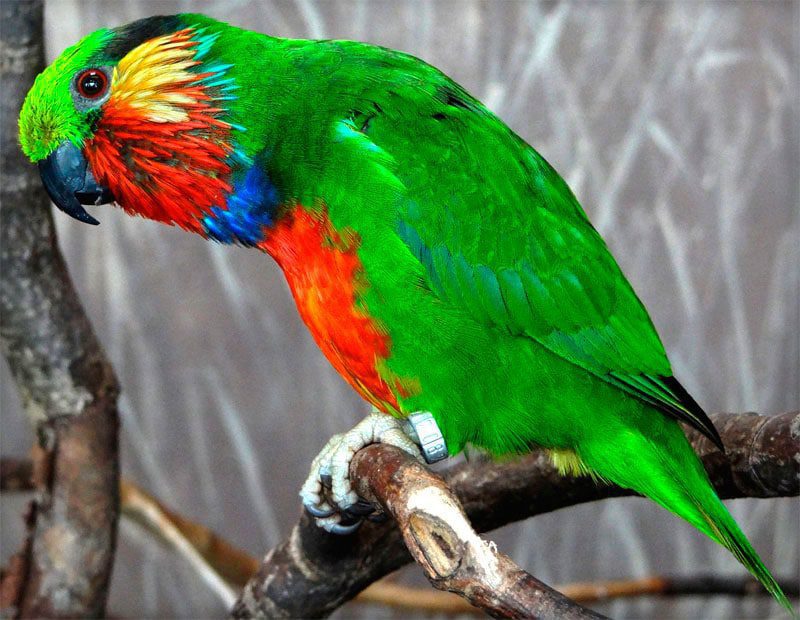
The Edwards' Fig-Parrot (Psittaculirostris edwardsii) you have the front and a bright yellowish-green Crown, with a green stripe on the back; neck greyish-Brown band above the band of gris-negruzco color that extends into the eye; area before and just behind the eyes, green. Elongated lower headset feathers and orange-red fire Gorge, with some green basal feathers interspersed and ends the headphone rear (also elongated) golden yellow with orange.

Dark green back: curve of the wing marked in blue. Black flight feathers marked with green in vane outer (except the primary outer) and with vane internal yellow, forming a set of bars under her wings; marked inner coverts reddish-orange. The wings of blue-green feathers, the longest with yellow tip. Purple-blue ruff with some lighter green feathers; Centre of the breast and upper belly of a showy orange-red; flanks, supracaudales yellowish-green coverts and thighs. Upper, the Green tail; undertail, opaque yellow olive.

the black beak; reddish brown to Brown irises; light grey legs.

The female of the Edwards' Fig-Parrot It lacks the heart of red on the chest and upper abdomen, and has a broader purple-blue band on the chest, inset below with red.

Immatures resemble females, but with the headphones coverts greenish yellow.

Habitat:

The Edwards' Fig-Parrot (Psittaculirostris edwardsii) are distributed among the humid lowland forests, partially cleared areas, wooded edges, as well as near rural areas, up to about 800 meters above sea level.

The birds are usually found in pairs or small noisy flocks, Although groups have been found for up to 400 birds collected in the canopy of fruit trees.

Rapid movements are, and usually they hang you upside down to reach food.
Has been in mixed flocks with the Double-eyed Fig-Parrot.

Reproduction:

Nesting behavior of the Edwards' Fig-Parrot they have been observed since January through may. In October he was seen a male rubbing its peak with the female and hovering above its perch. The nest is in a hole, at the top of a tree in the forest.

Food:

The diet consists of fruit, including the Ficus figs and casuarinas, nectar and probably insects

Distribution:

Endemic to the lowlands of the North of New Guinea in Irian Jaya and Papua New Guinea. It is commonly distributed in the northeast of all Jayapura along the coastal lowlands and inland to around of Pagwi, Chamhri Lake and the jimi river. Observed in the region of the Sepik River, extending eastward to the lowlands of the Huon Peninsula and the markham river. The world's population is believed to be in excess of 100.000.

Conservation:


minor concern


• Current IUCN Red List category: Least concern

• Population trend: Stable

The size of the world population Edwards' Fig-Parrot It has not been quantified, It is estimated around the 100,000 specimens. The species according to sources, it is common to very frequent, at the local level (pit et to the. 1997).

The population is suspected to be stable in the absence of evidence of any reduction or substantial threats.

"Edwards' Fig-Parrot" in captivity:

active parrot, need space to exercise. It has nice voice, harmless. Initially shy and nervous, It is customary to the caregiver with the time. You can die suddenly without apparent reason.

It is very rare in poultry.

Alternative names:

Edwards’ Fig-Parrot, Edward’s Fig Parrot, Edwards’ Fig Parrot, Edwards’s Fig Parrot, Edwards’s Fig-Parrot, Scarlet-cheeked Fig Parrot (ingles).
Psittacule d’Edwards (French).
Edwardszwergpapagei, Edwards Zwergpapagei, Edwards-Zwergpapagei (German).
Psittaculirostris edwardsii (Portuguese).
Lorito de Eduardo, Lorito de Edwards (español).

scientific classification:

Order: Psittaciformes
Family: Psittaculidae
Scientific name: Psittaculirostris edwardsii
Genus: Psittaculirostris
Citation: (Oustalet, 1885)
Protonimo: Cyclopsittacus Edwardsii

Images "Edwards' Lorito":

————————————————————————————————

«Edwards' parrot» (Psittaculirostris edwardsii)


Sources:

Avibase
– Parrots of the World – Forshaw Joseph M
– Parrots A Guide to the Parrots of the World – Tony Juniper & Mike Parr
– Birdlife

Photos:

(1) – Indonesia Traveling Guide – by Farelli in Indonesia Bird
(2) – Birds-pet-wallpapers
(3) – «Psittaculirostris edwardsii» by http://www.birdphotos.com – http://www.birdphotos.com/photos/v/parrots/IMG_3537b.jpg.html. Licensed under CC BY 3.0 via Wikimedia Commons.
(4) – By Michal Pilar – Methodical Portal
(5) – By Katerina Tvardikova – New Guinea Birds

▷ The world of Pets: Dogs, cats, birds, reptiles, amphibians

Luzon Racquet-tail
Prioniturus montanus

Content

Luzon Racquet-tail

Description

23 centimeters long, not to mention their racquets, and a weight between 100 and 140 g..

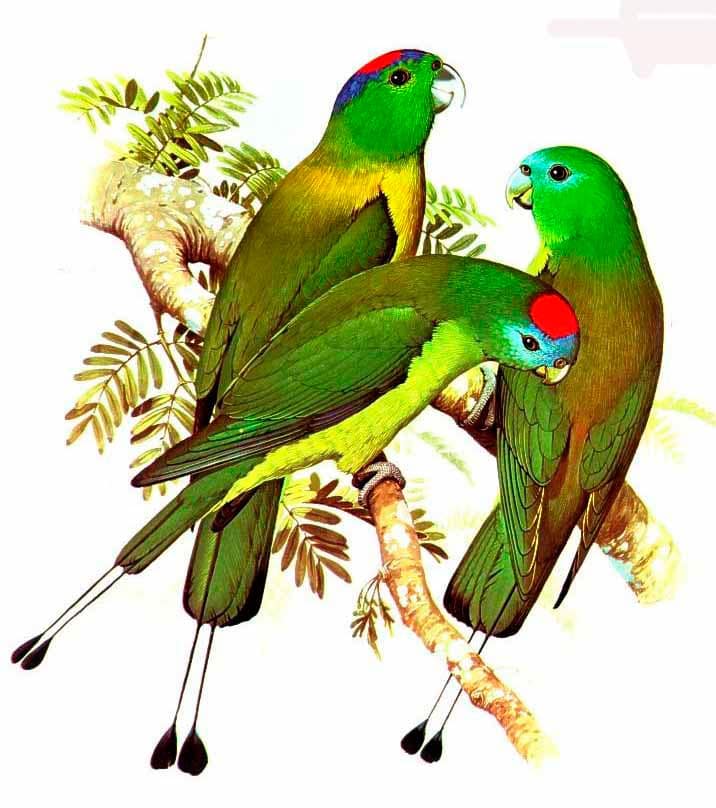
The Luzon Racquet-tail (Prioniturus montanus) has the head of color green with a strong diffusion of color blue turquoise in the face; point red in the center of the crown. Upperparts dull green. Wings green, vane outside of the flight feather, green; vane grey internal, Yellow-edged; networks internal of secondary marked in color yellow pale.

green wing feathers, bottom of bluish flight feathers; paler in network interiors to secondary internal. The underparts more green beige that the area of the back. Upper, the tail green in the center, black blue at the ends laterally; undertail, dark, blue margin to vane inner; spatulas blackish.

Bill blue; irises dark brown; legs black blue.

Female lacks of the point red and has less blue on the crown; rackets also shorter.

Young have tail Central with extensions of feathers narrow. Pens eventually lost beards to leave spatulas.

Habitat:

Little-known. Is distributed in the moist montane forests at altitudes ranging between the 850 and 2.000 m.

Reproduction:

The breeding season you have registered in the months of August and September. A nest was observed in the stump of an oak high (Quercus) at a height between 3 and 4 meters above the ground.

Food:

The birds feed on seeds, fruit, berries and nuts, and there have also been incursions into fields in the company of the Green Racquet-tail.

Distribution:

Size of the area of distribution (reproduction / resident): 10.400 km2

Endemic to Luzon. Being common in the Cordillera Central (for example, area Mount Pulag) and Sierra Madre, but threatened by the capture and loss of habitat in other places. The population world is inferior to 10.000 specimens.

Conservation:


Near-threatened


• Current category of the Red List of the UICN: Near threatened

• Population trend: Decreasing

Lambert et to the. (1993) estimated a maximum of 10.000 individuals.

The population is suspected of being in decline due to destruction of habitat, hunting and capture for the cage bird trade.

Conservation Actions Proposed:

Calculate loss of forests within its altitudinal range in Luzon. Estimate the remaining area of suitable habitat and, through surveys, produce an estimate of density to permit calculation of the size of its population. Protect effectively important tracts of forest right in key places, both in the areas of strict protection. as in multi-use areas.

"Luzon Racquet-tail" in captivity:

Its breeding in captivity is unknown..

Alternative names:

Luzon Racquet-tail, Luzon Montane Racquet-tail, Montane Racket-tail, Montane Racquet-tail, Montane Racquet-tail (nominal form), Montane Racquet-tail (nominate), Mountain Racket-tailed Parrot, Mountain Racquet-tailed Parrot (ingles).
Palette momot, Palette momot (nominal), Palette momot (nominale), Palette momot (race nominale) (French).
Motmotpapagei (German).
Prioniturus montanus (Portuguese).
Lorito momoto Montano, Lorito-momoto Montano (español).

scientific classification:

Order: Psittaciformes
Family: Psittaculidae
Genus: Prioniturus
Scientific name: Prioniturus montanus
Citation: Ogilvie-Grant, 1895
Protonimo: Prioniturus montanus

————————————————————————————————

«Lorito Momoto Montano» (Prioniturus montanus)

Sources:

Avibase
– Parrots of the World – Forshaw Joseph M
– Parrots A Guide to the Parrots of the World – Tony Juniper & Mike Parr
– Birdlife

Photos:

(1) – PetsHome.ro – Prioniturus montanus
(2) – By Bram Demeulemeester – Flickr

Sounds: Romeo B. Galang, Jr (Xeno-canto)

▷ The world of Pets: Dogs, cats, birds, reptiles, amphibians

Red-capped Parrot
Purpureicephalus spurius

Red-capped Parrot

Content


Anatomy-parrots

Description

36 cm.. length and a weight between 105 and 156 g..

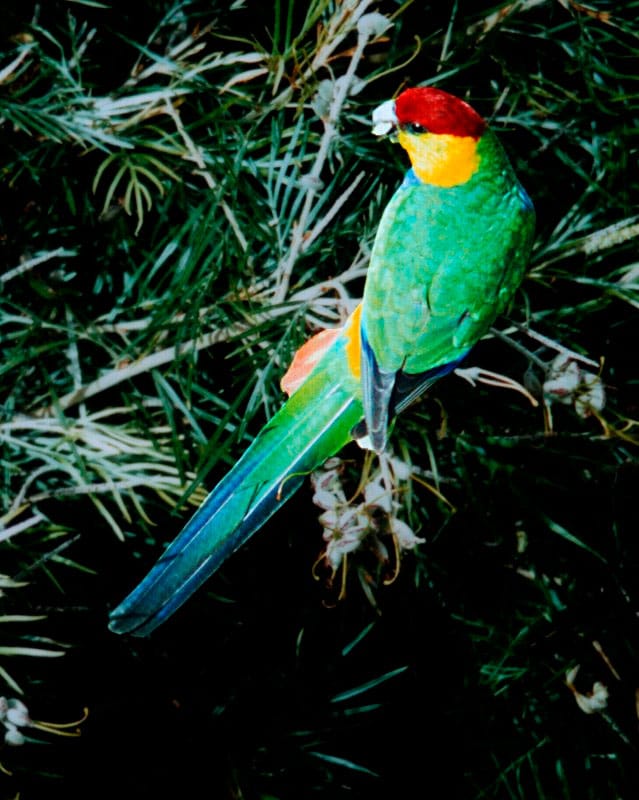
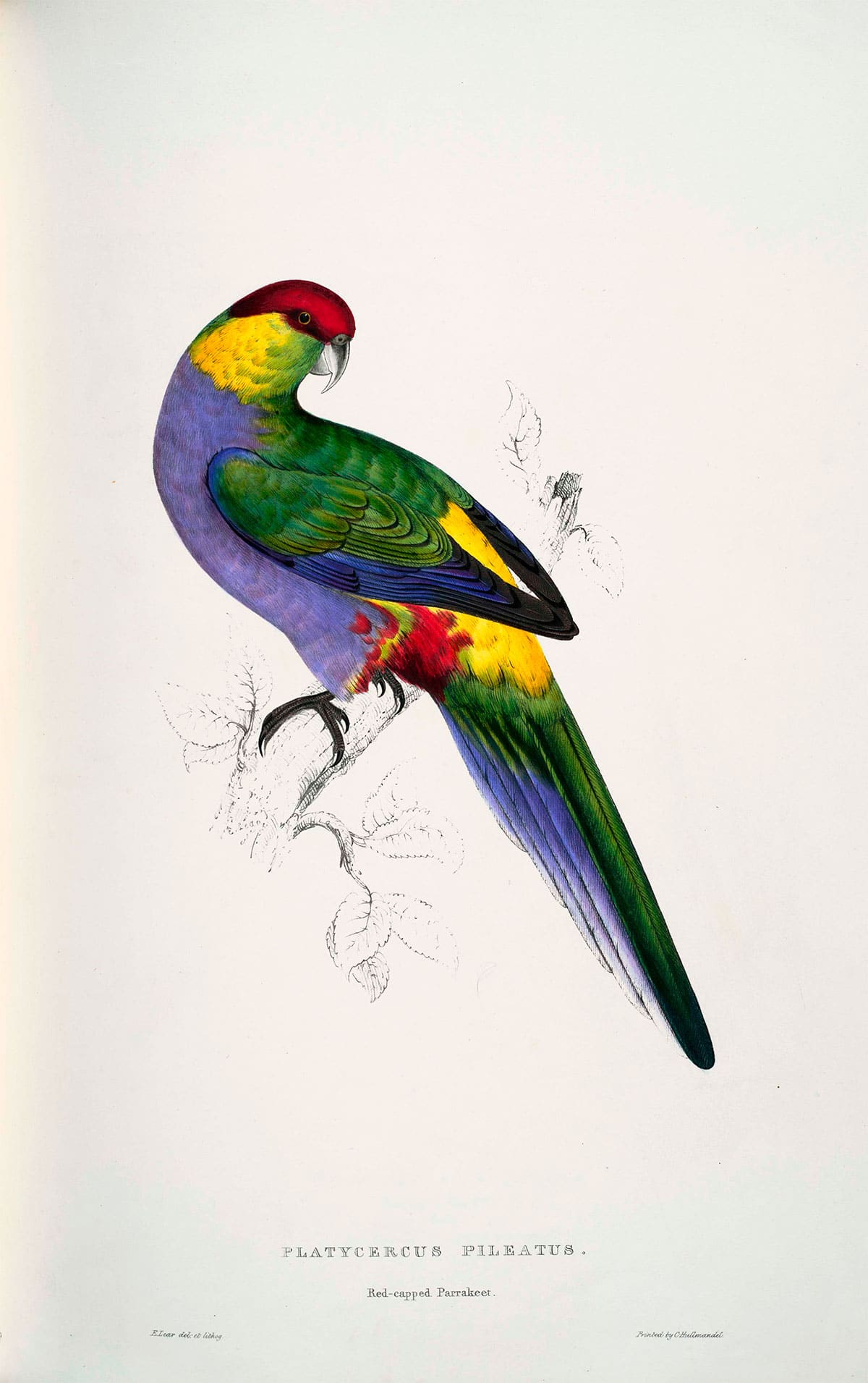
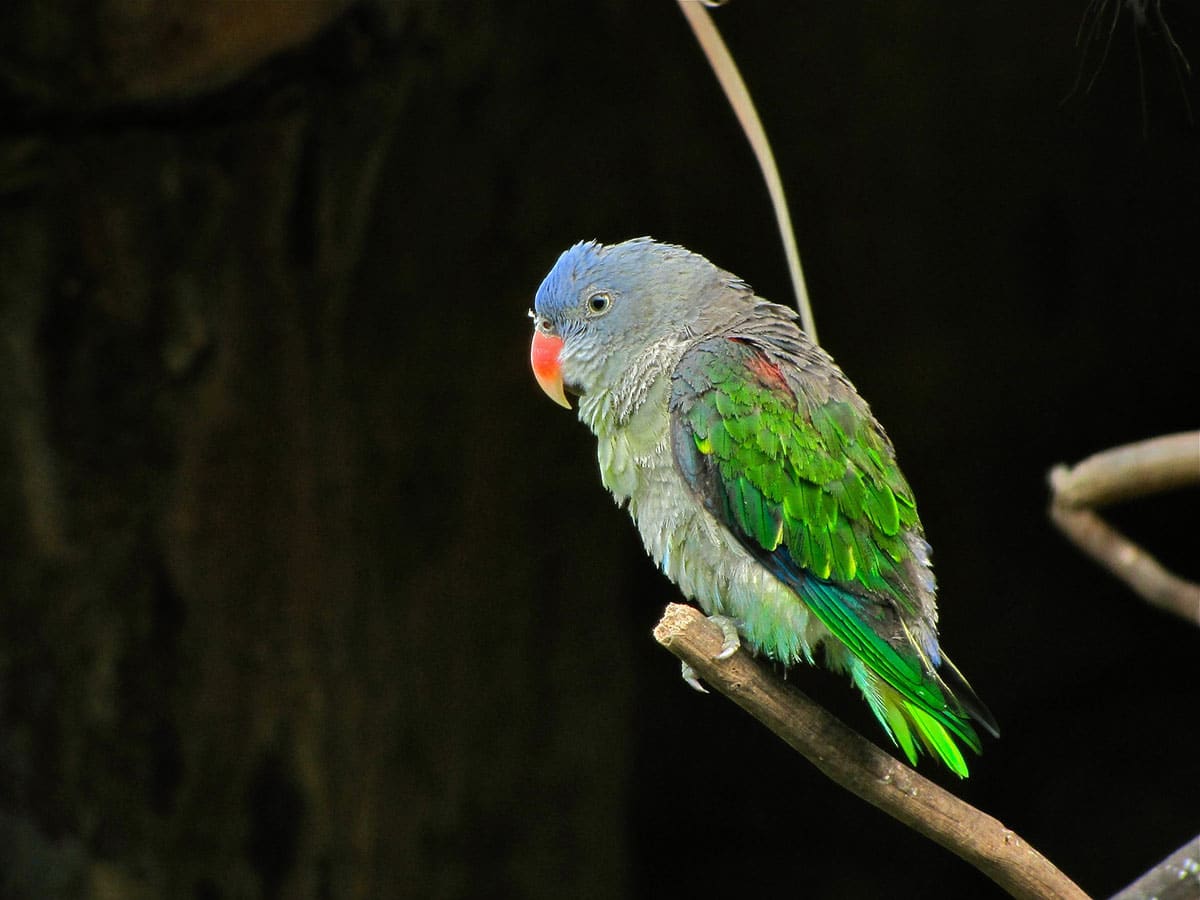
The Red-capped Parrot (Psittacus erithacus) It has the "crown" lid and the nape deep carmine red. The throat and cheeks are yellowish-green, merging slightly yellow on the sides of neck. The the mantle shows a dark green. The rump is bright yellow, which contrasts with the uppertail-coverts green. The wings covers are green, although large coberteras stain blue in the outer feathers.

The flight feather They are blackish with a large dark blue border around the outside edges of the primaries. The underparts is blue, with the exception of the flight feather that are black. The feathers of the chest and the abdomen they are blue-purple, becoming paler in area anal.

The the thighs and lower area of the tail They have a beautiful red. The undersides They have infiltrated some green feathers. Large central feathers tail They are green at the base, and bluish to the tip. side feathers tail They are dark at the base but gradually diluted colors light blue in the middle and then to white at the tips. The bottom of the tail It is pale blue with a white termination.

The bill, formed by a upper jaw more elongated, is bluish grey. The irises is of color Brown dark and the legs brown.

The female is more off than your partner. It has a crown green and chest brown. It shows a clear cross bar at the bottom of the wings, the level of flight feather. This motif is also present in the immature.

The immature they have the upperparts dark green and yellow rump duller than in adults. The the thighs They are less bright red colo. The chest It is browner. The forecrown It is covered with red feathers that are part, in small scattered groups, red feathers crown. The adult plumage It is acquired largely during the first molt and subsequently completed in the first spring.

Habitat:

Red-capped Parrot

Paired adults are sedentary, Although noisy flocks of up to 20 young birds are often seen wandering in search of food.

The Red-capped Parrot they have a preference for the eucalyptus forest and specialized to feed on seeds MARRI since its elongated upper jaw is adapted to eating the large seeds of the plant. The Fruit Marri they are available throughout the year and provide the source of staple food. The Red-capped Parrot they can also be observed in gardens (where sometimes cause serious damage), peoples, wooded pastures and forest of mallee (Eucalyptus Gracilis), feeding also on strips of grass covering the roads.

Couples remain inconspicuous, While quietly feeding in the canopy, during most of the day, Although they sometimes perch on Earth, in the clear, to feed on fallen fruit.

Reproduction:

The nesting season is between between August and December.

During the courtship, the male raises its crest, the tail, It tilts its wings and emits loud calls. The ritual offerings of food are also common, feeding the male to his partner during the incubation period.

The spawning usually includes 5 eggs, but may vary from 3 to 9. These are white. The eggs are deposited on a layer of sawdust that lines the bottom of a natural cavity of a eucalyptus marri, to a great height above the ground.

The incubation lasts a few 20 days. The male does not participate in feeding youngsters until they reach the age of 15 days. The flight of the young occurs approximately 5 weeks after hatching. The young remain in the family group for a short time after leaving the nest.

Food:

Apart from MARRI, These birds also feed on other eucalyptus, for example, Jarrah (Eucalyptus marginata), casuarinas, (Grevillea, Hakea), and they have also been feeding on flowers and insects.

Distribution:

Size of the area of distribution (reproduction / resident): 126.000 km2

Confined to the southwest corner of Western Australia. The species is distributed around the Moore river to the North of Perth (occasionally in Dandaragan), through the leafy South-West corner, usually within 100 km from the coast, reaching the inside of Lake Grace in the East and Esperance on the South Coast. The Red-capped Parrot they are regularly observed in the outskirts of Perth, and are reproduced in the King’s Park in the center of the city. The species is common, especially in the forests of MARRI (eucalyptus calphylla).

The world's population is believed to be above 20.000.

Moderate numbers in captivity. Can be shot like a plague in a small number of areas.

Conservation:


minor concern


• Current category of the Red List of the UICN: Least concern

• Population Trend: Growing

The size of the world population It has not been quantified, Although the world's population is estimated at more of 20 000 specimens.
The species is described as quite common (pit et to the. 1997).

The number of captive birds It seems to be quite modest. In some areas, This bird has no protection and can be shot down if it enters an area of intensive growth. Even so, the population It is suspected that You may be increasing.

As the degradation of the habitat is permanent, new areas of suitable habitat are being created.

"Red-capped Parrot" in captivity:

It is a bird shy and nervous. They should not be housed with aggressive species. They can be noisy especially early, in the morning.
Not common in captivity.

Una muestra vivió 15,3 years in captivity. In captivity, these animals have been able to play to the 2 years of age approximately.

Alternative names:

Red-capped Parrot, Hookbill, King Parrot, Pileated Parakeet, Pileated Parrot, Purple-crowned Parrot, Red capped Parrot, Red-capped Parakeet, Western Australian King Parrot, Western Gray Parrot, Western Grey Parrot, Western King Parrot (ingles).
Perruche à tête pourpre (French).
Kappensittich, Rotkappensittich (German).
Periquito-cabeça-púrpura (Portuguese).
Perico Capelo, Periquito de Birrete Rojo (español).

scientific classification:

Order: Psittaciformes
Family: Psittaculidae
Genus: Purpureicephalus
Scientific name: Purpureicephalus spurius
Citation: (Kuhl, 1820)
Protonimo: parrot champion

Images «Perico Capelo»:

Videos "Red-capped Parrot"

————————————————————————————————

«Perico Capelo» (Purpureicephalus spurius)


Sources:

Avibase
– Parrots of the World – Forshaw Joseph M
– Parrots A Guide to the Parrots of the World – Tony Juniper & Mike Parr
– Birdlife
– AnAge: The Animal Ageing and Longevity Database – Anagé entry for Purpureicephalus spurius

Photos:

(1) – «Red-Capped-Parrot 0004 flat web«. Licensed under CC BY-SA 2.5 via Wikimedia Commons.
(2) – A juvenile Red-capped Parrot at Earls Golf Club, Perth, Western Australia, Australia By Michael MK Khor [CC BY 2.0], via Wikimedia Commons
(3) – By Bill & Mark Bell – Flickr
(4) – By Bill & Mark Bell – Flickr
(5) – By Ralph Green – Red-capped Parrot juvenile – Flickr
(6) – Edward Lear [Public domain], via Wikimedia Commons

Sounds: Randy Moore (Xeno-canto)
▷ The world of Pets: Dogs, cats, birds, reptiles, amphibians

Turquoise Parrot
Neophema pulchella

Turquoise Parrot

Content


Anatomy-parrots

Description

20 cm.. length and a weight between 37 to 44 g..

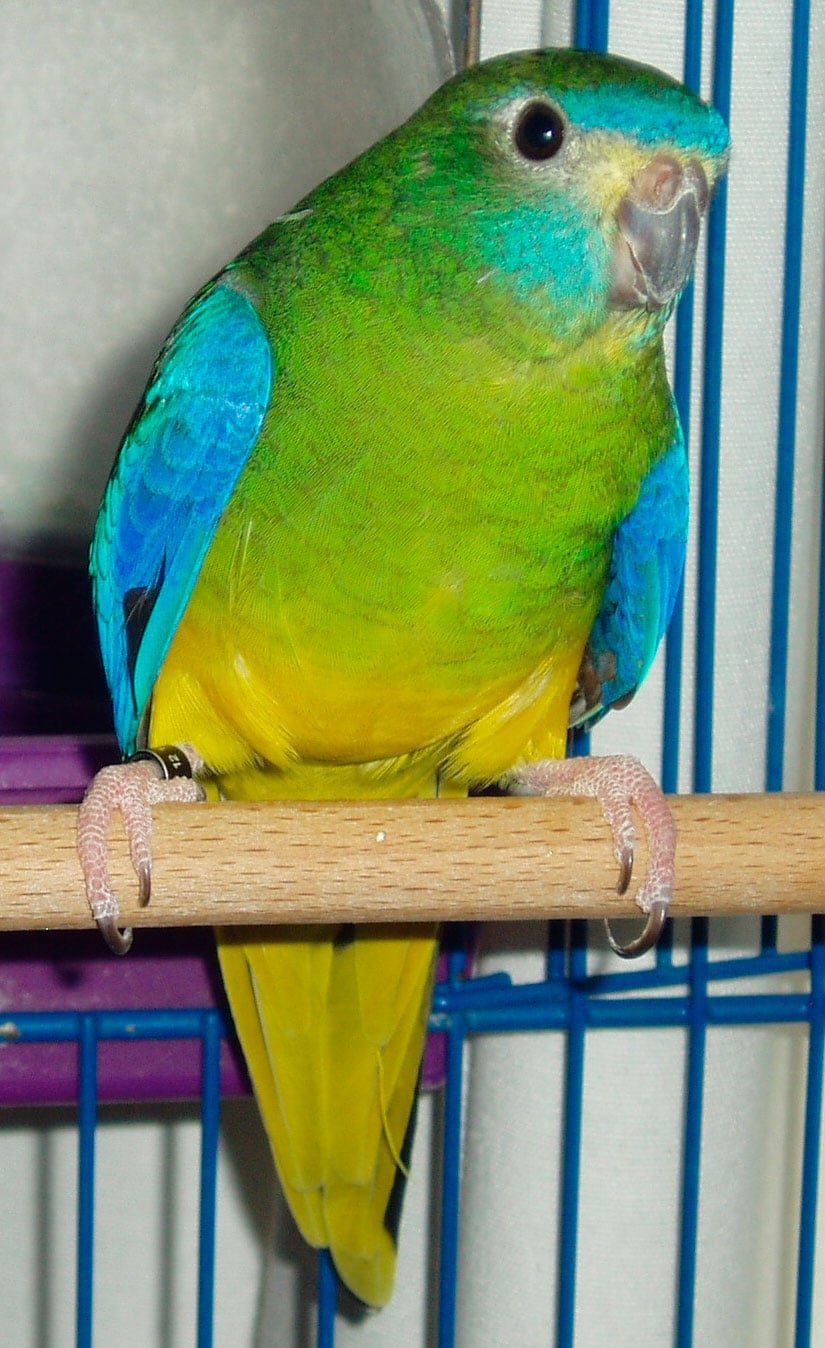
The Turquoise Parrot )(Neophema pulchella has the head bright turquoise blue, darker on the front of the crown, with the chin yellow and green on the back side of the crown.

Upperparts green.
The interior of the small and medium-sized coverts is reddish brown, the median are light blue. big blankets and primary coverts are blue-violet color. The primary feathers Black have them vane inmates of blue color and a fine yellow edge. The secondary feathers Black has foreign bands of yellowish green colour that tend toward the blue on the edges of the feathers. The lesser coverts the wings are blue-violet color.

The underparts is bright yellow with a slight orange patch in the throat and the chest. An orange stain, sometimes, is visible in the abdomen of certain individuals. The two pairs of the Central feathers of the tail are bright green, the outer tail feathers are yellow with green bases. The bill is black and the irises dark brown. The legs they are a pinkish-brown hue.

In the females, the plumage is more off than in males. There are no brown spots in the shoulders. The underparts they are much more green, especially in the chest. The lores they are whitish and the blue of the face is considerably reduced. A bar can be seen in the wing .

The immature are similar to the females.

The Immature males are distinguished by a small brown spot in the wing and blue dark figure.

Habitat:

Turquoise Parrot

The Turquoise Parrot they are distributed by clear wooded areas, wooded areas, meadows with native grasses, Although they have a strong preference for the ecotones, that is to say, regions that are intermediate between the forests and farmland.

In the State of Victoria, seasonally, These parakeets make positive use of habitats that suit them: the eucalyptus trees that are found in the Rocky Mountains in winter, wetlands and ravines from spring to fall and slopes that face southeast during all months of the year.

The Periquito turquoise they live in small flocks or family groups that feed near the ground.

These birds are sedentary but after nesting, You can attend a light dispersion.

During this last period, the formation of dorms is not uncommon.

We can often see them begging for food on the verges of roads.

Reproduction:

The Turquoise Parrot they breed from august to december. In other areas, the nests are also visible in April-may, but they are probably second clutches or broods alternatives. The nest is located in one a tree cavity, usually a eucalyptus, at least in regards to the State of Victoria. But it can also be located in a strain, a fallen pole or branch.

The spawning contains an average of 4 or 5 eggs with one incubation that lasts a few 20 days.

The chicks are altricial and remain in the nest for at least 4 weeks before you fly.

Food:

The Turquoise Parrot they have a diet vegetarian. They feed on seeds, flowers and fruits that are native and imported plants. Love cultivated herbs, wild herbs and different parts of the bushes.

A detailed census has identified the following genera: shrubs in Bloom's leucopogon, not less than 4 types of Danthonia, nettle, Urtica urens, Paspalum dilatatum, who are the edges of sea grass and the gernaios. The list is not exhaustive.

Distribution:

Size of its range (reproduction / resident): 771.000 km2

Currently fluctuates irregularly from the southeast of Queensland (North around Chinchilla and Maryborough) to the East of New South Wales, arriving at the coast, about Sydney, and extending to the South up to Nowra) in Victoria to the West of Bendigo. There is also an isolated population in the East of Victoria. The increase of population ,probably, continues in Victoria and New South Wales.

Conservation:


minor concern


• Current category of the Red List of the UICN: Least concern

• Population Trend: Stable

at the beginning of 20th century, the increase of pastoral activities, catastrophic drought in 1902, and to a lesser extent, poaching, they gave rise to the population of the Turquoise Parrot almost disappeared.

Since the decade of 1940, there has been a resurgence in the number of individuals. The resurgence of this species began in the vicinity of Chinchilal and Maryborough and little by little the South joined with the State of Victoria through New South Wales.

Today, growth tends to spread and strong presence in the national parks proof that the cessation of grazing is a great benefit for the development of these parrots. Since they nest close to the ground, These birds are still vulnerable to predation by foxes. The other recurring threat is habitat degradation and loss of nesting sites.. The world population deemed superior to the 20 000 birds, birds captive are estimated at 8 000.

"Turquoise Parrot" in captivity:

The Turquoise Parrot they are birds that are regularly and which are obtained very good results in the reproduction. These parakeets are highly recommended for amateur beginners.

In terms of its behavior, they are relatively strong with a sweet and melodious voice. These parakeets are not shy and are easy to keep..

During the breeding season they do not support other congeners or other species of neophemas. It is mainly of assaults by males. Your need to crack is very limited and their need for bathroom is very different from an individual to another. They tolerate dry climates, but they are very sensitive to cold and wet fog. They like to spend time on the floor, investigating, and therefore, they are vulnerable to infection by worms.

According to sources, a sample lived during 21 years in captivity. In captivity, these animals have been known that they can raise from 1 año de edad.

Alternative names:

Turquoise Parrot, Beautiful Grass-Parakeet, Beautiful Grass-Parrot, Beautiful Parrot, Chestnut-shouldered Grass-Parrot, Chestnut-shouldered Parakeet, Chestnut-shouldered Parrot, Chestnut-winged Grass-Parakeet, Chestnut-winged Parrot, Red-shouldered Grass-Parakeet, Red-shouldered Parakeet, Red-shouldered Parrot, Turcoisine Parrot, Turq, Turquoise Grass-Parakeet, turquoise parakeet, Turquoisine, Turquoisine Grass-Parrot, Turquoisine Parrot (ingles).
Perruche turquoisine (French).
Schönsittich (German).
Periquito-turquesa (Portuguese).
Papagayo Turquesa, Periquito Turquesa (español).

scientific classification:

George Shaw
George Shaw

Order: Psittaciformes
Family: Psittaculidae
Genus: Neophema
Scientific name: Neophema pulchella
Citation: (Shaw, 1792)
Protonimo: Psittacus Goshawk

«Turquoise Parakeet» Images:

Videos "Turquoise Parrot"

————————————————————————————————

«Turquoise Parakeet» (Neophema pulchella)


Sources:

Avibase
– Parrots of the World – Forshaw Joseph M
– Parrots A Guide to the Parrots of the World – Tony Juniper & Mike Parr
– Birdlife

Photos:

(1) – Turquoise Parrot (Neophema pulchella), female; of: Lovebird by Daniel Wehmeyer –> Danweh – Wikimedia
(2) – «Neophema pulchella -Rainbow Jungle -Australia-8a» by Sheila Bradford – originally posted to Flickr as DSCF7029 turquoise parrot. Licensed under CC BY 2.0 via Wikimedia Commons.
(3) – «Neophema pulchella -Twycross Zoo, Leicestershire, England-8a» by stephen jones from uk – [1]Uploaded by Snowmanradio. Licensed under CC BY 2.0 via Wikimedia Commons.
(4) – «Turquoise Parrot (Neophema pulchella)-6» by Lip Kee Yap – originally posted to Flickr as Turquoise Parrot (Neophema pulchella). Licensed under CC BY-SA 2.0 via Wikimedia Commons.
(5) – «Neophema pulchella pair Capertee Valley» by Lip Kee from Singapore, Republic of Singapore – Turquoise Parrot (Neophema pulchella). Licensed under CC BY-SA 2.0 via Wikimedia Commons.
(6) – Jacques Barraband [Public domain], via Wikimedia Commons

Sounds: Marc Anderson (Xeno-canto)

▷ The world of Pets: Dogs, cats, birds, reptiles, amphibians

Red-fronted Parrot
Poicephalus gulielmi


Lorito Frentirrojo

Content

Description:

28 cm. length and an average weight of 220 g..

The Red-fronted Parrot (Poicephalus gulielmi)has the forecrown and crown bright red; the lores and chin blackish; cheeks, back of the crown and nape dark green with scattered feathers showing blackish centers.

The mantle feathers and scapulars Black with large green edges that give scalloped appearance; rump and uppertail-coverts bright yellowish green .

Wing coverts black with a dark green margin; leading edge of the wings from joints carpal to the base of the primaries bright red. The primaries and secondaries black. Under, the wing feathers dark green and black.

Underparts dark green with scattered feathers showing a black central band; the thighs bright red. The tail black.

Top of the mandible grey, Blackish towards the tip with pale base stains, lower jawBlackish r; Orange the irises; legs dark grey to black.

Both sexes similar.

The youth lack of red color in the forecrown, the edge of the wings and the thighs; Green in a little paler than the adults plumage. Young birds sometimes show red color in the feathers of the wings. The irises is dark brown.

Description 3 subspecies:

  • Poicephalus gulielmi fantiensis

    (Neumann, 1908) – Smaller that the species nominal. Forehead, leading edge of the wings and the thighs Orange or orange-red (but not red) and more extensive, in some birds. Underparts paler green with fewer black markings.


  • Poicephalus gulielmi gulielmi

    (Jardine, 1849) – Nominal species


  • Poicephalus gulielmi massaicus

    (Fischer & Reichenow, 1884) – Restricted red in the forecrown. Paler than the species nominal, with few or no black marks on the underparts.

Habitat:

The Red-fronted Parrot They inhabit montane forests of Juniperus and Podocarpus in Kenya and Tanzania, between 1,800 and 3,250 meters above sea level, where may depend on the primary vegetation.

Confined in the lowlands the rest of the population rainforest (below 700 metres in West Africa), but are not limited to the primary formations, There are records of the Red-fronted Parrot perched on tall trees of shade coffee plantations in Angola and in secondary forests of Ghana.

Usually stays in the tree tops, While they feed or rest.

In general, seen in groups of up to 10 birds, forming large flocks where abundant food. Large congregations, sometimes, in places.

In Kenya, the Red-fronted Parrot they make long daytime journeys of foraging (60km) along gallery forests, or crossing the savanna forest dominated by Acacia.

Reproduction:

The Red-fronted Parrot they breed solitary.

During the mating, males sway rhythmically, without moving the wings, while standing behind the female's back.

The nest is located in a cavity between 3 and 12 meters above the ground.

In the Mount Meru (Tanzania), nests have been recorded in living trees of the genus Hagenia, Podocarpus and Juniperus.

The egg laying It has been recorded in November to January in Tanzania, September in Zaire and March, June and from September to November in Kenya. The implementation is of between 2 and 4 eggs bright white.

Food:

Its diet It is believed that it is composed of a variety of seeds, fruits, flowers and insects. The seeds of Spathodea, oil palm nuts (Elaeis guineensis), fruits of the Podocarpus flowers and seeds of Grevillea robusta. Probably some insects are also part of their diet.

Sometimes associated with the African Olive-Pigeon (Columba arquatrix) and Sharpe's Starling (Pholia sharpii) when feeding in the Olea capensis.

Distribution:

Size of the area of distribution (reproduction / resident): 5.380.000 km2

Several apparently separated distributions.

In West Africa are distributed to the East of Liberia until Ivory Coast and South of Ghana.
In the Center-West of Africa, South of Cameroon to the Northwest of Angola. A seemingly separate population extends to the North of Zaire and South of the Central African Republic to the southwest of Uganda and Rwanda. Also found in the Highlands of Kenya and North of Tanzania.

Sedentary with local movements. Locally common to abundant in many localities in part of its eastern range, apparently, the decrease in other areas is possibly due to deforestation.

Distribution 3 subspecies:

Conservation:


minor concern


• Current Red List of UICN: Least concern

• Population trend: Decreasing

Keep a Red-fronted Parrot as a pet it has steadily increased in popularity in recent years, and as a result, the species has been the subject of intense trade on the market of wild birds. His capture may represent a significant threat to the species, in particular for the population around the Mount Kilimanjaro in Tanzania, fact that could lead to the local extinction of the species in that area.

The Red-fronted Parrot is also at risk from the deforestation in parts of its area of distribution. But, the species is still distributed over a wide area and is not currently considered globally threatened, even though global population trends have yet to be quantified.

The Red-fronted Parrot is located in several protected areas, including the Lope-Okanda National Park in Gabon, World Heritage site, the Korup National Park in Cameroon and the Bia National Park in Ghana.

The species is included in the Appendix II the Convention on international trade in endangered species (CITES), that means that the international trade of the Red-fronted Parrot It must be carefully checked. But, a key problem in many areas is the lack of adequate legislation, and the lack of compliance with the legislation in which it does exist.

The wild trade in this bird and the destruction of their forest habitat may have a better follow-up to ensure that populations of the Red-fronted Parrot not to suffer future decreases.

"Red-fronted Parrot" in captivity:

Probably the first hatchlings of Red-fronted Parrot born in in captivity were achieved in 1978, in Switzerland and England Although already in advance, in the middle of the 90, specimens had arrived at zoos in London and Hamburg.

The Red-fronted Parrot is little known in Spain, but in other countries it is very common as a pet thanks to its size, its great intelligence, its capacity for imitation and its character quiet and loving, but at the same time playful and naughty.

It is soft and musical, and their cry is quite bearable. In general, is a bird bit noisy, which can be an asset to a future owner who lives in an apartment.

They are very destructive, or both must provide them with abundant branches and non-toxic toys for chopping and shredding.

In terms of their longevity, according to sources, one specimen was still alive after 21 years in captivity.

Alternative names:

Red-fronted Parrot, Jardine’s Parrot, Red fronted Parrot, Red-crowned Parrot, Red-headed Parrot, William’s Fig Parrot (English).
Perroquet à calotte rouge, Perroquet à front rouge, Perroquet de Jardine, Perroquet vert à calotte rouge (French).
Kongopapagei, Kongo Papagei (German).
Papagaio-de-jardine (Portuguese).
Lorito de Jardine, Lorito Frentirrojo, Loro Jardinero (español).


scientific classification:

William Jardine
William Jardine

Order: Psittaciformes
Family: Psittacidae
Genus: Poicephalus
Scientific name: Poicephalus gulielmi
Citation: (Jardine, 1849)
Protonimo: Parrot gulielmi


Images "Lorito Frentirrojo":

————————————————————————————————

"Lorito Red Front" (Poicephalus gulielmi)


Sources:

Avibase
– Parrots of the World – Forshaw Joseph M
– Parrots A Guide to the Parrots of the World – Tony Juniper & Mike Parr
– Birdlife
– Arkive

Photos:

(1) – A Red-fronted Parrot at Birds of Eden, South Africa By Dick Daniels (http://carolinabirds.org /) (Own work) [CC BY-SA 3.0 or GFDL], via Wikimedia Commons
(2) – Photograph of a couple of Poicephalus gulielmi By derivative work: Snowmanradio (talk)Poicephalus_gulielmi_pareja_reproductora. JPG: Juan Caparrós (Poicephalus_gulielmi_pareja_reproductora. JPG) [CC BY-SA 3.0 or GFDL], via Wikimedia Commons
(3) – P. g. fantiensis at Birds of Eden, South Africa By Poicephalus_gulielmi_-Birds_of_Eden_-South_Africa-8a.jpg: Grahamderivative work: Snowmanradio [CC BY-SA 2.0], via Wikimedia Commons
(4) – A juvenile pet Red-fronted Parrot (also known as Jardine’s Parrot) By Bram Cymet (originally posted to Flickr as Amazon) [CC BY 2.0], via Wikimedia Commons
(5) – Fledgeling Lesser Jardines Parrot eating vegetables By Kofiwannacracker (Own work) [Public domain], via Wikimedia Commons

▷ The world of Pets: Dogs, cats, birds, reptiles, amphibians

Blue-rumped Parrot
Psittinus cyanurus


Lorito Dorsiazul

Content

Ilustración Lorito Dorsiazul

Description:

Of 18 cm.. of length and a weight of 85 g..

The Blue-rumped Parrot (Psittinus cyanurus) is a small Parrot, robust and with a tail very short.

Since the crown up to the nape is a bluish grey, glossy on the front of the crown; the lower cheeks and chin grayish brown; the nape sharply demarcated from the the mantle black, with a strongly mottled grey; the low back and rump Blue light violet, brighter than the blue of the head. The patch in the shoulders reddish brown; upperwing-coverts medium Green, the edges of yellowish-green, especially in internal and great stockings coverts; primary coverts blue; flight feather green, with the primaries finely lined with yellow along the inner edges; carpal edge Blue and yellow. Lower parts of the wings dark, with bright red feathers on the underwing-coverts and axillary.

Underparts grayish brown, becoming a blue-green shutdown, with yellow marks in the vent. Uppertail greenish blue in the Center, inner featherss of yellow light with vane outer greener; undertail-coverts yellow

A long bill with red notches in the upper jaw, lower jaw duller; irises yellowish white; legs bluish grey.

The female has the head and upper jaw brown; lacks black on the back and shows just a little blue in the rump; the underparts are light green, Gray as in the male Brown not.

The youth are like females, but with the head green.

Subspecies description

Subspecies description:
  • Psittinus cyanurus abbotti

    (Richmond, 1902) – Males with green spread at the front of the crown, the back of neck black, Green mantle and the rump green (marked with turquoise), the underparts greenish. Female with the head green. Larger than the subspecies Psittinus cyanurus pontius.


  • Psittinus cyanurus cyanurus

    (Forster,JR, 1795) – The species nominal


  • Psittinus cyanurus pontius

    (Oberholser, 1912) – As well as the species nominal but larger.

Habitat:

There is some evidence of possible regular movements in the North of its distribution area, with a view to passing birds above Fraser Hill in Malaysia, 1,300 m.

The Blue-rumped Parrot is also seasonal in parts of the South visitor of Burma.

They are distributed in lowland forests (usually below 700 m) and related habitats, including open forests, secondary growth, huertas, mangroves, dry forests, swamp forest, cultivated areas, including oil palm plantations (Elaeis guineensis), near forests (where post-breeding concentrations are considered pests in some areas), dense thickets and groves of coconut (Cocoa nuts).

The Blue-rumped Parrot they are not shy, and can be found in groups of up to 20 birds, whether eating in silence at the canopy level, quickly flying above the forest, or above the tops of the trees hacuendo calls continuously.

Reproduction:

The breeding season of the Blue-rumped Parrot extends from February to may in Malaysia, and from June to September in Borneo, Although some birds have been seen inspecting possible nesting cavities at other times of the year.

During the courtship grooming each other is common; the male jumps by placing both feet on the back of the female during mating. The implementation is up to three eggs, which are deposited in a hole in the top of a tree, little more is known about the reproductive cycle.

Food:

The diet of the Blue-rumped Parrot is composed of seeds, fruits and flowers.

Distribution:

Its distribution varies from around 11°N in Peninsular Thailand and South of Tenasserim, Burma, across the peninsula Malaysia, Singapore, Sumatra and Borneo (Kalimantan, Sarawak, Sabah and Brunei). They are also found in the Riau (including Bintan) and groups of Lingga Islands to the North of the South of Sumatra, in Bangka, and, in West Sumatra, in Simeulue and the group Mentawai including Siberut, Sipura, Pagai Utara and Pagai Selatan.

It is only locally common and less abundant than other sympatric species of Psittaculas in most of its range.

Subspecies distribution

Subspecies distribution:

Conservation:


Near-threatened


• Current Red List of UICN: Near threatened

• Population trend: Decreasing

The size of the world population Blue-rumped Parrot He has not formally quantified, but it is believed that they are more than 100.000 individuals (Juniper and Parr 1998), and the species is described as common in primary habitats and uncommon in secondary habitats and plantations (pit et to the. 1997).

In general, the loss of the forest cover between 2000 and 2010 It has been estimated in 23,7% in the case of Sumatra, the 12,0% in Borneo and the 8,2% for Peninsular Malaysia (Miettinen et to the. 2011).

In Sumatra, It has been estimated that you close to of the 36% primary forest cover in 1990, lost in 2010 (including degraded primary forest) (Margono et to the. 2012).

Descents are compounded by the pressure of the capture; But, the Blue-rumped Parrot uses of forest fragments, forest exploitation, secondary vegetation, other modified habitats and habitats at elevations, What has prevented a faster decrease in its population. But, many lowland forests have been logged.. So, suspected of may be suffering a decrease in the moderately rapid population.

Conservation Actions Underway:

"Blue-rumped Parrot" in captivity:

Pretty rare in captivity.

The Blue-rumped Parrot It is not a bird which like to interact with humans, nor is it a particularly playful bird. Are described as docile who love to sing on rainy days. Due to its melodic voice, they are often alone as songbirds. But, not all of them are born as birds cantadoras, in fact, Some are dumb.

It is recommended to buy the younger, since they are more likely to sing. But, in general it's parrots very quiet with occasional whistles and high-pitched vocation, that it can be irritating when held captive in an apartment.

They have very limited ability to speak. Some of them learn to speak – but most never do.

Unfortunately, they are easy to catch, since they remain immobile when frightened. Hunters have only to shoot into the air or make some noise on turning the birds when they are resting so that they can be easily caught. This has led to its State endangered extincion ..

With regard to its longevity, according to sources, a Blue-backed Parrot was still alive after 10,2 years in captivity. Taking into account the longevity of the similar species, maximum longevity is probably underestimated in this species.

The Blue-rumped Parrot It is a beautiful bird when it is in its natural habitat, its potential as a pet it is said that it is limited. Usually do better in an environment of Aviary, with plenty of space so that you can explore the surrounding area. Better yet is protect their natural habitat and let them enjoy freedom.

Alternative names:

Blue-rumped Parrot, Blue rumped Parrot (English).
Perruche à croupion bleu, Perroquet à croupion bleu (French).
Rotachselpapagei, Rotachsel-Papagei (German).
Papagaio-de-rabadilha-azul (Portuguese).
Lorito de Lomo Azul, Lorito Dorsiazul (español).


scientific classification:

Johann Reinhold Forster

Order: Psittaciformes
Family: Psittaculidae
Genus: Psittinus
Scientific name: Psittinus cyanurus
Citation: (Forster, JR, 1795)
Protonimo: Psittacus cyanurus


Images "Lorito Dorsiazul":

Videos "Blue-rumped Parrot"

«Lorito Dorsiazul» (Psittinus cyanurus)


Sources:

Avibase
Parrots of the World – Forshaw Joseph M
Parrots A Guide to the Parrots of the World – Tony Juniper & Mike Parr
Birdlife

Photos:

(1) – Blue-rumped Parrot Psittinus cyanurus. Bird Park Kuala Lumpur by Bernard DUPONT – Flickr
(2) – Bird Park Kuala Lumpur By Bernard DUPONT from FRANCE (Blue-rumped Parrots Psittinus cyanurus) [CC BY-SA 2.0], via Wikimedia Commons
(3) – Blue-rumped Parrot in a cage By TJ Lin (originally posted to Flickr as DSC01255) [CC BY-SA 2.0], via Wikimedia Commons
(4) – Male blue-rumped parrot (Psittinus cyanurus) by Chlidonias – zoochat
(5) – Female blue-rumped parrot (Psittinus cyanurus) by Chlidonias – zoochat
(6) – Psittacus Malaccensis. (Latham, not Gmellin) Blue-rumped Parrot By William Swainson, F.R.S., F.L.S. (Zoological Illustrations, Volume III.) [Public domain], via Wikimedia Commons

Sounds: Martjan Lammertink (Xeno-canto)