11 to 13 cm.. length and a weight between 27 and 34 g..
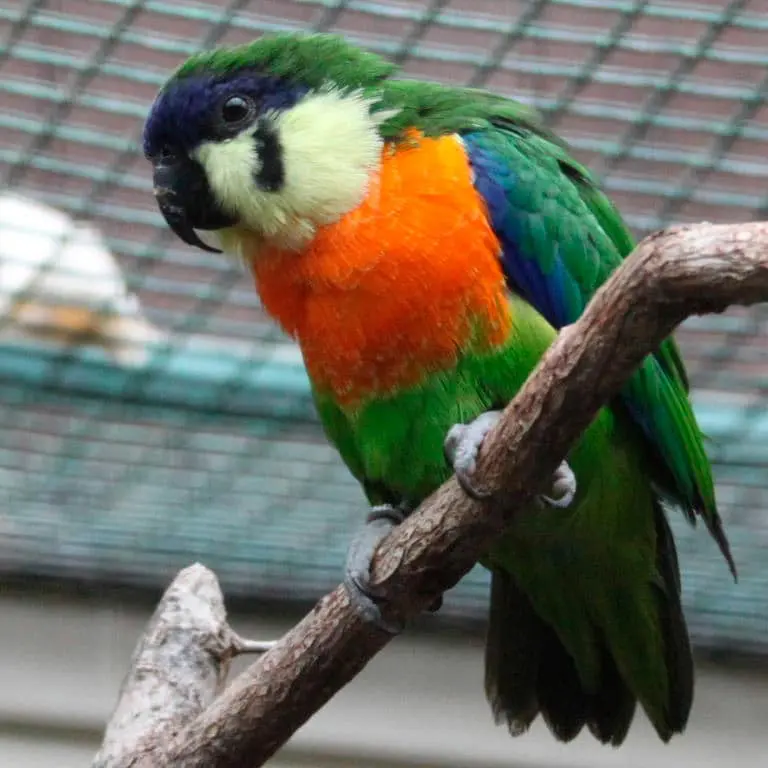
The forecrown of the Orange-breasted Fig-Parrot(Cyclopsitta gulielmitertii), back of the crown and area behind the eyes are a deep blue; pale yellow the lores, throat and both sides of the head; black spot on the back of the cheek; Orange the top part of the abdomen; the interior of the wing-coverts Yellow-edged; wide bands of pale yellow under the wings. Bill blackish gray. The eyes dark brown.
The female similar to the male, but pale yellow on the front of the cheeks black and white on the back. Frontal of the cheeks bordered below green with blue stripe; the ear-coverts on both sides of neck, orange; underparts green.
The immature as females, but orange, Since the ear-coverts and sides neck to the area below, faced with the cheeks; chest male washed with orange-brown.
(Reichenow, 1891) – 13 cm.. length. Area of the forecrown, crown and behind the eye, black. Female without chest Neither abdomen orange, cheeks white-yellowish color bordered by a blackish band. back of the cheeks and headphones feathers bright orange. Under black band greenish blue. The youth they are equal to adults.
Cyclopsitta gulielmitertii ramuensis
(Neumann, 1915) – It is more small, of about 11 cm.., with the area of the forecrown, crown and behind the eye Black interspersed with dark blue, cheeks and headphones feathers whitish in colour. Breast
and abdomen cream color. females as males but behind the eye and cheeks with a broad black patch interspersed with dark blue. Breast
whitish interspersed with orange feathers. Abdomen brighter yellowish green. The youth equal to adults.
Cyclopsitta gulielmitertii amabilis
(Reichenow, 1891) – It is more small, a few 11 cm..Forehead, crown and rear of the eye matte black. Cheeks Black interspersed with dark blue. females similar to the males but with the patch from behind the eye Black interspersed with dark blue matte. Headphones feathers whitish. The juveniles as in adult females but with the upper part of the chest greener
Cyclopsitta gulielmitertii suavissima
(Salvadori, 1876) – Smaller, a few 11 cm.., area of the forecrown, crown and behind the eye blue color, great patch on cheek black. Headphones feathers and cheeks white-yellowish color and chest and top of the abdomen reddish orange. The female It has a hue of different reddish orange and black spot of the cheek is Matt and interspersed with dark blue color. The youth adult females are, but marks of the head they are more off.
Cyclopsitta gulielmitertii fuscifrons
(Salvadori, 1876) – As the diophthalma gulielmitertii suavissima but the area of the forecrown, crown and back of the eye, blackish brown. The females similar to the Cyclopsitta gulielmitertii suavissima but back of the cheeks, front and behind the eyes blackish brown. The youth as adult females.
Cyclopsitta gulielmitertii melanogenia
(Rosenberg,HKB, 1866) – Of 11 cm.. length. The male is as the diophthalma gulielmitertii suavissima, the female also with the fused in light green Orange tones in the abdomen. The youth are like adults.
Habitat:
It is distributed in the rainforest, swamp forest, forest of Melaleuca , dense sheets and partially cleared areas from sea level to a 300 meters above sea level, rarely recorded in higher altitudes to the 800 m, the largest known altitude is 1.100 m.
They are usually in small groups assets of 6 to 10 individuals, whether it is flying above the treetops, or congregate where can feed on figs and other fruits in the canopy or plants at lower levels.
Bird feeding can be hard to spot, since they climb around the silent tree trunks, although they can pivot upside down as they feed, sometimes dropping food.
Reproduction:
The nests of the Orange-breasted Fig-Parrot found in arboreal termite, at the top of the trees of the forest. Up to three holes can be dug., and nesting they can be community. The nests also found at the base of a complex of epiphytes. There is little information available upon the breeding season, activity in apparent nests have been observed between the months of September and June. These sites can, However also, have been used to settle, and a record in January of a male regurgitating food near an entrance hole probably indicates breeding during that month at least..
Food:
The diet includes seeds of figs and other fruits, as well as small whole figs, nectar flower e insects occasional.
Distribution:
Widely distributed, abundant and easily observable in the lowland tropical rainforest, throughout much of New Guinea. The Orange-breasted Fig-Parrot most Western they are isolated, only seen in Salawati in the West of the islands of papua, and in the lowlands of theDoberai Peninsula, West Papua.
In other parts of New Guinea the range is continuous through the lowlands of the North of the eastern edge of Yellowfinch Bay around the memberamo river, throughout the region of the Sepik River and the lowlands of the Huon Peninsula, to Milne Bay, at the eastern end.
The range continues west through the southern lowlands of New Guinea through the Purari and Fly River regions to the southeastern lowlands of West Papua, on the 138 ° E; also in the islas Aru.
The Orange-breasted Fig-Parrot seems to be more common in southern New Guinea in the North.
Subspecies distribution
Distribution of the 7 subspecies
Cyclopsitta gulielmitertii gulielmitertii
: The nominal
Cyclopsitta gulielmitertii nigrifrons
: North of New Guinea between Mamberamo and Sepik Rivers.
Cyclopsitta gulielmitertii ramuensis
: District Ramu River, North of Papua New Guinea; It is thought that it may be a cross between the nigrifrons and the amabilis, therefore, probably not a valid subspecies.
The Green Racquet-tail(Prioniturus luconensis) has the head of color green light, impregnated of green yellowish around them lores and the base of the bill. Mantle light green, slightly yellowish. Wings green; vane outer, the first three primaries green, impregnated blue; vane Dark internal, the more internal with pale inner edge. Wing feathers greenish yellow, underside of flight feather impregnated of blue dark. The underparts brighter yellowish green, more yellow in the undertail-coverts. Upper, the tail green, lateral feathers strongly impregnated dark bluish-green and dark-tipped; undertail, the tail bluish.
Bill grey bluish pale ; irises dark brown; legs grey.
Previously reported in the strata media of the land low of forest primary, and in the nearby cornfields, mostly below 700 m. Recent records are from small groups of a maximum of seven birds that live most degraded or selectively, in exploited forests outside of settlements.
Reproduction:
Young have been observed in Luzon during the month of may. The nest It , apparently, a hollow tree. Little more is known about the habits of this rare Parrot.
Food:
The diet includes fruit, Tender corn, rice, seeds and flowers.
Distribution:
Size of the area of distribution (reproduction / resident): 93.500 km2
Endemic to Luzon and Marinduque, North of Philippines. Although the species was considered quite common at the end of the last century in the center of Luzon, seems to have suffered a rapid decline in recent years. Has not been registered in the Cordillera Central in this century, and now you can have their stronghold in the Sierra Madre, where it was reported to be generally rare or uncommon in the decade of 1990. It is rare in all currently considered Luzon except perhaps in the Subic Bay Naval Reserve Forest (Bataan, to the East of Manila). There are no recent records of Marinduque.
Conservation:
• Current category of the Red List of the UICN: Danger
• Population trend: Decreasing
The population is in the band of 1,000 to 2,499 mature individuals.
The threats by the tala generalized and their captures to the trade of birds of cage, suggest that this species is experiencing a downhill fast in the population.
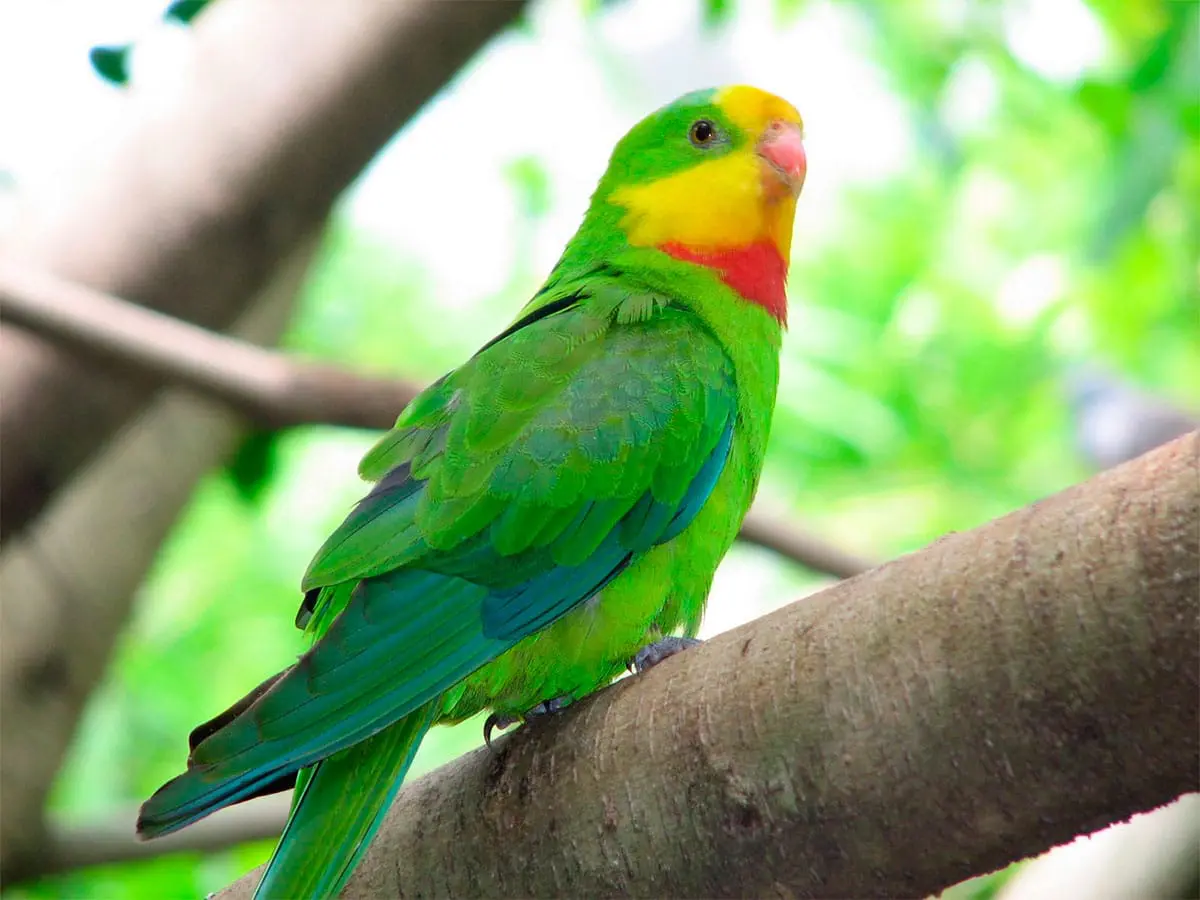
The Superb parrot (Polytelis swainsonii) has the front, crown, Chin and throat of bright yellow; back of the bright green Crown with turquoise blue wash: headphones coverts and Lords, green. Bright green upper parts. Upper, the wings, bright green, with dark diffusion in the inner margins of the vane internal and blue diffusion in vane outer (fine yellow rear margin for flight feathers); bluish carpal edge: light blue primary coverts; primary elongated.
Wing of bright green feathers; bottom of blackish brown flight feathers. Underparts pale bright green, with thin bright red Ruff between throat yellow and green at the top of the chest. Upper, bright green tail, with dark elongated Central feathers Slightly bulbous tips. outer feathers with bluish edges vane outer. The lower part of the tail is black.
The female is completely Green, with a bath pink Brown throat and with the headphones cinnamon and the Crown of blue-grey. The mantle is more off, more greenish Brown, contrasting with the Green rump and dark flight feathers. The underparts are paler, orange-red legs. She also has distinctive pink trim and pink tips to yellow vane internal bottom of the queue.
Yellow IRIS.
Immature as females but with Brown iris. Males attain adult plumage in about 12 months.
A part of the population of the Superb parrot is migratory, wintering in the North of the breeding areas.
Habitat preferences of breeding populations vary slightly from east to west within the slopes of the Great dividing range and open areas in forests of eucalyptus, It is the dominant vegetation type. Here the species nests far from watercourses, and it uses a variety of tree species.
In the region of Riverina, to the West, birds breed almost exclusively on the banks of rivers, in forests of Eucalyptus camaldulensis, feeding on nearby forests of Eucalyptus bicolor, Eucalyptus melliodora and White Pino-CIPRES (Callitris columellaris).
They sometimes also found in farmland and villages.
The size of the flocks are usually small, but groups of up to 100 individuals have been recorded after the breeding season.
The superb Parrot feed in the trees, in the understory, and also in land, where can be accessible, feeding on spilled grain on the roadsides and keeping the company of the Yellow Rosella and Cockatoos.
Reproduction:
The breeding season of the Superb parrot is from September to November.
Male parade making small greetings and nodding his head. Both members of the couple make ritual exchanges of food.
The nest is usually a hollow, full of scrap wood, at the top of a tree dead or alive and a considerable height that is usually between 11 and 51 meters above the ground. The individual sites tend to be reused.
The Superb parrot, they often nest in colonies ranging up to six couples. Spawning contains 4 or 6 eggs which are incubated for at least 20 days. The chicks are altricial and leave the nest after 30 days.
Food:
The diet includes fruits and flowers of Acacia and eucalyptus, fruit shrubs (for example Exocarpos); seeds of crops, pastures, weeds and grasses
Distribution:
Size of the area of distribution (reproduction / resident): 95.300 km2
The Superb parrot they are endemic in Australia, where are distributed only in New South Wales and the north end of Victoria.
• Current category of the Red List of the UICN: Least concern
• Population trend: Stable
Its population, apparently, fell in 1920 as an accidental effect of a poisoning by the crop protection.
A panel of experts considered that it was very likely that the population in 2010 exceeds the 10.000 mature individuals. The current estimate ranges in the Strip between 10.000 and 20.000 specimens.
The general trend of the population of the Superb parrot (Polytelis swainsonii) is uncertain, but there is no evidence of a continuous decline.
In Australia is also classified as vulnerable species the law of protection of the environment and conservation of the biodiversidadad of 1999. In addition, its conservation status varies between states., for example in the law of Victoria (1988) is considered to be threatened species.
"Superb parrot" in captivity:
Take it easy, relatively little aggressive with other birds, and very social.
Una muestra vivió 15,1 years in captivity. According to sources, these animals can live up to 24,2 years in captivity, It is possible to, but the source is not verified; the same study reported that these animals can reproduce in approximately 2 years of age in captivity.
Pretty common in captivity, above all in Australia.
– Avibase
– Parrots of the World – Forshaw Joseph M
– Parrots A Guide to the Parrots of the World – Tony Juniper & Mike Parr
– Birdlife
– The Animal Ageing and Longevity Database – Polytelis swainsonii
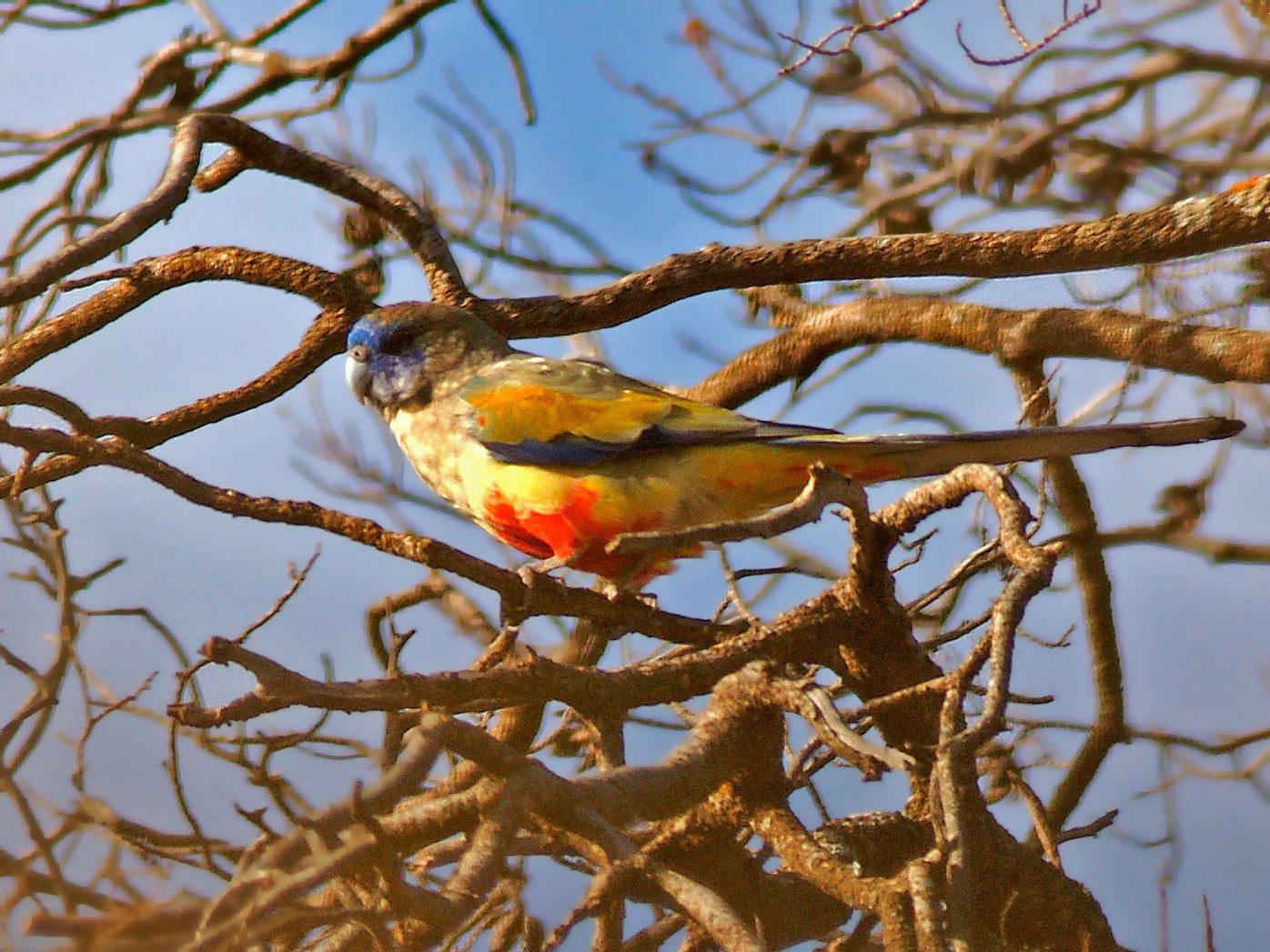
The Bluebonnet(Northiella haematogaster) they have the forecrown, lores and face, blue-violet color. The rest of the head, the chest, the layer, the back and rump It has a beautiful ochre mixed with yellow belly. The abdominal area It is covered by a large red spot.
The curvature of the wings is blue, most of the coverts are a key olive. The outermost feathers are purplish blue. The the wing lower and flight feather they are also blue-purple. The tail color is greenish bronze but the outer feathers they are blue-purple with white tips.
The bill grayish white is; the irises pale grey; legs grey.
The females they are more off, with less blue in the face and a pale bar on the wing
.
The immature they resemble females, but the stain abdominal Red is more discrete. The immature plumage is lost after few months. The chicks have the bill yellow.
(Bonaparte 1856) – The curvature of the wing is turquoise blue and the blankets they are redheads. The underparts is red
Northiella haematogaster pallescens
(Salvadori 1891) – The plumage It is similar to the nominal, but the underparts they are paler.
*
Northiella haematogaster narethae
(White,HL 1921) – The forecrown is blue, and has spots on the chest. The upperparts color is olive, the underparts is yellow with reddish color underneath the tail. Small outer covers red.
* A molecular study published in 2015 by Gaynor Dolman and Leo Joseph He confirmed the genetic isolation of the subspecies Northiella haematogaster narethae and recommended that it was restored as a separate species, the Naretha Bluebonnet(Northiella narethae)
Habitat:
The Bluebonnet frequent arid and semi-arid forests dominated by trees of the genus Myoporum, which are perennial shrubs and resistant to salt and drought.
They also appreciate the conifer and the casuarinas that you are home to colonies of caterpillars. They have a certain affection for the acacias and eucalyptus, especially if the weed is made up of small quenopodios.
The Bluebonnet they often visit the grassy plains, dry brush and trees lining the river. Sometimes they come to buildings, farms or small ponds.
In the South of its range, the removal of waste bags of Mallee, located on agricultural land, It seems to have had a very important influence.
The Bluebonnet they live in pairs or in small groups. When resent, loud disperse, but they remain on the ground a short distance from the trees. In the event of alarm, they raise the feathers of her eyebrows.
These birds are very enable, especially early in the morning when the boisterous groups are formed, just before his departure to feed. They are able to run very fast and have a very characteristic straight posture.. They are less active during the heat of the day, staying on the ground in silence.
The Western populations They seem to form larger groups, showing more sociability than the Eastern. They tend to get together with other species of parrots, such as the Mulga Parrot, Pale-headed Rosella and Mallee Ringneck.
During the spawning, the Bluebonnet carried out parades such as greetings with head, movements of the tail and eating ritual exchanges. They also have a ceremonial flight consisting of small flapping.
Reproduction:
The season of nesting extends from July to December, with some variations depending on the rains. The nest is located in a cavity in a tree, except in the subspecies narethae to use scrubby trees, being their favorite nesting place a nest on the ground in a crack in the base of a trunk. This subspecies usually gives preference to a tree of the genus acacia (Acacia papyrocarpa) family Fabaceae.
The spawning contains 4-7 eggs with one incubation lasts a few 19 days. The young chicks are born without feathers and remain in place of birth at least during 30 days.
The world population is probably superior to the 100.000 individuals, although the Western subspecies Nanthae You can have less than 5.000 specimens, having suffered for their catch in the past.
• Current category of the Red List of the UICN: Least concern
• Population Trend: Decreasing
In accordance with the Manual of the birds of the world (Handbook of the Birds of the World, HBW), the Bluebonnet they are not globally threatened. Son fairly common, except at the extremes of its range. But, the elucidation of native plants must be stopped if we want to preserve the food resources and nesting places.
The spread of the Common Starling (Sturnus vulgaris) It is a real danger in some areas. The subspecies Narethae is prized by poachers and the lots of beautiful feathers.
The proliferation of rabbits and Lagomorphs threatens the equilibrium of the habitat.
"Bluebonnet" in captivity:
The Bluebonnet they were classified for more than one hundred years within the genus Psephotus. On the basis of some essential differences with the species Psephotus, they are currently classified within the independent genre Northiella.
The parakeet more required by lovers of Australian parakeets, are likely to be the Bluebonnet, Although the subspecies Naretha is very rare and scarce. The Bluebonnet pure breed, they are virtually non-existent in Europe.
There are many Bluebonnet non-purebred, since they often interbreed with the of red-bellied (Northiella haematogaster haematorrhoa). The birds that have tones rojas in the coverts infracaudales non-purebred. Be very careful when making their acquisitions.
The first breeding success of the nominal species dates back to the year 1878, in France. With the subspecies of red-bellied (Northiella haematogaster haematorrhoa) also data from 1878, but this time in Belgium.
The first breeding results with the subspecies Northiella narethae they date from 1941 in Australia.
Are capricious in nature. The big problem is that of aggression since they are probably the most aggressive of all the Australian parakeets. Males, above all, they are the protagonists of this bad reputation. Therefore other birds not can be joined with the Bluebonnet, even larger birds.
The aggressiveness of the male reaches their own partner, the Aviary must take into account this, the female should be able to take refuge in case of attack. On the other hand, they are very animated and jugetones.
You spend much time on the ground looking for food, they are moderate rodents and are lovers of bath.
According to sources, a sample lived 15,3 years in captivity. In captivity, these animals have been known that they be reproduced in approximately 2 years of age.
Alternative names:
– Bluebonnet, Blue Bonnet, Blue-Bonnet, Bluebonnet Parakeet, Bulloak Parrot, Common Bluebonnet, Common Bluebonnet Parrot, Crimson-bellied Parakeet, Crimson-bellied Parrot, Eastern or Western Bluebonnet, Little Bluebonnet, Naretha Bluebonnet, Naretha Parrot, Oak Parrot, Pallid Parrot, Red-bellied Bluebonnet, Red-vented Bluebonnet, Yellow-vented Bluebonnet, Yellow-vented Parrot (ingles).
– Perruche à bonnet bleu, Bonnet bleu, Perruche à bonnet bleu ou P. de Nareth (French).
– Blutbauchsittich (German).
– Periquito-de-bluebonnet (Portuguese).
– Perico Azul, Perico Cariazul (español).
Parrots A Guide to the Parrots of the World – Tony Juniper & Mike Parr
Birdlife
Photos:
(1) – To Blue Bonnett in the Cocoparra National Park (near Griffith), NSW, Australia By David Cook Wildlife Photography [CC BY-SA 2.0], via Wikimedia Commons
(2) – Bluebonnet (Northiella haematogaster) Birdsville Track, South AustraliaBy by Ron Knight – Flickr
(3) – Northiella haematogaster, Photo by Benjamint444 – Animalia Etymology of animal name
(4) – Bluebonnet/Blue Bonnet/Crimson-bellied Parrot – animalphotos
(5) – Blue Bonnet Fact Sheet 26 May 2011, Windorah. QLD – travelling-australia.info
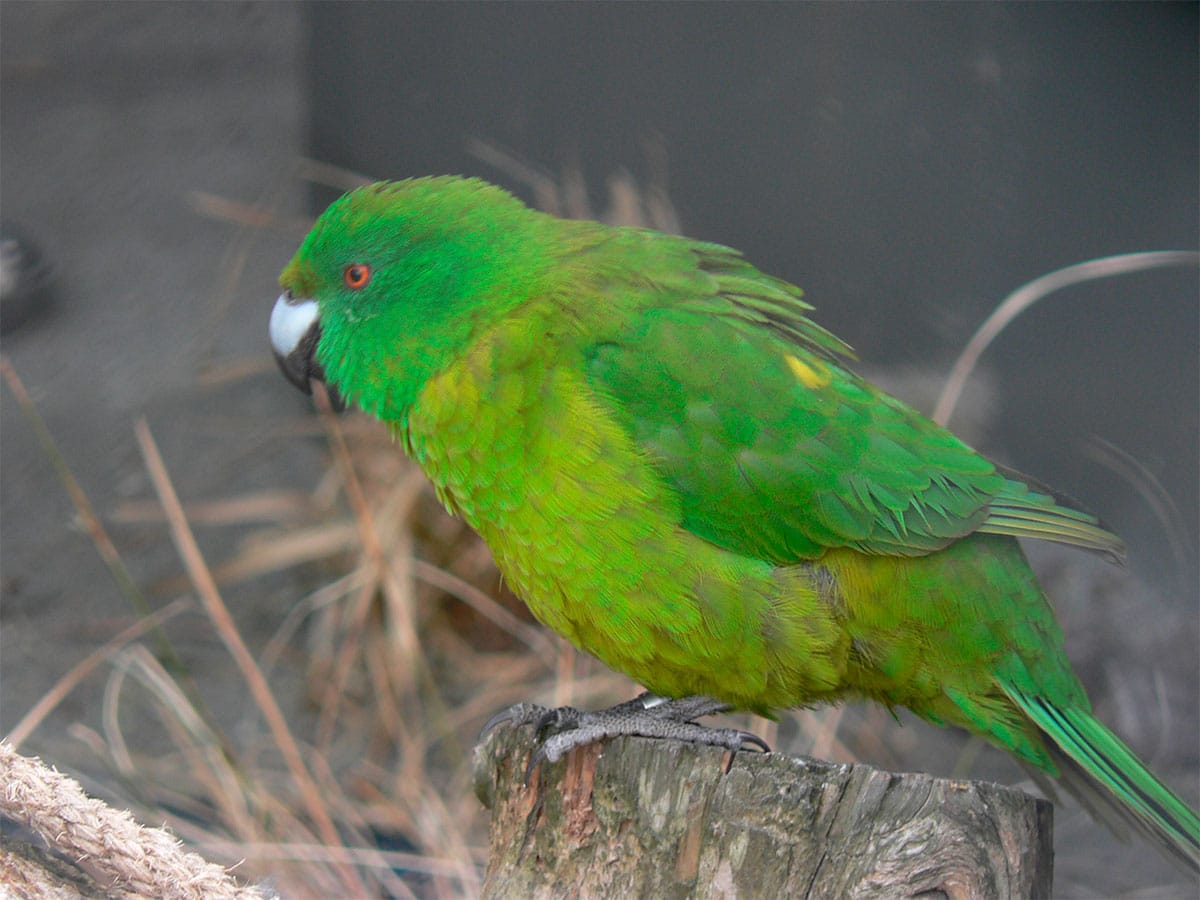
The Antipodes parakeet(Cyanoramphus unicolor) has a plumage brighter yellowish green, more yellowish on the hand down and sometimes with irregular yellow markings at the top. It is the only species that does not have color markings on head and tail. It is the largest of its kind.
The face and top are bright emerald green, and the contrast with the neck and the chest is more off.
At the top of the wings, the outer bands of the flight feather are blue, While the long tail It is green with fine yellow piping.
The great bill is silver-grey with dark end. The eyes are orange-red. The legs and feet are greyish.
Both sexes are identical. The female is slightly smaller than the male.
The young birds they are of tail shorter. The young people have the bill Pink White and the eyes light brown.
Habitat:
The Antipodes parakeet, usually, they prefer areas with tall grass (POA littorosa), areas of open scrub and sedges (Carex). Can also be seen in areas where thorny ferns grow (Polystichum vestitum) and the bushes (Coprosma antipode).
The birds are most common on steeper slopes and near water courses, alone or in small groups; They walk on the floor and climb among the branches as they seek food, normally during the morning and before nightfall.
These birds are very Meek and curious. When frightened, they disappear among the dense vegetation, keeping silent or giving a short alarm call. More than half of the day is spent sunbathing and grooming in protected areas. They bathe in small ponds and rest in burrows.
Reproduction:
The season of reproduction takes place between October and March. The Antipodes parakeetnest in soils with good drainage, a length of at least one meter. The nests is carved in fibrous peat, under the thick base of the tall grass vegetation. The nesting Chamber It is full of rootlets or fern scales.
The spawning occurs between November and January. The female lays 2-3 white eggs (5-6 in captivity). She carries out most of the duties of nesting, and incubates the eggs for a few 26 days. She cares for and feeds the chicks for nearly two weeks. The male contributes to breeding, feeding the female during this period, as well as feeding the young until their independence, at least two weeks after leaving the nest.
Food:
The diet main consists of leaves; an amount of crushed leaves, still attached to the plant, they are a distinctive sign of the power of the Antipodes parakeet. Also consume seeds, berries, the remains of penguins and petrels dead. They often enter into colonies of the Rockhopper Penguin (Eudyptes chrysocome) and of the Sclater's Penguin (Eudyptes sclateri) between the months of October and may, to feed on their eggs or dead young. It also feeds on the eggs and sometimes on the newborns of the same species.. (The sympatrico Red-crowned parakeet prevents competition by taking advantage of the niche that provide seeds, flowers, berries and small invertebrates.)
Distribution:
Endemic to the main island Antipodes, In addition to Bollons, Leeward, Inner Windward and Islands Archway.
The world's population of the Antipodes parakeet It is estimated between 2.000 and 3,000 specimens. Although common and stable within its range, the species is permanently at risk due to accidental introduction of predators, problem that could be fixed in no time.
Some birds are kept in captivity in New Zealand.
VULNERABLE.
"Antipodes parakeet" in captivity:
This stocky parakeet can live in community with species with similar characteristics.. It is usually outgoing, Active and depending on their way of breeding (natural or hand) and earlier experiences, It may be a trusted Parrot (hand raised or treated early), even being raised by their parents tends to be entrusted.
As a pet it could be good pet by his way of being cheerful and curious.
It is a rather nice parrot as vocalizations. It is not just loud. He likes to climb, There is no great need to crack and loves to be on the floor. enjoy the baths.
However, due to their vulnerability, is very rare poultry.
Alternative names:
– Antipodes Parakeet, Antipodes Green Parakeet, Antipodes Green Parrot, Antipodes Island Parakeet, Antipodes Island Parrot (English).
– Perruche des Antipodes, Kakariki des Antipodes, Perruche d’Antipodes (French).
– Einfarbsittich (German).
– Kakariki dos Antípodas (Portuguese).
– Perico de Antípodas, Perico de las Antípodas (español).
Parrots A Guide to the Parrots of the World – Tony Juniper & Mike Parr
Birdlife
Loromania
Photos Antipodean Parakeet:
(1) – Cyanoramphus unicolor at Wellington Zoo, Wellington, New Zealand by Peter Halasz. (User:Pengo) – Wikimedia
(2) – Cyanoramphus unicolor at Wellington Zoo, Wellington, New Zealand by Peter Halasz. (User:Pengo) – Wikimedia
(3) – Antipodes Island Parakeet, Auckland Zoo by russellstreet – Flickr
(4) – Antipodes Island parakeet (Cyanoramphus unicolor) by Chlidonias – zoochat
(5) – Antipodes Island parakeet (Cyanoramphus unicolor) by Chlidonias – zoochat
(6) – A painting of Antipodes Parakeet, also known as Antipodes Island Parakeet, (originally captioned «Platycercus unicolor Uniform Parrakeet») by Edward Lear 1812-1888 [Public domain], via Wikimedia Commons
▷ The world of Pets: Dogs, cats, birds, reptiles, amphibians
Of 25 cm.. length and a weight between 130 and 150 g..
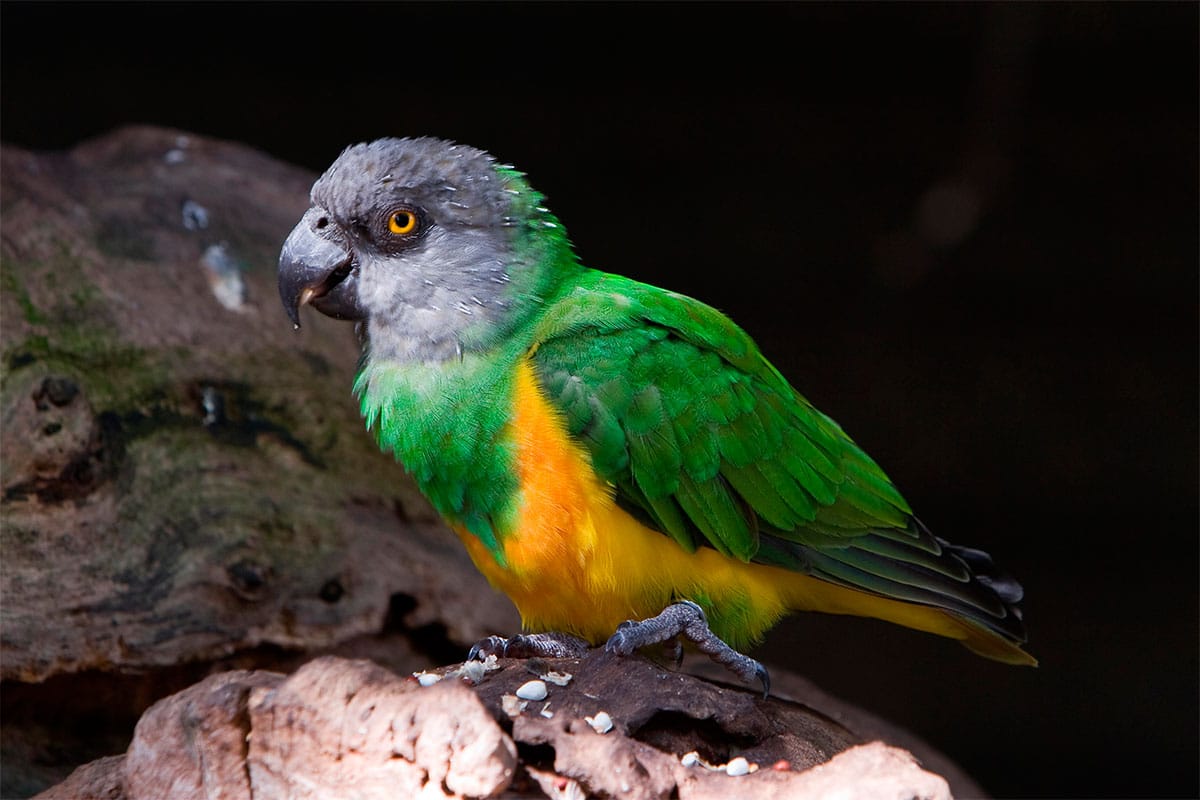
The Senegal Parrot(Poicephalus senegalus) has the forecrown, crown, lores and nape dark slate gray; clear the chin and cheeks; ear-coverts Silver. Mantle, scapulars and back bright green; rump and uppertail-coverts lighter with yellowish tint. Upper, the wing-coverts bright green ; secondaries and primaries of color Brown dark with edges green to them vane outer. Under, the wing-coverts Yellow. Throat grey, merging with the chest green (green lighter on the upper parts); low area chest and belly bright yellow with orange dye plant; the thighs green, undertail- coverts bright yellow. Tail greenish brown.
Bill grey: irises yellow with bare periophthalmic black; Chere blackish: Legs dark brown.
Sexes similar in plumage.
Immature generally paler than the adult with the head in brown tone off, has the ear-coverts Silver; sometimes extends the green on the bottoms shaped yellow patches on the flanks. Iris dark brown.
(Reichenow, 1910) – Similar to the species nominal, but with the green plumage paler and green color chest It is extending into the abdomen, the abdomen It is orange.
(Finsch, 1863) – Similar to the species nominal but the green color the mantle and wings is darker; the lower regions of chest and the abdomen are yellow orange to red in the middle of the abdomen.
Habitat:
The Senegal Parrot They are found in a variety of forest habitats ranging from open field with scattered and palm trees to the dense forests closed.
They are probably just below 1.000 meters above sea level.
Gregarious, at least outside the breeding period.
Usually they are seen in couples or groups of up to 20 birds, Larger groups can meet locally to exploit abundant food areas.
They perform diurnal movements and of longer duration in relation to the food supply;. Consequently, of the pobalación Senegal Parrot fluctuates widely in some areas.
Reproduction:
The Senegal Parrot usually they build a nest in the cavity of a tree branch (of Adansonia or Parkia), at a height of 10 m, sometimes more.
The breeding season It seems to vary depending on location. In the wetter areas, breeding season can be prolonged. In the region of Gambia and the rio Senegal, they have been egg production in the months of April, may, August and september, also from November to February. In drier areas (as Mali) the breeding season is probably limited by the rainy season (May to October).
They put of 2 to 4 eggs on alternate days and the period of incubation is of 25 to 28 days, female being fed by the male until hatching. The juveniles to leave the nest 9 weeks of age.
Food:
The diet of the Senegal Parrot It is composed of a variety of fruits, seeds and sprouts leaves.
Size of the area of distribution (reproduction / resident): 3.590.000 km2
The Senegal Parrot they are endemic in West Africa. Since Guinea (including the The islands), Senegal, Gambia, South of Mauritania and South of Mali through forest-savanna mosaic of Ivory Coast. Burkina Faso, South of Niger, Ghana (also on the coast). Benin and Togo until Nigeria, Cameroon and Southwest Chad.
Partially sedentary but seasonal visitors in some areas (especially further north), for example, some birds move south on the niger river in Mali with the onset of the driest periods. In the rainy season visitantan Southern Mauritania and some movements Nigeria, with the driest north unemployed, off wet season.
Subspecies distribution:
Poicephalus senegalus mesotypus
(Reichenow, 1910) – East and Northeast Nigeria, South of Niger, North of Cameroon, southwest end Chad and possibly the extreme northwest Central African Republic.
The size of the world population Senegal Parrot It has not been quantified, but the species, according to sources, It is often abundant (pit et to the. 1997).
The population is suspected to be stable and may even benefit from the widespread loss of closed canopy forests in the West Africa.
This species has been heavily traded: 1994-2003, more than 410,000 wild individuals were exported from the range States (Trade Database, in October of 2005 UNEP-WCMC CITES). It is one of the most popular pet birds, since it is regarded as a quiet little bird in captivity. Due to the large amount of this kind traded, It was the subject of a review of significant trade of the CITES, in which it was classified as «possible concern» (Inskipp et al. 1988). However, and despite international exports of a large number of birds, trade seems to have not seriously affected this species in general, without significant decreases in reported national population.
EXPORTS:
• Guinea exported in the dates between 1994 and 2003 a few 164.817 specimens.
• Mali exported in the dates between 1994 and 2003 a few 60.742 specimens.
• Senegal exported in the dates between 1994 and 2003 a few 173.794 specimens.
• Liberia not considered diffusion area, however it is known that among 1999 and 2003 some were exported 4.860 specimens, thus becoming the fourth country with the most exports made of Africa.
"Senegal Parrot" in captivity:
The Senegal Parrot It, after the Grey Parrot(Psittacus erithacus), African parrot most traded and raised in captivity. You might say whole sentences and whistle songs. Thanks to its size it is considered a quiet pet and very manageable when it's raised hand (papillero). They are not noisy and create a very emotional bond with family members.
Imported adult birds are always reserved even when they spend a lot of time with their caretaker. Young, on the other hand, They are docile and affectionate, and then adapt to the people.
With regard to its longevity, according to sources, a specimen lived 40 years in captivity.
– Avibase
– Parrots of the World – Forshaw Joseph M
– Parrots A Guide to the Parrots of the World – Tony Juniper & Mike Parr
– Birdlife
– Wikipedia
– Photos:
(1) – An adult Senegal Parrot at Artis Zoo, Amsterdam, Netherlands. The extent of yellow tends to indicate that it is probably a male By Arjan Haverkamp [CC BY 2.0], via Wikimedia Commons
(2) – An adult Senegal Parrot in Maspalomas, Gran Canaria, Canary Islands, By Juan Emilio Spain from Las Palmas, Spain [CC BY-SA 2.0], via Wikimedia Commons
(3) – Poicephalus senegalus senegalus, the Senegal Parrot By Charlesjsharp (Own work) [CC BY-SA 3.0 or GFDL], via Wikimedia Commons
(4) – A pair of Senegal Parrots in a tree. One parrot (probably the male) is feeding the other (probably the female). Thomas J. Haslam, http://www.flickr.com/photos/tjhaslam/ On 24 February 2007, I took the photos for this montage at the birding site Technopole in Dakar, Senegal. Licensed to Wikipedia under CC-BY 2.5 and GFDL. Published to my Flickr account under the same license.
(5) – A juvenile Senegal Parrot By Brian Holsclaw (originally posted to Flickr as IMG_2807) [CC BY 2.0], via Wikimedia Commons
Origin: Afghanistan, Bhutan, India, Nepal, Pakistan
Character: Shy, quiet.
Life expectancy: 15 to 17 years.
Height: Of 39 to 41 cm..
Content
Description:
Of 39 to 41 cm.. of length and a weight of 125 g..
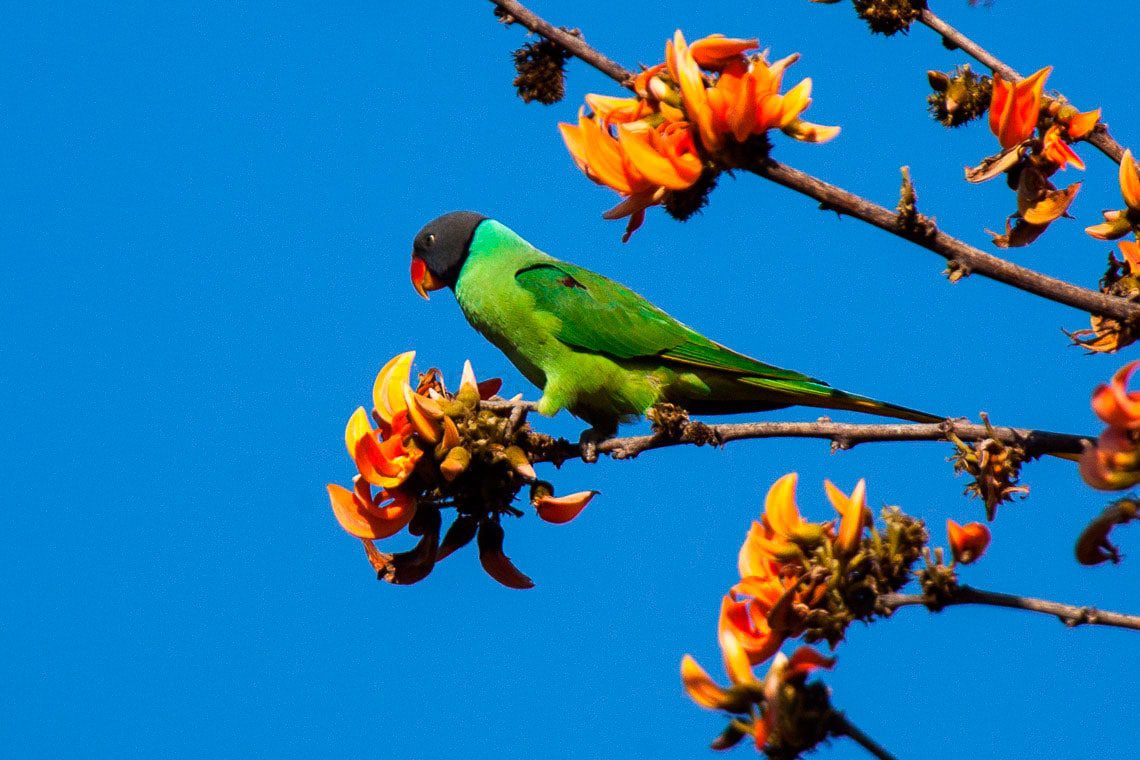
The Slaty-headed Parakeet(Psittacula himalayana) has the forecrown, crown, lores and ear-coverts slaty-grey; chin and lower cheeks black, extending in the lateral narrow shaped collar black, to mark a clear boundary between the dark head and back neck bright green and nape, whose colour fades to duller green on rest of upperparts..
Lesser wing-coverts outer, green, brown the inner coverts, with a distinctive patch shoulder; remaining upperwing-coverts green.
The primaries Green with narrow yellow margins in vane outer; secondaries green. Underwing-coverts bluish green. Underparts bright pale green. Uppertail bright blue green, tipped chrome yellow color in the center, outer feathers green with yellowish tips; undertail-coverts bright yellow.
upper jaw orange-red, tipped pale yellowish, the lower yellower; cere whitish; irises creamy white; legs yellowish green.
The female smaller, more opaque in nape, usually with the tail shorter and often they lack the brown in the patch of the shoulders.
The immature with the head greenish brown opaque; acquire gray slate after first winter. The young birds they have the irises dark.
The Slaty-headed Parakeet Mountain forests are distributed, at altitudes around 2.500 meters in summer; rarely above the 250 meters in winter. Otherwise residents, although there are fluctuations depending on local food supply.
Occupy denser forest than most of its congeners, but preferably in extensions near orchards or farms with high trees. Registered in a variety of slopes and steep wooded valleys, including oak forests, cedars, Oak, rhododendrons and pines.
Observed, in general, in small flocks or family groups, no large gatherings, although flocks 50 birds have been recorded at the end of the monsoon.
Also registered with mixed banndadas Rose-ringed Parakeet, the Plum-headed Parakeet and Blossom-headed Parakeet. Registered a flock of 15 males during the month of November Nepal.
Reproduction:
The nest Slaty-headed Parakeet usually it located in a recess, on top of a tree, at an altitude between 6 and 20 m above the ground; a rotten branch used to excavate a cavity or modificadan the old nest of other species.
In East Afghanistan, the nest is ,normally, an old hole made by a Scaly-bellied Woodpecker (Pico squamatus).
Often several nests are close together.
The breeding season in the west of the range is between March and May, (maybe later at higher altitudes); they leave the breeding area in July; the laying is of 3 to 5 eggs.
Food:
The Slaty-headed Parakeet it feeds on various fruit, cultivated and wild, dried fruits and seeds, depending on the season.
Although the overall economic impact of this species is probably light, they are considered locally as a pest due to attacks on corn crops, Apple trees (flower and fruit), pear and walnuts Juglans regia.
Distribution:
Size of the area of distribution (reproduction / resident): 696.000 km2
The Slaty-headed Parakeet It is distributed by the Himalaya occidental, where they are, Commonly, above the 1.350 m, from the East of Afghanistan through northern Pakistan, northern India and Nepal until Bhutan, West of Arunachal Pradesh and Assam (about 92 it is) to the North of the Brahmaputra.
The size of the world population Slaty-headed Parakeet It has not been quantified, but the species, according to sources, is usually common, although apparently very poorly documented in recent decades; uncommon in China.
The population is suspected to be stable in the absence of evidence of any reduction or substantial threats.
"Slaty-headed Parakeet" in captivity:
Fairly common in Australia, not so much in other places. In general, trade is not significant.
Alternative names:
– Slaty-headed Parakeet, Himalayan Slaty-headed Parakeet (English).
– Perruche de l’Himalaya, Perruche à tête ardoisée (French).
– Himalayasittich, Finsch-Sittich, Schwarzkopf-Edelsittich (German).
– Periquito-himalayana (Portuguese).
– Cotorra de Cabeza Pizarra, Cotorra del Himalaya (español).
– Avibase
– Parrots of the World – Forshaw Joseph M
– Parrots A Guide to the Parrots of the World – Tony Juniper & Mike Parr
– Birdlife
– Photos:
(1) – Slatina-headed Parakeet Psittacula Himalayas, Corbett National Park, India By Francesco Veronesi from Italy (Slaty-headed Parakeet – Corbett NP_1842) [CC BY-SA 2.0], via Wikimedia Commons
Origin: Bolivia, Brazil, Colombia, Ecuador, Guyana, French Guiana, Panama, Peru, Suriname, Venezuela
Character: Intelligent and social
Life expectancy: 40 years
Height: 46 cm..
Content
Description:
46 cm.. length and a weight between 285 and 387 g..
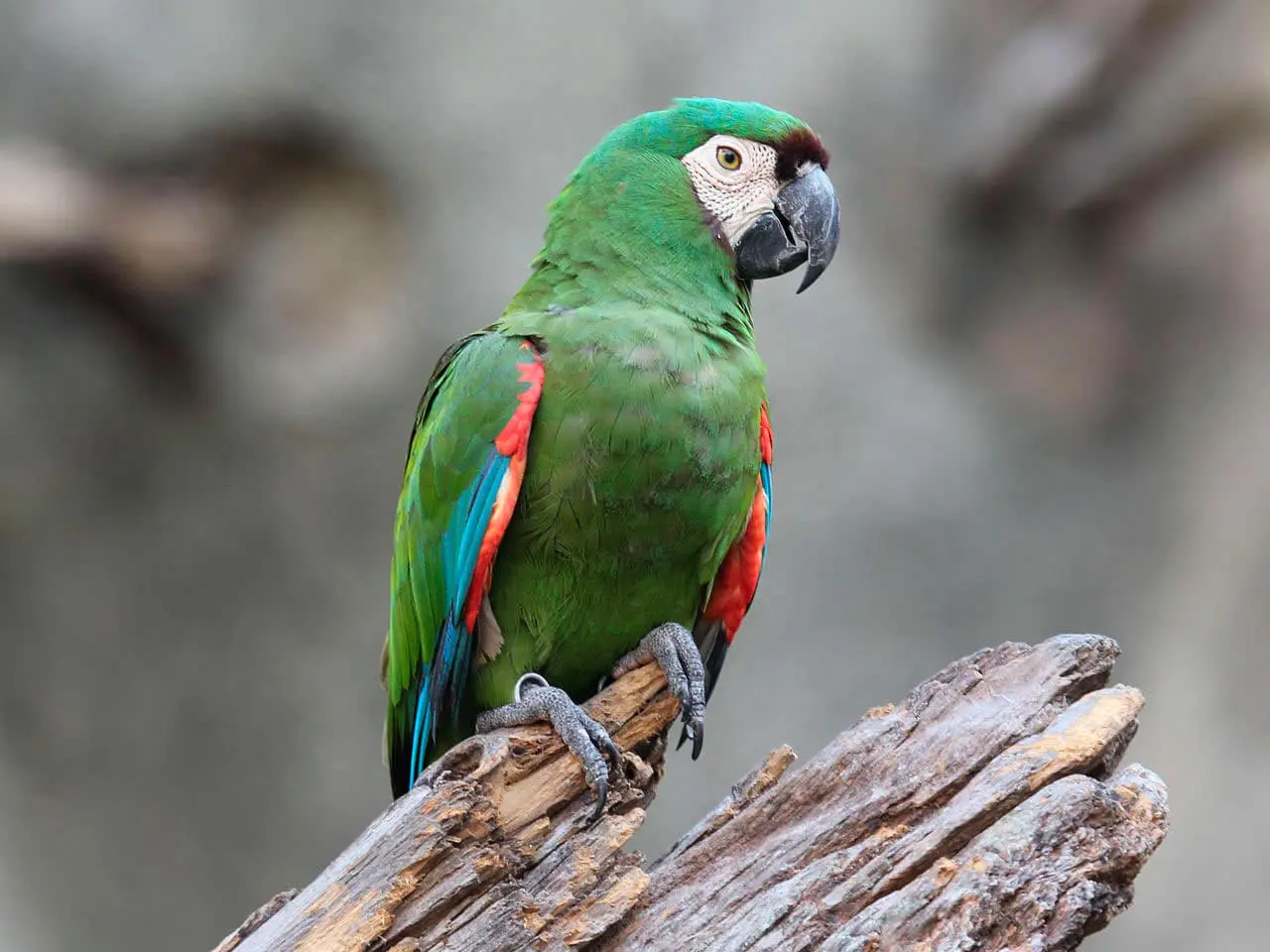
The Chestnut-fronted Macaw(Ara severus) It is a medium-sized Parrot with a plumage predominantly Green.
The male and female are almost identical and juveniles are hardly different from adults.
In the male adult, the feathers of the crown and the neck they are heavily infiltrated blue. The forecrown, chin and the area of the cheeks bordering with the bare skin of the face are brown. The curvature of the wing, carpal edge and small lower coverts are bright red. The bottom of the flight feather shows a dark red-orange color.
The tail is reddish brown with a blue tip. The bill greyish black. The bare skin of the face it is creamy white with fine lines of small black feathers. The irises is yellow, the legs grey.
The youth they are like the of adults, but have the tail shorter and the irises is grey.
The Chestnut-fronted Macaw may be confused with two species: the Blue-winged Macaw, Although this has a frontal band and stain abdominal Red and the Red-bellied Macaw Although it differs by having the facial skin yellow, and the abdomen red. On the other hand, These parrots are smaller and have a yellow color under the wings.
While they are sometimes in clearings or on the edge of this habitat, the Chestnut-fronted Macaw, in general, avoid the great forests never invaded by water. They prefer areas that are periodically flooded, secondary forests, galleries of trees that border the watercourses, oil palm plantations, meadows and pastures where there are still some scattered stands of trees.
It depends on the region, These birds live in very different elevations of up 1000 metres in Colombia, 1500 meters in the South of Ecuador, and only 350 metres in Venezuela.
The Chestnut-fronted Macaw, usually, they live in pairs or in small groups. However they can form large gatherings when dorms are set or when food resources are abundant.
The Chestnut-fronted Macaw, sometimes, they feed in the company of the Red-bellied Macaw (Ara manilata).
During the day, they are essentially arboreal, preferring to remain at the top of the trees and in the canopy, where they remain well hidden in thick foliage. They are best observed at dawn and dusk, as they follow regular routes between their places of rest and feeding sites.
They fly directly, with fast rhythms revealing red underneath his wings stain.
They are birds sedentary. In some mountain areas, However, undertake altitudinal migrations.
Reproduction:
Given the large size of its distribution area and large variation in latitude, nesting takes place at different times depending on the region, from March to may in Colombia, February-March in Panama, and from September to December in Suriname.
These macaws usually They nest in cavities of dead Palm trees, often just above the water, but they can also lay their eggs in a rock crevice.
The spawning usually includes 2 or 3 eggs. There is little information of this bird in the wild, but it is known that in captivity the period of incubation lasts a few 28 days. The reproductive cycle is particularly long, The chicks remain in the nest for a minimum of 9 weeks.
Food:
The Chestnut-fronted Macaw they are exclusively vegetarian. Its diet includes seeds of Hura crepitans, Sapium aureum, Cedrela odorata and Cupania cinerea, the pulp and the seeds of Inga laterifolia, Micropholis melinoneana, Euterpe precatoria and Gulielma, and fruits of Ficus, Cecropia feulla, Caraniana, as well as fruit of different types of fig trees or palms (especially species with small fruits); also flowers of, for example, Ferruleand Erythrina.
The birds are fed into silence in the canopy where they can be difficult to detect.
Distribution:
The Chestnut-fronted Macaw are distributed to the East of Panama and by South America reaching the center of Bolivia.
In East Panama they are in the tropical zone (records in the West to the North of the Canal area they are probably due to leaks), on the slope of the peaceful from the South of the Andes to the South of Ecuador (of Guayas to Pichincha) and in the Northern lowlands of Colombia, South to the upper area of the Valley of Sinu River, extending into the foothills of the Colombian Andes, in the valleys of the Cauca and Magdalena until Antioquia.
To the East of the Andes they occupy the Amazonian lowlands of Colombia, Ecuador, Peru and Bolivia in Peace, Beni, Cochabamba and Santa Cruz, going east of the foothills of the Andes through the West and South of the amazon (Although they are not known in the North of Brazil, for example, in Manaus or along the rivers Negro and Branco).
Propagate through the tropical zone of Venezuela in Zulia and from the West of Apure until Aragua, Northwest of Bolívar and the Amazonas along the Orinoco, reaching the Guianas and Amapá, Brazil.
To the South of the amazon is extended by the Mato Grosso, Brazil. A record to the South of Bahia is not confirmed.
Resident with seasonal movements of altitude in some areas (for example, West of Ecuador and North of Venezuela).
Pretty common throughout much of its range, and while the deterioration of habitat has caused serious decreases in population at the local level (for example, in the Valle del Cauca, Colombia and West of Ecuador), moderate deforestation has resulted in increases in other areas.
Although there are no reports in Guyana Since the beginning of the 19th century, the Chestnut-fronted Macaw they are still common in Suriname, especially in some coastal areas.
The species is kept in captivity, but the demand is not very big.
Conservation:
• Red List category of the UICN current: Least concern
• Population trend: Stable
The Chestnut-fronted Macaw they are quite common throughout much of its range birds. Apparently, they are able to survive to the selective deforestation and even capitalize.
In Venezuela it is a species with high rates of being traded as a pet due to its beauty and sociable behavior. The Ye'kwana on the Caura forest reserve in the State Bolívar, They include this species in his list of game birds, for its power and ornaments, but it is not the most hunted. In the State Carabobo is marketed as a pet according to data from the Regional Directorate for the Ecosocialism and waters-Carabobo.
On the part of the National Government is protected by the wildlife and its regulations protection law. Several of their populations are found in the national parks: Waraira Repano, Henri Pittier,The Caura forest reserve, San Esteban, Canaima. Currently the National office of biological diversity, Ministry of the Popular power for the environment He is working on defining the criteria to develop the official books of endangered species of the Bolivarian Republic of Venezuela.
In Bolivia, international trade in psittacines had caused significant problems for this species in the past, but since the beginning of 1980, their trade is prohibited.
"Chestnut-fronted Macaw" in captivity:
Recently, the Chestnut-fronted Macaw have joined the ranks of other birds kept in captivity. For a time, most of the breeding birds of this species were acquired through the importation of wild specimens. Today this has changed, and most of these macaws today come from generations bred in captivity. Being recent its breeding in captivity, most of These parrots will retain much of their natural behaviors.
These small macaws are popular due to their friendly disposal and most likely will continue to grow in popularity in the future.
While they have not had hundreds of years of selection to tame their personalities, These macaws can be a fantastic pets if they are fed by hand and are well socialized from a young age.
They are creatures very curious, so they need a lot of mental stimulation to be healthy and happy. They should have on hand, games, toys, and daily interaction with your caregiver to make sure that you do not bored.
Most of the Chestnut-fronted Macaw they form links monogamous and they need to live with more birds in order to be able to form a family. Won't these birds well if they are isolated from family and some even become neurotic if their mental needs are not met.
A future buyer of a Chestnut-fronted Macaw You should plan on integrating this beautiful bird in his life to ensure the achievement of all the emotional and cognitive needs.
In general, to most of the Chestnut-fronted Macaw do not like being touched in excess, Although all birds are different and have their own personality. Assess your bird to see what what works best. These birds enjoying caresses next to the back of the neck, along their beaks, or around your eyes. They can be happy on the shoulders of its owner. Jewelry or shiny objects amaze quickly to this curious Parrot. For this reason, All chains, earrings, watches, bracelets , etc … they should stay away from our Macaw, since it could break if the bird decides to play with them.
Although these parrots fall into the category of small macaws, they maintain a high level of noise. It is not an ideal pet for apartments. If you decide to buy one and you live in an apartment, It may be a good reason to argue with your neighbors, Since these birds are noisy. Loud high-pitched sounds can easily be heard a few floors below and are to be expected during the early morning hours., at noon, and before the sunset. This is what they do in their natural habitat.
Yes a Chestnut-fronted Macaw It is continuously shouting for the attention of their owner, These calls should be ignored.. The bird is reacting the only way it knows how to get your attention. The best thing is to give attention during moments of tranquility that is account that this works best.
Unfortunately, many times a homeowner will come to the incessant screams of your Macaw in order to calm the neighbors below; But, This attention usually works in opposite way and the bird will continue to making noise because you know it will work.
Under no circumstances, the owner should be snapping the beak of the bird, spray it with water, or shout it when is making excessive noise. Such tactics only make the problem worse and parrots do not understand this type of punishment. On the other hand, owners should focus on something more positive for the bird and reward it in some way when it is quiet. With the time, the bird will recognize that this positive behavior works much better.
Despite these parrots can be noisy, in general, they are those who speak better of all macaws. One Chestnut-fronted Macaw You can speak with clarity and memorize a lot of words and phrases. They are possessors of some sharp voices that are a delight to listen. It must be said that the purchase of a parrot for his ability to speak is not the best idea, Since some parrots can never learn to talk and its owner can feel extremely disappointed. In its place, the best is to opt for a bird by its adorable and nice personality, If she starts to talk, then it will be an added advantage.
REPRODUCTION:
The breeding of Chestnut-fronted Macaw it's not very hard. While it is true there is time for the union of these birds, not much effort is needed to achieve that they reproduce successfully. It is always recommended do not use domestic birds in a breeding program, since once domesticated, they usually do not reproduce successfully.
The best candidates are those who have been exposed to other severe macaws and have lived within a Aviary.
When approaching the season of reproduction in spring and early summer, a bonded pair will be more vocal. During this time a female will look for a nesting site to raise their future pigeon. In most cases, This is usually a vertical wooden nest box or metal placed in a corner of the cage. Inside the box must have a ladder to be sure that the female can be up and down without damaging their eggs. The bottom of the box should also have some kind of soft base such as wood chips that are non-toxic to the parrot.; But, some female birds choose to remove wood chips. If this occurs, the owner must again enter a handful of chips in the nest box until you put the first egg since this keeps the egg and prevents it from moving around and damage to. The box should also be placed so that the owner has easy access to the eggs and chicks. Most boxes are suspended outside the cage with doors that open on the side of the box or the top..
The egg laying it's every other day until your clutch is complete. On average, a typical clutch will consist of between 2 to 4 white eggs. The female incubates eggs during 27 to 28 days. Just before hatching, the chickens will make a small hole from the inside of the egg in order to be able to breathe. This will alert the mother of arrival. Some mothers eat the shell to help recover the calcium that is lost while it incubated, However, others completely ignore it.
Once the chicks are hatching, the mother is left with the chick for several weeks until they can produce their own body heat and increased demand for food of baby birds. Until then, the male work tirelessly to ensure the young, the female, and himself, food. This moment of hard tension until that all babies are weaned; approximately 70 days.
FEEDING:
In the wild these birds feed on all kinds of food and it is important that we try to imitate their natural diet. This makes it a healthier bird. From time to time, We must provide palm nuts their beaks are designed to eat the fleshy external parts of these fruits. These dried fruits contain oils and enzymes you require our birds. A base diet of Pellet and seeds also must provide.
They have to be powered also with fresh fruit and vegetables on a daily basis. fruits like oranges, Kiwis, handles, apples, grapes, peaches and Plums they are great accessories for the bird. Many of these fruits can be cut into squares and presented as a skewer of a our Macaw, Since he likes to play with fruit and the sampling of all flavors.
The vegetables as the pumpkin, corn, Carrot, Kale, Spinach, celery and are generally a joy to most parrots. These vegetables can be cut during the dinner and were placed in the refrigerator during the future feed. In this way you will save time. Other healthy items are beans and legumes; although, beans and vegetables always must be cooked before feeding your bird. If a severe Macaw is cared for properly, and feeds with a variety of different foods that are healthy, It can live up to the 45 or 50 years.
Alternative names:
– Chestnut-fronted Macaw, Brazilian Green Macaw, Chestnut fronted Macaw, Severa Macaw, Severe Macaw (English).
– Ara vert, Ara à front châtain, Ara sévère (French).
– Rotbugara (German).
– Maracanã-guacu, anacã, ararica, ararinha, ararinha-de-fronte-castanha, maracanã, maracanã-açu, maracanã-guaçu (Portuguese).
– Guacamaya Cariseca, Guacamayo Severo, Maracaná Grande (español).
– Guacamaya cariseca, Cheja cariseca (Colombia).
– Maracaná (Venezuela).
– Loro arara, Guacamayo frenticastaño (Ecuador).
– Tereche grande, Parabachi, maracaná grande (Bolivia).
– Shivaí (Chimane).
– Maracana Guasu (Guarani).
– Avensó (Embera).
– E-ara (Piaroa).
– Avibase
– Parrots of the World – Forshaw Joseph M
– Parrots A Guide to the Parrots of the World – Tony Juniper & Mike Parr
– Birdlife
– Venezuelan of information on biological diversity system – Macaw Maracanã (Ara severus)
– Photos:
(1) – Cheatnut-fronted Macaw (Ara severus) at Jungle Island of Miami By DickDaniels (http://carolinabirds.org /) (Own work) [GFDL or CC BY-SA 4.0-3.0-2.5-2.0-1.0], via Wikimedia Commons
(2) – A Chestnut-fronted Macaw stretching leg and wing By Sandysphotos2009 (20100123_187Uploaded by Snowmanradio) [CC BY 2.0], via Wikimedia Commons
(3) – Chestnut-fronted Macaw or Severe Macaw in south Columbia By anthrotect (originally posted to Flickr as [1]) [CC BY 2.0], via Wikimedia Commons
(4) – A Chestnut-fronted Macaw at Santa Fe Zoo, Medellín, Colombia By Steven (Quueee?Uploaded by Snowmanradio) [CC BY-SA 2.0], via Wikimedia Commons
(5) – A Chestnut-fronted Macaw at World Parrot Refuge, Coombs, British Columbia, Canada By Herb Neufeld (P1120046Uploaded by snowmanradio) [CC BY 2.0], via Wikimedia Commons
(6) – A Chestnut-fronted Macaw at Niabi Zoo, Coal Valley, Illinois, USA By Bill & Vicki Tracey from Rochelle, Illinois, usa (At the ZooUploaded by snowmanradio) [CC BY 2.0], via Wikimedia Commons
(7) – Chestnut-fronted Macaw (also known as Severe Macaw) at at World Parrot Refuge Center, Vancouver Island, British Columbia, Canada By Darlee Byron (Well.. Hello!Uploaded by Snowmanradio) [CC BY 2.0], via Wikimedia Commons
(8) – Chestnut-fronted Macaw | Maracanã (Ara severus) by Fernando Flores – Flickr
(9) – A Chestnut-fronted Macaw in Miami, Florida, USA. It is probably feral By Don Faulkner (Chestnut-fronted MacawUploaded by snowmanradio) [CC BY-SA 2.0], via Wikimedia Commons
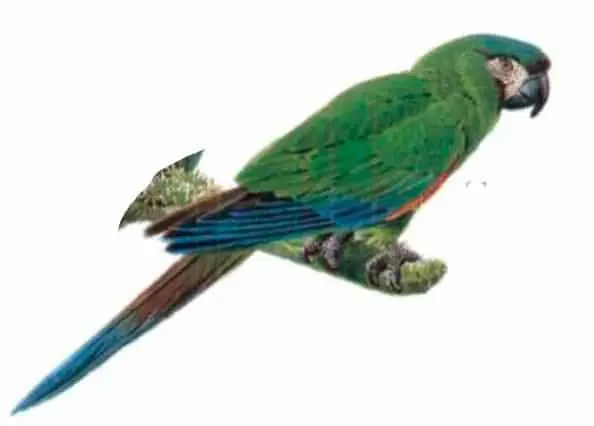
(10) – Ilustración Parrots A Guide to the Parrots of the World – Tony Juniper & Mike Parr
















_-pet-8a.jpg)


