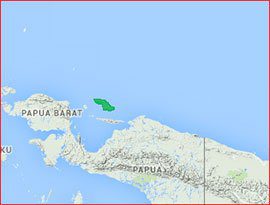
The Mindoro Racquet-tail(Prioniturus mindorensis) They are closely related to the Blue-crowned Racquet-tail but it is distinguished by the patch crown in the mindorensis it is blue with a slight violet tinge and stands out sharply against the forecrown green; the bill is larger and the rackets are never as long as in adult specimens of the discurus.
-similar female to female Blue-crowned Racquet-tail, but often with violet traces in the patch crown.
Formerly considered conspecific (belonging to the same species) with the Blue-crowned Racquet-tail(Prioniturus discurus).
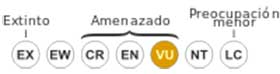
This newly divided species is listed as Vulnerable it is believed to have a small town, which infers that is in decline due to the continuous pressure of capture and loss of habitat.
Justification of the population
The population size of this species has not been formally quantified, but it is estimated preliminarily that has less than 10.000 mature individuals. So, placed in the band 2.500-9.999 mature individuals, which it is supposed equivalent to a total population of 3.750-14.999 individuals, rounded here to 3.500-15.000 approximately. It is presumed that all mature individuals form a single subpopulation.
Justification trend
It is inferred that the population of the species is continuous decrease due to the constant pressure capture and habitat loss(Juniper and Parr 1998).
Threats
Little information is available about threats to this species, but it is believed that the continuous capture for pet trade and the continuous loss of habitat through agricultural expansion, timber harvesting and development are causing a negative population trend.
conservation actions
Conservation actions underway
No specific conservation actions are known for this species., although suitable habitat is officially protected.
Conservation Actions Proposed
Surveys to quantify the population.
Study the habitat needs of the species.
Assess the level of threat of capture pressure.
Using remote sensing techniques to track the change in land use in Mindoro.
Carry out awareness activities to reduce trapping activities.
Origin: Indonesian, Papua New Guinea, Solomon Islands
Character: active and curious.
Life expectancy: 10 years.
Height: 15 to 18 cms.
Content
Description:
15 to 18 cms. length and 38 to 48 g. of weight.
The Red-flanked Lorikeet(Charmosyna placentis) has the forecrown and yellowish-green crown; nape green; chin, throat and lores red; ear-coverts dark blue striped strongly light blue. Top green with rump matte blue: uppertail-coverts green. The part superior of the wings It is green with innerwebs and ends the blackish flight feather. Underwing-coverts red; intense yellow band across the innerwebs of the flight feather blackish. Underparts lighter green than yellow upperparts; Strong red marks on the sides of chest and in the flanks below the sides of belly.
The upper part of the tail It is duller green than upperparts, tipped bright yellow, with lateral feathers red in the center of the innerwebs and slightly in outerweb, with a subterminal black mark; lower tail is basal yellow, with black and red marks.
Bill red; irises yellow to orange; legs opaque red.
The female no yellow-green spots on the top of the forecrown, Red in the face, in the chest, in the flanks and at the bottom of the wings (the underwing-coverts are green-yellow). The blue of the ear-coverts It is replaced by a dark patch badly scratched yellow.
Immature as the female, but duller green, and less extensive yellow streaks in ear-coverts (the young male can present a red stain on the face and greenish yellow in forecrown). Iris pale yellow, legs orange-brown.
Sound of the Red-flanked Lorikeet.
Subspecies description
Charmosyna placentis intensior
(Kinnear, 1928) – Greener than the species nominal, including the forecrown. Headphones coverts and patch on the rump duller blue-violet.
Charmosyna placentis ornata
(Mayr, 1940) – Mantle green slightly darker than the species nominal, a patch on rump largest darker blue and crown yellower. The Red throat larger in males.
Charmosyna placentis pallidior
(Rothschild & Hartert, 1905) – As the subspecies subplacens, but with upperparts pale green. Headphones coverts light blue in the male.
(Sclater,PL, 1876) – It differs from the species nominal by having green, nonblue the rump.
Habitat:
The Red-flanked Lorikeet It, mainly, a kind of lowlands found in primary moist forest, in the forest edge, in Savannah, the secondary high growth, in the monsoon forest, in the swamps of forget (when they are in bloom), in the gallery forest, in eucalypts, in the coastal forest and, occasionally, in the mangroves and coconut palms. It is also found in flowering trees in cultivated areas.
Can be Quiet and discreet and, even when feeding active and noisy, can be difficult to see through thick foliage. They are mostly in pairs, but occasionally in groups 25 or more, looking for food with others Loris with flowers and trees epiphytes or flying through or above the tree tops in small compact and noisy flocks.
Reproduction:
In New Guinea, Several observations of couples investigating arboreal termite mounds They indicate that it is likely that they are preferred for nest. The bases of ferns and moss cultures have also been identified as potential sites nesting. Activity on these sites has been observed between February and October, and it was found that specimens found in eastern Papua New Guinea by Diamond in July and August 1965 They were able to play. In the Vit Islandu, Coates He watched a couple with chicks in mid-August and is likely to play occurring during much of the year.
Food:
Feeds of pollen, nectar, flowers and seeds, mainly in the upper canopy.
Distribution and status:
Extension of the distribution (breeding/resident): 2.800.000 km2
originating Indonesia Oriental, New Guinea and the northern Solomon Islands.
Although mostly they found in lowlands, there have been up to 1.600 metres above sea level in Komo, in the highlands of southern Papua New Guinea; They are also common in high altitudes (about 1.150 meters to 1.450 m) in the zone of Karimui, the east, and they do not seem to be anywhere else in the region. reaches 300 metres in New Britain, above which is replaced by the Red-chinned Lory(Charmosyna rubrigularis). In the North of New Guinea It is replaced by the higher altitude Red-fronted Lorikeet(Charmosyna rubronotata).
Widespread and common to locally abundant. It is believed that the world population is at a level of caresses 500.000 individuals and it is stable. small numbers in captivity.
Translation made with the translator www.DeepL.com/Translator
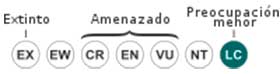
• Current category of the Red List of the UICN: Least concern
• Population trend: Stable.
• Population size : Unknown
Rationale for the Red List category
This species has a very extens distribution areato, and therefore does not approach the thresholds for Vulnerable under the criteria of size range (Scope of the presence <20.000 km2 combined with a decreasing area size or fluctuating distribution, extension / habitat quality, o Population size and a small number of locations o Severe fragmentation).
The population trend appears to be stable, and therefore the species does not approach the thresholds for Vulnerable under the criteria of population trend (decrease> 30% in ten years or three generations). The population size has not been quantified, but it is not believed to approach the thresholds for Vulnerable under the criterion of population size (<10.000 mature individuals with an estimated continuous decrease in> 10% in ten years or three generations, or with a specific population structure). For these reasons, the species is assessed as Least concern.
Justification of the population
Global population size has not been quantified, but it has been reported that the species is generally common and sometimes abundant (pit et to the. 1997). Some sources estimate the current population of this Lori in about half a million individuals.
Justification trend
They suspected that the population is stable the absence of evidence of decline or substantial threats.
"Red-flanked Lorikeet" in captivity:
Rare in captivity.
Alternative names:
– Blue-eared Lorikeet, Lowland Lorikeet, Red flanked Lorikeet, Red-flanked Lorikeet, Yellow-fronted Blue-eared Lorikeet, Yellow-fronted Blue-eared Lory (English).
– Lori coquet, Loriquet à croupion bleu, Loriquet joli (French).
– Schönlori (German).
– Loris Charmosyna Placentis (Portuguese).
– Lori de Dorso Rojo, Lori Flanquirrojo (español).
• Avibase
• Parrots of the World – Forshaw Joseph M
• Parrots A Guide to the Parrots of the World – Tony Juniper & Mike Parr
• Birdlife
Photos:
(1) – A male Red-flanked Lorikeet at Cincinnati Zoo, USA by Ltshears [CC BY 3.0]
(2) – Female Red-flanked Lorikeet at the Louisville Zoo, USA by Ltshears [CC BY-SA 3.0 or GFDL], from Wikimedia Commons
(3) – A pair of Red-flanked Lorikeets at Jurong Bird Park, Singapore by Peter Tan [CC BY-SA 2.0], via Wikimedia Commons
(4) – The image is free from copyright under Creative Commons CC0
(5) – Red-flanked Lorikeet, Male (Charmosyna placentis) at the Louisville Zoo by Ltshears [CC BY-SA 3.0 or GFDL], from Wikimedia Commons
The Sinú parakeet(Pyrrhura subandina) It, in general, green, with the forecrown and areas around eyes dark red.
In flight It is very evident dark red stain abdomen, the wings below greyish. The cheeks They have a greenish blue tone, the area surrounding the ear It is yellowish-brown and the breast feathers with design marginalized gray escamado.
Lives or lived in humid jungle, semi-humid, deciduous and gallery forests,low. It nests on trees of considerable size in hollow nests woodpeckers.
endemic to Colombia, in the lower valley of sinu river, Jaraquiel, Murrucucú hill, Córdoba.
Expeditions carried out in recent years have failed to sight it.
Estimated population: 0-100; The population trend: possibly extinct
We recommend that you devote to Sinú parakeet immediate attention to the conservation of this unique endemic species of the plain Sinu River.
Habitats in the jungle and near the Sinú river valley have been extensively altered and lost.
History:
The Sinú parakeet It was described by Todd 1917 as a distinctive bird endemic Valley Sinu River, Córdoba Department, Northwest of Colombia. Peters (1937), without evidence or any basis placed the Pyrrhura subandina within the species Pyrrhura picta, and the species immediately fell into obscurity as subspecies. However, Joseph and Stockwell (2002) they restored the status to Pyrrhura subandina as a species, based on a detailed assessment and phylogenetic analyses recent (com. pers. 2003).
DNA analysis has shown that the population of the Sinú parakeet(Pyrrhura subandina) It is probably different (monotype) (Joseph & Stockwell 2002), although at present it remains a subspecies of the Pyrrhura picta pending further studies (SACC 2007).
There is no information on the ecology of the Sinú parakeet or current status. The species has never been reported alive and its range has been extensively deforested (Salaman obs. pers.)
At the beginning of 2004 Paul Salman He visited the four sites type; two are entirely deforested, While Quimari and the Cerro Murrucucú still have some fragmented forests. No evidence of any Pyrrhura It was obtained by observations and interviews with the local community. In May of 2004, a researcher at ProAves spent three months exploring in search of this species throughout the Murrucucú hill but their results were not favorable. The lack of recent records of this species and its restricted and unprotected range give reasons for concern about their survival and current status.
Reference: Joseph, L. and Stockwell, D. 2002. Climatic modeling of the distribution of some Pyrrhura parakeets of northwestern South America with notes on their systematics and special reference to Pyrrhura caeruleiceps Todd, 1947. Ornitologia Neotropical 13: 1-8.
The Sinú parakeet(Pyrrhura subandina) was last reliably recorded in 1949. Almost nothing was recorded about their habits. Not found during searches on 2004 and 2006 (ProAves Colombia 2008). He may be extinct, but if it still survives, this bird will be seriously threatened by habitat loss and hunting associated with the armed conflict in the region; The future of this Pyrrhura It looks bleak.
* Subspecies included within the species Pyrrhura picta.
The Cobalt-winged Parakeet(Brotogeris cyanoptera) measured 15-21 cm.. in height and weighs around 67 g. Distinguishable on the fly by the cobalt blue of the the flight feathers; forecrown yellow and crown with blue dye; chin orange.
Has the tail short and acute. Its bill opaque beige es
(Berlepsch, 1889) – Has the forecrown light green, shoulder yellow and only a patch blue in half of the wing
.
Habitat:
Very common. It is found in secondary forest, riparian, edges and savanna, until the 600 m (occasional over of 1000 m). Fly in small flocks of 10 to 20 individuals (rare in couples), feed in the canopy.
Reproduction:
It nests in hollow and termite mounds on tree.
Food:
Its diet probably the same as for most species Brotogeris: fruit nectar, figs, berries and seeds.
Distribution:
Its population is distributed between the East of Colombia, Southwest of Venezuela to the North of Bolivia and Brazilian Amazon.
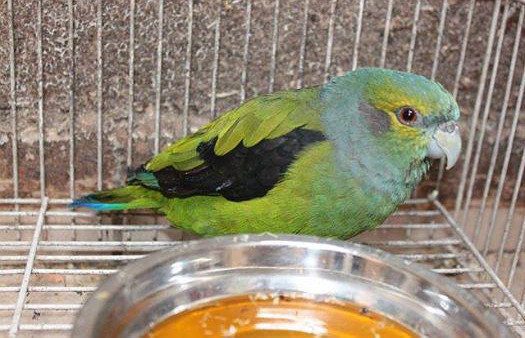
The Black-winged Parrot(Hapalopsittaca melanotis) is distinguishable by the head almost all greyish blue, with blue-billed, ochre around the eye and back of the same black spot defined. Wings with large black patch and purple-blue ends; the tip of the tail blue. The subspecies Hapalopsittaca melanotis peruvianahead green, with the spot towards the back of the eye dark orange.
Habitat
Rare, Although most abundant in Bolivia. It lives in temperate inter-Andean valleys and humid montane forests., between 1500 to 2500 m.. (Occasionally a 3450 m.. in Peru). Usually in pairs or small groups. Seen mostly in pairs or in small groups of 3 to 25 birds. From time to time they gather in groups of up to 50 birds around their favored roosting.
Conservation
Not considered in any of the threat categories, It is very rare in captivity.
They have recorded for this species altitudinal migration, Depending perhaps on the fruiting, Since the fruit is their main source of food.
With reproduced in cavities of trees or places of nesting woodpeckers.
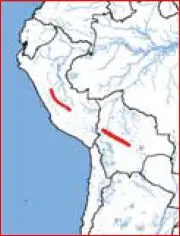
Inhabits intermittently to the East of the Andes, in the center of Peru and in the yunga of Bolivia.
51 to 64 cm. height and a weight between 910 and 1200 g.
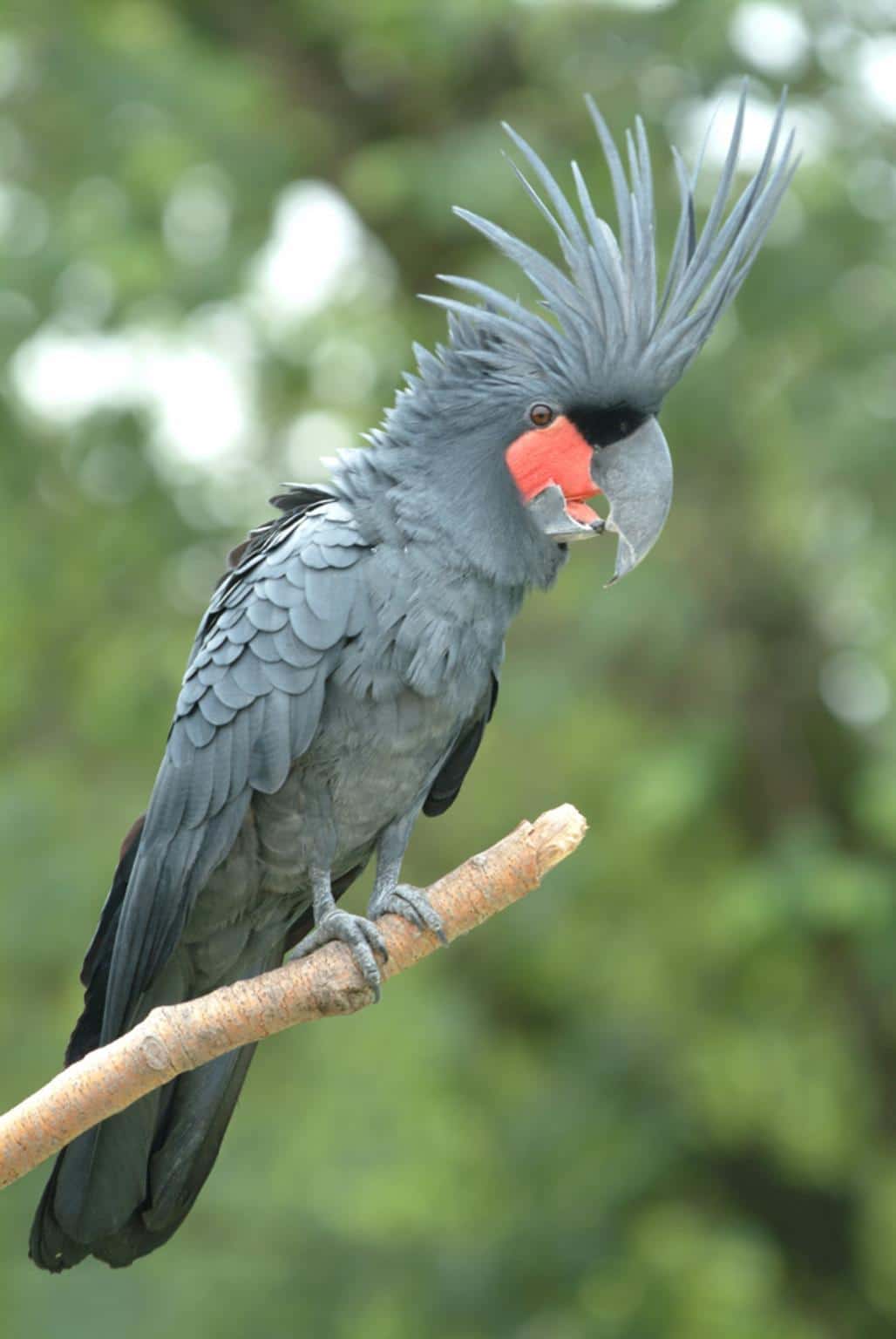
The Palm cockatoo(Probosciger aterrimus) it is one of the largest cockatoo species. Unmistakable with a Erectile Crest of 15 cm.. Mainly arboreal.
Both sexes differ in size. Immatures are differentiated by the pale yellow at the bottom and the tip of the bill and the eye ring in color white.
Usually black with a bare area around the cheeks and eyes red. The feathers of the crest they are long and thin, black streaks.
The bill is dark gray, smaller in the female. The legs son grises. The language is black and Red.
The cheek skin changes color according to its health or stress level, a pink / beige to a yellow when it is excited.
The presence of this cockatoo is documented from sea level to 1350 metres in height.
In New Guinea they are in tropical rainforests, including gallery forests, edges of forests and monsoon forests. In Australia they live in forests of eucalyptus, forest of Melaleuca, partially cleared areas and sheets.
You are travelling individually, in pairs or in groups of five or six. About an hour after sunrise they gather in the treetops.
Reproduction:
The nesting occurs between August and February. Nest in the cavities of trees which tend to be of approximately 1 m depth and 25 to 60 cm in diameter. These are full of branches broken at the bottom on which rests the egg. The site is often used year after year.
Reproduce every two years. They put a single egg and both parents the hatch for a period of 28 to 31 days, at around 3 to 4 more days to hatch. The squab was born completely naked and does not develop marker, unlike other Cockatoo chicks. They are taken from 100 to 110 days to leave the nest, the longest period among all parrot species. After leaving the nest, the young bird depends on the parents at least others 6 weeks because of its inability to fly.
Food:
Seeds, dried fruits, fruit, berries, sprouts leaves and insect larvae.
They feed mainly in the forest canopy, but can also feed on the ground on fallen fruits and seeds.
Distribution:
Size of the area of distribution (reproduction / resident): 716.000 km2
New Guinea and adjacent islands, North of Queensland, Australia.
Distribution 4 subspecies:
Probosciger aterrimus aterrimus
(Gmelin, 1788) – Nominal. Islands Aru, Misool, South of New Guinea and northeast of Australia (Cape York)
This species has a very large range, and therefore not approaching the threshold of vulnerability. While the trend of the population seems to be decreasing, the decline is not believed to be fast enough to approach vulnerable bird thresholds based on population trend criteria.
In some parts of its area of distribution, the forest habitat in which occur the hollow trees is being invaded by the rainforest.
"Palm cockatoo" in captivity:
Rare bird cage, Although they have a great demand for the market of pet due to its unusual appearance.
They can live more than 55 years of age in captivity.
They may develop compulsive behaviors, as the pecking of feathers. They can also mimic sounds and human language.
Aggressiveness within pairs is taken into account for captive breeding., Sometimes the male usually kill the female. As such, There are more different management methods, from bringing both cockatoos together only during the breeding period and quickly removing the male, cut the male that the female escape flying, or create complex installations that are carried out next to a cutout of the male, so that the female always has an escape route in the face of aggression.
There are currently laws that prohibit the export of any Palm cockatoo without a permit.
Alternative names:
– Palm Cockatoo, Black Macaw, Goliath Aratoo, Goliath Cockatoo, Great Black Cockatoo, Great Palm Cockatoo (English).
– Cacatoès noir, Microglosse noir (French).
– Arakakadu (German).
– Cacatua-das-palmeiras (Portuguese).
– Cacatúa de las Palmas, Cacatúa Enlutada (español).
Sources:
– avibase
– infoexoticos
– Parrots of the World – Forshaw Joseph M
– Parrots A Guide to the Parrots of the World – Tony Juniper & Mike Parr
– Birdlife
It measures 30-35 centimeters to paste 380 g..
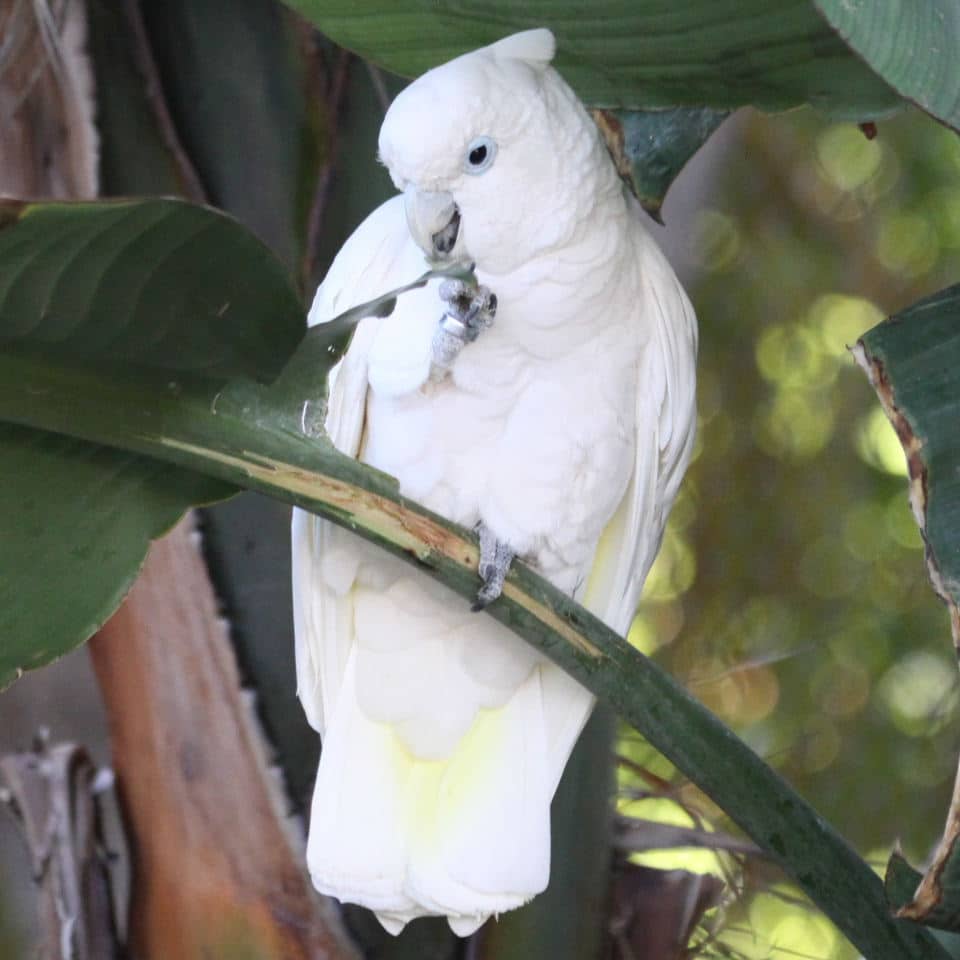
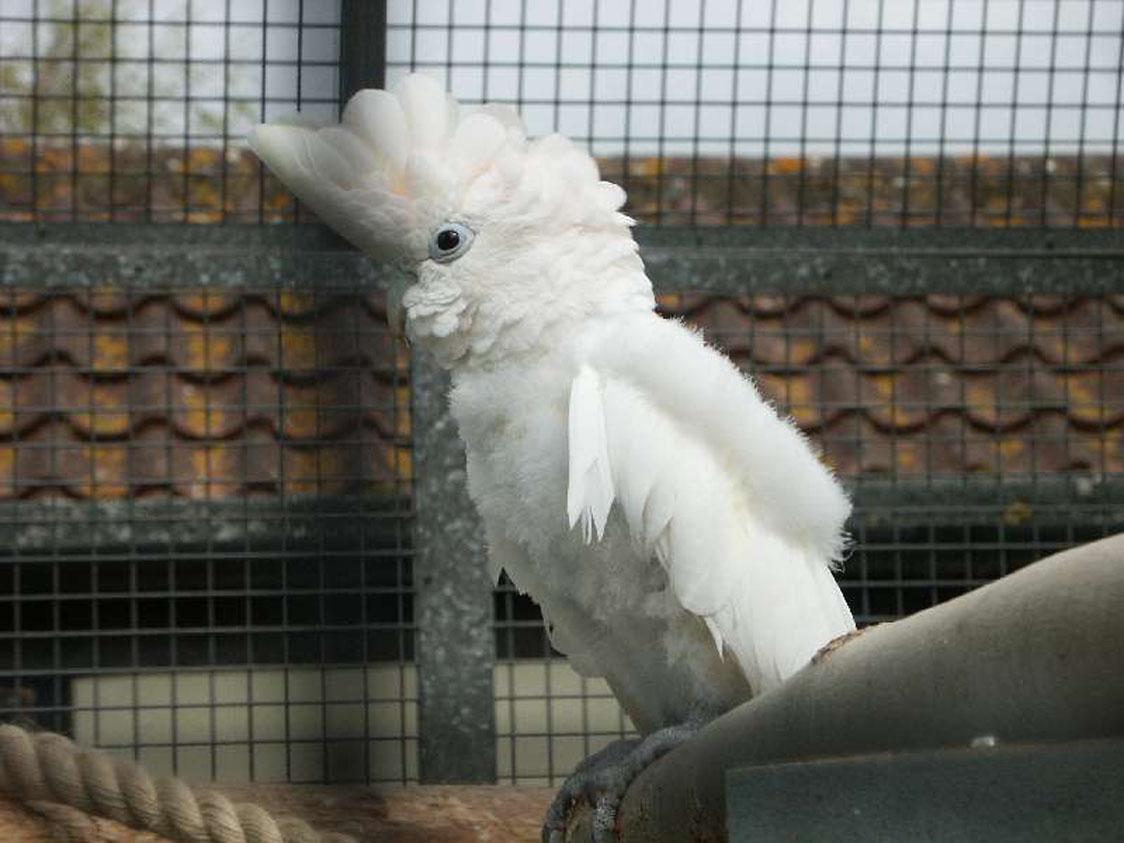
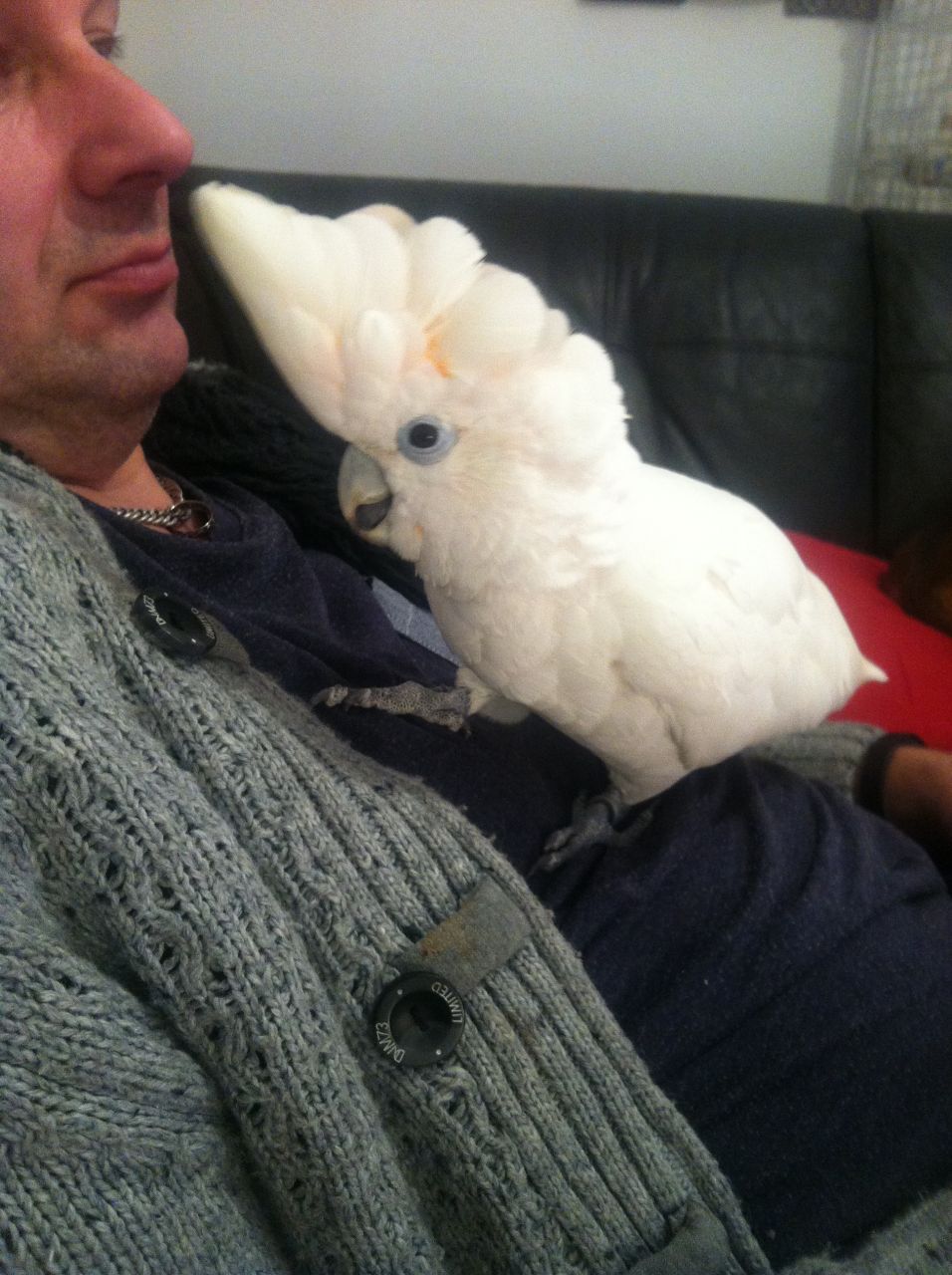
The Solomons cockatoo(Cacatua ducorpsii) is a small cockatoo immediately recognizable by its long triangular Crest.
Its plumage is almost completely white, except the part inferior of them wings and tail with infiltration of color yellow. The feathers of the crest, the cheeks, the the mantle and the chest they have a base of pink.
The bill is grey. The bare skin around the eyes is pale-blue. The irises are dark brown, the legs grey.
The females are distinguished from your partner to have the irises more reddish.
The Solomons cockatoo is quite similar to the Tanimbar corella living in the Tanimbar Islands. Also seems to the Little corella, although the latter have more bluish and developed the orbital area.
Is from coastal areas to the mountains; variety of habitats, including forests, secondary vegetation and gardens in cities. Found up to 1700m; mainly below the 700 m.
Behavior:
They are birds noisy and quite easy to observe, even though they mostly live in pairs or small groups. They fly high above the treetops where used well exposed perches in the top of the Cup.
Birds are very cautious, screaming when they are disturbed.
They have a strong and uneven consisting of shallow flapping flight.
Reproduction:
In the wild child from July to September.
They make their nests in hollows of trees or large branches and, they often use the same nest year after year.
The eggs are of color white and usually there are two in a clutch. The eggs are incubated for about 25 days, the young leave the nest 62 days after hatching.
Food:
They feed on seeds, berries, fruit, outbreaks, flowers, as well as insects and their larvae. From time to time they ingest the fleshy parts of «epiphytes«.
Distribution:
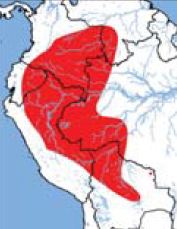
endemic to the Solomon Islands. Its area of distribution extends from Bougainville (Papua New Guinea) to Malaita, Choiseul, New Georgia and Santa Isabel. The species is absent in San Cristóbal and the islands surrounding.
Conservation:
State of conservation ⓘ
Minor Concern ⓘ(UICN)ⓘ
– Current IUCN Red List category: Least concern.
– The population trend: Stable
The population world is estimated at 100.000 birds and it seems quite stable.
The marketing of pet birds is a threat to this species, the other is the degradation of the habitat. The latter seems particularly serious, given the logging of forests in the lowlands.
"Solomons cockatoo" in captivity:
It´s little gregarious and have tendency to be aggressive with other species and with those of its same species. In relation to the human being is a Parrot very demanding. Not everyone is prepared to have a white cockatoo.
They often tend to develop behavior problems, unbearable screams, become very destructive…If not are given a rigorous education on a very regular basis. That is why it is convenient that if you intend to have a cockatoo, it should be done so that it can be accompanied by another or others of its kind to prevent it from developing an excessive dependency and thus you can enjoy it without fear of having problems or at least trying to avoid them as much as possible.
I like them much attention. They tend to create strong emotional bonds and they are quite Extrovert.
Despite the great attraction that having a pet parrot with such characteristics can mean for a person,. It is not often a parrot advised for anyone or rather, hardly anyone is prepared to have a cockatoo with these characteristics.
Alternative names:
– Ducorps’s Cockatoo, Broad-crested Corella, Solomon Corella, Solomon Islands Corella, White Cockatoo (ingles).
– Cacatoès de Ducorps (French).
– Salomonenkakadu (German).
– Cacatua-ducorps (Portuguese).
– Cacatúa de las Salomón, Cacatúa de Salomón (español).
26 cm.. length and a weight between 132 and 150 gr.
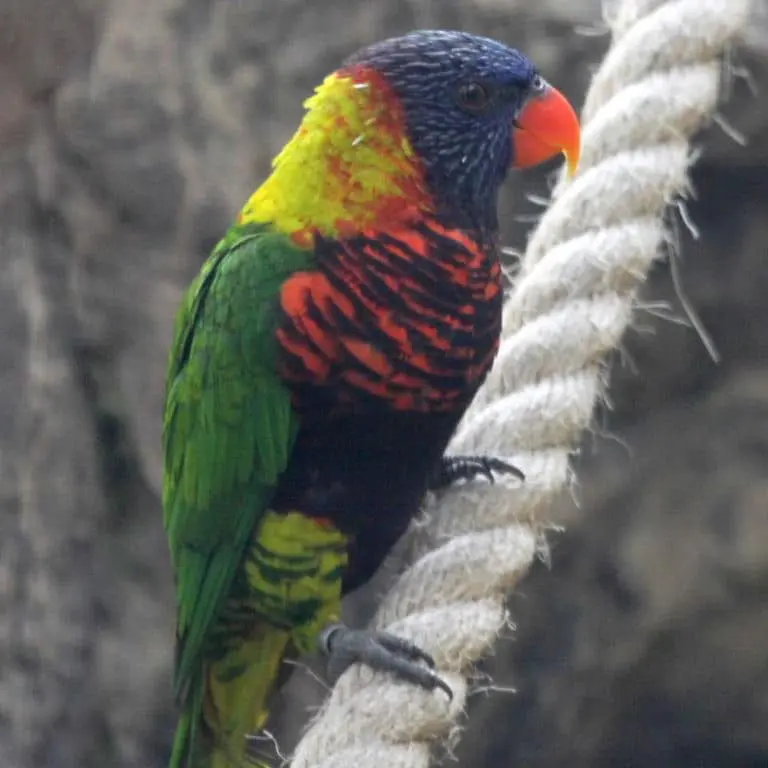
The Shawl-collared Lorikeet(Trichoglossus rosenbergii) is very similar to the Trichoglossus haematodus, but with a stronger blue in the head.
The edges of the breast feathers they are much wider, It has a broad yellow stripe on the neck, ending at the highest point with a red band narrow, their abdomen Violet is blue also has a wide orange stripe inside the flight feather.
The bill is red-orange. The irises They are orange-red and legs grey.
Variation of the nominal (Trichoglossus Haematodus).
Habitat:
They are in a wide range of habitats, including settlements in forests, coconut plantations, savannahs and mangroves.
In their natural habitats, They form small groups noisy that feed on the upper canopy. Often they are seen in mixed flocks with other species of parrots. At night, Community are hundreds of birds.
Son pollinators important species coconut.
Reproduction:
Within its natural range, usually they begin breeding between September and October – although breeding has been recorded in most months.
The average clutch it consists of 2 to 3 eggs. The female incubated eggs for about 24 to 27 days and the young become independent when they are about 80 days old.
Food:
Its diet natural It consists mainly nectar and pollen, but also it includes fruits like figs, citrus, papaya and mangoes open fruit bats. They may also feed on moth pupae and insects.
The Shawl-collared Lorikeet has a single small population, that can be seen to be decreasing as a result of the loss and degradation of forests, by agriculture and logging subsistence and perhaps also for the capture for trade. So, is qualified as Vulnerable.
The bird population is assumed that can range from 3000-4000 birds.
Alternative names:
– Shawl-collared Lorikeet, Biak Lorikeet, Rainbow Lorikeet (Biak) (ingles).
– Loriquet de Biak (French).
– Biaklori (German).
– Loris Arco-Íris Rosenbergii (Portuguese).
– Lori de Biak (español).