โ–ท The world of Pets: Dogs, cats, birds, reptiles, amphibians

Finsch's Pygmy-Parrot
Micropsitta finschii

Finsch's Pygmy-Parrot

Content


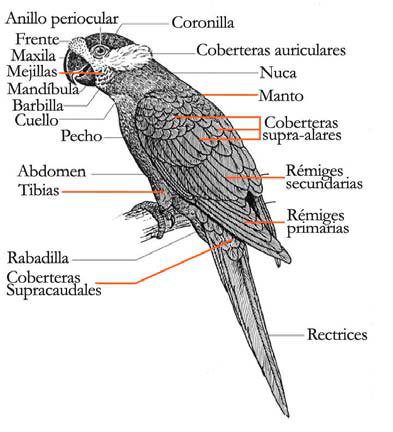
Anatomy-parrots

Description

9,5 cm. length between 12 and 18 g. of weight.

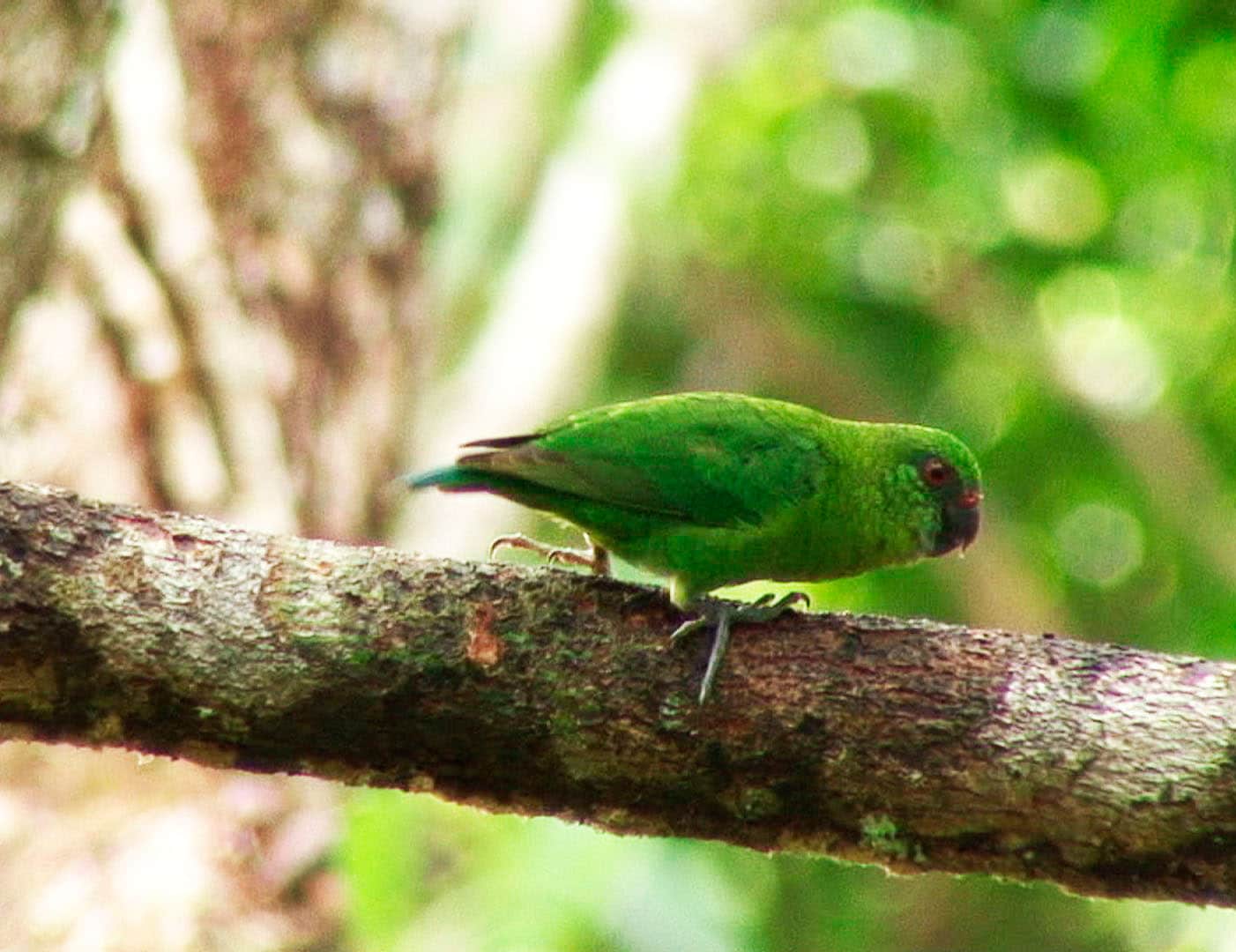
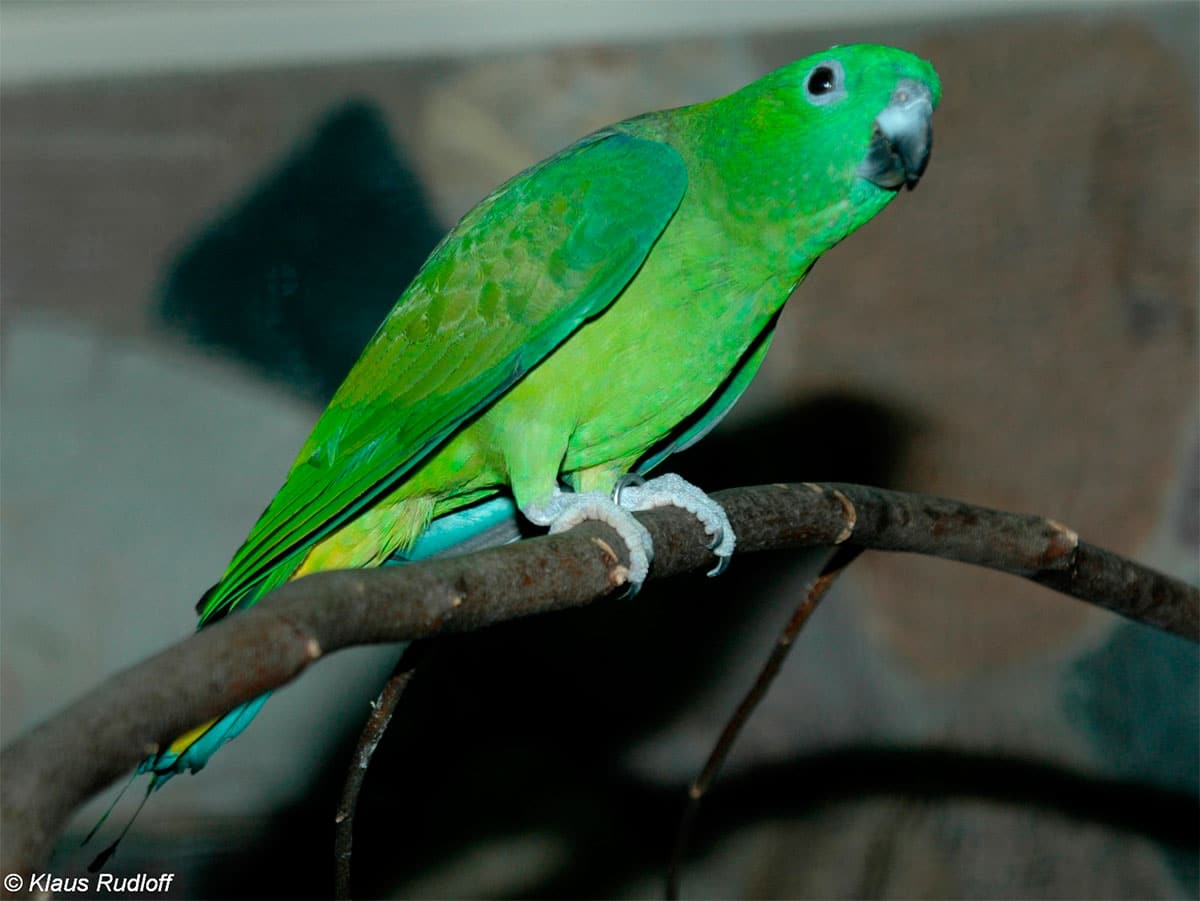
The head of the Finsch's Pygmy-Parrot (Micropsitta finschii) is bright green, slightly yellowish, dotted with pale blue in the chin and throat. Upperparts bright green, with fine darker stripes. The flight feather they are black with fine green edges; wing feathers greenish yellow. The underparts pale yellowish green with fine darker stripes and feather in the center of the belly orange-red; uppertail-coverts yellow, the longest with bluish-green tips. Upper, the tail is off blue, Black in the Center and sides with blue and yellow tips; below, the tail is black with yellow tips.

Bill blackish; cere Pink ; irises orange red; legs grey.

Cere rose in the male, grey in the female. The females they lack the red marks in the underparts and they have pink feathers, not blue, on chin.

Immature with bill grayish and reddish brown, not orange-red, the irises.

In the juvenile birds the cere is greyish in both sexes. Males immature of the species nominal lack of the chin Blue and red markings in the abdomen.

Subspecies description

Description 5 subspecies
  • Micropsitta finschii finschii

    (EP Ramsay, 1881) – The nominal.


  • Micropsitta finschii nanina

    (Tristram, 1891) – The adults have a stain blue in the part superior of the crown.


  • Micropsitta finschii viridifrons

    (Rothschild & ECTION Hartert, 1899) – Adults have a large blue spot at the top of the crown and blue tones to the sides of the face.


  • Micropsitta finschii tristami

    (Rothschild & ECTION Hartert, 1902) – Adults do not have blue spots and orange


  • Micropsitta finschii aolae

    (Ogilvie-Grant, 1888) – adults have the upperparts darker and have a blue spot on the top of the crown.

Habitat:

Finsch's Pygmy-Parrot

Most common in lowland primary forest at mid-altitude, are observed to the 900 meters above sea level (lower boundary of cloud forests where they are replaced by the Red-breasted Pygmy-Parrot, but they are distributed in a variety of habitats, including weed gardens, casuarinas, secondary growth, areas of open scrubland and occasionally coconut (Cocoa nuts). It's a vociferous and active species, difficult to observe. They are alone, in pairs or in groups of 3 to 6 birds. They feed on acrobatic form, down with your head upside down and using their tails as support on the bark of the trees.

Reproduction:

One to two eggs are deposited by the female in an excavated cavity over a period of several weeks in an active tree termite nest. (that is also used for the rest). Adults were observed with young in January 1995 in the South of New Ireland. The breeding period It speculates that may be between March and Mayo.

Food:

Peck the trunks and branches of the tree tops and medium height plants to glean lichens and fungi, also noticed them is feeding of seeds of casuarina.

Distribution:

Are found in the Bismarck Archipelago including New Hanover, Tabar, Lihir and New Ireland, through Bougainville in the Solomon Islands in Choiseul, Santa Isabel, Malaita, Vella Lavella, Gizo, Kolombangara, New Georgia, Rendova, the Russell Islands, the Islands of Florida, Nggela Sule, Guadalcanal, Uki and San Cristรณbal.

Subspecies distribution:

Distribution 5 subspecies

Conservation:


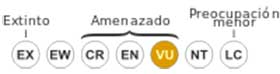
minor concern


โ€ข Current IUCN Red List category: Least concern

โ€ข Population trend: Stable

The size of the world population It has not been quantified, supposedly above 100.000 specimens. The species according to sources, It is abundant within its range (pit et to the. 1997).

The population is suspected to be stable in the absence of evidence of any reduction or substantial threats.


In captivity:

Not found in captivity.
This species has only been kept alive for short periods in captivity.; new birds may refuse foods completely.

Alternative names:

Finsch’s Pygmy-Parrot, Emerald Pygmy Parrot, Finsch’s Pygmy Parrot, Green Pygmy Parrot, Green Pygmy-Parrot (ingles).
Micropsitte de Finsch (francรฉs).
Salomonenspechtpapagei, Salomonen-Spechtpapagei (alemรกn).
Micropsitta finschii (portuguรฉs).
Microloro de Finsch (espaรฑol).

scientific classification:

Order: Psittaciformes
Family: Psittaculidae
Scientific name: Micropsitta finschii
Genus: Meeki
Citation: (Ramsay,EP, 1881)
Protonimo: Nasiterna Finschii

Images "Finsch's Pygmy-Parrot"

Videos "Finsch's Pygmy-Parrot"

————————————————————————————————

ยซFinsch microloreยป (Micropsitta finschii)


Sources:

Avibase
– Parrots of the World โ€“ Forshaw Joseph M
– Parrots A Guide to the Parrots of the World – Tony Juniper & Mike Parr
– Birdlife
Wikipedia

Photos:

(1) – A bird foraging on a trunk by Josep del Hoyo – lynx
(2) – Parrots of the World โ€“ Forshaw Joseph M

Sounds: Mark Todd (Xeno-canto)

โ–ท The world of Pets: Dogs, cats, birds, reptiles, amphibians

Buru Racket-tail
Prioniturus mada


Buru Racket-tail

Content

Buru Racket-tail

Description

32 cm.. length.

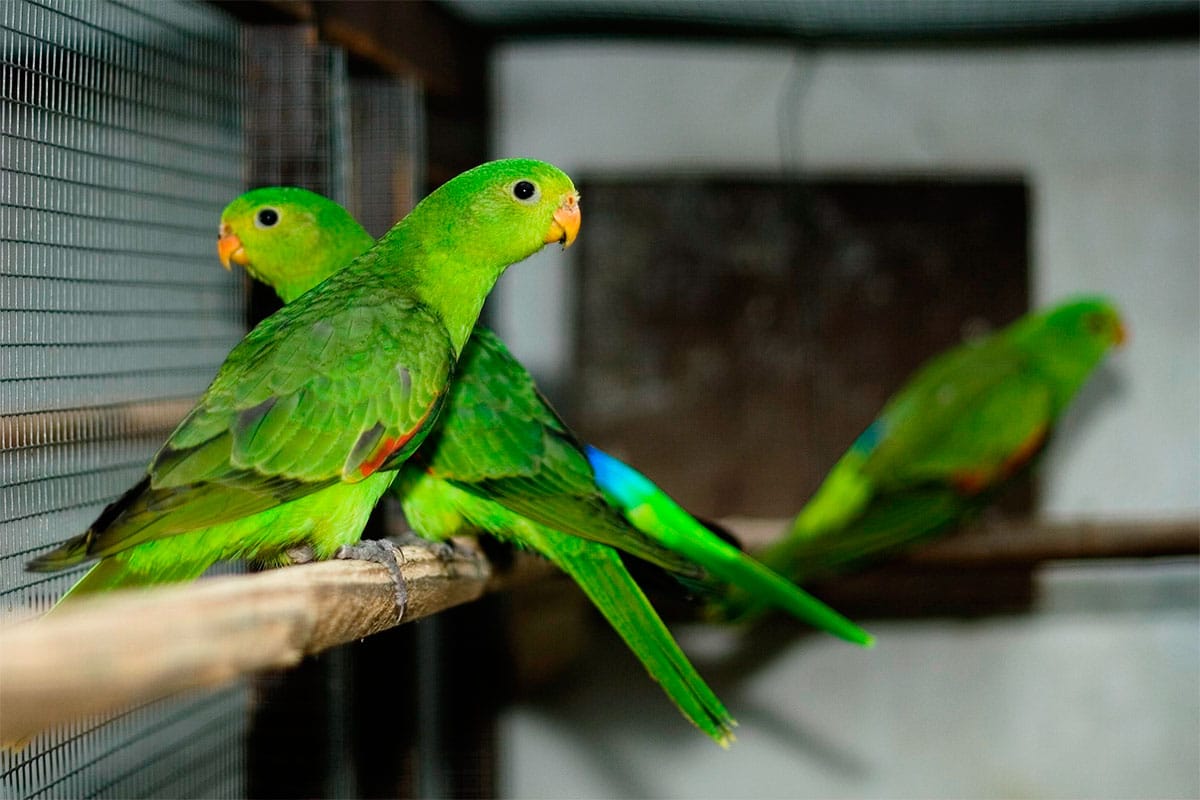
The head of the Buru Racket-tail (Prioniturus mada) is bright green, marked in blue-gray dark in the crown and in the nape. The upperparts are green, marked in grisaceo-azul dark in the upper mantle; Uppertail green. Wings green with lesser coverts and bend of wing Dark greyish-blue. Wing feathers green; underside of flight feather. Bluish.

The underparts are yellowish-green, more yellow in undertail-coverts. Upper, the tail green, outer feathers tipped dark blue; light blue, the tail down.

Bill grey; irises dark brown; legs grey.

Female lacks the blue color in the crown, nape and the the mantle; the blue in the bend of wing is smaller; rackets of the tail shorter.

Young without rackets on tail; males with blue in the nape.

Habitat:

Found until the 1600 meters above sea level, in all types of forest habitat, including selective exploitation and secondary high growth areas; also found in cultivated areas remaining trees; most common around 600 m. You often see them in small groups of up to ten birds. Tends to substitute to the Red-checked Parrot at higher elevations.

Reproduction:

breeding season from December to February. Up to five young can be raised in a nest.

Food:

It feeds on fruits, flowers, berries and seeds.

Distribution:

endemic to the island of Buru, Indonesian. The inclusion of the species as Near-threatened is based on the assumption of a very restricted range above the 1.000 m, but newly published evidence shows that it is common throughout the island with an estimated world population between 189.000-48S.000 birds.

Conservation:


minor concern


โ€ข Current category of the Red List of the UICN: Least concern

โ€ข Population trend: Stable

The size of the world population It has not been quantified, It is estimated between 189,000 and 483,000 individuals.

The species is described as common and widespread (pit et to the. 1997).

The population is suspected to be stable in the absence of evidence of any reduction or substantial threats.

"Buru Racket-tail" in captivity:

Not found in captivity.

Alternative names:

Buru Racket-tail, Buru Racket-tailed Parrot, Buru Racquet tail, Buru Racquet-tail, Buru Racquet-tail Parrot, Buru Racquet-tailed Parrot (ingles).
Palette de Buru, Perroquet ร  raquette de Buru (French).
Madapapagei (German).
Prioniturus mada (Portuguese).
Lorito Momoto de Buru, Lorito-momoto de Buru (espaรฑol).

scientific classification:

Order: Psittaciformes
Family: Psittaculidae
Genus: Prioniturus
Scientific name: Prioniturus mada
Citation: Hartert, E, 1900
Protonimo: Prioniturus mada

Images "Lorito momoto de Buru":

Videos "Buru Racket-tail"

————————————————————————————————

ยซLorito Momoto de Buruยป (Prioniturus mada)

Sources:

Avibase
– Parrots of the World โ€“ Forshaw Joseph M
– Parrots A Guide to the Parrots of the World – Tony Juniper & Mike Parr
– Birdlife

Photos:

(1) – By Klaus Rudloff (kdrudloff@web.de) – Germany , Weltvogelpark / World Bird Park – Walsrode – biolib
(2) – ยซPrioniturus mada qtl1ยป by QuartlOwn work. Licensed under CC BY-SA 3.0 via Wikimedia Commons.
(3) – ยซPrioniturus mada-captive-8a-tocยป by Prioniturus_mada_-captive-8a.jpg: Robert01.Original uploader was Robert01 at de.wikipediaderivative work: Snowmanradio (talk) – Transferred from de.wikipedia; transferred to Commons by User:Snowmanradio using Commonshelper.(Original text: selbst fotografiert) to Prioniturus_mada_-captive-8a.jpg. Licensed under CC BY-SA 3.0 of via Wikimedia Commons.
(4) – by jon hornbuckle – BIRDING AROUND THE WORLD
(5) – Prioniturus mada buru racquet tail – link

Sounds: Frank Lambert (Xeno-canto)

โ–ท The world of Pets: Dogs, cats, birds, reptiles, amphibians

Red-winged Parrot
Aprosmictus erythropterus

Red-winged Parrot

Content


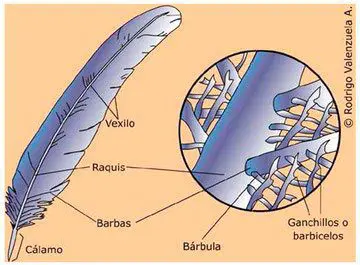
Anatomy-parrots

Description

30 to 33 cm.. length between 120 and 210 g. of weight.

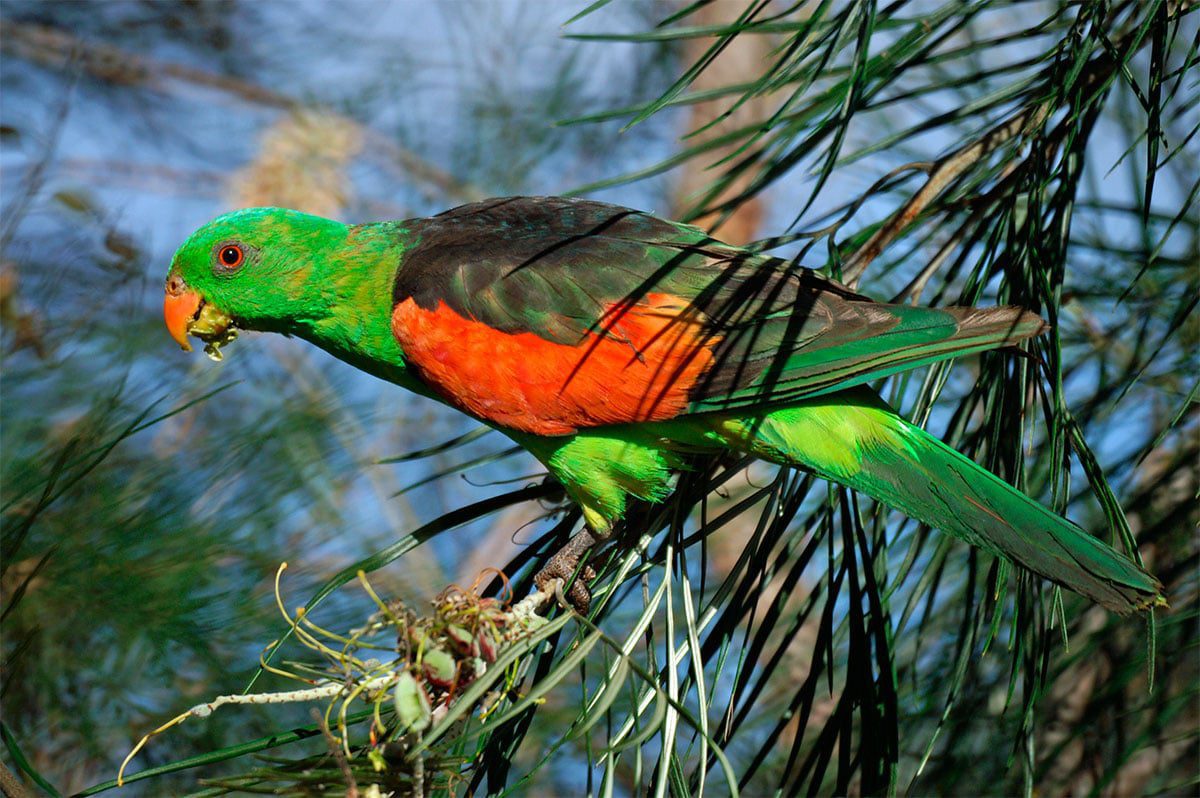
The Red-winged Parrot (Aprosmictus erythropterus) has the head of color green bright with brightness blue green in the crown and nape. Mantle, back and scapulars black. Area low of it back and rump brilliant blue, more clear towards the tail; uppertail-coverts of color green yellowish with broadcasting yellowish at the base. Curve of the wing yellow-green light. Carpal edge blackish. Upper, the wing-coverts, bright Scarlet. Tertiary and primaries marked in black on vane inner, green in vane outer; secondaries also bathed in black in vane outer; primary coverts of color green dark bathed in black. Under, the wing-coverts green. The underparts bright, pale and slightly yellowish-green. Upper, the tail Green dark with tips of color yellow and lateral feathers Blackish in vane internal with yellow tips; undertail, the tail Blackish with tips pale.

Bill coral red; irises reddish brown; legs grey-black.

Female It is predominantly green with a small red spot in the wings (only a point apical on coverts major interiors, but the increase in the external; restricted to the outer feathers of the median) that of the male, and it ain't got no black on it the mantle; vane outside of outer secondaries black. The Green is also more off, and a bit more yellowish in them underparts. The rump is of a blue more off, and the glitter blue in it crown and nape of the male, is absent in the female. Under, the tail has tips yellowish and touches of color pink.

The immature they are similar to the females, but with a irises more Brown and bill yellow from the beginning. Young males attain adult plumage in the third annual moult, but black can show the mantle feathers before this.

Description 3 subspecies

  • Aprosmictus erythropterus coccineopterus

    (Gould) 1865 – Male with more blue in it crown and nape. Both sexes slightly paler, and the female also more off the Green that it nominal species.


  • Aprosmictus erythropterus erythropterus

    (Gmelin) 1788 – The nominal.


  • Aprosmictus erythropterus papua

    (Mayr & Rand) 1936

Habitat:

Resident, Although nomads in the edges of the range. Is semiarid and subtropical forests of eucalyptus and casuarina, boedes of the Woods, riparian forests, thickets of acacia, mangroves, agricultural fields, scrub Cypress pine (Callitris), and the lowlands of the Savannah.

On the inside of Australia are mainly linked to the extension of wooded of the systems fluvial.

They are usually found in small groups of up to fifteen birds, rarely reach more of 50 individuals in a single flock. The largest groups are likely to form late in the breeding season when family groups gather at feeding grounds..

The species is common and conspicuous, but not particularly accessible; When resent, birds can fly some distance, often making strong sounds.

Sometimes associated with the Pale-headed Rosella and Mallee Ringneck, and they feed under the trees, Although it is more usual to see them on Earth to drink.

Reproduction:

The nesting You can start early, in the months of April or may in the North, but august to february is the main breeding season in the south. During the courtship, the male perches near the female, exposing your blue rump, and making sounds.

The nest normally found in a eucalyptus, and the eggs are put into a deep hole covered with scrap wood. Three to six white eggs are They incubated for around 20 days by the female, which is fed by the male until the eggs hatch. The young are cared for by both parents and they leave the nest in a five weeks.

Food:

The diet It includes seeds, fruit, flowers and insects; in the mangroves, the mistletoe (Loranthus) is your favorite diet.

Distribution:

Size of the area of distribution (reproduction / resident): 5.230.000 km2

The Red-winged Parrot (Aprosmictus erythropterus) are confined in Australia, in the coastal districts of the southeast of Irian Jaya (Indonesian) and in the Western Province (Papua New Guinea).

In New Guinea, the species is restricted to the region between the rivers Digul and Fly.

In Australia extends from about Broome, in Western Australia (registered West of Anna Plains, and southwest of the Cordillera de Edgar) through the Kimberley region, including some islands on the coast (Buccaneer and Bonaparte archipelago, Islands Osborne and Sir Graham Moore, and Admiralty Gulf Islands) in the Northern Territory, about Nicholson.

Extends northward up to the peninsula of cobourg and to the South, at the turn of the Cordillera Camfield and Dunmarra Roadhouse, reaching some coastal islands, including Melville and Groote Eylandt.

Extends to the East in Queensland, in the nicholson river, are distributed in the Cape York Peninsula, with records by the coast, about Rockhampton (occasional southernmost), and reaching inside, about Dajarra, to the South of Mount Isa and Southeast, through the lower part of the diamond river, Windorah, Quilpie, Mitchell and San Jorge.

On the inside of New South Wales the end points of the range are in Inverell in the East, Gunnedah, Dubbo and Mudgee in the South and There is a, Menindee and Broken Hill, near the southern border of Australia.

They are also in the North, in the basin of the darling river, and have been recorded in the South-East of Australia, around the Lake Eyre and North of Cooper Creek.

Wandering individuals have been recorded in Renmark and Victory Downs, In this last, possibly from an exhaust.

Leaks have also been observed in Sydney and Melbourne.

The species is common in suitable habitats, except at their range limits.

The world's population is above the 100.000individuals and the species is considered secure.

A moderate number of captive.

Protected by law.

Distribution 3 subspecies:

  • Aprosmictus erythropterus coccineopterus

    (Gould) 1865 – South of New Guinea and Western Australia, to the East through the northern territory of the Cape York Peninsula, Queensland


  • Aprosmictus erythropterus erythropterus

    (Gmelin) 1788 – The nominal


  • Aprosmictus erythropterus papua

    (Mayr & Rand) 1936 – South of New Guinea

Conservation:


minor concern


โ€ข Current category of the Red List of the UICN: Least concern

โ€ข Population trend: Growing

The size of the world population It has not been quantified, Although it is estimated very above the 100.000 specimens.

The species, according to sources, is usually common and locally abundant (pit et to the. 1997).

The population is suspected that it may be in decline due to ongoing habitat destruction.

"Red-winged Parrot" in captivity:

Fairly common in Australia, not so much in other places.

Active, Acrobat; they require a large birdhouse with plenty of hangers. The male can become aggressive with the female.
Quite quiet and shy.

Una muestra viviรณ 24,4 years in captivity.

Alternative names:

Red-winged Parrot, Red winged Parrot (ingles).
Perruche รฉrythroptรจre, Perruche erythroptรจre (French).
Rotflรผgelsittich, Rotflรผgel-Sittich (German).
Periquito-de-encontro-vermelho (Portuguese).
Papagayo Alirrojo, Papagayo de Alas Rojas (espaรฑol).


scientific classification:

Gmelin Johann Friedrich

Order: Psittaciformes
Family: Psittaculidae
Genus: Aprosmictus
Scientific name: Aprosmictus erythropterus
Citation: (Gmelin, JF, 1788)
Protonimo: Psittacus erythropterus


Images ยซPapagayo Alirrojoยป:

Videos "Red-winged Parrot"

————————————————————————————————

ยซPapagayo alirrojoยป (Aprosmictus erythropterus)

Sources:

Avibase
– Parrots of the World โ€“ Forshaw Joseph M
– Parrots A Guide to the Parrots of the World – Tony Juniper & Mike Parr
– World Parrot Trust – parrots.org
– Birdlife

Photos:

(1) – By David Cook Wildlife Photography from Wamboin, NSW, Australia [CC BY 2.0], via Wikimedia Commons
(2) – By Jan Harenburg (Own work) [CC BY 3.0], via Wikimedia Commons
(3) – Aprosmictus erythropterus erythropterus – Orde Psittaciformes – Papegaaiachtigen
(4) – Red-Winged Parrot (Aprosmictus erythropterus) Male – Pine Creek, M. 7. – encimages
(5) – ยซAprosmictus erythropterus-Australia-pair-8" Of Kitykat79 – originally posted to Flickr as King Parrots!. With license CC BY 2.0 Transact Wikimedia Commons.
(6) – A painting of two Red-winged Parrots (originally captioned ยซPlatycercus erythropterus. Crimson-winged parraket. 1. Male. 2.Female.ยป) by Edward Lear 1812-1888. The painting shows a female behind young male by Edward Lear [Public domain], via Wikimedia Commons

Sounds: Peter Woodall (Xeno-canto)

โ–ท The world of Pets: Dogs, cats, birds, reptiles, amphibians

Hooded Parrot
Psephotellus dissimilis

Hooded Parrot

Content


Anatomy-parrots

Description

25,5 to 28 cm.. length and a weight between 50 and 60 g..

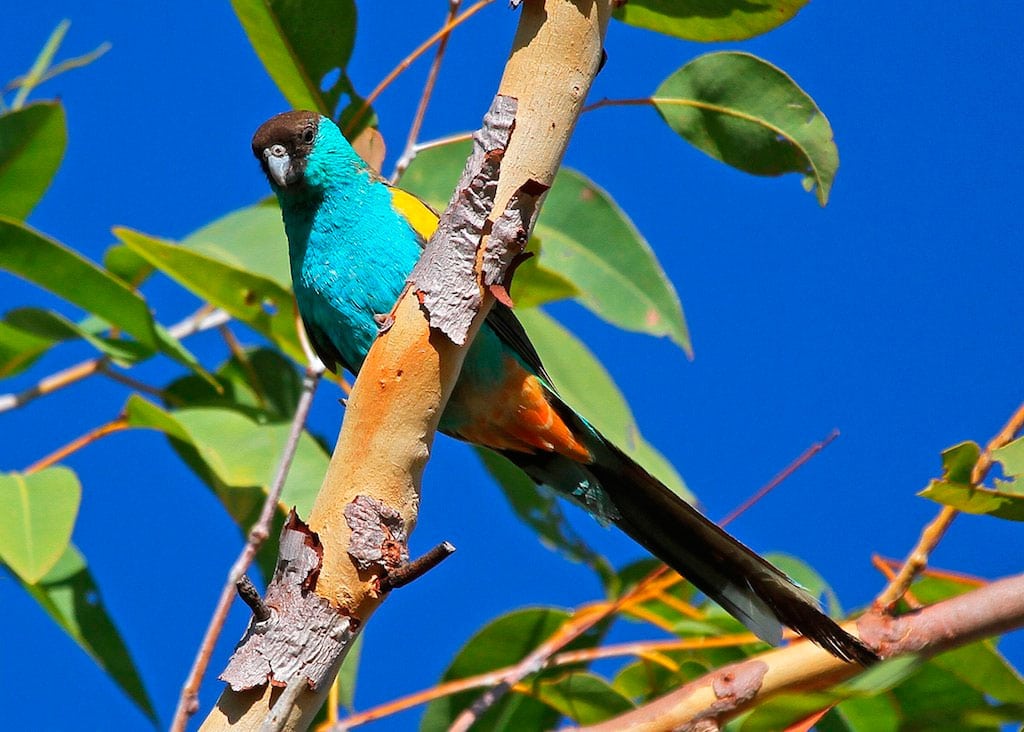
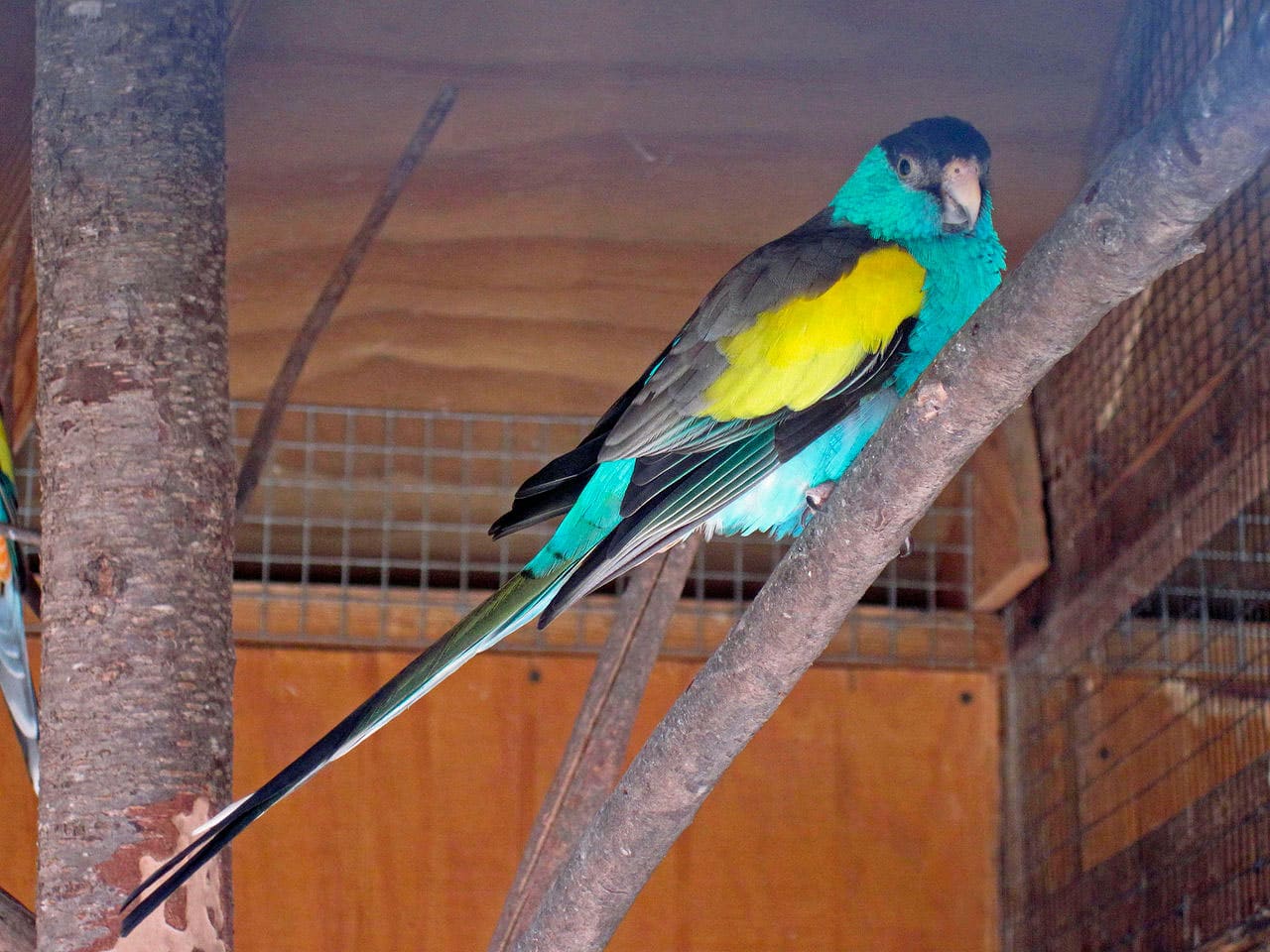
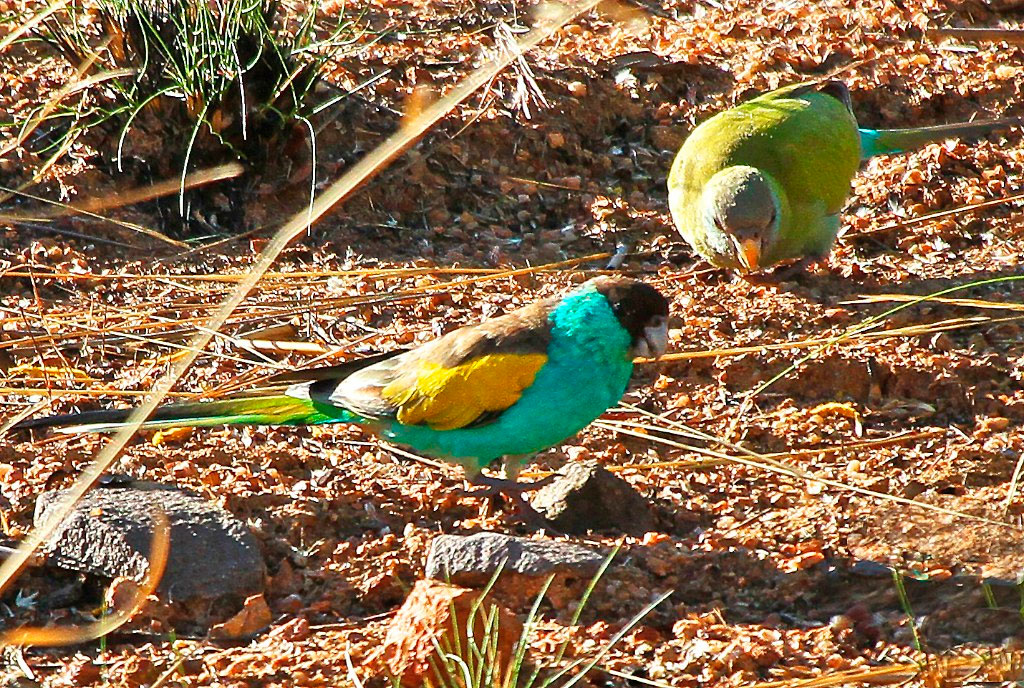
The Hooded Parrot (Psephotellus dissimilis) is a very striking species, restricted to the dry forests of the North of Australia. The male has a pileum black, their underparts are Turquoise with a patch in the shoulders golden yellow.

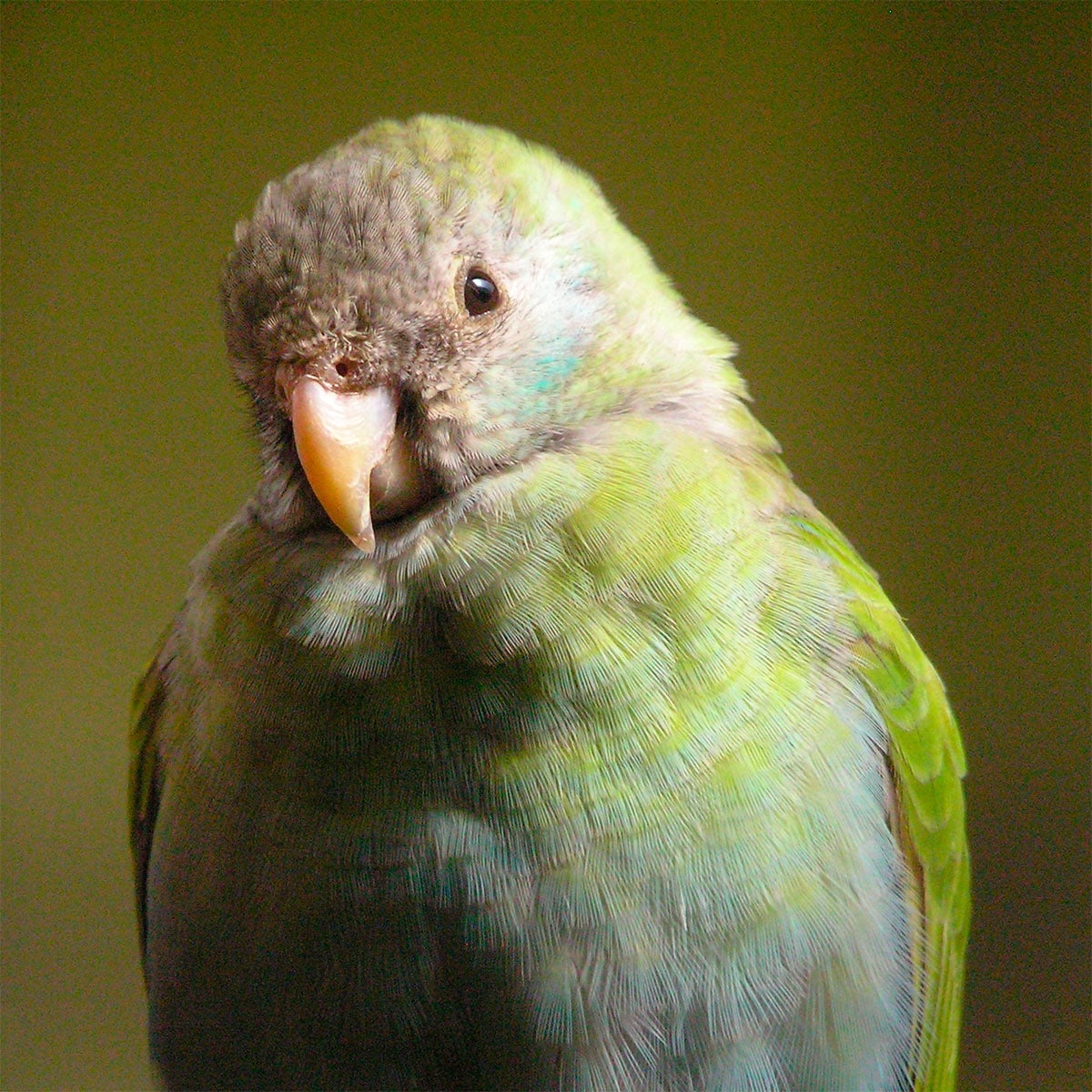
The females are pale green with a pale turquoise diffusion in the cheeks, abdomen and cadwas.

The Golden-shouldered Parrot, with which it is closely linked, is very similar in appearance, but they are only observed in the Cape York Peninsula, in the North of Queensland, and males differ in their tones slightly. The Hooded Parrot does the yellow colour in the forecrown or in the lores and the yellow markings of the shoulders and reddish of the belly, they are smaller than. The females they are very similar, but the Golden-shouldered Parrot It shows a faint red marks on the area, white, bass belly, has the undertail- coverts Bluish, bluish color of the belly is absent and the undertail- coverts They have a pinkish tone; also has a Brown Suffusion in the crown, a forecrown yellowish and the cheeks they are greener.

The Northern Rosella shares territory with the Hooded Parrot and also has a pileum black, but it lacks of the underparts Turquoise and yellow markings on the wings.

The Hooded Parrot they have an elegant flight, and males they are very bright with a Flash of bright yellow showing in the wings. The flight fast and slightly wavy. Bird perch, times, phone cables, and can make long flights at high altitude.

Providing more detail to its description, the Hooded Parrot has the pileum, lores and the area below and in front of the eyes, black, merging into grey-brown colour in the the mantle (darker uppers than the Golden-shouldered Parrot). The rump is turquoise blue and the uppertail-coverts green. Wing coverts golden yellow (grey dark in vane inner).

Flight feathers Blackish with difusion-verde turquoise at the edge of the vane outer (thin yellow color at the outer edge). feathers of the wings and bend of wing bluish green; underside of flight feather blackish brown. The cheeks, the neck and the chest Turquoise, lightly coated with emerald green; rest of the underparts Turquoise with the exception of undertail- coverts they are orange-red with yellow tips. Uppertail dark bars.

Central feathers of the tail Green bronze with black tips, side green blue with white tips, with a blackish central bar; undertail, the tail apparently light blue with black tips when it is closed. Bill pale grey; irises dark brown; legs light brown.

The female is usually pale, a light yellowish green, with wing-coverts a bright yellowish-green, flight feather blackish, and a turquoise color broadcasting in the rump, from the top of the breast to belly, and vaguely in the cheeks. Subcaudales coverts bathed in Pink salmon; pale marks in the wings.

The immature they are like the females, but males have the head darker and the cheeks bright. Adult plumage they would earn in the second annual moult.

The very young birds they have the peaks yellow.

Habitat:

Sedentary, although some early records of the Melville Island probably related to post-breeding dispersal. Scattered sparsely through the open dry forests, flooded Plains, especially grasslands of Malaleuca-dominated and Spinifex Triodia, grasslands with termite mounds, also in rows of eucalyptus trees along watercourses and the rocky ridges.

Usually, they are in pairs or in small groups, but after the breeding season, from September (end of the dry season) onwards, they may gather in groups of up to 100 birds feeding.

Reproduction:

Egg-laying range from late January until mid-April, at the end of the rainy season, and the nest is a tunnel in a Termite Mound. The direction and height of the entrance of the nest is variable, but nest chamber temperatures are more stable inside larger mounds. A recent study of nesting ecology in the Northern Territory showed a density of 0,45 to 0,70 nests per square kilometer, with a 50% from eggs producing hatchlings. Between two and six eggs make up the clutch, and are incubated for around 20 days for the female. In about five weeks the young leave the nest.. The females., sometimes, they roost far from their nests during the heat of the day.

Food:

The diet is composed, mainly, of pasture seeds seasonal during the dry season and perennial plants during the wet season. Variation in the ability to master feeding techniques for different seed types may explain the apparent early dispersal of immatures in the wet season.. Birds feed quietly on the ground, resting in foliage near water during the heat of the day. When drinking, they often walk into the water along banks of sand. They are sometimes seen feeding on road verges, often in association with the Black-faced Woodswallow (Artamus cinereus).

Distribution:

Endemic to North of Australia where is located in the western part of Arnhem Land, Northern Territory, from the South of the alligator river, to the southwest of Pine Creek and the South-East of Include. The birds also disperse further east and west to the rivers. Roper and upper area of the Daly.

The Hooded Parrot formerly extended eastward to the MacArthur river, but its territory, covering the Kakadu National Park, has recently been hired.

In general, It Rare. Although now it is fully protected. Capture is believed to it has been a problem in the past. Burning and grazing may limit the availability of herbs seeds during the dry season.

Mining also threatens the habitat of the species. There are a moderate number of birds in captivity.

Conservation:


minor concern


โ€ข Current category of the Red List of the UICN: Least concern

โ€ข Population Trend: Stable

The world population is estimated at 20.000 specimens (Garnett and Crowley 2000).

Population trends have not been quantified, but populations seem to be stable, without descents recent (Garnett and Crowley 2000).

The species remains common in areas under park management. Aboriginal and National, where grazing is minimal and where there are programs that guarantee their survival, or around the Rocky slopes, where is the availability of food in the rainy season relatively assured.

"Hooded Parrot" in captivity:

Although the popularity of the Hooded Parrot has increased considerably in the last decade, this species is still quite unknown in aviculture. The main reason is, probably, that they are not easy to care for and reproduce in captivity, due to its high demands care and difficulty it in terms of its food supply. The Hooded Parrot they are not recommended for a beginner breeder birds.

No one knows exactly when these birds were imported for the first time to Europe, but it was probably at the beginning of the last century. In the autumn of 1912 English Hubert Astley was the one who obtained the first satisfactory breeding result with the Hooded Parrot, got 4 young people from a litter of 5. in the netherlands, the Dr. Polak It also had results before the second world war. Once the pups are born, they were taken along with a couple of Red-rumped Parrot (Psephotus haematonotus) with which they grew up without any problem.

There is a variety of the Hooded Parrot because different crosses with other species such as Mulga Parrot (Psephotellus varius) and the the Golden-shouldered Parrot (Psephotellus chrysopterygius). So, we must pay attention to the characteristics when we are going to buy a pair of future reproducers of this species. If you have doubts about the purity of certain birds, consult with a person who is familiar with this type of parrots.

In terms of the behavior, the Hooded Parrot adapt to the European climate relatively well, although they are sensitive to cold and wet weather. They are quiet birds, enable, not shy and quickly adapt to their caregiver. His voice is not worrying. Love these birds being on the ground, where spend much time. They love to swim and are not rodents of wood. During the breeding season they are aggressive towards other birds.. Even outside the breeding season, It is not advisable to fit them with their peers or keep them with other bird species. Young birds together may stay in a birdhouse. As a basic rule, Ave predict an area of one square meter.

It is not known exactly how these birds can live, according to sources, one specimen was still alive after 18 years in captivity

Alternative names:

Hooded Parrot, Antbed Parrot, Anthill Parrot, Black-hooded Parakeet, Black-hooded Parrot, Golden-shouldered Parrot, Hooded Parakeet (ingles).
Perruche ร  capuchon noir (French).
Collettsittich, Hooded Sittich (German).
Periquito-encapuzado (Portuguese).
Perico Capirotado, Periquito encapuchado (espaรฑol).

scientific classification:

Order: Psittaciformes
Family: Psittaculidae
Genus: Psephotellus
Scientific name: Psephotellus dissimilis
Citation: Collett, 1898
Protonimo: Psephotus dissimilis

Images ยซCapitola Parakeetยป:

Videos "Hooded Parrot"

————————————————————————————————

ยซPerico Capirotadoยป (Psephotellus dissimilis)


Sources:

Avibase
– Parrots of the World โ€“ Forshaw Joseph M
– Parrots A Guide to the Parrots of the World – Tony Juniper & Mike Parr
– Birdlife

Photos:

(1) – A male Hooded Parrot, about 30 km south of Pine Creek, Northern Territory, Australia By birdphotosneill (Hooded ParrotUploaded by snowmanradio) [CC BY 2.0], via Wikimedia Commons
(2) – A pair of Hooded Parrots, about 30 km south of Pine Creek, Northern Territory, Australia By birdphotosneill (Hooded ParrotsUploaded by snowmanradio) [CC BY 2.0], via Wikimedia Commons
(3) – A pair of Hooded Parrots about 30 Km south of Pine Creek, Northern Territory, Australia. The male is in the foreground By birdphotosneill (Hooded ParrotsUploaded by snowmanradio) [CC BY 2.0], via Wikimedia Commons
(4) – By originally posted to Flickr as parkiet xxx and uploaded to commons at Psephotus_dissimilis_(female)_-Burgers_Zoo-8a.jpg: frank woutersderivative work: Snowmanradio (Psephotus_dissimilis_(female)_-Burgers_Zoo-8a.jpg) [CC BY 2.0], via Wikimedia Commons
(5) – Male Hooded Parrot (Psephotus dissimilis) – Sylvan Heights Waterfowl Park in Scotland Neck, North Carolina By SandyCole (Own work) [CC BY-SA 3.0 or GFDL], via Wikimedia Commons

โ–ท The world of Pets: Dogs, cats, birds, reptiles, amphibians

Malherbe's parakeet
Cyanoramphus malherbi

Malherbe's parakeet

Content


Anatomy-parrots

Description

19 to 22 cm. length and a weight between 40 and 52 grams for males and between 30 and 41 grams for females.

The Malherbe's parakeet (Cyanoramphus malherbi) they are small bright green parakeets, equipped with a long tail and with a bluish green colour wash in belly and chest.

The wings they have the primary coverts and the edges to the primary external of azure-blue. The crown is lemon-yellow colour and the front band, it reaches the eyes, is orange, as well as two patches on each side of the rump.

The bill is bluish grey, with the tip of black. The eyes are red and the legs are brown.

The colors tend to have a brighter tone in the males.

The youth they are more opaque, especially the patch of front band and the crown, which may be absent. The tail It is short for several weeks after feather. The bill is a pale pink color that darkens gradually when the young bird matures. They have darker the eyes, a reddish brown tone.

Habitat:

The Malherbe's parakeet tends to be quiet and hard to see. A brief and loud chatter or a quieter soft contact call can denote its presence, but locating the bird can be extremely difficult. The Malherbe's parakeet often confused with the Yellow-crowned parakeet.

Even though have been recorded in subalpine bushes and thickets of Matagouri open zones (Discaria toumatou), the Malherbe's parakeet they are predominantly in the forest.

They usually feed in the canopy, but also under frequent places with low vegetation and soil.

Reproduction:

The Malherbe's parakeet can reproduce in every month, with a main breeding period between December and April; incubation peak is in January.

Clutch size media is of approximately 7 eggs, but register a wide range (range of 1 to 10). Egg laying is asynchronous with an interval between eggs of 2 days. The incubation lasts from 21 to 26 days, and the period of breeding ranges between 35 and 45 days.

The females They seem to choose the nesting sites, as well as carry out all the preparation, incubation and breeding, the male provides most of the food during incubation.

It is suspected that the female only feeds the chicks during the first 10-14 days, just as they do other species Cyanoramphus. Once past this period, both sexes take care, equally, feeding the pigeons.

There may be second clutches If there is enough food available, for example, during the sowing of beech, or if the first attempt failed. The female may lay a second clutch when first chicks have, approximately, 2 weeks of age. This leaves the male as the sole provider for both the chicks and the incubating female..
Second clutches are not uncommon; When is food plentiful, some couples can reproduce 3 or 4 times on.

The nests are accessed normally through holes in knots of branches and the main trunk of a tree.

They use all species of you have to build the nest, predominantly the Red beech (69% nests monitored in the continent, n = 138) and dead trees (20%).
Nests may have more than one meter of depth. Records placed nests in heights that range between 2,5 and 26 m.

Food:

The Malherbe's parakeet consume seeds, flowers, buds and small invertebrates (mealybugs and caterpillars). In a year of abundance of fruits, the seeds become the dominant element of their diet, and they seem to be the main food for young people.

Invertebrates seem to play an important role in the diet of this species of parakeet which for the Yellow-crowned parakeet.

Distribution:

Size of the area of distribution (reproduction / resident) 360 km2

To the Malherbe's parakeet les is in areas where the South beeches (Nothofagaceae), in forest valleys in the South Island, the valleys Hawdon and Poulter in the Arthur Pass National Park and the South Branch of the Hurunui Valley in Lake Sumner Forest Park. Are unevenly distributed within these valleys; absent in many parts, but in some other places can be quite common.

They have been transferred to four islands: Maud and Blumine in Marlborough Sounds, Chalky Island in Fiordland, and Largest Island / Tuhua on bay of plenty.

Conservation:


critical hazard


โ€ข Current Red List of UICN: critically endangered

โ€ข Population trend: Decreasing

This species is the smallest of the class Cyanoramphus along with the Yellow-crowned parakeet.
The Malherbe's parakeet It is the kind of rare parrots of New Zealand. The population was wiped out by rats and stoats introduced by men.

Also the changes in the habitat due to the ungulates and opossums they have affected the species.

Some diseases have been discovered in two of the areas in which live.

It is in progress conservation actions such as the predator control in the three valleys of the continent and the protection of the trees hosting the nests.

The captive breeding programs they have helped to release the birds in 4 Islands cleared of predators. This work is still in progress.
On the Mainland, all populations are monitored closely by the Department of conservation.

The total population It was estimated in 290/690 individuals at the beginning of 2013.
The continent has between 130 and 270 specimens and Islands surrounding between 160 and 420.

"Malherbe's parakeet" in captivity:

Usually they are not in captivity.

A small captive breeding program was established in 2003.

Alternative names:

Malherbe’s Parakeet, Alpine Parakeet, Malherbe’s Parrot, Orange-fronted Parakeet (English).
Perruche de Malherbe, Kakariki de Malherbe (French).
Malherbesittich (German).
Kakariki-fronte-laranja (Portuguese).
Perico Maorรญ Montaรฑรฉs, Perico Maorรญ Montano (espaรฑol).

scientific classification:

Order: Psittaciformes
Family: Psittaculidae
Genus: Cyanoramphus
Scientific name: Cyanoramphus malherbi
Citation: Souancรฉ, 1857
Protonimo: Malherbe's Parakeet

Images ยซPerico Maorรญ Montanoยป:

Videos "Malherbe's parakeet"

ยซPerico Maorรญ Montanoยป (Cyanoramphus malherbi)

Sources:

  • Avibase
  • Parrots of the World โ€“ Forshaw Joseph M
  • Parrots A Guide to the Parrots of the World – Tony Juniper & Mike Parr
  • Birdlife

  • Photos Perico Maori Montano:

(1) – This is one of several birds being bred in captivity at Isaac Peacock Springs wildlife refuge.
Christchurch, New Zealand By Jon Sullivan from Christchurch, New Zealand [CC BY 2.0], via Wikimedia Commons
(2) – Orange-fronted parakeet. Adult male in captivity. Isaacs Wildlife Trust, Christchurch. Image ยฉ John Kearvell by John Kearvell – nzbirdsonline
(3) – Orange-fronted parakeet. Captive adult female. Isaacs Wildlife Trust, February 2012. Image ยฉ Sabine Bernert by Sabine Bernert www.sabinebernert.fr – nzbirdsonline
(4) – Orange-fronted parakeet. Juvenile feeding. Nelson, January 1983. Image ยฉ Department of Conservation (image ref: 10028825) by Dave Crouchley, Department of Conservation Courtesy of Department of Conservation – nzbirdsonline
(5) – Orange-fronted parakeet. Adult male (left) and female in captivity. Isaacs Wildlife Trust, Christchurch. Image ยฉ John Kearvell by John Kearvell – nzbirdsonline

โ–ท The world of Pets: Dogs, cats, birds, reptiles, amphibians

Reunion Parakeet
Psittacula eques

Cotorra de Mauricio

Content

Description:

Cotorra de Mauricio

42 cm.. length and a weight between 167 and 193 g..

The Reunion Parakeet (Psittacula eques) has the Lords and cheeks grass-green, deepening the emerald green upper cheeks, the forecrown and crown; wide swaths shaped mustache on the bottom of the cheeks and chin, fading on the sides of neck; narrow black stripes on the neck lined up with bluish patches on ear-coverts and sides neck and below by pink lines extending to the back of the neck, without getting to form an collar full.

Upperparts, including upperwing-coverts, emerald green. Underparts paler and yellowish. Uppertail green; the undertail pale brown.

upper jaw red, lower negruzca; irises pale yellow to greenish yellow; legs blackish.

The female lacks black moustachial stripes, as well as black, pink and blue marks on the sides of neck; dark green tones cheeks with yellowish green at the collar of the back of the neck; dark (almost black) the upper jaw.

The immature they are like the females, but the fledging bill It is red in both sexes, turning darker in females later.

Description 2 subspecies:

  • knight knight knight โ€ 

    (Boddaert, 1783) – Nominal. Extinct.


  • Psittacula eques echo

    (Newton,A & Newton,E, 1876) – On the edge of the extinction.

Habitat:

The Reunion Parakeet It is closely linked to the native vegetation. A part of the population is in an area of รขโ‚ฌโ€นรขโ‚ฌโ€นupland forest containing some of the largest samples, for example, Canarium paniculatum, Syzygium contractum, Mimusops maxima and Labourdonnaisia left in the Mauritius. Scrub forests lower level are also important, especially for food.

They are generally solitary, but they can also be seen in pairs or small groups (especially after breeding), but the extreme shortage should limit the normal social behavior.

Reproduction:

The Reunion Parakeet nests in cavities of large native trees (often Mimusops but also Calophyllum or Canarium) generally between 6-10 meters above the ground. The inlet has a diameter between 10-15cm.

The peak in the egg laying It is late September to early October, although it may take place between August to November, is composed of 2 to 4 eggs. The female incubated eggs for three to four weeks, while teammate bring your food. Both parents then provide for the young until they leave the nest in about two months old.

Food:

The feeding of the Reunion Parakeet It is composed of a wide range of native plant parts, including outbreaks include, sprouts, leaves, flowers, fruits, seeds, remained, sap and bark. Introduced plants rarely eat. Plants which include feed Calophyllum, Canarium paniculatum, Tabernaemontana mauritiana, Diospyros, erythrospermum monticolum, Eugenia, Labourdonnaisia, Mimusops trials, M. petiolaris, Nuxia verticillata and Protium obtusifolium.

The main feeding areas vary with the season.

Distribution:

Size of the area of distribution (reproduction / resident): 60 km2

endemic to Mauritius, Indian Ocean, but also he lived before the Rรฉunion. The rest of the birds confined to the last fragments of native forest vegetation.

In a time, widely distributed, but now reduced to a small relict population in the plateau south-west, around the Black River Gorges National Park and the Monte Cocotte.

Mainly sedentary, but with some slight seasonal changes depending on availability of food.

The main cause, apparently, the decline in the population of the Reunion Parakeet long-term, It is the loss of habitat (natural vegetation used for agriculture and forestry), nest predation by introduced species such as Crab-eating Macaque (Macaca fascicularis) and black rat (Rattus rattus) , competition with Rose-ringed Parakeet (Psittacula krameri) (introduced on 1886) and the effects of disease and storms.

The total area of รขโ‚ฌโ€นรขโ‚ฌโ€นhabitat available It is 50km2. Population between 7-11 birds in 1984, aumentando a 30 birds in the wild and 8 in captivity 1995, with between 40-50 wild birds 1996. An intensive conservation program that includes captive breeding in Mauritius (first successful reproduction 1993-1994), predator control with veterinary assistance for wild birds, ecological research and habitat protection, It is getting a considerable increase in the population of the Reunion Parakeet.

The National Park currently protect the last natural forests, but continuous invasion of exotic flora, It remains a long-term threat.

Distribution 2 subspecies:

Conservation:

State of conservation โ“˜


Endangered Endangered โ“˜ (UICN)โ“˜

โ€ข Current Red List of UICN: Danger

โ€ข Population trend: Growing

At the end of the breeding season between 2011/2012, the population was estimated at approximately 580 birds (V. Tatayah in some. 2012).

The population of the Reunion Parakeet It is estimated that it has experienced a very rapid increase in recent 23 years (three generations).

The previous decline in the distribution of this species is for the serious destruction and its native habitat degradation (Jones 1987 Greenwood 1996).

The population decreased probable total of several thousand individuals, as a result of the forest destruction and the replacement of their feeding habitat, upland dwarf forests, plantations (Jones et al., 1998).

In 1996, only the 5% the island was covered with native vegetation (Jones et al. 1998).

The areas of native forests remaining in the highlands still being highly degraded by cyclones, the influences of forestry practices of the past, the spread of introduced plants like Peruvian guava (Invasive cattleianum), privet (Ligustrum robustum) and Pomeroy (Syzygium jambos), as well as the effect of wild mammals introduced as boars (Sus scrofa) and the Timor deer (Cervuss) (Greenwood 1996, Thorsen y Jones 1998).

The production of native fruit, from which the parrot feeds, and regeneration is possible trees nest, because, poor (Greenwood 1996).

Recent research suggests that the food shortage due to deterioration of native forest is the main cause of nest failure; although exotic species can provide an abundant source of food, They are not available throughout the year, not even throughout the breeding season (Thorsen y Jones 1998).

The crab-eating macaque (Macaca fascicularis) and black rats (Rattus rattus) are among a number of introduced tree species representing a threat for the Reunion Parakeet, raiding nests and competing for native fruits (Greenwood 1996).

The European bee (Apis melรญfera), yellowjackets (Polistes hebraeus), termites, the common loptail (Phaethon lepturus), the introduced common mine (Acridotheres tristis) and Rose-ringed Parakeet (Psittacula krameri), They are all competing for nesting sites and can move active breeding pairs (Thorsen y Jones 1998, C. Jones in little. 2000, V. Tatayah in some. 2012).

The decline in the number of old native trees, that perish damaged by storms and senescence, They have intensified competition for nesting cavities (Jones et al., 1998).

Infestations fly larvae in the nests can be severe in some years and, without intervention, would kill many young people (C. Jones in a bit., 2000).

Beak and Feather Disease (PBFD), It has been found in more than 20% of birds sampled, and at least 50% birds observed with PBFD It is believed to have died, However, a considerable number of specimens have been seen to recover from the disease (Richards 2010). Pesticides do not seem to have significantly affected the species (Greenwood 1996).

According to Mauritius Wildlife Foundation (MWF), trying to stop this worrying phenomenon, the origin of evil is attributed to the imported parrots, mostly the Grey Parrot (Psittacus erithacus) and Coconut Lorikeet (Trichoglossus haematodus).

The species has been the subject of a conservation program from 1973 (Jones et al. 1998). The spectacular increase in the population of the species in recent years is undoubtedly due to an intensive program to manage the wild population., combined with a program captive breeding great success since the season 1993/4 Playback (Jones et al., 1998).

"Reunion Parakeet" in captivity:

The Reunion Parakeet is the only survivor of the species Psittacula They are inhabiting the islands in the South Indian Ocean, about Madagascar. It is one of the parrots World's rarest existing.

Some specimens bred in captivity (Hand rearing) for reintroduction into the wild; else not bred in captivity.

In the news, the aviary captive population is 18 birds, with successful reproduction of a couple. The place of the old aviary, where the extraordinary work has been achieved in very primitive conditions, now it is being replaced with a new space, once completed this spring, It will house up 12 breeding pairs of the Reunion Parakeet, a large flight cage 60 meters for immature.

Alternative names:

Mauritius Parakeet, Echo Parakeet, Maruitius parakeet, Mascarene Parakeet, Mauritian Parakeet (English).
Perruche de Maurice, Perruche ร  longue queue (French).
Mauritiussittich (German).
Periquito-de-maurรญcio (Portuguese).
Cotorra de Mauricio (espaรฑol).

scientific classification:

Order: Psittaciformes
Family: Psittaculidae
Genus: Psittacula
Scientific name: Psittacula eques
Citation: (Newton, A & Newton, E, 1876)
Protonimo: Palaeornis echo

Reunion Parakeet Images:

Videos "Reunion Parakeet"


Especies del gรฉnero Psittacula

Reunion Parakeet (Psittacula eques)


Sources:

Avibase
– Parrots of the World โ€“ Forshaw Joseph M
– Parrots A Guide to the Parrots of the World – Tony Juniper & Mike Parr
– Birdlife

Photos:

(1) – Echo parakeet (Psittacula eques echo), the rarest Parrokeet in the world, saved from extinction by captive breeding programme at the Durrell trust Blackwater Gorge By colin houston [CC BY 2.0], via Wikimedia Commons
(2) – By Wildlife Preservation Canada – link
(3) – Echo Parakeet, Mauritius by Tara – Miles to the wild
(4) – Echo Parakeet, Mauritius by Tara – Miles to the wild
(5) – Female Echo Parakeet (Psittacula eques) by Johannes Fischer – Mauritius January – July 2013, Petrin, Camp Field Station and Brise Fer
(6) – Psittacula type illustration of a knight on horseback (Martinet in Buffon, 1779) By Franรงois-Nicolas Martinet [Public domain], via Wikimedia Commons

Sounds: George Sangster (Xeno-canto)

โ–ท The world of Pets: Dogs, cats, birds, reptiles, amphibians

Brown-necked Parrot
Poicephalus fuscicollis

Brown-necked Parrot

Content

Description:

32 cm.. length and weight between 310-400 g..

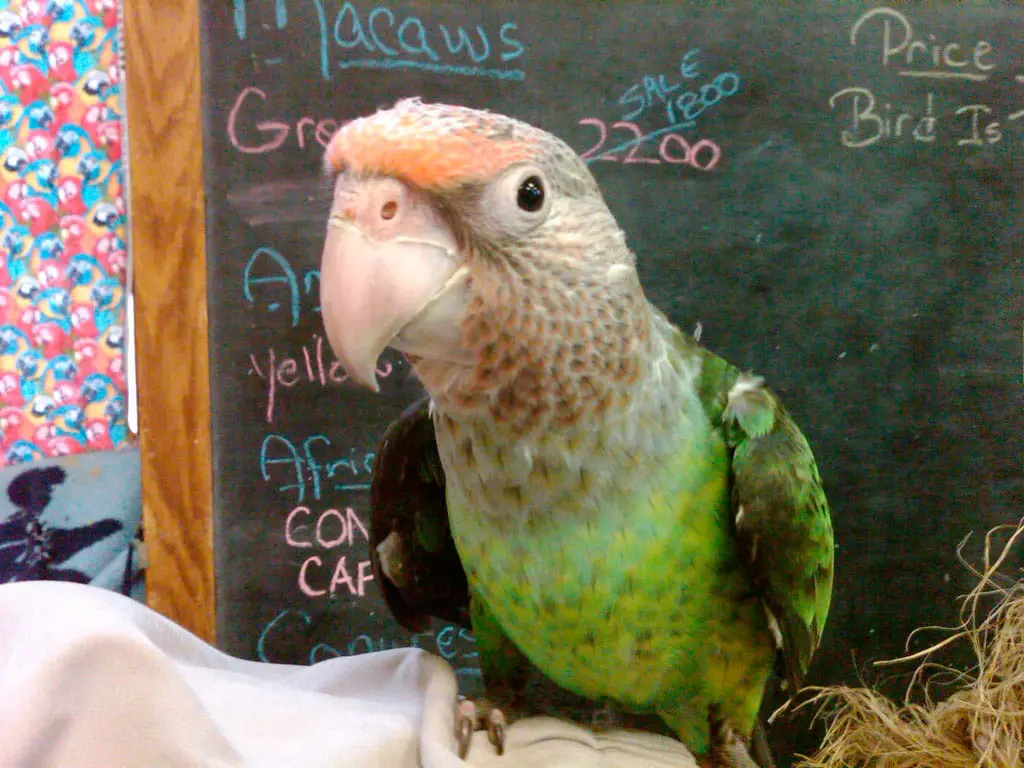
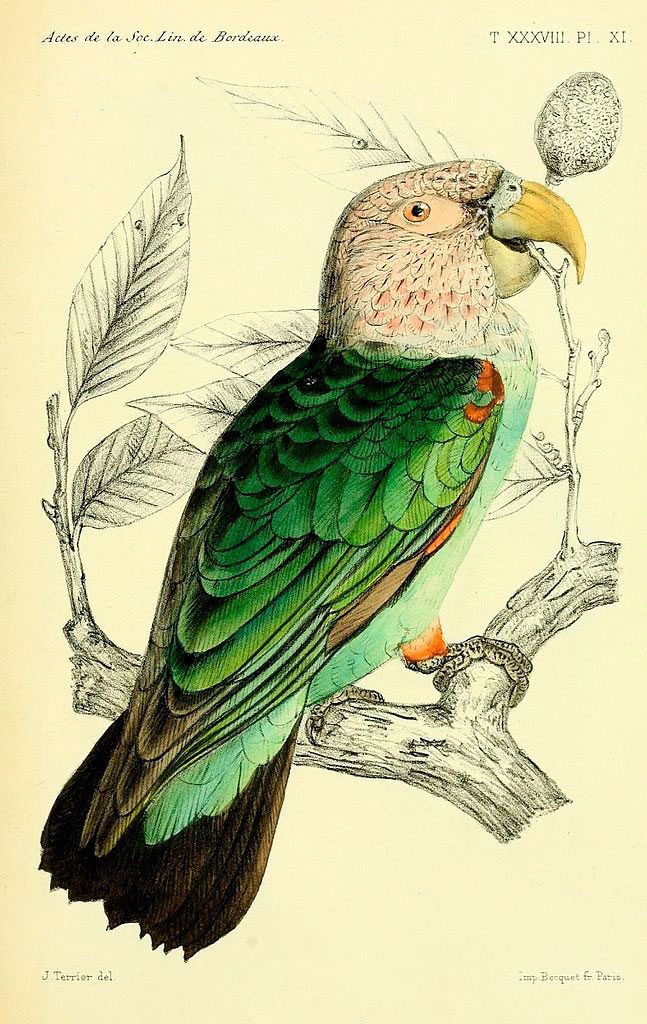
The Brown-necked Parrot (Poicephalus fuscicollis) has a plumage variable; head and gray to brown "neck" / light pink, slightly festooned with orange / brown; band orange / red through crown on female (absent in the males); back and wings, dark green; rump and underparts, green; the thighs, bend of wing and the carpal edge, red / orange; tail black / brown; irises dark brown; eye ring white / grey; bill color horn.

Immature with the head and the neck, green to yellow / brown; body dark green / oliva.

Taxonomic status:

In a study initiated in 1992, the taxonomic status of Lorito was revised Robusto (Poicephalus robustus) (Gmelin), and two species were proposed; Poicephalus robustus, restricted to montane forests of southern Africa, Poicephalus fuscicollis suahelicus, with wider distribution in wooded areas, and Poicephalus fuscicollis fuscicollis, similar to the Poicephalus fuscicollis suahelicus ostensibly, but with discontinuous, restricted to a narrow range of forests and West Africa.

Description 2 subspecies:

  • Poicephalus fuscicollis fuscicollis

    (Their Robust de Kuhl) (Kuhl, 1820) – Nominal.


  • Poicephalus fuscicollis suahelicus
  • Poicephalus fuscicollis suahelicus

    (Gray-headed parrot) (Reichenow, 1898) – With a plumage variable; head and neck silver / grey, festoneado slightly orange / brown; band orange / red through crown on female (absent in the males); back and wings, dark green; rump and lower partess, green / blue ; the thighs, bend of wing and the carpal edge, orange / red; tail black / brown; irises dark brown; eye ring white / grey; bill color horn.

Habitat:

Usually, prefers habitats of forests, as Mopane (Colosphermum mopane), miombo (Brachystegia) and riparian forests.

Most populations are residents but in the dry season become nomads, wandering in search of food.

Reproduction:

Nest in natural cavities of trees, usually on the trunk or at the bottom of a branch. The laying is of 2-4 eggs, they are incubated only by the female during 28-30 days. The male contributes to providing food for the female and chicks. Them They learn to fly when they have a 68-83 days old, only become fully independent 4-5 months later.

Food:

It feeds almost exclusively on fruit, mainly foraging in the upper canopy, using its beak to climb branches. The following foods have been recorded in your diet:

โ€ข Sclerocarya birrea (Marula)
โ€ข Pseudolachnostylis maprouneifolia (Kudu-berry)
โ€ข Commiphora mollis (Velvet cork)
โ€ข Xanthocercis zambesiaca (Nyala tree)
โ€ข Terminalia (cluster leaves)
โ€ข Gmelina arborea (Melina)

Distribution:

It is distributed from South Democratic Republic of the Congo and Tanzania until Zambia, Angola, Malawi and South of Africa; It is rare in the Caprivi Strip (Namibia), North of Botswana, Zimbabwe, Mozambique, the Limpopo and Southeast of South Africa.

Distribution 2 subspecies:

  • Poicephalus fuscicollis fuscicollis

    (Kuhl, 1820) – Nominal. It inhabits most forests including mangroves and can be found in West Africa, from Gambia and South of Senegal to the North of Ghana and Togo.


  • Poicephalus fuscicollis suahelicus

    (Reichenow, 1898) – Is located in South Africa, North of Zimbabue, Mozambique, areas Namibia, Angola, Zambia, North of Tanzania, Burundi, Rwanda and the southern part of the Sudafrican republic.

Conservation:


minor concern


โ€ข Current category of the Red List of the UICN: Least concern.

โ€ข Population trend: Decreasing.

This species has a extremely large range and therefore it is not close to the thresholds for Vulnerable under the criterion of size range (Extension <20,000 km2 combinada con un tamaรฑo de rango decreciente o fluctuante, extensiรณn o calidad de hรกbitat o tamaรฑo de poblaciรณn y un pequeรฑo nรบmero De lugares o fragmentaciรณn severa). A pesar de que la population trend appears to be declining, do not believe that the decline is fast enough for approaching the threshold of vulnerable under the criterion of population trend (> 30% decline in ten years or three generations). The population size has not been quantified, but it is not believed to be close to the thresholds for Vulnerable under the criterion of population size (<10.000 individuos maduros con una disminuciรณn continua estimada> 10% in ten years or three generations or a population structure). For these reasons, the species is evaluated as least concern.

Local and mostly uncommon throughout the range, Although more numerous and frequent in Ghana. South Subspecies considered vulnerable in South Africa where, although the erratic movements give the impression that the population fluctuates, It has suffered a decline due to the capture of the LBMs, the habitat destruction and persecution by farmers of pecan nuts; There are only fragmented patches of native vegetation. Generally rare or rare across West Africa (except Ghana).

We know very little about the biology on the loose subspecies Poicephalus fuscicollis suahelicus.
Although it has a very wide distribution area and is not classified as threatened, an analysis of the UICN and CITES recorded significantly high trafficking of Poicephalus robustus (including the Poicephalus fuscicollis suahelicus) between 1991 and 1995, It is involving a risk to natural populations. The lack of data on the ecology and behavior of this species restricts the establishment of the necessary conservation measures to effectively protect and manage the populations..

"Brown-necked Parrot" in captivity:

It easily adapts to captivity and is seen in the pet trade.

Alternative names:

Brown-necked Parrot, Angola Brown-necked Parrot, Brown-necked Parrot (Brown-necked), Gambia Brown-necked Parrot, Uncape Parrot (English).
Perroquet ร  cou brun, Perroquet ร  cou brun (nominal), Perroquet ร  cou brun (nominale), Perroquet ร  cou brun (race nominale) (French).
Graukopfpapage (German).
Brown-necked Parrot (Portuguese).
Loro de Cuello Marrรณn, You You Fuscicollis (espaรฑol).


scientific classification:

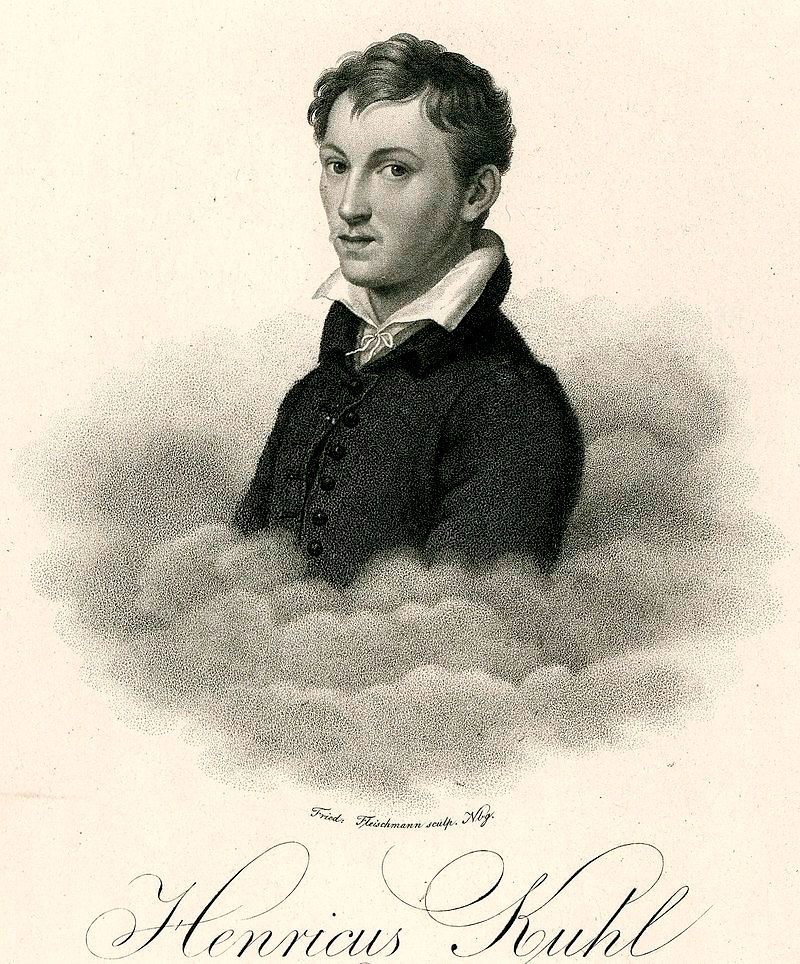
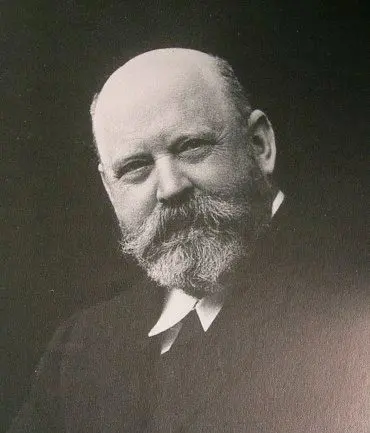
Kuhl, Heinrich
Heinrich Kuhl

Order: Psittaciformes
Family: Psittacidae
Genus: Poicephalus
Scientific name: Poicephalus fuscicollis
Citation: (Kuhl, 1820)
Protonimo: Psittacus fuscicollis


Images "Brown neck parrot":

Poicephalus [robustus or fuscicollis] suahelicus

Poicephalus [robustus or fuscicollis]

Poicephalus [robustus or fuscicollis] suahelicus

Poicephalus [robustus or fuscicollis] suahelicus

Videos "Brown-necked Parrot"

"Brown neck parrot" (Poicephalus fuscicollis)


Sources:

Avibase
– Parrots of the World โ€“ Forshaw Joseph M
– Parrots A Guide to the Parrots of the World – Tony Juniper & Mike Parr
– Birdlife
Parrots.org

Photos:

(1) – Youth, captive, friendly Poicephalus robustus fuscicollis by Bob CorriganFlickr
(2) – Brown-necked Parrot By Tremeau de Rochebrune, Alphonse [CC BY 2.0 or Public domain], via Wikimedia Commons

Sounds: Peter Boesman (Xeno-canto)

โ–ท The world of Pets: Dogs, cats, birds, reptiles, amphibians

Chatham Parakeet
Cyanoramphus forbesi

Chatham Parakeet

Content


Anatomy-parrots

Description:

23 cm. length and 95 g. of weight.

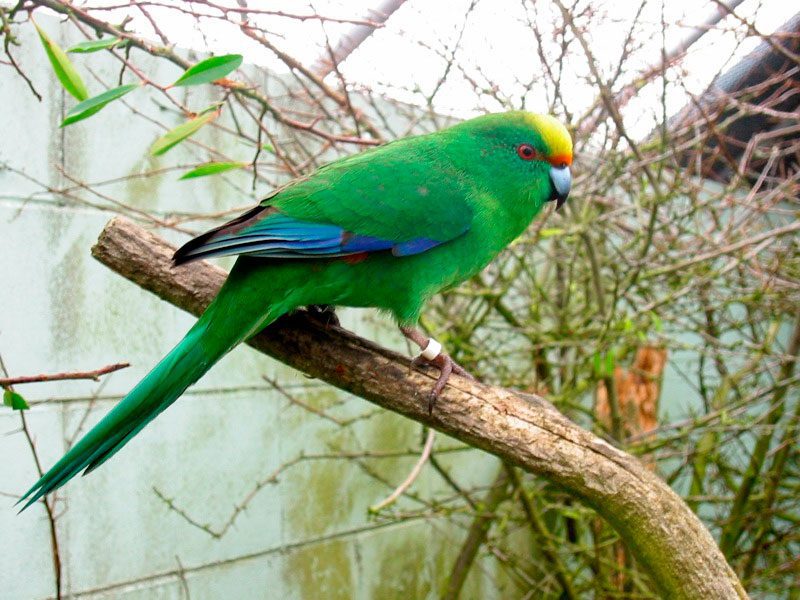
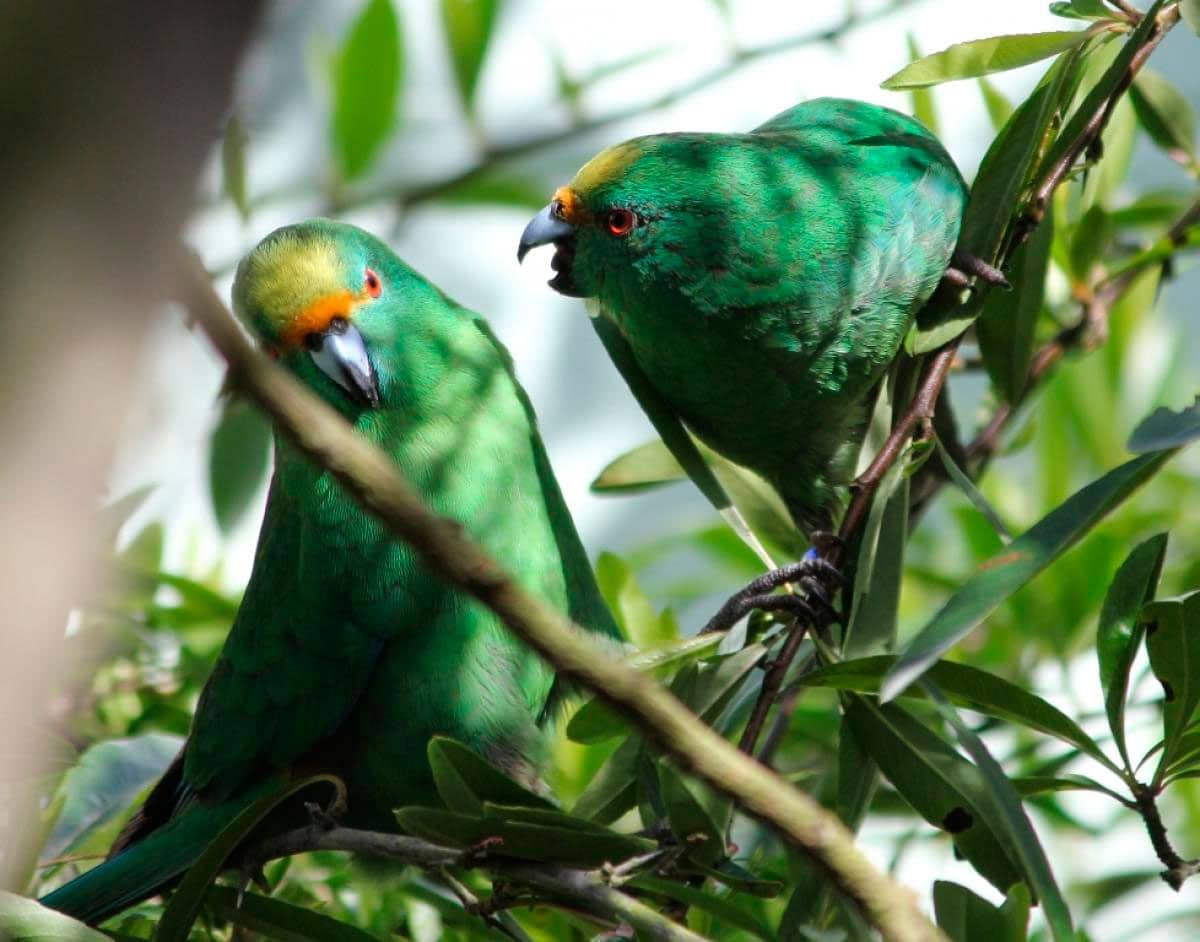
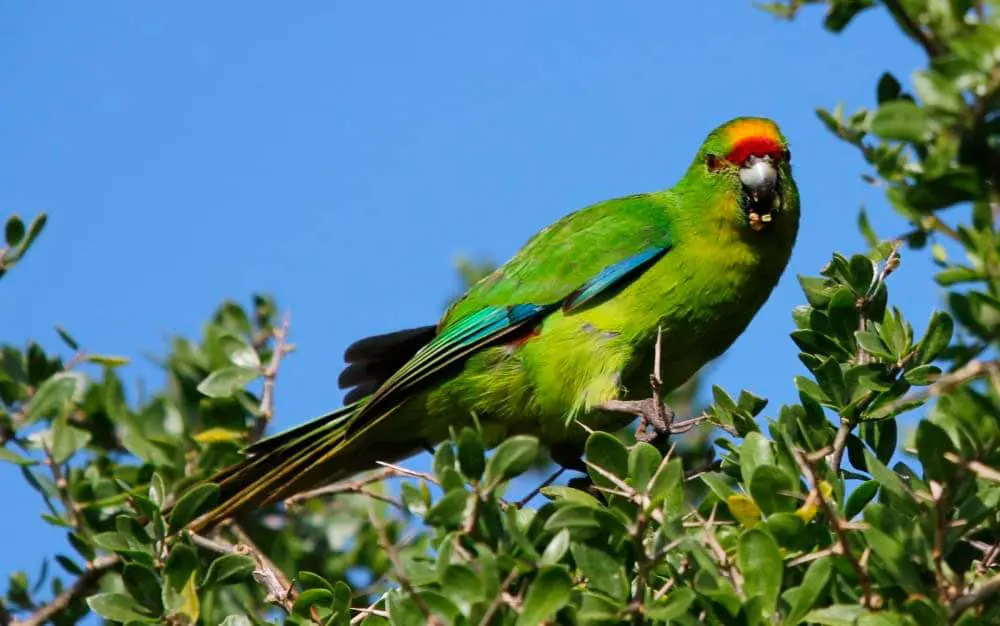
The Chatham Parakeet (Cyanoramphus forbesi) They are one of the two medium bright green parrots of Chatham Islands. Although they look very similar to those Yellow-crowned parakeet (Cyanoramphus auriceps) of New Zealand continental, the color of the crown is not a reliable indicator of taxonomic relationships.
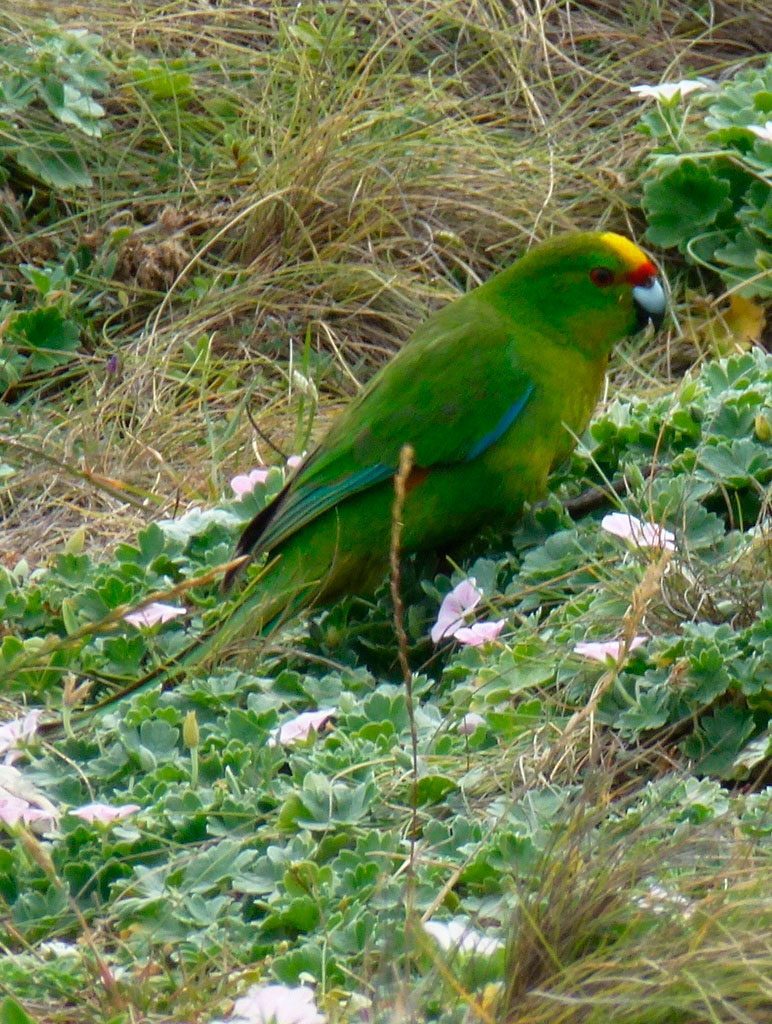
It believes that the Chatham Parakeet descended from an ancient lineage of parrots who reached the Chatham Islands before the division Yellow-crowned parakeet and Red-crowned parakeet happened in New Zealand continental, after which the Red-crowned parakeet (Cyanoramphus novaezelandiae) also they colonized Chatham Islands.

The Chatham Parakeet They are medium-sized parrots, of tail long, with wings wide and rounded and plumage predominantly emerald. have a crown bright yellow front and a crimson front band that does not reach to the eyes, unlike in the Red-crowned parakeet. Males are larger than the females.

taxonomy:

Since 1930 is commonly treated as a subspecies of the Yellow-crowned parakeet (Cyanoramphus auriceps), and clearly the two are closely related; the species differ, However, in size considerably, It is larger species Cyanoramphus forbesi. Currently considered Monotypic.

Habitat:

The Chatham Parakeet They are at higher densities in forests and dense vegetation regenerating areas than in open grassland. Despite its rather erratic flight, They fly hard and move easily between islas Mangere and little Mangere. Occasionally they have been observed Chatham Parakeet individual in the forests of southern Chatham Island (> 20 km from the Mangere Island) and nearby islands Pitt and owner. Their social behavior is similar to other species of parakeets Cyanoramphus. They are strongly territorial around nests, calling loudly and chasing intruders from nearby.

Reproduction:

The Chatham Parakeet have a long breeding season, with eggs laid between October and March. Son nesters cavity, preferring tree holes but also using rock crevices and under dense vegetation. The size medium of laying is of 5 eggs. Like all the other parakeets Cyanoramphus, females are responsible for preparing the nest, incubation, rearing and feeding the chicks until the 10-14 days old. During this period all your food is provided by your partner.. From then on, male and female parrots feed the chicks in the nest until they leave the nest.

The incubation usually begins after the start of the second egg, resulting in chicks within a clutch that vary greatly in age and size. The last chicks to hatch are usually born at a younger age and are less developed than their older brothers.. More than one brood may be attempted if the initial nest fails or if the food supply allows..

Food:

The foods consumed by Chatham Parakeet They are affected by seasonal availability, and include seeds, flowers and leaves of various plants, It is the most important invertebrates in spring. They feed extensively in soil in open areas.

Distribution and status:

Sw extension of its distribution area (reproduction / resident): 3 km2

The Chatham Parakeet It is restricted to of Tapuaenuku ISLA ISLA Pequeรฑa Mangere and Mangere in the Group of chatham islands, New Zealand. In 1930 He quenched in Mangere Island, but in 1973 had recolonized and numbered 40 birds and a small number of hybrids with the subspecies Cyanoramphus novaezelandiae chathamensis (of which there were 12 on the island) (Higgins 1999).

In 1996, two estimates indicated that the population of the Mangere Island It was from 50 to 120 Purebred birds. The population on the small island of little Mangere It is little known because the few visits made (H. Aikman a slightly. 1999). In 1999, it was estimated that the total population was about 120 birds (Aikman et al. 2001), but studies 2003 estimated 900 individuals on Isla Mangere (Aikman y Miskelly 2004, D. Houston y C. Miskelly a slightly. 2008).

A recent study estimated that more than 50% of the population of parakeets in Isla Mangere consisted of individuals hybrids (Chan et al. 2006), but this is expected to decrease due to mating positive range (T. Greene a slightly. 2012); the number of phenotypes forbes It is approaching the threshold management 10% (D. Houston a slightly. 2012) (that is to say, the number above which culling can be resumed as a management tool). There have been birds visiting South isla Chatham, the Pitt island and ISLA ISLA Chief of Sudeste (Taylor 1998, D. Houston y C. Miskelly a slightly. 2008, T. Greene a slightly. 2012).

Conservation:


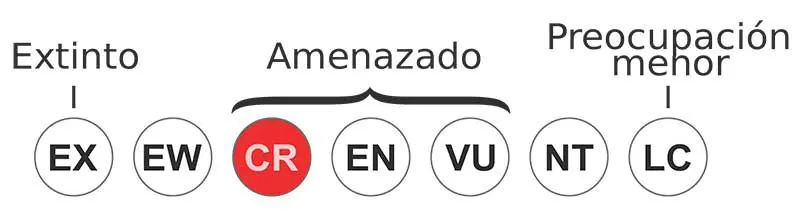
Vulnerable


โ€ข Current category of the Red List of the UICN: Vulnerable.

โ€ข Population trend: Stable.

โ€ข Population size : 250-999 individuals.
Rationale for the Red List category

This species may still have a small purebred adult population.. Possible removal by hybridization has been avoided thanks to three decades of conservation efforts, which they have seen increasing population size. It is restricted to one place (given the proximity of the small islands that lives and mobility), and its small population size means it still deserves to be listed in a threatened category, but it is likely that their population size has been more than 250 mature for more than 5 years, so it has been transferred to the category of Vulnerable.

Justification of the population

The population of phenotypes similar to those of Forbes It has increased dramatically in the Mangere Island, with the best estimates placing the population between 800 and 1.000 individuals. A survey in 2011 It assessed that the phenotypes of interest are in the 10%, the trigger level for management action (D. Houston a slightly. 2012). It is likely that populations have exceeded 250 mature for more than 5 years, so now it is in the range of 250-999 mature individuals.

Justification trend

The population has shown minor fluctuations in recent years, since the species recolonized the Mangere Island over the years 70 and it has benefited from habitat restoration, while hybridization has also suffered. In general, It is estimated that the population has remained stable for the last ten years, and It is probably increasing (T. Greene a slightly. 2012).

Threats

โ€ข Disappeared from Mangere Island due to a combination of deforestation for grazing, decades of burning, the effects of introduced grazing mammals and predation by feral cats (Higgins 1999).

โ€ข The greatest current threat is the hybridization with the Cyanoramphus novaezelandiae chathamensis, subspecies Red-crowned parakeet (Cyanoramphus novaezelandiae) What, despite the sacrifice, still it is settling in Mangere Island (J. Kearvell a slightly. 1999).

โ€ข It is believed that the rate of hybridization High above is the result of the then low population sizes of the two species (D. Houston y C. Miskelly a slightly. 2008).

โ€ข The levels of hybridization They have remained below 10% of the total population of parakeets Mangere Island over the last decade, so no management intervention was not necessary.

Conservation Actions Underway

โ€ข Appendix I and II of CITES. The Mangere Island It has been substantially replanted (Aikman et al. 2001, D. Houston y C. Miskelly a slightly. 2008).

โ€ข An ecological and genetic research program has investigated population dynamics, the hybridization and selection of partners (H. Aikman a slightly. 1999, Chan et al. 2006).

โ€ข During 1976-1999, hybrid birds and individuals of the subspecies Cyanoramphus novaezelandiae chathamensis They were sacrificed population (Nixon 1994).

โ€ข In 1998, 40 hybrids And six Cyanoramphus novaezelandiae chathamensis were killed, leaving 10 copies between hybrids and Cyanoramphus novaezelandiae chathamensis after the operation (H. Aikman a slightly. 1999).

โ€ข Surveys of the relative proportion of hybrids regarding type phenotypes Forbes They are held every two years (D. Houston a slightly. 2012).

โ€ข The translocation a fenced area predator proof in Chatham Island It is planned for 2017 (D. Houston a slightly. 2012).

Conservation Actions Proposed

โ€ข Complete the investigation ecological, biological and genetic, including analysis and dissemination of results.

โ€ข Monitor trends in the extent and quality of forest habitats on the island of Mangere.

โ€ข Restore forest habitats Mangere Island to increase the number and reduce the hybridization.

โ€ข Work for the establishment of one or more populations in the Chatham Island (H. Aikman a slightly. 1999).

"Chatham Parakeet" in captivity:

There are no data from Chatham Parakeet in captivity.

In the wild, its lonjevidad is probably similar to that of Yellow-crowned parakeet (Cyanoramphus auriceps): 10 years.

Alternative names:

Chatham Island Yellow-crowned Parakeet, Chatham Islands Parakeet, Chatham Parakeet, Forbes’s Parakeet (English).
Kakariki de Forbes, Kakariki des รฎles Chatham, Perruche des Chatham, Perruche des รฎles Chatham (French).
Chathamsittich (German).
Periquito-de-peito-amarelo-da-Ilha-chatham (Portuguese).
Perico de las Chatham (espaรฑol).

scientific classification:

Lionel Walter Rothschild

Order: Psittaciformes
Family: Psittaculidae
Gender: Cyanoramphus
Scientific name: Cyanoramphus forbesi
Subpoena: Rothschild, 1893
Protonimo: Cyanorhamphus [sic] forbes

"Perico de las Chatham" images:

Perico-de-las-Chatham

Sources:

โ€ข Avibase
โ€ข Parrots of the World โ€“ Forshaw Joseph M
โ€ข Parrots A Guide to the Parrots of the World – Tony Juniper & Mike Parr
โ€ข Birdlife
โ€ข Greene, T.C. 2013 [updated 2017]. Forbesโ€™ parakeet. In Miskelly, C.M. (ed.) New Zealand Birds Online. www.nzbirdsonline.org.nz

Photos:

(1) – Chatham Islands Parakeet on Mangere Island by Markanderson72 [CC BY-SA 4.0], from Wikimedia Commons
(2) – Andrew Sutherland, IBC1065693. Photo of Chatham Parakeet Cyanoramphus forbesi at Chatham Islands, New Zealand. Accessible at hbw.com/ibc/1065693.