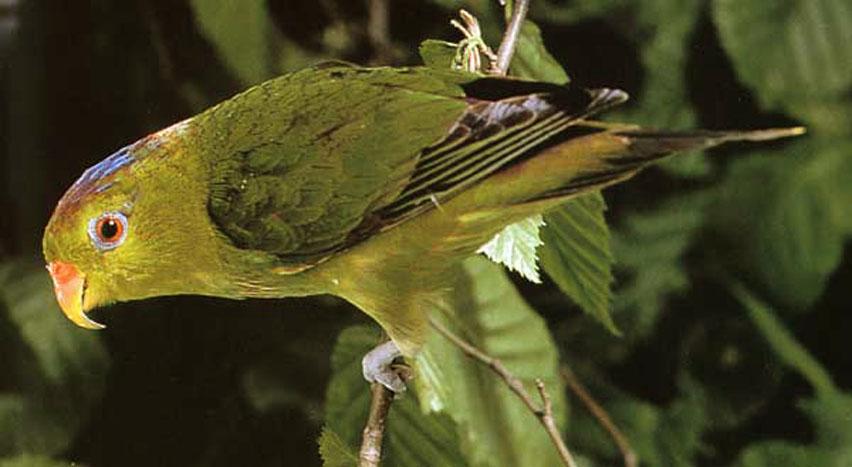
The Pygmy Lorikeet(Charmosyna wilhelminae) has an approximate length of 13 cm.. and a weight of 20 g..
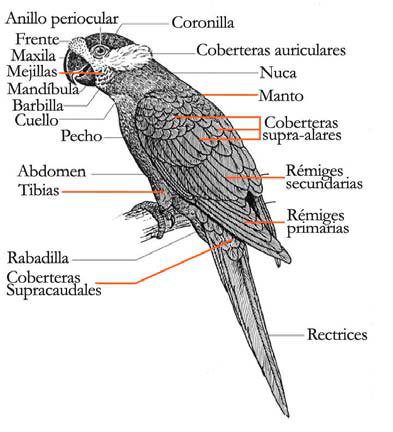
The head is green; the forecrown brighter yellowish green; crown dark purple, with broadcast Blue in them tips and color turquoise bright in the feathers of the nape; rear of the nape with wash of olive. Mantle green; low back and tail reddish color; at the top, the tail purple blue. The wings, by up green with parts internal of the flight feather Blackish and blackish the primary coverts. The wings below rosa-salmon; Tips from the flight feather blackish. The underparts Green yellowish with prominent veins on the chest. Upper, the tail green, Red at the base (normally hidden in the field); olive brown below with red and yellow tips on the base. The bill reddish orange-tipped yellow; cere color red pink; Grey the ringperioftalmico; irises yellow to orange-red; legs light grey.
Female lack of red on it rump and in the wings view in flight. Immature generally more muted and upperparts slightly more Brown. Lacks blue at the tips of the feathers of the nape. Yellow stripes on the top of the chest less distinct or absent. The bill and the irises brown.
Habitat:
Mainly inhabits in humid forests and on the edge of forests, but also by forest savanna and established secondary vegetation. It is usually between the 1.000 meters of altitude and the 2.200 m, but in the South and around Port Moresby It is occasionally much closer to sea level, in the forests of lowlands. It forages in couples and small flocks of up to 20 birds in the trees in flower, often in the company of Goldie's Lorikeet and Fairy Lorikeet. Very Active When it feeds and, often difficult to identify due to its size and predominantly green plumage. It is not uncommon, but easily overlooked. and has been found in groups of up to 200 individuals. It has often been seen flying in mixed flocks above the canopy, where they can hardly be identified due to their small size.
Reproduction:
Breeding and nesting habits unknown.
Food:
Feeds of nectar and pollen.
Distribution:
Size of the area of distribution (reproduction / resident): 290.000 km2
North of New Guinea in Irian Java (Indonesian) and Papua New Guinea. The range of the Mountains Parotia on doberai peninsula, in the West of the island of New Guinea, through the cordillera central, the Huon Peninsula, and South-East of the mountain range of Owen Stanley. In the immediate vicinity of Port Moresby (for example, area Sogeri) There is little (but possibly regular between May and November).
The population world will think that is of less than 50.000 specimens and is considered to be stable. There are few in captivity.
Conservation:
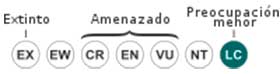
• Current IUCN Red List category: Least concern.
• Population trend: Stable.
The size of the world population It has not been quantified, but the species according to sources is generally very rare.
The population suspected to be stable in the absence of evidence of any reduction or substantial threats.
"Pygmy Lorikeet" in captivity:
Rare.
Alternative names:
– Pygmy Lorikeet, Pygmy Streaked Lorikeet, Pygmy Streaked Lory, Wilhelmina’s Lorikeet, Wilhemina’s Lorikeet (ingles).
– Lori de Wilhelmina (French).
– Elfenlori (German).
– Lori Pigmeo (español).
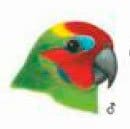
The head of the Great hanging parrot(Loriculus stigmatus) is bright green, with bright red crown ending in a clear line across the rear of the crown not extending over the nape.
Green upperparts, lightly impregnated with yellowish-orange in the mantle; rump and uppertail coverts dark crimson. green wings; edge of the carpal bones with small red mark. The underwings of turquoise blue with small green coverts. The lower parts of bright green with red stripe below the Chin and throat Center. Upper, the Green tail; light blue below.
the black beak; pale-yellow IRIS; Pink-Orange legs.
Females lack Red Crown and has a narrow red bib; Iris can be darker.
Young birds lack the Red Crown, It has a bib less clear and more yellowish, yellow edges of the Carpus, and in general a duller Green.
Slight differences in the degree of the orange-yellow colour in the mantle of some populations of the island are not considered sufficient to differentiate them.
• Loriculus stigmatus stigmatus : The nominal.
• Loriculus stigmatus croconotus
• Loriculus stigmatus quadricolor
Habitat:
Little is known about the ecology of the species.. Possible seasonal movements have been observed. According to reports, not found in old-growth forest and most common along forest edges, in the open field, and sometimes around urban centers, until 1.000 meters above sea level. Birds move usually alone or in pairs, whether it is flying above or feeding on the trees in flower. Nest-holes in thick bamboo have been recorded.
Reproduction:
Reproductive activity has been reported in February, from April to June, and in August and October
The Great hanging parrot nests in cavities. It usually lays three eggs. The female incubates the egg during 20 days and after hatching the chicks take time to develop 33 more days
– Current IUCN Red List category: Least concern
– The population trend: Stable
The size of the world's population has not been quantified, Although it is estimated above 100.000 specimens. The species is reportedly common and widespread in most of its range. (pit et to the. 1997).
The population is suspected to be stable in the absence of evidence of any reduction or substantial threats.
"Great hanging parrot" in captivity:
Rare.
Alternative names:
– Sulawesi Hanging-Parrot, Black-billed Hanging-Parrot, Celebes Hanging Parrot, Celebes Hanging-Parrot, Celebes Spotted Hanging-Parrot, Great Hanging Parrot, Maroon-rumped Hanging-Parrot, Red-capped Hanging-Parrot, Sulawesi Hanging Parrot (ingles).
– Coryllis des Célèbes (French).
– Rotplättchen, Rotlättchen (German).
– Lorículo do Célebes (Portuguese).
– Lorículo Celebiano, Lorículo de Célebes (español).
– Avibase
– Parrots of the World – Forshaw Joseph M
– Parrots A Guide to the Parrots of the World – Tony Juniper & Mike Parr
– Birdlife
– Photos:
(1) – By Lip Kee Yap [CC BY-SA 2.0], via Wikimedia Commons
(2) – male perched. by iggino – lynx
(3) – Birds-pet-wallpapers – link
(4) – male hanging by iggino – lynx
(5) – By F. Schulter – papageien.org
13 to 16 cm.. length and a weight between 25 and 56 g..
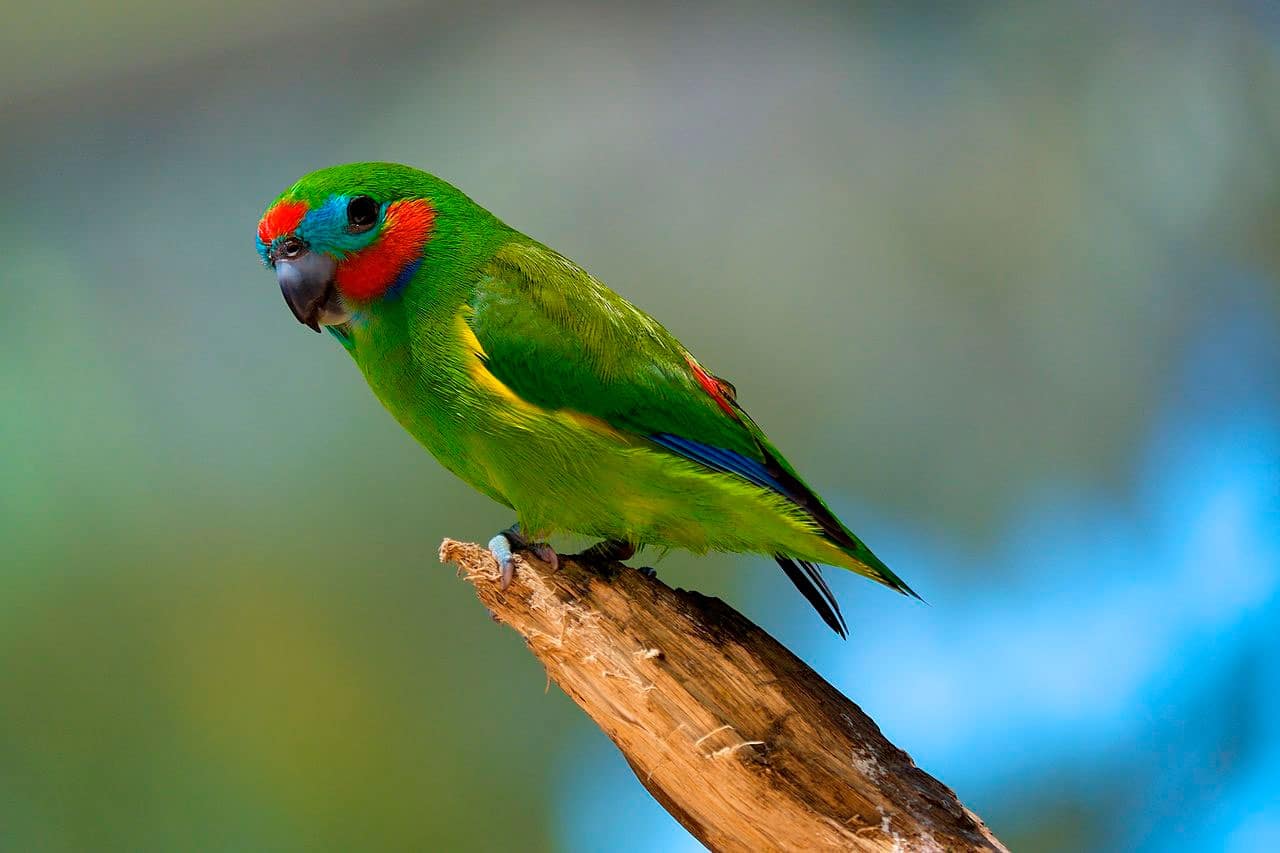
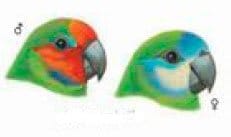
The Double-eyed Fig-Parrot(Cyclopsitta Diophthalma) half of the crown, lores, cheeks and headphones feathers bright Scarlet color with some slightly elongated feathers; bright turquoise brand above and in front of the eyes, that it extends slightly backwards above and below; green line above and behind the eyes; brand violet-blue light under the red on the back of the headphones feathers that extends to the throat; narrow yellowish Orange behind the red band of the crown, Fusion to the green in the part back from the crown.
Upperparts with indistinct diffusion of color bright green olive on the the mantle. Wing coverts, bright green; primary coverts blue; primaries with vane external of color blue turquoise pale and vane blackish internals; flight feather (except the primary outer) with band of yellowish white color visible from below; inner coverts marked in red, wing feathers bordered with yellow green.
The underparts paler; Green over yellow that the upperparts, with a strong Flash of yellow along the flank, about the bend of wing. Upper, the tail green; grey below.
Robust bill, notched grey lead and a blackish tip; cere dark grey; irises dark brown; legs Green grey.
The female has the cheeks brown, not red.
Immature as the females. The young male acquire the plumage adult in 14 months.
: (Schlegel, 1874) – Of 14 cm.. length. The plumage is greenish-yellow, the blue area on the eyes has greenish hue , Blue cheeks are lined with mauve colouration and extends to the bottom of the peak.
Female similar to the male but all the red marks are replaced by a pale blue.
Cyclopsitta diophthalma coccineifrons
: (Sharpe, 1882) – Of 14 cm.. length.
It is usually something more dark. The Crown is red bordered with a broad yellow band.
The female has less yellowish white.
Cyclopsitta diophthalma virago
: (ECTION Hartert, 1895) – Of 14 cm.. length.
Green is more pale, the red zones of the face are less extensive and more pale.
Yellow edge of the very weak Crown.
Juveniles as adult females
Cyclopsitta diophthalma inseparabilis
: (ECTION Hartert, 1898) – Of 14 cm.. length.
The Red coloration is reduced to a small spot on the forehead, the rest of the forehead is bluish.
Similar to males females.
Juveniles as adult females.
Cyclopsitta diophthalma macleayana
: (EP Ramsay, 1874) – Of 14 cm.. length.
The Red is reduced to a red spot in the front area and lower cheeks. The yellow border in the area of the Crown is absent, sides of the forehead and eyes blue with green. The azul-violaceos edges of the cheek extends to below the peak.
Females more yellowish and the bottom of the cheeks is white Brown.
Equal to the adult female juveniles.
Cyclopsitta diophthalma marshalli
: (Iredale, 1946) – Of 14 cm.. length.
Green is more beige and the azul-malva coloration extends to the area under the peak.
Females have pale blue color where the male has red and blackish brown cheek bottom area.
Juveniles as adult females.
Cyclopsitta diophthalma coxeni
: (Gould, 1867) – It's a bit more large, of about 15 cm.. approximately, No red forehead and face with some reddish feathers, the cheeks and orange headphones feathers. Blue front clear and without yellow stripe. The area of the eyes is absent blue. Blue edges of the bottom of the cheeks is variable.
The females are more yellowish with less or absent red in the face.
Equal to the adult female juveniles.
Habitat:
The Double-eyed Fig-Parrot are sedentary, with some dispersion after the breeding season. It is in a range of habitats from low to medium altitude, including jungle, secondary vegetation, on the edge of the Woods, riparian forest and occasionally dry forests and open forests of eucalyptus.
In Australia There are also birds in parks, Gardens, scrub, cultivated areas and mangroves; the Diophthalma diophthalma coxeni, probably, concentrated in the alluvial forest, but it was also visible in the forests of dry lowlands and hills of rainforest.
The species is highly dependent of the Ficus figs in all habitats.
The birds are usually found in pairs or in small groups, calling the attention with their constant calls acute while flying above the canopy.
They feed in silence, moving quietly through the foliage, often giving away their presence only by falling debris, Since break the shell of the fruit to reach its seeds.
outside the breeding season, groups of up to 200 birds can be nested together, dissolving into smaller groups to feed themselves during the morning and afternoon.
When alarmed, they move their wings in an agitated manner.
during the rains, the bath is carried out with wet foliage, and mutual grooming is common.
Reproduction:
The breeding season of the Double-eyed Fig-Parrot, probably begins in New Guinea during the month of March, in Australia the main season runs from August to November.
When the birds are played are divided into pairs, territorial around their food trees. The nest It is a cavity that is expanded in a trunk at a height between 8 and 20 meters above the ground. Most of the nest preparation is carried out by the female., that takes refuge in the hole and spends a large part of the day there during its excavation. She can experiment with more than one nest.
Courtship feeding is common. The entrance hole is about 4 cm in diameter, and putting two white eggs are deposited, at intervals of 48 hours, in one camera, some 20 centimetres below the entry hole.
The incubation hard 18 days and the young will leave the nest in 7-8 weeks, After having been fed during the first 3 to 4 weeks, only for the female. They return to settle in the hollow for a short period of time after having left the nest.
Food:
The fig seeds they are their main food, birds often return to the same ripe fruits ending all their seeds. The diet also includes whole fruits small, nectar, insect larvae and fungi or lichens collected from the barks. Birds may feed in groups with others Fig parrots and, in Australia, with Rosella parakeets and other species of parrots.
Distribution:
The Double-eyed Fig-Parrot is distributed throughout much of New Guinea and parts of the northeast of Australia. At the West end is located in Waigeo, Salawati, Misool and Rafiau in the West Papua islands, Indonesian.
Is widespread but distributed unevenly through the continental part of New Guinea, absent only in the center of the Doberai Peninsula and the central belt of mountains above the 1.600 m, Although there have previously been to 1.800 meters at the local level.
In Australia, the most northerly of the three isolated populations, is the tip of the Cape York Peninsula, from Jardine River in the northwest of the country, to the South, around East of Lockhart River, sometimes in the South to the extreme north of the Princess Charlotte Bay; the population Centre occupies the coastal district of everything Cooktown in the North through Cairns and the District Atherton, about South of Townsville; the southern-most population, now very reduced, with less than 50 records in the last century, formerly extended from Gympie, Queensland, to the South, about Richmond River, New South Wales, arriving inland up to the Bunya mountains (in 1976 two birds were about the Koreelah National Park, in February and two close Lamington National Park in December).
The estimate of the world population is above the 100.000 individuals and stable, but the State two of its subspecies is less secure:
– Cyclopsitta Diophthalma macleayana: has a population of 5.000 individuals and may be in decline, Although multiply in parks and gardens around Cairns.
– Cyclopsitta Diophthalma coxeni: just left 200 birds, After having reduced its population as a result of the destruction of the forests of lowlands along its limited distribution area.
– The third Australian subspecies, Cyclopsitta Diophthalma marshalli it's still pretty common.
In New Guinea, the species dispersed, and is considered to be rare in the Doberai Peninsula and absent from many parts of the lowlands of the South, is mainly distributed in the Highlands of the South basin. The Orange-breasted Fig-Parrot It probably replaces this species in much of this area. It is likely that the species has not been recorded accurately due to its small size and discreet habits. Protected by law in Australia. The Diophthalma diophthalma coxeni appears in the Appendix I of the CITES
Subspecies distribution
Subspecies distribution
Cyclopsitta diophthalma diophthalma
: West of the islands of papua and West of New Guinea
The size of the world population Double-eyed Fig-Parrot It has not been quantified, Although it is estimated at more than 100,000 specimens. But, the Diophthalma diophthalma coxeni is in critical hazard, with a population between 50 and 200 individuals; the Diophthalma diophthalma macleayana with a population of some 5.000 individuals and the Diophthalma diophthalma marshalli generally uncommon
The population, of the nominal species, is suspected to be stable in the absence of evidence of any reduction or substantial threats.
"Double-eyed Fig-Parrot" in captivity:
Rare in captivity.
Not social with people. Welcome in the distance.
Alternative names:
– Double-eyed Fig-Parrot, Double eyed Fig Parrot, Double-eyed Fig Parrot, Two-eyed Fig Parrot (ingles).
– Psittacule double-oeil (French).
– Rotwangen-Zwergpapagei (German).
– Papagaio-do-figo-de-cara-azul (Portuguese).
– Lorito de Cuatro Ojos, Lorito Dobleojo, Lorito de la higuera de doble ojo (español).
27 cm. long, 24 without snowshoes, and a weight between 140 and 160 g.
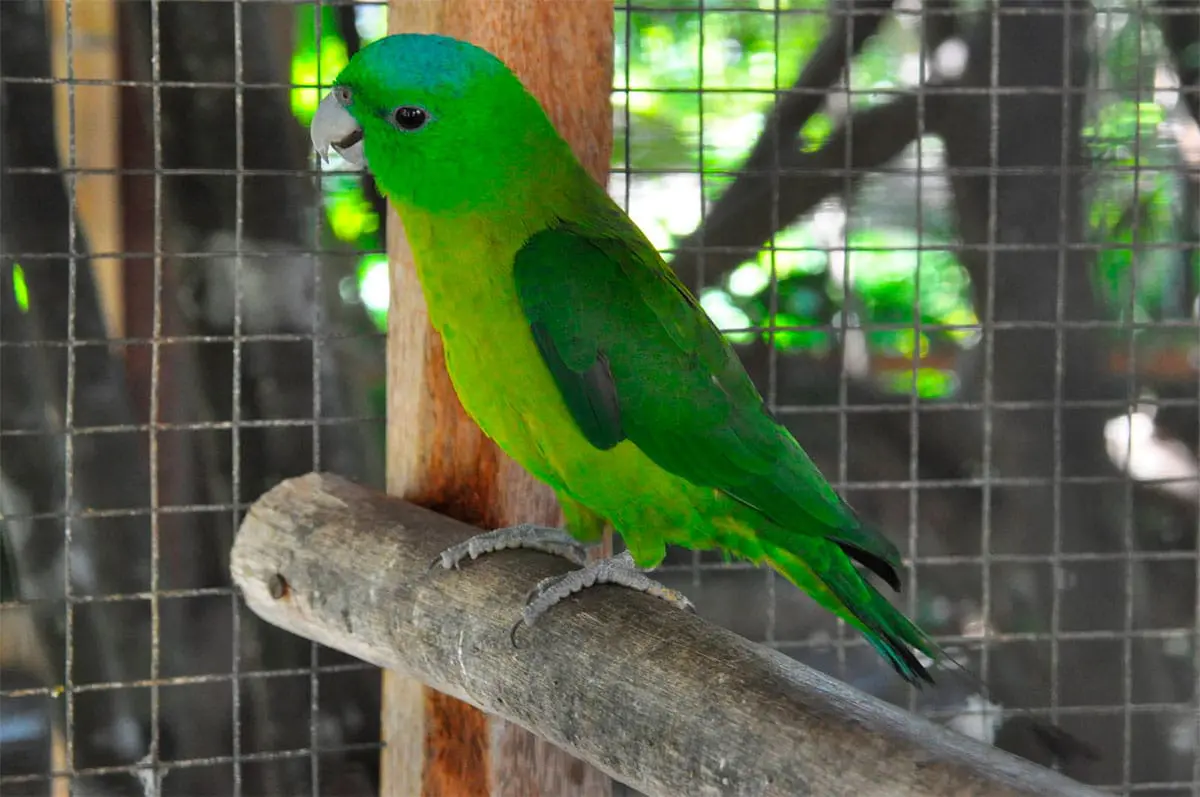
The head of the Blue-crowned Racquet-tail(Prioniturus discurus) bright green is strongly imbued with bright blue in the crown and brighter green in checks and lores.
Upperparts green. Wings green, darker in the vane inmates of the flight feather, with a narrow pale margin along the innermost edge; primary external greenish blue. Wing feathers green, underside of flight feather bluish green. The underparts yellowish-green illuminated. Upper, the lateral feathers of the tail green, Basal Blue with black tips; undertail, the tail strongly impregnated with blue; Blackish spatulas.
Bill whitish; irises dark brown; legs grey.
The female similar to the male but with the the tail rackets shorter.
Young with less blue in the crown and the absence of the rackets.
(Salomonsen, 1953) – Has less blue on the Crown and in the center of this is not clearly defined and merges gradually with the rest of the green of the head.
– Prioniturus discurus and Prioniturus mindorensis (Pit and necklace 2014) they were grouped previously as Prioniturus discurus
Rainforests, mangroves, plantations, crops in the lowlands and mountains to 1.750 meters above sea level. Seen flying above the canopy in small noisy groups of five to twelve birds outside of breeding season. Groups gather to feed in fruit trees, including banana.
Reproduction:
breeding season from April to may in Blacks, During may in Leyte and during April in Mindanao.
Food:
The diet includes fruits, berries, nuts and seeds.
• Current category of the Red List of the UICN: Least concern
• Population trend: Stable
The size of the world population It has not been quantified, is estimated at less of 10.000 specimens. The species according to information, it is generally common even in degraded habitats on heavily deforested islands (pit et to the. 1997).
The population is suspected that it may be in decline due to the capture and loss of habitat.
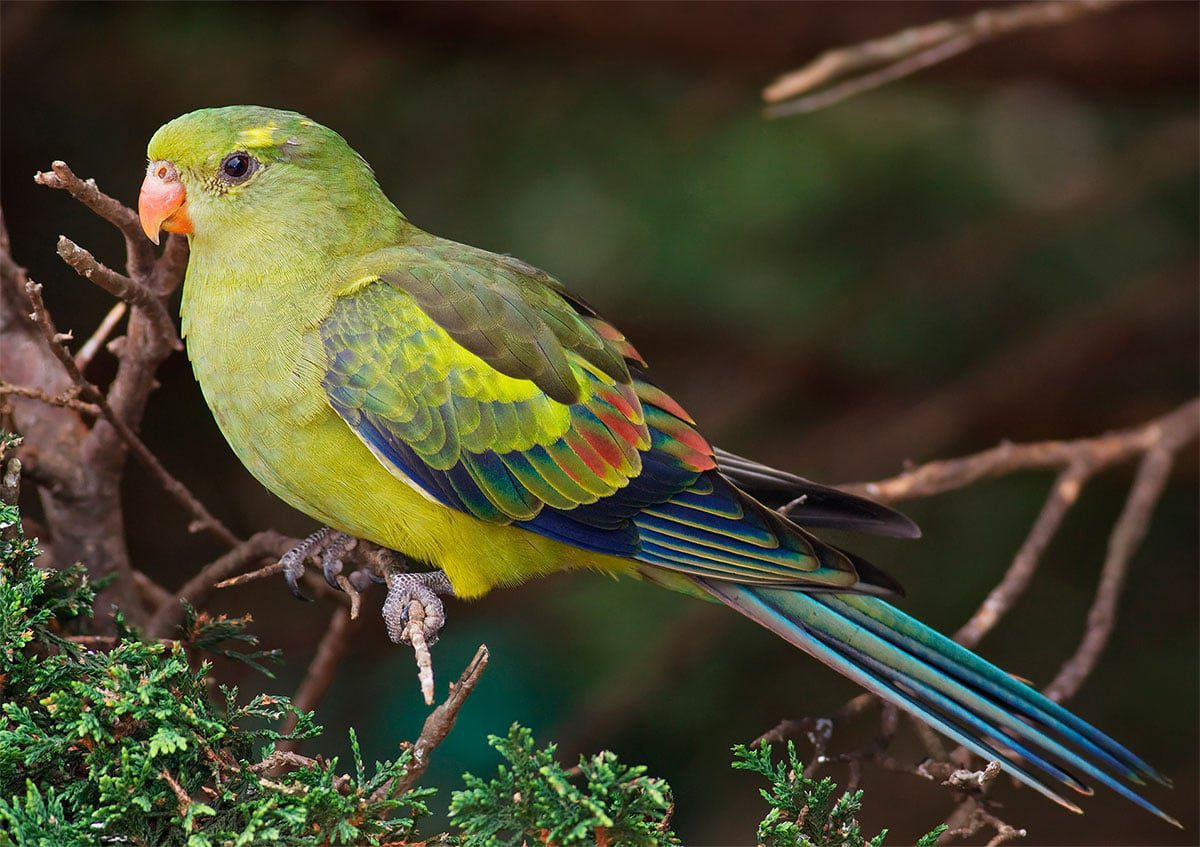
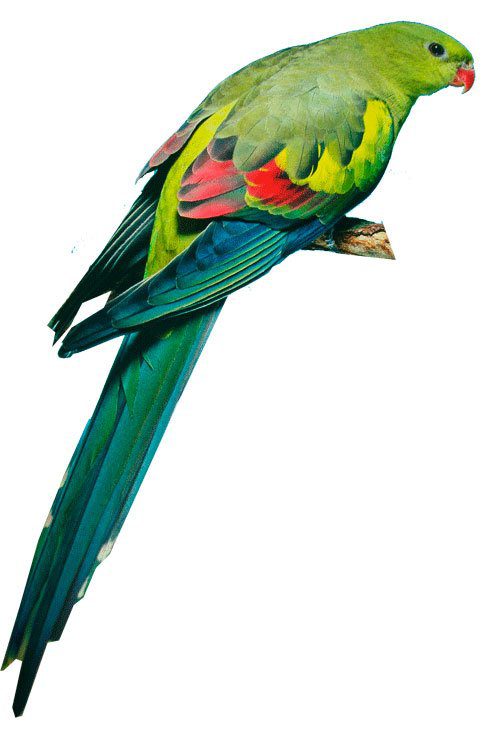
The Regent Parrot(Polytelis anthopeplus) has the yellow head, tending to yellow olive in it crown and nape. Green olive the the mantle; scapulars of color Brown olive dark; floor area of the back and tail showy yellow, tending to yellow olive in uppertail-coverts. Smalls and medium corbeteras, Yellow; greater coverts of color black blue in them pens external, Red with yellow tips on the innermost feathers; tertiary black grey in vane inner; reddish pink, with yellow tip in the vane outer; primary coverts bluish-black; primaries and secondaries bluish-black, with black inner tubes. Wing feathers yellow; underside of flight feather brown, almost black. The underparts Yellow, more off the yellow olive in undertail-coverts with some brands Orange indistinct around it area anal.
The tail is of color black with infiltrations of color blue dark in the part superior of their feathers Central and of the threads internal of their feathers side.
The bill is pinkish-Red. The irises are of color brown orange; legs grey.
The female has the underparts grey and of color green it top. Lords and ear-coverts are of colour more greenish. The strip of color blue dark of the feathers is more broad and it extends to the under wing-coverts that are more than color yellow-green that in the male. The rump is green olive opaque, not yellow. The red dot of the wing
is less developed and has less brightness. Tail of color green blue by over. It has a pink tip below.
The youth they resemble females, However, young males have more yellow in the head.
: (Schodde 1993) – The male has much more brightness that it nominal species, particularly, the yellow of the underparts.
Habitat and habits:
The Regent Parrot they reside mainly in the East, although the birds disperse after the breeding season.
More regular movements have been recorded in the Western population, with spread towards the South during the summer, and a concentration below 32° S in the fall.
The birds move to the northeast in winter; movements of up to 320 km have been recorded. Oriental birds are linked to the banks of the rivers, where is the red rubber (Eucalyptus camaldulensis) trees with mallee Shrublands partners (Eucalyptus gracilis). They are also distributed in forests of eucalyptus, areas with thin Cypress pine (Callitris preissii), orchards and vineyards.
In the West, the species is less dependent from the Mallee and they reside in mixed plots of acacia and eucalyptus (wandoo, salmonophloia) and within agricultural land.
The Regent Parrot they are not in the forests of the South-western area, Although there have been in the forest clearings.
outside the breeding season, the birds can be found in noisy flocks of a hundred or more individuals, being in general cautious. They feed primarily on Earth.
Reproduction:
The nesting season takes place between January and August. These birds nest either in single pairs or in small colonies composed of a maximum of 18 couples. Before the mating, There are ritual offerings of food.
The site selected for reproduction is usually a great tree of the gum dead or dying, to 20 metres above the ground and near a permanent water course. These nests are often reused.
The spawning includes of 3 to 6 white eggs You settle on a layer of decaying wood shavings. The female incubates alone during 21 days. His companion, who deserted the nest tree and joined an all-male group, it comes to collaborate with food tasks. The chicks have white down. Usually, leave the nest after 5 to 6 weeks, but after feather, remain in the family group for a few weeks yet.
Food:
The diet usually comprises seeds of grasses, herbs, fruit, berries, sprouts and flowers. They also take crops of cereals and dried fruits from orchards, as well as grain spilled on highways.
Size of the area of distribution (reproduction / resident): 1.520.000 km2
Confined to Australia, where in two very distant populations. In Western Australia are distributed mainly in the wheat belt, extending north to Ajana, on the inside of Laverton and Karonie, and down in Israelite Bay, on the South Coast; is also located to the South of Perth, but they have not fully colonized the wooded area Southwest.
In the southeast of Australia the range has shrunk in recent years. In the South of Australia, the species occurs along of the murray river, around Morgan at the border of New South Wales, Victoria (seven colonies).
There is some post-breeding dispersal, but the birds is unlikely it lies to the northeast of Balranald or to the South of Castenaso, except perhaps during periods of drought.
Locally common in areas of riparian forest and Mallee (Eucalyptus gracilis).
The world's population is believed to be superior to the 15.000 individuals, but the subspecies of the East is by far the smaller of the two.
Completely protected by law in all but a few regions of the South-West.
A moderate number of captive.
Distribution 2 subspecies:
Polytelis anthopeplus anthopeplus
: (Lear 1831) – The nominal. Southwest of Australia.
Polytelis anthopeplus monarchoides
: (Schodde 1993) – Interior West of the part of Southeast of Australia (Southeast of the South of Australia, Southwest of New South Wales and Northwest of Victoria).
Conservation:
• Current category of the Red List of the UICN: Least concern
• Population trend: Decreasing
The species has an estimated world population in 21.500 individuals (Garnett and Crowley 2000).
The population of the subspecies anthopeplusis It is estimated in 20.000 individuals.
The population of the subspecies monarchoides It is estimated in 1.500 individuals (Garnett and Crowley 2000).
The population of the subspecies anthopeplusis is probably stable as a whole, While the subspecies monarchoides could be declining (Garnett and Crowley 2000).
degradation areas Mallee (eucalyptus), accidents on the road, occupation natural cavities of swarms of bees and persecution due to farmers, they are the threats more recurrent. Despite its original development in areas of the southwest through the development of agriculture, even in these areas, It is considered a slight decline. The hope comes from the fact that can go to colonizing New Territories in forest areas in the South-western end. By now, the species is considered not presenting no major problem. But, in nearly all regions, except in areas of intensive agriculture, benefits from the protection.
"Regent Parrot" in captivity:
It is a bird very quiet. It is customary to his carer quickly enough. Friendly, It will also tolerate other non-aggressive species. Very active in the morning and afternoon. They may be prone to infections in the eyes and feet.
One sample was still alive after 13,8 years in captivity. It has been reported that these animals can live up to 27,5 years in captivity but it has not been able to be verified; the same study reported that these animals can reproduce from around the first year of age in captivity.
– Avibase
– Parrots of the World – Forshaw Joseph M
– Parrots A Guide to the Parrots of the World – Tony Juniper & Mike Parr
– Birdlife
– AnAge: The Animal Ageing and Longevity Database – Anage entry for Polytelis anthopeplus
– Photos:
(1) – A juvenile Regent Parrot (Polytelis anthopeplus) at the Bird Walk (Walk-in Aviary), Canberra, Australian National Territory, Australia By Polytelis_anthopeplus_2. jpg: JJ Harrison (jjharrison89@facebook.com)derivative work: Diliff (Polytelis_anthopeplus_2. jpg) [CC BY-SA 3.0], via Wikimedia Commons
(2) – An adult male perched by Josep del Hoyo – Lynx
(3) – A juvenile Regent Parrot (Polytelis anthopeplus) also known as the Rock Pebbler, Black-tailed Parakeet, Smoker, Marlock Parakeet and sometimes Regent Parakeet By Rainey06au at en.wikipedia [Public domain], from Wikimedia Commons
(4) – Two Regent Parrots in an aviary in Australia. It is also known as the Rock Pebbler, Black-tailed Parakeet, Smoker, Marlock Parakeet and sometimes Regent Parakeet By Kristina (originally posted to Flickr as Parrots) [CC BY 2.0], via Wikimedia Commons
(5) – A Regent Parrot in Flying High Bird Sanctuary, Australia. The parrot is feeding on seeds from the left hand of small boy’s outstretched arm By paulgear (Picasa Web Albums) [CC BY-SA 3.0], via Wikimedia Commons
(6) – The Cape Parrot (Polytelis anthopeplus) Started by Dallas – Gros-becs.net
20 to 21 cm. length and a weight between 44 and 61 g..
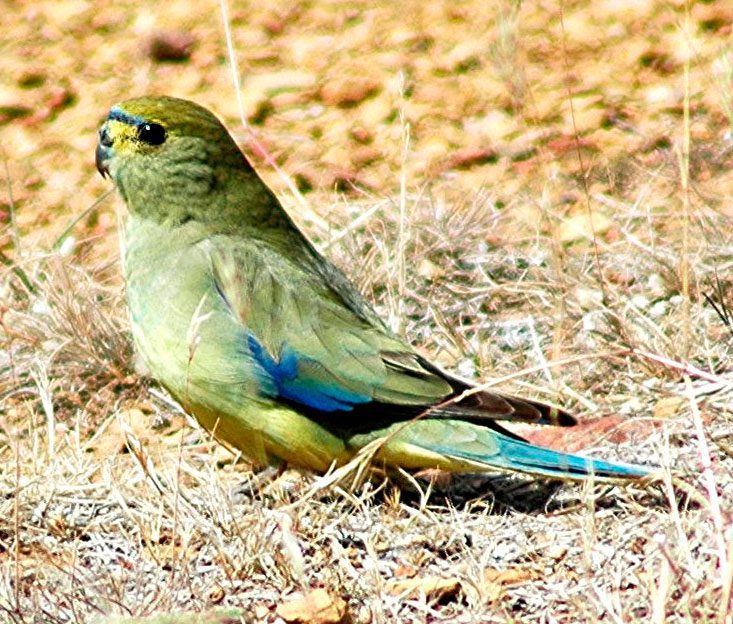
The Blue-winged Parrot(Neophema chrysostoma) has the crown olive green color with a yellow front wallwashing; blue front band (clearer on the back edge), arriving from the front towards the eyes (but not beyond); Lords bright yellow; coverts outpus and face Gris-Oliva. Upperparts olive green color without brightness.
Wing coverts blue, clearer in some feathers of the greater coverts Interior. Primaries black, with blue-violet edges in vane thin yellow margin and external; secondary internal with vane Green external, secondary average with blue in vane outer; tertiary olive green. Wing feathers blue. Top of the chest light green with yellow shading in the area of the belly and undertail- coverts. Upper, the tail is bluish grey, with the exception of the tips of the outer tail feathers, that are yellow.
The bill It is greyish-black with a pinkish lower jaw and the upper jaw with sharp edges.; irises dark brown; legs gris-rosado color.
The female it is duller than the male with the line that adorns the forecrown less developed.
It has the top of the crown olive green. The underparts they are tinged with pale green.
The young birds they lack the frontal band and most show a wing bar; the bill It is orange in very young birds.
During the nesting season, the Blue-winged Parrot frequent eucalyptus plots.
starting winter, These birds change the habitat type, visiting the clear, orchards or similar locations. In addition to these common locations, they tend to move into thickets of acacia and lightly wooded grasslands. At this time of the year, the Blue-winged Parrot They also feel attracted by the arid plains with Salt plants (Atriplex) and for the coast and mountain Moors.
These colorful birds occasionally visit swamps, sand dunes along the coast and wetlands.
To the Blue-winged Parrot You can see them in pairs or in small groups, but in the off-season, form large meetings in the regions south of the coast, in partnership with the Crimson Rosella or more rarely with the Orange-bellied Parrot.
When feed, they are relatively accessible, flying into a nearby tree when bother them.
During the courtship, the male drops his wings, moves the head and regurgitates food for your future partner. By now, not explained clearly the migration. We know that birds from the south of the continent head north after breeding and the northern limit of this movement is in the south of Queensland. On the other hand, It is unclear whether all the population of the island of Tasmania It has to do with the migration that it crosses the bass strait.
Reproduction:
The nesting season extends from October to January. The nest It is usually a natural cavity in a large eucalyptus. Sometimes, However, found in a stump on a fence post or fallen log.
The female always makes the choice of the site. The Blue-winged Parrot They nest in colonies, sometimes several pairs are established in the same tree. The site can be used for several consecutive years.
The setting contains of 4 to 6 eggs, which are incubated for a period of 18 to 20 days. At birth, the chicks are altricial, and leave their place of birth to the 30 days after hatching. But, they stay with their parents for a short time before becoming independent.
Food:
The Blue-winged Parrot they feed mainly on grass seeds, and especially Danthonia What are the grass family? Poaceae. But, they often enter fields, where to dig the ground with their beaks to retrieve newly sown seeds.
Insects and invertebrates are probably part of their diet. Fruits and flowers represent a significant part of its menu.
Distribution:
During the breeding season (September to January) the birds are found below in 36 ° S, concentrating in the wetter parts of the southeast of Southern Australia, South of Victoria, and in Tasmania.
In winter they are, to a large extent, absent of Tasmania and are distributed much more North, in the southeast of Australia, reaching the South of Queensland (some 26 ° S, for example Thargomindah, Cunnamulla, Chinchilla), and extending westward to the East of Southern Australia, coming to the South of the eyre peninsula and spreading northward around the border of Queensland; They also extend to the East, to the Western parts of New South Wales (as well, from time to time, to the South of the coastal districts in summer).
It is not known if the continental population of the South is resident and birds of Tasmania they are migrant, flying over the Mainland farms to winter over North, or if the entire population moved northward in winter.
There are relatively few records of the King Islands and Flinders, which suggests that, Unlike in the Orange-bellied Parrot, most birds fly over Bass Strait directly to the mainland.
The Blue-winged Parrot are generally common in most open field types and are, probably, the most common parrot in Tasmania. where are reproduced to the South of Macquarie Harbour, on the West Coast and are found in the central region, provided that their habitat is suitable.
Flocks of up to 2.000 young birds they can form in the Northwest of Tasmania before the autumn migration.
The world's population is above the 20.000 birds.
Conservation:
• Current category of the Red List of the UICN: Least concern
• Population Trend: Stable
According to the Manual of the birds of the world (HBW), This species is not threatened globally. It is even common in the region of Melbourne and Tasmania.
The population is suspected to be stable in the apparent absence of any reduction or substantial threats.
According to Barry Talor, the world population would exceed 20.000 individuals.
"Blue-winged Parrot" in captivity:
The Blue-winged Parrot It, in general, less popular in aviculture as the Crimson Rosella, the Turquoise Parrot, the Scarlet-chested Parrot and the Bourke's Parrot, it's not really weird though.
Their behavior is relatively quiet with few movement needs. It is a bird that is easy to maintain, even for beginners. Your need to crack is almost non-existent and their need for bathroom depends on the individual. It is resistant to the European climate and, certainly, is not inferior to other species of neophemas. But, is susceptible to fog and cold damp, as we know it here in the fall and winter seasons.
The Blue-winged Parrot they seek food by digging in the Earth and are therefore vulnerable to parasitic infections.
According to sources, a Blue-winged Parrot lived during 21 years in captivity. In captivity, these animals have been able to play at the age of 2 years.
Alternative names:
– Blue-winged Parrot, Blue winged Parrot, Blue-banded Grass-Parakeet, Blue-banded Grass-Parrot, Blue-banded Parrot, Blue-winged Grass-Parakeet, Grass Parrot, Hobart Grass-Parrot (ingles).
– Perruche à bouche d’or, Perruche à ailes bleues, Vénuste à ailes bleues (French).
– Feinsittich (German).
– Periquito-de-asa-azul (Portuguese).
– Papagayo de Alas Azules, Periquito Crisóstomo (español).
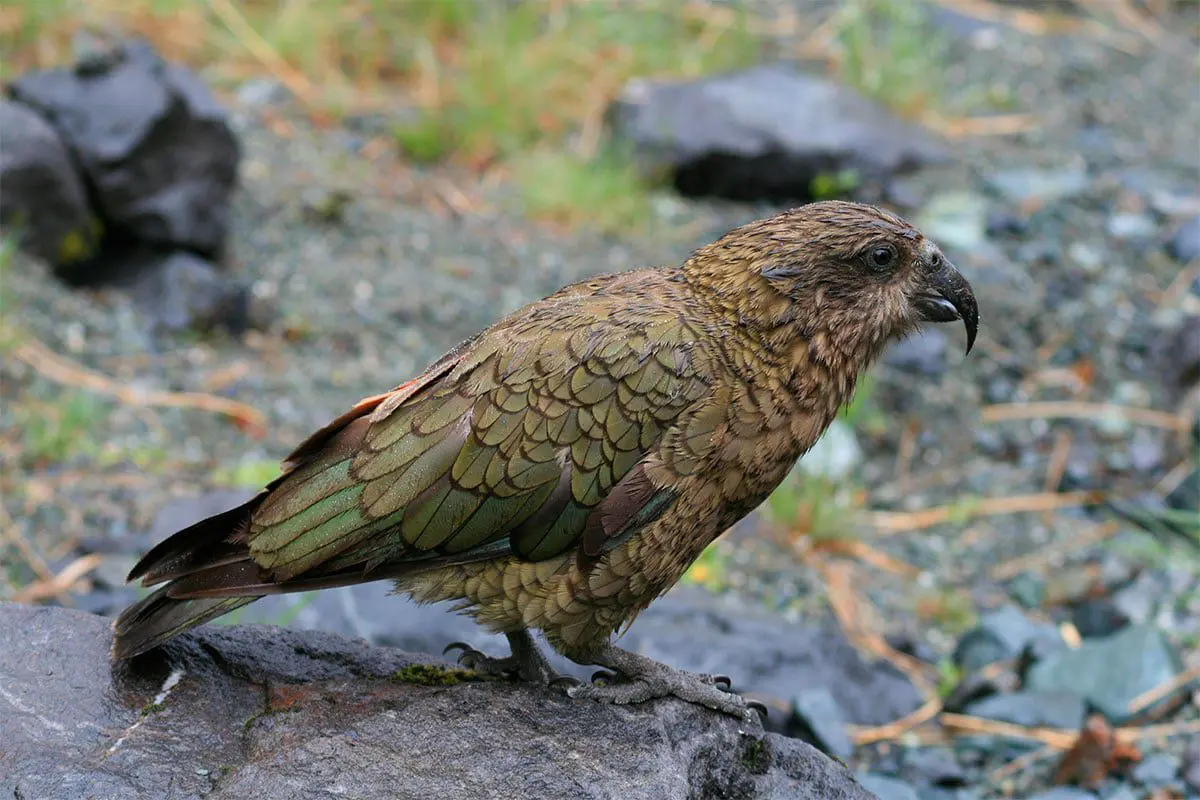
The Kea(Nestor notabilis) It is a bird of the family Strigopidae of 48 cm.. length and an average weight of 922 g..
Its head is olive brown color; narrow feathers of the crown with a few finely marbled black stripes; ear-coverts and lores more uniform dark brown; feathers of the neck slightly yellowish, with stripes and edges of brownish black color . Mantle and uppertail-coverts Green bronze with black stripes and Crescent-shaped rims; back and rump orange-red, with stripes and Tips blackish.
Flight feathers, primaries and greater coverts, drenched strongly with blue turquoise in them vane outer (more green in high schools); vane internal primaries, excluding the color lemon yellow. Wing feathers and axillary reddish color; underparts of the flight feather brown, with yellow bars in the vane internal primaries, excluding the orange color in the vane the secondary internal internal.
Their underparts feathers Brown olive light, with a ridge of dark brown. Upper, the tail, bathed in a bluish green tone, with bars in the vane internal orange yellow color and a blackish subterminal band with Tips lighter; undertail, the tail, olive-yellow color, with a dark subterminal band; the tips of the stripes of the tail feathers extend slightly beyond the network.
The bill brown-black color; cere dark brown; irises dark brown; legs blackish gray.
The males they are larger and have upper jaws longer than females (an average of 12 to 14% more).
The young birds they have the rump greener, yellow the Ceres, with rings perioftalmicos yellow, a pale base in the lower jaw, and legs pale yellow.
The nude parties yellow are lost after two years after three in the male and female.
The Kea (Nestor notabilis) they live at an altitude between 600-2400 m.
They are commonly found near tourist attractions. But, its main habitat is in the tree line between 950 and 1.400 m.
They mark a certain preference for deep canyons whose walls are covered in forests of beeches (Nothofagus cliffortioides). At higher altitudes, that is it can be observed in subalpine Shrublands. The species It is considered as monotype.
It is a bird family and curious. He likes to live close to the houses and feel the human presence. His mischievous behavior and his sharp intelligence earned him the title of «clown of the mountains«.
It's a joy for tourists, that compensates for, in part, the wrong bad reputation that had in the past.
During the period of nesting, the pair is the basic social unit, but for the rest of the year, It is a species very gregarious they live in family groups, feeding in flocks of 30-40 birds, often in landfill sites.
The males are polygamous, each can have a harem of some 4 females. Dominant males are not necessarily the oldest.
Establishing a hierarchy is tricky. Adults often dominate subadults but it can also happen that a young dominates an adult.
The Kea established territories that are resizable. These can be overlaid on the periphery, but the nucleus or the central part situated, near the nest, It has an inviolable space that is defended with aggression.
During the nesting season, breeding birds are sedentary, and never will they move away to more than one kilometre from the nest. On the other hand, the non-breeding birds are very mobile, and some have been seen more of 60 km of where they were ringed.
Reproduction of "Kea":
The strong conjugal bonds and fidelity to the nesting site are the two basic rules of the Kea, that is manifested by the fact that the nest often takes several years to be completed. But, unpaired males can visit the nests and try to mesh with females.
The breeding season extends July-January. The female lays 2 to 4 white eggs in a burrow or cavity covered with some sticks, leaves and MOSS. The site is often found at the base of a cornice, but they also use stone blocks placed above the tree line.
The eggs are deposited a few days apart and only the female incubates for a period that varies between 21 and 28 days. In the meantime, the male stands guard nearby and is responsible for feeding his partner. Initially, bring enough food to also supply the calf, but after a few weeks, the female leaves the nest, in order to help you in your task.
The chicks, covered with a white marker, they leave the nest after 13 to 14 weeks. They continue to be fed by the parents during 1 month to 6 weeks. In January and February, immediately after the nesting season, the Kea they tend to congregate in large flocks which can contain 50 or more individuals.
Food of "Kea":
During the summer, the Kea they can be active even during the night. In winter they are reduced to more modest altitudes below the elevation of snow. Some groups choose to stay in the mountains near ski resorts.
The Kea feed of carrion, in particular sheep. Contrary to its reputation, they never attack healthy sheep. have a diet mainly vegetarian and they fed both in trees and on the ground. Your menu includes leaves, outbreaks, estate, seeds, berries, flowers, nectar and insects. In summer they also eat beetles, worms, lobsters and land snails.
The dominant males they are known to find its food in campsites and parking areas.
Distribution:
Size of the area of distribution (reproduction / resident): 63.300 km2
endemic to the South Island of New Zealand (Although vagrants have been recorded in the North Island, for example, in the Tararua mountains), finding, mainly, between 950 m and 1.400 m above sea level in forests and subalpine scrub.
The populations of the Kea they appear as stable and they can range between 1000 and 5000 specimens.
The concentration of birds around tourist spots leaves a false impression, giving the impression of being a fairly ordinary parakeet.
Due to the false reputation he had for attacking sheep, This bird was hunted by farmers and thousands of birds were exterminated between 1860 and 1970.
Since 1988, the Kea is fully protected, What does not prevent, sometimes, their capture and sale as a pet.
The "Kea" parrot in captivity:
Very rare in captivity.
As indicated sources, a captive male for Kea was still alive after 47 years in the Antwerp Zoo. It showed signs of old age. Other Kea in the bristol zoo, of at least, 43 years of age showed no signs of aging.
In captivity, These birds can be raised from the 4 years of age
– Avibase
– Parrots of the World – Forshaw Joseph M
– Parrots A Guide to the Parrots of the World – Tony Juniper & Mike Parr
– Birdlife
– Photos:
(1) – An adult Kea in Fiordland, New Zealand by Mark Whatmough – Wikipedia
(2) – Kea at Twycross Zoo, England. Close up of head and neck By Paul Reynolds from UK (IMG_7147_080227_40DUploaded by snowmanradio) [CC BY 2.0], via Wikimedia Commons
(3) – A Kea at Mount Aspiring National Park, New Zealand By Rosino (scary keaUploaded by Snowmanradio) [CC BY-SA 2.0], via Wikimedia Commons
(4) – Male Kea (Nestor notabilis) on road to Milford Sound, New Zealand By User:Velela [Public domain], via Wikimedia Commons
(5) – Nestor notabilis By Aidan Wojtas from Wellington, New Zealand (Running KeaUploaded by snowmanradio) [CC BY-SA 2.0], via Wikimedia Commons
From between 13 and 15 cm in length and a weight between 25 and 31 g..
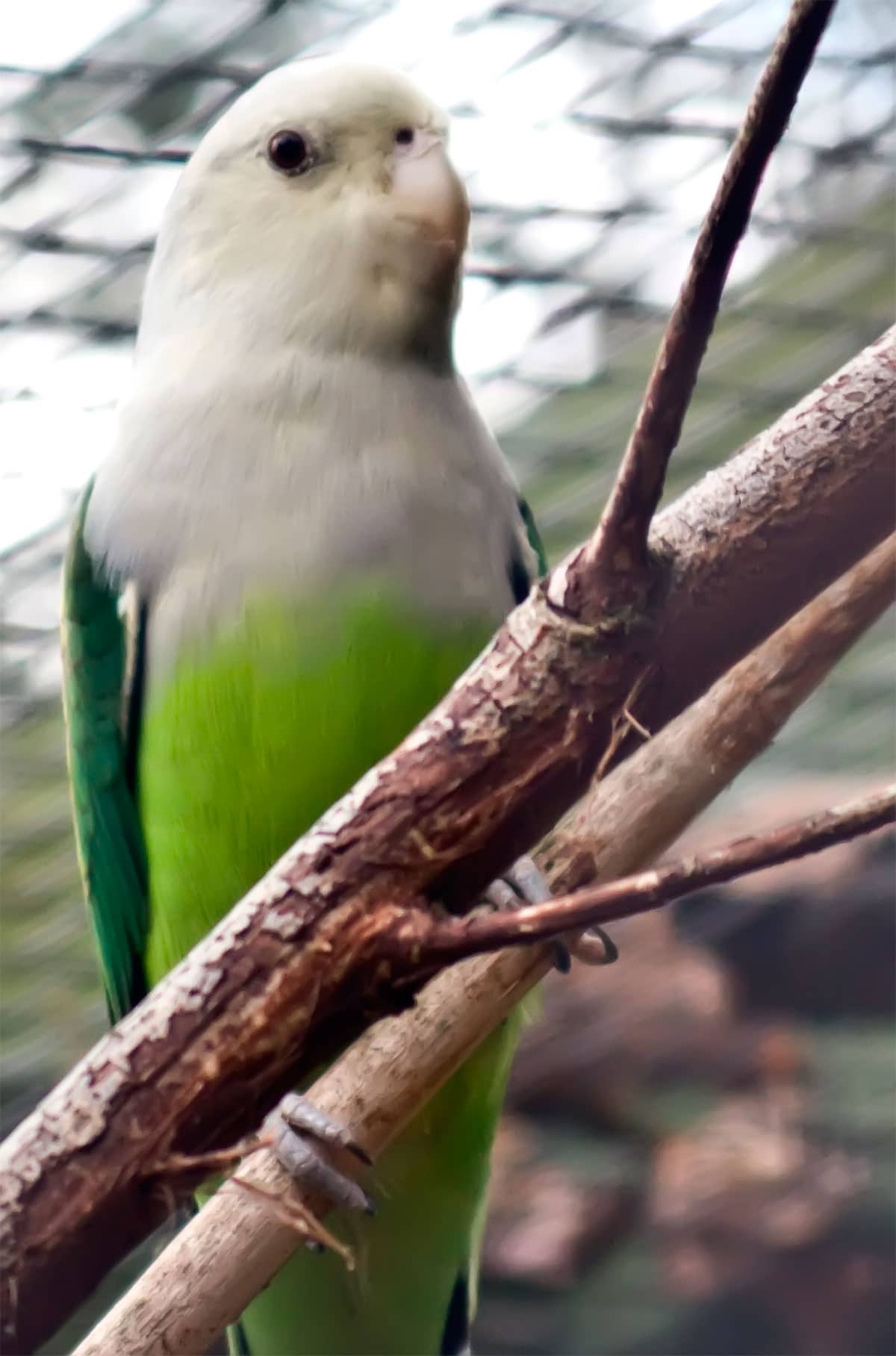
The Gray-headed Lovebird(Agapornis canus) has the head and the neck pale grey. Mantle and green scapulars; rump with a much brighter green than the rest of the tops. Upper, the wing-coverts green, alula dark. Flight feathers green above, darker towards tip and margins to the vane outer; grayish brown below. Under, the wing-coverts black. The throat to the top of the chest pale grey; low area chest up to the undertail- coverts pale yellowish green. Upper, the tail green, by bright side, with broad subterminal black band; undertail, the tail greenish-grey.
The upper jaw bluish white, the lower white pink; irises dark brown; legs pale grey.
The female has the head, neck and chest green; upperparts sometimes more brown than the male. Under, the wing-coverts green.
The immature adults resemble, but the gray hood the male is steeped in green, especially in the nape; bill yellow with black on the basis of upper jaw.
It notes that within the species Grey-headed Lovebird, given the presence of 2 subspecies, which are Agapornis canus canus (Gmelin); Agapornis canus ablectaneus (Bangs); However, not known no kind of mutation, What is something special in this genre, as usually, each species has different mutations, you change the color of its plumage.
Agapornis canus ablectaneus (Bangs, 1918) – Greener (less yellowish) below, head violet gray con held tinkles.
Agapornis canus canus (Gmelin, 1788) – The nominal species
Habitat:
In Madagascar They are in some wooded areas, palm savannas, forest edges, degraded forests, bush and farmland and rice paddies to altitudes 1.500 m. Use the clear in the dense forest along the mountainsides.
Observed in the vicinity of cities and towns and, often seen on the roads. Introduced populations show similar habitat preferences.
gregarious, usually in flocks of up to 50 birds, being able to concentrate in greater numbers in areas where food is abundant, sometimes it partnering with Madagascar Red Fody (Foudia madagascariensis), the Sakalava Weaver (Ploceus sakalava) or the Madagascar Munia (Lepidopygia nana). They often gather at communal roosts in the bare branches.
Sedentary.
Reproduction:
The nests of the Gray-headed Lovebird are treeholes; Inside the hole is lined with fragments of chewed leaves or wood chips and stalks of grass worn by females between body feathers.
Nesting They were recorded in the months of November and December in Madagascar. Probably they breed during the rainy season (November–April) in Comoros.
The laying is of 4-5 eggs, but up to eight they have been recorded in captivity.
The incubation, probably, the female performs single, lasts a few 23 days and the young leave the nest after about forty days.
Food:
The diet Gray-headed Lovebird consists, mainly, of grass seeds.
In Seychelles They have a preference for the crop pasto guinea (Megathyrsus maximus); in the Comoros islands by flower buds Stenotaphrum. They also eat rice out to dry around the villages and farms.
Distribution:
Madagascar It is the natural range of the Gray-headed Lovebird, where usually are common, especially in coastal regions, but today they are rare in eastern and absent or scarce in the central plateau.
In Seychelles, initially established extensively in Mahe but now confined to the suburbs around Victoria and some towns of the West Coast; small town, according to sources, in Silhouette.
Attempts to introduce them to other islands and in Africa have failed.
Subspecies distribution:
Agapornis canus ablectaneus (Bangs, 1918) – Arid lowlands of southwestern Madagascar, intergrades the species nominal about Beth kopaka and Ankavandra
Agapornis canus canus (Gmelin, 1788) – The nominal species
The size of the world population Gray-headed Lovebird It has not been quantified, but the species, according to sources, It common and it is generally Extended. (pit et to the. 1997).
The population is suspected to be stable in the absence of evidence of any reduction or substantial threats.
The species has undergone intense trade: from 1981 when it was listed in Appendix II of CITES, 107,829 wild-caught individuals They were recorded in international trade (UNEP-WCMC CITES Trade Database, January 2005).
After a total ban on exports from Madagascar, in recent years it has been possible to have some imported specimens.
,
"Gray-headed Lovebird" in captivity:
The Gray-headed Lovebird they are very rarely seen in captivity, Since this species it is not widespread today.
The Gray-headed Lovebird It is a pretty bird silent; active; often shy and elusive; Just get used to his caregiver patiently and in a gradual manner; newly imported birds, initially they are very susceptible; reared in aviaries not usually give complications; It hard chewer; enjoy bath; his voice is not too loud; communal aviary is not recommended because its something rowdiness; He tolerates only birds of the same species in large aviaries where you can implement your flight.
With regard to its longevity, they can live between 10 and 20 years.
Avibase
Parrots of the World – Forshaw Joseph M
Parrots A Guide to the Parrots of the World – Tony Juniper & Mike Parr
Birdlife
Photos:
(1) – A male Grey-headed Lovebird at Beale Park, Berkshire, England By Tony Austin (originally posted to Flickr as Parrot) [CC BY 2.0], via Wikimedia Commons
(2) – Grey-headed Lovebird, Ankarafantsika, Madagascar By Frank Vassen [CC BY 2.0], via Wikimedia Commons
(3) – Grey-headed Lovebird or Madagascar Lovebird By OPi@Toumoto(Opi @ Tomoto)-> http://opi.toumoto.net (Self-photographed) [GFDL or CC-BY-SA-3.0], via Wikimedia Commons
(4) – the whole family… by ZaR – ipernity
(5) – we Pedia














![Kea [Nestor Notabilis]](https://www.mascotarios.org/wp-content/plugins/wp-youtube-lyte/lyteCache.php?origThumbUrl=https%3A%2F%2Fi.ytimg.com%2Fvi%2F-EYSL93A6Ik%2F0.jpg)




_-Cairns-8.jpg#mediaviewer/File:Cyclopsitta_diophthalma_(female)_-Cairns-8.jpg)


_-head_-Twycross_Zoo-8.jpg)
.jpg)

_-running_-Lake_Brunner_-NZ-6.jpg)


