Content |
|---|
All breeds and species.
Content |
|---|
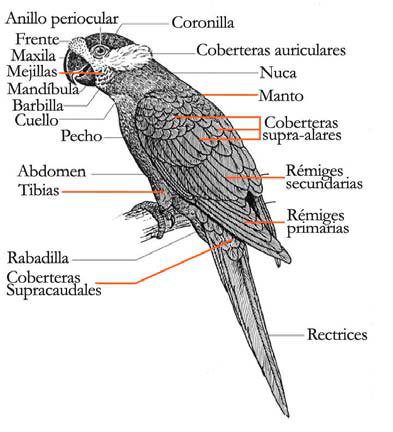
25-28 cm.. length and 200-232 g. of weight.
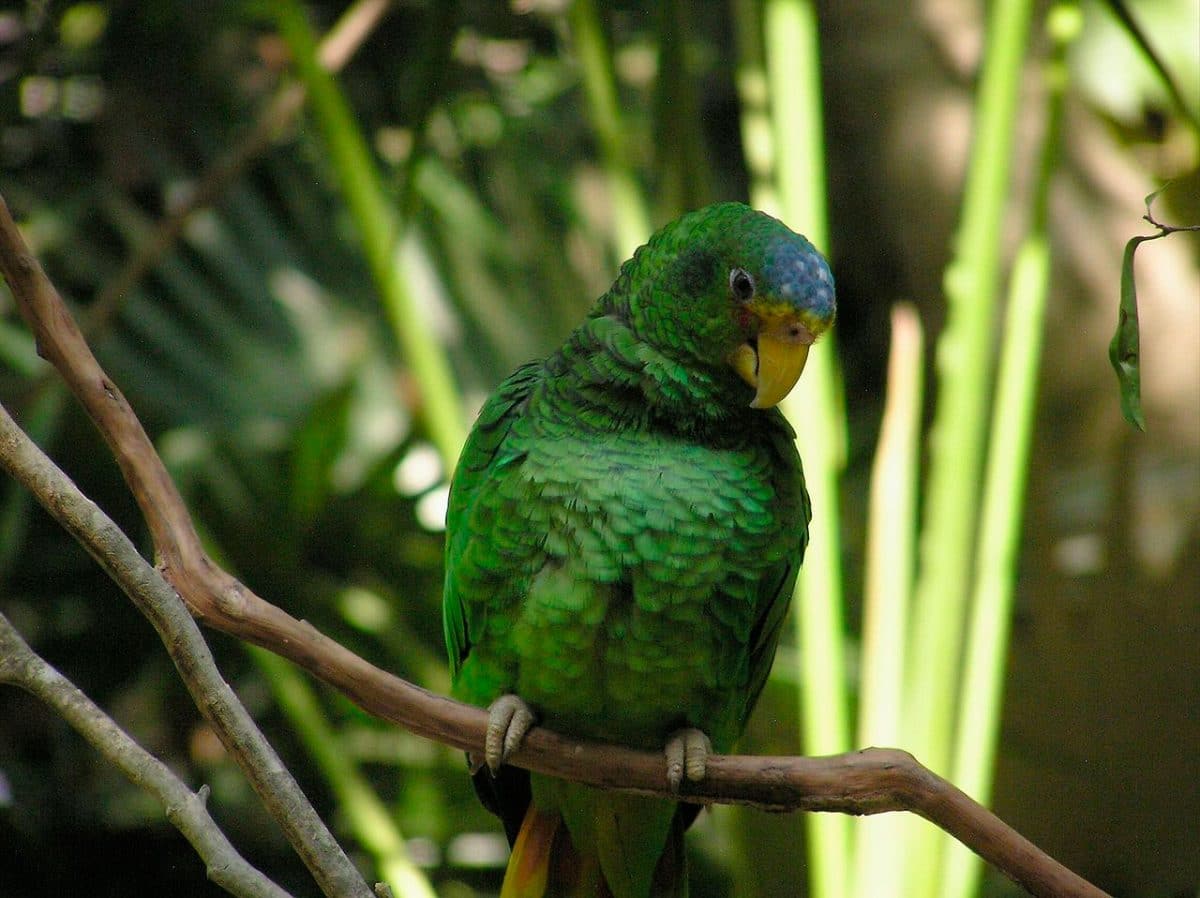
The Yellow-lored Parrot (Amazona xantholora) has the lores and a close frontal band, bright yellow; most of the forecrown and crown, are white; the back of the crown is blue; band wide around the eyes, including upper cheeks, bright red; ear-coverts dark gray.
Top green grass with prominent black tips on feathers giving a scalloped appearance, although uppertail-coverts are yellowish-green. Primary coverts red; remaining coberteras (especially smaller and medium), green with black tips. Flight feathers mostly blue with a green base at primaries. Under the wings, bluish green. Underparts green with black tips on breast feathers, although undertail-coverts are yellowish-green; at the top, the tail is green; below green with yellowish tip and the outer feathers red.
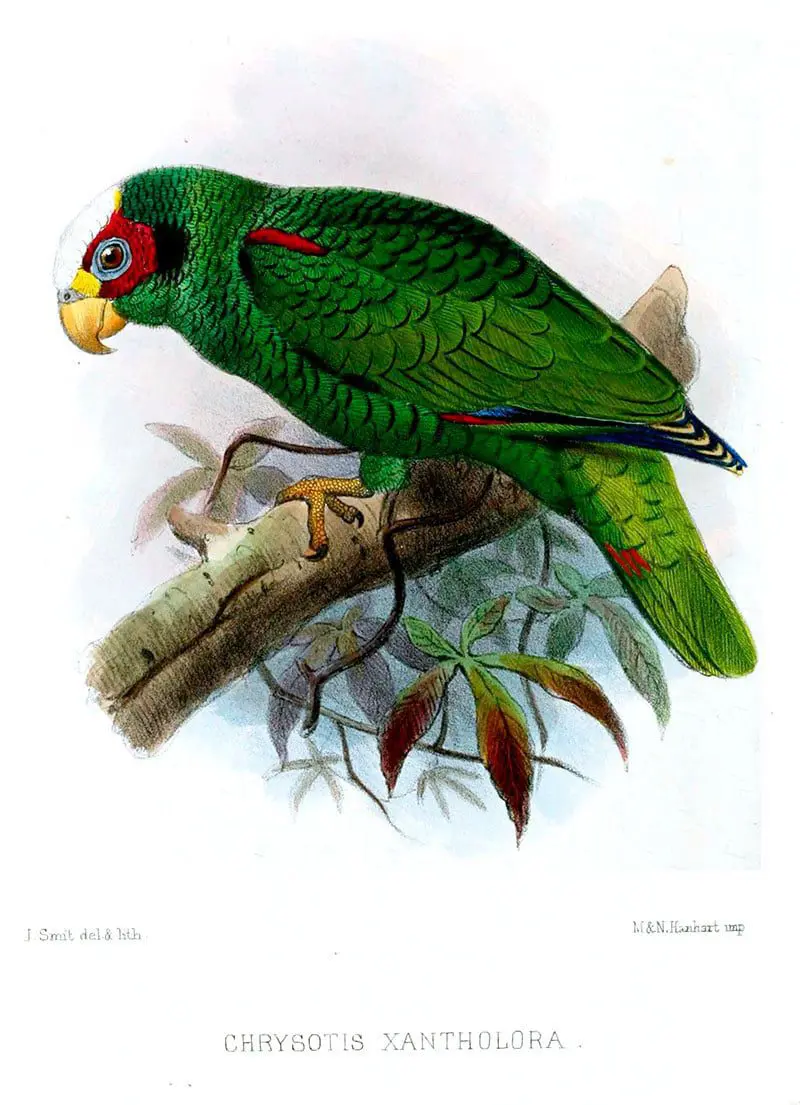
Bill yellow-horn; irises yellow; legs grey.
In this species sexual dimorphism. The female has the crown blue (nonwhite), little or no red around the eye, and primary coverts green. The immature They are like female but with lores paler yellow and crown pale blue.
Video – "Yellow-lored Parrot" |
|---|
In Yucatan, the Yellow-lored Parrot They live mostly in the tropical deciduous forest, probably avoiding dense rain forests. But, their exact preferences are unknown due to the difficulty of distinguishing the White-fronted Parrot (Amazona albifrons). Observed in pine forests and mixed forests of pines and oaks Quercus in the North of Belice, and pine forests in the highlands in Roatan.
They are distributed at altitudes between 100 and 250 m.
Usually views in flocks, to form communal roosts coming up 1.500 birds from roosting and dispersed in small herds forage.
They lay their nests in tree cavities on agricultural land and around cornfields where dead trees have been left standing after forests have been cleared and burned. also can nest in cracks of trees, rock walls or termiteros.
It has been observed to Yellow-lored Parrot in breeding condition in March in the yucatan peninsula, and young in the nest in April-May Belice. The laying is of 1 to 3 eggs; the incubation similar in duration to that of White-fronted Parrot (Amazona albifrons), that is to say, of 25 to 28 days.
Foods reported include guilt of Acacia gaumeri, corn and citrus. The Yellow-lored Parrot They feed mainly in the treetops.
Size of its range (reproduction / resident): 157.000 kilometros2
The Yellow-lored Parrot It is found mainly in the Eastern and Central parts of the Yucatan Peninsula, Mexico, in Yucatan, Campeche and Quintana Roo; in the northern parts of Belice; and in the islands of Cozumel (Mexico) and possibly Roatan (Honduras), where the recent field work could not confirm its current (or previous) existence. Common to quite common in the East of Yucatan and in Cozumel, but considered quite rare in some other parts (especially at the edges) Mexican range. It is thought to be scarcer than the White-fronted Parrot (Amazona albifrons) with which it is closely related, although in some areas, the Yellow-lored Parrot it's more common, especially towards the center of its range.
Live in several areas protected. Situation in Northern Belice unknown.
State of conservation ⓘ |
||
|---|---|---|
 Minor Concern ⓘ
(UICN)ⓘ
Minor Concern ⓘ
(UICN)ⓘ
| ||
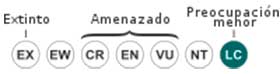
• Current category of the Red List of the UICN: Least concern.
• Population trend: Stable.
• Population size: 20,000-49,999.
This species has a range very large, and therefore not approaching the thresholds for vulnerable under the criterion of size range (extent of occurrence <20.000 km2 combinan con un tamaño gama disminución o fluctuante, hábitat medida / calidad, o de la población tamaño y un pequeño número de lugares o fragmentación severa). La population trend appears to be stable, and therefore the species does not approach the thresholds for Vulnerable according to the population trend criteria. (> 30% decrease of more than ten years or three generations). The population size It can be moderately small to large, but are not believed to approach the thresholds for Vulnerable based on population size criteria (<10.000 individuos maduros con una disminución continua estima en> 10% in ten years or three generations, or with a specific population structure). For these reasons, the species was evaluated as Least concern.
Partners in Flight estimates the population at fewer than 50.000 individuals (A. they Panjabi a slightly. 2008), by what is placed in the band 20,000-49,999 individuals here.
The population suspected to be stable in the absence of evidence of any reduction or substantial threats.
The main threats to this species are the deforestation, the catch eggs and chicks directly from their nests, just like him illegal trade adult individuals. Moreover and, considering the differential distribution of this species within the Peninsula, You may think that areas are susceptible to drastic declines in these species (Beissinger and Snyder 1992).
Very rare in captivity. Convention CITES regulates international trade under the Appendix II (Species not necessarily threatened with extinction, but in which trade must be controlled in order to avoid utilization incompatible with their survival).
– Yellow Lored Amazon, Yellow lored Parrot, Yellow-faced Amazon, Yellow-lored Amazon, Yellow-lored Parrot, Yucatan Amazon, Yucatan Parrot (English).
– Amazone du Yucatan, Amazone xantholore (French).
– Goldflügelamazone, Goldzügelamazone (German).
– Papagaio-de-iucatã (Portuguese).
– Amazona de Yucatán, Amazona Yucateca, Lora de Roatán, Loro Yucateco (español).
– Order: Psittaciformes
– Family: Psittacidae
– Genus: Amazona
– Scientific name: Amazona xantholora
– Citation: (Gray, GR, 1859)
– Protonimo: Chrysotis xantholora


Sources:
– Avibase
– Parrots of the World – Forshaw Joseph M
– Parrots A Guide to the Parrots of the World – Tony Juniper & Mike Parr
– Birdlife
– Naturalist
– Photos:
(1) – Amazon Yucatan, Mexico, Quintana Roo, Xcaret By philippe from FRANCE, You can search by name, by commission or family for birds and insects, using tags [CC BY-SA 2.0], via Wikimedia Commons
(2) – A female Yellow-lored Amazona also known as the Yucatan Amazona at Xcaret Eco Park, Quintana Roo, Mexico. By philippe from FRANCE, You can search by name, by commission or family for birds and insects, using tags [CC BY-SA 2.0], via Wikimedia Commons
(3) – Amazona species xantholora. His name is Poll By GuillermoPech (Own work) [CC BY-SA 4.0], via Wikimedia Commons
(4) – Yellow-lored Amazon By Andreas Mueller Pfgst (Picture yourself created) [GFDL or CC BY-SA 3.0], via Wikimedia Commons
(5) – Yellow-Lored Parrot by James Diedrick – Flickr
(6) – Chrysotis xantholora = Amazona xantholora by Joseph Smit [Public domain], via Wikimedia Commons
– Sounds: Oliver Komar, XC182833. accessible www.xeno-canto.org/182833
Content |
|---|

22 to 23 cm.. length and an approximate weight of 80 g..
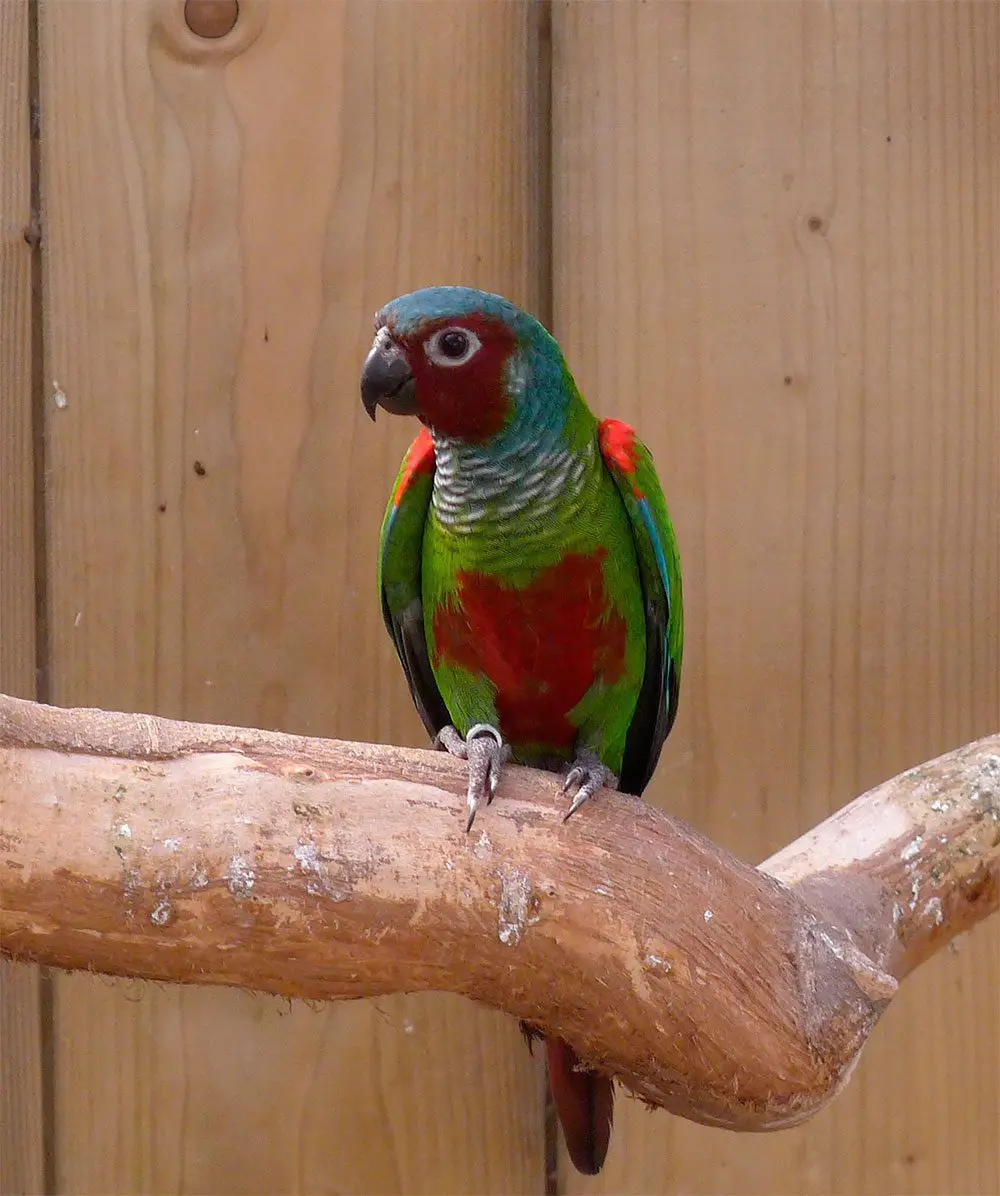
The Pfrimer's Parakeet (Pyrrhura pfrimeri) is a small psittacine of tail Long endemic Brazil very similar to Maroon-faced Parakeet (Pyrrhura leucotis), of which has recently been separated.
Its main color is green with bluish hues in primary rémiges and reddish tones in the back, the belly and retrizes penas. The bend of wing They are reddish.
The neck It has clear blue feathers with lighter edges, giving the whole a scaled aspect. The sides of the face They are red while the crown and nape They are bluish. The bill It is black and tail red-blue color at the tips
It has no sexual dimorphism.
Taxonomic status:
It has often been considered a subspecies of the Maroon-faced Parakeet (Pyrrhura leucotis) – Pyrrhura leucotis pfrimeri. The separation was made based on their distribution and the differences in habitat and plumage, I was the only member of the complex P. leucotis in which the light spot on ear-coverts It was very small. Recent mitochondrial DNA studies have confirmed this separate species status.
Its distribution is restricted to the forests dry deciduous or semi-evergreen growing on limestone outcrops in the calcareous. This habitat type caatinga is an isolated island within the surrounding savannah closed. The forest caatinga typically has a closed canopy and dense understory with lianas and some cacti, particularly in disturbed areas. The species has been seen recently fragmented woodlots (Olmos et al., 1998), but according to reports they do not live far from the edge of the forest.
Social, usually they are seen in flocks of up 10 birds. Noisy and conspicuous when they fly above the canopy. Difficult to see while feeding or resting in foliage.
We know very little about their reproductive habits.
They fly in flocks in search of fruits, seeds, flowers and larvae insects (wasps Family Agaonidae).
Size of its range (Widgets / Resident): 20.300 km2
It is located in the Brazilian states of Goiás, Tocantins and the northwestern tip of Minas Gerais, Brazil.
State of conservation ⓘ |
||
|---|---|---|
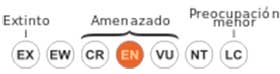 Endangered ⓘ (UICN)ⓘ
| ||
• Current category of the Red List of the UICN: In danger of extinction.
• Population trend: Decreasing.
• Population: 20,000-50,000.
Justification of the Red List of the Category
This species has a range very small highly fragmented and where habitat loss and degradation continue. For these reasons, It is classified as endangered.
Justification of the population
The total population is estimated to lie within the band 20,000-49,999 individuals (CA Bianchi in a little. 2006, 2007). The population density of the species has been estimated 11,7 individuals / km2 .
Justification trend
Given the rapid pace of deforestation within restricted range species, and its strong dependence on forest habitats suspected its population is declining rapidly (F. Olmos in some ., 2004).
Threats:
The main threat to this species is the deforestation driven selective logging, fires and conversion of habitat to pasture (Olmos et al . 1998). Dry wood Goiás He declined to be covering 15,8% of the region 1990 only the 5,8% in 1999, and less than 1% of the remaining fragments they were larger than 100 has (F. Olmos a slightly. 2007). There has been a reduction 66% habitat available in the last 31 years, with a current annual deforestation rate 2,1% (Bianchi 2010). Rapid deforestation is occurring within the range of the species to create pastures with widespread burning to improve poor pastures destroying the habitat of dry forest. It is mainly directed to logging forests durable normally used to make fence posts, and cement are starting to target areas of limestone outcroppings (CA Bianchi in a little . 2006, 2007). The species is rare while they recorded in the trade waves collections of exotic birds; This poses a potential threat (Olmos et al ., 1998). Population pressures increase as their range is close to the capital, Brasilia (Olmos et al ., 1998).
Very rare.
It's a bird in danger of extinction; each captive specimen of this species that is capable of reproducing, must be placed in a well-managed captive breeding program and not sold as a pet, in order to ensure its long-term survival.
– Goias Parakeet, Pfrimer’s Conure, Pfrimer’s Parakeet (English).
– Conure de Pfrimer (French).
– Goiasittich, Pfrimers Sittich (German).
– tiriba de Pfrimer, Tiriba-de-pfrimer, Tiriba-do-paranã , ciganinha, barreirinha, chiriri e periquito-do-morro (Portuguese).
– Cotorra de Goiás (español).

– Order: Psittaciformes
– Family: Psittacidae
– Genus: Pyrrhura
– Scientific name: Pyrrhura pfrimeri
– Citation: Miranda-Ribeiro, 1920
– Protonimo: Pyrrhura pfrimeri


Sources:
Photos:
(1) – Pyrrhura pfrimeri by Lander Van Nieuwenhuyse – Flickr
(2) – Pyrrhura pfrimeri by Lander Van Nieuwenhuyse – Flickr
(3) – Pyrrhura pfrimeri by Lander Van Nieuwenhuyse – Flickr
(4) – Pyrrhura pfrimeri by pyaf.net
(5) – Tiriba-de-Pfrimer, «Pyrrhura pfrimeri» – Pfrimer's Parakeet by Cláudia Brasileiro Martins
Brazilian Claudia Martins
(6) – Photo of Alipio de Miranda Ribeiro, brazilian natural scientist By File created by Flávio de Miranda Ribeiro (Picture taken by family) [CC BY-SA 3.0 or GFDL], via Wikimedia Commons
(7) – Parrots A Guide to the Parrots of the World – Tony Juniper & Mike Parr
Content
|
|---|
35-40 cm. length and 132-153 g. of weight.
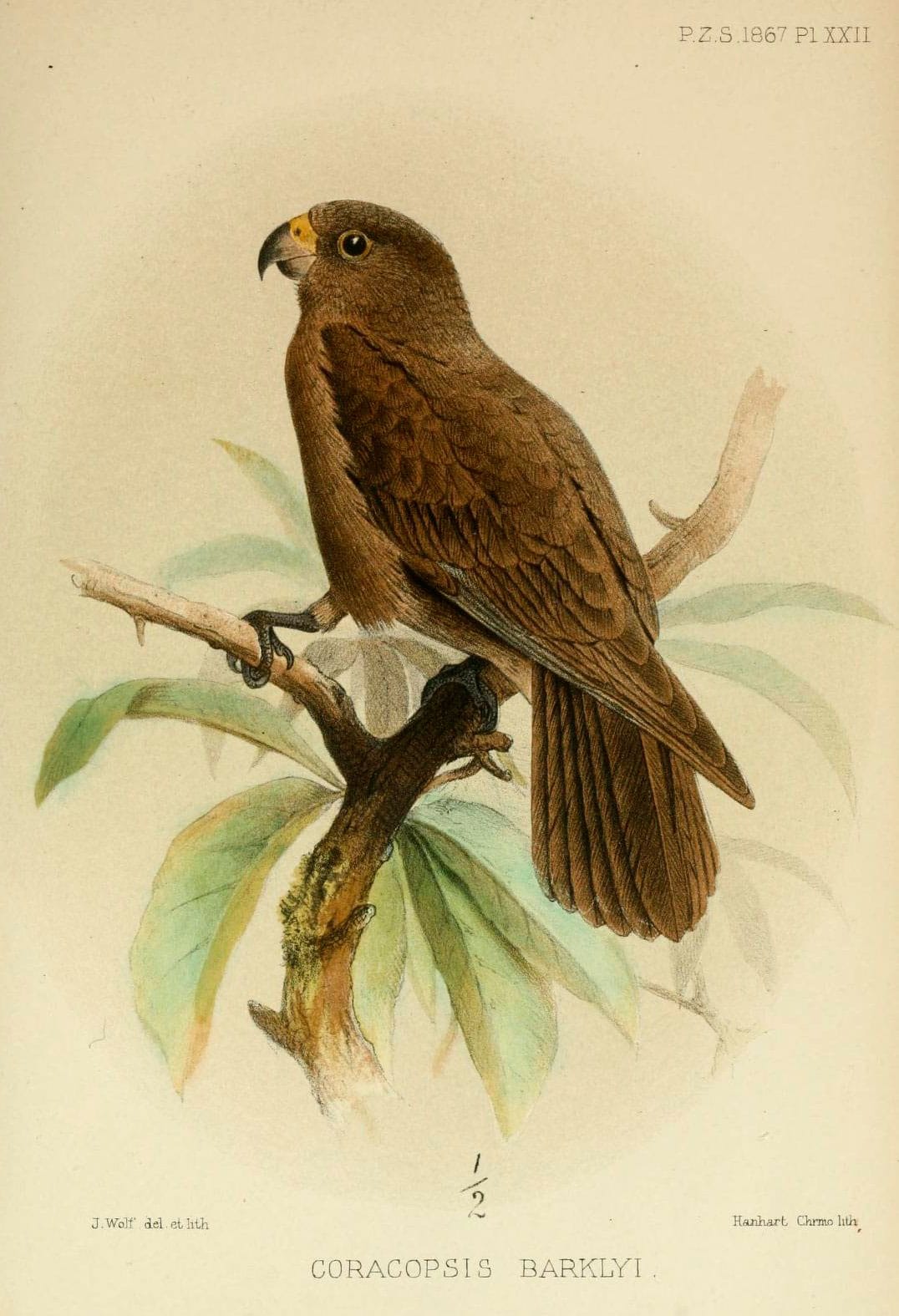
The Seychelles Black Parrot (Coracopsis barklyi) They have a pale brown, less black than the plumage Black Parrot (Coracopsis nigra), but gray / blue reflections in the outer layers of the primary feathers; pale brown patches with slight pale streaks on the crown.
The tone becomes slightly paler in uppertail-coverts.
The underparts They are pale grayish brown. We can see some short lines in throat, while the chest and the belly show a diffuse pale obstruction. The tail is pale-grey.
The bill dark gray becomes paler during the breeding season. The eyes are dark brown, surrounded by a naked orbital gray area. Legs and feet are dark gray to bluish gray.
Both sexes are very similar.
Youth colorization:
Immature paler than adults with a yellowish tinge bill and tips of the feathers tail with pale gray.
Taxonomic status:
Formerly a subspecies of Black Parrot (Coracopsis nigra), originating from Madagascar. Parrots Gender Coracopsis only found in the Western Indian Ocean.
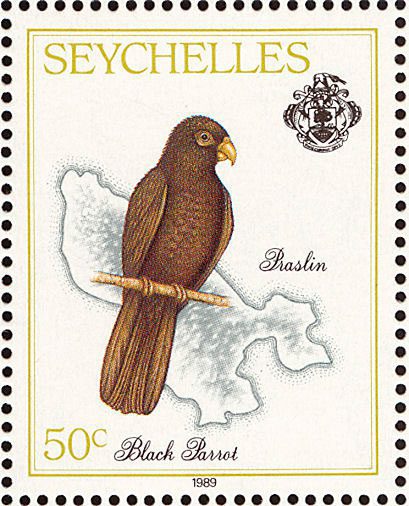
The Seychelles Black Parrot (Coracopsis barklyi) inhabits native and mixed woodland in Praslin, (Rocamora and Laboudallon 2013, A. Reuleaux y N. Bunbury a slightly. 2016). It is also found in cultivated areas and residential areas with gardens, habitats that are suitable feed (A. Reuleaux y N. Bunbury a slightly. 2016). They are usually seen alone or in pairs.
Their main breeding areas They are in a forest dominated by endemic palms coco de mer (Lodoicea maldivica). The tree species nests in cavities primarily in mer coconut dead, but also registered that nests in cavities and other palms living trees broadleaf (Reuleaux et al. 2014to), with reproductive activity October to March (Rocamora and Laboudallon 2013, Reuleaux et al. 2014to). Preferred deep cavities of hollow logs of L. maldivica with a dense cover canopy over the entrance (Reuleaux et al. 2014to). The reproductive activity fluctuates widely between years (A. Reuleaux y N. Bunbury a slightly. 2016). In a study, the 53% of nests they were successful in 36 nesting attempts, with a 57% incipient year survival (Reuleaux et al. 2014to).
The Seychelles Black Parrot It feeds on a variety of plant species, most of which are endemic and native (Reuleaux et al. 2014b), mainly from the fruit pulp, seeds and buds, with occasional observations feeding on leaves, flowers, crusts and scale insects (Reuleaux et al. 2014b).
Extending its range (breeding/resident): 70 km2
The Seychelles Black Parrot (Coracopsis barklyi) reside in Praslin, with occasional records in Curieuse (to 1 km to the North of Praslin), Seychelles (Reuleaux et al. 2013).
No individual was detected in curious during spot counts over four days and during supplementary fieldwork, so it is assumed that there is no resident population there (Reuleaux et al. 2013).
• Current category of the Red List of the UICN: Vulnerable.
• Population trend: Stable.
• Population size : 340-600 individuals.
Rationale for the Red List category
This newly divided species is listed as Vulnerable because, but it appears to be stable or possibly increasing, their population is still very small, and therefore it is at risk of stochastic events and human impacts.
Justification of the population
Count surveys conducted in Praslin points in 2010 and 2011 They found a density of 0.14-0.24 individuals / ha, as resultadi giving an estimate of the Total population 520-900 individuals (confidence intervals 95%) obtained through the distance sampling methodology (Reuleaux et al. 2013). After reviewing recent survey results, Rocamora and Laboudallon (2013) estimated total breeding population less than 200 couples, suggesting that there might be less than 400 mature individuals. Based on these data, it is assumed that there 340-600 mature individuals in the population.
Justification trend
They suspected that the population is stable the absence of evidence of any reduction or immediate threat. It is believed that the species has increased at least until the beginning of the century, but it is not clear if it is still increasing (Reuleaux et al. 2013, Rocamora and Laboudallon 2013).
This species is protected by law from 1966. No copy of Seychelles Black Parrot should be kept in captivity, unless it was under a controlled breeding program in order to reintroduce birds of this species to their habitat.
– Seychelles Black Parrot, Seychelles Lesser Vasa Parrot, Seychelles Parrot (English).
– Vasa des Seychelles, Vaza des Seychelles (French).
– Seychellenpapagei (German).
– Seychelles Black Parrot (Portuguese).
– Loro de Seychelles (español).
– Order: Psittaciformes
– Family: Psittaculidae
– Genus: Coracopsis
– Scientific name: Coracopsis barklyi
– Citation: Newton, E, 1867
– Protonimo: Coracopsis barklyi
Sources:
Avibase
Parrots of the World – Forshaw Joseph M
Parrots A Guide to the Parrots of the World – Tony Juniper & Mike Parr
Birdlife
Photos:
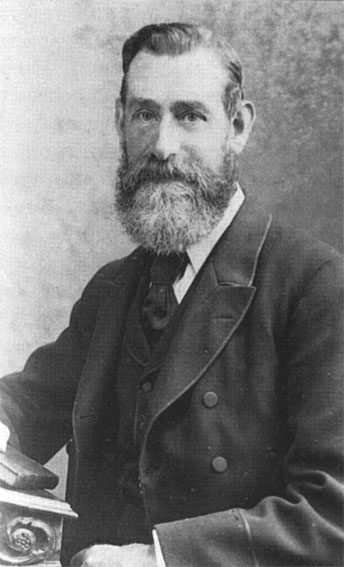
(1) – Coracopsis barklyi (=Coracopsis nigra barklyi) by Joseph Wolf [Public domain], via Wikimedia Commons
(2) – Coracopsis barklyi By Post of Seychelles ([1]) [Public domain], via Wikimedia Commons
Content
|
|---|
|
Video «Western Ground Parakeet»
|
30 cms. length between 105-110 g. of weight.
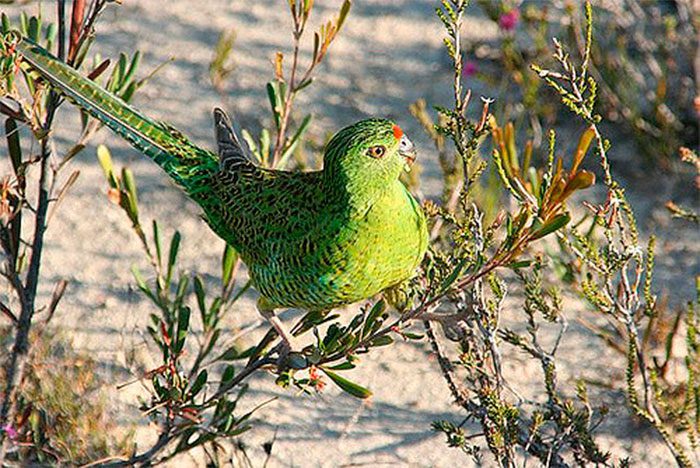
The Western Ground Parrot (Pezoporus flaviventris) It has mottled green back, underparts green and yellow, forecrown red. Tail long, with green stripes, Yellow and black poorly defined.
taxonomy:
A research team, directed by Stephen Murphy, studied taxonomy (discipline in charge of classifying living things) of the Eastern Ground Parrot (Pezoporus wallicus), an endemic species (exclusive geographic region) of fragmented coasts of southwest and southeast Australia. The researchers studied DNA from museum specimens from 160 years, and they concluded that the western population should be classified as a new species: Pezoporus flaviventris.
The Western Ground Parrot It is a bird that lives in soil and living in low heathland, dry or swampy near the coast. They are usually seen in habitat that has remained unburned for long periods of time. Mainly fly at dawn or dusk and feeds mainly on small seeds.
It is one of the few parrots in the world that does not nest in a hole or cavity. Little else is known about the reproductive biology of the Western Ground Parrot
The Western Ground Parrot usually it feeds alone or with another parakeet. Seeds of various plants, especially of Sedge, for example, Mesomaelaena stygia ssp. stygia. Flower buds and flowers base, for example, the beaufortias, the dryandras and grevilleas, They are also important parts of the diet. It has been observed Western Ground Parrot semisuculentas feeding on leaves Daviesia pachyphylla. The diet is varied and uses the great diversity of habitat.
Historically, This species was found along the south west coast of Australia from Perth north to Geraldton and along the south coast east to Israelite Bay. But, It seems to have disappeared off the west coast of Western Australia in 1900.
Today only two locations are known from the extreme southwest of Western Australia: Fitzgerald River National Park and Cabo Arid National Park / Natural Reserve Nuytsland
• It is classified by the Australian government as a species in danger of extinction.
• Population trend: Decreasing.
• Population size : 100-110 individuals.
During an investigation (1), scientists found that the population of this new species had diminished quickly in the last 20 years, They are leaving only around 110 birds surviving in the wild, most of them in an Australian national park, so it is considered one of the rarest species in the world, so that the entry introduced predators (cats) National Park, could lead to the extinction of the species in a short time, so the need to implement is suggested Urgent conservation program for this new species described.
(1) – «Tip(‘9. S. A. Murphy, S. A., L. Joseph, A. H. Burbidge y J. Austin. “A Cryptic and Critically Endangered Species Revealed by Mitochondrial DNA Analyses: the Western Ground Parrot”. Conservation Genetics, 12, (2010): 595-600.’
– Ground Parrot (Western), Western Ground Parrot (English).
– Kyloring (Aboriginal).
– Perruche à ventre doré, Perruche à ventre dorée, Perruche terrestre (de l’Ouest), Perruche terrestre (flaviventris) (French).
– Westlicher Erdsittich (German).
– Periquito Terrestre Occidental (Portuguese).
– Perico Terrestre Occidental (español).

– Order: Psittaciformes
– Family: Psittaculidae
– Gender: Pezoporus
– Scientific name: Pezoporus flaviventris
– Subpoena: North, 1911
– Protonimo: Pezoporus flaviventris


Sources:
• Avibase
• Parrots of the World – Forshaw Joseph M
• Parrots A Guide to the Parrots of the World – Tony Juniper & Mike Parr
• Science and Development Magazine
• Department of the Environment (2018). Pezoporus flaviventris in Species Profile and Threats Database, Department of the Environment, Canberra. Available from: http://www.environment.gov.au/sprat.
Photos:
(1) – Feeding Western Ground Parrot….. the only photo’s of this bird in the wild was taken in 2005 the day before my birthday, what a gift that was. This is from my field season the next year. No nest has been found since 1913. by Brent Barrett – Flickr
(2) – Western Ground Parrot (Pezoporus flaviventris) by Brent Barrett from Dunedin, New Zealand [CC BY-SA 2.0 or CC BY-SA 2.0], via Wikimedia Commons
(3) – A Western Ground Parrot in Australia by Brent Barrett from Dunedin, New Zealand [CC BY-SA 2.0], via Wikimedia Commons
(4) – Stand and sing Western Ground Parrot (Pezoporus flaviventris) by Brent Barrett from Dunedin, New Zealand [CC BY-SA 2.0], via Wikimedia Commons
(5) – This is officially one of the rarest images in exhistence Pezoporus wallicus flaviventris by Brent Barrett – Flickr
Content |
|---|
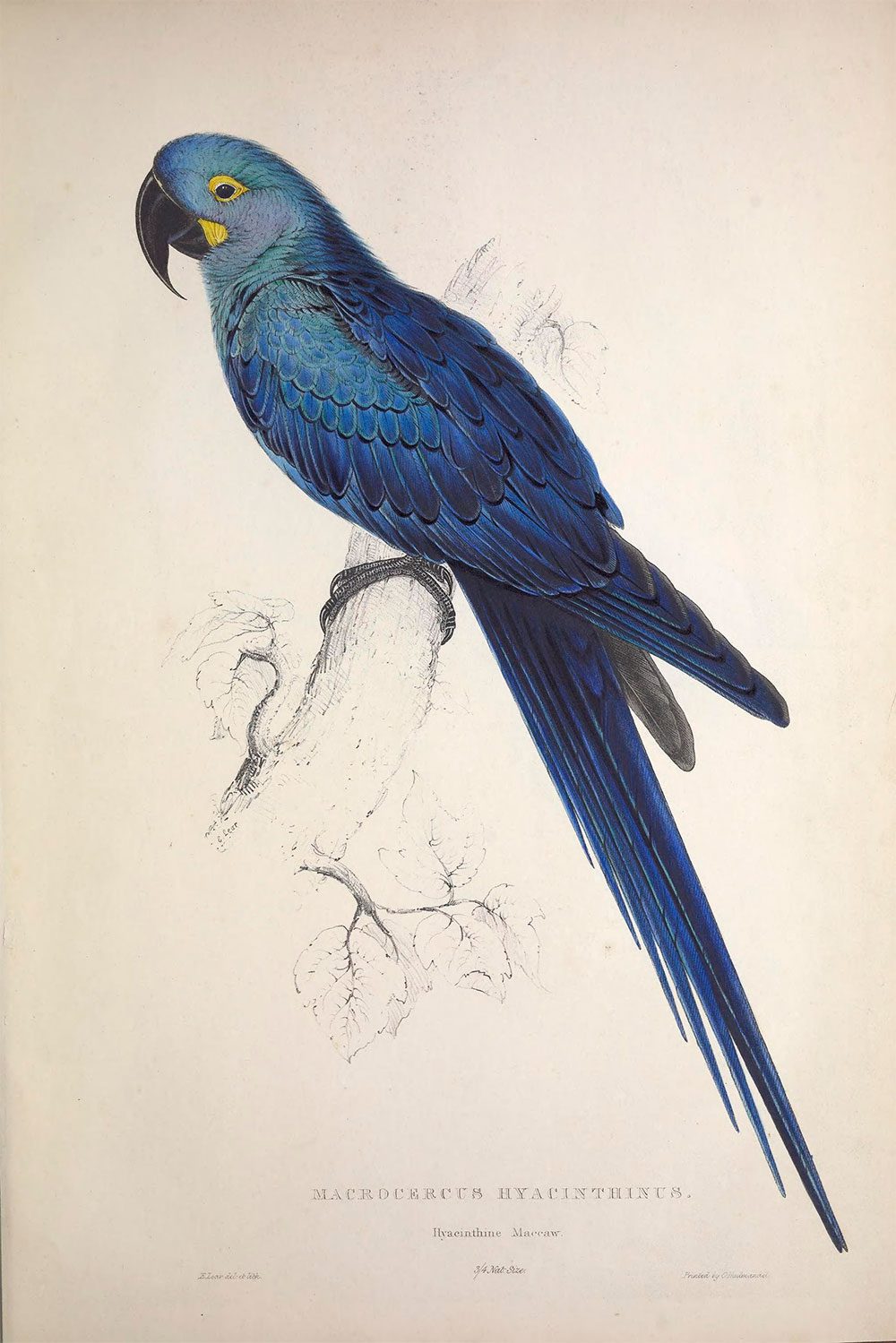
90 to 100 cm.. of length and a weight of 1,5 to 1,7 kg.
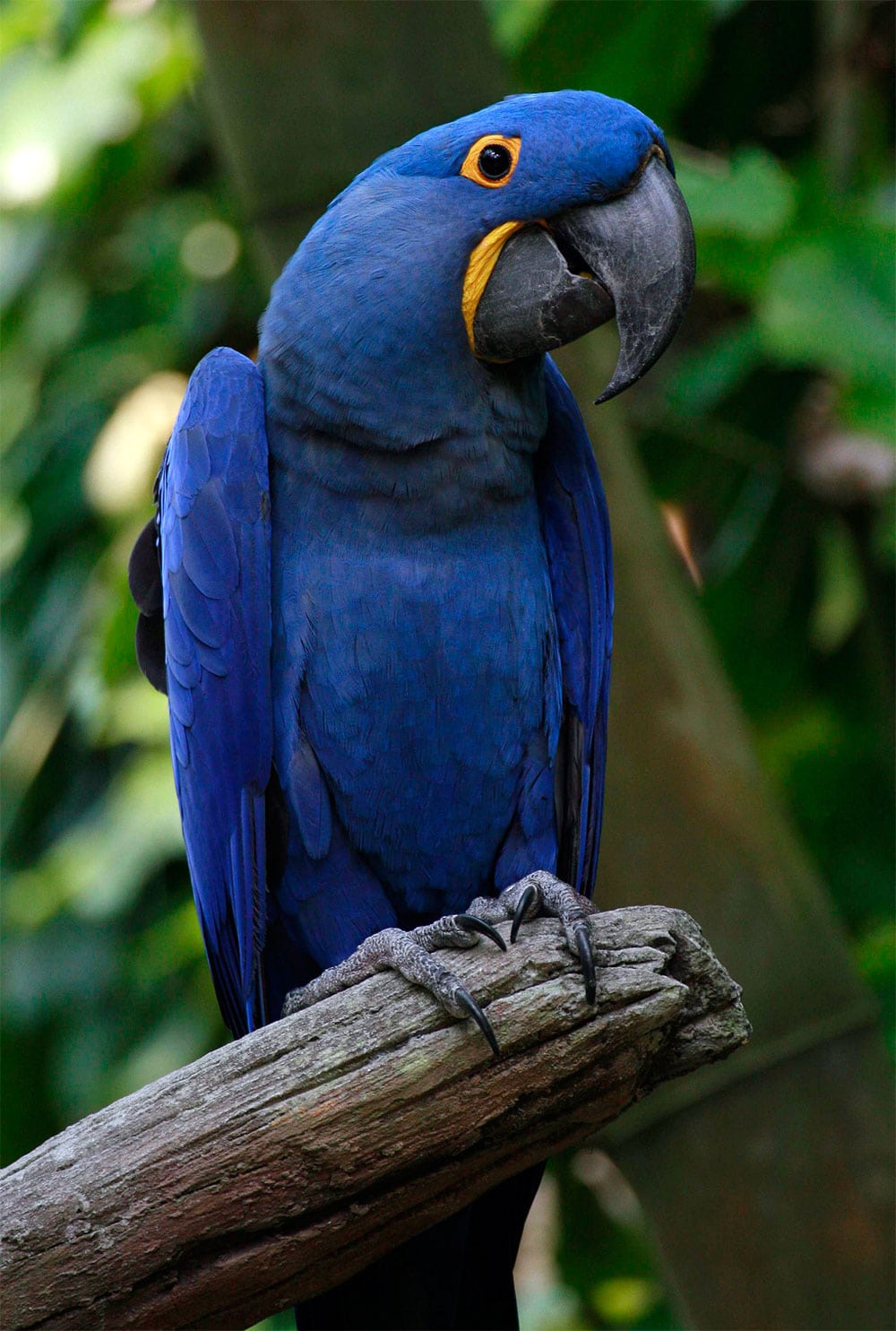
The Hyacinth Macaw (Anodorhynchus hyacinthinus) is the largest parrot; has a distinctive coloration, mostly blue intense, with different colors. Wings and tail below black. The basis of the bill and periocular ring, naked and yellow. The tail is very long, and its powerful bill Black is deeply curved and pointed.
The species Anodorhynchus glaucus, similar but smaller, extinct in the early 20th century, It may have been present in Bolivia.
The Hyacinth Macaw take advantage of a great diversity of habitats rich in various species of Palm trees with large seeds, of which feeds.
In the Brazilian Amazon avoid areas of more moisture, preferring lowland forests and seasonally wet formations with clear zones. In the drier parts of the northeast of Brazil inhabits areas of Plateau cut by Rocky valleys, steep with closed deciduous woodland, gallery forest and swamps with Mauritia flexuosa.
In the the Pantanal region birds frequent gallery forest with palm trees in areas covered with wet grass.
Apparently performs migratory movements.
Usually seen in pairs, family groups or small flocks (usually up to 10); much larger flocks reported before the decline.
They nest in large tree hollows, in cracks in rocks from cliffs in the northeast of Brazil or in moriche or aguaje (Mauritia).
The favorite for nesting trees in the Mato Grosso, Brazil, include Enterolobium and Sterculia striata. In Northeast Brazil, the nest is located in Palms Mauritia dead or on cliffs.
They usually put one or two eggs, although only one young usually survives if the second egg hatches a few days after the first, since the smaller calf cannot compete with the larger for food.
The incubation period lasts about a month, and the male will assist his partner while she incubates the eggs.
Young people remain with their parents up to three months of age. They reach maturity and begin to play on the seven years.
The breeding season is from August to December, Maybe a little later in areas of pantanal.
The diet Hyacinth Macaw consists mainly of nuts, locally available of various Palms, including (on Amazonia) Maximiliana regia, Orbignya martiana and Astrocaryum, in the northeast of Brazil, of the Syagrus coronata and Orbignya eicherir, in areas of wetlands of Bone collectors and Acrocomia.
The palm nuts they take them from the own soil or plant (especially after a fire or when available as undigested remains in livestock droppings).
Other fruits that have information are the from the Ficus sp., as well as aquatic molluscs Pomacea.
Birds drink liquid from green palm fruits.
Its distribution includes the Centre of South America, Perhaps in several spacious separate areas.
In the Amazonia in For from the Tapajos River, to the East of the basin of the Tocantins River, extending to the South, possibly to the Northwestern area of Tocantins. At least before present North of the Amazon River (in Amapá, amazon and Roraima, Brazil) and perhaps some specimens can still inhabit, Although there is no known recent records.
Distributed, as well, through the Northeast interior of Brazil, more or less centered on the Microregion of the Chapadas das Mangabeiras in the union between Maranhão, Piauí, Goiás and Bay, Brazil (the region Gerais).
A third important population focuses on habitats wetlands of the upper basin of the Paraguay River in the southwest of Mato Grosso, Mato Grosso do Sul, Brazil, and extending into the adjacent area of the East of Bolivia and North end of Paraguay.
Reported as probable for the Mapori River to the South-East of Colombia (Vaupés).
Movements General residents but perhaps seasonal in the Amazon in relation to the ecology of the plants on which they feed.
The territory between the three current major distributions, can still be busy even though recent trends given, They seem to indicate that this seems unlikely.
Formerly common in some areas (for example, Mato Grosso). Now they are rather unevenly distributed, with the recent and likely declines continuous in its population due mainly to the illegal trade internal and to the smaller, but significant, international market of live birds. Also hunted for its feathers (especially Pari) and as food. Declining in some areas (for example Eastern Amazonia), because of the alteration or loss of habitat.
Total estimated wild population in 3000 (1.992). CITES Appendix I.
VULNERABLE.
• Current Red List of UICN: Vulnerable
• Population trend: Decreasing
The Hyacinth Macaw It has been subjected to a massive illegal trade. At least 10.000 birds were captured in the wild, in the decade of 1980, with a 50% destined to the Brazilian market (Mittermeier et to the. 1990).
Among 1983-1984, more than 2.500 birds were moved out of Black Bay, Paraguay, with others 600 extra at the end of 1980 (J. Pryor in litt., 1998). Although these numbers are now much smaller, illegal trade continues (for example 10 bird went through a pet market in Santa Cruz, Bolivia, in August 2004 until July 2005, where the birds were changing hands for 1.000 $ US and went to Peru [Herrera and Hennessey 2007]). More recently it has been noted that there appears to be almost no illegal trade in this species in Bolivia (B. Hennessey in litt. 2012).
Through its area of distribution, There is something of the local game for use as food and for its feathers.
In the Amazon, habitat loss has occurred for cattle ranching and hydroelectric power systems in the rivers Tocantins and Xingu.
In the Pantanal, only the 5% trees S. apetala have suitable cavities (Guedes 1993, Johnson 1996). Young trees are used as food for livestock and burned by frequent fires (Newton 1994).
The Gerais is it being quickly transformed by mechanized agriculture, ranching and plantations of exotic trees (Conservation International 1999).
In Paraguay, the preferred habitats of the Hyacinth Macaw are considered seriously threatened (N. Kochalka Lopez in litt. 2013) and the Paso Bravo National Park suffering from illegal logging.
Conservation Actions Underway:
– Many landowners in the Pantanal (more and more in the Gerais) they do not allow hunters on their property.
– There are several studies long-term and conservation initiatives (for example. Anon 2004).
– In the Refuge Caiman ecological in the Pantanal, the Hyacinth Macaw Project has used artificial nests and hatchling management techniques and raised awareness among farmers (Anonymous 2004).
Conservation Actions Proposed:
– Assess the effectiveness of artificial nesting boxes (Snyder et to the., 2000).
– To enforce the legal measures that hinder trade.
– Experiment with ecotourism in one or two sites to encourage donors (Snyder et to the., 2000).
Rare up to 1970; then, starting at 1980, increased considerably in number of captive birds due to increased breeding.
Despite the prohibitions, many of these Macaws they are still trading at high prices (10.000 euros or more), due to its beauty and ease to mimic human language.
Rearing this species can be difficult and, Unfortunately, many chicks die each year in inexperienced hands.
From this page we strongly preserve these beautiful birds in their natural environment, sincerely not us seems reasonable to his tenure as a pet.
– Hyacinth Macaw, Blue Macaw, Black Macaw (English).
– Ara hyacinthe (French).
– Hyazinthara, Hyathinzara (German).
– Arara-azul-grande, arara-azul, arara-hiacinta, arara-preta, arara-roxa, arara-una, canindé (Portuguese).
– arara-azul, Arara-azul-grande, arara-hiacinta, arara-preta, arara-roxa, Ararauna, arara-una, canindé (Portuguese (Brazil)).
– Guacamayo Azul, Guacamayo Jacinto, Papagayo azul (español).
– Jacinta azul, Paraba azul (Bolivia).
– Vihina (Desana).
– Kaheta (Carijona).
– Guaía-hovy (Guarani).
– Arara-úna (Tupi Guaraní).
– Order: Psittaciformes
– Family: Psittacidae
– Genus: Anodorhynchus
– Scientific name: Anodorhynchus hyacinthinus
– Citation: (Latham, 1790)
– Protonimo: Psittacus hyacinthinus


Sources:
– Avibase
– Parrots of the World – Forshaw Joseph M
– Parrots A Guide to the Parrots of the World – Tony Juniper & Mike Parr
– Birdlife
– Parrots, Parrots and macaws (Neotropical)
– Photos:
(1) – Hyacinth Macaw also known as Hyacinthine Macaw at Disney’s Animal Kingdom Park by Hank Gillette [CC BY-SA 3.0 or GFDL], via Wikimedia Commons
(2) – A Hyacinth Macaw at Brevard Zoo, Florida, USA By Rusty Clark from merritt usland FLA (Brevard Zoo Hyacinth Macaw) [CC BY 2.0], via Wikimedia Commons
(3) – Hyacinthine Macaw at Melbourne Zoo, Australia By derivative work: Snowmanradio (talk)Anodorhynchus_hyacinthinus_-Australia_Zoo_-8.jpg: Erik (HASH) Hersman [CC BY 2.0], via Wikimedia Commons
(4) – Hyacinth Macaws at Stone Zoo, Stoneham, Massachusetts, USA By Eric Kilby (originally posted to Flickr as Squawking Heads) [CC BY-SA 2.0], via Wikimedia Commons
(5) – Hyacinthine Macaw (Anodorhynchus hyacinthinus) By Ana_Cotta (originally posted to Flickr as ARARA) [CC BY 2.0], via Wikimedia Commons
(6) – Hyacinth Macaws, Anodorhynchus hyacinthinus at the Aquarium of the Americas in New Orleans, Louisiana By Derek Jensen [CC BY 2.0], via Wikimedia Commons
(7) – A pair of Hyacinth Macaws and thier nest in Mato Grosso do Sul, Brazil By Geoff Gallice from Gainesville, FL, USA (Hyacinth macaws) [CC BY 2.0], via Wikimedia Commons
(8) – A Hyacinth Macaw preening at the Aquarium of the Americas, New Orleans, USA By Quinn Dombrowski (originally posted to Flickr as Dainty) [CC BY-SA 2.0], via Wikimedia Commons
(9) – Anodorhynchus hyacinthinus by Hans – Pixabay
(10) – Illustration Guacamayo Jacinto By Lear, Edward [CC BY 2.0 or Public domain], via Wikimedia Commons
– Sounds: Niels Poul Dreyer (Xeno-canto)
Content |
|---|
20 cm.. height.
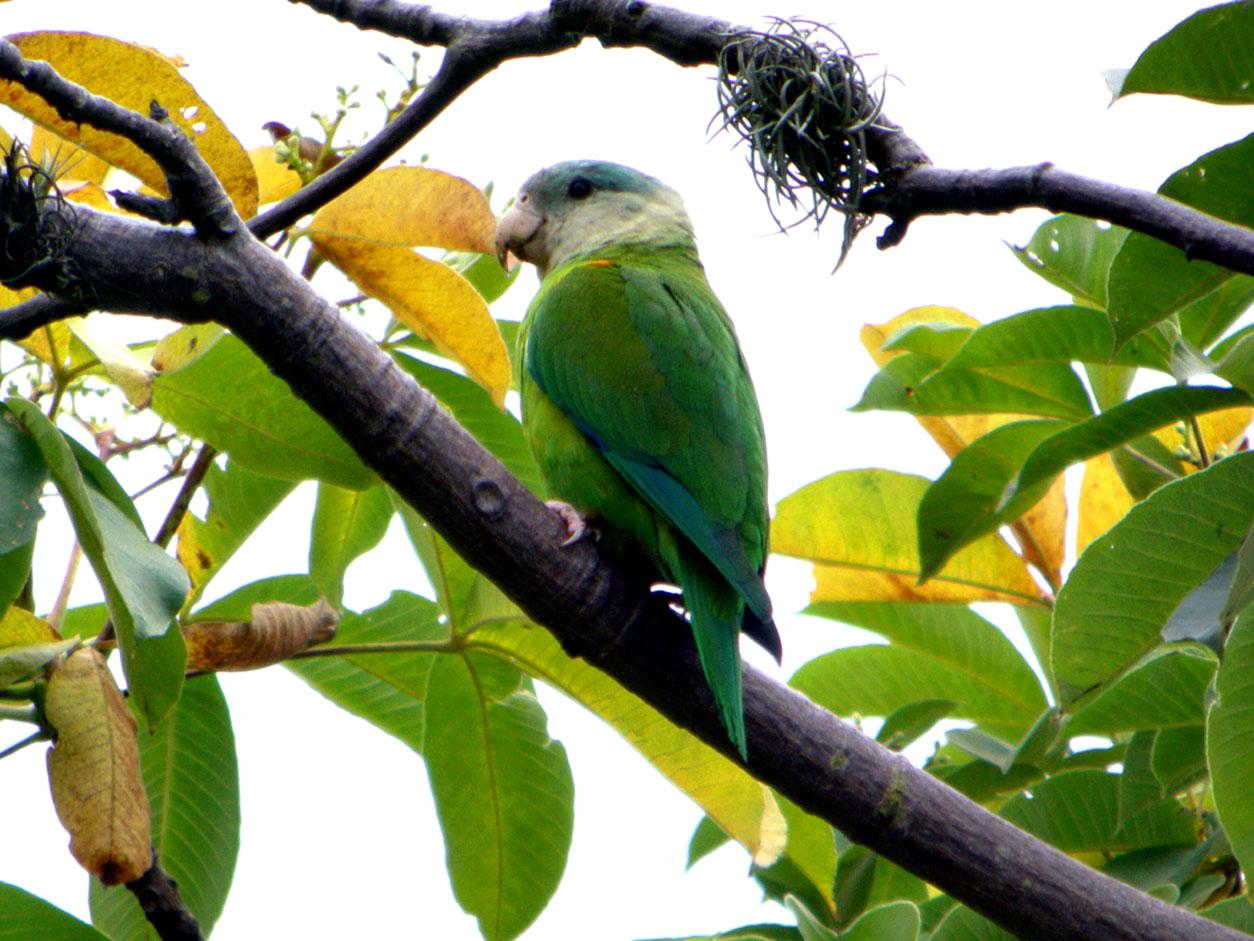
The Grey-cheeked Parakeet (Brotogeris pyrrhoptera) discovered in 1801. Is difference for them cheeks and sides neck grey, crown up to almost the nape, blue, bill yellowish, armpit reddish orange (only visible in flight), tail long and pointed, the rest of the body green.
The immature they have the crown greenish blue and the bill blackish.
hybrid species:
Video – "Grey-cheeked Parakeet" |
|---|
It inhabits in humid forest, semi-wet, secondary, formations of semi-deciduous forest and cultivated areas, until 1500 m. Has also seen it is in the banana plantations. Flies in pairs or small groups up to of 12 individuals, sometimes associated with other parrots.
Nest in hollows and termite mounds on large trees and apparently be reproduced between January and March. It is still unknown why the termites tolerate their presence.
Their eggs, they are around for 2 cm.. x 1,6 cm.. they settle in sunsets of four to six eggs in a nest filled with MOSS. The female incubates them for a few 25-26 days, While the male mounts guard out of the nest.
Feeds of flowers and seeds large trees including Erythina, Chorisia and cavanillesia platanifolia, Cecropia catkins, fruits of Ceiba and Ficus figs. Sometimes they feed of banana.
Size of the area of distribution (reproduction / resident): 9.300 km2
The Grey-cheeked Parakeet distributed over the southwest of Ecuador and Northwest corner of Peru, from the Valley of the chone river, Manabi, to the South up to Gold and Loja in Ecuador, and Tumbes and Piura in Peru.
The populations more large is found in the coast of Manabi and Guayas, and at the border between Ecuador and Peru (Juniper and Parr, 1998).
There was a large decrease in the population during the 20TH century, at the beginning of the year 1980 (Best et to the., 1995, Juniper and Parr 1998), with 59.320 birds imported by countries CITES between 1983-1988. In 1995, the population Wild was estimated in 15.000 birds, mainly in Ecuador (Best et to the., 1995). This represents a very crude c.70% decline in 10 years, although it is still locally common in some remains of its habitat. (Juniper and Parr 1998).
Counts of investigations in the Cerros de Amotape National Park and in the Tumbes national reserve they revealed a descent of the 33,2% between 1992 and 2008 (Anon. 2009).
State of conservation ⓘ |
||
|---|---|---|
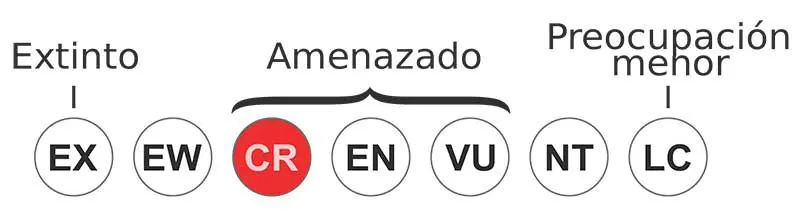 critically endangered ⓘ (UICN)ⓘ
| ||
• Current category of the Red List of the UICN: In danger of extinction.
• Population trend: Decreasing.
The main threat to this species is the wild bird trade. The habitat It is also losing out by logging, Agriculture and overgrazing. Its persecution as a pest crops can be also significant.
Is expected that the rate of decline is more slow in the next 10 years.
Most of the existing populations are found in the houses of individuals such as pets. Because of this, effort has been made to save this species of Brotogeris.
– Gray-cheeked Parakeet, Gray cheeked Parakeet, Grey cheeked Parakeet, Grey-cheeked Parakeet (English).
– Toui flamboyant, Perroquet à flancs orangés, Perroquet de Perico, Perruche ou (French).
– Feuerflügelsittich (German).
– Periquito-de-bochecha-cinza (Portuguese).
– Catita Macareña, Periquito de Alas Naranjas (español).
– Perico de Mejilla Gris (Peru).
– Order: Psittaciformes
– Family: Psittacidae
– Genus: Brotogeris
– Scientific name: Brotogeris pyrrhoptera
– Citation: (Latham, 1801)
– Protonimo: Psittacus pyrrhopterus


Sources:
– Avibase
– Parrots of the World – Forshaw Joseph M
– Parrots A Guide to the Parrots of the World – Tony Juniper & Mike Parr
– Birdlife
– Parrot Book, parrots and macaws Neotropical
– Photos:
(1) – Grey-cheeked Parakeet (also known as the Fire-winged Parakeet) at El Empalme (also known officially as Velasco Ibarra), a town located in Guayas, Ecuador By markaharper1 [CC BY-SA 2.0], via Wikimedia Commons
(2) – Periquito macareño (Brotogeris pyrrhoptera), Quito, Ecuador by Diego Delso [CC BY-SA 4.0], via Wikimedia Commons
(3) – Grey-cheeked Parakeet (Brotogeris pyrrhoptera) in captivity in Cuenca, Ecuador By Beatrice Murch (originally posted to Flickr as Grey headed parrot) [CC BY 2.0], via Wikimedia Commons
(4) – A pet Grey-cheeked Parakeet By Juano80 (Own work) [Public domain], via Wikimedia Commons
(5) – Grey-cheeked Parakeet Brotogeris pyrrhoptera in Río Milagro in Yaguachi. Prov. Guayas. ECU by Ronald Navarrete-Amaya – Flickr
– Sounds: (xENO-singing)
Content |
|---|
23 cm.. height.
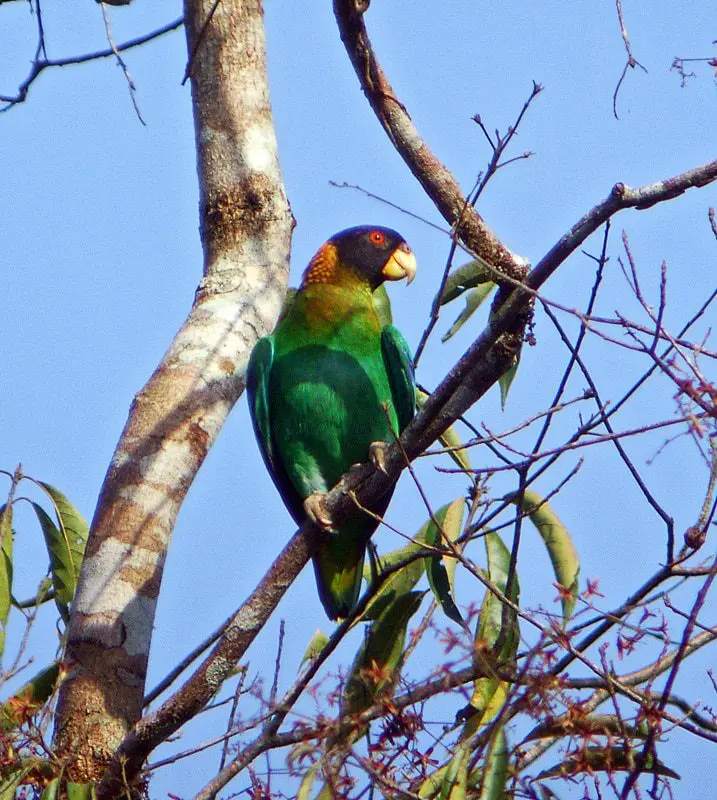
The head of the Caica Parrot (Pyrilia caica) totally black is it more distinguishable from this species, together with a collar Golden cafesoso that extends up to the chest.
The rest of the body usually Green, more clear in the belly and the inside of the tail; wing with blue stain and dark ends, Tip of the tail black.
Bill color bone; ring eyepiece bare of color grey pale; Orange irises.
The youth with crown green, face Dark greenish yellow, and collar not very notorious gold in neck and almost absent in chest.
Inhabits little disturbed humid forests, firm ground, in Tepuis, from the 50 to the 1100 m.
gregarious, They walk in small groups. They feed in the canopy of the forest.
Currently with little information about the reproduction.
In the wild, It believes that its diet consists mainly of eucalyptus flowers, fruit, nectar and pollen.
Can be observed in the South-East of Venezuela, Guyanas and northeast of the brazilian amazon.

• Red List category of the UICN current: Near-threatened
• Population trend: Stable
Justification of the population:
The size of the world population Caica Parrot It has not been quantified, although this species is described as 'rare’ (Stotz et to the., 1996).
Justification trend :
This species is suspected that it may lose 13,6-17,2% of habitat within its distribution over three generations (21 years) based on a model of deforestation of the Amazonia (Soares-Filho et to the., 2006, Bird et to the. 2011).
Given the susceptibility of this species to the hunting and/or entrapment, It is suspected that its population will decrease at a rate close to the 30% in three generations.
They adult acclimatised quite easily to a new environment and are very resistant … Conversational skills (in comparison with other species).
They are very quiet in an Aviary, with a personality friendly and Gentile. They are very sociable and it should be with a partner or in a group environment. In any way, It is not easy to see to the Caica Parrot in captivity.
– Caica Parrot, Hooded Parrot (English).
– Caïque à tête noire (French).
– Kappenpapagei, Kappen-Papagei (German).
– curica-caica, curica, papagainho, periquito-de-pescoço-marrom (Portuguese).
– Lorito Caica, Lorito de Cabeza Negra (español).
– Perico Cabecinegro (Venezuela).
– Order: Psittaciformes
– Family: Psittacidae
– Genus: Pyrilia
– Scientific name: Pyrilia caica
– Citation: (Latham, 1790)
– Protonimo: Caïca parrot
————————————————————————————————
Sources:
– Avibase
– Parrots of the World – Forshaw Joseph M
– Parrots A Guide to the Parrots of the World – Tony Juniper & Mike Parr
– Birdlife
– Photos:
(1) – lynxeds
– Sounds: controles-canto.org
Content |
|---|
51 to 64 cm. height and a weight between 910 and 1200 g.
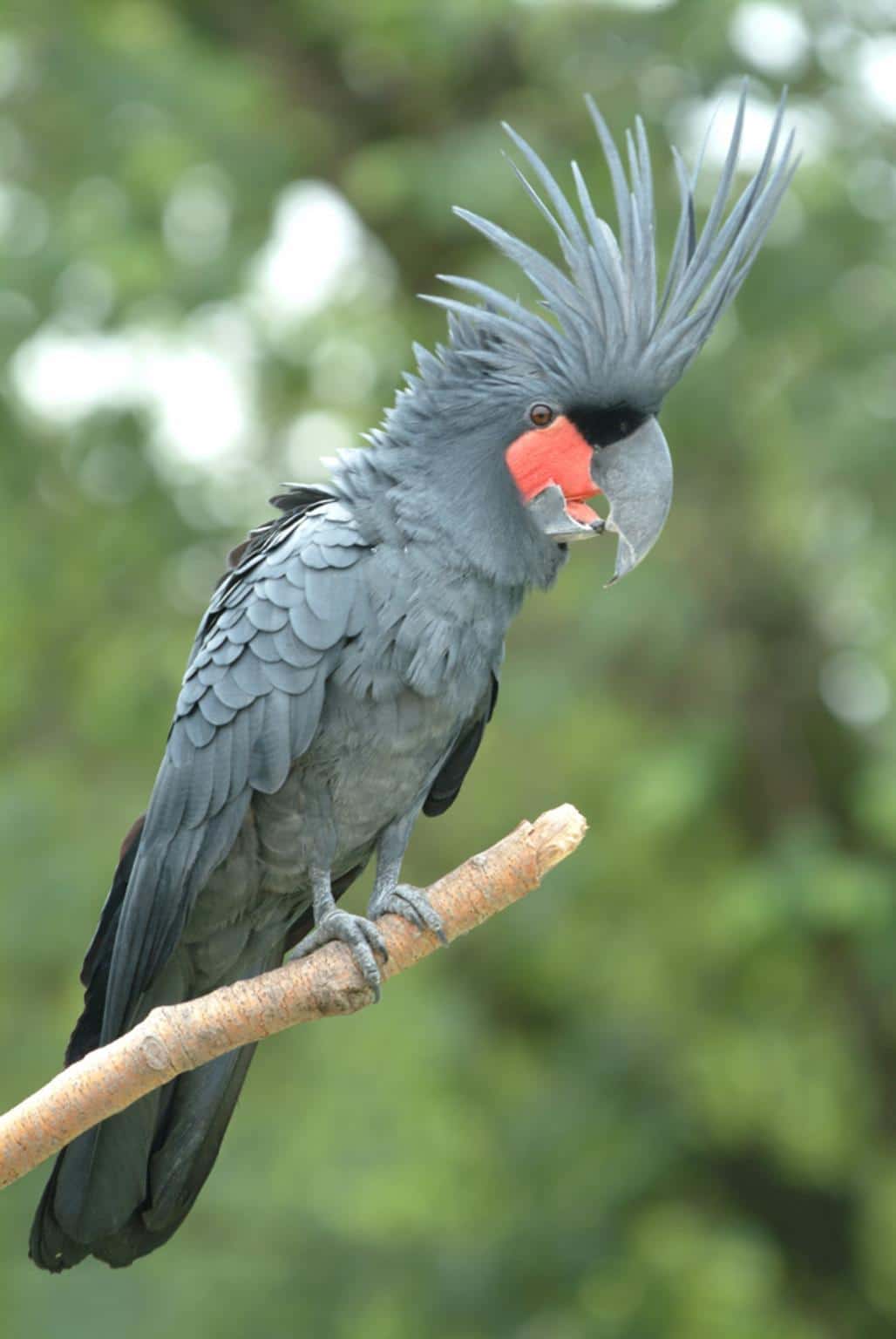
The Palm cockatoo (Probosciger aterrimus) it is one of the largest cockatoo species. Unmistakable with a Erectile Crest of 15 cm.. Mainly arboreal.
Both sexes differ in size. Immatures are differentiated by the pale yellow at the bottom and the tip of the bill and the eye ring in color white.
Usually black with a bare area around the cheeks and eyes red. The feathers of the crest they are long and thin, black streaks.
The bill is dark gray, smaller in the female. The legs son grises. The language is black and Red.
The cheek skin changes color according to its health or stress level, a pink / beige to a yellow when it is excited.
(Gmelin, 1788) – Nominal.
(Kuhl, 1820) – Larger than the subspecies macgillivrayi.
(Mathews, 1912) – Larger than the species nominal.
(Oort Cloud, 1911) – As the subspecies goliat, but with feathers crest closer.
The presence of this cockatoo is documented from sea level to 1350 metres in height.
In New Guinea they are in tropical rainforests, including gallery forests, edges of forests and monsoon forests. In Australia they live in forests of eucalyptus, forest of Melaleuca, partially cleared areas and sheets.
You are travelling individually, in pairs or in groups of five or six. About an hour after sunrise they gather in the treetops.
The nesting occurs between August and February.
Nest in the cavities of trees which tend to be of approximately 1 m depth and 25 to 60 cm in diameter. These are full of branches broken at the bottom on which rests the egg. The site is often used year after year.
Reproduce every two years. They put a single egg and both parents the hatch for a period of 28 to 31 days, at around 3 to 4 more days to hatch. The squab was born completely naked and does not develop marker, unlike other Cockatoo chicks. They are taken from 100 to 110 days to leave the nest, the longest period among all parrot species. After leaving the nest, the young bird depends on the parents at least others 6 weeks because of its inability to fly.
Seeds, dried fruits, fruit, berries, sprouts leaves and insect larvae.
They feed mainly in the forest canopy, but can also feed on the ground on fallen fruits and seeds.
Size of the area of distribution (reproduction / resident): 716.000 km2
New Guinea and adjacent islands, North of Queensland, Australia.
(Gmelin, 1788) – Nominal. Islands Aru, Misool, South of New Guinea and northeast of Australia (Cape York)
(Kuhl, 1820) – Western Cordillera Papuan Islands, except Misool, Indonesian, and centre of New Guinea, since the Doberai Peninsula, Irian Jaya, up to the this of the southeast of Papua New Guinea.
(Mathews, 1912) – South of New Guinea between the rivers Fly and Balim, and Cape York Peninsula, North of Queensland, Australia, on the East Coast towards the Princess Charlotte Bay and on the West Coast, in the edward river.
(Oort Cloud, 1911) – The Yapen island on Cenderawasih Bay, Irian Jaya, and North of New Guinea, from the mamberamo river to the East of the collingwood bay, Southeast of Papua New Guinea.
State of conservation ⓘ |
||
|---|---|---|
|
Minor Concern ⓘ
(UICN)ⓘ
| ||
• Least concern according to IUCN classification.
• Population trend: Decrease
This species has a very large range, and therefore not approaching the threshold of vulnerability. While the trend of the population seems to be decreasing, the decline is not believed to be fast enough to approach vulnerable bird thresholds based on population trend criteria.
In some parts of its area of distribution, the forest habitat in which occur the hollow trees is being invaded by the rainforest.
Rare bird cage, Although they have a great demand for the market of pet due to its unusual appearance.
They can live more than 55 years of age in captivity.
They may develop compulsive behaviors, as the pecking of feathers. They can also mimic sounds and human language.
Aggressiveness within pairs is taken into account for captive breeding., Sometimes the male usually kill the female. As such, There are more different management methods, from bringing both cockatoos together only during the breeding period and quickly removing the male, cut the male that the female escape flying, or create complex installations that are carried out next to a cutout of the male, so that the female always has an escape route in the face of aggression.
There are currently laws that prohibit the export of any Palm cockatoo without a permit.
– Palm Cockatoo, Black Macaw, Goliath Aratoo, Goliath Cockatoo, Great Black Cockatoo, Great Palm Cockatoo (English).
– Cacatoès noir, Microglosse noir (French).
– Arakakadu (German).
– Cacatua-das-palmeiras (Portuguese).
– Cacatúa de las Palmas, Cacatúa Enlutada (español).
– Order: Psittaciformes
– Family: Cacatuidae
– Genus: Palm
– Scientific name: Probosciger aterrimus
– Citation: (Gmelin, JF, 1788)
– Protonimo: Psittacus aterrimus


Sources:
– avibase
– infoexoticos
– Parrots of the World – Forshaw Joseph M
– Parrots A Guide to the Parrots of the World – Tony Juniper & Mike Parr
– Birdlife
– Photos: avianzoo, papageien.org, avianzoo, Wikimedia.org
– Sound: Frank Lambert


.jpg)

_(8116335153).jpg)

%2C_Quito%2C_Ecuador%2C_2015-07-22%2C_DD_180.JPG)
_captivity.jpg)
