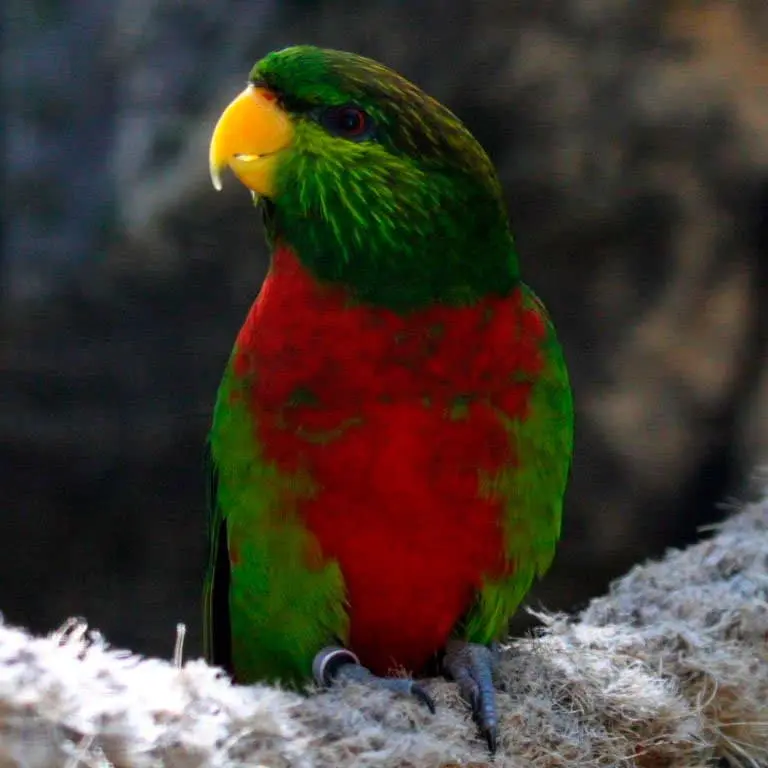
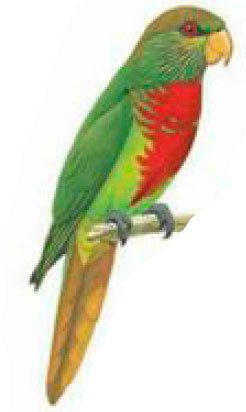
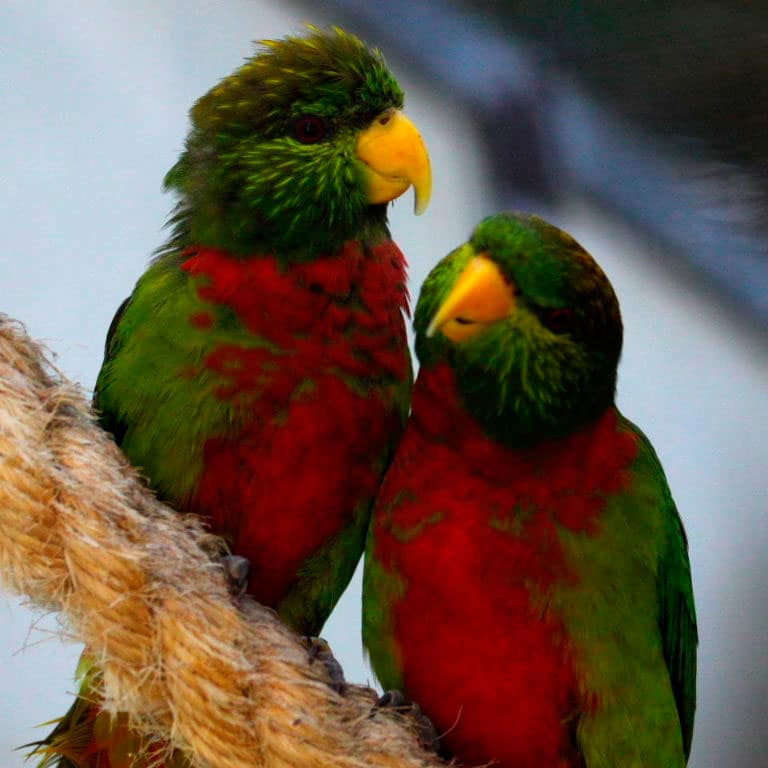
The head of the Yellow-billed Lorikeet(Neopsittacus musschenbroekii) is green, strongly impregnated with olive brown, veined in ear-coverts and showing a shaft of yellow stripes on the crown; darker line in the lores, above the bill; forecrown green.
Upperparts green intermediate. The wings green above with vane blackish internal to the coverts and black on the tips of the flight feather. Rojas the Underwing coverts. Flight feathers blackish with wide red central band. Throat greenish yellow yielding to red chest to the top of the the thighs. Flanks yellowish green to the sides of chest, with a central area in the bottom area chest and belly, red; coverts more yellowish than the rest of the underparts.
Cover top of queue, green, yellow tips, Brown shafts with red bases on the side of the feathers; undertail yellow-orange, showing red bases in lateral feathers when they deployed.
Bill pale yellow; irises red; gray of the legs.
Sexes alike.
Immature duller than adults with brands head less clear and red on the underparts restricted to spots in the center of belly and in the chest. Bill brownish-orange, irises yellow brown or orange. Young birds also show feathers tail pointy, which they are rounded as adults.
(Neumann, 1924) – Slightly larger than the nominal and paler in upperparts.
Habitat:
It inhabits in montane forests, edges of forests, partially cleared areas of secondary growth, mainly between 1.400 and 2.500 m, even if you are also registered at altitudes as low as 1.100 meters and as high as 3,000 m. It is also common in altered areas or in groves of Casuarina or eucalyptus in garden areas.
It seems that they have adapted well to the impacts of the man. But it is absent from the places where the forest has been removed completely over large areas.
Visible and noisy, they are in pairs, small flocks and in larger congregations of up to 50 birds in flowering trees. Over most of New Guinea, This species is replaced at higher altitudes by the smaller Orange-billed Lorikeet, commonly found in the company with the latter in the upper band of its altitudinal range (except Vogelkop).
Most frequently found in flowering trees, often in the company of other species such as the Papuan Lorikeet, also in the fructification of the Schefflera and feeding is sometimes lower levels even on the weeds at ground level.
Reproduction:
Observed to be moving like a rodent along branches. The laying It is two eggs in a hole in the trunk of a tree. Period unknown but an immature nesting was observed in the Province of West Papua in late August and a fledgling in the same area in the middle of November.
Food:
Feeds of pollen, nectar, small fruits and berries. It is also thought that feed on seeds as part regular your diet, while the Orange-billed Lorikeet is limited to nectar only. As other parrots can eat insects and their larvae, deliberately or accidentally.
Distribution:
Size of its range (reproduction / resident): 587.000 km2
New Guinea in Irian Java (Indonesian) and Papua New Guineto. Is distributed from East of Vogelkop up to the Huon Peninsula and scattered areas in the Southeast. In Vogelkop, Despite the absence of the Orange-billed Lorikeet, the population of the Yellow-billed Lorikeet is relatively low. A small amount in captivity.
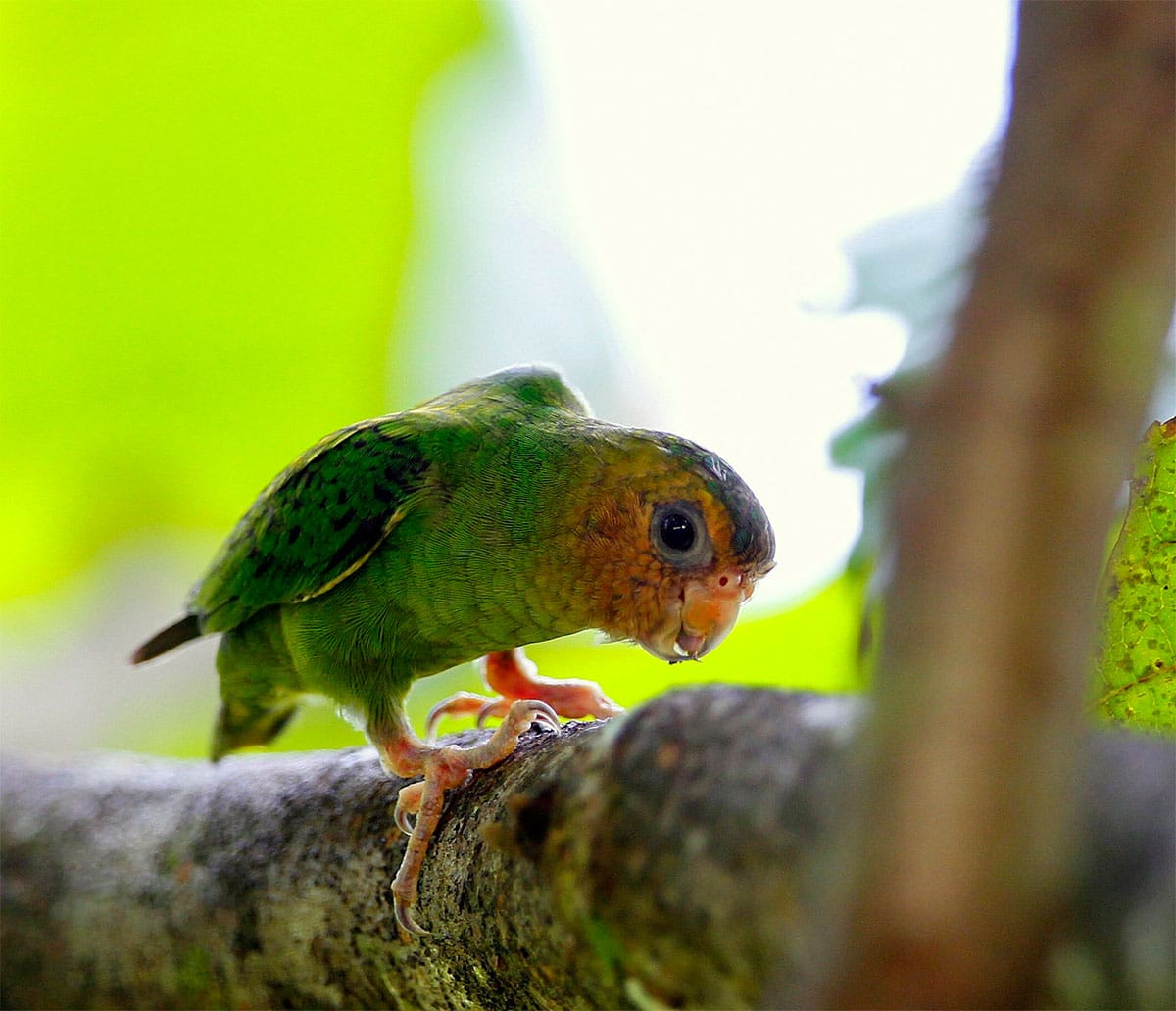
The Buff-faced Pygmy-Parrot(Micropsitta pusio) has a length 8,4-8,6 cm.. and 11,5 g. of weight, what it becomes in the Parrot more small of the world.
Has the forecrown, face and chin of color Brown mottled dark, eyebrows yellowish; centre of crown blue, merging to green in the area of the nape. Upperparts Greens with wing-coverts Black in the Center. Flight feathers Black with green ends; lower coverts greenish yellow; underside of the primaries greyish, lightly bathed in yellow. The underparts brighter yellowish green, more pale in the center of the chest and the belly; uppertail-coverts Yellow. The tail centrally blue, with a black shaft. Outer feathers Black with yellow spots.
Bill dark grey; irises brown; legs of color grey or pink.
Female slightly more off than the male around the face.
Young with crown greenish blue and less brightness in the face.
(Salvadori, 1876) – Usually darker than the nominal race especially on the face, including eyebrows.
Micropsitta pusio harterti
(Mayr, 1940) – Brands that most off the nominal head, Blue throat. Less yellow in the parts below that the subspecies Micropsitta pusio stresemanni.
Micropsitta pusio stresemanni
(ECTION Hartert, 1926) – As the subspecies Micropsitta pusio harterti, but slightly larger and more yellow below.
Habitat:
They are found in lowland forests, wooded hills, gallery forest and secondary vegetation, from sea level to the 500 m. It is also locally in the Savannah and areas of coconut trees (Cocoa nuts).
The species is common and trusting, but can be hard to find due to its small size. Birds can also sometimes be glimpsed by flying in small groups above the canopy. They tend to fraternize in pairs or in groups of up to 30 birds.
They frequently stop while they feed on and turn your head to the right, possibly to find predators.
Reproduction:
Common Long-tailed Kingfisher (Tanysiptera galatea)
Nestbox, they dig in tree cavities active termite mounds, for example the (Microcerotermes biroi). A nest was also found in a terrestrial termite, the entry just a meter from the ground. There is a flange on each side of the entry hole and this differentiates their holes of other species that make their nests in termite mounds, such as the Common Long-tailed Kingfisher (Tanysiptera galatea).
Until three white eggs are the implementation. The nesting season has been recorded throughout the year. Adults sleep on community and up to eight birds have been recorded from a cavity.
Food:
It moves rapidly along lianas and trunks or branches of trees (in inverted position) using its long claws to grip and digging lichens and fungi in the barks. Also sometimes feed on seeds, fruits and insects (that it can be accidentally ingested).
– Avibase
– Parrots of the World – Forshaw Joseph M
– Parrots A Guide to the Parrots of the World – Tony Juniper & Mike Parr
– Birdlife
– Photos:
(1) – El loro más pequeño del mundo – medioambiente.net
(2) – Photo of Micropsitta pusio [By Katerina Tvardikova] – New Guinea Birds
(3) – A bird feeding on the bark of a tree. Author Carmelo López – lynx
(4) – Photo of Micropsitta pusio [By Katerina Tvardikova] – New Guinea Birds
(5) – Buff-faced Pygmy-Parrot, Micropsitta pusio at Nimbokrang by jon hornbuckle – BIRDING AROUND THE WORLD
(6) – Tanysiptera galatea By Katerina Tvardikova – New Guinea Birds
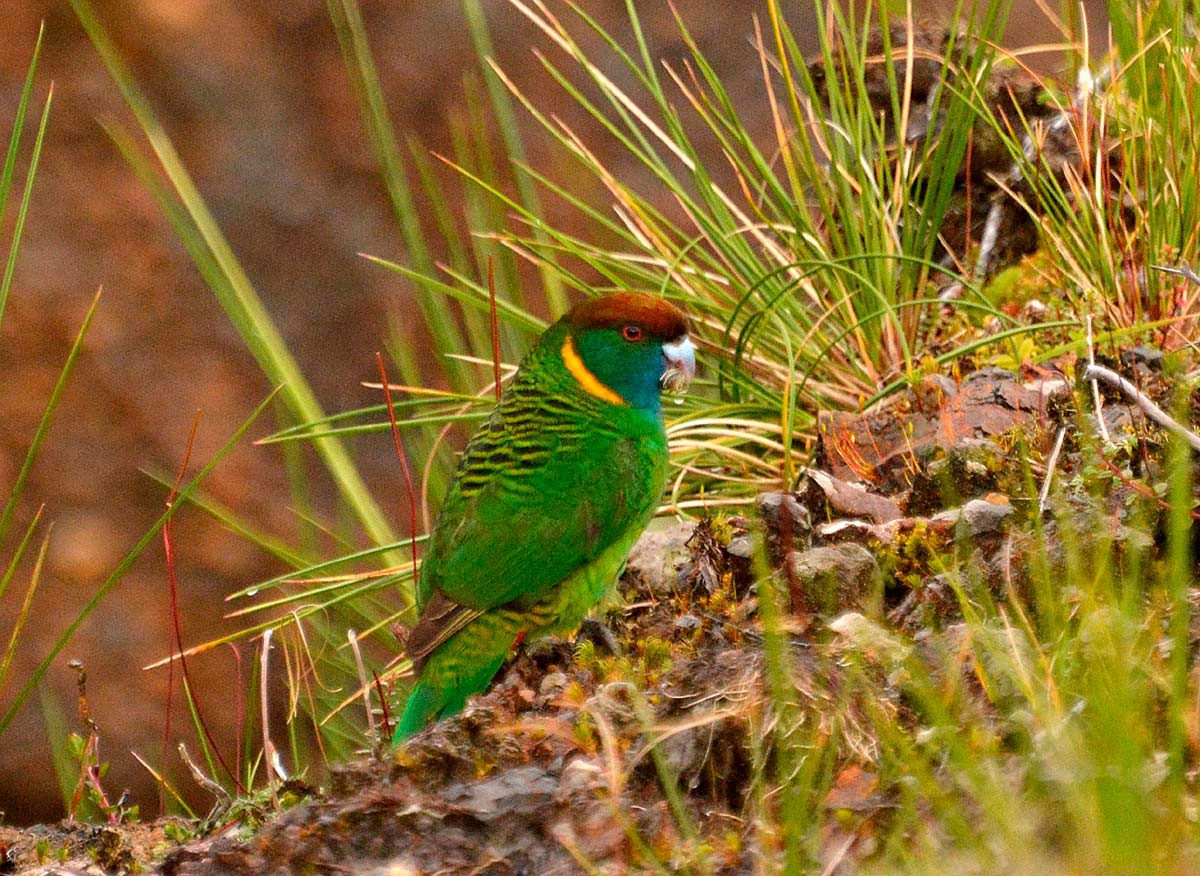
In adults of the Painted Tiger-Parrot(Psittacus erithacus), the head is predominantly Brown, but the colors of the top they are bright and warm, While the cheeks they are more off and more grey. One collar Yellow Strait decorates the neck. The plumage is green with black stripes. Rump and uppertail-coverts red. The wings They show a green with yellow stripes on the external threads and the flight feather. The underparts is yellowish-green.
The chin is brown, the upper part of the chest It has a central patch of blue. The coverts are orange-red. The rest of them underparts are a green medium, slightly clearer that the upperparts. The upper part of the tail is dark green. The bottom of the tail is blackish grey.
The bill is light grey and blue color with a white tip. The irises are reddish orange, the legs dark gray.
The collar Yellow is absent in the female. The cheeks they are dyed blue. The chest black and yellow colors absent. In the upperparts abounds over the scratched.
– (Victoria, 1910) Adults as the nominal species but the crown and the surroundings are color marron-oliva; cheeks teal, with a green darker in ear-coverts; rump and uppertail-coverts greenish yellow striped with black.
Psittacella picta excelsa
– (Mayr & Gilliard, 1951) Males as the nominal, but the Crown is colored bright marron-oliva. The female is like the female of the nominal species but with the head color glossy marron-oliva; the throat and cheeks heavily washed in blue.
Habitat:
The Painted Tiger-Parrot they live in the mountains, in forest areas where can be seen especially at edges and clearings. They are also found in the moss-covered forests, the secondary forest, and in the thickets of Alpine and subalpine areas. These birds can be downloaded at 1.370 m. In the southeast of its distribution area, they tend to be distributed at lower altitudes than in other places. But, their preferred Habitat is between the 2.400 and 4.000 m, just above the Brehm's Tiger-Parrot (Psittacella brehmii).
The birds are generally quiet, but not shy, and move individually, in pairs or in groups of up to six members; It has been observed feeding on groups, mixed with the Madarasz's Tiger-Parrot. They often feed in low bushes or on the ground.
Reproduction:
Little is known about the ecology of the species and the only information on reproductive behavior is that birds in breeding conditions have been observed in the months of June and August..
Food:
The diet It includes seeds, berries and the fruit of conifers Dacrydium.
Distribution:
Endemic to the central band of the mountain of New Guinea. Restricted to the high montane forests, from the West of the Maoke through the central mountains, including the Tari region, about Kandep, Mount Hagen, Monte, Kubor up to the Owen Stanley mountain range in the Southeast. The world's population is believed to be superior to the 100.000 specimens.
– Occupied the mountains Central of Papua New Guinea.
Conservation:
• Current IUCN Red List category: Unrecognized
According to "The World Parrot Trust«, in accordance with Tony Juniper, the world's population is superior to 100 000 individuals.
According to the Manual, This species, Although relatively dispersed, may be locally common. Despite its small extension, It is classified as «least concern»For the different ornithological organizations.
46 cm. length and a weight between 680 and 800 g..
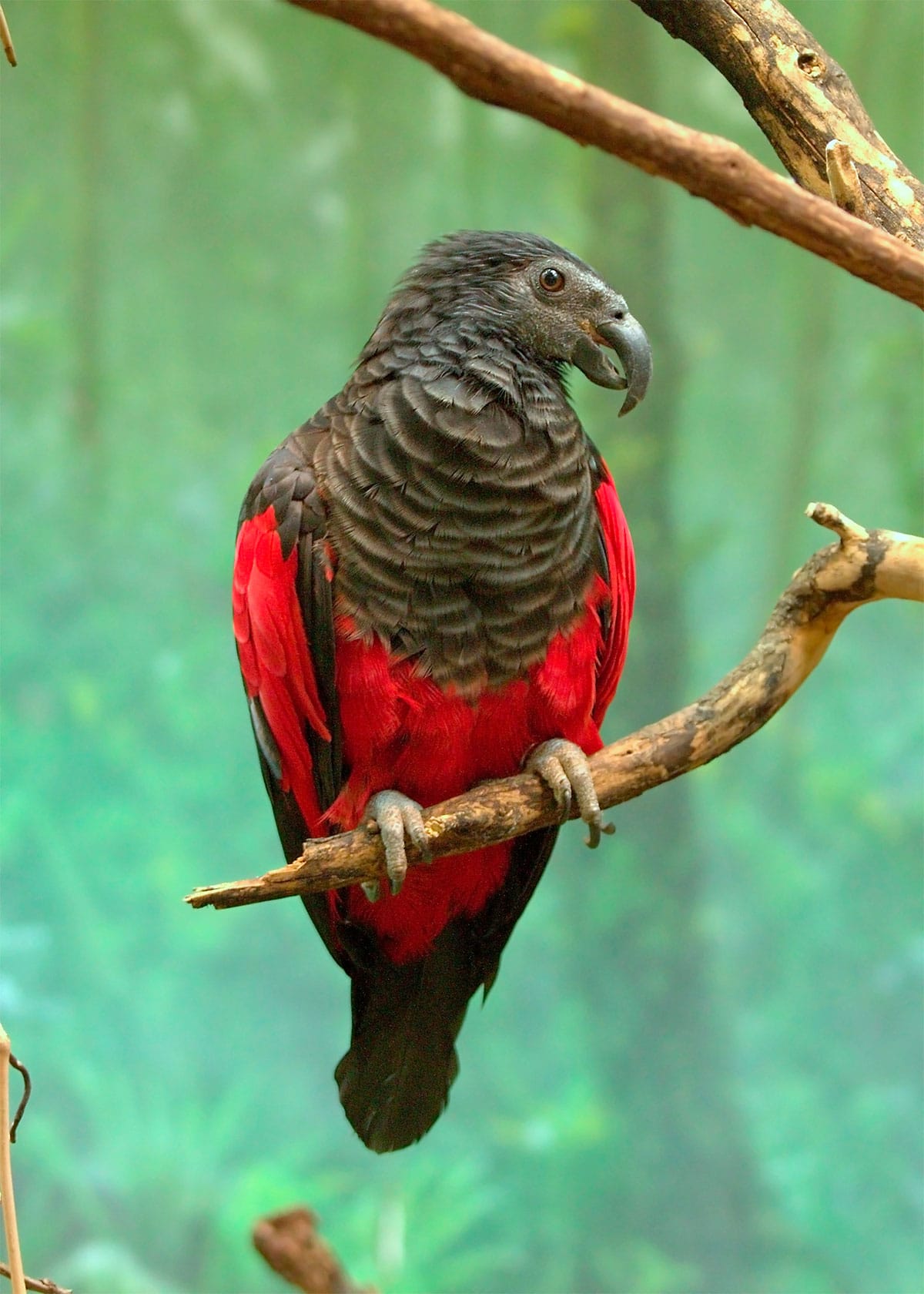
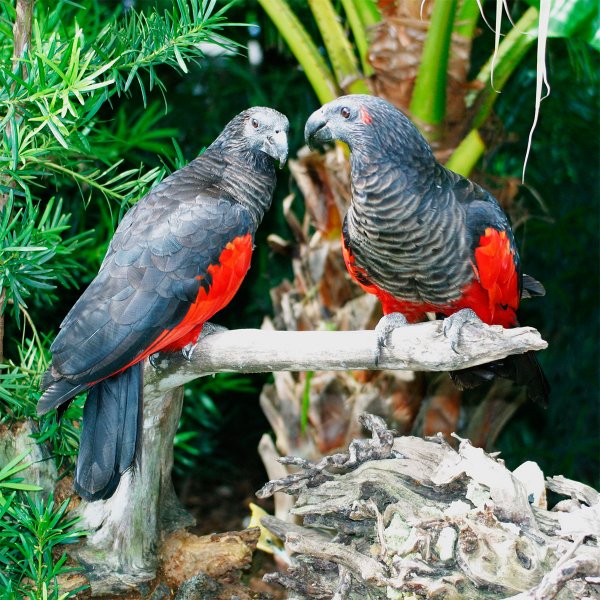
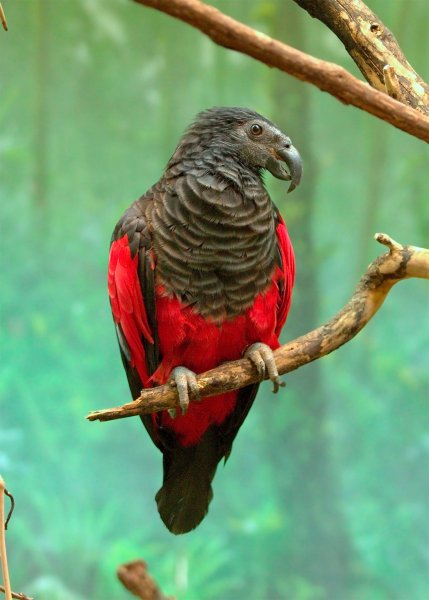
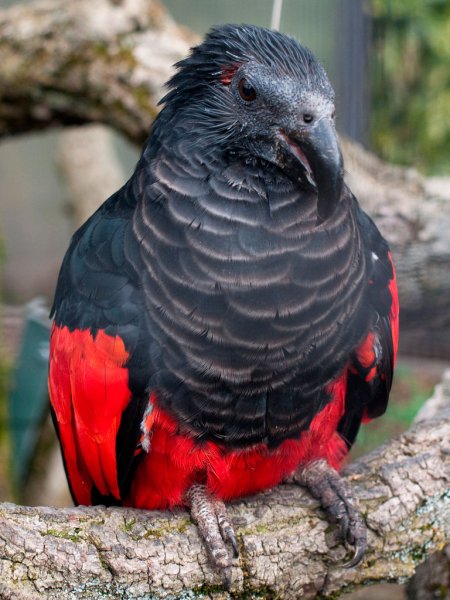
The head of the Pesquet's Parrot(Psittrichas fulgidus) is black, front without feathers, may be covered with small ruffled black feathers with a patch of stiff red feathers on the front of the legs ear-coverts. Nape, the mantle, back and tail blackish brown with fine pale edges.
Uppertail Red with black bases. Upper, black flight feathers, with large and medium-sized external coverts (except the innermost) and vane external Central flight feathers, red; Black primary coverts. Under, Black tail with red in the lower and medium coverts. More Brown on the top breast than in the rest, with a wavy effect to pale fringes to the feathers; belly, flanks and coverts red infracaudales. Upper, the black tail.
black beak; black skin of the face; dark brown irises; Blackish grey legs.
The female It lacks the red patch on the side of the head and is slightly smaller on average.
The Pesquet's Parrot are found mainly in the primary and secondary montane rain forest at an altitude between 600 and 1.200 m. However there are to the 2.000 m, and are occasional at altitudes as low as 50 m.
The species is thought, generally, they have a low density of population, finding the highest concentrations in forest areas relatively calm, where the birds are free from persecution.
These large and showy parrots, They are commonly found in pairs or in groups of up to 20 individuals, perched, usually, at the top of the exposed trees, or loud flying through or above the canopy.
Jump nervously around the Bush with quick flapping, and they can stay in the tops of emergent trees during a rain. It has been flying to settle on a solitary tree in the midst of the darkness.
Reproduction:
Reproductive habits in nature are unknown, but birds in breeding conditions have been observed in the months of February to May. In captivity a pair was observed to courting; There was a two-egg-laying, which were incubated by the female during 31 days, and the only chick, yellowish white, was fed by both parents.
During their feeding, the base of the beak can become covered with fruit pulp, and it is likely that extension of the exposed facial skin has evolved to avoid that feathers absorb from food scraps.
Distribution:
Size of the area of distribution (reproduction / resident): 278.000 km2
The species is unevenly distributed in montane forests, and is considered uncommon in most areas. World population is thought to be in decline, mainly due to hunting for food and feathers (that are more appreciated even than the feathers of the bird of paradise Paradisaeidae).
The introduction of weapons has significantly increased the pressure of the species in more densely populated areas. Live bird trade and habitat loss, It is also thought that they represent potential threats. There are a small number in captivity.
Conservation:
• Current category of the Red List of the UICN: Vulnerable
• Population trend: Decreasing
It is estimated that their population may be setting to the 42,000 birds.
This species is under severe pressure from the hunt for obtaining their colorful feathers, and to one degree lower for trade and meat. Hunting for feathers has increased with population growth and the increasing number of tourists. As a whole, These factors are suspected of being leading to a rapid and continuous reduction of the population of this species.
Conservation Actions Proposed:
– Conduct surveys to improve the accuracy of the estimate of the population.
– Investigation of the basic ecology of the species, especially any of their food.
– Investigate the trade in feathers.
– Monitor numbers at surveyed sites, as the crater of the mountain and Kikori.
– Numbers of monitors marketed domestically and internationally.
– Transport Control of threatened species in domestic flights.
– Run an education program to discourage tourists from buying feathers and artifacts.
– Investigate adequacy of a program to replace artificial or dyed feathers (Mack and Wright 1998) .
"Pesquet's Parrot" in captivity:
extremely rare.
Birds, even bred hand, may be difficult and aggressive with their caregiver; they can be a bit uncomfortable mainly due to their diet of fruit.
Alternative names:
– Pesquet’s Parrot, Vulturine Parrot (ingles).
– Psittrichas de Pesquet, Perroquet de Pesquet (French).
– Borstenkopf (German).
– Papagaio-de-pesquet (Portuguese).
– Loro Aguileño (español).
25 to 26 cm. length and a weight between 52 and 80 g..
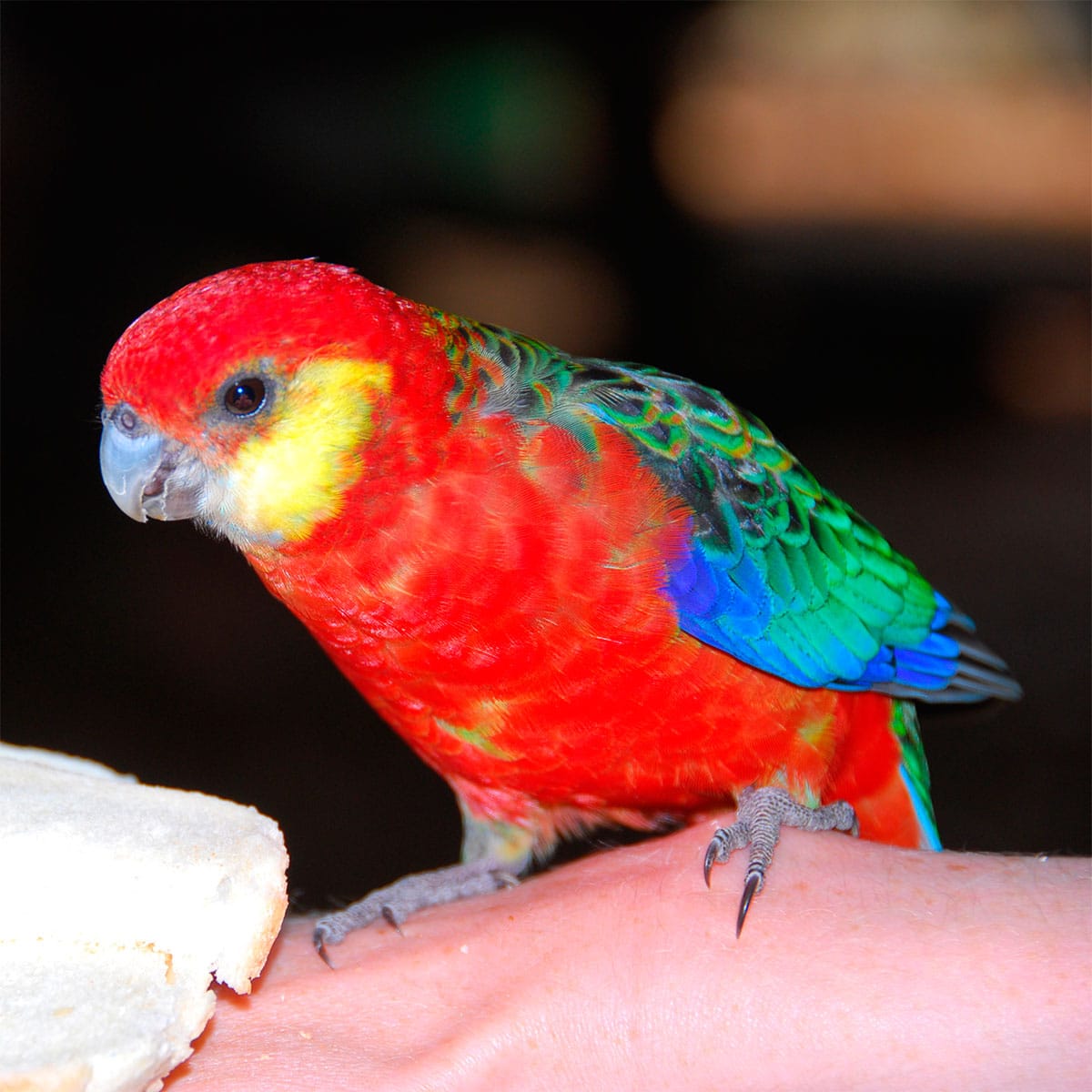
The Western Rosella(Platycercus icterotis) is the smallest of the Platycercus and the only one with big cheeks Yellow.
Adults have a clear dimorphism. The adult male has head and underparts bright red. The the mantle feathers, the back and scapulars They are black with large green edges forming a scalloped effect. The green edges sometimes infiltrated with red. The inner coverts They are dull green, While the external are dark blue. In the Middle, you can see some black on median. The primaries son negruzcas. The rump is dark green. The central tail feathers are dark green, the exteriors are blue with white tips. The underparts It has no stripe.
The bill grey; irises dark brown; legs greyish brown.
The adult female has the forecrown dark red. The crown and the sides of the neck are green. The cheeks are yellow, but duller and less developed than in the male. The underparts They are green with red infiltrations. The under wing
wearing a light streak.
The immature are similar to the females. They have head green with a strip of orange red on the front of the forecrown. The cheeks Yellow absent. The underparts is pale green with slight red orange infiltration in young men.
The adult plumage It is reached after a quick complete change to 14 months.
(Salvadori 1891) – The cheeks They are paler; black feathers nape; back and shoulders lined with large red brown. Area of the rump and uppertail-coverts, Olive Drab. Female much paler than the nominal.
Habitat and habits:
The Western Rosella they are not very common. Found in variable densities in stands of eucalyptus and in many types of open forest habitats. They also attend camps with little trees, partly cleared agricultural fields and residual trees lining grain fields or roadsides. They tend to visit the gardens and freshly harvested fields. They occasionally enter the parks, gardens and golf courses.
In areas close to the coast, the Western Rosella, without a doubt, have benefited from the transformation of dense forests into agricultural land. On the other hand, they were driven from the hinterlands by large-scale deforestation programs.
The Western Rosella they suffer the aggressive competition Australian Ringneck (Platycercus zonarius) that shares the same habitat type.
They are birds sedentary. Usually, they live in pairs or in small groups, and it is very rare to find them in flocks. Son quiet and discrete, so very often go unnoticed when they feed in Earth or when they seek refuge in the trees.
Around the houses, the Western Rosella they are very confident, coming into barns and corrals to feed on grain. Unlike other parrots, have a stable flight composed of multiple hits. Move over short distances, preferring to fly from one tree to another, instead of crossing open spaces.
Reproduction:
The nesting season running from August to December.
The nest It is found in the hole of a branch or in the cavity of a tree trunk.. The couple often choose a eucalyptus wandoo the genus eucalyptus salmonophloia. The cavity must be deep enough and the bottom must be lined with a layer of sawdust..
Before mating, the male courts to your partner. It leans forward on its perch uttering very specific cries.. If the female agrees, responds in the same way.
The laying, generally, comprises of 3 to 7 eggs which are incubated during 19 days. The female is responsible for one incubation, but she pauses in the morning and in the afternoon to be resupplied by the male.
The Young people are altricial and do not fly away before reaching the age of 5 weeks.
Food:
They mainly eat seeds of grasses and other plants found in stubble fields.. They also feed on fruits, berries, Jarrah flowers (Eucalyptus marginata) and seeds of the Zamia Palm.
Often in orchards where cause some damage.
Distribution:
Size of its range (reproduction / resident): 308.000 km2
Endemic to Western Australia, where its population is distributed between the vicinity of Dongara, in the North and Israelite Bay, on the South Coast, and reaching the interior in a line that goes more or less through the Lake Dundas, Southern Cross and Moora. Sometimes found in parks in Perth.
The species is common and seems to have benefited from forest clearing and agriculture.. The world's population is of more than 100,000 specimens. A small number of captivity. The birds can be pursued under a permit.
Distribution 2 subspecies
Platycercus icterotis icterotis
(Temminck & Kuhl 1820) – The nominal. Coast and Southwest podrebere Australia.
• Current category of the Red List of the UICN: Least concern
• Population Trend: Decreasing
The species is relatively common, like most birds that live in open areas, the Western Rosella It has benefited, to some extent, the slimming of the wooded areas. But, its numbers have declined in areas where it faces competition from the aggressive Australian Ringneck. It also, the difficulty to find holes for the construction of nests is a concern in the long run.
The Western Rosella is one protected species, However in some counties, a period was opened to try to regulate or stop the damage caused by this bird in crops.
"Western Rosella" in captivity:
Pretty common in captivity.
Una muestra vivió 13,2 years in captivity. Taking into account the longevity of the similar species, the maximum longevity in these birds could be underestimated. In fact it has been reported that these birds can live up to 31,6 years in captivity, data that can be, but it has not been verified; the same study reported that these animals can reproduce, approximately, to the 2 years of age in captivity.
Alternative names:
– Western Rosella, Earl of Derby’s Parrot, Stanley Parakeet, Stanley Rosella, West Australian Rosella, Yellow-cheeked Parakeet, Yellow-cheeked Parrot, Yellow-cheeked Rosella (ingles).
– Perruche à oreilles jaunes, Perruche de Stanley (French).
– Gelbwangenrosella (German).
– Rosela-do-leste (Portuguese).
– Perico Carigualdo, Rosela Oriental (español).
– Avibase
– Parrots of the World – Forshaw Joseph M
– Parrots A Guide to the Parrots of the World – Tony Juniper & Mike Parr
– AnAge: The Animal Ageing and Longevity Database – Anagé entry for Platycercus icterotis
– Birdlife
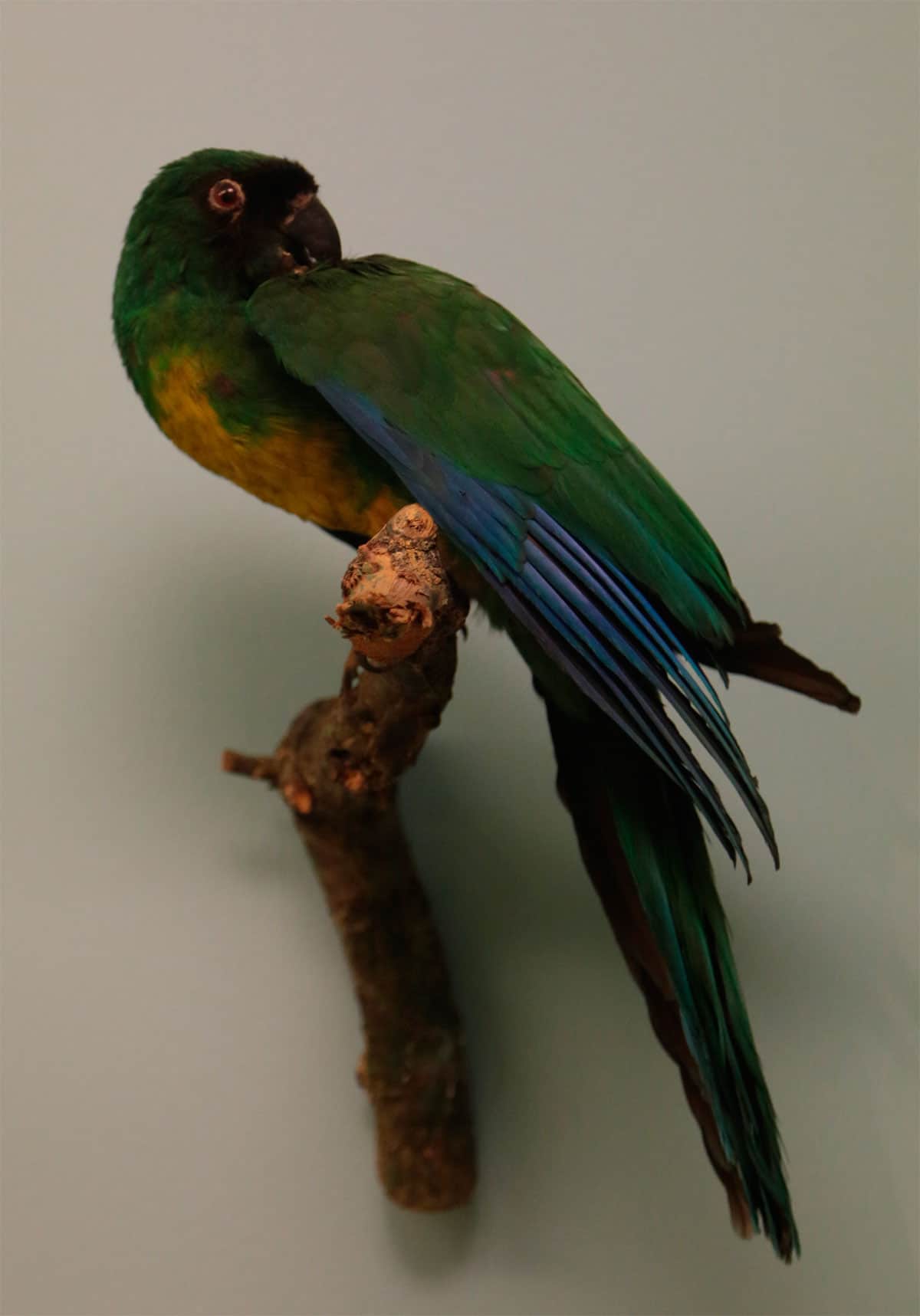
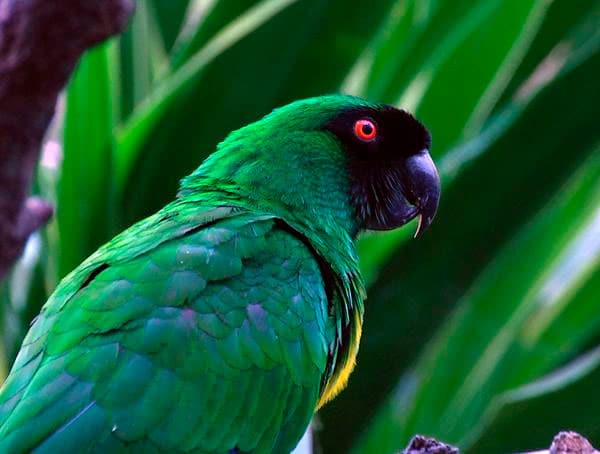
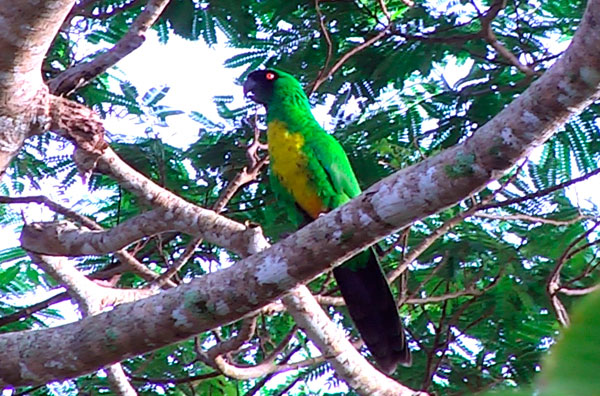
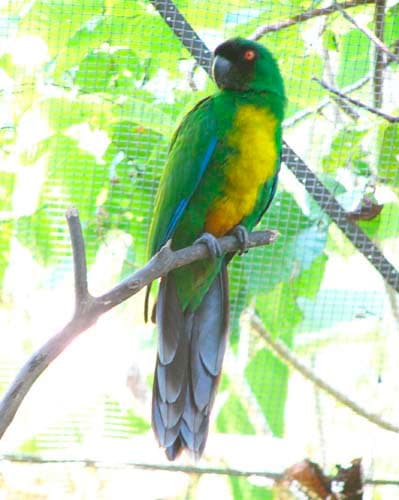
The colorful Masked Shining-Parrot(Prosopeia personata), has a plumage green over most of its body, the front of the crown, lores, cheeks and chin, are black.
The upperparts are bright pale green (with a brighter sheen on the Crown and nape). Large external coverts, primary coverts and primaries are blue with vane inner dark. Wing feathers green. Throat, top of the chest, flanks, and undertail- coverts green; center of chest and the belly bright yellow, a few feathers with the Green Tip, yellow shading in the Orange patch It is located in the lower part of the belly. Upper, the tail green; black for the part below.
The bill black; irises orange-red; legs blackish gray.
The male has the head and the bill larger that the female. The young birds have, peaks paler, less black in the face and irises brown.
El Papagayo Enmascarado (Prosopeia personata) is a large parrot, long tail which is only on an island, in Fiji.
They are distributed Since the sea level, until the 1.200 m altitude, in the forest reacor and secondary growth of the Windward areas and intermediate vegetation, You can also find them in orchards of villages, agricultural fields and mangroves; Often observed along forest edges near agricultural land and in trees bordering forest watercourses.
The Masked Shining-Parrot they are usually sociable and finds them alone, in pairs, or outside the breeding season in herds up to 40 birds.
Birds are sometimes interviews flying rapidly through the forest or wandering above the canopy. Son noisy birds and they are often heard before to be seen; similar to the Red Shining-Parrot, often make calls at the first sign of a human intruder, and they are generally shy and difficult to approach when they are perched on a branch.
Reproduction:
The breeding season occurs between July and September. The nest It is a hole or crack in a tree, or a cavity at the top of a stump. Two or more eggs White deposited inside a hollow form the implementation; the hole is expanded by making use of its powerful beak. Birds emit a strong odor.
Food:
The Masked Shining-Parrot they tend to rest the high parts of the trees, but descend to lower floors to feed on berries, and pick up the fruits of the soil; they can also attack fields.
The diet includes mainly fruit, for example, Mango (Mangifera indica), guava (Psidium guajava), Ficus figs and bananas, Although they can also be powered from flowers, insects, seeds and berries, as well as the cultivated grain.
When feed, They manipulate food with their legs using their beaks to catch small branches. They are powerful and it has been flying with a Mango between its claws.
Distribution:
Size of the area of distribution (reproduction / resident): 10,500 km2
The Masked Shining-Parrot they are endemic in Fiji, distributed only on the island of Viti Levu (Although the species also has been recorded in the nearby island of Ovalau in the past). In Viti Levu, It is not uncommon to see them on the inside of forests, including the surroundings of Nadarivatu and in the North of the Mount Tomanivi. In the center of Nadrau and to the East of the district Vunidawa.
The world population considered that it may be on the 5.000 specimens, but in decline due to habitat loss.
Required large trees for nesting are being felled., and tracts of mature forest are fragmented now in many areas.
The possible detrimental effect of inter-specific competition of the introduced Crimson Shining-Parrot remains study.
The most serious threat affecting the Masked Shining-Parrot It is the decline of forests in which inhabits, with less than the 50 per cent of the forests of Viti Levu remaining. This deforestation has led to the fragmentation of remaining forest areas. The huge trees felled during the deforestation are required by the Masked Shining-Parrot nest.
Other potential threats to this species include potential competition with the introduced Crimson Shining-Parrot (Prosopeia splendens). The Masked Shining-Parrot It can also be trafficked for the pet trade, Although the related species, as the Crimson Shining-Parrot It is believed that they are most popular).
Conservation of the “Masked Parrot”.
The Masked Shining-Parrot is protected by the law of Fiji. But, current legislation for the capture of wild parrots is difficult to enforce. This Parrot also appears in the Appendix II of the Convention on international trade in endangered species (CITES), which means that international trade in the species must be carefully monitored.
The Masked Shining-Parrot It lives in several reserves and parks, where can you get some protection against deforestation. It has been proposed that community forest reserves must be encouraged in Viti Levu, to prevent further deforestation, and that the population figures of the Masked Shining-Parrot in these protected areas should be monitored. But, None of these measures has been put into action
"Masked Shining-Parrot" in captivity:
Rarely found in captivity.
According to sources, It is known that one as a specimen of this species lived 11,8 years in captivity.
Origin: South Africa, Mozambique, Tanzania, Kenya, Malawi
Character: ...
Life expectancy: 32 years
Height: 22 cm..
Content
Description:
Of 22 cm.. length and a weight between 120 and 156 g..
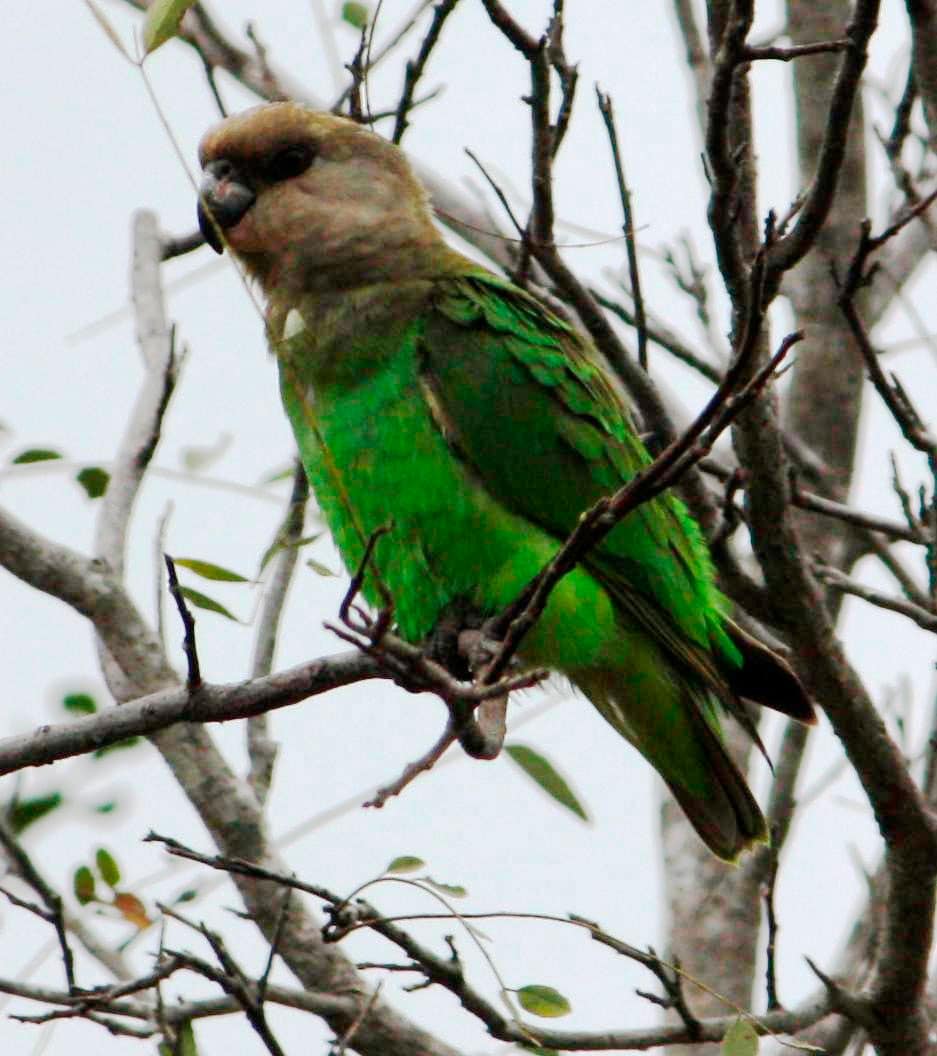
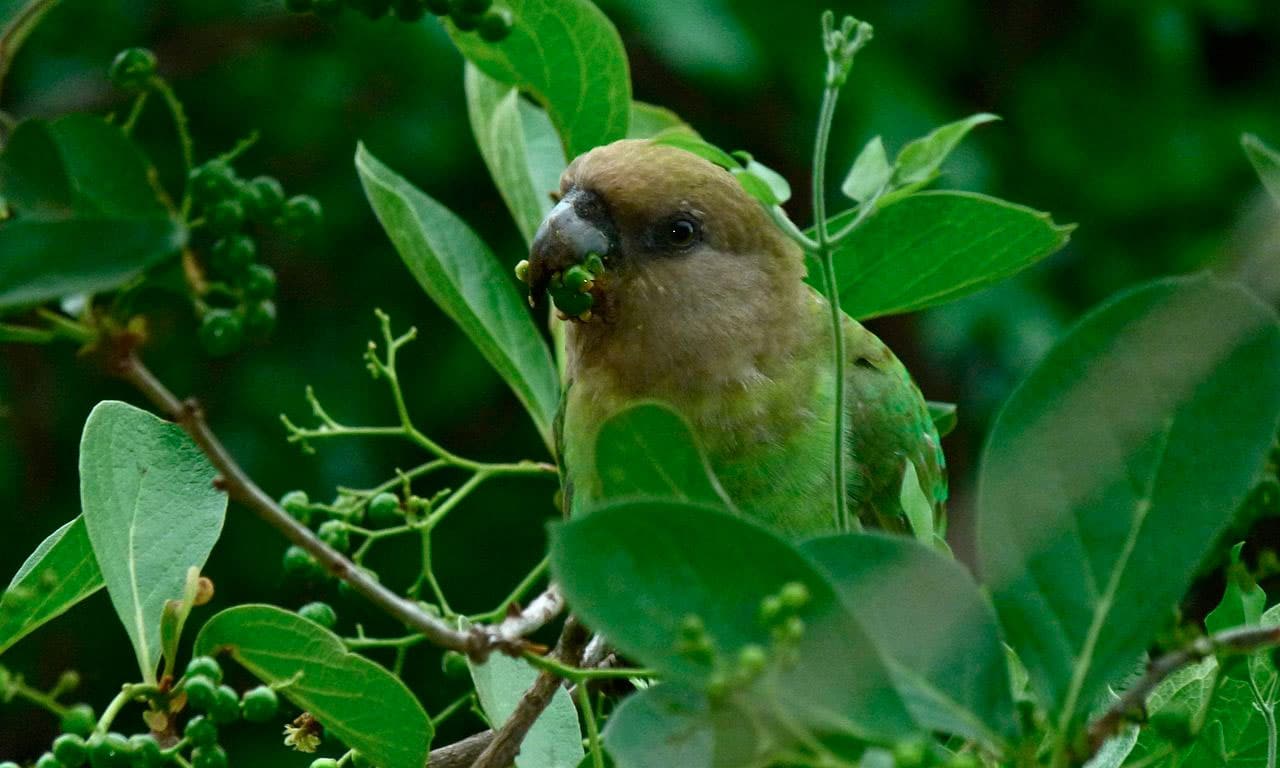
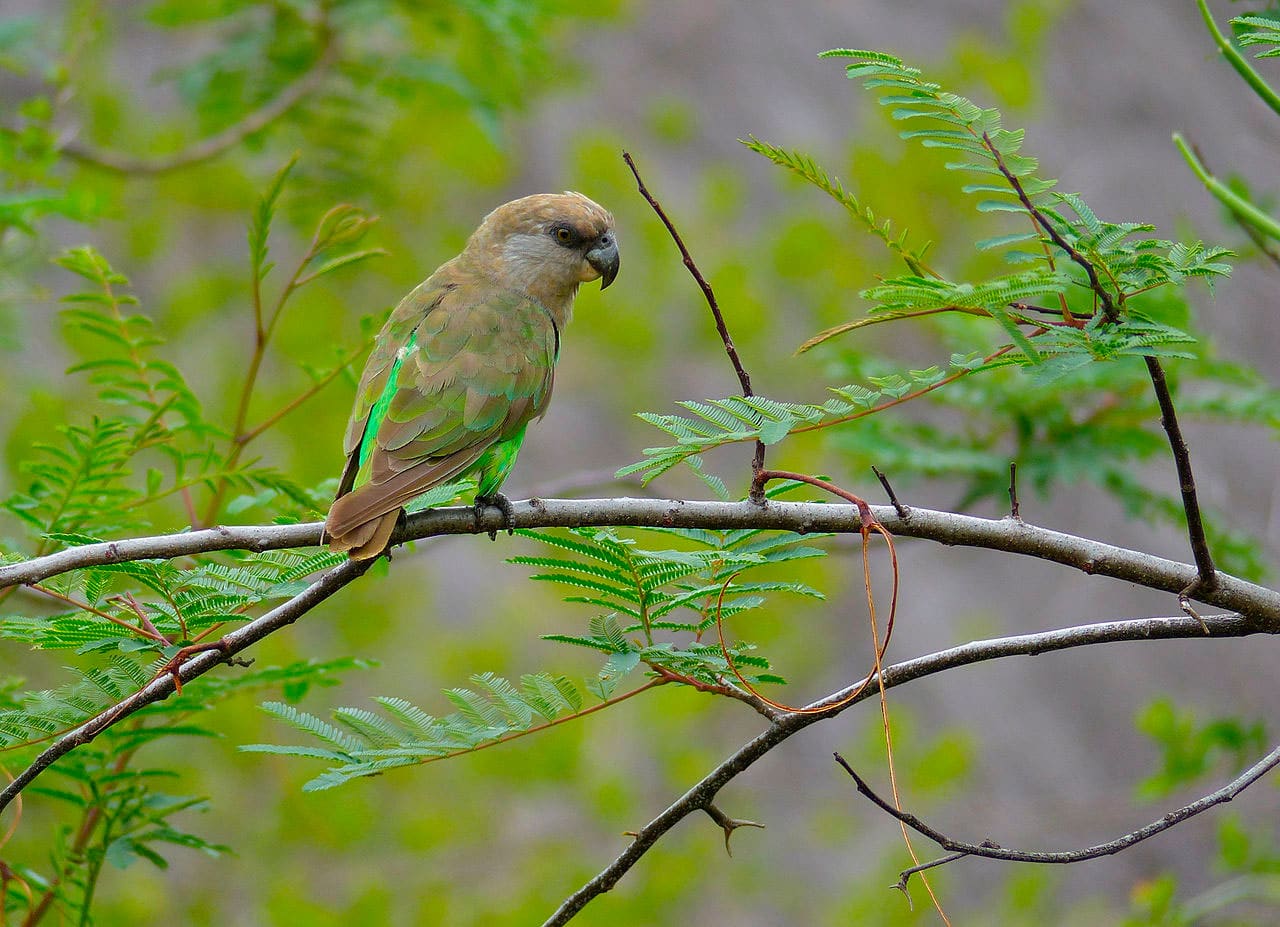
The Brown-headed Parrot(Poicephalus cryptoxanthus) has the head, including the nape, the chin and throat brown; ear-coverts paler. Mantle brown, but more to the tail; scapulars dark green-edged Brown; rump and uppertail-coverts bright green. Upper, the wing-coverts green, sometimes with a small yellow spot on the curve of the wing
folded; wing feathers yellow. Primaries brown with vane Blue-Green external; the secondaries brown.
The feathers in the upper area of the chest brown with a narrow green edge at the bottom; the rest of the underparts green, but darker bases of the feathers, giving a mottled look.
Tail dark brown with green washing and dark green tip.
The upper jaw and cere grey-black (darker towards tip), lower pale, almost white; irises yellow-green light; periophthalmic ring and legs dark grey to black.
Both sexes similar.
Immature generally more muted than adults and with the irises brown.
Poicephalus cryptoxanthus cryptoxanthus (Peters,W, 1854) – Nominal species
Poicephalus cryptoxanthus tanganyikae (Bowen, 1930) – As the nominal but more pale species; more green and less Brown. Green mantle and underparts brighter. Bib of brown feathers on the throat and upper of the much smaller chest than in the nominal species; the head more color olive brown.
Habitat:
Is located in almost all the forests: riparian forests, in the interior of the savannah forests and in the dry forests of southeastern Africa, but it seems to avoid the miombo woodland and prefers areas with baobabs.
Registered in coconut plantations, riparian forest, the edges of small farms and mangroves.
Confined in lowlands (below the 1.200 metres above sea level in Tanzania and 1.000 metres in Malawi).
Gregarious; usually seen them is in small flocks of about 12 birds, but can meet up to 50 in places of power. Sometimes it is associated with the Cape Parrot and also observed feeding in the company of the Madagascar Green-Pigeon.
Reproduction:
Normally nest in hollows of old trees of woodpeckers, between 4 and 10 meters above the ground. Often has to compete with the Cape Parrot, Meyer's Parrot, squirrels and Crowned Hornbill the nesting sites.
Season of laying egg is April-May in the South of its range.
The laying is of 2 to 4 eggs, which are incubated solely by the female during 26-30 days, While the male feeds her on the nest.
The chicks they remain in the nest during 50-54 days Before leaving for the "breeding area", which is usually an area of dense broadleaf trees with a nearby water supply. During this time the chicks are silent and largely immobile, becoming fully independent a few 28 days later.
They forage, with slow and deliberate movements, climbing and often holding the food between the claws. They drink daily, around midday.
Distribution:
The Brown-headed Parrot are distributed by the southeast of Africa. From the North-East of South Africa (Swaziland, Zululand and Transvaal) through the southeast of Zimbabwe, Mozambique and South of Malawi to the East of Tanzania (including the island of Pemba and southern end of Zanzibar) and southeastern edge of Kenya.
Apparently sedentary. In some places, the Brown-headed Parrot, are a species common, especially close to the coast and in the South of its range, but in some other areas are scarce or rather local; in Zanzibar possibly extinct.
Distribution Subspecies:
Poicephalus cryptoxanthus cryptoxanthus (Peters,W, 1854) – Nominal species
Poicephalus cryptoxanthus tanganyikae (Bowen, 1930) – Mozambique, to the North of the Save River across the South of Malawi and this from Tanzania to the coastal part of Kenya.
It is not threatened, although its distribution has contracted since 1990, to a large extent due to the capture illegal for the industry of cage birds.
More and more vulnerable due to the loss and fragmentation of their habitat.
Largely confined to protected areas in Zululand and East of Transvaal.
"Brown-headed Parrot" in captivity:
The only data we have on this bird, according to sources, is that one specimen was still alive after 32,1 years in captivity.
Alternative names:
– Brown-headed Parrot, Brown headed Parrot, Brownheaded Parrot (English).
– Perroquet à tête brune (French).
– Braunkopfpapagei, Braunkopf-Papagei (German).
– Papagaio-de-cabeça-castanha (Portuguese).
– Lorito Cabecipardo, Lorito de Cabeza Parda (español).
– Avibase
– Parrots of the World – Forshaw Joseph M
– Parrots A Guide to the Parrots of the World – Tony Juniper & Mike Parr
– Birdlife
– Photos:
(1) – A Brown-headed Parrot at Kruger National Park, South Africa Henry Flower at en.Wikipedia [CC BY-SA 3.0 or GFDL], from Wikimedia Commons
(2) – Bungalow N°51, Mopani Camp, Kruger NP, SOUTH AFRICA By Bernard DUPONT from FRANCE (Brown-headed Parrot (Poicephalus cryptoxanthus)) [CC BY-SA 2.0], via Wikimedia Commons
(3) – A Brown-headed Parrot in KwaZulu-Natal, South Africa By New Jersey Birds (Brown-headed ParrotUploaded by snowmanradio) [CC BY-SA 2.0], via Wikimedia Commons
(4) – Bungalow N°51, Mopani Camp, Kruger NP, SOUTH AFRICA By Bernard DUPONT from FRANCE (Brown-headed Parrot (Poicephalus cryptoxanthus)) [CC BY-SA 2.0], via Wikimedia Commons
(5) – Lower Sabie Camp, Kruger NP, SOUTH AFRICA By Bernard DUPONT from FRANCE (Brown-headed Parrot (Poicephalus cryptoxanthus)) [CC BY-SA 2.0], via Wikimedia Commons
Origin: Afghanistan, Bangladesh, Bhutan, Cambodia, India, Laos, Myanmar (Burma), Nepal, Pakistan, Sri Lanka, Viet Nam, Thailand
Character: active.
Life expectancy: 30 years.
Height: Of 50 to 62 cm..
Content
Description:
From between 50-62cm. in length and weighing between 198–258 grams.
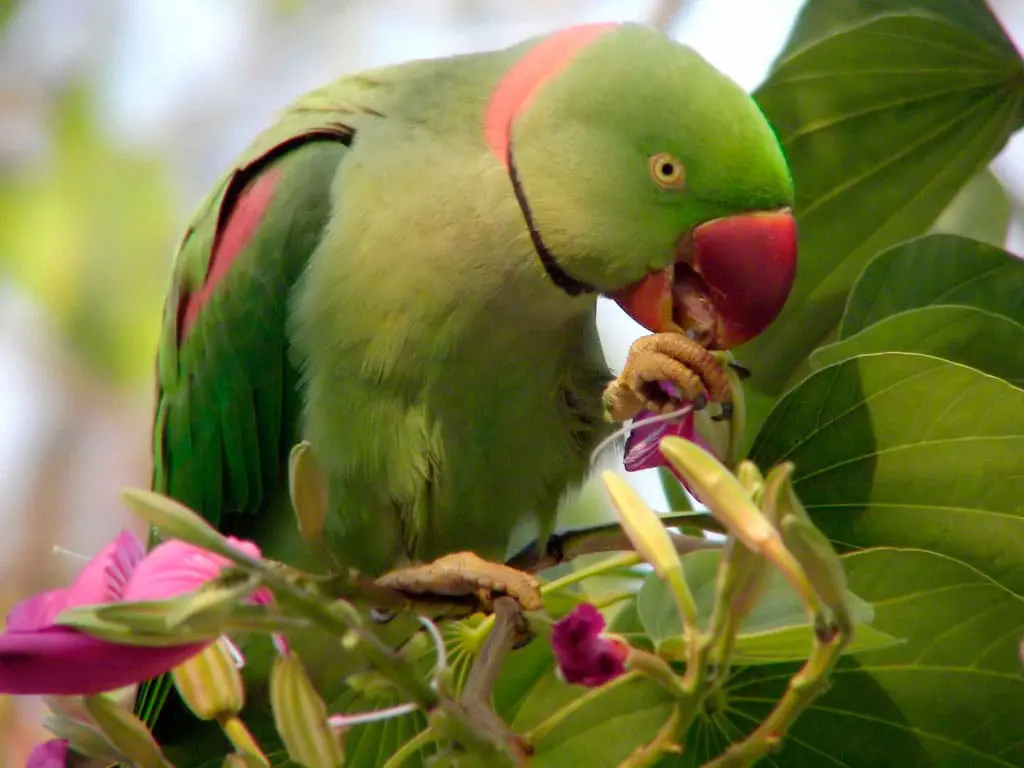
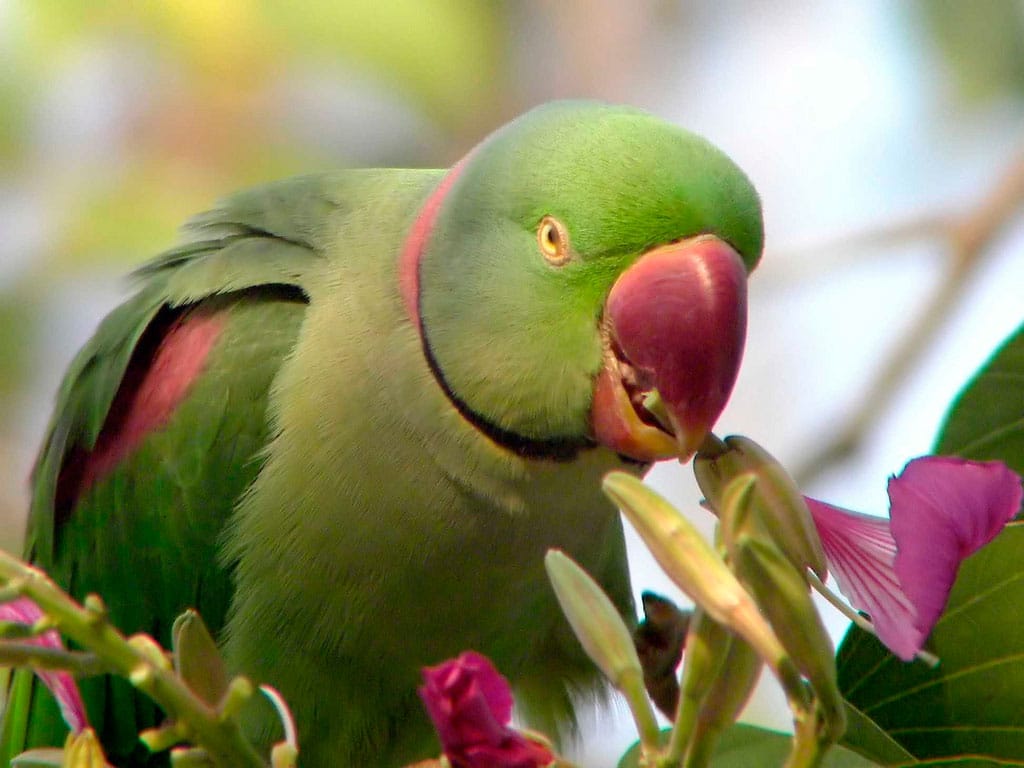
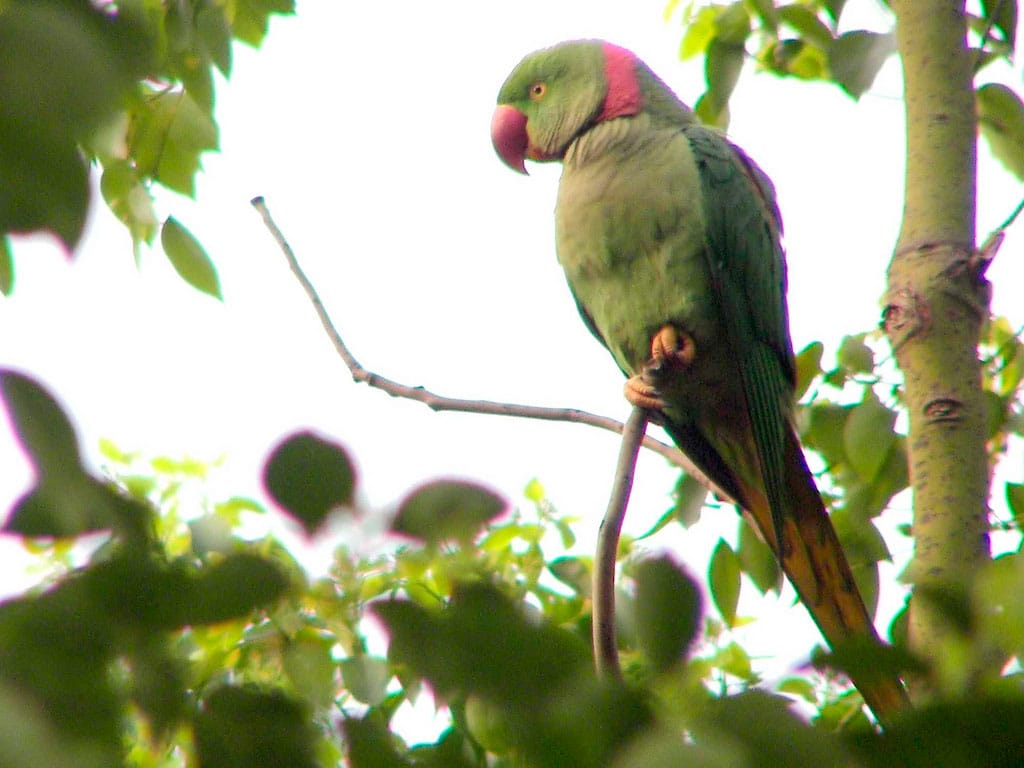
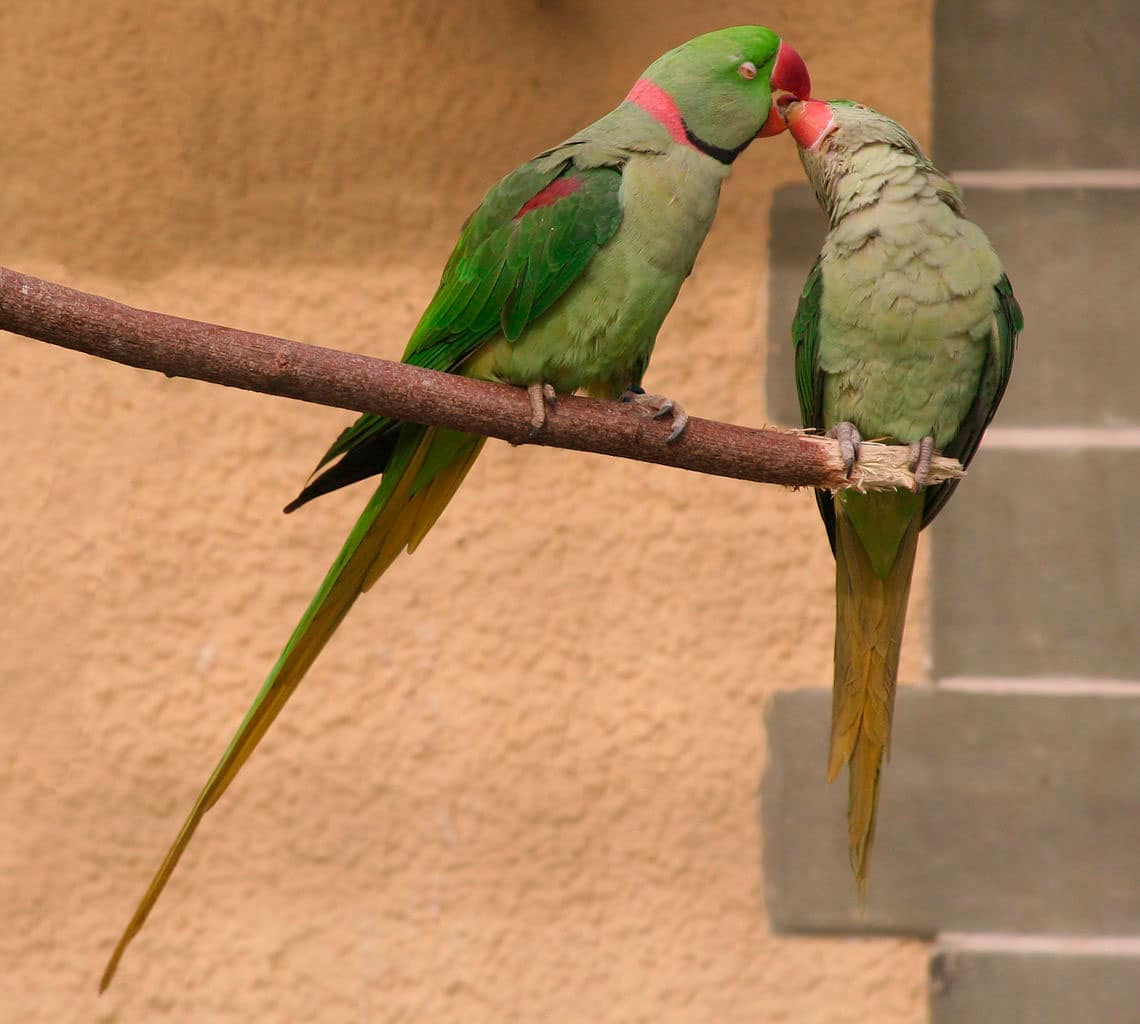
The Alexandrine Parakeet(Psittacula eupatria) has the forecrown, lores and crown bright green, merging to lavender-blue on cheeks, ear-coverts and back of the crown; faint dark line from back of cere to eye ring; narrow black band from the base of bill, laterally across the base of the cheeks, that binds with a wide collar pink around the back of the neck.
Nape, the mantle, scapulars, rump and uppertail-coverts greenish-grey. Upperwing-coverts smaller brown; rest of upperwing-coverts green (brighter and emerald body feathers). The primaries and secondaries greyish green with dark tips to the vane previous interns, Blackish below.
Underwing-coverts gray-green. The underparts brighter yellowish green, chest with grayish tint. Upper, the tail light green with yellow tip; undertail, golden yellow.
Bill red with paler tip: cere whitish; irises pale yellow; legs rose gray.
The female no black and pink markings neck and it is generally duller.
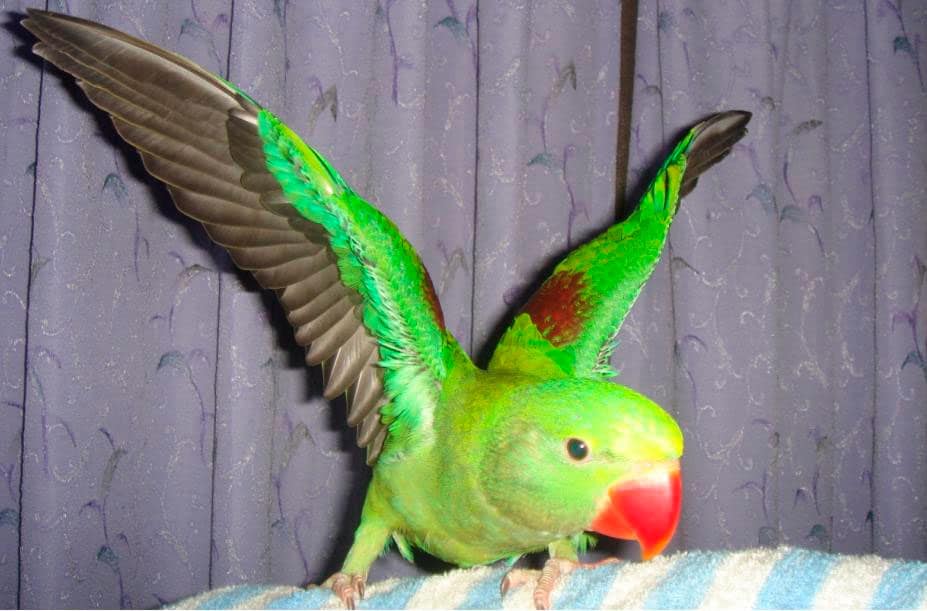
The immature It resembles the female (The males are sometimes distinguished by larger size).
(Kloss, 1917) – Similar to the subspecies Psittacula eupatria magnirostris but with the neck more yellow, the bill smaller and close blue neckband, reduced or absent. Yellower below the subspecies Psittacula eupatria nipalensis.
(Ball, 1872) – It differs from the subspecies Psittacula eupatria nipalensis by blue coloration above band pink, which it is more limited and sometimes non-existent and the pink band nape that is wider; swe other subspecies differs by having the bill Larger.
Psittacula eupatria nipalensis
(Hodgson, 1836) – Larger and grayer than the species nominal, less lavender in head and wider black stripe mustache.
Psittacula eupatria siamensis
(Kloss, 1917) – Cara and neck yellow, nape bluish. Slightly smaller than the subspecies Psittacula eupatria Avensis.
Habitat:
Video – "Alexandrine Parakeet" (Psittacula eupatria)
The Alexandrine Parakeet It is distributed in a great variety of humid and dry forests and wooded lands., but also they are seen in cultivated areas, mangroves (for example, of Rhizophora mueronata on the islands of the bay of bengal) and coconut plantations, mainly in the lowlands up 900 meters above sea level; on Punjab province (Pakistan) extend areas of subtropical pines (Pinus roxburghii) and penetrates irrigated plantations in desert areas; ascend to the foothills of Himalaya in areas of trees (will Shorea) and riparian forests, rarely above the 1.600 m.
In the Bandhavgarh National Park, the Alexandrine Parakeet prefers forests more dense than the Plum-headed Parakeet (Psittacula cyanocephala) and Rose-ringed Parakeet (Psittacula krameri).
Usually they found in small groups, but sometimes they form large flocks where food is plentiful and communal roosts, where birds can come together in one big tree.
Reproduction:
The nest of the Alexandrine Parakeet They found in tree cavities (for example, of Dalbergia, Shorea or Salmalia), palms or, very rarely, buildings, but generally far from human settlements.
The nest It comprises a chamber filled with wood shavings produced by barbets or woodpeckers during excavation or extension of the cavity; entry generally clean round.
The breeding season usually from November to December and from March to April, depending on the location (for example, February to March in the Punjab and andaman islands and from December to February in the center Burma).
The average size clutch is of 2-4 eggs measuring 34,0 x 26,9 mm. The incubation period average is 28 days usually after the placement of the second egg. The chicks leave the nest at about seven weeks of age. They are bred for about three weeks and usually are weaned between the 12 to 16 weeks of age.
Food:
Diet Alexandrine Parakeet It includes a variety of cultivated and wild seeds, flowers, nectar, grains, fruits and vegetables.
Considered serious pest in some places: the 70% their diet Pakistan comes from cultivated areas.
It feeds mainly early in the morning and afternoon.
The situation in Afghanistan of the Alexandrine Parakeet is uncertain, possibly some group in the extreme northeast, about Jalalabad.
In Pakistan, isolated colonies Are and Peshawar, most widespread and frequent in the irrigated lowlands of Punjab; They are distributed from Punjab (India), foothills Himalaya and South of Nepal, throughout the India and Sri Lanka, as well as the east through Bangladesh.
In Bhutan and Assam in Burma Central and Southern (not found in northern), extending from northern Thailand, Central and North Cambodia and Laos and north to central and southern Viet Nam.
Seasonal movements in some areas and in other locally nomadic.
generally common, but much rarer in the east and sporadically distributed by South India.
Decreasing in Sri Lanka, where it is now rare, especially in the north.
Sharp declines in Thailand and probably in other parts of Indochina.
Its appearance around some urban areas could be due to leaks.
Introduced in parts of Europe (Germany, Belgium, Netherlands, Middle East (Turkey, Bahrein, United Arab Emirates, Iran) and Japan.
Subspecies distribution
Subspecies
Psittacula eupatria Avensis
(Kloss, 1917) – South of Assam (Northeast of India) and Myanmar, but the area of ​​contact with the subspecies Psittacula eupatria nipalensis and Psittacula eupatria siamensis, It is unknown.
(Hodgson, 1836) – Pakistan through Punjab (India) until Assam, Bangladesh, Nagaland and Manipur, including skirts Himalaya and Nepal, to the South , approximately I8° north; the contact area with the subspecies Psittacula eupatria Avensis, unknown.
Psittacula eupatria siamensis
(Kloss, 1917) – West and north of Thailand, Laos, Cambodia and Viet Nam.
This species has been upgraded from Least concern based on new information on population trends. Is listed as Near-threatened, Since, although it remains common in some areas and its status is clouded by feral populations, It is suspected to be subjected to population decline moderately fast due to the continuing loss of habitat, to unsustainable levels of exploitation, the pursuit and capture.
The Alexandrine Parakeet It is widely captured and sold as bird cage.
In Cambodia, nests theft and capture adults, They represent the main threats, It is one of the most sought after birds (F. Goes in some. 2013).
Despite the virtual disappearance of the species Thailand, chicks still appear in the illegal trade in bird markets Bangkok, although, possibly, its origin is Cambodia (P. Ronda in a little. 2013).
The illegal trade, as well as the destruction of nesting places, threat to species Pakistan (S. Khan in a little. 2013). in addition, It reported that the species is threatened by extensive poaching at the hands of local tribes Gujarat (V. Vyas in some. 2013).
Habitat loss and degradation are also grave threats. In Cambodia, use changes in the lowlands it has been rapid (R. Timmins in some. 2013) and rates of degradation and loss of lowland forests is expected to impact more on the species (F. Goes in some. 2013). Conversion rates of habitat Laos They are described as severe (JW Duckworth in litt. 2013).
Conservation Actions Proposed:
– Conduct periodic surveys to monitor the population trend of the species.
– Conduct surveys and assess the situation in Pakistan (S. Khan in a little. 2013).
– Monitor rates of habitat loss and degradation through the distribution of the species.
– Quantify the impact of harvesting for trade.
– Enforcing trade restrictions.
– Carry out awareness raising activities to discourage the capture and trade.
– Increase the amount of suitable habitat that receives protection.
"Alexandrine Parakeet" in captivity:
The Alexandrine Parakeet is a popular bird among poultry. It is ideal for outdoor aviaries and cannot tolerate temperatures below 5°C.. They reproduce well in aviaries. This Psittacula It is one of the oldest species of captive parrots Eurasian continent. Named after the legendary Emperor Alexander the Great, he had numerous specimens exported by his legionnaires back to various Mediterranean countries. Since then, This parrot has been popular with the nobles of all the countries of Anatolia, European and Mediterranean Empire.
This is a kind active, He likes water and readily accepts different or new foods. It has a vigorous beak and therefore it is important to keep the perch free of toxicity and without chemicals such as disinfectants., fungicides, insecticides or pesticides. The Alexandrine Parakeet, like other parrots, They are among the best imitators.
With regard to its longevity, according to sources, one specimen was still alive after 30 years in captivity. In captivity, these parrots have been known that they can raise from the 4 years of age.
These birds Smart They make good pets for those willing to provide ongoing obedience training. If neglected, or appropriate training is given, the Alexandrine Parakeet it becomes prone to tear the feathers and other behavioral problems. The large and powerful beak of the parrot has a strong bite and therefore not recommended as a pet for children. a large cage is required to accommodate their beautiful, long narrow tail.
It is not a difficult species to breed, in fact usually successful.
Alternative names:
– Alexandrine Parakeet, Alexandrine Parrot, Andaman Parakeet, Large Indian Parakeet, Large Parakeet, Rose-breasted Parakeet (English).
– Perruche alexandre (French).
– Grosser Alexandersittich, Alexandersittich (German).
– Periquito-grande-alexandre (Portuguese).
– Cotorra Alejandrina, Cotorra de Alexander (español).
– Avibase
– Parrots of the World – Forshaw Joseph M
– Parrots A Guide to the Parrots of the World – Tony Juniper & Mike Parr
– Birdlife
– Photos:
(1) – Alexandrine Parakeet at Kowloon Park, Hong Kong By Charles Lam from Hong Kong, China (YummyUploaded by Snowmanradio) [CC BY-SA 2.0], via Wikimedia Commons
(2) – Alexandrine Parakeet Alexandrine Parrot gold. A 17 year old pet parakeet at home in Mumbai By Rudolph.A.furtado (Own work) [Public domain], via Wikimedia Commons
(3) – Alexandrine Parakeet (also known as the Alexandrine Parrot) at Rainbow Jungle (The Australian Parrot Breeding Centre), Kalbarri, Western Australia By Sheila Bradford [CC BY 2.0], via Wikimedia Commons
(4) – An male Alexandrine Parakeet (also known as Alexandrian Parrot) in a tree By Sammy Sam [CC BY-SA 3.0], via Wikimedia Commons
(5) – Alexandrine Parakeet (Psittacula eupatria). A pair By derivative work: Snowmanradio (talk)Two_species_of_Psittacula_on_perch.jpg: Thomas Guignard [CC BY-SA 2.0], via Wikimedia Commons
(6) – Alexandrine Parakeet flapping her wings By Iamoarampage at English Wikipedia [Public domain], via Wikimedia Commons
(7) – Alexandrine Parakeet at Kowloon Park, Hong Kong By Charles Lam from Hong Kong, China (RestingUploaded by Snowmanradio) [CC BY-SA 2.0], via Wikimedia Commons
(8) – Alexandrine Parakeet at Kowloon Park, Hong Kong By Charles Lam from Hong Kong, China (YummyUploaded by Snowmanradio) [CC BY-SA 2.0], via Wikimedia Commons
(9) – Alexandrine Parakeet Psittacula eupatria Melghat Tiger Reserve Maharashtra By Dr. Raju Kasambe (Own work) [CC BY-SA 3.0], via Wikimedia Commons
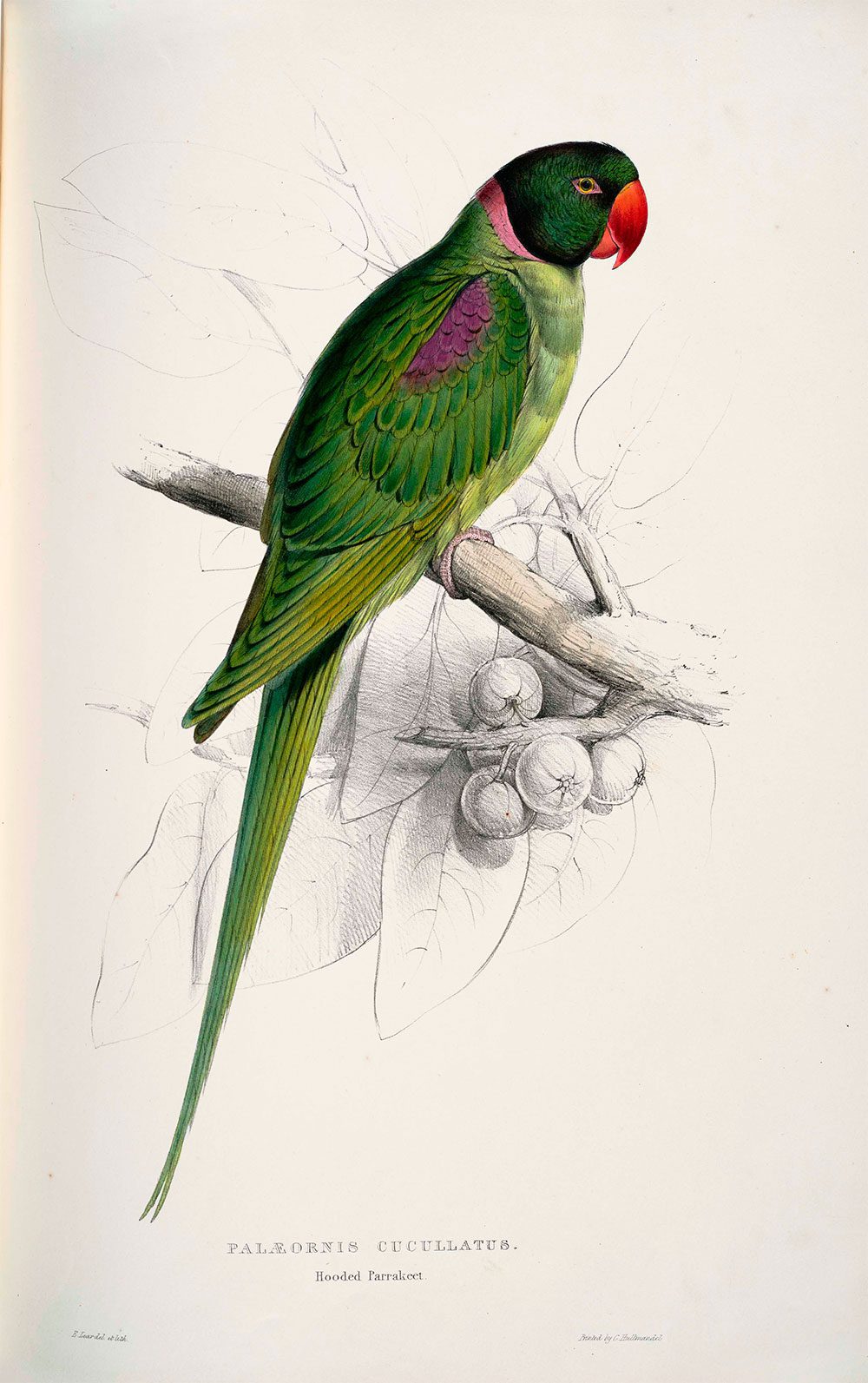
(10) – A painting of an Alexandrine Parakeet, also known at Alexandrian Parrot, (originally captioned «Palæornis hooded. Hooded Parakeet.») by Edward Lear 1812-1888 [Public domain], via Wikimedia Commons




















-5-4c.jpg)


_-eating_bread.jpg)

%2C_Masked_Shining_Parrot_%2C_Birds_Gallery%2C_Natural_History_Museum%2C_London.JPG)


_(11688869593)_(2).jpg)

_(11688946544).jpg)
_(6001313591).jpg)


_pair_-2pc.jpg)


