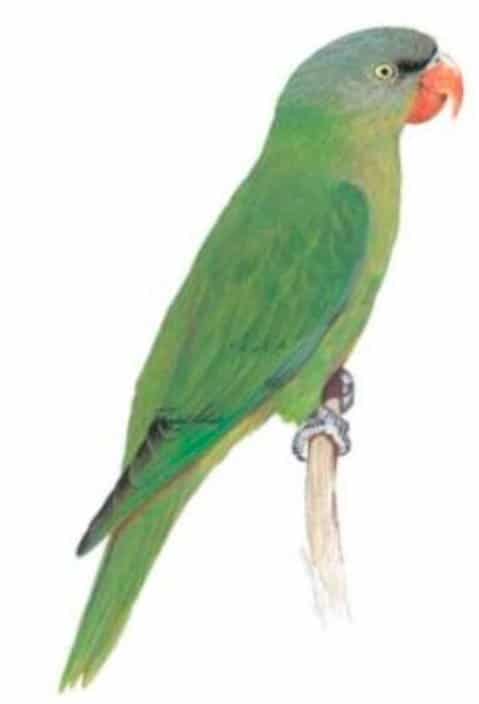
The Camiguin Hanging Parrot(Loriculus camiguinensis) has the plumage mostly green, with the throat, front side of the face and the thighs light blue; the forecrown, the pyleus, the obispillo and the top of the tail red, While the rest of the tail It is also blue. Underwing coverts blue. Band of orange-red in the nape, that varies from bird to bird.
Bill orange. Iris grayish brown.
The males and females they have a similar appearance, the female has less blue on the cheeks.
The youth they are similar to the adult female but with only a slight tinge of blue in the cheeks and red on the forehead minimal or absent. Bill a pale.
In 2006 described as a separate species to the loricles who lived on the island of Camiguin, to the North of Mindanao, Since then it was considered a subspecies of the Philippine loriclein the.
Probably sedentary. Found between the 300 and 1350 meters in montane forests, secondary forests, at the edges of the forest near the settlements, in plantations in the areas planted with shrubs and coconut.
Usually seen individually, in pairs, mixed flocks or small families. Feeds in trees or shrubs; difficult to detect. It´s shy and cautious.
Reproduction:
Breeding season probably between the months of September to November. Nest placed in the hole of a dead arbol-helecho. No other information.
Food:
It is said that they feed on nectar, seeds, especially wild banana (Musa), also soft fruit, berries and flowers.
Distribution:
Endemic in the Philippine island of Camiguin, off the North coast of Mindanao.
Conservation:
This species is threatened by its limited range, the natural habitat destruction and capture for the wild bird trade.
"Camiguin Hanging Parrot" in captivity:
Probably not remain outside the island of Camiguin.
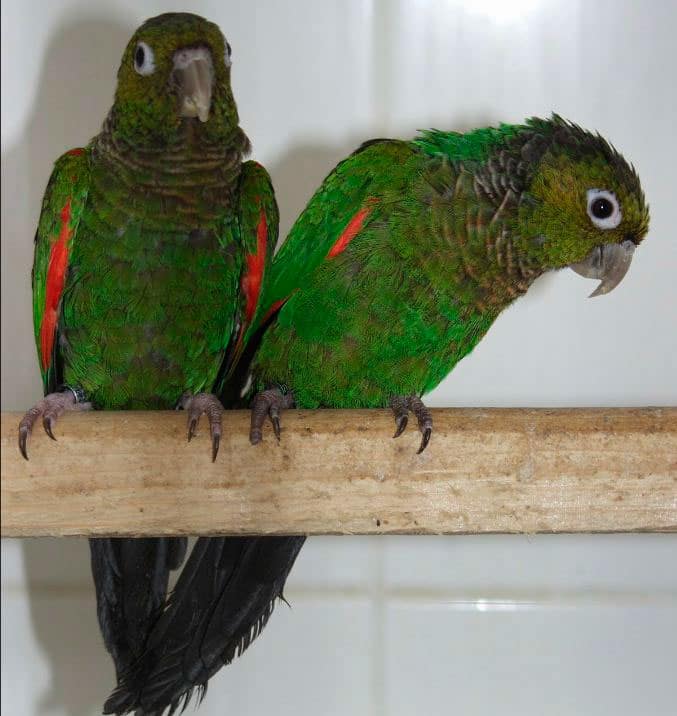
The head of the Brehm's Tiger-Parrot(Psittacella brehmii) is marron-oliva. The neck It is colored with black and green bars. The front and sides of the neck they are surrounded by a bright yellow stripe. The chest It is slightly striped in green and black colors.
The center of the back is very green and it integrates perfectly, with yellow and black striped, the area of the rump. Black fusion is absent from yellowish green to the extent lumbar and Hip. Wings they are a dark green color with dark edges in the covered medium-sized. The flight feather are blackish with vane a thin border beige and green external. The curvature of the wing is Bluestone. Wing feathers green.
The underparts are green, totally opaque, except the undertail-coverts that are of color red Scarlet. The bottom of the tail is green, greyish black down.
The bill It is brownish grey with lighter edges and a white tip. The irises is reddish orange. The legs are grey green.
The female lacks the yellow Crescent on the front of the neck. The chest listed in green and black.
Youth with the colors green and yellow absent from the chest area. Coverts of the tail of color orange tinged with tips yellow. The bill pale.
: Its underparts and back listing are more yellowish green tones, and larger.
Psittacella brehmii pallida
: As the nominal but with narrower peak.
Psittacella brehmii harterti
: It is clearer and less yellowish green head. Is smaller.
Habitat:
Are observed in the montane forest, including Podocarpus, beech forests of Nothofagus and edge of forests, mainly from 1.500 metres to the 2.600 m, ends in 1.100 and 3.800 m.
The Brehm's Tiger-Parrot is distributed primarily at altitudes below the habitat of the Painted Tiger-Parrot, but there is a zone in which they find sympathy latitudinally, and is between 2.500 and 3.000 m. Birds are often found individually or in small groups and allow an approximation.
You spend much time below the canopy or even close plants feeding on seeds and berries (including conifers and Podocarpus), Although also found in levels higher in the forest. Move slowly, often using his beak to balance and sometimes you can stay still. They only make short flights, never flying above the canopy.
Reproduction:
Little is known of nesting behavior, but two nestlings were observed in a nest during the month of June.
Food:
Diet includes seeds, coniferous berries and Podocarpus.
Distribution:
The Brehm's Tiger-Parrot they are endemic in New Guinea, where often live almost exclusively in mountain areas. Its range is divided into three isolated populations, an in Vogelkop, West Papua, the second in all the central and South-Eastern Highlands of New Guinea and the third in the mountains of the Huon Peninsula (the Painted Tiger-Parrot is absent and the Parrot Brehm Tiger is observed at altitudes higher than usual). The species is widespread, but generally uncommon; the world's population is believed to be superior to 100.000 specimens.
Distribution Subspecies
Psittacella brehmii brehmii
: The nominal.
Psittacella brehmii intermixta
: Is located in the central mountains of New Guinea.
Psittacella brehmii pallida
: Of the mountains of the southeast of New Guinea.
Psittacella brehmii harterti
: Occupies the Huon Peninsula (to the northeast of New Guinea).
Conservation:
• Current category of the Red List of the UICN: Least concern
• Population trend: Stable
The size of the world's population has not been quantified, It is believed that it is superior to 100.000 specimens.
The species, according to sources, it is quite common and widespread (pit et to the. 1997).
The population is suspected to be stable in the absence of evidence of any reduction or substantial threats.
"Brehm's Tiger-Parrot" in captivity:
It is not a bird for the lovers of the aviaries since their mortality rate in captivity is very high.
Alternative names:
– Brehm’s Tiger-Parrot, Brehm’s Parrot, Brehm’s Tiger Parrot (ingles).
– Perruche de Brehm (French).
– Brehmpapagei, Brehm Papagei, Brehm-Papagei (German).
– Psittacella brehmii (Portuguese).
– Lorito de Brehm, Lorito tigre de Brehm, Lorito-tigre de Brehm (español).
The Black-lored Parrot (Tanygnathus gramineus) It has a green head with a black line that goes from the top of the beak to the eyes.; steeped in turquoise blue Crown. The upper parts of green grass.
The medium-sized wing coverts, green; flight feather, green, a little darker, with blackish margins to the vane inner. Supracaudales coverts yellowish-green. The more underparts, more yellowish green, especially in the lower part of the cheeks and upper part of the chest. Upper, the Green tail with yellow tips; undertail, the Brown tail olive warm.
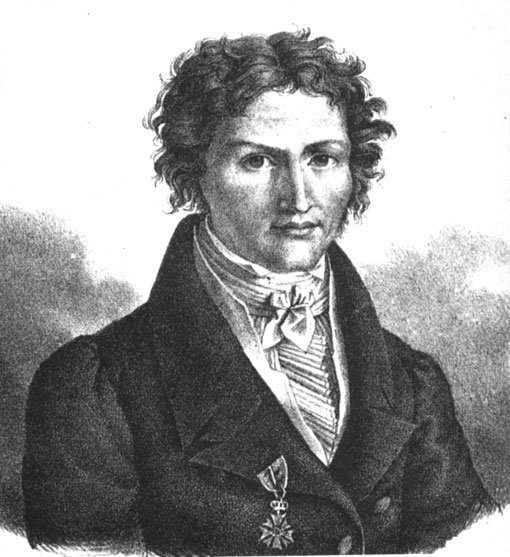
Information is received for the first time of the Black-lored Parrot Thanks to ornithologist side Hendrik Cornelis Sieber (1890-1949) in 1930.
Very little of this species is known. Is distributed in mountain forests above 600-700 meters and also, according to sources, in the lowlands, hills and coastal areas. It is partially nocturnal, although sightings of birds perched on treetops during the day, They show that, similar to the Azure-rumped parrot, they can also be active during the day.
Migration is relatively weak and there are only a few reports of parrots flying to high altitudes during the day and descending at night., Judging from their voices.
Bird predominantly occupies the central part, High Island, where according to sources, There are settlements in Gunung Tagalago,WA Temun and Kunturun, at elevations of 700-1100 m, also in the lowlands of the South in Fäkal, EHU and Leksula. There was a sighting of these parrots near Kayeli Bay on the eastern shores of Buru. Most recent observations made outside North (Waflia) and (Wamlana) Northwest Coast.
The voice of the Black-lored Parrot is heard frequently in Kunturun, mostly 1-7 hours after the sunset, where the locals call the bird «The ol' blue cockatoo«, which means Blue-headed Parrot. But, was caught during the day with slingshots in fruit trees, suggesting that his activity is not purely night.
Conservation:
• Current category of the Red List of the UICN: Vulnerable
• Population trend: Decreasing
The population is estimated at 2,500-9,999 mature individuals based on an assessment of the known records, descriptions of the abundance and range size. This estimate is equivalent to 3,500-15,000 specimens.
There are no data on trends for this species and has not been seen in the wild since 1995. Their habitat continues to decline slowly and were recorded in domestic trade in the year 2001. So, the population of the species is suspected of have been declining.
Conservation Actions Proposed:
– Conduct surveys, mostly using their vocalizations at night, mainly in the mountain areas.
– Investigate their ecological requirements and movements in order to develop appropriate conservation strategy.
– Identify the most suitable area for the conservation of this and other endangered species in Buru, and promote its establishment as protected areas.
– Black-lored Parrot, Black lored Parrot, Blacklored Parrot, Buru Parrot (ingles).
– Perruche de Buru, Perruche à calotte bleue (French).
– Burupapagei, Buru Papagei (German).
– Tanygnathus gramineus (Portuguese).
– Loro de Buru (español).
25 to 26 cm. length and a weight between 52 and 80 g..
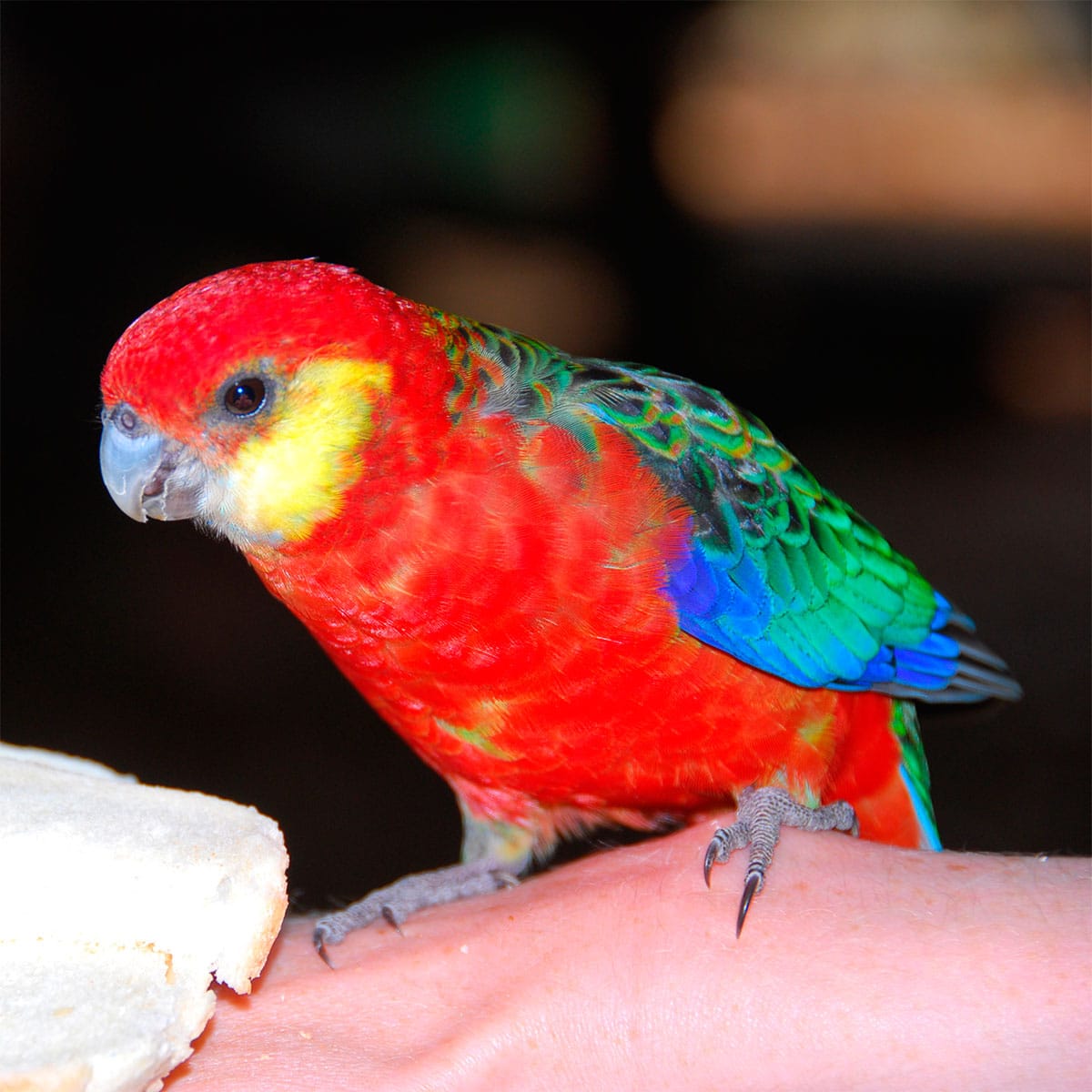
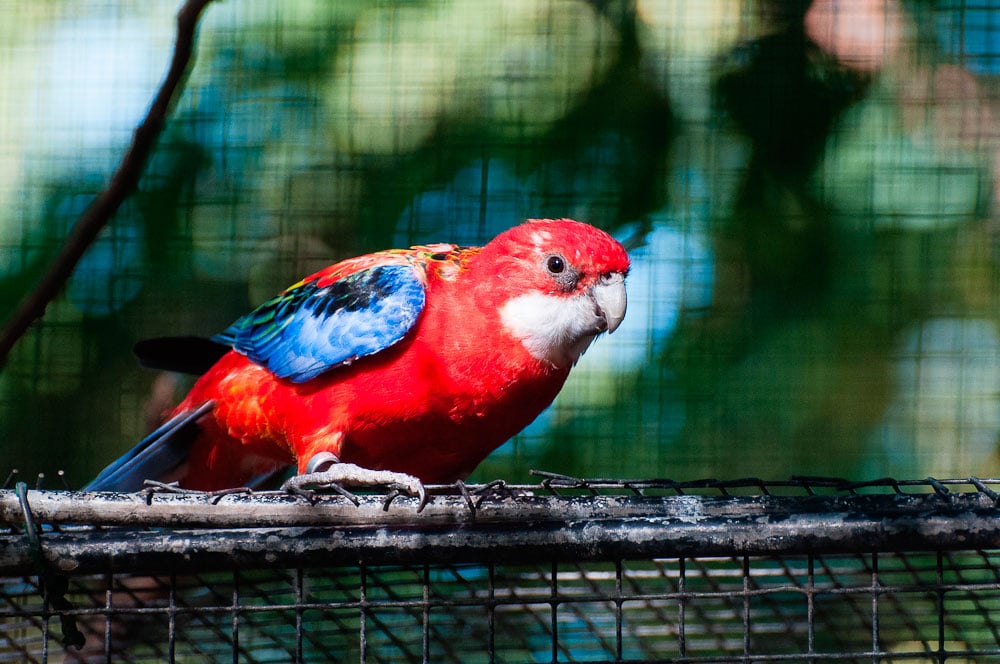
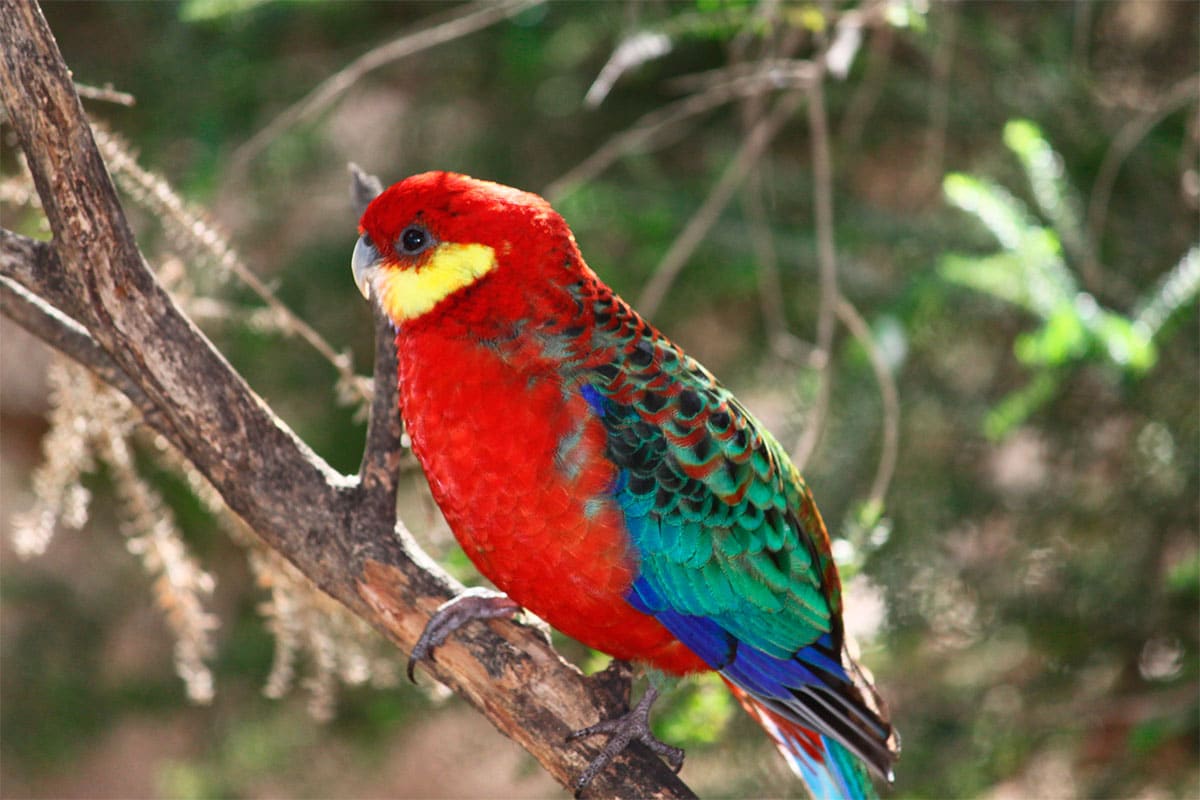
The Western Rosella(Platycercus icterotis) is the smallest of the Platycercus and the only one with big cheeks Yellow.
Adults have a clear dimorphism. The adult male has head and underparts bright red. The the mantle feathers, the back and scapulars They are black with large green edges forming a scalloped effect. The green edges sometimes infiltrated with red. The inner coverts They are dull green, While the external are dark blue. In the Middle, you can see some black on median. The primaries son negruzcas. The rump is dark green. The central tail feathers are dark green, the exteriors are blue with white tips. The underparts It has no stripe.
The bill grey; irises dark brown; legs greyish brown.
The adult female has the forecrown dark red. The crown and the sides of the neck are green. The cheeks are yellow, but duller and less developed than in the male. The underparts They are green with red infiltrations. The under wing
wearing a light streak.
The immature are similar to the females. They have head green with a strip of orange red on the front of the forecrown. The cheeks Yellow absent. The underparts is pale green with slight red orange infiltration in young men.
The adult plumage It is reached after a quick complete change to 14 months.
(Salvadori 1891) – The cheeks They are paler; black feathers nape; back and shoulders lined with large red brown. Area of the rump and uppertail-coverts, Olive Drab. Female much paler than the nominal.
Habitat and habits:
The Western Rosella they are not very common. Found in variable densities in stands of eucalyptus and in many types of open forest habitats. They also attend camps with little trees, partly cleared agricultural fields and residual trees lining grain fields or roadsides. They tend to visit the gardens and freshly harvested fields. They occasionally enter the parks, gardens and golf courses.
In areas close to the coast, the Western Rosella, without a doubt, have benefited from the transformation of dense forests into agricultural land. On the other hand, they were driven from the hinterlands by large-scale deforestation programs.
The Western Rosella they suffer the aggressive competition Australian Ringneck (Platycercus zonarius) that shares the same habitat type.
They are birds sedentary. Usually, they live in pairs or in small groups, and it is very rare to find them in flocks. Son quiet and discrete, so very often go unnoticed when they feed in Earth or when they seek refuge in the trees.
Around the houses, the Western Rosella they are very confident, coming into barns and corrals to feed on grain. Unlike other parrots, have a stable flight composed of multiple hits. Move over short distances, preferring to fly from one tree to another, instead of crossing open spaces.
Reproduction:
The nesting season running from August to December.
The nest It is found in the hole of a branch or in the cavity of a tree trunk.. The couple often choose a eucalyptus wandoo the genus eucalyptus salmonophloia. The cavity must be deep enough and the bottom must be lined with a layer of sawdust..
Before mating, the male courts to your partner. It leans forward on its perch uttering very specific cries.. If the female agrees, responds in the same way.
The laying, generally, comprises of 3 to 7 eggs which are incubated during 19 days. The female is responsible for one incubation, but she pauses in the morning and in the afternoon to be resupplied by the male.
The Young people are altricial and do not fly away before reaching the age of 5 weeks.
Food:
They mainly eat seeds of grasses and other plants found in stubble fields.. They also feed on fruits, berries, Jarrah flowers (Eucalyptus marginata) and seeds of the Zamia Palm.
Often in orchards where cause some damage.
Distribution:
Size of its range (reproduction / resident): 308.000 km2
Endemic to Western Australia, where its population is distributed between the vicinity of Dongara, in the North and Israelite Bay, on the South Coast, and reaching the interior in a line that goes more or less through the Lake Dundas, Southern Cross and Moora. Sometimes found in parks in Perth.
The species is common and seems to have benefited from forest clearing and agriculture.. The world's population is of more than 100,000 specimens. A small number of captivity. The birds can be pursued under a permit.
Distribution 2 subspecies
Platycercus icterotis icterotis
(Temminck & Kuhl 1820) – The nominal. Coast and Southwest podrebere Australia.
• Current category of the Red List of the UICN: Least concern
• Population Trend: Decreasing
The species is relatively common, like most birds that live in open areas, the Western Rosella It has benefited, to some extent, the slimming of the wooded areas. But, its numbers have declined in areas where it faces competition from the aggressive Australian Ringneck. It also, the difficulty to find holes for the construction of nests is a concern in the long run.
The Western Rosella is one protected species, However in some counties, a period was opened to try to regulate or stop the damage caused by this bird in crops.
"Western Rosella" in captivity:
Pretty common in captivity.
Una muestra vivió 13,2 years in captivity. Taking into account the longevity of the similar species, the maximum longevity in these birds could be underestimated. In fact it has been reported that these birds can live up to 31,6 years in captivity, data that can be, but it has not been verified; the same study reported that these animals can reproduce, approximately, to the 2 years of age in captivity.
Alternative names:
– Western Rosella, Earl of Derby’s Parrot, Stanley Parakeet, Stanley Rosella, West Australian Rosella, Yellow-cheeked Parakeet, Yellow-cheeked Parrot, Yellow-cheeked Rosella (ingles).
– Perruche à oreilles jaunes, Perruche de Stanley (French).
– Gelbwangenrosella (German).
– Rosela-do-leste (Portuguese).
– Perico Carigualdo, Rosela Oriental (español).
– Avibase
– Parrots of the World – Forshaw Joseph M
– Parrots A Guide to the Parrots of the World – Tony Juniper & Mike Parr
– AnAge: The Animal Ageing and Longevity Database – Anagé entry for Platycercus icterotis
– Birdlife
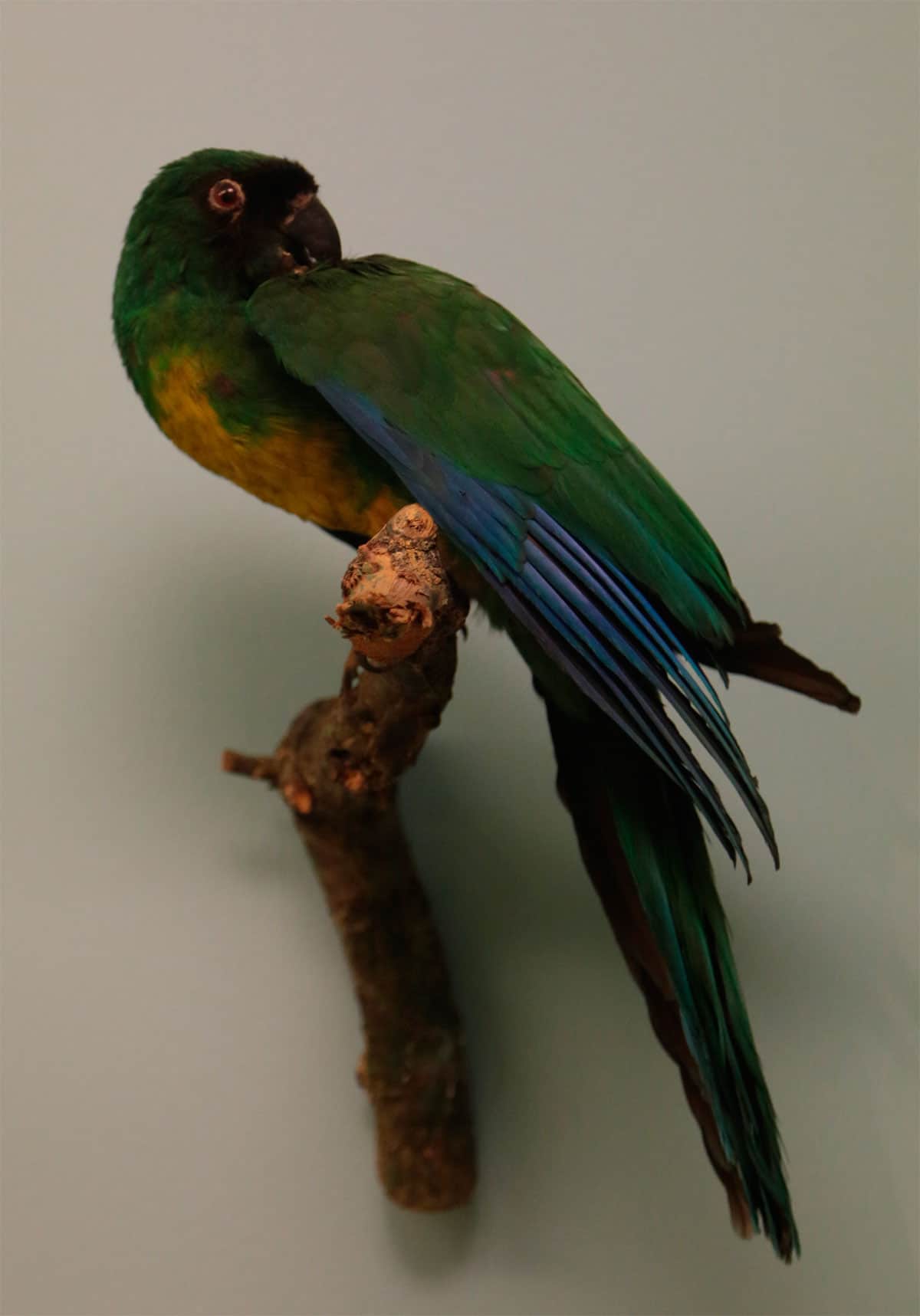
The colorful Masked Shining-Parrot(Prosopeia personata), has a plumage green over most of its body, the front of the crown, lores, cheeks and chin, are black.
The upperparts are bright pale green (with a brighter sheen on the Crown and nape). Large external coverts, primary coverts and primaries are blue with vane inner dark. Wing feathers green. Throat, top of the chest, flanks, and undertail- coverts green; center of chest and the belly bright yellow, a few feathers with the Green Tip, yellow shading in the Orange patch It is located in the lower part of the belly. Upper, the tail green; black for the part below.
The bill black; irises orange-red; legs blackish gray.
The male has the head and the bill larger that the female. The young birds have, peaks paler, less black in the face and irises brown.
El Papagayo Enmascarado (Prosopeia personata) is a large parrot, long tail which is only on an island, in Fiji.
They are distributed Since the sea level, until the 1.200 m altitude, in the forest reacor and secondary growth of the Windward areas and intermediate vegetation, You can also find them in orchards of villages, agricultural fields and mangroves; Often observed along forest edges near agricultural land and in trees bordering forest watercourses.
The Masked Shining-Parrot they are usually sociable and finds them alone, in pairs, or outside the breeding season in herds up to 40 birds.
Birds are sometimes interviews flying rapidly through the forest or wandering above the canopy. Son noisy birds and they are often heard before to be seen; similar to the Red Shining-Parrot, often make calls at the first sign of a human intruder, and they are generally shy and difficult to approach when they are perched on a branch.
Reproduction:
The breeding season occurs between July and September. The nest It is a hole or crack in a tree, or a cavity at the top of a stump. Two or more eggs White deposited inside a hollow form the implementation; the hole is expanded by making use of its powerful beak. Birds emit a strong odor.
Food:
The Masked Shining-Parrot they tend to rest the high parts of the trees, but descend to lower floors to feed on berries, and pick up the fruits of the soil; they can also attack fields.
The diet includes mainly fruit, for example, Mango (Mangifera indica), guava (Psidium guajava), Ficus figs and bananas, Although they can also be powered from flowers, insects, seeds and berries, as well as the cultivated grain.
When feed, They manipulate food with their legs using their beaks to catch small branches. They are powerful and it has been flying with a Mango between its claws.
Distribution:
Size of the area of distribution (reproduction / resident): 10,500 km2
The Masked Shining-Parrot they are endemic in Fiji, distributed only on the island of Viti Levu (Although the species also has been recorded in the nearby island of Ovalau in the past). In Viti Levu, It is not uncommon to see them on the inside of forests, including the surroundings of Nadarivatu and in the North of the Mount Tomanivi. In the center of Nadrau and to the East of the district Vunidawa.
The world population considered that it may be on the 5.000 specimens, but in decline due to habitat loss.
Required large trees for nesting are being felled., and tracts of mature forest are fragmented now in many areas.
The possible detrimental effect of inter-specific competition of the introduced Crimson Shining-Parrot remains study.
The most serious threat affecting the Masked Shining-Parrot It is the decline of forests in which inhabits, with less than the 50 per cent of the forests of Viti Levu remaining. This deforestation has led to the fragmentation of remaining forest areas. The huge trees felled during the deforestation are required by the Masked Shining-Parrot nest.
Other potential threats to this species include potential competition with the introduced Crimson Shining-Parrot (Prosopeia splendens). The Masked Shining-Parrot It can also be trafficked for the pet trade, Although the related species, as the Crimson Shining-Parrot It is believed that they are most popular).
Conservation of the “Masked Parrot”.
The Masked Shining-Parrot is protected by the law of Fiji. But, current legislation for the capture of wild parrots is difficult to enforce. This Parrot also appears in the Appendix II of the Convention on international trade in endangered species (CITES), which means that international trade in the species must be carefully monitored.
The Masked Shining-Parrot It lives in several reserves and parks, where can you get some protection against deforestation. It has been proposed that community forest reserves must be encouraged in Viti Levu, to prevent further deforestation, and that the population figures of the Masked Shining-Parrot in these protected areas should be monitored. But, None of these measures has been put into action
"Masked Shining-Parrot" in captivity:
Rarely found in captivity.
According to sources, It is known that one as a specimen of this species lived 11,8 years in captivity.
22 cm.. length and a weight between 105 and 132 g..
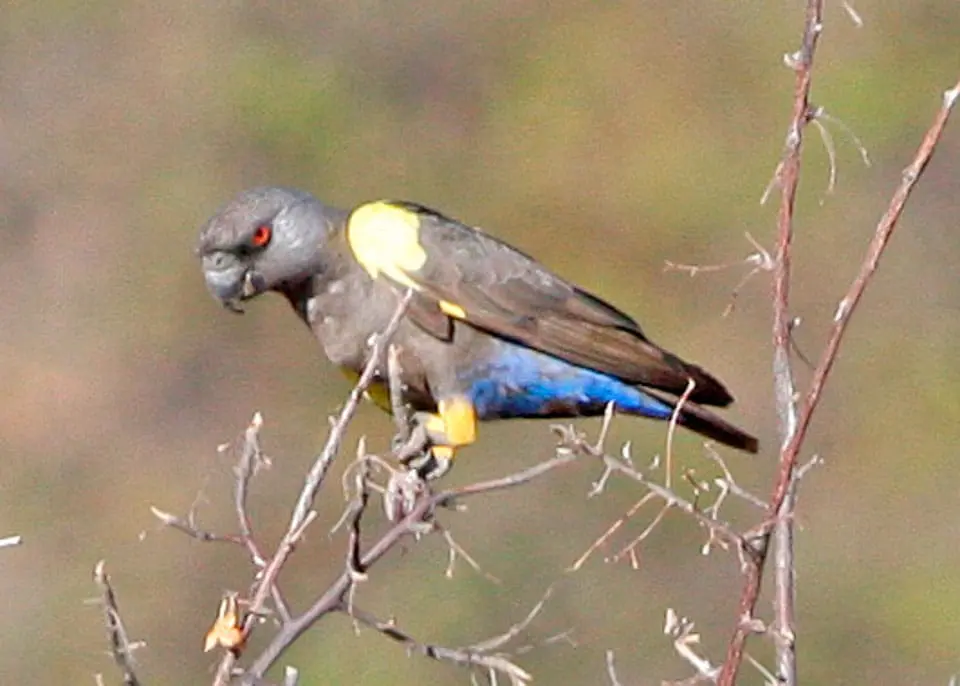
The Rüppell's parrot(Poicephalus rueppellii) has the head, generally, dark brown, clearer in the sides of the face with ear-coverts Silver. Nape, the mantle and scapulars brown in color with slightly paler silver tips and rather diffused on most feathers (especially in the nape); rump brown with blue wash, occasionally feathers Bright blue. Upper, the under wing-coverts brown. Leading Edge wing
, Since the carpal joints at the base of the primaries bright yellow. The primaries and secondaries brown above, paler below. Wing feathers bright yellow.
The underparts, above all, uniformly brown, clearly lighter than the upperparts; the thighs bright yellow; undertail- coverts and posterior flanks with blue wash, sometimes a few feathers with bright blue tips. Tail darker brown than the rest of the plumage.
Bill greyish black; cere black; irises orange-red; perioftalmico ring black ; legs black.
The females They have lower back, rump, uppertail-coverts, lower abdomen, undertail- coverts and the back of the flanks bright blue..
The immature They are similar to females but duller blue and less extensive, lighter brown in the body, the thighs brown. Wing feathers and set carpiano yellowish brown brown; clear margins in the wing-coverts.
They live in forests along water courses dry, dry forests (including forests Euphorbia), dry steppe thorny veld, showing a preference for areas with Adansonia or other tall trees; also in formations Acacia / Commiphora in Escarpment Namibia. Not registered above 1.250 metres in Angola.
Usually they found near water, in small flocks (until 20 birds); sometimes in greater numbers when food is plentiful.
Reproduction:
The nest usually it located in the old hole of a carpenter, at a height of up to 5 meters above the ground. It is believed that usually they breed from the months of February to May, but juvenile birds have been observed in September: the breeding It may be more closely linked to precipitation of the season. Of 3 to 5 egg white, rounded form the usual commissioning.
Some local nomadic movements in relation to the food supply, otherwise residents. Usually they reported as locally common but fluctuations can occur with nomadic movements.
Conservation:
• Current IUCN Red List: Least concern
• Population trend: Decreasing
The size of the world's population has not been quantified, although it is estimated below 30.000 individuals.
The species according to information, It quite common within suitable habitat.
The population is suspected of being in decline due to unsustainable levels of exploitation. Also their population numbers are threatened by the cage bird trade – an estimated number between 600 and 1000 birds are exported annually to South Africa and Europe, approximately 60-70% of them die during transport.
"Rüppell's parrot" in captivity:
Very rare in captivity.
Take it easy, It is a species in which males seem to speak better than females, usually they have easy to mimic sounds of other birds.
In terms of their longevity, according to sources, a specimen lived 34,3 years in captivity.
Alternative names:
– Rueppell’s Parrot, Ruppell’s Parrot, Rüppell’s Parrot (English).
– Perroquet de Rüppell (French).
– Rüppellpapagei, Rüppell Papagei, Rüppell-Papagei (German).
– Papagaio de Rüppell, Papagaio-de-rüppell (Portuguese).
– Lorito de Ruppell, Lorito de Rüppell (español).
– Avibase
– Parrots of the World – Forshaw Joseph M
– Parrots A Guide to the Parrots of the World – Tony Juniper & Mike Parr
– Birdlife
– Photos:
(1) – An adult female Rüppell’s Parrot near Hobatere Lodge, Kamanjab, Namibia By Ron Knight from Seaford, East Sussex, United Kingdom (Ruppell’s ParrotUploaded by snowmanradio) [CC BY 2.0], via Wikimedia Commons
(2) – In captivity by Udo Berg –> Heggy – Wikipedia
(3) – Rüppel's parrot – papageien.org
(4) – Poicephalus rueppellii rueppells parrot – Birds-pet-wallpapers
(5) – Poicephalus rueppellii in Erongo Mountains, Namibia – Buckham Birding
(6) – Proceedings of the Zoological Society of London 1882 by Joseph Smit [Public domain], via Wikimedia Commons
The Maroon-tailed Parakeet(Pyrrhura melanura) is distinguishable mainly by the tail and wings blackish (visible in flight); has the lores, the forecrown, the crown and the rear area of the neck, brownish, with paler reddish brown tips on the crown, forming altogether a speckled pattern; cheeks, ear-coverts and area behind the eyes, green; Brown in the shadows at the back of the crown Green in the nape.
Upperparts Green with tinge of olive in some feathers. Primary coverts Red with yellow tips; Front edge of the wing
, red; upperwing-coverts of color green with dye olive. Primaries Dark greenish blue with dark tips. Underwing-coverts green; underside of flight feather blackish. Throat and feathers of the upper part of the chest, Green or greyish green with pale margins, giving a scaly striking effect; pale edges that become less clear on the sides of the neck; the belly and undertail-coverts Green with dye olive dark. Upper, the tail dark brown with green outer feathers; undertail, the tail shiny black.
Bill pale grey; bare periophthalmic naked, whitish: irises dark brown; legs grey.
Both sexes similar. The immature has less red (greener) in the primary coverts.
(Salvadori, 1891) – Similar to the Pyrrhura melanura souancei, but with even broader and paler margins on the breast feathers (Some birds of Ecuador with almost entirely white breasts), less red on the front edge of the wing
and more pronounced brown patch in the belly. Cheeks dyed with color olive, Red uniform at the edge of the carpus; abdomen more uniform brown/red color.
Pyrrhura melanura chapmani
(Bond & Meyer de Schauensee, 1940) – With suspiciously in the chest more width, No yellow in the wing
; yellowish in the area of the ear and the green of the tail darker.
(Chapman, 1915) – More dark, No yellow in the wing
, grey around the eye, tail more short and reddish.
Pyrrhura melanura souancei
(Verreaux,J, 1858) – With the edge top of the wing
Red and not yellow; Green in the base of the tail more extensive and chest with scaled a little more width.
Habitat:
The Maroon-tailed Parakeet It occupies the temperate tropical formations, including forests of várzea, forests of land low and pre-montanos rainforests and forests cloud, often in areas partially cleared and edges of secondary forests; 150 - 300m in Venezuela (nominal), to 3,200 m in the slopes Andean Eastern (souancei), 1.600-2.800m on the slope of the Andes central (chapmani), at 1,700 m in Nariño (Pacifica), at 1500m (berlepschi). Usually in flocks of 6-12 individuals, staying in them cups of them trees to rest but moving is toward the branches more low for forage.
Reproduction:
Little information about breeding, observed during the months of April-June, headers of the Napo River, Ecuador. Copulation observed in January (Colombia). Clutch four eggs in captivity.
Food:
Few details about the diet, with foods known, including fruits of Miconia tkeaezans (Top of the Magdalena valley). Fagara tachuelo and tree bark (Amazonia).
Distribution:
Size of the area of distribution (reproduction / resident): 1.510.000 km2
The distribution of the Maroon-tailed Parakeet is discontinuous. Northwest of South America in the Western Amazon basin, southern portion of the the Orinoco basin and slope of the peaceful of the Andes, in the southwest of Colombia and West Ecuador.
In Venezuela the species is found in the Centre of the South of Bolívar along the upper Western Amazon basin of Brazil between the riversNegro and Solimões. They are also distributed in Andes Central of Colombia, at the top of the Magdalena valley, from the South of Tolimauntil Huilaand separated to the East from the Andes (in lowlands and up to 500 m in foothills) Since the Macarena mountains, southward through eastern lowlands Ecuador and Northeast and East of Peru.
A separate population is distributed to the West of the Andes, in the Northwest of the South of Ecuador, to the North of The rivers, with a single log in nose, to the southwest of Colombia.
Mainly resident Although the apparent absence during some seasons in some parts of Colombia suggests regular movements.
Unevenly distributed, in some areas very common, being the Parrot more numerous in some parts of the range such as high Magdalena valley and perhaps parts of Esmeraldas in the Northwest of Ecuador.
Alleged decrease in some areas (for example, Pacific slope of Ecuador) due to loss of habitat. Little known in the East of Peru. Not a locally popular cage bird if it has been traded internationally in significant numbers in late 1980 and fairly well known in captivity outside of its area of distribution.
Subspecies distribution
Subspecies distribution
Pyrrhura melanura berlepschi
(Salvadori, 1891) – Valley of Huallaga, is of Peru and Southeast of Ecuador on Cutucú mountain range. A specimen with characteristics of this species was observed at the head of the Magdalena valley suggesting their distribution in Colombia.
(Chapman, 1915) – Northwest of Ecuador and southwest of Colombia.
Pyrrhura melanura souancei
(Verreaux,J, 1858) – It is from Colombia since the Sierra de la Macarena Southwest, until Putumayo through the East of Ecuador, possibly up to the north end of Peru. Probably bordered on the eastern slopes of the Andes and mostly replaced by the nominal species in lowlands.
Conservation:
• Current category of the Red List of the UICN: Least concern.
• Population trend: Decreasing.
Justification of the population
The population size world has not been quantified, but this species is described as «quite common» (Stotz et to the., 1996).
Justification of trend
This species is suspected that he has been able to lose 6,95 to 7,1% of a habitat within its distribution over three generations (18 years) based on a deforestation model of the Amazon (Soares-Filho et to the., 2006, Bird et to the. 2011). Given the susceptibility of the species to the cazay and/or the capture, It is suspected that will decrease in <25% durante tres generaciones.
"Maroon-tailed Parakeet" in captivity:
Ave shy and quiet, get used to people over time. Colonies in large birdcages are possible.
Alternative names:
– Maroon-tailed Parakeet, Magdalena Parakeet, Maroon tailed Parakeet, Maroon-tailed Conure, Black-tailed Conure (English).
– Conure de Souancé, Perriche de Souancé, Perruche de Souancé (French).
– Braunschwanzsittich, Braunschwanz-Sittich (German).
– tiriba-fura-mata (Portuguese).
– Cotorra Colinegra, Perico de Cola Negra, Periquito Colirrojo (español).
– Periquito Colirrojo (Colombia).
– Periquito Colirrojo (Peru).
– Perico Cola Negra (Venezuela).
Origin: Mexico, Guatemala, Belice, El Salvador, Honduras, Costa Rica, Nicaragua
Character: active
Life expectancy: 60 years.
Height: 22 to 26 cm..
Content
Description:
22 to 26 cm.. length.
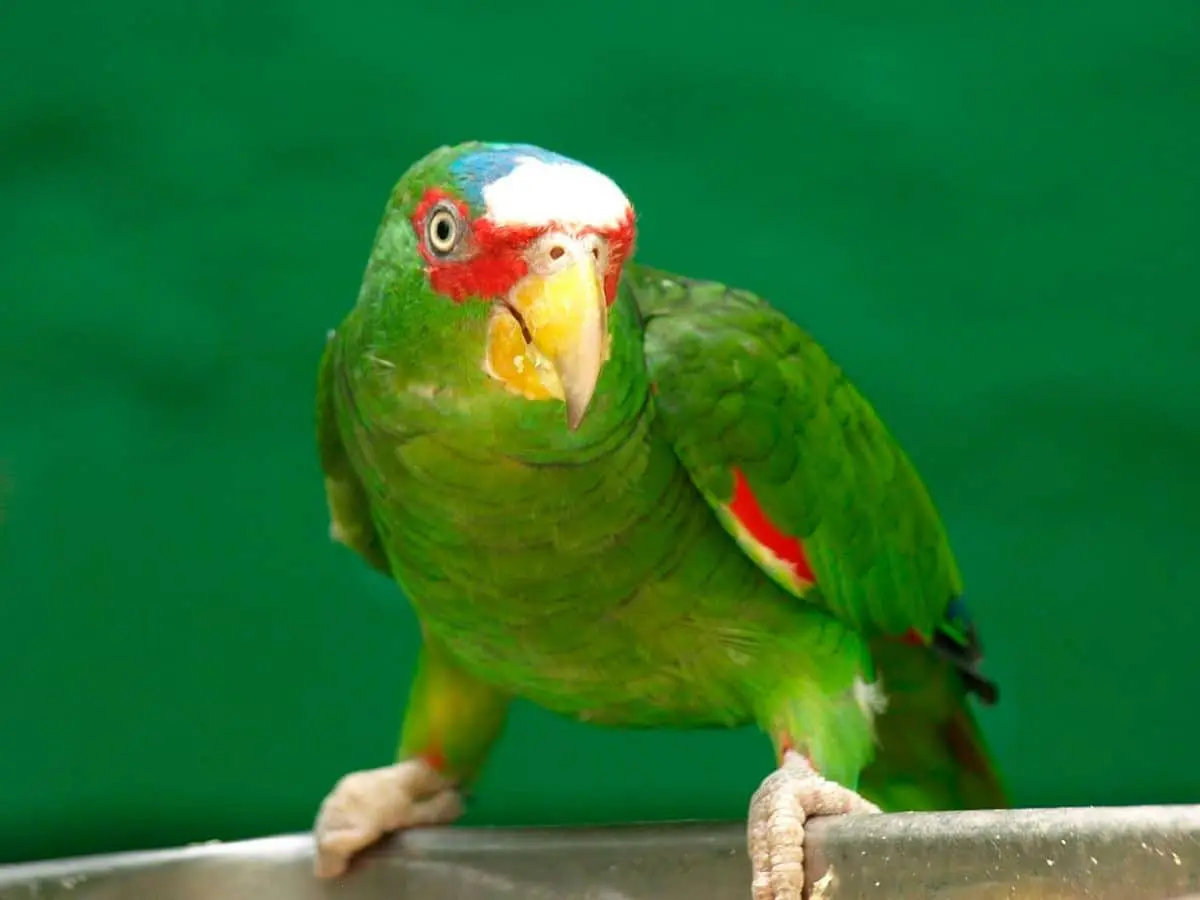
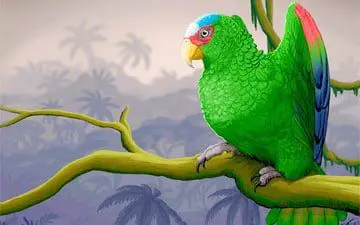
The White-fronted Parrot(Amazona albifrons) has the forecrown white; lores, upper cheeks and ring of feathers around eyes, red; the crown pale blue mingles with the green nape; the feathers with dark margins; sides neck green with narrow black margins. Mantle, back and scapulars, grass-green, sometimes with olive tint; the mantle with indistinct black tips; rump green, perhaps more emerald colors than the rest of the upperparts.
big blankets and alula, red, other coverts green. The outerweb of the primaries, green, They turn blue at the tips; outerweb of the secondaries, blue; innerwebs of the flight feather, blackish. Under, the wings bluish green. Underparts green with weak blackish edges to feathers on throat and the chest. Upper, the tail It is yellow in the center, outer feathers red at the base, blue in the outerweb. Bill light colored horn, darker at the tip; bare periophthalmic pale grey; irises pale yellow; legs pale grey.
It presents an undistinguished sexual dimorphism. The female It differs from the male in the red face It is limited to the region eye ring and it lacks the red hue in wing coverts. The immature male It looks like female but with red on the primary coverts.
(Miller,W, 1905) – smaller the species nominal. Little differentiated from nominal but the green plumage It is perhaps paler, yellower. Some individuals Coast peaceful show some red on the throat.
Amazona albifrons saltuensis
(Nelson, 1899) – Similar to the nominal but the plumage It is heavily steeped in blue. The blue of the crown It extends to the nape.
Habitat:
This adaptable Amazona uses all kinds of wooded habitats and open field with trees, including seasonally moist semi-evergreen semi-evergreen forest (especially at the edge), pine forests, gallery forest, agricultural land with open woods, savannah and tropical arid scrub with cactus, tending to more frequent open areas in the caribbean side.
Usually they prefer drier forests, but where it is simpátrica with Yellow-lored Parrot(Amazona xantholora), tends to prefer more humid and closed vegetation.
In Yucatan the White-fronted Parrot inhabit coastal coconut plantations while breeding. In altitudes of 900 m (Oaxaca), 1.800 m (Honduras) and 1.500 m (Sonora meridional: register only known outside the tropics).
In pairs during the breeding season but usually gregarious, distributed primarily in small groups, with occasional concentrations of hundreds of birds and some communal roosts (for example, mangroves) with several thousand birds.
The White-fronted Parrot nest in trees, cavities of the palm tree termitarium, sometimes in the cavity dug by some woodpecker. species trees Bursera simaruba and Caesalpinia gaumeri are among the favorites to nest in Yucatan. Breeding January July, depending on the location.
A clutch contains 3-5 eggs. Only the female incubates. The incubation lasts around 24 days.
Size of its range (breeding/resident ): 2.330.000 km2
The White-fronted Parrot They extend Mexico, from the South of Sonora (north to about 28 ° N) along the Sinaloa and West Durango south through the Pacific region to Oaxaca and north through Tehuantepec isthmus the Atlantic coast in southern Veracruz and to the East by Tabasco the entire Yucatan Peninsula, including northern Guatemala and Belice.
They are present in southern Chiapas and in the lowlands of the Guatemalan Pacific and, reportedly, in West El Salvador, extending through the lowlands of peaceful, arid and Caribbean lowlands Honduras to the Pacific Northwest Costa Rica and Nicaragua (where distribution is not detailed).
Mainly seasonal residents but visitors in some parts of the range (for example, Yucatan, El Salvador western and eastern mountains Guatemala).
Introduced in urban areas Cozumel Island, in the State of Quintana Roo (Mexico). Their presence only in urban areas of the island, the ability of the species to live successfully in urban areas, the abundance of fruit trees and use as a pet by the islanders allows us to suggest that registered individuals are the result of leakage or were released by their owners.
Usually common and together with the Orange-fronted Parakeet(Eupsittula canicularis), It is the largest parrot in the Pacific slope of Central America; although obviously scarce in some areas. The deforestation It is possibly promoting increases in population Caribbean slope of Central America. Captured for the pet trade and hunted as food, for example in Yucatan, where recently there has been a population decline due to the persecution of parrots that feed on fruit after loss of wild foods cultivated by Hurricane Gilbert. Its capture It is authorized only during the months of October to February in the states of Warrior, Jalisco, Michoacán, Oaxaca, Sinaloa and Tabasco and from September to January in Veracruz.
Distribution 3 subspecies:
Amazona albifrons albifrons
(Sparrman, 1788) – Nominal. Pacific Coast of Mexico from Nayarit to Oaxaca and South of Chiapas in the lowlands Guatemalan Pacific. Birds in the northern Guatemalan lowlands and the arid interior, they can refer to the subspecies Amazona albifrons nana.
• Current category of the Red List of the UICN: Least concern.
• Population trend: Increasing.
Rationale for the Red List category
• This species has a very large range and therefore it is not close to the thresholds for Vulnerable under the criterion of size range (Extent of occurrence below 20,000 km2 combined with a size decreasing or fluctuating range, extension / habitat quality or population size and a small number of sites or severe fragmentation).
• The trend of population appears to be increasing and, therefore, the species does not approach the thresholds Vulnerable under the criteria of population trend (Wholesale 30% decrease in ten years or three generations).
• The population size is very large and, therefore, not approaching the thresholds for vulnerable under the criterion of population size (less than 10.000 mature individuals with continuing decline estimated a higher percentage of 10% in ten years or three generations or with a specific population structure).
• For these reasons the species is evaluated as the least concern.
Justification of the population
• Partners in Flight estimated that the total population of 500.000-4.999.999 individuals (A. Panjabi in a bit., 2008).
Justification of trend
• The population is suspected to be increasing as habitat degradation is creating new areas of suitable habitat.
The White-fronted Parrot in captivity:
Due to the decline of these birds in the wild, especially in the Mexican populations, the White-fronted Parrot is now, unlike other times, offered for sale only rarely. It also, among birds received by importers, the males generally far outweigh the females so it's hard to find a partner.
According to many observations, the White-fronted Parrot captured still quite shy and unsociable, especially if they were mature when they were trapped. The birds immature, which can be stained by the yellowing of his crown, relatively well sympathize with their caregivers and are easily adapted to a life in a cage or aviary. It is said to have some talent to imitate.
According to sources, the first hatchlings in captivity They were born in 1949 in the United States by I.D. Putman; the second in 1977 on German Federal Republic by H. Müller (Walsrode) and a third set in Switzerland in 1979; Since then several European poultry farmers have reported breeding successes.. The latest report came in 1985 from the bird park Metelen Heide in Muen-sterland (Western Germany). there a clutch five eggs produced four hatchlings in mid-June 1984 after an incubation period of 28 days. The young left the nest after about 70 days, but they were still actively cared for and fed, mainly by the parent, for a few weeks more.
Its price in the European market round 1000 EUR. generally silent the Amazons largest. It can be noisy just before and during the breeding season.
These birds can become aggressive in breeding season and can attack the caregiver. The nest boxes are better positioned to nest inspection can be performed from outside the aviary. The inspection of the nest is best when adult birds are out of the nest, however captive breeding has rarely been achieved between individuals.
Susceptible to intestinal infections during the acclimatization period.
Their life expectancy can overcome the 50 years.
Alternative names:
– White-fronted Parrot, Spectacled Amazon, Spectacled Parrot, White fronted Parrot, White-browed Amazon, White-browed Parrot, White-fronted Amazon (English).
– Amazone à front blanc, Amazone à lunettes (French).
– Weißstirnamazone (German).
– Papagaio-de-testa-branca (Portuguese).
– Amazona de Frente Blanca, Amazona Frentialba, Cotorra Frentiblanca, Lora frentiblanca, Loro Frente Blanca, loro frente-blanca, Loro Frentiblanco, Cotorra Guayabera (español).
– Cabeza de Manta, Loro Manglero, Cocha, Cocho, Cucha (Mexico).
Parrots A Guide to the Parrots of the World – Tony Juniper & Mike Parr
Birdlife
The New Parrot Handbook by Werner Lantermann,Matthew M. Vriends
Photos:
(1) – White-fronted Amazon By David Oliva (originally posted to Flickr as Cotorro 007) [CC BY 2.0], via Wikimedia Commons
(2) – White-fronted Amazons in Schönbrunn Zoo By spacebirdy(also known as geimfyglið (:> )=| made with Sternenlaus-spirit) (Own work) [CC BY-SA 3.0 or FAL], via Wikimedia Commons
(3) – white-fronted amazon (Amazona albifrons) By Christoph Anton Mitterer (Flickr: P8155550) [CC BY-SA 2.0], via Wikimedia Commons
(4) – White-fronted Amazon Amazona albifrons pair perching in a tree at Guanacaste, Costa Rica By Steve Jurvetson (originally posted to Flickr as love birds) [CC BY 2.0], via Wikimedia Commons
(5) – White-fronted Amazon, (Amazona albifrons). A pet parrot on a perch. Red feathers on this parrots shoulders indicate that it is a male By ➨ Redvers (Flickr) [CC BY 2.0], via Wikimedia Commons
(6) – White-fronted Amazons in Schönbrunn Zoo By spacebirdy(also known as geimfyglið (:> )=| made with Sternenlaus-spirit) (Own work) [CC BY-SA 3.0 or FAL], via Wikimedia Commons
(7) – A captive White-fronted Amazon in Copán Ruinas, Copán, Honduras By Troy from Charlottesville, USA (Flickr) [CC BY-SA 2.0], via Wikimedia Commons
(8) – A White-fronted Amazon – upper body by sumba [CC BY 2.0 of], via Wikimedia Commons
(9) – A pet juvenile White-fronted Amazon in Poole, Dorset, England By Kyle Payne from England (Odd Looking Seagull) [CC BY-SA 2.0], via Wikimedia Commons
(10) – White-fronted Amazon, Amazona albifrons, Remove alone B. Planet Earth – Flickr













-5-4c.jpg)


_-eating_bread.jpg)

%2C_Masked_Shining_Parrot_%2C_Birds_Gallery%2C_Natural_History_Museum%2C_London.JPG)


_1.jpeg)


