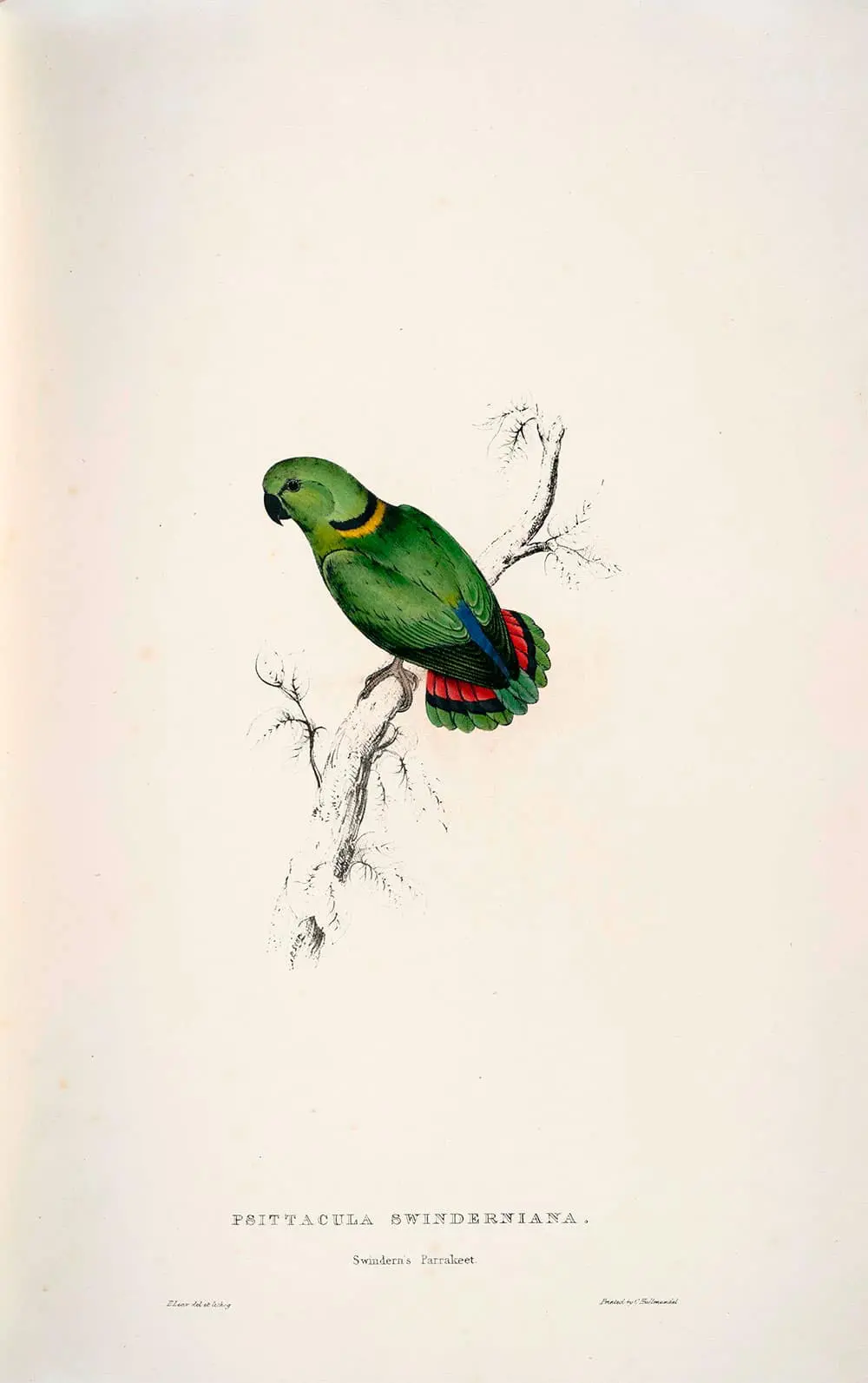
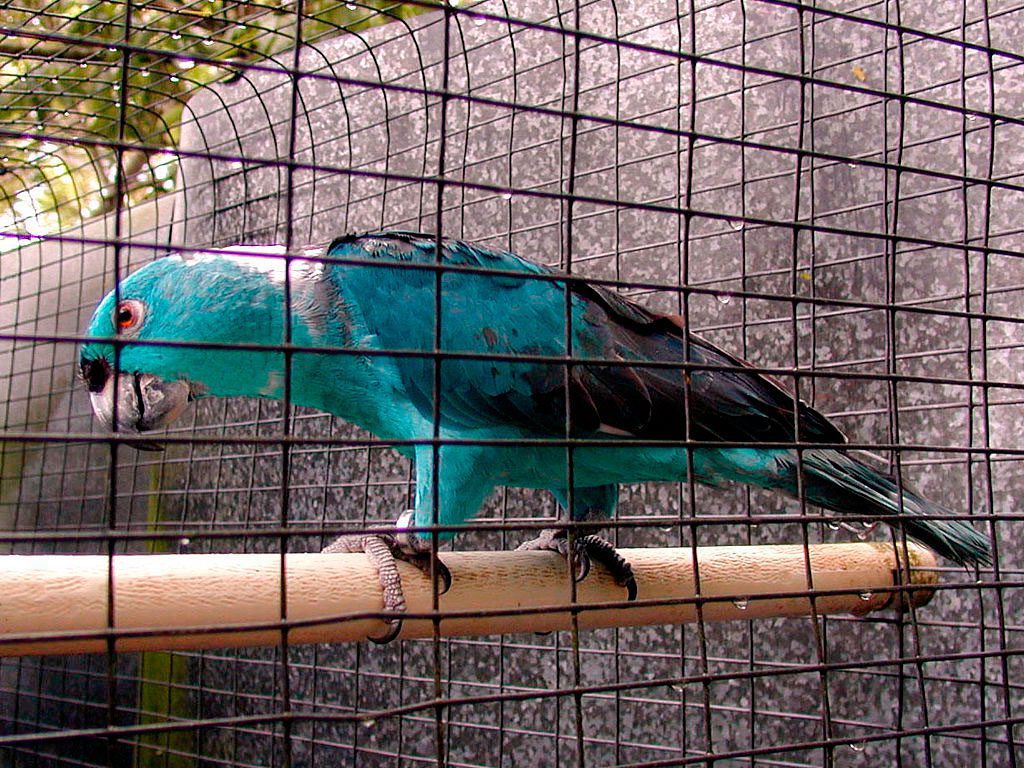
The Black-collared Lovebird(Agapornis swindernianus) has the forecrown, the lores and crown emerald green. Narrow black band at the nape, behind yellow lined. Mantle and scapulars green; rump and coverts bright blue. Upperwing-coverts green. Flight feathers Blackish with vane Green external on the upper face. Underwing-coverts emerald green.
The underparts pale green pretty boring, particularly on chest; flanks brightest. Central feathers of the tail, large black hand with green tips; other red at the base, green tips with broad black subterminal band.
Bill greyish black; irises yellow; legs Dark yellow green.
Both sexes similar.
The immature they are like adult, but without the nuchal collar. The Green head, the Blue rump and red tail, colors are duller than adults. Iris brown. beak pale gray with black spot at the base.
Subspecies description:
Agapornis swindernianus emini (Neumann, 1908) – Of 13 cm length. The collar is red and black and is narrower, It does not extend to the beginning of chest.
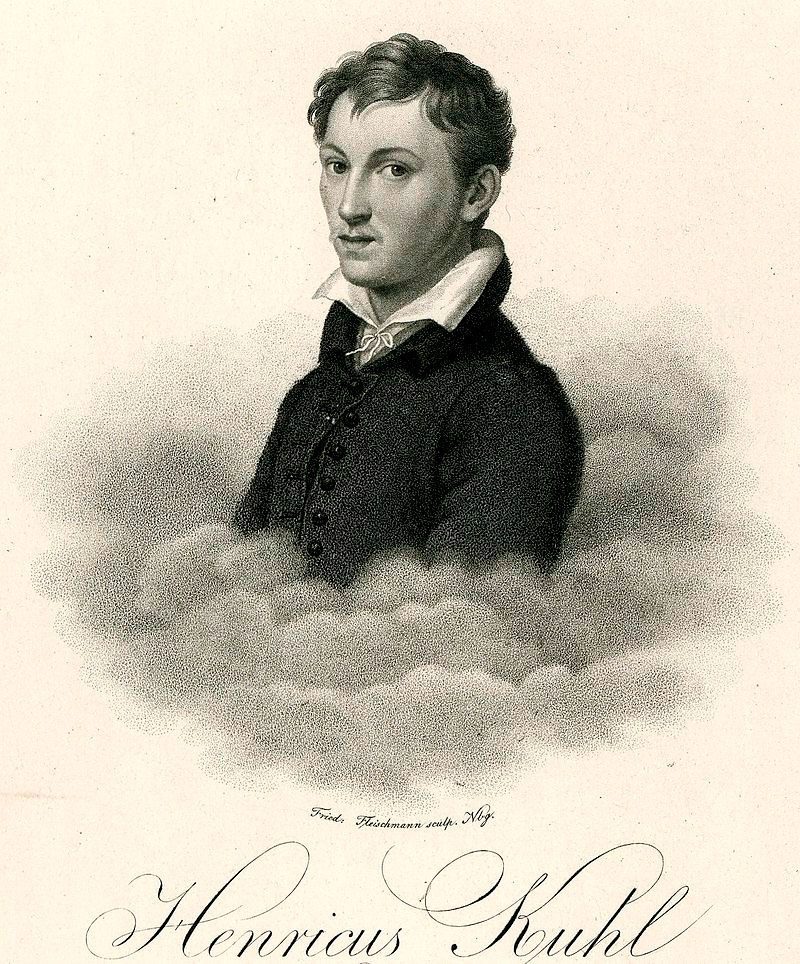
Agapornis swindernianus swindernianus (Kuhl, 1820) – The species nominal
Agapornis swindernianus zenkeri (Reichenow, 1895) – Of 13 cm.. length. Under the black band it has reddish coloration extends to the chest diluted.
Habitat "inseparable acoloado":
The Black-collared Lovebird They inhabit lowland tropical evergreen forests, both primary and secondary, generally below the 700 m. although some reports indicate sightings 1.800 metres in Uganda.
Visits occasionally cultivated land. In general, in small flocks (until 20 birds), sometimes in larger groups during the dry season.
It is a bird, generally, arboreal; frequent the treetops, where they can be very difficult to detect when they remain silent.
Forman communal roosts in their favorite places.
"Inseparable acoloado" reproduction:
Reproduction of this species is, to a great extent, unknown; They have been observed in arboreal termite nests and it is suspected that breeding in the northern basin of the congo river It is in July.
"Inseparable acoloado" food:
Their main food is, apparently, seeds Ficus, extracted from its fruits, in mature forests, light areas near the forest and trees growing areas around the villages; They also take millet, corn and other seeds, as well as insects and their larvae.
birds in the distrito de Ituri, Democratic Republic of the Congo, feeding were observed in the rice crops and Sesame.
"Agapornis swindernianus" distribution:
The Black-collared Lovebird they are endemic in West Africa center in at least two (possibly three or four) separate populations.
In West Central Africa Its distribution extends from southern Cameroon south on Gabon and east to the north Congo river and extreme southwestern Central African Republic.
You can also see from the basin Congo river in West Uganda.
Subspecies distribution:
Agapornis swindernianus emini (Neumann, 1908) – Spread across the center and east of Democratic Republic of the Congo to the west end of Uganda.
Agapornis swindernianus swindernianus (Kuhl, 1820) – The species nominal
Agapornis swindernianus zenkeri (Reichenow, 1895) – Distributed in southern Cameroon and eastern Gabon to the southwest of Central African Republic and West Democratic Republic of the Congo.
The size of the world population Black-collared Lovebird It has not been quantified, but the species, according to sources, It is considered rare in Ghana and probably confined to forest reserves. Described as common in Gabon and Democratic Republic of the Congo and reasonably common in lowlands in Bwamba of Uganda.
The population is suspected to be stable in the absence of evidence of any reduction or substantial threats.
As a curiosity, emphasize that governments Liberia and Uganda stamps have been printed with his image.
The Inseparable Vireo in captivity:
Probably It not kept out of their range; some captured birds died after a few days or weeks; No further information is available.
As with any other pet, it is essential to ensure that the birds one is about to purchase have been captive bred and not wild caught. In addition to conservation and ethical reasons, trapped wild animals are more likely to get sick and die.
Alternative names:
– Black-collared Lovebird, Black collared Lovebird (English).
– Inséparable à collier noir, Inséparable à collier, Inséparable du Libéria (French).
– Grüköpfchen, Grünköpchen, Grünköpfchen (German).
– Inseparável-acollarado (Portuguese).
– Inseparable Acollarado, Inseparable de Cuello Negro (español).
– Avibase
– Parrots of the World – Forshaw Joseph M
– Parrots A Guide to the Parrots of the World – Tony Juniper & Mike Parr
– Birdlife
– Photos:
(1) – Black-collared lovebird, the great unknown – fischospi
(2) – A painting of a Black-collared Lovebird (originally captioned «Psittacula swinderniana. Swindern’s Parakeet») by Edward Lear (1812-1888) [Public domain], via Wikimedia Commons
▷ The world of Pets: Dogs, cats, birds, reptiles, amphibians
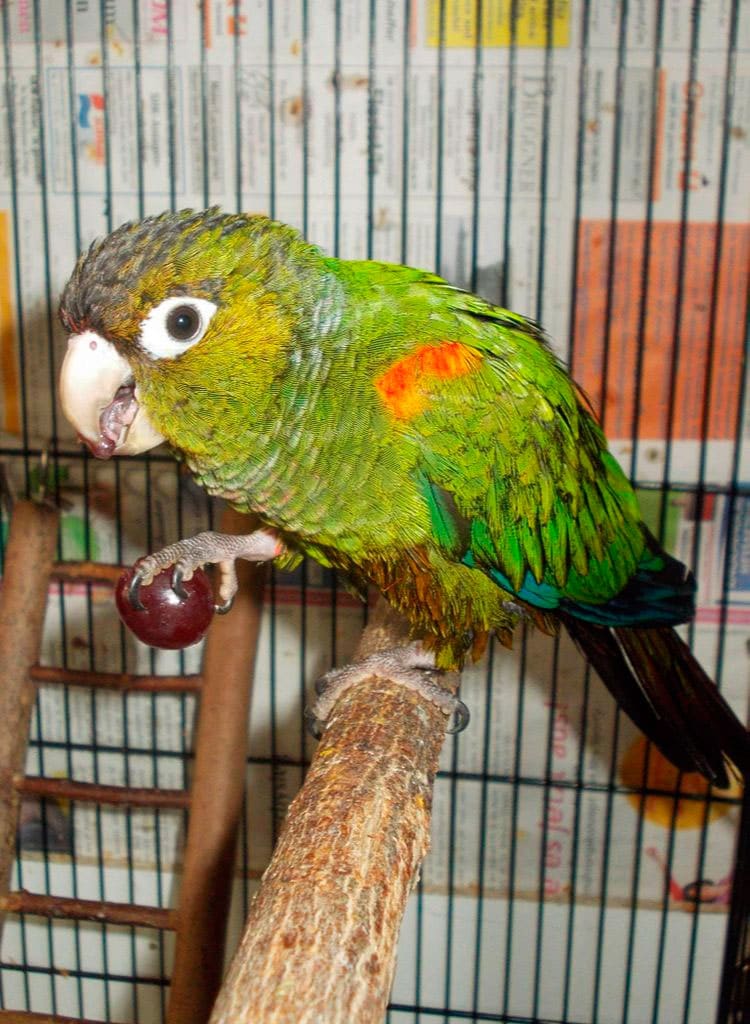
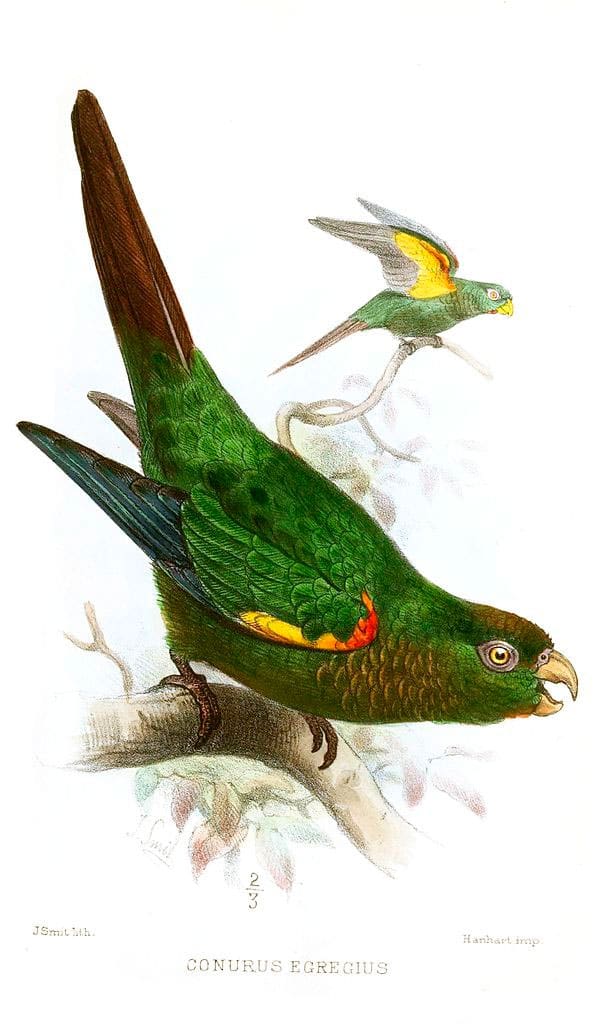
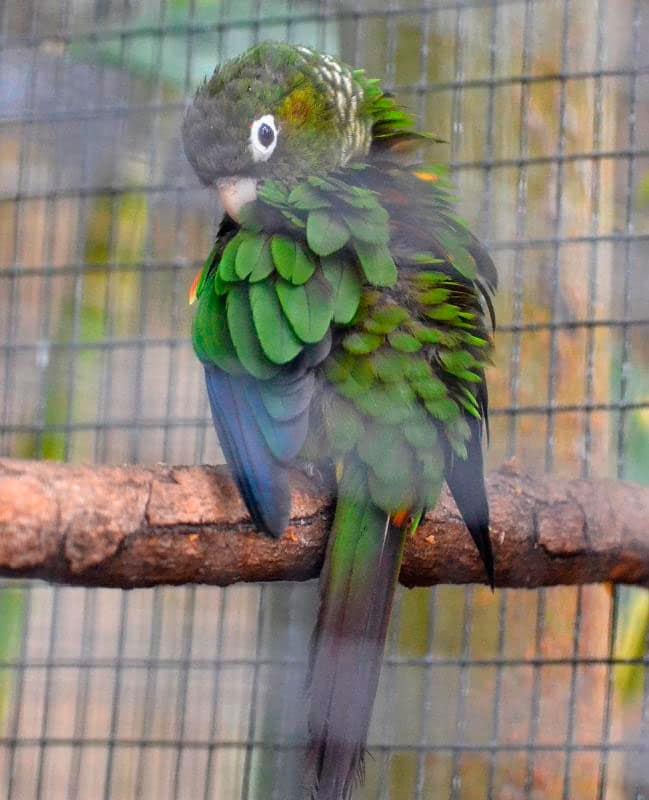
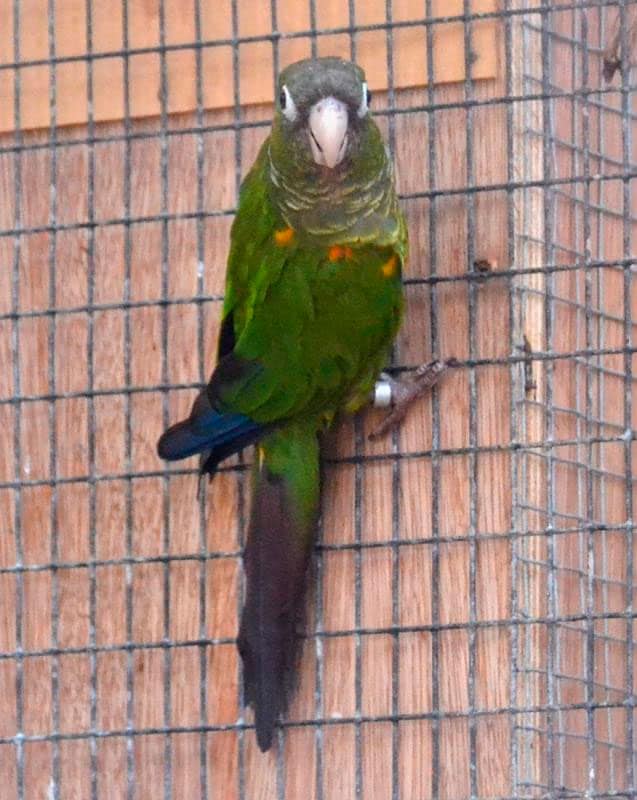
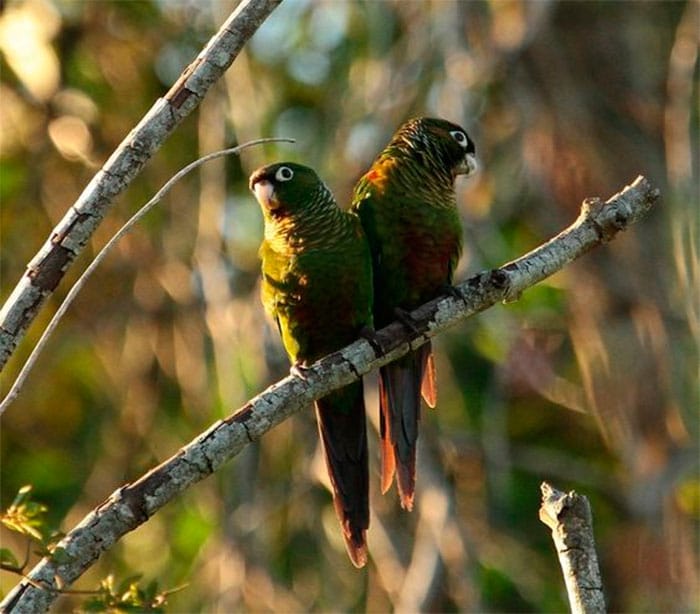
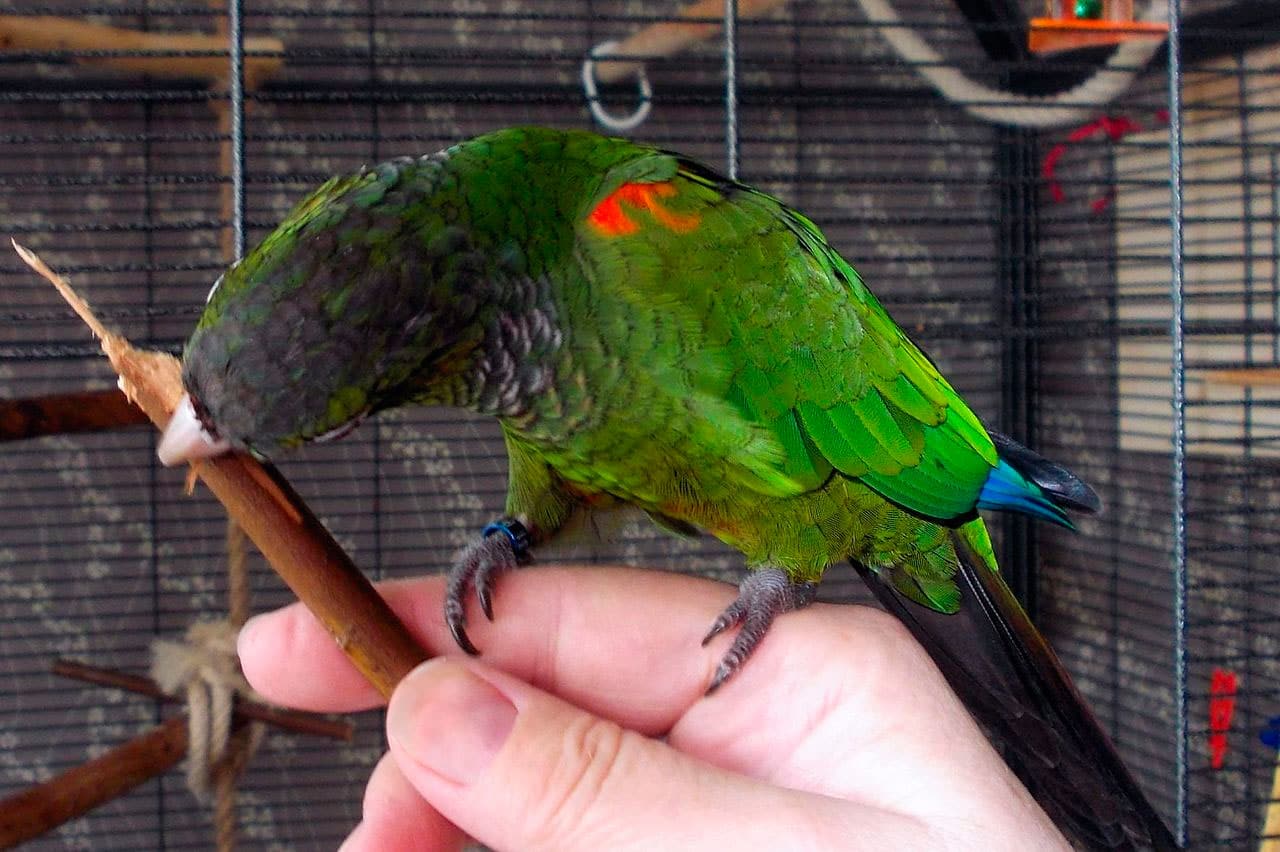
The Fiery shouldered Parakeet(Pyrrhura egregia) has a close frontal band brown; crown, lores, rear area of the neck and upper cheeks, brownish; ear-coverts reddish brown; feathers on the sides of the neck basically green with subterminal band of color beige, narrow dark tips giving a scaly appearance to the whole.
The upperparts Green with dark and narrow edges to some feathers. carpal area and front edge of the wing
, Orange with yellow marks; primary coverts usually blue but sometimes colored yellow shiny; upperwing-coverts green. Outerwebs of flight feather, blue. Underwing-coverts marked with yellow orange; bottom of the flight feather gray. feathers in the throat and the chest basically green with the subterminal band Hazelnut color and dark tips, giving a scaly appearance; underparts green, with most of the feathers of the belly Brown at the base and green-tipped, sometimes forming a brown patch. Upper, the tail Brown very dark, green at the base; by down gray.
The bill color horn; skin peri-oftalmica naked white; brown the irises; legs Brown-Black.
Both sexes are similar.
The immature It has much less yellow and orange in the upperwing-coverts and infra-alares; the crown Green and flakes in the chest and on the sides of the neck less pronounced.
(Zimmer & Phelps,WH 1946) – Similar to the species nominal but with the upperparts darker green and the underparts also slightly more dark. Patch Brown in the belly less frequent and less prominent.
Habitat:
The species inhabits in humid premontane forests and dense secondary forest on the Tepuis, between 700 to 1800 m. usually in flocks of 7-25 birds.
Reproduction:
Little information on the breeding; is reproduce between March and April with fledged young people between May-June. Period of incubation: 23 Dias.
Food:
There is no information about the diet, except that birds visit Amerindian villages from July to August to feed of fruit of, for example, guavas mature.
Distribution:
Size distribution (reproduction / resident): 49.400 km2
Can be found in adjacent areas of the West of Guyana, for example, in the surroundings of the Camaran River and top of the Mazaruni River, the Merume mountains and Pacaraima mountains to the South of Annai.
The reports of Suriname still no confirmed. Probably are distributed in the northeast of Roraima, Brazil.
Inaccessible range and few details about his status, but apparently quite common. Large part of the range Venezuelan included in the Canaima National Park.
Small quantities exported from Guyana to end of the years eighty and subsequently bred in captivity.
• Current category of the Red List of the UICN: Least concern.
• Population trend: Decreasing.
Justification of the population
The population size World has not been quantified, but this species is described as «quite common» (Stotz et to the., 1996).
Justification of trend
It is suspected that this species has lost 3.3-10.5% of habitat suitable within their distribution during three generations (18 years), based on a model of Amazon deforestation (Soares-Filho et to the., 2006, Bird et to the., 2011). Given the susceptibility of the species to hunt or capture, It is suspected that will decrease in <25% durante tres generaciones.
"Fiery shouldered Parakeet" in captivity:
Intelligent, relatively calm and playful. Young birds are very shy.
They are aggressive with other birds and it is very rare in captivity, with small quantities exported from Guyana at the end of the 1980s and subsequently raised in captivity.
– Avibase
– Parrots of the World – Forshaw Joseph M
– Parrots A Guide to the Parrots of the World – Tony Juniper & Mike Parr
– Birdlife
– Photos:
(1) – Demerara Conure By Gazelle74 (Own work) [CC BY-SA 4.0], via Wikimedia Commons
(2) – Demerara female «at work». These little parrots love to gnaw at wood, paper and many other things By Gazelle74 (Own work) [CC BY-SA 4.0], via Wikimedia Commons
(3) – Fiery-shouldered Parakeet (Pyrrhura egregia) by Margareta Wieser. A pair perching on a branch – HBW
(4) – Fiery-shouldered Parakeet (Pyrrhura egregia) by Andrew Emmerson. An adult bird – HBW
(5) – Fiery-shouldered Parakeet (Pyrrhura egregia) by Andrew Emmerson. An adult preening – HBW
(6) – Conurus egregius » = Pyrrhura egregius (Fiery-shouldered parakeet) by John Gerrard Keulemans [Public domain], via Wikimedia Commons
Origin: Mexico, Guatemala, Honduras, El Salvador, Nicaragua, Costa Rica
Character: Social
Life expectancy: More than 30 years.
Height: 35,5-38 cm..
Content
Description:
35,5-38 cm.. length and 480 g. of weight.
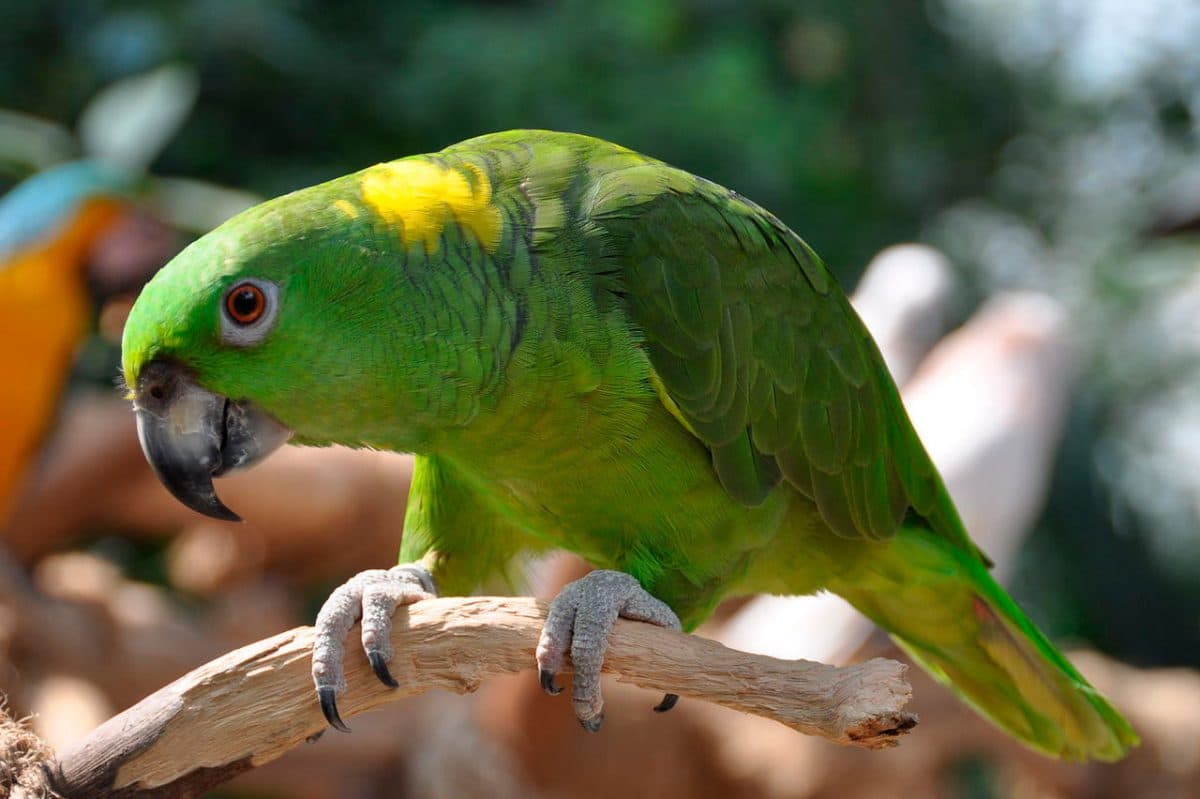
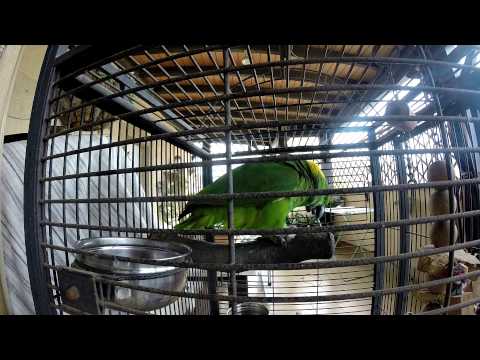
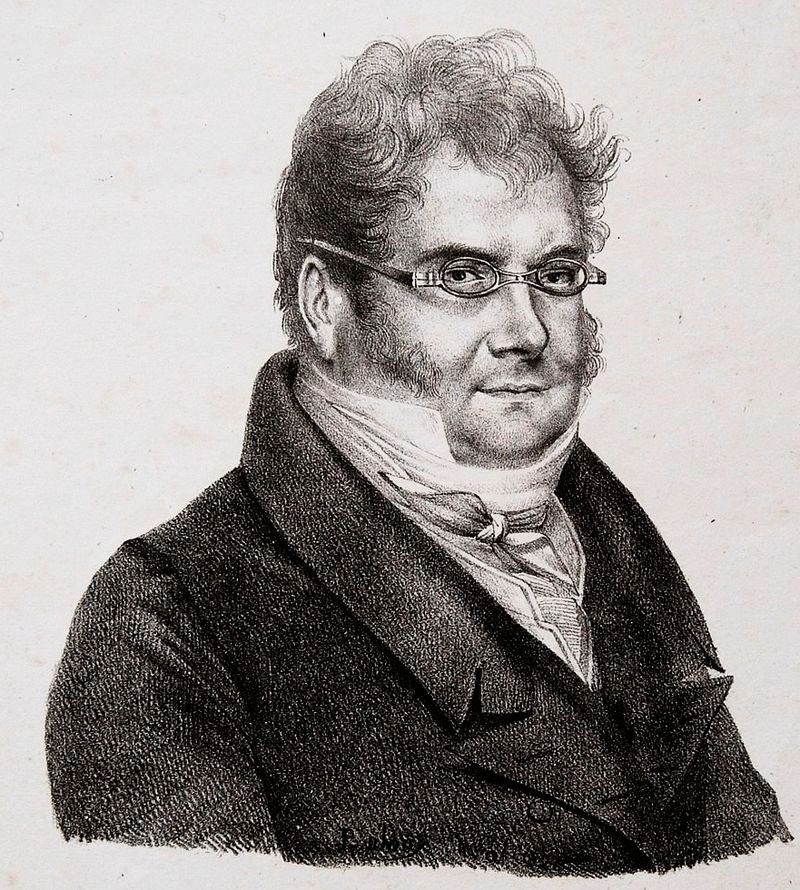
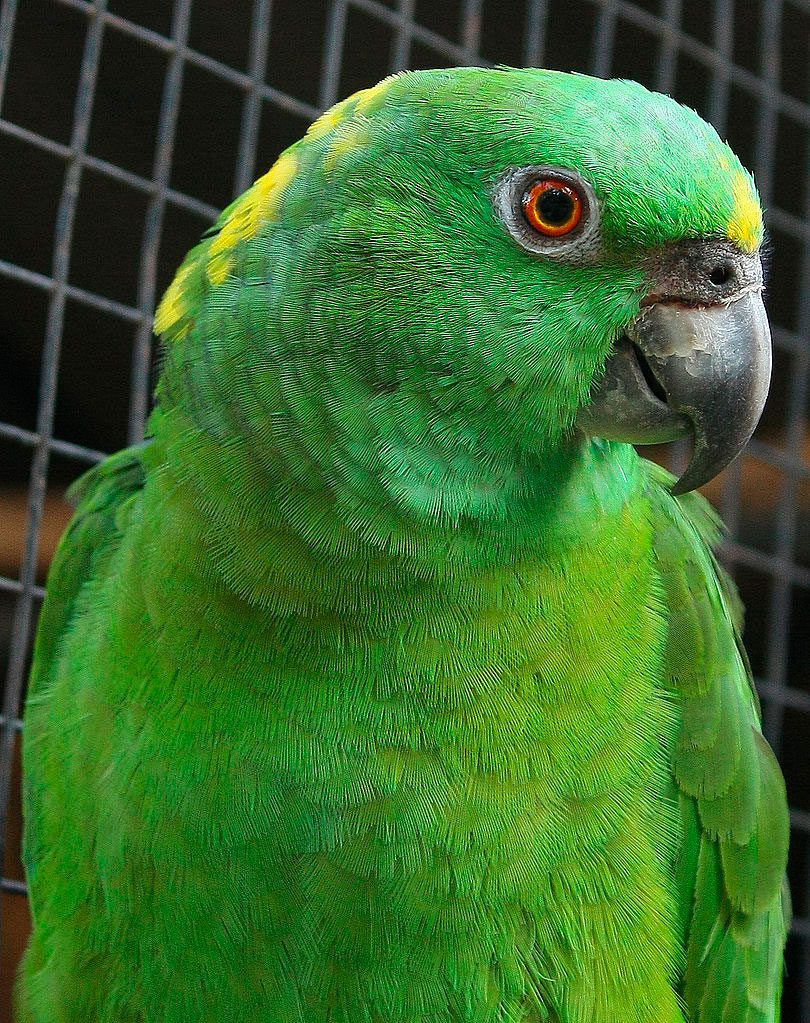
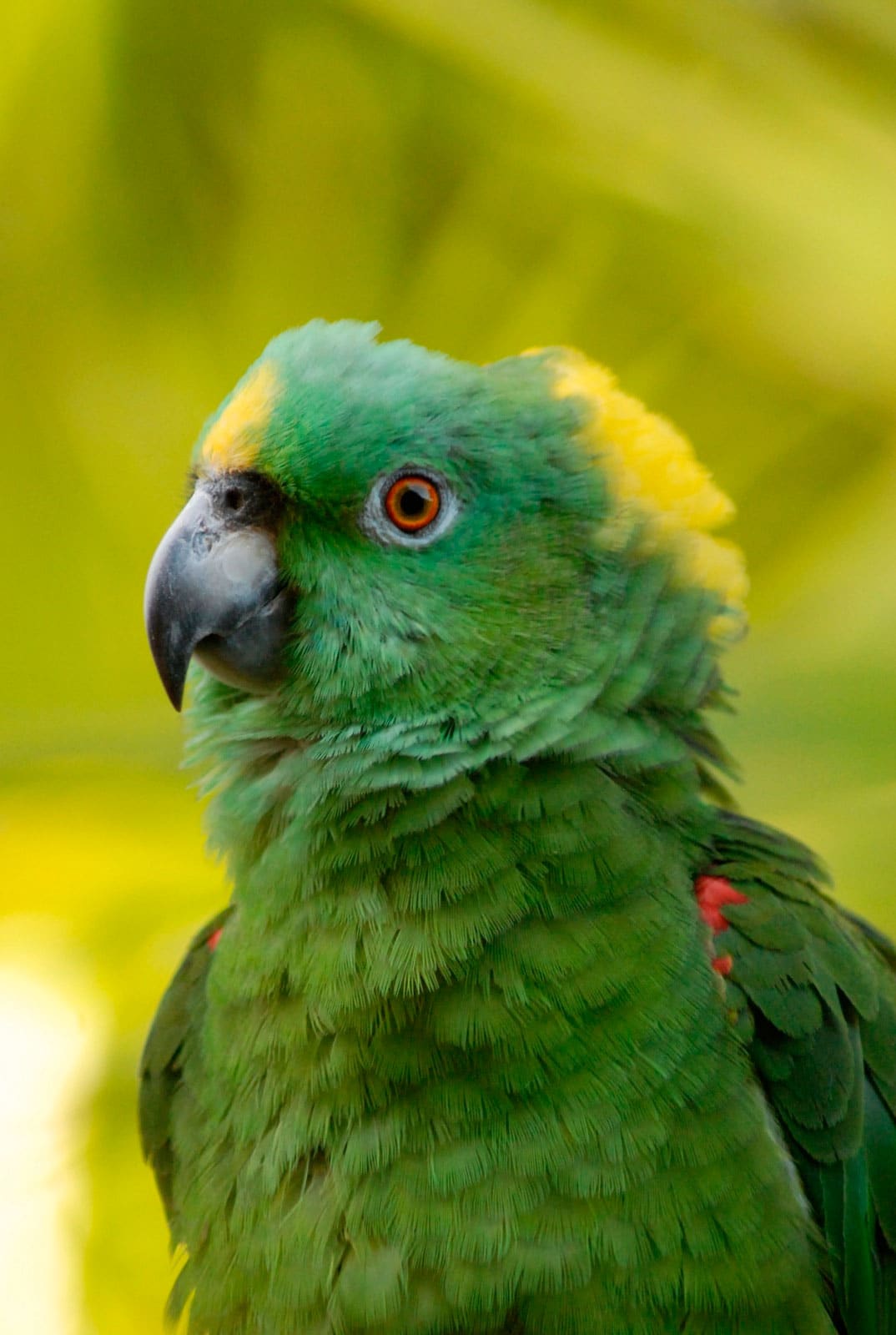
The Yellow-naped Parrot(Amazona auropalliata) It has a large size; their forecrown and front of the crown, usually, pale bluish green, sometimes with narrow frontal band yellow that extends to the front of the crown.
back of the crown pale bluish green; lores, cheeks and sides neck, green; nape with broad golden-yellow ban. Upperparts green with some feathers in the the mantle and in the back with blackish edges; rump and uppertail-coverts slightly brighter than the rest of the upperparts. The wing-coverts green but more emerald than upper body; feathers yellow feathers on leading edge of wing
in some birds. Outerwebs of the four outer secondaries, bright red as speculum; primaries and secondaries violet blue outerweb and towards tips. Under, the wings are green. Underparts pale green with a slight bluish tinge throat.
Tail green with a wide terminal band brighter yellowish green, red at the base with outerweb of the outer feathers, blue. Bill blue, black tip; bare periophthalmic grey; irises orange; legs grey.
Both sexes are similar. The immature has the nape green with yellow feathers appearing at end of first year; irises brown.
Yellow-naped Parrot sound.
Description 3 subspecies:
Birds of Bay islands often they treated as parvipes, not as caribaea. Some copies of Guatemalan Pacific show forecrown yellow, but apparently not consistent racial difference.
(Lousada, 1989) – Similar to the subespecie parvipes but with olive below and bill paler colored horn (especially lower jaw). usually adults patch yellow triangular in front of the crown. Young birds show little yellow in the head wave nape.
Amazona auropalliata parvipes
(Monroe,BL Jr & Howell,TR, 1966) – Less than nominal species, with red feathers on the curve wing
, otherwise similar.
The Yellow-naped Parrot inhabits semiarid forests, arid scrubland and savannas (including those of Pinus), openings in deciduous tropical forests and swamps peaceful, evergreen gallery forests and, sometimes, second growth in agricultural areas. Observed to 600 metres in Guatemala and a 700 metres in Honduras. Usually in pairs or small groups, sometimes in larger meetings, but the decline of the population may now obscures large flocks in some areas. They meet at communal roosts.
Reproduction:
Monógama; It maintains the union of couples throughout the year. It nests in natural cavities in trees, such as holes in old trunks or dead, including pines Nicaragua and Bay islands. breeding season in February Oaxaca and El Salvador; March Roatan. Clutch 2-3 eggs.
In captivity cycle nesting of the Yellow-naped Parrot complete with 29 days of incubation eggs, followed by two months increase of the young in the nest.
Size of its range (breeding/resident): 580.000 km2
The Yellow-naped Parrot It is confined to Central America. They are distributed in the lowlands Eastern Pacific of Mexico (Oaxaca and Chiapas), Guatemala (a sample taken in Petén but his status there is uncertain), El Salvador (arid lowland tropical zone), Honduras and Nicaragua, to the Northwest of Costa Rica from the south end of Gulf of Nicoya northward. They can also be seen in the Caribbean slope of Honduras and in the Mosquito Coast from Honduras, as well as in the neighboring area of northeast Nicaragua. found in Roatan and Guanaja, in the Bay islands but absent in Utila.
Resident. Apparently uncommon in Oaxaca and rare and declining in Costa Rica. Birds observed in the Sula Valley, Honduras, previously attributed to this species but now included within the species Yellow-headed Parrot.
Formerly common and locally abundant, but probably now declining throughout its entire range due to conversion of habitat for agricultural uses and its capture for trade local and international. Not yet considered endangered, but its long-term status is uncertain if its population decline continues.
Although Guanaja reasonable numbers remain, the species inhabiting the Bay islands (caribaea), It is in serious decline due to capture for export (practically 100% of hatchlings are caught each year); also at risk from tourism development, especially in Roatan.
Distribution 3 subspecies:
Amazona auropalliata auropalliata
(Lesson,PA, 1842) – Nominal. Pacific Coast of Central America, from Oaxaca, Mexico, to the Northwest of Costa Rica.
• Current category of the Red List of the UICN: Vulnerable.
• Population trend: Decreasing.
• Population size : 20000-49999.
Rationale for the Red List category
This species has been uploaded to Vulnerable because information on levels exploitation and habitat loss, and trends of the local population, They suggest that the species is suffering at least one rapid population decline. In fact, the rate of decline can be very rapid; However, Additional data are needed to confirm this, in which case the species may qualify for elevation In danger of extinction.
Justification of the population
Partners in Flight estimated that the population in number of less than 50.000 individuals (A. Punjabi in some. 2008), so it is placed in the band 20.000 to 49.999 individuals on freedom.
Justification of trend
It is suspected that the population is in rapid decline due to the continuous habitat destruction and unsustainable levels of hunting, a suspicion that is supported by the observations of trends of the local population.
Conservation Actions Underway
• CITES Appendix I (Endangered species, which they are or may be affected by international trade. Only trade in the species is authorized in the Appendix I in exceptional circumstances, and it must not have a primarily commercial purpose.)
• The species occurs in a number of protected areas.
• Efforts have been made to obtain an area of 4.000 hectares east of Monterrico on Pacific coast of Guatemala declared as protected area (C. Muccio in some . 2011).
• The species has been the subject of a number of local studies, some ongoing, aimed at gathering information on population trends and threats.
• The extent of exploitation of wildlife for the trade It has been highlighted by the local media, for example in Honduras ( by O. Andino in some . 2011).
Conservation Actions Proposed
• Carry out surveys coordinated through the range of the species to quantify the Total population size.
• Monitor the demographic trends through regular surveys.
• Monitor harvest rates for the trade through regular surveys of the local population and officials.
• Monitor rates of loss and degradation of habitat throughout the range of the species.
• Accomplish awareness activities to reduce exploitation.
• Increase the area of suitable habitat that receives effective protection..
The Yellow-naped Parrot in captivity:
The populations of the Amazon nuquigualda have suffered strong pressure by national and international trade (Ridgely, 1981, Iñigo- Elias and Ramos, 1992). There is now an illegal heavy traffic this species, both for domestic and international trade, Parrot's being seized in the Mexico-Texas border, with 648 copies confiscated during 1990-1993 (Gobbi, et to the., 1996).
protected by CITES Appendix I species (Endangered species, which they are or may be affected by international trade. Only trade in the species included in Appendix I authorized in exceptional circumstances, and it must not have a primarily commercial purpose.)
Each captive specimen of this species which is capable of reproducing, must be placed in a well-managed captive breeding program and not sold as a pet, in order to ensure its long-term survival.
Alternative names:
– Yellow naped Parrot, Yellow-naped Amazon, Yellow-naped Parrot, Yellow-naped Parrot (incl. ssp. caribaea, parvipes), (English).
– Amazone à nuque d’or, Amazone à nuque jaune, Amazone verte à nuque jaune (French).
– Gelbnackenamazone (German).
– Papagaio-de-nuca-amarela (Portuguese).
– Amazona nuquigualda, Lora de Nacu Amarilla, Lora de nuca amarilla, Lora nuca amarilla, Loro Nuca Amarilla, loro nuca-amarilla, Loro Nuquiamarillo (español).
– Lora de nuca amarilla (Costa Rica).
– Lora nuca amarilla (Honduras).
– loro nuca amarilla, loro nuca-amarilla, Loro Nuquiamarillo (Mexico).
– Loro Nuquiamarillo (Nicaragua).
Origin: Mexico, Belice, Guatemala, Honduras, Nicaragua, Costa Rica, Panama, Colombia
Character: quiet and shy
Life expectancy: ----
Height: 21 cm..
Content
Description:
21 cm.. height and weight around 165 g.
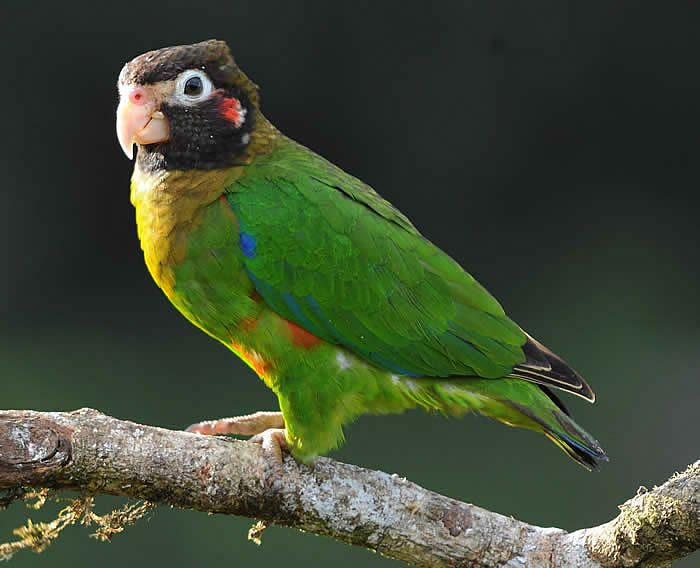
It more distinguishable from the Brown-hooded Parrot(Pyrilia haematotis) is your head, with forecrown White and the eye ring naked white also; ear with red feathers or oranges, crown grayish coffee, chest and nape Green yellowish.
The rest of the body usually green with it armpit red (easily view on the fly), contrasting with the blue-green of the wings and the green of the tail. The latter with light blue at the tip of the central feathers.
The bill is pale brown with yellow tinge. The irises they are red and the legs grayish brown.
The immature they are similar to adults, but more pale, off and without the color red in the head. Their irises is dark.
(Lawrence, 1862) – With red marks on the bottom of the rear of the neck and in the part superior of the chest, often forming a band in the male, more weakly in the females.
It inhabits mainly in the canopy of humid forests with a deciduous tendency, until the 1500 m. Their flocks are not numerous and are quiet at the time of feeding.
In Colombia is considered species very rare.
Reproduction:
It nests in hollow of trees and seems to share them with Blue-headed Parrot(Pionus menstruus).
Breeding season in February in Yucatan; May-July in Guatemala; August in Panama.
Food:
Feeds of fruits and seeds of trees in areas forested, as well as plants epiphytes and leaves green of some types of mistletoe.
Distribution:
Are you can observe in freedom from the Centre-South of Mexico to northwest of Colombia.
You can socialize with other parrots and toucans.
Subspecies distribution:
Pyrilia haematotis coccinicollaris
(Lawrence, 1862) – It is from Panama and Northwest of Colombia.
• Red List category of the UICN current: Least concern
• Population trend: Stable
Justification of the population:
Partners in Flight estimates the population at fewer than 50.000 individuals (A. Panjabi in litt., 2008), by what is placed in the band 20,000-49,999 individuals here.
Justification trend:
The population of the Parrot Encapuchad suspected to be stable in the absence of evidence of any reduction or substantial threats.
"Brown-hooded Parrot" in captivity:
Extremely susceptible to stress and diseases during the acclimatization, sudden deaths occur without warning. These are reasons why the they are seldom seen in captivity.
Alternative names:
– Brown hooded Parrot, Brown-hooded Parrot, Red-eared Parrot (English).
– Caïque à capuchon (French).
– Grauwangenpapagei, Grauwangen-Papagei (German).
– Brown-hooded Parrot (Portuguese).
– Cotorra Cabeciparda, Lora cabeciparda, Lorito Abigarrada, Lorito Encapuchado, Loro Cabecipardo, Loro Cabeza Oscura, loro cabeza-oscura, Loro Orejirrojo (español).
– Cotorra Cabeciparda (Colombia).
– Loro cabecipardo (Costa Rica).
– Lora cabeciparda (Honduras).
– loro cabeza oscura, loro cabeza-oscura, Loro Orejirrojo (Mexico).
– Loro Cabecipardo (Nicaragua).
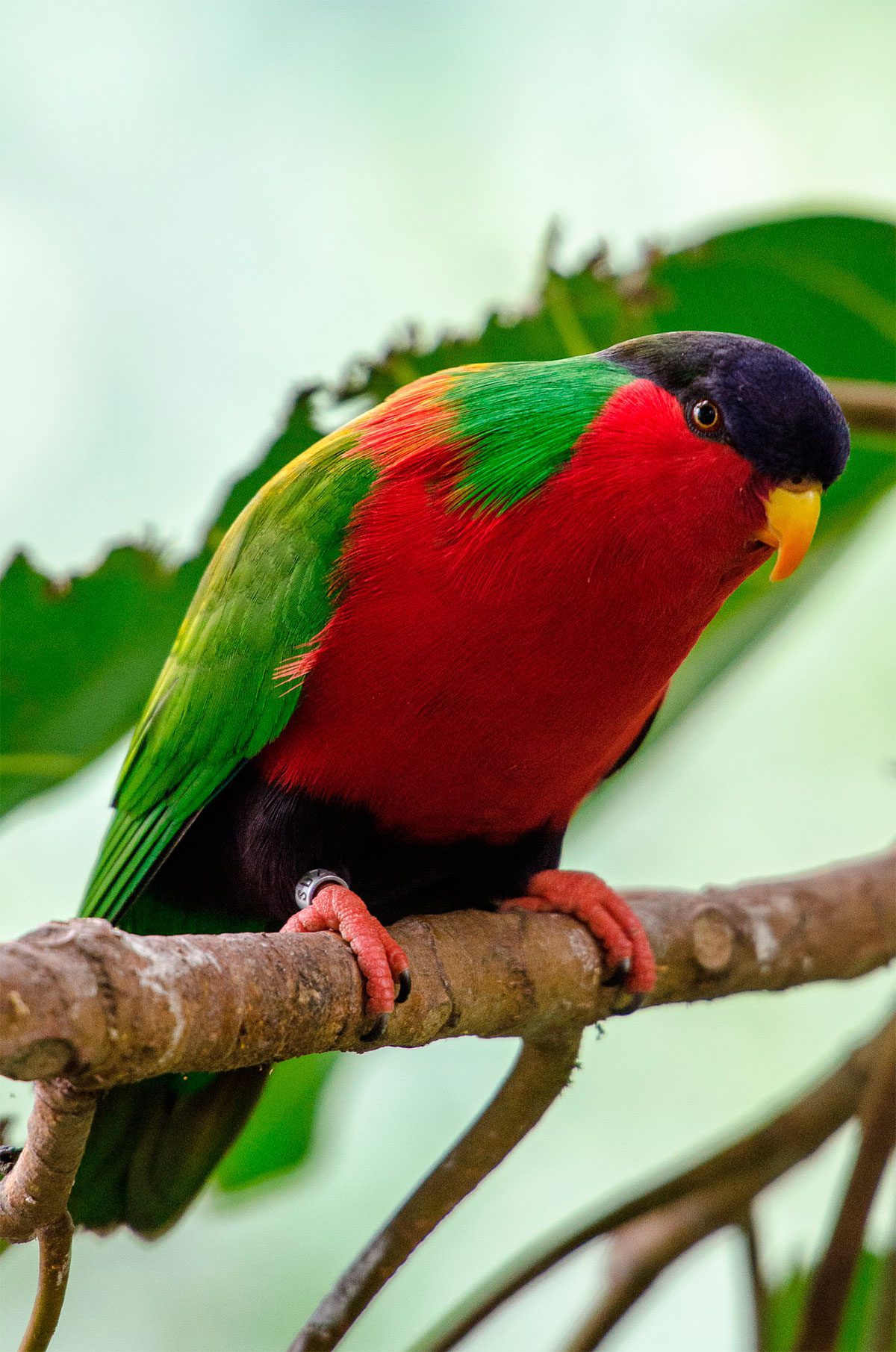
The Collared Lory(Phigys solitarius) has an approximate length of 20 cm.. and a weight ranging between 75 and 85 g..
The upper zone of the crown it is dark purple, In contrast with the ear-coverts, cheeks and throat that have a bright color red Scarlet;
The front of the crown, occasionally, with a mottled red light;
The tail feathers of the neck are of a green living with completion in red and a colorful blanket.
Under the the mantle, rump and top of the tail, bright green.
Upper wing green colour with the inside of the flight feather and coverts, in black color. Underwing coverts Red and green. Underparts Scarlet Red, but with the bottom of the abdomen, lower side of the rump and the thighs, in dark purple.
Orange-yellow spot in Central feathers of the tail. Undertail Matt Brown-Green, showing orange spots on the basis.
Bill orange; Iris from yellow to red; Orange yellow the legs.
The females has more green under the nape, less red in the the mantle, a pronounced green glow in the crown back and a bright purple on the crown front.
The immature show freckles slightly purplish color and some greenish hidden spots in the chest; crown Green rear: they lack the elongated feathers red of the nape up to eight months of age. They lack orange spots in the tail. Bill more Brown than adults; irises brown: legs dark.
Visible and noisy. Found usually in pairs or in small groups of five to fifteen members, Although flocks have also been of up to 50 birds . They are mainly distributed in the lowlands of humid forest, edge of the forest, plantations and second growth up to 1,200 m, but they can be found anywhere with flowering gardens.
It is usually more common in wet windward areas, being less common on agricultural leeward coasts.
The Collared Lory are Mobile and something nomads, they are prepared to travel to almost any habitat with trees in bloom.
Often seen flying over trees or feeding are loud in acrobatic groups.
Reproduction:
The nesting they occur in the second half of the year, especially after August. Two white eggs are placed in a hollow tree. Adults aggressively defend the nesting sites.
In an instance of captive breeding, the incubation lasted 30 days and the young bird left the nest almost nine weeks later.
Food:
The diet of the Collared Lory consists of seeds, nectar and flowers. Trees of your choice include the drala (Erythrina variegata), the coconut tree (Cocoa nuts) and the African tulip introduced and invasive (Spathodea campanulata).
Also eat fruits as the Mango (Mangifera indica).
The species is common and the world population is estimated between 10.000 and 100.000 specimens.
Some are kept in captivity. Red feathers were previously used by the Samoan and Tongan to make edges of floor mats, but trade does not seem to have had an impact on the abundance of the species in Fiji. Some birds are reported, they have escaped in Tonga and Samoa.
Conservation:
– Current IUCN Red List category: Least concern.
– The population trend: Stable.
The world's population has not been quantified, but the species is described as common in Viti Levu, the island of Vanua Levu and Makogai and rare in the Ngau island, Fiji.
The population It is suspected to be stable in the absence of evidence of any reduction or substantial threats.
"Collared Lory" in captivity:
Very rare to see them in captivity.
Alternative names:
– Collared Lory, Solitary Lory, Ruffed Lory, Fiji Lory (ingles).
– Lori des Fidji, Lori phigy (francés).
– Einsiedlerlori (alemán).
– Lóris-solitário (portugués).
– Lori Solitario (español).
Origin: Solomon Islands, Papua New Guinea, Australia, Indonesian
Character: curious and smart
Life expectancy: More than 50 years.
Height: 35 to 42 cm..
Content
Description
35 to 42 cm.. length and a weight between 355 and 615 g..
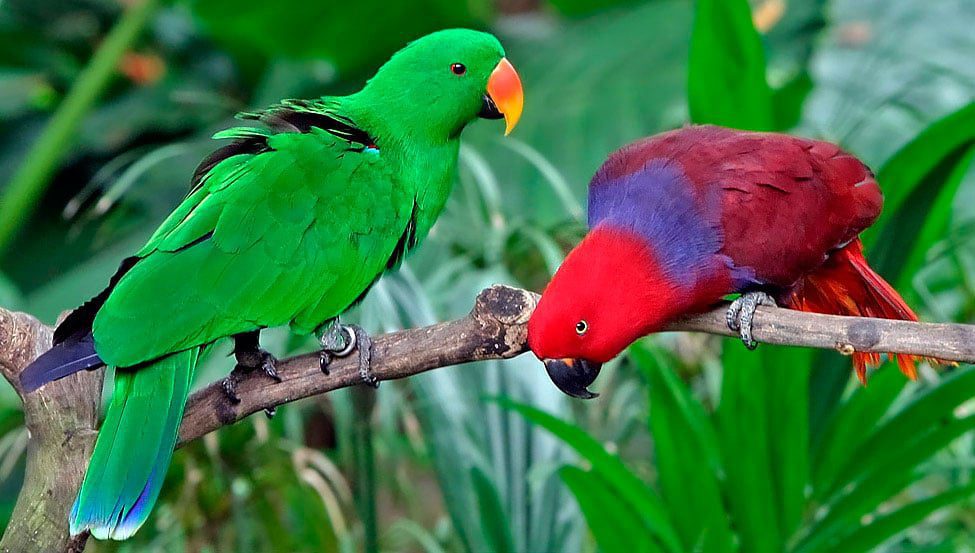
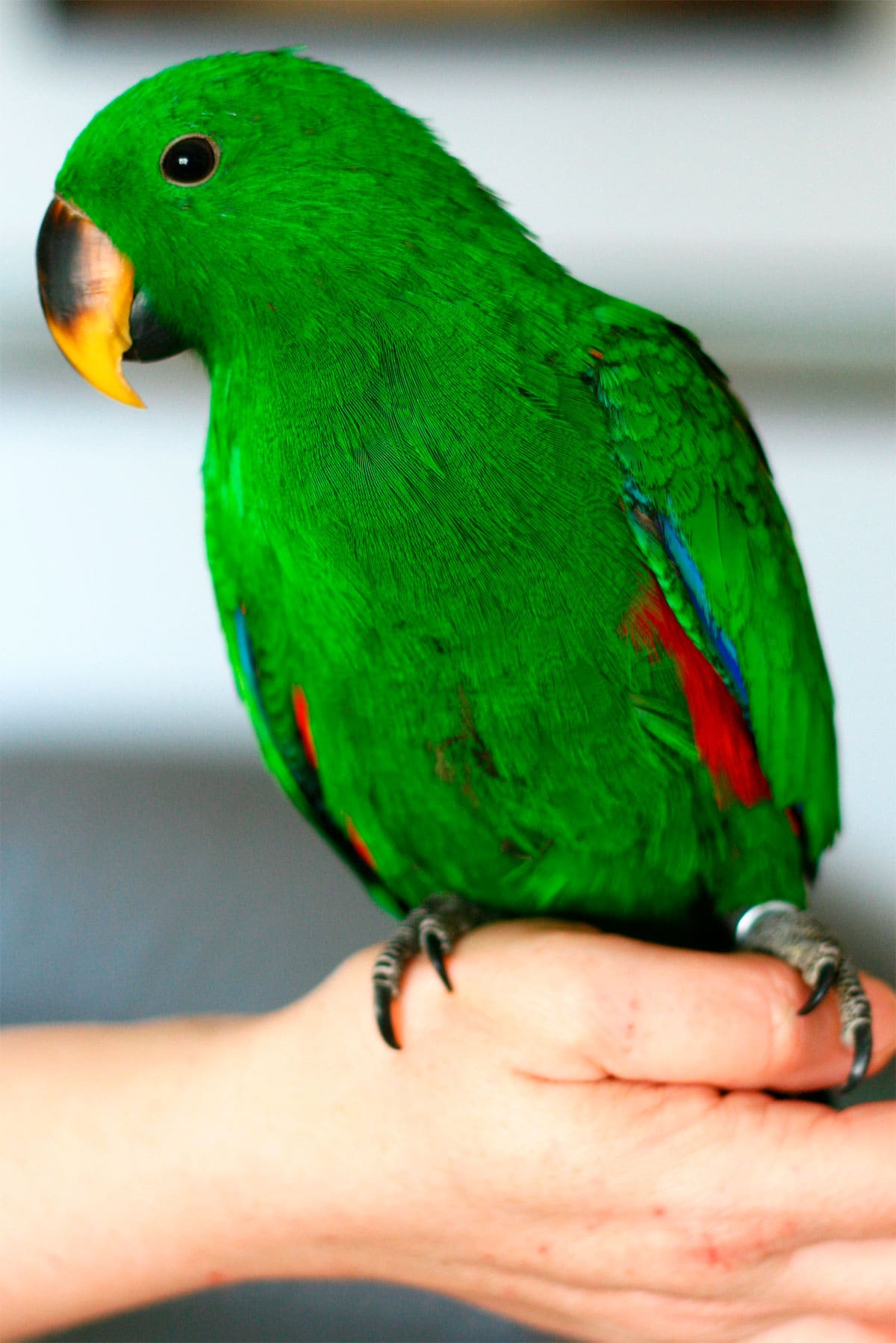
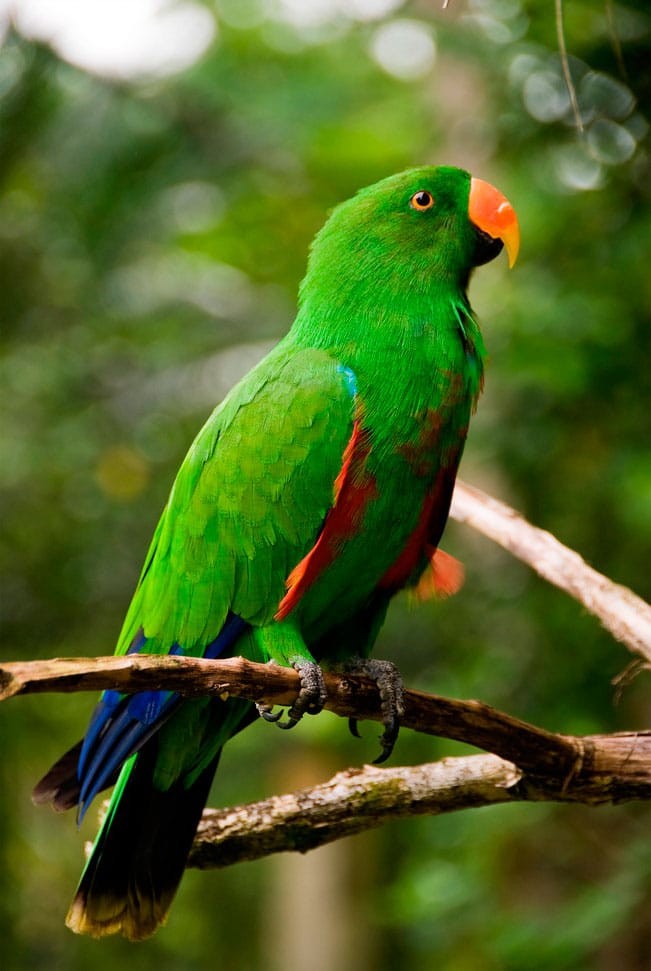
The Eclectus Parrot(Eclectus roratus) It has the head and upper parts of bright green. green wing coverts; curve of the wing and the carpal edge blue; primary coverts dark blue. Feathers of flying with vane very dark blue external, vane internal black on the edge inside. Wing of bright red feathers; bottom of the black flight feathers. Green underparts with flanks and axillary Red. Upper, the Green tail with narrow pale yellow tips, drenched side of blue and yellow-tipped feathers (more external with more blue); undertail, tail black with yellow tips.
Yellow-tipped red Bill, black lower jaw, iris orange, greyish Brown legs.
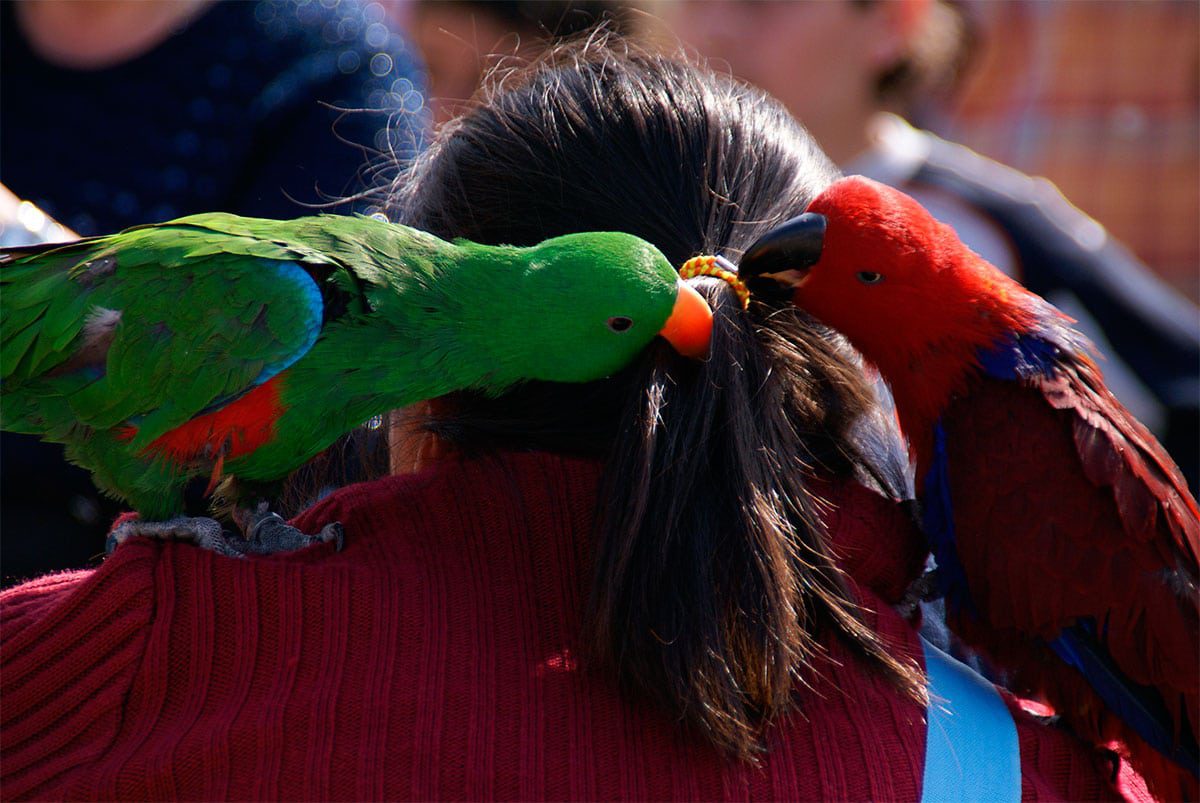
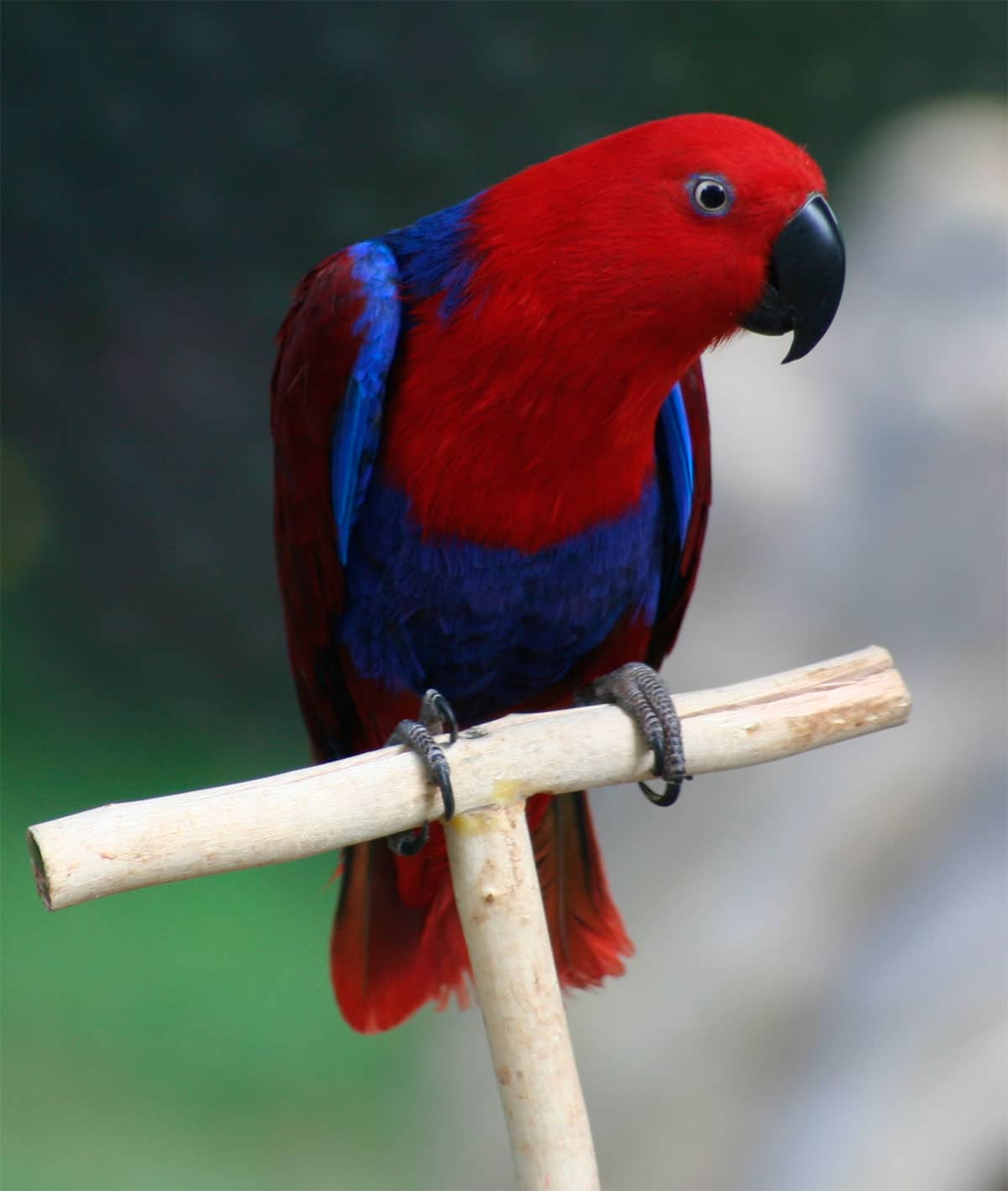
In all the eclectus sexual differences machos-hembras are so large that at the beginning he qualified them as different species. The female of the Eclectus Parrot it is bright red with a purple ruff across the top of the mantle, with bluish black in flight feathers, purple blue wing feathers, purple diffusion over the chest, dull purple-blue on lower chest and belly, coverts yellowish-tipped red infracaudales, and a tail of red with yellow tips (Feather darker bases). The beak is black and the iris is usually yellow (variable).
The young birds they move directly the adult plumage but they have brown peaks.
Sound of the Eclectus Parrot.
Subspecies
List of subspecies Eclectus roratus
Eclectus roratus vosmaeri
(Rothschild, 1922) – Larger than the nominal. Male with bright green plumage, more red on the flanks, broader yellow tail ends. Female with the red light, broader yellow tail and yellow in the coverts infracaudales ends.
Eclectus roratus roratus
(Statius Müller, 1776) –
Eclectus roratus cornelia
(Bonaparte, 1850) – Larger than the nominal. Male with more blue in the queue, the upper parts of lighter green color. Female completely red except for the edges of the Carpus, wing feathers and flight feathers, that are blue. Narrow yellow tip to the tail.
Eclectus roratus westermani
(Bonaparte, 1850) – (Known only from a few copies of populations in captivity; the origin is unknown). Smaller than the nominal. The male It has no visible red flanks when wings are closed and shows foreign banks of green to flight feathers. Female with the darker red color with broad yellow tip to tail. The possibility that the few copies are abnormal individuals of the subspecies E. r. flushed It has not ruled out.
Eclectus roratus riedeli
(A.B. Meyer, 1882) – Smaller than the nominal. Male with wide yellow tips on the tail (25 mm). Female as E. r. Cornelia, but it shows bright yellow on the coverts infracaudales.
Eclectus roratus aruensis
(G.R. Gray, 1858) – Males as the subspecies E. r. biaki, with a little more spacious yellow tips to the tail. Female Red clear, especially tail.
Eclectus roratus biaki
(Hartert, 1932)- As the subspecies E. r. tortoiseshell but smaller. The female just like the female of the E. r. tortoiseshell but more bright red underparts and back of neck (dubiously distinct race).
Eclectus roratus polychloros
(Scopoli, 1786) – Larger than the nominal. Male, Yellow tail more yellowish-green tips. Female with red chest and less violet blue in the bottom region restricted to belly, green in vane external primary. Narrow periophthalmic ring blue. Coverts red infracaudales.
Eclectus roratus solomonensis
(Rothschild & Hartert, 1901) – Smaller that the E. Eclectus tortoiseshell and the male more yellowish green. Female Red clear. Size is reduced clinalmente from West to East
Eclectus roratus macgillivrayi
(Mathews, 1913) – As the E. Eclectus tortoiseshell but larger.
Habitat:
The Eclectus Parrot It is distributed in a wide range of habitats, from second growth forests, Savannah, mangrove, coconut plantations and eucalyptus Woods, until 1.900 m.
The species is most common in lowland forests, around growing areas and coastal habitats.
The birds are alone, in pairs or in small groups, often composed of only males (presumably during playback).
They sometimes soar above the forest and draw attention with their shrill calls while flying over the canopy, or they perch on an exposed branch.
They are cautious, groups of foraging usually remain in the treetops, Although birds feeding on low-altitude or even on the ground have also been observed.
The Eclectus Parrot they are most active at dawn and at dusk, When traveling to and from their roosts in noisy groups of up to 80 birds.
The species is considered an agricultural pest in some parts of New Guinea.
Reproduction:
Breeding can apparently occur at any time of the year in Papua New Guinea, While active nests observed in Australia It was between the months of February and July; There has been during the month November in Buru, During August in Seram, and between June and September in the Solomon Islands.
Up to eight birds have been registered by attending a nest. It is not clear if these are brood helpers., young from a previous litter still attached to the family group, or additional hens females.
In courtship, birds become involved with mutual grooming and Wiggles head.
The nest is a hollow in a tall tree, until 30 metres in height, sometimes exposed; The cavity may have around 6 depth meters.
Putting two eggs are deposited on a bed of wood dust, hatching in about 26 days, and taking ahead 12 weeks to breeding.
The female takes care of the incubation, leaving only the nest twice a day to be fed by the male; Also is fed by the male when the first eggs hatch, but then begins to feed if same.
Food:
The diet includes fruits, seeds, flowers, outbreaks, fruits and nectar: they are especially fond of (Pandanus) banana, corn, figs and Papaya.
The species is also through of the Solomon Islands, including Buka and Bougainville (Papua New Guinea) to the East of San Cristóbal and its satellites.
There is an introduced population of the Eclectus Parrot in Koror and some smaller islands in the archipelago of Palau In the pacific, but likely to be occasional escapes from Hawaii, where apparently cannot have been established. This is one of the parrots most common and most familiar throughout much of their range.
The world's population is estimated over of 300.000 birds. Local entrapments in Ambon, Saparua and Haruku It has apparently made the species becoming extinct in these three islands. The distinctive population in Sumba is in danger.
• Current category of the Red List of the UICN: Least concern
• Population trend: Decreasing
The size of the world's population has not been quantified, It is estimated over the 300,000 specimens. The species is described as common to rare.. The population in Sumba It is estimated in 1.900 individuals, although Sumba It represents a very small proportion of the global range of the species (pit et to the. 1997).
The population is suspected to be declining due to the destruction of habitat in course and unsustainable levels of exploitation.
"Eclectus Parrot" in captivity:
3 the common subspecies in aviculture: Eclectus roratus flushed, Eclectus roratus vosmaeri and Eclectus roratus tortoiseshell; other rare breeds.
Es a curious and intelligent with an acceptable language ability, they learn without difficulty to say words and phrases.
It happens to be fairly quiet and able to live without too much attention. Males can be somewhat distant while in females it must be emphasized the theme that in the case that have nest can not out of it. On the topic food tends to be accepted that the eclectus have a greater need for vitamin A than other parrots.
When considering the purchase of a new Eclectus, it would be wise to obtain a photo and request a consultation with an authority on Eclectus to verify that you are not purchasing a hybrid.
When to acquire housing for our Eclectus Parrot, one should consider your major and arrange them in a cage as large as possible; reasonable steps would be 4,4 m x 1,5 m x 2 m.
We should keep in mind that our parrots should spend at least one hour each day outside the cage during the game.
DIET:
The Eclectus diet consists mainly of vegetables, fruit, legumes and granulated meal. Given that our Eclectus Parrot do not eat many seeds in the nature, and since they are deficient in nutrients, we must consider that their intake should be the exception and not the rule in our house.
The Eclectus they require a diet high in vegetable protein and beta carotene. Their digestive system is longer than most other species., with a greater proventriculus and longer intestines, so fat intake should be limited to avoid fatty tumors. But this does not mean "fat-free.", especially for young people who are very active. It takes some fat to store fat-soluble vitamins A, E and D. It also, with all species, If the cholesterol is too high, the excess accumulates in the liver and, through the bloodstream, travels to the heart where it accumulates; a problem evidenced by fatigue, lack of breed, secondary nutrient deficiency problems (for example, Candida, hypocalcemia, hypoprotenia, etc.), fatty liver, plumage and discoloration-poor quality, bad state of health in general and the inability of the other nutrients to be used correctly.
Too much oil in the diet can cause black feathers on the male and female. They are easily distinguished from the black marks of stress or liver disease because the pattern is different.. Some diets based on pelleted food are high in sugar and can cause kidney problems or hyperactivity. Some are also high in colorants and flavors and can cause toxicity problems. There are some diets which in the market that are organic; But the lack of condoms can cause growth of unwanted yeast and bacteria if left in the cage for more than one hour.
Reproduction Eclectus Parrot:
The reproduction of the Eclectus Parrot It is not difficult as long as we have a compatible partner, Since a female in heat can be aggressive with the male and pursue him while he nears the trough.
Nesting box can have very different ways. The measures are 30 x 30 x 80 cm and inlet of 10 cm.. Diameter. The Z-shaped nest is highly recommended for breeding the Eclectus Parrot Since it allows the male to stay on the top platform in the event that the female is shown aggressive to protect the nest. Inside the box you can put some kind of material, as pine bark.
The incubation period is 28 to 30 days and can breed throughout the year. A sunset happens to another and is not interrupted even during the time of molt. However often the eggs are not fertile or parents do not feed the chicks. It is best to allow them only two released per year, so the nest will have to be removed or the male will have to be separated for a few days. The only drawback, If we choose to separate the male, It is called the female strident so your partner.
The implementation is usually two eggs, and occasionally three.
Alternative names:
– Eclectus Parrot, Kalanga, King Parrot, Red-sided Eclectus Parrot, Red-sided Parrot (ingles).
– Grand Éclectus, Éclectus, Grand Eclectus (French).
– Edelpapagei, Salomonen Edelpapagei (German).
– Papagaio-eclectus (Portuguese).
– Loro Ecléctico, Loro Eclectus (español).
– Avibase
– Parrots of the World – Forshaw Joseph M
– Parrots A Guide to the Parrots of the World – Tony Juniper & Mike Parr
– Birdlife
– mundoexotics
– Birds N Ways
Of 40 cm., length and a weight between 116 and 140 g..
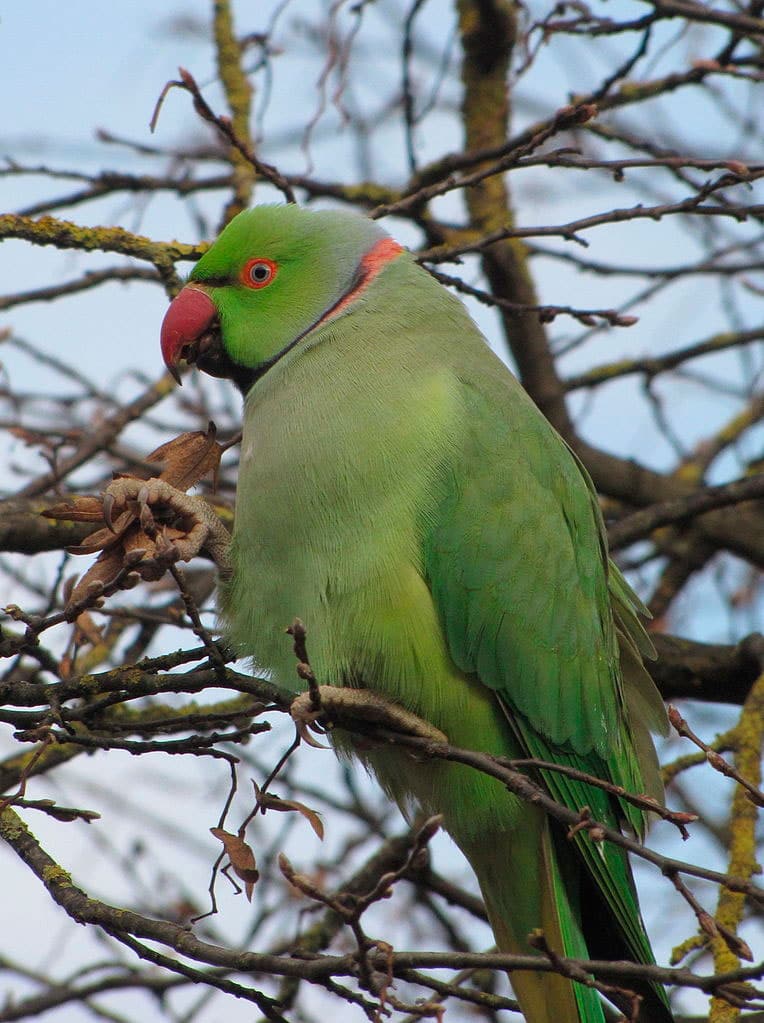
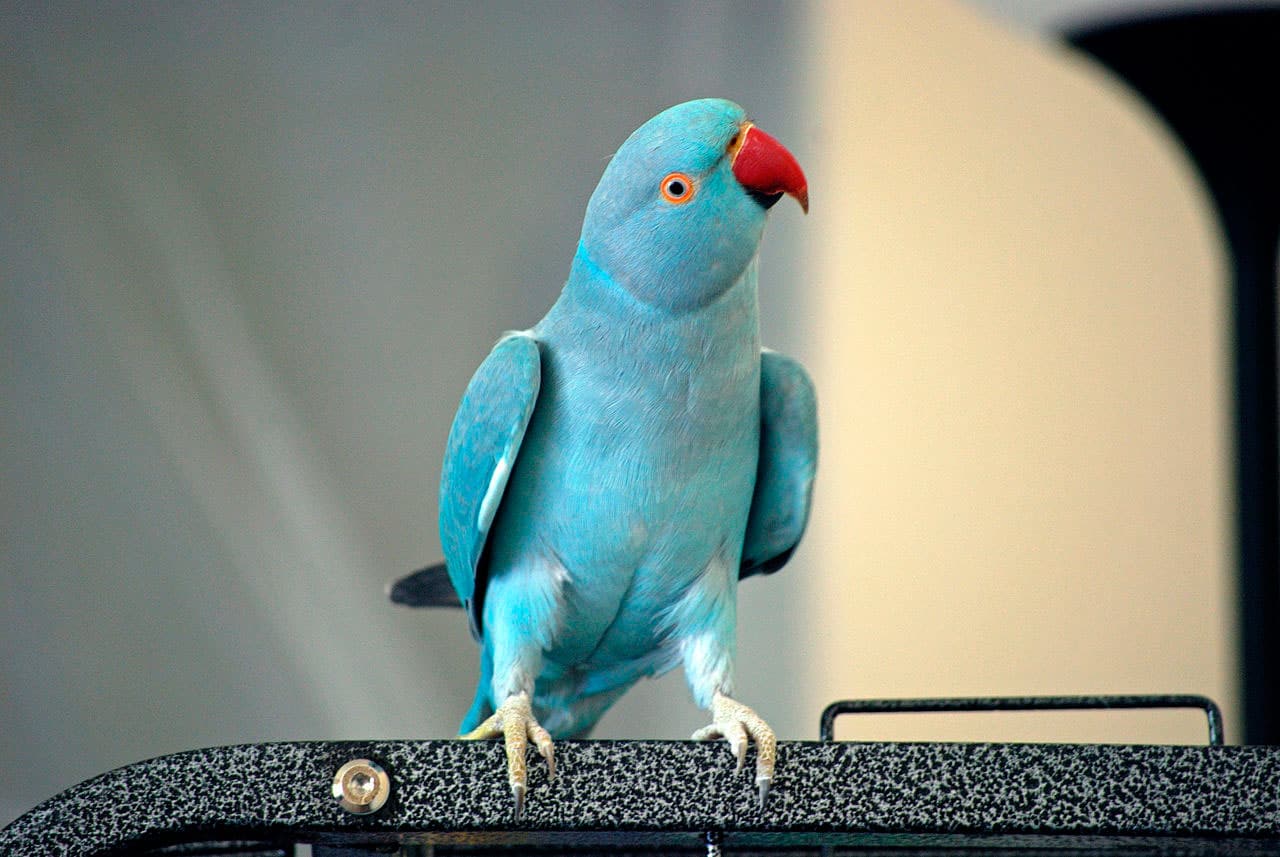
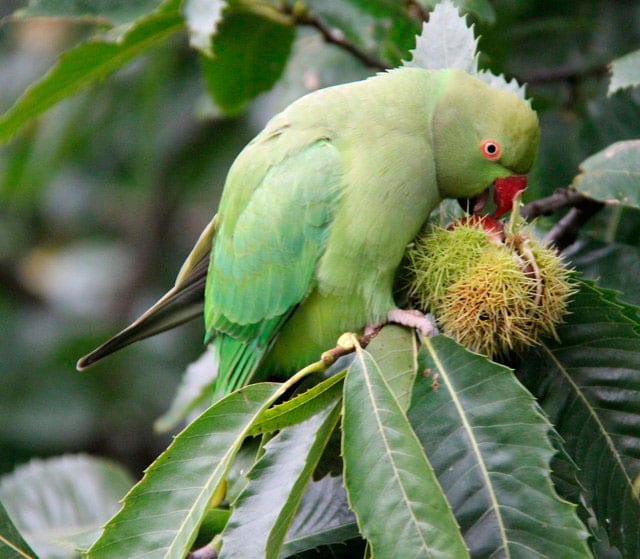
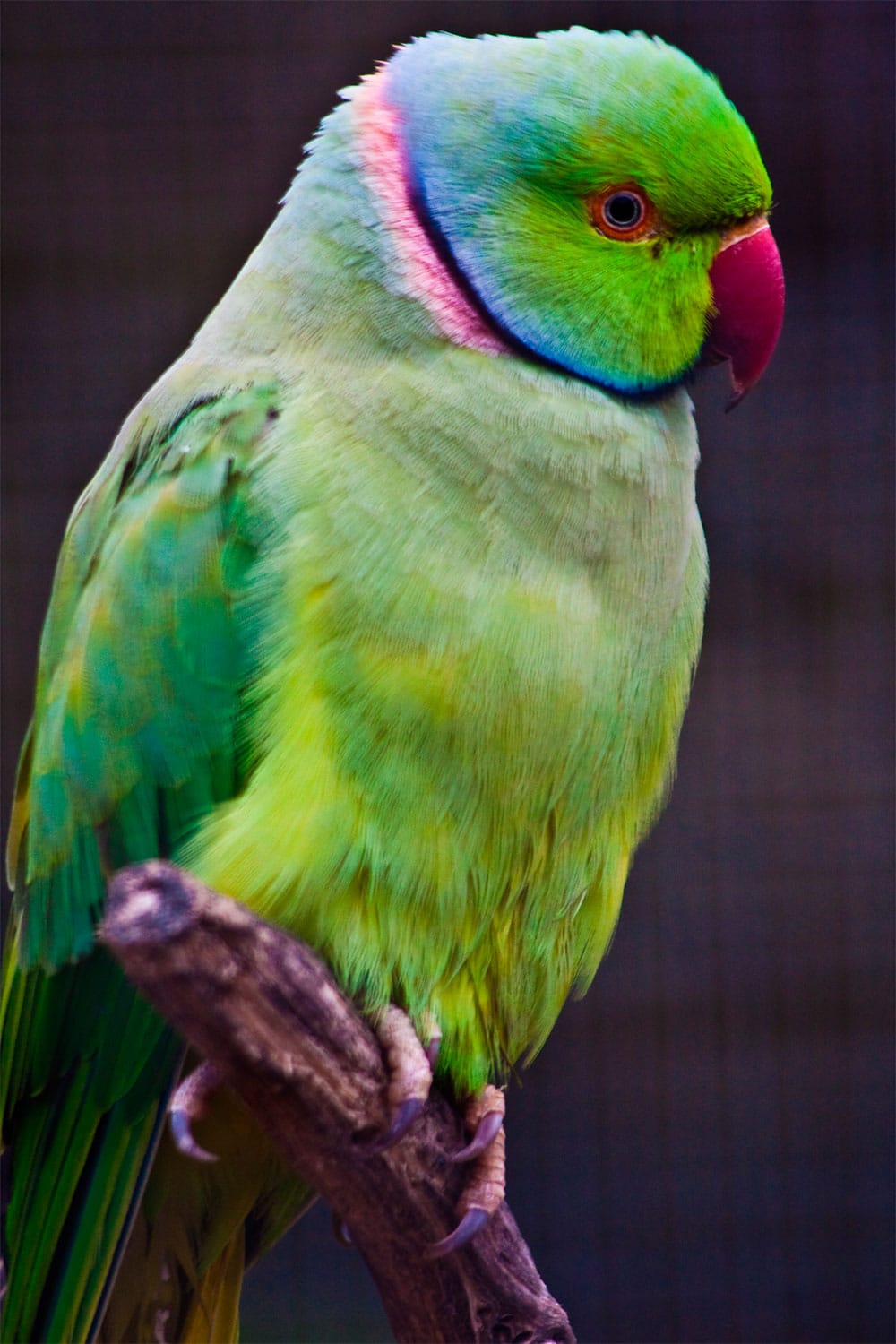
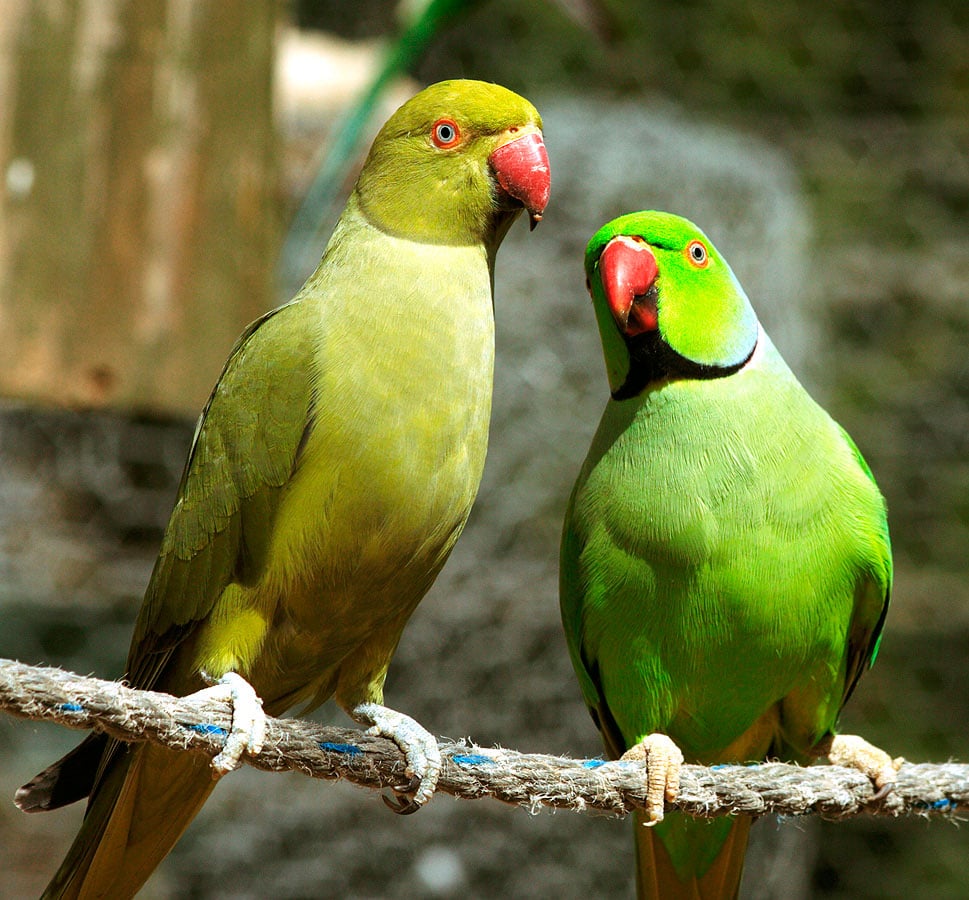
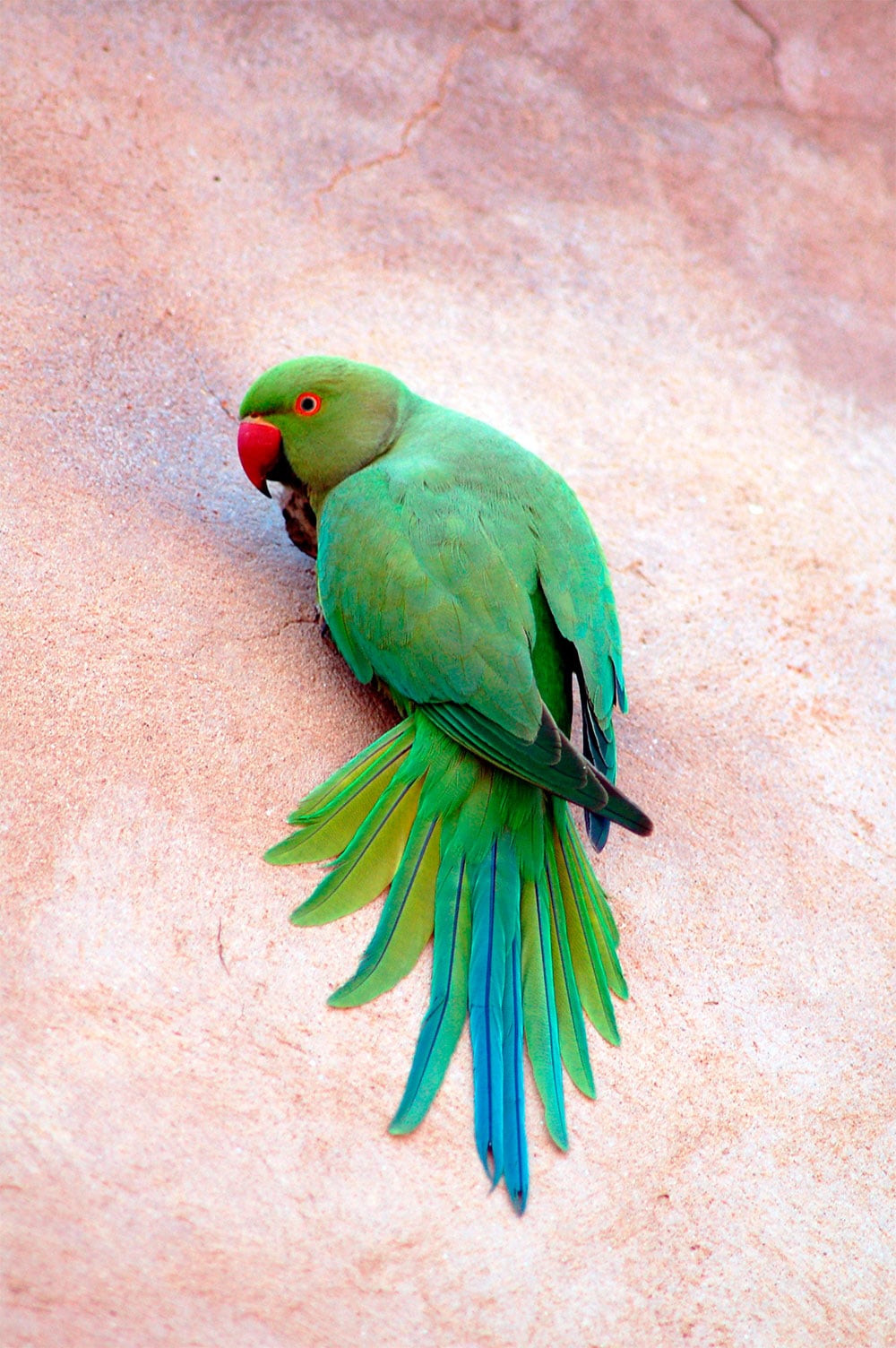
The Rose-ringed Parakeet(Psittacula krameri) has the forecrown, fore crown, the cheeks and lores bright yellowish green; narrow dark line between cere and the eye ring; the back of the crown, the nape and the sides of the neck, pale lavender gray, broken on the sides of neck with narrow black stripes; contiguous black markings with wide black stripes on the bottom of the cheeks merging the chin a solid black.
Pink collar in the back of the neck, the mantle and back light green tinged with olive; rump and uppertail-coverts slightly brighter. Lesser and medium upperwing-coverts light green (darker than the body); large coverts dark green; primaries and secondaries dark green with darker (almost black) margin to the vane inner. bottom of the feathers flight gray; underwing-coverts brighter yellowish green. Underparts brighter yellowish green. Upper, the tail centrally blue with yellowish tips, green side; undertail, the tail centralmente negruzca, yellow-olive laterally.
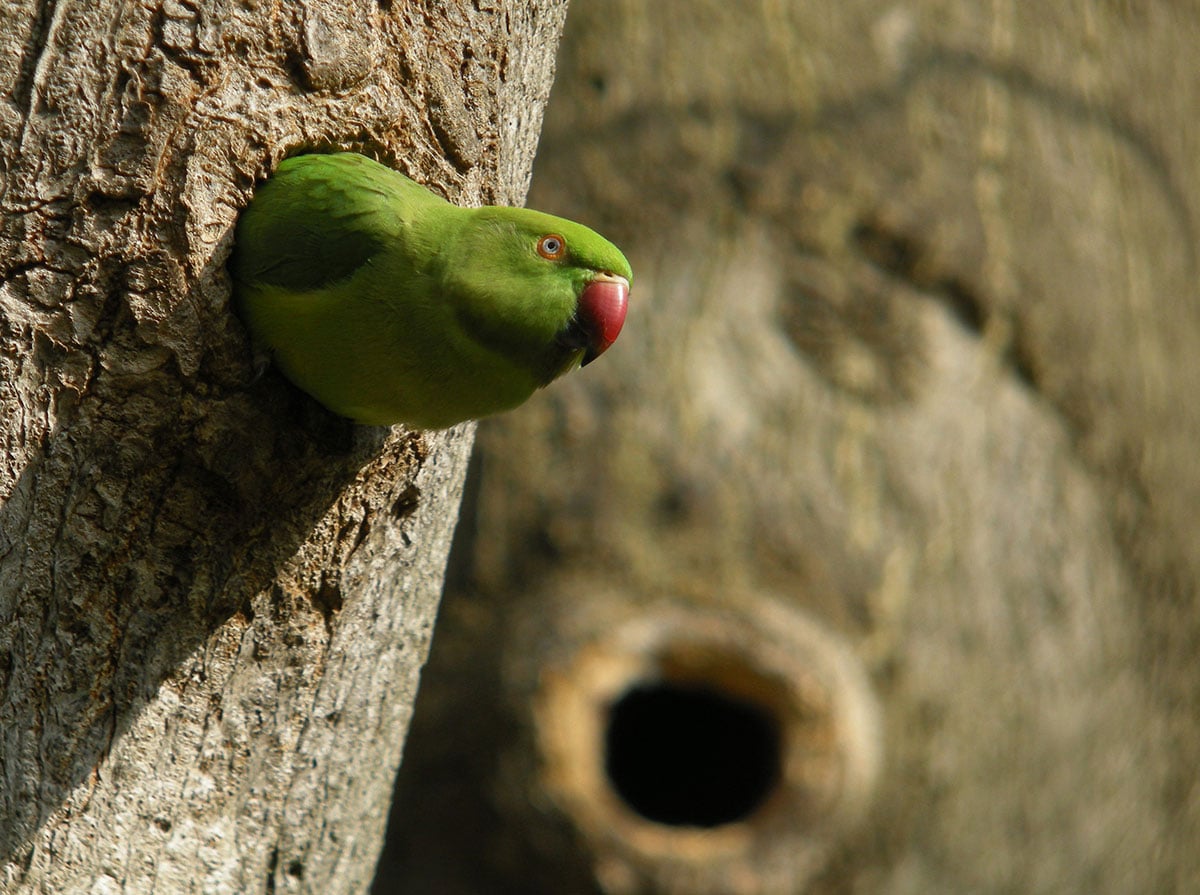
Crimson in the upper jaw tipped in black, the lower jaw of color stream blackish; cere whitish: irises yellowish white; legs pink, with 4 fingers ending in nails strong in black, two of these fingers are directed forward and two backward so called zigodactilia, which it allows them to easily climb.
The female lacks the neck black, brands in the chin and the cheekbone, of the collar pink and blue suffusion of neck; It has shorter central feathers tail.
The They are similar to immature females but with the bill a little paler, irises greyish; the males acquire the characteristic Pink collar in the third year.
Psittacula krameri borealis (Neumann, 1915) – Larger than the species nominal, with upper jaw all red and black marks on the lower jaw. Bluish suffusion in neck, behind ear-coverts; more than grayish bottoms species nominal.
Psittacula krameri krameri (Scopoli, 1769) – The species nominal
Psittacula krameri manillensis (Bechstein, 1800) – Larger than other subspecies, slightly paler and more yellow than the subspecies borealis. Different facial markings that species nominal. Under the mandible black.
Psittacula krameri parvirostris (Souance, 1856) – Of head and cheeks yellowish least the species nominal. Bill small upper jaw brighter red, less blackish towards the tip. The birds living in eastern Sudan They are intermediate between subspecies appearance parvirostris and species nominal.
Habitat:
The Rose-ringed Parakeet It is a very adaptable bird. It is located in a variety of forest types Forest, from secondary forests, wet, riparian forests, mangroves, open farmland with scattered trees, to parks and gardens in urban areas.
They can live at altitudes 1.600 metres in Asia and 2.000 metres in Africa.
gregarious, especially out of breeding season, coming to form large noisy flocks sometimes several thousand birds. Communal roosts, often with Crows, Mynas or other parrots.
Reproduction:
The Rose-ringed Parakeet It is not a territorial bird and, sometimes vaguely colonial while breeding.
It nests in natural tree cavities or holes extended, in cracks in rocks or walls built; in Africa, always nest atop a tree.
The breeding season, mainly, It covers the months from January to April, although offspring have been recorded in the month of July.
typical setting 3 to 4 eggs, although they have been registered you put six eggs.
23 days of incubation and 45 days of stay in the nest of the hatchlings.
Food:
Diet Rose-ringed Parakeet It includes a variety of cereals, herbs, seeds, vegetables, fruits, flowers and nectar, wild and cultivated; feeding varies seasonally,for example, in the Indian state of Punyab, They feed on weed seeds from April to June and sorghum between the months of August and January.
Inflingen crop damage, especially citrus, sunflower and corn.
Size of the area of distribution (reproduction / resident): 27800000 km2
The Rose-ringed Parakeet they are the parrots more widely distributed around the Old world. They are native to tropical africa, north of the humid forest zone, and much of Asia meridional.
In West Africa (Mauritania, Senegal, Gambia, Guinea-Bissau), the east, through Mali, South of Niger, North of Ivory Coast, North of Ghana, Burkina Faso, Togo and Benin to the North of Nigeria and Cameroon, South of Chad, North of the Central African Republic, from southern Sudan to the North of Uganda and Ethiopia, Djibouti and Northwest of Somalia.
In Asia, from the West of Pakistan, South of Nepal through the India, Bangladesh and Sri Lanka to downtown Burma.
Many introduced populations are distributed by EE.UU., England, Germany, Netherlands, North of Egypt, Kenya, coastal area Ivory Coast (possibly wild relict), South Africa (Natal and Zululandia), Mauritius, Arabian Peninsula, Singapore, Macao and China, in the surroundings of Hong Kong.
Mainly sedentary, but apparently with some seasonal movements in most parts of the African range (for example, temporary visitors during the rainy season in southern areas Mauritania).
Common to abundant in Africa and part of Asia; quite common in Burma.
Residents and especially sedentary. Widely bred in captivity.
Subspecies distribution
Subspecies
Psittacula krameri borealis (Neumann, 1915) – distributed by Pakistan, through North India, around of 20 ° norte, Nepal and Bangladesh until Burma. He also believed to belong to this subspecies distributed parts of birds Middle East, Mauritius, Macao and parts of Southeast China.
Psittacula krameri krameri (Scopoli, 1769) – The species nominal
Psittacula krameri manillensis (Bechstein, 1800) – Distributed by South India, about 20 ° north and Sri Lanka. Observed in wild populations England, elsewhere Europe, EE.UU. and Singapore, They seem to belong to this subspecies.
Psittacula krameri parvirostris (Souance, 1856) – Distributed by this Sudan through North Ethiopia until Djibouti and North of Somalia
The size of the world's population has not been quantified, but the species, according to sources, It common to abundant throughout their natural range (pit et to the. 1997), while the population Japan it has been estimated between 100 and 10,000 introduced breeding pairs ( Brazil 2009).
Its population It increased in the twentieth century, in relation to the expansion of agriculture.
Nest protection and brood handling has helped the Rose-ringed Parakeet recover.
Invasiveness in Spain
Because of its colonizing potential and constitute a serious threat to native species, habitats or ecosystems, This species has been cataloged in the Spanish Catalog of Invasive Exotic Species, approved by Royal Decree 1628/2011, of 14 November, It is banned in Spain its introduction into the wild, possession, transport, trade and commerce.
"Rose-ringed Parakeet" in captivity:
The Rose-ringed Parakeet is a bird with character that raised since childhood can become a docile pet, although its tendency is to be a fearful and aggressive bird. Form unstable pairs, something that affects their behavior. It is unlikely that this species has an affectionate behavior with their caregiver, with few exceptions.
To enjoy it Patience is needed and above all to have knowledge about this species, not to be disappointed if things are not progressing as expected.
The Rose-ringed Parakeet It is a bird that must be handled daily and this, throughout his life, with the aim of being able to achieve an “optimal” dressage. In fact, Naturally that tends to become suspicious if the time is not paid regularly. We have to "fight" against this tendency to touch it, manipularla, caress, etc … He does not like human contact, other interaction need not destroy your confidence.
It is a bird that is in great need of occupation. She is active and loves to be stimulated. Learns tricks easily and is always ready to learn, which makes it a bird very interactive with his master, despite being reluctant to hugs.
The Rose-ringed Parakeet she is also a bird that will tend to trust only the person who takes care of her every day.
If we do not put enough games available in your area, it can be very destructive, He likes to chew and grind objects with their powerful beak, which would cause us a serious problem … it is also important to periodically renew the games to avoid boredom.
They have a powerful screech and are quite noisy.
Still not much of a conversationalist, You can learn to say a few words.
It could eventually transmit diseases such as psitacosis.
With regard to its longevity, according to sources, a Rose-ringed Parakeet lived during 34 years in captivity. In captivity, these birds are known to breed, approximately, to the 2 years of age.
Alternative names:
– Rose-ringed Parakeet, Green Long-tailed Parakeet, Long-tailed Parakeet, Ring-necked Parakeet, Rose Ringed Parakeet, Roseringed Parakeet, Senegal Long-tailed Parakeet (English).
– Perruche à collier, Perruche de Kramer, Perruche verte à collier (French).
– Halsbandsittich, Kleiner Alexandersittich (German).
– Periquito-de-colar, Periquito-rabijunco (Portuguese).
– Cotorra de Kramer, Cotorra Verde de Collar, Periquito de Collar, Periquito de Kramer, Alejandrino común, Cotorra de Collar, Cotorra de Collar Verde, Cotorra de la India, Periquito de Collar (español).
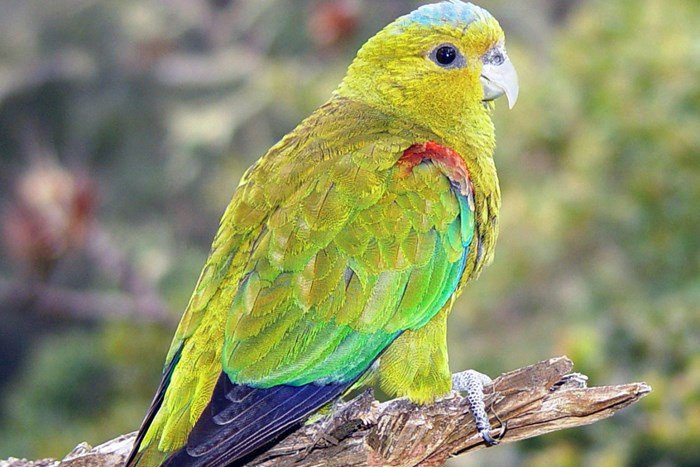
In 2002 It was the rediscovery of the the Indigo-winged Parrot(Hapalopsittaca fuertesi), an enigmatic parrot that had been lost to the world for more than 90 years and continues being one of the birds more rare of the Earth. It has a plumage mainly yellowish-green and is highlighted by the blue of the crown and olive yellow tone of the forecrown (except a strip), cheeks and sides of the eyes, narrow strip in the forecrown, under abdomen and shoulders red. End of the wing
blue violet dark, tail Blue with red base.
The bill Horn colored with blue color, Grey at the base of the upper jaw. Iris Green-yellow.
The immature It has less yellow streaks and more off face.
Is a kind of range restricted, very rare and difficult to observe. It inhabits high Andean forests and frequent cloud subparamos, between 2600 and 3800 m on the level of the sea, being the majority of the records between 2.900 and 3.150 m. With guavas, encenillo and laurels where he eats fruits of thematapalo”, and with Oak (Quercus humboldtii).
Observed in fairly open forests, and possibly disturbed, with small Palm trees and tree ferns.
Fly in flocks of 6 to 25 individuals.
Reproduction:
It believes that the nests they make them in cavities of tall, mature trees.
The nesting period takes place from January to may. The average size clutch is three eggs. The incubation is performed only by the female, Although the attention back to the hatching is biparental (Díaz 2006).
Food:
The ecology of breeding and feeding of the Indigo-winged Parrot is practically unknown, but it has been observed the birds feeding of berries, and is likely to show a preference for the berries of mistletoe.
Distribution:
Size distribution (reproduction / resident): 100 km2
Restricted to a small strip on the western slope of the Andes Central of Colombia, near the border of the Quindio, Risaralda and Tolima.
Conservation:
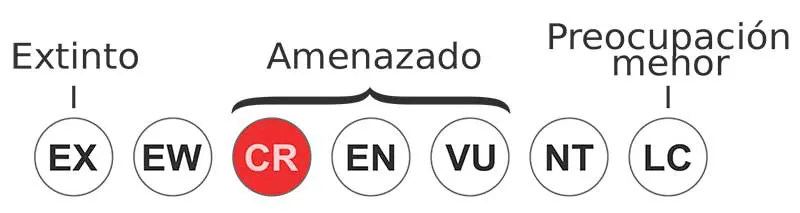
• Current category of the Red List of the UICN: critically endangered.
• Population trend: Decreasing.
According to the categories of UICN is considered in Critical Hazard (CR), due to the accelerated process of deforestation in the Andean forests.
Since ago 90 years it was thought that the bird was extinct until it was rediscovered in 2002, When a few biologists of the ProAves Foundation in the montane forest of the municipality of Genoa, department of Quindío, where the group more large observed consisted of 25 birds and the total population was of approximately 60 individuals.
Currently there are some 300 mature free individuals.
Thanks to the efforts made by different project is have retrieved data of them fluctuations in the abundances of them individuals during the year associated to its reproduction. Is very likely that the offer of the artificial nests This already having a positive impact that the length of the project It has observed an increase in the size population.
– Avibase
– Parrots of the World – Forshaw Joseph M
– Parrots A Guide to the Parrots of the World – Tony Juniper & Mike Parr
– Birdlife
– proaves.org
– Parrot Book, Parrots and macaws Neotropical