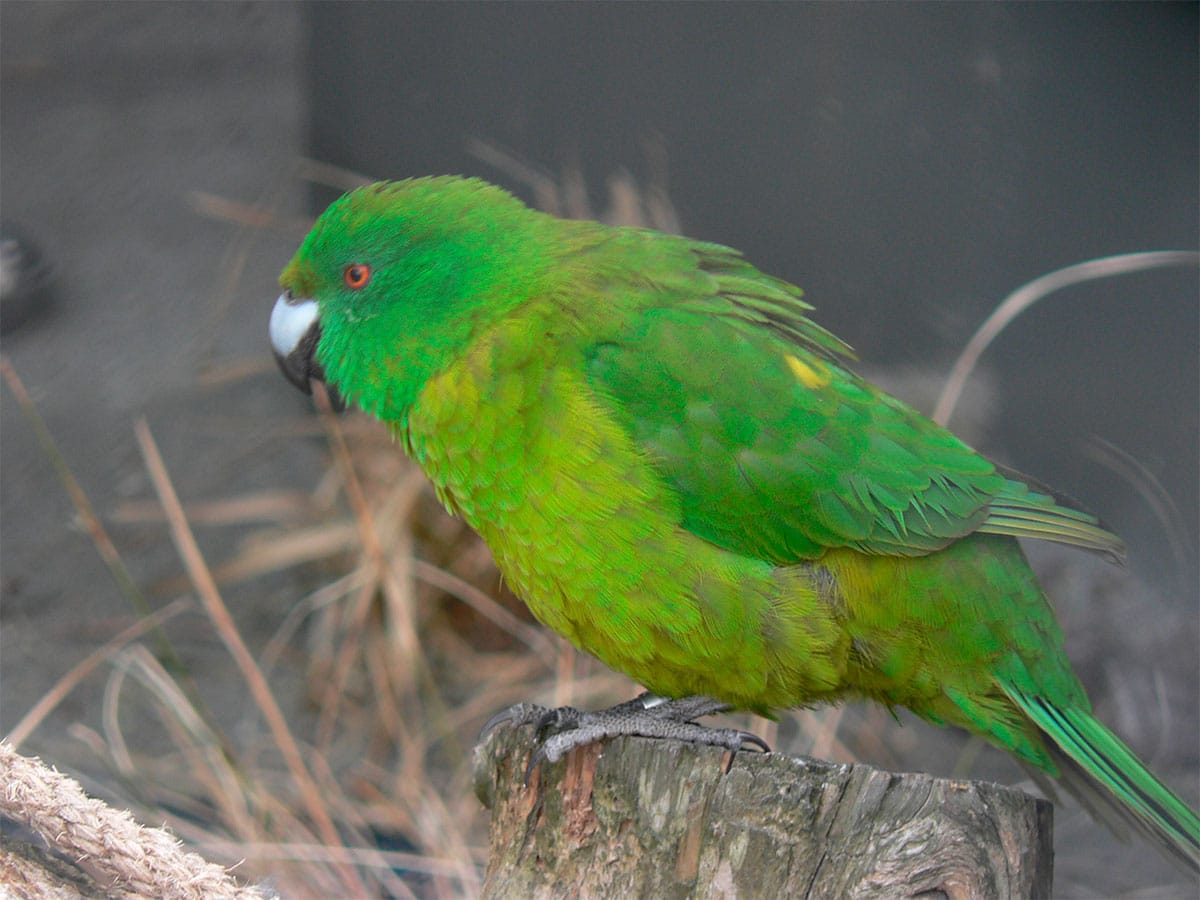
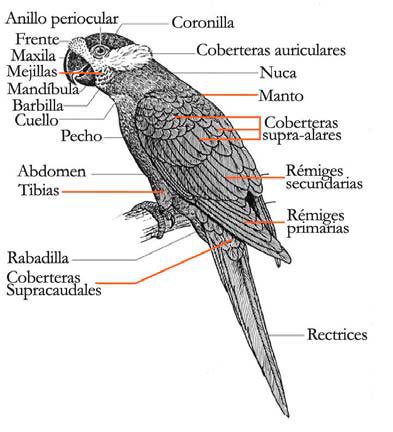
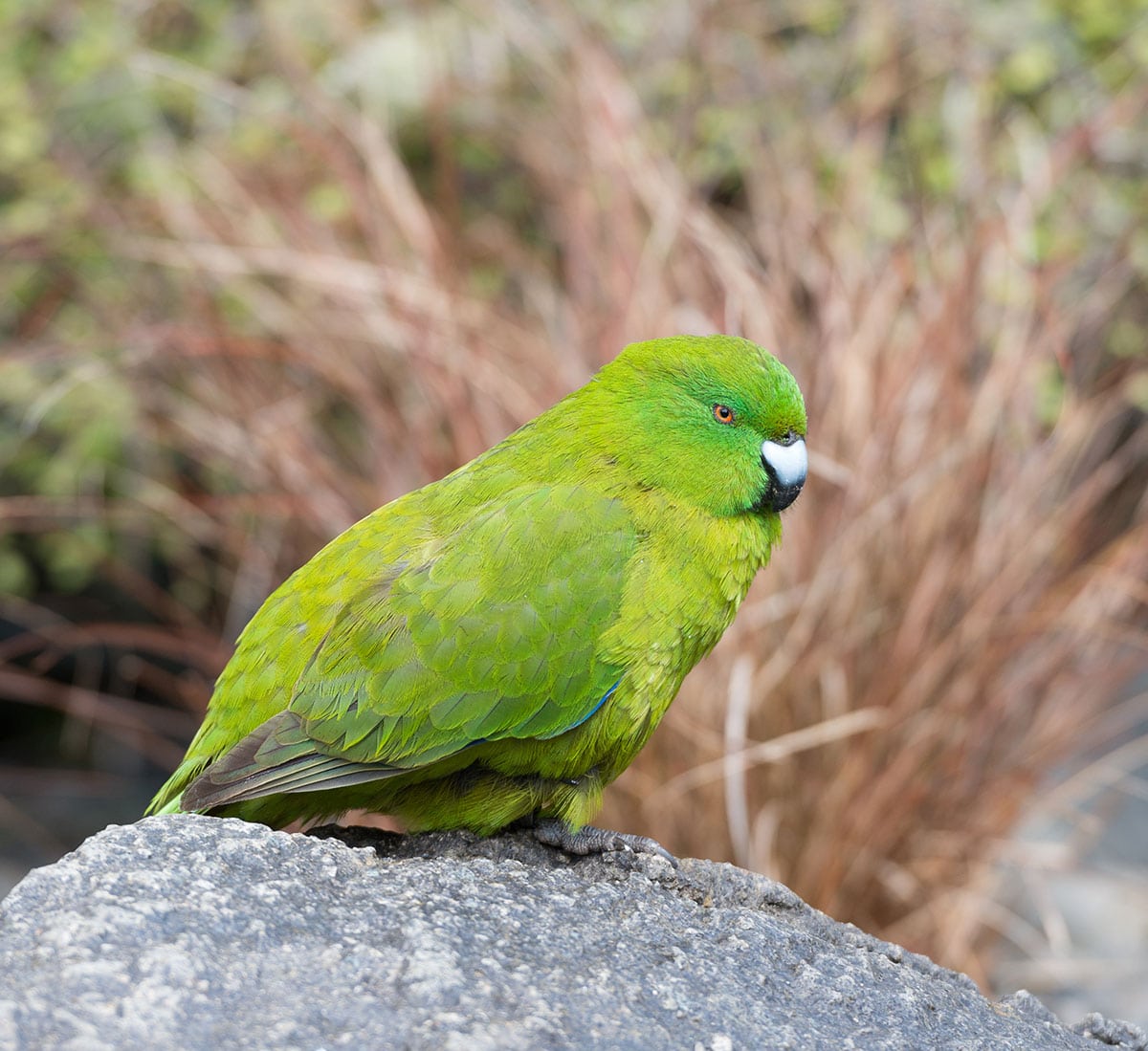
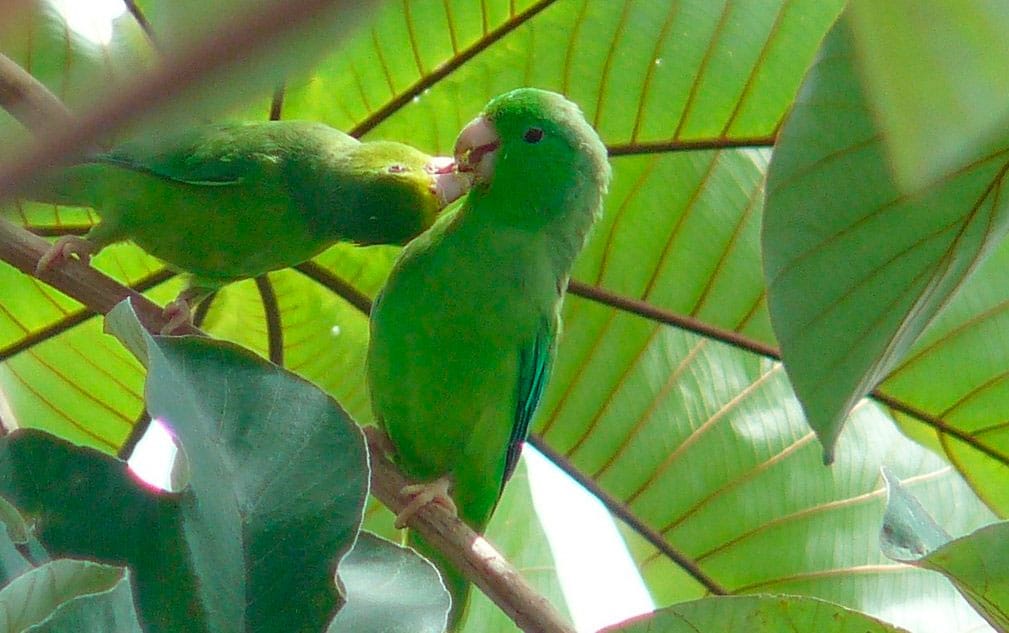
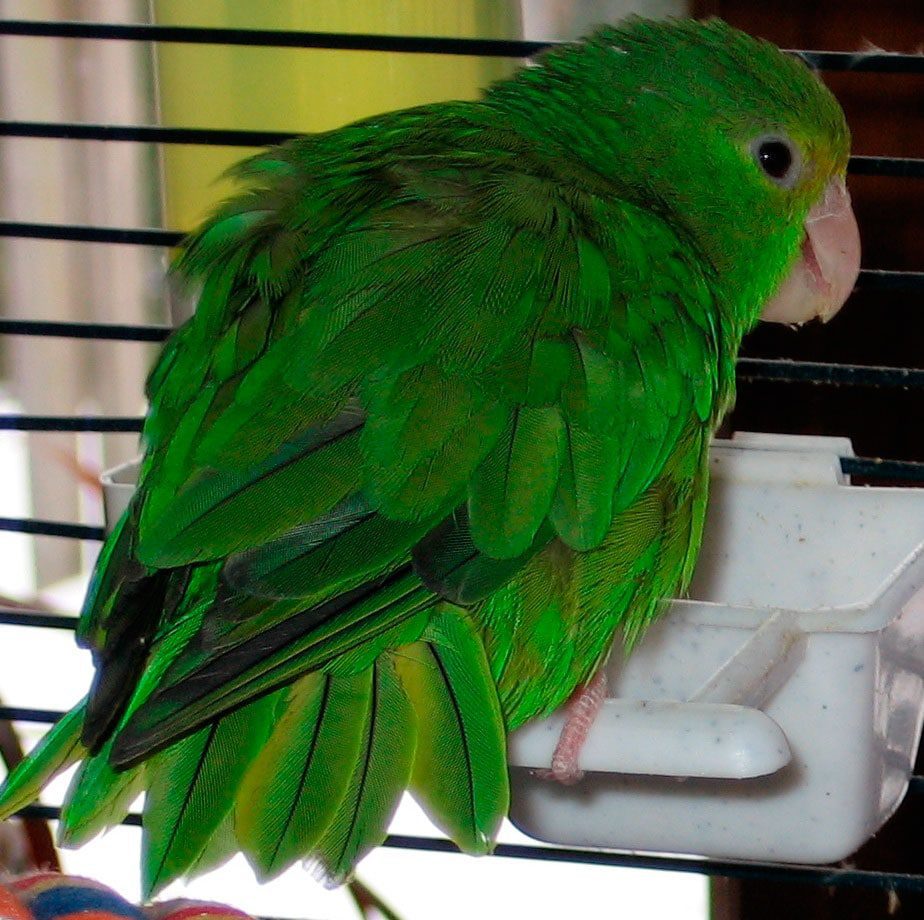
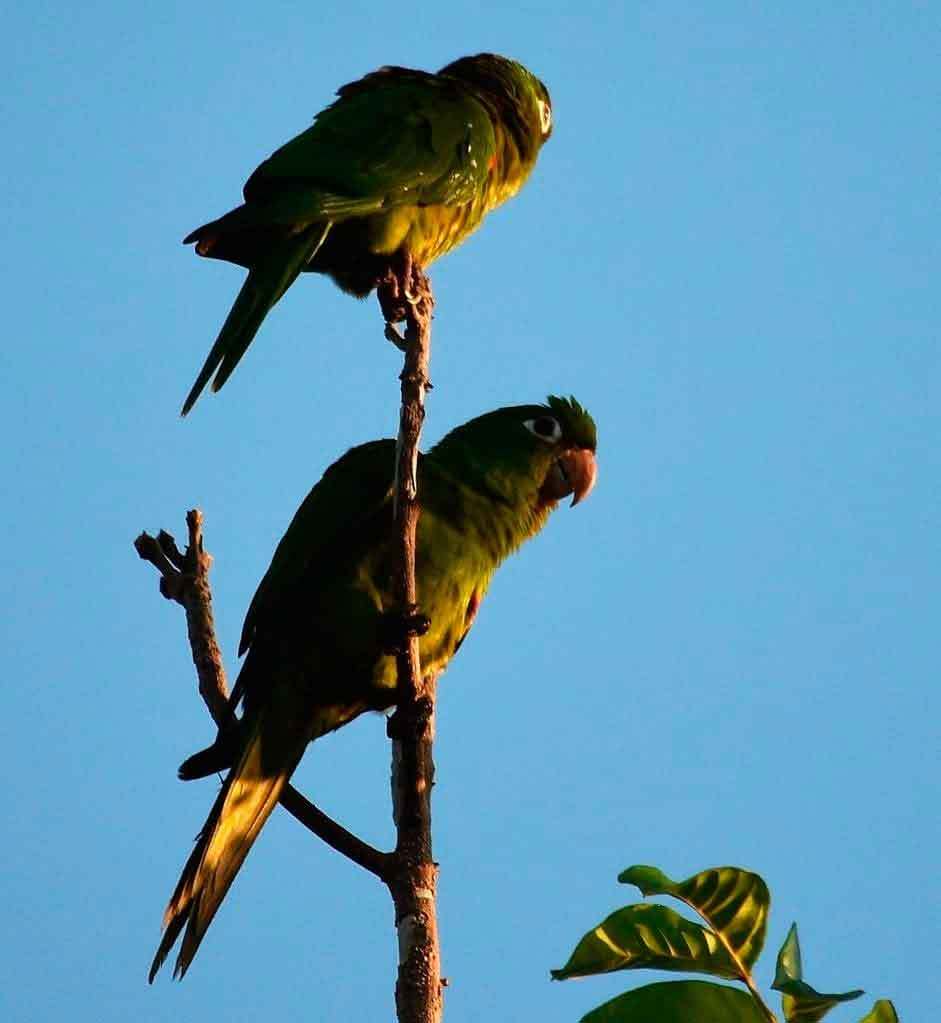
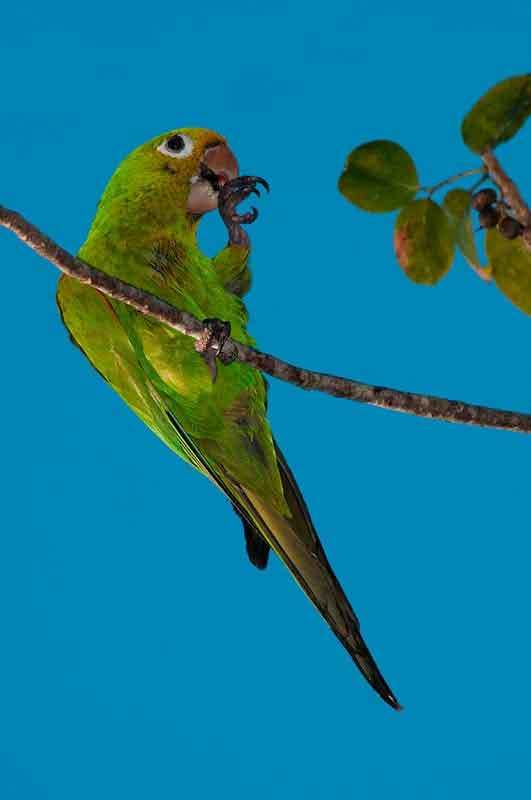
The Antipodes parakeet(Cyanoramphus unicolor) has a plumage brighter yellowish green, more yellowish on the hand down and sometimes with irregular yellow markings at the top. It is the only species that does not have color markings on head and tail. It is the largest of its kind.
The face and top are bright emerald green, and the contrast with the neck and the chest is more off.
At the top of the wings, the outer bands of the flight feather are blue, While the long tail It is green with fine yellow piping.
The great bill is silver-grey with dark end. The eyes are orange-red. The legs and feet are greyish.
Both sexes are identical. The female is slightly smaller than the male.
The young birds they are of tail shorter. The young people have the bill Pink White and the eyes light brown.
Habitat:
The Antipodes parakeet, usually, they prefer areas with tall grass (POA littorosa), areas of open scrub and sedges (Carex). Can also be seen in areas where thorny ferns grow (Polystichum vestitum) and the bushes (Coprosma antipode).
The birds are most common on steeper slopes and near water courses, alone or in small groups; They walk on the floor and climb among the branches as they seek food, normally during the morning and before nightfall.
These birds are very Meek and curious. When frightened, they disappear among the dense vegetation, keeping silent or giving a short alarm call. More than half of the day is spent sunbathing and grooming in protected areas. They bathe in small ponds and rest in burrows.
Reproduction:
The season of reproduction takes place between October and March. The Antipodes parakeetnest in soils with good drainage, a length of at least one meter. The nests is carved in fibrous peat, under the thick base of the tall grass vegetation. The nesting Chamber It is full of rootlets or fern scales.
The spawning occurs between November and January. The female lays 2-3 white eggs (5-6 in captivity). She carries out most of the duties of nesting, and incubates the eggs for a few 26 days. She cares for and feeds the chicks for nearly two weeks. The male contributes to breeding, feeding the female during this period, as well as feeding the young until their independence, at least two weeks after leaving the nest.
Food:
The diet main consists of leaves; an amount of crushed leaves, still attached to the plant, they are a distinctive sign of the power of the Antipodes parakeet. Also consume seeds, berries, the remains of penguins and petrels dead. They often enter into colonies of the Rockhopper Penguin (Eudyptes chrysocome) and of the Sclater's Penguin (Eudyptes sclateri) between the months of October and may, to feed on their eggs or dead young. It also feeds on the eggs and sometimes on the newborns of the same species.. (The sympatrico Red-crowned parakeet prevents competition by taking advantage of the niche that provide seeds, flowers, berries and small invertebrates.)
Distribution:
Endemic to the main island Antipodes, In addition to Bollons, Leeward, Inner Windward and Islands Archway.
The world's population of the Antipodes parakeet It is estimated between 2.000 and 3,000 specimens. Although common and stable within its range, the species is permanently at risk due to accidental introduction of predators, problem that could be fixed in no time.
Some birds are kept in captivity in New Zealand.
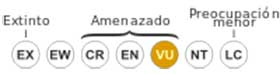
VULNERABLE.
"Antipodes parakeet" in captivity:
This stocky parakeet can live in community with species with similar characteristics.. It is usually outgoing, Active and depending on their way of breeding (natural or hand) and earlier experiences, It may be a trusted Parrot (hand raised or treated early), even being raised by their parents tends to be entrusted.
As a pet it could be good pet by his way of being cheerful and curious.
It is a rather nice parrot as vocalizations. It is not just loud. He likes to climb, There is no great need to crack and loves to be on the floor. enjoy the baths.
However, due to their vulnerability, is very rare poultry.
Alternative names:
– Antipodes Parakeet, Antipodes Green Parakeet, Antipodes Green Parrot, Antipodes Island Parakeet, Antipodes Island Parrot (English).
– Perruche des Antipodes, Kakariki des Antipodes, Perruche d’Antipodes (French).
– Einfarbsittich (German).
– Kakariki dos Antípodas (Portuguese).
– Perico de Antípodas, Perico de las Antípodas (español).
Parrots A Guide to the Parrots of the World – Tony Juniper & Mike Parr
Birdlife
Loromania
Photos Antipodean Parakeet:
(1) – Cyanoramphus unicolor at Wellington Zoo, Wellington, New Zealand by Peter Halasz. (User:Pengo) – Wikimedia
(2) – Cyanoramphus unicolor at Wellington Zoo, Wellington, New Zealand by Peter Halasz. (User:Pengo) – Wikimedia
(3) – Antipodes Island Parakeet, Auckland Zoo by russellstreet – Flickr
(4) – Antipodes Island parakeet (Cyanoramphus unicolor) by Chlidonias – zoochat
(5) – Antipodes Island parakeet (Cyanoramphus unicolor) by Chlidonias – zoochat
(6) – A painting of Antipodes Parakeet, also known as Antipodes Island Parakeet, (originally captioned «Platycercus unicolor Uniform Parrakeet») by Edward Lear 1812-1888 [Public domain], via Wikimedia Commons
▷ The world of Pets: Dogs, cats, birds, reptiles, amphibians
Among 28 and 30.5 cm.. of length and a weight of 232 g..
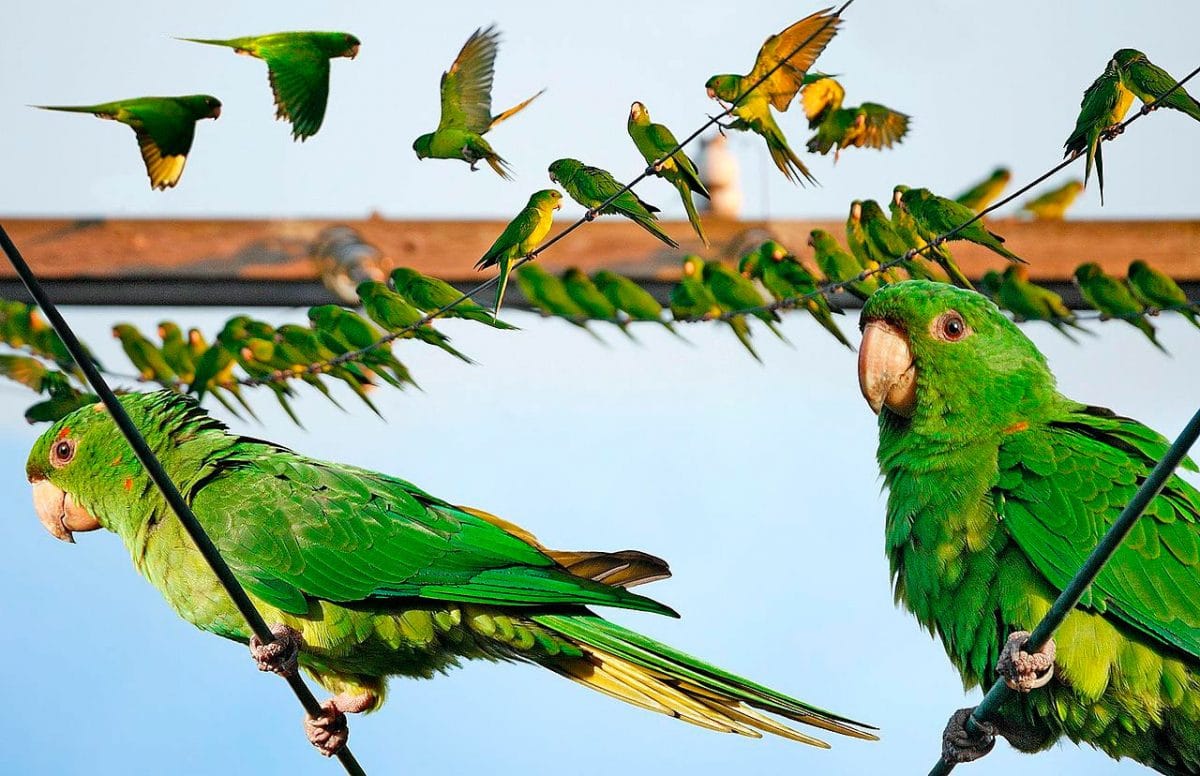
The Green Parakeet(Psittacara holochlorus) is a medium-sized Parrot with the wings in sharp form and the tail long and stitch. Its plumage is bright green, and can present several pens red or orange in the neck. In general, the underwing-coverts are metallic greenish-yellow color, While the the flight feathers and the bottom sides of the the tail feathers are yellow-olive. Presents a eye ring pale beige and the irises orange, the legs yellowish brown.
The Green Parakeet, as well as their subspecies, avoid moist lowland forests; Instead, prefer deciduous forests and gallery forests, scrub, clear and the edges of the forest.
In East Mexico, mainly seen in upland forest with some movements toward deciduous forests at elevations lower than during the non-breeding season. Registered to 2.100 meters in Mexico (the subspecies «brewsteri» at altitudes between 1,250 and 2,000m).
Views in flocks outside the breeding season, sometimes in groups of more of 100 birds, being larger groupings in places where food is abundant.
Reproduction:
The nests of the Green Parakeet they are located in tree cavities (for example, cavities made by woodpeckers), crack in rocks, holes in buildings or termite mounds. Colonial nesting reported in caves in the East of Mexico.
The breeding season has been recorded in the month of January to the East of Mexico (young in the nest); in April in Tamaulipas, to the South of Mexico.
The clutch most common consists of four eggs.
Food:
Diet Green Parakeet is based on seeds, nuts, berries and fruits; reported foods include the fruits of Myrica mexicana, seeds of Mimosa and corn (they can be destructive with their crops).
Distribution:
Size of the area of distribution (reproduction / resident): 275.000 km2
Some specimens settled in cities in southeastern Texas; It is not clear if they come from Pet escapes or are wild vagrant who emigrated from the North of Mexico. It is generally not migratory, but you can scroll to get food.
Subspecies distribution:
Psittacara holochlorus brewsteri
(Nelson, 1928) – Mountains of Northwest of Mexico, to the South of Sonora, Northeast of Sinaloa and South of Chihuahua.
• Red List category of the UICN current: Least concern
• Population trend: Decreasing
The population of the Green Parakeet It is suspected that it is between a slow to moderate decline due to the expansion of intensive farming and capture for the wild bird trade (Juniper and Parr 1998).
The State of conservation, globally, regards it as a kind of Least concern because it is abundant and widely distributed. It is considered one endangered species within the Mexican law by its restricted distribution. Nest boxes they have been provided in the South of Texas nest (Brush 2007).
The world population is estimated at 200.000 mature individuals.
Although it is not as popular as other large amazon parrots, the Green Parakeet is maintained as pet by the local population; have also been exported as pets to the United States. Although there are no accumulated figures, during the period of 9 months between October of 1979 and June of 1980, 327 birds were imported to the United States (Roete et to the. 1982).
While the loss of habitat It is probably the factor affecting the population of the Green Parakeet, their capture for the bird trade It is likely to be negative at the local level.
With the signing of the Wild birds Protection Act of 1991, the Green Parakeet can not be imported to the EE.UU. unless they are part of a breeding program authorized.
The marketing of all the species Mexican species parrots (parakeets, parrots and macaws) is banned in Mexico. Since the year 2008 It is a federal crime to catch, sell, buy this type of animal.
"Green Parakeet" in captivity:
Maintained as pet by the locals although its marketing is prohibited in Mexico.
The illegal trade in parrots and macaws is held thanks to demand from consumers. If the demand for these wild species is reduced, then the offer would be reduced and therefore the illegal capture.
According to sources, a specimen lived 21,8 years in captivity
– Avibase
– Parrots of the World – Forshaw Joseph M
– Parrots A Guide to the Parrots of the World – Tony Juniper & Mike Parr
– Birdlife
– Photos:
(1) – Green Parakeet From The Crossley ID Guide Eastern Birds By Richard Crossley (Richard Crossley) [CC BY-SA 3.0], via Wikimedia Commons
(2) – Green Parakeet by Vince Smith – Flickr
(3) – Aratinga verde by G. Lasley/Vireo – audubon.org
(4) – Aratinga verde by G. Lasley/Vireo – audubon.org
(5) – Aratinga holochlora (Psittacara holochlorus) – Bellas Aves de El Salvador –
Origin: Mexico, Guatemala, Honduras, Belice, Nicaragua, Costa Rica, Panama
Character: Curious and peaceful.
Life expectancy: 30 years
Height: 24 cm..
Content
Description:
24 cm.. length and a weight between 193-229 g..
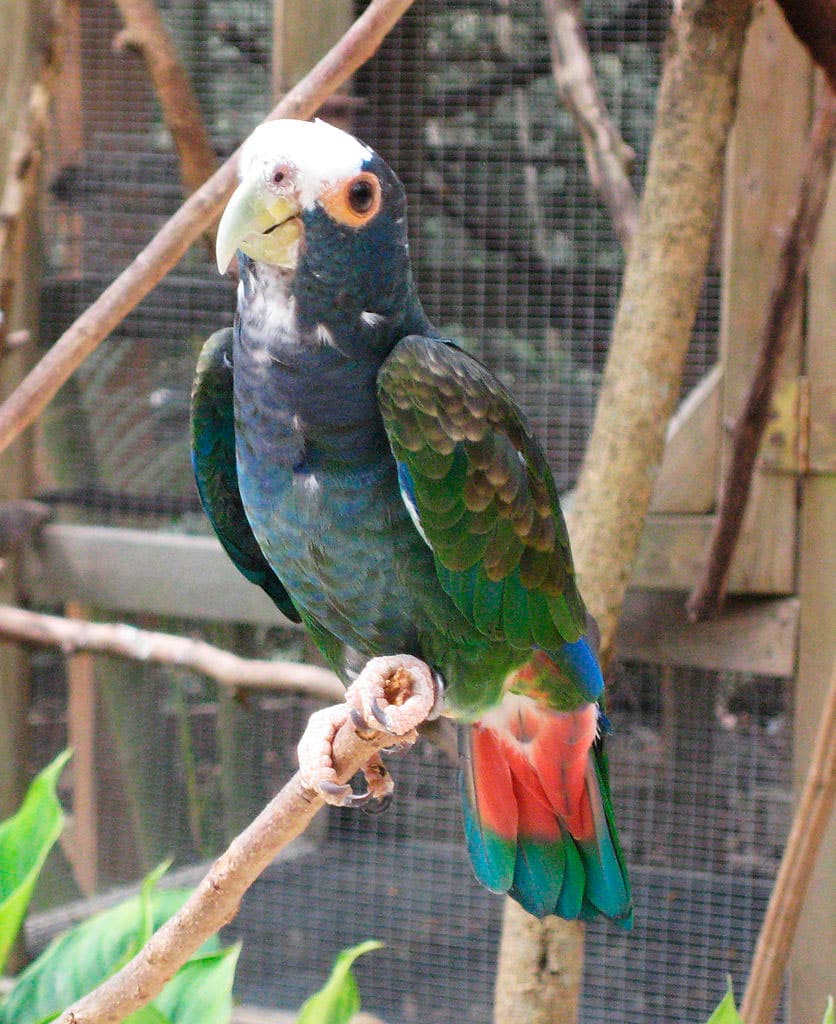
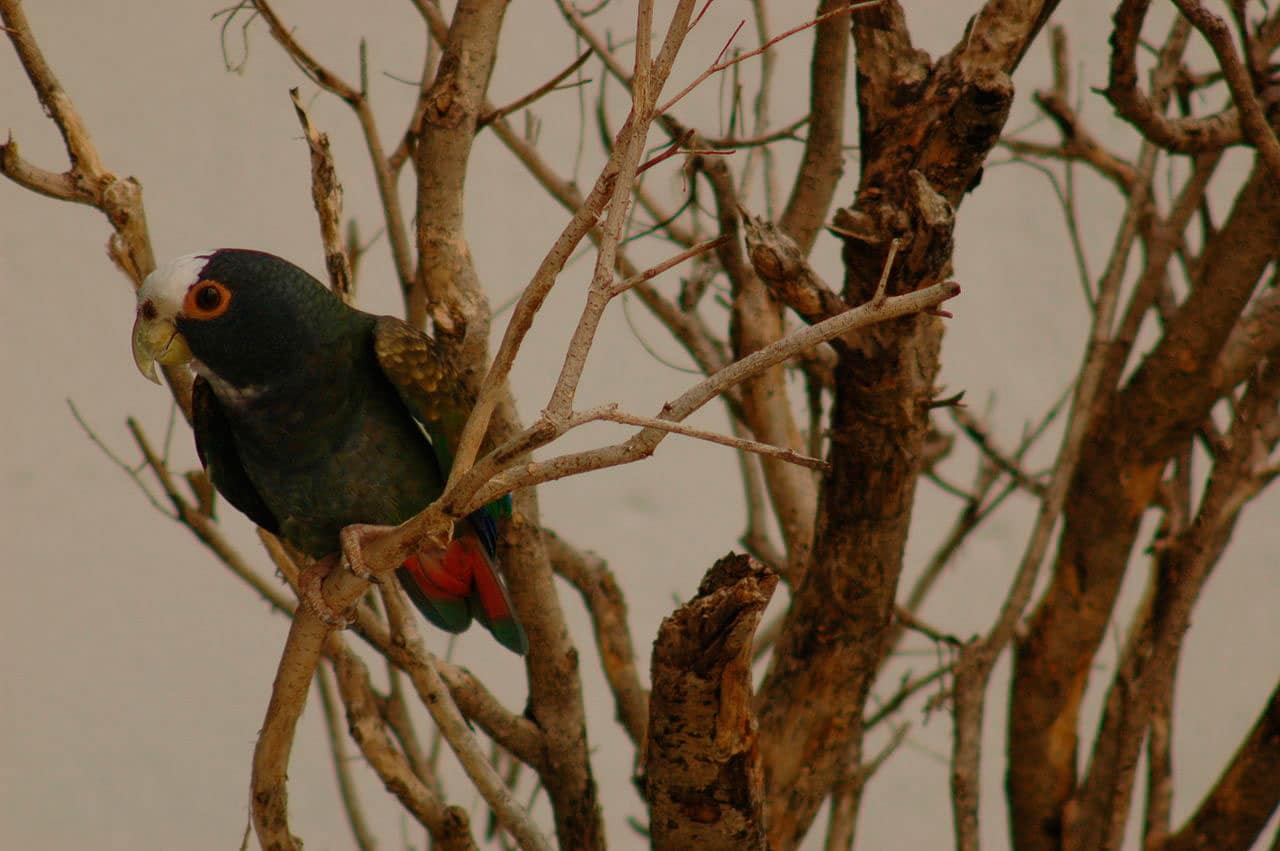
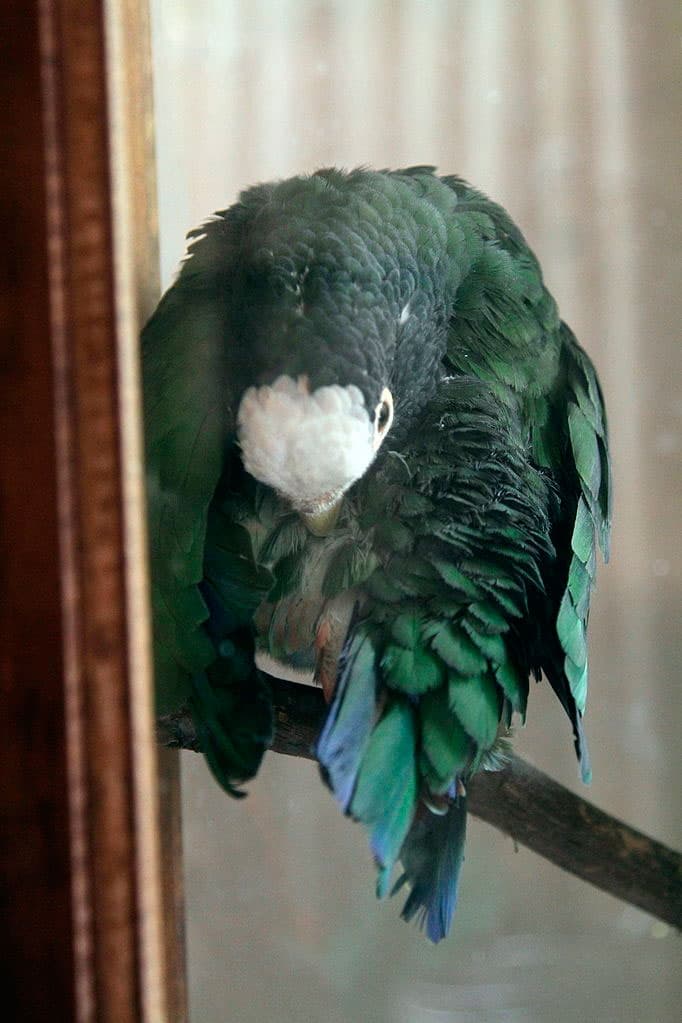
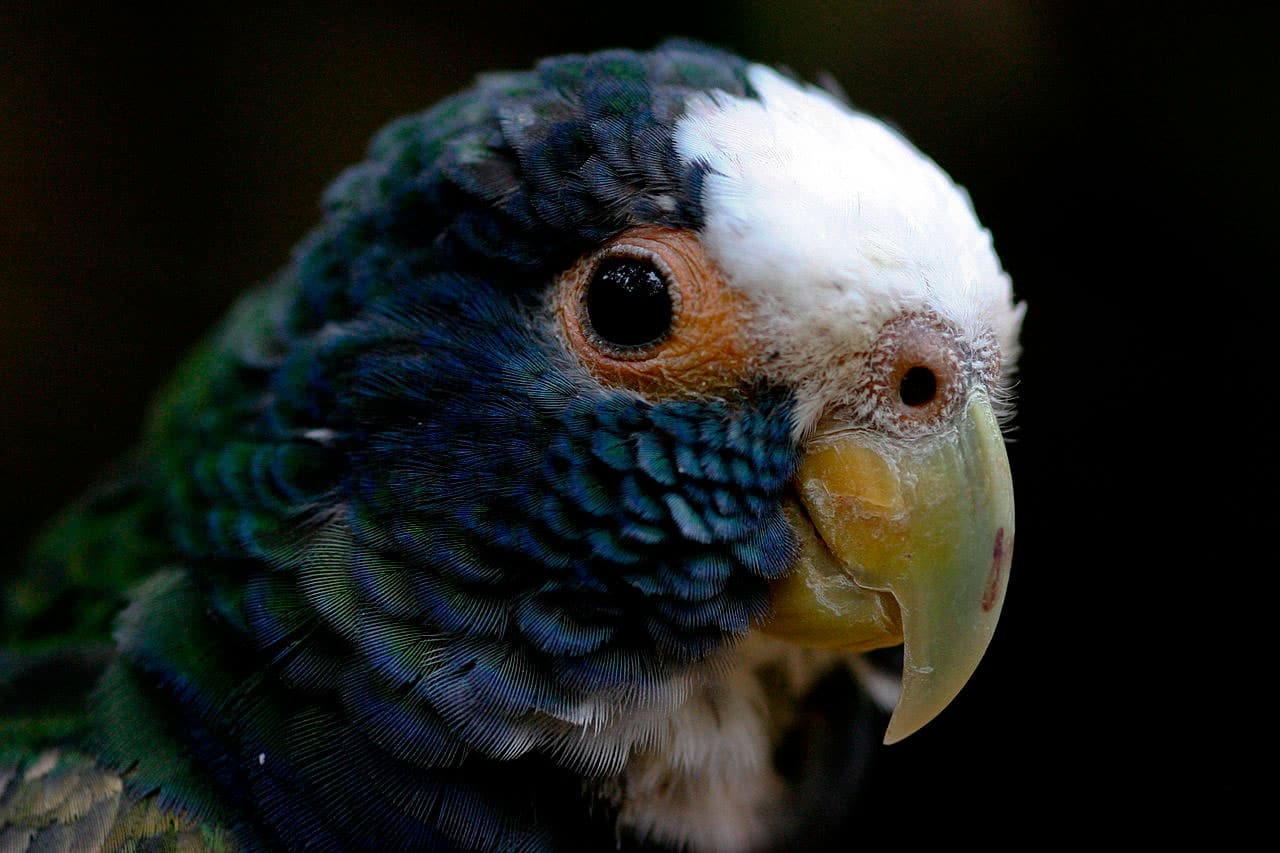
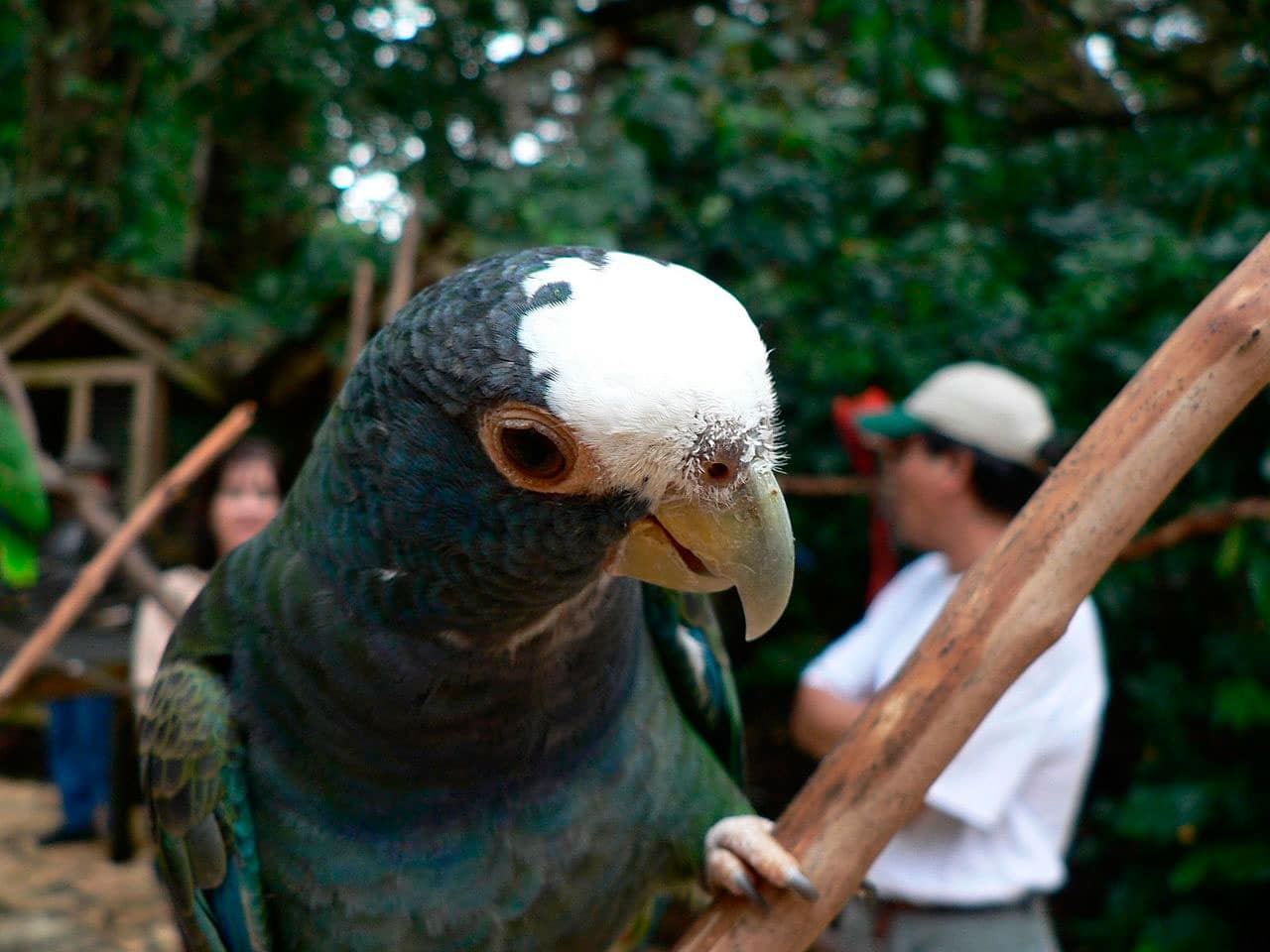
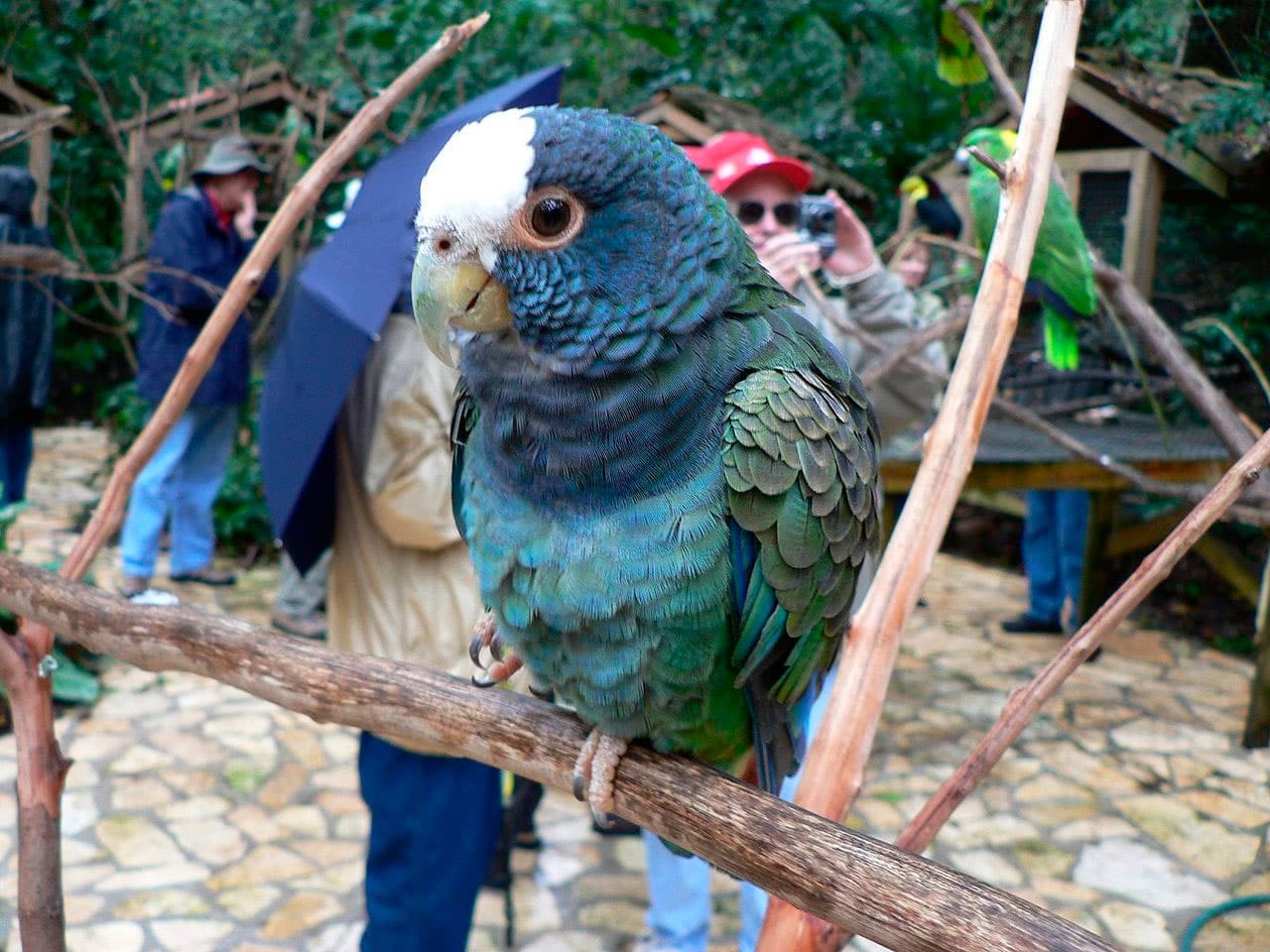
The White-crowned Parrot(Pionus senilis) has the forecrown, crown and lores, white. The feathers of the cheeks, sides head, behind eyes, and rear of the neck, basically pale bluish green with green or blue violet and blue subterminal band darker margins, giving the whole a intricate scaly appearance.
Mantle and back, green with copper plating shine; rump and uppertail-coverts, brighter green; scapulars basically colored green with coppery bronze in the points and outerweb. Lesser coverts and median, bronze with paler tips coppery, giving a mottled appearance; primary coverts, violet blue; greater coverts green. Primaries and secondaries outer, violet blue with green tips to outerweb of the primaries and inner secondary.
Under, the wings pale bluish green. Patch in chin and top of the throat, white; feathers of the chest, green at the base (mostly hidden part) tipped dark blue or violet-blue and blue band paler, giving the whole a scalloped effect; undertail-coverts red. Tail green in the center, outer feathers blue with red at base. Bill pale yellow color with light green tint; eye ring Pink; irises dark brown: legs yellowish gray.
Both sexes are similar. The immature has the head, the back of the neck and the chest, green, pale yellow with margins in the cheeks and crown, giving a pale mottling.
Note:
The subspecies decoloratus, which was distributed from yucatan peninsula to western Panama, previously recognized on the basis of their throat more purple (less blue) and your chest and wings, more blue. But, There is not much geographic variation in the species Pionus senilis and the aforementioned characters are not consistent on the proposed range.
Sound of the White-crowned Parrot.
Habitat:
The habitat of the Senile Parrot is mainly the humid forest (including tropical rain forest), but locally it can be found in forests of oak pine, and low mountain forest. Birds have been reported in forest edges, cultivated areas and grassland areas with scattered trees, plantations, secondary forest with emergent trees, woodlands and streams in Costa Rica, on the edge of urban areas.
Lives mainly in lowlands, but they are distributed locally 2.300 meters in Guatemala and near 1.600 meters in Costa Rica 1.800 meters in Panama. gregarious, mostly in pairs or out of breeding season, in small herds; sometimes in larger meetings of up to several hundred birds.
Reproduction:
Build your nests in tree cavities or hollow trunks of palm trees. The reproduction period occurs between February to May; in March in Mexico; in January-April Costa Rica; February to May in Honduras. The incubation comprises of 26-28 days, Followed by 54-68 pup growth days. It has been difficult to breed the species in captivity and there is little information on its reproduction in the wild..
The size of clutch is of 3 to 5 eggs
Food:
It feeds mainly on the tops of the trees seeds mature Inga and Erythrina and fruits Palm; sometimes cultures corn and Sorghum.
Distribution and status:
Size of its range (breeding/resident ): 1.290.000 km2
Endemic to Central America, from Mexico until Panama.
The White-crowned Parrot It is found in the humid tropics of eastern Mexico on the Caribbean side of Tamaulipas and to the East of San Luis Potosi eastward through yucatan peninsula, in Campeche and Quintana Roo, the borders of Belice and the northern lowlands and highlands of eastern Guatemala. It is found throughout the Caribbean slope of Honduras, mainly below 1.100 m (Occasionally highest altitudes) and in Roatan in the Bay islands, and on the Caribbean side of Nicaragua (possibly also on the side of peaceful) until Costa Rica, where it remains mainly in the lowlands and foothills of the Caribbean slope, becoming less and less numerous south of Lemon; also observed in the slope of peaceful in the South of Costa Rica and on both sides West Panama, to the West of Chiriqui and to the West of Bull's mouths.
Some local migrations (also apparently vertical) occur (for example, in parts of Oaxaca, Mexico and parts of Costa Rica). The species is widespread, but abundance varies from rare to very common depending on locality; It is perhaps the largest parrot in Costa Rica.
current distribution: No data where the current distribution of specified White-crowned Parrot. This species of psittacine still has a presence throughout its range, although there are regions where it has been extirpated, as the West's Quintana Roo and Gulf Coast (INE 2000).
Despite being frequently eaten by native peoples (at least once), persecuted as a pest of crops, caught in low numbers for the live bird trade and severely deforesting parts of their range, It has not detected a serious overall decline in population.
Conservation:
• Current category of the Red List of the UICN: Least concern.
• Population trend: decreasing.
sheltered Mexico by the Official Mexican Standard (NOM–059–SEMARNAT–2001–2010) under the category of Threatened.
Rationale for the Red List category
This species has a very large range and therefore it is not close to the thresholds for Vulnerable under the criterion of size range (Extension Occurrence <20,000 km2 combinada con un tamaño de rango decreciente o fluctuante, extensión / calidad de hábitat o tamaño de población y un pequeño número De lugares o fragmentación severa). A pesar de que la tendencia de la población parece estar disminuyendo, no se cree que la disminución sea suficientemente rápida para acercarse a los umbrales de Vulnerables bajo el criterio de tendencia poblacional (> 30% decline in ten years or three generations). The population size is very large and, therefore, not approaching the thresholds for vulnerable under the criterion of population size (<10.000 individuos maduros con una disminución continua estimada en> 10% in ten years or three generations or with a specific population structure). For these reasons the species is evaluated as the least concern.
Justification of the population
Partners in Flight estimates the total population of 50.000-499.999 individuals (A. Panjabi in a bit., 2008).
Justification of trend
It is suspected that the population is declining due to continuous habitat destruction.
"White-crowned Parrot" in captivity:
(CITES) It included in the Appendix II (It includes species not necessarily threatened with extinction, but in which trade must be controlled to avoid utilization incompatible with their survival.)
The species ranked first in the 80's among the most traded parrot species in Mexico (Iñigo Elias and Ramos 1992). Currently, there marketing of the species in the national and international market.
Valued as a pet or ornamental bird by its feathers, ability to imitate sounds and its tendency to form bonds with people.
Alternative names:
– White-crowned Parrot, White crowned Parrot, White-capped Parrot (English).
– Pione à couronne blanche, Pione givrée, Pionus à front blanc, Pionus à front blanche (French).
– Glatzenkopfpapagei, Glatzenkopf, Glatzenkopf-Papagei, Weißkappenpapagei (German).
– Curica-de-testa-branca (Portuguese).
– Lora coroniblanca, Loro Corona Blanca, loro corona-blanca, Loro Coroniblanco, Loro de Corona Blanca, Loro Gorgiblanco, Loro Senil (español).
– Loro coroniblanco (Costa Rica).
– Lora coroniblanca (Honduras).
– loro corona blanca, loro corona-blanca, Loro Coroniblanco (Mexico).
– Loro Gorgiblanco (Nicaragua).
– Avibase
– Parrots of the World – Forshaw Joseph M
– Parrots A Guide to the Parrots of the World – Tony Juniper & Mike Parr
– Birdlife
– Photos:
(1) – A White-crowned Parrot (also known as White-crowned Pionus) at Macaw Mountain Bird Park, Honduras By Pionus_senilis_-Macaw_Mountain_Bird_Park,_Honduras-8a.jpg: Sarah and Jasonderivative work: Snowmanradio [CC BY-SA 2.0], via Wikimedia Commons
(2) – A White-crowned Parrot (also known as White-crowned Pionus) at Macaw Mountain Bird Park, Honduras By nakashi (Flickr: P1100396) [CC BY-SA 2.0], via Wikimedia Commons
(3) – A White-crowned Parrot (also known as White-crowned Pionus) at Macaw Mountain Bird Park, Honduras By nakashi (Flickr: P1100397) [CC BY-SA 2.0], via Wikimedia Commons
(4) – (Pionus Senilis). White-crowned Parrot , Guatemala By Virgilrm at English Wikipedia (Transferred from en.wikipedia to Commons.) [Public domain], via Wikimedia Commons
(5) – A White-crowned Parrot (also known as White-crowned Pionus) at Macaw Mountain Bird Park, Honduras By nakashi (Flickr: P1100398) [CC BY-SA 2.0], via Wikimedia Commons
(6) – White-crowned Parrot (also known as the White-crowned Pionus); close up of upper body By Brian Gratwicke [CC BY 2.0], via Wikimedia Commons
(7) – A White-crowned Parrot at Cape May Zoo, New Jersey, USA By Jim Capaldi (Flickr: Parrot) [CC BY 2.0], via Wikimedia Commons
(8) – (Pionus Senilis) White-crowned Parrot in a tree By Virgilrm at English Wikipedia (Transferred from en.wikipedia to Commons.) [Public domain], via Wikimedia Commons
(9) – White-crowned Parrot (Pionus senilis), also known as White-crowned Pionus, at the aviary Birds of Eden in South Africa By SandyCole (mailto:sandyc@dicksandy.org) (Own work) [CC BY-SA 3.0 or GFDL], via Wikimedia Commons
– Sounds:
▷ The world of Pets: Dogs, cats, birds, reptiles, amphibians
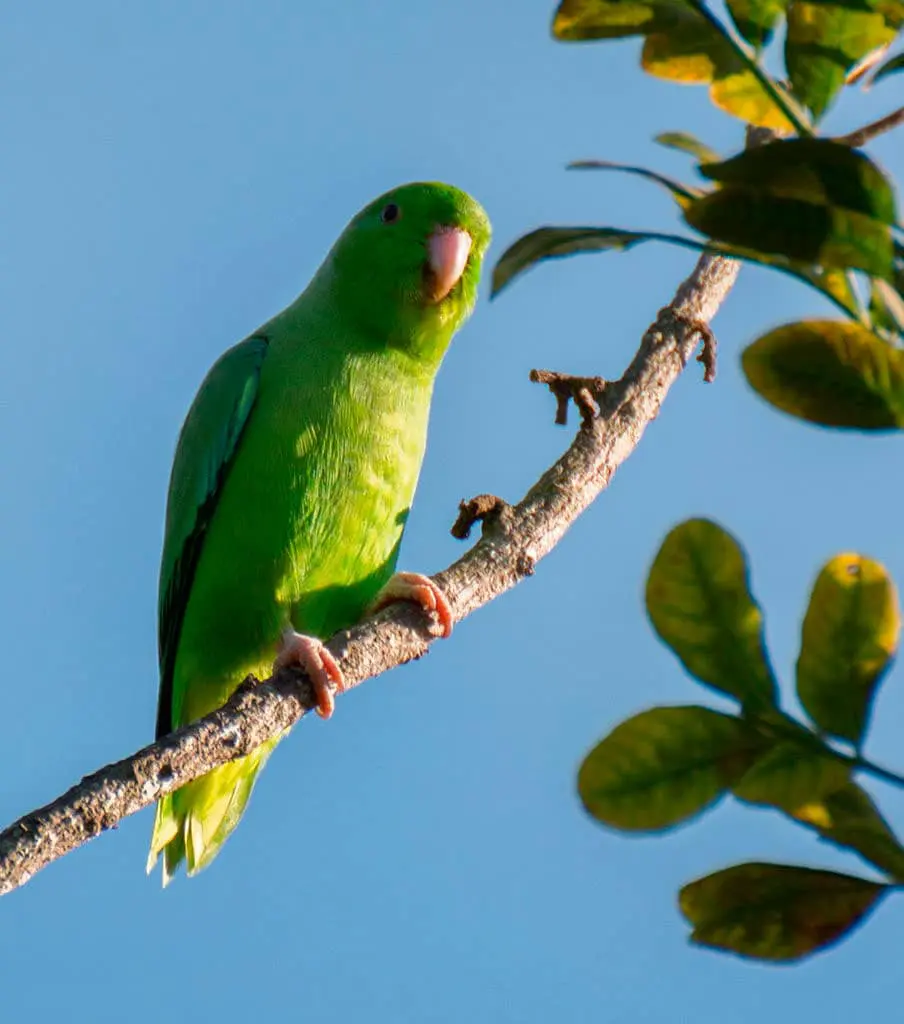
The Green-rumped Parrotlet(Forpus passerinus) is the psittacine smaller that can be found on the American continent. It is distinguished by being green, with a brighter green in the front, cheeks, lower part of the body and behind the neck; the rump bright green in the two sexes, wing
with one Strip Turquoise Blue followed by another greenish-blue in males; belly lighter than the back, tail with yellow border.
Female with rump greenish-yellow and wings without blue. It is possible to have dyes more yellowish forehead.
(Schlegel, 1864) – Also known as Parrotlet Schlegel. Similar to the subspecies Forpus passerinus passerinus, but the feathers of the tail of the female they are more green in the bottom. Also it has more yellow along the forecrown .
Forpus passerinus cyanophanes
(Todd, 1915) – Show more blue with the wing
closed in the other subspecies.
Forpus passerinus deliciosus
(Ridgway, 1888) – The male has the rear area Emerald green with blue and pale blue tint at the edge of the the greater wing coverts. Female has more yellow in all the facial area.
(Lafresnaye, 1848) – Also known as Venezuela green parakeet. The plumage is green in males; in females varies considerably according to the region they inhabit.
Habitat:
It is found in dry forest, semi-open areas, crops, among others, until the 500 m. In flocks of more of 100 individuals. You can perform altitudinal migrations.
Reproduction:
It nests in abandoned nests of woodpeckers or in other holes, from May to November.
Food:
They feed on seeds, including the of the grasses.
Distribution:
Size of the area of distribution (reproduction / resident): 1.060.000 km2
This is a very widespread and common. They are distributed in the northeast of Colombia, North of Venezuela, Guyanas to the northeast of Brazil, also in Curacao, Trinidad and the West Indies.
(Todd, 1915) – Are found in the areas around the North of Colombia.
Forpus passerinus deliciosus
(Ridgway, 1888) – Is located in the lower basin of the amazon, in Brazil.
Forpus passerinus passerinus
(Linnaeus, 1758) – The nominal. Found in the Guianas.
Forpus passerinus viridissimus
(Lafresnaye, 1848) – Found in the North of Venezuela, Trindad and Tobago.
Conservation:
State of conservation ⓘ
Minor Concern ⓘ(UICN)ⓘ
• Current category of the Red List of the UICN: Least concern.
• Population trend: Decreasing.
Justification of the population
The size of the world population It has not been quantified, but this species is described as «common» (Stotz et to the., 1996).
Justification of trend
It is suspected that this species has lost 19,2-21% of habitat within its distribution in three generations (12 years) based on a model of Amazon deforestation (Soares-Filho et to the., 2006, Bird et to the., 2011). Given the susceptibility of the species to hunt or capture, It is suspected that it will fall in <25% durante tres generaciones.
"Green-rumped Parrotlet" in captivity:
It´s common bird cage. In captivity they are sweet and playful. It might be possessive with toys and people.
– Avibase
– Parrots of the World – Forshaw Joseph M
– Parrots A Guide to the Parrots of the World – Tony Juniper & Mike Parr
– Birdlife
– Parrot Book, Parrots and macaws Neotropical
– Photos:
(1) – Forpus passerinus in Trinidad 2014, Caribbean By Jam.mohd (Own work) [CC BY-SA 4.0], via Wikimedia Commons
(2) – Photograph of pet Green-rumped Parrotlet (Forpus passerinus) By self (Own work) [Public domain], via Wikimedia Commons
(3) – Green-rumped Parrotlet, (Forpus passerinus), a pair, male (right) and female (left), in Venezuela By kulyka on flickr (Flickr) [CC BY 2.0], via Wikimedia Commons
(4) – Periquito mastrantero [Green-rumped Parrotlet] (Forpus passerinus viridissimus) by Cristóbal Alvarado Minic – Flickr
(5) – Periquito mastrantero [Green-rumped Parrotlet] (Forpus passerinus viridissimus) by Cristóbal Alvarado Minic – Flickr
(6) – Blue-winged Parrotlet, adult male (above); Green-rumped Parrotlet, young(?) male (below) Joseph Smit [Public domain], via Wikimedia Commons
31 cm.. length and a weight between 150 and 185 gr.
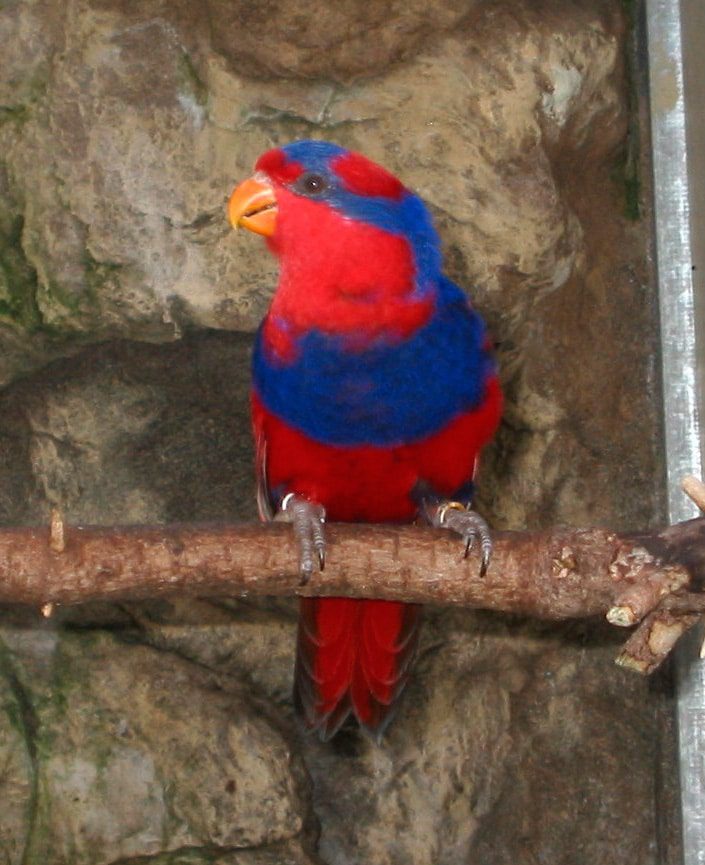
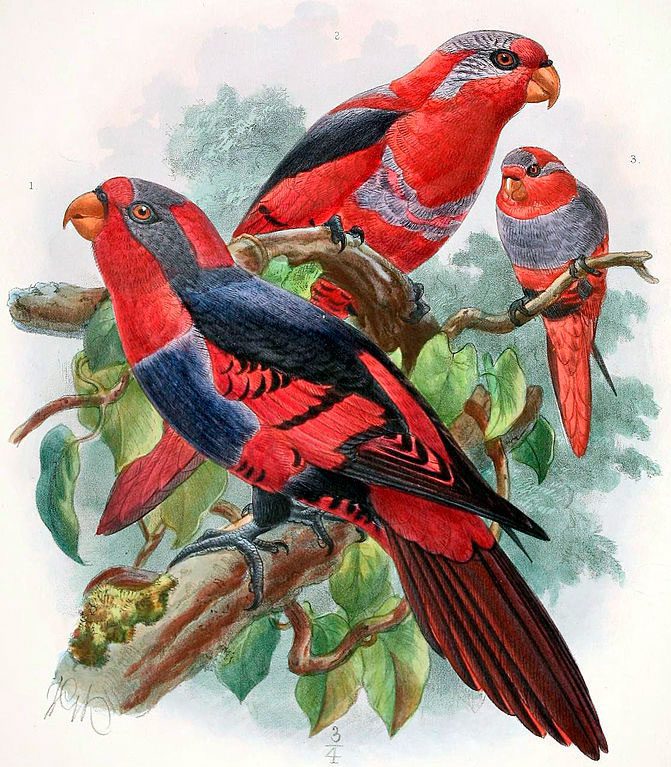
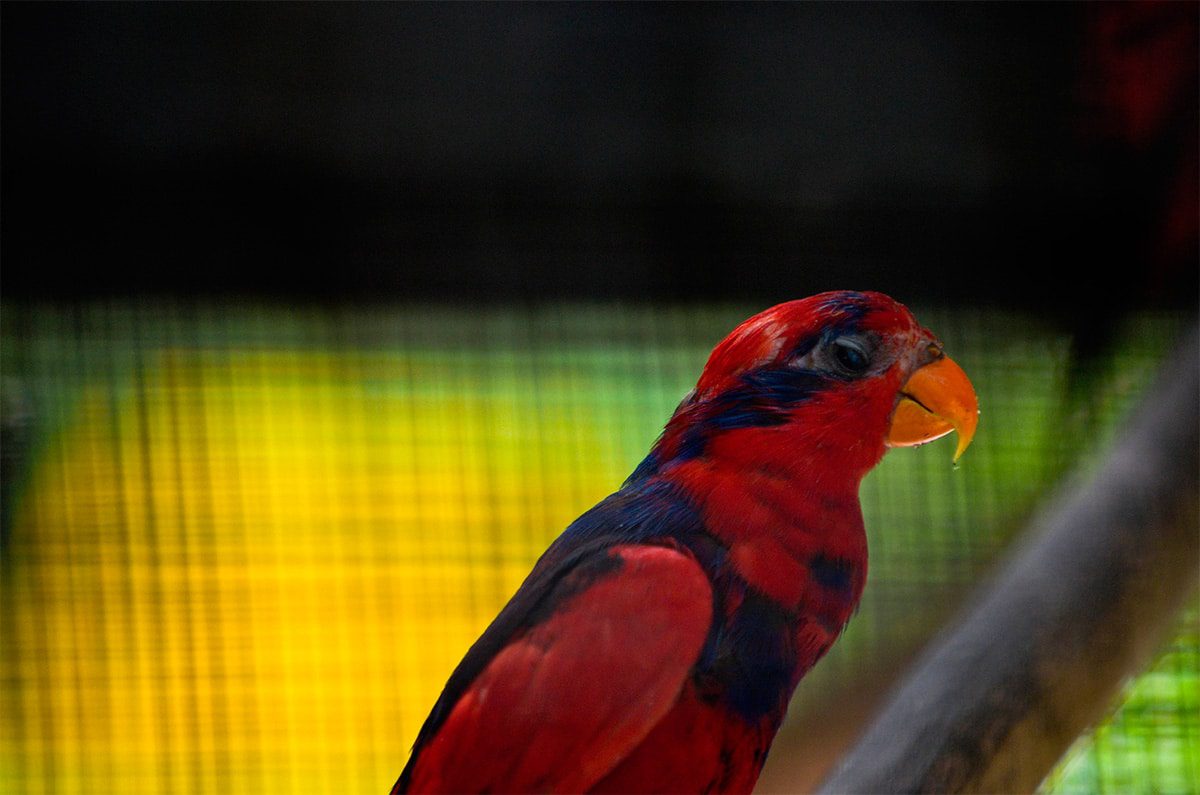
The two main colors of the Red-and-blue Lory(Eos histrio) they are the red and blue.
A broad blue-purple line extends from the eyes through the ears and for the sides of the neck. A broad transverse band blue on the chest. The tail coverts they have blue pink. The feathers of the part superior of the tail they are reddish purple.
The irises is red, the legs grey.
Both sexes are very similar.
In immature, the feathers of the head and the chest they have a dark blue edging. The blue of the crown extends up to the neck and below the eyes. Thighs they are dull purple. The irises They are brown.
(Salvadori, 1891) – The band blue of the chest is of smaller size and mixed with red; the blue band of the eyes does not extend to the the mantle; smaller.
(Meyer,AB & Wiglesworth, 1894) – More black in the corbeteras wing and in the flight feather.
Habitat:
The Red-and-blue Lory they are common in primary forests, and on the hills of the hills. The feed, they made raids in coconut plantations along the coast and in the more open areas.
They make short trips daily. In the Talaud Islands You can see flying from island to island.
Initially, They lived in large flocks and concentrated in large numbers in common dormitories..
Today, in view of its decline, them find in pairs or in small groups. Large gatherings have become extremely rare or virtually non-existent.
In the Karakelong island were seen, However, on two occasions, more groups of 400 birds.
The Red-and-blue Lory they are birds noisy, which makes them quite easy to observe.
Reproduction:
The species nests in holes in tall trees, most belonging to the class canarium family Burseraceae, and the breeding period main seems to be from May to June, Although it is suspected that nesting may include other months.
We find nests, both in the forests and cultivated areas. The spawning usually includes 2 eggs which are incubated for approximately 25 or 26 days. There is no any other information in the natural environment.
Food:
Although they also consume some insect larvae, the Red-and-blue Lory are mostly vegetarian. They feed on coconut plantations, in the fig trees and trees of the genus canarium It produces edible nuts.
Distribution:
Size of the area of distribution (reproduction / resident): 1,000 km2
The Red-and-blue Lory is confined to the Talaud Islands (almost exclusively in Karakelang) front North of Sulawesi, Indonesian
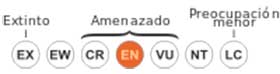
• Current category of the Red List of the UICN: Endangered.
• Population trend: Decreasing.
This species has a very small range (It is known only in some places), and it is declining due to habitat loss. It has been a downhill fast in the population, largely as a result of their capture for trade, and this is expected to increase in the future. So, qualified as In danger.
Although it was previously abundant, the species has decreased and the population in KarakelongIt was estimated in 8,230-21,400 birds in 1999 (Riley 2003). The subspecies of the nominal of the Sangihe Islands, is likely that has been extinguished.
The encroachment and logging are driving the loss of forests, aggravated by the threat of illegal trade in the species, contribute to the acceleration in the decrease of the population.
In 1999, the investigation concluded that you the 1.000 and 2.000 birds were being captured in Karakelang each year, the 80% (illegally) for the markets of birds of the Philippines.
Ongoing conservation actions:
Since 1995, the project "Action Sampiri» has been working for the conservation of biodiversity in Sangihe and Talaud, in the implementation of awareness-raising programmes of field work and the conservation and development of ideas for the future use of the land.
Efforts have been made to promote the local support of the species at Talaud, his last bastion.
It has been reported that the poaching and the trade of this species have decreased drastically after the confiscation of assets by Ranger of the forest Department in 2005 (RT Prayudhi in litt., 2008).
The bird is part of the European Association of Zoos, the program Aquaria’s European Endangered [species] and Parrot Taxon Advisory Group (Wilkinson 2000), where it is being bred in captivity (Sweeney, 1998).
"Red-and-blue Lory" in captivity:
It is currently very rare in captivity.
Due to its status in danger of extinction, any specimen that can not be returned to their natural habitat (natural range) should preferably be placed in a well-managed breeding program to ensure the survival of the species.
Alternative names:
– Red-and-blue Lory, Blue-tailed Lory, Red & Blue Lory, Red and Blue Lory, Red-blue Lory (ingles).
– Lori arlequin, Lori histrion (French).
– Harlekinlori (German).
– Lóris-arlequin (Portuguese).
– Lori de las Sangihe, Lori Rojo y Azul (español).
scientific classification:
– Order: Psittaciformes
– Family: Psittaculidae
– Genus: Eos
– Scientific name: Eos histrio
– Citation: (Statius Müller, 1776)
– Protonimo: A player parrot
1 – En Loro Parque (Spain, Tenerife) by Drägüs – Wikimedia
2 – Lori en Loro Parque, Tenerife, España by Drägüs – Wikimedia
3 – En ZooParc de Beauval, France by User:Edhral – Wikimedia
4 – Red-and-blue lory. two in a cage. by TJ Lin – Wikimedia
5 – A Red-and-blue lory in a zoo by jojo nicdao – Wikimedia
6 – The Red and Blue Lory (Eos histrio now Eos histrio histrio) and The Challenger Lory (EOS challengeri now Eos histrio challengeri) Chromolithograph. Plate VII from A monograph of the lories, or brush-tongued parrots, composing the family Loriidae. By St. George Jackson St. Mivart (1827–1900). Artwork by John Gerard Keulemans (1842-1912). This was published by R. H. Porter (London) in 1896. By John Gerard Keulemans [Public domain], via Wikimedia Commons
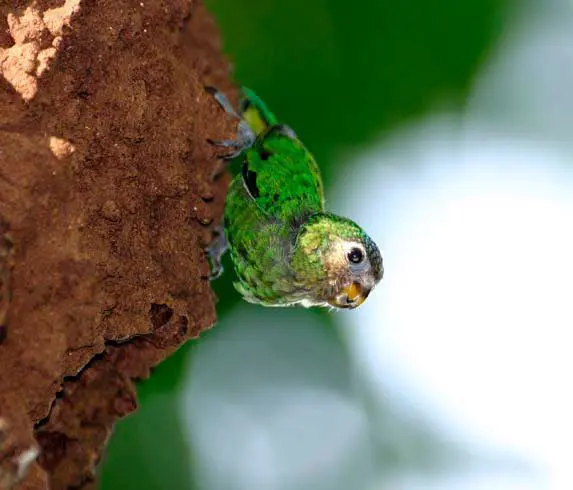
The Geelvink Pygmy-Parrot(Micropsitta geelvinkiana) has 9 cm.. length between 13 and 17 g. of weight.
The coverts headphones are of color brown with fusion to blue-green in the part rear; crown purple-blue; Upperparts green, Middle coverts with centers of color blackish. The flight feather Black with narrow green borders in vane outer. The underparts Green Center of chest and belly ocher-yellow, more warm towards the part superior of the chest. Uppertail Yellow. Central feathers of the tail blue, Green Tips with yellow spots and black exterior.
The bill grey; irises of color red or brown orange; legs grey.
Female with less blue of the crown and underparts greenish yellow.
Immature with the bill mostly yellow in color and gray tipped.
: (Salvadori, 1876) – The male has the head Brown marks on the belly yellow and orange. Female with the crown blue and underparts greenish.
Habitat:
With distributes in lowland, secondary growth, cultivated areas with isolated trees, and around native gardens, until 300 meters or higher altitudes. The birds are found in groups of 4-5. and is them has seen associate it with other birds in them trees low of berries that accrued in the forest. very shy.
Reproduction:
They dig caves in termite tree in which to lay their eggs (also used for rest cavities at night), often close to the ground. The nesting It was observed from mid-June to August. Arndt He found two young in a nest which were visited by the female every two hours. The chamber was filled with dust from the termite mound and contained some broken egg shell and feathers.
Food:
Probably Lichen and fungi from the bark of the trees. As in other Meeki, crushed seeds were found in the stomach of a bird collected.
Distribution:
Size distribution (reproduction / resident): 2,500 km2
Are observed only in Numfor and Biak island, (Indonesian), up to about 300 meters above sea level. In 1991 It was thought that the global population was around of 10.000 and stable, but in 1997 searches for the species over a period of 12 days suggested that it was either rare or easily missed, with observations of a single day, sometimes only with sound contacts.
The size of the world population It has not been quantified; in 1991 It was estimated in approximately 10,000 specimens. The species is described as well distributed in good numbers in lowland primary and secondary forests. (pit et to the. 1997).
There are no data on population trends, but the species is suspected that it is decreasing at a rate of slow to moderate, due to loss of habitat.
"Geelvink Pygmy-Parrot" in captivity:
Not found in poultry farming.
Alternative names:
– Geelvink Pygmy-Parrot, Geelvink Bay Pygmy Parrot, Geelvink Pygmy Parrot (ingles).
– Micropsitte de Geelvink (French).
– Geelvinkspechtpapagei, Geelvink-Spechtpapagei (German).
– Micropsitta geelvinkiana (Portuguese).
– Microloro de Geelvink (español).
Of 33 cm.. length and an average weight of 475 g..
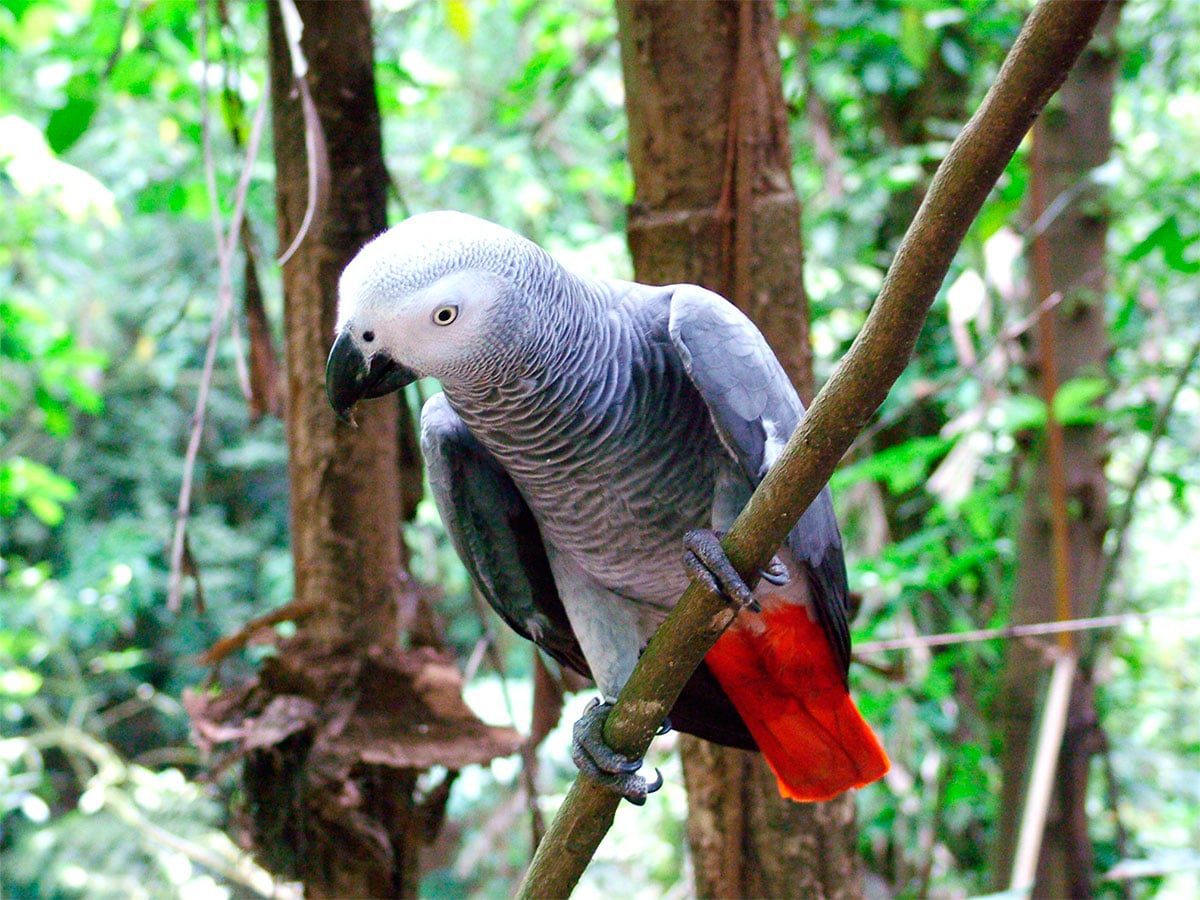
The Grey Parrot(Psittacus erithacus) is famous for its intelligence and ability to mimic sounds and human speech, so it is one of the most popular of all pets avian. It is one of the largest parrots in Africa.
They have the feathers of the lores, the cheeks, the frenyou and the crown silver grey, more clear tips. The of the the mantle and lower area of the back darker, slate gray with light margins, giving a scaly appearance; the lower area of the back and tail are silver grey. Upper wing coverts, secondaries and scapulars slaty-grey. Primaries grey dark (almost black), more clear below that top.
Wing feathers light grey, with the exception of the greater coverts that are of a dark grey tone.
feathers of the chest slate gray with pale gray margins fused with much lighter silver feathers on the belly; flanks and the thighs clear silver grey color.
Tail and their coverts, bright Scarlet.
Older birds they can show scattered red feathers between the plumage gray, especially in the the thighs and the belly.
The bill black; irises yellow; naked facial area with some fine white hairs; legs dark grey.
Without sexual dimorphism in the plumage.
Immature they have the tail darker red towards the tip, Grey dye in undertail- coverts and the irises grey.
(Alexander, 1909) – Very similar to the nominal, except that they are a little smaller. Some bird breeders argue that the Princeps is a regional type of Psittacus erithacus erithacus, instead of separate subspecies.
Habitat:
The Grey Parrot They inhabit the tropical jungle primary and secondary, the forest edges and clearings, gallery forest and mangroves; wooded Savannah, haunting, often, land cultivation and even gardens.
Partially confined in the lowlands, Although in the East of its range have been recorded at altitudes of 2.200 m.
They reach the highest densities in primary lowland forests, intermediate in the primary montane and lower density in plantation of coconut.
gregarious, they form large communal roosts of up to 10.000 individuals, often at some distance from the feeding areas.
Preferred places of shelter are trees or palm trees on the water, also islands in the rivers.
Are dispersed into smaller groups (until 30) to feed.
Reproduction:
The reproduction of the Grey Parrot takes place in loose colonies, in which each pair occupies its own tree. Individuals select their partners carefully and have a monogamous union of lifelong It begins at sexual maturity, between three and five years of age.
Few details are known about the courtship in nature, but have been observed and recorded flights of visualization around the nest cavities. The males feed their mates (power dating) and both sing soft monotonous notes. At this time the female goes to sleep to the nest cavity, While the male takes care of it.
In captivity, the Grey Parrot fed males to females after copulation events and both sexes participate in a mating dance in tipping its wings.
The nest they build it in the cavities of some tree (for example, Terminalia, Ceiba or Distemonathus), between 10 and 30 meters above the ground.
Sometimes breeds in colonies of up to several hundred couples loose (in Prince for example), but in most places they nest alone.
Breeding season varies with locality. In East africa, breeding has been recorded in the months of January-February and June-July, both in dry periods.
Young chicks have been released for sale from March onwards in Ghana. Other records suggest as a rule from the breeder, the dry season.
The females lay from three to five eggs, that you are in charge of incubate while they are powered entirely by the male. The incubation lasts approximately thirty days and the young man emerges from the nest at twelve weeks of age.
Food Loro Yaco:
Their diet consists of a variety of seeds, nuts, fruits and berries.
The fruit of the Palm oil (Elaeis guineensis) is her favourite in some areas, coming to bear its fruit over long distances before being consumed.
In Bioko, they prefer the berries of Tragacantha tail (Fam. Malvaceae).
They can be a pest, causing considerable damage to corn crops in some areas.
Loro distribution Yaco:
Size of the area of distribution (reproduction / resident): 2.760.000 km2
The Grey Parrot are distributed between the West and centre of Africa, of Guinea-Bissau and this from Sierra Leone, across the South of Mali, Ivory Coast, Ghana and Nigeria, until Cameroon, extending to Bioko and Islands Sao Tome and Principe in the gulf of guinea; from Gabon and the Congo through Zaire, Uganda and Western Kenya, the Southwest and East - Central of Zaire and Northwest of Tanzania.
Usually sedentary. Common where large extensions of forest persist and still abundant in some localities, especially in the tropical jungles of the Congo basin. But, due to the extensive loss of forests in some parts of the range (for example, of Nigeria to Sierra Leone) and the catch on a massive scale (the second best-selling parrot in the world in the Decade of 1980) There have been dramatic declines in some places (for example, in Liberia, Ghana, Kenya and around Kinshasa, Zaire, and other cities of the Congo basin).
The Grey Parrot They are protected by the convention CITES, consisting in annex II (species that may be threatened by a trade out of control).
If it is considered not threatened globally, the fact of being one of the species of the family Psittacidae (parrots and parakeets) most sold in the world makes its distribution is shrinking dramatically in certain places, its disappearance may be close in many of these areas according to the organization The World Parrot Trust [4].
The following data are quite illustrative in this respect:
1. In the period 1982-1989 It was the second psittacida then suffered more trade of Agapornis fischeri, with averages of more of 47.000 specimens exported from Africa annually [1].
2. The export quotas under the CITES agreement for psittacines are often not adjusted to scientific criteria due to the lack of detailed population studies and the annual renewal rates of the populations. [2].
3. Too often these quotas are widely exceeded by exporting countries.. These may include Cameroon exported 23.000 grays in 1996, When I had a share of 12.000! [2]. Although these facts to do that Cameroon could not legally exported in 1997, the current quota of 12.000 grays is exceeded with more of 15.000 all the years [5]. Another example, is the Republic of Congo, with an annual fee of 10.000 grays, that has also been sanctioned by the impossibility of exporting them in 2001 and 2002 by the large number of existing fraudulent export [6].
4. In the year 1999, the European Union imported (legally under the Convention CITES) from Africa 33.341 greys parrots, number only surpassed in this family by parrots of the genus Lovebirds (71.588 of Agapornis roseicollis, 63.867 of Agapornis fischeri and 33.720 of Agapornis personatus). Spain It was the second destination of these parrots grays, after Netherlands, imported 6.216 specimens [7].
5. There are specific areas Africa It supported much of the pressure from hunters of parrots for their trade. One of them is the area of Lobeke, in the southeast of Cameroon, where they hunt every year more than 15.000 grays, most of them die by mishandling in the capture and transport [5].
The aforementioned illegal trade is no stranger to our country, where was recently dismantled an international network of illegal import of this species from the Republic of Congo, who had brought to Spain at least 3.982 specimens from the year 1998 [7].
On the other hand, in some countries these birds are raised industrially for sale. This favours on the one hand the fact that decreases the importation of birds hunted in the wild [2], and on the other increases the number of birds on the market, and with it the chance of leaks or intentional releases, that they can get to colonize areas outside its area of distribution. An example of a Spanish company of these characteristics, among the many that are, It has more than 300 breeding pairs, can be found in [8].
References:
[1] NECKLACE, N.J.. 1997. Family Psittacidae (Parrots). In: Handbook of the Birds of the World. Vol. 4. Sandgrouse to Cuckoos (Ed: J. pit, A. Elliot, J. Sargatal). Lynx Edicions, Barcelona. pp. 280-477.
[2] MAY, D.L.. 2001. Grey Parrots of the Congo Basin Forest. PsittaScene 13-2(47): 8-10.
[3] AALANGDONG, O.I., AUGUSTINE, S. 1999. Langyintuo. Crop damage by wildlife in Northern Ghana. Abstracts of the 2nd International Wildlife Management Congress, Gödöllö, Hungary.
[4] The WPT 12. The World Parrot Trust. African Grey Parrot. www.worldparrottrust.org
[5] NGENYI, A. 2002. African Grey Parrot trade in Cameroon. PsittaScene 14-2(51): 2-3.
[6] El Periódico de Catalunya. Dismantled a network of trafficking in protected species in Barcelona. 11-11-2004.
[7] Report of Animal Aid. 2002. From Rainforest to Retail. Leading DIY chain and the horror of the wild bird trade.
[8] Psittacus Catalonia, SL. Information available in: www.psittacus.com
«Loro Yaco» in captivity:
The ancient Egyptians already kept these birds as pets.. Later the Greeks and the Romans did the same.
While the Grey Parrot they can be good pets, If you have children in your home, buying a Grey Parrot It would be a bad idea, by both the Parrot and the children that can be easily damaged with its claws and beak.
The Grey Parrot can also be difficult for some people to maintain, This is probably due, Unlike other pets, because these are always active and should be checked several times a day. These parrots can be unordered, for example, When they are eating the seeds or other foods it is likely that they end up throwing debris out of the cage and even against the walls.
More Intelligent any dog, calls attention to the 24 hours of the day. His extreme intelligence and sensitivity takes you easily to the depression if it is unrequited.
It is a bird very long-lived, There are those who say that these animals can live 73 and up 93 years. More longevity record reliable, However, is a specimen that was still alive after 49,7 years. In captivity, these animals they tend to breed to the 5 years of age.
Their cages they must also be cleaned daily, due to their feces, they are totally inconsistent and appear in their feeders, toys, or anywhere else in the cage. Because of this, you have to wash the cages thoroughly to remove any odor and bacteria.
To the Grey Parrot like biting everything, and when I say everything, I say this seriously. They mostly enjoy chewing on pieces of wood, probably because they do in nature, However, be aware that they will chew everything at your fingertips, clothing, curtains, the skin of our sofas, etc. If you have many objects in the House, make sure they are in a safe place when you let your birds out of the cage.
Note: In the European Community and the United States this prohibited the marketing of these parrots if they have been captured in wild environments.
Alternative names «Loro Yaco»:
– Grey or Timneh Parrot, African Gray Parrot, African Grey Parrot, Gray Parrot, Grey Parrot (English).
– Perroquet jaco ou P. de Timneh, Jacko, Perroquet gris, Perroquet gris du Gabon, Perroquet jaco (French).
– Graupapagei (German).
– papagaio-do-congo, Papagayo Cinzento, Jacco (Portuguese).
– Cotorra Africana, Loro Yaco, Loro Gris Africano, Loro Gris, Loro Gris de Cola Roja, Yaco (español).
– Avibase
– Parrots of the World – Forshaw Joseph M
– Parrots A Guide to the Parrots of the World – Tony Juniper & Mike Parr
– Birdlife
– Spanish Society of Ornithology / BirdLife – SEO
Photos:
(1) – Congo African Grey Parrot (Psittacus erithacus erithacus) at a bird park in Singapore By Michael Gwyther-Jones (originally posted to Flickr as Singapore) [CC BY 2.0], via Wikimedia Commons
(2) – Loro gris do Congo. Photo taken na Illa de Arousa, Galiza By L.Miguel Sánchez Bugallo (http://commons.wikimedia.org/wiki/User:Lmbuga) [GFDL or CC-BY-SA-3.0], via Wikimedia Commons
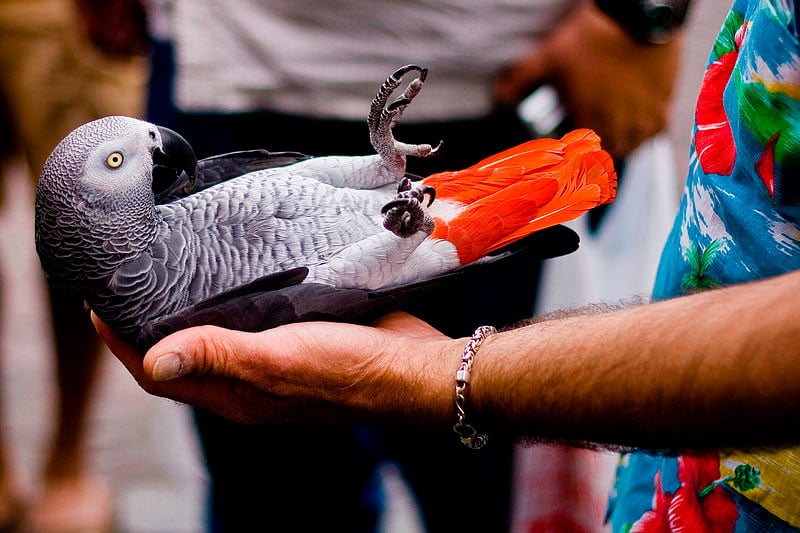
(3) – Congo African Grey Parrot (Psittacus erithacus erithacus). Pet parrot held on a hand. By Eli Duke [CC BY-SA 2.0], via Wikimedia Commons
(4) – Young African Grey Parrot (Psittacus erithacus erithacus) at Weltvogelpark Walsrode (Walsrode Bird Park, Germany) OLAF Oliviero Riemer [CC BY-SA 3.0], via Wikimedia Commons
(5) – Loro gris do Congo. Photo taken na Illa de Arousa, Galiza By L.Miguel Sánchez Bugallo (http://commons.wikimedia.org/wiki/User:Lmbuga) [GFDL or CC-BY-SA-3.0], via Wikimedia Commons
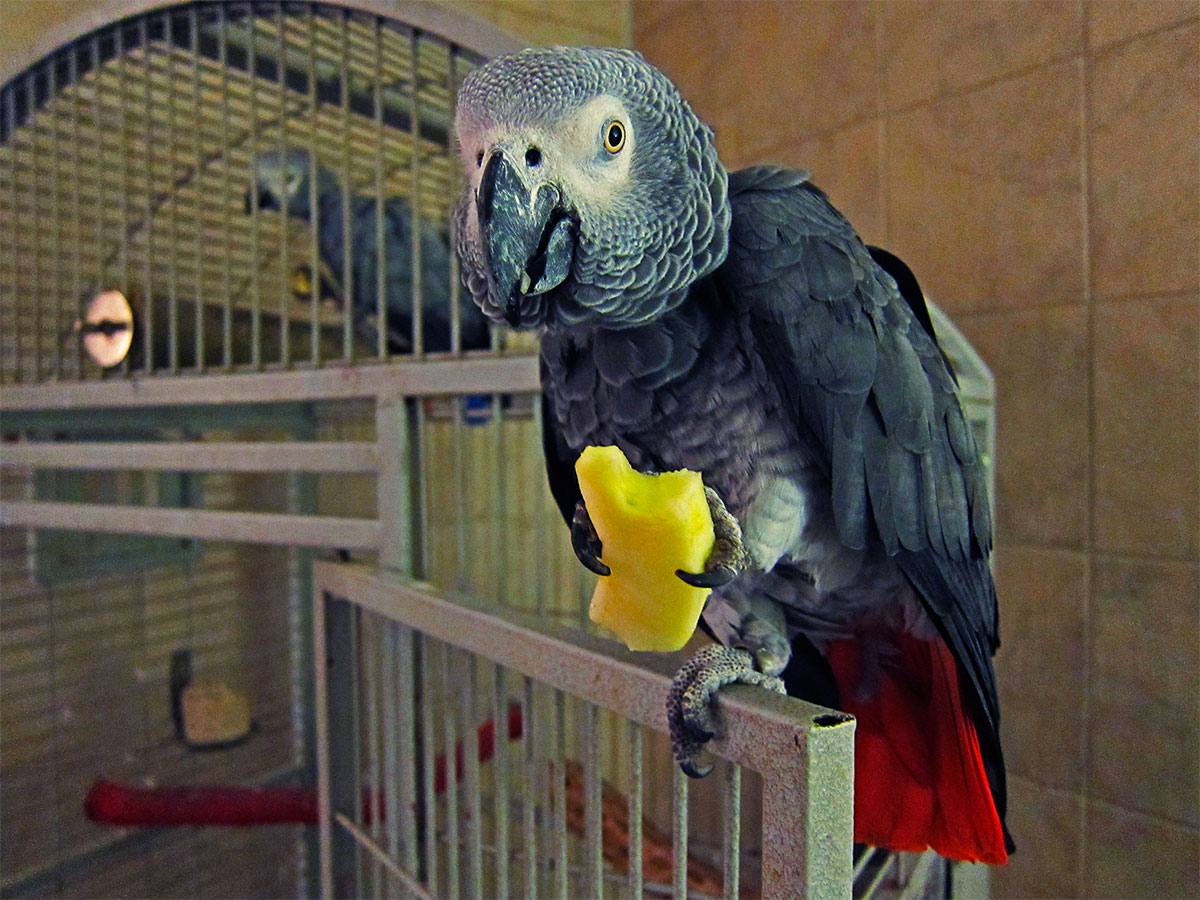
(6) – A Congo African Grey Parrot eating a piece of apple. It is perching on an open cage door and there is another parrot in the cage in the background By Peter F. (originally posted to Flickr as thanksgiving) [CC BY 2.0], via Wikimedia Commons
(7) – A pet Congo African Grey Parrot on held back By Sonny SideUp (originally posted to Flickr as Bird Tossing) [CC BY 2.0], via Wikimedia Commons
(8) – By Hans – pixabay
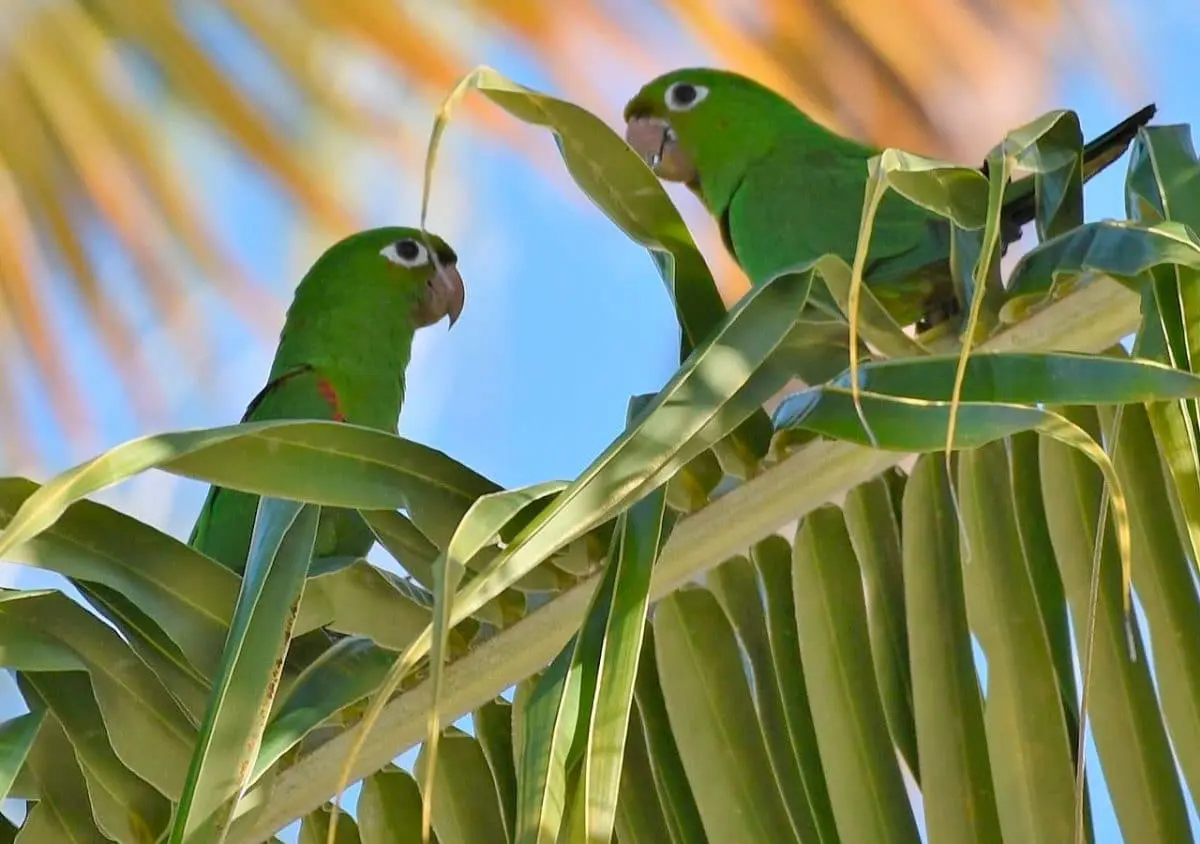
The Hispaniolan Parakeet(Psittacara chloropterus) has the head whole and both sides of the neck green grass with some scattered red feathers; the upperparts and upperwing-coverts Green with external ends of the Middle coverts red. Primary and secondary dark green with bluish-green tips on margins vane inner. The underwing-coverts yellowish brown in the flight feather, more grayish towards the tip; coverts Green except smaller and medium-sized external coverts, they are red and the primarys which are green and Red.
The underparts brighter yellowish green, usually with scattered red feathers.
Upper, the tail dark green and below, grayish brown.
The bill color horn; bare periophthalmic whitish: irises yellowish; legs grayish brown.
Both sexes similar.
The immature has less red and more green in underwing-coverts, No red on the upper surface of the bend of wing and grey at the base of the bill and on the cutting edge.
This species covers all types of natural habitats from arid lowland forests, to sheets of palmas, but obviously prefers upland forest (including the dominated by Pinus), to 3.000 meters above sea level, scarce, Perhaps because of the persecution, in the adjacent cultivated areas.
In general, observed in pairs or in small flocks, but sometimes in meetings of more than one hundred, at least in the past, When were most abundant. Discernible couples even within large flocks.
Reproduction:
They build their nests in tree cavities, including old holes made by woodpeckers, as well as in arboreal termite mounds.
The laying compose it between 3 and 5 eggs, exceptionally 7.
Food:
There are few details about the diet of the Hispaniolan Parakeet, but it is apparently similar to the fellow and and depends on local availability of fruits, seeds, nuts, outbreaks, flowers and beads; Some reported foods include Ficus figs and corn.
Distribution:
confined in Haiti and Dominican Republic, la Española, Greater Antilles. Previously in the Mona Island (Psittacara chloropterus maugei), extinct between 1892 and 1901, probably as a result of the pressure due to the hunting and, possibly, the perturbations by the explosions in the guano mine; possibly, also distributed in Puerto Rico, and its, probably, at the end of the century 19, due to loss of habitat and hunting.
In Hispaniola It is subject to a significant and continuous decrease, due to destruction of habitat, trade and persecution, especially in Haiti, where possibly is extinct.
In Dominican Republic still distributed in a few upland areas, for example, Cordillera Central.
Possibly small wild populations in Puerto Rico and Florida. A small number in captivity; the international trade small volume, probably, keep going.
(Souance, 1856) – Formerly distributed by the Mona Island and, possibly, Puerto Rico, but the last recorded specimen was in 1892. Currently extinct.
Conservation:
State of conservation ⓘ
Vulnerable ⓘ(UICN)ⓘ
• Red List category of the UICN current: Vulnerable
• Population trend: Decreasing
There is no new data on the evolution of the population; But, the species is suspected that it may be in decline, slow to moderate due to the hunting, capture and habitat loss.
Habitat loss and persecution as crop pest they are the greatest threats to this species. Is exploited for the local and international trade, Although only reported 12 individuals for international trade between 1991 and 1995 (Snyder et to the., 2000).
The number of copies of Hispaniolan Parakeet ranges between 1500 and 7000.
Conservation Actions Underway
• Appendix II of CITES.
• In the Dominican Republic, is legally protected against the hunt, but this legislation is not applied properly (Snyder et to the., 2000).
• A education strategy with community participation has been launched for the protection of this species (Vasquez et to the., 1995).
• Las interactions between this species and the Olive-throated Parakeet (Eupsittula nana), due to the recent increase in the number of the latter in the Sierra de Bahoruco [S. Latta in litt., 1998] ), they are being investigated (Anon. 2007).
• A group of volunteers for the protection of the parrot will work reforming the damaged nests. (Anon. 2007)
Conservation Actions Proposed.
• Clarify the status of the species in Haiti.
• Study ecology and reproductive success to determine the natural limiting factors.
• Comply with current legislation in the Dominican Republic.
The Hispaniolan Parakeet in captivity:
Rare in captivity and legally protected in Dominican Republic against the hunt and capture.
Alternative names:
– Hispaniolan Parakeet, Haitian Paroquet, Hispaniolan Conure, San Domingo Conure (inglés).
– Conure maîtresse, Perruche maîtresse (francés).
– Haitisittich (alemán).
– Periquito-de-hispaniola (portugués).
– Aratinga de la Española, Perico , Periquito Antillano, Periquito de la Española (español).
– Perico, Xaxavi (República Dominicana).
Avibase
Parrots of the World – Forshaw Joseph M
Parrots A Guide to the Parrots of the World – Tony Juniper & Mike Parr
Birdlife
Photos:
(1) – Haitisittich Psittacara chloropterus Aufnahme in La Romana By Martingloor (Own work) [CC BY-SA 4.0], via Wikimedia Commons
(2) – Haitisittich Psittacara chloropterus By Martingloor (Own work) [CC BY-SA 4.0], via Wikimedia Commons
(3) – Haitisittich Psittacara chloropterus Aufnahme in La Romana By Martingloor (Own work) [CC BY-SA 4.0], via Wikimedia Commons
(4) – Perico de la Hispaniola / Aratinga chloroptera by Carlos De Soto Molinari – Flickr
(5) – Perico de la Hispaniola / Aratinga chloroptera by Carlos De Soto Molinari – Flickr
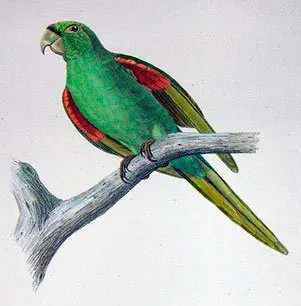
(6) – Evopsitta maugei. Illustrations from Iconographie des perroquets non figurs dans les publications de Levaillante et de M. Bourjot Evopsitta maugei = Aratinga chloroptera maugei == Psittacara chloropterus maugei By 48 hand-coloured lithographic plates by E. Blanchard and J. Daverne (pl. I-XV) or Juliot of Tours (XVI-XLVII, 79). [Public domain], via Wikimedia Commons
(7) – Psittacara euops Syn: Evopsitta euops & Psittacara chloropterus Syn: Psittacara chloropter bzw. Psittacara euops St. Domingue By Charles Emile Blanchard (1819–1900) (biodiversitylibrary.org) [Public domain], via Wikimedia Commons