â–· The world of Pets: Dogs, cats, birds, reptiles, amphibians

Ornate Lory
Trichoglossus ornatus

Lori Adornado

Content

Description

Of 25 cm.. length and 100 to 120 gr. weight.

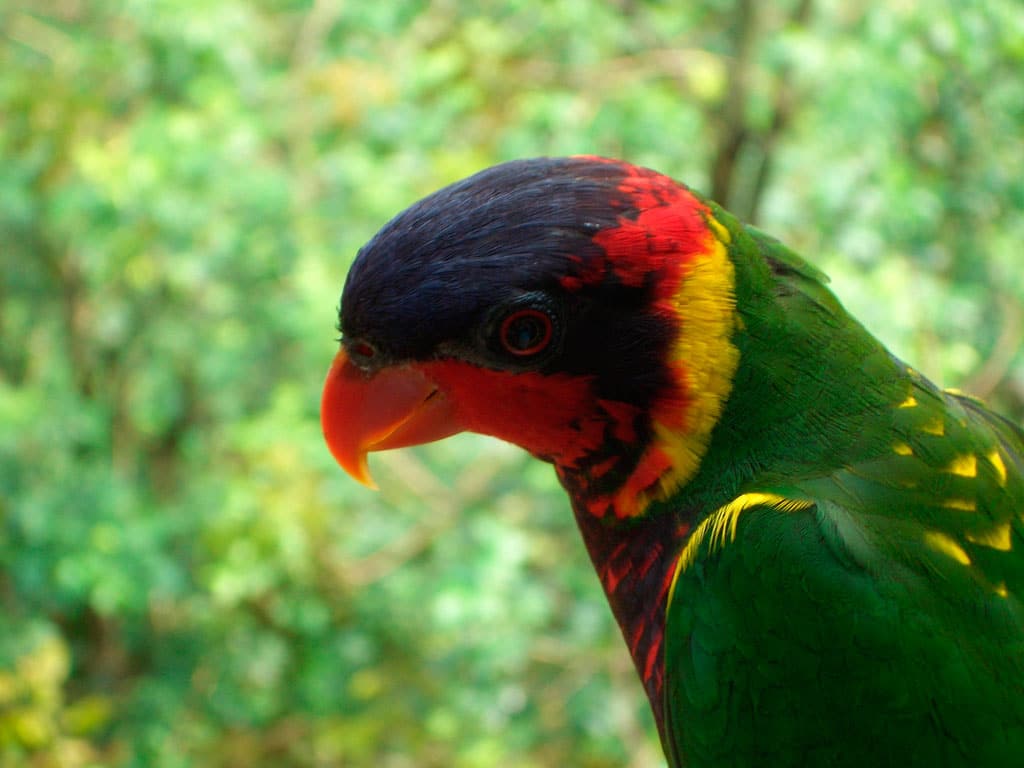
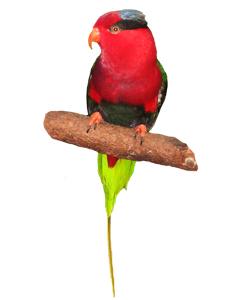
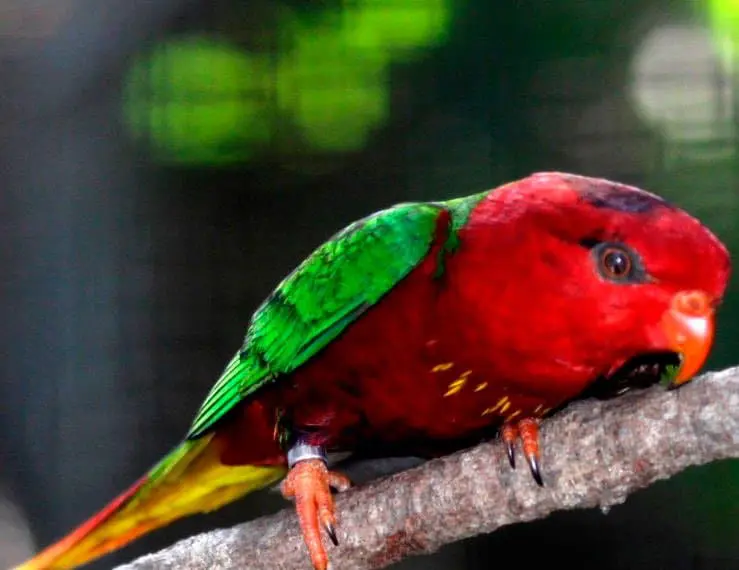
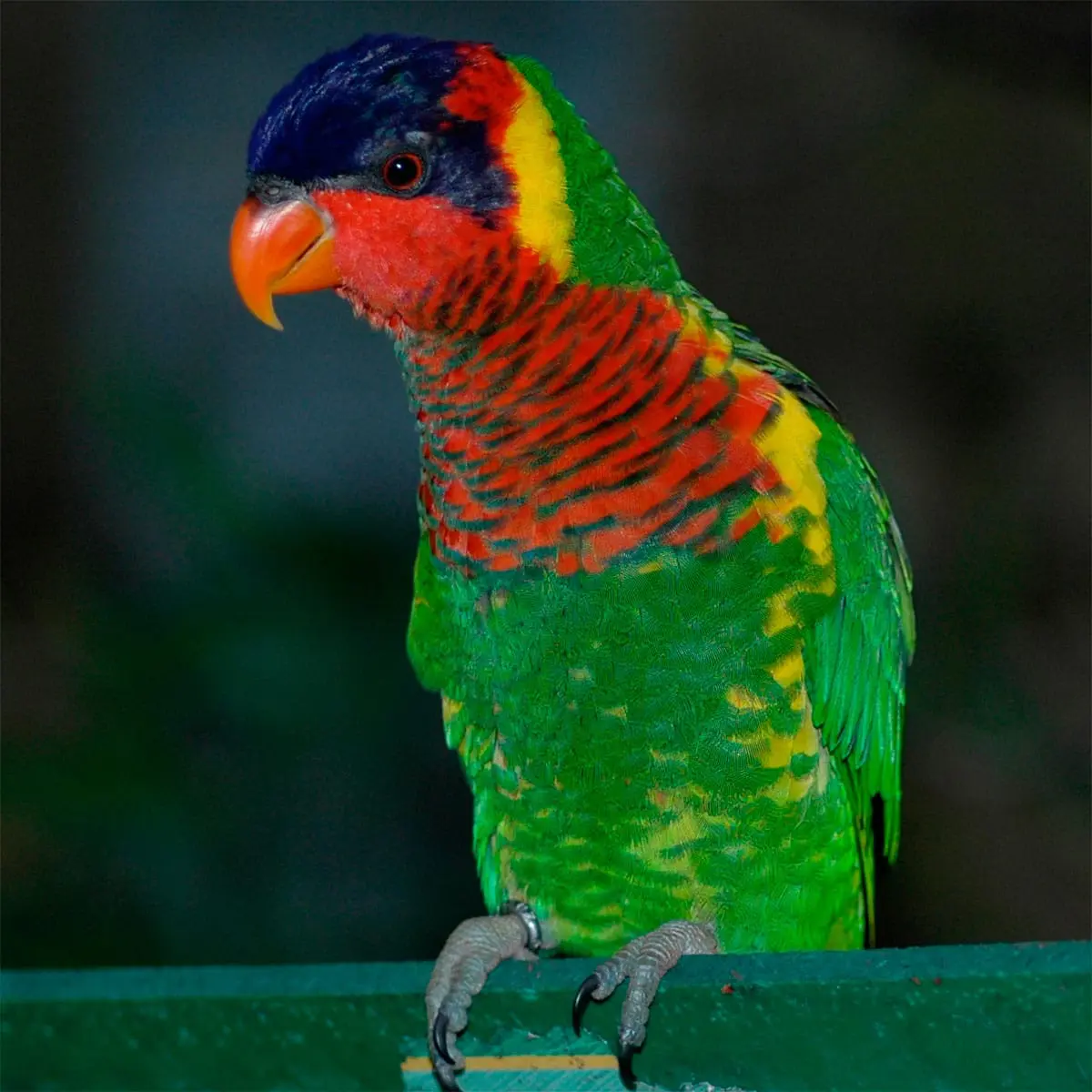
The general plumage of the Ornate Lory (Trichoglossus ornatus) is green. The front, the head and feathers that cover the ears are blue. It has a small red stripe that goes from the upper right corner of the eye to the nape of the neck, It also has a yellow stripe on the sides of the neck. The throat and chest are orange-red and in each pen has a bluish-black wide table. Underwing feathers are yellow.

The rest of the bottom is green with yellowish scales.
Belly pale green with dark green bars. Green-yellow under the tail is bright green ends. The upper part of the tail is dark green with yellow edges in outer feathers. The base of the outer tail feathers is pink.

The circle around the eyes is narrow and dark gray. The iris is red, the legs are grey and orange beaks.

Habitat:

The Ornate Lory they usually visit the swamps and marshy woodlands where there is fresh water. They are also found in the forest, the plots during the regeneration near the edges, scattered shrubs in cropland, including coconut plantations.

Usually, They appreciate the open areas and do not venture far from the primary forests.

In the North and center of the main island, These birds live from sea level up to the 1.000 meters above the sea level, While in the South, You can climb up to the 1.500 m. Its preferred habitat is between 300 and 500 m.

The Ornate Lory They mainly live in pairs or in small groups. Sometimes, when feeding in fruit trees or at the edges of the forest, are associated with the Yellow-and-green Lorikeet (Trichoglossus flavoviridis).

Benefiting from stable climate, These birds are probably sedentary.

Reproduction:

We really know very little about the reproductive habits of this species in the wild.

Most of the birds are able to breed in the months of September and October. There is no information on the construction and composition of the nest.

Spawning usually consists of 3 eggs that are incubated during 27 days. The chicks are nidicolous and depend on their parents during 80 days after hatching.

Food:

The Ornate Lory they are vegetarian birds, most of its menu is made up of nectar, pollen and fruit. When feed, these birds may concentrate in large numbers on flowering trees. The seeds of the trees of the genus Tectona and Casuarina they are also part of their diet.

Distribution:
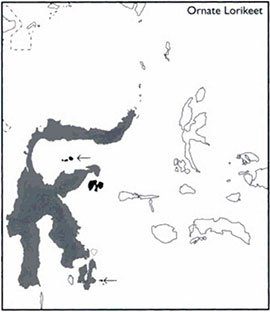
Distribution Lori adorned
This species is endemic to Indonesia , where is widespread in Sulawesi and surrounds the coast islands including Togian, Peleng, Banggai and the archipelago Tukang Besi. It has been reported that it is no longer common in parts of northern and central Sulawesi, but still seems to be common on the islands Togian and in the lowland forest in Torout (Bogani Nani NP) and to a lesser extent in Tangkoko.

Conservation:

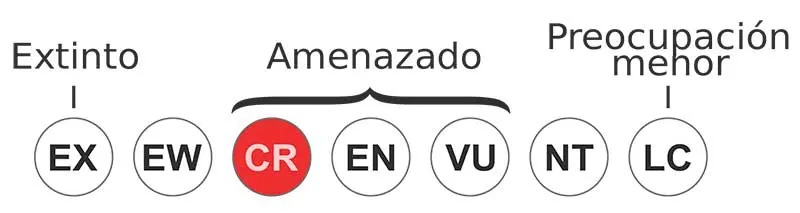
minor concern

– Current IUCN Red List category: Least concern

– The population trend: Decreasing

It has been described as common and locally very common., with a total population of over of 50.000 specimens.

The trend has not been quantified, but slow descents can be seen due to some pressure from capture, and although it does not require primary forest it is more common in the lowlands and therefore may be affected by habitat loss.

It seems that the Ornate Lory is trapped in national parks as Tangkoko and Lore Lindu, and they are commonly seen in bird markets.

"Ornate Lory" in captivity:

Due to its state of decline in its population, any specimen that can not be returned to their natural habitat (natural range) should preferably be placed in a well-managed breeding program to ensure the survival of the species.

Alternative names:

– Ornate Lorikeet, Ornate Lory (ingles).
– Loriquet orné (French).
– Schmucklori (German).
– Lóris-ornado (Portuguese).
– Lori Adornado, Tricogloso Adornado (español).

scientific classification:

– Order: Psittaciformes
– familia: Psittaculidae
– Scientific name: Trichoglossus ornatus
– Citation: (Linnaeus, 1758)
– Protonimo: parrot furniture

Images "Lori adorned":

—————————————————————————————————

«Lori adorned» » (Trichoglossus ornatus)


Sources:

– Avibase
– Oiseaux.NET

– Photos:

– Ornate Lorikeet at San Antonio Zoo, Texas, USA. by George Coller – Wikimedia
– by © 2004 Jeff Whitlock – Jacksonville Zoo
– by iggino – IBC.lynxeds.com
– Trichoglossus ornatus parrot eating banana – free-pet-wallpapers.com

– Sounds: Mike Nelson (Xeno-canto)
â–· The world of Pets: Dogs, cats, birds, reptiles, amphibians

Lilac-tailed Parrotlet
Touit batavicus

Lilac-tailed Parrotlet

Content

Description:

Lilac-tailed Parrotlet

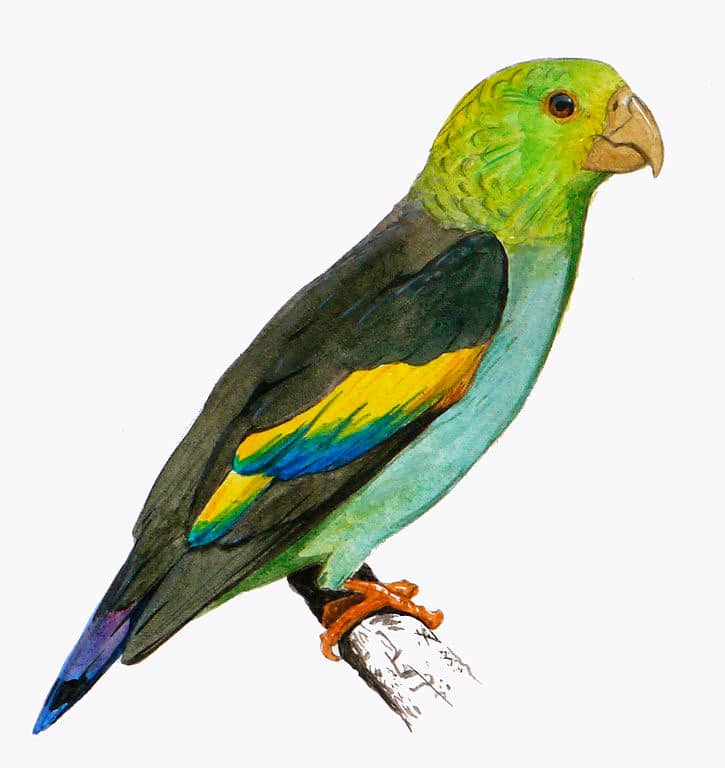
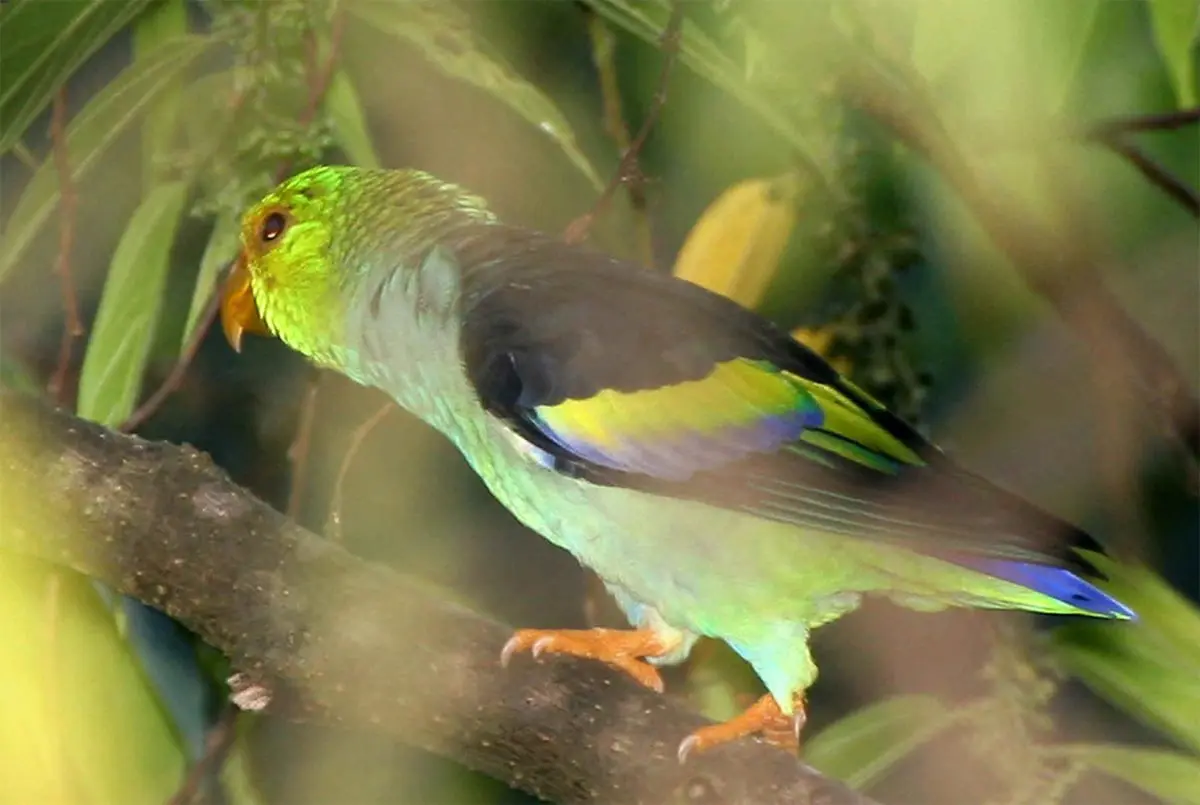
The Lilac-tailed Parrotlet (Touit batavicus) has 14 cm.. height. Usually black in it upperparts (back and wings) and green in it lower. With the crown and nape yellowish-green with black border (What gives a suspiciously aspect). The forecrown, cheeks and chin Yellow Gold, chest Azure Blue, Yellow patch in the wing , tail ends reddish purple and black subterminal edge.

Habitat:

It inhabits in forest dry and jungles cloudy between 400 and 1700 m (in Colombia).
Considered powerful flying, the sharp profile of its wings, They quickly fly over the forest canopy, in groups of 10 to 50 and they are gregarious except in the time reproductive.

It is of a forest Ave, but it can be seen near the shore of the sea in the areas where the edge of the forest close to the coast.

The calls during the flight they are soft and nasal, reaching a high tone, Buzz.

Reproduction:

It nests in hollows in trees or in arboreal termite holes, between the months of February and March. It is thought that it has migratory movements.

Food:

Its diet is composed of flowers, nectar, fruit, outbreaks, berries and seeds.

Distribution:

Size of the area of distribution (reproduction / resident): 330.000 km2

Can be found from the North of Venezuela According to the East up to Guyana, Suriname, French Guiana and in Trinidad and Tobago.

Conservation:

State of conservation ⓘ


minor concern Minor Concern ⓘ (UICN)ⓘ

• Current category of the Red List of the UICN: Least concern.
• Population trend: Decreasing.

Justification of the population

The size of the world population It has not been quantified, but this species is described as «quite common» (Stotz et to the., 1996).

Justification of trend

They suspect that this species has lost a 8,2-8,4% of habitat suitable within their distribution during three generations (15 years) based on a model of Amazon deforestation (Soares-Filho et to the., 2006, Bird et to the., 2011). Given the susceptibility of the species to the hunting or the capture, It is suspected that will decrease in <25% during three generations.

"Lilac-tailed Parrotlet " in captivity:

It's hard to keep alive captivity, refuses food during the acclimatization period. Deaths occur for this reason and the unbalanced diet.

Images of the "Lilac-tailed Parrotlet "

Videos:

Alternative names:

– Lilac-tailed Parrotlet, Black-winged Parrot, Lilac tailed Parrotlet, Scopoli’s Parrot, Seven-colored Parrot, Seven-colored Parrotlet, Seven-coloured Parrot, Seven-coloured Parrotlet (English).
– Toui à sept couleurs (French).
– Siebenfarbenpapagei, Siebenfarben-Papagei (German).
– Lilac-tailed Parrotlet (Portuguese).
– Cotorrita Sietecolores, Lorito de Siete Colores (español).


scientific classification:

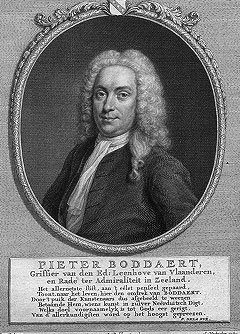
Pieter Boddaert
Pieter Boddaert

– Order: Psittaciformes
– Family: Psittacidae
– Genus: Touit
– Scientific name: Touit batavicus
– Citation: (Boddaert, 1783)
– Protonimo: Psittaca Batavica


Lilac-tailed Parrotlet (Touit batavicus)


Species of the genus Touit


Sources:

  • Avibase
  • Parrots of the World – Forshaw Joseph M
  • Parrots A Guide to the Parrots of the World – Tony Juniper & Mike Parr
  • Parrot Book, Parrots and macaws Neotropical

Photos:

(1) – birdsoftt
(2) – Lilac-tailed Parrotlet. Watercolor, Romain Risso By Gossipguy (Own work) [CC BY-SA 3.0], via Wikimedia Commons

â–· The world of Pets: Dogs, cats, birds, reptiles, amphibians

Bismarck hanging parrot
Loriculus tener


Bismarck hanging parrot

Content

Description

Measured around 10 cm.. length and approximately 12 g. of weight.

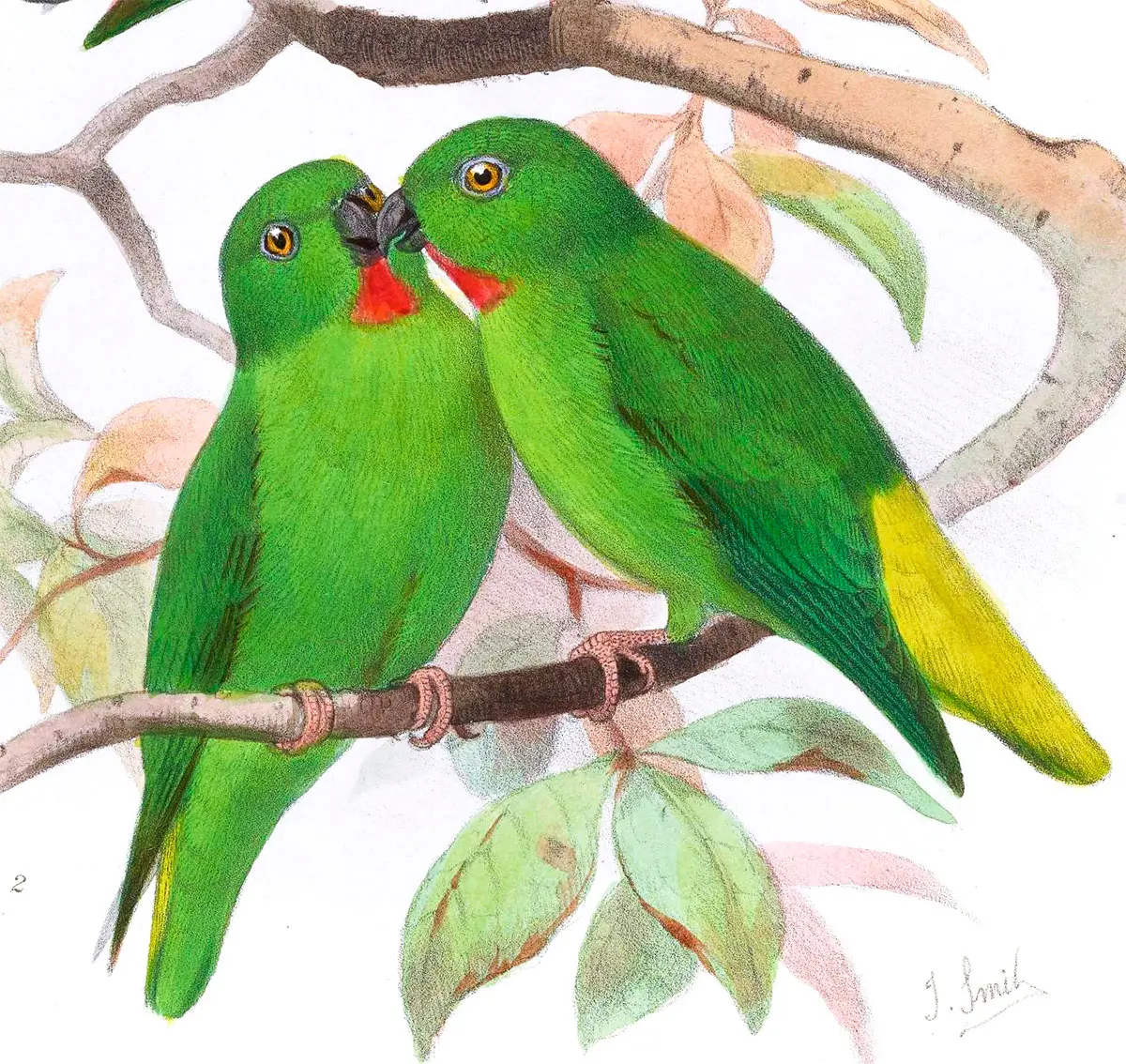
The head of the Bismarck hanging parrot (Loriculus tener)(Loriculus tener) is green. Upperparts Green except for the rump and upper coverts of the tail that are yellowish-green. The wings they are green with vane internal darker towards the flight feather.

Under, the wings blue with Feather coverts green. Chin red orange; rest of the underparts green. Upper, the tail green, pale blue view from below.

The bill black; irises yellowish white; legs yellowish brown.

The female have the front part of the crown and face blue.

The young birds they lack the orange patch of the throat and your bill is pale-brown.

Habitat:

A species very little known. Has been recorded along of the edge of forests and partially cleared from the lowlands up to the low hills areas.

Reproduction:

There is practically no information. Only a nest found, in the stump of one areca palm.

Food:

There is practically no information, but it is suspected that they feed on flowers and small fruit, usually, alone or in pairs, and often hung upside down.

Distribution:

Size of the area of distribution (reproduction / resident): 26.300 km2

Endemic to the Islands in the Bismarck Archipelago, registered in New Britain, New Ireland, Duke of York and New Hanover.

Conservation:


Near-threatened


• Current IUCN Red List category: Near threatened

• Population trend: Decreasing

This little known species is classified as Near-threatened, Since it is believed that it has a moderately low population that is limited to the lower forests. These areas are developing rapidly in oil palm plantations and therefore the population is undoubtedly decreasing.

In New England, clearing of lowland forests for conversion to oil palm plantations has been intense in recent decades.

The population size is between the 10.000 and 19.999 mature individuals.

"Bismarck hanging parrot" in captivity:

Usually they are not in captivity.

Alternative names:

– Green-fronted Hanging Parrot, Bismarck Hanging Parrot, Bismarck Hanging-parrot, Green fronted Hanging Parrot, Green-fronted Hanging-Parrot (ingles).
– Coryllis des Bismarck, Coryllis à front vert, Coryllis des Bismark (French).
– Bismarckpapageichen, Goldstirnpapageichen, Zartpapageichen (German).
– Lorículo de las Bismarck (español).

scientific classification:

– Order: Psittaciformes
– Family: Psittaculidae
– Genus: Loriculus
– Scientific name: Loriculus tener
– Citation: Sclater,PL, 1877
– Protonimo: Loriculus tener

Images «Bismarck's Parrot»:

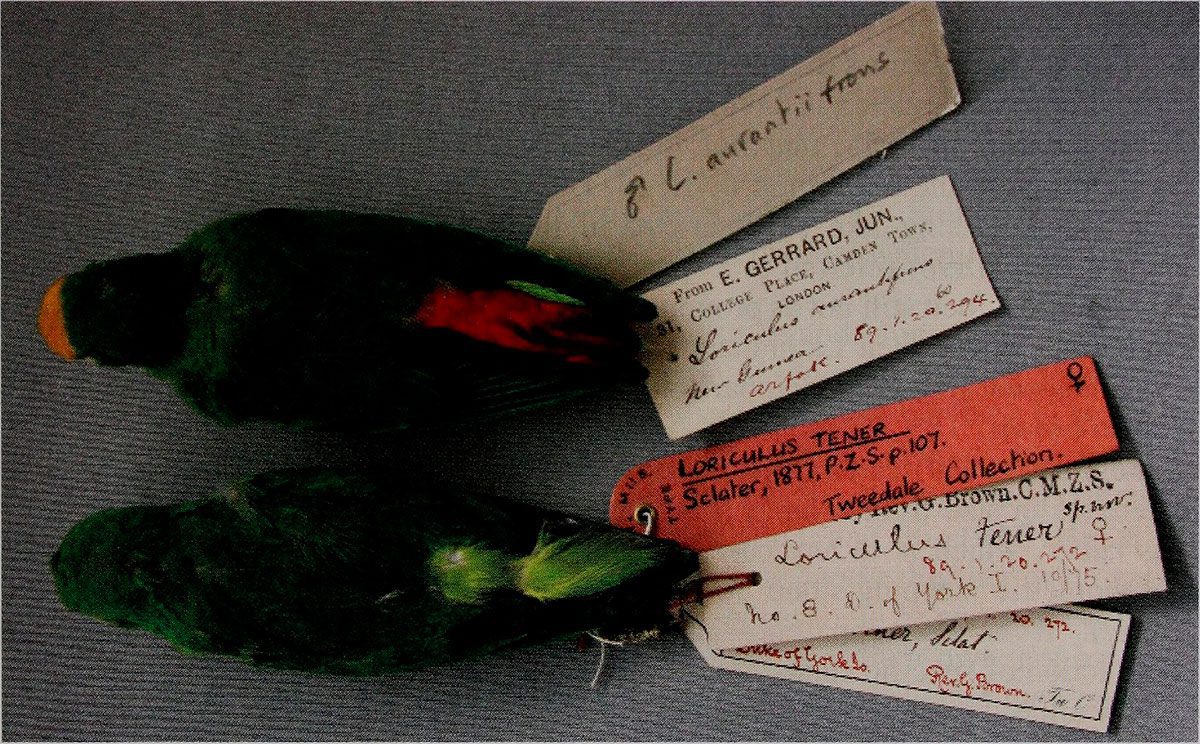
Loriculus tener. Image from page 18 of "Bulletin of the British Ornithologists' Club" (2007) - (N. J. Collar © Natural History Museum)
Loriculus tener. Image from page 18 of «Bulletin of the British Ornithologists’ Club» (2007) – (N. J. Collar © Natural History Museum)

————————————————————————————————

"Bismarck's Parrot" (Loriculus tener)


Sources:

– Avibase
– Parrots of the World – Forshaw Joseph M
– Parrots A Guide to the Parrots of the World – Tony Juniper & Mike Parr
– Birdlife

– Photos:

(1) – «Loriculus tener Smit» by Joseph Smit – Ornithological Miscellany. Volume 2. Licensed under Public Domain via Wikimedia Commons – http://Commons.wikimedia.org/wiki/file:Loriculus_tener_smit.jpg#mediaviewer/file:Loriculus_tener_smit.jpg

â–· The world of Pets: Dogs, cats, birds, reptiles, amphibians

Orange-billed Lorikeet
Neopsittacus pullicauda

Orange-billed Lorikeet

Content

Description

18 cm.. length and a weight between 28 and 40 g..

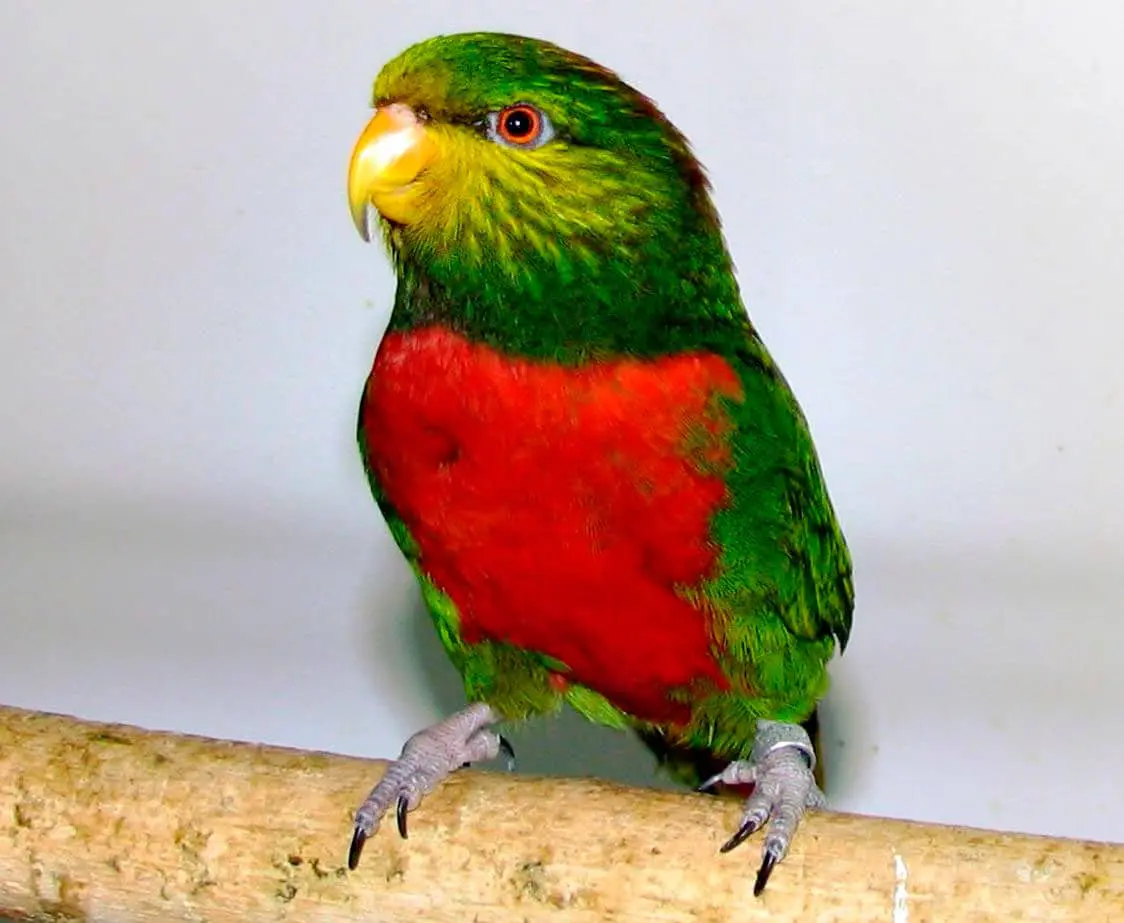
The head of the Orange-billed Lorikeet (Neopsittacus pullicauda) is green, the nape lightly brown tinged with yellow stripes; ear-coverts dark green, showing some streaks of greenish-yellow; chin dark green. Upperparts green. The wings, at the top, green, with vane internal to coverts blackish. Under the wings, the coats red; flight feather Blackish with wide red central stripe. Throat green; top of the chest, Scarlet Red, extending to the belly and ending above the the thighs; flanks green; undertail-coverts brighter yellowish green. Uppertail green; retrizes penas lower color olive brown, marked in red in vane inner.

Bill orange red: irises red; legs grey.

The sexes alike.

Immature more off than adults with much less red (or orange) on the chest and a Brown peak.

Subspecies description

  • Neopsittacus pullicauda pullicauda

    The nominal.


  • Neopsittacus pullicauda alpinus

    It differs from the nominal by the chest Orange which contrasts with the Red of the belly and upperparts darker.


  • Neopsittacus pullicauda socialis

    Similar to the nominal, but darker and showing less Brown at the nape.

Habitat:

Lives in the forests of MOSS and areas surrounding partially cleared, mainly between 2.100 and 3.800 m, with a limit not below 1,600 meters except for some occasionalLori found to 800 m. Normally found at higher altitudes than the Yellow-billed Lorikeet, but there is considerable overlap in lower altitudes to 2.500 m. where the two meet, often feeding in friendly company.

Pretty common and often found in pairs, small groups or groups of up to 30 birds in the trees in flower.

Travel in noisy groups, and it can fly very high above the canopy to and from the feeding areas. Not only feeds in the canopy, but also at low altitude of plants and even at the lowest levels near the ground. Assets and meek.

Reproduction:

Habits of nesting not described, Although it is said that they nest in holes of tall trees and lay two eggs. A male in breeding conditions was observed in October.

Food:

It feeds on pollen, nectar, flowers, fruits and seeds, Although he believes that they are less dependent on seeds as part regular your diet than the Yellow-billed Lorikeet.

Distribution:

Size of the area of distribution (reproduction / resident): 113.000 km2

New Guinea in Irian Jaya (Indonesian) and Papua New Guineto. The range runs from the East of Snow Mountains far reaches the Huon Peninsula e intervals to the Southeast. A small number of captivity.

Subspecies distribution:

  • Neopsittacus pullicauda pullicauda

    The nominal.


  • Neopsittacus pullicauda alpinus

    Snow Mountains, Irian Jaya, to the East with the upper region of the fly river, West of Papua New Guinea


  • >Neopsittacus pullicauda socialis

    Herzog mountains and mountains of the Huon Peninsula, North of Papua New Guinea.

Conservation:


minor concern


• Current IUCN Red List category: Least concern.

• Population trend: Stable.


The world population It has not been quantified, Although it is thought that it may be superior to the 30.000 birds. The species according to sources is common (pit et to the. 1997).

The population suspected to be stable in the absence of evidence of any reduction or substantial threats.


"Orange-billed Lorikeet" in captivity:

Uncommon in captivity.

Shy until getting used to the owner, It is best in coexistence with other loris, playful, they need stimulation to avoid boredom. You can learn to imitate. They are messy due to liquid diet.

Alternative names:

– Orange-billed Lorikeet, Emerald Lorikeet, Orange billed Lorikeet, Orange-billed Mountain Lory (ingles).
– Lori émeraude, Lori éméraude (French).
– Orangeschnabel-Berglori, Orangeschnabelberglori (German).
– Lori Montano Chico, Lori Moteado Chico (español).

scientific classification:

– Order: Psittaciformes
– Family: Psittaculidae
– Genus: Neopsittacus
– Scientific name: Neopsittacus pullicauda
– Citation: Hartert, 1896
– Protonimo: Neopsittacus pullicauda

«Lori Montano Chico» images:

Videos "Orange-billed Lorikeet"

————————————————————————————————

«Lori Montano Chico» (Neopsittacus pullicauda)


Sources:

– Avibase
– Parrots of the World – Forshaw Joseph M
– Parrots A Guide to the Parrots of the World – Tony Juniper & Mike Parr
– Birdlife

– Photos:

(1) – Birds-pet-wallpapers – link
(2) – Birds-pet-wallpapers – link
(3) – Author iggino – lynx
(4) – Animal Photos – link
(5) – Animal Photos – link

– Sounds: Hans Matheve (Xeno-canto)
â–· The world of Pets: Dogs, cats, birds, reptiles, amphibians

Papuan Lorikeet
Charmosyna papou

Papuan Lorikeet

Content

Papuan Lorikeet

Description

25 cm.. length and a weight between 90 and 115 g..

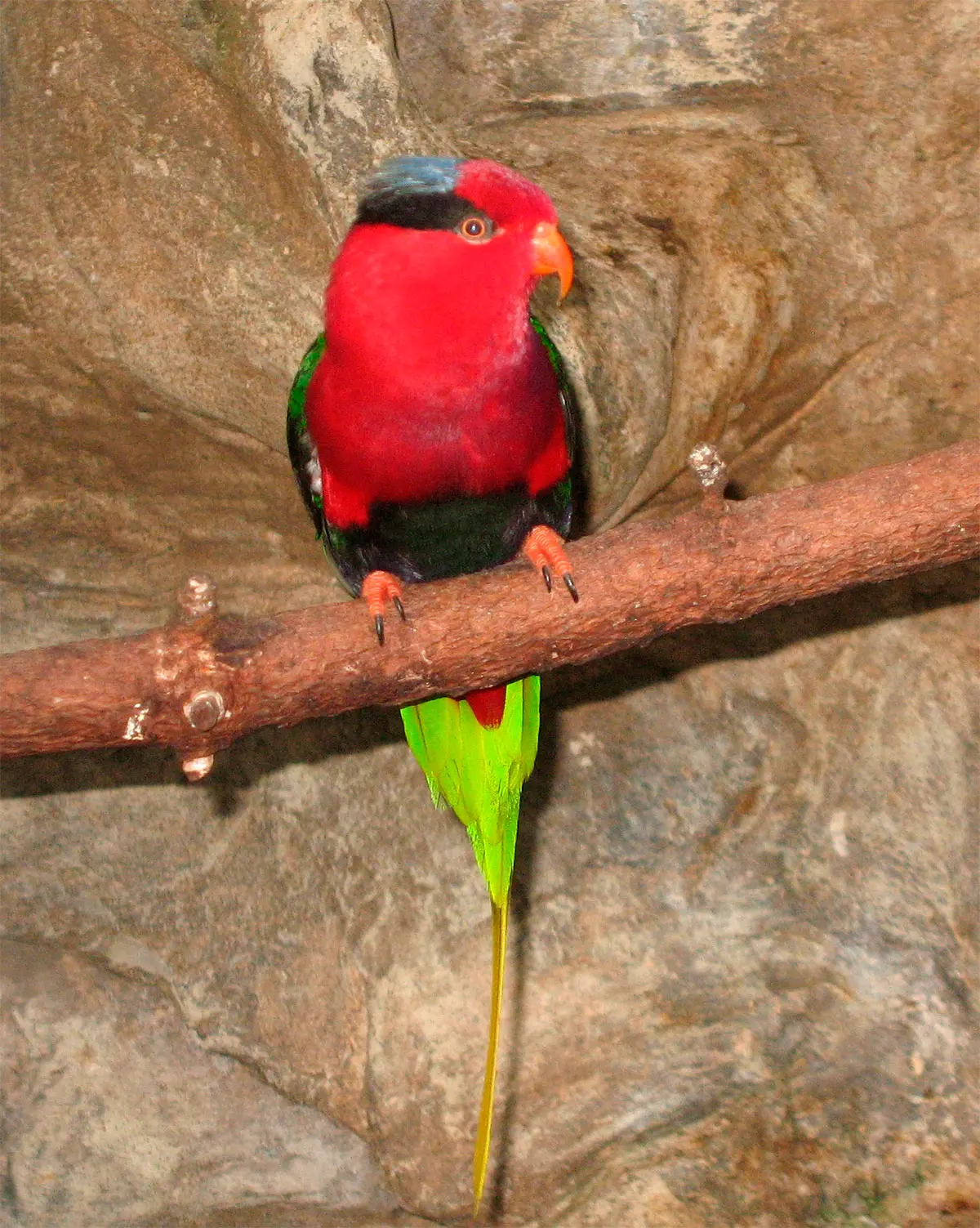
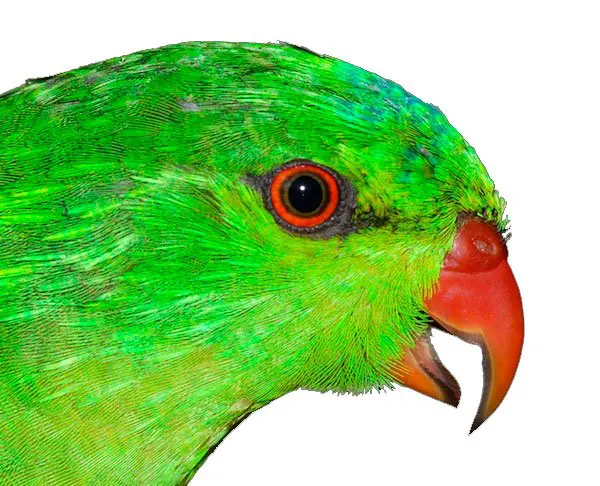
The head of the Papuan Lorikeet (Charmosyna papou) It is red with a black patch on the back of the crown and a crescent-shaped mark on the nape; patch in the crown with mottled blue extends to the top of the eyes.

Under the nape a red uniform coat; centre of back Dark emerald green; under the back bright red; rump light blue. Wings Emerald green with vane internal black; undertail, the flight feather grey with coats red; coverts marginal green. Throat red, darker than the upper part of the chest and a little more off: lower chest Red clear with a variable black patch in the center of the belly, Sometimes it extends over them the thighs; the sides of chest and flanks with two obvious yellow stripe sets; bottom of the belly and coverts of the tail, red. View from the top, the tail is green and yellow is your long tip, the axis of the Central feathers is of dark brown; below, the tail is yellow, finished in Orange at its end.

The bill orange; Orange the irises; Orange and the legs.

In the nominal species, both sexes are equal.

Immature more turned off than adults. A band yellow variables at the bottom of the secondaries; rump with mottled Green; Naranja-Pardo the bill and legs; irises pale yellow.

Description 4 subspecies

  • Charmosyna papou papou

    (Scopoli, 1786) The nominal.


  • Charmosyna papou goliathina

    (Rothschild & Hartert, 1911) With sexual dimorphism and two different colors. The normal morph is similar to the subspecies Stellae, but differentiated by the yellow at the tip of the tail (non-fusion Orange to yellow). The coverts of the tail they are longer, in color purple blue, not red as in the stellae. As in the subspecies stellae, This subspecies has melanism, the upperparts is green, and underparts blue-black in their entirety. Head and the mantle, only broken by the blue of the stripes in the nape; Red in the coverts of the back and bottom of the tail. The wings are green. The tail seen from below it is more yellow-green in color than in normal morphology, and streamers they are fused opaque to verdoso-amarillo down Green.


  • Charmosyna papou wahnesi

    (Rothschild, 1906) Similar to the subspecies goliathina, but the Red of the part superior of the chest It is bordered below with a narrow yellow band. Does not have a green-washing in the flanks and abdomen top. The belly Central and tail coverts are red.


  • Charmosyna papou stellae

    (Meyer,AB, 1886) This species has sexual dimorphism and also has a melanism (excess of dark pigmentation). In comparison with the nominal, the black patch has much more extensive of the nape, blue-violet striped; This black patch replaces the two areas of black in the crown and in the nape of the speciesnominal. The streamers of the tail They also differ, merging from green to orange red (instead of green to Orange) and finally to yellow on the tips. The subspecies stellae also lacks of the chest yellow and stripes on the flanks that if you have the Papou, as well as his black patch on the belly that extends to the flanks.

    The females They show a visible patch of yellow on the lower of the back Green-tipped on the longest feathers, and coverts of the tail red (male shows red with blue on the patch of the rump). The Red of the part superior of the chest seems more uniform. In the metamorphosis by melanism the Red is largely replaced by black (see goliathina).

    The young birds with dark and thin stripes on the underparts.

Habitat:

Have been recorded at an approximate height of 1.200 meters above a row of trees and also to the 3.500 m, although the most common is to see them above the 2.000 meters and rare to see them below the 1.500 m; found by Forshaw in the forest of Nothofagus and Podocarpus to 2.800 m.

A species active and agile you are often found in pairs or in small groups. The birds move through the trees with jerky movements, often waving his serpentine tail, However, It can be very discreet between the tops of the trees.

Observed in Scheffleras, often in the company of other species, with the same food taste, as the Yellow-billed Lorikeet (Neopsittacus musschenbroekii). Seen often making passes above the trees or half-height, among the plants through the clear.

Reproduction:

The nesting in nature it is not described, but Pratt observed an adult tracing branches above and below a large group of epiphytes , Perhaps in search of a nesting site. A pair in breeding conditions was also observed in late August., and young people have been in nature during October and November. In captivity, the implementation has been two eggs, lasting about three weeks of incubation and the young remain in the nest for about two months.

Food:

Feeds on flowering trees or flowers of the epiphytes, nectar, pollen, fruits and small seeds. Larvae of insects occasionally.

Distribution:

Intervals in the center of New Guinea in Irian Java (Indonesian) and Papua New Guinea, in where are distributed from the southeast of Vogelkop towards the Adelbert range, Huon Peninsula and intervals in the Southeast.

Distribution 4 subspecies:

Conservation:


minor concern


• Current IUCN Red List category: Least concern.

• Population trend: Stable.

The world population It has not been quantified, Although that it is more thought of 500.000 specimens. The species appears to be quite common throughout its area of distribution (pit et to the ., 1997).

The hunting of this species for the use of their feathers as tribal headdresses and capture for the bird trade do not believe today that can affect the size of the population.

It is suspected that the population is stable in the absence of evidence of any reduction or other substantial threat.

"Papuan Lorikeet" in captivity:

Coupled pairs will defend their territory vigorously. Individual birds active and playful; they require a cage as big as possible. May be a bit uncomfortable due to liquid diet.

Son rare in captivity.

Alternative names:

– Papuan Lorikeet, Fairy Lorikeet, Fairy Lory, Papuan Lory, Stella’s Lorikeet (ingles).
– Lori papou, Lori de Stella (French).
– Papualori (German).
– Lori de Cola Larga, Lori Rabilargo (español).

scientific classification:

– Order: Psittaciformes
– Family: Psittaculidae
– Genus: Charmosyna
– Scientific name: Charmosyna papou
– Citation: (Scopoli, 1786)
– Protonimo: Psittacus Papou

Images «Lori Long-tailed»:

Videos "Papuan Lorikeet"

————————————————————————————————

"Lori Rabilargo" (Charmosyna papou)


Sources:

– Avibase
– Parrots of the World – Forshaw Joseph M
– Parrots A Guide to the Parrots of the World – Tony Juniper & Mike Parr
– Birdlife

– Photos:

1 – (1) «Charmosyna papou goliathina1» by dragus – Own work. Licensed under Public Domain via Wikimedia Commons.
2 – (2) «Stellas Lory 2» by Ltshears – Own work. Licensed under CC BY-SA 3.0 via Wikimedia Commons.
3 – (3) «Charmosyna papou-Fort Worth Zoo-8" for Philip Shoffner – originally posted to Flickr as Dsc_0120. Licenciado sob CC BY 2.0 via Wikimedia Commons.
4 – (4) Charmosyna papou goliathina by Zdenek Chalupa – biolib.cz
5 – (5) Charmosyna papou goliathina – Birds-pet-wallpapers
6 – (6) Charmosyna papou goliathina By Elaine Radford (ilustración) – rightpet.com

– Sounds: Andrew Spencer (Xeno-canto)

â–· The world of Pets: Dogs, cats, birds, reptiles, amphibians

Fairy Lorikeet
Charmosyna pulchella


Fairy Lorikeet

Content

Description

18 cm.. length and a weight between 24 and 34 g..

The head of the Fairy Lorikeet (Charmosyna pulchella) is dark red with the back of the crown Black extending from above and behind the eyes up to the nape. Mantle Green with a black area below the nape and collar of color red dark at the height of the shoulders; under the back It shows a patch of dark violet interspersed with some green feathers on the ends; rump and tail coverts view from above of color green.

Wings Green with extremes of color black in them flight feather and in the internal parts of the coats. below the wings Red with coverts marginal green; flight feather blackish.

The underparts Red with stripes of pale yellow in the center of the chest, the thighs purple with yellow stripes. The tail view from the top of green at the top with a black shaft in the Center and the rest of red and yellow at the tip; view from below, the tail is yellow, bathed in red and green ends.

The bill is orange with gray tip; irises yellow red; legs oranges.

The female shows a color green beige, not red, on the sides and a yellow patch in the flanks that extends to the sides of the rump.

The female of the subspecies Rothschildi also shows more green in the underparts males and a green mottling on the upper part of the chest.

The Immature They show the yellow patch of the flanks more defined than the females. The lower part of the back, mainly green with some blue-violet. Top of the chest Green mottled without clearly defined yellow stripes adult. Crown Red with black patch restricted to the nape and mixed with the green of the upper mantle. Lack of the Red of the part back from neck clearly defined in adults. Yellow area at the bottom of the flight feather. Iris brown. Beak and feet grayish brown.

Subspecies description

There are two subspecies including the nominal. A third, Charmosyna pulchella beautiful, described by Devis (1900), is considered here as Charmosyna pulchella pulchella.

  • Charmosyna pulchella pulchella

    : (Gray,GR, 1859) – The nominal


  • Charmosyna pulchella rothschildi

    : (Hartert, 1930) – The patch of the crown descends to find is with them eye; Green fusion behind the yellow lines of the chest, and green fusion in the flanks and the thighs (that can also show some yellow stripes); without the Red of the neck and much less defined the violet patch in the lower part of the back.

Habitat:

Nomads. They are mainly distributed in montane forests, at the edges of forests and secondary growth forests. Its preferred habitat are the mountains between 500 and 1.800 m, but also found in lowlands up to the level of the sea and in the mountains up to 2.300 m.

Found in pairs or flocks of 15 or more members, uniting in the tops of trees in flower with others Charmosyna lorikeets, including the Josephine's Lorikeet.

Reproduction:

In captivity it nests continuously, with incubation of 25 days shared by both parents. Usually, It lays two eggs in a hole in the base of one epiphyte. In nature it is intended that nests between January and April (Pratt picked up breeding males in March).

Food:

It feeds on pollen and nectar.

Distribution:

The Fairy Lorikeet is distributed between New Guinea in Irian Java (Indonesian) and Papua New Guinea, from the East of Vogelkop to the peninsula of Huon. Owen Stanley mountains and southeastern intervals.

Subspecies distribution:

  • Charmosyna pulchella pulchella

    : The nominal


  • Charmosyna pulchella rothschildi

    : The mountains Cyclops and the slope North of the mountains on the idenburg river (Irian Java).

Conservation:


minor concern


• Current IUCN Red List category: Least concern.

• Population trend: Stable.

The world's population has not been quantified, It is thought that it surpasses the 500.000 birds. the species, according to information, is abundant in some areas, but few in others due to the trade (pit et to the., 1997). Suspected that the population is stable in the absence of evidence of any reduction or substantial threats.

"Fairy Lorikeet" in captivity:

A small number of captivity.

Alternative names:

– Fairy Lorikeet, Little Red Lorikeet, Little Red Lory (ingles).
– Lori féérique, Lori à croupion noir, Lori féerique, Loriquet à croupion noir (French).
– Goldstrichellori (German).
– Lori Lindo (español).

scientific classification:

– Order: Psittaciformes
– Family: Psittaculidae
– Scientific name: Charmosyna pulchella
– Citation: Gray,GR, 1859
– Protonimo: Charmosyna pulchella

«Cute Lori» Images:

————————————————————————————————

«Lori Lindo» (Charmosyna pulchella)


Sources:

– Avibase
– Parrots of the World – Forshaw Joseph M
– Parrots A Guide to the Parrots of the World – Tony Juniper & Mike Parr
– Birdlife

– Photos:

1 – animalphotos.me
2 – by W. Voit – koppiekrauw
3 – animalphotos.me
4 – Author iggino in Vogelpark Walsrode, Walsrode, Lower Saxony, Germany – lynx
5 – in Neues vom Loro-Parque – koelle-zoo

â–· The world of Pets: Dogs, cats, birds, reptiles, amphibians

Red-throated Lorikeet
Charmosyna amabilis

Red-throated Lorikeet

Content

Description

18 cm.. length.

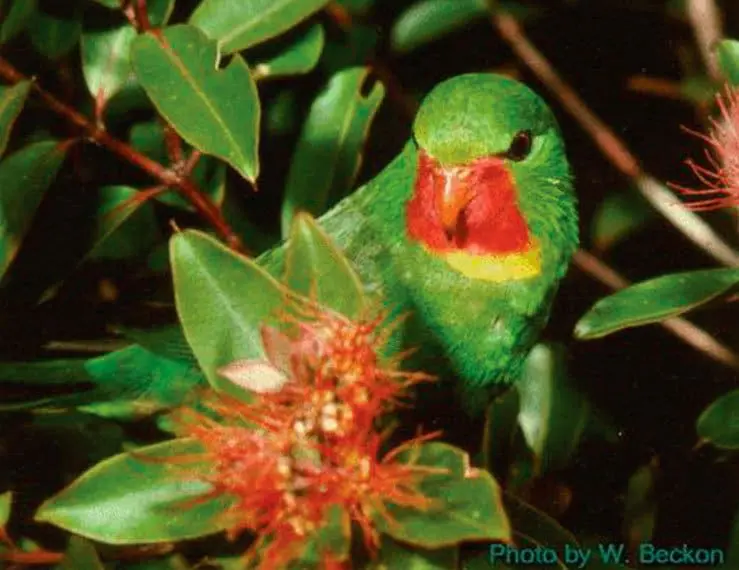
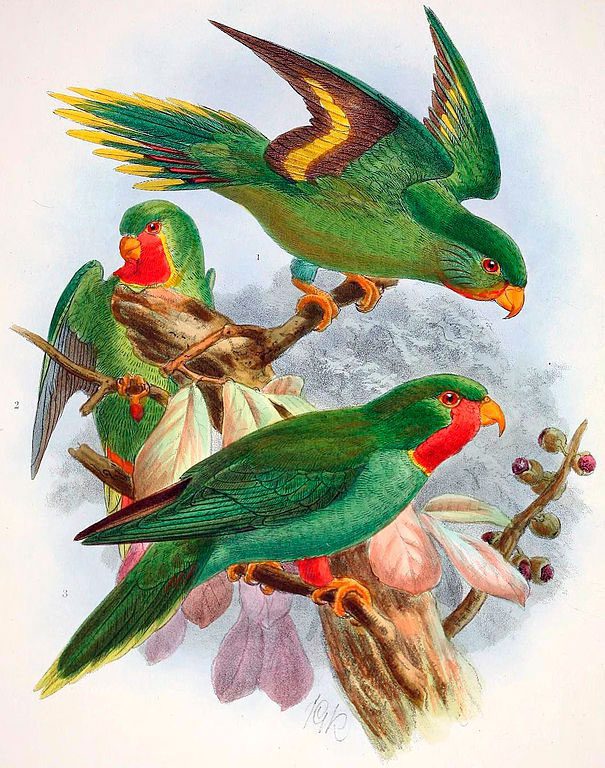
The head of the Red-throated Lorikeet (Charmosyna amabilis) is green with lores and chin red. Upperparts green. Wings internal and ends with green feathers flight feather color black. Throat red, bordered below by a narrow yellow collar; rest of the underparts with a yellowish green that upperparts, particularly in the center of belly; the thighs red. The tail above green a little darker than the rump, with yellow ends; undertail yellow. Bill orange; irises yellow; legs orange-red.

Male and female are equal.

Immature generally duller. The the thighs dull purple. The yellow band throat much weaker than in adults and the red facial and marks throat more restricted.

Habitat:

Move by tropical forests, mainly over the 500 m. Son nomads and fly in pairs or small flocks of 5-8 birds in search of flowering trees, uniting to feed on flowers, nectar and pollen. They prefer to feed in the canopy, and although it is apparently ejected away from the areas of power by the aggressive Collared Lory, Holyoak He found two species feeding on the same tree during his remarks in 1973.

Reproduction:

Breeding and nesting habits unknown.

Food:

They feed actively, to often hung upside down to get to flores.

Distribution:

Size of the area of distribution (reproduction / resident): 37.100 km2

endemic to the Fiji Islands where it is rare and usually only moves above 500 meters and below 1.000 m. Is distributed between in Viti Levu, Ovalau (where it may now be extinct), Vanua Levu and Taveuni. In 1973 Holyoak found at a Red-throated Lorikeet on a wooded Ridge around 250 metres in Viti Levu, species you saw or heard on five different days while exploring Taveuni thinking that the species was widespread in the rainy forests at an altitude between 550 and 1,000 m. The species was also recorded in rainforests between 120 meters and 980 feet by Martyn L. Gorman (1975), but it is said that they are rare. These records are among the few documented sightings of this century. The world's population is believed to be of less than 10.000 specimens. Despite its apparent rarity, This species may be overlooked due to their unobtrusive plumage and behavior.

Conservation:


critical hazard


• Current IUCN Red List category: Critical Hazard

• Population trend: Decreasing

Threats to the lowlands and hills of the forest is slowly being erased much of Fiji. But, the rarity and assumed decline of this species is probably largely the result of predation by introduced mammals, especially Black Rat (Rattus rattus) , as it is the case with the closely related New Caledonian Lorikeet (Charmosyna diadema).

Increases in course in the logging and the expansion of the road network, especially around the Highlands of Monasavu and Serua in Viti Levu, It is likely that you have caused an increase of the density of these rats (Watling 2000, G. Dutson in litt. 2005). The Indian Brown Mongoose (Herpestes fuscus) introduced, is also present in the areas of distribution of the Red-throated Lorikeet and it can be a threat (V. Masibalavu in litt. 2012).

Agricultural expansion is encroaching on primary forest in Taveuni. Have a distribution in mountains close to the maximum altitude within its distribution area, It also makes this potentially susceptible species to climate change (BirdLife International).

Is species is protected by the laws of Fiji. In Viti Levu, dwells within the Tomaniivi nature reserve, but this is not large enough to maintain a resident population and, Despite the creation of the extension Wabu proposal to make a reservation of adequate size, this would not provide better protection against rats if the reserve is kept unmanaged (D. Watling in litt. 2000)

"Red-throated Lorikeet" in captivity:

Unknown in captivity.

Alternative names:

– Red-throated Lorikeet, Red throated Lorikeet (ingles).
– Lori à gorge rouge (French).
– Rothöschen (German).
– Lori de Garganta Roja, Lori Gorgirrojo (español).

scientific classification:

– Order: Psittaciformes
– Family: Psittaculidae
– Scientific name: Charmosyna amabilis
– Citation: (Ramsay, 1875)
– Protonimo: Trichoglossus (Glossopsitta) amabilis

————————————————————————————————

«On Gorgirro» (Charmosyna amabilis)


Sources:

– Avibase
– Parrots of the World – Forshaw Joseph M
– Parrots A Guide to the Parrots of the World – Tony Juniper & Mike Parr
– Birdlife

– Photos:

1 – (Photo by Bill Beckon, 1973)
2 – Charmosyna amabilis By Artwork by John Gerard Keulemans (1842-1912). [Public domain], via Wikimedia Commons

â–· The world of Pets: Dogs, cats, birds, reptiles, amphibians

Meek's Lorikeet
Charmosyna meeki

Content

Description

Of 16 cm.. length and a weight between 23 and 32 g..

Meek's Lorikeet

The head of the Meek's Lorikeet (Charmosyna meeki) is bright green, more yellowish in the Chin and throat, darker on crown and streaked on ear coats; patch of dark green blue above and in front of the eye. Green upper parts with fused olive through the mantle.

The wings of green at the top. Under the yellowish-green wing coverts. The yellowish green underparts, lighter in the back and more yellow from the chest to the belly. Top of tail dark green with yellow tip; the yellow bottom. Orange peak; pale red irises; legs Orange.

Both sexes are equal. Immature with the paler beak with base brown color and shorter tail.

Habitat:

Nomad. It is distributed in the humid hills and montane forests, but they have also found found in lowland coconut palms. Usually found alone or in small flocks of about of 10 to 15 birds flying through or above the forest cover. Larger groups can gather in the blooming of trees to feed on pollen and nectar. It can be associated with other parrots as the Duchess Lorikeet, Finsch's Pygmy-Parrot, Yellow-bibbed Lory and Coconut Lorikeet

Reproduction:

Information is not available.

Food:

Its diet includes pollen and nectar.

Distribution:

Endemic to the mountains of the largest islands in the Group of Solomons: Bougainville, New Georgia, Malaita, Kolombangara, Guadalcanal and in the past Santa Isabel. Moves starting from the 300 m, until the 1.700 m, but reportedly rarely in the lowlands or above 1.200 m. The world's population is believed to be below 50,000 exemplary but probably stable.

Conservation:


Near-threatened

• Current IUCN Red List category: Near threatened
• Population trend: Decreasing

The size of the world's population has not been quantified, It is believed that it is below 50,000 specimens, but the species is described as abundant at the Summit of Kolombangara.

There is still no evidence of a decline in its population, but would be threatened by any future large-scale export trade

"Meek's Lorikeet" in captivity:

They are not known to be in captivity.

Alternative names:

– Meek’s Lorikeet (ingles).
– Lori de Meek (French).
– Salomonenlori (German).
– Lori de Meek (español).

scientific classification:

– Order: Psittaciformes
– Family: Psittaculidae
– Scientific name: Charmosyna meeki
– Citation: (Rothschild & Hartert, 1901)
– Protonimo: Hypocharmosyna meeki

Lori Meek images:

————————————————————————————————

"Lori de Meek" (Charmosyna meeki)


Sources:

– Avibase
– Parrots of the World – Forshaw Joseph M
– Parrots A Guide to the Parrots of the World – Tony Juniper & Mike Parr
– Birdlife

– Sounds: Mark Todd (Xeno-canto)