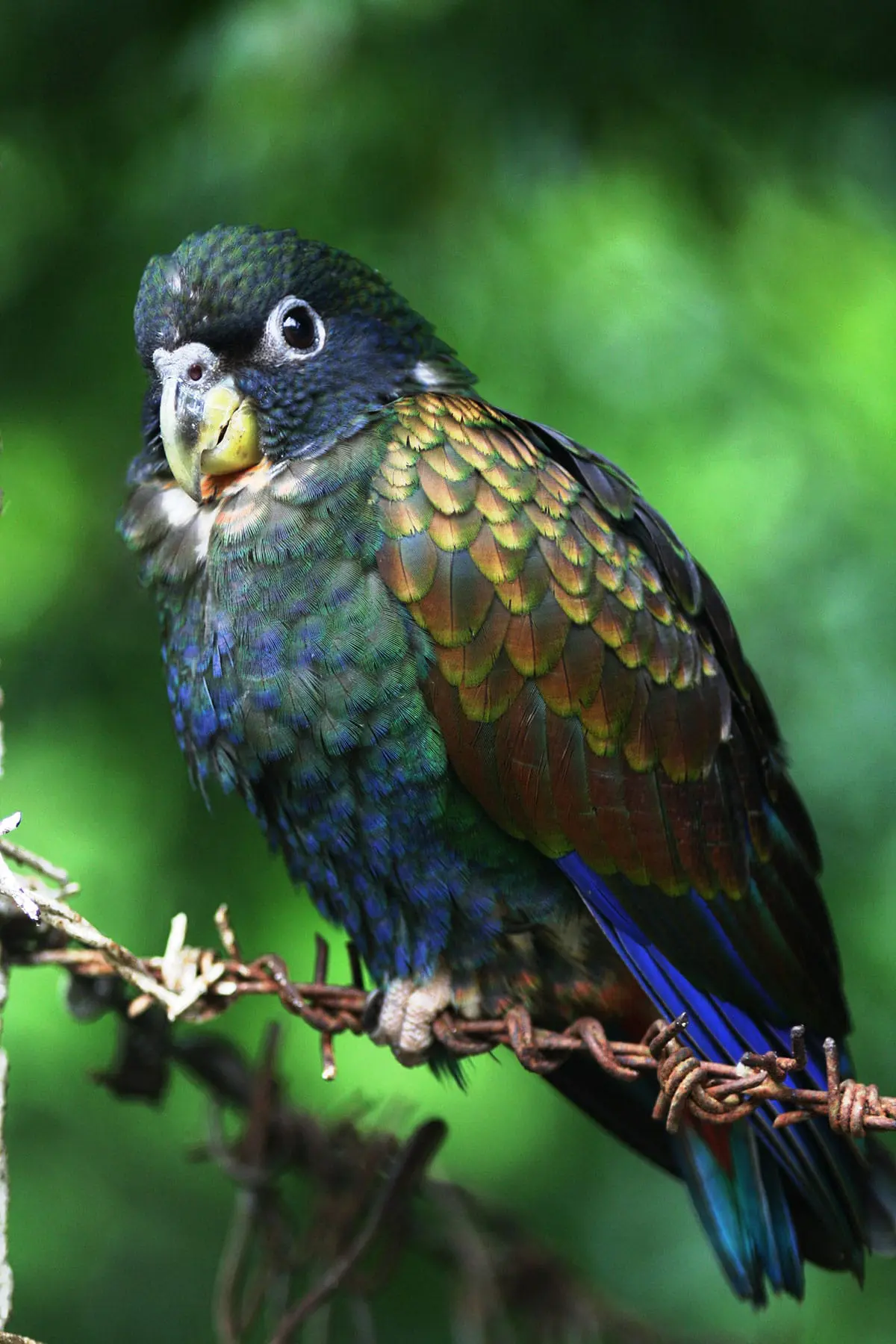
The Bronze winged Parrot(Pionus chalcopterus) has the general Brown, darker in head, neck, chest and flanks, This plumage with blue-violet edge.
The throat whitish and pink; wings bronze green.
Flight is evident violet blue at the top of the wing
the Green bottom, that contrasts with the Red of the lower abdomen. Dorsally Violet Blue is notorious in the rump, shoulder and tail. The feathers of the tail are dark blue with a shade of red at the base.
The bill is of color beige, area of naked skin surrounding the eyes of pink. The legs They are pink.
It inhabits in humid jungle, semi-humid, crops and forest edge between 120 and 2800 m.
They are birds gregarious and noisy. Every tomorrow is mobilized in flocks in search of food. Within the flocks are can observe to the couples, that form of life, and who interact with a variety of contact behaviors that reaffirm the marital bond.
Reproduction:
Prefer for their nests broken rods, hollow of logs and palm trees. They nest in the months of October-may. The female often put in two to four eggs they are incubated during three weeks approximately, after which are born them chicks naked or just covered with down. The chicks remain with their parents until the next reproductive shekel.
Food:
Will congregate in cornfields in groups up to of 40 individuals, feeding is of pulp and seeds many fruits and other material ingredients as nectar and flower petals, complementing occasionally its diet with insects.
Distribution:
Its population is distributed by the mountain range of the Andes, from Colombia, Northwest of Venezuela; to the South, by the mountains to the Northwest of Peru.
Conservation:
• Red List category of the UICN current: Least concern
• Population trend: Decreasing
The size of the population World of the Bronze winged Parrot It has not been quantified, but this species is described as ‘rare‘ (Stotz et to the., 1996).
The population was suspected of being in decline due to ongoing habitat destruction.
This species is characterized be decreasing in Colombia and West Ecuador, due to the logging of forest subtropical, which has been severe and quick on the slopes of the Andes (Juniper and Parr 1998).
The evident anecdotal, based on the frequency of sightings, suggests that the species has declined in Pineapples, South of Ecuador, in recent years c.15-20 (M. By D Sanchez. Díaz in litt. 2011). Also is says that has been extirpated from areas previously occupied as the slopes of them Andes and valleys of the Cauca and the Magdalena river in Colombia, again due to loss of habitat (Juniper and Parr 1998).
In Venezuela the species is scarce and local, limited, to a large extent, to the slope West of them Andes in Mérida and Sierra de Perija, with occasional records in Táchira (CJ Sharpe in litt. 2011). These areas have experienced rapid deforestation for at least the last few 24 years for cultivation and livestock.
Surveys conducted in the Northwest of Peru in the decade of 1990 they appeared to detect a sharp decrease in population from 1993 (Rosales et to the., 2007), although this species is known to be nomadic and its local numbers can fluctuate.
"Bronze winged Parrot" in captivity:
Rare in captivity, It is not a main target of poachers (CJ Sharpe in litt. 2011, R. Clay in litt. 2011), although it is still present in the illegal trade of Peru (F. Angle in litt. 2011)
Intelligent, playful and curious. You can be nervous, loving with your caregiver and aggressive with other people. It has a tendency to obesity.
It requires a spacious cage unless the bird pass periods of time outside of it. Not must keep is to open air where the temperatures fall below them 5 °C.
With feed a wide variety of seeds, fruits and berries.
It is a relatively healthy bird, While it may be more susceptible to infection aspergillosis that other species.
In captivity they lay two eggs the incubation takes 26 days.
Alternative names:
– Bronze winged Parrot, Bronze-winged Parrot (English).
– Pione noire, Pionus noir (French).
– Glanzflügelpapagei, Glanzflügel-Papagei (German).
– Curica-asa-de-bronze (Portuguese).
– Cotorra Oscura (Colombia).
– Cotorra Negra (Venezuela).
– Cotorra Oscura, Loro Alibronceado, Loro de Alas Bronceadas, Cheja alibronceada (español).
46 to 51 cm.. height and between 400 and 500 g. of weight.
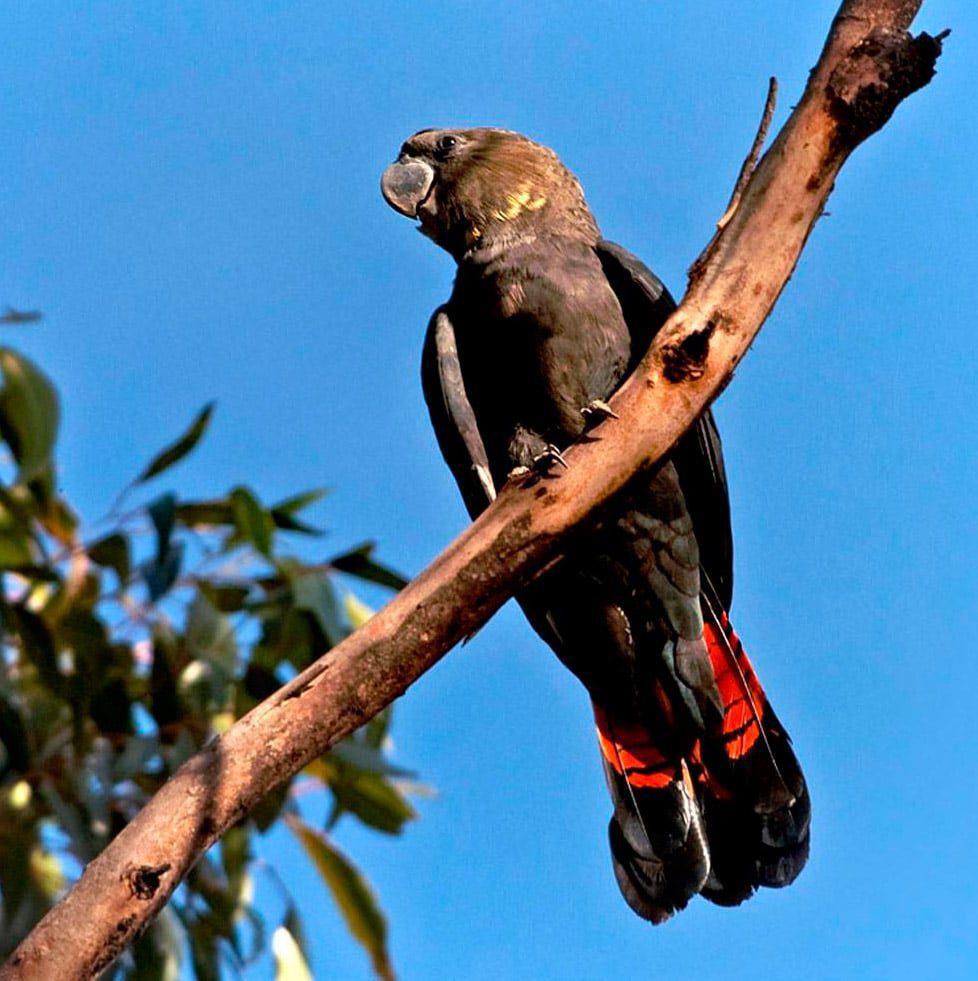
The Glossy black cockatoo(Calyptorhynchus lathami) is the smallest of the 5 black cockatoos and is restricted to the East coast of Australia (a population isolated also is reproduced in the Islands Kangaroo).
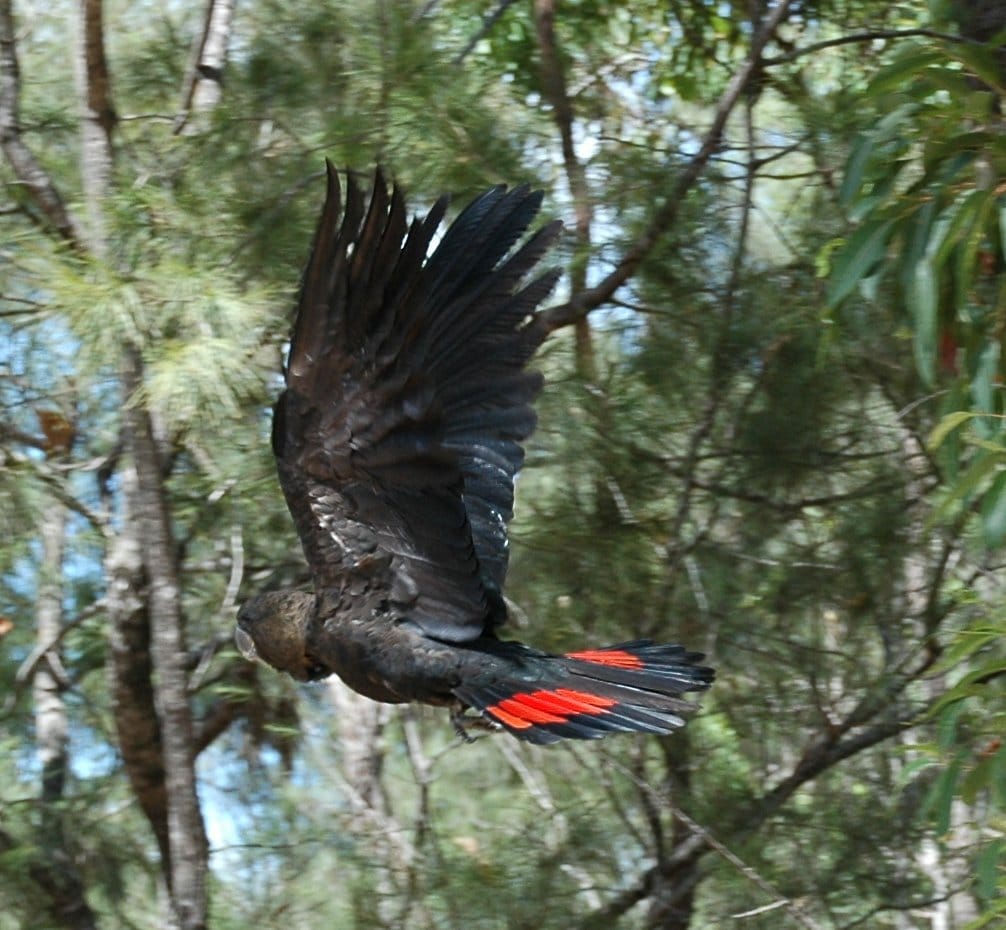
The male is brown-black color with a small crest rounded and bright Scarlet spots in the tail. The female shows spots irregular in color yellow in it head, The Scarlet patches in the tail they are permeated by narrow black bars and edges of pale yellow on the underparts of the wings.
The immature they are similar to the females, but they lack the yellow markings on the head and show different yellowish tones in the feathers, the chest and in the belly.
(Mathews, 1912) – Medium-size ones 48 cm. length and 510 to 515 weight g, with a wing
of approximately 90 cm.. The of adults they are mainly black, dark brown in the head, the neck and the bottom of the body, and Red panels (in males) or orange-red with bars Black (in females) on tail. The female adult is also conspicuous in the head. These patches are absent from most males., Although they can be expressed faintly in a few individuals (Higgins 1999).
The immature are similar in appearance to the male adult, but have small stains yellow in it head; spots or bars yellow in the chest, belly and flanks; yellow or orange spots on the wing
(mainly on the bottom); Red or orange-yellow panels with black bars at the tail; One bill pale grey (instead of dark); And a ring of skin around the eye pale grey (instead of grey dark) (Higgins 1999, L. Pedler 2007, com. Pers.).
Calyptorhynchus lathami erebus
(Schodde & Mason,IJ, 1993) – The only difference with the nominal species resides in that has the bill shorter.
Habitat:
Video – "Glossy black cockatoo" (Calyptorhynchus lathami)
Glossy-black Cockatoo (Calyptorhynchus lathami ) HD Video clip 1/3
Areas forested frequently dominated by casuarinas of which are highly dependent for its food. These are small shrubs commonly known as the Sheoaks, wood for beef (Beefwood) or Australian pine. These shrubs are widespread in tropical and subtropical regions.
They are also distributed in open humid forests, difficult terrain where deforestation has not been too great. They have an imperative for natural tree cavities to nest.
Reproduction:
Forman couple during all the life. The couple has relationships throughout the year. This type of family of them parrots prefers to nest in cavities natural of the eucalyptus, whether dead or in full vitality. The nest usually placed at an altitude that ranges between the 3 and 30 meters above the ground. The cavity is filled with leaves and branches. Sometimes, together with other breeding pairs, they share the same tree year after year.
In New South Wales the season extends from March to August. The spawning It consists of a single egg white. It is the female that takes charge of most of the tasks.: It prepares the nest and incubates herself. Never leave the nest until the small is reached the age of one week. In most cases, the male provides the female with food and assistance until the young can fend for itself, normally four months which remains with them until the next breeding season.
Food:
It feeds almost exclusively on the seeds several species of She-oak (Casuarina and Allocasuarina). You can also sometimes eat larvae of wood-boring. They feed in threes, less frequently in pairs, small groups or flocks of up to 60 birds. They can be detected by the snapping of their beaks and the remains of the casuarina cones and twigs that fall.
Distribution:
Size distribution (reproduction / resident): 770.000 km2
The species is Rare Although widespread in suitable forests of the central coast and forest habitats of Queensland and in the interior of the southern plateaus and Plains of the Midwest's New South Wales, with a small population in the Riverina. There is an isolated population in the Kangaroo Island, South of Australia.
(Schodde & Mason,IJ, 1993) – It is from Australia (the central eastern coastal area of Queensland)
Conservation:
State of conservation ⓘ
Minor Concern ⓘ(UICN)ⓘ
• Current category of the Red List of the UICN: Least concern.
• Population trend: Decreasing.
Like most parrot species, the Glossy black cockatoo is protected by the Convention on international trade in endangered species of Fauna and Flora Silvestres ( CITES ), with its inclusion in the list of the Appendix II of vulnerable species, What makes the import, the export and trade of animals captured in the wild is illegal.
Justification of the population
Garnett and Crowley (2000) estimated the size of the population in the following way: 12.000 individuals of the subspecies lathami, 70 breeding pairs of the subspecies halmaturinus (equivalent to 140 individuals) and 5.000 individuals of the subspecies erebus giving a total of 17.140 individuals.
Justification of trend
They suspected that the population is declining in general Since the largest subpopulation, lathami, It is slowly decreasing throughout its range. However it is believed that the subspecies Erebus is increasing and the subspecies halmaturinus It is increasing as a result of conservation efforts in the Island Ganguro (Garnett and Crowley 2000).
"Glossy black cockatoo" in captivity:
Like the other black cockatoos, the Glossy black cockatoo(Calyptorhynchus lathami) is extremely rare in the poultry. In Australia It has attained breed in captivity.
Measured between 30 to 31 cm.. and a weight between 180 and 245 gr.
The adults of the species Yellow-streaked Lory(Chalcopsitta scintillata) have plumage dark green, pale green veins in head and the abdomen, and bright yellow bands in the chest and in the the mantle.
Chalcopsitta sintillata rubrifrons
The forecrown, cheeks and the thighs are bright red. The sides of the chest with large red infiltrations.
The under wing
It is crossed by a thick yellow band. The bill is black. Bare skin eye and at the base of bill is dark gray. The irises are orange-red, the legs grey.
There is no sexual dimorphism, but in the female, the front spot It is less pronounced.
The immature They resemble adults, but have less red in the forecrown. The basis of the bill It is less stained yellow. The irises They are brown.
They are particularly visible in the early hours of the day, When the bands fly over canopy, sometimes very large heights.
They have a direct flight with rapid wing beats. In spite of this, they give the impression of moving slowly, almost in a hesitant way. Its neck tense and the tail feathers widely deployed gives them a vision in flight that is very characteristic. Couples often engage in stunts, with many screams.
(Salvadori, 1876) – Adults of this subspecies differ little from those of the nominal species. But, they differ from the latter by the narrower stripes on the plumage. The bottom of your wings They are green or green with red markings.
Chalcopsitta scintillata rubrifrons
(Gray,GR, 1858) – In this subspecies, both adults and juveniles, they are identical to the nominal species, but the veins of body plumage They are more spacious and orange-yellow.
common in the lowlands, in the Savanna They are covering the hills, in plantations cocoteros and in the mangroves.
They are also in the primary forest and secondary adjacent, even in narrow bands of gallery forests bordering rivers in open country.
Occasionally, the Yellow-streaked Lory They sit near or inside Gardens in local villages.
They can fly to 800 m above sea level.
Reproduction:
Typically install their nests in treeholes high. There is not much information about the reproduction in the center of nature.
In captivity, the implementation is of 2 eggs which both parents incubate alternately during 26 days. At hatching, hatchlings weigh 7 u 8 g.. Duration reproductive cycle It is very long and can overcome 80 days. Despite this, There may be a second clutch in the season.
Food:
They feed in the trees.
consume nectar, pollen and fruit. Are said to some insects complete this predominantly vegetarian diet.
Distribution:
Size of its range (breeding/resident): 586.000 km2
These birds are endemic to the Islas Aru and South of Papua New Guinea.
Distribution 3 subspecies
Chalcopsitta scintillata chloroptera
(Salvadori, 1876) – High of the fly river to Southeast Papua New Guinea.
It is not an endangered species. In a study in Southeast New Guinea, its density was estimated at 20 birds per square kilometer.
Its world population approaches the 100.000 birds.
The population suspected to be stable in the absence of evidence of any reduction or substantial threats.
"Yellow-streaked Lory" in captivity:
Pretty common.
They are birds very noisy People who like to let their loud cries are heard. They are playful, they have no fear and they can easily become meek in the hands of your caregiver. They are not only extremely aggressive against other Yellow-streaked Lory, also as with other species.
Alternative names:
– Yellow-streaked Lory, Greater Streaked Lory, Streaked Lory, Yellow streaked Lory, Yellowish-streaked Lory (ingles).
– Lori flamméché, Lori à front jaune, Lori à front rouge, Lori strié (French).
– Schimmerlori (German).
– Lóris-listrado-amarelo (Portuguese).
– Lori Chispeado (español).
Its length is about 25 cm. and weigh between 80 and 85 gr.
The Olive headed Lorikeet(Trichoglossus euteles) show, in general, a green shade.
The head color is olive with waves pale mustard and yellow stripes over the entire surface of the top.
The neck and its part rear are surrounded by a collar of color green brilliant that continues until the throat.
The underparts below the throat are entirely greenish-yellow.
The bill is red-orange. The irises they are red, and legs grey.
The youth they are more muted than adults. Its head is slightly greenish with streaks pale. The bill is brown. The irises They are brown. The species is considered monotype.
They frequent humid subtropical forests., secondary forests and wooded meadows. Adapt quite well to cultivated land and the gardens in cities.
In Timor, they are relatively abundant between 1.000 and 2.300 meters above sea level, apparently, substitute to the Coconut Lorikeet in these heights. Also they can be observed at sea level in the island of Timor. In the rest of the Islands it frequents lowland areas.
The Olive headed Lorikeet they live in small groups. They are especially visible when they are in flight because they emit continuously shouts. On the other hand, when feeding or resting in trees, they are very difficult to observe because of their green plumage mixed with the color of the foliage.
They are birds territorial, capable of showing great aggressiveness if the limits of their area of influence are violated.
Usually disperse in search of their food, forming large groups when resources are abundant.
Outside the breeding season they form large roaming flocks of a hundred or more individuals.. Move in flying fast and slightly wavy.
In Timor, during the season, dry, These birds seem to descend below 1.000 meters and are scattered in coastal areas.
Reproduction:
The anidacio seasonn would take place perhaps between September and October, but this information needs to be confirmed.
In captivity, the Olive headed Lorikeet put 3 white eggs that parents are in charge of incubate for a few 23 days. As in the majority of the Lori, the nesting cycle is particularly long.
Food:
Feed primarily of nectar and fruit. They forage in trees in flower and shrubs.
Distribution:
Size of the area of distribution (reproduction / resident): 38.100 km2
The population size This species has not been quantified. Suspected that the population is stable in the absence of evidence of any reduction or substantial threats.
Like most brightly plumaged parrots, the Olive headed Lorikeet It victim of trade bird cage or Aviary.
"Olive headed Lorikeet" in captivity:
Pretty common. They can be housed with others of its kind.
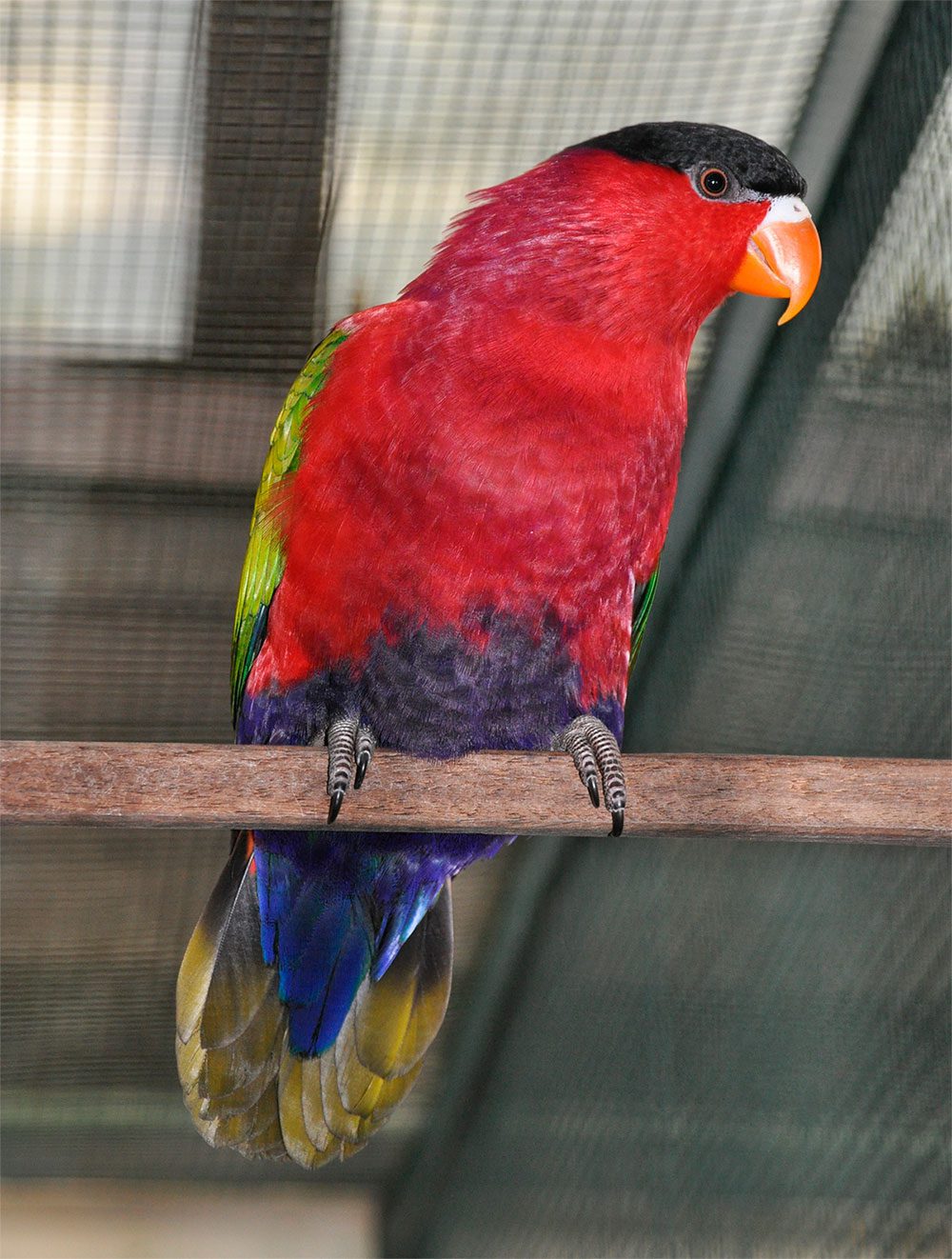
The Purple-bellied Lory(Lorius hypoinochrous) has an approximate length of 26 cm.. with a weight ranging between 200 and 240 g..
Hood black in color with blue purple sheen extending to the rear of the nape; rest of head red. Upperparts completely red with a band dark variable on the the mantle; upper mantle slightly more purple that the rest of them upperparts. Primary coverts Bluish; remaining wing
Green with the internals of the flight feather in black color. Rojas the wing-coverts with black tips. The flight feather show a large patch yellow in the part internal.
Throat and chest, red, getting more purple towards the top belly; part low belly, the thighs and coverts, dark purple-blue. The parties above of the tail basically red, with the final part in dark blue (appears only teal at rest); undertail, opaque yellow with red hidden base.
Bill orange; cere (waxy soft swelling, containing the nostrils, at the base of the upper beak) white; Iris orange; legs black grey.
There is no significant difference between males and females. In general, the male has a bill a little stronger than the female.
The juveniles has belly pale purple color and peaks are more brownish.
(Rothschild & Hartert, 1918) – Difference with the species rated by the fact of that has the chest the same red that the upper part of the abdomen.
Habitat:
Unlike in the Black-capped Lory, often found in coconut, mangroves and coastal vegetation (especially fond of coconut flowers); the Purple-bellied Lory also frequents low forests, the edges of these, high secondary forests, inhabited or partially cleared areas and gardens. Found individually, in pairs or in small groups of up to 10-20 birds. Ruidoso, visible and Active, they often live in trees or just above the canopy.
In the Island of Papua, they are distributed by the lowlands and foothills, in New Britain up to at least 450 m, in New Ireland until 750 m (where is sympathetic with the White-naped Lory) and up 1.600 metres in the Goodenough island.
Virtually nothing is known of the reproductive ecology of this species., Although is has been able to observe to them males in a, apparent, participation in the cortejo, with repetitive stretching of the neck and movements side of the head.
Reproduction:
Due to its extreme rarity, We know little about their reproductive behavior.
It is likely to be very similar to the of the Black-capped Lory(Lorius lory). This means a spawning two eggs and a incubation period of about 26 days.
Food:
The Purple-bellied Lory It feeds mainly in the canopy in noisy groups. Its diet natural consists of pollen, nectar, flowers, fruits, insects and their larvae, and probably seeds.
Usually see, sometimes, feeding is in company of the Sulphur-crested cockatoo and the Eclectus Parrot.
Distribution:
Size of the area of distribution (reproduction / resident): 61.900 km2
24 cm.. length and an approximate weight of 68 g..
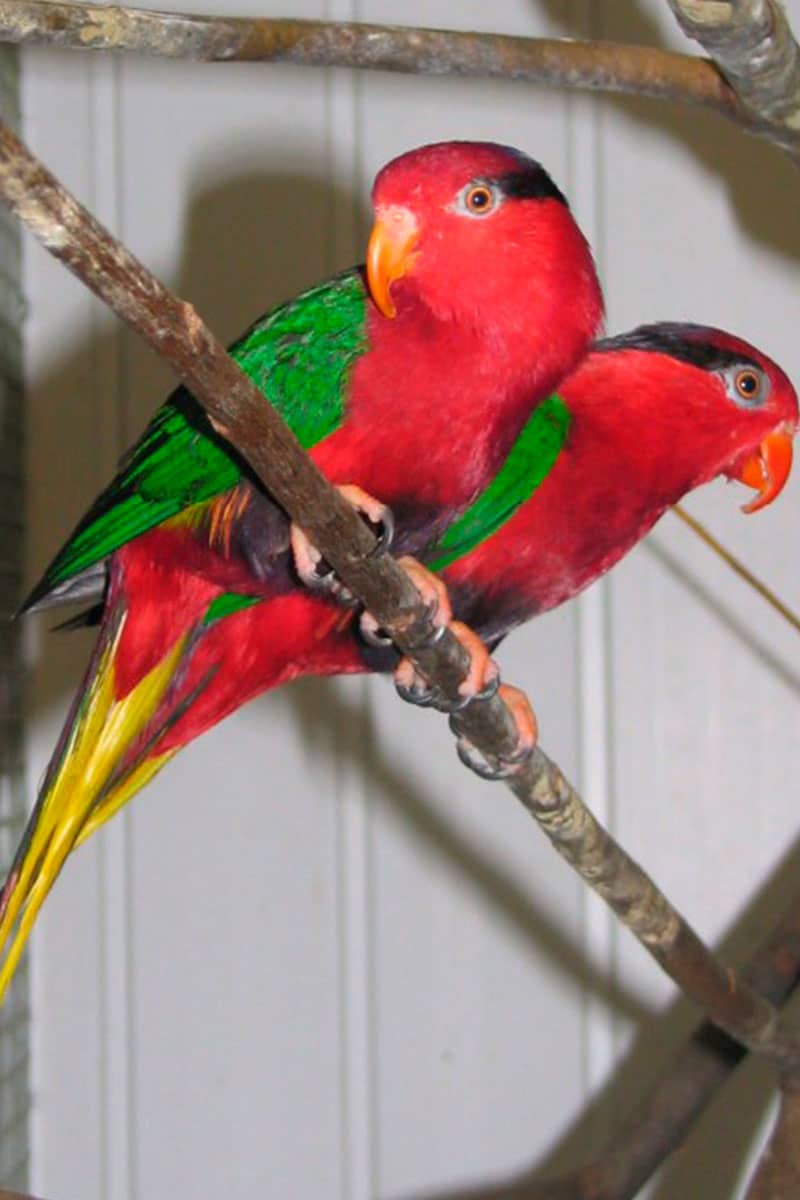
The head of the Josephine's Lorikeet (Charmosyna josefinae) it is red in color with a conspicuous black patch extending from the back of the crown to the nape and in a transverse line to the eyes; back of the Crown is marked with purple stripes; large red necklace. Mantle and scapulars Green; bottom of the Red back: rump with a central patch of dark blue; views from the top, the coverts of the tail of blue to red. The wings, from above, green with vane internal greyish towards flight feathers; marginal coverts Green. View from below, the coverts of Red Wings. Red underparts with a purplish-black spot in the center of the belly, that extends to the flanks on the thighs; seen from below, tail-coats are red. From above, the tail shows red with yellow tip and green color side feathers; from below, the tail is yellow. The peak, orange red; iris yellow ; orange-yellow legs.
The female It shows the lower part of the back of yellow, tending to green on the rump.
The immature with impregnated in green belly patch, and bluish black thighs. The blue rump patch impregnated in green. Makes color lilac in the back of the Crown replaced by blue-green color marks.
Immature females It shows the low back of red with some yellow marks.
: It differs from the nominal value by having more extensive black belly patch and more grey marks on the back of the Crown. Females lack of greenish broadcasting on the flanks and in the low back.
Charmosyna josefinae cyclopum
: Differs from the nominal value by the absence of black belly patch and the practical absence of grisaceo-azul in the back color of the Crown marks.
Habitat:
Possibly Nomad. Frequents montane forests, edges of forests and partially cleared areas, mainly between 760 and 2.200 meters and more common between 850 and 1.200 meters although there have been up to at sea level. Usually seen in pairs or small groups. Despite their striking coloration, is quite discreet. Feeds in the tops of trees in flower, flowering vines or plants epiphytes, often with him Fairy Lorikeet.
Reproduction:
Nesting and breeding to be described.
Food:
Diet includes pollen, nectar, flower buds and soft fruits.
Distribution:
New Guinea in Irian Java (Indonesian) and Papua New Guinea, mainly in the Western and central cordillera, Since the Mountains Parotia and Vogelkop, to the Bismarck range in the Northeast (Jimi and also Baiyer River). There has been since Jayapura, on the North coast of Irian Java, and come to the South of Mount Bosavi, Papua New Guinea.
Subspecies distribution:
Charmosyna josefinae josefinae
: The nominal.
Charmosyna josefinae sepikiana
: Mountains of the region of Sepik, Papua New Guinea and in the Highlands of the West to the East until approximately the area of the jimi river and to the South of Mount Bosavi
The world's population has not been quantified, but it is thought that it may be above the 300.000 specimens.
A small number in captivity.
The population is suspected to be stable in the absence of evidence of any reduction or substantial threats.
"Josephine's Lorikeet" in captivity:
Take it easy, but at the lively and active time. Some new birds may initially be nervous. Young birds, in particular, curious and playful. Aggressive toward other birds. Susceptible to stress and disease during the acclimatization. Strict hygiene necessary due to a mainly liquid diet.
Alternative names:
– Josephine’s Lorikeet, Josephine’s Lory (ingles).
– Lori de Josephine, Lori de Joséphine (French).
– Josefinenlori (German).
– Lori de Josefina (español).
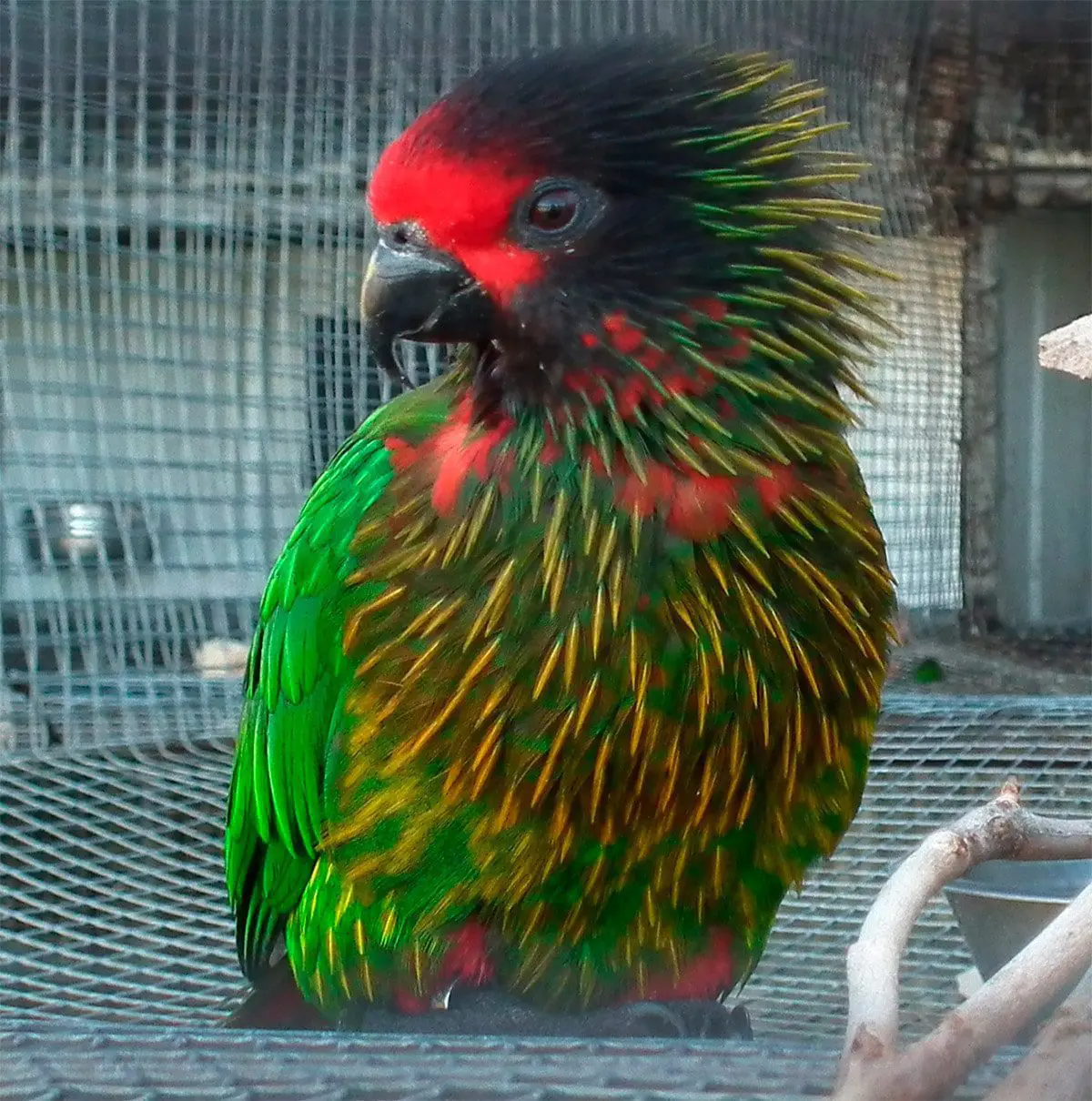
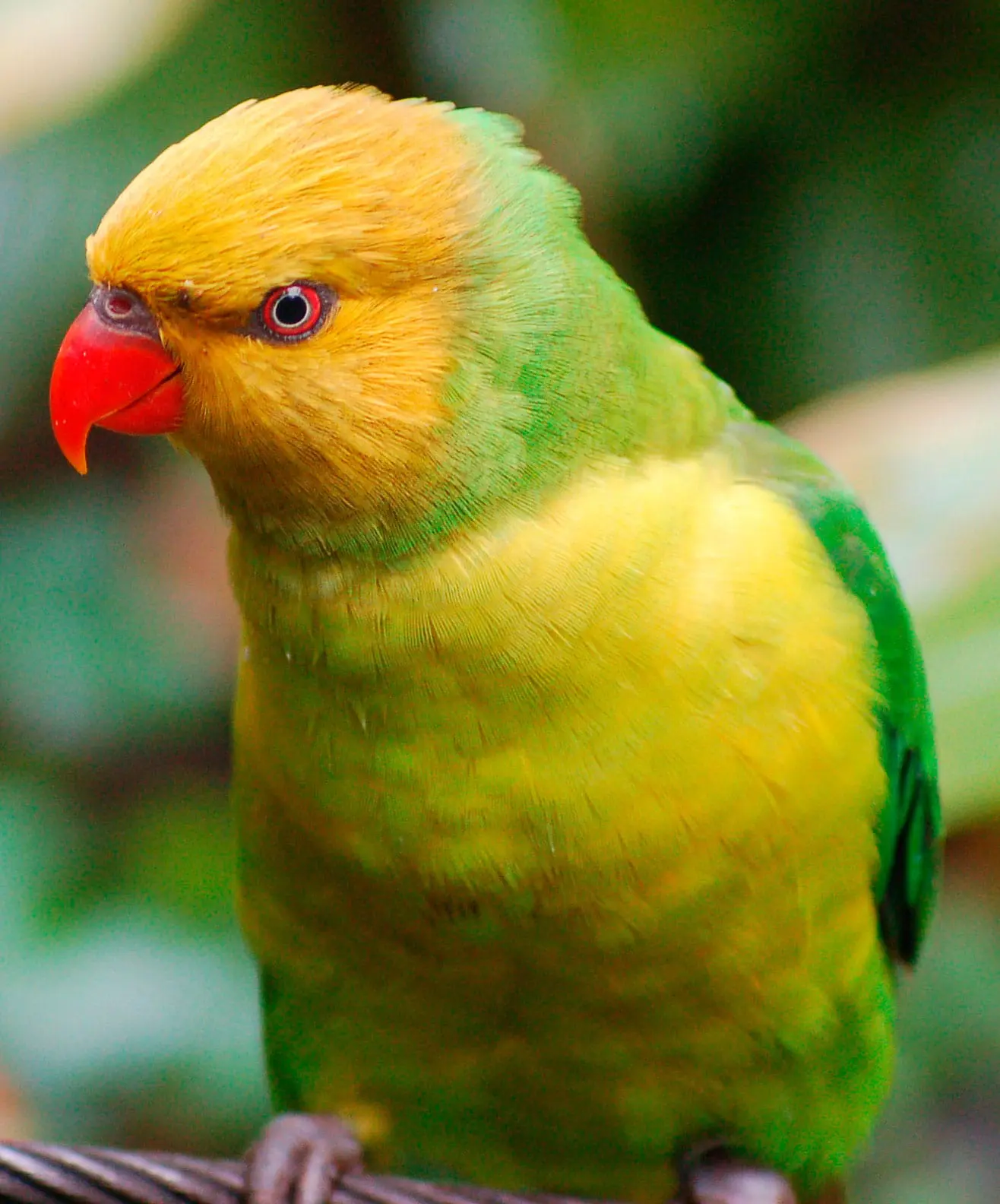
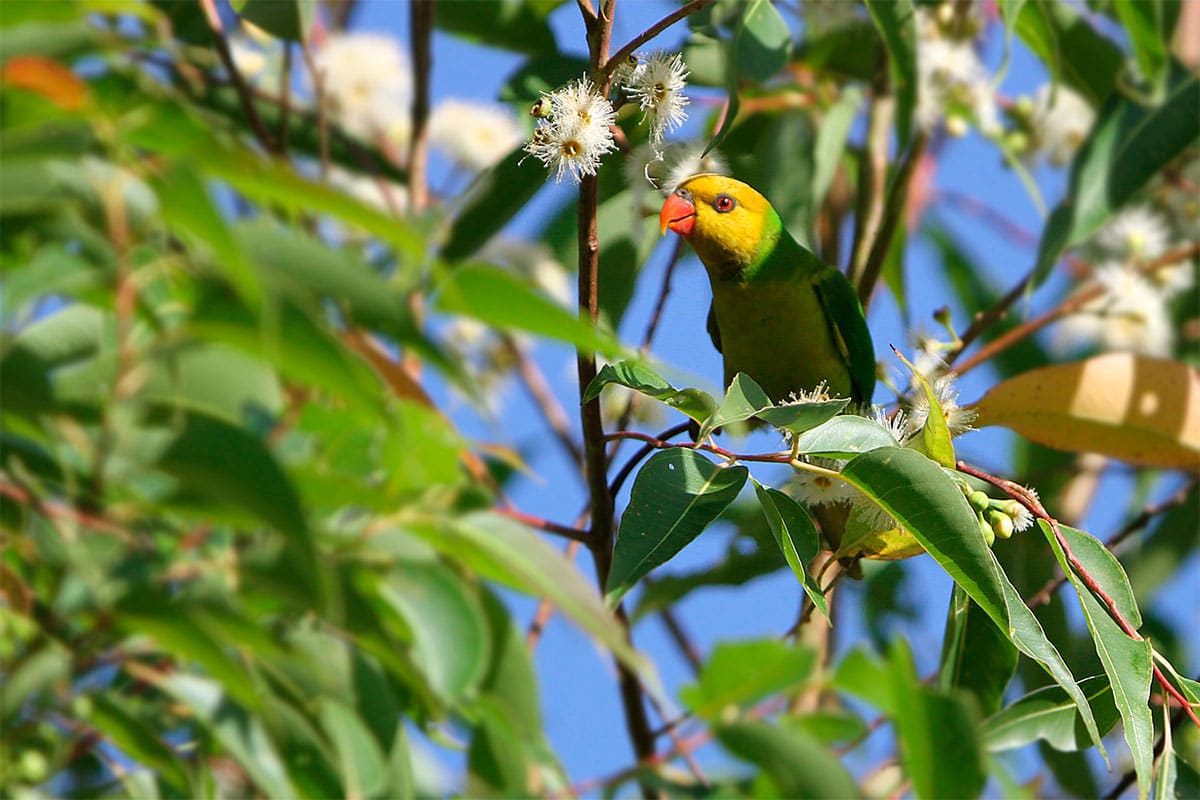
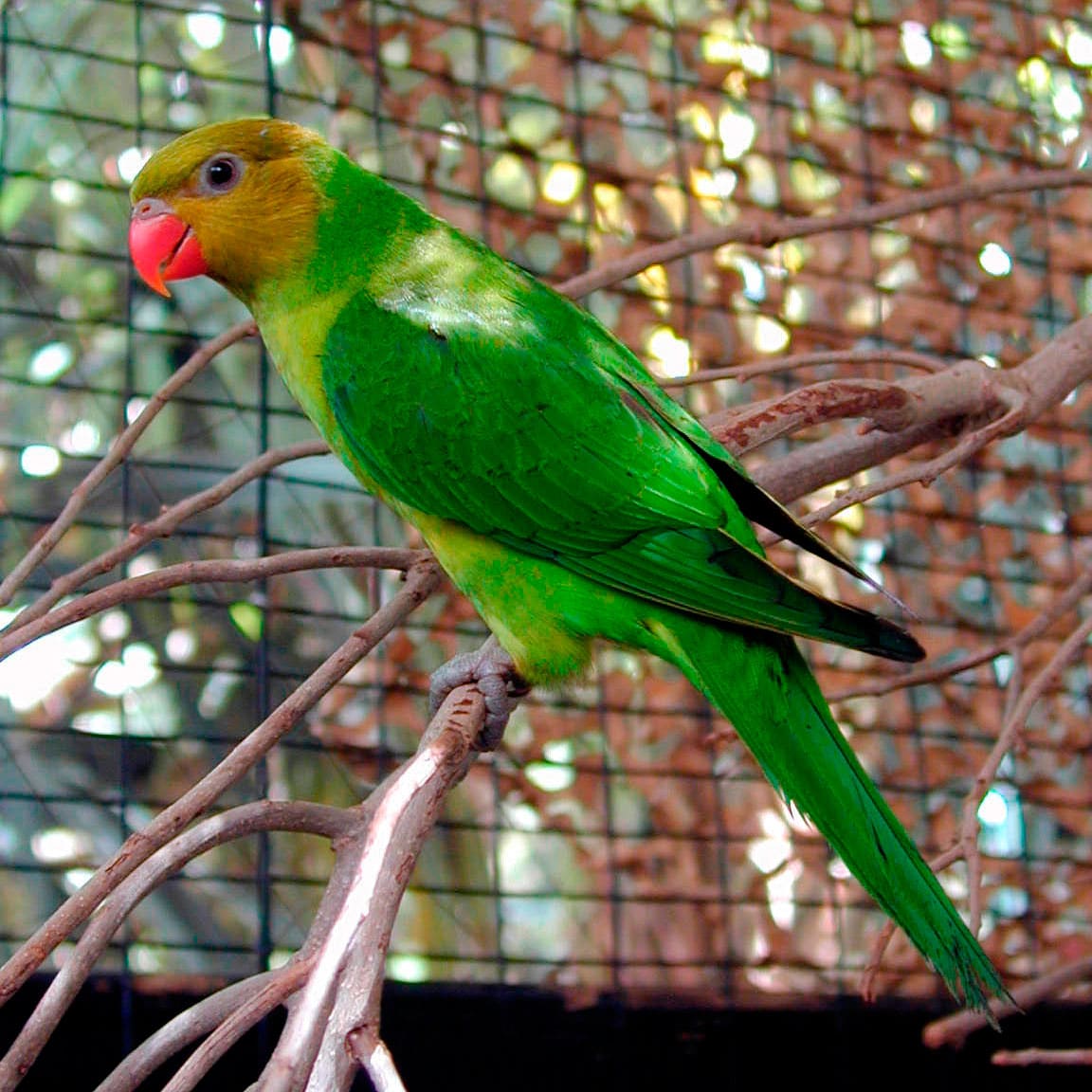
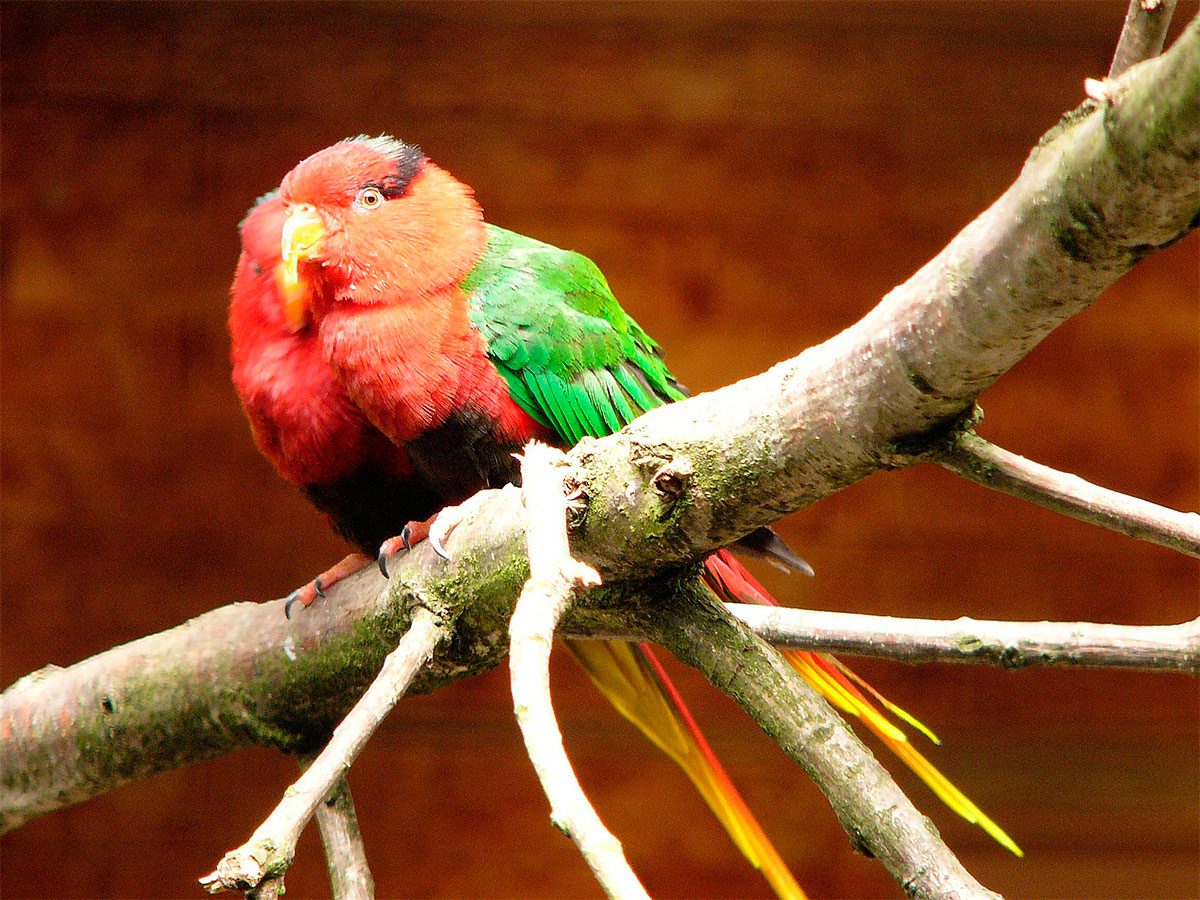
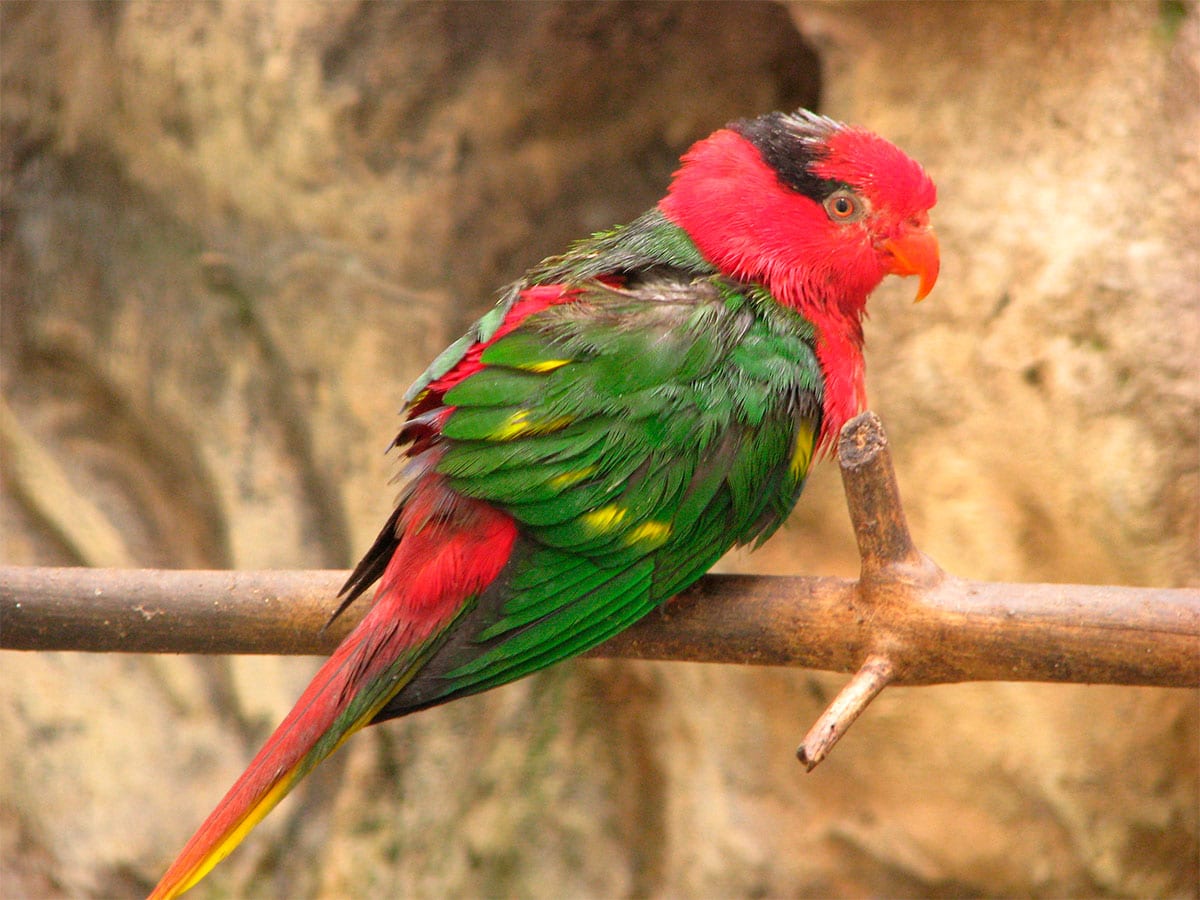
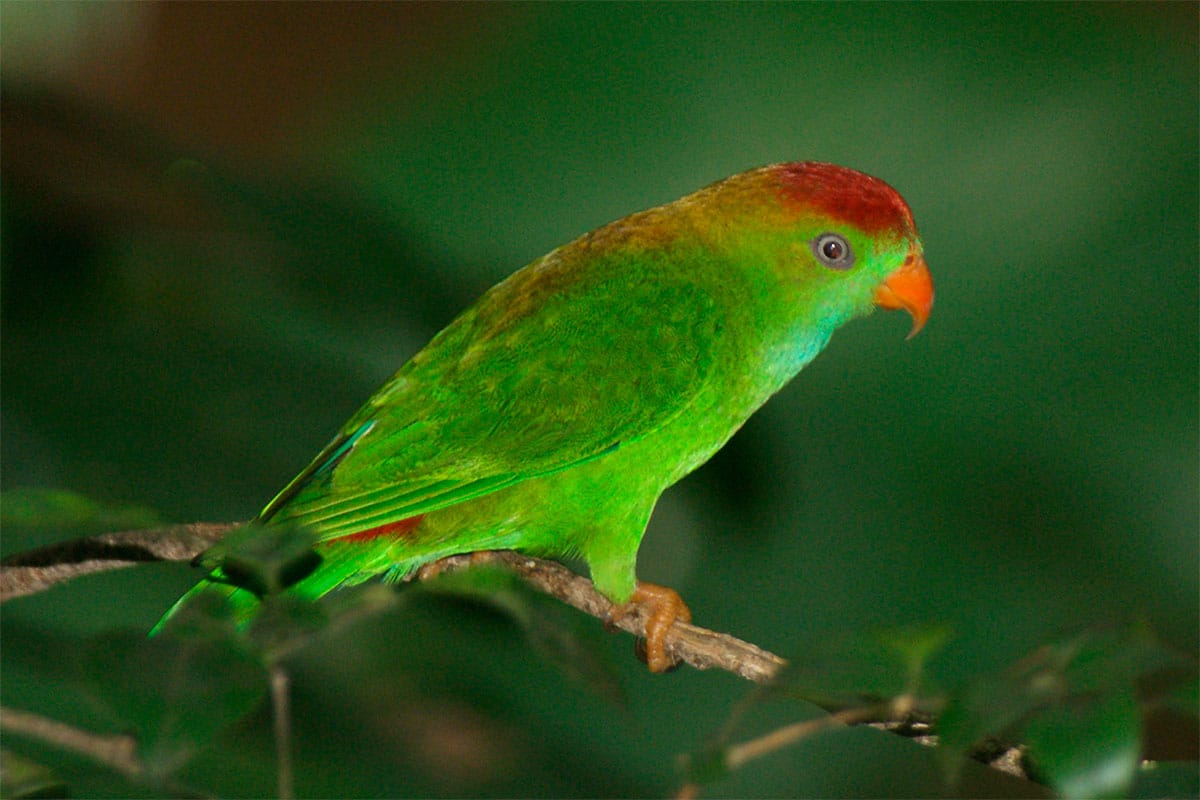
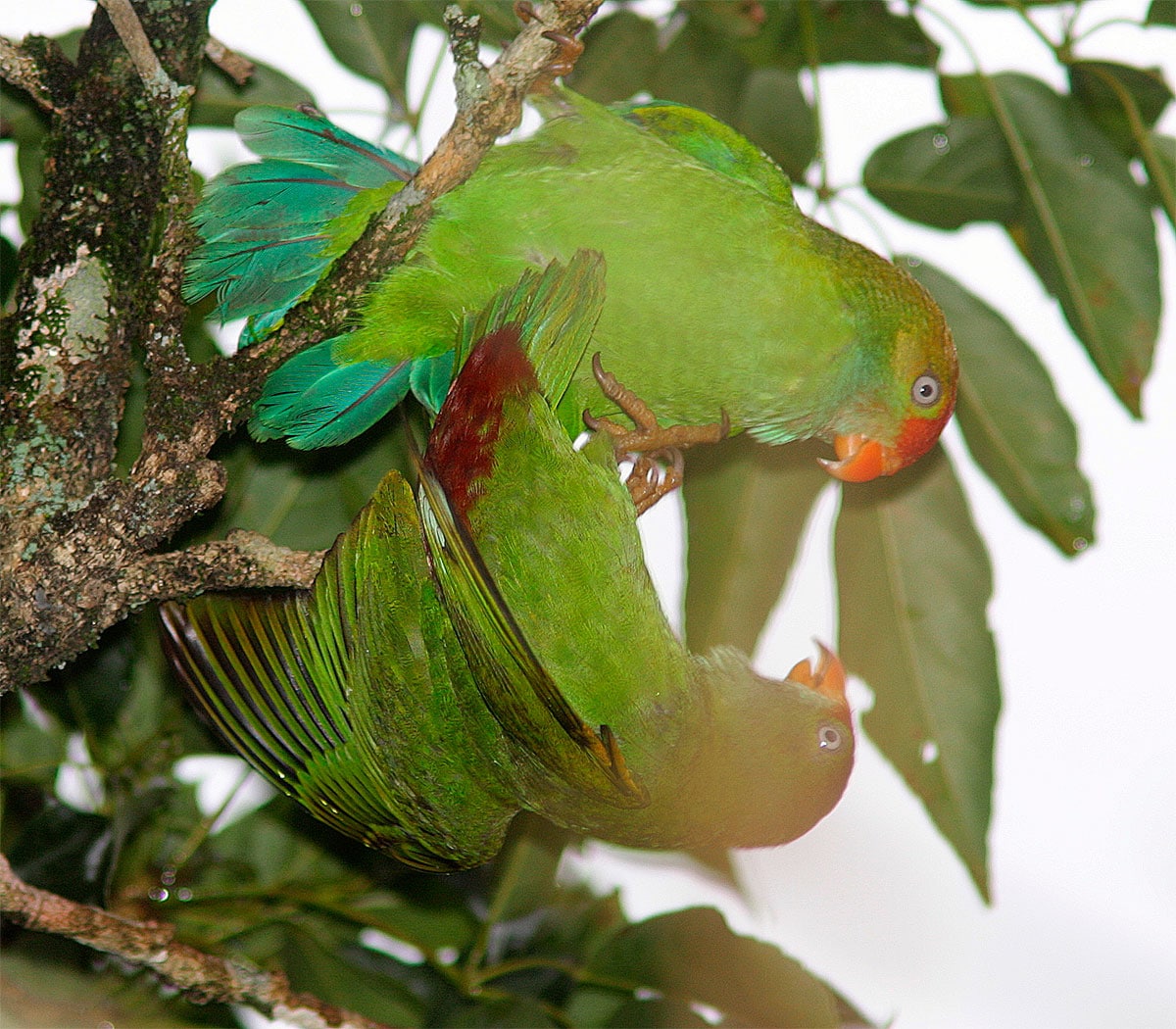
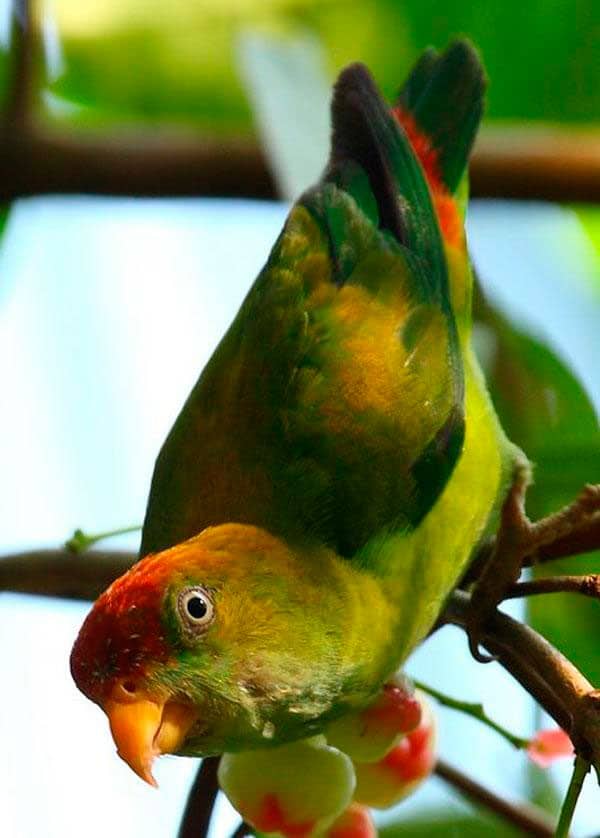
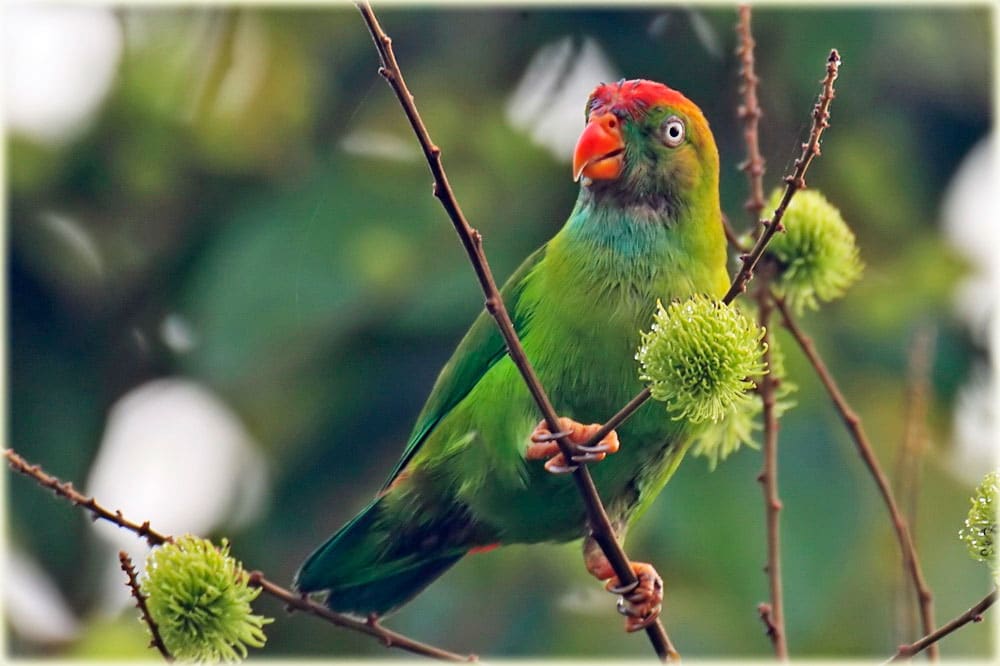
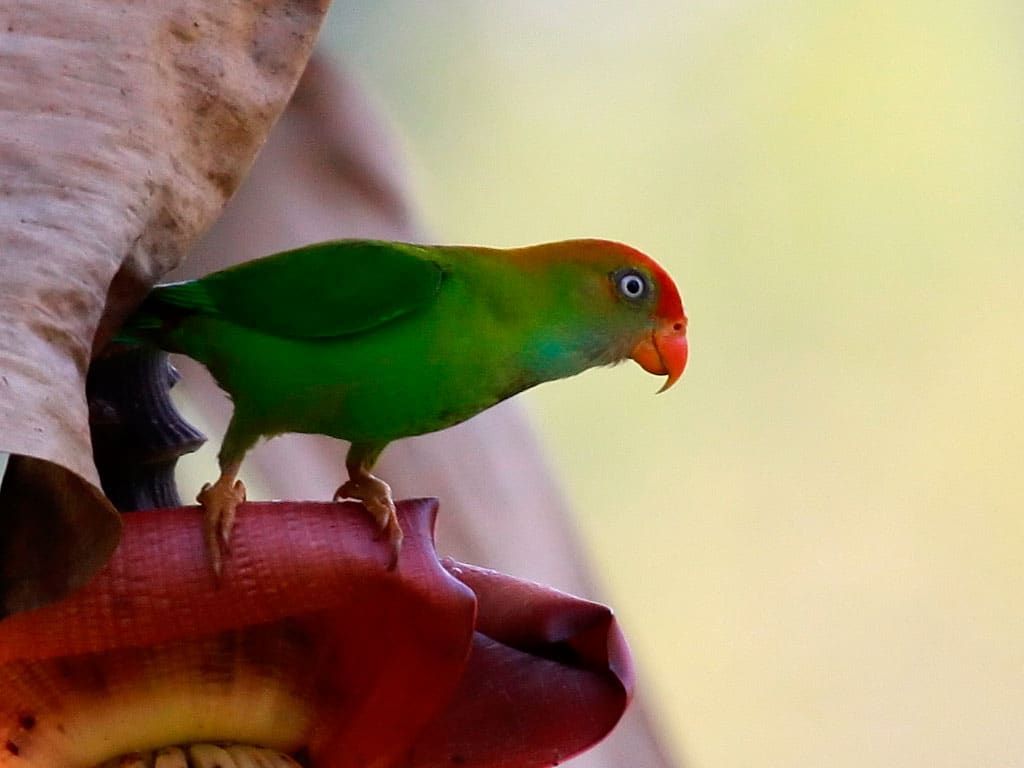
The Ceylon Hanging-Parrot(Loriculus beryllinus) has the crown red, merging into orange-yellow in the area of the nape; eyebrows, lores and the area in front of the eyes light green (lightly bathed in pale blue); sides of the front of the crown red. Mantle green, Bañado de slightly reddish and yellowish orange color in the Center; back green; rump and uppertail-coverts, red. Wings green up, with the exception of vane inner of the blackish flight feathers ; undertail, the wings bright turquoise color with the exception of coats and axillary green. The underparts bright green, paler and more yellowish which the upperparts and light blue marking in the throat. above the tail green color; Turquoise below.
Bill orange red, paler at the tip; irises off-white; legs dark yellow.
Female as the male, but most off and only a trace of blue in the throat.
The young birds they are even duller, the crown reddish-tinged, the patch blue of the throat absent, the rump with some green feathers, the bill paler, the iris and the legs brown; the face nude in the fledglings.
Seen in a range of habitats, from sea level to 1.600 m, reaching the highest areas according to seasonal conditions. The species is found in forests of coconut trees, Evergreen and deciduous forests, semicultivadas areas, open woodland and around the dwellings.
birds are not shy, and is usually found in pairs or family groups, although outside the breeding season larger flocks congregate high up in flowering trees. They are active and acrobatic feeding.
Reproduction:
Observations, they have registered the male approaching his partner upright, with the high peak, swollen throat, extended tail and rump feathers erect, while emitting a screeching chirp. Wiggles head in courtship period have also been observed.
The breeding begins in January and although the main nesting period is between March and May, a second litter is, sometimes, until September. The nest is located in a hollow branch filled with fragments of vegetation that the female carefully cuts with her beak and carries to the nesting sites tucked between her rump feathers.. Only two to four white eggs she incubates, sitting firmly, screeching and creating a 'thumping' sound’ Yes is the annoying. The young Chick has the face exposed, presumably to avoid getting dirty by liquid food.
Food:
Feed on fruits such as Ficus figs and guava (Psidium guajava); berries; flowers, including Erythrina, Salmalia and eucalyptus; seeds, including Casuarina. Poisonings have been reported after drinking Palm wine collected pots attached to the trunks of the trees.
Distribution:
Endemic to Sri Lanka, where most records come from the South, Although there have been North of Trincomalee and should be observed in suitable habitats throughout the country. Records include proximities of Colombo, around Kandy, Yala and National parks Gal Oya, the district Welimada, and to the South of Galle and Hambantota, on the coast.
Conservation:
• Current IUCN Red List category: Least concern
• Population trend: Stable
The size of the world's population has not been quantified, Although it is estimated at 10.000 specimens. The species is qualified as widespread and abundant in the South-West and almost absent in the North of its distribution area (pit et to the. 1997).
The population is suspected to be stable in the absence of evidence of any reduction or substantial threats, However, the bird trade is judged as a potential threat.
"Ceylon Hanging-Parrot" in captivity:
Rare.
Alternative names:
– Ceylon Hanging-Parrot, Ceylon Hanging Parrot, Ceylon Lorikeet, Sri Lanka Hanging Parrot, Sri Lanka Hanging-Parrot, Sri Lankan Hanging Parrot (ingles).
– Coryllis de Ceylan, Coryllis du Sri Lanka (French).
– Ceylonpapageichen, Ceylon Papageichen (German).
– Loriculus beryllinus (Portuguese).
– Lorículo de Ceilán, Lorículode Ceilán (español).
21 to 27 cm. length and a weight between 130 and 180 g..
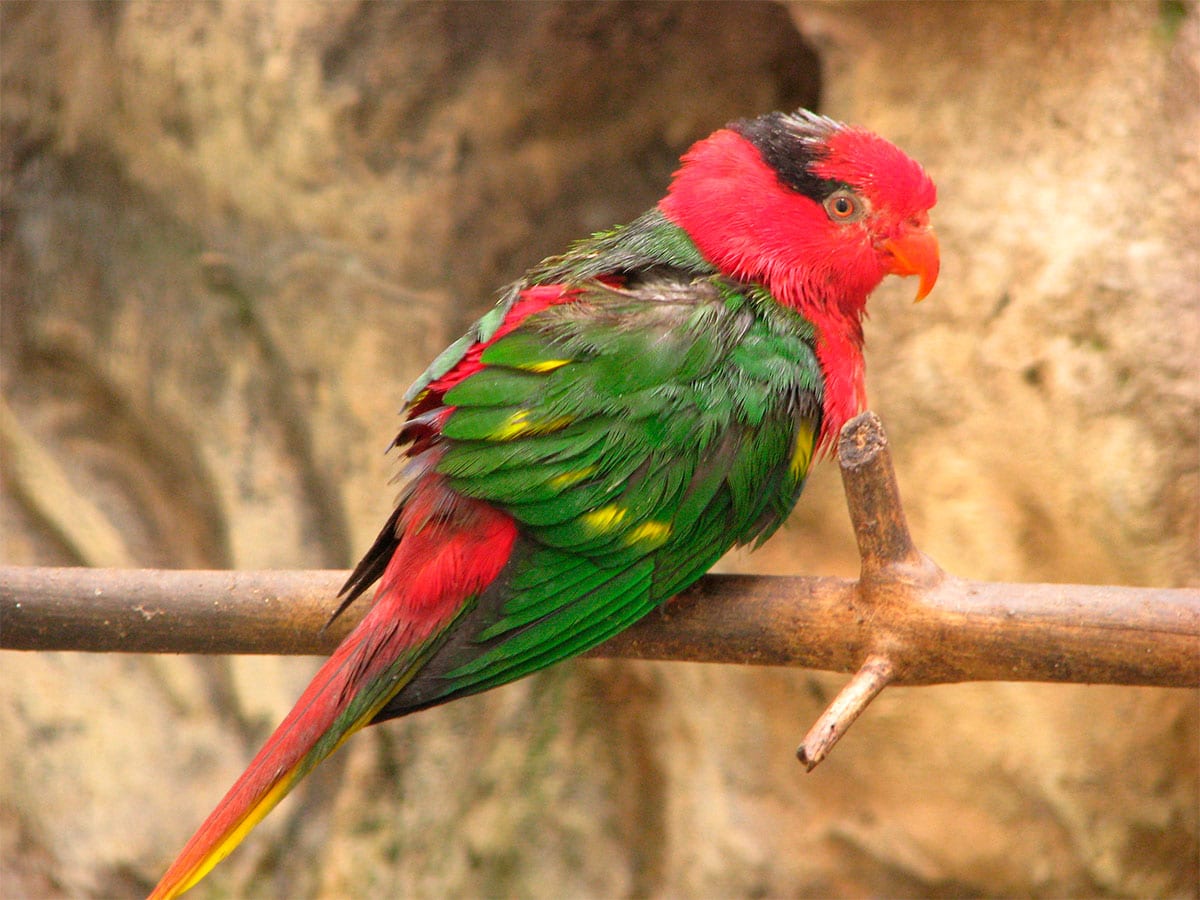
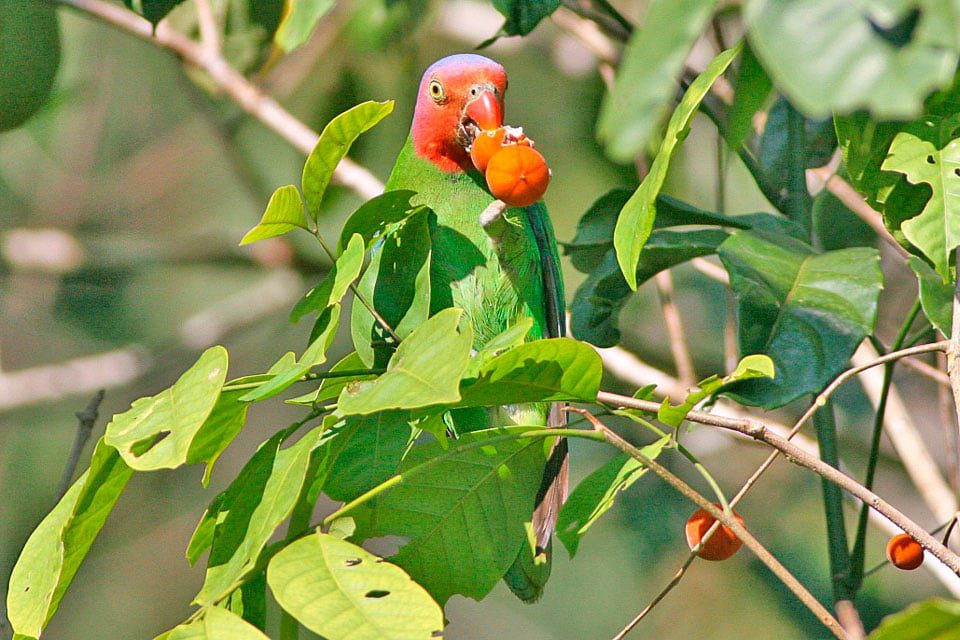
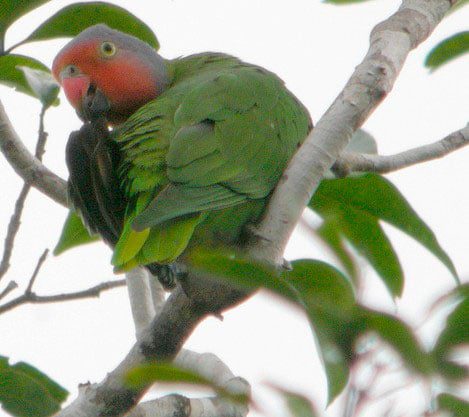
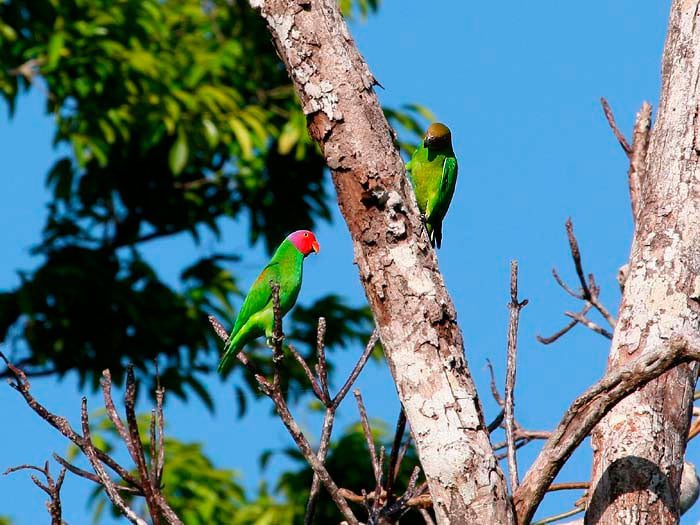
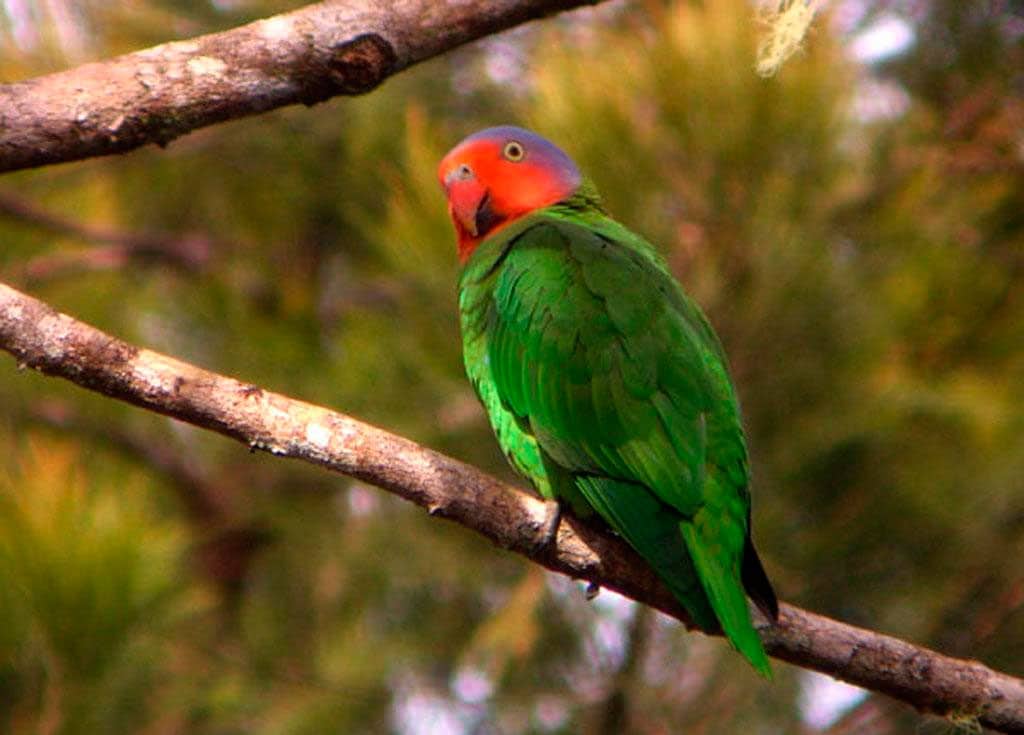
The face of the Red-checked Parrot(Geoffroyus geoffroyi) is of color rojo-rosaceo up to just above the eyes, more pink in the ear-coverts; front of the crown of color rojo-rosaceo. Half of the crown to the nape mauve-blue. Upperparts green. Wings with patch red in them Middle coverts interiors.
Flight feathers with vane Dark internal and external Green. Edge of yellow to vane internal of greater coverts and secondaries. Wing feathers and axillary, bright blue; below, the rest of the wings, blackish. The underparts green, more yellowish in them lower flanks. Upper, the feathers of the tail of color green, drenched sides of yellow; below, brighter yellowish green.
The bill red orange in upper jaw, the lower jaw in color black; irises yellow; legs grey.
Female with head Brown and upper jaw black.
Youth they have the head green, irises dark and bill pale. The male juveniles go through a plumage «female stage» before they begin to acquire masculine characters (bird takes over one year to mature). The birds young also lack of the brand red on them small coverts.
(Müller, 1841) – The darker male in general that the nominal; purple blue crown comes to the part back from the neck; neck light blue; Marron-bronce washing variable on the mantle and top of the back; Green bluish in the part superior of the chest and zone inferior of the abdomen ; brown reddish of them coats internal of the wings absent; Blue more dark in them Underwing coverts. Larger in size.
The female with the head more dark that the nominal; purple diffusion in the crown; nape blue, reaching the neck with color blue light.
Geoffroyus geoffroyi obiensis
(Finsch, 1868) – Adults as the subspecies cyanicollis but collar Blue in the part back from the neck more comprehensive, reaching almost up to the eyes; blue-purple in the male or brown in the female does not reach the lower part of the occiput; reddish brown in the bottom of the back to rear.
Geoffroyus geoffroyi rhodops
(Schlegel), 1864) – Similar to the subspecies males floresianus, but darker in general; marks of the coats internal of the wings of color brown reddish dark; crown Blue separate with red in the face; Underwing coverts Blue more dark. Larger in size.
The female with the crown castano-oscuro color.
Geoffroyus geoffroyi explorator
(Hartert, 1901) – Synonymous with Geoffroyus geoffroyi rhodops
Geoffroyus geoffroyi keyensis
(Finsch, 1868) – The male resembles the subspecies floresianus, but in general more greenish-yellow, in particular in the tail; cheeks Pink and ear-coverts washed with Blue Lilac; Yellow greenish pale in the neck through the part back from the neck and a strip Green, darker, in the early part of the neck; Underwing coverts pale blue. Larger in size.
The female chestnut brown on the head.
Geoffroyus geoffroyi floresianus
(Salvadori, 1891) – The male is like the nominal, but darker in general; the purple blue of the crown It's darker and reached to the nape; coats internal of the wings dark reddish brown; Blue more dark them Underwing coverts. Larger in size. Largest peak. Female with the crown darker brown, coming up to the nape.
(Meyer, 1884) – The subspecies resemble adults Kei, but smaller.
Geoffroyus geoffroyi pucherani
(Souancé, 1856) – Adults and juveniles with bronze-colored marking of the parts internal of the wings, minimal or absent; the mantle have less marron-bronce washing; Brown more pale in the part low of it back; the buttocks with less red; coats dark blue low the wings.
Geoffroyus geoffroyi minor
(Neumann, 1922) – Male adults are as the subspecies aruensis, but with reddish brown under the back to rear; face darker red; washing Marron-bronce in the the mantle; brands in the coats internal of the wings minimal or absent.
The female as the subspecies aruensis, but with the head of brown slightly more dark.
Geoffroyus geoffroyi jobiensis
(Meyer, 1874) – Adults and juveniles but with Underwing coverts pale blue; bright red in the lower part of the back to the rear; in males, the red in the forecrown back to the front of the crown.
Geoffroyus geoffroyi mysoriensis
(Meyer, 1874) – Males as juveniles, but with the crown blue-purple, down on the back of the neck, and red in the face, coming up to the throat; washing marron-bronce absent in the the mantle; extensive reddish brown marks in inner median coverts; Underwing coverts dark blue; dark brown in the bottom of the back to rear.
The female as juveniles, but the color brown in the crown comes to the part back from the neck.
Geoffroyus geoffroyi orientalis
(Meyer, 1891) – Hardly differs from the subspecies aruensis; Crown of the male is slightly more pale.
Geoffroyus geoffroyi sudestiensis
(Estimate, 1890) – The adult male is similar to the subspecies aruensis, but with the underparts darker; the trademark brown reddish of them coats internal, absent.
The crown and nape of the female, is dark green.
Geoffroyus geoffroyi cyanicarpus
(Hartert, 1899) – The adult male is similar to the subspecies aruensis, but with azul-lila wash in them cheeks and ear-coverts; bend of wing has edge blue.
The female is as the subspecies aruensis, but the crown and nape They are brown, with light green dye; edge blue in the part outside of the wing
as in the male.
Geoffroyus geoffroyi aruensis
(Gray, 1858) – Similar to the species males nominal, but darker purple blue from the crown up to the nape; inner coverts a reddish brown marked darker; Blue more dark in them Underwing coverts.
The female Brown darker from the crown even the nape.
Geoffroyus geoffroyi maclennani
(W. D. K. Macgillivray, 1913) – The male is similar to the subspecies aruensis, but darker in general; the Red of the face is darker and more uniform; Underwing coverts paler blue. Female similar to the female of subspecies aruensis, but darker in general; head dark brown; Underwing coverts paler blue.
* The varieties sumbavensis and tjindanae proposed as subspecies are synonymous of floresianus; rhodops stresemanni; explorator It is also synonymous of rhodops.
Habitat:
Distributed by primary and secondary forests, tree savannas, plantations, Open forests, mangrove forests and farmland, a altitude of 1.400 m. Usually replaced by the Blue-collared Parrot at higher altitudes. Exclusive tropical jungle in the North of Australia. View the birds, generally, flying high above the trees, making calls to cries.
Groups of birds in the North of Australia, many still in family units, they have been observed leaving their roosts early, to feed into the dense jungle; in their flights to areas of foraging, We have seen some of these birds perched in the upper branches of the trees, by calling aloud for a few minutes and dithered wings before continuing. The reason for this unknown behavior can be a way of requesting food due to early maturation.
During the day the birds are less visible, they can draw attention by discarded food falling from their food trees.
They are usually in couples, in small groups or assembled in groups in fruit trees.
Reproduction:
The nest It is a hole that the birds excavate in a rotten limb of a tree from the forest, sometimes also in a knot in the trunk; probably only the female excavates. The entrance to the nest is of 80 to 90 mm. wide, and the tunnel, that it can twist in order to hide the eggs, You can have a length of 42 cm.. Includes the implementation of 2 to 4 eggs. The female alone incubates and is fed by the male during this time. In the West, the breeding season It takes place between April and September at least, month in which a live nest was found in Seram.
In New Guinea, the nesting is been registered during several months more, including February in the North and between the months of April to December in other places.
In Australia, in where the season seems to extend is from August to December, little information about the cycle reproductive is available.
It is known that the species It has never been raised successfully in captivity.
Food:
The diet It includes seeds, fruits and flowers. The birds tend to hang acrobaticamente to reach their food.
Distribution:
Size of the area of distribution (reproduction / resident): 793.000 km2
Generalized from the West of Lombok, through the Moluccas, the lowlands of New Guinea, and observed in the groups of associated Islands, to the East of Rossel in the Louisiade archipelago.
The species can also be observed in the northeast of the Cape York Peninsula, Australia, at its southern end, and North ranges up to Morotai in the North of the Moluccas. In many areas, throughout its distribution area, is the most abundant Parrot (rarer over the 800 meters above sea level), even around inhabited areas. Despite this, It may be extinct in Ambon.
The size of the world population It has not been quantified, Although it is estimated above 1.000.000 of copies. The species according to sources, is of common to abundant much of its area of distribution (pit et to the. 1997).
The population suspected to be stable in the absence of evidence of any reduction or substantial threats, Although you can that its population is affected by the capture in various parts of its area of distribution.
"Red-checked Parrot" in captivity:
Very rare or impossible to see in poultry.
Passive Parrot. Extremely susceptible to stress and disease; they may die suddenly without apparent reason. Few times you live long in captivity
Alternative names:
– Red-checked Parrot, Red cheeked Parrot, Red-cheeked Parrot (ingles).
– Perruche de Geoffroy, Eclectus de Geoffroy, Éclectus de Geoffroy (francés).
– Rotkopfpapagei (alemán).
– Papagaio de bochechas vermelhas (portugués).
– Lorito Carirrojo, Lorito de Mejillas Rojas (español).
– Avibase
– Parrots of the World – Forshaw Joseph M
– Parrots A Guide to the Parrots of the World – Tony Juniper & Mike Parr
– Wikipedia
– Birdlife
– parrots.org
– Photos:
(1) – By Ron Knight (Flickr: Red-cheeked Parrot) [CC BY 2.0], via Wikimedia Commons
(2) – By Nick Athanas/Tropical Birding – Birds-pet-wallpapers
(3) – A male perched in a tree by Josep del Hoyo – Lynx
(4) – A male and a female looking for a suitable nest by mehdhalaouate – Lynx
(5) – By markharper1 [CC BY-SA 2.0], via Wikimedia Commons