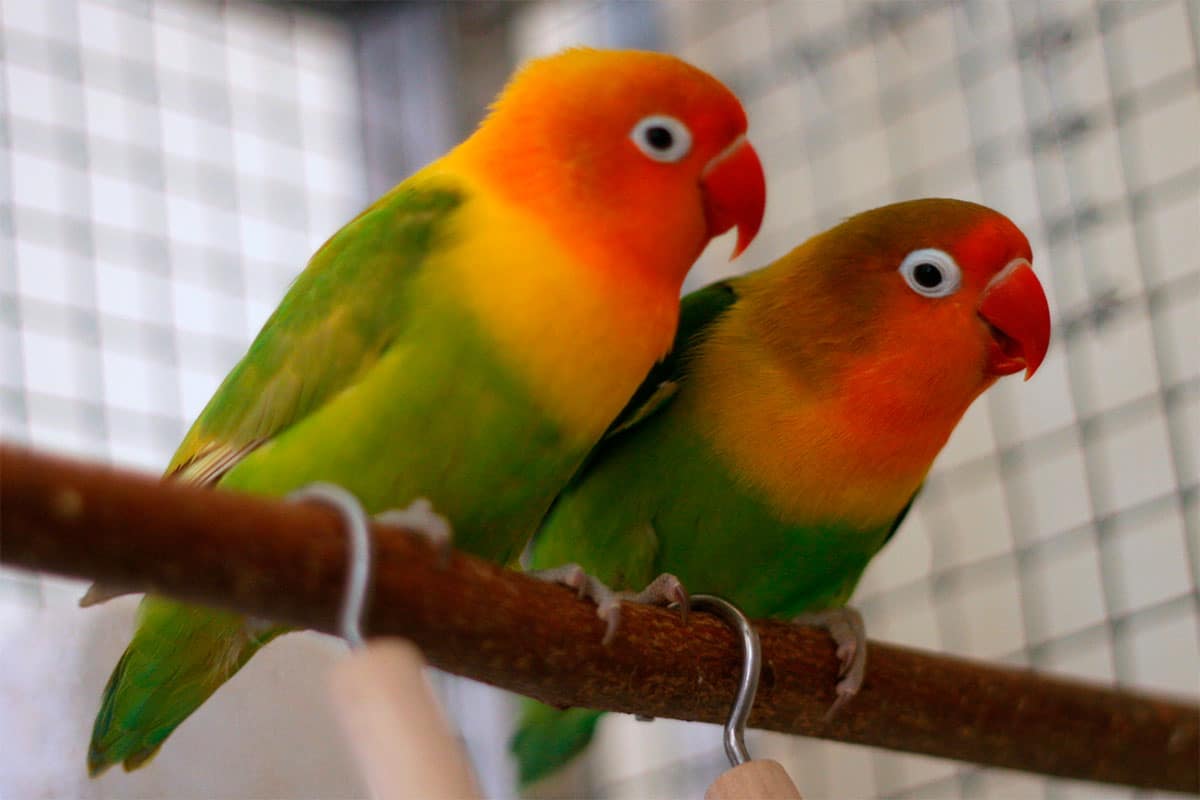
โ–ท The world of Pets: Dogs, cats, birds, reptiles, amphibians

Scarlet-chested Parrot
Neophema splendida

Scarlet-chested Parrot

Content


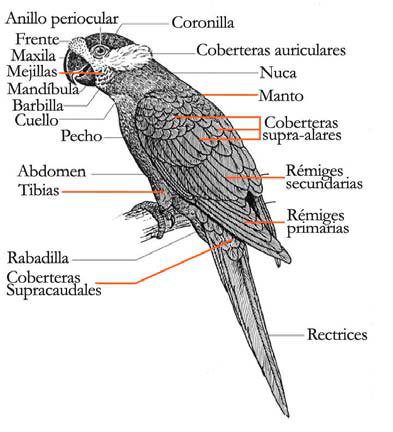
Anatomy-parrots

Description

19 cm. length and a weight between 36 and 44 g..

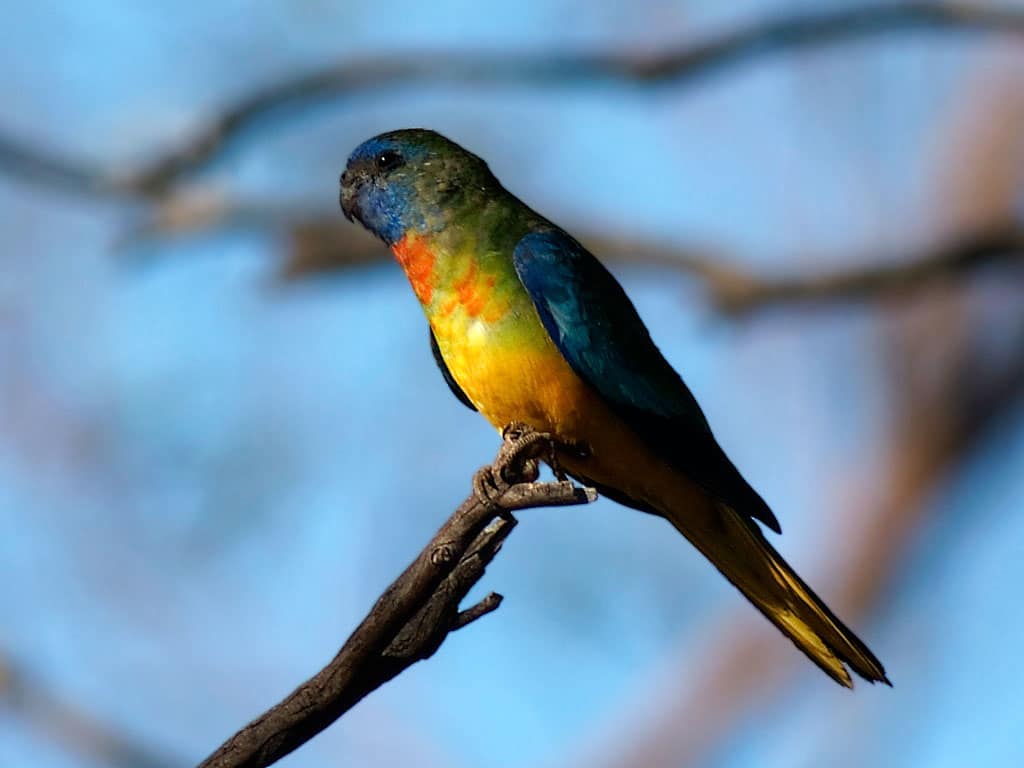
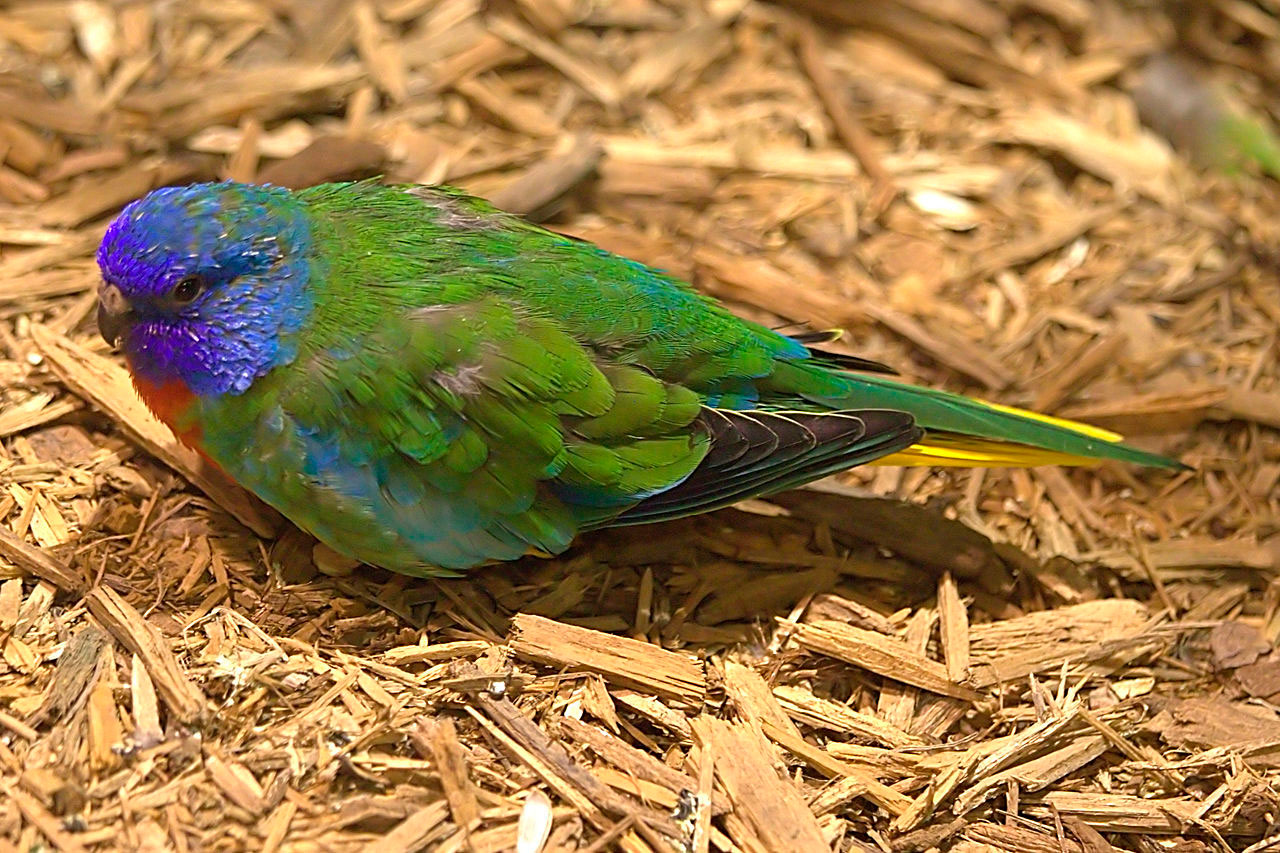
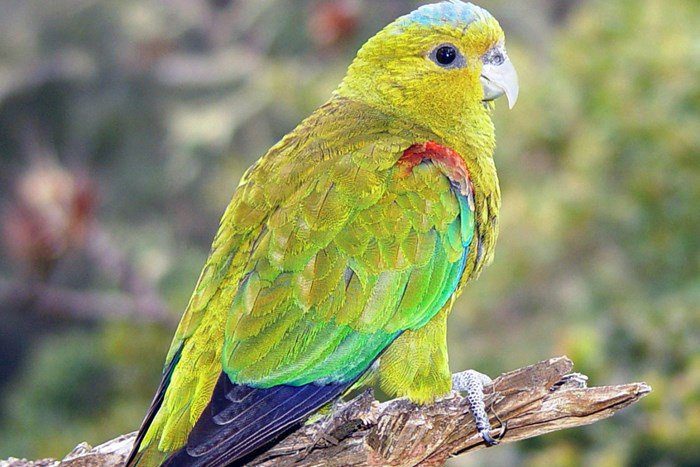
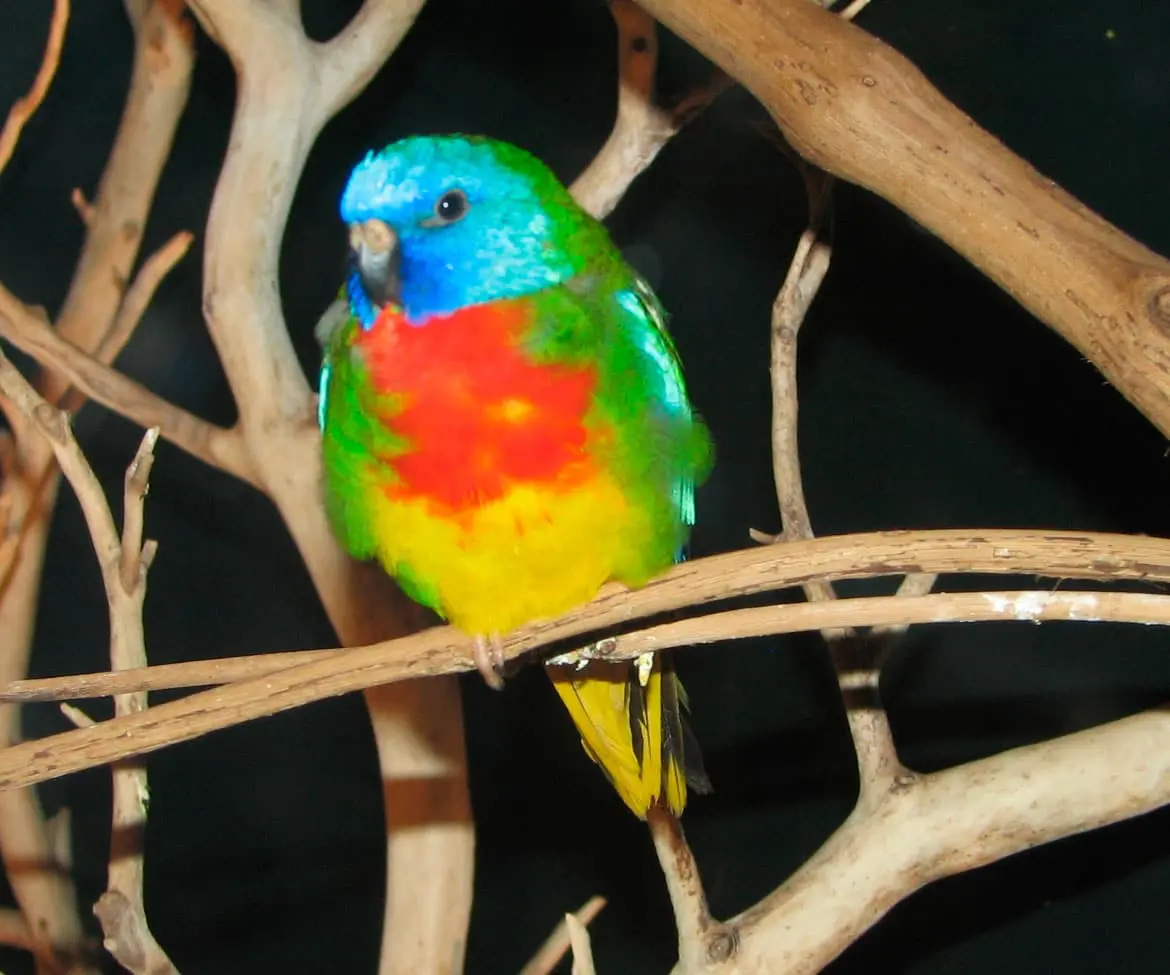
The Scarlet-chested Parrot (Neophema splendida) It is particularly colorful. It has the "face" and the forecrown are bright turquoise blue, darker in the throat and chin.

The upperparts are green. The curvature of the wings is dark blue, wing-coverts are the same blue tone to the face. Primary coverts dark blue-violet. The primaries Black has light blue brainwashed in the foreign bands. The outer edge of the secondaries has a tone blue-green that is mixed with the green of them vane inner and tertiary.

The underparts is dark blue. The chest is bright Scarlet, which is an important recognition feature. The sides of the top of the chest and flanks are green. The rest of the underparts is bright yellow. The bottom of the tail is green, but the tips of the outer tail feathers they are dyed yellow.

The bill is black, irises dark brown. The legs are gray-Brown.

The female is duller than its companion, with the belly and the chest green. The blue color of the face is restricted.

The females and juveniles they often show Wing bars.

The young male need four months to purchase your mature plumage, and retain a youthful glow until the age of 2 years.

Habitat:

The Scarlet-chested Parrot they are usually distributed in arid scrublands that are composed mainly of acacias and eucalyptus. They appreciate, particularly, plants of Mallee (Eucalyptus gracilis) and Mulga (Acacia aneura).

Also live in wooded areas dominated by casuarinas, as well as areas where the soil is covered by Spinifex or large clumps of grass type Triodia.

The Scarlet-chested Parrot do not despise the crests of hills that are equipped with a large number of plants, like the covered Plains of Sea sandwort or Salt grass (Honckenya peploides), What are plants which grow in saline environments.

They tend to find their food on Earth and form relatively consistent flocks outside of the nesting season.

During the breeding season, These birds are not very gregarious, but couples establish their nests in trees not very far from the other.

As with the Turquoise Parrot, the division of labor is well established and the females are responsible for the collection of green leaves that adorn the interior of the nest.

There is no description of the various courtship.

Reproduction:

The season of nesting of the Scarlet-chested Parrot, usually, is carried out between January and August, but these dates can change as the reproduction is influenced, significantly, by climatic conditions, especially the rains.

The nest It is placed in a tree cavity, above all a eucalyptus, between 2,5 and 8 meters above the ground.

The Scarlet-chested Parrot they are very loose colonies.

The spawning includes of 3 to 5 eggs and your incubation lasts a few 18 days. The most numerous litters, sometimes, provide 6 eggs.

The chicks are altricial, they take flight to leave his place of birth 30 days after hatching.

Food:

The Scarlet-chested Parrot they have a diet almost exclusively granivore.

These birds acquire most of the moisture you need eating Succulents as Calandrinia. If this practice is not enough, These parrots are like other species of arid lands, that is to say, that they are going to supply themselves with liquid directly to the sources and water points.

Menu details are poorly known, but it is known that most feed on seeds of plants such as Triodia, Newcastelia, haloragis, Acacia and Stipa.

Distribution:

Size of the area of distribution (reproduction / resident): 1.280.000 km2

This rare Nomad has a wide area of historical distribution, but it is probable that now concentrate on parts with more vegetation of the Great Victoria desert, with records from Kalgoorlie, Western Australia, the East, through the North of the Nullarbor plain in Southern Australia, North of the Eyre Peninsula, about Port Augusta and in areas of Mallee to the North of the murray river, to the Northwest of Victoria, West of New South Wales, Southwest of Queensland and MacDonnell Ranges of the Northern Territory.

A flock of 240 bird was recently recorded in the Great Victoria desert.

Conservation:
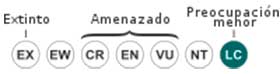

minor concern


โ€ข Current category of the Red List of the UICN: Least concern

โ€ข Population Trend: Stable

The inroads among 1939 and 1996 They show that these birds are able to form very rapidly large gatherings.

Disturbances affecting the natural environment had a negative impact on the evolution of the active population. The use of aquatic resources for the livestock and competition in this field with the Bourke's Parrot they have also caused damage.

Poaching and marketing of this bird have also had devastating consequences: more than 25.000 Scarlet-chested Parrot they are in captivity in Australia.

Its population in freedom is estimated at around 10,000 specimens.

"Scarlet-chested Parrot" in captivity:

The Scarlet-chested Parrot is a species peaceful and silent. This beautiful parakeet ends up gaining confidence with your caregiver, It is only a matter of time. It is also easy to maintain and almost do not eat wood. It is resistant to cold (light Frost), but it is very sensitive to humidity, fog, and air currents.

The Scarlet-chested Parrot they feed on the ground; It is convenient to use of vermicides, deworming them regularly. They are also susceptible to ocular infections and vulnerable to infections of Candida.

The tastes for the bathroom vary from one individual to another.

In terms of their longevity, according to sources, a sample lived during 14 years in captivity. The same sources report that these parakeets can live up to 25,4 years in captivity, but this has not been verified; the same study also ensures that the Scarlet-chested Parrot You can play from around 1 year of age in captivity.

The mutations:

    โ€ข Aqua: autosomal recessive
    โ€ข Turquoise: autosomal recessive
    โ€ข Blue: autosomal recessive
    โ€ข Pastel: autosomal recessive (not in Europe)
    โ€ข Cinnamon: recessive sex-linked
    โ€ข Pale: recessive sex-linked
    โ€ข Mixed: autosomal dominant
    โ€ข Misty: autosomal co-dominant (PAS en Europe)
    โ€ข Gris: autosomal dominant
    โ€ข Mixed: autosomal recessive
    โ€ข Fallow (bronze fallow): autosomal recessive
    โ€ข INO: recessive sex-linked
    โ€ข Platinum: recessive sex-linked
    โ€ข Violet: co-dominante autosomique
    โ€ข Dark factor: co-autosomal dominant

Alternative names:

Scarlet-chested Parrot, Scarlet chested Parrot, Scarlet-breasted Parrot, Scarlet-chested Parakeet, splendid parakeet (ingles).
Perruche splendide, Euphรจme resplendissante, Perruche resplendissante (French).
Glanzsittich (German).
Periquito-esplรชndido (Portuguese).
Papagayo Esplรฉndido, Periquito Esplรฉndido (espaรฑol).

scientific classification:

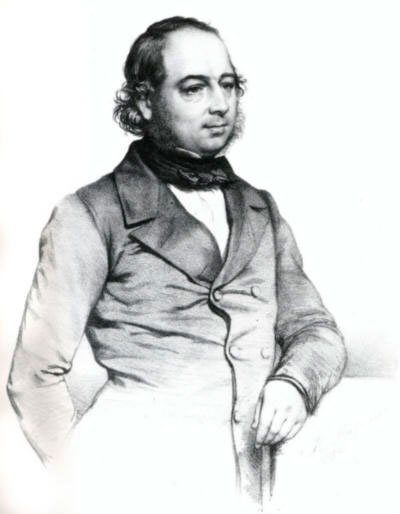
John Gould
John Gould

Order: Psittaciformes
Family: Psittaculidae
Genus: Neophema
Scientific name: Neophema splendida
Citation: (Gould, 1841)
Protonimo: E uphema splendida

ยซSplendid Parakeetยป Images:

Videos "Scarlet-chested Parrot"

————————————————————————————————

ยซSplendid Parakeetยป (Neophema splendida)


Sources:

Avibase
– Parrots of the World โ€“ Forshaw Joseph M
– Parrots A Guide to the Parrots of the World – Tony Juniper & Mike Parr
– Birdlife

Photos:

(1) – Adult male at Cincinnati zoo, USA By Ltshears (Own work) [Public domain], via Wikimedia Commons
(2) – Taken at the Cincinnati Zoo By Greg Hume (Own work) [CC BY-SA 3.0], via Wikimedia Commons
(3) – Immature male on the left and an immature female on the right at Gluepot Reserve, South Australia By David Cook Wildlife Photography from Wamboin, NSW, Australia [CC BY 2.0], via Wikimedia Commons
(4) – Immature male on the left and an immature female on the right at Gluepot Reserve, South Australia By David Cook Wildlife Photography from Wamboin, NSW, Australia [CC BY 2.0], via Wikimedia Commons
(5) – Scarlet-chested Parrot ยซNeophema splendidaยป at Cincinnati Zoo By Ltshears (Own work) [CC BY-SA 3.0], via Wikimedia Commons
(6) – By T.H. Maguire (1821โ€“1895) (http://www.birdresearch.dk/dk/jgould.htm) [Public domain], via Wikimedia Commons
โ–ท The world of Pets: Dogs, cats, birds, reptiles, amphibians

Grey Parrot
Psittacus erithacus


Loro Yaco

Content


Anatomy-parrots

Description Loro Yaco:

Of 33 cm.. length and an average weight of 475 g..

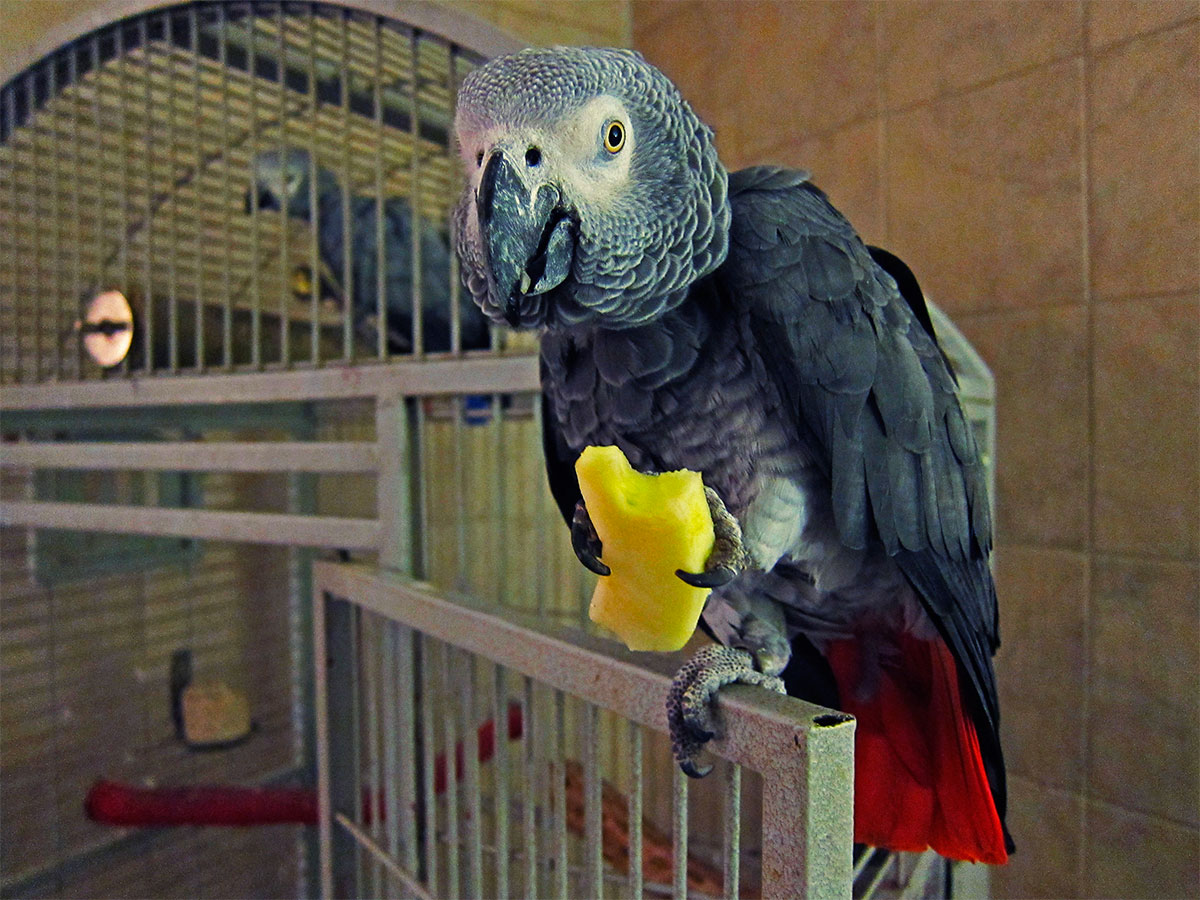
The Grey Parrot (Psittacus erithacus) is famous for its intelligence and ability to mimic sounds and human speech, so it is one of the most popular of all pets avian. It is one of the largest parrots in Africa.

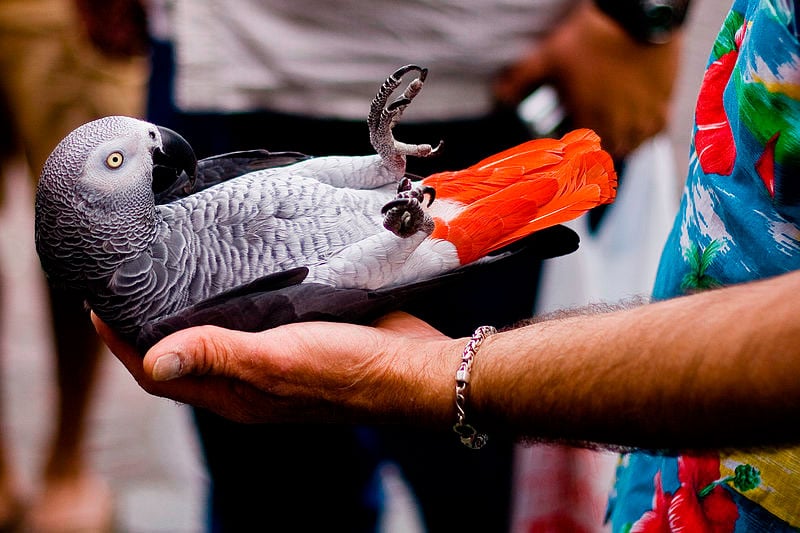
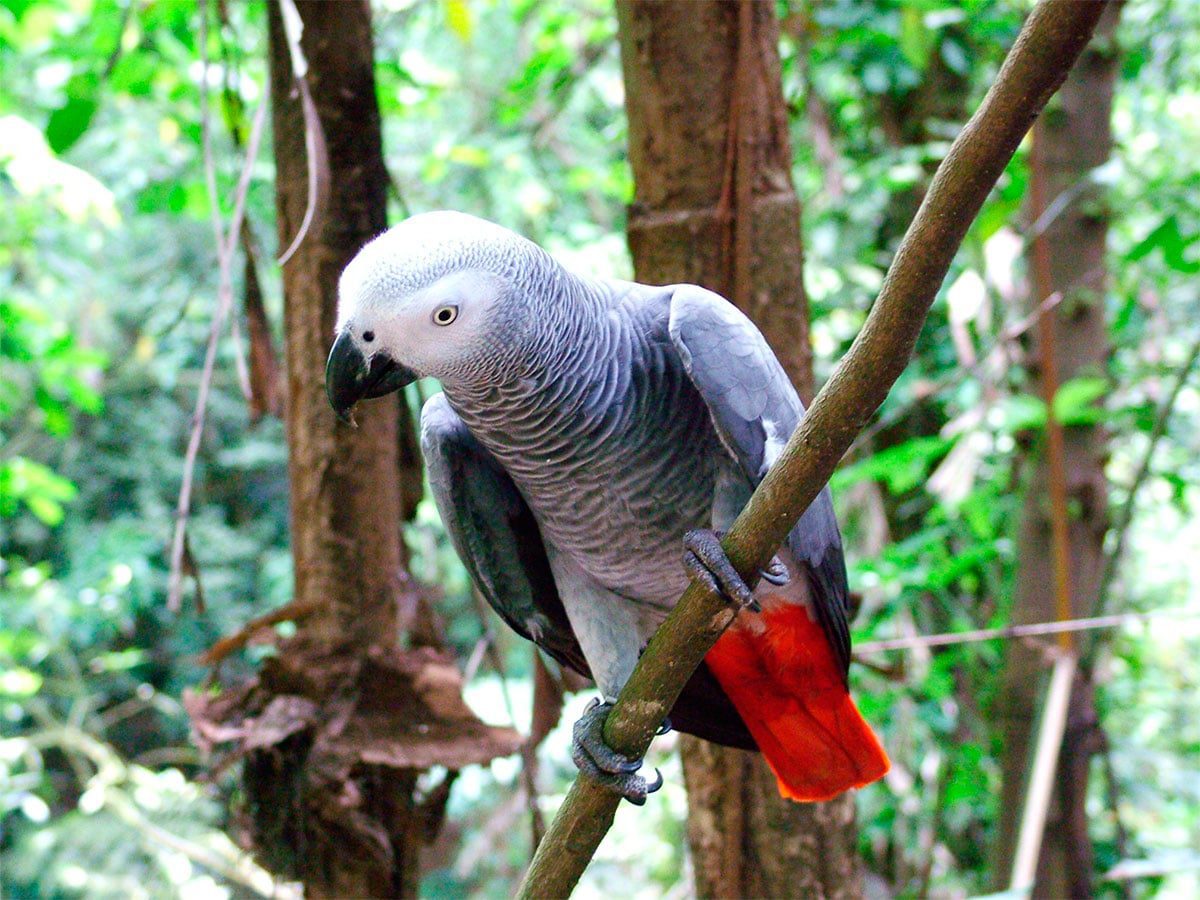
They have the feathers of the lores, the cheeks, the frenyou and the crown silver grey, more clear tips. The of the the mantle and lower area of the back darker, slate gray with light margins, giving a scaly appearance; the lower area of the back and tail are silver grey. Upper wing coverts, secondaries and scapulars slaty-grey. Primaries grey dark (almost black), more clear below that top.

Wing feathers light grey, with the exception of the greater coverts that are of a dark grey tone.

feathers of the chest slate gray with pale gray margins fused with much lighter silver feathers on the belly; flanks and the thighs clear silver grey color.

Tail and their coverts, bright Scarlet.

Older birds they can show scattered red feathers between the plumage gray, especially in the the thighs and the belly.

The bill black; irises yellow; naked facial area with some fine white hairs; legs dark grey.

Without sexual dimorphism in the plumage.

Immature they have the tail darker red towards the tip, Grey dye in undertail- coverts and the irises grey.

Subspecies description:

  • Psittacus erithacus erithacus

    (Linnaeus, 1758) – Subspecies nominal


  • Psittacus erithacus princeps

    (Alexander, 1909) – Very similar to the nominal, except that they are a little smaller. Some bird breeders argue that the Princeps is a regional type of Psittacus erithacus erithacus, instead of separate subspecies.

Habitat:

The Grey Parrot They inhabit the tropical jungle primary and secondary, the forest edges and clearings, gallery forest and mangroves; wooded Savannah, haunting, often, land cultivation and even gardens.

Partially confined in the lowlands, Although in the East of its range have been recorded at altitudes of 2.200 m.

They reach the highest densities in primary lowland forests, intermediate in the primary montane and lower density in plantation of coconut.

gregarious, they form large communal roosts of up to 10.000 individuals, often at some distance from the feeding areas.

Preferred places of shelter are trees or palm trees on the water, also islands in the rivers.

Are dispersed into smaller groups (until 30) to feed.

Reproduction:

The reproduction of the Grey Parrot takes place in loose colonies, in which each pair occupies its own tree. Individuals select their partners carefully and have a monogamous union of lifelong It begins at sexual maturity, between three and five years of age.

Few details are known about the courtship in nature, but have been observed and recorded flights of visualization around the nest cavities. The males feed their mates (power dating) and both sing soft monotonous notes. At this time the female goes to sleep to the nest cavity, While the male takes care of it.

In captivity, the Grey Parrot fed males to females after copulation events and both sexes participate in a mating dance in tipping its wings.

The nest they build it in the cavities of some tree (for example, Terminalia, Ceiba or Distemonathus), between 10 and 30 meters above the ground.

Sometimes breeds in colonies of up to several hundred couples loose (in Prince for example), but in most places they nest alone.

Breeding season varies with locality. In East africa, breeding has been recorded in the months of January-February and June-July, both in dry periods.

Young chicks have been released for sale from March onwards in Ghana. Other records suggest as a rule from the breeder, the dry season.

The females lay from three to five eggs, that you are in charge of incubate while they are powered entirely by the male. The incubation lasts approximately thirty days and the young man emerges from the nest at twelve weeks of age.

Food Loro Yaco:

Their diet consists of a variety of seeds, nuts, fruits and berries.

Known within their power are the fruits and seeds of Ficus, heisteria, Dacryodes, Petersianthus, Combretum, Macaranga, Raffia, Her heart, Ceiba, Sapida, Bombax, Celtis, Hunting, Parkia, Terminalia and Prunus.

The fruit of the Palm oil (Elaeis guineensis) is her favourite in some areas, coming to bear its fruit over long distances before being consumed.

In Bioko, they prefer the berries of Tragacantha tail (Fam. Malvaceae).

They can be a pest, causing considerable damage to corn crops in some areas.

Loro distribution Yaco:

Size of the area of distribution (reproduction / resident): 2.760.000 km2

The Grey Parrot are distributed between the West and centre of Africa, of Guinea-Bissau and this from Sierra Leone, across the South of Mali, Ivory Coast, Ghana and Nigeria, until Cameroon, extending to Bioko and Islands Sao Tome and Principe in the gulf of guinea; from Gabon and the Congo through Zaire, Uganda and Western Kenya, the Southwest and East - Central of Zaire and Northwest of Tanzania.

Usually sedentary. Common where large extensions of forest persist and still abundant in some localities, especially in the tropical jungles of the Congo basin. But, due to the extensive loss of forests in some parts of the range (for example, of Nigeria to Sierra Leone) and the catch on a massive scale (the second best-selling parrot in the world in the Decade of 1980) There have been dramatic declines in some places (for example, in Liberia, Ghana, Kenya and around Kinshasa, Zaire, and other cities of the Congo basin).

Subspecies distribution:

  • Psittacus erithacus erithacus

    (Linnaeus, 1758) – Species nominal


  • Psittacus erithacus princeps

    (Present on the islands of Saint Thomas (in this possibly introduced) and Principe)

Conservation ยซLoro Yacoยป:


Vulnerable


โ€ข Current Red List of UICN: Vulnerable.

โ€ข Population trend: Decreasing

The Grey Parrot They are protected by the convention CITES, consisting in annex II (species that may be threatened by a trade out of control).

If it is considered not threatened globally, the fact of being one of the species of the family Psittacidae (parrots and parakeets) most sold in the world makes its distribution is shrinking dramatically in certain places, its disappearance may be close in many of these areas according to the organization The World Parrot Trust [4].

The following data are quite illustrative in this respect:

    1. In the period 1982-1989 It was the second psittacida then suffered more trade of Agapornis fischeri, with averages of more of 47.000 specimens exported from Africa annually [1].

    2. The export quotas under the CITES agreement for psittacines are often not adjusted to scientific criteria due to the lack of detailed population studies and the annual renewal rates of the populations. [2].

    3. Too often these quotas are widely exceeded by exporting countries.. These may include Cameroon exported 23.000 grays in 1996, When I had a share of 12.000! [2]. Although these facts to do that Cameroon could not legally exported in 1997, the current quota of 12.000 grays is exceeded with more of 15.000 all the years [5]. Another example, is the Republic of Congo, with an annual fee of 10.000 grays, that has also been sanctioned by the impossibility of exporting them in 2001 and 2002 by the large number of existing fraudulent export [6].

    4. In the year 1999, the European Union imported (legally under the Convention CITES) from Africa 33.341 greys parrots, number only surpassed in this family by parrots of the genus Lovebirds (71.588 of Agapornis roseicollis, 63.867 of Agapornis fischeri and 33.720 of Agapornis personatus). Spain It was the second destination of these parrots grays, after Netherlands, imported 6.216 specimens [7].

    5. There are specific areas Africa It supported much of the pressure from hunters of parrots for their trade. One of them is the area of Lobeke, in the southeast of Cameroon, where they hunt every year more than 15.000 grays, most of them die by mishandling in the capture and transport [5].

The aforementioned illegal trade is no stranger to our country, where was recently dismantled an international network of illegal import of this species from the Republic of Congo, who had brought to Spain at least 3.982 specimens from the year 1998 [7].

On the other hand, in some countries these birds are raised industrially for sale. This favours on the one hand the fact that decreases the importation of birds hunted in the wild [2], and on the other increases the number of birds on the market, and with it the chance of leaks or intentional releases, that they can get to colonize areas outside its area of distribution. An example of a Spanish company of these characteristics, among the many that are, It has more than 300 breeding pairs, can be found in [8].

References:

[1] NECKLACE, N.J.. 1997. Family Psittacidae (Parrots). In: Handbook of the Birds of the World. Vol. 4. Sandgrouse to Cuckoos (Ed: J. pit, A. Elliot, J. Sargatal). Lynx Edicions, Barcelona. pp. 280-477.
[2] MAY, D.L.. 2001. Grey Parrots of the Congo Basin Forest. PsittaScene 13-2(47): 8-10.
[3] AALANGDONG, O.I., AUGUSTINE, S. 1999. Langyintuo. Crop damage by wildlife in Northern Ghana. Abstracts of the 2nd International Wildlife Management Congress, Gรถdรถllรถ, Hungary.
[4] The WPT 12. The World Parrot Trust. African Grey Parrot. www.worldparrottrust.org
[5] NGENYI, A. 2002. African Grey Parrot trade in Cameroon. PsittaScene 14-2(51): 2-3.
[6] El Periรณdico de Catalunya. Dismantled a network of trafficking in protected species in Barcelona. 11-11-2004.
[7] Report of Animal Aid. 2002. From Rainforest to Retail. Leading DIY chain and the horror of the wild bird trade.
[8] Psittacus Catalonia, SL. Information available in: www.psittacus.com

ยซLoro Yacoยป in captivity:

The ancient Egyptians already kept these birds as pets.. Later the Greeks and the Romans did the same.

While the Grey Parrot they can be good pets, If you have children in your home, buying a Grey Parrot It would be a bad idea, by both the Parrot and the children that can be easily damaged with its claws and beak.

The Grey Parrot can also be difficult for some people to maintain, This is probably due, Unlike other pets, because these are always active and should be checked several times a day. These parrots can be unordered, for example, When they are eating the seeds or other foods it is likely that they end up throwing debris out of the cage and even against the walls.

More Intelligent any dog, calls attention to the 24 hours of the day. His extreme intelligence and sensitivity takes you easily to the depression if it is unrequited.

It is a bird very long-lived, There are those who say that these animals can live 73 and up 93 years. More longevity record reliable, However, is a specimen that was still alive after 49,7 years. In captivity, these animals they tend to breed to the 5 years of age.

Their cages they must also be cleaned daily, due to their feces, they are totally inconsistent and appear in their feeders, toys, or anywhere else in the cage. Because of this, you have to wash the cages thoroughly to remove any odor and bacteria.

To the Grey Parrot like biting everything, and when I say everything, I say this seriously. They mostly enjoy chewing on pieces of wood, probably because they do in nature, However, be aware that they will chew everything at your fingertips, clothing, curtains, the skin of our sofas, etc. If you have many objects in the House, make sure they are in a safe place when you let your birds out of the cage.

Note: In the European Community and the United States this prohibited the marketing of these parrots if they have been captured in wild environments.

Alternative names ยซLoro Yacoยป:

Grey or Timneh Parrot, African Gray Parrot, African Grey Parrot, Gray Parrot, Grey Parrot (English).
Perroquet jaco ou P. de Timneh, Jacko, Perroquet gris, Perroquet gris du Gabon, Perroquet jaco (French).
Graupapagei (German).
papagaio-do-congo, Papagayo Cinzento, Jacco (Portuguese).
Cotorra Africana, Loro Yaco, Loro Gris Africano, Loro Gris, Loro Gris de Cola Roja, Yaco (espaรฑol).


Scientific classification ยซLoro Yacoยป:

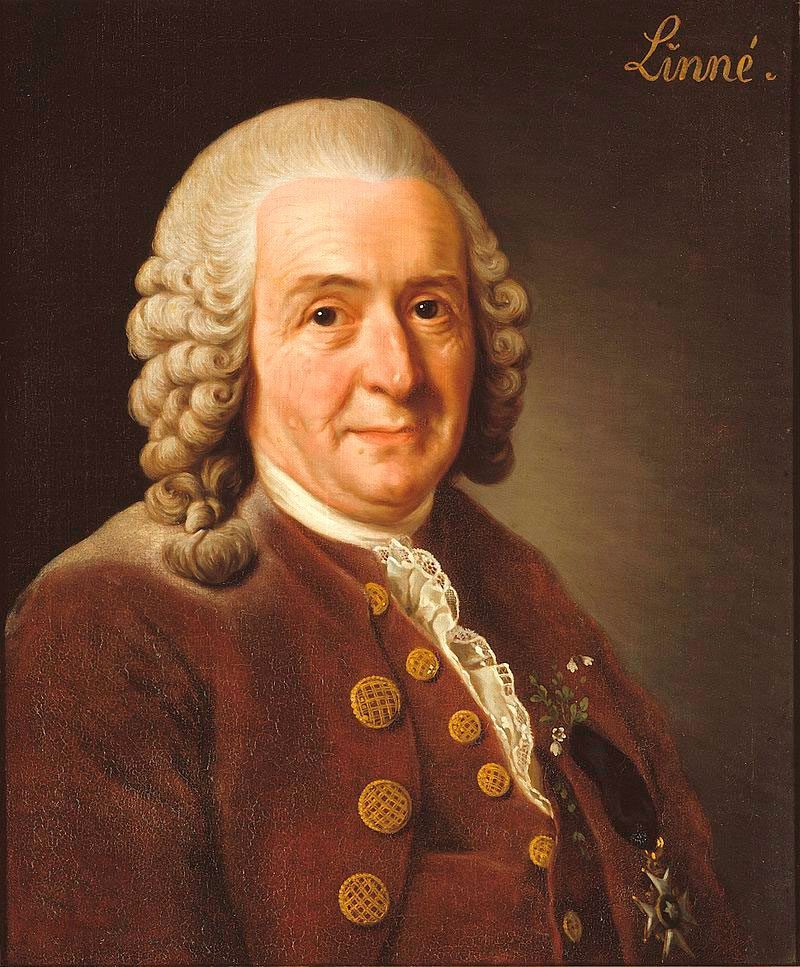
Carl Linnaeus
Carl Linnaeus

Order: Psittaciformes
Family: Psittacidae
Genus: Psittacus
Scientific name: Psittacus erithacus
Citation: Linnaeus, 1758
Protonimo: Psittacus erithacus

Images ยซLoro Yacoยป:

Videos "Grey Parrot"

ยซYaco Parrotยป (Psittacus erithacus)

    Sources:

    Avibase
    – Parrots of the World โ€“ Forshaw Joseph M
    – Parrots A Guide to the Parrots of the World – Tony Juniper & Mike Parr
    – Birdlife
    – Spanish Society of Ornithology / BirdLife – SEO

    Photos:

    (1) – Congo African Grey Parrot (Psittacus erithacus erithacus) at a bird park in Singapore By Michael Gwyther-Jones (originally posted to Flickr as Singapore) [CC BY 2.0], via Wikimedia Commons
    (2) – Loro gris do Congo. Photo taken na Illa de Arousa, Galiza By L.Miguel Sรกnchez Bugallo (http://commons.wikimedia.org/wiki/User:Lmbuga) [GFDL or CC-BY-SA-3.0], via Wikimedia Commons
    (3) – Congo African Grey Parrot (Psittacus erithacus erithacus). Pet parrot held on a hand. By Eli Duke [CC BY-SA 2.0], via Wikimedia Commons
    (4) – Young African Grey Parrot (Psittacus erithacus erithacus) at Weltvogelpark Walsrode (Walsrode Bird Park, Germany) OLAF Oliviero Riemer [CC BY-SA 3.0], via Wikimedia Commons
    (5) – Loro gris do Congo. Photo taken na Illa de Arousa, Galiza By L.Miguel Sรกnchez Bugallo (http://commons.wikimedia.org/wiki/User:Lmbuga) [GFDL or CC-BY-SA-3.0], via Wikimedia Commons
    (6) – A Congo African Grey Parrot eating a piece of apple. It is perching on an open cage door and there is another parrot in the cage in the background By Peter F. (originally posted to Flickr as thanksgiving) [CC BY 2.0], via Wikimedia Commons
    (7) – A pet Congo African Grey Parrot on held back By Sonny SideUp (originally posted to Flickr as Bird Tossing) [CC BY 2.0], via Wikimedia Commons
    (8) – By Hans – pixabay

    Sounds: Martin St-Michel (Xeno-canto)
    (9) – A pet Congo African Grey Parrot in a cage By ร‚ngela from Portugal (Hello hello!Uploaded by Snowmanradio) [CC BY 2.0], via Wikimedia Commons

โ–ท The world of Pets: Dogs, cats, birds, reptiles, amphibians

Fischer's Lovebird
Agapornis fischeri


Inseparable de Fischer

Content

Description Fischer's Lovebird:

Inseparable de Fischer

Of 12,7 to 15 cm in length and a weight between 42 and 58 g..

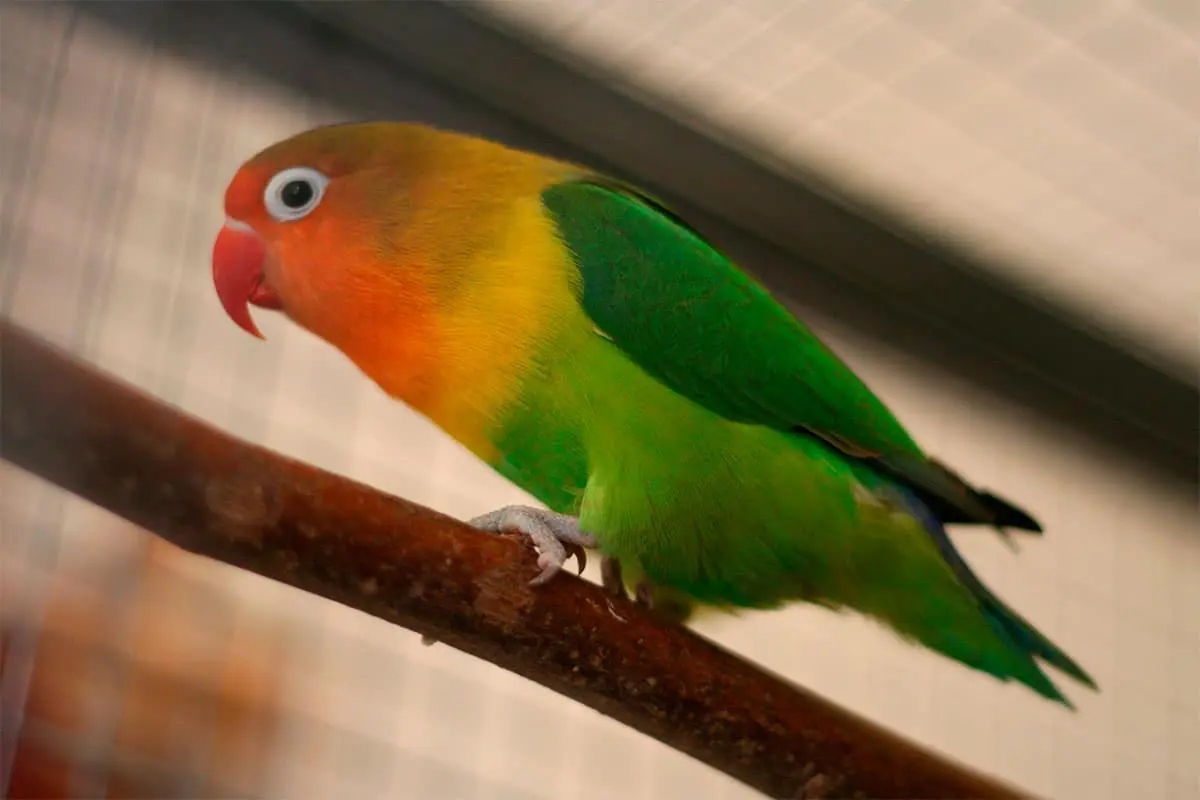
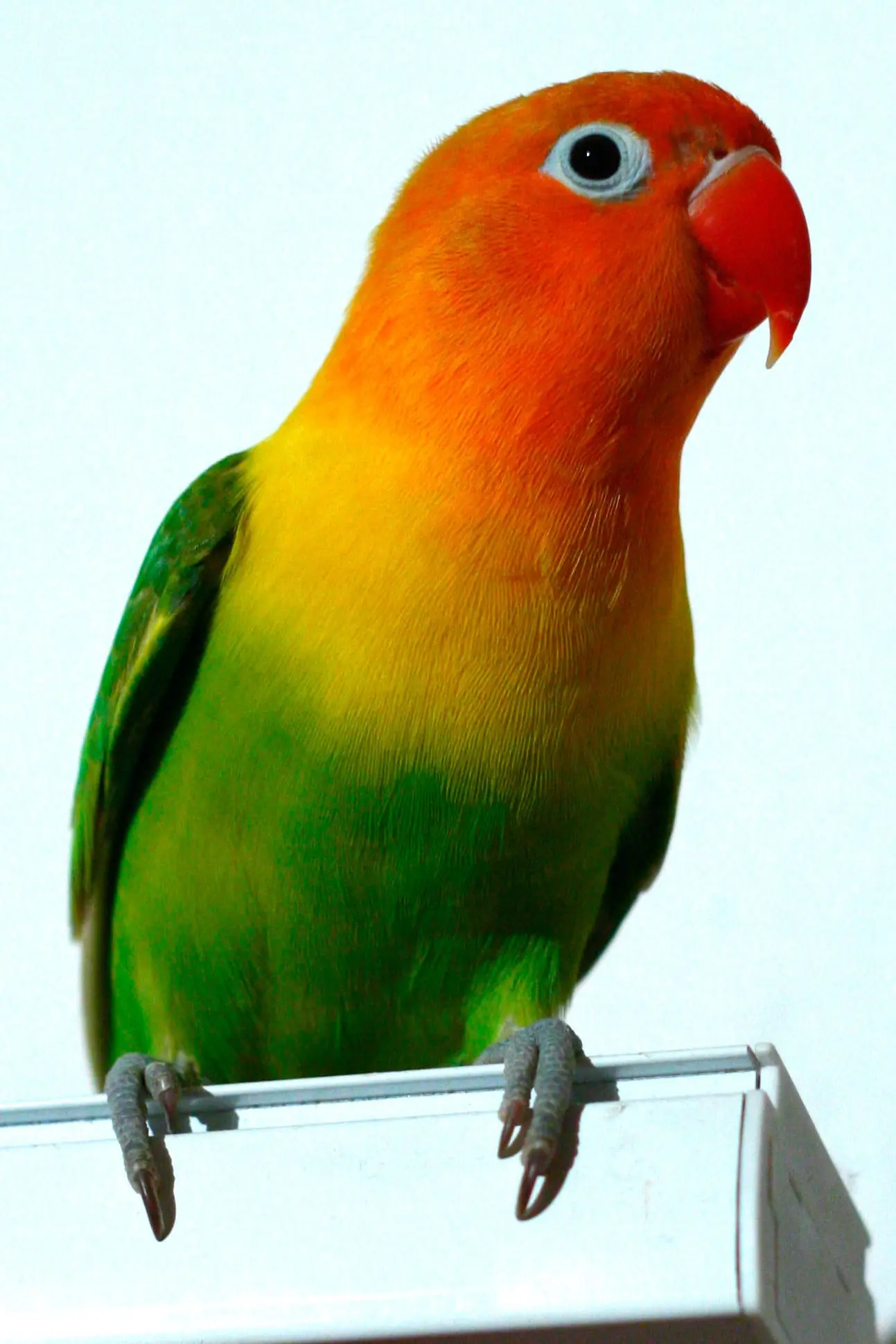
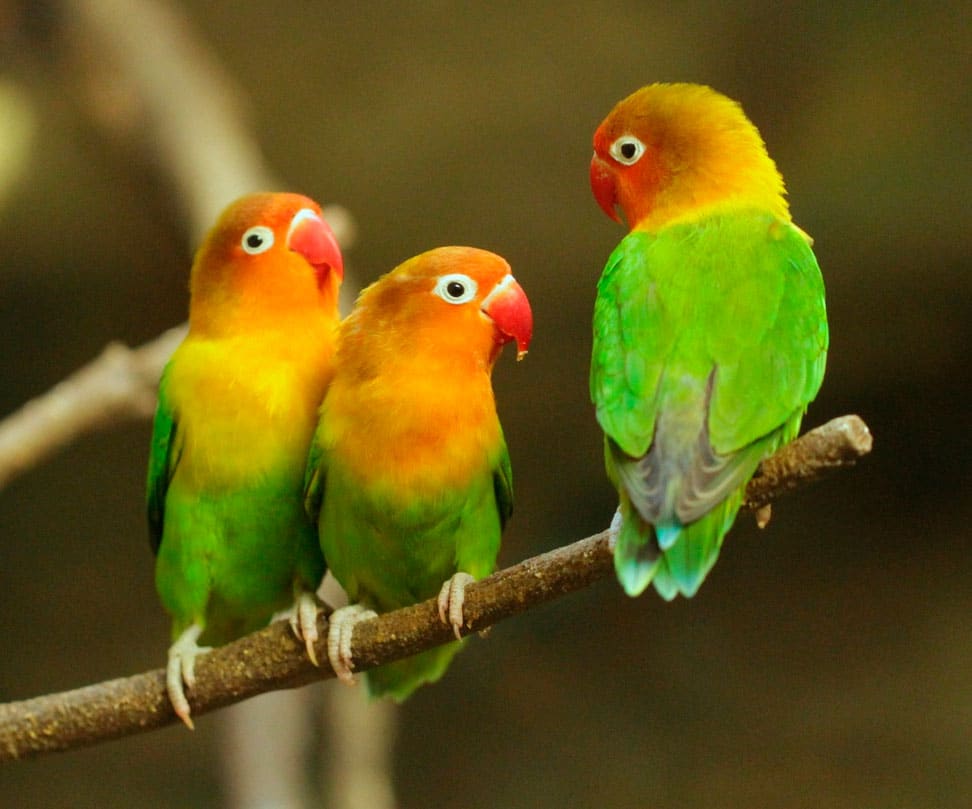
The Fischer's Lovebird (Agapornis fischeri) has a frontal band, the lores and cheeks bright red with an orange shaded in red chin and throat. Upper chest is orange-yellow; crown and nape They are brown. Width collar adjacent yellowish brown and yellowish orange band at the top of chest.

The the mantle, scapulars and front of the rump, are green; the back of the rump and uppertail-coverts dark blue. Upper, the wing-coverts green; primaries and secondaries blackish brown with green edges to the vane outer. Under, the wing-coverts green; underside of flight feather grey-black. The low area chest up to the undertail- coverts pale yellowish green.

Tail bluish green, tipped yellow and bordered by a black line.

The bill is red, whitish towards the base of the upper jaw; cere white; irises brown; periophthalmic ring white of a 2 mm; legs pale grey.

Both sexes similar, indeed there no sexual dimorphism Between both.
One method that is very effective in distinguishing the sex of our Fischer's Lovebird It is the bone of the pelvis, being more open in females than in males.

The immature They have reduced the blue in the uppertail-coverts and they are both duller than adults, particularly on neck, the head and the chest; black markings, sometimes at the base of the upper jaw.

Habitat Fischer's Lovebird:

The Fischer's Lovebird They inhabit wooded grasslands with acacias, Commiphora; especially in the west, also in more open grasslands with Adansonia and cultivated areas. More common in sheets with different types of acacias and trees of the genus Egyptian balanites; also in terrestrial flora zones including Penisetum, Digitaria, Themeda and pastures Eustachys.

In the south of its range They are present in the forest with palm trees Borassus aethiopum.

When the season is dry, They can also be seen in areas of riverine forests Ficus, Boolean, Tamarindus, Aphania, Garcinia and Eckberg.

Avoid wooded savannah type miombo.

usually in altitude between 1,100-2.000 m. Often near water, especially in hot weather.

Gregarious, at least outside the breeding season , and generally in small flocks. Sometimes more important meetings form, for example, where abundant food.

In Tanzania They meet roosting nests leveraging Rufous-tailed Weaver (Histurgops ruficauda).

The main known predators Fischer's Lovebird they are the Borni Falcon (Falco biarmicus).

Reproduction Fischer's Lovebird:

The Fischer's Lovebird They breed in colonies.

The breeding It takes place from January to April and in June and July, coinciding with the dry season; the exact timing depends on the locality.

Most of the nests They are located 2.15 meters above the ground, at the base of leaves overhead palm, in the holes and cracks of dead trees or dead branches and live trees, sometimes nest on cliffs.

The nest It comprises grass stalks and peel strips carried by the female in his beak.

The Clutch size in captivity is three to eight eggs, with a period of incubation of 23 days and period incipient of 38 days.

Food Fischer's Lovebird:

The diet of the Fischer's Lovebird is mainly granivorous. It feeds on seeds such as Pennisetum mezianum, also it feeds millet and corn, although the species does not come to be considered a serious pest for crops; Also they take seeds Acacia directly from trees, grass Achyranths asper, fallen berries and fruit Ficus, Rhus shaggy and Commiphora.

They need to drink daily.

Distribution:

The Fischer's Lovebird They are endemic to the north and northwest Tanzania from Kondoa in the South-East, Serengeti National Park, in the north and the Lago Manyara in the East; possibly closer to the border Kenya in some areas.

In Rwanda and Burundi the species is either a recent natural settler, or I asilvestrado from 1970, or an irruptive visitor in response to drought.

Observed on the islands Ukerewe and KNIT in southern Lago Victoria.

Wild populations established in the region Dar es Salaam and Thong in Tanzania, and around Mombasa, Nairobi, Naivasha and Isiolo, in Kenya.

Probably some Local movements in the dry season with irruptions in drought years. Within its tiny range, is a common bird, with large flocks in some areas, scarce and seemingly in decline, especially outside protected areas where low density is attributed to the capture for trade.

There is a self-sustaining wild population derived from escapes from captivity in Southeast France, where Yellow-collared Lovebird (Agapornis personatus) also they escaped, along with hybrids also observed.

A big number of Fischer's Lovebird in captivity.

Conservation:


Near-threatened

โ€ข Current Red List of UICN: Near threatened

โ€ข Population trend: Decreasing

The population of the Fischer's Lovebird release has been estimated to range between 290.205 and 1.002.210 birds.

There has been a significant population decline Since the Decade of 1970, mainly because of widespread trapping for the wild bird trade.

The Fischer's Lovebird wild bird was the most traded in the world 1987 and was the most popular wild parrot imported into the then European economic community, representing about 80% exports of parrots in Tanzania (RSPB 1991).

The legal collection for export has been stopped, but the population remains much lower than it was, and trade could start again (Moyer 1995).

The species hybridized with the Yellow-collared Lovebird (Agapornis personatus) in the nature, but not within the natural range of the species (there is a range of overlap but the Fischer's Lovebird It appears to be a non-breeding visitor habitat Yellow-collared Lovebird [N. Baker a slightly. 1999, Morton y Bhatia 1992]) so this is unlikely to pose a threat.

Conservation Actions Proposed

– Conduct surveys to obtain an estimate of the population-date.
– Monitor population trends through regular surveys.
– It prevent capture for export to start again. Investigate the extent of hybridization with the Yellow-collared Lovebird (Agapornis personatus).

The Fischer's Lovebird in captivity

The Fischer's Lovebird They have been kept as pets from, approximately, mid-sixteenth century. They became part of the trade in live birds 1926. The first successful captive breeding of Agapornis fischeri It was documented 11 in January of 1928. For the year 1931, the berlin zoo (Germany) they had raised 68 copies successfully in captivity. Today they are bred and sold as pets, mainly in the United States and Europe. In 1987 was the most traded bird species in the world.

The Fischer's Lovebird they are difficult birds to keep healthy in captivity. Son active birds they need a lot of space. When you are confined in a cage, health tends to deteriorate. Instead of being active and vocal, often they sit on the floor of the cage in a corner. physical problems such as negative young and the overweight also they shortened their longevity.

Being very active birds and require wide cage (a minimum of 50 x 50 x 75 cm. to a bird and 65 x 65 x 75 cm for a couple.). It is appropriate to give a little spot inside the cage to hide in when they feel insecure.

Surprisingly, they don't seem to have much trouble acclimatizing to cold weather even though their original habitat is tropical. If they kept away from drafts, they can withstand the long winters on other continents.

If allowed out of his cage must be very careful not to have utensils close that they can damage or may damage, they are avid chewers, they have strong beaks and can quickly cause damage.

They are very vocal birds and their shrill noise can be a nuisance.
.
Of all species of Lovebirds, the Fischer's Lovebird He is known to be the most acrobatic.

With regard to its longevity, a demographic study suggested that these birds are aging rapidly with maximum longevity 7,7 years. An exemplary, as indicated sources, lived 12.6 years in captivity. Maximum longevity could be underestimated; More studies are needed. It has also been informed by other sources that these animals can live up 32,2 years in captivity, but this has not been verified.

Alternative names:

Fischer’s Lovebird (English).
Insรฉparable de Fischer (French).
Pfirsichkรถpfchen (German).
Inseparรกvel-de-fisher (Portuguese).
Inseparable de Fischer, Agapornis Fischer (espaรฑol).


scientific classification:

Fischer's Lovebird - Anton Reichenow
Anton Reichenow

Order: Psittaciformes
Family: Psittaculidae
Genus: Lovebirds
Scientific name: Agapornis fischeri
Citation: Reichenow, 1887
Protonimo: Agapornis Fischeri


Images Fischer's Lovebird:

Videos "Fischer's Lovebird"


Species of the genus Agapornis


Fischer's Lovebird (Agapornis fischeri)


Sources:

Avibase
– Parrots of the World โ€“ Forshaw Joseph M
– Parrots A Guide to the Parrots of the World – Tony Juniper & Mike Parr
– Birdlife

Photos:

(1) – Fischerโ€™s Lovebird, (Agapornis fischeri); side view of a pet on a perch By Peter Bรฉkรฉsi (Flickr) [CC BY 2.0], via Wikimedia Commons
(2) – Two Fischerโ€™s Lovebirds, (Agapornis fischeri). Pets on a perch By Peter Bรฉkรฉsi from Budapest, Hungary (IMG_2303) [CC BY 2.0], via Wikimedia Commons
(3) – Three Fischerโ€™s Lovebirds at Ueno Zoo, Japan By Agapornis_fischeri_-Ueno_Zoo,_Japan_-three-8a.jpg: Takashi Hososhima from Tokyo, Japanderivative work: Snowmanradio [CC BY-SA 2.0], via Wikimedia Commons
(4) – Fischerโ€™s Lovebirds, Agapornis fischeri, social grooming By Peter Bรฉkรฉsi (originally posted to Flickr as IMG_0692) [CC BY-SA 2.0], via Wikimedia Commons
(5) – Fischerโ€™s Lovebird perching on a branch in captivity By Franรงoise Walthรฉry from Bruxelles, Belgium (8_Buiten_reeks_8) [CC BY-SA 2.0], via Wikimedia Commons
(6) – Fischerโ€™s Lovebirds at World of Birds Wildlife Sanctuary and Monkey Park in Cape Town, South Africa By Mara 1 (originally posted to Flickr as I Love You !) [CC BY 2.0], via Wikimedia Commons
(7) – Fischerโ€™s Lovebird (Agapornis fischeri). Two on a branch By Lucia Smit (originally posted to Flickr as Sonny & Cher) [CC BY 2.0], via Wikimedia Commons
(8) – Fischerโ€™s Lovebirds, Agapornis fischeri By Peter Bรฉkรฉsi (originally posted to Flickr as IMG_0736) [CC BY-SA 2.0], via Wikimedia Commons
(9) – A group of Fischerโ€™s Lovebirds feeding at Ueno Zoo, Japan By kanegen (originally posted to Flickr as Ueno Zoo) [CC BY 2.0], via Wikimedia Commons
(10) – Fischerโ€™s Lovebird, (Agapornis fischeri) perching on a box By Peter Bรฉkรฉsi (Flickr) [CC BY-SA 2.0], via Wikimedia Commons

Sounds: Rory Nefdt (Xeno-canto)

โ–ท The world of Pets: Dogs, cats, birds, reptiles, amphibians

Blue-rumped Parrot
Psittinus cyanurus


Lorito Dorsiazul

Content

Ilustraciรณn Lorito Dorsiazul

Description:

Of 18 cm.. of length and a weight of 85 g..

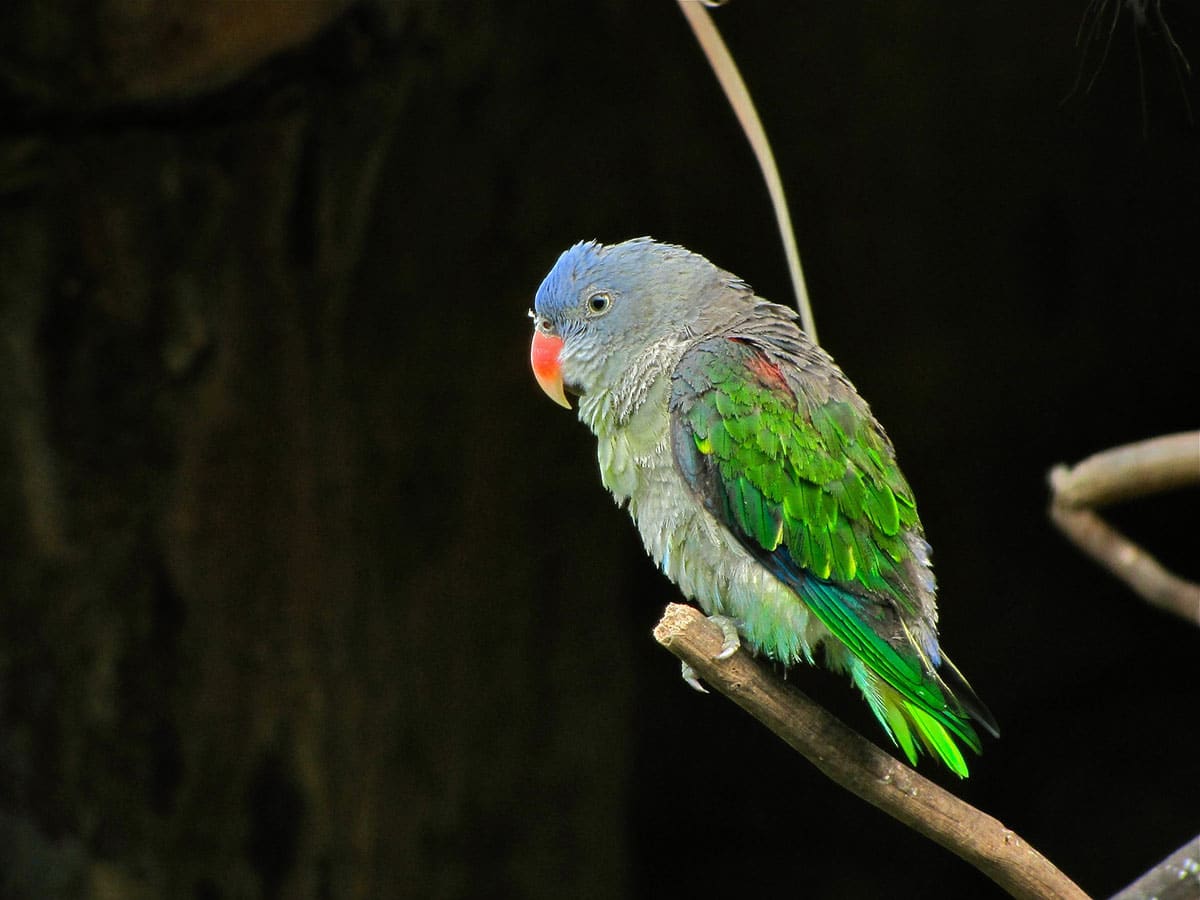
The Blue-rumped Parrot (Psittinus cyanurus) is a small Parrot, robust and with a tail very short.

Since the crown up to the nape is a bluish grey, glossy on the front of the crown; the lower cheeks and chin grayish brown; the nape sharply demarcated from the the mantle black, with a strongly mottled grey; the low back and rump Blue light violet, brighter than the blue of the head. The patch in the shoulders reddish brown; upperwing-coverts medium Green, the edges of yellowish-green, especially in internal and great stockings coverts; primary coverts blue; flight feather green, with the primaries finely lined with yellow along the inner edges; carpal edge Blue and yellow. Lower parts of the wings dark, with bright red feathers on the underwing-coverts and axillary.

Underparts grayish brown, becoming a blue-green shutdown, with yellow marks in the vent. Uppertail greenish blue in the Center, inner featherss of yellow light with vane outer greener; undertail-coverts yellow

A long bill with red notches in the upper jaw, lower jaw duller; irises yellowish white; legs bluish grey.

The female has the head and upper jaw brown; lacks black on the back and shows just a little blue in the rump; the underparts are light green, Gray as in the male Brown not.

The youth are like females, but with the head green.

Subspecies description

Subspecies description:
  • Psittinus cyanurus abbotti

    (Richmond, 1902) – Males with green spread at the front of the crown, the back of neck black, Green mantle and the rump green (marked with turquoise), the underparts greenish. Female with the head green. Larger than the subspecies Psittinus cyanurus pontius.


  • Psittinus cyanurus cyanurus

    (Forster,JR, 1795) – The species nominal


  • Psittinus cyanurus pontius

    (Oberholser, 1912) – As well as the species nominal but larger.

Habitat:

There is some evidence of possible regular movements in the North of its distribution area, with a view to passing birds above Fraser Hill in Malaysia, 1,300 m.

The Blue-rumped Parrot is also seasonal in parts of the South visitor of Burma.

They are distributed in lowland forests (usually below 700 m) and related habitats, including open forests, secondary growth, huertas, mangroves, dry forests, swamp forest, cultivated areas, including oil palm plantations (Elaeis guineensis), near forests (where post-breeding concentrations are considered pests in some areas), dense thickets and groves of coconut (Cocoa nuts).

The Blue-rumped Parrot they are not shy, and can be found in groups of up to 20 birds, whether eating in silence at the canopy level, quickly flying above the forest, or above the tops of the trees hacuendo calls continuously.

Reproduction:

The breeding season of the Blue-rumped Parrot extends from February to may in Malaysia, and from June to September in Borneo, Although some birds have been seen inspecting possible nesting cavities at other times of the year.

During the courtship grooming each other is common; the male jumps by placing both feet on the back of the female during mating. The implementation is up to three eggs, which are deposited in a hole in the top of a tree, little more is known about the reproductive cycle.

Food:

The diet of the Blue-rumped Parrot is composed of seeds, fruits and flowers.

Distribution:

Its distribution varies from around 11ยฐN in Peninsular Thailand and South of Tenasserim, Burma, across the peninsula Malaysia, Singapore, Sumatra and Borneo (Kalimantan, Sarawak, Sabah and Brunei). They are also found in the Riau (including Bintan) and groups of Lingga Islands to the North of the South of Sumatra, in Bangka, and, in West Sumatra, in Simeulue and the group Mentawai including Siberut, Sipura, Pagai Utara and Pagai Selatan.

It is only locally common and less abundant than other sympatric species of Psittaculas in most of its range.

Subspecies distribution

Subspecies distribution:

Conservation:


Near-threatened


โ€ข Current Red List of UICN: Near threatened

โ€ข Population trend: Decreasing

The size of the world population Blue-rumped Parrot He has not formally quantified, but it is believed that they are more than 100.000 individuals (Juniper and Parr 1998), and the species is described as common in primary habitats and uncommon in secondary habitats and plantations (pit et to the. 1997).

In general, the loss of the forest cover between 2000 and 2010 It has been estimated in 23,7% in the case of Sumatra, the 12,0% in Borneo and the 8,2% for Peninsular Malaysia (Miettinen et to the. 2011).

In Sumatra, It has been estimated that you close to of the 36% primary forest cover in 1990, lost in 2010 (including degraded primary forest) (Margono et to the. 2012).

Descents are compounded by the pressure of the capture; But, the Blue-rumped Parrot uses of forest fragments, forest exploitation, secondary vegetation, other modified habitats and habitats at elevations, What has prevented a faster decrease in its population. But, many lowland forests have been logged.. So, suspected of may be suffering a decrease in the moderately rapid population.

Conservation Actions Underway:

"Blue-rumped Parrot" in captivity:

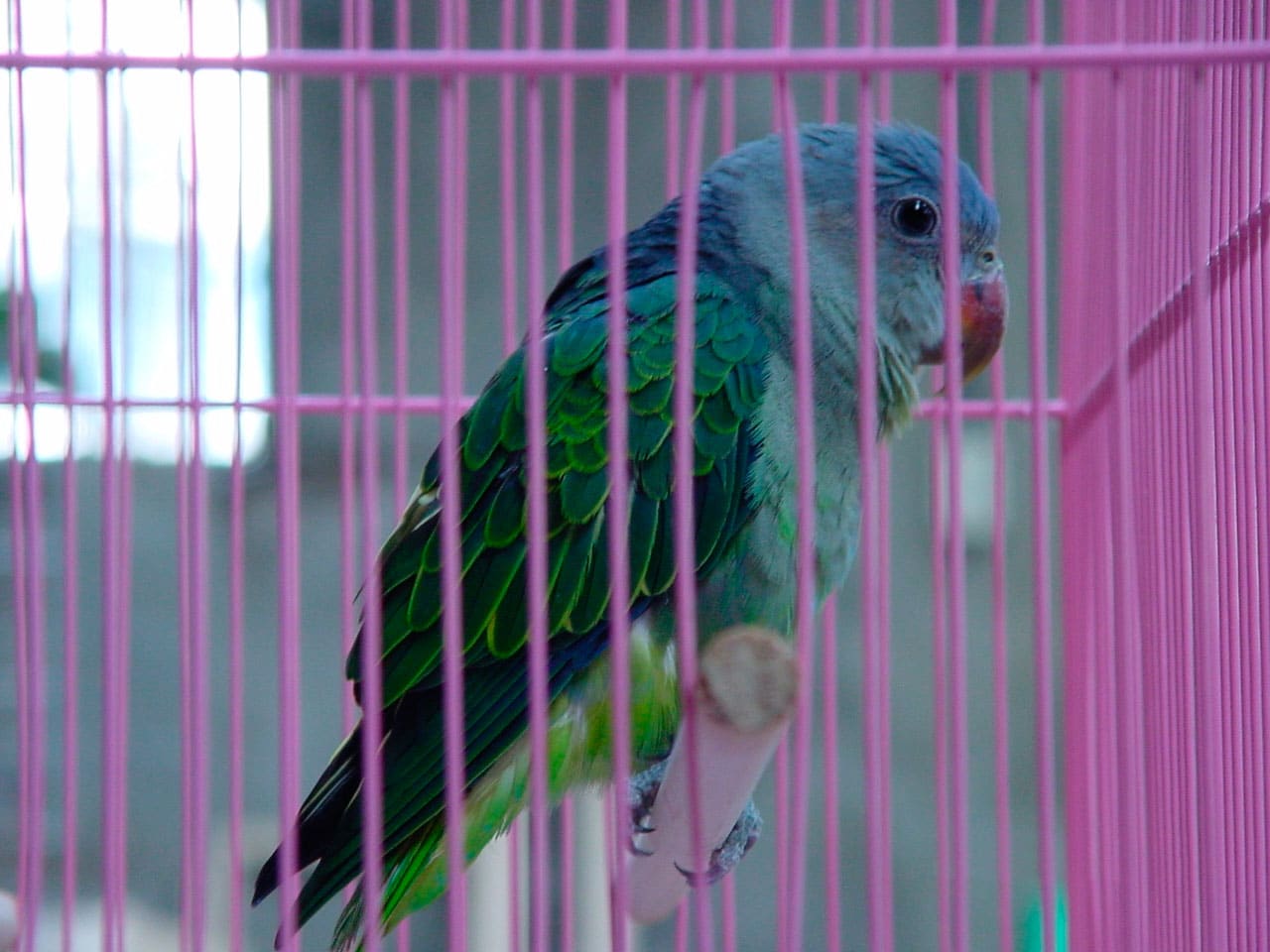
Pretty rare in captivity.

The Blue-rumped Parrot It is not a bird which like to interact with humans, nor is it a particularly playful bird. Are described as docile who love to sing on rainy days. Due to its melodic voice, they are often alone as songbirds. But, not all of them are born as birds cantadoras, in fact, Some are dumb.

It is recommended to buy the younger, since they are more likely to sing. But, in general it's parrots very quiet with occasional whistles and high-pitched vocation, that it can be irritating when held captive in an apartment.

They have very limited ability to speak. Some of them learn to speak – but most never do.

Unfortunately, they are easy to catch, since they remain immobile when frightened. Hunters have only to shoot into the air or make some noise on turning the birds when they are resting so that they can be easily caught. This has led to its State endangered extincion ..

With regard to its longevity, according to sources, a Blue-backed Parrot was still alive after 10,2 years in captivity. Taking into account the longevity of the similar species, maximum longevity is probably underestimated in this species.

The Blue-rumped Parrot It is a beautiful bird when it is in its natural habitat, its potential as a pet it is said that it is limited. Usually do better in an environment of Aviary, with plenty of space so that you can explore the surrounding area. Better yet is protect their natural habitat and let them enjoy freedom.

Alternative names:

Blue-rumped Parrot, Blue rumped Parrot (English).
Perruche ร  croupion bleu, Perroquet ร  croupion bleu (French).
Rotachselpapagei, Rotachsel-Papagei (German).
Papagaio-de-rabadilha-azul (Portuguese).
Lorito de Lomo Azul, Lorito Dorsiazul (espaรฑol).


scientific classification:

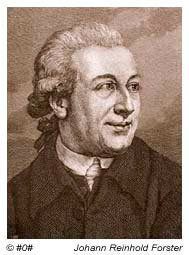
Johann Reinhold Forster

Order: Psittaciformes
Family: Psittaculidae
Genus: Psittinus
Scientific name: Psittinus cyanurus
Citation: (Forster, JR, 1795)
Protonimo: Psittacus cyanurus


Images "Lorito Dorsiazul":

Videos "Blue-rumped Parrot"

ยซLorito Dorsiazulยป (Psittinus cyanurus)


Sources:

Avibase
Parrots of the World โ€“ Forshaw Joseph M
Parrots A Guide to the Parrots of the World – Tony Juniper & Mike Parr
Birdlife

Photos:

(1) – Blue-rumped Parrot Psittinus cyanurus. Bird Park Kuala Lumpur by Bernard DUPONT – Flickr
(2) – Bird Park Kuala Lumpur By Bernard DUPONT from FRANCE (Blue-rumped Parrots Psittinus cyanurus) [CC BY-SA 2.0], via Wikimedia Commons
(3) – Blue-rumped Parrot in a cage By TJ Lin (originally posted to Flickr as DSC01255) [CC BY-SA 2.0], via Wikimedia Commons
(4) – Male blue-rumped parrot (Psittinus cyanurus) by Chlidonias – zoochat
(5) – Female blue-rumped parrot (Psittinus cyanurus) by Chlidonias – zoochat
(6) – Psittacus Malaccensis. (Latham, not Gmellin) Blue-rumped Parrot By William Swainson, F.R.S., F.L.S. (Zoological Illustrations, Volume III.) [Public domain], via Wikimedia Commons
Sounds: Martjan Lammertink (Xeno-canto)

โ–ท The world of Pets: Dogs, cats, birds, reptiles, amphibians

Golden Parakeet
Guaruba guarouba


Golden Parakeet

Content

Description Golden Parakeet:


Anatomy-parrots

34 cm. of length and a weight of 270 g.

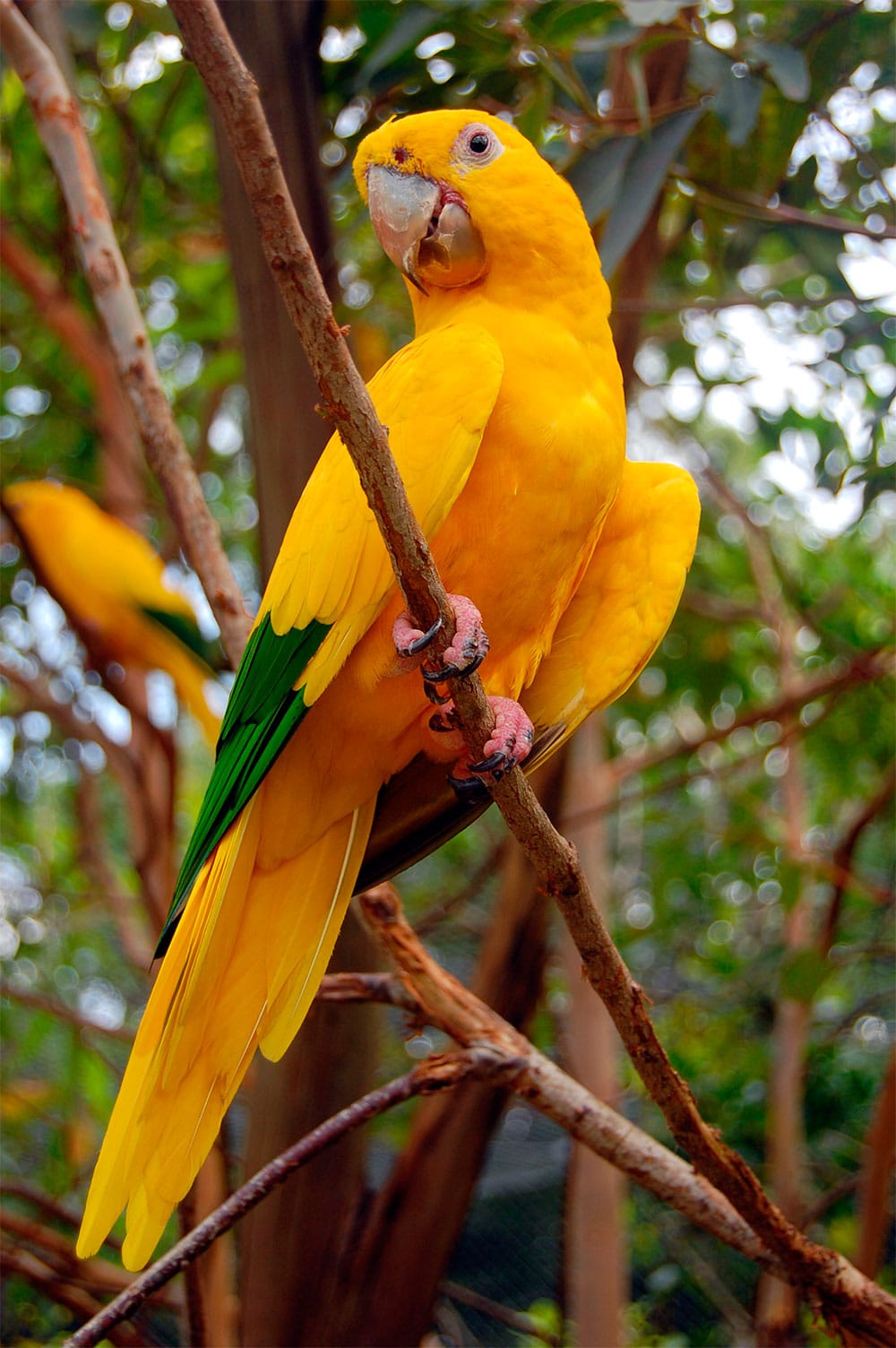
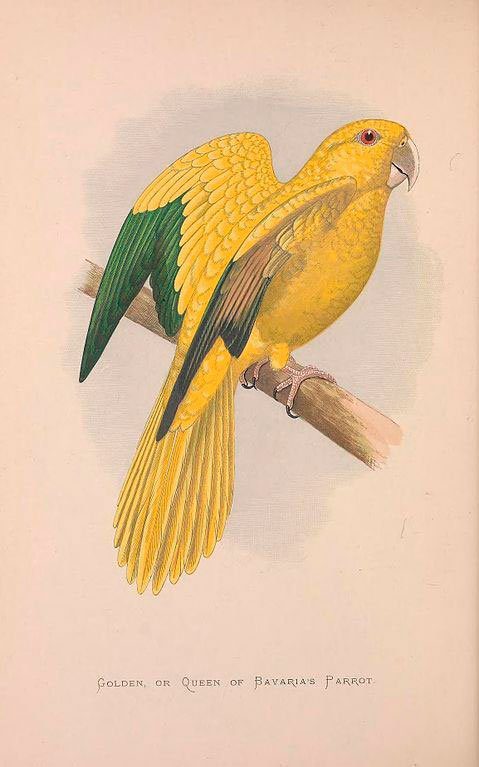
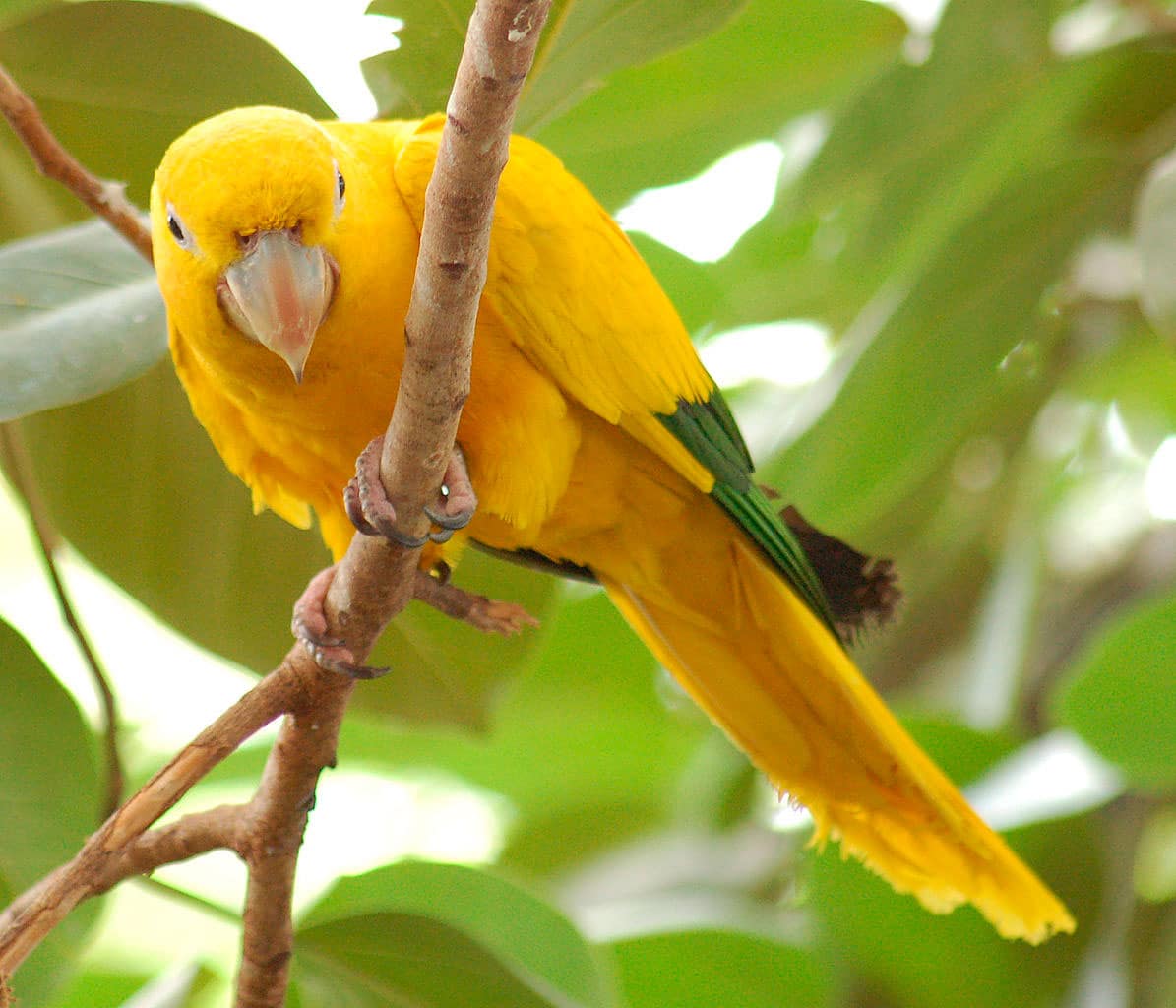
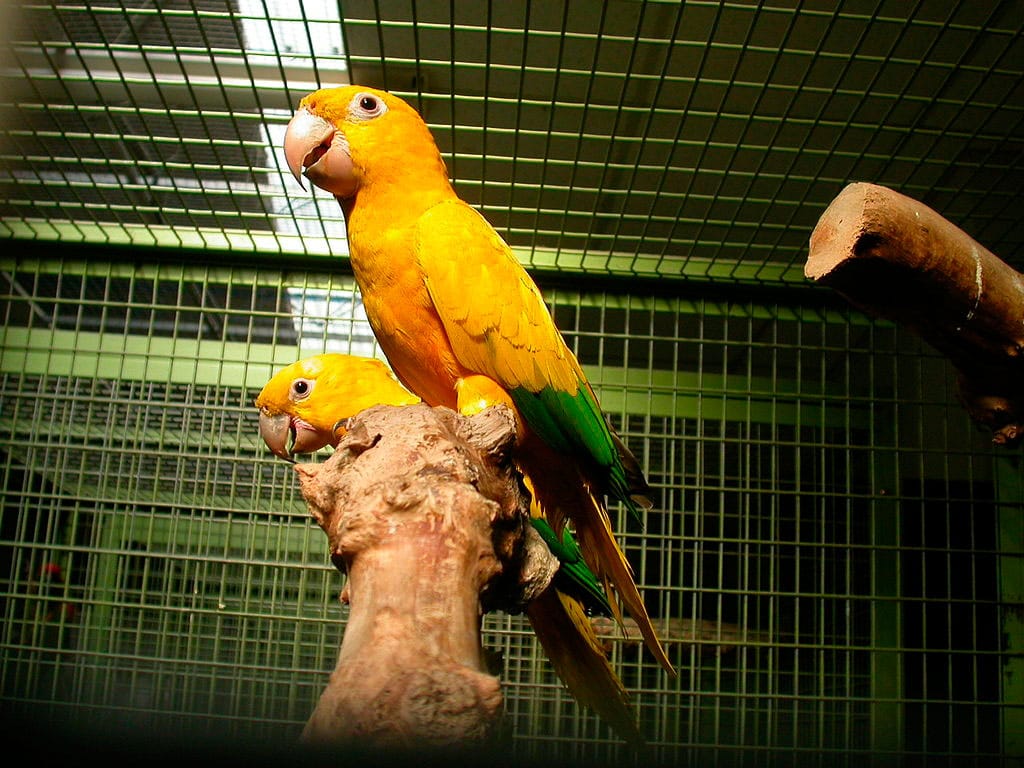
The Golden Parakeet (Guaruba guarouba) has all the head, upperparts, lower andtail , a bright yellow. The greater coverts, primaries and secondaries are dark green (one or two feathers yellow in some birds flying). Underwing-coverts yellow, the bottom of the flight feather dark yellow. Feather shafts of the tail are white.

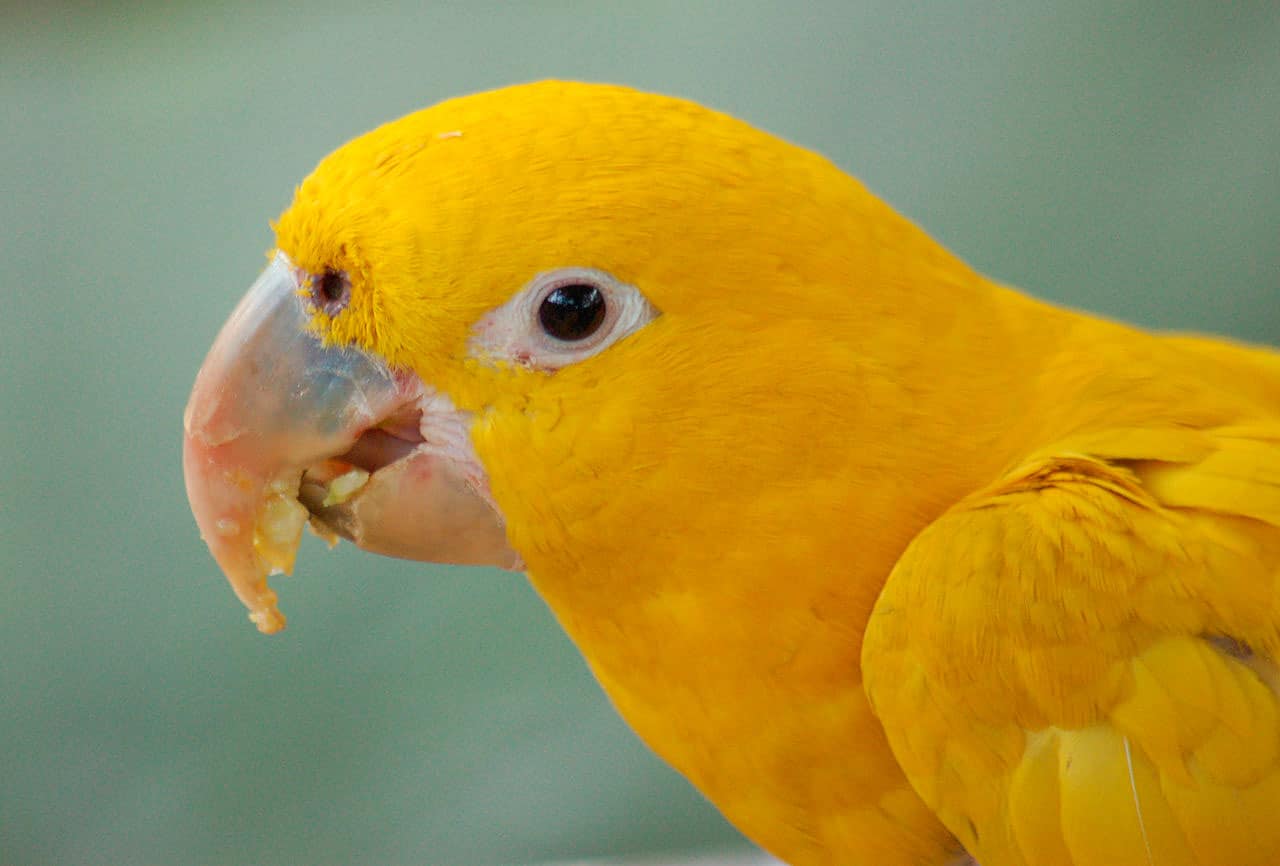
The bill pale pink, more Brown on the basis of the upper jaw; bare periophthalmic naked whitish; Iris Orange to brownish Orange; legs Rosaceae.

Illustration Aratinga Guaruba

Both sexes similar.

Immature colour olive brown opaque dark green streak. In the transition to adulthood, the head, top of the tail and back They are the last to acquire the bright yellow color of the adult plumage.

Habitat:

Video – "Golden Parakeet" (Guaruba guarouba)

yellow parakeet (Guaruba garouba) - Golden Parakeet - Aratinga guarouba

inhabits the humid tropical forests, avoiding the forests and marshes (seasonally flooded), Although in the immediate breeding period, You can wander through these habitats from the adjacent dry forests.
When is the breeding season, the Golden Parakeet they occupy the forests next to the clear.
Gregarious in all the seasons of the year. Observed in flocks of 3 to 30 birds, Although on a regular basis in groups between 6 and 10.
Forman communal roosts in tree cavities during the non-breeding season, using the holes in the area, alternately in successive nights. The usual and regular use of resting and feeding areas, is suspected to be due to the predictable daily routines. Sometimes seen feeding with other species of parrots.

Reproduction:

Nest at the top of the trunk or main branch of a hollow tree, a height between 15 and 30 m. Nesting tree is usually isolated, but near virgin forests. The old nest of other species It can be used by the Golden Parakeet, expanding its cavity as necessary.

The sexual behavior This species is unusual, and this is one of the most interesting aspects of their biology. With reproduce communally, with several females contributing to the work of the clutch, Although there are also reports of individual couples. Young people at different stages of development sometimes share a same nest.

On the other hand, at breeding sites during the reproductive period, the Golden Parakeet they react defensively to the presence of flocks of the same species, other species of parrots, especially the Scarlet Macaw (Ara macao), and before the approach of birds of prey.

The normal clutch female is of 2 to 4 eggs (perhaps up to six); 14 reported in a single nest chicks in captive, where the six adults helped in the breeding work. The breeding season, usually, takes place from December to April, and it corresponds to the rainy season

Food:

The Golden Parakeet, generally, feed in the forests of height, Although they will too of some cultivated plants; toreported foods (all the fruits or pseudo-fruits), They include the Palm trees of the genus Euterpe, that feels special canevale, Anacardium spruceanum, Anacardium occidentale, Protium and Tetragastris, Visnia quail, Inga, Byrsonima crassifobia, Carapa guianensis, Cecropia and Oenocarpus bacaba; as well flowers and buds (for example Symphonia), and crops as the corn and mango in some areas.

Golden Parakeet distribution:

endemic to the Amazonia, to the South of amazon in Brazil, from the west shore of the Tapajos River, to the East through the basins of the Xingu River and North of Tocantins to 5 ยฐ N, For, and up to the eastern shore of the Turiacu River in West Maranhรฃo.

Are not observed in the Marajรณ island and prevents the forests and marshes (for example, immediately to the South of the Amazonia).

Recent records in Rondร ยดnia and Mato Grosso, far from their known range, They suggest a little-known distribution. Apparently, they are distributed in large areas, but it is not known whether the movements are predictable or related with, for example, the seasonal availability of food.

Rare range-wide and no doubt in decline due to the very wide, fast and continuous deforestation and fragmentation of forests, both in the Amazonia occidental as in the Eastern.

The capture illegal for national and international live bird markets and the hunting for food and sport they pose a serious additional pressures. Protected areas in the range are insufficient and are being violated regularly, for example, with the illegal logging of Mahogany Swietenia macrophylla.

Listed in Appendix 1. In danger of extinction.

Conservation:

โ€ข Red List category of the UICN current: Vulnerable

โ€ข Population trend: Decreasing

The threat most obvious for the survival of the Golden Parakeet is deforestation? The construction of the tucuruรญ dam, which was completed in 1984, displaced 35.000 settlers from their House to adjoining territories and brought rapid deforestation. Prior to the dam construcicรณn, Wildlife in the lower basin of Tocantins It was considered among the richest and most diverse in the world. It is estimated that you a 117 species of mammals and 294 species of birds were displaced. So what 120 species of amphibians and reptiles were affected.

The population of the Golden Parakeet was initially in a range between 1,000-2,499 individuals, based on an assessment of the known records, descriptions of the abundance and range size. But, recent information suggests that the population may be greater. The species has been recorded in several additional places. (Laranjeiras and Cohn-Haft 2009), and a recent survey along of the Tapajos River by Laranjeiras (2011) indicated that it was as common in the study area as other Psittacidae, not threatened.
On the basis of this information, the population is placed on the band's 10,000-19,999 individuals, that means include c.6,600-13,400 mature individuals.

According to records of International Species Information System There is a population of 213 scattered individuals in different zoos.

Conservation Actions Underway:

CITES Appendix I and II, managed under the Association of Zoos and Aquariums Parrot Taxon Advisory Group and protected by the Brazilian legislation (being proposal as the national bird of Brazil).

– A campaign attacking trade of birds in Bolivia It can help to reduce international trade (AB Hennessey in litt., 2009).

– A population is relatively well protected in the Tapajos National Park, and a remnant population can survive in the Gurupi biological reserve.

Floresta Nacional do Jamari It is poorly protected and suffer the constant pressure of illegal occupants, loggers and poachers (F. Olmos in litt., 1999).

– The conservation of this species in the reserves is problematic because of its apparent nomadism.

Conservation Actions Proposed:

– Conduct studies to find the populations so far unknown, especially in the South and West of its range.

– The de facto protection the Gurupi biological reserve.

– Maintain the integrity of the Tapajos National Park.

– Protect and manage the land between the existing protected areas to facilitate the movements of nomadic.

– To enforce the legal restrictions on trade, especially in domestic markets.

– Further develop the program captive breeding.

"Golden Parakeet" in captivity:

Date back to the first reproductive outcomes of this kind of 1939 in Sri Lanka.

The Golden Parakeet It is probably the most coveted among all the parrots, being the prices demanded by her extremely high. It is very rare and endangered in its natural habitat, and are therefore protected from import.

Birds reserved for breeding are happier in the presence of members of their species. This is due to the nature of the Golden Parakeet, sociable and cheerful, with an intense need for interaction with their peers.

With regard to its longevity, according to sources, a specimen lived 23,2 years in captivity. It has been reported that these animals can live up to the 60,9 years in captivity, but this has not been verified; the same study reported that these animals can reproduced from the 3 years age in captivity.

Alternative names:

Golden Parakeet, Golden Conure, Queen of Bavaria’s Conure (English).
Conure dorรฉe, Conure ou, Garouba jaune, Perriche dorรฉe, Perruche dorรฉe, Perruche guarouba (French).
Goldsittich (German).
Arara-juba, ajurujuba, arajuba, Ararajuba, guarajuba, guaruba, guira-juba, marajuba, papagaio-imperial, tanajuba (Portuguese).
Aratinga Guaruba, Guacamayo Guarouba, Periquito Amarillo (espaรฑol).

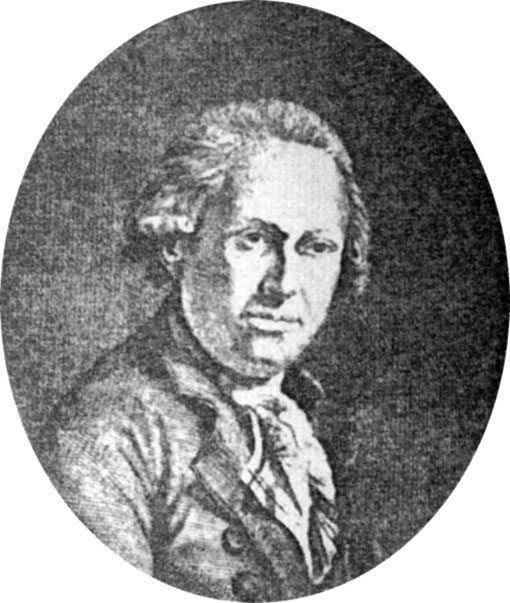
Gmelin Johann Friedrich

scientific classification:

Order: Psittaciformes
Family: Psittacidae
Genus: Guaruba
Scientific name: Guaruba guarouba
Citation: (Gmelin, JF, 1788)
Protonimo: Psittacus Guarouba

Golden Parakeet images:

Sources:

(1) – Avibase
(2) – Parrots of the World โ€“ Forshaw Joseph M
(3) – Parrots A Guide to the Parrots of the World – Tony Juniper & Mike Parr
(4) – Birdlife
(5) – WAZA

  • Photos:

(1) – Golden Parakeet (also known or Golden Conure) at Gramado Zoo, in south Brazil By Ironman br (Own work) [CC BY-SA 3.0], via Wikimedia Commons
(2) – Golden Parakeet or the Queen of Bavaria Conure in Burgers Zoo, Arnhem By frank wouters (originally posted to Flickr as goudparkiet) [CC BY 2.0], via Wikimedia Commons
(3) – Two Golden Parakeets at Gramado Zoo, Rio Grande do Sul, Brazil By diegodobelo (Zoo de GramadoUploaded by Snowmanradio) [CC BY-SA 2.0], via Wikimedia Commons
(4) – Golden Parakeet or the Queen of Bavaria Conure). Two captive By TJ Lin (originally posted to Flickr as Golden Conure) [CC BY-SA 2.0], via Wikimedia Commons
(5) – Photo taken at the National Aviary By Photo by and (C)2007 Derek Ramsey (Ram-Man) (Self-photographed) [GFDL 1.2 or CC BY-SA 2.5], via Wikimedia Commons
(6) – Photo taken at the National Aviary By Photo by and (C)2007 Derek Ramsey (Ram-Man) (Self-photographed) [GFDL 1.2 or CC BY-SA 2.5], via Wikimedia Commons
(7) – Golden Conure at the Parque das Aves, Foz do Iguaรงu, Brazil By Bruno Girin from London, United Kingdom (06680018Uploaded by Snowmanradio) [CC BY-SA 2.0], via Wikimedia Commons
(8) – Photo taken at the National Aviary By Photo by and (C)2007 Derek Ramsey (Ram-Man) (Self-photographed) [GFDL 1.2 or CC BY-SA 2.5], via Wikimedia Commons
(9) – Golden Conure by Jean – Flickr
(10) – Illustration Guaruba guarouba By Dutton, F. G.; Fawcett, Benjamin; Greene, W. T.; Lydon, A. F.; Lydon, A. F. [CC BY 2.0 or Public domain], via Wikimedia Commons

โ–ท The world of Pets: Dogs, cats, birds, reptiles, amphibians

Red-masked Parakeet
Psittacara erythrogenys

Aratinga de Guayaquil

Content


Anatomy-parrots

Description Aratinga of Guayaquil:

33 cm.. length between 165 and 200 g.. weight.

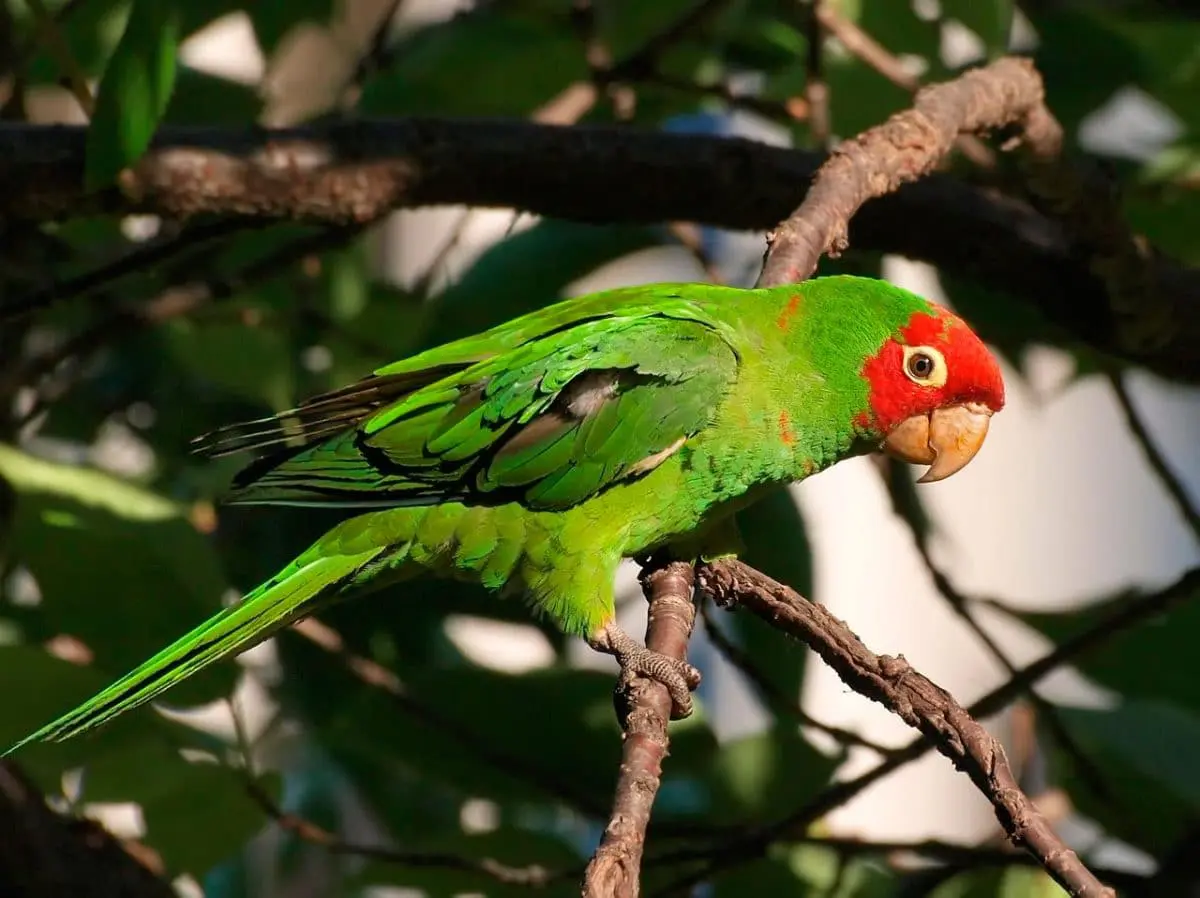
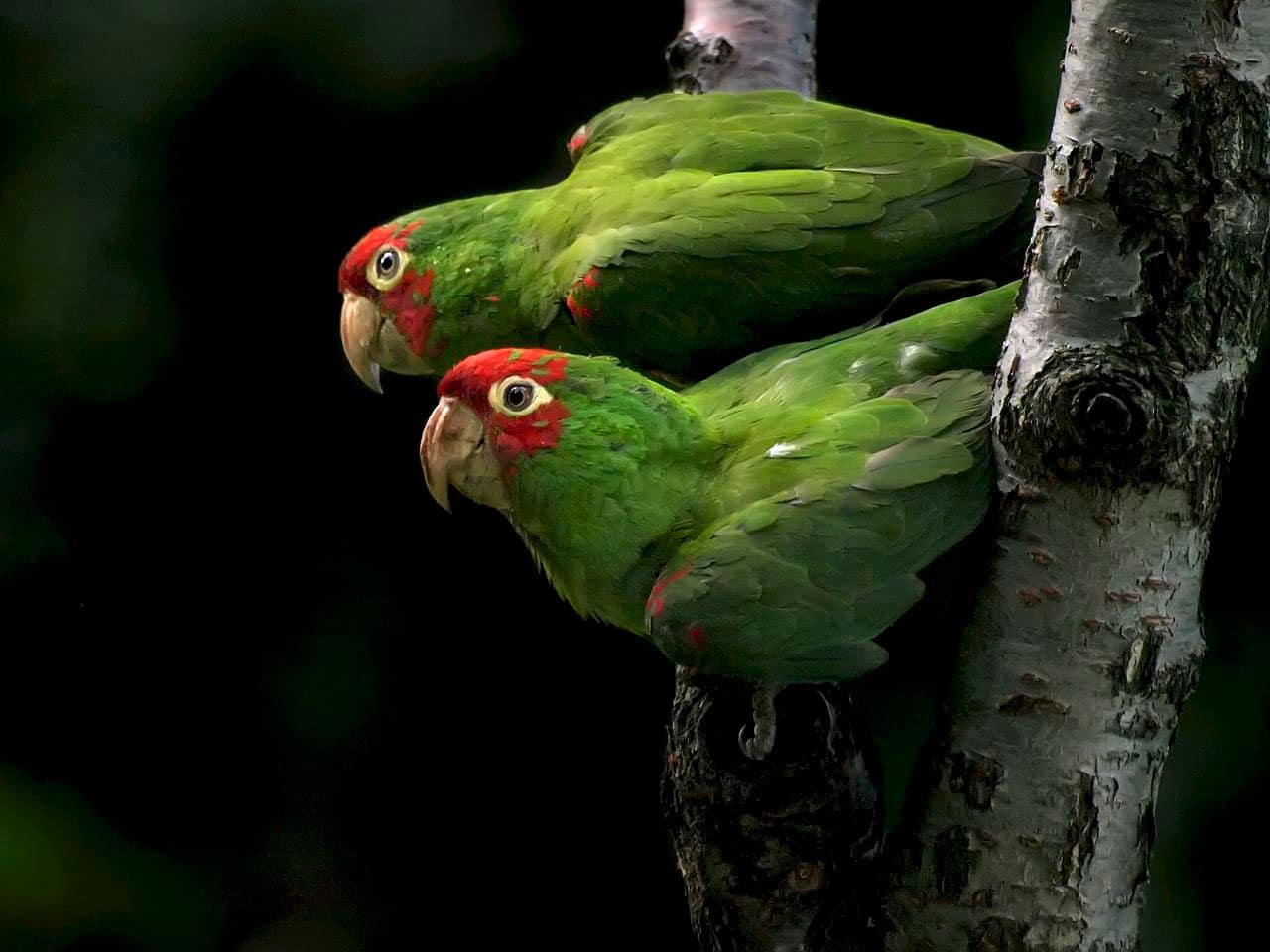
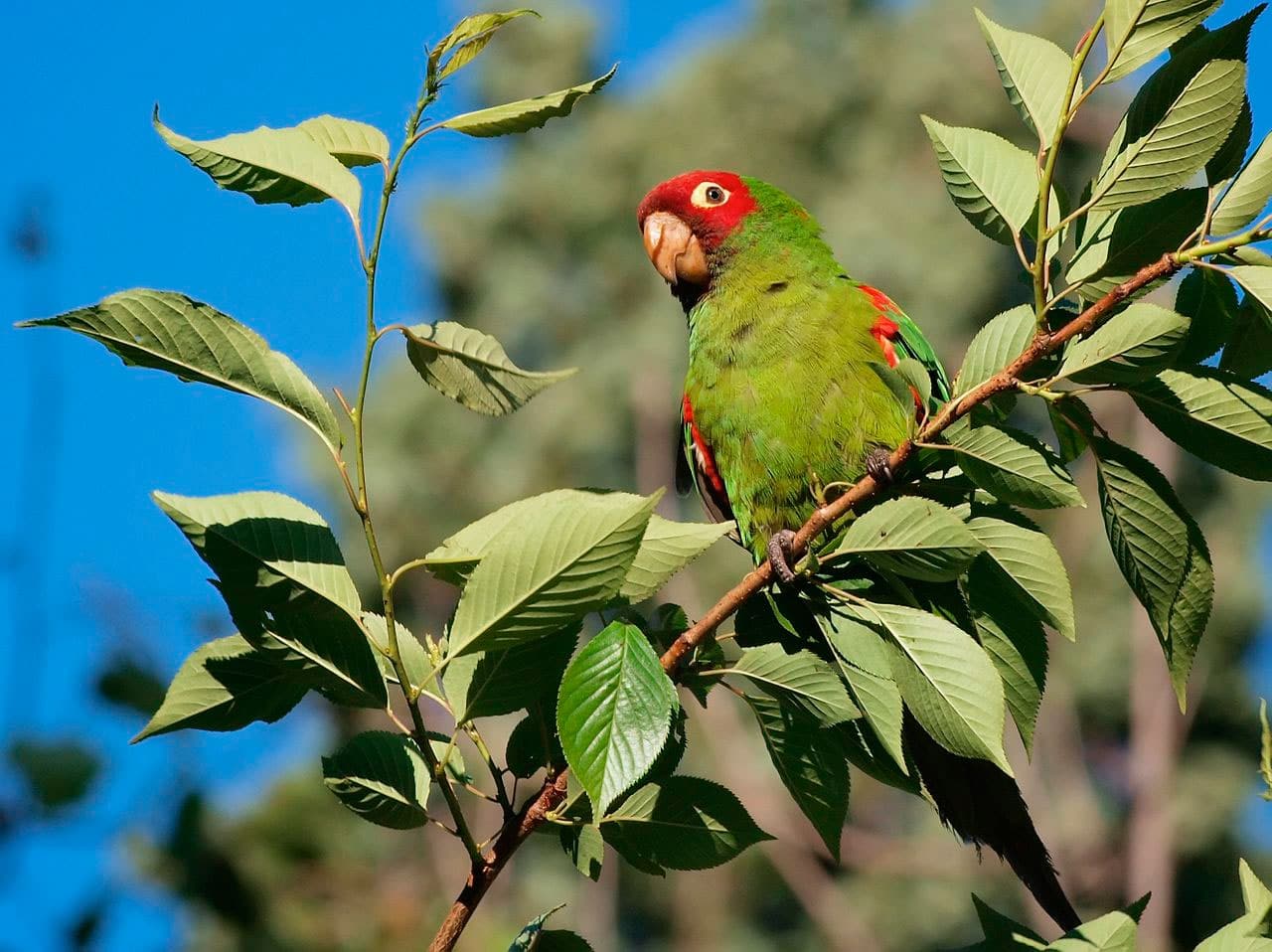
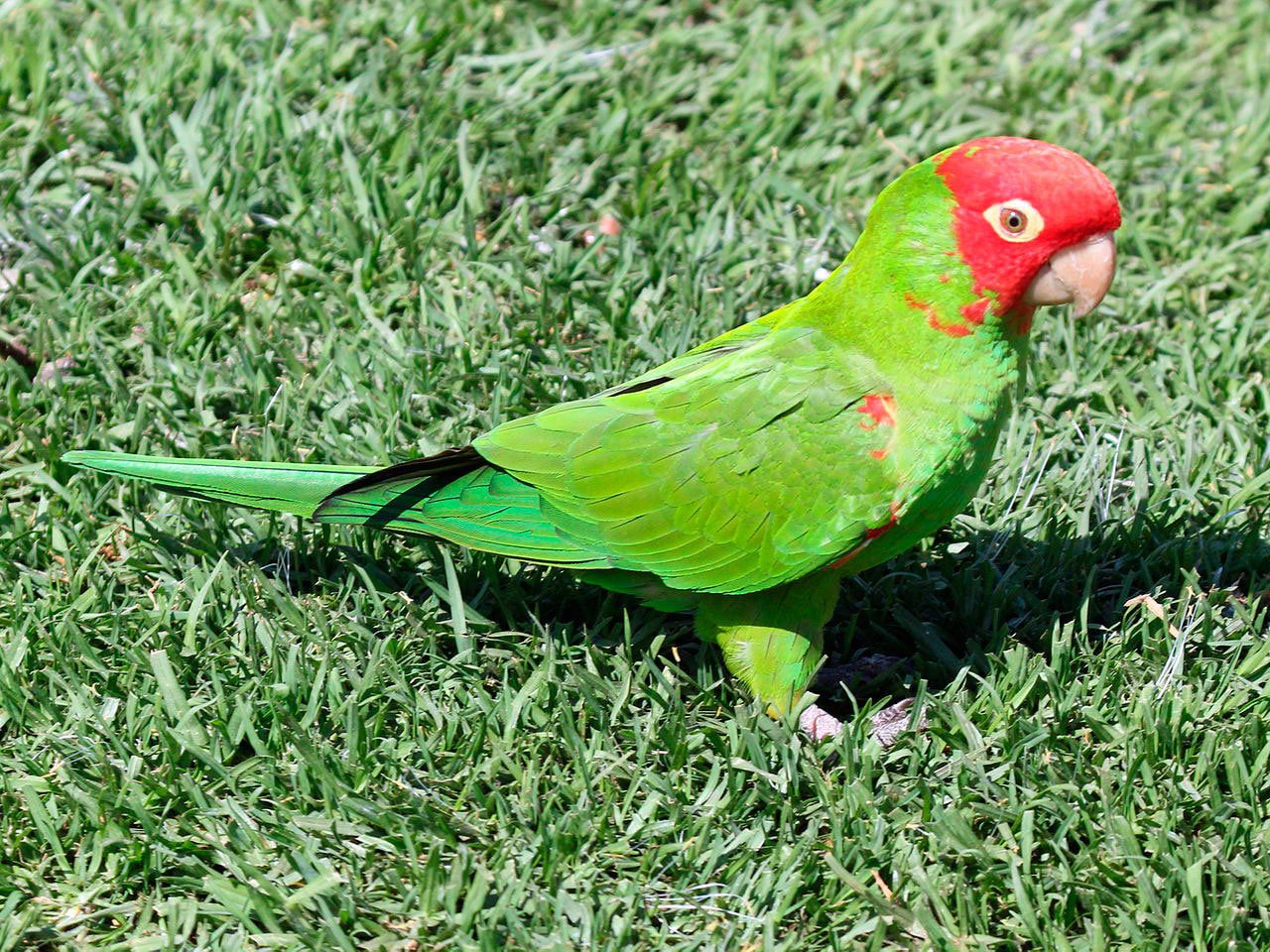
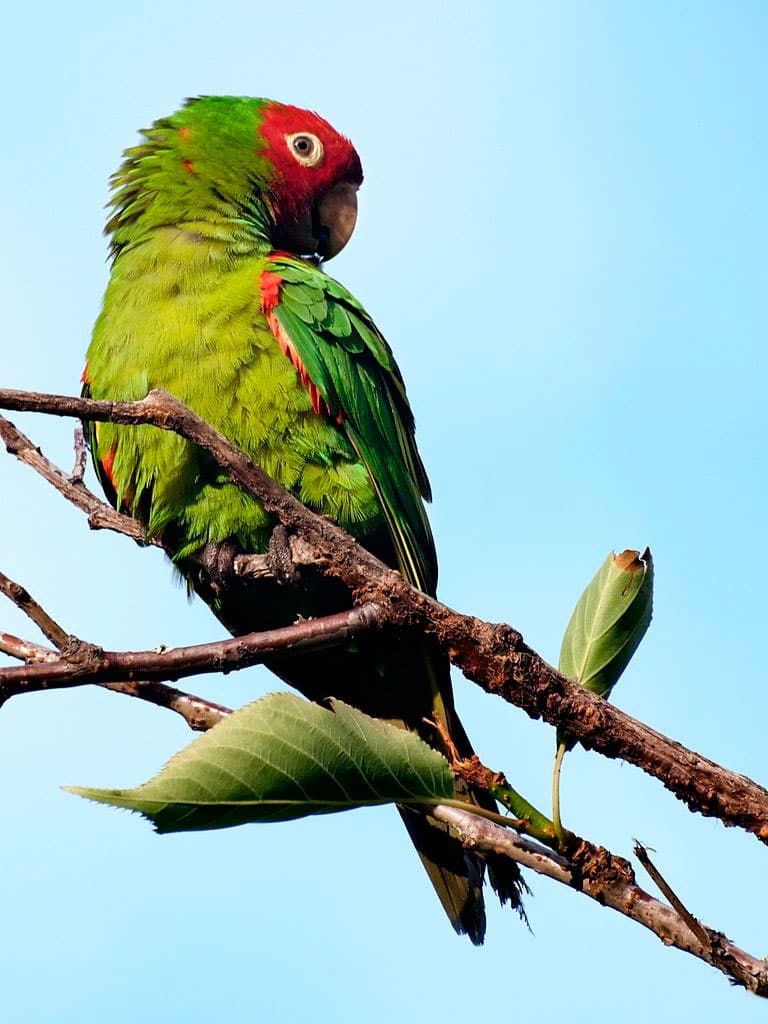
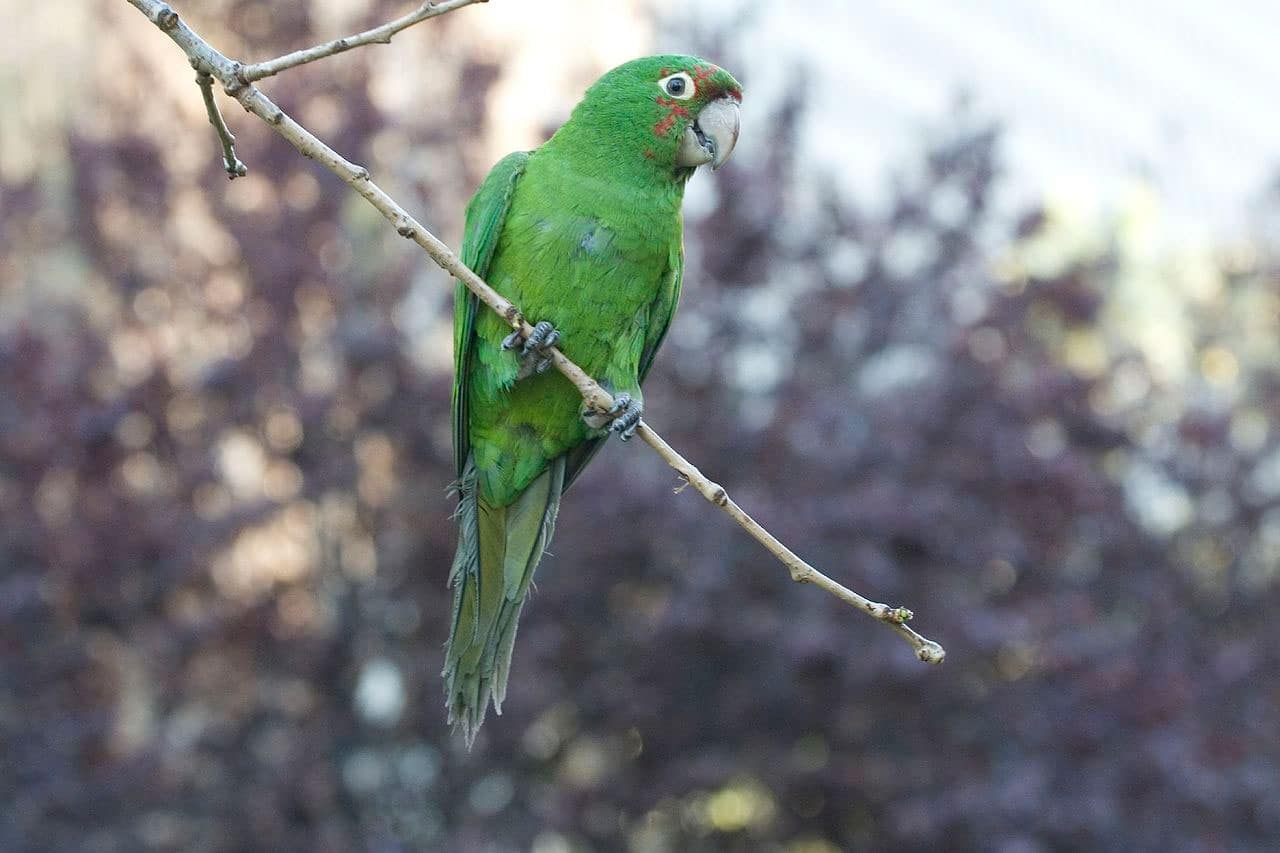
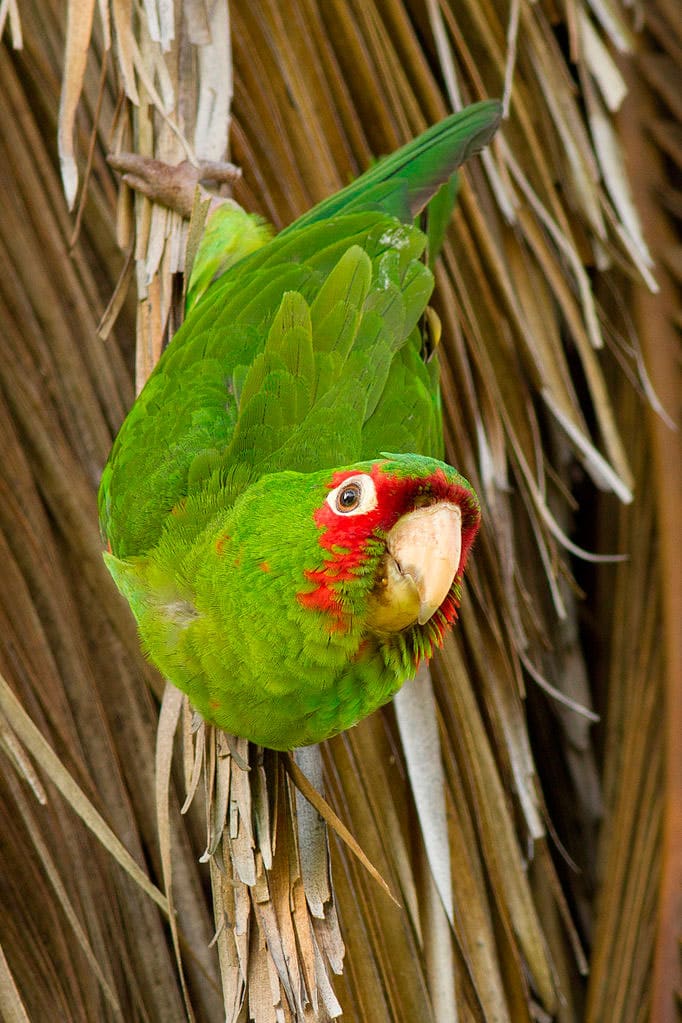
The Red-masked Parakeet (Psittacara erythrogenys) It is very similar to birds Scarlet-fronted Parakeet and to the Mitred Parakeet, but smaller and with more red area in the face, extending continuously up to the throat and nape.

Has the forecrown, crown, lores, the cheeks and the area around the eyes, bright red, generally forming a complete red mask to join to the chin (Sometimes the mask extends up to the throat). Since the nape up to the uppertail-coverts dark green, sometimes with scattered red feathers. The upperwing-coverts children with some feathers of red and the bend of wing red; remaining upperwing-coverts dark green, with dye Emerald to them vane outer the primary. The flight feather Brown Gold below; underwing-coverts minors, bright red, the greater coverts yellowish brown. The underparts brighter yellowish green, sometimes with mottled red and almost always with the the thighs red. Upper, the tail dark green; by below grayish brown.

The bill color pale horn; bare periophthalmic off-white; irises yellow; legs distant.

Both sexes similar.

The immature with the head and the thighs green.

Habitat Red-masked Parakeet:

Video – "Red-masked Parakeet" (Psittacara erythrogenys)

Telegraph Hill Parrots January 30, 2008 (HD)

The Red-masked Parakeet It occupies a wide range of vegetation types, from arid zones to rainforests, Since the sea level to altitudes 2.500 m, Although its usual habitat is below of the 1.000 m, in humid forests, deciduous forests, areas of dry thorny scrub and arid with cactus; They also live in degraded forest, areas cultivated with scattered trees, and around the urban areas. They tend to prefer arid and semi-arid habitats, not avoiding moist forest habitats.

Outside the breeding season, is a bird gregarious; in general, observed in pairs or in groups of up to 12 individuals, forming groups of up to 200 birds in the places where their communal roosts are. Formerly registered flocks of thousands of birds in Guayaquil, Ecuador.

Often associated in mixed flocks with the Grey-cheeked Parakeet (Brotogeris pyrrhoptera) and also observed in mixed flocks with the Bronze winged Parrot (Pionus chalcopterus).

Reproduction Red-masked Parakeet:

Nests in holes of mature trees, for example of Ceiba trichistandra or Cochlospermun vitifolium, There are also records of nests in termite mounds, with a report in a nest on a cliff. The breeding season in the southwest of Ecuador recorded during the rainy season (January-March). The laying, between 2 and 4 eggs. The female the incubated eggs during 23 to 24 days. The pups they are born very little developed, blind and naked. They are fed with food previously digested by their mothers.

Food Aratinga of Guayaquil:

Few details exist about food preferences of the Red-masked Parakeet, Although seasonal movements from the more arid areas are probably related to food supply.

Reported foods include fruits of Hieronyma, Anacardiaceae, Oleaceae and Boraginaceae, as well as flowers of Erythrina.

Distribution:

Size of the area of distribution (reproduction / resident): 151.000 km2

The Red-masked Parakeet is distributed to the West of Ecuador and the Northwest corner of Peru.

In Ecuador, the species has been recorded from Manabi near south of the equator, through Pichincha, The rivers, Guayas, Azuay, Gold and Loja, until Tumbes, Piura, Lambayeque and Cajamarca, in the North of Peru and the region of Chachapoyas, amazon (6ยฐ 10โ€™S).

In Ecuador, the distribution of the Red-masked Parakeet is limited to the lowlands of the peaceful, Western slope of the Andes and valleys, Although it is apparently absent from the eastern slope; similar pattern in the Peru most Eastern records in the basin of the amazon (Valley of the Utcubamba River) to 77ยฐ 54โ€™W.

The seasonal movements to and from the more arid areas, otherwise, residents.

Usually considered to be common (described as the most common parrot in various locations in the province of Gold, Ecuador), but numbers fluctuate widely in some locations due to irregular seasonal movements. In some areas there has been a very drastic decrease of copies, reflecting the combined effects of the loss of habitat and your capture for the trade in live birds, for example, in Guayas, Ecuador.

There are at least eight protected areas, of which seven are in Ecuador.

There are leaks in Spain; so also in EE. UU., with breeding populations in the California cities of San Diego, Los Angeles, San Gabriel, Sunnyvale and San Francisco, You can see them eating fruits of cultivated tropical plants, and nesting in Palm trees.

Maintained in captivity at the local level (where is the most common Parrot kept in captivity) and commercialized in large quantities at the international level, especially since Peru.

Conservation:

State of conservation โ“˜


Near-threatened Near Threatened โ“˜ (UICN)โ“˜

โ€ข Red List category of the UICN current: Near-threatened

โ€ข Population trend: Decreasing

The size of the population This species has not been estimated officially, but, in the absence of sufficient data, It is suspected that it may be in around the 10.000 specimens, more or less equivalent to 6.700 mature individuals.

The population of the species is suspected that it may be subjected to a moderately rapid decrease, due to its capture for him pet trade together with the loss of habitat and fragmentation. Further research is required.

Conservation Actions Underway:

  • Appendix II of CITES.

Conservation Actions Proposed:

  • Carry out surveys to get an estimate of the population.
  • The current threat of trade research.
  • Enforcing trade restrictions.
  • Census of population and monitoring.
  • Monitor the rates of loss and fragmentation of habitat.
  • Study its ability to persist in altered and fragmented habitats.

The Red-masked Parakeet in captivity:

Shy and distrustful. Little common in captivity outside its area of distribution.

They may live until 25 years, Although the average tends to be between 10 and 15 years.

Their diet: fruit as, Apple, pear, orange, bananas, grenades, Kiwi, papaya, cactus fruits, they form a 30 percent of the diet. Vegetables, such as: Carrot, celery, green beans and peas in the pod, sweet corn on the cob, green leavess, such as: chard, lettuce , Kale, healer, Dandelion, Aviary grass, spray millet, mixture of small seeds, such as: Millet and small amounts of oats, buckwheat, safflower and hemp.

This species is found threatened from the wild bird trade local in Peru and Ecuador, where are rates of mortality due to mismanagement and stress high.

Never buy these birds in the illegal trade, Since these tend to come from its natural environment and it must be remembered that the Red-masked Parakeet is one endangered species.

Alternative names:

Red-masked Parakeet, Red Masked Conure, Red masked Parakeet, Red-headed Conure, Red-headed Parakeet, Red-masked Conure (English).
Conure ร  tรชte rouge, Conure ร  tรชte cerise, Conure ร  tรชte รฉcarlate, Perriche ร  tรชte rouge, Perruche ร  tรชte rouge (French).
Guayaquilsittich (German).
Periquito-de-cabeรงa-vermelha (Portuguese).
Aratinga de Guayaquil, Loro de cara roja, Periquito de Cabeza Roja, Perico Cara Roja (espaรฑol).
Loro de cara roja (Chile).
Cotorra de Cabeza Roja (Peru).
Perico caretirrojo (Ecuador).


scientific classification:

Renรฉ Primevรจre Lesson

Order: Psittaciformes
Family: Psittacidae
Genus: Psittacara
Scientific name: Psittacara erythrogenys
Citation: (Lesson, 1844)
Protonimo: Psittacara (psittacus) Erythrogenys

Red-masked Parakeet pictures:


Species of the genus Psittacara

Sources:

Avibase
– Parrots of the World โ€“ Forshaw Joseph M
– Parrots A Guide to the Parrots of the World – Tony Juniper & Mike Parr
– Birdlife
Feather wind

Photos:

(1) – A feral Red-masked Parakeet (also known as the Red-masked Conure and Cherry-headed Conure) in San Francisco, USA By Ingrid Taylar [CC BY 2.0], via Wikimedia Commons
(2) – Red-masked parakeet, Aratinga erythrogenys. Two birds in a tree in San Francisco, California By Jef Poskanzer (Flickr) [CC BY 2.0], via Wikimedia Commons
(3) – Red-masked Parakeet (Psittacara erythrogenys) at the Presidio, San Francisco, California By Frank Schulenburg (Own work) [CC BY-SA 4.0], via Wikimedia Commons
(4) – Red-masked parakeet (Aratinga erythrogenys). A juvenile parrot which is mostly green and just starting to get some red feathers on its head By Eliya Selhub (Flickr) [CC BY 2.0], via Wikimedia Commons
(5) – Red-masked Parakeet preening on a branch in San Francisco, USA By Ingrid Taylar from San Francisco Bay Area – California, USA [CC BY 2.0], via Wikimedia Commons
(6) – Red-masked Conure at Birds of Eden, South Africa By Dick Daniels (http://carolinabirds.org /) (Own work) [CC BY-SA 3.0 or GFDL], via Wikimedia Commons
(7) – A feral Red-masked Parakeet (also known as the Red-masked Conure and Cherry-headed Conure) in San Francisco, USA By Ingrid Taylar [CC BY 2.0], via Wikimedia Commons
(8) – Two feral Red-masked Parakeets in San Francisco, USA By Ingrid Taylar from San Francisco Bay Area – California, USA (Wild in SFUploaded by Snowmanradio) [CC BY 2.0], via Wikimedia Commons
(9) – Several Red-masked Parakeets eating a discarded apple in San Francisco, USA By Ingrid Taylar from San Francisco Bay Area – California, USA (A Big Find for ParrotsUploaded by Snowmanradio) [CC BY 2.0], via Wikimedia Commons

Sounds: (Xeno-canto)

โ–ท The world of Pets: Dogs, cats, birds, reptiles, amphibians

Indigo-winged Parrot
Hapalopsittaca fuertesi


Indigo-winged Parrot

Content

Description:

23-24 cm.. height.

In 2002 It was the rediscovery of the the Indigo-winged Parrot (Hapalopsittaca fuertesi), an enigmatic parrot that had been lost to the world for more than 90 years and continues being one of the birds more rare of the Earth. It has a plumage mainly yellowish-green and is highlighted by the blue of the crown and olive yellow tone of the forecrown (except a strip), cheeks and sides of the eyes, narrow strip in the forecrown, under abdomen and shoulders red. End of the wing blue violet dark, tail Blue with red base.

The bill Horn colored with blue color, Grey at the base of the upper jaw. Iris Green-yellow.

The immature It has less yellow streaks and more off face.

Habitat:

Is a kind of range restricted, very rare and difficult to observe. It inhabits high Andean forests and frequent cloud subparamos, between 2600 and 3800 m on the level of the sea, being the majority of the records between 2.900 and 3.150 m. With guavas, encenillo and laurels where he eats fruits of thematapaloโ€, and with Oak (Quercus humboldtii).

Observed in fairly open forests, and possibly disturbed, with small Palm trees and tree ferns.

Fly in flocks of 6 to 25 individuals.

Reproduction:

It believes that the nests they make them in cavities of tall, mature trees.

The nesting period takes place from January to may. The average size clutch is three eggs. The incubation is performed only by the female, Although the attention back to the hatching is biparental (Dรญaz 2006).

Food:

The ecology of breeding and feeding of the Indigo-winged Parrot is practically unknown, but it has been observed the birds feeding of berries, and is likely to show a preference for the berries of mistletoe.

Distribution:

Size distribution (reproduction / resident): 100 km2

Restricted to a small strip on the western slope of the Andes Central of Colombia, near the border of the Quindio, Risaralda and Tolima.

Conservation:


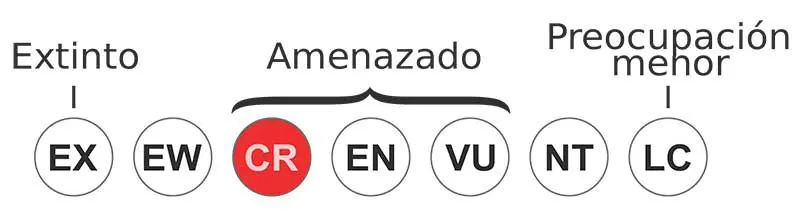
critical hazard


โ€ข Current category of the Red List of the UICN: critically endangered.

โ€ข Population trend: Decreasing.

According to the categories of UICN is considered in Critical Hazard (CR), due to the accelerated process of deforestation in the Andean forests.

Since ago 90 years it was thought that the bird was extinct until it was rediscovered in 2002, When a few biologists of the ProAves Foundation in the montane forest of the municipality of Genoa, department of Quindรญo, where the group more large observed consisted of 25 birds and the total population was of approximately 60 individuals.

Currently there are some 300 mature free individuals.
Thanks to the efforts made by different project is have retrieved data of them fluctuations in the abundances of them individuals during the year associated to its reproduction. Is very likely that the offer of the artificial nests This already having a positive impact that the length of the project It has observed an increase in the size population.

"Indigo-winged Parrot" in captivity:

They do not exist in captivity.

Alternative names:

Indigo-winged Parrot, Fuerte’s Parrot, Fuertes’s Parrot, Indigo winged Parrot (English).
Caรฏque de Fuertes, Caรฏque de Colombie (French).
Fuertespapagei, Chapmans Zwergamazone, Zwergamazone (German).
Indigo-winged Parrot (Portuguese).
Cotorra Aliazul, Lorito de Fuertes (espaรฑol).
Cotorra Aliazul, Loro coroniazul (Colombia).


scientific classification:

Frank Chapman
Frank Chapman

Order: Psittaciformes
Family: Psittacidae
Genus: Hapalopsittaca
Scientific name: Hapalopsittaca fuertesi
Citation: (Chapman, 1912)
Protonimo: Pionopsitta fuertesi


Images "Indigo-winged Parrot"

Video of the "Indigo-winged Parrot"

————————————————————————————————

ยซLorito de Fuertesยป (Hapalopsittaca fuertesi)


Sources:

Avibase
– Parrots of the World โ€“ Forshaw Joseph M
– Parrots A Guide to the Parrots of the World – Tony Juniper & Mike Parr
Birdlife
proaves.org
– Parrot Book, Parrots and macaws Neotropical

Photos:

(1) – Conservationbirding.org

Sounds: controles-canto.org

โ–ท The world of Pets: Dogs, cats, birds, reptiles, amphibians

Brown-necked Parrot
Poicephalus fuscicollis

Brown-necked Parrot

Content

Description:

32 cm.. length and weight between 310-400 g..

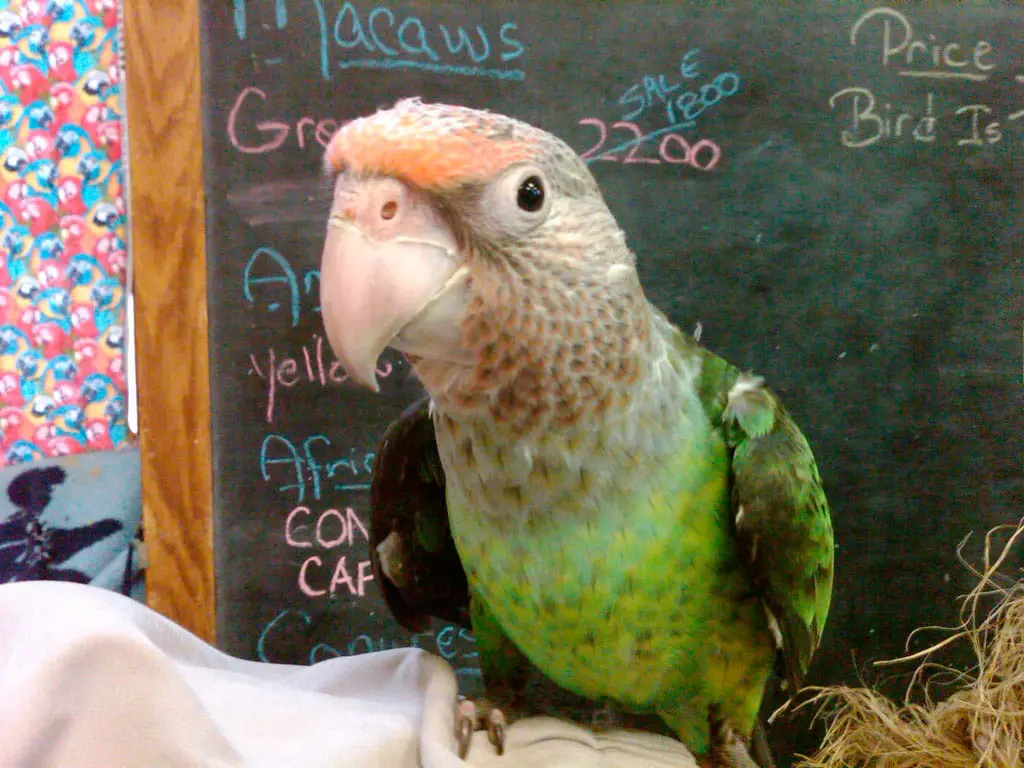
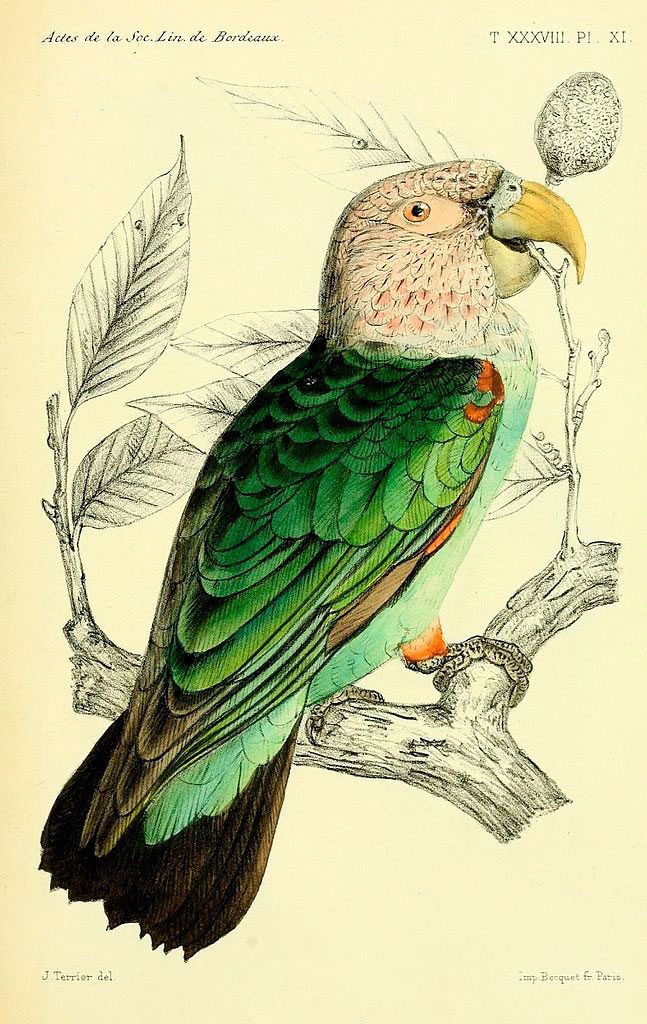
The Brown-necked Parrot (Poicephalus fuscicollis) has a plumage variable; head and gray to brown "neck" / light pink, slightly festooned with orange / brown; band orange / red through crown on female (absent in the males); back and wings, dark green; rump and underparts, green; the thighs, bend of wing and the carpal edge, red / orange; tail black / brown; irises dark brown; eye ring white / grey; bill color horn.

Immature with the head and the neck, green to yellow / brown; body dark green / oliva.

Taxonomic status:

In a study initiated in 1992, the taxonomic status of Lorito was revised Robusto (Poicephalus robustus) (Gmelin), and two species were proposed; Poicephalus robustus, restricted to montane forests of southern Africa, Poicephalus fuscicollis suahelicus, with wider distribution in wooded areas, and Poicephalus fuscicollis fuscicollis, similar to the Poicephalus fuscicollis suahelicus ostensibly, but with discontinuous, restricted to a narrow range of forests and West Africa.

Description 2 subspecies:

  • Poicephalus fuscicollis fuscicollis

    (Their Robust de Kuhl) (Kuhl, 1820) – Nominal.


  • Poicephalus fuscicollis suahelicus
  • Poicephalus fuscicollis suahelicus

    (Gray-headed parrot) (Reichenow, 1898) – With a plumage variable; head and neck silver / grey, festoneado slightly orange / brown; band orange / red through crown on female (absent in the males); back and wings, dark green; rump and lower partess, green / blue ; the thighs, bend of wing and the carpal edge, orange / red; tail black / brown; irises dark brown; eye ring white / grey; bill color horn.

Habitat:

Usually, prefers habitats of forests, as Mopane (Colosphermum mopane), miombo (Brachystegia) and riparian forests.

Most populations are residents but in the dry season become nomads, wandering in search of food.

Reproduction:

Nest in natural cavities of trees, usually on the trunk or at the bottom of a branch. The laying is of 2-4 eggs, they are incubated only by the female during 28-30 days. The male contributes to providing food for the female and chicks. Them They learn to fly when they have a 68-83 days old, only become fully independent 4-5 months later.

Food:

It feeds almost exclusively on fruit, mainly foraging in the upper canopy, using its beak to climb branches. The following foods have been recorded in your diet:

โ€ข Sclerocarya birrea (Marula)
โ€ข Pseudolachnostylis maprouneifolia (Kudu-berry)
โ€ข Commiphora mollis (Velvet cork)
โ€ข Xanthocercis zambesiaca (Nyala tree)
โ€ข Terminalia (cluster leaves)
โ€ข Gmelina arborea (Melina)

Distribution:

It is distributed from South Democratic Republic of the Congo and Tanzania until Zambia, Angola, Malawi and South of Africa; It is rare in the Caprivi Strip (Namibia), North of Botswana, Zimbabwe, Mozambique, the Limpopo and Southeast of South Africa.

Distribution 2 subspecies:

  • Poicephalus fuscicollis fuscicollis

    (Kuhl, 1820) – Nominal. It inhabits most forests including mangroves and can be found in West Africa, from Gambia and South of Senegal to the North of Ghana and Togo.


  • Poicephalus fuscicollis suahelicus

    (Reichenow, 1898) – Is located in South Africa, North of Zimbabue, Mozambique, areas Namibia, Angola, Zambia, North of Tanzania, Burundi, Rwanda and the southern part of the Sudafrican republic.

Conservation:


minor concern


โ€ข Current category of the Red List of the UICN: Least concern.

โ€ข Population trend: Decreasing.

This species has a extremely large range and therefore it is not close to the thresholds for Vulnerable under the criterion of size range (Extension <20,000 km2 combinada con un tamaรฑo de rango decreciente o fluctuante, extensiรณn o calidad de hรกbitat o tamaรฑo de poblaciรณn y un pequeรฑo nรบmero De lugares o fragmentaciรณn severa). A pesar de que la population trend appears to be declining, do not believe that the decline is fast enough for approaching the threshold of vulnerable under the criterion of population trend (> 30% decline in ten years or three generations). The population size has not been quantified, but it is not believed to be close to the thresholds for Vulnerable under the criterion of population size (<10.000 individuos maduros con una disminuciรณn continua estimada> 10% in ten years or three generations or a population structure). For these reasons, the species is evaluated as least concern.

Local and mostly uncommon throughout the range, Although more numerous and frequent in Ghana. South Subspecies considered vulnerable in South Africa where, although the erratic movements give the impression that the population fluctuates, It has suffered a decline due to the capture of the LBMs, the habitat destruction and persecution by farmers of pecan nuts; There are only fragmented patches of native vegetation. Generally rare or rare across West Africa (except Ghana).

We know very little about the biology on the loose subspecies Poicephalus fuscicollis suahelicus.
Although it has a very wide distribution area and is not classified as threatened, an analysis of the UICN and CITES recorded significantly high trafficking of Poicephalus robustus (including the Poicephalus fuscicollis suahelicus) between 1991 and 1995, It is involving a risk to natural populations. The lack of data on the ecology and behavior of this species restricts the establishment of the necessary conservation measures to effectively protect and manage the populations..

"Brown-necked Parrot" in captivity:

It easily adapts to captivity and is seen in the pet trade.

Alternative names:

Brown-necked Parrot, Angola Brown-necked Parrot, Brown-necked Parrot (Brown-necked), Gambia Brown-necked Parrot, Uncape Parrot (English).
Perroquet ร  cou brun, Perroquet ร  cou brun (nominal), Perroquet ร  cou brun (nominale), Perroquet ร  cou brun (race nominale) (French).
Graukopfpapage (German).
Brown-necked Parrot (Portuguese).
Loro de Cuello Marrรณn, You You Fuscicollis (espaรฑol).


scientific classification:

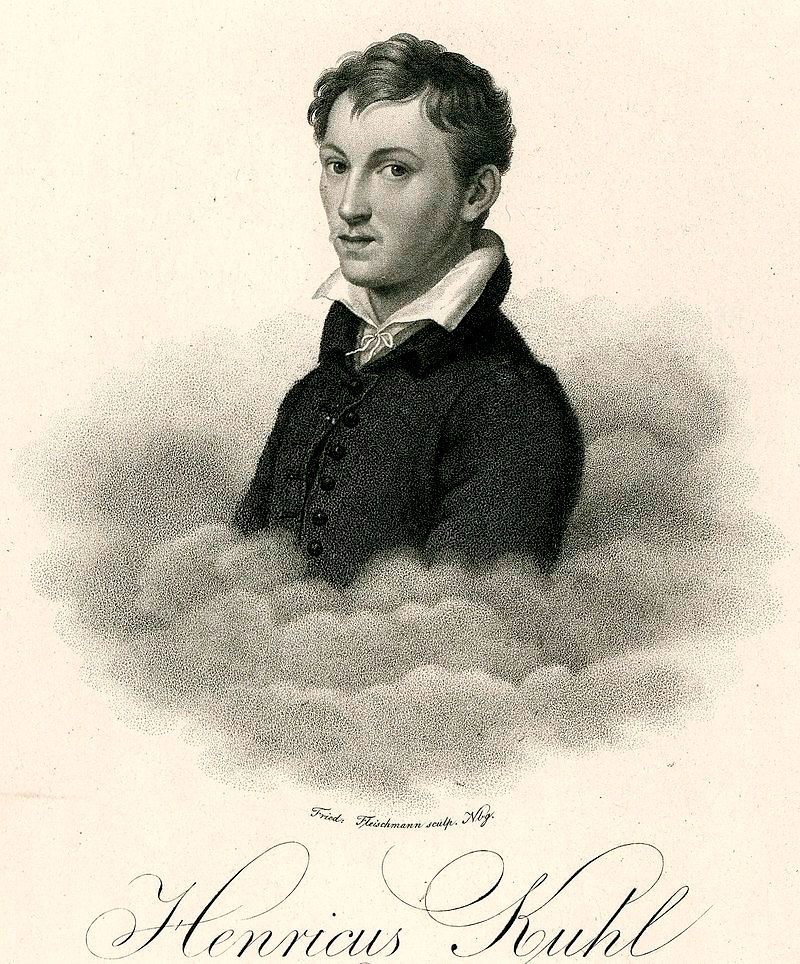
Kuhl, Heinrich
Heinrich Kuhl

Order: Psittaciformes
Family: Psittacidae
Genus: Poicephalus
Scientific name: Poicephalus fuscicollis
Citation: (Kuhl, 1820)
Protonimo: Psittacus fuscicollis


Images "Brown neck parrot":

Poicephalus [robustus or fuscicollis] suahelicus

Poicephalus [robustus or fuscicollis]

Poicephalus [robustus or fuscicollis] suahelicus

Poicephalus [robustus or fuscicollis] suahelicus

Videos "Brown-necked Parrot"

"Brown neck parrot" (Poicephalus fuscicollis)


Sources:

Avibase
– Parrots of the World โ€“ Forshaw Joseph M
– Parrots A Guide to the Parrots of the World – Tony Juniper & Mike Parr
– Birdlife
Parrots.org

Photos:

(1) – Youth, captive, friendly Poicephalus robustus fuscicollis by Bob CorriganFlickr
(2) – Brown-necked Parrot By Tremeau de Rochebrune, Alphonse [CC BY 2.0 or Public domain], via Wikimedia Commons

Sounds: Peter Boesman (Xeno-canto)

+ More