27 to 29 cm.. height and between 233 and 293 g. of weight.
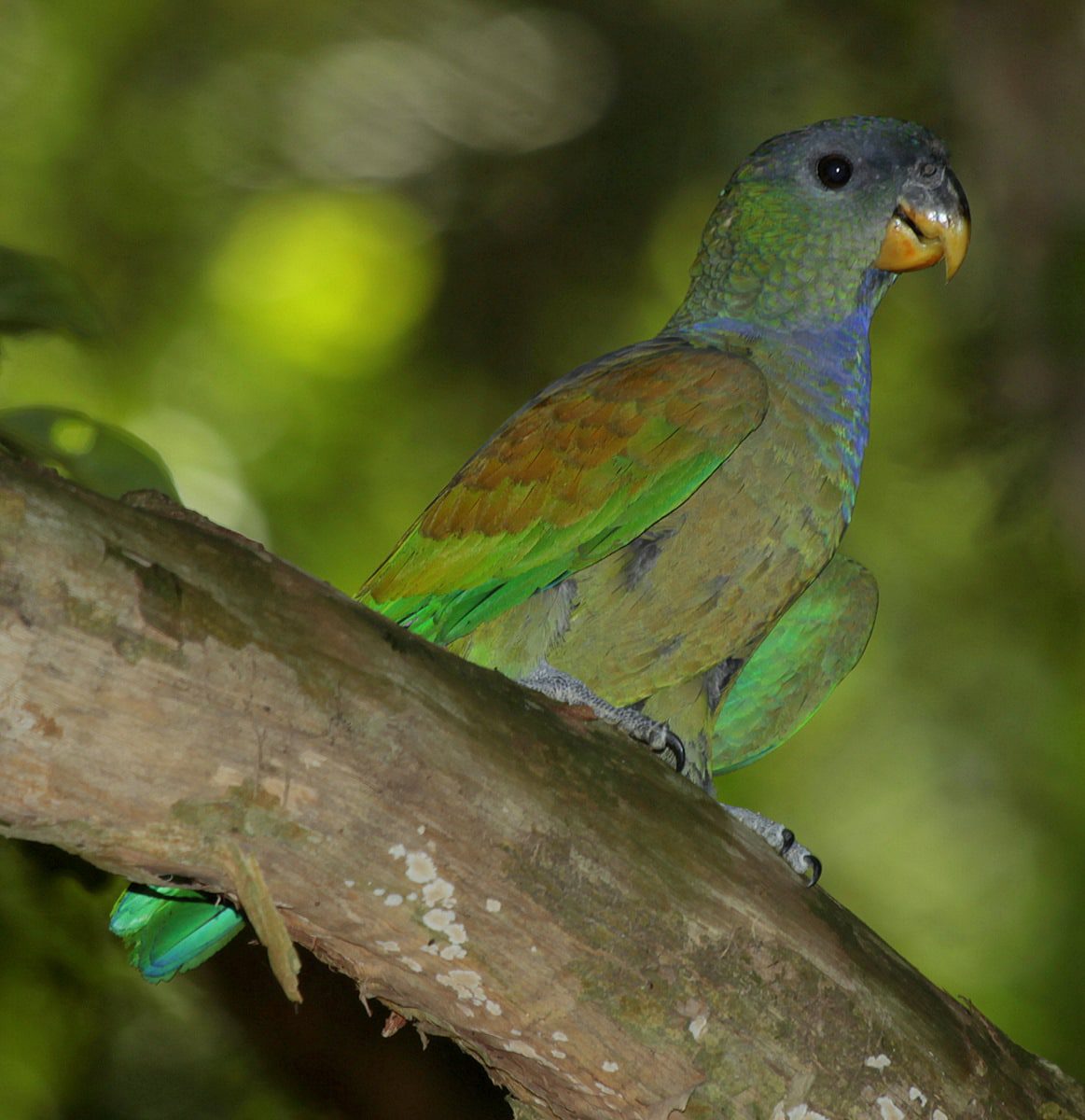
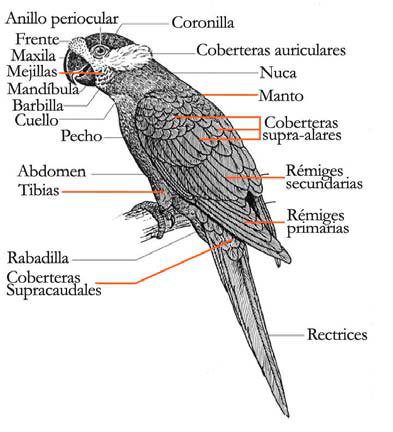
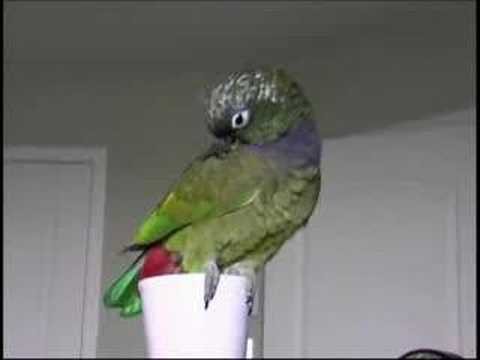
The Scaly-headed Parrot(Pionus maximiliani) It is medium in size and tail very short; has the lores, the forecrown and the eye area opaque dark bronze; the feathers on crown, the cheeks, the chin and the sides of the neck, basal green with wide enough margins bronze that give the appearance of flake; ear-coverts with dark green margins but brighter than other pens head.
The back of the neck and green the mantle become more brown and olive green upper lower parts, where some feathers have quite indistinct darker tips. Coverts smaller and medium-sized green olive brown with indistinct dark tips; alula, primary and greater coverts and flight feathers, brighter green, contrasting with the upperparts brown, duller.
Under the wings, opaque green. The throat and the top chest blue violet off that fade in brownish olive green in the bottom of the chest and most of the belly, but they are become brighter and greener in flanks and the thighs; undertail-coverts crimson. Upper, the tail green in the center, outer feathers mainly blue and red at the base; undertail, the tail, bluish green duller. Bill black with yellow edges on the upper jaw and the bottom tip; orbital skin pale grey; irises dark brown; legs grey. Both sexes are similar. Immature It has less intense the blue throat; feathers head more green with less distinct margins.
(Ribeiro, 1920) – Blue darker in throat and darker above. Larger.
Pionus maximiliani siy
(Souance , 1856) – Much like the nominal species but darker below, more purple and less blue in the chest, yellower in back and Blue throat lighter.
Habitat:
It inhabits in a wide range of forested habitats, but mostly in dry forests lowland ranging from caatinga very dry, inside the northeast of Brazil, through the savannas Cerrado seasonal, to chaco; also in wetter forests, including gallery forests and forests of araucarias, especially in southeast Brazil. They can also be seen in subtropical forests in Eastern Andean slopes some 2.000 meters in the Northwest of Argentina and some 1.500 meters in the mountains of the South of Brazil.
Tolerant to human alteration of forest habitats and sometimes cultivated areas. Usually gregarious, arriving to form flocks numerous in places in where the food is abundant probably is hiding in small groups in them cups of them trees.
Reproduction:
They nest in tree hollows. Birds in terms of breeding in the month of October in Paraguay; November in São Paulo; laying 3-5 eggs.
Mainly resident, although it may not grow in the drier parts of the Argentine Chaco. Apparently more numerous in the center of its area of distribution, where its abundance is only surpassed by the Maroon-bellied Parakeet(Pyrrhura frontalis); progressively more scarce toward the periphery.
Locally quite common the common in Bolivia and locally common in the North of Argentina, where it is most abundant in the South of Salta, Tucumán and areas adjacent in Catamarca. Moderately common in Rio Grande do Sul and common in the pantanal; densities Brazilian more high in São Paulo.
The decrease apparent, in some parts of the range, (for example, North of the Argentina) is attributable to the trade, but in other places (for example, the southeast of Brazil) is undoubtedly its decline due to the loss of forests.
(Ribeiro, 1920) – It is from Paraguay, Brazil and northeast of Argentina (Missions)
Pionus maximiliani siy
(Souance , 1856) – Southeast of Bolivia until Paraguay, West of Brazil (Mato Grosso), North of Argentina.
Conservation:
• Current category of the Red List of the UICN: Least concern.
• Population trend: Decreasing.
Justification of the population
The size of the world population It has not been quantified, but this species is described as «quite common» (Stotz et to the., 1996).
Justification of trend
It is suspected that the population is in decline due to the continuous habitat destruction and to levels of exploitation unsustainable.
Threats
The species has been object of strong exchanges: from 1981, When is included in the Appendix II of the CITES, they have been 93.234 individuals captured in the wild in the international trade (database CITES from the UNEP-WCMC, January 2005).
"Scaly-headed Parrot" in captivity:
Curious, very intelligent and social. Quiet and relatively little aggressive. Prone to obesity. You can learn to imitate.
Pretty common in captivity. Life expectancy: 20 years.
Housing: Enclosure suspended at least 2 metres in height.
Diet: fruit as: Apple, pear, orange, banana, granada, cactus fruits, they form approximately the 30 percent of the diet; vegetables as: Carrot, celery, green beans, pea in the pod; corn fresh; green leaves such as: chard, lettuce, dandelion, Aviary grass; millet; mix of seeds small e.g.: millet, and small amounts of buckwheat, oats, safflower and hemp; soaked and sprouted from seeds of sunflower; beans, cooked legumes and boiled corn.
It needs regular exercise it is necessary to provide you with an Aviary as large as possible. Provide shallow bowls of water for bathing. Also provide stairs, swings, strings, different sizes of hooks and assorted toys.
Alternative names:
– Scaly-headed Parrot, Maximilian’s Parrot, Scaly headed Parrot (English).
– Pione de Maximilien, Pionus de Maximilien (French).
– Maximilianpapagei (German).
– Maitaca, baitaca, maitaca-bronzeada, maitaca-de-Maximiliano, maitaca-suia, maitaca-verde, suia, umaitá (Portuguese).
– Loro Bronceado, Loro choclero, Loro maitaca (español).
(1) – IBC.lynxeds.com
(2) – A Scaly-headed Parrot (also called a Scaly-headed Pionus, Maximilian’s Pionus, amd Maximilian’s Parrot) in a cage By Alex Knowles [CC BY 2.0], via Wikimedia Commons
(3) – A pet male Scaly-headed Parrot (also called Maximilian Pionus, Maximilian Parrot, Maximilian’s Pionus, or Maximilian’s Parrot) By Snowmanradio (Own work) [CC BY-SA 3.0 or GFDL], via Wikimedia Commons
(4) – Scaly-headed Pionus (also called Maximilian Pionus, Maximilian Parrot, Maximilian’s Pionus, or Maximilian’s Parrot) at Zoológico de Americana, Sao Paulo, Brazil By Moe Oliveira [CC BY 2.0], via Wikimedia Commons
(5) – Loro Choclero By Danbrazil (Own work) [CC BY-SA 4.0], via Wikimedia Commons
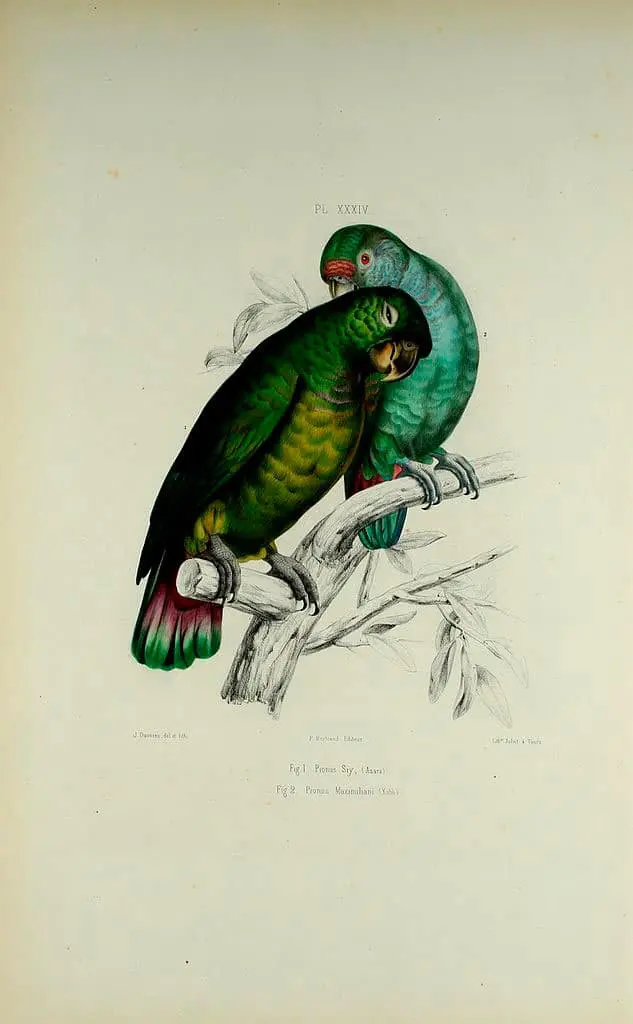
(6) – Iconographie des perroquets : non figurés dans les publications de Levaillant et de M. Bourjot Saint-Hilaire By Blanchard, Emile; Bonaparte, Charles Lucian; Bourjot Saint-Hilaire, Alexandre; Le Vaillant, François; Souancé, Charles de. [CC BY 2.0 or Public domain], via Wikimedia Commons
17 to 20 cm.. length between 33 and 40 g. of weight.
The Red-chinned Lory(Charmosyna rubrigularis) has the head green; ear-coverts brilliant emerald green with pale green streaks and showing even paler on the crown; chin, top of the throat and lower lores, surrounded by yellow red. The upperparts, Green olive darker than the underparts. The wings Green with the part internal black and them edges yellow. Yellowish-green below-wing coverts; flight feather grey and black with stripe yellow central.
Underparts brighter yellowish green, clearly more gentle to them upperparts. The tail above it is green with yellow tips, lateral feathers marked in red, black and orange in the bases; by below with broad lateral feathers red, with tips yellow (more or less hidden red rest), central feathers Black with them ends yellow.
Bill orange red; irises orange; legs orange-yellow.
Both sexes are equal.
Immature they are similar to the adult with less red in the chin and throat.
With distributed by the humid forest, mainly in the mountains. Usually found in small flocks of up to ten birds, feeding in the canopy or flying above. Can be seen in the company of others Loris that is feed from nectar, including the much larger Coconut Lorikeet. You can be assured while feeding.
Reproduction:
Unknown breeding habits.
Food:
Feeds of pollen and nectar and it has been noted that they frequent native Palms in the mountains of New Ireland.
Distribution:
Size of the area of distribution (reproduction / resident): 185.000 km2
In Karkar island (off the northeast coast) and the Bismarck Archipelago (New Britain, New Hanover and New Ireland), Papua New Guinea. In Karkar is found from sea level to the top but rarely below 625 m, and more common among 1.150 meters of 1,280 m. common since 450 meters up in New Britain and in New Ireland from 1.500 metres to the Summit of the Hans Meyer Range; Although found as low as a 70 m. It tends to replace Red-flanked Lorikeet at higher altitudes, but it may be sympatric with species in some areas.
Conservation:
• Current IUCN Red List category: Least concern
• Population trend: Stable
The population World has not been quantified, but the species according to information is common and abundant (pit et to the. 1997).
Justification of trend
It is suspected that the population is stable in the absence of evidence of any reduction or substantial threats.
"Red-chinned Lory" in captivity:
The species does not arise today as a cage bird.
Alternative names:
– Red-chinned Lory, Red chinned Lorikeet, Red-chinned Lorikeet (ingles).
– Lori à menton rouge (French).
– Rotkinnlori (German).
– Lori Barbirrojo, Lori de Barba Roja (español).
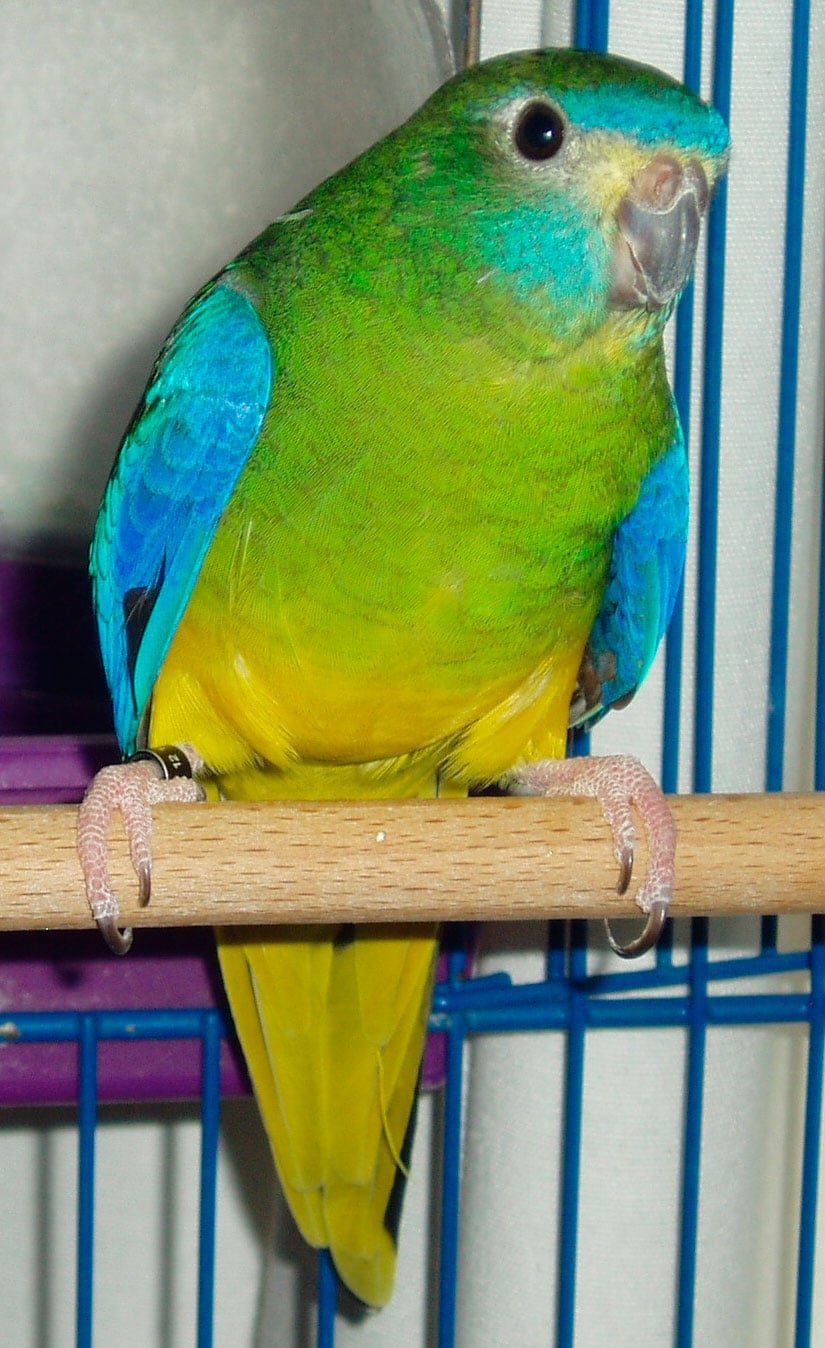
The Turquoise Parrot )(Neophema pulchella has the head bright turquoise blue, darker on the front of the crown, with the chin yellow and green on the back side of the crown.
Upperparts green.
The interior of the small and medium-sized coverts is reddish brown, the median are light blue. big blankets and primary coverts are blue-violet color. The primary feathers Black have them vane inmates of blue color and a fine yellow edge. The secondary feathers Black has foreign bands of yellowish green colour that tend toward the blue on the edges of the feathers. The lesser coverts the wings are blue-violet color.
The underparts is bright yellow with a slight orange patch in the throat and the chest. An orange stain, sometimes, is visible in the abdomen of certain individuals. The two pairs of the Central feathers of the tail are bright green, the outer tail feathers are yellow with green bases. The bill is black and the irises dark brown. The legs they are a pinkish-brown hue.
In the females, the plumage is more off than in males. There are no brown spots in the shoulders. The underparts they are much more green, especially in the chest. The lores they are whitish and the blue of the face is considerably reduced. A bar can be seen in the wing
.
The immature are similar to the females.
The Immature males are distinguished by a small brown spot in the wing
and blue dark figure.
The Turquoise Parrot they are distributed by clear wooded areas, wooded areas, meadows with native grasses, Although they have a strong preference for the ecotones, that is to say, regions that are intermediate between the forests and farmland.
In the State of Victoria, seasonally, These parakeets make positive use of habitats that suit them: the eucalyptus trees that are found in the Rocky Mountains in winter, wetlands and ravines from spring to fall and slopes that face southeast during all months of the year.
The Periquito turquoise they live in small flocks or family groups that feed near the ground.
These birds are sedentary but after nesting, You can attend a light dispersion.
During this last period, the formation of dorms is not uncommon.
We can often see them begging for food on the verges of roads.
Reproduction:
The Turquoise Parrot they breed from august to december. In other areas, the nests are also visible in April-may, but they are probably second clutches or broods alternatives. The nest is located in one a tree cavity, usually a eucalyptus, at least in regards to the State of Victoria. But it can also be located in a strain, a fallen pole or branch.
The spawning contains an average of 4 or 5 eggs with one incubation that lasts a few 20 days.
The chicks are altricial and remain in the nest for at least 4 weeks before you fly.
Food:
The Turquoise Parrot they have a diet vegetarian. They feed on seeds, flowers and fruits that are native and imported plants. Love cultivated herbs, wild herbs and different parts of the bushes.
A detailed census has identified the following genera: shrubs in Bloom's leucopogon, not less than 4 types of Danthonia, nettle, Urtica urens, Paspalum dilatatum, who are the edges of sea grass and the gernaios. The list is not exhaustive.
Distribution:
Size of its range (reproduction / resident): 771.000 km2
Currently fluctuates irregularly from the southeast of Queensland (North around Chinchilla and Maryborough) to the East of New South Wales, arriving at the coast, about Sydney, and extending to the South up to Nowra) in Victoria to the West of Bendigo. There is also an isolated population in the East of Victoria. The increase of population ,probably, continues in Victoria and New South Wales.
Conservation:
• Current category of the Red List of the UICN: Least concern
• Population Trend: Stable
at the beginning of 20th century, the increase of pastoral activities, catastrophic drought in 1902, and to a lesser extent, poaching, they gave rise to the population of the Turquoise Parrot almost disappeared.
Since the decade of 1940, there has been a resurgence in the number of individuals. The resurgence of this species began in the vicinity of Chinchilal and Maryborough and little by little the South joined with the State of Victoria through New South Wales.
Today, growth tends to spread and strong presence in the national parks proof that the cessation of grazing is a great benefit for the development of these parrots. Since they nest close to the ground, These birds are still vulnerable to predation by foxes. The other recurring threat is habitat degradation and loss of nesting sites.. The world population deemed superior to the 20 000 birds, birds captive are estimated at 8 000.
"Turquoise Parrot" in captivity:
The Turquoise Parrot they are birds that are regularly and which are obtained very good results in the reproduction. These parakeets are highly recommended for amateur beginners.
In terms of its behavior, they are relatively strong with a sweet and melodious voice. These parakeets are not shy and are easy to keep..
During the breeding season they do not support other congeners or other species of neophemas. It is mainly of assaults by males. Your need to crack is very limited and their need for bathroom is very different from an individual to another. They tolerate dry climates, but they are very sensitive to cold and wet fog. They like to spend time on the floor, investigating, and therefore, they are vulnerable to infection by worms.
According to sources, a sample lived during 21 years in captivity. In captivity, these animals have been known that they can raise from 1 año de edad.
Origin: Mexico, Guatemala, Honduras, Nicaragua, Costa Rica, Panama, Venezuela, Colombia, Ecuador, Peru, Brazil, Guyana, Suriname
Character: Intelligent and social
Life expectancy: 40 years
Height: 85 to 96 cm..
Content
Description:
Of 85 to 96 cm. length and a weight between 1.060 and 1.123 g..
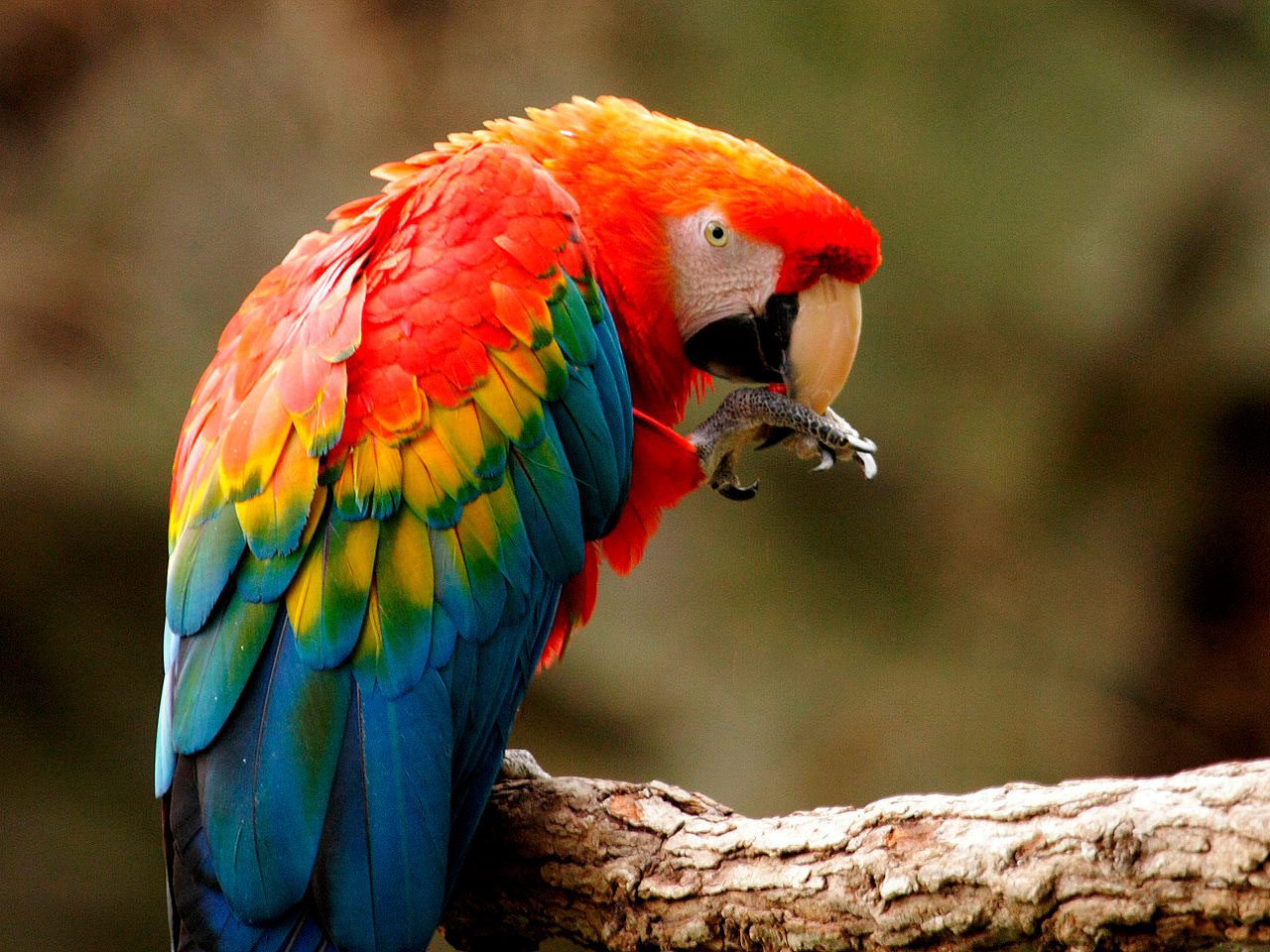
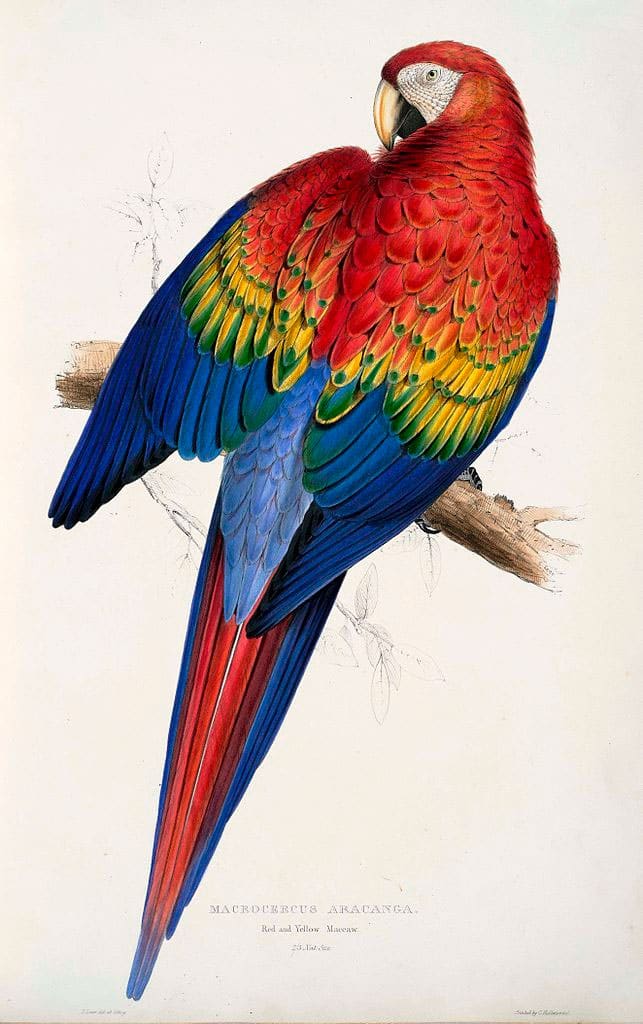
The Scarlet Macaw(Ara macao) has a showy and colorful plumage, predominantly Scarlet red in the head, neck, back, throat, belly, sides and the thighs, as well as in the upper parts of the wings and tail. These pens are a brighter shade of Red, almost Orange, If you are directly exposed to the sunlight.
The feathers greater coverts and stockings of the wings they are yellow, even if the ends of these feathers are green in the subspecies Ara macao macao and blue in Ara macao cyanoptera. The t-shirts, as well as the lower coverts of the obispillo, the of the back and both upper and lower part of the tail they are blue. The internal parts of the tail and of the wings are orange-red, lighter than the predominantly Scarlet plumage.
Its bill is hooked, strong enough to cut objects, dig, help climbing and defend themselves, but light in such a way that it does not affect your flight. It consists of two parts, of which the upper is the largest and is off-white, Sometimes a little pink, Besides that it has a small black marks on each side in the region where it joins with the head. It is also black on the tip and base, forming a triangular figure of this color. At its top are its nostrils, almost imperceptible to the naked eye. The under bill, on the other hand, is completely black, like its fleshy language.
The eyes are positioned laterally in the head, and although the exposed part of the cornea is round and seemingly small, the eyeball is large enough reality, even more than the brain. Its irises is light brown on the young but it becomes yellow when reaching the adult age. around the eyes they have an area of skin between whitish and pink which is apparently nude, although in reality it is partially covered by small, almost imperceptible reddish feathers that form thin sinuous lines.
Their legs they are short but strong, because it has powerful flexor muscles and tendons, allowing you to be upright perching. Their legs ‘zigodactilas‘ they are available in four fingers, two forward and two backwards, and are dark gray.
Morphologically, is very similar to the Red-and-green Macaw (Ara chloropterus), However, differ in that the Scarlet Macaw have yellow spots on their wings While in Red-and-green Macaw, as its name implies, stains are completely Green. The same, in the Red-and-green Macaw the thin red lines on the plucked white part of his head they are much more notorious, while the Scarlet Macaw lacks these lines or they are almost imperceptible. Finally, in the Red-and-green MacawScarlet Macaw Red is vivid tone, lighter, Stressing in particular in the nape and crown, where tends to Orange.
It is a species that has a very light sexual dimorphism, because the females they are smaller and their bill is more curved, short and thick, In addition to the tail of the male is slightly longer. Even so, it is difficult to determine its sex with the naked eye; the only reliable way to know him is through a DNA test collected from his blood or his feathers, technical or more invasive as the laparoscopy and sewer exploration.
(Wiedenfeld, 1995) – Larger than the species nominal. A dark Scarlet red in the plumage of the head and the body, a wide yellow stripe in the wings, where many feathers have blue tip, and the central feathers of the tail extremely long and wide whose tip is light blue.
The Scarlet Macaw they are distributed through the tropical forests of lowlands and savannas.
In Mexico in remote areas of humid forest.
In Honduras, on the arid slopes of the peaceful, birds forage in open areas (including growing areas); sometimes in the forests of pines above the rainforest in the Mosquito Coast.
In Costa Rica in deciduous forests, humid and in more open areas and edges with scattered tall trees.
They inhabit intact and partially cleared lowlands of rainforest and gallery forest in Colombia.
In the rainforest, Savannah and plains in Venezuela.
They prefer dry rainforest land in Suriname and the rainforest and savanna in Guyana.
Often near rivers throughout its range.
Below 240 metres in Oaxaca, Mexico, of 1.100 metres in Honduras, 1.500 metres in Costa Rica, 500 metres in Colombia and 450 metres in Venezuela.
The Scarlet Macaw, generally, they can be observed in pairs, in groups of 3/4 birds or in flocks of up to approximately 30 individuals, up to a maximum of 50, in communal roosts in tall trees (including the mangroves).
They often perch on the top of large trees.
Reproduction:
In Central America, the Scarlet Macaw nest during the months of December to June in the time dry (Forshaw, 1989; Iñigo-Elias, 1996; Renton, 1998; Renton et to the., 2003).
The macaws they use large mature trees with the average breast height diameter 129 cm.. (IñigoElias, 1996; Carreon-Brook, 2006). Apparently, the macaws Select the highest cavities for nest, taking an average of 19 height m, and with dimensions of average entry 22 cm.. x 32 cm.. (Iñigo-Elias 1996; Carreon-Brook, 2006). They prefer soft tree species for the entrance to the nest cavity can be modified.
Usually, the nests of the Scarlet Macaw they are separated by more than 3 km. (Carreonarroyo, 2006), which would reduce strong agonistic interactions between nesting pairs, and may cause the failure of nests (Renton, 2004; Renton and Brightsmith, 2009).
In Central America they put in 1 to 3 eggs (Iñigo-Elias, 1996, Renton, 1998; Renton et to the., 2003), even if broods have been recorded of up to 4 eggs in South America (Nycander et to the., 1995). In the Lacandon Jungle of Mexico, recorded an average clutch size of 1.6 eggs/female in 1988-1989 (IñigoElias, 1996) and 2.7 eggs/female in 1998- 1999 (Carreon-Brook, 2006).
Hatch on average 1.5 to 2.0 chicks/pair, managing to fly the nest 0.6 to 1.3 young per nesting pair (Iñigo-Elias, 1996; Carreon-Brook, 2006; Renton and Brightsmith, 2009).
Feeding in the canopy, usually in silence. May be associated with other parrot species where abundant food.
Distribution:
Size of the area of distribution (reproduction / resident): 10.200.000 km2
The Scarlet Macaw are distributed to a large extent of Central America, from the South of Mexico until Panama and apparently scattered in tropics of South America, from the South to the East of Bolivia.
In Mexico, formerly, were observed in the South of Tamaulipas, South of Veracruz, Oaxaca, Tabasto, Chiapas and Campeche and through the lowlands of Guatemala to the most remote areas of Belize, where the most recent records are from the Macal River.
Formerly widespread in Honduras, EI Salvador and Nicaragua; Costa Rica mainly on the Pacific slope.
In Panama confined to the Coiba island, to the southwest of the azuero peninsula and a Chiriqui, where birds once could have flown from Costa Rica.
In Venezuela, in Apure, Northeast of Monagas, Southwest of Sucre, widely distributed through the Plains and inBolívar and amazon.
A sizeable population in Guianas, throughout the Amazon basin of Brazil, to the East of Ecuador and to the East of Peru.
In the North and East of Bolivia, in Santa Cruz, Beni and possibly Pando. Away to the West of Los Andes.
The Scarlet Macaw make seasonal movements in search of fruit and is temporary visitor in some areas. Locally common but obviously in decline range-wide, especially around the centers of development, due to loss of habitat, trade and hunting, both as food and for obtaining their feathers; the population total of Mesoamerica probably not greater than 4.000 individuals.
extinguished the majority of former distribution area in Mexico (not registered in Tamaulipas Since 19th century) and persisting in limited numbers only in the Lacandon Jungle, Chiapas.
Generally rare in Guatemala, although more common in more remote areas, as the West's Petén.
extinct in El Salvador. widespread, Although rare on the Caribbean slope of Honduras; extinct on the slope of the peaceful. Nearly extinct on the Pacific slope of Nicaragua, but persisting in the remote area of the Northeast. Formerly widespread on the slopes of the Caribbean from Costa Rica, now only in the Northeast; few localities on the Pacific slope (for example, the Osa Peninsula). Fairly common in Coiba, Panama. In Venezuela Local. Fairly common in amazon basin and Guianas, especially in the more remote areas. Fewer that the Red-and-green Macaw in Guyana and Venezuela.
Widespread in captivity, but rarely bred. CITES Appendix I.
Subspecies distribution:
Ara macao cyanopterus
(Wiedenfeld, 1995) – They inhabit the area of Mesoamerica between Mexico and Honduras; Currently there are two towns in the southeast of Mexico, one of just 50 individuals in the region of the Chimalapas, Oaxaca (Íñigo et al 2004; Lazcano-Barrero obs. Pers.) and the other in the Lacandon Jungle in Chiapas, with an estimated population of between 150 and 250 individuals (Iñigo Elijah 1996 & Iñigo Elias et al. 2004, Garcia Fair).
Since the Scarlet Macaw they have an extraordinarily wide distribution range—the largest among all birds of the genus Ara—,and its population, Despite being apparently shrinking, do not fast enough to consider it vulnerable, the Red list of endangered species of the IUCN considers it to be a kind of least concern. But, This organism caught attention in his «Conservation action plan and sampling of Psitacidae»Regarding the status of subspecies to. m. cyanoptera, since its population had indeed declined rapidly in a span of twenty years. The species also appears from the 1 in August of 1985 in the Appendix I of the Convention on international trade in endangered species of Wild Fauna and Flora (CITES), that prohibits trade in this species within the signatory countries. Originally entered in Appendix III of this organization in 1976, amounted to Appendix II in 1981 and finally it came to Appendix I in before this date.
It is also protected by various laws and decrees national; for example, in Costa Rica, where he spent to deal with around the 80% of the national territory to only the 20% for the year of 1993. Because of its particularly precarious condition within the territory of Mexico, in that country he is considered from 2000 a priority species for conservation. In Panama, also, It is considered to be one of the two most endangered bird species in the country along with the Cotinga. For its part, in Peru is listed as Vulnerable species (VU) according to Supreme Decree No. 034-2004-AG from September of 2004. In Guatemala was enacted in 1989 Decree No. 4-89 of the Protected Areas Law, same with which created the Guatemalan System of Protected Areas, that ensures the protection of species endangered within its territory, including the Scarlet Macaw. In Belice It is sheltered from 1992 by the Environmental Protection Act, that prohibits their trade or possession. Inside Brazil has a similar protection, Since its trade locally or export or possession is not allowed, unless they are breeding or authorized zoos. In Colombia his criterion is "indeterminate" in the List of Colombian Species on the Way to Extinction, so it is not considered endangered within that country, although it does receive the protection of various national laws. In Venezuela it is considered a vulnerable species and is protected by the Protection law to the wildlife.
Among the main factors threatening the survival of this species are the habitat destruction because of deforestation, the oil industry and intentional burning; the fragmentation of populations, the commercial traffic of feathers, eggs and specimens as such for sale as pets, as well as the fact of being an inbred species with low reproductive rates, and the specialization of the diet of some populations. The problem of the illegal trade It affected him greatly in the 20th century, where among 1975 and 1990 It is estimated that they exported around 1500 specimens. Until the mid of 1980, The main exporting countries were those where the Scarlet Macaw reproduces naturally, as Bolivia, Guyana and Suriname. But, by the end of that decade, countries such as United States, Philippines and Canada they were already major exporters, as local bird breeding has developed sufficiently to sustain its own trade. The main destination of the trade of these birds was always United States. In more recent years, the various national laws have banned the trade of this and other species of birds, Although this illegal practice has not completely eradicated. The main change that has occurred is that most of the birds in trade now come from the reproduction in captivity, What is an advantage for buyers since they tend to be healthier and more domesticated birds.
"Scarlet Macaw" in captivity:
Starting at the century XVI, as a result of the Conquest of America, appeared the European interest to catch various species of parrots, including this one. The traffic of this and other species was growing due to their popularity as pets, by Macaw began to disappear from their habitat in some regions since the 19th century. Its value on the black market, that it can be several thousand dollars, It makes often a more profitable activity for local residents that agriculture, logging of precious woods or even drug trafficking. This is one of the main reasons that have contributed to its disappearance. In fact, the popularity of several species of macaws is such that these animals have become more quoted in the pet market, and they have overcome even the cats and primates.
Sources They point out that a female's Scarlet Macaw was still alive after 33 years in captivity, but it rarely flew probably due to its age; He grew up with a male from 32 years of age, during 22 years, until the two you almost 30 years of age. There are several anecdotal reports that indicate that these birds live longer, However, including a report of a Scarlet Macaw of 37,1 years and a live specimen of 64 years of age. In captivity, these animals have been known of raising starting from 8 years of age.
Some factors that make one Macaw very attractive pet they are your sociable behavior, their colorful plumage and their ability to learn to imitate words, Although it should be noted that this is not one of the species of macaws who better to develop this skill. It also, it should be emphasized that when they "speak" they do not really understand the meaning of what they say: at most they relate the sound to some object or event, but never through a process of reasoning. Anyway, in general terms it is a bird very intelligent, with learning ability similar to that of a child aged between five and seven years.
On the other hand, precisely because it is highly social, In addition to that need plenty of space to exercise, It bustling and it has a beak and strong claws which are capable of damaging objects and even hurt people, It is not ideal to live as a pet, although you can do it, preferably in the company of other birds and especially of the same species, in aviaries and zoos right. In fact, is a bird easy to raise even for poultry farmers with little experience, and today it is one of the most common species for captive breeding around the world. As well, due to its curious nature and its excellent ability to learn tricks, It is a bird very common in zoo and amusement park exhibits.
In 1993, the Scarlet Macaw He was nominated to wildlife symbol of Honduras and declared as the national bird of this nation, according to executive decree no. 36-93 issued by the Honduran national Congress. This bird was also chosen as the mascot of the America's Cup 2007 held in Venezuela, which is representative of this country by carrying the three colors of its national flag in its plumage. The name given to said pet was "Guaky", which wore the burgundy shirt of the soccer team of that country, as well as eight stars on its wings, to highlight the allusion to the Venezuelan flag. More recently, the Scarlet Macaw began to be coined in the face of the coins of 200 weights Colombians that began to circulate in that country from 2012.
– Avibase
– Parrots of the World – Forshaw Joseph M
– Parrots A Guide to the Parrots of the World – Tony Juniper & Mike Parr
– Birdlife
– Wikipedia
– Ara macao cyanoptera (Scarlet Macaw) For: Jesus Gomez Pina and Jose A.. Valero Pérez
– Photos:
(1) – This has the appearance of a Scarlet Macaw, which have a variable amount of green in the wings. The exact pedigree of this zoo parrot may be known by the zoo By Travis Isaacs from Grapevine, TX, USA (zoo355Uploaded by snowmanradio) [CC BY 2.0], via Wikimedia Commons
(2) – Scarlet Macaw (Ara macao). Side view. It is raising one of its legs By Peter (Flickr) [CC BY-SA 2.0], via Wikimedia Commons
(3) – A Scarlet Macaw flying away from the photographe By The original uploader was Robert01 at German Wikipedia [CC BY-SA 3.0 of], via Wikimedia Commons
(4) – Scarlet Macaw at Diergaarde Blijdorp, Rotterdam, Netherlands By Jar0d [CC BY-SA 2.0], via Wikimedia Commons
(5) – Scarlet Macaw in Yucatan, Mexico By Tony Hisgett (originally posted to Flickr as Parrot 2) [CC BY 2.0], via Wikimedia Commons
(6) – Scarlet Macaw at Phoenix Zoo, USA By Khamis Hammoudeh (originally posted to Flickr as <3) [CC BY 2.0], via Wikimedia Commons
(7) – Scarlet Macaws (Ara macao) by Heather Paul – Flickr
(8) – Guacamayo rojo by m.prinke – Flickr
(9) – Ara macao (Scarlet Macaw) Tarcoles, Costa Rica by Juan Zamora – Flickr
(10) – First edition of Illustrations of the Family of Psittacidae, or Parrots. Originally a painting by Edward Lear [Public domain], via Wikimedia Commons
– Sounds:
▷ The world of Pets: Dogs, cats, birds, reptiles, amphibians
The Tepui Parrotlet(Nannopsittaca panychlora) measured between 14 and 15,7 cm.. height. Small size, with wings sharp and tail cut and wedge.
The head It is green with yellow tinge oliváceo; the eye area is yellow, color extending below and behind the eyes. The upperparts they are green (brighter and less than oliváceo head). Upperwing-coverts green. Flight feathers blackish green tipped primary, brownish opaque below; INFRACA-wing coverts green. The underparts yellowish green turn yellow-green in the undertail-coverts. Upper, the tail is green; undertail, yellower. Bill grey; cere grey; Bello to singr dark gray; irises brown; legs Rosaceae.
Both sexes are similar; the female has the forecrown Off-white to yellowish.
They inhabit moist montane forests. in tropical and subtropical highlands, sometimes in the rainforest of the lowlands around tepuyes, generally 750-1,850 m (Gran Sabana), although they observed at the top of Auyantepui to 2,200 meters and near the summit Monte Roraima A 2,200 m; to 750-950 metres in Sucre.
Can reproduce in subtropical and tropical zone descend to feed. Recent records in the view of birds in the lowlands suggest at least seasonal aparienciones at lower altitudes. Fly very high, fast and straight, in compact flocks of 6 to 150 individuals. It´s resident but it shows seasonal migrations.
Reproduction:
Sleeps and nests in Tepuis. Not much more information about the reproduction of this species in the wild.
Food:
In their natural habitats, the Tepui Parrotlet normally eat fruits, seeds and small insects.
Distribution:
Size of the area of distribution (reproduction / resident): 486.000 km2
Mainly montana, It is distributed in several scattered populations in eastern Venezuela and the adjacent area of ​​western Guyana; concentrated in Gran Sabana from the east of Bolívar in Venezuela (for example, Montes Roraima and Auyantepui); It is also present around the meseta del Duida and the lowlands of Ventauri River, amazon, and in the West of Guyana from the area Camaran River; a more distant population occupies the Paria Peninsula (for example, the Monte Papelón), Sucre, to the northeast of Venezuela. Probably you can be observed at the north end of Roraima, Brazil.
Apparently locally common and stable, but perhaps it diminished in Paria peninsula due to large-scale deforestation. Much of the range is included in Canaima National Park.
Conservation:
State of conservation ⓘ
Minor Concern ⓘ(UICN)ⓘ
• Current category of the Red List of the UICN: Least concern.
• Population trend: Stable.
Justification of the population
The size of the world population It has not been quantified, but this species is described as «quite common, but unevenly distributed» (Stotz et to the., 1996).
Justification of trend
It is suspected that this species has lost 6,9-11,6% of habitat within its distribution over three generations (15 years) starting from a model of deforestation Amazon (Soares-Filho et to the., 2006, Bird et to the., 2011). Given the susceptibility of the species to hunting and / or capture, It is suspected that its population decline by <25% during three generations.
"Tepui Parrotlet" in captivity:
Breeding in captivity outside of South America. It is intelligent, quiet and very sociable.
Can normally live about 20 years.
The Seychelles Parakeet(Psittacula wardi) It was a medium-sized parrot with a length of about 41 cm and a weight between 100 and 125 g..
It was green with a large bill red with yellow tips, a red stain on the shoulders and a long tail. The male had a narrow black band on the cheek and neck black that the female and juvenile lacked. blueness in nape and eyes yellow. the legs They were greyish
taxonomy:
Phylogenetic studies suggest that this species away from the Alexandrine Parakeet(Psittacula eupatria).
Habitat:
In a report they were seen over the forest along a field corn.
They were probably in small groups or flocks, making striking flights. It was reported that the birds were cautious, presumably due to its constant pursuit.
Reproduction:
No data.
Food:
It was a forest species, which probably it fed on fruit and seeds.
Distribution:
The Seychelles Parakeet It was endemic to Mahe and Silhouette, Seychelles, with a visual record of Praslin. A considerable number were found in 1811, But it was rare in 1867 and the last specimen was shot at Mahe by Abbott in 1893. It may have survived until the twentieth century (Skerrett y Disley 2011), although apparently he was already extinguished when Nicoll He visited the island 1906 (Lionnet 1984).
Conservation:
• Current category of the Red List of the UICN: Extinct.
• Population trend: The last known individuals were shot dead in 1893.
Clearing forests for plantations and coconut hunting and capture (in particular, to protect corn crops) were the main causes of the disappearance of the species (Forshaw and Cooper 1989).
In captivity:
The last captive records of these birds date back to the year 1883.
There are currently two specimens in the museums of Liverpool and New York City.
Alternative names:
– Green Parakeet, Seychelles Alexandrine Parrot, Seychelles Parakeet, Seychelles Parrot (inglés).
– Perruche des Seychelles (francés).
– Seychellen-Edelsittich, Seychellensittich, Seychellen-Sittich (alemán).
– Periquito-das-seychelles (portugués).
– Cotorra de las Seychelles, Cotorra de los Seychelles, Cotorra de Seychelles (español).
Avibase Parrots of the World – Forshaw Joseph M Parrots A Guide to the Parrots of the World – Tony Juniper & Mike Parr Birdlife
Photos:
(1) – Seychelles Parakeet (Psittacula wardi), depiction by John Gerrard Keulemans from ‘Extinct Birds’ by Lionel Walter Rothschild from the year 1907 by John Gerrard Keulemans [Public domain], via Wikimedia Commons
▷ The world of Pets: Dogs, cats, birds, reptiles, amphibians
The Sinú parakeet(Pyrrhura subandina) It, in general, green, with the forecrown and areas around eyes dark red.
In flight It is very evident dark red stain abdomen, the wings below greyish. The cheeks They have a greenish blue tone, the area surrounding the ear It is yellowish-brown and the breast feathers with design marginalized gray escamado.
Lives or lived in humid jungle, semi-humid, deciduous and gallery forests,low. It nests on trees of considerable size in hollow nests woodpeckers.
endemic to Colombia, in the lower valley of sinu river, Jaraquiel, Murrucucú hill, Córdoba.
Expeditions carried out in recent years have failed to sight it.
Estimated population: 0-100; The population trend: possibly extinct
We recommend that you devote to Sinú parakeet immediate attention to the conservation of this unique endemic species of the plain Sinu River.
Habitats in the jungle and near the Sinú river valley have been extensively altered and lost.
History:
The Sinú parakeet It was described by Todd 1917 as a distinctive bird endemic Valley Sinu River, Córdoba Department, Northwest of Colombia. Peters (1937), without evidence or any basis placed the Pyrrhura subandina within the species Pyrrhura picta, and the species immediately fell into obscurity as subspecies. However, Joseph and Stockwell (2002) they restored the status to Pyrrhura subandina as a species, based on a detailed assessment and phylogenetic analyses recent (com. pers. 2003).
DNA analysis has shown that the population of the Sinú parakeet(Pyrrhura subandina) It is probably different (monotype) (Joseph & Stockwell 2002), although at present it remains a subspecies of the Pyrrhura picta pending further studies (SACC 2007).
There is no information on the ecology of the Sinú parakeet or current status. The species has never been reported alive and its range has been extensively deforested (Salaman obs. pers.)
At the beginning of 2004 Paul Salman He visited the four sites type; two are entirely deforested, While Quimari and the Cerro Murrucucú still have some fragmented forests. No evidence of any Pyrrhura It was obtained by observations and interviews with the local community. In May of 2004, a researcher at ProAves spent three months exploring in search of this species throughout the Murrucucú hill but their results were not favorable. The lack of recent records of this species and its restricted and unprotected range give reasons for concern about their survival and current status.
Reference: Joseph, L. and Stockwell, D. 2002. Climatic modeling of the distribution of some Pyrrhura parakeets of northwestern South America with notes on their systematics and special reference to Pyrrhura caeruleiceps Todd, 1947. Ornitologia Neotropical 13: 1-8.
The Sinú parakeet(Pyrrhura subandina) was last reliably recorded in 1949. Almost nothing was recorded about their habits. Not found during searches on 2004 and 2006 (ProAves Colombia 2008). He may be extinct, but if it still survives, this bird will be seriously threatened by habitat loss and hunting associated with the armed conflict in the region; The future of this Pyrrhura It looks bleak.
* Subspecies included within the species Pyrrhura picta.
35,5 to 38,1 cm.. height and between 314 and 485g. weight.
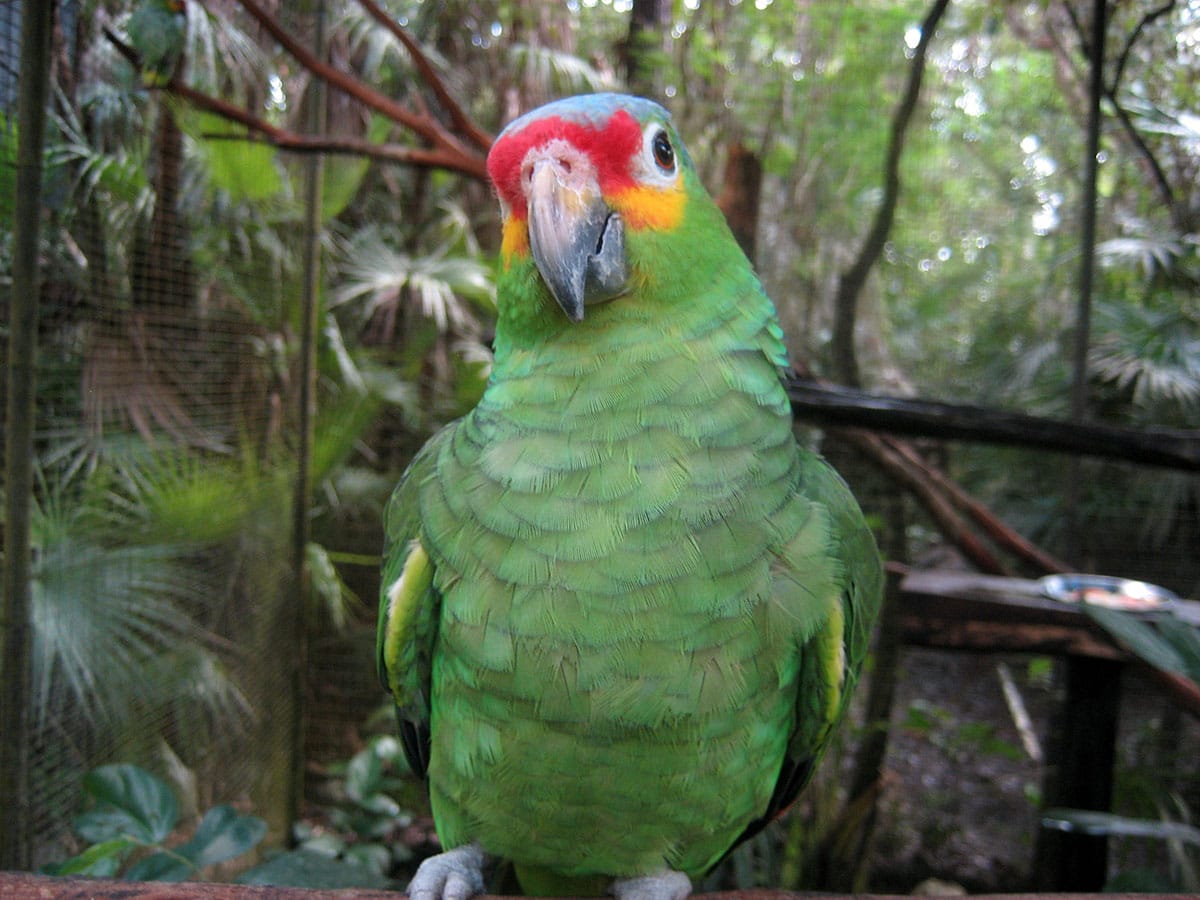
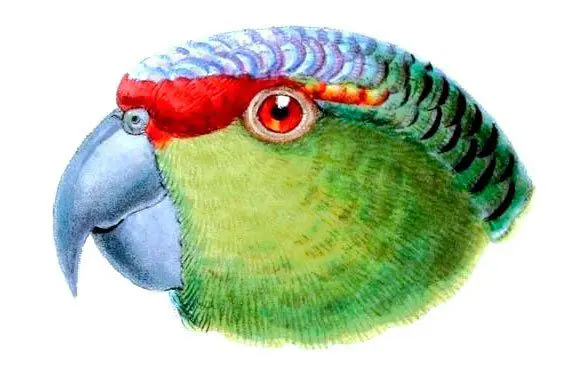
The Red-lored Amazon(Amazona autumnalis) is distinguished by its red front; Green with edge lilac it nape ; crown lilac; stain red in the wing
, and tail blue margin.
The bill is grey with the upper jaw yellowish-horn. The irises his eye is orange. The legs are of color gray greenish. They do not possess sexual dimorphism, that is to say, there is no physical difference between the male and the female.
This amazon frequents a wide range of habitats wooded and open with trees, including rainforest, tropical deciduous forest, pine forests, mangroves, forest swamps, gallery woods, areas cultivated with trees high and plantations; also forest dry in the South of Ecuador.
The Red-lored Amazon move from the rainforest (breeding season) to a habitat more open in winter in the Yucatan Peninsula, Mexico. The altitudes that inhabit range from sea level to the 320 metres in Oaxaca, 1.100 metres in Honduras, 800 metres in the Caribbean, 1.000 meters on the slopes of the peaceful of Costa Rica, and 1.000 metres in Colombia.
The birds tend to be in pairs or in flocks loose, being more gregarious When feed (occasionally macaws) and when resting. outside the breeding season, birds take refuge in tall trees in gallery forests or mangroves.
Reproduction:
They nest during the seasonal dry in hollow of trees (usually dead, for example, Tabebuia or Ceiba) or on the stump of a Palm tree. Birds in State reproductive in April, Oaxaca; February-March, Belice; March, Guatemala; January-February, Colombia. Reproduce between February-April, Panama; March-may, Belice and January-March, Ecuador. Clutch 3-4 eggs.
The incubation varies from 25 to 26 days. The chicks remain in the nest 70 days.
Size of the area of distribution (reproduction / resident): 2.570.000 km2
The Red-lored Amazon It extends from the South of Mexico north of South America with a population disjunct in the amazon.
You can find in them lands low of the this of Mexico, in the South of Tamaulipas, in the East of San Luis Potosi, Puebla, Oaxaca, Chiapas, Tabasco, Campeche and Quintana Roo. Records from other parts of the country (for example, City of Mexico) probably you refer to leak.
You can see in Belice and in the lowlands of the Caribbean of Guatemala and Honduras (including Roatan and Guanaja in Bay islands and probably soon in Utila), until Nicaragua and Costa Rica, where they are present in humid areas of the tropics on both slopes (absent from the dry Northwest ), also in Panama and on the islands of Coiba and Escudo de Veraguas and in the Archipelago of pearls (absent from the driest areas of the Azuero Peninsula).
In the Northwest of Colombia appear on the Pacific slope of the Western Andes from the Panamanian border to the South up to the Serrania del Baudo and from the southwest of Cauca south to Ecuador in the Gulf of Guayaquil. Also it extends to the North of the Andes in Colombia to Magdalena Medio and to the East in the Northwest of Venezuela in Zulia (Sierra de Perija).
In the Northwestern basin of the brazilian amazon a disjunct population exists between Black river and Solimões River.
Usually resident with some local seasonal habitat preferences (for example, in Yucatan Peninsula, Mexico). Is usually the most common parrot and more numerous in some parts of the range (for example, in parts of Central America) but now is a species very rare to the West of them Andes in Ecuador and Colombia with a population of the subspecies Amazona autumnalis lilacina estimated in 400-600 specimens.
Population decreased drastically in the island of Roatan (Honduras) where he captured it is massively for export, and maybe missing in Utila for the same reason.
Capture combined with the loss of habitat also has caused declines in some other parts of its area of distribution (for example, east of Mexico and Ecuador). common in captivity in some areas, and marketed internationally.
Distribution 3 subspecies:
Amazona autumnalis autumnalis
(Linnaeus, 1758) – Nominal. Coast of the Caribbean from the East of Mexico South to North of Nicaragua.
(Salvadori, 1891) – North of Nicaragua south to Colombia and Venezuela.
Conservation:
State of conservation ⓘ
Minor Concern ⓘ(UICN)ⓘ
• Current category of the Red List of the UICN: Least concern.
• Population trend: Decreasing.
This species has a very large range and, Therefore, is not approaching the thresholds of Vulnerability at the discretion of the distribution area size.
The population size is very large and, therefore, not approaching the thresholds for vulnerable under the criterion of population size (<10.000 mature individuals with an estimated continuous decrease in> 10% in ten years or three generations or with a specific population structure). For these reasons, the species is evaluated as least concern.
Justification of trend
It is suspected that the population is in decline due to the continuous destruction of the habitat and to levels of exploitation unsustainable.
The Amazona lored in captivity:
Is of vital importance that the diet is complete and balanced in all directions, as this prevents, along with other factors, the appearance of bone problems or the known software that affects numerous parrots. To ensure the balance of this, prepared feed very well supply the nutritional needs of each animal, However, they should not miss plant, fruits and vegetables, as well as diversity of seeds that come in mixture.
As for accommodation, If they are not removed from cage constantly, it should be spacious enough to exercise the muscles of the wings and legs, and the plumage of the bird is preserved in perfect condition.
The Red-lored Amazon enjoy, like all parrots, tearing apart and finding out things, so they must have the occasional toy or we may end up having problems with the furniture. Them feet of parrot are very suitable if your stay is in the outside of the cage. Of course, they must not be exposed to draughts or sudden changes in temperature. The water must be clean at your fingertips, because the existence of fungi causes serious breathing problems.
In terms of coexistence to have it in the neighborhood area, in comparison with other species in Amazon, are relatively quiet, so in general do not cause many problems.
In captivity, can get to live up to 80 years.
BREEDING AND REPRODUCTION:
Its captive breeding started for the first time in United States, after their importation from the place of origin, South America in the 1950's.
Those individuals acquire their sexual maturity on the 4 years of age, and if you have a good breeding pair in the right conditions, they can perform two annual broods, Although the main thing if you want to raise, patience. Many pairs need several years until the first calf, so it is very important to be patient and wait for the right moment.
The female lays in the nest (No fill) of 2 to 6 eggs incubated without the help of the male usually. This is dedicated to feeding the female itself and that of the chicks after their birth at the 28 days until independence after twelve weeks.
(1) – Wikimedia.org
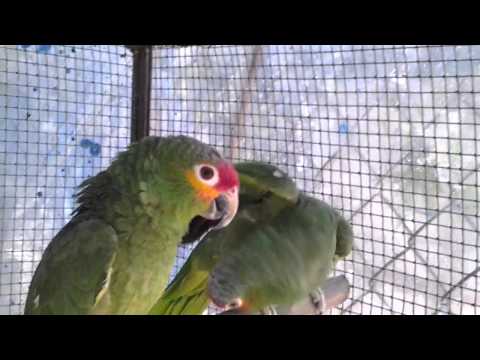
(2) – Red-lored Amazon or Red-lored Parrot; two captive parrots By Brian Gratwicke (originally posted to Flickr as Red-lored Amazon) [CC BY 2.0], via Wikimedia Commons
(3) – A Red-lored Amazon in Panama By Nelson de Witt from USA (Hello!) [CC BY-SA 2.0], via Wikimedia Commons
(4) – To pet Red-lored Amazon By Richard (originally posted to Flickr as Looming….) [CC BY 2.0], via Wikimedia Commons
(5) – Red-lored parrots (Amazona autumnalis), OSA Peninsula, Costa Rica By Charlesjsharp (Own work) [CC BY-SA 3.0], via Wikimedia Commons
(6) – A Red-lored Amazon at Rock Farm, Belize. It has a feather problem By Rigrat [CC BY-SA 3.0], via Wikimedia Commons
(7) – This is the image of a parrot originating of the jungle of Chiapas in Mexico By Joe Quick [CC BY 2.0], via Wikimedia Commons
(8) – Red-lored Amazon perching on a branch with wings open near Belmopan, Belize By Rigrat (Picasa Web Albums) [CC BY-SA 3.0], via Wikimedia Commons
(9) – A strange sight to me to see parrots flying in the wild. This Red-lored Amazon (Amazona autumnalis) was spotted with a group along the roadside in the Cayo distict of Belize By The Lilac Breasted Roller (originally posted to Flickr as Red Lored Parrot) [CC BY 2.0], via Wikimedia Commons
(10) – Lilacine Amazon, head from lateral by John Gerrard Keulemans [Public domain], via Wikimedia Commons











.JPG)
.jpg)


-6.jpg#/media/File:Turquoise_Parrot_(Neophema_pulchella)-6.jpg)


_-raising_leg.jpg)


