19 cm.. length and a weight of environment to the 118 g..
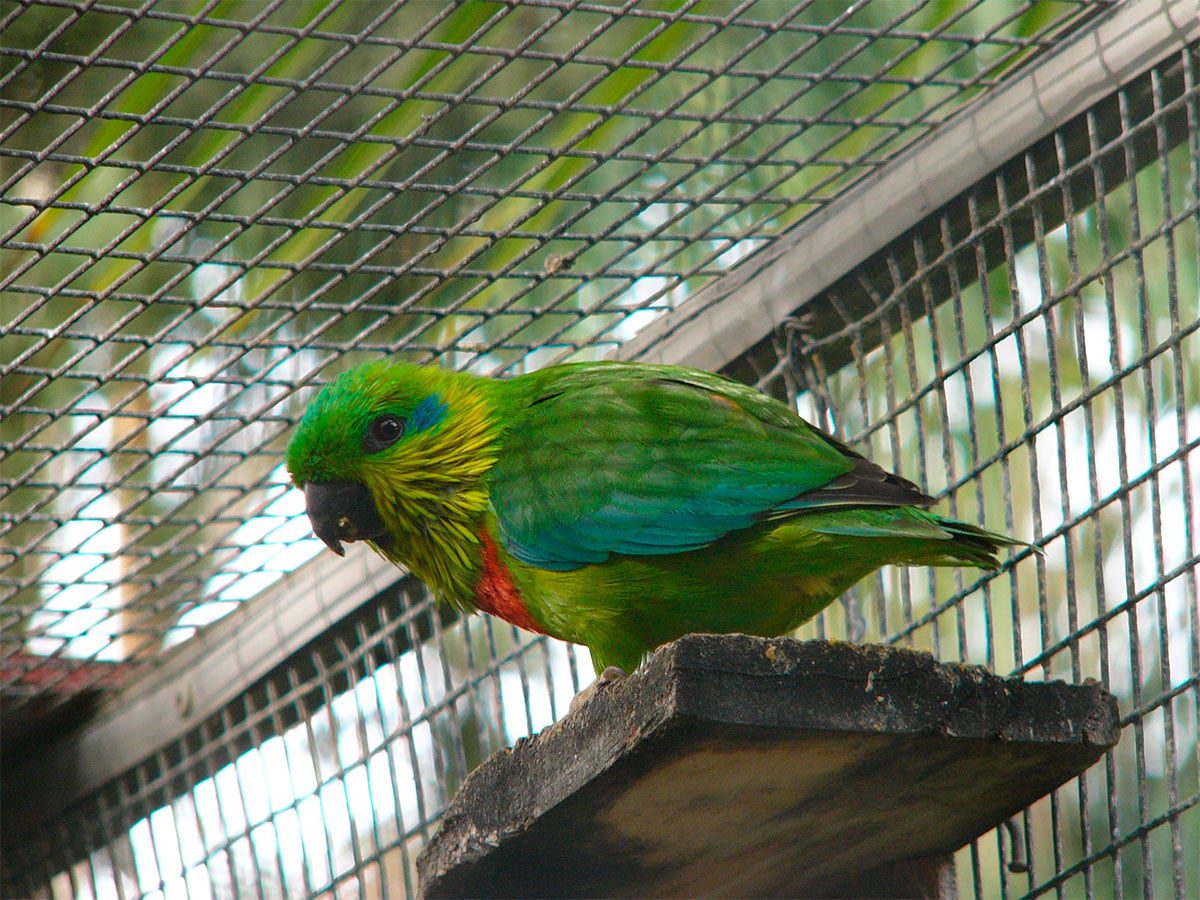
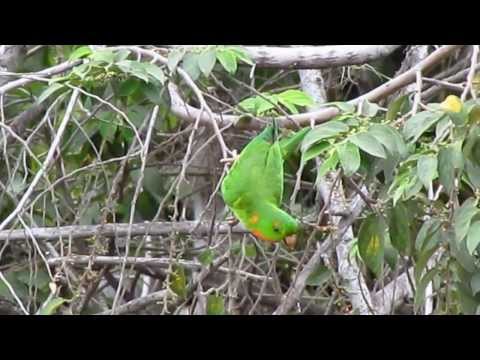
The forecrown and crown of the Salvadori's Fig-Parrot(Psittaculirostris salvadorii) is bright green with a little blue diffusion; cheeks and ear-coverts elongated yellow gold; area behind the eyes, pale blue: yellow the nape.
Upperparts green; internal parts of flight feather, orange-red at their ends. Under, the wings opaque green. Top of the chest with bright red band, rest of the underparts bright yellowish green, brighter and clearer than the upperparts. Upper, the tail green; Yellow below.
Bill black; irises red-brown; legs grey,
Female lacks the band scarlet chest, evident in the male, which it is substituted by a band It is showing some green opaque red feathers on the sides.
Youth equal to the adult female but duller overall; band pale blue chest, weak or invisible. Iris reddish brown.
The Salvadori's Fig-Parrot is distributed in the forests, along their edges, partially cleared areas and close to human settlements. Birds subsist mainly on the seeds of figs, and groups are fed into the cup of fruit trees, sometimes mixed with other species. Hang it upside down to feed, and they can make brief forays above the canopy. The species is found more often in pairs or in small groups, and nests colonies.
Reproduction:
Little is known about its ecology.
Food:
Their diet consists mainly of figs and other fruit.
Distribution:
Size of the area of distribution (reproduction / resident): 81.500 km2
THE Salvadori's Fig-Parrot (Psittaculirostris salvadorii) is endemic to the North of Irian Jaya, Indonesian. You can see in the forests of lowlands from the eastern edge of the Cenderawasih Bay to the humboldt bay (approximately 137 ° a 141 it is), reaching inside through the northern slopes of the Van Rees mountains to 700 meters above sea level. Not rare within its small range.
Conservation:
• Current IUCN Red List category: Least concern
• Population trend: Decreasing
This species is suspected of slow to moderate decline due to loss of habitat, limited degradation and some pressure for his capture.
Its population is estimated around the 10,000 specimens.
In the past, this species has been caught in relatively large numbers for the cage bird trade, both for the domestic and foreign markets, with a total of 1.582 birds exported from Indonesia between 1985 and 1990 (Beehler 1985, Nash 1990b , KD Bishop in litt., 1996, 1997to collar), and 1.791 between 1990 and 2001, When the species registered trade ceased (UNEP-WCMC 2007). But, the true extent of trade is unknown and is likely to be overlooked by many hunters in the preference of the most coveted and abundant species (B. Beehler in litt. 2012).
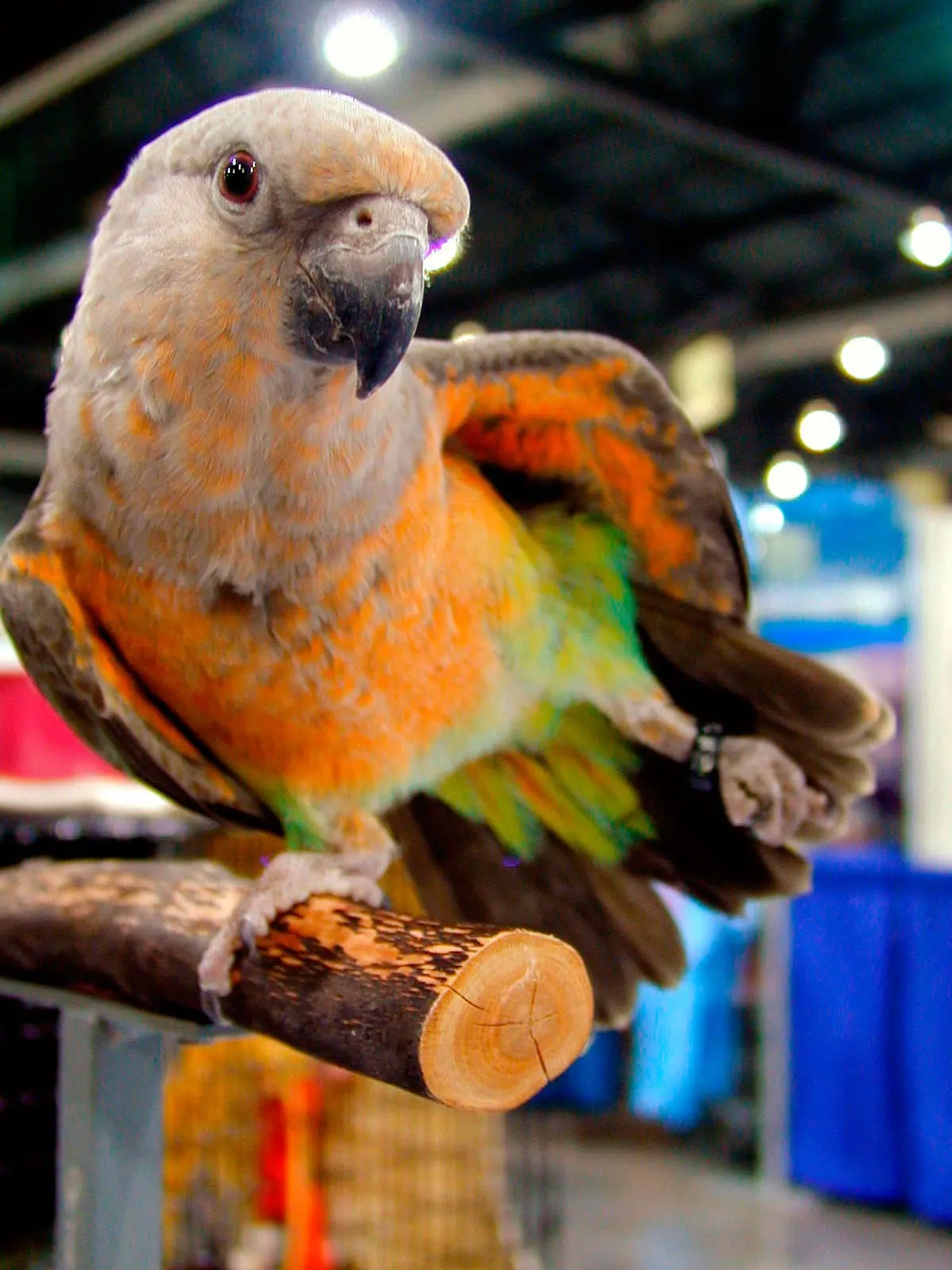
The Red-bellied Parrot(Poicephalus rufiventris) has the crown, nape and lores brown ash, the cheeks sometimes with orange tips; ear-coverts slightly paler. Mantle and scapulars brown ash; the back blue-black; rump iridescent pale blue or bluish green. Upper, the wings slightly darker than the head and back: the primaries brown. Under, the feathers of orange wings; underside of feathers Light brown flight. Throat and the chest ash brown with orange tint; top of the chest orange; belly up to undertail- coverts pale green sometimes shows Orange-tinged feathers. Tail dark brown ash.
Bill, cere and orbital skin black; irises orange-red; legs black.
The female You have the upper chest grey, the pale green underside sometimes dyed orange. The head paler and grayer than male. Feathers of the wings greyish.
Immature, generally, similar to females, but the young males have orange feathers Wings below and can show brown marks on the chest.
Usually associated with semiarid vegetation, including areas of dry scrub and forest steppe Acacia Commiphora. It tends to avoid the dense foliage and, often it perches on dead branches.
In the south of the range, He prefers savannas Adansonia.
Where it is sympatric with the Meyer's Parrot (West range) the Red-bellied Parrot riparian forests and avoid living in the most open savannas.
In Ethiopia They can be observed in areas of savannah Acacia-Chrysopogon, up to 2,000m. altitude.
In Somalia They are subject to seasonal altitudinal movements in relation to the food supply, moving in altitude of about 2,000m from July to September in search of wild figs Ficus. Otherwise, generally below 1,400m.
Usually, seen in pairs or in family groups 3-4 birds; rarely in larger flocks.
Reproduction:
Nest in cavities within terrestrial termite mounds, between 2 and 3 meters above ground or 10 meters or more, in some dead tree.
The female incubates the eggs while the male goes in search of food, these eggs hatch after a few 28 days and start flying to the 60 days after hatching.
A female was recorded under breeding conditions during the month of March (Tanzania) and feeding immature in July and October. Registered one laying in the months of May and June Ethiopia; In Somalia, between January and May; also recorded half-grown chicks in January. In Somalia in colonial times, with individual couples baobab, between 100 and 200 meters away. The implementation is of 1 to 2 eggs.
They drink frequently and often they can be found near the water.
Due to the limited food that is in their respective regions, the Red-bellied Parrot They reach the fields and harvest crops eaten, so they are often hunted by farmers.
Distribution:
Size of the area of distribution (reproduction / resident): 1.540.000 km2
endemic to eastern Africa, from the North-East of Tanzania, eastern and northern Kenya, in the horn of africa in the southern and eastern Ethiopia (included Rift Valley) and western and northern zone Somalia.
Usually common within its range. Absent in the coastal lowlands, mainly sedentary with seasonal movements in some areas.
Distribution 2 subspecies:
Poicephalus rufiventris pallidus
(Someren, 1922) – It is found exclusively in eastern Ethiopia.
The Red-bellied Parrot It is included in the Appendix II according to CITES (The Convention on International Trade in Endangered Species of Wild Fauna and Flora) from 1981 and established as a lesser concern in the Red List of Threatened Species of the UICN since the population has fallen by more than 30% in the last 10 years. The Red-bellied Parrot it began exporting significant quantities primarily in Tanzania over the years 80. Years before it began to export to Great Britain in very small quantities.
"Red-bellied Parrot" in captivity:
In captivity is rare, although Spain Some important breeding centers have managed to bring them up without difficulty. This parrot can be purchased directly from a specialized breeding.
What pet They are very cheerful, Playful, Intelligent and affectionate, a generally peaceful nature.
They are not very noisy. He likes to climb and climb, great need to crack and it is always advisable a regular supply of fresh branches. They like to bathe.
With regard to its longevity, according to sources, a specimen lived 33,4 years in captivity.
Alternative names:
– Red-bellied Parrot, African Orange-bellied Parrot, Orange-bellied Parrot, Red bellied Parrot (English).
– Perroquet à ventre rouge (French).
– Rotbauch-Mohrenkopf (German).
– Papagaio-de-ventre-vermelho (Portuguese).
– Lorito de Vientre Rojo, Lorito Ventrirrojo, Loro Abisinio (español).
(1) – Red-bellied Parrot; a male juvenile pet parrot on a wooden perch stretching By Ruth Rogers [CC BY 2.0], via Wikimedia Commons
(2) – Mature breeding pair of Red-Bellied Parrots (Poicephalus rufiventris) on a perch in a cage. Picture taken by user:Fruitwerks at home By Fruitwerks at English Wikipedia(Original text: User:Fruitwerks on en wiki) (Transferred from en.wikipedia to Commons.) [Public domain], via Wikimedia Commons
(3) – A adult male pet Red-bellied Parrot perching on a bright red perch. Photography: one SB-600, diffused, hand held to the left and below Joey, fired with CLS, on TTL with no Compensation. By Bram Cymet [CC BY 2.0], via Wikimedia Commons
(4) – Red-bellied Parrot; a juvenile male pet parrot on a wooden perch. Shows back By Ruth Rogers [CC BY 2.0], via Wikimedia Commons
(5) – A Red-bellied Parrot at San Antonio Zoo, USA. In the male the abdomen is red-orange and in the female the abdomen is green, but the abdomen is not visible making it difficult to sex this parrot from the view shown By Zach Welty (originally posted to Flickr as Parrot 2) [CC BY-SA 2.0], via Wikimedia Commons
Origin: Guatemala, Honduras, El Salvador, Nicaragua
Character: shy
Life expectancy: 35 to 40 years.
Height: 28 cm..
Content
Description:
28 cm.. length and 130 g. of weight.
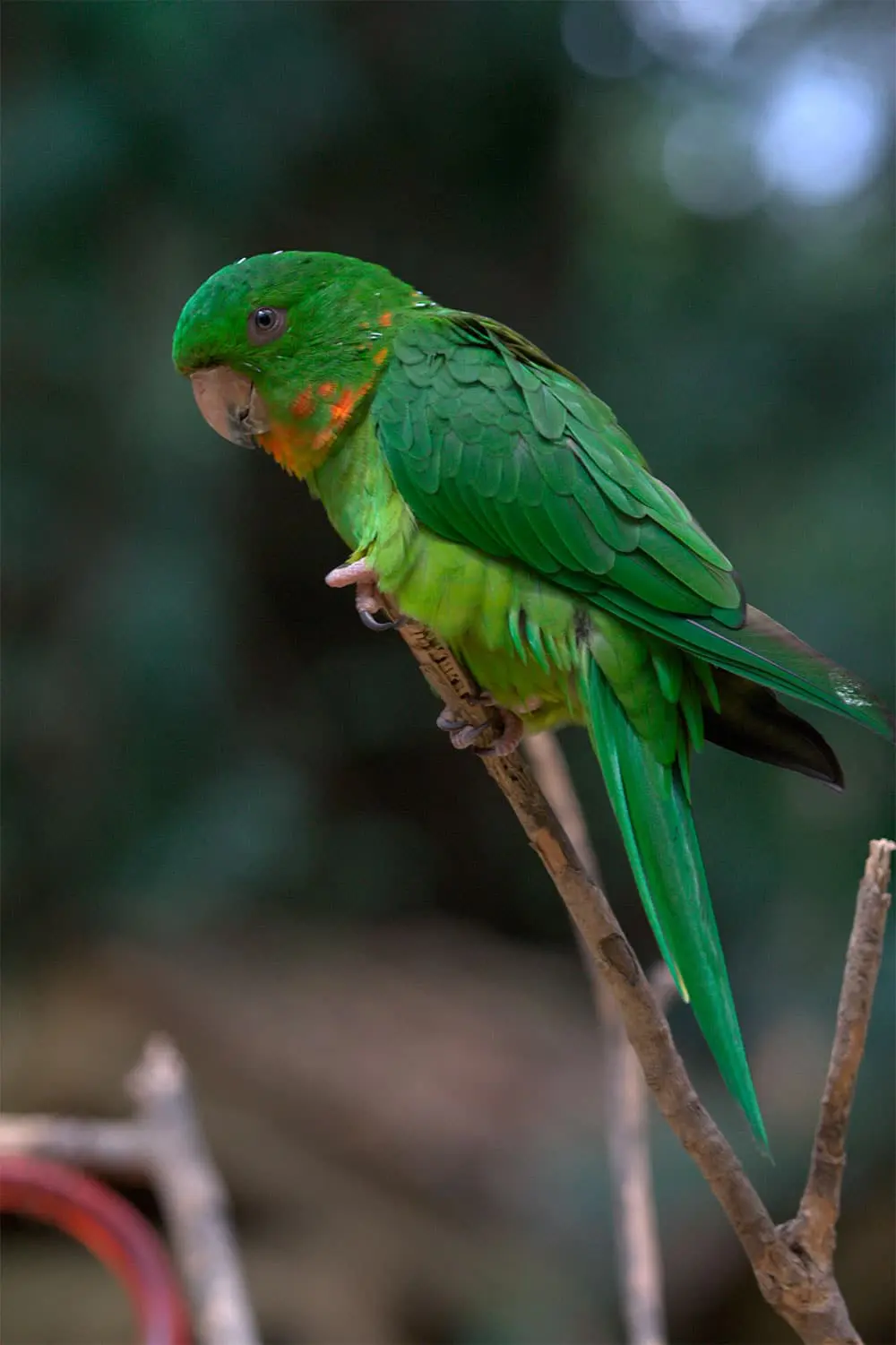
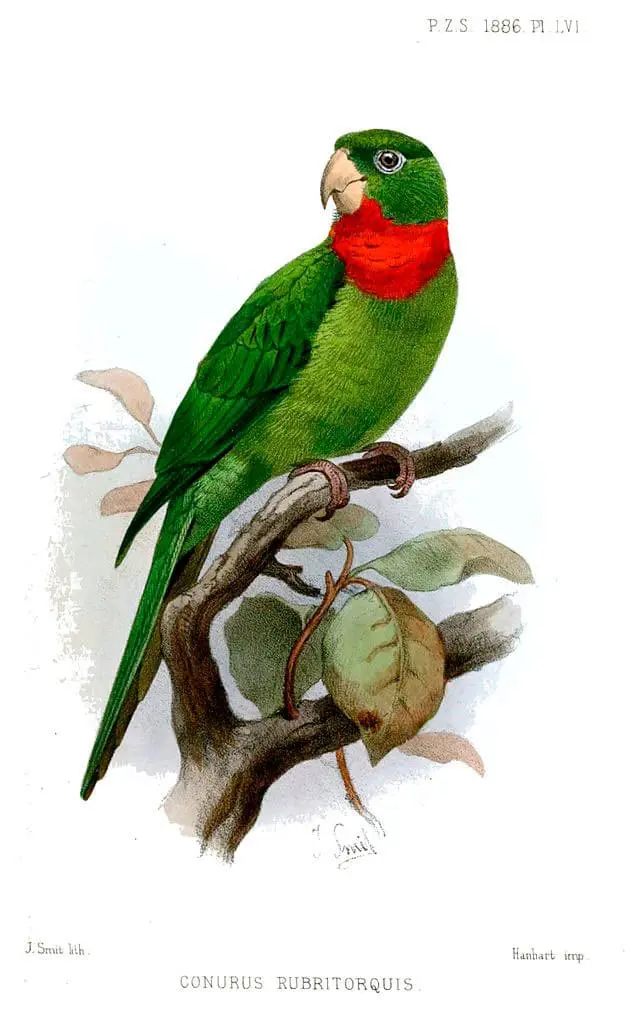
The Red-throated Parakeet(Psittacara rubritorquis) they have a plumage, in general, green, with yellow tones in the underparts; orange-red in the throat and on the front of the neck, with yellow-orange feathers scattered; variety of pens of color red orange scattered in the part low of them cheeks and both sides of the neck; blue tint on primary coverts and vane outer of the flight feather; underwing-coverts brighter yellowish green; below, the flight feather yellow color without brightness.
The bill color horn. Bare area of the eye ring grayish brown. The irises orange.
The male and female are similar.
The immature with the throat red, absent in the cheeks and both sides of the neck. The irises brown.
The Red-throated Parakeet is located in altitudes that range between the 600 and 1.800 m, in a variety of wooded areas, Save the rainforest.
They can be observed in humid forests, Open with weeds and growing areas areas in Guatemala; forests of Pinus sp in Nicaragua.
Is in flocks outside the breeding season, and couples during courtship and nesting season. Larger congregations are produced when food is abundant.
Reproduction:
The nesting takes place in tree cavities, cracks in rocks, holes from woodpeckers, holes in buildings or in tree termite mounds.
The breeding season is between the months of January and August and the laying tends to be of 3-4 eggs.
Food:
With feeds seed, nuts, berries and fruits. It can also feed on cultivated seeds and corn..
Sometimes, considered a pest to crops.
Distribution:
Size of the area of distribution (reproduction / resident): 139.000 km2
Distributed by the Eastern Highlands of Guatemala and El Salvador (apparently only a record) to the South by Honduras to the North of Nicaragua.
Conservation:
State of conservation ⓘ
Minor Concern ⓘ(UICN)ⓘ
• Red List category of the UICN current: Least concern
• Population trend: Stable
The size of the world population It has not been quantified, but this species is described as «quite common» (Stotz et to the. 1996).
The population of Red-throated Parakeet suspected to be stable in the absence of evidence of any reduction or substantial threats.
– Avibase
– Parrots of the World – Forshaw Joseph M
– Parrots A Guide to the Parrots of the World – Tony Juniper & Mike Parr
– Birdlife
– Photos:
(1) – Red-throated Parakeet (Aratinga rubritorquis) also called Red-throated Conure at Macaw Mountain Bird Park and Nature Reserve, Copan, Honduras By Lauri Väin [CC BY 2.0], via Wikimedia Commons
(2) – A Red-throated Parakeet (also called Red-throated Conure) at Macaw Mountain Bird Park, Copan Ruinas, Honduras By Sarah and Jason (originally posted to Flickr as IMG_6987) [CC BY-SA 2.0], via Wikimedia Commons
(3) – Two Red-throated Parakeets at Kakegawa Kacho-en, Kakegawa, Shizuoka, Japan By Takashi Hososhima from Tokyo, Japan (Green with envyUploaded by snowmanradio) [CC BY-SA 2.0], via Wikimedia Commons
(4) – Psittacara rubritorquis by Psittaciformes .NL – pinterest
(5) – Psittacara rubritorquis by Bellas Aves de El Salvador
(6) – Conurus rubritorquis by Joseph Smit [Public domain], via Wikimedia Commons
Red-necked Parrot (Amazona arausiaca) | By mikko.pyhala
Content
Description:
40 cm.. length and 650 g. of weight.
The Red-necked Parrot(Amazona arausiaca) has the lores, forecrown, front of crown, orbital area and upper cheeks, bright blue; back of the crown, nape and sides neck, with dark blue or blackish margins.
Mantle, back and scapulars, green with narrow faint dark margins giving subtle barred effect. Wing coverts green; carpal edge brighter yellowish green. Primaries green with blue tips; the three outer secondaries, red at the base, yellow and blue at the tips; four secondaries yellow and blue tips. The remaining secondary they are green. Under the wings, the coverts green; flight feather Bluish.
Chin and top of the throat, blue; the bottom throat and, sometimes, upper region chest, with patch resizable bright red; remaining chest and of the belly, green; undertail-coverts, brighter yellowish green. Tail bright green in the center, their outer feathers green tip yellowish green and red marks on the basis of the innerwebs. Bill horn; iris orange; legs grey
Both sexes are similar. It is thought that the immature It is similar to adult but with irises brown. The young fledglings They are significantly smaller than of adults during its first year.
The Red-necked Parrot inhabits the canopy mountain rainforest, preferring forest areas with trees Tabonuco(Dacryodes excelsa), especially among 300-800 m (the highest density is found and altitudes 500-600 m) although occasionally they reported to 1.200 meters and formerly was a regular visitor (August October ) of the Coast zones.
Usually in small flocks or pairs; more numerous flocks feeding areas, outside the breeding season. Communal roosting in traditional sites, for example in large trees Dacryodes excelsa or Sloanea berteriana, They are using from year to year (but not necessarily all year).
Reproduction:
Nests in a large tree cavity with most nests reported in Dacryodes or Sloanea. breeding season February-June. low productivity probably just a clutch every two years and usually only one young per nest.
Size of its range (reproduction / resident): 190 km2
The Red-necked Parrot It is endemic to the Dominica Island in the Lesser Antilles. Formerly it spreads through the mountainous interior, including the northern peninsula. Contraction range from about 1950 with the existing population centered Morne Diablotin (1.447 m, the highest mountain Dominica) which it may have always been his main strength but whose southern slopes birds have been absent from the hurricane 1992.
small populations, reportedly, in the north of the peninsula (where apparently they are resident) and in the eastern center of the island. They can remain very small populations in the south. Recent sporadic observations of birds in low-lying areas of the north and east; other towns in the south suggest the gradual recolonization of the parts of the former range.
mainly residents but maybe (at least once) some regular seasonal foraging movements and some November-January nomadism. Although historical accounts tell of the abundance of this species, the drastic contraction in range and population have occurred since the mid-twentieth century with its gradual retreat in the most remote forests of northern and eastern. The decline is due to the loss of habitat, the hunting and capture bird cage.
The small existing population It is especially vulnerable to the loss of food plants and nesting sites due to hurricane damage. Although the effects of habitat loss may have been especially severe because of the preference of birds through the forests of low level (which it has been under pressure) They tolerate any disturbance and returned to the old feeding areas recently after conversion to plantations of fruit trees. The hunting It was probably the greatest threat to the seventies. Capture for local pet trade now under control due to a successful education campaign.
The population 1977 It was at least 350 birds (probably), but halved by the effects of hurricanes between 1979 and 1980. A Recovery since then 350 estimated birds 1990 and evidence of further increases to more than 500 in 1992. The remaining habitat is partially protected in the North Forest Reserve, but does not include neighboring critically important areas for conservation. Completely protected by national legislation.
Conservation:
State of conservation ⓘ
Vulnerable ⓘ(UICN)ⓘ
• Current category of the Red List of the UICN: Vulnerable.
• Population trend: Increasing.
• Population size: 850-1000.
Rationale for the Red List category
The conservation actions He has helped this species to recover a population down from 1980. Still rated as vulnerable because its population is still very small and its range of small extent and restricted to a single island. But, if future declines in habitat available, could be reclassified as danger of extinction.
Justification of the population
Estimating population most recent is 850-1,000 mature individuals (PR Reillo a slightly. 2012), more or less equivalent to 1.200-1.500 individuals in total.
Justification trend
The population size has increased possibly only 150 birds in 1980, possibly even 1.200 birds currently, based on recent surveys and density estimates (PR Reillo in some. 2016). There is no new data on the evolution of the population, but the species is supposed to still rising.
Threats
The loss of habitat in the lower elevations has been caused mainly by clearance for agriculture (Collar 1997). Although replanting fruit crops has benefited the species (Reillo y Durand 2008), the frugivorous diet of the Red-necked Parrot, conflict is causing local farmers (Douglas 2011). Damage caused by hurricanes has also been important: another hurricane the magnitude of Hurricane David could reverse recent population increases. Hunting and illegal trade are now low-level threats, but the illegal wildlife trade throughout the Caribbean is a constant concern and there is increasing pressure from illegal wildlife trade centered in Europe (PR Reillo in some. , 2016).
Conservation Actions Underway
CITES Appendix I and II. It is fully protected by national legislation. Much of the remaining habitat is in the northern and central forest reserves, national parks and Morne Trois Pitons and Morne Diablotin, but adjacent areas, critically important, They are not protected (Juniper and Parr 1998). Since 1980, It has benefited from the joint efforts of government and non-governmental organizations to protect their habitat and sensitize the local population of the needs of this species. Research methods have recently improved to maximize ecological information acquired, while minimizing the disturbance of birds, and the study has provided important information on nesting behavior and parental care. Similarly, census methodologies have improved to give more accurate estimates of population size and density (Reillo y Durand 2008). The population is monitored annually. A recent doctoral thesis project examined the interaction of species with fruit crops in Dominica (PR Reillo in some. 2012).
Conservation Actions Proposed
Continue the implementation of the protection of national parks Morne Diablotin and Morne Trois Pitons and forest reserves in central and northern. Continue to monitor the population each year. To investigate the effects of nest site (and the food) competition between this species and Imperial Parrot (Amazona imperialis). Continue to prohibit the trade in this species, exports of ex situ captive breeding, and importation of non-native parrots as pets in Dominica (PR Reillo in some. 2012).
Red-necked Parrot in captivity:
CITES Appendix I and II. It is fully protected by national legislation.
Alternative names:
– Bouquet’s Parrot, Dominican Blue-faced Amazon, Dominican Blue-faced Parrot, Jacquot, Red necked Parrot, Red-necked Amazon, Red-necked Parrot (English).
– Amazone à cou rouge, Amazone de Bouquet (French).
– Blaukopfamazaone, Blaukopfamazone (German).
– Papagaio-de-colar-vermelho (Portuguese).
– Amazona de Cuello Rojo, Amazona Gorgirroja, Amazona gorjirroja, Jaco, loro de cuello rojo (español).
(1) – Red-necked Amazon (Amazona arausiaca) – Author: mikko.pyhala – HBW
(2) – Red-necked Amazons at the Parrot Conservation and Research Centre Botanical Gardens, Roseau, Dominica By Andrew Szymanski (originally posted to Flickr as DSCF0031) [CC BY-SA 2.0], via Wikimedia Commons
(3) – Red-necked Amazons at the Parrot Conservation and Research Centre Botanical Gardens, Roseau, Dominica By Amazona_arausiaca_-Roseau_-Dominica_-aviary-6a.jpg: Andrew Szymanskiderivative work: Snowmanradio [CC BY-SA 2.0], via Wikimedia Commons
(4) – Amazona arausiaca Sunday, West Indies by Don Faulkner – Flickr
(5) – BARRABAND, Jacques (1767/8-1809) [Parrot Bouquet (Red-necked Amazon, Amazona arausiaca)] From Natural History of Parrots (by Francois Levaillant, 1801-1805) – Wikimedia
(6) – Natural history of parrots /. In Paris :chez Levrault … ;an IX (1801)-an XIII (1805).. by Biodiversity Heritage Library – Flickr
16,5 to 17,5 cm.. height.
The Tui Parakeet(Brotogeris sanctithomae) has the forecrown and the front of the crown, bright yellow; rest of the head and nape, bluish green.
Mantle, back and scapulars dark green, paler and brighter in the rump and in the uppertail-coverts. Alula blue on the innerwebs, greenish on the outerweb; primary coverts greenish blue; other coverts green, the smaller and medium slightly impregnated olive green. Flight feathers greenish-blue on outerweb, dark green innerwebs, and light blue below; infra-wing coverts minor, green, the greater coverts, blue. Underparts brighter yellowish green. Upper, the tail is green; below is more yellowish.
The bill It is quite dark orange-brown; Cere pale pink; the irises brown; legs grayish bone.
(Neumann, 1931) – The yellow stripe behind (and sometimes below) of the eyes It extends over the ear-coverts. The yellow patch on the forecrown sometimes it is larger.
Habitat:
Mainly inhabits in second-growth forests, in humid areas of tropical forest, forests and marshes on the banks of large rivers and river islands and clearings near watercourses; to 100 metres in Colombia and 900 metres in Peru. Gregaria, usually in small flocks; sometimes in larger meetings. The Tui Parakeet it is very common in riverside towns and cities where it arrives in large flocks to spend the night. Visit palms on the banks of rivers.
Reproduction:
It nests on trees, in natural hollows or termiteros, small and noisy groups. views in nests in May and July, with immature during the month of June Colombia.
Food:
Few details about their diet; taking views flowers Erythrina in Colombia.
Distribution:
Size of the area of distribution (reproduction / resident): 3.870.000 km2
This species is confined to the Basin Amazon Southeast Colombia (area of Leticia), northeast and southeast Peru and to the West of Brazil, possibly on the right bank of Black river and in river basins Purus, Solimões (this to about Cojadás) and south of Juruá, to the North of Bolivia in Pando and Beni, It is able to see so dispersed in the Eastern Amazonas, around river mouths Negro and Madeira, to the this to Amapá and Pari Eastern, possibly up area Bethlehem.
Apparently sedentary. Local (for example, in Loreto, Peru) but common or abundant in many places (for example, about Leticia).
Perhaps its population has been reduced due to trade locally (for example, in Peru), but the effect of habitat loss remains within the range lower. Present in many protected areas (for example, > Manu National Park, Peru).
Distribution 2 subspecies:
Brotogeris sanctithomae sanctithomae
(Statius Müller, 1776) – Nominal. West Basin amazon, from the southeast of Colombia to the North of Bolivia.
Brotogeris sanctithomae takatsukasae
(Neumann, 1931) – Both sides of the basin under amazon, from the junction with the Black river to the East of Pari.
Conservation:
State of conservation ⓘ
Minor Concern ⓘ(UICN)ⓘ
• Current category of the Red List of the UICN: Least concern.
• Population trend: Stable.
Justification of the population
The size of the world population It has not been quantified, but this species is described as «common» (Stotz et to the., 1996).
Justification of trend
It is suspected that this species has lost 15,9-17,4% of habitat within its distribution over three generations (15 years) starting from a model of deforestation Amazon (Soares-Filho et to the., 2006, Bird et to the., 2011). Given the susceptibility of the species to hunting and / or capture, suspected population decline in <25% durante tres generaciones.
"Tui Parakeet" in captivity:
saved pet locally but uncommon in captivity outside its range.
– Avibase
– Parrots of the World – Forshaw Joseph M
– Parrots A Guide to the Parrots of the World – Tony Juniper & Mike Parr
– Birdlife
– Parrot Book, Parrots and macaws Neotropical
It measures 30-35 centimeters to paste 380 g..
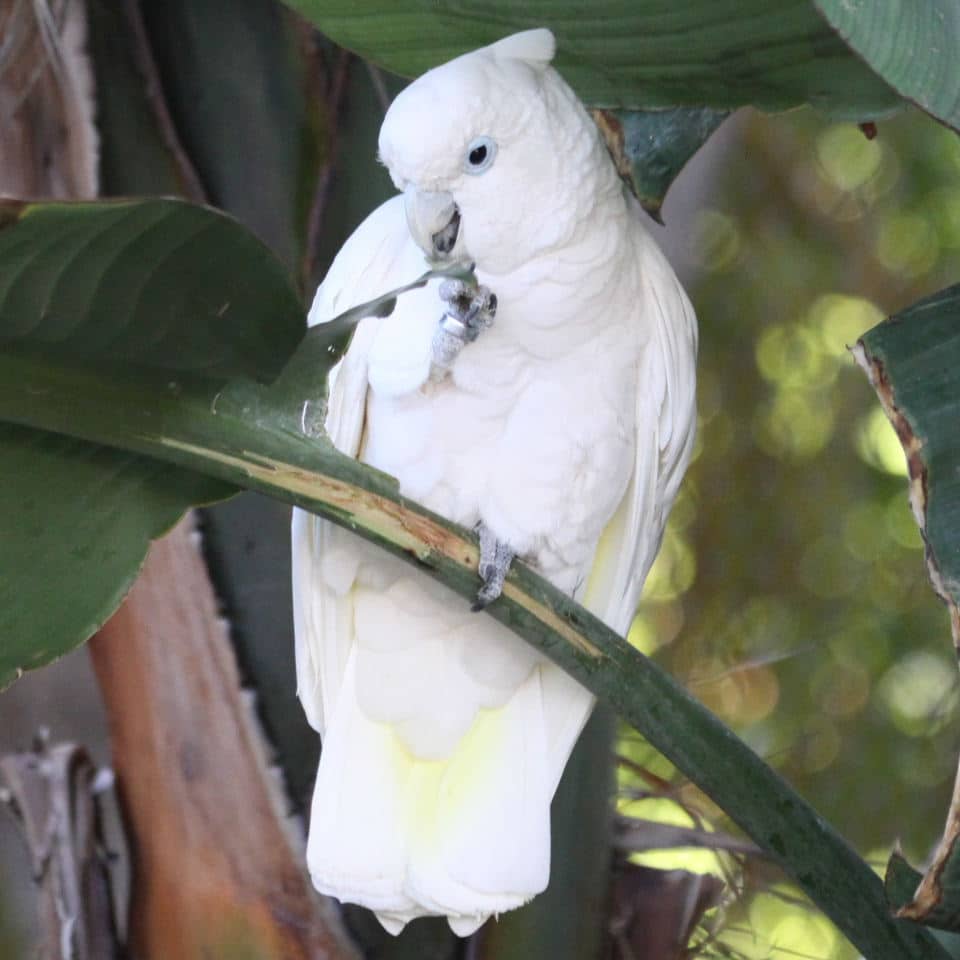
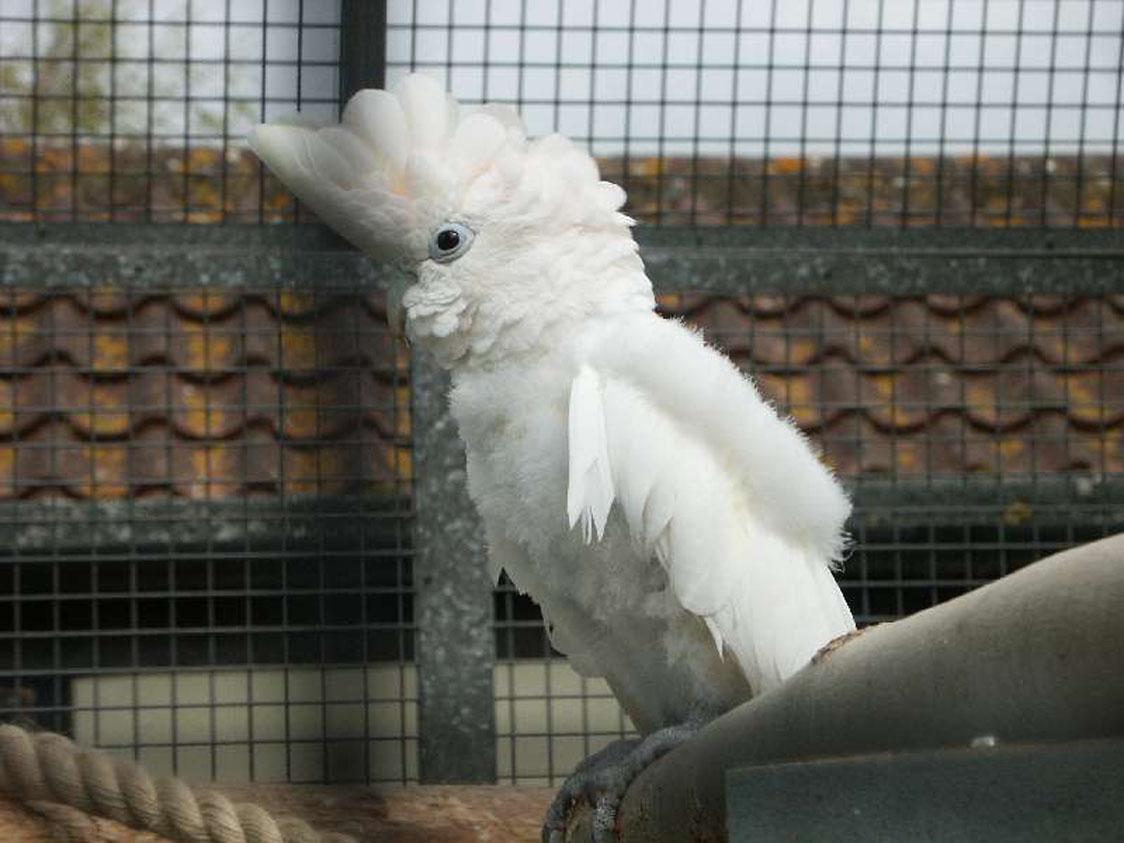
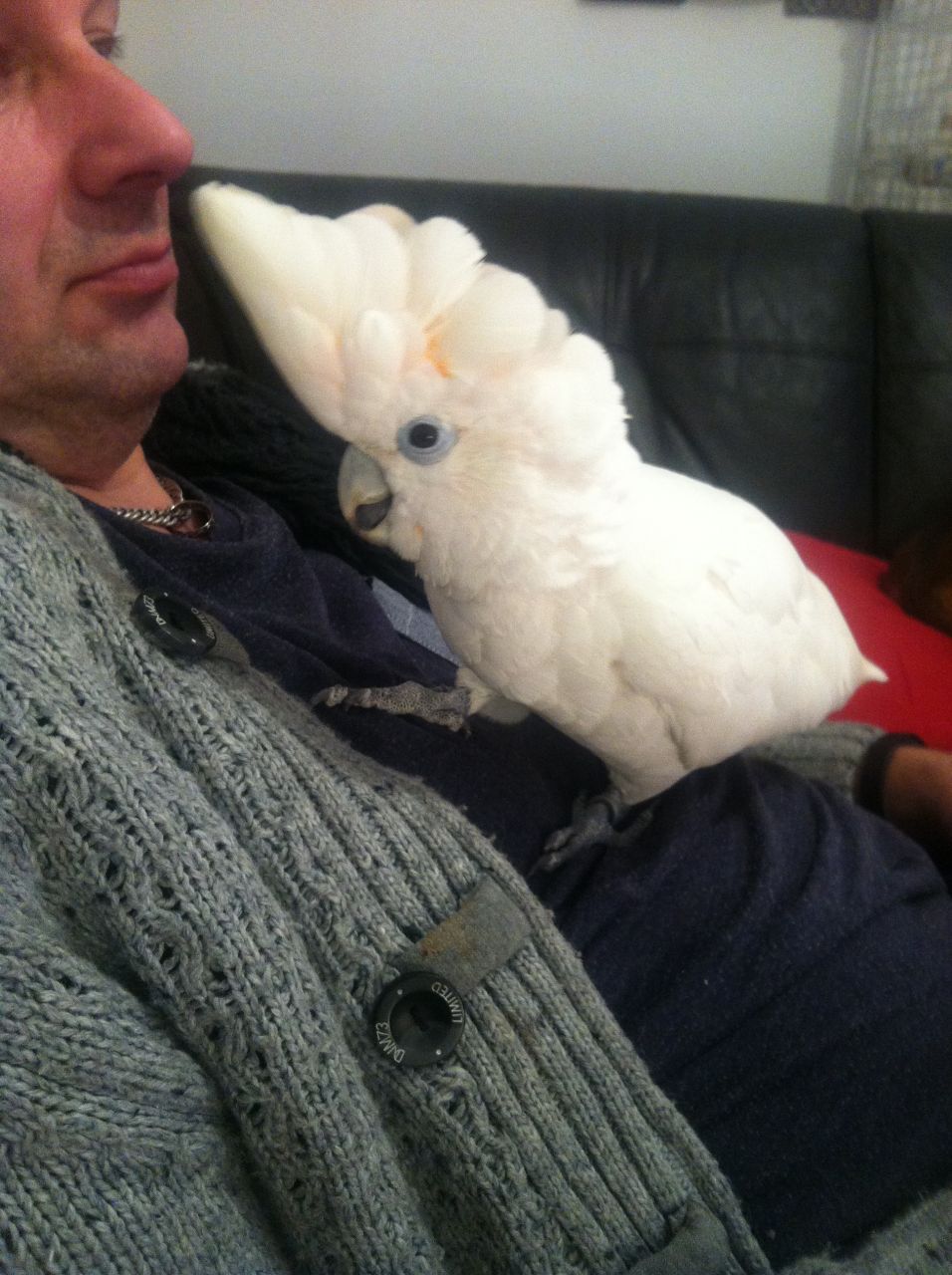
The Solomons cockatoo(Cacatua ducorpsii) is a small cockatoo immediately recognizable by its long triangular Crest.
Its plumage is almost completely white, except the part inferior of them wings and tail with infiltration of color yellow. The feathers of the crest, the cheeks, the the mantle and the chest they have a base of pink.
The bill is grey. The bare skin around the eyes is pale-blue. The irises are dark brown, the legs grey.
The females are distinguished from your partner to have the irises more reddish.
The Solomons cockatoo is quite similar to the Tanimbar corella living in the Tanimbar Islands. Also seems to the Little corella, although the latter have more bluish and developed the orbital area.
Is from coastal areas to the mountains; variety of habitats, including forests, secondary vegetation and gardens in cities. Found up to 1700m; mainly below the 700 m.
Behavior:
They are birds noisy and quite easy to observe, even though they mostly live in pairs or small groups. They fly high above the treetops where used well exposed perches in the top of the Cup.
Birds are very cautious, screaming when they are disturbed.
They have a strong and uneven consisting of shallow flapping flight.
Reproduction:
In the wild child from July to September.
They make their nests in hollows of trees or large branches and, they often use the same nest year after year.
The eggs are of color white and usually there are two in a clutch. The eggs are incubated for about 25 days, the young leave the nest 62 days after hatching.
Food:
They feed on seeds, berries, fruit, outbreaks, flowers, as well as insects and their larvae. From time to time they ingest the fleshy parts of «epiphytes«.
Distribution:
endemic to the Solomon Islands. Its area of distribution extends from Bougainville (Papua New Guinea) to Malaita, Choiseul, New Georgia and Santa Isabel. The species is absent in San Cristóbal and the islands surrounding.
Conservation:
State of conservation ⓘ
Minor Concern ⓘ(UICN)ⓘ
– Current IUCN Red List category: Least concern.
– The population trend: Stable
The population world is estimated at 100.000 birds and it seems quite stable.
The marketing of pet birds is a threat to this species, the other is the degradation of the habitat. The latter seems particularly serious, given the logging of forests in the lowlands.
"Solomons cockatoo" in captivity:
It´s little gregarious and have tendency to be aggressive with other species and with those of its same species. In relation to the human being is a Parrot very demanding. Not everyone is prepared to have a white cockatoo.
They often tend to develop behavior problems, unbearable screams, become very destructive…If not are given a rigorous education on a very regular basis. That is why it is convenient that if you intend to have a cockatoo, it should be done so that it can be accompanied by another or others of its kind to prevent it from developing an excessive dependency and thus you can enjoy it without fear of having problems or at least trying to avoid them as much as possible.
I like them much attention. They tend to create strong emotional bonds and they are quite Extrovert.
Despite the great attraction that having a pet parrot with such characteristics can mean for a person,. It is not often a parrot advised for anyone or rather, hardly anyone is prepared to have a cockatoo with these characteristics.
Alternative names:
– Ducorps’s Cockatoo, Broad-crested Corella, Solomon Corella, Solomon Islands Corella, White Cockatoo (ingles).
– Cacatoès de Ducorps (French).
– Salomonenkakadu (German).
– Cacatua-ducorps (Portuguese).
– Cacatúa de las Salomón, Cacatúa de Salomón (español).
21 to 27 cm. length and a weight between 130 and 180 g..
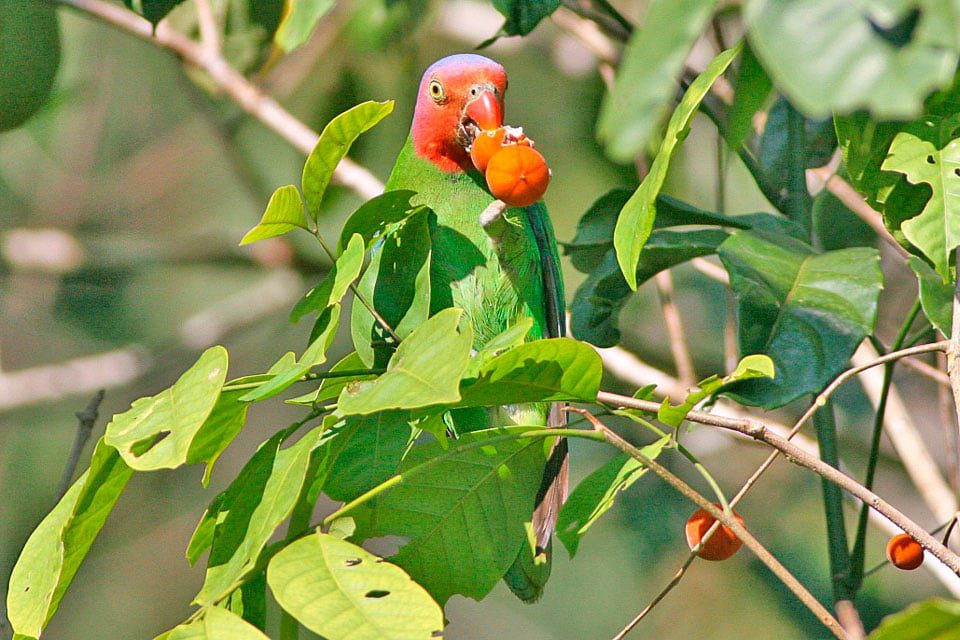
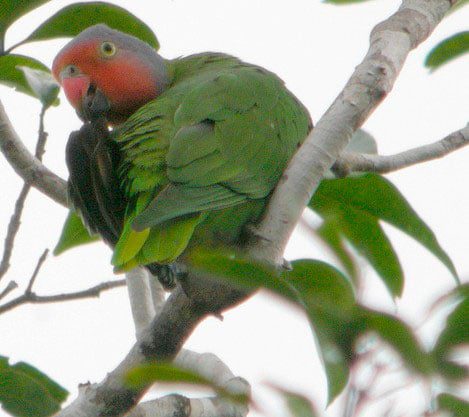
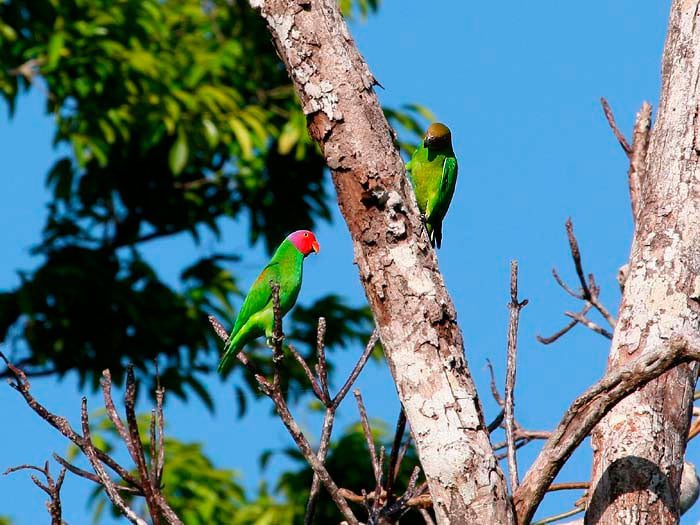
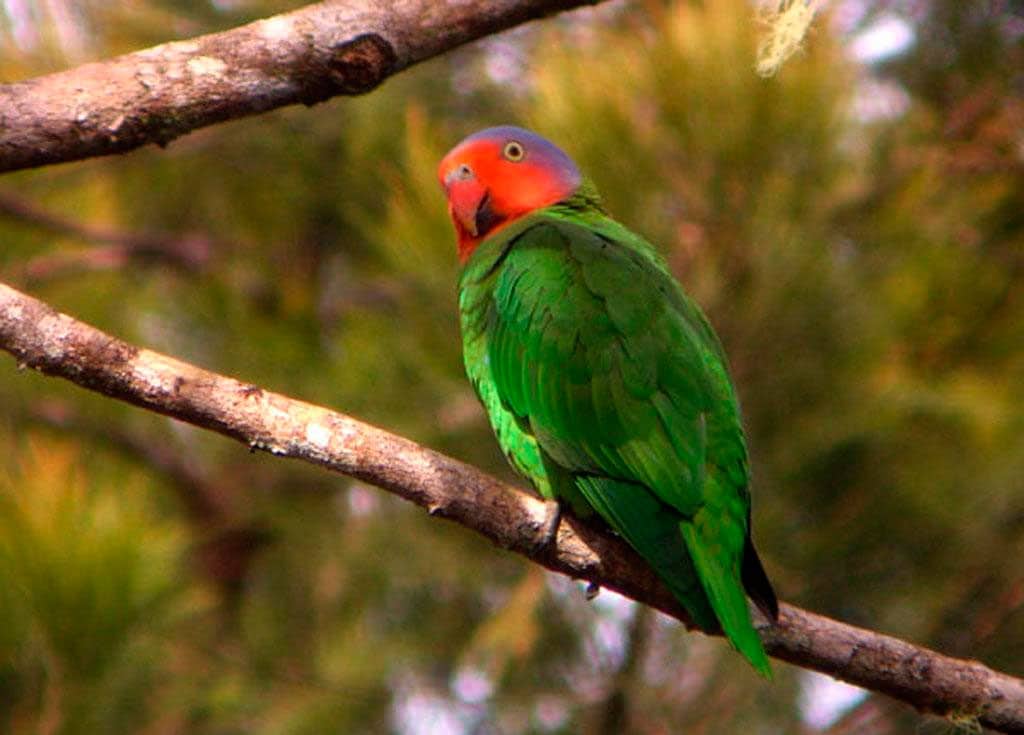
The face of the Red-checked Parrot(Geoffroyus geoffroyi) is of color rojo-rosaceo up to just above the eyes, more pink in the ear-coverts; front of the crown of color rojo-rosaceo. Half of the crown to the nape mauve-blue. Upperparts green. Wings with patch red in them Middle coverts interiors.
Flight feathers with vane Dark internal and external Green. Edge of yellow to vane internal of greater coverts and secondaries. Wing feathers and axillary, bright blue; below, the rest of the wings, blackish. The underparts green, more yellowish in them lower flanks. Upper, the feathers of the tail of color green, drenched sides of yellow; below, brighter yellowish green.
The bill red orange in upper jaw, the lower jaw in color black; irises yellow; legs grey.
Female with head Brown and upper jaw black.
Youth they have the head green, irises dark and bill pale. The male juveniles go through a plumage «female stage» before they begin to acquire masculine characters (bird takes over one year to mature). The birds young also lack of the brand red on them small coverts.
(Müller, 1841) – The darker male in general that the nominal; purple blue crown comes to the part back from the neck; neck light blue; Marron-bronce washing variable on the mantle and top of the back; Green bluish in the part superior of the chest and zone inferior of the abdomen ; brown reddish of them coats internal of the wings absent; Blue more dark in them Underwing coverts. Larger in size.
The female with the head more dark that the nominal; purple diffusion in the crown; nape blue, reaching the neck with color blue light.
Geoffroyus geoffroyi obiensis
(Finsch, 1868) – Adults as the subspecies cyanicollis but collar Blue in the part back from the neck more comprehensive, reaching almost up to the eyes; blue-purple in the male or brown in the female does not reach the lower part of the occiput; reddish brown in the bottom of the back to rear.
Geoffroyus geoffroyi rhodops
(Schlegel), 1864) – Similar to the subspecies males floresianus, but darker in general; marks of the coats internal of the wings of color brown reddish dark; crown Blue separate with red in the face; Underwing coverts Blue more dark. Larger in size.
The female with the crown castano-oscuro color.
Geoffroyus geoffroyi explorator
(Hartert, 1901) – Synonymous with Geoffroyus geoffroyi rhodops
Geoffroyus geoffroyi keyensis
(Finsch, 1868) – The male resembles the subspecies floresianus, but in general more greenish-yellow, in particular in the tail; cheeks Pink and ear-coverts washed with Blue Lilac; Yellow greenish pale in the neck through the part back from the neck and a strip Green, darker, in the early part of the neck; Underwing coverts pale blue. Larger in size.
The female chestnut brown on the head.
Geoffroyus geoffroyi floresianus
(Salvadori, 1891) – The male is like the nominal, but darker in general; the purple blue of the crown It's darker and reached to the nape; coats internal of the wings dark reddish brown; Blue more dark them Underwing coverts. Larger in size. Largest peak. Female with the crown darker brown, coming up to the nape.
(Meyer, 1884) – The subspecies resemble adults Kei, but smaller.
Geoffroyus geoffroyi pucherani
(Souancé, 1856) – Adults and juveniles with bronze-colored marking of the parts internal of the wings, minimal or absent; the mantle have less marron-bronce washing; Brown more pale in the part low of it back; the buttocks with less red; coats dark blue low the wings.
Geoffroyus geoffroyi minor
(Neumann, 1922) – Male adults are as the subspecies aruensis, but with reddish brown under the back to rear; face darker red; washing Marron-bronce in the the mantle; brands in the coats internal of the wings minimal or absent.
The female as the subspecies aruensis, but with the head of brown slightly more dark.
Geoffroyus geoffroyi jobiensis
(Meyer, 1874) – Adults and juveniles but with Underwing coverts pale blue; bright red in the lower part of the back to the rear; in males, the red in the forecrown back to the front of the crown.
Geoffroyus geoffroyi mysoriensis
(Meyer, 1874) – Males as juveniles, but with the crown blue-purple, down on the back of the neck, and red in the face, coming up to the throat; washing marron-bronce absent in the the mantle; extensive reddish brown marks in inner median coverts; Underwing coverts dark blue; dark brown in the bottom of the back to rear.
The female as juveniles, but the color brown in the crown comes to the part back from the neck.
Geoffroyus geoffroyi orientalis
(Meyer, 1891) – Hardly differs from the subspecies aruensis; Crown of the male is slightly more pale.
Geoffroyus geoffroyi sudestiensis
(Estimate, 1890) – The adult male is similar to the subspecies aruensis, but with the underparts darker; the trademark brown reddish of them coats internal, absent.
The crown and nape of the female, is dark green.
Geoffroyus geoffroyi cyanicarpus
(Hartert, 1899) – The adult male is similar to the subspecies aruensis, but with azul-lila wash in them cheeks and ear-coverts; bend of wing has edge blue.
The female is as the subspecies aruensis, but the crown and nape They are brown, with light green dye; edge blue in the part outside of the wing
as in the male.
Geoffroyus geoffroyi aruensis
(Gray, 1858) – Similar to the species males nominal, but darker purple blue from the crown up to the nape; inner coverts a reddish brown marked darker; Blue more dark in them Underwing coverts.
The female Brown darker from the crown even the nape.
Geoffroyus geoffroyi maclennani
(W. D. K. Macgillivray, 1913) – The male is similar to the subspecies aruensis, but darker in general; the Red of the face is darker and more uniform; Underwing coverts paler blue. Female similar to the female of subspecies aruensis, but darker in general; head dark brown; Underwing coverts paler blue.
* The varieties sumbavensis and tjindanae proposed as subspecies are synonymous of floresianus; rhodops stresemanni; explorator It is also synonymous of rhodops.
Habitat:
Distributed by primary and secondary forests, tree savannas, plantations, Open forests, mangrove forests and farmland, a altitude of 1.400 m. Usually replaced by the Blue-collared Parrot at higher altitudes. Exclusive tropical jungle in the North of Australia. View the birds, generally, flying high above the trees, making calls to cries.
Groups of birds in the North of Australia, many still in family units, they have been observed leaving their roosts early, to feed into the dense jungle; in their flights to areas of foraging, We have seen some of these birds perched in the upper branches of the trees, by calling aloud for a few minutes and dithered wings before continuing. The reason for this unknown behavior can be a way of requesting food due to early maturation.
During the day the birds are less visible, they can draw attention by discarded food falling from their food trees.
They are usually in couples, in small groups or assembled in groups in fruit trees.
Reproduction:
The nest It is a hole that the birds excavate in a rotten limb of a tree from the forest, sometimes also in a knot in the trunk; probably only the female excavates. The entrance to the nest is of 80 to 90 mm. wide, and the tunnel, that it can twist in order to hide the eggs, You can have a length of 42 cm.. Includes the implementation of 2 to 4 eggs. The female alone incubates and is fed by the male during this time. In the West, the breeding season It takes place between April and September at least, month in which a live nest was found in Seram.
In New Guinea, the nesting is been registered during several months more, including February in the North and between the months of April to December in other places.
In Australia, in where the season seems to extend is from August to December, little information about the cycle reproductive is available.
It is known that the species It has never been raised successfully in captivity.
Food:
The diet It includes seeds, fruits and flowers. The birds tend to hang acrobaticamente to reach their food.
Distribution:
Size of the area of distribution (reproduction / resident): 793.000 km2
Generalized from the West of Lombok, through the Moluccas, the lowlands of New Guinea, and observed in the groups of associated Islands, to the East of Rossel in the Louisiade archipelago.
The species can also be observed in the northeast of the Cape York Peninsula, Australia, at its southern end, and North ranges up to Morotai in the North of the Moluccas. In many areas, throughout its distribution area, is the most abundant Parrot (rarer over the 800 meters above sea level), even around inhabited areas. Despite this, It may be extinct in Ambon.
The size of the world population It has not been quantified, Although it is estimated above 1.000.000 of copies. The species according to sources, is of common to abundant much of its area of distribution (pit et to the. 1997).
The population suspected to be stable in the absence of evidence of any reduction or substantial threats, Although you can that its population is affected by the capture in various parts of its area of distribution.
"Red-checked Parrot" in captivity:
Very rare or impossible to see in poultry.
Passive Parrot. Extremely susceptible to stress and disease; they may die suddenly without apparent reason. Few times you live long in captivity
Alternative names:
– Red-checked Parrot, Red cheeked Parrot, Red-cheeked Parrot (ingles).
– Perruche de Geoffroy, Eclectus de Geoffroy, Éclectus de Geoffroy (francés).
– Rotkopfpapagei (alemán).
– Papagaio de bochechas vermelhas (portugués).
– Lorito Carirrojo, Lorito de Mejillas Rojas (español).
– Avibase
– Parrots of the World – Forshaw Joseph M
– Parrots A Guide to the Parrots of the World – Tony Juniper & Mike Parr
– Wikipedia
– Birdlife
– parrots.org
– Photos:
(1) – By Ron Knight (Flickr: Red-cheeked Parrot) [CC BY 2.0], via Wikimedia Commons
(2) – By Nick Athanas/Tropical Birding – Birds-pet-wallpapers
(3) – A male perched in a tree by Josep del Hoyo – Lynx
(4) – A male and a female looking for a suitable nest by mehdhalaouate – Lynx
(5) – By markharper1 [CC BY-SA 2.0], via Wikimedia Commons
Of 25 cm.. length and a weight between 130 and 150 g..
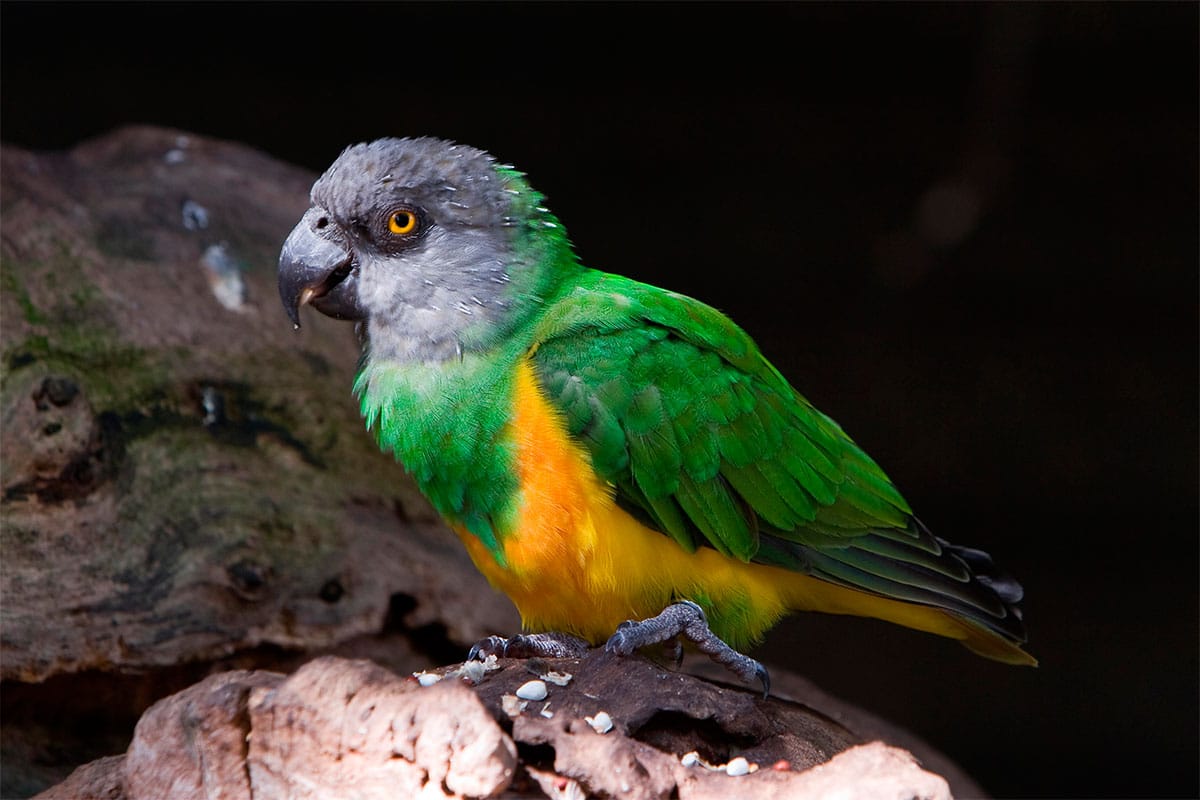
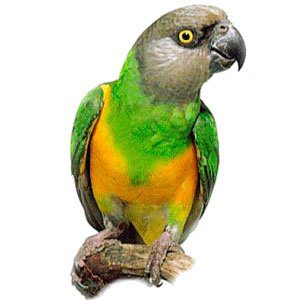
The Senegal Parrot(Poicephalus senegalus) has the forecrown, crown, lores and nape dark slate gray; clear the chin and cheeks; ear-coverts Silver. Mantle, scapulars and back bright green; rump and uppertail-coverts lighter with yellowish tint. Upper, the wing-coverts bright green ; secondaries and primaries of color Brown dark with edges green to them vane outer. Under, the wing-coverts Yellow. Throat grey, merging with the chest green (green lighter on the upper parts); low area chest and belly bright yellow with orange dye plant; the thighs green, undertail- coverts bright yellow. Tail greenish brown.
Bill grey: irises yellow with bare periophthalmic black; Chere blackish: Legs dark brown.
Sexes similar in plumage.
Immature generally paler than the adult with the head in brown tone off, has the ear-coverts Silver; sometimes extends the green on the bottoms shaped yellow patches on the flanks. Iris dark brown.
(Reichenow, 1910) – Similar to the species nominal, but with the green plumage paler and green color chest It is extending into the abdomen, the abdomen It is orange.
(Finsch, 1863) – Similar to the species nominal but the green color the mantle and wings is darker; the lower regions of chest and the abdomen are yellow orange to red in the middle of the abdomen.
Habitat:
The Senegal Parrot They are found in a variety of forest habitats ranging from open field with scattered and palm trees to the dense forests closed.
They are probably just below 1.000 meters above sea level.
Gregarious, at least outside the breeding period.
Usually they are seen in couples or groups of up to 20 birds, Larger groups can meet locally to exploit abundant food areas.
They perform diurnal movements and of longer duration in relation to the food supply;. Consequently, of the pobalación Senegal Parrot fluctuates widely in some areas.
Reproduction:
The Senegal Parrot usually they build a nest in the cavity of a tree branch (of Adansonia or Parkia), at a height of 10 m, sometimes more.
The breeding season It seems to vary depending on location. In the wetter areas, breeding season can be prolonged. In the region of Gambia and the rio Senegal, they have been egg production in the months of April, may, August and september, also from November to February. In drier areas (as Mali) the breeding season is probably limited by the rainy season (May to October).
They put of 2 to 4 eggs on alternate days and the period of incubation is of 25 to 28 days, female being fed by the male until hatching. The juveniles to leave the nest 9 weeks of age.
Food:
The diet of the Senegal Parrot It is composed of a variety of fruits, seeds and sprouts leaves.
Size of the area of distribution (reproduction / resident): 3.590.000 km2
The Senegal Parrot they are endemic in West Africa. Since Guinea (including the The islands), Senegal, Gambia, South of Mauritania and South of Mali through forest-savanna mosaic of Ivory Coast. Burkina Faso, South of Niger, Ghana (also on the coast). Benin and Togo until Nigeria, Cameroon and Southwest Chad.
Partially sedentary but seasonal visitors in some areas (especially further north), for example, some birds move south on the niger river in Mali with the onset of the driest periods. In the rainy season visitantan Southern Mauritania and some movements Nigeria, with the driest north unemployed, off wet season.
Subspecies distribution:
Poicephalus senegalus mesotypus
(Reichenow, 1910) – East and Northeast Nigeria, South of Niger, North of Cameroon, southwest end Chad and possibly the extreme northwest Central African Republic.
The size of the world population Senegal Parrot It has not been quantified, but the species, according to sources, It is often abundant (pit et to the. 1997).
The population is suspected to be stable and may even benefit from the widespread loss of closed canopy forests in the West Africa.
This species has been heavily traded: 1994-2003, more than 410,000 wild individuals were exported from the range States (Trade Database, in October of 2005 UNEP-WCMC CITES). It is one of the most popular pet birds, since it is regarded as a quiet little bird in captivity. Due to the large amount of this kind traded, It was the subject of a review of significant trade of the CITES, in which it was classified as «possible concern» (Inskipp et al. 1988). However, and despite international exports of a large number of birds, trade seems to have not seriously affected this species in general, without significant decreases in reported national population.
EXPORTS:
• Guinea exported in the dates between 1994 and 2003 a few 164.817 specimens.
• Mali exported in the dates between 1994 and 2003 a few 60.742 specimens.
• Senegal exported in the dates between 1994 and 2003 a few 173.794 specimens.
• Liberia not considered diffusion area, however it is known that among 1999 and 2003 some were exported 4.860 specimens, thus becoming the fourth country with the most exports made of Africa.
"Senegal Parrot" in captivity:
The Senegal Parrot It, after the Grey Parrot(Psittacus erithacus), African parrot most traded and raised in captivity. You might say whole sentences and whistle songs. Thanks to its size it is considered a quiet pet and very manageable when it's raised hand (papillero). They are not noisy and create a very emotional bond with family members.
Imported adult birds are always reserved even when they spend a lot of time with their caretaker. Young, on the other hand, They are docile and affectionate, and then adapt to the people.
With regard to its longevity, according to sources, a specimen lived 40 years in captivity.
– Avibase
– Parrots of the World – Forshaw Joseph M
– Parrots A Guide to the Parrots of the World – Tony Juniper & Mike Parr
– Birdlife
– Wikipedia
– Photos:
(1) – An adult Senegal Parrot at Artis Zoo, Amsterdam, Netherlands. The extent of yellow tends to indicate that it is probably a male By Arjan Haverkamp [CC BY 2.0], via Wikimedia Commons
(2) – An adult Senegal Parrot in Maspalomas, Gran Canaria, Canary Islands, By Juan Emilio Spain from Las Palmas, Spain [CC BY-SA 2.0], via Wikimedia Commons
(3) – Poicephalus senegalus senegalus, the Senegal Parrot By Charlesjsharp (Own work) [CC BY-SA 3.0 or GFDL], via Wikimedia Commons
(4) – A pair of Senegal Parrots in a tree. One parrot (probably the male) is feeding the other (probably the female). Thomas J. Haslam, http://www.flickr.com/photos/tjhaslam/ On 24 February 2007, I took the photos for this montage at the birding site Technopole in Dakar, Senegal. Licensed to Wikipedia under CC-BY 2.5 and GFDL. Published to my Flickr account under the same license.
(5) – A juvenile Senegal Parrot By Brian Holsclaw (originally posted to Flickr as IMG_2807) [CC BY 2.0], via Wikimedia Commons















_-stretching-8a.jpg)


_-side-8a.jpg)



_-pet-8a.jpg)