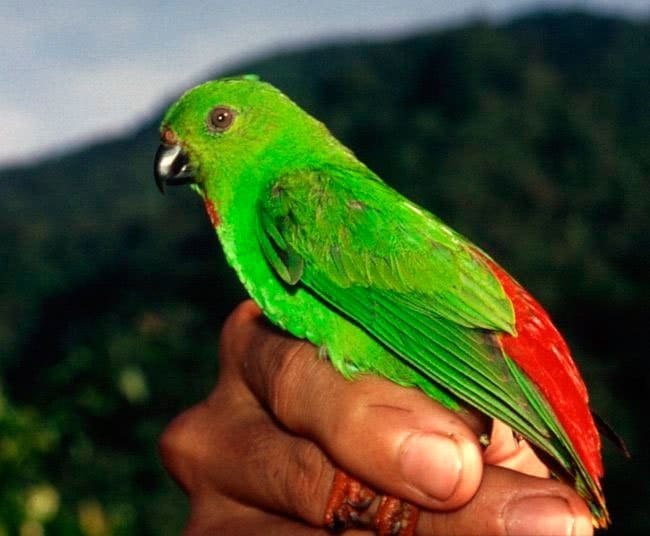
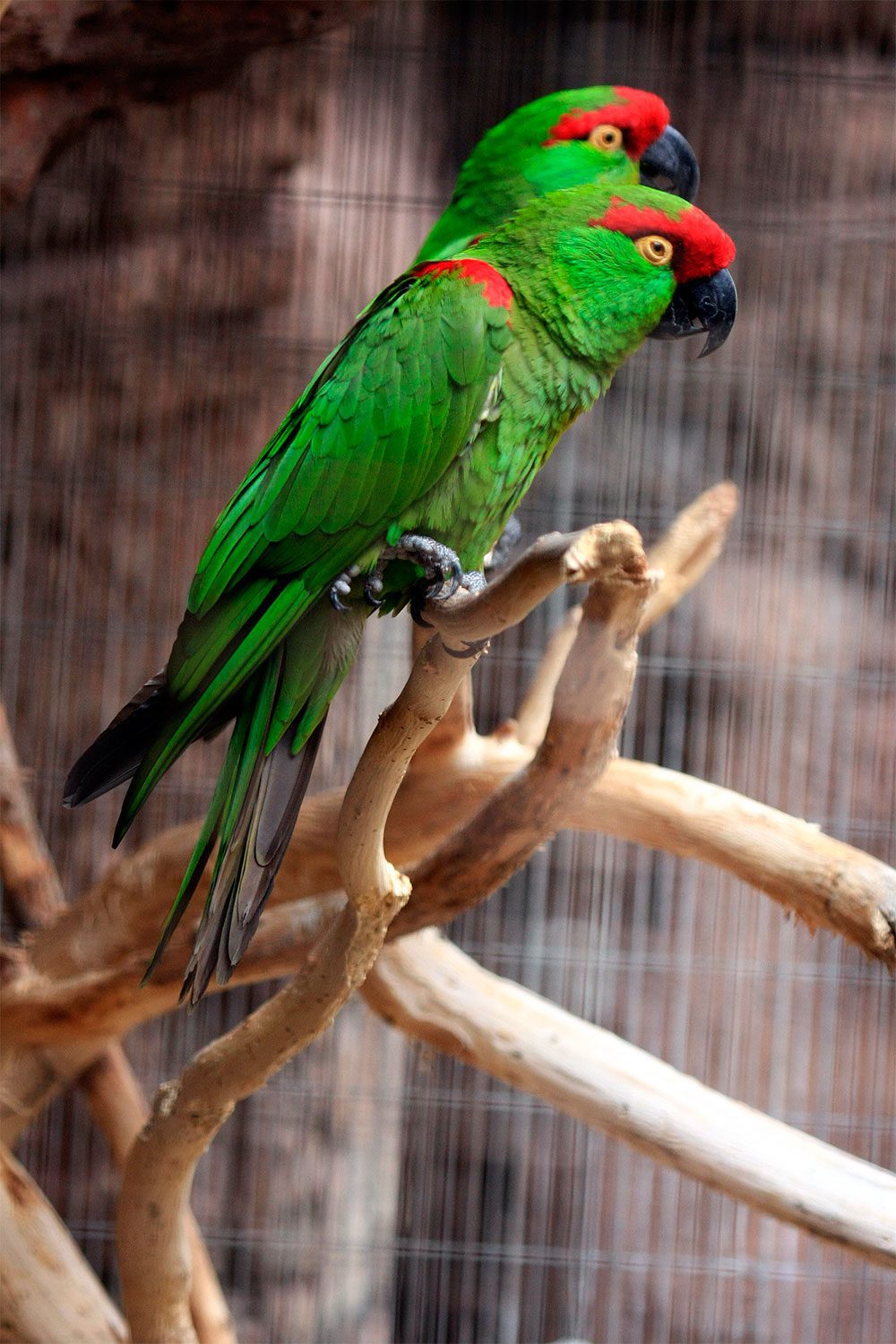
The Sangihe hanging parrot(Loriculus catamene) has the head Green with the front of the crown and the bib red. Upperparts Green with light wash of color orange in the the mantle; rump and long tail coverts red. Wings green, slightly dark; carpal edge brighter yellowish green. The flight feather blue with green coverts.
The underparts Green with the belly Beige and tail coverts of color red marked in green. Upper, the tail of color green with lips Red; Blue below. The bill black; irises brown; legs orange.
The female not have the Red of the crown; the Red of the bib reduced to a few points, and green the coverts infracaudales.
The immature with carpal edge yellow, lack of crown red, But if the bib red.
Found in pairs or in small groups on them flowers of coconut and shrub in flower, and groups of up to four birds found with greater frequency in plantations mixed. The species is has adapted to habitats side and their main source of food seems to be the nectar of coconut. One roost of 17 birds is the largest group reported.
Reproduction:
One nest with two eggs is noted in 1985, little more is known of the habits reproductive of this species.
Food:
Their main source of food is the nectar of coconut.
Distribution:
Size of the area of distribution (reproduction / resident): 700 km2
endemic to the Sangir Islands. Most of the original vegetation in Sangir, It has now been replaced by plantations of coconut and nutmeg, and secondary vegetation of the abandoned gardens. Observations during mid of 1980 showed that it is quite common in coconut forests, and two pairs were observed in the steep volcanic slopes covered with trees in 1986. In 1995, the species was recorded of all forest habitats on the island from sea level up to around the 900 m (also be meeting around Tahuna). The birds are observed more frequently in fragments of forest and coconut plantations.
Conservation:
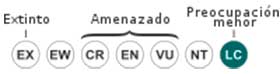
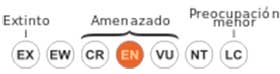
• Current IUCN Red List category: Near threatened
• Population trend: Decreasing
There are few data on recent trends, but not there is evidence of a continuous decrease and given your apparent tolerance to different secondary habitats, the declines in their population may have been insignificant.
The population of the Sangihe hanging parrot It is estimated between 10.000 and 46.000 specimens.
The original forest in Sangihe It has been almost completely replaced by the crop, but the species appears to be tolerant to degraded habitats and cultivated areas and there is no evidence of a continuous decrease. Other potential threats include the widespread settlement of large trees in the Decade of 1980, the escaped parrots-borne disease and the volcanic activity in the future (Riley 2002).
"Sangihe hanging parrot" in captivity:
Is not usual.
Alternative names:
– Sangihe Hanging-Parrot, Sangihe Hanging Parrot, Sangir Hanging Parrot (ingles).
– Coryllis des Sangi, Coryllis de Sangihe (francés).
– Rotsteisspapageichen (alemán).
– Loriculus catamene (portugués).
– Lorículo de la Sangihe, Lorículo de Sangihe (español).
Origin: Cameroon, Angola, Democratic Republic of the Congo, Uganda
Character: Intelligent, quiet and affectionate.
Life expectancy: 21 years
Height: 28 cm..
Content
Description:
28 cm. length and an average weight of 220 g..
The Red-fronted Parrot(Poicephalus gulielmi)has the forecrown and crown bright red; the lores and chin blackish; cheeks, back of the crown and nape dark green with scattered feathers showing blackish centers.
The mantle feathers and scapulars Black with large green edges that give scalloped appearance; rump and uppertail-coverts bright yellowish green .
Wing coverts black with a dark green margin; leading edge of the wings from joints carpal to the base of the primaries bright red. The primaries and secondaries black. Under, the wing feathers dark green and black.
Underparts dark green with scattered feathers showing a black central band; the thighs bright red. The tail black.
Top of the mandible grey, Blackish towards the tip with pale base stains, lower jawBlackish r; Orange the irises; legs dark grey to black.
Both sexes similar.
The youth lack of red color in the forecrown, the edge of the wings and the thighs; Green in a little paler than the adults plumage. Young birds sometimes show red color in the feathers of the wings. The irises is dark brown.
Description 3 subspecies:
Poicephalus gulielmi fantiensis
(Neumann, 1908) – Smaller that the species nominal. Forehead, leading edge of the wings and the thighs Orange or orange-red (but not red) and more extensive, in some birds. Underparts paler green with fewer black markings.
(Fischer & Reichenow, 1884) – Restricted red in the forecrown. Paler than the species nominal, with few or no black marks on the underparts.
Habitat:
The Red-fronted Parrot They inhabit montane forests of Juniperus and Podocarpus in Kenya and Tanzania, between 1,800 and 3,250 meters above sea level, where may depend on the primary vegetation.
Confined in the lowlands the rest of the population rainforest (below 700 metres in West Africa), but are not limited to the primary formations, There are records of the Red-fronted Parrot perched on tall trees of shade coffee plantations in Angola and in secondary forests of Ghana.
Usually stays in the tree tops, While they feed or rest.
In general, seen in groups of up to 10 birds, forming large flocks where abundant food. Large congregations, sometimes, in places.
In Kenya, the Red-fronted Parrot they make long daytime journeys of foraging (60km) along gallery forests, or crossing the savanna forest dominated by Acacia.
Reproduction:
The Red-fronted Parrot they breed solitary.
During the mating, males sway rhythmically, without moving the wings, while standing behind the female's back.
The nest is located in a cavity between 3 and 12 meters above the ground.
The egg laying It has been recorded in November to January in Tanzania, September in Zaire and March, June and from September to November in Kenya. The implementation is of between 2 and 4 eggs bright white.
Food:
Its diet It is believed that it is composed of a variety of seeds, fruits, flowers and insects. The seeds of Spathodea, oil palm nuts (Elaeis guineensis), fruits of the Podocarpus flowers and seeds of Grevillea robusta. Probably some insects are also part of their diet.
Size of the area of distribution (reproduction / resident): 5.380.000 km2
Several apparently separated distributions.
In West Africa are distributed to the East of Liberia until Ivory Coast and South of Ghana.
In the Center-West of Africa, South of Cameroon to the Northwest of Angola. A seemingly separate population extends to the North of Zaire and South of the Central African Republic to the southwest of Uganda and Rwanda. Also found in the Highlands of Kenya and North of Tanzania.
Sedentary with local movements. Locally common to abundant in many localities in part of its eastern range, apparently, the decrease in other areas is possibly due to deforestation.
Distribution 3 subspecies:
Poicephalus gulielmi fantiensis
(Neumann, 1908) – High Guinea, rainforests of West Africa, in Liberia, Ivory Coast and South of Ghana.
Keep a Red-fronted Parrot as a pet it has steadily increased in popularity in recent years, and as a result, the species has been the subject of intense trade on the market of wild birds. His capture may represent a significant threat to the species, in particular for the population around the Mount Kilimanjaro in Tanzania, fact that could lead to the local extinction of the species in that area.
The Red-fronted Parrot is also at risk from the deforestation in parts of its area of distribution. But, the species is still distributed over a wide area and is not currently considered globally threatened, even though global population trends have yet to be quantified.
The species is included in the Appendix II the Convention on international trade in endangered species (CITES), that means that the international trade of the Red-fronted Parrot It must be carefully checked. But, a key problem in many areas is the lack of adequate legislation, and the lack of compliance with the legislation in which it does exist.
The wild trade in this bird and the destruction of their forest habitat may have a better follow-up to ensure that populations of the Red-fronted Parrot not to suffer future decreases.
"Red-fronted Parrot" in captivity:
Probably the first hatchlings of Red-fronted Parrot born in in captivity were achieved in 1978, in Switzerland and England Although already in advance, in the middle of the 90, specimens had arrived at zoos in London and Hamburg.
The Red-fronted Parrot is little known in Spain, but in other countries it is very common as a pet thanks to its size, its great intelligence, its capacity for imitation and its character quiet and loving, but at the same time playful and naughty.
It is soft and musical, and their cry is quite bearable. In general, is a bird bit noisy, which can be an asset to a future owner who lives in an apartment.
They are very destructive, or both must provide them with abundant branches and non-toxic toys for chopping and shredding.
In terms of their longevity, according to sources, one specimen was still alive after 21 years in captivity.
Alternative names:
– Red-fronted Parrot, Jardine’s Parrot, Red fronted Parrot, Red-crowned Parrot, Red-headed Parrot, William’s Fig Parrot (English).
– Perroquet à calotte rouge, Perroquet à front rouge, Perroquet de Jardine, Perroquet vert à calotte rouge (French).
– Kongopapagei, Kongo Papagei (German).
– Papagaio-de-jardine (Portuguese).
– Lorito de Jardine, Lorito Frentirrojo, Loro Jardinero (español).
– Avibase
– Parrots of the World – Forshaw Joseph M
– Parrots A Guide to the Parrots of the World – Tony Juniper & Mike Parr
– Birdlife
– Arkive
– Photos:
(1) – A Red-fronted Parrot at Birds of Eden, South Africa By Dick Daniels (http://carolinabirds.org /) (Own work) [CC BY-SA 3.0 or GFDL], via Wikimedia Commons
(2) – Photograph of a couple of Poicephalus gulielmi By derivative work: Snowmanradio (talk)Poicephalus_gulielmi_pareja_reproductora. JPG: Juan Caparrós (Poicephalus_gulielmi_pareja_reproductora. JPG) [CC BY-SA 3.0 or GFDL], via Wikimedia Commons
(3) – P. g. fantiensis at Birds of Eden, South Africa By Poicephalus_gulielmi_-Birds_of_Eden_-South_Africa-8a.jpg: Grahamderivative work: Snowmanradio [CC BY-SA 2.0], via Wikimedia Commons
(4) – A juvenile pet Red-fronted Parrot (also known as Jardine’s Parrot) By Bram Cymet (originally posted to Flickr as Amazon) [CC BY 2.0], via Wikimedia Commons
(5) – Fledgeling Lesser Jardines Parrot eating vegetables By Kofiwannacracker (Own work) [Public domain], via Wikimedia Commons
▷ The world of Pets: Dogs, cats, birds, reptiles, amphibians
The Thick-billed Parrot(Rhynchopsitta pachyrhyncha) has the forecrown, the lores and a large swath in the region supercilii, bright Scarlet Red; a small patch of feathers brown in color lores, directly in front of the eyes; the crown, the cheeks and the sides of the neck are green with yellow tinge. The upperparts Green tinged indistinct tone olive in scapulars.
Upperwing-coverts Green with red feathers in the region where bend the wings. The flight feather of color green for over, with blackish tips and margins to the vane inner, grey below. Large infra-wing coverts Yellow, other coverts green.
Underparts Green with red on the the thighs. Upper, the tail green; gray at the bottom.
The bill black; bare orbital skin yellowish white; irises yellow-orange; legs grey.
Both sexes similar.
Immature with the bill color horn, greyish the bare orbital skin, and no Scarlet feathers behind the eye or red in the region where bend the wings.
The Thick-billed Parrot is often treated as the same species as the Maroon-fronted Parrot.
It inhabits in Highlands with mature pine forests or pine forests with other conifers of the genus Pseudotsuga, malls Populus and/or trees of the genus Quercus, in areas isolated and often rugged, sometimes are also observed in towns of lowlands.
They are mostly distributed at altitudes between 1,500 and 3,000 m, breeding generally at heights between 2,000 and 3,000 m.
Its preference they are areas with Pinus arizonica and Pinus ayacahuite. In general, observed in flocks. They rest in large groups on inaccessible cliffs or trees with dense foliage. Diurnal movements of up 40 km between resting areas and feeding.
Long-lived and gregarious, they form social groups; because of this, over time the Thick-billed Parrot they return to visit forests which are of your choice.
Reproduction:
Nest in the cavities of trees, usually pine, but also, according to sources, in trees of the species Populus tremuloides and Pseudotsuga taxifolia; usually in trees partially dead or alive, with small holes excavated, for example, by woodpeckers as the Northern Flicker (Colaptes auratus) or caused by fungal decomposition in the Heartwood wood; sometimes very together (in the same tree) When there is available room, Although generally scattered.
The breeding season coincides with the ripening of the pine seeds; birds, usually, They arrive at the breeding area between the months of April and May, carrying out the mid June to end of July update. The young begin to leave the nest from early September to late October, after 59 – 65 days, depending on their parents for a period of time after fledging.
Clutch of 2 to 4 eggs, generally three, Perhaps variable with the size of the harvest of pine seeds. The care of the eggs during incubation is carried out by the female and the care of the young is biparental..
Food:
Diet Thick-billed Parrot It is mainly composed of pine seeds (including the of the Pinus teocote and of the Pinus leiophylla) extracted from the cones with its powerful beak; They also feed, according to sources, of seeds and sprouts coniferous Pseudotsuga, fruits of the American black cherry (Prunus serotina) and acorns.
Distribution:
Size of the area of distribution (reproduction / resident): 67.100 km2
The distribution Master of the Thick-billed Parrot lies between the West and centre of Mexico, with sporadic movements towards the North and towards South.
Like other bird specialists in pine seeds, the Thick-billed Parrot wanders widely after playback, sporadically to South-West of Mexico in Jalisco, Colima and Michoacán, previously to the East up to Veracruz (Although these records are possibly involved the Maroon-fronted Parrot – Rhynchopsitta in terris) and, possibly, Coahuila de Zaragoza.
Formerly it was a sporadic visitor, and possibly resided and lesson in Arizona (especially in the mountains of Chiricahua, in the South) and in New Mexico, EE.UU, Although since the beginning of the century 20 no large-scale visits have been observed and the latest reproductive data in the area date from the 1938.
The presence of the Thick-billed Parrot is determined by the availability of pine seeds; the core of your playback area It seems to be the most constantly occupied area.
The decrease important in your population during the century 20 as a result ,mainly, of the loss and degradation of habitat, with the absence of these birds where the large pines were cut down, mainly by forestry. The loss of birds in EE.UU. was attributable to the hunt, but his presence there, probably, It was only in the short term, When were feeding conditions unusually favorable (or on the contrary very unfavorable in Mexico).
The recent threats in Mexico they are the trade in live birds and the continuous loss of habitat for livestock, as well as logging (the loss of old trees for nesting is a major problem that puts this species at a higher risk than the of the Maroon-fronted Parrot, when the latter uses the cliffs to build their nests).
Confiscated and captive-bred birds were released in Arizona at the end of the Decade of 1960, with the first successful reproduction in EE.UU. shortly after, although unfortunately the birds have mostly disappeared from that area.
• Red List category of the UICN current: In danger of extinction
• Population trend: Decreasing
The thick-billed Parrot is found in danger of extinction due to the destruction of nesting habitat, as well as his commercial exploitation, the decrease of population who have suffered these parrots is very evident to those that, long overdue, They inhabit the timber areas of Chihuahua and Durango (Lanning and Shiflett, 1981).
The commercial logging of pine living for wood, as well as standing dead trees to obtain their pulp, they are ending with a lot of nesting sites effective and potential for these birds (Lanning and Shiflett, 1983).
The trade of the parrots seemed to be minimal until the 1980s (Lanning and Shiflett, 1981), However, It is estimated that during 1985 and 1986 between several hundred and even thousands of parrots were illegally trafficked to the United States of America (Snyder & Wallace, 1988).
To reduce these threats the species and its habitat, There are legal instruments such as the vedas and provisions in the Law-General ecological balance and environmental protection (LGEEPA) and General wildlife law (LGVS); as well as the Norma Oficial Mexicana NOM-059-SEMARNAT-2001 that lists the species of Mexican wild flora and fauna under some risk category and the inclusion and modification mechanisms.
The size of the population of the Thick-billed Parrot It is estimated between 2000-2800 mature individuals.
"Thick-billed Parrot" in captivity:
Its sale as a pet is illegal.
Alternative names:
– Thick-billed Macawlet, Thick billed Parrot, Thick-billed Parrot (English).
– Conure à gros bec, Perriche à gros bec, Perruche à gros bec (French).
– Kiefernsittich, Arasittich, Kiefern Sittich (German).
– Papagaio-mexicano-de-testa-vermelha (Portuguese).
– Cotorra de Pico Ancho, Cotorra serrana, Cotorra Serrana Occidental, Cotorra-serrana Occidental (español).
– Cotorra serrana, Cotorra-serrana Occidental, Loro de Pico Grueso Occidental Mexicano, Cotorra de Pico Duro,
Guacamaya, Guaca (Mexico).
– Avibase
– Parrots of the World – Forshaw Joseph M
– Parrots A Guide to the Parrots of the World – Tony Juniper & Mike Parr
– Birdlife
– National Commission of Natural Protected Areas
– Photos:
(1) – Two Thick-billed Parrots at Arizona-Sonora Desert Museum, Tucson, Arizona, USA By Tim Lenz from Ithaca (Thick-billed ParrotsUploaded by Snowmanradio) [CC BY 2.0], via Wikimedia Commons
(2) – Thick-Billed Parrots at Twycross Zoo, Leicestershire, England By derivative work: Snowmanradio (talk)Rhynchopsitta_pachyrhyncha_-Twycross_Zoo-8.jpg: Paul Reynolds from UK [CC BY 2.0 or CC BY 2.0], via Wikimedia Commons
(3) – An adult Thick-billed Parrot at Edinburgh Zoo, Scotland By Jenni Douglas from Edinburgh, Scotland (Thick billed ParrotUploaded by Snowmanradio) [CC BY 2.0], via Wikimedia Commons
(4) – A Thick-billed Parrot at Cincinnati Zoo, USA By Rhynchopsitta_pachyrhyncha_-captive-8a.jpg: Jean from Shelbyville, KYderivative work: Snowmanradio [CC BY 2.0], via Wikimedia Commons
(5) – Three adult Thick-billed Parrots in captivity in the USA By Joe Mazzola (LovebirdsUploaded by snowmanradio) [CC BY-SA 2.0], via Wikimedia Commons
(6) – Thick-billed Parrot (Rhynchopsitta pachyrhyncha). Two parrots on a nestbox By Just chaos [CC BY 2.0], via Wikimedia Commons
(7) – Thick-billed Parrot Rhynchopsitta pachyrhyncha at Cincinnati Zoo By Ltshears (Own work) [CC BY-SA 3.0 or GFDL], via Wikimedia Commons
(8) – A Thick-billed Parrot in captivity By Mark Dumont from Cincinnati, USA (Thick Billed ParrotUploaded by snowmanradio) [CC BY 2.0], via Wikimedia Commons
(9) – Thick-billed Parrot – Rhynchopsitta pachyrhyncha at Cincinnati Zoo By Ltshears (Own work) [CC BY 3.0], via Wikimedia Commons
(10) – Monographia Psittacorum By Wagler, Johann Georg [CC BY 2.0 or Public domain], via Wikimedia Commons
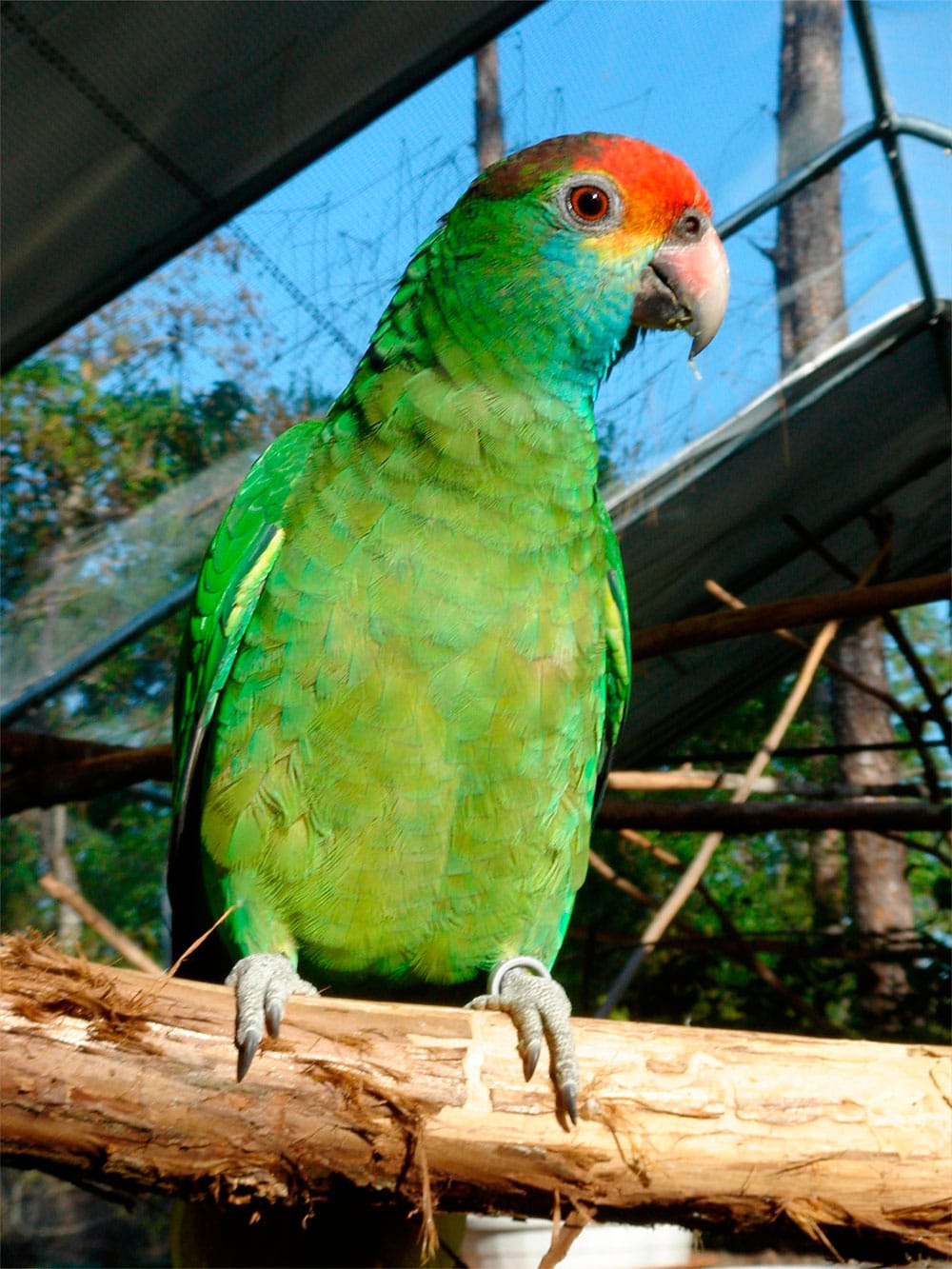
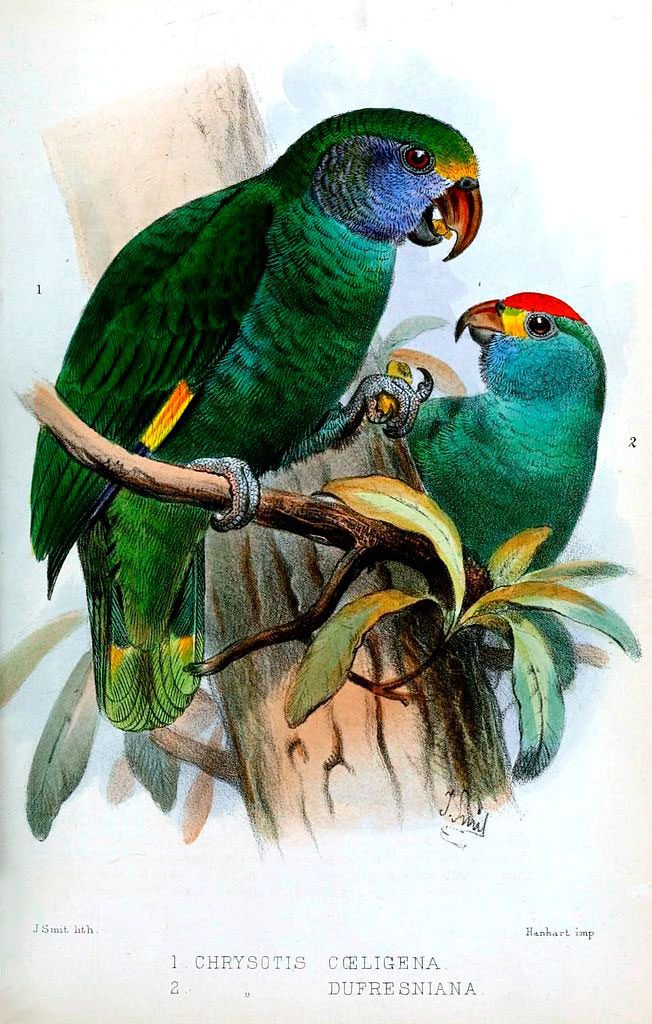
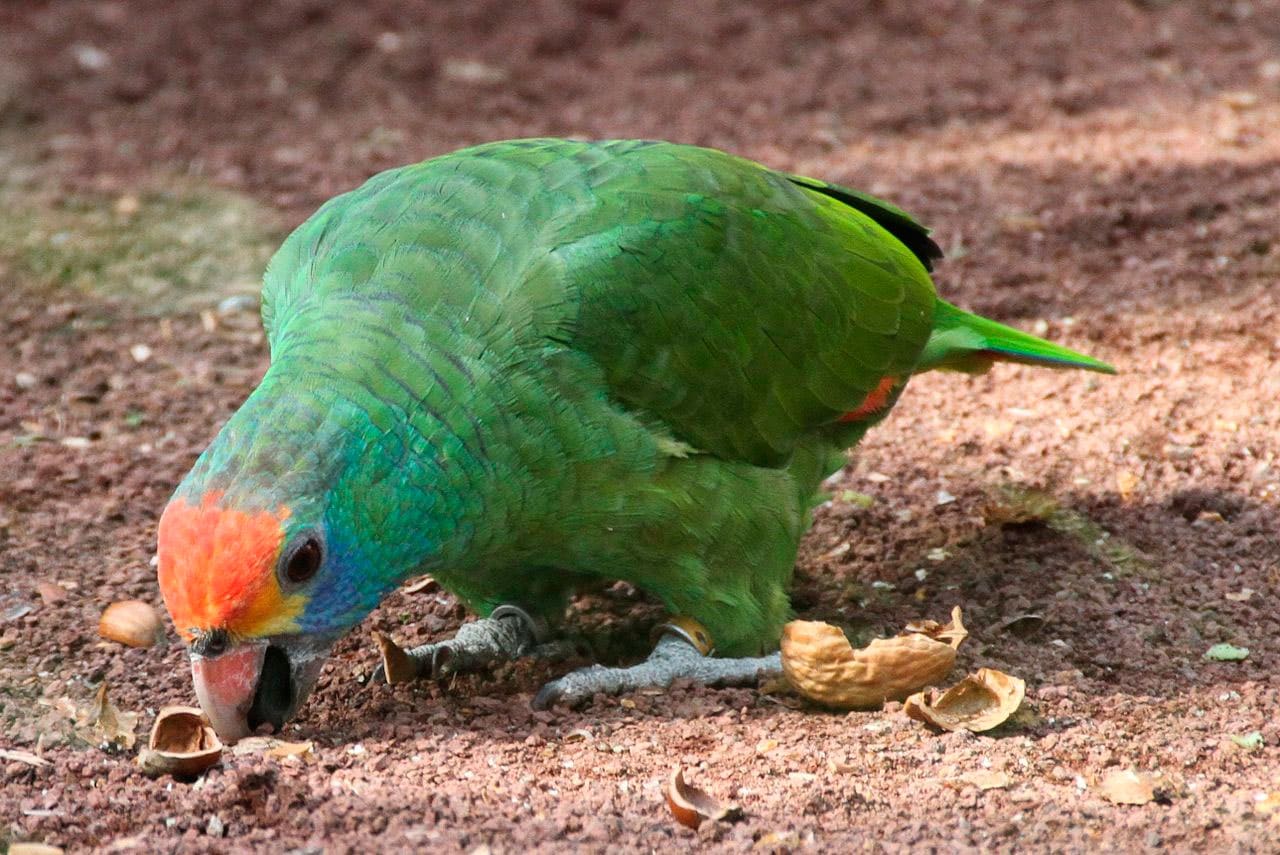
The Red-browed Parrot(Amazona rhodocorytha) has the forecrown and front of the crown, bright red; back of the crown, green with brownish purple tips; lores oranges; lower cheeks and throat, pale blue; ear-coverts and sides neck, green with plenty of blue; nape green with black tips. Upperparts green, some feathers showing faint dark tips. Wing coverts green with yellow on the carpal edge. Primaries dark grey; three outermost secondary, red at the base, other green with violet blue tips. Underwing-coverts green. Underparts green, paler and more yellowish than above, with some feathers showing faint pale blue tips (especially in the belly and around the thighs). The tail It is green with yellow tip and a large patch in red subterminal innerwebs of the lateral feathers. Bill color pale horn; irises orange; legs grey.
Both sexes are similar. Immature It is less extensive in red head and in the tail, and the red color is confined to only the first two secondaries.
Taxonomic note:
The Red-browed Parrot It has been widely treated as conspecific with Blue cheeked Parrot(Amazona dufresniana) and Red-tailed Parrot(Amazona brasiliensis). According to reports, the birds of Alagoas show the throat orange, suggesting a racial differentiation. It has not proposed any subspecies.
The Red-browed Parrot mainly inhabits moist lowland forests, but forests also date from the highlands (perhaps seasonally) inside (for example, in Serra do Mar and east of Minas Gerais, Brazil) up to approximately 1.000 m. Although records on the edges of forests, probably not adapt to the conditions created, even partial deforestation. They sleep communally on tall trees in forest.
Reproduction:
The eggs possibly they hatch in October and pairs with their young have been observed in January.
In captivity, sunsets four eggs are common; the incubation hard 24 days, with the young leaving the nest 34 days after hatching.
Food:
Feeds of fruit, seeds, berries and cocoons they get in the treetops; It has also been registered to Red-browed Parrot feeding is of papaya, jaca, Mango, cacao, banana and coffee plantations.
Distribution and status:
Size of its range (breeding/resident): 2.700 km2
The Red-browed Parrot It was first discovered in northern Sao Paulo at the beginning of the year 90.
This is an Amazon of Atlantic tropical forests of Brazil, in the East of Alagoas and further south, until Rio de Janeiro. No records between Alagoas and northeast of Bay, but if southwards and into neighboring areas, to the East of Minas Gerais, Brazil, through Espirito Santo until Rio de Janeiro.
Obviously, he suffered a drastic decline in its geographical expansion and its population since European settlement. Today they live confined to the last remaining fragments of the Atlantic tropical forests. Possibly extinct Alagoas, where the last native lowland forests were cleared in the 1990s 1980, although still quite common in at least one protected area Espirito Santo.
• Current category of the Red List of the UICN: In danger of extinction.
• Population trend: Decreasing.
• Population size : 600-1700
Rationale for the Red List category
This species is endangered because of their severely fragmented and declining population. There remains a proper dismantling of Atlantic forest habitat and capture for the bird trade cage is an additional threat. It is considered nationally in peligro de extinctionn in Brazil.
Justification of the population
The species has a small population located in the band 1,000-2,499 individuals in total. This is equivalent to 667-1.666 mature individuals, rounded here to 600-1.700 mature individuals.
Justification of trend
It is suspected continued rapid population decline based on habitat destruction and fragmentation and capture for domestic and international pet trade.
Threats
less than 10% of original forest cover remains in Bahia and Espírito Santo, and only 2% en Alagoas (Brown and Brown 1992, Conservation International 1995), mainly due to conversion to plantations and pastures. In fact, now it is estimated that less than 1% the general habitat of this species remains (Klemann-Júnior et al., 2008). In janeiro river, many fragments of important habitats are being cleared, especially around the Desengano State Park. The collapse of the cocoa economy in southern Bahia has resulted in increased logging by landowners and colonization of reserves by former plantation workers. (Snyder et to the., 2000). If the seasonal movement of birds is confirmed, this would multiply the problems of habitat loss. In the breeding season 1998-1999, 174 nestlings were captured, especially reservation, for domestic and international trade of birds in cages (Brown and Brown 1992), While 664 individuals were recorded in captivity at the Center for Reintroduction of Wild Animals 2005-2006 and others were found in private cages (L. Klemann-Júnior a little., 2007). Illegal trade is apparently the main threat to the species in Espírito Santo (Klemann-Júnior et al., 2008b). Memories containing feathers have been on sale outside the Monte Pascoal National Park (Sweeney 1996). a pest species is considered in some plantations of papaya, coffee and cocoa (Klemann-Junior 2006, L. Klemann-Júnior a little., 2012).
Conservation Actions Underway
CITES Appendix I and II and protected by Brazilian law. Considered endangered in Brazil to 2014 (Klemann-Júnior et al., 2008), It is now classified as Vulnerable (MMA 2014). They live in 14 Reservations (Wege and Long 1995 , RB Pineschi by C. Yamashita in some. 2000), but most of them provide minimal habitat protection and none are effective against poaching. The ex situ population is managed under a European species survival plan (Sweeney 1996) and Curitiba Zoo (L. Klemann-Júnior a little. 2012), which together with Loro Parque Foundation, Foundation Rare Species Conservation and Environmental Idéia, have successfully developed a captive breeding program (Reinschmidt and Waugh 2005 , L. Klemann-Júnior a little. 2007, 2012) .
Conservation Actions Proposed
Survey to locate additional populations. Protect forests where the species is found outside reserves in Rio de Janeiro. Effectively protect habitat and birds within reserves and further develop the captive breeding population. Enforce laws against trafficking, especially on roads connecting the Monte Pascoal National Park with the rest of southern Brazil (Snyder et to the., 2000). Mapping the current distribution of the species within its extent of occurrence. Identify priority areas for conservation. Investigate dietary requirements and nesting. Estimate the range of the house of the species. Study the impact of fragmentation of forests within its population. Implement an education program (L. Klemann-Júnior a little. 2012).
The Red-browed Parrot in captivity:
Suffering from a continuous illegal trade in which the birds are highly valued.
protected by CITES Appendix I, where they are included all endangered species. Trade in specimens of these species is authorized only under exceptional circumstances..
Each captive specimen of this species which is capable of reproducing, It is placed in a well-managed program captive breeding and not be sold as a pet, with the order to ensure their survival long-term.
The captive breeding, although difficult, It has been successful in United States and Europe and overall management plan for captive birds of this species is underway. The reintroduction into the wild of captive populations can become an important conservation strategy in the future.
(1) – Red-browed Amazon (Amazona rhodocorytha) at Rare Species Conservatory Foundation, USA By Duncan Rawlinson (originally posted to Flickr as DSC00744) [CC BY 2.0], via Wikimedia Commons
(2) – Red-browed Amazon (Amazona rhodocorytha) in a zoo By Duncan Rawlinson (originally posted to Flickr as [1]) [CC BY 2.0], via Wikimedia Commons
(3) – Red-browed Amazon (Amazona rhodocorytha) at a zoo By Duncan Rawlinson (originally posted to Flickr as [1]) [CC BY 2.0], via Wikimedia Commons
(4) – Red-browed Amazon at Rare Species Conservatory Foundation, Florida, USA By Ruth Rogers (originally posted to Flickr as P8120449) [CC BY 2.0], via Wikimedia Commons
(5) – Red-browed Amazon (Amazona rhodocorytha). Parrot in a zoo By Duncan Rawlinson (originally posted to Flickr as [1]) [CC BY 2.0], via Wikimedia Commons
(6) – Red-browed Amazon (Amazona rhodocorytha) at Rare Species Conservatory Foundation, USA By Duncan Rawlinson (originally posted to Flickr as [1]) [CC BY 2.0], via Wikimedia Commons
(7) – Red-browed Amazon (Amazona rhodocorytha) in the Loro Parque zoo of Tenrerife (Spain) By Bjoertvedt (Own work) [CC BY-SA 4.0], via Wikimedia Commons
(8) – Red-browed Amazon (Amazona rhodocorytha) at Rare Species Conservatory Foundation, USA By Duncan Rawlinson (originally posted to Flickr as DSC00736) [CC BY 2.0], via Wikimedia Commons
(9) – The red-browed Amazon parrot Amazona rhodocorytha at Rare Species Conservatory Foundation, USA By Duncan Rawlinson from Vancouver, BC (Flickr) [CC BY 2.0], via Wikimedia Commons
(10) – Blue-cheeked Amazon (left); Red-browed Amazon (right) Proceedings of the Zoological Society of London (too.. 1880, plate IX) – Wikipedia
Of 25-30 cm. length; 70-169 grams and a wingspan of 46 cm..
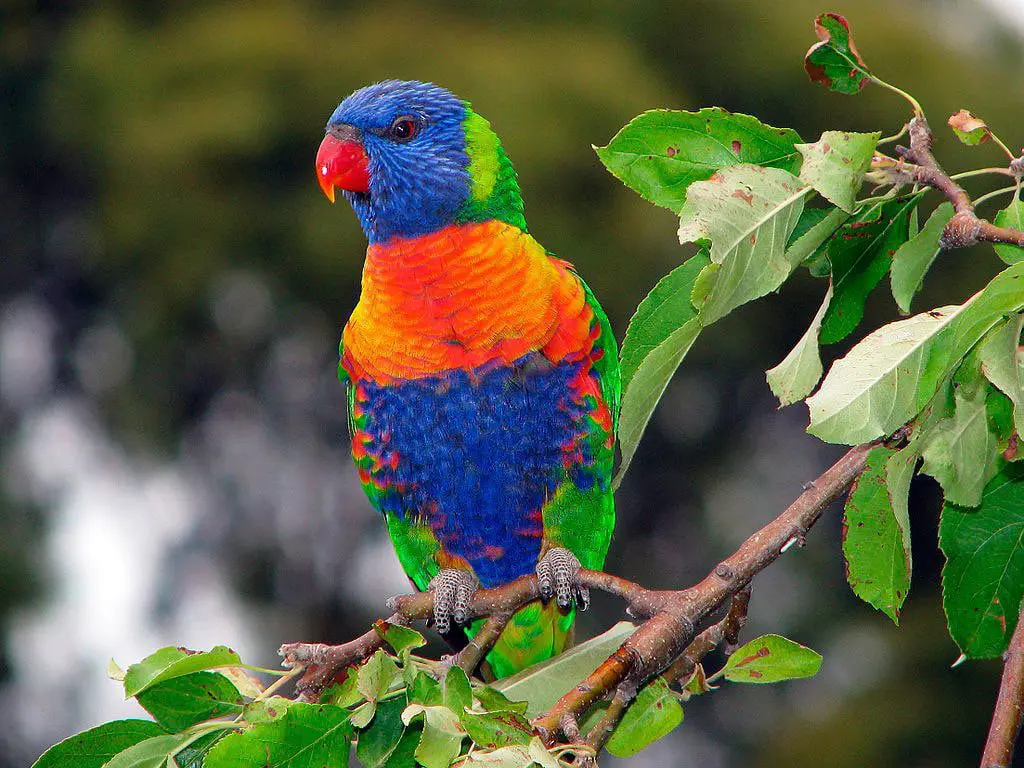
The plumage of the Rainbow Lorikeet(Trichoglossus moluccanus) is very bright. The head is deep blue with a neck greenish-yellow and the rest of the upperparts (wings, back and tail) are deep green. The chest is red with blue-black barring.. The belly is deep green, and the thighs and rump are yellow with deep green barring.. In flight, a yellow wing-bar contrasts clearly with the red underwing-coverts.
There is little to visually distinguish between the sexes; However, for an acute observer, their dimorphism is readily apparent.
The youth has bill black, which gradually brightens to orange in the adults..
The markings of Trichoglossus moluccanus resemble of the Coconut Lorikeet(Trichoglossus haematodus), but with a belly blue and breast with little or no blue-black barring..
Rainbow Lorikeet taxonomy
With one exception, the species have been treated so far as a group of subspecies within the extended group Coconut Lorikeet(Trichoglossus haematodus), but they differ from the Trichoglossus haematodus her pale red breast without bars ; its blue belly against green or blackish; its pale blue hood without black edge and its larger size.
The subspecies Trichoglossus moluccanus eyrei (South of Australia) It is included within the species nominal. Small hybrid population of present species paired with the Musk Lorikeet(Glossopsitta concinna) in SE Southern Australia (Yorke Peninsula).
Sound of the Rainbow Lorikeet. (1)
(1) Some species are under extreme pressure because of traps and harassment. So, the open availability of high-quality recordings of these species may further worsen the problems, this being the reason why downloading these recordings is off. In conclusion, recorders themselves are free to share these files on xeno-canto, but they will have to approve access to these recordings.
We do not take this action lightly, and we wish it wasn't necessary, but we are convinced that the negative impacts of offering easy access to these recordings outweigh the benefits. To access these recordings, You can contact directly with the recorder.
(Robinson, 1900) – As the species nominal but with brighter purple/blue stripes on the head and tail shorter.
Habitat:
The Rainbow Lorikeet often they travel together in pairs and occasionally respond to calls to fly like a flock, then they disperse again in pairs. Couples aggressively defend their feeding and nesting against other lstallion arcoiris and other bird species. Not only they scare off smaller birds, as the Noisy Miner(Manorina melanocephala) and the Brush Wattlebird(Anthochaera chrysoptera), but also to larger, as the Australian Magpie(Gymnorhina tibicen).
Reproduction:
In Australia, Reproduction usually takes place during spring (from September to December), but it may vary from one region to another with changes in food availability and climate. Sites nesting They are variable and may include gaps as tall trees eucalyptus, trunks of palm trees or overhanging rocks.
Couples sometimes nest in the same tree with other couples Rainbow Lorikeet or other species of birds. The clutch size is between one and three eggs, which are incubated for about 25 days. Incubation tasks are performed by the female alone.
The Rainbow Lorikeet are mostly monogamous and remain paired for long periods, if not for life.
Extension of the distribution (breeding/resident): 3,810,000 km2
Endemic East and Southeast Australia (of Cape York to the Eyre Peninsula, South of Australia)
They were recorded for the first time in Perth in 1968 and the population is believed to have come from fewer than ten birds that were deliberately released or had escaped from aviaries.
Since the beginning of the decade 1960, the population has grown exponentially and has spread rapidly throughout 174 km2 metropolitan area. The current population is estimated at 8.400 birds and their range is expanding at a rate of 0,7 km per year.
(Robinson, 1900) – North of Queensland (Cape York Peninsula), in northwestern Australia; also the Torres Strait Islands (Boigu and Saibai except, at the north end) and it was introduced in the district of Perth, in southwest Australia..
Conservation "Rainbow Lorikeet":
1. Current red list category of the UICN: Least concern.
2. The population trend: Decreasing.
3. Population size : Unknown.
Rationale for the Red List category
This species has a extremely large distribution area, and therefore does not approach the thresholds for Vulnerable under the criteria of size range (Extent of Occurrence <20,000 km2 combined with a decreasing area size or fluctuating distribution, extension / habitat quality, or population size and a small number of places or severe fragmentation). While the trend of the population seems to be decreasing, the decline is not believed to be rapid enough to approach the Vulnerable thresholds according to the population trend criterion (decrease of more than 30% in ten years or three generations).
The population size has not been quantified, but it is not believed to approach the thresholds for Vulnerable under the criterion of population size (<10.000 mature individuals with an estimated continuous decrease in> 10% in ten years or three generations, or with a specific population structure). For these reasons, the species is assessed as Least concern.
Justification of the population
Global population size has not been quantified, but the species is described as abundant in northern Australia and rare Tasmania(pit et to the. 1997).
Justification trend
They suspected that the population is declining due to unsustainable levels of exploitation.
Rainbow Lori Threats
The species has been the subject of a intense trade: from 1981, When it was included in the Appendix II of the CITES, they have been 100.388 individuals caught in international trade (UNEP-WCMC CITES Trade Database, January 2005).
In captivity:
Not very common. Its longevity It 20 years en libertad, 15-25 years in captivity and its market price is around wild birds 250 EUR.
Alternative names:
– Rainbow Lorikeet, Rainbow Lorikeet (Rainbow) (English).
– Loriquet à tête bleue (de Swainson), Loriquet à tête bleue (moluccanus), Loriquet arc-en-ciel, Loriquet de Swainson (French).
– Regenbogenlori (German).
– Lóris-molucano, Periquito-arco-íris (moluccanus) (Portuguese).
– Lori arcoiris, Lori de Arco Iris (español).
(1) – A Rainbow Lorikeet Trichoglossus moluccanus in Melbourne, Australia by Alfred Sin [CC BY-SA 2.0], via Wikimedia Commons
(2) – Rainbow Lorikeet Trichoglossus moluccanus on a garden bird feeder, Sydney, Australia by Tim Douglas from Sydney, Australia [CC BY-SA 2.0], via Wikimedia Commons
(3) – Rainbow Lorikeets (Trichoglossus moluccanus) feeding frenzy South Molle Island, Airlie Beach, Central Queensland, AUSTRALIA by Bernard DUPONT – Flickr
(4) – Rainbow Lorikeet (Trichoglossus moluccanus) Kangaroo Flat, Vic by patrickkavanagh – Flickr
(5) – Rainbow Lorikeet Trichoglossus moluccanus, Daintree Village, Queensland, Australia by JJ Harrison (jjharrison89@facebook.com) [GFDL or CC BY 3.0], from Wikimedia Commons
(6) – Rainbow Lorikeets Trichoglossus moluccanus in Broulee, New South Wales, Australia by Steve Shattuck from Canberra, Australia [CC BY 2.0], via Wikimedia Commons
(7) – Trichoglossus moluccanus by Skitterphoto [CC0], via Wikimedia Commons
(8) – Rainbow lorikeet, Trichoglossus moluccanus, Royal Botanic Gardens, Melbourne, Australia by Derek Keats from Johannesburg, South Africa [CC BY 2.0], via Wikimedia Commons
(9) – Rainbow Lorikeets Trichoglossus moluccanus at a bird feeder in Narooma, New South Wales, Australia by Robyn Jay [CC BY-SA 2.0], via Wikimedia Commons
(10) – A digital image of Trichoglossus moluccanus, by the esteemed scientific illustrator Ferdinand Bauer [Public domain], via Wikimedia Commons
Origin: Colombia, Ecuador, Peru, Brazil, French Guiana
Character: Ruidoso, social
Life expectancy: ----
Height: 23 to 24 cm..
Content
Description:
23 to 24 cm.. height and between 188 and 233 g. weight.
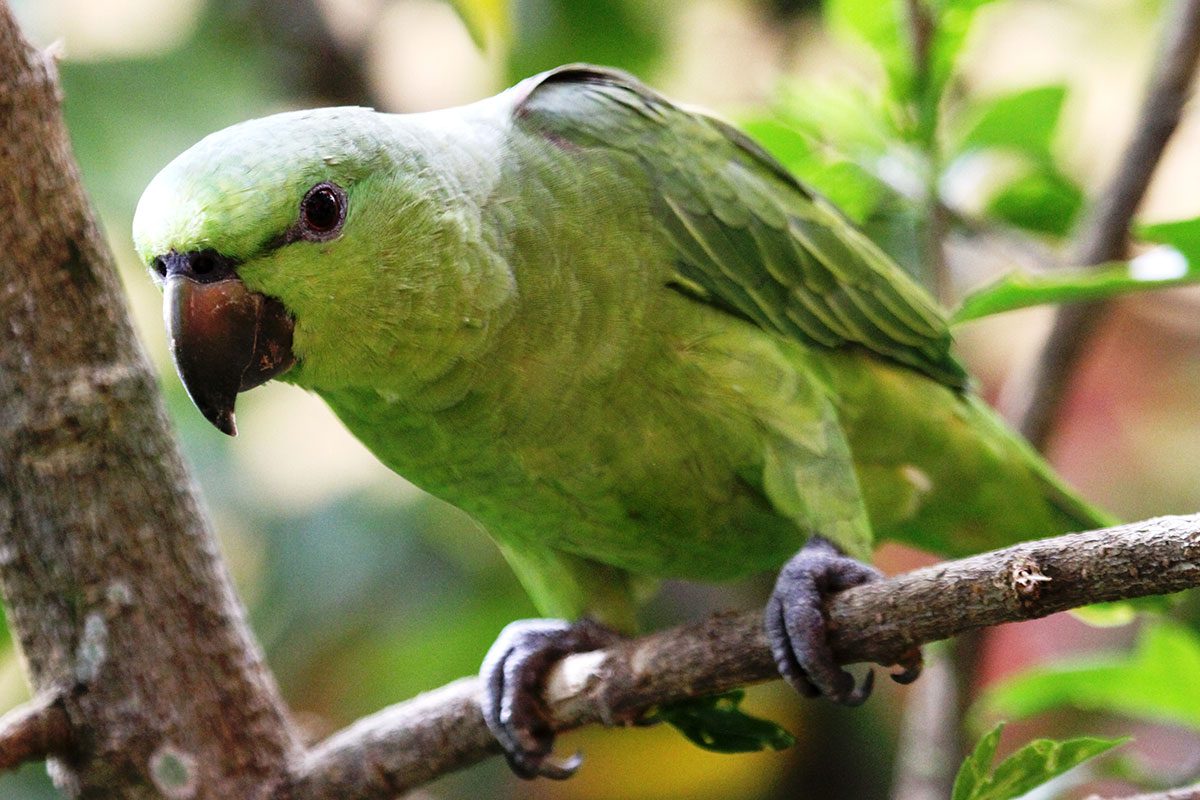
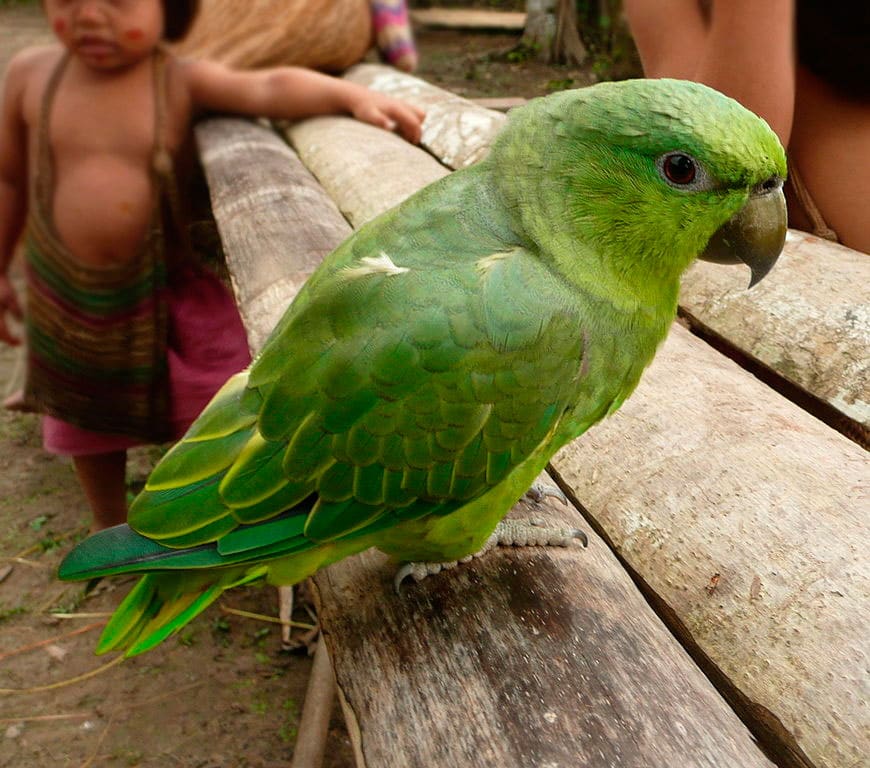
The short tail Short tailed Parrot(Graydidascalus brachyurus) It is the most distinctive, although it is also known the eyes red orange.
generally green, somewhat yellowish on wing
and the belly; Flying red noted in the base of the outer feathers tail and a small upper portion of wing
towards the armpit.
The beak is greenish gray, large.
The sexual dimorphism in this species it is absent.
This species, the only one of the genre Graydidascalus, is related with the Yellow-faced Parrot(Alipiopsitta xanthops), own kind of Bolivia and Brazil.
It inhabits in swampy forests, intervenidas, River Islands, borders of humid and semi-humid forest, until the 400 m, associated with river banks.
Fly quickly in large groups of up to 50 individuals, is very noisy and visit populated places. They are very social outside the breeding season. It will associate with other species of parrots in the wild.
Reproduction:
With plays during the last quarter of the year.
Successes captive breeding have not yet been registered; although several females put one or two eggs, but no chicks. In its natural habitat, the clutch average consists of 3 to 4 eggs. The period of incubation is of 24 to 25 days.
Food:
Consume large variety of fruits (very fond of guava), tubers and possibly berries, seeds, sprouts and flowers. Foraging in the treetops.
Distribution:
Size of the area of distribution (reproduction / resident): 3.870.000 km2
Its population is distributed among the rivers of the southeast of Colombia, east of Ecuador, northeastern Peru and northern Brazil, on Basin Amazon.
Conservation:
• Current category of the Red List of the UICN: Least concern.
• Population trend: Decreasing.
Justification of the population
The population size World has not been quantified, but this species is described as «quite common» (Stotz et to the., 1996).
Justification of trend
It is suspected that this species has lost 19.1-20.4% of habitat within its distribution over three generations (15 years) based on a model of Amazon deforestation (Soares-Filho et to the., 2006, Bird et to the., 2011). Given the susceptibility of the species to hunting and / or capture, you suspect your decrease in population <25% over the next three generations.
"Short tailed Parrot" in captivity:
Rare in captivity. Young people are susceptible to stress and disease.
Alternative names:
– Short-tailed Parrot, Short tailed Parrot (English).
– Caïque à queue courte, Perroquet à queue courte, Perroquet nain de Panama (French).
– Kurzschwanzpapagei, Kurzschwangenpapagei (German).
– curica-verde, curica-pequena, curiquinha, papagainho-verde (Portuguese).
– Cotorra Colicorta, Cotorrita Cabezona, Lorito Colicorto (español).
– Cotorra Colicorta (Colombia).
– Loro de Cola Corta (Peru).
▷ The world of Pets: Dogs, cats, birds, reptiles, amphibians
Red avadavat
Amandava amandava
Origin:
Character: Social
Life expectancy: 8 years.
Height: 9 to 11 cm.
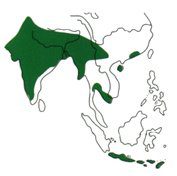
The species is native to Bangladesh, Cambodia, China, Egypt, India, Indonesian, Burma, Nepal, Pakistan, Thailand and Viet Nam.
There are established populations in the Iberian Peninsula (Spain and Portugal), Brunei, fiji, Malaysia, Puerto Rico, Singapore and Hawaii.
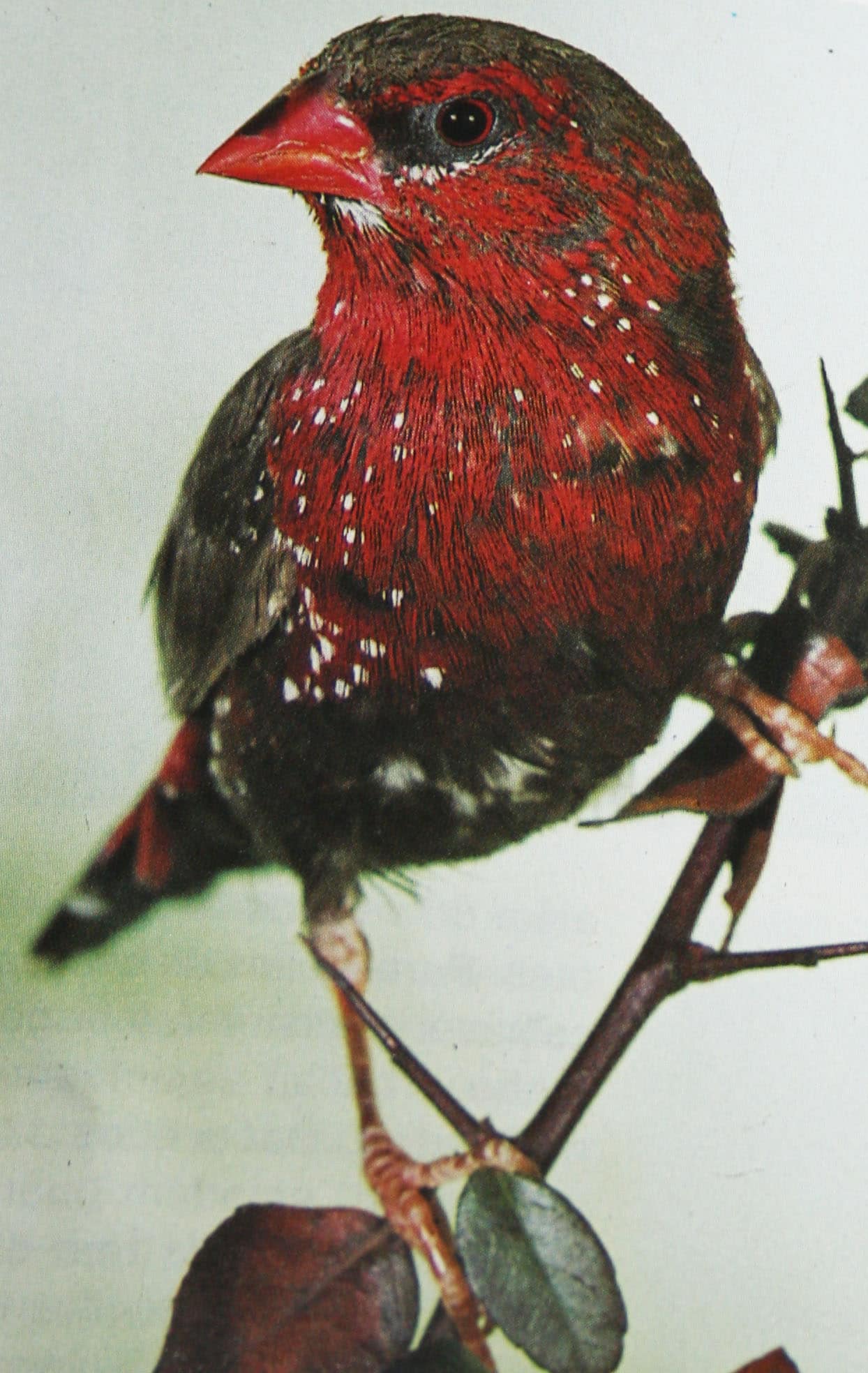
The sexes are different. In the adult male plumage is almost entirely red, the Chin, throat, chest, top of the abdomen and flanks are bright Scarlet. The sides of the chest and flanks have spotted with small white dots. The tail is blackish brown, finely fringed in white at the tip of the lower face. The lower part of the abdomen, the anal area and the bottom of the tail are black or blackish brown with shades of Red. The beak is short, red.
common at local level, red bengals are prevalent among the tall grass, Juncos, reedbeds, shrubs and bushes, generally, in areas close to water or wetlands. It is above all a kind of the Plains, but can climb to the 1500 meters in Java and Bali, even up 2400 meters in the small islands of the Sunda.
There are two subspecies:
–Amandava flavidiventris He lives in Burma,in the North of Indochina and the Sunda Islands.
–Amandava punicea He lives in Indochina, Java and Bali and has many more white spots. The Red of their nuptial plumage is more alive than in the nominal species. The two subspecies are somewhat smaller and less present in imports.
Generally live in pairs or in small groups of up to thirty individuals. In winter, the demonstrations are larger and sometimes birds are grouped into more than a hundred individuals, sometimes with other species such as Capuchin, sparrows or email us. Their bedrooms are usually located in the common cane or cane fields. They are very territorial and vigorously defend the entrances to some of their nests.
In the India, breeding season occurs during the second half of the monsoon season or during the dry season. The nests are found on land or at a low height. They are built with thin strips of grass, stems and other plant materials. The female lays 4-6 white eggs which are incubated during 11 to 12 days for both parents. The young leave the nest after 3 weeks. When leaving the nest, adults are very attentive and communicate with their chicks with sweet notes, especially in the night, When it comes to remind them the location of its nest.
It has a mainly vegetarian diet. This bird feeds on grass and a wide variety of seeds. Also eat rice and millet. Their observation in captivity suggests that Red Bengals also feed in the wild on a small number of insects such as ants and caterpillars..
The population is suspected to be stable in the absence of evidence of any reduction or substantial threats.
Bengals can be kept both in spacious cages and in outdoor or indoor aviaries., although the breeding has a greater chance of success if they are kept in outdoor aviaries. Since it does not like empty spaces, it is best to decorate its habitat with an abundance of plants. . Love the Sun and the heat so the Aviary should be oriented so that you can to maximize the available hours of sunshine. At the same time, it must be sheltered and have a shelter that protects them from cold days during the winter months..
The Bengali gets along very well with the other species with which it can share a habitat. Less tolerant with its own species during the breeding season. ,It is best to keep a single partner in each Aviary.




















_-two_on_nestbox2.jpg)


_(8122281325).jpg)

2.jpg)
_-zoo3.jpg)

_-zoo4.jpg)


.jpg)


.jpg)


