Content |
|---|
History
The Karelian Bobtail is a Russian cat breed originating from the Republic of Karelia, on the Finnish border. It appeared naturally at least 200 years on the islands of Lake Ladoga, and has not undergone many human modifications.
It is probable that the race had a link in its history with the Norwegian Forest Cat , a Scandinavian breed that also has a natural origin. But, to date there are no DNA studies that demonstrate this relationship. Specialists have also long linked the Karelian Bobtail with the Kurilian Bobtail, a feline breed also Russian but originally from the Kuril Islands, located near the coast of Japan. But, science has since established that these natural races, both with short tail and, in fact, with many physical and psychological similarities, they are actually completely different.
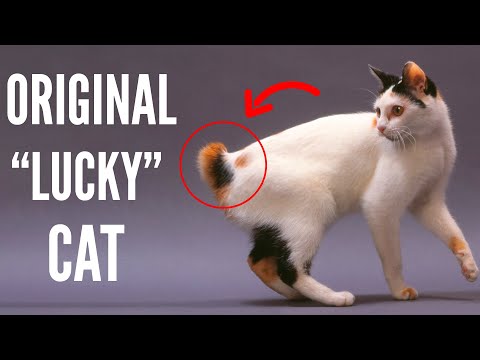
The Karelian Bobtail He was highly appreciated by the inhabitants of his native region not only for his great ability to hunt vermin, but also because, according to an old legend, owning a cat without a tail or with an especially short tail brought good luck to its owner.
This morphological peculiarity is the result of a genetic mutation that occurred naturally in cats that live on the islands of Lake Ladoga.. It is transmitted spontaneously from generation to generation and is different from Kurilian Bobtail. In the Kurilian Bobtail, the gene is dominant: it is only necessary that one of the two parents transmit it for the kittens to be carriers. On the other hand, in the Karelian it is a recessive gene, which means that both parents must have a short tail for the kitten to inherit this characteristic.
It was in the years 80 when felinologists from present-day Saint Petersburg, members of the commission of the Kotofey KLK, a major Russian feline association, first became interested in the breed in detail and accurately described it.
The first standard was drawn up by them in 1987, based on the breeder's cats Liliya Dvoryaninovich. I had some 15 short tailed cats, descendants of parents found on the north shore of Lake Ladoga.
The breed was first recognized in Russia in 1990 by the Sovetskaya Felinologicheskaya Federatsiya (SFF), a Russian organization that no longer exists. He made his first appearance at a feline show at 1993, specifically at the Eurasia Intercontinental Exhibition, in Yekaterinburg. The Kotofey KLK registered the first representatives in 1994.
– Lovely-dogs
But, not much has changed since then in terms of breed recognition, which is still limited to its country of origin. These may include, nor international organizations such as the Fédération Internationale Féline (FIFé) o The International Cat Association (TICA), nor national structures like the American Cat Fanciers’ Association (CFA), el British Governing Council of the Cat Fancy (GCCF), el Official Book of Feline Origins (LOOF) inglés o the Canadian Cat Association (CCA) they recognize the breed. Still unknown outside of Russia, the Karelian Bobtail is very underrepresented around the world.
Even in russia, their number is very small. Various attempts have been made by enthusiasts to develop the breed and increase its numbers., but so far they have not been successful. The most important program was developed by the Kotofey KLK in 2012, but it quickly reached its limits as the organization does not allow any crossbreeding with other breeds. Thus, it is difficult to create a sufficient population to guarantee a bright future for the Karelian. Even if you go into the wild to find animals in your home region, is not enough. But, it must be taken into account that a large part of the population of the breed - in fact, the majority- live in nature and, Therefore, is not included in the statistics.
The number of farms Karelian Bobtail It is very small. Most of them are located in the territories near St. Petersburg, but there are also a handful in other cities (Medvezhyegorsk, Kirov, Petrozavodsk…).
Physical characteristics
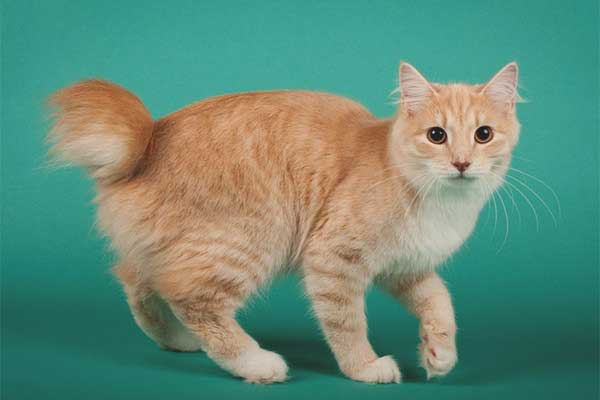
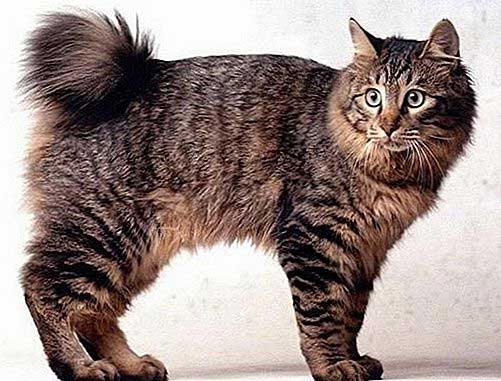
His admirers often compare him to Karelian Bobtail with a little lynx, for its lack of a tail and its large hind legs. Hind legs are much larger than front legs, but they are all strong and very powerful.
Although it is a fairly standard size, it is much more massive and heavier than it seems. Built around a medium, muscular chest, has a compact overall look, without looking too beefy.
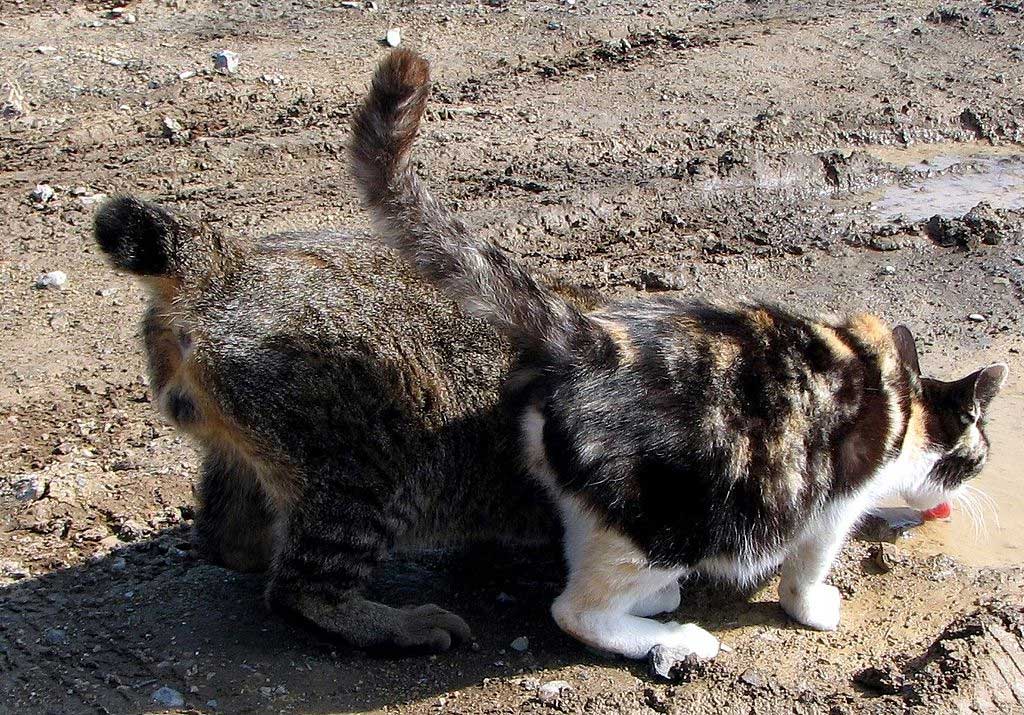
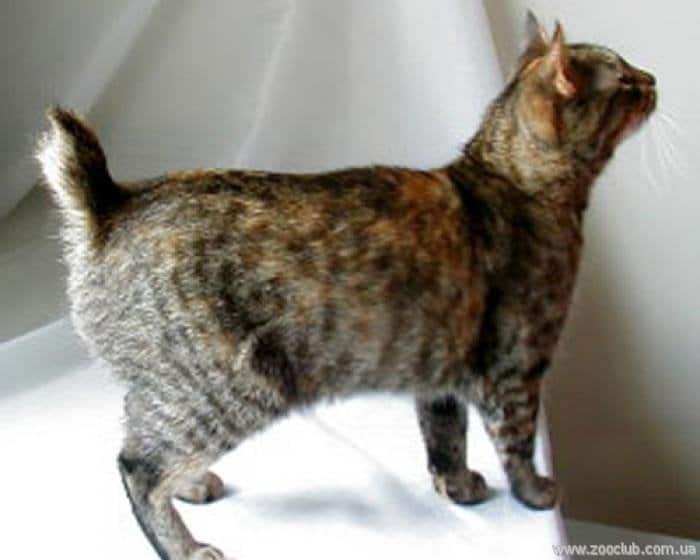
The tail It is one of the most outstanding characteristics of the breed., and their exact appearance differs greatly from one individual to another. It is in all cases very short, measuring just over 4 to 13 cm.: a totally absent or longer tail than 13 cm is not accepted in the breed standard. Whatever its size, the fur is longer at this point, giving the appearance of a pompom. On the other hand, may be completely straight or have breaks.
This uniqueness in the size of the tail is the result of a genetic mutation, and the gene that causes it is recessive. This means that both parents must have a short tail for the kittens to be short..
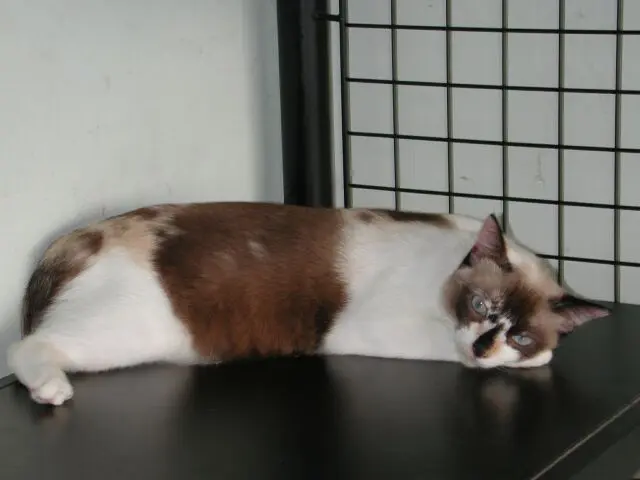
The head of the Karelian Bobtail it is medium in size and triangular in shape. Its forecrown and their cheeks they are flat, and your nose it is rather long and straight. The ears are large and are located on the top of the head. Their tips are slightly rounded. Their eyes they are almond shaped, medium in size and its color generally corresponds to that of the coat. The most common colors are green and yellow.
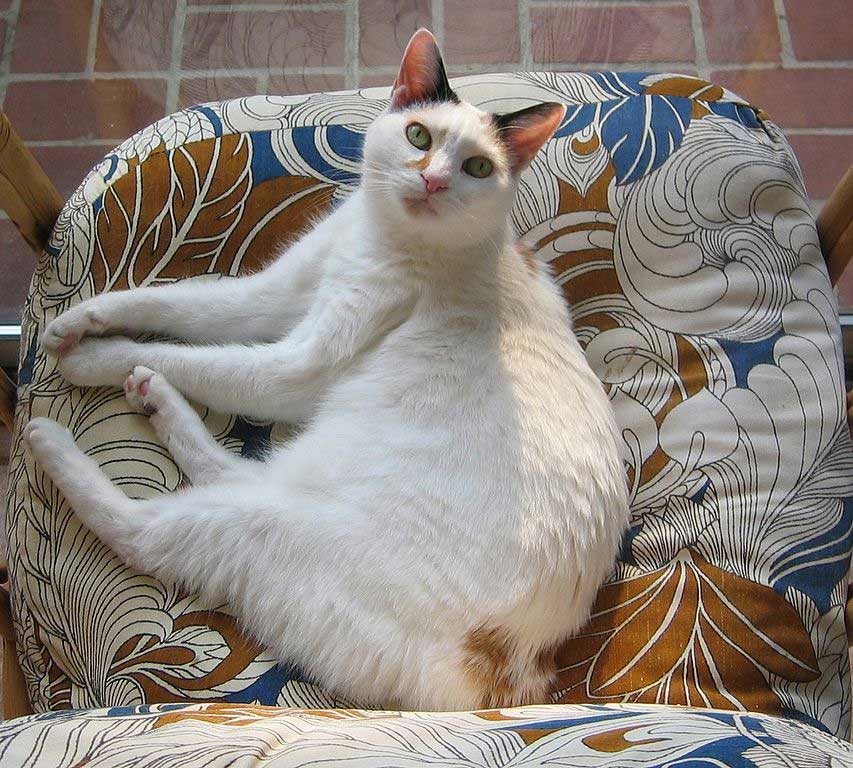
The fur of the Karelian Bobtail it consists of a very thick double layer of hair, that protects you from inclement weather. It can be short or long, but in any case it must be dense, bright and smooth. All colors are accepted except tan, chocolate, leonado, lila y colourpoint. The most observed colors are white, the black, blue and blue-cream. The coat can be bicolor, tricolor or brindle, and in many individuals it has silver and gold reflections.
Last, this breed is marked by a certain sexual dimorphism, since females are mostly smaller and lighter than males. Regardless of your gender, pups take a long time to grow, since they only reach full physical maturity around the 5 years.
Size and weight
Variations
The Karelian Bobtail it comes in two varieties: short-haired and long-haired individuals. Apart from the length of its fur, there is no physical or psychological difference between them.
Character and skills
The Karelian Bobtail he is a smart cat, sociable and curious. They love spending time with their family members and enjoy being around them, proving that they fit well in any home. Often tends to favor a specific person to whom he is especially attached, but this does not mean that I turn my back on others.
Its playful temperament and its marked taste for interaction make it a recommended breed of cat for a child.. As long as you know how to behave in a respectful way with the child, you both can spend hours having fun together. But, it is important to remember that, for the safety of both, a young child should never be left unattended with a cat. It is a matter of safety for both the animal and the child.
This cat also gets along very well with older people.
The Karelian Bobtail he's also not shy around people he doesn't know, although it may take time to know them.
Their sociability also applies to other animals: even if you have to share your home and the care of its owners with them, tends to get along perfectly with his companions and tends to make a good pair with dogs, especially those of cat-loving breeds.
On the other hand, there is no hope of making him cohabit harmoniously with small animals that could be considered prey for him. In fact, its acute hunting instinct makes a rodent, a bird or fish is never safe around it, although they have lived together since childhood. It also, if you have access to the outside, his owner should expect to regularly receive gifts from his pet in the form of prey brought home.
In any case, although its origins make it very resistant to cold, Being able to evolve abroad is not necessarily essential for a Karelian Bobtail. Very adaptable, you can live just as well in a house with a garden to which you have free access as in an apartment, as long as you have something to occupy yourself with and exercise. If you live inside, must have a cat tree, for example. like most cats, they love to climb trees and furniture. But, just because they are very active does not mean that they do not also enjoy quiet time with their owners, and they are happy to share the sofa with them.
In fact, the most important thing you need a Karelian to be happy is to be in contact with other living beings. So, where you live is less important than the presence of your owners and their availability to pay attention to you. So, not suitable for people who are usually out most of the day, that they would be better off with an independent breed of cat. Having said that, Sharing the home with one or more cats or dogs can be an interesting way to compensate for the absence of the owner.
Knowing that, besides moving a lot, he also needs to be mentally stimulated and that he is very attentive to his owners, is a perfect student for those who want to teach tricks to their cat. These may include, can learn to respond to his name, to lie down when ordered or to pick up objects.
Not only can he learn what is expected of him, it can also understand behavior that is considered undesirable. If you are caught on the spot, for example, getting on the table during the meal, a simple reprimand is usually enough to prevent him from repeating the act.
The Karelian Bobtail it also has the good taste of being a rather calm breed of cat: he is not one of those who use his voice, although it is very soft and melodic, to ask for favors. When they want to express a wish, they generally prefer to communicate by touching their owner with their paw. Having said that, in general, it is not demanding or invasive.
Last, the male has the peculiarity of marking his territory very little.
Health
The Karelian Bobtail is in good general health and is not known to have any particular genetic problem, nor any disease to which you are especially prone. Having said that, is also related to the lack of hindsight, since cat specialists have been interested in your case for a short time and its distribution is still very limited.
Accustomed to the harsh climate of his native Russia, it is in any case particularly resistant to low temperatures and has no problem spending most of the time outdoors, even in winter.
Although this breed does not present any particular health risk, it is important to choose a serious breeder of Karelian Bobtail. They must be able to present a certificate of good health from a trusted veterinarian, showing that the little cat shows no signs of illness or any other problem. You should also be able to show proof of vaccinations.
Last, as prevention is better than cure, a routine visit to the vet at least once a year is strongly recommended to get a full check up and make sure everything is okay. It is also the opportunity to do any booster shots if necessary., and to review the antiparasitic treatments that the owner should take care of administering to his cat throughout the year.
Grooming
The coat of the Karelian Bobtail it is easy to care. For people with short hair, a weekly brushing is enough to remove dead hair. Long hairs should be brushed a little more often - at least twice a week- to prevent knots or hairballs from forming. In normal times, both shed very little hair. But, this is not the case during the shedding season in spring and fall, when daily shedding is usually necessary to prevent hair from being found throughout the house.
Regardless of the length of its coat, it is rarely necessary to bathe him, unless, of course, that has gotten especially dirty. When i do, you must use a shampoo specially designed for cats.
On the other hand, your eyes need to be checked at least once a week and cleaned if necessary. In addition to removing dirt from around you, this can detect any possible infection or small injury.
The ears should also be examined and cleaned weekly to prevent dirt from building up in them., which could also be the cause of infections (otitis, etc.).
Brushing your teeth is also very important, as it helps limit plaque formation, which can cause a lot of problems. The ideal is a daily brushing, but once a week is enough. Whatever the frequency, a toothpaste specially formulated for small cats should always be used.
You should also check your cat's nails at regular intervals., for example, each month. If they get too long, you have to trim them manually. Otherwise, could get in the way or even break, with the consequent risk of injury. In any case, if you live inside, a scratching post is an essential investment to keep you from satisfying your natural urge to scratch furniture or curtains.
coat care, of the eyes, from the ears, teeth and claws are basic gestures that every owner must learn to perform correctly, at the risk of hurting or injuring your pet. So, it is advisable to ask a hairdresser or veterinarian for advice the first time, to learn the proper gestures to adopt to keep your Karelian Bobtail. On the other hand, do not hesitate to get started quickly, to teach your kitten to be handled as soon as possible: sessions will be more enjoyable for both him and his owner.
Food
The Karelian Bobtail it is not difficult to feed and is content with a quality and balanced industrial feed. As in the case of any cat, the chosen products and the established rations must be adapted to age, the health and activity level of the cat.
By being able to self-regulate, you can have food at all times without fear of becoming obese.
But, it is important to monitor the weight of the cat, as you may gain weight for medical reasons (disease, reaction to a treatment, etc.). Weighing your cat once a month is an opportunity to make sure everything is going well or, on the other hand, to make an appointment in case a later slip is confirmed or even accentuated.
It also, like any cat, a bowl of fresh, clean water should be available at all times.
For sale "Karelian Bobtail"
The Karelian Bobtail it is an extremely rare breed of cat. To adopt one, you have no choice but to turn to your country of origin, Russia. even there, the offer is not much less abundant. Most of the representatives and breeders of the breed are concentrated in the city of St. Petersburg and its surroundings., but there are also some hatcheries in the cities of Medvezhyegorsk, Kirov y Petrozavodsk.
The price of a kitten Karelian Bobtail varies greatly from individual to individual depending on the lineage of the cat, of the reputation of the hatchery but also and above all of its physical characteristics. Usually, you have to count between 30.000 and 70.000 rubles (that is to say, between 350 and 900 EUR) for such an adoption.
To this amount must be added the expenses related to bringing the cat from Russia: transportation expenses, administrative expenses, etc.
Characteristics "Karelian Bobtail"
Coexistence is important that you have with your new friend. Before considering the acquisition of a cat of the breed "Karelian Bobtail" you know certain factors. You must take into account their character, their need for exercise, their interaction with other pets, their care and if you have small children, their level of tolerance towards them.
Joy5,0 of 5 stars (based on 1 review)
|
Activity level3,0 of 5 stars (based on 1 review)
|
Friendliness to other pets3,0 of 5 stars (based on 1 review)
|
|---|---|---|
Friendliness to children5,0 of 5 stars (based on 1 review)
|
Grooming requirements2,0 of 5 stars (based on 1 review)
|
Vocality4,0 of 5 stars (based on 1 review)
|
Need for attention4,0 of 5 stars (based on 1 review)
|
Affection towards its owners5,0 of 5 stars (based on 1 review)
|
Docility4,0 of 5 stars (based on 1 review)
|
Intelligence4,0 of 5 stars (based on 1 review)
|
Independence2,0 of 5 stars (based on 1 review)
|
Hardiness5,0 of 5 stars (based on 1 review)
|