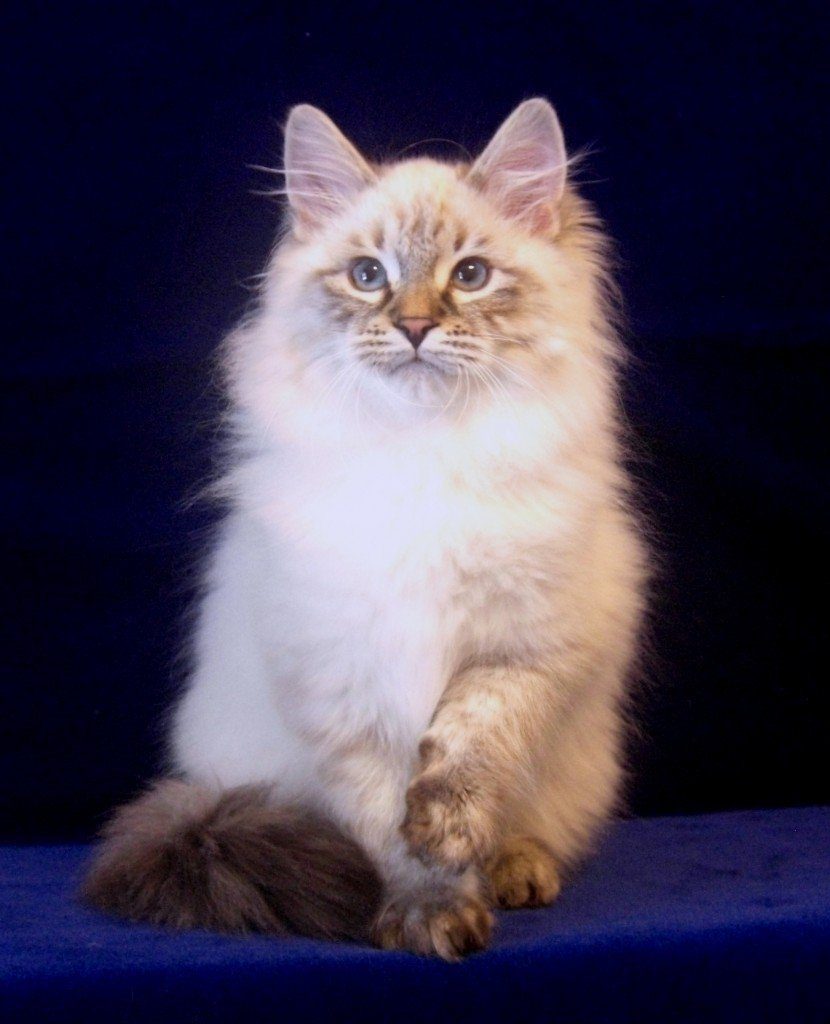
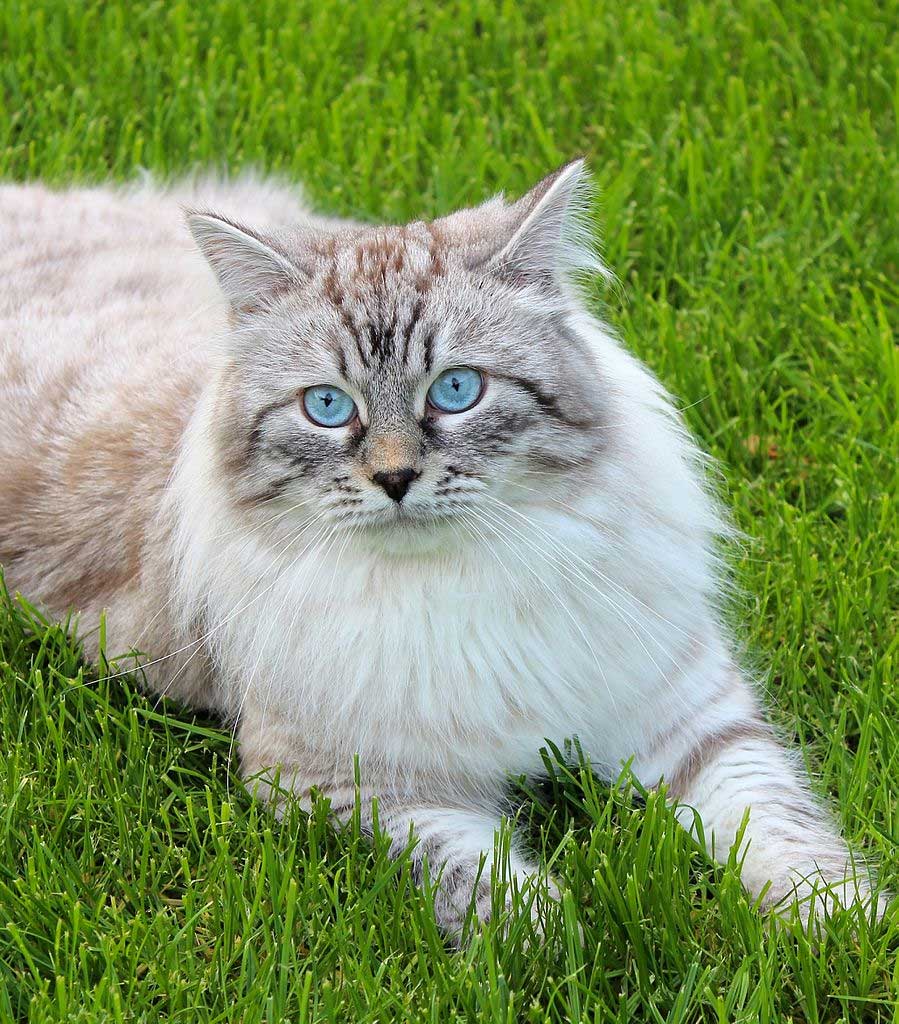
The Neva Masquerade cat it's the traditional cat Colorpoint of the Siberian cat. The Neva Masquerade has its source along the Neva River in Leningrad (now St. Petersburg). When were the other cats breeds imported to the area of Siberia, the place street cat, mixed with other races like the Balinese cat, the Siamese, Persians, himalayas, etc, the descendant States that it arose naturally.
The traditional ideal of Neva Masquerade is that of a medium-sized cat, robust, strong and long-haired. They are believed to be a mixed race based on the Siberian cat, the Persian and with bloodlines Siamese.
Mature cats are corpulent with a general appearance of strength and a pose of alert. Powerful hind legs that are slightly longer than the front. They have a natural expression of sweetness. Their fur is dense due to the weather and varies in length and coat density with different seasons.. The traditional Neva Masquerade originally withstood the rigors of the weather, the cold of his native Russia. Since then it has been adapted easily to different environments.
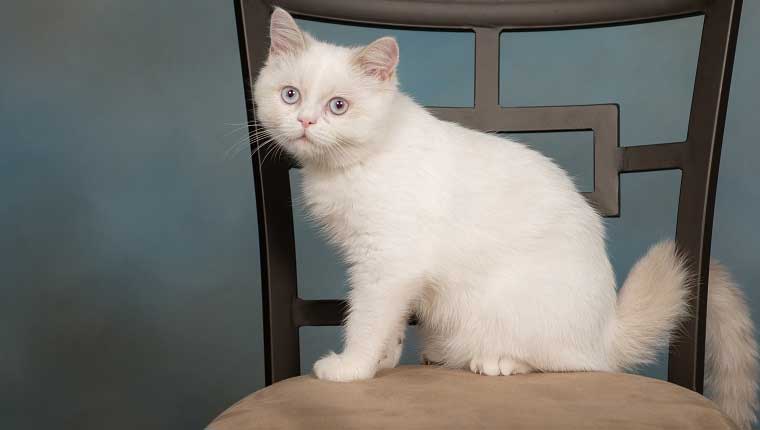
The color of your eyes it is deep blue. The ears are slightly inclined forward, a little convex. The tip of the ears should be rounded and generally with longer strands of hair at the ends.
Although the Neva Masquerade share most of the characteristics of a Siberian cat traditional (including his physique and personality), has some distinct attributes that make it special.
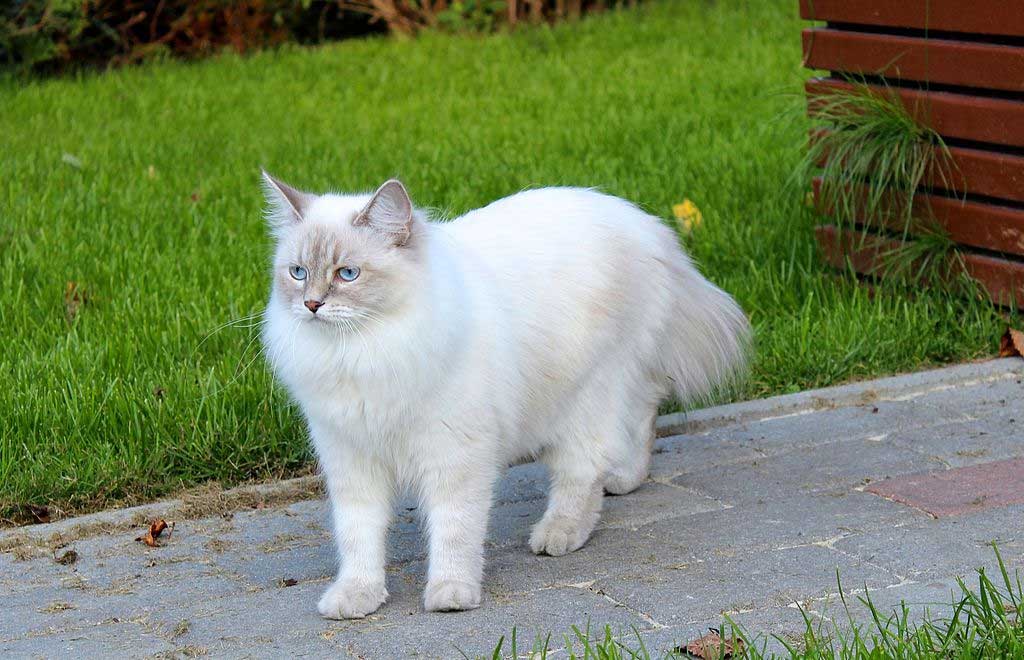
They lack the enzyme tyrosinase, responsible for the production of the pigment melanin, what gives rise to his white body.
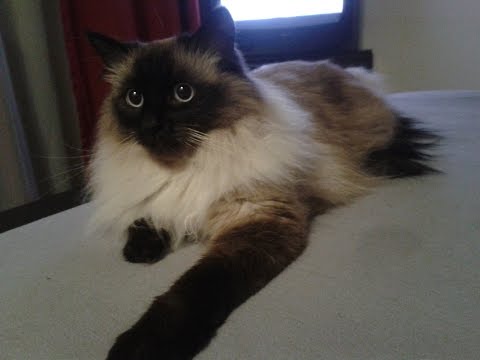
While some have black legs, gray or brown as part of your colorpoint, others may have white legs despite their dark face and ears.
The color of these cats can be of the following types:
The character of the cat Neva Masquerade It is very similar to the Norwegian Forest Cat . Although it is often described as a silent force, it is a cat that shows great vitality, has a strong personality and a strong character. One of the peculiarities of Neva Masquerade is that it is hypoallergenic.
Although he is descended from the rustic mountain cats, the Neva Masquerade it is an easy-going animal that gets along well with children, with other cats and even with dogs. This sociable character explains his success. It is also a demonstrative feline, intelligent and very communicative. As he has highly developed hunter instincts, must be able to meet your needs, what comes with the desire for freedom and independence. It is highly recommended to put at your disposal a tree so that the cat can vent.
The Neva Masquerade he is no longer the rustic mountain cat he used to be. Now, he is a very sociable cat, able to get along with everyone (cats, dogs, children…) As long as you are not in a hurry and are nice to him. Very affectionate, demonstrative and communicative, it can even be exclusive with its master or a little tail.
lively and smart, has brilliant qualities as a hunter. Sometimes you may have a certain desire for independence and freedom, but that does not prevent him from living in an apartment as long as he can vent comfortably with games, a cat tree and other entertainment sources.
Health
The Neva Masquerade it is a model of robustness. No specific disease is attributed to him.
Curiosities
Former Russian President Dmitry Medvedev he owned a well-known cat Neva Masquerade call Dorofei, who was crowned with the title of "First Mascot" in 2008.
The Neva Masquerade they have even been diplomatic gifts from Russian officials. People say that Vladimir Putin gave one to a Japanese governor, and that Dmitri Medvédev gave one to the former Finnish president.
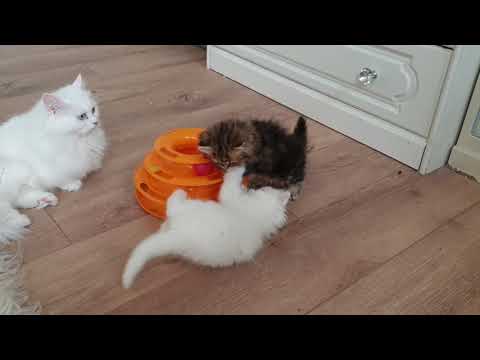
Playing with Siberian Cats and Kittens - Neva Masquerade
The Mojave Spotted was developed to preserve the bobcat in the mojave desert. The mojave desert is located in the southwestern United States, riding through California, Nevada and Arizona.
The Gato of the mojave desert was discovered in 1980 by April Langford, an American breeder. Your number has not been registered, but the colonies lived under bushes or in burrows to protect the young from the harsh desert climate.
The first colony he observed was in the small town of Hesperia, in southern california. All its members were very homogeneous in terms of their morphology: they were bigger than the domestic cats and they had powerful and raised bodies and very muscular legs that ended in feet polydactyls (of 6 to 7 fingers on each leg). His coat color was not uniform -silver, brown, gold or even black-, but they all had the same pattern of spots. Later, April Langford realized that the individuals of the different colonies shared the same appearance, except for the color of its fur.
April Langford decided to breed them to preserve this feline from extinction, endemic to mojave desert. He observed that it reproduced very slowly and began to disappear. But, his first attempts were unsuccessful, since these wild cats were not allowed to be tamed.
In 1984, accidentally found a litter of kittens under a juniper. How food was scarce during the winter, it seemed that their mother had abandoned them to survive herself. He decided to take them in instead of abandoning them to their fate. He placed them in a closed enclosure under a cedar and fed them a substitute for cat milk.. But, they were not domesticated and remained wild.
April Langford decided to cross them with him Bengal cat, also a spotted cat, which was a cross between a Domestic cat and European wildcat, the cat bengal leopard. The result was a cat thirteen with a spotted fur. But, even though they were born and raised in captivity, the first generations were still wild and were not domesticated.
At that time, to the polydactyl cats they were often called Hemingway cats, in honor of the famous American writer Ernest Hemingway. A Hemingway they gave him a gata polidáctila, which is known to have given birth to many litters.
Cats with six or seven toes on some legs are not a special breed.; on the contrary, they are found in many different breeds. It is simply an inherited genetic defect that can occur in any individual, regardless of race or gender. Most of the time, the sixth or seventh extra toes are on the front legs, but sometimes they are in the back, and even more rarely in all four. Far from being a disease or having any effect on the health of the animal, this particularity is rather an advantage, since it gives you greater agility.
April Langford decided to call the race he was trying to create Mojave Spotted, in reference both to its geographical origins and to the stains that its representatives present.
In the Decade of 1990, the natural habitat of mojave desert wildcat was being invaded by construction, and the feline, already in danger of extinction, was disappearing.
April Langford accelerated his breeding program by continuing to cross the Mojave Spotted with the Bengal cat, but also with him American Polydactyl Cat of other races. From 2007, these crosses are no longer necessary. In effect, the created population had reached a sufficient number of individuals to be able to continue breeding only from the cats already obtained, inbred.
It also, with the passing of the generations, the Mojave Spotted began to be tamed, although there is still a long way to go.
Breed recognition and popularity
The only organization that recognizes Mojave Spotted is the International Progressive Cat Breeders’ Alliance (IPCBA), an organization specialized in new breeds of cats.
So, no major body recognizes this cat, whether international -such as the World Cat Federation (WCF), The International Cat Association (TICA) o the International Feline Federation (FIFé)- or national, as the American Cat Fanciers’ Association (CFA), la Canadian Cat Association (CCA), el British Governing Council of the Cat Fancy (GCCF) o the Official Book of Feline Origins (LOOF) French. Given its extremely confidential distribution, there is little chance this will change in the near future.
In any case, the Mojave Spotted was created primarily as a reaction to the extinction of the mojave desert wildcat, to try to keep it another way, not with the aim of developing a new breed and spreading it as widely as possible.
Just a hatchery, Cheshire Cattery, with sede in EE.UU., participates in the development of Mojave Spotted. Giving cats are systematically neutered, to avoid parallel breeding and maintain control.
All of these factors combined limit the reputation of the Mojave Spotted.
Physical characteristics
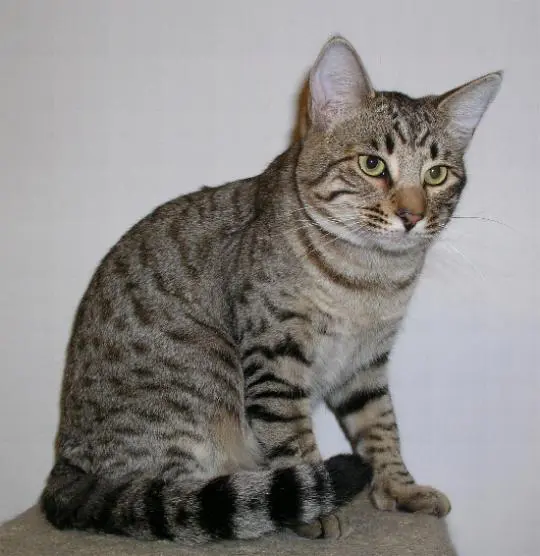
Larger than most house cats, the Mojave Spotted it's a long and powerful body type (or long and substantial).
The body have strong bones and muscles, but the skin on the belly is slightly distended, so they are not too prominent. The back is prolonged with a tail that can be short or medium long.
The legs they are long, wide and very muscular, slightly larger at the rear than at the front. The vast majority of individuals are polydactyls, that is to say, have of 6 to 7 fingers on one or more feet. This specificity is due to a dominant gene, that is to say, it is enough for an individual to have inherited this genetic mutation from one of their parents to be thirteen. In general, the phenomenon is symmetrical, that is to say, affects both hind legs (that normally only have 4 fingers) or the front two (in which there are usually 4 fingers and a spur), the latter being the most common case. Some individuals are even polydactyls on all fours. In all cases, the claws are powerful and sharp.
The head it is quite fine, slightly oval and medium in size. Ears are medium to large, with a wide base and rounded tips. Some individuals have a tuft of hair at the base. The eyes they are big, oval and widely spaced. The snout it's wide, short and square. The leather of the nose, that is to say, the part where the nostrils meet, it is solid pink, black or brown. Last, whiskery areas are prominent.
The fur of the Mojave Spotted it's short and silky. Accepted colors and patterns are brindle, the leopard, snow leopard, the rose window, Marten, Brown, the fawn, the silver, blue and charcoal. On the other hand, the coat has dark spots that may fade with age.
But, remember that the Mojave Spotted is still a very new and developing breed. So, It is possible that, in the future, and in particular in the context of a possible recognition by some important organization, details are added about the appearance that this or that part of your body should have. It also, there may also be changes in your current appearance.
Varieties
The Mojave Spotted comes in 4 varieties:
Mojave Spotted short-tailed polydactyl;
Mojave Spotted semi-long-tailed polydactyl;
Mojave Spotted short-tailed;
Mojave Spotted medium long-tailed.
The same litter can combine representatives of the four varieties.
Apart from differences in the number of toes or the length of the tail, all individuals of the breed have the same physical appearance and temperament.
Character and skills
The Mojave Spotted developed a handful of decades ago in response to the extinction of the mojave desert wildcat. Numbers are still low, so you have to be cautious when generalizing about their temperament. But, whatever the individual observed, your wild ancestors are never far away in your family tree. Although he appreciates the company of man, this wild cat is still very independent, and only with successive generations is domestication possible. In any case, it is difficult to have him locked up, so you can't be happy in a flat, even more so when it is very active and its hunting instinct is still very present.
They need a garden to thrive, and they won't hesitate to explore beyond it if they get the chance: it is difficult to contain them in a concrete environment. In fact, being extremely curious, they usually have a strong desire to exceed the limits of their territory. Agile and athletic, they don't get tired of climbing trees, search and capture small prey, and even playing in the water, as they are one of the few cat breeds that love water.
As the breed is still new and developing, it's hard to say if he Mojave Spotted will eventually behave like most house cats, and when will, as successive selections are made. But, it is true that with each new generation, being increasingly away from the wild cat, becomes a little more tame.
Health
Since the Mojave Spotted is still very new and is in full development, information about your health and, in particular, about the possible diseases to which you are predisposed.
On the other hand, a trait inherited from European wildcat from which it descends, and that explains in part that the latter is close to extinction, is its very low fertility. the number of litters (from one to three a year) is comparable to domestic cats, but instead the number of kittens they produce (of 1 to 3 at most) is significantly less. Obviously, this is not unrelated to the fact that the number of specimens of the breed grows very slowly.
▷ The world of Pets: Dogs, cats, birds, reptiles, amphibians
Coexistence is important that you have with your new friend. Before considering the acquisition of a cat of the breed "Minuet cat (Napoleon)" you know certain factors. You must take into account their character, their need for exercise, their interaction with other pets, their care and if you have small children, their level of tolerance towards them.
Joy
5,0 of 5 stars (based on 1 review)
Activity level
4,0 of 5 stars (based on 1 review)
Friendliness to other pets
4,0 of 5 stars (based on 1 review)
Friendliness to children
5,0 of 5 stars (based on 1 review)
Grooming requirements
3,0 of 5 stars (based on 1 review)
Vocality
3,0 of 5 stars (based on 1 review)
Need for attention
4,0 of 5 stars (based on 1 review)
Affection towards its owners
5,0 of 5 stars (based on 1 review)
Docility
5,0 of 5 stars (based on 1 review)
Intelligence
4,0 of 5 stars (based on 1 review)
Independence
2,0 of 5 stars (based on 1 review)
Hardiness
4,0 of 5 stars (based on 1 review)
History
The Minuet cat or Napoleon It is a recent breed of cat originally from the United States.
A fine June day 1995, Joseph Smith, an American breeder of Basset hounds, came across a photo of a Munchkin cat and an article in the Wall Street Journal about this cat, also known as basset cat. He was immediately drawn to the breed and its distinctive features: short legs (as the Basset hound that he was raising), round and expressive eyes, and the absence of a stop in the nose. He noticed that individuals with long legs that did not conform to the breed standard looked like feral cats.
He decided then to create an original breed of cats, including both short-legged and long-legged individuals, being the length of the legs the only difference between both. The first would be the only ones strictly in accordance with the breed standard, but the latter would be kept for use in the breeding program.
Turned to her friend Deb Kenny, creator of persian cats, who decided to help him in his research and over time became his mentor as his project progressed.
The two enthusiasts were first interested in the gene for short legs. This is the dominant genre, call M of Munchkin, is a spontaneous genetic mutation. But, an individual who inherits an allele M of each of his parents, that is to say, What is it homozygous for this gene, it is not viable. So, it is not a question of raising two short-legged individuals, since otherwise you will have a litter in which, average, half of the individuals are not viable. The only way to obtain viable short-legged cats is to breed a short-legged individual (a Munchkin) with a long-legged individual. In this way, all kittens are viable: the 50% of them have short legs (are heterozygous in the gene M), and the 50% have normal-sized legs (are homozygous in the gene for long legs).
Joseph Smith y Deb Kenny They then dedicated themselves to selecting the breeds with which they would cross the Munchkin. His choices were:
The Traditional Persian cat, also called Persian "doll face", what is the traditional appearance of the breed. It has a round general shape, a moderately long nose, rather short legs and a long angora coat, silky and dense. For the latter all colors are accepted, except the colourpoint;
The choice of these races was intended to give the Minuet a rounded overall appearance, a coat with all possible colors (colourpoint or not), and legs that can be both short and long. It also, the exclusion of the possibility of crossing with the Peke Face Persian (flattened nose) allowed to avoid the respiratory problems inherent in this variety.
The breeding program started in 1996 when Joseph Smith bought a female Munchkin (whose grandmother was Persian) to Penny Squires of Penhaven Munchkin Cattery and Deb Kenny provided him with a male of Exotic shorthair cat. The following year they reproduced and gave birth to their first litter. The initiative was successful, since the kittens obtained had the desired characteristics.
They called the new breed Napoleon, in reference to the first French emperor, and more specifically its small size.
Breed recognition
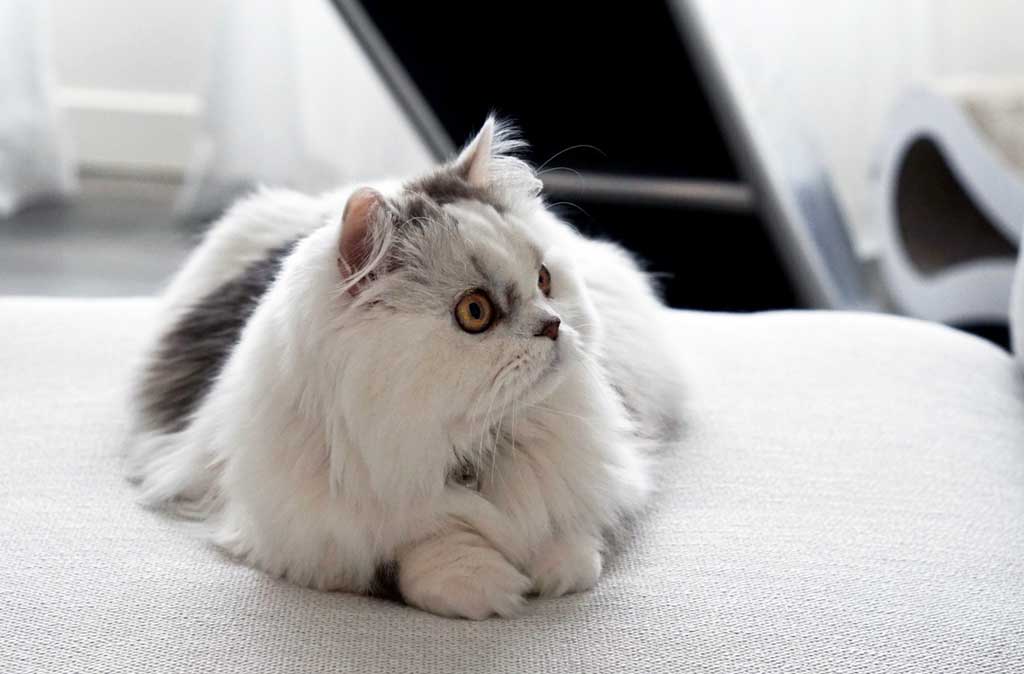
A long-haired white and gray hair minuet cat – Parkerwh, CC BY-SA 4.0, via Wikimedia Commons
The Minuet cat (Napoleon) inherited the controversies of the Munchkin and of the Persians.
In fact, since its creation in the United States in the decade of 1980, the Munchkin cat has been the subject of numerous disputes. In fact, Both breeders and some official bodies considered that raising a breed with a physical malformation (short legs) it was unethical.
With regard to the Persian, was beginning to be criticized, especially since the then recent appearance of the varieties Himalayan cat and Exotic shorthair. Not to mention the Traditional Persian cat «Peke Face«, that had already appeared in the 30s… In effect, your flattened face and flattened nose cause breathing problems, while her bulging eyes are the source of tear duct problems. Remember that Joseph Smith was careful not to introduce any Traditional Persian cat «Peke Face» in your breeding program, precisely to prevent the Napoleon cat suffer those problems.
In these conditions, it is easy to understand that the recognition of Minuet cat (Napoleon) by the different feline organizations, whether international or national, it was not a bed of roses.
Joseph Smith and Deb Kenny they then received the help of important support, in the person of Gloria Stephens, judge of the International Cat Association (TICA) and Solveig Pflueger, president of the organization's genetics committee.
The former helped them draft the breed standard, while the latter defended it internally. His efforts paid off in 2011, when the TICA recognized the breed provisionally. But, in 2015, TICA decided to change the name to Minuet, much more consensual. In fact, the reference to the French emperor could be considered an insult, although it was indeed small. The following year, the breed obtained the full recognition of the TICA, so their representatives were able to compete in the feline exhibitions organized under the auspices of the organization.
It could be that the latter emulates in the coming years, but at the moment neither the Fédération Internationale Féline (FIFé), not even World Cat Federation (WCF), have taken the step in turn. The benchmark feline organization in the United States, the Cat Fanciers’ Association (CFA), does not recognize the Minuet, nor do the national organizations of other countries: the Canadian Cat Association (CCA), the Governing Council of the Cat Fancy (GCCF) British, the Livre Officiel des Origines Félines (LOOF) French… I.e., much work remains to be done to get people to talk about Minuet cat around the world.
Popularity of "Minuet cat (Napoleon)"
As often happens with new breeds of cats, the fame of Minuet is essentially limited to your country of origin, United States. even there, this knowledge is relative, although its recognition by The International Cat Association (TICA) in 2016 has obviously given you some visibility. Of course, things could speed up if other organizations followed suit.
In the meantime, there are about twenty breeders of Minuet in United States, but the breed has also started to spread a bit in other countries.
There are a handful of breeders in Australia, South Africa and France.
Physical characteristics
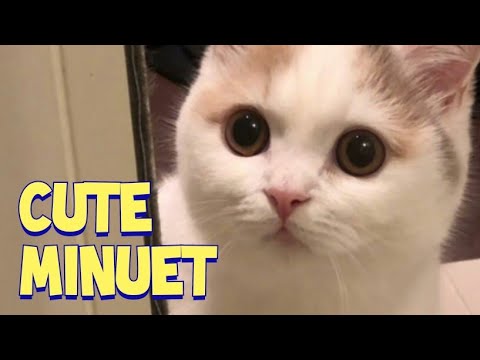
Minuet cat (Napoleon)
The Minuet cat It is a breed of cat of the short-lived type (o cobby) distinguished by its short legs, inherited from Munchkin cat. Otherwise, owes most of its physical characteristics to the Persian, starting with its general anatomy all round (body, head, ears, eyes…).
Built around a wide rib cage, his body is muscular and has a strong bone structure, with firm shoulders and hips. The tail it is medium in size and bushy. If the cat has a long coat, the hair he has is similar to that of feathers.
The legs they are muscular and short; the front ones are even shorter than the rear ones. May have a slight curve on the inside. The feet They are round, and in long-haired dogs they have tufts of hair.
The head rests on a short, strong neck and is small and wide. The head contour is completely round from all angles. The cheeks they are round and full, without being rounded. The nose is wide and moderately short, without being crushed. The eyes they are big, well rounded and have a soft and soulful expression. They can be of any color, and some subjects have them vairones (one eye of each color). The ears they are small to medium in size, widely spaced and rounded at the tip.
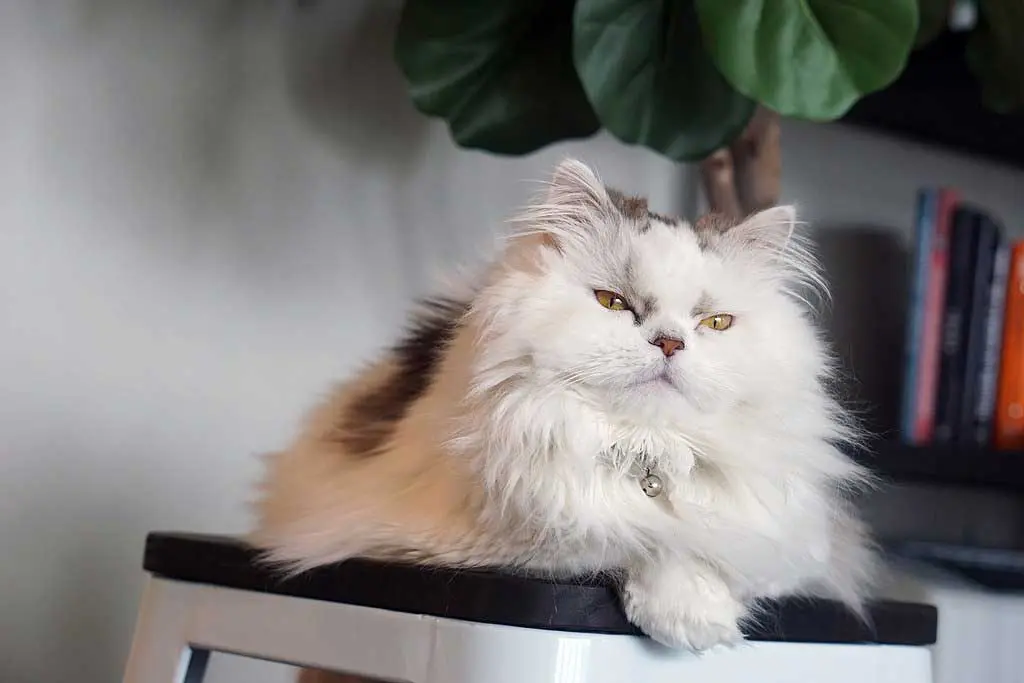
The Minuet it comes in two varieties, with shorthair cats and longhair cats. The only difference is the length of the fur, and both have a very dense undercoat.
On the other hand, regardless of length, the coat is soft and silky. It also, all the colors and patterns are accepted by the breed standard.
Last, this breed is characterized by the almost absence of sexual dimorphism: males and females are nearly identical in size.
Also keep in mind that, although officially they are only considered Minuets short-legged individuals, litters also include an average of long-legged individuals. Apart from this difference, they are identical in everything to their brothers and sisters. Its existence is essential for the survival of the race, since reproduction between two short-legged individuals is not possible: a good fraction of the individuals simply would not be viable. So, a short-legged individual can only reproduce with a long-legged individual.
Breed standard
The breed standards are documents produced by official bodies that list the conditions that a dog must meet. Minuet cat to be fully recognized as belonging to the race:
Apart from the length of its fur, there is nothing that distinguishes one from the other, neither in appearance nor in temperament.
On average, litters also contain kittens with half long legs, that can also be short or long hair. They are not recognized as Minuets for its long legs, but they are absolutely essential for breeding programs. In fact, two short-legged cats cannot breed together, since some of her kittens would be homozygous for the short leg gene and, Therefore, they would not be viable. In any case, apart from the length of its legs, these cats have exactly the same characteristics as those with short legs.
Character and skills
"Minuet cat (Napoleon)"
Minuet cat (Napoleon)
The Minuet cat has inherited the calm and kindness of his ancestor the Persian cat, but also the energy and curiosity of his other ancestor the Munchkin cat.
It is a very affectionate cat, who knows how to make his family happy. This is especially true of children.: as soon as they are old enough to know how to treat an animal with delicacy and respect, they find in him an enthusiastic playmate, and vice versa. But, even if it's not aggressive at all, should never be left alone with a small child, and this is applicable to any race.
But, they are still one-person cats, which means they have their own person, usually the person who spends the most time caring for them. He is very possessive of her, follows her around and doesn't miss the opportunity to snuggle with her or sit on her lap.
But, the fact that your relationship with a person is special should not hide that you are very sociable and get along well with all members of the family. In fact, it is ideal for him to have a human presence by his side almost all the time, since he is very reluctant to be alone. So, they are not suitable for people who are away from home most of the day, that it would be better if they chose an independent cat breed.
On the other hand, his fondness for humans is not limited to those he knows. Sociable and confident, do not mistrust strangers, and they even approach them to be caressed. You have to be careful so that this is not counterproductive on occasion.
His sociability also extends to his peers. Usually, they get along well with other cats in the same house, as long as, of course, don't be aggressive with them. This company can also help you better cope with the temporary absences of your masters.
They are also among the cat breeds that get along well with a dog., as long as, of course, they themselves be friends with cats. But, if the cat is not used to living with the canine species from an early age, introductions and coexistence should be done very gradually.
Regarding coexistence with birds and small rodents, being the Napoleon cat peaceful in nature, everything is generally fine, as long as everyone has their own space.
Last, the Minuet he is very active and playful. Toys for cats that stimulate their intelligence are a good way to stimulate them both physically and mentally, as you tend to be a bit lazy and sleepy if you have nothing to do. In any case, its high level of activity does not make it incompatible with life in a flat, to which he is perfectly capable of adapting if his master does not live in a house with a garden.
It is also very curious, and does not hesitate to make up for its small size by standing on its hindquarters, how does a «Suricata«, to better observe in height. It also, although their legs are short, is able to jump on a chair, a bed or a low cabinet. But, better get him a cat tree that fits his size, otherwise you will not be able to fully enjoy it.
Health
"Minuet cat (Napoleon)"
Minuet cat (Napoleon)
As the Minuet cat it is of recent creation, there is still no information about it, but seems to be in solid health.
It is able to adapt to all climates. But, in hot weather, it is important to ensure that you always have shade and fresh water at your disposal.
It is not surprising that the diseases to which he is predisposed are those of his ancestors. Persians and Munckin:
waterfalls, that cause degeneration of the lens of the eye and, long-term, the blindness. If the retina is not affected, the animal can be operated on to regain sight;
The renal polyquistosis, a hereditary genetic disease that also affects the Persian cat and to the Himalayan cat, and for which there is no treatment. Leads to cysts in the kidneys and leads to life-threatening kidney failure;
The feline hypertrophic cardiomyopathy, which can be inherited and causes the myocardium to become abnormally large. It is often asymptomatic, but puts the animal at risk of sudden death. But, can sometimes manifest with a rapid heart rate, vomiting and listlessness. There's no cure, but there are treatments that can improve the daily life of the cat;
The lordosis, a genetic deformation that causes excessive curvature of the spine. May cause pain with age;
The had, a skin condition caused by a fungus, it is highly contagious and can be transmitted to humans as well as other animals. The most important symptom is the appearance of scaly lesions with hair loss on the skin or at the base of the claws., without the animal frantically scratching.
As in the case of any race, it is best to go to a breeder of Minuet conscientious to maximize the chances of adopting a healthy kitten. They must be able to provide a veterinary certificate of good health, details of vaccinations administered and the results of any genetic tests performed on the parents or kitten, to reduce the risk of inherited diseases.
It also, like any other breed of cat, the Minuet you should not miss your review with the vet, that must be done at least once a year. In addition to allowing the professional to check its general condition and detect any problem as soon as possible, it may also be the occasion to carry out your vaccination booster.
Another rule of thumb to keep your cat healthy is to make sure his worm protection is up to date.. So, it is up to the owner to renew it throughout the year, whenever necessary.
Grooming
The Minuet Cat's coat requires different care depending on whether it is short-haired or long-haired.. In the first case, one brushing a week is enough. In the second case, of 4 to 5 brushed is not too much.
During your annual molt, in spring, it is better in both cases to do a small daily brushing, to help you get rid of dead hairs. This avoids excessively long sessions at less regular intervals, to which I might be reluctant.
In any case, it's a good idea to start the session with a wide-toothed comb and finish with a wide-bristled backcombing brush.
Queue can be a problem, since knots are easily formed – especially in long-haired dogs, knots are easily formed. It is useless to insist if they do not unravel: it is better to cut above the knot.
It's also important to take a few minutes once a week to clean your cat's eyes with a damp cloth.. This is also an opportunity to check that there are no injuries to the eyes., and they are not beginning to be covered by an opaque veil, a sign of cataracts, to which this breed is prone.
It is also very important to clean their ears with a damp cloth once a week to avoid infections. (otitis, etc.).
You also need to brush your teeth regularly, using a cat-friendly toothpaste each time. This will prevent tartar build-up., that not only can cause bad breath in cats, it can also be the cause of more or less serious diseases. If your cat is used to daily grooming sessions, it is best to use them to brush your teeth every day. In any case, it is better to avoid doing it less than once a week.
It is also important to check the length of your nails every month to prevent them from being too long.: they could not only hinder, but also break and potentially injure yourself. If you have access to the outside, natural wear and tear is usually enough to file them down. But, if you do not have access to the outside, it is usually necessary to cut them manually. By the way, if you live in a flat, it is essential that you have a scratching post at your disposal. Otherwise, be tempted to scratch furniture or curtains.
Every owner must master the necessary gestures for the maintenance of the coat, the eyes, the ears, the teeth and claws of his companion. The first time, it is advisable to learn how to do it with a veterinarian or a professional groomer, because inappropriate gestures could injure or even harm the animal.
In any case, You should not hesitate to start quickly after the cat arrives at your home.. In fact, the sooner a cat gets used to being handled, more easily accept different treatments. In fact, as long as the owner knows how to do it and does not hesitate to rate them with caresses and small attentions, these maintenance sessions can become privileged moments with your animal, so close to his humans.
Food
Like all other races, the Minuet you need a quality diet appropriate to your age and activity level to make sure you get all the nutrients you need.
It also, although the breed is not prone to obesity, you need to monitor your weight at least once a month. In case of an unjustified weight gain that is confirmed or even accentuated in the following measurements, it is essential to go to a vet. Only a professional can diagnose the origin of the problem (improper diet, drug intolerance, disease, etc.) and indicate how to remedy it.
The same happens if the little feline loses weight abnormally.; this may be a symptom of polycystic kidney disease, to which you are predisposed.
Last, like any cat, the Minuet you need fresh water at all times.
For sale "Minuet cat (Napoleon)"
The Minuet It is a very recent and not very common breed of cat.. Thus, outside your country of origin, United States, can be difficult to get one, or at least need to wait many months on the waiting list.
In any case, the price of a kitten Minuet often haunt them 1200 EUR.
whatever the country, the price depends on the reputation of the breeder, of the lineage from which the animal comes, but also and above all its intrinsic characteristics; It is this last point that explains why different quantities can be given within the same litter..
In the case of a purchase abroad, It must be taken into account that transport costs and administrative costs are added to the purchase price. It also, we must respect, of course, legislation on the importation of animals.
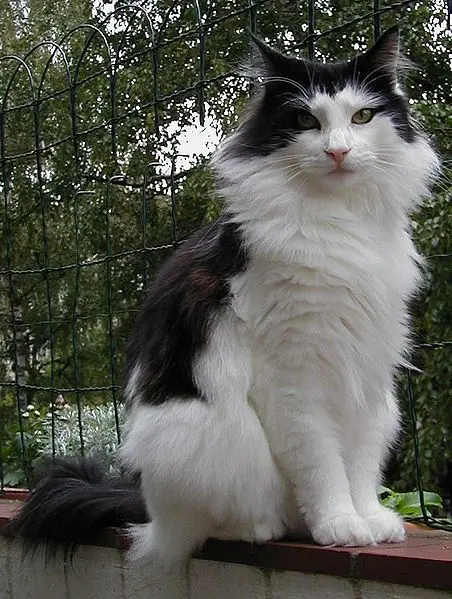
The only true thing about the cat Norwegian Forest Cat It's an ancient race.
The legend, He says that he is none other than the troll of Scandinavian fairy tales cat, But history suggests otherwise.
It is known that the domestic cat reached Norway by the year 1000 d. c. In addition to arrive with the gradual expansion of cats throughout Europe during previous centuries, cats arrived in Scandinavia due to the trade between the Vikings and the Byzantine Empire. Evidence of this movement are in some colors of fur, which are common in Turkey and Norway, but rare in the rest of Europe.
This relationship suggests the possibility that the gene for long hair came to Norway by the same trade routes. Long hair gave advantages to the harsh winters of the North, and became a widespread feature in Norwegian cats.
Photo: Wilkipedia
The skogkatt or skaukatt, as is known, not recognized as a race in his native land until the Decade of 1930, and only a few decades later their selective breeding was carried out.
But, Since the Norwegian Forest cat has gained acceptance in its terra and abroad, Although it remains less well known that the Maine Coon , another similar past long-haired cat.
This race, also known as wegie, continues to reflect its origins as a farm cat, and breeders sometimes refer to him as their "little lynx".
It is great, robust and muscular, and his triangular head is defined by a long nose. His glossy hair has a waterproof layer and a less thick, insulating. It still also has the personality of a farm cat.
These cats are flexible and agile, excellent hunters, and it is known that they fish. Although they are calm and docile companions, they are independent and tend to vigorously defend their territory. A Norwegian lives happily being the only cat in the house.
Alternative names:Skogkatt / Skaukatt / Norsk Skogkatt / Norsk Skaukatt / Weegie
Cat breeds: Norwegian Forest Cat
▷ The world of Pets: Dogs, cats, birds, reptiles, amphibians
The Javanese cat (Colorpoint Longhair) was inspired by breeders who wanted to take the qualities of the Siamese and alter the coat and colors to your liking. All of these breeds share similar conformaities and personality types..
Coexistence is important that you have with your new friend. Before considering the acquisition of a cat of the breed "Javanese cat (Colorpoint Longhair)" you know certain factors. You must take into account their character, their need for exercise, their interaction with other pets, their care and if you have small children, their level of tolerance towards them.
Joy
5,0 of 5 stars (based on 1 review)
Activity level
5,0 of 5 stars (based on 1 review)
Friendliness to other pets
3,0 of 5 stars (based on 1 review)
Friendliness to children
3,0 of 5 stars (based on 1 review)
Grooming requirements
2,0 of 5 stars (based on 1 review)
Vocality
5,0 of 5 stars (based on 1 review)
Need for attention
5,0 of 5 stars (based on 1 review)
Affection towards its owners
5,0 of 5 stars (based on 1 review)
Docility
2,0 of 5 stars (based on 1 review)
Intelligence
5,0 of 5 stars (based on 1 review)
Independence
1,0 of 5 stars (based on 1 review)
Hardiness
3,0 of 5 stars (based on 1 review)
History
The origins of the Javanese cat
Also known as Colorpoint Longhair, the Javanese is a fairly rare breed of cat.
Contrary to what the various exotic names might suggest, was created in the United States.
In 1978, American breeders of the Balinese cat and the Oriental shorthair cat crossed the two races to develop a new one with a personality similar to that of the Siamese cat, but with longer hair and a greater variety of colors.
Of these two ancestors, is clearly the Balinese cat the one that most resembles its general appearance: has inherited the fact that its tail ends in feather-like hairs. This explains the name Javanese, as the Indonesian island of Java is close to Bali: It, Therefore, a nod to its resemblance to the Balinese cat -although, by the way, the balinese does not come from Bali like the Javanese cat makes it Java…
The cats Javanese and balinese they differ in the colors of their robes. In the case of the first, all dress colors are accepted. For the balinese, However, only colors are allowed point blue, chocolate, lilac and seal.
The recognition of the breed
The Javanese cat (Colorpoint Longhair) has caused a lot of controversy and debate about whether this cat is really a new breed., or simply a variety of Balinese cat. Major government bodies around the world remain divided, but many consider it a variety of Oriental Longhair cat, not a separate breed.
In 1979, the International Cat Association (TICA) recognized the Javanese cat as a race in its own right, with the name of Oriental Longhair cat. But, later he changed his mind and grouped him with the Siamese cat, the Balinese cat and the Oriental shorthair cat, considering all four as one race, the group of Siamese breeds.
The Cat Fanciers’ Association (CFA) did exactly the same thing: after recognizing the Javanese cat as a distinct breed in 1986, renamed it as Oriental Longhair cat in 2002 and classified it as an Oriental variety, in the same way as the Oriental shorthair cat. In other words, unlike TICA, the CFA regards Orientals as a race in their own right, especially for its wide variety of colors.
The British Ruling Council of Feline Fantasy (GCCF) he took the same position when he recognized it in 1997: he also kept the name of Oriental long-haired and integrated it into the group of oriental breeds, where the Siamese already appeared, the Balinese and the Oriental Shorthair.
For its part, the Livre Officiel des Origines Félines (LOOF), French reference body, decided to associate the Javanese cat with the Balinese cat. Like this, considered at the Javanese as a balinese with green eyes and a wide range of coat colors.
It also, whatever the official body, accepted crosses are :
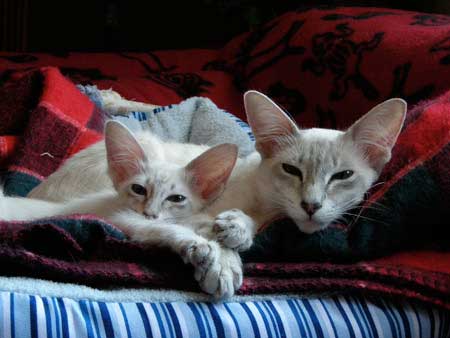
Blue lynx point Javanese Cats – Adult and Kitten Females – Wikipedia
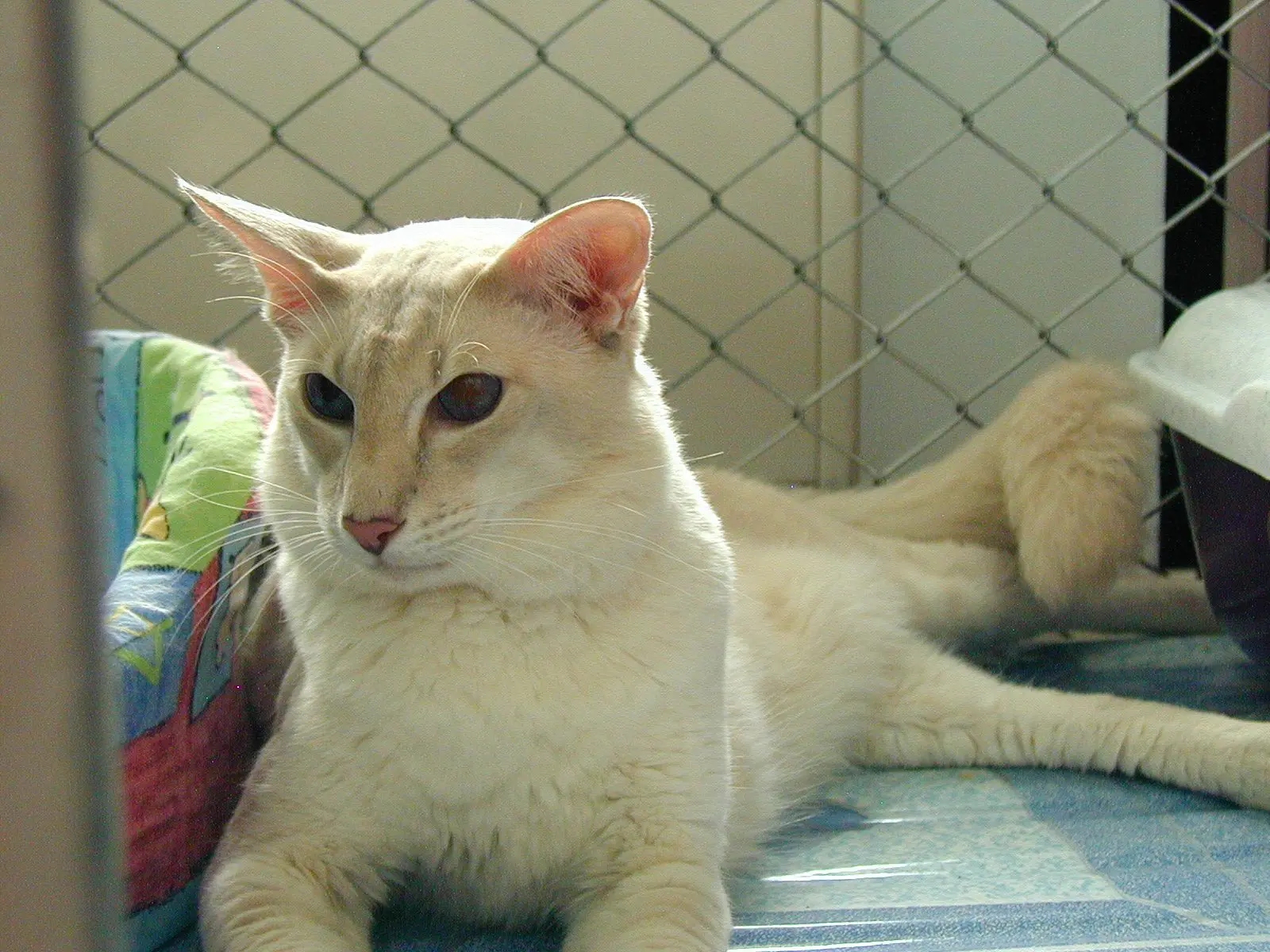
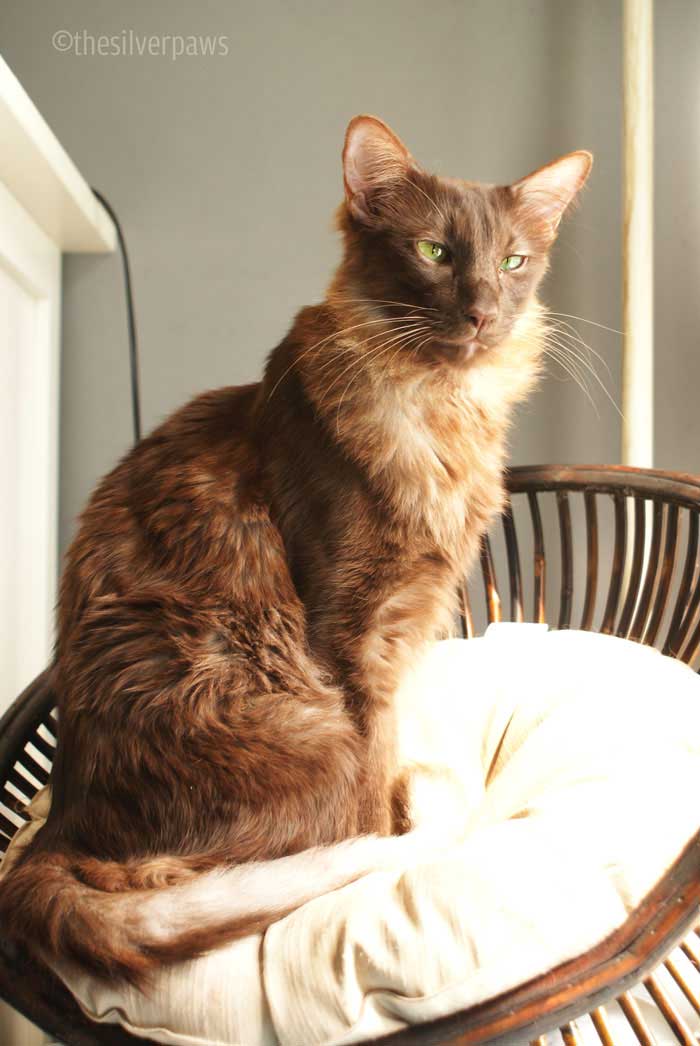
The Javanese cat has inherited the physical characteristics of the Siamese cat, from which it descends: the only important difference is that it has a long coat and can be of a greater number of colors.
It is, because, of a long-haired or oriental cat that is distinguished by its great elegance. In fact, its silhouette is very well balanced and its movements are graceful.
Medium-sized, tubular and very muscular, their body it is flexible, thin and has a fine bone structure. The tail it is also thin and tapers towards the tip, where the hair is feathered.
The Hips and shoulders they are equally wide and are attached to legs slender and well muscled. The latter are high, but the ones in the back are even taller than the ones in the front. Both legs end in small feet oval.
The head rests on a long neck, thin and muscular. It is medium in size and triangular in shape, long and narrow. The skull and the forehead are flat. The profile is straight from the forehead to the nose, which is long and thin. The cheeks they are flat, but the double chin is accepted in the male. The eyes almond-shaped, they are far apart and are usually emerald green. But, individuals with a multicolored coat may have pearly eyes, while those with white fur may have blue eyes. The ears are especially large, long and wide at the base.
The Javanese cat does not have undercoat, but a top layer of medium long hair, fine and silky, which is shorter on the shoulders. All coat colors and patterns are accepted, except the Colourpoints.
Last, the Javanese cat presents a lightweight sexual dimorphism, since the male is slightly more solid than the female. It also, the male may have jowls, which does not happen with the female.
Size and weight
Size: 30 to 35 cm.
Weight: 3 to 5 kg
Character and skills
"Javanese cat (Colorpoint Longhair)"
Oriental Longhair (also Javanese or Mandarin) in chocolate smoke – Yusui.y, CC0, via Wikimedia Commons
If he Javanese cat shares many traits with the Siamese in terms of appearance, it also has a temperament quite similar to that of the Siamese, even if you are less demanding in daily life.
But, by being at the same time intelligent, loving and playful, but also stubborn and possessive, it should be noted that he has a strong personality.
Very faithful and attached to its owners and the people with whom it lives, loves pampering, but also spending time with them and participating in family activities. It's even easier to integrate it into the family, as you can learn to walk on a leash and, Therefore, to be taken for a walk.
Gets along very well with children and enjoys playing with them, as long as you are treated with respect and attention. In any case, for the sake of both, a cat should never be left alone with a young child without adult supervision. This applies regardless of race.
It is common for the Javanese to be especially attached to a specific member of the house, who is usually the person who takes care of you the most. Combined with your curiosity, this closeness can make them a bit sticky dogs to the point of following them everywhere, sleep with them and monitor all their movements from morning to night.
By being very observant and intelligent, does not hesitate to take advantage to learn and reproduce them. That is why it is not strange to see him, for example, opening a door, a drawer or even emptying a bag.
But, it is possible to use these skills to teach your cat tricks. These may include, can teach your cat to search for and retrieve objects, just like a cat. In fact, the Javanese is an easy to train cat breed.
To keep your cat happy, it is necessary to stimulate it mentally. Enjoy games that require thought and cunning, such as kibble labyrinths or any other toy that involves difficulty. Giving him a part of his daily ration through a dispenser or toys that appeal to his intelligence is also an excellent thing., because it also helps you to satiate more quickly: this helps prevent this little wolverine from becoming obese, to which you are predisposed.
It's also a good way to keep you busy when you're away., since his attachment to his humans makes him not bear to be alone. But, as you suffer from separation anxiety, soon begins to behave destructively. So, it is preferable not to leave you alone for a long time or too often, and leave him toys to take care of when he's out. In any case, a person who spends most of his days away from home and cannot take it with him would be better off with a more independent representative of another race.
Another solution may be to share your home with another dog.; this playmate is sure to help you pass the time, and vice versa. But, things tend to go much better when he comes in second place, or when both enter the house at the same time. If you are used to being the only cat in the house and a newcomer enters, is likely to be jealous and possessive, but also to defend its territory against this invader.
Due to his closeness to family, the javanese is also a breed of cat that meows a lot. In this case, has a remarkable ability to vary his vocalizations according to the object of his request, to gradually educate their masters to recognize them. He does not hesitate to communicate with his humans and ask for all the attention he needs., generally achieving without difficulty to make oneself understood.
For seniors, this can be a bit exhausting in the long run, given the attention and response it requires. If they also have difficulty moving and he always hinders them, certain situations can even become dangerous. Again, another cat breed choice is potentially more appropriate.
In any case, the Javanese cat behaves very differently with people he doesn't know: he is as reserved with them as he is close to those he meets on a daily basis.
On the other hand, a dog with whom you share your home can be perfectly regarded as your friend, especially if you have lived with him since he was very young. Otherwise, a gradual adaptation is necessary for coexistence to work.
Although he is sociable with his family, your companions and even dogs, the Javanese cat he is still a formidable hunter. Even if you have been with him since he was very young, a rodent or a bird would never be completely safe with it, because his predatory instinct could take over at any moment.
This instinct, combined with your curiosity, makes, if you have access to a garden, do not hesitate to abandon it to follow its prey. So, there is a great risk that you will end up getting lost by getting too far away from your territory. Thus, A GPS collar for cats can be a wise investment so you know where your cat is at all times and don't worry unnecessarily.
In any case, fear of losing it is no reason to keep it locked up when living in a house with a garden. In effect, this little feline, very athletic, agile and lively, needs space to run, frolicking and climbing. It is clear that they are happier in a house with a garden, but they can get used to living in a flat, as long as it is big enough, are stimulated and have a cat tree. You should also remember to provide a scratching post if you don't have access to the outside., as furniture and curtains can be very comfortable for scratching.
Last, just because it's generally very active and moves often doesn't mean it can't also be calm and restrained at times.. Like this, their closeness to their humans is not incompatible with the fact that, like any cat, you also need your moments of solitude; everyone must respect them, since it is an indispensable condition for its development.
Health
The Javanese cat is generally in good health, although it is prone to certain diseases:
Asma, which is similar to chronic bronchitis. With proper treatment, the life of the animal is not in danger and can lead an almost normal life;
Genetic strabismus, that slightly reduces visual acuity and is not treatable;
The glaucoma, which is caused by a sudden increase in pressure inside the eye. If not treated quickly, may cause blindness;
The progressive retinal atrophy (ARP), an inherited disease that also ends up causing blindness. The difference is that it is incurable;
The hyperesthesia syndrome, a rare disease that is manifested by occasional or regular attacks, during which numerous symptoms may appear (spasms of the skin of the back, dilated pupils, frantic licking of certain areas, aggressiveness…). Treatment is possible, but it depends on the cause of the problem, which is often difficult to identify;
The amyloidosis, a rare and incurable inherited disease for which there is currently no genetic screening test. It usually occurs before the 5 years and causes kidney failure;
The periodontal disease, an inflammation of the structures that support the teeth caused by the accumulation of tartar.
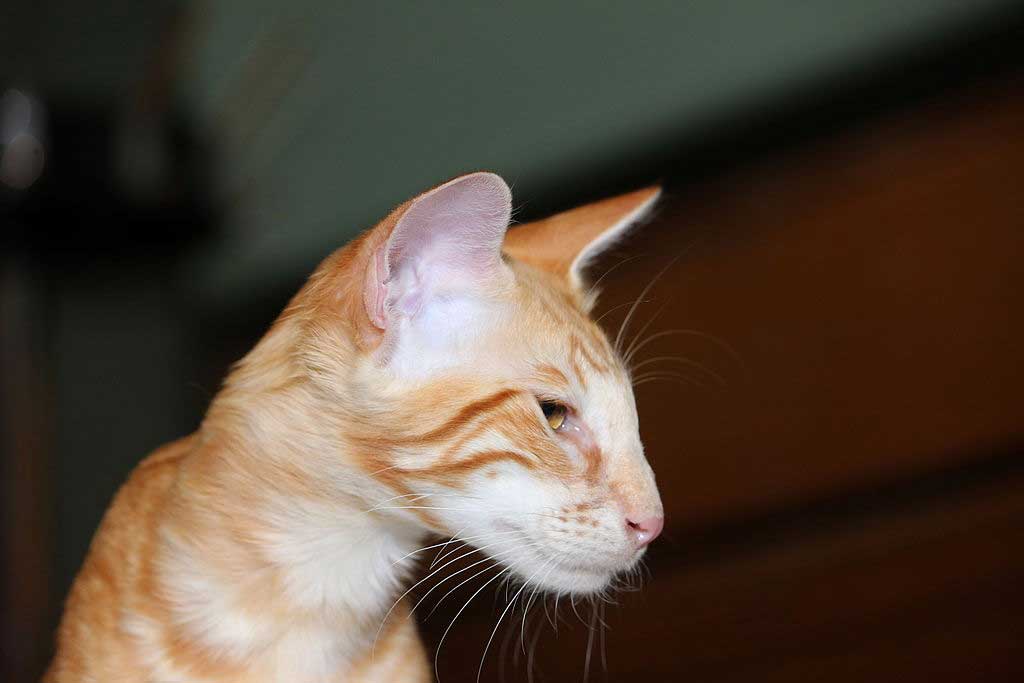
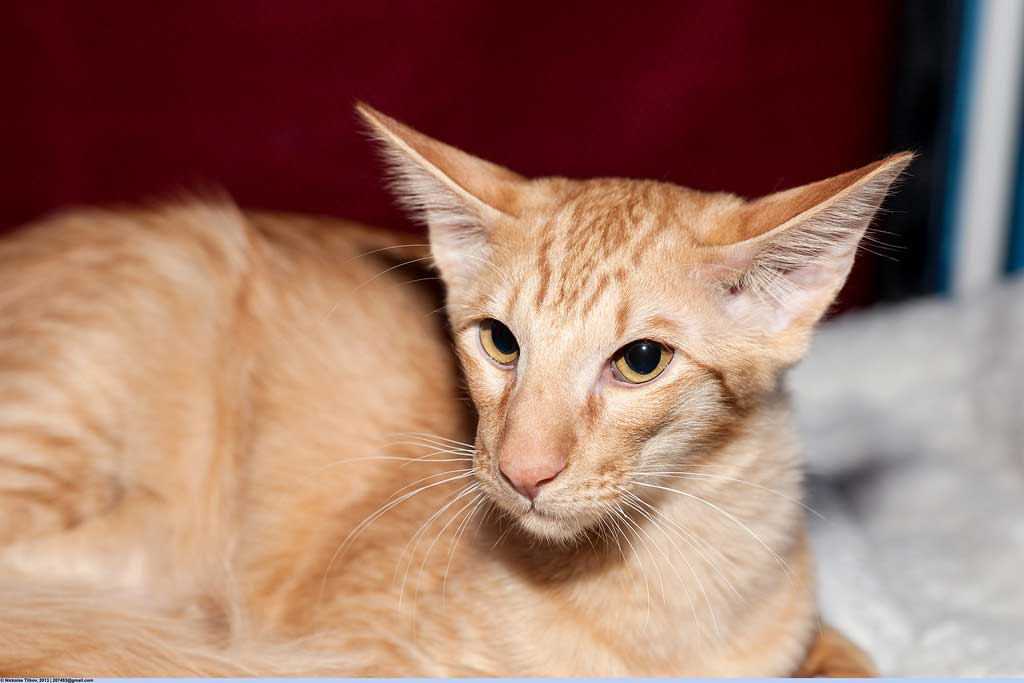
Oriental Longhair (Javanese, Mandarin), Red Classic Tabby. Name: Firefly vom Honigtöpfchen – Kamée, CC BY 3.0, via Wikimedia Commons
It also, the Javanese has a predisposition to Obesity. Easily gluttonous, you can quickly gain a lot of weight and get into a vicious circle, since an overweight animal has less desire to move and, Therefore, tends to get even fatter. Obesity can cause or aggravate many health problems. Obviously, the risk increases if the dog spends its life confined between four walls, no access to the outside world…
As with any race, adopt a Javanese cat of a serious breeder gives you the best chance of adopting a healthy animal. In addition to a veterinary certificate that certifies that the animal is really healthy, the breeder must be able to show the details of the vaccines administered to the animal (registered in your health card, or vaccination book), as well as the results of any genetic tests carried out on the parents or offspring to counteract the risk of hereditary diseases.
Once adopted, regular veterinary care is, as in the case of any feline, the best way to keep your pet in good health. In particular, a full check-up should be performed at least once a year to diagnose any potential problems as soon as possible and, at the same time, make sure you are up to date on your vaccinations.
At the same time, the owner must renew his antiparasitic treatments whenever necessary, so that your partner is always protected.
Grooming
Like any cat, the Javanese cat requires a little maintenance every week.
First of all, it is necessary to brush your coat to remove dead hairs and avoid knots. As it has no underspeed, this is quite easy.
At the same time, wiping the corners of the eyes with a damp cloth can reduce the risk of eye diseases.
You should also take the opportunity to clean your dog's ears with a damp cloth to prevent infections..
The weekly maintenance session is also an opportunity to brush your cat's teeth with a toothpaste specially designed for cats.. This prevents tartar buildup, that doesn't just cause bad breath, but it can cause various diseases, some of them very serious (like septicemia, for example). Do not hesitate to do it even more often if your dog accepts this treatment easily., especially since this breed is prone to periodontal disease.
Last, it is essential to check the length of the cat's nails at least once a month. If the cat lives outside, natural wear and tear is usually sufficient. But, if you live in a flat, this does not usually happen, and it is even recommended to do it more often. In any case, how long are they too long, it is necessary to cut them by hand, with the risk of them getting in the way or even breaking, with the risk of injuring them in the process. It also, if you do not have access to the outside, you have to provide a scraper to do your needs, at the risk of you using the furniture instead.
The first time, It may be convenient to learn from a veterinarian or a professional hairdresser the correct gestures and reflexes to take care of the coat, the eyes, the ears, your cat's teeth and nails. It also, no waiting to get started: the sooner you get used to it, sessions are more likely to go well, especially since his proximity to his master makes things easier.
Food
Oriental Longhair (Javanese, Mandarin), Red Classic Tabby. Name: Firefly vom Honigtöpfchen – Kamée, CC BY 3.0, via Wikimedia Commons
Like all breeds of felines, the Javanese cat you need a good quality diet adapted to your age and activity, and therefore to their nutritional needs.
It is even more necessary to pay attention to your diet since you tend to be overweight or even obese. In addition to providing you with adequate daily rations, it is essential to control your weight through regular weighing, At least once a month. If your dog is overweight and persists during several heavy (or even gets worse), it is essential to take it to the veterinarian. The veterinarian will be able to determine if the problem is due to a disease, a medicine that is not well tolerated or a diet that is not adequate in terms of quality and/or quantity. Once the diagnosis has been made, may propose a solution to the problem.
Last, it is absolutely essential that the Javanese cat have continuous access to available water. This is true of any cat, but even more for him, that is prone to hyperesthesia, that causes kidney failure.
For sale "Javanese cat (Colorpoint Longhair)"
The price of a Javanese cat often haunt them 1000 EUR.
But, in Europe, the limited number of breeders Javanese cat makes it sometimes necessary to have patience.
Another solution is to go abroad to get the cat. In the United Kingdom, the cost is usually about 500 pounds (a few 550 EUR). In United States, country of origin of the breed and with the largest number of breeders, the average cost is 1.500 $.
In the case of an adoption abroad, it is necessary, of course, find out about legislation on the importation of animals, to comply with it. It also, administrative and transport costs shall be added to the purchase price of the kitten.
whatever the country, the price that is requested may differ from one copy to another depending on its lineage, the reputation of the hatchery from which it comes, and, above all, of its own characteristics, especially the physical ones.




,_Red_Classic_Tabby.jpg)