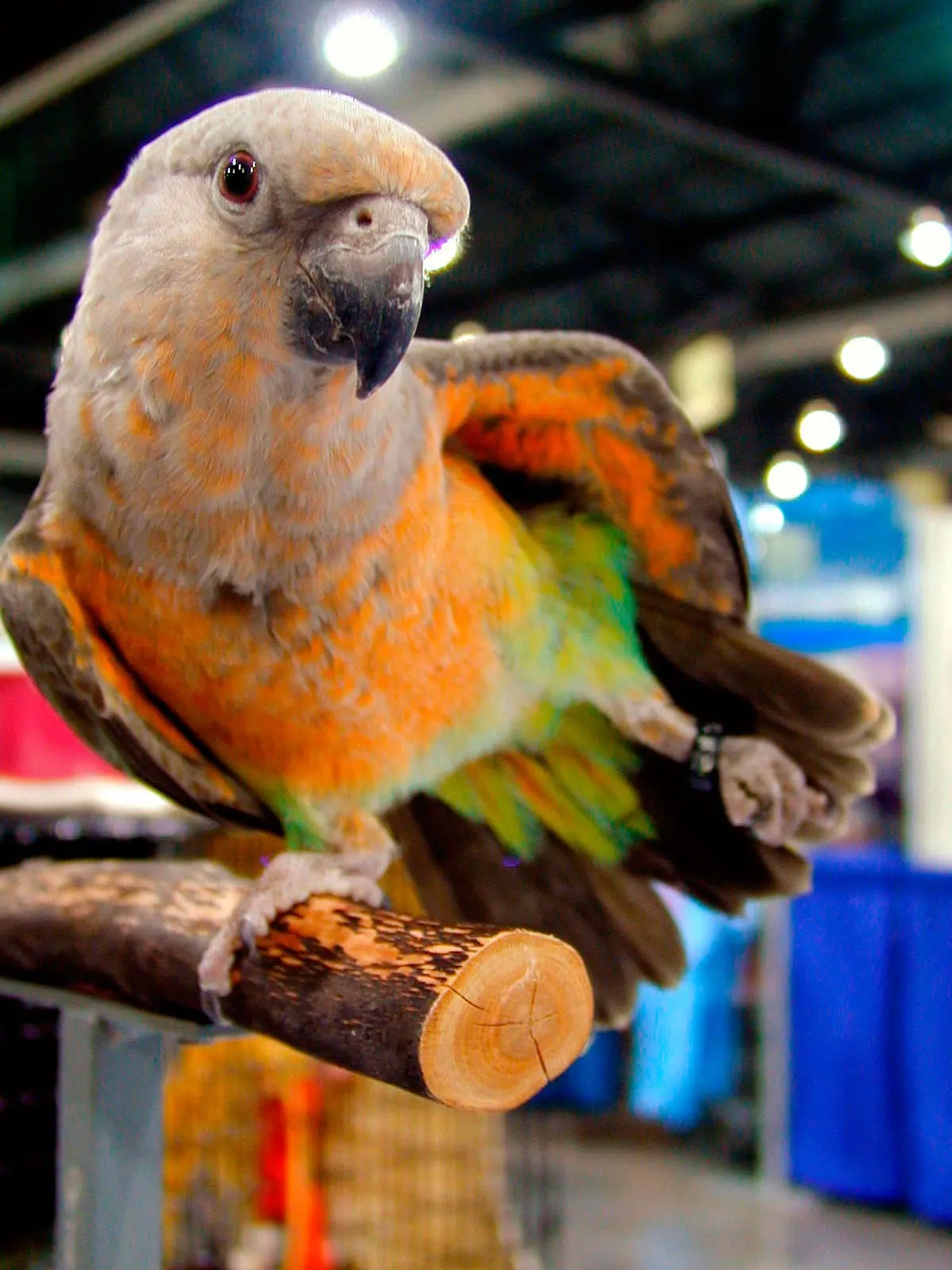
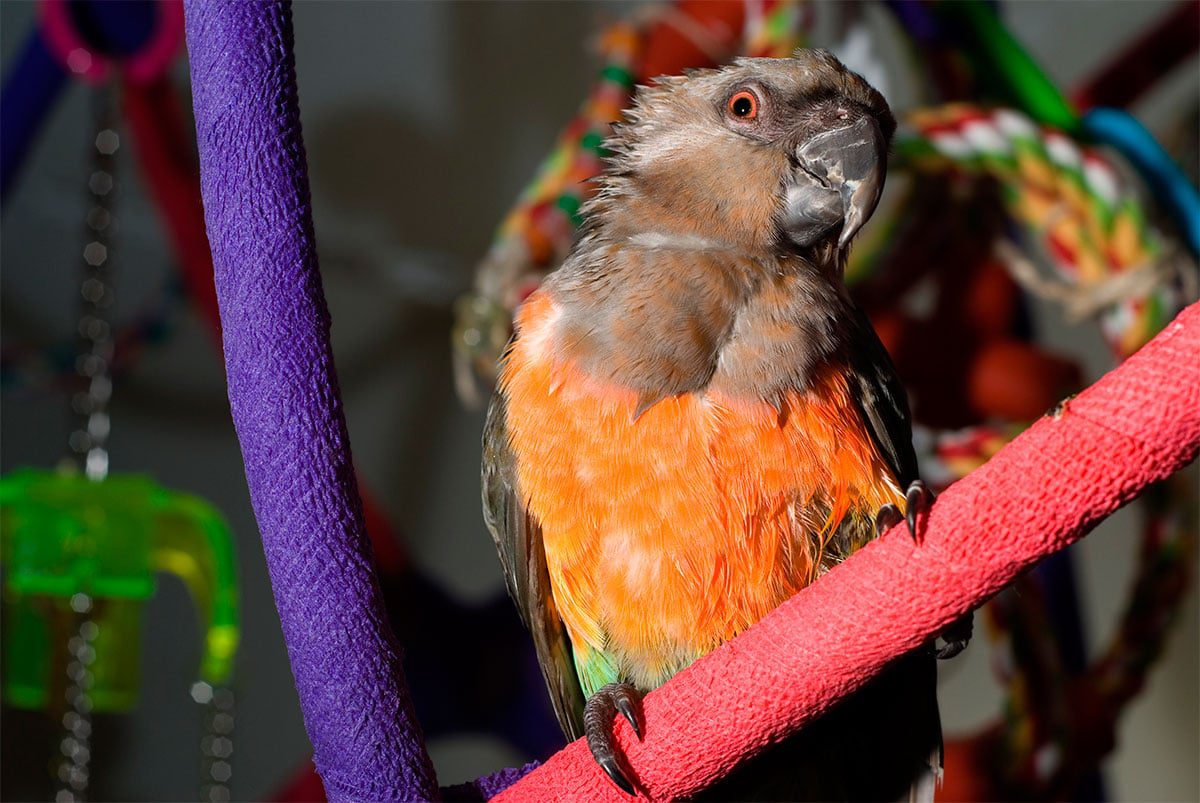
The Red-bellied Parrot(Poicephalus rufiventris) has the crown, nape and lores brown ash, the cheeks sometimes with orange tips; ear-coverts slightly paler. Mantle and scapulars brown ash; the back blue-black; rump iridescent pale blue or bluish green. Upper, the wings slightly darker than the head and back: the primaries brown. Under, the feathers of orange wings; underside of feathers Light brown flight. Throat and the chest ash brown with orange tint; top of the chest orange; belly up to undertail- coverts pale green sometimes shows Orange-tinged feathers. Tail dark brown ash.
Bill, cere and orbital skin black; irises orange-red; legs black.
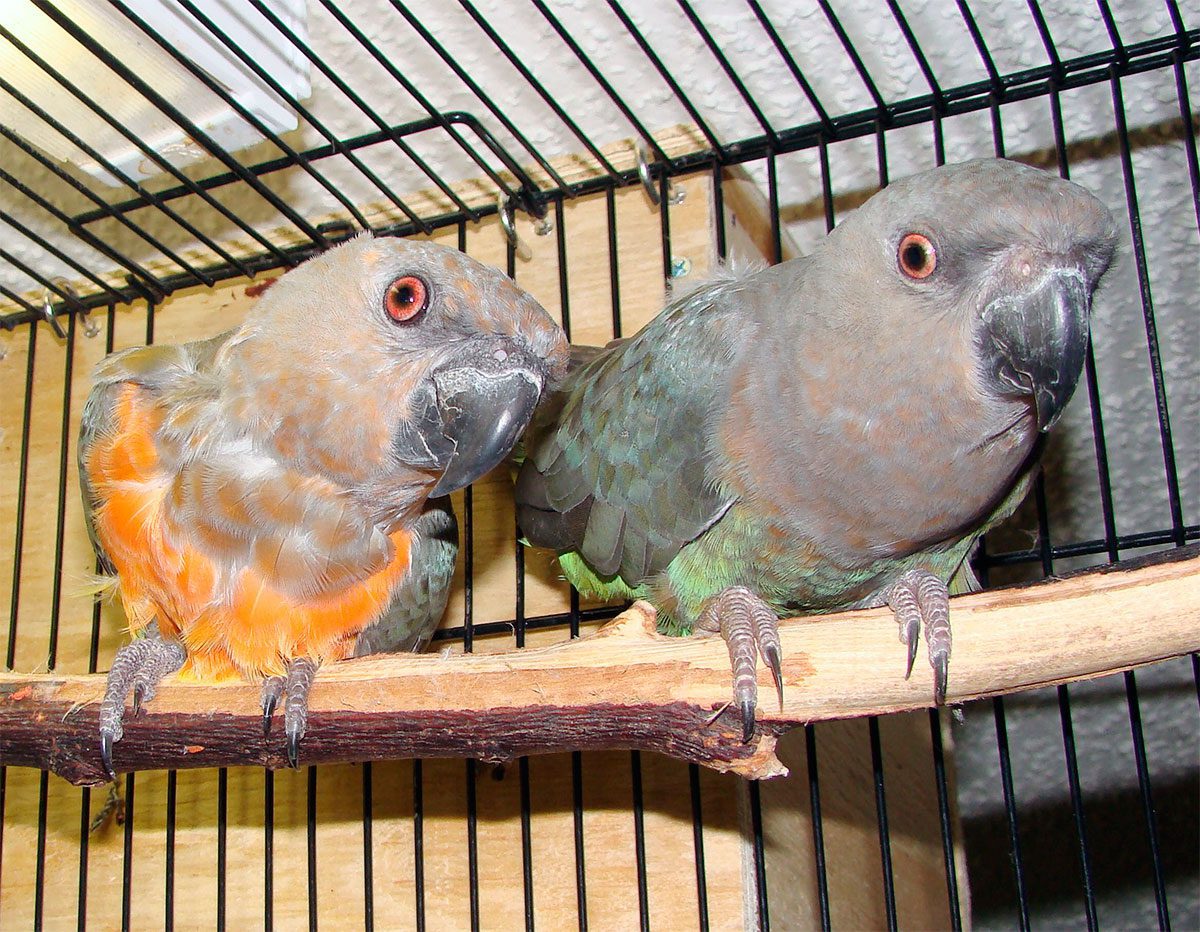
The female You have the upper chest grey, the pale green underside sometimes dyed orange. The head paler and grayer than male. Feathers of the wings greyish.
Immature, generally, similar to females, but the young males have orange feathers Wings below and can show brown marks on the chest.
Usually associated with semiarid vegetation, including areas of dry scrub and forest steppe Acacia Commiphora. It tends to avoid the dense foliage and, often it perches on dead branches.
In the south of the range, He prefers savannas Adansonia.
Where it is sympatric with the Meyer's Parrot (West range) the Red-bellied Parrot riparian forests and avoid living in the most open savannas.
In Ethiopia They can be observed in areas of savannah Acacia-Chrysopogon, up to 2,000m. altitude.
In Somalia They are subject to seasonal altitudinal movements in relation to the food supply, moving in altitude of about 2,000m from July to September in search of wild figs Ficus. Otherwise, generally below 1,400m.
Usually, seen in pairs or in family groups 3-4 birds; rarely in larger flocks.
Reproduction:
Nest in cavities within terrestrial termite mounds, between 2 and 3 meters above ground or 10 meters or more, in some dead tree.
The female incubates the eggs while the male goes in search of food, these eggs hatch after a few 28 days and start flying to the 60 days after hatching.
A female was recorded under breeding conditions during the month of March (Tanzania) and feeding immature in July and October. Registered one laying in the months of May and June Ethiopia; In Somalia, between January and May; also recorded half-grown chicks in January. In Somalia in colonial times, with individual couples baobab, between 100 and 200 meters away. The implementation is of 1 to 2 eggs.
They drink frequently and often they can be found near the water.
Due to the limited food that is in their respective regions, the Red-bellied Parrot They reach the fields and harvest crops eaten, so they are often hunted by farmers.
Distribution:
Size of the area of distribution (reproduction / resident): 1.540.000 km2
endemic to eastern Africa, from the North-East of Tanzania, eastern and northern Kenya, in the horn of africa in the southern and eastern Ethiopia (included Rift Valley) and western and northern zone Somalia.
Usually common within its range. Absent in the coastal lowlands, mainly sedentary with seasonal movements in some areas.
Distribution 2 subspecies:
Poicephalus rufiventris pallidus
(Someren, 1922) – It is found exclusively in eastern Ethiopia.
The Red-bellied Parrot It is included in the Appendix II according to CITES (The Convention on International Trade in Endangered Species of Wild Fauna and Flora) from 1981 and established as a lesser concern in the Red List of Threatened Species of the UICN since the population has fallen by more than 30% in the last 10 years. The Red-bellied Parrot it began exporting significant quantities primarily in Tanzania over the years 80. Years before it began to export to Great Britain in very small quantities.
"Red-bellied Parrot" in captivity:
In captivity is rare, although Spain Some important breeding centers have managed to bring them up without difficulty. This parrot can be purchased directly from a specialized breeding.
What pet They are very cheerful, Playful, Intelligent and affectionate, a generally peaceful nature.
They are not very noisy. He likes to climb and climb, great need to crack and it is always advisable a regular supply of fresh branches. They like to bathe.
With regard to its longevity, according to sources, a specimen lived 33,4 years in captivity.
Alternative names:
– Red-bellied Parrot, African Orange-bellied Parrot, Orange-bellied Parrot, Red bellied Parrot (English).
– Perroquet à ventre rouge (French).
– Rotbauch-Mohrenkopf (German).
– Papagaio-de-ventre-vermelho (Portuguese).
– Lorito de Vientre Rojo, Lorito Ventrirrojo, Loro Abisinio (español).
(1) – Red-bellied Parrot; a male juvenile pet parrot on a wooden perch stretching By Ruth Rogers [CC BY 2.0], via Wikimedia Commons
(2) – Mature breeding pair of Red-Bellied Parrots (Poicephalus rufiventris) on a perch in a cage. Picture taken by user:Fruitwerks at home By Fruitwerks at English Wikipedia(Original text: User:Fruitwerks on en wiki) (Transferred from en.wikipedia to Commons.) [Public domain], via Wikimedia Commons
(3) – A adult male pet Red-bellied Parrot perching on a bright red perch. Photography: one SB-600, diffused, hand held to the left and below Joey, fired with CLS, on TTL with no Compensation. By Bram Cymet [CC BY 2.0], via Wikimedia Commons
(4) – Red-bellied Parrot; a juvenile male pet parrot on a wooden perch. Shows back By Ruth Rogers [CC BY 2.0], via Wikimedia Commons
(5) – A Red-bellied Parrot at San Antonio Zoo, USA. In the male the abdomen is red-orange and in the female the abdomen is green, but the abdomen is not visible making it difficult to sex this parrot from the view shown By Zach Welty (originally posted to Flickr as Parrot 2) [CC BY-SA 2.0], via Wikimedia Commons
Origin: Bolivia, Brazil, Colombia, Ecuador, Guyana, French Guiana, Panama, Peru, Suriname, Venezuela
Character: Intelligent and social
Life expectancy: 40 years
Height: 46 cm..
Content
Description:
46 cm.. length and a weight between 285 and 387 g..
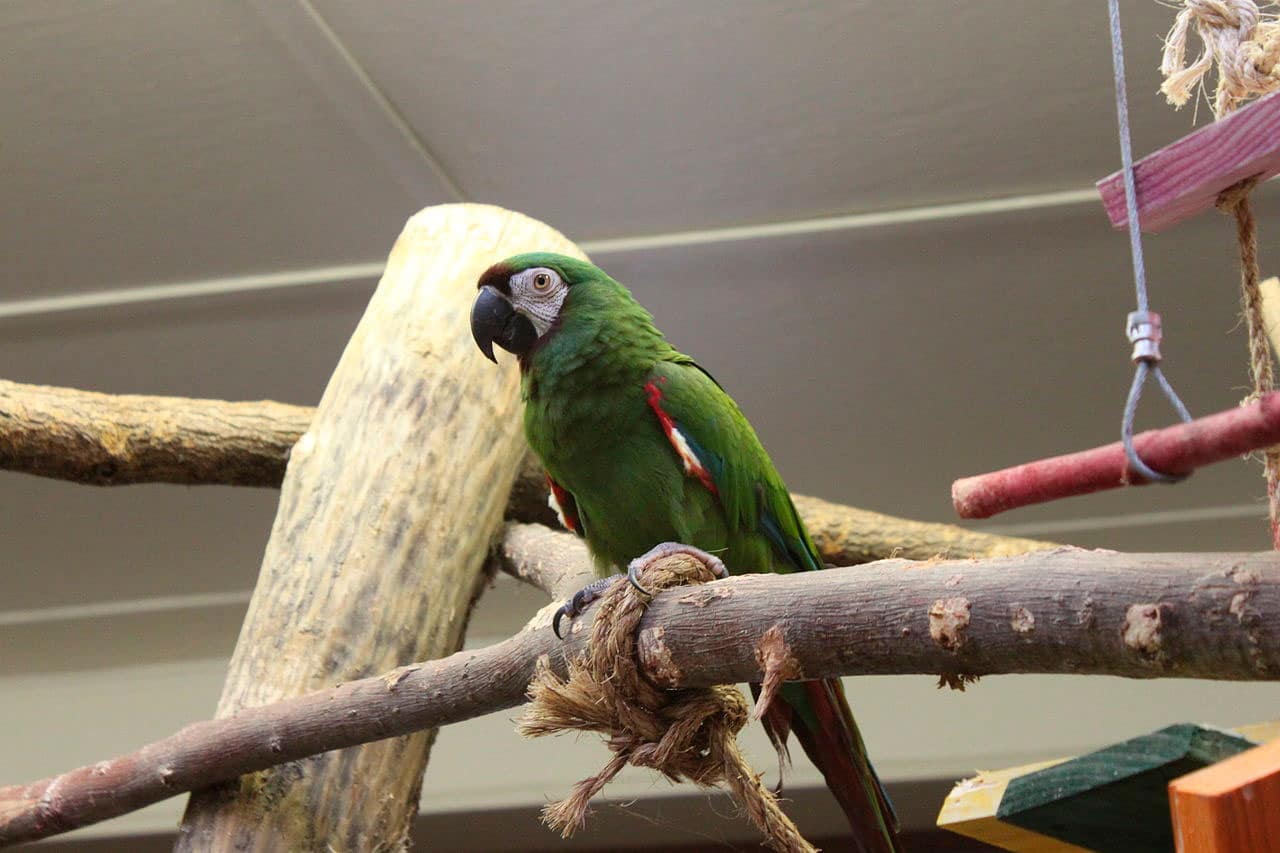
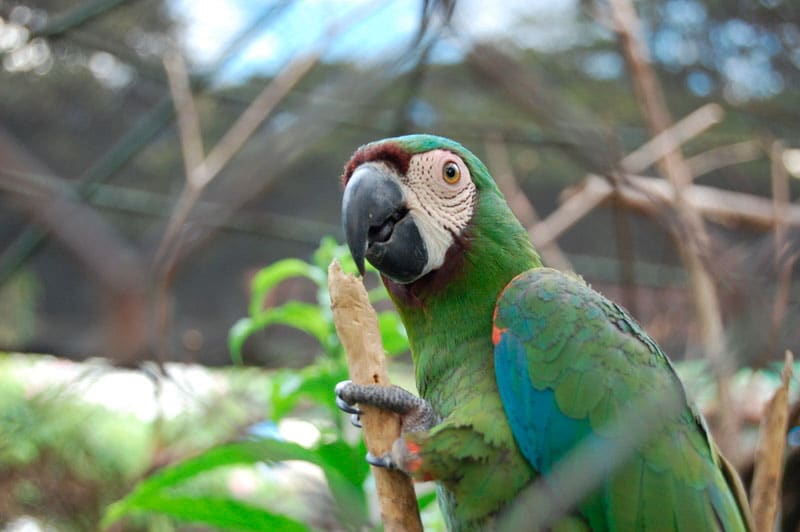
The Chestnut-fronted Macaw(Ara severus) It is a medium-sized Parrot with a plumage predominantly Green.
The male and female are almost identical and juveniles are hardly different from adults.
In the male adult, the feathers of the crown and the neck they are heavily infiltrated blue. The forecrown, chin and the area of the cheeks bordering with the bare skin of the face are brown. The curvature of the wing, carpal edge and small lower coverts are bright red. The bottom of the flight feather shows a dark red-orange color.
The tail is reddish brown with a blue tip. The bill greyish black. The bare skin of the face it is creamy white with fine lines of small black feathers. The irises is yellow, the legs grey.
The youth they are like the of adults, but have the tail shorter and the irises is grey.
The Chestnut-fronted Macaw may be confused with two species: the Blue-winged Macaw, Although this has a frontal band and stain abdominal Red and the Red-bellied Macaw Although it differs by having the facial skin yellow, and the abdomen red. On the other hand, These parrots are smaller and have a yellow color under the wings.
While they are sometimes in clearings or on the edge of this habitat, the Chestnut-fronted Macaw, in general, avoid the great forests never invaded by water. They prefer areas that are periodically flooded, secondary forests, galleries of trees that border the watercourses, oil palm plantations, meadows and pastures where there are still some scattered stands of trees.
It depends on the region, These birds live in very different elevations of up 1000 metres in Colombia, 1500 meters in the South of Ecuador, and only 350 metres in Venezuela.
The Chestnut-fronted Macaw, usually, they live in pairs or in small groups. However they can form large gatherings when dorms are set or when food resources are abundant.
The Chestnut-fronted Macaw, sometimes, they feed in the company of the Red-bellied Macaw (Ara manilata).
During the day, they are essentially arboreal, preferring to remain at the top of the trees and in the canopy, where they remain well hidden in thick foliage. They are best observed at dawn and dusk, as they follow regular routes between their places of rest and feeding sites.
They fly directly, with fast rhythms revealing red underneath his wings stain.
They are birds sedentary. In some mountain areas, However, undertake altitudinal migrations.
Reproduction:
Given the large size of its distribution area and large variation in latitude, nesting takes place at different times depending on the region, from March to may in Colombia, February-March in Panama, and from September to December in Suriname.
These macaws usually They nest in cavities of dead Palm trees, often just above the water, but they can also lay their eggs in a rock crevice.
The spawning usually includes 2 or 3 eggs. There is little information of this bird in the wild, but it is known that in captivity the period of incubation lasts a few 28 days. The reproductive cycle is particularly long, The chicks remain in the nest for a minimum of 9 weeks.
Food:
The Chestnut-fronted Macaw they are exclusively vegetarian. Its diet includes seeds of Hura crepitans, Sapium aureum, Cedrela odorata and Cupania cinerea, the pulp and the seeds of Inga laterifolia, Micropholis melinoneana, Euterpe precatoria and Gulielma, and fruits of Ficus, Cecropia feulla, Caraniana, as well as fruit of different types of fig trees or palms (especially species with small fruits); also flowers of, for example, Ferruleand Erythrina.
The birds are fed into silence in the canopy where they can be difficult to detect.
Distribution:
The Chestnut-fronted Macaw are distributed to the East of Panama and by South America reaching the center of Bolivia.
In East Panama they are in the tropical zone (records in the West to the North of the Canal area they are probably due to leaks), on the slope of the peaceful from the South of the Andes to the South of Ecuador (of Guayas to Pichincha) and in the Northern lowlands of Colombia, South to the upper area of the Valley of Sinu River, extending into the foothills of the Colombian Andes, in the valleys of the Cauca and Magdalena until Antioquia.
To the East of the Andes they occupy the Amazonian lowlands of Colombia, Ecuador, Peru and Bolivia in Peace, Beni, Cochabamba and Santa Cruz, going east of the foothills of the Andes through the West and South of the amazon (Although they are not known in the North of Brazil, for example, in Manaus or along the rivers Negro and Branco).
Propagate through the tropical zone of Venezuela in Zulia and from the West of Apure until Aragua, Northwest of Bolívar and the Amazonas along the Orinoco, reaching the Guianas and Amapá, Brazil.
To the South of the amazon is extended by the Mato Grosso, Brazil. A record to the South of Bahia is not confirmed.
Resident with seasonal movements of altitude in some areas (for example, West of Ecuador and North of Venezuela).
Pretty common throughout much of its range, and while the deterioration of habitat has caused serious decreases in population at the local level (for example, in the Valle del Cauca, Colombia and West of Ecuador), moderate deforestation has resulted in increases in other areas.
Although there are no reports in Guyana Since the beginning of the 19th century, the Chestnut-fronted Macaw they are still common in Suriname, especially in some coastal areas.
The species is kept in captivity, but the demand is not very big.
Conservation:
• Red List category of the UICN current: Least concern
• Population trend: Stable
The Chestnut-fronted Macaw they are quite common throughout much of its range birds. Apparently, they are able to survive to the selective deforestation and even capitalize.
In Venezuela it is a species with high rates of being traded as a pet due to its beauty and sociable behavior. The Ye'kwana on the Caura forest reserve in the State Bolívar, They include this species in his list of game birds, for its power and ornaments, but it is not the most hunted. In the State Carabobo is marketed as a pet according to data from the Regional Directorate for the Ecosocialism and waters-Carabobo.
On the part of the National Government is protected by the wildlife and its regulations protection law. Several of their populations are found in the national parks: Waraira Repano, Henri Pittier,The Caura forest reserve, San Esteban, Canaima. Currently the National office of biological diversity, Ministry of the Popular power for the environment He is working on defining the criteria to develop the official books of endangered species of the Bolivarian Republic of Venezuela.
In Bolivia, international trade in psittacines had caused significant problems for this species in the past, but since the beginning of 1980, their trade is prohibited.
"Chestnut-fronted Macaw" in captivity:
Recently, the Chestnut-fronted Macaw have joined the ranks of other birds kept in captivity. For a time, most of the breeding birds of this species were acquired through the importation of wild specimens. Today this has changed, and most of these macaws today come from generations bred in captivity. Being recent its breeding in captivity, most of These parrots will retain much of their natural behaviors.
These small macaws are popular due to their friendly disposal and most likely will continue to grow in popularity in the future.
While they have not had hundreds of years of selection to tame their personalities, These macaws can be a fantastic pets if they are fed by hand and are well socialized from a young age.
They are creatures very curious, so they need a lot of mental stimulation to be healthy and happy. They should have on hand, games, toys, and daily interaction with your caregiver to make sure that you do not bored.
Most of the Chestnut-fronted Macaw they form links monogamous and they need to live with more birds in order to be able to form a family. Won't these birds well if they are isolated from family and some even become neurotic if their mental needs are not met.
A future buyer of a Chestnut-fronted Macaw You should plan on integrating this beautiful bird in his life to ensure the achievement of all the emotional and cognitive needs.
In general, to most of the Chestnut-fronted Macaw do not like being touched in excess, Although all birds are different and have their own personality. Assess your bird to see what what works best. These birds enjoying caresses next to the back of the neck, along their beaks, or around your eyes. They can be happy on the shoulders of its owner. Jewelry or shiny objects amaze quickly to this curious Parrot. For this reason, All chains, earrings, watches, bracelets , etc … they should stay away from our Macaw, since it could break if the bird decides to play with them.
Although these parrots fall into the category of small macaws, they maintain a high level of noise. It is not an ideal pet for apartments. If you decide to buy one and you live in an apartment, It may be a good reason to argue with your neighbors, Since these birds are noisy. Loud high-pitched sounds can easily be heard a few floors below and are to be expected during the early morning hours., at noon, and before the sunset. This is what they do in their natural habitat.
Yes a Chestnut-fronted Macaw It is continuously shouting for the attention of their owner, These calls should be ignored.. The bird is reacting the only way it knows how to get your attention. The best thing is to give attention during moments of tranquility that is account that this works best.
Unfortunately, many times a homeowner will come to the incessant screams of your Macaw in order to calm the neighbors below; But, This attention usually works in opposite way and the bird will continue to making noise because you know it will work.
Under no circumstances, the owner should be snapping the beak of the bird, spray it with water, or shout it when is making excessive noise. Such tactics only make the problem worse and parrots do not understand this type of punishment. On the other hand, owners should focus on something more positive for the bird and reward it in some way when it is quiet. With the time, the bird will recognize that this positive behavior works much better.
Despite these parrots can be noisy, in general, they are those who speak better of all macaws. One Chestnut-fronted Macaw You can speak with clarity and memorize a lot of words and phrases. They are possessors of some sharp voices that are a delight to listen. It must be said that the purchase of a parrot for his ability to speak is not the best idea, Since some parrots can never learn to talk and its owner can feel extremely disappointed. In its place, the best is to opt for a bird by its adorable and nice personality, If she starts to talk, then it will be an added advantage.
REPRODUCTION:
The breeding of Chestnut-fronted Macaw it's not very hard. While it is true there is time for the union of these birds, not much effort is needed to achieve that they reproduce successfully. It is always recommended do not use domestic birds in a breeding program, since once domesticated, they usually do not reproduce successfully.
The best candidates are those who have been exposed to other severe macaws and have lived within a Aviary.
When approaching the season of reproduction in spring and early summer, a bonded pair will be more vocal. During this time a female will look for a nesting site to raise their future pigeon. In most cases, This is usually a vertical wooden nest box or metal placed in a corner of the cage. Inside the box must have a ladder to be sure that the female can be up and down without damaging their eggs. The bottom of the box should also have some kind of soft base such as wood chips that are non-toxic to the parrot.; But, some female birds choose to remove wood chips. If this occurs, the owner must again enter a handful of chips in the nest box until you put the first egg since this keeps the egg and prevents it from moving around and damage to. The box should also be placed so that the owner has easy access to the eggs and chicks. Most boxes are suspended outside the cage with doors that open on the side of the box or the top..
The egg laying it's every other day until your clutch is complete. On average, a typical clutch will consist of between 2 to 4 white eggs. The female incubates eggs during 27 to 28 days. Just before hatching, the chickens will make a small hole from the inside of the egg in order to be able to breathe. This will alert the mother of arrival. Some mothers eat the shell to help recover the calcium that is lost while it incubated, However, others completely ignore it.
Once the chicks are hatching, the mother is left with the chick for several weeks until they can produce their own body heat and increased demand for food of baby birds. Until then, the male work tirelessly to ensure the young, the female, and himself, food. This moment of hard tension until that all babies are weaned; approximately 70 days.
FEEDING:
In the wild these birds feed on all kinds of food and it is important that we try to imitate their natural diet. This makes it a healthier bird. From time to time, We must provide palm nuts their beaks are designed to eat the fleshy external parts of these fruits. These dried fruits contain oils and enzymes you require our birds. A base diet of Pellet and seeds also must provide.
They have to be powered also with fresh fruit and vegetables on a daily basis. fruits like oranges, Kiwis, handles, apples, grapes, peaches and Plums they are great accessories for the bird. Many of these fruits can be cut into squares and presented as a skewer of a our Macaw, Since he likes to play with fruit and the sampling of all flavors.
The vegetables as the pumpkin, corn, Carrot, Kale, Spinach, celery and are generally a joy to most parrots. These vegetables can be cut during the dinner and were placed in the refrigerator during the future feed. In this way you will save time. Other healthy items are beans and legumes; although, beans and vegetables always must be cooked before feeding your bird. If a severe Macaw is cared for properly, and feeds with a variety of different foods that are healthy, It can live up to the 45 or 50 years.
Alternative names:
– Chestnut-fronted Macaw, Brazilian Green Macaw, Chestnut fronted Macaw, Severa Macaw, Severe Macaw (English).
– Ara vert, Ara à front châtain, Ara sévère (French).
– Rotbugara (German).
– Maracanã-guacu, anacã, ararica, ararinha, ararinha-de-fronte-castanha, maracanã, maracanã-açu, maracanã-guaçu (Portuguese).
– Guacamaya Cariseca, Guacamayo Severo, Maracaná Grande (español).
– Guacamaya cariseca, Cheja cariseca (Colombia).
– Maracaná (Venezuela).
– Loro arara, Guacamayo frenticastaño (Ecuador).
– Tereche grande, Parabachi, maracaná grande (Bolivia).
– Shivaí (Chimane).
– Maracana Guasu (Guarani).
– Avensó (Embera).
– E-ara (Piaroa).
– Avibase
– Parrots of the World – Forshaw Joseph M
– Parrots A Guide to the Parrots of the World – Tony Juniper & Mike Parr
– Birdlife
– Venezuelan of information on biological diversity system – Macaw Maracanã (Ara severus)
– Photos:
(1) – Cheatnut-fronted Macaw (Ara severus) at Jungle Island of Miami By DickDaniels (http://carolinabirds.org /) (Own work) [GFDL or CC BY-SA 4.0-3.0-2.5-2.0-1.0], via Wikimedia Commons
(2) – A Chestnut-fronted Macaw stretching leg and wing By Sandysphotos2009 (20100123_187Uploaded by Snowmanradio) [CC BY 2.0], via Wikimedia Commons
(3) – Chestnut-fronted Macaw or Severe Macaw in south Columbia By anthrotect (originally posted to Flickr as [1]) [CC BY 2.0], via Wikimedia Commons
(4) – A Chestnut-fronted Macaw at Santa Fe Zoo, Medellín, Colombia By Steven (Quueee?Uploaded by Snowmanradio) [CC BY-SA 2.0], via Wikimedia Commons
(5) – A Chestnut-fronted Macaw at World Parrot Refuge, Coombs, British Columbia, Canada By Herb Neufeld (P1120046Uploaded by snowmanradio) [CC BY 2.0], via Wikimedia Commons
(6) – A Chestnut-fronted Macaw at Niabi Zoo, Coal Valley, Illinois, USA By Bill & Vicki Tracey from Rochelle, Illinois, usa (At the ZooUploaded by snowmanradio) [CC BY 2.0], via Wikimedia Commons
(7) – Chestnut-fronted Macaw (also known as Severe Macaw) at at World Parrot Refuge Center, Vancouver Island, British Columbia, Canada By Darlee Byron (Well.. Hello!Uploaded by Snowmanradio) [CC BY 2.0], via Wikimedia Commons
(8) – Chestnut-fronted Macaw | Maracanã (Ara severus) by Fernando Flores – Flickr
(9) – A Chestnut-fronted Macaw in Miami, Florida, USA. It is probably feral By Don Faulkner (Chestnut-fronted MacawUploaded by snowmanradio) [CC BY-SA 2.0], via Wikimedia Commons
(10) – Ilustración Parrots A Guide to the Parrots of the World – Tony Juniper & Mike Parr
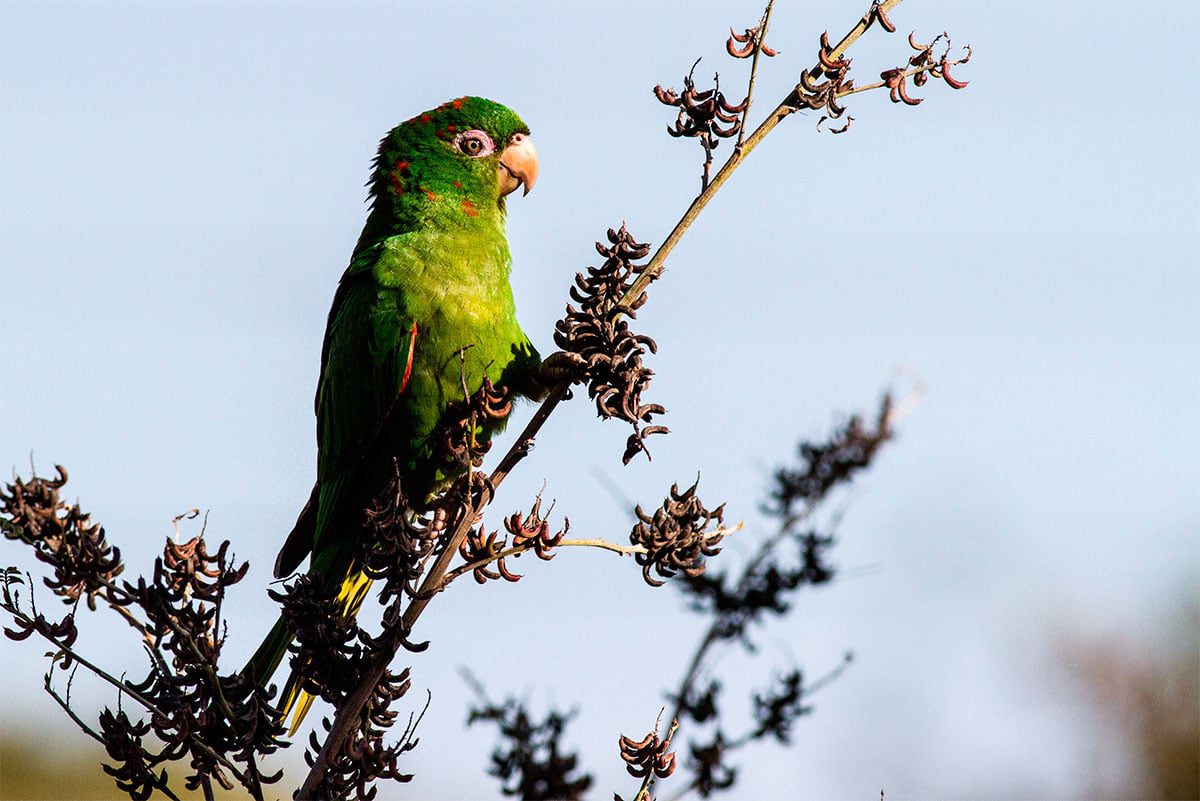
The bill of the Cuban Parakeet(Psittacara euops) is strong and hooked, presenting the capacity of both the upper and the lower mobility, enabling this psittacine to husk and crush seeds, fruits and nuts discarded by many other birds, thus showing another successful feature of this Psittacara.
Their legs they have a magnificent prehensile capacity that allows them to take incredible poses and hold on to extreme places thanks to a "zygodactyly" arrangement of the fingers by moving two fingers forward, the 2 and 3, and two backwards, the 1 and 4.
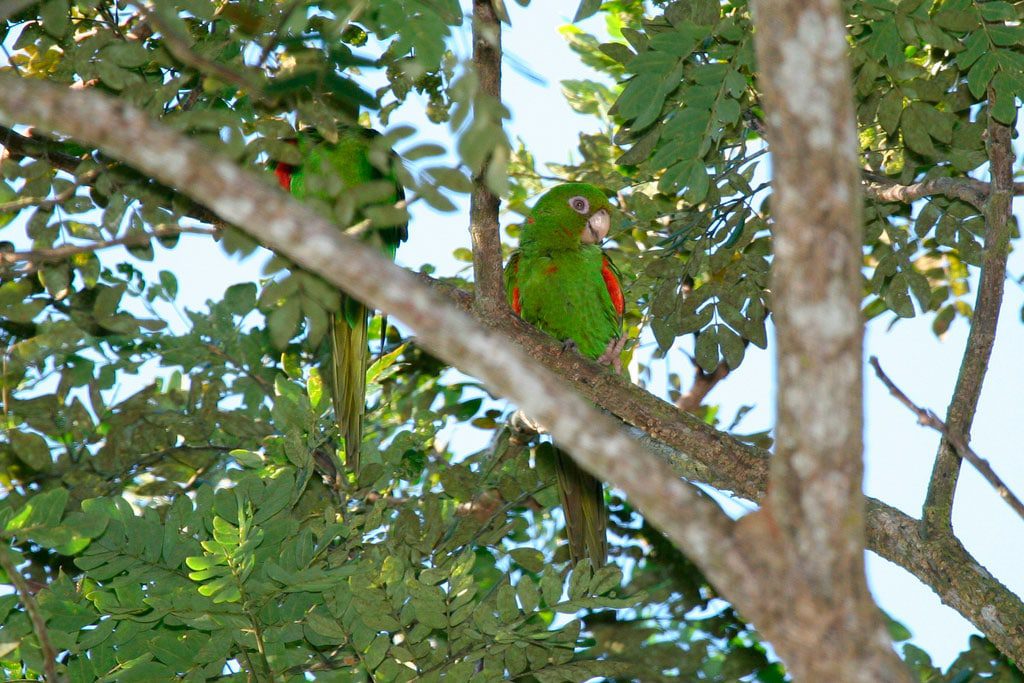
Has the head, sides neck and nape green grass with some red feathers scattered, sometimes forming patches. The upperparts and upperwing-coverts grass-green; primaries and secondaries with margins and dark green tips to vane inner; carpal edge with scattered red feathers and bend of wing red. Underwing-coverts with golden brown in the flight feather, small and medium-sized coverts Red and large coverts Yellow olive. The underparts yellowish green with diffusion of color olive, sometimes with scattered red feathers, especially in the throat and/or the thighs. Upper, the tail dark green color with dye olive; by down yellowish brown. The bill color Horn; bare periophthalmic bluish white; irises yellow; legs distant.
The female has more orange in the wings.
Immature has green and red in underwing-coverts, beige color (not red) in carpal edge, irises Gray with scattered red feathers.
They inhabit on Savannah, especially in areas where there are the PalmasCopernicus and Thrinax, at the edges of forests and Lands planted with trees. Although they have also been very modified habitats, such as eucalyptus forests in open field and fragments of forests of Evergreen in sheets of Palma. The species survives only near large extensions of primary forest.
In general, observed in family groups or small flocks, but sometimes in larger groups, hundreds of birds; the Cuban Parakeet, often, mix with the more common and endemic Cuban Parrot (Amazona leucocephala).
Reproduction:
One of the major problems of this kind in the reproduction, It is competition and the finding by the nesting cavities; This psittacine is a small, so their physical advantage over other birds to displace these from cavities or nests is less and they must show greater aggressiveness to be able to expel woodpeckers and even some small birds of prey These cavities that already occupy.
But, in recent studies, It is suggested that in free-living this species has a high degree of selectivity by the height of the Palma in which anidated or for the depth of the nest, still not evident during the stage of formation of couples and nesting strong signs of gregariousness, But if there could be a tendency to prefer nests with a sufficiently narrow entrance opening to enter the couple and hamper the penetration of predators. It also seems that the species in reproduction is more tolerant of other neighboring couples of the same species, than others parrots, but to some degree of alienation, preferring Palmas in which there is only one cavity to have a certain degree of privacy in the rearing of their chicks.
The breeding season It begins in April and usually ends in July. They sometimes build their nests in cavities excavated, originally, by the Cuban Green Woodpecker (Xiphidiopicus percussus).
The number of eggs in the implementation It, in averaged, between three and five. The incubation both members of the couple is done, as well as feeding the young until they leave the nest. Once abandoned the nest, You can see to the immature flying with parents in small camps before the winter season, forming major sides joining them different families.
Formerly persecuted by provoking large damage to crops Orange, coffee and corn.
Distribution:
Species vulnerable to extinction, from an original distribution throughout Cuba and Isle of youth, isolated populations between Yes.
Formerly one of the most common endemic birds in Cuba and in the Isle of youth, old Isle of pines, but now is limited to various strongholds in remote areas of Cuba, including the Zapata Peninsula, the districts around Cienfuegos and the mountains around the city of Trinidad, to the extent Western Centre of the island, and Sierra Maestra at the end of this.
Resident but some seasonal movements (Perhaps altitude) supposedly by the decline of the birds of the mountains of Trinidadin the months of September and October.
Extinct in the Isle of youth from 1913, mainly due to the strong capture for export as bird cage.
The current population, Although comparatively small, Perhaps stable. A small number of captivity out of Cuba, especially in Eastern Europe. The international trade currently it is small.
Today this species is restricted to 16 populations considering that a total of 2800 individuals released, with a number of individuals per population not exceeding, usually, the 100 copies and is considered of greater size the located in the Zapata Swamp live in where is estimated around 800 these birds. Each of these populations are isolated or insulated semi between if, not exceeding groups or sides that make it up, the 30 individuals, with a general tendency to the disappearance of the species in many of the populations, mainly due to the loss of Habitat and illegal catches.
Conservation:
State of conservation ⓘ
Vulnerable ⓘ(UICN)ⓘ
• Red List category of the UICN current: Vulnerable
• Population trend: Decreasing
There are no new data on the evolution of the population of the Cuban Parakeet; But, the species is suspected of have been declining at a moderate pace, mainly as a result of the habitat degradation.
Rounded, a population estimated between 1,500-7,000 mature individuals.
The persecution as a pest of crops, loss of habitat and, in particular, the capture for trade bird cage, They explain the current shortage of copies of Cuban Parakeet (A. Kirkconnell in litt., 2007).
The capture for trade International is now insignificant, with only 10 birds recorded in trade between 1991 and 1995. Another major threat is the loss of nesting trees (Snyder et to the., 2000) as a result of hurricane damage (as the caused in the Zapata Peninsula by the Hurricane Lili in 1996), and the felling of trees for chicks of the Cuban Parrot (Amazona leucocephala) (A. Mitchell in litt., 1998).
Conservation Actions Underway
• Appendix II of CITES.
• Is legally protected.
• They are distributed within the seven environmental reserves, including the important Ciénaga de Zapata National Park (Snyder et to the., 2000).
• A study of the species and an intense public awareness campaign are intended to help establish a management programme effective (Wiley, 1998).
• The programs of ecotourism they have begun in some areas (Snyder et to the., 2000).
• A provision scheme has been started for nest boxes, the plastic boxes are more durable than the facts of sections of the trunk of the Palm (Waugh 2006), but the parakeets prefer those made of natural materials (Anon., 2010).
• A program of reintroduction from the main island of Cuba to the Isle of youth is being developed from the 2004, but the species is generally difficult to breed (parrots 2000-2004; avianweb.com).
Conservation Actions Proposed
• Carry out more Research to determine the ecological requirements of the species and population (Wiley 1998, Snyder et to the., 2000).
• Conserve additional habitat, especially in the areas of nesting (Snyder et to the., 2000).
• Adapt the environmental awareness and protection of nests in situ to local situations (Snyder et to the., 2000).
• Continue a plan for the re-establishment of the species in the Isle of youth (Wiley 1998, Snyder et to the., 2000) through the development and extension of the programme of captive breeding.
"Cuban Parakeet" in captivity:
In captivity, they are very sleepers and somewhat quarrelsome and restless, needing always to be monitored. Non-communicative the issuance of words but very friendly with the person you choose as partner, which will not get rid of some sympathetic evil, almost always tolerated and even grateful.
Sensitive to the changing conditions of the ecosystem that inhabits.
The requirements and difficulties in the reproduction of this species are considerable.
Own this nice bird as pet, Although on the one hand it can be a satisfaction to the owner, on the other hand means to convict individuals of this species not reproduction and populations to lead them to the risk of the extinction.
Alternative names:
– Cuban Parakeet, Cuban Conure, Cuban Paroquet, Red-speckled Conure (English).
– Conure de Cuba, Perriche de Cuba, Perruche de Cuba (French).
– Kubasittich (German).
– Periquito-cubano (Portuguese).
– Aratinga Cubana, Perico, Periquito, Periquito Cubano (español).
– Catey, Perico, Periquito (Cuba).
(1) – Psittacara euops – Cuban parakeet by Ekaterina Chernetsova (Papchinskaya) – Flickr
(2) – Psittacara euops – Cuban parakeet by Ekaterina Chernetsova (Papchinskaya) – Flickr
(3) – Cuban Parakeet, Conure De Cuba, or Aratinga Cubana (Aratinga euops). Two parrots in a tree By dominic sherony (originally posted to Flickr as Cuban Parakeet) [CC BY-SA 2.0], via Wikimedia Commons
(4) – Cuban Parakeets are a rare sight in Cuba, the only place they live in the world by Hank Davis, DNS Board Member – Delaware nature society
(5) – For the Caribbean Conservation Trust in conjunction with the Massachusets Audubon Society – Winged spur imaging
(6) – Deutsch: Psittacara euops Syn: Evopsitta euops & Psittacara chloropterus Syn: Psittacara chloropter bzw. Psittacara euops St. Domingue By Charles Emile Blanchard (1819–1900) (biodiversitylibrary.org) [Public domain], via Wikimedia Commons
20-25 cm.. length and 72 g. of weight.
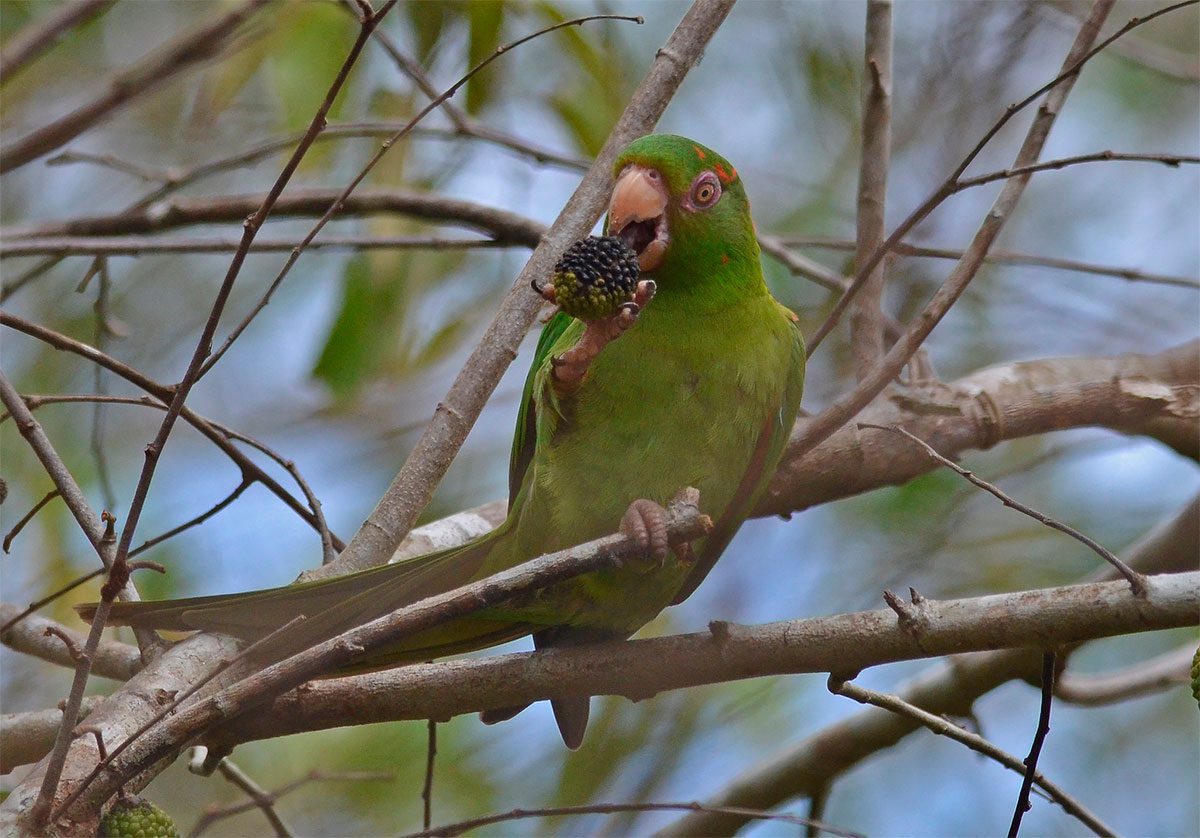
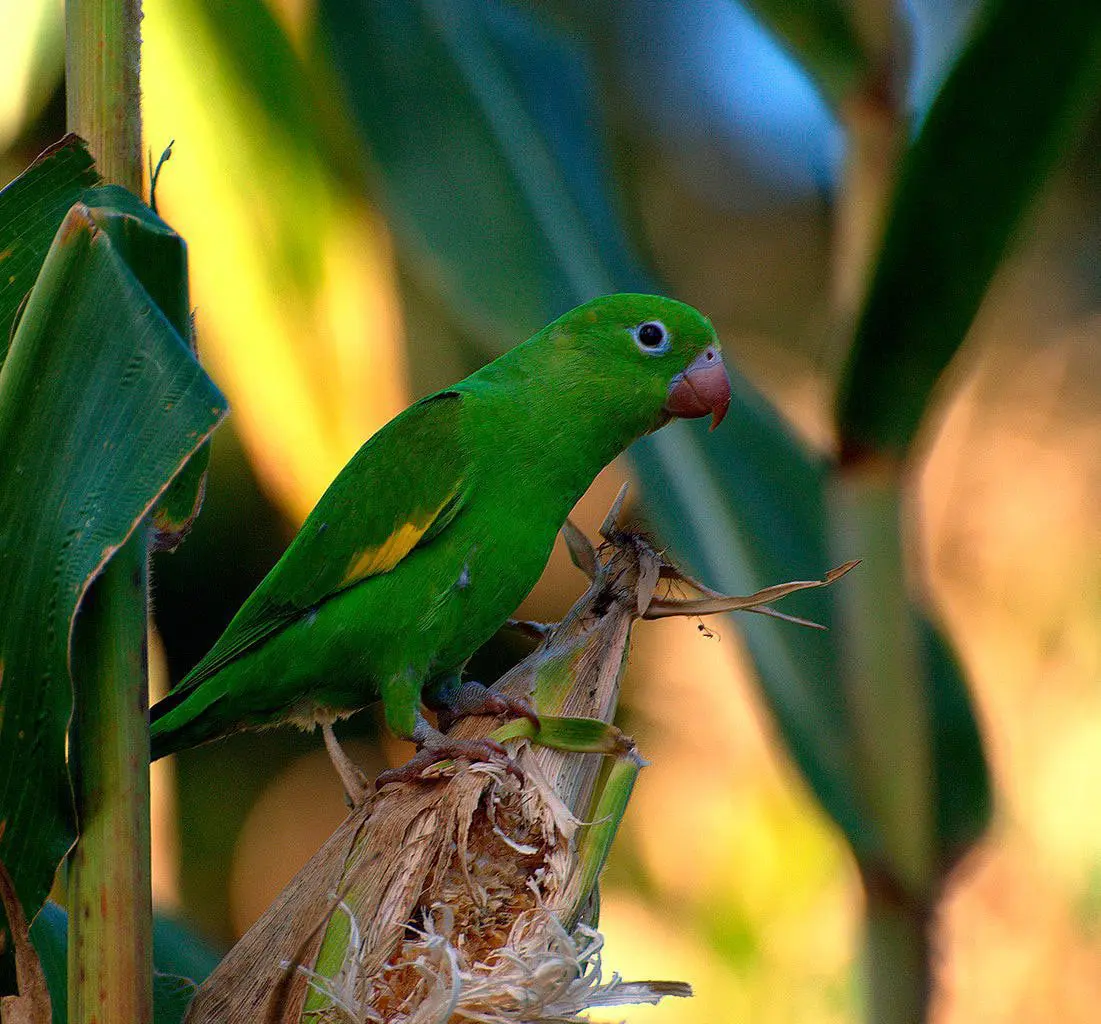
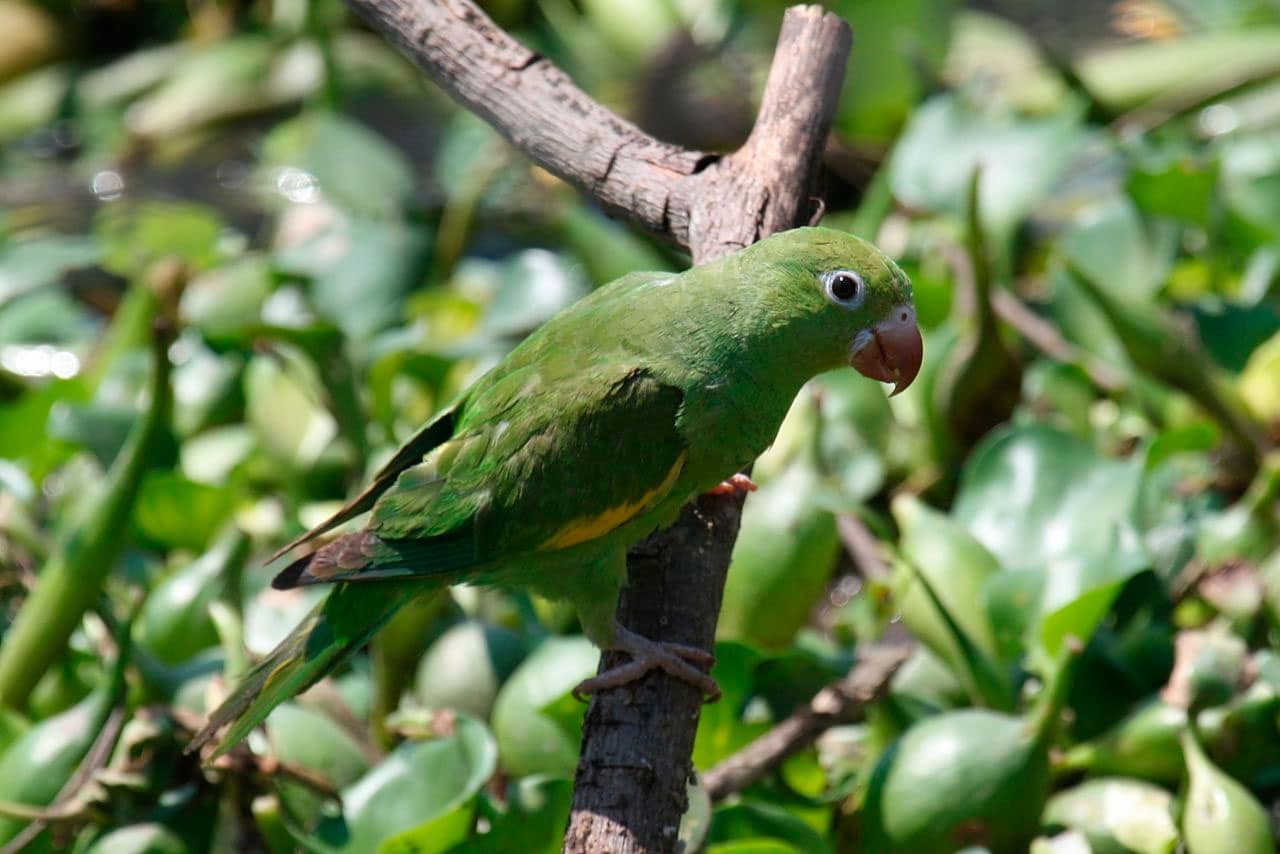
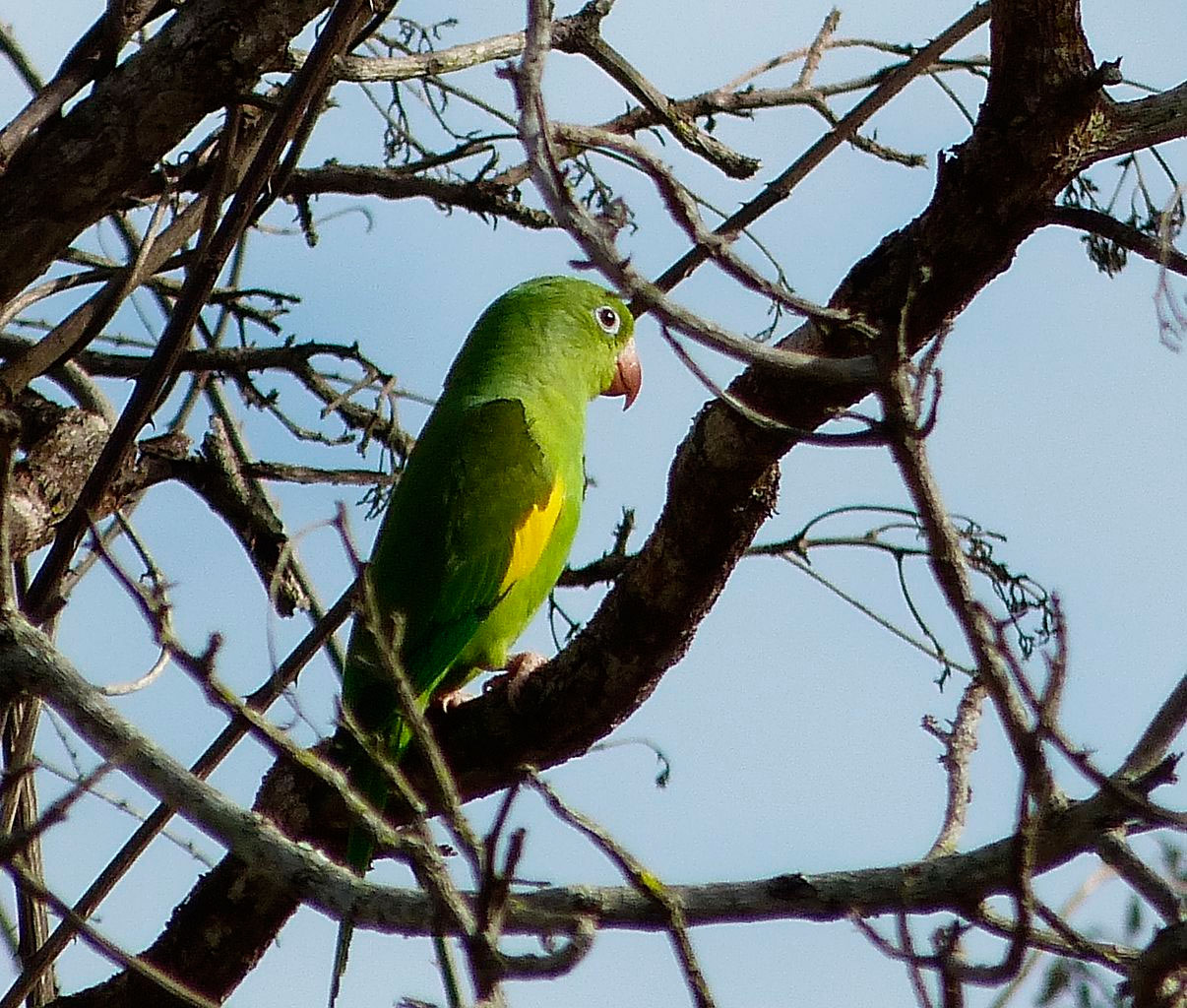
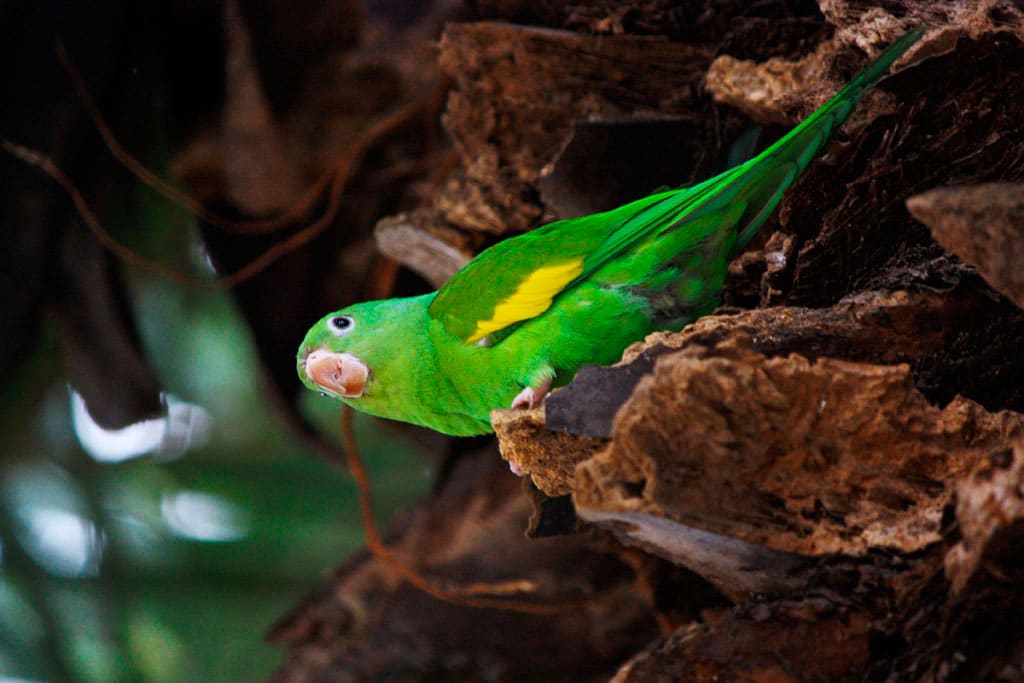
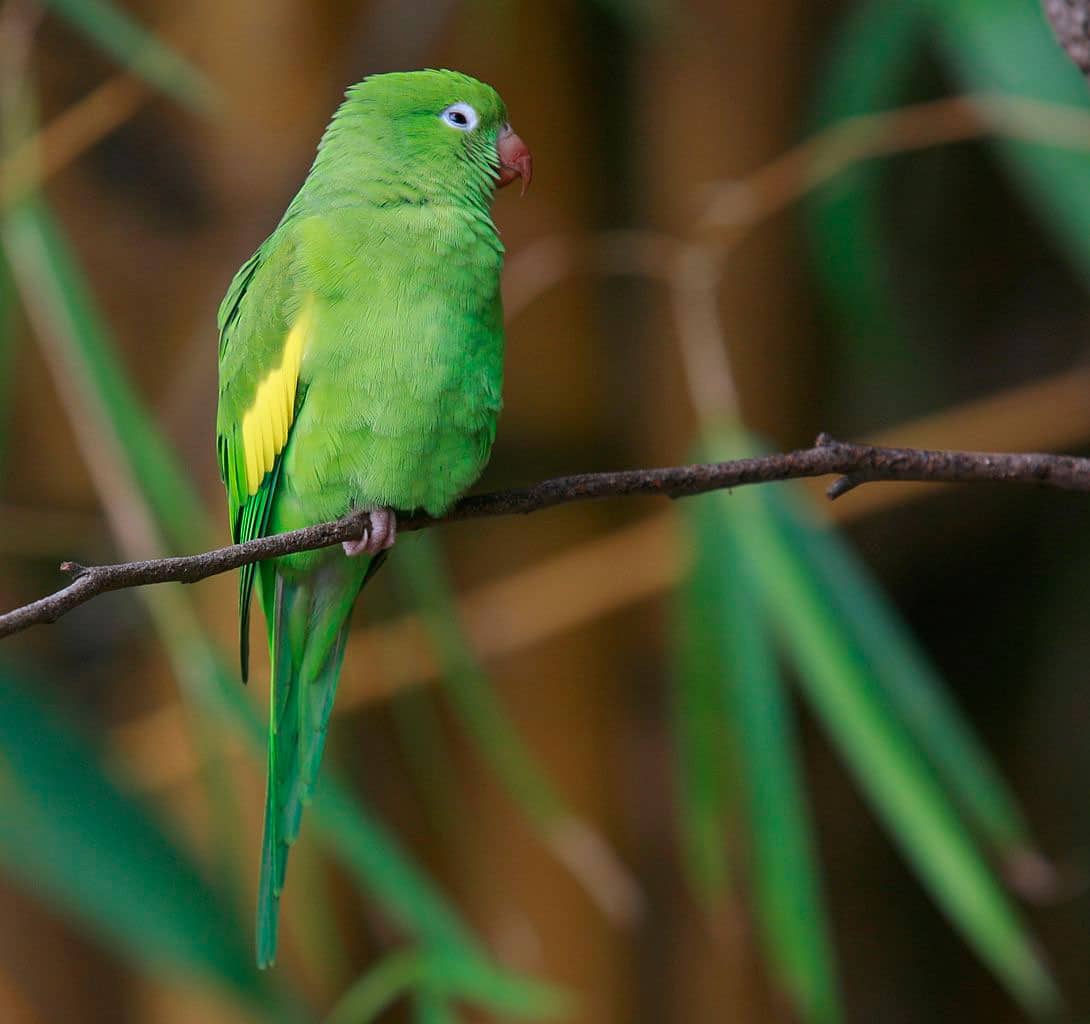
The Yellow-chevroned parakeet(Brotogeris chiriri) has a plumage, in general, bright green; the underparts They are of a paler green and lower coverts are yellowish-green.
The wings They are of a slightly darker green, with the yellow border, visible when wings remain bent or when the bird is in flight. Their bill, hook-shaped, is orange-brown and legs and feet, pinkish gray. The eye rings They are creamy white and eyes dark browns.
It is intimately related to the Canary-winged Parakeet(Brotogeris versicolurus). In fact, it was considered conspécifica (owned or belonging to the same species) until 1997.
The females sexually dimorphic and are not to be sexed, either surgically or by DNA.
The immature are similar to adults but have the tail shorter and the bill It is a darker brown.
Taxonomic note:
Until 1997, some taxonomists considered the Canary-winged Parakeet and Yellow-chevroned parakeet belonging to the same species. Even though the Yellow-chevroned parakeet It has the same secondary covert yellow feathers that can be seen in the Canary-winged Parakeet – no white in the primary wing feathers.
They are mainly below 1000 m, locally up 2500 meters in a variety of habitats including humid forests, seasonal and coastal, Pantanal, savannah and city parks. reported to 2500 meters in arid areas.
Usually, traveling in flocks; in such small groups as 2 to 4 birds, but they have been observed to 20. They are described as small parrots assets, entertaining to watch.
Reproduction:
Nest usually in the cavities of trees or in tree termite nests. They also form nesting tunnels in dead palm fronds..
Once a nest It has been located and correctly "prepared" by the couple, It is performed the laying, between 4 and 5 eggs. after breeding, the Yellow-chevroned parakeet they form large communal huts until the next breeding season.
Food:
In their natural habitats, feed of seeds (including outbreaks), fruit as berries and figs and flowers. Also consume nectar, insects and their larvae. Often they are seen visiting barreiros (areas where there is soil rich in minerals) and the banks of the rivers to feed on the soil.
Distribution:
Size of its range (breeding/resident ): 5,670,000 km2
Distributed inside East Brazil to the East of Bolivia, Paraguay and North of Argentina, in Formosa, Chaco, Missions and North of Currents. Introduced populations in Miami, Florida and California.
Distribution 2 subspecies:
Brotogeris chiriri behni
(Neumann, 1931) – Center of Bolivia to the Northwest of Argentina, in Salta.
• Current category of the Red List of the UICN: Least concern.
• Population trend: Stable.
Rationale for the Red List category
This species has a extremely large range and, therefore, it does not approach the thresholds of vulnerability under the criteria of size range (Extension <20,000 km2 combinada con un tamaño de rango decreciente o fluctuante, extensión / calidad de hábitat o tamaño de población y un pequeño número De lugares o fragmentación severa). La demographic trend appears to be stable and, therefore, the species does not approach the thresholds Vulnerable under the criteria of population trend (> 30% decline over ten years or three generations). The population size has not been quantified, but it is not believed to be close to the thresholds for Vulnerable under the criterion of population size (<10.000 individuos maduros con un descenso continuo estimado> 10% in ten years or three generations or a population structure). For these reasons the species is evaluated as the least concern.
Justification of the population
The size of the world's population has not been quantified, but this species is described as «quite common» (Stotz et to the., 1996).
Justification of trend
They suspected that the population is stable in absence of evidence of any decline or threatens substantial.
"Yellow-chevroned parakeet" in captivity:
Today is Rare.
Since the late sixties to mid-seventies, more than 260.000 these were parakeets imported from South America for the pet trade. At that moment, the Yellow-chevroned parakeet It was the most imported parrot. They settled in California (Los Angeles, San Francisco) self-sustaining populations Yellow-chevroned parakeet released or escapes; populations also in Florida (Miami), as well as Connecticut and New York City.
The Chirirí Kitten appears to be better suited to its adopted habitat than its closely related cousin., the the Canary-winged Parakeet(Brotogeris versicolurus).
The Canary-winged Parakeet It has declined considerably since the early 80, while the Yellow-chevroned parakeet It has established itself in different habitats.
In 2002, the population of Yellow-chevroned parakeet in the area of Los Angeles, California It was estimated at 400 individuals. In the Florida, They have prospered more than any other place in the United States – there have been huge flocks, several hundred of them. The species is also quite established in the city center Rio de Janeiro, Brazil, which he was also introduced.
– Avibase
– Parrots of the World – Forshaw Joseph M
– Parrots A Guide to the Parrots of the World – Tony Juniper & Mike Parr
– Birdlife
– Photos:
(1) – A Yellow-chevroned Parakeet in Sarutaiá, Sao Paulo, Brazil By Dario Sanches [CC BY-SA 2.0], via Wikimedia Commons
(2) – A pet Yellow-chevroned Parakeet By Wagner Machado Carlos Lemes from Goiânia, Brazil [CC BY 2.0], via Wikimedia Commons
(3) – A Yellow-chevroned Parakeet perching in a tree By Paulo Barradas (Brotogeris chiririUploaded by Sno whom You nradio) [CC BY 2.0], via Wikimedia Commons
(4) – A Yellow-chevroned Parakeet in Goiânia, Goiás, Brazil By Delcio Gonçalves from Goiânia, Brazil (A corn diferenteUploaded by Snowmanradio) [CC BY 2.0], via Wikimedia Commons
(5) – Parakeet yellow meeting. Photo taken in the hinterlands of the Sucuriú River By Deusdedith de Souza Alves Filho DehAlves (Own work) [CC BY-SA 4.0], via Wikimedia Commons
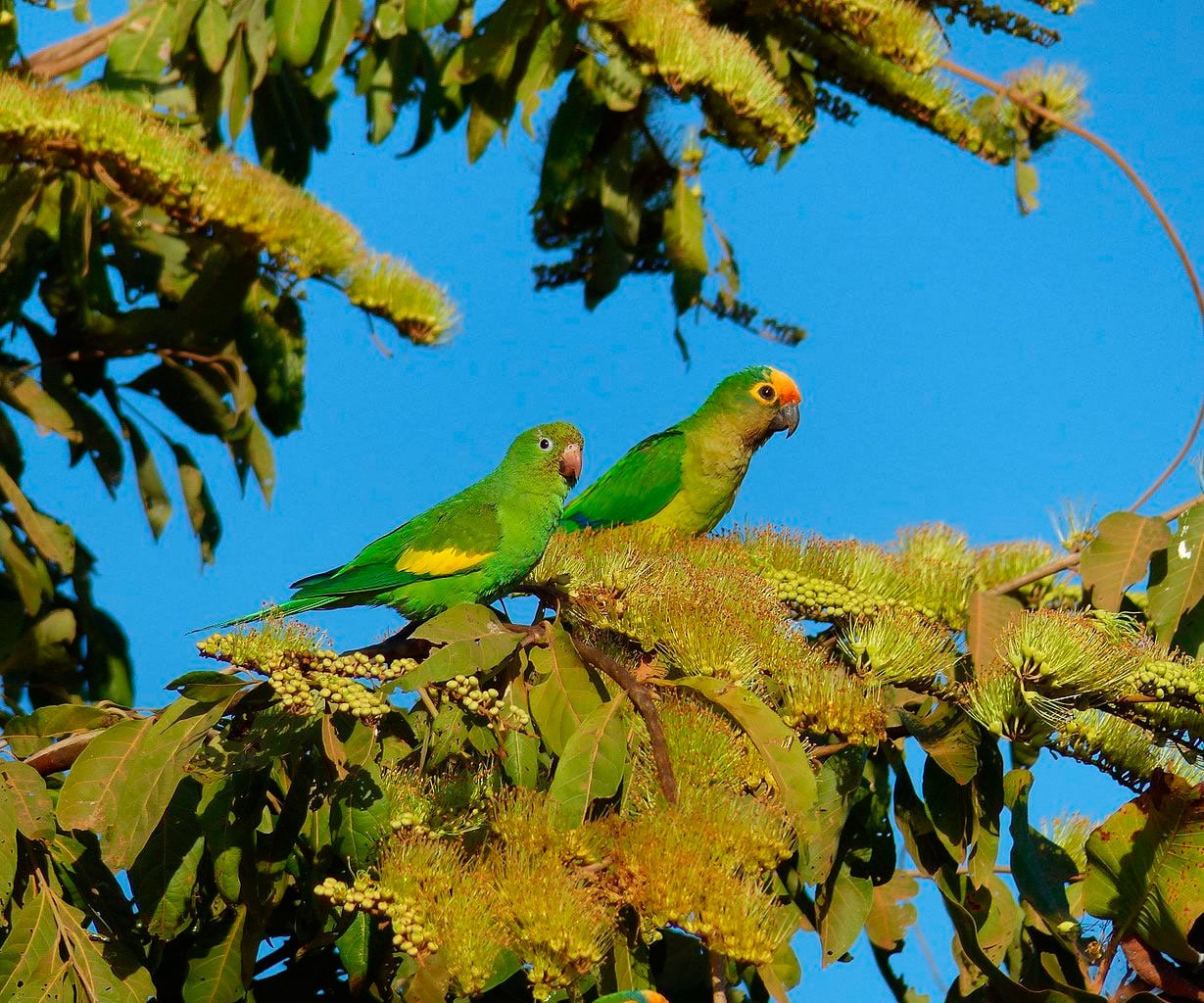
(6) – Yellow-chevroned Parakeet (Brotogeris chiriri)(Left) and Peach-fronted Parakeet (Aratinga aurea)(Right) on Combretum flowers By Bernard DUPONT from FRANCE [CC BY-SA 2.0], via Wikimedia Commons
(7) – A Yellow-chevroned Parakeet in Brazil By Alastair Rae (Flickr: Yellow-chevroned Parakeet) [CC BY-SA 2.0], via Wikimedia Commons
(8) – A Yellow-chevroned Parakeet in Bonito, Mato Grosso do Sul, Brazil. It is perching on the stem of a mango, which it has been eating By Alexandre Pereira [CC BY-SA 2.0], via Wikimedia Commons
(9) – A Yellow-chevroned Parakeet on Erythrina velutina By Derek Keats from Johannesburg, South Africa (… on Erythrina velutina) [CC BY 2.0], via Wikimedia Commons
Origin: Mexico, Guatemala, Honduras, El Salvador, Nicaragua, Costa Rica
Character: Social
Life expectancy: More than 30 years.
Height: 35,5-38 cm..
Content
Description:
35,5-38 cm.. length and 480 g. of weight.
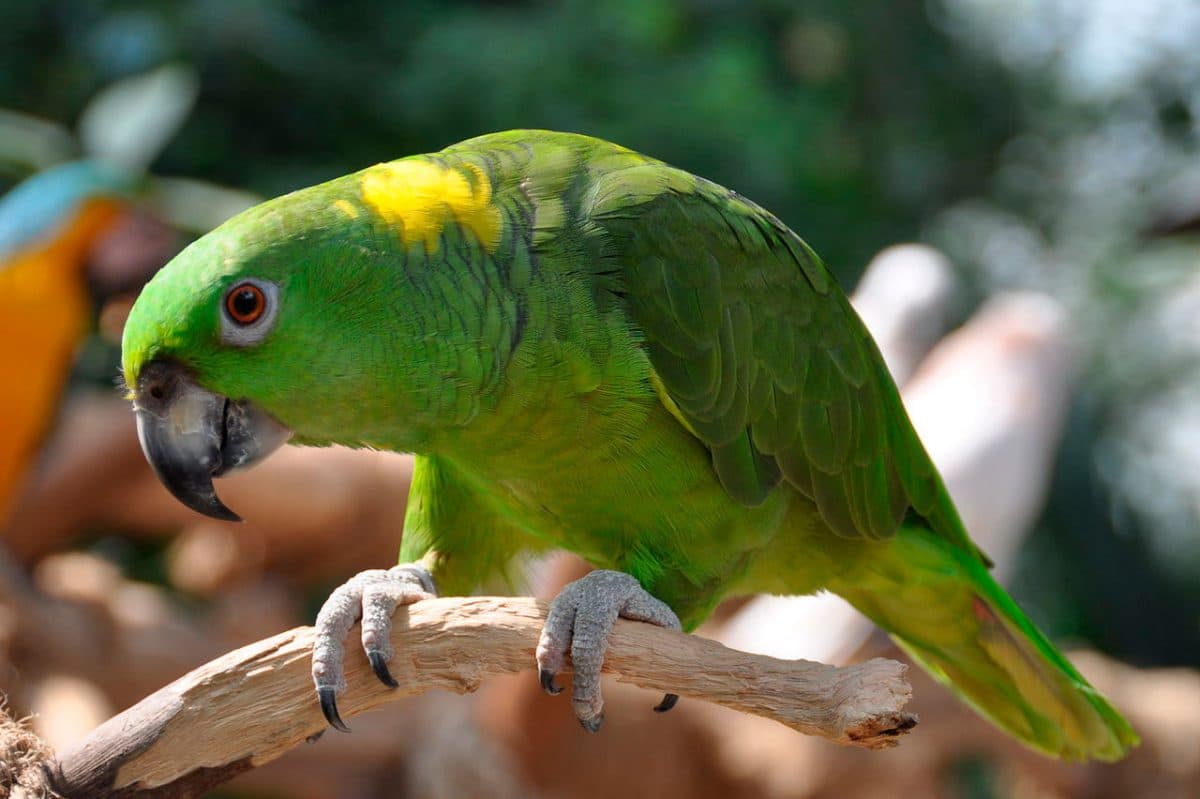
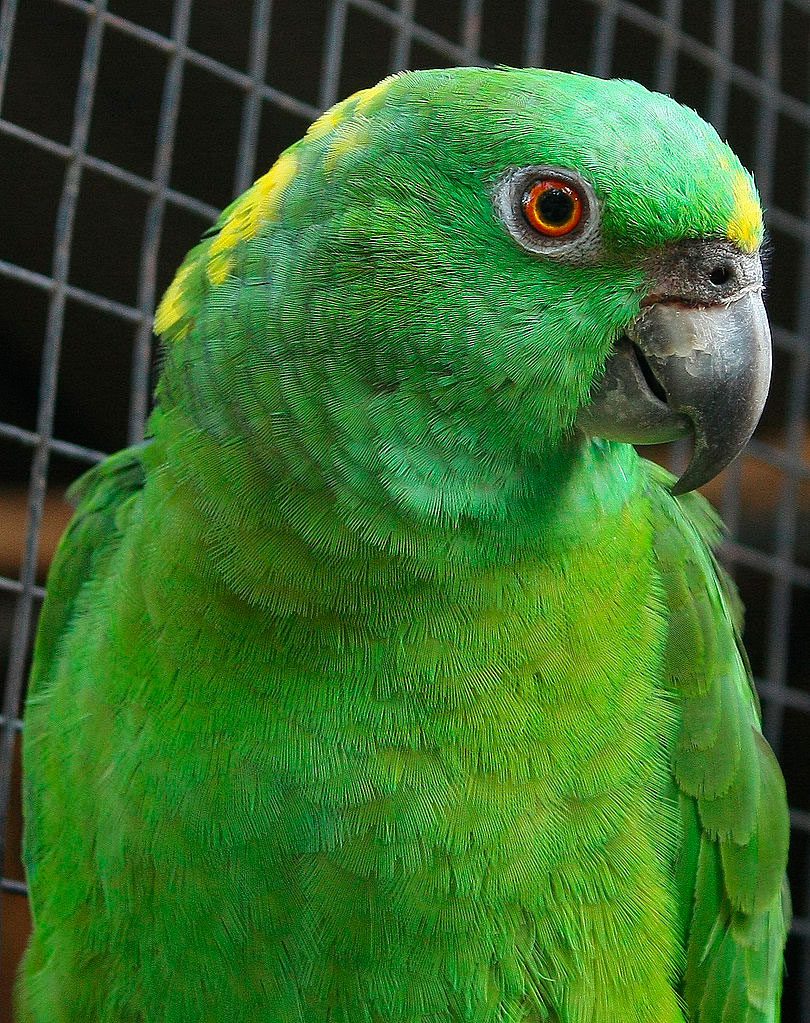
The Yellow-naped Parrot(Amazona auropalliata) It has a large size; their forecrown and front of the crown, usually, pale bluish green, sometimes with narrow frontal band yellow that extends to the front of the crown.
back of the crown pale bluish green; lores, cheeks and sides neck, green; nape with broad golden-yellow ban. Upperparts green with some feathers in the the mantle and in the back with blackish edges; rump and uppertail-coverts slightly brighter than the rest of the upperparts. The wing-coverts green but more emerald than upper body; feathers yellow feathers on leading edge of wing
in some birds. Outerwebs of the four outer secondaries, bright red as speculum; primaries and secondaries violet blue outerweb and towards tips. Under, the wings are green. Underparts pale green with a slight bluish tinge throat.
Tail green with a wide terminal band brighter yellowish green, red at the base with outerweb of the outer feathers, blue. Bill blue, black tip; bare periophthalmic grey; irises orange; legs grey.
Both sexes are similar. The immature has the nape green with yellow feathers appearing at end of first year; irises brown.
Yellow-naped Parrot sound.
Description 3 subspecies:
Birds of Bay islands often they treated as parvipes, not as caribaea. Some copies of Guatemalan Pacific show forecrown yellow, but apparently not consistent racial difference.
(Lousada, 1989) – Similar to the subespecie parvipes but with olive below and bill paler colored horn (especially lower jaw). usually adults patch yellow triangular in front of the crown. Young birds show little yellow in the head wave nape.
Amazona auropalliata parvipes
(Monroe,BL Jr & Howell,TR, 1966) – Less than nominal species, with red feathers on the curve wing
, otherwise similar.
The Yellow-naped Parrot inhabits semiarid forests, arid scrubland and savannas (including those of Pinus), openings in deciduous tropical forests and swamps peaceful, evergreen gallery forests and, sometimes, second growth in agricultural areas. Observed to 600 metres in Guatemala and a 700 metres in Honduras. Usually in pairs or small groups, sometimes in larger meetings, but the decline of the population may now obscures large flocks in some areas. They meet at communal roosts.
Reproduction:
Monógama; It maintains the union of couples throughout the year. It nests in natural cavities in trees, such as holes in old trunks or dead, including pines Nicaragua and Bay islands. breeding season in February Oaxaca and El Salvador; March Roatan. Clutch 2-3 eggs.
In captivity cycle nesting of the Yellow-naped Parrot complete with 29 days of incubation eggs, followed by two months increase of the young in the nest.
Size of its range (breeding/resident): 580.000 km2
The Yellow-naped Parrot It is confined to Central America. They are distributed in the lowlands Eastern Pacific of Mexico (Oaxaca and Chiapas), Guatemala (a sample taken in Petén but his status there is uncertain), El Salvador (arid lowland tropical zone), Honduras and Nicaragua, to the Northwest of Costa Rica from the south end of Gulf of Nicoya northward. They can also be seen in the Caribbean slope of Honduras and in the Mosquito Coast from Honduras, as well as in the neighboring area of northeast Nicaragua. found in Roatan and Guanaja, in the Bay islands but absent in Utila.
Resident. Apparently uncommon in Oaxaca and rare and declining in Costa Rica. Birds observed in the Sula Valley, Honduras, previously attributed to this species but now included within the species Yellow-headed Parrot.
Formerly common and locally abundant, but probably now declining throughout its entire range due to conversion of habitat for agricultural uses and its capture for trade local and international. Not yet considered endangered, but its long-term status is uncertain if its population decline continues.
Although Guanaja reasonable numbers remain, the species inhabiting the Bay islands (caribaea), It is in serious decline due to capture for export (practically 100% of hatchlings are caught each year); also at risk from tourism development, especially in Roatan.
Distribution 3 subspecies:
Amazona auropalliata auropalliata
(Lesson,PA, 1842) – Nominal. Pacific Coast of Central America, from Oaxaca, Mexico, to the Northwest of Costa Rica.
• Current category of the Red List of the UICN: Vulnerable.
• Population trend: Decreasing.
• Population size : 20000-49999.
Rationale for the Red List category
This species has been uploaded to Vulnerable because information on levels exploitation and habitat loss, and trends of the local population, They suggest that the species is suffering at least one rapid population decline. In fact, the rate of decline can be very rapid; However, Additional data are needed to confirm this, in which case the species may qualify for elevation In danger of extinction.
Justification of the population
Partners in Flight estimated that the population in number of less than 50.000 individuals (A. Punjabi in some. 2008), so it is placed in the band 20.000 to 49.999 individuals on freedom.
Justification of trend
It is suspected that the population is in rapid decline due to the continuous habitat destruction and unsustainable levels of hunting, a suspicion that is supported by the observations of trends of the local population.
Conservation Actions Underway
• CITES Appendix I (Endangered species, which they are or may be affected by international trade. Only trade in the species is authorized in the Appendix I in exceptional circumstances, and it must not have a primarily commercial purpose.)
• The species occurs in a number of protected areas.
• Efforts have been made to obtain an area of 4.000 hectares east of Monterrico on Pacific coast of Guatemala declared as protected area (C. Muccio in some . 2011).
• The species has been the subject of a number of local studies, some ongoing, aimed at gathering information on population trends and threats.
• The extent of exploitation of wildlife for the trade It has been highlighted by the local media, for example in Honduras ( by O. Andino in some . 2011).
Conservation Actions Proposed
• Carry out surveys coordinated through the range of the species to quantify the Total population size.
• Monitor the demographic trends through regular surveys.
• Monitor harvest rates for the trade through regular surveys of the local population and officials.
• Monitor rates of loss and degradation of habitat throughout the range of the species.
• Accomplish awareness activities to reduce exploitation.
• Increase the area of suitable habitat that receives effective protection..
The Yellow-naped Parrot in captivity:
The populations of the Amazon nuquigualda have suffered strong pressure by national and international trade (Ridgely, 1981, Iñigo- Elias and Ramos, 1992). There is now an illegal heavy traffic this species, both for domestic and international trade, Parrot's being seized in the Mexico-Texas border, with 648 copies confiscated during 1990-1993 (Gobbi, et to the., 1996).
protected by CITES Appendix I species (Endangered species, which they are or may be affected by international trade. Only trade in the species included in Appendix I authorized in exceptional circumstances, and it must not have a primarily commercial purpose.)
Each captive specimen of this species which is capable of reproducing, must be placed in a well-managed captive breeding program and not sold as a pet, in order to ensure its long-term survival.
Alternative names:
– Yellow naped Parrot, Yellow-naped Amazon, Yellow-naped Parrot, Yellow-naped Parrot (incl. ssp. caribaea, parvipes), (English).
– Amazone à nuque d’or, Amazone à nuque jaune, Amazone verte à nuque jaune (French).
– Gelbnackenamazone (German).
– Papagaio-de-nuca-amarela (Portuguese).
– Amazona nuquigualda, Lora de Nacu Amarilla, Lora de nuca amarilla, Lora nuca amarilla, Loro Nuca Amarilla, loro nuca-amarilla, Loro Nuquiamarillo (español).
– Lora de nuca amarilla (Costa Rica).
– Lora nuca amarilla (Honduras).
– loro nuca amarilla, loro nuca-amarilla, Loro Nuquiamarillo (Mexico).
– Loro Nuquiamarillo (Nicaragua).
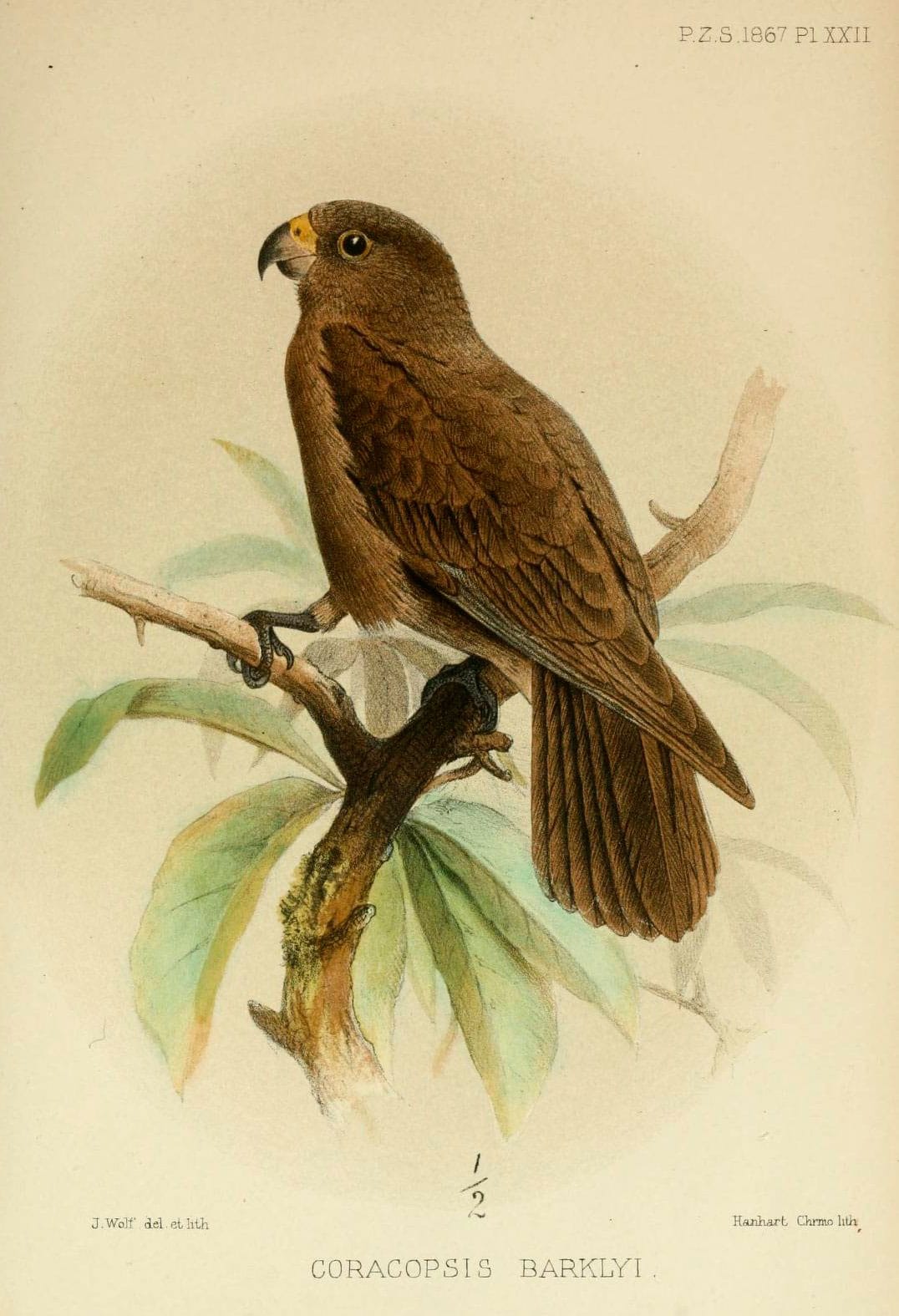
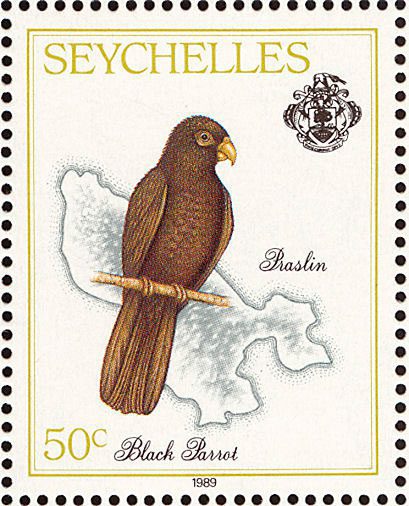
The Seychelles Black Parrot(Coracopsis barklyi) They have a pale brown, less black than the plumage Black Parrot(Coracopsis nigra), but gray / blue reflections in the outer layers of the primary feathers; pale brown patches with slight pale streaks on the crown.
The tone becomes slightly paler in uppertail-coverts.
The underparts They are pale grayish brown. We can see some short lines in throat, while the chest and the belly show a diffuse pale obstruction. The tail is pale-grey.
The bill dark gray becomes paler during the breeding season. The eyes are dark brown, surrounded by a naked orbital gray area. Legs and feet are dark gray to bluish gray.
Both sexes are very similar.
Youth colorization:
Immature paler than adults with a yellowish tinge bill and tips of the feathers tail with pale gray.
Taxonomic status:
Formerly a subspecies of Black Parrot(Coracopsis nigra), originating from Madagascar. Parrots Gender Coracopsis only found in the Western Indian Ocean.
Habitat:
The Seychelles Black Parrot(Coracopsis barklyi) inhabits native and mixed woodland in Praslin, (Rocamora and Laboudallon 2013, A. Reuleaux y N. Bunbury a slightly. 2016). It is also found in cultivated areas and residential areas with gardens, habitats that are suitable feed (A. Reuleaux y N. Bunbury a slightly. 2016). They are usually seen alone or in pairs.
Reproduction:
Their main breeding areas They are in a forest dominated by endemic palms coco de mer(Lodoicea maldivica). The tree species nests in cavities primarily in mer coconut dead, but also registered that nests in cavities and other palms living trees broadleaf (Reuleaux et al. 2014to), with reproductive activity October to March (Rocamora and Laboudallon 2013, Reuleaux et al. 2014to). Preferred deep cavities of hollow logs of L. maldivica with a dense cover canopy over the entrance (Reuleaux et al. 2014to). The reproductive activity fluctuates widely between years (A. Reuleaux y N. Bunbury a slightly. 2016). In a study, the 53% of nests they were successful in 36 nesting attempts, with a 57% incipient year survival (Reuleaux et al. 2014to).
Food:
The Seychelles Black Parrot It feeds on a variety of plant species, most of which are endemic and native (Reuleaux et al. 2014b), mainly from the fruit pulp, seeds and buds, with occasional observations feeding on leaves, flowers, crusts and scale insects (Reuleaux et al. 2014b).
Distribution:
Extending its range (breeding/resident): 70 km2
The Seychelles Black Parrot(Coracopsis barklyi) reside in Praslin, with occasional records in Curieuse (to 1 km to the North of Praslin), Seychelles(Reuleaux et al. 2013).
No individual was detected in curious during spot counts over four days and during supplementary fieldwork, so it is assumed that there is no resident population there (Reuleaux et al. 2013).
Conservation:
• Current category of the Red List of the UICN: Vulnerable.
• Population trend: Stable.
• Population size : 340-600 individuals.
Rationale for the Red List category
This newly divided species is listed as Vulnerable because, but it appears to be stable or possibly increasing, their population is still very small, and therefore it is at risk of stochastic events and human impacts.
Justification of the population
Count surveys conducted in Praslin points in 2010 and 2011 They found a density of 0.14-0.24 individuals / ha, as resultadi giving an estimate of the Total population 520-900 individuals (confidence intervals 95%) obtained through the distance sampling methodology (Reuleaux et al. 2013). After reviewing recent survey results, Rocamora and Laboudallon (2013) estimated total breeding population less than 200 couples, suggesting that there might be less than 400 mature individuals. Based on these data, it is assumed that there 340-600 mature individuals in the population.
Justification trend
They suspected that the population is stable the absence of evidence of any reduction or immediate threat. It is believed that the species has increased at least until the beginning of the century, but it is not clear if it is still increasing (Reuleaux et al. 2013, Rocamora and Laboudallon 2013).
Threats
It is believed that the decline of Seychelles Black Parrot before age 60 It was mainly due to predation by introduced rats and hunting conducted by settlers and farmers (Rocamora and Laboudallon 2013). Other causes of increased mortality include capture as pets and trade, and bycatch when targeting other species.
The most serious current threats for the species include diseases such as disease Beak and feather, continuous nest predation by rats and cats, competition from introduced species of birds for food and nesting sites, poaching of their main nesting tree (coco de mer), and habitat destruction caused by fires, with potential threats including persecution, pesticides, bats and kinship networks (Rocamora and Laboudallon 2013, Seychelles Islands Foundation in litt. 2014).
The forest fires They may represent the most serious threat to the species, with records since the beginning of the decade 1980 showing that approximately every 10 years a major fire occurs (The Seychelles Islands Foundation in litt. 2014). The availability of nesting cavities can be a limiting factor in years of very active reproduction, some females occupying suboptimal cavities.
Collection sea ​​coconuts probably reduce the area of ​​palm forest long term.
The presence of the Rose-ringed Parakeet(Psittacula krameri) in Mahe, one of which is registered Praslin, increases the risk of disease.
The impacts of introduced species causing nest predation and competition for nesting sites can not be serious enough to limit the population; However, mice are increasing in Praslin.
The crazy ants or zanconas ants (anoplolepis gracilipes) not appear to have impacted the species so far, probably because they use dead palms, where the appropriate cavities Seychelles Black Parrot.
Chicks predation by cats and dogs is probably limited, and post-harvest mortality is not currently a major concern. The persecution of the species by farmers is considered a minor threat.
Other risk factors for the species include their low genetic diversity and unexplained large fluctuations in reproductive activity of one station to another (Seychelles Islands Foundation in litt. 2014).
conservation actions
Conservation actions underway
The species is protected by law from 1966(Rocamora and Laboudallon 2013). Endemic palms have been protected from 1991, and the restoration of native palm forest on Praslin and Curieuse is underway. The species is found in the Praslin National Park, created in 1979, and Vallée de Mai It was declared a World Heritage Site in 1983. The Background islas Ferdinand curious y They are administered as nature reserves, but no official protection. Among 1983 and 2005 boxes were provided artificial nesting (Rocamora and Laboudallon 2013, A. Reuleaux y N. Bunbury a slightly. 2016).
In Vallée de Mai there is a firebreak around the brood nucleus, but it is not guaranteed to work in the event of a large fire that can not be contained quickly (The Seychelles Islands Foundation in litt. 2014), However, It has only proved partially effective when a fire destroyed several hectares of breeding habitat high quality 2010 (A. Reuleaux y N. Bunbury a slightly. 2016). Poaching coco de mer nuts it being countered with increased security and a program regeneration, and they have carried out awareness activities to reduce the persecution by farmers. Measures are being taken to eradicate the presence of the Rose-ringed Parakeet(Psittacula krameri) and also they are conducting tests for the virus Psittacine Beak and Feather Disease Virus(The Seychelles Islands Foundation in litt. 2014).
In 2009 a national plan of action was drawn up for the species, It is including plans to introduce the species Silhouette, along with captive breeding in Frigate y North Island, if you can carry out a proper restoration and habitat management (reviewed by Rocamora and Laboudallon 2013). Other conservation identified for this species include control of introduced, the renovation and improvement of nests, population monitoring and public awareness campaigns (reviewed by Rocamora and Laboudallon 2013). Analysis using statistical models is intended to 2014, after annual counts have been made for three years without interruption, and conclusions on the trend of the species will be published from 1982 (G. Rocamora in litt. 2014). Repeating the remote sampling survey is scheduled at intervals 5-10 years (A. REuleaux y N. Bunbury a slightly. 2016).
Conservation Actions Proposed
Carry out further surveys to get a more accurate estimate population size and to monitor the demographic trend. Conduct research on the impacts of potential threats. Protect additional areas of native forest of palms. Suitable restore native habitats. Continue awareness activities to eliminate any residual persecution.
"Seychelles Black Parrot" in captivity:
This species is protected by law from 1966. No copy of Seychelles Black Parrot should be kept in captivity, unless it was under a controlled breeding program in order to reintroduce birds of this species to their habitat.
Alternative names:
– Seychelles Black Parrot, Seychelles Lesser Vasa Parrot, Seychelles Parrot (English).
– Vasa des Seychelles, Vaza des Seychelles (French).
– Seychellenpapagei (German).
– Seychelles Black Parrot (Portuguese).
– Loro de Seychelles (español).
Avibase
Parrots of the World – Forshaw Joseph M
Parrots A Guide to the Parrots of the World – Tony Juniper & Mike Parr Birdlife
Photos:
(1) – Coracopsis barklyi (=Coracopsis nigra barklyi) by Joseph Wolf [Public domain], via Wikimedia Commons
(2) – Coracopsis barklyi By Post of Seychelles ([1]) [Public domain], via Wikimedia Commons
▷ The world of Pets: Dogs, cats, birds, reptiles, amphibians
The Flores Lorikeet(Trichoglossus weberi) is generally Green; light green / blue stripes on the forecrown and lores, the rest of the head with brighter green stripes; underwing-coverts yellow / green. The chest and the thighs are yellowish or reddish. The bill It is orange-red and irises orange-red. The legs son grises. Smaller size than other species Trichoglossus.
The youth they are similar to adults.
taxonomy:
Sometimes you think you're closer Olive headed Lorikeet(Trichoglossus euteles). With one exception, so far it has been treated as a subspecies within the complex Coconut Lorikeet(Trichoglossus haematodus), but differs in its chest rather pale green; abdominal patch medium green; head dark green with streaks of bright green; small size (less than a Scarlet-breasted Lorikeet (Trichoglossus forsteni) relatively small). Monotypic.
Sound of the Flores Lorikeet. (1)
(1) Some species are under extreme pressure because of traps and harassment. The open availability of high-quality recordings of these species may make the problems even worse.. For this reason, transmission and download of these recordings is off. Recorders are free to share in xeno-edge, but they will have to approve access to these recordings.
Habitat:
It's more common in the lowlands, but it is up 2400 meters above sea level. Wide variety of areas including settlements, forests, coconut plantations, Savanna, eucalyptus forests and mangroves.
It is found in mixed flocks with other parrots; small and noisy groups. Nomads, since they depend on flowering trees. It perches communally in groups of hundreds of birds.
Reproduction:
Birds have been recorded in conditions reproduction in June and is reported reproduction between February and August (White and Bruce 1986, Reeve y Rabenak 2016).
It will nest on the ground in some of the predator-free islands.
Food:
It feeds mainly from nectar, but also feeds on figs, insects and can be found around artificial feeding stations.
Distribution:
Extension of the distribution (breeding/resident): 25.500 km2
The Lori Flores are endemic to the flower island, Indonesian, where it is described as common(pit et to the. 1997).
Conservation Lori Flores:
1. Current red list category of the UICN: Near-threatened.
2. The population trend: Decreasing.
3. Population size : 10000-19999 individuals.
Rationale for the Red List category
It is believed that this species has recently split a moderately small population (approaching 10.000 mature individuals), forming one subpopulation, inferring that is suffering moderately rapid decreases due to the pressure of capture and loss of habitat. So, It has been classified as Near threatened, but more information on population size, trends and threats can lead to a reassessment of their status.
Justification of the population
It is believed that the population of Flores Lorikeet It is moderately small (that is to say, approaching 10.000 mature individuals).
Justification trend
They suspected that the population is declining due to loss of habitat and unsustainable levels of exploitation.
Threats
The habitat destruction through the combined impacts of firewood collection, commercial logging, timber extraction for construction materials and clearance for agriculture may represent the most relevant threat.
The loss and fragmentation of forests It is already extensive in Flowers, where no semi-permanent forest below the 1.000 meters is included within the protected areas published in the Official Gazette. These threats are exacerbated by the expansion of human population, with large volumes of wood needed for housing construction, and the fact that the application of the laws by the government is little or no.
The moist deciduous forest is being cleared extensively through land grabbing and the establishment of agricultural areas, a factor that is inevitably reducing the range and population of this species. Forest clearing continues in the coastal belt to make way for crops, and illegal logging continues in protected areas.
It is presumed that the capture for trade in wild birds It represents an additional threat, as for other subspecies of the complex (Trichoglossus haemotodus).
Conservation actions and research in progress
Appendix II of the CITES. CMS Appendix II. It has been recorded in the Mbeliling Forest Reserve(Reeve y Rabenak 2016).
Proposed Research and Conservation Actions
1 – Estimate the population and assess population trends and scale of the pressure catch.
2- Conduct a species-specific study to identify important sites, in order to provide protection.
3- Carry out research on their status and habitat use (with special attention to feeding ecology and forest fragmentation) so that long-term management of the species facilitate.
4- Monitor trade to investigate whether this represents a significant threat.
5- Initiate campaigns sensitization to get the support of local people in forest protection.
In captivity:
In captivity it is kind enough rare de lori. He was raised for the first time Great Britain, in 1969, in Germany in 1984.
Because of its endangered status, Any suitable specimen can not be released back into their natural habitat (native range) It should preferably be placed in a breeding program well managed to ensure the continued survival of this species.
Alternative names
– Flores Island rainbow lory, Flores Lorikeet, Leaf Lorikeet, Rainbow Lorikeet (Leaf) (English).
– Loriquet à tête bleue (Weber), Loriquet à tête bleue (weberi), Loriquet de Flores, Loriquet de Weber (French).
– Flores Blauwangenallfarblori, Flores-Allfarblori, Webers Lori (German).
– Periquito-arco-íris (weberi) (Portuguese).
– Lori de Flores, Lori Arcoiris (weberi) (español).
1. Avibase
2. Parrots of the World – Forshaw Joseph M
3. Parrots A Guide to the Parrots of the World – Tony Juniper & Mike Parr
4. Birdlife
Photos:
(1) – Flores Lorikeet, Trichoglossus (haematodus) weberi, at New Port Aquarium, Cincinnati, USA by derivative work: Snowmanradio (talk)Trichoglossus_haematodus_weberi_-New_Port_Aquarium-8.jpg: Serge Melki [CC BY 2.0], via Wikimedia Commons
(2) – Weber’s Lorikeets (Trichoglossus haematodus weberi) at Newport Aquarium by Ltshears [CC BY-SA 3.0 or GFDL], from Wikimedia Commons
(3) – Fig. 1: Flores Lorikeet (Trichoglossus = Psitteuteles Weber Weber)
Fig. 2: Olive-headed Lorikeet (Trichoglossus euteles = Psitteuteles euteles) by A Weber’s lorikeet (Trichoglossus weberi) at the Jerusalem Biblical Zoo by SuperJew [CC BY-SA 4.0], from Wikimedia Commons
(4) – Trichoglossus haematodus weberi Buttikofer, 1894 bt Huub Veldhuijzen van Zanten / Naturalis Biodiversity Center [CC BY-SA 3.0]
(5) – Weber’s lorikeet, Picture taken at Loro Parque in Puerto de la Cruz / Tenerife by Dominik Deobald – Flickr
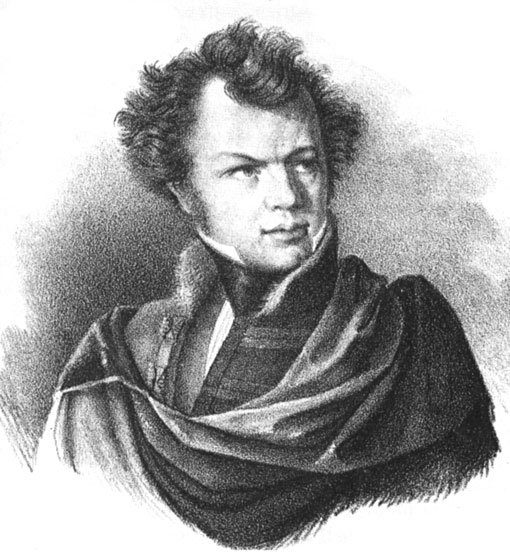
(6) – Johann Buttikofer [Public domain], via Wikimedia Commons
16 cm.. height.
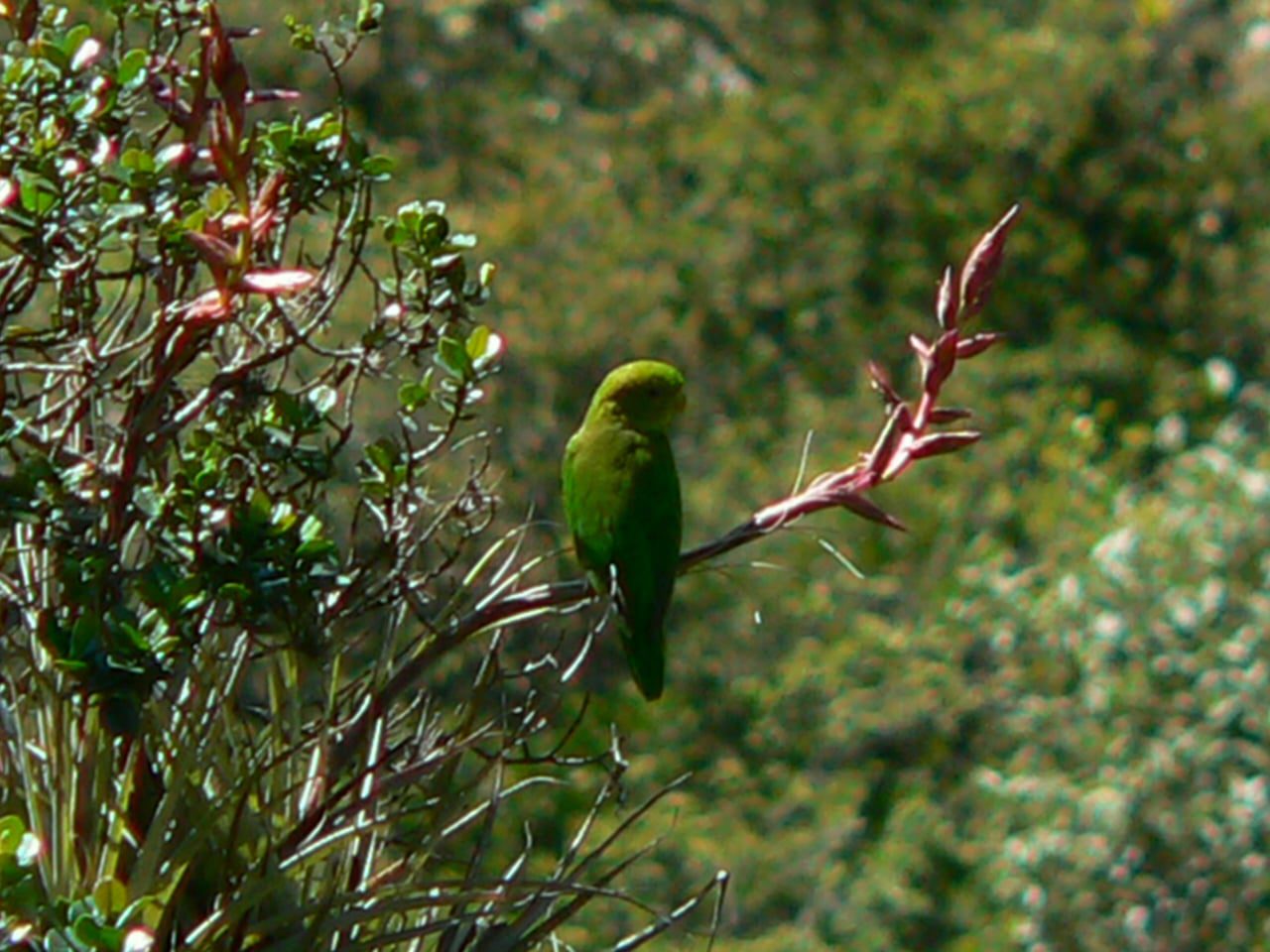
The Andean parakeet (Bolborhynchus orbygnesius) is usually dark green, with blue wing patch (visible in flight), clear peak, tail broad at the base and finished at tip of yellowish color with bluish tinge in the interior.
Video – "Andean parakeet" (Bolborhynchus orbygnesius)
It is usually found in deserts and semi-arid areas, between 3000 to 4000 m (It has been reported to the 1500 and to the 6000 m).
Possibly perform altitudinal migration, descending to mountainous valleys after reproduction. You can also visit rural areas and agricultural land.
Reproduction:
Walks in couple or flocks of more or less 300 individuals. They breed in caves dug into ravines.
Food:
The diet consists of seeds, buds and fruits.
Conservation:
State of conservation ⓘ
Minor Concern ⓘ(UICN)ⓘ
This species has a very large distribution area and, therefore, does not approach thresholds for Vulnerable based on range size criteria (presence extension <20 000 km2 combinada con un tamaño de distribución decreciente o fluctuante, extensión>30 % decrease in ten years or three generations). Population size has not been quantified., but not believed to approach the thresholds for Vulnerable based on population size criteria (<10 000 individuos maduros con una disminución continua estimada en>10 % in ten years or three generations, or with a population structure).
Population size: unknown
The population trend: Stable
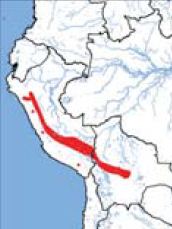
presence extension (breeding/resident): 655 000 km 2
Distribution:
It is found in northwestern Peru to Bolivia and west of the Andes in Peru..
"Andean parakeet" in captivity
They are shy and quiet birds, very sensitive to cold, stress and infections. Birds may die without apparent reason. They are rare in captivity.



















_-stretching-8a.jpg)


_-side-8a.jpg)


_-two_in_tree.jpg)


.jpg)
(Left)_and_Peach-fronted_Parakeet_(Aratinga_aurea)(Right)_on_Combretum_flowers_..._(28443407306).jpg)


.jpg)


_-cage-6a.jpg)


