18 cm.. height.
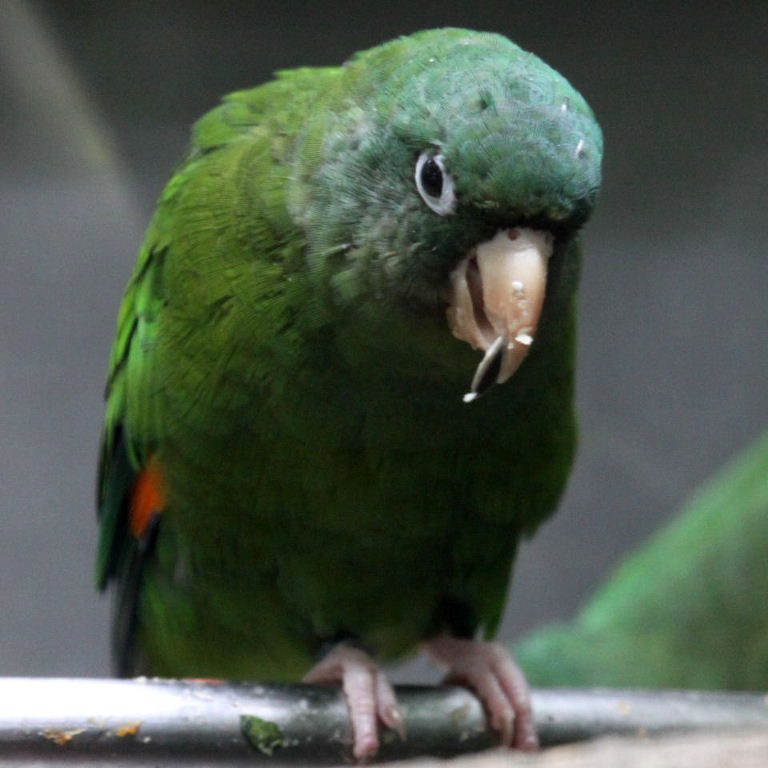
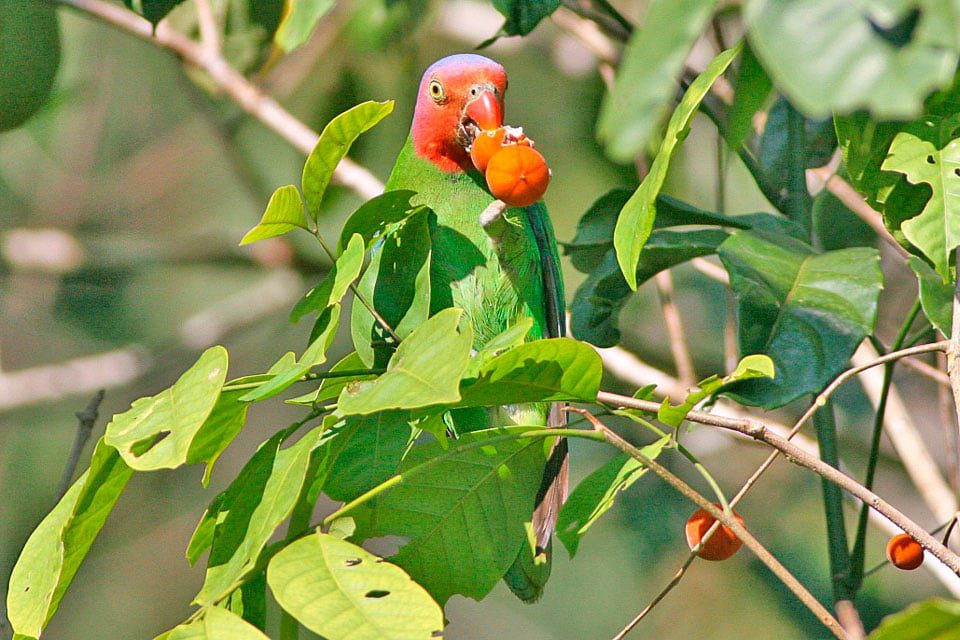
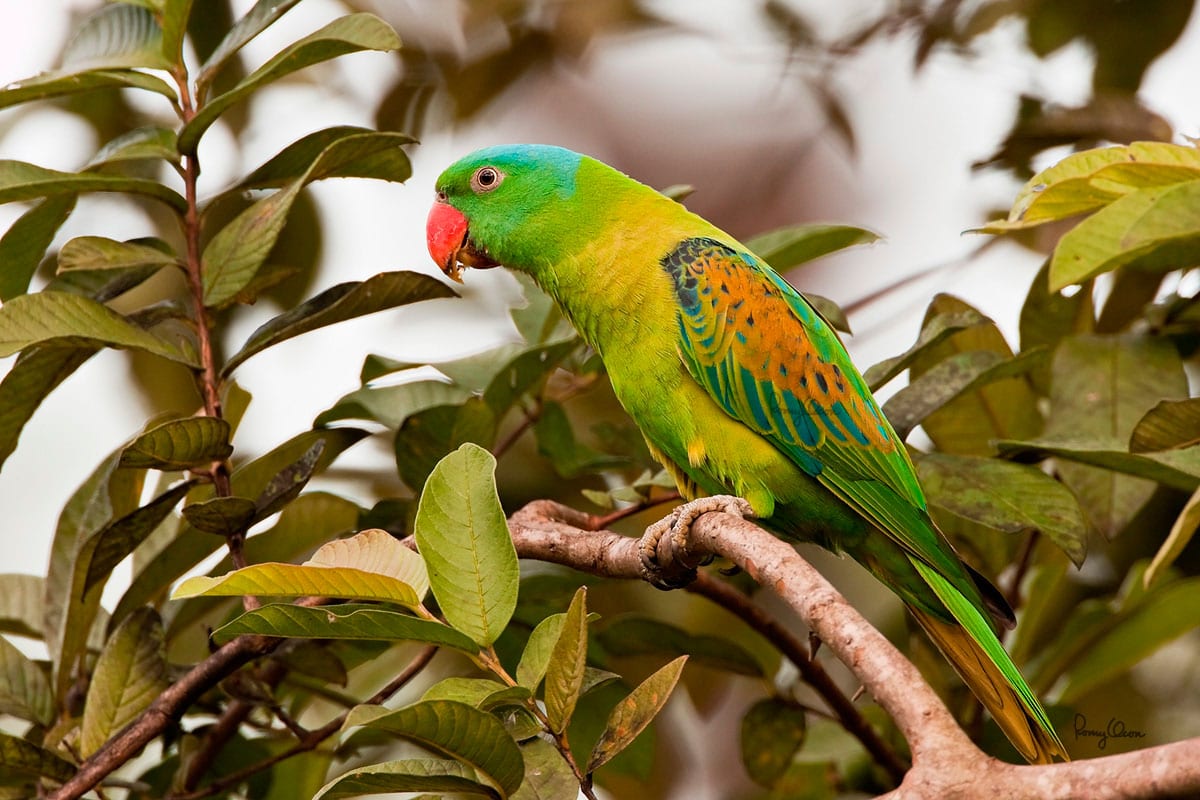
The Golden-winged Parakeet((Brotogeris chrysoptera)) has a tail short and finished in tip, bill Of course, body almost all green.
Its main characteristic is to have wing
a patch orange or gold and the end blue (more visible on the fly). Crown bluish, forecrown and throat orange.
The eye ring is whitish and without feathers; the irises is of color Brown dark and the legs flesh-colored.
The immature is distinguished by not having the Golden wing patch.
(Sclater,PL) – Golden parakeets. Its plumage is generally more yellow. L0s adults have yellow-orange the forecrown and the regions between them eyes and the peak, on the sides of the head. There is a patch in the chin orange. The primary coverts are yellow. Son bigger the species nominal.
Brotogeris chrysoptera solimoensis
(Gyldenstolpe, 1941) – Codajás Golden parakeets. Similar to subspecies nominal, but the frontal band is more pale and of color brown reddish. The patch of the chin is a yellow-brown color.
Brotogeris chrysoptera tenuifrons
(Friedmann, 1945) – Black River Parakeets. Similar in appearance to the subspecies Brotogeris chrysoptera tuipara, with the exception of the frontal band orange, which is minimal or absent.
Brotogeris chrysoptera tuipara
(Gmelin, 1788) – Parakeets Tuipara. It also seems to refer to the species, with the exception of its plumage that is usually more yellow. adults have a frontal band fine of color orange and a patch Orange in the chin. The lateral feathers with edges yellow. They are also bigger that the subspecies nominal.
Habitat:
Video – "Golden-winged Parakeet" (Brotogeris chrysoptera)
It inhabits in humid forest and savannah, more common to 300 meters although it has reported to them 1200 m. You in groups small of 8 to 16 individuals not reproductive time, It is common to see more than 100 consuming fruits in the canopy. Noisy when flying and silent when they feed on.
Reproduction:
Nest on trees, in hollows and termite mounds. Breeding season in November, February and April.
Food:
With feeds of the nectar of the flowers, fruit, figs, berries and seeds.
Distribution:
Size of the distribution (reproduction / resident): 3.110.000 km2
Its population is distributed between the East of Venezuela, Guyanas, Center and East of the Brazilian Amazon.
• Current category of the Red List of the UICN: Least concern.
• Population trend: Decreasing.
Justification of the population
The size of the world population It has not been quantified, but this species is described as «common» (Stotz et to the., 1996).
Justification of trend
It is suspected that this species has lost 20,7-24,8% of habitat suitable within their distribution during three generations (15 years), on the basis of a model of Amazon deforestation (Soares-Filho et to the., 2006, Bird et to the., 2011). So, It is suspected that will decrease in <25% durante tres generaciones.
"Golden-winged Parakeet" in captivity:
Rare in captivity. They are birds a bit nerve until you are acclimatized to its owner. They can be housed in an Aviary with other parrots.
Alternative names:
– Golden-winged Parakeet, Golden winged Parakeet, Golden-winget parakeet, Tuipara Parakeet (English).
– Toui para (French).
– Braunkinnsittich (German).
– periquitinho, Periquito-de-asa-dourada, periquito-de-asas-douradas, tuipara-de-asa-dourada, tuipara-de-asa-laranja, periquitinho, periquito-de-asas-douradas, tuipara-de-asa-dourada, tuipara-de-asa-laranja (Portuguese).
– Catita Alidorada, Periquito de Alas Amarillas (español).
– Periquito Ala Dorada (Venezuela).
– Avibase
– Parrots of the World – Forshaw Joseph M
– Parrots A Guide to the Parrots of the World – Tony Juniper & Mike Parr
– Birdlife
– Parrot Book, Parrots and macaws Neotropical
– Photos:
(1) – animalphotos
(2) – Modern accepted name (2012) is Brotogeris chrysoptera By William Swainson, F.R.S., F.L.S. (Zoological Illustrations, Volume I.) [Public domain], via Wikimedia Commons
– Sounds: controles-canto.org
▷ The world of Pets: Dogs, cats, birds, reptiles, amphibians
Origin: Panama, Brazil, Bolivia, Venezuela, Colombia, Ecuador, Guyana, Trinidad and Tobago, Peru
Character: active and smart
Life expectancy: 50 to 60 years.
Height: 35 to 41 cm..
Content
Description
35 to 41 cm.. height and between 380 and 500 g. of weight.
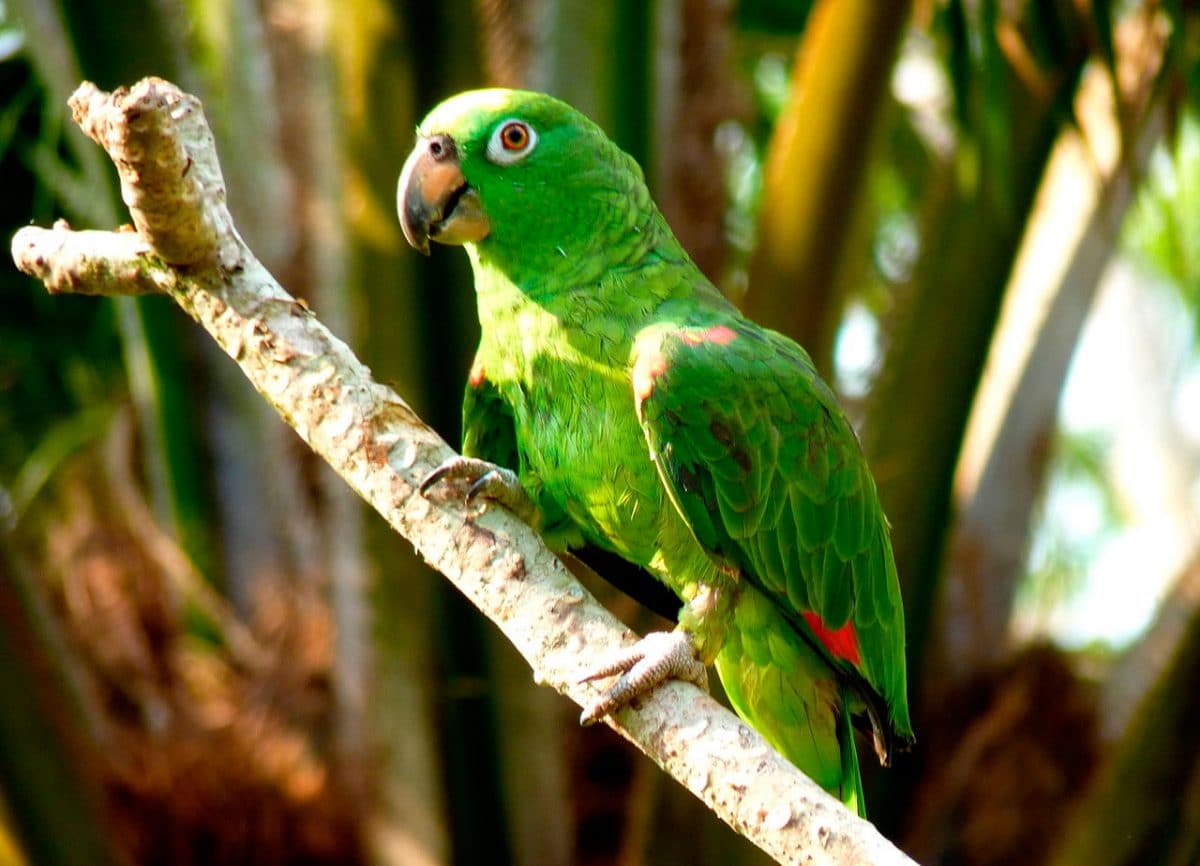
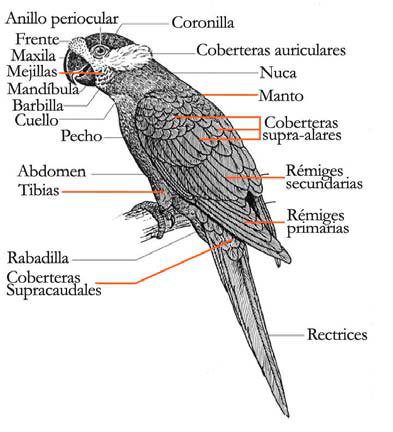
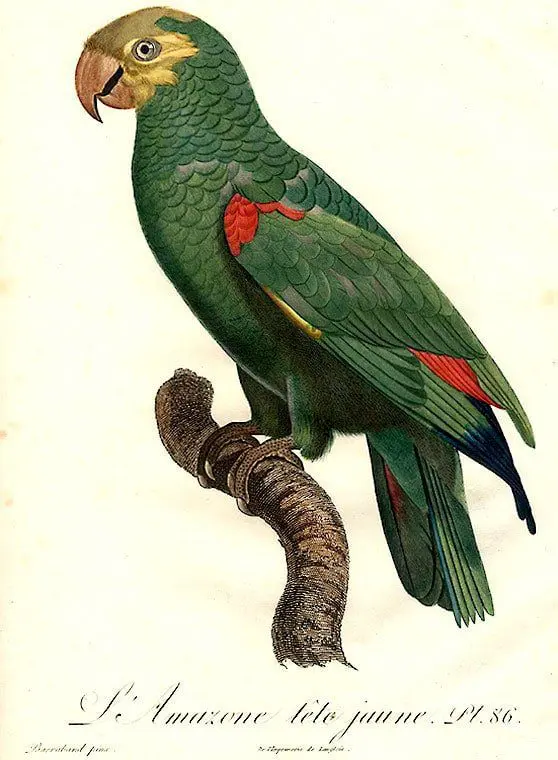
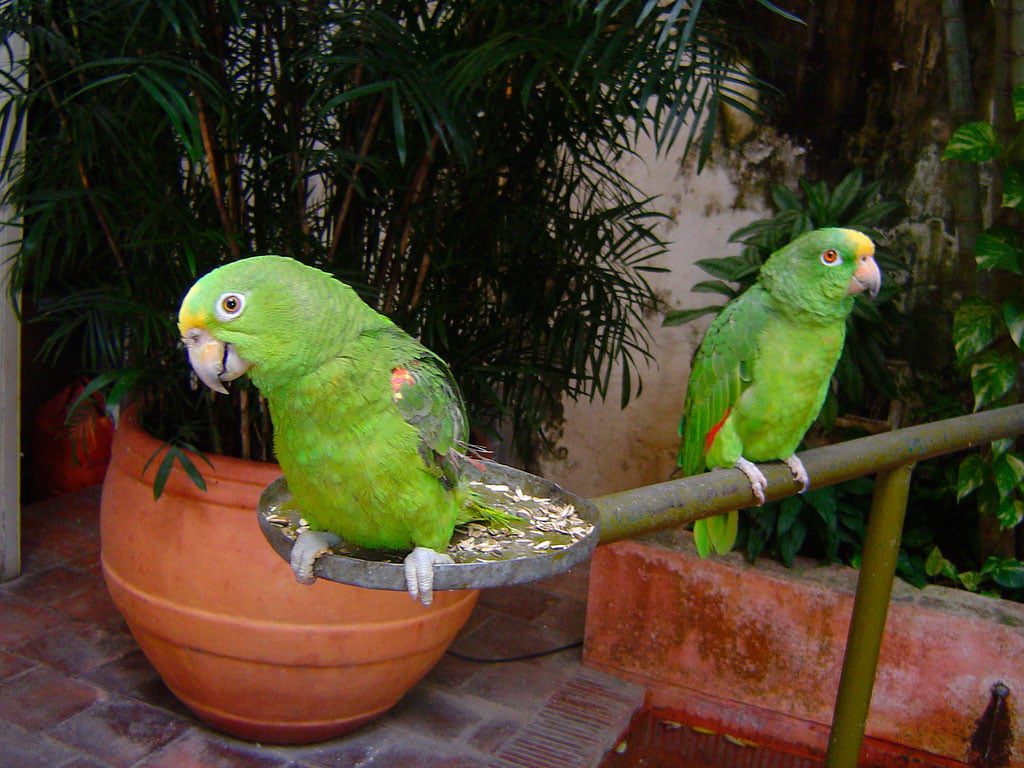
The Yellow-crowned Parrot(Amazona ochrocephala) has the forecrown and front area crown, bright yellow; lores, cheeks and supercilii area, green in most birds, but sometimes with yellow extending over lores and around eyes, and some birds with red bases hidden by yellow feathers crown; sides and back of the neck, nape and the mantle, green with dark margins, giving scalloped effect.
Upperparts green. coverts lower red, other coverts green; edge front of the wing
yellowish; five o'clock outer secondaries They are green with bright red to outerweb forming speculum; flight feather green with blue tips to secondaries and primary outerweb, dark to black in points. Underwing-coverts, dull green with blackish tips. Underparts green with plenty of blue in the chest; yellow feathers on the the thighs (often few and discrete).
Upper, the tail It is green with yellow stripes; below green with wide yellow ends; both with outer feathers basically red and a bluish puckered in outerweb.
Dark gray Bill, reddish at base of upper jaw; iris orange; legs grey.
Both sexes they are similar. The immature It has a narrower yellow patch on the head, stripes orange-red to yellow feathers crown; less red at the base of feathers tail; feathers of the tail more pointed and irises brown.
(Finsch, 1865) – Less yellow in the head that the nominal species, with frontal band green. Cheeks, supercilii area and lores with blue tint. Red curve wing
often mixed with yellow feathers.
(Cabanis, 1874) – Bill horn-colored pink, yellow feathers restricted as V in forecrown and front of the crown. Possibly average smaller than the nominal species.
Amazona ochrocephala xantholaema
(Berlepsch, 1913) – More extensive yellow in the head which extends to the back of the neck, around the eyes, to cheeks and to the ear-coverts. Often with frontal band narrow green. bluish tint in the chest.
They inhabit in open forests, moist forest edges, gallery forests, deciduous forest, open savannas and wetlands in lowland rain forests, also cultivated and suburban areas in some localities, and often near rivers.
The gallery forest It is your preferred Panama where Yellow-crowned Parrot avoid continuous humid forest, being replaced, possibly, there and in many areas of South America, by the Orange-winged Parrot(Amazona amazonica).
Usually observed in the lowlands; reported to 500 metres in Colombia and Venezuela and a 750 metres in Honduras. Usually in pairs or small flocks of 10-30 birds, with occasional gatherings up 300. Birds gather in common trees.
Reproduction:
Son Monogamie, couples joined in for life.
His time of reproduction It is from December to May. During this time, they lay clutches of 2 to 4 eggs, only Por those Nidada Tempordaa. Nest palm trunks and termite mounds.
It takes about 25 days for the eggs to hatch and near 56 days to become fledglings. The young become independent 2 months after hatching. Both male and female Yellow crowned Parrot reach sexual maturity around the 3 years.
Food:
Foods reported in the diet include fruit Immature American Curatella, Pereskia guamacho and other Cactus. Mainly feeds on treetop.
It is considered a plague in some localities for their love of eating bananas (Mussa paradisea), handles and Corn crops.
This species is considered a pest in some areas by his fondness for the consumption of bananas (Mussa paradisea), mangoes and corn crops.
Distribution:
Size of its range (reproduction / resident): 8.010.000 km2
The Yellow-crowned Parrot are in Panama, in Central America and in South America, from south to east Brazil and to the North of Bolivia.
Observed in the eastern foothills of the Andes and adjacent lowlands Colombia; eastward across the tropical zone Venezuela and south, from the coastal mountains through Bolívar (where apparently it is not known from south) and amazon, until Guyanas and Trinidad (where their status is uncertain due to the captive birds introduced).
Present in the basin Amazonas Brazil, to the south, to the Northwest of Mato Grosso and west, in the lowlands of eastern Ecuador and through the Peruvian Amazon, to the North of Bolivia.
Apparently residents throughout its distribution area. very small numbers in Panama, although locally fairly common, especially in those areas more dry; it is the most common parrot (at least once) in the San Blas Islands. generally common (even locally abundant) in South America, but the numbers are reduced in the more accessible areas due to trade.
Distribution 4 subspecies
Amazona ochrocephala nattereri
(Finsch, 1865) – South of Colombia in Caqueta, is of Ecuador, is of Peru, West of Brazil and North of Bolivia. Possibly integrated with nominal species in border areas Goal and Caquetá in Colombia.
Amazona ochrocephala ochrocephala
(Gmelin, 1788) – Nominal. It is from Colombia, Venezuela, Trinidad, Guianas and North of Brazil south to the tributaries of the lower margin right amazon in amazon and For.
• Current category of the Red List of the UICN: Least concern.
• Population trend: Decreasing.
This species is considered at present as minor concern BirdLife International, and, as a result, also by UICN.
Even though the populations it is believed that are in decline, still do not approach the threshold specified by BirdLife International to evaluate the species as Near-threatened.
It is listed in the Appendix II of the CITES.
The Yellow-crowned Parrot in captivity:
Known for his pranks and excellent skills imitate the human voice. Having said that, the ability to mimic will vary between birds and although many of them are excellent conversadoras, Some will never come to talk. These Amazons are generally affectionate. Its friendly and playful nature make them excellent pets.
Son easily domesticable and easy to train. Known to be very active, What makes them more suited to an environment that enables them to fly.
Son known for their voices. It is said that it is the strongest of all Amazon parrots. People who are not tolerant to noise, they will do well to live with this Parrot.
like most parrots, this horsewoman it can be very destructive. We must "personalize their environment" by providing them with objects to chew such as different toys and branches.
Its longevity should also be a consideration. These parrots They can live between 60 and 80 years.
Alternative names:
– Yellow crowned Parrot, Yellow-crowned Amazon, Yellow-headed Amazon, Yellow-headed Parrot (English).
– Amazone à front jaune, Amazone à tête jaune, Amazone verte de Colombie (French).
– Gelbscheitalamazone, Gelbscheitelamazone, Panama Amazone, Surinamamazone (German).
– papagaio-campeiro, ajurú-apara, papagaio-de-Suriname (Portuguese).
– Amazona Real, Cotorra Cabeciamarilla, Lora Cabeciamarilla, Lora coroniamarilla, Lora Real (español).
avibase
Parrots of the World – Forshaw Joseph M
Parrots A Guide to the Parrots of the World – Tony Juniper & Mike Parr Birdlife
Parrot Book, Parrots and macaws Neotropical
Photos:
(1) – A pet Yellow-crowned Amazon in Puerto Maldonado, Peru By Kate from UK (Lola) [CC BY-SA 2.0], via Wikimedia Commons
(2) – A pet Yellow-crowned Amazon By Freegiampi (From Giuseppe's farm) [CC BY-SA 2.5], via Wikimedia Commons
(3) – Yellow-crowned Amazon or Yellow-crowned Parrot (Amazona ochrocephala) in captivity By Stephen Joyce from barcelona, Spain (Parrot) [CC BY-SA 2.0], via Wikimedia Commons
(4) – Yellow-crowned Amazon or Yellow-crowned Parrot (Amazona ochrocephala) in captivity in the Parrot’s Garden (Jardim dos Louros), in the Botanical Garden of Funchal, Madeira island, Portugal By jmaximo [CC BY 2.0], via Wikimedia Commons
(5) – A Yellow-crowned Amazon in Gatorland, Florida, USA By greyloch from Washington, DC, area, U.S.A. (green parrot preening) [CC BY-SA 2.0], via Wikimedia Commons
(6) – Amazona ochrocephala panamensis, Panama Amazon (also known as the Panama Yellow-headed Amazon); two in captivity By TJ Lin (originally posted to Flickr as DSCN1005) [CC BY-SA 2.0], via Wikimedia Commons
(7) – A Yellow-headed Amazon (or Parrot) near the Brazil-Peru-Colombia triple junction By Dick Culbert from Gibsons, B.C., Canada (Amazona ochrocephala) [CC BY 2.0], via Wikimedia Commons
(8) – A Yellow-crowned Amazon at Bloedel Floral Conservatory, Vancouver, Canada By Karen Neoh (Parrot) [CC BY 2.0], via Wikimedia Commons
(9) – Yellow-crowned Amazon or Yellow-crowned Parrot (Amazona ochrocephala) in a tree in Venezuela By Rufino (originally posted to Flickr as camouflage) [CC BY-SA 2.0], via Wikimedia Commons
(10) – Amazona ochrocephala From Natural History of Parrots (by Francois Levaillant, 1801-1805) – Wikimedia
21 to 27 cm. length and a weight between 130 and 180 g..
The face of the Red-checked Parrot(Geoffroyus geoffroyi) is of color rojo-rosaceo up to just above the eyes, more pink in the ear-coverts; front of the crown of color rojo-rosaceo. Half of the crown to the nape mauve-blue. Upperparts green. Wings with patch red in them Middle coverts interiors.
Flight feathers with vane Dark internal and external Green. Edge of yellow to vane internal of greater coverts and secondaries. Wing feathers and axillary, bright blue; below, the rest of the wings, blackish. The underparts green, more yellowish in them lower flanks. Upper, the feathers of the tail of color green, drenched sides of yellow; below, brighter yellowish green.
The bill red orange in upper jaw, the lower jaw in color black; irises yellow; legs grey.
Female with head Brown and upper jaw black.
Youth they have the head green, irises dark and bill pale. The male juveniles go through a plumage «female stage» before they begin to acquire masculine characters (bird takes over one year to mature). The birds young also lack of the brand red on them small coverts.
(Müller, 1841) – The darker male in general that the nominal; purple blue crown comes to the part back from the neck; neck light blue; Marron-bronce washing variable on the mantle and top of the back; Green bluish in the part superior of the chest and zone inferior of the abdomen ; brown reddish of them coats internal of the wings absent; Blue more dark in them Underwing coverts. Larger in size.
The female with the head more dark that the nominal; purple diffusion in the crown; nape blue, reaching the neck with color blue light.
Geoffroyus geoffroyi obiensis
(Finsch, 1868) – Adults as the subspecies cyanicollis but collar Blue in the part back from the neck more comprehensive, reaching almost up to the eyes; blue-purple in the male or brown in the female does not reach the lower part of the occiput; reddish brown in the bottom of the back to rear.
Geoffroyus geoffroyi rhodops
(Schlegel), 1864) – Similar to the subspecies males floresianus, but darker in general; marks of the coats internal of the wings of color brown reddish dark; crown Blue separate with red in the face; Underwing coverts Blue more dark. Larger in size.
The female with the crown castano-oscuro color.
Geoffroyus geoffroyi explorator
(Hartert, 1901) – Synonymous with Geoffroyus geoffroyi rhodops
Geoffroyus geoffroyi keyensis
(Finsch, 1868) – The male resembles the subspecies floresianus, but in general more greenish-yellow, in particular in the tail; cheeks Pink and ear-coverts washed with Blue Lilac; Yellow greenish pale in the neck through the part back from the neck and a strip Green, darker, in the early part of the neck; Underwing coverts pale blue. Larger in size.
The female chestnut brown on the head.
Geoffroyus geoffroyi floresianus
(Salvadori, 1891) – The male is like the nominal, but darker in general; the purple blue of the crown It's darker and reached to the nape; coats internal of the wings dark reddish brown; Blue more dark them Underwing coverts. Larger in size. Largest peak. Female with the crown darker brown, coming up to the nape.
(Meyer, 1884) – The subspecies resemble adults Kei, but smaller.
Geoffroyus geoffroyi pucherani
(Souancé, 1856) – Adults and juveniles with bronze-colored marking of the parts internal of the wings, minimal or absent; the mantle have less marron-bronce washing; Brown more pale in the part low of it back; the buttocks with less red; coats dark blue low the wings.
Geoffroyus geoffroyi minor
(Neumann, 1922) – Male adults are as the subspecies aruensis, but with reddish brown under the back to rear; face darker red; washing Marron-bronce in the the mantle; brands in the coats internal of the wings minimal or absent.
The female as the subspecies aruensis, but with the head of brown slightly more dark.
Geoffroyus geoffroyi jobiensis
(Meyer, 1874) – Adults and juveniles but with Underwing coverts pale blue; bright red in the lower part of the back to the rear; in males, the red in the forecrown back to the front of the crown.
Geoffroyus geoffroyi mysoriensis
(Meyer, 1874) – Males as juveniles, but with the crown blue-purple, down on the back of the neck, and red in the face, coming up to the throat; washing marron-bronce absent in the the mantle; extensive reddish brown marks in inner median coverts; Underwing coverts dark blue; dark brown in the bottom of the back to rear.
The female as juveniles, but the color brown in the crown comes to the part back from the neck.
Geoffroyus geoffroyi orientalis
(Meyer, 1891) – Hardly differs from the subspecies aruensis; Crown of the male is slightly more pale.
Geoffroyus geoffroyi sudestiensis
(Estimate, 1890) – The adult male is similar to the subspecies aruensis, but with the underparts darker; the trademark brown reddish of them coats internal, absent.
The crown and nape of the female, is dark green.
Geoffroyus geoffroyi cyanicarpus
(Hartert, 1899) – The adult male is similar to the subspecies aruensis, but with azul-lila wash in them cheeks and ear-coverts; bend of wing has edge blue.
The female is as the subspecies aruensis, but the crown and nape They are brown, with light green dye; edge blue in the part outside of the wing
as in the male.
Geoffroyus geoffroyi aruensis
(Gray, 1858) – Similar to the species males nominal, but darker purple blue from the crown up to the nape; inner coverts a reddish brown marked darker; Blue more dark in them Underwing coverts.
The female Brown darker from the crown even the nape.
Geoffroyus geoffroyi maclennani
(W. D. K. Macgillivray, 1913) – The male is similar to the subspecies aruensis, but darker in general; the Red of the face is darker and more uniform; Underwing coverts paler blue. Female similar to the female of subspecies aruensis, but darker in general; head dark brown; Underwing coverts paler blue.
* The varieties sumbavensis and tjindanae proposed as subspecies are synonymous of floresianus; rhodops stresemanni; explorator It is also synonymous of rhodops.
Habitat:
Distributed by primary and secondary forests, tree savannas, plantations, Open forests, mangrove forests and farmland, a altitude of 1.400 m. Usually replaced by the Blue-collared Parrot at higher altitudes. Exclusive tropical jungle in the North of Australia. View the birds, generally, flying high above the trees, making calls to cries.
Groups of birds in the North of Australia, many still in family units, they have been observed leaving their roosts early, to feed into the dense jungle; in their flights to areas of foraging, We have seen some of these birds perched in the upper branches of the trees, by calling aloud for a few minutes and dithered wings before continuing. The reason for this unknown behavior can be a way of requesting food due to early maturation.
During the day the birds are less visible, they can draw attention by discarded food falling from their food trees.
They are usually in couples, in small groups or assembled in groups in fruit trees.
Reproduction:
The nest It is a hole that the birds excavate in a rotten limb of a tree from the forest, sometimes also in a knot in the trunk; probably only the female excavates. The entrance to the nest is of 80 to 90 mm. wide, and the tunnel, that it can twist in order to hide the eggs, You can have a length of 42 cm.. Includes the implementation of 2 to 4 eggs. The female alone incubates and is fed by the male during this time. In the West, the breeding season It takes place between April and September at least, month in which a live nest was found in Seram.
In New Guinea, the nesting is been registered during several months more, including February in the North and between the months of April to December in other places.
In Australia, in where the season seems to extend is from August to December, little information about the cycle reproductive is available.
It is known that the species It has never been raised successfully in captivity.
Food:
The diet It includes seeds, fruits and flowers. The birds tend to hang acrobaticamente to reach their food.
Distribution:
Size of the area of distribution (reproduction / resident): 793.000 km2
Generalized from the West of Lombok, through the Moluccas, the lowlands of New Guinea, and observed in the groups of associated Islands, to the East of Rossel in the Louisiade archipelago.
The species can also be observed in the northeast of the Cape York Peninsula, Australia, at its southern end, and North ranges up to Morotai in the North of the Moluccas. In many areas, throughout its distribution area, is the most abundant Parrot (rarer over the 800 meters above sea level), even around inhabited areas. Despite this, It may be extinct in Ambon.
The size of the world population It has not been quantified, Although it is estimated above 1.000.000 of copies. The species according to sources, is of common to abundant much of its area of distribution (pit et to the. 1997).
The population suspected to be stable in the absence of evidence of any reduction or substantial threats, Although you can that its population is affected by the capture in various parts of its area of distribution.
"Red-checked Parrot" in captivity:
Very rare or impossible to see in poultry.
Passive Parrot. Extremely susceptible to stress and disease; they may die suddenly without apparent reason. Few times you live long in captivity
Alternative names:
– Red-checked Parrot, Red cheeked Parrot, Red-cheeked Parrot (ingles).
– Perruche de Geoffroy, Eclectus de Geoffroy, Éclectus de Geoffroy (francés).
– Rotkopfpapagei (alemán).
– Papagaio de bochechas vermelhas (portugués).
– Lorito Carirrojo, Lorito de Mejillas Rojas (español).
– Avibase
– Parrots of the World – Forshaw Joseph M
– Parrots A Guide to the Parrots of the World – Tony Juniper & Mike Parr
– Wikipedia
– Birdlife
– parrots.org
– Photos:
(1) – By Ron Knight (Flickr: Red-cheeked Parrot) [CC BY 2.0], via Wikimedia Commons
(2) – By Nick Athanas/Tropical Birding – Birds-pet-wallpapers
(3) – A male perched in a tree by Josep del Hoyo – Lynx
(4) – A male and a female looking for a suitable nest by mehdhalaouate – Lynx
(5) – By markharper1 [CC BY-SA 2.0], via Wikimedia Commons
The Blue-naped Parrot(Tanygnathus lucionensis) has the head bright green with a clear bright blue diffusion through the back of the crown and nape.
Upperparts yellowish-green with pale blue illuminated on the back low and the tail; upper tail coverts brighter yellowish green.
Scapulars blue, with green edges; shoulder Black with small coverts Black bordered of blue-green and orange Green; median black and pale blue, large edges of opaque orange brown; greater coverts Blue-Green lined with orange-yellow in the feathers interiors.
Secondary Green with yellow and narrow margins; primaries Greens with vane blackish internal.
Wing feathers green, underside of primaries blackish.
Upper, the tail green, narrow edge and yellowish tip laterally; undertail, the tail yellowish brown opaque.
Bill red, paler at the tip and the lower jaw; irises yellow; legs grey.
Both sexes are equal.
Immature with less blue in the crown and more off the brands of the wings.
: It has the most extended head blue, with violet tone. Their wings are greener.
Tanygnathus lucionensis talautensis
: No blue in the obispillo and their plumage is less yellowish.
Tanygnathus lucionensis [salvadorii u horrisonus]:
Habitat:
It is a bird of forests closed and open, including secondary growth, coconut plantations, patches of mangrove and banana to the 1.000 meters above sea level; and not so strongly linked to coastal habitats as the Great-billed Parrot. Is usually found in flocks of up to 12 individuals who sit in community and make regular flights at dawn and in the evening between the feeding and resting areas. Feeds on fruit trees.
Reproduction:
The breeding It has been observed in the months of April to June. Registered a nest the natural cavity or abandoned Woodpecker hole, often a clear. There is no data on the size of the laying.
Food:
Fruits and seeds of forest trees, Palm fruit, young coconuts, the banana and papaya.
Apparently, small groups of birds in Mantanani Kiss (Northwest Sabah), and SI-Amil (until 100 birds present in 1962) and Maratua off the northeast coast of Borneo; The existence of a wild population was also reported around Kota Kinabalu, (Sabah).
Occasional leaks occur in other parts, including the Sangir Islands.
The species was described as common in Salibabu in the Group of Talaud in 1978 (more numerous there than the Azure-rumped parrot) and they are still regularly seen there and in the nearby Karakelong during observations in 1995 (Numerous in a last record in 1997).
In other areas the species is rare. Recent records in Philippines they come mainly from Mindoro and Palawan, places that seem to be the bastion of the species.
Tanygnathus lucionensis [salvadorii u horrisonus]:
(Ogilvie-Grant, 1896) – Philippines, (except North), but it can be rare or extinct on many islands. Also in some small islands off Northwest and northeast of Borneo (If Amil, Mantanani), where it was possibly introduced, especially on this last island.
Conservation:
• Current category of the Red List of the UICN: Near threatened
• Population trend: Decreasing
The total population is provisionally estimated to be below the 10,000 specimens in 1993 (Lambert et to the. 1993).
The population is suspected to be in decline due to capture for the bird trade and habitat degradation from expansion and logging due to agricultural pressures..
– Determine the impact of trade on the population of the species.
– Revise its estimate of the world population.
– Estimate the rates of decline based on the rates of deforestation within its range.
– Protect effectively important extensions of high forest with trees suitable to nest in key places throughout its distribution area, both in the areas of strict protection, such as multi-use areas.
"Blue-naped Parrot" in captivity:
pretty calm.
Occasionally available.
Alternative names:
– Blue-naped Parrot, Blue naped Parrot (ingles).
– Perruche de Luçon, Perroquet à couronne (French).
– Blaunackenpapagei, Blaunacken-Papagei (German).
– Papagaio-de-nuca-azul (Portuguese).
– Loro de Nuca Azul, Loro Nuquiazul (español).
27 to 28 cm. length between 53 and 70 g. of weight.
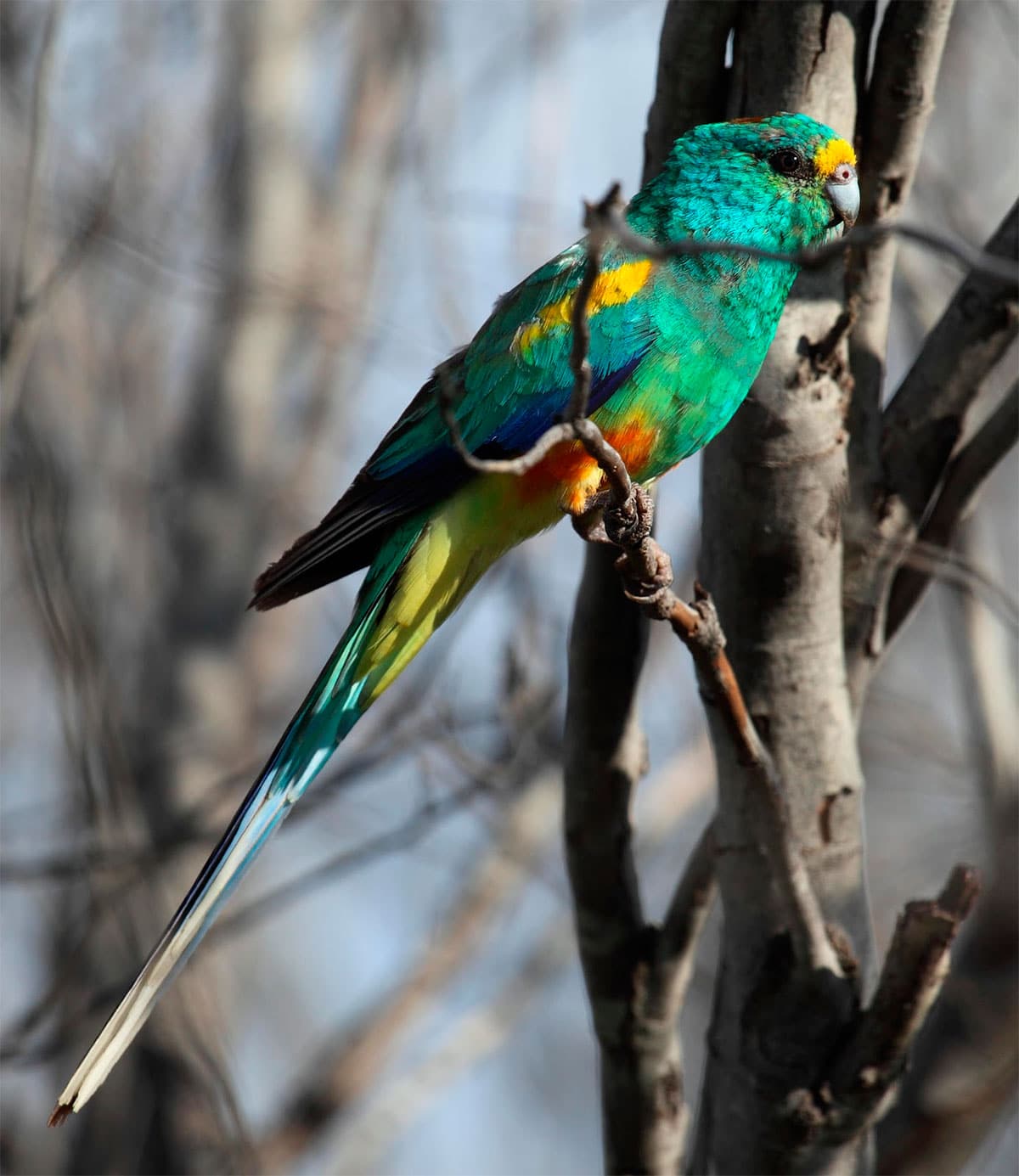
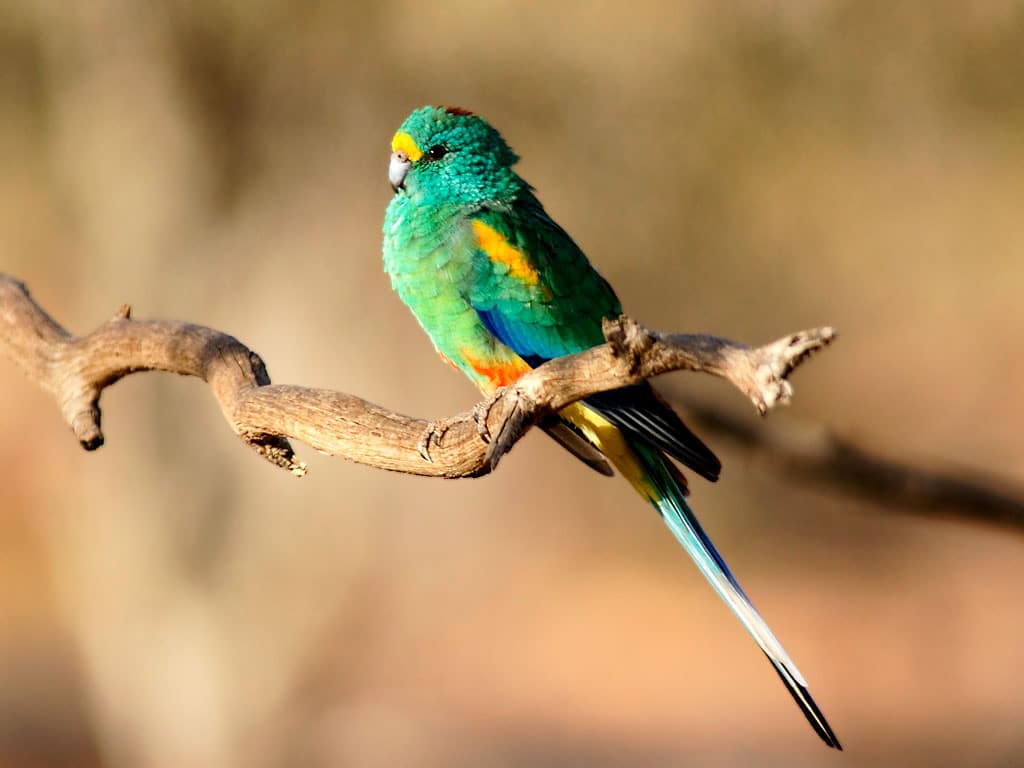
The plumage of the Mulga Parrot(Psephotellus varius) It, in general, color bright green. A yellow band across the front and a variable red spot adorns the back of the crown. The abdomen and the thighs are yellow, more or less stained Red. The uppertail-coverts are bright green, with a reddish blotch at the base of the tail. The lower area of the back has a blue-green band bordered above and below with a dark bluish-green line;. The curvature of the wings are turquoise and the blankets they have a yellow-orange tone forming a patch on the wing. The central feathers of the tail are green bronze, changing to greenish-blue. The outer feathers of the tail are green-blue on the bottom and white on the tip. The bottom of the tail It has a pale blue base and a finish in black. The bill is dark gray. The irises They are brown, legs grey.
In the female, the head, the back and top of the chest a color is brownish olive. The feathers of the lower parts are light green. The headband orange-yellow is barely noticeable and, often dyed red bermejo. The place that adorns the back of the crown is opaque reddish. The patch of the wing
is red, not yellow as in the male.
The youth they are much more muted than their parents. Young females have small blankets green edged with red, giving the latter a scaly appearance. Among young males, the red in the abdomen and the thighs is practically missing.
The Mulga Parrot generally prefers dry open habitats and lightly wooded Plains, where can find a great variety of vegetation. Found in scrubland Mallee and, in plots of acacia, casuarina, and also in the regions where small trees of eucalyptus They punctuate the stretches of sand. They are also present in the rocky hills or rocky cliffs.
They survive in dry areas, but in these cases, often sit near sources or temporary streams. The Mulga Parrot they owe their English name (Mulga Parrot) the fact that his rank often coincides with areas of Mulga, It is the vernacular name of Aboriginal origin, It is used to describe the semi-arid vegetation that covers the largest part the Australian continent. Mulga It appoints to the extension of the ecosystem or landscape in which Acacia are the dominant vegetation type. This does not mean that this species is strictly dependent on this habitat type.
Unlike in the Red-rumped Parrot, the Mulga Parrot is a quiet and reserved bird. This species usually lives in pairs or small family groups, rarely in large flocks. Most of the time, looking for food on the ground, in the shade of the trees at the edge of a road.
They show a great familiarity and usually allow to photograph them at close range. When it manifests some distrust, They walk away a short distance, to a tree and then return to Earth as soon as the intruder has moved away. On the other hand, When it comes to drinking, they are very cautious, as well as when they rest in the treetops, where are trying to keep hidden.
Reproduction:
The nesting period is carried out between the months of July and December, but also at other times of the year, provided that is a rainy month. The processions are very similar to the of the Red-rumped Parrot (Psephotus haematonotus) and includes mutual grooming.
The nest It is often found in a cavity in a tree, However, They also use nests of others parakeets or other openings such as tunnels dug in riverbanks.
The nests of the Mulga Parrot they are often found in small stunted trees, at low altitude above the ground. But, places near rivers provide locations that are at a higher elevation.
The female incubated during 19 days, While the male mounts guard close to stock up your food partner and warn of possible dangers.
The chicks, they leave the nest four weeks after hatching. Immediately after take-off, they join adults to form family groups.
Food:
The Mulga Parrot they feed on grass seeds, acacia seeds, berries, mistletoe and fruits. They complement their menu with different varieties of insects.
Distribution:
Size of the area of distribution (reproduction / resident): 3.330.000 km2
Endemic to the southern part of the Australian continent. Its range covers the entire southern part of Western Australia, except the forest area of ​​south west. It continues throughout the Great Australian Bight, Southern Australia and reaching the state of Victoria. Ends in southeast New South Wales, but does not cross the Great dividing range and it kept at great distance from the coast. Despite the large size of its territory (more than 3 million square kilometers), the species is considered monotypic (no subspecies).
Conservation:
• Current category of the Red List of the UICN: Least concern
• Population Trend: Decreasing
The Mulga Parrot they are widespread and relatively common in appropriate habitats.
Since the European colonization, the species appears to have changed its habitat significantly and is now more common in the grain belt in the desert.
The population, currently estimated at around 100.000 birds, It is slightly decreasing in the South due to the thinning areas of Mallee. In general, is not endangered. Classified by the IUCN as it does not present major problems.
"Mulga Parrot" in captivity:
It is in 1861 that the Mulga Parrot they arrived in Europe. The first specimen was exhibited to the public at the London Zoo. The first case of reproduction of this species dates back in the year 1876 in charge of the SR. Verviers in France. For a long time, These birds were known for being unreliable. That may be true, but the Mulga Parrot who are captives now in Europe support good climate, although they seem a little less solid than the Red-rumped Parrot (Psephotus haematonotus). It is possible that this is one of reasons why have been much less popular in aviaries that the Red-rumped Parrot.
Despite this, It is a parakeet can be advised to novice fans. The varied Perico often show minor differences in color and design. This is not anything unusual, This phenomenon is also known among the birds living in the wild. It is even possible to see the small differences in the same nest, If you look well.
These birds always in motion they are not suitable for being kept captive as pet birds in a small cage.
These are relatively strong birds, they withstand the cold relatively well, although they are sensitive to very low temperatures. They are birds peaceful and assets. Quickly show confidence to their caregiver. The sound of his voice is melodious. It is a bird that likes to raise. Like to be on the ground and, often spend their time grooming are. They also love to bathe. On the other hand, they are large rodents.
During the breeding season they are aggressive when in the company of other birds., even if it can be accommodated with conspecifics and other species of large birds, that will have no trouble, If the space in which birds are kept is large enough.
With regard to its longevity, a sample lived 11,8 years in captivity. In captivity, estas aves se han conocido casos de reproducción con 1 año de edad.
(1) – Mulga Parrot (Psephotus varius), Northern Territory, Australia By Christopher Watson (http://www.comebirdwatching.blogspot.com/) [CC BY-SA 3.0], via Wikimedia Commons
(2) – A male Mulga Parrot at Gluepot Reserve, South Australia, Australia. Male By David Cook Wildlife Photography from Wamboin, NSW, Australia [CC BY 2.0], via Wikimedia Commons
(3) – Mulga Parrot (Psephotus varius) Currawinya NP, SW Queensland, Australia By Aviceda (Own work) [CC BY-SA 3.0], via Wikimedia Commons
(4) – Mulga Parrot (Psephotus varius), Northern Territory, Australia By Christopher Watson (http://www.comebirdwatching.blogspot.com/) [CC BY-SA 3.0], via Wikimedia Commons
(5) – A male Mulga Parrot (also known as the Many-coloured Parrot at Wyperfeld National Park, Victoria, Australia By David Cook Wildlife Photography [CC BY-SA 2.0], via Wikimedia Commons
(6) – Parrots in captivity /. London :George Bell and Sons,1884-1887 [i.e. 1883-1888] – Flickr
Sounds: Marc Anderson (Xeno-canto)
▷ The world of Pets: Dogs, cats, birds, reptiles, amphibians
Of 50 cm.. length and an average weight of 480 g..
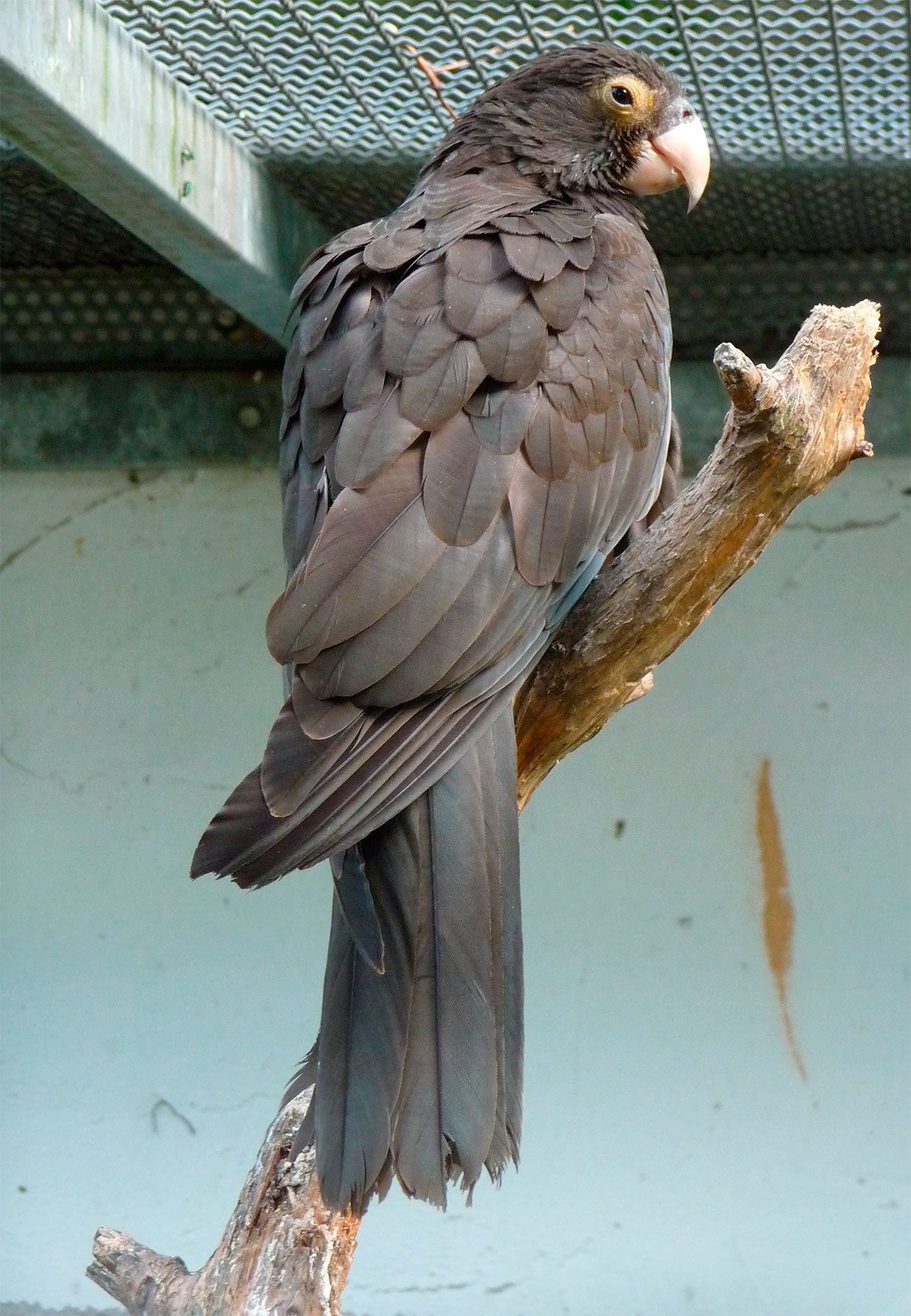
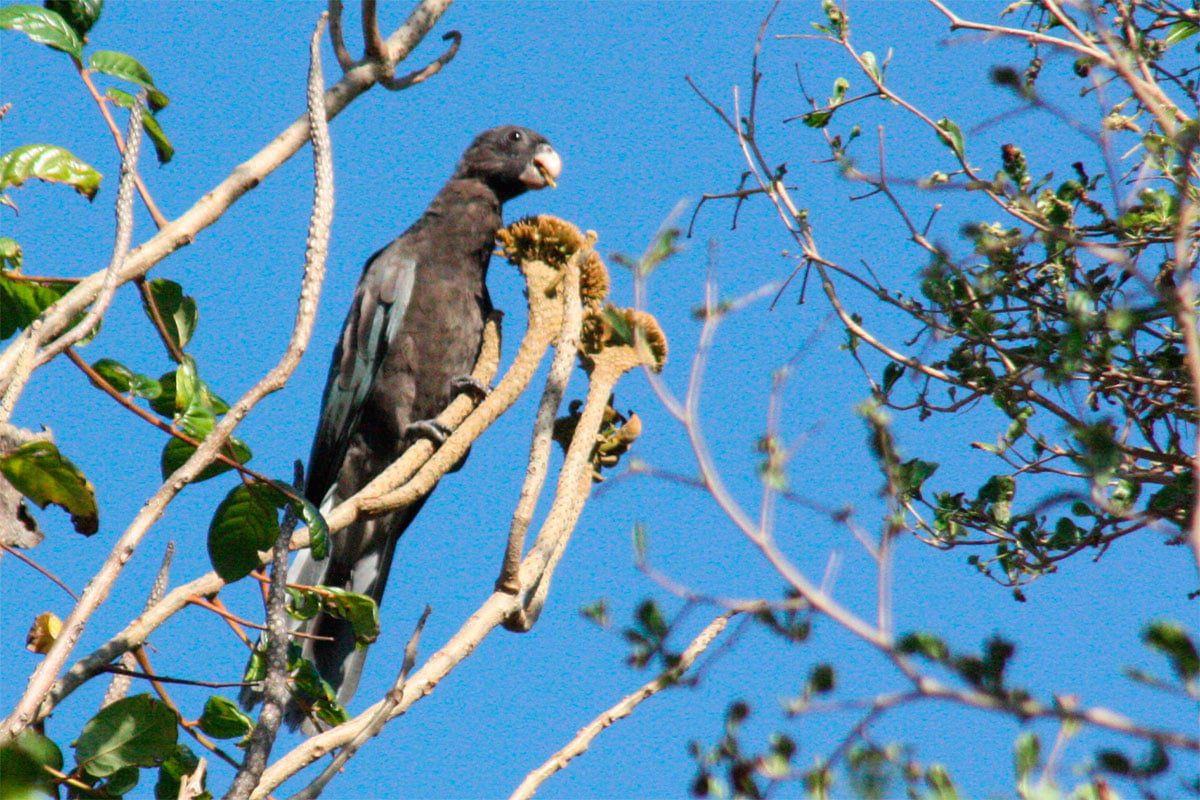
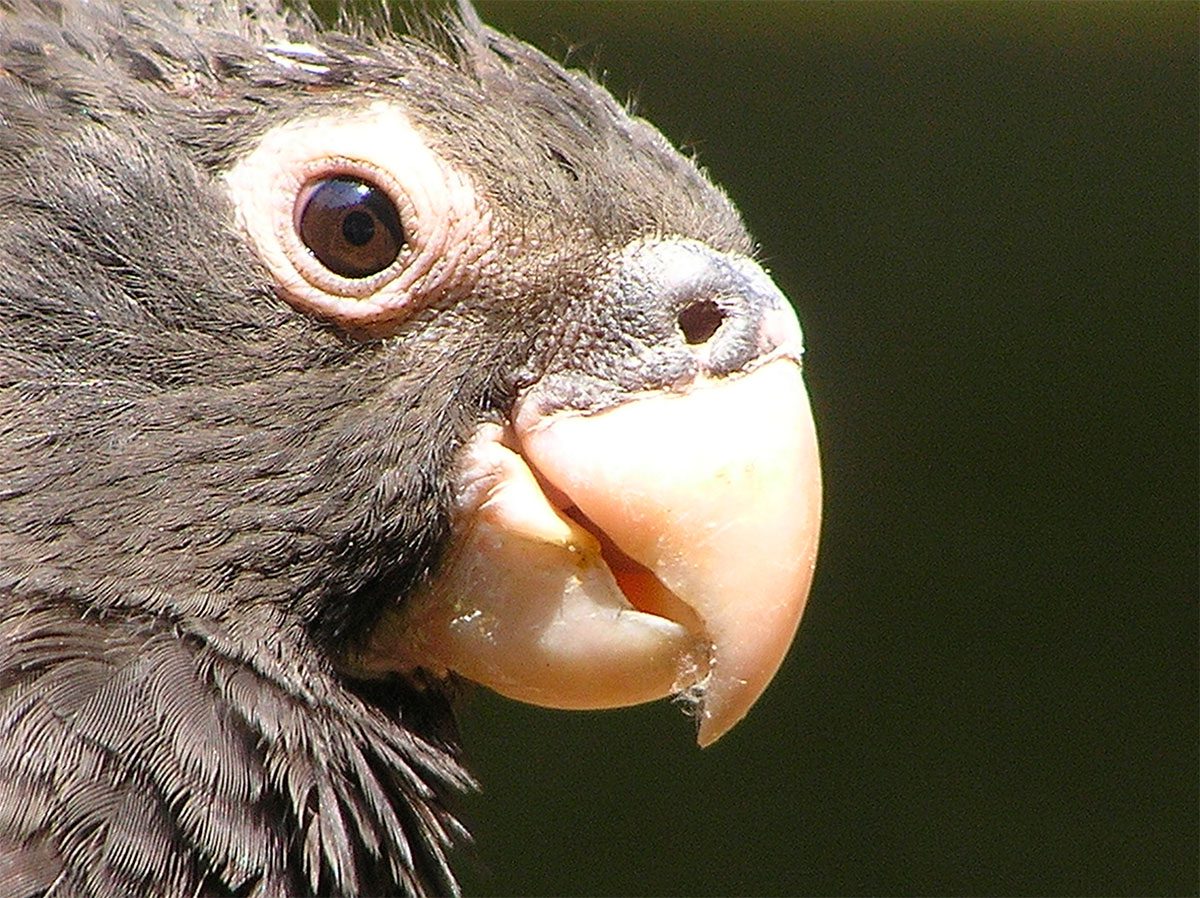
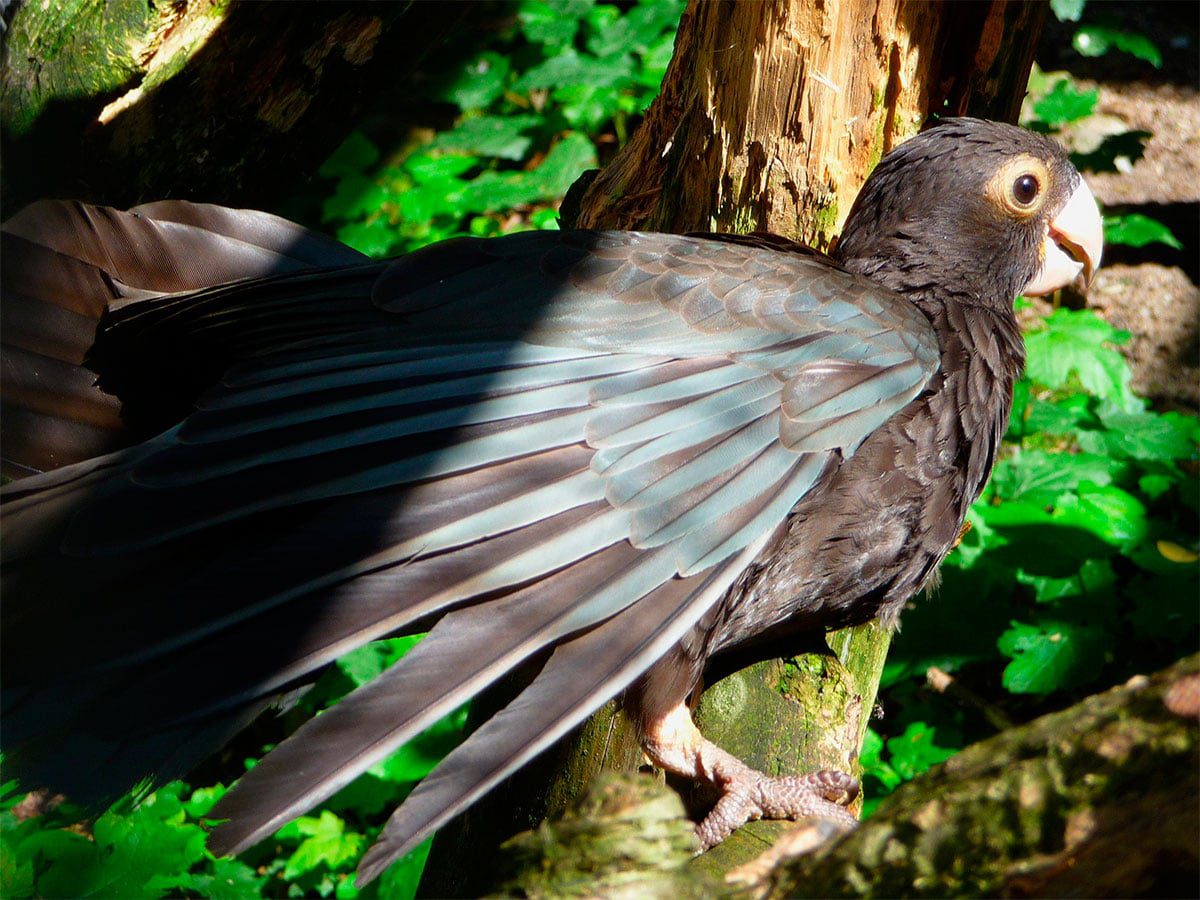
The Vasa Parrot (Coracopsis vasa) It has a few shades between black and Brown, big enough, grim looking, with the rounded tail and a powerful bill pinkish.
They can be difficult to spot when they combine their dark plumage with shadows under the forest canopy..
To a large extent, sympatric with the very similar Black Parrot (Coracopsis nigra), but the Vasa Parrot It is larger and somewhat paler, greyish Brown rather than dark brown
They can fly at high altitude when they travel to or from the sites of communal rest. It can be very Meek and accessible When feeds below the forest canopy.
In general, the plumage of the Vasa Parrot is brown-black color with a slight greyish tinge clear at the top, in special wings and top of the tail. Primaries with narrow gray margin in vane outer. bottom of the flight feather pale grey. Subcaudales coverts Gray with variable black stripes on the shafts of feathers. Tail with faint dark subterminal band; undertail, the tail pale grey. Bill usually pink but grey color after molting; irises brown; naked periophthalmic patch (that extends to the peak) pale grey; legs greyish Brown clear
Without sexual dimorphism in plumage. Reproductive females can become bald on the head, around the eyes and throat , with the exposed skin of mustard yellow or orange.
Immature with plumage more greyish Brown lighter and paler skin around the eyes. Skin patch naked eye more smaller than in adults or absent.
(Peters,W, 1854) – Smaller, of 45 cm., and paler than the nominal species, Unlike the subspecies drouhardi by having underparts dyed color chocolate instead of gray, and undertail-coverts Brown instead of gray or whitish.
Coracopsis vasa drouhardi
(Lavauden, 1929) – It´s smaller, of 45 cm., and paler than the nominal species. The underparts they are more gray with undertail-coverts more whitish, upperparts They show a bluish grey tinge clear. Dark subterminal band on the tail.
The Vasa Parrot they are distributed among a wide variety of habitats, from the dense and humid forests, Brambles open forests, until Medemia Palms in the savannas.
It attends the habitats modified by human activity; sometimes visits farmland.
Move, mainly, by lowlands, from sea level to the 1.000 meters above sea level.
In Comoros, the Vasa Parrot, generally, are associated with humid forests, always green, above the 300 m, but visit more open fields to feed.
Within its forest habitat, they are usually seen in the treetops, Although they descend to the ground to feed.
Usually found in small noisy groups, although they congregate in larger flocks when feeding or roosting.
The Vasa Parrot They perch on the top of large trees with at least one individual awake to warn of the danger; It is said that they are most active in the full moon nights.
Reproduction:
The breeding season, probably, of the months from October to December.
The nest It is built in a tree cavity or a trunk. In the western area of Madagascar, the baobabs trees (Adansonia) they are often used, sometimes with several nests in the same tree. These birds (especially the males) they can show cloacal protuberances while breeding.
Food:
Seeds, nuts, berries and fruits are part of their diet. Visit rice fields, millet and corn, causing, sometimes, extensive damage to crops. Apparently less frugivorous than the Black Parrot.
Distribution:
Size of its range (reproduction / resident): 928.000 km2
The species is partly common, in some places abundant, but its distribution in Madagascar possibly contracted due to large-scale deforestation in the center of the island.
Officially treated as harmful species, the Vasa Parrot they are persecuted because of predation on crops (especially rice) and captured for the trade in live birds at national and international level. They are also hunted as food.
It is distributed in several protected areas and although his pursuit and capture is intense in some areas, apparently, the species still is not at risk.
As they are seen as crop pests, is legal to hunt at the Vasa Parrot in Madagascar, and high levels of hunting contributes to a rapid decline in its population.
Like many species of Madagascar, the loss of their forest habitat is also a threat.
The size of the world's population has not been quantified, but the species, according to sources, It quite common in many areas
"Vasa Parrot" in captivity:
Very rare in captivity, difficult to find in aviaries, perhaps because of its initial lack of spectacularity compared to the more striking colors of any other species of parrot.
Although Vasa Parrot they are not very common as pets, comments from owners praise its virtues as a companion animal.
It is an extremely Intelligent and cunning.
Its beak is not strong enough to destroy the hard wood.
During the breeding season, they are very assets and quite noisy.
The female is the dominant, It is recommended as well that the eclectus that for an optimal result in reproduction, two males and one female are used in small aviaries or a greater number of males than females in breeding by means of colonies.
By the time they enter zeal both the male and the female, drop you the feathers of the head practically bald and both players.
The skin of the female head becomes yellow and white male. They tend to put in 2 to 3 eggs that incubate for space of 17 days.
The pups they are born completely devoid of markers, their legs are too long to be parrots and another feature that makes them unique is that they have both sides of their beaks at the corners, some bumps with characteristics similar to some exotic
Tienen facilidad para imitar la voz humana.
In terms of their longevity, according to sources, a specimen lived 53,9 years in captivity.
Alternative names:
– Vasa Parrot, Greater Vasa Parrot, Greater Vasa-Parrot (English).
– Grand Vaza, Grand Perroquet vasa, Grand Vasa, Perroquet vaza (French).
– Vasapapagei, Großer Vasa, Vasa (German).
– Papagaio-vasa (Portuguese).
– Loro Vasa (español).
– Avibase
– Parrots of the World – Forshaw Joseph M
– Parrots A Guide to the Parrots of the World – Tony Juniper & Mike Parr
– Birdlife
– ornitoloxia
– Photos:
(1) – Coracopsis vasa By 4028mdk09 (Own work) [CC BY-SA 3.0], via Wikimedia Commons
(2) – Greater Vasa Parrot in Madagascar By AEM (Picasa Web Albums) [CC BY-SA 3.0], via Wikimedia Commons
(3) – Coracopsis vasa By 4028mdk09 (Own work) [Public domain], via Wikimedia Commons
(4) – Greater Vasa Parrot (caracopsis vasa) in a Antwerp zoo By frank wouters from antwerpen, belgium , Belgium , Belgique (grote vasapapegaai) [CC BY 2.0], via Wikimedia Commons
(5) – Lesser vasa parrot (coracopsis nigra) in Anjajavy Forest, Madagascar By Charlesjsharp (Own work) [CC BY-SA 3.0], via Wikimedia Commons
(6) – Parrots of the World, by Joseph Forshaw (illustrated by William T. Cooper)
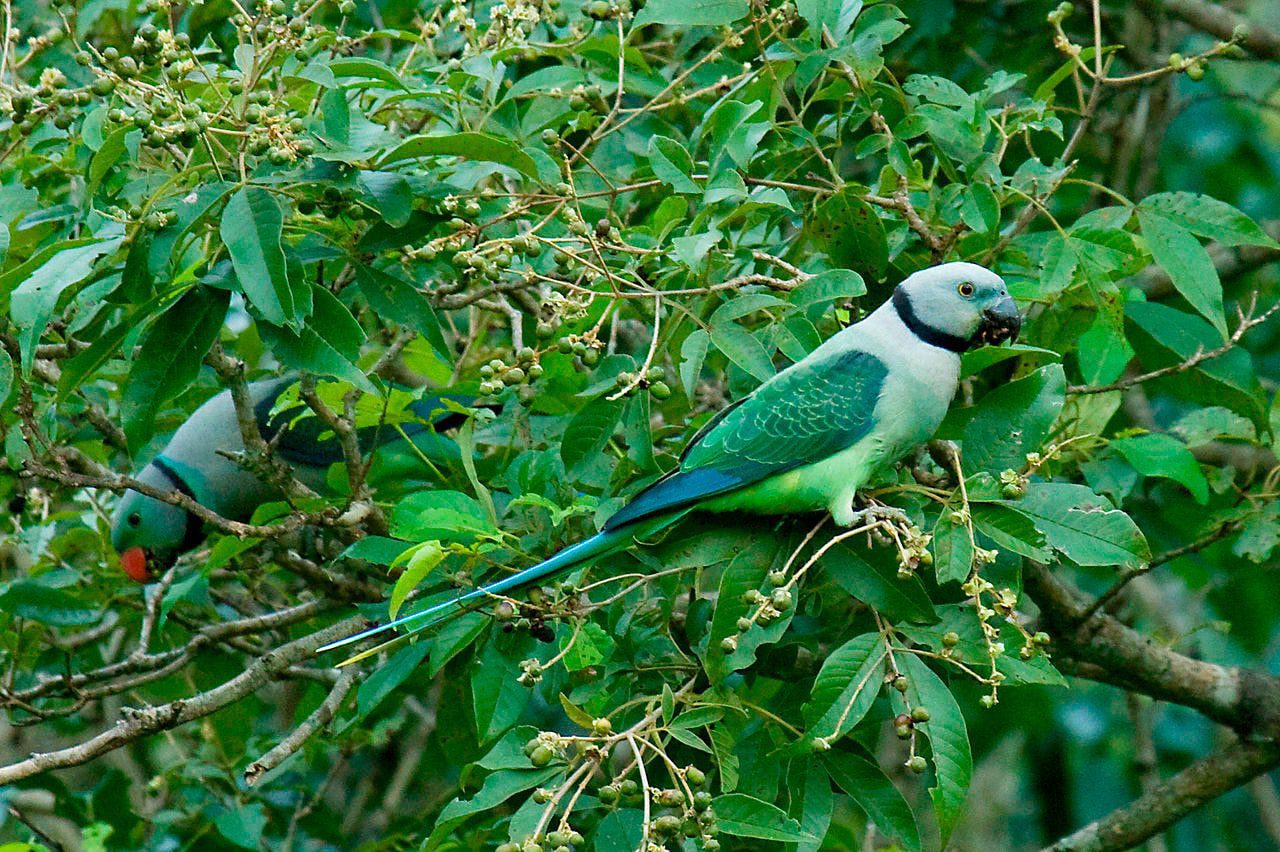
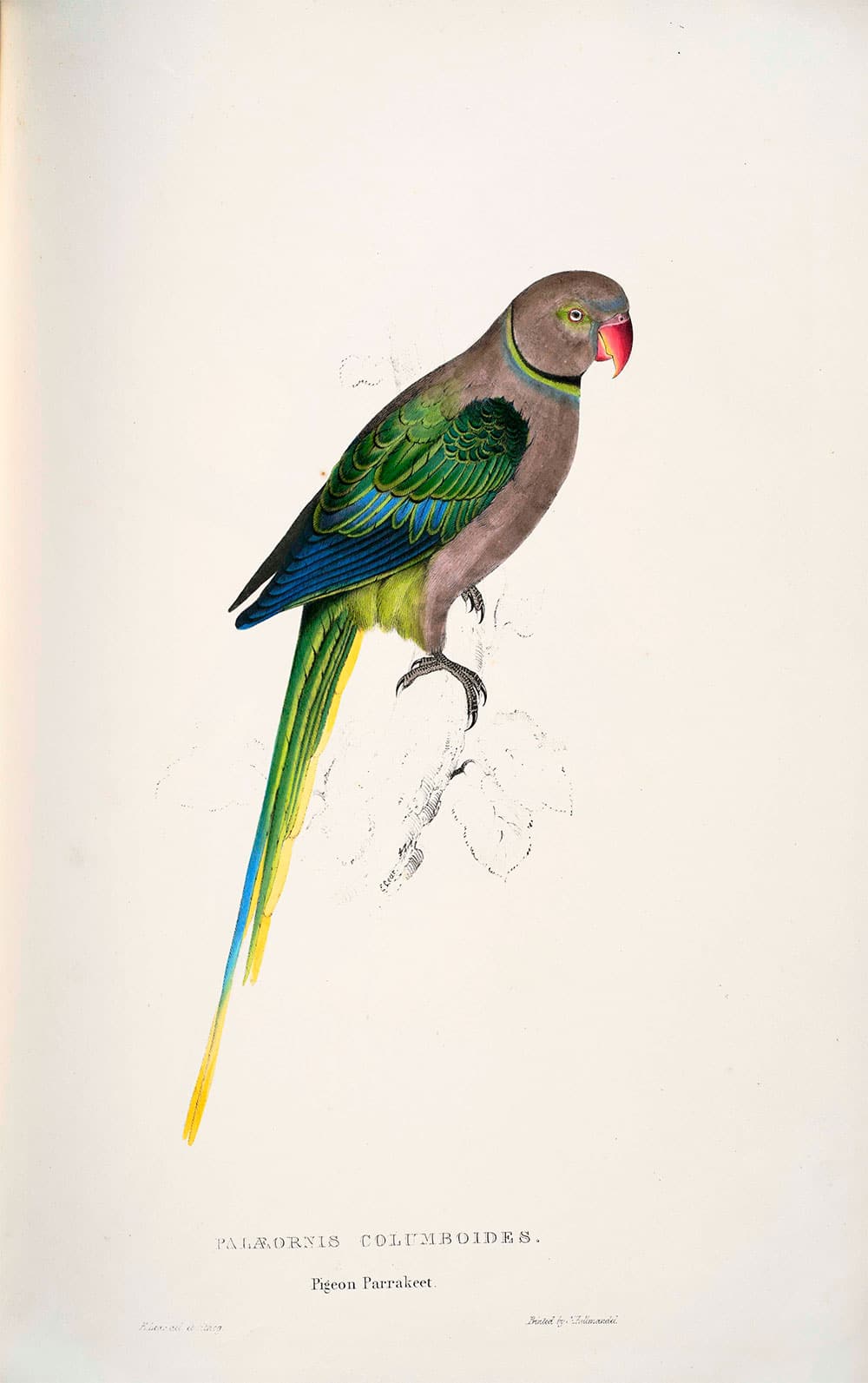
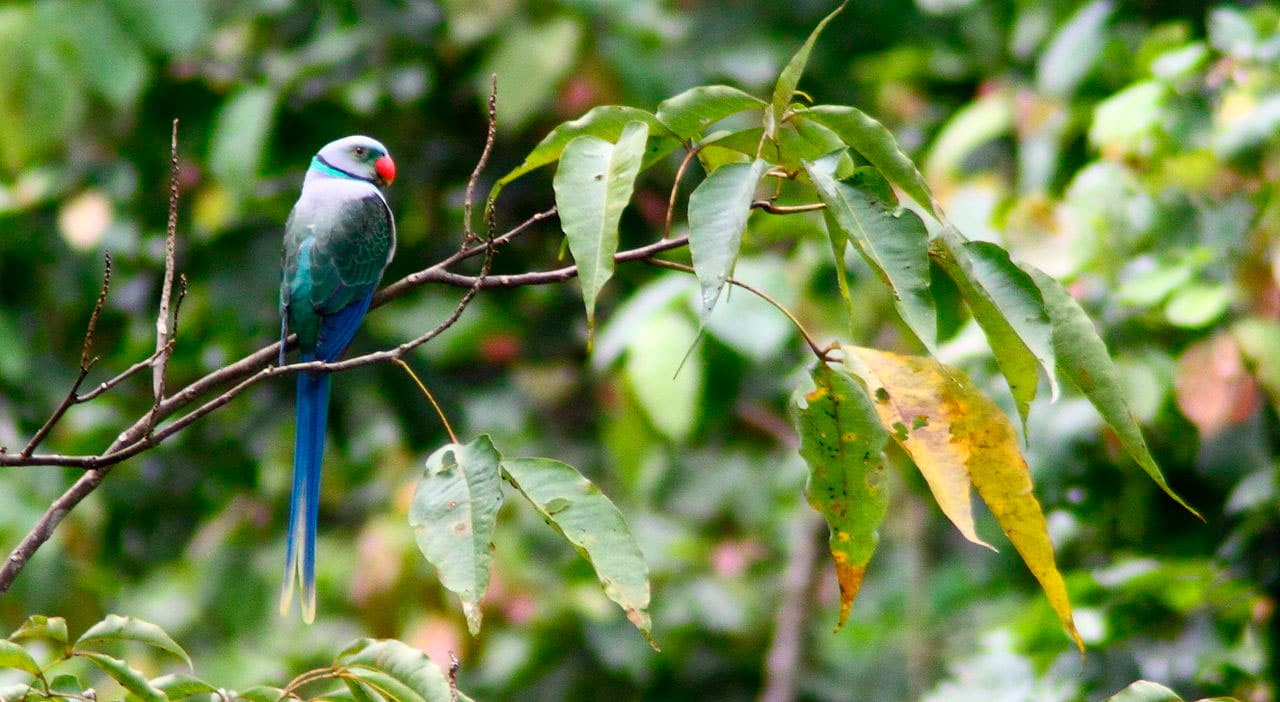
The Malabar Parakeet(Psittacula columboides) has the lores and upper cheeks of green grass, blue tinge on the edges and in the dark pearl gray crown, the lower cheeks, the sides and rear of the neck; with wide black bands at the mustache that attenuate to form a collar black, then bordered with a band of bright blue-green, which extends around the throat.
Mantle dove-grey fading to greyish-green on back and scapulars; rump and uppertail-coverts pale bluish green, sides rump yellowish.
Lesser coverts dark green, subterminally tipped dark grey edged buffish; inner median coverts green with pale buffish margins; alula and greater coverts blue. The primaries and secondaries blue, darker in the vane inner. Underwing-coverts bluish green. Throat bright blue green; yellowish blue discoloration in the rest of the underparts; dove-grey in the chest; blue tinge on the thighs. Uppertail centrally bright blue, tipped yellow, lateral feathers greenish-blue on vane outer, in bright yellow inner; undertail-coverts bright golden-yellow centrally, otherwise brown with yellow tip.
upper jaw bright red with yellow tip, the lower brown, turning orange in the chin; irises light yellow; legs greenish-grey.
The female smaller, with little or no green in face and with both brown jaws. Underparts greyish-yellow. Less grey in the the mantle and tail shorter.
The immature shows grayish green in place of grey-plumage of adults. Collar black and green absent band neck.
To a large degree, the Malabar Parakeet It is confined in forests (primary and secondary) evergreen upland, although according to sources, also observed in other formations, including deciduous forest adjacent to bamboo and especially in plantations coffee and rubber abandoned, and often close to small areas of crops.
Partly inhabit between 450-1.000 m, but exceptionally above 1.600 m, and up to about 60 m.
Usually, observed in family groups or small flocks.
At lower altitudes it is associated with Plum-headed Parakeet (Psittacula cyanocephala), completely replacing it at higher altitudes and in humid forests.
Reproduction:
Escavan their nests on branches or trunks, at a height between 6 and 30 m, sometimes they take advantage of the holes made by woodpeckers or Barbs, expanding the cavity. Los Ceylon ironwood (Mesua iron) are his favorite trees.
Usual clutch 4 eggs.
The breeding season It is between the months of January to March
Food:
Diet Malabar Parakeet It includes seeds and fruits, especially wild figs; regularly eat sprouts, flowers and nectar Erythrina and Grevillea.
They can be very destructive in crops of sorghum and fruit.
The size of the world's population has not been quantified, but the species, according to information, It common throughout the core of its range (pit et to the. 1997).
The population is suspected to be stable in the absence of evidence of any reduction or substantial threats.
The bird trade and loss of habitat have caused, apparently, a decrease in its population, However, It is not sufficient to place this species at risk.
"Malabar Parakeet" in captivity:
The Malabar Parakeet it is rare in the pet trade.
This species was the subject of extensive trade, but now it is illegal in India. He was known in the pet trade as "Loro nonsense» and acquired a misleading reputation as a superior talker.
It is a parrot medium-noisy, occasionally noisy; initially shy; It becomes slowly confianda; newly imported birds are very likely; Care must be acclimatised; only it becomes active in a wide aviary; a common aviary with other species of Psittacula only possible outside the breeding season; little bathing but enjoys flying light rain outside; He likes to chop fresh branches; times aggressive during courtship; sensitive to cold and wet conditions.
Pet food variety, including aerosols millet, fruit, vegetables, Sunflower seed mixtures, oats and millet.
Rarely achieved the captive breeding; clutch 3 to 4 eggs; 23 incubation days; incipient period 6 weeks; young independent after 21 days; the calf sometimes aggressive with its mother.
In terms of their longevity, It is known that a Malabar Parakeet lived during 11,2 years in captivity.Given the longevity of similar species, This longevity is probably underestimated for these birds.
Origin: Venezuela, Guyana, Suriname, Brazil, Bolivia, Peru
Character: Sociable
Life expectancy: 30 years
Height: 30 cm..
Content
Description:
30 cm.. length and a weight between 130 and 170 g..
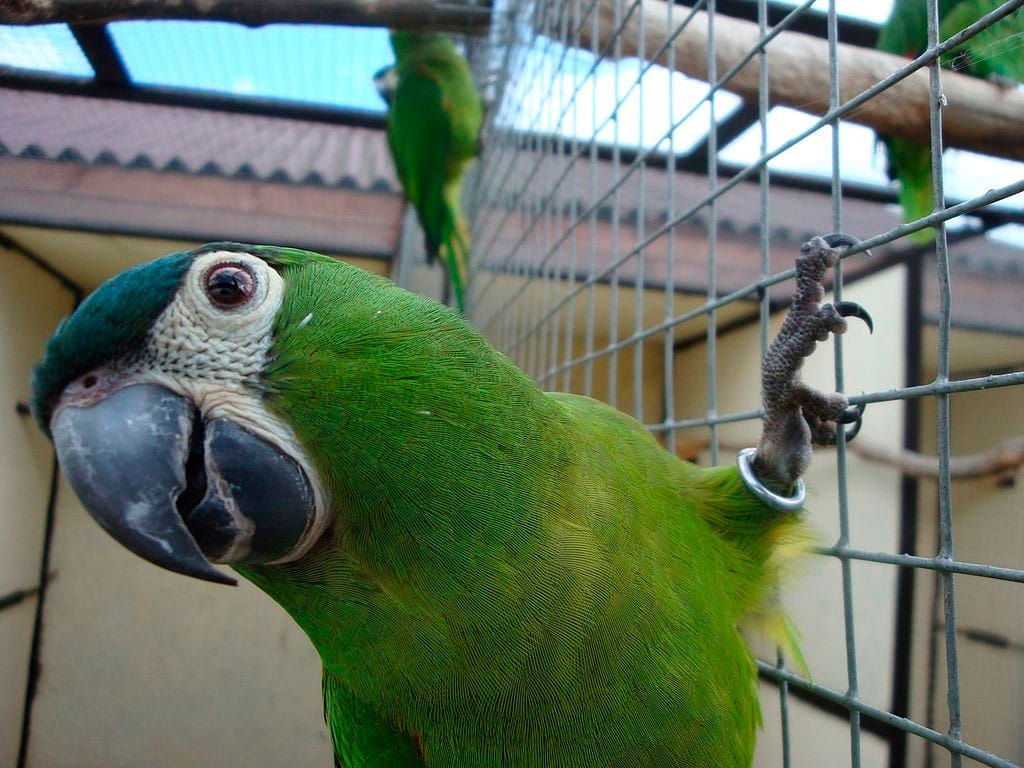
The Red-shouldered Macaw(Diopsittaca nobilis) along with the other two subspecies belong to the Group of the small macaws often called dwarf macaws or mini macaws parrots.
They have forecrown, front of the crown and top of the eyes blue; rest of the head and upperparts, including the wings and the top of the tail, grass-green. Rojas the carpal joints and the leading edge of the wing
. Lesser and medium underwing-coverts red; large underwing-coverts brown; underside of flight feather Golden olive.
The underparts green, but more yellowish than the upper. The bottom of the tail Golden olive.
Bill blackish; bare skin of the lores and top of the cheeks white; irises orange-brown; black legs.
Both sexes similar; Perhaps a little smaller females.
The immature with the head completely Green: has no red color in the carpal joints.
With they are distributed in a variety of open wooded habitats, including savannah with scattered shrubs and palm trees (for example of Mauritia) in Suriname, morichales and the coast plantations in Guyana, closed with palm groves of Mauritia on the inside of Brazil and margins of caatinga in the northeast of Brazil with palm groves of Mauritia.
A persistent feature in its preferred habitat is the presence of palm trees., especially of the genus M. flexuosa, Orbignya martiana and Maximiliana maripa (the latter especially in the southern region of the Amazon). Also observed in wetlands with palms, gallery forests and cultivated areas.
Avoid large expanses of closed canopy forests, but they can be seen around human settlements and it is common in the city of Georgetown, Guyana.
They reach the 1.400 metres in Venezuela, to the South of the Orinoco.
Gregarious, often in large flocks outside breeding season; If not in couples.
Reproduction:
Nest in tree cavities, termite tree or in holes of palmas. Copulations registered in the month of October to the South-West of Brazil; Probably engender between February and June in Guiana. Clutch four eggs in captivity. The average period of incubation is of 24 days, the chicks leave the nest about 54 days after birth.
Food:
Its diet, probably, It is similar to its closest relatives, nuts are included in the, seeds, fruits and flowers, but with some signs of favorite seeds; known his preference for flowers of Terminalia argentea and Erythrina glauca, as well as the berries Cordia and fruits Euterpe. They also feed cereals and fruits in cultivated fields and are considered as one plague in some areas.
Distribution:
Size of the area of distribution (reproduction / resident): 910.000 km2
endemic to northeast South America, from the East of the Andes toward the center of Brazil.
In East Venezuela they are distributed, mainly, to the South of the Orinoco (Delta Amacuro and parts of Bolívar), also at the East end of Monagas.
The few records of Trinidad they are probably elopements captive birds.
Are distributed through of the Guianas, in areas of seasonal forests (mainly near the coast) and in Brazil to the North of the amazon in Roraima, Amapá and North of For. Returns disjoint inside of Brazil, to the South of the Amazon from the southeast of For and maranhão the wetlands of Mato Grosso and to the South by the dry northeast in Piauí, Bahia and, according to reports south of Alagoas until Holy Spirit, Rio de Janeiro and Northwest of São Paulo (with a population introduced in the City of São Paulo).
They occupy the Center and East of Bolivia and Southeast of Peru, where there are records in the Heath pampas.
In general residents, with seasonal movements in some coastal areas (for example Guianas) and distributed irregularly, to the North of amazon, where they remain scattered on the basis of suitable habitat.
In general common, especially in the Centre and northeast of Brazil, although rare in Guianas.
Distribution 3 subspecies:
Diopsittaca nobilis cumanensis
(Lichtenstein, 1823) – Northwest of Brazil, to the South of the Amazon River, from Alagoas and West of Bay until maranhão and Southeast of For, and South to the Centre of goias.
• Red List category of the UICN current: Least concern
• Population trend: Stable
Global population size has not been quantified, but this species is described as «quite common» (Stotz et to the., 1996).
The population of Red-shouldered Macaw suspected to be stable in the absence of evidence of any reduction or substantial threats.
Currently capture and trade of wild individuals is illegal.
"Red-shouldered Macaw" in captivity:
Quite common.
They are the smaller macaws commercially available pet and enough popular due to its small size (only a little bigger that a cockatoo) and for its excellent ability to imitate sounds.
In captivity, These birds are sociable and friendly.
The Red-shouldered Macaw they are easy to breed in captivity birds. They have proven to be prolific breeders and they have brought successfully for many years. In his book "All about parrots«, the author Arthur Freud He points out that the first Red-shouldered Macaw It was bred in captivity in the United Statess in the year 1939 and again in 1940, the Lord and Lady Vance Wright. But it was the British success during the year 1949 by EMT Vane, the best known. In fact Vane received the first breeding metal from the British Avicultural Society’s for his achievements with the Red-shouldered Macaw.
The Red-shouldered Macaw are commonly held as pets, but their number has been declining in nature due to the habitat destruction and to his capture to the pet market.
With regard to its longevity, according to sources, It is known that a specimen lived 22,9 years in captivity.
– Avibase
– Parrots of the World – Forshaw Joseph M
– Parrots A Guide to the Parrots of the World – Tony Juniper & Mike Parr
– Birdlife
– Photos:
(1) – A Red-shouldered Macaw at Parque das Aves, Foz do Iguaçu, Brazil. This subspecies is also know at the Noble Macaw By Chad Bordes (Picasa Web Albums) [CC BY 3.0], via Wikimedia Commons
(2) – The photograph shows a Hahn’s Macaw (D. n. nobilis) pet parrot perching on a finger By derivative work: Snowmanradio (talk)Diopsittaca_nobilis_-pet-2.jpg:Evenprime at en.wikipedia. Photo by Walter Maier. Picture of family pet. Later version(s) were uploaded by Snowmanradio at en.wikipedia. (Diopsittaca_nobilis_-pet-2.jpg) [GFDL or CC-BY-SA-3.0], from Wikimedia Commons
(3) – Two Red-shouldered Macaws in the Pantanal, Mato Grosso, Brazil By Nori Almeida (originally posted to Flickr as Pantanal 2009) [CC BY 2.0], via Wikimedia Commons
(4) – Long-wing Macaw or Hahn’s Macaw); two in a cage By TJ Lin (originally posted to Flickr as DSCN9927) [CC BY-SA 2.0], via Wikimedia Commons
(5) – Two Red-shouldered Parrots at Lisbon Zoo, Portugal By Jorge Andrade from Rio de Janeiro, Brazil (Lisbon zoo (107)Uploaded by snowmanradio) [CC BY 2.0], via Wikimedia Commons
(6) – Red-shouldered Macaw (Diopsittaca nobilis), also known as the Noble Macaw By Snowmanradio (Own work) [CC BY-SA 3.0 or GFDL], via Wikimedia Commons
(7) – A Red-shouldered Macaw at Bird Park, Kaluga region, Zhukovsky District, Russia By Remiz [CC BY-SA 2.0], via Wikimedia Commons
(8) – Three Red-shouldered Macaws at a zoo By DSuàr (To be coldUploaded by Snowmanradio) [CC BY-SA 2.0], via Wikimedia Commons
(9) – Red-shouldered Macaw (this subspecies is also known as Hahn’s Macaw) at Jungle Island, Miami, USA By Chris Acuna from Miami, USA [CC BY 2.0], via Wikimedia Commons

 Minor Concern ⓘ
(UICN)ⓘ
Minor Concern ⓘ
(UICN)ⓘ


















.jpg)
.jpg)



_-Kerala_-India-6.jpg)


