▷ The world of Pets: Dogs, cats, birds, reptiles, amphibians

New Zealand Kaka
Nestor meridionalis

New Zealand Kaka

Content

Illustration of a Kaka.

Description

45 cm.. length and an average weight of 550 g..

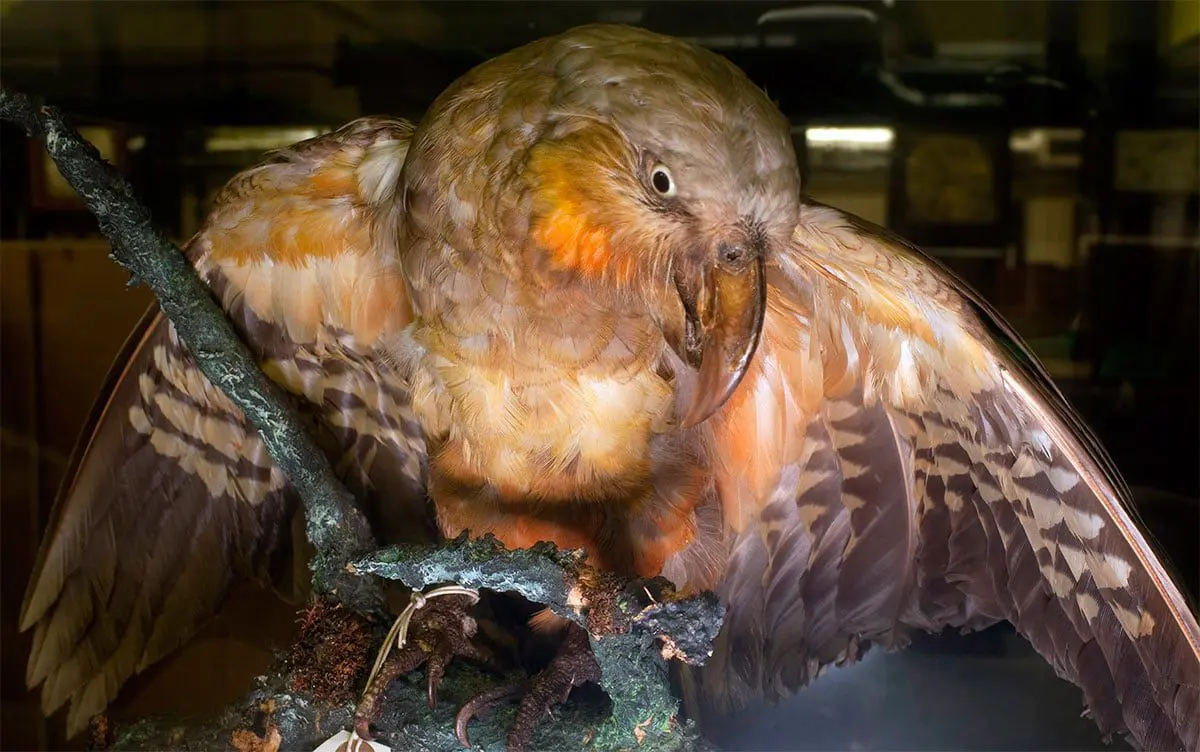
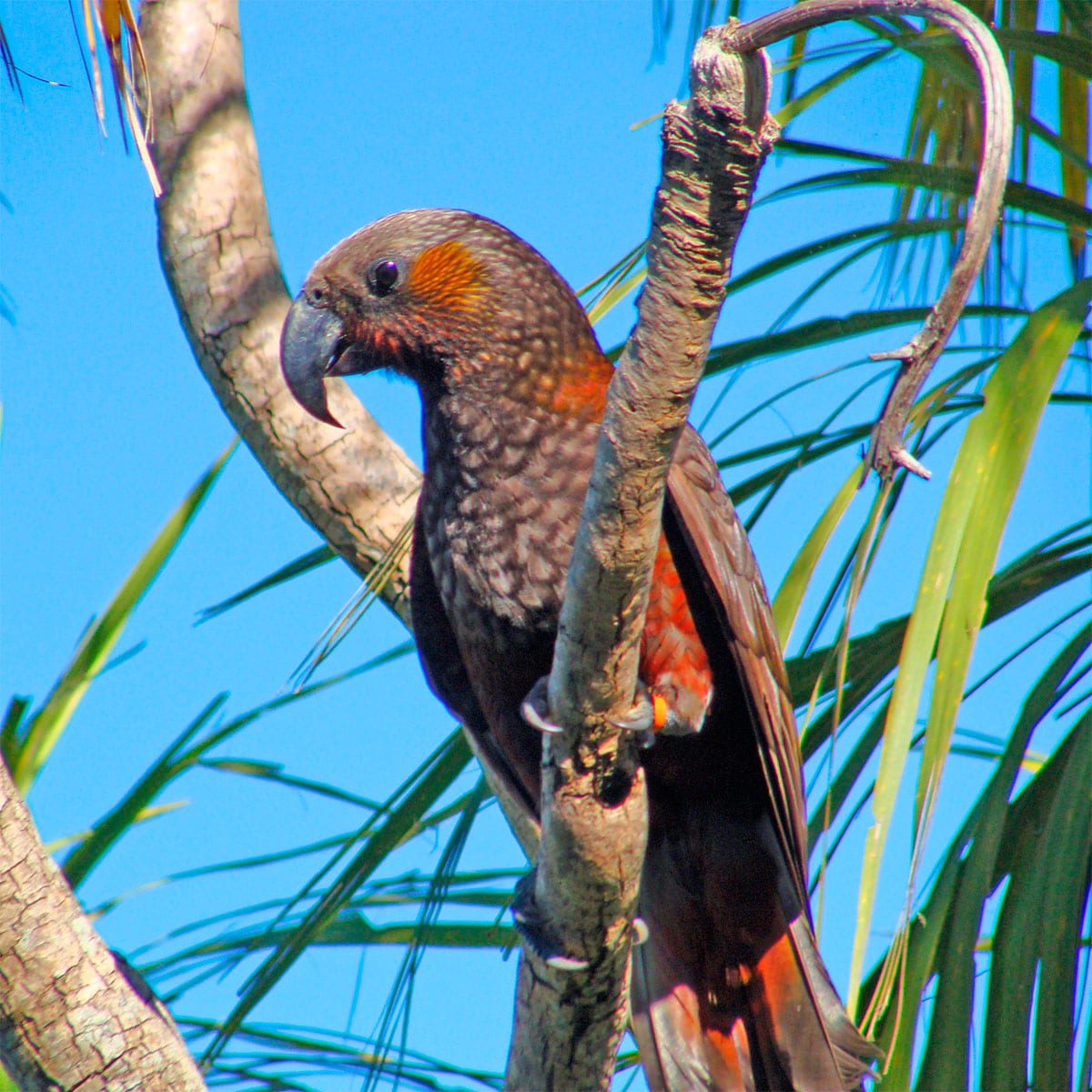
The New Zealand Kaka (Nestor meridionalis) they are some great parrots with a tail of medium length and a plumage predominantly Brown and Red.

The adult male has the crown whitish grey color and the neck with a greyish Brown appearance due to large brown feathers that surround you.

The under eye and the sides of the neck has a bluish grey clear. The lores are greyish Brown, that contrast with the ear-coverts strongly tinged with orange. The sides of the chin they have reddish-brown infiltrations.

The feathers of the upperparts are greenish Brown with darker stripes and stripes. Those in the back of the neck They are crimson red with yellow endings and browner bases..

The the mantle, sometimes, has some red spots. Rump and uppertail-coverts are red with dark brown trim. The lower area of the wings and axillary they are also red.

The feathers of the chest are olive brown in colour with reddish edges subterminales. Belly and undertail-coverts are red with dark edges.

The tail is brown with lighter tip.

The bill is brownish grey, more powerful that the of the Kea. The cere Brown it is decorated with a few whiskers. The irises is dark brown, legs dark gray.

The adult female presents a bill shorter and one mandible less curved top.

The youth they are similar to adults, but have a small yellow spot at the base of the lower jaw.

Subspecies description

  • Nestor meridionalis meridionalis (Gmelin, 1788) – Nominal species

  • Nestor meridionalis septentrionalis (Lorenz von Liburnau, L 1896) – It measures 42 cm approximately. Variation of the nominal (Nestor Meridionalis). More small, in general, and plumage more off. The red band of the neck is more small and dark. The back of the wings olive color is more dark.

Habitat:

The New Zealand Kaka (Nestor meridionalis) they frequent the compact forests of low to medium height, where there are mainly podocarp and beech trees of the genus Nothofagus. Occasionally they come into gardens and orchards, especially in winter.

These birds they tend to live at altitudes between 450 and 850 meters in the summer and from the sea level to the 550 meters in winter. But, from time to time, You can climb up to the 1.500 m.

The New Zealand Kaka they live in pairs or in small groups of up to ten birds.

These birds are not as well known as the Kea (Nestor notabilis), Although in some places come to feed in the hand of the tourists.

We can often see them at the top of trees or simply flying over the canopy.

The birds that are found in the air almost always heard before to be seen.

The New Zealand Kaka they are active during the morning and afternoon. At the hottest time of the day, around midday, They lie between the foliage of the trees.

Around the darkness, they perform a series of acrobatic flights, before returning to their roosts. Screams and calls can be heard well into the night.

In some areas, the New Zealand Kaka they are sedentary. But, most of the time they are erratic or perform short altitudinal migrations. These birds are able to fly long distances. They fly to vigorous banging of wings.

Reproduction:

The season of nesting is from September to March, but it is above all active between November and January.

The nest is located in a tree cavity between 3 and 9 meters above the ground. The pair sometimes enlarges the entrance hole with its beak..

The spawning contains 4 or 5 eggs white. These are deposited on a layer of sawdust that covers the bottom of the cavity.

The incubation, that lasts a few 24 days, It is done solely for the female. She leaves the nest at dawn and dusk to be able to be powered by your partner. an assistant, sometimes, can participate in the feeding of the female during the period in which she incubates.

In the North, the young have white down, While the of the South they have grey down at the bottom.

The juveniles they acquire their full plumage in ten weeks.

For the duration of the stay in the nest, they are fed by both parents.

The breeding success rate is relatively low and they rarely lay more than one egg per year..

Food:

The New Zealand Kaka It has a long tongue terminated tip, What helps you to extract nectar from the flowers and to collect molasses.

In the Spring, in the South of the island, the New Zealand Kaka almost passes the 30% of their time in the trees (Beech) where feeding of honeydew produced by the local cochineal (Ultracoelostoma assimilates). In other stations, This food is a less important resource due to competition with the WaSP, which is also a great consumer.

The larvae of beetles of long antennae they are also a good source of nutrition.

Throughout the year the New Zealand Kaka, regularly, frequent trees, where it used its powerful curved beak to hunt insects hidden beneath the bark.

When opossum populations disperse, the New Zealand Kaka they spend nearly the 60% of their time feeding on flowers and berries. It also, consume sprouts, seeds, nectar and SAP.

Distribution:

Size of the area of distribution (reproduction / resident): 71.100 km2

This species is endemic of New Zealand.

Subspecies distribution

Conservation:


Endangered

• Current Red List of UICN: Danger

• Population trend: Decreasing

This species has a very irregular distribution. in most places, is rather sparse, but in other places, is common locally, especially in some coastal islands.

Its population It is estimated between 3750 and 15,000 specimens.

The main threat is the habitat degradation. It stays within primary forest fragments, showing its very low adaptation to artificial habitats.

The New Zealand Kaka not nest every year in a systematic way. When I was try to reproduce in captivity, the success rate was not very high (on average the 56% eggs not hatched ).

Clutches often suffer from the predation on the part of the weasels It was introduced on the island. For all these reasons that the species is classified as VULNERABLE.

"New Zealand Kaka" in captivity:

Very rare in captivity.

In terms of their longevity, according to sources, a specimen in captivity lived during 15 years.

Taking into account the longevity of the similar species, the maximum longevity of these birds might be underestimated. Other sources indicate that these birds can live up to the 35,5 years in captivity, something that is plausible, pero que no ha sido verificado; el mismo estudio informó que los New Zealand Kaka can reproduce a partir de los 7 years of age in captivity.

Alternative names:

New Zealand Kaka, Common Kaka, Kaka (English).
Nestor superbe (French).
Kaka (German).
Kākā (Portuguese).
Kaka (español).

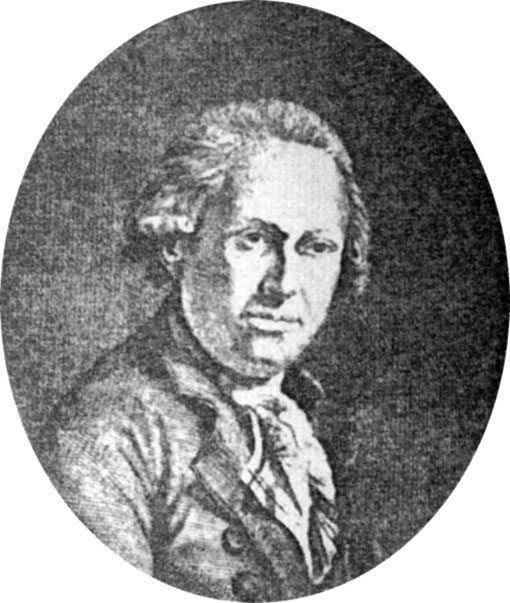
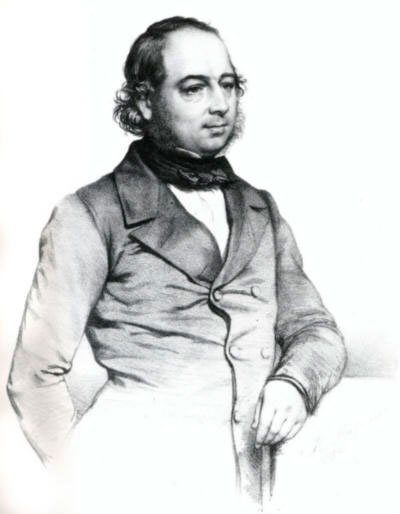
Gmelin Johann Friedrich

scientific classification:

Order: Psittaciformes
Family: Strigopidae
Genus: Nestor
Scientific name: Nestor meridionalis
Citation: (Gmelin, JF, 1788)
Protonimo: Psittacus meridionalis


"Kaka" images:

Videos "New Zealand Kaka"

————————————————————————————————

«Kaka» (Nestor meridionalis)


Sources:

Avibase
– Parrots of the World – Forshaw Joseph M
– Parrots A Guide to the Parrots of the World – Tony Juniper & Mike Parr
– Birdlife

Photos:

(1) – Car (Nestor meridionalis) in Wellington, New Zealand By derivative work: Snowmanradio (talk)Kaka_(Nestor meridionalis)-_Wellington_-NZ-8.jpg: PhillipC [CC BY 2.0 or CC BY 2.0], via Wikimedia Commons
(2) – North Island in Kaka, at Auckland Zoo, New Zealand By Small [CC BY-SA 2.0], via Wikimedia Commons
(3) – A New Zealand Kaka in Karori Wildlife Sanctuary, Wellington, North Island, New Zealand By Rosino (the colorful kākāUploaded by Snowmanradio) [CC BY-SA 2.0], via Wikimedia Commons
(4) – Nestor meridionalis meridionalis, South Island Turkey, on Stewart Island, New Zealand By derivative work: Snowmanradio (talk)Kaka-parrot_-Stewart-Island.jpg: giles.breton [CC BY 2.0 or CC BY 2.0], via Wikimedia Commons
(5) – Kaka in flight. Karori Wildlife Sanctuary, Wellington, New Zealand. I, Tony Wills [CC BY-SA 3.0], via Wikimedia Commons
(6) – Illustration of a Kaka By J. G. Keulemans, in W.L. Buller’s A History of the Birds of New Zealand. 2nd edition. Published 1888. (New Zealand Electronic Text Centre) [CC BY-SA 3.0 nz], via Wikimedia Commons

Sounds: Fernand DEROUSSEN (Xeno-canto)
▷ The world of Pets: Dogs, cats, birds, reptiles, amphibians

Fischer's Lovebird
Agapornis fischeri


Inseparable de Fischer

Content

Description Fischer's Lovebird:

Inseparable de Fischer

Of 12,7 to 15 cm in length and a weight between 42 and 58 g..

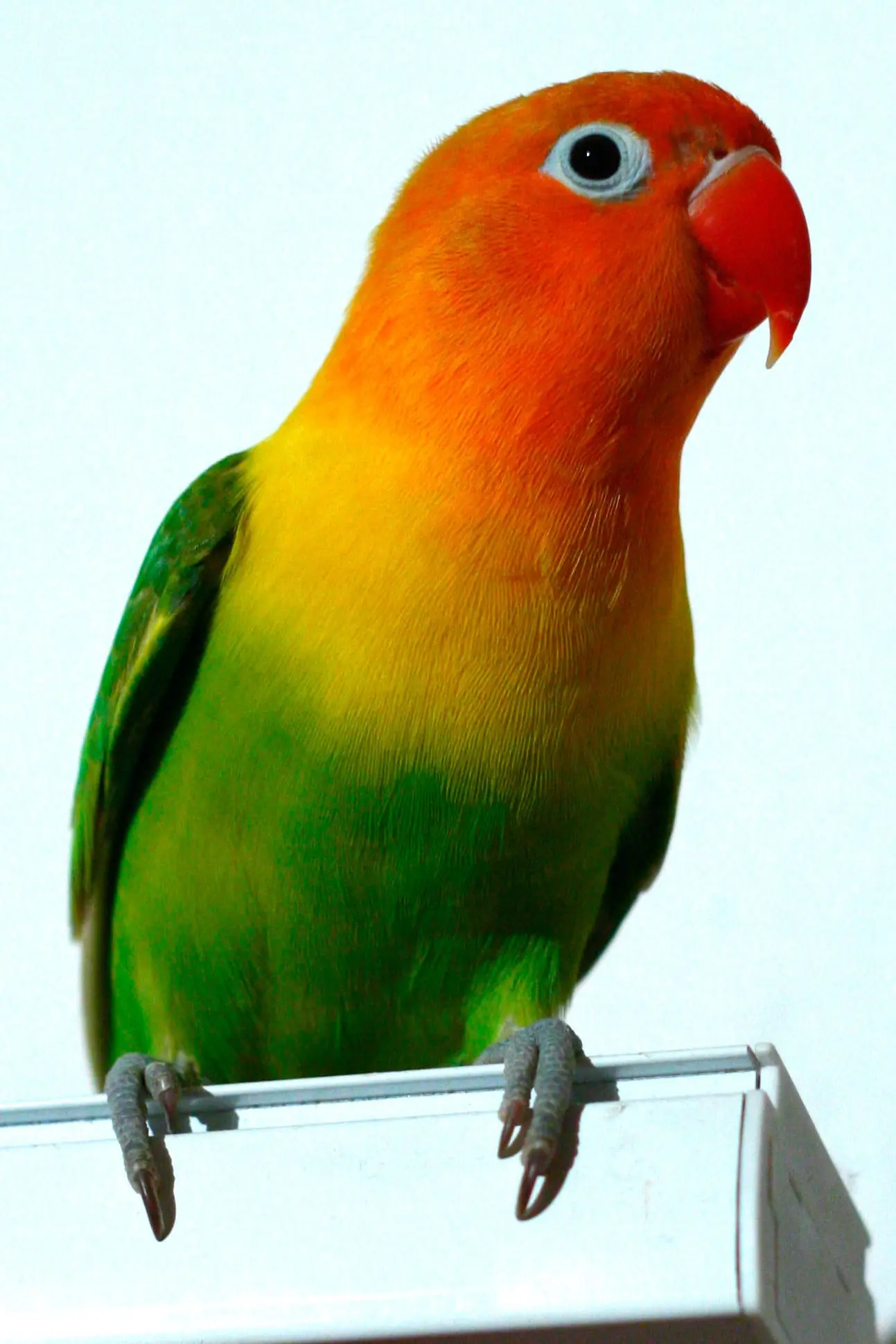
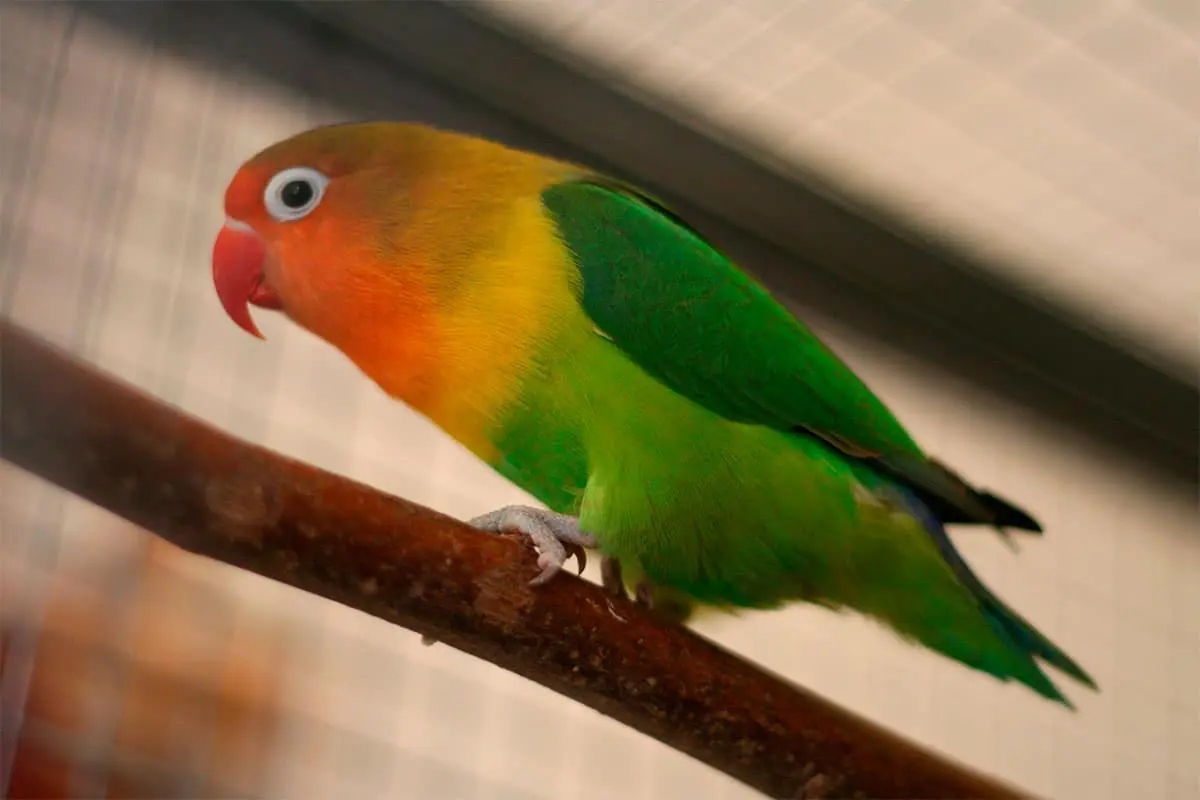
The Fischer's Lovebird (Agapornis fischeri) has a frontal band, the lores and cheeks bright red with an orange shaded in red chin and throat. Upper chest is orange-yellow; crown and nape They are brown. Width collar adjacent yellowish brown and yellowish orange band at the top of chest.

The the mantle, scapulars and front of the rump, are green; the back of the rump and uppertail-coverts dark blue. Upper, the wing-coverts green; primaries and secondaries blackish brown with green edges to the vane outer. Under, the wing-coverts green; underside of flight feather grey-black. The low area chest up to the undertail- coverts pale yellowish green.

Tail bluish green, tipped yellow and bordered by a black line.

The bill is red, whitish towards the base of the upper jaw; cere white; irises brown; periophthalmic ring white of a 2 mm; legs pale grey.

Both sexes similar, indeed there no sexual dimorphism Between both.
One method that is very effective in distinguishing the sex of our Fischer's Lovebird It is the bone of the pelvis, being more open in females than in males.

The immature They have reduced the blue in the uppertail-coverts and they are both duller than adults, particularly on neck, the head and the chest; black markings, sometimes at the base of the upper jaw.

Habitat Fischer's Lovebird:

The Fischer's Lovebird They inhabit wooded grasslands with acacias, Commiphora; especially in the west, also in more open grasslands with Adansonia and cultivated areas. More common in sheets with different types of acacias and trees of the genus Egyptian balanites; also in terrestrial flora zones including Penisetum, Digitaria, Themeda and pastures Eustachys.

In the south of its range They are present in the forest with palm trees Borassus aethiopum.

When the season is dry, They can also be seen in areas of riverine forests Ficus, Boolean, Tamarindus, Aphania, Garcinia and Eckberg.

Avoid wooded savannah type miombo.

usually in altitude between 1,100-2.000 m. Often near water, especially in hot weather.

Gregarious, at least outside the breeding season , and generally in small flocks. Sometimes more important meetings form, for example, where abundant food.

In Tanzania They meet roosting nests leveraging Rufous-tailed Weaver (Histurgops ruficauda).

The main known predators Fischer's Lovebird they are the Borni Falcon (Falco biarmicus).

Reproduction Fischer's Lovebird:

The Fischer's Lovebird They breed in colonies.

The breeding It takes place from January to April and in June and July, coinciding with the dry season; the exact timing depends on the locality.

Most of the nests They are located 2.15 meters above the ground, at the base of leaves overhead palm, in the holes and cracks of dead trees or dead branches and live trees, sometimes nest on cliffs.

The nest It comprises grass stalks and peel strips carried by the female in his beak.

The Clutch size in captivity is three to eight eggs, with a period of incubation of 23 days and period incipient of 38 days.

Food Fischer's Lovebird:

The diet of the Fischer's Lovebird is mainly granivorous. It feeds on seeds such as Pennisetum mezianum, also it feeds millet and corn, although the species does not come to be considered a serious pest for crops; Also they take seeds Acacia directly from trees, grass Achyranths asper, fallen berries and fruit Ficus, Rhus shaggy and Commiphora.

They need to drink daily.

Distribution:

The Fischer's Lovebird They are endemic to the north and northwest Tanzania from Kondoa in the South-East, Serengeti National Park, in the north and the Lago Manyara in the East; possibly closer to the border Kenya in some areas.

In Rwanda and Burundi the species is either a recent natural settler, or I asilvestrado from 1970, or an irruptive visitor in response to drought.

Observed on the islands Ukerewe and KNIT in southern Lago Victoria.

Wild populations established in the region Dar es Salaam and Thong in Tanzania, and around Mombasa, Nairobi, Naivasha and Isiolo, in Kenya.

Probably some Local movements in the dry season with irruptions in drought years. Within its tiny range, is a common bird, with large flocks in some areas, scarce and seemingly in decline, especially outside protected areas where low density is attributed to the capture for trade.

There is a self-sustaining wild population derived from escapes from captivity in Southeast France, where Yellow-collared Lovebird (Agapornis personatus) also they escaped, along with hybrids also observed.

A big number of Fischer's Lovebird in captivity.

Conservation:


Near-threatened

• Current Red List of UICN: Near threatened

• Population trend: Decreasing

The population of the Fischer's Lovebird release has been estimated to range between 290.205 and 1.002.210 birds.

There has been a significant population decline Since the Decade of 1970, mainly because of widespread trapping for the wild bird trade.

The Fischer's Lovebird wild bird was the most traded in the world 1987 and was the most popular wild parrot imported into the then European economic community, representing about 80% exports of parrots in Tanzania (RSPB 1991).

The legal collection for export has been stopped, but the population remains much lower than it was, and trade could start again (Moyer 1995).

The species hybridized with the Yellow-collared Lovebird (Agapornis personatus) in the nature, but not within the natural range of the species (there is a range of overlap but the Fischer's Lovebird It appears to be a non-breeding visitor habitat Yellow-collared Lovebird [N. Baker a slightly. 1999, Morton y Bhatia 1992]) so this is unlikely to pose a threat.

Conservation Actions Proposed

– Conduct surveys to obtain an estimate of the population-date.
– Monitor population trends through regular surveys.
– It prevent capture for export to start again. Investigate the extent of hybridization with the Yellow-collared Lovebird (Agapornis personatus).

The Fischer's Lovebird in captivity

The Fischer's Lovebird They have been kept as pets from, approximately, mid-sixteenth century. They became part of the trade in live birds 1926. The first successful captive breeding of Agapornis fischeri It was documented 11 in January of 1928. For the year 1931, the berlin zoo (Germany) they had raised 68 copies successfully in captivity. Today they are bred and sold as pets, mainly in the United States and Europe. In 1987 was the most traded bird species in the world.

The Fischer's Lovebird they are difficult birds to keep healthy in captivity. Son active birds they need a lot of space. When you are confined in a cage, health tends to deteriorate. Instead of being active and vocal, often they sit on the floor of the cage in a corner. physical problems such as negative young and the overweight also they shortened their longevity.

Being very active birds and require wide cage (a minimum of 50 x 50 x 75 cm. to a bird and 65 x 65 x 75 cm for a couple.). It is appropriate to give a little spot inside the cage to hide in when they feel insecure.

Surprisingly, they don't seem to have much trouble acclimatizing to cold weather even though their original habitat is tropical. If they kept away from drafts, they can withstand the long winters on other continents.

If allowed out of his cage must be very careful not to have utensils close that they can damage or may damage, they are avid chewers, they have strong beaks and can quickly cause damage.

They are very vocal birds and their shrill noise can be a nuisance.
.
Of all species of Lovebirds, the Fischer's Lovebird He is known to be the most acrobatic.

With regard to its longevity, a demographic study suggested that these birds are aging rapidly with maximum longevity 7,7 years. An exemplary, as indicated sources, lived 12.6 years in captivity. Maximum longevity could be underestimated; More studies are needed. It has also been informed by other sources that these animals can live up 32,2 years in captivity, but this has not been verified.

Alternative names:

Fischer’s Lovebird (English).
Inséparable de Fischer (French).
Pfirsichköpfchen (German).
Inseparável-de-fisher (Portuguese).
Inseparable de Fischer, Agapornis Fischer (español).


scientific classification:

Fischer's Lovebird - Anton Reichenow
Anton Reichenow

Order: Psittaciformes
Family: Psittaculidae
Genus: Lovebirds
Scientific name: Agapornis fischeri
Citation: Reichenow, 1887
Protonimo: Agapornis Fischeri


Images Fischer's Lovebird:

Videos "Fischer's Lovebird"


Species of the genus Agapornis


Fischer's Lovebird (Agapornis fischeri)


Sources:

Avibase
– Parrots of the World – Forshaw Joseph M
– Parrots A Guide to the Parrots of the World – Tony Juniper & Mike Parr
– Birdlife

Photos:

(1) – Fischer’s Lovebird, (Agapornis fischeri); side view of a pet on a perch By Peter Békési (Flickr) [CC BY 2.0], via Wikimedia Commons
(2) – Two Fischer’s Lovebirds, (Agapornis fischeri). Pets on a perch By Peter Békési from Budapest, Hungary (IMG_2303) [CC BY 2.0], via Wikimedia Commons
(3) – Three Fischer’s Lovebirds at Ueno Zoo, Japan By Agapornis_fischeri_-Ueno_Zoo,_Japan_-three-8a.jpg: Takashi Hososhima from Tokyo, Japanderivative work: Snowmanradio [CC BY-SA 2.0], via Wikimedia Commons
(4) – Fischer’s Lovebirds, Agapornis fischeri, social grooming By Peter Békési (originally posted to Flickr as IMG_0692) [CC BY-SA 2.0], via Wikimedia Commons
(5) – Fischer’s Lovebird perching on a branch in captivity By Françoise Walthéry from Bruxelles, Belgium (8_Buiten_reeks_8) [CC BY-SA 2.0], via Wikimedia Commons
(6) – Fischer’s Lovebirds at World of Birds Wildlife Sanctuary and Monkey Park in Cape Town, South Africa By Mara 1 (originally posted to Flickr as I Love You !) [CC BY 2.0], via Wikimedia Commons
(7) – Fischer’s Lovebird (Agapornis fischeri). Two on a branch By Lucia Smit (originally posted to Flickr as Sonny & Cher) [CC BY 2.0], via Wikimedia Commons
(8) – Fischer’s Lovebirds, Agapornis fischeri By Peter Békési (originally posted to Flickr as IMG_0736) [CC BY-SA 2.0], via Wikimedia Commons
(9) – A group of Fischer’s Lovebirds feeding at Ueno Zoo, Japan By kanegen (originally posted to Flickr as Ueno Zoo) [CC BY 2.0], via Wikimedia Commons
(10) – Fischer’s Lovebird, (Agapornis fischeri) perching on a box By Peter Békési (Flickr) [CC BY-SA 2.0], via Wikimedia Commons

Sounds: Rory Nefdt (Xeno-canto)

▷ The world of Pets: Dogs, cats, birds, reptiles, amphibians

Norfolk Island Kaka
Nestor productus †

Norfolk Island Kaka

Content

Description:

The Norfolk Island Kaka (Nestor productus) was their large with a bill, wings short and wide, and with legs and feet large.

Norfolk Island Kaka

I had 38 centimeters long. The top of his head era gris pardusca, while its face varied from yellow to orange, sometimes with a reddish tint. It was said that his Hip It was greenish yellow, and upperparts, including the wings, they were mostly greyish-brown in color, slightly darker than the top of the head, with the bottom of the back and rump orange or dark red and the tail brown. Upper chest It was brown and gray bottom bright yellow, with the belly and sides reddish orange (Forshaw & Cooper 1981, 2002; Greenway 1958).

Its social structure and dispersion are not registered, but the Norfolk Island Kaka of New Zealand, he watched alone or in small groups of up 10 individuals (Higgins 1999).

Habitat:

Habit in the native forest in the Norfolk Island and about Phillip Island (Greenway 1958). The species could be observed both in the canopy of tall trees, and soil, the rocks (Gould, 1865, Greenway 1958).

Given its endemism in the Norfolk Island, the Norfolk Island Kaka It was presumably sedentary.

Reproduction:

Little is known of reproductive cycle of the Norfolk Island Kaka; just put on record of four eggs in tree holes (Gould 1865).

Food:

It is known that he fed on nectar Flowers tree white wood (Lagunaria) (Gould 1865). Definitely should be more varied. The captive birds they ate lettuce and the leaves of other vegetables, as well as dairy meals and fruit juice (Gould 1865). Presumably he foraged in both the soil and the canopy (Gould, 1865).

Distribution:

Its range was about 15,5 hectares.

It was endemic to the Norfolk island (in Australia) and nearby Phillip Island, Australia. It became extinct in the wild in mid-century 19 on Norfolk Island, and possibly a little later Phillip Island.

The species is believed to have had a very limited ability to move between islands., and probably he spent his whole life on the island of his birth (Gould, 1865).
In the Norfolk Island Kaka occasionally kept in captivity, as the birds were gentle and easy to capture alive (Gould 1865). The species He survived in captivity until after it had become extinct in the wild (Greenway 1958). There are no known captive populations and none has been reintroduced into the wild. The last known living bird was in captivity in London in 1851 (Garnett et to the., 2011).

No made extensive studies for this species. But, there have been a series of ornithological studies in the Norfolk Island since the species disappeared from the island (p.ej. Bell 1990, Robinson 1988, Schodde et al., 1983, Smithers y Disney 1969), no signs have been found of the species.

Conservation:

• Current category of the Red List of the UICN: extinct.

Rationale for the Red List category

This species was known in the Norfolk Island, but it was Extinguished to mid 1800. It is believed that the elimination of habitat and hunting have been the main drivers.

According to reports, was tame and, Therefore, hunted strongly convicts and early settlers and easily trapped as a pet.

No information is available on the population size before its decline.

"Norfolk Island Kaka" in captivity:

They were captured by his meekness and they were common in the Norfolk Island

Alternative names:

Norfolk Island Kaka, Norfolk Island Kea, Norfolk Island Parrot, Norfolk Kaka (English).
Nestor de Norfolk (French).
Dünnschnabelnestor, Norfolkkaka, Norfolk-Kaka (German).
Kākā-de-norfolk (Portuguese).
Kaka de Norfolk (español).

John Gould
John Gould

scientific classification:


Order: Psittaciformes
Family: Strigopidae
Genus: Nestor
Scientific name: Nestor productus
Citation: (Gould, 1836)
Protonimo: produced Plyctolophus


«Norfolk Kaka» Images:

————————————————————————————————

Norfolk Island Kaka (Nestor productus)


Sources:

Avibase
– Parrots of the World – Forshaw Joseph M
– Parrots A Guide to the Parrots of the World – Tony Juniper & Mike Parr
Birdlife
– Australian Government – Department of the Environment and Energy (Nest produced - Norfolk Island Kaka)

Photos:

(1) – Natural Science Curatorial Trainee – Birmingham’s Norfolk kaka
(2) – Nestor productus Gould, 1836 by Huub Veldhuijzen van Zanten / Naturalis [CC BY-SA 3.0], via Wikimedia Commons
(3) – Nestor productus By Gould, 1836 [CC BY-SA 3.0], via Wikimedia Commons
(4) – Norfolk Island in Kaka (Nestor productus). The last bird in captivity died in London in 1851. Specimen from the Zoological Museum in Firenze, Italy by Thomas WesenerFlickr
(5) – Nestor productus By Gould, 1836 [CC BY-SA 3.0], via Wikimedia Commons
(6) – The Norfolk Island in Kaka (Nestor productus) from the plate in the Bulletin of the Liverpool Museum. From the specimen in the Tring Museum by John Gerrard Keulemans [Public domain], via Wikimedia Commons

▷ The world of Pets: Dogs, cats, birds, reptiles, amphibians

Kawall's Parrot
Amazona kawalli

Kawall's Parrot

Content

Description:

35-36 cm.. length.

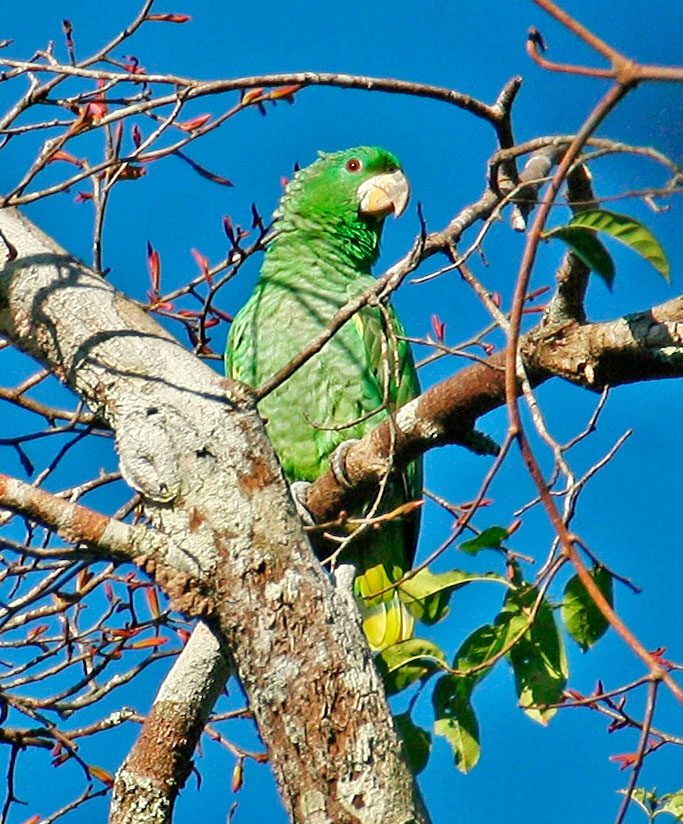
The Kawall's Parrot (Amazona kawalli) after not having been recorded in the wild for a few 70 years, It was rediscovered in the early 1980.

Wrongly confused with Southern Mealy Parrot (Amazona farinosa) which differs from the remarkable white band at the base of bill.

They have forecrown, the lores, the cheeks and ear-coverts green, although in some birds appear blackish. The crown, sides and back of the neck, as well as the nape, They are green with broad blackish margins to feathers, giving the whole a intricate scaly appearance, with escalation most pronounced in the nape and the the mantle.

Kawall's Parrot

Upperwing-coverts green, with the coverts smaller and medium dark shades showing weak at tips; some feathers yellowish green in the leading edge of wing . Primaries green with black towards the tips and some blue in outerweb (a specimen with primary external bright yellow in a wing); red in the three secondaries External form a speculum bright. The underparts They are green with scaling effect derived from the blackish tips to the feathers on the sides of the low chest; some feathers with dark tips in the middle of the chest although little visible; undertail-coverts, more greenish yellow. Upper, the tail It is green with wide band terminal greenish yellow, lateral feathers variably marked dark red (sometimes lined with black-brown and blue) in basal half; undertail, the tail similar but slightly off.


Anatomy-parrots

Bill gray bare skin cream in the base and a cream patch on the upper jaw; irises reddish-orange; legs gray.

The male has the lores and perhaps gray bill largest. Immature not described.

  • Sound of the Kawall's Parrot.

Habitat:

The Kawall's Parrot They inhabit tropical rainforests, with apparent preference for river edges and permanently flooded forests (igapó).

Reproduction:

Nests observed in tree cavities flooded forest

Food:

Foods reported include seeds trees Hevea brasiliensis and H. spruceana, mesocarpio palm fruit Maximiliana maripa and seeds of Eichleria and Joannesia.

Distribution:

Size of its range (breeding/resident ): 1,160,000 km2

The few published records come from the Amazon basin of Brazil; on top of Juruá (under Eirunepé), in the amazon; the confluence of roosevelt river and Aripuanã River, to the South of For; and southern Santarém, For.

Possibly they overlooked in the field due to morphological similarities with some of the best known and there are almost certainly more individuals than congeners the few records suggest. Distribution map based on alleged occurrence among localities known. No details on the population or condition.

Conservation:

State of conservation ⓘ


Near-threatened Near Threatened (UICN)ⓘ

• Current category of the Red List of the UICN: Near-threatened.

• Population trend: Stable.

Rationale for the Red List category

Based on a model of future deforestation in the Amazon basin and the susceptibility of the species to habitat fragmentation and hunting , It suspected population decline by 25-30% in the next three generations and, therefore, It has risen to Near Threatened.

Justification of the population

The size of the world's population has not been quantified, but this species is described as «rare» (Stotz et to the., 1996).

Justification of trend

It is suspected that this species has lost 19.1-33.6% of habitat suitable within their distribution during three generations (37 years), based on a model of Amazon deforestation (Soares-Filho et to the., 2006, Bird et to the., 2011). But, it is considered that the species has a wider distribution than indicated on the map used in this analysis (A. Lees in litt 2011), As it suspected to decline by 25-30% during three generations.

Conservation Actions Underway

The species in Appendix II CITES.

Conservation Actions Proposed

First of all, expand the network of protected areas to effectively protect the IBA. Second manage more effectively the resources and existing and new protected areas, using the emerging opportunities for funding the management of protected areas with the overall goal of reducing carbon emissions and maximize the conservation of biodiversity. Especially relevant conservation on private land, through the expansion of market pressures for proper land management and prevention of deforestation on land not suitable for agriculture (Soares-Filho et to the., 2006). Campaign against proposed changes to Brazilian Forest Code that would lead to a decrease in the width of protected riparian forest areas such as Permanent Preservation Areas (APPs), that function as vital corridors in fragmented landscapes.

"Kawall's Parrot" in captivity:

The Kawall's Parrot It is a half-noisy parrot, not very active and hard chewing. They can easily tame. They are not common in aviculture. They are hardy once acclimated. Its minimum temperature tolerance is 15 degrees. Any lower temperature than this requires supplemental heat until the Parrot has acclimatized.

Alternative names:

Kawall’s Amazon, Kawall’s Parrot, Kawall’sParrot, White-cheeked Amazon, White-faced Amazon (English).
Amazone de Kawall (French).
Kawallamazone, Stromamazone (German).
papagaio-dos-Garbes (Portuguese).
Amazona de Kawall, Loro de Kawall, Loro de Kawallí, Amazonas de mejillas blancas,
loro de garbes
(español).


scientific classification:

Rolf Grantsau

Order: Psittaciformes
Family: Psittacidae
Genus: Amazona
Scientific name: Amazona kawalli
Citation: Grantsau & Camargo, 1989
Protonimo: Amazona kawalli

Kawall's Parrot images:

Amazona de Control


Videos Kawall's Amazon:


Species of the genus Amazona


Sources:

  • Avibase
  • Parrots of the World – Forshaw Joseph M
  • Parrots A Guide to the Parrots of the World – Tony Juniper & Mike Parr
  • Birdlife

Photos:

(1) – Kawall’s Amazon at Rio Cristalino, Mato Grosso, Brazil by Jacek Kisielewski [CC BY-SA 3.0], via Wikimedia Commons
(2) – Kawall’s Parrot (Amazona kawalli) Cristalino Jungle Lodge, Mato Grosso, Brazil by Amy McAndrewsFlickr
(3) – ROLF GRANTSAU* and HÉLIO F. DE ALMEIDA CAMARGO** Museum of Zoology of the University of São Paulo CP 7172, Sao Paulo, Brazil – NEW BRAZILIAN AMAZON SPECIES

Sounds: Jeremy Recall, XC313948. accessible www.xeno-canto.org/313948

▷ The world of Pets: Dogs, cats, birds, reptiles, amphibians

Western Ground Parrot
Pezoporus flaviventris

Western Ground Parrot

Content


Anatomy-parrots
Video «Western Ground Parakeet»

Description:

30 cms. length between 105-110 g. of weight.

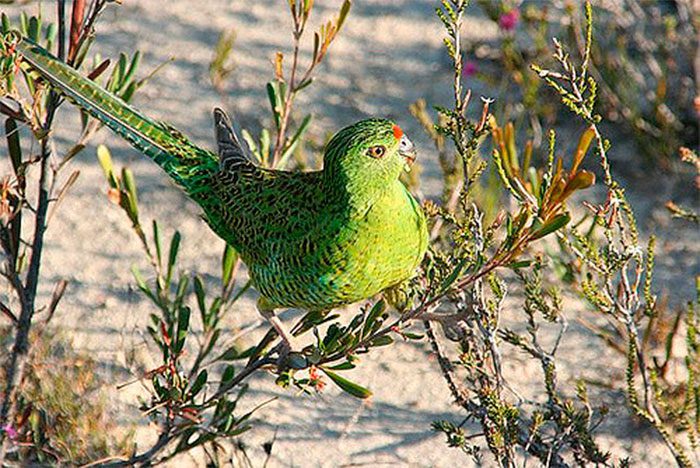
The Western Ground Parrot (Pezoporus flaviventris) It has mottled green back, underparts green and yellow, forecrown red. Tail long, with green stripes, Yellow and black poorly defined.

taxonomy:

A research team, directed by Stephen Murphy, studied taxonomy (discipline in charge of classifying living things) of the Eastern Ground Parrot (Pezoporus wallicus), an endemic species (exclusive geographic region) of fragmented coasts of southwest and southeast Australia. The researchers studied DNA from museum specimens from 160 years, and they concluded that the western population should be classified as a new species: Pezoporus flaviventris.

Habitat:

The Western Ground Parrot It is a bird that lives in soil and living in low heathland, dry or swampy near the coast. They are usually seen in habitat that has remained unburned for long periods of time. Mainly fly at dawn or dusk and feeds mainly on small seeds.

Reproduction:

It is one of the few parrots in the world that does not nest in a hole or cavity. Little else is known about the reproductive biology of the Western Ground Parrot

Food:

The Western Ground Parrot usually it feeds alone or with another parakeet. Seeds of various plants, especially of Sedge, for example, Mesomaelaena stygia ssp. stygia. Flower buds and flowers base, for example, the beaufortias, the dryandras and grevilleas, They are also important parts of the diet. It has been observed Western Ground Parrot semisuculentas feeding on leaves Daviesia pachyphylla. The diet is varied and uses the great diversity of habitat.

Distribution:

Historically, This species was found along the south west coast of Australia from Perth north to Geraldton and along the south coast east to Israelite Bay. But, It seems to have disappeared off the west coast of Western Australia in 1900.

Today only two locations are known from the extreme southwest of Western Australia: Fitzgerald River National Park and Cabo Arid National Park / Natural Reserve Nuytsland

Conservation:

• It is classified by the Australian government as a species in danger of extinction.

• Population trend: Decreasing.

• Population size : 100-110 individuals.

During an investigation (1), scientists found that the population of this new species had diminished quickly in the last 20 years, They are leaving only around 110 birds surviving in the wild, most of them in an Australian national park, so it is considered one of the rarest species in the world, so that the entry introduced predators (cats) National Park, could lead to the extinction of the species in a short time, so the need to implement is suggested Urgent conservation program for this new species described.

(1) – «Tip(‘9. S. A. Murphy, S. A., L. Joseph, A. H. Burbidge y J. Austin. “A Cryptic and Critically Endangered Species Revealed by Mitochondrial DNA Analyses: the Western Ground Parrot”. Conservation Genetics, 12, (2010): 595-600.’

Threatened Species Strategy

The Western Ground Parrot is one of the 20 birds that the Australian Government has given priority in the allocation of resources to support the recovery effort species. The Western Ground Parrot It has a base of strong and growing support in the local community. An association between South Coast NRM, Friends of the Western Ground Parrot, the Department of Parks and Wildlife and the Perth Zoo It is working to prevent extinction.

The success of the population captive breeding recently established security will be key to the species, and management of wild cats and fires Cabo Arid National Park It will be essential for local recovery. With an estimated population of less than 150 individuals and a captive population of less than ten, we need to act.

The emergency actions include the protection of the wild population and creating a population secured in captivity. Opportunities to receive more support through National Planning Program, the local group management of natural resources and existing partnerships with Government of Western Australia and the Zoo of Perth They are likely to contribute to recovery.

The website Endangered Species Strategy It includes information on what is being done to support the recovery effort species. Understanding the habits of a partnership project of rare birds and reserved aims to benefit the species improve the behavior of captive birds, which may allow better management of wild populations.

Alternative names:

Ground Parrot (Western), Western Ground Parrot (English).
Kyloring (Aboriginal).
Perruche à ventre doré, Perruche à ventre dorée, Perruche terrestre (de l’Ouest), Perruche terrestre (flaviventris) (French).
Westlicher Erdsittich (German).
Periquito Terrestre Occidental (Portuguese).
Perico Terrestre Occidental (español).

scientific classification:

Alfred John North
Alfred John North

Order: Psittaciformes
Family: Psittaculidae
Gender: Pezoporus
Scientific name: Pezoporus flaviventris
Subpoena: North, 1911
Protonimo: Pezoporus flaviventris

Images «Western Ground Parakeet»:

Sources:

Avibase
• Parrots of the World – Forshaw Joseph M
• Parrots A Guide to the Parrots of the World – Tony Juniper & Mike Parr
• Science and Development Magazine
• Department of the Environment (2018). Pezoporus flaviventris in Species Profile and Threats Database, Department of the Environment, Canberra. Available from: http://www.environment.gov.au/sprat.

Photos:

(1) – Feeding Western Ground Parrot….. the only photo’s of this bird in the wild was taken in 2005 the day before my birthday, what a gift that was. This is from my field season the next year. No nest has been found since 1913. by Brent BarrettFlickr
(2) – Western Ground Parrot (Pezoporus flaviventris) by Brent Barrett from Dunedin, New Zealand [CC BY-SA 2.0 or CC BY-SA 2.0], via Wikimedia Commons
(3) – A Western Ground Parrot in Australia by Brent Barrett from Dunedin, New Zealand [CC BY-SA 2.0], via Wikimedia Commons
(4) – Stand and sing Western Ground Parrot (Pezoporus flaviventris) by Brent Barrett from Dunedin, New Zealand [CC BY-SA 2.0], via Wikimedia Commons
(5) – This is officially one of the rarest images in exhistence Pezoporus wallicus flaviventris by Brent BarrettFlickr

▷ The world of Pets: Dogs, cats, birds, reptiles, amphibians

Budgerigar
Melopsittacus undulatus


Common Budgie

Content

Description

18 cm. length and a weight between 22 and 32 g..

Periquito-Comun

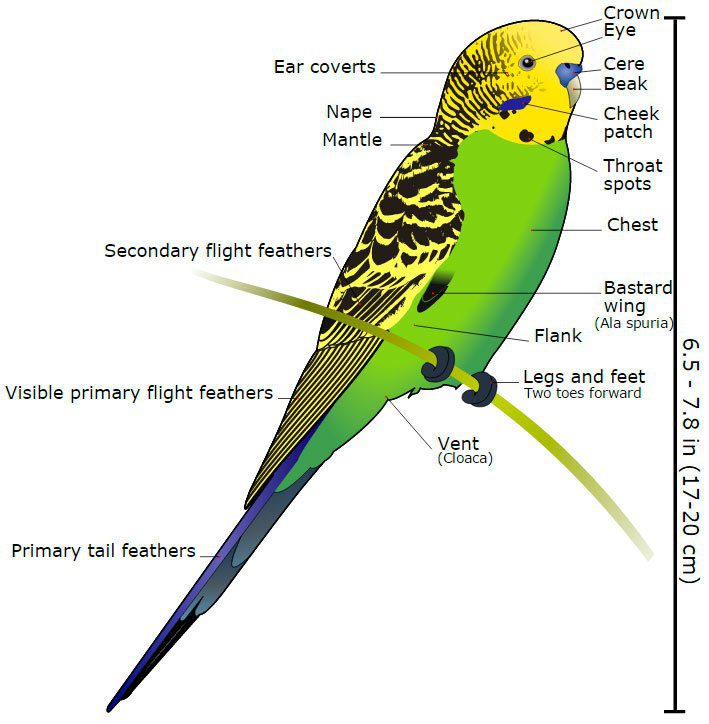
In the Budgerigar (Melopsittacus undulatus) of adults, the cere Blue contrasts with the frontal zone; the front of the face and throat are pale yellow. The latter is covered by a line of black dots. The area which is located below the cheeks it's purple.

The central part of the pileum extending from the rear of the eyes to neck It is covered with alternating thin black bands and bands of pale yellow. These bars are expanded on the the mantle and wing-coverts, forming a scaly effect.

The underparts, the area beneath the wings, the lower part of the back and rump create a beautiful pale green together. The tail is opaque blue tones with a central yellow stripe on the side feathers.

The female has a Brown wax.

The immature they are more turned off with bars on the front. The black spots on the throat they are absent.

Habitat:

The Budgerigar they are distributed by a wide variety of open habitats, including open forests, lightly wooded grasslands and savannas. Also appreciate the areas of Mallee, farmland, vegetation that grows along rivers, drought-adapted scrub and open plains. They come fitted with desert areas of Mulga (Acacia aneura). Although they are able to survive several days without water, These birds are never far from a water source.

In areas where fruit production is constant and in others where it is stable for very long periods, the movements of the Budgerigar they are easily predictable.

In the South end, Pilgrimages exist only in cases of prolonged drought and wandering parakeets return to their territory with the first rains and recolonize when river levels return to normal.

Reproduction:

The Budgerigar they build their nests of June to September in the North its area of distribution. They reproduce between August and January in the South. Nests can be installed at any time of the year after the rains fall. They establish a second brood as soon as conditions are favorable.

These parakeets usually nest in colonial way. The nest is located in a natural cavity in a tree, in a strain, an any fence post, or on a big fallen branch.

The female lays from 4 to 6 eggs and incubation lasts a few 18 days. The chicks remain in place of birth during 30 days before flying.

Food:

The Budgerigar It vegetarian, they eat herbs and seeds of quenopodios. Plants vary in categories and in proportions, according to which regions and times.

The East inside of Australia, These birds feed exclusively on seeds that are on the ground, While in the middle of the continent, There is more variety of plants to select. In the first case, grain size barely exceeds the 2 mm diameter and the second, more than 40 plant varieties make up the diet of these parakeets.

From time to time, the Budgerigar, they come in growing areas and take advantage of the ripe fruits.

Distribution:

The Budgerigar are distributed widely throughout the Interior of Australia, Although they are rare in the coastal districts of the This and the end South-West (absent of Tasmania, Arnhem Land and Cape York Peninsula).

The species may be of common to very abundant, but they are nomadic, and may change from year to year areas.

These parakeets, frequently, they burst from the arid zones to the more humid zones and there are temporary movements towards the south during the summer, but these changes may be affected by annual rainfall patterns.

We have introduced, without success, in a number of places around the world (or they have escaped from captivity and could not be) including South Africa, United Kingdom, Japan, Hong Kong, Puerto Rico, Brazil, Switzerland, Colombia, the Society Islands, New Zealand and Oman.

In the EE.UU. the species has managed to colonize Hawai and California (leaks also occur regularly in the city of New York City). In Florida a population was originally registered in the area of St. Petersburg, in the decade of 1950 and now has more of 3.000 individuals; These birds are mobile and have been recorded along the coast This of all the South from Jacksonville to Miami, and in the West everything Hudson to South of Fort Myers, from time to time go towards the North in Gainsville.

Parakeets, occasionally escaped, they may appear in Tasmania.

The world population is estimated at around 5.000,000 copies.

Conservation:


minor concern


• Current category of the Red List of the UICN: Least concern

• Population Trend: Growing

This species is not threatened at all, even they are abundant, and in some places where resources are good, countless flocks darken the sky, to cause branches to break from 4 centimeters in diameter, When large number of birds used them as support for their breaks.

Populations fluctuate widely depending on weather conditions.

Livestock living on farms in central Australia have caused Budgerigar they will benefit from new water supplies. Like this, the number of parakeets are constantly increasing.

These parakeets are the most well known psittacidas in the world.

"Budgerigar" in captivity:

This parakeet was discovered in 1805 and since then it has become the most popular captive bird in the world. While it is considered as domestic fowl, However, is a gregarious and instinctive animal, with the same needs that the parrots who freely roam the lands of Australia.

The Budgerigar It dynamic, curious, melodious and because of its small size, the beauty of their plumage and their entertaining behaviour, truly charming. This is what makes it a coveted bird. But, It is still a bird that needs to fly, play and socialize with their peers. Like any bird, It is sensitive to the social and environmental context. In fact, their real needs are too often overlooked, many parakeets suffer neglect or even abuse.

In captivity, the Budgerigar It is larger than its counterpart in nature. Measures of 20 to 25 cm. from head to tail and weighs between 30 and 45 g.. In addition to the colour of your coat, wild type, There are numerous mutations (other coat colors) associated with the increase in crossings and selections in certain genes, that translates into more spontaneous mutations.

The Budgerigar has two silent by year average, and the first moult occurs between the fourth and sixth month. The molt is complete renovation of the plumage of the bird. Pens fall to others push, includes your tube of keratin that parakeets will open with their beaks to release pen and relieve the irritation that engenders the same thrust. It can be more or less painful and intense. Some plucking is so fast that the bird may experience some difficulties during the flight.

Check the intensity of the change of the parakeet through black head tubes, tiredness and especially the number of feathers on the ground.

The feeding of the Budgerigar is based on the millet and the birdseed, Although it must be complemented with other seeds or vegetables (as the lettuce, Spinach, pepper, Carrot, corn). The fruits are also a good dietary supplement for these birds. Occasionally it can provide a little bread or biscuit, but always with caution that not give them anything very sweet. The avocado, the chocolate and the parsley they are deadly toxic for the Australian parakeets.

The the parakeet cage must be protected from the cold, a temperature between the 20-25 C. It must be of one sufficient size so you have freedom of movement and can exercise. The balusters must be arranged horizontally so that they can climb up them. The cage must be washed at least once a month with a disinfectant, change the water daily and clean the shells of the food. A cat litter tray can be placed to make their needs.
It is also important to let the parakeet out occasionally and fly freely around the room. Windows must be closed and curtains, because you can hit them.
Son very sociable birds and it is better to live with other parakeet. The best couple is formed by a male and a female. This will try to kill its companion if it is of the same gender.

With regard to its longevity, according to sources, these animals can come to live until 21 years in captivity. The same sources indicate that these parakeets suffer from a high incidence with respect to ovarian cancer.

Alternative names:

Budgerigar, Budgerygah, Budgie, Canary Parrot, Grass-Parakeet, Lovebird, Scalloped Parrot, Shell Parakeet, Shell Parrot, Undulated Parrot, Warbling Grass-Parrot, Zebra Parrot (ingles).
Perruche ondulée (French).
Wellensittich (German).
Periquito-australiano (Portuguese).
Periquito Australiano, Periquito Común, Cotorra Australiana, Cata Australiana (español).

scientific classification:

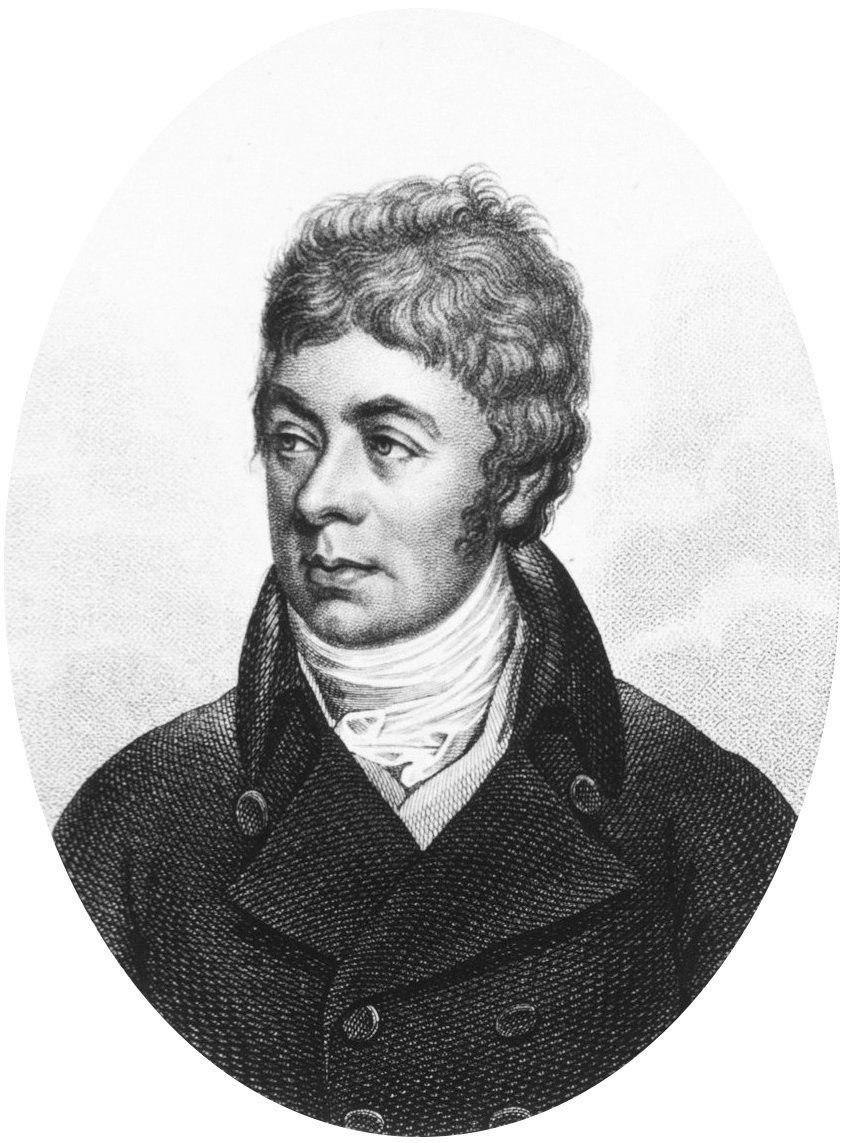
George Shaw


Order: Psittaciformes
Family: Psittaculidae
Genus: Budgerigar
Scientific name: Melopsittacus undulatus
Citation: (Shaw, 1805)
Protonimo: Psittacus undulatus

«Common Parakeet» Images:

Videos "Budgerigar"

————————————————————————————————

«Common Parakeet» (Melopsittacus undulatus)


Sources:

Avibase
– Parrots of the World – Forshaw Joseph M
– Parrots A Guide to the Parrots of the World – Tony Juniper & Mike Parr
– Birdlife

Photos:

(1) – Budgerigar at Zoo Atlanta, USA By TheSussman (Mike) (originally posted to Flickr as Parakeet) [CC BY 2.0], via Wikimedia Commons
(2) – Two budgerigar at Henry Doorly Zoo, USA By Jeff Coffman (originally posted to Flickr as DSC_1265) [CC BY 2.0], via Wikimedia Commons
(3) – male budgerigar. taken near Cameron’s Corner, Qld By Benjamint444 (Own work) [GFDL 1.2], via Wikimedia Commons
(4) – Detail shot of budgerigars head By Kirk (Own work) [CC BY-SA 3.0 or GFDL], via Wikimedia Commons
(5) – Melopsittacus undulatus flock, Karratha, Pilbara region, Western Australia By Jim Bendon from Karratha, Australia (budgies_4) [CC BY-SA 2.0], via Wikimedia Commons
(6) – By User Magnus Manske on en.wikipedia [Public domain], via Wikimedia Commons
(7) – Exterior diagram of a green budgerigar By ZooFari [CC BY-SA 3.0], via Wikimedia Commons

Sounds: Marc Anderson (Xeno-canto)

▷ The world of Pets: Dogs, cats, birds, reptiles, amphibians

Red billed Parrot
Pionus sordidus

Tropicbird Parrot

Content


Anatomy-parrots

Description:

The Red billed Parrot (Pionus sordidus), of looking scruffy, has a length of 28 to 31 cm. and a weight between 255 and 275 g..

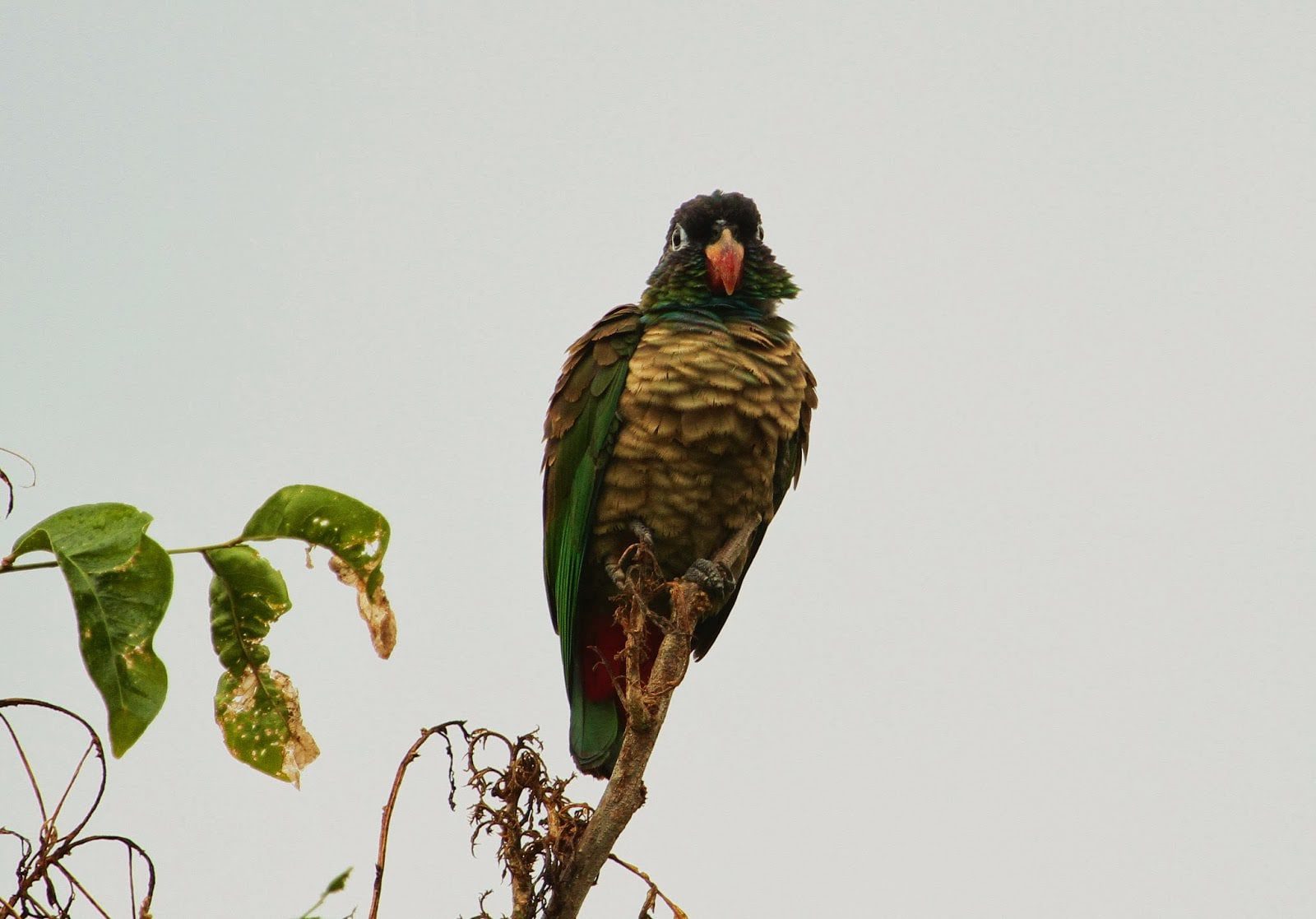
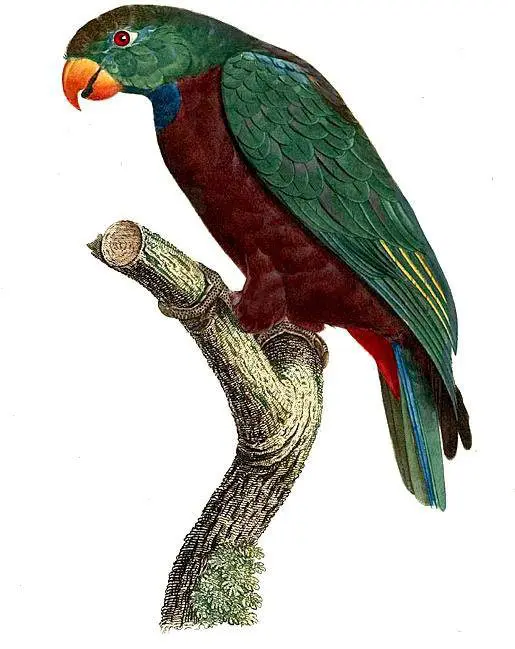
The subspecies Pionus sordidus corallinus, the most widespread, has the feathers of the forecrown, lores and behind the eyes, Green at the base and with blue edges widths; the cheeks, ear-coverts and the sides of the neck, mainly green with some blue narrow tips; the crown and rear of the neck, Green with edges blue narrow. Mantle and back pretty dull green with paler blue margins; rump and uppertail-coverts, of color green basally, more Brown olive distally. Coverts medium and small with wide olive green tips; the front edge of the wing ; coverts primary and higher and flight feather brightest which the parts superiores and others wing-coverts.

Under, the wings green; chin green; throat and upper breast with band broadband of color blue violet; belly green, Some birds with gray Suffusion; undertail-coverts crimson. Tail Green by the Center, Blue side; Red at the base.

Bill coral red, pale at the base of the upper jaw; cere dark grey; bare periophthalmic pale grey; Iris dark brown; legs pale grey.

Both sexes are similar. Immature sample undertail-coverts yellowish-green with some red marks; head green.

Subspecies description

Description 6 subspecies
  • Pionus sordidus antelius

    (Todd, 1947) – Similar to the nominal species but the feathers of the throat lack of edges blue and the center of the chest is in color pink.

  • Pionus sordidus corallinus

    (Bonaparte, 1854) – Described above.

  • Pionus sordidus mindoensis

    (Chapman, 1925) – Is as the subspecies Pionus sordidus corallinus, but of color green more beige, those edges blue of the feathers of the head are more narrow and the under wing-coverts not have them edges dark.

  • Pionus sordidus ponsi

    (Aveledo & Gines, 1950) – Throat of color blue violet almost solid. The chest and upperparts they are darker and greener that the of the nominal species, they lack clear margins to the feathers of the back and of the wing-coverts.

  • Pionus sordidus saturatus

    (Todd, 1915) – More dark and more green that it nominal species with the feathers of the upperparts lack of margins of color green olive. Less green in the throat and cheeks.

  • Pionus sordidus sordidus

    (Linnaeus, 1758) – Nominal. Much more Brown that the subspecies Pionus sordidus corallinus, with blue (turquoise) more reduced in the throat. Feathers in them upperparts with most distinctive pale margins.

Habitat:

Red billed Parrot

It is a very rare species. It inhabits in mountains of humid and semi-humid cloudy forests, edges of forest and partially deforested areas, between 200-2850 m, Although they are more frequent at altitudes of 500-1.500 m. They use areas of secondary growth, partially deforested with tall trees scattered and sometimes light forests on coffee plantations, being less frequent in dry areas.

Gregarious outside of breeding season; formations in flocks of up to 50 birds, sometimes more where the food is abundant. Children sleep in community.

Reproduction:

They nest in the cavity of the trees, sometimes in very degraded habitats. Birds in breeding attitude during the months of February-April in Colombia; It breeds in the months of April-June in Venezuela, January-may in Ecuador; Nest occupied in October in Bolivia. Laying three eggs in captivity.

Food:

Feeds of fruit, berries and seeds.

Distribution:

Size of the area of distribution (reproduction / resident): 169.000 km2

This species has a distribution batch through them land high in the North and West of South America, from Venezuela to the North of Bolivia. You can find in the North of Venezuela, in the mountains of Anzoátegui, Sucre, North of Monagas and apparently, of way to discontinuous, in the Highlands of the Federal District through the mountains coastal, to the West, until Lara and Falcon, then in the Sierra de Perija, Zulia and parts adjacent in Colombia, West to the foothills of Santa Marta in Magdalena, also locally in the Eastern Andes of Boyacá and Huila. Extends over the Western side of the Andes in Ecuador, from Pichincha until Gold and for all the East side to the northeast of Peru.

Although there are no records in the Eastern Andean slope, in the central and southern Peru, the range includes the Yungas North of Bolivia in Santa Cruz and Cochabamba.

common locally; apparently less numerous in the West of Ecuador and North of Bolivia, and probably in decline locally due to the deforestation (for example, in the Ecuador Western, North of Venezuela and Andes of Colombia).

A recent study not localized to the subspecies Pionus sordidus antelius in its area of distribution widely cleared, Although the subspecies can dwell in forests moderately disturbed.

Kept as pets locally although generally scarce in captivity.

Subspecies distribution

Distribution 6 subspecies

Conservation:


minor concern


• Current category of the Red List of the UICN: Least concern.

• Population trend: Decreasing.

Justification of the population

The size of the world population It has not been quantified, but this species is described as «quite common» (Stotz et to the., 1996).

Justification of trend

It is suspected that the population is in decline due to ongoing habitat destruction.

"Red billed Parrot" in captivity:

Very rare in captivity. In general, they are not so nervous in temperament as other parrots. They can learn to imitate.

Its diet in captivity It varied: fruits such as: Apple, orange, banana, granada, Cactus, they form approximately the 30 percent of the diet; vegetables such as: Carrot, celery, green beans, pea in the pod, fresh corn; Greens such as: chard, lettuce, dandelion, Aviary grass; millet; mixture of small seeds, such as: millet, birdseed, and small amounts of oats, buckwheat, safflower and hemp; soaked and sprouted sunflower seeds; beans, cooked legumes and boiled corn; hard cheese.

Alternative names:

Red-billed Parrot, Dusky parrot, Red billed Parrot, Sordid parrot (English).
Pione à bec rouge, Perroquet sordide (French).
Dunenkopfpapagei, Dunenkopf, Dunenkopf-Papagei (German).
Curica-de-bico-vermelho (Portuguese).
Cotorra Piquirroja, Loro de Pico Rojo, Loro Piquirrojo (español).
Cotorra piquiroja, Cotorra Piquirroja (Colombia).
Loro de Pico Rojo (Peru).
Perico Pico Rojo (Venezuela).

scientific classification:

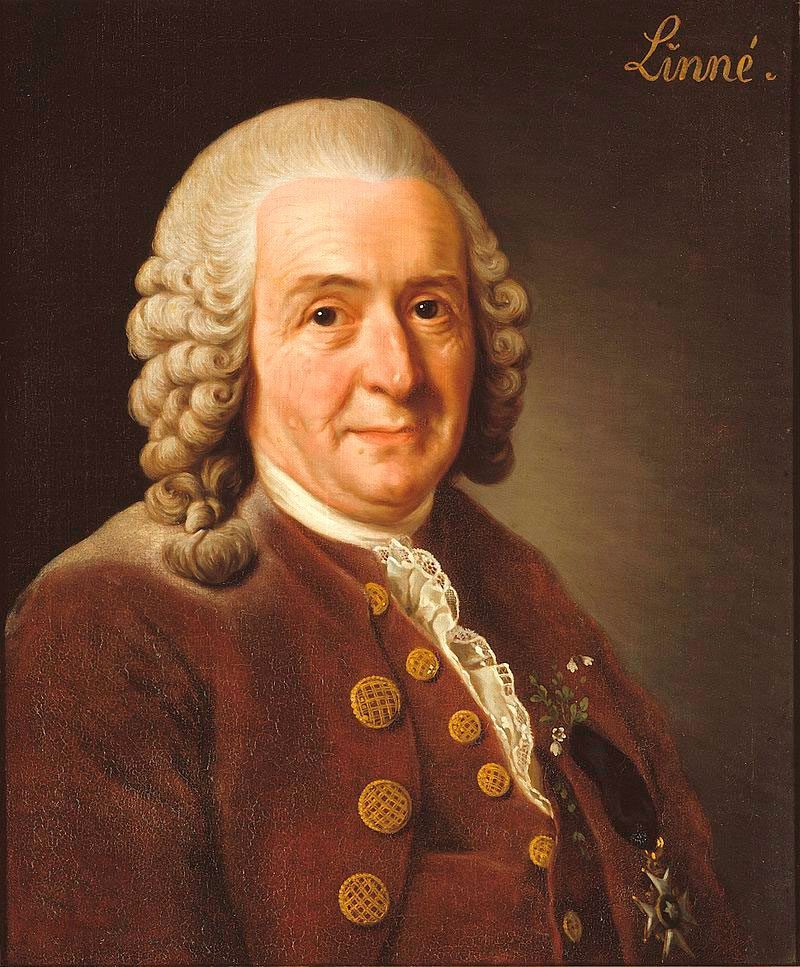
Carl Linnaeus
Carl Linnaeus

Order: Psittaciformes
Family: Psittacidae
Genus: Pionus
Scientific name: Pionus sordidus
Citation: (Linnaeus, 1758)
Protonimo: Psittacus sordidus


Images «Loro Piquirrojo»:

Videos "Red billed Parrot"

«Loro Piquirrojo» (Pionus sordidus)

Sources:

  • Avibase
  • Parrots of the World – Forshaw Joseph M
  • Parrots A Guide to the Parrots of the World – Tony Juniper & Mike Parr
  • Birdlife
  • Parrot Book, Parrots and macaws Neotropical

  • Photos:

(1) – Red-billed Parrot, Pionus s. sordidus, Perico Pico Rojo – Our beautiful world
(2) – Red-billed Parrot, Pionus s. sordidus, Perico Pico Rojo – Our beautiful world
(3) – Red-billed Parrot, Pionus s. sordidus, Perico Pico Rojo – Our beautiful world
(4) – Red-billed Parrot (also known ans the Red-billed Pionus); two captive By TJ Lin (originally posted to Flickr as coral-billed pionus) [CC BY-SA 2.0], via Wikimedia Commons
(5) – Red-billed-Parrot (Pionus sordidus), Pajaro Jumbo Reserve, NW Ecuador By Nomdeploom (Own work) [CC BY-SA 4.0], via Wikimedia Commons
(6) – BARRABAND, Jacques (1767/8-1809) Le Perroquet brun [Red-billed Parrot (Pionus sordidus)] – Wikimedia

  • Sounds: Sebastian K. Herzog

▷ The world of Pets: Dogs, cats, birds, reptiles, amphibians

Red Lory
Eos bornea

Red Lory

Content

Description

31 cm.. length and an approximate weight of 170 gr.

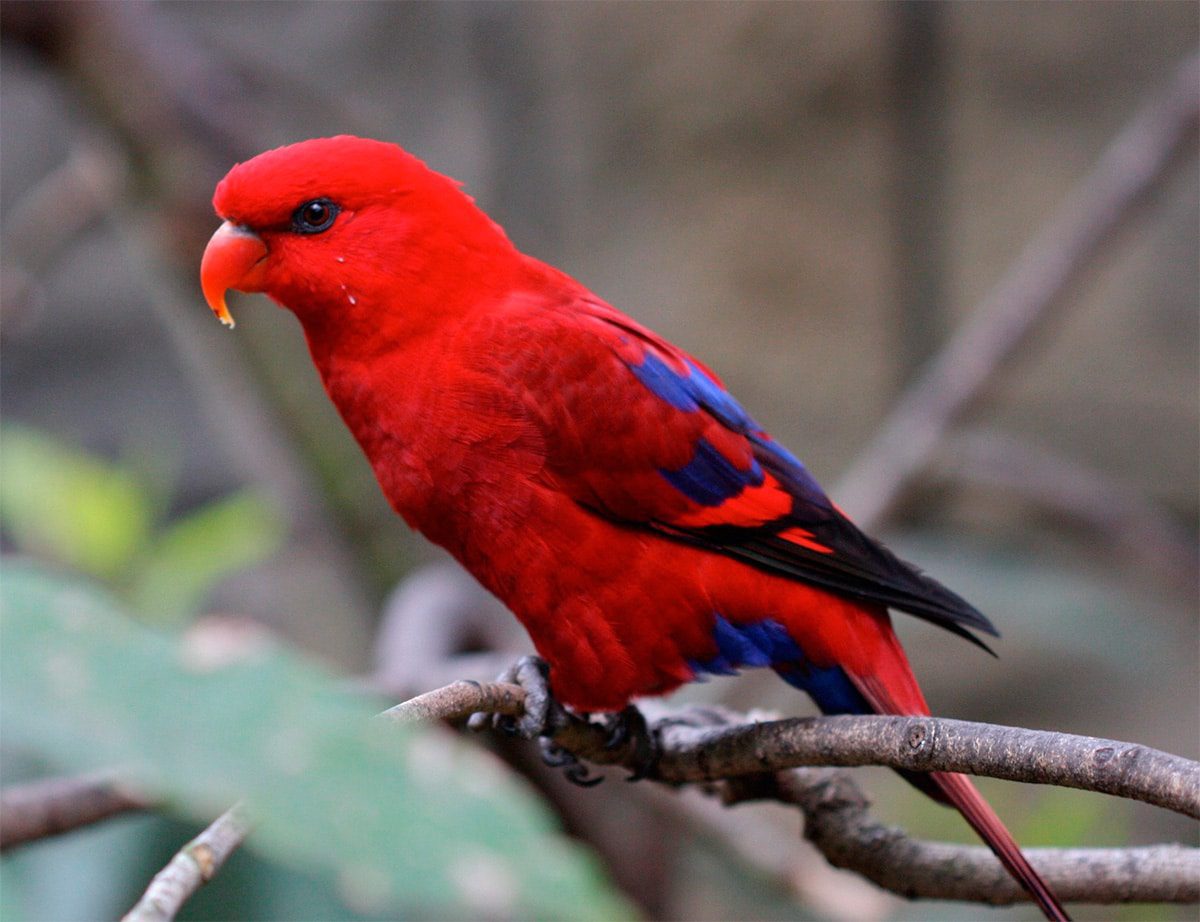
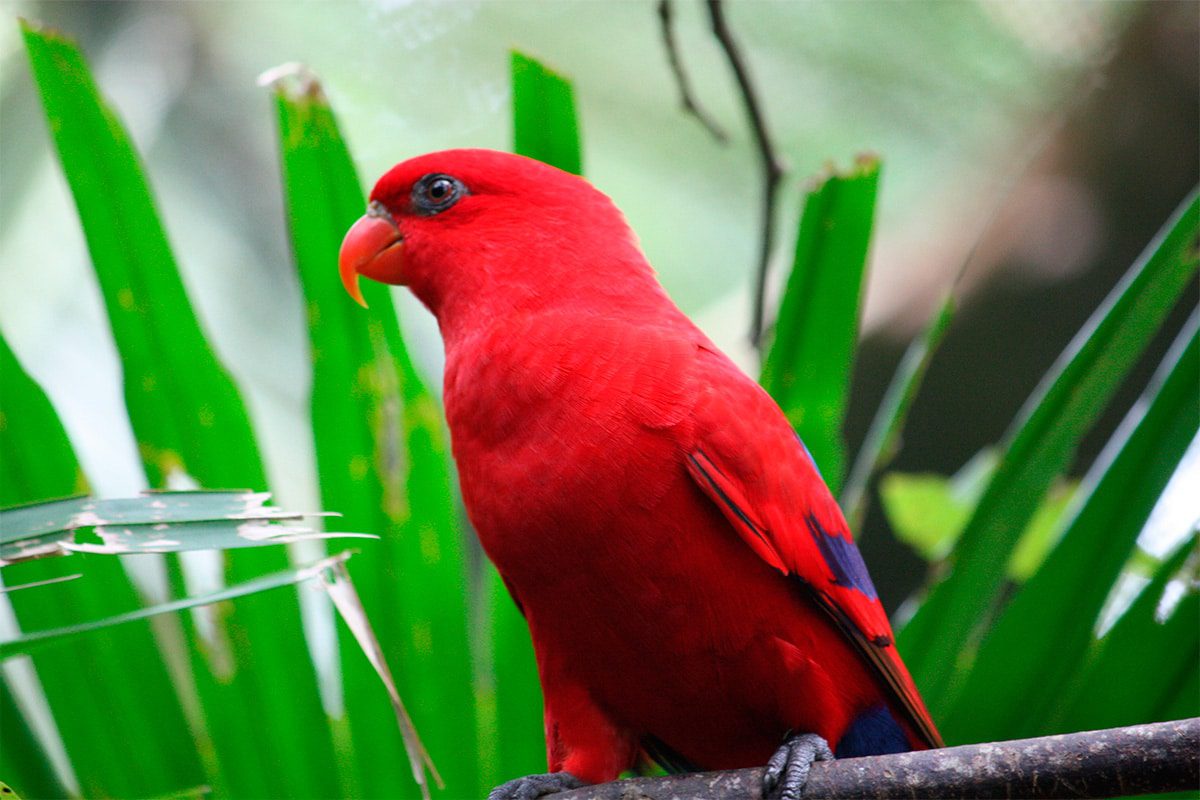
The head and the neck of the Red Lory (Eos bornea) are entirely of a deep red color.

In the adult the primary feathers are black with a large red mirror. The feathers tertiary and the coverts are of color blue. The joint of the feathers of the helmsman they are reddish-brown. The irises they are red, legs grayscale and the bill dark orange.

The immature they tend to be more off than their parents coloring. They show the feathers tertiary grey, lightly stained blue. The ear-coverts Sometimes it tinges of blue. Times, the area of the vent and the thighs it infiltrates with small stains blue. The feathers of the abdomen often carry some edges blue dark. They have the irises brown.

Not exists no sexual dimorphism visible although the males tend to be more corpulent that the females.

Description 2 subspecies

  • Eos bornea bornea

    (Linnaeus, 1758) – Nominal.


  • Eos bornea cyanonotha

    (Vieillot, 1818) – The Red of his plumage is much more dark almost brown.

Habitat:

They are mostly primary forests, in the wooded areas during regeneration, Forest Hills, coconut plantations, in abandoned gardens and mangroves.

They are mainly in coastal areas, What does not climb up to 900 m in the island of Ceram and up 1.800 m in the of Buru.

Throughout its area, the Red Lory are fairly common, However, some populations are more dispersed around the villages, since they are very cautious towards humans.

Behavior:

The Red Lory they live in pairs or in small groups, but sometimes you can observe large flocks of 50 individuals.

They are birds noisy and quite easy to observe, as they often fly above the canopy attracted by the red flowers of the tree of coral (Erythrina).

They have a fast and direct flight and when moving, make your buzz due to its quick flapping.

In the Kai Islands, their movements are common: all days, they cross the arm of sea that separates the different islands flying rapidly and at high altitude.

During the rest hours that occur at noon, the Red Lory they spend most of their time smoothing their feathers in the shade of a tree. Probably, This practice is designed to strengthen marital ties. Parties that enjoy priority are the head and neck; as you can not reach these areas with its beak, you will always need your partner collaboration. The "patient" that undergoes this preferential treatment seems to express a great sense of satisfaction.

Reproduction:

The couples begin to look for the location of the nest between the months of August and September. It is located high in a big tree.
In mid-December some young leaving the nest have observed.

As in all loris, the nesting period is very long and hard 7 to 9 weeks.

In captivity, the Red Lory puts 1 or 2 litters per year. Each spawning has usually 2 white eggs that are incubated for a period ranging from 24 to 26 days.

Food:

In their natural habitats, the Red Lory feed of nectar, pollen, fruits and insects of fashion casual.
Your food › seem to be them flowers of the trees of the species Eugenia and Erythrina.

All the Loris they have a language that is especially suited, with a brush tip made up of elongated papillae. This characteristic allows birds to collect pollen from flowers and compress it in a suitable way for swallowing.. They play an important role in the pollination of flowering plants and trees.

Distribution:

Size of the area of distribution (reproduction / resident): 57.900 km2

The Red Lory they have a very restricted distribution area. They live South of the Moluccan Islands, halfway between Sulawesi and the western end of New Guinea.

Distribution 2 subspecies:

Conservation:


minor concern


• Current IUCN Red List category: Least concern

• Population trend: Decreasing

This species has a very large range, and therefore not approaching the thresholds for Vulnerable according to the range size criterion.

The population is suspected of being in decline due to unsustainable levels of exploitation.

The species has undergone intense trade from 1981, When it began trading in Appendix II. 99.834 wild-caught specimens have been recorded in international trade, Although none from 2000 (UNEP-WCMC trade database, January 2005 CITES).

"Red Lory" in captivity:

This lori is considered one of the most widespread within poultry. It's an interesting bird, robust and easy of play, ideal for a start in the world of the loris. It also has a very attractive red color; It playful and is easy for tame.

It is a great conversationalist. Some have entire sentences in their vocabulary. Unfortunately, his voice is sometimes very strong, with a high sharp squeal. Most are docile, even at maturity. They can be prolific breeders and are fairly easy to find as hand-raised pets..

Too much protein in the diet can lead to gout., a type of arthritis that crystals are deposited in the joints. May be a bit uncomfortable due to liquid diet.

Alternative names:


Red Lory, Buru Red Lory (ingles).
Lori écarlate, Lori rouge (French).
Rotlori (German).
Lóris-vermelho (Portuguese).
Lori Rojo (español).

Carl Linnaeus
Carl Linnaeus

scientific classification:


Order: Psittaciformes
Family: Psittaculidae
Genus: Eos
Scientific name: Eos bornea
Citation: (Linnaeus, 1758)
Protonimo: Psittacus borneus


Images "Red Lori":

Videos "Red Lory"

——————————————————————————————————–

«Lori Rojo» (Eos bornea)


Sources:

Avibase
– BirdLife.org
– mundoexotics
Oiseaux.NET

Photos:

* A Red Lorry at Taronga Zoo, Sydney, Australia by Navin – wikimdia
* Red Lory (Eos bornea) looking upwards by shahram sharif – Wikimedia
* Red Lory (Eos bornea) at Singapore Zoo by Joost Rooijmans – Wikimedia
* Red Lory – KL Bird Park – Malaysia by diego_cue – Panoramio
* Moluccan Red Lory – Parrots Australia

Sounds: BAS van Balen (Xeno-canto)

+ More