โ–ท The world of Pets: Dogs, cats, birds, reptiles, amphibians

New Zealand Kaka
Nestor meridionalis

New Zealand Kaka

Content

Illustration of a Kaka.

Description

45 cm.. length and an average weight of 550 g..

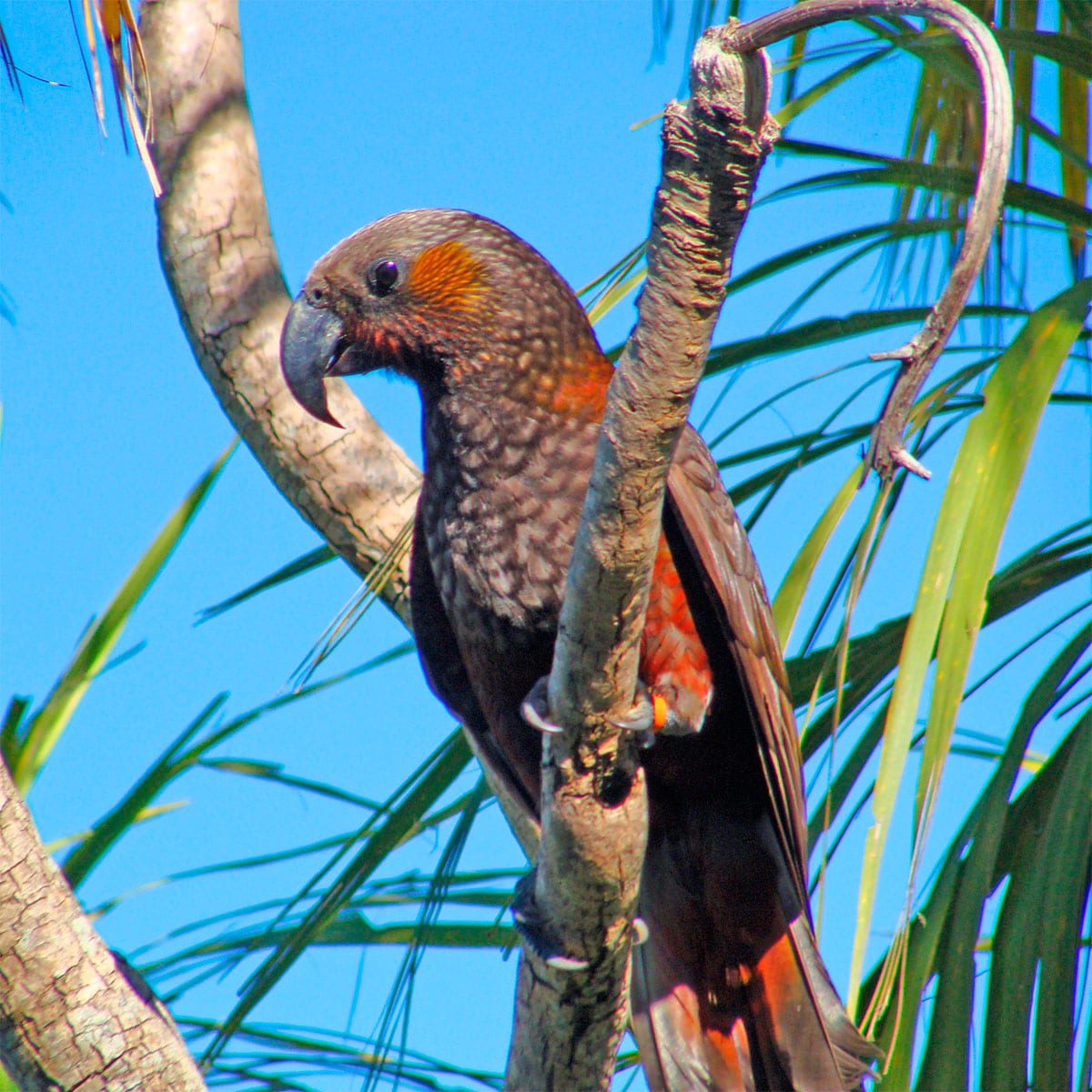
The New Zealand Kaka (Nestor meridionalis) they are some great parrots with a tail of medium length and a plumage predominantly Brown and Red.

The adult male has the crown whitish grey color and the neck with a greyish Brown appearance due to large brown feathers that surround you.

The under eye and the sides of the neck has a bluish grey clear. The lores are greyish Brown, that contrast with the ear-coverts strongly tinged with orange. The sides of the chin they have reddish-brown infiltrations.

The feathers of the upperparts are greenish Brown with darker stripes and stripes. Those in the back of the neck They are crimson red with yellow endings and browner bases..

The the mantle, sometimes, has some red spots. Rump and uppertail-coverts are red with dark brown trim. The lower area of the wings and axillary they are also red.

The feathers of the chest are olive brown in colour with reddish edges subterminales. Belly and undertail-coverts are red with dark edges.

The tail is brown with lighter tip.

The bill is brownish grey, more powerful that the of the Kea. The cere Brown it is decorated with a few whiskers. The irises is dark brown, legs dark gray.

The adult female presents a bill shorter and one mandible less curved top.

The youth they are similar to adults, but have a small yellow spot at the base of the lower jaw.

Subspecies description

  • Nestor meridionalis meridionalis (Gmelin, 1788) – Nominal species

  • Nestor meridionalis septentrionalis (Lorenz von Liburnau, L 1896) – It measures 42 cm approximately. Variation of the nominal (Nestor Meridionalis). More small, in general, and plumage more off. The red band of the neck is more small and dark. The back of the wings olive color is more dark.

Habitat:

The New Zealand Kaka (Nestor meridionalis) they frequent the compact forests of low to medium height, where there are mainly podocarp and beech trees of the genus Nothofagus. Occasionally they come into gardens and orchards, especially in winter.

These birds they tend to live at altitudes between 450 and 850 meters in the summer and from the sea level to the 550 meters in winter. But, from time to time, You can climb up to the 1.500 m.

The New Zealand Kaka they live in pairs or in small groups of up to ten birds.

These birds are not as well known as the Kea (Nestor notabilis), Although in some places come to feed in the hand of the tourists.

We can often see them at the top of trees or simply flying over the canopy.

The birds that are found in the air almost always heard before to be seen.

The New Zealand Kaka they are active during the morning and afternoon. At the hottest time of the day, around midday, They lie between the foliage of the trees.

Around the darkness, they perform a series of acrobatic flights, before returning to their roosts. Screams and calls can be heard well into the night.

In some areas, the New Zealand Kaka they are sedentary. But, most of the time they are erratic or perform short altitudinal migrations. These birds are able to fly long distances. They fly to vigorous banging of wings.

Reproduction:

The season of nesting is from September to March, but it is above all active between November and January.

The nest is located in a tree cavity between 3 and 9 meters above the ground. The pair sometimes enlarges the entrance hole with its beak..

The spawning contains 4 or 5 eggs white. These are deposited on a layer of sawdust that covers the bottom of the cavity.

The incubation, that lasts a few 24 days, It is done solely for the female. She leaves the nest at dawn and dusk to be able to be powered by your partner. an assistant, sometimes, can participate in the feeding of the female during the period in which she incubates.

In the North, the young have white down, While the of the South they have grey down at the bottom.

The juveniles they acquire their full plumage in ten weeks.

For the duration of the stay in the nest, they are fed by both parents.

The breeding success rate is relatively low and they rarely lay more than one egg per year..

Food:

The New Zealand Kaka It has a long tongue terminated tip, What helps you to extract nectar from the flowers and to collect molasses.

In the Spring, in the South of the island, the New Zealand Kaka almost passes the 30% of their time in the trees (Beech) where feeding of honeydew produced by the local cochineal (Ultracoelostoma assimilates). In other stations, This food is a less important resource due to competition with the WaSP, which is also a great consumer.

The larvae of beetles of long antennae they are also a good source of nutrition.

Throughout the year the New Zealand Kaka, regularly, frequent trees, where it used its powerful curved beak to hunt insects hidden beneath the bark.

When opossum populations disperse, the New Zealand Kaka they spend nearly the 60% of their time feeding on flowers and berries. It also, consume sprouts, seeds, nectar and SAP.

Distribution:

Size of the area of distribution (reproduction / resident): 71.100 km2

This species is endemic of New Zealand.

Subspecies distribution

Conservation:


Endangered

โ€ข Current Red List of UICN: Danger

โ€ข Population trend: Decreasing

This species has a very irregular distribution. in most places, is rather sparse, but in other places, is common locally, especially in some coastal islands.

Its population It is estimated between 3750 and 15,000 specimens.

The main threat is the habitat degradation. It stays within primary forest fragments, showing its very low adaptation to artificial habitats.

The New Zealand Kaka not nest every year in a systematic way. When I was try to reproduce in captivity, the success rate was not very high (on average the 56% eggs not hatched ).

Clutches often suffer from the predation on the part of the weasels It was introduced on the island. For all these reasons that the species is classified as VULNERABLE.

"New Zealand Kaka" in captivity:

Very rare in captivity.

In terms of their longevity, according to sources, a specimen in captivity lived during 15 years.

Taking into account the longevity of the similar species, the maximum longevity of these birds might be underestimated. Other sources indicate that these birds can live up to the 35,5 years in captivity, something that is plausible, pero que no ha sido verificado; el mismo estudio informรณ que los New Zealand Kaka can reproduce a partir de los 7 years of age in captivity.

Alternative names:

New Zealand Kaka, Common Kaka, Kaka (English).
Nestor superbe (French).
Kaka (German).
Kฤkฤ (Portuguese).
Kaka (espaรฑol).

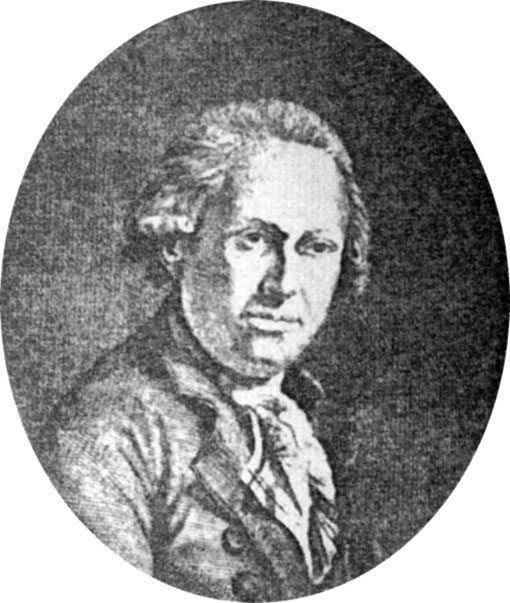
Gmelin Johann Friedrich

scientific classification:

Order: Psittaciformes
Family: Strigopidae
Genus: Nestor
Scientific name: Nestor meridionalis
Citation: (Gmelin, JF, 1788)
Protonimo: Psittacus meridionalis


"Kaka" images:

Videos "New Zealand Kaka"

————————————————————————————————

ยซKakaยป (Nestor meridionalis)


Sources:

Avibase
– Parrots of the World โ€“ Forshaw Joseph M
– Parrots A Guide to the Parrots of the World – Tony Juniper & Mike Parr
– Birdlife

Photos:

(1) – Car (Nestor meridionalis) in Wellington, New Zealand By derivative work: Snowmanradio (talk)Kaka_(Nestor meridionalis)-_Wellington_-NZ-8.jpg: PhillipC [CC BY 2.0 or CC BY 2.0], via Wikimedia Commons
(2) – North Island in Kaka, at Auckland Zoo, New Zealand By Small [CC BY-SA 2.0], via Wikimedia Commons
(3) – A New Zealand Kaka in Karori Wildlife Sanctuary, Wellington, North Island, New Zealand By Rosino (the colorful kฤkฤUploaded by Snowmanradio) [CC BY-SA 2.0], via Wikimedia Commons
(4) – Nestor meridionalis meridionalis, South Island Turkey, on Stewart Island, New Zealand By derivative work: Snowmanradio (talk)Kaka-parrot_-Stewart-Island.jpg: giles.breton [CC BY 2.0 or CC BY 2.0], via Wikimedia Commons
(5) – Kaka in flight. Karori Wildlife Sanctuary, Wellington, New Zealand. I, Tony Wills [CC BY-SA 3.0], via Wikimedia Commons
(6) – Illustration of a Kaka By J. G. Keulemans, in W.L. Bullerโ€™s A History of the Birds of New Zealand. 2nd edition. Published 1888. (New Zealand Electronic Text Centre) [CC BY-SA 3.0 nz], via Wikimedia Commons

Sounds: Fernand DEROUSSEN (Xeno-canto)
โ–ท The world of Pets: Dogs, cats, birds, reptiles, amphibians

Slender-billed Parakeet
Enicognathus leptorhynchus

Slender-billed Parakeet

Content

Description:

40 to 42 cms. length and 200 to 250 g. of weight.
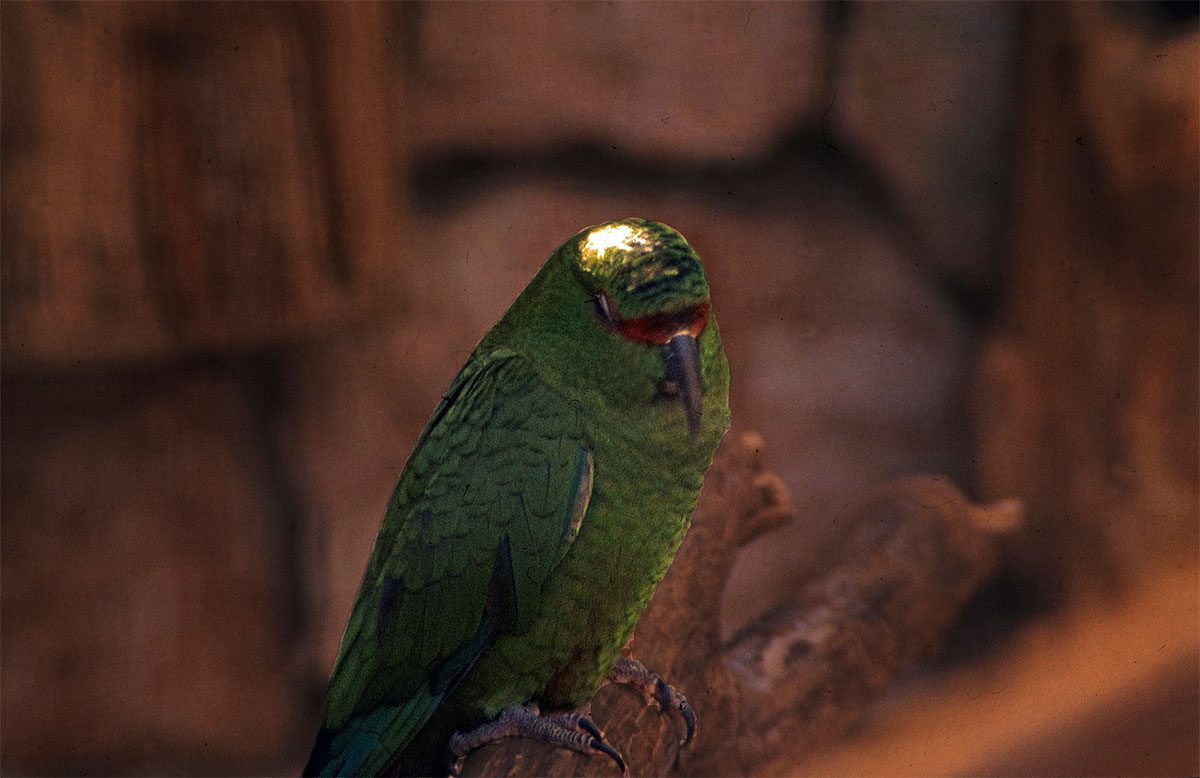
The Slender-billed Parakeet (Enicognathus leptorhynchus) has the lores, forecrown and a narrow ring feathers around the eyes bright crimson red; cheeks and sides neck, green; feathers of the crown, the nape, the the mantle and back, with dark green margins producing a scalloped effect (more pronounced in the crown, where the feathers are brighter and more emerald).

Scapulars, rump and uppertail-coverts They are green. Primary coverts green with blue suffusion; other coverts green. Flight feathers green-blue above with dark margins in innerwebs near the tips; light gray below. Underwing-coverts brighter yellowish green. Underparts yellowish green with patch dull red in centre of belly. Upper, the long tail red is off; greenish toward the tip; undertail, dull red suffused greyish.

Slender-billed Parakeet

The upper jaw It is dark gray with colored tip horn, the lower jaw is horn; Strait bare periophthalmic grey; irises orange-red; legs grey.

Both sexes are similar.

Immature darker, with the upper jaw shorter, less red in the face little or no red on belly.

  • Sound of the Slender-billed Parakeet.

Habitat:

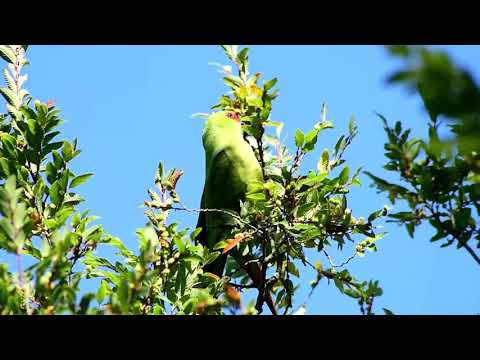
Video – "Slender-billed Parakeet" (Enicognathus leptorhynchus)

CHOROY PARROT EATING

The Slender-billed Parakeet dwells in wooded areas, mainly Nothofagus and Araucaria, although they can be seen in more open cultivated fields or pastures, especially in winter. Its range is from sea level in winter to 2.000 meters in summer. Usually in flocks, of a few individuals to several hundred, even in breeding season; large communal concentrations sometimes composed of several thousand birds.

Reproduction:

Nests generally treeholes, often at a certain height and several couples using the same tree; very deep holes fill them with twigs to raise the base level. Occasionally nidifican in rock crevices, building the nest with twigs (for example, bamboo thicket This chusquea) if there is no tree cavities available. breeding season in November-December. Clutch 5-6 eggs.

Food:

Its diet It consists of seeds of wild and cultivated plants (They are sometimes considered a pest), including grains and thistles, seed cones araucaria (March April) open with its elongated peaks, acorns, seeds of Nothofagus and bulbous roots. generally place vigilantes while the rest of the birds feed.

Distribution and status:

Distribution area (breeding / resident): 195.000 km2

The Slender-billed Parakeet It is confined to the center Chile, from the South of Santiago through coastal lowlands and valleys on the slopes of hills peaceful, south to the Chiloe Island and maybe Palena River in the North of Aysen; They can also be seen in Isla Mocha off the southwest coast bio bio.

made some movements altitudinal seasonal, with moving from coastal lowlands to the foothills of the hills between spring and autumn bird (September-May).

Quite common, although in recent decades its population has suffered a decline due to, fundamentally, deforestation, his capture and the Newcastle disease.

Less frequent and perhaps only sporadic in the northern and southern ends of its range.

Caught locally as pets, although quite rare in captivity outside Chile.

Conservation:

State of conservation โ“˜


minor concern Minor Concern โ“˜ (UICN)โ“˜
  1. Current red list category of the UICN: Least concern.
  2. The population trend: Stable.
  3. Population size : Unknown.

(classified in Appendix II of CITES)

Justification of the Red List of the Category

This species has a range very large, and as a result does not approach the thresholds for Vulnerable under the range size criterion (extent of occurrence <20.000 km2). La tendencia de la population seems to be stable, and therefore the species does not approach the thresholds for Vulnerable according to the population trend criterion. (> 30% decrease of more than ten years or three generations). The population size It has not been quantified, but are not believed to approach the thresholds for Vulnerable based on population size criteria (<10.000 individuos maduros con una disminuciรณn continua estima en> 10% in ten years or three generations, or in a particular population structure). For these reasons, the species is evaluated as Least concern.

Justification of the population

The world population It has not been quantified, but the species according to sources is locally common (pit et to the., 1997).

Justification trend

The population suspected to be stable in the absence of evidence of any reduction or substantial threats.

"Slender-billed Parakeet" in captivity:

Virtually unknown until 1976.

It is a nice and noisy bird, whose docility and cunning behavior have meant it to be hunted down and captured to commercialize as pets, very common but absolutely illegal practice, because they are removed from their natural means of inhabitancy in South Chile, which they can not be replaced in urban areas and in captivity. People who do sell through a network of illegal trafficking. However, it is a rare bird watching in captivity outside Chile.

In captivity, according to sources, a specimen lived 15,3 years.

Alternative names:

Chilean Parakeet, Long-billed Conure, Long-billed Parakeet, Slender billed Parakeet, Slender-billed Conure, Slender-billed Parakeet, Slight-billed Conure, Slight-billed Parakeet (English).
Conure ร  long bec, Perriche ร  long bec, Perruche ร  long bec (French).
Langschnabelsittich, Langschnabel-Sittich (German).
Periquito Delgado-faturado (Portuguese).
Choroy, Cotorra Choroy (espaรฑol).


scientific classification:

Admiral Phillip Parker King

Order: Psittaciformes
Family: Psittacidae
Genus: Enicognathus
Scientific name: Enicognathus leptorhynchus
Citation: (King, PP, 1831)
Protonimo: Psittacara leptorhyncha

Images Slender-billed Parakeet:


Species of the genus Enicognathus

Sources:

  • Avibase
  • Parrots of the World โ€“ Forshaw Joseph M
  • Parrots A Guide to the Parrots of the World – Tony Juniper & Mike Parr
  • Birdlife
  • surmagico

Photos:

  • (1) Enicognathus leptorhynchus (Slender-billed parakeet), Vogelpark Walsrode Taken sometime during 1985 by Rรผdiger StehnFlickr
  • (2) Enicognathus leptorhynchus Paso Mamuil by Malal xerofitoFlickr
  • (3) they choroy, recovering after being stoned Austral By Blizzard (Own work) [CC BY-SA 4.0], via Wikimedia Commons
  • (4) Slender-billed Parakeets rehabilitating in a Parque Tumbes in a large aviary, Talcahuano, Bio Bio Region, Chile. In January 2012, about a 100 parrots were rescued from a pet shop in La Granja, Santiago Province, Chile. They were rehabilitated for about three months before being released to the wild. By Municipality of Talcahuano [CC BY-SA 2.0], via Wikimedia Commons
  • (5) Enicognathus leptorhynchus – thin-beaked conure – Slender-billed conure – long-billed conure Florin FeneruFlickr
  • (6) A painting of a Slender-billed Parakeet (originally captioned ยซPsittacara leptorhyncha Long-billed. Parrakeet-Maccaw.ยป) by Edward Lear 1812-1888 [Public domain], via Wikimedia Commons

Sounds: Ross Gallardy, XC296142. accessible www.xeno-canto.org/296142

โ–ท The world of Pets: Dogs, cats, birds, reptiles, amphibians

Kakapo
Strigops habroptila


Kakapo

Content

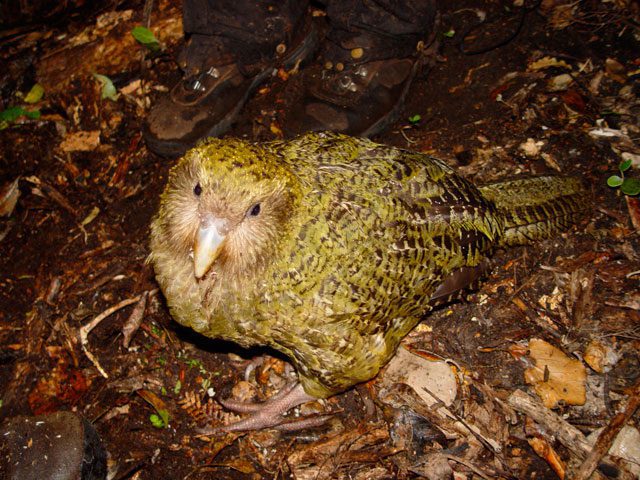
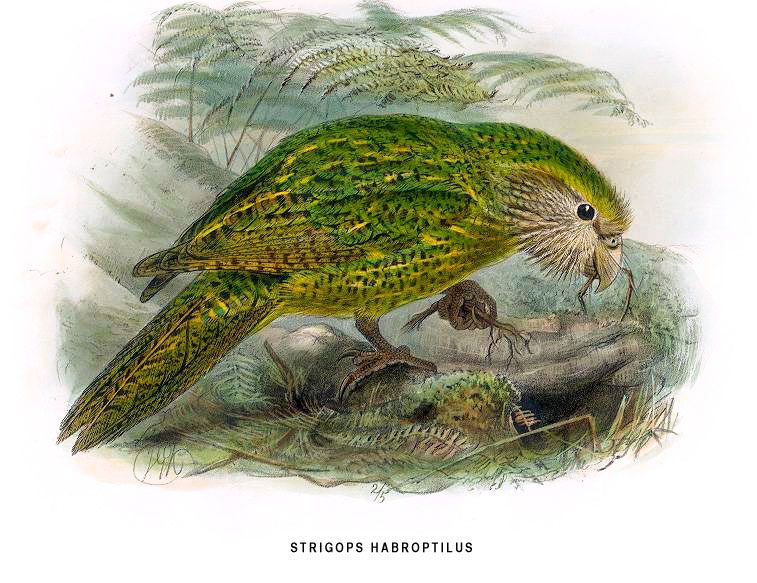
Illustration Kakapo

Description

Males can reach up to 60 cm. and weigh between 3 and 4 kg.

The Kakapo (Strigops habroptila) It is a robust and stocky bird with wings short in relation to the rest of the body.

grown ups, on upperpartsr, are MOSS Green, pulling a beige. All his upperparts they are spotted black and brownish gray, What gives them an excellent camouflage in its environment. The chest and flanks are yellowish green with streaks of yellow. The abdomen, under the tail, the neck and face are yellow, mostly streaked with pale green and imperceptible gray-brown spots.

Their feathers they are surprisingly soft, since they do not need the strength and the necessary stiffness for flying birds.

The Kakapo shows a composite facial disc of feathers fine, giving it the appearance of an owl.

Its bill it is surrounded by fine whiskers that are very useful for testing the ground when moving through the undergrowth.

The mandible it is mostly ivory color, but with a bit of blue-gray in the upper jaw.

Their eyes are dark brown. Their long and scaly legs they have long claws which serve to climb.

The end of the feathers of the tail It tends to end up worn down by the continuous friction with the ground.

The females they are very different from your partner. Its head is narrow and has a crown less rounded. Their peaks they are narrow and elongated. Less muscular legs, a grayish pink. Its tail is more elongated. Though their plumage is hardly different from males, appears less mottled beige.

The nesting females they are also distinguished by the cushion of bare skin that develops on the abdomen during the incubation period.

Habitat:

Before the humans arrived to New Zealand, the Kakapo lived in a wide variety of habitats, pastures with clumps of grass, scrub and coastal regions.

They were also the primary forests, including those who were dominated by lush podocarp and false have the gender Nothofagus. In the region of Fiordland, to the southwest of South Island, the Kakapo they frequented areas of avalanches and landslides, small regenerated trees or vegetation with abundant fruit.

These regions contained among other plants, Japanese raspberry wine (Rubus phoenicolasius), Shrubby Veronica (genus Scrophulariaceae) and Coprosmas. It was known as "kakapo gardensยป

Given its inability to fly, the Kakapo It, mainly, a terrestrial bird. This is also a excellent climber able to reach the tops of the tallest trees. They leave the foliage practicing a "parachute" descent, spreading their wings in all their amplitude.

When the Kakapo is threatened, simply is still trying to pass unnoticed in the vegetation, with which is camouflaged. This was a great strategy to avoid his great enemy, the gigantic Haast's Eagle, but does not protect against introduced mammals.

Son nocturnal birds. They sit during the day and roam their territory during the night period.. Having lost the ability to fly, the Kakapo they have developed remarkable skills for their long haul. His powerful legs allow them to make long distances at night to feed or during the time of nesting that it takes place from October to January.

During courtship, the males they abandon their traditional territories and walk many kilometers to reach the top of the hills or a crest to establish their mating area, competing in the place to try to conquer the location that appears most advantageous to them. Conflicts often lead to serious injury and are sometimes fatal for the belligerents.

To appeal to the females, the males they emit a kind of explosions that produce dilating a bag in the area of the chest. After a series of 20 explosions, is right and take a break. Then lower the head again to issue a new series of explosions. Inside its cavity, move to make sounds in all directions. on clear days, These explosions can be heard more than one kilometre away. The males get involved in this type of sample for nearly eight hours at night. Each male produces thousands of explosions during 3 or 4 months. During this time, males sometimes lost half of their body mass.

Reproduction:

During the time of reproduction, the Kakapo They use a system ofLekยซ. He "Lekยป is the space dedicated to the parade within which males gather in loose groups in an attempt to attract and seduce females. Females are very attentive spectator and choose your partner according to the quality of your display. Females are not persecuted openly by males.

It is not set no marital bond. He "Lekยป is just a meeting place that serves only for mating. The space for processions They consist of one or more small depressions of 10 cm of depth and 50 cm in diameter dug into the soil. The holes are usually do about faces of rocks, banks, or tree trunks, to help the sound bounce. The holes of each male are connected. The various depressions are interconnected by a network of small roads that cleaned thoroughly of all plant debris.

As soon as the male's cry is heard, the female embarks on a long journey to reach the area Lek. As soon as it enters the lek mating area, the male begins its rituals. It sways from side to side emitting clicks with the peak. He turns his back on his future partner, It spreads its wings and walk back towards her. Once mating has occurred, The female returns to her area of โ€‹โ€‹origin to lay her eggs and raise her young.. The male stays in place of courtship for try to seduce a new female.

The Kakapo they usually put 3 eggs per season. The nest placed on the ground under vegetation cover or in a hollow of a tree. The female incubated during 30 days, but you must leave the nest at night to feed, leaving the door open to many predators. After the eggs have hatched, She It feeds the chicks for three months, these will still remain in the company of their mother for a few more months. Since they have a life relatively long, the Kakapo have a fairly prolonged adolescence. Males do not begin courting until the age of 5 years and females do not respond to the calls of the males until they have reached the age of 9 or 11 years.

Food:

The peak of the Kakapo It is especially suitable for grinding food finely. For this reason, they have a gizzard less developed than most birds of its size.

The Kakapo they have a menu that is mostly herbivore. They used native plants, seeds, fruit, pollen and even the SAP flowing from the trees.

In a study of 1984, 25 different types of plants have been identified as part of your diet. Is particularly fond of the fruit of the rimu tree, and they feed on it exclusively during seasons when it is abundant. The Kakapo He has a habit of distinctive grab a leaf or frond with a foot and stripping the nutritious parts of the plant with its beak, leaving a non-digestible fiber ball. These small groups of vegetable fibers are a distinctive sign of the presence of the bird.

Distribution:

In the past, the Kakapo they were in the Islands North Island and South Island of New Zealand.

The species has suffered a sharp decline since the European colonization, and now it is one of the rarest birds in the world.

map-kakapo

Despite the fact that it disappeared from most of its original range following human colonization, the species remained abundant in Fiordland and some other places of great rainfall was scarce in the inhabited areas of South Island until the beginning of the 20th century. In 1976, However, the known population had been reduced to 18 birds, all males, all in Fiordland.

In 1977, found to be a rapid decline in the population of birds, about 150, on Stewart Island. Among 1980 and 1992, the 61 other birds of the Stewart Island they were transferred to the islands of the coast, and are currently in Codfish and Anchor island. The last accepted records were in North Island in 1927, three males reported in South Island, in Fiordland in 1987, and the last record in the Stewart Island of a female found and transferred to the Codfish Island in 1997.

In 2009, a male of the transferred four of Stewart Island to Isla Codfish in 1987, It was rediscovered after having been missing for 21 years.

It is likely that it is extinct in its natural distribution area, but, from November of 2005, birds are still present on four islands: Isla Codfish, Chalky, Anchor and Maud island.

In 1999, 26 females and 36 males survived, which includes 50 individuals in reproductive age, six subadults and six juveniles.

The population was stabilized, and has started to increase slowly following the application of intensive management. In the 2005, the population of the Kakapo stood in 86 specimens, of which 52 they were of reproductive age (21 females and 31 males) and 34 they were underage; a productive breeding year in the 2009 He saw the increase of the population up to 124 specimens, and it was known of the existence of 126 birds at the beginning of 2012, including 78 adult players.

Conservation:


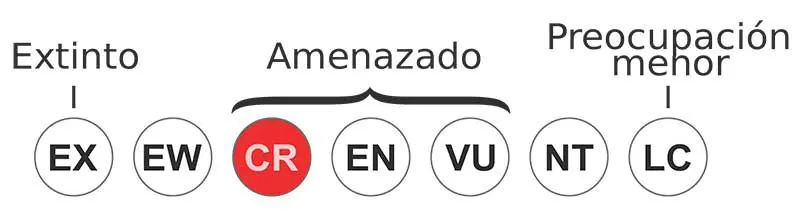
critical hazard

โ€ข Current Red List of UICN: critically endangered

โ€ข Population trend: Increasing

In the Stewart Island, more than the 50% of adults monitored died, each year, attacked by cats (CLOUT and Merton 1998).

An abnormal low fertility and low natural rates of reproduction and mating are the main concerns.

In 2004, three young people died of septicaemia caused by bacteria Erysipelothrix rhusiopathiae (erysipelas), a disease that had not been previously reported in this species (P. Jansen in litt. 2004)

They are subject to a plan of support by the authorities of New Zealand. Their number is currently estimated at little more than one hundred of copies, increases slowly with the plan.

At the beginning of 2012 there was 126 specimens, among them 78 adult players (RJ Moorhouse in litt. 2012).

"Kakapo" in captivity:

The only birds in captivity are those bred in the Recovery program of the Kakapo.

In terms of their longevity, debido a su largo ciclo de vida y la ausencia de depredadores naturales, es posible que el Kakapo viva mรกs de 60 years.

Alternative names:

Kakapo, Owl Parrot (English).
Strigops kakapo, Kakapo, Perroquet hibou (French).
Kakapo, Eulenpapagei (German).
Kakapo (Portuguese).
Kakapo (espaรฑol).

scientific classification:

Order: Psittaciformes
Family: Strigopidae
Genus: Habroptilus
Scientific name: Strigops habroptila
Citation: Gray, GR, 1845
Protonimo: Strigops habroptilus

Images "Kakapo":

Videos "Kakapo"

————————————————————————————————

"Kakapo" (Strigops habroptila)


Sources:

Avibase
– Parrots of the World โ€“ Forshaw Joseph M
– Parrots A Guide to the Parrots of the World – Tony Juniper & Mike Parr
– Birdlife
Wikipedia

Photos:

(1) – Pura, a 1-year-old Kakapo (Strigops habroptila) on Codfish Island By Mnolf [GFDL, CC-BY-SA-3.0 or CC BY-SA 2.0], via Wikimedia Commons
(2) – Kakapo Pura on Codfish Island By Mnolf [GFDL, CC-BY-SA-3.0 or CC BY-SA 2.0], via Wikimedia Commons
(3) – Kea, on the road to Milford Sound Uploaded by The Rambling Man – Wikipedia
(4) – Kakapo Sirocco amongst the renga renga lillies. Maud Island. Photo: Chris Birmingham, 2012 – Flickr
(5) – Kakapo by jidanchaomian – Flickr
(6) – Birds of New Zealand 1st edition, by Walter Lawry Buller, published in 1873 By John G. Keulemans. Minor edits have been made to the original by User:Msikma; I release these changes into the public domain as well. [Public domain], via Wikimedia Commons

โ–ท The world of Pets: Dogs, cats, birds, reptiles, amphibians

Olive-throated Parakeet
Eupsittula nana

Olive-throated Parakeet

Content

Description:


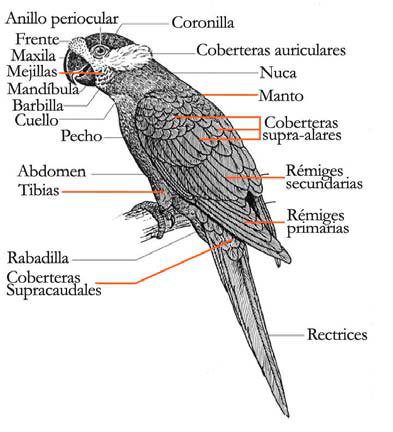
Anatomy-parrots

20 to 26 cm. in length and 72โ€“85 grams in weight. It is one of the smallest Aratingas.

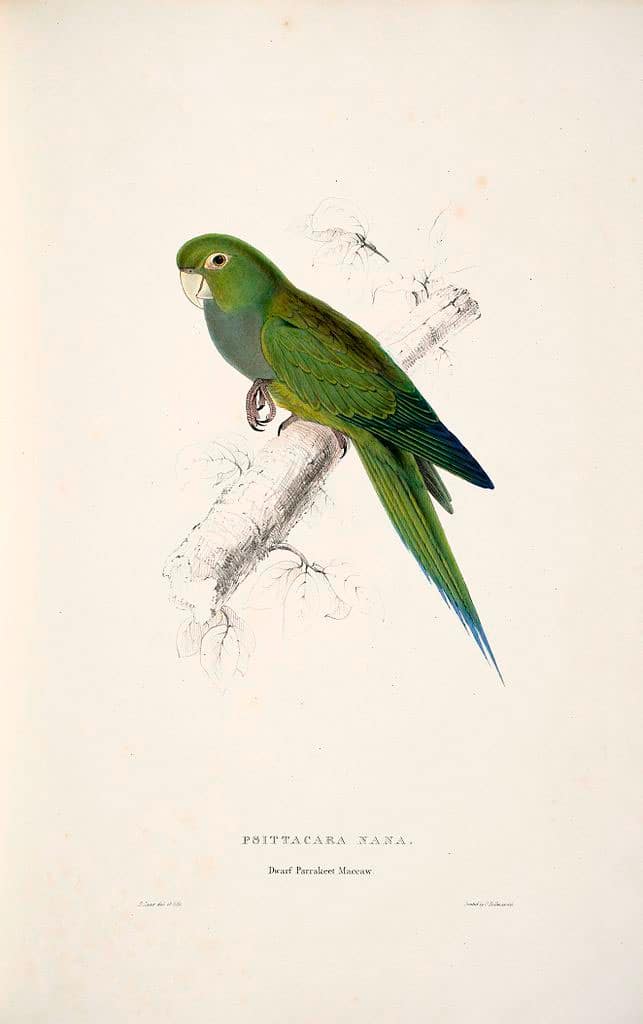
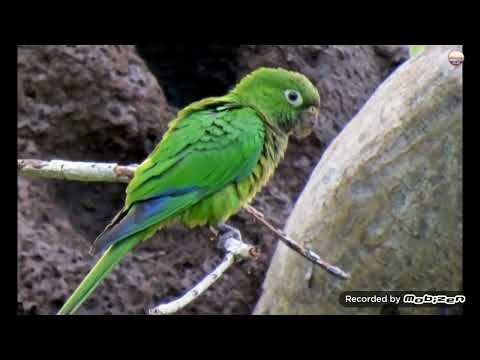
The Olive-throated Parakeet (Eupsittula nana) has the head and upperparts dark green; feathered area of cere yellow to orange-red.

Upperwing-coverts dark green, outer more emerald. The Outer secondaries and inner primaries deep dark blue tipped black above; the outer primary blue only towards tips. The greater underwing-coverts and underside of the flight feather dull slate or brownish-grey; the remaining coberteras are light green. Chin, throat and sides neck chocolate-brown they are merging with brownish olive on top of chest which turns yellow at the bottom and the belly; undertail-coverts light green. Uppertail dark green with blue diffusion, especially towards the tip; undertail metallized yellow-olive. Bill brown with the tip paler; irises yellow to orange; legs blackish-gray.

Olive-throated Parakeet

All plumages are similar but immature has irises brown.

  • Sound of the Olive-throated Parakeet.

Subspecies description:

three subspecies Panamanian and Honduran birds previously bore the respective names outmost and melloni, but light regional variations in Central America (p. e.g.. birds in southern paler and those of Tabasco, Mexico and Honduras They are darker) not justify more separations as described below.

  • Eupsittula nana astec

    (Souance, 1857) – Similar to the nominal but the throat and (especially the underparts) more pale brown, the bill perhaps smaller average.

  • Eupsittula nana nana

    (Vigors, 1830) – Nominal.


  • Eupsittula nana vicinalis

    (Bangs & Penard,TO, 1919) – Slightly larger than the subspecies Eupsittula nana astec, up brighter and greener down

NOTE The continental population is sometimes treated as a full species under the name A. astec, although the differences with Jamaican birds are minimal.

Habitat:

Video – "Olive-throated Parakeet" (Eupsittula nana)

Information on the Eupsittula nana

They live mainly in forests and forest edges (especially adjacent lowland) in wet areas (to 1.100 m in Honduras, to 700 m in Costa Rica and a 300 m in southern Mexico), It is less frequent in large tracts of rainforest; reported in arid areas (Veracruz) and pine forests (Honduras), open country with scattered trees (including acreages) and plantations. More common in Jamaica in mid-level humid limestone forests. Usually it remains below the canopy. larger groups can be formed (c. 30) after breeding or when food is abundant. mixed flocks with Crimson-fronted Parakeet reported in Costa Rica.

Reproduction:

Arboreal termitarium prefer to lay their nests, where birds excavate the cavity; also used treeholes. Often nests at the edge of a river or forest. Breeding season March, Jamaica; April May, Belize and Guatemala. The implementation is of 3-4 eggs that hatch in 26-27 days. After hatching, it takes about 50 days until chicks are ready for independence.

Note: In most birds, male/female bonds occur only during the breeding season and function solely in coordinating parental care. La monogamy perenne, or linking partner throughout the year, It occurs in at least a dozen families of birds, including cockatoos and other parrots.

Food:

Registered foods include higos ficus, Psidium, Inga, Hura, fruit of Hieronyma and guilt of tamarindo unripened. attacking crops, especially corn, and it is considered highly destructive in some areas.

Distribution:

Extending its range (breeding/resident): 1,373,500 km2

distributed by the Gulf and the Caribbean slope of Central America and Jamaica; a population in Hispaniola (Sierra de Bahoruco, Dominican Republic) It comes from a recent introduction from Jamaica. In Mexico, the Olive-throated Parakeet It extends from eastern San Luis Potosi and South of Tamaulipas, through South Veracruz until Oaxaca, North of Chiapas and Yucatan; then through the humid north of Guatemala and the Caribbean slope of Honduras, Nicaragua and Costa Rica to western Panama. It is located along Jamaica except in the high mountains and the humid mountain range of John Crow in the East.

Resident and locally common to abundant (commonly the most abundant parrot in some localities) although it is likely to be decreased in some areas (p. and. Jamaica and Costa Rica) due to the loss of habitat. Less common in southern Costa Rica and uncommon in Panama, where possibly a seasonal visitor Southern Lemon.

Caught for live bird market, but rare in international trade.

Subspecies description:

  • Eupsittula nana astec

    (Souance, 1857) – Veracruz, Mexico, to Panama


  • Eupsittula nana nana

    (Vigors, 1830) – Nominal. Jamaica, apparently in most areas except the high mountains and the humid Cordillera de John Crow


  • Eupsittula nana vicinalis

    (Bangs & Penard,TO, 1919) – East of Mexico south of Veracruz, zone of contact with the last unknown species

Conservation:

โ€ข Current category of the Red List of the UICN: Least concern.

โ€ข Population trend: Decreasing.

โ€ข Population size : 500,000-4,999,999 individuals.

Rationale for the Red List category

Although the demographic trend appears to be declining, the decline is not believed to be rapid enough to approach the Vulnerable thresholds based on demographic trend criteria (> 30% decrease in ten years or three generations). The population size is very large, and therefore does not approach the thresholds for Vulnerable under the criterion of population size (<10.000 individuos maduros con un descenso continuo estimado en >10% in ten years or three generations, or with a specific population structure). For these reasons, the species is evaluated as Least concern.

The subspecies Eupsittula nana nana It is endemic to Jamaica, where still widespread but probably has a moderately small population (approximately 10.000 mature individuals), all in one subpopulation, inferring that is in continuous decline due to a variety of threats including loss and degradation of the habitat, pursuit and capture for trade. So, It has been classified as Near-threatened.

Justification of the population

Partners in Flight They estimate that the total population is 500,000-4,999,999 individuals (A. Panjabi a slightly. 2008).

Justification trend

They suspected that the population is declining due to continuing habitat destruction and unsustainable levels of exploitation.

"Olive-throated Parakeet" in captivity:

Uncommon in international trade. Their life expectancy is over 15 years.

It is included in the appendix ll of the Convention on International Trade in Endangered Species of Wild Fauna and Flora Silvestre (CITES).

The Olive-throated Parakeet It is important to attract tourists with hotel advantages in the Caribbean and tropical areas that offer free bird tour with reservations. It is one of the reasons why this beautiful bird should remain free..

Alternative names:

Dwarf Conure, Dwarf Parakeet, Jamaican Conure, Jamaican Parakeet, Olive-throated Parakeet, Olive-throated Parakeet (Jamaican) (English).
Conure aztรจque , Conure naine, Conure naine (nominal), Conure naine (nominale), Conure naine (race nominale) (French).
Aztekensittich, Jamaikasittich (German).
Periquito-da-jamaica (Portuguese).
Aratinga jamaicana, Aratinga Pechisucia, Perico Amargo, Perico azteco, Perico Pechiolivo, Perico Pechisucio, perico pecho sucio, perico pecho-sucio, Periquito pechisucio (espaรฑol).
Perico azteco (Costa Rica).
Perico Amargo (Dominican Rep.).
Periquito pechisucio (Honduras).
Perico Pechisucio, perico pecho sucio, perico pecho-sucio (Mexico).
Perico Pechiolivo (Nicaragua).

scientific classification:

Order: Psittaciformes
Family: Psittacidae
Genus: Eupsittula
Scientific name: Eupsittula nana
Citation: (Vigors, 1830)
Protonimo: Psittacara nana

Images Olive-throated Parakeet:


Especies del gรฉnero Eupsittula
  • Eupsittula nana
  • —- Eupsittula nana astec
  • —- Eupsittula nana nana
  • —- Eupsittula nana vicinalis
  • Eupsittula canicularis
  • —- Eupsittula canicularis canicularis
  • —- Eupsittula canicularis clarae
  • —- Eupsittula canicularis eburnirostrum
  • Eupsittula aurea
  • Eupsittula pertinax
  • —- Eupsittula pertinax aeruginosa
  • —- Eupsittula pertinax arubensis
  • —- Eupsittula pertinax chrysogenys
  • —- Eupsittula pertinax chrysophrys
  • —- Eupsittula pertinax griseipecta
  • —- Eupsittula pertinax lehmanni
  • —- Eupsittula pertinax margaritensis
  • —- Eupsittula pertinax ocularis
  • —- Eupsittula pertinax paraensis
  • —- Eupsittula pertinax pertinax
  • —- Eupsittula pertinax surinama
  • —- Eupsittula pertinax tortugensis
  • —- Eupsittula pertinax venezuelae
  • —- Eupsittula pertinax xanthogenia
  • Eupsittula cactorum
  • —- Eupsittula cactorum cactorum
  • —- Eupsittula cactorum caixana

  • Sources:

    Avibase
    – Parrots of the World โ€“ Forshaw Joseph M
    – Parrots A Guide to the Parrots of the World – Tony Juniper & Mike Parr
    Birdlife

    Photos:

    (1) – Jamaican Parakeet (aka Olive-throated Parakeet or Aztec Parakeet) in captivity in Costa Rica By http://www.birdphotos.com (Own work) [CC BY 3.0], via Wikimedia Commons
    (2) – Aratinga nana astec in Belize By Dominic Sherony [CC BY-SA 2.0], via Wikimedia Commons
    (3) – Aratinga (nana) astec in Tikal, Guatemala By Aztec_Parakeet_(Aratinga_astec)_-Guatemala-8.jpg: Walter Rodriguez from Berlin, Germanyderivative work: Snowmanradio [CC BY 2.0], via Wikimedia Commons
    (4) – Aratinga (nana) astec in Tikal, Guatemala By Walter Rodriguez from Berlin, Germany (parakeetUploaded by Snowmanradio) [CC BY 2.0], via Wikimedia Commons
    (5) – Eupsittula nana. Celestรบn Biosphere Reserve, Yucatan, Mรฉxico By Katja Schulz from Washington, D. C., USA (Olive-throated Parakeet) [CC BY 2.0], via Wikimedia Commons
    (6) – A painting of an Olive-throated Parakeet, also known as the Olive-throated Conure, (originally captioned ยซPsittacara nana. Dwarf Parakeet Maccaw.ยป) by Edward Lear 1812-1888 [Public domain], via Wikimedia Commons

    Sounds: Guy Kirwan, XC284214. accessible www.xeno-canto.org/284214
    [contact-form][contact-field label=ยปNombreยป type=ยปnameยป required=ยปtrueยป /][contact-field label=ยปEmailยป type=ยปemailยป required=ยปtrueยป /][contact-field label=ยปWebยป type=ยปurlยป /][contact-field label=ยปMensajeยป type=ยปtextareaยป /][/contact-form]

    โ–ท The world of Pets: Dogs, cats, birds, reptiles, amphibians

    Cobalt-winged Parakeet
    Brotogeris cyanoptera


    Periquito Aliazul

    Content

    Description:

    The Cobalt-winged Parakeet (Brotogeris cyanoptera) measured 15-21 cm.. in height and weighs around 67 g. Distinguishable on the fly by the cobalt blue of the the flight feathers; forecrown yellow and crown with blue dye; chin orange.

    Has the tail short and acute. Its bill opaque beige es

    Subspecies description:

    • Brotogeris cyanoptera beniensis

      (Gyldenstolpe, 1941) – It has lighter green in all the body and yellow plumage edges in the wing .


    • Brotogeris cyanoptera cyanoptera

      (Pelzeln, 1870) – The nominal


    • Brotogeris cyanoptera gustavi

      (Berlepsch, 1889) – Has the forecrown light green, shoulder yellow and only a patch blue in half of the wing .

    Habitat:

    Very common. It is found in secondary forest, riparian, edges and savanna, until the 600 m (occasional over of 1000 m). Fly in small flocks of 10 to 20 individuals (rare in couples), feed in the canopy.

    Reproduction:

    It nests in hollow and termite mounds on tree.

    Food:

    Its diet probably the same as for most species Brotogeris: fruit nectar, figs, berries and seeds.

    Distribution:

    Periquito Aliazul

    Its population is distributed between the East of Colombia, Southwest of Venezuela to the North of Bolivia and Brazilian Amazon.

    Subspecies distribution:

    • Brotogeris cyanoptera beniensis

      (Gyldenstolpe, 1941) – Bolivia.


    • Brotogeris cyanoptera cyanoptera

      (Pelzeln, 1870) – The nominal


    • Brotogeris cyanoptera gustavi

      (Berlepsch, 1889) – Peru.

    Conservation:


    minor concern


    • Its population has been estimated at more of one million copies
    • .

    • Not considered in any of the threat categories.

    "Cobalt-winged Parakeet" in captivity:

    Rare in captivity, due to the limited success in reproduction.

    Alternative names:

    Cobalt-winged Parakeet, Blue-winged Parakeet, Cobalt winged Parakeet (English).
    Toui de Deville, Perruche ร  ailes de cobalt (French).
    Kobaltflรผgelsittich (German).
    Periquito-de-asa-azul, Periquito-de-asa-azul, tuipara-de-asa-azul (Portuguese).
    Catita Aliazul, Periquito Aliazul, Periquito de Alas Azules (espaรฑol).

    scientific classification:

    Order: Psittaciformes
    Family: Psittacidae
    Genus: Brotogeris
    Scientific name: Brotogeris cyanoptera
    Citation: (of Pelzeln, 1870)
    Protonimo: Sittace cyanoptera

    Images "Cobalt-winged Parakeet"

    Videos "Cobalt-winged Parakeet"

    ————————————————————————————————

    Cobalt-winged Parakeet (Brotogeris cyanoptera)


    Sources:

    Avibase
    – Parrots of the World โ€“ Forshaw Joseph M
    – Parrots A Guide to the Parrots of the World – Tony Juniper & Mike Parr
    – Birdlife

    โ–ท The world of Pets: Dogs, cats, birds, reptiles, amphibians

    Cape Parrot
    Poicephalus robustus


    Lorito Robusto

    Content

    Description:

    32 cm. medium length and a weight between 300 and 400 g..

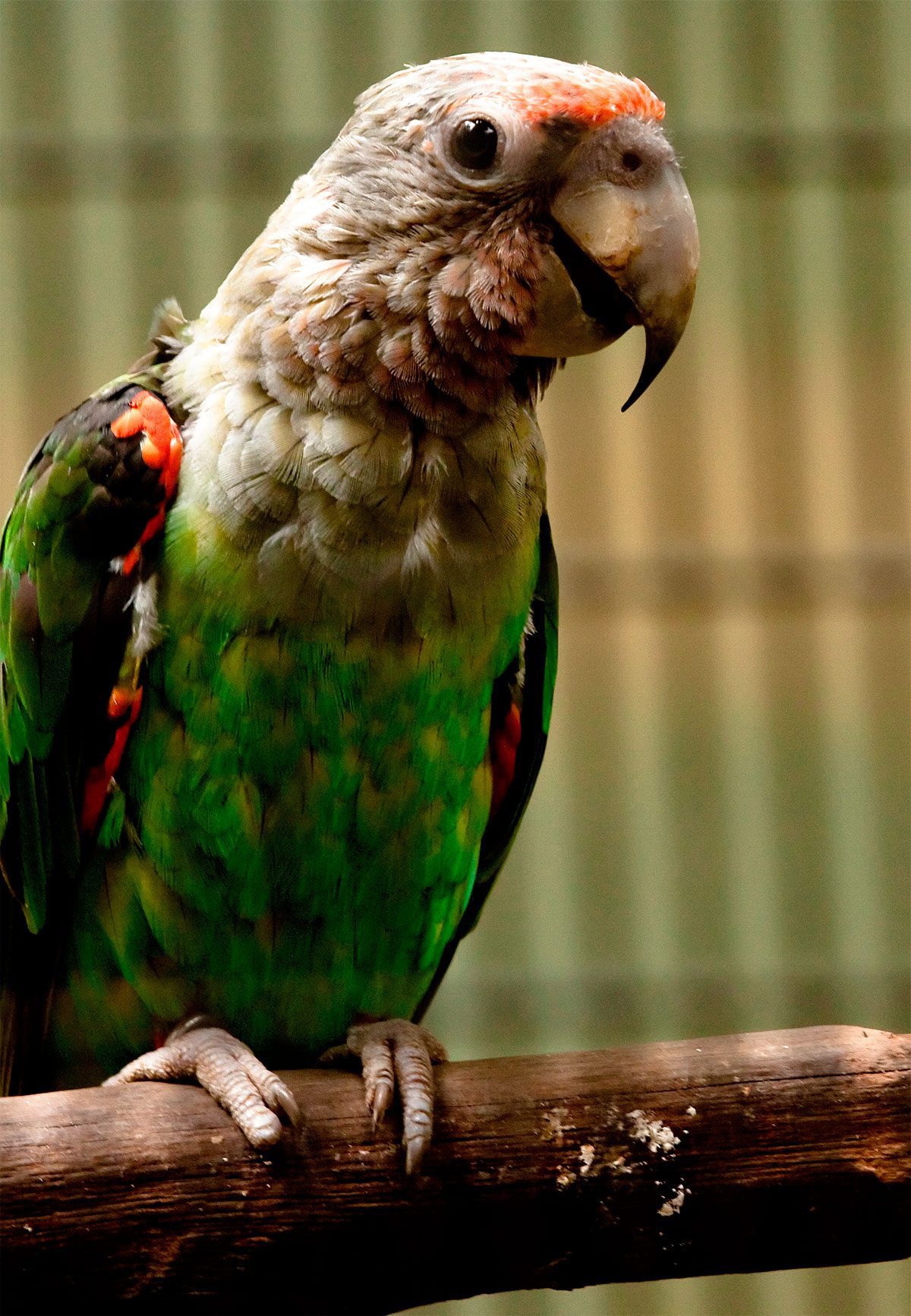
    The Cape Parrot (Poicephalus robustus) has the head, neck and throat between olive brown and olive yellow, with darker spots (almost black in some birds), especially in the crown; lores and cheeks blackish; pale red frontal band, is present, occasionally, in males (generally evident in females).

    The mantle feathers and scapulars dark green opaque, bright green-edged; rump bright green.

    Coverts on the leading edges of the wings, Since the carpal joints at the base of the primaries, bright orange red; upper wing coverts, dark green to black, with lighter green edges; below, the feathers of the wings blackish and green. The primaries and secondaries black top, dark brown below. High area of the chest, stomach and vent, bright green; the thighs orange red glossy. Upper, the tail black; undertail, dark brown.

    Some birds (around the 10%) have feathers yellow in the plumage spread.

    Bill color horn; irises dark brown to reddish brown; legs bluish grey.

    The females, generally (Although not always), they have well defined orange red frontal band.

    The youth lack of color marks orange red envelope the wing-coverts and the thighs, but tend to show a bit of red in the forecrown.

    Subspecies description:

    Taxonomic status:

    In a study initiated in 1992, the taxonomic status of Lorito was revised Robusto (Poicephalus robustus) (Gmelin), and two species were proposed; Poicephalus robustus, restricted to montane forests of southern Africa, Poicephalus fuscicollis suahelicus, with wider distribution in wooded areas, and Poicephalus fuscicollis fuscicollis, similar to the Poicephalus fuscicollis suahelicus ostensibly, but with discontinuous, restricted to a narrow range of forests and West Africa.

    Subspecies Poicephalus robustus

    • Poicephalus robustus robustus

      (Gmelin, 1788) – The nominal species


    • Poicephalus robustus suahelicus

      (Reichenow, 1898) – Of larger size the species nominal, the male has the head and the neck a silvery gray and lacks the reddish frontal band. The female has orange colouring in the the thighs and in the shoulders and in the cere, while the male not. Blue tint in the rump.


    • Poicephalus robustus fuscicollis

      (Kuhl, 1820) – The smaller subspecies. With more blue tones, especially in rump and bottom of the back.

    Habitat:

    They live in a variety of forest types, including Red Mangroves (Rhizophora mangle) (for example, in Gambia), riparian forests (for example in Ghana, Zimbabwe), Savanna Woods (for example, Nigeria, Ivory Coast), in montane forests at altitudes of 3,750m (for example, east of Zaire), in lowland forests (for example, South Zaire).

    The birds of the Southern Africa they have favoritism by the Acacia mearnsii and Podocarpus forests at altitudes between 1.000 and 1,700 m, separating attitudinally and ecologically in the subspecies suahelicus, It occurs in lowland forests.

    The birds of the Southern Africa (also perhaps other species) they form communal roosts before spreading to power remote areas (until 90 km) in small flocks.

    Sometimes seen separately but more usually found in groups of up to 20 birds (sometimes 50). It forms mixed flocks with peers.

    Reproduction:

    The nest in hollow trees (including in Brachystegia, Adansonia or Podocarpus) between 6 and 12 meters above the ground.

    The season of breeding varies with locality. In Gambia, reportedly, breeding takes place between the months of February and April, While in Zimbabwe It is estimated to be between the months of March to June, and between October and November. In South Africa, breeding takes place in June and between August and October.

    The laying tends to be of 3 to 4 eggs.

    During the courtship the male feeds the female making exaggerated turns his head and dropping their wings to form a kind of layer around the lower half of your body. The pair shows a strong union ties and they spend much time grooming each other.

    Food:

    In Zimbabwe, In addition to daily trips in search of food, seasonal movements are performed in search of Uapaca and fruits of Sysygium.

    They feed on fruits of ficus, Olea capensis, Mimusops caffra, Acacia molissima, Melia azecdarach, Terminalia, Calodendron capense and Commiphora, the consumption of seeds has also been recorded from the acacia mearnsii, Monotes glaber and the fruits of the Parinari curatellifolia. But, they may prefer the pulp of fruit, discarding the seeds and grains of the seeds.

    Has been feeding of millet in Zimbabwe and Malawi, of peanuts harvested in Gambia and, occasionally, visiting gardens of Apple trees, but numerous enough to be considered a plague serious nowhere.

    The birds of the Southern Africa feed almost exclusively on fruit of the Podocarpus, long as they are available.

    Use the peak to climb between the branches when they feed in the trees; They also feed on the ground. The Cape Parrot make daily trips to secret locations for drinking water.

    Distribution:

    Probably occupy three zones separated, in the West, South-Central and South of Africa.

    In West Africa, are from Gambia and South of Senegal to the East of Ghana and Togo.

    In the Center-South of Africa, from the southwest of Congo, South and East of Zaire, Southwest of Uganda, Rwanda and from the center of Tanzania to the North of Namibia, North of Botswana, Zambia and Zimbabwe.

    In South Africa from the North-East of Transvaal to the Province Eastern Cape.

    Flocks of foraging roam unpredictably and can remain away from traditional sites for weeks. Sometimes they make seasonal movements in relation to the availability of food, for example, in the northern savannas of Ghana.

    Local and mostly uncommon across the range, Although more numerous and frequent in Ghana.

    Subspecies distribution:

    • Poicephalus robustus robustus

      (Gmelin, 1788) – The nominal species


    • Poicephalus robustus suahelicus

      (Reichenow, 1898) – Are distributed by the center of Angola; Southeast of the Democratic Republic of the Congo, Rwanda and South of Tanzania until Zimbabwe, North of Mozambique, and far northeast of South Africa; in populations along the lower Congo River the three subspecies can mix.


    • Poicephalus robustus fuscicollis

      (Kuhl, 1820) – Are distributed from the South of the Senegal and Gambia to the North of Ghana

    Conservation:


    minor concern


    โ€ข Current Red List of UICN: Least concern

    โ€ข Population trend: Decreasing

    In 1988 included for the first time in the red list of threatened species by the IUCN as least concern species.

    The size of its current population is estimated at less than 1.600 birds in their natural habitat.

    Why not join this parrot species in critical hazard is due to the subspecies of this they comprise an area of diffusion much greater than that of the nominal species, whereupon, This leads to a growth in the population of subspecies and the decrease of the nominal species. The subspecies occupy all the Central Africa and Western, while the Poicephalus robustus only lives in some provinces of South Africa as they are Eastern Cape, KwaZulu-Natal and Limpopo.

    Over time the Poicephalus robustus, they have drastically dropped its population due to the uncontrolled felling of the forests of Sandalwood to manufacture furniture. Thus reaching that there is only two percent of the forest of Sandalwood.

    Diffusion area of Poicephalus fuscicollis and Poicephalus robustus
    Diffusion area of Poicephalus fuscicollis and Poicephalus robustus

    In captive the Cape Parrot it is found in small quantities by several countries of Europe and without many successful breeding advances, so the first objective to preserve the nominal species is to control the logging of forests, Since the Cape Parrot they have to travel many miles to feed, as there is no food have to descend to feed from the crop fields where many die because they are hunted by the owners of the fields. Forests are also needed in the life of the Poicephalus robustus since they nest in cavities of the trees, they feed on.

    The legal and illegal trade It is another point to be highlighted in the conservation of this species. Since 1998 the countries with the most legal exports have been Tanzania, Guinea-Bissau, Guinea, Democratic Republic of the Congo and Ivory Coast. What makes think that the nominal species It has been the least affected in the terms of trade while the subspecies they have been the most affected and the most marketed. This can be known by looking at the area of diffusion of the subspecies and the countries with the most exports made..

    The diseases they are also a major threat, above all in the nominal species. The disease of PBFD or beak and feather disease (Psittacine Beak and Feather Disease virus) is that more deaths has caused to the Poicephalus robustus.

    "Cape Parrot" in captivity:

    It is very similar in nature to the Grey Parrot.
    Its capacity for imitation is still little known since, for years, has been very difficult to get in poultry farming.

    Not advisable to keep mixed aviaries. Son quiet and depending on their way of breeding (natural or by hand) and previous experiences, they can be quite confident and curious, even without being hand reared do not usually take to commit themselves. As pets they are very Welcome to, Smart and affectionate, with a very good character.

    Captive breeding of this species may be the last hope of saving it from total extinction.. The number of specimens in captivity is low, but enough, If handled properly to strengthen the species.

    In terms of their longevity, according to sources, a Cape Parrot lived 29,7 years in captivity. In captivity, These birds can be raised from the 5 years of age.

    Alternative names:

    Cape Parrot, Brown necked Parrot, Brown-necked Parrot, Cape or Brown-necked Parrot, Gray-headed Parrot, Grey-headed Parrot (English).
    Perroquet ร  cou brun, Perroquet du Cap, Perroquet du Cap ou P. ร  cou brun, Perroquet robuste (French).
    Graukopfpapage, Kap Papagei, Kappapagei (German).
    Papagaio-de-bico-grosso (Portuguese).
    Lorito Robusto, Loro de El Cabo, Lorito del Cabo (espaรฑol).


    scientific classification:

    Gmelin Johann Friedrich
    Gmelin Johann Friedrich

    Order: Psittaciformes
    Family: Psittacidae
    Genus: Poicephalus
    Scientific name: Poicephalus robustus
    Citation: (Gmelin, JF, 1788)
    Protonimo: Psittacus robustus

    Images "Lorito Robusto":

    ————————————————————————————————

    Cape Parrot (Poicephalus robustus)


    Sources:

    Avibase
    – Parrots of the World โ€“ Forshaw Joseph M
    – Parrots A Guide to the Parrots of the World – Tony Juniper & Mike Parr
    – Birdlife
    Wikipedia
    – Loromania
    Mundoexotics

    Photos:

    (1) – To Brown-necked Parrot at Jurong Bird Park, Singapore By Peter so [CC BY 2.0], via Wikimedia Commons
    (2) – Cape Parrot en Benvie, Karkloof, KwaZulu-Natal, South Africa By Alan Manson [CC BY-SA 2.0], via Wikimedia Commons
    (3) – Youth, captive, friendly Poicephalus robustus fuscicollis by Bob Corrigan – Flickr
    (4) – Male Cape parrot (Poicephalus robustus). Image credit: Cyril Laubscher – SCI-news.com
    (5) – Cape parrot flying low over to wild plum tree. Africa's most endangered parrot like never before... (Rodnick Biljon) – nationalgeographic
    (6) – Diffusion area of Poicephalus fuscicollis and Poicephalus robustus By Juan Caparrรณs (Own work) [GFDL or CC BY-SA 4.0-3.0-2.5-2.0-1.0], via Wikimedia Commons

    Sounds: Daniel Danckwert (Xeno-canto)
    โ–ท The world of Pets: Dogs, cats, birds, reptiles, amphibians

    Cactus Parakeet
    Eupsittula cactorum

    Cactus Parakeet

    Content

    Description:


    Anatomy-parrots

    25 cm.. length and 75-90 g. of weight.

    The Cactus Parakeet (Eupsittula cactorum) has the forecrown, lores lower cheeks and brown off; crown with slaty tinge; sides neck, the nape and upperparts up to the rump grass-green.

    The primary coverts They are bluish green in the outerweb, the remaining are green grass. Flight feathers (above) green on innerwebs, blue green on outerweb, blue black at the tips (below) gray. Underwing-coverts greenish yellow. Throat and upper breast dull brown; lower breast and belly fairly bright orange-yellow, the thighs and vent greenish-yellow color. Uppertail green, four distal blue central feathers; undertail gray.

    Cactus Parakeet

    upper jaw horn, greyish at base and lower jaw; perioftรกlmico patch naked white; irises brown-orange; gray-gray legs.

    Both sexes similar. Immature paler than adult, with crown green, more olive upper chest and throat, and the irises darker.

    • Sound of the Cactus Parakeet.

    Subspecies description:

    • Eupsittula cactorum cactorum

      (Kuhl, 1820) – Nominal.


    • Eupsittula cactorum caixana

      (Spix, 1824) – Generally paler than nominal, with belly yellow instead of orange.

    Habitat:

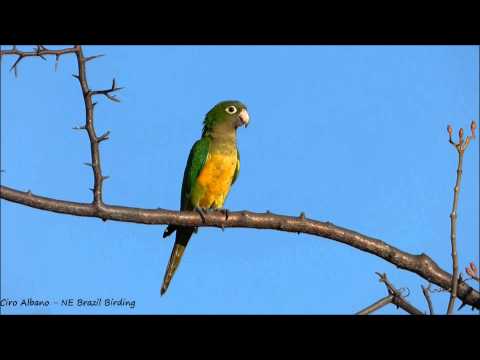
    Video – "Cactus Parakeet" (Eupsittula cactorum)

    Cactus Parakeet - Caatinga Parakeet - Eupsittula cactorum -

    Its distribution area closely matches the dried vegetation and prickly caatinga Northeast Brazil, but it encompasses higher drier semi-desert areas created by overgrazing and dry forests (caatinga arborea) and seasonal savannah lusher (closed). Usually in pairs or (mainly outside the breeding season) flocks of up to 20 birds, most abundant where food is abundant (as rice crops).

    Reproduction:

    Crianza undocumented released. Clutch six eggs in captivity.

    Food:

    The diet includes seeds, fruits (including cactus), berries, dried fruits, flowers and cocoons, taken both trees and shrubs and soil. Sometimes it attacks crops (for example rice, grapes and corn).

    Distribution and status:

    Population expansion (breeding/resident): 1.220.000 km2

    Distributed by the interior Northeast Brazil. The Cactus Parakeet extending from the drier parts of Bay and adjacent northeast Minas Gerais, Brazil north through Piauรญ and Southeast of maranhรฃo, up to Pernambuco and Paraรญba, passing by Rio Grande do Norte and Cearรก. Absent in coastal areas: a record of Bethlehem at the mouth of amazon in For It seems wrong or possibly refers to a leak.

    It is usually common (the most common parrot in some localities) with a stable population, although the decline is inevitable in some areas due to massive loss of habitat by agriculture and plantations of exotic trees. Continuing degradation and conversion caatinga by grazing and cultivation they represent a long-term threat. Present in the Serra da Capivara National Park. Any Local persecution due to predation crop. Atrapada to trade small numbers in captivity.

    Subspecies distribution:

    Conservation:

    State of conservation โ“˜


    minor concern Minor Concern โ“˜ (UICN)โ“˜

    โ€ข Current category of the Red List of the UICN: Least concern.

    โ€ข Population trend: Stable.

    โ€ข Population size : Unknown.

    Rationale for the Red List category

    The trend population seems to be stable and, therefore, the species does not approach the thresholds for Vulnerable under the criterion of population trend (> 30% decrease in ten years or three generations). The population size has not been quantified, but it is not believed to approach the thresholds for Vulnerable under the criterion of population size (<10.000 mature individuals with an estimated continuous decrease in> 10% in ten years or three generations, or with a specific population structure). For these reasons, the species is evaluated as Least concern.

    Justification of the population

    The size of the world's population has not been quantified, but this species is described as ยซquite commonยป (Stotz et to the. (1996).

    Justification trend

    It is suspected that the population is stable the absence of evidence of any reduction or substantial threat.

    Threats

    Local persecution because of the invasion of crops. This species is also trapped for pet bird trade.

    "Cactus Parakeet" in captivity:

    Young birds are removed from their nest before they can fly, and then sold, for example, at the fair in inner cities.
    These birds can become very tame, and it is not rare to see a Cactus Parakeet living "freely" in the owner's house, as a member of the family so to speak. It however is seeing a rare bird in captivity outside their range. It is not as common as other more familiar species of aratinga. It also, usually they reach very high prices.

    The illegal trade It has greatly reduced the population of these Aratingas in nature, and threatens the survival of the species in many areas. Habitat destruction appears to be a minor problem.

    For more information – Loro Parque

    Alternative names:

    Caatinga Conure, Caatinga Parakeet, Cactus Conure, Cactus Parakeet (English).
    Conure des cactus, Perriche des cactus, Perruche des cactus (French).
    Kaktussittich (German).
    Aratinga-vaqueira, giguilim, Jandaia-gangarra, merequรฉm, periquito-da-caatinga, periquito-gangarra (Portuguese).
    Aratinga Cactรกcea, Aratinga de los cactos, Periquito de los Cardones (espaรฑol).


    scientific classification:

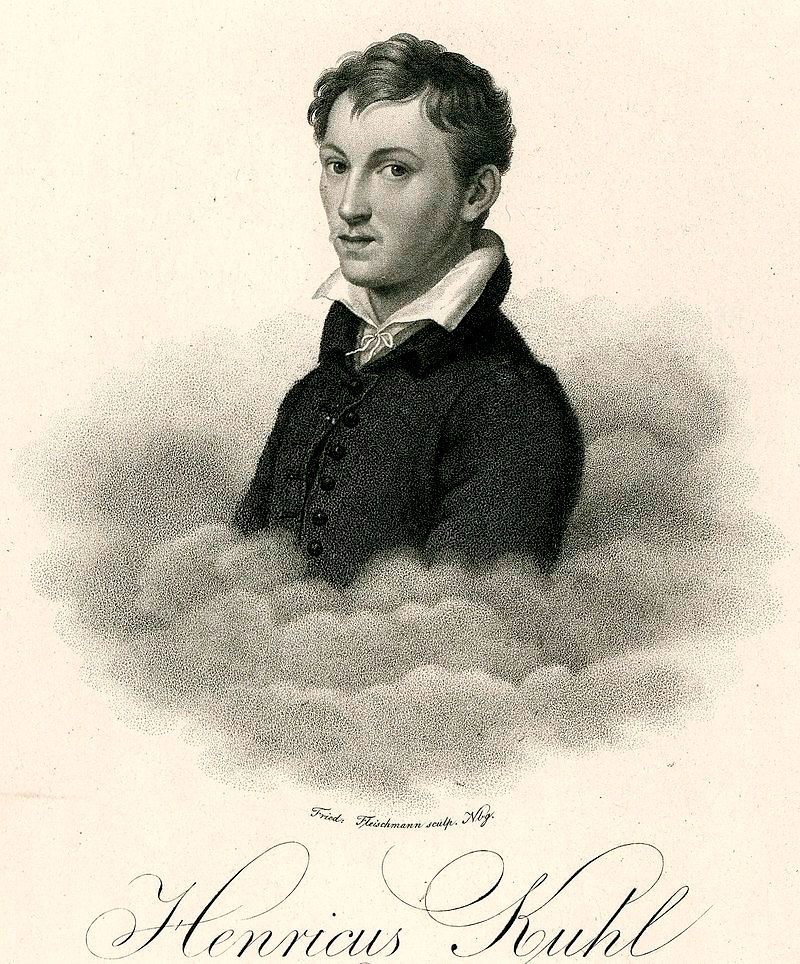
    Kuhl, Heinrich
    Heinrich Kuhl

    Order: Psittaciformes
    Family: Psittacidae
    Genus: Eupsittula
    Scientific name: Eupsittula cactorum
    Citation: (Kuhl, 1820)
    Protonimo: Psittacus cactorum


    Images Cactus Parakeet:


    Especies del gรฉnero Eupsittula
  • Eupsittula nana
  • —- Eupsittula nana astec
  • —- Eupsittula nana nana
  • —- Eupsittula nana vicinalis
  • Eupsittula canicularis
  • —- Eupsittula canicularis canicularis
  • —- Eupsittula canicularis clarae
  • —- Eupsittula canicularis eburnirostrum
  • Eupsittula aurea
  • Eupsittula pertinax
  • —- Eupsittula pertinax aeruginosa
  • —- Eupsittula pertinax arubensis
  • —- Eupsittula pertinax chrysogenys
  • —- Eupsittula pertinax chrysophrys
  • —- Eupsittula pertinax griseipecta
  • —- Eupsittula pertinax lehmanni
  • —- Eupsittula pertinax margaritensis
  • —- Eupsittula pertinax ocularis
  • —- Eupsittula pertinax paraensis
  • —- Eupsittula pertinax pertinax
  • —- Eupsittula pertinax surinama
  • —- Eupsittula pertinax tortugensis
  • —- Eupsittula pertinax venezuelae
  • —- Eupsittula pertinax xanthogenia
  • Eupsittula cactorum
  • —- Eupsittula cactorum cactorum
  • —- Eupsittula cactorum caixana

  • Sources:

    • Avibase
    • Parrots of the World โ€“ Forshaw Joseph M
    • Parrots A Guide to the Parrots of the World – Tony Juniper & Mike Parr
    • Birdlife

    • Photos:

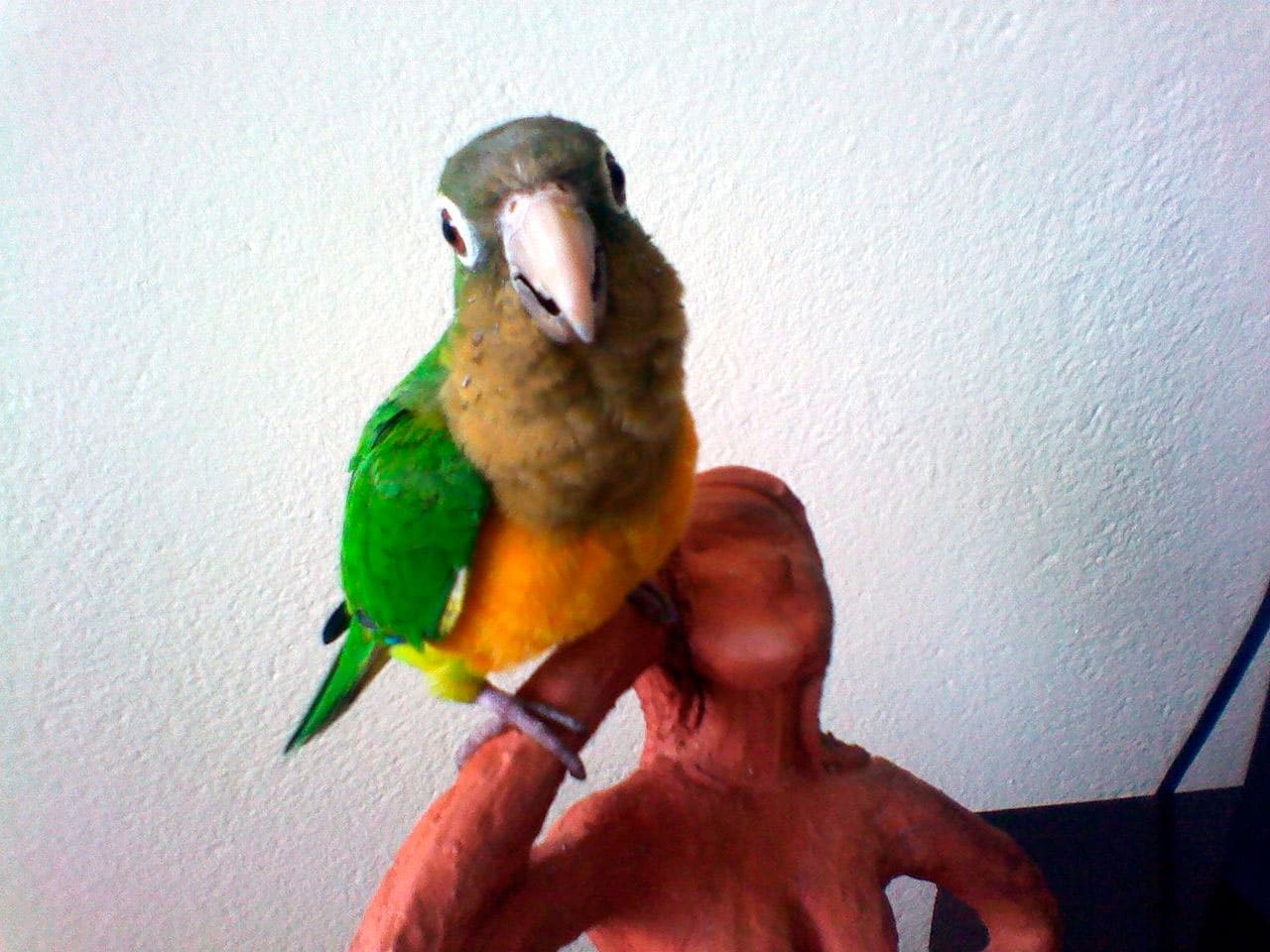
    (1) – A pet Caatinga Parakeet in Riachรฃo do Jacuรญpe, Baiano northeast, Brazil By Paulo Marcos from Painted-BA, Brazil (Periquito MartinsUploaded by snowmanradio) [CC BY 2.0], via Wikimedia Commons
    (2) – Caatinga Parakeet (also known as Cactus Parakeet) in Brazil By Phillipe (Picasa Web Albums) [CC BY-SA 3.0], via Wikimedia Commons
    (3) – Eupsittula cactorum – cactus conure – Cactus conure – conure cactus by Florin FeneruFlickr
    (4) – Parakeet CAATINGA (Eupsittula cactorum) by Cantosdanatureza WITH
    (5) – Cactus Parakeet โ€” aratinga cactacea by Animal Encyclopedia 2
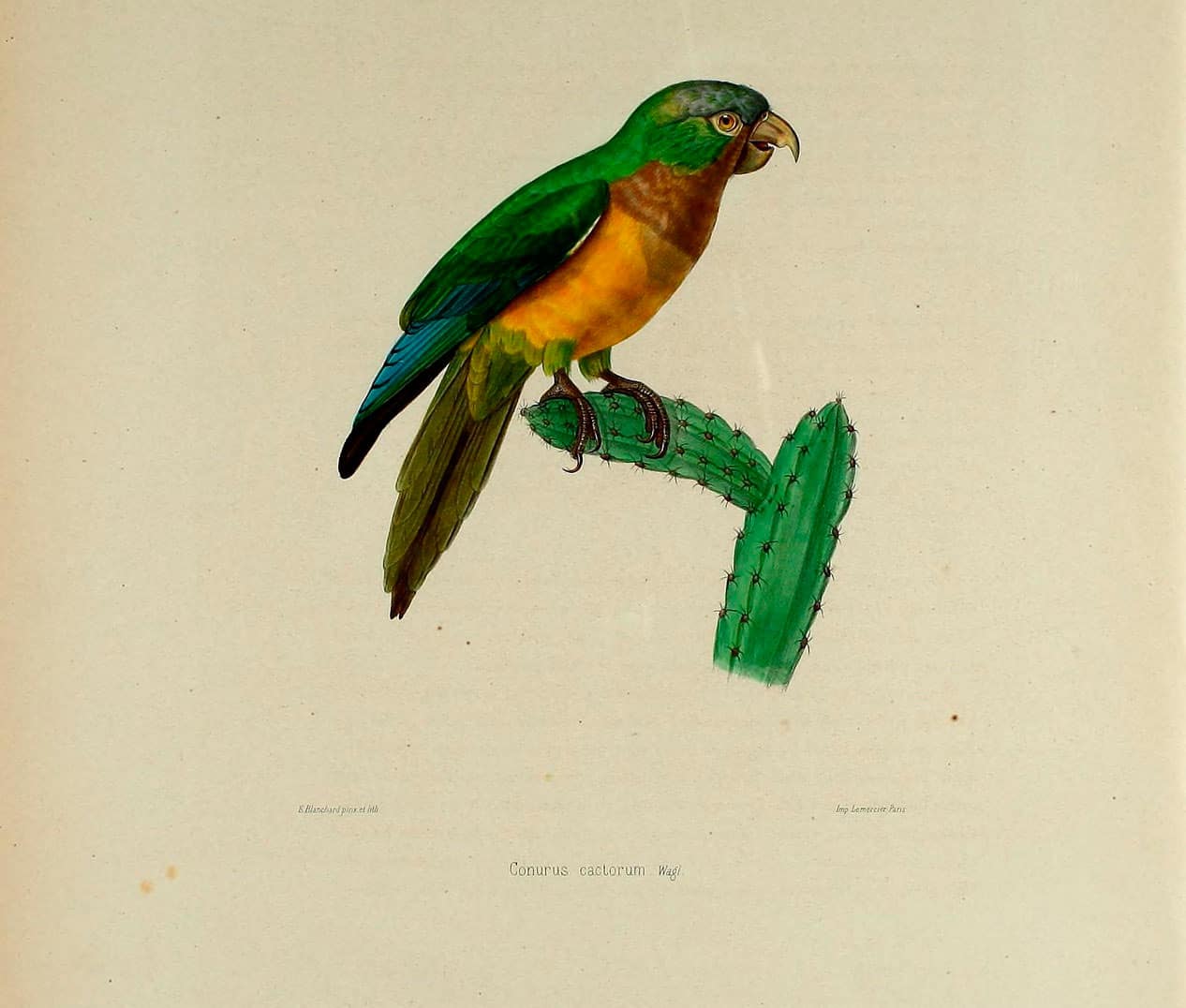
    (6) – Cactus parakeet – conographie parrots :.Paris :P. Bertrand,1857.. biodiversitylibrary.org/page/47804387

    โ–ท The world of Pets: Dogs, cats, birds, reptiles, amphibians

    Blue-fronted Parrotlet
    Touit dilectissima

    Blue-fronted Parrotlet

    Content

    Description

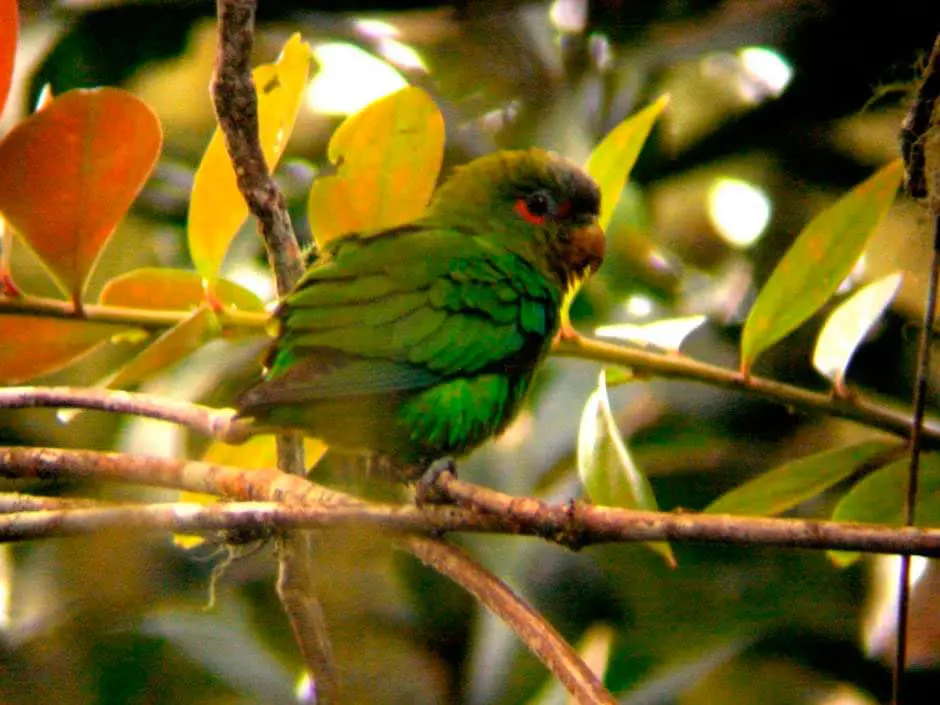
    The height of the Blue-fronted Parrotlet (Touit dilectissimus) varies between the 15 and 18 cm.. It is differentiated by the red line that goes from the bill towards the back of the eye and below the eye ring white, and blue bordering the red line from the forecrown up to the back side of. Wings with the part inside red and yellow, evident on the fly, shoulder and external margin of the wings red, crown and nape green.

    Tail with black border, Yellow ends and green central part.

    The female have the Red of the shoulder reduced or absent.

    Habitat:

    Uncommon and surly. It lives in humid forest that is often cloudy and has tall stubble., between 700 and 1700 meters above sea level (apparently with migration to the 3000 m). ANDA in pairs or groups of 15 or more, lie quietly in the canopy.

    In-flight calls are based on mild or sharp notes repeated several times between pauses. Calls are stronger during the flight.

    Reproduction:

    It nests in termite mounds on tree.

    Food:

    Cotorrita Cariazul
    It feeds on small seeds, fruits and flowers.

    Distribution:

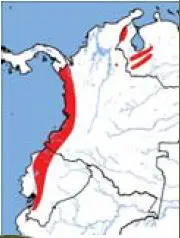
    Can be seen in freedom from Panama, Colombian Pacific to the Northwest of Ecuador, and in the northeast of Colombia and Northwest of Venezuela.

    Conservation:

    State of conservation โ“˜


    minor concern Minor Concern โ“˜ (UICN)โ“˜

    Appreciated a decrease of the species due to deforestation at the local level (in particular in Colombia).
    The population size World has not been quantified, but this species is described as ยซrareยป (Stotz et to the. 1996).
    The population is suspected to be stable in the absence of evidence of any reduction or substantial threats.

    "Blue-fronted Parrotlet" in captivity:

    These birds are rare to see them in captivity. Any person possessing one has to know that it can not be put into freedom, It must be part of a well-managed maintenance program to ensure the continued existence of this species.

    Alternative names:

    Blue-fronted Parrotlet, Blue fronted Parrotlet, Red-winged Parrotlet (ingles).
    Toui ร  front bleu (French).
    Kronenpapagei, Kronen-Papagei (German).
    Touit dilectissimus (Portuguese).
    Cotorrita Cariazul, Lorito de Alas Amarillas (espaรฑol).
    Periquito Alirrojo (Colombia).
    Churiquita (Venezuela).
    Periquito frentiazul (Ecuador).

    scientific classification:

    Order: Psittaciformes
    Family: Psittacidae
    Genus: Touit
    Scientific name: Touit dilectissimus
    Citation: (Sclater,PL & Salvin, 1871)
    Protonimo: Urochroma favorite

    Images:

    Videos:


    Species of the genus Touit


    Blue-fronted Parrotlet (Touit dilectissimus)


    Sources:

    • Avibase
    • Parrots of the World โ€“ Forshaw Joseph M
    • Parrots A Guide to the Parrots of the World – Tony Juniper & Mike Parr
    • Parrots, Parrots and macaws Neotropical
    • Birdlife

    • Photos:

    (1) – One bird perched close to the nest by Manakin Nature Tours – lynx