Origin: Senegal, Gambia, Mali, Guinea, Sierra Leone, Liberia, Ivory Coast, Ghana, Togo, Nigeria, Congo, Democratic Republic of the Congo, Rwanda, Burundi, Angola, Zambia, Malawi, Mozambique, Zimbabwe, South Africa
Character:
Life expectancy: 20 to 25 years.
Height: 32 cm..
Content
Description:
32 cm.. length and weight between 310-400 g..
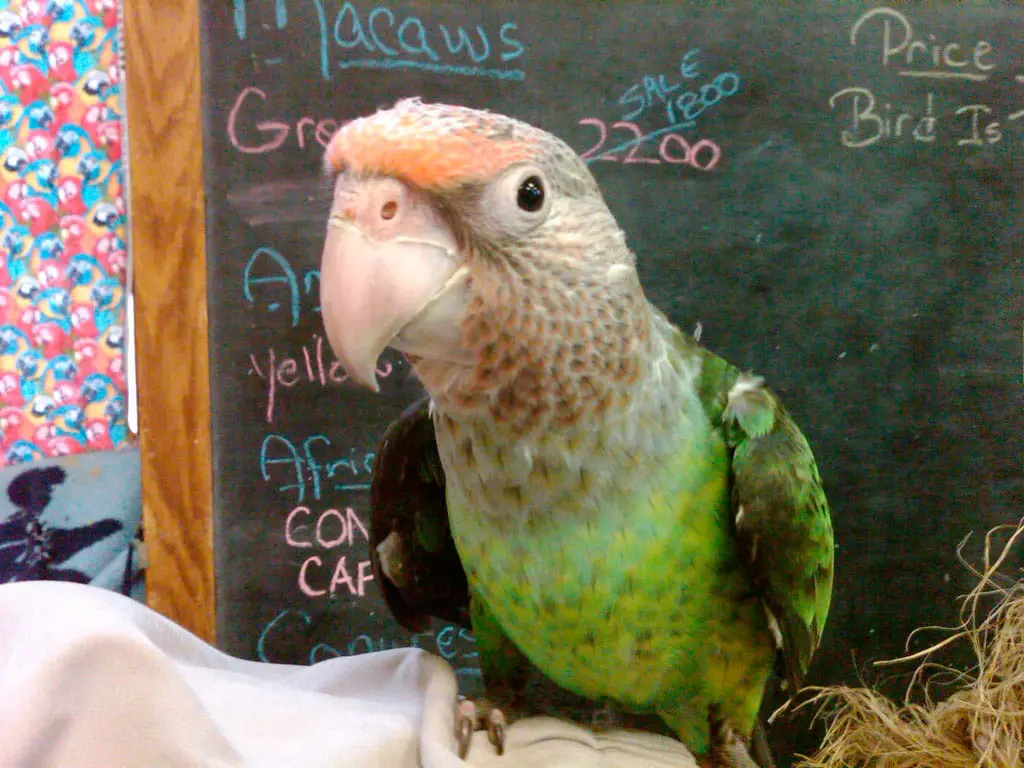
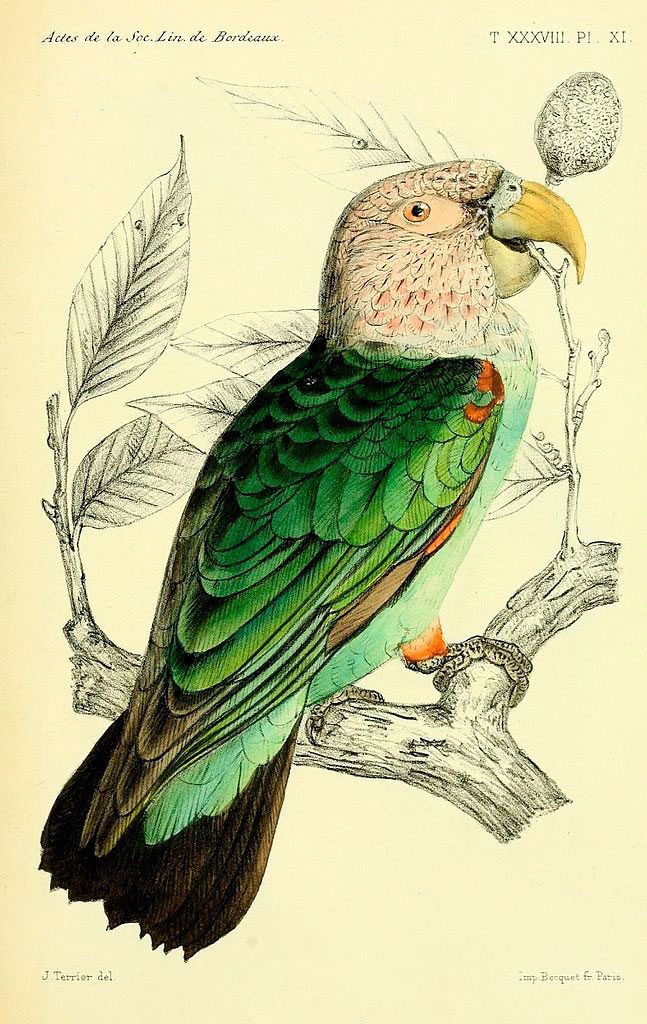
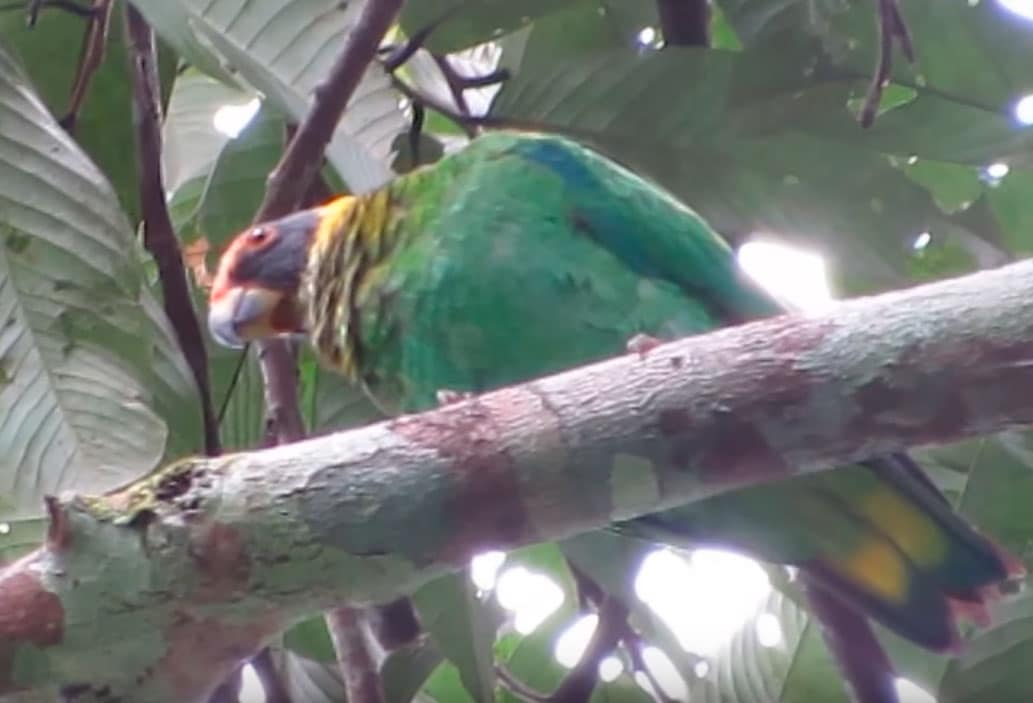
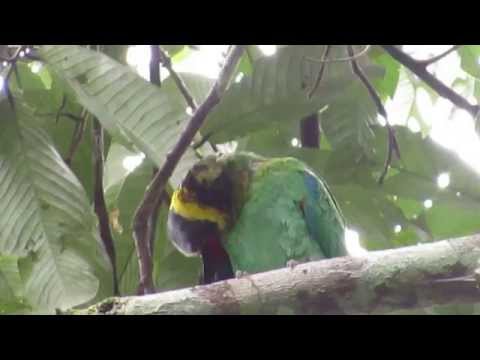
The Brown-necked Parrot(Poicephalus fuscicollis) has a plumage variable; head and gray to brown "neck" / light pink, slightly festooned with orange / brown; band orange / red through crown on female (absent in the males); back and wings, dark green; rump and underparts, green; the thighs, bend of wing and the carpal edge, red / orange; tail black / brown; irises dark brown; eye ring white / grey; bill color horn.
Immature with the head and the neck, green to yellow / brown; body dark green / oliva.
Taxonomic status:
In a study initiated in 1992, the taxonomic status of Lorito was revised Robusto (Poicephalus robustus) (Gmelin), and two species were proposed; Poicephalus robustus, restricted to montane forests of southern Africa, Poicephalus fuscicollis suahelicus, with wider distribution in wooded areas, and Poicephalus fuscicollis fuscicollis, similar to the Poicephalus fuscicollis suahelicus ostensibly, but with discontinuous, restricted to a narrow range of forests and West Africa.
(Gray-headed parrot) (Reichenow, 1898) – With a plumage variable; head and neck silver / grey, festoneado slightly orange / brown; band orange / red through crown on female (absent in the males); back and wings, dark green; rump and lower partess, green / blue ; the thighs, bend of wing and the carpal edge, orange / red; tail black / brown; irises dark brown; eye ring white / grey; bill color horn.
Most populations are residents but in the dry season become nomads, wandering in search of food.
Reproduction:
Nest in natural cavities of trees, usually on the trunk or at the bottom of a branch. The laying is of 2-4 eggs, they are incubated only by the female during 28-30 days. The male contributes to providing food for the female and chicks. Them They learn to fly when they have a 68-83 days old, only become fully independent 4-5 months later.
Food:
It feeds almost exclusively on fruit, mainly foraging in the upper canopy, using its beak to climb branches. The following foods have been recorded in your diet:
It is distributed from South Democratic Republic of the Congo and Tanzania until Zambia, Angola, Malawi and South of Africa; It is rare in the Caprivi Strip (Namibia), North of Botswana, Zimbabwe, Mozambique, the Limpopo and Southeast of South Africa.
Distribution 2 subspecies:
Poicephalus fuscicollis fuscicollis
(Kuhl, 1820) – Nominal. It inhabits most forests including mangroves and can be found in West Africa, from Gambia and South of Senegal to the North of Ghana and Togo.
Poicephalus fuscicollis suahelicus
(Reichenow, 1898) – Is located in South Africa, North of Zimbabue, Mozambique, areas Namibia, Angola, Zambia, North of Tanzania, Burundi, Rwanda and the southern part of the Sudafrican republic.
Conservation:
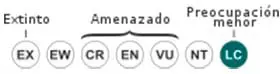
• Current category of the Red List of the UICN: Least concern.
• Population trend: Decreasing.
This species has a extremely large range and therefore it is not close to the thresholds for Vulnerable under the criterion of size range (Extension <20,000 km2 combinada con un tamaño de rango decreciente o fluctuante, extensión o calidad de hábitat o tamaño de población y un pequeño número De lugares o fragmentación severa). A pesar de que la population trend appears to be declining, do not believe that the decline is fast enough for approaching the threshold of vulnerable under the criterion of population trend (> 30% decline in ten years or three generations). The population size has not been quantified, but it is not believed to be close to the thresholds for Vulnerable under the criterion of population size (<10.000 individuos maduros con una disminución continua estimada> 10% in ten years or three generations or a population structure). For these reasons, the species is evaluated as least concern.
Local and mostly uncommon throughout the range, Although more numerous and frequent in Ghana. South Subspecies considered vulnerable in South Africa where, although the erratic movements give the impression that the population fluctuates, It has suffered a decline due to the capture of the LBMs, the habitat destruction and persecution by farmers of pecan nuts; There are only fragmented patches of native vegetation. Generally rare or rare across West Africa (except Ghana).
We know very little about the biology on the loose subspecies Poicephalus fuscicollis suahelicus.
Although it has a very wide distribution area and is not classified as threatened, an analysis of the UICN and CITES recorded significantly high trafficking of Poicephalus robustus (including the Poicephalus fuscicollis suahelicus) between 1991 and 1995, It is involving a risk to natural populations. The lack of data on the ecology and behavior of this species restricts the establishment of the necessary conservation measures to effectively protect and manage the populations..
"Brown-necked Parrot" in captivity:
It easily adapts to captivity and is seen in the pet trade.
Alternative names:
– Brown-necked Parrot, Angola Brown-necked Parrot, Brown-necked Parrot (Brown-necked), Gambia Brown-necked Parrot, Uncape Parrot (English).
– Perroquet à cou brun, Perroquet à cou brun (nominal), Perroquet à cou brun (nominale), Perroquet à cou brun (race nominale) (French).
– Graukopfpapage (German).
– Brown-necked Parrot (Portuguese).
– Loro de Cuello Marrón, You You Fuscicollis (español).
– Avibase
– Parrots of the World – Forshaw Joseph M
– Parrots A Guide to the Parrots of the World – Tony Juniper & Mike Parr
– Birdlife
– Parrots.org
– Photos:
(1) – Youth, captive, friendly Poicephalus robustus fuscicollis by Bob Corrigan – Flickr
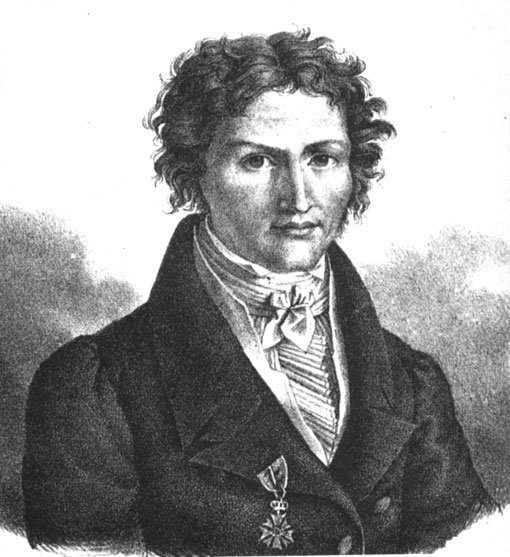
(2) – Brown-necked Parrot By Tremeau de Rochebrune, Alphonse [CC BY 2.0 or Public domain], via Wikimedia Commons
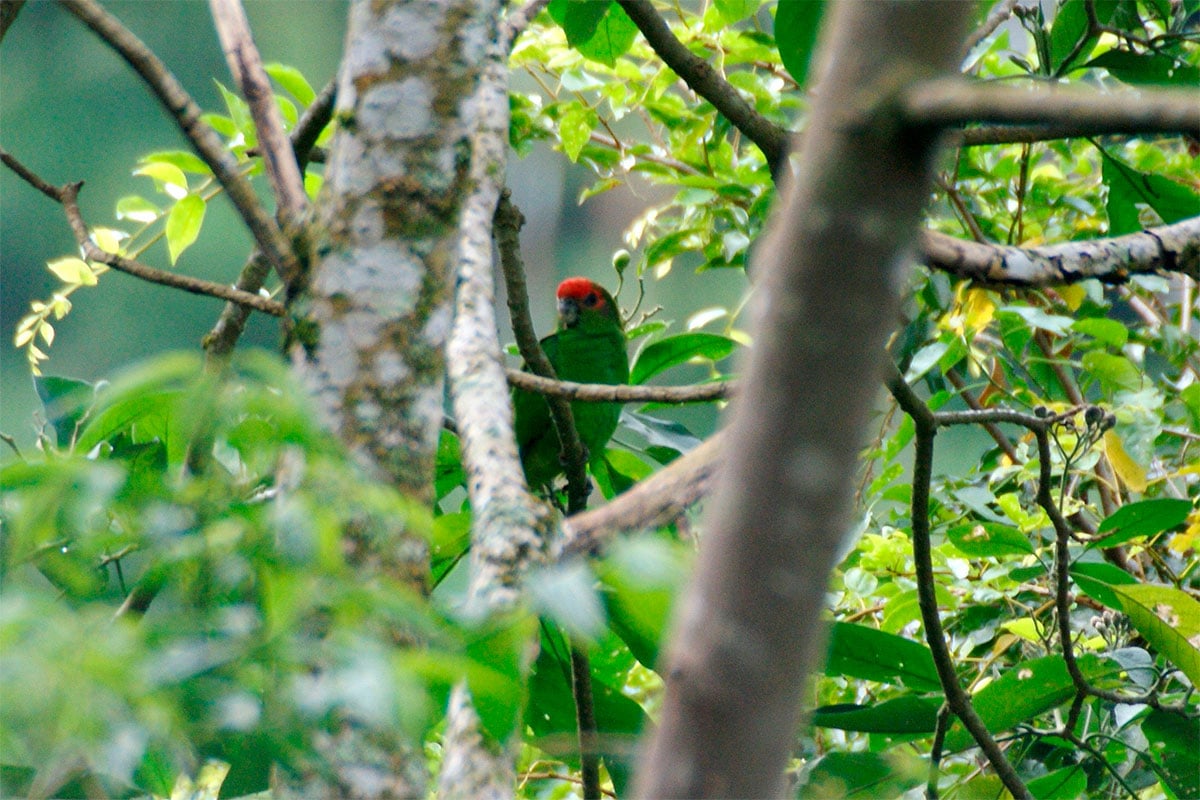
The few records Red-fronted Parrotlet existing in Costa Rica come from, mainly, from the central-southern highlands of the Caribbean slope.
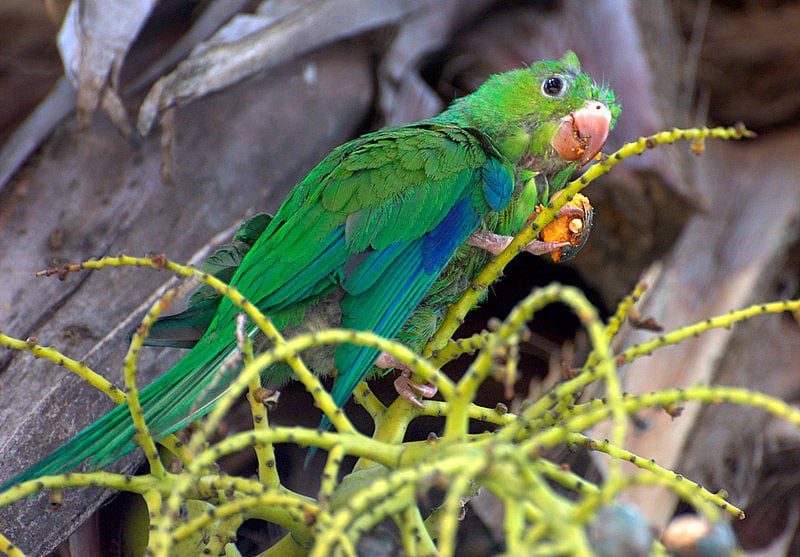
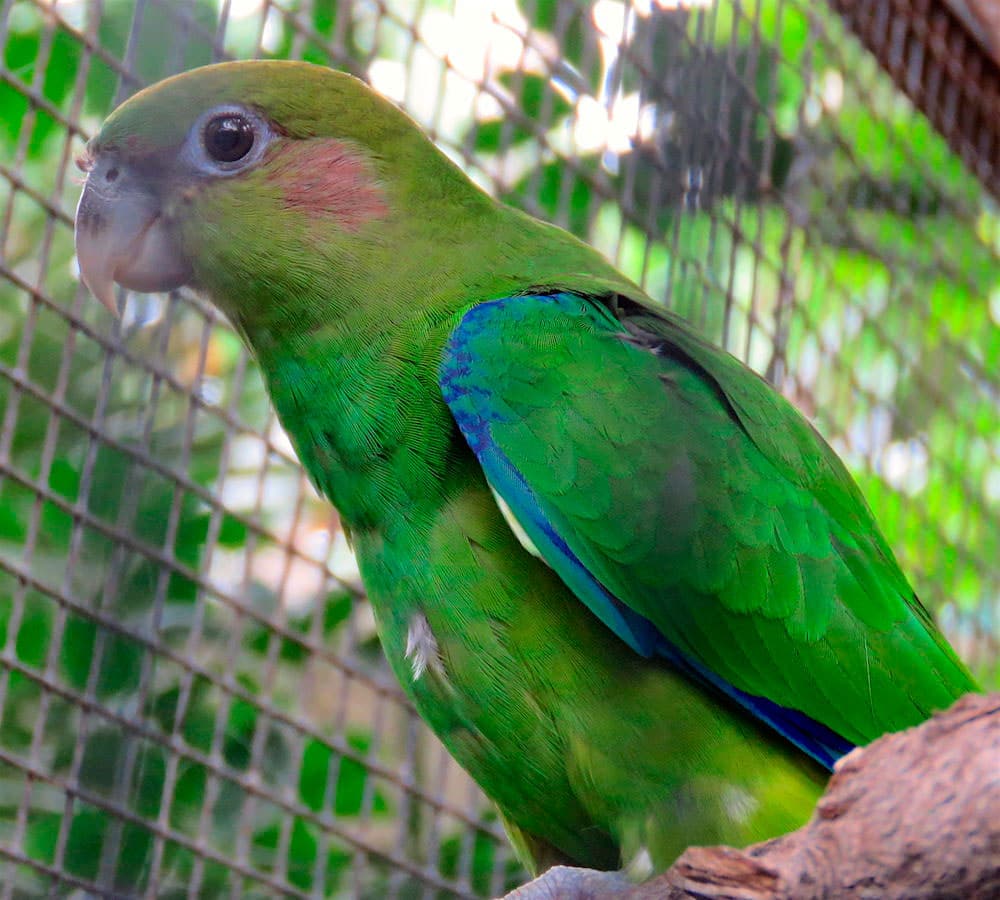
A captive Costa Rican Parrot eating – Nrg800, CC BY-SA 3.0, via Wikimedia Commons
Content
Description:
17,5 cm.. length.
The Red-fronted Parrotlet(Touit costaricensis) has the forecrown, anteriorly of crown, lores and stripe under the eyes, red; sides neck, cheeks and upperparts, green with the back of the crown and nape slightly paler and yellower. Inner wing-coverts green; exterior and median coverts and wing leading edge, red; primary coverts black.
Primaries and outer secondaries, black with green margin to outerweb of the primaries. Inner underwing-coverts, yellow, the outer, red. Feathers on base of the beak, on chin and throat, brighter yellowish green; the chest, the belly and undertail-coverts, green tinted yellowish. The tail greenish yellow with a black tip (except the outermost feathers) and dark green subterminally. Bill pale yellow; cere and bare periophthalmic, grey; irises grey; legs slaty.
The female It has less red on the upperwing-coverts, and perhaps more yellow in the underwing-coverts; probably, on average, are smaller than males. The immature It has little or no red on the head.
The Red-fronted Parrotlet It has sometimes been treated as conspecific with the Blue-fronted Parrotlet(Touit dilectissimus) North of South America and Panama. Although these taxa are clearly allied and share a recent common ancestor, most authors now treat them as separate on the basis of their clear and consistent plumage differences. The structural divergence can also exist in the Red-fronted Parrotlet longer seems to show the uppertail-coverts (extending almost to the end of the tail) its counterpart Southern, While (although the sample is small) it suggests a sexual dimorphism by the length of the wings and tail on Red-fronted Parrotlet but not in Blue-fronted Parrotlet.
Habitat:
Generally observed in the canopy moist forests at mid-altitudes. It moves towards the thicket, on forest edges, flying over the clear, sometimes in the lowlands (sometimes at sea level, especially in southeast Costa Rica), where perhaps it is a seasonal visitor. Tolerates some habitat alterations.
Observed in association with Red-headed Barbet(Eubucco bourcierii) and Blue-and-gold Tanager(Bangsia arcaei), both species associated in cool wet forests in the upper tropics and subtropics.
Observed to 3.000 meters in Costa Rica in the early dry season and reported regularly at altitudes 500-1.000 m during the wet season. Usually in pairs or small flocks family.
Reproduction:
The family size usually between 4-5 birds, suggests the clutch usual 2-3 eggs. probably plays during the season, dry.
Food:
They feed on fruits trees and epiphytes, such as Cavendishia and Clusia, but probably also include flowers and seeds.
Distribution:
Size of its range (breeding/resident): 10.000 km2
The few records Red-fronted Parrotlet existing in Costa Rica come, mainly, the highlands of central-south Caribbean side, where its range seems to extend to the south, from Monteverde, Turrialba volcano and Lemon.
Although there are no records in much of the east of Costa Rica, its existence can be continuous along the Cordillera de Talamanca (perhaps only in the Caribbean side) to western Panama. The handful of panamanian specimens and records from observations, They are mainly from the western highlands to a report from the east, about the Cocle Province.
It is obviously a kind rare and presumably in decline due to continued deforestation (at least in the lowlands) in a limited range.
Conservation:
• Current category of the Red List of the UICN: Vulnerable.
• Population trend: Decreasing.
Population size : 2500-9999 specimens.
Rationale for the Red List category
This species is classified as Vulnerable because the clearing and forest fragmentation at middle elevations, mainly in the Central Volcanic Range and in the Sierra de Tilarán of Costa Rica, It is likely to be causing significant slopes in its small range and (presumably) in population.
Justification of the population
It is estimated that the breeding population of the Important Bird Areas of Costa Rica is 1.000 to 4.000 mature individuals (J. And others Craido 2007, J. Sánchez et al., In 2007), so it is believed that the total population may be within the range of 2.500-9.999 mature individuals. This is equivalent to 3.750-14.999 individuals in total, rounded here to 3.500-15.000 individuals.
Justification of trend
It is suspected that the population species is decreasing at a moderate rate, in line with continued clearing of its forest habitat in the northern part of its range.
Conservation Actions Underway
CITES Appendix II. Live in several areas protected, including national parks Braulio Carrillo, Tapantí-Cerro de la Muerte and Monteverde, Costa Rica, and La Amistad International Park and adjacent reserves in both countries. But, The legal protection of Palo Seco Protected Forest (BPPS) (a booking Panama adjacent to La Amistad) has not prevented clearance for agriculture (Angehr and Jordan, 1998).
Conservation Actions Proposed
Evaluate the importance of habitat outside the breeding season (J. Created en lit. 2007, J. Sanchez et al., In 2007). Conduct surveys to determine the total size of the population. Study of the ecology of the species (J. Sanchez et al., in bed. , 2007). Monitor population trends through regular surveys. Monitor rates of loss and recovery of forests (J. Sanchez et al., In 2007). Effectively protect the Bosque Protector Palo Seco (BPPS).
"Red-fronted Parrotlet" in captivity:
No reports are known captive birds.
Alternative names:
– Red-fronted Parrotlet, Red fronted Parrotlet (English).
– Toui du Costa Rica (French).
– Costa-Rica-Papagei (German).
– Red-fronted Parrotlet (Portuguese).
– Cotorrita Costarricense, Lorito de Pecho Rojo, Periquito alirrojo (español).
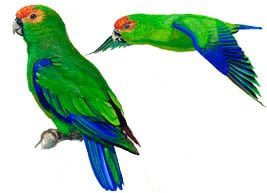
The Golden-tailed Parrotlet(Touit surdus) has a plumage mostly green; the forecrown, lores, supercilii area and cheeks, They are yellowed; crown, rear area of the neck, ear-coverts and sides neck, green with dark narrow margins, giving a scaly appearance.
Mantle and back, green with rump and uppertail-coverts slightly brighter, more emerald. Scapulars and inner tertials, warm brown: primary coverts, dark brown, rest of the coverts green. The the flight feathers They are brown above with narrow green margins to outerweb; brown opaque below. Blue feathers Carpal edge of the wing. Underwing-coverts green. Chin yellowish; chest brighter yellowish green, brighter in the belly and in the undertail-coverts. Tail, centrally green with faint black markings at tips, laterally golden-yellow with narrow black tips on upper surface.. The bill yellow horn; gray irises, legs grey.
The female perhaps duller below, with lateral feathers tail greener and green tips and margins. Immature not described.
The subspecies Touit surdus chryseurus it has been proposed to birds of northeastern range on the basis of dubious lateral tail feathers more brownish and smaller.
Touit surdus chryseurus
(Swainson, 1823) – Side tail feathers, brown / yellow; smaller.
They live mainly in evergreen forests lowland, although occasionally they extend to the adjacent lower mountain slopes. Birds have been observed in the canopy of a secondary forest fragment surrounded by open fields; Other reports suggest that birds visit fruiting trees in deforested areas to feed.
You can visit, occasionally, cocoa plantations where trees shade the crop plants, but this has not been tested. They are to 700 m in Alagoas and to 800 m in Espirito Santo, Rio de Janeiro and São Paulo. The Brown-backed Parrotlet They seem to live in flocks (mainly 6-12), perhaps you composed of family groups.
Recent observations suggest that this species is resistant habitat alteration.
Reproduction:
The reproduction of this species practically is not registered. A female observed in September Alagoas, He was not in breeding condition.
Food:
Foods reported in feed Brown-backed Parrotlet are fruits Spondias lutea and Rapanea schwackeana
Distribution:
Size of its range (breeding/resident ): 1.680.000 km2
The distribution of the Brown-backed Parrotlet It extends through Atlantic forests of eastern Brazil, including coastal areas of the northeastern states of Paraíba, Pernambuco and Alagoas with a record Camocim in the North of Ceará, where there are fragments of humid forest in coastal areas.
They seem to be distributed at low densities and (except a report in the lower basin tiete river in Sao Paulo) It was considered a rare species in the nineteenth century. Like other members of the genus is, without a doubt, ave a difficult to observe, and often overlooked. But, many ancient villages are no longer inhabited, with forests completely eliminated or severely degraded lowland, especially in the north of the mountain range, where you can be almost extinct. In the news They are distributed in several protected areas.
(Kuhl, 1820) – Nominal. Southeast of Brazil, from the South of Bay and possibly southern Goiás, south to São Paulo.
Conservation:
State of conservation ⓘ
Vulnerable ⓘ(UICN)ⓘ
• Current category of the Red List of the UICN: Vulnerable.
• Population trend: Decreasing.
Population size: 2500-9999 specimens.
Rationale for the Red List category
This species is classified as Vulnerable because its population is small and declining rapidly due to continuous deforestation. It has been found that it is more resistant to forest fragmentation of what was thought first, and may be sub-registered instead of actually little, especially in the southern part of its range.
Justification of the population
The species is generally rare; Its population is located in the band 2.500-9.999 mature individuals, equivalent to 3.750-14.999 individuals, rounded here to 3.500-15.000 individuals.
Justification of trend
rapid and continuous population decline is suspected on the basis of continuous destruction and fragmentation of habitat.
Conservation Actions Underway
CITES Appendix II. It is considered Vulnerable nationally in Brazil (MMA 2014). And protected by Brazilian law. There have been numerous protected areas: Hewn Stone Biological Reserve (Alagoas), Monte Pascoal National Park and Serra das Lontras, Biological Reserve and Private Reserve Serra Nice (Bahia), Great stream, Sooretama and Augusto Ruschi), Desengano State Park and Itatiaia National Park (Rio de Janeiro)
Conservation Actions Proposed
Examine the historical towns and proper habitat to clarify the distribution. Research ecology and seasonal movements. designate murici in Alagoas biological reserve and ensure their protection de facto. Consolidate protected areas distributed.
"Golden-tailed Parrotlet" in captivity:
Rare and unknown in captivity. Any captive individual (it can not be released) It should be part of a conservation program well managed to ensure continuity of this species.
Alternative names:
– Golden-tailed Parrotlet, Golden tailed Parrotlet (English).
– Toui à queue d’or (French).
– Gelbschwanzpapagei, Gelbschwanz-Papagei (German).
– Apuim-de-cauda-amarela, papagainho, periquitinho, periquitinho-surdo (Portuguese).
– Cotorrita Sorda, Lorito de Cola Dorada (español).
(2) – Urochroma deaf By Blanchard, Emile; Bonaparte, Charles Lucian; Bourjot Saint-Hilaire, Alexandre; Le Vaillant, François; Souancé, Charles de. [CC BY 2.0 or Public domain], via Wikimedia Commons
23 cm.. long and about 63 g. of weight.
The Plain Parakeet(Brotogeris tirica) has the forecrown, lores, crown and cheeks, pale green with yellowish tint. Sides of the neck and nape, green, duller than in the head.
The upperparts green, slightly darker than the rest of the plumage. Most of the under wing-coverts, green, some feathers dyed olive brown, especially in lesser and median coverts. Primary coverts, primaries and outer secondaries, violet blue with green margins close to outerweb. Underwing-coverts greenish yellow, flight feather, bluish green. Underparts, pale yellowish green, tinged with bluish color on the sides of chest, the the thighs and undertail-coverts; flanks yellowish. Upper, the tail green with bluish tint to the central feathers; undertail, the tail is grayish blue-green. Bill color pale horn: irises brown: legs Rosaceae.
Both sexes are similar. Immature with little or no blue in primary coverts.
The Plain Parakeet They are experts in the art of adaptation; They can be found in a wider range of habitats than any other endemic parrot Brazilian Atlantic forest: in the lowlands and highlands, in the forest canopy and forest edges, parks and gardens (for example, of Rio de Janeiro and São Paulo), farmland with trees, scattered patches of forest and secondary growth. Apparently more numerous in the forest edge habitats. Generally observed in the lowlands, but reported to 1.200 metres in the Itatiaia National Park on the border between the state of Río and São Paulo. Gregaria. Generally seen in pairs or small groups, although sometimes you can see several hundred birds together.
It is the most common parrot in São Paulo, where you can find even in the slums of the city.
Reproduction:
Observed in arboreal termite nests, in the crowns of Palmas or natural openings of trees; in the city of São Paulo nest in crevices of buildings and roofs, regularly using the balconies to feed.
The breeding season It has been recorded in September; observed immature in January. The clutch common in captivity is four eggs. They stay together for life.
Some seasonal movements. Uncommon to fairly common depending on locality, but apparently only reported very common in the city of Sao Paulo. Its population has declined in the Eastern European settlement Brazil, although less than other endemic parrots in the region. Live in several areas protected (for example, Itatiaia National Park).
Conservation:
State of conservation ⓘ
Minor Concern ⓘ(UICN)ⓘ
• Current category of the Red List of the UICN: Least concern.
• Population trend: Stable.
Rationale for the Red List category
This species has a very large range and therefore it is not close to the thresholds for Vulnerable under the criterion of size range (Extension Occurrence <20,000 km2 combinada con un tamaño de rango decreciente o fluctuante, extensión / calidad de hábitat o tamaño de población y un pequeño número De lugares o fragmentación severa). La demographic trend appears to be stable and, therefore, the species does not approach the thresholds Vulnerable under the criteria of population trend (> 30% decline over ten years or three generations). The population size has not been quantified, but it is not believed to be close to the thresholds for Vulnerable under the criterion of population size (<10.000 individuos maduros con un descenso continuo estimado> 10% in ten years or three generations or a population structure). For these reasons the species is evaluated as the least concern.
Justification of the population
The size of the world's population has not been quantified, but this species is described as «common» (Stotz et to the., 1996).
Justification of trend
They suspected that the population is stable in absence of evidence of any decline or threatens substantial.
– Avibase
– Parrots of the World – Forshaw Joseph M
– Parrots A Guide to the Parrots of the World – Tony Juniper & Mike Parr
– Birdlife
– Photos:
(1) – A Plain Parakeet in Morretes, Paraná, Brazil By Ben Tavener from Curitiba, Brazil [CC BY 2.0], via Wikimedia Commons
(2) – Plain Parakeet in Brazil By Jônatas Cunha [CC BY-SA 2.0], via Wikimedia Commons
(3) – Plain Parakeet in captivity By Lucas de Melo [CC BY 2.0], via Wikimedia Commons
(4) – Independence Park, Ipiranga museum, Sao Paulo By Dario Sanches from SAO PAULO, BRAZIL (PERIQUITO-RICO ( Brotogeris tirica)) [CC BY-SA 2.0], via Wikimedia Commons
(5) – Plain Parakeet (Brotogeris tirica) in São Paulo By Dario Sanches [CC BY-SA 2.0], via Wikimedia Commons
(6) – Independence Park, Ipiranga museum, Sao Paulo By Dario Sanches from SAO PAULO, BRAZIL (PERIQUITO-RICO ( Brotogeris tirica)) [CC BY-SA 2.0], via Wikimedia Commons
(7) – Independence Park, Ipiranga museum, São Paulo Species molting By Dario Sanches from SÃO PAULO, BRAZIL (PERIQUITO-RICO ( Brotogeris tirica)) [CC BY-SA 2.0], via Wikimedia Commons
(8) – Brotogeris tirica, Independence Park, Ipiranga museum, Sao Paulo By Dario Sanches from SAO PAULO, BRAZIL (PERIQUITO-RICO ( Brotogeris tirica)) [CC BY-SA 2.0], via Wikimedia Commons
(9) – The Plain Parakeet in the Serra da Cantareira State Park, Sao Paulo, Brazil By Dario Sanches (Flickr: PERIQUITO-RICO (Brotogeris tirica)) [CC BY-SA 2.0], via Wikimedia Commons
(10) – Illustration Ricardo Sanches, parakeets rich(Brotogeris tirica) in ABES-SP
The Pileated Parrot(Pionopsitta pileata) has the forecrown, lores, crown anterior upper cheeks to behind eyes, bright red; patch reddish brown in ear-coverts; the lower cheeks, sides and rear of the neck, green.
The upperparts, green. Primaries and greater coverts, alula and feathers bend of wing, violet blue; other coverts, green. Outerwebs of the primary and secondary, violet blue with blue-green edges. Under, the wings bluish green, coverts with some darker blue feathers. Underparts green with bluish tint in the chest and throat, and with a yellowish tint in the belly and undertail-coverts. Upper, the tail centrally green, laterally violet blue; undertail, bluish green.
Bill dark brown, becoming dark horn distally in both jaws; bare periophthalmic naked, pale grey, irises and legs, grayish brown.
The female has most of its head green but with a pretty pale blue in the forecrown.
Immature as female, but with grayish green or green spots and dark spots on the base bill; young male sometimes with red limited in forecrown with a patch orange behind.
Sound of the Pileated Parrot.
Habitat:
They inhabit in forests, including humid tropical forests and forests dominated by araucarias, mainly in lowlands in the south of the mountain range, although penetrating the coastal mountains Brazil, at altitudes of 300 to 1.500 m; also in areas partially cleared. gregarious in groups of approximately 10 birds; apparently rare in greater numbers.
Reproduction:
They nest in the cavities of trees. probably reproduce mainly in the months of November to January. Clutch 3-4 eggs in captivity.
Size of its range (breeding/resident ): 1.650.000 km2
The Pileated Parrot It is located in southeast Brazil, to the South of Bay, through the belt of the Atlantic forest in Espirito Santo, probably east of Minas Gerais, Brazil, Rio de Janeiro, São Paulo, Paraná and Santa Catarina, until Rio Grande do Sul, extending to the east Paraguay and northeast of Argentina in Missions and possibly in Currents (no recent records); also they have been reported east of Chaco in Argentina, where they can arrive as an irregular visitors.
Some seasonal movements occur Paraná, where birds leave the inland coastal plateau after breeding, and in Paraguay where it is in Amambay in October.
Nomad in the Intervales State Park of São Paulo. Its population is widespread but declining due to the extensive loss of forests by urban growth, agriculture and mining.
Described as uncommon to fairly common in Missions, Argentina. Apparently its population is still not at risk due to habitat loss, since birds are still quite numerous where fragments of forest remain. (for example, east of Paraguay) and travel between them on land without trees. More numerous are more extensive where the remains of forest, It is more common in eastern Paraguay and adjacent Paraná and São Paulo in Brazil.
Conservation:
• Current category of the Red List of the UICN: Least concern.
• Population trend: Stable.
Rationale for the Red List category
This species has a very large range and therefore it is not close to the thresholds for Vulnerable under the criterion of size range (Extension Occurrence <20,000 km2 combinada con un tamaño de rango decreciente o fluctuante, extensión / calidad de hábitat o tamaño de población y un pequeño número de lugares o fragmentación severa). La demographic trend appears to be stable and, therefore, the species does not approach the thresholds Vulnerable under the criteria of population trend (> 30% decline over ten years or three generations). The population size It has not been quantified, but it is not believed to be close to the thresholds for Vulnerable under the criterion of population size (<10.000 individuos maduros con un descenso continuo estimado> 10% in ten years or three generations or a population structure). For these reasons the species is evaluated as the least concern.
Justification of the population
The size of the world's population has not been quantified, but this species is described as «Rare» (Stotz et to the., 1996).
Justification of trend
They suspected that the population is stable in absence of evidence of any decline or threatens substantial.
– Avibase
– Parrots of the World – Forshaw Joseph M
– Parrots A Guide to the Parrots of the World – Tony Juniper & Mike Parr
– Birdlife
– Photos:
(1) – Pileated Parrot Loro Parque – Tenerife (Spain) by Florin Feneru – Flickr
(2) – Pileated Parrot Loro Parque – Tenerife (Spain) by Florin Feneru – Flickr
(3) – Pileated Parrot Loro Parque – Tenerife (Spain) by Florin Feneru – Flickr
(4) – Pionopsitta pileata by Taguató yetapa – Flickr
(5) – Red-capped parrot (Pionopsitta pileata) – «Cuiú-Cuiú» Campina Grande do Sul | The Birds of Brazil by Ben Tavener – Flickr
(6) – Catita Cabeza Roja by Argentavis – Birds of Argentina
▷ The world of Pets: Dogs, cats, birds, reptiles, amphibians
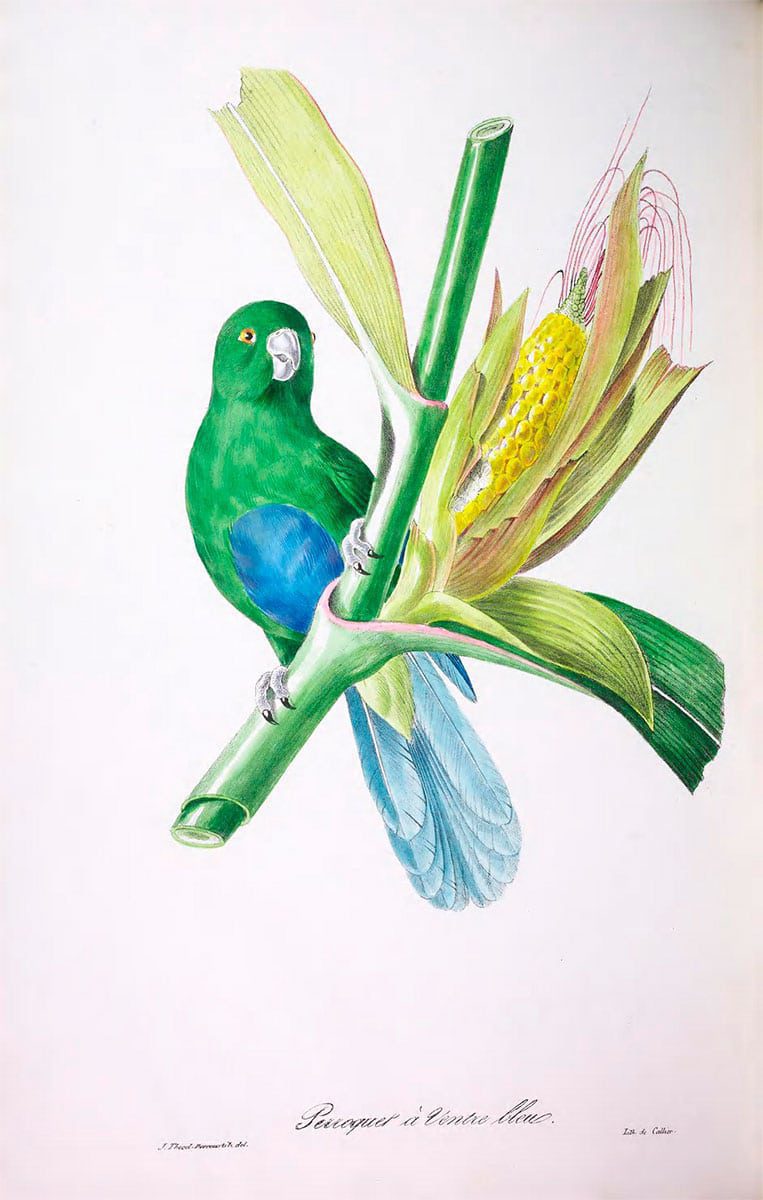
The Blue-bellied Parrot(Triclaria malachitacea) has the head, neck and all the "upper parts" and wing-coverts, grass-green.
Flight feathers grass-green with narrow blue tips to primaries, except the outermost, with a narrow pale blue margin to outerweb. Under, the wings with coverts green, and flight feather, bluish green. The underparts mainly green with large purplish-blue patch on centre of chest and the belly. Upper, the tail It is green with blue tips to central feathers; undertail, bluish green. Bill pink white: cere Pink; brown the irises; legs grey.
The female lacks the patch in the belly blue violet. The immature is as the adult but the respective young male has less blue purple in the underparts.
Sound of the Blue-bellied Parrot.
Its singing It is similar to a Thrush (Molothrus).
Habitat:
The Blue-bellied Parrot They live in the humid forests of the low mountains., generally preferring the canopy and the upper floors of tall forest, rich in bromeliads, along watercourses in the valleys. Visit cultivated areas with orchards and plantations and sometimes wooded suburban areas (for example in São Paulo).
Mainly observed at altitudes of 300-700 m, perhaps 1,000 meters in some places, but also they inhabit lowlands at sea level. The sporadic nature of reports, with apparent absence of apparently suitable areas, suggests some critical aspects of its little-understood ecology.
Reproduction:
Observed nests in cavities of large trees or stumps of palm. Strongly territorial, at least during breeding, with separation until nests 2 km. The breeding season It covers the months of September to January, maybe a little earlier or later.
Food:
Its diet it's formed, mainly, by fruit, seeds, outbreaks and nectar, some insects and their larvae (looking birds seen flying insects); specific foods include Pachystroma, Actinostemon, Sebastian, Eugenia, Campomanesia and Euterpe edulis, also occasionally Cortex, and citrus plantations.
Distribution and status:
Size of its range (breeding/resident): 361.000 km2
The species is quite common in large forest fragments in the Itajai Valley (G. Kohler in some ., 2011). Due to changes in habitat in the lowlands Santa Catarina, the most recent records in that state come from montane forests (G. Kohler in some ., 2011). Two records in Missions, Argentina, require confirmation. The population was estimated previously less than 5.000 individuals (Lambert et to the ., 1993), But Bencke (1996) suggested that there may be 10.000 in Rio Grande do Sul and significant numbers on the eastern slope of the Serra do Mar; But, the apparent rarity of the species suggests that these figures may be an overestimation (J. Gilardi in litt., 2010). In general, it is suspected that the population is declining, although in the State Park Tres Picos, Rio de Janeiro, It seems to have been stable since 2003 (A. Foster in a bit).
Population little known due to camouflage habits. Perhaps more numerous in the many facing slopes east of the Serra do Mar in Rio de Janeiro and São Paulo; habitat loss on a large scale has certainly caused a serious decline in its population, as well as the fragmentation of its distribution area. Although humid upland forests remain in substantial quantities in Serra do Mar, replacement of forests in valleys and on lower slopes with banana plantations could lead to further declines.
Captured for local LBMs and traded in small numbers internationally. There are records of several protected areas, but most of them may be insufficient to support populations of this species due to their low density.
Conservation:
• Current category of the Red List of the UICN: Near-threatened.
• Population trend: decreasing.
Rationale for the Red List category
This species is classified as near threatened because they suspect is in a moderately rapid decline due to loss of habitat and, perhaps to a lesser extent, to the capture for trade bird cage.
Justification of the population
The size of the world's population has not been quantified, but this species is generally described as "rare» (Stotz et to the ., 1996), although it is locally common in some places.
Justification of trend
Se sospecha una decrease moderate and continuous of the population depending on rates of habitat loss and perhaps, to a lesser extent, capture for the bird trade. The decline is not thought to be faster because the species occurs in montane areas where deforestation is typically less severe., It seems to tolerate mature secondary forests and anecdotal observations suggest that is locally stable, for example in the State Park Tres Picos, Rio de Janeiro. (A. Foster in a bit ., 2013).
The ecology and conservation of the Blue-bellied Parrot in remaining forest fragments in Rio Grande do Sul
This project aims to collect basic information on population, the distribution and ecology of the Blue-bellied Parrot in the center of Rio Grande do Sul, where a large population of the species is rapidly declining due to habitat fragmentation. The use of the radiotelemetry technique will make it possible to determine the area of use of the species and to evaluate their dispersal capacities.. Biology studies of this species is the objective to determine the elements that make up its diet and collect information on behavior and reproduction.. Through this information, It is intended to outline a regional plan for conservation Blue-bellied Parrot and their habitat, together with local actors. (AU)
Conservation status:
UICN: Vulnerable (with + 2c, d, Cl, Q2a). Previously in danger of extinction (Q2a: see Collar et al., 1994). CITES: Appendix II.
State of national protection: Protected by federal law and included in the list IBAMA of Brazilian species threatened with extinction (Bernardes et al 1990).
"Blue-bellied Parrot" in captivity:
unknown in captivity.
Alternative names:
– Blue-bellied Parrot, Blue bellied Parrot, Purple-bellied Parrot (English).
– Crick à ventre bleu, Caïque à ventre bleu (French).
– Blaubauchpapagei, Blaubauch, Blaubauch-Papagei (German).
– Papagaio-de-peito-roxo, araçoiaba, araçuaiava, cica, sabiá-ci, sabiá-cica (Portuguese).
– Loro de vientre azul, Loro Sabiá-cicá, Loro Ventriazul (español).
– araçoiaba, araçuaiava, cica, sabiá-ci, Sabiá-cica (Brazil).
The Vulturine Parrot(Pyrilia vulturina) It is a small parrot with bare skin yellow orange and covered bristles pale hairlike, in the area that covers the forecrown and back of the crown, until the eyes; bare skin on lores, the cheeks and center of crown black and covered with bristles black hairlike; feathers on the sides of neck and in the part back from the crown, are yellow, forming a band bright contrasting with the black of the head bare; back of the neck, black; upperparts green.
carpal area and lesser upperwing-coverts, orange-yellow; outer median coverts with some blue; leading edge of wing, red; primary coverts blue; rest of the upper parts of the wings, green.
Primaries bluish-black with narrow bluish-green margins to outerweb. Under, the wings with coverts red; flight feather green with blackish tips. feathers throat and the chest, olive yellow with dark tips, giving a scalloped effect; belly green with bluish tint; undertail-coverts brighter yellowish green. Tail green with tips blue and outer feathers with yellow on base of innerwebs. Bill dark blackish-grey with patch pale yellow at the base of the upper jaw; cere yellowish-horn; irises brownish-orange; legs grey.
Both sexes are similar.
The head of the immature, fully feathered (except in the eye ring); greenish on the cheeks and yellow olive in the rest of the head with no collar yellow. The bend of wing and underwing-coverts, yellowish-orange; irises darker.
Sound of the Vulturine Parrot.
Habitat:
It inhabits in the rainforest of lowland formations várzea (seasonally flooded forest), and the Mainland (without flooding). Gregarious.
Reproduction:
No details on the reproductive biology of this species.
Food:
diet includes fruit, seeds and berries taken in the forest canopy. Its bareheaded adaptation may be a high frugivore diet, to prevent the fruit pulp enmarañara their feathers.
Distribution and status:
Size of its range (breeding/resident ): 1.030.000 km2
endemic to northeast Brazil, to the South of the amazon, from the eastern state of amazon, on the east bank of Madeira River, passing by For, to the south, up to the Serra do Cachimbo, extending eastward to the areas bordering northwest Maranhão, in the region of the Gurupi River. May be restricted to areas around major rivers within this region, which would mean that the size of the range may be overestimated.
References in relation to its range to include Venezuela (lower basin Caura River) and Guyana, They are apparently wrong.
generally considered Rare, although undoubtedly they not have a lot of data due to the difficulty of observation of this species.
The continuing rapid deforestation throughout its range has had to contribute to a substantial decrease in the population Vulturine Parrot in the last decades.
They can be seen in protected forests in the west of its range, but illegal logging and colonization remain a threat even there.
Conservation:
• Current category of the Red List of the UICN: Vulnerable.
• Population trend: Decreasing.
Rationale for the Red List category
Based on a model of future deforestation in the amazon basin and its dependence on primary forest and sensitivity to fragmentation, It is suspected that population of this species will decrease rapidly during the next three generations and, therefore, It has risen to Vulnerability.
Justification of the population
The population size World has not been quantified, but this species is described as «Rare» (Stotz et to the ., 1996).
Justification of trend
It is suspected that this species has lost 37,1-54,8% of habitat within its distribution over three generations (21 years) starting from a model of deforestation Amazon (Soares-Filho et to the ., 2006, Bird et to the ., 2011). Although the species may have some susceptibility to hunting and / or capture, also it appears to have some degree of tolerance habitat degradation (A. Lees in litt ., 2011). So, you suspect your population decline by 30-49% during three generations.
Conservation Actions Underway
• Is listed as Vulnerable nationally in Brazil (MMA 2014).
• No specific actions known.
Conservation Actions Proposed
• Expand the network of protected areas to effectively protect the IBA.
• Effectively manage existing and new protected areas and resources, using the emerging opportunities for financing the management of protected areas with the overall goal of reducing carbon emissions and maximize the conservation of biodiversity.
• It is also essential to conservation on private land, through the expansion of market pressures for proper land management and prevention of deforestation on land not suitable for agriculture (Soares-Filho et to the., 2006).
• Campaign against proposed changes to the Brazilian Forest Code that would lead to a decrease in the width of the areas of riparian forest protected as Permanent Preservation Areas (APPs), that function as vital corridors in fragmented landscapes.
"Vulturine Parrot" in captivity:
It is not found in aviculture; Probably they never stood outside Brazil.
Parrots A Guide to the Parrots of the World – Tony Juniper & Mike Parr
Birdlife
Photos:
(1) – Pyrilia vulturina (adult and immature) – Imagen de Parrots A Guide to the Parrots of the World – Tony Juniper & Mike Parr
(2) – Pyrilia vulturina ( Curica Vulture) by victor castro
▷ The world of Pets: Dogs, cats, birds, reptiles, amphibians
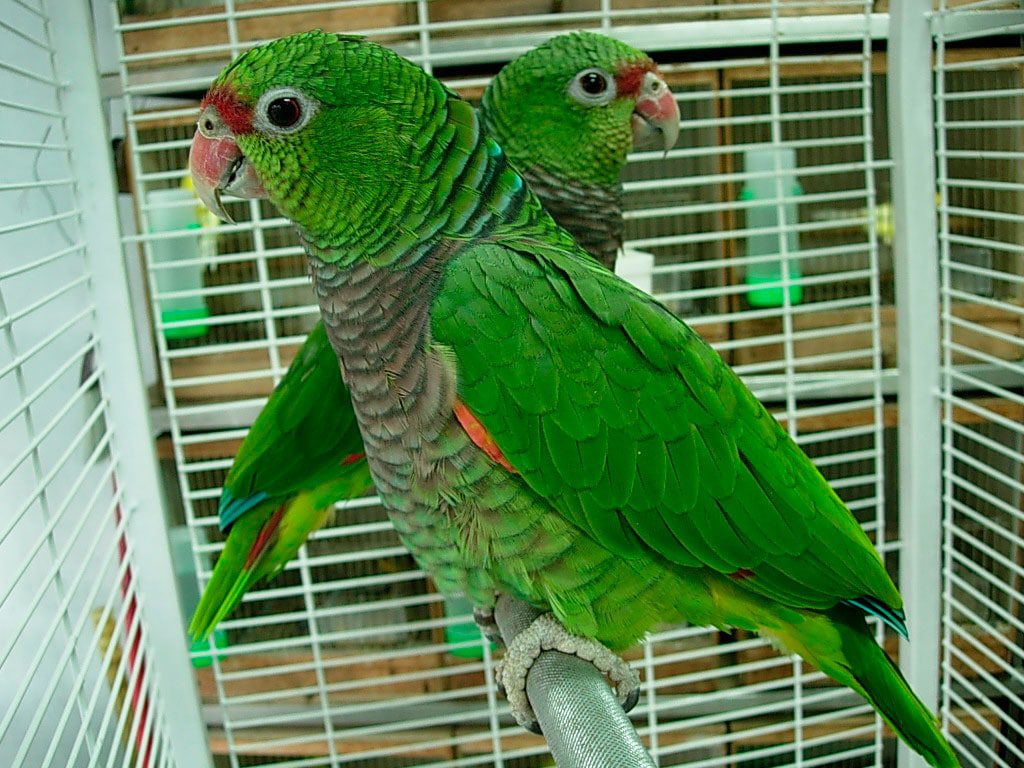
30 cm.. length and an approximate weight of 370 g..
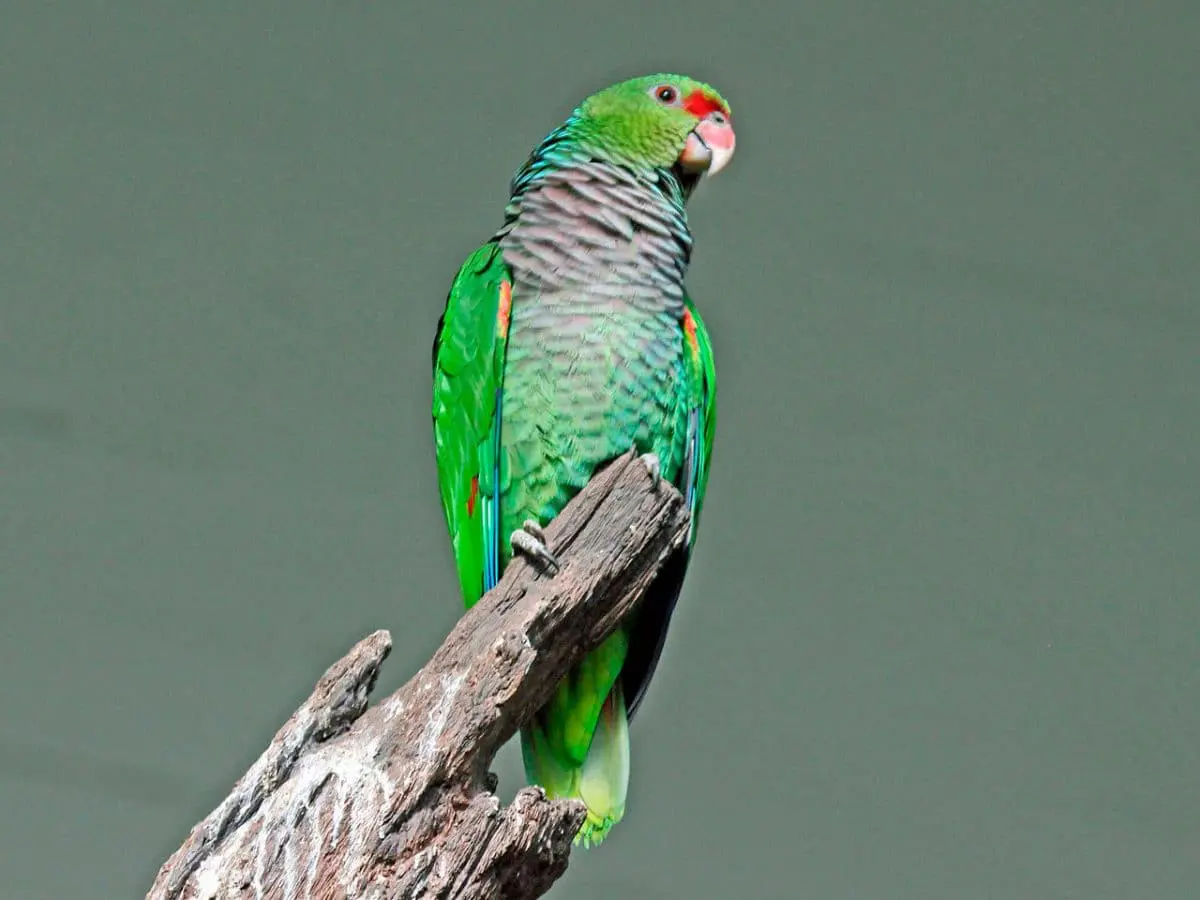
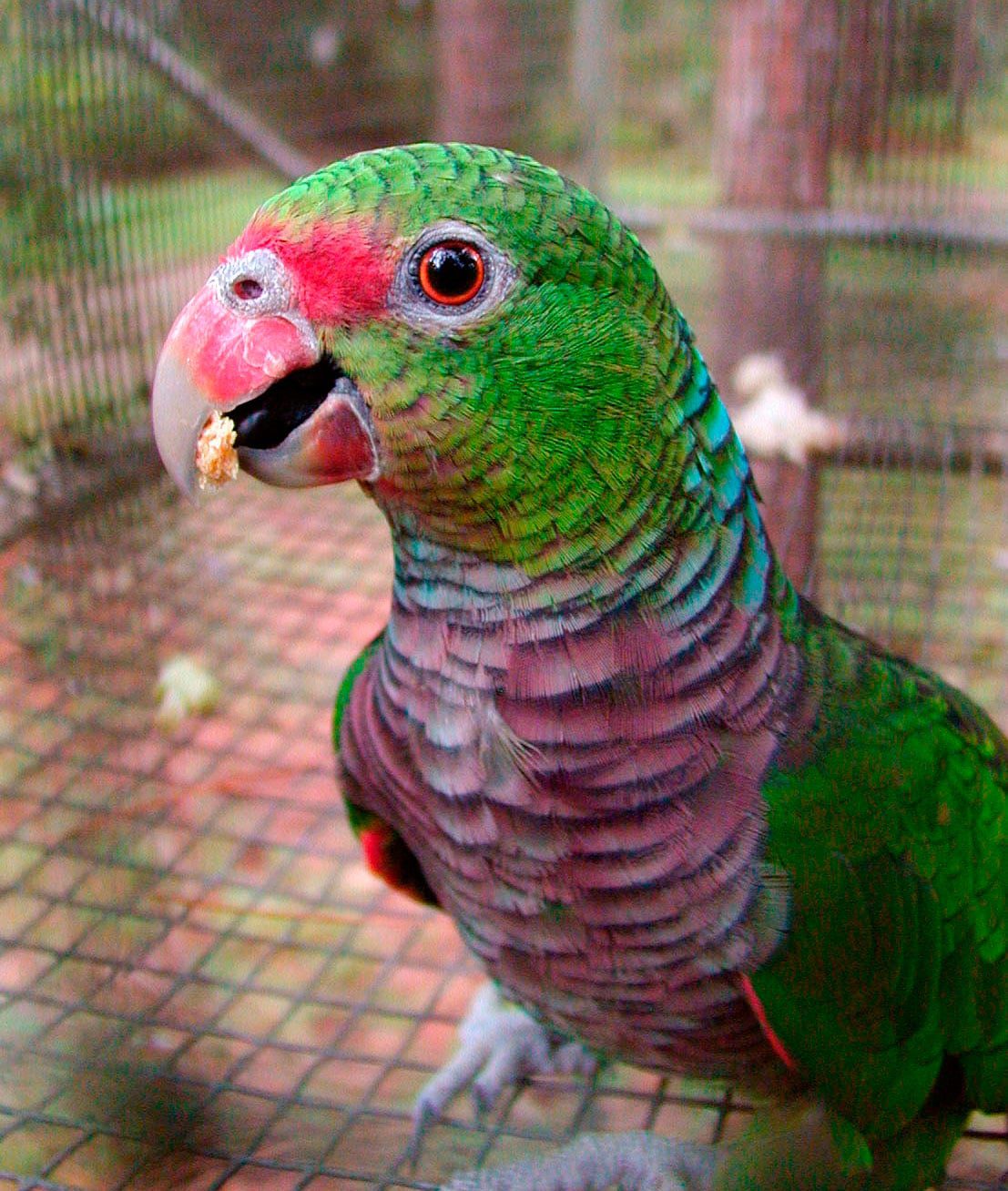
The Vinaceous Parrot(Amazona vinacea) has the lores and forecrown bright red; cheeks and crown green with black tips to some feathers head; elongated feathers on the sides of neck, the nape and the upper mantle, green at the base, subterminally light blue and black tip. The rest of the the mantle, back and scapulars, green with some feathers showing indistinct black tips; uppertail-coverts pale green.
Wing coverts green with red variable and / or yellow in leading edge of wing and the carpal area. Primaries pale bluish-green; Secondary green with blue tips, the base outerweb of the three outer secondaries, red, forming a small looking-glass. Under the wings, green. Throat and chest with shades that vary from strong wine brown to pale blue with a strong vinous diffusion; subterminal dark band at the tips of the feathers gives scalloping pattern; Belly green or yellowish green sometimes with vinous dissemination; undertail-coverts brighter yellowish green. Tail green with yellow green tip; the base lateral feathers in red innerwebs, in purple outerweb. The upper jaw It is red at the base with pale tip, horn-colored lower, reddish at the base; irises orange to reddish brown; legs grey.
Both sexes are similar. The immature It has the green suffusion in chest and the less extensive red on the head (confined to the base upper jaw).
Sound of the Vinaceous Parrot.
Habitat:
Video – "Vinaceous Parrot"
Purple-breasted Parrot in Itamonte - Minas Gerais, Brazil
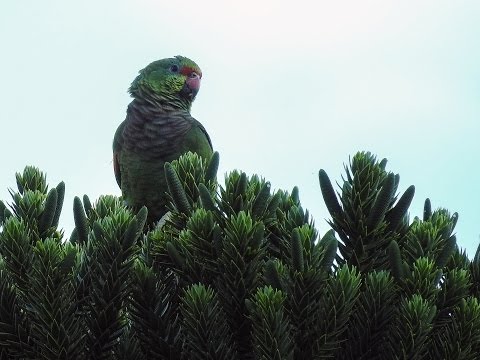
The Vinaceous Parrotinhabit in tropical and subtropical evergreen mixed forests; in the Brazil in humid coastal forests, in the East of Paraguay They can be found in forests Araucaria angustifolia and Euterpe edulis. The extent of the ecological dependence of this species on coniferous trees (Araucaria and Podocorpus) It is not clear, but the Araucaria angustifolia It is clearly important in Missions, Rio Grande do Sul and Santa Catarinaand possibly it was related to the previous distribution further north in southeast Brazil.
Mainly observed in the lowlands, but there are reports of birds seen in hills 1.500-2.000 meters in the southeast of Brazil, where the best forest remnants persist. Usually in pairs or small groups with larger meetings (up to approximately 30) in July-August. In pairs during breeding (usually around September).
Reproduction:
The Vinaceous Parrotnidifica in holes in large trees with obvious preference for the Araucaria angustifolia, including rarely cracks in the cliffs. With reproduce the May in loose colonies. breeding season during the months of September to January. Clutch 2-4 eggs.
After the breeding season (February to July), the species congregate in large groups and community shelters.
Food:
The specific foods of the Vinaceous Parrot include flowers and fruits of Euterpe edulis (which apparently it is important seasonally in East Paraguay), seeds of Araucaria angustifolia, fruits of cocoons of Achatocarpus and new leaves Eucalyptus and seeds of Pilocarpus. It has been reported damagor cause in crops of oranges, but with the current low density of this species, It is unlikely to produce a serious economic impact.
Distribution and status:
Size of its range (player / resident ): 1.230.000 km2
The Vinaceous Parrot It is endemic in Southeast South America.
There are some seasonal movements and post-breeding dispersal, possibly in relation to the food supply (for example, seed availability coniferous trees), with invasions scale reported in Paraguay in the past. Declines in the number of birds occur in Rio Grande do Sul January, with all its people disappeared by March and return in April for the rest of the year.
Formerly abundant and widespread but now there has been a contraction dramatic of its range and population, mainly due to the habitat destruction scale, the expansion of agriculture and floods caused by large hydroelectric dams. also trapped for a long time for bird trade.
Are distributed in several protected areas, but none is large enough to maintain a viable population. The former strongholds in eastern Paraguay They are subject to rapid deforestation, with a recent reduction in its scope and numbers and now probably confined only in Alto Paraná and Ganindeyu.
A census 2007 yielded a minimum of 253 copies in Argentina.
It is perhaps the Amazona more common in populations of Rio Grande do Sul, Santa Catarina and Paraná (several populations of more than 100 birds), in the South of Brazil, and the low number persists in Minas Gerais, Brazil and Sao Paulo, within an estimated total of 1.500-2.000 birds.
Conservation:
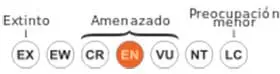
State of conservation ⓘ
Endangered ⓘ(UICN)ⓘ
• Current category of the Red List of the UICN: In danger of extinction.
• Population trend: Decreasing.
• Population size: 600-1700.
Rationale for the Red List category
This species is classified as endangered due to recent population estimates Brazil They indicate that the world population is very small and has suffered a rapid decline due to loss and fragmentation of habitat, aggravated by the trade. It is necessary to clarify whether Brazilian subpopulations exceed 250 specimens.
Justification of the population
Based on estimates 1.500 to 2.000 individuals in Brazil (G. Bencke in some. 2009), 220-400 in Paraguay and 253 in Argentina (K. Cockle in some. 2009), it is estimated that the total population is within the range of 1.970 -2.650 individuals and is probably positioned within the band 1,000-2,499. This is equivalent to 667-1.666 mature individuals, rounded here to 600-1.700 mature individuals.
Justification of trend
rapid and continuous population decline is suspected because of the Poaching of nests, the habitat destruction and persecution as a pest Of crops.
Conservation Actions Underway
• CITES Appendix I and II and protected by the Brazilian legislation.
• Nationally considered Vulnerable in Brazil (Urben-Filho et al . 2008, MMA 2014), and Critically Endangered in Argentina and Paraguay.
• Small populations are found in numerous protected areas (Wege and Long 1995, F. Olmos in some ., 1999).
• In the Argentina, two young provincial parks are used by the species, but they offer only partial protection because parrots use habitat outside the park for most of its life cycle, including, critically, the reproduction.
• In the Argentine stronghold of the species between San Pedro and Saint Rose, environmental education is underway to reduce the capture of chicks, and the population has been monitored since 2005 (Selva de Pino Paraná in litt project., 2007).
• It has been achieved successful captive breeding.
Conservation Actions Proposed
• Monitor large populations (in March Argentina).
• Study reproductive biology and demography throughout the species' range and develop structured captive breeding programs to counter the high level of poaching of wild populations..
• Protect the general Carneiro (Santa Catarina), Itaipu (Alto Paraná), RNP Itabó Rivas (Canindeyú), Estancia Golondrina (Caaguazu) and forests outside reserves Rio de Janeiro (Snyder et to the ., 2000) and between San Pedro and Saint Rose in Missions.
• Invest in permanently trained park rangers and resolve land tenure problems in Brazilian and Paraguayan reserves. (F. Olmos in some ., 1999, Cockle et al. 2007).
• Apply laws against the trafficking of species on the roads that connect the Monte Pascoal National Park with South Brazil (Snyder et to the ., 2000), in places where the species is captured and at borders and ports Paraguay and Argentina.
• Increase local public awareness to reduce nest theft and promote conservation of nesting sites..
• In Argentina, provide technical support to promote soil conservation, to avoid clearing forests for crops on small farms.
The Vinaceous Parrot in captivity:
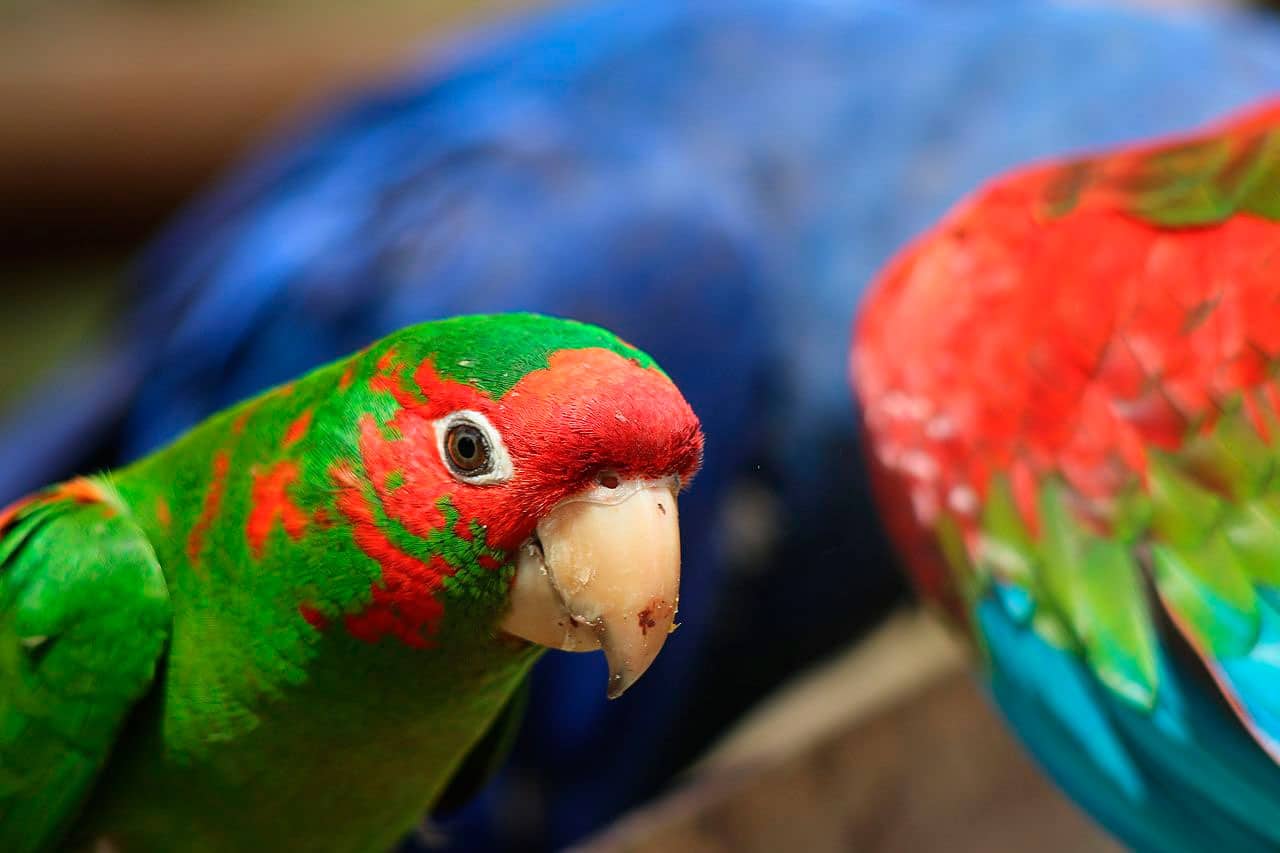
The Vinaceous Parrot noted for its easy to imitate the human voice, better and clearer than the Amazona aestiva. Small easily they learn to speak.
Two decades ago, before placement in the Appendix 1 CITES Convention, this species was available in aviculture. It never was imported to Europe in a large number, but nevertheless often it offered for sale. Its price was higher than other species of Amazona available at that time, because of its amazing looks and his talent as an imitator. As the trade in wild birds was coming to an end, the captive population decreased markedly. While this species has been willing to breed for those that provide adequate breeding and have enough individuals to allow natural selection of the mate., captive breeding has been very disappointing, considering the number of birds that were previously available.
In the current avicultura, it seems that there are still a significant number of birds kept in Europe. A survey of amazon parrots in the European zoos, made in 1993 and published in 1994 by the EAZA, he listed in 59 species Vinaceous Parrot conserved in 11 zoological collections: of this, only three, Loro Parque (Spain), Walsrode Bird Park (Germany) and Beauval (France), had recorded breeding successes. It's known, However, that a significant number of Vinaceous Parrot They are held by private poultry farmers Europe and if these owners are willing to work in cooperation with EEP plan that can be started for this species, then the known captive population Europe could be big, enough to be considered as a viable.
The population of this species in captivity is similar to that of other species of the genus Amazona. In Loro Parque a couple is kept in an aviary in the exhibition area of ​​the park, and several more couples are kept in breeding cages suspended in their breeding outside exhibition. Suspended breeding cages are approximately 300 cm long x 95 cm width and height. Each cage has the nest-box placed against the outer rear panel, and there is a cut in the wire hole to allow birds to enter the nest-box. With the nest located outside of the cage, this eliminates the need to enter the service or inspect the nest-box.
The feeding of these birds is done twice a day. To the 7 Morning receive their main dish containing a mixed salad prepared with the following elements: – Apple, pear, tomato, beet, Carrot, alfalfa, lettuce, Peppers, papaya and other fruits and vegetables seasonally available; In addition, They are also used, when available, various fruits that are grown in the park, as nopal cactus plants and berries palmera pindó (Syagrus romanzoffiana). A second smaller dish meal in the morning provides birds commercial pellets dietary, and during the breeding season each pair is also given segments of their own supplement "pie" that is made fresh every day. The evening meal is given to 3:00 pm, with a mixture of nuts, seeds and beans cooked.
The Vinaceous Parrot It was raised for the first time Loro Parque in 1990, when one pigeon was raised hand. The couple proved to be very unreliable when it came to the incubation their eggs, why he has always resorted to artificial incubation or host and breeding. This couple Vinaceous Parrot He received on subsequent occasions eggs more common species to give them the opportunity to prove that they are good parents, but so far they remain unreliable.
No offspring were produced in 1991, but the couple tried again in 1992, when he carried out another manually raising and other raised squab. In 1993, when the same pair joined again, the clutch of eggs was transferred to a pair of Red-crowned Parrot(Amazona viridigenalis), which they proved to be excellent foster parents and raised chicks born. The same technique was used in 1994, but only one egg clutch proved to be fertile and the chick was raised successfully by Red-crowned Parrot.
– Avibase
– Parrots of the World – Forshaw Joseph M
– Parrots A Guide to the Parrots of the World – Tony Juniper & Mike Parr
– Birdlife
– THE VINACEOUS AMAZON Amazona vinacea AT LORO PARQUE – First Published in The Avicultural Magazine Vol. 103 No. 2
– Photos:
(1) – Vinaceous-breasted Amazon (Amazona vinacea) – San Francisco Zoo, California By Dick Daniels (http://carolinabirds.org /) (Own work) [CC BY-SA 3.0 or GFDL], via Wikimedia Commons
(2) – Vinaceous Amazon in captivity at the Rare Species Foundation Programme, Florida, USA By derivative work: Snowmanradio (talk)Amazona_vinacea_-RSFP-8a.jpg: Ruth Rogers [CC BY 2.0 or CC BY 2.0], via Wikimedia Commons
(3) – Vinaceous Amazon at the Walsrode Bird Park, Germany By Quartl (Own work) [CC BY-SA 3.0], via Wikimedia Commons
(4) – Vinaceous Amazon; two in a cage By TJ Lin (originally posted to Flickr as Copy of DSCN3375) [CC BY-SA 2.0], via Wikimedia Commons
(5) – flying. Picture taken in Morretes By Leandro Govoni Lacerda (Own work) [CC BY-SA 4.0], via Wikimedia Commons
(6) – A Vinaceous-breasted Amazon at Parque das Aves, Foz do Iguaçu, Brazil By Kee Yip from Union City, California, USA (IMG_4509_P1040019) [CC BY 2.0], via Wikimedia Commons
(7) – Pigeons neck Amazone (Amazona vinacea) Shot in Palmitospark Gran Canaria By Martingloor (Own work) [CC BY-SA 4.0], via Wikimedia Commons
(8) – Vinaceous-breasted Amazon (Amazona vinacea) – San Francisco Zoo, California By Dick Daniels (http://carolinabirds.org /) (Own work) [CC BY-SA 3.0 or GFDL], via Wikimedia Commons
(9) – Amazone vineuse, Bioparc Doue-la-Fontaine By Melvin TOULLEC (Own work) [CC BY-SA 4.0], via Wikimedia Commons



















.jpg)

.jpg)


_(2087239475).jpg)
4.jpg)
.jpg)
_(3).jpg)


.JPG)

