โ–ท The world of Pets: Dogs, cats, birds, reptiles, amphibians

Tanimbar corella
Cacatua goffiniana

Cacatua de las Tanimbar

Content

Description

31 to 32 cm.. length and a weight of just 300 g..
The Tanimbar corella (Cacatua goffiniana), like all family members Cacatuidae, is a species crestada, meaning it has a collection of feathers on its head which can go up or down at will; his body is covered with white feathers with some feathers or salmon pink between bill and eyes.
The deepest parts of the feathers of the crest and of the neck They are also the pink, but the color is hidden by the white color of the more superficial. The bottom of its wings and feathers of the tail They have a yellowish hue. The bill It is pale gray and eyes range from brown to black.
There is a clear sexual dimorphism and, often, merge with the blood cockatoo (Cacatua sanguinea) due to their similar appearance.

Habitat:

Riparian forests, thickets of acacias and eucalyptus with short grass or pasture with scattered groups of trees.

Reproduction:

The start is two to three eggs, generally deposited in the hollow of a tree. The incubation, that is shared by two birds, lasts a few 30 days. The chicks they leave the nest about ten weeks after hatching, and feeding by the parents continues for another few weeks.

Food:

Dried fruits, fruit, berries, flowers, estate, bulbs, egg yolks, sprouts, and insects

Distribution:

Size of the area of distribution (reproduction / resident): 9.100 km2

The Tanimbar Cockatoo It is a species of cockatoo endemic to the forests of Yamdena, Larat and Selaru, all the islands of the Tanimbar Islands of Indonesian. This species has been introduced in the Kai Islands, Indonesian, Puerto Rico and Mexico.

Conservation:

State of conservation โ“˜


Near-threatened Near Threatened โ“˜ (UICN)โ“˜

โ€ข Current IUCN Red List category: Near-threatened.

โ€ข Population trend: Decreasing.

In the Decade of 1970, Japanese loggers ravaged the Islands. Many birds were stunned and disoriented and were captured for pet trade. Although many died from stress during transport, there is still some hope after this ecological disaster, since many cockatoos managed to reproduce in the programs of captive breeding. So, there are now more specimens in captivity than in their natural habitat.

This species has a range very small, but its population is severely fragmented or restricted to a few places. Despite suffering from the pressure of his capture, seems to have maintained a large population. But, the degradation of the habitat, trapping and continuous persecution is likely to be causing a moderate reduction of the population. Therefore it is classified as Near-threatened.

There is a conservation plan in endemic parrots Tanimbar Islands, Indonesian, financed by LORO PARQUE FUNDACIร“N

"Tanimbar corella" in captivity:

You can show a fearful beginning, but you quickly get used to their caregiver, turning into a very cockatoo sweet, playful, sometimes inquisitive and very active. Enjoy being observed, being the center of the world, like all cockatoos. His cry is not nice, but this little cockatoo is quickly forgiven everything as his antics and bad manners will surprise us and make us laugh.

Has the continuing need to fly so you need a large space.

Curiosities:

A Tanimbar corella, without previous training, open five types different locks:

The incredible mechanical intelligence of the Tanimbar cockatoos 1

The incredible mechanical intelligence of Tanimbar Cockatoo

Alternative names:

Tanimbar Cockatoo, Goffin’s cackatoo, Goffin’s Cockatoo, Tanimbar Corella (ingles).
Cacatoรจs de Goffin (French).
Goffinkakadu, Goffin-Kakadu (German).
Cacatua-de-goffin (Portuguese).
Cacatรบa de las Tanimbar, Cacatรบa de Tanimbar (espaรฑol).

scientific classification:

Order: Psittaciformes
Family: Cacatuidae
Genus: Cockatoo
Scientific name: Cacatua goffiniana
Citation: Roselaar,CS & Michaels, 2004
Protonimo: Cacatua goffiniana

Images Tanimbar Cockatoo:


Species of the genus Cacatua

Sources:
Avibase, BirdLife.org, faunadex
– Photos: sciencio.com, Marah09013 (Wikipedia),
– Sounds: Frank Lambert (Xeno-canto)

โ–ท The world of Pets: Dogs, cats, birds, reptiles, amphibians

Coconut Lorikeet (massena)
T. haematodus massena


Coconut Lorikeet (massena)

Content

Description (1)

25 cm.. length.

The Coconut Lorikeet (massena) (Trichoglossus haematodus massena) is a variation of the nominal (Trichoglossus Haematodus).

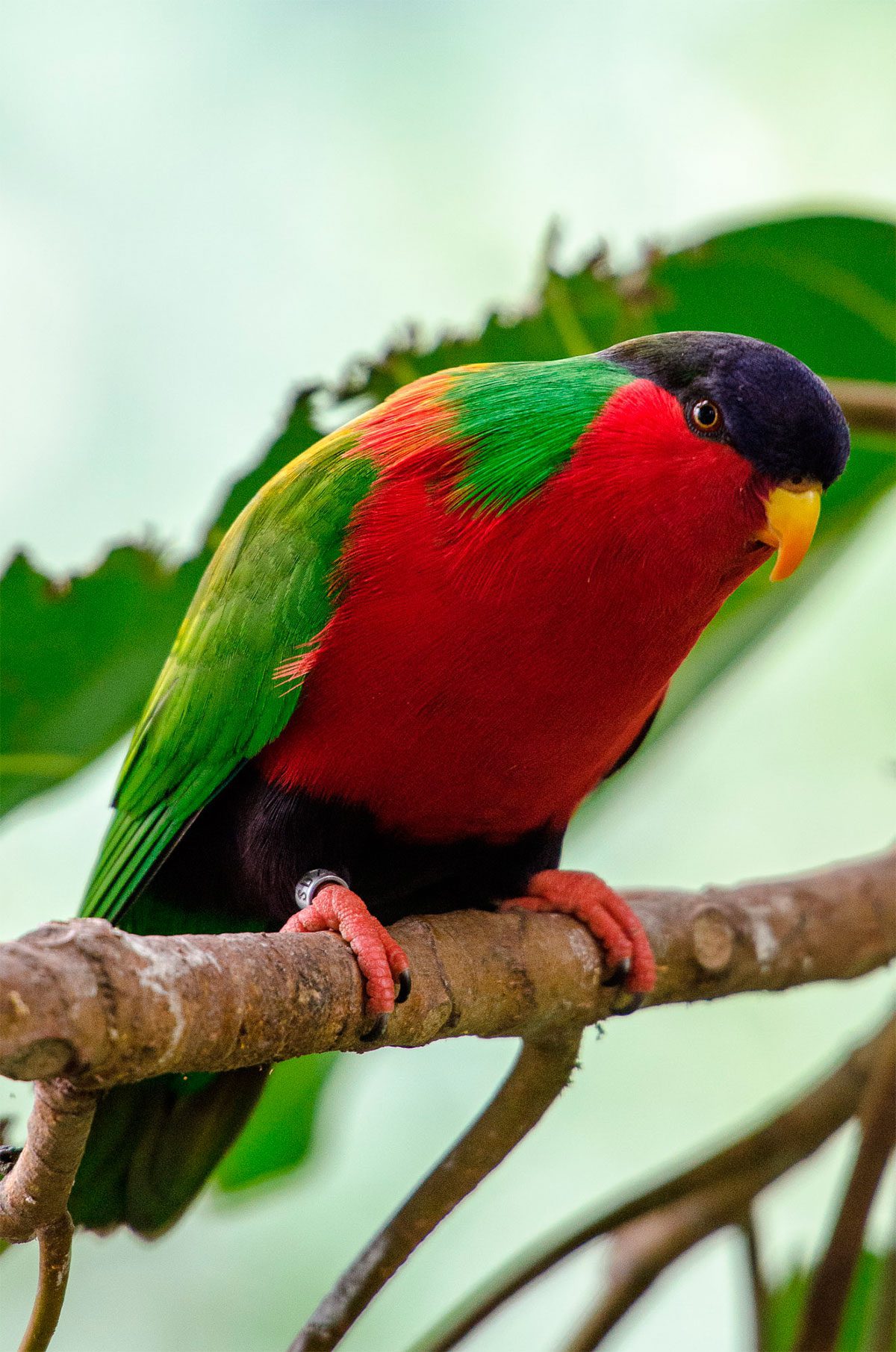
The plumage is similar to the of the Ornate Lory except that it is usually paler. The head is blue, ending at the nape with dark brown feathers interspersed with more Brown clear. The chest is reddish color with a narrow dark blue edging. In some cases, You can see some yellow zones in chest plumage. The abdomen is green; but there may be some kind of marking on the lower abdomen blue-violet.

The eyes are orange brown in juveniles and adult. The beak is orange-red.

Distribution:

Bismarck Archipelago, Solomon Islands and Vanuatu.

Conservation:

This species is endangered due to habitat loss and capture for the pet trade.

Alternative names:

Coconut Lorikeet (massena) (ingles).
Loriquet ร  tรชte bleue (massena) (French).
Allfarblori (massena) (German).
Lรณris-arco-รญris (massena) (Portuguese).
Lori Arcoiris Massena, Tricogloso de Pecho Rojo (massena) (espaรฑol).

scientific classification:

Order: Psittaciformes
Family: Psittaculidae
Scientific name: Trichoglossus haematodus massena
Genus: Trichoglossus
Citation: Bonaparte, 1854
Protonimo: Trichoglossus massena

————————————————————————————————

    (1) – Subspecies Coconut Lorikeet (Trichoglossus haematodus)

————————————————————————————————

ยซLori Arcoiris Massenaยป (Trichoglossus haematodus massena)


Sources:

Avibase

Photos: animalphotos.me

โ–ท The world of Pets: Dogs, cats, birds, reptiles, amphibians

Stephen's Lorikeet
Vini stepheni

Stephen's Lorikeet

Content

Description

19 cm.. length and a weight between 42 and 55 g..

The plumage of the Stephen's Lorikeet (Vini stepheni), in general is green.

The upper part of the head is light green. The region of the windows of the nose, the cheeks, the ear-coverts, the neck, the chest and the abdomen They are red. It has a belt Variable greenish purple size chest. Thighs and bottom of the abdomen They are purple. The Hip is yellowish-green. The feathers wing-coverts They are red and green; the primaries, longer, are black. The upper part of the tail It is yellowish green and the bottom darker yellow with green.

The irises It is reddish brown, the legs and the bill are orange.

The immature they have the underparts green with purple and red marks on the throat and the abdomen. Tail dark green. The bill and eyes They are brown.

Habitat:

Its usual habitat are dense shrubs and trees, Palm trees, handles, coconut and banana plantations.

They make daily trips from the forest into the coastal strips to feed in coconut palms.

They live in pairs or small groups outside of the breeding season.. They are very active and hard to see in dense vegetation; the easiest way to see them is in flight, they are easy to distinguish by their bright red plumage. Its flight is fast with a characteristic buzz of the wings.. They are not shy and allow you to see them up close, are especially when eating.

Reproduction:

There are no data about its reproduction in the wild.

Food:

The Stephen's Lorikeet is omnivore, consumes nectar, pollen and fruits of a wide variety of plants. The flowers of the plants Scaevola sericea and Timonius polygamus They provide the main sources of nectar. Arthropods are part of the diet, including lepidopteran larvae found in the sporangia fern Phymatosorus

Distribution:

Stephen distribution of Lori


The Stephen's Lorikeet is limited to Henderson island in the Pitcairn Islands, a small island uninhabited and surrounded of coral limestone cliffs, in the south-central zone of the Pacific Ocean.

The Pitcairn Islands, Henderson, Ducie and Oeno There are four volcanic islands in the southern pacific ocean. These islands are a British overseas territory (formerly a British colony), the last one left in the peaceful.

In 1987, the total population It was estimated between 720 and 1.820 specimens.


Conservation:


Vulnerable


โ€ข Current IUCN Red List category: Vulnerable

โ€ข Population trend: Stable

This species may be the only member of its genus whose habitat and population size have been little affected by adverse changes in its environment.. But, is qualified as vulnerable, Since it is only on a small island.

It seems to have adapted to the presence of the only introduced predator., the pacific rat (Rattus exulans). In August of 2011, a rat eradication operation was carried out in the Henderson island to eradicate R. exulans of the island. But, the accidental introduction of a more aggressive predator, as other species Rattus, could be devastating. Diseases such as malaria avian and smallpox are another potential threat. The introduction of exotic plant species could have serious consequences for native vegetation and, Therefore, for this species.

– Rat eradication could save seabirds on Henderson Island

Averted a potentially serious threat in 1983 When an American millionaire sought to make a home in the Henderson island. The request was rejected by the Government of the United Kingdom. Henderson is now a world heritage site.

"Stephen's Lorikeet" in captivity:

There are currently no known Stephen's Lorikeet in captivity. VULNERABLE.

Due to its endangered status, any specimen that can not be returned to their natural habitat (natural range) should preferably be placed in a well-managed breeding program to ensure the survival of the species.

Alternative names:

Stephen’s Lorikeet, Henderson Island Lorikeet, Henderson Island Lory, Henderson Lorikeet, Henderson Lory, Stephen’s Lory, Stephens’s Lory (ingles).
Lori de Stephen (French).
Hendersonlori, Henderson Lori (German).
Stephen Lori (Portuguese).
Lori de Stephen (espaรฑol).

scientific classification:

Order: Psittaciformes
Family: Psittaculidae
Genus: Vini
Scientific name: Vini stepheni
Citation: (North, 1908)
Protonimo: Calliptilus ? stepheni

Stephen Lori "Images":

Videos "Stephen's Lorikeet"

————————————————————————————————

ยซLori de Stephenยป (Vini stepheni)


Sources:

Avibase
– Parrots of the World โ€“ Forshaw Joseph M
– Parrots A Guide to the Parrots of the World – Tony Juniper & Mike Parr
– Birdlife

Photos:

1 – by ยฉ Pawl Warren – UK OVERSEAS TERRITORIES CONSERVATION FORUM
2 – By Peter Fitzgerald, Andrew J.Kurbiko, Hansbaer, Openstreetmap (File:Pitcairn Islands map.svg) [CC BY-SA 3.0], via Wikimedia Commons

Sounds: Mark Todd (Xeno-canto)

โ–ท The world of Pets: Dogs, cats, birds, reptiles, amphibians

Striated Lorikeet
Charmosyna multistriata

Striated Lorikeet

Content

Description

They weigh around 40 to 50 g. and length of 18 cm..

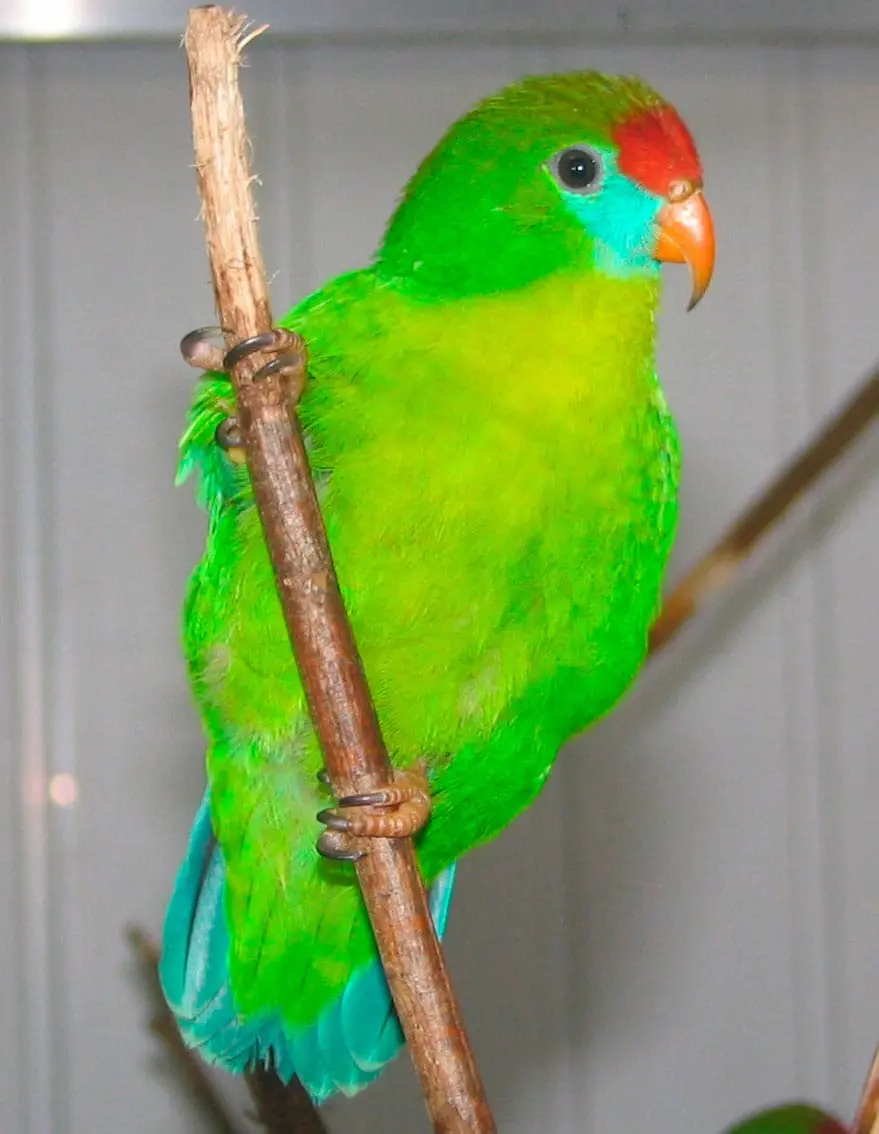
The plumage of the Striated Lorikeet (Charmosyna multistriata) It is predominantly green with yellow stripes on the belly and in the chest.

The throat, the forecrown and sides of the head They are slightly more yellow. The neck and the back of the head They are brown with some orange yellow stripes. The tail is olive green on top and having a tip dark yellow. The bottom of the tail It is greenish yellow with some red feathers around the vent. The most characteristic feature of Striated Lorikeet is the bill two colors. Upper bill is blue-gray with a touch of red orange, While the bottom is completely reddish-orange. Only one other Lori with a peak of two colors and that is the Musk Lorikeet. The irises It is red and legs They are gray with black nails.

Both sexes are the same color, the male is slightly larger and has a bill longer. They are also a little colored in the head.
The immature They have the same colors as adults, only the bill it is more black and darker stripes.

Habitat:

It inhabits in the mountains and hills and forest edges. Mainly found between 180 and 1.800 m, but they have been at much lower altitude, about 80 m. Found in pairs or in small groups of up 20 birds, sometimes fellowship with the Red-flanked Lorikeet and the Fairy Lorikeet (observed in mid-February in mixed flocks with these species). similar to the behavior Red-flanked Lorikeet, the consorts, but although they have observed flocks Striated Lorikeet fly with the Red-flanked Lorikeet, they usually form discrete individual groups.

Reproduction:

Habits of nesting and breeding unknown.

Food:

Prefer treetops in bloom where it feeds on pollen and nectar, but they may also feed on epiphytes.

Distribution:

Size of the area of distribution (reproduction / resident) 170,000 km2

Endemic to the montane forests of the center of West Papua New and Papua New Guinea, South of the cordillera central. The world population It is believed to be of less than 10.000 specimens, but it is probably stable. A small number in captivity.

Conservation:


Near-threatened


โ€ข Current IUCN Red List category: Near threatened

โ€ข Population trend: Decreasing

Its habitat is locally threatened by logging and clearing for agriculture. Reports of the species in Ok Tedi They show that the population of the Striated Lorikeet has fallen dramatically after the severe drought in 1997-1998 (P. Gregory in litt., 2010).

The species may be threatened by the presence of a large copper and gold open pit mine in Ok Tedi, but the impacts of this mine are currently unknown. It is likely to be tolerant of uneven and degraded forests and although it may have a small population in general, do not believe that it is declining very rapidly.

"Striated Lorikeet" in captivity:

In aviculture the Striated Lorikeet It has become one of the rarest species. These birds have not been imported in large quantities, and many of the birds that survived the journey later died due to infections by fungi and other diseases. Few breeders were able to raise them on a regular basis.

Alternative names:

Striated Lorikeet, Streaked Lorikeet, Yellow Streaked Lory, Yellow-streaked Lorikeet (ingles).
Lori striรฉ (French).
Streifenlori (German).
Lori Estriado (espaรฑol).

scientific classification:

Order: Psittaciformes
Family: Psittaculidae
Genus: Charmosyna
Scientific name: Charmosyna multistriata
Citation: (Rothschild, 1911)
Protonimo: Charmosynopsis multistriata

"Lori striated" images:

————————————————————————————————

ยซLori striatedยป (Charmosyna multistriata)


Sources:

Avibase
– Parrots of the World โ€“ Forshaw Joseph M
– Parrots A Guide to the Parrots of the World – Tony Juniper & Mike Parr
– Birdlife
– loryclub

Photos:

1 – Author: Jaroslav Chloupekbiolib.cz
2 – by DavyVanthuyneโ€™s Bucket
3 – Birds-pet-wallpapers – link
4 – Author iggino – lynx
5 – tierportraet.ch – link

โ–ท The world of Pets: Dogs, cats, birds, reptiles, amphibians

Moluccan hanging parrot
Loriculus amabilis

 Moluccan hanging parrot

Content

Description

11 cm.. length between 25 and 38 g. of weight.

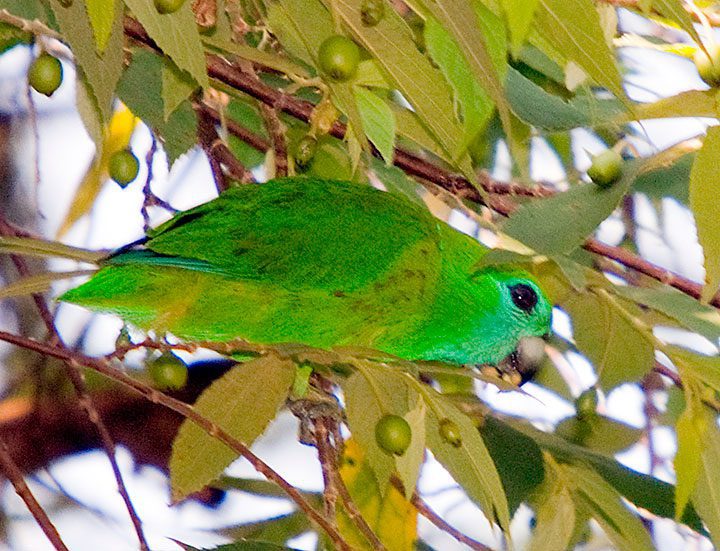
The Moluccan hanging parrot (Loriculus amabilis)(Loriculus amabilis) has the head of color green with the front of the crown red. The the mantle slightly tinted Orange; rump and uppertail-coverts dark red. The latter extends almost to the tip of the tail. Wings green; Red and yellow mark in the carpus. Under, the wings blue with coverts greenish blue. Chin red; rest of the underparts more green yellowish to them upperparts, especially the coverts at the bottom of the tail. The tail, at the top, green, by down Bluestone with fine yellowish tips.

The bill black; irises yellowish white; legs oranges.

Female with the crown green, red dots on the forecrown and throat. Iris brown.

The young birds with trademark yellow around the bib, and at the edge of the carpus. Iris pale brown.

Habitat:

It is distributed by primary and secondary forests, in the lowlands until 800 m, along the edges of forests, in the mangroves and the casuarinas coastal, on the edges of agricultural land, around the villages and occasionally in forests of coconut trees.

The species is observed more frequently in solitary, in pairs or in small groups in the vicinity of the trees in flower.

Reproduction:

Little is known of the habits of nesting, only periods of courtship have been recorded.

Food:

Their natural diet consists of nectar, fruit, outbreaks, flowers and seeds.

Distribution:

Size of the area of distribution (reproduction / resident) 23.000 km2

Endemic to Indonesian, where are distributed by the islands off the northeast of Sulawesi including the archipelagos of the Banggai (Peleng. Labobo) and Sula (Seho, Taliabu, Mangole, Sulabesi), and in the North of Moluccas in Kasiruta, Bacan, Halmahera and Morotai.

In the Sula Islands It is rare, its population is probably around of 5.000 birds due to habitat loss. The status of the species in Banggai and Peleng It is insufficiently known.

Conservation:


minor concern


โ€ข Current IUCN Red List category: Least concern

โ€ข Population trend: Stable

The size of the world population It has not been quantified, Although it is believed that it is superior to the 20.000. specimens. The species is described as moderately common, although rarer in primary forest and common in secondary forest (pit et to the. 1997).

The population is suspected to be stable in the absence of evidence of any reduction or substantial threats, Although slightly affected by trade.

"Moluccan hanging parrot" in captivity:

Unknown.

Alternative names:

Moluccan Hanging-Parrot, Halmahera Hanging-Parrot, Moluccan Hanging Parrot, Wallace’s Hanging-Parrot (ingles).
Coryllis des Moluques, Coryllis des Moluques (nominal), Coryllis des Moluques (nominale), Coryllis des Moluques (race nominale) (French).
Zierpapageichen (German).
Loriculus amabilis (Portuguese).
Lorรญculo Amable (espaรฑol).

scientific classification:

Order: Psittaciformes
Family: Psittaculidae
Scientific name: Loriculus amabilis
Citation: Wallace, 1862
Protonimo: Loriculus amabilis

images of "Moluccan hanging parrot"

Videos "Moluccan hanging parrot"

————————————————————————————————

Moluccan hanging parrot (Loriculus amabilis)


Sources:

Avibase
– Parrots of the World โ€“ Forshaw Joseph M
– Parrots A Guide to the Parrots of the World – Tony Juniper & Mike Parr
– Birdlife

Photos:

(1) – Single bird on a branch by nvoaden – lynx

Sounds: Mike Nelson (Xeno-canto)

โ–ท The world of Pets: Dogs, cats, birds, reptiles, amphibians

Large Fig Parrot
Psittaculirostris desmarestii


Large Fig Parrot

Content

Description

18 cm.. length and a weight between 108 and 126 g..

The Large Fig Parrot (Psittaculirostris desmarestii) is a small Parrot, Chunky, of head large, with one tail short of tip, can only be confused with the Double-eyed Fig-Parrot.

The Large Fig Parrot have the front of the crown burning Orange, paler towards the nape; lores orange red; area above and below the eye, clear turquoise and bright blue-violet; cheeks and elongated headphones feathers bottom of color green pale bright, diffuse orange in the Center. Stripe blue in the part back from the neck.

Upperparts green, with a wash light color olive on the part lumbar and Hip; coverts of the wings green, with orange spots at the tip of the greater coverts more internal; vane outside of the flight feather more blue-green that the coverts and with margin yellow on the tips; vane blackish brown internal; bend of wing light blue. Wing feathers Turquoise Green (the longest yellow); below, the wings, with yellow band in vane inner, with the exception of the primaries outermost.

The underparts of a green more light, broken by a close and continuous band of pale blue at the top of the chest, bordered below by a reddish-brown band.

Upper, the tail green; below greyish green.

The bill black; irises dark brown; legs gray-green.

The females the males are, except in the lowlands of the South where lack of yellow in the back of the neck, present in males (in this species, young birds are like the female).

The immature they have a crown dirty yellowish in most subspecies, although immature of the Southeast they have the crown green. In Misool, the juveniles they have a blue dot in the eye that is lost with the plumage of the adult.

Subspecies description

Subspecies description
  • Psittaculirostris Psittaculirostris desmarestii

    : (Desmarest, 1826) – The nominal.


  • Psittaculirostris desmarestii blythii

    : (Wallace, 1864) – Males and females are similar to the occidentalis, but with cheeks bright orange-yellow; the blue color under the eyes, absent.

    The youth, similar to adults, but with blue under the eye.


  • Psittaculirostris desmarestii occidentalis

    : (Salvadori, 1876) – Both the male and the female with the cheeks and throat golden yellow, becoming yellow bright in the elongated ear-coverts; Blue pale and greenish below the eyes; absent the blue color of the neck.

    The youth, equal to adults.


  • Psittaculirostris desmarestii intermedius

    : (Victoria, 1909) – Both adults similar to the nominal species, but much deeper orange color of the crown and nape; cheeks green and ear-coverts Yellowish orange to some feather-tipped; the nuchal collar blue, absent the least.

    The youth, equal to adults


  • Psittaculirostris desmarestii godmani

    : (Ogilvie-Grant, 1911) – In the male, the blue color in the occiput and under the eye, is absent; orange-red in the crown and nape with a yellow stripe on the back of the neck; cheeks and headphones coverts bright; the band light blue above the chest is more extensive, but the red-orange band below is absent or minimal. The female is green on the back side of the neck, absent yellow band.

    The youth, equal to adults.


  • Psittaculirostris desmarestii cervicalis

    : (Salvadori & Dโ€™Albertis, 1875) – Male and females are similar to the subspecies godmani, but with the nape and back neck , are blue; darker blue chest band; Orange the part low of the chest and the abdomen.

    The youth with the crown and nape green.

Habitat:

The Large Fig Parrot are found in the land low and forests in the hills, riparian forests, edge forest and occasionally in sheets, usually below 1.100 m, at the local level to the 1,650 m.

Very active, are released from branch to branch and quickly fly in groups of 2 to 6 birds through the trees in search of food, make calls constantly.

Reproduction:

Its breeding season It has registered in various moments of the year, with reproductive behaviors observed in July and September. Little is known of their breeding habits but they have been observed to use the nests communally, in groups of up to three couples, also it has observed them in noisy groups in the vicinity of alleged nests high in the trees.

During the courtship, mutual grooming is common, and during copulation the male places one foot on the back of the female and one on its perch.

Food:

The diet is made up mainly of figs and their seeds, nectar, and probably insects.

The birds gather in small groups to feed at the top of the fruiting fig trees. Cut the fruit with their sharp beaks to expose seeds.

Distribution:

Size area (reproduction / resident): 82.400 km2

West and South of Irian Jaya, Indonesia New Guinea, Since the papuan islands (West Batanta, Salawati and Misool), through the peninsulas of Vogelkop to Bomberai and Onin in the South, and in the north of the Peninsula Wandamen, in the South and East of the lowlands and hills (in the area of Karimui) 137 ยฐ E, reaching around of Popondetta on the north coast of the southeastern peninsula. The species is unique and locally common, with a stable world population estimated at more of 150.000 specimens. The subspecies Psittaculirostris desmarestii occidentalis they are declining, probably because the bird trade and habitat loss.

Subspecies distribution

Subspecies distribution
  • Psittaculirostris desmarestii desmarestii

    : The nominal – West of New Guinea (East of regions of peninsula Vogelkop)


  • Psittaculirostris desmarestii blythii

    : Islands of Misool (West of papua islands)


  • Psittaculirostris desmarestii occidentalis

    : West of peninsula Vogelkop, Salawati and Batanta Islands


  • Psittaculirostris desmarestii intermedius

    : West of New Guinea (peninsula Onin)


  • Psittaculirostris desmarestii godmani

    : South of New Guinea (from the southeast of Irian Jaya to Fly River)


  • Psittaculirostris desmarestii cervicalis

    : Southeast of New Guinea (from Fly River at the East end of Papua New Guinea)

Conservation:


minor concern


โ€ข Current IUCN Red List category: Least concern

โ€ข Population trend: Decreasing

The size of the world population Although not it has quantified, It is thought that it may be above the 150,000 specimens. The species, according to sources, is usually Rare and local (pit et to the. 1997).

The population is suspected that it may be in decline due to the destruction of habitat and fragmentation underway, and perhaps also by the captures for the bird trade.

"Large Fig Parrot" in captivity:

Rare in captivity.

The Large Fig Parrot It Active and playful. Pretty quiet; only makes noise when shaken. It is customary to caregiver quite easily. You can stay in the colony only in a large aviary.

Alternative names:

Large Fig Parrot, Demarest’s Fig Parrot, Desmarest’s Fig Parrot, Desmarest’s Fig-Parrot, Flame-headed Fig Parrot, Large Fig-Parrot (ingles).
Psittacule de Desmarest (French).
Buntbrust-Zwergpapagei, Buntbrust-Zwergpapgei (German).
Lรณris-da-cabeรงa-dourada-de-desmarest (Portuguese).
Lorito de Desmarest (espaรฑol).

scientific classification:

Order: Psittaciformes
Family: Psittaculidae
Genus: c
Scientific name: Psittaculirostris desmarestii
Citation: (Desmarest, 1826)
Protonimo: Psittacus Desmarestii

Images "Lorito de Desmarest":

Videos "Large Fig Parrot"

————————————————————————————————

"Lorito of Desmarest" (Psittaculirostris desmarestii)


Sources:

Avibase
– Parrots of the World โ€“ Forshaw Joseph M
– Parrots A Guide to the Parrots of the World – Tony Juniper & Mike Parr
– Birdlife
parrots.org

Photos:

(1) – By Zdenek ChalupaBiolib
(2) – By Vladimir MotyฤkaBiolib
(3) – Would Janmad (Own work) [GFDL or CC BY 3.0], via Wikimedia Commons
(4) – animalphotos
(5) – ยซBuntbrust-Feigenpapagei desmarestrii Psittaculirostris 090501 We 228ยซ. Licensed under CC BY-SA 3.0 via Wikimedia Commons.

Sounds: BAS van Balen (Xeno-canto)

โ–ท The world of Pets: Dogs, cats, birds, reptiles, amphibians

Blue-headed Racquet-tail
Prioniturus platenae


Blue-headed Racquet-tail

Content

Blue-headed Racquet-tail

Description

27 to 28 centimeters length (23,5 not to mention their racquets).

The head of the Blue-headed Racquet-tail (Prioniturus platenae) is clear brilliant blue. Mantle and back of color green light; rump slightly brighter green. Wings green, flight feather with vane blackish internal.

Underwing coverts Turquoise Green, strongly impregnated with blue. Upper abdominal area green, strongly impregnated with blue; undertail-coverts brighter yellowish green, uppertail-coverts bright. Upper, the tail green, Blue-Green lateral feathers with black tips; undertail, the tail dark, bathed in blue; spatulas blackish

Bill blue-white; irises yellowish; legs black.

Female no blue in the underparts (or simply a wash light blue) and a wash light turquoise blue in the head, in the absence of the male light blue Cap; also with extensions in tail shorter.

Habitat:

Little-known. The species is found in moist lowland forests and nearby crops up to altitudes above 300 m. In the islands of the North of Palawan, you have registered in the ultrabรกsico forest, bamboo thickets, mangroves and natural grasslands with scattered trees.. Birds are often recorded in small groups and their habits are presumably similar to those of other Prioniturus.

Reproduction:

There are hardly any data relating to its reproduction. Marked juvenile birds have been collected in January (two) and in August, and a markedly immature, in the month of may.

Food:

There are many data about food. Remains of nuts have been found in the stomachs of the specimens.

Distribution:

Endemic to Palawan and associated Islands, West of Philippines. Registered in Balabac, Dumaran and the islands of the Calamian group (Culion, Calauit, Busuanga). Uncommon and declining due to the destruction of their habitat and indiscriminate capture. The species is uncommon but regular in the Puerto Princesa Subterranean River National Park.

Conservation:


Vulnerable


โ€ข Current category of the Red List of the UICN: Vulnerable

โ€ข Population trend: Decreasing

The population is estimated at 2,500-9,999 individuals based on an assessment of the known records, descriptions of the abundance and range size.

The lack of recent information on this species is opposed to making strong claims about its current trend, but threats by logging, mining and trapping, They suggest that the species is declining rapidly.

The set of Palawan It is classified as a hunting ground, where is hunting illegal, the island was designated as a Biosphere reserve in 1990. But, legislation controlling habitat disturbance and hunting is difficult to enforce effectively.

"Blue-headed Racquet-tail" in captivity:

Not found in captivity.

Alternative names:

Blue-headed Racquet-tail, Blue headed Racquet tail, Blue-headed Racket-Tail, Blueheaded Racket-tailed Parrot, Blue-headed Racquet Tail, Palawan Racket-tailed Parrot, Palawan Racquet-tail, Palawan Racquet-tailed Parrot (ingles).
Palette de Palawan, Palette ร  tรชte bleue, Perroquet ร  raquette de Palawan (French).
Palawan-Spatelschwanzpapagei, Palawan Spatelschwanz-Papagei, Palawanpapagei (German).
Prioniturus platenae (Portuguese).
Lorito Momoto de Palau, Lorito momoto de Palawan, Lorito-momoto de Palawan (espaรฑol).

scientific classification:

Order: Psittaciformes
Family: Psittaculidae
Genus: Prioniturus
Scientific name: Prioniturus platenae
Citation: Blasius,W, 1888
Protonimo: Prioniturus platenae

– Recent phylogenetic study suggests that this species is part of a clade containing also to the P. waterstradti, P. Montanus and P. mindorensis. Formerly treated as a subspecies of the P. discurus, but the treatment recently strengthened as species, considers it Monotypic.

Images "Blue-headed Racquet-tail"

————————————————————————————————

โ€œPalawan Momoto Loritoโ€ (Prioniturus platenae)

Sources:

Avibase
– Parrots of the World โ€“ Forshaw Joseph M
– Parrots A Guide to the Parrots of the World – Tony Juniper & Mike Parr
– Birdlife

Photos:

(1) – Birds of the Philippines – Near Coron Airport, Coron, Palawan. April 2010 – manilaoldtimer
(2) – minghouse.infolinker.com.tw

Sounds: Paul Noakes (Xeno-canto)

โ–ท The world of Pets: Dogs, cats, birds, reptiles, amphibians

Alexandra's Parrot
Polytelis alexandrae

Alexandra's Parrot

Content


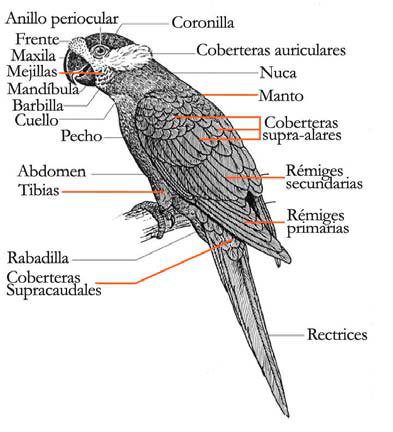
Anatomy-parrots

Description

45 cm. length, including its long, narrow tail, and around 92 g. of weight.

The head of the Alexandra's Parrot (Polytelis alexandrae) is light olive brown color, heavily washed in blue pastel in the Crown area, the nape of the neck, and slightly below the eyes; the Chin and throat pale pink.

Mantle and scapulars Brown olive-tinged greenish and fine dark stripes; back and rump, color pastel blue; upper coverts greenish-gray tail. Upper coverts bright yellowish green wings, with a few more green feathers around the curve of the wing; Dark greenish blue primary coverts; primary blue-green with yellowish-brown, and dark brown margin leading edge for the vane inner (the third rรฉmige primary has the tip spatula-shaped. ); secondary of pale blue-green with a yellowish margin (more pronounced in vane outer); greenish grey tertials with vane more obscure internal. Wing of bright green feathers, more yellow towards leading edge; undertail, wings greyish Brown with large pale yellow inner margin to the vane inner. Usually gray olive underparts pale, with the pink color of the throat which runs on top of the chest; belly and flanks washed clear bluish green; thighs and lower flanks with increase in pink; coverts yellow olive color infracaudales. Upper, tail Brown olive green near the axis and blue toward tip-washed, lateral feathers bluish grey and pink-tipped; undertail, Black tail with tips and margins of pink.

The beak is red with a grey periophthalmic ring; orange-yellow irises; grey legs.

Female has a shorter tail (average of 6 cm.. less than the male) and it lacks of spatula in the third tip rรฉmige primary. The wing coverts are greener and more off. And the mantle shows less green Suffusion. Crown, back and rump are less blue.

Immature similar to females and males acquire the adult plumage in about 14 to 18 months.

Habitat:

Highly nomadic and little known in the wild.

Inhabits the deserts of sand from the arid Center of Australia, often far from water. Birds can reach an area which have been absent for many years, reproduce, and quickly exit again.

They are found in mound grasslands, dry forests of coastal eucalyptus, thickets of acacia, mulga (Acacia aneura) and deserts with scattered Oaks (Allocasuarina decaisneana).

The birds are alone, in pairs or in small groups of up to 15 Member. There are also some earlier records of larger breeding colonies.

Reproduction:

The breeding season has been recorded from September to January, Although the nesting can be irregular and probably depend on the rainfall of rain and is also sometimes colonial.

During courtship, the male raises some feathers on its Crown and extends its wings and tail.

Favorite nesting place is a large hole in a Red eucalyptus (Eucalyptus camaldulensis) lined with a pile of rotting wood dust (the desert oak It has also been used).

Of four to six white eggs make up the implementation, incubated by the female for a few 21 days. While the female is incubating, the male takes care of your power. The young are fed during 5-6 weeks and become independent from three to five weeks after leaving the nest.

Food:

The birds feed on the ground and can be very meek. The diet includes seeds of Spinifex (Triodia mitchelli) and Herb mulga (Bipartite Danthonia). As well, according to sources, they can feed on nectar.

Distribution:

The Alexandra's Parrot are confined to the interior of Australia, where usually are very rare and few records. The species is an irregular visitor, It may not appear in parts of its distribution area for two decades or more.

Are distributed in Western Australia, from the North of the Great sandy desert to the West of the fitzroy river, about Wiluna, Sandstone, Menzies and Coolgardie and East through the deserts Gibson and Great victory.

Occurs in the Northern Territory to the North of the area of Newcastle Waters and Stuart Plains, and to the South up to around Alice Springs.

In Queensland, It is very rare in the South-western end, but there is a recent breeding record around Cloncurry.

In South Australia, extends to the East, about Oodnadatta, and there is a record of 1986 in the Great Victoria desert some 25 kilometers to the North of the Nurrari Lakes.

There is disagreement about its conservation status. The recent lack of records of large groups of reproduction, He cited as a possible indication of population decline, but there is little real information, and it suggests that the world's population can be estimated between 1.000 and 20.000 birds. A recent study suggests the species could be irruptive rather than nomadic, and that a population nucleus may be resident in the area around the Tobin Lake, Western Australia.

Trade, fires, changing land use regimes and predation, they have been cited as potential threats.

Protected by law.

A large number in captivity.

VULNERABLE

Conservation:


Near-threatened


โ€ข Current category of the Red List of the UICN: Near threatened

โ€ข Population trend: Stable

The population of the Alexandra's Parrot It is estimated, with low reliability, in 5 000 birds breeding (Garnett and Crowley 2000).

There is no firm evidence to determine the general trend of the number of Princess Parrot that exist. But, the rate appears to have decreased (Garnett and Crowley 2000), and recent sightings (in different places of Tobin Lake in the Great sandy desert) they have only been small batches (Garnett 1993; Garnett and Crowley 2000). On the other hand, historical records include reports of large flocks and large breeding colonies (Forshaw and Cooper 2002; North 1912; Parker 1971; Whitlock 1924).

The Alexandra's Parrot It has not been registered crossed with other species in nature. It is unlikely that any interbreeding occurs because the other two members of the genus Polytelis, the Superb parrot (Polytelis swainsonii) and the Regent Parrot (Polytelis anthopeplus), they usually do not occur in the same places as the Princess Parrot (Higgins 1999).

Remote areas occupied by species, its irregular presence in most places, and the lack of information about their movements, make it difficult to accurately estimate population size (Higgins 1999).

Conservation Actions Proposed

โ€ข Study the ecology of species, about the Tobin Lake or the Great Victoria desert to determine the likely constraints on population size.

โ€ข Monitoring of sightings to characterize the habitat and habitat models to verify the needs and historical responses to fire and precipitation throughout the distribution of the species.

โ€ข Use research information to develop a management strategy.

โ€ข Protect the areas where the species breeds..

"Alexandra's Parrot" in captivity:

Not too noisy, good whistling, and friendly disposition. It is a robust bird able to tolerate reasonable temperatures. Susceptible to infections in the eyes.

According to records, a female lived 23,9 years in captivity.

common in captivity.

Pure birds, with colors typical of their species are increasingly difficult to find.

The Alexandra's Parrot they can be accommodated in a wide variety of sizes of aviaries. It is best to raise them as couples, They seem to play better if they can see or listen to another pair of the same species. An Aviary of 4 meters long is considered the minimum to adequately house these birds.

Have brought successfully as a colony of 3-5 couples in a large aviary.

Non-toxic hardwood branches can be placed in the Aviary of birds so that they can chew them. This entertains our parakeets, helping to minimize boredom and providing them with a little exercise for supico. Natural branches of different diameters, and placed in different angles, they can be used for hangers. These natural hangers can be chewed by birds and may need to be replaced periodically. Birds can chew the flowers and fruiting bodies on the branches.

Its diet It requires a mixture of quality of food for parrots and a variety of fruits, such as the Apple and orange, as well as a variety of vegetables – corn, chard, usually providing green food and green leafy vegetables. Sowing grasses, If they are available. Soaked or sprouted seeds if they are available.

Commercial dry pellets can be part of a balanced diet.

Some birds will eat insects, as mealworms, especially around the breeding season. The insects will provide adult and young birds with a good source of easily digestible protein.. Insects can serve food to these birds on your daily diet.

The breeding season These parrots begins in March; the implementation is of 3 to 7 eggs, and incubation lasts approximately 20 days; the young become independent to the 50 days; occasionally breeding occurs 2 times a year. It is frequent that the female sexually mature in the first year, the male after the second year; couples can stay in adjacent aviaries each other separated by double metal fabric.

Alternative names:

Alexandra’s Parrot, Gould princess parrot, Pilpul, Princess Alexandra’s Parrot, Princess Parrot (ingles).
Perruche d’Alexandra, Perruche, Perruche ร  calotte bleue, Perruche Princesse-de-Galles, Princesse-de-Galle (French).
Alexandrasittich, Alexandra-Sittich, Blaukappensittich, Grosser Alexandersittich (German).
Periquito-princesa (Portuguese).
Perico Princesa, Periquito Princesa de Gales (espaรฑol).

scientific classification:

Order: Psittaciformes
Family: Psittaculidae
Genus: Polytelis
Scientific name: Polytelis alexandrae
Citation: Gould, 1863
Protonimo: Polyteles alexandrae

ยซPrincess Parakeetยป Images:

————————————————————————————————

ยซPrincess Parakeetยป (Polytelis alexandrae)

Sources:

Avibase
– Parrots of the World โ€“ Forshaw Joseph M
– Parrots A Guide to the Parrots of the World – Tony Juniper & Mike Parr
– Birdlife
– AnAge: The Animal Ageing and Longevity Database – Genomics.senescence.info

Photos:

(1) – Pet Info Club – petinfoclub.com
(2) – Princess Parrot at Cincinnati Zoo, USA By Ted (originally posted to Flickr as DSC_0026) [CC BY-SA 2.0], via Wikimedia Commons
(3) – Princess Parrot at Cincinnati Zoo, USA By Ted (originally posted to Flickr as DSC_0063) [CC BY-SA 2.0], via Wikimedia Commons
(4) – A blue mutant Princess Parrot at Flying High Bird Sanctuary, Australia By paulgear (Picasa Web Albums) [CC BY-SA 3.0], via Wikimedia Commons
(5) – ยฉ2013 Simon J.. Tonge – calphotos

Sounds: Nigel Jackett (Xeno-canto)