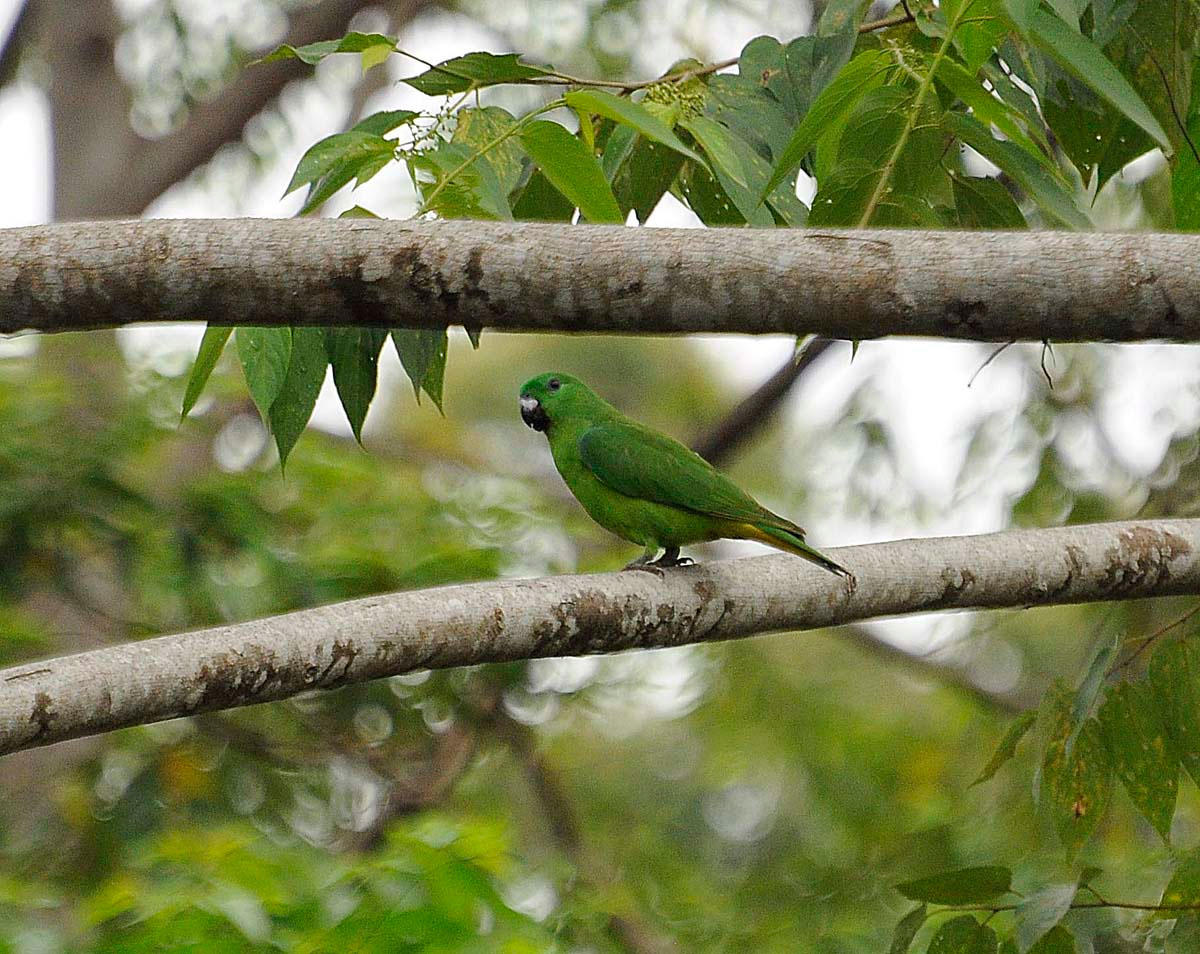
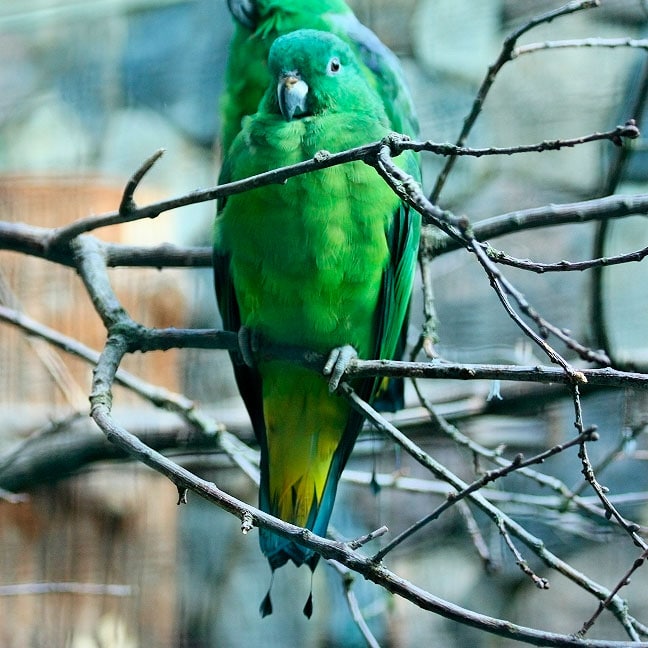
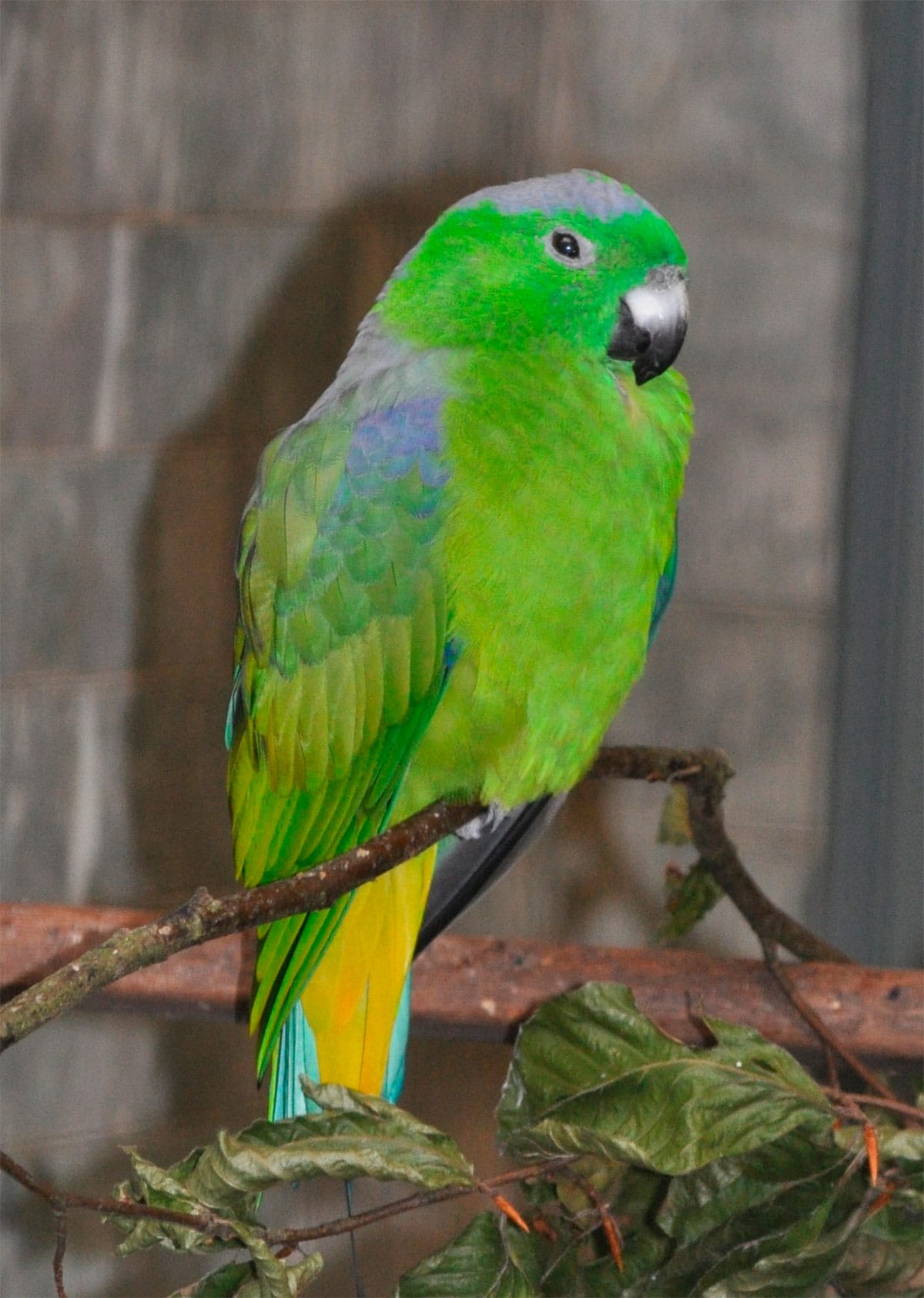
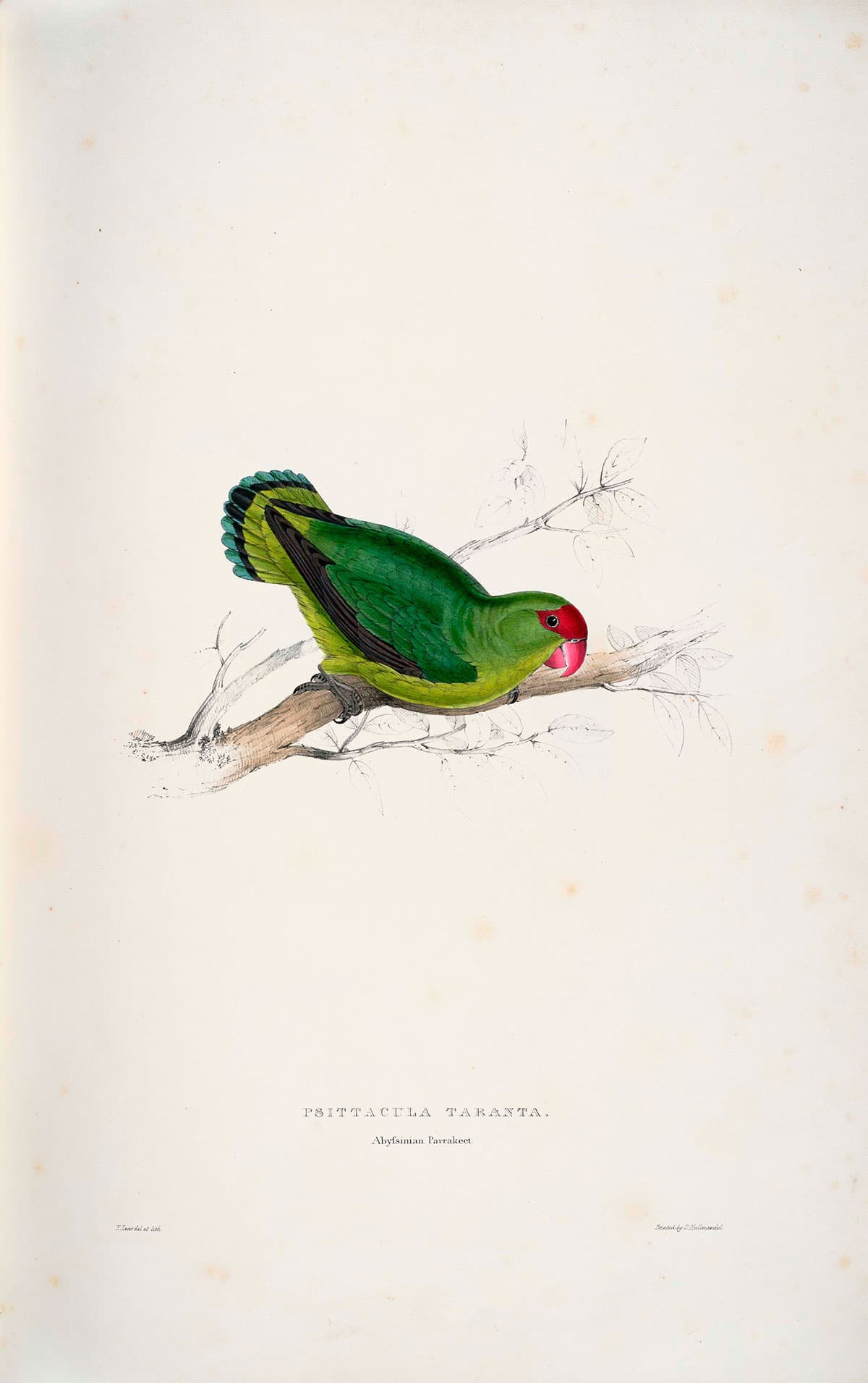
Origin: Trinidad and Tobago, Guyana, Venezuela, Colombia, Ecuador, Peru, Bolivia, Brazil, Costa Rica
Character: Intelligent and inquisitive
Life expectancy: 30 to 45 years.
Height: 28 to 30 cm..
Content
Description "Loro Cabeciazul":
28 to 30 cm.. height and between 234 and 295g. weight.
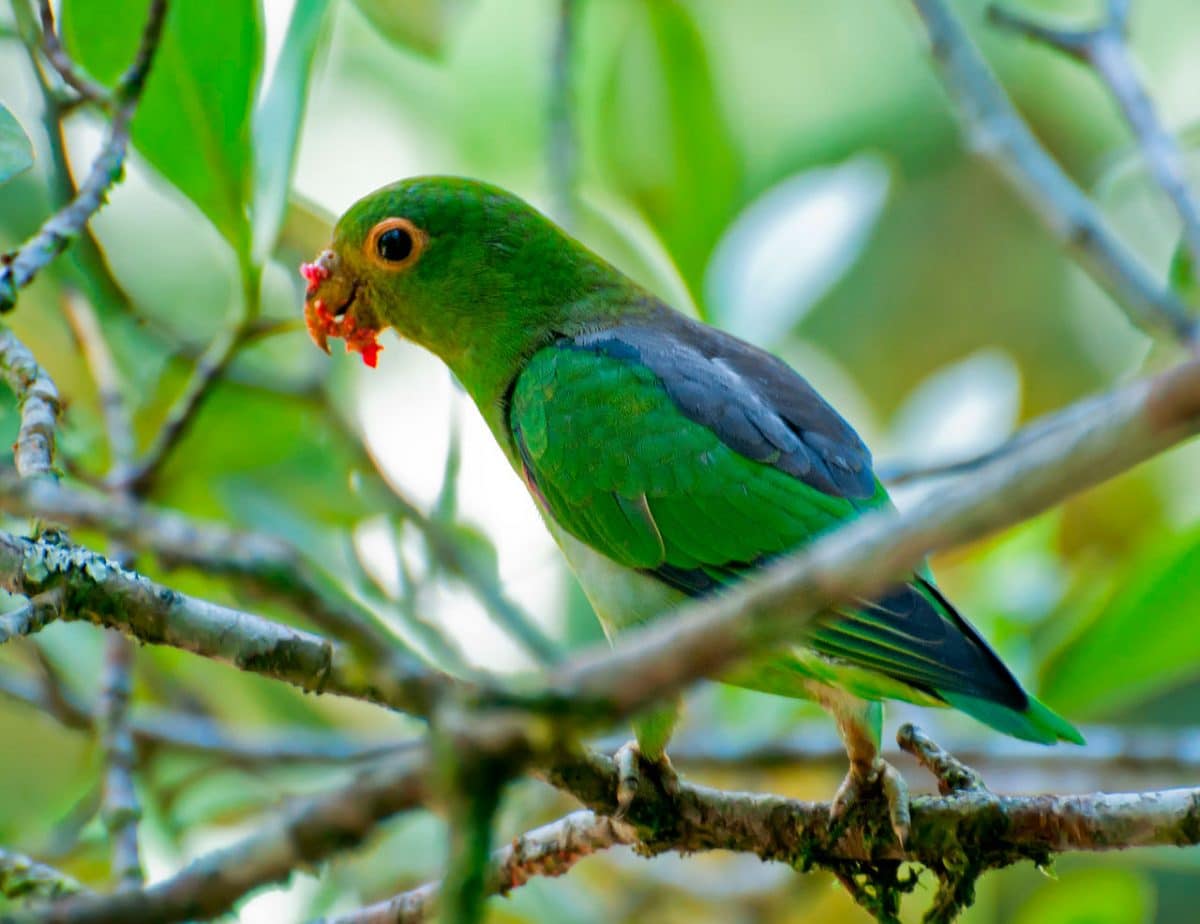
The Blue-headed Parrot(Pionus menstruus) is distinguishable by having the head, neck and chest blue; Red in the rump and in the Base ventral of the tail (very visible on the fly), basis of the bill and neck dotted with pink.
Shoulder and end of the wing
olive green with yellow border, tail green with blue tip.
(Heine, 1884) – Blue head, the neck and darker throat; lower underparts washed with blue green color; coverts red infracaudales with blue ends.
Pionus menstruus rubrigularis
(Cabanis, 1881) – Smaller, head pale blue, neck more extensive and clear Red.
Habitat:
Species very common, lives in humid forests, semi-wet, from gallery, stubble, crop areas until the 1500 m.
Reproduction:
It feeds on various seeds, fruits and flowers.
Food:
It nests in hollows of trees and palms in dry season.
Loro distribution-headed:
They live in freedom from the South of Costa Rica, North of South America to the West of Ecuador. To the East of the Andes, comes to Peru, part of Brazil to the North of Bolivia.
(Cabanis, 1881) – Tropical North of Costa Rica to western Colombia and West of Ecuador.
Conservation-headed Parrot:
โข Red List category of the UICN current: Least concern
โข Population trend: Decreasing
The size of the world population of the Blue-headed Parrot It has not been quantified, but this species is described as ยซcommonยป (Stotz et to the., 1996).
This species is suspected that it may lose 18,5-23% of habitat within its distribution over three generations (20 years) based on a deforestation model of the Amazon (Soares-Filho et to the., 2006, Bird et to the. 2011). So, they suspected that can decrease in <25% in three generations.
In captivity:
Pretty common in captivity. Intelligent, inquisitive although sometimes shy. Active by nature, they can become overweight if you don't have a wide space where exercise your flight. Mature birds usually match throughout his life with his partner, you will defend with aggression of any intruder.
Its diet in captivity is wide. fruits such as: Apple, pear, orange, banana, granada, cactus fruits, Kiwi, they form around the 30 percent of the diet; vegetables such as: Carrot, celery, green beans and peas in pods; fresh corn; Greens such as: chard, lettuce, Kale, dandelion, healer, chickweed; mixture of small seeds, such as: millet, birdseed, and small amounts of buckwheat, oats, safflower and hemp; soaked and sprouted sunflower; beans, cooked legumes and boiled corn.
Origin: Thailand, Malaysia, Singapore, Indonesian, Brunei
Character: shy and nice
Life expectancy: ---
Height: 13 cm..
Content
Description
Of 13 cm.. length and 28 g. of weight.
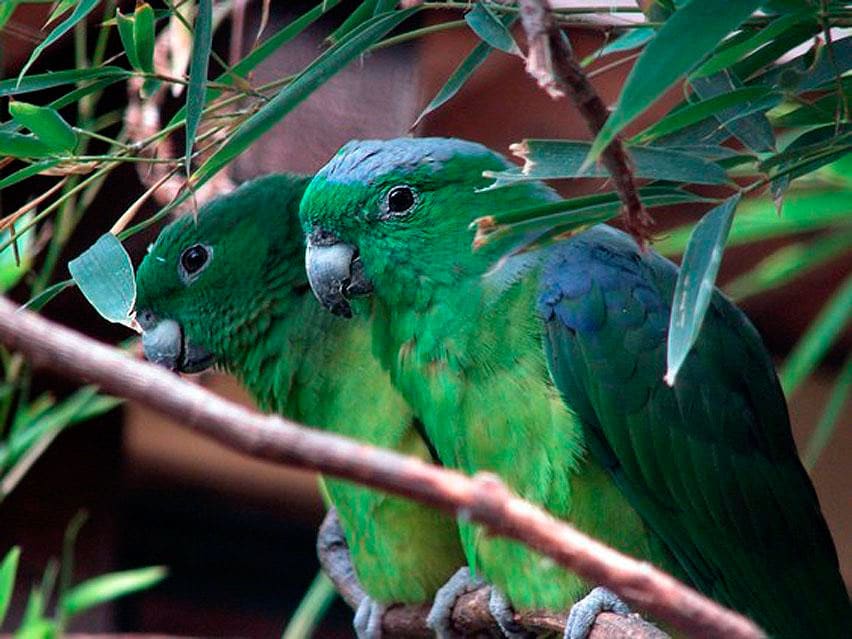
The head of the Blue-crowned hanging parrot(Loriculus galgulus) is bright green with a patch dark blue in the center of the back of the crown. Upperparts Greens with patch orange-brown in the Centre of the the mantle, yellow band at the bottom of the rump and tail coverts scarlet. Wings Greens with vane inner to flight feather darker. Under the wing coats green, with the underside of the flight feather blue. Throat and top of the chest with a patch bright Scarlet, the rest of the underparts slightly of a green pale that the upperparts (and more yellowish on the flanks). Upper, the tail green; Blue below.
Bill black; irises dark brown, legs yellowish brown.
The females lack of the bib red, with the underparts yellowish green. The patch of the crown is much more off, and the the mantle Orange is less marked than in the male.
The young birds lack of the crown blue, they have only an orange wash on the the mantle and bill yellowish. Maturation takes from two to four years in young men, showing the throat Red as the first sign of plumage adult.
Birds have been observed spending the night on the Hill of Fraserโs Hill (Malaysia), which indicates that there is a certain night dispersion. Extralimitales records have also reached coastal islands. The species occurs from the lowlands up to around 1.300 m, lies in the Woods, river banks growing, mangroves, secondary growth, lightly wooded areas, bamboo clumps, orchards, inhabited areas and coconut trees. The birds frequent the canopy and medium height plants, travelling alone, in pairs or. outside the breeding season, in groups of up to 150 birds that invade fruit orchards.
The birds are moving forward with steps balanced through the vegetation with a comical air, using the peak to help upload, and tail as support. Like other hanging parrots, This species sleeping upside down and also uses rain water for bathing in the same position.
The reproductive behavior you have registered between the months of January and August. When the courtship takes place, the male is shaking his head, cupping their red feathers, extending the tail, with the body upright, and making calls with a soft Twitter.
The nest It is built into the natural cavity in a tree, enlarged by birds, at a height between 5 and 12 meters above the ground.
The Nesting material It is cut by the female and taken to the nest in the contour feathers. The laying is three to four white eggs often dyed Brown. The female incubates the eggs for 20 days and the chicks leave the nest about 33 days after hatching.
Food:
It feeds on flowers, outbreaks, fruit, various seeds and nuts.
Distribution:
Ranges to South, about 10 ยฐ Norte, on the peninsula of Thailand, through Malaysia and Singapore, distributed also in some surrounding islands, including the Anambas Islands, the archipelago of Riau and Batam. The species is widespread through Sumatra and can be seen in the islands of the coast including Tuangku, Nias, Pini, Batu, Siberut, Sipura, Enggano, and to the North of Bangka, Mendanau and Belitung. Is present in a habitat along of Borneo, and the coastal islands Labuan and Maratua. His presence at the end of Java Western, in the area Labuhan, It can be the result of leaks of birds; the population around Jakarta is certainly wild.
Conservation:
โข Current IUCN Red List category: Least concern
โข Population trend: Stable
The size of the world's population has not been quantified, but it is thought that it may be superior to 100.000 specimens without registration of captive birds. The species according to information, it is common and widespread in most of its range (pit et to the. 1997).
The population is suspected to be stable in the absence of evidence of any reduction or substantial threats.
"Blue-crowned hanging parrot" in captivity:
These birds are kept in poultry, both in United States as in all Europe. Your dietary needs predispose them to a series of infections if failure to observe stringent hygiene practices, which makes them difficult to keep in captivity. This is the main reason that this species is rare in poultry farming., and even rarer as a pet.
20 to 21 cm. length and a weight between 44 and 61 g..
The Blue-winged Parrot(Neophema chrysostoma) has the crown olive green color with a yellow front wallwashing; blue front band (clearer on the back edge), arriving from the front towards the eyes (but not beyond); Lords bright yellow; coverts outpus and face Gris-Oliva. Upperparts olive green color without brightness.
Wing coverts blue, clearer in some feathers of the greater coverts Interior. Primaries black, with blue-violet edges in vane thin yellow margin and external; secondary internal with vane Green external, secondary average with blue in vane outer; tertiary olive green. Wing feathers blue. Top of the chest light green with yellow shading in the area of the belly and undertail- coverts. Upper, the tail is bluish grey, with the exception of the tips of the outer tail feathers, that are yellow.
The bill It is greyish-black with a pinkish lower jaw and the upper jaw with sharp edges.; irises dark brown; legs gris-rosado color.
The female it is duller than the male with the line that adorns the forecrown less developed.
It has the top of the crown olive green. The underparts they are tinged with pale green.
The young birds they lack the frontal band and most show a wing bar; the bill It is orange in very young birds.
During the nesting season, the Blue-winged Parrot frequent eucalyptus plots.
starting winter, These birds change the habitat type, visiting the clear, orchards or similar locations. In addition to these common locations, they tend to move into thickets of acacia and lightly wooded grasslands. At this time of the year, the Blue-winged Parrot They also feel attracted by the arid plains with Salt plants (Atriplex) and for the coast and mountain Moors.
These colorful birds occasionally visit swamps, sand dunes along the coast and wetlands.
To the Blue-winged Parrot You can see them in pairs or in small groups, but in the off-season, form large meetings in the regions south of the coast, in partnership with the Crimson Rosella or more rarely with the Orange-bellied Parrot.
When feed, they are relatively accessible, flying into a nearby tree when bother them.
During the courtship, the male drops his wings, moves the head and regurgitates food for your future partner. By now, not explained clearly the migration. We know that birds from the south of the continent head north after breeding and the northern limit of this movement is in the south of Queensland. On the other hand, It is unclear whether all the population of the island of Tasmania It has to do with the migration that it crosses the bass strait.
Reproduction:
The nesting season extends from October to January. The nest It is usually a natural cavity in a large eucalyptus. Sometimes, However, found in a stump on a fence post or fallen log.
The female always makes the choice of the site. The Blue-winged Parrot They nest in colonies, sometimes several pairs are established in the same tree. The site can be used for several consecutive years.
The setting contains of 4 to 6 eggs, which are incubated for a period of 18 to 20 days. At birth, the chicks are altricial, and leave their place of birth to the 30 days after hatching. But, they stay with their parents for a short time before becoming independent.
Food:
The Blue-winged Parrot they feed mainly on grass seeds, and especially Danthonia What are the grass family? Poaceae. But, they often enter fields, where to dig the ground with their beaks to retrieve newly sown seeds.
Insects and invertebrates are probably part of their diet. Fruits and flowers represent a significant part of its menu.
Distribution:
During the breeding season (September to January) the birds are found below in 36 ยฐ S, concentrating in the wetter parts of the southeast of Southern Australia, South of Victoria, and in Tasmania.
In winter they are, to a large extent, absent of Tasmania and are distributed much more North, in the southeast of Australia, reaching the South of Queensland (some 26 ยฐ S, for example Thargomindah, Cunnamulla, Chinchilla), and extending westward to the East of Southern Australia, coming to the South of the eyre peninsula and spreading northward around the border of Queensland; They also extend to the East, to the Western parts of New South Wales (as well, from time to time, to the South of the coastal districts in summer).
It is not known if the continental population of the South is resident and birds of Tasmania they are migrant, flying over the Mainland farms to winter over North, or if the entire population moved northward in winter.
There are relatively few records of the King Islands and Flinders, which suggests that, Unlike in the Orange-bellied Parrot, most birds fly over Bass Strait directly to the mainland.
The Blue-winged Parrot are generally common in most open field types and are, probably, the most common parrot in Tasmania. where are reproduced to the South of Macquarie Harbour, on the West Coast and are found in the central region, provided that their habitat is suitable.
Flocks of up to 2.000 young birds they can form in the Northwest of Tasmania before the autumn migration.
The world's population is above the 20.000 birds.
Conservation:
โข Current category of the Red List of the UICN: Least concern
โข Population Trend: Stable
According to the Manual of the birds of the world (HBW), This species is not threatened globally. It is even common in the region of Melbourne and Tasmania.
The population is suspected to be stable in the apparent absence of any reduction or substantial threats.
According to Barry Talor, the world population would exceed 20.000 individuals.
"Blue-winged Parrot" in captivity:
The Blue-winged Parrot It, in general, less popular in aviculture as the Crimson Rosella, the Turquoise Parrot, the Scarlet-chested Parrot and the Bourke's Parrot, it's not really weird though.
Their behavior is relatively quiet with few movement needs. It is a bird that is easy to maintain, even for beginners. Your need to crack is almost non-existent and their need for bathroom depends on the individual. It is resistant to the European climate and, certainly, is not inferior to other species of neophemas. But, is susceptible to fog and cold damp, as we know it here in the fall and winter seasons.
The Blue-winged Parrot they seek food by digging in the Earth and are therefore vulnerable to parasitic infections.
According to sources, a Blue-winged Parrot lived during 21 years in captivity. In captivity, these animals have been able to play at the age of 2 years.
Origin: Colombia, Venezuela, Mexico, Brazil, Panama, Costa Rica
Character: Sociable
Life expectancy: 10 to 25 years
Height: 17 to 20 cm..
Content
Description:
Of 17 to 20 cm. length between 76 and 102 g. of weight.
The Brown-throated Parakeet(Eupsittula pertinax) it is a polytypic species. Its fourteen subspecies are distinguished by the mix yellow and Brown on his face and throat.
In the case of the Eupsittula pertinax aeruginosa, the lores previous, the frontal area, underside of cheeks, both sides of the neck and ear-coverts, are dark brown; dark stripes visible on the cheeks; the feathers of the ocular region are of color orange-yellow; the crown greenish blue. Upperparts olive green. Lesser and medium coverts green; bluish green the primaries and greater coverts. Primaries and secondaries green up, Blue dark on the tips, Blue them vane outer in the secondaries; by down dark grey. Underwing-coverts brighter yellowish green. The throat and the top chest dark brown; the underparts Matte yellowish green with an orange patch in the central area of the belly. For above, the tail is of color green blue, bluer towards the tip; undertail greyish-yellow.
The bill brownish-grey; bare periophthalmic yellowish white; irises yellow, legs grey.
Both sexes similar, without sexual dimorphism, where males are larger than females.
The youth they tend to lack intense yellow, that is alive in individuals adults. Its forecrown is dark greenish blue. The throat and the chest are greenish, while the belly is green with a bit of orange or yellow.
Eupsittula pertinax arubensis (Hartert) 1892 – Cara and throat color opaque marron-oliva. Narrow yellow line on the eyes. Crown greenish blue.
Eupsittula pertinax chrysogenys (Massena & Souance) 1854 – Similar to the aeruginosa subspecies, but darker.
Eupsittula pertinax chrysophrys (Swainson) 1838 – Similar to the subspecies margaritensis and venezuelae but with the forecrown a pale yellowish brown.
Eupsittula pertinax griseipecta (Meyer de Schauensee) 1950 – Similar to the aeruginosa subspecies, with the cheeks, the throat and top of the chest, Gray-olive, veins in the cheeks absent. The crown Green with little blue.
Eupsittula pertinax lehmanni (Dugand) 1943 – Is similar to the aeruginosa subspecies, but with yellowish feathers around the eye more extensive; the Blue head limited with the forecrown and less blue in the flight feather.
Eupsittula pertinax margaritensisCory 1918 – Forehead whitish, the cheeks and ear-coverts color oliva-marron with forecrown greenish blue.
Eupsittula pertinax ocularis (Sclater,PL & Salvin) 1865 – Patch distinctive yellow below and behind the eyes (absent in the immature). Forehead and crown green color with tint blue in some birds. Throat, top of the chest, the cheeks and lores warm brown; ear-coverts slightly darker.
Eupsittula pertinax paraensis (Sick) 1959 – Similar to the aeruginosa subspecies, but with the irises of color red and the vane outer of primaries and secondaries blue.
Eupsittula pertinax pertinax (Linnaeus) 1758 – The nominal. Extensive but variable amount of yellow color in the forecrown, the cheeks, the throat and lores. It may be more off or more Orange under and behind the eyes. Crown Green with only a few light blue indications.
Eupsittula pertinax surinama (Zimmer & Phelps,WH) 1951 – Similar to the subspecies margaritensis but with narrow frontal band orange-yellow color, orange-yellow colour around the eyes extending towards the cheeks and yellowish-green (not brown) the throat.
Eupsittula pertinax tortugensis (Cory) 1909 – Similar to the aeruginosa subspecies but larger, orange-yellow color on both sides of the head and underwing-coverts more yellowish.
Eupsittula pertinax venezuelae (Zimmer & Phelps,WH) 1951 – Similar to the subspecies margaritensis but more pale and yellow on the underparts.
Eupsittula pertinax xanthogenia (Bonaparte) 1850 – Clearer (almost sallow) the head the species nominal, with yellow tones ranging from a variable on the front of the crown and nape.
Habitat:
Video – "Brown-throated Parakeet" (Eupsittula pertinax)
Brown-throated Parakeet Eupsittula pertinax / dirty face parakeet
The Aratinga Pertinaz occupies all kind of fields wooded open of the Savannah, transparent areas of dry scrubland full of cactus and acacias, forests of mangrove, tropical forests (where is the most abundant parrot species often), gallery and white sand forests, Mangroves of Rhizophora, edges of moist evergreen forests, and agricultural areas with palms and other trees.
Move at altitudes on the 1.200 m or more, Although they tend to stay below the 1.200 m. This Aratinga also lives in artificial clearings such as public parks or gardens..
In general, observed in flocks or pairs, forming larger groups where food is abundant and in communal roosts.
Reproduction:
The Brown-throated Parakeet It monogamous. With plays After the season of rains, in general from February to April. Birds very social, assess potential mates in large communal roosts. Also used strong calls in select to your mate / to.
Its breeding season It begins after the rainy season, and varies geographically between the months of February and September. Between February and April in Goal, Colombia; from February to April in Venezuela and any time of the year in Suriname, Curacao, Aruba and Bonaire.
When the conditions are favorable this species You can reproduce several times a year. Son colonial and have been observed up to seven pairs nesting next to each other.
Nest in the cavities of trees, artificial nesting boxes, or in arboreal termite. There are reports of nests made in cracks in rocks. The nests they are very simple, without any plant covering and the eggs, often, they are placed on the floor of the cavity nude. The number of eggs in a nest varies from two to seven.
The female is the primary incubator, with one incubation which can last thirty-six to thirty-seven days in the wild. The chicks they leave the nest after 50 days. The young join their parents and form small family groups that last until the parents begin a new breeding season..
Sometimes it causes damage to crops (for example, of millet and handle), of corn in Colombia and in fruit plantations of the Netherlands Antilles. Despite being considered pests in some areas, the Brown-throated Parakeet they are not strongly persecuted.
They feed in very vocal groups that often include macaws and amazon parrots.
Distribution:
The Brown-throated Parakeet are distributed to the North of South America, Panama and the islands of the Southern Caribbean.
In Panama are present in the slope of the peaceful, rarely on the side of the Caribbean, even in the canal area. But, they occupy the lowlands of the Northern Caribbean and northeast of Colombia, from the East of the Sinu River up to the Guajira peninsula, including the Center and low Magdalena valley, and observed at elevations more low in the East of the Andes and the lowlands of the South of the Alto Orinoco, to the North of Vaupรฉs.
Probably can be observed in all Venezuela, extending to the Margarita Islands, Turtle (Venezuela), Curacao, Aruba and Bonaire (Netherlands Antilles); introduced in St Thomas, virgin islands, in the 19th century.
Its distribution extends through of the Guianas and the North of Brazil, from Roraima until Amapรก, as well as discontinuously in the upper part of the basin of the Tapajos River, For and in the basin of the Black river, amazon.
In spite of his uneven distribution, usually common to abundant, in many places it is the most common parrot (for example in localities of Guyana), locally common in Panama and reportedly very common in black rivers and Branco, Brazil.
Your area of distribution possibly be increasing due to deforestation. In general resident with local seasonal movements (for example, in the region of Santa Maria, Colombia) the availability of food and the dispersion of the areas of reproduction-related.
Distribution subspecies Eupsittula pertinax
Subspecies
Eupsittula pertinax aeruginosa (Linnaeus) 1758 – North of Colombia, Northwest of Venezuela and the upper part of the basin of the Rio Branco, in the Northwest of Brazil
Eupsittula pertinax chrysogenys (Massena & Souance) 1854 – Region of Black river and, possibly, Solimรตes River, North of Brazil; There are no details about its area of distribution
Eupsittula pertinax chrysophrys (Swainson) 1838 – Southeast of Venezuela, Guyana Interior and North of Roraima, Brazil.
Eupsittula pertinax griseipecta (Meyer de Schauensee) 1950 – Valley of the sinu river, North of Colombia. Range in relation to the aeruginosa subspecies unclear
Eupsittula pertinax lehmanni (Dugand) 1943 – It is from Colombia and possibly Venezuela.
Eupsittula pertinax margaritensisCory 1918 – Islands Margarita and The friars, Venezuela. the birds of the Paria Peninsula in the North of Venezuela, they can be of this subspecies; see the subspecies venezuelae
Eupsittula pertinax surinama (Zimmer & Phelps,WH) 1951 – French Guiana and Suriname through the coast of Guyana to Delta Amacuro, Northeast of Venezuela.
Eupsittula pertinax tortugensis (Cory) 1909 – Turtle Island, Venezuela.
Eupsittula pertinax venezuelae (Zimmer & Phelps,WH) 1951 – North and Central Venezuela. Areas of contact with other little-known Venezuelan subspecies: see aeruginosa, surinama and chrysophrys.
โข Red List category of the UICN current: Least concern
โข Population trend: Growing
The Eupsittula Pertinax (Pit and neck of 2014) was considered, previously, belonging to the genus Aratinga.
The subspecies Griseipecta, endemic of the sinu valley in Colombia, There have been since 1949 and is likely to be extinct (T. Donegan in litt. 2011).
The size of the population world of this kind not has been quantified, but it is described as "commonยป (Stotz et to the. (1996). Is considered as the Parrot more abundant in the land low for the Caribbean, Plain in Colombia, Guyana, North of Suriname and the three islands of the Netherlands Antilles.
A density of five to eighty and nine birds by kilometer square is has estimated in the regions of the Northwest of Venezuela.
It is believed that populations on the continent are increasing their range in response to an increase in the conversion of the forest into farmland.
This species is often captured with commercial purposes, but not has been consequences serious, with the exception of the subspecies Aratinga pertinax margaritensis and Aratinga pertinax tortuguensis.
The Aratinga pertinax tortuguensis It is also vulnerable to severe climate changes. (Juniper and Parr, 1998;. Pit, et to the, 1997)
"Brown-throated Parakeet" in captivity:
The Brown-throated Parakeet has a average vinein the nature of about ten years. But, When live in captivity with the proper supervision, they have come to live up to twenty-five years.
common in the industry of the pet because, mainly, to your behavior affective. Captured for the pet trade and occasionally as food.
Pretty noisy, both in the nature as in captivity. With certain skills for repeated whistles and words short.
Alternative names:
– Brown-throated Parakeet, Brown throated Parakeet, Brown-throated Conure, Caribbean Parakeet, Curacao Conure, Curacao Parakeet, St. Thomas’s Conure (English).
– Conure cuivrรฉe, Conure de Saint-Thomas, Perriche cuivrรฉe, Perruche cuivrรฉe (French).
– Braunwangensittich (German).
– Aratinga de-cara-parda, aratinga-de-bochecha-parda, periquito-de-bochecha-parda (Portuguese).
– Aratinga Pertinaz, Perico cara sucia, Perico Carisucio, Perico Gorgicafรฉ, Periquito de Cola Corta, Periquito Gorgimoreno (espaรฑol).
– Loro carisucio, Perico Carisucio (Colombia).
– Perico Gorgicafรฉ (Costa Rica).
– Perico Cara Sucia (Venezuela).
– Avibase
– Parrots of the World โ Forshaw Joseph M
– Parrots A Guide to the Parrots of the World – Tony Juniper & Mike Parr
– Birdlife
– Animal Diversity Web
– Photos:
(1) – Aratinga pertinax By Genes Luna (Flickr: IMG_0309.jpg) [CC BY-SA 2.0], via Wikimedia Commons
(2) – Aratinga pertinax xanthogenia By gailf548 (originally posted to Flickr as Young Parrot) [CC BY 2.0], via Wikimedia Commons
(3) – Eupsittula pertinax arubensis By Alexander Yates (originally posted to Flickr as Aruba Parakeet) [CC BY 2.0], via Wikimedia Commons
(4) – Brown-throated Parakeet (Aratinga pertinax venezuelae) in Cagua, Estado Aragua, Venezuela By Cristรณbal Alvarado Minic [CC BY 2.0], via Wikimedia Commons
(5) – Aratinga pertinax aeruginosa By Aratinga_pertinax_-Colombia-8a.jpg: anthrotectderivative work: Snowmanradio [CC BY 2.0], via Wikimedia Commons
(6) – Eupsittula pertinax By Leizelt, Balthasar Friedrich; Wilhelm, Gottlieb Tobias [CC BY 2.0 or Public domain], via Wikimedia Commons
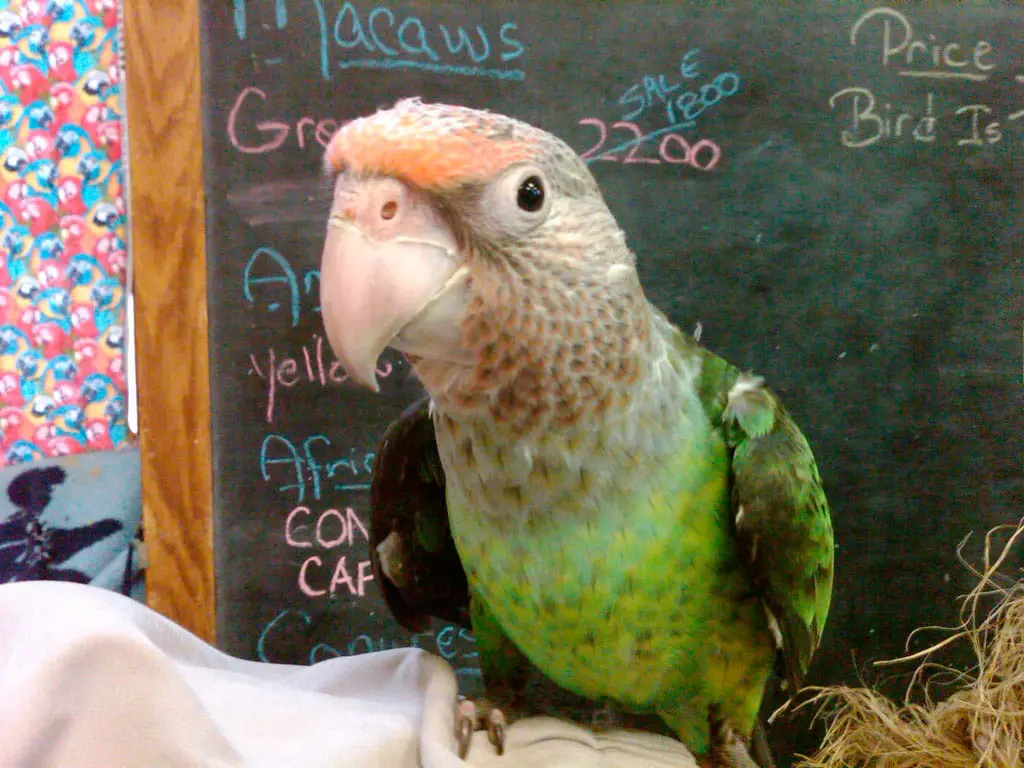
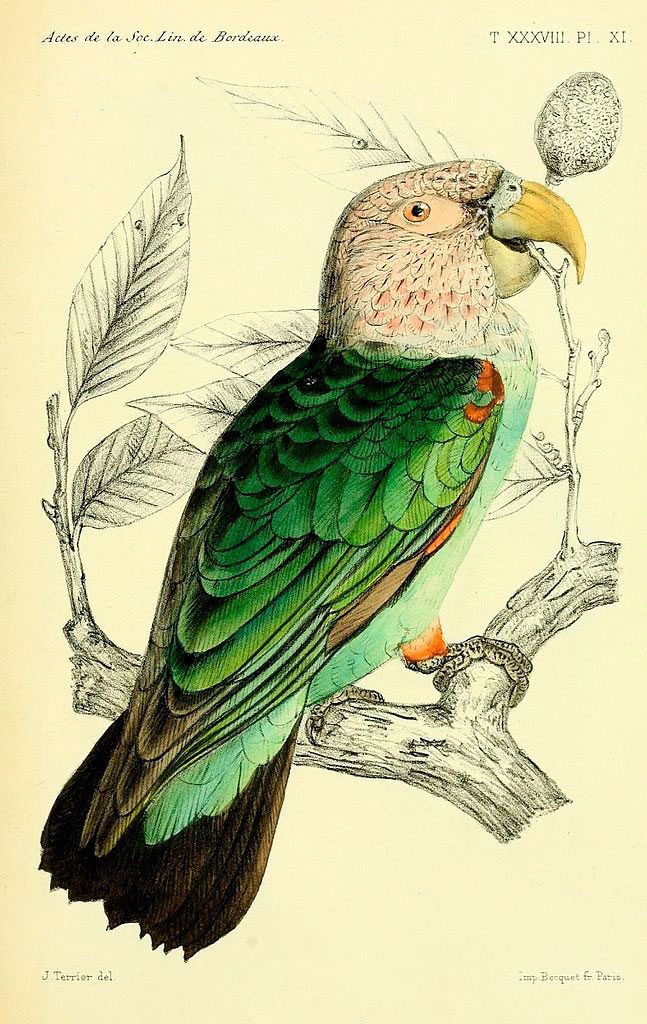
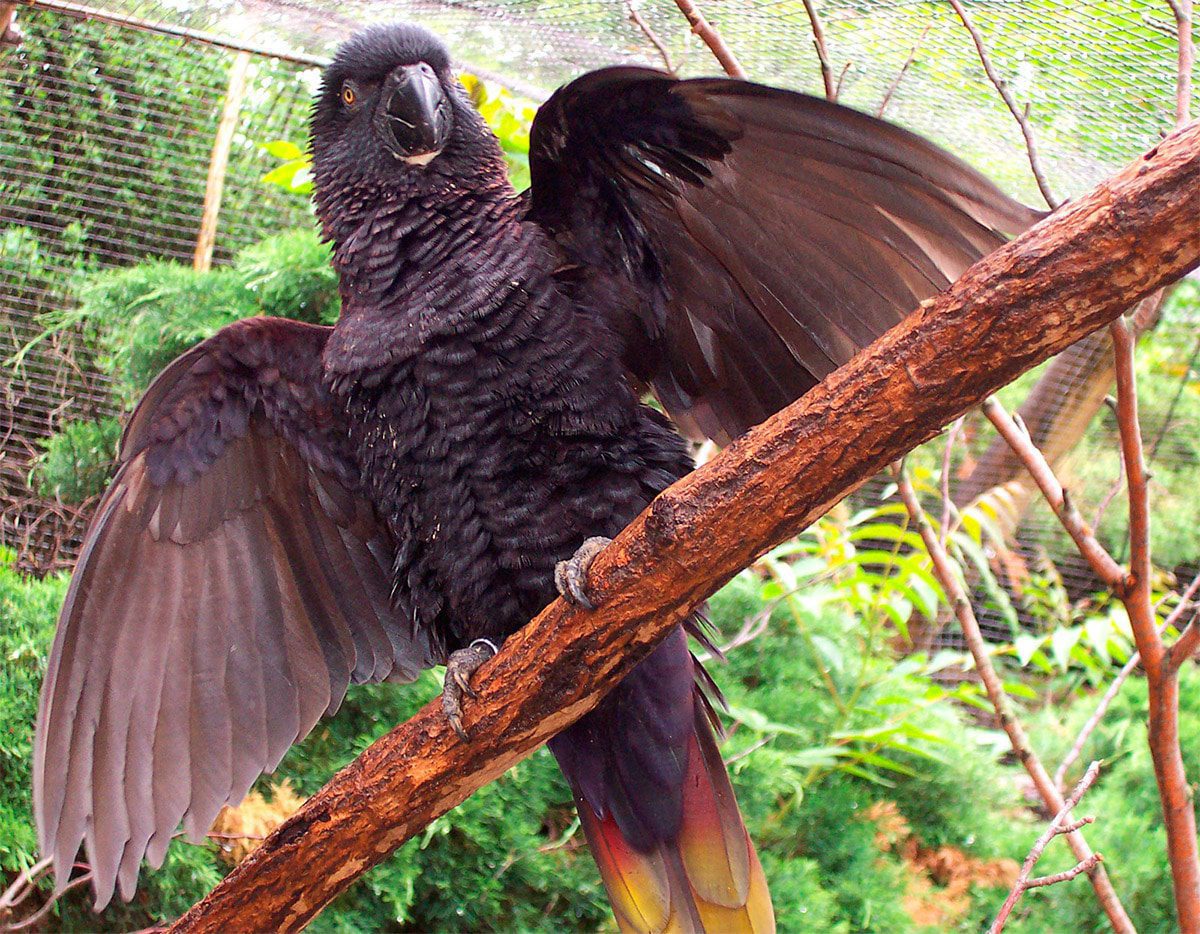
The Bronze winged Parrot(Pionus chalcopterus) has the general Brown, darker in head, neck, chest and flanks, This plumage with blue-violet edge.
The throat whitish and pink; wings bronze green.
Flight is evident violet blue at the top of the wing
the Green bottom, that contrasts with the Red of the lower abdomen. Dorsally Violet Blue is notorious in the rump, shoulder and tail. The feathers of the tail are dark blue with a shade of red at the base.
The bill is of color beige, area of naked skin surrounding the eyes of pink. The legs They are pink.
It inhabits in humid jungle, semi-humid, crops and forest edge between 120 and 2800 m.
They are birds gregarious and noisy. Every tomorrow is mobilized in flocks in search of food. Within the flocks are can observe to the couples, that form of life, and who interact with a variety of contact behaviors that reaffirm the marital bond.
Reproduction:
Prefer for their nests broken rods, hollow of logs and palm trees. They nest in the months of October-may. The female often put in two to four eggs they are incubated during three weeks approximately, after which are born them chicks naked or just covered with down. The chicks remain with their parents until the next reproductive shekel.
Food:
Will congregate in cornfields in groups up to of 40 individuals, feeding is of pulp and seeds many fruits and other material ingredients as nectar and flower petals, complementing occasionally its diet with insects.
Distribution:
Its population is distributed by the mountain range of the Andes, from Colombia, Northwest of Venezuela; to the South, by the mountains to the Northwest of Peru.
Conservation:
โข Red List category of the UICN current: Least concern
โข Population trend: Decreasing
The size of the population World of the Bronze winged Parrot It has not been quantified, but this species is described as ‘rare‘ (Stotz et to the., 1996).
The population was suspected of being in decline due to ongoing habitat destruction.
This species is characterized be decreasing in Colombia and West Ecuador, due to the logging of forest subtropical, which has been severe and quick on the slopes of the Andes (Juniper and Parr 1998).
The evident anecdotal, based on the frequency of sightings, suggests that the species has declined in Pineapples, South of Ecuador, in recent years c.15-20 (M. By D Sanchez. Dรญaz in litt. 2011). Also is says that has been extirpated from areas previously occupied as the slopes of them Andes and valleys of the Cauca and the Magdalena river in Colombia, again due to loss of habitat (Juniper and Parr 1998).
In Venezuela the species is scarce and local, limited, to a large extent, to the slope West of them Andes in Mรฉrida and Sierra de Perija, with occasional records in Tรกchira (CJ Sharpe in litt. 2011). These areas have experienced rapid deforestation for at least the last few 24 years for cultivation and livestock.
Surveys conducted in the Northwest of Peru in the decade of 1990 they appeared to detect a sharp decrease in population from 1993 (Rosales et to the., 2007), although this species is known to be nomadic and its local numbers can fluctuate.
"Bronze winged Parrot" in captivity:
Rare in captivity, It is not a main target of poachers (CJ Sharpe in litt. 2011, R. Clay in litt. 2011), although it is still present in the illegal trade of Peru (F. Angle in litt. 2011)
Intelligent, playful and curious. You can be nervous, loving with your caregiver and aggressive with other people. It has a tendency to obesity.
It requires a spacious cage unless the bird pass periods of time outside of it. Not must keep is to open air where the temperatures fall below them 5 ยฐC.
With feed a wide variety of seeds, fruits and berries.
It is a relatively healthy bird, While it may be more susceptible to infection aspergillosis that other species.
In captivity they lay two eggs the incubation takes 26 days.
Alternative names:
– Bronze winged Parrot, Bronze-winged Parrot (English).
– Pione noire, Pionus noir (French).
– Glanzflรผgelpapagei, Glanzflรผgel-Papagei (German).
– Curica-asa-de-bronze (Portuguese).
– Cotorra Oscura (Colombia).
– Cotorra Negra (Venezuela).
– Cotorra Oscura, Loro Alibronceado, Loro de Alas Bronceadas, Cheja alibronceada (espaรฑol).
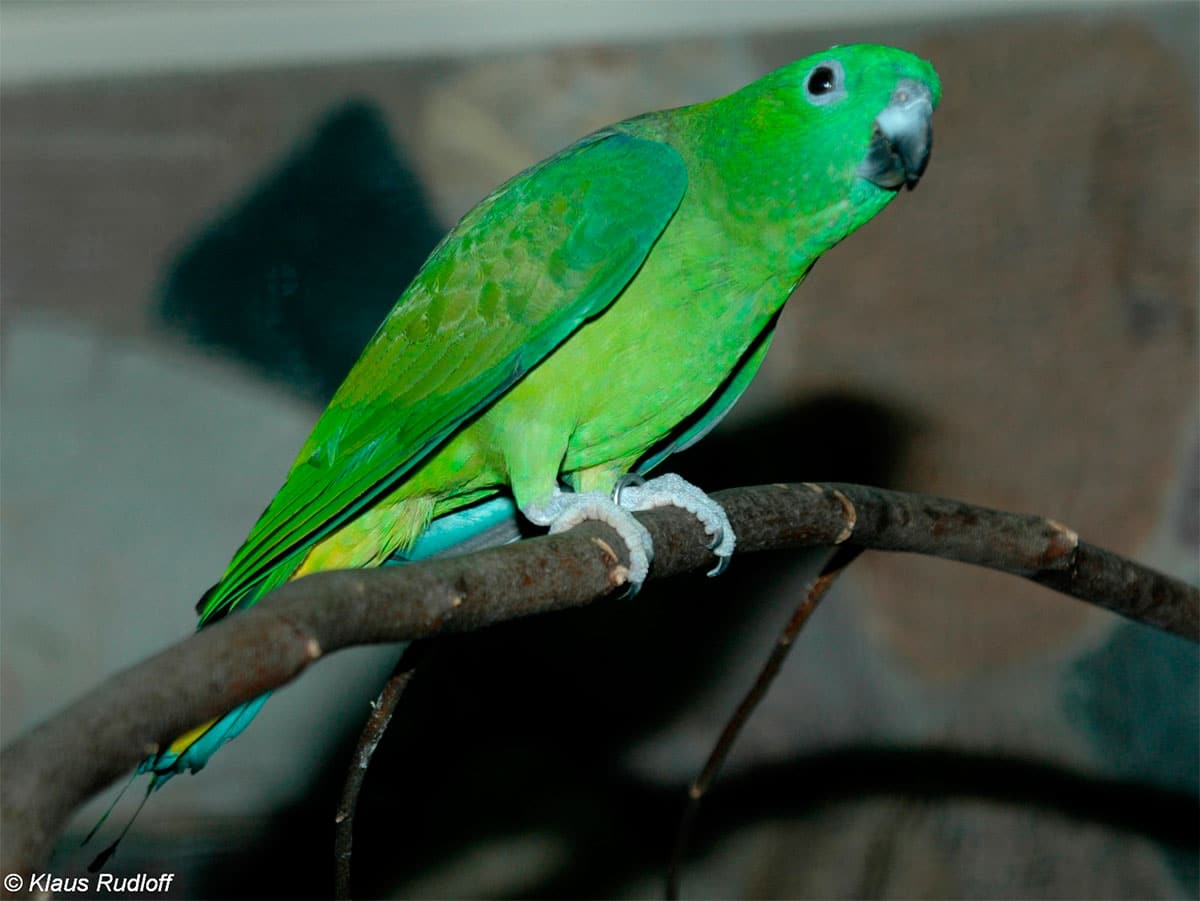
The Black-billed Hanging Parrot (2) is a subspecies of the Colasisi (Loriculus philippensis) being the only member of the genus, in the Sulu archipelago. The combination of the Red Crown on front, merging Orange gold neckband, and the black Bill are the brand identity of the Black-billed Hanging Parrot for both sexes. Aside from lacking these features, the most similar species within the subspecies of Loriculus philippensis, the L. p. apicalis and L. p. dohertyi, they have the necks much more of orange-red color and a strong orange color shawl in broadcast.
The female of the Ceylon Hanging-Parrot has the Red Crown, reddish diffusion in the mantle, peak red and a whitish iris (males do not have the Red bib of birds of Sulu).
The front of the Crown of the Black-billed Hanging Parrot is red, shading back in Orange and yellow in the back of the Crown, with a clear line of demarcation of the green mantle; bright green cheeks and Lores. Orange robe loosely washed in the Center; rump and tail coverts bright crimson (Blue Suffusion on sides of rump). Wings green brilliant with vane internal to blackish flight feathers. Feathers of the wings of Turquoise Green: below, the wings of blue. The Chin and throat bright Scarlet; rest of the underparts of bright green. Upper, the Green tail; Blue below. the black beak; Brown irises; Orange to greyish legs.
Habitat:
The species is little known, but their habits and ecology are presumably similar to those of the Colasisi. Commonly found in front of coconut groves on the coast, inside you have registered in forests, as well as in partially cleared areas. Observed feeding on flowers of Palm and flying between the trees.
Reproduction:
The breeding season starts around February and may continue until may. An average clutch can coasts of 2 to 4 eggs. Parents make their nests on top of the cavities of the trees.
Food:
Their natural diet consists of nectar, seeds, red fruits (especially wild figs), berries and flowers
The Bourke's Parrot(Neopsephotus bourkii) has frontal area white. The chin, lores and contour of the eyes they are also white and form a kind of orbital ring clear when seen from a distance.
The ear-coverts and upper cheeks they are dark brown with pink dots and specks. The pileum and the neck are greenish-Brown, with darker edges.
The upperparts are brown-grey color with pale edges on scapulars.
The rump and the top of the tail has darker tones, with some pale blue on the sides. The curvature of the wing is blue.
The small coverts are blue, the median they have light blue, the greater coverts they have a dark tint with yellow-white and blue pink.
The flight feather primaries and secondaries are mostly blue.
The underparts is blue.
The breast feathers are brown with pink ends, giving an appearance of general pinkish brown.
The abdomen is bright pink.
Thighs, lower flanks, side of the rump, under belly and lower area of the tail they have a light blue color. The upper part of the tail infiltrates with bluish-grey.
The bill is greyish black, no hook in upper jaw. The irises They are brown, legs grey-brown.
The female in General, the colors are off and the blue coloration is very little visible or is absent.
The youth they are equal to the female adult but more muted, with a pale band under the wings which is less pronounced in the male juvenile
For a long time, the Bourke's Parrot It was classified in the genus Neophema. A number of ornithologists, more and more, is of the opinion that this parakeet does not belong to this genus and species have been classified in a separate genus called Neopsephotus.
The Bourke's Parrot they are distributed among the driest inland areas.
They mark a strong preference for scattered areas of mulga (Acacia aneura) but does not disdain the plantations of eucalyptus. Can also be observed in plots along streams and afforestation of Callitris which are conifers belonging to the family of cypress.
Son nomads and slightly Twilight. These birds establish themselves in a territory and remain there for several years before disappearing completely.. The Bourke's Parrot they can be very sociable. During periods of drought, You can meet thousands around the water wells and springs.
During the months of summer, We can see them in the morning and in the evening around the ponds.
In Winter, these parakeets come to drink during the day in the company of species of doves such as the common bronze pigeon (Phaps chalcoptera). In places close to the drinking fountains, the Bourke's Parrot They fly in Group emitting loud cries and making whistling wings. But, These parakeets sometimes go unnoticed, they are able to rest or to eat ground in pairs or in small groups. They remain in silence on the floor or hide in the dead wood that serves as camouflage. There are more assets during the sunset.
Reproduction:
The Bourke's Parrot they usually reproduce in August to december, but the season can vary depending on rainfall. The courtship of this bird are similar to those of other species of Parrot Neophema. Males approach the female in upright position with outspread wings and tail.
The nest is located in one a tree cavity, between 1 and 3 meters above the ground. The laying is formed by between 3 and 6 eggs they are incubated during at least 18 days. There are often two broods in the season. The female leaves the nest only once a day in order to be replenished by the male.. The male is also in charge of mounted guard, patrolling and emitting calls in the vicinity of the nest, with the intention to deter intruders.
At birth, the chicks have a white marker, are altricial and remain in the nest for at least 4 weeks. They remain dependent on their parents during a week after feather.
Food:
The Bourke's Parrot they are almost exclusively vegetarian: they eat grass seeds, especially those that are dispersed by the wind. They also eat herbs collected in the soil and in the bushes. These parakeets also appreciate the fresh young shoots and seeds of Acacia or of Bassia, which are small shrubs belonging to the category of Chenopodium album.
Distribution:
Scattered through the interior of Australia, where are nomads but locally common.
The birds, to the This of the Montes Flinders You can isolate, since there are no records between 139ยบ and 140 ยฐE.
Apparently, the species has declined in the center of New South Wales due to overgrazing by cattle and rabbits, and is now mainly in the West, from the surroundings of Broken Hill, to paroo river; nomads, However, There have been more towards the This, in the surroundings of Narrandera in the South and the Lightning Ridge in the North.
The world population is considered to be more of 50.000 specimens.
The species is probably increasing in the west due to agricultural expansion including the provision of artificial irrigation sites..
Conservation:
โข Current category of the Red List of the UICN: Least concern
โข Population Trend: Growing
It is estimated one population superior to the 50 000 individuals.
In the western part of its range, the numbers are growing, probably due to the development of agriculture and the installation of new irrigation areas. The reason for its development can also be found in the reduction of sheep farming and the replacement of saline areas with grass..
"Bourke's Parrot" in captivity:
The Bourke's Parrot they are very good birds for beginners amateurs, easy-to-play.
It is a bird peaceful, silent and that it is active only in the first and last hours of the day. Son calm and confident by nature and easy to maintain. It has almost no cravings for crack and your bathroom need depends on the individual. A dry climate supports well, but it is sensitive to cold and wet fog.
Les gusta estar en tierra firme y son susceptibles a la infecciรณn por gusanos, tambiรฉn son susceptibles a infecciones oculares.
With regard to its longevity, according to sources, a sample lived 12,6 years in captivity. In captivity, estos animales pueden criar, approximately, to the 2 years of age.
– Avibase
– Parrots of the World โ Forshaw Joseph M
– Parrots A Guide to the Parrots of the World – Tony Juniper & Mike Parr
– Birdlife
– Photos:
(1) – Bourkeโs parrot (Neopsephotus bourkii) By Flickr user Jan Tik (Flickr) [CC BY 2.0], via Wikimedia Commons
(2) – Bourkeโs Parrot – Neopsephotus bourkii taken at the Cincinnati Zoo and Botanical Gardens By Greg5030 (Own work) [CC BY-SA 3.0], via Wikimedia Commons
(3) – Bourkeโs Parrot Neopsephotus bourkii. Wild pair at Bowra Station, near Cunamulla, Queensland, Australia By Bruce Kendall (Own work) [CC BY-SA 3.0 or GFDL], via Wikimedia Commons
(4) – A male Bourkeโs Parrot at the Flying High Bird Sanctuary, Apple Tree Creek, Queensland, Australia By paulgear (Picasa Web Albums) [CC BY-SA 3.0], via Wikimedia Commons
(5) – Neopsephotus bourkii (formally placed in genus Neophema) By Jan Tik (originally posted to Flickr as Hitchhiker) [CC BY 2.0], via Wikimedia Commons
(6) – By T.H. Maguire (1821โ1895) (http://www.birdresearch.dk/dk/jgould.htm) [Public domain], via Wikimedia Commons
Origin: Mexico, Panama, Colombia, Venezuela, Guatemala, Honduras, Peru
Character: Docile
Life expectancy: 15 years
Height: 17 cm..
Content
Description:
They measure 17 cm. long and weigh between 47 and 55 g.
The Barred Parakeet(Bolborhynchus lineola) has a size similar to the of a Sparrow. The tail and wings they are pointed. Slightly different sexes: in males, the eyes they are brown, the eye ring grey, the bill and legs flesh-colored. The head and underparts they are bright green, with a tenuous beaming on the sides and the tail coverts. The wings they have very marked black bars at the shoulder and patch black(not always visible), the upperparts they are green with a beaming widely dispersed black in the nape and back.
The females and juveniles they present a beaming more pardo. A wide black border and dark green bottom; the irises Dark coffee and legs pink (Howell and Webb, 1995).
(Souance, 1856) – Dark green, Crown and bright green front and the rough black is more intense.
Habitat:
Rare and unpredictable. It lives in humid forests, subandinos and Andean cloud forests, open areas, from 900 at 2900m. They are nomads, with numerous flocks (150 or more individuals) following the fruition of the โchusqueโ (This chusquea). In small groups or in pairs during the dry season in Central America.
Reproduced in elevations of 1500 meters or more and, like most parrots, they prefer to raise their chicks in a hollow tree or limb trunk. In the winter after the breeding season, the Barred Parakeet often descends to lowland forests. This season, Many feed on partially cleared areas, areas cultivated and in them sheets.
Registered at altitudes from 900 to 2.400 m. in Mexico; by under 1.500 m. in Honduras, Although below 600 After the playback meters; above 1.500 m especially in the West of Panama, although there are records there and in Costa Rica below the 600 m; between 900 and 1,500 m. in Venezuela, between 1,600 and 2,600 m. in Colombia, and until 2.900 m. in the South of Ecuador.
Little known about the habits of these small wild parrots. Since they are small, they like to live high in the treetops, and they are very well camouflaged in their environment, still very hard to see in nature. It also, they are not as noisy as other parrots, which makes them difficult to detect. Most frequently observed during the flight, because they often emit a chirp while flying, What can attract the attention of an observer of birds.
Reproduction:
It nests colonies, in tree hollows, Although you can to occur in crevices in Rocky escarpments, probably during the dry season in Costa Rica; during the month of December in Panama; July-August in Colombia.
Food:
Reported foods that make up their diet include Myrtis, Heliocarpus and Miconia, catkins of Cecropia and bamboo seeds; they occasionally forage in cultivated areas, where has observed them is consuming corn.
Distribution:
Distributed in South of Mexico to western Panama and separated by the Andes, from Venezuela until Peru.
In Mexico they can be observed on the Atlantic slope, in the Highlands of Veracruz, Oaxaca, Chiapas and possibly (There is only a record) in Warrior, also seen in the South of Guatemala (a record from time to time) and in the Highlands of Honduras, with a single bird observed in Nicaragua, specifically in Saint Mary of Ostuma; also registered in those areas mountain of Costa Rica (not seen in areas of the Northwest, for example in the Cordillera de Guanacaste) and in the West of Panama (apparently absent from Central and Eastern).
Distributed through them Andes, to the Northwest of Venezuela in the Federal District, Tรกchira and Merida; scattered locations of Colombia, in subtropical areas of the Western Andes, Central and Eastern and in the massif of Santa Marta; Ecuadorian Andes, with records recent in the South; Peruvian Andes, in Huanuco, Ayacucho and Cuzco, with birds, possibly of this species, observed in the North.
Scattered records, e irregular, as well as a strong nomadic tendency (movements perhaps related to bamboo planting) they indicate that their appearances may be continuous.
Apparently, is one local and rare species over much of its range, Although according to reports, is quite common in Honduras and even locally abundant in the Talamanca mountain range in Costa Rica.
Deforestation in parts of its range, Although these birds travel on cleared land and distributed (at least from time to time) in protected areas, which suggests a low risk population at present.
There is a captive specimens outside their countries of origin.
(Souance, 1856) – Mountains from northwestern Venezuela and Colombia to southern Peru
Conservation:
State of conservation โ
Minor Concern โ(UICN)โ
โข Red List category of the UICN current: Least concern.
โข Population trend: Stable.
Partners in Flight estimated the total population of Barred Parakeet in a number ranging from 50,000-499,999 individuals (A. Panjabi in litt., 2008).
The population This species is suspected of being stable in the absence of evidence of any reduction or substantial threats.
"Barred Parakeet" in captivity:
It is of a species that is has adapted well to the life in captivity, tough enough, its reproduction is expanding.
They are perfect apartment birds due to its arrangement and you need only basic things of life. Son kind and happy of being with the people, but they can be kept entertained with toys and swings when there is nobody around.
Is an Ave. moderately long-lived and if is of good health, Food and hygiene can live during 12 or 14 years.
Limited ability for speech.
They have developed many and striking mutations of color in poultry, including blue, olive, cobalt, Slate (or mauve), turquoise, lutino (bright yellow with red eyes), cremino, cinnamon, Silver, purple …
– Avibase
– Parrots of the World โ Forshaw Joseph M
– Parrots A Guide to the Parrots of the World – Tony Juniper & Mike Parr
– Birdlife
– Photos:
(1) – A Barred Parakeet (also known as Lineolated Parakeet) in captivity By Timo Helgert (originally posted to Flickr as greenguy.) [CC BY 2.0], via Wikimedia Commons
(2) – Two pet Barred Parakeets (also known as Lineolated Parakeet) perching on a parasol By Lisa Lenscap (originally posted to Flickr as sistas) [CC BY-SA 2.0], via Wikimedia Commons
(3) – Barred Parakeet (Bolborhynchus lineola) also known as Lineolated Parakeet or Catherine Parakeet By Lisa Lenscap [CC BY-SA 2.0], via Wikimedia Commons
(4) – Perruche Catherine de couleur mauve By Weena (Own work) [GFDL, CC-BY-SA-3.0 or CC BY-SA 2.5-2.0-1.0], via Wikimedia Commons