โ–ท The world of Pets: Dogs, cats, birds, reptiles, amphibians

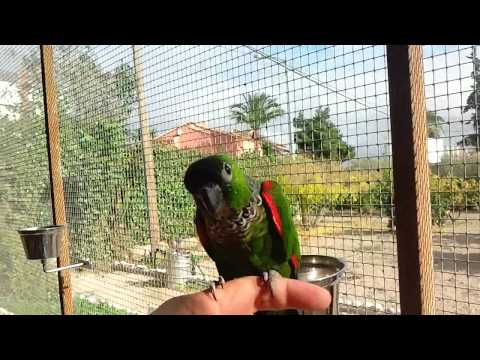
Bronze winged Parrot
Pionus chalcopterus


Bronze winged Parrot

Content

Description:

28 to 30 cm.. tall and around 210 weight g.

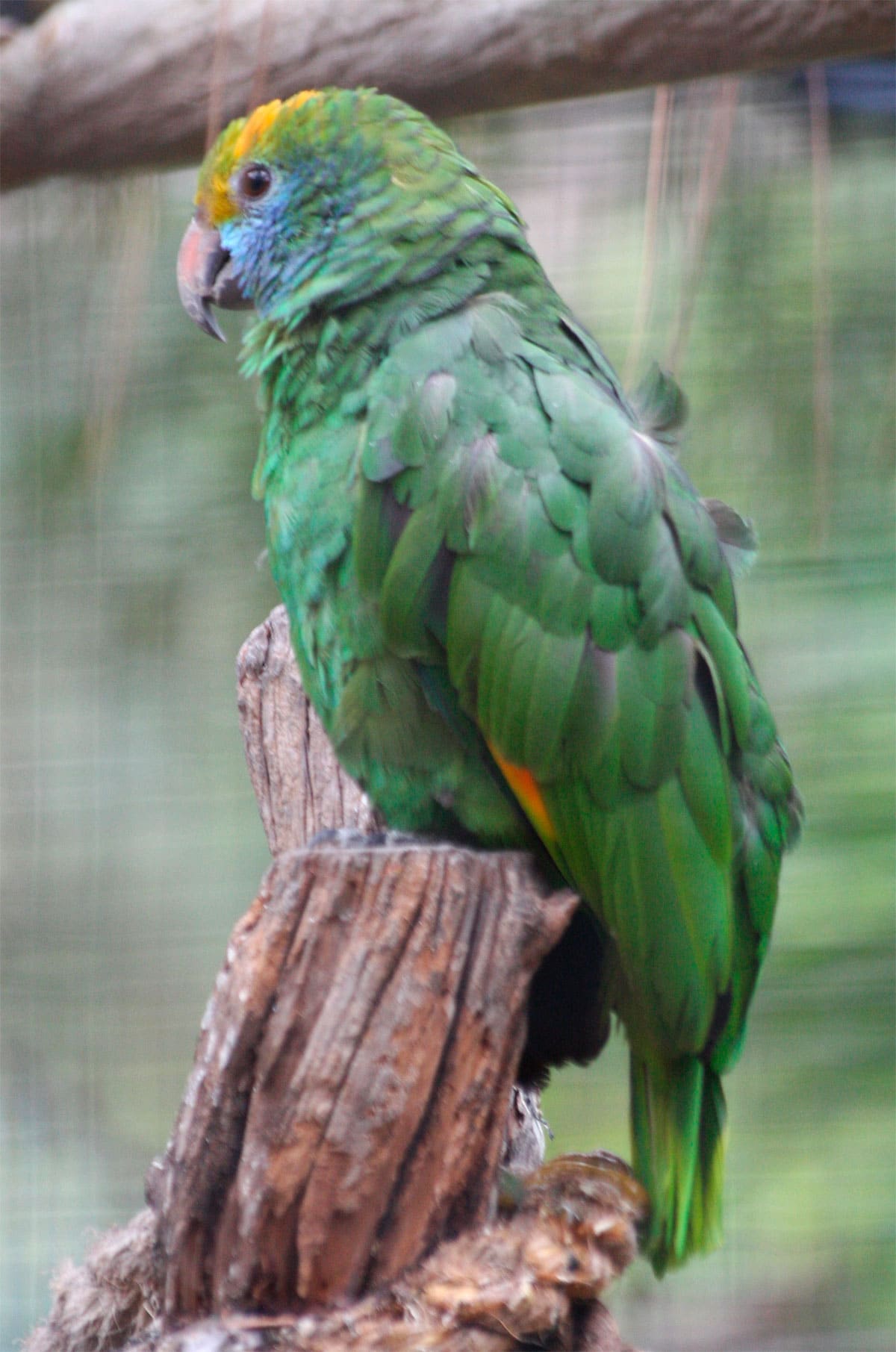
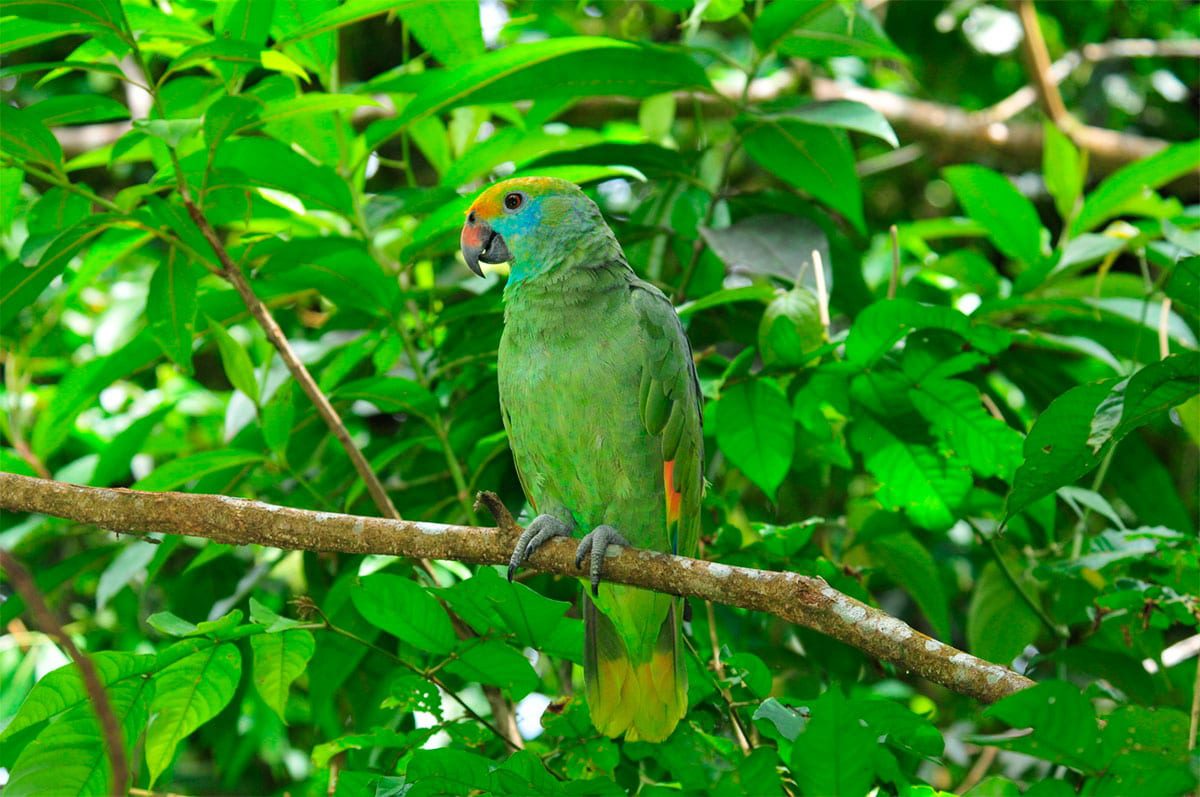
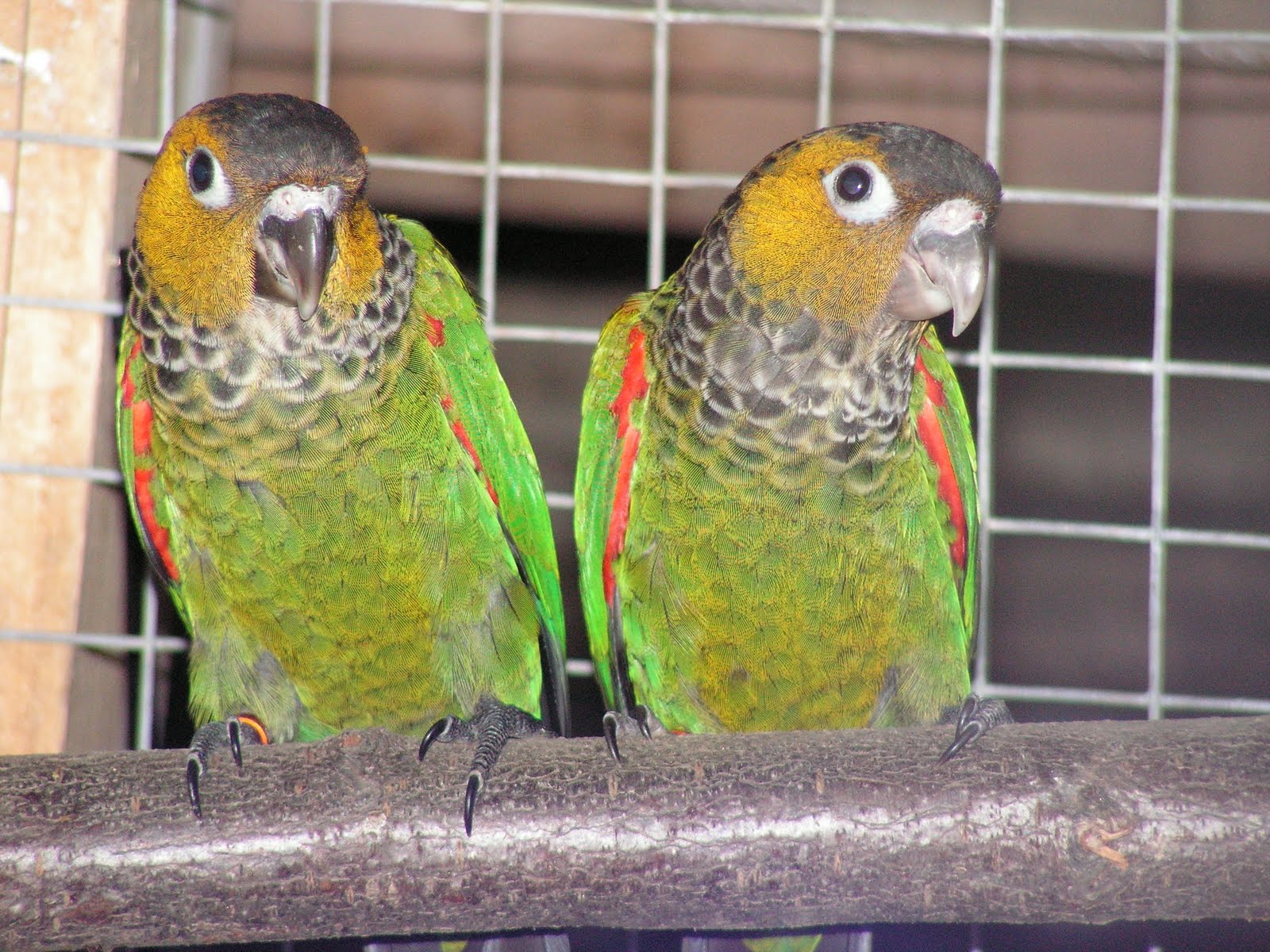
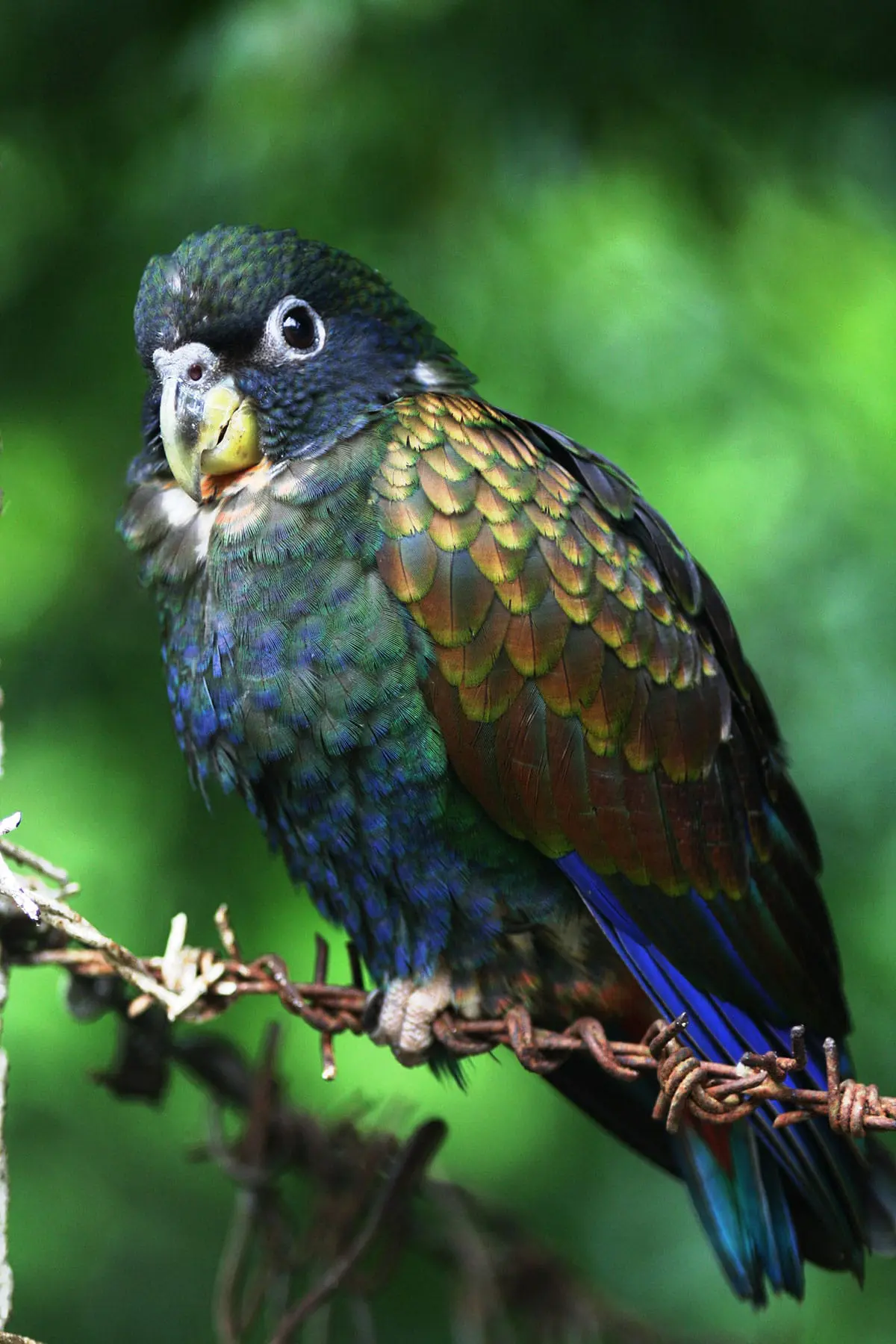
The Bronze winged Parrot (Pionus chalcopterus) has the general Brown, darker in head, neck, chest and flanks, This plumage with blue-violet edge.

The throat whitish and pink; wings bronze green.

Flight is evident violet blue at the top of the wing the Green bottom, that contrasts with the Red of the lower abdomen. Dorsally Violet Blue is notorious in the rump, shoulder and tail. The feathers of the tail are dark blue with a shade of red at the base.

The bill is of color beige, area of naked skin surrounding the eyes of pink. The legs They are pink.

Habitat:

It inhabits in humid jungle, semi-humid, crops and forest edge between 120 and 2800 m.

They are birds gregarious and noisy. Every tomorrow is mobilized in flocks in search of food. Within the flocks are can observe to the couples, that form of life, and who interact with a variety of contact behaviors that reaffirm the marital bond.

Reproduction:

Prefer for their nests broken rods, hollow of logs and palm trees. They nest in the months of October-may. The female often put in two to four eggs they are incubated during three weeks approximately, after which are born them chicks naked or just covered with down. The chicks remain with their parents until the next reproductive shekel.

Food:

Will congregate in cornfields in groups up to of 40 individuals, feeding is of pulp and seeds many fruits and other material ingredients as nectar and flower petals, complementing occasionally its diet with insects.

Distribution:

Its population is distributed by the mountain range of the Andes, from Colombia, Northwest of Venezuela; to the South, by the mountains to the Northwest of Peru.

Conservation:

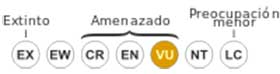
minor concern


โ€ข Red List category of the UICN current: Least concern

โ€ข Population trend: Decreasing

The size of the population World of the Bronze winged Parrot It has not been quantified, but this species is described as ‘rare‘ (Stotz et to the., 1996).

The population was suspected of being in decline due to ongoing habitat destruction.

This species is characterized be decreasing in Colombia and West Ecuador, due to the logging of forest subtropical, which has been severe and quick on the slopes of the Andes (Juniper and Parr 1998).

The evident anecdotal, based on the frequency of sightings, suggests that the species has declined in Pineapples, South of Ecuador, in recent years c.15-20 (M. By D Sanchez. Dรญaz in litt. 2011). Also is says that has been extirpated from areas previously occupied as the slopes of them Andes and valleys of the Cauca and the Magdalena river in Colombia, again due to loss of habitat (Juniper and Parr 1998).

In Venezuela the species is scarce and local, limited, to a large extent, to the slope West of them Andes in Mรฉrida and Sierra de Perija, with occasional records in Tรกchira (CJ Sharpe in litt. 2011). These areas have experienced rapid deforestation for at least the last few 24 years for cultivation and livestock.

Surveys conducted in the Northwest of Peru in the decade of 1990 they appeared to detect a sharp decrease in population from 1993 (Rosales et to the., 2007), although this species is known to be nomadic and its local numbers can fluctuate.

"Bronze winged Parrot" in captivity:

Rare in captivity, It is not a main target of poachers (CJ Sharpe in litt. 2011, R. Clay in litt. 2011), although it is still present in the illegal trade of Peru (F. Angle in litt. 2011)

Intelligent, playful and curious. You can be nervous, loving with your caregiver and aggressive with other people. It has a tendency to obesity.

It requires a spacious cage unless the bird pass periods of time outside of it. Not must keep is to open air where the temperatures fall below them 5 ยฐC.

With feed a wide variety of seeds, fruits and berries.

It is a relatively healthy bird, While it may be more susceptible to infection aspergillosis that other species.

In captivity they lay two eggs the incubation takes 26 days.

Alternative names:

Bronze winged Parrot, Bronze-winged Parrot (English).
Pione noire, Pionus noir (French).
Glanzflรผgelpapagei, Glanzflรผgel-Papagei (German).
Curica-asa-de-bronze (Portuguese).
Cotorra Oscura (Colombia).
Cotorra Negra (Venezuela).
Cotorra Oscura, Loro Alibronceado, Loro de Alas Bronceadas, Cheja alibronceada (espaรฑol).

scientific classification:

Order: Psittaciformes
Family: Psittacidae
Genus: Pionus
Scientific name: Pionus chalcopterus
Citation: (Fraser, 1841)
Protonimo: Psittacus chalcopterus

Images "Bronze winged Parrot"

Videos "Bronze winged Parrot"

ยซLoro Alibronceadoยป (Pionus chalcopterus)

Sources:

  • Avibase
  • Parrots of the World โ€“ Forshaw Joseph M
  • Parrots A Guide to the Parrots of the World – Tony Juniper & Mike Parr
  • Birdlife

  • Photos:

(1) – IBC.lynxeds.com
(2) –
(3) –
(4) –
(5) –

โ–ท The world of Pets: Dogs, cats, birds, reptiles, amphibians

Black-billed Hanging Parrot (2)
Loriculus philippensis bonapartei

Content

Description

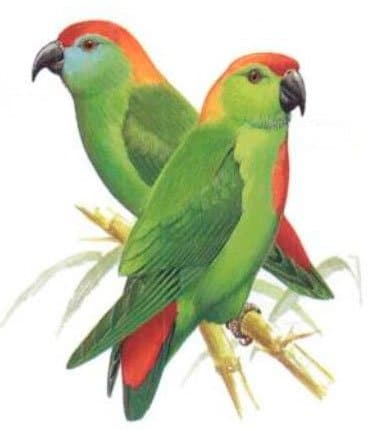
Black-billed Hanging Parrot
14 cm.. length.

The Black-billed Hanging Parrot (2) is a subspecies of the Colasisi (Loriculus philippensis) being the only member of the genus, in the Sulu archipelago. The combination of the Red Crown on front, merging Orange gold neckband, and the black Bill are the brand identity of the Black-billed Hanging Parrot for both sexes. Aside from lacking these features, the most similar species within the subspecies of Loriculus philippensis, the L. p. apicalis and L. p. dohertyi, they have the necks much more of orange-red color and a strong orange color shawl in broadcast.

The female of the Ceylon Hanging-Parrot has the Red Crown, reddish diffusion in the mantle, peak red and a whitish iris (males do not have the Red bib of birds of Sulu).

The front of the Crown of the Black-billed Hanging Parrot is red, shading back in Orange and yellow in the back of the Crown, with a clear line of demarcation of the green mantle; bright green cheeks and Lores. Orange robe loosely washed in the Center; rump and tail coverts bright crimson (Blue Suffusion on sides of rump). Wings green brilliant with vane internal to blackish flight feathers. Feathers of the wings of Turquoise Green: below, the wings of blue. The Chin and throat bright Scarlet; rest of the underparts of bright green. Upper, the Green tail; Blue below. the black beak; Brown irises; Orange to greyish legs.

Habitat:

The species is little known, but their habits and ecology are presumably similar to those of the Colasisi. Commonly found in front of coconut groves on the coast, inside you have registered in forests, as well as in partially cleared areas. Observed feeding on flowers of Palm and flying between the trees.

Reproduction:

The breeding season starts around February and may continue until may. An average clutch can coasts of 2 to 4 eggs. Parents make their nests on top of the cavities of the trees.

Food:

Their natural diet consists of nectar, seeds, red fruits (especially wild figs), berries and flowers

Distribution:

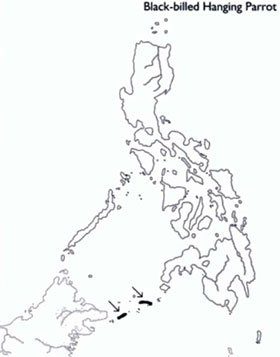
Loriculus-bonapartei-Distribucion
Restricted to islands in the Sulu archipelago. Philippines, among them: Sibutu, Bongao, Sanga Sanga, Manuk Manka, Tawitawi, Siasi and Jolo.

Conservation:

There is no data

"Black-billed Hanging Parrot (2)" in captivity:

Captive breeding of this species has rarely been achieved.; It has however occurred in communal aviaries.

Alternative names:

Black-billed Hanging Parrot, Black-billed Hanging-Parrot (ingles).
Coryllis de Bonaparte, Coryllis ร  bec noir (French).

scientific classification:

Order: Psittaciformes
Family: Psittaculidae
Scientific name: Black-billed Hanging Parrot
Citation: Souance, 1856
Protonimo: Loriculus Bonaparte

————————————————————————————————

ยซLoriculus bonaparteiยป (Black-billed Hanging Parrot)


Sources:

– Avibase
– Parrots of the World โ€“ Forshaw Joseph M
– Parrots A Guide to the Parrots of the World – Tony Juniper & Mike Parr

โ–ท The world of Pets: Dogs, cats, birds, reptiles, amphibians

Bourke's Parrot
Neopsephotus bourkii


Bourke's Parrot

Content


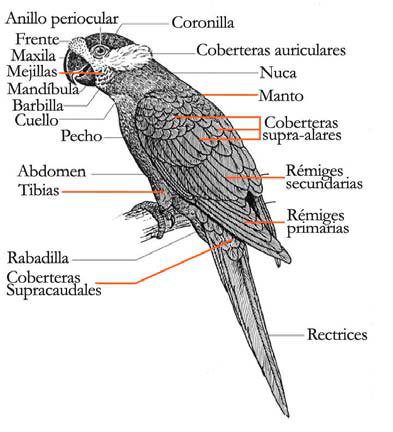
Anatomy-parrots

Description

19 cm. length and an approximate weight of 39 g..

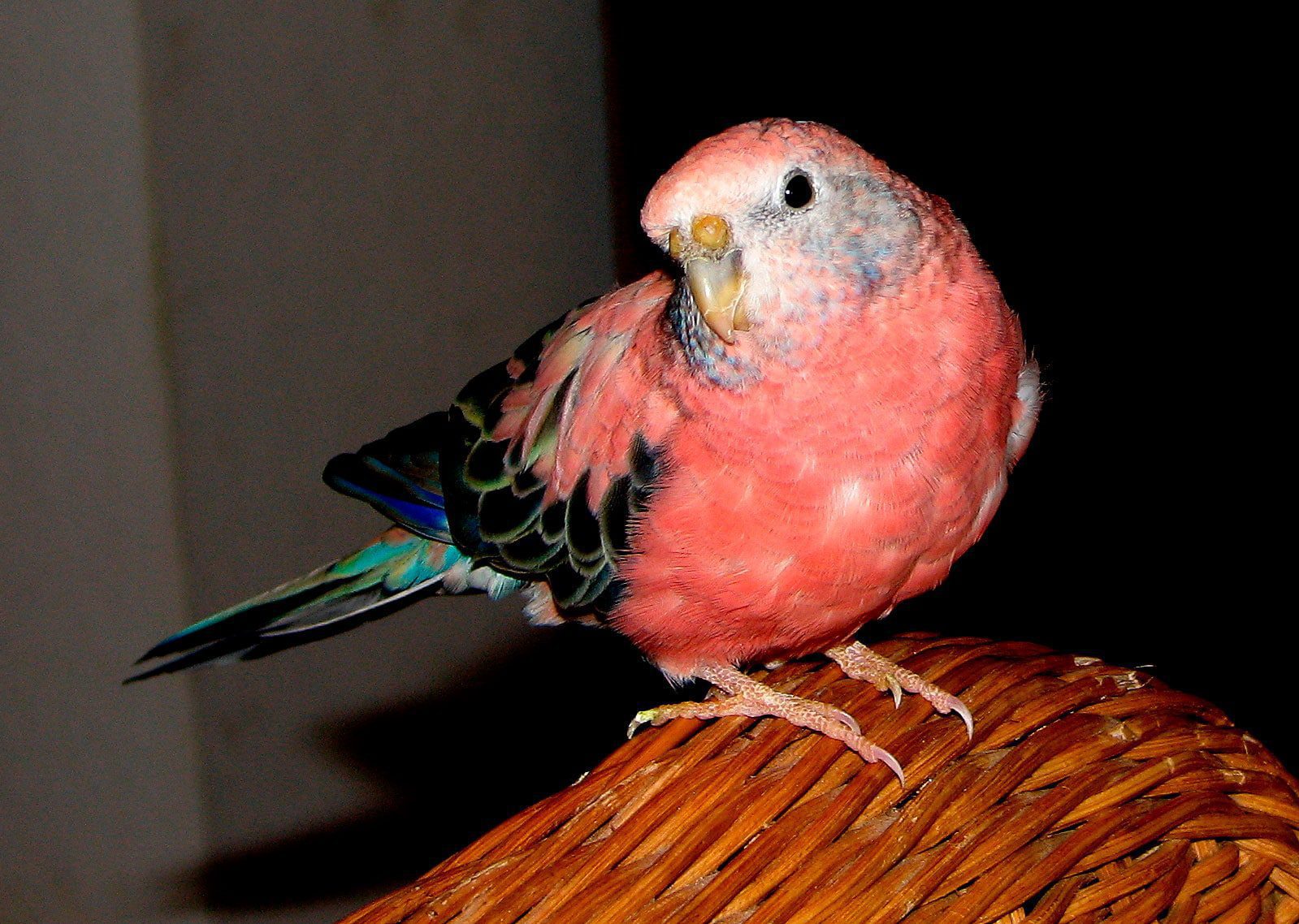
The Bourke's Parrot (Neopsephotus bourkii) has frontal area white. The chin, lores and contour of the eyes they are also white and form a kind of orbital ring clear when seen from a distance.

The ear-coverts and upper cheeks they are dark brown with pink dots and specks. The pileum and the neck are greenish-Brown, with darker edges.

The upperparts are brown-grey color with pale edges on scapulars.

The rump and the top of the tail has darker tones, with some pale blue on the sides. The curvature of the wing is blue.

The small coverts are blue, the median they have light blue, the greater coverts they have a dark tint with yellow-white and blue pink.

The flight feather primaries and secondaries are mostly blue.

The underparts is blue.

The breast feathers are brown with pink ends, giving an appearance of general pinkish brown.

The abdomen is bright pink.

Thighs, lower flanks, side of the rump, under belly and lower area of the tail they have a light blue color. The upper part of the tail infiltrates with bluish-grey.

The bill is greyish black, no hook in upper jaw. The irises They are brown, legs grey-brown.

The female in General, the colors are off and the blue coloration is very little visible or is absent.

The youth they are equal to the female adult but more muted, with a pale band under the wings which is less pronounced in the male juvenile

For a long time, the Bourke's Parrot It was classified in the genus Neophema. A number of ornithologists, more and more, is of the opinion that this parakeet does not belong to this genus and species have been classified in a separate genus called Neopsephotus.

Habitat:

The Bourke's Parrot they are distributed among the driest inland areas.
They mark a strong preference for scattered areas of mulga (Acacia aneura) but does not disdain the plantations of eucalyptus. Can also be observed in plots along streams and afforestation of Callitris which are conifers belonging to the family of cypress.

Son nomads and slightly Twilight. These birds establish themselves in a territory and remain there for several years before disappearing completely.. The Bourke's Parrot they can be very sociable. During periods of drought, You can meet thousands around the water wells and springs.

During the months of summer, We can see them in the morning and in the evening around the ponds.

In Winter, these parakeets come to drink during the day in the company of species of doves such as the common bronze pigeon (Phaps chalcoptera). In places close to the drinking fountains, the Bourke's Parrot They fly in Group emitting loud cries and making whistling wings. But, These parakeets sometimes go unnoticed, they are able to rest or to eat ground in pairs or in small groups. They remain in silence on the floor or hide in the dead wood that serves as camouflage. There are more assets during the sunset.

Reproduction:

The Bourke's Parrot they usually reproduce in August to december, but the season can vary depending on rainfall. The courtship of this bird are similar to those of other species of Parrot Neophema. Males approach the female in upright position with outspread wings and tail.

The nest is located in one a tree cavity, between 1 and 3 meters above the ground. The laying is formed by between 3 and 6 eggs they are incubated during at least 18 days. There are often two broods in the season. The female leaves the nest only once a day in order to be replenished by the male.. The male is also in charge of mounted guard, patrolling and emitting calls in the vicinity of the nest, with the intention to deter intruders.

At birth, the chicks have a white marker, are altricial and remain in the nest for at least 4 weeks. They remain dependent on their parents during a week after feather.

Food:

The Bourke's Parrot they are almost exclusively vegetarian: they eat grass seeds, especially those that are dispersed by the wind. They also eat herbs collected in the soil and in the bushes. These parakeets also appreciate the fresh young shoots and seeds of Acacia or of Bassia, which are small shrubs belonging to the category of Chenopodium album.

Distribution:

Scattered through the interior of Australia, where are nomads but locally common.

The species ranges from the West coast of Western Australia around the inside of Geraldton to rรญo Ashburton and South, through Leonora, and through Gibson and the Great Victoria desert in the South of the Northern Territory, about 20 ยฐS.

Extends from the Northwest of Southern Australia, South-East through Woomera until Port Augusta, that also extends to the North through Oodnadatta and the regions of the Lake Eyre and the Lake Frome.

The birds, to the This of the Montes Flinders You can isolate, since there are no records between 139ยบ and 140 ยฐE.

Apparently, the species has declined in the center of New South Wales due to overgrazing by cattle and rabbits, and is now mainly in the West, from the surroundings of Broken Hill, to paroo river; nomads, However, There have been more towards the This, in the surroundings of Narrandera in the South and the Lightning Ridge in the North.
In the South of Queensland, the Bourke's Parrot are distributed to the This, about Dirranbandi and Cunnamulla. and in the North until Windorah.

Escapes There have been around Brisbane.

The world population is considered to be more of 50.000 specimens.

The species is probably increasing in the west due to agricultural expansion including the provision of artificial irrigation sites..

Conservation:


minor concern


โ€ข Current category of the Red List of the UICN: Least concern

โ€ข Population Trend: Growing

It is estimated one population superior to the 50 000 individuals.

In the western part of its range, the numbers are growing, probably due to the development of agriculture and the installation of new irrigation areas. The reason for its development can also be found in the reduction of sheep farming and the replacement of saline areas with grass..

"Bourke's Parrot" in captivity:

The Bourke's Parrot they are very good birds for beginners amateurs, easy-to-play.

It is a bird peaceful, silent and that it is active only in the first and last hours of the day. Son calm and confident by nature and easy to maintain. It has almost no cravings for crack and your bathroom need depends on the individual. A dry climate supports well, but it is sensitive to cold and wet fog.
Les gusta estar en tierra firme y son susceptibles a la infecciรณn por gusanos, tambiรฉn son susceptibles a infecciones oculares.

With regard to its longevity, according to sources, a sample lived 12,6 years in captivity. In captivity, estos animales pueden criar, approximately, to the 2 years of age.

Alternative names:

Bourke’s Parrot, Blue-vented Parakeet, Blue-vented Parrot, Bourke Grass-Parakeet, Bourke Parakeet, Bourke Parrot, Bourke’s Grass-Parakeet, Night Parrot, Pink-bellied Parakeet, Pink-bellied Parrot, Sundown Parrot (ingles).
Perruche de Bourke (French).
Bourkesittich, Bourke-Sittich (German).
Periquito-rosa (Portuguese).
Papagayo de Bourke, Periquito Rosado (espaรฑol).

scientific classification:

John Gould
John Gould

Order: Psittaciformes
Family: Psittaculidae
Genus: Neopsephotus
Scientific name: Neopsephotus bourkii
Citation: (Gould, 1841)
Protonimo: Euphema Bourkii

Images "Pink Periquito":

Videos "Bourke's Parrot"

————————————————————————————————

"Pink Periquito" (Neopsephotus bourkii)


Sources:

Avibase
– Parrots of the World โ€“ Forshaw Joseph M
– Parrots A Guide to the Parrots of the World – Tony Juniper & Mike Parr
– Birdlife

Photos:

(1) – Bourkeโ€™s parrot (Neopsephotus bourkii) By Flickr user Jan Tik (Flickr) [CC BY 2.0], via Wikimedia Commons
(2) – Bourkeโ€™s Parrot – Neopsephotus bourkii taken at the Cincinnati Zoo and Botanical Gardens By Greg5030 (Own work) [CC BY-SA 3.0], via Wikimedia Commons
(3) – Bourkeโ€™s Parrot Neopsephotus bourkii. Wild pair at Bowra Station, near Cunamulla, Queensland, Australia By Bruce Kendall (Own work) [CC BY-SA 3.0 or GFDL], via Wikimedia Commons
(4) – A male Bourkeโ€™s Parrot at the Flying High Bird Sanctuary, Apple Tree Creek, Queensland, Australia By paulgear (Picasa Web Albums) [CC BY-SA 3.0], via Wikimedia Commons
(5) – Neopsephotus bourkii (formally placed in genus Neophema) By Jan Tik (originally posted to Flickr as Hitchhiker) [CC BY 2.0], via Wikimedia Commons
(6) – By T.H. Maguire (1821โ€“1895) (http://www.birdresearch.dk/dk/jgould.htm) [Public domain], via Wikimedia Commons

Sounds: Tom Tarrant (Xeno-canto)

โ–ท The world of Pets: Dogs, cats, birds, reptiles, amphibians

Barred Parakeet
Bolborhynchus lineola

Catita Barrada

Content

Description:


Anatomy-parrots

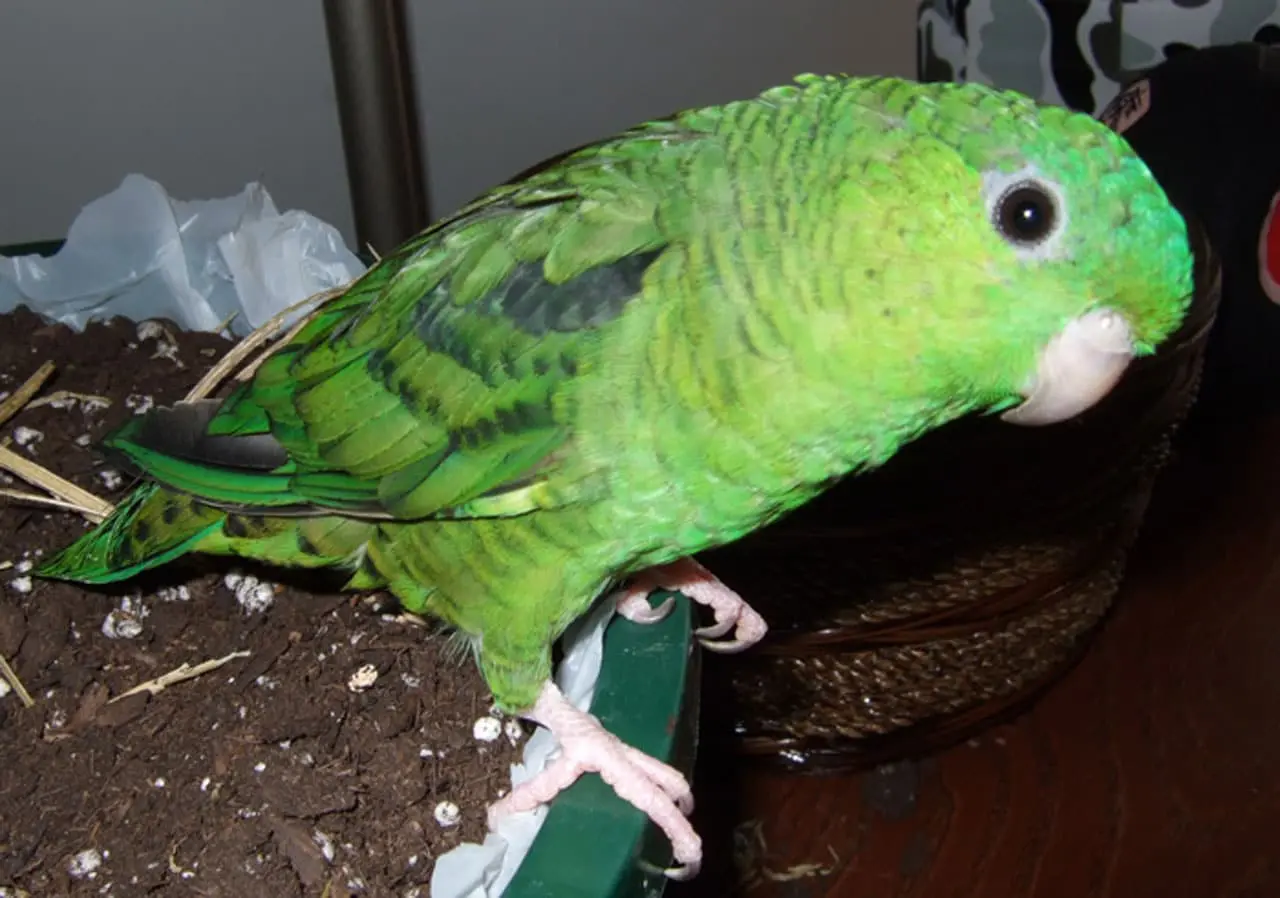
They measure 17 cm. long and weigh between 47 and 55 g.
The Barred Parakeet (Bolborhynchus lineola) has a size similar to the of a Sparrow. The tail and wings they are pointed. Slightly different sexes: in males, the eyes they are brown, the eye ring grey, the bill and legs flesh-colored. The head and underparts they are bright green, with a tenuous beaming on the sides and the tail coverts. The wings they have very marked black bars at the shoulder and patch black(not always visible), the upperparts they are green with a beaming widely dispersed black in the nape and back.
The females and juveniles they present a beaming more pardo. A wide black border and dark green bottom; the irises Dark coffee and legs pink (Howell and Webb, 1995).

Subspecies description:

  • Bolborhynchus lineola lineola

    (Cassin, 1853) – The nominal


  • Bolborhynchus lineola tigrinus

    (Souance, 1856) – Dark green, Crown and bright green front and the rough black is more intense.

Habitat:

Rare and unpredictable. It lives in humid forests, subandinos and Andean cloud forests, open areas, from 900 at 2900m. They are nomads, with numerous flocks (150 or more individuals) following the fruition of the โ€œchusqueโ€ (This chusquea). In small groups or in pairs during the dry season in Central America.

Reproduced in elevations of 1500 meters or more and, like most parrots, they prefer to raise their chicks in a hollow tree or limb trunk. In the winter after the breeding season, the Barred Parakeet often descends to lowland forests. This season, Many feed on partially cleared areas, areas cultivated and in them sheets.

Registered at altitudes from 900 to 2.400 m. in Mexico; by under 1.500 m. in Honduras, Although below 600 After the playback meters; above 1.500 m especially in the West of Panama, although there are records there and in Costa Rica below the 600 m; between 900 and 1,500 m. in Venezuela, between 1,600 and 2,600 m. in Colombia, and until 2.900 m. in the South of Ecuador.

Little known about the habits of these small wild parrots. Since they are small, they like to live high in the treetops, and they are very well camouflaged in their environment, still very hard to see in nature. It also, they are not as noisy as other parrots, which makes them difficult to detect. Most frequently observed during the flight, because they often emit a chirp while flying, What can attract the attention of an observer of birds.

Reproduction:

It nests colonies, in tree hollows, Although you can to occur in crevices in Rocky escarpments, probably during the dry season in Costa Rica; during the month of December in Panama; July-August in Colombia.

Food:

Reported foods that make up their diet include Myrtis, Heliocarpus and Miconia, catkins of Cecropia and bamboo seeds; they occasionally forage in cultivated areas, where has observed them is consuming corn.

Distribution:

Distributed in South of Mexico to western Panama and separated by the Andes, from Venezuela until Peru.

In Mexico they can be observed on the Atlantic slope, in the Highlands of Veracruz, Oaxaca, Chiapas and possibly (There is only a record) in Warrior, also seen in the South of Guatemala (a record from time to time) and in the Highlands of Honduras, with a single bird observed in Nicaragua, specifically in Saint Mary of Ostuma; also registered in those areas mountain of Costa Rica (not seen in areas of the Northwest, for example in the Cordillera de Guanacaste) and in the West of Panama (apparently absent from Central and Eastern).

Distributed through them Andes, to the Northwest of Venezuela in the Federal District, Tรกchira and Merida; scattered locations of Colombia, in subtropical areas of the Western Andes, Central and Eastern and in the massif of Santa Marta; Ecuadorian Andes, with records recent in the South; Peruvian Andes, in Huanuco, Ayacucho and Cuzco, with birds, possibly of this species, observed in the North.

Scattered records, e irregular, as well as a strong nomadic tendency (movements perhaps related to bamboo planting) they indicate that their appearances may be continuous.

Apparently, is one local and rare species over much of its range, Although according to reports, is quite common in Honduras and even locally abundant in the Talamanca mountain range in Costa Rica.

Deforestation in parts of its range, Although these birds travel on cleared land and distributed (at least from time to time) in protected areas, which suggests a low risk population at present.

There is a captive specimens outside their countries of origin.

Subspecies distribution:

  • Bolborhynchus lineola lineola

    (Cassin, 1853) – The nominal


  • Bolborhynchus lineola tigrinus

    (Souance, 1856) – Mountains from northwestern Venezuela and Colombia to southern Peru

Conservation:

State of conservation โ“˜


minor concern Minor Concern โ“˜ (UICN)โ“˜

โ€ข Red List category of the UICN current: Least concern.

โ€ข Population trend: Stable.

Partners in Flight estimated the total population of Barred Parakeet in a number ranging from 50,000-499,999 individuals (A. Panjabi in litt., 2008).


The population This species is suspected of being stable in the absence of evidence of any reduction or substantial threats.


"Barred Parakeet" in captivity:

It is of a species that is has adapted well to the life in captivity, tough enough, its reproduction is expanding.

They are perfect apartment birds due to its arrangement and you need only basic things of life. Son kind and happy of being with the people, but they can be kept entertained with toys and swings when there is nobody around.

Is an Ave. moderately long-lived and if is of good health, Food and hygiene can live during 12 or 14 years.

Limited ability for speech.

They have developed many and striking mutations of color in poultry, including blue, olive, cobalt, Slate (or mauve), turquoise, lutino (bright yellow with red eyes), cremino, cinnamon, Silver, purple …

Alternative names:

Barred Parakeet, Catherine Parakeet, Lineolated Parakeet (English).
Toui catherine, Perruche catherine, Perruche rayรฉe (French).
Katharinasittich, Katharina Sittich (German).
Periquito-catarina (Portuguese).
Catita Barrada, Catita Manchada, Chocoyo Listado, Perico Barrado, Perico Listado, Perico rayado, Periquito Barrado, Periquito Listado, Periquito saraviado (espaรฑol).
Periquito Barrado (Colombia).
Perico Listado, Periquito listado (Costa Rica).
Perico rayado (Honduras).
Perico rayado (Mexico).
Chocoyo Listado (Nicaragua).
Perico Barrado (Peru).
Perico Barreteado (Venezuela).

scientific classification:

Order: Psittaciformes
Family: Psittacidae
Genus: Bolborhynchus
Scientific name: Bolborhynchus lineola
Citation: (Cassin, 1853)
Protonimo: Psittacula lineola

Images ยซCatita Barradaยป:

Videos "Barred Parakeet"


Species of the genus Bolborhynchus

Sources:

Avibase
– Parrots of the World โ€“ Forshaw Joseph M
– Parrots A Guide to the Parrots of the World – Tony Juniper & Mike Parr
– Birdlife

Photos:

(1) – A Barred Parakeet (also known as Lineolated Parakeet) in captivity By Timo Helgert (originally posted to Flickr as greenguy.) [CC BY 2.0], via Wikimedia Commons
(2) – Two pet Barred Parakeets (also known as Lineolated Parakeet) perching on a parasol By Lisa Lenscap (originally posted to Flickr as sistas) [CC BY-SA 2.0], via Wikimedia Commons
(3) – Barred Parakeet (Bolborhynchus lineola) also known as Lineolated Parakeet or Catherine Parakeet By Lisa Lenscap [CC BY-SA 2.0], via Wikimedia Commons
(4) – Perruche Catherine de couleur mauve By Weena (Own work) [GFDL, CC-BY-SA-3.0 or CC BY-SA 2.5-2.0-1.0], via Wikimedia Commons

Sounds:

โ–ท The world of Pets: Dogs, cats, birds, reptiles, amphibians

Blue cheeked Parrot
Amazona dufresniana

Blue cheeked Parrot

Content

Physical characteristics


Anatomy-parrots

34 to 37 cm.. height and between 480 and 600g. weight.

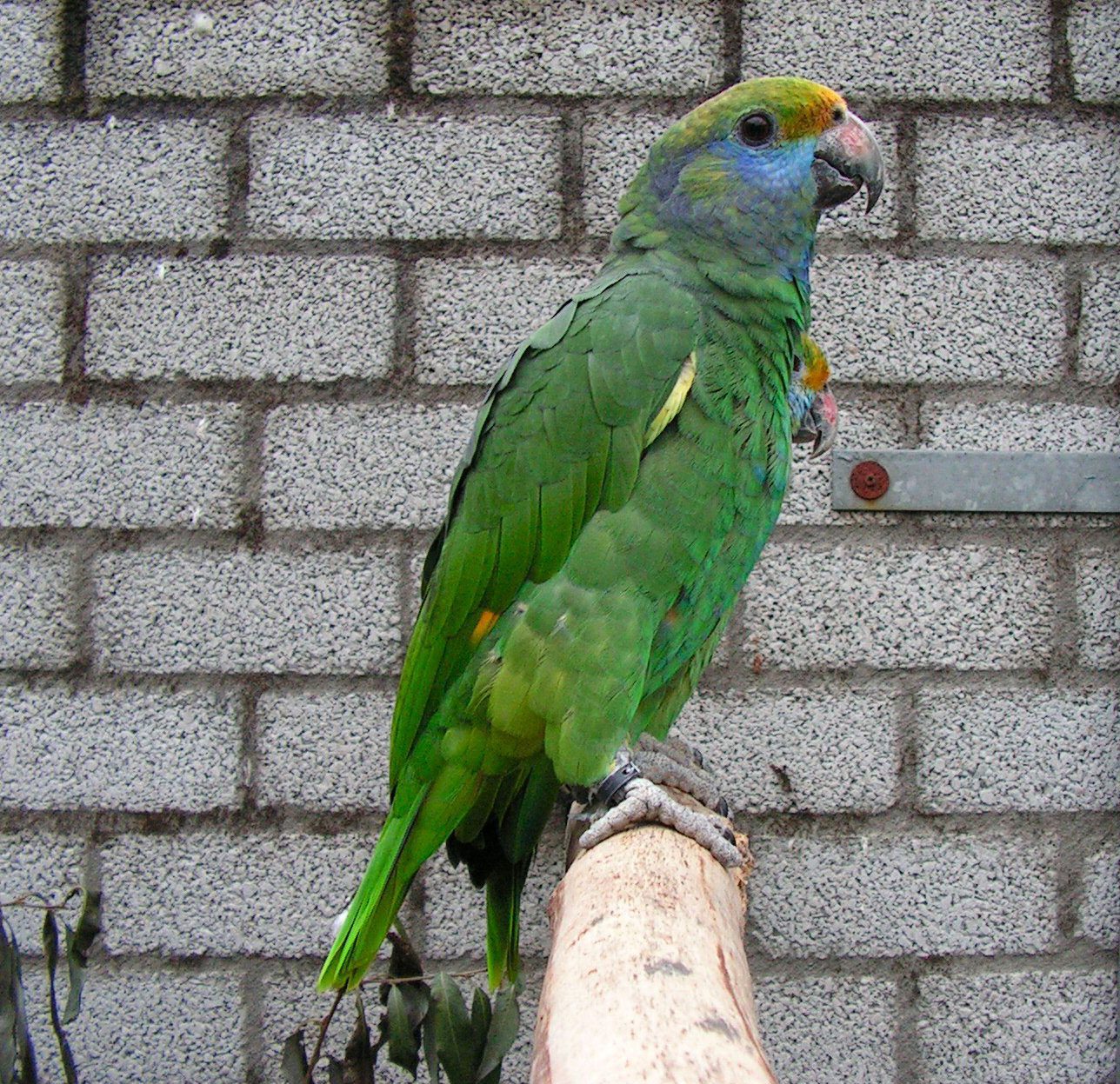
The Blue cheeked Parrot (Amazona dufresniana) It is easily identifiable by the orange yellow wing patch, much more noticeable in flight.

Head with orangeade narrow stripe on the forehead; Yellow Crown, cheeks, base of the beak, sides of the neck to almost light blue Crown.

End of the wing dark, tail with yellow border, rest of green body.

Young birds with orange-yellow feathers on the front of the head and a violet color in the bottom of the cheeks.

The binomial name of this species is in honor to the French zoologist Louis Dufresne.

Video "Blue cheeked Parrot"

Blue cheeked Parrot habitat:

It lives in humid forest, of gallery and sheets, up to 1700m.

It can also be seen sporadically in coastal areas, possibly in response to food availability.

Reproduction Blue cheeked Parrot:

They walk in pairs or small groups of no more of 4 to 8 individuals.

Reproduction and feeding, there is little information.

In the wild, the breeding season occurs in March in Guyana. In captivity, the female lays 3 eggs that we do not know exactly the incubation period.

Food Blue cheeked Parrot:

We don't know the details of your menu, but it is assumed that they eat almost exclusively seeds, and berries.

Distribution Blue cheeked Parrot:

Amazon-fronted Parrotlet location

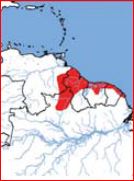
The Amazona dufresniana It is located in southeast Venezuela (Bolรญvar, with a record isolated on Amazon), Northern Guyana (north of 5ยฐN), Northeast Suriname and French Guiana northeast (Y way Collar 1991).

There are reports of Para and Amapa, Brazil, where its occurrence seems likely, but there is no conclusive records (Y way Collar 1991, Collar 1995). The scarcity of records from frequently surveyed areas suggests that it is a low-density and rare species., at the least in parts of its range (Y way Collar 1991).

a Guyana, Healthy populations are known in the area in northwestern Aruka Guyana, between the Aruka and Amakuru rivers, the Kaieteur National Park and the Kuribong River, and the Iwokrama Forest Reserve (A. Narine a slightly. 2010)

Conservation:

State of conservation โ“˜


Near-threatened Near Threatened โ“˜ (UICN)โ“˜

It is in the category of near threatened. (NT), due to habitat loss and illegal trade.

Classified as near-threatened (NT) on the IUCN Red list (1) listed in Appendix II of the CITES (4).

Conservation in March CITES Appendix II actions. Banded from Canaima National Park (Venezuela), Iwokrama forest reserve (Guyana) and the Brownsberg nature park (Suriname).

Blue cheeked Parrot in captivity:

Rare in captivity.
Placid temperament, seems less active than many Amazon.

Alternative names:

Blue cheeked Parrot, Blue-checked Parrot, Blue-cheeked Amazon, Blue-cheeked Parrot, Dufresne’s Amazon, Dufresne’s Parrot (English).
Amazone de Dufresne (French).
Goldmaskenamazone, Granada Amazone (German).
Papagaio-de-bochecha-azul (Portuguese).
Loro de cachetes azules, Amazona Cariazul, Amazona de Cara Azul, Loro cariazul (espaรฑol).

scientific classification:

Order: Psittaciformes
Family: Psittacidae
Scientific name: Amazona dufresniana
Citation: (Shaw, 1812)
Protonimo: Psittacus dufresnianus

Blue cheeked Parrot images:


Species of the genus Amazona


Sources:

– Parrot Book, Parrots and macaws Neotropical

Photo:

1 – papageien.org
2- by Matthieu Sontag[GFDL or CC BY-SA 4.0-3.0-2.5-2.0-1.0], via Wikimedia Commons
3 – By Bjoertvedt (Own work) [CC BY-SA 3.0 or GFDL], via Wikimedia Commons
4 – papageien.org
5 – by ยฉMichel Clement – gepog.org

Sound: Olivier Claessens

โ–ท The world of Pets: Dogs, cats, birds, reptiles, amphibians

Buff-faced Pygmy-Parrot
Micropsitta pusio


Buff-faced Pygmy-Parrot

Content


Anatomy-parrots

Description

The Buff-faced Pygmy-Parrot (Micropsitta pusio) has a length 8,4-8,6 cm.. and 11,5 g. of weight, what it becomes in the Parrot more small of the world.

Has the forecrown, face and chin of color Brown mottled dark, eyebrows yellowish; centre of crown blue, merging to green in the area of the nape. Upperparts Greens with wing-coverts Black in the Center. Flight feathers Black with green ends; lower coverts greenish yellow; underside of the primaries greyish, lightly bathed in yellow. The underparts brighter yellowish green, more pale in the center of the chest and the belly; uppertail-coverts Yellow. The tail centrally blue, with a black shaft. Outer feathers Black with yellow spots.

Bill dark grey; irises brown; legs of color grey or pink.

Female slightly more off than the male around the face.

Young with crown greenish blue and less brightness in the face.

Subspecies description

  • Micropsitta pusio pusio

    (PL Sclater, 1866) – Nominal


  • Micropsitta pusio beccarii

    (Salvadori, 1876) – Usually darker than the nominal race especially on the face, including eyebrows.


  • Micropsitta pusio harterti

    (Mayr, 1940) – Brands that most off the nominal head, Blue throat. Less yellow in the parts below that the subspecies Micropsitta pusio stresemanni.


  • Micropsitta pusio stresemanni

    (ECTION Hartert, 1926) – As the subspecies Micropsitta pusio harterti, but slightly larger and more yellow below.

Habitat:

They are found in lowland forests, wooded hills, gallery forest and secondary vegetation, from sea level to the 500 m. It is also locally in the Savannah and areas of coconut trees (Cocoa nuts).

The species is common and trusting, but can be hard to find due to its small size. Birds can also sometimes be glimpsed by flying in small groups above the canopy. They tend to fraternize in pairs or in groups of up to 30 birds.

They frequently stop while they feed on and turn your head to the right, possibly to find predators.

Reproduction:

Tanysiptera-galatea
Common Long-tailed Kingfisher (Tanysiptera galatea)

Nestbox, they dig in tree cavities active termite mounds, for example the (Microcerotermes biroi). A nest was also found in a terrestrial termite, the entry just a meter from the ground. There is a flange on each side of the entry hole and this differentiates their holes of other species that make their nests in termite mounds, such as the Common Long-tailed Kingfisher (Tanysiptera galatea).

Until three white eggs are the implementation. The nesting season has been recorded throughout the year. Adults sleep on community and up to eight birds have been recorded from a cavity.

Food:

It moves rapidly along lianas and trunks or branches of trees (in inverted position) using its long claws to grip and digging lichens and fungi in the barks. Also sometimes feed on seeds, fruits and insects (that it can be accidentally ingested).

Distribution:

Lowlands of North of New Guinea from the West coast of the bahรญa Paradise, Irian Java, at the Southeast end of Papua New Guinea; absent from the Highlands of the Huon Peninsula and Owen Stanley Ranges above each 500 m, but observed in some of the Northern Islands of New Guinea, including Kairiru, the Schouten Islands, Manam, Karkar and Batangas. The species is found in the lowlands of the West to the coastal region of South on the Purari River. Are also in the Bismarck Archipelago, including Umboi, Tolokiwa, Sakai, the Witu Islands, Lolobau, New Britain, Uatom and Duke of York. Also observed in the d'Entrecasteaux archipelago in Fergusson and in the Louisiade archipelago in Misima Island and Tagula.

Subspecies distribution:

Conservation:


minor concern


โ€ข Current IUCN Red List category: Least concern

โ€ข Population trend: Stable

The size of the world's population has not been quantified but he is estimated above the 100 000 specimens.

The species according to sources is very rare in its range distribution.

The population suspected to be stable in the absence of evidence of any reduction or substantial threats.

"Buff-faced Pygmy-Parrot" in captivity:

They feed on lichens and fungi., therefore its reproduction and maintenance in captivity it is virtually impossible.

Alternative names:

Buff-faced Pygmy-Parrot, Buff faced Pygmy Parrot, Buff-faced Pygmy Parrot (ingles).
Micropsitte ร  tรชte fauve (French).
Braunstirn-Spechtpapagei (German).
Papagaio-pigmeu (Portuguese).
Microloro de Cabeza Azul, Microloro Pusio (espaรฑol).

scientific classification:

Order: Psittaciformes
Family: Psittaculidae
Genus: Meeki
Scientific name: Micropsitta pusio
Citation: (Sclater,PL, 1866)
Protonimo: Nasiterna pusio

Images ยซMicroloro Pusioยป:

Videos "Buff-faced Pygmy-Parrot"

————————————————————————————————

ยซMicroloro Pusioยป (Micropsitta pusio)


Sources:

Avibase
– Parrots of the World โ€“ Forshaw Joseph M
– Parrots A Guide to the Parrots of the World – Tony Juniper & Mike Parr
– Birdlife

Photos:

(1) – El loro mรกs pequeรฑo del mundo – medioambiente.net
(2) – Photo of Micropsitta pusio [By Katerina Tvardikova] – New Guinea Birds
(3) – A bird feeding on the bark of a tree. Author Carmelo Lรณpez – lynx
(4) – Photo of Micropsitta pusio [By Katerina Tvardikova] – New Guinea Birds
(5) – Buff-faced Pygmy-Parrot, Micropsitta pusio at Nimbokrang by jon hornbuckle – BIRDING AROUND THE WORLD
(6) – Tanysiptera galatea By Katerina Tvardikova – New Guinea Birds

Sounds: BAS van Balen (Xeno-canto)

โ–ท The world of Pets: Dogs, cats, birds, reptiles, amphibians

Antipodes parakeet
Cyanoramphus unicolor

Antipodes parakeet

Content


Anatomy-parrots

Description

32 cm.. of length and a weight of 130 g..

The Antipodes parakeet (Cyanoramphus unicolor) has a plumage brighter yellowish green, more yellowish on the hand down and sometimes with irregular yellow markings at the top. It is the only species that does not have color markings on head and tail. It is the largest of its kind.

The face and top are bright emerald green, and the contrast with the neck and the chest is more off.

At the top of the wings, the outer bands of the flight feather are blue, While the long tail It is green with fine yellow piping.

The great bill is silver-grey with dark end. The eyes are orange-red. The legs and feet are greyish.

Both sexes are identical. The female is slightly smaller than the male.

The young birds they are of tail shorter. The young people have the bill Pink White and the eyes light brown.

Habitat:

Antipodes parakeet

The Antipodes parakeet, usually, they prefer areas with tall grass (POA littorosa), areas of open scrub and sedges (Carex). Can also be seen in areas where thorny ferns grow (Polystichum vestitum) and the bushes (Coprosma antipode).

The birds are most common on steeper slopes and near water courses, alone or in small groups; They walk on the floor and climb among the branches as they seek food, normally during the morning and before nightfall.

These birds are very Meek and curious. When frightened, they disappear among the dense vegetation, keeping silent or giving a short alarm call. More than half of the day is spent sunbathing and grooming in protected areas. They bathe in small ponds and rest in burrows.

Reproduction:

The season of reproduction takes place between October and March. The Antipodes parakeet nest in soils with good drainage, a length of at least one meter. The nests is carved in fibrous peat, under the thick base of the tall grass vegetation. The nesting Chamber It is full of rootlets or fern scales.

The spawning occurs between November and January. The female lays 2-3 white eggs (5-6 in captivity). She carries out most of the duties of nesting, and incubates the eggs for a few 26 days. She cares for and feeds the chicks for nearly two weeks. The male contributes to breeding, feeding the female during this period, as well as feeding the young until their independence, at least two weeks after leaving the nest.

Food:

The diet main consists of leaves; an amount of crushed leaves, still attached to the plant, they are a distinctive sign of the power of the Antipodes parakeet. Also consume seeds, berries, the remains of penguins and petrels dead. They often enter into colonies of the Rockhopper Penguin (Eudyptes chrysocome) and of the Sclater's Penguin (Eudyptes sclateri) between the months of October and may, to feed on their eggs or dead young. It also feeds on the eggs and sometimes on the newborns of the same species.. (The sympatrico Red-crowned parakeet prevents competition by taking advantage of the niche that provide seeds, flowers, berries and small invertebrates.)

Distribution:

Endemic to the main island Antipodes, In addition to Bollons, Leeward, Inner Windward and Islands Archway.

Conservation:


Vulnerable


โ€ข Current Red List of UICN: Vulnerable

โ€ข Population trend: Stable

The world's population of the Antipodes parakeet It is estimated between 2.000 and 3,000 specimens. Although common and stable within its range, the species is permanently at risk due to accidental introduction of predators, problem that could be fixed in no time.

Some birds are kept in captivity in New Zealand.

VULNERABLE.

"Antipodes parakeet" in captivity:

This stocky parakeet can live in community with species with similar characteristics.. It is usually outgoing, Active and depending on their way of breeding (natural or hand) and earlier experiences, It may be a trusted Parrot (hand raised or treated early), even being raised by their parents tends to be entrusted.

As a pet it could be good pet by his way of being cheerful and curious.

It is a rather nice parrot as vocalizations. It is not just loud. He likes to climb, There is no great need to crack and loves to be on the floor. enjoy the baths.

However, due to their vulnerability, is very rare poultry.

Alternative names:

Antipodes Parakeet, Antipodes Green Parakeet, Antipodes Green Parrot, Antipodes Island Parakeet, Antipodes Island Parrot (English).
Perruche des Antipodes, Kakariki des Antipodes, Perruche d’Antipodes (French).
Einfarbsittich (German).
Kakariki dos Antรญpodas (Portuguese).
Perico de Antรญpodas, Perico de las Antรญpodas (espaรฑol).

scientific classification:

Edward Lear
Edward Lear

Order: Psittaciformes
Family: Psittaculidae
Genus: Cyanoramphus
Scientific name: Cyanoramphus unicolor
Citation: (Lear, 1831)
Protonimo: Platycercus unicolor

ยซAntipodean Parakeetยป Images:

Videos "Antipodes parakeet"

ยซAntipodean Parakeetยป (Cyanoramphus unicolor)

Sources:

  • Avibase
  • Parrots of the World โ€“ Forshaw Joseph M
  • Parrots A Guide to the Parrots of the World – Tony Juniper & Mike Parr
  • Birdlife
  • Loromania

  • Photos Antipodean Parakeet:

(1) – Cyanoramphus unicolor at Wellington Zoo, Wellington, New Zealand by Peter Halasz. (User:Pengo) – Wikimedia
(2) – Cyanoramphus unicolor at Wellington Zoo, Wellington, New Zealand by Peter Halasz. (User:Pengo) – Wikimedia
(3) – Antipodes Island Parakeet, Auckland Zoo by russellstreet – Flickr
(4) – Antipodes Island parakeet (Cyanoramphus unicolor) by Chlidonias – zoochat
(5) – Antipodes Island parakeet (Cyanoramphus unicolor) by Chlidonias – zoochat
(6) – A painting of Antipodes Parakeet, also known as Antipodes Island Parakeet, (originally captioned ยซPlatycercus unicolor Uniform Parrakeetยป) by Edward Lear 1812-1888 [Public domain], via Wikimedia Commons

โ–ท The world of Pets: Dogs, cats, birds, reptiles, amphibians

Black-capped Parakeet
Pyrrhura rupicola

Should be noted that until the year 1981, The Blackcap Parakeet was considered a rarity in poultry farming.. From that date began to be imported in quantity although at a very high price.

Black-capped Parakeet

Content

Description:

25 cm. length and 70 g. weight.

The Black-capped Parakeet (Pyrrhura rupicola) has the lores, the forecrown and the Crown, blackish brown; cheeks, ear-coverts and supercilii area, of color olive beige; back of the neck brown with narrow pale edges.

Upperparts green. External primary coverts, alula and leading edge of the wings bright red; other coverts mainly green. The flight feather, mainly bluish green, by top with narrow black tips; grey dark below.

Underwing-coverts green. The throat feathers, sides neck and top of the chest, Black base with wide white margins, becoming yellowish-white at the bottom of the chest and almost no formation of continuous pale band; belly and undertail-coverts green with brown stain in the center of the belly. Upper, the tail mainly green.

Black-capped Parakeet

The bill slaty-grey; Cere pale grey; bare periophthalmic off-white; irises brown; legs blackish.

Both sexes similar.

The immature has primary coverts almost completely green, as well as the leading edge of the wings.

Subspecies description:

  • Pyrrhura rupicola rupicola

    (Tschudi, 1844) – The nominal


  • Pyrrhura rupicola sandiae

    (Bond & Meyer de Schauensee, 1944) – It differs from the species nominal much closer to the Gray margins to the feathers of the throat and the front of the neck. These pale fringes measure only 2-2,5 mm. wide (specimens with new plumage) in comparison with the 4-5 mm of the nominal species. Like this, the dark basal portion of these pens is more prominent. It also, the whitish edges to the feathers of the back of the neck they are practically obsolete and the sides of the neck much smaller.

Habitat:

Video – "Black-capped Parakeet" (Pyrrhura rupicola)

PYRRHURA RUPICOLA TAUGHT

It lives in the Amazon rainforest., including formations of vรกrzea and the Mainland, below 300 m. Visits have been recorded in the East of the Andes. Fly in flocks of 30 individuals, or small groups in reproductive age.

Reproduction:

It is believed that it can nest in the months of February-March, although the copulation of observed during the month of September. Sunset until the seven eggs in captivity than hatch during 23 to 24 days.

Food:

Usually feed in the canopy but no specific information on diet or breeding.

Distribution:

Can be seen in the Western basin of the amazon. There has been in the East of Peru from the South of Loreto until Mother of God and Puno, and in the North of Bolivia in Pando.

Also distributed in Peace and the Yungas and in the lowlands of the North of Beni, from the East to the border with Rondร ยดnia in Brazil, with a record until the date in the extreme west of Brazil (Rio Branco, Acre).

In general common (Perhaps more scarce on the edges of the range), but it can be locally decreasing due to the alteration of its habitat.

Subspecies distribution:

  • Pyrrhura rupicola rupicola

    (Tschudi, 1844) – The nominal


  • Pyrrhura rupicola sandiae

    (Bond & Meyer de Schauensee, 1944) – Southeast of Peru, West end of Brazil and North of Bolivia.

Conservation:

State of conservation โ“˜


Near-threatened Near Threatened โ“˜ (UICN)โ“˜

โ€ข Red List category of the UICN current: Near-threatened

โ€ข Population trend: Decreasing

The Parrot Capirotada world population size has not been quantified, but this species is described as "quite common" (Stotz et to the. (1996).

This species is suspected that may be losing from the 13,7 to the 15,5% of their habitat within its distribution over three generations (18 years) based on a model of deforestation of the Amazon (Soares-Filho et to the., 2006, Bird et to the. 2011). Given the susceptibility of this species to be hunted or trapped, leads to the suspicion of a probable decline in population close to the 30% in three generations.

"Black-capped Parakeet" in captivity:

Should be noted that until the year 1981, the Black-capped Parakeet It was considered a rarity in aviculture. From that date began to be imported in quantity although at a very high price.

Their behavior Active, his sympathetic character, their robustness and ease of reproduction attached to the made of own a voice very little annoying, they make an excellent animal for those poultry producers who are initiated into this wonderful hobby. These qualities allow us to intuit that if raised by hand they could be lovely pets.. It is sad to observe that, too often, the main maxim that justifies poultry farming "play to preserve" becomes "play to sellโ€.

Alternative names:

Black-capped Parakeet, Black capped Parakeet, Black-capped Conure, Rock Conure, Rock Parakeet (English).
Conure ร  cape noire, Perriche ร  cape noire, Perruche ร  cape noire (French).
Schwarzkappensittich, Schwarzkappen-Sittich (German).
tiriba-rupestre (Portuguese).
Cotorra Capirotada, Perico de Frente Negra (espaรฑol).
Wewey, Aboro gushรณus (Chimane).


scientific classification:

Tschudi-Johann Jakob of

Order: Psittaciformes
Family: Psittacidae
Genus: Pyrrhura
Scientific name: Pyrrhura rupicola
Citation: (Tschudi, 1844)
Protonimo: Conurus rupicola

Images "Black-capped Parakeet"


Especies del gรฉnero Pyrrhura

Sources:

Avibase
– Parrots of the World โ€“ Forshaw Joseph M
– Parrots A Guide to the Parrots of the World – Tony Juniper & Mike Parr
– Birdlife

Photos:

(1) – Pyrrhura rupicola sandiae by pedroduarte
(2) – Maroon-tailed Parakeet ssp. (in front); and Pyrrhura rupicola, Black-capped Parakeet (behind) by John Gerrard Keulemans [Public domain], via Wikimedia Commons

Sounds: (Xeno-canto)