โ–ท The world of Pets: Dogs, cats, birds, reptiles, amphibians

Cardinal Lory
Pseudeos cardinalis


Lori Cardenal

Content

Description

31 cm.. height and weight of 175 to 215 gr.

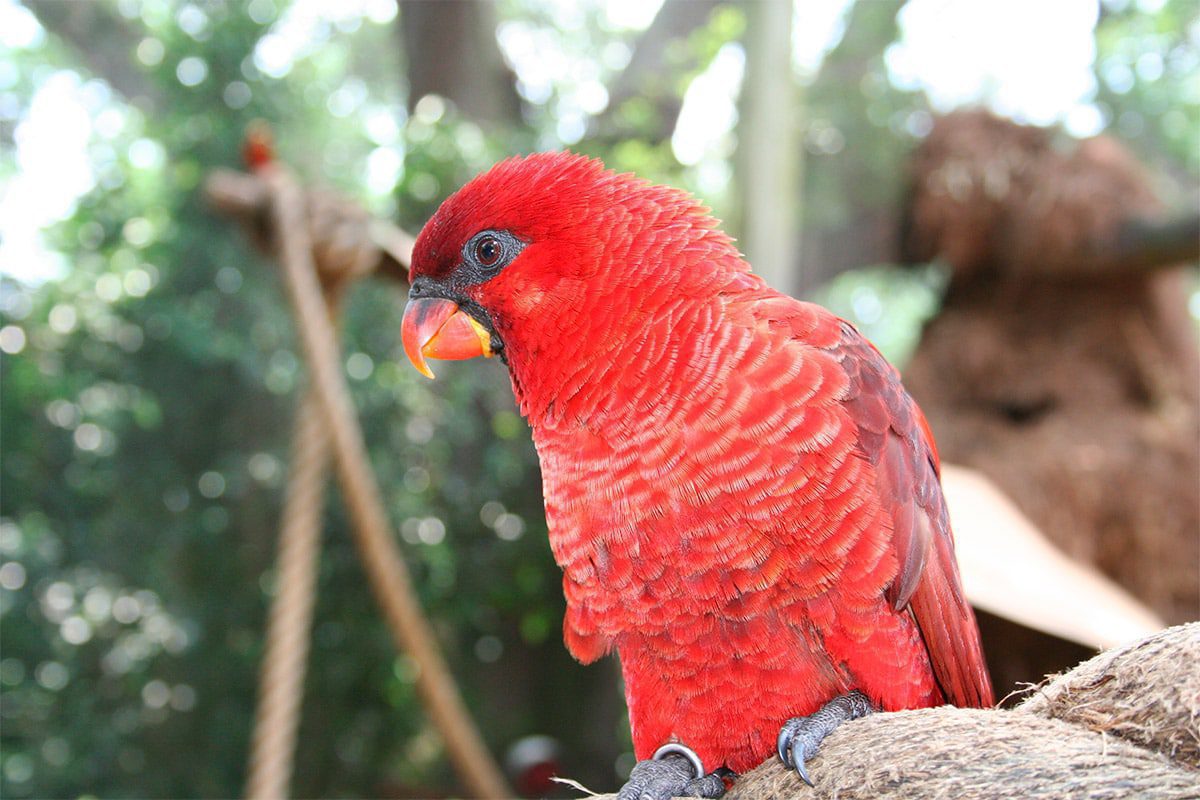
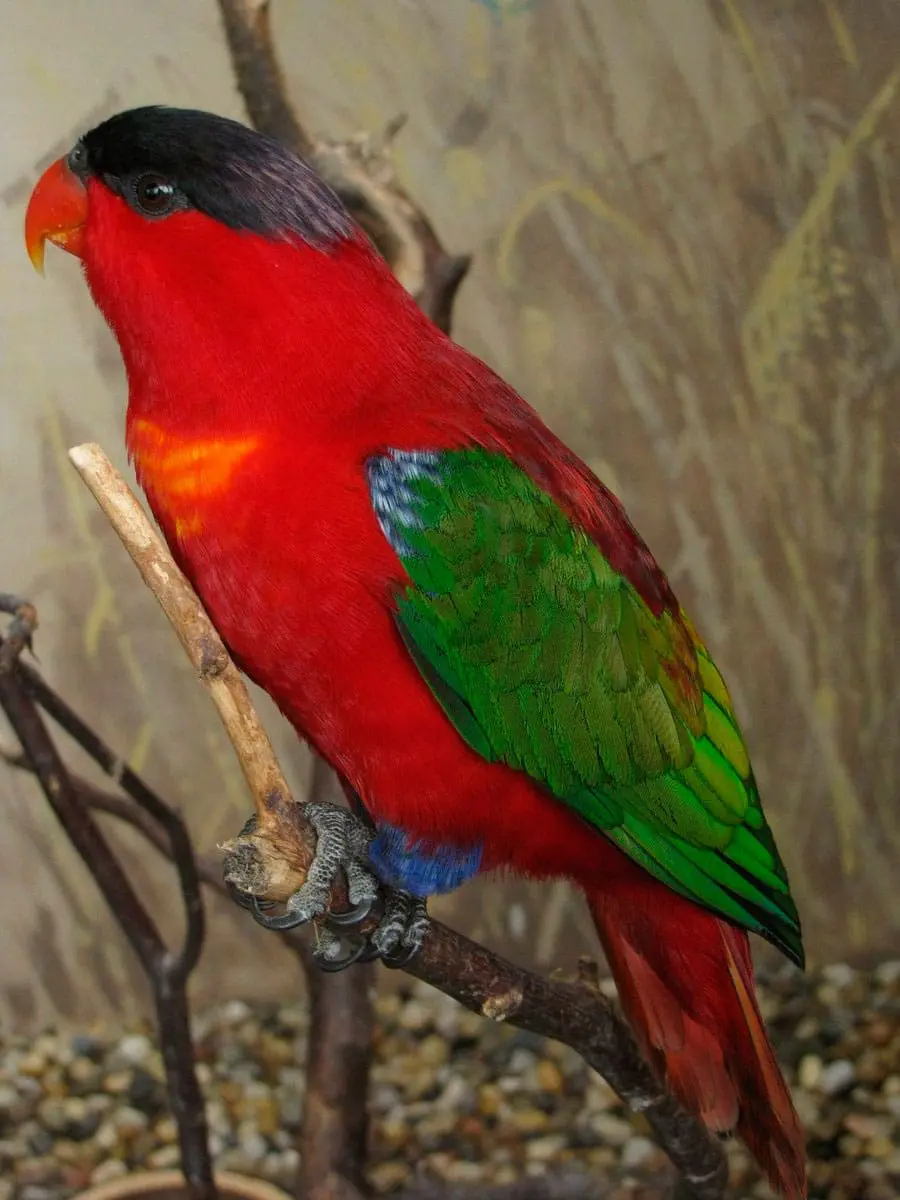
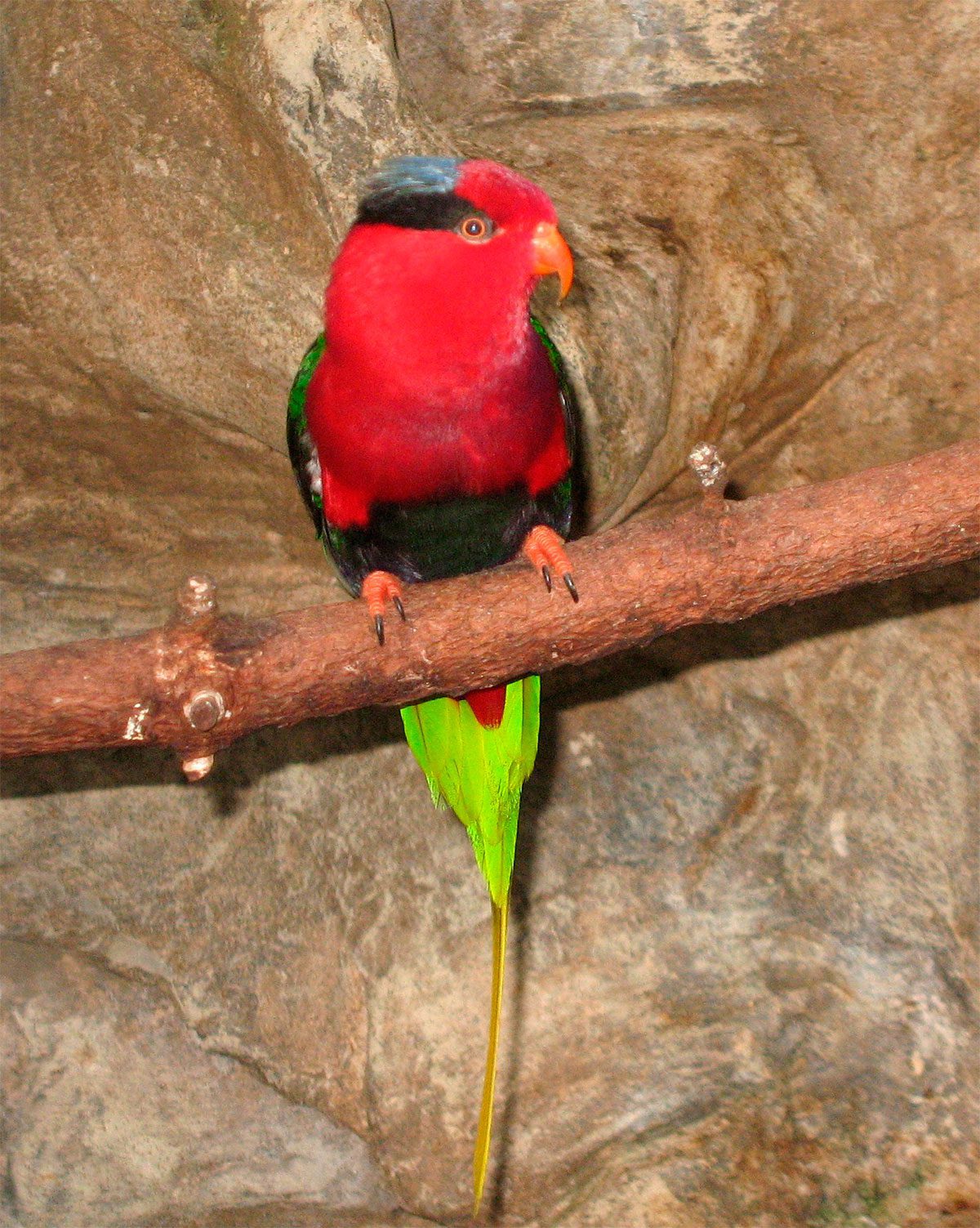
The Cardinal Lory (Pseudeos cardinalis) has a characteristic shape due to its relatively long tail.

Among adults, There is no sexual dimorphism, the plumage is completely brilliant red, but the upperparts and wings They seem to be darker.

The bill is orange-red with a black color in the base area.
The bare orbital skin is black.

The feathers the lower parts have small yellowish features, What gives a vaguely scaly appearance.
The legs are grey.

The irises is red-orange.

The immature has the back and blankets of Red Wings clear. Its bill It is pale orange with small black marks. Its orbital skin is whitish grey. Their irises are pale yellow.

Habitat:

It is a kind forest. It is very widespread and is locally abundant in primary and secondary forests. It is also in the forests in regeneration in coconut plantations and mangroves where there are trees in flower.

Can rise to 1.200 m above sea level, Although in the Bougainville Island (Papua New Guinea), does not exceed of the 800 m.

It is a bird loud that does not happen easily unnoticed.

It is usually in small flocks of up to 20 birds flying high above the canopy. Also gets into branches higher trees in flower which is notable for its continuous shrieks and its beautiful bright colors.

It is often found in the company of the Coconut Lorikeet (Trichoglossus haematodus) and they particularly appreciate red flowers.

This bird moves constantly in the day, flying from one island to another.

Reproduction:

The breeding season probably starts in June. There are reports of links in August and stops extending to September.

To date, We have found a nest in a high tree cavity, at low altitude above the ground. This is the only information we have about the natural environment.

In captivity, the Cardinal Lory puts two white eggs. Both parents incubate and care for young people.
The incubation period is 24 days.

When out of the shell, chicks weigh in 6 to 7 g.. They are covered with a white quilt, long and dense.

As with all the Loris type Chalcopsitta y Pseudeos the nest is especially long and hard between 65 and 80 days.

Food:

The Cardinal Lory is exclusively vegetarian. Feeds in the canopy and fruit Palms, small berries, flowers, outbreaks, also pollen and nectar.

This Parrot seems to mark a clear preference for the flowers and red fruits.

Distribution:

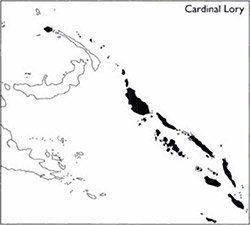
Distribucion Chalcopsitta cardinalis

The Cardinal Lory It is endemic to the Islands to the East of New Guinea. Its area of distribution covers New Hanover and the islands surrounding (Tabar, Lihir, Thong, FeNi and Nissan). Extends to Buka and Bougainville. In the Solomon Islands occupies a territory that extends to the South of San Cristรณbal.

Conservation:


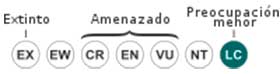
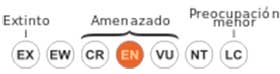
minor concern

– Current IUCN Red List category: Least concern

– The population trend: Stable

The world population It has not been quantified, but the species is described as abundant (pit et to the. 1997). Sources estimate that the total population in nature exceeds the 100 thousand copies.
The population is suspected to be stable in the absence of evidence of any reduction or substantial threats.

But, is classified by the UICN as a species "in restricted area", which means that it has a territory whose surface is less to 50 000 km, therefore, potential danger.

"Cardinal Lory" in captivity:

Very rare.

In 1989, the Solomon Island allowed that a few Cardinal Lory were exported to the EE.UU.. But, because of the Law on the conservation of wild birds in 1992 The export of the Lori of Solomon Islands to the United States. UU. they banned except that is for authorized reproduction.

Alternative names:

Cardinal Lory (ingles).
Lori cardinal (French).
Kardinallori (German).
Lรณris-cardinal (Portuguese).
Lori Cardenal (espaรฑol).

scientific classification:

Order: Psittaciformes
Family: Psittaculidae
Scientific name: Pseudeos cardinalis
Genus: Dusky
Citation: (Gray,GR, 1849)
Protonimo: cardinal lorius

ยซLori Cardenalยป images:

Videos "Cardinal Lory"


ยซLori Cardenalยป (Pseudeos cardinalis)


Sources:

Avibase, BirdLife.org, Oiseaux.NET

Photos: Wikipedia, Chalcopsitta cardinalis - Cincinnati Zoo (Wikipedia), Ethan Ograngy (IBC.lynxeds.com), Minppu (IBC.lynxeds.com)

Sounds: Niels Krabbe (Xeno-canto)

โ–ท The world of Pets: Dogs, cats, birds, reptiles, amphibians

Mindanao Lorikeet
Trichoglossus johnstoniae

Mindanao Lorikeet

Content

Description

20 cm.. length and a weight between 48 and 62 gr.

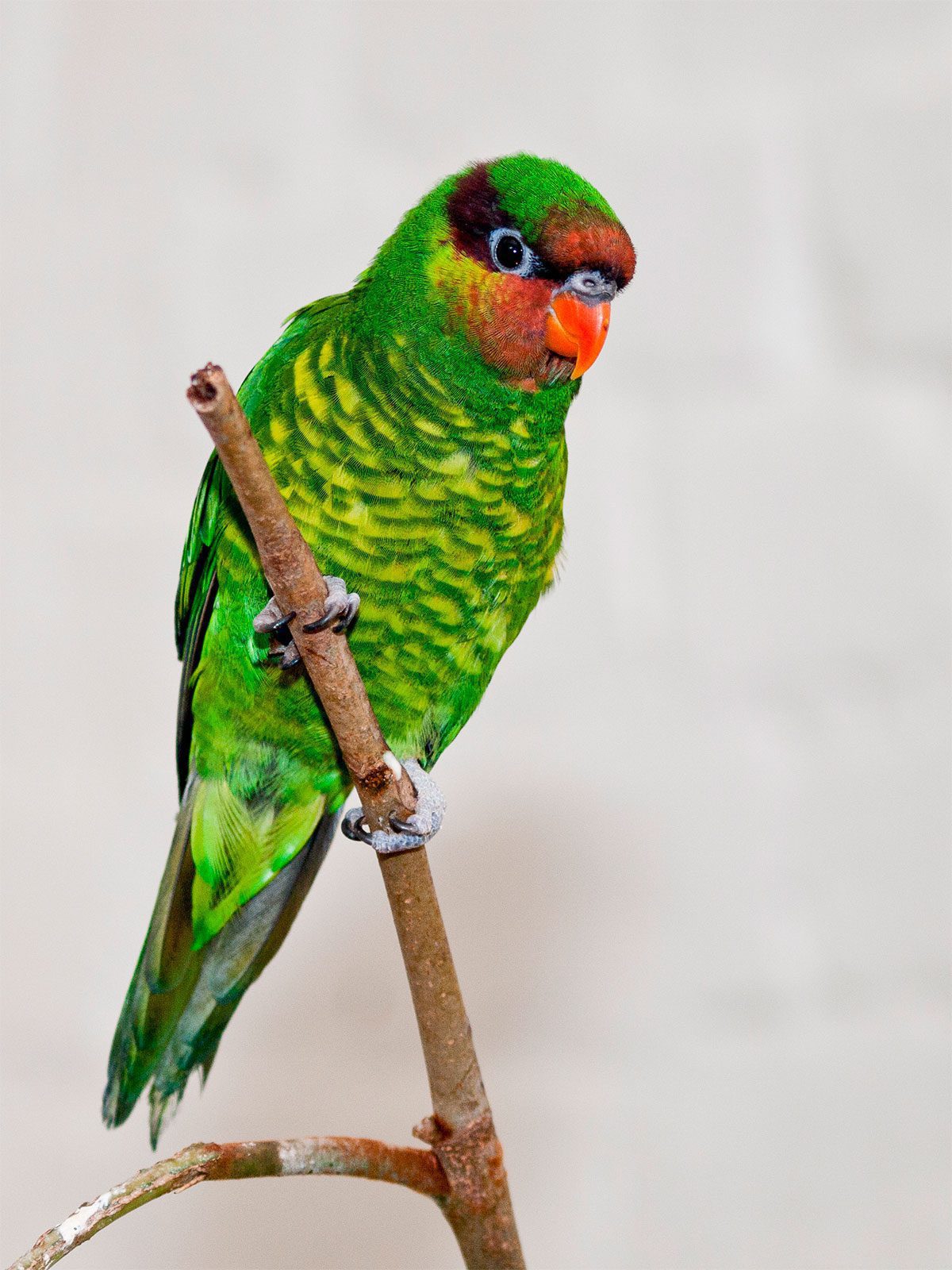
The plumage of the Mindanao Lorikeet (Trichoglossus johnstoniae) is usually Green. The facial area It is red with a tendency to pink. The band that goes from the eye until the part back from the neck it is dark purple.

The underparts are yellow, scalloped with green resembling scales. They have the Underwing coverts and subcaudales yellowish green. The band less of them wings is yellow. Its bill is reddish orange, the legs grayscale and the eye ring dark gray. The eyes orange-red.

The birds immatures have less red on the face. Instead of the band dark purple in adults, young birds have an off color lilac and a Brown stain behind the eye. The rings of the eyes are of color grey white. The eyes They are brown.

There are no significant differences between males and females.

  • Sound of the Mindanao Lorikeet.

Habitat:

Found of 1.000 to 2.500 m in the Mount Apo and 1.000 1,700 m in the Mount Malindang.

The Mindanao Lorikeet they prefer mossy forests, but also you can see them along the edge of the forest and in degraded areas.

Usually noisy during the flight, but when they feed on, remain calm. They migrate daily between different altitudes in the morning looking for food in the Highlands and in the evening return to their resting places in the lower areas.

They move higher during the day, in flocks of up to 50 birds, to feed on trees with flowers and shrubs. At sunset, they return to the lower slopes to rest.

Reproduction:

Little is known about the ecology of reproduction.. Probably it breeding is performed between months of March and may.

Captive breeding records indicate that the laying tends to be of two eggs, the incubation of some three weeks and that the young leave the nest between three weeks and a month more afternoon.

Food:

With feeds nectar, flowers, fruits, pollen and insects.

Distribution:

Size of the area of distribution (reproduction / resident): 8.700 km2

Endemic to the mountains of Mindanao (Philippines)

Conservation:


Near-threatened

โ€ข Current IUCN Red List category: Near threatened

โ€ข Population trend: Decreasing

Its habitat favorite is relatively unlikely that is affected by human activities in the medium term, but logging and capture should remain concerns.

The world population apparently not been quantified formally, but the species is described as very rare and there are those who think that there are less than 10.000 individuals.

"Mindanao Lorikeet" in captivity:

Very rare in captivity.

Due to its decreasing trend in terms of its population, any specimen that can not be returned to their natural habitat (natural range) should preferably be placed in a well-managed breeding program to ensure the survival of the species.

Alternative names:

Mindanao Lorikeet, Apo Lorikeet, Johnstone’s Lorikeet (ingles).
Loriquet de Johnstone (French).
Mindanaolori, Mindanao-Lori (German).
Loris johnstoniae (Portuguese).
Lori de Mindanao, Tricogloso de Mindano (espaรฑol).

scientific classification:

Order: Psittaciformes
Family: Psittaculidae
Genus: Trichoglossus
Scientific name: Trichoglossus johnstoniae
Citation: Hartert, 1903
Protonimo: Trichoglossus johnstoniae

โ€œMindanao Loryโ€ Images:

————————————————————————————————

ยซLori de Mindanaoยป (Trichoglossus johnstoniae)


Sources:

Avibase
– Parrots of the World โ€“ Forshaw Joseph M
– Parrots A Guide to the Parrots of the World – Tony Juniper & Mike Parr
– BirdLife.org

Photos:

1 – ยซTrichoglossus johnstoniae - London Zoo, England-8aยป by William Warby from London, England – Unknown-Tropical BirdUploaded by Snowmanradio. Licensed under CC BY 2.0 via Wikimedia Commons.
2 – ยซMindanao Lorikeet (Trichoglossus johnstoniae)-3cยป by Mindanao_Lorikeet_(Trichoglossus johnstoniae).jpg: Elizabeth Ellisderivative work: Snowmanradio (talk) – originally posted to Flickr as lovebird and uploaded to commons at Mindanao_Lorikeet_(Trichoglossus johnstoniae).jpg. Licensed under CC BY-SA 2.0 via Wikimedia Commons.
3 – by Jonathan Beilby – IBC.lynxeds.co
4 – zoochat.com
5 – papageien.org

Sounds: Kennedy, Robert S. – ยฉ 2014 Cornell University

โ–ท The world of Pets: Dogs, cats, birds, reptiles, amphibians

Purple-naped Lory
Lorius domicella

Purple-naped Lory

Content

Lori damsel drawing

Description

The Purple-naped Lory (Lorius domicella) has a length of 28 cm.. and an approximate weight of 235 g..

The forecrown, crown and nape black, with variable purple spots on the back of the top. The cheeks, lores and ear-coverts red. Upperparts red, darker in the center of the the mantle. Upper wing Green with white and purple patch in the shoulder. Color bronze in all the upper inner coverts, the most marked inside opaque red. the flight feather Blackish with area central in the interior of color yellow. Underwing-coverts Violet Blue impregnated white. Underwing coverts black; blue purple in them axillary. Parts low Red with band yellow, variable at the top of the chest; Violet Blue the the thighs, slightly impregnated in green. Tail red, reddish brown tipped. Bill orange; irises reddish brown; dark grey the legs.

Males and females are equal.
Immature with yellow stripe in the chest more extensive and more diffuse. Bill Brown in very young birds.

There is no geographic variation

Habitat:

In Seram the Purple-naped Lory found in montane and submontane forests, both primary and secondary, a altitude between 400 and 1.050 m; also in the jungle in the this of the island and in the areas cultivated. They move in pairs, rarely in groups and can be territorial. reproductive ecology of the species in the wild is unknown. Forshaw gives details of an instance of poultry farming in which two eggs were laid., hatching around the 25 days; the young are independent only three months more afternoon.

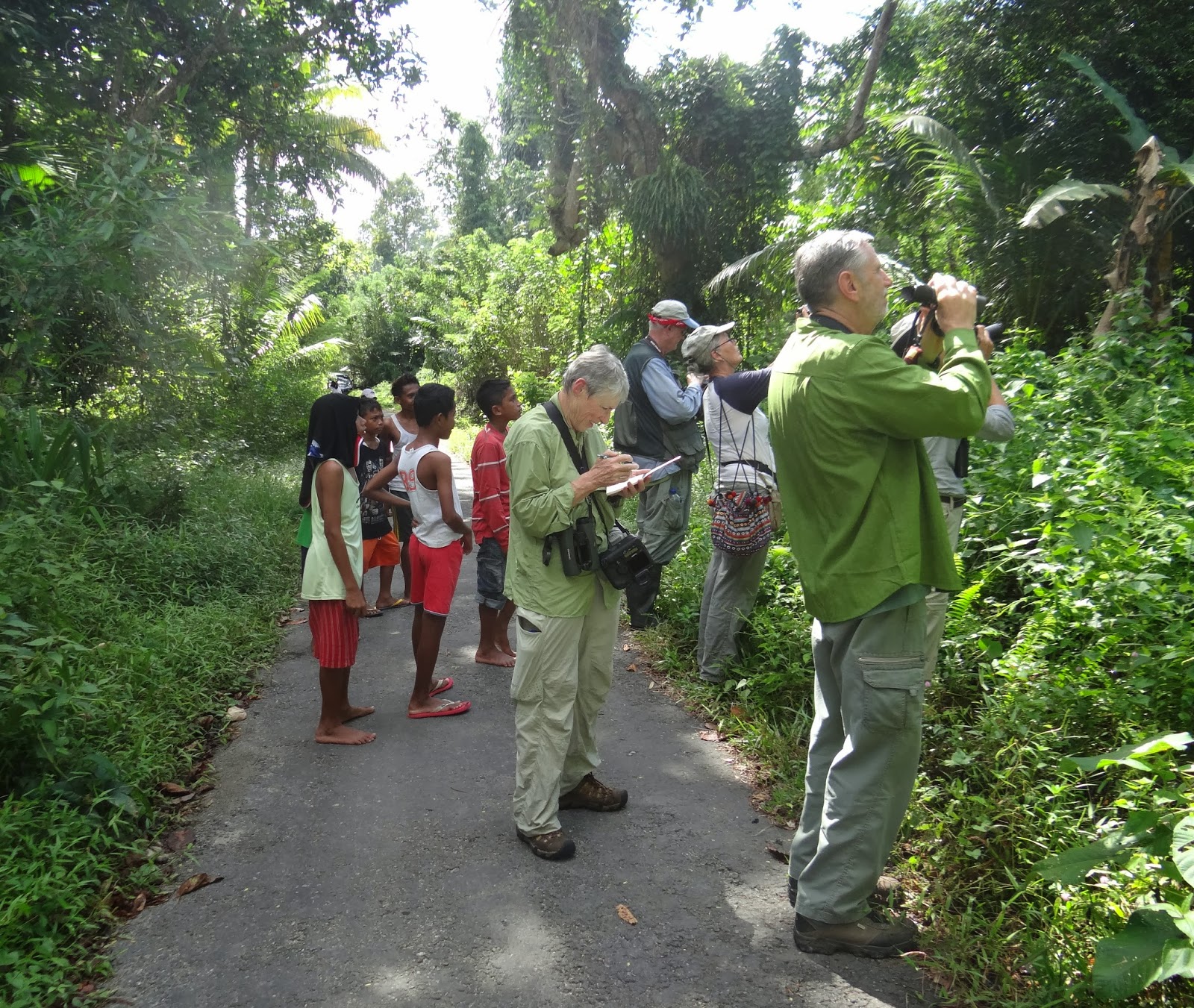
A group birding in Ambon

Reproduction:

The reproduction of the species in the wild is unknown. Details of breeding in poultry farming establish a clutch of two eggs, incubation in a few 25 days, and the young three months after independence.

Food:

Feed on fruits of Pandanus scattered.

Distribution:

Size of the area of distribution (reproduction / resident): 6.300 km2

endemic to the Seram Islands and Ambon (has also been seen in Buru: probably an escaped bird), in Indonesian. There are no recent records of Ambon or Buru. The current records come from the Manusela National Park (uncommon) and the center of Seram and WAE Fufa (locally common).

In 1987 Bowler and Taylor they found a rate of 0,7 birds per hour in Kineke, in the Manusela National Park; But during nearly two months of observations in 1990, they only saw 10 individuals.

The species is a bird people of cage in Seram and throughout the province of Maluku and the expansion of foreign trade could pose a threat to their survival.

The population worldwide is estimated at less than 20.000 individuals in 1991, but currently, the population, is considered on the rise. VULNERABLE.

Conservation:


Endangered

โ€ข Current IUCN Red List category: Danger.

โ€ข Population trend: Decreasing.

This species has been upgraded to In danger Since its population It is suspected that has fallen below 2.500 individuals mature, with more than 250 in any subpopulation mature individuals.

Capture unsustainable for local and national trade, as well as the loss of forests due to logging, oil extraction and hydroelectric power combinations.

These facts, It is suspected, they are causing an downhill fast and constant in the species.

"Purple-naped Lory" in captivity:

Very rare.

Alternative names:

Purple-naped Lory, Purple naped Lory (ingles).
Lori des dames (French).
Erzlori (German).
Loris-de-nuca-roxa (Portuguese).
Lori Damisela, Lori Domicela (espaรฑol).

scientific classification:

Order: Psittaciformes
Family: Psittaculidae
Genus: Lorius
Scientific name: Lorius domicella
Citation: (Linnaeus, 1758)
Protonimo: Psittacus Domicella

โ€œDamsel Loriโ€ Images:

Videos "Purple-naped Lory"

————————————————————————————————

ยซLori Damiselaยป (Lorius domicella)


Sources:

Avibase
– Parrots of the World โ€“ Forshaw Joseph M
– Parrots A Guide to the Parrots of the World – Tony Juniper & Mike Parr
Birdlife

Photos:

1 – Zoolรณgico de Praga: Pรบrpura-naped Lory – animalphotos
2 – ยซLorius domicella-Artis Zoo-Netherlands-8aยป by Arjan Haverkamp – originally posted to Flickr as Img_4196e. Licensed under CC BY 2.0 via Wikimedia Commons.
3 – ยซLorius domicella-Banda Islands-Indonesia-upper body-8ยป by Henri – originally posted to Flickr as Lory = green-tailed lory. Licensed under CC BY 2.0 via Wikimedia Commons.
4 – Birds-pet-wallpapers – link
5 – ยซLorius domicella-Jurong Bird Park, Singapore-8a-tocยป by Lorius domicella-Jurong Bird Park,_Singapore-8a.jpg: kwang chongderivative work: Snowmanradio (talk) – originally posted to Picasa Web Albums as Picasa Web Albums and uploaded to Commons as Lorius domicella-Jurong Bird Park,_Singapore-8a.jpg. Licensed under CC BY-SA 3.0 via Wikimedia Commons.
6 – Illustrations ยฉ2010 by Frank Knight

Sounds: George Wagner (Xeno-canto)
โ–ท The world of Pets: Dogs, cats, birds, reptiles, amphibians

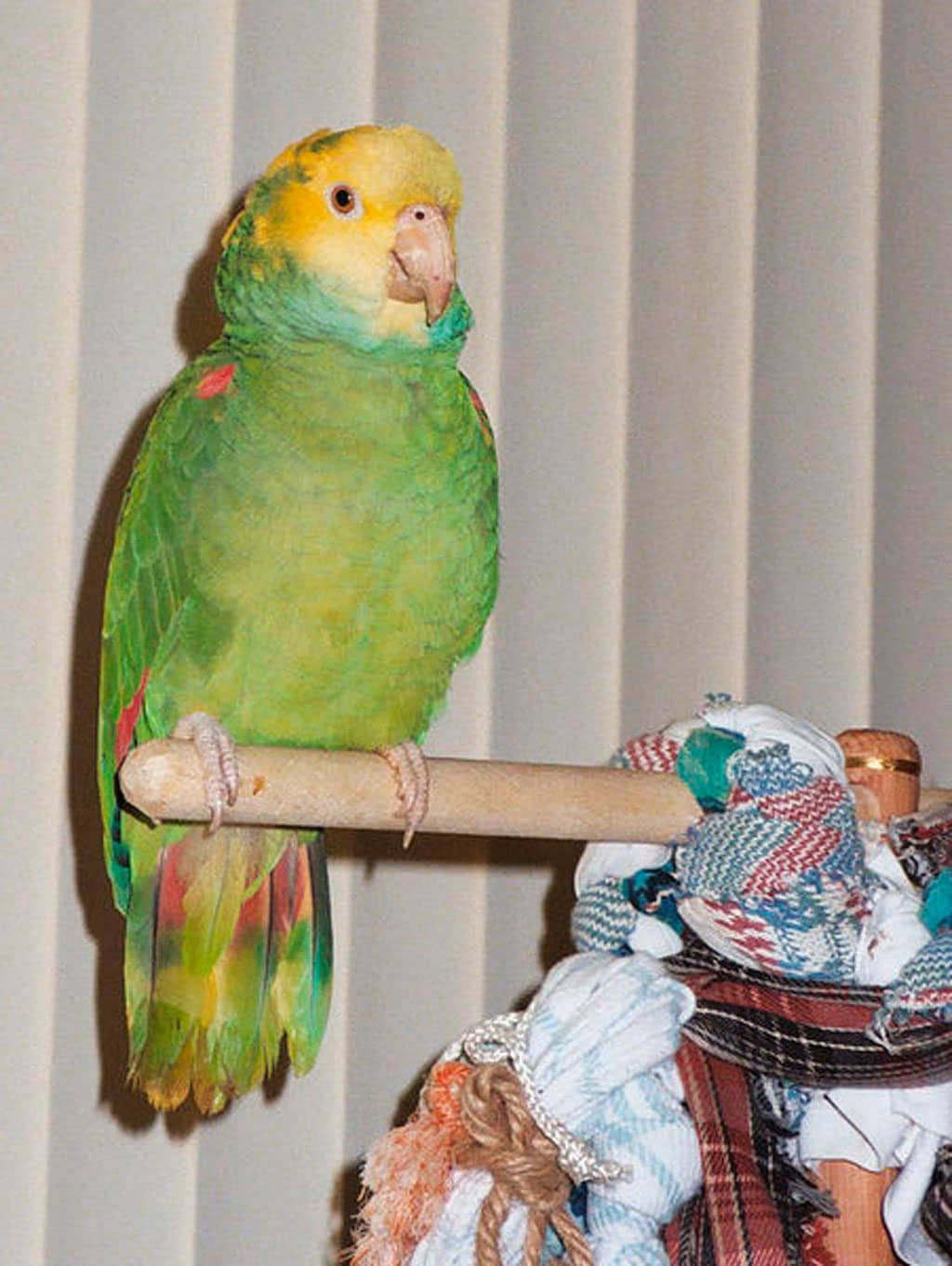
Papuan Lorikeet
Charmosyna papou

Papuan Lorikeet

Content

Papuan Lorikeet

Description

25 cm.. length and a weight between 90 and 115 g..

The head of the Papuan Lorikeet (Charmosyna papou) It is red with a black patch on the back of the crown and a crescent-shaped mark on the nape; patch in the crown with mottled blue extends to the top of the eyes.

Under the nape a red uniform coat; centre of back Dark emerald green; under the back bright red; rump light blue. Wings Emerald green with vane internal black; undertail, the flight feather grey with coats red; coverts marginal green. Throat red, darker than the upper part of the chest and a little more off: lower chest Red clear with a variable black patch in the center of the belly, Sometimes it extends over them the thighs; the sides of chest and flanks with two obvious yellow stripe sets; bottom of the belly and coverts of the tail, red. View from the top, the tail is green and yellow is your long tip, the axis of the Central feathers is of dark brown; below, the tail is yellow, finished in Orange at its end.

The bill orange; Orange the irises; Orange and the legs.

In the nominal species, both sexes are equal.

Immature more turned off than adults. A band yellow variables at the bottom of the secondaries; rump with mottled Green; Naranja-Pardo the bill and legs; irises pale yellow.

Description 4 subspecies

  • Charmosyna papou papou

    (Scopoli, 1786) The nominal.


  • Charmosyna papou goliathina

    (Rothschild & Hartert, 1911) With sexual dimorphism and two different colors. The normal morph is similar to the subspecies Stellae, but differentiated by the yellow at the tip of the tail (non-fusion Orange to yellow). The coverts of the tail they are longer, in color purple blue, not red as in the stellae. As in the subspecies stellae, This subspecies has melanism, the upperparts is green, and underparts blue-black in their entirety. Head and the mantle, only broken by the blue of the stripes in the nape; Red in the coverts of the back and bottom of the tail. The wings are green. The tail seen from below it is more yellow-green in color than in normal morphology, and streamers they are fused opaque to verdoso-amarillo down Green.


  • Charmosyna papou wahnesi

    (Rothschild, 1906) Similar to the subspecies goliathina, but the Red of the part superior of the chest It is bordered below with a narrow yellow band. Does not have a green-washing in the flanks and abdomen top. The belly Central and tail coverts are red.


  • Charmosyna papou stellae

    (Meyer,AB, 1886) This species has sexual dimorphism and also has a melanism (excess of dark pigmentation). In comparison with the nominal, the black patch has much more extensive of the nape, blue-violet striped; This black patch replaces the two areas of black in the crown and in the nape of the speciesnominal. The streamers of the tail They also differ, merging from green to orange red (instead of green to Orange) and finally to yellow on the tips. The subspecies stellae also lacks of the chest yellow and stripes on the flanks that if you have the Papou, as well as his black patch on the belly that extends to the flanks.

    The females They show a visible patch of yellow on the lower of the back Green-tipped on the longest feathers, and coverts of the tail red (male shows red with blue on the patch of the rump). The Red of the part superior of the chest seems more uniform. In the metamorphosis by melanism the Red is largely replaced by black (see goliathina).

    The young birds with dark and thin stripes on the underparts.

Habitat:

Have been recorded at an approximate height of 1.200 meters above a row of trees and also to the 3.500 m, although the most common is to see them above the 2.000 meters and rare to see them below the 1.500 m; found by Forshaw in the forest of Nothofagus and Podocarpus to 2.800 m.

A species active and agile you are often found in pairs or in small groups. The birds move through the trees with jerky movements, often waving his serpentine tail, However, It can be very discreet between the tops of the trees.

Observed in Scheffleras, often in the company of other species, with the same food taste, as the Yellow-billed Lorikeet (Neopsittacus musschenbroekii). Seen often making passes above the trees or half-height, among the plants through the clear.

Reproduction:

The nesting in nature it is not described, but Pratt observed an adult tracing branches above and below a large group of epiphytes , Perhaps in search of a nesting site. A pair in breeding conditions was also observed in late August., and young people have been in nature during October and November. In captivity, the implementation has been two eggs, lasting about three weeks of incubation and the young remain in the nest for about two months.

Food:

Feeds on flowering trees or flowers of the epiphytes, nectar, pollen, fruits and small seeds. Larvae of insects occasionally.

Distribution:

Intervals in the center of New Guinea in Irian Java (Indonesian) and Papua New Guinea, in where are distributed from the southeast of Vogelkop towards the Adelbert range, Huon Peninsula and intervals in the Southeast.

Distribution 4 subspecies:

Conservation:


minor concern


โ€ข Current IUCN Red List category: Least concern.

โ€ข Population trend: Stable.

The world population It has not been quantified, Although that it is more thought of 500.000 specimens. The species appears to be quite common throughout its area of distribution (pit et to the ., 1997).

The hunting of this species for the use of their feathers as tribal headdresses and capture for the bird trade do not believe today that can affect the size of the population.

It is suspected that the population is stable in the absence of evidence of any reduction or other substantial threat.

"Papuan Lorikeet" in captivity:

Coupled pairs will defend their territory vigorously. Individual birds active and playful; they require a cage as big as possible. May be a bit uncomfortable due to liquid diet.

Son rare in captivity.

Alternative names:

Papuan Lorikeet, Fairy Lorikeet, Fairy Lory, Papuan Lory, Stella’s Lorikeet (ingles).
Lori papou, Lori de Stella (French).
Papualori (German).
Lori de Cola Larga, Lori Rabilargo (espaรฑol).

scientific classification:

Order: Psittaciformes
Family: Psittaculidae
Genus: Charmosyna
Scientific name: Charmosyna papou
Citation: (Scopoli, 1786)
Protonimo: Psittacus Papou

Images ยซLori Long-tailedยป:

Videos "Papuan Lorikeet"

————————————————————————————————

"Lori Rabilargo" (Charmosyna papou)


Sources:

Avibase
– Parrots of the World โ€“ Forshaw Joseph M
– Parrots A Guide to the Parrots of the World – Tony Juniper & Mike Parr
– Birdlife

Photos:

1 – (1) ยซCharmosyna papou goliathina1ยป by dragusOwn work. Licensed under Public Domain via Wikimedia Commons.
2 – (2) ยซStellas Lory 2ยป by LtshearsOwn work. Licensed under CC BY-SA 3.0 via Wikimedia Commons.
3 – (3) ยซCharmosyna papou-Fort Worth Zoo-8" for Philip Shoffner – originally posted to Flickr as Dsc_0120. Licenciado sob CC BY 2.0 via Wikimedia Commons.
4 – (4) Charmosyna papou goliathina by Zdenek Chalupabiolib.cz
5 – (5) Charmosyna papou goliathina – Birds-pet-wallpapers
6 – (6) Charmosyna papou goliathina By Elaine Radford (ilustraciรณn) – rightpet.com

Sounds: Andrew Spencer (Xeno-canto)
โ–ท The world of Pets: Dogs, cats, birds, reptiles, amphibians

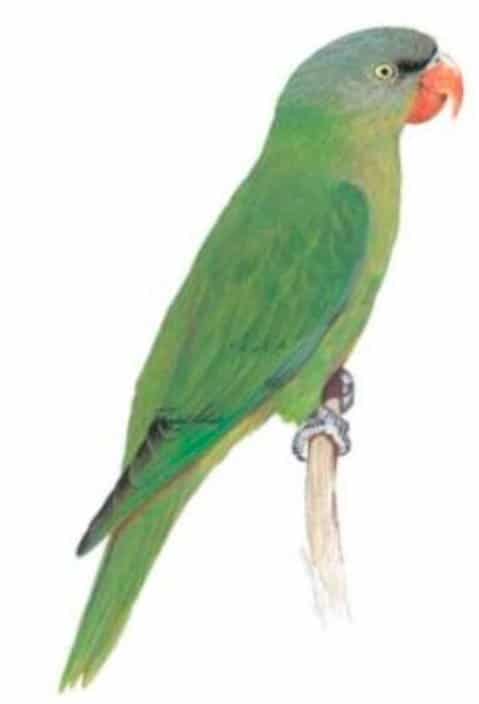
Camiguin Hanging Parrot
Loriculus camiguinensis


Loriculo the Camiguin

Content

Description

14 cm.. length.

The Camiguin Hanging Parrot (Loriculus camiguinensis) has the plumage mostly green, with the throat, front side of the face and the thighs light blue; the forecrown, the pyleus, the obispillo and the top of the tail red, While the rest of the tail It is also blue. Underwing coverts blue. Band of orange-red in the nape, that varies from bird to bird.

Bill orange. Iris grayish brown.

The males and females they have a similar appearance, the female has less blue on the cheeks.

The youth they are similar to the adult female but with only a slight tinge of blue in the cheeks and red on the forehead minimal or absent. Bill a pale.

In 2006 described as a separate species to the loricles who lived on the island of Camiguin, to the North of Mindanao, Since then it was considered a subspecies of the Philippine loricle in the.

Habitat:

Probably sedentary. Found between the 300 and 1350 meters in montane forests, secondary forests, at the edges of the forest near the settlements, in plantations in the areas planted with shrubs and coconut.

Usually seen individually, in pairs, mixed flocks or small families. Feeds in trees or shrubs; difficult to detect. Itร‚ยดs shy and cautious.

Reproduction:

Breeding season probably between the months of September to November. Nest placed in the hole of a dead arbol-helecho. No other information.

Food:

It is said that they feed on nectar, seeds, especially wild banana (Musa), also soft fruit, berries and flowers.

Distribution:

Endemic in the Philippine island of Camiguin, off the North coast of Mindanao.

Conservation:


minor concern


This species is threatened by its limited range, the natural habitat destruction and capture for the wild bird trade.

"Camiguin Hanging Parrot" in captivity:

Probably not remain outside the island of Camiguin.

Alternative names:

Camiguin Hanging-parrot, Camiguin Hanging Parrot (ingles).
Coryllis de Camiguin (French).
Camiguin-Fledermauspapagei, Camiguinpapageichen (German).
Loriculus camiguinensis (Portuguese).
Lorรญculo de Camiguin (espaรฑol).

scientific classification:

Order: Psittaciformes
Family: Psittaculidae
Genus: Loriculus
Scientific name: Loriculus camiguinensis
Citation: Tello, Degner, Bates,JM & Willard, 2006

Images "Camiguin Hanging Parrot"

Videos "Camiguin Hanging Parrot"

————————————————————————————————

"Camiguin Loricle" (Loriculus camiguinensis)


Sources:

Avibase
– Parrots of the World โ€“ Forshaw Joseph M
– Parrots A Guide to the Parrots of the World – Tony Juniper & Mike Parr
Wikipedia

Photos:

(1) – By Alexkant – zoochat

Sounds: George Wagner (Xeno-canto)
โ–ท The world of Pets: Dogs, cats, birds, reptiles, amphibians

Singing Parrot
Geoffroyus heteroclitus

Parrot Heteroclito

Content

Description

25 cm.. length and a weight between 160 and 195 g..

The Singing Parrot (Geoffroyus heteroclitus) they have the head bright pale yellow.

A band Large blue-gray adorns the back of neck and gradually it fades in green on the the mantle. The throat is bluish grey. All upperparts are light green. The median stained reddish brown. You can see the pale yellow stripes on the innerwebs of the flight feather. The underparts is bright blue. Upper chest is blue-gray, which contrasts with the rest of the underparts, that are of a much lighter green back. The upper part of the tail is green. The bottom of the tail is grey, but with a slight yellow color in the outerweb external feathers tail.

The upper jaw is of color yellow pale, the dark gray lower jaw. The irises are yellow, the legs gray-green.

The sexes are dimorphic. The female has a bill totally dark. Yellow beginning of the head and neck greenish blue are away. In its place, the top It is gray and cheeks They are brownish green.

Immature show greener on the head than females. Its bill is paler and its irises dark.

Description 2 subspecies

  • Geoffroyus heteroclitus heteroclitus

    (Hombron & Jacquinot, 1841) – The nominal.


  • Geoffroyus heteroclitus hyacinthinus

    (Mayr, 1931) – Males have neck gray violรกceo.

Habitat:

The Singing Parrot frequent humid lowlands, undisturbed, Hills generally below and of the 600 meters up to a maximum of 1.760 meters in the South of New Ireland . They are also partially cleared areas, at the edge of forests, in stands of trees in regeneration and in gardens.

The birds, often, they are heard when they make calls from the exposed or isolated trees, or view flying rapidly above the canopy.

They are alone, in pairs, or having relationships in small groups. There have been next to the Cardinal Lory and Duchess Lorikeet in Bougainville. They are often calm and difficult to detect when they remain perched among the dense foliage.

Reproduction:

The nest is a hole dug by the female in a dead tree stump or rotten, but nothing more is known about the breeding ecology of the species.

Food:

The diet It includes seeds, fruit, flowers and buds.

Distribution:

Size of the area of distribution (reproduction / resident): 576.000 km2

The Singing Parrot They are endemic Bismarck Archipelago and Solomon Islands. These birds are found in the following Islands: Umboi, New Britain, Lolobau, Duke of York, New Ireland, New Hanover, Tabar, Lihir, Buka, Bougainville (Papua New Guinea). It can also be seen in Choiseul, Santa Isabel, San Jorge, Malaita, New Georgia, Guadalcanal and all the little Islands Rennell (Solomon Islands).

Distribution 2 subspecies:

  • Geoffroyus heteroclitus heteroclitus

    (Hombron & Jacquinot, 1841) – The nominal.


  • Geoffroyus heteroclitus hyacinthinus

    (Mayr, 1931) – present only in the Rennell island.

Conservation:


minor concern


โ€ข Current category of the Red List of the UICN: Least concern.

โ€ข Population trend: Stable.

The world population it is generally estimated at just less than 100.000 specimens.

The subspecies that lives in Rennell Island is between 5.000 and 20.000 birds.

The Singing Parrot It suffers from the degradation of habitat throughout its area of distribution, but is not in danger.

"Singing Parrot" in captivity:

Extremely shy and touchy; they may die suddenly without discernible cause, possibly due to stress and improper diet.

Not commonly found in poultry.

Alternative names:

Singing Parrot, Song Parrot (ingles).
Perruche hรฉtรฉroclite, Eclectus hรฉtรฉroclite, ร‰clectus hรฉtรฉroclite (French).
Bismarckpapagei (German).
Geoffroyus heteroclitus (Portuguese).
Lorito Cantor, Lorito Heterรณclito (espaรฑol).

scientific classification:

Order: Psittaciformes
Family: Psittaculidae
Genus: Geoffroyus
Scientific name: Geoffroyus heteroclitus
Citation: (Hombron & Jacquinot, 1841)
Protonimo: Psittacus Geoffroyi heteroclitus

Images "Singing Parrot"

Videos "Singing Parrot"

————————————————————————————————

โ€œLorito heterroclitoยป (Geoffroyus heteroclitus)

Sources:

Avibase
– Parrots of the World โ€“ Forshaw Joseph M
– Parrots A Guide to the Parrots of the World – Tony Juniper & Mike Parr
Wikipedia

Photos:

(1) – Birds-pet-wallpapers

Sounds: Mark Todd (Xeno-canto)
โ–ท The world of Pets: Dogs, cats, birds, reptiles, amphibians

Black-lored Parrot
Tanygnathus gramineus

Black-lored Parrot

Content


Anatomy-parrots

Description

40 to 42 cm. long.

The Black-lored Parrot (Tanygnathus gramineus) It has a green head with a black line that goes from the top of the beak to the eyes.; steeped in turquoise blue Crown. The upper parts of green grass.

The medium-sized wing coverts, green; flight feather, green, a little darker, with blackish margins to the vane inner. Supracaudales coverts yellowish-green. The more underparts, more yellowish green, especially in the lower part of the cheeks and upper part of the chest. Upper, the Green tail with yellow tips; undertail, the Brown tail olive warm.

Billed red; iris yellow ; greyish legs.

Female with the grey brown peak, not red.

Immature undescribed.

Habitat:

Information is received for the first time of the Black-lored Parrot Thanks to ornithologist side Hendrik Cornelis Sieber (1890-1949) in 1930.

Very little of this species is known. Is distributed in mountain forests above 600-700 meters and also, according to sources, in the lowlands, hills and coastal areas. It is partially nocturnal, although sightings of birds perched on treetops during the day, They show that, similar to the Azure-rumped parrot, they can also be active during the day.

Migration is relatively weak and there are only a few reports of parrots flying to high altitudes during the day and descending at night., Judging from their voices.

Reproduction:

There is no data.

Food:

Possibly fruits, berries, seeds and nuts

Distribution:

Endemic to Buru, Indonesian.

Bird predominantly occupies the central part, High Island, where according to sources, There are settlements in Gunung Tagalago, WA Temun and Kunturun, at elevations of 700-1100 m, also in the lowlands of the South in Fรคkal, EHU and Leksula. There was a sighting of these parrots near Kayeli Bay on the eastern shores of Buru. Most recent observations made outside North (Waflia) and (Wamlana) Northwest Coast.

The voice of the Black-lored Parrot is heard frequently in Kunturun, mostly 1-7 hours after the sunset, where the locals call the bird ยซThe ol' blue cockatooยซ, which means Blue-headed Parrot. But, was caught during the day with slingshots in fruit trees, suggesting that his activity is not purely night.

Conservation:


Vulnerable


โ€ข Current category of the Red List of the UICN: Vulnerable

โ€ข Population trend: Decreasing

The population is estimated at 2,500-9,999 mature individuals based on an assessment of the known records, descriptions of the abundance and range size. This estimate is equivalent to 3,500-15,000 specimens.

There are no data on trends for this species and has not been seen in the wild since 1995. Their habitat continues to decline slowly and were recorded in domestic trade in the year 2001. So, the population of the species is suspected of have been declining.

Conservation Actions Proposed:

– Conduct surveys, mostly using their vocalizations at night, mainly in the mountain areas.
– Investigate their ecological requirements and movements in order to develop appropriate conservation strategy.
– Identify the most suitable area for the conservation of this and other endangered species in Buru, and promote its establishment as protected areas.

"Black-lored Parrot" in captivity:

Unknown outside the island of Buru

Alternative names:

Black-lored Parrot, Black lored Parrot, Blacklored Parrot, Buru Parrot (ingles).
Perruche de Buru, Perruche ร  calotte bleue (French).
Burupapagei, Buru Papagei (German).
Tanygnathus gramineus (Portuguese).
Loro de Buru (espaรฑol).

scientific classification:

Order: Psittaciformes
Family: Psittaculidae
Genus: Tanygnathus
Scientific name: Tanygnathus gramineus
Citation: (Gmelin, JF, 1788)
Protonimo: Psittacus gramineus

Images "Black-lored Parrot"

————————————————————————————————

ยซLoro de Buruยป (Tanygnathus gramineus)

Sources:

Avibase
– Parrots of the World โ€“ Forshaw Joseph M
– Parrots A Guide to the Parrots of the World – Tony Juniper & Mike Parr
– Birdlife
Wikipedia

Photos:

(1) – Parrots A Guide to the Parrots of the World – Tony Juniper & Mike Parr

Sounds: Frank Lambert (Xeno-canto)

โ–ท The world of Pets: Dogs, cats, birds, reptiles, amphibians

Eastern Rosella
Platycercus eximius


Eastern Rosella

Content


Anatomy-parrots

Description

30 cm.. length between 95 and 120 g. of weight.

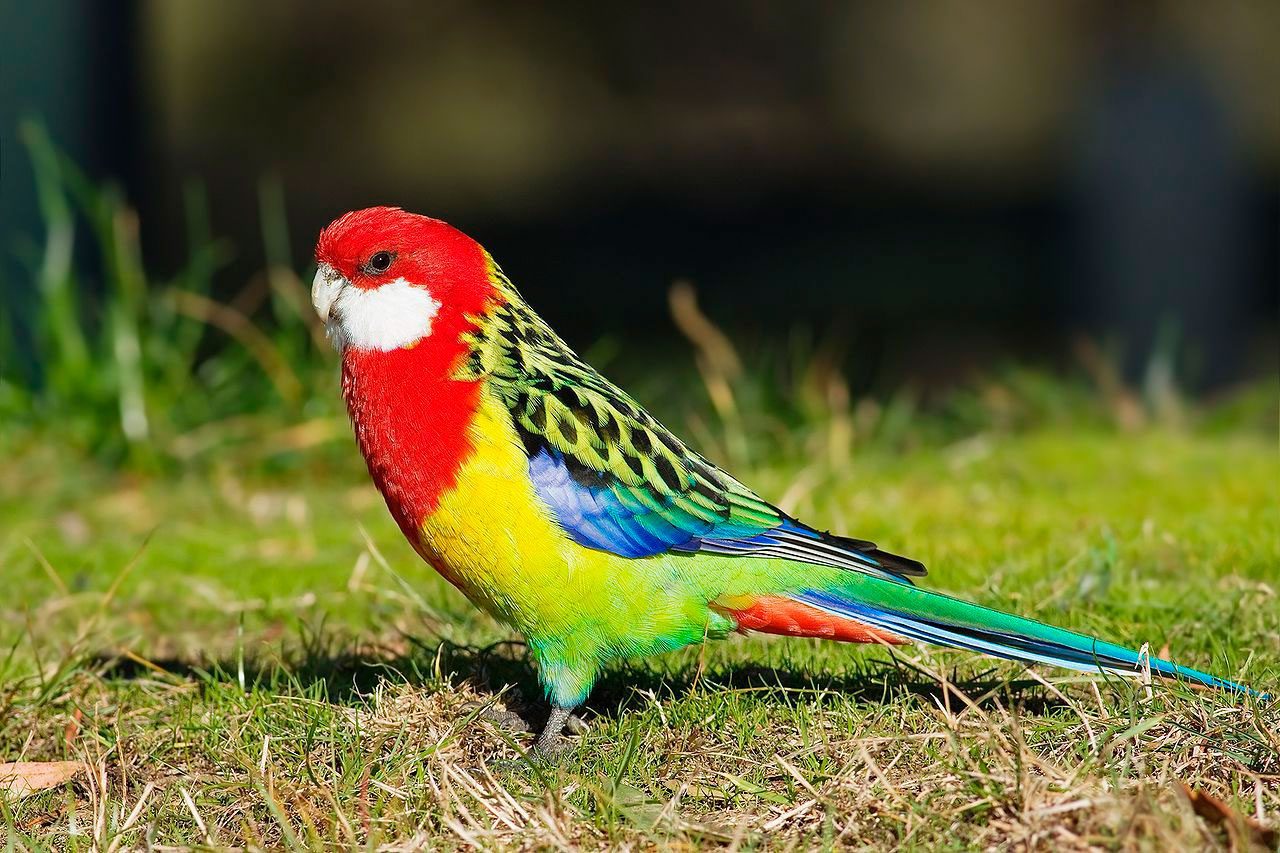
The males of the Eastern Rosella (Platycercus eximius), has bill white. The lower area of the cheeks and chin are white, that contrasts sharply with the rest of the head and the chest that are of color red glossy. Upper abdomen shows a beautiful color yellow that is again gradually of color green pale in its part lower. The coats are of color red. The the mantle feathers, the back and scapulars are of color black with a broad edge yellow, giving these regions a highly scaled appearance. The median are black. The blankets, out of them coverts secondary and flight feather are bluish grey. The rump is bright green. The central feathers of the tail are green bottle, While the outer feathers of the tail are bluish grey with white tips.

The irises They are brown, legs grey.

The female looks like your partner, but the Red of the head and the chest is less bright.

The underparts has a thin white stripe.

The youth they are a copy in Pale tones of the female. They have a little bit of green on the back of the head.

Subspecies description:

  • Platycercus eximius diemenensis

    (North 1911) – Of 30 cm.. length. Head and chest color much more dark and white cheek much more large. Female as the nominal species.


  • Platycercus eximius elecica

    (Schodde & Short 1989) – Of 33 cm.. length. It is something more than the nominal species, the red and the chest and the head is slightly more dark, the black feathers of the neck, back and shoulders have a very broad bright yellow bordered. Area of the rump and coverts bluish-green supracaduales. Female with back and neck with hints. Your obispillo is bluish green


  • Platycercus eximius eximius

    (Shaw 1792) – The nominal.

Habitat:

The Eastern Rosella they tend to be fairly common in all habitats of open forests, including agricultural land, urban parks and gardens. They are usually in little populated wooded areas, rows of trees along streams, shrub and scrub savannahs ยซMalleeยซ.

They are common in cultivated areas and can invade orchards where you can cause severe damage.

In many areas, It is the most widespread species of parrot, You can even nest in the trees lining the streets of towns and cities. Wherever possible, they avoid dense forests and mountainous areas, where is replaced by the Crimson Rosella. The habitat of the Eastern Rosella usually less to 1.250 m above sea level.

Breeding pairs are sedentary in their territories, While young and immature form bands of up to 25 birds that roam the area. very commonly, the multicolored parrot can be seen perched on power lines or poles lining the sides of the roads in the outskirts of cities.

On the floor were fed more frequently than other types of rosella Parrot. In flight, they are quite noisy and therefore very easy to detect. But, When they are on the ground, they are not always easy to observe.

They feed on, sometimes, in the company of Red-rumped Parrot (Psephotus haematonotus) but never be with them organized mixed flocks.

Reproduction:

The Eastern Rosella They nest in the months from August to February, but also from time to time in April and may.

Pairs mate for life and is the female which chooses the nest site, usually in a hole or cavity of a eucalyptus branch. Sometimes the place to start may be an old stump, an any fence post, a fallen log, a rabbit hole, the nest of a Rainbow Bee-eater. Optionally, the Eastern Rosella also used the abandoned nest of the Blue-winged Kookaburra, some termite mound, ferns in facades of houses, rock walls, old buildings and an old nest of pomatostome.

The bottom of the nest is filled with sawdust or small wood shavings..

Spawning includes 4-9 eggs (generally 5) which are incubated during 19 days. The female is solely in charge of incubation and her partner is responsible for supplying. The chicks stay lasts a few 35 days.

Food:

The Eastern Rosella has a mainly vegetarian diet. Consumed mainly eucalyptus and acacia seeds, Although also seeds of a variety of greenery bushes. Berries, leaves and sprouts are also part of its menu.

During the summer, eats some insects and their larvae. Take the seeds that are dispersed in fields and roads. It penetrates into the orchards where causes some damage.

Distribution:

The Eastern Rosella lives confined to the southeast of Australia where is spread around Gympie, Bribie Island and the Darling Downs district in the extreme southeast of Queensland, in the South through New South Wales, coming towards the inside of Moree, Parkes, Griffith and There is a, and reaching Victoria where is it absent only in the Northwest region, and West up to Edenhope.

In the southeast of South Australia the species is largely limited to the area between Bordertown and Salt Creek, but a population caused by birds in captivity is also distributed by the Lofty Mountains.

In Tasmania, the species is widespread, Although barely wide and sparsely distributed, and have been faced with the King Island in the bass strait.

There are small introduced populations in the South Island of New Zealand, concentrated around Dunedin (includes some Crimson Rosella mixed with oriental hybrids) and in the Banks Peninsula, and a larger population in the North Island, that extends from the northern end of the island, along the West Coast through Raglan, New Plymouth and the interior of Pirongia and Taupo. They can also be found Eastern Rosella in the districts of Wellington and Lower Hutt, in the Tararua mountains, about Gisborne and along the Coromandel Peninsula, but are rare in the South of Auckland.

The world population is more of 500.000 birds, and stable or increasing.

There is some competition with nesting places with the Common Starling (Sturnus vulgaris) in Tasmania.

Moderate multicolored parrot in captivity.

The species has benefited before the spread of agriculture, and although protected by law, they can be killed under license.

Subspecies distribution:

  • Platycercus eximius diemenensis

    (North 1911) – Own East of Tasmania.


  • Platycercus eximius elecica

    (Schodde & Short 1989) – Present in the northeast of New South Wales and the southeast of Queensland.


  • Platycercus eximius eximius

    (Shaw 1792) – The nominal.

Conservation:


minor concern


โ€ข Current category of the Red List of the UICN: Least concern

โ€ข Population Trend: Growing

The size of the world's population has not been quantified, Although it is estimated above 500.000 birds.

Throughout its distribution area, except Tasmania, the Eastern Rosella East are very common birds. Unlike in the Crimson Rosella, that like dense forests, the Eastern Rosella they have benefited from deforestation that took place for the establishment of new pastures or areas of cereals.

"Eastern Rosella" in captivity:

Very common in captivity, It is probably the most popular of the Rosellas.

The Eastern Rosella they are coveted because of the beautiful colors of plumage.

They are intelligent birds and can be trained to whistle a large repertoire of melodies., and you can even learn how to pronounce some words.

These parakeets can make good pet birds but require a great deal of care and attention., In addition to devices and toys to keep them mentally stimulated. They are wild birds which are not always adapted to live as a family pet, and even the hand reared parrots are never fully domesticated. They generally do not tolerate caresses or cuddling and tend to react by stinging when you try to handle them like this.. Many breeders believe that the best way to keep this type of bird is in great aviaries where can fly freely, in pairs to meet their social needs and with minimal human interaction. Although they tend to be aggressive with other species Bird by should not be treated so integrate them to mixed aviaries.

Its diet poultry includes seeds, fruits like Apple, PEAR and grape, and vegetables such as lettuce, grass, and silver beet.

A sample of Eastern Rosella lived 27,4 years in captivity. In captivity, these animals have been able to play, approximately, to the 2 years of age..

Alternative names:

Eastern Rosella, White-cheeked Rosella (ingles).
Perruche omnicolore (French).
Rosella, Buntsittich (German).
Rosela-multicolorida (Portuguese).
Perico Multicolor, Rosela Comรบn (espaรฑol).

scientific classification:

Order: Psittaciformes
Family: Psittaculidae
Genus: Platycercus
Scientific name: Platycercus eximius
Citation: (Shaw, 1792)
Protonimo: Psittacus eximius

Images ยซMulticolored Parakeetยป:

Videos "Eastern Rosella"

————————————————————————————————

ยซMulticolored Parakeetยป (Platycercus eximius)


Sources:

Avibase
– Parrots of the World โ€“ Forshaw Joseph M
– Parrots A Guide to the Parrots of the World – Tony Juniper & Mike Parr
Wikipedia
– AnAge: The Animal Ageing and Longevity Database – Anagรฉ entry for Platycercus eximius
– Birdlife

Photos:

(1) – Eastern Rosella (Platycercus eximius), male, Queenโ€™s Domain, Hobart, Tasmania, Australia By JJ Harrison (jjharrison89@facebook.com) (Own work) [CC BY-SA 3.0], via Wikimedia Commons
(2) – Eastern Rosella (Platycercus eximius), female, Queenโ€™s Domain, Hobart, Tasmania, Australia By JJ Harrison (jjharrison89@facebook.com) (Own work) [CC BY-SA 3.0], via Wikimedia Commons
(3) – Eastern Rosella (Platycercus eximius) at Woodland Park Zoo, Seattle, USA By Platycercus_eximius_-Woodland_Park_Zoo-6. jpg: Nickderivative work: Snowmanradio [CC BY 2.0], via Wikimedia Commons
(4) – Eastern Rosella at Hobart Domain, Tasmania (grazing) By KeresH (Own work) [GFDL, CC-BY-SA-3.0 or CC BY-SA 2.5], via Wikimedia Commons
(5) – Eastern Rosella (Platycercus eximius diemenensis), The Queenโ€™s Domain, Hobart, Tasmania, Australia By JJ Harrison (jjharrison89@facebook.com) (Own work) [GFDL 1.2 or CC BY-SA 3.0], via Wikimedia Commons

Sounds: Peter Woodall (Xeno-canto)