โ–ท The world of Pets: Dogs, cats, birds, reptiles, amphibians

Eclectus Parrot
Eclectus roratus


Eclectus Parrot

Content

Description


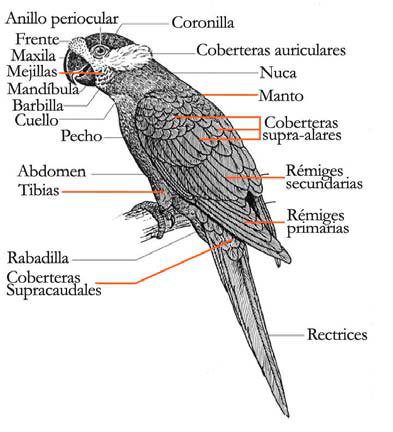
Anatomy-parrots

35 to 42 cm.. length and a weight between 355 and 615 g..

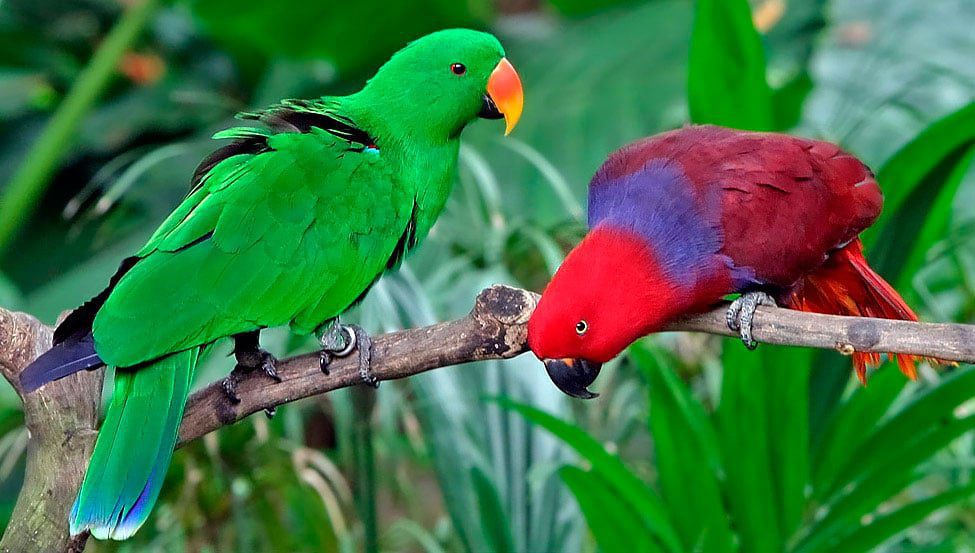
The Eclectus Parrot (Eclectus roratus) It has the head and upper parts of bright green. green wing coverts; curve of the wing and the carpal edge blue; primary coverts dark blue. Feathers of flying with vane very dark blue external, vane internal black on the edge inside. Wing of bright red feathers; bottom of the black flight feathers. Green underparts with flanks and axillary Red. Upper, the Green tail with narrow pale yellow tips, drenched side of blue and yellow-tipped feathers (more external with more blue); undertail, tail black with yellow tips.

Yellow-tipped red Bill, black lower jaw, iris orange, greyish Brown legs.

In all the eclectus sexual differences machos-hembras are so large that at the beginning he qualified them as different species. The female of the Eclectus Parrot it is bright red with a purple ruff across the top of the mantle, with bluish black in flight feathers, purple blue wing feathers, purple diffusion over the chest, dull purple-blue on lower chest and belly, coverts yellowish-tipped red infracaudales, and a tail of red with yellow tips (Feather darker bases). The beak is black and the iris is usually yellow (variable).

The young birds they move directly the adult plumage but they have brown peaks.

  • Sound of the Eclectus Parrot.

Subspecies

List of subspecies Eclectus roratus
  • Eclectus roratus vosmaeri

    (Rothschild, 1922) – Larger than the nominal. Male with bright green plumage, more red on the flanks, broader yellow tail ends. Female with the red light, broader yellow tail and yellow in the coverts infracaudales ends.

  • Eclectus roratus roratus

    (Statius Mรผller, 1776) –

  • Eclectus roratus cornelia

    (Bonaparte, 1850) – Larger than the nominal. Male with more blue in the queue, the upper parts of lighter green color. Female completely red except for the edges of the Carpus, wing feathers and flight feathers, that are blue. Narrow yellow tip to the tail.

  • Eclectus roratus westermani

    (Bonaparte, 1850) – (Known only from a few copies of populations in captivity; the origin is unknown). Smaller than the nominal. The male It has no visible red flanks when wings are closed and shows foreign banks of green to flight feathers. Female with the darker red color with broad yellow tip to tail. The possibility that the few copies are abnormal individuals of the subspecies E. r. flushed It has not ruled out.

  • Eclectus roratus riedeli

    (A.B. Meyer, 1882) – Smaller than the nominal. Male with wide yellow tips on the tail (25 mm). Female as E. r. Cornelia, but it shows bright yellow on the coverts infracaudales.

  • Eclectus roratus aruensis

    (G.R. Gray, 1858) – Males as the subspecies E. r. biaki, with a little more spacious yellow tips to the tail. Female Red clear, especially tail.

  • Eclectus roratus biaki

    (Hartert, 1932)- As the subspecies E. r. tortoiseshell but smaller. The female just like the female of the E. r. tortoiseshell but more bright red underparts and back of neck (dubiously distinct race).

  • Eclectus roratus polychloros

    (Scopoli, 1786) – Larger than the nominal. Male, Yellow tail more yellowish-green tips. Female with red chest and less violet blue in the bottom region restricted to belly, green in vane external primary. Narrow periophthalmic ring blue. Coverts red infracaudales.

  • Eclectus roratus solomonensis

    (Rothschild & Hartert, 1901) – Smaller that the E. Eclectus tortoiseshell and the male more yellowish green. Female Red clear. Size is reduced clinalmente from West to East

  • Eclectus roratus macgillivrayi

    (Mathews, 1913) – As the E. Eclectus tortoiseshell but larger.

Habitat:

The Eclectus Parrot It is distributed in a wide range of habitats, from second growth forests, Savannah, mangrove, coconut plantations and eucalyptus Woods, until 1.900 m.

The species is most common in lowland forests, around growing areas and coastal habitats.

The birds are alone, in pairs or in small groups, often composed of only males (presumably during playback).
They sometimes soar above the forest and draw attention with their shrill calls while flying over the canopy, or they perch on an exposed branch.

They are cautious, groups of foraging usually remain in the treetops, Although birds feeding on low-altitude or even on the ground have also been observed.

The Eclectus Parrot they are most active at dawn and at dusk, When traveling to and from their roosts in noisy groups of up to 80 birds.

Have been recorded roosting in Sumba where the Eclectus Parrot they share space with the Sulphur-crested cockatoo.

The species is considered an agricultural pest in some parts of New Guinea.

Reproduction:

Breeding can apparently occur at any time of the year in Papua New Guinea, While active nests observed in Australia It was between the months of February and July; There has been during the month November in Buru, During August in Seram, and between June and September in the Solomon Islands.

Up to eight birds have been registered by attending a nest. It is not clear if these are brood helpers., young from a previous litter still attached to the family group, or additional hens females.

In courtship, birds become involved with mutual grooming and Wiggles head.

The nest is a hollow in a tall tree, until 30 metres in height, sometimes exposed; The cavity may have around 6 depth meters.

Putting two eggs are deposited on a bed of wood dust, hatching in about 26 days, and taking ahead 12 weeks to breeding.

The female takes care of the incubation, leaving only the nest twice a day to be fed by the male; Also is fed by the male when the first eggs hatch, but then begins to feed if same.

Food:

The diet includes fruits, seeds, flowers, outbreaks, fruits and nectar: they are especially fond of (Pandanus) banana, corn, figs and Papaya.

Distribution:

Sumba in the Small Oriental Sunda Islands, Indonesian and Moluccan Islands including Buru, Seram, Ambon, Haruku, Saparua, the Gorong Islands (apparently introduced), OBI, Damar, Bacan, Halmahera, Mare. Ternate and Morotai, in the West of the papuan islands,including Waigeo, Batanta, Salawati and Misool; thence through the lowlands of New Guinea, and Tanimbar Islands, Kai and islas Aru, to the South of the Islands in the Cenderawasih Bay (Numfor, Biak, Yapen, My Num).

In the East, the Eclectus Parrot are distributed among archipelagos of D'Entrecasteaux and the Luisiadas, Papua New Guinea, including Goodenough and Normanby, and in the Trobriand Islands extending through the Bismarck Archipelago including Umboi, New Britain, the Witu Islands, Lolobau, Uatom, Duke of York, New Ireland, New Hanover, Tabar, Lihir, Thong and FeNi, reaching Manus and Rambutyo in the the Admiralty archipelago and Nissan in the South.

The species is also through of the Solomon Islands, including Buka and Bougainville (Papua New Guinea) to the East of San Cristรณbal and its satellites.

There is an isolated population in the North of the Cape York Peninsula, Australia, that goes from the Iron range National Park and the pascoe river, to the South of the McIlwraith range, regularly visiting smaller islands in the Torres Strait, in the continental part of New Guinea.

There is an introduced population of the Eclectus Parrot in Koror and some smaller islands in the archipelago of Palau In the pacific, but likely to be occasional escapes from Hawaii, where apparently cannot have been established. This is one of the parrots most common and most familiar throughout much of their range.

The world's population is estimated over of 300.000 birds. Local entrapments in Ambon, Saparua and Haruku It has apparently made the species becoming extinct in these three islands. The distinctive population in Sumba is in danger.

Subspecies

Distribution subspecies Eclectus roratus

Conservation:


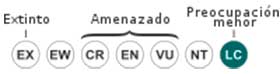
minor concern


โ€ข Current category of the Red List of the UICN: Least concern

โ€ข Population trend: Decreasing

The size of the world's population has not been quantified, It is estimated over the 300,000 specimens. The species is described as common to rare.. The population in Sumba It is estimated in 1.900 individuals, although Sumba It represents a very small proportion of the global range of the species (pit et to the. 1997).

The population is suspected to be declining due to the destruction of habitat in course and unsustainable levels of exploitation.

"Eclectus Parrot" in captivity:

3 the common subspecies in aviculture: Eclectus roratus flushed, Eclectus roratus vosmaeri and Eclectus roratus tortoiseshell; other rare breeds.

Es a curious and intelligent with an acceptable language ability, they learn without difficulty to say words and phrases.

It happens to be fairly quiet and able to live without too much attention. Males can be somewhat distant while in females it must be emphasized the theme that in the case that have nest can not out of it. On the topic food tends to be accepted that the eclectus have a greater need for vitamin A than other parrots.

When considering the purchase of a new Eclectus, it would be wise to obtain a photo and request a consultation with an authority on Eclectus to verify that you are not purchasing a hybrid.

When to acquire housing for our Eclectus Parrot, one should consider your major and arrange them in a cage as large as possible; reasonable steps would be 4,4 m x 1,5 m x 2 m.

We should keep in mind that our parrots should spend at least one hour each day outside the cage during the game.

DIET:

The Eclectus diet consists mainly of vegetables, fruit, legumes and granulated meal. Given that our Eclectus Parrot do not eat many seeds in the nature, and since they are deficient in nutrients, we must consider that their intake should be the exception and not the rule in our house.

The Eclectus they require a diet high in vegetable protein and beta carotene. Their digestive system is longer than most other species., with a greater proventriculus and longer intestines, so fat intake should be limited to avoid fatty tumors. But this does not mean "fat-free.", especially for young people who are very active. It takes some fat to store fat-soluble vitamins A, E and D. It also, with all species, If the cholesterol is too high, the excess accumulates in the liver and, through the bloodstream, travels to the heart where it accumulates; a problem evidenced by fatigue, lack of breed, secondary nutrient deficiency problems (for example, Candida, hypocalcemia, hypoprotenia, etc.), fatty liver, plumage and discoloration-poor quality, bad state of health in general and the inability of the other nutrients to be used correctly.

Too much oil in the diet can cause black feathers on the male and female. They are easily distinguished from the black marks of stress or liver disease because the pattern is different.. Some diets based on pelleted food are high in sugar and can cause kidney problems or hyperactivity. Some are also high in colorants and flavors and can cause toxicity problems. There are some diets which in the market that are organic; But the lack of condoms can cause growth of unwanted yeast and bacteria if left in the cage for more than one hour.

Reproduction Eclectus Parrot:

The reproduction of the Eclectus Parrot It is not difficult as long as we have a compatible partner, Since a female in heat can be aggressive with the male and pursue him while he nears the trough.

Nesting box can have very different ways. The measures are 30 x 30 x 80 cm and inlet of 10 cm.. Diameter. The Z-shaped nest is highly recommended for breeding the Eclectus Parrot Since it allows the male to stay on the top platform in the event that the female is shown aggressive to protect the nest. Inside the box you can put some kind of material, as pine bark.

The incubation period is 28 to 30 days and can breed throughout the year. A sunset happens to another and is not interrupted even during the time of molt. However often the eggs are not fertile or parents do not feed the chicks. It is best to allow them only two released per year, so the nest will have to be removed or the male will have to be separated for a few days. The only drawback, If we choose to separate the male, It is called the female strident so your partner.

The implementation is usually two eggs, and occasionally three.

Alternative names:

Eclectus Parrot, Kalanga, King Parrot, Red-sided Eclectus Parrot, Red-sided Parrot (ingles).
Grand ร‰clectus, ร‰clectus, Grand Eclectus (French).
Edelpapagei, Salomonen Edelpapagei (German).
Papagaio-eclectus (Portuguese).
Loro Eclรฉctico, Loro Eclectus (espaรฑol).

scientific classification:

Order: Psittaciformes
Family: Psittaculidae
Genus: Eclectus
Scientific name: Eclectus roratus
Citation: (Statius Mรผller, 1776)
Protonimo: Psittacus roratus

ยซEclectic Parrotยป Images:

Videos "Eclectus Parrot"

ยซEclectic Parrotยป (Eclectus roratus)

Sources:

Avibase
– Parrots of the World โ€“ Forshaw Joseph M
– Parrots A Guide to the Parrots of the World – Tony Juniper & Mike Parr
– Birdlife
mundoexotics
– Birds N Ways

Photos:

(1) – ยซEclectus roratus-20030511ยป by Doug Janson – Licensed under CC BY-SA 3.0 via Wikimedia Commons.
(2) – ยซEclectus roratus-Malagos Garden Resort, Davao City, Philippines-male-8aยป by Raymund James BareFlickrUploaded by Snowmanradio. Licensed under CC BY 2.0 via Wikimedia Commons.
(3) – ยซEclectus Parrot (Eclectus roratus) -6-4cยป by derivative work: Snowmanradio (talk)Eclectus_parrot_(Eclectus roratus)_-6. jpg: Bear golden retriever – originally posted to Flickr as Img_4575. JPG and uploaded to commons as Eclectus_parrot_(Eclectus roratus)_-6. jpg. Licensed under CC BY 2.0 via Wikimedia Commons.
(4) – ยซEclectus roratus (male) -juvenile pet-atedยป by Peter Bรฉkรฉsi from Budapest, Hungary – Img_0983Uploaded by snowmanradio. Licensed under CC BY-SA 2.0 via Wikimedia Commons.
(5) – By J E Three from houston, usa (parrots eating hairUploaded by snowmanradio) [CC BY 2.0], via Wikimedia Commons

Sounds: Niels Krabbe (Xeno-canto)

โ–ท The world of Pets: Dogs, cats, birds, reptiles, amphibians

Pale-headed Rosella
Platycercus adscitus

Perico pale

Content


Anatomy-parrots

Description

30 cm.. length and a weight between 100 and 175 g..

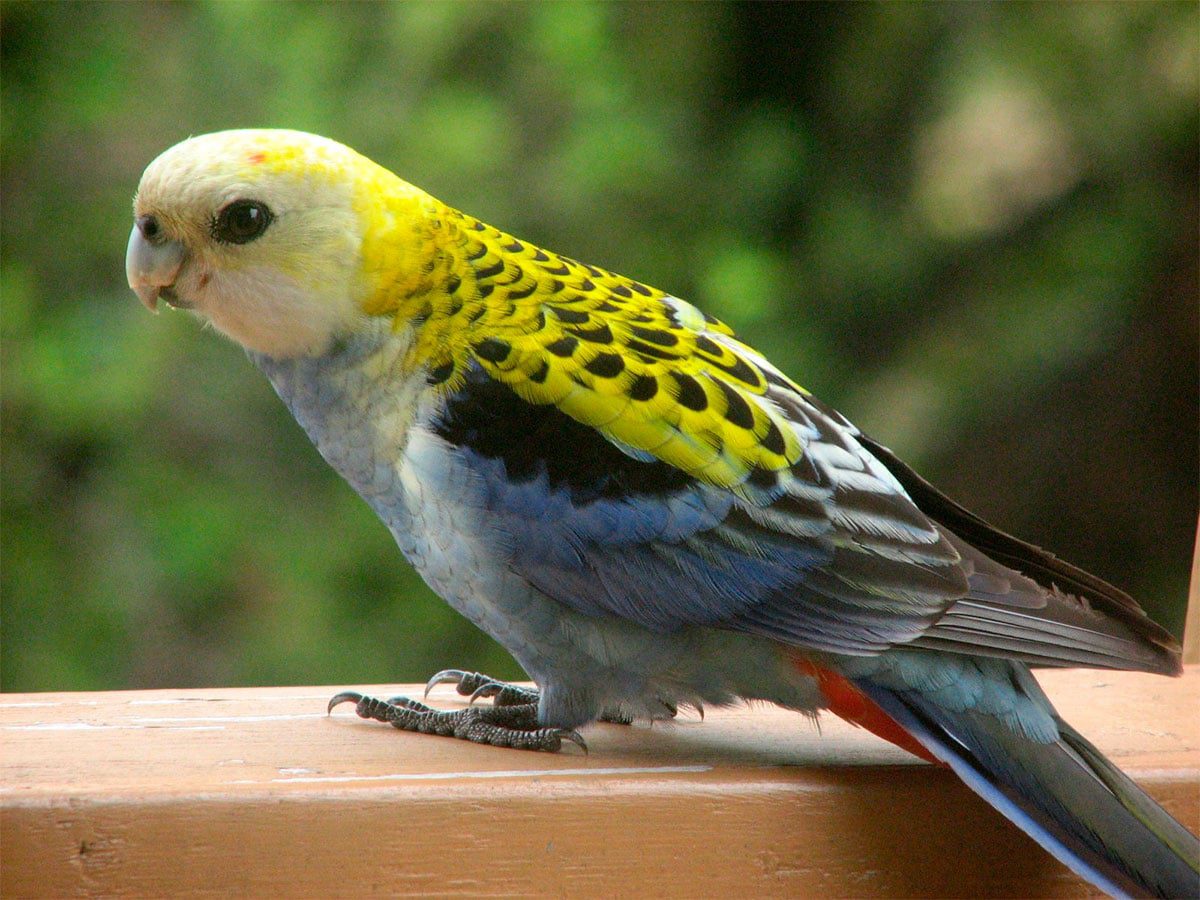
The adult male of the Pale-headed Rosella (Platycercus adscitus), It has a pale yellow "head". The part superior of the cheeks is whitish in contrast with the part below that is of color blue light. Upper chest is yellow, the lower part of the chest and the abdomen are blue. The coverts They show a beautiful red hue. The the mantle, the back and scapulars are black with broad yellow edges, these areas giving a scaly appearance.

The tail is of color yellow uniform. The external coverts are dark blue. The central feathers of the tail are dark blue, but the outer feathers are more pale with thin white edges. The bottom has no stripe.

The bill is white. The irises They are brown, legs grey.

The female is different from the male, its color is more off and has a strip at the bottom of the wings.

The immature they have grayish feathers ending in yellow or orange-red at the top of the crown and the neck. The red feathers lose them about three months. The bottom of the wings is scratched. They acquire adult plumage in about 16 months.

Description 2 subspecies:

  • Platycercus adscitus adscitus

    (Latham 1790) – The nominal


  • Platycercus adscitus palliceps

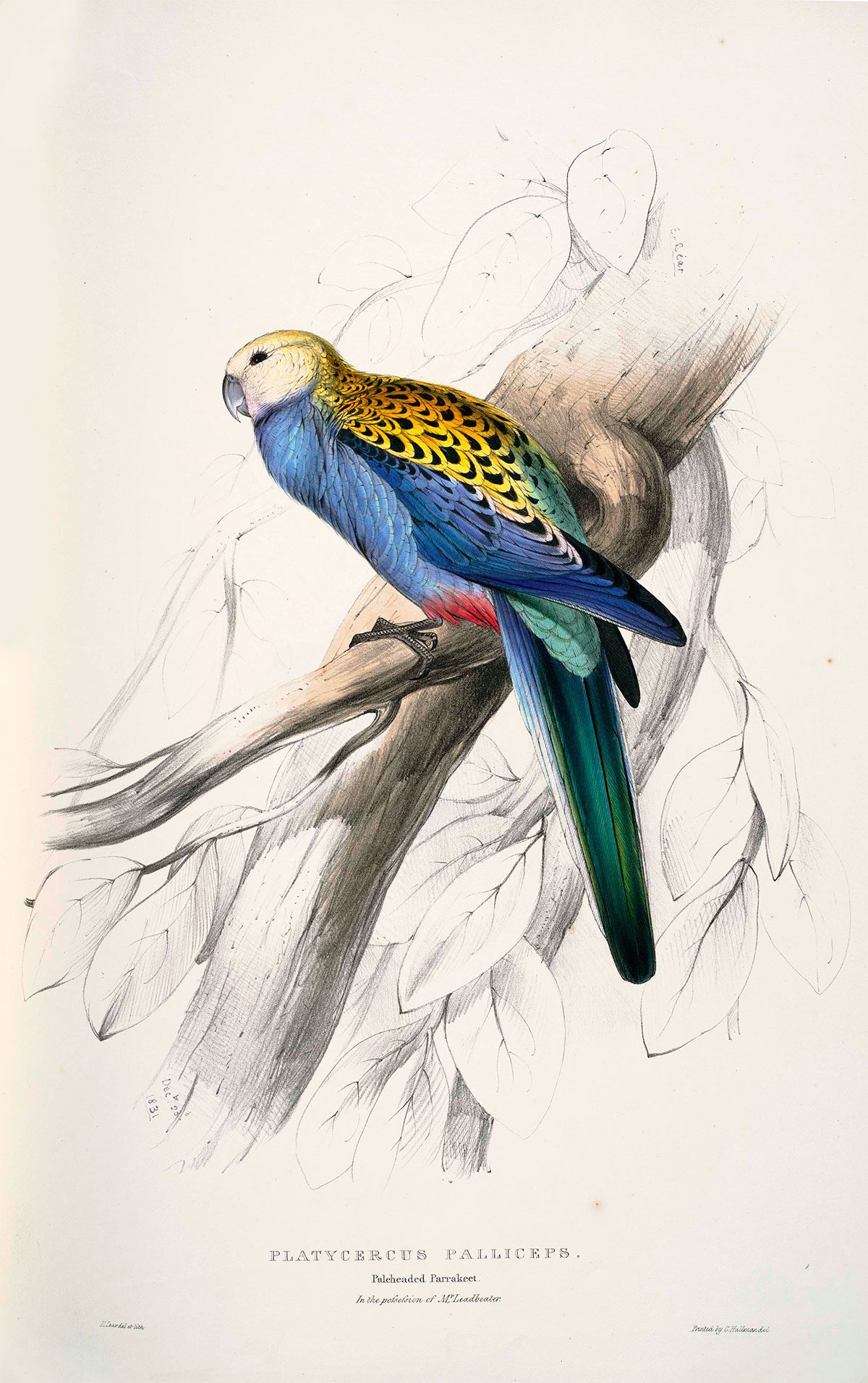
    (Lear 1832) – 32 cm.. length. It is something most large that the nominal species. The white color of the face is more extensive, coming up to the neck. Crown, nape and ear-coverts are pale yellow. The blue of the chest presents tonalities yellowishwhite and the feathers of the chest they have a thin lined black. The shoulders with wide verdosa-amarilla blue staining. bottom of the flight feather white.

Habitat:

Pale-headed Rosella

The Pale-headed Rosella they are common in all types of habitats of open forests, either scrub, scattered forests with logging, the rows of trees along rivers or swamps. They are also found in the wooded heaths which surround the coast and which are dominated by trees of the genus Banksia.

Avoid plunging into the thick forests, giving preference to the clear, meadows at the edges or directly border the plots. They also penetrate the surrounding farmland to feed.

They are birds of the lower regions, rarely rising above 700 meters and voluntarily leaving altitudes to the Crimson Rosella in dense forests and semi-montanosas areas.

Reproduction:

In the North, the Pale-headed Rosella They nest in the months of February to June, with some variations depending on the frequency of rains.

In the South, the breeding season are produced starting from September until the month of December.

These birds build their nests in deep a sick or healthy tree cavity, preferably a eucalyptus located near a river.
Other places that tend to choose are: a hole in a stump or a hole in a fence post.

The spawning generally includes between 3 and 5 eggs. The female incubates alone during 19 days, but as soon as the eggs are incubated, It receives assistance from the male that helps feed the young.

The chicks leave the nest after 5 weeks.

Food:

The Pale-headed Rosella they are mostly vegetarian. They consume a lot of plants, We have identified about 50 plant species. Similar to the Eastern Rosella, the Pale-headed Rosella It feeds mainly in the trees. The seeds of eucalyptus, acacias, Melaleuca, Black Cypress of Australia, acanthus and spiny Thistles, they are your favorite foods. The flowers and fruits some species also form part of their diet.

The Pale-headed Rosella they are often real pests for gardens and cornfields.

Distribution:

Size of the area of distribution (reproduction / resident): 1.470.000 km2

Confined to the East of Australia, where is dispersed through of the Cape York Peninsula, coming to the South up to the Gilbert River in the West, and extending to the South along the coast East of Queensland to the North of New South Wales.

In Queensland its inner boundary runs approximately through Croydon, Richmond, Lomgreach, Charleville and Bingara.

Are also distributed by the Fraser Island and around Brisbane, as well as in other coastal districts.

In New South Wales, the population is limited to the Northeast, extending toward the interior of Bourke and to the South up to around Coffs Harbour, on the coast.

Escapes have been recorded in Sydney and Melbourne, and there was an introduction without success in Hawaii at the beginning of this century.

The species coexists in the same altitude with the Eastern Rosella in the southeast of Queensland.

Common in suitable habitat within its range.

The world's population is above the 100.000 specimens.

Moderate numbers in captivity.

Fully protected.

Distribution 2 subspecies:

Conservation:


minor concern


โ€ข Current category of the Red List of the UICN: Least concern

โ€ข Population Trend: Growing

The size of the world population It has not been quantified, It is estimated at around 100,000 specimens.

The species according to reports, It is abundant in much of their range (pit et to the. 1997).

They have benefited from the clearing of the forests and the development of fruit tree crops and agricultural fields.. But, an important limitation is that of its acquisition as a popular pet bird, marketed as Blue cheek parakeet. Each year, hundreds of birds are illegally captured in the wild.

"Pale-headed Rosella" in captivity:

common in Europe, not so much in the United States.

Active and moderately loud. Aggressive with other birds. A little susceptible to stress and disease.

Alternative names:

Pale-headed Rosella, Blue Rosella, Blue-cheeked Parakeet, Blue-cheeked Rosella, Mealy Parakeet, Mealy Rosella, Moreton Bay Parakeet, Moreton Bay Rosella, Pale headed Rosella, White-cheeked Rosella, White-headed Rosella (ingles).
Perruche ร  tรชte pรขle, Perruche palliceps (French).
Blasskopfrosella (German).
Rosela-pรกlida (Portuguese).
Perico Pรกlido, Rosela de Cabeza Pรกlida (espaรฑol).

scientific classification:

Order: Psittaciformes
Family: Psittaculidae
Genus: Platycercus
Scientific name: Platycercus adscitus
Citation: (Latham, 1790)
Protonimo: Trained parrot

ยซPale Parakeetยป Images:

Videos "Pale-headed Rosella"

————————————————————————————————

ยซPale Parakeetยป (Platycercus adscitus)


Sources:

Avibase
– Parrots of the World โ€“ Forshaw Joseph M
– Parrots A Guide to the Parrots of the World – Tony Juniper & Mike Parr
– Loromania
– Birdlife

Photos:

(1) – A Pale-headed Rosella in Brisbane, Queensland, Australia By Paul Gear (Picasa Web Albums) [CC BY-SA 3.0], via Wikimedia Commons
(2) – Pale-headed Rosella (Platycercus adscitus) Kobble Creek, SE Queensland, Australia By Pale-headed_Rosella_kob02. JPG: Avicedaderivative work: Snowmanradio [CC BY-SA 3.0], via Wikimedia Commons
(3) – A Pale-headed Rosella in Herberton, Far North Queensland, Australia By Peter Shanks (originally posted to Flickr as pale headed rosella) [CC BY 2.0], via Wikimedia Commons
(4) – A Pale-headed Rosella in Brisbane, Queensland, Australia By Paul Gear (Picasa Web Albums) [CC BY-SA 3.0], via Wikimedia Commons
(5) – Pale-headed Rosella, Platycercus adscitus By Glen Fergus (Own work, Brisbane, Australia) [CC BY-SA 2.5], via Wikimedia Commons
(6) – A painting of a Pale-headed Rosella(originally captioned ยซPlatycercus palliceps. Paleheaded Parakeet. In the pofsefsion of Mr. Leadbeater.ยป) by Edward Lear 1812-1888 Edward Lear [Public domain], via Wikimedia Commons

Sounds: Judith Lattaway (Xeno-canto)

โ–ท The world of Pets: Dogs, cats, birds, reptiles, amphibians

Night Parrot
Pezoporus occidentalis

Night Parrot

Content


Anatomy-parrots

Description

22 to 25 cm.. length

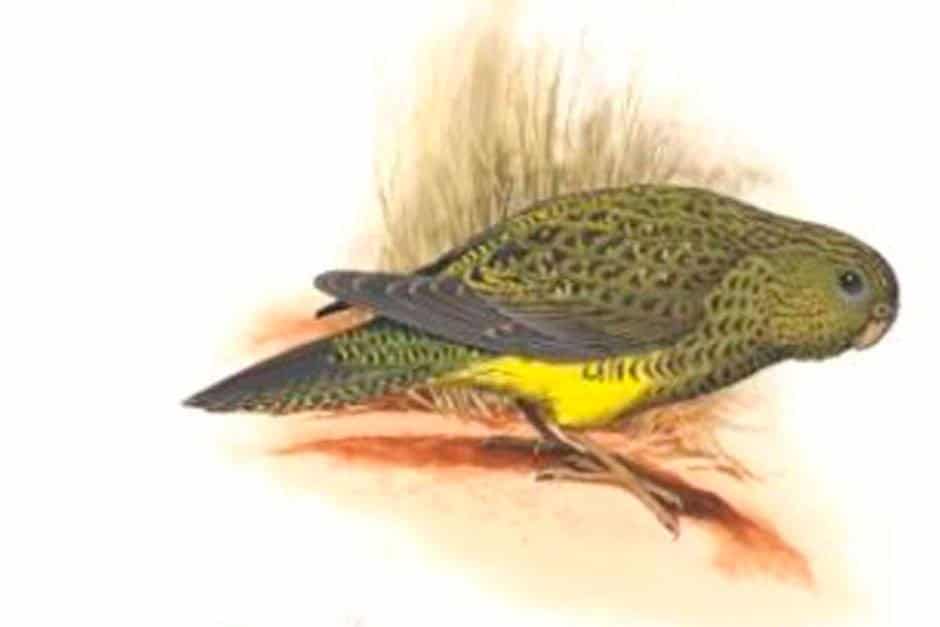
The Night Parrot (Pezoporus occidentalis) It is one of the most elusive and mysterious world of birds.

They have a bill plane, similar to the of the Kakapo (Strigops habroptila), without the apparent hook of the upper jaw. They have feathers around the cere. The tail is short. The legs are relatively elongated, indicating its good predispositions to walk.

The male and female they are similar.

In adults, the upperparts they are generally yellowish-green with dark brown cryptic spots, black and yellow. The front of the neck is greenish yellow. The chest and flanks they have discreet black and yellow stripes. Belly and coats are bright yellow. The flight feather are pale yellow, forming a thin stripe on the lower part of the wing. The central tail feathers are green with a strong yellowish brown shade. The bill is grey-brown, black eyes. Legs long claws dark grey.

In the wild, the Night Parrot It can be confused with the kakapo Parrot, If not we are looking too details which differentiates them.

Habitat:

The Night Parrot It attends a wide variety of habitats in arid or semi-arid land. They are mainly in places where the herbs grow in clumps on rocky peaks, also in the steppes composed of thickets of quenopodios. They also feel a great attraction for the Rock Samphire (A maritime rhythm), plants that are highly resistant to drought and salt.

They are known to flee to the interior areas of Muehlenbeckia, which have a dense foliage. The most recent reports do not come from the areas of Spinifex. It seems that new techniques of fire used to create firewall, They allow you to create favourable conditions for this parakeet.

The night Parrot almost never fly, except when looking for sources of water. To observe them, What has become extremely rare, We must look to the ground, in areas which consists almost exclusively of grasses of the genus Spinifex.

after dark, They fly a short distance until they find a fresh water pond. Once he has satisfied his thirst, they return to the infeed zone.

There is no certainty about the movements of this parakeet. It can be nomadic, Perhaps sedentary. No doubt depend on the climate and territory who attends them. Formerly, when the number of Night Parrot were still substantial, stocks were fluctuating seasonally.

At the end of the 19th century, in Southern Australia, groups of fifteen individuals were local irruptions, a signal that were sensitive to the favorable climatic conditions or were found in the alternative storage sites whose resources were relatively abundant.

All these considerations must be taken with great moderation for the following reason: the well-established notion that birds move through the Plains Spinifex in the direction of places full of thickets of quenopodios according to seasons and seed resources, not always been confirmed in recent reports.

Reproduction:

We know very little about the reproductive habits of this bird. The season of nesting is in July or August. The nest It is a kind of platform built with pieces of wood, on the ground or at low altitude. It is placed in a cavity that has been enlarged and which is accessed by a tunnel whose entrance is in a tuft of grass.. Its diameter is of some 8 centimeters. According to the previous data, the spawning usually contains 4 or 5 eggs. The time of incubation It is unknown.

Food:

The Night Parrot mainly consumed seeds of Spinifex (Triodia). Recent and circumstantial reports, indicate also the absorption of deciduous plants family leaves Poaceae as Enneapogon purpurascens.

Distribution:

Size of the area of distribution (reproduction / resident): 26.300 km2

The Night Parrot (Pezoporus occidentalis) are confined in the arid interior of Australia. Samples or reports come from all Australian States, especially in the Center and North of Western Australia (Mount Farmer, Nichol Spring, to the North of Glenayle, South of Kimberleys and to the West of the cue district), Southern Australia (Lake Eyre, to the South of Oodnadatta, Gawler Ranges, the Eyre Peninsula and Coopers Creek), Northern Territory South-Central and North-Western (Mac Donnell Ranges, Tanami desert), and to the southwest of Queensland (Lake Muncoonie and the surrounding areas of Boulia).

There is a report of 1913 that places them around Murrayville and Cowangie, Victoria, and another around of Ross Springs between 1954 and 1959. There is also a register of 1.897 that placed them in District of Oxleand, New South Wales.

The species has never been common, but it was more frequently toward the end of the last century (for example, 16 sightings in the region of the Lake Eyre, Southern Australia, in the decade of 1870). Due to marauding habits, many sightings remain unconfirmed, and this makes it difficult to assess its true condition. Even so, It seems certain that the population is declining. The cause of this is unknown, but it may be related to the introduction of predators such as cats, Rats, dogs or foxes. Changes in fire regimes, as well as the introduction of camels, they have also influenced its decline.

Night Parrot
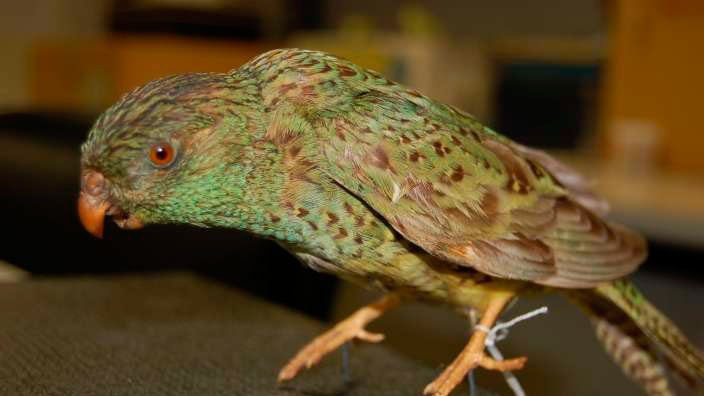
The Night Parrot seen only as museum specimens for 25 are not extinct. To cat-killed Night Parrot was recovered recently in western Queensland, Australia. (South Australian Museum)

There have been reports in every decade since its discovery, and all states in recent years, except Victoria (the last record was in 1950). The most notable recent sighting was of four birds in the eastern side of the cooper river, to 8 km to the East of the Lake Perigundi, Northeast of Southern Australia, in June of 1979. The birds were arrebolados in tangled shrubs, Sclerolaena intricata and flew away before perederse in the dense forests of Muehlenbeckia florulenta. In 1990 a long dead individual, It was the first specimen in a Museum from the Decade of 1880, was collected in the southwest of Queensland,to 36 km to the North of Boulia. A more recent record of these birds (between March of 1992 and June of 1993) He was picked up in the South of Cloncurry, about 150 km to the North of the area where the dead bird was found, which confirms the local persistence of this species.

The global population is unknown, but it can be very small and is likely to be declining. There are none in captivity.

The Night Parrot has been the subject of a legal protection in Australia since 1937.

Conservation:


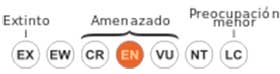
Endangered


โ€ข Current category of the Red List of the UICN: Danger

โ€ข Population trend: Decreasing

After no record is confirmed from 1990, despite several exhaustive searches and publicity campaigns, This species was rediscovered in 2005 in the region of Pilbara in Western Australia, and a dead juvenile was found in the Diamantina National Park, Queensland in 2006.

It is likely that they have decreased as a result of a series of threats, and the remaining population can be very small and possibly subject to extreme fluctuations.

Based on the records of 2005 and 2006, and because of the shortage of sightings, a Committee of experts concluded that the species was in danger of extinction.

The population of the Night Parrot is supposed to be very small, and is estimated at less of 50 mature individuals based on the scarcity of records. In 2010 a Committee of experts re-evaluรณ given records of Western Australia in 2005 and Queensland in 2006, and estimated that there could be 50 to 250 birds in total (Garnett et to the. 2011). Therefore, the number of mature individuals is placed in the band of 50-249, but it can become something bigger.

The population It is suspected that it may be in decline due to a combination of threats, including predation by invasive exotic predators.

If a population can be located, the following measures could be introduced:

    โ€ข a research and monitoring program
    โ€ข control of wild animals in and around the place where the population of the Night Parrot
    โ€ข patch burning to limit the possibility, or to prevent the occurrence of fire in the place of the population until better understanding of the situation and the ecological needs of the population
    โ€ข minimize disturbance to the population site, which could include leaking information to the public, and the establishment of agreements with landowners and land managers.
    โ€ข establish a captive breeding program (Blyth 1996; Garnett and Crowley 2000).

"Night Parrot" in captivity:

There are no records of this bird in captivity.

Alternative names:

Night Parrot (ingles).
Perruche nocturne (French).
Hรถhlensittich (German).
Periquito-de-barriga-laranja (Portuguese).
Perico Nocturno (espaรฑol).

scientific classification:

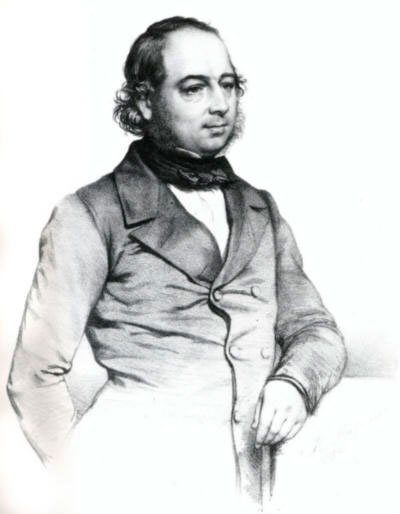
John Gould
John Gould

Order: Psittaciformes
Family: Psittaculidae
Genus: Pezoporus
Scientific name: Pezoporus occidentalis
Citation: (Gould, 1861)
Protonimo: Geopsittacus occidentalis

Images "Night Parrot"

"Night parakeet" (Pezoporus occidentalis)

Sources:

  • Avibase
  • Parrots of the World โ€“ Forshaw Joseph M
  • Parrots A Guide to the Parrots of the World – Tony Juniper & Mike Parr
  • Birdlife

  • Night parakeet photos:

(1) – 1971 painting of a night parrot by William Cooper – Enlace
(2) – The Night Parrot seen only as museum specimens for 25 are not extinct. To cat-killed Night Parrot was recovered recently in western Queensland, Australia. (South Australian Museum) – Top Birding Tours

โ–ท The world of Pets: Dogs, cats, birds, reptiles, amphibians

Red-fronted Parrot
Poicephalus gulielmi


Lorito Frentirrojo

Content

Description:

28 cm. length and an average weight of 220 g..

The Red-fronted Parrot (Poicephalus gulielmi)has the forecrown and crown bright red; the lores and chin blackish; cheeks, back of the crown and nape dark green with scattered feathers showing blackish centers.

The mantle feathers and scapulars Black with large green edges that give scalloped appearance; rump and uppertail-coverts bright yellowish green .

Wing coverts black with a dark green margin; leading edge of the wings from joints carpal to the base of the primaries bright red. The primaries and secondaries black. Under, the wing feathers dark green and black.

Underparts dark green with scattered feathers showing a black central band; the thighs bright red. The tail black.

Top of the mandible grey, Blackish towards the tip with pale base stains, lower jawBlackish r; Orange the irises; legs dark grey to black.

Both sexes similar.

The youth lack of red color in the forecrown, the edge of the wings and the thighs; Green in a little paler than the adults plumage. Young birds sometimes show red color in the feathers of the wings. The irises is dark brown.

Description 3 subspecies:

  • Poicephalus gulielmi fantiensis

    (Neumann, 1908) – Smaller that the species nominal. Forehead, leading edge of the wings and the thighs Orange or orange-red (but not red) and more extensive, in some birds. Underparts paler green with fewer black markings.


  • Poicephalus gulielmi gulielmi

    (Jardine, 1849) – Nominal species


  • Poicephalus gulielmi massaicus

    (Fischer & Reichenow, 1884) – Restricted red in the forecrown. Paler than the species nominal, with few or no black marks on the underparts.

Habitat:

The Red-fronted Parrot They inhabit montane forests of Juniperus and Podocarpus in Kenya and Tanzania, between 1,800 and 3,250 meters above sea level, where may depend on the primary vegetation.

Confined in the lowlands the rest of the population rainforest (below 700 metres in West Africa), but are not limited to the primary formations, There are records of the Red-fronted Parrot perched on tall trees of shade coffee plantations in Angola and in secondary forests of Ghana.

Usually stays in the tree tops, While they feed or rest.

In general, seen in groups of up to 10 birds, forming large flocks where abundant food. Large congregations, sometimes, in places.

In Kenya, the Red-fronted Parrot they make long daytime journeys of foraging (60km) along gallery forests, or crossing the savanna forest dominated by Acacia.

Reproduction:

The Red-fronted Parrot they breed solitary.

During the mating, males sway rhythmically, without moving the wings, while standing behind the female's back.

The nest is located in a cavity between 3 and 12 meters above the ground.

In the Mount Meru (Tanzania), nests have been recorded in living trees of the genus Hagenia, Podocarpus and Juniperus.

The egg laying It has been recorded in November to January in Tanzania, September in Zaire and March, June and from September to November in Kenya. The implementation is of between 2 and 4 eggs bright white.

Food:

Its diet It is believed that it is composed of a variety of seeds, fruits, flowers and insects. The seeds of Spathodea, oil palm nuts (Elaeis guineensis), fruits of the Podocarpus flowers and seeds of Grevillea robusta. Probably some insects are also part of their diet.

Sometimes associated with the African Olive-Pigeon (Columba arquatrix) and Sharpe's Starling (Pholia sharpii) when feeding in the Olea capensis.

Distribution:

Size of the area of distribution (reproduction / resident): 5.380.000 km2

Several apparently separated distributions.

In West Africa are distributed to the East of Liberia until Ivory Coast and South of Ghana.
In the Center-West of Africa, South of Cameroon to the Northwest of Angola. A seemingly separate population extends to the North of Zaire and South of the Central African Republic to the southwest of Uganda and Rwanda. Also found in the Highlands of Kenya and North of Tanzania.

Sedentary with local movements. Locally common to abundant in many localities in part of its eastern range, apparently, the decrease in other areas is possibly due to deforestation.

Distribution 3 subspecies:

Conservation:


minor concern


โ€ข Current Red List of UICN: Least concern

โ€ข Population trend: Decreasing

Keep a Red-fronted Parrot as a pet it has steadily increased in popularity in recent years, and as a result, the species has been the subject of intense trade on the market of wild birds. His capture may represent a significant threat to the species, in particular for the population around the Mount Kilimanjaro in Tanzania, fact that could lead to the local extinction of the species in that area.

The Red-fronted Parrot is also at risk from the deforestation in parts of its area of distribution. But, the species is still distributed over a wide area and is not currently considered globally threatened, even though global population trends have yet to be quantified.

The Red-fronted Parrot is located in several protected areas, including the Lope-Okanda National Park in Gabon, World Heritage site, the Korup National Park in Cameroon and the Bia National Park in Ghana.

The species is included in the Appendix II the Convention on international trade in endangered species (CITES), that means that the international trade of the Red-fronted Parrot It must be carefully checked. But, a key problem in many areas is the lack of adequate legislation, and the lack of compliance with the legislation in which it does exist.

The wild trade in this bird and the destruction of their forest habitat may have a better follow-up to ensure that populations of the Red-fronted Parrot not to suffer future decreases.

"Red-fronted Parrot" in captivity:

Probably the first hatchlings of Red-fronted Parrot born in in captivity were achieved in 1978, in Switzerland and England Although already in advance, in the middle of the 90, specimens had arrived at zoos in London and Hamburg.

The Red-fronted Parrot is little known in Spain, but in other countries it is very common as a pet thanks to its size, its great intelligence, its capacity for imitation and its character quiet and loving, but at the same time playful and naughty.

It is soft and musical, and their cry is quite bearable. In general, is a bird bit noisy, which can be an asset to a future owner who lives in an apartment.

They are very destructive, or both must provide them with abundant branches and non-toxic toys for chopping and shredding.

In terms of their longevity, according to sources, one specimen was still alive after 21 years in captivity.

Alternative names:

Red-fronted Parrot, Jardine’s Parrot, Red fronted Parrot, Red-crowned Parrot, Red-headed Parrot, William’s Fig Parrot (English).
Perroquet ร  calotte rouge, Perroquet ร  front rouge, Perroquet de Jardine, Perroquet vert ร  calotte rouge (French).
Kongopapagei, Kongo Papagei (German).
Papagaio-de-jardine (Portuguese).
Lorito de Jardine, Lorito Frentirrojo, Loro Jardinero (espaรฑol).


scientific classification:

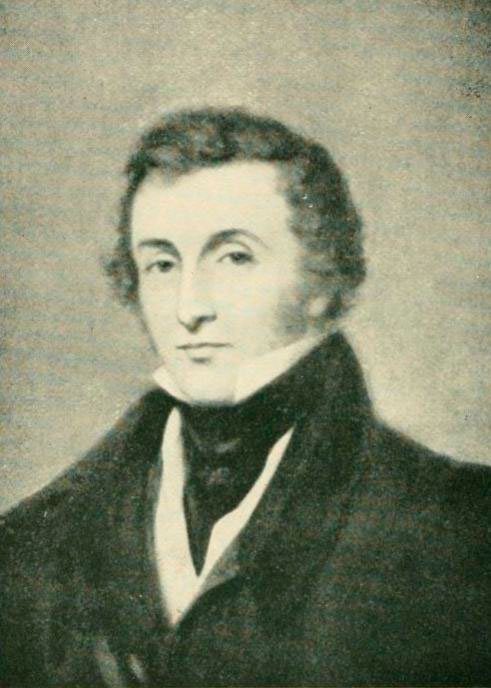
William Jardine
William Jardine

Order: Psittaciformes
Family: Psittacidae
Genus: Poicephalus
Scientific name: Poicephalus gulielmi
Citation: (Jardine, 1849)
Protonimo: Parrot gulielmi


Images "Lorito Frentirrojo":

————————————————————————————————

"Lorito Red Front" (Poicephalus gulielmi)


Sources:

Avibase
– Parrots of the World โ€“ Forshaw Joseph M
– Parrots A Guide to the Parrots of the World – Tony Juniper & Mike Parr
– Birdlife
– Arkive

Photos:

(1) – A Red-fronted Parrot at Birds of Eden, South Africa By Dick Daniels (http://carolinabirds.org /) (Own work) [CC BY-SA 3.0 or GFDL], via Wikimedia Commons
(2) – Photograph of a couple of Poicephalus gulielmi By derivative work: Snowmanradio (talk)Poicephalus_gulielmi_pareja_reproductora. JPG: Juan Caparrรณs (Poicephalus_gulielmi_pareja_reproductora. JPG) [CC BY-SA 3.0 or GFDL], via Wikimedia Commons
(3) – P. g. fantiensis at Birds of Eden, South Africa By Poicephalus_gulielmi_-Birds_of_Eden_-South_Africa-8a.jpg: Grahamderivative work: Snowmanradio [CC BY-SA 2.0], via Wikimedia Commons
(4) – A juvenile pet Red-fronted Parrot (also known as Jardineโ€™s Parrot) By Bram Cymet (originally posted to Flickr as Amazon) [CC BY 2.0], via Wikimedia Commons
(5) – Fledgeling Lesser Jardines Parrot eating vegetables By Kofiwannacracker (Own work) [Public domain], via Wikimedia Commons

โ–ท The world of Pets: Dogs, cats, birds, reptiles, amphibians

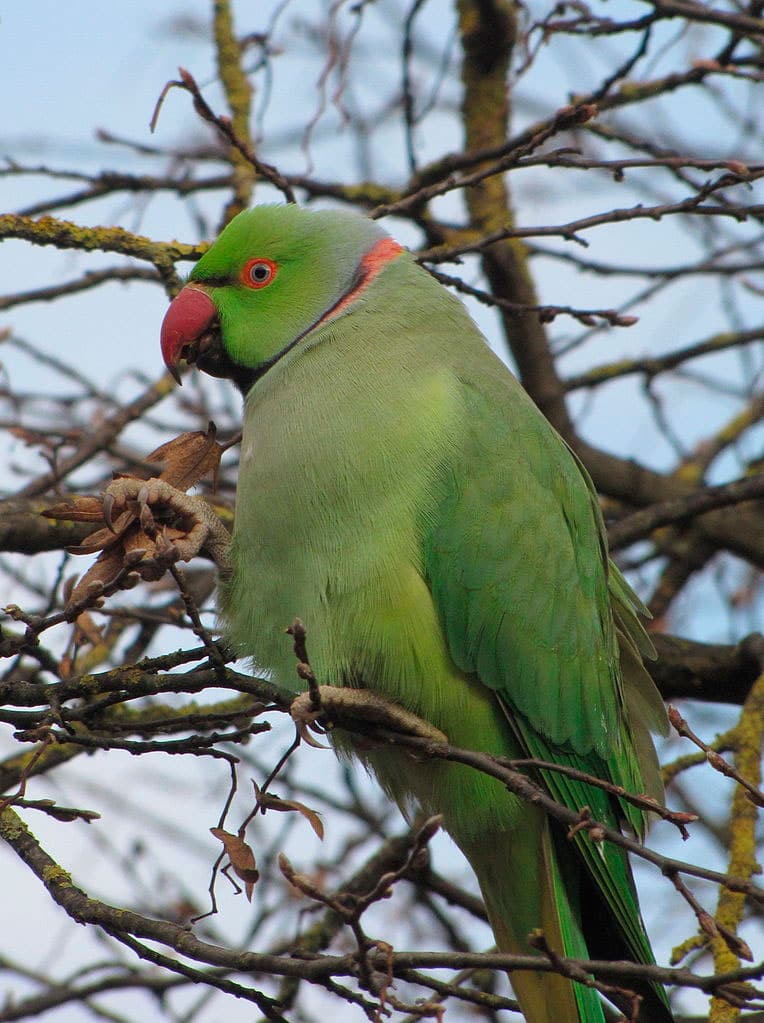
Rose-ringed Parakeet
Psittacula krameri


Cotorra de Kramer

Content

Description:

Cotorra de Kramer

Of 40 cm., length and a weight between 116 and 140 g..

The Rose-ringed Parakeet (Psittacula krameri) has the forecrown, fore crown, the cheeks and lores bright yellowish green; narrow dark line between cere and the eye ring; the back of the crown, the nape and the sides of the neck, pale lavender gray, broken on the sides of neck with narrow black stripes; contiguous black markings with wide black stripes on the bottom of the cheeks merging the chin a solid black.

Pink collar in the back of the neck, the mantle and back light green tinged with olive; rump and uppertail-coverts slightly brighter. Lesser and medium upperwing-coverts light green (darker than the body); large coverts dark green; primaries and secondaries dark green with darker (almost black) margin to the vane inner. bottom of the feathers flight gray; underwing-coverts brighter yellowish green. Underparts brighter yellowish green. Upper, the tail centrally blue with yellowish tips, green side; undertail, the tail centralmente negruzca, yellow-olive laterally.

Crimson in the upper jaw tipped in black, the lower jaw of color stream blackish; cere whitish: irises yellowish white; legs pink, with 4 fingers ending in nails strong in black, two of these fingers are directed forward and two backward so called zigodactilia, which it allows them to easily climb.

The female lacks the neck black, brands in the chin and the cheekbone, of the collar pink and blue suffusion of neck; It has shorter central feathers tail.

The They are similar to immature females but with the bill a little paler, irises greyish; the males acquire the characteristic Pink collar in the third year.

Subspecies description
Subspecies
  • Psittacula krameri borealis (Neumann, 1915) – Larger than the species nominal, with upper jaw all red and black marks on the lower jaw. Bluish suffusion in neck, behind ear-coverts; more than grayish bottoms species nominal.

  • Psittacula krameri krameri (Scopoli, 1769) – The species nominal

  • Psittacula krameri manillensis

  • Psittacula krameri manillensis (Bechstein, 1800) – Larger than other subspecies, slightly paler and more yellow than the subspecies borealis. Different facial markings that species nominal. Under the mandible black.

  • Psittacula krameri parvirostris (Souance, 1856) – Of head and cheeks yellowish least the species nominal. Bill small upper jaw brighter red, less blackish towards the tip. The birds living in eastern Sudan They are intermediate between subspecies appearance parvirostris and species nominal.

Habitat:

The Rose-ringed Parakeet It is a very adaptable bird. It is located in a variety of forest types Forest, from secondary forests, wet, riparian forests, mangroves, open farmland with scattered trees, to parks and gardens in urban areas.

They can live at altitudes 1.600 metres in Asia and 2.000 metres in Africa.

gregarious, especially out of breeding season, coming to form large noisy flocks sometimes several thousand birds. Communal roosts, often with Crows, Mynas or other parrots.

Reproduction:

The Rose-ringed Parakeet It is not a territorial bird and, sometimes vaguely colonial while breeding.

It nests in natural tree cavities or holes extended, in cracks in rocks or walls built; in Africa, always nest atop a tree.

The breeding season, mainly, It covers the months from January to April, although offspring have been recorded in the month of July.

typical setting 3 to 4 eggs, although they have been registered you put six eggs.
23 days of incubation and 45 days of stay in the nest of the hatchlings.

Food:

Diet Rose-ringed Parakeet It includes a variety of cereals, herbs, seeds, vegetables, fruits, flowers and nectar, wild and cultivated; feeding varies seasonally,for example, in the Indian state of Punyab, They feed on weed seeds from April to June and sorghum between the months of August and January.

Inflingen crop damage, especially citrus, sunflower and corn.

In Africa feed of fruits, for example, of Boolean, Tamarindus, Adansonia, Psidium, Acacia white and Slassus.

In Asia, their diet consists of seeds of Acacia arabica, Prosopis spicigera, Casuarina equisetifolia and Crotalaria medicaginea and fruits of Morus alba, Bridiela retusa, Dalbergja, Ficus, Xanthium, Meliรก and Albizia.

Distribution:

Size of the area of distribution (reproduction / resident): 27800000 km2

The Rose-ringed Parakeet they are the parrots more widely distributed around the Old world. They are native to tropical africa, north of the humid forest zone, and much of Asia meridional.

In West Africa (Mauritania, Senegal, Gambia, Guinea-Bissau), the east, through Mali, South of Niger, North of Ivory Coast, North of Ghana, Burkina Faso, Togo and Benin to the North of Nigeria and Cameroon, South of Chad, North of the Central African Republic, from southern Sudan to the North of Uganda and Ethiopia, Djibouti and Northwest of Somalia.

In Asia, from the West of Pakistan, South of Nepal through the India, Bangladesh and Sri Lanka to downtown Burma.

Many introduced populations are distributed by EE.UU., England, Germany, Netherlands, North of Egypt, Kenya, coastal area Ivory Coast (possibly wild relict), South Africa (Natal and Zululandia), Mauritius, Arabian Peninsula, Singapore, Macao and China, in the surroundings of Hong Kong.

Mainly sedentary, but apparently with some seasonal movements in most parts of the African range (for example, temporary visitors during the rainy season in southern areas Mauritania).

Common to abundant in Africa and part of Asia; quite common in Burma.

Residents and especially sedentary. Widely bred in captivity.

Subspecies distribution
Subspecies
  • Psittacula krameri borealis (Neumann, 1915) – distributed by Pakistan, through North India, around of 20 ยฐ norte, Nepal and Bangladesh until Burma. He also believed to belong to this subspecies distributed parts of birds Middle East, Mauritius, Macao and parts of Southeast China.

  • Psittacula krameri krameri (Scopoli, 1769) – The species nominal

  • Psittacula krameri manillensis (Bechstein, 1800) – Distributed by South India, about 20 ยฐ north and Sri Lanka. Observed in wild populations England, elsewhere Europe, EE.UU. and Singapore, They seem to belong to this subspecies.

  • Psittacula krameri parvirostris (Souance, 1856) – Distributed by this Sudan through North Ethiopia until Djibouti and North of Somalia

Conservation:

State of conservation โ“˜


minor concern Minor Concern โ“˜ (UICN)โ“˜

โ€ข Current Red List of UICN: Least concern

โ€ข Population trend: Growing

The size of the world's population has not been quantified, but the species, according to sources, It common to abundant throughout their natural range (pit et to the. 1997), while the population Japan it has been estimated between 100 and 10,000 introduced breeding pairs ( Brazil 2009).

Its population It increased in the twentieth century, in relation to the expansion of agriculture.

Nest protection and brood handling has helped the Rose-ringed Parakeet recover.

Invasiveness in Spain

    Because of its colonizing potential and constitute a serious threat to native species, habitats or ecosystems, This species has been cataloged in the Spanish Catalog of Invasive Exotic Species, approved by Royal Decree 1628/2011, of 14 November, It is banned in Spain its introduction into the wild, possession, transport, trade and commerce.

"Rose-ringed Parakeet" in captivity:

The Rose-ringed Parakeet is a bird with character that raised since childhood can become a docile pet, although its tendency is to be a fearful and aggressive bird. Form unstable pairs, something that affects their behavior. It is unlikely that this species has an affectionate behavior with their caregiver, with few exceptions.

To enjoy it Patience is needed and above all to have knowledge about this species, not to be disappointed if things are not progressing as expected.

The Rose-ringed Parakeet It is a bird that must be handled daily and this, throughout his life, with the aim of being able to achieve an โ€œoptimalโ€ dressage. In fact, Naturally that tends to become suspicious if the time is not paid regularly. We have to "fight" against this tendency to touch it, manipularla, caress, etc … He does not like human contact, other interaction need not destroy your confidence.

It is a bird that is in great need of occupation. She is active and loves to be stimulated. Learns tricks easily and is always ready to learn, which makes it a bird very interactive with his master, despite being reluctant to hugs.

The Rose-ringed Parakeet she is also a bird that will tend to trust only the person who takes care of her every day.

If we do not put enough games available in your area, it can be very destructive, He likes to chew and grind objects with their powerful beak, which would cause us a serious problem … it is also important to periodically renew the games to avoid boredom.

They have a powerful screech and are quite noisy.
Still not much of a conversationalist, You can learn to say a few words.

It could eventually transmit diseases such as psitacosis.

With regard to its longevity, according to sources, a Rose-ringed Parakeet lived during 34 years in captivity. In captivity, these birds are known to breed, approximately, to the 2 years of age.

Alternative names:

Rose-ringed Parakeet, Green Long-tailed Parakeet, Long-tailed Parakeet, Ring-necked Parakeet, Rose Ringed Parakeet, Roseringed Parakeet, Senegal Long-tailed Parakeet (English).
Perruche ร  collier, Perruche de Kramer, Perruche verte ร  collier (French).
Halsbandsittich, Kleiner Alexandersittich (German).
Periquito-de-colar, Periquito-rabijunco (Portuguese).
Cotorra de Kramer, Cotorra Verde de Collar, Periquito de Collar, Periquito de Kramer, Alejandrino comรบn, Cotorra de Collar, Cotorra de Collar Verde, Cotorra de la India, Periquito de Collar (espaรฑol).


scientific classification:

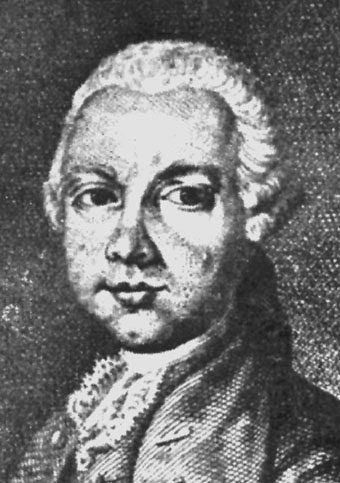
Giovanni Antonio Scopoli

Order: Psittaciformes
Family: Psittaculidae
Genus: Psittacula
Scientific name: Psittacula krameri
Citation: (Scopoli, 1769)
Protonimo: Psittacus krameri


Images Rose-ringed Parakeet:

Videos "Rose-ringed Parakeet"


Especies del gรฉnero Psittacula

Rose-ringed Parakeet (Psittacula krameri)


Sources:

Avibase
– Parrots of the World โ€“ Forshaw Joseph M
– Parrots A Guide to the Parrots of the World – Tony Juniper & Mike Parr
– Birdlife
Wikipedia

Photos:

(1) – A male Rose-ringed Parakeet (also known as the Ringnecked Parakeet) in Richmond Park, London, England By London looks (originally posted to Flickr as ring neck parakeet) [CC BY 2.0], via Wikimedia Commons
(2) – A Rose-ringed Parakeet at Agra Fort (Red Fort of Agra), Agra, India By Leigh Harries from London, UK (Parakeet, Red Fort, AgraUploaded by Snowmanradio) [CC BY-SA 2.0], via Wikimedia Commons
(3) – Two Rose-ringed Parakeets (also known as the Ringnecked Parakeet) at Canberra Walk In Aviary, Gold Creek Village, Canberra, Australian Capital Territory, Australia By Richard Taylor (originally posted to Flickr as IMG_6777) [CC BY 2.0], via Wikimedia Commons
(4) – A male Rose-ringed Parakeet at Seaview Wildlife Encounter, Seaview, Isle of Wight, UK By Garry Knight from London, England (Blue Ring-Nosed ParakeetUploaded by Snowmanradio) [CC BY-SA 2.0], via Wikimedia Commons
(5) – Ring necked Parakeet (Psittacula krameri), Kew Gardens ยฉ Copyright Christine Matthews and licensed for reuse under this Creative Commons Licence. – geograph
(6) – Rose-Ringed Parakeet (Psittacula krameri). Pet parrot having the blue colour mutation By Tanya Dropbear (originally posted to Flickr as ยซAm I true blue?ยป) [CC BY 2.0], via Wikimedia Commons
(7) – Rose-Ringed Parakeet (also known as the Ringnecked Parakeet) in Hong Kong By Charles Lam (originally posted to Flickr as Asking for Food…) [CC BY-SA 2.0], via Wikimedia Commons
(8) – Rose-ringed Parakeet Psittacula krameri in Narsapur, Andhra Pradesh, India By J.M.Garg (Own work) [GFDL or CC BY-SA 4.0-3.0-2.5-2.0-1.0], via Wikimedia Commons
(9) – Rose-Ringed Parakeet (Psittacula krameri), Woluwe Park, Brussels by Frank Vassen – Flickr
(10) – SeoBirdlife
(11) – Female on left and male on right (Psittacula krameri manillensis) By J.M.Garg (Own work) [GFDL or CC BY-SA 3.0], via Wikimedia Commons

Sounds: Josรฉ Carlos Sires (Xeno-canto)

โ–ท The world of Pets: Dogs, cats, birds, reptiles, amphibians

Blue-and-yellow Macaw
Ara ararauna


Guacamayo azuliamarillo

Content

Description:

Guacamayo azuliamarillo

Of 86 cm.. length and a weight between 995 and 1380 g..

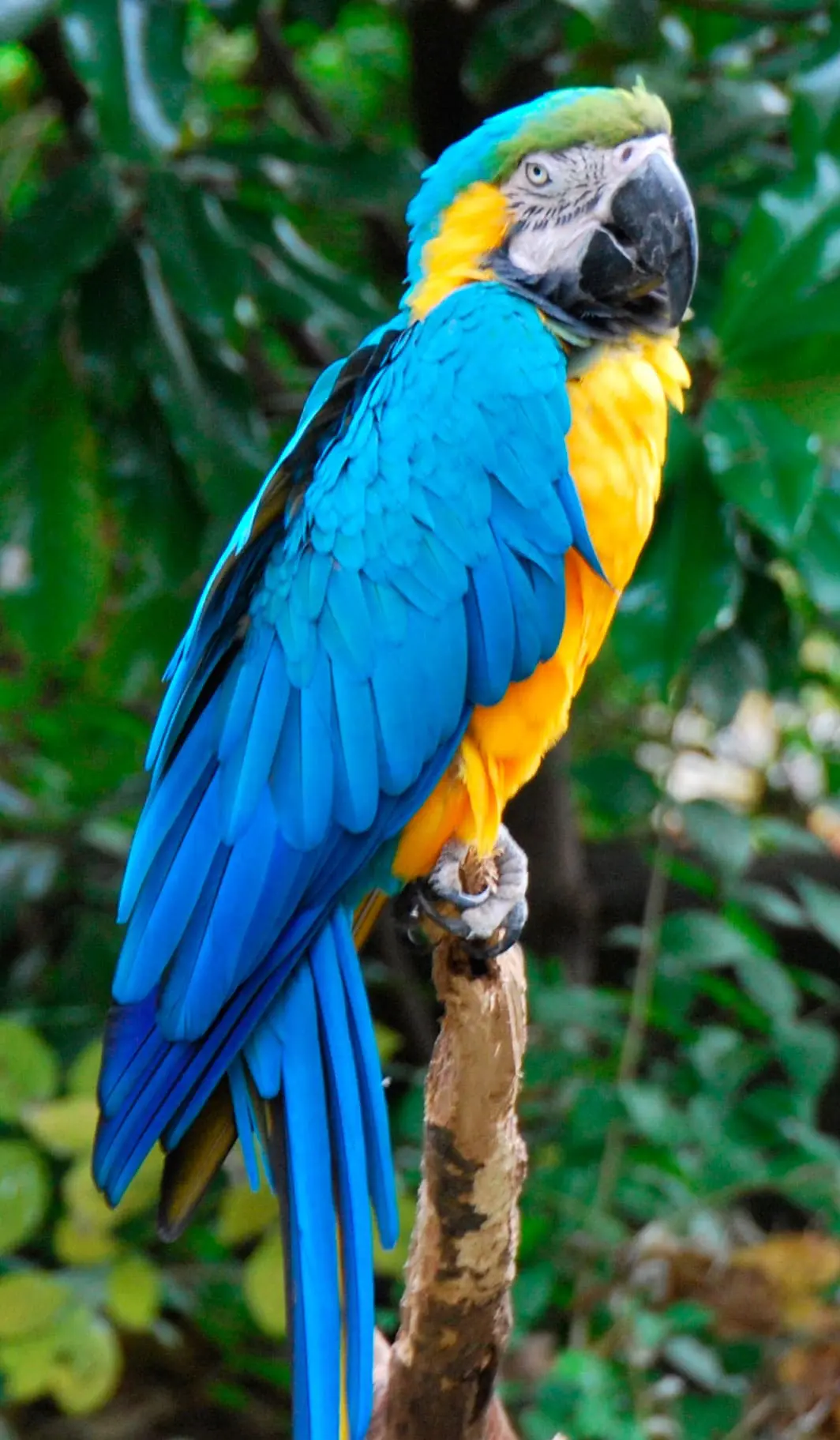
The Blue-and-yellow Macaw (Ara ararauna) has the forecrown and both sides of the head to behind eyes bright green, faded to bright ultramarine blue in the crown and nape.

The upperparts Blue bright overseas. Upper wing coverts Blue bright overseas; flight feather Violet Blue top, Yellow Gold to olive brown down; Depending on the light, the underwing-coverts, yellow.

Large patch yellow on the sides of the neck and ear-coverts edged ahead by a black stripe, to expand to form a black patch in the throat.

Undertail-coverts blue. Uppertail dark purple suffusion overseas; undertail, the tail golden yellow to olive brown depending on the light; Tips new feather of the tail striped wide.

Bill dark grey; cere naked and facial patch (including lores and cheeks to behind eyes) white crossed by narrow lines of feathers Black in knowledge and cheeks top (the skin of the face pink when they are excited); irises pale yellow; legs dark grey.

Both sexes similar.

The youth they have the wings and tail Cafe-grisacea and eyes browns.

Habitat:

They inhabit areas with large trees, often near water, including moist lowland forest edges (mostly forests and marshes, avoiding the lowland forest of tierra firme), gallery forest in the savannah, Savannah with trees and scattered Palms, marshy forests and swampy areas with Palm trees (Mauritia flexuosa). As well bosque deciduous away from the water in Colombia and Panama.

They sometimes feed in more open areas, posing on the floor, for example, for feeding of fruits of Palm.

Gregarious. Usually, observed in pairs, family groups or flocks of up to 25 birds (sometimes many more, especially near the roosts).

The Blue-and-yellow Macaw are observed more often in the morning and afternoon, halfway between the roosts and feeding areas.

Communal roosts in the trees.

Reproduction:

Son monogamous and they usually form a couple throughout their lives.

It nests in a hole in the top of a dead Palm tree (for example, Mauritia flexuosa).

Breeding between the months of February and March in Suriname; Between January and may in Trinidad (formerly); Between December and February in Colombia (birds observed in breeding conditions). Egg laying observed in February in Guyana and between November and January at Peru.

The laying, generally, is two or three eggs, incubated by the female for a few 28 days, the chicks leave the nest to the 90 days after birth.

Food:

They feed on a wide variety of locally available fruits (mostly from various Palm trees), nuts, Spring sprouts, etc., elements reported including fruits of Astrocaryum, Mauritia and palms Acrocomia, seeds of platypodium grandiflorum, Sloanea, Brosimum, Were, Spondias, Inga, Parkia, Hura crepitans and Enterolobium, nectar Combretum laxum and aril of Hymenaea Courbaril.

The Blue-and-yellow Macaw they eat quietly at the top of the canopy, often near clearings. Large flocks may congregate in areas of ribera, often with other species of parrots, to supplement their diet with minerals that are ncuentran in clayey soils.

Distribution:

Its distribution is varied and discontinuous: east of Panama and the tropical lowlands of South America to the South-East of Brazil, Bolivia and Paraguay.

In Panama, from the top of the bayano river (Maybe just once) to the East of Darien mainly in the drainage of the Tuira River and the Chucunaque River.

Along the lower tropics (some 500 m) in Colombia; apparently absent from the Valle del Cauca, Nariรฑo, and the moist rain forests of central Choco.

In the eastern lowlands of Ecuador, and perhaps earlier in Guayas, on the slope of the peaceful.

Tropical zone of Venezuela, mainly to the South of the Orinoco, in Monagas only in the north shore (for example in the drainage of the amana river).

extinct in Trinidad from 1970; escapes of captive birds reported since.

Spread sheets and coastal river systems of Guyanas and Suriname.

Widespread in Brazil, but extinct in Bay, South of Rio de Janeiro and in Santa Catarina, during the years 1950 or 1960; they remain in the southeast of Brazil only in the State of Sรฃo Paulo Western, as a wandering bird from populations further to the West in the region of the Pantanal and the lowlands of Bolivia and Peru.

Current situation in the Paraguay (probably Northeast, perhaps earlier in the South) It is not clear.

The records of Argentina remain corroborated.

Resident general, but with some movements of foraging season.

Locally common, but, apparently, decrease in Panama.

Fairly common in less disturbed areas of Colombia.

Scarce, irregular and decreasing to the West of the Andes in Colombia and Ecuador.

Local in Venezuela.

The largest population of the Blue-and-yellow Macaw It is located in the coastal area of Suriname and it appears to be very common in northwestern Guyana, much less numerous in the South; local in the French Guayana due to the persecution. More common in parts of Brazil (especially in the Amazonia), but rarer in Pantanal. Locally common in the Amazon area of Peru but with a drastic drop around the main capture centers (for example, Iquitos and Pucallpa).

Apparently rare Bolivia, in the Northwest area, but common (at least locally) in the East.

In the 15th century and probably until the end of the 19th century its distribution area encompassed virtually all the the Caribbean basin.

Conservation:


minor concern

โ€ข Current Red List of UICN: Least concern

โ€ข Population trend: Decreasing

The size of the world's population has not been quantified, but this species is described as ‘Rare‘ (Stotz et to the. 1996).

Not regarded as threatened, Although it is appreciated as bird cage, and their populations are declining and several are now extinct, including the of Trinidad.

The species has undergone intense trade: from 1981, When it began trading in the Appendix II of CITES, 55,531 individuals captured in nature have been registered in international trade (UNEP-WCMC CITES Trade Database, January 2005).

An investigation by the UN indicates that removal of chicks of Blue-and-yellow Macaw, in the Amazon, exceeds the 26%, which leads to overexploitation of the species.
โ€œIf a stock is already being overexploited, any rate and type of extraction would have serious effects on its viability and could quickly drive it to extinction. The extraction of adults, even in healthy populations, is even more critical as a rate of 3% already produces population declines, and if they are being subjected simultaneously to extraction of chicks and adults, hunting rates must not exceed the 1% or 2% so that there is no risk of extinctionโ€, Esteban Carrillo and Diego Fernando Builes doors explained, authors of research.
The genera Amazon (Loras) and Ara (macaws) they are particularly vulnerable, due to factors such as its low reproductive rates, low survival of chicks, late age of first breeding, large proportion of non-breeding adults and specific requirements for nest building. In addition are the two most desired genera as pets, and whose extraction generates greater economic โ€œprofitsโ€ for local hunters.
In particular, the Blue-and-yellow Macaw (Ara ararauna), that it is distributed in lowland forests from Panama to Bolivia Centre and the South-East of Brazil, it is common, but decreases according to the human activity and local extinctions have already.
Sensitivity analysis in the adult hunting scenario for crafts shows that this type of extraction can have profound effects.. Through a program of modelling, It was determined that only extract the 3% of adults, the growth rate turns negative, to extract the 8% the adult begins to have chance of extinction, and with extraction rates equal or greater to the 10%, the probability of extinction of the population in the following 100 years ranges between 52% and 100%.

Researchers warn that the only form of sustainable extraction is subsistence hunting, which is carried out in order to obtain animal protein or hunting by-products to meet the needs of human groups linked to rural areas. Likewise, they needed to hunt for chicks rates are decreased below the 10%, in order to not affect population viability.
"The recommendation we make is that protected areas be established that include their important nesting and feeding places such as the salted ones and the cananguchales, as well as including the species in Appendix I of Cites and completely prohibiting its trade until studies and Population Viability Analysis are carried out. (PVA, for its acronym in English), that establish the rates and forms of sustainable extractionโ€, conclude the researchers.

(For: Fin/pbs/feb/vbr) – agenciadenoticias.unal.edu.co

Habitat degradation in South America, pollution, development and logging are also affecting the populations of Blue-and-yellow Macaw.


"Blue-and-yellow Macaw" in captivity:

The Blue-and-yellow Macaw they have great popularity as pets. They are beautiful birds with complex behavior, and a good ability to mimic words and sounds. Son social and Smart and they can be great companions of their owners, If managed well. (Juniper, 1998)

With regard to its longevity, There is anecdotal records of animals kept as pets who have lived more than 50 years, but none has been confirmed. If it has been confirmed a specimen that lived 43 captive years. In captivity, these animals have been known that they can be raised from the 8 years of age.

Although these birds are rewarding colleagues, its large size, the complexity of their behavior and its longevity, they do need to have a large space and a big commitment. Their capture in native habitats also often includes the killing of the parents in order to obtain their young., as well as the destruction of important nesting trees.

The results of illegal trade involves much destruction.

Alternative names:

Blue-and-yellow Macaw, Blue & Yellow Macaw, Blue and yellow Macaw, Blue-yellow Macaw (English).
Ara bleu, Ara ararauna, Ara bleu et jaune, Ara bleu et or (French).
Gelbbrustara, Ararauna (German).
Arara-canindรฉ, arara-amarela, arara-azul, arara-de-barriga-amarela, araraรญ, ararauna, arari, Canindรฉ (Portuguese).
Guacamaya Azuliamarilla, Guacamayo Azul y Amarillo, Guacamayo Azulamarillo, Guacamayo azuliamarillo, Papagayo amarillo, Paraba azul amarillo (espaรฑol).
Guacamayo, Guacamaya azul, Papagayo, Guacamaya pechiamarilla (Colombian).
Guacamaya azuliamarillo, Guacamayo pecho amarillo (Ecuadorian).
Paraba azul (Bolivian).
Canindรฉ (Guarayo).
Ararakรกng (Guarani).

scientific classification:

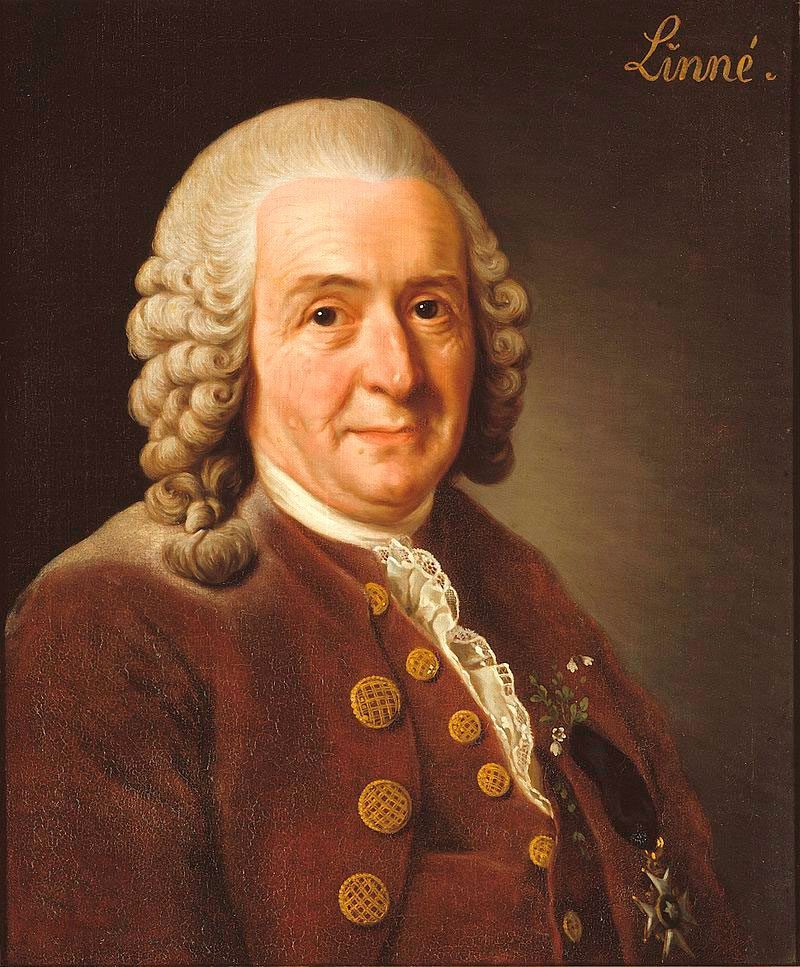
Carl Linnaeus
Carl Linnaeus

Order: Psittaciformes
Family: Psittacidae
Genus: ARA
Scientific name: Ara ararauna
Citation: (Linnaeus, 1758)
Protonimo: Psittacus Ararauna

Videos "Blue-and-yellow Macaw"

ยซBlue-yellow macawยป (Ara ararauna)


Species of the genus Ara


Sources:

Avibase
Parrots of the World โ€“ Forshaw Joseph M
Parrots A Guide to the Parrots of the World – Tony Juniper & Mike Parr
Birdlife
Book, Parrots, parrots and macaws.

Photos:

(1) – Blue-and-yellow Macaw at Cincinnati Zoo, USA By Ted (originally posted to Flickr as DSC_0389) [CC BY-SA 2.0], via Wikimedia Commons
(2) – A Blue-and-yellow Macaw (also known as the Blue-and-gold Macaw) at Gramado Zoo, Rio Grande do Sul, Brazil By diegodobelo (Zoo de GramadoUploaded by Snowmanradio) [CC BY-SA 2.0], via Wikimedia Commons
(3) – Guacamayo azul y amarillo by, Luc Viatour [GFDL, CC BY 2.0 or CC BY-SA 3.0], via Wikimedia Commons
(4) – Portrait of a Blue-and-yellow Macaw (Ara ararauna) in the Vogelburg (bird park) Hochtaunus, Weilrod, Germany – Wikipedia
(5) – Ara ararauna ou Arara-canindรฉ By No machine-readable author provided. Observatore assumed (based on copyright claims). [GFDL or CC-BY-SA-3.0], via Wikimedia Commons
(6) – Blue-and-yellow Macaw (Ara ararauna) in Santa Fรฉ do Sul, Sรฃo Paulo State, Brazil By Miguelrangeljr (Own work) [CC BY-SA 3.0], via Wikimedia Commons

Sounds: (Xeno-canto)
โ–ท The world of Pets: Dogs, cats, birds, reptiles, amphibians

Maroon-fronted Parrot
Rhynchopsitta terrisi


Cotorra Serrana Oriental

Content

Description:


Anatomy-parrots

Among 40 and 45 cm.. length and 300 g. of weight.

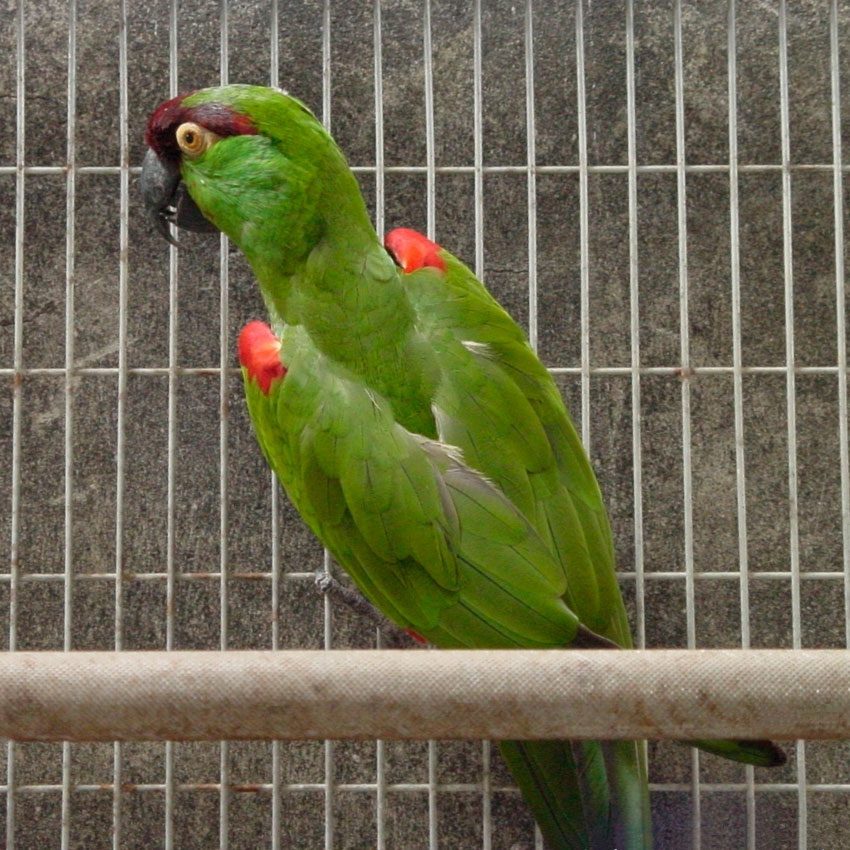
The Maroon-fronted Parrot (Rhynchopsitta terrisi) It has a size slightly larger than the Thick-billed Parrot. Its bill is large, hooked and curved black. Of tail short in comparison to other members of the family, by high green and below Brown gray. Upright perching, legs short but strong and the fingers toes zigodactilos, i.e. two toes forward and two backwards. Is bright green, slightly more clear and yellowish on the cheekbones and ears. It has a patch brown in the forecrown, red spots on the shoulders and in the the thighs.

The color of the irises in adults is yellow amber, While in juveniles is coffee. The eye ring is yellow. below the wings they have red border. The rest of the inside of the wings darker Green is. The legs they are greyish.

Both sexes of similar shape and color.
Immature with eyes browns and bill paler.

Often treated as the same species as the Thick-billed Parrot.

Habitat:

It lives in temperate with dry winter climates, to high altitudes ranging from the 1,900 to the 3,000 m, exceptionally a 1.300 meters and 3.700 m, in mountainous regions with pine forest (Pinus duranguensis, Pinus ayacahuite, and Pinus arizonica among others), forest of Pine-oak (Pinus spp.. and Quercus spp..), isolated forest fragments of pure FIR (Abies spp..), or mixed forests of oyamel, firs (Pseudotsuga spp..) and poplars (Populus tremuloides). Forests may be at the top of the mountains, open areas or be part of abrupt cliffs and crags land.

The Maroon-fronted Parrot is a Diurnal with activity social. To the nestsr meets in large flocks, at times of until 100 individuals and to build their nest, Unlike in the Thick-billed Parrot, don't use holes in trees but cavities and cracks in the rock of the cliffs. With pairs once a year with a single partner throughout the reproductive season. Form flocks to find their food. These groups tend to fly at low altitude moving long distances in search of trees with fruits and seeds that can be eaten. It is also possible to find lonely couples looking for food. They sleep in community, flocking on inaccessible crags. Individuals within the flock to communicate by means of strong vocals similar to harsh squawks and squeaks, While they are looking for food or to warn of threats. In general, the species of this family are known to be noisy, especially when they are in groups.

You know when these birds are approximated by the noises that make, the group flies in a flock that forms an โ€œopen Vโ€. The reproductive colony You can move up to 30 km to find food, If it is scarce. With enough food available near the nests, just move in 3 to 5 daily km.

Reproduction:

The breeding season It between July and November. To build the nest using cracks and voids in high limestone crags and they tend to use the same sites year after year to nest. The colony nests above the 1,300 and 1,700 m.

They put between 2 and 5 eggs (average is 2.7) between mid-June and late July. When is food scarce, drastically reduces the production of broilers. The female incubates eggs between 24 and 27 days which hatch between early September and late October. Since they are born until they fly chicks they remain in the nest for approximately two months, being fed and cared for by both parents. Of all the eggs laid and incubated in the colony only the 60% fledged young occur. The chicks are bred in sync with the maturation of pine seeds, It usually occurs in late summer and autumn.

Food:

They eat mainly seeds of coniferous cones, especially of pines (Pinus durangensis, Pinus leiophylla, Pinus ayacahuite, Pinus arizonica, Pinus gregii, Pinus teocote, Pinus montezumae, Pinus cembroides and Pinus engelmannii) and bur-marigold (Pseudotsuga menziesi).

Its beak is specially adapted to extract seeds from the cones (pine nuts) of Pine. When are pine seeds scarce, include in your diet oak acorns (Quercus spp..) and Guatemalan FIR seeds (Abies spp..). Their diet also includes capulin fruits (Prunus capuli) and flowers of Agave Nectar. In general the diet of both species, the Eastern Mountain Parrot and the Thick-billed Parrot es similar. The Maroon-fronted Parrot has the habit of eating dirt (geophagy) in clay banks.

Distribution:

The distribution of the Maroon-fronted Parrot is restricted in the northeast of Mexico. confined in Sierra Madre Oriental, in the southeast of Coahuila de Zaragoza, about Saltillo, in the Centre-West of Nuevo Leรณn, including mountains to the South-West of Monterrey, and the mountains of the West of Tamaulipas.

Full range of approximately 300 km from North to South, with an average of 60 kilometers from West to East and breeding pairs, possibly, only in the North third.

Similar to the Thick-billed Parrot, ago seasonal movements (Although probably less extensive) in response to the availability of pine seeds, apparently being distributed to the South of their range only between October and April (old reports of the Thick-billed Parrot in Veracruz they may belong to this species).

Rare, very local and extinct in many areas. Now limited to restricted areas in the few pine forests that remain (probably around 7.000 kmยฒ of forests within the 18.000 kmยฒ of its range, they are suitable).

The decrease in its population is mainly due to the loss of habitat by logging, the Agriculture, the burning and the grazing, Although their habits of nesting on cliffs, It avoids the need of old or dead trees. Selective logging can reduce the diversity of pine trees and therefore the availability of food.

Conservation:

In 1981 they were estimated between 2,000 and 3,000 individuals of this species.

State of conservation โ“˜


Endangered Endangered โ“˜ (UICN)โ“˜

โ€ข Red List category of the UICN current: In danger of extinction

โ€ข Population trend: Decreasing

In 1997 ranked in the The Taray sanctuary, in Coahuila de Zaragoza as the reproductive Center of the species for having been found there near 100 reproductive couples. A 16 km from there, in a place known as Condos the second largest colony was located with 60 couples.

Census continued and in 1999, the population was estimated at a minimum of 2,500 individuals.

One recent census based on the large flocks threw an account of approximately 3,500 individuals of Eastern Mountain Parrot.

The main threat facing the Maroon-fronted Parrot is the destruction and modification of their habitat, mainly due to actions such as agriculture, livestock, logging (to produce wood and paper) and forest fires.

Its current Habitat is very limited, as well as the area of โ€‹โ€‹its distribution as an endemic species that is.

The deforestation continues to diminish more and more forests mountain of the region, and unfortunately the recovery or regeneration of these forests is poor compared to pine forests in other parts of the country, which is probably due to the layer of soil of the region is thin and Rocky and scarce rain.

In 2006, a forest fire devastated about 2,000 It has pine forest in the Sierra, destroying trees that provided food to the Parrot and causing a decrease in the number of chickens raised in the era of nidation. Additionally, when the average size of the trees that make up a forest is reduced and also the area occupied by seed production decreases and the number of defective cones increases, Finally affecting to the Maroon-fronted Parrot that feeds on the seeds.

Exist protected natural areas on Sierra Madre Oriental that protect and preserve to the Maroon-fronted Parrot.

Since 1939 was decreed the Cumbres de Monterrey National Park, in Nuevo Leรณn to protect more than 150 thousand hectares of forest, including half of the areas where the species nests. Shortly before it had been decreed, in 1936, The El Potosi National Park, in San Luis Potosi.

In 1985 created the The El Cielo biosphere reserve, in Tamaulipas. And between the three Protected natural areas partially cover the rest of the known colonies and part of the winter range. Also they have formed private protected natural areas, as the The Taray sanctuary in Coahuila de Zaragoza, nail 350 has of forest, created in 1996 specifically to protect the Maroon-fronted Parrot that contains the nidation largest colony known. This area is managed by the Museum of the birds of Mexico in Saltillo, Coahuila de Zaragoza and has been funded by the National Commission for the knowledge and use of biodiversity (CONABIO) and donations from other national and foreign organizations such as the Zoological Society of San Diego and the Fish and Wildlife Service of United Statess.

Various research projects they have been conducted from 1995 for the knowledge and conservation of the Maroon-fronted Parrot.

Recently in 2008, the Universidad Autรณnoma de Nuevo Leรณn (UANL), carried out a project on the Cumbres de Monterrey National Park. For its part, the Instituto Tecnolรณgico de Monterrey (ITESM) and Pronatura After studies in the same area, they have begun to establish landscape-level conservation strategies.

In the Official standard of species at risk (NAME-059-ECOL-2001), The Maroon-fronted Parrot (Rhynchopsitta terrisi) appears as danger of extinction.

The Convention on international trade in endangered species of Fauna and Flora Silvestres (CITES) protects it inside of the Appendix I.

The International Union for the conservation of nature (IUCN for its acronym in English) in his Red list of threatened species, granted the threatened category to the Maroon-fronted Parrot from 1988. Category changed to vulnerable from 1994 up until the present day.

In the year 2000 the National Consultative Technical Subcommittee for the protection, Conservation and recovery of the Psitacidae, developed the Conservation project, Management and sustainable utilization of the Psitacidae in Mexico (PREP), in which we considered both mountain parrots as priorities for conservation.

The species of Thick-billed Parrot (R. pachyrhyncha) and Maroon-fronted Parrot (R. terrisi), they are considered from 2008 as priority species in the Species at risk conservation program (NATIONAL HERO) of the National Commission of Protected Natural Areas (CONANP). Due to their biological similarities and a common problem, both were included in a single PACE (Programmes of action for the conservation of species), after the Subcommittee on Psitacidae carried out the Workshop of species identification of priority Psitacidae to be included in a PACE, document that contains, among other aspects related to the biology of the species, the objectives, goals and strategies for the conservation of both Mountain parrots.

Conservation actions have also been made in the field of the environmental education.

at the end of 2008, in the framework of the Program for the conservation of species at risk (NATIONAL HERO), seven locations of the Cumbres de Monterrey National Park they conducted environmental education activities with the Maroon-fronted Parrot as a priority species.

Perhaps the most important conservation measure, the publication is the 14 in October of 2008, in the Official Journal of the Federation, the decree that reforms to the General wildlife law (Decree Art. 60 Bis 2) What prohibits the capture of parrots and macaws from Mexico. The law prohibits the extractive use subsistence or commercial, export, the import or re-export of these native species of the country. With this law is protected 22 bird species of the family Psittacidae in Mexico. The violation of the above provision, is in a federal crime that is punished with prison, through a penalty ranging from 1 to 9 years in prison and up to 12 years if the offence is committed within a protected natural area or is done for commercial purposes.

The priority regions for the species are located in the Sierra Madre Oriental: The Cumbres de Monterrey National Park, in Nuevo Leรณn, The El Potosi National Park, in San Luis Potosi, the The El Cielo biosphere reserve, in Tamaulipas and the The Taray sanctuary in Coahuila de Zaragoza.

Source: Site on the network of knowledge on birds of Mexico

"Maroon-fronted Parrot" in captivity:

The mountainous region of Wood, Chihuahua, It has been inhabited since makes 1500 years by the ethnic groups that built the "cliff houses", those who originally were hunters and gatherers. The archaeological remains of Paquimรฉ, to 350 km to the Northwest of the city of Chihuahua and half a kilometer from Large houses they indicate that the region had a dedicated trade to the production of feathers from macaws, shells, ceramic and copper among others, the being first settlers in capture and breed, both the Eastern Mountain Parrot as to the Thick-billed Parrot.

In the conquest increased interest in capturing individuals from the family of the parrots. Starting at the century XVI, they gained greater popularity among Mexicans, mainly as pets.

During the 20th century This intense trade, In addition to the illegal traffic, has resulted from 1970 and 1982, Mexico It was the largest exporter of live birds to the pet trade coming from the countries of the Neotropics, exporting on average 14,500 Mexican parrots, annually a United States.

During the period of 1981 to 1985 United States imported a minimum of 703 thousand parrots; and still in 1987 Mexico was the largest source of smuggling of wild birds. In addition only between 1982 and 1983, 104,530 individuals the family were captured in Mexico for the internal domestic market.

Sale as pets is illegal.

Alternative names:

Maroon-fronted Parrot, Maroon fronted Parrot (English).
Conure ร  front brun, Perriche ร  front brun, Perruche ร  front brun (French).
Maronenstirnsittich, Maronenstirn-Sittich (German).
Papagaio-de-fronte-castanha (Portuguese).
Cotorra Serrana Oriental, Cotorra-serrana Oriental (espaรฑol).

scientific classification:

Order: Psittaciformes
Family: Psittacidae
Genus: Rhynchopsitta
Scientific name: Rhynchopsitta terrisi
Citation: Moore, RT, 1947
Protonimo: Rhynchopsitta terrisi

Maroon-fronted Parrot images:

Video of the "Maroon-fronted Parrot"


Species of the genus Rhynchopsitta

Maroon-fronted Parrot (Rhynchopsitta terrisi)


Sources:

Avibase
– Parrots of the World โ€“ Forshaw Joseph M
– Parrots A Guide to the Parrots of the World – Tony Juniper & Mike Parr
– Birdlife
– CONABIO. 2011. Priority species sheets. Maroon-fronted Parrot (Rhynchopsitta terrisi). National Commission of Protected Natural Areas and National Commission for the Knowledge and Use of Biodiversity, Mexico D.F.

Photos:

(1) – An adult Maroon-fronted Parrot in a cage By TJ Lin (originally posted to Flickr as DSC01484) [CC BY-SA 2.0], via Wikimedia Commons
(2) – Maroon-fronted Parrot by ยฉ greglasley – inaturalist.org
(3) – Maroon-fronted Parrot by ยฉ greglasley – inaturalist.org
(4) – Maroon-fronted Parrot by Zรณcalo Saltillo
(5) – Maroon-fronted Parrot (Rhynchopsitta terrisi) – Loro Parque

Sounds: Jon King (Xeno-canto)

โ–ท The world of Pets: Dogs, cats, birds, reptiles, amphibians

Golden-capped Parakeet
Aratinga auricapillus

Aratinga Testadorada

Content

Description:


Anatomy-parrots

Of 30 cm.. of length and a weight of 130 g..
The Golden-capped Parakeet (Aratinga auricapillus) It is often treated as the same species as the Sun Parakeet (Aratinga solstitialis) and Jandaya Parakeet (Aratinga jandaya).

The lores, frontal band and ocular region of this kind are of color red glossy; the crown is bright golden yellow; ear-coverts, cheeks and both sides of the neck, green. The area of the nape and the the mantle are pale green: the back and the top of the rump with different hues of green and tips of red or orange; floor area of the rump and uppertail-coverts, green; the small and medium-sized upperwing-coverts, green; the large coverts and primaries, secondaries, vane outer and tips from them primaries, blue.

Underwing-coverts, orange-red; underside of flight feather grey. The chin and throat yellowish green with orange discoloration on the top of the chest and deep color red pale in the belly; vent, the thighs and undertail-coverts, green. Upper, the tail, of colour brownish with them tips blue, sometimes with the vane external foreign blue feathers; undertail, the tail, grey.

The bill, grey-black; grey, the bare skin of the bare periophthalmic; irises yellowish; legs grey.

Both sexes similar.

Immature It has little or nothing red in the rump, more off the yellow colour of the crown; the top of the chest is greener and less extensive red on the belly.

Subspecies description:

  • Aratinga auricapillus auricapillus

    (Kuhl, 1820) – The species nominal.


  • Aratinga auricapillus aurifrons

    (Spix, 1824) – The upperparts totally green (without red margins on the feathers of the back and Hip top). More green in the upper zone of the chest, lacking Orange dye of the nominal species.

Habitat:

Video – "Golden-capped Parakeet" (Aratinga auricapillus)

aratinga jendaya y auricapilla

They live in forests, as well as in the clearings and edges of the same, including coastal moist Atlantic evergreen forests and inland closed-type deciduous forests. They prefer primary formations.

Scarce or absent grassland with trees or secondary vegetation, including from the vicinity of the remaining original forests. Observed to 2.180 m (Parque nacional do Caparaรณ, to the South of Holy Spirit). gregarious, usually observed in flocks of 12-20 individuals, more rarely in groups of up to 40.

Reproduction:

There are few details on the reproductive ecology of this species., Although probably nest in the months of November-December.

Implementation size in captivity is of 3-5 eggs.

Food:

Diet Golden-capped Parakeet includes various seeds and fruits. Reported foods include the corn, okra and fruits red sweet unspecified.

considered a pest of crops in some areas before its abrupt population decline.

Distribution:

The Golden-capped Parakeet (Aratinga auricapillus) are distributed in the area South-East of Brazil; from the North of Bay, Eastern part of Goiรกs and Minas Gerais, Brazil, to the East and South, on the East coast of Brazil (Holy Spirit, Rio de Janeiro, Sรฃo Paulo, Paranรก and possibly, Santa Catarina).

The observations in Rio Grande do Sul, apparently they are wrong, although the species can still be found in the extreme east of Mato Grosso from the South.

A single record in 1918 in Paraguay, near the border with Paranรก, Presumably coming from some exhaust.

Usually rare and irregular distribution, residents, extinct in many places with their current range defined by the remaining forests.

He greater stronghold population of the species is located in Minas Gerais, Brazil, where the species was considered common in 1987 in several areas. They are very rare or they have become extinct in Santa Catarina, Paranรก, Sรฃo Paulo, Rio de Janeiro and Espirito Santo, and scarce in Goiรกs and Bay.

The decrease in the population is must to the continuous logging of forests and to their captures for the trade of birds.

There are several protected areas with populations of the Golden-capped Parakeet, such as the Monte Pascoal National Park (Bahia) and Parque Estadual do Rio Doce (Minas Gerais, Brazil).

Rare in captivity, mostly out of Brazil.

Subspecies distribution:

Conservation:

โ€ข Red List category of the UICN current: Near-threatened

โ€ข Population trend: Decreasing

The size of the population of the Golden-capped Parakeet It has not estimated formally and in the absence of sufficient data, it is estimated that you there are more than 10.000 specimens, more or less equivalent to 6.700 mature individuals; But, detailed research is required.

The population the species is suspected that it may be in decline due to the continuous loss of habitat and to his capture to the pet trade.

โ€ข There has been extensive and ongoing clearance and fragmentation of suitable habitat for this species., for use as coffee plantations, soybean and sugarcane in Sao Paulo, and livestock in Goiรกs and Minas Gerais, Brazil (Snyder et to the., 2000).

โ€ข The capture for trade, He has probably had a significant impact, since it was relatively common in the illegal Brazilian markets in the mid-1990s. 1980, importing hundreds of birds to Western Germany in the decade of 1980. But, the precise effect is obscured by large numbers of captive-bred birds, that presumably see reduced pressure on wild populations remaining (LF Silveira in litt., 1999).

โ€ข Despite its tendency to nest, times, near human settlements, It is apparently not the most favoured species for the pet trade (VT Lombardi in litt. 2011).

โ€ข There are no records of persecution in response to crop degradation..

Conservation Actions Underway:

Conservation Actions Proposed:

    โ€ข Survey to locate important new populations and define the limits of their current range..

    โ€ข Study to determine its population dynamics and dispersal capacity., as well as provide a detailed analysis of their habitat requirements in different sites.

    โ€ขEnsure the protection of key reserves.

    โ€ข Protect species under Brazilian law.

"Golden-capped Parakeet" in captivity:

Rare in captivity, mostly out of Brazil.

Their life expectancy is about 30 years.

Alternative names:

Golden-capped Parakeet, Flame-capped Conure, Flame-capped Parakeet, Gold-capped Conure, Golden capped Parakeet, Golden-capped Conure (English).
Conure ร  tรชte d’or, Conure ร  tรชte dorรฉe, Perriche ร  tรชte d’or, Perruche ร  tรชte d’or (French).
Goldkopfsittich, Goldkappensittich (German).
jandaia-de-testa-vermelha, cara-suja, jandaia, periquito-de-cabeรงa-vermelha (Portuguese).
Aratinga Testadorada, Maracanรก corona dorada, Periquito de Cabeza Dorada (espaรฑol).
Maracanรก corona dorada (Paraguay).

Kuhl, Heinrich
Heinrich Kuhl

scientific classification:


Order: Psittaciformes
Family: Psittacidae
Genus: Aratinga
Scientific name: Aratinga auricapillus
Citation: (Kuhl, 1820)
Protonimo: parrot auricapillus


Golden-capped Parakeet images:


Species of the genus Aratinga

Sources:

Avibase
– Parrots of the World โ€“ Forshaw Joseph M
– Parrots A Guide to the Parrots of the World – Tony Juniper & Mike Parr
– Birdlife

Photos:

(1) – A Golden-capped Parakeet at Jurong Bird Park, Singapore By Peter so (Golden-capped ParakeetUploaded by Snowmanradio) [CC BY-SA 2.0], via Wikimedia Commons
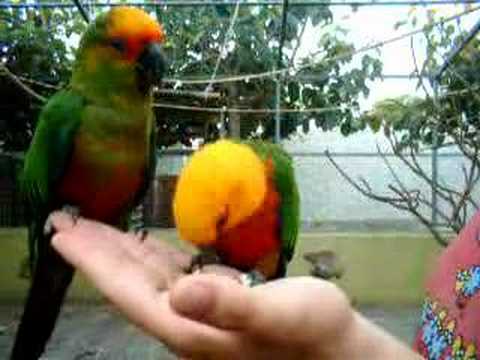
(2) – Picture of a Golden-capped Parakeet in the zoo of Wrocล‚aw (Poland) By Nicolas Guรฉrin (messages) (Own work) [GFDL or CC BY-SA 3.0], via Wikimedia Commons
(3) – A Golden-capped Parakeet (also known as Golden-capped Conure) in Seattle, Washington, USA By Matthew Wilson (Picasa Web Albums) [CC BY-SA 3.0], via Wikimedia Commons
(4) – Two Golden-capped Parakeets (also known as Golden-capped Conures) in Seattle, Washington By Matthew Wilson (Picasa Web Albums) [CC BY-SA 3.0], via Wikimedia Commons
(5) – A Golden-capped Parakeet (also known as Golden-capped Conure) in captivity By Patrick Hawks from Sint Maarten (Bird is the wordUploaded by snowmanradio) [CC BY 2.0], via Wikimedia Commons

Sounds: Douglas Meyer (Xeno-canto)