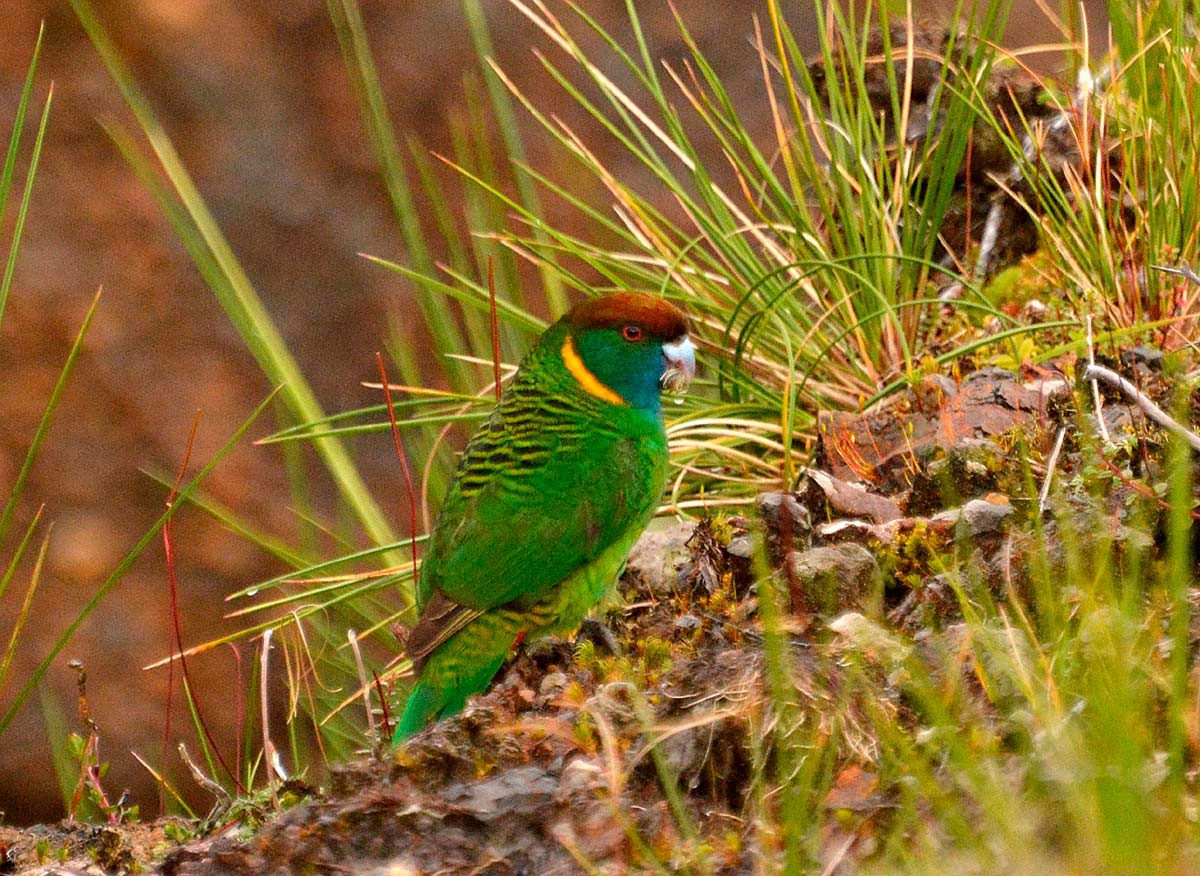
โ–ท The world of Pets: Dogs, cats, birds, reptiles, amphibians

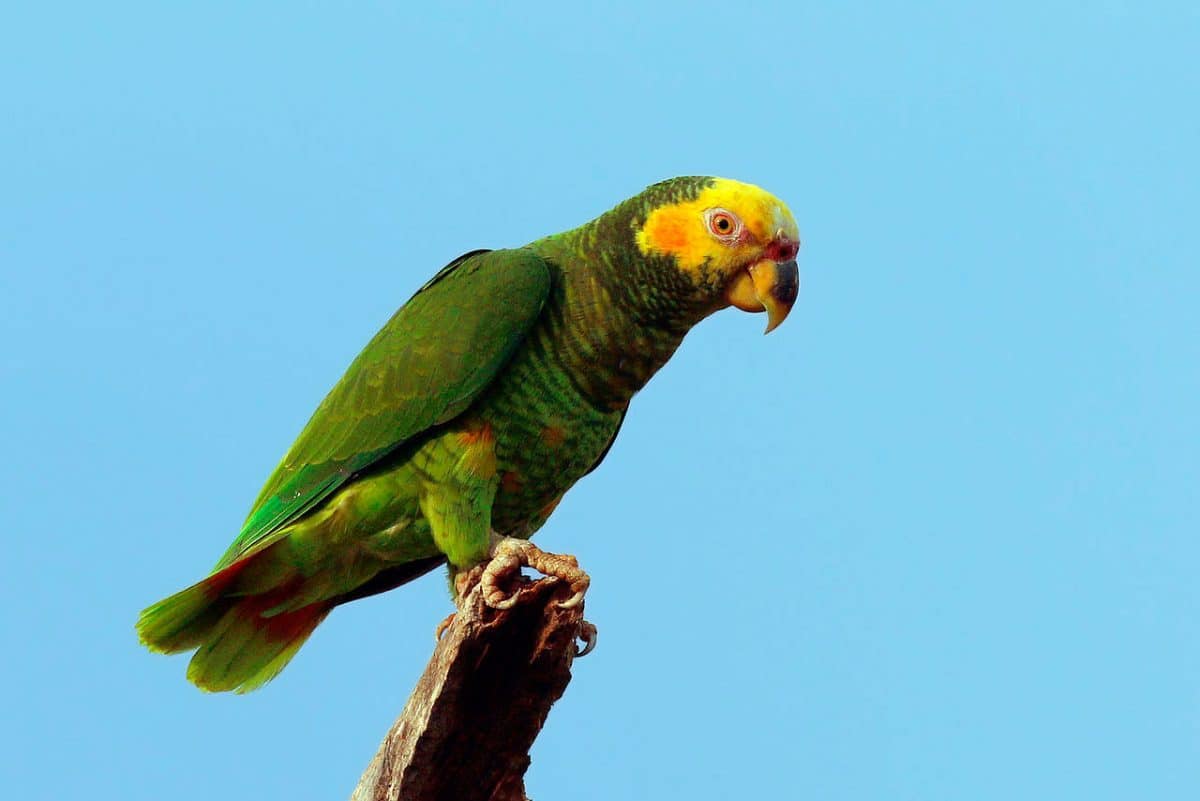
Yellow-faced Parrot
Alipiopsitta xanthops

Yellow-faced Parrot

Content

Description

Yellow-faced Parrot

26 to 27 cm.. tall and about 260g. weight.

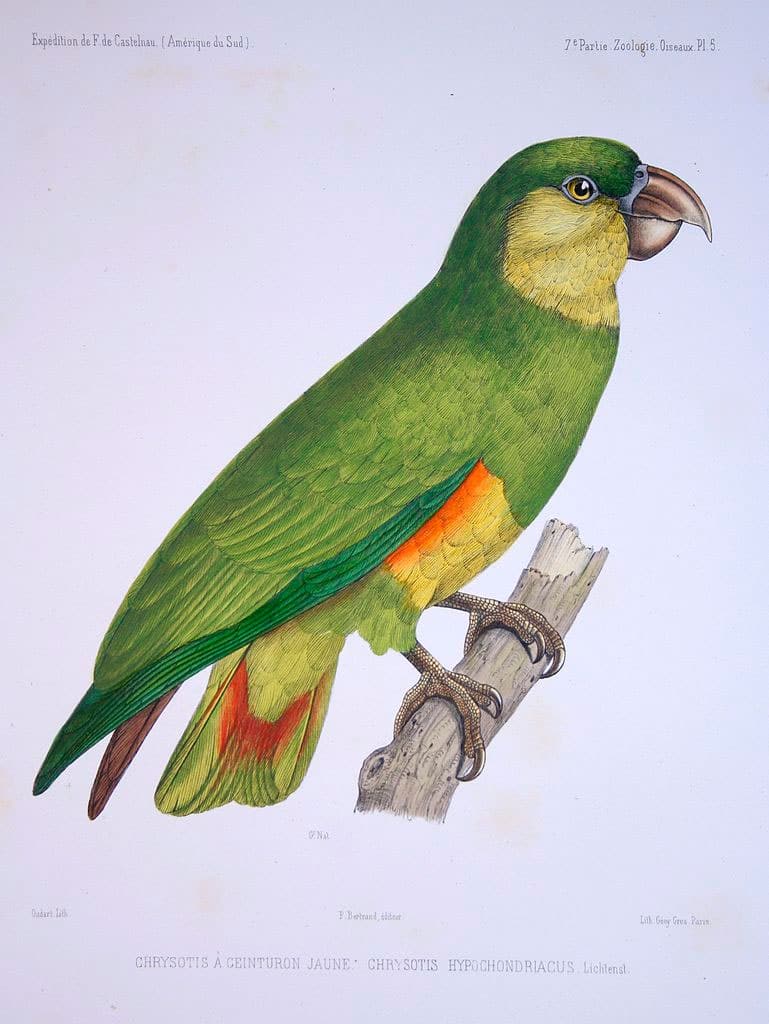
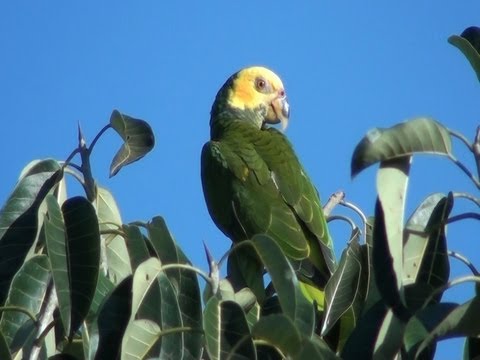
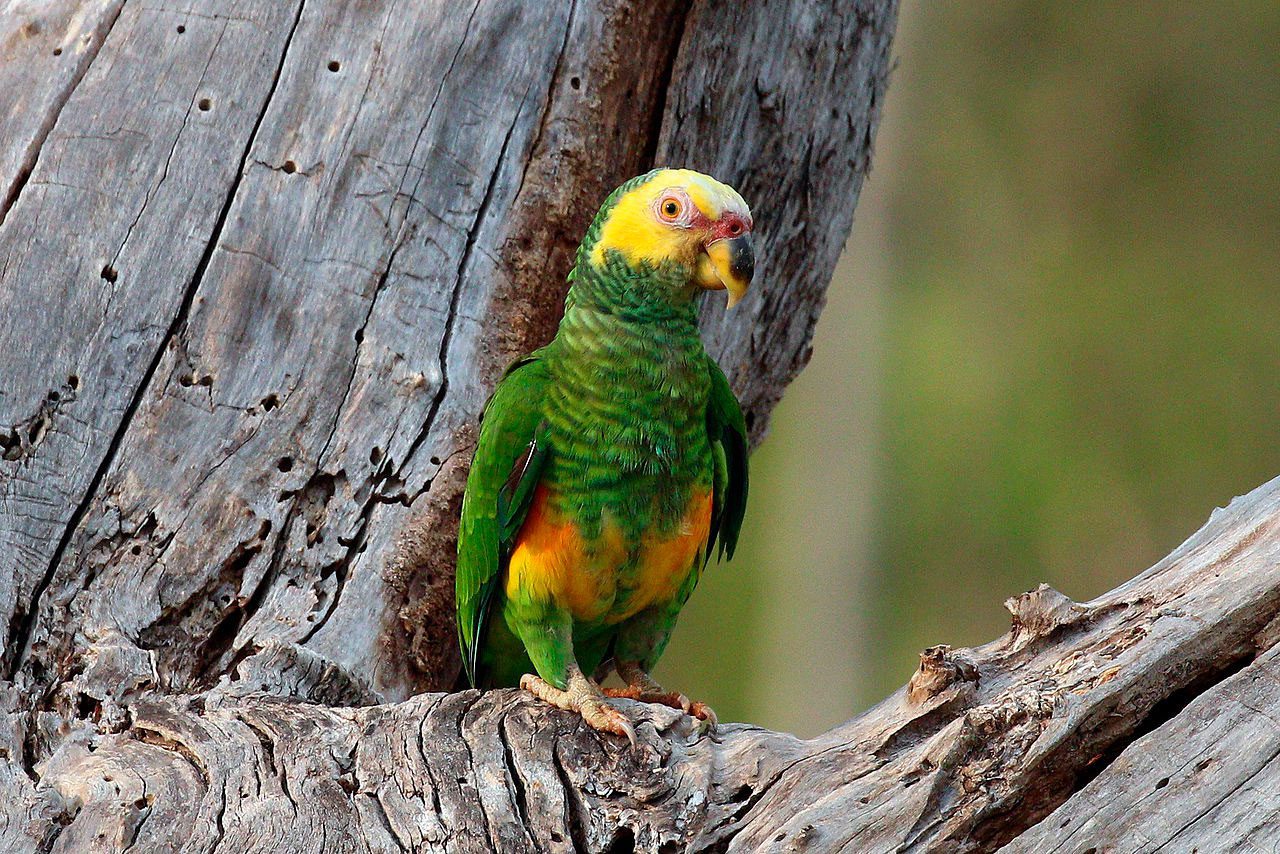
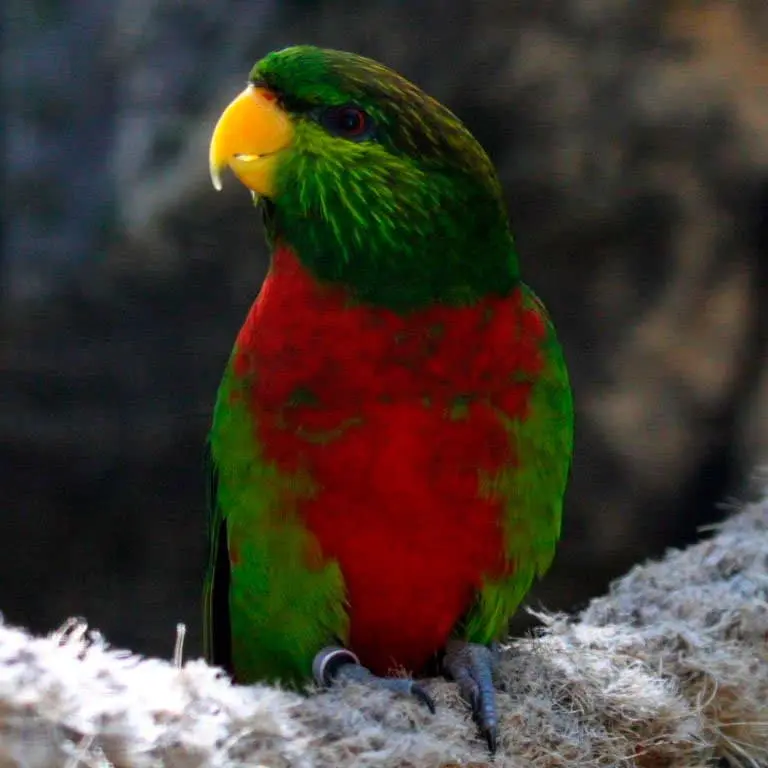
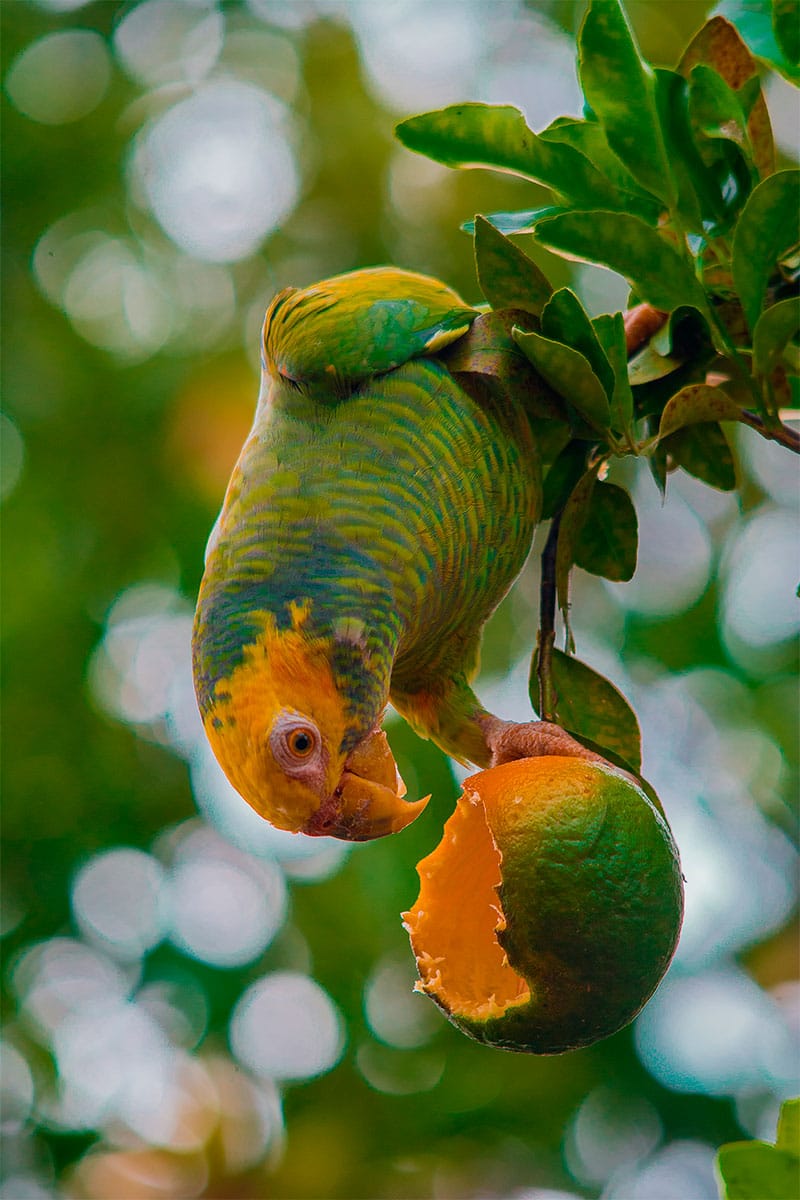
The Yellow-faced Parrot (Alipiopsitta xanthops) It is distinguished by the large area of รขโ‚ฌโ€นรขโ‚ฌโ€นyellow in the head, with green tint nape; orange to the sides of body and upper base of the tail; collar yellowish green, belly almost all yellow, the thighs and green inner core tail green; the back it is usually green with yellow tints.

blackish brown with yellow edges; iris yellow .

The youth less yellow in body.
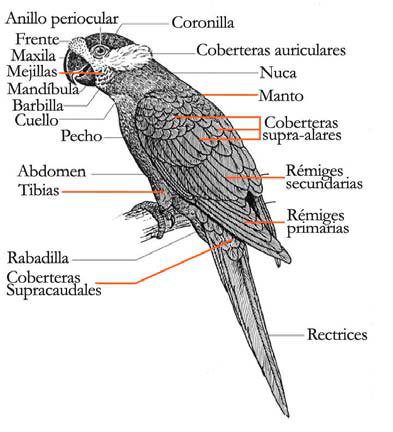

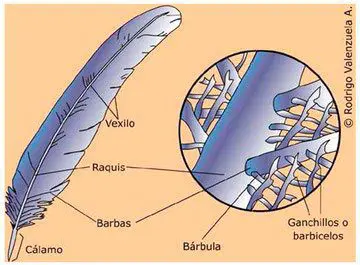
Anatomy-parrots

Habitat:

It inhabits in dry forests, also called deciduous forests, in lowlands, with the presence of palmas Mauritia, Although they prefer water courses.
They can be seen in pairs or flocks of up 50 specimens.

Reproduction:

Video – "Yellow-faced Parrot"

Canto-galego parrot (ALIPIOPSITTA XANTHOPS), YELLOW-FACED PARROT, Curraleiro, CURAU PARROT.

Although little information regarding this is available, it is known that nest in the hollows of the highest trees closed; the laying usually three eggs and the incubation period is 23-24 days.

Food:

It's a species of which there are few studies of their natural habitat. Its main food It consists mainly of fruits and seeds. Very fond of mangoes, usually visit their trees full of fruit.

Distribution:

Size of its range (reproduction / resident): 2.700.000 km2

Inside of Brazil and adjacent area to the east of Bolivia and Horqueta, in the East of Paraguay.

Conservation Alipiopsitta xanthops:

State of conservation โ“˜


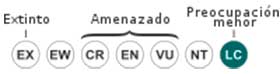
Near-threatened Near Threatened โ“˜ (UICN)โ“˜

โ€ข Current category of the Red List of the UICN: Near-threatened.

โ€ข Population trend: Decreasing.

In 1993 two thirds of the Cerrado, This species inhabited, had been moderately or severely altered by agriculture, heavy cattle farming, invasive grasses, the use of pesticides and annual burning.

Conservation Actions Proposed:

โ€ข Collate sample data and recent records to provide an improved assessment of distribution and status.

โ€ข Estimate the total wild population (Bianchi 2009).

โ€ข Assess the impact of habitat loss (Snyder et to the . 2000).

โ€ข Create a network of large reserves in Bahia, maranhรฃo and Piauรญ.

Yellow-faced Parrot in captivity:

Ave Rare in the world of poultry farming.

active, curious and playful. Aggressive with other parrots. They can become very noisy. Prone to obesity

Its reproduction rarely been achieved in captivity. The basic requirement would be to isolate a compatible pair during the breeding season due to increased aggression towards other birds during this period.; also require spacious accommodations and a nest box of 25 x 25 x 60 cm. . with input from 8 cm in diameter.

They tend to be aggressive toward their caregivers. The breeding season begins in early May. The implementation is of 2 to 4 eggs, which are incubated during 26 days. The young leave the nest when they are near the 8 weeks of age.

Alternative names:

Yellow faced Parrot, Yellow-crowned Amazon, Yellow-crowned Parrot, Yellow-faced Amazon (English).
Amazone ร  face jaune (French).
Goldbauchamazone, Schoapapagei (German).
Papagaio-galego, chorรฃo, curau, papagaio-acurau, papagaio-curraleiro, papagaio-de-barriga-amarela (Portuguese).
Amazona Chica, Amazona del Cerrado, Loro cara amarilla, Lora chica (espaรฑol).


Scientific classification Alipiopsitta xanthops:
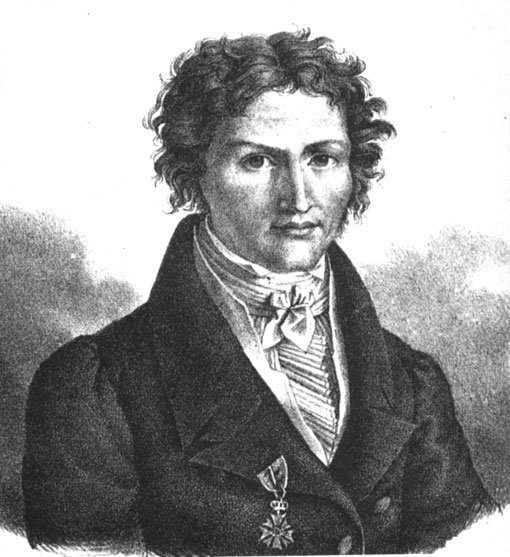
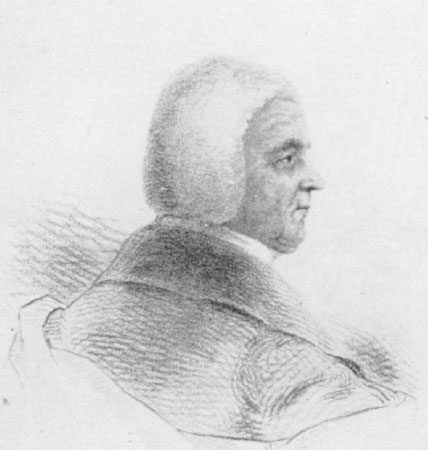
Johann Baptist von Spix

Order: Psittaciformes
Family: Psittacidae
Genus: Alipiopsitta
Scientific name: Alipiopsitta xanthops
Citation: (von Spix, 1824)
Protonimo: Psittacus xanthops


Images Yellow-faced Parrot:

Species of the genus Amazona


Sources:

  • Parrot Book, Parrots and macaws Neotropical
  • avibase
  • parrots.org
  • Parrots of the World โ€“ Forshaw Joseph M
  • Parrots A Guide to the Parrots of the World – Tony Juniper & Mike Parr
  • Birdlife

Photos:

(1) – Yellow-faced parrot (Alipiopsitta xanthops) green morph, the Pantanal, Brazil By Charlesjsharp (Own work, from Sharp Photography, sharpphotography) [CC BY-SA 4.0], via Wikimedia Commons
(2) – Yellow-faced parrot (Alipiopsitta xanthops) yellow morph, the Pantanal, Brazil By Charlesjsharp (Own work, from Sharp Photography, sharpphotography) [CC BY-SA 4.0], via Wikimedia Commons
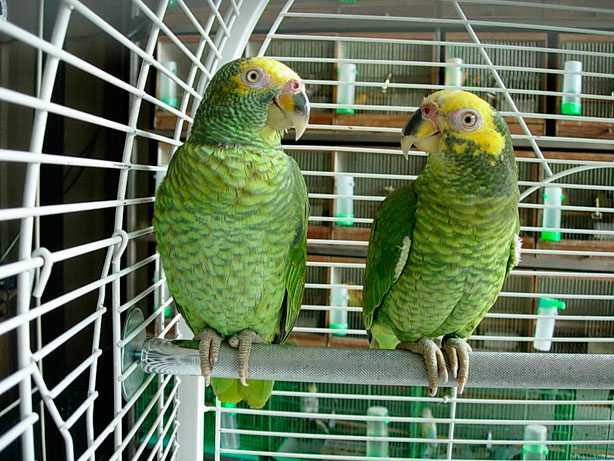
(3) – Alipiopsitta xanthops, Yellow-faced Parrot; two in a cage By TJ Lin (originally posted to Flickr as yellow-faced amazon) [CC BY-SA 2.0], via Wikimedia Commons
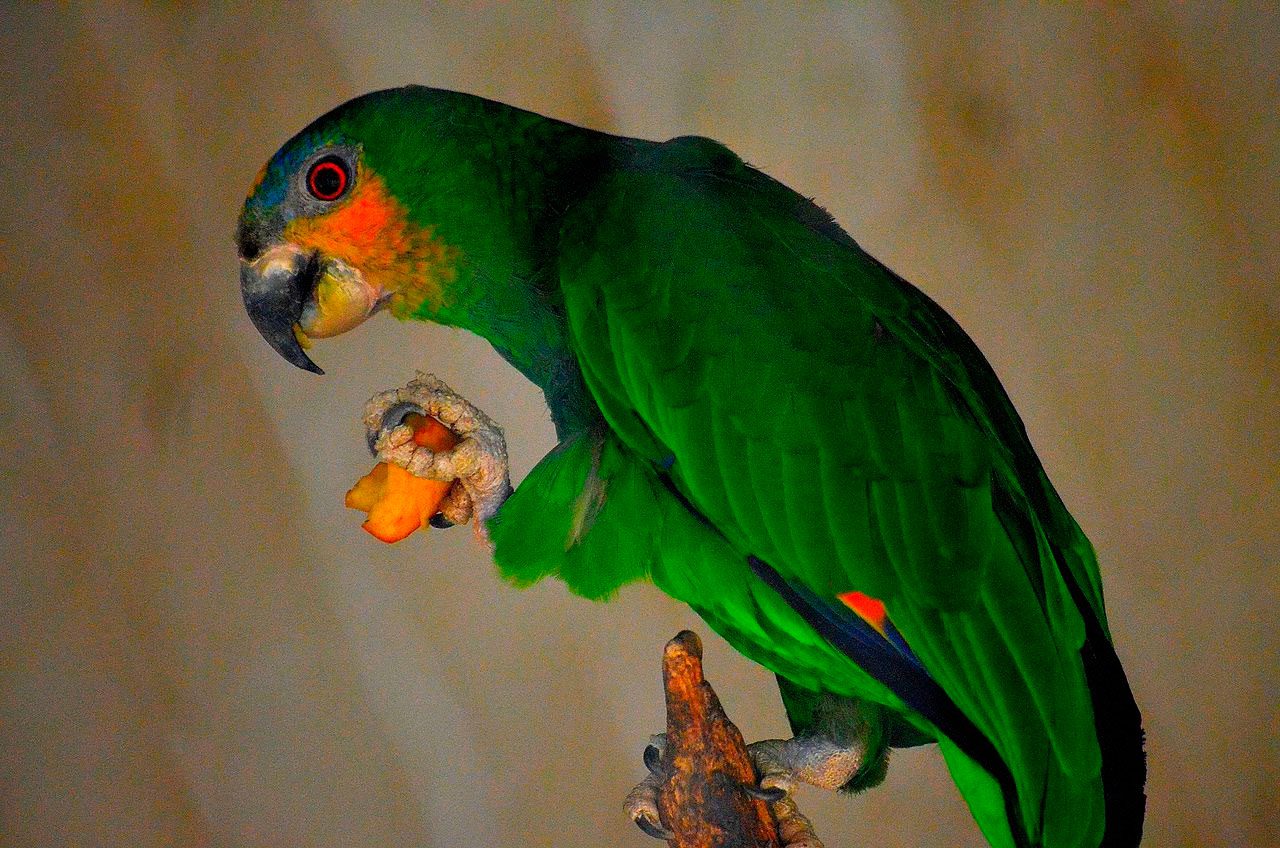
(4) – Yellow-faced Parrot in Giza Zoo By Hatem Moushir (Own work) [CC BY-SA 3.0], via Wikimedia Commons
(5) – Record made in the city of Trรชs Lagoas-MS, urban area. A flock landed on a ponca tree to feed By Jairmoreirafotografia (Own work) [CC BY-SA 4.0], via Wikimedia Commons
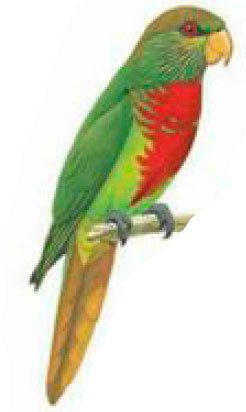
(6) – Illustration does not look like A. xanthops (Yellow-faced Parrot). Fisch's Papageien monograph discusses this dubious specimen by Francis de Laporte de Castelnau [Public domain], via Wikimedia Commons

Sounds: Joao Antonio de B.. Vitto
โ–ท The world of Pets: Dogs, cats, birds, reptiles, amphibians

Sulphur-crested cockatoo
Cacatua galerita

Cacatua galerita

Content

Description

55 cm.. height and a weight between 815 and 975 g..
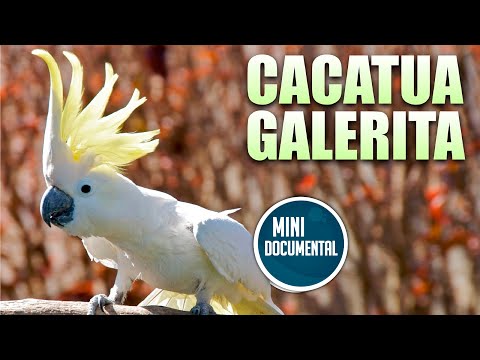
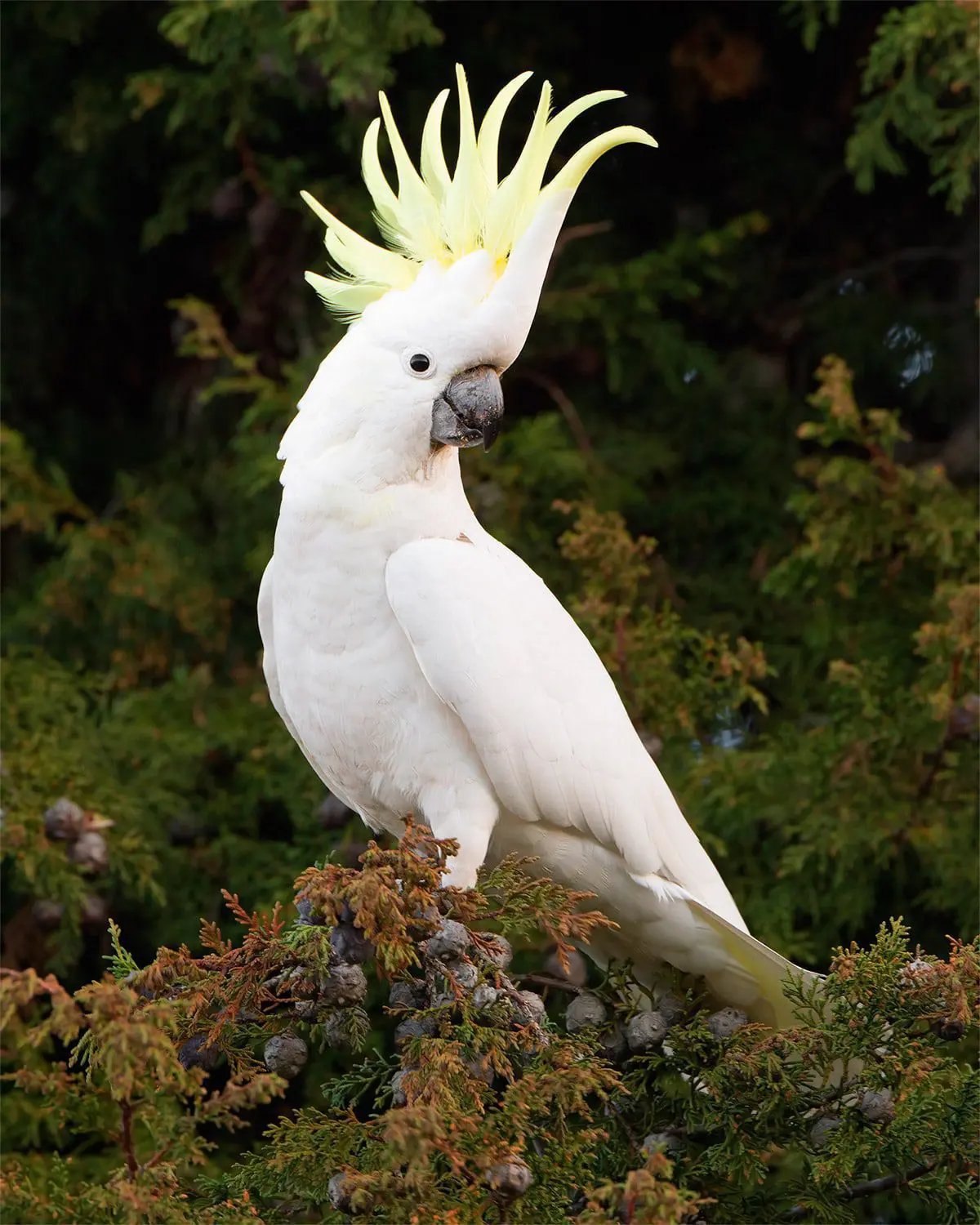
The Sulphur-crested cockatoo (Cacatua galerita) It is a bird with a predominantly white plumage.
In adults, the ear-coverts, bases feathers throat and cheeks, are pale yellow. the arista formed by the 6 Erectile feathers slightly inclined forward, are yellow. The crest You can reach up 14 centimeters in length. The bottom of the wings and of the tail van dyed pale yellow.
The ring surrounding the eye shows a white. The irises is dark brown in the male and reddish brown in the female. The bill is blackish grey, the legs grey.

The immature They are just different from adults. The irises They are pale brown.

Description 4 subspecies
  • Cacatua galerita eleonora

    (Finsch, 1863) – It's like Cacatua galerita triton but smaller and with bill smaller.


  • Cacatua galerita fitzroyi

    (Mathews, 1912) – Yellowed feathers, both ear-coverts, and the throat and cheeks, they are absent. The eye ring It is light blue. Bill but great.


  • Cacatua galerita galerita

    (Latham, 1790) – Nominal.


  • Cacatua galerita triton

    (Temminck, 1849) – Something smaller, the crest WIDER and eye ring pale blue.

Behavior:

They are very noisy and very easy to observe, Although they are more identifiable by their cries.
During the breeding season, they live in pairs or in small family groups, but the rest of the year, They are in flocks that may contain hundreds of birds.

In the urban areas and in places that they are equipped with feeders, adopt a family behavior.
In other places, It inspired his distrust and his usual prudence, the Sulphur-crested cockatoo they are very difficult to deal with.

In open areas these birds are implementing a sentinel system that is organized as follows: while most of the flock feeds, Some birds seen from a nearby perch and are likely to sound the alarm if danger.

Habitat:

Video – "Sulphur-crested cockatoo" (Cacatua galerita)

Cacatua galerita (mini documentary)

Is located in variety of forest areas, forests (including swamps and river areas), mangroves, Open field, on farm land (including rice fields and plantations of Palm), Savannah, Mallee and suburban areas. Found up to 1.500 meters in parts of Australia, 2.400 metres in Papua New Guinea.

Reproduction:

In Australia, the breeding season occurs from May to August in the North and between August and January, in the South.

In New Guinea, It takes place during every month of the year, although the most active months are during the period from May to December.

This species occasionally breeds in colonies. The nest is a natural cavity in a eucalyptus large near a stream between 3 and 30 meters above the ground. Sometimes the residence of the Sulphur-crested cockatoo It is located in the holes of the limestone cliffs along the murray river. In this case, the eggs are deposited directly in the sand.

In New Zealand, These birds lay amid bales of hay in barns. The nest generally it contains 3 white eggs. These are deposited on a layer of debris decomposing at the bottom of the cavity.
incubate both parents alternately for a period of 30 days. Hatchlings have a yellowish color and leave the nest after 6 to 9 weeks. Quite regularly, they return to the nest to rest for about two weeks.

The juveniles They remain within the family group for several months. They feed together in small scattered groups.

Food:

forages in grasses and herbs. You can take corn and wheat sprouts. It also feeds harmful herbs like cotton thistle. other foods include: estate, Rhizomes, nuts, berries, flowers, bulbs, flower and insect larvae.

They can cause great damage to crops. They dig in lands that were recently planted to eating fruit ripening, It also causes damage to crops that are stored and bales of hay to tear the plastic covering them.

Distribution:

Size of the area of distribution (reproduction / resident): 10600000 km2

This species is endemic to the north and east of Australia, New Guinea and nearby islands, especially islas Aru, Indonesian.
It was imported successfully to Palau Islands in Micronesia, New Zealand and some Maluku islands.

The population in Taiwan It has been estimated at about 100 introduced breeding pairs

Lives mainly below 1.000 m, but sometimes you can see in Australia to 1500 m. and 2000 m in east New Guinea.

Distribution 4 subspecies

Conservation:

State of conservation โ“˜


minor concern Minor Concern โ“˜ (UICN)โ“˜

โ€ข Current category of the Red List of the UICN: Least concern.

โ€ข Population trend: In decline.

It is thought that his population It is greater than 500.000 individuals.

It is not an endangered species. But, despite protection Indonesian this species is followed by trapping wild bird trade. Nor is a protected species in Australia, therefore sacrifices occur.

In New Guinea, sometimes it is hunted for its feathers.

It is suspected that his population is in decline due to ongoing habitat destruction.

"Sulphur-crested cockatoo" in captivity:

and valued species often as a pet.
Very Intelligent, sociable and playful. It is a cockatiel for experienced bird owners. You can be dominant and aggressive. It can be very noisy.

There are anecdotal reports of some Sulphur-crested cockatoo who they have lived more than 100 years. In the news, However, longevity record, according to sources, belongs to a captive specimen called "Cocky" who lived more than 57 years in the London Zoo. Another report suggests that these animals can live up 73.0 years in captivity, but this has not been verified.

Alternative names:

Sulphur-crested Cockatoo, Greater Sulphur-crested Cockatoo, White Cockatoo, Yellow-crested cackatoo (ingles).
Cacatoรจs ร  huppe jaune, Grand Cacatoรจs ร  huppe jaune (French).
Gelbhaubenkakadu (German).
Cacatua-de-crista-amarela (Portuguese).
Cacatรบa de Moรฑo Amarillo, Cacatรบa Galerita (espaรฑol).

John Latham
John Latham

scientific classification:


Order: Psittaciformes
Family: Cacatuidae
Genus: Cockatoo
Scientific name: Cacatua galerita
Citation: (Latham, 1790)
Protonimo: parrot galeritns


Images Galerita Cockatoo:


Species of the genus Cacatua
  • Cacatua tenuirostris
  • Cacatua pastinator
  • —- Cacatua pastinator derbyi
  • —- Cacatua pastinator pastinator
  • Cacatua sanguinea
  • —- Cacatua sanguinea gymnopis
  • —- Cacatua sanguinea normantoni
  • —- Cacatua sanguinea sanguinea
  • —- Cacatua sanguinea transfreta
  • —- Cacatua sanguinea westralensis
  • Cacatua goffiniana
  • Cacatua ducorpsii
  • Cacatua haematuropygia
  • Cacatua galerita
  • —- Cacatua galerita eleonora
  • —- Cacatua galerita fitzroyi
  • —- Cacatua galerita galerita
  • —- Cacatua galerita triton
  • Cacatua ophthalmica
  • Cacatua sulphurea
  • —- Cacatua sulphurea abbotti
  • —- Cacatua sulphurea citrinocristata
  • —- Cacatua sulphurea parvula
  • —- Cacatua sulphurea sulphurea
  • Cacatua moluccensis
  • Cacatua alba

  • Sources:

    Avibase
    – Parrots of the World โ€“ Forshaw Joseph M
    – Parrots A Guide to the Parrots of the World – Tony Juniper & Mike Parr
    – Birdlife

    Photos:

    (1) – commons.wikimedia.org
    (2) – birdsandbirds.com
    (3) – tilcheff

    Sounds: Hans Matheve (Xeno-canto)

    โ–ท The world of Pets: Dogs, cats, birds, reptiles, amphibians

    Black-winged Lory
    Eos cyanogenia

    Lori Alinegro

    Content

    Description

    30 cm.. height and an approximate weight of 120 gr.

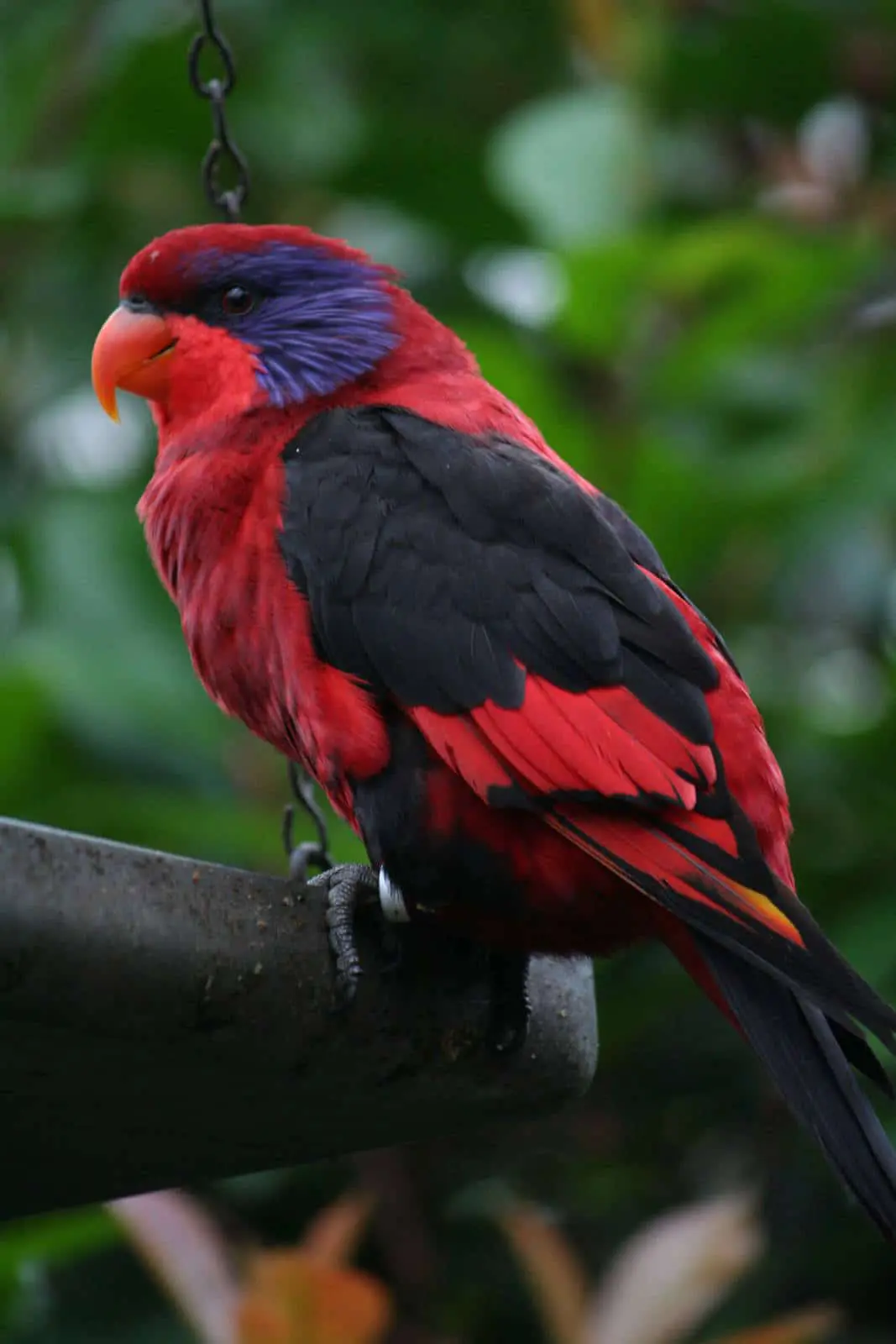
    The Black-winged Lory (Eos cyanogenia) has a plumage predominantly red.

    Adults have a blue patch surrounding the eyes, cover the tops of the ear and reaches the back of the neck.

    Feathers covering the shoulder blade (scapular), small feathers that cover the outside (coverts) and bend of wing are black. The primary and high school they have a black bordered.

    The the thighs and flanks they are sprinkled with black. The bottom of the wings shows a wide band Red. The feathers of the tail are black contrasted with red feathers.

    The bill is red-orange. The irises they are red, legs grey.

    The youth they are more muted than adults. They have blue-black ends in feathers of the head, neck and underparts. The the wing covers are black, with a green light opaque. The bill is of color brown orange, irises brown.

    The Black-winged Lory It can be confused with almost all parrots of the genus Eos, but it is the only one of this category that has the covered wing in black color.

    Habitat:

    The Black-winged Lory they are quite common and widespread in coastal areas, coconut plantations, the forested areas in the process of regeneration, in some large trees scattered in bushes Moors and local gardens.

    In some small islands such as Supiori, they are also present in large numbers in inland forests.

    Residing in altitudes ranging from sea level to the 460 m.

    They live in pairs or in small family groups. They are also often found in flocks of forty individuals or more.

    Son noisy birds and easily observable. At the local level are very popular. In the reflection of both, the natives capture them frequently as pet birds.

    The Black-winged Lory they have a fly quick and direct. Often you can hear the hum of their wings when they fly over the villages. They are even more recognizable when they often fly low, well below the tops of the trees.

    Reproduction:

    Little is known of their reproductive ecology., but it was observed the presence of a possible nesting site in a hole in a tall tree in the forest by a couple during the observations in 1982.

    The incubation in harsh captivity around 26 days, and as in all loris, the nesting cycle is particularly long and hard between 75 and 89 days.

    Food:

    They have a regime that differs little from other parrots of the genus Eos. Feed in the trees in flower of nectar of Brugierto and pollen. Your menu will probably be complemented by fruit, berries of the mistletoe and sometimes insects.

    Distribution:

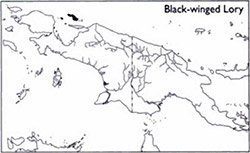
    Distribution Lori Alinegro


    Being endemic to the islands of the Cenderawasih Bay in the part Indonesia of New Guinea.

    They live on most islands (Numfor, Biak, Manim, Pulau Num) but are absent from Yapen, the main island, where are replaced by the Dusky lory (Pseudeos fuscata).


    Conservation:


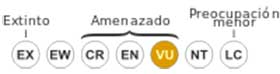
    Vulnerable

    – Current IUCN Red List category: Vulnerable

    – The population trend: Decreasing

    The population is estimated at 2,500 to 9,999 mature individuals.

    Logging and subsistence agriculture have driven the loss of forests within their range and the hunting pressure remains a threat. Consequently, the species is suspected to be declining at a moderate pace.

    Relatively large numbers of birds have been trapped for the national and international trade.

    Since December of 1989, the import of the Black-winged Lory It is strictly prohibited in the European Community.

    Conservation Actions Proposed:

    – Conduct surveys on all the Geelvink Islands to clarify its distribution and current population status.
    – Investigation of their ecology and movements to facilitate conservation planning.
    – Investigate the species trade and design and implement appropriate controls.
    – Estimating the rate of loss of forests within its range.
    – Check the register in Supiori and establish a captive breeding program to support future reintroduction and supplementation efforts.

    "Black-winged Lory" in captivity:

    This species is observed commonly as a pet in Biak (island located in the bahรญa Paradise, off the north coast of Papua).

    Due to its status in danger of extinction, any specimen that can not be returned to their natural habitat (natural range) should preferably be placed in a well-managed breeding program to ensure the survival of the species.

    Alternative names:

    Black winged Lory, Biak Red Lory, Black-winged Lory (ingles).
    Lori ร  joues bleues (French).
    Schwarzschulterlori (German).
    Lรณris-asa-negra (Portuguese).
    Lori Alinegro, Lori de Alas Negras (espaรฑol).

    scientific classification:

    Order: Psittaciformes
    Family: Psittaculidae
    Scientific name: Eos cyanogenia
    Citation: Bonaparte, 1850
    Protonimo: Eos cyanogenia

    ยซLori Alinegroยป images:

    Videos "Black-winged Lory"

    ————————————————————————————————-

    ยซLori Alinegroยป (Eos cyanogenia)


    Sources:
    Avibase, Oiseaux.NET, BirdLife.org
    – Photos: galleryhip.com, Sheri Hanna
    – Sounds: Hans Matheve (Xeno-canto)

    โ–ท The world of Pets: Dogs, cats, birds, reptiles, amphibians

    Iris Lorikeet
    Psitteuteles iris


    Iris Lorikeet

    Content

    Description

    20 cm.. length and a weight between 65 and 75 gr.

    The Iris Lorikeet (Psitteuteles iris) It has three subspecies recognized including the nominal, the extent and gradation of red and purple coloration in the head varies among the three subspecies:

    • Psitteuteles iris iris

      The Iris Lorikeet (Psitteuteles iris) has a plumage, in general, Green with stripes of color green light in the underparts.

      The forecrown, lores and zone extending in a narrow line around the Crown rear, red.
      Cheeks yellowish green. The eye-stripe and headphones feathers purple.
      Center of the crown, Turquoise, extending it until it nape in a large yellow-green necklace.
      The chest and abdomen are yellowish-green. The feathers of the neck and the chest they have dark green edges. Wings and tail green.
      Bill and irises orange. The legs greyish black.

      It presents sexual dimorphism. The Red coloration of the female on head It is more off and less extensive that in the male.


    • Psitteuteles iris rubripileum

      It has all the forecrown and crown Red and the headphones feathers Violet Blue.


    • Psitteuteles iris wetterensis

      Larger, the crown It is red and mixed with Violet Blue variable extension. The cheeks they are dark green. The chest bright yellow contrast with the Panza green.

    Note:

    It has placed at times as subspecies to the Neopsittacus. The validity of the subspecies Psitteuteles iris rubripileum, is questionable, and it was claimed that the differences with the nominal species It may be due to age or individual variation.

    Habitat:

    Found up to a height of 1.500 meters above the sea level.

    The Iris Lorikeet They inhabit monsoon forests, plantations and agricultural land with flowering trees.
    Although they are apparently more common in the higher elevations, its local abundance is based on the availability of trees with flowers for food, as is the case with most Lori.
    The flight of the Iris Lorikeet fast and slightly wavy.

    Reproduction:

    Little is known about the breeding ecology of this species in its natural environment.. A record of a captive calf states that the laying is of two eggs, with a period of incubation of 23 days and emancipation some nine weeks more afternoon.

    Food:

    Feeds of nectar of the flowers Sesbania sp.

    Distribution:

    Size of the area of distribution (reproduction / resident): 31.300 km2

    Endemic to the Islands Wetar and Timor (Indonesian).

    Subspecies distribution:

    • Psitteuteles iris Iris

      : West of Timor.


    • Psitteuteles iris Rubripileum

      : It is from Timor.


    • Psitteuteles iris Wetterrensis

      : Wetar island.

    Conservation:


    Near-threatened


    โ€ข Current IUCN Red List category: Near threatened

    โ€ข Population trend: Decreasing

    There are no data on population trend; But, the species is suspected to be in decline due to the capture and the degradation of the habitat.

    Previously considered common, but not found in the Island of Wetar during a search in 1990, found only in two places during a study of nine weeks in the jungle in Timor West in 1993. Considered main many that the Olive headed Lorikeet and the Coconut Lorikeet in East Timor. World population around 10.000 specimens. VULNERABLE.

    "Iris Lorikeet" in captivity:

    Quite rare.

    Alternative names:

    Iris Lory, Iris Lorikeet (ingles).
    Loriquet iris, Loriquet d’Iris (French).
    Irislori (German).
    Lรณris-รญris (Portuguese).
    Lori de Goldie, Lori Iris, Tricogloso Iris (espaรฑol).

    scientific classification:

    Order: Psittaciformes
    Family: Psittaculidae
    Scientific name: Psitteuteles iris
    Citation: (Temminck, 1835)
    Protonimo: Psittacus iris

    Images ยซLori Irisยป:

    ————————————————————————————————

    ยซIris Truckยป (Psitteuteles iris)


    Sources:

    Avibase
    – Parrots of the World โ€“ Forshaw Joseph M
    – Parrots A Guide to the Parrots of the World – Tony Juniper & Mike Parr
    – BirdLife.org

    Photos:

    1 – By Dirk (originally posted to Flickr as DSC_7897) [CC-BY-2.0], via Wikimedia Commons
    2 – By Dirk (originally posted to Flickr as DSC_2608) [CC-BY-2.0], via Wikimedia Commons
    3 – By Asim Bharwani (originally posted to Flickr as San Diego Zoo) [CC-BY-2.0], via Wikimedia Commons
    4 – By tinyfroglet [CC-BY-2.0], via Wikimedia Commons
    5 – By Liam from Washington DC, USA (IMG_9040Uploaded by snowmanradio) [CC-BY-2.0], via Wikimedia Commons

    Sounds: Filip Noel (Xeno-canto)

    โ–ท The world of Pets: Dogs, cats, birds, reptiles, amphibians

    Yellow-bibbed Lory
    Lorius chlorocercus

    Yellow-bibbed Lory

    Content

    Description

    28 cm.. length and an approximate weight of 200 g..

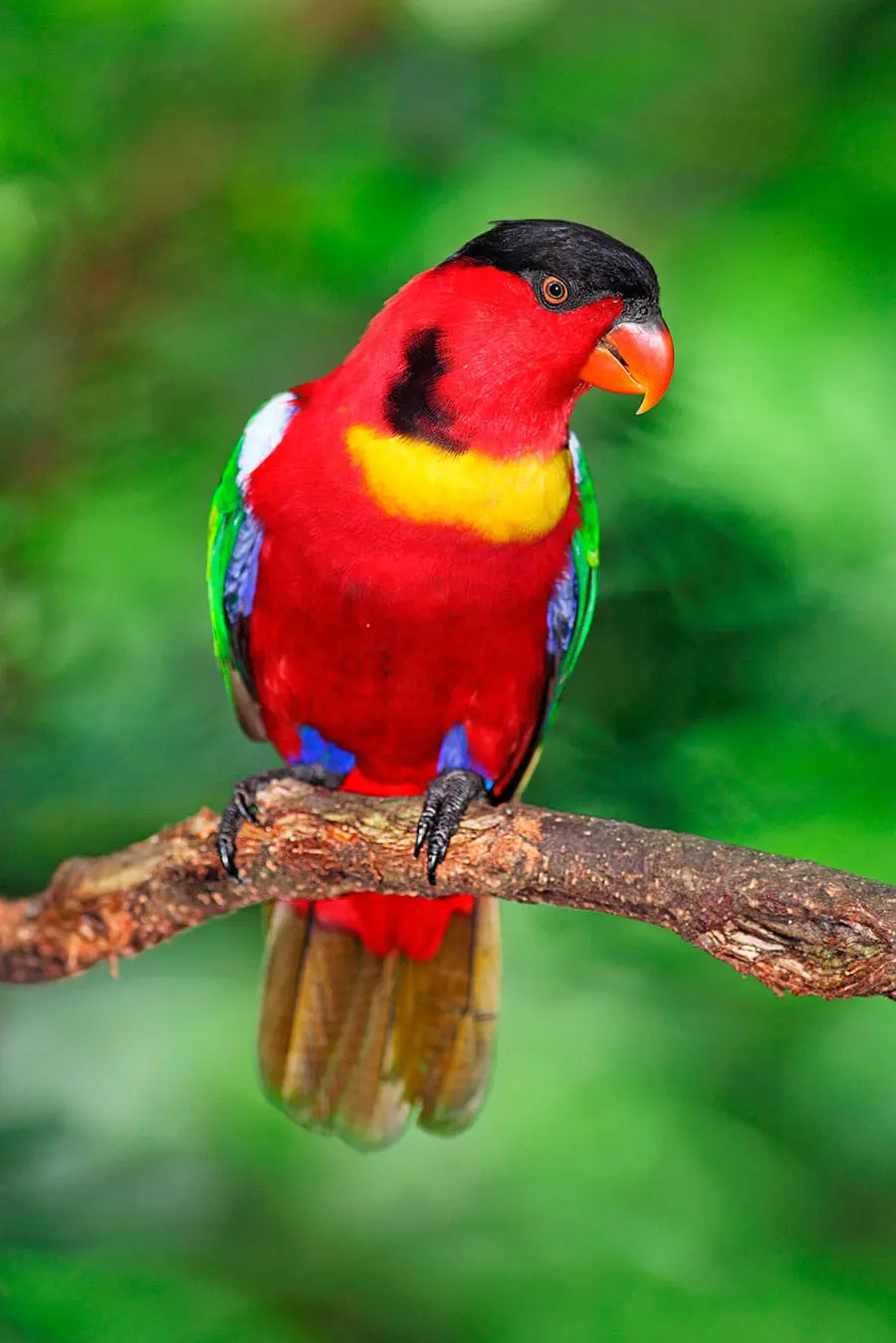
    The Yellow-bibbed Lory (Lorius chlorocercus) is the only member of the genus Lorius It found in the Solomon Islands Orientales. In flight it has a robust construction, with a distinctive tail short.

    It has a hood black running from the top of the bill up to the nape; the rest of the head is bright red with a prominent patch black, Crescent-shaped, on one side of neck. The upperparts They are red; center of the mantle, dark red. The wings green with yellow light bronze glow, in particular coverts and tertiary.

    internals flight feather and greater coverts, black; bend of wing with a white spot and sometimes showing blue below wing-coverts; the coverts are blue, black tip, with a reddish pink broadband in the Central, on the undersides of the primaries. axillary purple blue.

    The underparts They are red with a prominent yellow necklace; the thighs blue. Top, of the tail, red with green tips; lower tail, red with yellow opaque tip.

    The bill It is orange with dark base to lower jaw; Orange the irises; legs dark gray.

    The immature They have yellow band chest and marks on the sides and virtually absent bill is brown.

    The cap black, wings green and underparts red with a band in the chest yellow, you are distinguished from other sympatric species of similar size as the Cardinal Lory and the Coconut Lorikeet.

    Habitat:

    Found in the canopy of the forest and secondary growth at all altitudes up to 1.000 m. In Guadalcanal it is more common in foothills than in lowlands and more common in low cloud forest. Other islands also occasionally observed around coconut plantations. Usually moves individually, in pairs or in groups of up to ten birds. Ecology generally little known although presumably typical of the genus.

    Reproduction:

    Little is known of its reproduction in the wild.

    In captive, the setting is two eggs and incubation lasts and 25 days. The young remain in the nest during 8 to 10 weeks.

    Food:

    Its diet pollen compose, nectar, flowers and seeds.

    Distribution:

    Size of its range (reproduction / resident): 78.200 km2

    endemic to the Solomon Islands Eastern on Savo, Guadalcanal, Malaita, Suavanao, Uki, San Cristรณbal and Rennell. Quite common. World population 10.000 – 50, 000 specimens.

    Conservation:


    minor concern

    โ€ข Current IUCN Red List category: Least concern.

    โ€ข Population trend: Stable.

    Least concern – in the news quite common in the natural and abundant across most of its range.

    Many species of birds in the Solomon Islands are vulnerable simply because of their small natural ranges, and the felling of forests for agriculture is a constant threat.

    "Yellow-bibbed Lory" in captivity:

    Before the Decade of 1990, the Yellow-bibbed Lory (Lorius chlorocercus) it was almost unknown in the United States and poultry farming, even then, a handful of birds were imported from the Solomon Islands. In 1998, a captive breeding consortium, call Solomon Island Parrot Consortium (SIPC), It was formed and received permission from the Government of the Solomon Islands and permissions of USFWS to import 30 pairs of each of the six species of parrots that are found in the Solomon Islands.

    These 60 Yellow-bibbed Lory they were the first species imported under this permit. From these original 60 birds, now there are enough birds that are starting to appear as pets from time to time. They were first bred in United States in 1989, in the aviaries of Seattle by Jan van Oosteen, who is considered the force behind the obtaining of this group of 30 couples.

    More information on –> birdchannel

    Alternative names:

    Yellow-bibbed Lory, Yellow bibbed Lory (ingles).
    Lori ร  collier jaune (French).
    Grรผnschwanzlori (German).
    Lรณris-de-colar-amarelo (Portuguese).
    Lori Acollarado, Tricogloso de Collar (espaรฑol).

    John Gould
    John Gould

    scientific classification:


    Order: Psittaciformes
    Family: Psittaculidae
    Scientific name: Lorius chlorocercus
    Genus: Lorius
    Citation: Gould, 1856
    Protonimo: Lorius chlorocercus


    Images ยซCollared Loriยป:

    Videos "Yellow-bibbed Lory"

    ————————————————————————————————

    ยซLori Acollaradoยป (Lorius chlorocercus)


    Sources:

    Avibase
    – Parrots of the World โ€“ Forshaw Joseph M
    – Parrots A Guide to the Parrots of the World – Tony Juniper & Mike Parr
    – Birdlife

    Photos:

    1 – By Benjamint444 (Own work) [GFDL 1.2], via Wikimedia Commons
    2 – Birds-pet-wallpapers – link
    3 – By Benjamint444 (Own work) [GFDL 1.2], via Wikimedia Commons
    4 – Young Yellow-bibbed lory feeding from spoon – kcbbs.gen.nz
    5 – Singapore Jurong Bird Park – jaxstumpes

    Sounds: Niels Krabbe (Xeno-canto)

    โ–ท The world of Pets: Dogs, cats, birds, reptiles, amphibians

    Yellow-billed Lorikeet
    Neopsittacus musschenbroekii

    Yellow-billed Lorikeet

    Content

    Yellow-billed Lorikeet

    Description

    23 cm.. length and a weight between 43 and 55 g..

    The head of the Yellow-billed Lorikeet (Neopsittacus musschenbroekii) is green, strongly impregnated with olive brown, veined in ear-coverts and showing a shaft of yellow stripes on the crown; darker line in the lores, above the bill; forecrown green.

    Upperparts green intermediate. The wings green above with vane blackish internal to the coverts and black on the tips of the flight feather. Rojas the Underwing coverts. Flight feathers blackish with wide red central band. Throat greenish yellow yielding to red chest to the top of the the thighs. Flanks yellowish green to the sides of chest, with a central area in the bottom area chest and belly, red; coverts more yellowish than the rest of the underparts.

    Cover top of queue, green, yellow tips, Brown shafts with red bases on the side of the feathers; undertail yellow-orange, showing red bases in lateral feathers when they deployed.

    Bill pale yellow; irises red; gray of the legs.

    Sexes alike.

    Immature duller than adults with brands head less clear and red on the underparts restricted to spots in the center of belly and in the chest. Bill brownish-orange, irises yellow brown or orange. Young birds also show feathers tail pointy, which they are rounded as adults.

    Description 2 subspecies

    • Neopsittacus musschenbroekii musschmbrorkii

      (Schlegel, 1871) – The nominal.


    • Neopsittacus musschenbroekii mayor

      (Neumann, 1924) – Slightly larger than the nominal and paler in upperparts.

    Habitat:

    It inhabits in montane forests, edges of forests, partially cleared areas of secondary growth, mainly between 1.400 and 2.500 m, even if you are also registered at altitudes as low as 1.100 meters and as high as 3,000 m. It is also common in altered areas or in groves of Casuarina or eucalyptus in garden areas.

    It seems that they have adapted well to the impacts of the man. But it is absent from the places where the forest has been removed completely over large areas.

    Visible and noisy, they are in pairs, small flocks and in larger congregations of up to 50 birds in flowering trees. Over most of New Guinea, This species is replaced at higher altitudes by the smaller Orange-billed Lorikeet, commonly found in the company with the latter in the upper band of its altitudinal range (except Vogelkop).

    Most frequently found in flowering trees, often in the company of other species such as the Papuan Lorikeet, also in the fructification of the Schefflera and feeding is sometimes lower levels even on the weeds at ground level.

    Reproduction:

    Observed to be moving like a rodent along branches. The laying It is two eggs in a hole in the trunk of a tree. Period unknown but an immature nesting was observed in the Province of West Papua in late August and a fledgling in the same area in the middle of November.

    Food:

    Feeds of pollen, nectar, small fruits and berries. It is also thought that feed on seeds as part regular your diet, while the Orange-billed Lorikeet is limited to nectar only. As other parrots can eat insects and their larvae, deliberately or accidentally.

    Distribution:

    Size of its range (reproduction / resident): 587.000 km2

    New Guinea in Irian Java (Indonesian) and Papua New Guineto. Is distributed from East of Vogelkop up to the Huon Peninsula and scattered areas in the Southeast. In Vogelkop, Despite the absence of the Orange-billed Lorikeet, the population of the Yellow-billed Lorikeet is relatively low. A small amount in captivity.

    Distribution 2 subspecies

    • Neopsittacus musschenbroekii musschmbrorkii

      (Schlegel, 1871) – The nominal.


    • Neopsittacus musschenbroekii mayor

      (Neumann, 1924) – Live from the East of the region of Sepik to the Huon Peninsula and areas southeast.

    Conservation:


    minor concern


    โ€ข Current IUCN Red List category: Least concern.

    โ€ข Population trend: Growing.

    The world population It has not been quantified, Although it is probably superior to the 300.000 specimens.

    The species according to information is usually common.

    The population is suspected can be increased. As the degradation of the habitat is permanent, new suitable habitat areas are being created.

    "Yellow-billed Lorikeet" in captivity:

    Rare in aviculture.

    More distant other parrots. Average noise level. Shy.

    Alternative names:

    Yellow-billed Lorikeet, Musschenbroek’s Lorikeet, Yellow billed Lorikeet, Yellow-billed Mountain Lory (ingles).
    Lori de Musschenbroek (French).
    Gelbschnabel-Berglori, Gelbschnabelberglori (German).
    Lori Montano Grande, Lori Moteado Grande (espaรฑol).

    Hermann Schlegel

    scientific classification:

    Order: Psittaciformes
    Family: Psittaculidae
    Scientific name: Neopsittacus musschenbroekii
    Genus: Neopsittacus
    Citation: (Schlegel, 1871)
    Protonimo: Nanodes Musschenbroekii


    โ€œLori Montano Grandeโ€ images:

    Video

    ————————————————————————————————

    ยซLori Montano Grandeยป (Neopsittacus musschenbroekii)


    Sources:

    Avibase
    – Parrots of the World โ€“ Forshaw Joseph M
    – Parrots A Guide to the Parrots of the World – Tony Juniper & Mike Parr
    – Birdlife

    Photos:

    (1) – Animal Photos – link
    (2) – ยซNeopsittacus musschenbroekii-two captive-8aยป by TJ Lin – originally posted to Flickr as Dscn8852. Licensed under CC BY-SA 2.0 via Wikimedia Commons.
    (3) – papageien.org – link
    (4) – Animal Photos – link
    (5) – neopsittacus musschenbroekii, male By iggino – lynx
    (6) – Illustration

    Sounds: Frank Lambert (Xeno-canto)

    โ–ท The world of Pets: Dogs, cats, birds, reptiles, amphibians

    Buff-faced Pygmy-Parrot
    Micropsitta pusio


    Buff-faced Pygmy-Parrot

    Content


    Anatomy-parrots

    Description

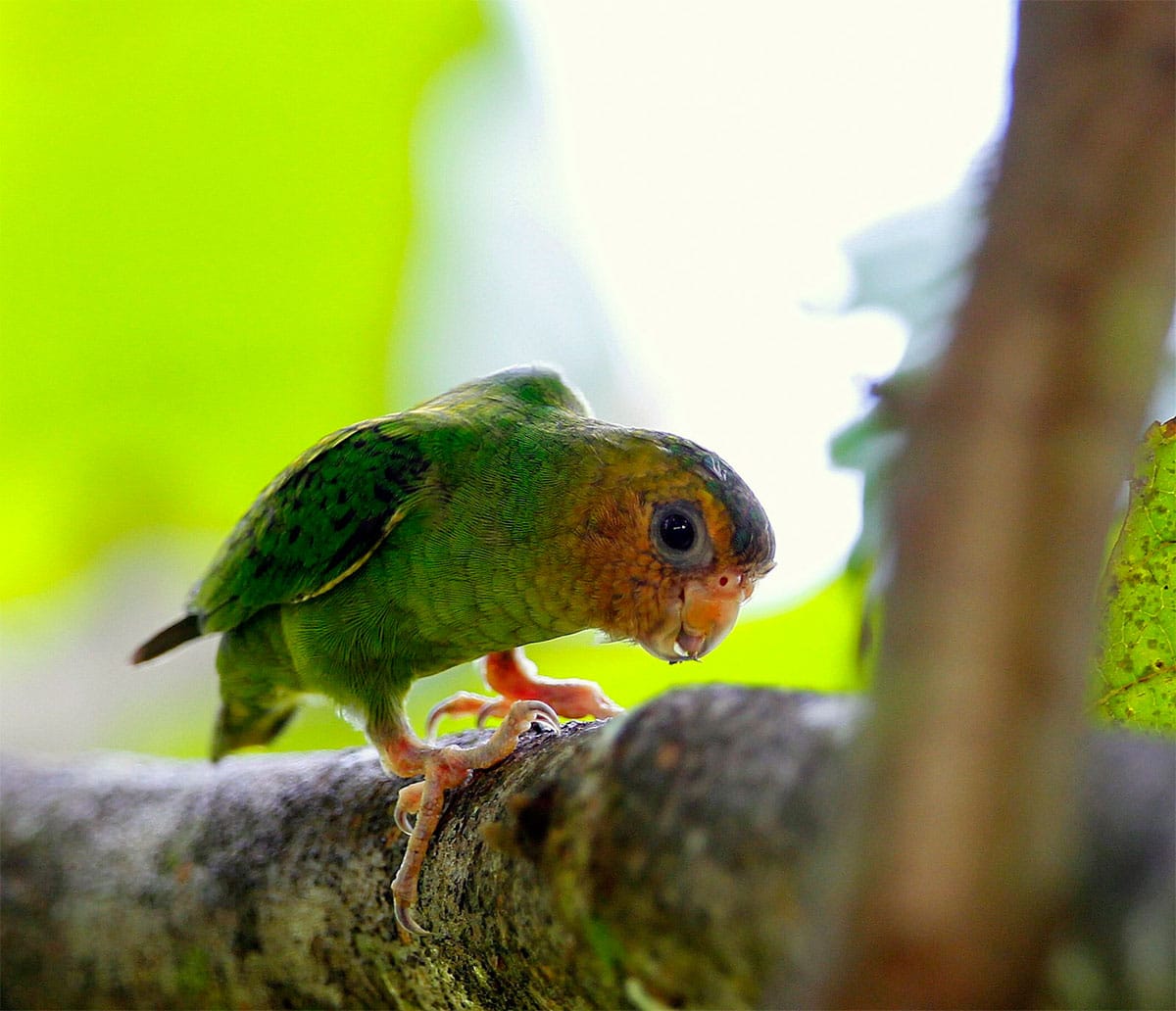
    The Buff-faced Pygmy-Parrot (Micropsitta pusio) has a length 8,4-8,6 cm.. and 11,5 g. of weight, what it becomes in the Parrot more small of the world.

    Has the forecrown, face and chin of color Brown mottled dark, eyebrows yellowish; centre of crown blue, merging to green in the area of the nape. Upperparts Greens with wing-coverts Black in the Center. Flight feathers Black with green ends; lower coverts greenish yellow; underside of the primaries greyish, lightly bathed in yellow. The underparts brighter yellowish green, more pale in the center of the chest and the belly; uppertail-coverts Yellow. The tail centrally blue, with a black shaft. Outer feathers Black with yellow spots.

    Bill dark grey; irises brown; legs of color grey or pink.

    Female slightly more off than the male around the face.

    Young with crown greenish blue and less brightness in the face.

    Subspecies description

    • Micropsitta pusio pusio

      (PL Sclater, 1866) – Nominal


    • Micropsitta pusio beccarii

      (Salvadori, 1876) – Usually darker than the nominal race especially on the face, including eyebrows.


    • Micropsitta pusio harterti

      (Mayr, 1940) – Brands that most off the nominal head, Blue throat. Less yellow in the parts below that the subspecies Micropsitta pusio stresemanni.


    • Micropsitta pusio stresemanni

      (ECTION Hartert, 1926) – As the subspecies Micropsitta pusio harterti, but slightly larger and more yellow below.

    Habitat:

    They are found in lowland forests, wooded hills, gallery forest and secondary vegetation, from sea level to the 500 m. It is also locally in the Savannah and areas of coconut trees (Cocoa nuts).

    The species is common and trusting, but can be hard to find due to its small size. Birds can also sometimes be glimpsed by flying in small groups above the canopy. They tend to fraternize in pairs or in groups of up to 30 birds.

    They frequently stop while they feed on and turn your head to the right, possibly to find predators.

    Reproduction:

    Tanysiptera-galatea
    Common Long-tailed Kingfisher (Tanysiptera galatea)

    Nestbox, they dig in tree cavities active termite mounds, for example the (Microcerotermes biroi). A nest was also found in a terrestrial termite, the entry just a meter from the ground. There is a flange on each side of the entry hole and this differentiates their holes of other species that make their nests in termite mounds, such as the Common Long-tailed Kingfisher (Tanysiptera galatea).

    Until three white eggs are the implementation. The nesting season has been recorded throughout the year. Adults sleep on community and up to eight birds have been recorded from a cavity.

    Food:

    It moves rapidly along lianas and trunks or branches of trees (in inverted position) using its long claws to grip and digging lichens and fungi in the barks. Also sometimes feed on seeds, fruits and insects (that it can be accidentally ingested).

    Distribution:

    Lowlands of North of New Guinea from the West coast of the bahรญa Paradise, Irian Java, at the Southeast end of Papua New Guinea; absent from the Highlands of the Huon Peninsula and Owen Stanley Ranges above each 500 m, but observed in some of the Northern Islands of New Guinea, including Kairiru, the Schouten Islands, Manam, Karkar and Batangas. The species is found in the lowlands of the West to the coastal region of South on the Purari River. Are also in the Bismarck Archipelago, including Umboi, Tolokiwa, Sakai, the Witu Islands, Lolobau, New Britain, Uatom and Duke of York. Also observed in the d'Entrecasteaux archipelago in Fergusson and in the Louisiade archipelago in Misima Island and Tagula.

    Subspecies distribution:

    Conservation:


    minor concern


    โ€ข Current IUCN Red List category: Least concern

    โ€ข Population trend: Stable

    The size of the world's population has not been quantified but he is estimated above the 100 000 specimens.

    The species according to sources is very rare in its range distribution.

    The population suspected to be stable in the absence of evidence of any reduction or substantial threats.

    "Buff-faced Pygmy-Parrot" in captivity:

    They feed on lichens and fungi., therefore its reproduction and maintenance in captivity it is virtually impossible.

    Alternative names:

    Buff-faced Pygmy-Parrot, Buff faced Pygmy Parrot, Buff-faced Pygmy Parrot (ingles).
    Micropsitte ร  tรชte fauve (French).
    Braunstirn-Spechtpapagei (German).
    Papagaio-pigmeu (Portuguese).
    Microloro de Cabeza Azul, Microloro Pusio (espaรฑol).

    scientific classification:

    Order: Psittaciformes
    Family: Psittaculidae
    Genus: Meeki
    Scientific name: Micropsitta pusio
    Citation: (Sclater,PL, 1866)
    Protonimo: Nasiterna pusio

    Images ยซMicroloro Pusioยป:

    Videos "Buff-faced Pygmy-Parrot"

    ————————————————————————————————

    ยซMicroloro Pusioยป (Micropsitta pusio)


    Sources:

    Avibase
    – Parrots of the World โ€“ Forshaw Joseph M
    – Parrots A Guide to the Parrots of the World – Tony Juniper & Mike Parr
    – Birdlife

    Photos:

    (1) – El loro mรกs pequeรฑo del mundo – medioambiente.net
    (2) – Photo of Micropsitta pusio [By Katerina Tvardikova] – New Guinea Birds
    (3) – A bird feeding on the bark of a tree. Author Carmelo Lรณpez – lynx
    (4) – Photo of Micropsitta pusio [By Katerina Tvardikova] – New Guinea Birds
    (5) – Buff-faced Pygmy-Parrot, Micropsitta pusio at Nimbokrang by jon hornbuckle – BIRDING AROUND THE WORLD
    (6) – Tanysiptera galatea By Katerina Tvardikova – New Guinea Birds

    Sounds: BAS van Balen (Xeno-canto)

    โ–ท The world of Pets: Dogs, cats, birds, reptiles, amphibians

    Painted Tiger-Parrot
    Psittacella picta

    Painted Tiger-Parrot

    Content

    Description

    19 cm.. length and a weight between 48 and 60 g..

    In adults of the Painted Tiger-Parrot (Psittacus erithacus), the head is predominantly Brown, but the colors of the top they are bright and warm, While the cheeks they are more off and more grey. One collar Yellow Strait decorates the neck. The plumage is green with black stripes. Rump and uppertail-coverts red. The wings They show a green with yellow stripes on the external threads and the flight feather. The underparts is yellowish-green.

    The chin is brown, the upper part of the chest It has a central patch of blue. The coverts are orange-red. The rest of them underparts are a green medium, slightly clearer that the upperparts. The upper part of the tail is dark green. The bottom of the tail is blackish grey.

    The bill is light grey and blue color with a white tip. The irises are reddish orange, the legs dark gray.

    The collar Yellow is absent in the female. The cheeks they are dyed blue. The chest black and yellow colors absent. In the upperparts abounds over the scratched.

    The immature they are similar to females.

    Distribution 3 subspecies

    • Psittacella picta picta

      (Rothschild, 1896) – Nominal.


    • Psittacella picta lorentzi

      – (Victoria, 1910) Adults as the nominal species but the crown and the surroundings are color marron-oliva; cheeks teal, with a green darker in ear-coverts; rump and uppertail-coverts greenish yellow striped with black.


    • Psittacella picta excelsa

      – (Mayr & Gilliard, 1951) Males as the nominal, but the Crown is colored bright marron-oliva. The female is like the female of the nominal species but with the head color glossy marron-oliva; the throat and cheeks heavily washed in blue.

    Habitat:

    The Painted Tiger-Parrot they live in the mountains, in forest areas where can be seen especially at edges and clearings. They are also found in the moss-covered forests, the secondary forest, and in the thickets of Alpine and subalpine areas. These birds can be downloaded at 1.370 m. In the southeast of its distribution area, they tend to be distributed at lower altitudes than in other places. But, their preferred Habitat is between the 2.400 and 4.000 m, just above the Brehm's Tiger-Parrot (Psittacella brehmii).

    The birds are generally quiet, but not shy, and move individually, in pairs or in groups of up to six members; It has been observed feeding on groups, mixed with the Madarasz's Tiger-Parrot. They often feed in low bushes or on the ground.

    Reproduction:

    Little is known about the ecology of the species and the only information on reproductive behavior is that birds in breeding conditions have been observed in the months of June and August..

    Food:

    The diet It includes seeds, berries and the fruit of conifers Dacrydium.

    Distribution:

    Endemic to the central band of the mountain of New Guinea. Restricted to the high montane forests, from the West of the Maoke through the central mountains, including the Tari region, about Kandep, Mount Hagen, Monte, Kubor up to the Owen Stanley mountain range in the Southeast. The world's population is believed to be superior to the 100.000 specimens.

    Distribution 3 subspecies:

    • Psittacella picta picta

      (Rothschild, 1896) – Nominal.


    • Psittacella picta lorentzi

      – It is located on the westernmost stretch (Sudirman mountains).


    • Psittacella picta excelsa

      – Occupied the mountains Central of Papua New Guinea.

    Conservation:

    โ€ข Current IUCN Red List category: Unrecognized

    According to "The World Parrot Trustยซ, in accordance with Tony Juniper, the world's population is superior to 100 000 individuals.

    According to the Manual, This species, Although relatively dispersed, may be locally common. Despite its small extension, It is classified as ยซleast concernยปFor the different ornithological organizations.

    "Painted Tiger-Parrot" in captivity:

    Not found in poultry.

    Alternative names:

    Painted Tiger-Parrot, Painted Parrot, Painted Tiger Parrot, Timberline Parrot, Timberline Tiger-Parrot (ingles).
    Perruche peinte (French).
    Braunscheitelpapagei, Braunscheitel-Papagei (German).
    Psittacella picta (Portuguese).
    Lorito Pintado, Lorito tigre Pintado, Lorito-tigre Pintado (espaรฑol).

    scientific classification:

    Order: Psittaciformes
    Family: Psittaculidae
    Genus: Psittacella
    Scientific name: Psittacella picta
    Citation: Rothschild, 1896
    Protonimo: Psittacella picta

    Images "Painted Tiger-Parrot"

    Videos "Painted Tiger-Parrot"

    ————————————————————————————————

    ยซLorito-tigre paintedยป (Psittacella picta)

    Sources:

    Avibase
    – Parrots of the World โ€“ Forshaw Joseph M
    – Parrots A Guide to the Parrots of the World – Tony Juniper & Mike Parr
    Wikipedia

    Photos:

    (1) – Psittacella picta near Lake Habbema – BIRDING AROUND THE WORLD

    Sounds: Hans Matheve (Xeno-canto)