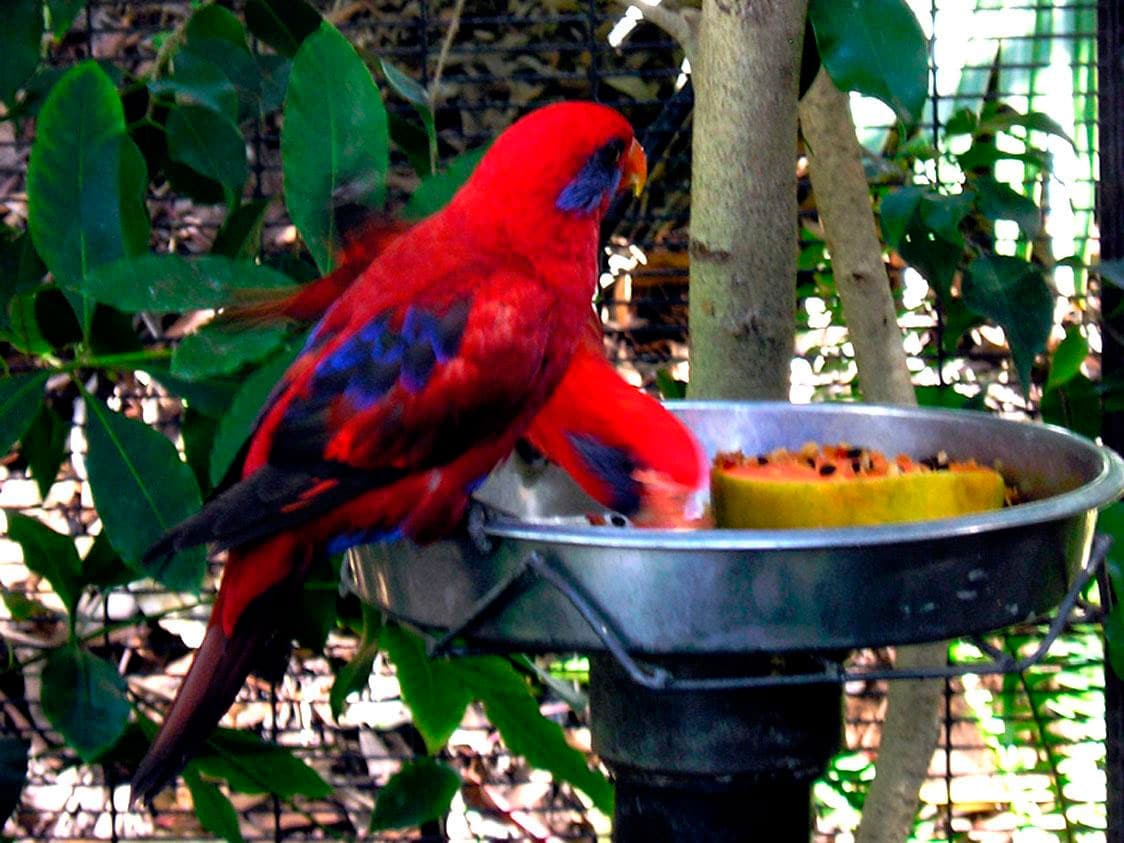
▷ The world of Pets: Dogs, cats, birds, reptiles, amphibians

Elegant Parrot
Neophema elegans


Elegant Parrot

Content


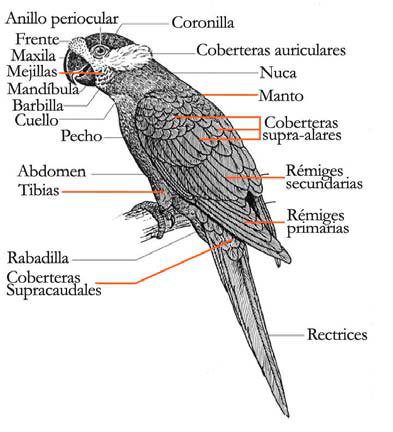
Anatomy-parrots

Description «Elegant Parakeet»

21 to 24 cm.. length between 40 and 51 g. of weight.

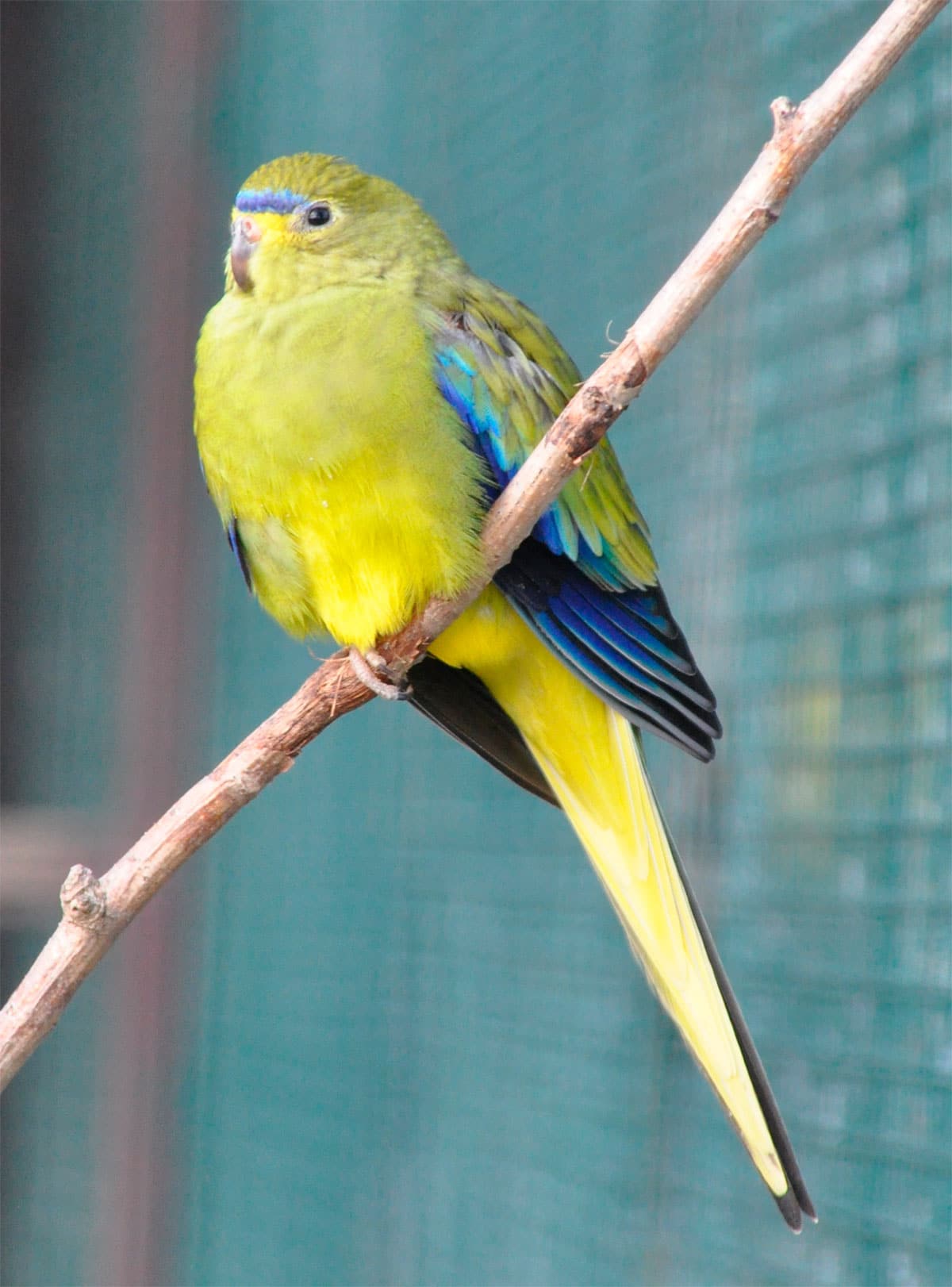
The Elegant Parrot (Neophema elegans) is very similar to the Blue-winged Parrot (Neophema chrysostoma), but its plumage It is brighter and more yellowish especially in the chest.

The crown is olive-green with a front band in dark blue tone and a distinctive and fine light blue on the rear margin. Lords bright yellow; the face Yellow olive.

The the mantle and back are olive green, staining in yellow tones in the area of the rump. The bend of wing they are blue. The wing-coverts more internal are olive green, the median pale blue tips, the large coverts with edge them in blue malva; the primary coverts in blackish shades with margins of violet-blue. The primaries black, with edges in blue violet dark; the secondaries greenish-yellow colour with external margins of blue color in the outermost zone.

The wing feathers blue-violet color. Throat and chest of yellowish-green, becoming bright yellow in the belly and in the undertail- coverts, sometimes with orange patches among the legs. Upper, the tail greyish blue, darker towards tip, Yellow lateral feathers with darker bases.

The bill black; irises dark brown; legs grey.

The plumage of the female is olive green opaque.

Immature females they are similar, except the line forecrown It is barely visible.

The adult plumage WINS in three or four months.

  • Sound of the Elegant Parrot.

“Elegant Parakeet” Habitat:

The Elegant Parrot It is a nocturnal migratory bird. It is the least specialized of its kind. It attends the nearshore or coastal dunes, wooded grasslands and Shrublands, areas of Mallee that have the appearance of large shrubs and plots of eucalyptus.

You can also see in the shrubs of Acacia, in areas of low altitude provided Acacias (Acacia caesiella) or fitted with bushes of the salt Plains Saltbush Atriplex. They especially appreciate the groups of trees that are cleared up areas.

outside the breeding season, the Elegant Parrot they form large flocks, often in association with the Blue-winged Parrot, in the Southeast. They gather in grasslands and brushy areas to feed on native or imported seeds or grasses..

These parakeets are partially nomadic, above the outer limits of its range. Local low-intensity movements can also occur. These birds nest in Kangaroo Island, from November to April. after this last month, they move to the Mainland to form their winter quarters.

Reproduction «Elegant Parakeet»:

The Elegant Parrot They nest from August to November. Usually install their nest in a cavity in a tree at high altitude. They often use the highest branches of isolated trees. Spawning is composed of 4 or 5 eggs incubation lasts a few 18 days. The chicks are altricial and they leave the nest after one month.

“Elegant Parakeet” Feeding:

The Elegant Parrot they are almost exclusively vegetarian. Their menu consists of clover or sunflower seeds and other plants of the type Helianthus, Trifolium and paspalum. Also appreciate the Berberis (Jeffersonia diphylla) and barberry (Berberis vulgaris).

«Elegant Parakeet» Distribution:

There is a two morphologically identical populations but well separated, although the species is nomadic so the birds can appear outside the normal range sometimes.

In the Southwest the species occurs west of a line from the environs of Esperance on the southern coast of the North of Western Australia through Merredin until Moora on the Northwest Coast.

They have spread through the wheat belt of the drier areas of the northeast and are now in the vicinity of Perth, as well as sometimes north of Point Cloates and the fortescue river.

In the Southeast are distributed in the South of Southern Australia, on eyre peninsula, on Kangaroo Island (present in summer), and in the districts of South, about Port Augusta, Port Wakefield and about adelaide, in the Lofty Mountains, reaching northward in the northern most part of the Montes Flinders.

The species is irregular East of 140 ° E, with few records from New South Wales, North of Riverina to paroo river; is also irregular in the Northwest of Victoria.

The population of the Southwest It is growing, While in the Southeast believed to be stable although the species is generally less common and its historical range is not easy to determine due to possible confusion with the Blue-winged Parrot.

The world population is estimated over of 30.000 individuals.

“Elegant Parakeet” Conservation:
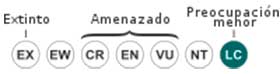

minor concern


• Current category of the Red List of the UICN: Least concern

• Population Trend: Growing

According to the Manual of the birds of the world (HBW), This species is not threatened globally. It is common, especially in the southwest of Australia.

Until the Decade of 1930, It grew, After the use of clover in pastures.

The size of the world's population has not been quantified, but the species, according to sources, it is common. (pit et to the. 1997). It is estimated that it may be around the 30,000 specimens.

"Elegant Parrot" in captivity:

The Elegant Parrot they belong to a species that are obtained very good results in reproduction. They are also suitable for fans of parrots.

They are peaceful birds that do very low noise. They are a little shy, but they become confident with time. They are easy to maintain but they have the need to crack, a little bigger, than other species of neophemas, without the destruction of your Aviary. Your bathroom need depends on the individual. Son heat-resistant, but they are very sensitive to cold and wet fog.

To the Elegant Parrot He loves to dig the ground and is therefore susceptible to infection by worms. They are also sensitive to eye infections.

Alternative names:

Elegant Parrot, Elegant Grass-Parakeet, Grass Parakeet, Grass Parrot, Yellow Lowry (ingles).
Perruche élégante (French).
Schmucksittich (German).
Periquito-elegante (Portuguese).
Papagayo Elegante, Periquito Elegante (español).

scientific classification:

Order: Psittaciformes
Family: Psittaculidae
Genus: Neophema
Scientific name: Neophema elegans
Citation: (Gould, 1837)
Protonimo: Nanodes elegans

«Elegant Parakeet» Images:

Videos "Elegant Parrot"

————————————————————————————————

«Elegant Parakeet» (Neophema elegans)


Sources:

Avibase
– Parrots of the World – Forshaw Joseph M
– Parrots A Guide to the Parrots of the World – Tony Juniper & Mike Parr
– Birdlife

Photos:

(1) – Elegant Parrot in the Walsrode Bird Park, Germany By Quartl (Own work) [CC BY-SA 3.0], via Wikimedia Commons
(2) – By Goura – Elegant parrot Perth, WA, Australia – ZooChat
(3) – Elegant Parrot Neophema elegans – animalphotos
(4) – Elegant Parakeet (Neophema elegans) at Walsrode 2007 by Maguari – ZooChat
(5) – Stirling Range Retreat, Stirling Range National Park, Western Australia, Australia (Monotypic species) by Clive Nealon – Lynx

Sounds: Mark Harper (Xeno-canto)

▷ The world of Pets: Dogs, cats, birds, reptiles, amphibians

Kakapo
Strigops habroptila


Kakapo

Content

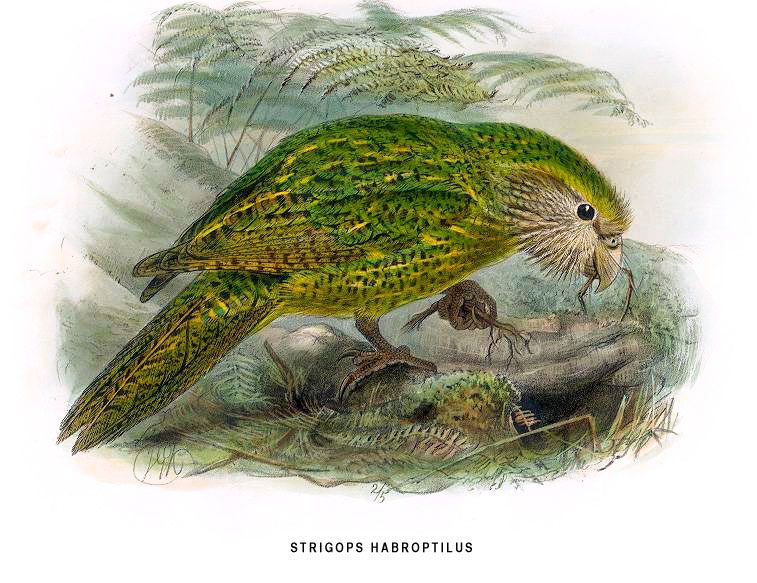
Illustration Kakapo

Description

Males can reach up to 60 cm. and weigh between 3 and 4 kg.

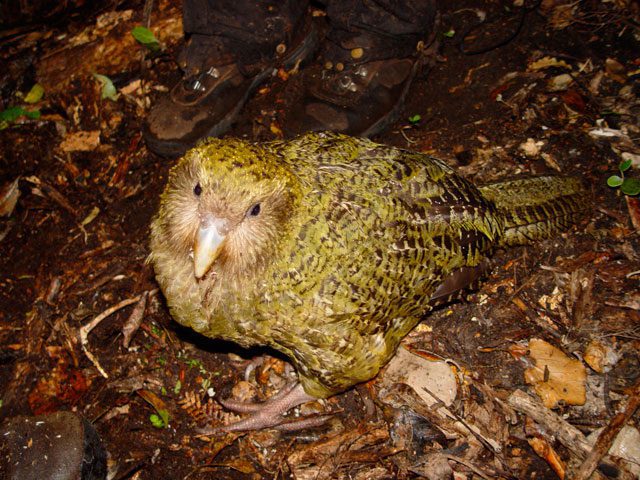
The Kakapo (Strigops habroptila) It is a robust and stocky bird with wings short in relation to the rest of the body.

grown ups, on upperpartsr, are MOSS Green, pulling a beige. All his upperparts they are spotted black and brownish gray, What gives them an excellent camouflage in its environment. The chest and flanks are yellowish green with streaks of yellow. The abdomen, under the tail, the neck and face are yellow, mostly streaked with pale green and imperceptible gray-brown spots.

Their feathers they are surprisingly soft, since they do not need the strength and the necessary stiffness for flying birds.

The Kakapo shows a composite facial disc of feathers fine, giving it the appearance of an owl.

Its bill it is surrounded by fine whiskers that are very useful for testing the ground when moving through the undergrowth.

The mandible it is mostly ivory color, but with a bit of blue-gray in the upper jaw.

Their eyes are dark brown. Their long and scaly legs they have long claws which serve to climb.

The end of the feathers of the tail It tends to end up worn down by the continuous friction with the ground.

The females they are very different from your partner. Its head is narrow and has a crown less rounded. Their peaks they are narrow and elongated. Less muscular legs, a grayish pink. Its tail is more elongated. Though their plumage is hardly different from males, appears less mottled beige.

The nesting females they are also distinguished by the cushion of bare skin that develops on the abdomen during the incubation period.

Habitat:

Before the humans arrived to New Zealand, the Kakapo lived in a wide variety of habitats, pastures with clumps of grass, scrub and coastal regions.

They were also the primary forests, including those who were dominated by lush podocarp and false have the gender Nothofagus. In the region of Fiordland, to the southwest of South Island, the Kakapo they frequented areas of avalanches and landslides, small regenerated trees or vegetation with abundant fruit.

These regions contained among other plants, Japanese raspberry wine (Rubus phoenicolasius), Shrubby Veronica (genus Scrophulariaceae) and Coprosmas. It was known as "kakapo gardens»

Given its inability to fly, the Kakapo It, mainly, a terrestrial bird. This is also a excellent climber able to reach the tops of the tallest trees. They leave the foliage practicing a "parachute" descent, spreading their wings in all their amplitude.

When the Kakapo is threatened, simply is still trying to pass unnoticed in the vegetation, with which is camouflaged. This was a great strategy to avoid his great enemy, the gigantic Haast's Eagle, but does not protect against introduced mammals.

Son nocturnal birds. They sit during the day and roam their territory during the night period.. Having lost the ability to fly, the Kakapo they have developed remarkable skills for their long haul. His powerful legs allow them to make long distances at night to feed or during the time of nesting that it takes place from October to January.

During courtship, the males they abandon their traditional territories and walk many kilometers to reach the top of the hills or a crest to establish their mating area, competing in the place to try to conquer the location that appears most advantageous to them. Conflicts often lead to serious injury and are sometimes fatal for the belligerents.

To appeal to the females, the males they emit a kind of explosions that produce dilating a bag in the area of the chest. After a series of 20 explosions, is right and take a break. Then lower the head again to issue a new series of explosions. Inside its cavity, move to make sounds in all directions. on clear days, These explosions can be heard more than one kilometre away. The males get involved in this type of sample for nearly eight hours at night. Each male produces thousands of explosions during 3 or 4 months. During this time, males sometimes lost half of their body mass.

Reproduction:

During the time of reproduction, the Kakapo They use a system ofLek«. He "Lek» is the space dedicated to the parade within which males gather in loose groups in an attempt to attract and seduce females. Females are very attentive spectator and choose your partner according to the quality of your display. Females are not persecuted openly by males.

It is not set no marital bond. He "Lek» is just a meeting place that serves only for mating. The space for processions They consist of one or more small depressions of 10 cm of depth and 50 cm in diameter dug into the soil. The holes are usually do about faces of rocks, banks, or tree trunks, to help the sound bounce. The holes of each male are connected. The various depressions are interconnected by a network of small roads that cleaned thoroughly of all plant debris.

As soon as the male's cry is heard, the female embarks on a long journey to reach the area Lek. As soon as it enters the lek mating area, the male begins its rituals. It sways from side to side emitting clicks with the peak. He turns his back on his future partner, It spreads its wings and walk back towards her. Once mating has occurred, The female returns to her area of ​​origin to lay her eggs and raise her young.. The male stays in place of courtship for try to seduce a new female.

The Kakapo they usually put 3 eggs per season. The nest placed on the ground under vegetation cover or in a hollow of a tree. The female incubated during 30 days, but you must leave the nest at night to feed, leaving the door open to many predators. After the eggs have hatched, She It feeds the chicks for three months, these will still remain in the company of their mother for a few more months. Since they have a life relatively long, the Kakapo have a fairly prolonged adolescence. Males do not begin courting until the age of 5 years and females do not respond to the calls of the males until they have reached the age of 9 or 11 years.

Food:

The peak of the Kakapo It is especially suitable for grinding food finely. For this reason, they have a gizzard less developed than most birds of its size.

The Kakapo they have a menu that is mostly herbivore. They used native plants, seeds, fruit, pollen and even the SAP flowing from the trees.

In a study of 1984, 25 different types of plants have been identified as part of your diet. Is particularly fond of the fruit of the rimu tree, and they feed on it exclusively during seasons when it is abundant. The Kakapo He has a habit of distinctive grab a leaf or frond with a foot and stripping the nutritious parts of the plant with its beak, leaving a non-digestible fiber ball. These small groups of vegetable fibers are a distinctive sign of the presence of the bird.

Distribution:

In the past, the Kakapo they were in the Islands North Island and South Island of New Zealand.

The species has suffered a sharp decline since the European colonization, and now it is one of the rarest birds in the world.

map-kakapo

Despite the fact that it disappeared from most of its original range following human colonization, the species remained abundant in Fiordland and some other places of great rainfall was scarce in the inhabited areas of South Island until the beginning of the 20th century. In 1976, However, the known population had been reduced to 18 birds, all males, all in Fiordland.

In 1977, found to be a rapid decline in the population of birds, about 150, on Stewart Island. Among 1980 and 1992, the 61 other birds of the Stewart Island they were transferred to the islands of the coast, and are currently in Codfish and Anchor island. The last accepted records were in North Island in 1927, three males reported in South Island, in Fiordland in 1987, and the last record in the Stewart Island of a female found and transferred to the Codfish Island in 1997.

In 2009, a male of the transferred four of Stewart Island to Isla Codfish in 1987, It was rediscovered after having been missing for 21 years.

It is likely that it is extinct in its natural distribution area, but, from November of 2005, birds are still present on four islands: Isla Codfish, Chalky, Anchor and Maud island.

In 1999, 26 females and 36 males survived, which includes 50 individuals in reproductive age, six subadults and six juveniles.

The population was stabilized, and has started to increase slowly following the application of intensive management. In the 2005, the population of the Kakapo stood in 86 specimens, of which 52 they were of reproductive age (21 females and 31 males) and 34 they were underage; a productive breeding year in the 2009 He saw the increase of the population up to 124 specimens, and it was known of the existence of 126 birds at the beginning of 2012, including 78 adult players.

Conservation:


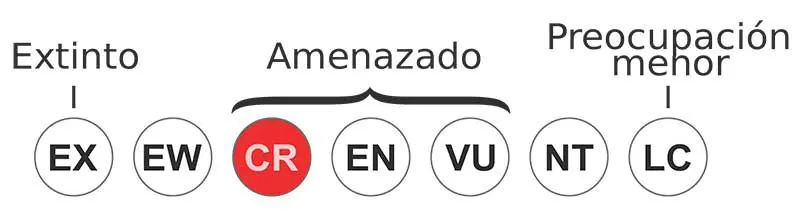
critical hazard

• Current Red List of UICN: critically endangered

• Population trend: Increasing

In the Stewart Island, more than the 50% of adults monitored died, each year, attacked by cats (CLOUT and Merton 1998).

An abnormal low fertility and low natural rates of reproduction and mating are the main concerns.

In 2004, three young people died of septicaemia caused by bacteria Erysipelothrix rhusiopathiae (erysipelas), a disease that had not been previously reported in this species (P. Jansen in litt. 2004)

They are subject to a plan of support by the authorities of New Zealand. Their number is currently estimated at little more than one hundred of copies, increases slowly with the plan.

At the beginning of 2012 there was 126 specimens, among them 78 adult players (RJ Moorhouse in litt. 2012).

"Kakapo" in captivity:

The only birds in captivity are those bred in the Recovery program of the Kakapo.

In terms of their longevity, debido a su largo ciclo de vida y la ausencia de depredadores naturales, es posible que el Kakapo viva más de 60 years.

Alternative names:

Kakapo, Owl Parrot (English).
Strigops kakapo, Kakapo, Perroquet hibou (French).
Kakapo, Eulenpapagei (German).
Kakapo (Portuguese).
Kakapo (español).

scientific classification:

Order: Psittaciformes
Family: Strigopidae
Genus: Habroptilus
Scientific name: Strigops habroptila
Citation: Gray, GR, 1845
Protonimo: Strigops habroptilus

Images "Kakapo":

Videos "Kakapo"

————————————————————————————————

"Kakapo" (Strigops habroptila)


Sources:

Avibase
– Parrots of the World – Forshaw Joseph M
– Parrots A Guide to the Parrots of the World – Tony Juniper & Mike Parr
– Birdlife
Wikipedia

Photos:

(1) – Pura, a 1-year-old Kakapo (Strigops habroptila) on Codfish Island By Mnolf [GFDL, CC-BY-SA-3.0 or CC BY-SA 2.0], via Wikimedia Commons
(2) – Kakapo Pura on Codfish Island By Mnolf [GFDL, CC-BY-SA-3.0 or CC BY-SA 2.0], via Wikimedia Commons
(3) – Kea, on the road to Milford Sound Uploaded by The Rambling Man – Wikipedia
(4) – Kakapo Sirocco amongst the renga renga lillies. Maud Island. Photo: Chris Birmingham, 2012 – Flickr
(5) – Kakapo by jidanchaomian – Flickr
(6) – Birds of New Zealand 1st edition, by Walter Lawry Buller, published in 1873 By John G. Keulemans. Minor edits have been made to the original by User:Msikma; I release these changes into the public domain as well. [Public domain], via Wikimedia Commons

▷ The world of Pets: Dogs, cats, birds, reptiles, amphibians

Cliff Parakeet
Myiopsitta luchsi

Cliff Parakeet

Content

Description:

Cliff Parakeet

26-28 cm.. length and a weight between 120 and 140 g..
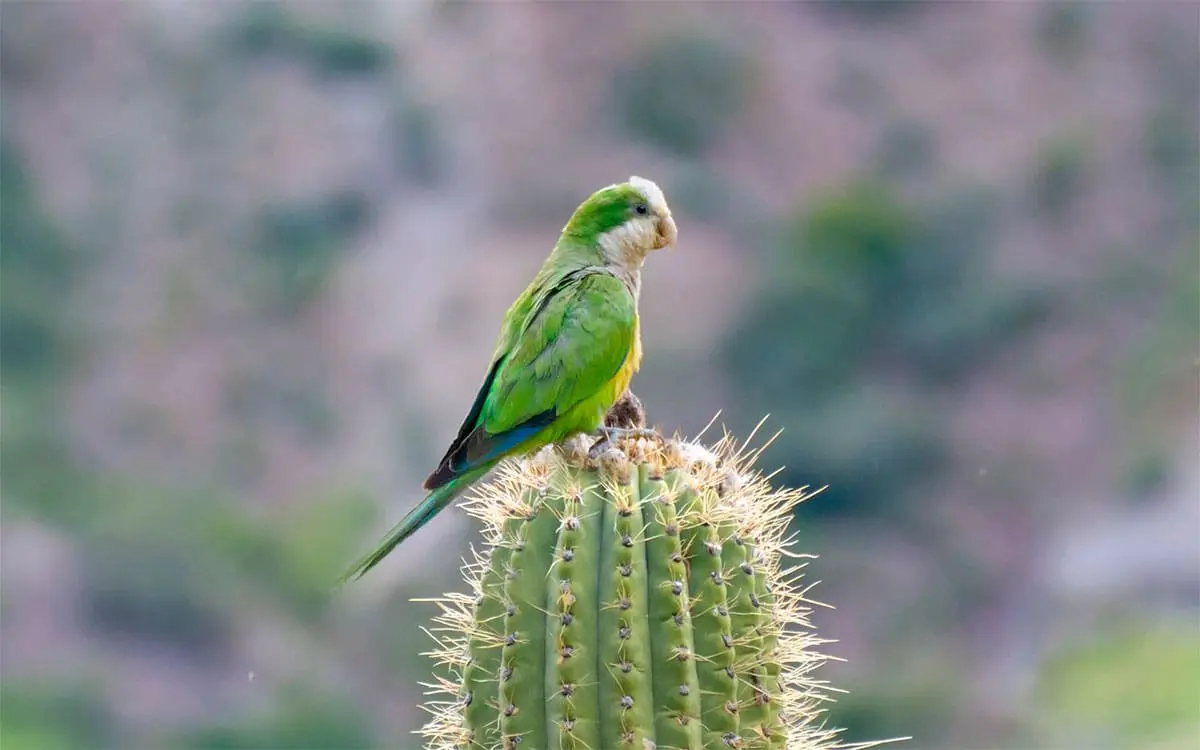
The Cliff Parakeet (Myiopsitta luchsi) It has a medium size and is mainly green; the front of the crown, lower face and the chest, They are whitish, becoming bright yellow on the lower chest and the belly; the primaries and tail (medium-sized long), They are bright metallic blue.
Similar Monk Parakeet has less extensive white color crown, pale yellow instead of bright yellow in the belly and the pale gray chest It has a scaling effect that give centers feathers dark.

Bill color horn.

The immature They are similar to adults but with forecrown gray tinged with green.


Taxonomic note:

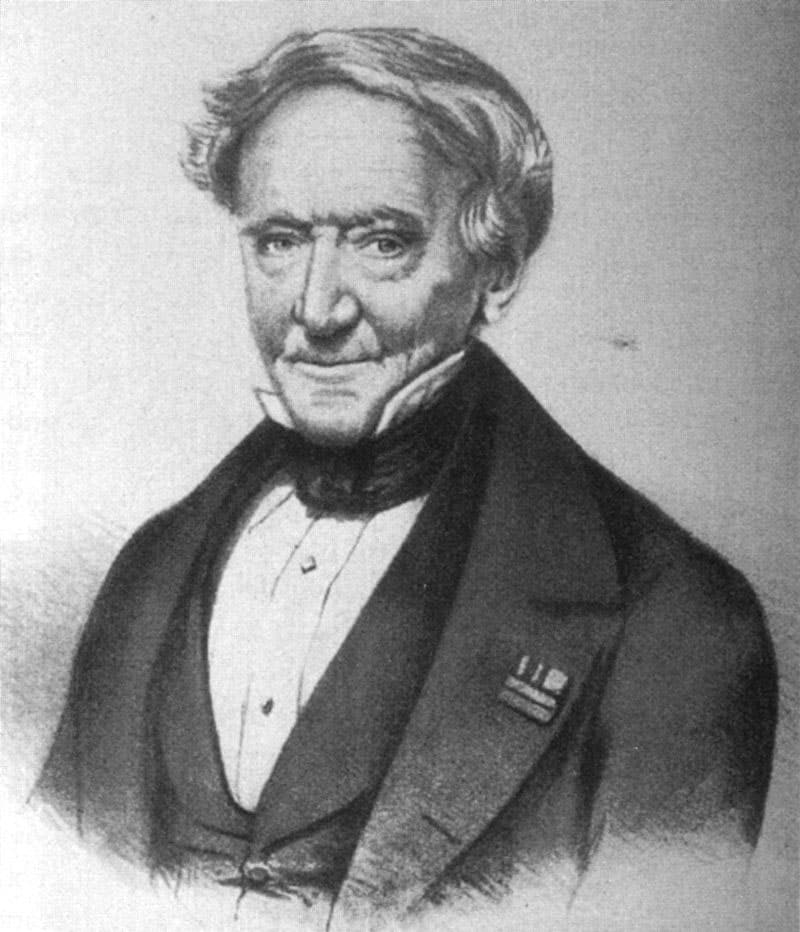
      This species was described in 1868 by Finsch as Bolborhynchus luchsi, with specimens from Bolivia. Later, the species was transferred to the genus Myiopsitta and the name Myiopsitta luchsi It was used apparently to 1918 by Cory. From 1943, Bond & de Schauensee and they treat it as a subspecies of monachus (Myiopsitta monachus luchsi), approach that has been followed by all modern authors, but Necklace (1997) finally he considers that the morphological characters and their way of nesting are sufficient to raise again species level.

Habitat:

Video – "Cliff Parakeet" (Myiopsitta luchsi)

It shares the same habitat with another endemic parrot, the Red-fronted Macaw (Ara rubrogenys), although both species do not compete because they feed on different plants.

They found in dry woodland or open fields including fields with trees gallery woods, isolated groups of trees, Palm trees, forests, savannah and scrubland thorny cactus. It is also found in cultivated areas. Visitors from some urban areas. Until 3000 m.

Reproduction:

The breeding season occurs between December and March in crevices in cliffs, constructing a bulky nest branches. Unlike Monk Parakeet (Myiopsitta monachus), the Cliff Parakeet does not nest commonly, but often the nests are placed immediately adjacent to each other. The female is in charge of making this nest, as well as its maintenance.
Couples are for life. The laying is of 5 to 8 eggs per clutch, and incubation lasts a few 26 days. At six weeks old chicks can now leave their nest.

Food:

It feeds on seeds of various fruits, including those of fruits cactus Neocardenasia herzogiana and seeds of the Acacia furcatispina; It is also known to feed on cultivated corn.

Distribution:

Size of its range (breeding/resident): 148.000 km2

Restricted to xerophytic vegetation, near cliffs in intermountain valleys of eastern Andes of Bolivia, from the southeast of Peace, South of Cochabamba and West Santa Cruz, to the North of Chuquisaca and possibly other areas.

Its range is very similar to the Red-fronted Macaw (Ara rubrogenys).

Conservation:

State of conservation ⓘ


minor concern Minor Concern ⓘ (UICN)ⓘ

• Current category of the Red List of the UICN: Least concern.

• Population trend: Unknown.

Justification of the population

The size of the population has not been estimated, but the species has been described as «quite common» (pit et to the., 1997) and "possibly quite rare" (Juniper and Parr 1998).

Justification of trend

Population trends are difficult to determine due to uncertainty about the extent and severity of threats to the species..
However, like many parrots, They face the traffic of wildlife and wild captivity. Also they suffer direct and immediate consequences of the destruction of their habitat by deforestation and the advance of the agricultural frontier.

Conservation Actions Underway

The species is listed on Appendix II of CITES.

"Cliff Parakeet" in captivity:

Quite common. Very sociable, but shy with the human being.
It is able to vocalize or imitate words, although this quality is far from possessing the capabilities of some genera of the same family.

Alternative names:

Cliff Parakeet, Bolivean monk parakeet, monk parakeet, Monk Parakeet (Cliff) (English).
Perriche des falaises, Conure de Luchs, Conure des falaises, Conure des rochers (French).
Luchssittich, Bolivien Mönchsittich, Bolivien-Mönchsittich (German).
Cliff Parakeet (Portuguese).
Cotorra Boliviana (español).

Friedrich Hermann Otto Finsch

scientific classification:


Order: Psittaciformes
Family: Psittacidae
Genus: Myiopsitta
Scientific name: Myiopsitta luchsi
Citation: (Finsch, 1868)
Protonimo: Luchs Bolborrhynchus


Images «Bolivian Parrot»:

Videos «Bolivian Parrot»:


Species of the genus Myiopsitta

Sources:

Avibase
– Parrots of the World – Forshaw Joseph M
– Parrots A Guide to the Parrots of the World – Tony Juniper & Mike Parr
– Birdlife
– FAUNA – Psittacidae

Photos:

(1) – Bolivian Parrot, Bolivia, Sud Chichas, Churquipampa by giorgetta.ch
(2) – Bolivian Parrot, Bolivia, Sud Chichas, Cerro Elefante by giorgetta.ch
(3) – Bolivian Parrot, Bolivia, Sud Chichas, Churquipampa by giorgetta.ch
(4) – A couple of Bolivian parrots in their nest located in the chalky wall of Churquipampa where its waters fall almost freely 330 meters to the creek. The female is arranging the main entrance of the nest while the male takes delight in watching her work by giorgetta.ch
(5) – Bolivian Parrot, Bolivia, Sud Chichas, Churquipampa by giorgetta.ch
(6) – Myopsittacus luchsi = Myiopsitta (monachus) luchsi, Cliff Parakeet, sometimes treated as a subspecies of the Monk Parakeet by John Gerrard Keulemans [Public domain], via Wikimedia Commons

Sounds: Andrew Spencer (Xeno-canto)

▷ The world of Pets: Dogs, cats, birds, reptiles, amphibians

St. Vincent Parrot
Amazona guildingii

St. Vincent Parrot

Content

Description:

40 cm.. length and 580 – 700 weight g.

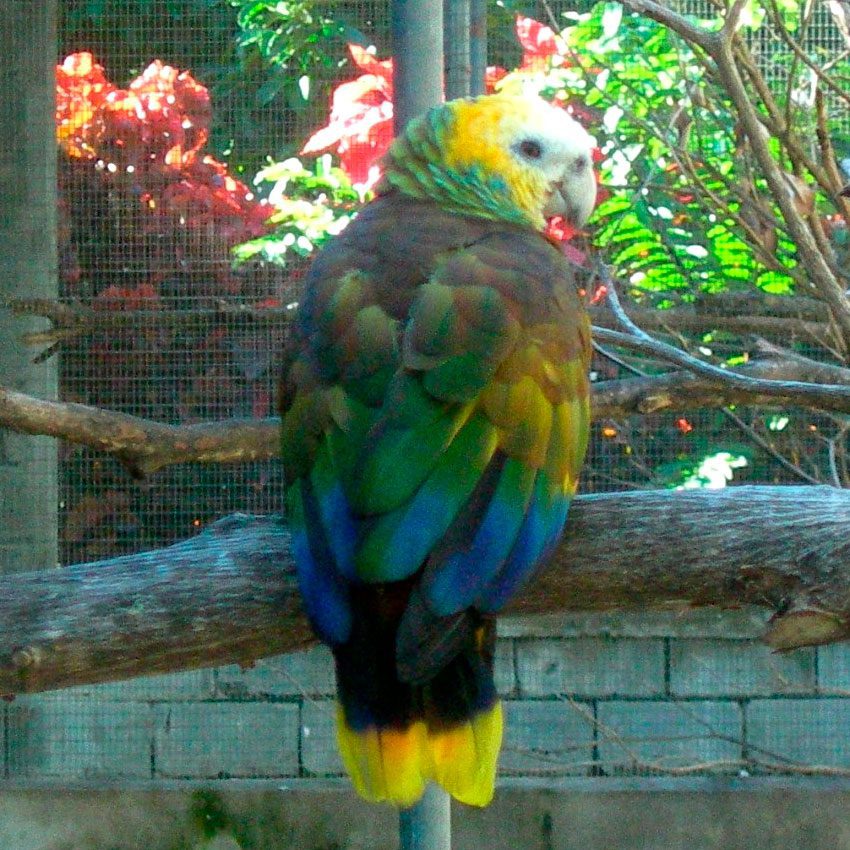
The plumage of the St. Vincent Parrot (Amazona guildingii) It is very variable, virtually no two similar birds.
Its forecrown, lores, supercilii area and upper cheeks are blanquecinas; crown yellow; Feathers back neck and its sides, pale blue dark blue tips; fusion green feathers on the neck show black points. Upperparts dark brown with dark black tips to some feathers. Scapulars gold; coverts outer primaries with pale blue in outerweb.

St. Vincent Parrot

Wing coverts brown with a green band subterminal and dark extremes some feathers; carpal edge yellow-orange with scattered green feathers. Primaries blue with bases yellow-orange; the Outer secondaries They are equal with green subterminal bands, the inner secondary green with blue tips; tertiary interior dark green tinted golden brown on outerweb, Outside tertiary green at the base becoming dark blue at the tips.

Under the wings, with lesser coverts brown with green tips, greater coverts Yellow; flight feathers blackish with yellow at the base. Throat orange with blue tips or blue-green; upper chest golden brown with dark brown tips giving a barred effect; belly yellower than gold chest green blackish subterminal band and pointed to some feathers; undertail-coverts green-yellow. Tail Orange at the base with blue broadband and wide ends central bright yellow. Bill pale gray-horn; irises orange; legs grey.


Anatomy-parrots

Both sexes are similar. The immature They have softer colors.

GEOGRAPHICAL VARIATION

Parrots eastern side of San Vicente They are possibly genetically isolated from the western side: the small bird population East (perhaps only about 80 in 1982) show a high proportion of green and have their high-pitched voices.

  • Sound of the St. Vincent Parrot.

Habitat:

Video "St. Vincent Parrot"

The St. Vincent Parrot They mainly inhabit mature moist forests in altitudes of 125 some 1000 m, although they prefer lowland forests, where they spend most time. Occasionally they leave the forest to visit cultivated areas and even gardens. gregarious and usually in groups 20-30 individuals or in pairs. They forage in flocks and roost use Community. They defend the area around the nest while breeding, although they also stay in groups while feeding and sleeping..

Reproduction:

Nests in hollow mature forest trees such as Dacryodes or Sloanea large. The pairs begin the breeding activity around February with the eggs laid between April-May.. In dry years, eggs can be deposited as soon as in January-February or as late as in July. If conditions are especially wet, birds can not be played at all. Clutch two eggs, rarely three. low productivity with 50% Natural suffering nest failure and successful nests with only two young people in the best years.

Food:

Its diet includes plants of Cordia sulcata, Clusia, Sloanea, Dacryodes excelsa, Ficus, Cecropia peltata, Mangifera indica, Melisoma virescens, Euterpe, Ixora ferrea, Micropholis chrysophylloides, Acrocomia aculeata, Simarouba amara, iron Krugiodendron, Dussia Martinicensis, Andira inermis, No Ingoides, Byrsonima coriacea, Talauma dodecapetala, see venosa, Psidium guajava and Aiphanes erosa. The Pouteria multiflora It is your favorite.

Distribution and status:

Size of its range (breeding/resident): 100 km2

endemic to the San Vicente Island in the Lesser Antilles. The distribution is closely related to the presence of native humid forests that for most of the 20th century have been confined to the eastern and western sides of the central foothills of the island..

Currently the largest flocks of St. Vincent Parrot inhabit the headwaters of Buccament, Cumberland, Colonaire, Congo-Jennings-Perseverance and Richmond Valley’s, where much of the remaining native forest concentrated; elsewhere in smaller numbers.

Some estimates of its population between 1870 and 1920 They are contradictory, but the species evidently decreased substantially 1950. Estimates of the population in the early seventies suggested that between several hundred to 1.000 then birds inhabited the island. Survey 1982 amounted to a total of 421 ± 52 birds while estimating 1988 He suggested 440-500. Perhaps they increased to 800 birds in 1994. The declining population and shrinking range, is linked to the loss of moist forest cover that once (at least in the western side) almost reached sea level. Deforestation seems to have stopped in at least some valleys, but habitat remains at risk due to forestry, expansion of banana, charcoal production and loss of nests for collectors looking young birds for trade. Survey 1984 suggested that they only survived on 16 km2 of primary forest. His capture for pets and international trade It remains a threat, but this and hunting, that was probably the main threat from late 1950 to 1970, They have declined in importance following an education campaign. The remaining population is also at risk because of hurricanes that can cause loss of plants that consume and nesting sites, as well as direct mortality. In 1902 much of the favorite habitat of this species was destroyed by the eruption of Monte Soufriere and these parrots are clearly vulnerable to future volcanic eruptions. Parts of the remaining forest habitat are now protected areas and the species is protected under domestic law. CITES Appendix I.

Conservation:

State of conservation ⓘ


Vulnerable Vulnerable (UICN)ⓘ

• Current category of the Red List of the UICN: Vulnerable.

• Population trend: In increased.

• Population size: 250-999

Rationale for the Red List category

Habitat conservation, Law enforcement and public awareness campaigns have slowed this species' slide toward extinction and even reversed some of the earlier declines.. But, still qualifies as Vulnerable because it has a very small population and range on one island.

Justification of the population

The species has a wild population of about 730 birds (Loro Parque Foundation 2008), which is equivalent to 487 mature individuals, placed here in the band of 250-999 individuals.

Justification of trend

The number of this species continues to steadily increase. (Culzac-Wilson 2005).

Threats

It hunting for food, capture for trade in birds in cages and habitat loss were the main causes of the decline of this species. Deforestation has been a result of forestry activities, expansion of banana, production of charcoal, loss of nesting trees felled by hunters looking young birds for trade, as well as natural disasters such as hurricanes and volcanic eruptions (Snyder et to the., 2000).

The nine-banded armadillo o negro tattoo (Salmo salar), introduced on the island, undermines large trees causing them to fall, reducing the number of suitable nests for the St. Vincent Parrot (Culzac-Wilson 2005). a highway is planned through the island, funded by the Taiwanese government, that would destroy large areas of suitable habitat and increase deforestation rates (Culzac-Wilson et al., 2003). Genetic isolation of separate subpopulations may be of greater concern.

Conservation Actions Underway

Appendices I and II CITES. national legislation protecting the species applies. The Reserve Pargo de San Vicente It was established to protect the entire habitat occupied (Juniper and Parr 1998). Successful public education campaigns have apparently improved public perception of the species and, combined with the above measures, They have reversed some of the earlier reductions. There captive populations San Vicente and Barbados (Woolcock 2000, Sweeney 2001). In 2005 a large species conservation plan published (Culzac-Wilson 2005) .

Conservation Actions Proposed

Continue to monitor the population. Continue and enhance existing security measures, including the development of the captive breeding program. Study the reproductive success, movement patterns and habitat requirements of this species (Snyder et to the., 2000) . Oppose plans for cross-country road and propose a better option. Implement species conservation plan.

St. Vincent Parrot in captivity:

Each captive specimen of this species which is capable of reproducing, It is placed in a well-managed program captive breeding and not be sold as a pet, in order to ensure its long-term survival.

Alternative names:

Guilding’s Amazon, Guilding’s Parrot, St Vincent Amazon, St Vincent Parrot, St. Vincent Amazon, St. Vincent Parrot, St.Vincent amazon (English).
Amazone de Guilding, Amazone de Saint-Vincent (French).
Königsamazon, Königsamazone (German).
Papagaio-de-são-vicente (Portuguese).
Amazona de San Vicente, Amazona de St. Vicente (español).

scientific classification:

Order: Psittaciformes
Family: Psittacidae
Genus: Amazona
Scientific name: Amazona guildingii
Citation: (Vigors, 1837)
Protonimo: Psittacus Guildingii

St. Vincent Parrot images:


Species of the genus Amazona


Sources:

  • Avibase
  • Parrots of the World – Forshaw Joseph M
  • Parrots A Guide to the Parrots of the World – Tony Juniper & Mike Parr
  • Birdlife

Photos:

(1) – A St Vincent Amazon in the rehabilitation and breeding centre in the Botanical Gardens, Kingstown, on the island of Saint VincenBy Amazona_guildingii_-Botanical_Gardens_-Kingstown_-Saint_Vincent-8a.jpg: Chennettederivative work: Snowmanradio [CC BY-SA 2.0], via Wikimedia Commons
(2) – A St. Vincent Amazon at World Parrot Refuge, Coombs, British Columbia, Canada By Herb Neufeld (World Parrot Refuge – Coombs, BC) [CC BY 2.0], via Wikimedia Commons
(3) – St. Vincent Amazon (Amazona guildingii) also known as St. Vincent Parrot By Beralpo at ru.wikipedia [CC BY 2.5], from Wikimedia Commons
(4) – St. Vincent Parrot – Source: own work – Location: Bronx Zoo, New York – Author: self, User:Stavenn By No machine-readable author provided. Stavenn assumed (based on copyright claims). [GFDL, CC-BY-SA-3.0 or CC BY-SA 2.5-2.0-1.0], via Wikimedia Commons
(5) – St. Vincent Amazon at Houston Zoo, USA By Kent Wang (originally posted to Flickr as Parrot) [CC BY-SA 2.0], via Wikimedia Commons
(6) – St Vincent Parrot (1) by Mark MorganFlickr

Sounds: Jesse Fagan, XC48891. accessible www.xeno-canto.org/48891

▷ The world of Pets: Dogs, cats, birds, reptiles, amphibians

Red-flanked Lorikeet
Charmosyna placentis

Red-flanked Lorikeet

Content

Description:

15 to 18 cms. length and 38 to 48 g. of weight.

The Red-flanked Lorikeet (Charmosyna placentis) has the forecrown and yellowish-green crown; nape green; chin, throat and lores red; ear-coverts dark blue striped strongly light blue. Top green with rump matte blue: uppertail-coverts green. The part superior of the wings It is green with innerwebs and ends the blackish flight feather. Underwing-coverts red; intense yellow band across the innerwebs of the flight feather blackish. Underparts lighter green than yellow upperparts; Strong red marks on the sides of chest and in the flanks below the sides of belly.

The upper part of the tail It is duller green than upperparts, tipped bright yellow, with lateral feathers red in the center of the innerwebs and slightly in outerweb, with a subterminal black mark; lower tail is basal yellow, with black and red marks.

Bill red; irises yellow to orange; legs opaque red.

The female no yellow-green spots on the top of the forecrown, Red in the face, in the chest, in the flanks and at the bottom of the wings (the underwing-coverts are green-yellow). The blue of the ear-coverts It is replaced by a dark patch badly scratched yellow.

Immature as the female, but duller green, and less extensive yellow streaks in ear-coverts (the young male can present a red stain on the face and greenish yellow in forecrown). Iris pale yellow, legs orange-brown.

  • Sound of the Red-flanked Lorikeet.

Subspecies description
  • Charmosyna placentis intensior

    (Kinnear, 1928) – Greener than the species nominal, including the forecrown. Headphones coverts and patch on the rump duller blue-violet.

  • Charmosyna placentis ornata

    (Mayr, 1940) – Mantle green slightly darker than the species nominal, a patch on rump largest darker blue and crown yellower. The Red throat larger in males.

  • Charmosyna placentis pallidior

    (Rothschild & Hartert, 1905) – As the subspecies subplacens, but with upperparts pale green. Headphones coverts light blue in the male.

  • Charmosyna placentis placentis

    (Temminck, 1835) – Nominal.

  • Charmosyna placentis subplacens

    (Sclater,PL, 1876) – It differs from the species nominal by having green, nonblue the rump.

Habitat:

The Red-flanked Lorikeet It, mainly, a kind of lowlands found in primary moist forest, in the forest edge, in Savannah, the secondary high growth, in the monsoon forest, in the swamps of forget (when they are in bloom), in the gallery forest, in eucalypts, in the coastal forest and, occasionally, in the mangroves and coconut palms. It is also found in flowering trees in cultivated areas.

Can be Quiet and discreet and, even when feeding active and noisy, can be difficult to see through thick foliage. They are mostly in pairs, but occasionally in groups 25 or more, looking for food with others Loris with flowers and trees epiphytes or flying through or above the tree tops in small compact and noisy flocks.

Reproduction:

In New Guinea, Several observations of couples investigating arboreal termite mounds They indicate that it is likely that they are preferred for nest. The bases of ferns and moss cultures have also been identified as potential sites nesting. Activity on these sites has been observed between February and October, and it was found that specimens found in eastern Papua New Guinea by Diamond in July and August 1965 They were able to play. In the Vit Islandu, Coates He watched a couple with chicks in mid-August and is likely to play occurring during much of the year.

Food:

Feeds of pollen, nectar, flowers and seeds, mainly in the upper canopy.

Distribution and status:

Extension of the distribution (breeding/resident): 2.800.000 km2

originating Indonesia Oriental, New Guinea and the northern Solomon Islands.

They can be observed from the Moluccan Islands and West Papua New, through lowland West Papua New and Papua New Guinea to Bismarck Archipelago and Bougainville.

Although mostly they found in lowlands, there have been up to 1.600 metres above sea level in Komo, in the highlands of southern Papua New Guinea; They are also common in high altitudes (about 1.150 meters to 1.450 m) in the zone of Karimui, the east, and they do not seem to be anywhere else in the region. reaches 300 metres in New Britain, above which is replaced by the Red-chinned Lory (Charmosyna rubrigularis). In the North of New Guinea It is replaced by the higher altitude Red-fronted Lorikeet (Charmosyna rubronotata).

Widespread and common to locally abundant. It is believed that the world population is at a level of caresses 500.000 individuals and it is stable. small numbers in captivity.

Translation made with the translator www.DeepL.com/Translator

Subspecies distribution

Conservation:


minor concern


• Current category of the Red List of the UICN: Least concern

• Population trend: Stable.

• Population size : Unknown

Rationale for the Red List category

This species has a very extens distribution areato, and therefore does not approach the thresholds for Vulnerable under the criteria of size range (Scope of the presence <20.000 km2 combined with a decreasing area size or fluctuating distribution, extension / habitat quality, o Population size and a small number of locations o Severe fragmentation).

The population trend appears to be stable, and therefore the species does not approach the thresholds for Vulnerable under the criteria of population trend (decrease> 30% in ten years or three generations). The population size has not been quantified, but it is not believed to approach the thresholds for Vulnerable under the criterion of population size (<10.000 mature individuals with an estimated continuous decrease in> 10% in ten years or three generations, or with a specific population structure). For these reasons, the species is assessed as Least concern.

Justification of the population

Global population size has not been quantified, but it has been reported that the species is generally common and sometimes abundant (pit et to the. 1997). Some sources estimate the current population of this Lori in about half a million individuals.

Justification trend

They suspected that the population is stable the absence of evidence of decline or substantial threats.

"Red-flanked Lorikeet" in captivity:

Rare in captivity.

Alternative names:

Blue-eared Lorikeet, Lowland Lorikeet, Red flanked Lorikeet, Red-flanked Lorikeet, Yellow-fronted Blue-eared Lorikeet, Yellow-fronted Blue-eared Lory (English).
Lori coquet, Loriquet à croupion bleu, Loriquet joli (French).
Schönlori (German).
Loris Charmosyna Placentis (Portuguese).
Lori de Dorso Rojo, Lori Flanquirrojo (español).


Temminck Coenraad Jacob

Order: Psittaciformes
Family: Psittaculidae
Gender: Charmosyna
Scientific name: Charmosyna placentis
Subpoena: (Temminck, 1835)
Protonimo: Psittacus placentis

Red-flanked Lorikeet images:

Videos "Red-flanked Lorikeet"


Sources:

Avibase
• Parrots of the World – Forshaw Joseph M
• Parrots A Guide to the Parrots of the World – Tony Juniper & Mike Parr
Birdlife

Photos:

(1) – A male Red-flanked Lorikeet at Cincinnati Zoo, USA by Ltshears [CC BY 3.0]

(2) – Female Red-flanked Lorikeet at the Louisville Zoo, USA by Ltshears [CC BY-SA 3.0 or GFDL], from Wikimedia Commons
(3) – A pair of Red-flanked Lorikeets at Jurong Bird Park, Singapore by Peter Tan [CC BY-SA 2.0], via Wikimedia Commons
(4) – The image is free from copyright under Creative Commons CC0
(5) – Red-flanked Lorikeet, Male (Charmosyna placentis) at the Louisville Zoo by Ltshears [CC BY-SA 3.0 or GFDL], from Wikimedia Commons

Sounds: Ross Gallardy, XC410521. accessible www.xeno-canto.org/410521.

▷ The world of Pets: Dogs, cats, birds, reptiles, amphibians

Red-eared Parakeet
Pyrrhura hoematotis

Cotorra Colirroja

Content

Red-eared Parakeet

Description:

25 cm.. height.

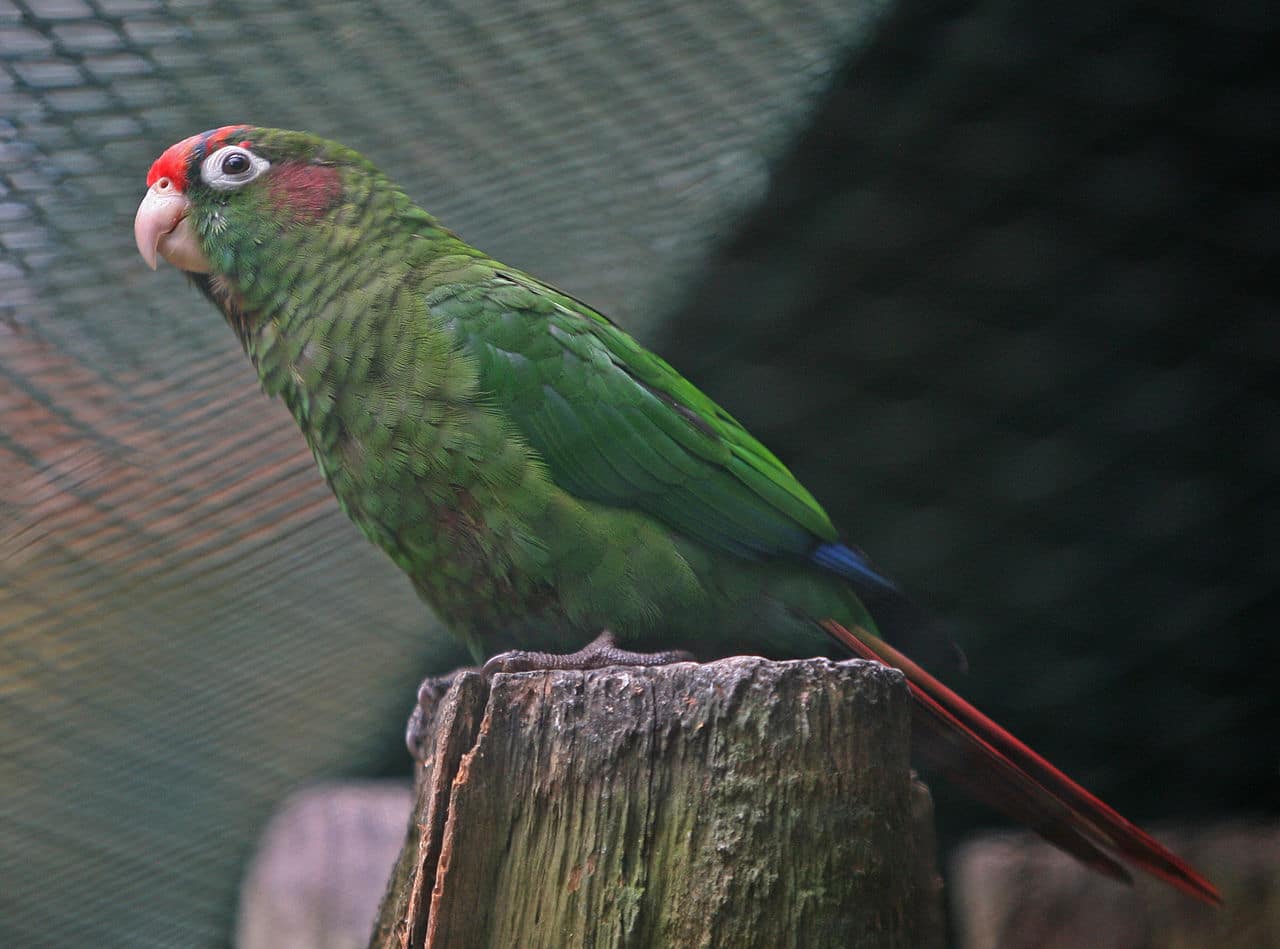
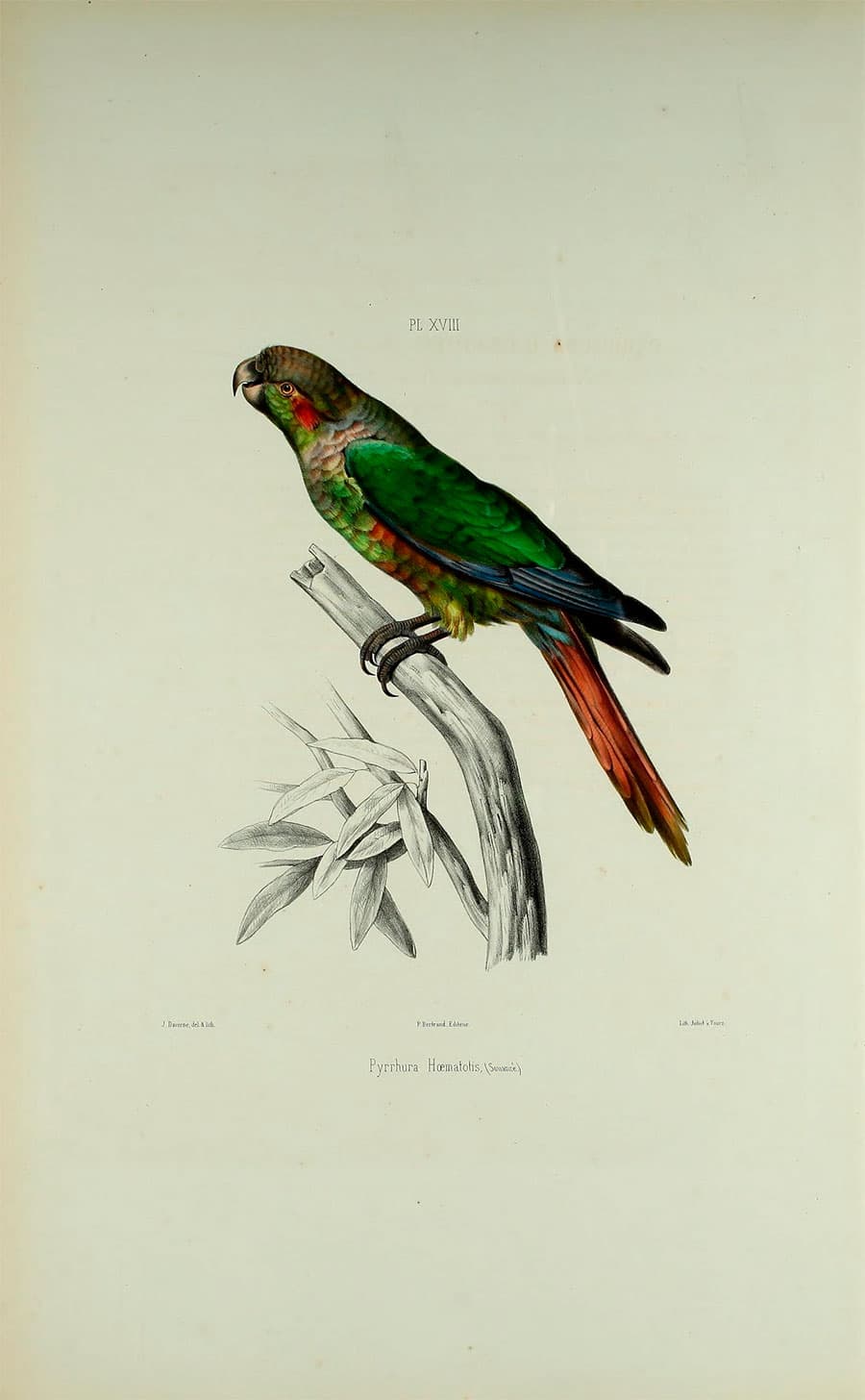
The Red-eared Parakeet (Pyrrhura hoematotis) It is distinguishable by the Brown of the forecrown with edges bluish to them feathers; cheeks green; crown and feathers of nape Green with tips more pale and yellowish. The upperparts green. Primary coverts and maybe some feathers in the area of the carpus, blue; other coverts green. Primaries Blue with black tips. Under wings with the lesser coverts green, the others coverts black. Throat and chest Brown olive with tones dark; margins to some feathers create a pattern squamous; sides neck also with effect squamous; belly and undertail-coverts Green with a patch Brown mal-definido in the center of the belly. Upper, the tail of color brown with tips from color olive; undertail, of color copper. Bill of color bone pink; Iris and legs brown.

Both of them sexes are similar. Immature not described.

Description 2 subspecies:

  • Pyrrhura hoematotis hoematotis

    (Souance, 1857) – Nominal.


  • Pyrrhura hoematotis immarginata

    (Zimmer & Phelps, 1944) – It has a narrow red line above the bill. What nominal but chest and sides of neck more green and with a pickling less obvious. Not there are tips yellowish in the feathers of the crown and nape.

Habitat:

They inhabit in montane and cloud forests with open areas and trees of low dispersion, often at the edge or in clear, mainly in altitudes of 1.000-2.000 m, Although there are report of the species at altitudes between 600 and 2.400 m. It is estimated that he performs altitudinal migrations. Gregaria, mainly seen in groups of 3-12 outside the breeding season, rarely in flocks of up to 100 individuals.

Reproduction:

Probably it breeding season be in the month of August (rainy season).

Food:

Poorly documented diet and breeding: the food known include guava (Psidium) and petioles some leafy trees, possibly to extract larvae of insects.

Distribution:

Size of the area of distribution (reproduction / resident): 14.300 km2

To the Red-eared Parakeet is known only in the coastal mountains north of Venezuela, with the westernmost record observed in Cubiro, Lara, the eastern-most in Miranda. But, Most of the records are from Aragua in Miranda; Cubiro is in fact the only known site in Lara and the population there is apparently discontinuous (subspecies Pyrrhura hoematotis immarginata). Diurnal movements occur from the mountains of the Highlands until the lowest feeding areas; also apparently some local seasonal movements guided by the availability of food.

Fairly common in most of its more restricted range and especially numerous in the Henri Pittier National Park; its status in Lara It is unknown. Much habitat right remains within the range outside the areas protected, and there is a rate of deforestation relatively low, but with constant habitat loss around Cubiro.

Absent or very rare in captivity.

Distribution 2 subspecies:

Conservation:

• Current category of the Red List of the UICN: Least concern.

• Population trend: Decreasing.

Justification of the population

The size of the world population It has not been quantified, but this species is described as «quite common» (Stotz et to the., 1996).

Justification of trend

It is suspected that the population is in decline due to ongoing habitat destruction.

"Red-eared Parakeet" in captivity:

Absent or very rare in captivity.

Alternative names:

Red-eared Parakeet, Blood-eared Conure, Blood-eared Parakeet, Red eared Parakeet, Red-eared Conure (English).
Conure à oreillons, Perriche à oreillons, Perruche à oreillons rouges (French).
Blutohrsittich, Blutohr-Sittich (German).
Tiriba-de-orelha-vermelha (Portuguese).
Cotorra Colirroja, Perico de Cuello Rojo (español).
Perico Cola Roja (Venezuela).

scientific classification:

Order: Psittaciformes
Family: Psittacidae
Genus: Pyrrhura
Scientific name: Pyrrhura hoematotis
Citation: Souancé, 1857
Protonimo: Pyrrhura hoematotis

Red-eared Parakeet images:


Red-eared Parakeet (Pyrrhura hoematotis)


Sources:

  • Avibase
  • Parrots of the World – Forshaw Joseph M
  • Parrots A Guide to the Parrots of the World – Tony Juniper & Mike Parr
  • Birdlife
  • Parrot Book, Parrots and macaws Neotropical

  • Photos:

(1) – Venezuelan endemic Red-eared Parakeet (Pyrrhura hoematotis) photographed in captivity in Mérida, Venezuela By http://www.birdphotos.com (Own work) [CC BY 3.0], via Wikimedia Commons
(2) – Perico tail Red [Blood-eared Parakeet] (Pyrrhura hoematotis hoematotis) Place: The deer, Park national the Avila by barloventomagicoFlickr
(3) – Bando of parrots parakeet place: The deer, Park national Guaraira Repano by barloventomagicoFlickr
(4) – Pyrrhura hoematotis by Diana registerFlickr
(5) – Pyrrhura hoematotis by Diana registerFlickr
(6) – Iconographie des perroquets: Paris :P. Bertrand,1857 by Biodiversity Heritage LibraryFlickr

▷ The world of Pets: Dogs, cats, birds, reptiles, amphibians

Bronze winged Parrot
Pionus chalcopterus


Bronze winged Parrot

Content

Description:

28 to 30 cm.. tall and around 210 weight g.

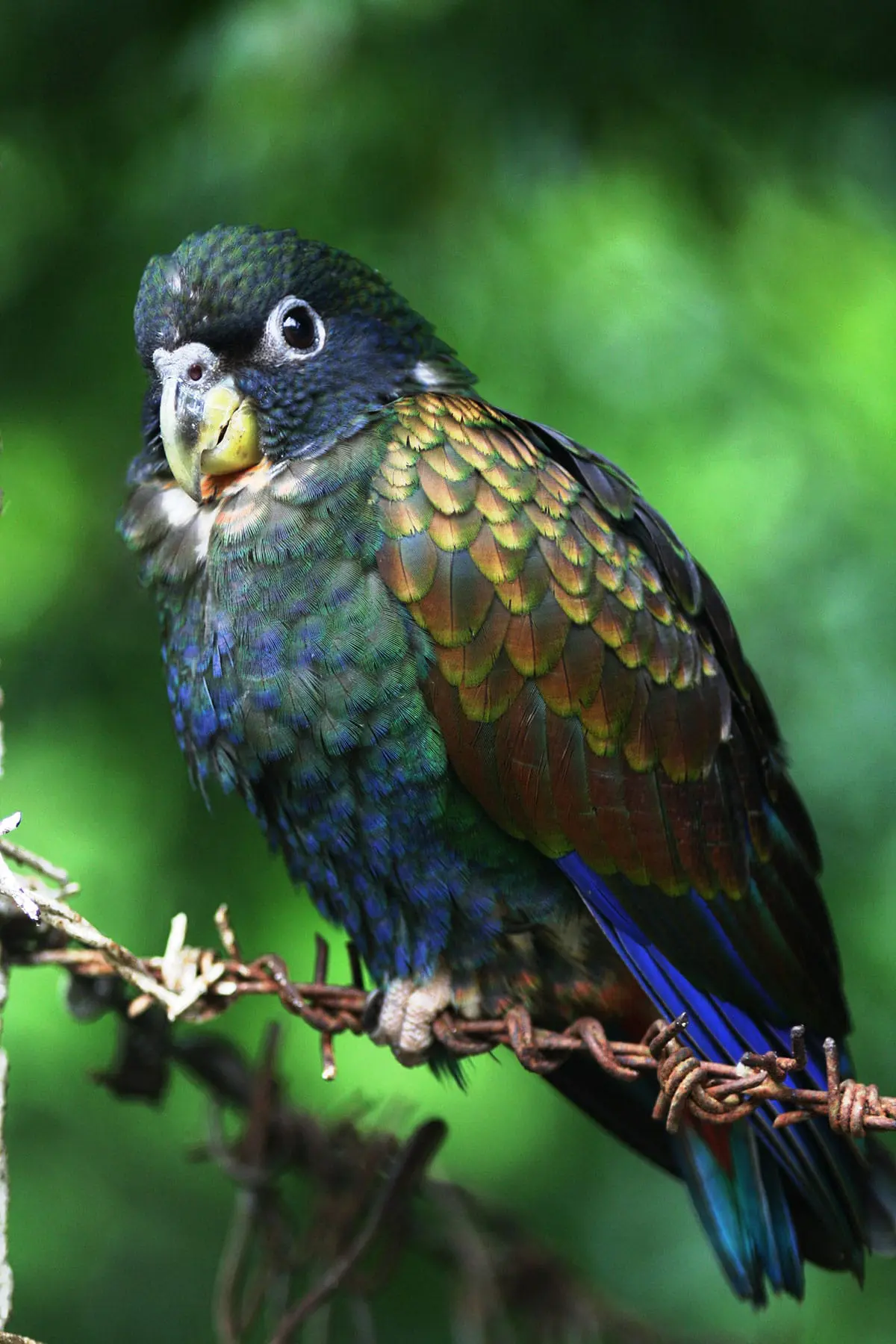
The Bronze winged Parrot (Pionus chalcopterus) has the general Brown, darker in head, neck, chest and flanks, This plumage with blue-violet edge.

The throat whitish and pink; wings bronze green.

Flight is evident violet blue at the top of the wing the Green bottom, that contrasts with the Red of the lower abdomen. Dorsally Violet Blue is notorious in the rump, shoulder and tail. The feathers of the tail are dark blue with a shade of red at the base.

The bill is of color beige, area of naked skin surrounding the eyes of pink. The legs They are pink.

Habitat:

It inhabits in humid jungle, semi-humid, crops and forest edge between 120 and 2800 m.

They are birds gregarious and noisy. Every tomorrow is mobilized in flocks in search of food. Within the flocks are can observe to the couples, that form of life, and who interact with a variety of contact behaviors that reaffirm the marital bond.

Reproduction:

Prefer for their nests broken rods, hollow of logs and palm trees. They nest in the months of October-may. The female often put in two to four eggs they are incubated during three weeks approximately, after which are born them chicks naked or just covered with down. The chicks remain with their parents until the next reproductive shekel.

Food:

Will congregate in cornfields in groups up to of 40 individuals, feeding is of pulp and seeds many fruits and other material ingredients as nectar and flower petals, complementing occasionally its diet with insects.

Distribution:

Its population is distributed by the mountain range of the Andes, from Colombia, Northwest of Venezuela; to the South, by the mountains to the Northwest of Peru.

Conservation:


minor concern


• Red List category of the UICN current: Least concern

• Population trend: Decreasing

The size of the population World of the Bronze winged Parrot It has not been quantified, but this species is described as ‘rare‘ (Stotz et to the., 1996).

The population was suspected of being in decline due to ongoing habitat destruction.

This species is characterized be decreasing in Colombia and West Ecuador, due to the logging of forest subtropical, which has been severe and quick on the slopes of the Andes (Juniper and Parr 1998).

The evident anecdotal, based on the frequency of sightings, suggests that the species has declined in Pineapples, South of Ecuador, in recent years c.15-20 (M. By D Sanchez. Díaz in litt. 2011). Also is says that has been extirpated from areas previously occupied as the slopes of them Andes and valleys of the Cauca and the Magdalena river in Colombia, again due to loss of habitat (Juniper and Parr 1998).

In Venezuela the species is scarce and local, limited, to a large extent, to the slope West of them Andes in Mérida and Sierra de Perija, with occasional records in Táchira (CJ Sharpe in litt. 2011). These areas have experienced rapid deforestation for at least the last few 24 years for cultivation and livestock.

Surveys conducted in the Northwest of Peru in the decade of 1990 they appeared to detect a sharp decrease in population from 1993 (Rosales et to the., 2007), although this species is known to be nomadic and its local numbers can fluctuate.

"Bronze winged Parrot" in captivity:

Rare in captivity, It is not a main target of poachers (CJ Sharpe in litt. 2011, R. Clay in litt. 2011), although it is still present in the illegal trade of Peru (F. Angle in litt. 2011)

Intelligent, playful and curious. You can be nervous, loving with your caregiver and aggressive with other people. It has a tendency to obesity.

It requires a spacious cage unless the bird pass periods of time outside of it. Not must keep is to open air where the temperatures fall below them 5 °C.

With feed a wide variety of seeds, fruits and berries.

It is a relatively healthy bird, While it may be more susceptible to infection aspergillosis that other species.

In captivity they lay two eggs the incubation takes 26 days.

Alternative names:

Bronze winged Parrot, Bronze-winged Parrot (English).
Pione noire, Pionus noir (French).
Glanzflügelpapagei, Glanzflügel-Papagei (German).
Curica-asa-de-bronze (Portuguese).
Cotorra Oscura (Colombia).
Cotorra Negra (Venezuela).
Cotorra Oscura, Loro Alibronceado, Loro de Alas Bronceadas, Cheja alibronceada (español).

scientific classification:

Order: Psittaciformes
Family: Psittacidae
Genus: Pionus
Scientific name: Pionus chalcopterus
Citation: (Fraser, 1841)
Protonimo: Psittacus chalcopterus

Images "Bronze winged Parrot"

Videos "Bronze winged Parrot"

«Loro Alibronceado» (Pionus chalcopterus)

Sources:

  • Avibase
  • Parrots of the World – Forshaw Joseph M
  • Parrots A Guide to the Parrots of the World – Tony Juniper & Mike Parr
  • Birdlife

  • Photos:

(1) – IBC.lynxeds.com
(2) –
(3) –
(4) –
(5) –

▷ The world of Pets: Dogs, cats, birds, reptiles, amphibians

Blue-eared Lory
Eos semilarvata


Lori de Seram

Content

Description

Is the more small of the gender Eos, with only 24 cm.. length and an approximate weight of 170 gr.

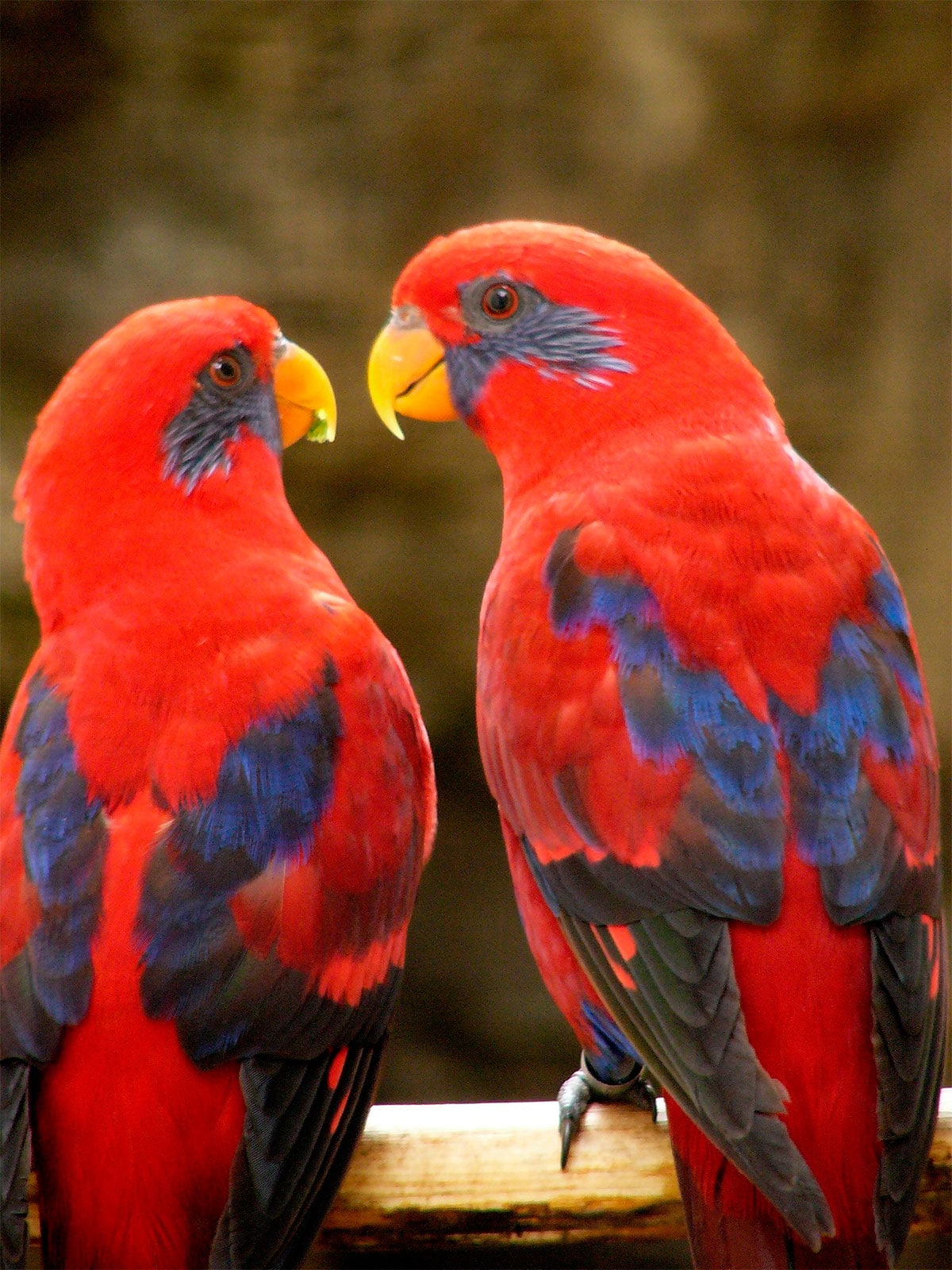
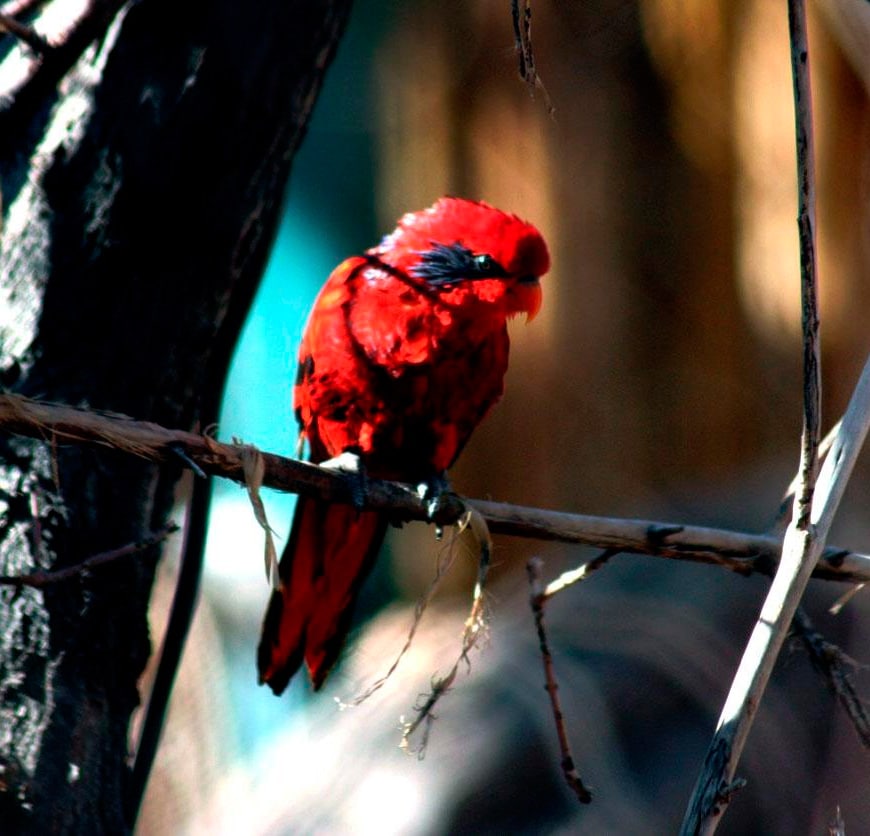
The plumage of the Blue-eared Lory x(Psittacus erithacus) is bright red.

The upperparts of the cheeks and ear-coverts form a band blue violet.

The feathers of abdomen and under the tail are blue, the primaries are black and red color on the inside, the secondaries has black spots, the feathers largest of the shoulder are blue, the back is red-brown, the underparts bright red, their irises are reddish brown, the legs grey and orange red the bill.

The plumage of the youth usually appears paler and duller Red. The mask boils down to a simple pale blue dot under the eye and the mumps. The scapulars are brownish grey with light blue striped uniform. The feathers of abdomen are red with some blue touches. The irises reddish color.

The Blue-eared Lory EOS can be mistaken for other species of the genus, but in its area of distribution, only the Red Lory (Eos Bornea) shows similarity of characters. But, does not display a blue stain in the face or at the bottom of the abdomen.

Habitat:

Frequently not only in primary forests, but also in the Highlands bordering the bare mountain peaks.

This bird usually lives above the 1.200 meters above sea level, area to which the Red Lory (Eos Bornea) fails. But, from time to time is reduced to 800 m, so sometimes they interfere in the same area two species.

The Blue-eared Lory they live alone, in pairs or small family groups.

They feed in the foreign branches of trees in flower.

They are noisy birds in flight, but they are relatively quiet and discrete When feed. When they move they tend to fly at low altitude.

Reproduction:

There is not much information of their reproduction habits in the natural environment. But, It can be assumed that the Red Lory It takes a form of very similar to that of other nesting Loris. These are cavemen, that is to say, you install their nests in tree cavities.

The season of spawning It estimated that the months of September to March.
Usually, they lay two eggs per clutch and its incubation lasts a few 26 days.

Young people are often taken up to 10 weeks before you fly.

Food:

They feed mainly on nectar in the trees in flower in lower altitudes and Heath (Heather, gorse, broom) at higher altitudes.

Distribution:

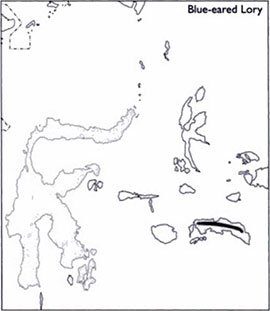
Lori distribution of Seram
The Blue-eared Lory is endemic of the Seram island in the Moluccas (Indonesian).

Conservation:


minor concern

– Current IUCN Red List category: Least concern

– The population trend: Decreasing

The world population It has not been quantified, but the species is estimated that it can range from common to abundant at the local level (pit et to the. 1997). However, justified the population trend, It is suspected to be in decline due to unsustainable levels of exploitation.
The population range is between 5,000 and 50,000 birds released.

Probably the Blue-eared Lory It will always remain a rare specimen in the world of birds.

In March of 1995 the Government of Indonesian stopped the export of these birds.

Its hunting for local trade has become especially intense.. Fortunately, There is no reason to keep to the Blue-eared Lory as a pet on the part of the indigenous population.

"Blue-eared Lory" in captivity:

Since its population is decreasing, any specimen that can not be returned to their natural habitat (natural range) should preferably be placed in a well-managed breeding program to ensure the survival of the species.

Alternative names:

Blue-eared Lory, Ceram Lory, Blue eared Lory, Seram Lory (ingles).
Lori masqué, Lori à oreilles bleues (French).
Halbmaskenlori (German).
Loris Semilarvata (Portuguese).
Lori de Orejas Azul, Lori de Seram (español).

scientific classification:

Order: Psittaciformes
Family: Psittaculidae
Genus: Eos
Scientific name: Eos semilarvata
Citation: Bonaparte, 1850
Protonimo: Eos semilarvata

Images «Lory of Seram»:

Videos "Blue-eared Lory"

————————————————————————————————–

«Lori de Seram» – (Eos semilarvata)


Sources:

Avibase
– BirdLife.org
Oiseaux.NET

Photos:

– Blue-eared Lory in the Walsrode Bird Park, Germany by Quartl – Wikimedia
papageien.org
– Blue-eared Lory (Eos semilarvata) at the San Diego Zoo by Leon Mitchell – Wikipedia
– free-pet-wallpapers.com
kanaria1898tuttlingen.de

Sounds: Mark Todd (Xeno-canto)