▷ The world of Pets: Dogs, cats, birds, reptiles, amphibians

Sulphur-crested cockatoo
Cacatua galerita

Cacatua galerita

Content

Description

55 cm.. height and a weight between 815 and 975 g..
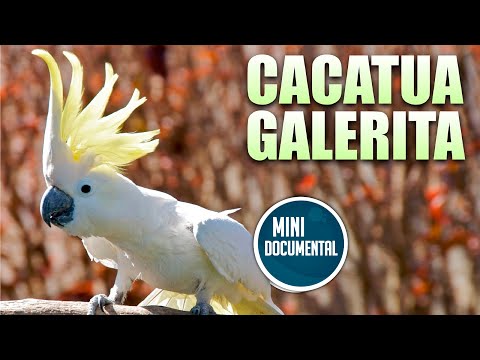
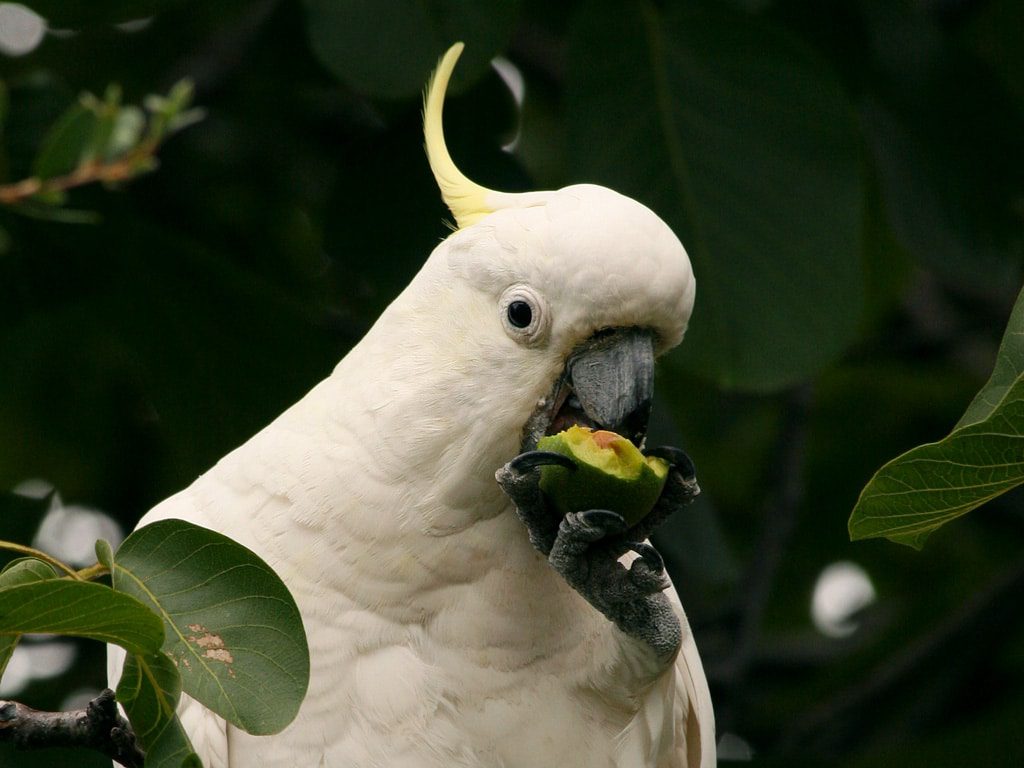
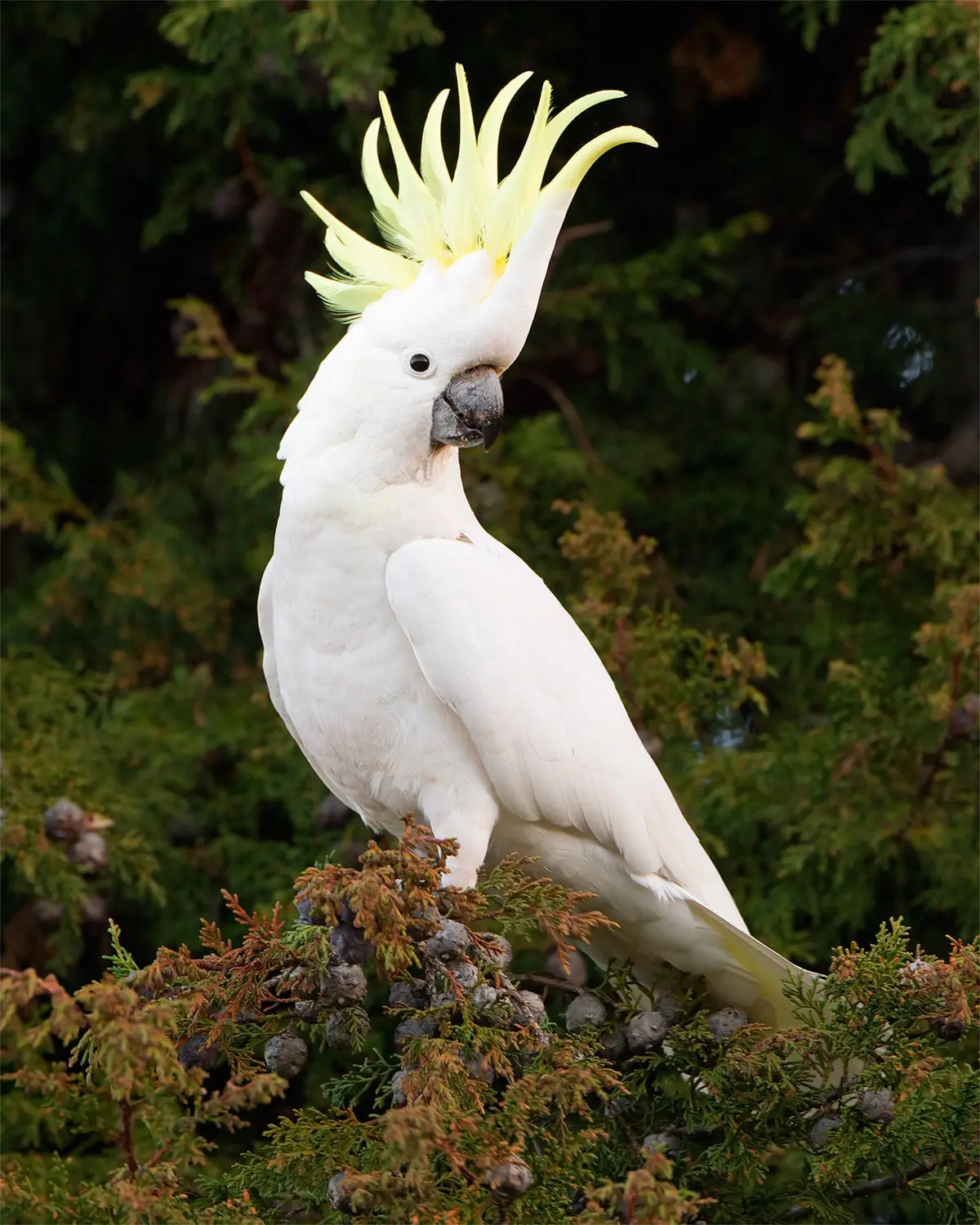
The Sulphur-crested cockatoo (Cacatua galerita) It is a bird with a predominantly white plumage.
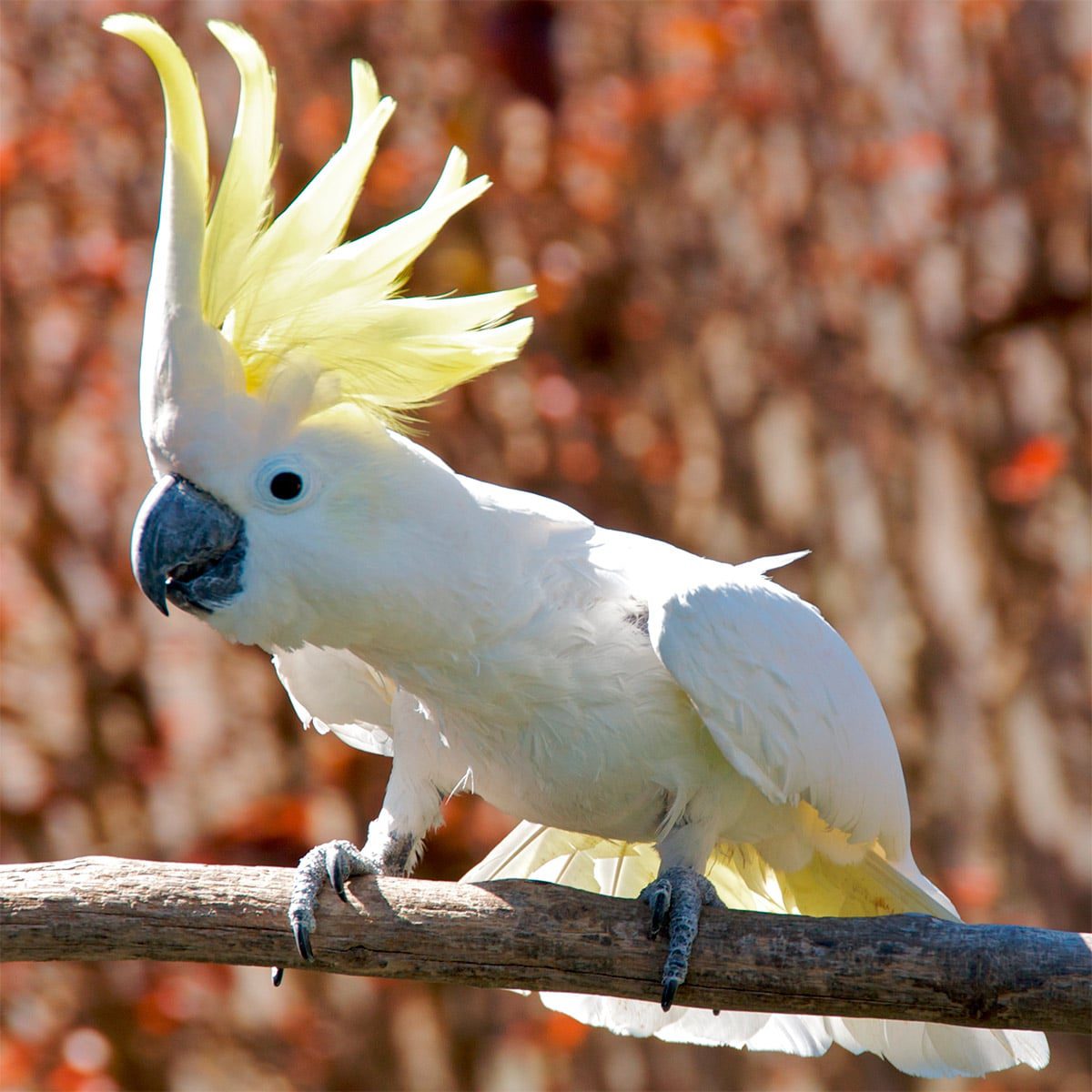
In adults, the ear-coverts, bases feathers throat and cheeks, are pale yellow. the arista formed by the 6 Erectile feathers slightly inclined forward, are yellow. The crest You can reach up 14 centimeters in length. The bottom of the wings and of the tail van dyed pale yellow.
The ring surrounding the eye shows a white. The irises is dark brown in the male and reddish brown in the female. The bill is blackish grey, the legs grey.

The immature They are just different from adults. The irises They are pale brown.

Description 4 subspecies
  • Cacatua galerita eleonora

    (Finsch, 1863) – It's like Cacatua galerita triton but smaller and with bill smaller.


  • Cacatua galerita fitzroyi

    (Mathews, 1912) – Yellowed feathers, both ear-coverts, and the throat and cheeks, they are absent. The eye ring It is light blue. Bill but great.


  • Cacatua galerita galerita

    (Latham, 1790) – Nominal.


  • Cacatua galerita triton

    (Temminck, 1849) – Something smaller, the crest WIDER and eye ring pale blue.

Behavior:

They are very noisy and very easy to observe, Although they are more identifiable by their cries.

During the breeding season, they live in pairs or in small family groups, but the rest of the year, They are in flocks that may contain hundreds of birds.

In the urban areas and in places that they are equipped with feeders, adopt a family behavior.
In other places, It inspired his distrust and his usual prudence, the Sulphur-crested cockatoo they are very difficult to deal with.

In open areas these birds are implementing a sentinel system that is organized as follows: while most of the flock feeds, Some birds seen from a nearby perch and are likely to sound the alarm if danger.

Habitat:

Video – "Sulphur-crested cockatoo" (Cacatua galerita)

Cacatua galerita (mini documentary)

Is located in variety of forest areas, forests (including swamps and river areas), mangroves, Open field, on farm land (including rice fields and plantations of Palm), Savannah, Mallee and suburban areas. Found up to 1.500 meters in parts of Australia, 2.400 metres in Papua New Guinea.

Reproduction:

In Australia, the breeding season occurs from May to August in the North and between August and January, in the South.

In New Guinea, It takes place during every month of the year, although the most active months are during the period from May to December.

This species occasionally breeds in colonies. The nest is a natural cavity in a eucalyptus large near a stream between 3 and 30 meters above the ground. Sometimes the residence of the Sulphur-crested cockatoo It is located in the holes of the limestone cliffs along the murray river. In this case, the eggs are deposited directly in the sand.

In New Zealand, These birds lay amid bales of hay in barns. The nest generally it contains 3 white eggs. These are deposited on a layer of debris decomposing at the bottom of the cavity.
incubate both parents alternately for a period of 30 days. Hatchlings have a yellowish color and leave the nest after 6 to 9 weeks. Quite regularly, they return to the nest to rest for about two weeks.

The juveniles They remain within the family group for several months. They feed together in small scattered groups.

Food:

forages in grasses and herbs. You can take corn and wheat sprouts. It also feeds harmful herbs like cotton thistle. other foods include: estate, Rhizomes, nuts, berries, flowers, bulbs, flower and insect larvae.

They can cause great damage to crops. They dig in lands that were recently planted to eating fruit ripening, It also causes damage to crops that are stored and bales of hay to tear the plastic covering them.

Distribution:

Size of the area of distribution (reproduction / resident): 10600000 km2

This species is endemic to the north and east of Australia, New Guinea and nearby islands, especially islas Aru, Indonesian.
It was imported successfully to Palau Islands in Micronesia, New Zealand and some Maluku islands.

The population in Taiwan It has been estimated at about 100 introduced breeding pairs

Lives mainly below 1.000 m, but sometimes you can see in Australia to 1500 m. and 2000 m in east New Guinea.

Distribution 4 subspecies

Conservation:

State of conservation ⓘ


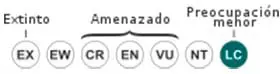
minor concern Minor Concern ⓘ (UICN)ⓘ

• Current category of the Red List of the UICN: Least concern.

• Population trend: In decline.

It is thought that his population It is greater than 500.000 individuals.

It is not an endangered species. But, despite protection Indonesian this species is followed by trapping wild bird trade. Nor is a protected species in Australia, therefore sacrifices occur.

In New Guinea, sometimes it is hunted for its feathers.

It is suspected that his population is in decline due to ongoing habitat destruction.

"Sulphur-crested cockatoo" in captivity:

and valued species often as a pet.
Very Intelligent, sociable and playful. It is a cockatiel for experienced bird owners. You can be dominant and aggressive. It can be very noisy.

There are anecdotal reports of some Sulphur-crested cockatoo who they have lived more than 100 years. In the news, However, longevity record, according to sources, belongs to a captive specimen called "Cocky" who lived more than 57 years in the London Zoo. Another report suggests that these animals can live up 73.0 years in captivity, but this has not been verified.

Alternative names:

– Sulphur-crested Cockatoo, Greater Sulphur-crested Cockatoo, White Cockatoo, Yellow-crested cackatoo (ingles).
– Cacatoès à huppe jaune, Grand Cacatoès à huppe jaune (French).
– Gelbhaubenkakadu (German).
– Cacatua-de-crista-amarela (Portuguese).
– Cacatúa de Moño Amarillo, Cacatúa Galerita (español).
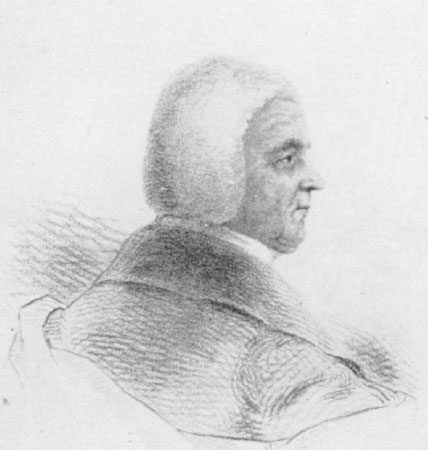
John Latham
John Latham

scientific classification:


– Order: Psittaciformes
– Family: Cacatuidae
– Genus: Cockatoo
– Scientific name: Cacatua galerita
– Citation: (Latham, 1790)
– Protonimo: parrot galeritns


Images Galerita Cockatoo:


Species of the genus Cacatua
  • Cacatua tenuirostris
  • Cacatua pastinator
  • —- Cacatua pastinator derbyi
  • —- Cacatua pastinator pastinator
  • Cacatua sanguinea
  • —- Cacatua sanguinea gymnopis
  • —- Cacatua sanguinea normantoni
  • —- Cacatua sanguinea sanguinea
  • —- Cacatua sanguinea transfreta
  • —- Cacatua sanguinea westralensis
  • Cacatua goffiniana
  • Cacatua ducorpsii
  • Cacatua haematuropygia
  • Cacatua galerita
  • —- Cacatua galerita eleonora
  • —- Cacatua galerita fitzroyi
  • —- Cacatua galerita galerita
  • —- Cacatua galerita triton
  • Cacatua ophthalmica
  • Cacatua sulphurea
  • —- Cacatua sulphurea abbotti
  • —- Cacatua sulphurea citrinocristata
  • —- Cacatua sulphurea parvula
  • —- Cacatua sulphurea sulphurea
  • Cacatua moluccensis
  • Cacatua alba

  • Sources:

    – Avibase
    – Parrots of the World – Forshaw Joseph M
    – Parrots A Guide to the Parrots of the World – Tony Juniper & Mike Parr
    – Birdlife

    – Photos:

    (1) – commons.wikimedia.org
    (2) – birdsandbirds.com
    (3) – tilcheff

    – Sounds: Hans Matheve (Xeno-canto)

    ▷ The world of Pets: Dogs, cats, birds, reptiles, amphibians

    Blue fronted Parrot
    Amazona aestiva


    Blue fronted Parrot

    Content

    Description

    33-39 cm.. height and weight around the 450 and 550 g..

    The Blue fronted Parrot (Amazona aestiva) is distinguished by yellow head, with blue-green forehead and cheek, Dark nostrils, Red shoulders outlined with yellow, wing with red patch and dark blue ends. Rest of the usually green body, more clear towards the belly and tail.

    • The subspecies Amazona aestiva xanthopteryx of Bolivia, has more extensive yellow face and the shoulder is mostly yellow with a small red patch.

    • The subspecies A. to. xanthopteryx (Yellow wing Amazon): Wing coverts of the shoulder area almost exclusively yellow and, in general, creating a stain of greater extension. – From the southwest of Mato Grosso, Brazil, North and East of Bolivia, Paraguay and northern Argentina


    Anatomy-parrots

    In young coloration is generally more off. The blue and yellow practically do not exist and the iris is dark

    Habitat:

    Video – "Blue fronted Parrot"

    AVES - The Amazon Aestiva, one of the most popular and talkative parrots

    Lives in humid forests, Savanna, gallery forest, areas planted with trees and forest with palms, up to 1600m.

    Common in pairs or flocks, they have many individuals community roosts.
    In this species the sex of the specimens is not distinguished at a glance.

    Reproduction:

    It nests in holes in large trees.

    Breeds between October and March.

    The implementation is usually of 3 eggs, and incubation lasts approximately 25 days. Chicks leave the nest to the 60 days.

    Food:

    Its food consists of fruit, berries, nuts, leaves and seeds.

    Distribution:

    Amazon Frentiazul location

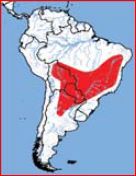
    Interior of South America, from the North-East of Brazil, East of Bolivia, Paraguay, to the North of Argentina.

    Conservation:

    Not considered under any threat category globally.

    State of conservation ⓘ


    minor concern Minor Concern ⓘ (UICN)ⓘ

    Protected by the Convention CITES, consisting in annex II (species that may be threatened by a trade out of control).
    It is a fairly widespread species in their area of distribution and is considered to have a stable population. However, numbers are declining rapidly in some areas due to capture for trade (both legal and illegal), and to other problems such as the destruction of their habitat and human pressure. Another problem affecting the species is that the average age of populations that exist in freedom is not known.

    Blue fronted Parrot in captivity:

    He is very smart, curious and loving. They are very sociable and gets along very well with children.

    It is one of the best imitators that exist within the group psittacine after grays.
    With its strong beak, as any Parrot, She likes chewing everything that gets you ahead. So, newcomer to our home, It is necessary to pay close attention.

    It has a social behaviour so it is important to look for a partner. A large aviary and the possibility of going out every day are necessary.
    If it feels threatened, It opens its wings between loud cries and wild-eyed.
    Water love it. Released, When it rains, enjoy, in the rain, with open wings. The ideal humidity for a Blue fronted Parrot is of the 60-70%, which is impossible in an apartment during the winters in the heat of radiators. It is therefore necessary the use of humidifiers.

    The staple food is made up of different types of nuts, sunflower seeds, pumpkin seeds, corn, wheat, etc. Important for a healthy diet are fruits and vegetables. These must be offered fresh every day.
    Just before the breeding season, our birds must be provided with foods rich in calcium and protein, for example egg cooked.
    Multivitamin supplements complete proper nutrition.

    The female lays two to five eggs that incubate for an approximate period of 25 to 28 days.

    Alternative names:

    – Blue fronted Parrot, Blue-fronted Amazon, Blue-fronted Parrot, Turquoise-fronted Amazon, Turquoise-fronted Parrot (English).
    – Amazone à front bleu (French).
    – Blaustirnamazone, Rotbugamazone (German).
    – Papagaio-verdadeiro, papagaio-colareiro, papagaio-comum, papagaio-curau (Portuguese).
    – Amazona Frentiazul, Amazona Sudamericana, Loro hablador, Lora frente azul (español).

    scientific classification:

    – Order: Psittaciformes
    – Family: Psittacidae
    – Genus: Amazona
    – Scientific name: Amazona aestiva
    – Citation: (Linnaeus, 1758)
    – Protonimo: Psittacus aestivus


    Species of the genus Amazona


    Sources:
    – Parrot Book, Parrots and macaws Neotropical
    – avibase
    – SEO.org
    – Photo: birdnest
    – Sounds: Diego Caiafa

    ▷ The world of Pets: Dogs, cats, birds, reptiles, amphibians

    Black-capped Lory
    Lorius lory

    Tricolor loris

    Content

    Description

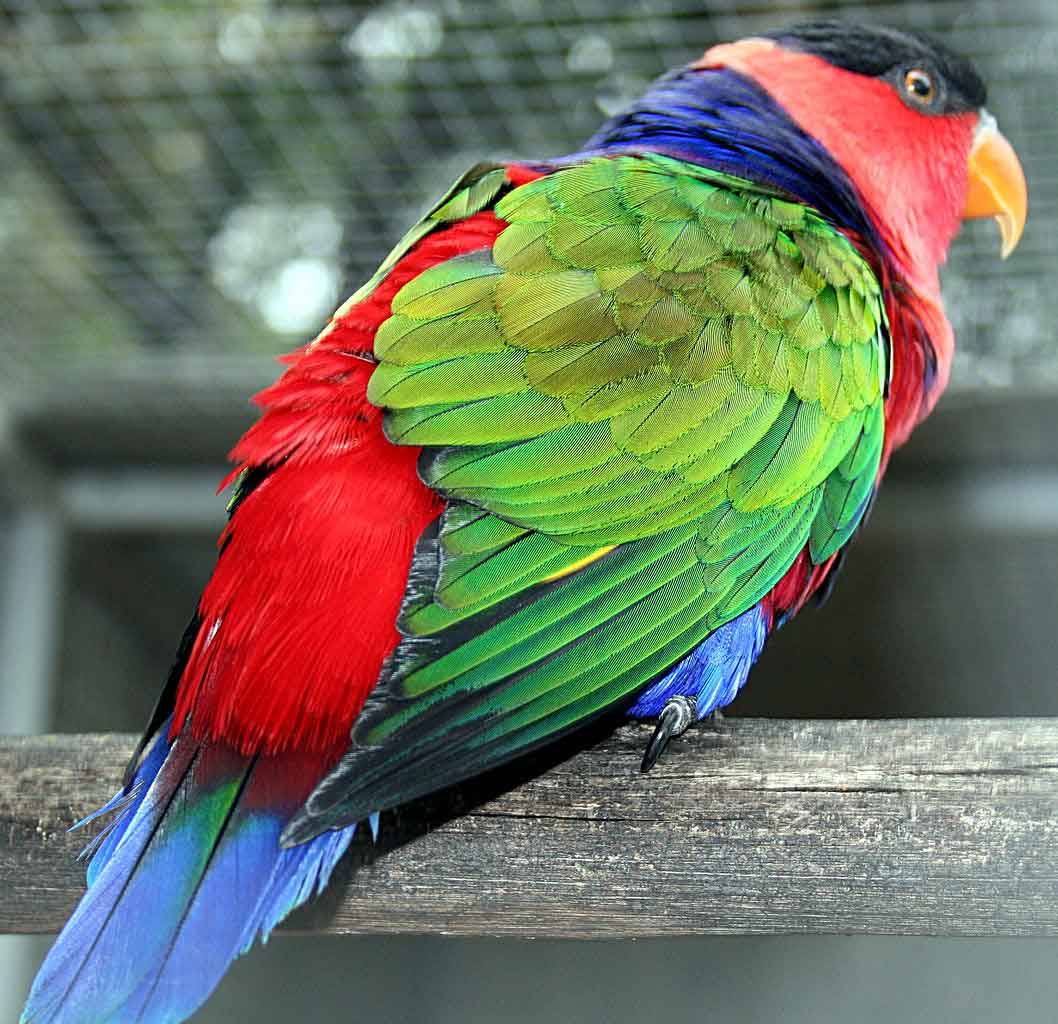
    The Black-capped Lory (Lorius lory) has an approximate length of 31 cm.. and a weight between 200 and 260 g..

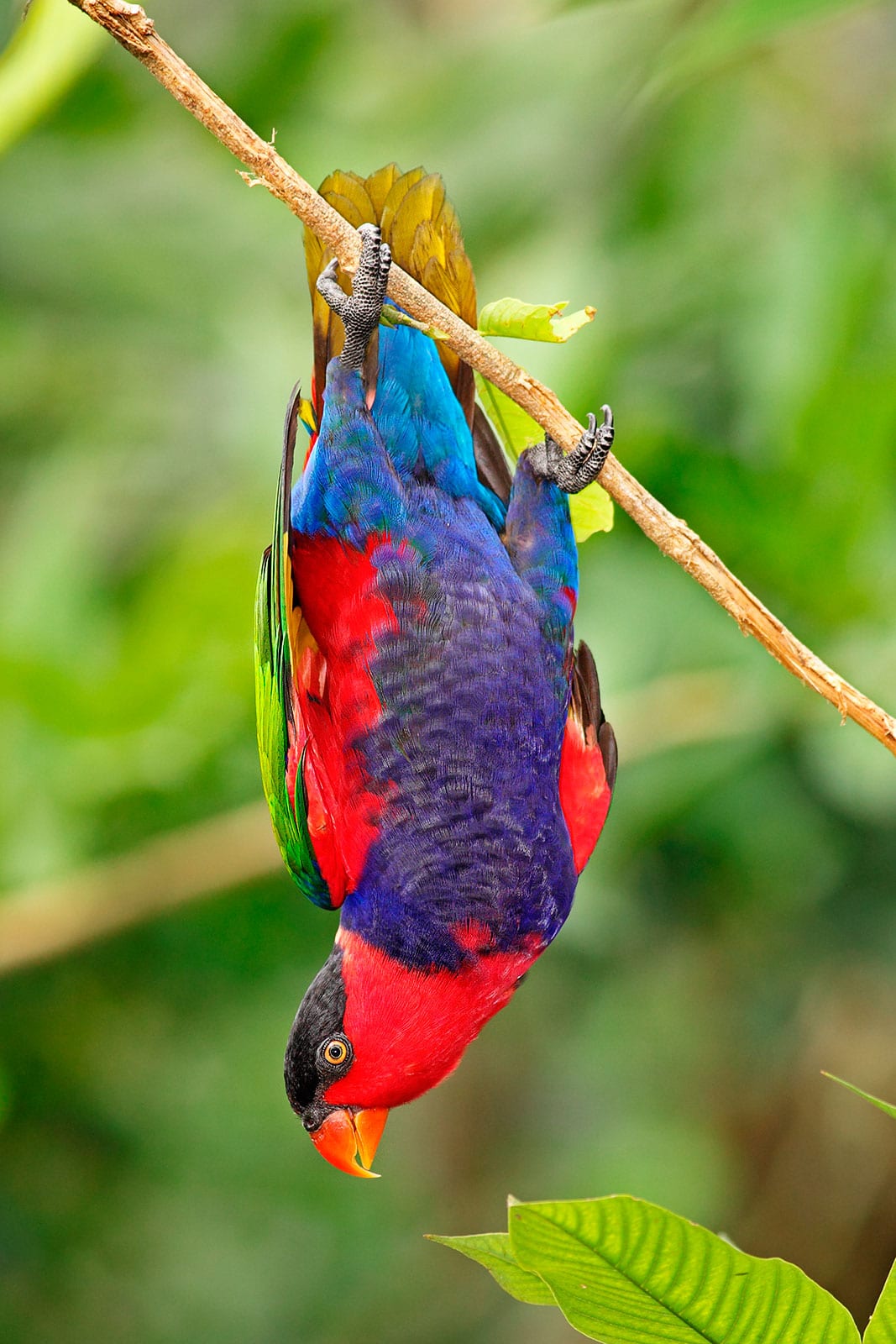
    Black hood extends above the peak to the nape of the neck, where a few blue spots appear; rest of the head is bright red. The black hood is separated from the rear mantle red pink (sometimes mottled red), by a fine necklace of dark purple blue; back, the upper coverts bright red tail and rump.

    Upper parts of green color with slight shine bronze wing, more visible on the coverts and secondary more internal.

    Flight feathers of black on the inside and marked with yellow in the middle part, forming the group a tricolour in the Underwing. Red Wing coverts.

    Throat and upper part of the chest of Red; Blue mantle extends around the sides of the chest, dark blue in the abdomen that is slightly brighter in thighs and coverts; flanks with varying amounts of Red ranging upward and around the curve of the wing.

    Dark bluish black on the upper tail feathers, Green slightly sieved in the Centre and Red at the base (It shows only dark blue at rest); Yellow undertail dark Olive with red hidden base.

    Orange peak; Cere and grey-black periophthalmic ring; orange-yellow IRIS; grey to black legs.

    Males and females they are the same. Immature with less extensive blue underparts and the upper part of the chest of color red wine. Fine blue collar around throat. Underwing coverts blue and yellow with a black tip, not red as in adults. Brownish beak.

    Subspecies vary considerably in color:

    • Lorius lory lory: It is the nominal
    • Lorius lory erythrothorax: Neck and central area of blue belly. Yellow in the wings. Blue mantle in two bands. Red Underwing coverts.
    • Lorius lory SOMU: Red neck, blue belly.
    • Lorius lory salvadorii: As the erythrothorax but with blue-black Underwing coverts.
    • Lorius lory viridicrissalis: As the salvadorii but the blue darker everywhere.
    • Lorius lory jobiensis: As the salvadorii but top of the paler breast and mantle bands.
    • Lorius lory cyanuchen: Black on the top with blue on the nape of the neck.

    Habitat:

    The Black-capped Lory he prefers the primary forests and edges of these, They also reported in secondary forests well grown, in some partially cleared areas and swamp forest. It is not known to occur in the monsoon forest, planted forests or plantations of coconut trees. The Black-capped Lory is mainly distributed in the lowlands up to 1.000 m, but there have been examples to 1.750 m.

    They are mainly found in pairs and usually smaller than other groups parrots sympatric, but it may happen that they get together in groups of ten or more to feed in trees in flower.

    Reproduction:

    Little is known of its breeding ecology in the wild., Although there is a history of a couple digging a pit to make the nest in a dead tree. Apparently the nesting occurs from the month of may until October.

    In captivity, the setting is two eggs with 26 incubation days; emancipation occurs between 57 and 70 days after hatching.

    Food:

    The diet includes pollen, nectar, flowers, fruits and insects. The birds prefer to feed in the canopy or half-height where they remain quiet and discrete. Unlike in the Coconut Lorikeet and the Dusky lory, It reached generally similar maximum altitudes, This species has been able to adapt to secondary habitats in high levels in the East of New Guinea.

    Distribution:

    Widely distributed from the West of Irian Java (Indonesian), including Waigeo, Batanta, Salawati and Misool in the Group of islands west of papua and Yapen, My Num. They are also found in the Biak island on bahía de Geelvink, (It is from Papua New Guinea).

    It is quite common in the lowlands and foothills.. Top world population to the 100.000 individuals.

    Subspecies distribution:

    • Lorius lory lory: It is the nominal.
    • Lorius lory erythrothorax: The South coast of New Guinea east of the peninsula Bird’s Head, and to the southeast of the North Coast.
    • Lorius lory SOMU: Mountain districts in the South of the center of New Guinea.
    • Lorius lory salvadorii: Northwest Coast of Papua New Guinea.
    • Lorius lory viridicrissalis: Northeast coast of Western New Guinea.
    • Lorius lory jobiensis: Islands Yapen and My Num.
    • Lorius lory cyanuchen: Biak Island.

    Conservation:


    minor concern


    • Current IUCN Red List category: Least concern

    • Population trend: Stable


    The world's population has not been quantified, but the species has been observed that it is, usually, common, but not abundant throughout its area of distribution.

    Suspected that the population is stable in the absence of evidence of any reduction or substantial threats.


    "Black-capped Lory" in captivity:

    It has attractive voice and can learn to imitate. Playful and curious; It can be noisy at times.

    Common up to the decade of 1960 When exports began to cease.

    Alternative names:

    – Black-capped Lory, Black capped Lory, Tricolored Lory, Tricoloured Lory, Western Black-capped Lory (ingles).
    – Lori tricolore, Lori à calotte noire (French).
    – Frauenlori (German).
    – Lóris-bailarino (Portuguese).
    – Lori Tricolor, Tricogloso Tricolor (español).

    scientific classification:

    – Order: Psittaciformes
    – Family: Psittaculidae
    – Scientific name: Lorius lory
    – Citation: (Linnaeus, 1758)
    – Protonimo: Psittacus Lory

    “Tricolor Lory” Images:

    Videos "Black-capped Lory"

    ————————————————————————————————

    "Lori Tricolor" (Lorius lory)


    Sources:

    – Avibase
    – Parrots of the World – Forshaw Joseph M
    – Parrots A Guide to the Parrots of the World – Tony Juniper & Mike Parr
    – Birdlife

    – Photos:

    1 – By Michael Spencer [CC BY 2.0], via Wikimedia Commons
    2 – «Lorius lory – Bird Park, Singapore – upside down-8a» by Benjamint444 – Own work. Licensed under GFDL 1.2 via Wikimedia Commons.
    3 – «Lorius lory-20051118» by Doug Janson – Own work. Licensed under CC BY-SA 3.0 via Wikimedia Commons.
    4 – By René Modery (originally posted to Flickr as CIMG6207) [CC BY 2.0], via Wikimedia Commons
    5 – VJ Czar World – Black-capped Lory Snapshots

    – Sounds: Frank Lambert (Xeno-canto(

    ▷ The world of Pets: Dogs, cats, birds, reptiles, amphibians

    Finsch's Pygmy-Parrot
    Micropsitta finschii

    Finsch's Pygmy-Parrot

    Content


    Anatomy-parrots

    Description

    9,5 cm. length between 12 and 18 g. of weight.

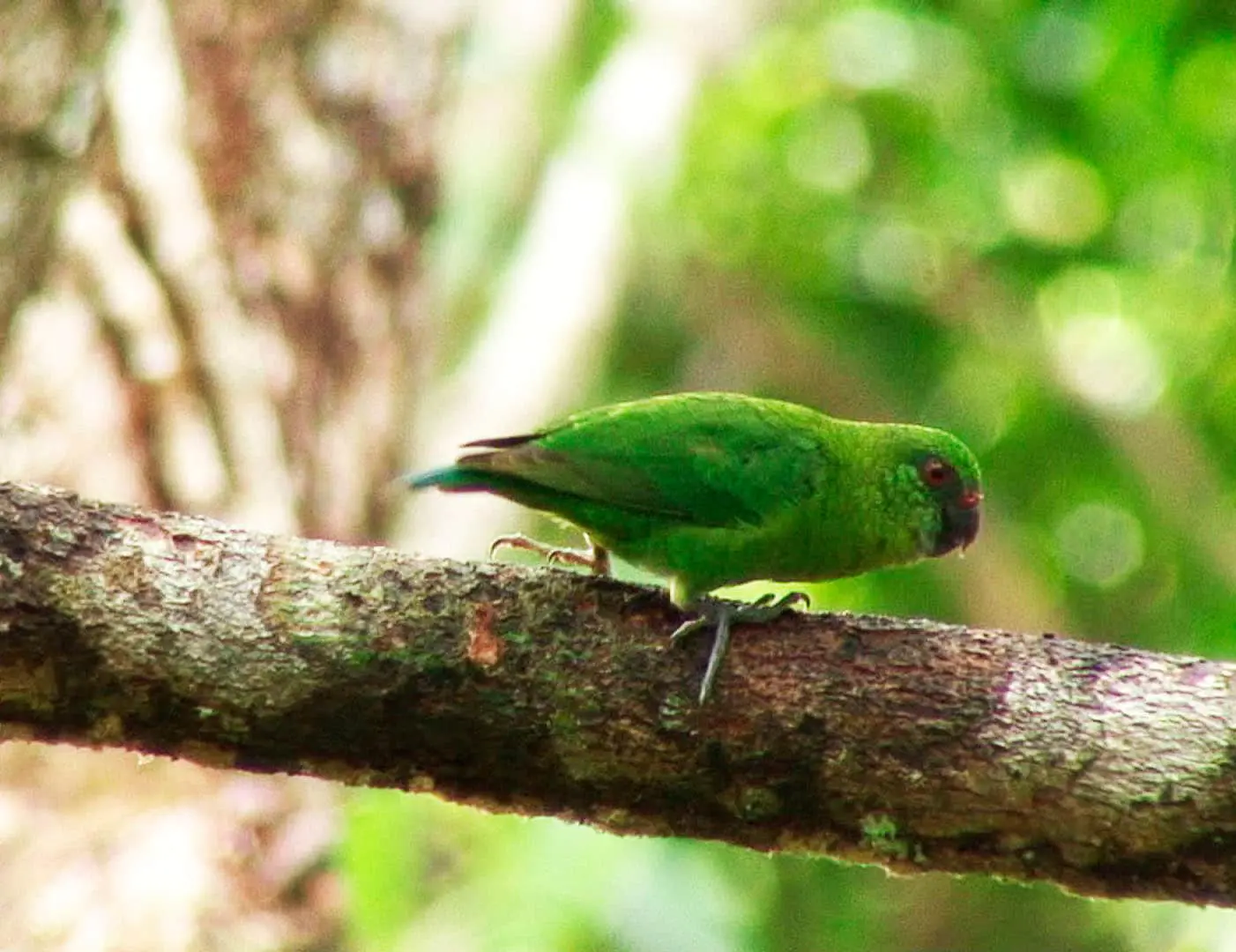
    The head of the Finsch's Pygmy-Parrot (Micropsitta finschii) is bright green, slightly yellowish, dotted with pale blue in the chin and throat. Upperparts bright green, with fine darker stripes. The flight feather they are black with fine green edges; wing feathers greenish yellow. The underparts pale yellowish green with fine darker stripes and feather in the center of the belly orange-red; uppertail-coverts yellow, the longest with bluish-green tips. Upper, the tail is off blue, Black in the Center and sides with blue and yellow tips; below, the tail is black with yellow tips.

    Bill blackish; cere Pink ; irises orange red; legs grey.

    Cere rose in the male, grey in the female. The females they lack the red marks in the underparts and they have pink feathers, not blue, on chin.

    Immature with bill grayish and reddish brown, not orange-red, the irises.

    In the juvenile birds the cere is greyish in both sexes. Males immature of the species nominal lack of the chin Blue and red markings in the abdomen.

    Subspecies description

    Description 5 subspecies
    • Micropsitta finschii finschii

      (EP Ramsay, 1881) – The nominal.


    • Micropsitta finschii nanina

      (Tristram, 1891) – The adults have a stain blue in the part superior of the crown.


    • Micropsitta finschii viridifrons

      (Rothschild & ECTION Hartert, 1899) – Adults have a large blue spot at the top of the crown and blue tones to the sides of the face.


    • Micropsitta finschii tristami

      (Rothschild & ECTION Hartert, 1902) – Adults do not have blue spots and orange


    • Micropsitta finschii aolae

      (Ogilvie-Grant, 1888) – adults have the upperparts darker and have a blue spot on the top of the crown.

    Habitat:

    Finsch's Pygmy-Parrot

    Most common in lowland primary forest at mid-altitude, are observed to the 900 meters above sea level (lower boundary of cloud forests where they are replaced by the Red-breasted Pygmy-Parrot, but they are distributed in a variety of habitats, including weed gardens, casuarinas, secondary growth, areas of open scrubland and occasionally coconut (Cocoa nuts). It's a vociferous and active species, difficult to observe. They are alone, in pairs or in groups of 3 to 6 birds. They feed on acrobatic form, down with your head upside down and using their tails as support on the bark of the trees.

    Reproduction:

    One to two eggs are deposited by the female in an excavated cavity over a period of several weeks in an active tree termite nest. (that is also used for the rest). Adults were observed with young in January 1995 in the South of New Ireland. The breeding period It speculates that may be between March and Mayo.

    Food:

    Peck the trunks and branches of the tree tops and medium height plants to glean lichens and fungi, also noticed them is feeding of seeds of casuarina.

    Distribution:

    Are found in the Bismarck Archipelago including New Hanover, Tabar, Lihir and New Ireland, through Bougainville in the Solomon Islands in Choiseul, Santa Isabel, Malaita, Vella Lavella, Gizo, Kolombangara, New Georgia, Rendova, the Russell Islands, the Islands of Florida, Nggela Sule, Guadalcanal, Uki and San Cristóbal.

    Subspecies distribution:

    Distribution 5 subspecies

    Conservation:


    minor concern


    • Current IUCN Red List category: Least concern

    • Population trend: Stable

    The size of the world population It has not been quantified, supposedly above 100.000 specimens. The species according to sources, It is abundant within its range (pit et to the. 1997).

    The population is suspected to be stable in the absence of evidence of any reduction or substantial threats.


    In captivity:

    Not found in captivity.
    This species has only been kept alive for short periods in captivity.; new birds may refuse foods completely.

    Alternative names:

    – Finsch’s Pygmy-Parrot, Emerald Pygmy Parrot, Finsch’s Pygmy Parrot, Green Pygmy Parrot, Green Pygmy-Parrot (ingles).
    – Micropsitte de Finsch (francés).
    – Salomonenspechtpapagei, Salomonen-Spechtpapagei (alemán).
    – Micropsitta finschii (portugués).
    – Microloro de Finsch (español).

    scientific classification:

    – Order: Psittaciformes
    – Family: Psittaculidae
    – Scientific name: Micropsitta finschii
    – Genus: Meeki
    – Citation: (Ramsay,EP, 1881)
    – Protonimo: Nasiterna Finschii

    Images "Finsch's Pygmy-Parrot"

    Videos "Finsch's Pygmy-Parrot"

    ————————————————————————————————

    «Finsch microlore» (Micropsitta finschii)


    Sources:

    – Avibase
    – Parrots of the World – Forshaw Joseph M
    – Parrots A Guide to the Parrots of the World – Tony Juniper & Mike Parr
    – Birdlife
    – Wikipedia

    – Photos:

    (1) – A bird foraging on a trunk by Josep del Hoyo – lynx
    (2) – Parrots of the World – Forshaw Joseph M

    – Sounds: Mark Todd (Xeno-canto)

    ▷ The world of Pets: Dogs, cats, birds, reptiles, amphibians

    Gray-headed Lovebird
    Agapornis canus


    Gray-headed Lovebird

    Content

    Description:

    Gray-headed Lovebird

    From between 13 and 15 cm in length and a weight between 25 and 31 g..

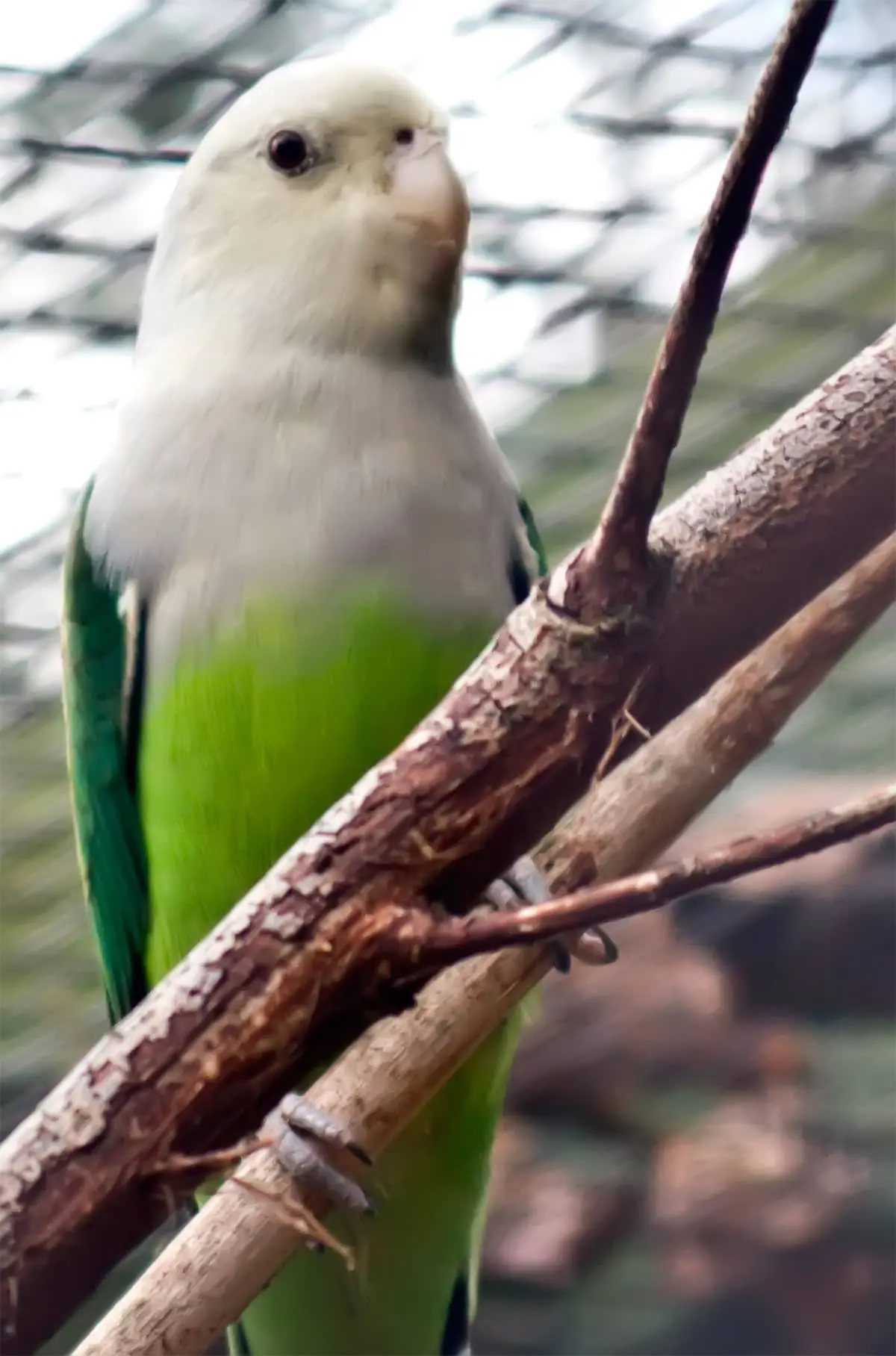
    The Gray-headed Lovebird (Agapornis canus) has the head and the neck pale grey. Mantle and green scapulars; rump with a much brighter green than the rest of the tops. Upper, the wing-coverts green, alula dark. Flight feathers green above, darker towards tip and margins to the vane outer; grayish brown below. Under, the wing-coverts black. The throat to the top of the chest pale grey; low area chest up to the undertail- coverts pale yellowish green. Upper, the tail green, by bright side, with broad subterminal black band; undertail, the tail greenish-grey.

    The upper jaw bluish white, the lower white pink; irises dark brown; legs pale grey.

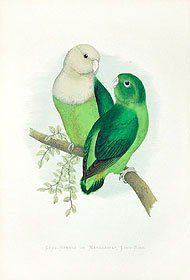
    The female has the head, neck and chest green; upperparts sometimes more brown than the male. Under, the wing-coverts green.

    The immature adults resemble, but the gray hood the male is steeped in green, especially in the nape; bill yellow with black on the basis of upper jaw.

    Subspecies description:


    It notes that within the species Grey-headed Lovebird, given the presence of 2 subspecies, which are Agapornis canus canus (Gmelin); Agapornis canus ablectaneus (Bangs); However, not known no kind of mutation, What is something special in this genre, as usually, each species has different mutations, you change the color of its plumage.

    • Agapornis canus ablectaneus (Bangs, 1918) – Greener (less yellowish) below, head violet gray con held tinkles.

    • Agapornis canus canus (Gmelin, 1788) – The nominal species

    Habitat:

    In Madagascar They are in some wooded areas, palm savannas, forest edges, degraded forests, bush and farmland and rice paddies to altitudes 1.500 m. Use the clear in the dense forest along the mountainsides.

    Observed in the vicinity of cities and towns and, often seen on the roads. Introduced populations show similar habitat preferences.

    gregarious, usually in flocks of up to 50 birds, being able to concentrate in greater numbers in areas where food is abundant, sometimes it partnering with Madagascar Red Fody (Foudia madagascariensis), the Sakalava Weaver (Ploceus sakalava) or the Madagascar Munia (Lepidopygia nana). They often gather at communal roosts in the bare branches.

    Sedentary.

    Reproduction:

    The nests of the Gray-headed Lovebird are treeholes; Inside the hole is lined with fragments of chewed leaves or wood chips and stalks of grass worn by females between body feathers.

    Nesting They were recorded in the months of November and December in Madagascar. Probably they breed during the rainy season (November–April) in Comoros.

    The laying is of 4-5 eggs, but up to eight they have been recorded in captivity.

    The incubation, probably, the female performs single, lasts a few 23 days and the young leave the nest after about forty days.

    Food:

    The diet Gray-headed Lovebird consists, mainly, of grass seeds.

    In Seychelles They have a preference for the crop pasto guinea (Megathyrsus maximus); in the Comoros islands by flower buds Stenotaphrum. They also eat rice out to dry around the villages and farms.

    Distribution:

    Madagascar It is the natural range of the Gray-headed Lovebird, where usually are common, especially in coastal regions, but today they are rare in eastern and absent or scarce in the central plateau.

    Introduced Comoros, Seychelles, Rodrigues, Meeting, Mauritius, Zanzibar and Mafia; apparently missing on the last three islands and only a small number on Rodrigues and Meeting, but widespread and generally common in Comoros.

    In Seychelles, initially established extensively in Mahe but now confined to the suburbs around Victoria and some towns of the West Coast; small town, according to sources, in Silhouette.

    Attempts to introduce them to other islands and in Africa have failed.

    Subspecies distribution:

    • Agapornis canus ablectaneus (Bangs, 1918) – Arid lowlands of southwestern Madagascar, intergrades the species nominal about Beth kopaka and Ankavandra

    • Agapornis canus canus (Gmelin, 1788) – The nominal species

    Conservation:


    minor concern

    • Current Red List of UICN: Least concern

    • Population trend: Stable

    The size of the world population Gray-headed Lovebird It has not been quantified, but the species, according to sources, It common and it is generally Extended. (pit et to the. 1997).

    The population is suspected to be stable in the absence of evidence of any reduction or substantial threats.

    The species has undergone intense trade: from 1981 when it was listed in Appendix II of CITES, 107,829 wild-caught individuals They were recorded in international trade (UNEP-WCMC CITES Trade Database, January 2005).

    After a total ban on exports from Madagascar, in recent years it has been possible to have some imported specimens.
    ,

    "Gray-headed Lovebird" in captivity:

    The Gray-headed Lovebird they are very rarely seen in captivity, Since this species it is not widespread today.

    The Gray-headed Lovebird It is a pretty bird silent; active; often shy and elusive; Just get used to his caregiver patiently and in a gradual manner; newly imported birds, initially they are very susceptible; reared in aviaries not usually give complications; It hard chewer; enjoy bath; his voice is not too loud; communal aviary is not recommended because its something rowdiness; He tolerates only birds of the same species in large aviaries where you can implement your flight.

    With regard to its longevity, they can live between 10 and 20 years.

    Alternative names:

    – Gray-headed Lovebird, Gray headed Lovebird, Grey headed Lovebird, Grey-headed Lovebird, Madagascar Lovebird (English).
    – Inséparable à tête grise, Inséparable cana (French).
    – Grauköpfchen, Grauköpchen (German).
    – Inseparável-de-faces-cinzentas (Portuguese).
    – Inseparable de Cabeza Gris, Inseparable Malgache, Agapornis Cana, Inseparable de Madagascar (español).


    scientific classification:

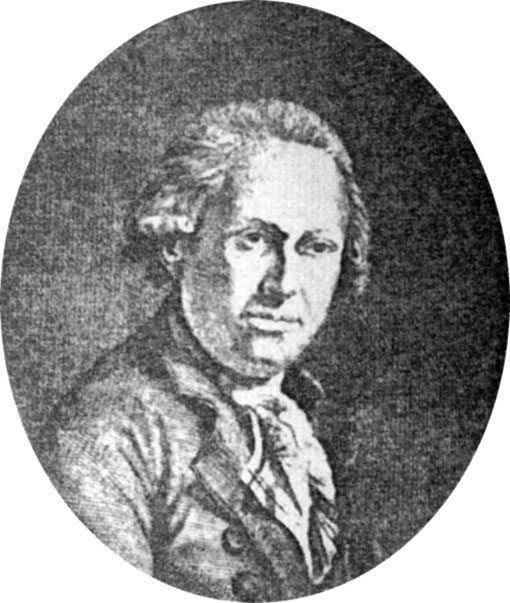
    Gmelin Johann Friedrich
    Gmelin Johann Friedrich

    – Order: Psittaciformes
    – Family: Psittaculidae
    – Genus: Lovebirds
    – Scientific name: Agapornis canus
    – Citation: (Gmelin, JF, 1788)
    – Protonimo: Psittacus canus


    «Inseparable Malagasy» images:

    Videos "Gray-headed Lovebird"


    Species of the genus Agapornis


    Gray-headed Lovebird (Agapornis canus)


    Sources:

    Avibase
    Parrots of the World – Forshaw Joseph M
    Parrots A Guide to the Parrots of the World – Tony Juniper & Mike Parr
    Birdlife

    Photos:

    (1) – A male Grey-headed Lovebird at Beale Park, Berkshire, England By Tony Austin (originally posted to Flickr as Parrot) [CC BY 2.0], via Wikimedia Commons
    (2) – Grey-headed Lovebird, Ankarafantsika, Madagascar By Frank Vassen [CC BY 2.0], via Wikimedia Commons
    (3) – Grey-headed Lovebird or Madagascar Lovebird By OPi@Toumoto(Opi @ Tomoto)-> http://opi.toumoto.net (Self-photographed) [GFDL or CC-BY-SA-3.0], via Wikimedia Commons
    (4) – the whole family… by ZaR – ipernity
    (5) – we Pedia

    Sounds: Mike Nelson (Xeno-canto)

    ▷ The world of Pets: Dogs, cats, birds, reptiles, amphibians

    Red-bellied Parrot
    Poicephalus rufiventris


    Lorito Ventrirrojo

    Content

    Description:

    22 cm.. length and an average weight of 130 g..

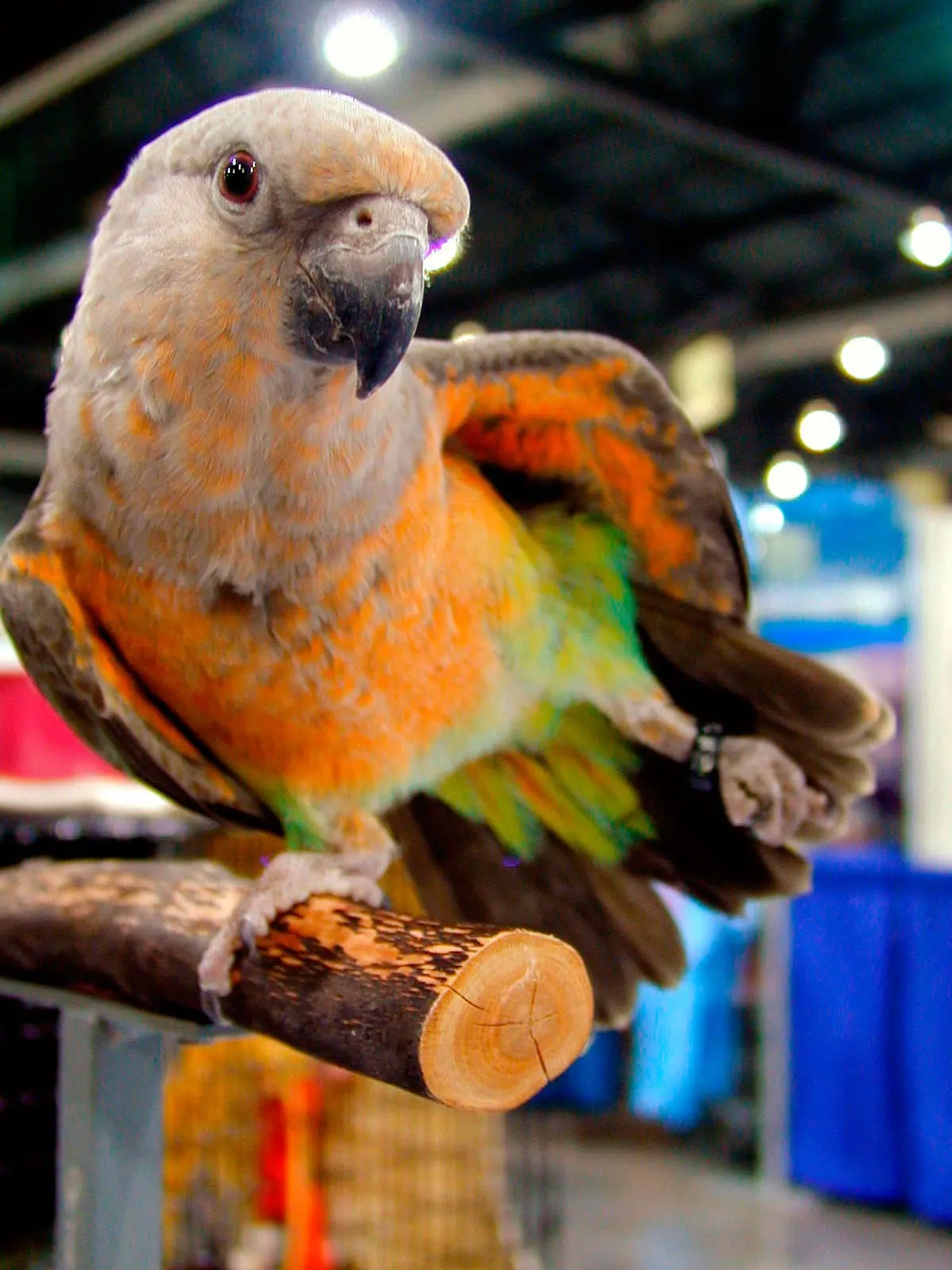
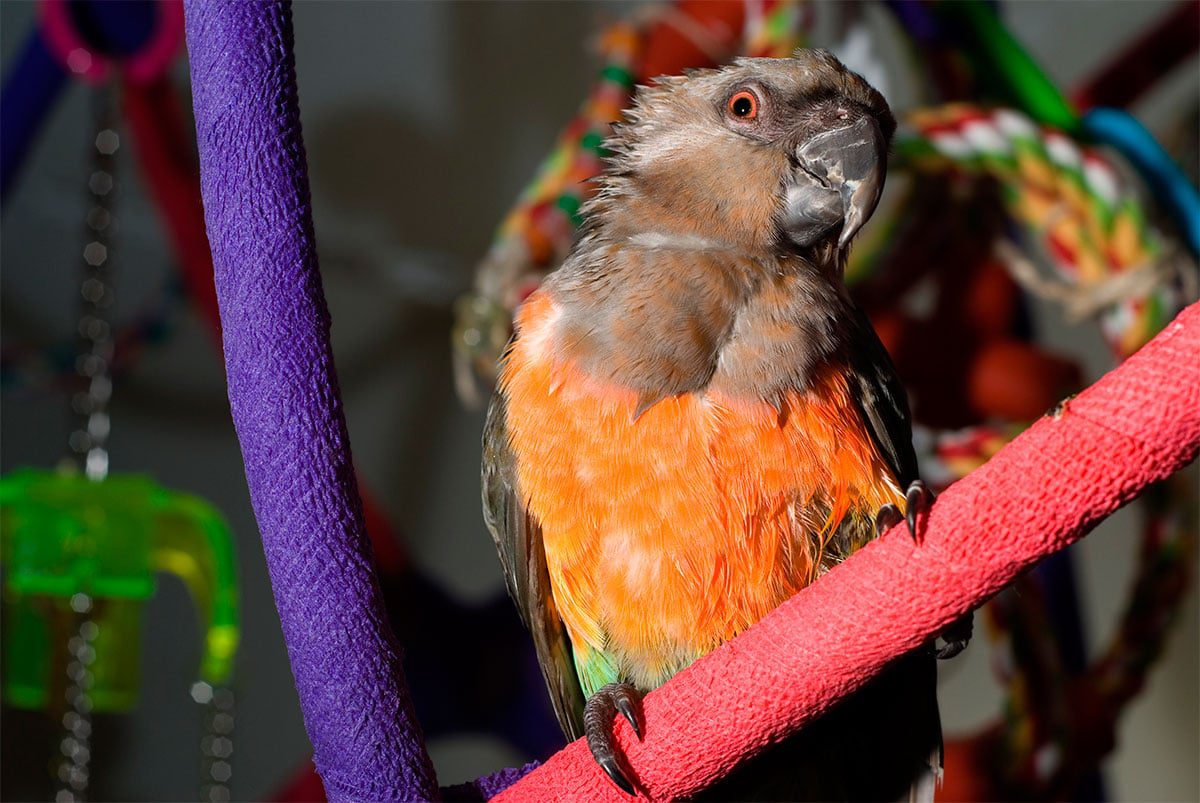
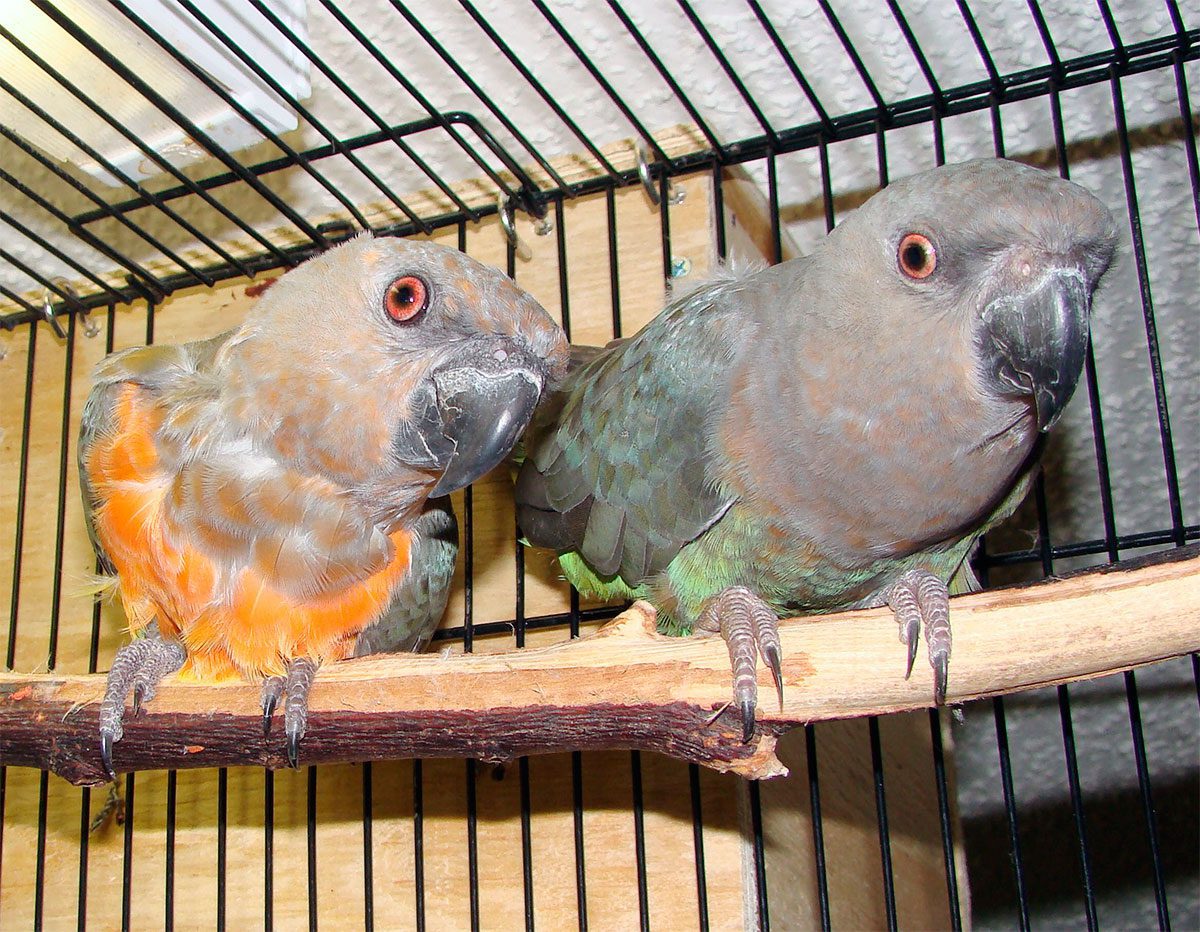
    The Red-bellied Parrot (Poicephalus rufiventris) has the crown, nape and lores brown ash, the cheeks sometimes with orange tips; ear-coverts slightly paler. Mantle and scapulars brown ash; the back blue-black; rump iridescent pale blue or bluish green. Upper, the wings slightly darker than the head and back: the primaries brown. Under, the feathers of orange wings; underside of feathers Light brown flight. Throat and the chest ash brown with orange tint; top of the chest orange; belly up to undertail- coverts pale green sometimes shows Orange-tinged feathers. Tail dark brown ash.

    Bill, cere and orbital skin black; irises orange-red; legs black.

    The female You have the upper chest grey, the pale green underside sometimes dyed orange. The head paler and grayer than male. Feathers of the wings greyish.

    Immature, generally, similar to females, but the young males have orange feathers Wings below and can show brown marks on the chest.

    Description 2 subspecies:

    • Poicephalus rufiventris pallidus

      (Someren, 1922) – head of color Brown and throat clearer than the one of the species nominal..


    • Poicephalus rufiventris rufiventris

      (Ruppell, 1842) – The species nominal.

    Habitat:

    Usually associated with semiarid vegetation, including areas of dry scrub and forest steppe Acacia Commiphora. It tends to avoid the dense foliage and, often it perches on dead branches.

    In the south of the range, He prefers savannas Adansonia.

    Where it is sympatric with the Meyer's Parrot (West range) the Red-bellied Parrot riparian forests and avoid living in the most open savannas.

    In Ethiopia They can be observed in areas of savannah Acacia-Chrysopogon, up to 2,000m. altitude.

    In Somalia They are subject to seasonal altitudinal movements in relation to the food supply, moving in altitude of about 2,000m from July to September in search of wild figs Ficus. Otherwise, generally below 1,400m.

    Usually, seen in pairs or in family groups 3-4 birds; rarely in larger flocks.

    Reproduction:

    Nest in cavities within terrestrial termite mounds, between 2 and 3 meters above ground or 10 meters or more, in some dead tree.

    The female incubates the eggs while the male goes in search of food, these eggs hatch after a few 28 days and start flying to the 60 days after hatching.

    A female was recorded under breeding conditions during the month of March (Tanzania) and feeding immature in July and October. Registered one laying in the months of May and June Ethiopia; In Somalia, between January and May; also recorded half-grown chicks in January. In Somalia in colonial times, with individual couples baobab, between 100 and 200 meters away. The implementation is of 1 to 2 eggs.

    Food:

    They feed on, besides the figs, seed (including Acacia), fruits of Egyptian balanites, Cordia ovation and Dalbergia melanoxylon, including the corn.

    They drink frequently and often they can be found near the water.

    Due to the limited food that is in their respective regions, the Red-bellied Parrot They reach the fields and harvest crops eaten, so they are often hunted by farmers.

    Distribution:

    Size of the area of distribution (reproduction / resident): 1.540.000 km2

    endemic to eastern Africa, from the North-East of Tanzania, eastern and northern Kenya, in the horn of africa in the southern and eastern Ethiopia (included Rift Valley) and western and northern zone Somalia.

    Usually common within its range. Absent in the coastal lowlands, mainly sedentary with seasonal movements in some areas.

    Distribution 2 subspecies:

    • Poicephalus rufiventris pallidus

      (Someren, 1922) – It is found exclusively in eastern Ethiopia.


    • Poicephalus rufiventris rufiventris

      (Ruppell, 1842) – The species nominal.

    Conservation:


    minor concern


    • Current Red List of UICN: Least concern

    • Population trend: Stable

    The Red-bellied Parrot It is included in the Appendix II according to CITES (The Convention on International Trade in Endangered Species of Wild Fauna and Flora) from 1981 and established as a lesser concern in the Red List of Threatened Species of the UICN since the population has fallen by more than 30% in the last 10 years. The Red-bellied Parrot it began exporting significant quantities primarily in Tanzania over the years 80. Years before it began to export to Great Britain in very small quantities.

    "Red-bellied Parrot" in captivity:

    In captivity is rare, although Spain Some important breeding centers have managed to bring them up without difficulty. This parrot can be purchased directly from a specialized breeding.

    What pet They are very cheerful, Playful, Intelligent and affectionate, a generally peaceful nature.

    They are not very noisy. He likes to climb and climb, great need to crack and it is always advisable a regular supply of fresh branches. They like to bathe.

    With regard to its longevity, according to sources, a specimen lived 33,4 years in captivity.

    Alternative names:

    – Red-bellied Parrot, African Orange-bellied Parrot, Orange-bellied Parrot, Red bellied Parrot (English).
    – Perroquet à ventre rouge (French).
    – Rotbauch-Mohrenkopf (German).
    – Papagaio-de-ventre-vermelho (Portuguese).
    – Lorito de Vientre Rojo, Lorito Ventrirrojo, Loro Abisinio (español).

    scientific classification:

    – Order: Psittaciformes
    – Family: Psittacidae
    – Genus: Poicephalus
    – Scientific name: Poicephalus rufiventris
    – Citation: (Rüppell, 1842)
    – Protonimo: Pionus rufiventris

    Images "Red Ventriloid Lori":

    Videos "Red-bellied Parrot"

    "Red Ventriloid Lori" (Poicephalus rufiventris)

    Sources:

    • Avibase
    • Parrots of the World – Forshaw Joseph M
    • Parrots A Guide to the Parrots of the World – Tony Juniper & Mike Parr
    • Birdlife
    • Wikipedia
    • Loromania

    • Photos:

    (1) – Red-bellied Parrot; a male juvenile pet parrot on a wooden perch stretching By Ruth Rogers [CC BY 2.0], via Wikimedia Commons
    (2) – Mature breeding pair of Red-Bellied Parrots (Poicephalus rufiventris) on a perch in a cage. Picture taken by user:Fruitwerks at home By Fruitwerks at English Wikipedia(Original text: User:Fruitwerks on en wiki) (Transferred from en.wikipedia to Commons.) [Public domain], via Wikimedia Commons
    (3) – A adult male pet Red-bellied Parrot perching on a bright red perch. Photography: one SB-600, diffused, hand held to the left and below Joey, fired with CLS, on TTL with no Compensation. By Bram Cymet [CC BY 2.0], via Wikimedia Commons
    (4) – Red-bellied Parrot; a juvenile male pet parrot on a wooden perch. Shows back By Ruth Rogers [CC BY 2.0], via Wikimedia Commons
    (5) – A Red-bellied Parrot at San Antonio Zoo, USA. In the male the abdomen is red-orange and in the female the abdomen is green, but the abdomen is not visible making it difficult to sex this parrot from the view shown By Zach Welty (originally posted to Flickr as Parrot 2) [CC BY-SA 2.0], via Wikimedia Commons

    ▷ The world of Pets: Dogs, cats, birds, reptiles, amphibians

    Brown Lory
    Chalcopsitta duivenbodei


    Lori Pardo

    Content

    Description

    31 cm.. length and a weight between 200 and 230 gr.

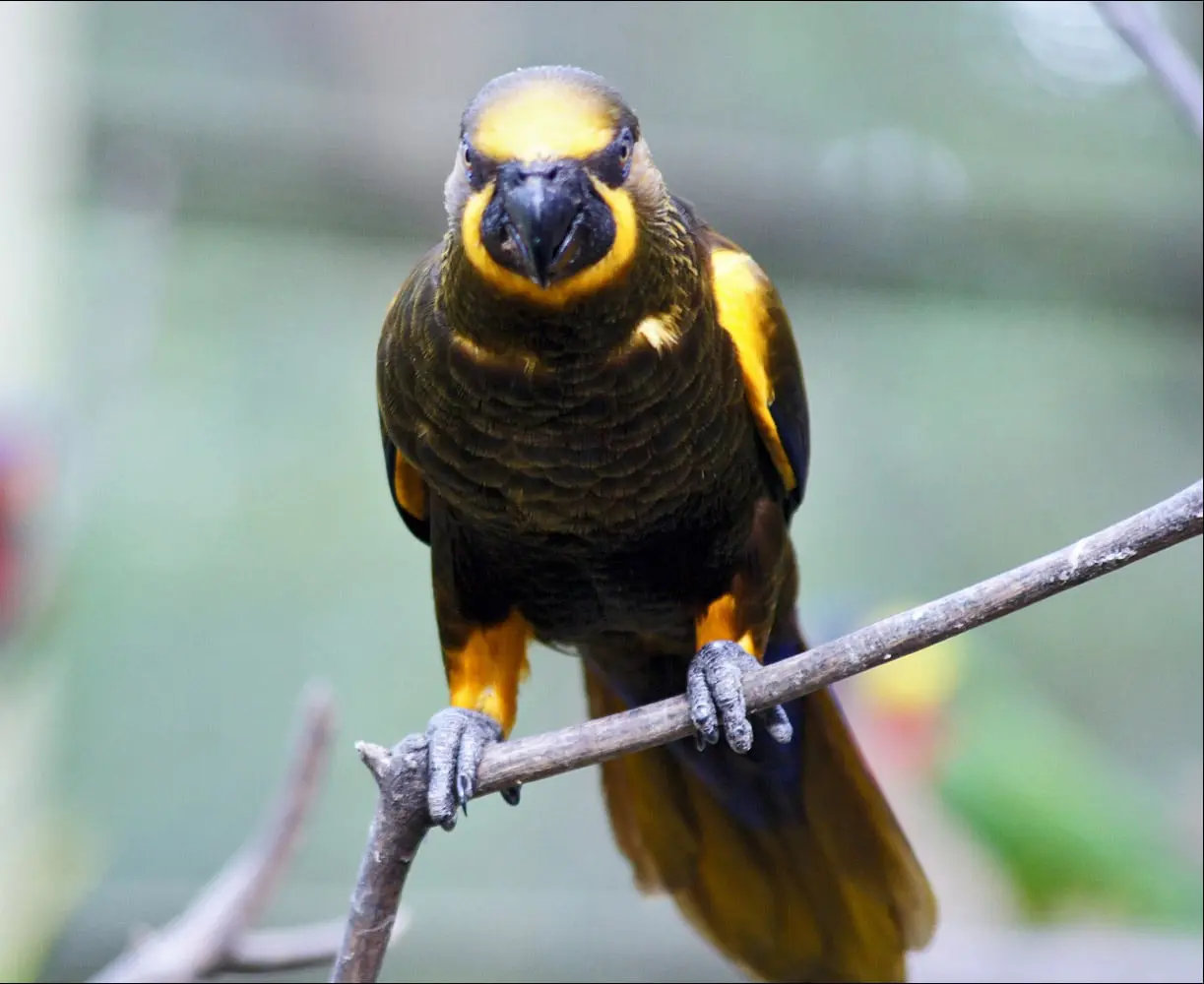
    The bottom of the wings of the Brown Lory (Chalcopsitta duivenbodei) are bright yellow narcissus.

    Two other features of its plumage that powerfully attract attention are, seen head-on , the yellow that completely surrounds the bill and forecrown and also the contrast of color violet or blue deep in it low back, the thighs and feathers of the tail.

    The feathers of the chest have pointed yellow, giving a scaly appearance to the area.

    The bill is black, as the eye ring and the skin bare at the base of the bill. The irises are orange-red, the legs are grey.

    There is no sexual dimorphism, females are identical to males.

    The youth they have more muted colors, with less yellow.

    To the Brown Lory may be mistaken for it is a very similar species, the Dusky lory (Pseudeos fuscata). The latter, However, can be distinguished by their underparts predominantly orange or yellow, rump white, their bill Orange and its smaller size.

    It is a bird of extraordinary beauty.

    Subspecies description

    • Chalcopsitta Duivenbodei Syringanuchalis

      (Neumann, 1915) – 31 cm approx.. Brown is more dark by the area of the head and back. Many specimens with dark violet hue.


    • Chalcopsitta Duivenbodei Duivenbodei

      (Dubois, 1884) – The nominal

    Habitat:

    They frequent the primary and secondary forests with large mature trees.
    They seem to especially appreciate the edges of wooded areas. They are also found in the partially open forests. They seem to be able to adapt to areas that have suffered more or less significant damage.

    The Brown Lory It is a bird of lowland, It is usually present below the 200 m.

    There is little information about the habits of this species. Often live in pairs or in small groups in that often is associated with other species of parrots dining rooms of nectar or near those trees in flower.

    They usually seek food the canopy of the forest and vegetation at ground level. Their activity seems to have no end. At night they retire to dormitories in the branches.

    When moving, they have a very characteristic flight made with very accentuated flapping at the tips of the wings.
    Their flight is much slower than the Coconut Lorikeet (Trichoglossus hamatodus). Yellow-orange color under the wings are very obvious.

    Reproduction:

    The breeding season is produced in April. In captivity, the females usually lay two eggs, which hatch in approximately 24 days. The total duration of the nesting is very long. 11 weeks from the construction of the nest to the full autonomy of the young. We don't have more information.

    Food:

    We don't have many details about their menu. One thing is certain, their diet is almost exclusively vegetarian. It feeds on fruits, seeds and sprouts. Given the fact that spends most of its time in shrubs or flowering trees, pollen and nectar should be an essential resource in your diet.

    Distribution:

    This species has a patchy distribution along the lowlands of the North coast of New Guinea, since the Cenderawasih Bay between papua and West Papua (Indonesian) to the Astrolabe Bay in Papua New Guinea. In general they are rare (Coates 1985, Beehler et to the., 1986), but it is quite common locally in locations such as the southern zone of Vanimo Puwani River and in the area of the wapoga river (A. Mack in lit. . 1999, KD Bishop in litt. 1999, B. Beehler in litt., 2000).

    Subspecies distribution

    • Chalcopsitta Duivenbodei Syringanuchalis

      (Neumann, 1915) – Cenderawasih Bay between Papua and West Papua and Astrolabe Bay, in Papua New Guinea.


    • Chalcopsitta Duivenbodei Duivenbodei

      (Dubois, 1884) – The nominal

    Conservation:


    minor concern


    • Current IUCN Red List category: Least concern.

    • Population trend: Stable.

    The species has a population global estimated at more of 50.000 individuals.
    Forests throughout its area of distribution is threatened by commercial logging, but the abundance of the species in secondary forest suggests that it is not threatened.

    The fact that are able to adapt to them areas forest exploited or degraded, It is an encouraging sign and the mark of the relative health of the species.

    "Brown Lory" in captivity:

    It is of a bird rare in captivity, but its breeding is easy.

    Information in BeautyofBirds

    Alternative names:

    – Brown Lory, Duyvenbode’s Lory (ingles).
    – Lori de Duyvenbode (French).
    – Braunlori (German).
    – Lóris-castanho (Portuguese).
    – (español).

    scientific classification:

    – Order: Psittaciformes
    – Family: Psittaculidae
    – Genus: Chalcopsitta
    – Scientific name: Chalcopsitta duivenbodei
    – Citation: (Dubois, 1884)
    – Protonimo: Chalcopsittacus Duivenbodei

    «Lori Pardo» images:

    Videos "Brown Lory"

    —————————————————————————————————

    «Lori Pardo» (Chalcopsitta duivenbodei)


    Sources:
    – Avibase, Birdlife International, Oiseaux.NET

    – Photos: bob|P-&-S (Flickr), Wikimedia, J. Brubaker (IBC.lynxeds.com), iggino (IBC.lynxeds.com), animalphotos.me

    – Sounds: BAS van Balen (Xeno-canto)

    ▷ The world of Pets: Dogs, cats, birds, reptiles, amphibians

    Scaly-naped Amazon
    Amazona mercenarius

    Scaly-naped Amazon

    Content

    Description


    Anatomy-parrots

    33 to 38 cm.. tall and 300 g. of weight.

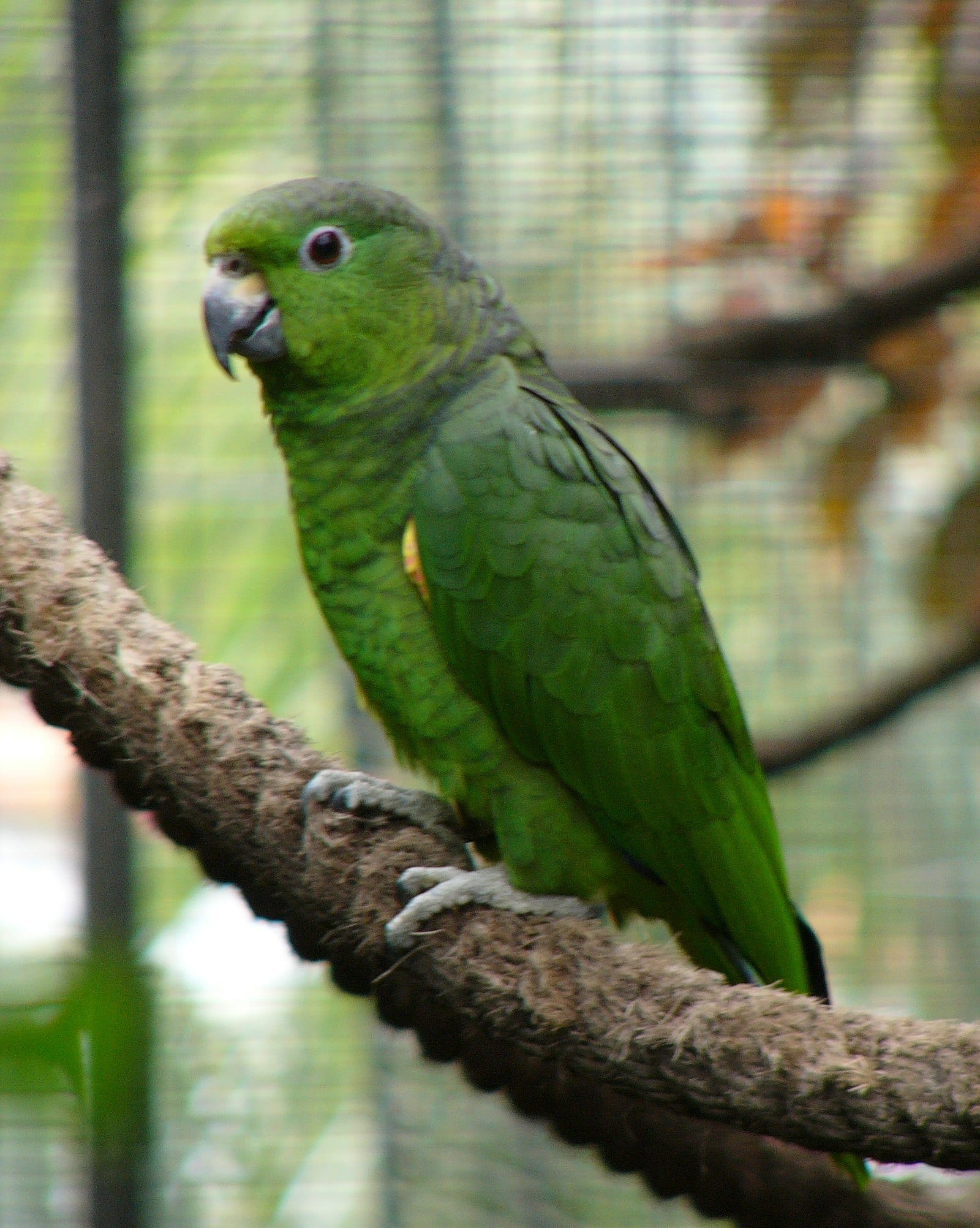
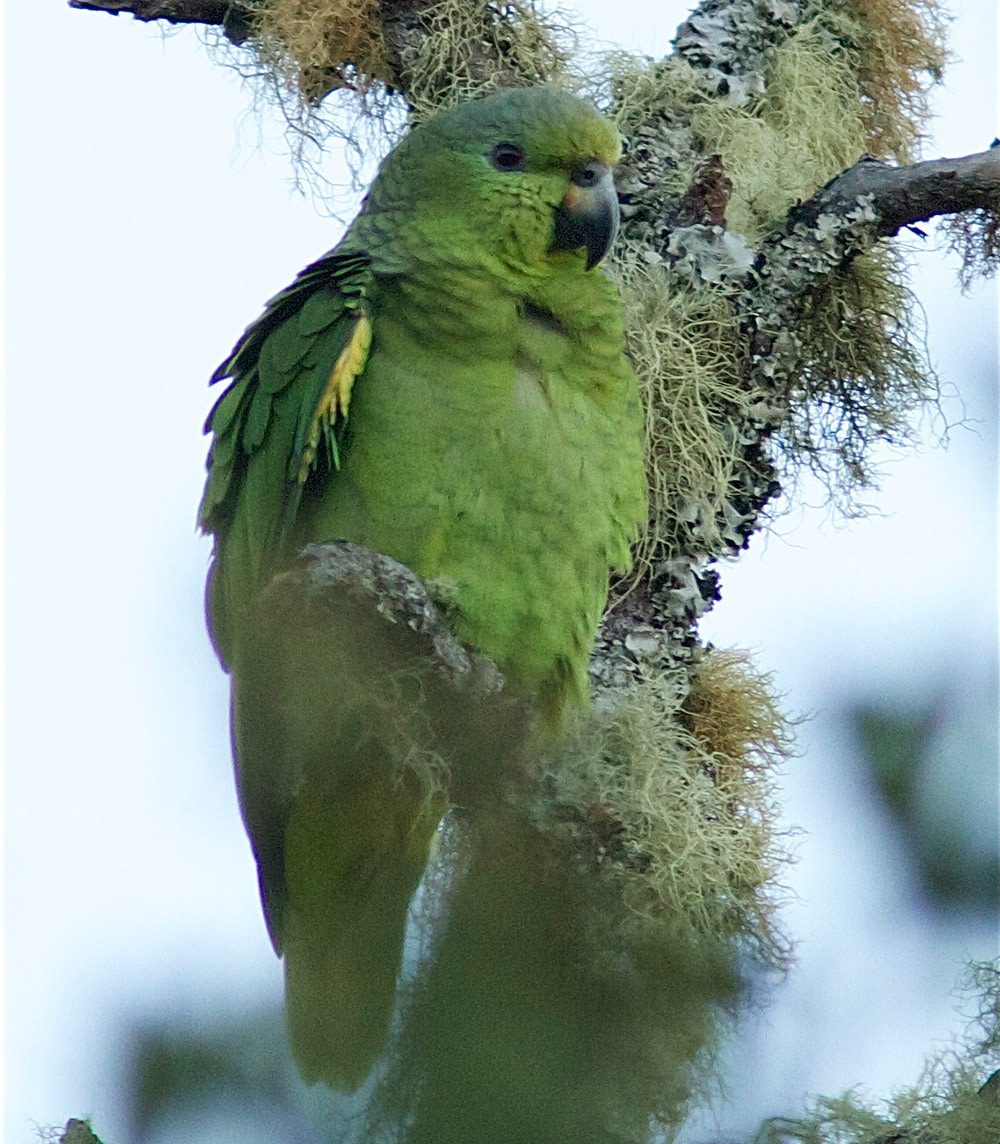
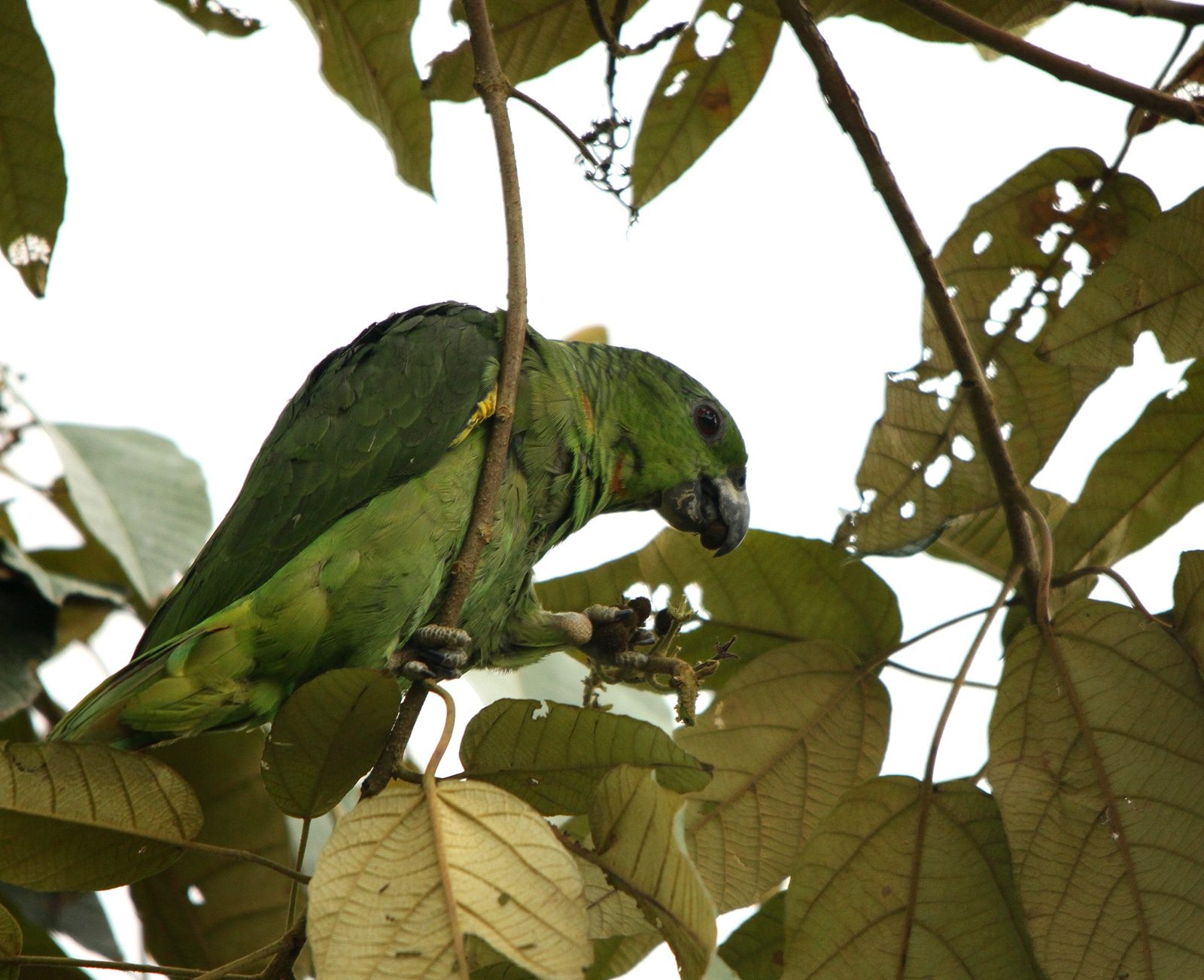
    The Scaly-naped Amazon (Amazona mercenarius) it is the only amazon in mountainous areas.

    General coloring green, with the feathers of the chest with black border, It is distinguished by having the wingtip yellow with orange spots, and external feathers tail tricolor with blue base, middle part red and yellow tip.

    Bill pale gray area at the base of jaw; irises orange; legs brown.

    Both sexes are similar. It is thought that immature they are similar to adults.

    Description 2 subspecies

    • Amazona mercenarius canipalliata

      (Cabanis, 1874) – Speculum red absent. bases outer secondaries marked with brown spots. Some specimens show scattered red feathers crown, the throat top of the chest.


    • Amazona mercenarius mercenarius

      (Tschudi, 1844) – Nominal.

    Habitat:

    Video – "Scaly-naped Amazon"

    Loro Verde (Mercenary Amazon)

    Andean and sub-Andean forests permanently cloudy between 1200 and 3000 m. Occasionally in warm floor and cultivated land.
    Usually in pairs or groups of 30 to 40 individuals.

    Reproduction:

    They have reported evidence reproduction between March and May in Colombia. Nest and eggs not yet described. The incubation period apparently it lasts 25 and 26 days.

    Food:

    Little information on their diet, but he has seen taking figs and fruit unidentified in Colombia.
    In Colombia they have been observed down to attack corn fields.

    Distribution:

    Size of the area of distribution (reproduction / resident): 3.160.000 km2

    Andes from Venezuela to the North of Bolivia.

    Distribution 2 subspecies

    • Amazona mercenarius canipalliata

      (Cabanis, 1874) – Andes of Colombia to northwest Venezuela and Ecuador.


    • Amazona mercenarius mercenarius

      (Tschudi, 1844) – Nominal. Andes North of Peru to the North of Bolivia; a single record in Argentina.

    Conservation:

    State of conservation ⓘ


    minor concern Minor Concern ⓘ (UICN)ⓘ

    • Current category of the Red List of the UICN: Least concern.

    • Population trend: Decreasing.

    Justification of the population

    The population size World has not been quantified, but this species is described as «quite common» (Stotz et to the., 1996).

    Justification of trend

    It is suspected that the population is in decline due to the continuous habitat destruction.

    The Amazona Mercenary in captivity:

    Very rare in captivity.

    Alternative names:

    – Scaly-naped Amazon, Mercenary Amazon, Mercenary Parrot, Scaly naped Parrot, Scaly-naped Parrot (English).
    – Amazone mercenaire (French).
    – Soldatenamazone (German).
    – Loro verde (Portuguese).
    – Amazona Mercenaria, Amazona Verde, Lora Andina, Loro nuca escamada, Lora paramera (español).


    scientific classification:

    Tschudi-Johann Jakob of
    Tschudi-Johann Jakob of

    – Order: Psittaciformes
    – Family: Psittacidae
    – Genus: Amazona
    – Scientific name: Amazona mercenarius
    – Citation: (Tschudi, 1844)
    – Protonimo: parrot hired


    Scaly-naped Amazon Pictures:


    Species of the genus Amazona


    Sources:
    – Parrot Book, Parrots and macaws Neotropical
    – avibase
    – Parrots of the World – Forshaw Joseph M
    – Parrots A Guide to the Parrots of the World – Tony Juniper & Mike Parr
    – Birdlife

    – Photos: papageien.org, IBC.lynxeds.com , chrislansdell.blogspot.com.es, Flickr.com

    – Sound: Hans Matheve