32 cm.. height and a weight between 230 and 260 gr.
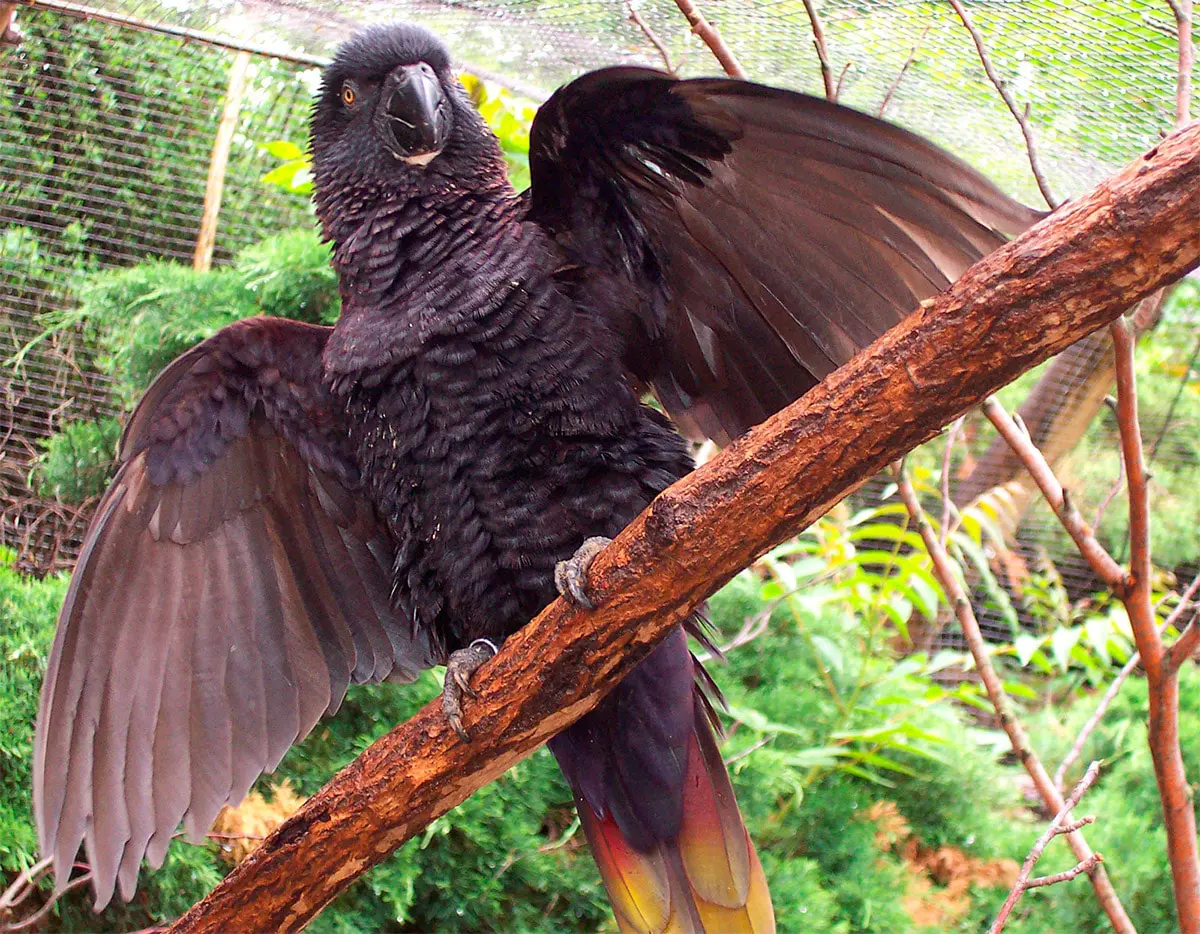
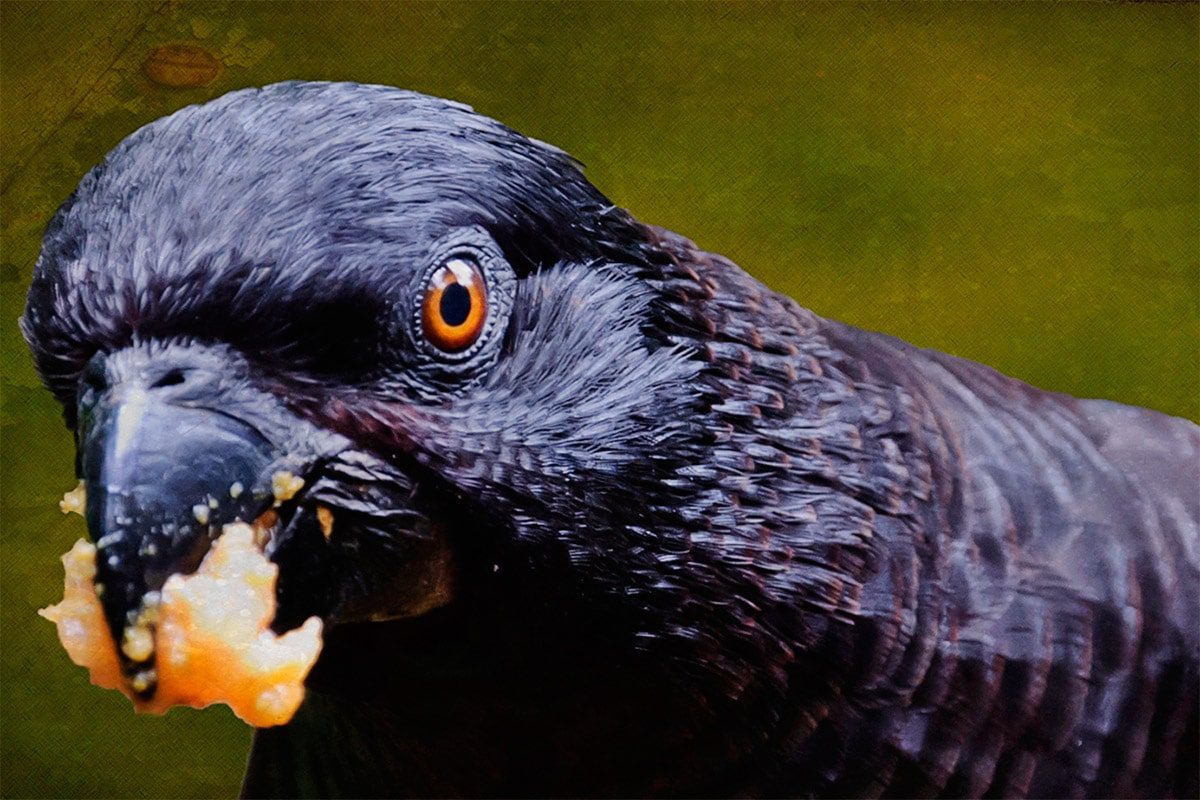
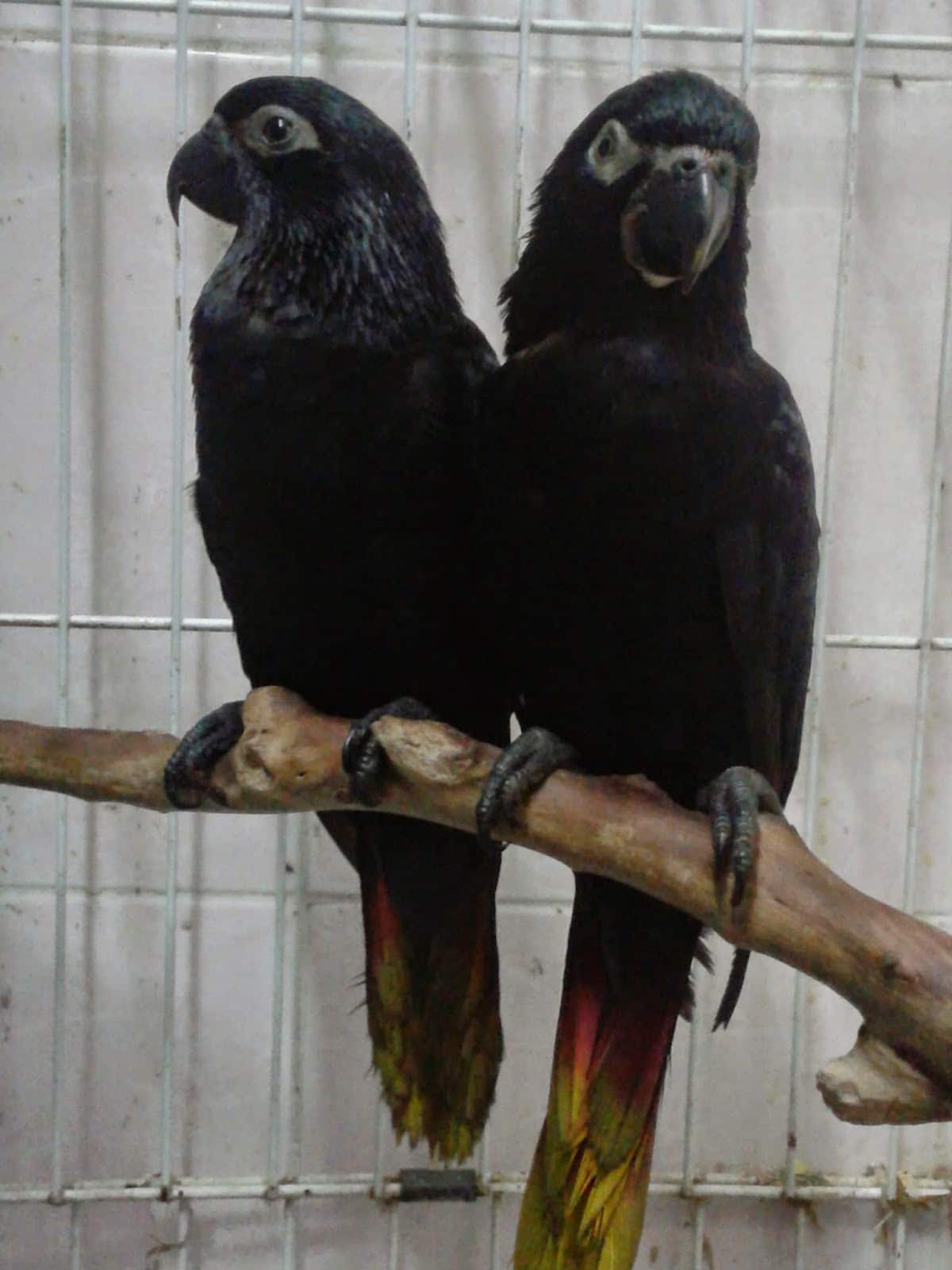
The Black Lory(Chalcopsitta atra) It is the least colorful member of an otherwise very colorful genre. It´s, in poultry, therefore, the least popular. This is unfortunate because it is equally as interesting as the other members of the genus.
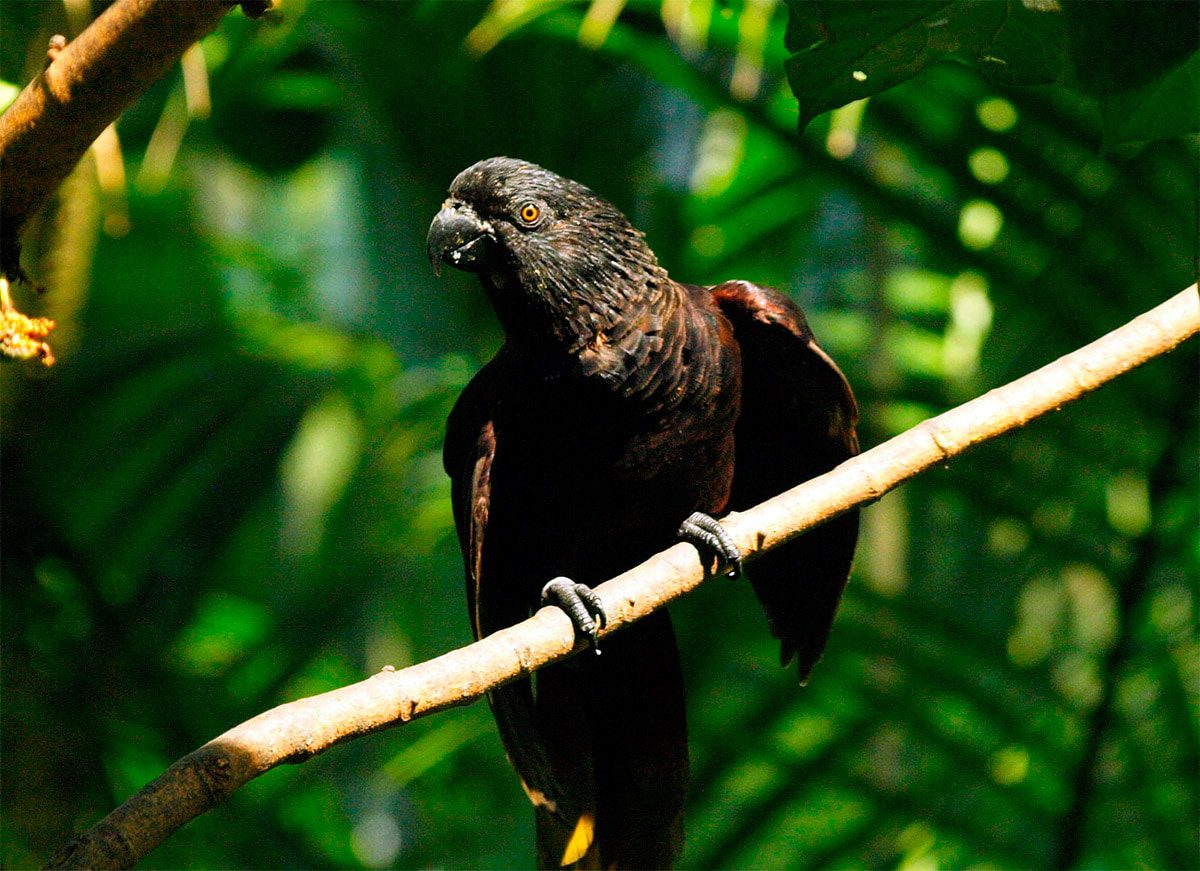
Black in color with a purplish sheen to the plumage that is highly evident in sunlight, which gives it a superficial appearance of a crow. Even their bare parts, as the nose , the skin around the eyes and at the base of the jaws, eyes and claws, they are equally dark. Rump displays a violet blue.
The underside of the tail feathers are color olivaceous with light infusions of red at the base.
The iris is orange-red, the grey legs.
The youth differ little from adults but have an eye-ring and a skin at the base of the peak which are whitish. It is grey.
There is a 3 subspecies, that differ little between if:
Chalcopsitta atra atra: Both adults, usually black. The bluish violet rump. The feathers of the bottom of tail olive/yellow washed in red. Naked eye-ring black , black skin at the base of the peak. Orange-red eyes.
Chalcopsitta atra bernsteini: Red marks / purple on the forehead and thighs, less evident in females; Blue darker in the rump.
Chalcopsitta atra insignis: Head striped gray/blue. The front, the face, the thighs and the underside of the wings are red. The feathers of the throat and underparts with red trim. The rump is dull blue. The lower part of the tail is greyish blue. It is one of the most beautiful parrots that exist. It will be necessary to see any parrot in the light of the Sun to be able to appreciate its beauty.
It is also said that there are other subspecies, the calcopsitta atra spectabilis, resident of the Mamberiok Peninsula, but the data given are running that it was only a hybridization of the Chalcopsitta Atra and the Chalcopsitta Sintillata.
They are nomadic outside of the breeding season., and, they are sometimes found in large groups, associated with the Blackbirds, feeding together on trees in flower.
The Black Lory live in the Plains, rarely above the 200 m. They are very abundant in relatively open habitats, as the mangroves near the coast, swamp forest, coconut plantations, scattered eucalyptus in the Middle areas of meadows and scrub land. From time to time come to the edge of the Woods primary or forest growth. The Black Lory is endemic to New Guinea.
Reproduction:
Most of the information has been obtained from captive birds. In the wild, most of these birds breed between December and February. In captivity, the female lays two white eggs which are incubated for about 25 days. The entire reproductive period is particularly long, lasting approximately 75 days.
The male incubates not, but sometimes it remains in the nest with the female. After birth the chicks remain in the nest approximately one 10 weeks.
Food:
The Black Lory is vegetarian. Primarily feeds on nectar and fruits. Constantly migrates in search of seasonal food. Green corn sprouts and seeds are also in their diet.. Enjoy the Schefflera shrubs.
Distribution:
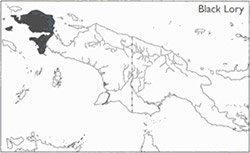
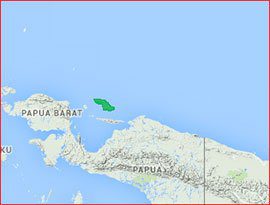
This species is distributed in the westernmost part of West Papua, the Indonesian portion of New Guinea. In particular, they are in the Western Vogelkop, also on the islands of Misool (provinces of Maluku), Batanta (papua province), the Onin and Bomberai and Salawati peninsulas (West Papua), off the coast.
Between the 3 [+] Subspecies:
Chalcopsitta atra atra: Distribution. West New Guinea
Chalcopsitta atra bernsteini: Distribution. Confined to the island of Misool (Indonesian) in the West of New Guinea.
Chalcopsitta atra insignis: Distribution. The Vogelkop, Island Amberpon, Onin, bomberai peninsulas, Northeast of New Guinea.
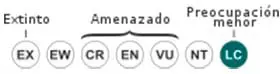
This lory is evaluated as least concern on the red list of threatened species. Is included in Appendix II of CITES.
The world population is estimated at 50.000 birds.
This number is probably stable, but data are lacking to say it with certainty.
The commercial import of this species in EC was banned in 1991.
"Black Lory" in captivity:
The Black Lory It is said is among the parrots with the sweetest character. They are easy to tame. Its obvious disadvantage is acute cries that often emit. Not everyone can tolerate them. It is however unusual in captivity.
The subspecies insignis is rare, and the subspecies bernsteini practically non-existent.
Alternative names:
– Black Lory, Rajah Lory, Red-quilled Lory (ingles).
– Lori noir (francés).
– Schwarzlori (alemán).
– Lóris-negro (portugués).
– Lori Negro (español).
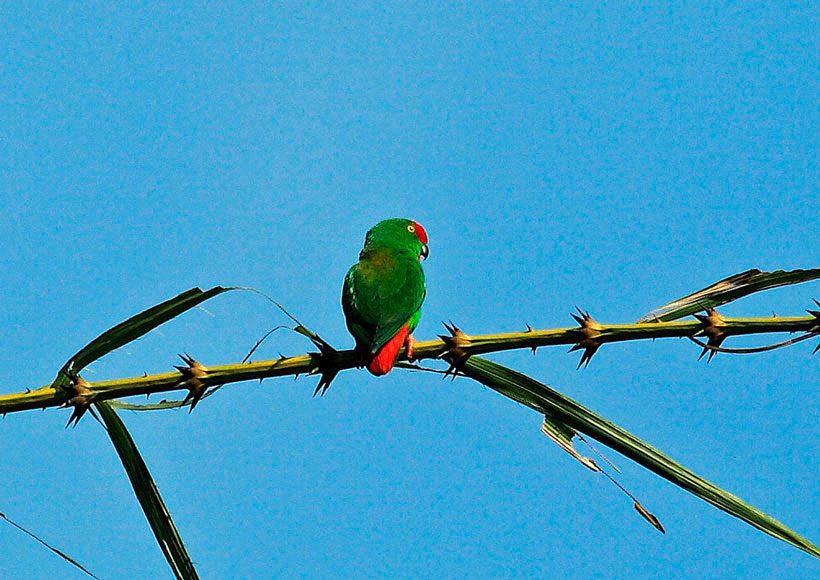
The Moluccan hanging parrot (Loriculus amabilis)(Loriculus amabilis) has the head of color green with the front of the crown red. The the mantle slightly tinted Orange; rump and uppertail-coverts dark red. The latter extends almost to the tip of the tail. Wings green; Red and yellow mark in the carpus. Under, the wings blue with coverts greenish blue. Chin red; rest of the underparts more green yellowish to them upperparts, especially the coverts at the bottom of the tail. The tail, at the top, green, by down Bluestone with fine yellowish tips.
The bill black; irises yellowish white; legs oranges.
Female with the crown green, red dots on the forecrown and throat. Iris brown.
The young birds with trademark yellow around the bib, and at the edge of the carpus. Iris pale brown.
It is distributed by primary and secondary forests, in the lowlands until 800 m, along the edges of forests, in the mangroves and the casuarinas coastal, on the edges of agricultural land, around the villages and occasionally in forests of coconut trees.
The species is observed more frequently in solitary, in pairs or in small groups in the vicinity of the trees in flower.
Reproduction:
Little is known of the habits of nesting, only periods of courtship have been recorded.
Food:
Their natural diet consists of nectar, fruit, outbreaks, flowers and seeds.
Distribution:
Size of the area of distribution (reproduction / resident) 23.000 km2
Endemic to Indonesian, where are distributed by the islands off the northeast of Sulawesi including the archipelagos of the Banggai (Peleng. Labobo) and Sula (Seho, Taliabu, Mangole, Sulabesi), and in the North of Moluccas in Kasiruta, Bacan, Halmahera andMorotai.
In the Sula Islands It is rare, its population is probably around of 5.000 birds due to habitat loss. The status of the species in Banggai and Peleng It is insufficiently known.
Conservation:
• Current IUCN Red List category: Least concern
• Population trend: Stable
The size of the world population It has not been quantified, Although it is believed that it is superior to the 20.000. specimens. The species is described as moderately common, although rarer in primary forest and common in secondary forest (pit et to the. 1997).
The population is suspected to be stable in the absence of evidence of any reduction or substantial threats, Although slightly affected by trade.
"Moluccan hanging parrot" in captivity:
Unknown.
Alternative names:
– Moluccan Hanging-Parrot, Halmahera Hanging-Parrot, Moluccan Hanging Parrot, Wallace’s Hanging-Parrot (ingles).
– Coryllis des Moluques, Coryllis des Moluques (nominal), Coryllis des Moluques (nominale), Coryllis des Moluques (race nominale) (French).
– Zierpapageichen (German).
– Loriculus amabilis (Portuguese).
– Lorículo Amable (español).
It measures 31 cm. and weighs around 300 g..
To the Philippine cockatoo(Cacatua haematuropygia) It is called locally Katala.
Its plumage is of a beautiful white color except for the feathers of the crest they are yellow or pink on its base and the bottom of the tail and wings they are yellow and Red.
The bill is a grayish-white color, and males has irises dark brown, While the of the female are brown-red color.
Is restricted to lowland not more than 50 meters above the sea level, in or adjacent to rivers, and in coastal mangrove areas.
outside the breeding season (March to June, and, times, from February to August), frequents corn and rice crops. This depends on the station where foods are grown and have the available resources, being partially nomadic.
These birds can fly from their island to the adjacent if they are not more than a few 8 km. distance.
Reproduction:
breeding season between February and June. Of one to three eggs they are placed on a nest on a tree branch. The eggs are hatch for a few 28 days, and the chicks remain in the nest for nine to ten weeks after the hatching.
Food:
They feed on seeds, vegetables, fruits and berries.
They are known to attack corn crops in agricultural areas.
Distribution:
Size of the area of distribution (reproduction / resident): 22.700 km2
This cockatoo is endemic in Philippines, and the only representative of the cockatoos that we will find there; This has become a treasure of these islands.
Conservation:
State of conservation ⓘ
critically endangered ⓘ(UICN)ⓘ
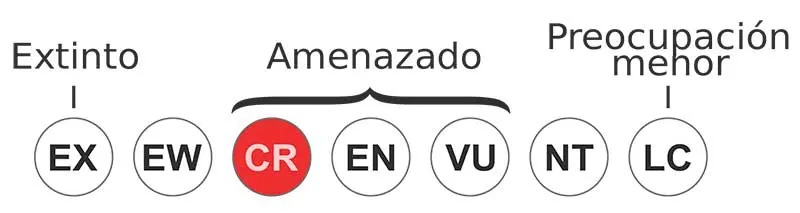
• Current IUCN Red List category: Critical Hazard.
• Population trend: Decreasing.
• Population size: 370-770 mature individuals.
In Palawan the capture of the cockatoos for the international illegal trade is particularly serious, something which is reflected in the high price of these birds ($ 160 Americans in Manila in 1997); to have been looted all the visible nests each time the price is higher because it costs more to catch them.
The deforestation and the destruction of mangroves have been extensive in their range of occupancy and have contributed significantly to their decline.
It is also hunted and hunted for consumption as food.
The release of captive birds can introduce diseases into wild populations.
Conservation Actions Proposed:
• Conduct surveys on all range islands to assess species population size and distribution.
• Monitor population trends.
• Monitor rates of habitat loss and degradation.
• Quantify catch levels, persecution and trade.
• Designate more protected areas (for example Tawi-Tawi and towns in or near Palawan).
• Support the proposal to expand the Puerto Princesa Subterranean River National Park.
• Prevent destruction of mangroves.
• Promote economically viable alternatives to avoid the capture of this cockatoo.
• Continue with education programs and captive breeding programs.
• Establish staff at airports and ferry terminals to control the departure of specimens.
• Translocate animals to suitable areas such as lowland forests or mangroves..
Loro Parque Foundation It has warned of the risk of extinction that runs the Philippine cockatoo by the construction of a power plant in Palawan, an island province of Philippines in the region of Western Visayas.
This Spanish NGO has invested 1,3 millions of dollars and more than 14 years of work in the recovery project of this cockatoo, and fears that with the construction of this station, the less than 1.000 remaining specimens in the world could be electrocuted by high-voltage lines, In addition to being blocked their migration in search of food.
26 cm.. length and a weight between 132 and 150 gr.
The Shawl-collared Lorikeet(Trichoglossus rosenbergii) is very similar to the Trichoglossus haematodus, but with a stronger blue in the head.
The edges of the breast feathers they are much wider, It has a broad yellow stripe on the neck, ending at the highest point with a red band narrow, their abdomen Violet is blue also has a wide orange stripe inside the flight feather.
The bill is red-orange. The irises They are orange-red and legs grey.
Variation of the nominal (Trichoglossus Haematodus).
Habitat:
They are in a wide range of habitats, including settlements in forests, coconut plantations, savannahs and mangroves.
In their natural habitats, They form small groups noisy that feed on the upper canopy. Often they are seen in mixed flocks with other species of parrots. At night, Community are hundreds of birds.
Son pollinators important species coconut.
Reproduction:
Within its natural range, usually they begin breeding between September and October – although breeding has been recorded in most months.
The average clutch it consists of 2 to 3 eggs. The female incubated eggs for about 24 to 27 days and the young become independent when they are about 80 days old.
Food:
Its diet natural It consists mainly nectar and pollen, but also it includes fruits like figs, citrus, papaya and mangoes open fruit bats. They may also feed on moth pupae and insects.
The Shawl-collared Lorikeet has a single small population, that can be seen to be decreasing as a result of the loss and degradation of forests, by agriculture and logging subsistence and perhaps also for the capture for trade. So, is qualified as Vulnerable.
The bird population is assumed that can range from 3000-4000 birds.
Alternative names:
– Shawl-collared Lorikeet, Biak Lorikeet, Rainbow Lorikeet (Biak) (ingles).
– Loriquet de Biak (French).
– Biaklori (German).
– Loris Arco-Íris Rosenbergii (Portuguese).
– Lori de Biak (español).
The females of the New Caledonian Lorikeet(Charmosyna diadema) are green in general, with the crown Violet Blue intense and the thighs Blue dark, a face Beige and it bottom side and anal region red. The tail It is green above and yellowish olive below, with the four lateral feathers with red basal markings followed by a band of black, with yellow tip on the bottom. The bill is red-orange, the irises dark orange, probably, similar to the legs.
The males they have not been registered. On the basis of similar species, they probably have a more red coloration, probably including the face, the bottom of the primaries and the sides of the rump; and it is likely to be slightly larger than. The immature should look like females but paler.
Habitat:
This bird is difficult to track because it is Nomad and is relatively little visible. The species is believed to be able to live in moist montane forests but (seasonally). Flying in and out of the lowland forests of Melaleuca. Most reports come from such lowland forests, but this probably reflected only a better accessibility for observation. Mt. Ignambi It is believed that it is an ideal habitat for the species. The report Yacht Lake was an area of low scrub.
Reproduction:
Data playback of the New Caledonian Lorikeet (Charmosyna diadema) are only available the of the Red-flanked Lorikeet(Charmosyna placentis) and the Red-fronted Lorikeet (Charmosyna rubronotata). The breeding season, probably, is from July to December, and possibly until February, or even all year round. They dig in the arboreal nests of termites or in epiphytic ferns. Link gives as a result the implementation of two (sometimes three?) White rounded eggs; the incubation period likely to be similar to other species of Loris.
Food:
The bird apparently is fed into the tops of the trees.
Related species eat nectar, pollen, flowers and sometimes delicate fruits, in pairs or small groups feeding (usually less than 10). The Erythrina is specifically mentioned as plants on which this species feeds.
Distribution:
Size of the area of distribution (reproduction / resident): 1 km2
Possibly extinct. Endemic to New Caledonia and known from two female specimens collected in 1859. The species also could have been observed in the forests of the North of the island in the year 1900. and it was identified by the Islanders with the reference of a picture (at Delacour 1966) of Anthony Stokes in December of 1976. One Islander claimed to see a single individual in the Decade of 1920, and another had observed two the 3 in June of 1976 to the West of Monte Panie. This last observation was made by an experienced observer who noticed the birds by their call, and said it was different to Coconut Lorikeet. The authors are in agreement with Necklace et to the. (1994) in the extension of remaining forests in New Caledonia and the size of the island indicate that this species may well still exist and that observations and studies should be within suitable habitat including the Monte Panie, Mount Humboldt and other forest areas of the Highlands. IN DANGER.
Conservation:
• Current IUCN Red List category: Critical Hazard
• Population trend: Unknown
The population It is estimated between 1 and 49 individuals mature.
This species has not been recorded with certainty since 1913, despite specific searches in 1998, and it may have decreased as a result of a number of different threats. But, cannot be assumed that they have become extinct, because there were local reports in the Decade of 1950 and in 1976, and lorites of this genus are notoriously difficult to detect, being discreet and nomadic, more studies are needed. Any remaining population is likely to be small, and for these reasons it is in Critical Hazard.
The montane moist forest is not under threat, but it is possible that this species has a requirement for other habitats, some of which, forests semi-deciduous in particular, the lowlands, they have almost disappeared from the island (Ekstrom et to the. 2000, Ekstrom et to the . 2002). Several Lori headband have suffered severe population decreases and fluctuations by unknown causes (Forshaw 1989). The introduction of any disease is possible (such as malaria, avian) or more likely mammals (especially rats) they may have been one of the causes of the decline of this species.(Bregulla 1992, Ekstrom et to the. 2000, Ekstrom et to the ., 2002).
"New Caledonian Lorikeet" in captivity:
Not found in captivity.
Alternative names:
– New Caledonian Lorikeet, New Caledonia lorikeet (ingles).
– Lori à diadème, Loriquet à diadème (French).
– Diademlori (German).
– Lori Diadema (español).
21 to 27 cm. length and a weight between 130 and 180 g..
The face of the Red-checked Parrot(Geoffroyus geoffroyi) is of color rojo-rosaceo up to just above the eyes, more pink in the ear-coverts; front of the crown of color rojo-rosaceo. Half of the crown to the nape mauve-blue. Upperparts green. Wings with patch red in them Middle coverts interiors.
Flight feathers with vane Dark internal and external Green. Edge of yellow to vane internal of greater coverts and secondaries. Wing feathers and axillary, bright blue; below, the rest of the wings, blackish. The underparts green, more yellowish in them lower flanks. Upper, the feathers of the tail of color green, drenched sides of yellow; below, brighter yellowish green.
The bill red orange in upper jaw, the lower jaw in color black; irises yellow; legs grey.
Female with head Brown and upper jaw black.
Youth they have the head green, irises dark and bill pale. The male juveniles go through a plumage «female stage» before they begin to acquire masculine characters (bird takes over one year to mature). The birds young also lack of the brand red on them small coverts.
(Müller, 1841) – The darker male in general that the nominal; purple blue crown comes to the part back from the neck; neck light blue; Marron-bronce washing variable on the mantle and top of the back; Green bluish in the part superior of the chest and zone inferior of the abdomen ; brown reddish of them coats internal of the wings absent; Blue more dark in them Underwing coverts. Larger in size.
The female with the head more dark that the nominal; purple diffusion in the crown; nape blue, reaching the neck with color blue light.
Geoffroyus geoffroyi obiensis
(Finsch, 1868) – Adults as the subspecies cyanicollis but collar Blue in the part back from the neck more comprehensive, reaching almost up to the eyes; blue-purple in the male or brown in the female does not reach the lower part of the occiput; reddish brown in the bottom of the back to rear.
Geoffroyus geoffroyi rhodops
(Schlegel), 1864) – Similar to the subspecies males floresianus, but darker in general; marks of the coats internal of the wings of color brown reddish dark; crown Blue separate with red in the face; Underwing coverts Blue more dark. Larger in size.
The female with the crown castano-oscuro color.
Geoffroyus geoffroyi explorator
(Hartert, 1901) – Synonymous with Geoffroyus geoffroyi rhodops
Geoffroyus geoffroyi keyensis
(Finsch, 1868) – The male resembles the subspecies floresianus, but in general more greenish-yellow, in particular in the tail; cheeks Pink and ear-coverts washed with Blue Lilac; Yellow greenish pale in the neck through the part back from the neck and a strip Green, darker, in the early part of the neck; Underwing coverts pale blue. Larger in size.
The female chestnut brown on the head.
Geoffroyus geoffroyi floresianus
(Salvadori, 1891) – The male is like the nominal, but darker in general; the purple blue of the crown It's darker and reached to the nape; coats internal of the wings dark reddish brown; Blue more dark them Underwing coverts. Larger in size. Largest peak. Female with the crown darker brown, coming up to the nape.
(Meyer, 1884) – The subspecies resemble adults Kei, but smaller.
Geoffroyus geoffroyi pucherani
(Souancé, 1856) – Adults and juveniles with bronze-colored marking of the parts internal of the wings, minimal or absent; the mantle have less marron-bronce washing; Brown more pale in the part low of it back; the buttocks with less red; coats dark blue low the wings.
Geoffroyus geoffroyi minor
(Neumann, 1922) – Male adults are as the subspecies aruensis, but with reddish brown under the back to rear; face darker red; washing Marron-bronce in the the mantle; brands in the coats internal of the wings minimal or absent.
The female as the subspecies aruensis, but with the head of brown slightly more dark.
Geoffroyus geoffroyi jobiensis
(Meyer, 1874) – Adults and juveniles but with Underwing coverts pale blue; bright red in the lower part of the back to the rear; in males, the red in the forecrown back to the front of the crown.
Geoffroyus geoffroyi mysoriensis
(Meyer, 1874) – Males as juveniles, but with the crown blue-purple, down on the back of the neck, and red in the face, coming up to the throat; washing marron-bronce absent in the the mantle; extensive reddish brown marks in inner median coverts; Underwing coverts dark blue; dark brown in the bottom of the back to rear.
The female as juveniles, but the color brown in the crown comes to the part back from the neck.
Geoffroyus geoffroyi orientalis
(Meyer, 1891) – Hardly differs from the subspecies aruensis; Crown of the male is slightly more pale.
Geoffroyus geoffroyi sudestiensis
(Estimate, 1890) – The adult male is similar to the subspecies aruensis, but with the underparts darker; the trademark brown reddish of them coats internal, absent.
The crown and nape of the female, is dark green.
Geoffroyus geoffroyi cyanicarpus
(Hartert, 1899) – The adult male is similar to the subspecies aruensis, but with azul-lila wash in them cheeks and ear-coverts; bend of wing has edge blue.
The female is as the subspecies aruensis, but the crown and nape They are brown, with light green dye; edge blue in the part outside of the wing
as in the male.
Geoffroyus geoffroyi aruensis
(Gray, 1858) – Similar to the species males nominal, but darker purple blue from the crown up to the nape; inner coverts a reddish brown marked darker; Blue more dark in them Underwing coverts.
The female Brown darker from the crown even the nape.
Geoffroyus geoffroyi maclennani
(W. D. K. Macgillivray, 1913) – The male is similar to the subspecies aruensis, but darker in general; the Red of the face is darker and more uniform; Underwing coverts paler blue. Female similar to the female of subspecies aruensis, but darker in general; head dark brown; Underwing coverts paler blue.
* The varieties sumbavensis and tjindanae proposed as subspecies are synonymous of floresianus; rhodops stresemanni; explorator It is also synonymous of rhodops.
Habitat:
Distributed by primary and secondary forests, tree savannas, plantations, Open forests, mangrove forests and farmland, a altitude of 1.400 m. Usually replaced by the Blue-collared Parrot at higher altitudes. Exclusive tropical jungle in the North of Australia. View the birds, generally, flying high above the trees, making calls to cries.
Groups of birds in the North of Australia, many still in family units, they have been observed leaving their roosts early, to feed into the dense jungle; in their flights to areas of foraging, We have seen some of these birds perched in the upper branches of the trees, by calling aloud for a few minutes and dithered wings before continuing. The reason for this unknown behavior can be a way of requesting food due to early maturation.
During the day the birds are less visible, they can draw attention by discarded food falling from their food trees.
They are usually in couples, in small groups or assembled in groups in fruit trees.
Reproduction:
The nest It is a hole that the birds excavate in a rotten limb of a tree from the forest, sometimes also in a knot in the trunk; probably only the female excavates. The entrance to the nest is of 80 to 90 mm. wide, and the tunnel, that it can twist in order to hide the eggs, You can have a length of 42 cm.. Includes the implementation of 2 to 4 eggs. The female alone incubates and is fed by the male during this time. In the West, the breeding season It takes place between April and September at least, month in which a live nest was found in Seram.
In New Guinea, the nesting is been registered during several months more, including February in the North and between the months of April to December in other places.
In Australia, in where the season seems to extend is from August to December, little information about the cycle reproductive is available.
It is known that the species It has never been raised successfully in captivity.
Food:
The diet It includes seeds, fruits and flowers. The birds tend to hang acrobaticamente to reach their food.
Distribution:
Size of the area of distribution (reproduction / resident): 793.000 km2
Generalized from the West of Lombok, through the Moluccas, the lowlands of New Guinea, and observed in the groups of associated Islands, to the East of Rossel in the Louisiade archipelago.
The species can also be observed in the northeast of the Cape York Peninsula, Australia, at its southern end, and North ranges up to Morotai in the North of the Moluccas. In many areas, throughout its distribution area, is the most abundant Parrot (rarer over the 800 meters above sea level), even around inhabited areas. Despite this, It may be extinct in Ambon.
The size of the world population It has not been quantified, Although it is estimated above 1.000.000 of copies. The species according to sources, is of common to abundant much of its area of distribution (pit et to the. 1997).
The population suspected to be stable in the absence of evidence of any reduction or substantial threats, Although you can that its population is affected by the capture in various parts of its area of distribution.
"Red-checked Parrot" in captivity:
Very rare or impossible to see in poultry.
Passive Parrot. Extremely susceptible to stress and disease; they may die suddenly without apparent reason. Few times you live long in captivity
Alternative names:
– Red-checked Parrot, Red cheeked Parrot, Red-cheeked Parrot (ingles).
– Perruche de Geoffroy, Eclectus de Geoffroy, Éclectus de Geoffroy (francés).
– Rotkopfpapagei (alemán).
– Papagaio de bochechas vermelhas (portugués).
– Lorito Carirrojo, Lorito de Mejillas Rojas (español).
– Avibase
– Parrots of the World – Forshaw Joseph M
– Parrots A Guide to the Parrots of the World – Tony Juniper & Mike Parr
– Wikipedia
– Birdlife
– parrots.org
– Photos:
(1) – By Ron Knight (Flickr: Red-cheeked Parrot) [CC BY 2.0], via Wikimedia Commons
(2) – By Nick Athanas/Tropical Birding – Birds-pet-wallpapers
(3) – A male perched in a tree by Josep del Hoyo – Lynx
(4) – A male and a female looking for a suitable nest by mehdhalaouate – Lynx
(5) – By markharper1 [CC BY-SA 2.0], via Wikimedia Commons
Of 40 cm., length and a weight between 116 and 140 g..
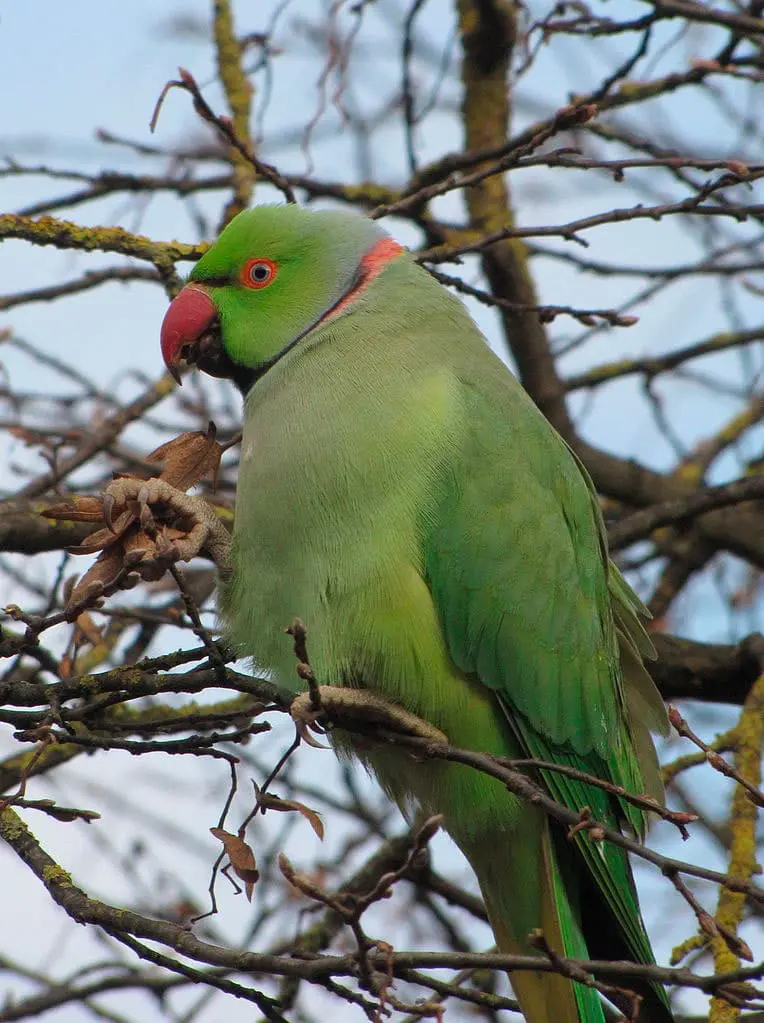
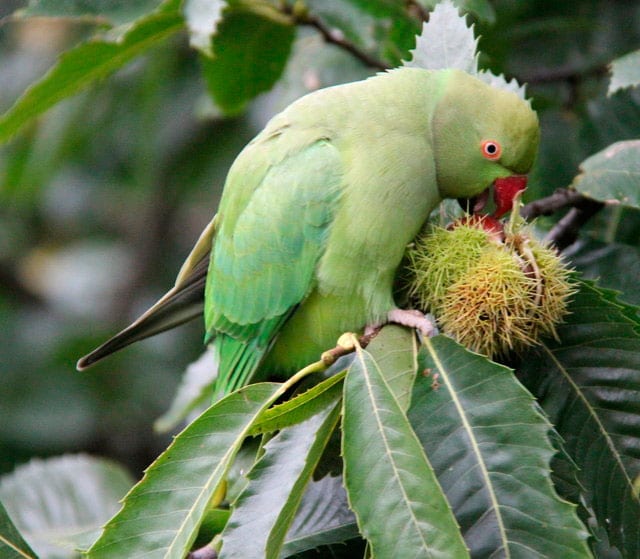
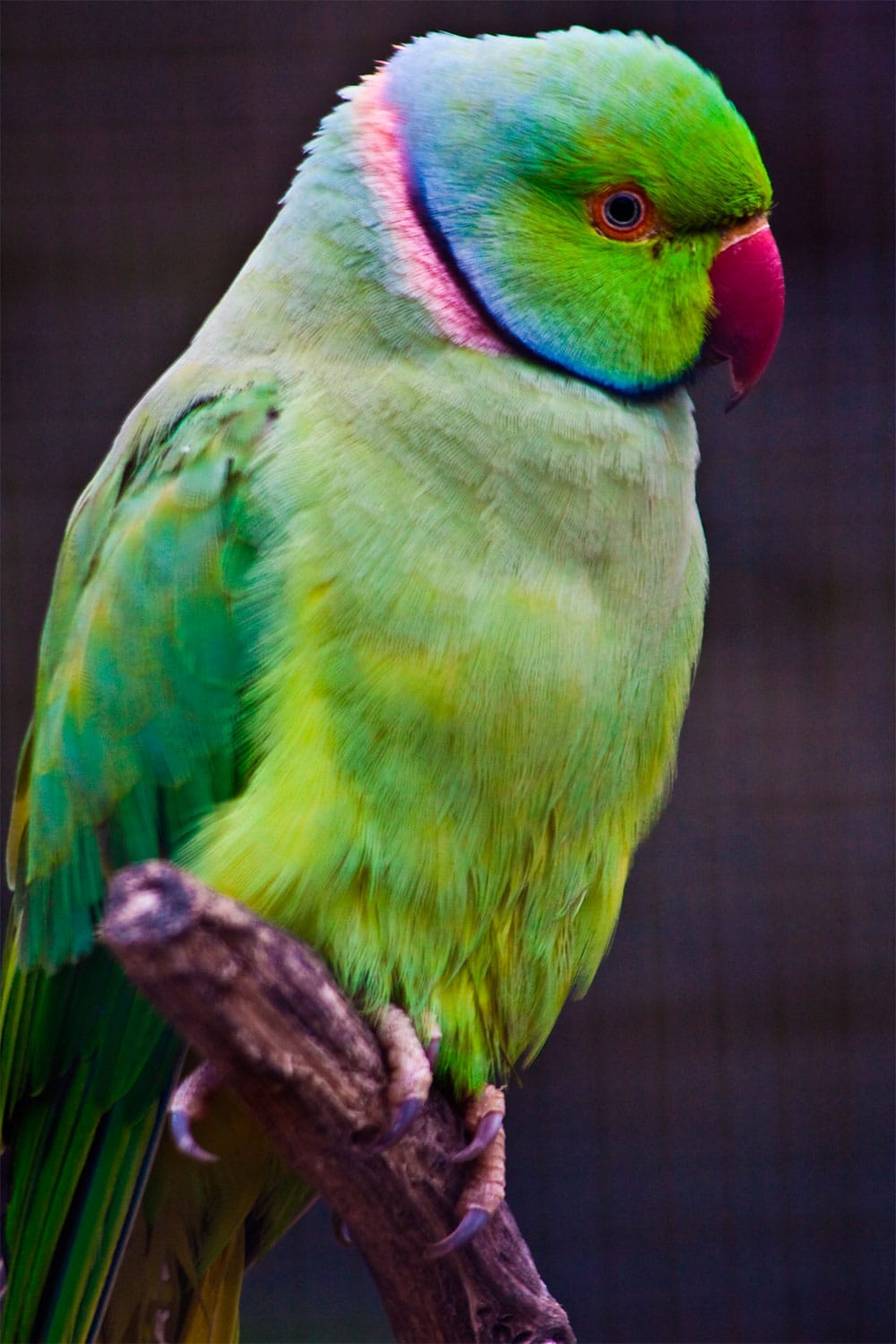
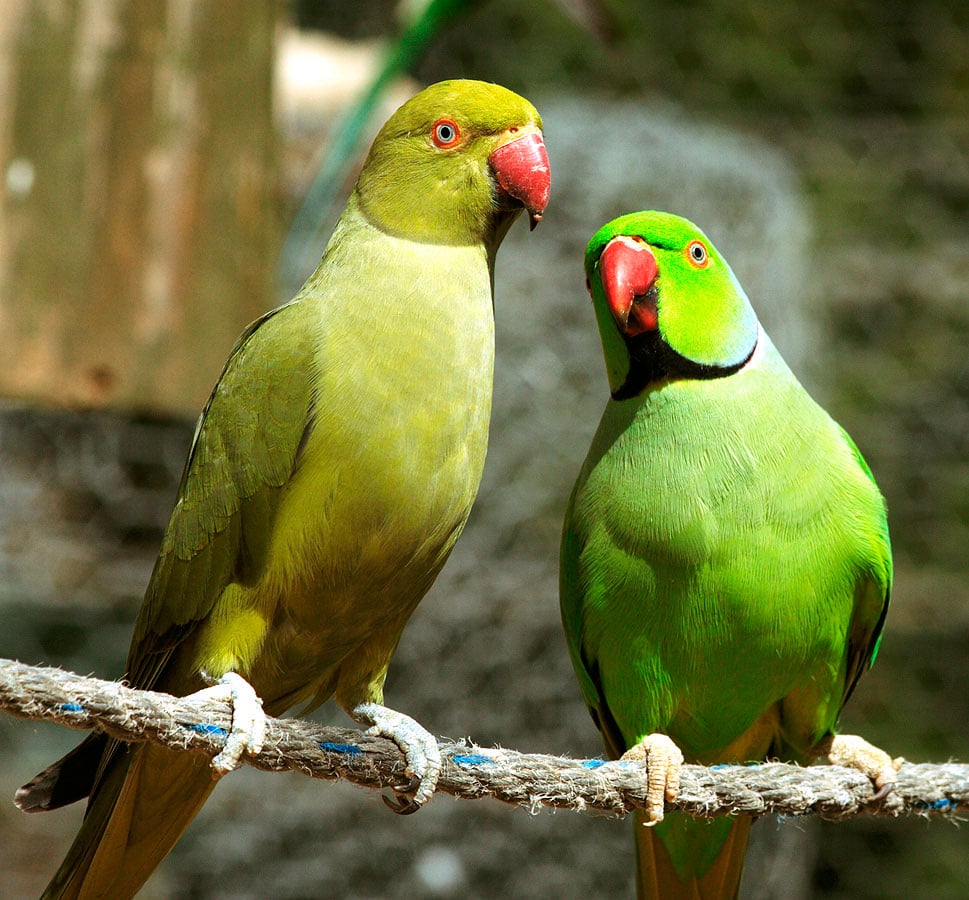
The Rose-ringed Parakeet(Psittacula krameri) has the forecrown, fore crown, the cheeks and lores bright yellowish green; narrow dark line between cere and the eye ring; the back of the crown, the nape and the sides of the neck, pale lavender gray, broken on the sides of neck with narrow black stripes; contiguous black markings with wide black stripes on the bottom of the cheeks merging the chin a solid black.
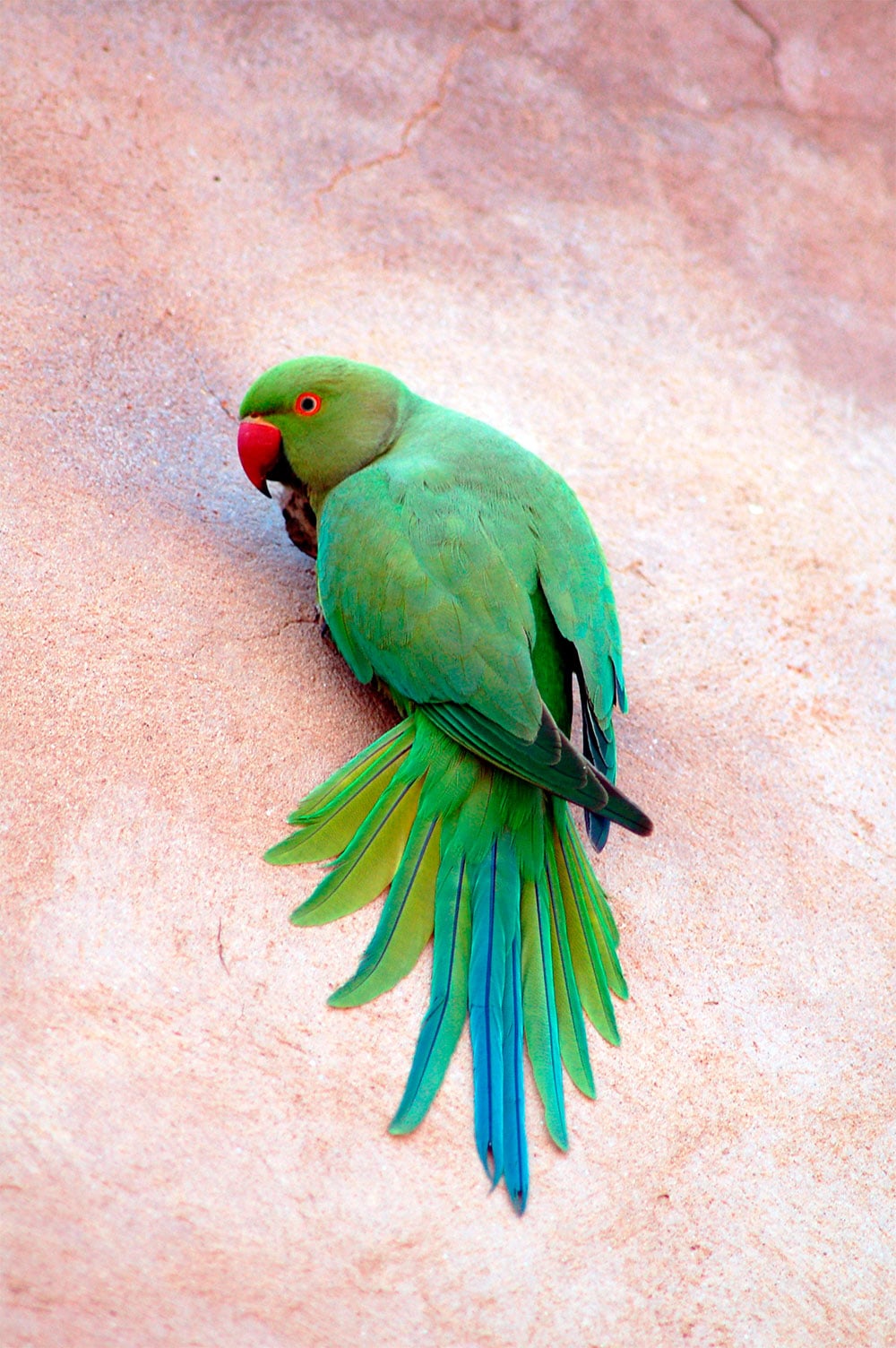
Pink collar in the back of the neck, the mantle and back light green tinged with olive; rump and uppertail-coverts slightly brighter. Lesser and medium upperwing-coverts light green (darker than the body); large coverts dark green; primaries and secondaries dark green with darker (almost black) margin to the vane inner. bottom of the feathers flight gray; underwing-coverts brighter yellowish green. Underparts brighter yellowish green. Upper, the tail centrally blue with yellowish tips, green side; undertail, the tail centralmente negruzca, yellow-olive laterally.
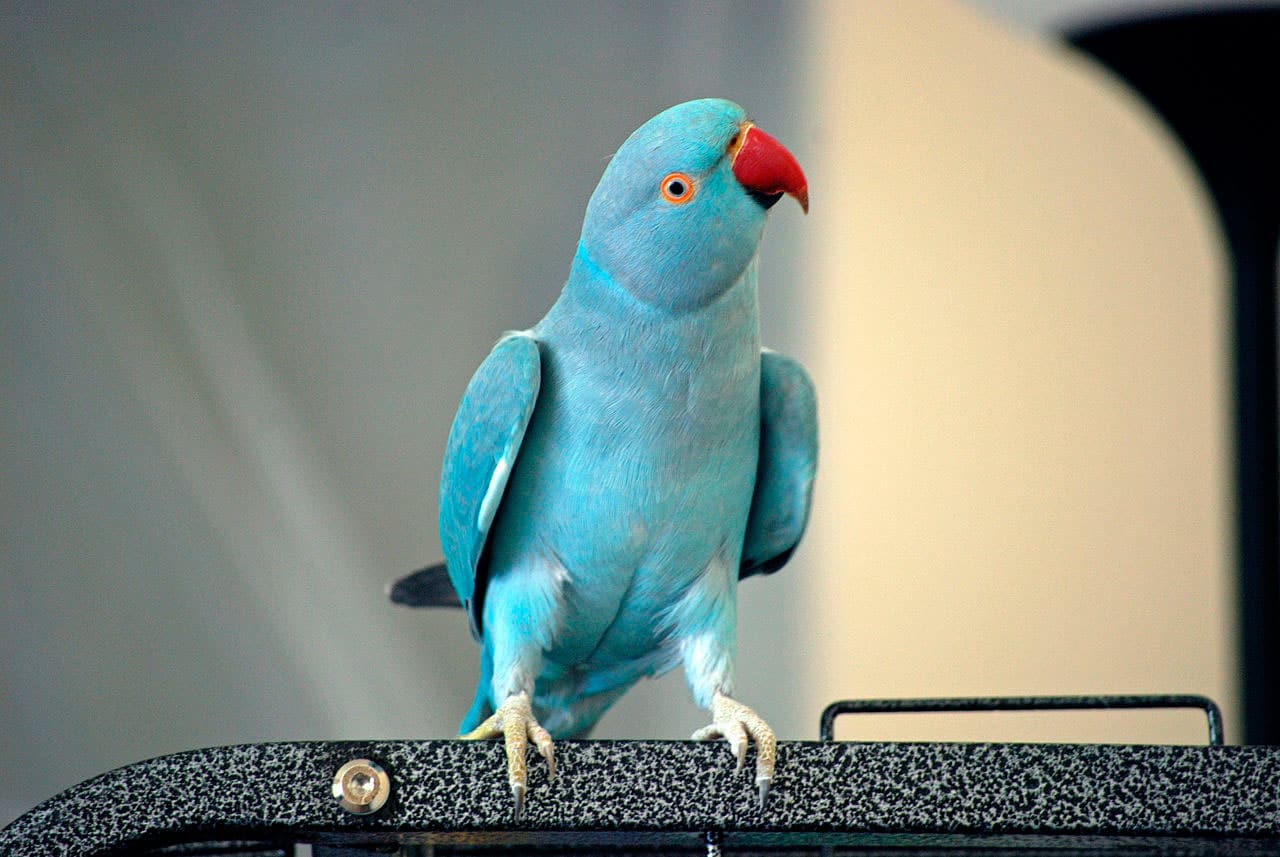
Crimson in the upper jaw tipped in black, the lower jaw of color stream blackish; cere whitish: irises yellowish white; legs pink, with 4 fingers ending in nails strong in black, two of these fingers are directed forward and two backward so called zigodactilia, which it allows them to easily climb.
The female lacks the neck black, brands in the chin and the cheekbone, of the collar pink and blue suffusion of neck; It has shorter central feathers tail.
The They are similar to immature females but with the bill a little paler, irises greyish; the males acquire the characteristic Pink collar in the third year.
Psittacula krameri borealis (Neumann, 1915) – Larger than the species nominal, with upper jaw all red and black marks on the lower jaw. Bluish suffusion in neck, behind ear-coverts; more than grayish bottoms species nominal.
Psittacula krameri krameri (Scopoli, 1769) – The species nominal
Psittacula krameri manillensis (Bechstein, 1800) – Larger than other subspecies, slightly paler and more yellow than the subspecies borealis. Different facial markings that species nominal. Under the mandible black.
Psittacula krameri parvirostris (Souance, 1856) – Of head and cheeks yellowish least the species nominal. Bill small upper jaw brighter red, less blackish towards the tip. The birds living in eastern Sudan They are intermediate between subspecies appearance parvirostris and species nominal.
Habitat:
The Rose-ringed Parakeet It is a very adaptable bird. It is located in a variety of forest types Forest, from secondary forests, wet, riparian forests, mangroves, open farmland with scattered trees, to parks and gardens in urban areas.
They can live at altitudes 1.600 metres in Asia and 2.000 metres in Africa.
gregarious, especially out of breeding season, coming to form large noisy flocks sometimes several thousand birds. Communal roosts, often with Crows, Mynas or other parrots.
Reproduction:
The Rose-ringed Parakeet It is not a territorial bird and, sometimes vaguely colonial while breeding.
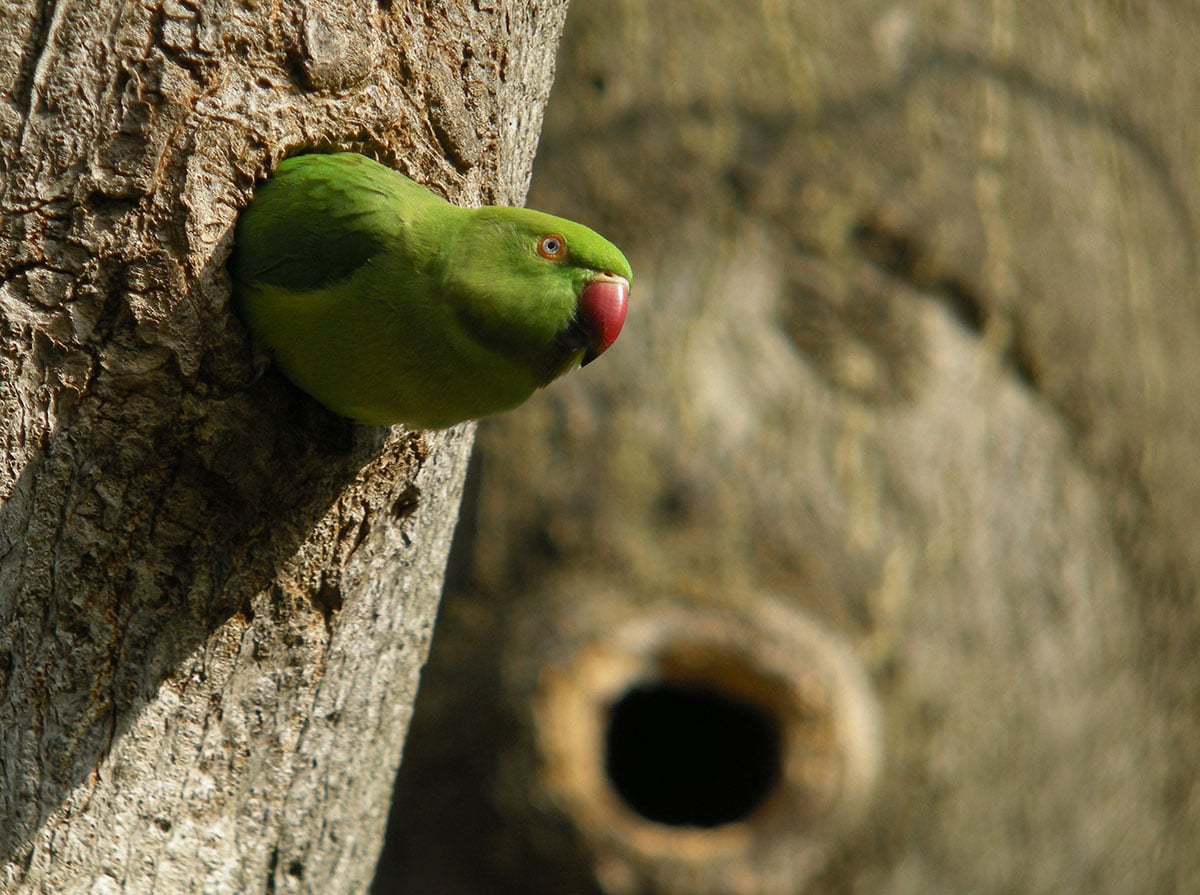
It nests in natural tree cavities or holes extended, in cracks in rocks or walls built; in Africa, always nest atop a tree.
The breeding season, mainly, It covers the months from January to April, although offspring have been recorded in the month of July.
typical setting 3 to 4 eggs, although they have been registered you put six eggs.
23 days of incubation and 45 days of stay in the nest of the hatchlings.
Food:
Diet Rose-ringed Parakeet It includes a variety of cereals, herbs, seeds, vegetables, fruits, flowers and nectar, wild and cultivated; feeding varies seasonally,for example, in the Indian state of Punyab, They feed on weed seeds from April to June and sorghum between the months of August and January.
Inflingen crop damage, especially citrus, sunflower and corn.
Size of the area of distribution (reproduction / resident): 27800000 km2
The Rose-ringed Parakeet they are the parrots more widely distributed around the Old world. They are native to tropical africa, north of the humid forest zone, and much of Asia meridional.
In West Africa (Mauritania, Senegal, Gambia, Guinea-Bissau), the east, through Mali, South of Niger, North of Ivory Coast, North of Ghana, Burkina Faso, Togo and Benin to the North of Nigeria and Cameroon, South of Chad, North of the Central African Republic, from southern Sudan to the North of Uganda and Ethiopia, Djibouti and Northwest of Somalia.
In Asia, from the West of Pakistan, South of Nepal through the India, Bangladesh and Sri Lanka to downtown Burma.
Many introduced populations are distributed by EE.UU., England, Germany, Netherlands, North of Egypt, Kenya, coastal area Ivory Coast (possibly wild relict), South Africa (Natal and Zululandia), Mauritius, Arabian Peninsula, Singapore, Macao and China, in the surroundings of Hong Kong.
Mainly sedentary, but apparently with some seasonal movements in most parts of the African range (for example, temporary visitors during the rainy season in southern areas Mauritania).
Common to abundant in Africa and part of Asia; quite common in Burma.
Residents and especially sedentary. Widely bred in captivity.
Subspecies distribution
Subspecies
Psittacula krameri borealis (Neumann, 1915) – distributed by Pakistan, through North India, around of 20 ° norte, Nepal and Bangladesh until Burma. He also believed to belong to this subspecies distributed parts of birds Middle East, Mauritius, Macao and parts of Southeast China.
Psittacula krameri krameri (Scopoli, 1769) – The species nominal
Psittacula krameri manillensis (Bechstein, 1800) – Distributed by South India, about 20 ° north and Sri Lanka. Observed in wild populations England, elsewhere Europe, EE.UU. and Singapore, They seem to belong to this subspecies.
Psittacula krameri parvirostris (Souance, 1856) – Distributed by this Sudan through North Ethiopia until Djibouti and North of Somalia
The size of the world's population has not been quantified, but the species, according to sources, It common to abundant throughout their natural range (pit et to the. 1997), while the population Japan it has been estimated between 100 and 10,000 introduced breeding pairs ( Brazil 2009).
Its population It increased in the twentieth century, in relation to the expansion of agriculture.
Nest protection and brood handling has helped the Rose-ringed Parakeet recover.
Invasiveness in Spain
Because of its colonizing potential and constitute a serious threat to native species, habitats or ecosystems, This species has been cataloged in the Spanish Catalog of Invasive Exotic Species, approved by Royal Decree 1628/2011, of 14 November, It is banned in Spain its introduction into the wild, possession, transport, trade and commerce.
"Rose-ringed Parakeet" in captivity:
The Rose-ringed Parakeet is a bird with character that raised since childhood can become a docile pet, although its tendency is to be a fearful and aggressive bird. Form unstable pairs, something that affects their behavior. It is unlikely that this species has an affectionate behavior with their caregiver, with few exceptions.
To enjoy it Patience is needed and above all to have knowledge about this species, not to be disappointed if things are not progressing as expected.
The Rose-ringed Parakeet It is a bird that must be handled daily and this, throughout his life, with the aim of being able to achieve an “optimal” dressage. In fact, Naturally that tends to become suspicious if the time is not paid regularly. We have to "fight" against this tendency to touch it, manipularla, caress, etc … He does not like human contact, other interaction need not destroy your confidence.
It is a bird that is in great need of occupation. She is active and loves to be stimulated. Learns tricks easily and is always ready to learn, which makes it a bird very interactive with his master, despite being reluctant to hugs.
The Rose-ringed Parakeet she is also a bird that will tend to trust only the person who takes care of her every day.
If we do not put enough games available in your area, it can be very destructive, He likes to chew and grind objects with their powerful beak, which would cause us a serious problem … it is also important to periodically renew the games to avoid boredom.
They have a powerful screech and are quite noisy.
Still not much of a conversationalist, You can learn to say a few words.
It could eventually transmit diseases such as psitacosis.
With regard to its longevity, according to sources, a Rose-ringed Parakeet lived during 34 years in captivity. In captivity, these birds are known to breed, approximately, to the 2 years of age.
Alternative names:
– Rose-ringed Parakeet, Green Long-tailed Parakeet, Long-tailed Parakeet, Ring-necked Parakeet, Rose Ringed Parakeet, Roseringed Parakeet, Senegal Long-tailed Parakeet (English).
– Perruche à collier, Perruche de Kramer, Perruche verte à collier (French).
– Halsbandsittich, Kleiner Alexandersittich (German).
– Periquito-de-colar, Periquito-rabijunco (Portuguese).
– Cotorra de Kramer, Cotorra Verde de Collar, Periquito de Collar, Periquito de Kramer, Alejandrino común, Cotorra de Collar, Cotorra de Collar Verde, Cotorra de la India, Periquito de Collar (español).
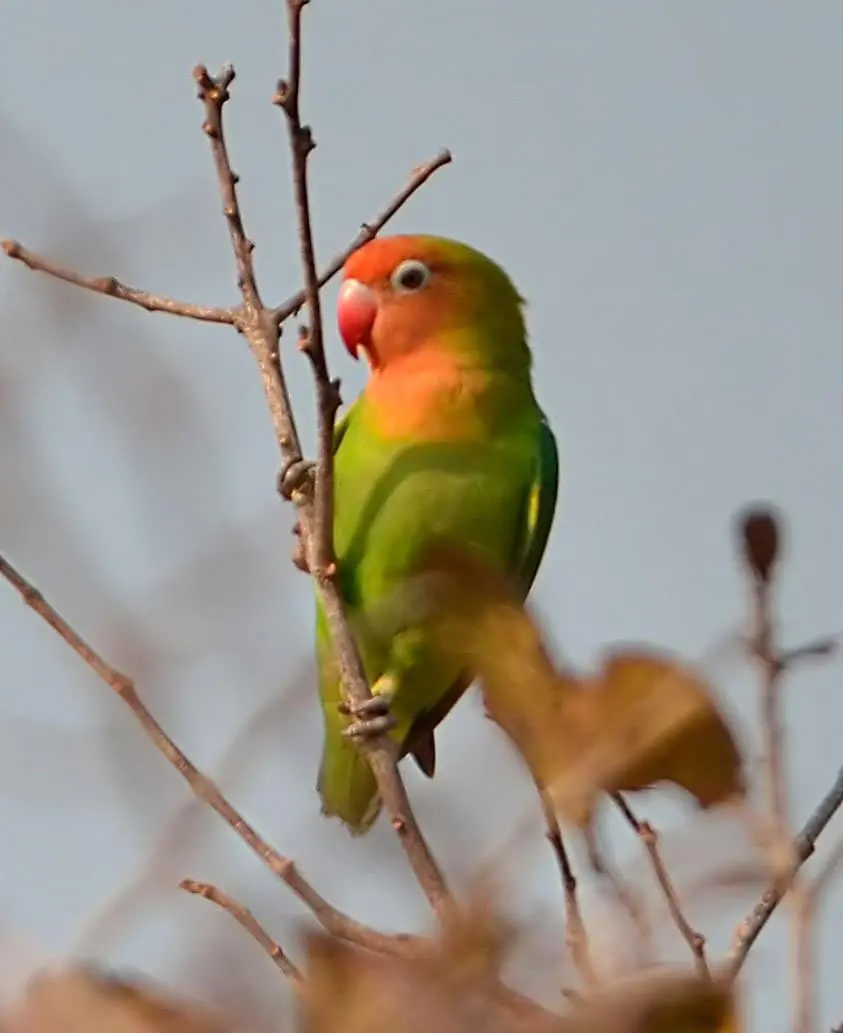
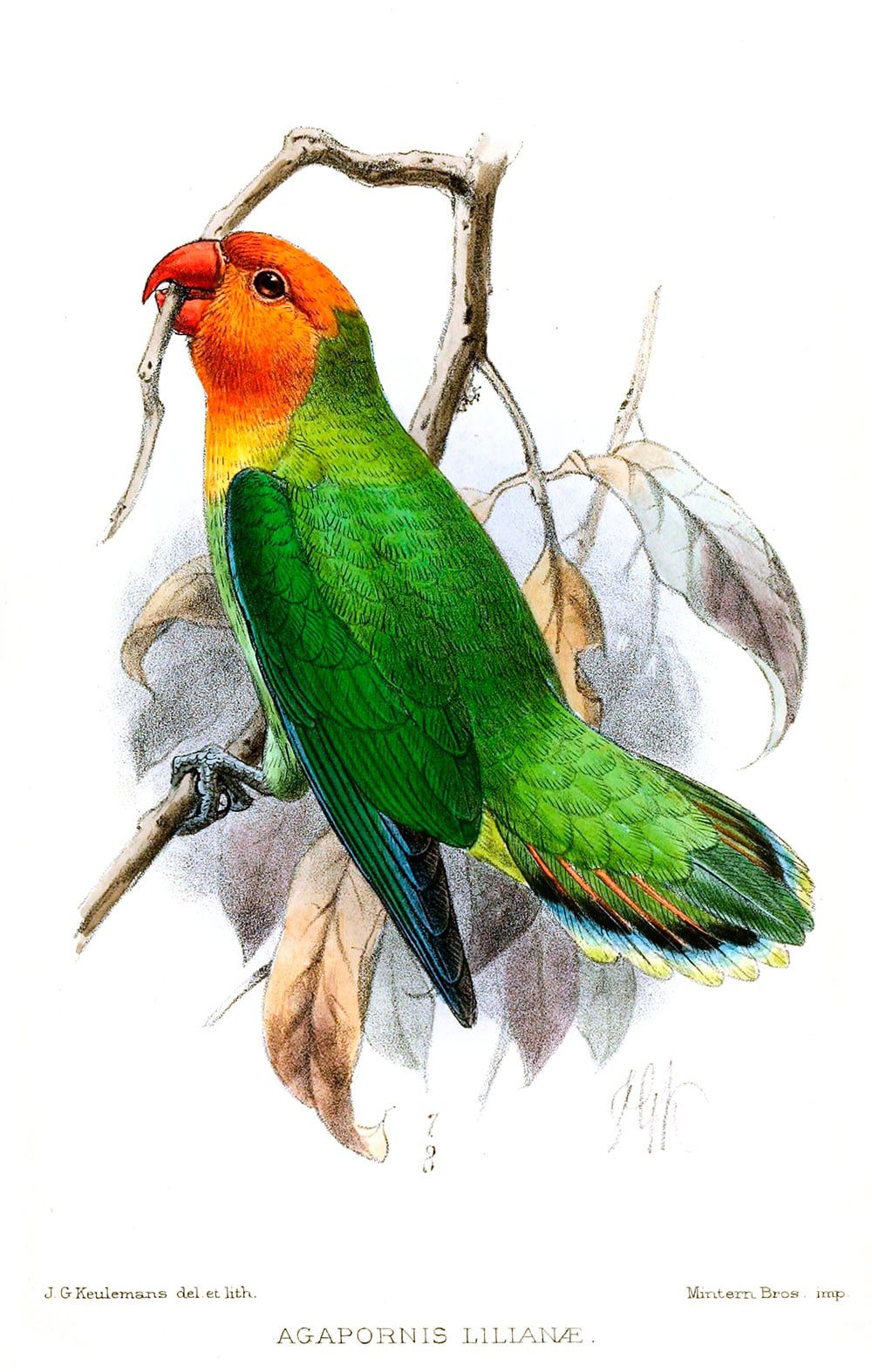
The colorful plumage of Nyasa small Inseparable (Agapornis lilianae) may cause their extinction, as it faces the constant threat of capture for the cage bird trade.
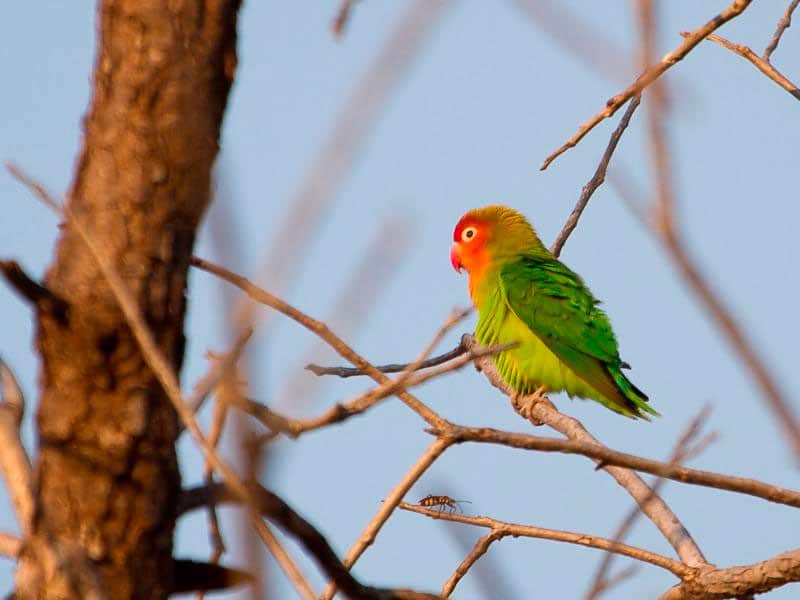
They have forecrown, fore crown, lores and cheeks brick red, merging with an orange and yellow-green wash on the back of the crown, ear-coverts, sides neck and nape, but occasionally (including samples taken in Malawi and unlikely to be hybrids with the Black-cheeked Lovebird (Agapornis nigrigenis)) brick red is replaced by dark crimson and orange by dark brown.
Mantle and scapulars bright green, rump and uppertail-coverts, Also bright green, but lighter. Upper, wing-coverts bright green; sometimes in yellow alula; vane outside of primaries and secondaries green; vane blackish internal. Under, the wing-coverts green with some blue feathers; bottoms of the flight feather blackish. Throat and top of the chest orange-red to pink salmon; bottom of the chest up to the undertail- coverts light green. The tail green, except central feathers with orange-red base and subterminal band dark.
Bill coral red; cere white; irises brown; eye ring white (2mm wide); legs pale grey.
Both sexes similar.
Immature and adults, but in black suffusion ear-coverts and black marks on the basis of upper jaw.
The Lilian's Lovebird It is in groves mopane (Colophospermum mopane) and acacias in alluvial deposits and banks of river valleys, in general, below the 1.000 m, preferring areas with figs. Avoid trees miombo.
Very sociable and usually observed in noisy flocks of 20 to 100 birds, sometimes many more, especially when food is plentiful. The birds are not breeding, forman communal roosts in hollow trees, where between 4 and 20 sleeping birds clinging to the walls of the chamber.
Before settling in the place of descando, the Lilian's Lovebird They engaged, to a great extent, to engage in fights and chases.
Reproduction Lilian's Lovebird
Reproduction colonies.
The nest it is a bulky dome-shaped structure with a tube-shaped entrance built from strips of bark, branches and stems brought to the nest by females at the peak.
They build nests in the cavities of trees Mopane, sometimes in some nest of the White-billed Buffalo-Weaver (Bubalornis albirostris).
Wild birds Lundazi nest in the eaves of buildings. the brood, according to sources, It takes place in the months of January and February (birds possibly introduced), September in Zimbabwe and between January and July Zambia.
The laying you can have between 3 and 8 eggs in captivity.
Food Lilian's Lovebird
The diet Lilian's Lovebird It is mainly composed of grass seeds, including Rice perennial and cultivated varieties like millet (particularly unripe) and the sorghum, also seeds acacias, flowers A. whitish, African Erythrophleum, Vitex duamiana and African Cordyla, berries and leaf buds.
The food is collected directly from plants and soil. Often they need to drink, so usually they live near water sources.
Distribution:
Size of the area of distribution (reproduction / resident): 129.000 km2
Several populations Lilian's Lovebird separated on a restricted area in the southeast africa.
They are distributed in the middle of the valley Zambezi River, from the top of Lake Kariba around East of Binga to province Head in Mozambique, in northern and southern belt Zambezi River, below the 1.000 m, including valleys Angwa and Hunyani in Zimbabwe and valleys Lunsemfwa and Sash in Zambia.
In Northeast Zambia, It is also located north of valle de Luangwa, seemingly isolated from the valley Zambezi River, where possibly they were imported.
In Malawi, There is an isolated population of Inseparable the Nyasa located in forests Mopane in the region of the Lake Malombe, to the South of the Lake Malawi. There is also dispersed populations in southern Tanzania.
Wild birds are believed to exist (at least in the past) in the District of Choma and Mazabuka, to the South of Zambia. Aves on al Namibia are escapes from.
generally common, in some places abundant, but probably overall decline due to habitat loss, for example, in the basin of the Lake Kariba.
Apparently they are sedentary, but you can make local movements in response to the food supply.
There is a large number of Lilian's Lovebird in captivity.
The population of the Lilian's Lovebird It is suspected of being in decline due to predation by invasive species and unsustainable levels of exploitation.
Its population has been greatly reduced by the flooding of much of the valley Zambezi by the Lake Kariba, and probably also by the dam Cahorra Low in Mozambique.
They considered a pest, small-scale, by farmers (Harrison et al. 1997). Besides the captura legal large quantities for the international trade in cage birds (more than 10.000 from 1981 when it began to be mentioned in the CITES Appendix II), many are caught and sold locally Mozambique, and the species is also caught and sold in Zimbabwe and Zambia (V. Parker in little . 2003, UNEP-WCMC CITES Trade Database, January 2005).
Conservation Actions Underway:
– Conduct surveys to obtain an overall estimate of the population.
– Monitor population trends through regular surveys.
– Control or stop the capture and trade in order to prevent overfishing.
This species is well studied in South Africa "Research Project" conducted by the "Research Center for Parrot Conservation" of the University of Kwazulu-Natal. Studies to better understand its ecology and conservation.
The Inseparable from the Nyasa in captivity
They were imported to Europe 1926.
Rarely seen among breeders and many crossed with Fischer's Lovebird (Agapornis fischeri).
The Lilian's Lovebird son aves gregarias, that coexist very well in Cologne. They have a character quite scary because not very frequent, they have not yet become very familiar with the human being, but once caught enough confidence spend the day making a racket.
They are birds something else complicated to create than other varieties Lovebird, are birds more timid and therefore need more peace of mind, plus the percentage of egg fertility in this species is a 40 % to 60 %.
Apparently they have problems to survive the first moult, so in this case it is recommended to acquire and adults.
With regard to its longevity, according to sources, a specimen lived 19,2 years in captivity.
Alternative names:
– Nyasa Lovebird, Black-cheeked Lovebird, Nyassa Lovebird (English).
– Inséparable de Lilian, Inséparable de Liliane, Inséparable liliane, Inséparable nyasa (French).
– Erdbeerköpfchen (German).
– Inseparável do Niassa, Inseparável-de-niassa (Portuguese).
– Inseparable del Nyasa, Inseparable Liliana, Agapornis Lilianae (español).



















_-blue_mutation2.jpg)

_at_nest_in_Narshapur%2C_AP_W_IMG_0737.jpg)
-_During_Foreplay_at_Hodal_I_Picture_0034.jpg)
.jpg)
