Content |
|---|
Characteristics "Singapura cat"
Coexistence is important that you have with your new friend. Before considering the acquisition of a cat of the breed "Singapura cat" you know certain factors. You must take into account their character, their need for exercise, their interaction with other pets, their care and if you have small children, their level of tolerance towards them.
Joy5,0 of 5 stars (based on 1 review)
|
Activity level4,0 of 5 stars (based on 1 review)
|
Friendliness to other pets3,0 of 5 stars (based on 1 review)
|
|---|---|---|
Friendliness to children3,0 of 5 stars (based on 1 review)
|
Grooming requirements1,0 of 5 stars (based on 1 review)
|
Vocality2,0 of 5 stars (based on 1 review)
|
Need for attention5,0 of 5 stars (based on 1 review)
|
Affection towards its owners4,0 of 5 stars (based on 1 review)
|
Docility1,0 of 5 stars (based on 1 review)
|
Intelligence4,0 of 5 stars (based on 1 review)
|
Independence3,0 of 5 stars (based on 1 review)
|
Hardiness2,0 of 5 stars (based on 1 review)
|
History
«Singapura» is the Malay name for Singapore. The name has also been given to a small cat considered the smallest domestic cat in the world and originally from the Southeast Asian city-state located at the southern tip of the Malay Peninsula.
In Singapura, brown or dark brown color is widespread in the genetic makeup and is characteristic of the local population of domestic cats. But, the fur of the Singapura is usually quite pale, and its origin story is not simple at all. It's not easy to find out.
Historically, the most widely accepted version was that of the International Cat Association (TICA), starring an American geophysicist, Hal Meadow, who was in Singapore at the beginning of the years 70, working for an oil company. His wife, Tommy, had been a judge of Cat Fanciers’ Association (CFA) and was interested in breeding cats - he had bred the Burmese, to the Abyssinian and Siamese-, as well as by genetics - he had carried out genetic experiments with mice and rats -. Due to the interests of Tommy, Thing sent him three brown cats from Southeast Asia during a visit to the city-state in 1971. He had obtained them from the crew of a ship that had adopted them and in which he had sailed.
In 1974, When Thing He was posted to Singapore for work reasons, he moved with his wife and cats: two burmese and three descendants of those who had been sent from Asia three years earlier. In 1975, upon his return to the United States, the Meadow they brought a Burmese and five brown cats, including two kittens born in Singapore. Hal y Tommy Meadow started a breeding project to create a new breed to be called Singapura.
In 1980, Barbara Gilbertson, one of the first breeders of the Singapura cat, brought another cat to America, call Chiko, that he had obtained from SPCA (Society for the Prevention of Cruelty to Animals) from Singapore, and that was included in the breeding program. Finally, in 1987, another breeder named Gerry Mayes traveled to Singapore to get some local stray cats, Known as "sewer cats" to the public due to their tendency to seek refuge in the city drainage system. These specimens were registered in the TICA and were incorporated into the breeding project of the Singapura.
Controversy
But, with the passage of time, other versions have emerged about the origin of the breed, that have caused controversy. The Meadows they first claimed to have captured one of their precursor cats in the vicinity of a Thai restaurant in Singapore and to have removed the other two from a nest found on the city's waterfront. This initial story was finally dismantled by a series of key events.
First of all, when the enthusiastic breeder Gerry Mayes traveled to Singapore in 1987 to bring "sewer cats", discovered that Meadow, when they arrived in 1974, had brought with them - and registered with the Singapore Ministry of National Development- Abyssinians and burmese. It also, No one on the ground seemed to have ever seen cats on the streets of Singapore that looked like the "gutter cats" described by Hal y Tommy Meadow.
Gerry Mayes he wondered if the Singapuras of Meadow were actually descended from Abyssinians and burmese that they had brought to Singapore. This did not stop him from bringing several cats from Singapore to the United States., but they could not be registered with the CFA as Singapuras, as they did not meet the breed criteria of the CFA. TICA agreed to register them. After five generations, the descendants of these cats are now recognized by the CFA as Singapuras.
around that same time, Lucy Koh, who had been collaborating with the Singapore Cat Club for a long time, undertook research and found very few cats in Singapore that met the criteria of the Singapura cat. He even claimed to have found a real Singapore cat, call Baby Bull, he had dark brown fur, much darker than the Singapuras ivory and sepia color Meadow. And what is more important, its size was much larger.
It also, Lucy Koh claimed to have a copy of a letter from 1975 of Tommy Meadow to the editor of Cat World Magazine, a month before she and her husband left Singapore. In this letter, allegedly declared his intention to achieve fame by passing American cats as singapurenses.
A third event that raised questions about the true origins of the Singapura happened in 1991. In that year, the Singapore Tourism Promotion Board (STPB) decided to grant the Singapura cat the national mascot title. After a contest to find the best nickname, the tourism body renamed it “Kucinta«, a crossword puzzle consisting of «kucin» ("cat" in Malay) y «cynta» («amor»). Kucinta It also means "the one I love". Thus, the small feline's new name means "love cat", and is often known as the "Singapore love cat".
The STPB had asked Lucy Koh your opinion about him Singapura. He gave them his opinion that it was a american cat hybrid. I affirm that Tommy Meadow -participating in the Feline Society of Singapore (SFS) as a registrar- he had created the breed standard himself and had changed the procedures for registering cats at the SFS. By refusing to give credit to this information, the STPB resorted to Tommy Meadow to give his version, what was it, of course, very different. Of course, the STPB did not want to give up its great promotional campaign based on the use of the kitten as a national emblem.
Seeing this, Lucy Koh told the story to Sandra Davie, reporter of Singapore Strait Times. The reporter investigated and ended up publishing an article stating that, far from having rescued Singapore's stray cats, as he had stated, Tommy Meadow Instead, he had created Singapura in Houston (Texas), hybridizing Abyssinians with burmese.
A true novel by Le Carré
Summoned to appear before the CFA to explain itself, the breeder adapted her version stating that the cats that created the breed were, In fact, those that her husband sent her in 1971, when I was already working in Singapore. Apparently, found the cats on or near the docks in Lo Yang District. To justify your previous lies, claimed that Thing I was then on a very discreet mission, if not secret, for the oil company that had hired him. In other words, his interlocutors were almost immersed in a real spy novel.
Tommy Meadow he also denied having raised Abyssinians during the time he was in charge of raising the Singapura. He also developed several responses to counter his critics' arguments.. It seems that his explanations were accepted by the feline associations, since the Singapura is still recognized by most of them. The CFA went so far as to affirm that, Regardless of whether the mating of the original cats occurred on the streets of Singapore or Michigan, the breed's gene pool originated in Southeast Asia, as in the case of Burmese and the Abyssinian.
In any case, having died in 2004, Mrs Meadow you will never have the opportunity to provide new information about the history of this feline breed with which you were so closely linked.
Recognition by feline associations and notoriety
In 1979, TICA recognized the Singapura as a "natural" race (non hybrid) and allowed him to compete in championships. The CFA recognized the breed in 1982, but he didn't pass her for the championships until 1988. In United States, the breed is also recognized by the American Cat Fanciers’ Association (ACFA).
In Europe, the Governing Council of the Cat Fancy (GCCF) and Fédération Internationale Féline (FIFé), the main feline associations of Great Britain and Europe, they also recognize it.
So there is unanimity, despite the controversy surrounding the breed.
The Singapura It remains a rare breed, above all because feline associations - in particular the CFA- They consider it a "natural" breed and, Therefore, crossing is not allowed. So, the number of their representatives can only increase very slowly. According to the CFA, the world population of Singapuras it was about 5.000 individuals in 2006. In France, fewer than fifty births are registered per year.
Physical characteristics
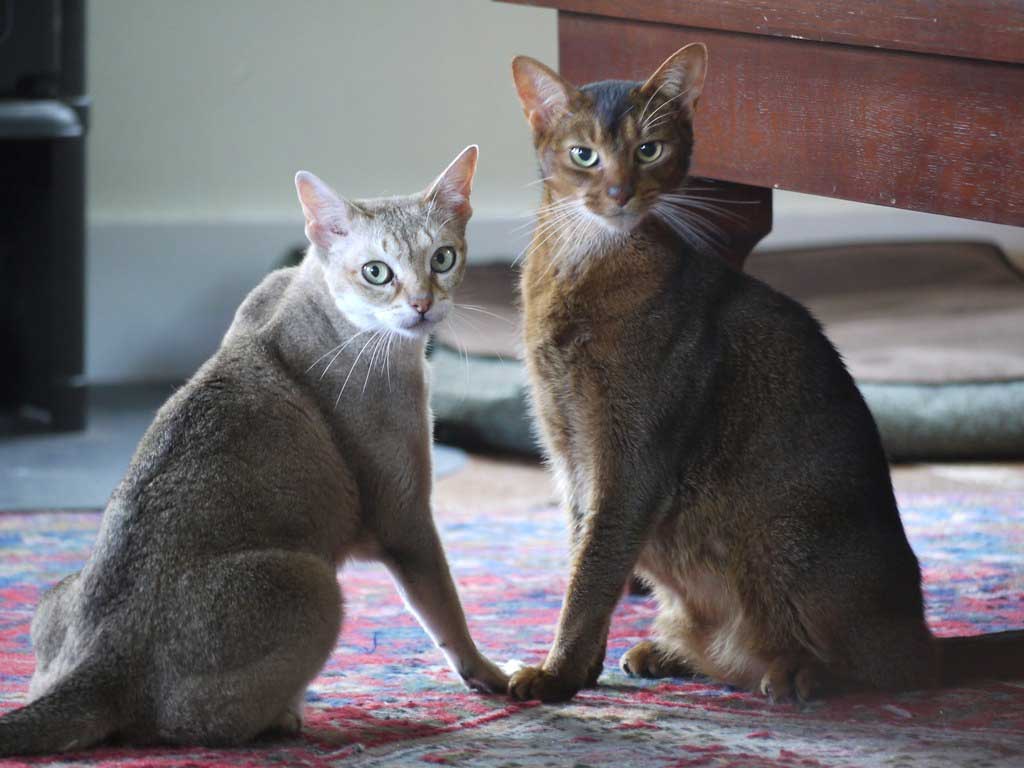
The Singapura it's a small cat. It is even known as the smallest domestic cat in the world. The adult female weighs about 2 kg, while the male can reach a weight of about 3,5 kg.
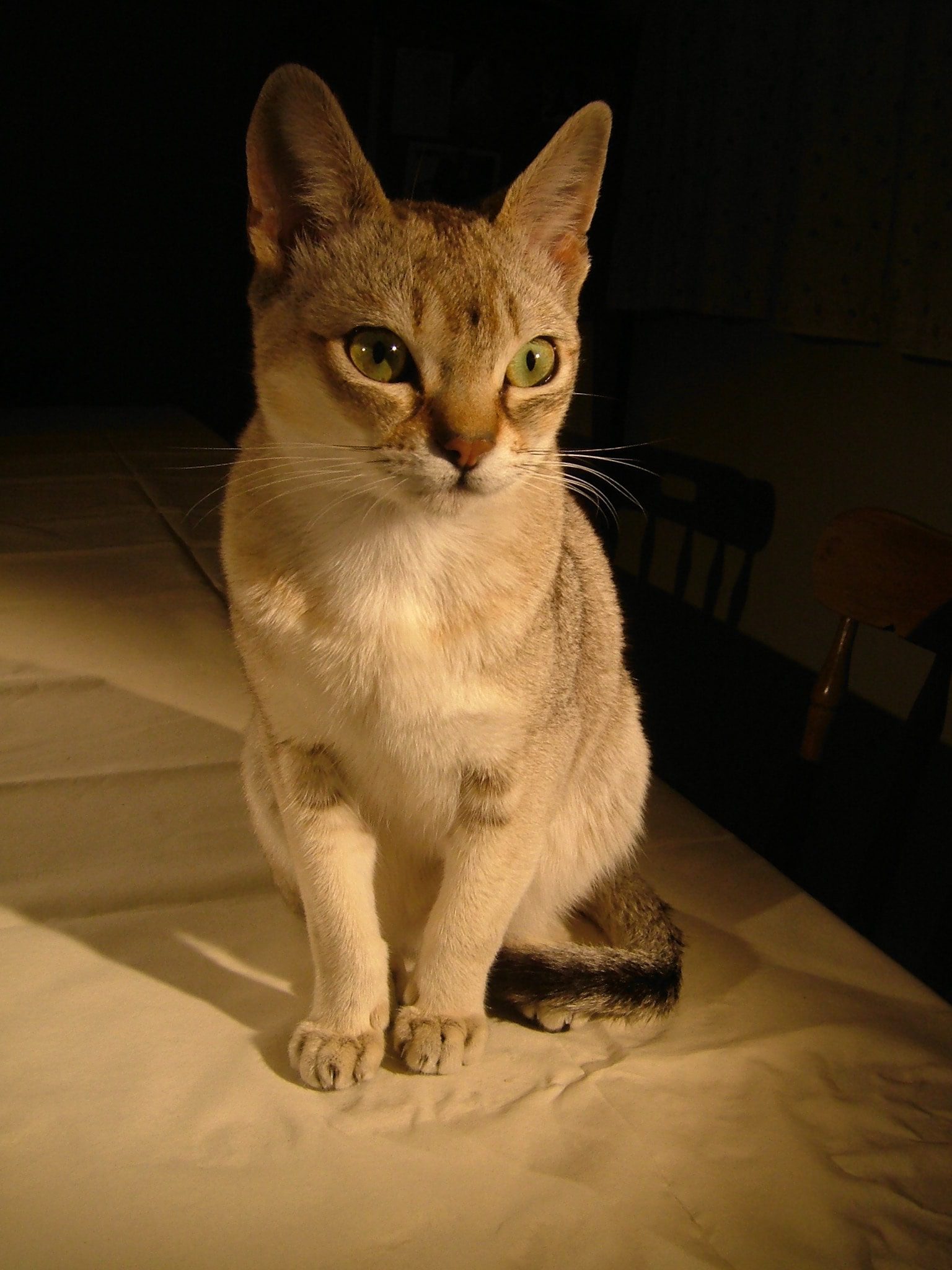
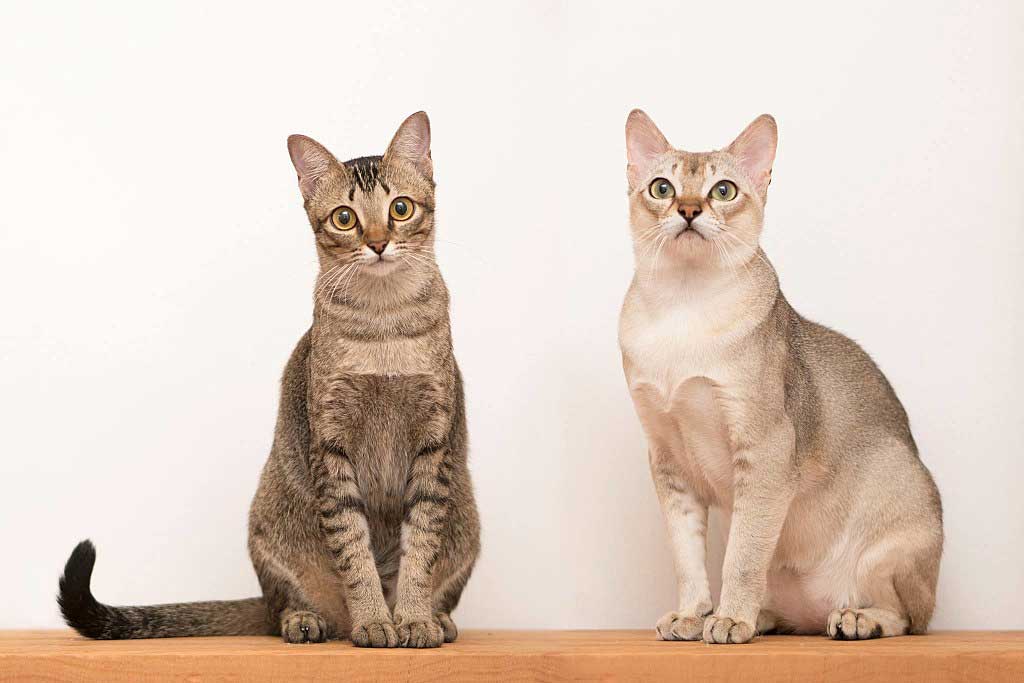
It is a somewhat stocky and muscular cat: as such, It is considered medium and semi-rigid.. Its head it is round and has large eyes hazelnut-colored almonds, brown, green or yellow. The ears they are wide at the base, deep and quite large for its size, ending slightly pointed. The tail it is thin and slightly shorter than the body, with rounded tip.
The fur is short, very fine and bright and is of the type ticked tabby, that is to say, hair strands are alternately light and dark shades. The bottom of the animal, including throat, muzzle and chin, are of a lighter shade.
In addition to his unusually large eyes and ears for his size, the third remarkable physical characteristic of the Singapura cat is the color cuttlefish from its fur. It is a coat with beige to dark brown reflections on a deep ivory background..
Size and weight
- Size: 25 cm.
- Weight: Of 2 to 4 kg
Breed standard
The breed standards are documents established by official bodies that list the conditions that a dog must meet. Singapura to be fully recognized as belonging to the race:
- Standard FIFé (Fédération Internationale Féline)
- Standard LOOF (Livre Officiel des Origines Félines)
- Standard AFC (Association Féline Canadienne)
- Standard TICA (The International Cat Association)
- Standard CFA (The Cat Fanciers’ Association)
- Standard GCCF (The Governing Council of the Cat Fancy)
Character and skills

The Singapura he's a beautiful little fellow, loving and lively. It is a lively cat, energetic and very active, who is also very affectionate and friendly, since he loves human company. They love to lie on their owner's lap or shoulders and are delighted to show their affection, and expect the same in return.
Intelligent and curious, they love to play and climb on shelves and cabinets to get a good look at their surroundings. Throughout his life, her youthful and playful temperament never leaves her. This explains that it adapts very well to the presence of children or other domestic animals., who are welcome playmates for him. But, like any other breed of cat, should not be left alone in the presence of a very young child.
The Singapura cat he is also known for being very calm. He doesn't meow very often and his voice is quite discreet..
If we add to this that they like the heat and that they are reluctant to go outside when it is cold, we have the ingredients of an ideal domestic cat. But, his need for activity makes it essential to provide him with a tree and cat toys to keep him from destroying the floor, especially when left alone for a while.
They don't like to be alone and they don't get along. So, you better have a home where you are not left alone too often or for too long, and in which at least one person spends some time with him every day.
Grooming and Care "Singapura cat"
"Singapura cat" |
||
|---|---|---|
 | ||
The short and fine coat of the Singapura It does not require a lot of care. Brushing the cat's coat weekly is enough.
Daily brushing of the cat's teeth is also recommended to prevent periodontal disease.
Last, the cat's ears should be examined weekly and, if required, clean them with a cotton ball or soft cloth soaked in a mixture of half and half cider vinegar and warm water.
Indoor or outdoor cat?
Thanks to its small size, cats Singapura can be easily kept in a small flat. It would be great if you could provide a cat proof balcony or, even better, a garden. But, even without this welcome change, the Singapura you will feel right at home if the floor is designed accordingly and there are enough opportunities to play and climb.
Much more important to him Singapura that the opportunity to spend time outdoors is the company of a companion and that his owners do not leave him alone for an unnecessarily long time, then it can be kept as an indoor cat without any problem.
How much activity does he need? "Singapura cat"?
Whether it is a female Singapura like a male Singapura, don't underestimate the high energy level and intelligence of this breed. So, a feline companion is almost essential, so that the Singapura, with its social nature, never be completely alone and can thus also dissipate energy during playful confrontations and fast chase runs.
But, the Singapura cat is very people-oriented and should not be left alone for a long time. It is much more important that caregivers take time every day for play sessions and cuddles. Especially hunting and intelligence games go well with representatives of the breed Singapura.
Health and nutrition
How this breed has a very limited gene pool, it is very possible that hereditary or congenital diseases occur in the Singapura. But, is considered robust and not prone to disease.
For the moment, according to him Governing Council of the Cat Fancy (GCCF), the leading British feline association, only the progressive retinal atrophy and pyruvate kinase deficiency as diseases to which the Singaporea is especially susceptible.
As the name of the disease indicates, cats affected by progressive retinal atrophy experience gradual deterioration of vision due to retinal atrophy. The pyruvate kinase deficiency can cause some form of anemia in affected animals. This can cause lethargy., diarrhea, loss of appetite and weight, and affect the appearance of the cat's coat. The disease can even lead to premature death of the animal.
Both can be detected by genetic testing, allowing serious breeders of the Singapura cat identify and eliminate individuals carrying the defective genes from their breeding grounds. Any prospective buyer should require proof that the kitten they wish to adopt has been tested negatively..
It is interesting to note that these two diseases are also present in the Abyssinian cat. The Abyssinian is the only breed of cat in which progressive retinal atrophy has been shown to be congenital. It is also one of the two races suspected of being the cause of Singapura…
Last, it has also been reported that the female Singapura have a predisposition to uterine inertia. In cats affected by this failure of the reproductive system, contractions are insufficient to allow expulsion of the fetus when the cat gives birth, and then a caesarean section is necessary. As there is no test to detect this disease, It is important to be vigilant when giving birth to a Singapura for the first time and seek veterinary assistance if possible. If you are found to have this condition, it is recommended that she be spayed or neutered, as any future childbirth would be risky for her and her unborn babies.
Life expectancy
11 to 15 years
Food
Feed a Singapura cat not particularly difficult. You just have to make sure that the food is balanced and of good quality, asking a breeder of Singapura or a vet if necessary.
As with any other race, it is important to bear in mind that the nutritional needs of the cat change throughout his life.
Last, as the Singapura does not tend to overeat and is usually content with the amount of food that he needs, it is a breed not prone to feline obesity.
For sale "Singapura cat"
If you are thinking of adopting a kitten Singapura, you should know that this cat can reach an age of 12 years and more. During this period of time, be prepared to provide a loving home for her and give her the right time and care.
Since the breeders of Singapura are scarce, it is not easy to find a suitable breeder, but the search is worth it, because the Singapura, extremely sociable, it is a perfect family cat that will give you many joys. Of course, it is important that you are prepared to keep it with one or more cats, because only then will the little bundle of energy really feel at home.
By the way, the breeders of Singapura renowned charge between 700 and 1500 euros for healthy kittens and vet checked with papers.
Videos "Singapura cat"
|
|
|
|---|