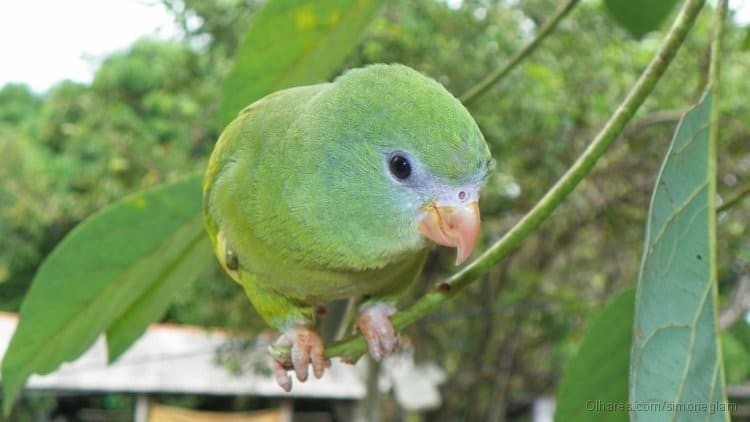
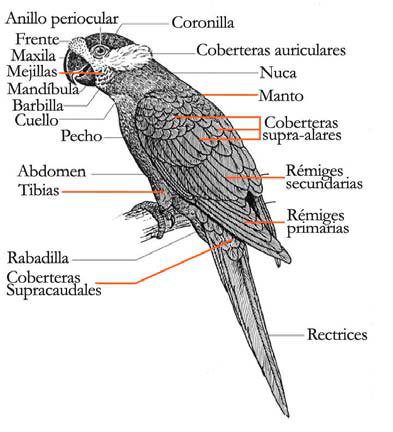
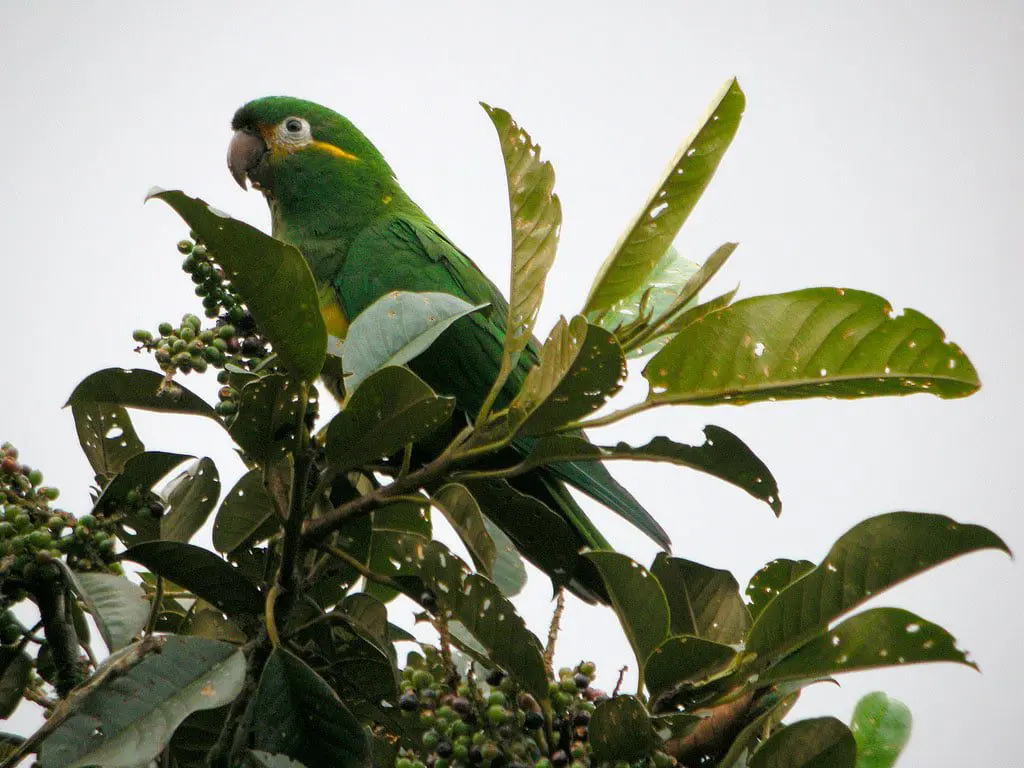
The Amazonian Parrotlet(Nannopsittaca dachilleae) has pointed wings, something square tail. Distinguishable from this species is the forehead and Crown with blue dye, feet and pink Bill, area naked clear around the eye. Usually green body on the back, and more yellowish belly.
Common and abundant in riparian forest, until the 300 m. Possibly associated with the guadua. They fly low over rivers in small, compact flocks of 3 to 12 individuals.
Seen climbing on trees.
They are presumed to nest in clumps of bromeliads or other epiphytes..
Calls are described as acute, they sound very similar to the chicks of birds of farm.
Distribution:
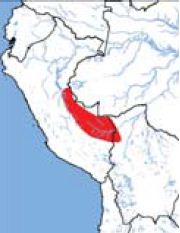
It is found in the western part of the Amazon basin, from southern and southeastern Peru to northwestern Bolivia. Probably West of Brazil.
It is a scarce bird that rarely has photographed. The conservation of the rainforest is crucial to their survival. There are many threats to the ecosystem of the Amazonian Parrotlet, harvesting the Guaua bamboo, the Habitat fragmentation and pollution.
Conservation:
According to the IUCN categories it is considered as Near Threatened. (NT). Deforestation, mainly for colonization, logging and mining, affect their populations.
Alternative names:
– Manu Parrotlet o Amazonian Parrotlet (English)
– Amazonaspapagei, Amazonassittich, Urwaldsittich (Germany)
– Toui de D’Achille, Toui de l’Amazone (France)
– Periquito-da-amazônia (Brazil).
– Periquito-da-Amazônia (Portugal).
– Periquito Amazónico (Peru).
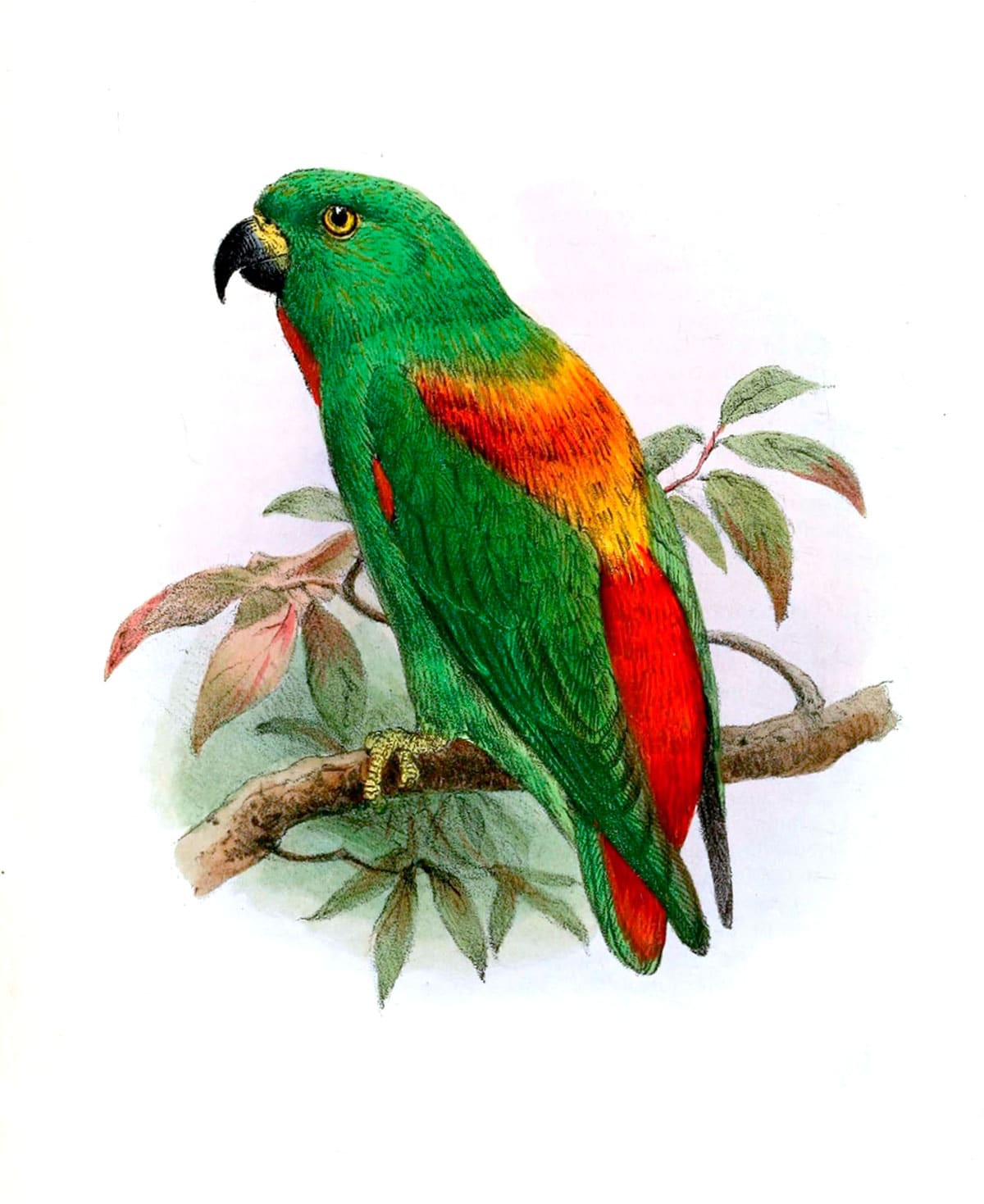
The plumage of the Sula hanging parrot(Loriculus sclateri) is mostly green.
The chin and throat They are red. There are orange-yellow markings on the mantle and in the back. The coverts, rump and tail upper are crimson, extending to the tip of the tail. Carpal edge red (Wing attack on the "shoulder"). The tail It is green with yellow-green tip. The bill is black.
the female has the irises brown, While the male is pale yellow.
To the Sula hanging parrot Sometimes I have treated as a subspecies of the Moluccan hanging parrot, but the two are treated as separate species based on its clear differences in plumage and size.
They are generally distributed in humid areas of subtropical primary and secondary forests or lowland tropical forests. until 450 meters above sea level – mainly on the edge of the forest. Can also be seen in remaining tall trees in plantations and cultivated areas.
viewed solos, or pairs or small groups.
Reproduction:
The first breeding season begins in January and lasts until April; and if conditions are right, breeding activities can once again be observed from July to September.
Nest trunks of dead trees, favor of the narrow hollow long with small entrance holes. Noticed it a female carrying nesting material, that can include pieces of bark, leaves and feathers for lining of the nest. Sunset You can consist of 2 to 4 white eggs. Single the female incubates the eggs during 20 days, While the male feeds it. Each egg measures of ~ 15 mm to 18,7 mm.
Food:
Its diet natural It consists mainly of red fruits – particularly wild figs, guava and berries, as well as flower buds and flowers. They also feed on nectar and seeds.
Distribution:
Size of the area of distribution (reproduction / resident): 30.800 km2
– Avibase
– Parrots of the World – Forshaw Joseph M
– Parrots A Guide to the Parrots of the World – Tony Juniper & Mike Parr
– Birdlife
– beautyofbirds
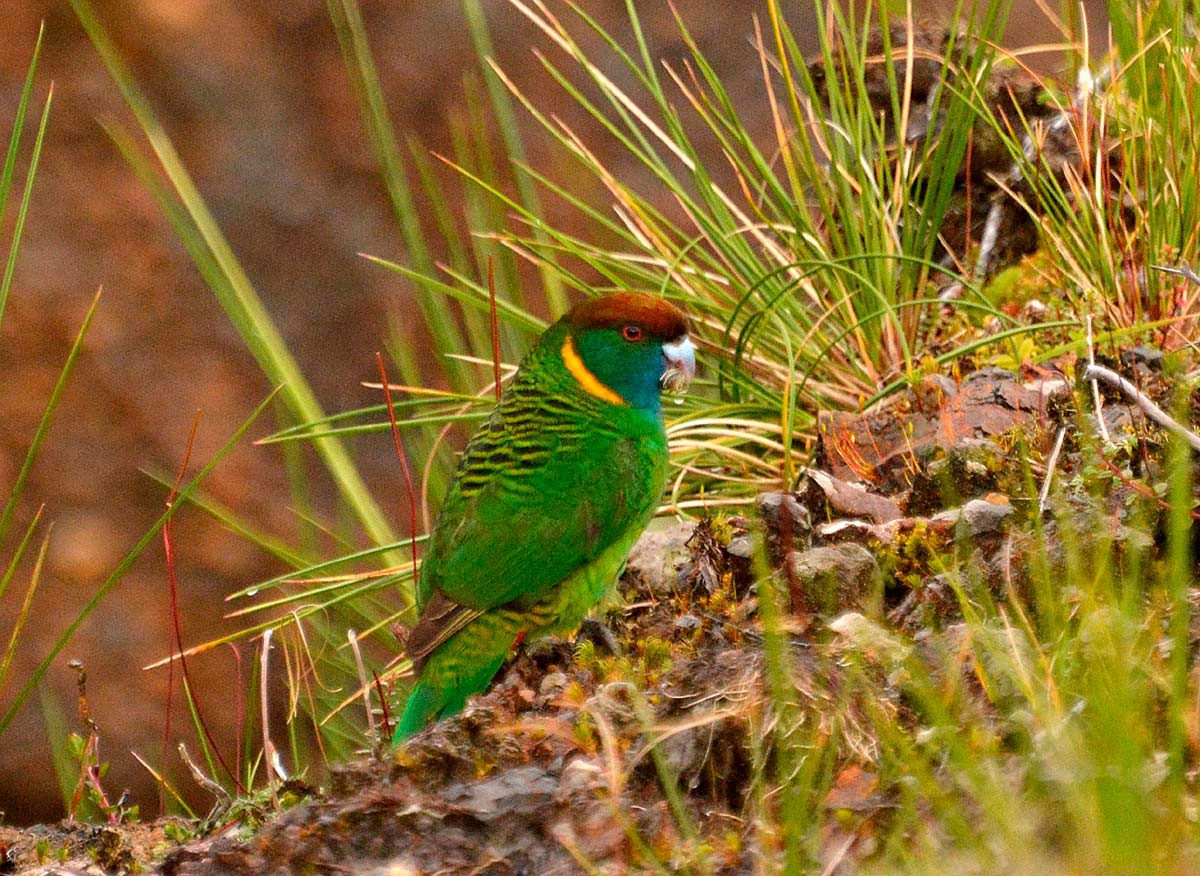
In adults of the Painted Tiger-Parrot(Psittacus erithacus), the head is predominantly Brown, but the colors of the top they are bright and warm, While the cheeks they are more off and more grey. One collar Yellow Strait decorates the neck. The plumage is green with black stripes. Rump and uppertail-coverts red. The wings They show a green with yellow stripes on the external threads and the flight feather. The underparts is yellowish-green.
The chin is brown, the upper part of the chest It has a central patch of blue. The coverts are orange-red. The rest of them underparts are a green medium, slightly clearer that the upperparts. The upper part of the tail is dark green. The bottom of the tail is blackish grey.
The bill is light grey and blue color with a white tip. The irises are reddish orange, the legs dark gray.
The collar Yellow is absent in the female. The cheeks they are dyed blue. The chest black and yellow colors absent. In the upperparts abounds over the scratched.
– (Victoria, 1910) Adults as the nominal species but the crown and the surroundings are color marron-oliva; cheeks teal, with a green darker in ear-coverts; rump and uppertail-coverts greenish yellow striped with black.
Psittacella picta excelsa
– (Mayr & Gilliard, 1951) Males as the nominal, but the Crown is colored bright marron-oliva. The female is like the female of the nominal species but with the head color glossy marron-oliva; the throat and cheeks heavily washed in blue.
Habitat:
The Painted Tiger-Parrot they live in the mountains, in forest areas where can be seen especially at edges and clearings. They are also found in the moss-covered forests, the secondary forest, and in the thickets of Alpine and subalpine areas. These birds can be downloaded at 1.370 m. In the southeast of its distribution area, they tend to be distributed at lower altitudes than in other places. But, their preferred Habitat is between the 2.400 and 4.000 m, just above the Brehm's Tiger-Parrot (Psittacella brehmii).
The birds are generally quiet, but not shy, and move individually, in pairs or in groups of up to six members; It has been observed feeding on groups, mixed with the Madarasz's Tiger-Parrot. They often feed in low bushes or on the ground.
Reproduction:
Little is known about the ecology of the species and the only information on reproductive behavior is that birds in breeding conditions have been observed in the months of June and August..
Food:
The diet It includes seeds, berries and the fruit of conifers Dacrydium.
Distribution:
Endemic to the central band of the mountain of New Guinea. Restricted to the high montane forests, from the West of the Maoke through the central mountains, including the Tari region, about Kandep, Mount Hagen, Monte, Kubor up to the Owen Stanley mountain range in the Southeast. The world's population is believed to be superior to the 100.000 specimens.
– Occupied the mountains Central of Papua New Guinea.
Conservation:
• Current IUCN Red List category: Unrecognized
According to "The World Parrot Trust«, in accordance with Tony Juniper, the world's population is superior to 100 000 individuals.
According to the Manual, This species, Although relatively dispersed, may be locally common. Despite its small extension, It is classified as «least concern»For the different ornithological organizations.
35 to 40 cm.. length between 145 and 163 g. of weight.
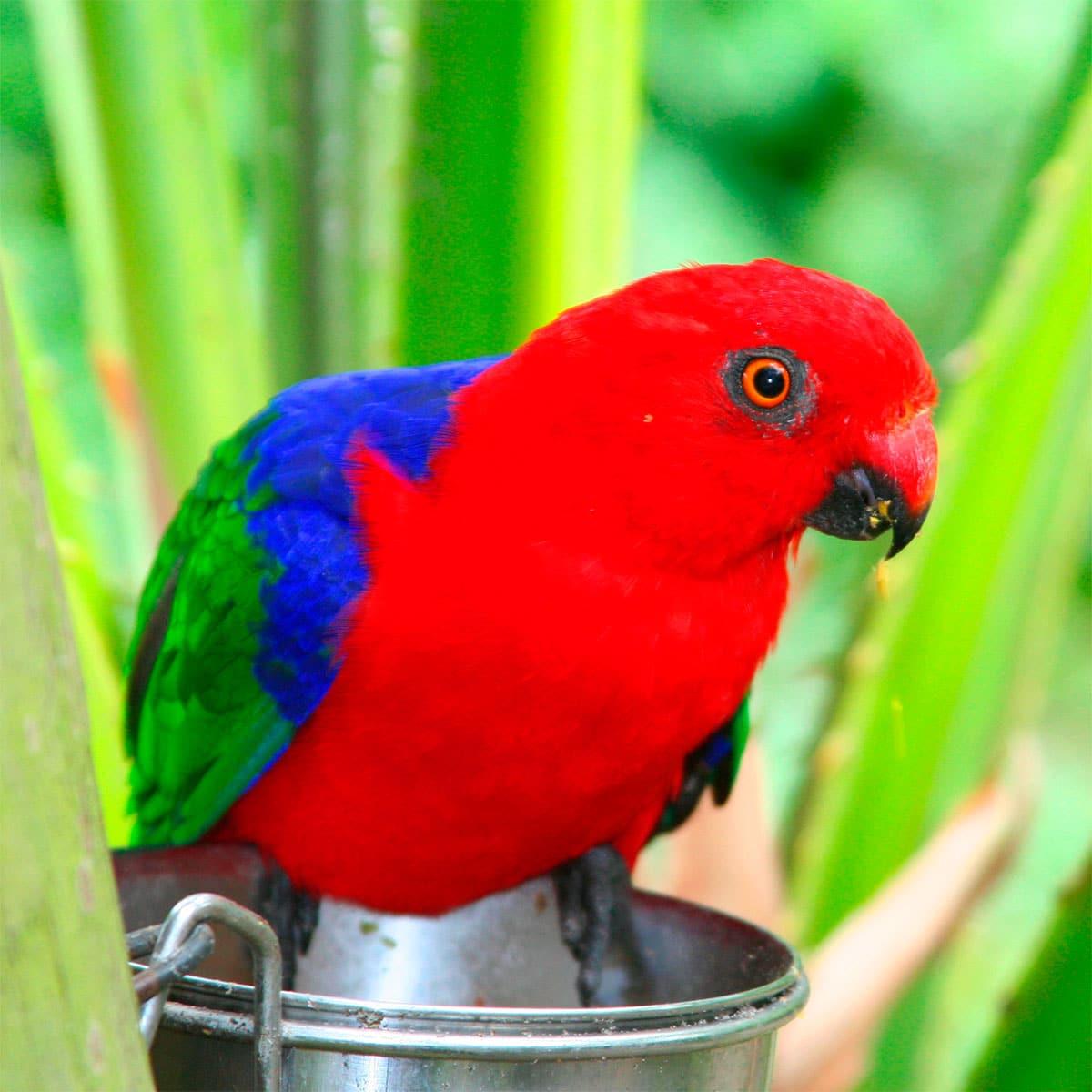
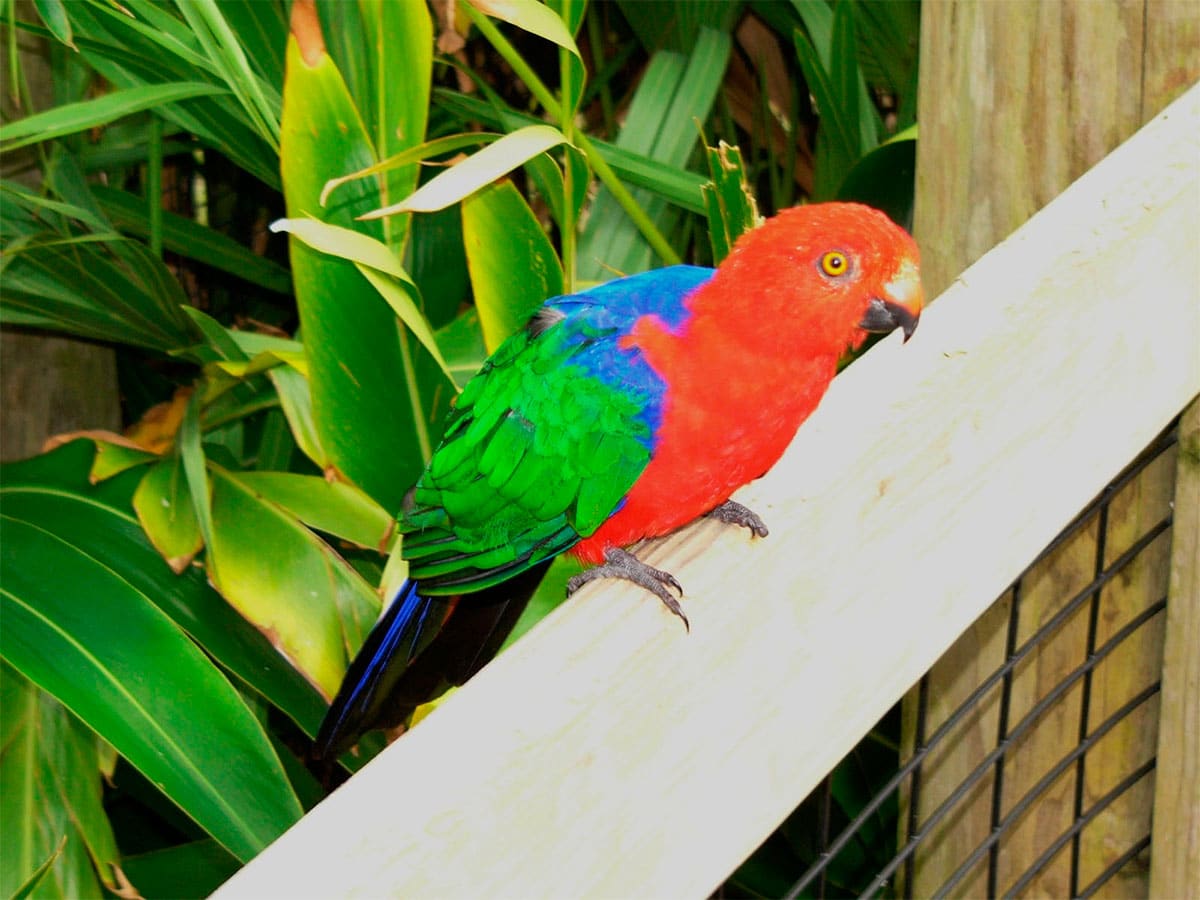
The Moluccan King-Parrot (Alisterus amboinensis) has a head, neck, the nape of the neck and the upper mantle of bright red, with strong demarcation to dark blue-violet in the lower mantle, back, buttocks and supracaudales coverts. Green wings with the exception of the blue in the small inner coverts and carpal edge. Under, black wings with blue-violet coverts. Bright red bottoms, with mauve bases to coverts infracaudales, sometimes visible; flanks with a little blue. Upper, the very dark blue colal; below black grey color wide-margin rose to the side feathers.
Bill with an orange-red base on the upper mandible, Blackish lower; Orange iris; black grey legs.
The two sexes, somatic sexual dimorphism is not presented..
Immature with more green in the back; Brown-Black beaks; pale eye-ring and darker than the adults of iris. Dotted pink on the outer tail feathers. Mature in one year.
(Salvadori, 1876) – As the subspecies sulaensis but with more feathers in the tail with pink edges. Blackish grey peak in both sexes
Alisterus amboinensis dorsalis
(Quoy & Gaimard, 1830) – As the nominal but the rose of the absent tail feathers; Red slightly darker on the head and underparts.
Alisterus amboinensis hypophonius
(S. Muller, 1843) – As the nominal, but the wings and the deep blue wing coverts; the rose in the absent tail feathers
Alisterus amboinensis sulaensis
(Reichenow, 1881) – As the nominal, but with a green stripe across the upper mantle; No rim with pink in the tail feathers.
Alisterus amboinensis versicolor
(Neumann, 1939) – Unlike the subspecies sulaensis by having a uniform blue mantle; smaller in size than the nominal.
Habitat:
The Moluccan Parrot is distributed through the dense primary and secondary humid forests, and from time to time in the adjacent plantations, farmland and gardens, from the lowlands up to around the 2.100 meters above sea level.
The birds are usually found in pairs or in small groups, and they are very calm while feeding and shy at all times, hiding in the thick foliage and flying amid shrill calls at the first sign of an intruder.
Reproduction:
Just nothing is known of the cycle of reproduction in the wild, although according to sources, nesting takes place between the months of February and April.
Two young birds nests have been found on two occasions in hollow trees.
One instance of captive breeding gave data for incubation of 19 days, with the emerging young in nine weeks.
The courtship was observed during feeding, and two eggs were deposited.
Food:
The diet includes acorns Lithocarpus, as well as hard fruits, outbreaks and other forest tree berries.
Distribution:
Size of the area of distribution (reproduction / resident): 149.000 km2
• Current category of the Red List of the UICN: Least concern
• Population trend: Decreasing
The size of the world's population has not been quantified, but the species is described as generally common, Although rare in Halmahera.
The nominal subspecies population is estimated at 70.000 specimens (pit et to the. 1997).
The population is suspected to be declining due to the destruction of habitat in course.
"Moluccan King-Parrot" in captivity:
Occasionally available.
Nervous, is a bird a pet bird.
In captivity will have failed to reproduce.
In the Zoological Garden of Loro Parque, Tenerife, on Canary Islands, biologists Dr. Burkard and Dr. Gerlach they have made so large colonies, but since 1972 they have succeeded until now non.
More information on loromania
Alternative names:
– Moluccan King-Parrot, Amboina King Parrot, Amboina King-Parrot, Ambon King-Parrot, Moluccan King Parrot (ingles).
– Perruche tricolore, Perruche royale d’Amboine (French).
– Amboinasittich (German).
– Periquito-rei-amboina (Portuguese).
– Papagayo Moluqueño, Papagayo Real de Amboina (español).
– Avibase
– Parrots of the World – Forshaw Joseph M
– Parrots A Guide to the Parrots of the World – Tony Juniper & Mike Parr
– Birdlife
– World Parrot Trust – parrots.org
20 to 21 cm. length and a weight between 44 and 61 g..
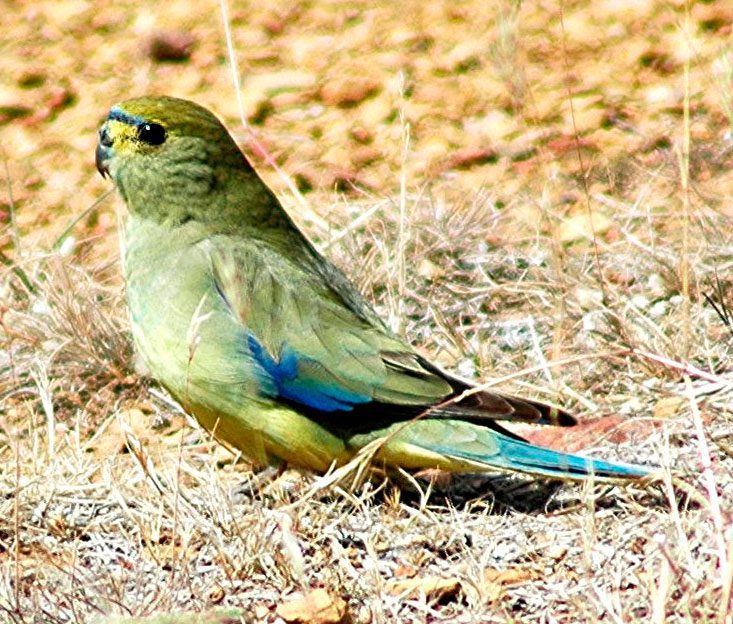
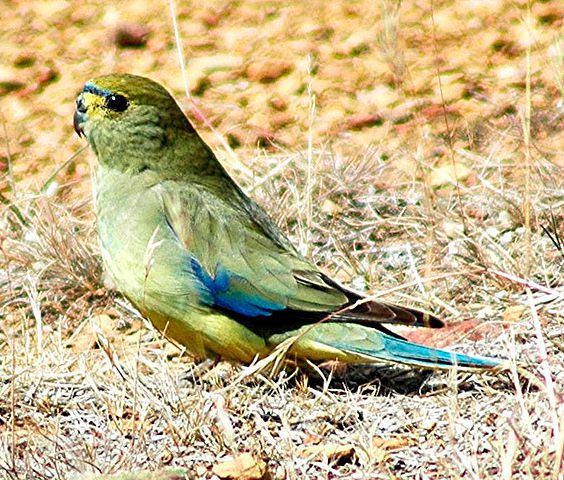
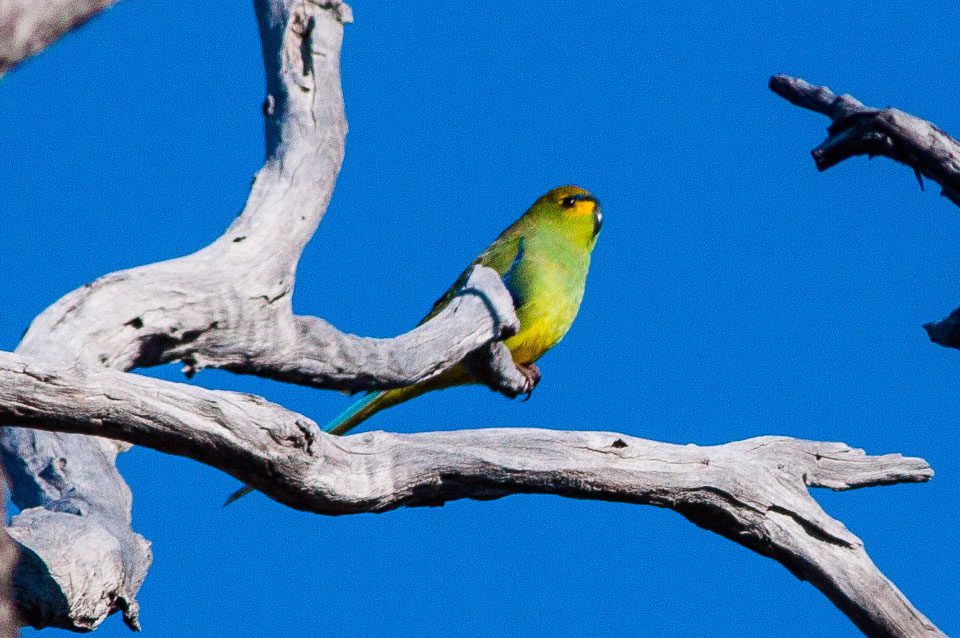
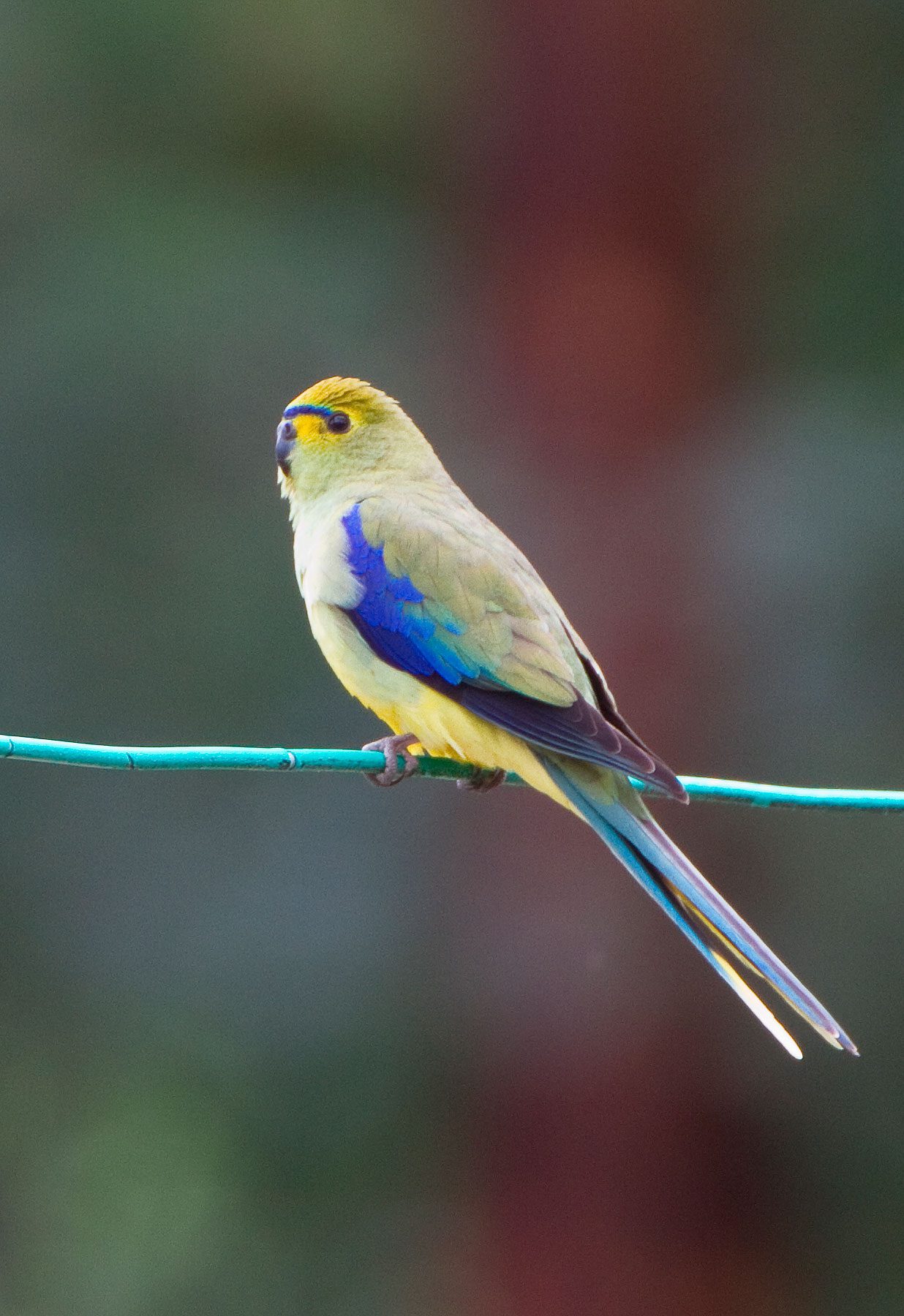
The Blue-winged Parrot(Neophema chrysostoma) has the crown olive green color with a yellow front wallwashing; blue front band (clearer on the back edge), arriving from the front towards the eyes (but not beyond); Lords bright yellow; coverts outpus and face Gris-Oliva. Upperparts olive green color without brightness.
Wing coverts blue, clearer in some feathers of the greater coverts Interior. Primaries black, with blue-violet edges in vane thin yellow margin and external; secondary internal with vane Green external, secondary average with blue in vane outer; tertiary olive green. Wing feathers blue. Top of the chest light green with yellow shading in the area of the belly and undertail- coverts. Upper, the tail is bluish grey, with the exception of the tips of the outer tail feathers, that are yellow.
The bill It is greyish-black with a pinkish lower jaw and the upper jaw with sharp edges.; irises dark brown; legs gris-rosado color.
The female it is duller than the male with the line that adorns the forecrown less developed.
It has the top of the crown olive green. The underparts they are tinged with pale green.
The young birds they lack the frontal band and most show a wing bar; the bill It is orange in very young birds.
During the nesting season, the Blue-winged Parrot frequent eucalyptus plots.
starting winter, These birds change the habitat type, visiting the clear, orchards or similar locations. In addition to these common locations, they tend to move into thickets of acacia and lightly wooded grasslands. At this time of the year, the Blue-winged Parrot They also feel attracted by the arid plains with Salt plants (Atriplex) and for the coast and mountain Moors.
These colorful birds occasionally visit swamps, sand dunes along the coast and wetlands.
To the Blue-winged Parrot You can see them in pairs or in small groups, but in the off-season, form large meetings in the regions south of the coast, in partnership with the Crimson Rosella or more rarely with the Orange-bellied Parrot.
When feed, they are relatively accessible, flying into a nearby tree when bother them.
During the courtship, the male drops his wings, moves the head and regurgitates food for your future partner. By now, not explained clearly the migration. We know that birds from the south of the continent head north after breeding and the northern limit of this movement is in the south of Queensland. On the other hand, It is unclear whether all the population of the island of Tasmania It has to do with the migration that it crosses the bass strait.
Reproduction:
The nesting season extends from October to January. The nest It is usually a natural cavity in a large eucalyptus. Sometimes, However, found in a stump on a fence post or fallen log.
The female always makes the choice of the site. The Blue-winged Parrot They nest in colonies, sometimes several pairs are established in the same tree. The site can be used for several consecutive years.
The setting contains of 4 to 6 eggs, which are incubated for a period of 18 to 20 days. At birth, the chicks are altricial, and leave their place of birth to the 30 days after hatching. But, they stay with their parents for a short time before becoming independent.
Food:
The Blue-winged Parrot they feed mainly on grass seeds, and especially Danthonia What are the grass family? Poaceae. But, they often enter fields, where to dig the ground with their beaks to retrieve newly sown seeds.
Insects and invertebrates are probably part of their diet. Fruits and flowers represent a significant part of its menu.
Distribution:
During the breeding season (September to January) the birds are found below in 36 ° S, concentrating in the wetter parts of the southeast of Southern Australia, South of Victoria, and in Tasmania.
In winter they are, to a large extent, absent of Tasmania and are distributed much more North, in the southeast of Australia, reaching the South of Queensland (some 26 ° S, for example Thargomindah, Cunnamulla, Chinchilla), and extending westward to the East of Southern Australia, coming to the South of the eyre peninsula and spreading northward around the border of Queensland; They also extend to the East, to the Western parts of New South Wales (as well, from time to time, to the South of the coastal districts in summer).
It is not known if the continental population of the South is resident and birds of Tasmania they are migrant, flying over the Mainland farms to winter over North, or if the entire population moved northward in winter.
There are relatively few records of the King Islands and Flinders, which suggests that, Unlike in the Orange-bellied Parrot, most birds fly over Bass Strait directly to the mainland.
The Blue-winged Parrot are generally common in most open field types and are, probably, the most common parrot in Tasmania. where are reproduced to the South of Macquarie Harbour, on the West Coast and are found in the central region, provided that their habitat is suitable.
Flocks of up to 2.000 young birds they can form in the Northwest of Tasmania before the autumn migration.
The world's population is above the 20.000 birds.
Conservation:
• Current category of the Red List of the UICN: Least concern
• Population Trend: Stable
According to the Manual of the birds of the world (HBW), This species is not threatened globally. It is even common in the region of Melbourne and Tasmania.
The population is suspected to be stable in the apparent absence of any reduction or substantial threats.
According to Barry Talor, the world population would exceed 20.000 individuals.
"Blue-winged Parrot" in captivity:
The Blue-winged Parrot It, in general, less popular in aviculture as the Crimson Rosella, the Turquoise Parrot, the Scarlet-chested Parrot and the Bourke's Parrot, it's not really weird though.
Their behavior is relatively quiet with few movement needs. It is a bird that is easy to maintain, even for beginners. Your need to crack is almost non-existent and their need for bathroom depends on the individual. It is resistant to the European climate and, certainly, is not inferior to other species of neophemas. But, is susceptible to fog and cold damp, as we know it here in the fall and winter seasons.
The Blue-winged Parrot they seek food by digging in the Earth and are therefore vulnerable to parasitic infections.
According to sources, a Blue-winged Parrot lived during 21 years in captivity. In captivity, these animals have been able to play at the age of 2 years.
Alternative names:
– Blue-winged Parrot, Blue winged Parrot, Blue-banded Grass-Parakeet, Blue-banded Grass-Parrot, Blue-banded Parrot, Blue-winged Grass-Parakeet, Grass Parrot, Hobart Grass-Parrot (ingles).
– Perruche à bouche d’or, Perruche à ailes bleues, Vénuste à ailes bleues (French).
– Feinsittich (German).
– Periquito-de-asa-azul (Portuguese).
– Papagayo de Alas Azules, Periquito Crisóstomo (español).
32 cm. medium length and a weight between 300 and 400 g..
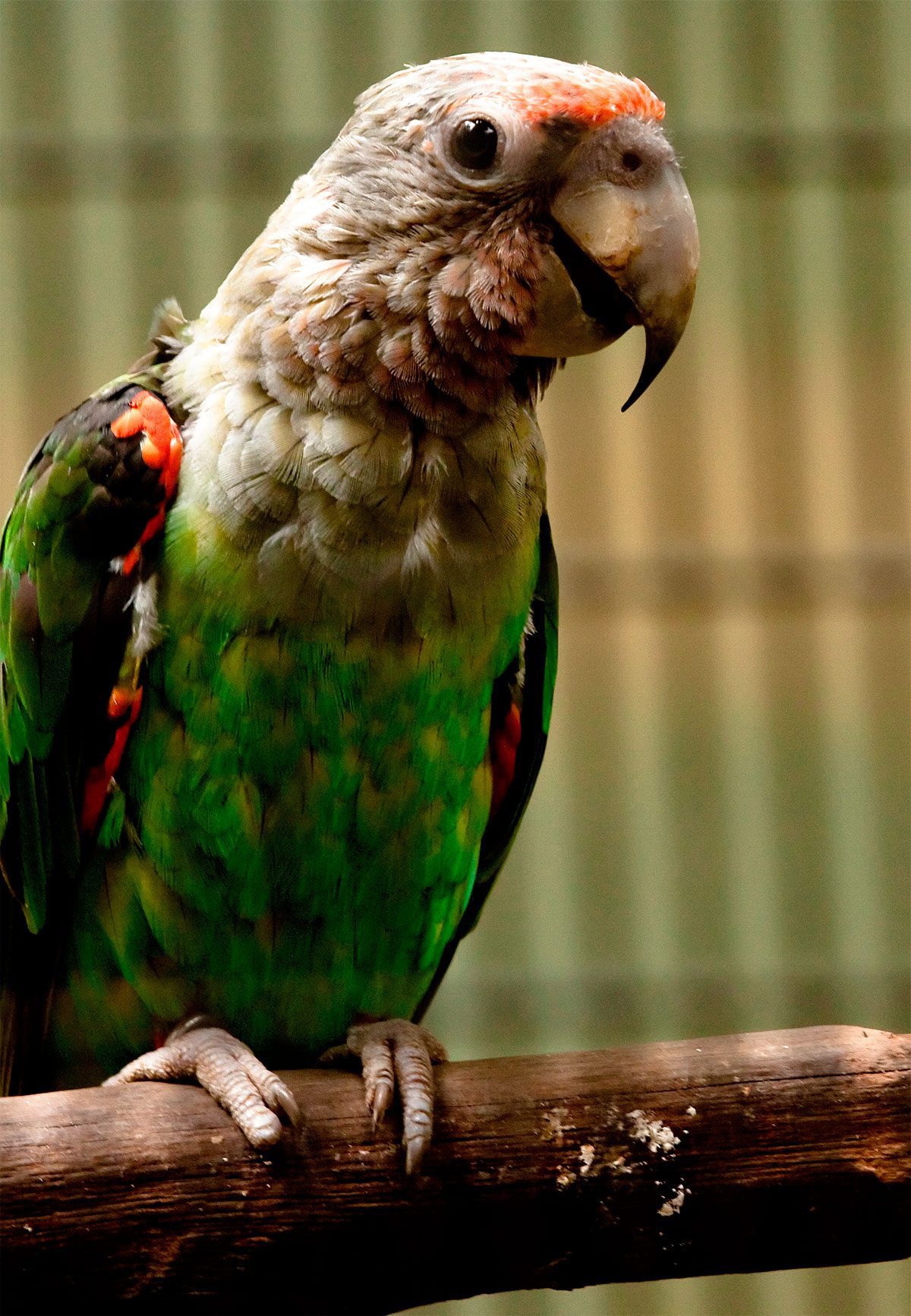
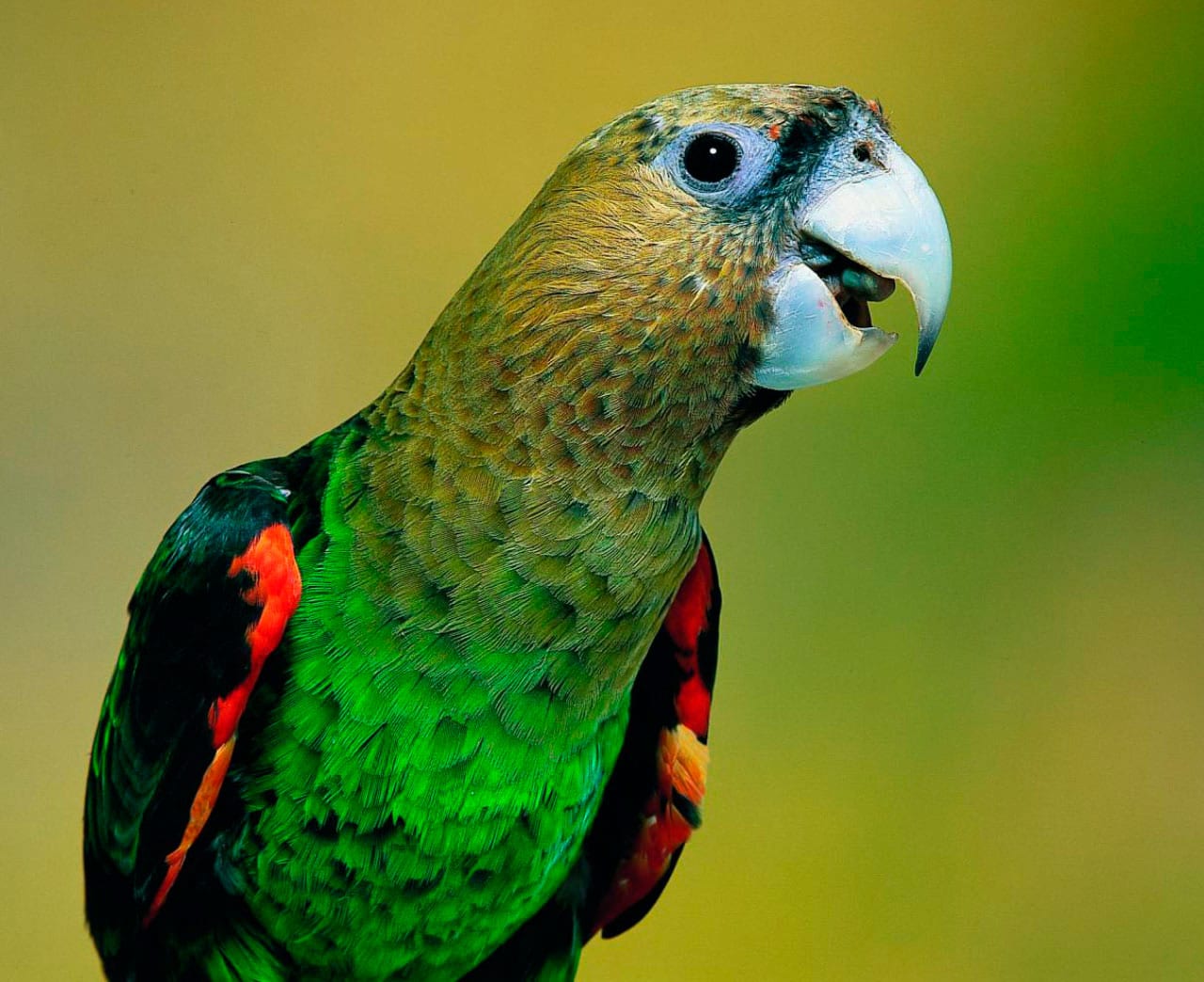
The Cape Parrot(Poicephalus robustus) has the head, neck and throat between olive brown and olive yellow, with darker spots (almost black in some birds), especially in the crown; lores and cheeks blackish; pale red frontal band, is present, occasionally, in males (generally evident in females).
The mantle feathers and scapulars dark green opaque, bright green-edged; rump bright green.
Coverts on the leading edges of the wings, Since the carpal joints at the base of the primaries, bright orange red; upper wing coverts, dark green to black, with lighter green edges; below, the feathers of the wings blackish and green. The primaries and secondaries black top, dark brown below. High area of the chest, stomach and vent, bright green; the thighs orange red glossy. Upper, the tail black; undertail, dark brown.
Some birds (around the 10%) have feathers yellow in the plumage spread.
Bill color horn; irises dark brown to reddish brown; legs bluish grey.
The females, generally (Although not always), they have well defined orange red frontal band.
The youth lack of color marks orange red envelope the wing-coverts and the thighs, but tend to show a bit of red in the forecrown.
In a study initiated in 1992, the taxonomic status of Lorito was revised Robusto (Poicephalus robustus) (Gmelin), and two species were proposed; Poicephalus robustus, restricted to montane forests of southern Africa, Poicephalus fuscicollis suahelicus, with wider distribution in wooded areas, and Poicephalus fuscicollis fuscicollis, similar to the Poicephalus fuscicollis suahelicus ostensibly, but with discontinuous, restricted to a narrow range of forests and West Africa.
(Reichenow, 1898) – Of larger size the species nominal, the male has the head and the neck a silvery gray and lacks the reddish frontal band. The female has orange colouring in the the thighs and in the shoulders and in the cere, while the male not. Blue tint in the rump.
Poicephalus robustus fuscicollis
(Kuhl, 1820) – The smaller subspecies. With more blue tones, especially in rump and bottom of the back.
Habitat:
They live in a variety of forest types, including Red Mangroves (Rhizophora mangle) (for example, in Gambia), riparian forests (for example in Ghana, Zimbabwe), Savanna Woods (for example, Nigeria, Ivory Coast), in montane forests at altitudes of 3,750m (for example, east of Zaire), in lowland forests (for example, South Zaire).
The birds of the Southern Africa they have favoritism by the Acacia mearnsii and Podocarpus forests at altitudes between 1.000 and 1,700 m, separating attitudinally and ecologically in the subspecies suahelicus, It occurs in lowland forests.
The birds of the Southern Africa (also perhaps other species) they form communal roosts before spreading to power remote areas (until 90 km) in small flocks.
Sometimes seen separately but more usually found in groups of up to 20 birds (sometimes 50). It forms mixed flocks with peers.
The season of breeding varies with locality. In Gambia, reportedly, breeding takes place between the months of February and April, While in Zimbabwe It is estimated to be between the months of March to June, and between October and November. In South Africa, breeding takes place in June and between August and October.
The laying tends to be of 3 to 4 eggs.
During the courtship the male feeds the female making exaggerated turns his head and dropping their wings to form a kind of layer around the lower half of your body. The pair shows a strong union ties and they spend much time grooming each other.
Food:
In Zimbabwe, In addition to daily trips in search of food, seasonal movements are performed in search of Uapaca and fruits of Sysygium.
Has been feeding of millet in Zimbabwe and Malawi, of peanuts harvested in Gambia and, occasionally, visiting gardens of Apple trees, but numerous enough to be considered a plague serious nowhere.
The birds of the Southern Africa feed almost exclusively on fruit of the Podocarpus, long as they are available.
Use the peak to climb between the branches when they feed in the trees; They also feed on the ground. The Cape Parrot make daily trips to secret locations for drinking water.
Distribution:
Probably occupy three zones separated, in the West, South-Central and South of Africa.
In West Africa, are from Gambia and South of Senegal to the East of Ghana and Togo.
In the Center-South of Africa, from the southwest of Congo, South and East of Zaire, Southwest of Uganda, Rwanda and from the center of Tanzania to the North of Namibia, North of Botswana, Zambia and Zimbabwe.
Flocks of foraging roam unpredictably and can remain away from traditional sites for weeks. Sometimes they make seasonal movements in relation to the availability of food, for example, in the northern savannas of Ghana.
Local and mostly uncommon across the range, Although more numerous and frequent in Ghana.
(Reichenow, 1898) – Are distributed by the center of Angola; Southeast of the Democratic Republic of the Congo, Rwanda and South of Tanzania until Zimbabwe, North of Mozambique, and far northeast of South Africa; in populations along the lower Congo River the three subspecies can mix.
Poicephalus robustus fuscicollis
(Kuhl, 1820) – Are distributed from the South of the Senegal and Gambia to the North of Ghana
In 1988 included for the first time in the red list of threatened species by the IUCN as least concern species.
The size of its current population is estimated at less than 1.600 birds in their natural habitat.
Why not join this parrot species in critical hazard is due to the subspecies of this they comprise an area of diffusion much greater than that of the nominal species, whereupon, This leads to a growth in the population of subspecies and the decrease of the nominal species. The subspecies occupy all the Central Africa and Western, while the Poicephalus robustus only lives in some provinces of South Africa as they are Eastern Cape, KwaZulu-Natal and Limpopo.
Over time the Poicephalus robustus, they have drastically dropped its population due to the uncontrolled felling of the forests of Sandalwood to manufacture furniture. Thus reaching that there is only two percent of the forest of Sandalwood.
Diffusion area of Poicephalus fuscicollis and Poicephalus robustus
In captive the Cape Parrot it is found in small quantities by several countries of Europe and without many successful breeding advances, so the first objective to preserve the nominal species is to control the logging of forests, Since the Cape Parrot they have to travel many miles to feed, as there is no food have to descend to feed from the crop fields where many die because they are hunted by the owners of the fields. Forests are also needed in the life of the Poicephalus robustus since they nest in cavities of the trees, they feed on.
The legal and illegal trade It is another point to be highlighted in the conservation of this species. Since 1998 the countries with the most legal exports have been Tanzania, Guinea-Bissau, Guinea, Democratic Republic of the Congo and Ivory Coast. What makes think that the nominal species It has been the least affected in the terms of trade while the subspecies they have been the most affected and the most marketed. This can be known by looking at the area of diffusion of the subspecies and the countries with the most exports made..
The diseases they are also a major threat, above all in the nominal species. The disease of PBFD or beak and feather disease (Psittacine Beak and Feather Disease virus) is that more deaths has caused to the Poicephalus robustus.
"Cape Parrot" in captivity:
It is very similar in nature to the Grey Parrot.
Its capacity for imitation is still little known since, for years, has been very difficult to get in poultry farming.
Not advisable to keep mixed aviaries. Son quiet and depending on their way of breeding (natural or by hand) and previous experiences, they can be quite confident and curious, even without being hand reared do not usually take to commit themselves. As pets they are very Welcome to, Smart and affectionate, with a very good character.
Captive breeding of this species may be the last hope of saving it from total extinction.. The number of specimens in captivity is low, but enough, If handled properly to strengthen the species.
In terms of their longevity, according to sources, a Cape Parrot lived 29,7 years in captivity. In captivity, These birds can be raised from the 5 years of age.
Alternative names:
– Cape Parrot, Brown necked Parrot, Brown-necked Parrot, Cape or Brown-necked Parrot, Gray-headed Parrot, Grey-headed Parrot (English).
– Perroquet à cou brun, Perroquet du Cap, Perroquet du Cap ou P. à cou brun, Perroquet robuste (French).
– Graukopfpapage, Kap Papagei, Kappapagei (German).
– Papagaio-de-bico-grosso (Portuguese).
– Lorito Robusto, Loro de El Cabo, Lorito del Cabo (español).
– Avibase
– Parrots of the World – Forshaw Joseph M
– Parrots A Guide to the Parrots of the World – Tony Juniper & Mike Parr
– Birdlife
– Wikipedia
– Loromania
– Mundoexotics
– Photos:
(1) – To Brown-necked Parrot at Jurong Bird Park, Singapore By Peter so [CC BY 2.0], via Wikimedia Commons
(2) – Cape Parrot en Benvie, Karkloof, KwaZulu-Natal, South Africa By Alan Manson [CC BY-SA 2.0], via Wikimedia Commons
(3) – Youth, captive, friendly Poicephalus robustus fuscicollis by Bob Corrigan – Flickr
(4) – Male Cape parrot (Poicephalus robustus). Image credit: Cyril Laubscher – SCI-news.com
(5) – Cape parrot flying low over to wild plum tree. Africa's most endangered parrot like never before... (Rodnick Biljon) – nationalgeographic
(6) – Diffusion area of Poicephalus fuscicollis and Poicephalus robustus By Juan Caparrós (Own work) [GFDL or CC BY-SA 4.0-3.0-2.5-2.0-1.0], via Wikimedia Commons
Origin: Afghanistan, Bhutan, India, Nepal, Pakistan
Character: Shy, quiet.
Life expectancy: 15 to 17 years.
Height: Of 39 to 41 cm..
Content
Description:
Of 39 to 41 cm.. of length and a weight of 125 g..
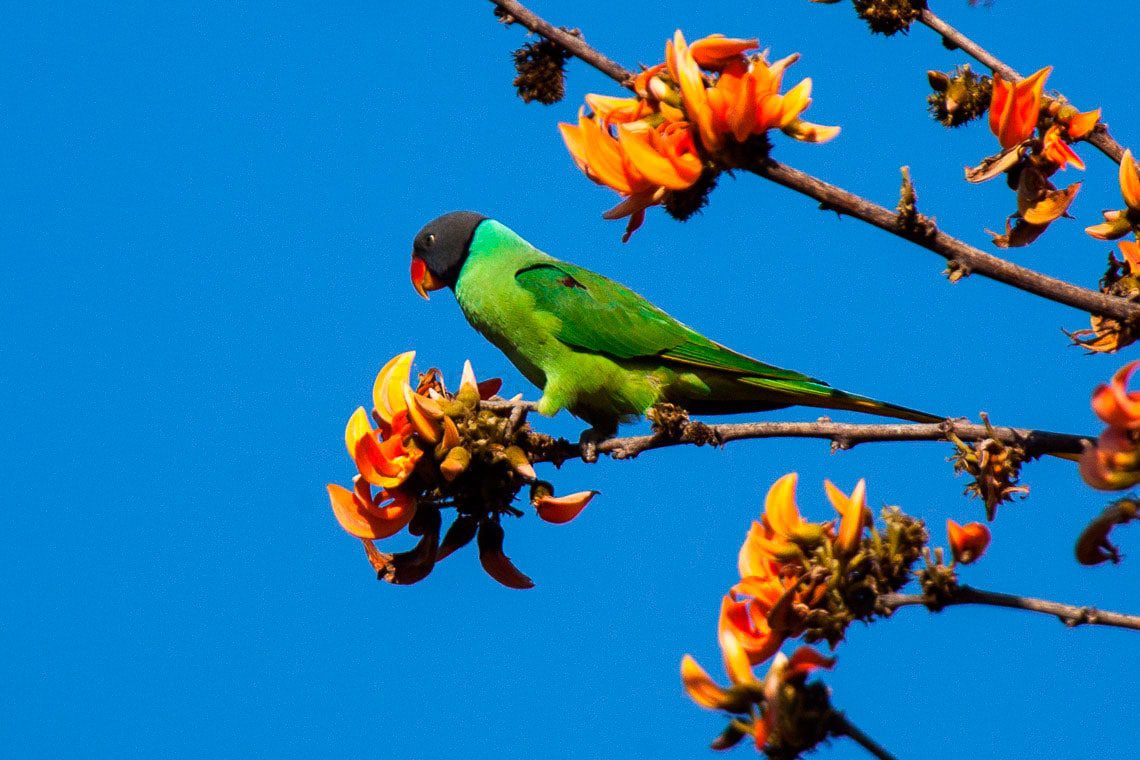
The Slaty-headed Parakeet(Psittacula himalayana) has the forecrown, crown, lores and ear-coverts slaty-grey; chin and lower cheeks black, extending in the lateral narrow shaped collar black, to mark a clear boundary between the dark head and back neck bright green and nape, whose colour fades to duller green on rest of upperparts..
Lesser wing-coverts outer, green, brown the inner coverts, with a distinctive patch shoulder; remaining upperwing-coverts green.
The primaries Green with narrow yellow margins in vane outer; secondaries green. Underwing-coverts bluish green. Underparts bright pale green. Uppertail bright blue green, tipped chrome yellow color in the center, outer feathers green with yellowish tips; undertail-coverts bright yellow.
upper jaw orange-red, tipped pale yellowish, the lower yellower; cere whitish; irises creamy white; legs yellowish green.
The female smaller, more opaque in nape, usually with the tail shorter and often they lack the brown in the patch of the shoulders.
The immature with the head greenish brown opaque; acquire gray slate after first winter. The young birds they have the irises dark.
The Slaty-headed Parakeet Mountain forests are distributed, at altitudes around 2.500 meters in summer; rarely above the 250 meters in winter. Otherwise residents, although there are fluctuations depending on local food supply.
Occupy denser forest than most of its congeners, but preferably in extensions near orchards or farms with high trees. Registered in a variety of slopes and steep wooded valleys, including oak forests, cedars, Oak, rhododendrons and pines.
Observed, in general, in small flocks or family groups, no large gatherings, although flocks 50 birds have been recorded at the end of the monsoon.
Also registered with mixed banndadas Rose-ringed Parakeet, the Plum-headed Parakeet and Blossom-headed Parakeet. Registered a flock of 15 males during the month of November Nepal.
Reproduction:
The nest Slaty-headed Parakeet usually it located in a recess, on top of a tree, at an altitude between 6 and 20 m above the ground; a rotten branch used to excavate a cavity or modificadan the old nest of other species.
In East Afghanistan, the nest is ,normally, an old hole made by a Scaly-bellied Woodpecker (Pico squamatus).
Often several nests are close together.
The breeding season in the west of the range is between March and May, (maybe later at higher altitudes); they leave the breeding area in July; the laying is of 3 to 5 eggs.
Food:
The Slaty-headed Parakeet it feeds on various fruit, cultivated and wild, dried fruits and seeds, depending on the season.
Although the overall economic impact of this species is probably light, they are considered locally as a pest due to attacks on corn crops, Apple trees (flower and fruit), pear and walnuts Juglans regia.
Distribution:
Size of the area of distribution (reproduction / resident): 696.000 km2
The Slaty-headed Parakeet It is distributed by the Himalaya occidental, where they are, Commonly, above the 1.350 m, from the East of Afghanistan through northern Pakistan, northern India and Nepal until Bhutan, West of Arunachal Pradesh and Assam (about 92 it is) to the North of the Brahmaputra.
The size of the world population Slaty-headed Parakeet It has not been quantified, but the species, according to sources, is usually common, although apparently very poorly documented in recent decades; uncommon in China.
The population is suspected to be stable in the absence of evidence of any reduction or substantial threats.
"Slaty-headed Parakeet" in captivity:
Fairly common in Australia, not so much in other places. In general, trade is not significant.
Alternative names:
– Slaty-headed Parakeet, Himalayan Slaty-headed Parakeet (English).
– Perruche de l’Himalaya, Perruche à tête ardoisée (French).
– Himalayasittich, Finsch-Sittich, Schwarzkopf-Edelsittich (German).
– Periquito-himalayana (Portuguese).
– Cotorra de Cabeza Pizarra, Cotorra del Himalaya (español).
– Avibase
– Parrots of the World – Forshaw Joseph M
– Parrots A Guide to the Parrots of the World – Tony Juniper & Mike Parr
– Birdlife
– Photos:
(1) – Slatina-headed Parakeet Psittacula Himalayas, Corbett National Park, India By Francesco Veronesi from Italy (Slaty-headed Parakeet – Corbett NP_1842) [CC BY-SA 2.0], via Wikimedia Commons
Approximately from 36 cm.. of length and a weight of 150 g.
The Golden-plumed Parakeet(Leptosittaca branickii) has the crown, most of the forecrown, the cheeks, the sides of neck and ear-coverts grass-green; close frontal band on bottom of the forecrown orange, extending towards the upper lores; a feature yellowish stripe at the lower lores extending below the eyes to then join in a loop of yellow the part located behind the eyeball. Upperparts green. above the wings green. Underwing-coverts greenish yellow; underside of feathers opaque yellow flight.
The underparts green, slightly more yellow than the upper, with a large yellow and orange patch at the bottom of the chest.
Upper, the tail of color green with red off on them vane inner; below its long and acute tail opaque reddish.
The bill color horn; cere grey; bare orbital skin pale whitish-grey; Orange the irises; legs grey.
Both sexes similar. The immature not described.
NOTE: Some authors include the species within the genus Aratinga. But, the facial feathers they are distinctive and monotypic, so the gender Leptosittaca is justified for this species.
These birds are found in high altitude formations, between 2,400 and 3.400 m, Sometimes you can see them at altitudes lower, about 1.400 m. With distributed in temperate zones, stunted forests, cloud and tree growth limits. Sometimes they cross cleared areas to visit residual plots.
Its distribution is possibly linked to the trees Podocarpus, at least in the Azuay province and parts of Colombia, Although more studies are needed to confirm this.
The Golden-plumed Parakeet make altitudinal movements day towards the Moors, returning to the lower forests for sleep; in the Puracé national natural park This pattern is reversed, and birds perch on community in paramo areas (above 3.000 m), descending to feed during the day.
In general, in flocks (at least outside of breeding season) of up 20 birds (sometimes more).
Reproduction:
The Golden-plumed Parakeet nests on trunks of Palm wax (Ceroxylon quinduense) and encenillo (Weinmania sp.). Played during the first half of the year. Birds in breeding conditions during the month of February, Colombia, and birds mating in August, Ecuador.
The female lays 2-3 eggs they are incubated both during 28 to 32 days. Only the female incubates during the day., while at night, both dealt with the work. The chicks leave the nest 64-68 days after birth and are fed by both parents, While they are in the nest.
Seasonal and nomadic, unusual and very local, especially in Colombia, in where the drastic decrease of birds is due to the deforestation; in Ecuador It scarce, possibly more common in the southeast, but absent in apparently suitable habitats in the Eastern Andes. In Peru, where is deforestation less severe, It may be more widespread. Your local observation is unpredictable and may be linked to the fructification of your favorite plants.
• Red List category of the UICN current: Vulnerable
•Population trend: Decreasing
You suspect a rapid descent and ongoing in the population of the Aratinga of brushes based on the destruction, degradation and fragmentation of their habitat to large scale.
Currently its population It is estimated within a range between 1.500 and 7.000 mature individuals.
The habitat loss and fragmentation It has been significant throughout its range, with between the 90% and the 93% lost mountain forests in Colombia. In the Peru the loss of habitat is less (Salaman et to the. 1999b, PGW Salaman in litt., 1999).
Logging of the Quindio wax Palm for the services of the Palm Sunday It is a serious problem in some parts of Ecuador. (1999b Salaman et to the.).
The road construction is continuous through many areas of dwarf and humid forests in Peru, causing a severe loss of habitat in areas such as Málaga (H. Lloyd in litt., 2007).
In Colombia, are persecuted as corn pests and as pet birds (1999b Salaman et to the.).
Many protected areas they are affected by the burning and grazing Moor, settlements, cleared for agriculture, logging, Narcotics and the extraction of gold (Wege and Long 1995, Salaman et to the., 1999b).
Conservation Actions Underway:
Appendix II of CITES.
Is known of many protected areas (Wege and Long, 1995), including the national parks Los Nevados and Cave of the Guacharos in Colombia, and the Podocarpus national park in Ecuador (PGW Salaman in litt., 1999, Clements and Shany 2001).
The reserves, Ucumari Regional Natural Park, Puracé National Park (Colombia), Huashapamba native forest (Ecuador) and the Rio Abiseo National Park (Peru) they are apparently well protected (Wege and Long 1995).
In Ecuador, an organized campaign by Birds and conservation and Fundación Jocotoco with the support of the Government is aimed at reducing the unsustainable exploitation of the Quindio wax Palm. The Fundación Jocotoco you have installed nest boxes your reservations, that they are being used (even in preference to the natural cavities) for this and other species of parrot (D. Waugh in litt., 2010).
Conservation Actions Proposed:
Assess their condition from Peru (Flanagan et to the., 2000).
Establish the degree of dependence of the Quindio wax Palm in different regions (Sornoza Molina and Lopez-Lanús 1999).
Develop a network of mountain protected forest. Protect the Nevado del Ruiz – Nevado del Tolima and Cordillera de Chilla in the The Manu National Park (Jacobs and Walker 1999, PGW Salman in litt., 1999, López-Lanús et al., In press).
"Golden-plumed Parakeet" in captivity:
Very rare in captivity, Some examples in Colombia.
Alternative names:
– Golden-plumed Parakeet, Branicki’s Conure, Golden Plumed Conure, Golden plumed Parakeet, Golden-plumed Conure, Golden-plumed Parrot (English).
– Conure à pinceaux d’or, Perriche à pinceaux d’or, Perruche à pinceaux d’or (French).
– Pinselsittich, Pinsel-Sittich (German).
– Papagaio-de-bochechas-douradas (Portuguese).
– Aratinga de Pinceles, Cotorra Moteada, Perico Paramuno, Catanica de páramo (español).
– Loro paramuno, Perico Paramuno (Colombia).
– Perico de Mejilla Dorada (Peru).
– Perico cachetidorado, Cotorra moteada o Loro de mejillas doradas (Ecuador).
– Avibase
– Parrots of the World – Forshaw Joseph M
– Parrots A Guide to the Parrots of the World – Tony Juniper & Mike Parr
– Birdlife
– Parrot Book, Parrots and macaws