โ–ท The world of Pets: Dogs, cats, birds, reptiles, amphibians

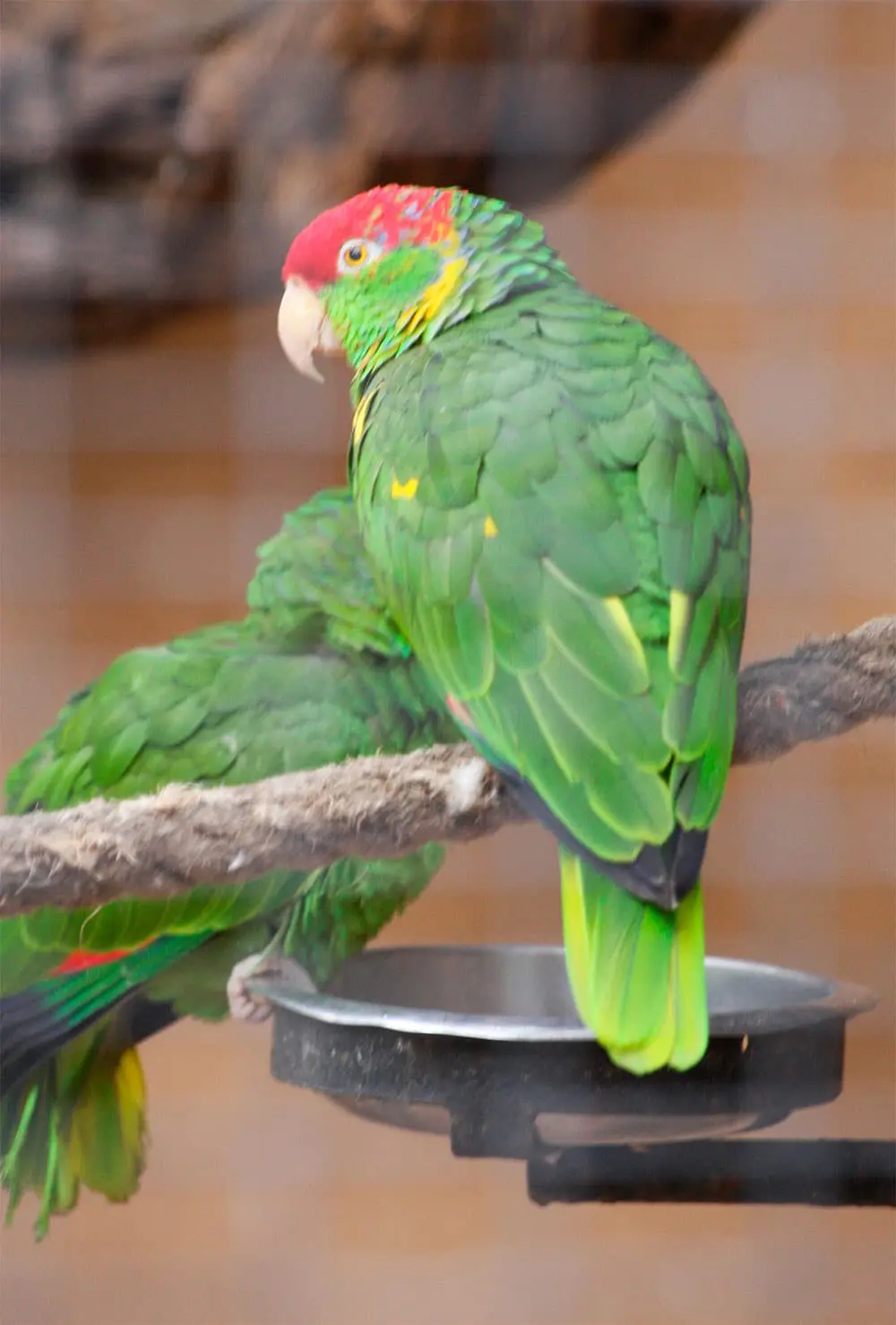
Red-crowned Parrot
Amazona viridigenalis

Red-crowned Parrot

Content

Description:


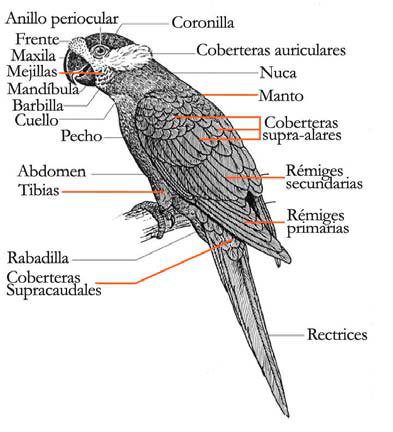
Anatomy-parrots

30.5-33 cm.. length and 294 g. of weight.

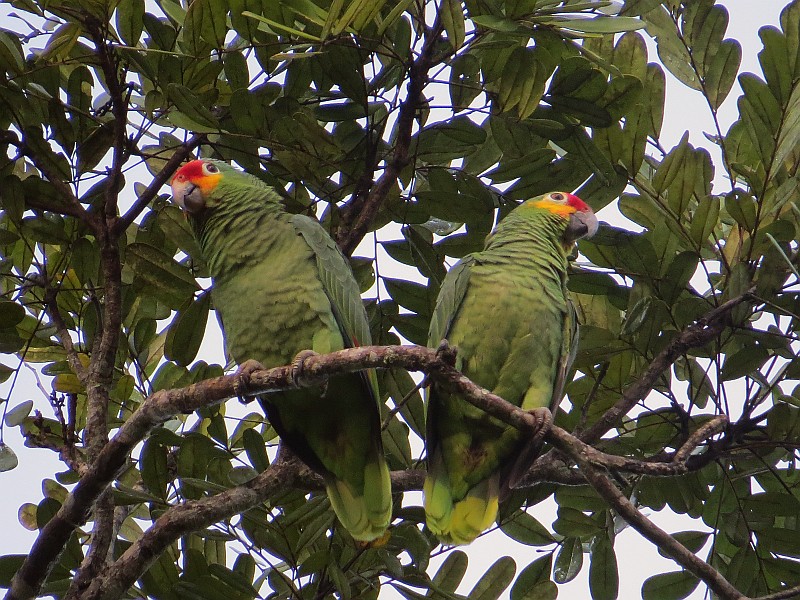
The Red-crowned Parrot (Amazona viridigenalis) has the lores, forecrown and crown, bright red, with side margins on the back of the neck and top of the neck, showing blue feathers with black ends; ear-coverts bright green without black ends in feathers; nape boldly festooned with green feathers with their ends in black.

Mantle and back green with some weak black tips; rump and uppertail-coverts, green. Wing coverts green with black margins on some weak feathers. The flight feather, mostly green, the primaries, in general, with dark ends, of dark blue or black, the Outer secondaries, with the ends of blue with red in the outerweb. Under, the wings green. Underparts green, slightly yellowish; some feathers show visible dark tips. The tail is green, in general with its yellow end. Bill pale yellow; irises yellow; legs pale grey.

Red-crowned Parrot

although females They can have on average less red in the head, probably no consistent sexual dimorphism. The immature She has red in the head very small, with feathers in the central part of the crown green tipped black and subterminally banded pale blue; feathers on the side of the crown, forming broad band over eye.

  • Sound of the Red-crowned Parrot.

Habitat:

Video "Red-crowned Parrot"

The habitat of the Red-crowned Parrot son los Bosques deciduous, gallery forests and evergreen floodplain forests in tropical lowlands, with non-breeding birds on dry ridges extend to 1,200 meters in temperate zones Pinus and Quercus.

frequenting cultivated areas where they remain large trees. Usually in flocks, generally larger than its sympatric congeners (Red-lored Amazon and the Yellow-headed Parrot, with which sometimes mixed); in larger flocks in winter. Used roost communally.

Reproduction:

They nest in tree hollows, including abandoned nests Lineated Woodpecker (Dryocopus lineatus), generally 6-20 meters above the ground. Nests reported in trees Taxodium mucronatum, Bumelia laetivirens and Brosimum alicastrum. Reproduction April-May Tamaulipas. The laying is of 3 or 4 eggs. Only the female incubates. The incubation hard 28 days. The young are cared for for nine weeks.

Food:

Foods reported include seeds of Pinus, corn, berries of Ehretia, Jewish of Pithecellobium, acorns and berries Melia azedarach; introduced populations have adapted to the food sources parks, consuming fruitsJuglans, Liquidambar, eucalyptus and Chorisia.

Distribution and status:

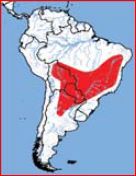
Size of its range (breeding/resident ): 61.900 km2

Northeast Endemic Mexico, where records from southern Nuevo Leรณn (South of Monterrey) through Tamaulipas (mostly in the center and south of the state) and East of San Luis Potosi, to the North of Veracruz and towards the south until near 21ยบN. They can be seen as visitors in the winter Brownsville, southwestern end Texas, USA.

The current range appears confined to Tamaulipas and San Luis Potosi, no known breeding records in recent decades in Nuevo Leรณn or Veracruz, except for the seemingly wild population in the suburbs Monterrey.

wild populations in California, Florida, Oahu (Hawaiian Islands) and Puerto Ricor (small number in southern dry forests).

Resident but nomadic in winter with some altitudinal movements that lead birds to higher ground in winter (perhaps to exploit the seeds and acorns Pine) and with other movements further away from the breeding range, for example, to the South of Texas. Apparently they return to the breeding area in February, declining along the ridge, but they are most common near the east coast, especially around the Sierra de Tamaulipas and on the slopes east of the Sierra Madre Oriental in Tamaulipas. Otherwise, sparsely distributed and frequently only some strengths as the Valley Sabinas River, Tamaulipas.

Total population estimated in 3.000-6.500. Popular in captivity locally and previously traded in large numbers internationally. Clearly the recent population declines are due to excessive trade and to the continued destruction of habitats scale; they are also you fired in some areas due to crop damage. There are no large protected areas within reach and illegal trade continues.

Conservation:

State of conservation โ“˜


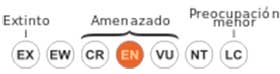
Endangered Endangered โ“˜ (UICN)โ“˜

โ€ข Current category of the Red List of the UICN: In danger of extinction.

โ€ข Population trend: Decreasing.

โ€ข Population size : 2000-4300.

Rationale for the Red List category

    The combination of high levels of exploitation for cage bird trade, loss of habitat and long term estimates reduced density It indicates that this species is declining very quickly. Therefore it qualifies as in danger of extinction.

Justification of the population

    In 1992-1994, estimated in an area in Mexico densities indicated a wild population of 3.000 to 6.500 birds (EC Enkerlin-Hoeflich in a bit., 1994). This estimate equals approximately 2.000-4.300 mature individuals.

Justification of trend

    The historical densities recorded for the species were 25,2 in the early birds / km2 1970 (Castro 1976), down to 5,7 birds / km2 in an area 1992-1994 (EC Enkerlin-Hoeflich in 1994, Enkerlin-Hoeflich 1995), indicating a population declines of up to 77,4% on a strip of 20 years. It is suspected that the decline will continue at a higher rate to 50% in ten years, due to threats capture and forest clearing.
Threats

โ€ข In 1970-1982, 16.490 birds (mainly chicks) They were imported legally to United States.

โ€ข Las illegal exports from Mexico and mortality prior to export to the top 50% they are equivalent to 5.000 birds per year (Enkerlin-Hoeflich and Hogan, 1997).

โ€ข Los hunters damage nests when removing chicks (sometimes cutting whole trees), reducing the availability of the nest and bringing the permanent abandonment of the site (Snyder et to the., 2000).

โ€ข Many gallery forests have been cleared or degraded, with more than 80% lowlands of Tamaulipas cleared for agriculture (especially sorghum) and pastures.

โ€ข The habitat of the Red-crowned Parrot It is now distributed unevenly in cattle ranches, where the pressure is greater capture (Enkerlin-Hoeflich and Hogan, 1997).

Conservation Actions Underway

โ€ข CITES Appendix I (1992) and part of the European Endangered Species Programme [Species] of the European Association of Zoos and Aquariums (EAZA).

โ€ข The population of Red-crowned Parrot It is distributed in the Biosphere Reserves Heaven and Sierra Gorda (A. G. Navarro in some ., 1998, T. Brush in a bit., 2003), but there are only small colonies in Sierra Gorda and status in Heaven It is unknown (Wege and Long 1995, A. G. Navarro in some 1998).

โ€ข Los livestock They are increasingly aware of the benefits of keeping large trees, but this is not reflected in practice.

Conservation Actions Proposed

โ€ข Conduct surveys to obtain an estimate of the total size of the population.

โ€ข Monitor populations to determine degree of decline.

โ€ข Identify the most important nesting aggregations for protection (Enkerlin-Hoeflich and Hogan 1997).

โ€ข Integrate ranchers in efforts to reduce capture and regenerate habitat (Enkerlin-Hoeflich and Hogan 1997) .

The Red-crowned Parrot in captivity:

CITES Appendix I. (It includes species threatened with extinction. Trade individuals of these species, it is allowed only in exceptional circumstances.)

Each captive specimen of this species which is capable of reproducing, It is placed in a well managed captive breeding program and not be sold as a pet, with the order to ensure their survival long-term.

Alternative names:

Green-cheeked Amazon, Green-cheeked Parrot, Mexican Red-headed Amazon, Mexican Red-headed Parrot, Red-crowned Amazon, Red-crowned Parrot, red-crowned parrot parakeet (English).
Amazone ร  joues vertes, Amazone verte ร  front rouge (French).
Grรผnwangenamazon, Grรผnwangenamazone (German).
Papagaio-de-coroa-vermelha, Papagaio-de-face-verde (Portuguese).
Amazona de Corona Roja, Amazona Tamaulipeca, Cotorra Coronirroja, Loro Tamaulipeco (espaรฑol).


scientific classification:

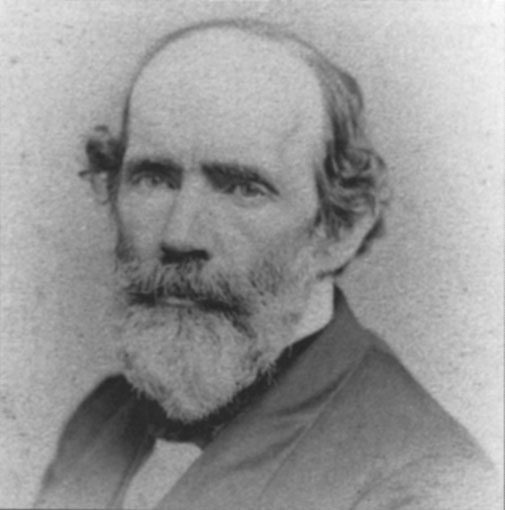
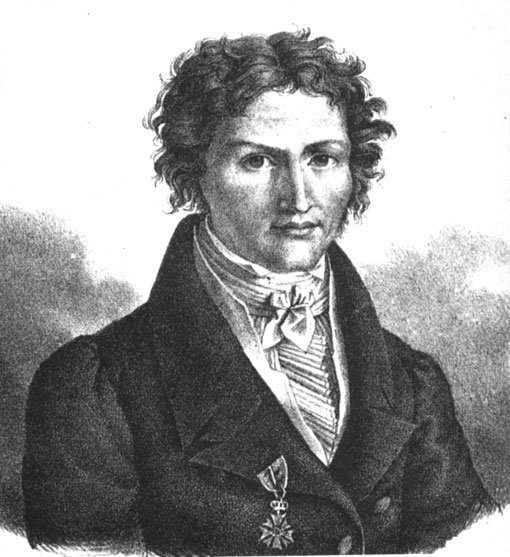
John Cassin
John Cassin

Order: Psittaciformes
Family: Psittacidae
Genus: Amazona
Scientific name: Amazona viridigenalis
Citation: (Cassin, 1853)
Protonimo: chrysotis viridigenalis


Images Red-crowned Parrot:


Species of the genus Amazona


Sources:

Avibase
– Parrots of the World โ€“ Forshaw Joseph M
– Parrots A Guide to the Parrots of the World – Tony Juniper & Mike Parr
Birdlife

Photos:

(1) – Amazona_viridigenalis is native of Mexico. Specimen in Palmitos Park, Gran Canaria By Bjoertvedt (Own work) [CC BY-SA 3.0 or GFDL], via Wikimedia Commons
(2) – Red-crowned Amazon (Amazona viridigenalis) also known as Green-cheeked Amazon, Red-crowned Parrot, or Mexican Red-headed Parrot By rachael fogarty (originally posted to Flickr as Fred) [CC BY-SA 2.0], via Wikimedia Commons
(3) – Red-crowned Amazon (also known as Red-crowned Parrot, Green-cheeked Amazon, or Mexican Red-headed Parrot). Two in a cage By TJ Lin [CC BY-SA 2.0], via Wikimedia Commons
(4) – Red-crowned Amazon, (Amazona viridigenalis) also known as Green-cheeked Amazon, Red-crowned Parrot, or Mexican Red-headed Parrot by Leonhard F at the German language Wikipedia [GFDL or CC-BY-SA-3.0], via Wikimedia Commons
(5) – Red-crowned Amazon By Glandauer/Roger Moore (Roger Moore (transfer from en.wiki)) [GFDL or CC-BY-SA-3.0], via Wikimedia Commons
(6) – Red-crowned Amazonian Parrot (Amazona viridigenalis) by Heather PaulFlickr
(7) – Red-crowned Amazon (also known as Red-crowned Parrot, Green-cheeked Amazon, and Mexican Red-headed Parrot) at Tropical Birdland, Leicestershire, England By Dean Sas from Chesterfield, UK (Pieces of eight) [CC BY-SA 2.0], via Wikimedia Commons
(8) – A pet Red-crowned Amazon By jarrett chandler from Rowland Heights, US (zazu) [CC BY 2.0], via Wikimedia Commons
(9) – (Amazona viridigenalis), photographed in Heidelberg Tiergarten (Baden-Wuerttemberg, Deutschland) By 4028mdk09 (Own work) [CC BY-SA 3.0], via Wikimedia Commons
(10) – PL XXXI Chrysohs viridigenalis, (tassro) By Blanchard, Emile; Bonaparte, Charles Lucian; Bourjot Saint-Hilaire, Alexandre; Le Vaillant, Franรงois; Souancรฉ, Charles de. [CC BY 2.0 or Public domain], via Wikimedia Commons

Sounds: Aidan Place, XC306093. accessible www.xeno-canto.org/306093
โ–ท The world of Pets: Dogs, cats, birds, reptiles, amphibians

Blue fronted Parrot
Amazona aestiva


Blue fronted Parrot

Content

Description

33-39 cm.. height and weight around the 450 and 550 g..

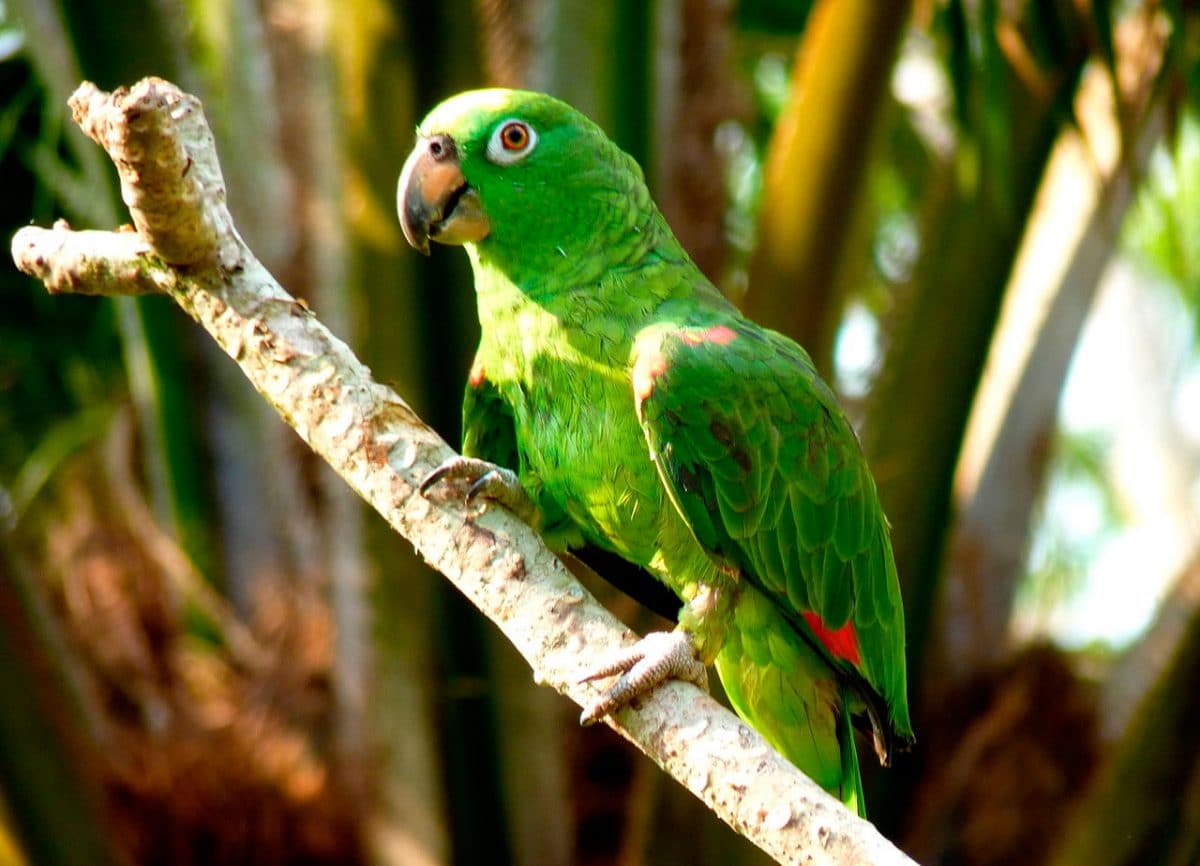
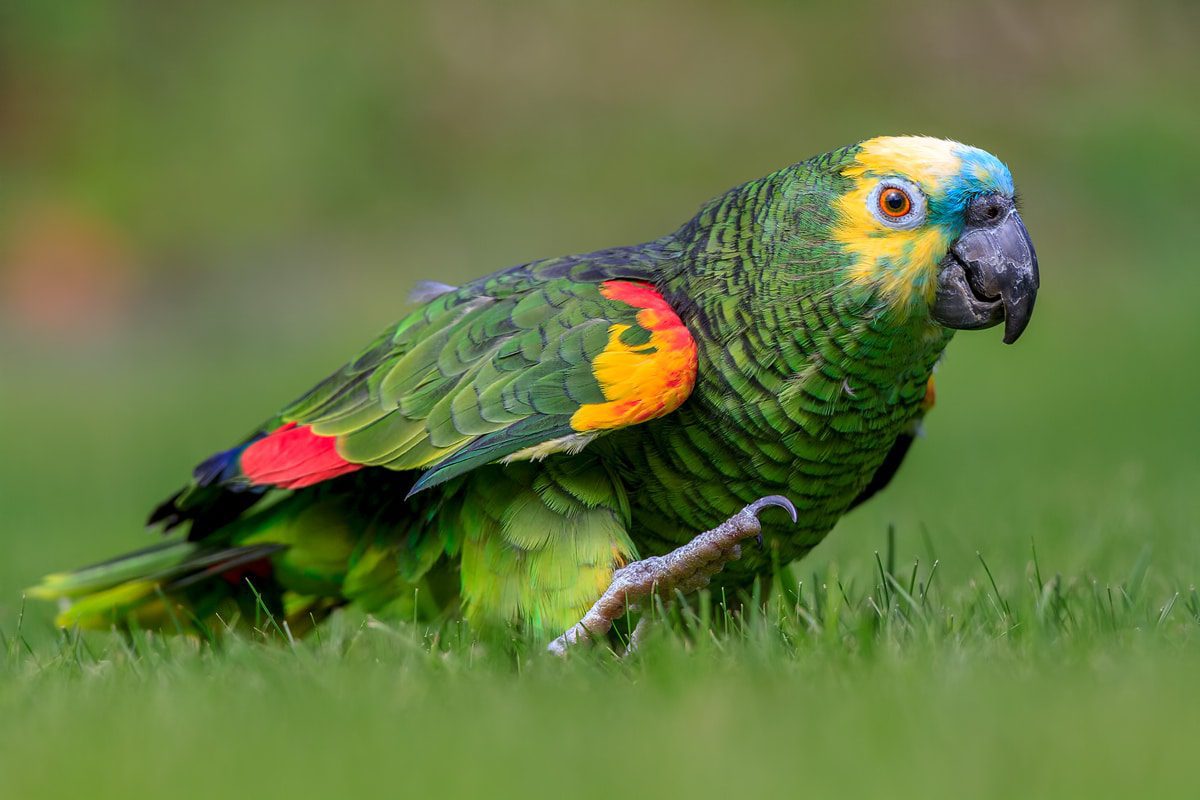
The Blue fronted Parrot (Amazona aestiva) is distinguished by yellow head, with blue-green forehead and cheek, Dark nostrils, Red shoulders outlined with yellow, wing with red patch and dark blue ends. Rest of the usually green body, more clear towards the belly and tail.

  • The subspecies Amazona aestiva xanthopteryx of Bolivia, has more extensive yellow face and the shoulder is mostly yellow with a small red patch.

  • The subspecies A. to. xanthopteryx (Yellow wing Amazon): Wing coverts of the shoulder area almost exclusively yellow and, in general, creating a stain of greater extension. – From the southwest of Mato Grosso, Brazil, North and East of Bolivia, Paraguay and northern Argentina


Anatomy-parrots

In young coloration is generally more off. The blue and yellow practically do not exist and the iris is dark

Habitat:

Video – "Blue fronted Parrot"

AVES - The Amazon Aestiva, one of the most popular and talkative parrots

Lives in humid forests, Savanna, gallery forest, areas planted with trees and forest with palms, up to 1600m.

Common in pairs or flocks, they have many individuals community roosts.
In this species the sex of the specimens is not distinguished at a glance.

Reproduction:

It nests in holes in large trees.

Breeds between October and March.

The implementation is usually of 3 eggs, and incubation lasts approximately 25 days. Chicks leave the nest to the 60 days.

Food:

Its food consists of fruit, berries, nuts, leaves and seeds.

Distribution:

Amazon Frentiazul location

Interior of South America, from the North-East of Brazil, East of Bolivia, Paraguay, to the North of Argentina.

Conservation:

Not considered under any threat category globally.

State of conservation โ“˜


minor concern Minor Concern โ“˜ (UICN)โ“˜

Protected by the Convention CITES, consisting in annex II (species that may be threatened by a trade out of control).
It is a fairly widespread species in their area of distribution and is considered to have a stable population. However, numbers are declining rapidly in some areas due to capture for trade (both legal and illegal), and to other problems such as the destruction of their habitat and human pressure. Another problem affecting the species is that the average age of populations that exist in freedom is not known.

Blue fronted Parrot in captivity:

He is very smart, curious and loving. They are very sociable and gets along very well with children.

It is one of the best imitators that exist within the group psittacine after grays.
With its strong beak, as any Parrot, She likes chewing everything that gets you ahead. So, newcomer to our home, It is necessary to pay close attention.

It has a social behaviour so it is important to look for a partner. A large aviary and the possibility of going out every day are necessary.
If it feels threatened, It opens its wings between loud cries and wild-eyed.
Water love it. Released, When it rains, enjoy, in the rain, with open wings. The ideal humidity for a Blue fronted Parrot is of the 60-70%, which is impossible in an apartment during the winters in the heat of radiators. It is therefore necessary the use of humidifiers.

The staple food is made up of different types of nuts, sunflower seeds, pumpkin seeds, corn, wheat, etc. Important for a healthy diet are fruits and vegetables. These must be offered fresh every day.
Just before the breeding season, our birds must be provided with foods rich in calcium and protein, for example egg cooked.
Multivitamin supplements complete proper nutrition.

The female lays two to five eggs that incubate for an approximate period of 25 to 28 days.

Alternative names:

Blue fronted Parrot, Blue-fronted Amazon, Blue-fronted Parrot, Turquoise-fronted Amazon, Turquoise-fronted Parrot (English).
Amazone ร  front bleu (French).
Blaustirnamazone, Rotbugamazone (German).
Papagaio-verdadeiro, papagaio-colareiro, papagaio-comum, papagaio-curau (Portuguese).
Amazona Frentiazul, Amazona Sudamericana, Loro hablador, Lora frente azul (espaรฑol).

scientific classification:

Order: Psittaciformes
Family: Psittacidae
Genus: Amazona
Scientific name: Amazona aestiva
Citation: (Linnaeus, 1758)
Protonimo: Psittacus aestivus


Species of the genus Amazona


Sources:
– Parrot Book, Parrots and macaws Neotropical
avibase
– SEO.org
– Photo: birdnest
– Sounds: Diego Caiafa

โ–ท The world of Pets: Dogs, cats, birds, reptiles, amphibians

Diademed Parrot
Amazona Diadema

amazona autumnalis

Content

Description:

31โ€“35 cm. length and 450-550 g. of weight.

The Diademed Parrot (Amazona Diadema) It is generally green, with black edges to feathers crown, to the mantle and the chest; crown green to nape; the back of the green neck, mauve margin; feathers of the cere and forecrown, red; yellow-green, less yellow in upper cheeks, up to the ear-coverts; secondaries red on the bases, the green rest; tail green; eye ring pale yellow; eyes oranges; bill dark grey.


Note:

Previously treated as conspecific with the Red-lored Amazon (Amazona autumnalis), It is very similar to the subspecies Amazona autumnalis salvini

  • Sound of the Diademed Parrot.

Habitat:


Anatomy-parrots

It is likely to frequent a variety of habitats from lowland forest species, including edges evergreen forest, as well as modified areas containing scattered trees or plantations (Del Hoyo et al., 1997, pit et to the., 2016).

They are in loose flocks or pairs, are gregarious When feed.

Reproduction:

The laying is of 2-3 eggs. Breeding season, It is supposed to be in early: January-March.

Food:

It feeds mainly from fruits and seeds, even some cultivated species (Del Hoyo et al., 1997), although there are no published data (Del Hoyo et al., 2016).

Distribution:

Size of its range (breeding/resident): 71.800 km2

Endemic low Black river and the northern margin of Amazon River, in the states of amazon and Northwest of For, in Brazil.

Conservation Amazona diadema:

State of conservation โ“˜


Endangered Endangered โ“˜ (UICN)โ“˜

โ€ข Current category of the Red List of the UICN: In danger of extinction.

โ€ข Population trend: Decreasing.

Rationale for the Red List category

    Based on a model of future deforestation on amazon basin and susceptibility to this new species capture, it is suspected that its population will suffer a very fast along three generations descent from 2002, so it is in danger of extinction.

Justification of trend

    This species is expected to lose between 49 and 55% suitable habitat within its distribution throughout three generations (37 years) starting at 2002, based on a model of Amazon deforestation (Soares-Filho et to the). Given its susceptibility to capture, It is suspected that species decline by 50-79% during this time.
Threats

โ€ข The main threat to this species is the accelerating deforestation in the Amazon Basin as land is cleared for ranching and soy production, provided by the expansion of the road network, together with his susceptibility to capture (Soares-Filho et to the. 2011).

โ€ข The species is assumed to experience some pressure catch, probably mainly for internal trade, since this species is rare in aviculture (Del Hoyo et al ., 1997, pit et to the ., 2016).

โ€ข Proposed changes to the Brazilian Forest Code reduce the percentage of land to a private owner is legally obliged to keep as forest (including, critically, a reduction in the width of forest buffers with perennial vapors) and include an amnesty for owners who deforested before July 2008 (That they would later be absolved of the need to reforest illegally vacated land) (Bird et to the., 2011).

Conservation Actions Underway

โ€ข No specific conservation actions are known for this species, although part of their habitat is protected.

โ€ข It is distributed in the Jau National Park where it is rare or uncommon (Borges et al ., 2001, Borges & Almeida 2011).

Conservation Actions Proposed

โ€ข Carry out surveys to estimate the size of the population.

โ€ข Monitor deforestation rates in the range using remote sensing techniques.

โ€ข Study the level of Trapping threat.

โ€ข Increase the area of โ€‹โ€‹suitable habitat that receives protection effective.

โ€ข Boost changes in laws related to deforestation and forest protection.

The Diademed Parrot in captivity:

Rare in aviculture.

Each captive specimen of this species which is capable of reproducing, It is placed in a well managed captive breeding program and not be sold as a pet, in order to ensure its long-term survival.

Alternative names:

Diademed Amazon, Diademed Parrot, Red-lored Parrot (Diademed) (English).
Amazone ร  diadรจme, Amazone diadรจme, Amazone du Brรฉsil (French).
Diademamazone (German).
Papagaio-diadema (Portuguese).
Amazona diadema (espaรฑol).


Scientific classification Diademed amazon:

Johann Baptist von Spix

Order: Psittaciformes
Family: Psittacidae
Genus: Amazona
Scientific name: Diademed Parrot
Citation: (von Spix, 1824)
Protonimo: Psittams diadema


Diademed Parrot images.:


Species of the genus Amazona


Sources:

Photos:

(1) – diadem parrot. Red lored parrot. 11 November 2015, Tikal, Guatemala by ze_da_binha
(2) – Diademed Parrot – amazon with tiara – Diademed amazon – amazon tiara By Florin Feneru from Orpington, UK (Diademed Parrot) [CC BY 2.0], via Wikimedia Commons
(3) – A Red-lored Amazon at Loro Parque, Cross port, Tenerife, Spain. This subspecies is also called the Diademed Amazon By Carlos Urdiales [CC BY-SA 2.0], via Wikimedia Commons
(4) – A Red-lored Amazon at Xcaret Eco Park, Riviera Maya, Mexico. Photographed as it started to rain By Tomasz Wagner from Burnaby, BC, Canada (Parrot – Amazona autumnalis) [CC BY-SA 2.0], via Wikimedia Commons
(5) – Diademed amazon (Diademed Parrot) Loro Parque, Tenerife by Florin FeneruFlickr
(6) – PL. XXXI I Chrysolis diadema (รฎ^wl By Blanchard, Emile; Bonaparte, Charles Lucian; Bourjot Saint-Hilaire, Alexandre; Le Vaillant, Franรงois; Souancรฉ, Charles de. [CC BY 2.0 or Public domain], via Wikimedia Commons

Sounds: GABRIEL MILK, XC119110. accessible www.xeno-canto.org/119110

โ–ท The world of Pets: Dogs, cats, birds, reptiles, amphibians

Yellow-crowned Parrot
Amazona ochrocephala

Yellow-crowned Parrot

Content

Description

35 to 41 cm.. height and between 380 and 500 g. of weight.

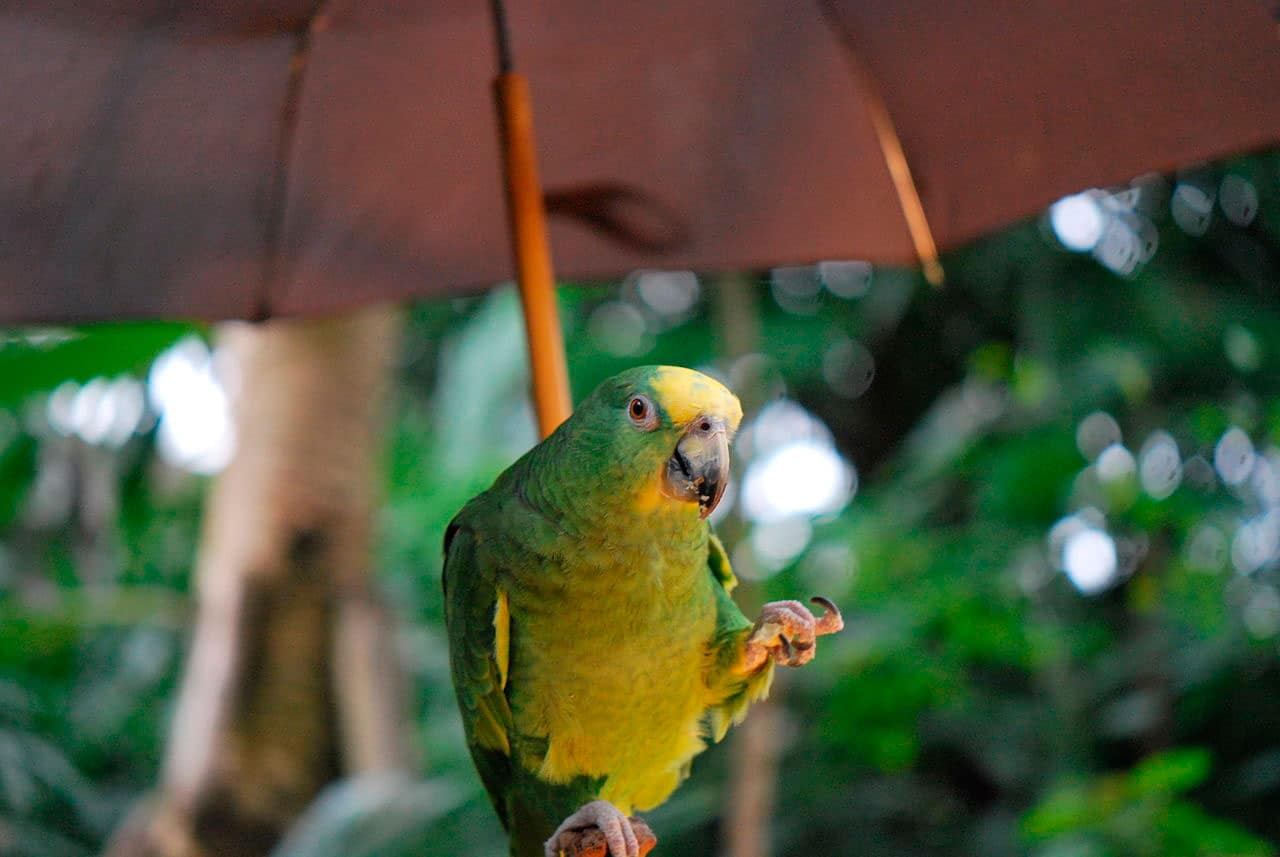
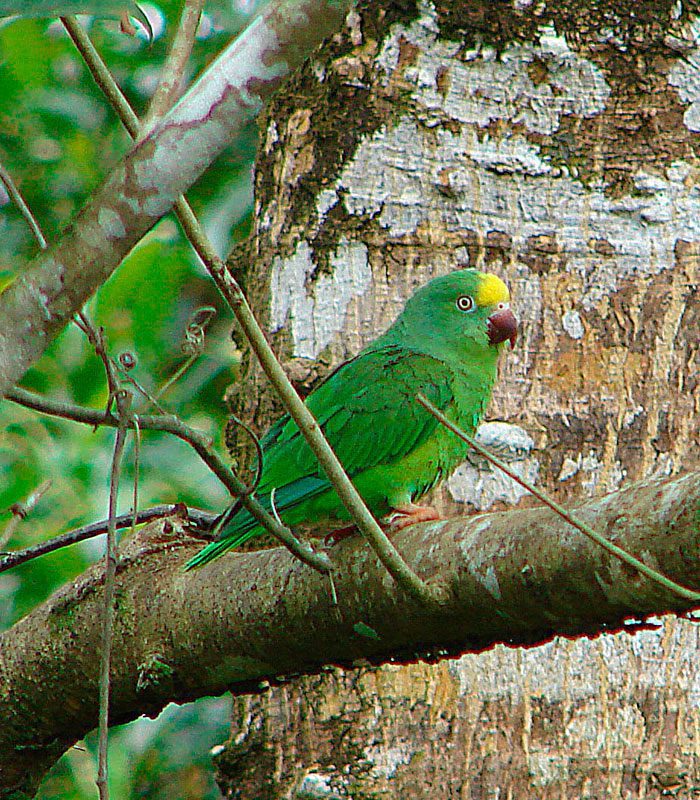
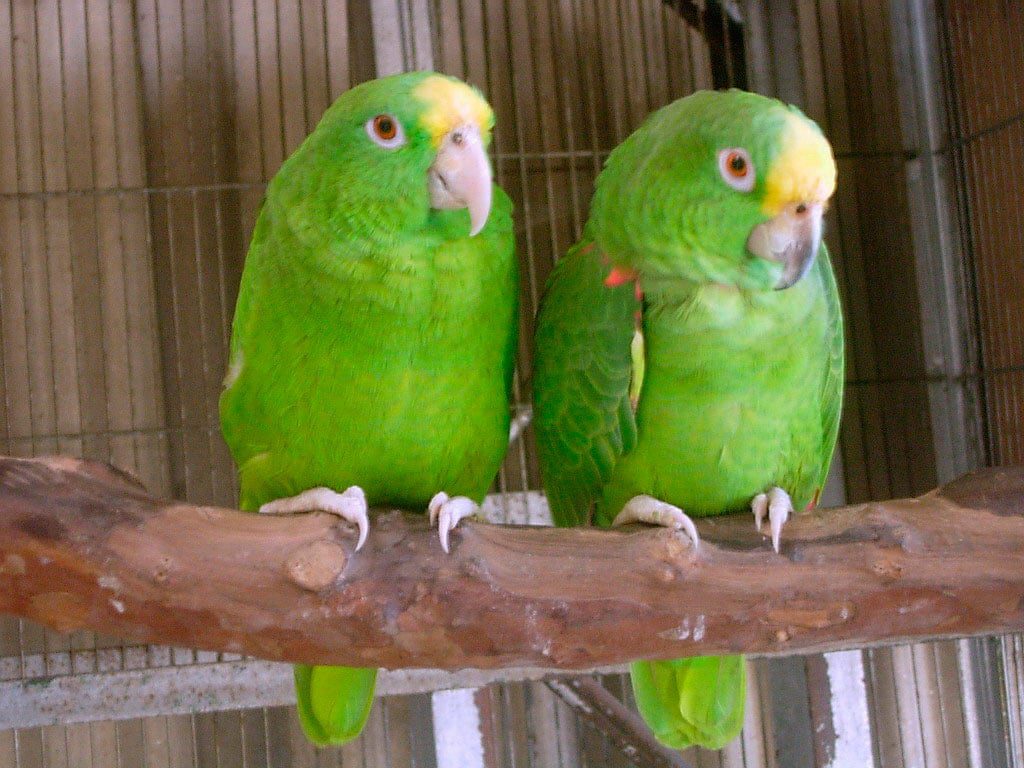
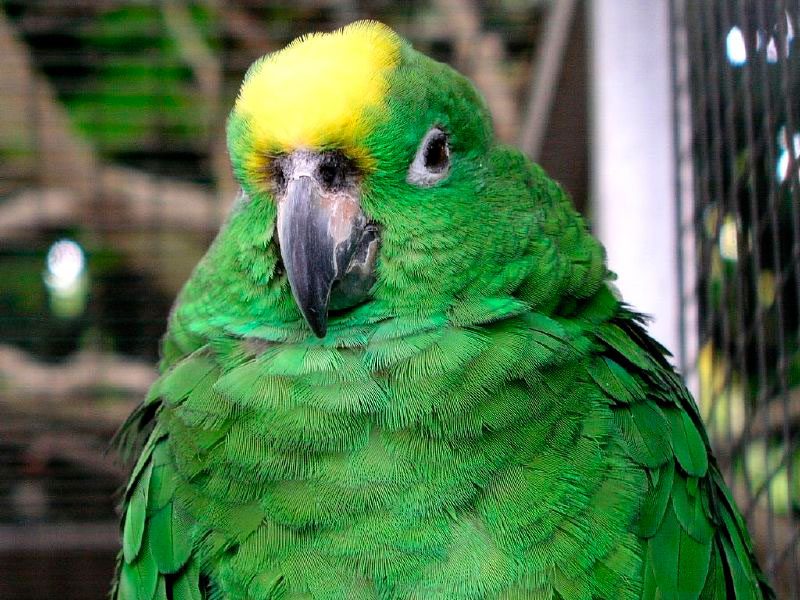
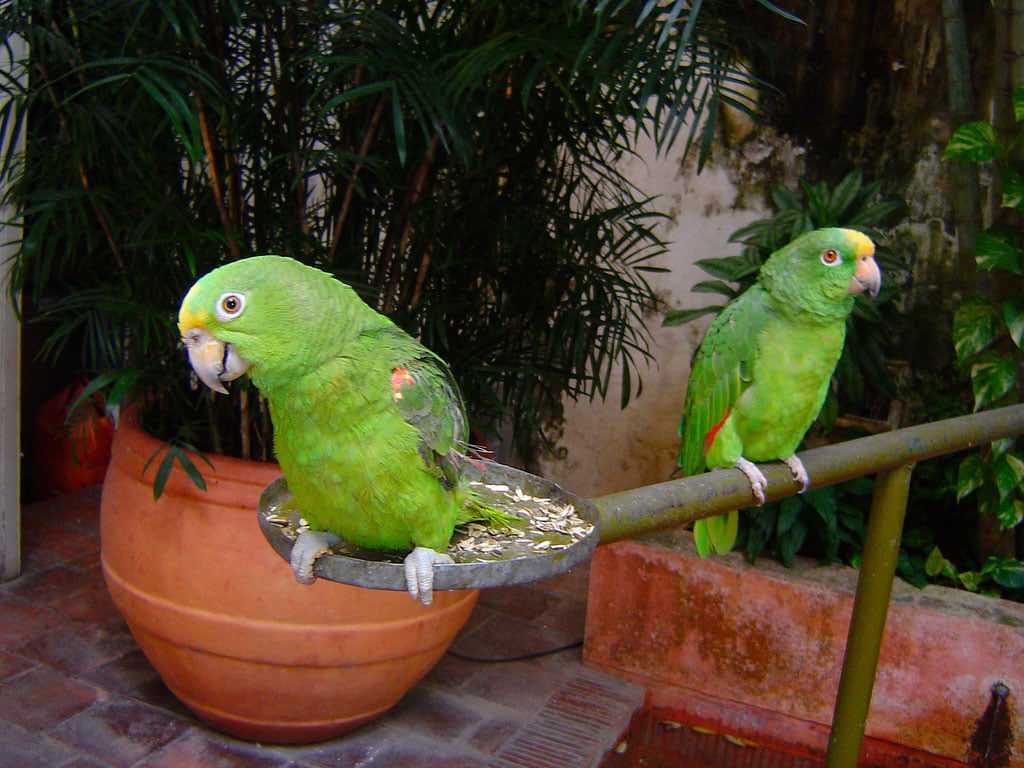
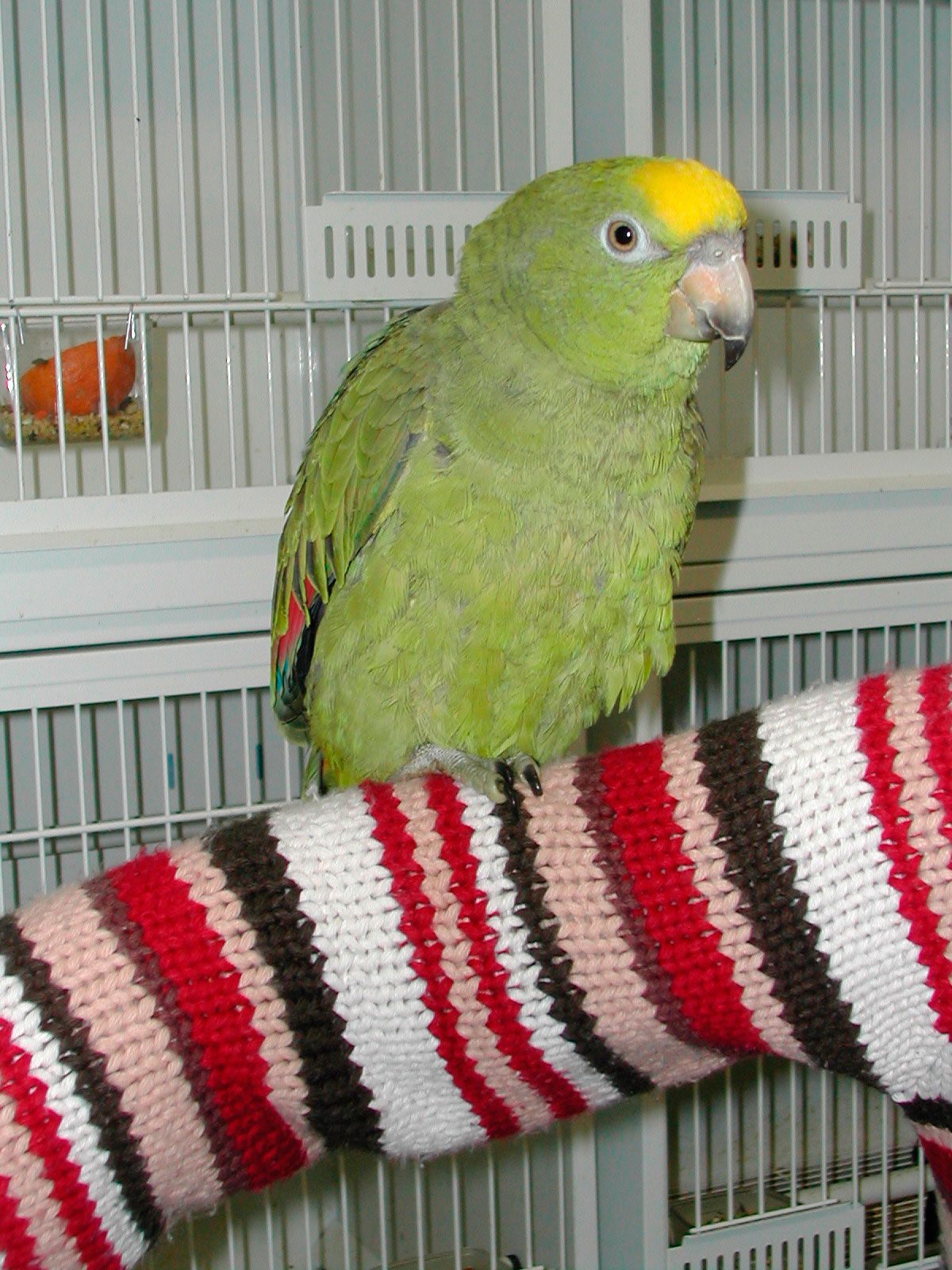
The Yellow-crowned Parrot (Amazona ochrocephala) has the forecrown and front area crown, bright yellow; lores, cheeks and supercilii area, green in most birds, but sometimes with yellow extending over lores and around eyes, and some birds with red bases hidden by yellow feathers crown; sides and back of the neck, nape and the mantle, green with dark margins, giving scalloped effect.


Anatomy-parrots

Upperparts green. coverts lower red, other coverts green; edge front of the wing yellowish; five o'clock outer secondaries They are green with bright red to outerweb forming speculum; flight feather green with blue tips to secondaries and primary outerweb, dark to black in points. Underwing-coverts, dull green with blackish tips. Underparts green with plenty of blue in the chest; yellow feathers on the the thighs (often few and discrete).

Yellow-crowned Parrot

Upper, the tail It is green with yellow stripes; below green with wide yellow ends; both with outer feathers basically red and a bluish puckered in outerweb.

Dark gray Bill, reddish at base of upper jaw; iris orange; legs grey.

Both sexes they are similar. The immature It has a narrower yellow patch on the head, stripes orange-red to yellow feathers crown; less red at the base of feathers tail; feathers of the tail more pointed and irises brown.

Description 4 subspecies
  • Amazona ochrocephala nattereri

    (Finsch, 1865) – Less yellow in the head that the nominal species, with frontal band green. Cheeks, supercilii area and lores with blue tint. Red curve wing often mixed with yellow feathers.

  • Amazona ochrocephala ochrocephala

    (Gmelin, 1788) – Nominal.

  • Amazona ochrocephala panamensis

    (Cabanis, 1874) – Bill horn-colored pink, yellow feathers restricted as V in forecrown and front of the crown. Possibly average smaller than the nominal species.

  • Amazona ochrocephala xantholaema

    (Berlepsch, 1913) – More extensive yellow in the head which extends to the back of the neck, around the eyes, to cheeks and to the ear-coverts. Often with frontal band narrow green. bluish tint in the chest.

Habitat:

Video – "Yellow-crowned Parrot"

They Real (Amazonas Ochrocephala)

They inhabit in open forests, moist forest edges, gallery forests, deciduous forest, open savannas and wetlands in lowland rain forests, also cultivated and suburban areas in some localities, and often near rivers.

The gallery forest It is your preferred Panama where Yellow-crowned Parrot avoid continuous humid forest, being replaced, possibly, there and in many areas of South America, by the Orange-winged Parrot (Amazona amazonica).

Usually observed in the lowlands; reported to 500 metres in Colombia and Venezuela and a 750 metres in Honduras. Usually in pairs or small flocks of 10-30 birds, with occasional gatherings up 300. Birds gather in common trees.

Reproduction:

Son Monogamie, couples joined in for life.

His time of reproduction It is from December to May. During this time, they lay clutches of 2 to 4 eggs, only Por those Nidada Tempordaa. Nest palm trunks and termite mounds.

It takes about 25 days for the eggs to hatch and near 56 days to become fledglings. The young become independent 2 months after hatching. Both male and female Yellow crowned Parrot reach sexual maturity around the 3 years.

Food:

Foods reported in the diet include fruit Immature American Curatella, Pereskia guamacho and other Cactus. Mainly feeds on treetop.
It is considered a plague in some localities for their love of eating bananas (Mussa paradisea), handles and Corn crops.

This species is considered a pest in some areas by his fondness for the consumption of bananas (Mussa paradisea), mangoes and corn crops.

Distribution:

Size of its range (reproduction / resident): 8.010.000 km2

The Yellow-crowned Parrot are in Panama, in Central America and in South America, from south to east Brazil and to the North of Bolivia.

They are present in Panama, mainly on the slope of the peaceful, from Chiriqui, to the West of Darien, but also in the shed Caribbean (for example, in the eastern San Blas Islands); also along the Pearl Islands and Coiba National Park.

They are also distributed in northern Colombia, from the North of the Chocรณ and lower basin of Atrato River, as well as along the Caribbean coast and tropical zone of the Magdalena River Valley, to the base southeast Sierra Nevada de Santa Marta and western part of the Serrania del Perija.

Observed in the eastern foothills of the Andes and adjacent lowlands Colombia; eastward across the tropical zone Venezuela and south, from the coastal mountains through Bolรญvar (where apparently it is not known from south) and amazon, until Guyanas and Trinidad (where their status is uncertain due to the captive birds introduced).

Present in the basin Amazonas Brazil, to the south, to the Northwest of Mato Grosso and west, in the lowlands of eastern Ecuador and through the Peruvian Amazon, to the North of Bolivia.

Apparently residents throughout its distribution area. very small numbers in Panama, although locally fairly common, especially in those areas more dry; it is the most common parrot (at least once) in the San Blas Islands. generally common (even locally abundant) in South America, but the numbers are reduced in the more accessible areas due to trade.

Distribution 4 subspecies
  • Amazona ochrocephala nattereri

    (Finsch, 1865) – South of Colombia in Caqueta, is of Ecuador, is of Peru, West of Brazil and North of Bolivia. Possibly integrated with nominal species in border areas Goal and Caquetรก in Colombia.

  • Amazona ochrocephala ochrocephala

    (Gmelin, 1788) – Nominal. It is from Colombia, Venezuela, Trinidad, Guianas and North of Brazil south to the tributaries of the lower margin right amazon in amazon and For.

  • Amazona ochrocephala panamensis

    (Cabanis, 1874) – North of Colombia, north and west of the Andes to western Panama, including Pearl Islands and Coiba National Park.

  • Amazona ochrocephala xantholaema

    (Berlepsch, 1913) – Isla Marajรณ at the mouth of amazon.

Conservation:

State of conservation โ“˜


minor concern Minor Concern โ“˜ (UICN)โ“˜

โ€ข Current category of the Red List of the UICN: Least concern.

โ€ข Population trend: Decreasing.

This species is considered at present as minor concern BirdLife International, and, as a result, also by UICN.
Even though the populations it is believed that are in decline, still do not approach the threshold specified by BirdLife International to evaluate the species as Near-threatened.

It is listed in the Appendix II of the CITES.

The Yellow-crowned Parrot in captivity:

Known for his pranks and excellent skills imitate the human voice. Having said that, the ability to mimic will vary between birds and although many of them are excellent conversadoras, Some will never come to talk. These Amazons are generally affectionate. Its friendly and playful nature make them excellent pets.

Son easily domesticable and easy to train. Known to be very active, What makes them more suited to an environment that enables them to fly.

Son known for their voices. It is said that it is the strongest of all Amazon parrots. People who are not tolerant to noise, they will do well to live with this Parrot.

like most parrots, this horsewoman it can be very destructive. We must "personalize their environment" by providing them with objects to chew such as different toys and branches.

Its longevity should also be a consideration. These parrots They can live between 60 and 80 years.

Alternative names:

Yellow crowned Parrot, Yellow-crowned Amazon, Yellow-headed Amazon, Yellow-headed Parrot (English).
Amazone ร  front jaune, Amazone ร  tรชte jaune, Amazone verte de Colombie (French).
Gelbscheitalamazone, Gelbscheitelamazone, Panama Amazone, Surinamamazone (German).
papagaio-campeiro, ajurรบ-apara, papagaio-de-Suriname (Portuguese).
Amazona Real, Cotorra Cabeciamarilla, Lora Cabeciamarilla, Lora coroniamarilla, Lora Real (espaรฑol).


scientific classification:

Gmelin Johann Friedrich

Order: Psittaciformes
Family: Psittacidae
Genus: Amazona
Scientific name: Amazona ochrocephala
Citation: (Gmelin, JF, 1788)
Protonimo: Psittacus ochrocephalus


Images Yellow-crowned Parrot:


Species of the genus Amazona


Sources:

avibase
Parrots of the World โ€“ Forshaw Joseph M
Parrots A Guide to the Parrots of the World – Tony Juniper & Mike Parr
Birdlife
Parrot Book, Parrots and macaws Neotropical

Photos:

(1) – A pet Yellow-crowned Amazon in Puerto Maldonado, Peru By Kate from UK (Lola) [CC BY-SA 2.0], via Wikimedia Commons
(2) – A pet Yellow-crowned Amazon By Freegiampi (From Giuseppe's farm) [CC BY-SA 2.5], via Wikimedia Commons
(3) – Yellow-crowned Amazon or Yellow-crowned Parrot (Amazona ochrocephala) in captivity By Stephen Joyce from barcelona, Spain (Parrot) [CC BY-SA 2.0], via Wikimedia Commons
(4) – Yellow-crowned Amazon or Yellow-crowned Parrot (Amazona ochrocephala) in captivity in the Parrotโ€™s Garden (Jardim dos Louros), in the Botanical Garden of Funchal, Madeira island, Portugal By jmaximo [CC BY 2.0], via Wikimedia Commons
(5) – A Yellow-crowned Amazon in Gatorland, Florida, USA By greyloch from Washington, DC, area, U.S.A. (green parrot preening) [CC BY-SA 2.0], via Wikimedia Commons
(6) – Amazona ochrocephala panamensis, Panama Amazon (also known as the Panama Yellow-headed Amazon); two in captivity By TJ Lin (originally posted to Flickr as DSCN1005) [CC BY-SA 2.0], via Wikimedia Commons
(7) – A Yellow-headed Amazon (or Parrot) near the Brazil-Peru-Colombia triple junction By Dick Culbert from Gibsons, B.C., Canada (Amazona ochrocephala) [CC BY 2.0], via Wikimedia Commons
(8) – A Yellow-crowned Amazon at Bloedel Floral Conservatory, Vancouver, Canada By Karen Neoh (Parrot) [CC BY 2.0], via Wikimedia Commons
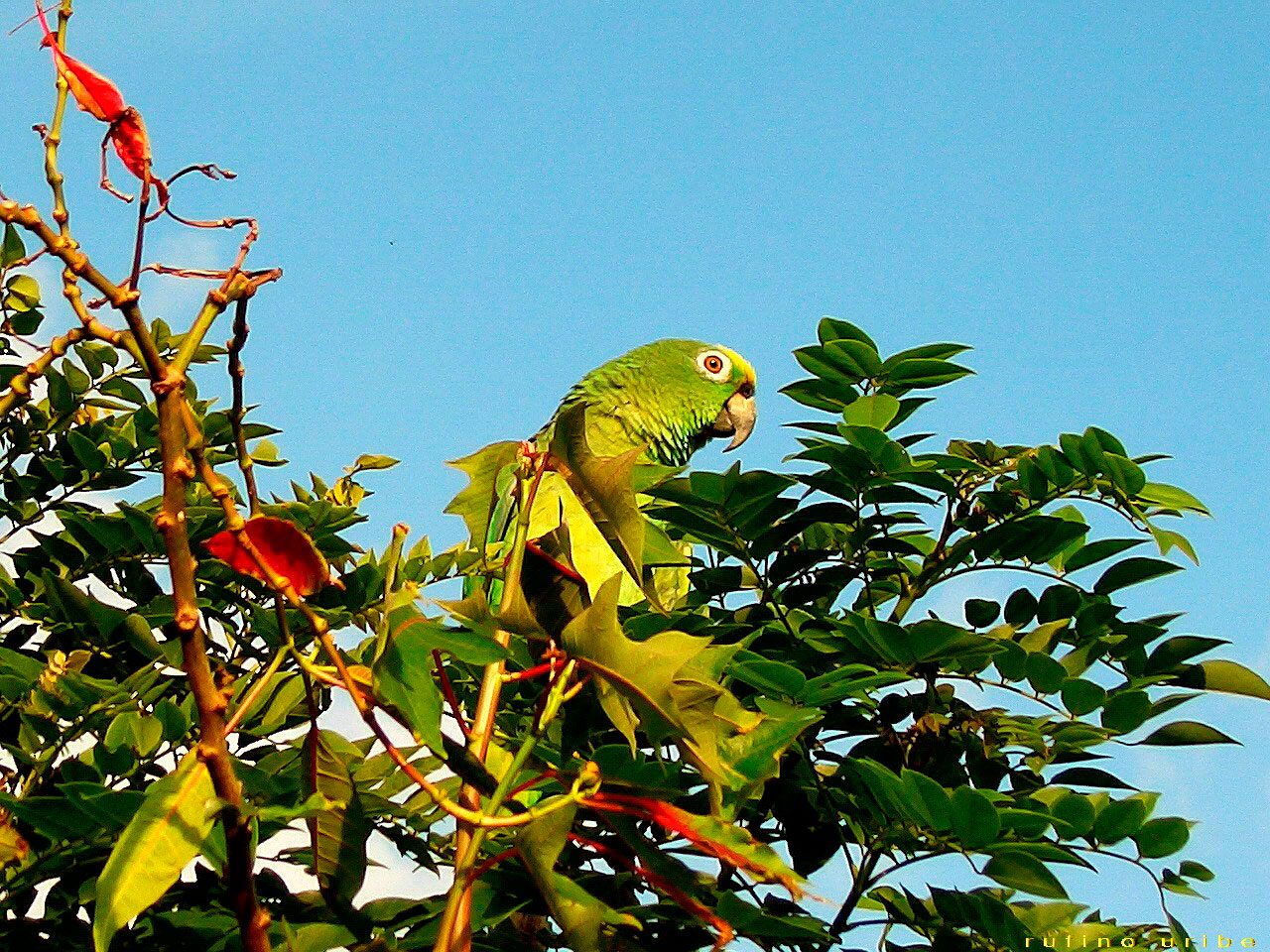
(9) – Yellow-crowned Amazon or Yellow-crowned Parrot (Amazona ochrocephala) in a tree in Venezuela By Rufino (originally posted to Flickr as camouflage) [CC BY-SA 2.0], via Wikimedia Commons
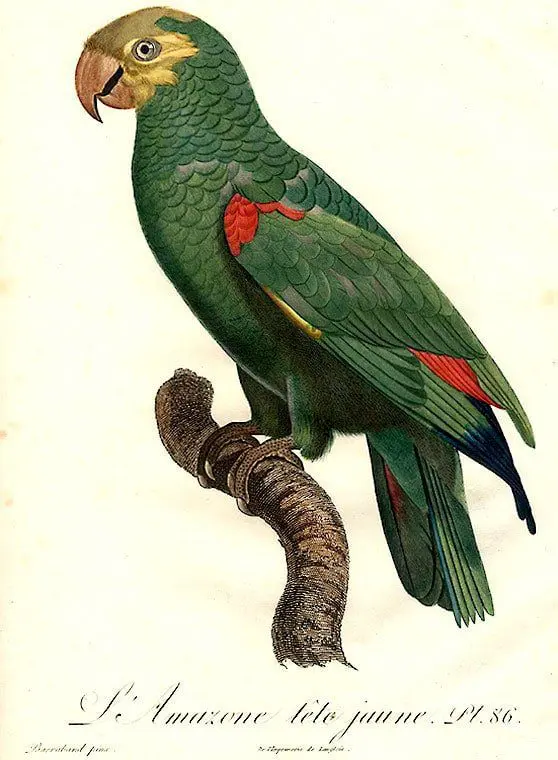
(10) – Amazona ochrocephala From Natural History of Parrots (by Francois Levaillant, 1801-1805) – Wikimedia

Sounds: Edson Guilherme

โ–ท The world of Pets: Dogs, cats, birds, reptiles, amphibians

Yellow-headed Parrot
Amazona oratrix

Yellow-headed Parrot

Content


Anatomy-parrots

Description:

35-38 cm. in length weighing up 500 g..

Yellow-headed Parrot

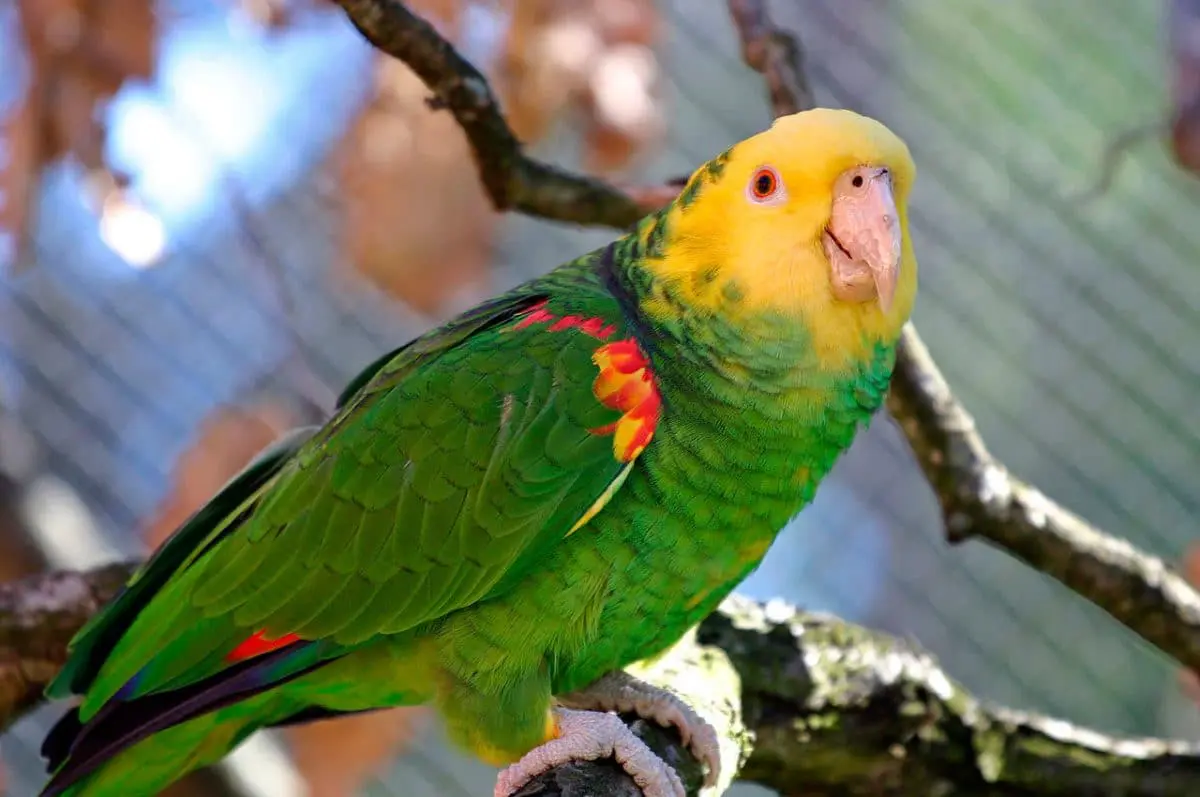
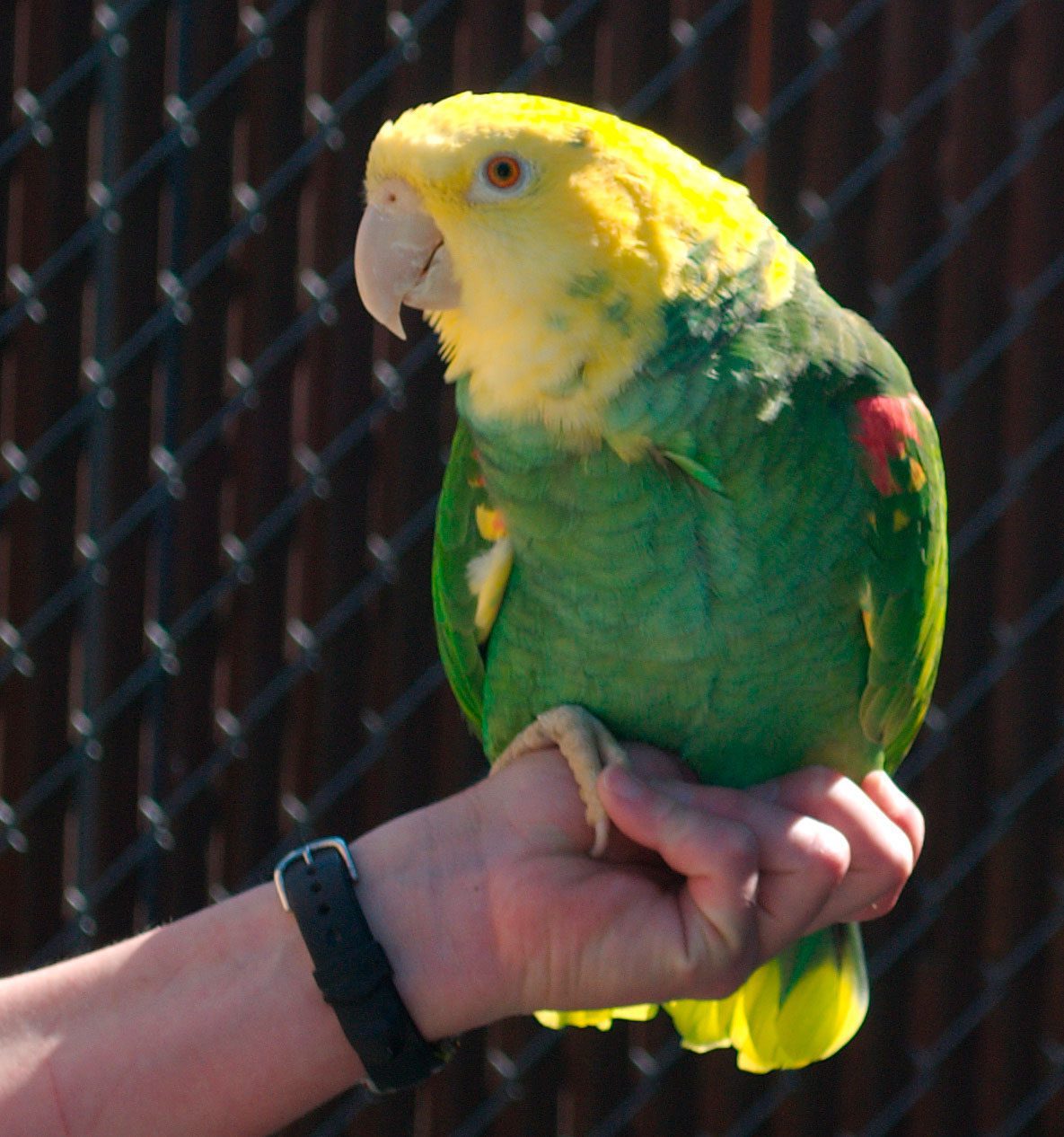
The Yellow-headed Parrot (Amazona oratrix) has head and nape bright yellow; sides neck sometimes with scattered green feathers.

Upperparts green grass with ends of darker green in some feathers; uppertail-coverts paler. Wing coverts green, sometimes with paler yellow margins on some feathers; edge front of the wing and carpal area with red marks and / or yellow variables. Primaries and secondaries green at the base (more emerald than coverts), blue at the tips; five base outer secondaries bright red, forming a speculum. Under wings green. The chin is bright yellow, the throat variable green and dark blue suffusion margins in the feathers of some birds; chest and belly green with yellowish suffusion in some birds, bluish suffusion in other; the thighs with yellow feathers in some birds. Tail green with red tips yellow and green at the base of the innerwebs of the lateral feathers. Bill gray horn; bare periophthalmic whitish; irises orange; legs grey.

Both sexes are similar.

Immature It is very green part with little or no yellow in the head without red and yellow in the wings.

  • Sound of the Yellow-headed Parrot.

Geographic Variation:

All birds puerto Barios at the East end of Guatemala show yellow concentrate lores and crown. While it described as near the subspecies belizensis, the birds of puerto Barios at the northwest end of Honduras They may represent another subspecies of oratrix (not yet formally described) provisionally named guatemalensis (see belizensis below). The hondurensis, described below, It was widely regarded as a subspecies of undescribed Yellow-crowned Parrot (Amazona ochrocephala), but now treated at the southern end as a cline (gradual change of phenotypic traits of the same species due to environmental influences and conditions) Yellow decreasing in head Group of birds yellowhead.

Description 3 subspecies:

  • Amazona oratrix belizensis

    Monroe,BL Jr & Howell,TR, 1966) – Less yellow in the head that the nominal species, without yellow on the throat. Cheeks green, bare periophthalmic grayish-white and probably on average smaller. Fowl Guatemala, to the Northwest of Honduras, sometimes show yellow in head as a patch wide in front of the crown and around eyes, and perhaps they represent a species not yet described (known as guatemalensis); although some birds also show yellow feathers on nape (see geographic variation in Yellow-naped Parrot (Amazona auropalliata).


  • Amazona oratrix hondurensis

    (Lousada & Howell,SNG, 1997) – Yellow on head limited to forecrown and in front of the crown, some birds show patch yellow in nape. One bill paler and more extensive yellow on the nape and the head subspecies caribea of the Yellow-naped Parrot. The patch Yellow crown It is also rounded or triangular, against a narrowband subspecies caribea. The subspecies panamensis of the Yellow-crowned Parrot has a bill darker and lacks the patch yellow in nape.


  • Amazona oratrix oratrix

    (Ridgway, 1887) – Nominal.

Habitat:

The Yellow-headed Parrot frequent savannas, Bosques Tropicales deciduous (including clear), dense forests of thorns, marshy forests peaceful, flood forest evergreen, dense gallery forest, forests Pinus caribea (Belice) and cultivated land with trees, mainly in lowlands below 500 m.

Mainly observed in pairs or in large groups in communal roosts and feeding areas favorites. They snuggle into pine-covered ridges in Belice, moving to nearby humid forests to feed. Apparently, only flocks form in Tamaulipas.

Reproduction:

The Yellow-headed Parrot put their nests in cavities of trees 6-15 meters and in the holes of the palmeras Roystonea. Along the Pacific coast of Michoacรกn in Mexico, the Yellow-headed Parrot nests in trees Astronium graveolens, Brosimum allicastrum and at least five other species of trees (T. Monterrubio-Rico et al., In 2007)

In Belice, preferred pines nest. Breeding season in the months of February to May in the south, to June in the north (for example in Tamaulipas). Clutch, usually 2-3 eggs, they are incubated between 27 and 28 days. The young leave the nest at eight weeks.. On average, only 1.2 hatchlings reach adulthood in each clutch.

Food:

Food in diet of the Yellow-headed Parrot include outbreaks, leaves news, fruits of Palma, seeds of Acacia, fruits of Macuna, Ficus, Zuelania guidonia, Bumelia laetivirens, Solanum and Pithecellobium flexicaule.

They can cause damage to crops, including corn, mango and green bananas.

Distribution and status:

Size of its range (breeding/resident ): 1.020.000 km2

The Yellow-headed Parrot It is confined to Central America in Mexico, Belice, the east end Guatemala and the Northwest corner of Honduras. They are distributed by the slope of peaceful of Mexico in Colima, Michoacรกn, Warrior, Oaxaca (two disjunct populations on the slopes of peaceful and of the Gulf on Isthmus region) and Chiapas. also observed in the shed Gulf from the central and southern Tamaulipas, to the East of San Luis Potosi, Puebla, Veracruz, Tabasco and Campeche, as well as in Belice and around puerto Barios at the East end of Guatemala to the northwest corner of Honduras in the Sula Valley.

Distribution in the east of its range poorly documented, with dubious appearances Campeche and in the region of Petรฉn in the North of Guatemala, confirmed only 1993.

Reports Yellow-headed Parrot outside the normal range Mexico (for example, City of Mexico) probably involving leaks. Wild populations Miami (Florida) and Puerto Rico.

local residents, and rare sparsely distributed along most of its distribution (perhaps locally common in parts of Belice) with diminished by the loss of habitat populations and their capture for live bird markets.

The population of Sula Valley survives as remainder. marketed widely both within and outside the species range, being one of the most searched Neotropical parrots pet (reputedly one of the best talkers). The most drastic falls have probably been in the northeast of Mexico, where habitat loss has been more rapid and severe. The wild population is probably less than 7.000 individuals (1994).

Distribution 3 subspecies:

  • Amazona oratrix belizensis

    Monroe,BL Jr & Howell,TR, 1966) – Belice.


  • Amazona oratrix hondurensis

    (Lousada & Howell,SNG, 1997) – Sula Valley, Honduras.


  • Amazona oratrix oratrix

    (Ridgway, 1887) – Nominal.

Conservation:


Endangered


โ€ข Current category of the Red List of the UICN: In danger of extinction.

โ€ข Population trend: Decreasing.

โ€ข Population size: 4700

Rationale for the Red List category

    This species qualifies as in danger of extinction due to demographic decline very fast. The population is now so small that it is likely to fall (but still very significant) rates decrease in the future (Collar et al., 1992).

Justification of the population

    The population It was estimated 7.000 copies in 1994. This is roughly equivalent to 4.700 mature individuals.

Justification of trend

    It is estimated that the population of the species is declining very fast, due to the loss and degradation of habitat and the levels of capture and persecution. On the coast of Michoacรกn, Mexico, it is estimated that the species occupies the 45.6% its estimated historical distribution (Monterrubio-Rico et al ., 2007 ). Throughout all Pacific coast of Mexico, its historical range has contracted by a 79% (Monterrubio-Rico et al ., 2010). The population of Punta de Manabique It decreased by 30% between 1994 and 2001 mainly due to the Poaching of nests (our man 2003 , Eisermann in a bit., 2007).
Threats

โ€ข The habitat loss It has been extensive, with the 80% lowlands of Tamaulipas cleared for agriculture and pasture, and growing settlements along the Autopista del Oeste in Belice (Somerville 1997).

โ€ข In Belice, where much of the suitable habitat is outside the sistema national protected area, the regions occupied by species remain under heavy development pressure (B. Miller in a little ., 2007).

โ€ข Las palm savannas at the only known breeding site in Guatemala They are used for no intensive cattle grazing (our man 2003), who is still a threat here (Fundary et al ., 2006).

โ€ข Many thousands of Individuals of this species are exported illegally from Mexico and some from Belice each year, and it is popular in domestic markets (Low 1995b, Miller and Miller 1997, Somerville 1997).

โ€ข The illegal internal traffic is intense in Mexico and may represent the 38% of recent species loss distributive (T. Monterrubio-Rico et al., In 2007).

โ€ข In the Mexican states of Michoacรกn, Warrior and Oaxaca, They are mainly pups those taken to the pet trade (T. Monterrubio-Rico et al., In 2007).

โ€ข In Guatemala, It is reported that Local military authorities are complicit in the illegal trade of this species, and poachers frequent nest nesting site of the species (our man 2003, Eisermann in some). It also, has reported its hunting for food from local fishermen in Guatemala (our man 2003, Eisermann in some ., 2007).

โ€ข In Belice, It is hunted and persecuted by damage to crops (SNG Howell in some 1998) and it remains a victim of the illegal pet trade, whose capture involves logging nesting (B. Miller in a little ., 2007).

โ€ข It is estimated that its extension around the coast of Michoacรกn It has decreased 1.507 km2 , of which 576 km2 can not be attributed to habitat loss and, therefore, They may be due to the poaching for trade (Monterrubio-Rico et al., 2007).

Conservation Actions Underway

โ€ข CITES Appendix I.

โ€ข In Mexico It is distributed in nine protected areas (T. Monterrubio-Rico et al., In 2007).

โ€ข The nominal subspecies inhabits Biosphere Reserves of Heaven, Los Tuxtlas, Swamps Centla and Terms Lagoon.

โ€ข The species Tres Marias Parrot (Amazona tresmariae), considered by some authors as a subspecies of Amazona [oratrix gold tresmariae], It is protected in Islas Marรญas Biosphere Reserve.

โ€ข The nominal subspecies It is in the Reserva Chamela-Cuixmala, in the Lagunas de Chacahua, in the Huatulco National Park, and in the Biosphere Reserve Zicuirรกn-Infiernillo in Michoacรกn (T. Monterrubio-Rico et al., 2007), as well as in seven protected areas in Belice (EC Enkerlin-Hoeflich in some 1994, Miller and Miller 1997, Snyder et to the., 2000).

โ€ข The only one breeding population known in Guatemala It was declared Wildlife Refuge in 2005, but effective protection is difficult due to organized crime in the area (Eisermann in some ., 2007).

โ€ข There are several awareness campaigns nationally in Mexico (Roberson y Carratello, 1997).

โ€ข It is bred in captivity, but the reintroduction of captive bred birds is unfeasible (Baja 1995b).

Conservation Actions Proposed

โ€ข Carry out surveys for an updated estimate of population size.

โ€ข Monitor rates of habitat loss and degradation.

โ€ข Monitor hunting levels, catch and trade.

โ€ข Apply the trade restrictions.

โ€ข To protect effectively as key sites Las Colorados Ranch, Soto La Marina / Fishing, Tamaulipas, orange river, focused on Las Abritas (San Luis Potosi) and Punta de Manabique.

โ€ข Survey to identify other important sites.

โ€ข Investigate habitat use and local movements.

โ€ข Continue zooming awareness campaigns.

โ€ข Develop structured captive breeding programs and investigate the possibility of future release.

"Yellow-headed Parrot" in captivity:

The Yellow-headed Parrot are popular in domestic markets.

protected by CITES Appendix I (Species that are endangered. Prohibited international trade of specimens of those species, except when the import is non-commercial purposes).

In Mexico It is listed as endangered in both the NAME-059-SEMARNAT-2001, as in the NAME-059-SEMARNAT-2010, and by the Article 60 Bis of the General Law on Wildlife removal of specimens from the environment is prohibited, marketing, tenure, import, export, use of any of its parts. They are up 9 years in prison and fines very high who are surprised by the Profepa with specimens of this species in their possession and do not have papers proving their legal provenance.

Should be avoided in all cases buy this or any of the protected species by different appendices CITES.

Alternative names:

Yellow-headed Amazon, Yellow-headed Parrot, Yellow-headed Parrot (Mainland) (English).
Amazone ร  tรชte jaune, Amazone ร  tรชte jaune (continentale), Amazone ร  tรชte jaune (forme continentale) (French).
Gelbkopfamazone (German).
papagaio-de-cabeรงa-amarela (Portuguese).
Loro Cabeza Amarilla, Amazona cabecigualda (espaรฑol).


scientific classification:

Robert Ridgway
Robert Ridgway

Order: Psittaciformes
Family: Psittacidae
Genus: Amazona
Scientific name: Amazona oratrix
Citation: Ridgway, 1887
Protonimo: Amazona oratrix


ยซYellow Headed Parrotยป Images:

Videos "Yellow-headed Parrot"

————————————————————————————————

ยซYellow Headed Parrotยป (Amazona oratrix)


Sources:

Avibase
– Parrots of the World โ€“ Forshaw Joseph M
– Parrots A Guide to the Parrots of the World – Tony Juniper & Mike Parr
Birdlife

Photos:

(1) – A Yellow-headed Amazon (also known as the Double Yellow-headed Amazon) in an aviary By Ernst Vikne (IMG_4451.JPG) [CC BY-SA 2.0], via Wikimedia Commons
(2) – Yellow-headed Amazon at Baltimore Aquarium, USA By Christine Schmidt from Laurel, USA (Parrot pair) [CC BY 2.0], via Wikimedia Commons
(3) – Yellow-headed Amazon, also known as the Yellow-headed Parrot or Double Yellow-headed Amazon, at Lion Country Safari, West Palm Beach, Florida, USA. Photograph is a close up of head By Duncan Rawlinson from Vancouver, BC (Parrot) [CC BY 2.0], via Wikimedia Commons
(4) – Yellow-headed Amazon (Amazona oratrix) playing on his cage by Mbtskysurfer at English Wikipedia [GFDL or CC BY 3.0], via Wikimedia Commons
(5) – Yellow-headed Amazon (Amazona oratrix) also known as the Yellow-headed Parrot, Double Yellow-headed Amazon. Two parrots on a perch By Gary Denness (originally posted to Flickr as Parrot Portrait) [CC BY-SA 2.0], via Wikimedia Commons
(6) – Yellow-headed Amazon (also known as the Yellow-headed Parrot and the Double Yellow-headed Amazon) at Vancouver Aquarium, Canada By Lizzy Foulkes (originally posted to Flickr as Hello, Goregous) [CC BY-SA 2.0], via Wikimedia Commons
(7) – A Yellow-headed Amazon at Palmitos Park, Gran Canaria, Canary islands, Spain By William Warby (Flickr: Parrot) [CC BY 2.0], via Wikimedia Commons
(8) – A Yellow-headed Amazon in Jungle Island, Miami, Florida, USA By Humberto Moreno (Parrot Jungle, Miami) [CC BY 2.0], via Wikimedia Commons
(9) – Yellow-headed Amazon (also known as the Yellow-headed Parrot and the Double Yellow-headed Amazon) at Dallas World Aquarium, USA By texas_mustang (Dallas Aquarium 2008 with Meredith) [CC BY 2.0], via Wikimedia Commons

Sounds: Peter Boesman, XC218407. accessible www.xeno-canto.org/218407

โ–ท The world of Pets: Dogs, cats, birds, reptiles, amphibians

Orange-winged Parrot
Amazona amazonica

Amazona Alinaranja

Content


Anatomy-parrots

Description Orange-winged Parrot

Of 33 to 36 cm.. height can weigh between 350 gr y 450 gr.
The Orange-winged Parrot (Amazona amazonica) It is distinguishable by having the Centre of the crown and cheeks yellow, separated by the forecrown and sides of the crown pale blue, edge of the wing orange, and inside of the tail Orange with stripe green in the Middle.
The copies juveniles have a color different to it of them adults; the head is green, Blue and pale yellow.
It is not possible to determine the sex of the Amazons in a safe manner by their appearance.

Habitat:

Present in varied habitats (dry forests, morichales, Savanna, stubble, mangroves, etc.) below the 500 m.

Frequently is seen in pairs or in flocks numerous out of it breeding season.

Reproduction:

It is a kind monogamous (the couple stays together for life).

It nests in trunks of Palms killed apparently at the end of the season dry.
The female lays from 3 to 5 eggs and she incubates them for three weeks approximately. the chicks take two months to develop.

Food:

It feeds on various fruits, seeds and sprouts leaves. Including the fruit of Palms (Sloanea, Richeria and Byrsonima) , flowers Erythrina and sometimes cocoa.
You can take oranges and mangoes of the cultivated areas when other food is scarce.

Distribution:


Size of the area of distribution (reproduction / resident): 7.420.000 km2

North and Central South America to the East of Peru, Brazilian Amazon and northeast of Bolivia.

Conservation:

State of conservation โ“˜


minor concern Minor Concern โ“˜ (UICN)โ“˜
  • Current red list category of the UICN: Least concern.
  • The population trend: Decreasing.

  • Trapped for the wild bird trade: they have been 268.510 wild-caught individuals for international trade from 1981.
    In some areas of their range they are hunted for food by the indigenous population.
    The loss of habitat is also a concern.


    "Orange-winged Parrot" in captivity:

    Video – "Orange-winged Parrot"

    Amazona Amazonica

    Popular as a mascot for more than 100 years.
    Loving, playful, with good ability to speak, sociable with people.

    Known for being very friendly, easy to train, very Smart.
    They need constant attention of their owners, they carry out all kinds of fun pranks to get that attention.
    Over time they will form a strong bond with their owner., they can however be quite noisy. They will make noise early in the morning and when the Sun is setting. This usually lasts for a few 10 minutes, to wake up and just before sleep.

    Alternative names:

    Orange winged Parrot, Common Amazon Parrot, Orange-winged Amazon, Orange-winged Parrot (English).
    Amazone ร  ailes orange, Amazone aourou (French).
    Venezuelaamazone (German).
    curica, airu-curuca, ajuru-catinga, ajuru-curau, ajuru-curuca, curau, curuรงรก, Papagaio-do-mangue, papagaio-grego, papagaio-poaieiro (Portuguese).
    Amazona Alinaranja, Amazona Guaro, Cotorra Alianaranjada, Lora Amazรณnica, Loro Real, Lora alianaranjada (espaรฑol).
    Lora Amazรณnica (Colombia).
    Loro Guaro (Venezuela).

    scientific classification:

    Order: Psittaciformes
    Family: Psittacidae
    Genus: Amazona
    Scientific name: Amazona amazonica
    Citation: (Linnaeus, 1766)
    Protonimo: Psittacus amazonicus

    Orange winged Parrot images :


    Species of the genus Amazona


    Sources:

    – Parrot Book, Parrots and macaws Neotropical
    avibase

    Photos:

    Our beautiful world
    – An Orange-winged Amazon at Kuala Lumpur Bird Park, Malaysia. It is eating a slice of corn on the cob by Vasenka – Wikimedia
    – by Patrick Ingremeau – IBC.lynxeds.com
    – by Snowmanradio (talk) – Wikimedia
    – by Thore Noernberg – IBC.lynxeds.com

    Sounds: Joao Antonio de B.. Vitto (Xeno-canto)

    โ–ท The world of Pets: Dogs, cats, birds, reptiles, amphibians

    Tres Marias Parrot
    Amazona tresmariae

    Tres Marias Parrot

    Content

    Description:

    38-40 cm.. length and 580-650 g. of weight.

    The Tres Marias Parrot (Amazona tresmariae) has head and throat yellow.

    The upperparts are green. The underparts They are green but more yellowed than upperparts. Thighs yellow. Primaries and secondaries green, violet-blue becoming the tip. should carpal yellow. Speculum red on the basis of the five outer secondaries. The curve wings, pale red, with some yellow.

    The tail is green, with yellowish green tip and lateral feathers basically marked with red on the inner band; outermost feathers fringed blue. The legs They are pale gray. The irises It is orange. The bill is horn-colored, gray towards the base of the upper jaw. Cere dark gray.


    Anatomy-parrots

    Both sexes are similar. The immature They are completely green head, except the yellow patch in forecrown. The curve wings, green. should carpal yellowish green.

    Taxonomic note:

    It is granted status species by the International Congress of Ornithology.

    Habitat:

    Video "Tres Marias Parrot"

    They have preference by deciduous forests or evergreen, clear, Savanna Woods, pine forests, dense gallery forests; less commonly in dry thorn forests, mangroves or coastal marshes and cultivated areas with scattered trees.

    Resident throughout its area of distribution.

    Reproduction:

    Nest in holes in tree trunks or fallen branches.

    Food:

    consume outbreaks, leaves news, fruits palm, seeds of Acacia, fruits of Macuna, figs and some fruits of cultivated land.

    Distribution:

    Endemic to the Marias Islands, on the west coast of Mexico.

    Amazon tresmariae Conservation :

    State of conservation โ“˜


    minor concern Minor Concern โ“˜ (UICN)โ“˜

    โ€ข Current category of the Red List of the UICN: Least concern.

    โ€ข Population trend: Decreasing.

    The Tres Marias Parrot It has an extremely large range and, therefore, it does not approach the thresholds for Vulnerable at the discretion of the distribution area size (Extension <20,000 km2 combined with a size decreasing or fluctuating range, extent or quality of habitat or population size and a small number of locations or severe fragmentation).

    Even though the population trend appears to be declining, It not believed to be declining fast enough to approach the thresholds for Vulnerable under the criteria of population trend (> 30% decline over ten years or three generations).

    The population size has not been quantified, but it is not believed that approximates Vulnerable thresholds under the criterion of population size (<10.000 mature individuals with an estimated continuous decline> 10% in ten years or three generations or a population structure). For these reasons, the species is evaluated as Least Concern.

    Usually it regarded as a subspecies of the Yellow-crowned Parrot (Amazona ochrocephala).

    Tres Marias Parrot in captivity:

    These birds belong to Appendix I of the CITES, with special protection because they are highly sought.

    Alternative names:

    Panama yellow-crowned amazon, Tres Maria Yellow-headed Parrot, Tres Marias Amazon, Tres Marias Parrot, Yellow-headed Parrot (Tres Marias Is.) (English).
    Amazone ร  tรชte jaune (forme des Tres Marias), Amazone de Trรชs Marias, Amazone des Tres Marias (French).
    Gelbkopfamazone-tresmariae, Tres-Marias-Amazone (German).
    Tres Marias Parrot (Portuguese).
    Tres Marias Parrot, Tres Marias Amazon, amazona de Tres Marias, Amazona cabeciamarilla de tres marias, Loro de las islas Marรญa (espaรฑol).


    Scientific classification Amazona tresmariae:

    Edward William Nelson
    Edward William Nelson

    Order: Psittaciformes
    Family: Psittacidae
    Genus: Amazona
    Scientific name: Amazona tresmariae
    Citation: Nelson, 1900<

    Tres Marias Parrot images:


    Species of the genus Amazona


    Sources:

    • Avibase
    • Parrots of the World โ€“ Forshaw Joseph M
    • Parrots A Guide to the Parrots of the World – Tony Juniper & Mike Parr

    Photos:

    (1) – Amazona tresmariae at Cougar Mountain Zoological Park, USA perching on a zoo keepers left hand By Derrick CoetzeeCamera location47ยฐ 33โ€ฒ 11.72โ€ณ N, 122ยฐ 04โ€ฒ 50.26โ€ณ W View this and other nearby images on: Openstreetmap – Google Earth 47.553255; -122.080628 [CC0], via Wikimedia Commons
    (2) – Amazona tresmariae in a cage at Cougar Mountain Zoological Park By Derrick Coetzee from Seattle, USA (Tres Marias Amazon in cage 2) [CC0], via Wikimedia Commons
    (3) – Amazona tresmariae at Cougar Mountain Zoological Park, USA. There are two with a woman zoo keeper By Derrick Coetzee [CC0], via Wikimedia Commons
    (4) – Tres Marias Amazon in cage by D CoetzeeFlickr
    (5) – Yellow-headed Parrot of the Tres Marias Islands by (c) Juan Cruzado Cortรฉs – naturalista.mx

    โ–ท The world of Pets: Dogs, cats, birds, reptiles, amphibians

    Scaly-naped Amazon
    Amazona mercenarius

    Scaly-naped Amazon

    Content

    Description


    Anatomy-parrots

    33 to 38 cm.. tall and 300 g. of weight.

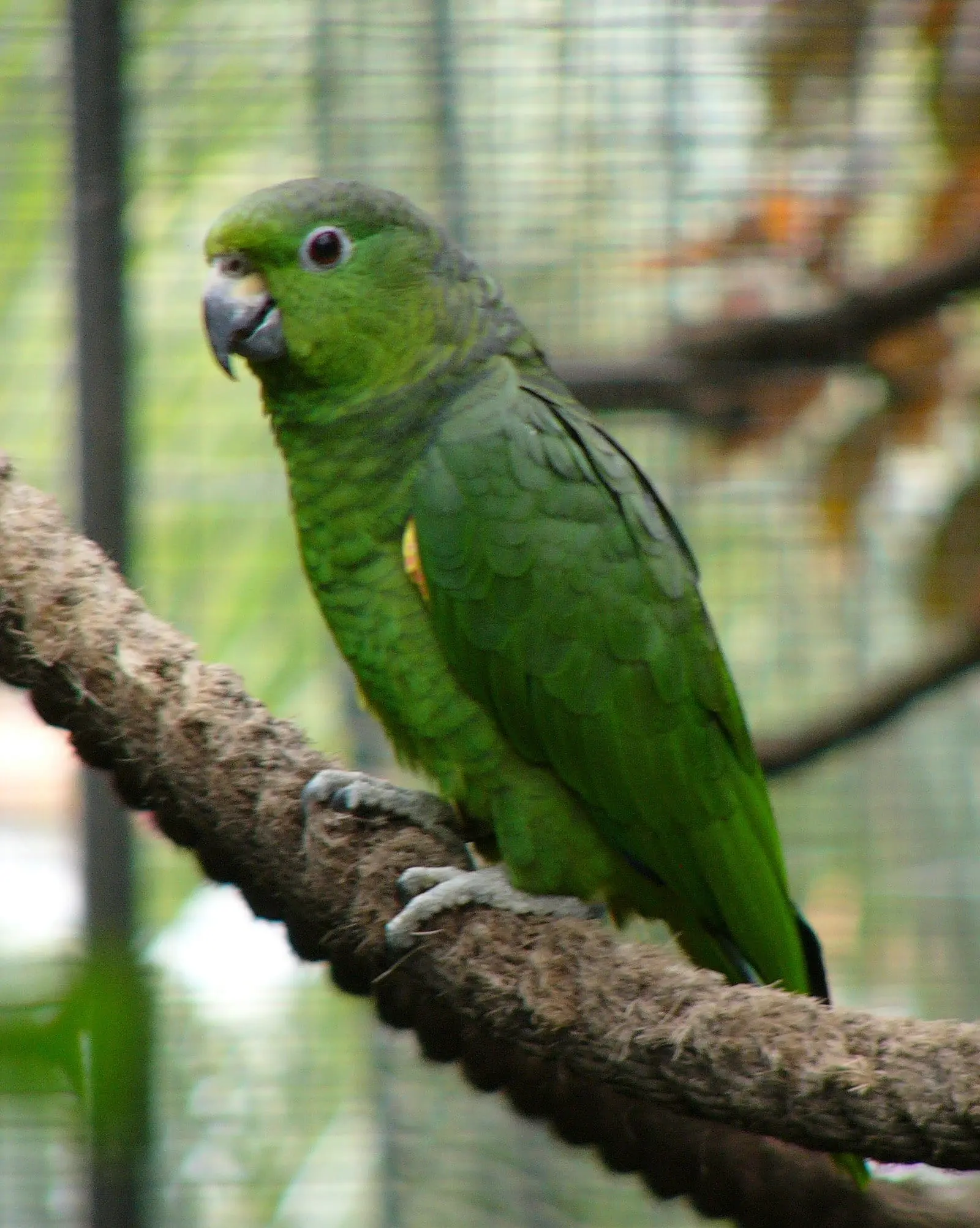
    The Scaly-naped Amazon (Amazona mercenarius) it is the only amazon in mountainous areas.

    General coloring green, with the feathers of the chest with black border, It is distinguished by having the wingtip yellow with orange spots, and external feathers tail tricolor with blue base, middle part red and yellow tip.

    Bill pale gray area at the base of jaw; irises orange; legs brown.

    Both sexes are similar. It is thought that immature they are similar to adults.

    Description 2 subspecies

    • Amazona mercenarius canipalliata

      (Cabanis, 1874) – Speculum red absent. bases outer secondaries marked with brown spots. Some specimens show scattered red feathers crown, the throat top of the chest.


    • Amazona mercenarius mercenarius

      (Tschudi, 1844) – Nominal.

    Habitat:

    Video – "Scaly-naped Amazon"

    Loro Verde (Mercenary Amazon)

    Andean and sub-Andean forests permanently cloudy between 1200 and 3000 m. Occasionally in warm floor and cultivated land.
    Usually in pairs or groups of 30 to 40 individuals.

    Reproduction:

    They have reported evidence reproduction between March and May in Colombia. Nest and eggs not yet described. The incubation period apparently it lasts 25 and 26 days.

    Food:

    Little information on their diet, but he has seen taking figs and fruit unidentified in Colombia.
    In Colombia they have been observed down to attack corn fields.

    Distribution:

    Size of the area of distribution (reproduction / resident): 3.160.000 km2

    Andes from Venezuela to the North of Bolivia.

    Distribution 2 subspecies

    • Amazona mercenarius canipalliata

      (Cabanis, 1874) – Andes of Colombia to northwest Venezuela and Ecuador.


    • Amazona mercenarius mercenarius

      (Tschudi, 1844) – Nominal. Andes North of Peru to the North of Bolivia; a single record in Argentina.

    Conservation:

    State of conservation โ“˜


    minor concern Minor Concern โ“˜ (UICN)โ“˜

    โ€ข Current category of the Red List of the UICN: Least concern.

    โ€ข Population trend: Decreasing.

    Justification of the population

    The population size World has not been quantified, but this species is described as ยซquite commonยป (Stotz et to the., 1996).

    Justification of trend

    It is suspected that the population is in decline due to the continuous habitat destruction.

    The Amazona Mercenary in captivity:

    Very rare in captivity.

    Alternative names:

    Scaly-naped Amazon, Mercenary Amazon, Mercenary Parrot, Scaly naped Parrot, Scaly-naped Parrot (English).
    Amazone mercenaire (French).
    Soldatenamazone (German).
    Loro verde (Portuguese).
    Amazona Mercenaria, Amazona Verde, Lora Andina, Loro nuca escamada, Lora paramera (espaรฑol).


    scientific classification:

    Tschudi-Johann Jakob of
    Tschudi-Johann Jakob of

    Order: Psittaciformes
    Family: Psittacidae
    Genus: Amazona
    Scientific name: Amazona mercenarius
    Citation: (Tschudi, 1844)
    Protonimo: parrot hired


    Scaly-naped Amazon Pictures:


    Species of the genus Amazona


    Sources:
    – Parrot Book, Parrots and macaws Neotropical
    avibase
    – Parrots of the World โ€“ Forshaw Joseph M
    – Parrots A Guide to the Parrots of the World – Tony Juniper & Mike Parr
    Birdlife

    – Photos: papageien.org, IBC.lynxeds.com , chrislansdell.blogspot.com.es, Flickr.com

    – Sound: Hans Matheve