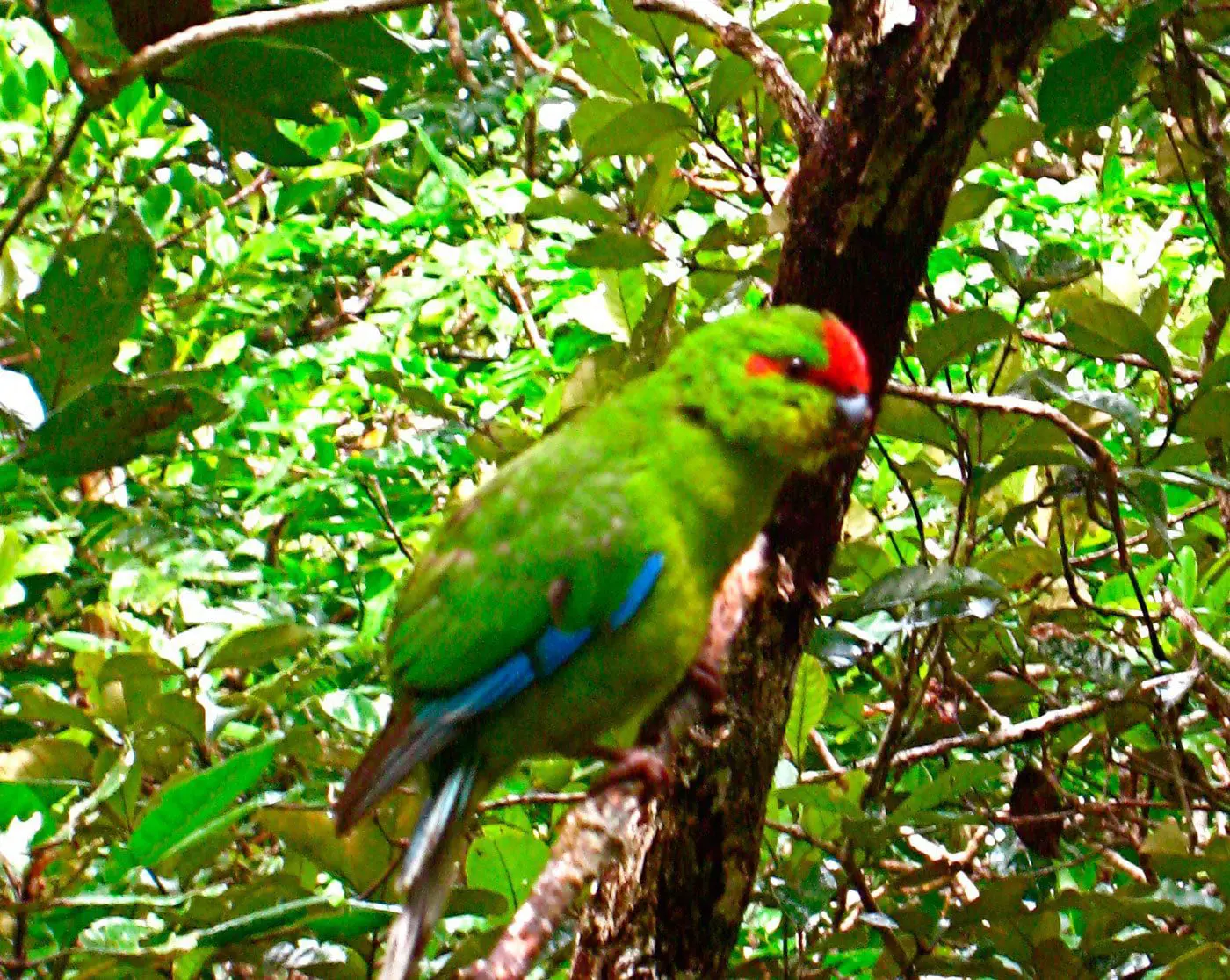
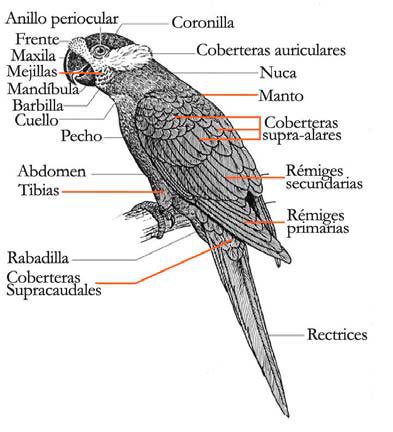
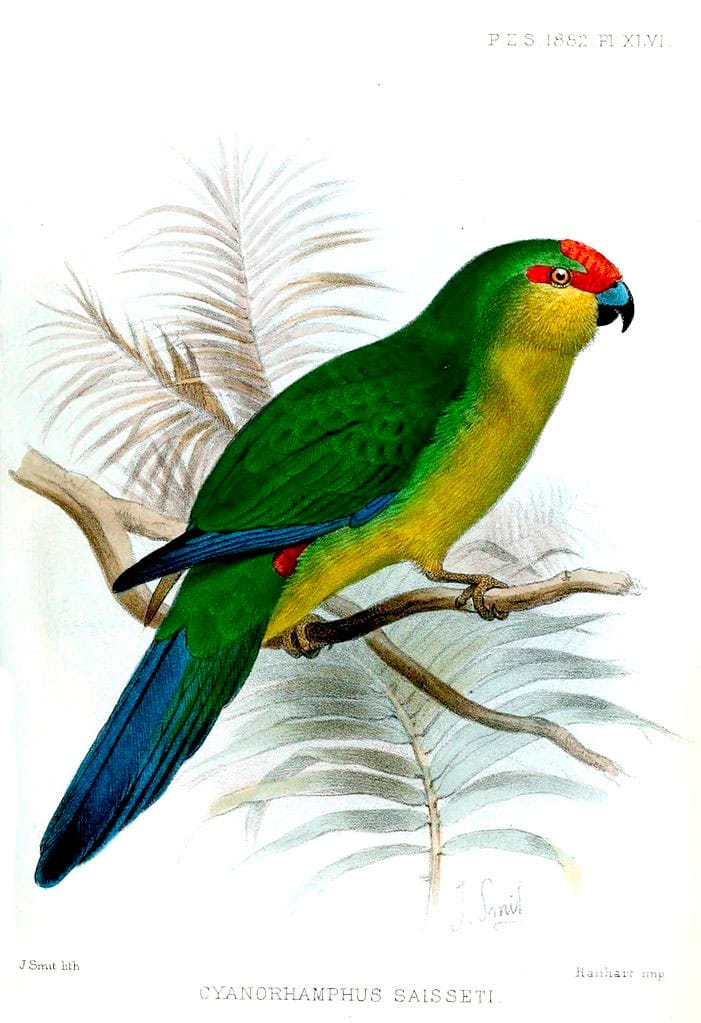
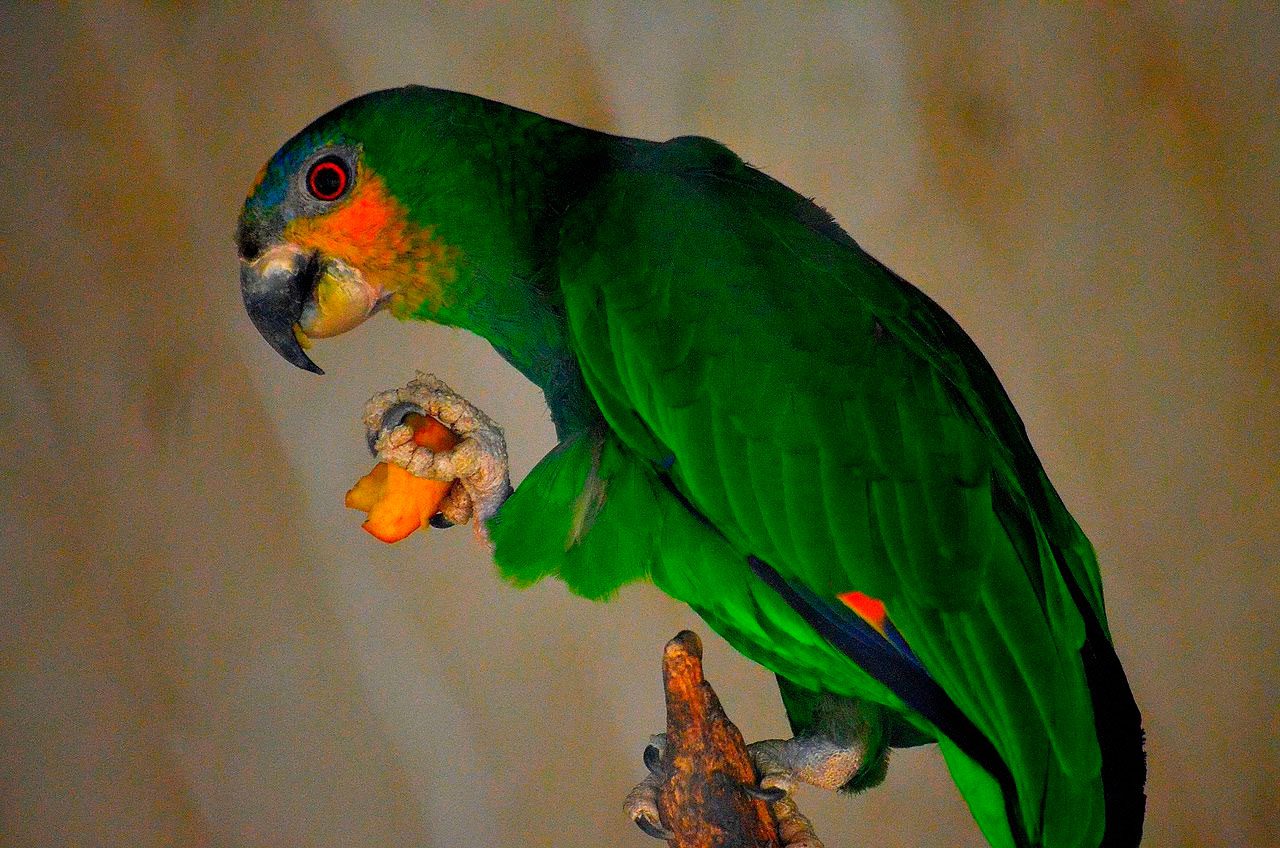
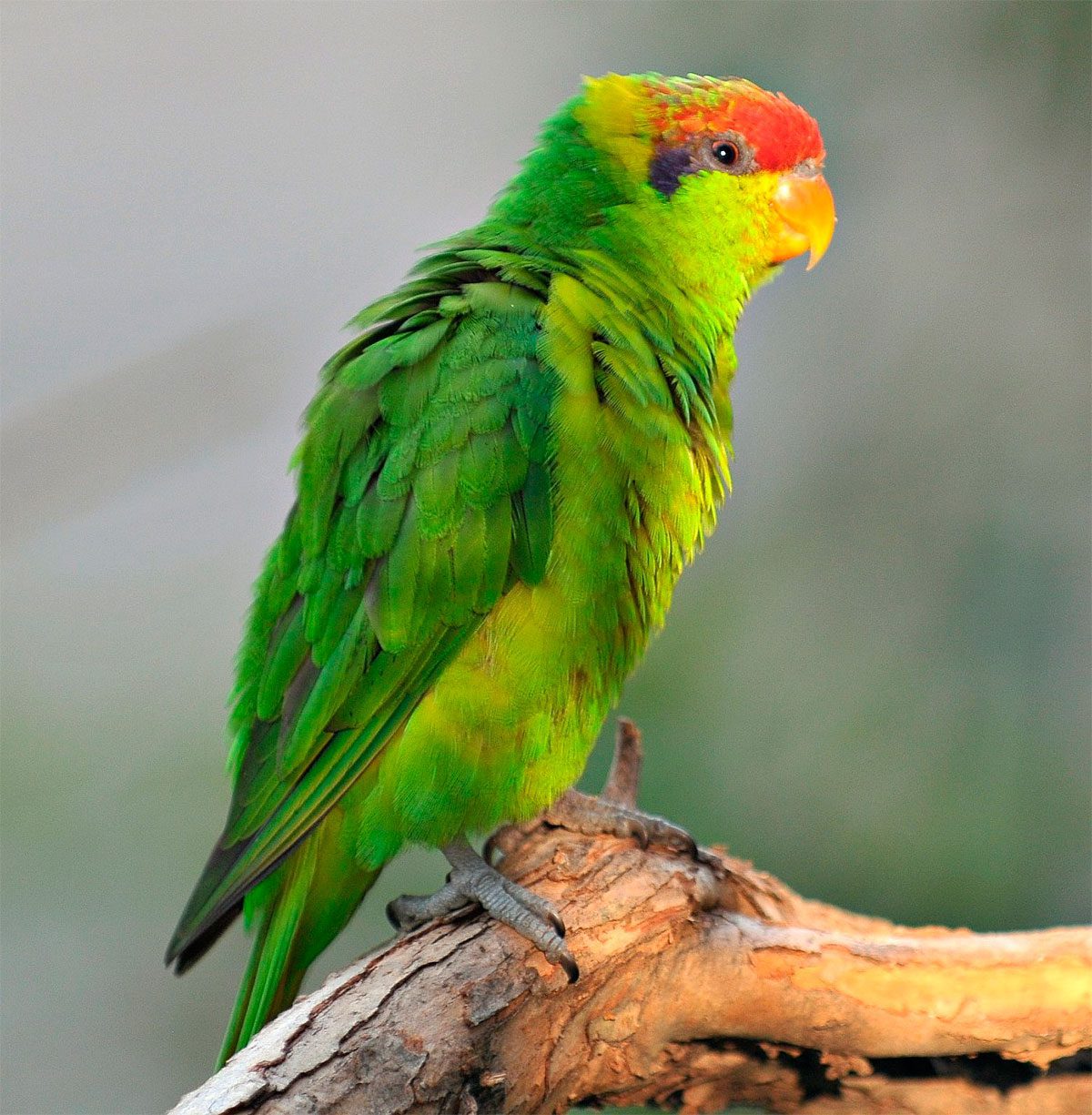
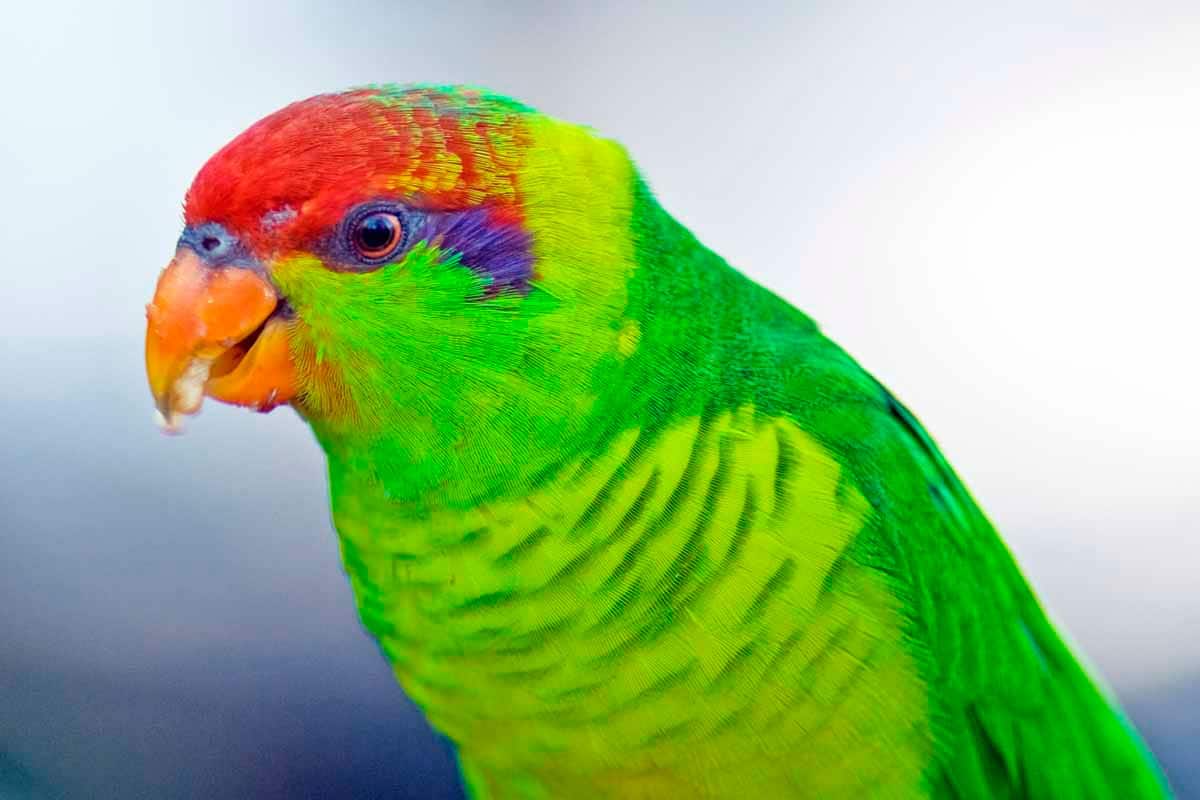
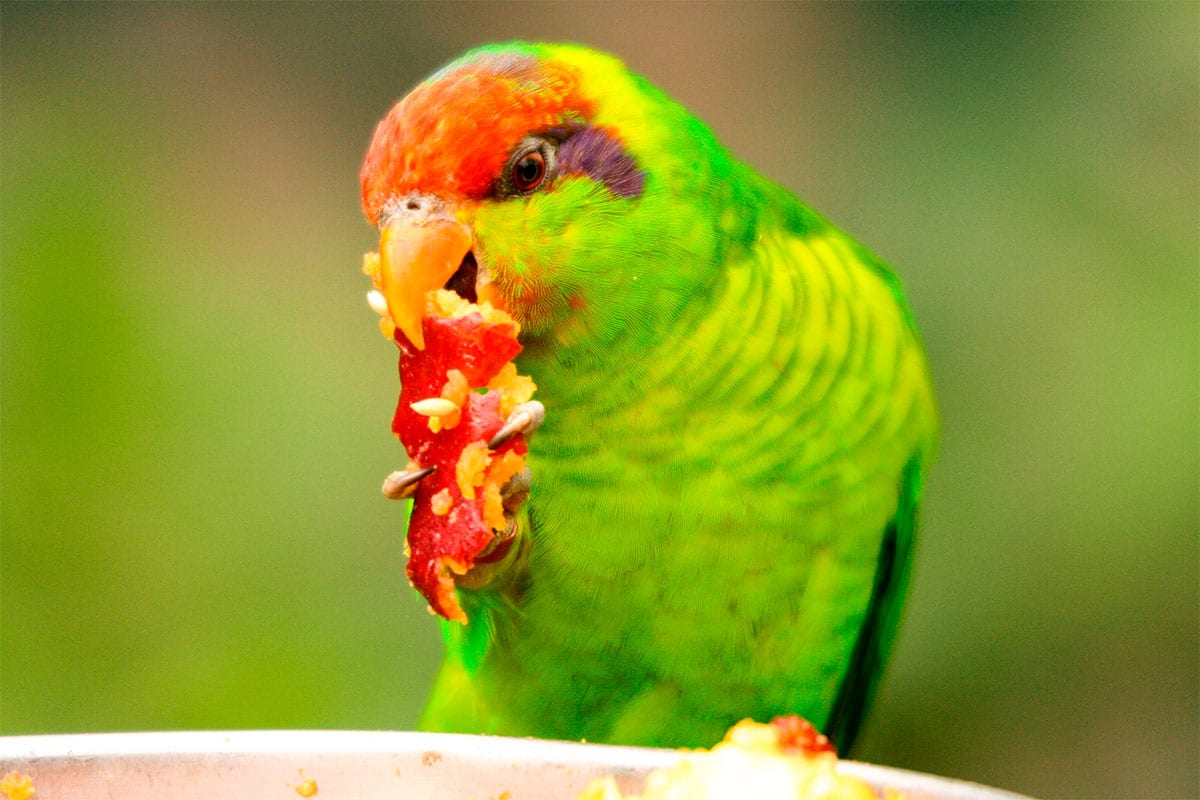
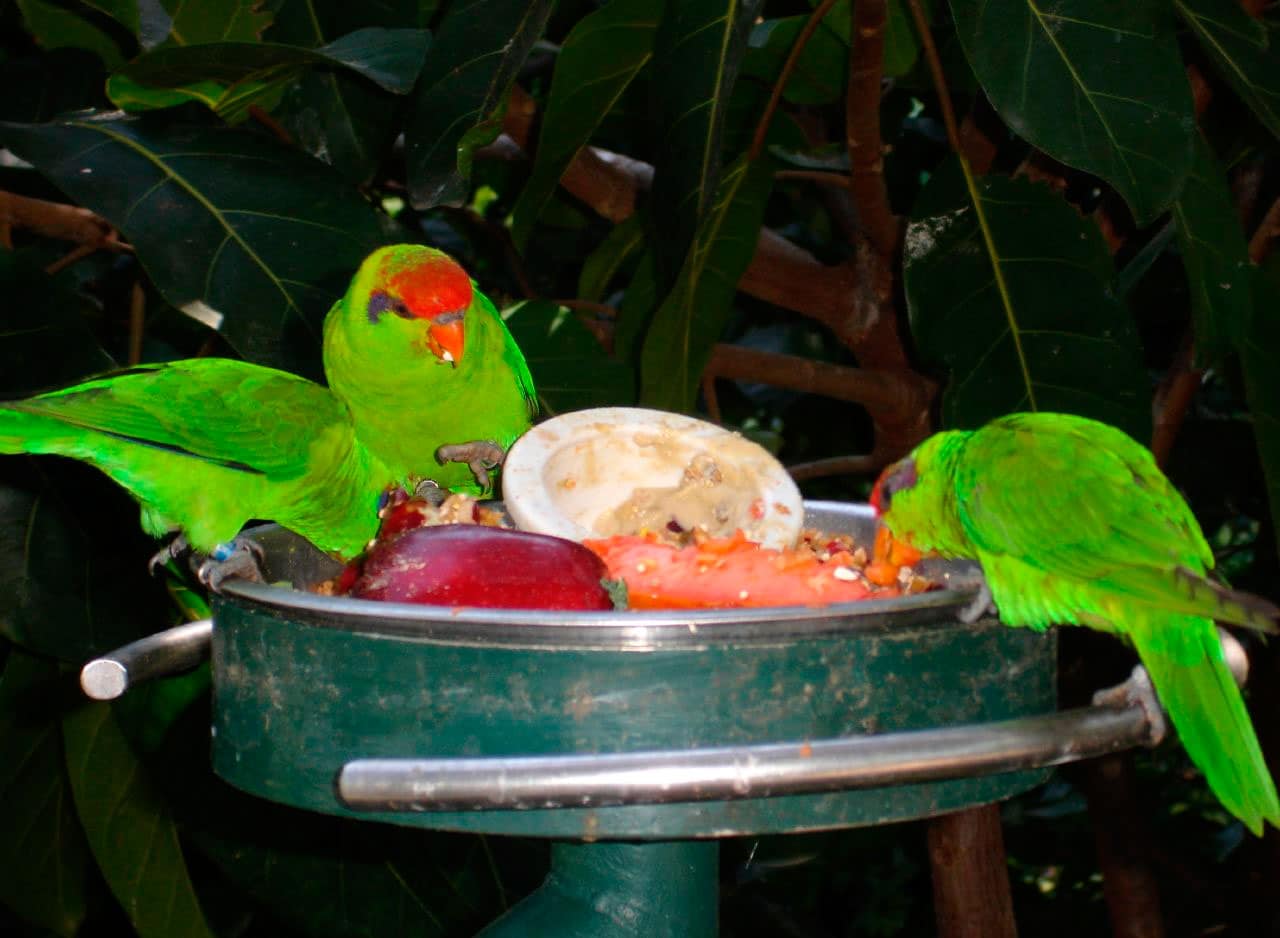
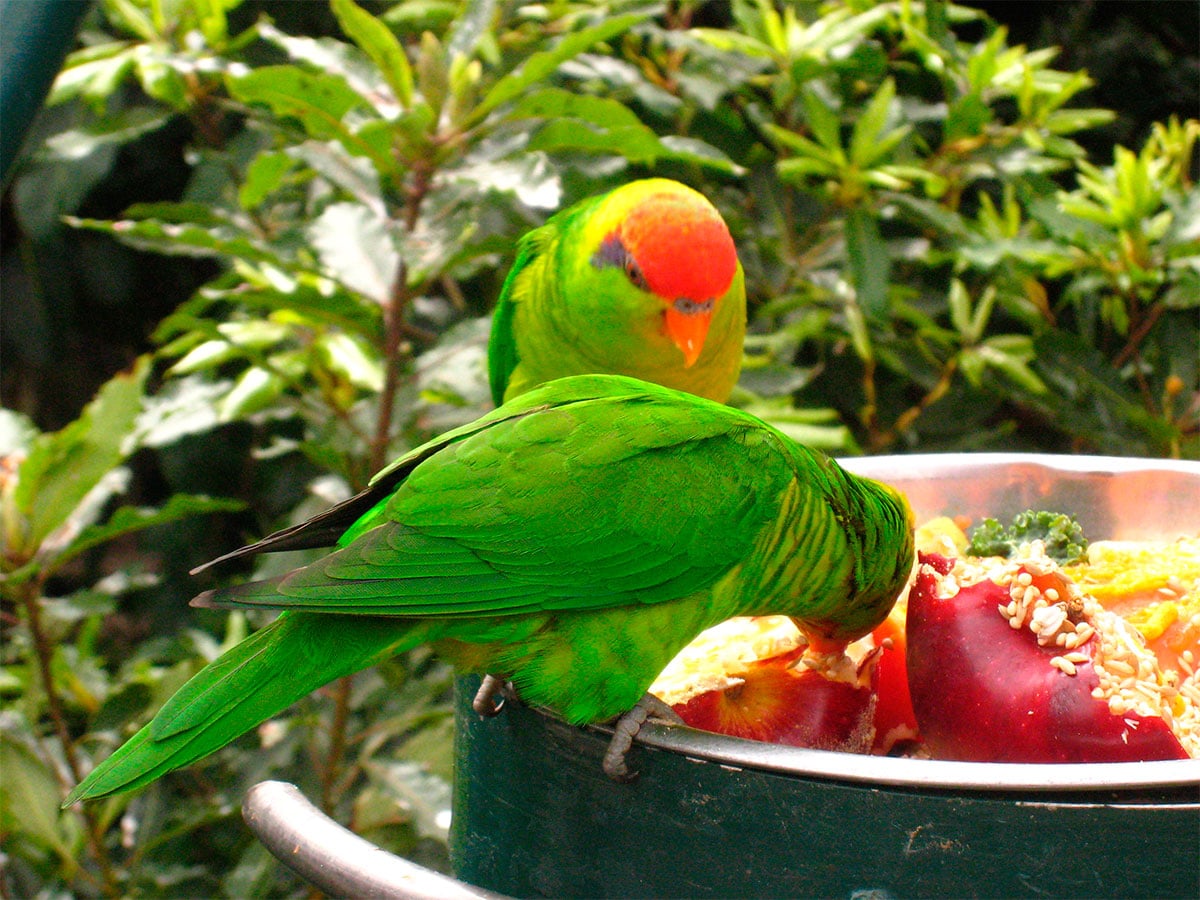
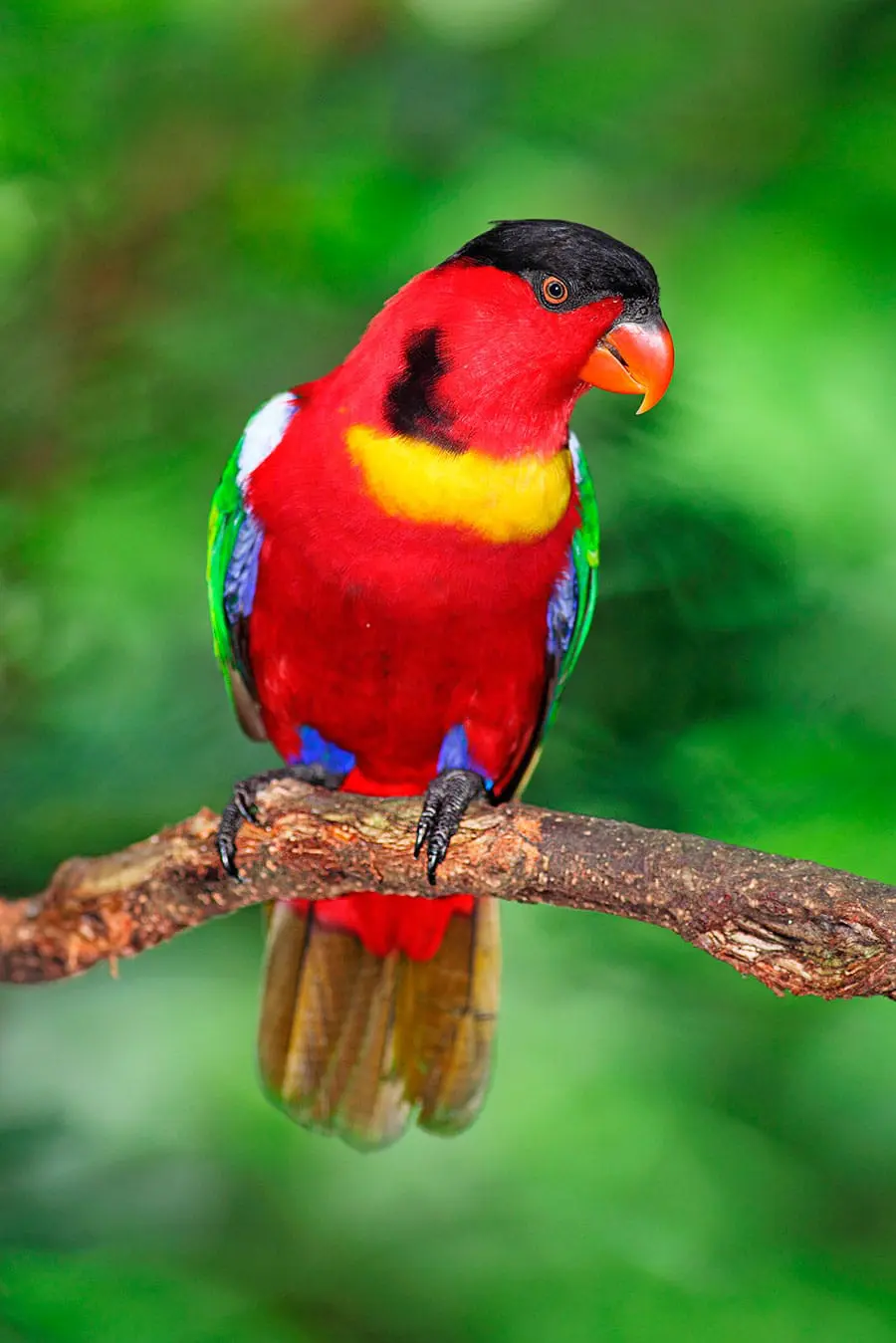
The upperparts of the New Caledonian Parakeet(Cyanoramphus saisseti) they are mostly green, with some bluish green in the tail, violet-blue along the outerweb flight feathers, and red patches on each side of the rump. The underparts are yellowish green, yellower near throat, and gray below tail(Forshaw 1989, Juniper & Parr 1998, Doughty et al. 1999).
A red patch extends from the crown up to the forecrown, and it extends in a narrow band from the forecrown up to the ears(Juniper & Parr 1998).
The bill is leaden gray, with black tips, the irises is red-orange and legs are dark gray. (Layard & Layard 1882b, Juniper & Parr 1998).
The males typically exceed the females in size, although its plumage is similar (Verreaux & walls 1860, Layard & Layard 1882b, Salvadori 1891, Forshaw 1989)
taxonomy:
In the past it was considered to New Caledonian Parakeet conspecific of Red-crowned parakeet(Cyanoramphus novaezelandiae) of New Zealand, but genetic studies have shown that it is a separate species and occupying a basal position on gender Cyanoramphus, which indicates that the genus would have its origin in New Caledonia.
Sound of the New Caledonian Parakeet.
Habitat:
The New Caledonian Parakeet They were primarily fed at low altitudes canopy, and regularly they observed on the edge of the forest, on slopes or in the forest maquis (scrub).
Seem to have small populations and their distributions are expected to shrink as a result of climate change.
They are not particularly shy, although they tend to be rather calm and difficult to observe.
Reproduction:
It has been reported that the nesting It occurs between November and January, and nidadas They consist of two to five eggs, that they are placed in holes in trees (Hannecart & Létocart 1980, Theuerkauf et al. 2009b).
Genetic evidence suggests that the species is polyandrous, and the presence of male food assistants suggests that probably involves mating system poliandria cooperative (Theuerkauf et al., 1999).
Food:
It is usually fed in average heights, low canopy, but it has also been observed that feeds on the floor.
Essentially it is granivore. It feeds mainly on seeds and fruits, besides berries, nuts and other plant parts (outbreaks, flowers and leaves).
Distribution:
The New Caledonian Parakeet It is endemic to the main island of New Caledonia, although there are still uncertainties about the extent of its range and population size (Taylor 1985, Juniper & Parr 1998). The species was considered rare at the time of its introduction (Verreaux & walls 1860). But, in the decade of 1880, Flocks of birds were reported in the West, flying into the valleys Moindou from nearby mountain forests, where it is rumored to have slept in large quantities (Layard & Layard 1882b).
It has the lowest population density of parrots New Caledonia.
Conservation:
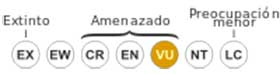
• Current category of the Red List of the UICN: Vulnerable.
• Population trend: Decreasing.
• Population size : 2500-10,000 individuals.
The New Caledonian Parakeet They face a variety of threats, and their populations seem to be in decline. But, it is difficult to determine the cause or extent of their declines due to the paucity of ecological data.
classified as Vulnerable because it has a single small population suspected to be declining due to predation by invasive species; his fortress is in an area threatened by nickel mining and may be in rapid decline in the near future.
The humid mountain forest is not threatened, but it is possible that this species in need of other habitats, some of which, particularly semi-deciduous forests lowland, They have almost disappeared from the island. It is possible that introduced diseases (such as avian malaria) or the mammals (especially rats) It has been a cause of decline.
There is no evidence that nest poaching is widespread.
"New Caledonian Parakeet" in captivity:
unregistered.
Alternative names:
– New Caledonian Parakeet, New Caledonian Parrot, New Caledonian Red-crowned Parakeet, Red-crowned Parakeet (inglés).
– Perruche à front rouge, Perruche calédonienne, Perruche de Nouvelle-Calédonie (francés).
– Cyanoramphus saisseti (alemán).
– Periquito-da-nova-caledônia (portugués).
– Perico de Nueva Caledonia (español).
• Avibase
• Parrots of the World – Forshaw Joseph M
• Parrots A Guide to the Parrots of the World – Tony Juniper & Mike Parr
• Birdlife
Photos:
(1) – Cyanoramphus saisseti, blue river park, New Caledonia by Mickaël T. [CC BY 2.0], via Wikimedia Commons
(2) – Cyanoramphus saisseti Proceedings of the Zoological Society of London 1882 (Web) by Joseph Smit [Public domain]
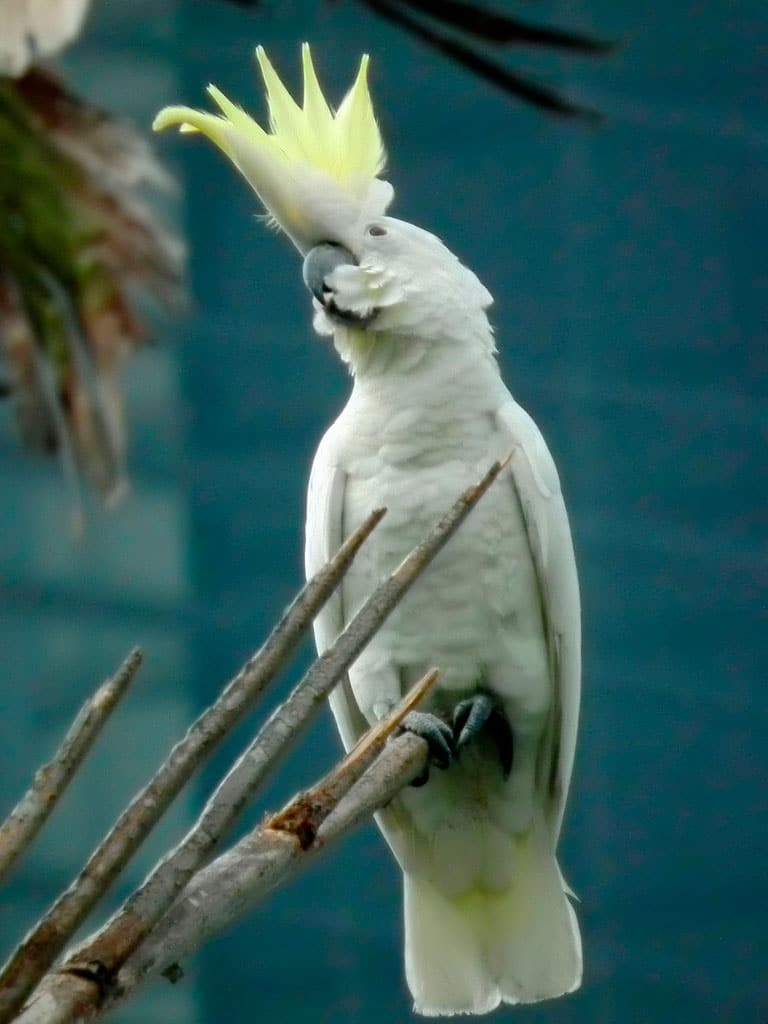
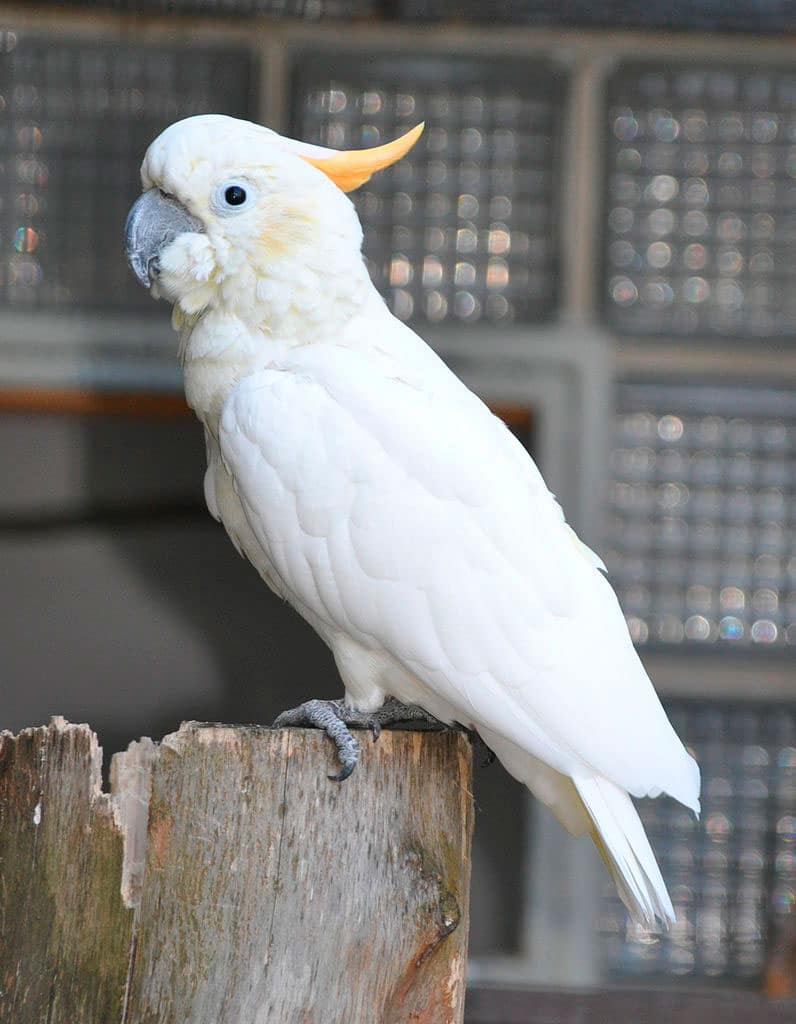
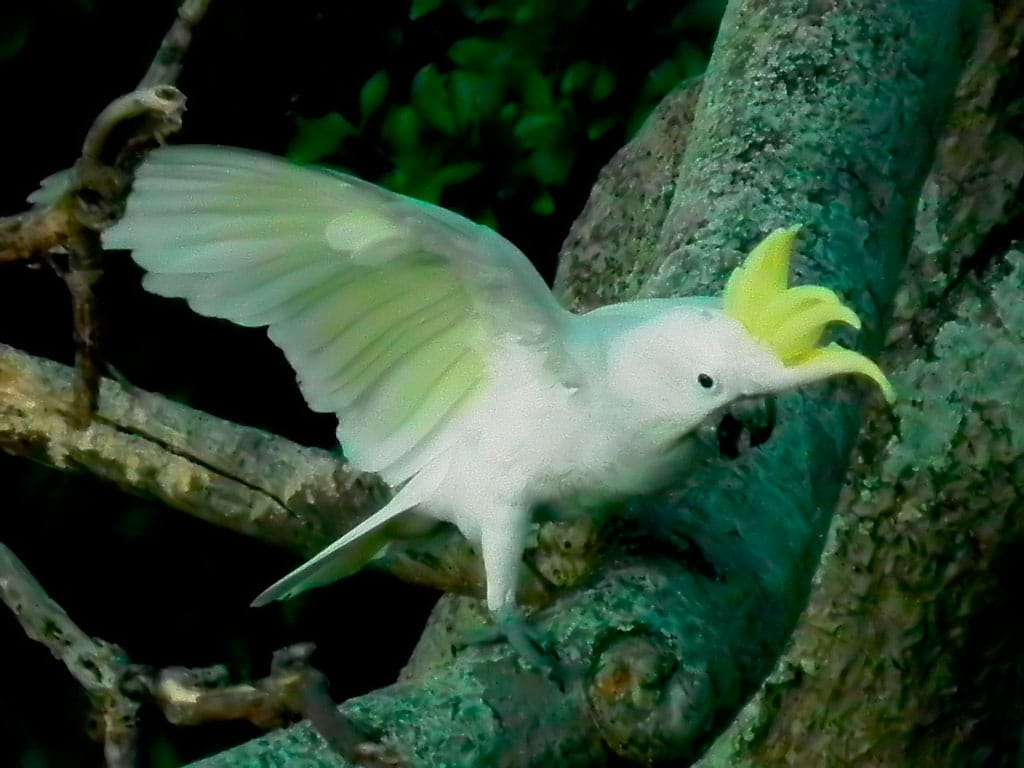
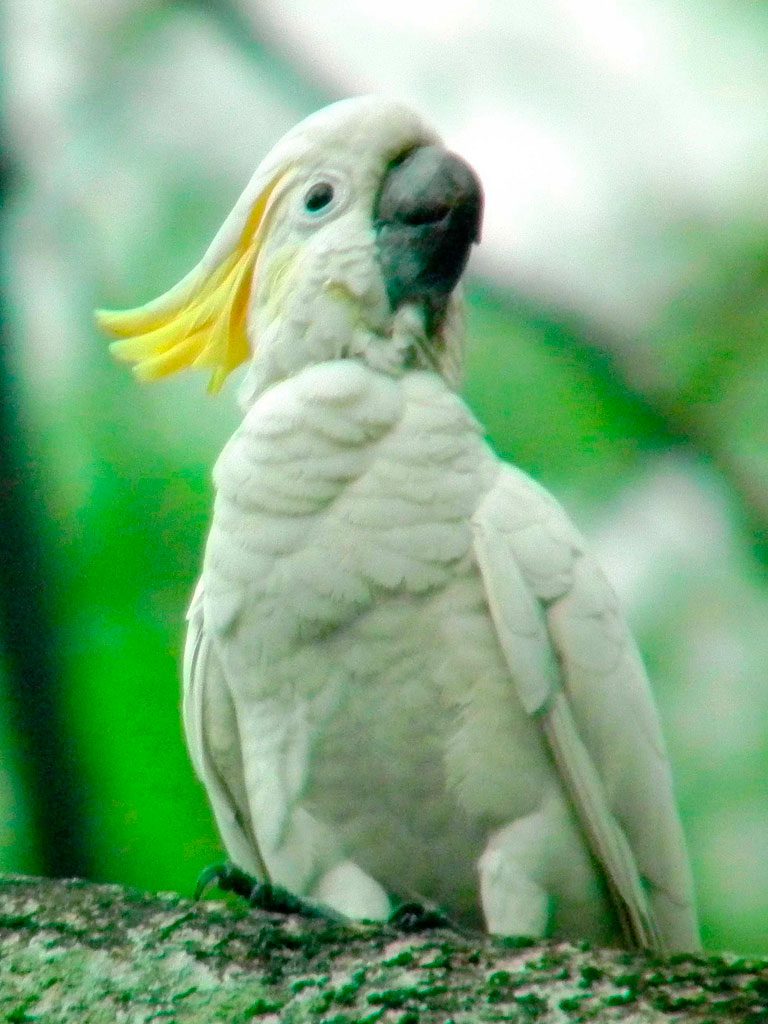
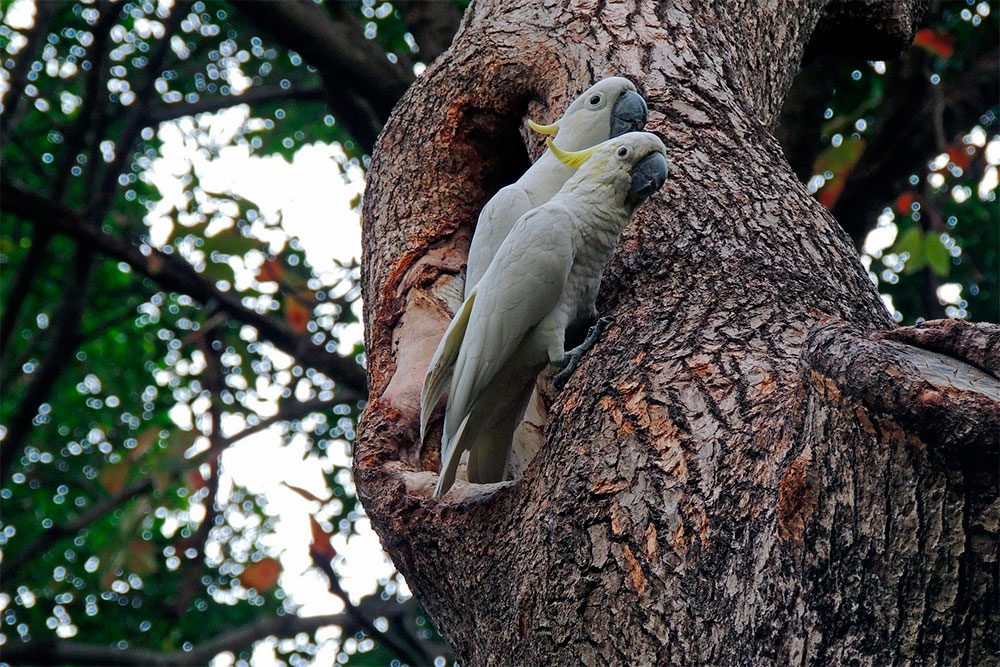
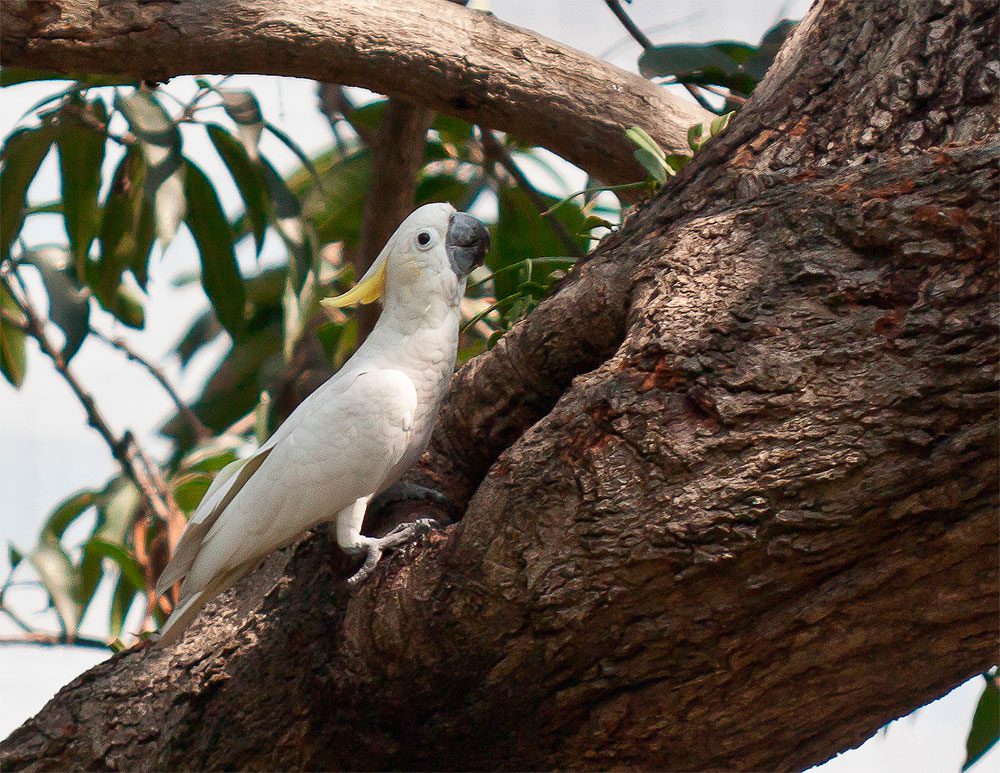
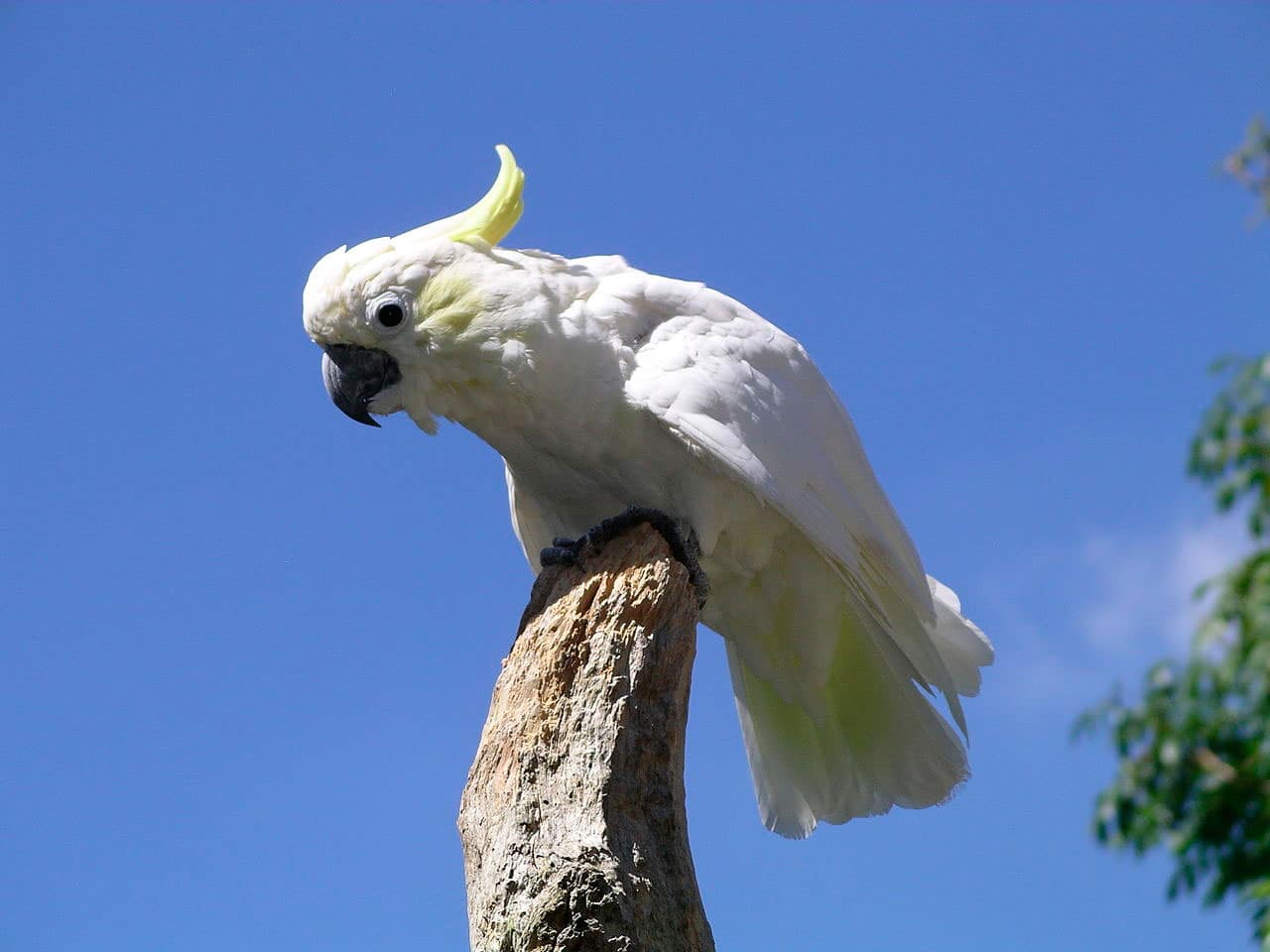
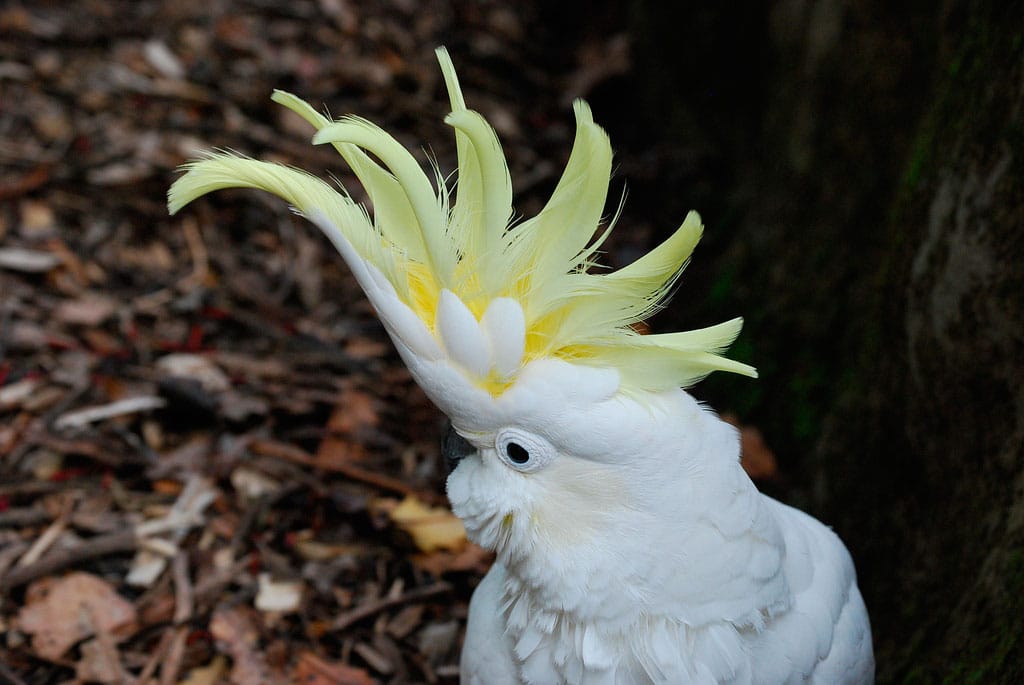
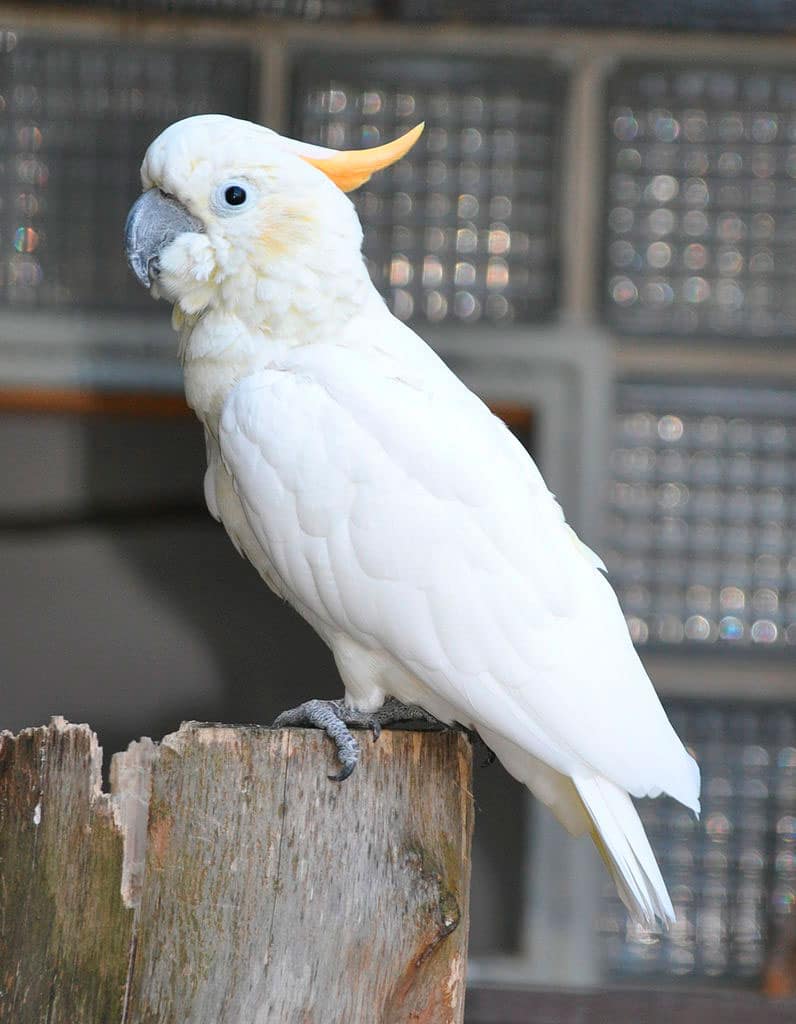
The Yellow-crested cockatoo(Cacatua sulphurea) It is distinguished by its long, thin yellow erectile crest, that curves forward, and extending upward, above the nape, when it folded. The front of his crown and main feathers crest, are white. The rest of your plumage It is also white, except in yellow suffusion ear-coverts, under the wings and in the innerwebs of the undertail-coverts. The bases of the hackles and underparts, They are yellowed; some birds show a slight yellow tone, particularly on chest and the belly. The bill It is black; eye ring pale bluish; irises dark brown; legs grey. The female is similar to the male but with the irises reddish and slightly smaller.
The young birds They show both sexes irises dark taupe, although females They begin to acquire the red coloration in the first year. The bill and legs immature are also lighter.
(Oberholser, 1917) – Similar to the parvula, but largest.
Cacatua sulphurea citrinocristata
Cacatua sulphurea citrinocristata
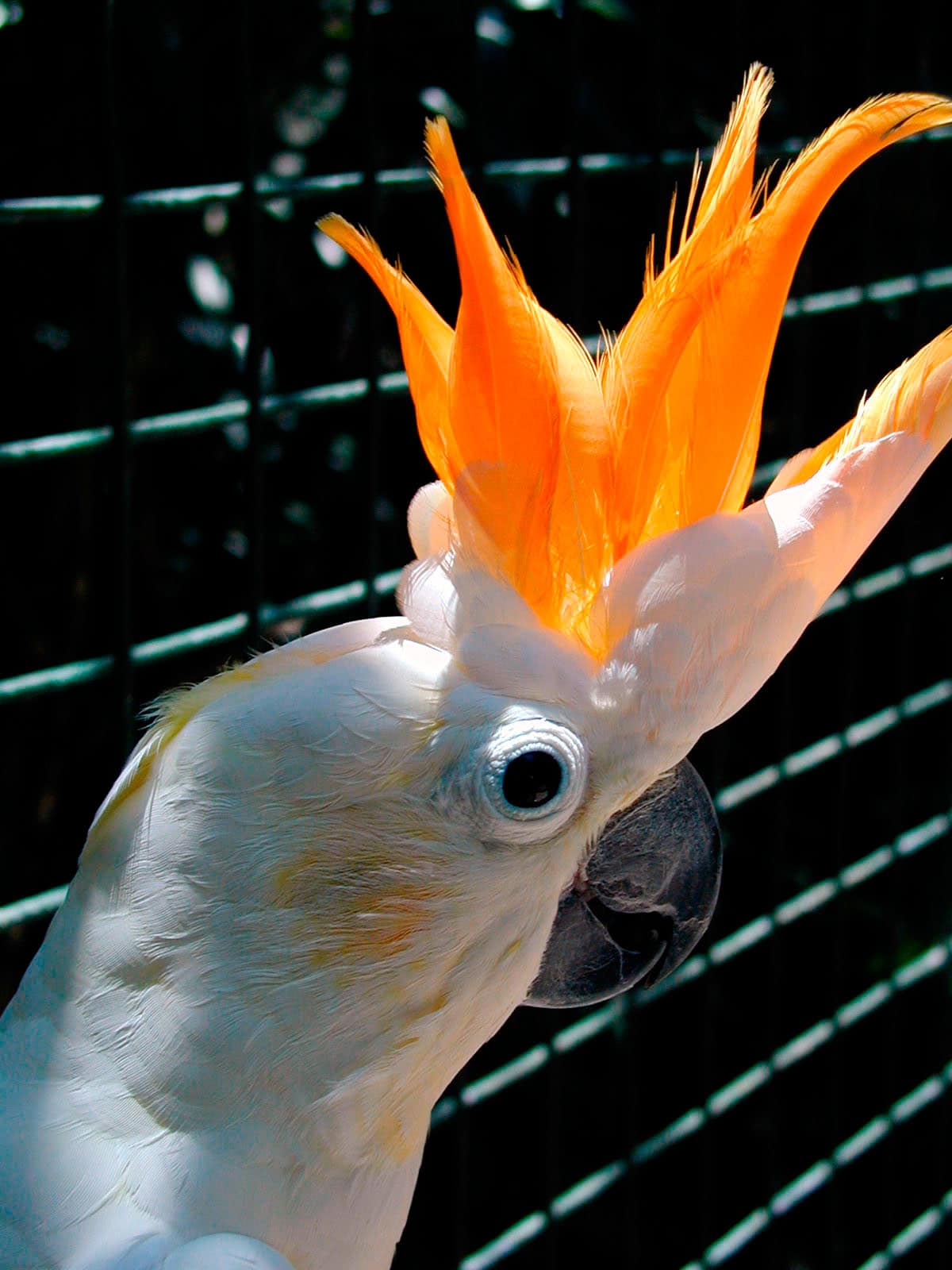
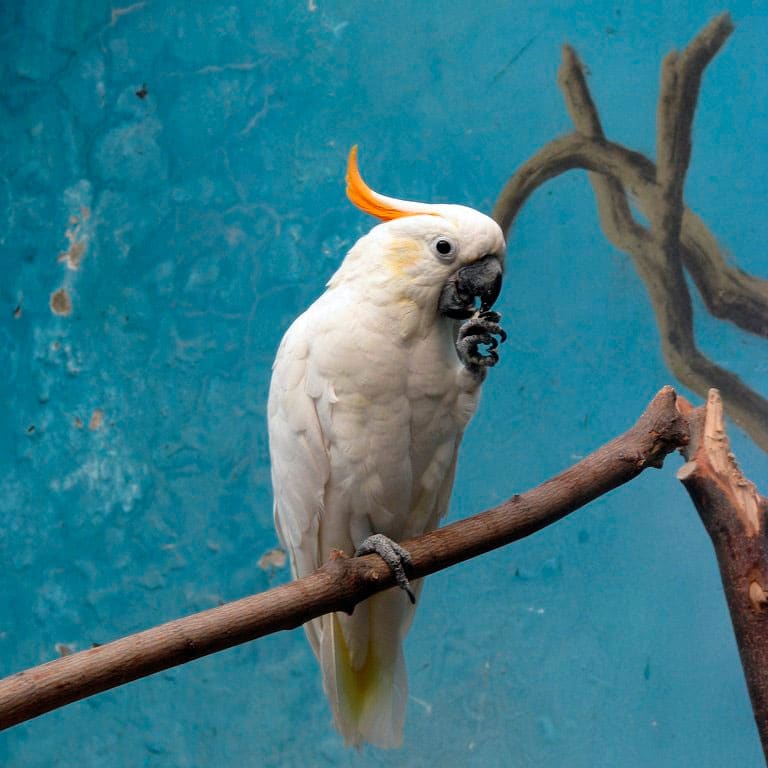
(Fraser, 1844) – Slightly larger than the nominal, with one crest orange & ear-coverts orange yellow. Additional research may provide a basis for improving this subspecies to a specific status..
Cacatua sulphurea parvula
(Bonaparte, 1850) – Similar to the nominal species, but with the ear-coverts paler and less yellow on yellow feathers underparts. the size of the bill in this subspecies it increases clinically towards the west.
They inhabit at the edges of the forest, wooded areas, farmland, cocoteros, semi-arid areas and forests until the 800 m (locally 1.200 m).
The Yellow-crested cockatoo usually they found in pairs or small groups of up to ten individuals, although they may meet in larger flocks to feed on fruit trees. They can form flocks with Eclectus Parrot(Eclectus roratus).
They tend to be noisy and visible, but can be difficult to spot when moving silently in the canopy, and they are more often in flight. The groups who leave their resting places in the montane forest areas frequently displace forage at lower altitudes including cultivated fields. Pairs may hover conspicuously above the forest canopy searching for fruitful trees, allowing a reasonably close approach when resting on a branch.
The crest It is generally stands when landing, or when an individual is making calls from a perch. Like most of the Cockatoos They enjoy a bath in the rain.
Reproduction:
Specimens of Yellow-crested cockatoo on the island of button in State reproductive during the months of September and October, although Nusa Tenggara the breeding It occurs in the months of April and May. The female It lays two or three white eggs in the hollow of a tree, and incubation lasts around 28 days with both parents participating. Chicks they leave the nest to 10 weeks and are dependent parent for about two months.
Food:
They feed in trees and soil. Its diet It includes seeds, corn (Zea mays) of cultivated fields, fruit, berries, egg yolks, flowers and nuts (including large coconuts (cocos nucifera)).
Distribution and status:
Size of its range (breeding/resident ): 1.360.000 km2
The Yellow-crested cockatoo They are confined Indonesian, where they can be seen in the lowlands Isla Celebes (virtually extinct in the north), islands in the Flores sea, in Nusa Tenggara and isolated islands Masalembu in the Java Sea.
introduced in Singapore and Hong Kong. The species is found in both wooded areas and cultivated and is scarce throughout its range. It is estimated that the world population total is less than 40.000 birds and is decreasing. Although populations of the nominal subspecies and of the subspecies parvula may still be close to 10.000 specimens, the citrinocristata subspecies It has an estimated population between 800 and 7.200 only individuals, having declined by 80% between the years 1986 and 1989, while the distinctive subspecies abbotti It is now represented by only nine individuals in nature.
Although habitat loss is clearly a factor in Sumba, where distribution appears to be linked to the extent of primary forest (is only about 15% the original forest), trade is the main threat to the species as a whole. Trade data show that exported almost 100.000 birds in years 1980-1992. The export citrinocristata subspecies It was banned in 1992 by local authorities, and 26 birds were confiscated in September of that year. There are probably at least 50 individuals of each subspecies in public collections and more than 2.000 in private aviculture, although the numbers for the subspecies abbotti They are unknown.
(Fraser, 1844) – Sumba, where it can be seen in the remaining forest around left, or east of the island, where it may still be locally common; an expedition of the Manchester Metropolitan University found it common in the remaining forest areas in 1990, with the greatest discovery of birds, a group of five birds, found in primary forest near Tabundung
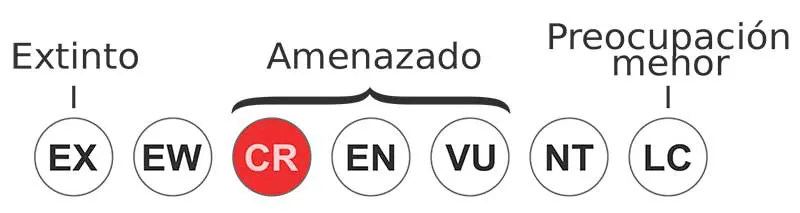
• Current category of the Red List of the UICN: critically endangered.
• Population trend: Decreasing.
Its crashing fall It is almost entirely attributable to the unsustainable exploitation for domestic and international trade. Logging to the conversion of forests for agriculture as well as the use of pesticides for land and large-scale.
Justification of the population
Based on recent surveys in various parts of the range of the species, C. Trainor in some (2007) It has been estimated the world population in less than 7.000 individuals: 3.200-5.000 en Sumba (though perhaps only 562 in 2012, Burung Indonesia en preparación), 500 en Komodo, 200-300 en Timor Leste, 200-300 en Sulawesi, 20-50 in West Timor, 40-70 Flores, 50-100 en Sumbawa, 100 in Rinca and other 700 birds in total. The best data is located in the band 2.500-9.999 individuals, equivalent to 1.667-6.666 mature individuals, rounded here to 1.500-7.000 mature individuals.
Conservation actions and research in progress
CITES Appendix I (2005). It has developed and adopted a recovery plan cooperative and has prepared an update 2012 (D. Mulyawati in some. 2012). The populations are found in various protected areas, It is the most important Rawa Aopa Watumohai (55 copies in 2011 [Waugh 2013]) and National Parks Caraente (en Sulawesi), supporting up 100 individuals (transgressed 2006) , Reserva Natural de Wildlife en Pulau Moyo, Komodo National Park and two national parks in Sumba: Manupeu-Tanadaru y Laiwangi-Wanggameti. Nini Konis Santana National Park declared in Timor has a 100 estimated birds (Trainor et al., Without date) . In Rawa Aopa Watumohai nests they have been protected from predators by removing vegetation pendant necklaces and installation of plastic around the tree trunks nesting (Waugh 2013). Moratoriums on international trade are in effect, although it is likely that a large proportion of trade is a national. Several subpopulations of Sulphur-crested Cockatoo have increased in Sumba between 1992 and 2002, due to conservation efforts (including local education, ecotourism and law enforcement), although densities remained below those typical for other cockatoo species (Cahill et al ., 2006) . Capture for trade has declined dramatically in Sumba through a variety of awareness and protection measures of the community (D. Mulyawati in some. 2012).
Following the surveys of 2008 and 2009, the Indonesia Parrot Project and Konservasi Kakatua Indonesia have started meetings with community leaders and villagers in Masakambing and Masalembu, as well as with the military and local police, to raise awareness and gain support for Sulphur-crested Cockatoo conservation (Metz et al. Al., 2009) . A conservation program-awareness-pride has also begun to involve adults and school Archipelago Masalembu (Metz et al. , 2009, Translating et al., 2009) And in Southeast Sulawesi (Anon., 2012). A "village regulation" was written to catch, possess or transport the species and initiate measures to reduce habitat destruction and employ a former village chief to guard and protect nests and study Sulphur-crested Cockatoos (Translating et al., 2009) . Moronone community in Rawa Aopa Watumohai NP, where four members of the village have been hired as Forest Wardens (Anon., 2012), have established similar community-based regulations. The guards protect the species against poachers and perform monitoring activities (Waugh 2013). The pest status of the species can be addressed by planting crops to compensate for losses and to act as a "sacrifice culture", for example, sunflower fields are used to attract the species out of other crops (Waugh 2013). Mangrove restoration is also being used to increase nesting habitat available (Waugh 2013). a repeat of the population census is planned abbotti , together with studies on its biological history and ecology (Metz et al., 2009) .
Proposed Research and Conservation Actions
Carry out further studies (including Roti, but also more studies on Alor and Pantar) to identify the most appropriate action for conservation areas and to periodically monitor key population surveys repeating ago 8-10 years. Provide relevant support for protected areas and conservation initiatives within its range and protect nests when possible. Strengthen the protection of forest Poronumbu, Sumba, declaring Nature Reserve (Translating y Agustina 2012). Strengthen control, the enforcement and monitoring of trade and establishing greater management of captive populations. Improve law enforcement in designated protected areas and other key areas for trade, including ports, markets, etc. Promote widespread community conservation initiatives. These may include, en la isla de Pasoso, Sulawesi Central, work to protect the Sulphur-crested Cockatoo should involve all five families living on the island and introduce community involvement programs for children and adults on several other islands where the species occurs (Translating y Agustina 2012). The recommendations formulated specifically for the protection of the species in the Komodo National Park consisted of carrying out an annual monitoring, maintain regular patrols, sensitize local communities and studying human activities and impacts within the park (Imansyah et al ., 2005, Benstead 2006) . Conduct ecological research to clarify options for management and conservation. Other objectives should be to study the abundance and distribution of nest holes and water sources.. The provision of artificial sources of water near the nesting sites, that is to say, water ponds, It is essential for the species on the island of Komodo and may also be necessary to protect the nests of young Komodo dragons in Komodo (Translating y Agustina, 2012).
"Yellow-crested cockatoo" in captivity:
The male Yellow-crested cockatoo It is especially aggressive with the female, sometimes to kill her. This phenomenon is known in many cockatoo species..
among the white cockatoos, this is somewhat difficult to breed in captivity. As a pet can be a formidable partner provided it has been raised for that purpose and to provide much attention.
It is very difficult for them to disconnect in the presence of their owners and entertain themselves without seeking continuous interaction.
Great ability to imitate human sound within the world of cockatoos.
Note: Because of its status, CRITICALLY ENDANGERED, only controlled captive breeding is recommended in an attempt to recover this species in the wild.
– Avibase
– Parrots of the World – Forshaw Joseph M
– Parrots A Guide to the Parrots of the World – Tony Juniper & Mike Parr
– Birdlife
– Photos:
(1) – Cacatua sulphurea by Charles Lam – Flickr
(2) – Citron-crested Cockatoo(Cacatua sulphurea citrinocristata) in the Walsrode Bird Park, Germany By Quartl (Own work) [CC BY-SA 3.0], via Wikimedia Commons
(3) – A Yellow-crested Cockatoo at Auckland Zoo, New Zealand By Ashleigh Thompson (originally posted to Flickr as Captain) [CC BY 2.0], via Wikimedia Commons
(4) – Cacatua sulphurea citrinocristata, Citron-crested Cockatoo. Photograph of upper body and crest By Ruth Rogers (originally posted to Flickr as Citron Cockatoo) [CC BY 2.0], via Wikimedia Commons
(5) – Citron-crested Cockatoo (Cacatua sulphurea citrinocristata). The glass between the camera and this parrot makes the picture just a little bit blurry By Alexander Tundakov (originally posted to Flickr as White Parrot) [CC BY 2.0], via Wikimedia Commons
(6) – Photo of Lesser Sulphur-crested Cockatoo (wings clipped) By Snowmanradio, with permission from Tropical Birdland, Leicestershire, England. (Own work) [GFDL or CC BY-SA 3.0], via Wikimedia Commons
(7) – Yellow-crested Cockatoo (Cacatua sulphurea) at the KOBE Oji Zoo by opencage.info
(8) – Lesser Sulphur-crested Cockatoo (wings clipped) By Snowmanradio, with permission from Tropical Birdland, Leicestershire, England. (Own work) [GFDL or CC BY-SA 3.0], via Wikimedia Commons
(9) – Yellow-crested Cockatoo (Cacatua sulphurea) by Darren – Flickr
(10) – Yellow-Crested Cockatoo, Cacatua sulphurea by Sek Keung Lo – Flickr
(11) – Cacatua sulphurea by Charles Lam – Flickr
(12) – Cacatua sulphurea by Charles Lam – Flickr
(13) – Cacatua sulphurea by Pichon Charles Lam – Flickr
(14) – A painting of a Yellow-crested Cockatoo, also known as the Lesser Sulphur-crested Cockatoo, (originally captioned «Plyctolophus sulphureus. Lesser Sulphur-crested Cockatoo») by Edward Lear 1812-1888. [Public domain], via Wikimedia Commons
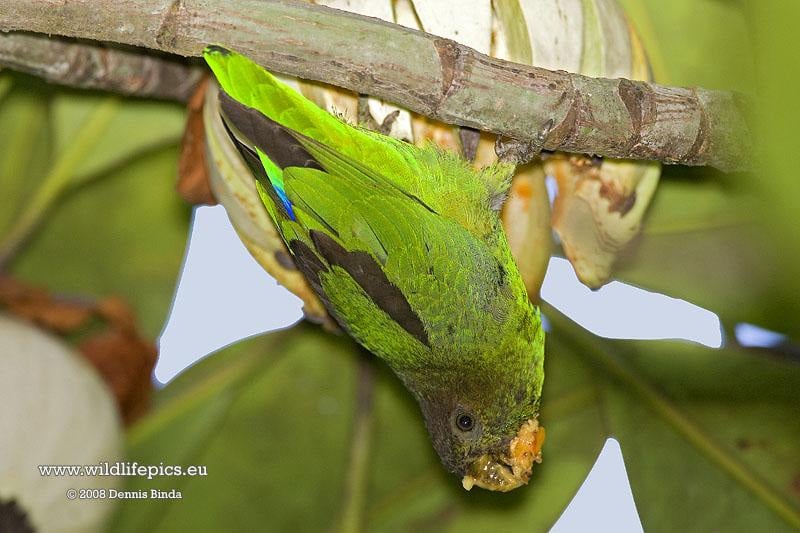
The Sapphire-rumped Parrotlet(Touit purpuratus) has the forecrown, crown, ear-coverts and sides neck, color marron-oliva; lores and cheeks green; rear area of the neck of color green pale with broadcasting brownish. Mantle and top of the back, green; scapulars and tertiary, dark brown; rump blue; uppertail-coverts green.
Feather blue in it bend of wing; primary coverts brown-black, rest of the coverts green. The flight feather Brown by up in innerwebs and tips, Yes no green; pale green blue for below. Underwing-coverts green. The underparts pale, of color green emerald slightly yellowish, with a layer of ochre in the sides of the belly. The tail Le da an appearance unmistakable, with black edge, green in the center and dark crimson on the sides, with black margins to outerwebs.
Bill off-white color pale Horn-tipped up to the upper jaw; irises black; legs grey.
The female has the tail (except central feathers) with the subterminal band green. Immature more yellowish below; the black color in the tail confined to the tips; Green olive from the forecrown up to the nape and ear-coverts lower.
(Chapman, 1929) – As the nominal species but with the forecrown, crown and back neck, green; flanks with less yellowish green and feathery external of the tail showing a purple glow.
Habitat:
Species Rare and hard to see. It inhabits, mainly, in the humid lowland canopy and forests and marshes, also observed in savanna in Suriname. In lower and more open to high altitude forests in Venezuela and in isolated areas cleared forests. Reports in altitudes of 400 metres in Colombia, and 1.200 metres in Mount Duida, Venezuela. gregarious, usually in groups of 12-40 birds.
Reproduction:
Observed the female digging a hole in a tree of forests and marshes in the month of November in Colombia; Birds in a nest in termitario tree in the month of April in Suriname, and males in breeding condition in the month of March in Venezuela. The laying tends to be of 3-5 eggs.
Comes to be local in Suriname and French Guiana. Discrete, often difficult to observe and apparently sparsely populated in most parts of its range. Perhaps more numerous in those sections more low of it amazon basin.
Distribution 2 subspecies:
Touit purpuratus purpuratus
(Gmelin, 1788) – Nominal. Southeast of amazon in Venezuela, up to the Guianas and this from the Basin of the Amazon in Brazil.
Touit purpuratus viridiceps
(Chapman, 1929) – Black river, the Northwestern basin of Brazil, Venezuela West from Mount Duida until Colombia, Ecuador and Peru.
Conservation:
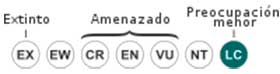
State of conservation ⓘ
Minor Concern ⓘ(UICN)ⓘ
• Current category of the Red List of the UICN: Least concern.
• Population trend: Stable.
Justification of the population
The size of the world's population has not been quantified, but this species is described as «Rare» (Stotz et to the., 1996).
Justification of trend
It is suspected that this species has lost 12,8-15,2% of habitat within its distribution over three generations (15 years) starting from a model of deforestation Amazon (Soares-Filho et to the., 2006, Bird et to the., 2011). Given the susceptibility of the species to hunting and / or capture, It is suspected that it will fall in <25% during three generations.
Of 18 cm.. tall Inconfundible by the ends of the tail, which are dorsally and ventrally purple-red with black border.
Overall green body with Brown Crown and nape, wing with both opaque Brown ends and violet blue rump.
Female with paler brown head and green-streaked tail.
The subspecies T. p. viridiceps has a totally green head.
Uncommon and difficult to observe species.
Lives in humid forests, semi-humid and swampy, until the 400 m. It forms small groups and they are silent when they feed. It nests in hollows of trees or arboreal termiteros at low altitude. The implementation is of 3-5 eggs and breeding season: from November to April
It is found in the wild in the Amazon, South-East of Colombia to the Guyanas, southern Venezuela to northeastern Peru and northern Brazil.
It feeds on fruits, and figs.
Video: Video 1
Deforestation and loss of Habitat is a threat for this species.
Alternative names:Sapphire-rumped Parrotlet (English), Periquito zafiro (Colombia), Periquito lomizafiro (Ecuador), Purpurschwanz, Purpurschwanzpapagei (Germany), Lorito de Lomo Purpúreo (Spain), Periquito Rabadilla Púrpura (Venezuela), Toui à queue pourprée (France), apuim-de-costa-azul (Brazil)
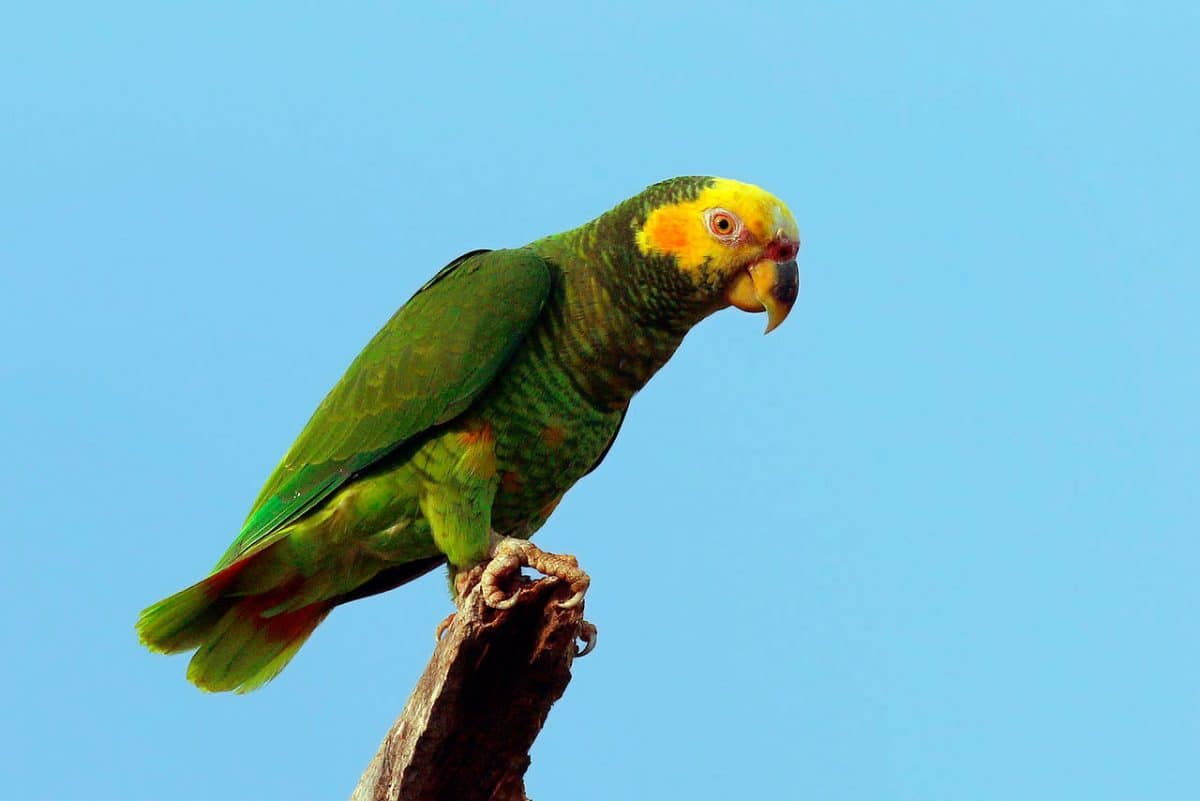
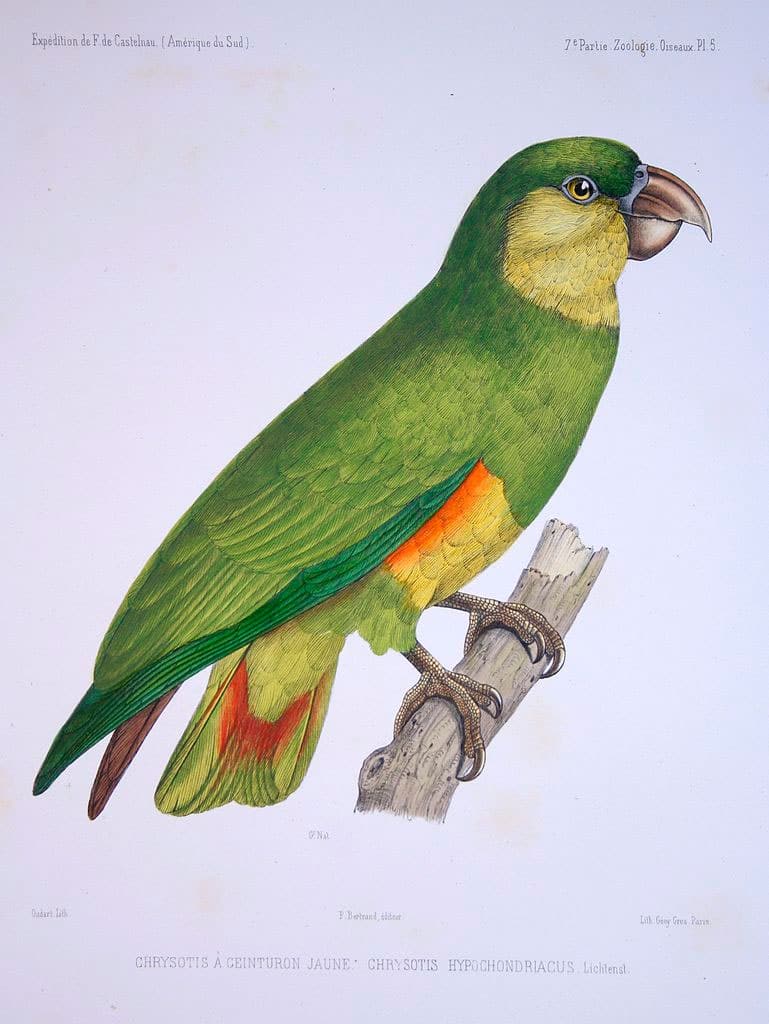
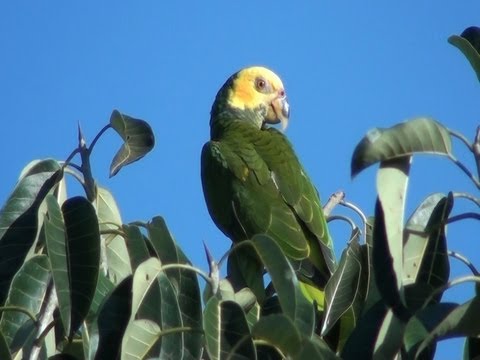
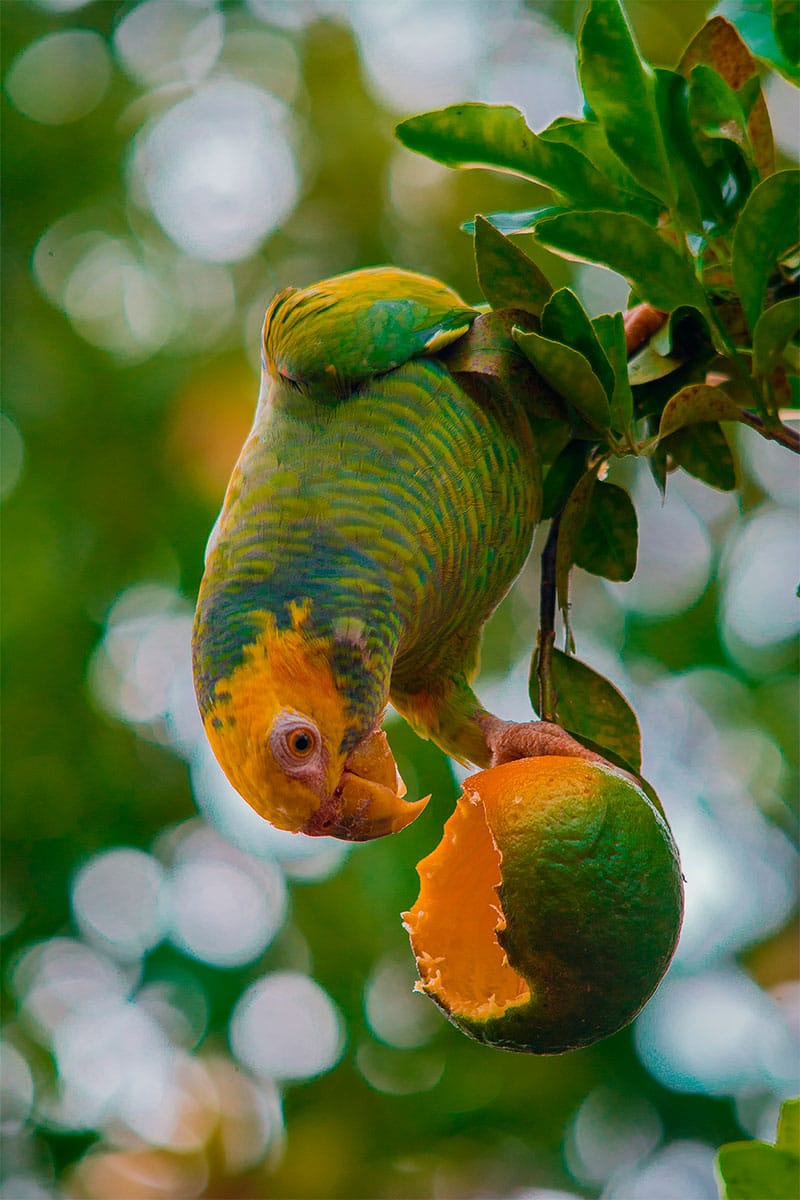
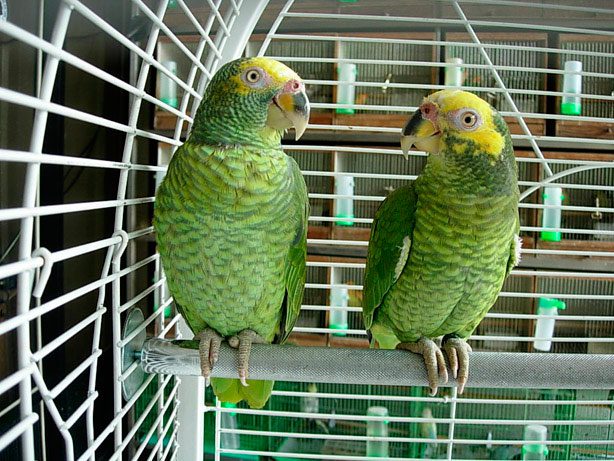
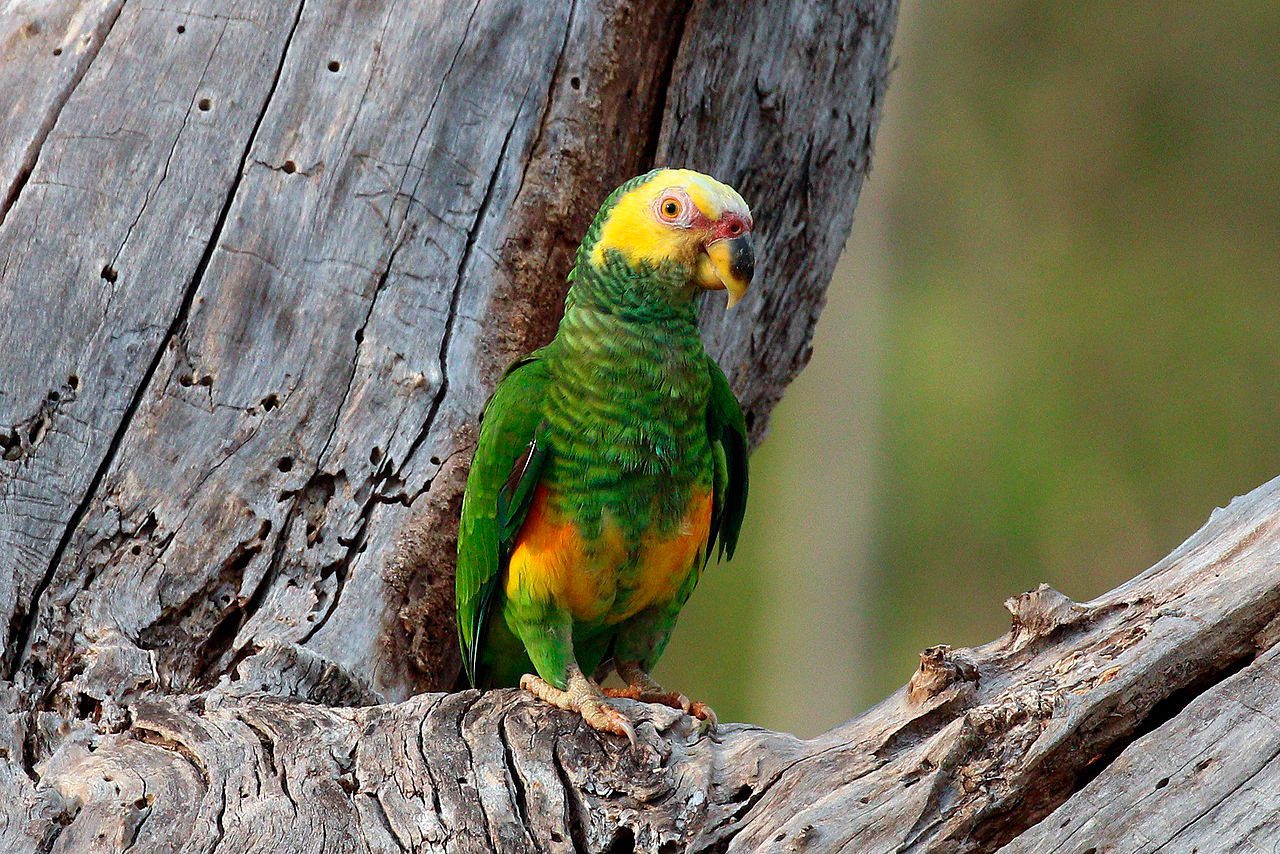
The Yellow-faced Parrot(Alipiopsitta xanthops) It is distinguished by the large area of ​​yellow in the head, with green tint nape; orange to the sides of body and upper base of the tail; collar yellowish green, belly almost all yellow, the thighs and green inner core tail green; the back it is usually green with yellow tints.
It inhabits in dry forests, also called deciduous forests, in lowlands, with the presence of palmas Mauritia, Although they prefer water courses.
They can be seen in pairs or flocks of up 50 specimens.
Although little information regarding this is available, it is known that nest in the hollows of the highest trees closed; the laying usually three eggs and the incubation period is 23-24 days.
Food:
It's a species of which there are few studies of their natural habitat. Its main food It consists mainly of fruits and seeds. Very fond of mangoes, usually visit their trees full of fruit.
Distribution:
Size of its range (reproduction / resident): 2.700.000 km2
Inside of Brazil and adjacent area to the east of Bolivia and Horqueta, in the East of Paraguay.
Conservation Alipiopsitta xanthops:
State of conservation ⓘ
Near Threatened ⓘ(UICN)ⓘ
• Current category of the Red List of the UICN: Near-threatened.
• Population trend: Decreasing.
In 1993 two thirds of the Cerrado, This species inhabited, had been moderately or severely altered by agriculture, heavy cattle farming, invasive grasses, the use of pesticides and annual burning.
Conservation Actions Proposed:
• Collate sample data and recent records to provide an improved assessment of distribution and status.
• Estimate the total wild population (Bianchi 2009).
• Assess the impact of habitat loss (Snyder et to the . 2000).
active, curious and playful. Aggressive with other parrots. They can become very noisy. Prone to obesity
Its reproduction rarely been achieved in captivity. The basic requirement would be to isolate a compatible pair during the breeding season due to increased aggression towards other birds during this period.; also require spacious accommodations and a nest box of 25 x 25 x 60 cm. . with input from 8 cm in diameter.
They tend to be aggressive toward their caregivers. The breeding season begins in early May. The implementation is of 2 to 4 eggs, which are incubated during 26 days. The young leave the nest when they are near the 8 weeks of age.
Alternative names:
– Yellow faced Parrot, Yellow-crowned Amazon, Yellow-crowned Parrot, Yellow-faced Amazon (English).
– Amazone à face jaune (French).
– Goldbauchamazone, Schoapapagei (German).
– Papagaio-galego, chorão, curau, papagaio-acurau, papagaio-curraleiro, papagaio-de-barriga-amarela (Portuguese).
– Amazona Chica, Amazona del Cerrado, Loro cara amarilla, Lora chica (español).
(1) – Yellow-faced parrot (Alipiopsitta xanthops) green morph, the Pantanal, Brazil By Charlesjsharp (Own work, from Sharp Photography, sharpphotography) [CC BY-SA 4.0], via Wikimedia Commons
(2) – Yellow-faced parrot (Alipiopsitta xanthops) yellow morph, the Pantanal, Brazil By Charlesjsharp (Own work, from Sharp Photography, sharpphotography) [CC BY-SA 4.0], via Wikimedia Commons
(3) – Alipiopsitta xanthops, Yellow-faced Parrot; two in a cage By TJ Lin (originally posted to Flickr as yellow-faced amazon) [CC BY-SA 2.0], via Wikimedia Commons
(4) – Yellow-faced Parrot in Giza Zoo By Hatem Moushir (Own work) [CC BY-SA 3.0], via Wikimedia Commons
(5) – Record made in the city of Três Lagoas-MS, urban area. A flock landed on a ponca tree to feed By Jairmoreirafotografia (Own work) [CC BY-SA 4.0], via Wikimedia Commons
(6) – Illustration does not look like A. xanthops (Yellow-faced Parrot). Fisch's Papageien monograph discusses this dubious specimen by Francis de Laporte de Castelnau [Public domain], via Wikimedia Commons
55 cm.. height and a weight between 815 and 975 g..
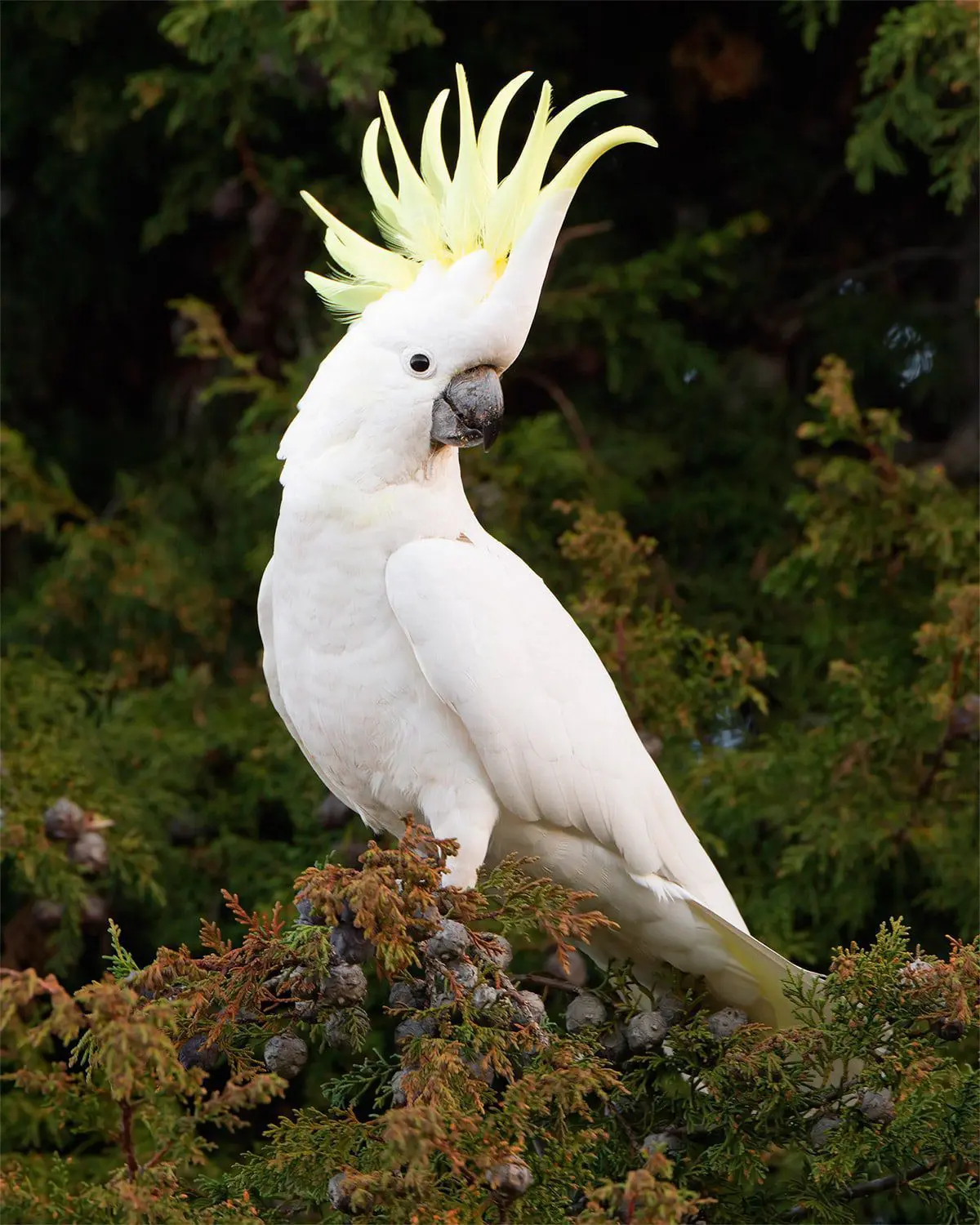
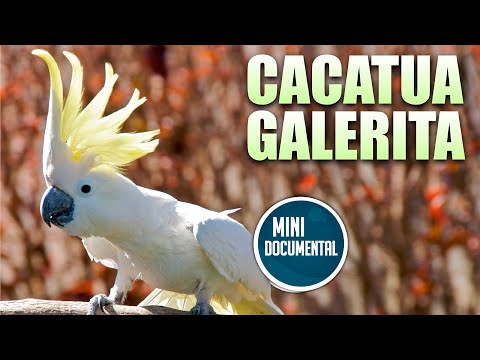
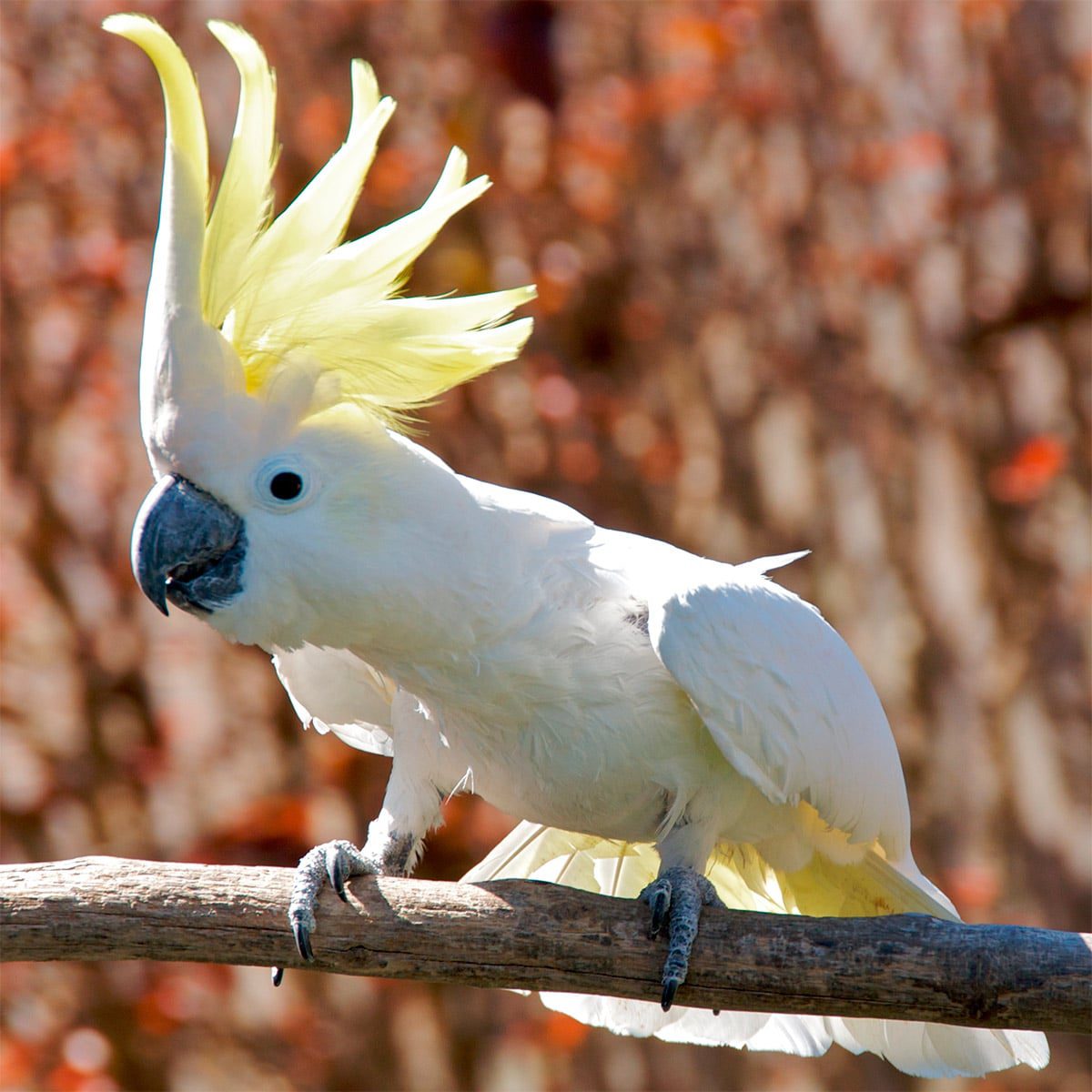
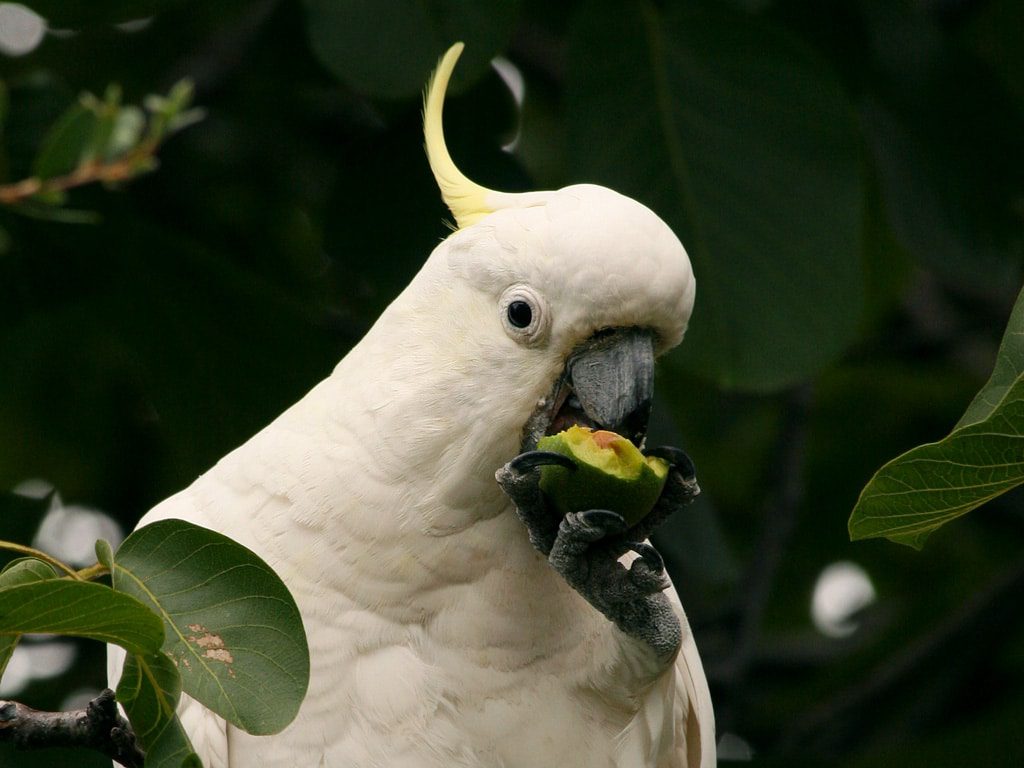
The Sulphur-crested cockatoo(Cacatua galerita) It is a bird with a predominantly white plumage.
In adults, the ear-coverts, bases feathers throat and cheeks, are pale yellow. the arista formed by the 6 Erectile feathers slightly inclined forward, are yellow. The crest You can reach up 14 centimeters in length. The bottom of the wings and of the tail van dyed pale yellow.
The ring surrounding the eye shows a white. The irises is dark brown in the male and reddish brown in the female. The bill is blackish grey, the legs grey.
The immature They are just different from adults. The irises They are pale brown.
(Temminck, 1849) – Something smaller, the crest WIDER and eye ring pale blue.
Behavior:
They are very noisy and very easy to observe, Although they are more identifiable by their cries.
During the breeding season, they live in pairs or in small family groups, but the rest of the year, They are in flocks that may contain hundreds of birds.
In the urban areas and in places that they are equipped with feeders, adopt a family behavior.
In other places, It inspired his distrust and his usual prudence, the Sulphur-crested cockatoo they are very difficult to deal with.
In open areas these birds are implementing a sentinel system that is organized as follows: while most of the flock feeds, Some birds seen from a nearby perch and are likely to sound the alarm if danger.
Habitat:
Video – "Sulphur-crested cockatoo" (Cacatua galerita)
Is located in variety of forest areas, forests (including swamps and river areas), mangroves, Open field, on farm land (including rice fields and plantations of Palm), Savannah, Mallee and suburban areas. Found up to 1.500 meters in parts of Australia, 2.400 metres in Papua New Guinea.
Reproduction:
In Australia, the breeding season occurs from May to August in the North and between August and January, in the South.
In New Guinea, It takes place during every month of the year, although the most active months are during the period from May to December.
This species occasionally breeds in colonies. The nest is a natural cavity in a eucalyptus large near a stream between 3 and 30 meters above the ground. Sometimes the residence of the Sulphur-crested cockatoo It is located in the holes of the limestone cliffs along the murray river. In this case, the eggs are deposited directly in the sand.
In New Zealand, These birds lay amid bales of hay in barns. The nest generally it contains 3 white eggs. These are deposited on a layer of debris decomposing at the bottom of the cavity. incubate both parents alternately for a period of 30 days. Hatchlings have a yellowish color and leave the nest after 6 to 9 weeks. Quite regularly, they return to the nest to rest for about two weeks.
The juveniles They remain within the family group for several months. They feed together in small scattered groups.
Food:
forages in grasses and herbs. You can take corn and wheat sprouts. It also feeds harmful herbs like cotton thistle. other foods include: estate, Rhizomes, nuts, berries, flowers, bulbs, flower and insect larvae.
They can cause great damage to crops. They dig in lands that were recently planted to eating fruit ripening, It also causes damage to crops that are stored and bales of hay to tear the plastic covering them.
Distribution:
Size of the area of distribution (reproduction / resident): 10600000 km2
This species is endemic to the north and east of Australia, New Guinea and nearby islands, especially islas Aru, Indonesian.
It was imported successfully to Palau Islands in Micronesia, New Zealand and some Maluku islands.
The population in Taiwan It has been estimated at about 100 introduced breeding pairs
Lives mainly below 1.000 m, but sometimes you can see in Australia to 1500 m. and 2000 m in east New Guinea.
(Latham, 1790) – Nominal. east and southeast of Australia, North of Queensland, South of Tasmania and Southeast of Australia, including the Kangaroo Island. Introduced in southwest Australia and New Zealand
Cacatua galerita triton
(Temminck, 1849) – West islands papua, Indonesian and New Guinea. introduced in Palau Islands, Micronesia, and some islands in the East Moluccas, Indonesian.
Conservation:
State of conservation ⓘ
Minor Concern ⓘ(UICN)ⓘ
• Current category of the Red List of the UICN: Least concern.
• Population trend: In decline.
It is thought that his population It is greater than 500.000 individuals.
It is not an endangered species. But, despite protection Indonesian this species is followed by trapping wild bird trade. Nor is a protected species in Australia, therefore sacrifices occur.
In New Guinea, sometimes it is hunted for its feathers.
It is suspected that his population is in decline due to ongoing habitat destruction.
"Sulphur-crested cockatoo" in captivity:
and valued species often as a pet.
Very Intelligent, sociable and playful. It is a cockatiel for experienced bird owners. You can be dominant and aggressive. It can be very noisy.
There are anecdotal reports of some Sulphur-crested cockatoo who they have lived more than 100 years. In the news, However, longevity record, according to sources, belongs to a captive specimen called "Cocky" who lived more than 57 years in the London Zoo. Another report suggests that these animals can live up 73.0 years in captivity, but this has not been verified.
Alternative names:
– Sulphur-crested Cockatoo, Greater Sulphur-crested Cockatoo, White Cockatoo, Yellow-crested cackatoo (ingles).
– Cacatoès à huppe jaune, Grand Cacatoès à huppe jaune (French).
– Gelbhaubenkakadu (German).
– Cacatua-de-crista-amarela (Portuguese).
– Cacatúa de Moño Amarillo, Cacatúa Galerita (español).
30 cm.. height and an approximate weight of 120 gr.
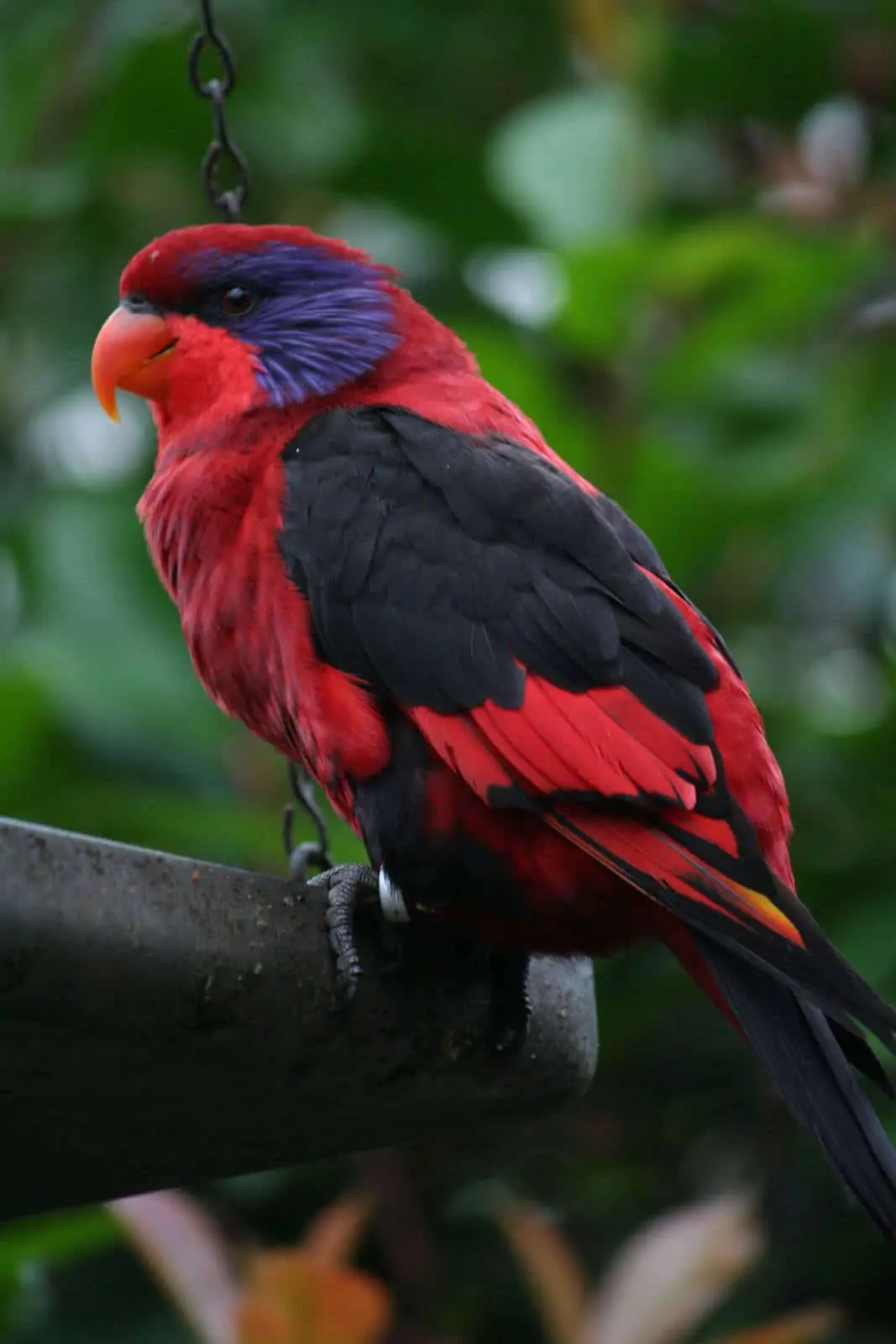
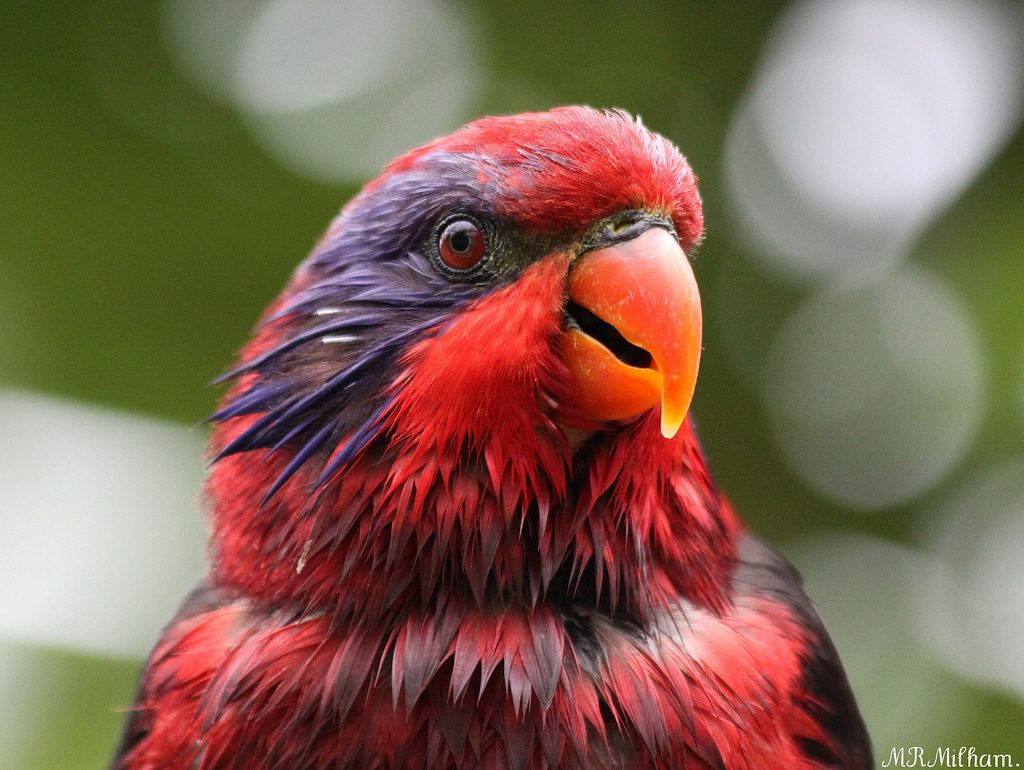
The Black-winged Lory(Eos cyanogenia) has a plumage predominantly red.
Adults have a blue patch surrounding the eyes, cover the tops of the ear and reaches the back of the neck.
Feathers covering the shoulder blade (scapular), small feathers that cover the outside (coverts) and bend of wing are black. The primary and high school they have a black bordered.
The the thighs and flanks they are sprinkled with black. The bottom of the wings shows a wide band Red. The feathers of the tail are black contrasted with red feathers.
The bill is red-orange. The irises they are red, legs grey.
The youth they are more muted than adults. They have blue-black ends in feathers of the head, neck and underparts. The the wing covers are black, with a green light opaque. The bill is of color brown orange, irises brown.
The Black-winged Lory It can be confused with almost all parrots of the genus Eos, but it is the only one of this category that has the covered wing in black color.
The Black-winged Lory they are quite common and widespread in coastal areas, coconut plantations, the forested areas in the process of regeneration, in some large trees scattered in bushes Moors and local gardens.
In some small islands such as Supiori, they are also present in large numbers in inland forests.
Residing in altitudes ranging from sea level to the 460 m.
They live in pairs or in small family groups. They are also often found in flocks of forty individuals or more.
Son noisy birds and easily observable. At the local level are very popular. In the reflection of both, the natives capture them frequently as pet birds.
The Black-winged Lory they have a fly quick and direct. Often you can hear the hum of their wings when they fly over the villages. They are even more recognizable when they often fly low, well below the tops of the trees.
Reproduction:
Little is known of their reproductive ecology., but it was observed the presence of a possible nesting site in a hole in a tall tree in the forest by a couple during the observations in 1982.
The incubation in harsh captivity around 26 days, and as in all loris, the nesting cycle is particularly long and hard between 75 and 89 days.
Food:
They have a regime that differs little from other parrots of the genus Eos. Feed in the trees in flower of nectar of Brugierto and pollen. Your menu will probably be complemented by fruit, berries of the mistletoe and sometimes insects.
Distribution:
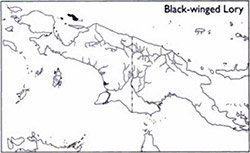
Being endemic to the islands of the Cenderawasih Bay in the part Indonesia of New Guinea.
They live on most islands (Numfor, Biak, Manim, Pulau Num) but are absent from Yapen, the main island, where are replaced by the Dusky lory (Pseudeos fuscata).
Conservation:
– Current IUCN Red List category: Vulnerable
– The population trend: Decreasing
The population is estimated at 2,500 to 9,999 mature individuals.
Logging and subsistence agriculture have driven the loss of forests within their range and the hunting pressure remains a threat. Consequently, the species is suspected to be declining at a moderate pace.
Relatively large numbers of birds have been trapped for the national and international trade.
Since December of 1989, the import of the Black-winged Lory It is strictly prohibited in the European Community.
Conservation Actions Proposed:
– Conduct surveys on all the Geelvink Islands to clarify its distribution and current population status.
– Investigation of their ecology and movements to facilitate conservation planning.
– Investigate the species trade and design and implement appropriate controls.
– Estimating the rate of loss of forests within its range.
– Check the register in Supiori and establish a captive breeding program to support future reintroduction and supplementation efforts.
"Black-winged Lory" in captivity:
This species is observed commonly as a pet in Biak (island located in the bahía Paradise, off the north coast of Papua).
Due to its status in danger of extinction, any specimen that can not be returned to their natural habitat (natural range) should preferably be placed in a well-managed breeding program to ensure the survival of the species.
Alternative names:
– Black winged Lory, Biak Red Lory, Black-winged Lory (ingles).
– Lori à joues bleues (French).
– Schwarzschulterlori (German).
– Lóris-asa-negra (Portuguese).
– Lori Alinegro, Lori de Alas Negras (español).
scientific classification:
– Order: Psittaciformes
– Family: Psittaculidae
– Scientific name: Eos cyanogenia
– Citation: Bonaparte, 1850
– Protonimo: Eos cyanogenia
The Iris Lorikeet(Psitteuteles iris) It has three subspecies recognized including the nominal, the extent and gradation of red and purple coloration in the head varies among the three subspecies:
Psitteuteles iris iris
The Iris Lorikeet(Psitteuteles iris) has a plumage, in general, Green with stripes of color green light in the underparts.
The forecrown, lores and zone extending in a narrow line around the Crown rear, red. Cheeks yellowish green. The eye-stripe and headphones feathers purple.
Center of the crown, Turquoise, extending it until it nape in a large yellow-green necklace.
The chest and abdomen are yellowish-green. The feathers of the neck and the chest they have dark green edges. Wings and tail green. Bill and irises orange. The legs greyish black.
It presents sexual dimorphism. The Red coloration of the female on head It is more off and less extensive that in the male.
Psitteuteles iris rubripileum
It has all the forecrown and crown Red and the headphones feathers Violet Blue.
Psitteuteles iris wetterensis
Larger, the crown It is red and mixed with Violet Blue variable extension. The cheeks they are dark green. The chest bright yellow contrast with the Panza green.
Note:
It has placed at times as subspecies to the Neopsittacus. The validity of the subspecies Psitteuteles iris rubripileum, is questionable, and it was claimed that the differences with the nominal species It may be due to age or individual variation.
Found up to a height of 1.500 meters above the sea level.
The Iris Lorikeet They inhabit monsoon forests, plantations and agricultural land with flowering trees.
Although they are apparently more common in the higher elevations, its local abundance is based on the availability of trees with flowers for food, as is the case with most Lori.
The flight of the Iris Lorikeet fast and slightly wavy.
Reproduction:
Little is known about the breeding ecology of this species in its natural environment.. A record of a captive calf states that the laying is of two eggs, with a period of incubation of 23 days and emancipation some nine weeks more afternoon.
There are no data on population trend; But, the species is suspected to be in decline due to the capture and the degradation of the habitat.
Previously considered common, but not found in the Island of Wetar during a search in 1990, found only in two places during a study of nine weeks in the jungle in Timor West in 1993. Considered main many that the Olive headed Lorikeet and the Coconut Lorikeet in East Timor. World population around 10.000 specimens.VULNERABLE.
"Iris Lorikeet" in captivity:
Quite rare.
Alternative names:
– Iris Lory, Iris Lorikeet (ingles).
– Loriquet iris, Loriquet d’Iris (French).
– Irislori (German).
– Lóris-íris (Portuguese).
– Lori de Goldie, Lori Iris, Tricogloso Iris (español).
28 cm.. length and an approximate weight of 200 g..
The Yellow-bibbed Lory(Lorius chlorocercus) is the only member of the genus Lorius It found in the Solomon Islands Orientales. In flight it has a robust construction, with a distinctive tail short.
It has a hood black running from the top of the bill up to the nape; the rest of the head is bright red with a prominent patch black, Crescent-shaped, on one side of neck. The upperparts They are red; center of the mantle, dark red. The wings green with yellow light bronze glow, in particular coverts and tertiary.
internals flight feather and greater coverts, black; bend of wing with a white spot and sometimes showing blue below wing-coverts; the coverts are blue, black tip, with a reddish pink broadband in the Central, on the undersides of the primaries. axillary purple blue.
The underparts They are red with a prominent yellow necklace; the thighs blue. Top, of the tail, red with green tips; lower tail, red with yellow opaque tip.
The bill It is orange with dark base to lower jaw; Orange the irises; legs dark gray.
The immature They have yellow band chest and marks on the sides and virtually absent bill is brown.
The cap black, wings green and underparts red with a band in the chest yellow, you are distinguished from other sympatric species of similar size as the Cardinal Lory and the Coconut Lorikeet.
Found in the canopy of the forest and secondary growth at all altitudes up to 1.000 m. In Guadalcanal it is more common in foothills than in lowlands and more common in low cloud forest. Other islands also occasionally observed around coconut plantations. Usually moves individually, in pairs or in groups of up to ten birds. Ecology generally little known although presumably typical of the genus.
Reproduction:
Little is known of its reproduction in the wild.
In captive, the setting is two eggs and incubation lasts and 25 days. The young remain in the nest during 8 to 10 weeks.
Food:
Its diet pollen compose, nectar, flowers and seeds.
Distribution:
Size of its range (reproduction / resident): 78.200 km2
Least concern – in the news quite common in the natural and abundant across most of its range.
Many species of birds in the Solomon Islands are vulnerable simply because of their small natural ranges, and the felling of forests for agriculture is a constant threat.
"Yellow-bibbed Lory" in captivity:
Before the Decade of 1990, the Yellow-bibbed Lory(Lorius chlorocercus) it was almost unknown in the United States and poultry farming, even then, a handful of birds were imported from the Solomon Islands. In 1998, a captive breeding consortium, call Solomon Island Parrot Consortium (SIPC), It was formed and received permission from the Government of the Solomon Islands and permissions of USFWS to import 30 pairs of each of the six species of parrots that are found in the Solomon Islands.
These 60 Yellow-bibbed Lory they were the first species imported under this permit. From these original 60 birds, now there are enough birds that are starting to appear as pets from time to time. They were first bred in United States in 1989, in the aviaries of Seattle by Jan van Oosteen, who is considered the force behind the obtaining of this group of 30 couples.
More information on –> birdchannel
Alternative names:
– Yellow-bibbed Lory, Yellow bibbed Lory (ingles).
– Lori à collier jaune (French).
– Grünschwanzlori (German).
– Lóris-de-colar-amarelo (Portuguese).
– Lori Acollarado, Tricogloso de Collar (español).