โ–ท The world of Pets: Dogs, cats, birds, reptiles, amphibians

Rosy-faced Lovebird
Agapornis roseicollis


Inseparable de Namibia

Content

Description Rosy-faced Lovebird

Inseparable de Namibia

Among 15 and 18 cm in length and a weight between 43 and 63 g..

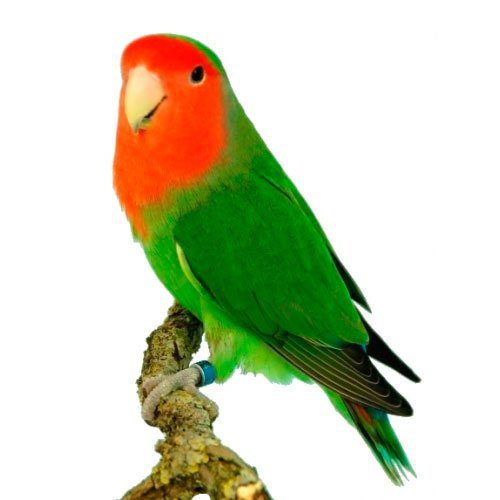
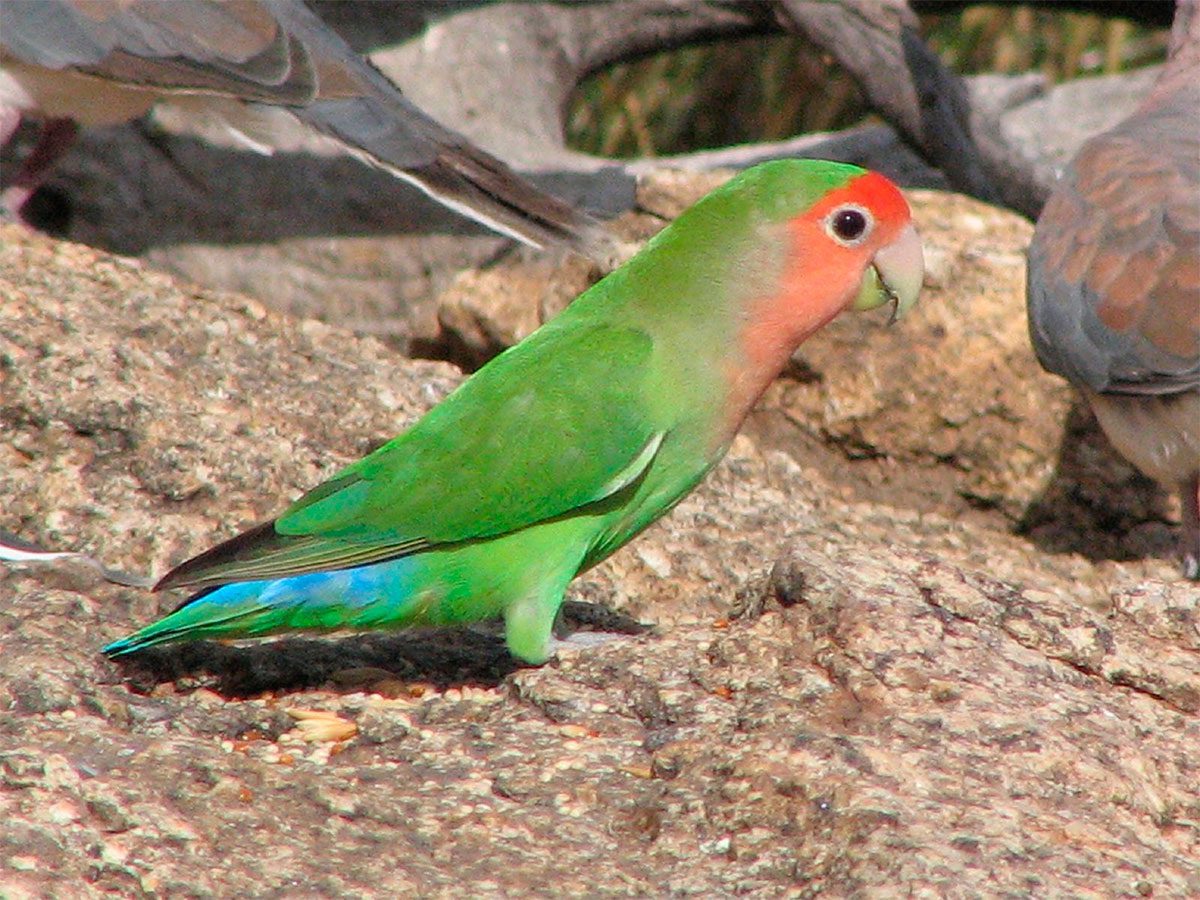
The Rosy-faced Lovebird (Agapornis roseicollis) has the upperparts green, except in the rump and uppertail-coverts they are bright blue. The tail is green, but the side feathers are black base, orange-red edges and subterminal band black. The flight feather They have black tips.

The underparts They are pale green from the bottom of the chest up to the undertail-coverts. The feathers of the tail and flight feather son negruzcas.

The head, the forecrown and the part behind eyes They are red, while the face, the chin, the throat and the top chest They are pink.

The bill It is white with greenish-gray tint. The eyes are dark brown, surrounded by a eye ring white. The legs are grey.

Both sexes are similar.

The youth They are duller with forecrown green tinged with red rose. The face is pale pink to the top chest. The bill It has a black base.

Subspecies description:

  • Agapornis roseicollis catumbella (Hall,BP 1952) – Brighter colors, with the front of the crown a dark red and the cheeks Bright color.

  • Agapornis roseicollis roseicollis (Vieillot, 1818) – The species nominal

Habitat Rosy-faced Lovebird

The Rosy-faced Lovebird frequents dry woodlands fields altitudes up to 1.500 m. Sub-desert steppes observed, wooded savannah with scattered forest cover, forest belts along rivers and farmland; often near standing water.

Usually, in flocks of 5 to 20 birds, although sometimes as many as several hundred may gather in areas where grass seeds ripen or near water sources.

They are very sociable and noisy, but also pretty tame. When resent, They fly to the nearest tree or vegetation, before returning quickly to the food source.

They used as roosts, nests Sociable Weaver (Philetairus socius) and the White-browed Sparrow-Weaver (Plocepasser mahali). Birds huddle in small groups in branches when the weather is rather cool.

Reproduction Rosy-faced Lovebird

The Rosy-faced Lovebird can pair off from two months of age. The male wait until the female accepts him before approaching. She adopts a "ruffled" position when she is ready.. The male It provides food, while balancing the head to get his attention. Also head scratching, especially around peak. When the male tries his approach, gently slides his hand. You can try out the other side if female It is shown aggressive.

The Rosy-faced Lovebird they are monogamous.

Nest in rock crevices, human constructions, bridges or communal nests Sociable Weaver (Philetairus socius) and the White-browed Sparrow-Weaver (Plocepasser mahali). The nest It is made of straw and branches, as well as some other materials such as pieces of bark, leaves and herbs, carried by the female rump feathers. The nest of the weavers carries no additional material added. The nests are communal.

The breeding season It has been recorded in the months Feb-Mar, April and October; most clutches seem to take place in the months of February-May.

The female lays 4-6 eggs. The incubation lasts a few 23 days, What does the female do alone?. It is fed by the male during this period.. The chicks are fed by regurgitation female, but it is the male who carries food. The period in the nest It is close to the 5-6 weeks, during which both parents feed the young. Flying around the age of 43 days.

Food Inseparable de Namibi

The Rosy-faced Lovebird they feed on, mainly, seed, sometimes taken directly from the soil, including grasses, Albizia and Acacia; usually they do visits to gardens to feed on sunflower seeds to cropland for him millet and the corn.

Sean is not considered a serious pest for crops because agriculture is scarce in the inhabited regions. They also eat flowers Albizia and other foliage plants, such as leaves of the genus Euphorbia. You can drink several times a day.

Distribution:

Size of the area of distribution (reproduction / resident): 774.000 km2

The Rosy-faced Lovebird They are endemic areas southwestern africa. In Angola, where the range of Rosy-faced Lovebird It is little known, The species is found in the region Sumba (perhaps further north) to the south, in parallel to the shore area through Namibia north of Cape, South Africa, extending from the east to the north. In Namibia to Lago Me, Botswana, although there are no recent records of the species there.

A sighting 1992 in Victoria Falls, Zimbabwe, suggests little-known eastern limits or nomadic behavior.

The main population Rosy-faced Lovebird It is within 400 km of Atlantic coastline. Records in the ancient province of Transvaal They are considered leaks. There is a wild population in the sector Fish Hoek of the Cape Peninsula, South Africa.

Subspecies description:

  • Agapornis roseicollis catumbella (Hall,BP 1952) – Southwest Angola, with a population in the wild Kissama National Park Northwest of Angola.

  • Agapornis roseicollis roseicollis (Vieillot, 1818) – The species nominal

Conservation Rosy-faced Lovebird

minor concern

โ€ข Current Red List of UICN: Least concern

โ€ข Population trend: Decreasing

The size of the world population Rosy-faced Lovebird It has not been quantified, but the species is described as locally common or even abundant in the vicinity of areas where water is abundant.

However it is suspected that the population of the Rosy-faced Lovebird can be in decline due to unsustainable levels of exploitation.

There has been a historic decline due to the capture and export of thousands of birds from Angola, This has contributed, to a large extent, a significant reduction in the population Rosy-faced Lovebird in the south of that country.

The Rosy-faced Lovebird in captivity:

The small Rosy-faced Lovebird It is a brilliant bird, joyful, Robust and gregarious. It is one of the most common parrots in captivity, along with the Budgerigar and Cockatiel, because of its ease of maintenance and reproduction.

Birds are considered easy, ideal for people who want to start breeding small parrots. The Rosy-faced Lovebird They can live in a large aviary cage outdoors, including winter. But, they will need to have a frost shelter to shelter in when it gets too cold outside.

Son active birds they like to fly. If they have to live in a cage, this will have to be wide and longer than high (birds are not helicopters). Ideally, the bird should be able to leave its cage for a while in order to be able to fly greater distances..

Contrary to popular belief, the Lovebirds They can perfectly live without a partner. Why do sellers try to sell both?, It is a purely financial maneuver. One Lovebirds only, will not die.

Similarly, when we say that a Lovebirds He will die of sadness when you lose your partner, It is once again a commercial argument. The bird can pass through a period of mourning during which try to call your partner / yy shouts, even more so when the other members of the aviary belong to another species.

All parrots are aves gregarias and they depend on the group to survive. A widow bird accept another partner, previous adaptation before sharing the same cage. It is possible however, two birds never understand (which it is rare, with the Lovebirds).
To end this belief, the "couples" of Lovebirds They not necessarily have to be of the opposite sex. Homosexual couples are common among Lovebirds.

His behavior with birds of their own species is quite good or very good, It is not the same for their behavior with other species: the Rosy-faced Lovebird are restless and vengeful birds. Coexistence with other species is totally discouraged by the vast majority of poultry farmers: the peak of a lovebird can easily cut your finger or injure another bird, smaller and more peaceful.

In general, the Rosy-faced Lovebird they are birds, relatively, easy to educate, provided that taken from young. Son tame birds, loving, playful, sleepers, large pet birds. The bite related to its small peak is still very painful, especially in the soft fingers of children.

It is permissible to say that males are better pet birds than females. The breeding females are often within their hormonal period, making them very territorial. A sweet female domesticated before sexual maturity can be very aggressive to the point of not being manipulated when in hormonal period. Once again, this does not affect all birds, because there are always exceptions.

In general, to the Lovebirds, They are not considered good speakers.

Not recommended for people with incompatible squeals.

No sexual dimorphism in this species. The only way to know the sex of the bird is to carry out a DNA test using a blood or feather sample..

It is not known much about the longevity of the Rosy-faced Lovebird. according to some sources They can live up to 34.1 years in captivity, It is plausible, but it has not been confirmed. Age of sexual maturity of 2 months to almost a year.

Due to the depletion of stocks, in poultry in the early 20th century, It will be started hybridize with other species, but thanks to some breeders are you has been able to preserve in its pure State.

Mutations Agapornis roseicollis
Mutations

Mutations.

There are over 500 mutations or combinations of different colored. Mutations in genes lead to changes in the pigments that give color pens, such as psittacin (red, yellow or orange) or eumelanin (black, brown) or variations on feather structure. They may be sex-linked recessive mutations (They depend on the sex of birds) or autosomal recessive and dominant (irrespective of gender). Among the sex-linked mutations have: ino (known the lutino. There have eumelanin), cinnamon (produce eumelanin brown instead of black), Balls (quantitative reduction of melanin 60 %) andopaline (red psittacine of the mask has spread from the back of the head, the rump is the same color as the body). Also shows some combinations as are the pallidino (Only males, -pallid gene on one X chromosome and ino gene on the other X chromosome) and canela-ino (It is given by crosslinking between cinnamon and ino on the same chromosome and can be male and female). In all these mutations, females never carry the mutation. Years ago, the cinnamon cinnamones were called Americans and Australians palids cinamones or Isabelas.

Consider several crossings (to better understand the sex-linked mutations):

  • Crossing 1: Green x lutino male female = green and lutino male carrying female lutinas
  • Crossing 2: Green male x female = green Lutina carriers lutino males and green females
  • Crossing 3: Green male carrying female green x lutino = green and green lutino male carriers, Green and females lutinas
  • Crossing 4: Green male carrying female lutino Lutina x = green and lutino male carriers lutinos, Green and females lutinas
  • Crossing 5: Lutina x lutino male female = male and female lutinas

As autosomal recessive mutations have:

  • aqua (reducing a yellow psittacine 50 %)
  • turquoise (reducing a yellow psittacine 80-90 %)
  • aquaturquesa (combination thereof)
  • edged dilute (reduction of eumelanin 50 % in the body, in the center of the back and wing feathers eumelanin it is lower than in the edge, it seems that feathers are trimmed)
  • dilute (reduction of eumelanin 80-90 %, having a green veil over the whole body)
  • bronze fallow (It presents grayish brown eumelanin and red eyes)
  • pale fallow (greyish brown eumelanin sparingly, light green eyes and red veil in the abdomen)
  • recessive harlequin (reduction of eumelanin 95 %, smaller mask)
  • orange face (psittacin mask and tail is orange rather than red)

In these mutations, both males and females can be carriers. To be transmitted, or both are carriers or join a carrier with a mutated. Years ago, to dilute edged was called golden cherry and if it was combined with aqua, aquaturquesa or turquoise, silver cherry o plata.

As we autosomal dominant mutations:

  • dominant harlequin (reduction eumelanin and randomly scattered throughout the body)
  • pale headed (psittacine of the mask and the tail is light orange pink. Hay SF,factor simple y DF, double factor, ie more or less mask dark)
  • dark factor (a change occurs in the structure of the pen, in the spongy zone, so they look darker. There SF and DF, naming as a factor D and DD for two)
  • purple (a change occurs in the structure of the pen, in the spongy zone. We have SF and DF. The ideal is to combine a dark factor)

As discussed above, both headed as pale as dark violet factor are dominant incomplete, so we say what the single and double factors. In these mutations is mutated or not is, no carriers and being transmitted need only one parent to the present.

Is a type of harlequin which it is transmitted to different recessive and dominant form, is the progressive harlequin or mottle. The harlequin is increasing as the bird will be more adult, as it is getting older.

The mutation bee does not exist in the A. roseicollis. We have the combination of turquoise with ino, if they go selecting, we can get a completely white bird with red eyes, what would look like albino.

Apart from all these mutations, There is a variety called Long Feathered, of larger size and colors sharper the ancestral. It was obtained through years of selection, according to some or emerged spontaneously in some aviary, according to others and from there they began to work with them. Something similar happened with mandarins (Poephila guttata), Giant calling mandarins. So the variety would call if they have achieved by selection and mutation if they have arisen spontaneously.

Once you view the different mutations must say that several cases can occur, that make possible the multiple existing color combinations. They may have a recessive mutation with a dominant (edged dilute violeta), two or more mutations at the same time (turquesa edged dilute violeta arlequin DD), and it can even happen to have two different mutations and make the other not appreciated (normal and lutino lutino D or DD are exactly the same visually).

Source: The bird aviary

Alternative names:


Rosy-faced Lovebird, Peach-faced Lovebird, Rosy faced Lovebird, Rosyfaced Lovebird (English).
Insรฉparable rosegorge, Insรฉparable ร  face rose, Insรฉparable roseicollis (French).
Rosenkรถpfchen, Rosenpapagei (German).
Inseparรกvel-de-faces-rosadas (Portuguese).
Inseparable de Cuello Rojo, Inseparable de Namibia, Agapornis Roseicollis, Inseparable de Cara Melocotรณn (espaรฑol).

scientific classification:


Order: Psittaciformes
Family: Psittaculidae
Genus: Lovebirds
Scientific name: Agapornis roseicollis
Citation: (Vieillot, 1818)
Protonimo: Psittacus roseicollis

Images Rosy-faced Lovebird:

Videos "Rosy-faced Lovebird"


Species of the genus Agapornis


Rosy-faced Lovebird (Agapornis roseicollis)


Sources:

Avibase
– Parrots of the World โ€“ Forshaw Joseph M
– Parrots A Guide to the Parrots of the World – Tony Juniper & Mike Parr
– Birdlife

Photos:

(1) – Peach-faced Lovebird in Namibia, Africa By Alastair Rae from London, United Kingdom (Rosy-faced Lovebird) [CC BY-SA 2.0], via Wikimedia Commons
(2) – Picture taken in the zoo of Wrocล‚aw (Poland) By Nicolas Guรฉrin (messages) (Own work) [GFDL or CC BY-SA 3.0], via Wikimedia Commons
(3) – A pet chick By Toumoto๏ผšhttp://opi.toumoto.net (Self-photographed) [GFDL or CC-BY-SA-3.0], via Wikimedia Commons
(4) – Rosy-faced Lovebirds at Etosha National Park, Namibia By Brian Taylor from U.S.A (Rosy-faced Lovebirds) [CC BY 2.0], via Wikimedia Commons
(5) – Peach-faced Lovebirds (also known as the Rosy-faced Lovebird) eating seeds from a seed-block garden bird feeder in a garden in Scottsdale, Arizona, US By D. Patrick Lewis [CC BY 2.0], via Wikimedia Commons
(6) – Mutation in roseicollis : opaline double dark factor By Roseicollis (Own work) [GFDL or CC BY-SA 3.0], via Wikimedia Commons
(7) – Turquoise mutation By Sergi Bio (Own work) [Public domain], via Wikimedia Commons
(8) – Mutations in Agapornis roseicollis yellow machine-readable By No author provided. Ajit S.~commonswiki assumed (based on copyright claims). [Public domain], via Wikimedia Commons
(9) – Peach-faced Lovebird (Agapornis roseicollis). Pet on a perch. Shows blue rump feathers By Peter Bรฉkรฉsi (Flickr) [CC BY 2.0], via Wikimedia Commons

Sounds: Andrew Spencer (Xeno-canto)
โ–ท The world of Pets: Dogs, cats, birds, reptiles, amphibians

Red-breasted Parakeet
Psittacula alexandri


Cotorra Pechirroja

Content

Description:

Ilustraciรณn Cotorra Pechirroja

33 to 38 cm.. length between 133 and 168 g. of weight.

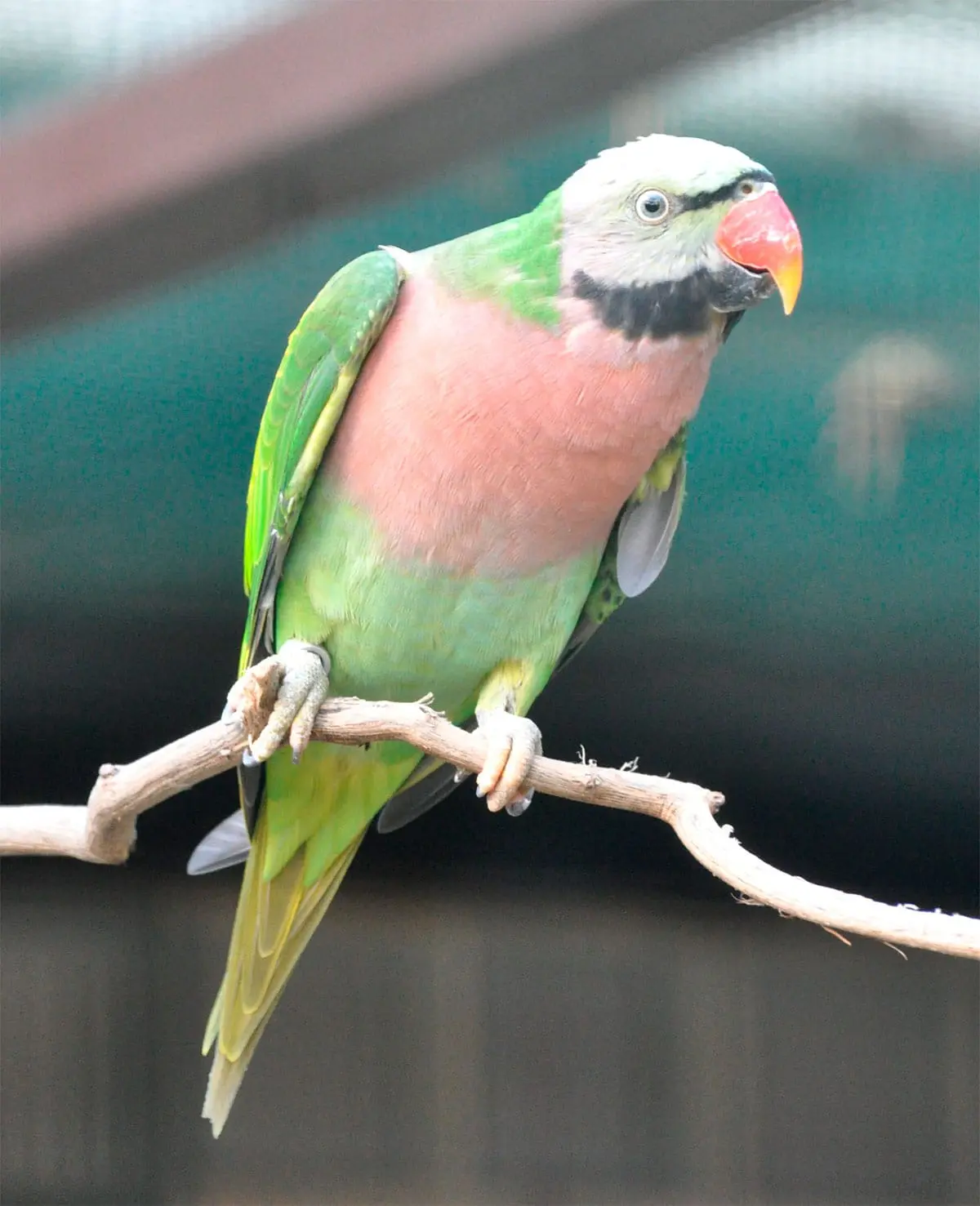
The Red-breasted Parakeet (Psittacula alexandri) is a bird with a form attractive, thin, and with a long and narrow tail. Its plumage is green, the overall tone of the head is grey, the bill red, and with brands distinctive in the head and face. The area around the eyes is greenish, with a pretty bluish tint. It has a fine line along its forecrown and wide stripes in their cheeks. Plumage in the chest, the throat and the top abdomen is salmon-pink color, extending halfway from the vent.

The female It has a shade bluish through the region of the face. In general, they have a pink color more off above the chest and the feather half of its tail they are shorter than the of the male.

The immature birds they have the tail shorter, the bill Pink, and incomplete rays of the cheek they are easily distinguished.

Between the young birds hard identification between males and females, However, breeders have managed to identify them correctly. The head of the female bows in a more uniform manner from the cere to the rear of the head. The young males they tend to be flatter in the forecrown. The females They seem to have a face darker than blue.

Subspecies description
Subspecies
  • Psittacula alexandri abbotti

    (Oberholser,1919) – Length: 36 cm.. Similar to the Psittacula alexandri fasciata (including sexual dimorphism in staining of the bill) but larger and paler.


  • Psittacula alexandri alexandri

    (Linnaeus, 1758) – Species nominal


  • Psittacula alexandri cala

    (Oberholser, 1912) – Length: 36 cm.. As the Psittacula alexandri fasciata but with the belly blue (especially in males), the upper part of the abdomen darker and the lores, forecrown and bottom of the abdomen strongly impregnated with the pale blue.


  • Psittacula alexandri dammermani

    (Chasen & Kloss, 1932) – Length: 36 cm.. Perhaps, on average, larger that the Psittacula alexandri fasciata. The pink color of the chest It is darker than the species nominal. In the female, the pink color extends from the throat at the sides of the neck. The bill larger than that of the species nominal. Both jaws Red in both sexes.


  • Psittacula alexandri fasciata

    (Statius Mรผller, 1776) – Length: 33 cm.. Upper chest and abdomen is dark pink with violet tone, the head is bluish-grey way more uniform. The areas of the eyes and forehead with greenish hue. The females, part of the difference of the bill, nor have the violet tonality in the pink of the chest.


  • Psittacula alexandri kangeanensis

    (Hoogerwerf, 1962) – Length: 33 cm.. More grey the head (less blue). Bill larger than that of the species nominal and both jaws Red in both sexes.


  • Psittacula alexandri major

    (Richmond, 1902) – It is more large, of 38 cm.. length. Similar to the Psittacula Alexandri Fasciata but something more pale and the head is without bluish tone gray.


  • Psittacula alexandri perionca

    (Oberholser, 1912) – Length: 37 cm.. As the Psittacula alexandri fasciata (including sexual dimorphism in the coloration of the bill) but paler and larger, without the Green tint around the eyes.

Habitat:

Usually, they live below 2.000 m (rarely above 345 metres in Nepal) all types or forest and wooded areas, including dry forest, secondary-humid deciduous forest, mangroves, coconut and mango groves , areas planted with trees (including hills of shifting cultivation), parks and urban areas. In the region of the Himalaya avoids the dense green forests.

Gregaria, usually in flocks of 6-10 birds, less frequently in groups of 50 and very exceptionally in thousands, larger flocks during garbage collection (for example, the mango or rice), sometimes mixed with the Slaty-headed Parakeet wave Gray-headed Parakeet. They form communal roosts in the tall trees, bamboo or sugarcane scrub areas.

Reproduction:

The Red-breasted Parakeet nests in natural cavities or old hole made by woodpeckers or barbets, usually at a height between 3 and 10 m, often in loose colonies. The hole is filled with wood shavings.

The laying is of 2 to 4 eggs.

The breeding season is between December and April, Depending on the location and the altitude; in Java, breeding has been recorded in every month, except for April.

Food:

Diet Red-breasted Parakeet includes wild figs and other fruits, fruit trees and wild, flowers and nectar (especially, for example, of the Parkia speciosa and Erythrina variegata), dried fruits (for example, chestnuts Castanea), fruit (for example, Mango), berries, seeds (for example Albizia), leaves and cereals such as rice and corn, by causing serious damage to crops, especially for rice.

Distribution:

Size of the area of distribution (reproduction / resident): 2.570.000 km2

The Red-breasted Parakeet are distributed from the central area of the Himalaya until Indochina, China and West of Indonesian. From the lowlands of the Himalaya in the North of India, approximately to the East of Dehradun, through Nepal, Sikkim and North of Bhutan in the southwest of Yunnan, China; to the South by Assam, Manipur and Nagaland, India, until Bangladesh and to the East by Burma (including Mergui archipelago), Indochina, Malacca Peninsula, around 9ยฐN (a record of 1889 in the Kelantan River at approximately 5ยฐN suggests a contraction in its distribution) of Guangxi and Provinces of Canton and Hainan Island, to the South of China.

They are also distributed in Islas Andaman and Indonesian in Java, Bali, Karimun Java, Kangean, Borneo South (where it was probably introduced from Java) and Simeulue, Nias and Banyak, West of Sumatra.

Getaways captive birds eggs were found in Singapore and a single record (presumably an escape) in Hong Kong.

Resident but with some local movements dependent on food supply.

It is the most common parrot in some parts of its range., but with a substantial decrease in Thailand and Laos in recent years and local extinctions (for example, Java and Bali), because of the live poultry trade; the nominal subspecies may be at risk as a result of his capture. A small number in captivity out of range (mainly the nominal species and fasciata).

Subspecies distribution
Subspecies

Conservation:

State of conservation โ“˜


Near-threatened Near Threatened โ“˜ (UICN)โ“˜

โ€ข Current Red List of UICN: Near-threatened

โ€ข Population trend: Decreasing

The population of the Red-breasted Parakeet It is suspected in a moderate to fast global decline, due to the unsustainable levels of exploitation and the destruction of their habitat. This suspicion is supported by widespread anecdotal evidence that in many parts of its range decreases.

Threats:

    – The declines and local extinctions in recent decades in the population of the Red-breasted Parakeet have been attributed in large part to his capture to the trade in live birds (Juniper and Parr 1998).

    – The hunt they are considered the main threats to the species in Nepal, where it is also threatened by the loss of forests (C. Inskipp and HS Baral in litt. 2011).

    – His nasal voice makes the species a popular in Nepal cage bird, and their vocal habits during the breeding season, together with the tendency to form large flocks when not raising, they make susceptible to trappers. These factors lead to illegal hunting and his capture in protected areas; they are also persecuted by farmers due to their raids on crops (C. Inskipp and HS Baral in litt. 2013).

    – Similarly, in Bangladesh, the species is captured for the cage bird trade It is also likely that they are affected by the removal of large trees (P. Thompson in litt. 2012).

    – Almost the total disappearance of the species from the North of Laos, It is believed that it is mainly due to the loss of habitat through conversion to agriculture (JW Duckworth in litt. 2011).

    – Loss and fragmentation of forests is likely to accelerate in Cambodia in the near future, given that many of the large agro-industrial concessions have been awarded recently (H. Rainey in some. 2011).

Conservation Actions:

"Red-breasted Parakeet" in captivity:

The Red-breasted Parakeet is a bird Smart and outgoing that is gaining increasing worldwide popularity. These parrots are sociable and playful, and if they are properly socialized, they can be a few excellent pets. They can be a bit aggressive and authoritarian, If it is not properly discipline. They need a good cage for a large size, with a lot of toys to avoid boredom.

Although this bird is linked with the Rose-ringed Parakeet, they are very different in personality. The Red-breasted Parakeet It is softer and not so noisy, although she has been described as "feisty". It is usually more quiet than other Psittacula. Also are great eaters and you accept easily new foods other birds may be thrown away.

You can get to imitate some sounds, even words, Although not as clear as the some of the larger parrots, example the Grey Parrot. But, according to some sources, they can speak more clearly than the Rose-ringed Parakeet.

Regular handling is important at an early age, since they can become aggressive, If not are well socialized and manipulated.

If you want a small Parrot with personality, the Red-breasted Parakeet It can be the ideal ave. But, It is still a "stubborn" and "stubborn" bird.. It is not surprising considering his intelligence. Obedience training is recommended. On the other hand it is one voracious chomping and should it be should provide plenty of toys to chew.

Like other parrots, need company, and if they will not be in an Aviary with other birds, We must be able and willing to spend large amounts of time with them.

In nature, this bird is often seen in flocks of 10 to 50 individuals. These flocks, often, they are heard before to be seen. This is a fact that must be taken into account before deciding to buy one Red-breasted Parakeet. Breeding females can be put in 3 to 4 eggs in each clutch, with an incubation approximately 22 days.

With regard to its longevity, according to sources, We need to know that a specimen lived 23,3 years in captivity.

Captive breeding:

The Red-breasted Parakeet commonly bred in captivity. They reach maturity between 2 and 3 years of age. The birds must be matched at a young age. The female can sometimes dominate males. The procession begins at the end of winter and the females can be seen calling males for food. In the wild they breed between the months of December and April, Although this is variable, Depending on the climate and altitude.

A thick-walled hollow trunk, It can be used as nest. If not available, any commercially available nesting box should suffice.

They require long aviaries, more than wide, due to its long tail and its type of flight (powerful, linear). Also like a protected breeding area. The entrance door to the Aviary must be on the opposite end. We must place leaves of Palm on the bird front and leafy branches on the back to protect the young fledged when they hit the walls of the Aviary and fall on your floor. If this is not done, many of the young people will die from injuries in the head or severely damage their hair. Young hatchlings do not have great control when they start to fly; they can be left with the parents during 9 months, but then you must be separated.

Diet during breeding It is very important. We can use sunflower seeds germinated, soaked chickpeas, Apple diced, celery, raw or boiled corn and green feed. Supplementation with multiple vitamins and liquid calcium is especially important prior to egg laying..

Alternative names:

Red-breasted Parakeet, Banded Parakeet, Bearded Parakeet, Indian Red-breasted Parakeet, Moustached Parakeet, Pink-breasted Parakeet, Red breasted Parakeet, Rose-breasted Parakeet (English).
Perruche ร  moustaches (French).
Bartsittich, Rosenbrustsittich (German).
Periquito-de-bigode (Portuguese).
Cotorra de Pecho Rosado, Cotorra Pechirroja (espaรฑol).


scientific classification:

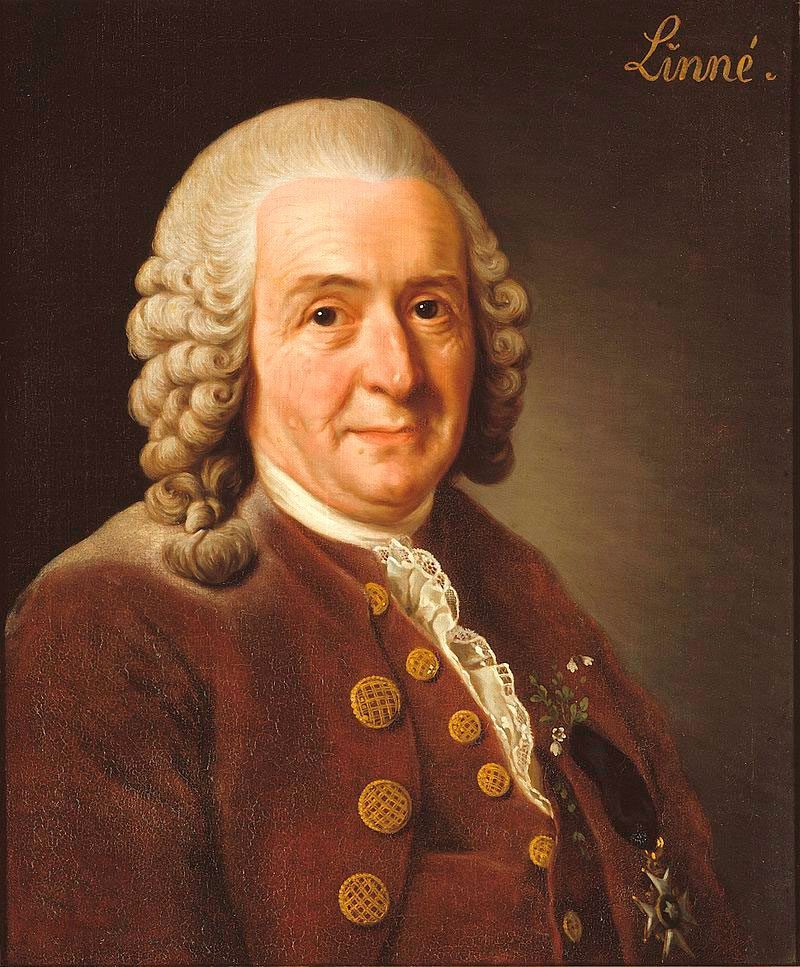
Carlos Linneo
Carl Linnaeus

Order: Psittaciformes
Family: Psittaculidae
Genus: Psittacula
Scientific name: Psittacula alexandri
Citation: (Linnaeus, 1758)
Protonimo: Psittacus alexandri


Red-breasted Parakeet images:

Videos "Red-breasted Parakeet"


Especies del gรฉnero Psittacula

Red-breasted Parakeet (Psittacula alexandri)


Sources:

Avibase
– Parrots of the World โ€“ Forshaw Joseph M
– Parrots A Guide to the Parrots of the World – Tony Juniper & Mike Parr
– Birdlife

Photos:

(1) – Moustached Parakeet in the Walsrode Bird Park, Germany By Quartl (Own work) [CC BY-SA 3.0], via Wikimedia Commons
(2) – Red-breasted Parakeet at Brooklands Zoo, New Plymouth, New Zealand By Dave Young (originally posted to Flickr as bird) [CC BY 2.0], via Wikimedia Commons
(3) – Red-breasted Parakeet (Psittacula alexandri fasciata). Coutrtship – male on right. Changi Village, Singapore. 2 January 2006 By Lip Kee Yap [CC BY-SA 2.0], via Wikimedia Commons
(4) – Moustached Parakeet in the Walsrode Bird Park, Germany By Quartl (Own work) [CC BY-SA 3.0], via Wikimedia Commons
(5) – Female of Red-Breasted Parakeet (Psittacula alexandri) at Bangkok, Thailand By Jason Thompson (Flickr: Red-Breasted Parakeet (Female)) [CC BY 2.0], via Wikimedia Commons
(6) – Plate from Zoological illustrations, Volume 1, 2nd series By William Swainson [Public domain], via Wikimedia Commons

Sounds: Peter Ericsson (Xeno-canto)
โ–ท The world of Pets: Dogs, cats, birds, reptiles, amphibians

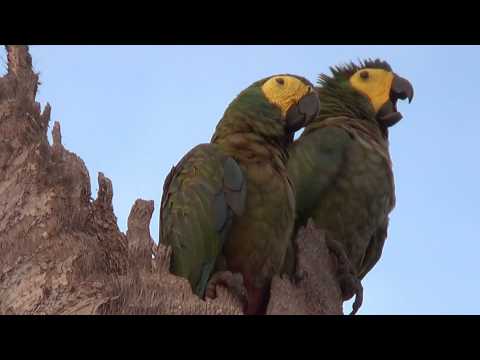
Red-bellied Macaw
Orthopsittaca manilatus


Guacamayo Ventrirrojo

Content

Description:

50 to 51 cm.. length and a weight between 292 and 390 g.

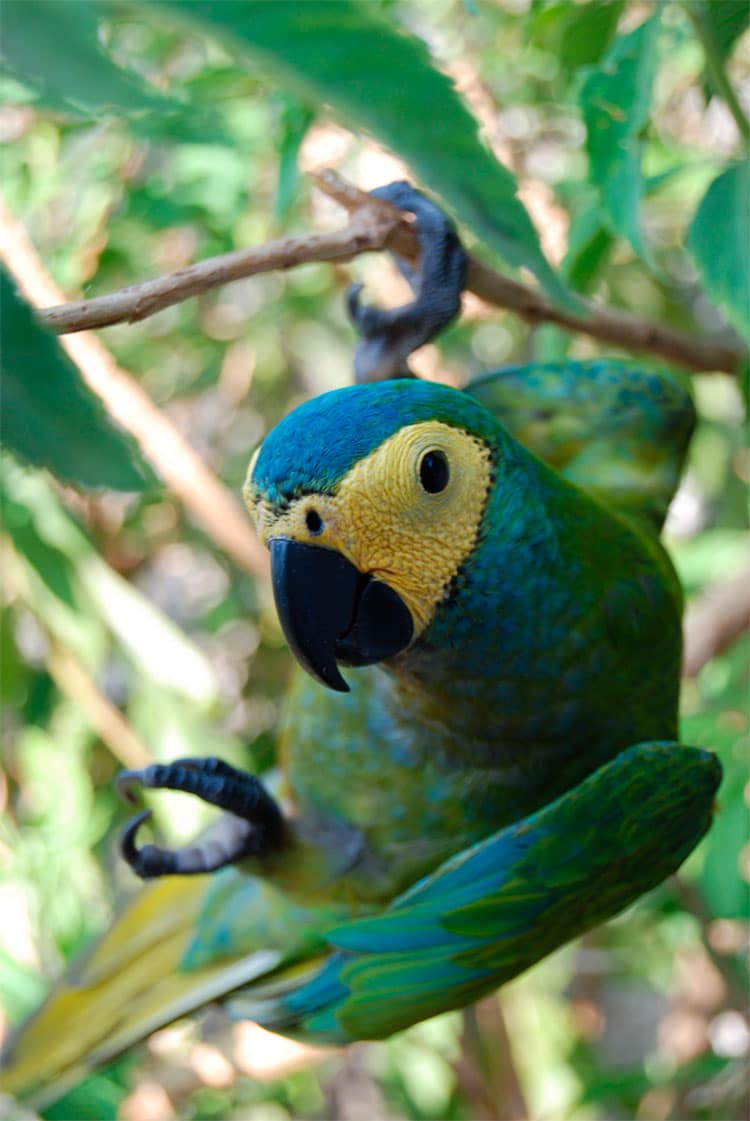
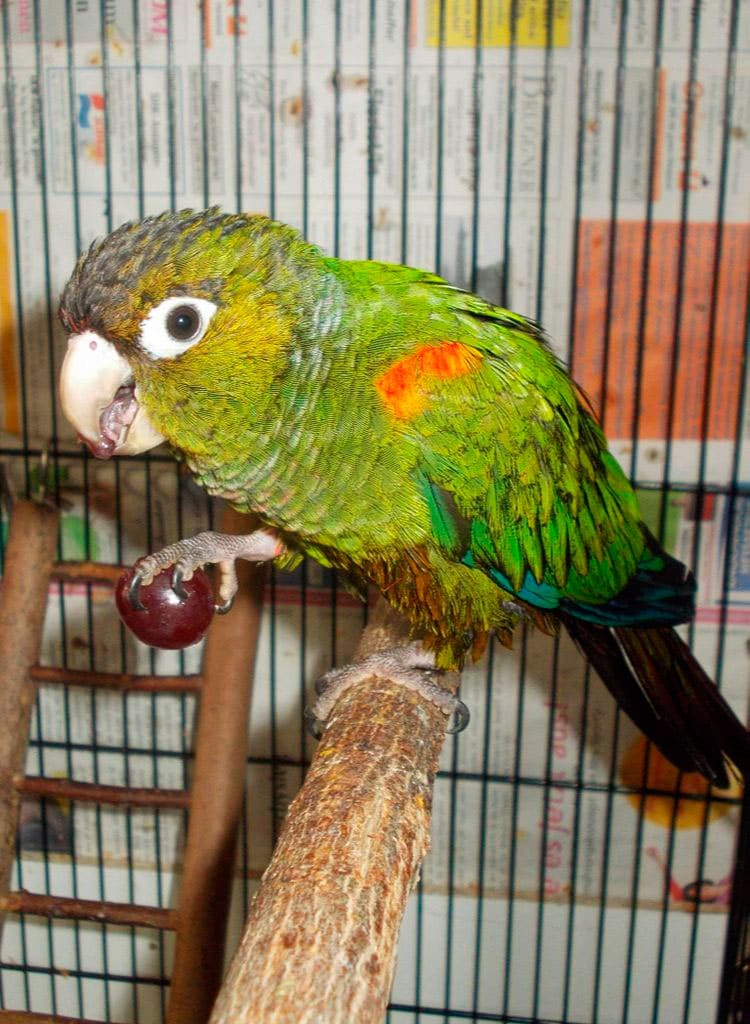
The Red-bellied Macaw (Orthopsittaca manilatus) is a medium-sized Macaw; has the forecrown and crown a bright blue, gradually faded to blue-green color in the area of the nape and on both sides of the neck. The the mantle and scapulars are green grass with impregnations color olive and yellow edges, producing, altogether, a flaky effect; the back and rump are green grass, with some feathers tipped pale bluish. The uppertail-coverts grass-green. The lesser and median coverts green grass impregnated with green olive with yellowish margins; alula and primary coverts green with vane outer blue; large inner coverts green.

The flight feather bordered with blue and green tips. Under, the wings with coverts yellowish-green and flight feather yellowish. The feathers of the throat and top of the chest are pale grey blue in the Center and yellowish-green in the margins; those of the lower area of the chest and top of the belly without tones pale in the Center, but with some feathers with margins off dark red; belly dark red; undertail-coverts bluish green. Upper, the tail green color in the Center with yellowish margins; upor down yellow.

Bill black; nude part of lores and cheeks yellowish white; irises dark brown; legs dark gray.

Sexes similar
, the males, possibly, bigger.

Immature clear tip in the bill and smaller patch of dark red color of the belly.

Habitat:

Lives in Savanna and flooded forest, where there are Palm trees, in altitudes close to the 500 m. Very dependent from the Palma de moriche or aguaje (Mauritia flexuosa), which feeds, staying almost invisible due to its Green plumage.

Occasionally wander in by cultivated areas and have been in the mangroves.

gregarious, flocks of more of 100 observed birds. Usually, they rest in the branches of the Mauritia Palms, where they remain hidden among the foliage of leaves.

Reproduction:

They nest in holes of las palmas dead found near or surrounded by water, often use the nests of the Orange-winged Parrot (Amazona amazonica), of Trinidad and Tobago.

The breeding season is from February to September in Trinidad and Tobago; from February to may in Colombia; from February to June in Guyana. The size of the put is of 2 to 6 eggs with a period of incubation of approximately 27 days. The young begin to feather already in the eleventh week. Take an average of 2 to 3 years to mature, remaining during that period very close to their parents.

Food:

Usually feeds on the fruits of the Palm tree Mauritia flexuosa they are present during the season dry when other fruits are scarce, as well as other palm trees such as Roystonea oleracea and Euterpe.

The Red-bellied Macaw communicate with each other with calls when there is a localized food source.

They roost in Palm trees full of fruit and used its beak to peel hard fruits to expose the pulp. Son, unlike most parrots, seed predators, but partially, since they eat the fruit, leaving intact the endocarpio (Darnell and Bergstrom 2002; Janzen 1981; Kristosh and Marcondes Machado-2001).

Some lick attempt to fly with the seed at its peak, and unintentionally may fall between two palm trees. Seed drop and feeding behavior, in order to avoid damaging the seed, It makes these macaws and other psittacidas agents of seed dispersal.

Distribution:

Size of the area of distribution (reproduction / resident): 7.150.000 km2

The Red-bellied Macaw is distributed to the North of South America to the East of the Andes.

In Colombia its range is from Goal and West of Vaupรฉs until Putumayo and amazon, spreading northeast of Venezuela until Trinidad and Tobago and Guianas, where apparently, they are restricted to coastal areas.

Are distributed to the East of Ecuador, Northeast of Peru, North of Bolivia and much of the Brazilian Amazon, to the East of For and from the West of Bay and Goiรกs until Mato Grosso. Apparently absent most of Venezuela and North of the Amazon basin of Brazil, in the basin of the Black river.

A small population reported in the North of Sรฃo Paulo, Brazil.

Probably residents in some areas, although migratory in others, for example, in the Northwest of Bolivia, where been observed have to these macaws in the months of September to November, being absent from November to January.

Share on a local scale; the distribution is closely related to the palms of Mauritia. Probably stable population. But, in the northeast of Brazil fruit Mauritia It is used in the manufacture of confectionery products and the trunks of the palms for some construction purposes..

Rare in captivity.

Conservation:


minor concern

โ€ข Red List category of the UICN current: Least concern.

โ€ข Population trend: Stable.

Global population size has not been quantified, but this species is described as quite common.

The populations of the Red-bellied Macaw they depend of the Palms Mauritia for food and nesting. These trees are widely used for construction, and that is why you can have bad consequences for the future of the species.

These birds are threatened by the felling of these Palm trees and capture for the pet trade. But, This species tends to be common in most of their habitats, with the exception of Colombia, Guyana and Venezuela, where it is threatened by Habitat loss.

"Red-bellied Macaw" in captivity:

Rare bird cage.

It is extremely difficult to keep these birds alive in captivity., because, mainly, to your excitable personality, and its diet low in fat and high in carbohydrates.

The export and import for the pet trade often brings with it a mortality of the 100%; captive-bred chicks have a very low survival rate. A high percentage die at an early age kidney disease. Its acquisition as a pet is very questionable.

The only country that exports these birds in recent years is Guyana.

Due to the lack of commercial availability of nuts of moriche Palm, peeled unsalted peanuts have been used as a staple in the diet of these birds in captive. They should not be fed with the typical commercial seed, especially fat seeds such as of the Sunflower.

A nutritional analysis of the natural diet of the Red-bellied Macaw He revealed that this was made up of high levels of beta carotene, of carbohydrates and zero fat. This explains its propensity to obesity in captivity. Almost all parrots usual diets are too high in fat content, with what the Vitamin A supplements in the form of beta carotene they are essential.

Deficiencies of Vitamin A are usually made to notice very quickly, giving rise to many serious diseases, being able to get to many of them deadly.

The beta carotene is the only way Vitamin A that do not require fat to be absorbed. The successful reproduction This species only has been able to achieve by adjusting your diet.

The pups fed by hand are much quieter than adults and are able to metabolize fat more efficiently than adults. Once weaned, they remain in need of a very low fat diet.

There are no data of your longevity in captivity, Although in nature, possibly, they can live around the 40 years.

Is not a bird to keep in captive. A responsible attitude should be to place these beautiful birds in breeding programs so that future generations can enjoy them..

More information –>

Alternative names:

Red-bellied Macaw, Red bellied Macaw, Small Red-bellied Macaw (English).
Ara macavouanne, Ara ร  ventre rouge (French).
(German).
Maracanรฃ-do-buriti, arararana, ararinha, maracanรฃ-de-cara-amarela (Portuguese).
Guacamaya Buchirroja, Guacamayo Ventrirrojo, Maracanรก de Vientre Rojo (espaรฑol).
Guacamayita morichalera, Guacamaya Buchirroja (Colombia).
Guacamayo barriga roja, Perico morichalero (Venezuela).
Guacamayo ventrirrojo (Ecuador).
Maracanรก ventrirroja, Parabachi de palmar (Bolivia).
Evaรญ (Chimani).
Ararinha (tupi).
Quequeto (Guahibo).
Ectoa (Barasana).

Pieter Boddaert
Pieter Boddaert

scientific classification:


Order: Psittaciformes
Family: Psittacidae
Genus: Orthopsittaca
Scientific name: Orthopsittaca manilatus
Citation: (Boddaert, 1783)
Protonimo: Psittacus manilatus


Images Red-bellied Macaw:

Videos "Red-bellied Macaw"

MARACANรƒ-DO-BURITI: Canto! (ORTHOPSITTACA MANILATA), RED-BELLIED MACAW, Yellow-faced Maracanรฃ,


ยซVentrirrojo Guacamayoยป (Orthopsittaca manilatus)


Sources:

  • Avibase
  • Parrots of the World โ€“ Forshaw Joseph M
  • Parrots A Guide to the Parrots of the World – Tony Juniper & Mike Parr
  • Birdlife
  • Wikipedia

Photos:

(1) – Red-bellied Macaw Orthopsittaca manilata in Goiรขnia, Brazil By A C Moraes (originally posted to Flickr as Tocci) [CC BY 2.0], via Wikimedia Commons
(2) – Two Red-bellied Macaws flying near the Amerindian Reservation of Santa Mission, Guyana By Feroze Omardeen [CC BY 2.0], via Wikimedia Commons
(3) – A little girl in San Martin, Peru with a pet juvenile Red-bellied Macaw on her right shoulder By Michael Nickel (originally posted to Flickr as girl with lorito) [CC BY 2.0], via Wikimedia Commons
(4) – Buchirroja Guacamaya ( Orthopsittaca manilatus) by Marcello Magnussen – wiki_aves_colombia
(5) – Buriti maracana chicks in the nest, Orthopsittaca manilatus by Osvaldo Scalabrini

โ–ท The world of Pets: Dogs, cats, birds, reptiles, amphibians

White-eyed Parakeet
Psittacara leucophthalmus

Aratinga Ojiblanca

Content

Description:


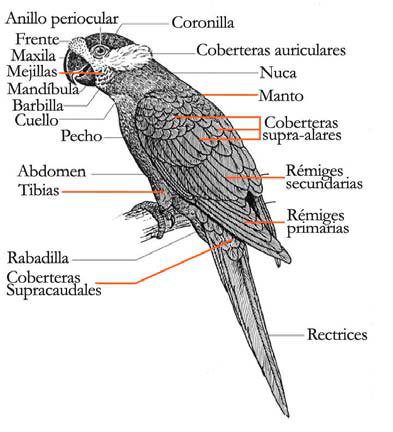
Anatomy-parrots

Of 32 cm. length and a weight between 140 and 170 g..
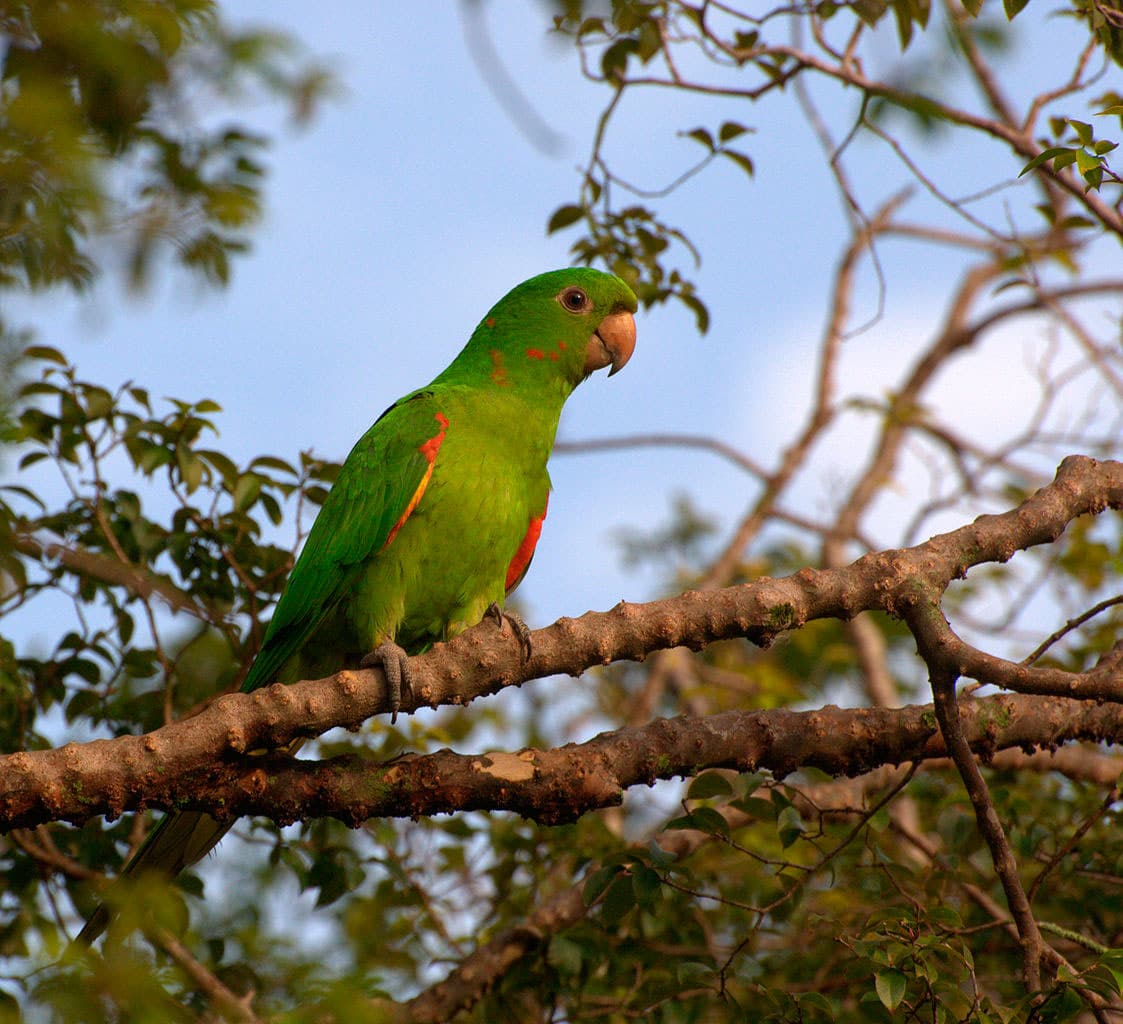
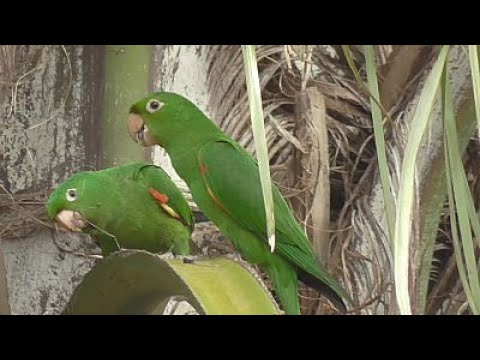
The White-eyed Parakeet (Psittacara leucophthalmus) has the head dark green with small scattered red feathers, especially in the area of the lores, cheeks, sides neck and throat. The head and nape Some birds are almost entirely green, others have solid red spots in the cheeks, with numerous scattered red feathers elsewhere.

The upperparts are dark green, with one or two scattered red feathers. Upper, the wings dark green, with a little red in the curve; undertail, with golden brown flight feathers, the outer red and green small coverts inner; Yellow large coverts external and green internal.

The underparts Green with scattered red feathers on the throat and the chest, sometimes forming irregular patches. Upper, the tail dark green; Brown down.

The bill hooked is color Horn and its gray tip; bare periophthalmic grayish white; irises yellow-orange; legs grey.

The plumage of the male and the female, they are identical.

The immature they have more muted colors; some feathers Red in the head, No red in the bend of wing and olive in the underwing-coverts outermost.

Subspecies description:

  • Psittacara leucophthalmus callogenys

    (Salvadori, 1891) – They have head, neck and throat, green grass dark with small feathers red color above the cheeks. The the mantle, the wing-coverts, the tail and primary feathers of the tail are dark green. The lower part of the chest and flanks of the body are green clear. The feathers largest of the wings and secondaries are dark green with a grey reflection at the ends. Smaller feathers of the wings and the area of the wing curvature are bright red; small coverts feathers are red; the feathers of the greater coverts are yellow. The top of the large feathers of the tail are dark green, the underparts is olive green.

    The eyes are black with the irises orange-brown. The bare periophthalmic is grayish white. Bill color horn, the sides and the tip of the upper part are dark gray. Legs brownish grey, black nails.

    On average largest the species nominal with the bill more robust. Birds in the West have a green dark.


  • Psittacara leucophthalmus leucophthalmus

    (Statius Mรผller, 1776) – The species nominal.


  • Psittacara leucophthalmus nicefori

    (Meyer de Schauensee, 1946) – Similar to the species nominal, except for having a red frontal band.

Habitat:

Video – "White-eyed Parakeet" (Psittacara leucophthalmus)

Calacante de Ala Roja Psittacara leucophthalmus.

The White-eyed Parakeet It is in a great range of forest habitats and forests, mainly in lowlands, even if they manage to reach altitudes of 1.700 meters in the Ecuador and 2.500 meters in Bolivia.

In the Amazon, they are in tropical rainforests, mostly along the rivers (including the forests and marshes), in scattered areas of woodland and in land grown in wetlands, mangroves, sheets and the forests of Palms in the Guianas, chaco types of forests in the South of its range, gallery forests and alluvial forests in Bolivia.

The White-eyed Parakeet they are highly gregarious, they form flocks, usually, hundreds of birds (usually up to 90), covering large expanses between the roosts and feeding areas.

In the Amazon, in general, birds travel along the banks of rivers, crossing also large tracts of forest to reach the meanders and hidden Marsh.

They form large community groups to sleep in trees, sugar cane fields and caves.

Associated with the Blue-crowned Conure (Psittacara acuticaudatus), the Blue-headed Parrot (Pionus menstruus), the Chestnut-fronted Macaw (Ara severus) and
Crimson-bellied Parakeet (Pyrrhura perlata), in mixed flocks, especially while they forage.

Reproduction:

The nest It consists of a natural cavity in a tree, often a palma, but also in limestone caves in Mato Grosso, Brazil. The female usually deposits there 3 white eggs, What incubates alone during 24 or 25 days. During this time, It is fed by the male. At birth the chicks are completely naked, a gray marker appears at the end of the first week. Son fed by parents for approximately 6 weeks, those that leave the nest and get together with the family group. are still dependent parents during 2 to 3 months.

The breeding season It has been reported in the months of November-December, in Argentina; July-August, in the East of Peru; From January to April, Mato Grosso; in Guianas during the month of February.

Food:

The diet of this species depends on the habitat, including a variety of dried fruits, seeds, fruit, berries, flowers and insects.

In general, they feed in the canopy, Although also feed on of grass seeds. Other reported foods include fruits of Palms and Goupia glabra, Tetragastris altissima and Allantoma lineata, as well as flowers Erythrina and ficus.

Distribution:

Size of its range (reproduction / resident): 13200000 km2

The White-eyed Parakeet are widespread in much of the North of South America, to the East of the Andes, to the North of Argentina.

Are distributed from the West of the Guianas (absent from Guyana), through Venezuela, from Anzoรกtegui and Monagas through the Delta Amacuro, until Bolรญvar and amazon, and up to the Colombian Amazon, to the North of the Department of the Goal. They live in much of Ecuador and Peru.

Extend through the entire interior of Brazil and possibly reach the coast of Sรฃo Paulo and Rio Grande do Sul (absent in the arid zones of the Northeast, mountainous areas of the northern basin of the amazon in Brazil and Venezuela, and the basin of the Black river in Brazil and Colombia).

Are also distributed to the East of Bolivia through Paraguay until Argentina, to the South of Santa Fe and Between rivers (possibly in the North of Buenos Aires), including Tucumรกn and Catamarca (There are no recent reports in Catamarca or Santa Fe, While reports of Santiago del Estero, Cรณrdoba and San Luis they are probably incorrect).

  • Narosky and Di Giacomo (1993) they consider that the population in the city of Buenos Aires and its surroundings possibly originated from specimens escaped from captivity, i.e. released or escaped pet, owners or traffickers of fauna.

Observed in the highest parts of Uruguay.

In general resident, Although some seasonal movements seem to occur in some areas. The most numerous in the center of the range, the least, at the edges. Locally abundant in the Amazon central and Mato Grosso, Brazil, as well as in the east of Peru. common in Colombia. Quite common in the forests of the coast of Suriname and in the gallery forests of Santa Cruz in Bolivia. Unevenly distributed in the North of Bolivia, where it is described as common to rare. common in Argentina, especially in the North.

The Aratinga Ojiblanca It adapts easily to the degradation and urban areas, long as no sources of food and nesting places (ceilings and other cavities) and this occurs in several cities.

Large captive population with high volume of international trade, in particular from Argentina, where the species, Perhaps, is being threatened due to the capture.

Subspecies distribution:

  • Psittacara leucophthalmus callogenys

    (Salvadori, 1891) – It is from Ecuador, Northeast of Peru and Northwest of Brazil.


  • Psittacara leucophthalmus leucophthalmus

    (Statius Mรผller, 1776) – The species nominal.


  • Psittacara leucophthalmus nicefori

    (Meyer de Schauensee, 1946) – Its validity is based on a single specimen found in an area around Guaicaramo in the guavio river, Department of the Goal, Colombia.

Conservation:

โ€ข Red List category of the UICN current: Least concern

โ€ข Population trend: Decreasing

The size of the world population White-eyed Parakeet It has not been quantified, but this species is described as ยซcommonยป (Stotz et to the., 1996).

The species has undergone intense trade: from 1981, When it was included in the Appendix II, 60.207 individuals have been captured in the wild, registered for the international trade (UNEP-WCMC trade database CITES, January 2005).

"White-eyed Parakeet" in captivity:

The White-eyed Parakeet they are among the best talkers within the family Aratinga. Well socialized they can become a good companions. Rarely are destructive and usually they are not pijas, they often take the choice to imitate human speech in place. Personality always varies from bird to bird, but they are generally known to be very playful and curious.

Imported birds are, mostly, shy and take time to gain confidence with their caregiver.

Alternative names:

White-eyed Parakeet, White-eyed Conure, Green Conure, White eyed Parakeet (English).
Conure pavouane, Perriche pavouane, Perruche pavouane (French).
Pavuasittich (German).
Aratinga-de-bando, araguaรญ, araguari, aratinga, arauรก-i, aruaรญ, guira-juba, maracanรฃ, maracanรฃ-malhada, maricatรฃ, periquitรฃo-maracanรฃ (Portuguese).
Aratinga Ojiblanca, Calacante ala roja, Calancate Ala Roja, Loro Barranquero, Loro de ala roja, Loro Maracanรก, Maracanรก ala roja, Perico Ojiblanco, Periquito Verde (espaรฑol).
Calacante ala roja, Calancate Ala Roja, Loro de ala roja (Argentina).
Loro ojiblanco, Perico Ojiblanco (Colombia).
Cotorra de Ojo Blanco (Peru).
Maracanรก ala roja (Paraguay).
Loro Barranquero, Loro Maracanรก (Uruguay).
Perico Ojo Blanco (Venezuela).

scientific classification:

Order: Psittaciformes
Family: Psittacidae
Genus: Psittacara
Scientific name: Psittacara leucophthalmus
Citation: (Statius Mรผller, 1776)
Protonimo: Psittacus leucophthalmus

White-eyed Parakeet images:


Species of the genus Psittacara

Sources:

Avibase
Parrots of the World โ€“ Forshaw Joseph M
Parrots A Guide to the Parrots of the World – Tony Juniper & Mike Parr
Birdlife

Photos:

(1) – White-eyed Parakeet (also known as the White-eyed Conure) in Piraju, Sao Paulo, Brazil By Dario Sanches [CC BY-SA 2.0], via Wikimedia Commons
(2) – White-eyed Parakeet at the aviary at the Mayaguez Zoo in Mayaguez, Puerto Rico By Kati Fleming (Own work) [CC BY-SA 3.0], via Wikimedia Commons
(3) – A White-eyed Parakeet in Reserva Guainumbi, Sao Luis do Paraitinga, Sao Paulo, Brazil By Dario Sanches from Sao Paulo, Brazil [CC BY-SA 2.0], via Wikimedia Commons
(4) – Barao do Rio Branco square, Serra Negra-SP By Dario Sanches [CC BY-SA 2.0], via Wikimedia Commons
(5) – White-eyed Parakeet (also known as White-eyed Conure) in Goiania, Goiรกs, Brazil By Wagner Machado Carlos Lemes [CC BY 2.0], via Wikimedia Commons
(6) – White-eyed Conure (Aratinga leucophthalmus) – upper body, neck and face. In captivity in the Parrotโ€™s Garden (Jardim dos Louros), in the Botanical Garden of Funchal, Madeira island, Portugal By jmaximo [CC BY 2.0], via Wikimedia Commons
(7) – White-eyed From The Crossley ID Guide Eastern Birds By Richard Crossley (Richard Crossley) [CC BY-SA 3.0], via Wikimedia Commons
(8) – White-eyed Conure, also called White-eyed Parakeet, in Brazil By Dario Sanches [CC BY-SA 2.0], via Wikimedia Commons
(9) – Couple of white-eyed parakeets (Aratinga elucophthalma). Spotted in Sao Carlos, Brazil By Leoadec (Own work) [CC BY-SA 3.0 or GFDL], via Wikimedia Commons

Sounds: (Xeno-canto)
โ–ท The world of Pets: Dogs, cats, birds, reptiles, amphibians

Fiery shouldered Parakeet
Pyrrhura egregia


Fiery shouldered Parakeet

Content

Description:

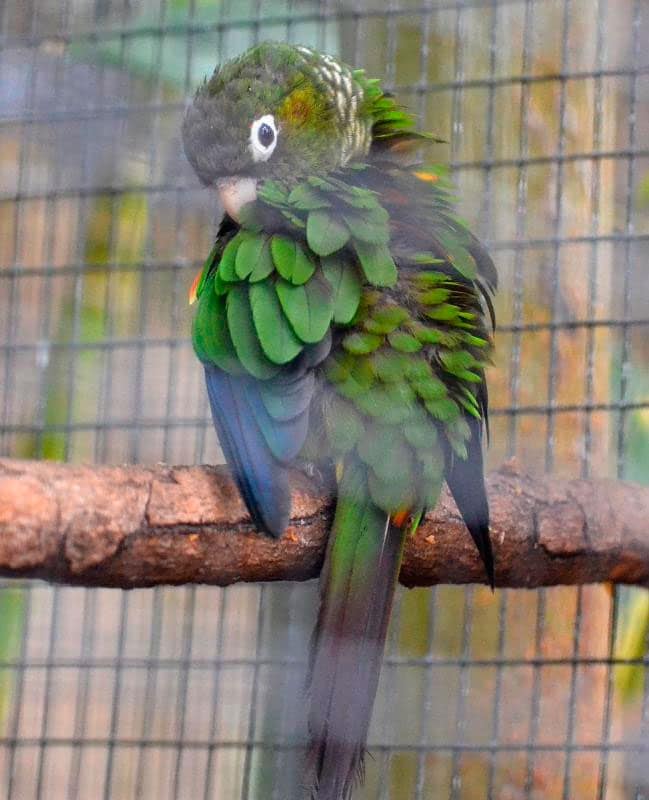
Fiery shouldered Parakeet

25 cm.. height.

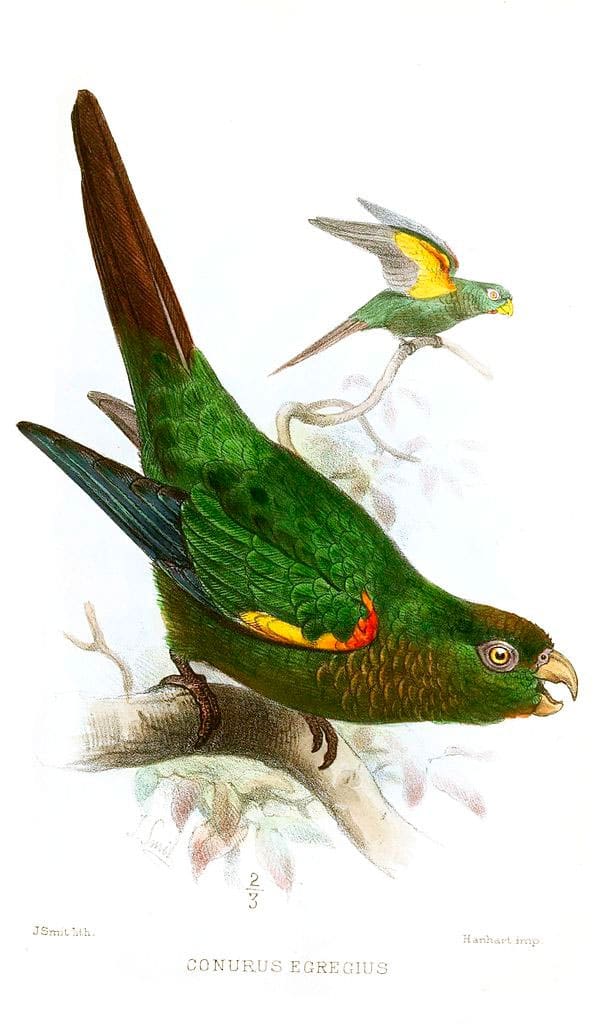
The Fiery shouldered Parakeet (Pyrrhura egregia) has a close frontal band brown; crown, lores, rear area of the neck and upper cheeks, brownish; ear-coverts reddish brown; feathers on the sides of the neck basically green with subterminal band of color beige, narrow dark tips giving a scaly appearance to the whole.

The upperparts Green with dark and narrow edges to some feathers. carpal area and front edge of the wing , Orange with yellow marks; primary coverts usually blue but sometimes colored yellow shiny; upperwing-coverts green. Outerwebs of flight feather, blue. Underwing-coverts marked with yellow orange; bottom of the flight feather gray. feathers in the throat and the chest basically green with the subterminal band Hazelnut color and dark tips, giving a scaly appearance; underparts green, with most of the feathers of the belly Brown at the base and green-tipped, sometimes forming a brown patch. Upper, the tail Brown very dark, green at the base; by down gray.

The bill color horn; skin peri-oftalmica naked white; brown the irises; legs Brown-Black.

Both sexes are similar.

The immature It has much less yellow and orange in the upperwing-coverts and infra-alares; the crown Green and flakes in the chest and on the sides of the neck less pronounced.

Subspecies description:

  • Pyrrhura egregia egregia

    (Sclater,PL, 1881) – The nominal.


  • Pyrrhura egregia obscura

    (Zimmer & Phelps,WH 1946) – Similar to the species nominal but with the upperparts darker green and the underparts also slightly more dark. Patch Brown in the belly less frequent and less prominent.

Habitat:

The species inhabits in humid premontane forests and dense secondary forest on the Tepuis, between 700 to 1800 m. usually in flocks of 7-25 birds.

Reproduction:

Little information on the breeding; is reproduce between March and April with fledged young people between May-June. Period of incubation: 23 Dias.

Food:

There is no information about the diet, except that birds visit Amerindian villages from July to August to feed of fruit of, for example, guavas mature.

Distribution:

Size distribution (reproduction / resident): 49.400 km2

Distribution restricted to the Tepui region in the north-eastern interior of South America. The species is known from Venezuela on Gran Sabana to the southeast of Bolรญvar, in the Mount Roraima and Arabopo and from the Mount Auyan-tepui and the Mt. Ptari-tepui.

Can be found in adjacent areas of the West of Guyana, for example, in the surroundings of the Camaran River and top of the Mazaruni River, the Merume mountains and Pacaraima mountains to the South of Annai.

The reports of Suriname still no confirmed. Probably are distributed in the northeast of Roraima, Brazil.

Inaccessible range and few details about his status, but apparently quite common. Large part of the range Venezuelan included in the Canaima National Park.

Small quantities exported from Guyana to end of the years eighty and subsequently bred in captivity.

Subspecies distribution:

Conservation:

State of conservation โ“˜


minor concern Minor Concern โ“˜ (UICN)โ“˜

โ€ข Current category of the Red List of the UICN: Least concern.

โ€ข Population trend: Decreasing.

Justification of the population

The population size World has not been quantified, but this species is described as ยซquite commonยป (Stotz et to the., 1996).

Justification of trend

It is suspected that this species has lost 3.3-10.5% of habitat suitable within their distribution during three generations (18 years), based on a model of Amazon deforestation (Soares-Filho et to the., 2006, Bird et to the., 2011). Given the susceptibility of the species to hunt or capture, It is suspected that will decrease in <25% durante tres generaciones.

"Fiery shouldered Parakeet" in captivity:

Intelligent, relatively calm and playful. Young birds are very shy.
They are aggressive with other birds and it is very rare in captivity, with small quantities exported from Guyana at the end of the 1980s and subsequently raised in captivity.

Price per couple: 300-400 EUR.

Alternative names:

Fiery-shouldered Parakeet, Fiery shouldered Parakeet, Fiery-shoulderd Conure, Fiery-shouldered Conure (English).
Conure aile-de-feu, Perriche aile-de-feu, Perruche aile-de-feu (French).
Feuerbugsittich, Feuerbug-Sittich (German).
tiriba-de-cauda-roxa (Portuguese).
Cotorra Egregia, Perico de Cola Morada, Perico colimorado (espaรฑol).
Perico de Pantepui (Venezuela).


scientific classification:

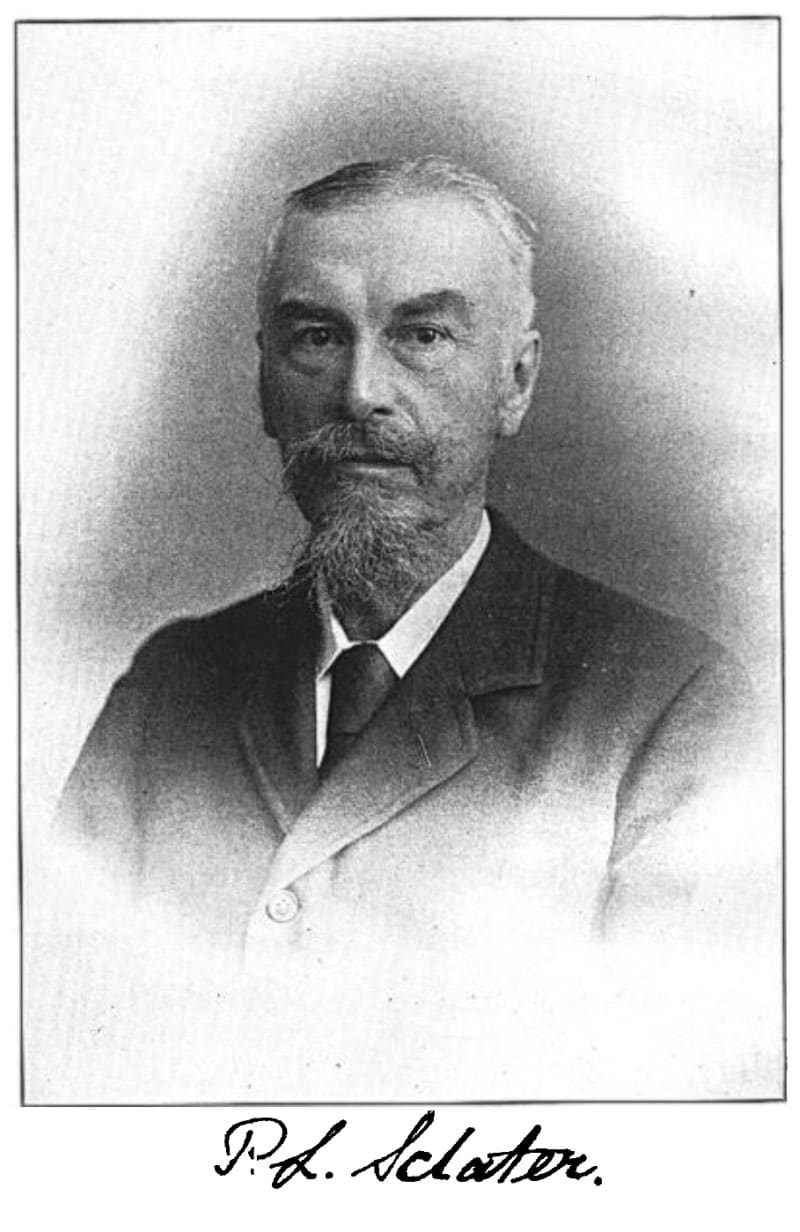
Philip Sclater
Philip Sclater

Order: Psittaciformes
Family: Psittacidae
Genus: Pyrrhura
Scientific name: Pyrrhura egregia
Citation: (Sclater, PL, 1881)
Protonimo: conurus outstanding


Fiery shouldered Parakeet images:

Videos "Fiery shouldered Parakeet"

Fiery shouldered Parakeet (Pyrrhura egregia)


Sources:

Avibase
– Parrots of the World โ€“ Forshaw Joseph M
– Parrots A Guide to the Parrots of the World – Tony Juniper & Mike Parr
– Birdlife

Photos:

(1) – Demerara Conure By Gazelle74 (Own work) [CC BY-SA 4.0], via Wikimedia Commons
(2) – Demerara female ยซat workยป. These little parrots love to gnaw at wood, paper and many other things By Gazelle74 (Own work) [CC BY-SA 4.0], via Wikimedia Commons
(3) – Fiery-shouldered Parakeet (Pyrrhura egregia) by Margareta Wieser. A pair perching on a branch – HBW
(4) – Fiery-shouldered Parakeet (Pyrrhura egregia) by Andrew Emmerson. An adult bird – HBW
(5) – Fiery-shouldered Parakeet (Pyrrhura egregia) by Andrew Emmerson. An adult preening – HBW
(6) – Conurus egregius ยป = Pyrrhura egregius (Fiery-shouldered parakeet) by John Gerrard Keulemans [Public domain], via Wikimedia Commons

Sounds: (Xeno-canto)
โ–ท The world of Pets: Dogs, cats, birds, reptiles, amphibians

Norfolk Island Kaka
Nestor productus โ€ 

Norfolk Island Kaka

Content

Description:

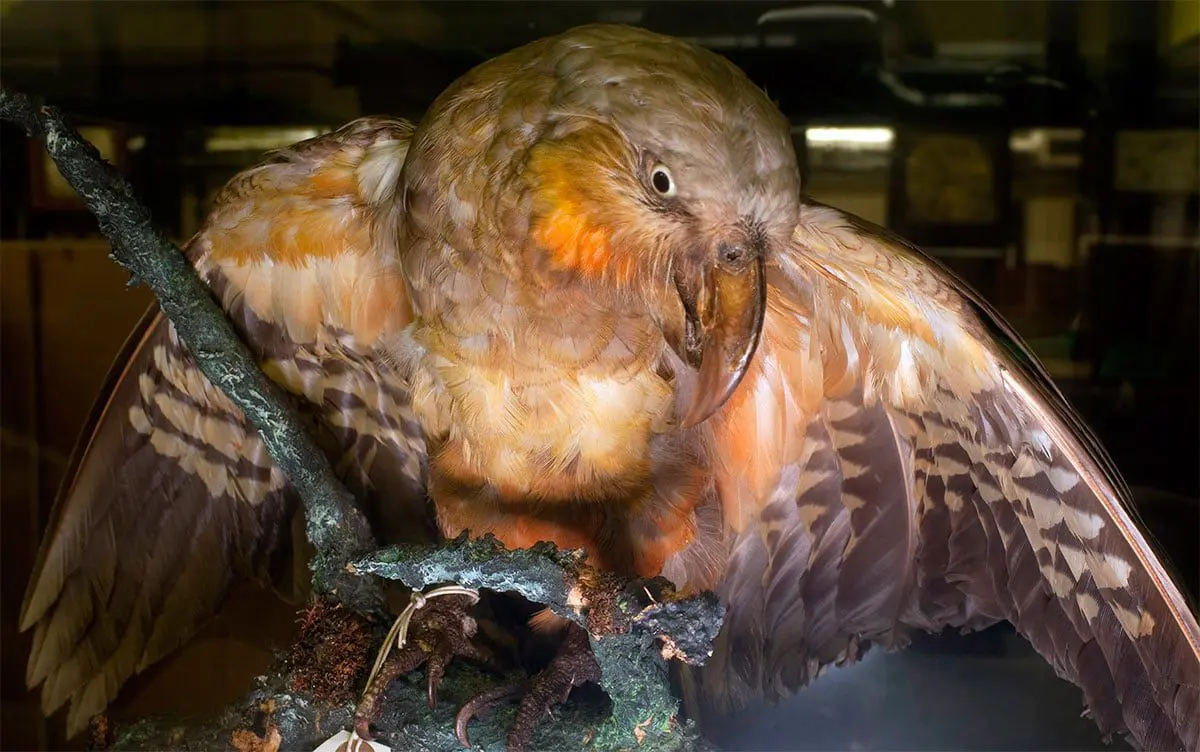
The Norfolk Island Kaka (Nestor productus) was their large with a bill, wings short and wide, and with legs and feet large.

Norfolk Island Kaka

I had 38 centimeters long. The top of his head era gris pardusca, while its face varied from yellow to orange, sometimes with a reddish tint. It was said that his Hip It was greenish yellow, and upperparts, including the wings, they were mostly greyish-brown in color, slightly darker than the top of the head, with the bottom of the back and rump orange or dark red and the tail brown. Upper chest It was brown and gray bottom bright yellow, with the belly and sides reddish orange (Forshaw & Cooper 1981, 2002; Greenway 1958).

Its social structure and dispersion are not registered, but the Norfolk Island Kaka of New Zealand, he watched alone or in small groups of up 10 individuals (Higgins 1999).

Habitat:

Habit in the native forest in the Norfolk Island and about Phillip Island (Greenway 1958). The species could be observed both in the canopy of tall trees, and soil, the rocks (Gould, 1865, Greenway 1958).

Given its endemism in the Norfolk Island, the Norfolk Island Kaka It was presumably sedentary.

Reproduction:

Little is known of reproductive cycle of the Norfolk Island Kaka; just put on record of four eggs in tree holes (Gould 1865).

Food:

It is known that he fed on nectar Flowers tree white wood (Lagunaria) (Gould 1865). Definitely should be more varied. The captive birds they ate lettuce and the leaves of other vegetables, as well as dairy meals and fruit juice (Gould 1865). Presumably he foraged in both the soil and the canopy (Gould, 1865).

Distribution:

Its range was about 15,5 hectares.

It was endemic to the Norfolk island (in Australia) and nearby Phillip Island, Australia. It became extinct in the wild in mid-century 19 on Norfolk Island, and possibly a little later Phillip Island.

The species is believed to have had a very limited ability to move between islands., and probably he spent his whole life on the island of his birth (Gould, 1865).
In the Norfolk Island Kaka occasionally kept in captivity, as the birds were gentle and easy to capture alive (Gould 1865). The species He survived in captivity until after it had become extinct in the wild (Greenway 1958). There are no known captive populations and none has been reintroduced into the wild. The last known living bird was in captivity in London in 1851 (Garnett et to the., 2011).

No made extensive studies for this species. But, there have been a series of ornithological studies in the Norfolk Island since the species disappeared from the island (p.ej. Bell 1990, Robinson 1988, Schodde et al., 1983, Smithers y Disney 1969), no signs have been found of the species.

Conservation:

โ€ข Current category of the Red List of the UICN: extinct.

Rationale for the Red List category

This species was known in the Norfolk Island, but it was Extinguished to mid 1800. It is believed that the elimination of habitat and hunting have been the main drivers.

According to reports, was tame and, Therefore, hunted strongly convicts and early settlers and easily trapped as a pet.

No information is available on the population size before its decline.

"Norfolk Island Kaka" in captivity:

They were captured by his meekness and they were common in the Norfolk Island

Alternative names:

Norfolk Island Kaka, Norfolk Island Kea, Norfolk Island Parrot, Norfolk Kaka (English).
Nestor de Norfolk (French).
Dรผnnschnabelnestor, Norfolkkaka, Norfolk-Kaka (German).
Kฤkฤ-de-norfolk (Portuguese).
Kaka de Norfolk (espaรฑol).

John Gould
John Gould

scientific classification:


Order: Psittaciformes
Family: Strigopidae
Genus: Nestor
Scientific name: Nestor productus
Citation: (Gould, 1836)
Protonimo: produced Plyctolophus


ยซNorfolk Kakaยป Images:

————————————————————————————————

Norfolk Island Kaka (Nestor productus)


Sources:

Avibase
– Parrots of the World โ€“ Forshaw Joseph M
– Parrots A Guide to the Parrots of the World – Tony Juniper & Mike Parr
Birdlife
– Australian Government – Department of the Environment and Energy (Nest produced - Norfolk Island Kaka)

Photos:

(1) – Natural Science Curatorial Trainee – Birminghamโ€™s Norfolk kaka
(2) – Nestor productus Gould, 1836 by Huub Veldhuijzen van Zanten / Naturalis [CC BY-SA 3.0], via Wikimedia Commons
(3) – Nestor productus By Gould, 1836 [CC BY-SA 3.0], via Wikimedia Commons
(4) – Norfolk Island in Kaka (Nestor productus). The last bird in captivity died in London in 1851. Specimen from the Zoological Museum in Firenze, Italy by Thomas WesenerFlickr
(5) – Nestor productus By Gould, 1836 [CC BY-SA 3.0], via Wikimedia Commons
(6) – The Norfolk Island in Kaka (Nestor productus) from the plate in the Bulletin of the Liverpool Museum. From the specimen in the Tring Museum by John Gerrard Keulemans [Public domain], via Wikimedia Commons

โ–ท The world of Pets: Dogs, cats, birds, reptiles, amphibians

White-fronted Parrot
Amazona albifrons

White-fronted Parrot

Content

Description:

22 to 26 cm.. length.

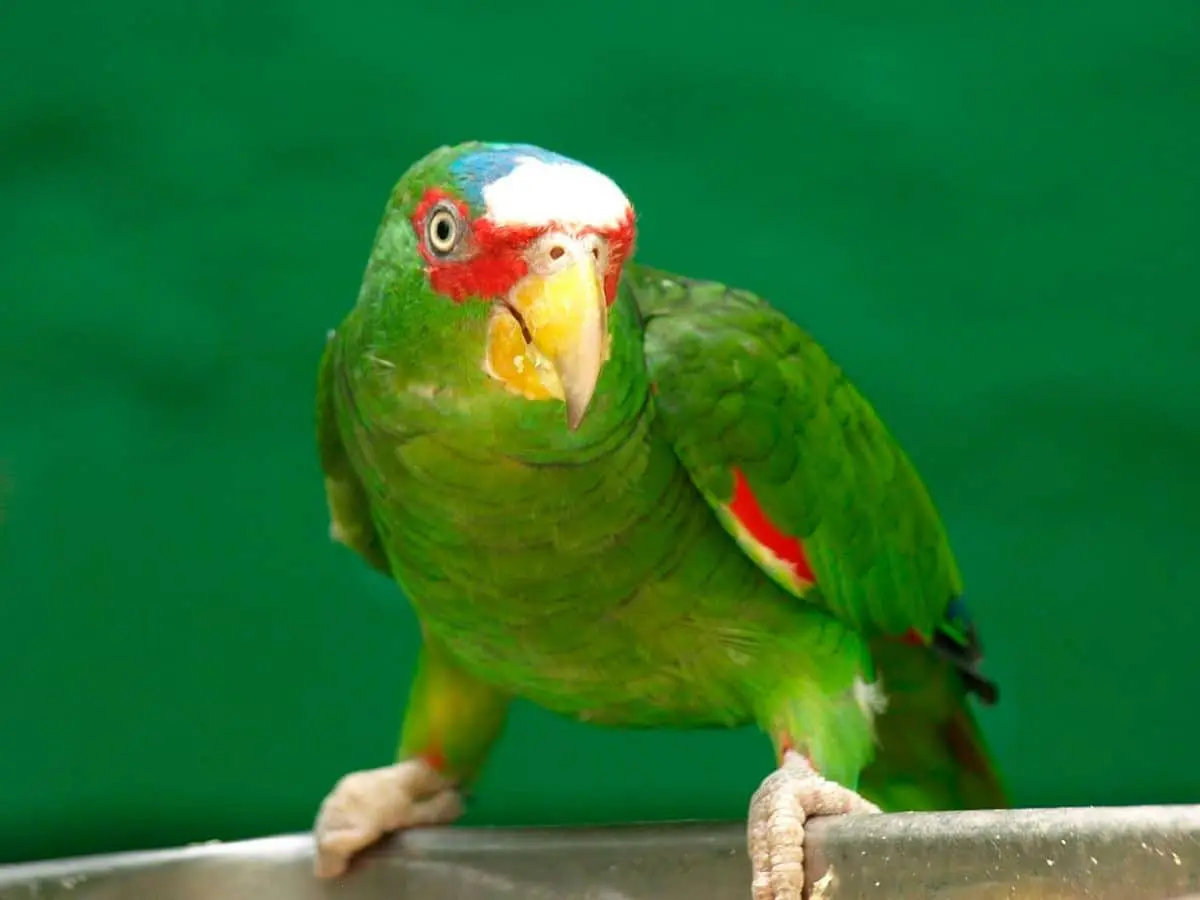
The White-fronted Parrot (Amazona albifrons) has the forecrown white; lores, upper cheeks and ring of feathers around eyes, red; the crown pale blue mingles with the green nape; the feathers with dark margins; sides neck green with narrow black margins. Mantle, back and scapulars, grass-green, sometimes with olive tint; the mantle with indistinct black tips; rump green, perhaps more emerald colors than the rest of the upperparts.

big blankets and alula, red, other coverts green. The outerweb of the primaries, green, They turn blue at the tips; outerweb of the secondaries, blue; innerwebs of the flight feather, blackish. Under, the wings bluish green. Underparts green with weak blackish edges to feathers on throat and the chest. Upper, the tail It is yellow in the center, outer feathers red at the base, blue in the outerweb. Bill light colored horn, darker at the tip; bare periophthalmic pale grey; irises pale yellow; legs pale grey.


Anatomy-parrots

It presents an undistinguished sexual dimorphism. The female It differs from the male in the red face It is limited to the region eye ring and it lacks the red hue in wing coverts. The immature male It looks like female but with red on the primary coverts.

  • Sound of the White-fronted Parrot.

Description 3 subspecies:

White-fronted Parrot

  • Amazona albifrons albifrons

    (Sparrman, 1788) – Nominal.


  • Amazona albifrons nana

    (Miller,W, 1905) – smaller the species nominal. Little differentiated from nominal but the green plumage It is perhaps paler, yellower. Some individuals Coast peaceful show some red on the throat.


  • Amazona albifrons saltuensis

    (Nelson, 1899) – Similar to the nominal but the plumage It is heavily steeped in blue. The blue of the crown It extends to the nape.

Habitat:

This adaptable Amazona uses all kinds of wooded habitats and open field with trees, including seasonally moist semi-evergreen semi-evergreen forest (especially at the edge), pine forests, gallery forest, agricultural land with open woods, savannah and tropical arid scrub with cactus, tending to more frequent open areas in the caribbean side.

Usually they prefer drier forests, but where it is simpรกtrica with Yellow-lored Parrot (Amazona xantholora), tends to prefer more humid and closed vegetation.

In Yucatan the White-fronted Parrot inhabit coastal coconut plantations while breeding. In altitudes of 900 m (Oaxaca), 1.800 m (Honduras) and 1.500 m (Sonora meridional: register only known outside the tropics).

In pairs during the breeding season but usually gregarious, distributed primarily in small groups, with occasional concentrations of hundreds of birds and some communal roosts (for example, mangroves) with several thousand birds.

Reproduction:

Video – "White-fronted Parrot"

Chauรก(Amazona Rhodocorytha) - Red-browed Parrot

The White-fronted Parrot nest in trees, cavities of the palm tree termitarium, sometimes in the cavity dug by some woodpecker. species trees Bursera simaruba and Caesalpinia gaumeri are among the favorites to nest in Yucatan. Breeding January July, depending on the location.

A clutch contains 3-5 eggs. Only the female incubates. The incubation lasts around 24 days.

Food:

Registered foods include guilt of Acacia gaumeri (Yucatan), fruits of Lemaireocereus thurberi and Pachycereus and cocoons of Jatropha cordata (Sonora), Ehretia tinijolia and Metopium browneii (Campeche); They also feed on cultivated fruits like mango and grain, including corn. Birds often get excited and shout while feeding.

Distribution and status:

Size of its range (breeding/resident ): 2.330.000 km2

The White-fronted Parrot They extend Mexico, from the South of Sonora (north to about 28 ยฐ N) along the Sinaloa and West Durango south through the Pacific region to Oaxaca and north through Tehuantepec isthmus the Atlantic coast in southern Veracruz and to the East by Tabasco the entire Yucatan Peninsula, including northern Guatemala and Belice.

They are present in southern Chiapas and in the lowlands of the Guatemalan Pacific and, reportedly, in West El Salvador, extending through the lowlands of peaceful, arid and Caribbean lowlands Honduras to the Pacific Northwest Costa Rica and Nicaragua (where distribution is not detailed).

Mainly seasonal residents but visitors in some parts of the range (for example, Yucatan, El Salvador western and eastern mountains Guatemala).

Introduced in urban areas Cozumel Island, in the State of Quintana Roo (Mexico). Their presence only in urban areas of the island, the ability of the species to live successfully in urban areas, the abundance of fruit trees and use as a pet by the islanders allows us to suggest that registered individuals are the result of leakage or were released by their owners.

Usually common and together with the Orange-fronted Parakeet (Eupsittula canicularis), It is the largest parrot in the Pacific slope of Central America; although obviously scarce in some areas. The deforestation It is possibly promoting increases in population Caribbean slope of Central America. Captured for the pet trade and hunted as food, for example in Yucatan, where recently there has been a population decline due to the persecution of parrots that feed on fruit after loss of wild foods cultivated by Hurricane Gilbert. Its capture It is authorized only during the months of October to February in the states of Warrior, Jalisco, Michoacรกn, Oaxaca, Sinaloa and Tabasco and from September to January in Veracruz.

Distribution 3 subspecies:

  • Amazona albifrons albifrons

    (Sparrman, 1788) – Nominal. Pacific Coast of Mexico from Nayarit to Oaxaca and South of Chiapas in the lowlands Guatemalan Pacific. Birds in the northern Guatemalan lowlands and the arid interior, they can refer to the subspecies Amazona albifrons nana.


  • Amazona albifrons nana

    (Miller,W, 1905) – Veracruz until Costa Rica, including all yucatan peninsula.


  • Amazona albifrons saltuensis

    (Nelson, 1899) – Sonora, Sinaloa and Durango, in Mexico.

Conservation Amazona:

State of conservation โ“˜


minor concern Minor Concern โ“˜ (UICN)โ“˜

โ€ข Current category of the Red List of the UICN: Least concern.

โ€ข Population trend: Increasing.

Rationale for the Red List category

โ€ข This species has a very large range and therefore it is not close to the thresholds for Vulnerable under the criterion of size range (Extent of occurrence below 20,000 km2 combined with a size decreasing or fluctuating range, extension / habitat quality or population size and a small number of sites or severe fragmentation).

โ€ข The trend of population appears to be increasing and, therefore, the species does not approach the thresholds Vulnerable under the criteria of population trend (Wholesale 30% decrease in ten years or three generations).

โ€ข The population size is very large and, therefore, not approaching the thresholds for vulnerable under the criterion of population size (less than 10.000 mature individuals with continuing decline estimated a higher percentage of 10% in ten years or three generations or with a specific population structure).

โ€ข For these reasons the species is evaluated as the least concern.

Justification of the population

โ€ข Partners in Flight estimated that the total population of 500.000-4.999.999 individuals (A. Panjabi in a bit., 2008).

Justification of trend

โ€ข The population is suspected to be increasing as habitat degradation is creating new areas of suitable habitat.

The White-fronted Parrot in captivity:

Due to the decline of these birds in the wild, especially in the Mexican populations, the White-fronted Parrot is now, unlike other times, offered for sale only rarely. It also, among birds received by importers, the males generally far outweigh the females so it's hard to find a partner.

According to many observations, the White-fronted Parrot captured still quite shy and unsociable, especially if they were mature when they were trapped. The birds immature, which can be stained by the yellowing of his crown, relatively well sympathize with their caregivers and are easily adapted to a life in a cage or aviary. It is said to have some talent to imitate.

According to sources, the first hatchlings in captivity They were born in 1949 in the United States by I.D. Putman; the second in 1977 on German Federal Republic by H. Mรผller (Walsrode) and a third set in Switzerland in 1979; Since then several European poultry farmers have reported breeding successes.. The latest report came in 1985 from the bird park Metelen Heide in Muen-sterland (Western Germany). there a clutch five eggs produced four hatchlings in mid-June 1984 after an incubation period of 28 days. The young left the nest after about 70 days, but they were still actively cared for and fed, mainly by the parent, for a few weeks more.

Its price in the European market round 1000 EUR. generally silent the Amazons largest. It can be noisy just before and during the breeding season.

These birds can become aggressive in breeding season and can attack the caregiver. The nest boxes are better positioned to nest inspection can be performed from outside the aviary. The inspection of the nest is best when adult birds are out of the nest, however captive breeding has rarely been achieved between individuals.

Susceptible to intestinal infections during the acclimatization period.

Their life expectancy can overcome the 50 years.

Alternative names:

White-fronted Parrot, Spectacled Amazon, Spectacled Parrot, White fronted Parrot, White-browed Amazon, White-browed Parrot, White-fronted Amazon (English).
Amazone ร  front blanc, Amazone ร  lunettes (French).
WeiรŸstirnamazone (German).
Papagaio-de-testa-branca (Portuguese).
Amazona de Frente Blanca, Amazona Frentialba, Cotorra Frentiblanca, Lora frentiblanca, Loro Frente Blanca, loro frente-blanca, Loro Frentiblanco, Cotorra Guayabera (espaรฑol).
Cabeza de Manta, Loro Manglero, Cocha, Cocho, Cucha (Mexico).


Scientific classification Amazona albifrons:

Anders Sparrman

Order: Psittaciformes
Family: Psittacidae
Genus: Amazona
Scientific name: Amazona albifrons
Citation: (Sparrman, 1788)
Protonimo: Psittacus albifrons


Images White-fronted Parrot:


Species of the genus Amazona


Sources:

  • Avibase
  • Parrots of the World โ€“ Forshaw Joseph M
  • Parrots A Guide to the Parrots of the World – Tony Juniper & Mike Parr
  • Birdlife
  • The New Parrot Handbook by Werner Lantermann,Matthew M. Vriends

Photos:

(1) – White-fronted Amazon By David Oliva (originally posted to Flickr as Cotorro 007) [CC BY 2.0], via Wikimedia Commons
(2) – White-fronted Amazons in Schรถnbrunn Zoo By spacebirdy(also known as geimfygliรฐ (:> )=| made with Sternenlaus-spirit) (Own work) [CC BY-SA 3.0 or FAL], via Wikimedia Commons
(3) – white-fronted amazon (Amazona albifrons) By Christoph Anton Mitterer (Flickr: P8155550) [CC BY-SA 2.0], via Wikimedia Commons
(4) – White-fronted Amazon Amazona albifrons pair perching in a tree at Guanacaste, Costa Rica By Steve Jurvetson (originally posted to Flickr as love birds) [CC BY 2.0], via Wikimedia Commons
(5) – White-fronted Amazon, (Amazona albifrons). A pet parrot on a perch. Red feathers on this parrots shoulders indicate that it is a male By โžจ Redvers (Flickr) [CC BY 2.0], via Wikimedia Commons
(6) – White-fronted Amazons in Schรถnbrunn Zoo By spacebirdy(also known as geimfygliรฐ (:> )=| made with Sternenlaus-spirit) (Own work) [CC BY-SA 3.0 or FAL], via Wikimedia Commons
(7) – A captive White-fronted Amazon in Copรกn Ruinas, Copรกn, Honduras By Troy from Charlottesville, USA (Flickr) [CC BY-SA 2.0], via Wikimedia Commons
(8) – A White-fronted Amazon – upper body by sumba [CC BY 2.0 of], via Wikimedia Commons
(9) – A pet juvenile White-fronted Amazon in Poole, Dorset, England By Kyle Payne from England (Odd Looking Seagull) [CC BY-SA 2.0], via Wikimedia Commons
(10) – White-fronted Amazon, Amazona albifrons, Remove alone B. Planet EarthFlickr

Sounds: Richard E. Webster, XC353211. accessible www.xeno-canto.org/353211

โ–ท The world of Pets: Dogs, cats, birds, reptiles, amphibians

Saint Lucia amazon
Amazona versicolor

Saint Lucia amazon

Content

Description:

43 cm.. length and 700-800 g. of weight.

Saint Lucia amazon

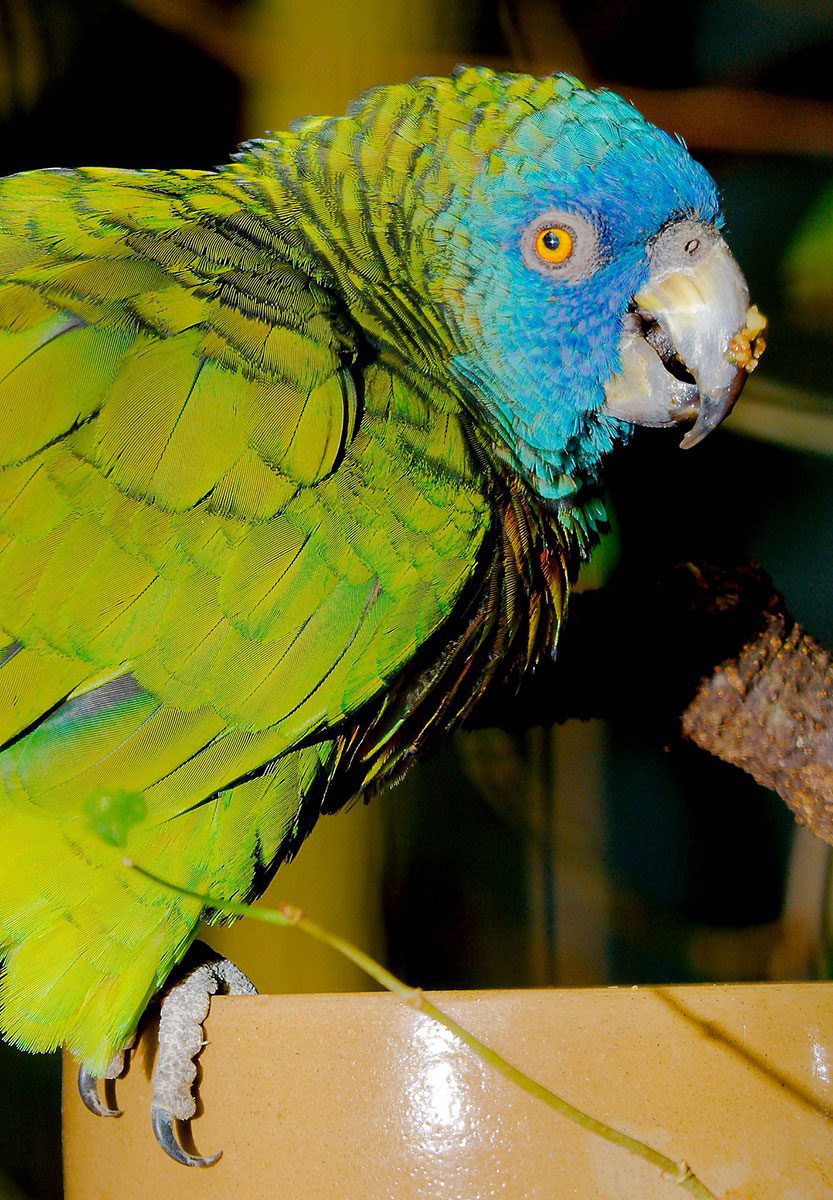
The Saint Lucia amazon (Amazona versicolor) has the lores, cheeks and forecrown, bright blue; crown, ear-coverts and lower cheeks, paler blue with iridescent emerald suffusion from some angles; dark tips to feathers on head.

Hindneck neck, nape and upperparts, yellowish-olive, many feathers with visible black tips, giving the whole a barred effect strong, especially in the upper region. Wing coverts yellowish green olive. Primary coverts dyed blue, rest with black tips to some feathers. Primaries blue; bases of external secondarys forman speculum red, blue tips; secondary internal green and blue at the base to the tips. Underwing, yellowish green with blackish tips to some feathers; flight feather bluish green. Chin and throat, bright blue with blackish tips to feathers; tips of feathers on lower throat and top of the chest, bright red forming a patch distinct red patch or mottled red area; chest and belly rather yellowish-green, blackish tips and brick red in the subterminal area of some feathers, giving scalloped appearance with scattered rusty patches; the thighs and undertail-coverts, green-yellow. Tail bluish green in the center, outer feathers green with large yellowish green tips and hidden red bases. Bill grey; irises orange; legs grey.


Anatomy-parrots

Probably no sexual dimorphism.

Immature has irises brown.

  • Sound of the Saint Lucia amazon.

Habitat:

Video "Saint Lucia amazon"

Mainly they inhabit the canopy montana primary rainforest, but they make inroads into areas of secondary growth to feed. Reported flocks of up 20 birds. living forms community.

Reproduction:

They nest in tree hollows. Nests observed in trees Dacryodes excelsa, Pouleria and Tetracera caribaeum. breeding season in February-August. Clutch usually two eggs, although, usually, only one young per nest thrives.

Food:

Its diet includes flowers and fruits of Clusia, Fruits of Talauma dodecapetala, Acrocomia irenensis, Pouleria, Dacryodes excelsa, Sloanea massoni, Byrsonima martinicensis, Miconia mirabilis, Pterocarpus officinalis and Euterpe globosa; also they have been seen feeding on bananas after the hurricane and presumably due to the depletion of natural food sources. Absence of common areas from August to November possibly linked to the lack of fruitfulness of Clusia.

Distribution and status:

Size of the area of distribution (raising / resident): 230 km2

Confined to St. Lucia in the Lesser Antilles, now in the central and southern mountains, although formerly you were more widespread everywhere where the humid forest grew. The species has suffered a contraction of the range since the nineteenth century and now It occupies an area of รขโ‚ฌโ€นรขโ‚ฌโ€นonly 65-70 km2 from Millet and Mont Lacombe in the North, until Mont Beucop and Calfourc in the East, Piton Pig, St Piton, St Desrache and Big store in the south to Morne Gimie in the west and Mont Houlemon in the Northwest. The results of studies on the species suggest that the southwestern part of this area is the most densely populated of parrots, while relatively few live in the northeast.

Plentiful mid-nineteenth century, but decreasing rapidly to very little in the early twentieth century. Subsequently they recovered, with an estimated population of 1.000 birds in 1950. They declined again sixties, mostly due to hunting; observations in 1977 They estimated that there were more than 100 birds. steady increase since then with an estimated population of 300-350 birds in 1990.

The threats main arise from habitat loss and its hunting for food and pet trade as. Forestry practices that lead to the removal of mature trees (favorite breeding sites) could put additional pressure. They seem to be less susceptible to hurricanes than their counterparts in Dominica, but this may be due to conservation efforts rather than any intrinsic ability to withstand the effects of severe storms.

Can compete for nesting sites with Pearly-eyed Thrasher (Margarops fuscatus), which it has increased considerably since 1950.

Amazona versicolor Conservation:

State of conservation โ“˜


Vulnerable Vulnerable โ“˜ (UICN)โ“˜

โ€ข Current category of the Red List of the UICN: Vulnerable.

โ€ข Population trend: In increased.

โ€ข Population size : 230-330

Rationale for the Red List category

Conservation action may have saved this species from extinction. Numbers are now increasing and there is some evidence of a small range extension.. But, the habitat area apparently adequate (but vacated) It may be waning. If this begins to affect the habitat occupied, the species can be described as danger of extinction. In the news, its small population size and small size on one island are calling it Vulnerable.

Justification of the population

The population is estimated at 350-500 individuals, approximately equal to 230-330 mature individuals.

Justification of trend

No new data on population trends, so it is assumed that the species continues increasing.

Threats

The human population St. Lucia It is growing at a considerable rate, increasing the pressure on the forest and resulting in habitat loss (Copsey 1995). The selective logging of mature trees You can significantly reduce breeding sites (Juniper and Parr 1998), and hurricanes, the hunting and the trade pose new threats. There have been recent efforts to raise the moratorium on hunting within forest reserves, what would seriously threaten this species (J. D. Gilardi in litt., 1999).

Conservation Actions Underway
Coat of arms of Saint Lucia

Appendices I and II of CITES. This protected by national legislation (J. D. Gilardi in litt., 1999).

Education programs and awareness have made this bird in a National symbol.

This has eliminated successfully hunting (Juniper and Parr 1998), helped by a moratorium on hunting within forest reserves (J. D. Gilardi in litt., 1999).

In 1975 program was established captive breeding, and in 1995 had developed a total of 19 young birds (Copsey, 1995).

Conservation Actions Proposed

Maintain the moratorium on hunting within all forest reserves. Conduct a studyo Basic feeding and breeding ecology. Designate the remaining habitat protected areas. Reassess the objectives of the program captive breeding.

The Saint Lucian Amazon in captivity:

extremely rare; currently only it found in the Jersey Zoo

Appendices I and II CITES. This protected by national legislation.

Each captive specimen of this species which is capable of reproducing, It is placed in a well-managed program captive breeding and not be sold as a pet, with the objective of ensure their survival long-term.

Alternative names:

Blue-masked Amazon, Blue-masked Parrot, St Lucia Amazon, St Lucia Parrot, St. Lucia Amazon, St. Lucia Parrot, St.Lucia amazon, Versicolored Parrot, Versicoloured Parrot (English).
Amazone de Sainte-Lucie, Amazone versicolore, Amazone versicolore de Sainte-Lucie (French).
Blaumaskenamazone, Blaustirnamazone (German).
Papagaio-de-santa-lรบcia (Portuguese).
Amazona de Santa Lucia, Amazona de Sta. Lucia (espaรฑol).

Scientific classification Amazona versicolor:

Order: Psittaciformes
Family: Psittacidae
Genus: Amazona
Scientific name: Amazona versicolor
Citation: (Statius Mรผller, 1776)
Protonimo: Psittacus versicolor

Saint Lucia Amazon Images:

Attention: The internal data of table โ€œ19โ€ is corrupted!

Species of the genus Amazona


Sources:

  • Avibase
  • Parrots of the World โ€“ Forshaw Joseph M
  • Parrots A Guide to the Parrots of the World – Tony Juniper & Mike Parr
  • Birdlife

Photos:

(1) – Saint Lucia Parrot(Amazona versicolor) by Josh MoreFlickr
(2) – Chrysotis bouqueti (a.k.a. Amazona versicolor, the St. Lucia amazon, or the St. Lucia parrot) by Joseph Smit [Public domain], via Wikimedia Commons

Sounds: Allen T. Chartier, XC9438. accessible www.xeno-canto.org/9438