▷ The world of Pets: Dogs, cats, birds, reptiles, amphibians

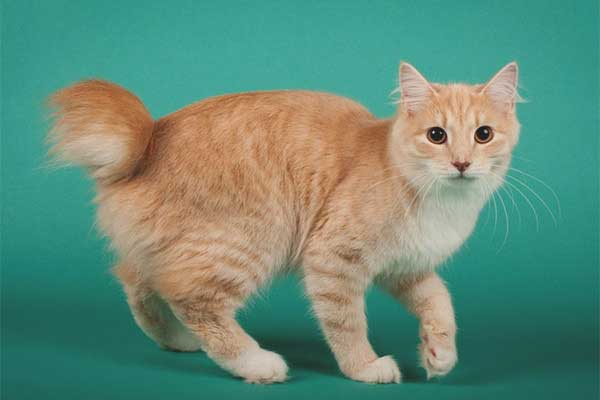
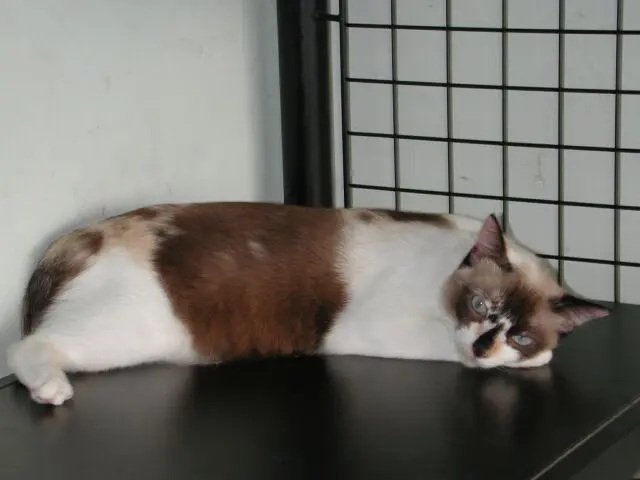
Minskin cat
Federations: TICA

Even in his homeland, United States, the Minskin remains unknown. Breeders of the breed can be counted on the fingers of one hand, so the annual number of births is extremely limited.

Content

Characteristics "Minskin cat"

Coexistence is important that you have with your new friend. Before considering the acquisition of a cat of the breed "Minskin cat" you know certain factors. You must take into account their character, their need for exercise, their interaction with other pets, their care and if you have small children, their level of tolerance towards them.

Joy

5,0 of 5 stars (based on 1 review)

Activity level

4,0 of 5 stars (based on 1 review)

Friendliness to other pets

5,0 of 5 stars (based on 1 review)

Friendliness to children

4,0 of 5 stars (based on 1 review)

Grooming requirements

1,0 of 5 stars (based on 1 review)

Vocality

3,0 of 5 stars (based on 1 review)

Need for attention

4,0 of 5 stars (based on 1 review)

Affection towards its owners

5,0 of 5 stars (based on 1 review)

Docility

4,0 of 5 stars (based on 1 review)

Intelligence

4,0 of 5 stars (based on 1 review)

Independence

2,0 of 5 stars (based on 1 review)

Hardiness

4,0 of 5 stars (based on 1 review)

History

the atypical Minskin is the result of the will of Paul McSorley, an American breeder of Munchkin based in Boston (Massachusetts) that one day he set out to create a breed of cat with no hair and short legs, hence the name he gave it, given that "min» is short for «miniature» and «skin» refers to your skin.

To achieve your goal, in 1998 crossed a specimen from his kennel with a Sphynx cat (Canadian Sphynx). In fact, the most striking feature of Munchkin cat is having very short legs, while that of the Sphynx is having skin without hair or with hair on the ends (legs, tail, ears and face mask). This crossover allowed him to combine the two characteristics he wanted.

Next, continued his breeding program by introducing the American Burmese cat and the Devon Rex. He wanted to expand the genetic pool and recover certain physical and temperamental traits of these breeds.

How the first generations did not give the expected results, Paul McSorley had to wait until July 2000 to get the first kitten that met your expectations. For the next five years, were born no less than 50 short-legged, hairless cats.

Recognition by official bodies

"Minskin cat"

Minskin
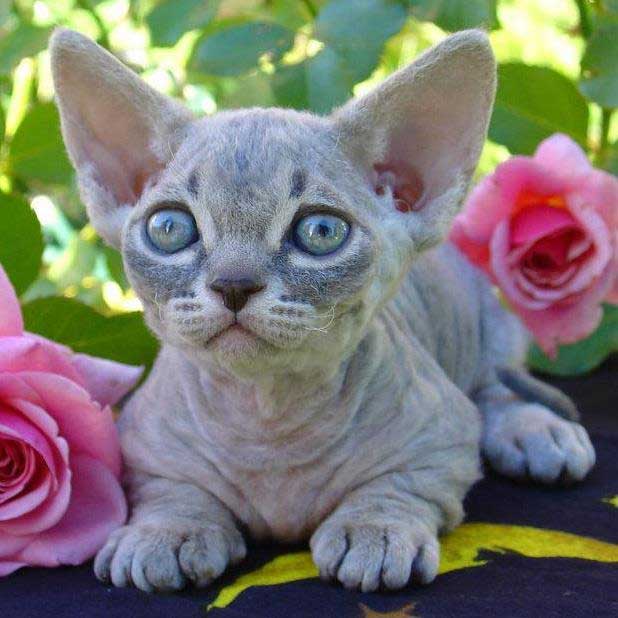
Minskin kitten photo taken in Massachusetts by Minskin breed founder Paul McSorley – Paulmcsorley, CC BY-SA 3.0, via Wikimedia Commons

The short legs of the Minskin, characteristic that it shares with its ancestor Munchkin cat, correspond to a delay in the growth of bones that contain. Thus, all four limbs do not grow as large as the rest of the body, which has a medium size.

This is due to a spontaneous genetic mutation associated with a dominant gene.. In other words, an individual only needs to have one copy of the gene to have this particularity. This also implies that kittens can inherit the gene even if only one parent has it..

This morphological characteristic explains that the Munchkin has always been a source of debate and controversy. Following the example of the International Cat Association (TICA) or Livre Officiel des Origines Félines (LOOF), some feline reference organizations have recognized it, but other associations, on the other hand, refuse to take the plunge: the fact that the race is based on a genetic anomaly puts them back.

It is no wonder that the Minskin has inherited the controversies associated with his ancestor: the fact that it is a recent feline breed is by no means the only explanation why its recognition by global or national feline institutions remains almost non-existent at the moment.

The TICA was an exception and recognized it as an experimental breed in 2008. Next, closely followed by the organization's genetics committee, whose mission is to control the work of the breeders and supervise the development of the breeds. In 2019, the organization eventually reversed its decision and no longer recognizes the breed.

Popularity

The Minskin it is one of the rarest cat breeds in the world. The fact that it is not (yet?) recognized by the main feline organizations does not favor, Obviously, its development, not to mention that some breeders are reluctant to develop a breed based on a genetic abnormality.

Even in his homeland, United States, the Minskin remains unknown. Breeders of the breed can be counted on the fingers of one hand, so the annual number of births is extremely limited.

Physical characteristics

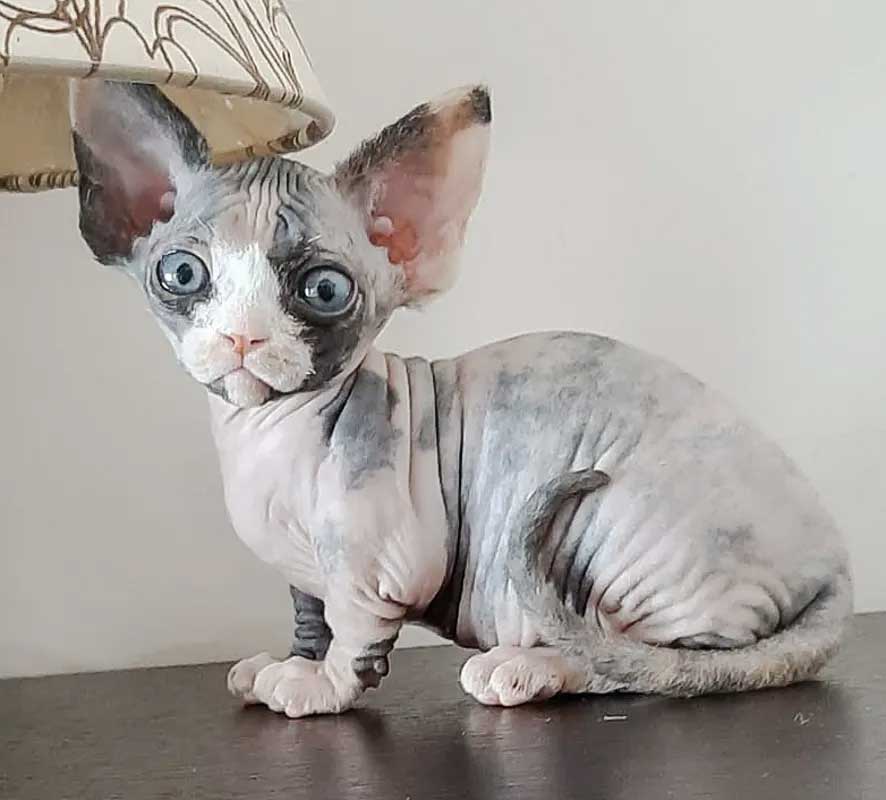
The Minskin has a particularly original look, and rarely leaves anyone indifferent. Almost hairless, it is small in size and has short legs that keep it close to the ground.
Minskin
Minskin – The Discerning Cat

Size and weight

  • Male size: 18 to 20 cm.
  • female size: 18-20 cm.
  • Male weight: 2 to 3 kg
  • female weight: 2 to 3 kg

Morphology

The Minskin it is a medium length dog (semi-cobby). Long but small to medium in size, his body is made of solid bones and strong muscles. The chest is broad and strong. As it grows, keeps her cute kitty look.

The Minskin it is distinguished by its very short legs of equal length. They can make your body appear longer than it actually is, but they do not impede their agility: it is quite comparable to other cats.

The feet are round and compact, in line with the legs and pointing forwards, which gives the cat a solid foundation.

However, It should be noted that this particularity inherited from his ancestor the Munchkin cat is not exempt from debate. It is the result of a genetic mutation that corresponds to a delay in the growth of the bones of the four extremities.

Tail

The back of the Minskin it is flat and ends in a tail slightly larger than the body, tapering from base to tip. The tail is somewhat blunt.

Head

Supported by a neck well developed, the Minskin's head is wider than it is long. Its shape is rounded, so much that there is no flat surface. The profile shows a slight stop.

The ears they are especially large and are located on the top of the head or on the sides. They have a wide, open base and a rounded tip.

The eyes they are far apart, they are big, round and open. They give the dog a gentle air that melts those who cross its path, but also an alert and intelligent expression.

The nose it is neither straight nor bulky. It is prolonged in its alignment by a strong and firm chin.

Whisker pads are prominent, and the whiskers themselves can be very dense, scarce or absent altogether.

Shelter

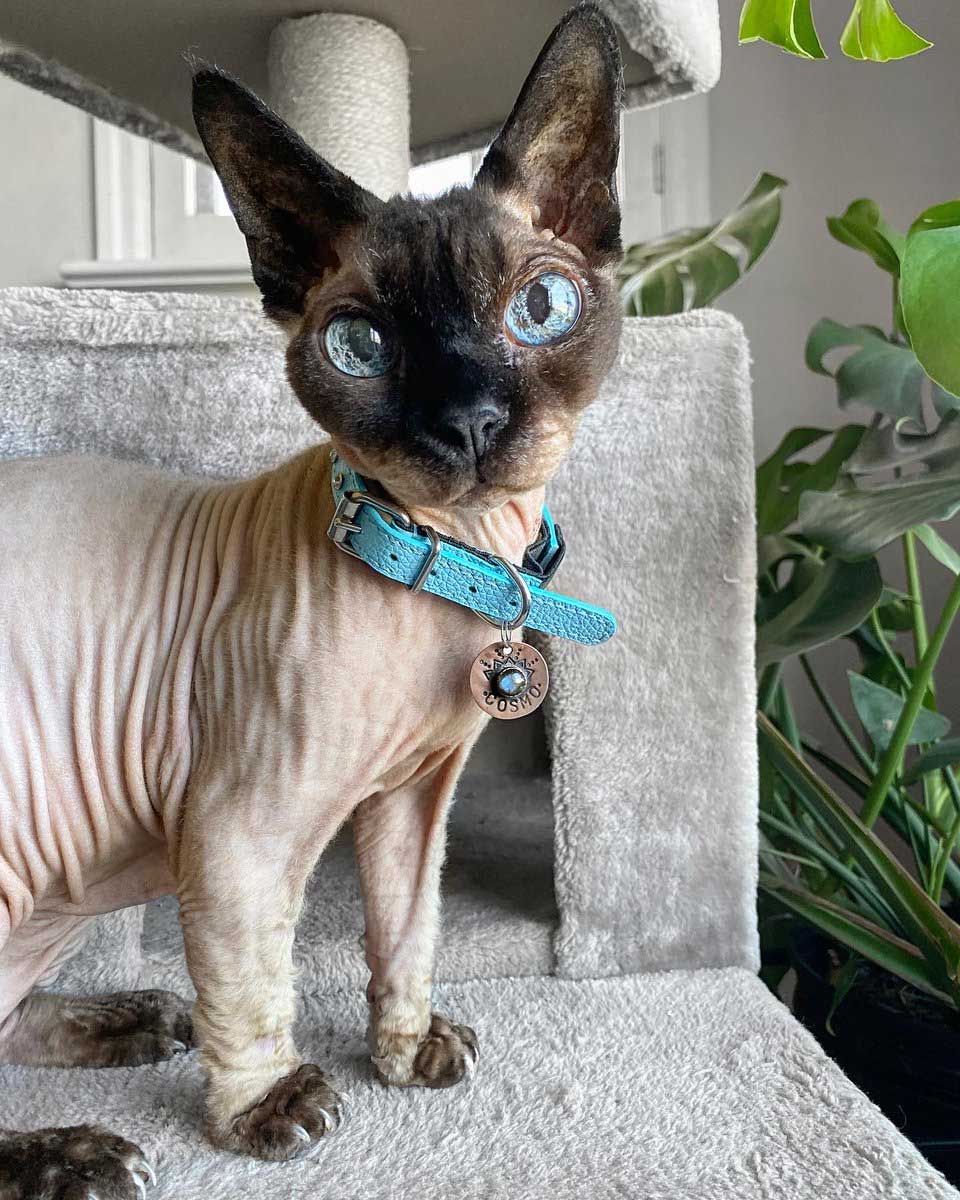
The Minskin has short fur on the limbs (legs, tail, ears and face mask), while the rest of the body has a small barely visible down or is completely naked. But, the hair on the legs may rise a little on the shoulders, hips or hindquarters. The hair on the temples is very sparse, but sometimes there are tufts of hair at the entrance of the ears. The belly is always totally hairless.

In all cases, this peculiarity is not the result of genetic manipulation or skin disease: it simply corresponds to a natural genetic mutation that has existed for a long time in the feline species, and that in this case he has inherited from his ancestor the Sphynx cat (Canadian Sphynx). The corresponding gene is recessive: to have this particularity, an individual must carry two copies of the gene. This also means that only two parents with hairless or lightly fluffy fur can give birth to offspring that also have these characteristics. (but not necessarily all).

The skin of the Minskin may be wrinkled, especially when he's still a kitten. The texture is similar to that of cashmere.

layer colors

The coat of the Minskin can be of any pattern and color; there are no restrictions in this regard.

Character and skills
Minskin
Minskin
Closeness to their owners

The Minskin not only distinguished by its unusual physique, but also because of his very affectionate character.

    In fact, it is an ideal cat for a family, since he loves and seeks the company of humans, being very loving and affectionate with everyone. He is not stingy with his affection, and expresses their attachment by waiting outside the door to greet their owners when they enter. May show slight preference for human referent (the person who cares the most for you), but he is not one of those who are dedicated to a single cat, so he has a good relationship with all members of the household.

    They like pampering and care, and they are very good at making themselves understood when they feel the need to be taken care of, without being too loud or intrusive.

    Get satisfaction more easily because stroking it is very pleasant: her almost hairless and warm skin gives the sensation of touching cashmere. The absence of a coat makes him seek the warmth of others: doesn't hesitate to snuggle up against one of their own to warm up and soak up the sun.

Ability to endure loneliness
    Very attached to his family, the Minskin can't stand being alone for hours or even days, even if you share your home with another cat or dog.

    If you want to adopt this cat, I better have a more homey lifestyle, otherwise you could develop behavioral problems.

Get along with children
    The Minskin it is a good companion for children, since he likes to play with them and is patient.

    But, not necessarily a good companion for a very restless child. In fact, both its small size and its bare skin make it especially exposed and require it to be treated delicately.

    In any case, no cat, Whatever your race, must be left alone with a very young child, without adult supervision: the safety of both partners is at stake.

Get along with strangers
    As this cat is still new and underdeveloped, some character traits remain unclear. This is especially true in his relationship with unknown humans., which can vary greatly from one subject to another.

    Waiting to see it clearer, it is important to ensure that you are never forced and that you always have a workaround. A cat tree is an essential accessory to allow you not only to exercise, but also observe the world around you and evaluate situations from above, so that you feel calm. If you want to meet the visitor, can approach him.

Need for exercise
    Contrary to what her short-legged appearance might suggest, the Minskin is relatively athletic and has a fairly high exercise need.

    He especially likes to run, and is capable of going much faster than you would expect. He also likes to climb, and here too its particular morphology does not harm it much.

    All this explains that you need a certain space to be comfortable: it is not a matter of living within the four walls of a very small apartment.

Recommended activities
    To the Minskin he likes children because he is very playful. It is not enough to caress it and give it affection, but you also have to challenge your intelligence through various games. Thus, it is recommended to spend twenty minutes two or three times a day playing with the dog and thus stimulate it not only physically but also intellectually.

    Leave interactive toys, like puzzle, it's also a good way to keep you busy when you're out and about.

Sound level
    The Minskin knows how to communicate and make himself understood by his family when he has a request to make, for example if you want a hug. But, not the type to meow excessively (or even for no reason), and the volume of his meows is quite reasonable.

    In other words, does not hesitate to express himself when necessary, but he does it gently.

Adaptation to change
    Moving houses or going on vacation does not have to upset a Minskin as much as he usually does with his peers. In fact, his curiosity makes him adapt quite easily to changes in his environment: he does not stop touring his new home and quickly finds his place in it.
Getting along with other cats
    Usually, the Minskin has no difficulty living with a travel companion: this makes him a playmate and makes his masters' absences less painful.

    But, if the two dogs have not known each other since they are puppies, it is preferable to accustom them in stages, so that everyone can find their place and feel comfortable.

    It also, as the Minskin barely has hair, your skin is more prone to small wounds. So, you should check your dog's nails regularly and trim them as soon as they get too long, to prevent inadvertent scratching.

Get along with dogs
    The Minskin gets along very well with canines, If and when, of course, a cat-friendly breed of dog is chosen. Sharing a home with another animal is a great way to give your Minskin a playmate and make him feel less lonely when his owners are away.

    Things go better if the coexistence is established from the earliest age of the two protagonists. If that is not the case, it is better to start the relationship gradually, so that everyone finds their place and thus minimizes the risk of conflict.

    In any case, it is important to regularly trim the claws of your(s) pet(s), since the absence of hair means that your skin is not really protected: could inadvertently hurt her when playing together.

Ideal home

Minskin
Minskin – stealyourheartexotics.com
Apartment
    The Minskin is a suitable jack for a floor, as long as it is large enough to allow you to exercise comfortably. Don't let its short legs fool you: this cat is no less athletic than any other. Can run under the ground, but that doesn't stop you from moving quickly, like any cat. He is also quite capable of climbing and jumping, and does not miss the need to find another route to get where he wants.

    On the other hand, the fact that you live indoors protects you from external aggressions: cold, Sun, bad weather… In effect, your almost bare skin can easily be burned by ultraviolet rays in case of prolonged exposure to the sun, and makes you especially sensitive to cold when mercury drops.

In the garden?
    Although Minskins they are perfectly in a flat, they are never happier than when they live in a big house with free access to the outside, thanks to a cat flap that allows them to come and go as they please.

    But, you have to take certain precautions, due to its lack of fur. When the temperatures are low, it is useful to equip him with a cat coat and/or not leave him outside during the coldest hours. This accessory also has the advantage of protecting your skin, to avoid injury to tree branches, the bushes, etc. During the hot season, it is essential to apply a sun cream designed for felines, and it is better to avoid leaving it in the sun when it is at its peak.

as first cat?
    The Minskin needs their owners to be present by their side, and his skin almost or totally devoid of hair makes it need more care and attention.

    So, it is a quite demanding breed, not necessarily recommended for a first adoption.

For a person with little time?
    It is clear that the Minskin not a good choice for an unavailable person, since its proximity to its humans means that it does not cope well with their prolonged absences: can cause real separation anxiety.

    The problem is less likely to arise if you share your home with another cat or canine representative, but it is still true that it needs human presence and daily care.

    Thus, before adopting a cat of this breed, it is important to think about the time that you will be able to dedicate, at the risk of ending up with an unhappy partner.

for an older person?
    The Minskin it is very suitable for an older person, as long as you are willing to go the extra mile to take proper care of it, including daily skin care.

    They are close to people, loving and cuddly, without being "drinkable". It also, although it is playful, also appreciates long rest periods.

    So, cohabitation can be very beneficial for both parties.

For a person with allergies?
    As the Minskin has almost hairless skin, sometimes comes across as a hypoallergenic breed.

    It's about forgetting that no breed is totally hypoallergenic.. In fact, cat allergies are caused by proteins (especially the Fel d 1, the most allergenic) found in urine, tallow, saliva, perspiration and in certain skin cells. All cats produce them and, Therefore, are likely to cause an allergic reaction.

    But, It is true that the fact that the Minskin almost completely hairless means that it does not shed and, Therefore, does not leave allergens everywhere in its path.

    Since zero risk does not exist, an allergic person should not do without a test in real life, which consists of spending several hours with the animal you are considering adopting.

For a small budget?
    What is rare is expensive, and the Minskin is no exception. So, at the time of purchase, far from a budget-friendly breed.

    It also, the amount spent on their diet tends to be slightly higher than average. In effect, his lack of hair makes, to maintain a body temperature between 40° and 41°C at all times (that is to say, two degrees higher than most other races), should burn more calories, Therefore, eat more.

Grooming and caring for the "Minskin cat"

"Minskin cat"

Minskin
Minskin
coat care
    As the Minskin it only has hair on the limbs and the rest of the body is completely lacking or covered by a very light down, your skin is especially exposed and requires certain care.

    Ideally, clean the skin daily with a soft, damp cloth to keep it healthy. Frequent bathing is also essential.

Bathroom
    The Minskin you should bathe approximately once every fortnight. This is because the light fluff that covers the skin is not enough to absorb all the sebum that the dermis emits. (the underside of the skin), and the skin becomes fatty. Washing the skin removes the accumulation of oil and keeps the skin tissue soft and clean. As in the case of any cat, this requires the use of a moisturizing shampoo specially designed for felines.

    Once soaped and rinsed thoroughly to avoid skin irritation, a soft towel should be used to dry the cat. An electric dryer is not appropriate, as it can cause burns.

ear care
    the ears of Minskin should be checked and cleaned weekly. Removing dirt with a damp cloth will help prevent infection (starting with the ear).

    This is especially important, since the Minskin has little or no hair to protect it.

Eye care
    as with the ears, it is necessary to check the eyes of the Minskin weekly.

    If they are not clean, it is essential to clean the corners with a damp cloth: This will prevent the accumulation of dirt., that can cause disease.

Teeth care
    As in the case of any race, maintenance of the teeth of the Minskin. Helps prevent plaque build-up, that can cause not only bad breath, but also serious diseases.

    Brushing once a week with a toothpaste designed specifically for small felines is a minimum, but the ideal is to do it daily.

Nail care
    The length of your nails Minskin should be checked at least once a month, even if you have access to the outside. This is because natural wear and tear may not be enough.. If the claws are too long, they can get in the way, break or even hurt the dog. So, if they have grown too much, you have to cut them manually.

    It also, like any cat, the Minskin you should be able to scratch whenever you feel the need. So, a scratching post is essential; otherwise, you may have no choice but to fall on the furniture or curtains.

Introduction to hairdressing

Whether the skin, the ears, the eyes, teeth or claws, caring for a Minskin it's not very complex. But, it is essential to master the correct gestures, at the risk of hurting or even injuring you. So, it is best to learn them the first time from a vet or professional groomer.

In any case, the Minskin has the advantage of loving to be handled. So, easily accept these grooming moments, And he is all the more receptive and cooperative if his master knows how to make these occasions special moments of caresses and tenderness.. Things also go better if you get used to it from a young age.

Health and nutrition

Resistance to cold and heat
    The completely or almost completely bare skin of the Minskin makes it especially sensitive to low temperatures and sunlight. Although the body of the Minskin is covered by a small, almost invisible coat, this is not enough to protect you from the elements, and not just the weather.

    So, during the summer months, you should apply sunscreen to your cat's body and avoid letting it go outside during the hottest hours. This will prevent sunburn, burns and possible skin cancer.

    The other way, It is also essential to invest in a small coat to keep your cat warm in low temperatures, or even sickness. In any case, it is best to avoid keeping it outside during the coldest hours of winter, first thing in the morning or in the evening.

    There should always be a place in the house where the cat can be kept warm, away from cold and drafts.

Diseases

As the Minskin it is a recent breed and is not yet widespread, information about your health is missing.

But, like any race, is more prone to certain diseases. In your case, is about:

  • The Hypertrophic cardiomyopathy, which corresponds to a thickening of the heart muscle. May cause respiratory problems, severe fatigue and difficulty exercising. It is caused by a genetic mutation and can be detected by a DNA test. But, it is impossible to know when symptoms will start to appear;
  • Lordosis, that is to say, an excessive curvature of the spine;
  • The excavated breast, a concave deformation of the rib cage. This leads to compression, which can cause breathing or heart problems;
  • Cutaneous mastocytosis, a skin disease causing lesions that require treatment, usually on time. The causes of this condition are not well known..
Healthy adoption
    As in the case of any race, it is essential to go to a trusted breeder to have the best chance of adopting a kitten Minskin healthy. It is also a guarantee that the little feline has been raised and socialized in an environment that allows him to be healthy in the head and legs..

    A serious professional will ensure that certain genetic tests are performed on the proposed breeders, to ensure that they are not carriers of a genetic disease that can be passed on to their offspring. It will not hesitate to exclude from its breeding program any individual that presents such a risk..

    In addition to the results of the tests carried out on the stallions, must be able to present a certificate of good health issued by a veterinarian, as well as the list of vaccinations administered to the kitten, that have been registered in your vaccination or health card.

Maintain good health
    Once adopted, the new owner is responsible for keeping the kitten healthy throughout its life.

    This includes taking the dog to the vet for a regular checkup.. Once a year is enough for the first few years, but this frequency should be increased as the animal ages.

    These checks allow the vet to diagnose potential problems, sometimes even before they appear (and, Therefore, treat them in optimal conditions), but also carry out the necessary vaccination reminders.

    They are likely to be carried out without too much difficulty: it is known that the Minskin enjoys handling and is not one to put up a lot of resistance when examined.

    The owner must also ensure that their cat is treated for parasites as often as necessary throughout the year.. This preventative effort is essential to ensure that your dog is always protected against parasites., even if I live between four walls. Although the probability is significantly lower, an indoor cat can get parasites.

Minskin
Minskin –
madpaws.com.au

Life expectancy

12 – 14 years.

Food

Like any other cat, the Minskin should be fed a diet that meets their nutritional needs, both quantitatively and qualitatively. This means that it differs according to your age, activity level and health status.

In any case, is distinguished by its appetite, which is slightly higher than that of most of its congeners, as it happens with his ancestor the Sphynx cat (Canadian Sphynx). In effect, his almost bare skin forces him to continuously maintain a body temperature between 40 y 41°C, that is to say, two degrees higher than most other cat breeds. As such, have to burn more calories… and, Therefore, eat more.

This is most noticeable in winter, when you need to feed more, especially if you have access to the outside. In any case, to avoid underfeeding or giving him more than he needs, it is best to consult a veterinarian to find out the daily dose to be given.

Industrial foods can perfectly meet your needs, as long as they are of good quality. On the other hand, you should avoid giving food intended for humans, Unless you select them carefully to match your needs. Not to mention the risk of foods that are popular with humans but toxic to cats.. In other words, although he knows how to soften his owners, they should refrain from systematically giving him food scraps and offering him access to bins, who does not hesitate to delve with relish if the opportunity is offered.

Last, as in the case of any small cat, it is essential that the Minskin have fresh water at your disposal at all times, so you can quench your thirst when you feel the need.

For sale "Minskin cat"

The Minskin it is a very rare recent breed. The fact that it is not recognized by any major feline organization (mainly due to the controversy over the genetic mutation associated with short legs) explain that it is difficult for him to develop.

In fact, in Europe , currently there are no breeders of the breed.

To adopt a Minskin, you have to go to the United States, your country of origin. There are only a handful of breeders there, that they usually offer their little ones between 1.500 and 2.400 USD.

But, adopting a cat abroad implies finding out about the regulations that regulate the importation of pets in the country where you live, to avoid unpleasant surprises. It also, It is important to note that administrative and transport costs will be added to the purchase price.

In any case, the latter can differ considerably depending on the reputation of the breeding, of the line from which the animal comes, but also its intrinsic characteristics, in particular its physical characteristics. This last point justifies the differences, sometimes significant, within the same litter.

Videos "Minskin cat"

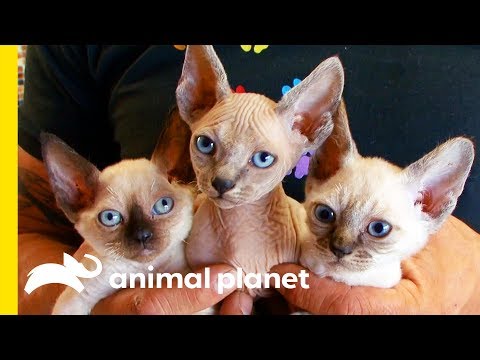
This Cat Breed Looks Like A Kitten For Its Whole Life! | Cats 101

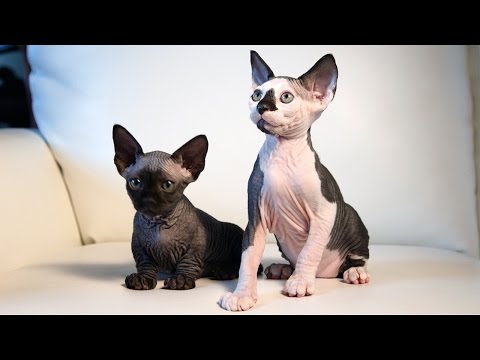
New Cat Breeds: Meet the Hairless SphynxieBob And BamBob

Alternative names:

  • Teddy Rex
  • ▷ The world of Pets: Dogs, cats, birds, reptiles, amphibians

    Manx cat
    Federations: LOOF, CFA, ACF, ACFA, TICA, FIFé, WCF

    According to reports, King Edward VIII was a fan of the Manx cat and often attended cat shows with the breed. The British formed the first club on the Isle of Man in 1901.

    Content

    Characteristics "Manx cat"

    Coexistence is important that you have with your new friend. Before considering the acquisition of a cat of the breed "Manx cat" you know certain factors. You must take into account their character, their need for exercise, their interaction with other pets, their care and if you have small children, their level of tolerance towards them.

    Joy

    4,0 of 5 stars (based on 1 review)

    Activity level

    3,0 of 5 stars (based on 1 review)

    Friendliness to other pets

    5,0 of 5 stars (based on 1 review)

    Friendliness to children

    5,0 of 5 stars (based on 1 review)

    Grooming requirements

    3,0 of 5 stars (based on 1 review)

    Vocality

    2,0 of 5 stars (based on 1 review)

    Need for attention

    3,0 of 5 stars (based on 1 review)

    Affection towards its owners

    4,0 of 5 stars (based on 1 review)

    Docility

    4,0 of 5 stars (based on 1 review)

    Intelligence

    4,0 of 5 stars (based on 1 review)

    Independence

    3,0 of 5 stars (based on 1 review)

    Hardiness

    1,0 of 5 stars (based on 1 review)

    History

    The Manx cat It has existed since the middle of the 18th century on the Isle of Man, situated between England and Ireland, but its exact origins are the subject of speculation. A legend says that it was the last animal to climb into Noah's Ark and that its tail was cut off when the door was closed.. Another legend claims that the invaders, Vikings or Irish depending on the version, they cut off the kittens' tails to use as good luck charms: to protect their young, mother cats would have cut off their tails with their teeth at birth. Last, another wild theory is that it is the result of a cross between a cat and a rabbit, but it has been scientifically proven that it has no basis.

    In fact, the most likely explanation is that it is a genetic mutation that appeared spontaneously among the island's feline population and spread rapidly thanks to its dominance (it is enough that one of the two parents is a carrier of the corresponding gene, and therefore have this characteristic, so that some of the kittens are in the same case).

    Manx cat
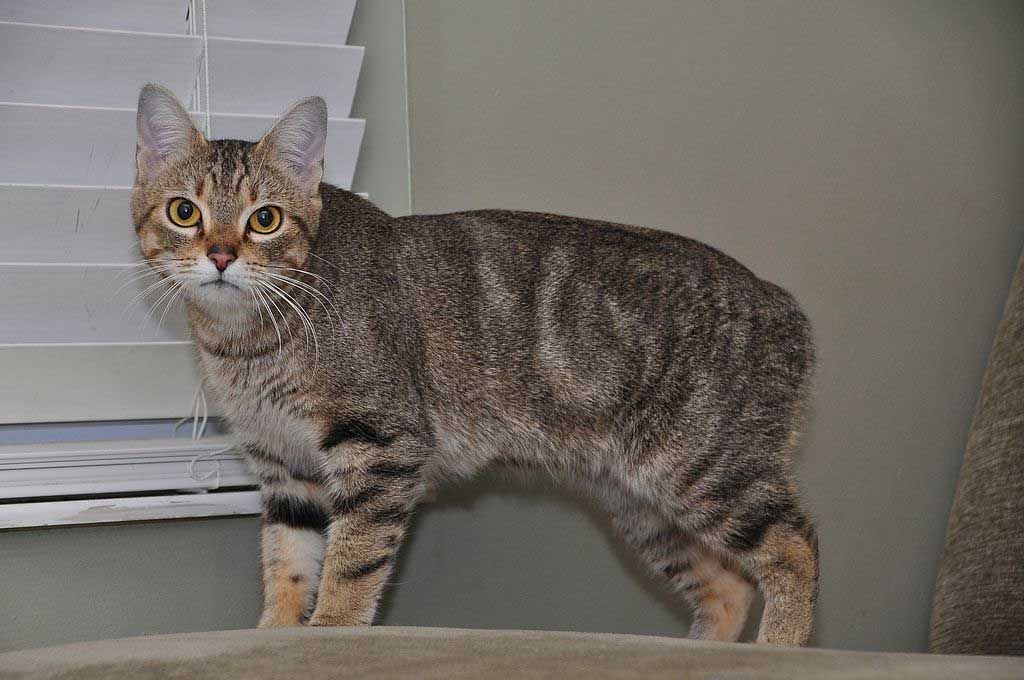
    This is a one year old rumpy manx cat – Michelle Weigold, CC BY-SA 4.0, via Wikimedia Commons

    The presence of cats on the Isle of Man is also the subject of speculation. One of the theories is that the Vikings took them to the 9th century, another that the English sailors took on their frequent voyages from the 13th century and another that arrived with the survivors of the sinking of a Spanish galleon in 1588. All these explanations may have some basis of truth, but one thing is true: the first representatives of the feline species that appeared on the island had a full tail.

    What is also true is that the fact that the Isle of Man was a port with some international traffic in a context of increasing trade facilitated the spread of manna around the world during the 19th century., especially in the UK (since the beginning of the century) and then in the United States. This is how the Manx became one of the breeds exhibited in the first cat shows in history, which were held in Great Britain from 1871. In 1903 a breed standard was developed and the famous Cat Fanciers’ Association (CFA) recognized the breed at its founding in 1906. The same happened with the creation of the Fédération Internationale Féline (FIFé) in 1949, and then with the TICA (The International Cat Association) in 1979.

    Authentic national symbol of its island of origin, where it appears mostly in coins, seals, postcards and badges, manx is still unpopular outside, despite its long history and international recognition. In United States, CFA statistics place the Manx cat between the posts 25 and 30 (of about 45) in the ranking of breeds according to the number of annual registrations. In Great Britain, there has even been a certain disaffection for this cat since 2006: while in 1997 and 2006 about forty individuals were registered per year, now their number can be counted on the fingers of one hand, although 2018 marked a jump, with 22 registered births. It remains to be seen if this holds up over time.… In France, In addition, it is a rare breed of cat, since they only registered 56 specimens in the Official Book of Feline Origins (LOOF) between 2003 and 2019. Their number is even zero in some years.

    Physical characteristics

    The Manx has a short morphology / Cobby. Its body it is compact and curvilinear, but well muscled and with good bones. The legs foreheads are short and widely spaced, while the rear ones are much longer.

    Like the rest of the body, the head of the Manx cat she is also plump, seated on a neck wide and short. The ears are size medium, wide at the base and rounded at the tip. The eyes they are large and round and can be of various colors: yellow, copper, Hazelnut, green or even blue.

    The no tail is the most distinctive feature of this cat. Unlike in the Bobtails, they have a short tail, the Manx has no tail at all (variety rumpy), or just a bone growth (variety riser) consisting of one to three sacral vertebrae, that is to say, at hip level. The standard of the Official Book of Feline Origins (LOOF) also recognizes specimens with a short tail formed by between 1 and 3 caudal vertebrae, that is to say, located beyond the hips and that, Therefore, already forms a queue (variety "stumpy«), but neither the Cat Fancier’s Association (CFA) neither him Governing Council of the Cat Fancy (GCCF) accept them. There's also Manx cats that have a tail as long as that of another breed (variety "longy«); they are not recognized as Manxs by no rule, but they remain in the breeding program, since they can still give birth to tailless individuals («rumpy» o «riser«).

    The fur consists of a dense, cottony undercoat and a harder, glossier topcoat. The undercoat may be less dense in summer, and white or light-colored specimens may have a softer top coat. Your top coat can be short or long. But, while some organizations consider that the Manx longhair it is a mere variety, other (as the Fédération Internationale Féline or The International Cat Association) consider it a breed in its own right, other than Manx and named Cymric cat.

    All are accepted coat colors, except for those resulting from hybridization: chocolate or lavender. Similarly, all patterns are possible except the Himalaya.

    Last, the sexual dimorphism it is well marked, the female being smaller than the male.

    Size and weight

    • Size: 35 cm.
    • Weight: Of 3,5 to 5,5 kg
    Manx
    Chatelaine, ginger tabby Manx cat – Flickr

    Varieties of the “Manx Cat”

    The Manx longhair, also known as Cymric cat, is considered by feline associations well as a simple variety of the Manx (this is the position taken by the British Governing Council of the Cat Fancy and American Cat Fanciers’ Association), fine as a breed in its own right (this is the case, for example, of the Fédération Internationale Féline and The International Cat Association).

    It also, not all individuals, whether they are short or long hair, completely lack a tail (variety rumpy) or have a small bump made up of one to three sacral vertebrae (variety riser). There are also short-tailed individuals (stumpys) with one to three vertebrae in the tail, and long-tailed individuals.

    The latter are not considered Manx, but nevertheless they are used in the breeding program, since they can give birth to healthy litters with kittens rumpy or riser. This is lucky, since the offspring of two parents rumpy or riser it's troublesome, since some of their offspring are victims of the manx syndrome or even die before being born.

    Character and skills

    The Manx cat he is affectionate with his whole family, but he usually has a favorite person who he follows around the house and with whom he likes to rest. They are perfectly capable of spending the day alone when their owners are away., but they prefer the company of their humans to solitude: they are not a suitable cat breed for someone who is absent often.

    Its playful nature makes it a breed of cat suitable for children, provided they have learned to behave with and respect animals. He also gets along well with other cats and with dogs accustomed to cats, as long as they get to know each other little by little. On the other hand, how he has preserved his hunting instincts, the little rodents, birds or fish would run a great risk of a quick and tragic end if they had to cohabit with a Manx.

    Rather suspicious in character, is reserved with strangers and is even an excellent guardian cat -or at least alert-, who does not stop warning his master when a newcomer approaches. If you see that the owner remains calm, accept the situation and observe it.

    Clever and skillful, the Manx cat It is a good option for those who want to teach their cat tricks, as for example, to retrieve an object. They are also very good when walked on a leash. On the other hand, his intelligence can also turn against his master: It is very probable, for example, who understands how a doorknob works, so it is advisable to close the food cupboard.

    This is especially true because, despite his fat and lack of a tail, that might be mistakenly thought to impair your sense of balance, the Manx is surprisingly agile and active. Its powerful hind legs make it an excellent jumper, and it is quite common to find it sitting on top of a cupboard. Having said that, it is also a breed of cat that adapts well to life in a flat, as long as I have enough opportunities to run and play.

    From its island origins, the Manx cat retains a fascination for water, what can take you, for example, to observe a tap that is open for a long time or to play with the water in the bath. But, this does not go much further: does not like to get wet and, therefore, does not have the possibility to follow his master in the shower.

    Last, this cat has a nice voice, who does not hesitate to share with others by having a conversation from time to time.

    Grooming "Manx cat"

    Manx
    Manx cat – pixabay

    The Manx it is an easy cat to care for: just brush it once a week to keep its coat healthy. But, this frequency should be increased during the annual spring and fall molts, when it is necessary to brush every 2 or 3 days to remove excess dead hair.

    Weekly brushing of the cat's hair is an opportunity to ensure that its teeth are free of cavities and tartar., and that their eyes and ears are clean. They should be cleaned with a damp cloth.

    Last, if they have become too long, you should cut your cat's nails with a nail clipper to prevent it from being hindered in its movements. But, this operation is not usually necessary, since a cat trims its nails regularly and keeps them in good condition and with the right length.

    Health and nutrition

    The Manx cat is a carrier of a gene responsible for the disappearance of its tail, what has consequences on your health. This gene is dominant (it is not necessary for both parents to have this anatomical feature for their kittens to have it), but it is not expressed in the same way in all cats, so some do not have a tail, while others have a partial tail.

    "Manx cat"

    rumpy riser tail Manx cat
    This is an example of a «rumpy riser» tail in a Manx cat – Michelle Weigold, CC BY-SA 4.0, via Wikimedia Commons

    A fetus that receives two mutated genes has serious developmental problems and usually dies in the womb.. Those with only one mutated gene manage to develop, either no tail or with a short tail; In the latter case they are called variety «stumpy«. But, between 20% and the 30% of them are affected by what is commonly called "Manx syndrome.".

    Affects the spine and various internal organs, like bladder, intestines or stomach. These deformities are fatal in the long run, so affected kittens are usually euthanized. Those who are not usually die after 3 or 4 years, with a peak of 5 years. The syndrome is detectable from 4-6 months old watching the kitten, so a responsible Manx breeder will not put kittens up for adoption before this age.

    Individuals who are saved tend to live long, most exceed 15 years of age and some reach 20. Yes indeed, are more likely to suffer from certain diseases:

    • The tail arthritis, which mainly affects purebred individuals and can be very painful for the animal;
    • The corneal dystrophy, a genetic eye disease that begins around the 4 months old and causes vision problems that can lead to blindness.

    Food

    The Manx is not picky about food and can be fed commercially available industrial cat food without any problem. It must be ensured that the quality of the feed is sufficient to provide the necessary essential nutrients, depending on the age and activity level of the cat.

    This cat is a greedy guy and has a healthy appetite. So, not necessarily capable of self-regulation, so it is best to avoid leaving food at your disposal all the time: its owner must, on the other hand, make sure to provide you with daily rations tailored to your needs, and ensure that you are not overweight. If this is the case, a veterinarian should be consulted to establish an appropriate feeding program.

    For sale "Manx cat"

    The price of a kitten Manx male is about 800 EUR, while that of a female Manx is of some 700 EUR.

    Videos "Manx cat"

    Silly Manx cat playing

    Epic battle between Boston Terrier and Manx cat

    Alternative names:

    • Manks
    • Stubbin
    • Rumpy
    • Isle of Man cat

    ▷ The world of Pets: Dogs, cats, birds, reptiles, amphibians

    Egyptian Mau
    Recognized by the CFA, FIFe, TICA, AACE, ACFA/CAA, CCA-AFC

    The Egyptian Mau does not give his affection to everyone: to earn their trust, your family should give you all the attention you deserve.

    Photo: Wikipedia.org

    Content

    Characteristics "Egyptian Mau"

    Coexistence is important that you have with your new friend. Before considering the acquisition of a cat of the breed "Egyptian Mau" you know certain factors. You must take into account their character, their need for exercise, their interaction with other pets, their care and if you have small children, their level of tolerance towards them.

    Joy

    5,0 of 5 stars (based on 1 review)

    Activity level

    5,0 of 5 stars (based on 1 review)

    Friendliness to other pets

    3,0 of 5 stars (based on 1 review)

    Friendliness to children

    3,0 of 5 stars (based on 1 review)

    Grooming requirements

    1,0 of 5 stars (based on 1 review)

    Vocality

    4,0 of 5 stars (based on 1 review)

    Need for attention

    4,0 of 5 stars (based on 1 review)

    Affection towards its owners

    4,0 of 5 stars (based on 1 review)

    Docility

    1,0 of 5 stars (based on 1 review)

    Intelligence

    4,0 of 5 stars (based on 1 review)

    Independence

    3,0 of 5 stars (based on 1 review)

    Hardiness

    3,0 of 5 stars (based on 1 review)

    History


    Mau it is an egyptian word that means “cat”, and all existing races, the Egyptian Mau It is probably the one that has the most similarity to the domestic cats of Ancient Egypt. This appearance is not due to recreation detailed with various races or varieties, but to the descendants of the race of Egyptian Street cats that may have lived in the same region and have been essentially equal for millennia.

    If the appearance of this variety is taken as the date of the race, It is by far the oldest in the world. More recently, the Egyptian Mau as a pedigree breed is the creation of Nathalie Troubetskoy, exiled Russian living in Italy since the second world war, it imported cats of Cairo. Reproduced them and showed the resulting kittens in Europe, and in United States recorded, where is installed in 1956. The full recognition of the breed took another twenty years, and much more in Great Britain, where it was delayed by confusion with similar spotted tabby cats: that used to be called maits and they were part of Oriental shorthair cat, and because of its similarity with the Ocicat cat.

    Its international diffusion also continued, so that in the years 90 was present in both America and continental Europe, but also in more distant latitudes, like japan. The Fédération Internationale Féline (FIFé) recognized her in 1992.

    But, the United Kingdom, a country with a great feline culture, stayed a little behind, since it was not until 1998 When Melissa Bateson imported the first Egyptian maus to the country, and up 2006 When the British Governing Council of the Cat Fancy (GCCF) granted the definitive recognition to the breed.

    Today, the Egyptian Mau is well represented on all continents, but their popularity is still well below the new breeds of cats of wild origin, as the Bengal cat or the Savannah cat. In United States, is around the post 30 of the CFA breed ranking by number of registrations, and it even looks like it`s stagnating, since at the beginning of the decade of 2010 I was around the post 20. In the United Kingdom, the breed was quite popular after its recognition by the GCCF, With almost 200 specimens registered every year around 2010, but his popularity only decreased thereafter, to the point that since 2015 the number has dropped to less than 100 by year.

    Physical characteristics

    Egyptian Mau
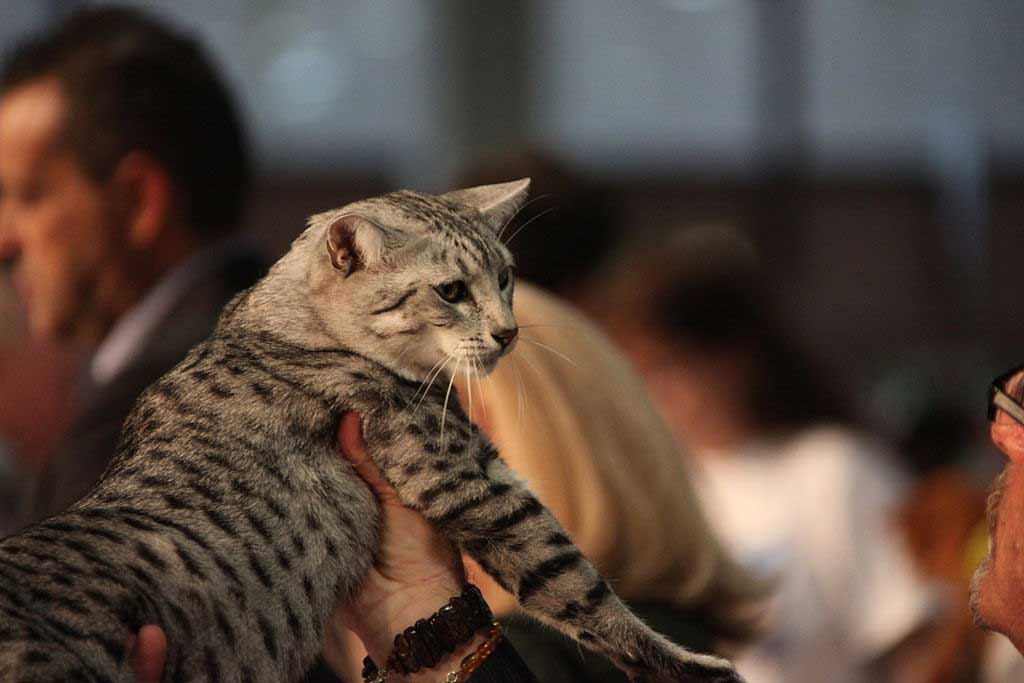
    Egyptian Mau – Pieter Lanser from The Netherlands, CC BY 2.0, via Wikimedia Commons

    The Egyptian Mau it is a semi-linear cat. Its body he is both muscular and elegant, well settled on long legs (more in the front than in the back) and powerful, to the point of turning him into a speed champion. It is distinguished by an excess of skin between the flanks and the hindquarters, which forms a kind of ventral pouch called "bellows". The tail is medium in size and tapers towards the tip.

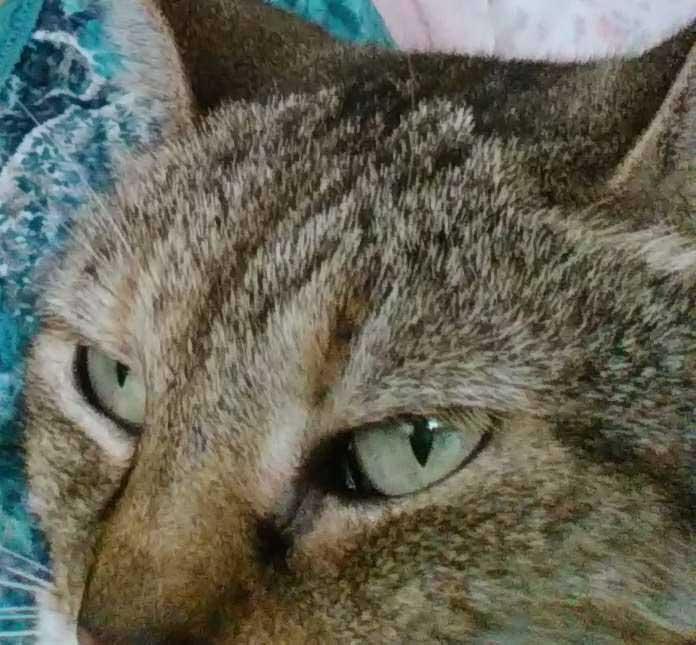
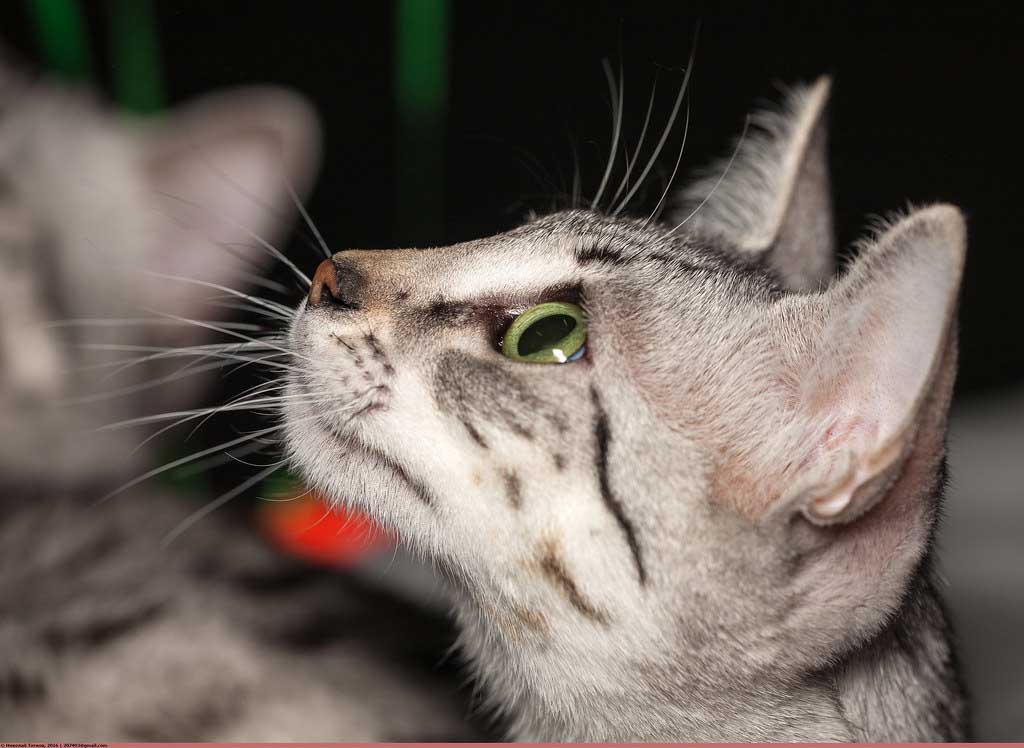
    Seen from the front, the head of the Egyptian Mau is shaped like a rounded triangle, no straight lines. The forecrown has a very characteristic mark in the form of an M, called "beetle mark". The eyes are wide open and have a color specifically called "currant green.". The ears they are medium in size and have a rounded tip.

    The fur of the Egyptian Mau It is of medium length, and its texture depends on the color of the coat. Like this, the black smoke (black marks on charcoal background) and the black (black marks on black background, only visible under certain lighting) they have fine, silky fur. The silver (black marks on silver background) and the bronze (dark brown markings on bronze background) have a dense and flexible coat.

    Whatever its color, the fur of the Egyptian Mau is always stained. The Egyptian Mau It is the only breed of domestic cat that has this peculiarity., since the other races in this case were all created by man.

    Last, the sexual dimorphism it is well marked: the male is significantly larger and heavier than the female.

    Size and weight

    • Male size: Of 28 to 32 cm.
    • female size: 25-28 cm.
    • Male weight: 4-7 kg
    • female weight: 2,5-4,5 kg

    Breed standard

    The breed standards are documents established by official bodies that list the conditions that a dog must meet. Egyptian Mau to be fully recognized as belonging to the race:

    Character and skills

    "Egyptian Mau"

    Mau egipcio
    Eyes of Egyptian Mau change colour according to mood, first pale green – Madame Diana, CC BY-SA 4.0, via Wikimedia Commons

    The Egyptian Mau does not give his affection to everyone: to earn their trust, your family should give you all the attention you deserve. He seems to like to be admired and the center of attention, as were their ancestors, who were considered deities in ancient Egypt. Once the link is established, he is completely devoted and loyal, and enjoy spending time playing with his master or being caressed.

    But, they are much more wary of strangers and are quite shy and fearful in a noisy environment. To prevent the cat from becoming overly stressed, it is important to get him used to a certain level of activity at home from an early age, as well as the various noises you may face later: television or music at high volume, vaccum cleaner, fire siren, etc. This is especially true for those individuals who are destined to participate in feline shows., since the atmosphere and the agitation that reign in these events can be extremely stressful for a cat that until then has only known the calm of a quiet home.

    Being playful, to the Egyptian Mau likes the company of children who know how to behave in the presence of an animal, but he quickly runs away from the little ones and / or those he finds too agitated for his liking. They enjoy the company of other dogs and cats, but they want to remain the center of their family's universe.

    On the other hand, how is an excellent hunter, you have to avoid living with rodents, fish or birds, since it is very likely that it will end badly. It also, if you have access to the outside, it should come as no surprise that from time to time he brings a gift to his family, mouse or bird shape. He would not understand that his family was not happy to enjoy the fruits of his efforts, so it is advisable to congratulate him with lots of caresses and some treats, to let you know that your gift is appreciated.

    Smart and active breed, the Egyptian Mau quickly learn to return a thrown object, to run after a plastic mouse or to open a door, either the one in the closet where the goodies are kept or the one that offers you the access to the outside that you like so much. However, can live in a flat, but then it is necessary to play with it daily and that the floor is large enough for this little car to run around.

    They are also one of the few cat breeds that love water.. Although unlikely to join its owner in the shower, you can play with the water from your bowl or from an open tap for a while. He also likes to jump and position himself high to observe his territory., so it is quite possible that the top of a closet will become your favorite place.

    Last, although it is not very vocal, the Egyptian Mau she does not hesitate to make her soft and melodious voice heard when her bowl is empty, or when he is especially happy. It is also capable of emitting clucking sounds quite specific to this breed., while wagging his tail in a rather unusual way.

    Health

    The Egyptian Mau It is a very resistant feline breed and has hardly been shaped by the hand of man throughout its long history, making you less prone to genetic diseases.

    But, are more prone to certain diseases:

    • Leucodistrofia, an extremely rare disease of the nervous system;
    • Umbilical hernias (organ that crosses the abdominal wall), that can be corrected by neutering the cat;
    • The pyruvate kinase deficiency, another rare disease, that affects an enzyme in the blood. Causes anemia in other breeds, but it doesn't seem to have any effect on the Egyptian Mau: even if it is a carrier, does not seem to develop any particular symptoms.

    It also, this breed is especially drug sensitive and anesthetics; therefore, before any treatment or operation, make sure that the vet is well aware of this specificity.

    Last, the risk of Obesity in cats it is especially pronounced in the Egyptian Mau, especially if they live indoors. It is not a disease in itself, but it can be the cause or an aggravating factor of many health problems.

    Life expectancy

    Of 12 to 15 years

    Grooming

    Egyptian Mau
    Egyptian Mau – Flickr

    The Egyptian Maue is an easy-care cat. In fact, a quick brushing once a week is enough to rid his coat of dead hairs.

    This weekly grooming session is also an opportunity to check that your teeth, eyes and ears are clean and to clean if necessary, in order to avoid any risk of infection.

    Last, if its claws are too long, you have to cut them with a nail clipper. This is more likely in the case of a person who lives indoors, since there is less natural wear.

    Food

    The Egyptian Mau he is not picky about his meals and can be fed commercial cat food without any problem. But, These must be of good quality and adapted to your age and activity level, to provide you with everything you need for your health.

    How they are quite gluttonous and prone to obesity, it is important to keep a close eye on your daily rations and not leave food available all the time as, unlike other cat breeds, are not capable of self-regulation.

    For sale "Egyptian Mau"

    The price of a kitten Egyptian Mau it is on average about 1400 EUR.

    But, this figure hides great disparities between a subject with a prestigious pedigree and characteristics destined for feline exhibitions, whose price can easily amount to 1800 EUR, and another destined simply to become a pet, that can be found around the 1000 EUR.

    In any case, there is no significant price difference between male and female kittens.

    ▷ The world of Pets: Dogs, cats, birds, reptiles, amphibians

    Jungala Ocicat cat
    Federations: CATZ

    Content

    History

    Most people have heard of or seen cats. Ocicats, But you never hear about the classic "Jungala". An image of one may not be found on a website, that farmers are allowed to breed with them, However, they may not exhibit them. There are three additional variants in the breed Ocicat, The classic «Jungala,», the classic tabby Ocicat which in New Zealand is called a cat Jungala, as well as the name of the race of the Ocicat cat (‘Oci‘), It is derived from the name of the cat of Ocelot, a "wild" Central American or a cat "jungle", The new name in Spain for the "Jungala", which is also taken from the Sanskrit word that means "the jungle".

    "Jungala Ocicat cat"

    This breed was achieved by crossing a mixture of the Abyssinian cat, the Siamese cat and of the American shorthair cat. As such, is a home race, that was selectively bred to emulate the ocelot is found in nature, while retaining the friendly disposition of domestic.

    In New Zealand, the first cats Jungala were registered by the Karakakat kennel, with CATZ Incorporated, who recognized the Jungala cat as an independent breed with full championship status in August 2001.

    Physical characteristics

    The so -called "Jungala" is a Ocicat cat without stains. Or more specifically, a cat with genetics Ocicat that express only one pattern Tabby Classic. The conformation and personality type are exactly the same as an Ocicat, but the pattern should conform to that of the classic brindle model of the American shorthair cat

    "Jungala Ocicat cat"

    The Oci-Classic has a large bullseye circle on each side of the torso broadly defined with a beautiful color contrast. Their stomachs are also marked with spots. The spotted kittens are very nice, the classical coloring is awesome, with a luxurious and exceptional velvety color, an authentic and unusual color combination. Are highly prized for its stunning beauty. This pattern is especially striking when viewed on a Tabby Silver, where the silver under light allows a strong contrast with the marks of the final layer color depth.

    Character and skills

    The Jungala cat, just like their counterparts Ocicat, they are very sociable and somewhat similar to dogs in their devotion for the people. They are bright, easily manageable and often are outgoing, even with strangers. As such, they are an ideal cat for households where there are other pets and children.

    Source: catzinc.org

    ▷ The world of Pets: Dogs, cats, birds, reptiles, amphibians

    Karelian Bobtail
    Federations: WCF

    Content

    History

    The Karelian Bobtail is a Russian cat breed originating from the Republic of Karelia, on the Finnish border. It appeared naturally at least 200 years on the islands of Lake Ladoga, and has not undergone many human modifications.

    It is probable that the race had a link in its history with the Norwegian Forest Cat , a Scandinavian breed that also has a natural origin. But, to date there are no DNA studies that demonstrate this relationship. Specialists have also long linked the Karelian Bobtail with the Kurilian Bobtail, a feline breed also Russian but originally from the Kuril Islands, located near the coast of Japan. But, science has since established that these natural races, both with short tail and, in fact, with many physical and psychological similarities, they are actually completely different.

    The Karelian Bobtail He was highly appreciated by the inhabitants of his native region not only for his great ability to hunt vermin, but also because, according to an old legend, owning a cat without a tail or with an especially short tail brought good luck to its owner.

    This morphological peculiarity is the result of a genetic mutation that occurred naturally in cats that live on the islands of Lake Ladoga.. It is transmitted spontaneously from generation to generation and is different from Kurilian Bobtail. In the Kurilian Bobtail, the gene is dominant: it is only necessary that one of the two parents transmit it for the kittens to be carriers. On the other hand, in the Karelian it is a recessive gene, which means that both parents must have a short tail for the kitten to inherit this characteristic.

    It was in the years 80 when felinologists from present-day Saint Petersburg, members of the commission of the Kotofey KLK, a major Russian feline association, first became interested in the breed in detail and accurately described it.

    The first standard was drawn up by them in 1987, based on the breeder's cats Liliya Dvoryaninovich. I had some 15 short tailed cats, descendants of parents found on the north shore of Lake Ladoga.

    The breed was first recognized in Russia in 1990 by the Sovetskaya Felinologicheskaya Federatsiya (SFF), a Russian organization that no longer exists. He made his first appearance at a feline show at 1993, specifically at the Eurasia Intercontinental Exhibition, in Yekaterinburg. The Kotofey KLK registered the first representatives in 1994.

    Karelian Bobtail
    Karelian Bobtail
    – Lovely-dogs

    But, not much has changed since then in terms of breed recognition, which is still limited to its country of origin. These may include, nor international organizations such as the Fédération Internationale Féline (FIFé) o The International Cat Association (TICA), nor national structures like the American Cat Fanciers’ Association (CFA), el British Governing Council of the Cat Fancy (GCCF), el Official Book of Feline Origins (LOOF) inglés o the Canadian Cat Association (CCA) they recognize the breed. Still unknown outside of Russia, the Karelian Bobtail is very underrepresented around the world.

    Even in russia, their number is very small. Various attempts have been made by enthusiasts to develop the breed and increase its numbers., but so far they have not been successful. The most important program was developed by the Kotofey KLK in 2012, but it quickly reached its limits as the organization does not allow any crossbreeding with other breeds. Thus, it is difficult to create a sufficient population to guarantee a bright future for the Karelian. Even if you go into the wild to find animals in your home region, is not enough. But, it must be taken into account that a large part of the population of the breed - in fact, the majority- live in nature and, Therefore, is not included in the statistics.

    The number of farms Karelian Bobtail It is very small. Most of them are located in the territories near St. Petersburg, but there are also a handful in other cities (Medvezhyegorsk, Kirov, Petrozavodsk…).

    Physical characteristics

    Karelian Bobtail
    Karelian-Bobtail

    His admirers often compare him to Karelian Bobtail with a little lynx, for its lack of a tail and its large hind legs. Hind legs are much larger than front legs, but they are all strong and very powerful.

    Although it is a fairly standard size, it is much more massive and heavier than it seems. Built around a medium, muscular chest, has a compact overall look, without looking too beefy.

    The tail It is one of the most outstanding characteristics of the breed., and their exact appearance differs greatly from one individual to another. It is in all cases very short, measuring just over 4 to 13 cm.: a totally absent or longer tail than 13 cm is not accepted in the breed standard. Whatever its size, the fur is longer at this point, giving the appearance of a pompom. On the other hand, may be completely straight or have breaks.

    This uniqueness in the size of the tail is the result of a genetic mutation, and the gene that causes it is recessive. This means that both parents must have a short tail for the kittens to be short..

    The head of the Karelian Bobtail it is medium in size and triangular in shape. Its forecrown and their cheeks they are flat, and your nose it is rather long and straight. The ears are large and are located on the top of the head. Their tips are slightly rounded. Their eyes they are almond shaped, medium in size and its color generally corresponds to that of the coat. The most common colors are green and yellow.

    The fur of the Karelian Bobtail it consists of a very thick double layer of hair, that protects you from inclement weather. It can be short or long, but in any case it must be dense, bright and smooth. All colors are accepted except tan, chocolate, leonado, lila y colourpoint. The most observed colors are white, the black, blue and blue-cream. The coat can be bicolor, tricolor or brindle, and in many individuals it has silver and gold reflections.

    Last, this breed is marked by a certain sexual dimorphism, since females are mostly smaller and lighter than males. Regardless of your gender, pups take a long time to grow, since they only reach full physical maturity around the 5 years.

    Size and weight

  • Size: 30 cm.
  • Weight: Of 3 to 5 kg

  • Variations

    The Karelian Bobtail it comes in two varieties: short-haired and long-haired individuals. Apart from the length of its fur, there is no physical or psychological difference between them.

    Character and skills

    The Karelian Bobtail he is a smart cat, sociable and curious. They love spending time with their family members and enjoy being around them, proving that they fit well in any home. Often tends to favor a specific person to whom he is especially attached, but this does not mean that I turn my back on others.

    Its playful temperament and its marked taste for interaction make it a recommended breed of cat for a child.. As long as you know how to behave in a respectful way with the child, you both can spend hours having fun together. But, it is important to remember that, for the safety of both, a young child should never be left unattended with a cat. It is a matter of safety for both the animal and the child.
    This cat also gets along very well with older people.

    The Karelian Bobtail he's also not shy around people he doesn't know, although it may take time to know them.

    Their sociability also applies to other animals: even if you have to share your home and the care of its owners with them, tends to get along perfectly with his companions and tends to make a good pair with dogs, especially those of cat-loving breeds.

    On the other hand, there is no hope of making him cohabit harmoniously with small animals that could be considered prey for him. In fact, its acute hunting instinct makes a rodent, a bird or fish is never safe around it, although they have lived together since childhood. It also, if you have access to the outside, his owner should expect to regularly receive gifts from his pet in the form of prey brought home.

    In any case, although its origins make it very resistant to cold, Being able to evolve abroad is not necessarily essential for a Karelian Bobtail. Very adaptable, you can live just as well in a house with a garden to which you have free access as in an apartment, as long as you have something to occupy yourself with and exercise. If you live inside, must have a cat tree, for example. like most cats, they love to climb trees and furniture. But, just because they are very active does not mean that they do not also enjoy quiet time with their owners, and they are happy to share the sofa with them.

    In fact, the most important thing you need a Karelian to be happy is to be in contact with other living beings. So, where you live is less important than the presence of your owners and their availability to pay attention to you. So, not suitable for people who are usually out most of the day, that they would be better off with an independent breed of cat. Having said that, Sharing the home with one or more cats or dogs can be an interesting way to compensate for the absence of the owner.

    Knowing that, besides moving a lot, he also needs to be mentally stimulated and that he is very attentive to his owners, is a perfect student for those who want to teach tricks to their cat. These may include, can learn to respond to his name, to lie down when ordered or to pick up objects.

    Not only can he learn what is expected of him, it can also understand behavior that is considered undesirable. If you are caught on the spot, for example, getting on the table during the meal, a simple reprimand is usually enough to prevent him from repeating the act.

    The Karelian Bobtail it also has the good taste of being a rather calm breed of cat: he is not one of those who use his voice, although it is very soft and melodic, to ask for favors. When they want to express a wish, they generally prefer to communicate by touching their owner with their paw. Having said that, in general, it is not demanding or invasive.

    Last, the male has the peculiarity of marking his territory very little.

    Health

    The Karelian Bobtail is in good general health and is not known to have any particular genetic problem, nor any disease to which you are especially prone. Having said that, is also related to the lack of hindsight, since cat specialists have been interested in your case for a short time and its distribution is still very limited.

    Accustomed to the harsh climate of his native Russia, it is in any case particularly resistant to low temperatures and has no problem spending most of the time outdoors, even in winter.

    Although this breed does not present any particular health risk, it is important to choose a serious breeder of Karelian Bobtail. They must be able to present a certificate of good health from a trusted veterinarian, showing that the little cat shows no signs of illness or any other problem. You should also be able to show proof of vaccinations.

    Last, as prevention is better than cure, a routine visit to the vet at least once a year is strongly recommended to get a full check up and make sure everything is okay. It is also the opportunity to do any booster shots if necessary., and to review the antiparasitic treatments that the owner should take care of administering to his cat throughout the year.

    Grooming

    The coat of the Karelian Bobtail it is easy to care. For people with short hair, a weekly brushing is enough to remove dead hair. Long hairs should be brushed a little more often - at least twice a week- to prevent knots or hairballs from forming. In normal times, both shed very little hair. But, this is not the case during the shedding season in spring and fall, when daily shedding is usually necessary to prevent hair from being found throughout the house.

    Regardless of the length of its coat, it is rarely necessary to bathe him, unless, of course, that has gotten especially dirty. When i do, you must use a shampoo specially designed for cats.

    On the other hand, your eyes need to be checked at least once a week and cleaned if necessary. In addition to removing dirt from around you, this can detect any possible infection or small injury.

    The ears should also be examined and cleaned weekly to prevent dirt from building up in them., which could also be the cause of infections (otitis, etc.).

    Brushing your teeth is also very important, as it helps limit plaque formation, which can cause a lot of problems. The ideal is a daily brushing, but once a week is enough. Whatever the frequency, a toothpaste specially formulated for small cats should always be used.

    You should also check your cat's nails at regular intervals., for example, each month. If they get too long, you have to trim them manually. Otherwise, could get in the way or even break, with the consequent risk of injury. In any case, if you live inside, a scratching post is an essential investment to keep you from satisfying your natural urge to scratch furniture or curtains.

    coat care, of the eyes, from the ears, teeth and claws are basic gestures that every owner must learn to perform correctly, at the risk of hurting or injuring your pet. So, it is advisable to ask a hairdresser or veterinarian for advice the first time, to learn the proper gestures to adopt to keep your Karelian Bobtail. On the other hand, do not hesitate to get started quickly, to teach your kitten to be handled as soon as possible: sessions will be more enjoyable for both him and his owner.

    Food

    The Karelian Bobtail it is not difficult to feed and is content with a quality and balanced industrial feed. As in the case of any cat, the chosen products and the established rations must be adapted to age, the health and activity level of the cat.

    By being able to self-regulate, you can have food at all times without fear of becoming obese.

    But, it is important to monitor the weight of the cat, as you may gain weight for medical reasons (disease, reaction to a treatment, etc.). Weighing your cat once a month is an opportunity to make sure everything is going well or, on the other hand, to make an appointment in case a later slip is confirmed or even accentuated.

    It also, like any cat, a bowl of fresh, clean water should be available at all times.

    For sale "Karelian Bobtail"

    The Karelian Bobtail it is an extremely rare breed of cat. To adopt one, you have no choice but to turn to your country of origin, Russia. even there, the offer is not much less abundant. Most of the representatives and breeders of the breed are concentrated in the city of St. Petersburg and its surroundings., but there are also some hatcheries in the cities of Medvezhyegorsk, Kirov y Petrozavodsk.

    The price of a kitten Karelian Bobtail varies greatly from individual to individual depending on the lineage of the cat, of the reputation of the hatchery but also and above all of its physical characteristics. Usually, you have to count between 30.000 and 70.000 rubles (that is to say, between 350 and 900 EUR) for such an adoption.

    To this amount must be added the expenses related to bringing the cat from Russia: transportation expenses, administrative expenses, etc.

    Characteristics "Karelian Bobtail"

    Coexistence is important that you have with your new friend. Before considering the acquisition of a cat of the breed "Karelian Bobtail" you know certain factors. You must take into account their character, their need for exercise, their interaction with other pets, their care and if you have small children, their level of tolerance towards them.

    Joy

    5,0 of 5 stars (based on 1 review)

    Activity level

    3,0 of 5 stars (based on 1 review)

    Friendliness to other pets

    3,0 of 5 stars (based on 1 review)

    Friendliness to children

    5,0 of 5 stars (based on 1 review)

    Grooming requirements

    2,0 of 5 stars (based on 1 review)

    Vocality

    4,0 of 5 stars (based on 1 review)

    Need for attention

    4,0 of 5 stars (based on 1 review)

    Affection towards its owners

    5,0 of 5 stars (based on 1 review)

    Docility

    4,0 of 5 stars (based on 1 review)

    Intelligence

    4,0 of 5 stars (based on 1 review)

    Independence

    2,0 of 5 stars (based on 1 review)

    Hardiness

    5,0 of 5 stars (based on 1 review)

    ▷ The world of Pets: Dogs, cats, birds, reptiles, amphibians

    Kucing Malaysia
    Experimental cats

    Kucing Malasia

    Content

    History

    The idea of a cat that could identify with Malaysia arose at the end of 1994. Opinions were requested from the different international judges who were in Malaysia. For almost a year these opinions were collected and finally the President of the FIFe and also a member of the Council of the International World Organization for the maintenance and regulation of breed standards, the Mrs. Alva Uddin, proposed the selection of Kucing Malaysia or Malaysian cat.

    The breed is recognized by the Malaysian Cat Club – Kelab Kucing Malaysia (KKM).

    Physical characteristics

    It is the first cat of breed Malaysia. It has a conformation similar to that of Tonkinese cat While its color is similar to the Ragdoll. These cats have a white spot on the face and muzzle with white markings on legs colorpoint.

    The model for the Kucing Malaysia or Malaysian cat It is that of a medium-sized cat with a muscular body. The main feature is the head egg-shaped that together with the opening of the eyes, should give the characteristic alert appearance of the breed.

    The head, wide and rounded at the top has a good height and smooth rounded lines. Cheeks full, the nose long to medium, with the chin moderate. Profile showing a convex curve smooth giving an oval impression.

    The hair short and glued to the body, silky, with an inner layer almost hairless.

    Videos "Kucing Malaysia"

    kucing malaysia

    ▷ The world of Pets: Dogs, cats, birds, reptiles, amphibians

    Make fun of them

    Ultimate Dog Tease


    Some pet owners have a habit of making fun of their dogs and cats with toys and goodies.

    You can enjoy watching your dog looking for without rest a ball you never tiraste, but this kind of jokes can make it unstable and make him an aggressive and disobedient animal.

    ▷ The world of Pets: Dogs, cats, birds, reptiles, amphibians

    The smoke of tobacco in dogs

    Tabaco en los perros

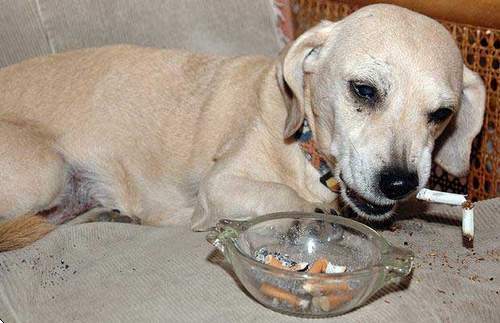
    Is more than demonstrated The damage that tobacco not only produces those people who smoke it, but also to the of his around, The "passive smokers". It seems logical to think if it is harmful to human beings also it for animals that are close and breathe in the noxious air.

    Carolynn MacAllister (University of Oklahoma) He has done studies on the subject of pets in homes of people who smoke, and some very unique conclusions reached, that vary according to the type of animal in question.

    The Boca cancer It is more frequent in those cats that are in places where, and it is much greater when these cats lead five years living with smokers. There is an explanation of the why this type of cancer in cats is most common: so habits have of licking the skin. This suggests that the beagles should not walk very far, because they also have the usual acuciada of lick their feet to keep them clean. This gesture makes the animal to expose the mucosa of the mouth to harmful substances found in their fur, Hence this type of cancer.

    In a study by the University of Colorado, It is demonstrated that the tumor nasal It is more frequent in dogs living in smokers' homes, in those who do smoke-free places. It is more likely in addition if the dog is a large nasal system (long snout) as they accumulate more carcinogenic, While that if they are of shorter snout, they are more exposed to lung cancer. A dog with nasal cancer often die within a year.

    Cancer in animals, just as in people, It may be benign or malignant, located in an area or be extended. It is a common disease that also increases with age, responsible for the deaths of pets with over half of 10 years, the incidence in dogs very similar to the persons to be.

    To the slightest symptom or suspicion, It is advisable to take the animal to the vet, If diagnosed in time their cure will be more likely to. Therapies are similar to that carried them to humans.

    Source: dogs-beagle.com