โ–ท The world of Pets: Dogs, cats, birds, reptiles, amphibians

Night Parrot
Pezoporus occidentalis

Night Parrot

Content


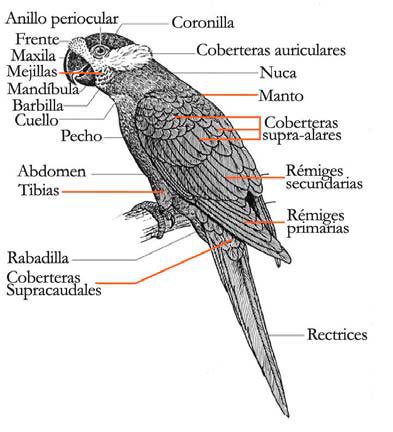
Anatomy-parrots

Description

22 to 25 cm.. length

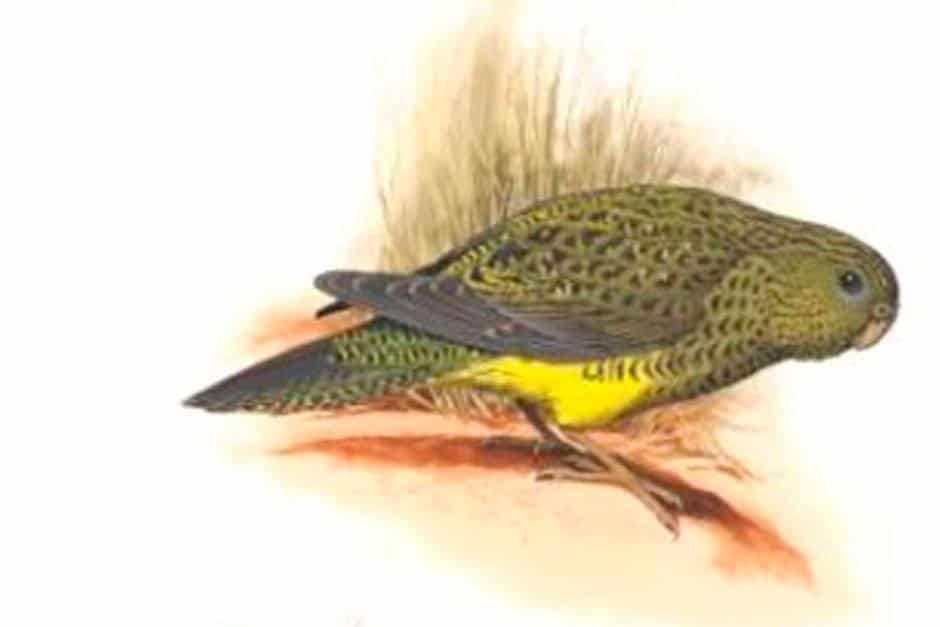
The Night Parrot (Pezoporus occidentalis) It is one of the most elusive and mysterious world of birds.

They have a bill plane, similar to the of the Kakapo (Strigops habroptila), without the apparent hook of the upper jaw. They have feathers around the cere. The tail is short. The legs are relatively elongated, indicating its good predispositions to walk.

The male and female they are similar.

In adults, the upperparts they are generally yellowish-green with dark brown cryptic spots, black and yellow. The front of the neck is greenish yellow. The chest and flanks they have discreet black and yellow stripes. Belly and coats are bright yellow. The flight feather are pale yellow, forming a thin stripe on the lower part of the wing. The central tail feathers are green with a strong yellowish brown shade. The bill is grey-brown, black eyes. Legs long claws dark grey.

In the wild, the Night Parrot It can be confused with the kakapo Parrot, If not we are looking too details which differentiates them.

Habitat:

The Night Parrot It attends a wide variety of habitats in arid or semi-arid land. They are mainly in places where the herbs grow in clumps on rocky peaks, also in the steppes composed of thickets of quenopodios. They also feel a great attraction for the Rock Samphire (A maritime rhythm), plants that are highly resistant to drought and salt.

They are known to flee to the interior areas of Muehlenbeckia, which have a dense foliage. The most recent reports do not come from the areas of Spinifex. It seems that new techniques of fire used to create firewall, They allow you to create favourable conditions for this parakeet.

The night Parrot almost never fly, except when looking for sources of water. To observe them, What has become extremely rare, We must look to the ground, in areas which consists almost exclusively of grasses of the genus Spinifex.

after dark, They fly a short distance until they find a fresh water pond. Once he has satisfied his thirst, they return to the infeed zone.

There is no certainty about the movements of this parakeet. It can be nomadic, Perhaps sedentary. No doubt depend on the climate and territory who attends them. Formerly, when the number of Night Parrot were still substantial, stocks were fluctuating seasonally.

At the end of the 19th century, in Southern Australia, groups of fifteen individuals were local irruptions, a signal that were sensitive to the favorable climatic conditions or were found in the alternative storage sites whose resources were relatively abundant.

All these considerations must be taken with great moderation for the following reason: the well-established notion that birds move through the Plains Spinifex in the direction of places full of thickets of quenopodios according to seasons and seed resources, not always been confirmed in recent reports.

Reproduction:

We know very little about the reproductive habits of this bird. The season of nesting is in July or August. The nest It is a kind of platform built with pieces of wood, on the ground or at low altitude. It is placed in a cavity that has been enlarged and which is accessed by a tunnel whose entrance is in a tuft of grass.. Its diameter is of some 8 centimeters. According to the previous data, the spawning usually contains 4 or 5 eggs. The time of incubation It is unknown.

Food:

The Night Parrot mainly consumed seeds of Spinifex (Triodia). Recent and circumstantial reports, indicate also the absorption of deciduous plants family leaves Poaceae as Enneapogon purpurascens.

Distribution:

Size of the area of distribution (reproduction / resident): 26.300 km2

The Night Parrot (Pezoporus occidentalis) are confined in the arid interior of Australia. Samples or reports come from all Australian States, especially in the Center and North of Western Australia (Mount Farmer, Nichol Spring, to the North of Glenayle, South of Kimberleys and to the West of the cue district), Southern Australia (Lake Eyre, to the South of Oodnadatta, Gawler Ranges, the Eyre Peninsula and Coopers Creek), Northern Territory South-Central and North-Western (Mac Donnell Ranges, Tanami desert), and to the southwest of Queensland (Lake Muncoonie and the surrounding areas of Boulia).

There is a report of 1913 that places them around Murrayville and Cowangie, Victoria, and another around of Ross Springs between 1954 and 1959. There is also a register of 1.897 that placed them in District of Oxleand, New South Wales.

The species has never been common, but it was more frequently toward the end of the last century (for example, 16 sightings in the region of the Lake Eyre, Southern Australia, in the decade of 1870). Due to marauding habits, many sightings remain unconfirmed, and this makes it difficult to assess its true condition. Even so, It seems certain that the population is declining. The cause of this is unknown, but it may be related to the introduction of predators such as cats, Rats, dogs or foxes. Changes in fire regimes, as well as the introduction of camels, they have also influenced its decline.
Night Parrot
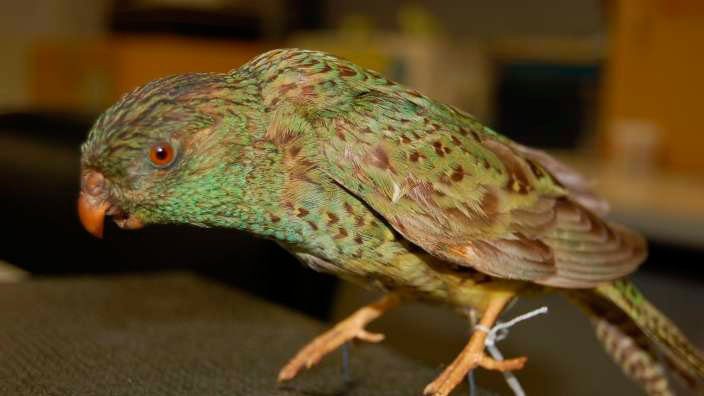
The Night Parrot seen only as museum specimens for 25 are not extinct. To cat-killed Night Parrot was recovered recently in western Queensland, Australia. (South Australian Museum)

There have been reports in every decade since its discovery, and all states in recent years, except Victoria (the last record was in 1950). The most notable recent sighting was of four birds in the eastern side of the cooper river, to 8 km to the East of the Lake Perigundi, Northeast of Southern Australia, in June of 1979. The birds were arrebolados in tangled shrubs, Sclerolaena intricata and flew away before perederse in the dense forests of Muehlenbeckia florulenta. In 1990 a long dead individual, It was the first specimen in a Museum from the Decade of 1880, was collected in the southwest of Queensland,to 36 km to the North of Boulia. A more recent record of these birds (between March of 1992 and June of 1993) He was picked up in the South of Cloncurry, about 150 km to the North of the area where the dead bird was found, which confirms the local persistence of this species.

The global population is unknown, but it can be very small and is likely to be declining. There are none in captivity.

The Night Parrot has been the subject of a legal protection in Australia since 1937.

Conservation:
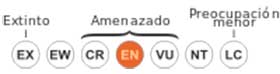

Endangered


โ€ข Current category of the Red List of the UICN: Danger

โ€ข Population trend: Decreasing

After no record is confirmed from 1990, despite several exhaustive searches and publicity campaigns, This species was rediscovered in 2005 in the region of Pilbara in Western Australia, and a dead juvenile was found in the Diamantina National Park, Queensland in 2006.

It is likely that they have decreased as a result of a series of threats, and the remaining population can be very small and possibly subject to extreme fluctuations.

Based on the records of 2005 and 2006, and because of the shortage of sightings, a Committee of experts concluded that the species was in danger of extinction.

The population of the Night Parrot is supposed to be very small, and is estimated at less of 50 mature individuals based on the scarcity of records. In 2010 a Committee of experts re-evaluรณ given records of Western Australia in 2005 and Queensland in 2006, and estimated that there could be 50 to 250 birds in total (Garnett et to the. 2011). Therefore, the number of mature individuals is placed in the band of 50-249, but it can become something bigger.

The population It is suspected that it may be in decline due to a combination of threats, including predation by invasive exotic predators.

If a population can be located, the following measures could be introduced:

    โ€ข a research and monitoring program
    โ€ข control of wild animals in and around the place where the population of the Night Parrot
    โ€ข patch burning to limit the possibility, or to prevent the occurrence of fire in the place of the population until better understanding of the situation and the ecological needs of the population
    โ€ข minimize disturbance to the population site, which could include leaking information to the public, and the establishment of agreements with landowners and land managers.
    โ€ข establish a captive breeding program (Blyth 1996; Garnett and Crowley 2000).

"Night Parrot" in captivity:

There are no records of this bird in captivity.

Alternative names:

– Night Parrot (ingles).
– Perruche nocturne (French).
– Hรถhlensittich (German).
– Periquito-de-barriga-laranja (Portuguese).
– Perico Nocturno (espaรฑol).

scientific classification:

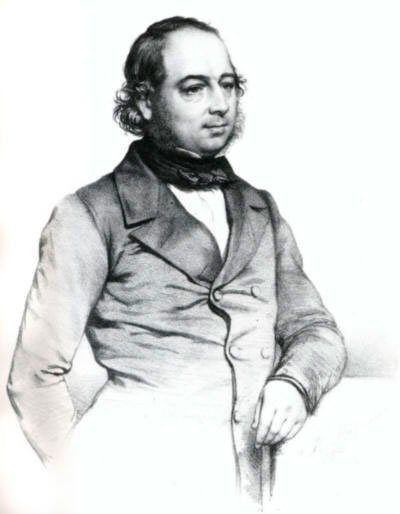
John Gould
John Gould

– Order: Psittaciformes
– Family: Psittaculidae
– Genus: Pezoporus
– Scientific name: Pezoporus occidentalis
– Citation: (Gould, 1861)
– Protonimo: Geopsittacus occidentalis

Images "Night Parrot"

"Night parakeet" (Pezoporus occidentalis)

Sources:

  • Avibase
  • Parrots of the World โ€“ Forshaw Joseph M
  • Parrots A Guide to the Parrots of the World – Tony Juniper & Mike Parr
  • Birdlife

  • Night parakeet photos:

(1) – 1971 painting of a night parrot by William Cooper – Enlace
(2) – The Night Parrot seen only as museum specimens for 25 are not extinct. To cat-killed Night Parrot was recovered recently in western Queensland, Australia. (South Australian Museum) – Top Birding Tours
โ–ท The world of Pets: Dogs, cats, birds, reptiles, amphibians

Orange-cheeked Parrot
Pyrilia barrabandi


Orange-cheeked Parrot

Content

Parrot-carinaranja-6

Description:

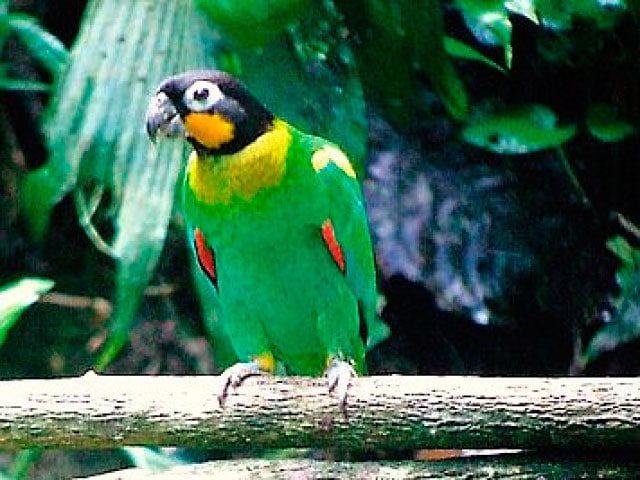
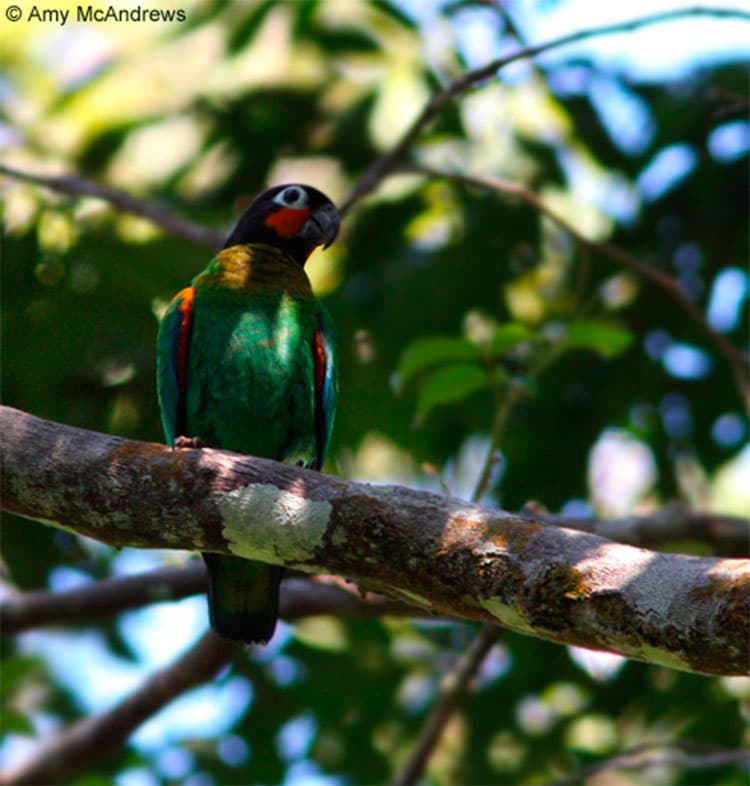
The Orange-cheeked Parrot (Pyrilia barrabandi) measured, approximately, 25 cm., has the head and throat black, except for the bright colored area amarillento-naranja that goes from the base of the bill up to the lower cheek well behind the eyes.

Upperparts green, lesser coverts, yellow-orange; edge front of the wing red; primary coverts blue-black; greater coverts bluish green; other coverts, green. Primary, dark blue at the base and in outerweb, If not black; underwing-coverts, bright red, flight feather opaque green. Upper zone of the chest dorado, its bottom and belly, bright blue green, the thighs with orange-yellow feathers. Tail green with blue tip, with yellow bases to the innerwebs of outer feathers.

Bill grey; brown the irises; legs grey.

Both sexes are similar.

The immature has the head Brown golden colour with yellowish brown in cheeks inferiores. Younger birds also has less yellow in the bend of wing, some green feathers in the underwing-coverts and yellow on the tips of the primaries.

Description 2 subspecies:

  • Pyrilia barrabandi aurantiigena

    (Gyldenstolpe, 1951) – Lesser coverts, curve of the wing and the thighs intense Orange instead of yellow-orange.

  • Pyrilia barrabandi barrabandi

    (Kuhl, 1820) – Nominal.

Habitat:

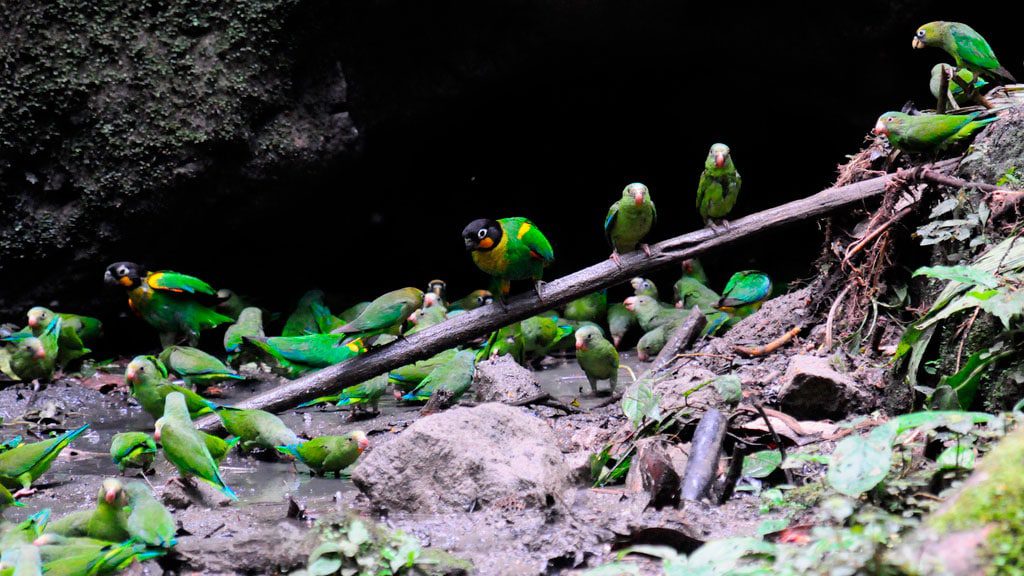
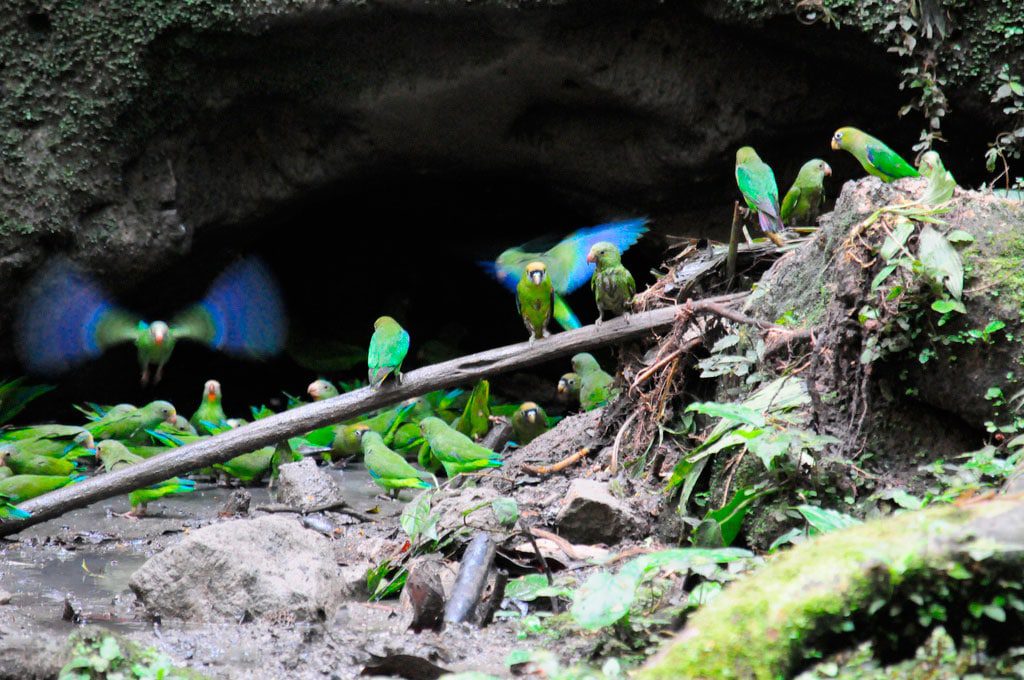
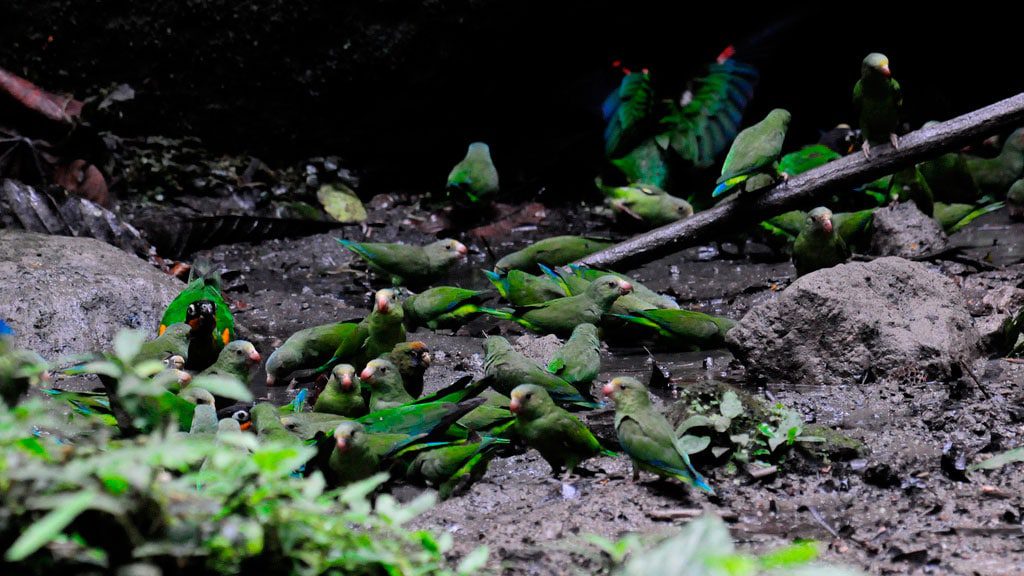
They inhabit mainly in lowland forests, apparently less frequently in forests and marshes. They are distributed at the edge of forests and partially disturbed forest, occasionally in small groves in deforested areas. Observed in altitudes of 150-300 metres in Venezuela and 500 meters in the southeast of Colombia. Seen individually, in pairs and in small groups of up to 10 individuals (sometimes more in banks of land rich in minerals). Are activated more early, In the morning, than other parrots and will rest later.

Reproduction:

There is no information about the nesting, but that suggests the registration of immature birds in February and March breeding season It can be between the months of September/October until the end of year.

Food:

Observed taking seeds or fruits of Ficus sphenophylla, Pourouma, Pseudolmedia, Mimosa, Pithecellobium and Heisteria and possibly larvae of the gall wasps. Usually, they feed in the canopy of the trees, or just below them; less frequently in low branches. Regularly visit areas with mineral-rich soil in the company of other species of parrots.

Distribution:

Size of the area of distribution(reproduction / resident): 3.470.000 km2

This is a kind of basin of the Western Amazon and the Alto Orinoco. Its length extends from the southeast of Colombia, from the Caquetรก Western and bass inirida river, Guainia, until Venezuela in amazon and the Center and South of Bolรญvar and in Brazil in the upper part of the Amazon to the West, from the rivers Negro and Madeira through the rivers Juruรก and Purus and to the South towards Mato Grosso, through the East of Ecuador and East of Peru and to the Northwest of Bolivia, in hand me.

They are generally considered rare throughout its distribution area, Although they are fairly common in the Northwest of Bolivia and many in the sandy Woods of bass Inirida River, to the southeast of Colombia. Its population has fallen locally due to deforestation, Although large tracts of primary forest remain in all range States. Live in several areas protected.

Distribution 2 subspecies:

  • Pyrilia barrabandi aurantiigena

    (Gyldenstolpe, 1951) – Is located in the East of Ecuador and to the East of Peru, where is this in the Manu National Park. In the North of Bolivia is it described as frequent to numerous. The extension also comes to Brazil: is limited by the Amazon in the North and Rio Madeira from the East (pit et to the., 1997).

  • Pyrilia barrabandi barrabandi

    (Kuhl, 1820) – Nominal.

Conservation:


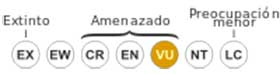
Near-threatened


โ€ข Current category of the Red List of the UICN: Almost threatened.

โ€ข Population trend: Stable.

Justification of the population

The size of the world population It has not been quantified, but this species is described as ยซRareยป (Stotz et to the., 1996).

Justification of trend

It is suspected that this species has lost 12.1-15% of habitat within its distribution over three generations (21 years) based on a model of Amazon deforestation (Soares-Filho et to the., 2006, Bird et to the., 2011). Given the susceptibility of the species to the fragmentation and degradation of forest and potentially your hunting and/or trapping, It is suspected that its population will decrease at a rate close to the 30% during three generations.

Threats

The main threat This species is the acceleration of the deforestation on amazon basin with large tracts of land used for livestock and soybean production; It is highly susceptible to degradation and fragmentation due to its dependence of primary forests (Soares-Filho et to the. 2006, Bird et to the. 2011, A. Lees in litt. 2011). It can also be vulnerable to the hunt (A. Lees in litt. 2011). The changes proposed by the Forest code of Brazil reduce the percentage of land that a private owner is legally required to maintain as forest and include an amnesty for owners who deforested before July 2008 (who would later be acquitted of the need to reforest illegally cleared land) (Bird et to the. 2011).

"Orange-cheeked Parrot" in captivity:

It is very rare see you in captivity outside of Brazil.

Alternative names:

– Orange-cheeked Parrot, Barraband’s Parrot, Orange cheeked Parrot (English).
– Caรฏque de Barraband (French).
– Goldwangenpapagei, Goldwangen-Papagei (German).
– curica-de-bochecha-laranja, curica, curuca (Portuguese).
– Cotorra Cabecinegra, Lorito Carinaranja, Lorito de Mejillas Amarillas (espaรฑol).
– Cotorra Cabecinegra (Colombia).
– Loro de Mejilla Naranja (Peru).
– Perico Cachete Amarillo (Venezuela).


scientific classification:

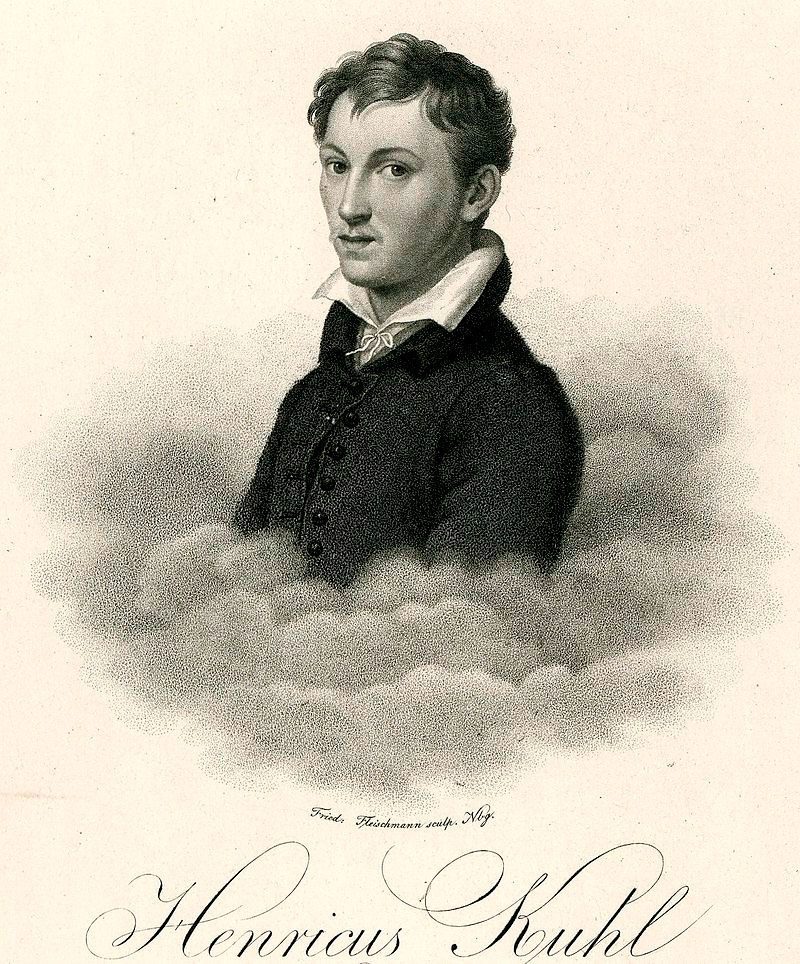
Kuhl, Heinrich
Heinrich Kuhl

– Order: Psittaciformes
– Family: Psittacidae
– Genus: Pyrilia
– Scientific name: Pyrilia barrabandi
– Citation: (Kuhl, 1820)
– Protonimo: Psittacus Barrabandi


Images "Lorito Carinanja":

Videos "Orange-cheeked Parrot"

————————————————————————————————

"Lorito Carinanja" (Pyrilia barrabandi)


Sources:

– Avibase
– Parrots of the World โ€“ Forshaw Joseph M
– Parrots A Guide to the Parrots of the World – Tony Juniper & Mike Parr
– Birdlife

– Photos:

(1) – Orange-cheeked Parrot (Pyrilia barrabandi) Cristalino Jungle Lodge, Mato Grosso, Brazil by Amy McAndrews – Flickr
(2) – Orange-cheeked Parrot at Napo Wildlife Reserve, Ecuador by ocelot123 – Flickr
(3) – Cobalt Winged Parakeet , Scarlet Shouldered Parrotlet and Orange Cheeked Parrot at 3rd lick by Vince Smith – Flickr
(4) – Cobalt Winged Parakeet , Scarlet Shouldered Parrotlet and Orange Cheeked Parrot at 3rd lick by Vince Smith – Flickr
(5) – Cobalt Winged Parakeet , Scarlet Shouldered Parrotlet and Orange Cheeked Parrot at 3rd lick by Vince Smith – Flickr
(6) – Oiseaux brillans du Brรฉsil.. Paris,1834.. biodiversitylibrary.org/page/47697228

– Sounds: controles-canto.org

โ–ท The world of Pets: Dogs, cats, birds, reptiles, amphibians

Mindoro Racquet-tail
Prioniturus mindorensis

Mindoro Racquet-tail

Content

Mindoro Racquet-tail

Description:

27 cms length.

The Mindoro Racquet-tail (Prioniturus mindorensis) They are closely related to the Blue-crowned Racquet-tail but it is distinguished by the patch crown in the mindorensis it is blue with a slight violet tinge and stands out sharply against the forecrown green; the bill is larger and the rackets are never as long as in adult specimens of the discurus.

-similar female to female Blue-crowned Racquet-tail, but often with violet traces in the patch crown.

Formerly considered conspecific (belonging to the same species) with the Blue-crowned Racquet-tail (Prioniturus discurus).

Habitat:

They can be found in humid lowland forests, most recently being observed records, in groups of birds visiting the IBA Siburan.

Reproduction:

No information about their reproductive behavior.

Food:

Surely it feeds their congeners fruits, berries, nuts and seeds.

Distribution:

Extending its range (breeding/resident): 12.100 km2

endemic to the Mindoro Island in Philippines.

Conservation:


Vulnerable


Rationale for the Red List category: Vulnerable.

Population size: 2500-9999 specimens.

The population trend: In decline.

Rationale for the Red List category

This newly divided species is listed as Vulnerable it is believed to have a small town, which infers that is in decline due to the continuous pressure of capture and loss of habitat.

Justification of the population

The population size of this species has not been formally quantified, but it is estimated preliminarily that has less than 10.000 mature individuals. So, placed in the band 2.500-9.999 mature individuals, which it is supposed equivalent to a total population of 3.750-14.999 individuals, rounded here to 3.500-15.000 approximately. It is presumed that all mature individuals form a single subpopulation.

Justification trend

It is inferred that the population of the species is continuous decrease due to the constant pressure capture and habitat loss (Juniper and Parr 1998).

Threats

Little information is available about threats to this species, but it is believed that the continuous capture for pet trade and the continuous loss of habitat through agricultural expansion, timber harvesting and development are causing a negative population trend.

conservation actions

Conservation actions underway

No specific conservation actions are known for this species., although suitable habitat is officially protected.

Conservation Actions Proposed

Surveys to quantify the population.
Study the habitat needs of the species.
Assess the level of threat of capture pressure.
Using remote sensing techniques to track the change in land use in Mindoro.
Carry out awareness activities to reduce trapping activities.

"Mindoro Racquet-tail" in captivity:

Not found in captivity.

Alternative names:

– Blue-crowned Racquet-tail (mindorensis), Mindoro Racket-tail, Mindoro Racquet-tail (English).
– Palette ร  couronne bleue (mindorensis), Palette de Mindoro (French).
– Mindoro-Spatelschwanzpapagei (German).
– Prioniturus mindorensis (Portuguese).
– Lorito momoto de Mindoro (espaรฑol).


scientific classification:

Joseph Beal Steere
Joseph Beal Steere

– Order: Psittaciformes
– Family: Psittaculidae
– Genus: Prioniturus
– Scientific name: Prioniturus mindorensis
– Citation: Steere, 1890
– Protonimo: Prioniturus mindorensis

Images "Mindoro Racquet-tail"

ยซLorito Momoto de Mindoroยป (Prioniturus mindorensis)

Sources:

Avibase
Parrots of the World โ€“ Forshaw Joseph M
Parrots A Guide to the Parrots of the World – Tony Juniper & Mike Parr
Birdlife

Photos:

(1) – Mindoro Racquet-tail Prioniturus mindorensis (Young bird with no racquets) in Mounts Iglit-Baco National Park, Mindoro, Philippines by Djop Tabaranza Accessible at hbw.com/ibc/1405853.
(2) – Mindoro Racquet-tail (Prioniturus mindorensis) – https://www.hbw.com/species/mindoro-racquet-tail-prioniturus-mindorensis

Sounds: Desmond Allen, XC79225. accessible www.xeno-canto.org/79225.

โ–ท The world of Pets: Dogs, cats, birds, reptiles, amphibians

Olive headed Lorikeet
Trichoglossus euteles

Olive headed Lorikeet

Content

Description

Its length is about 25 cm. and weigh between 80 and 85 gr.

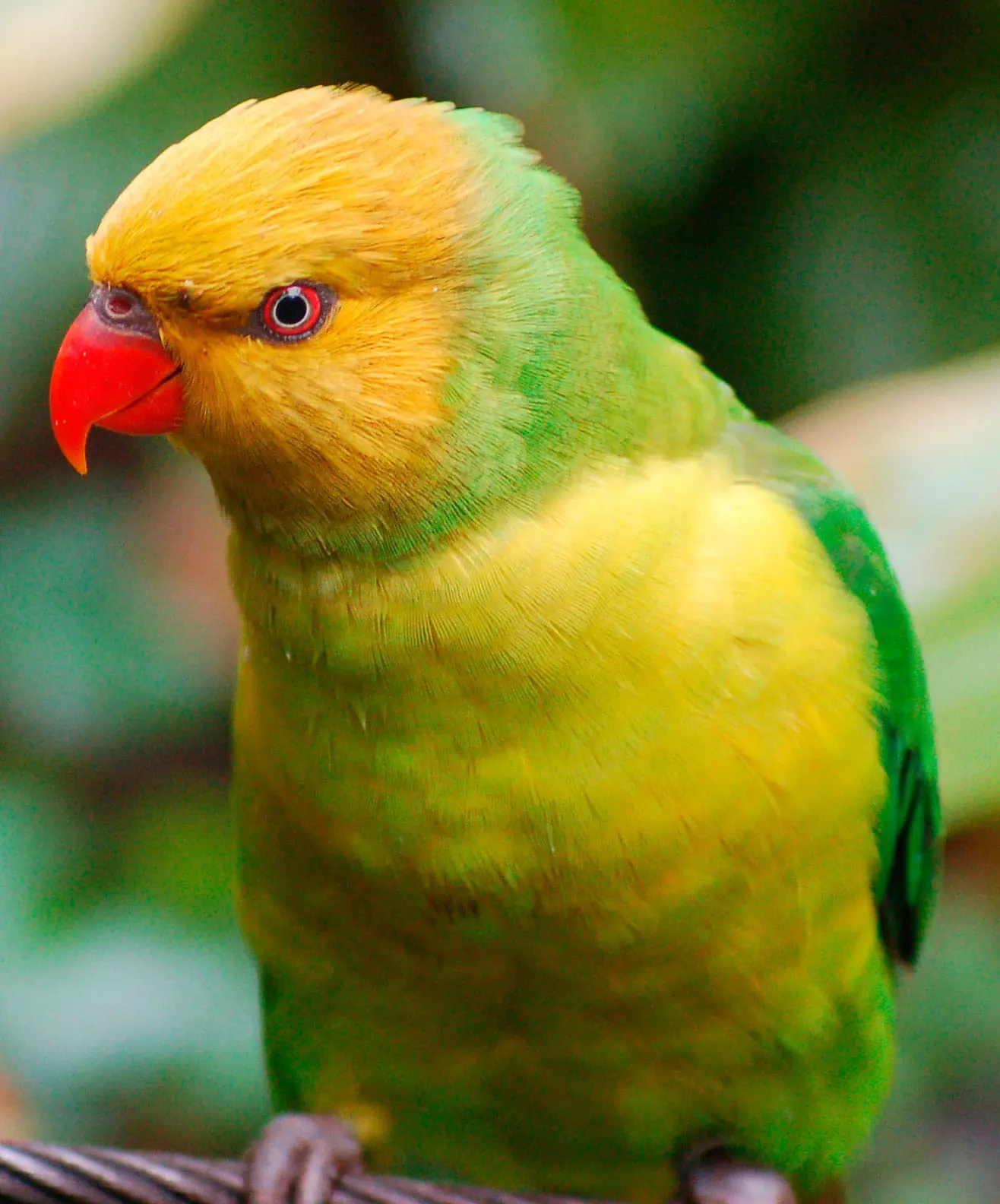
The Olive headed Lorikeet (Trichoglossus euteles) show, in general, a green shade.
The head color is olive with waves pale mustard and yellow stripes over the entire surface of the top.
The neck and its part rear are surrounded by a collar of color green brilliant that continues until the throat.

The underparts below the throat are entirely greenish-yellow.
The bill is red-orange. The irises they are red, and legs grey.

The youth they are more muted than adults. Its head is slightly greenish with streaks pale. The bill is brown. The irises They are brown. The species is considered monotype.

Habitat:

They frequent humid subtropical forests., secondary forests and wooded meadows. Adapt quite well to cultivated land and the gardens in cities.

In Timor, they are relatively abundant between 1.000 and 2.300 meters above sea level, apparently, substitute to the Coconut Lorikeet in these heights. Also they can be observed at sea level in the island of Timor. In the rest of the Islands it frequents lowland areas.

The Olive headed Lorikeet they live in small groups. They are especially visible when they are in flight because they emit continuously shouts. On the other hand, when feeding or resting in trees, they are very difficult to observe because of their green plumage mixed with the color of the foliage.

They are birds territorial, capable of showing great aggressiveness if the limits of their area of โ€‹โ€‹influence are violated.

Usually disperse in search of their food, forming large groups when resources are abundant.

Outside the breeding season they form large roaming flocks of a hundred or more individuals.. Move in flying fast and slightly wavy.

In Timor, during the season, dry, These birds seem to descend below 1.000 meters and are scattered in coastal areas.

Reproduction:

The anidacio seasonn would take place perhaps between September and October, but this information needs to be confirmed.

In captivity, the Olive headed Lorikeet put 3 white eggs that parents are in charge of incubate for a few 23 days. As in the majority of the Lori, the nesting cycle is particularly long.

Food:

Feed primarily of nectar and fruit. They forage in trees in flower and shrubs.

Distribution:

Size of the area of distribution (reproduction / resident): 38.100 km2

Timor and Lesser Sunda Islands, from the East of Lembata until Nila and Babar.

Conservation:


minor concern


โ€ข Current IUCN Red List category: Least concern

โ€ข Population trend: Stable


The population size This species has not been quantified. Suspected that the population is stable in the absence of evidence of any reduction or substantial threats.

Like most brightly plumaged parrots, the Olive headed Lorikeet It victim of trade bird cage or Aviary.


"Olive headed Lorikeet" in captivity:

Pretty common. They can be housed with others of its kind.

Alternative names:

– Olive headed Lorikeet, Olive-headed Lorikeet, Perfect Lorikeet (ingles).
– Loriquet eutรจle (French).
– Gelbkopflori (German).
– Lรณris-de-cabeรงa-amarilla (Portuguese).
– Lori Humilde, Tricogloso Humilde (espaรฑol).

scientific classification:

– Order: Psittaciformes
– Family: Psittaculidae
– Genus: Trichoglossus
– Scientific name: Trichoglossus euteles
– Citation: (Temminck, 1835)
– Protonimo: Psittacus euteles

Images "Humned Lori":

Videos "Olive headed Lorikeet"

———————————————————————————————–

"Lori humildeยป (Trichoglossus euteles)


Sources:

– Avibase
– Parrots of the World – Joseph Forshaw M
– Parrots-A Guide to the Parrots of the World by Tony Juniper & Mike Parr
– BirdLife.org

– Photos:

1 – Photo by and (C)2007 Derek Ramsey (Ram-Man) – Self-photographed – Wikipedia
2 – By James Eaton – IBC.lynxeds.com
3 – ยซTrichoglossus euteles-captive-8a-ecยป by Trichoglossus_euteles_-captive-8a.jpg: Ruth Rogersderivative work: Snowmanradio (talk) – originally posted to Flickr as P8120395 and uploaded to commons at Trichoglossus_euteles_-captive-8a.jpg. Licensed under CC BY 2.0 via Wikimedia Commons.
4 – "Scaly-breasted Lorikeet Kobble Dec06" von Aviceda – Eigenes Werk. Lizenziert unter CC BY-SA 3.0 รผber Wikimedia Commons.
5 – By Marcella (Picasa Web Albums) [CC-BY-SA-3.0], via Wikimedia Commons

– Sounds: Colin Trainor (Xeno-canto)

โ–ท The world of Pets: Dogs, cats, birds, reptiles, amphibians

Meek's Pygmy-Parrot
Micropsitta meeki

Meek's Pygmy-Parrot

Content


Anatomy-parrots

Description

10 cm. length.

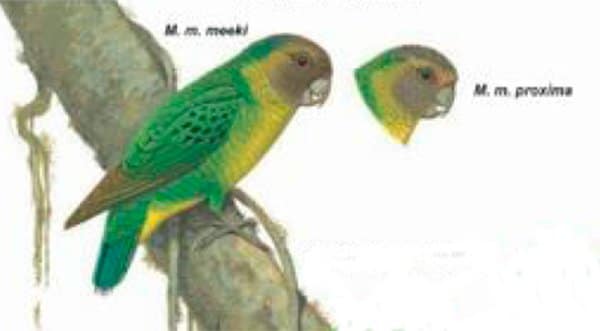
The Meek's Pygmy-Parrot (Micropsitta meeki) has the feathers of the head dark brown, strongly scalloped in color yellow on them ear-coverts and the sides of the throat, and usually with the eyebrows in a vague color yellow; feathers of the crown with fine greyish yellow tips.

Upperparts dark green, darker on the margins and the Center to the Middle coverts black. Feathers primary Black with green trim; secondaries mainly green. Wing feathers more dark with the tips of color yellow; underside of flight feather blackish. Top of the chest and centre of belly, opaque yellow, with brown spots at the tips of the feathers; flanks color green dark; under the tail, coverts yellow. Tail greenish blue in the Center, feathers laterales blackish with stains yellow on the tips or with pointed blue and yellow.

Bill yellow rose pale; irises yellowish brown; legs Pink.

Similar to males females.

Subspecies

  • Micropsitta meeki meeki

    (Rothschild and Hartert, 1914) – The nominal.


  • Micropsitta meeki proxima

    (Rothschild and Hartert, 1924) – The face is more pale and the grey more beige that the of the nominal species; light diffusion of greenish color instead of the yellow markings of the nominal, and a band front yellow with find in them eyebrows.

Habitat:

Microloro-of-Meek-(2)

Not well known. It occurs in forests, high secondary growth, and even in trees around inhabited areas. The birds are found in small groups. Habits are like those of the Buff-faced Pygmy-Parrot.

Reproduction:

The nest they usually build it on a tree termite mound, Sometimes it can be very close to the ground.

Food:

They feed on lichens and fungi collected from trunks of trees.
They nourish also of seeds, nuts, berries and fallen fruits that they can find, Although they prefer to eat fruits of plants. They also feed on insects and insect larvae.

Distribution:

Size of the area of distribution (reproduction / resident): 2,400 km2

Endemic to the forests of the lowlands, until 700 meters of altitude on the Islands in the Northwest Bismarck Archipelago including Manus, Lou and Rambutyo in the Group of Admiralty and Mussau and Emira in the Saint Matthias group.

Of the two subspecies:

Conservation:


minor concern


โ€ข Current IUCN Red List category: Least concern

โ€ข Population trend: Stable

The size of the world population It has not been quantified, It is thought that it may be above the 10,000 specimens. According to sources, the species is common both in Manus as Lou (pit et to the. 1997).

The population is suspected to be stable in the absence of evidence of any reduction or substantial threats.

"Meek's Pygmy-Parrot" in captivity:

Not found in captivity.

While attempts have been made to keep Pygmy parrots in captivity, These have not been successful. This may be due to the fact that birds suffer from stress or a lack of understanding of their dietary needs.

Alternative names:

– Meek’s Pygmy-Parrot, Citrine Pygmy Parrot, Meek’s Pygmy Parrot, Yellow-breasted Pygmy Parrot, Yellow-breasted Pygmy-parrot (ingles).
– Micropsitte de Meek (French).
– Meekspechtpapagei, Meek-Papagei (German).
– Micropsitta meeki (Portuguese).
– Microloro de Meek (espaรฑol).

scientific classification:

– Order: Psittaciformes
– Family: Psittaculidae
– Genus: Meeki
– Scientific name: Micropsitta meeki
– Citation: Rothschild & Hartert, 1914
– Protonimo: Micropsitta meeki

Images "Meek's Pygmy-Parrot"

————————————————————————————————

ยซMicroloro de Meekยป (Micropsitta meeki)


Sources:

– Avibase
– Parrots of the World โ€“ Forshaw Joseph M
– Parrots A Guide to the Parrots of the World – Tony Juniper & Mike Parr
– Birdlife

– Photos:

(1) – Parrots of the World โ€“ Forshaw Joseph M
(2) – Meekโ€™s Pygmy-Parrot on Manus – BIRDING AROUND THE WORLD

– Sounds: Frank Lambert (Xeno-canto)

โ–ท The world of Pets: Dogs, cats, birds, reptiles, amphibians

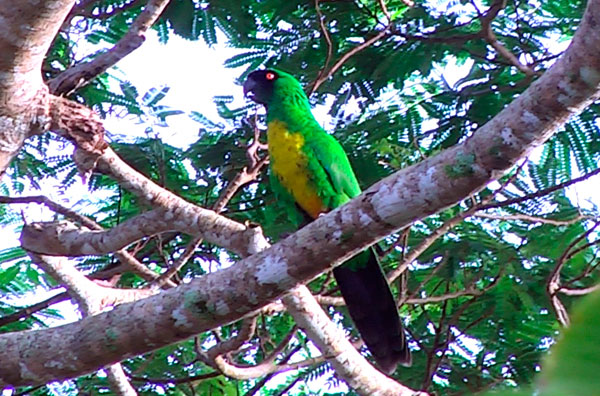
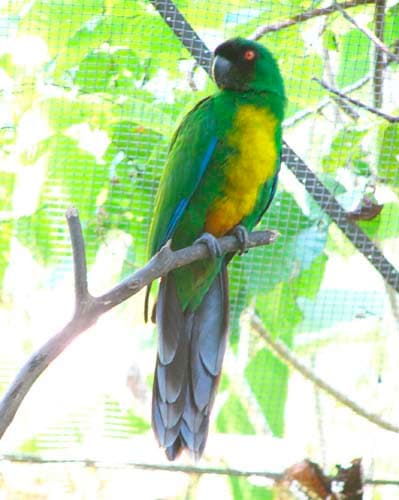
Masked Shining-Parrot
Prosopeia personata

Masked Shining-Parrot

Content


Anatomy-parrots

Description

47 cm of length and weight approximate of 322 g..

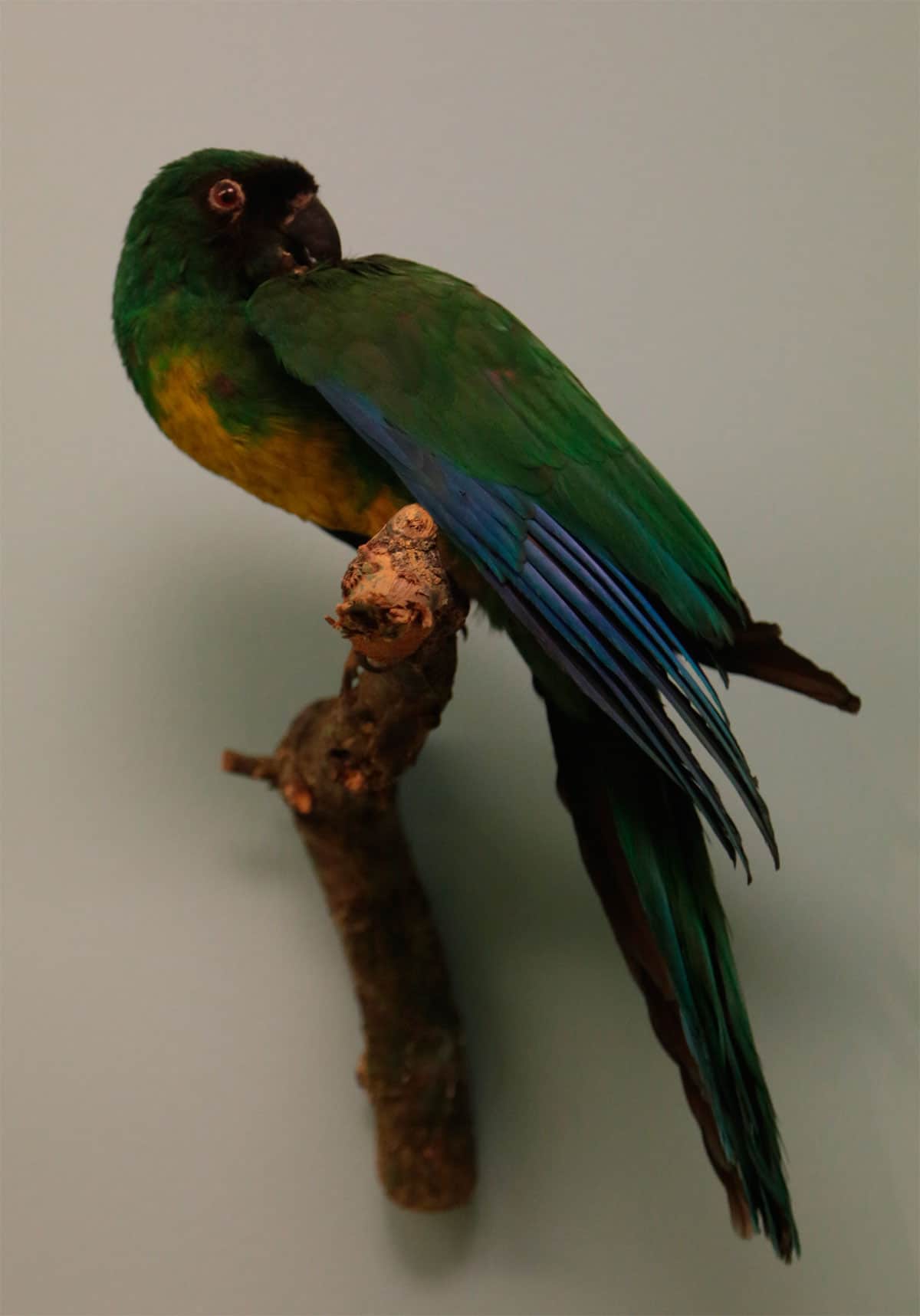
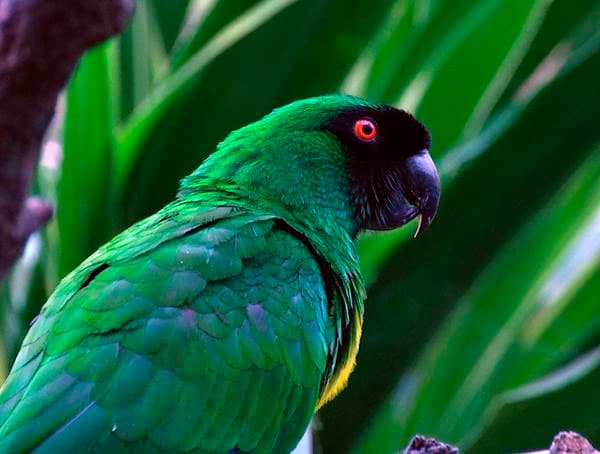
The colorful Masked Shining-Parrot (Prosopeia personata), has a plumage green over most of its body, the front of the crown, lores, cheeks and chin, are black.

The upperparts are bright pale green (with a brighter sheen on the Crown and nape). Large external coverts, primary coverts and primaries are blue with vane inner dark. Wing feathers green. Throat, top of the chest, flanks, and undertail- coverts green; center of chest and the belly bright yellow, a few feathers with the Green Tip, yellow shading in the Orange patch It is located in the lower part of the belly. Upper, the tail green; black for the part below.

The bill black; irises orange-red; legs blackish gray.

The male has the head and the bill larger that the female. The young birds have, peaks paler, less black in the face and irises brown.

El Papagayo Enmascarado (Prosopeia personata) is a large parrot, long tail which is only on an island, in Fiji.

Habitat:

Masked Shining-Parrot

They are distributed Since the sea level, until the 1.200 m altitude, in the forest reacor and secondary growth of the Windward areas and intermediate vegetation, You can also find them in orchards of villages, agricultural fields and mangroves; Often observed along forest edges near agricultural land and in trees bordering forest watercourses.

The Masked Shining-Parrot they are usually sociable and finds them alone, in pairs, or outside the breeding season in herds up to 40 birds.

Birds are sometimes interviews flying rapidly through the forest or wandering above the canopy. Son noisy birds and they are often heard before to be seen; similar to the Red Shining-Parrot, often make calls at the first sign of a human intruder, and they are generally shy and difficult to approach when they are perched on a branch.

Reproduction:

The breeding season occurs between July and September. The nest It is a hole or crack in a tree, or a cavity at the top of a stump. Two or more eggs White deposited inside a hollow form the implementation; the hole is expanded by making use of its powerful beak. Birds emit a strong odor.

Food:

The Masked Shining-Parrot they tend to rest the high parts of the trees, but descend to lower floors to feed on berries, and pick up the fruits of the soil; they can also attack fields.

The diet includes mainly fruit, for example, Mango (Mangifera indica), guava (Psidium guajava), Ficus figs and bananas, Although they can also be powered from flowers, insects, seeds and berries, as well as the cultivated grain.

When feed, They manipulate food with their legs using their beaks to catch small branches. They are powerful and it has been flying with a Mango between its claws.

Distribution:

Size of the area of distribution (reproduction / resident): 10,500 km2

The Masked Shining-Parrot they are endemic in Fiji, distributed only on the island of Viti Levu (Although the species also has been recorded in the nearby island of Ovalau in the past). In Viti Levu, It is not uncommon to see them on the inside of forests, including the surroundings of Nadarivatu and in the North of the Mount Tomanivi. In the center of Nadrau and to the East of the district Vunidawa.

The world population considered that it may be on the 5.000 specimens, but in decline due to habitat loss.

Required large trees for nesting are being felled., and tracts of mature forest are fragmented now in many areas.

The possible detrimental effect of inter-specific competition of the introduced Crimson Shining-Parrot remains study.

Conservation:


Near-threatened


โ€ข Current Red List of UICN: Near threatened

โ€ข Population trend: Decreasing

The most serious threat affecting the Masked Shining-Parrot It is the decline of forests in which inhabits, with less than the 50 per cent of the forests of Viti Levu remaining. This deforestation has led to the fragmentation of remaining forest areas. The huge trees felled during the deforestation are required by the Masked Shining-Parrot nest.

Other potential threats to this species include potential competition with the introduced Crimson Shining-Parrot (Prosopeia splendens). The Masked Shining-Parrot It can also be trafficked for the pet trade, Although the related species, as the Crimson Shining-Parrot It is believed that they are most popular).

Conservation of the โ€œMasked Parrotโ€.

The Masked Shining-Parrot is protected by the law of Fiji. But, current legislation for the capture of wild parrots is difficult to enforce. This Parrot also appears in the Appendix II of the Convention on international trade in endangered species (CITES), which means that international trade in the species must be carefully monitored.

The Masked Shining-Parrot It lives in several reserves and parks, where can you get some protection against deforestation. It has been proposed that community forest reserves must be encouraged in Viti Levu, to prevent further deforestation, and that the population figures of the Masked Shining-Parrot in these protected areas should be monitored. But, None of these measures has been put into action

"Masked Shining-Parrot" in captivity:

Rarely found in captivity.

According to sources, It is known that one as a specimen of this species lived 11,8 years in captivity.

Alternative names:

– Masked Shining-Parrot, Masked Parrot, Masked Shining Parrot, Yellow-breasted Musk Parrot, Yellow-breasted Shining-Parrot (ingles).
– Perruche masquรฉe, Perruche masquรฉe masquรฉe (French).
– Maskensittich, Masken-Sittich (German).
– Prosopeia personata (Portuguese).
– Papagayo Enmascarado (espaรฑol).

scientific classification:

– Order: Psittaciformes
– Family: Psittaculidae
– Genus: Prosopeia
– Scientific name: Prosopeia personata
– Citation: (Gray, GR, 1848)
– Protonimo: Coracopsis ? personata

Images ยซMasked Parrotยป:

Videos "Masked Shining-Parrot"

————————————————————————————————

ยซMasked Parrotยป (Prosopeia personata)


Sources:

– Avibase
– Parrots of the World โ€“ Forshaw Joseph M
– Parrots A Guide to the Parrots of the World – Tony Juniper & Mike Parr
– Birdlife
– ARKive.org

– Photos:

(1) – Masked Shining Parrot , Birds Gallery, Natural History Museum, London By John Cummings (Own work) [CC BY-SA 3.0], via Wikimedia Commons
(2) – By Benjamin Waterhouse Hawkins [Public domain], via Wikimedia Commons
(3) – Masked Shining Parrot Prosopeia personata Kula Eco Park – Viti Levu, Fiji ยฉ 2007 Sarah – The Online Zoo
(4) – Masked Shining Parrot Prosopeia personata Kula Eco Park – Viti Levu, Fiji ยฉ 2007 Sarah – The Online Zoo
(5) – A bird resting in a tree by Josep del Hoyo – Lynx
(6) – A close-up of the head of one bird by Josep del Hoyo – Lynx

– Sounds: Matthias Feuersenger (Xeno-canto)

โ–ท The world of Pets: Dogs, cats, birds, reptiles, amphibians

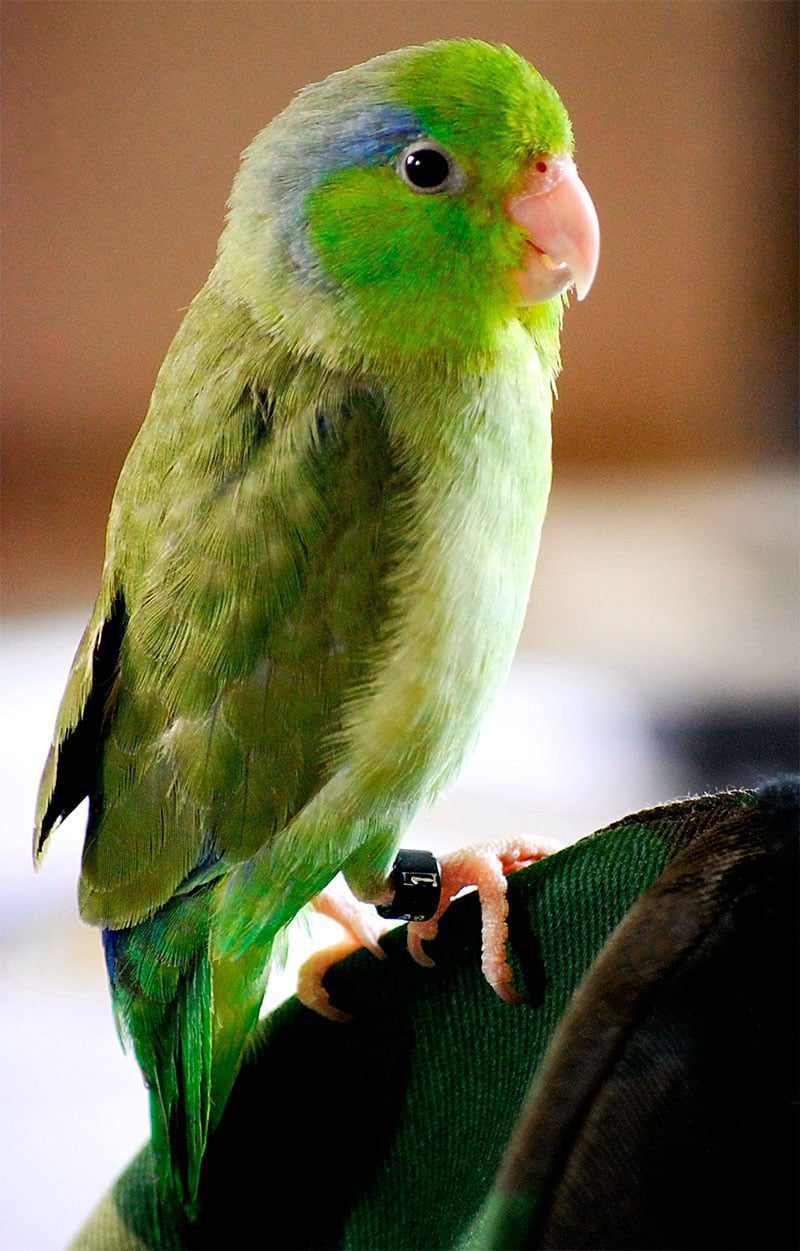
Pacific Parrotlet
Forpus coelestis


Pacific Parrotlet

Content

Description:


Anatomy-parrots

12-13 cm.. height.

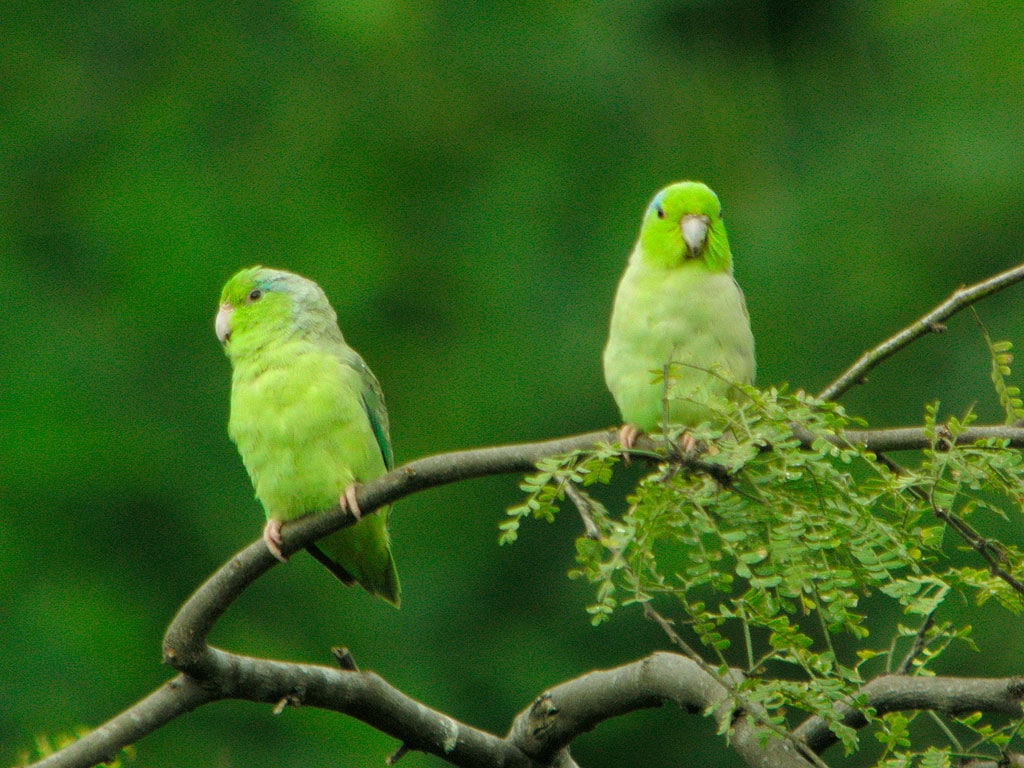
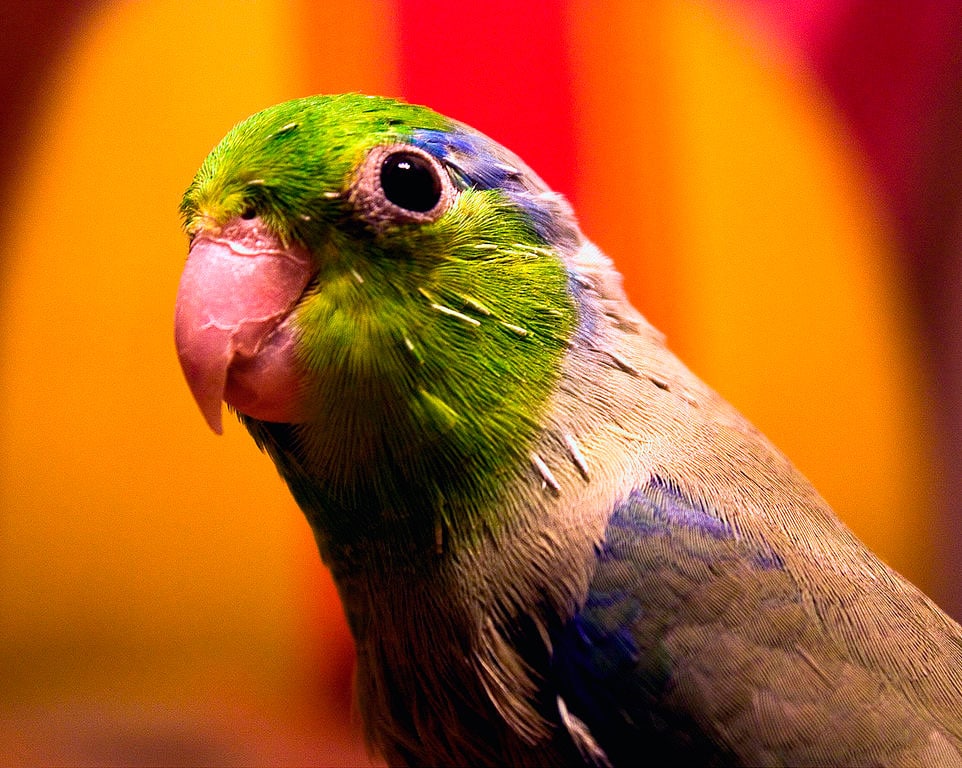
The Pacific Parrotlet (Forpus coelestis) It is a small bird, chubby with a tail short and finished in tip. Distinguishable in flight by the blue and Brown on the inside of the wings. It has blue behind the eye and in the middle of the wing at the top. The female does blue stain on the top of the wing and the blue behind the eye is paler. The Immature males they are similar to the adult male, but more pale and with back brownish.

Habitat:

The Pacific Parrotlet frequent most dry woodland habitats, such as scrub thorny, bosque deciduous, dense thickets of Captus with balsa trees, plantations of banana and mango, riparian zone, irrigated fields in Savannah and gardens, although their preferred areas are those of humid tropical vegetation such as the coastal mangales.

Older records of this species are from below sea level of 1.000 m, but are to 2.150 meters on the West side of the Andes in Huancabamba, is of Piura, Peru, and a 1.370-1.650 meters in the South of Loja, Ecuador.

Usually gregarious; they form large flocks where abundant food.

Reproduction:

It nests in the cavity of trees, in cactus, fence posts, pipes or the nests of the Pale-legged Hornero (Furnarius leucopus), of the Tie Neck Pijuรญ (Synallaxis stictothorax) or Fasciated Wren (Campylorhynchus fasciatus).

The breeding season includes the months of January to may. Sometimes, they breed a second time throughout the year. The laying of eggs 4-6.

Food:

The diet of the Pacific Parrotlet includes seeds grass, berries, fruit (example, of Tamarindus, Amaranthus spinosus) and cactus fruits. It forages among the vegetation and land.

Distribution:

Size of the area of distribution (reproduction / resident): 147.000 km2

This species is found in the West of Ecuador, in Manabi Since the latitude of the Valley of the Chone River to the South across the South of Pichincha, The rivers and Guayas (including the Isla Puna), until Gold and Loja, entering the Northwest of Peru, in Tumbes, Piura, Lambayeque and South of Cajamarca, until Freedom and Trujillo.

irregularly common, sometimes abundant; most numerous in arid areas. The population has apparently not yet been severely affected by the trade in live birds or the conversion of natural and semi-natural habitats for the Agriculture. The species is probably Forpus most numerous in captivity.

Conservation:

State of conservation โ“˜


minor concern Minor Concern โ“˜ (UICN)โ“˜

โ€ข Current category of the Red List of the UICN: Least concern.

โ€ข Population trend: Stable.

Justification of the population

The size of the world population It has not been quantified, but this species is described as ยซcommonยป (Stotz et to the., 1996).

Justification of trend

Suspected that the population is stable in absence of evidence of any decline or threatens substantial.

"Pacific Parrotlet" in captivity:

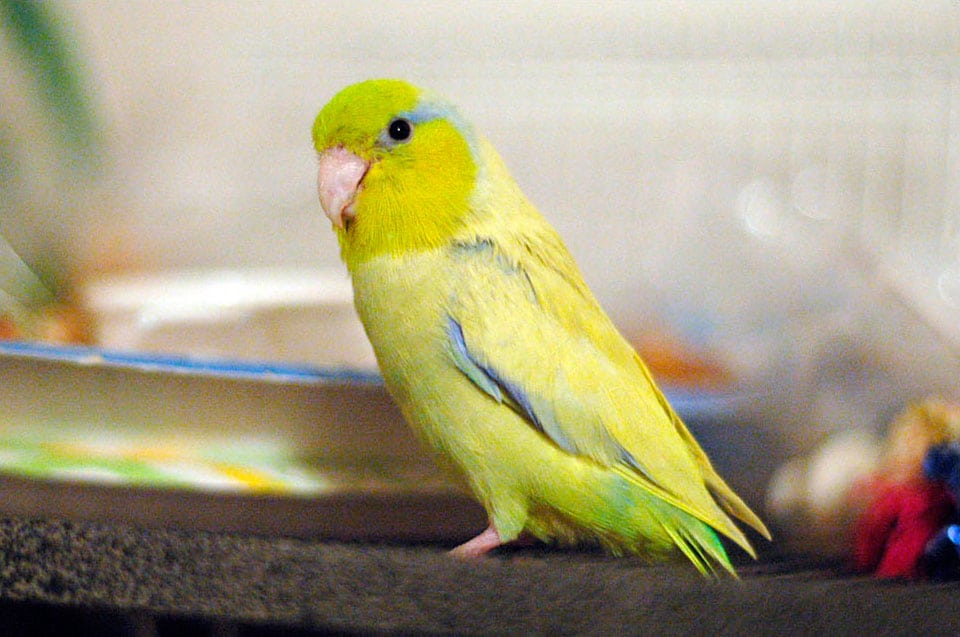
Colorful, charming and intelligent. These small birds have become in very popular pets in recent years. Its small size and quiet nature make of the Pacific Parrotlet an ideal choice for people living in apartments. Nicknamed โ€œpocket parrotsโ€ in the pet trade, These parakeets are actually the smallest of the family of parrots, and they are as smart as many larger species. Some learn to speak quite well, Although the species is not particularly known for the ability to speak.
An interesting fact upon the Pacific Parrotlet is that its closest relative is the Amazon parrot. Although the two species differ greatly in size, owners often report striking similarities between them. Despite being small birds, they are by no means โ€œlow maintenance birdsโ€. While it is true that they are, course, easy to clean, in comparison with the larger birds, However require your daily care to keep them docile, socialization at an early age is the key to be in a future good behavior.
They have tendency to obesity. They must be able to get out of their cages, spread your wings, and exercise your muscles to maintain your physical and mental health.

Their metabolism is very high, and they should have food available at all times. They are known for their appetite voracious, and occur in one diet varied that consists in fruits and vegetables fresh, small seeds such as millet, the high-quality commercial pellets, and protein sources from hard boiled egg.

There are many mutations.

Alternative names:

– Pacific Parrotlet, Western Parrotlet (English).
– Toui cรฉleste, Perruche-moineau cรฉleste (French).
– Himmelsperlingspapagei, Himmelspapagei (German).
– Tuim-peruano (Portuguese).
– Catita Enana Amarilla, Cotorrita de Piura, Cotorrita Celestial (espaรฑol).
– Periquito Esmeralda (Peru).

scientific classification:

Renรฉ Primevรจre Lesson

– Order: Psittaciformes
– Family: Psittacidae
– Genus: Forpus
– Scientific name: Forpus coelestis
– Citation: (Lesson, 1847)
– Protonimo: agapornis heavenly

Pacific Parrotlet images:

Videos of the "Pacific Parrotlet"

Pacific Parrotlet (Forpus coelestis)


Species of the genus Forpus

Sources:

  • Avibase
  • Parrots of the World โ€“ Forshaw Joseph M
  • Parrots A Guide to the Parrots of the World – Tony Juniper & Mike Parr
  • Birdlife
  • Parrot Book, Parrots and macaws.

Photos:

(1) – Male Green Pacific Parrotlet, named Jackson By Susan C. Griffin (Own work) [CC BY-SA 3.0], via Wikimedia Commons
(2) – Pacific Parrotlets (also known as Lessonโ€™s Parrotlet and Celestial Parrotlet) at Wilhelma Zoo, Stuttgart, Germany By Undertable [CC BY 2.0], via Wikimedia Commons
(3) – A pet Pacific Parrotlet – yellow colour mutation By Becky Wetherington (originally posted to Flickr as 82/365 – Good bird.) [CC BY 2.0], via Wikimedia Commons
(4) – A pet male Pacific Parrotlet (also known as Lessonโ€™s Parrotlet and Celestial Parrotlet) By Erin Purcell (originally posted to Flickr as [1]) [CC BY 2.0], via Wikimedia Commons
(5) – Pacific Parrotlet (also known as Lessonโ€™s Parrotlet and Celestial Parrotlet) in El Empalme, El Oro Province, coastal SW Ecuador By markaharper1 [CC BY-SA 2.0], via Wikimedia Commons

Sounds: (Xeno-canto)

โ–ท The world of Pets: Dogs, cats, birds, reptiles, amphibians

Newton's parakeet โ€ 
Psittacula exsul

Newton's Parakeet

Content

Description:

Of 40 centimeters length.

The male of the Newton's Parakeet (Psittacula exsul) It was probably green, with red patches on wings, also manifested in a variation bluish; only two skins of this species, both blue hue; the plumage It was generally greenish blue with gray shades; chest, abdomen and under cover tail slightly paler shades; head darker gray hue without; fine black line between cere and the eye; black bars cheek and narrow black strip on the neck, strip adjacent the blue-green; primaries blue-green; feathers on top of the tail blue-green, underside grey; mandible red top, mandible lower black; irises yellow; legs grey.

The female with narrow black stripe on the forehead; black bars cheek not extend to the side neck; crown washed with gray; upper jaw black.

Immature; No information

Habitat:

It was a kind forest who lived in areas of pine Pandanus and Palm trees.

Reproduction:

Probably similar to Reunion Parakeet (Psittacula eques)

Food:

According to reports, birds preferred nuts and fruits of Cassine East and Fernelia buxifolia.

Distribution:

The Newton's Parakeet It was endemic to the forests of Rodrigues, Mauritius (checks 1987).

It was said to be abundant by explorer Leguat in 1691 (Cowles 1987), but Pingre He noted that it was rare in 1761, and the last record was a bird captured in August of 1875 (Forshaw 2010).

It seems likely that the last birds were wiped out later that year, When the island suffered "the worst cyclonic season of the nineteenth century" (checks 1987).

Two complete specimens survive, plus several bones subfossil (Cowles 1987).


Conservation:

Rationale for the Red List category


This species was endemic to the Rodrigues Island, Mauritius, but it has not been seen since 1875 and now it is extinct.

โ€ข Current category of the Red List of the UICN: Extinct.
โ€ข The last record was a bird collected in August of 1875

It is believed that hunting and habitat loss greatly contributed to its decline, and that the final blow could have been given by heavy storms 1876. curiously, survived for much longer than most of the island's endemic bird species.

Justification of the population

extinct.

"Newton's parakeet โ€ " in captivity:

Leguat and his followers saw the birds – presumably Newton's Parakeet – feeding nuts, and they taught to speak to some of these parakeets, which certainly it is an indication of what these birds were tame. Apparently they became bilingual; They could speak both French and Flemish!! When Leguat and his small band of followers fled the island, a parakeet they took with them on their trip to Mauritius.

Alternative names:

– Newton’s Parakeet, Newton’s Parrot, Rodrigues Parakeet, Rodrigues Ring-necked Parakeet, Rodriguez Parakeet (English).
– Perruche de Newton (French).
– Rodriguessittich, Rodrigues-Sittich, Rodriguez-Edelsittich (German).
– Periquito-de-rodriguez (Portuguese).
– Cotorra de Newton, Cotorra de Rodrigues (espaรฑol).


scientific classification:

Alfred Newton
Alfred Newton

– Order: Psittaciformes
– Family: Psittaculidae
– Gender: Psittacula
– Scientific name: Psittacula exsul
– Subpoena: (Newton, A, 1872)
– Protonimo: Palaeornis exaul


Especies del gรฉnero Psittacula

Sources:

โ€ข Avibase
โ€ข Parrots of the World โ€“ Forshaw Joseph M
โ€ข Parrots A Guide to the Parrots of the World – Tony Juniper & Mike Parr
โ€ข Birdlife

Photos:

(1) – Psittacula exsul (Newtonโ€™s Parakeet), female holotype specimen – Wikipedia
(2) – Sternum and mandible of Psittacula exsul, extracted from the female holotype specimen – Wikipedia

+ More