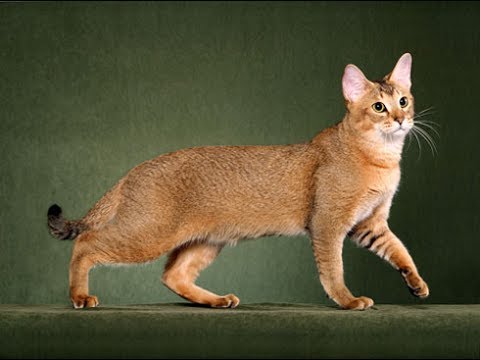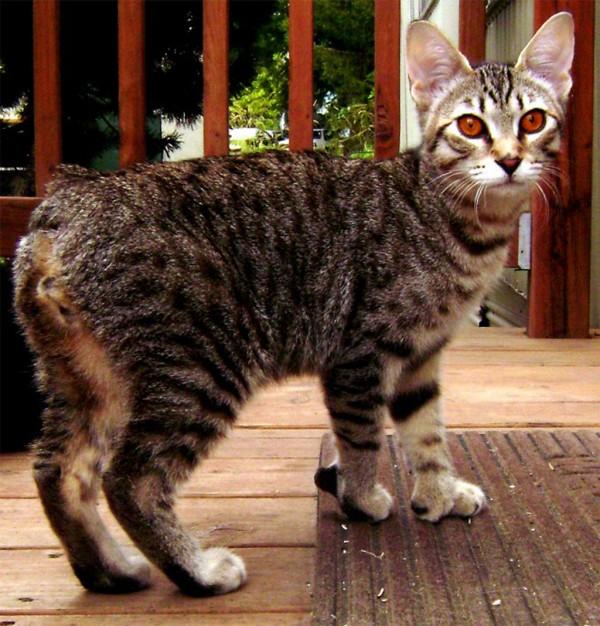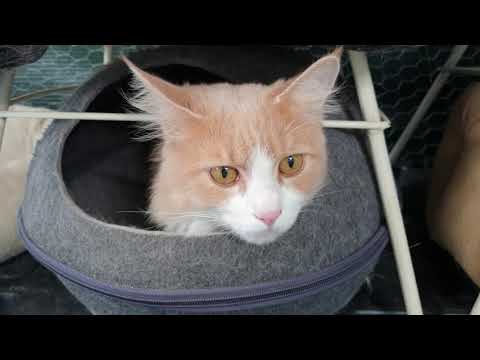
Supposedly, a cat Devon Rex served as the model for the evil pixies in the movie 1984 ยซGremlins – Little monsters".
Content
Characteristics "Devon Rex"
Coexistence is important that you have with your new friend. Before considering the acquisition of a cat of the breed "Devon Rex" you know certain factors. You must take into account their character, their need for exercise, their interaction with other pets, their care and if you have small children, their level of tolerance towards them.
Joy
4,0 of 5 stars (based on 1 review)
Activity level
4,0 of 5 stars (based on 1 review)
Friendliness to other pets
3,0 of 5 stars (based on 1 review)
Friendliness to children
3,0 of 5 stars (based on 1 review)
Grooming requirements
1,0 of 5 stars (based on 1 review)
Vocality
2,0 of 5 stars (based on 1 review)
Need for attention
3,0 of 5 stars (based on 1 review)
Affection towards its owners
5,0 of 5 stars (based on 1 review)
Docility
3,0 of 5 stars (based on 1 review)
Intelligence
4,0 of 5 stars (based on 1 review)
Independence
2,0 of 5 stars (based on 1 review)
Hardiness
3,0 of 5 stars (based on 1 review)
History
The Devon Rex appeared in 1960 and originated in Buckfastleigh, Devon, England, where a colony of stray cats lived in a mine. One of them had curly hair and was mated with a straight-haired tortoiseshell cat adopted by Mrs. Beryl Cox.. One of the kittens she gave birth to had curly brown-black hair and was named Kirlee..
The Sra. Cox knew that a new breed of cat was being developed in neighboring Cornwall., the Cornish Rex. Thinking you had one of these new cats on your hands, contacted one of the breeders of Cornish Rex, the Sr. Brian Sterling-Webb. He was obviously interested and bought Kirlee for 25 pounds at that time.
But, several crosses between Kirlee females and Cornish Rex they only produced straight-haired kittens. At the same time, the differences in the coat (more kinky in the Devon, silky in the Cornish), in the ears (low implantation in the Devon, high implantation in the Cornish) and in the whiskers (curly in the Cornish, short or without mustaches on the Devon) confirmed that the genes responsible for this coat characteristic were different from those of the Cornish Rex.
The genetic mutation of Cornish Rex It was called "Gen 1", and of the Devon Rex ยซGen 2ยป. It was also around this time that the breed's name was coined, a reference to its origin in Devon and its fur similar to that of the Astrex rabbit, like the Cornish Rex.
The Sr. Brian Sterling-Webb began working on the conservation of Gen 2 and crossed Kirlee with many domestic and purebred cats to consolidate the breed's gene pool, following the model applied to Cornish Rex. All the Devon Rex current are descendants of Kirlee, that had a tragic ending in 1970 when he died in a car accident.
Nonetheless, his numerous offspring had aroused the interest of other breeders, like Mrs. Agnes Watts or Mrs. Madge Shrouder, that contributed to the development of the breed. In 1967, the Governing Council of the Cat Fancy (GCCF) was the first feline organization to officially recognize the breed, and the International Feline Federation (ICF) did the same the following year.
In 1968, only 8 years after Kirlee's birth, the first Devon Rex crossed the Atlantic and the race began its conquest of the Americas. In 1972, the American Cat Fan Association (CFA) allowed the registration of their representatives, before obtaining final recognition eleven years later, in 1983, giving them the right to participate in feline exhibitions organized under their auspices. In 1979, became one of the breeds recognized by the International Cat Association (TICA) since its foundation.
Today, this cat is found all over the world and, although it is not one of the most popular breeds, it is quite popular in general. in your country of origin, ranks tenth (of about 40) in the GCCF ranking of records, with more than 300 specimens registered every year. This figure supposes, However, a clear decrease compared to the first years of the 21st century, when more than 600 kittens a year.
In United States, it also ranks 10th in terms of the number of annual registrations in the CFA. In France, it is much less common: with only 150 to 200 individuals registered each year in the Livre Officiel des Origines Fรฉlines (LOOF), it hardly represents the 0,5% of the French feline population. On the other hand, the trend is rather upward, as the number of annual registrations was rather between 100 and 150 during the first decade of the century.
The Devon Rex is a breed of cat with an original appearance, that has earned him several nicknames, as "Gremlin Cat", ยซElf Catยป or ยซAlien Catยป.
Medium-sized, has a graceful but muscular body, seated on long legs and finished with a fine, tapered tail.
It is in the head where the first peculiarities appear: sideways, the flat skull is prolonged with a rounded forehead and a distinct break in the nose, while in front, strong cheekbones and powerful muzzle broaden the silhouette.
Oval eyes can be any color, even blue, and the whiskers are short and brittle, or even non-existent. The ears are large, long and tapered: placed low and to the sides, dan al Devon Rex its characteristic appearance of elf or face.
Its curly fur all over the body is also very particular.. Is short, fine and silky and not very dense, to the point that some individuals may have bare spots, what constitutes a defect for adults who wish to participate in feline shows.
Regardless of the cat's body, Devon Rex standard accepts all coat patterns and colors, including white marks.
Last, sexual dimorphism is moderately marked, being the male larger than the female.
Weight and size
Male size: Of 27 to 30 cm.
female size: Of 25 to 28 cm.
Male weight: Of 3 to 4 kg
female weight: Of 2,5 to 3,5 kg
Character and skills
The Devon Rex he is very close to his family and loves to spend most of his time with them. Whether perched on the cook's shoulder, on the lap of the television watcher or on the keyboard of the computer user, a Devon Rex you are never far from your loved ones, and his natural curiosity makes him often come to see what they are doing. But it is not an exclusive cat, and also enjoys the company of people who come to the house often. This closeness to people makes them an excellent therapy cat..
It is a breed of cat suitable for children, they are very sociable with them and can spend hours playing with them, as long as they know how to behave with respect and refrain from pulling their tails, for example.
He also loves the company of other pets., already be partners, dogs that don't usually chase cats, rabbits or other rodents, birds or reptiles. So, it is an ideal option for those who already have one or more animals at home.
The presence of these animals can be very beneficial for the cat's balance, since its attachment to the family and its great sociability make it a feline breed that does not tolerate loneliness. But, if they get bored alone at home, they are likely to behave destructively. Having said that, Although the presence of one or more companions can help you pass the time and have fun when your master is away, not a breed adapted to an often absent master.
On the other hand, is relatively flexible and able to cope with a change of environment, for example when you go on vacation with your cat. They can even become an excellent travel companion..
Quite curious and active, to the Devon Rex he likes to explore his territory: his climbing abilities allow him to reach the highest shelves, while its slim and flexible body allows it to slide under the lowest furniture. He also likes to play with his owner, chasing a ball or looking for a thrown object. These activities are more than enough for him, so it is a breed of cat that lives very well in a flat.
They are smart and can learn a few tricks if their owner is patient enough to teach them.. They can also be stimulated intellectually with the help of various puzzles for cats., especially the ones that offer a food reward.
This is another feature of Devon Rex: He is a greedy cat and is constantly looking for something to eat. They are always on the lookout for something to eat, and they will sit at the table with the rest of the family, taking what they can from the plates at every opportunity. It also, once the meal is finished, if his master leaves any food available, is an invitation to a feast that will never be missed, although this may be detrimental to your health.
It also, their sparse fur retains little heat. Many people who caress a Devon Rex have the feeling that it is warmer than other cats, but this is only an impression due to the low density of its fur, since it has exactly the same body temperature as other breeds. But, how they can't trust their fur to keep warm, they usually look for sources of heat. It is common to find them sleeping on the radiator or curled up under the duvet, especially if its owner is also in bed.
Last, the Devon Rex not especially loud, but you can attract the attention of your family with a meow-gurro if you want to let them know something, for example, that your bowl is empty.
The Devon Rex It is an easy-care breed of cats: a brief brushing every week is enough to keep his coat beautiful. But, brushing should be gentle and preferably by hand, so as not to damage the fragile fur.
Although most dogs don't need more than one bath a year, some may have excess sebum on the skin, especially on the legs. In this case, it may be helpful to bathe them once a month to prevent dirt buildup, that could cause an infection.
The Devon Rex it is a breed of cat hypoallergenic, but, contrary to popular belief, young. Having said that, as the hair is fine and the shedding is constant throughout the year, the phenomenon is quite discreet, and at no time does it accumulate excessively in the house.
Otherwise, it's advisable, as in the case of any cat, make sure his teeth and eyes are clean every week and clean his big ears with a damp cloth, to avoid the risk of infection.
Last, if your cat does not use his scratching post enough and his claws are too long, must be trimmed with a nail clipper.
Indoor or outdoor cat?
The Devon Rex she is an excellent indoor cat, since he prefers to be warm and cozy. In any case, prefers to be around his two-legged friends. Likes to leave a bit of a mess when exploring the house. Likes a cozy place to lie on the radiator or on the sunny windowsill.
Especially in winter it is not suitable for going outside, since his fine hair cannot protect himself from the cold. But, needs enough floor space to vent. A safe balcony or terrace would be ideal. Some representatives of the breed can also get used to walks on a leash.
How much activity does he need? "Devon Rex"?
Being a very intelligent breed, the Devon Rex always looking for new challenges and things to do. A large, sturdy scratching post and other cat toys are just what this active cat needs.. He loves to play and is extremely docile.
You can easily teach him little tricks and feats. This communicative cat loves to spend time not only with his owner, but also seeks contact with other cats of the same species. Having several cats is almost a requirement to acquire a Devon Rex.
Health and nutrition
The Devon Rex it is a fairly robust breed, which generally does not pose a significant risk of disease.
But, is more prone to certain conditions:
Feline Hypertrophic Cardiomyopathy, which causes an enlargement of certain tissues of the heart, which leads to heart problems;
Congenital hypotrichosis, โhereditary baldnessโ, which makes the affected individual's coat much less dense than normal;
Patellar luxation, a fairly common knee problem that can interfere with walking;
myopathy of Devon Rex, that appears between 1 and 6 months old and causes muscle degeneration. This incurable disease varies in severity and can remain stable or progress slowly.;
Various treatable skin diseases, such as hives or Malassez dermatitis, caused by a fungus.
The most common health risk for the Devon Rex is the Obesity, that can be deadly. Thus, the owner must ensure that the dog does not eat more than it should, does not yield to his pleading gaze and leaves no easily accessible food scraps, as this could endanger your health.
Merle is a four year old Devon Rex from Oakland CA – Wikipedia
Life expectancy
Of 12 to 15 years
Food
The Devon Rex he is a glutton who eats everything. Despite her slim appearance, the risk of obesity is very real, and a responsible owner must ensure that his partner does not gain too much weight.
To provide your cat with everything it needs to stay healthy, it is advisable to feed it with quality commercial food, respect the rations recommended by the manufacturer and do not leave large amounts of food at your disposal: unlike most breeds, not necessarily capable of self-regulation.
You should also avoid feeding him leftovers and resist his insistent requests., when your imploring gaze may suggest that you are constantly hungry. This is especially true because some of the foods their owners eat can be dangerous to cats..
If, despite the precautions taken, your cat is overweight, you should contact a vet without delay to establish a diet that will keep him healthy.
For sale "Devon Rex"
The average price of a kitten Devon Rex male is about 1.200 EUR, while a female is somewhat more expensive: a few 1.300 EUR.
But, this average price hides a very wide range of prices, since they oscillate between 800 and 2500 euros for males, and between 1000 and 2600 euros for females. These important price differences from one individual to another are mainly correlated with the fact that their physical characteristics are more or less close to the breed standard., and with the greater or lesser prestige of the lineage from which it comes.
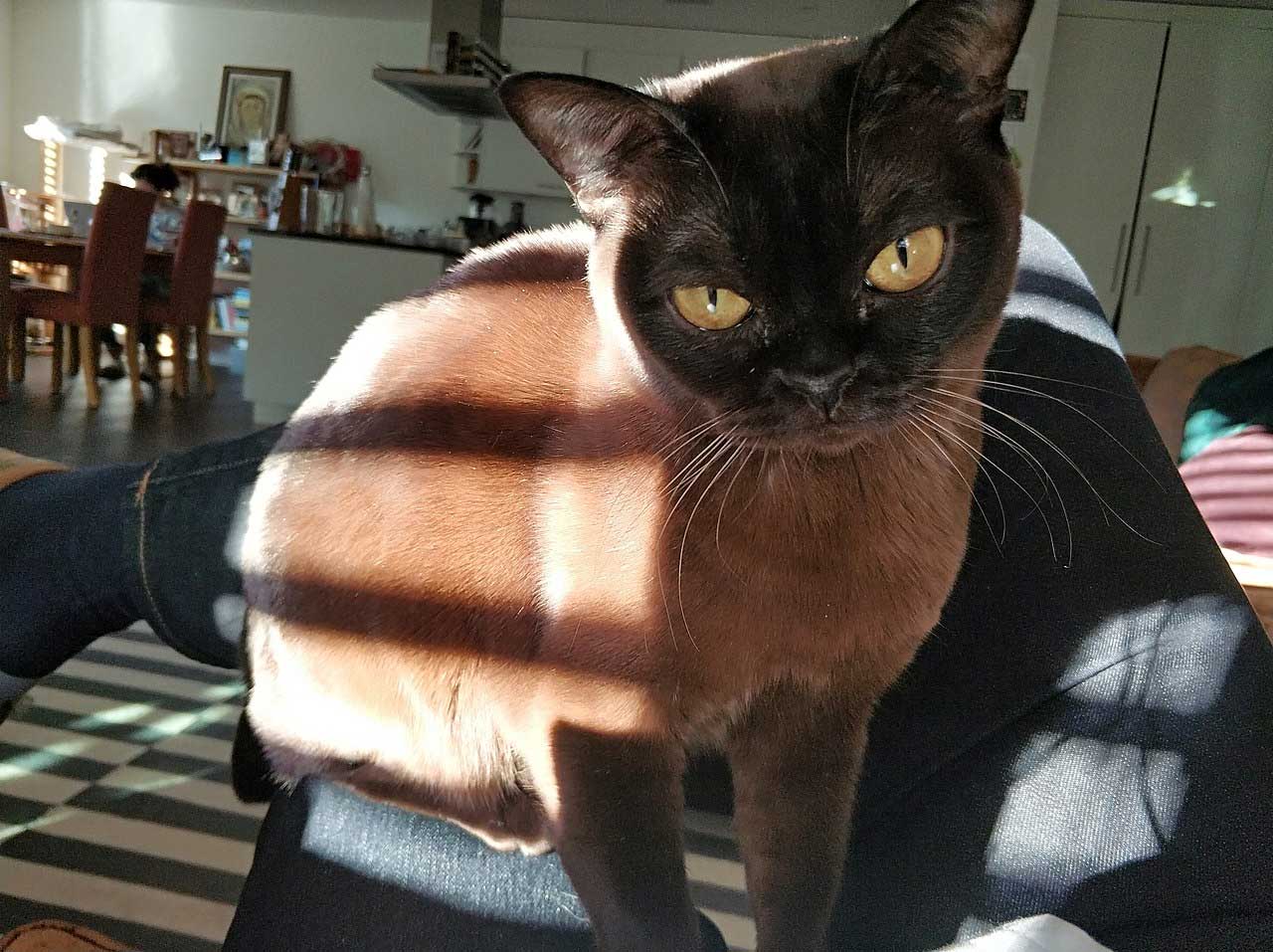
The Havana brown he is an affectionate cat, friendly and intelligent. It also, unlike its ancestor the Siamese, it is quite calm and serene.
Content
Characteristics "Havana brown cat"
Coexistence is important that you have with your new friend. Before considering the acquisition of a cat of the breed "Havana brown cat" you know certain factors. You must take into account their character, their need for exercise, their interaction with other pets, their care and if you have small children, their level of tolerance towards them.
Joy
4,0 of 5 stars (based on 1 review)
Activity level
3,0 of 5 stars (based on 1 review)
Friendliness to other pets
3,0 of 5 stars (based on 1 review)
Friendliness to children
3,0 of 5 stars (based on 1 review)
Grooming requirements
1,0 of 5 stars (based on 1 review)
Vocality
1,0 of 5 stars (based on 1 review)
Need for attention
5,0 of 5 stars (based on 1 review)
Affection towards its owners
4,0 of 5 stars (based on 1 review)
Docility
3,0 of 5 stars (based on 1 review)
Intelligence
5,0 of 5 stars (based on 1 review)
Independence
2,0 of 5 stars (based on 1 review)
Hardiness
3,0 of 5 stars (based on 1 review)
History
The Havana brown He is a descendant of the famous Siamese. Its origins date back to the fourteenth century in the Kingdom of Siam, current Thailand. The brown cats were described and represented together with the Siamese and the Korat cat in numerous manuscripts of poems and paintings found in the city of Ayutthaya, which was then the capital of the kingdom. They were considered very beautiful, but above all, good luck charms for their owners.
These chocolate-colored felines were among the first to be imported from Siam to the UK, where they arrived at the end of the 19th century. The texts of this time, like the writings of an English breeder named Madame French and passages from Frances Simpson's book of 1903 The Cat Book, describe a Siamese cat with brown fur and blue-green eyes.
It is probable that not all imported cats of this color were of the same breed and that among them there were burmese, Siamese and the Tonkinese cat (a cruce enters Burmese and Siamese). But, it is difficult to differentiate the breeds from the available writings and drawings.
In any case, It was at this time that the term โSwiss Mountain Catsโ was coined to designate cats with this peculiarity. But, historians cannot establish whether it covered all chocolate-colored specimens imported from Thailand in the late 19th century, or only those of one or more specific races.
Brown cats were exhibited in Europe in the late 19th and early 20th centuries. At an exhibition held in England in 1888, one of them won the first prize, which tends to show that felines of this type enjoyed a certain visibility and popularity at the time. This is corroborated by the fact that in 1928, in another exhibition held in Great Britain, the British Siamese Cat Club went on to award a special prize to the chocolate-colored specimens.
Just two years later, in 1930, god a ride, promoting only the breeding of cats Siamese blue-eyed. But, a large majority of brown individuals had green eyes and not blue, so they were suddenly excluded from competitions organized under the aegis of the organization. Logically, breeders began to abandon this color, and the number of individuals wearing it drastically decreased.
This decline continued until the years 50, when a group of British breeders, among which were Baroness Miranda Von Ullman and Anne Hargreaves, they set out to give these cats a new life. They studied the inheritance of the chocolate gene and launched a breeding program based on their research.. New crosses were made between Siamese chocolate-colored, domestic cats blacks and the Russian Blue Cat, which resulted in the tan brown as we know it today. The first kitten regarded as a Havana brown was born in the UK in 1952 and it was called Elmtower Bronze Idol. Result of a cross between a Siamese catseal point carrier of the chocolate gene and a black cat also carrier of the gene, became one of the founders of the breed.
The main British feline organism, the Governing Council of the Cat Fancy (GCCF), recognized the new breed in 1958 as Chestnut Brown Foreign. Twelve years later, in 1970, was replaced by the Havana brown. There are two opposing hypotheses to explain the choice of this name: the first is that it refers to its brown color similar to tobacco, while the other claims that it comes from a breed of rabbit of the same color called Havana.
Even before its official recognition in Great Britain, the breed had taken its first steps in the United States. In fact, after coming into contact with Mrs.. From Ullman, an American breeder named Elsie Quinn imported two cats into 1956. A selection process was started somewhat different from that of the United Kingdom, so soon the American and English types were differentiated. This is still the case today, the first being more massive than the second, whose morphology is long and thin, apparently modeled on that of the Siamese.
The Cat Fanciersโ Association (CFA) accepted the breed in 1964, and The International Cat Association (TICA) did the same in 1979. Both took the North American version of the breed as a reference., whose features differed significantly from the British model recognized by the GCCF: the latter had a longer and thinner oriental morphology. Despite this formalization of the existence of two very different types of cats, the name remained the same for all bodies: Havana brown. In 1983, the TICA accepted the lilac color in its standard, whereas until then only the color chocolate was allowed. Quite consistently, decided at the same time to change the name with which he recognizes the breed, in favor of him Havana. In France, the Livre Officiel des Origines Fรฉlines (LOOF) did the same and began to accept the lilac color, but kept the denomination Havana brown.
In United States, the beginning of the years 90 was characterized by the loss of interest in breeding this breed, whose number dropped a lot. The breed became especially rare and, at the end of the decade, the CFA only had 12 hatcheries and some 130 representatives of the breed throughout the country.
The situation worried some breeders, who feared that the cats would disappear. They contacted Dr.. Leslie Lyons, who was then working at the California Veterinary Genetics Laboratory, so that with your help they could develop a breeding program. The analyzes of the genome of the Havana brown revealed excessive inbreeding. In other words, a healthy development of the breed was only possible if new individuals were introduced in the breeding programs.
Thus, the breeders asked the CFA to open the breed to new crosses, what was accepted by the organization in 1997. Since that year, it has been possible to cross the brown Havana with siamese catsSeal Point and Chocolate Point, Oriental Longhair cat, as well as with domestic cats blacks and blues not beggars in the United States. If the individuals born from these crosses are brown, are recognized by the CFA as Havana brown. On the other hand, regardless of its color, if they cross paths with the Havana brown, their offspring is considered by the organization as Havana brown.
This show turned out to be a success: expanded the breed's gene pool and kept it healthy, at the same time that it allowed to continue increasing the number of dogs in the country. These authorizations are still valid today., but they are still exclusive to the United States, since organizations from other countries do not allow these crossings.
But, the surge in popularity was short-lived, and the Havana brown is now at the bottom of the CFA's annual enrollment rankings, in the post 42 of 45 in 2018, after falling steadily in previous years. These may include, early in the decade 2010, rather occupied the position 30 or 35.
But, the problem of the lack of diversity in the different lines also arose in other places, like the UK. During the decade of the 90, some changes in the selection of Havana brown and the Siamese modified the quality of the fur of the latter and other morphological parameters, what some people did not like.
In 1996, a breeder named Joan Judd expressed concern about the future of the breed, What, in addition to these changes away from its original appearance, suffered from a clear lack of representation. He wrote an article explaining, among other things, that the Havana brown couldn't survive without an influx of foreign blood. Under your direction, a small group of breeders, among which were Mrs.. P. Sharp-Popple, la Sra. S. Miller and Linda and Charlie Spendlove, selected some specimens and developed a joint breeding program called Pure Havana. As such, the Sr. and mrs. Spendlove imported a subject from the French breeding of Claire Rassat. Christened St Evroult Gatsby, was initially registered with the GCCF as a Havana brown.
In view of its traditional pattern, breed enthusiasts Havana brown The modern model did not look favorably on the five litters it produced and complained to the GCCF, requesting that St Evroult Gatsby be removed from the breeding program. But, they came across a number of enthusiasts who had noticed the qualities of the traditional model through this small group of cats, and defended him before the association. The GCCF then proposed that these cats form a new breed, which was baptized as Suffolk and officially recognized by the organization in 2014. So, the Suffolk is considered a separate breed from the Havana brown, although it is very similar to him. It can be chocolate or lilac color. 13 Suffolks were registered with the organization in 2018, and 35 in 2019.
In France, the Havana brown is very underrepresented. The number of people registered each year in the LOOF does not exceed fifteen, for a total of 108 between 2010 and 2019.
Worldwide, its total population is estimated to be no more than a thousand, so it is still a rare feline breed.
The Havana brown it is a medium size cat, long-legged, with good muscles and strong bones.
The legs are straight. They are finer and more delicate in females than in males. They also have the most developed muscles, so its slenderness and length are less striking than in the female.
Regardless of gender, the hind legs they are longer than the front ones. The feet they are oval shaped, compact and the pads are pink.
However, keep in mind that there are two versions of the Havana brown: the american and the english. The first is usually more muscular and massive than the second, that preserves the longest and slimmest body of the oriental cats.
In both cases, the tail is fine and of medium length.
The neck It is also medium in size and proportional to the size of the body. View from the top, the head it is longer than it is wide, and ends in a rounded nose with a clear break on either side of it. This is a distinctive trait of the breed, which must be clearly visible. The chin is well developed and square. Ideally, it should form a nearly perpendicular angle to the nose.
The ears they are wide and rounded at the tip. Are leaning forward, which gives the appearance of being always alert.
The eyes they are medium in size and oval in shape, wide apart and bright. They give you an alert and always expressive expression and are necessarily green, accepting all shades of this color.
The fur of the Havana brown it is made up of short hair, smooth and shiny. All shades of brown accepted, but a reddish brown color is generally preferred (Mahogany) to a blackish brown color. Some organizations, like LOOF and TICA, they also accept lilac, But not all. Whatever the color of the cat's coat, should be uniform throughout your body. Kittens can be born with tabby markings, but these normally disappear as they grow.
The whiskers they are also brown.
Last, the sexual dimorphism it is quite marked, being the male heavier than the female, although its size is quite similar.
Size and weight-
Male size: Of 25-30 cm.
female size: 25-30 cm.
Male weight: 3,5-4,5 kg
female weight: 2,5-3,5 kg
Varieties of "Havana brown cat"
Havana Brown – Dave Scelfo from Point Pleasant Beach, NJ, USA, CC BY-SA 2.0, via Wikimedia Commons
The Havana brown cat It was developed mainly in the United Kingdom and the United States. But, the selections made and the breeding programs applied were significantly different between these two countries, so over the years two different models emerged: the Havana brown of English type and the of American type.
The former has a very long morphology and is close to its cousins โโand ancestors from the East, especially the Siamese. It is a very fine and muscular cat.
As for him Havana brown American, it is more solid and round, deviating from the elongated morphology to sometimes approach the semi-free type. Although more rectangular and strong, it is no less elegant.
Another example is the Suffolk, created in the early 21st century by British enthusiasts of the Havana brown who opposed the evolution that the race was experiencing in their country. The Suffolk it's a kind of Havana brown traditional, as opposed to the modern version that is now in the country. The GCCF recognized his work in 2014, recognizing it as a breed in its own right.
Character and skills
The Havana brown he is an affectionate cat, friendly and intelligent. It also, unlike its ancestor the Siamese, it is quite calm and serene.
He is also more adaptable than most of his peers., since it is not one of those who are scared by a change of environment, for example. This flexibility makes it a good option for someone who wants to take their cat on vacation or is moving frequently., for example.
To be happy and at ease, this constantly seeking attention-loving companion needs a lot of interaction with humans. He likes to follow his master around the house and accompany him in housework. So, needs an owner who is present often and who does not fail to show him that he loves him every day. This makes it a very good cat breed choice for an older person., and a very bad one for an active person who spends most of his time away from home.
Very tactile, does not shy away from contact with its owner. On the other hand, you like to physically interact with him, with a marked tendency to touch him stretching the leg to attract his attention. He also uses his paw a lot to examine things that are interesting to him.
These qualities make it an ideal cat for children., especially since he never tires of playing for hours.
On the other hand, can be exclusive, as close to its owners as it is shy and distant with strangers, at least at the beginning.
Usually, they get along very well with other animals, including dogs, provided they are gradually introduced or, even better, from an early age. But, it is advisable to take some precautions if you are brought to live with rodents, birds or fish, since the Havana brown is a great player and his ability to find in any object -or small animal- an exciting toy is awesome. Be careful to store her socks and other small items that are easy to transport, or you may not see them again. Having said that, the games he likes the most are those that involve interaction with their owner. It is an excellent candidate to teach your cat tricks, and also excels at solving puzzles.
Last, if he is not as talkative as the Siamese, nevertheless likes to chat with its owners through soft meows. Havana brown – Flickr
Grooming and caring for the "Havana brown cat"
The Havana brown it is an easy-care cat.
Needs weekly brushing but sheds very little, except during the shedding season in spring and fall, when more frequent brushing is necessary - often daily- to prevent hair from accumulating in the house. Finishing brushing with a felt or hand cloth helps remove dead hair that has resisted brushing. Bathing is seldom necessary.
Ears and eyes should also be checked regularly, ideally once a week, to avoid infections, and get cleaned up as soon as needed.
Your weekly maintenance session is also an opportunity to brush your cat's teeth., in order to avoid the formation of tartar and all the risks that it entails. Having said that, the ideal is a more regular brushing.
Last, Since the Havana brown he does not usually go abroad much -if he does-, the natural wear of its claws is usually insufficient. So, they need to be examined regularly to trim them when they get too long, in order to prevent them from being hindered in their movements and / or injuring themselves. It is highly recommended that you provide him with a scratching post so that he can wear them down himself and don't have to do it as often.
If your pet is used to being handled from a young age, will perfectly accept these different treatments.
Indoor or outdoor cat?
He loves to play and run around the house and spends a lot of time, but it is a perfect indoor cat, fully satisfied with a life in a flat, as long as their owners are present and they have enough games to keep busy. Even if I have access to the outside, it's not where you like to spend most of your time. So, you don't need a garden to adopt a cigar, that is something sensitive to cold.
How much activity does he need? "Havana brown cat"?
The Havana brown they are not sleepy. You should offer your roommate some job opportunities. This is important to this intelligent breed when you are away.. This domestic cat loves to play with his human. Learning little tricks is not a problem. This need for activity can be exhausting after a day at work.. An alternative would be a cat companion of the same age and temperament as a balance.
The Havana brown enjoys, in general, Of good health.
But, may be prone to developing calcium oxylate stones in the urinary tract. If it is not attended on time, can lead to blockage of the cat's urinary tract. Cats prone to this problem should drink plenty of water to avoid stone formation as much as possible.
Some cats can also suffer from upper respiratory tract infections, that is to say, those that affect the nose, sinuses, pharynx and larynx, When you are young. Among them is chlamydia, for which there is a vaccine, which can be a smart investment to maximize the chances of keeping your cat healthy. In general, the general symptoms of a respiratory infection are fever, sneezing, tos, watery eyes or a runny nose.
Last, the Havana brown is sensitive to cold. In any case, it is not an outdoor cat, but it is important to ensure that it does not come out when the temperatures are very low.
Life expectancy
15 years
Food
A quality industrial cat food is perfectly suitable for the Havana brown, that is not a demanding cat. As with any cat, you simply have to adapt the daily ration to your level of physical activity and your age.
In any case, not the type of cat who likes to eat too much: is a teether and very rarely suffers from obesity. Once you've made sure your cat is no exception that proves the rule, food can be left at your disposal at all times without risking health problems, since it is capable of self-regulation.
On the other hand, an individual prone to urinary stone problems should be encouraged to drink heavily. As in the case of any cat, fresh water must be available at all times, but the owner can add some milk, tuna juice or ice cubes to the water bowl to encourage the cat to drink more.
For sale "Havana brown cat"
In Europe, the price of a kitten Havana brown usually oscillates between 900 and 1100 EUR. The price difference between male and female cats is quite small, normally it does not exceed one hundred euros.
In North America, the price range is much wider, oscillating between 600 and 1.500 $.
whatever the country, the main parameters that affect the price are its greater or lesser conformity with the breed standard, the reputation of the cattery and the origins of the kitten. Another important factor is color: a Havana brown reddish, for example, is more prized than a blackish brown specimen and, Therefore, likely to sell at a higher price.
In any case, what is rare is usually expensive, and this cat is no exception. There are few hatcheries of Havana brown in North America, and even less in Europe. So, it can be quite difficult for a future owner to find their rare gem.
The Aegean cat is a natural breed of cat from the Cyclades islands of Greece.
This species likely dates back many millennia. Archaeologists have found evidence that the first domesticated cats lived on the island of Cyprus, neighboring Greece, ago 10.000 years. It seems reasonable that, over the years, some of those cats will emigrate to Greece on fishing or trading boats, where they were undoubtedly well received for their ability to mouse. The Aegean cat They may also be related to Turkish cat breeds, as the Angora.
Very often we can see many cats of this type sitting in the ports, waiting for the return of the fishermen, who won't let them miss their share of the catch. They are not afraid of water, so they can fish independently while diving in shallow water.
These cats, common in their homeland, they have only been recognized as a distinct breed in the last two decades. Some consider them a Greek national treasure. So far, they have not been recognized by any cat registry, as the Cat Fanciers’ Association (CFA) wave The International Cat Association (TICA).
This is a medium sized cat with a slim but muscular build. The chest is wide and the belly is elevated. The legs are long and muscular in relation to the body. In terms of weight, males can reach 4.500 kg, females one kilo less.
The head is not very big, but it is wide compared to the body. The ears they are well spaced, quite wide at the base with rounded tips, the eyes macaroons, with the outer ends slightly tilted up, they are very expressive and can be of various shades of a surprising green color.
Finally, the fur characterized by a two or three tone pattern, and the target usually occupies two thirds of the total area. Colors can be black, blue, grey, cream, red. The hair, soft and silky, is usually of medium length, glued to the body; there is no undercoat.
Character and skills
The Aegean cat tends to be smart and lively, with good communication skills. Usually, they are kind to people and can be excellent cats for families with children.
True to their heritage as island cats, the Egeos they do not disdain the water and can even go fishing by themselves. Consider this cat if you've always wanted a feline fishing buddy. But, if you have an aquarium or koi pond, should ensure that its inhabitants are protected from a curious cat with a claw.
The Aegean Cat likes to be part of the family and adapts well to most homes.. You will appreciate having an enclosed outdoor area where you can climb or lie in the sun, but he shouldn't be allowed to roam.
The Aegean cat has a semi-long coat that requires relatively little maintenance in terms of grooming, although its silky fur is thicker in winter. The shedding is usually moderate and brushing twice a week is sufficient.
In spring, tends to shed excess hair for a fresh, summery style. But, cats that live indoors tend to shed some hair throughout the year. This is because they live in artificial light conditions., what affects the growth cycle of your coat.
As with all races, be on the lookout for mats that may start to develop while grooming the cat. Remember that regular brushing will help keep the cat's coat clean and healthy..
Regarding the weather, is generally considered an adaptable cat that can live happily in most climates. Remember to always make sure there is shade and cool water when the temperature spikes.
Indoor or outdoor cat?
If you have ever been on vacation to the Greek islands of Andros, Delos, Mykonos, Naxos or Santorini, you may have seen these medium-sized, semi-longhaired cats hanging around fishing boats, lounging in the shade of a coffee chair or sunbathing on a balcony.
The Aegean cat, named after the sea that surrounds it, believed to be one of the oldest types of domesticated cats. It can be a pet in your country of origin, but some lead a wild life, subsisting on their own hunting prowess or the handouts of fishermen.
It is not a breed of cat to be kept in an apartment. You need the freedom you have been used to for thousands of years.
It is a sociable pet that tolerates life in a flat quite well, but you need some freedom and exercise. He is very independent and tends to be especially attached to one person in the family, but he loves to play, so it is also suitable for families with children and does not have problems with other cats or dogs.
Although he is very affectionate and sociable, this cat has its own personality, does not like to stay snuggled in the lap of his owner, but he knows how to show his affection in another way. It can accompany you in your movements around the house, and is often a meow that seeks the attention of its favorite human.
It is a very active cat, so you need stimuli such as games and outdoor activities, especially if it can run and chase small prey there. Although it is an independent cat, prolonged periods of loneliness may be too much for her.
On the one hand, the Aegean cat live quietly with humans, but on the other hand, retains its independence and feline instincts.
Health and nutrition
The Aegean cat is generally healthy. Since they are not the product of selective breeding, they are less likely to carry genetic diseases. However, it is always a good idea to choose a breeder that offers a written health guarantee against genetic diseases for the first two years of the cat's life.
She is not a complicated cat when it comes to feeding. Fish of any kind will be a delight for our Aegean cat
For sale "Aegean cat"
Probably, the best way to acquire a Aegean cat is to go to Greece and take one home.
If you bring a cat from Greece, must have an International Health Certificate from a veterinarian indicating that he is healthy and in good condition to be transported by air.
The cat may also need a valid rabies vaccination certificate, unless it comes from an area considered rabies free, have less than 4 months or travel to a state that does not require vaccination. The vaccine must be administered at least 30 days before departure.
Characteristics "Aegean cat"
Coexistence is important that you have with your new friend. Before considering the acquisition of a cat of the breed "Aegean cat" you know certain factors. You must take into account their character, their need for exercise, their interaction with other pets, their care and if you have small children, their level of tolerance towards them.
Joy
4,0 of 5 stars (based on 1 review)
Activity level
3,0 of 5 stars (based on 1 review)
Friendliness to other pets
4,0 of 5 stars (based on 1 review)
Friendliness to children
4,0 of 5 stars (based on 1 review)
Grooming requirements
3,0 of 5 stars (based on 1 review)
Vocality
4,0 of 5 stars (based on 1 review)
Need for attention
3,0 of 5 stars (based on 1 review)
Affection towards its owners
5,0 of 5 stars (based on 1 review)
Docility
3,0 of 5 stars (based on 1 review)
Intelligence
3,0 of 5 stars (based on 1 review)
Independence
5,0 of 5 stars (based on 1 review)
Hardiness
5,0 of 5 stars (based on 1 review)
Videos "Aegean cat"
youtu.be/Jwpb82qLfUE
Aegean | Cats 101
youtu.be/Ccvcxkz62-o
Aegean Greek cat swimming
โท The world of Pets: Dogs, cats, birds, reptiles, amphibians
as the number of Singapura cats it is rather small, you must ensure that both parents do not weigh less than 2,5 kg. You should also check the pedigree carefully before buying., as inbreeding can greatly reduce the life expectancy of Singapura cats.
Photo: wilkipedia
Content
Characteristics "Singapura cat"
Coexistence is important that you have with your new friend. Before considering the acquisition of a cat of the breed "Singapura cat" you know certain factors. You must take into account their character, their need for exercise, their interaction with other pets, their care and if you have small children, their level of tolerance towards them.
Joy
5,0 of 5 stars (based on 1 review)
Activity level
4,0 of 5 stars (based on 1 review)
Friendliness to other pets
3,0 of 5 stars (based on 1 review)
Friendliness to children
3,0 of 5 stars (based on 1 review)
Grooming requirements
1,0 of 5 stars (based on 1 review)
Vocality
2,0 of 5 stars (based on 1 review)
Need for attention
5,0 of 5 stars (based on 1 review)
Affection towards its owners
4,0 of 5 stars (based on 1 review)
Docility
1,0 of 5 stars (based on 1 review)
Intelligence
4,0 of 5 stars (based on 1 review)
Independence
3,0 of 5 stars (based on 1 review)
Hardiness
2,0 of 5 stars (based on 1 review)
History
ยซSingapuraยป is the Malay name for Singapore. The name has also been given to a small cat considered the smallest domestic cat in the world and originally from the Southeast Asian city-state located at the southern tip of the Malay Peninsula.
In Singapura, brown or dark brown color is widespread in the genetic makeup and is characteristic of the local population of domestic cats. But, the fur of the Singapura is usually quite pale, and its origin story is not simple at all. It's not easy to find out.
Historically, the most widely accepted version was that of the International Cat Association (TICA), starring an American geophysicist, Hal Meadow, who was in Singapore at the beginning of the years 70, working for an oil company. His wife, Tommy, had been a judge of Cat Fanciersโ Association (CFA) and was interested in breeding cats - he had bred the Burmese, to the Abyssinian and Siamese-, as well as by genetics - he had carried out genetic experiments with mice and rats -. Due to the interests of Tommy, Thing sent him three brown cats from Southeast Asia during a visit to the city-state in 1971. He had obtained them from the crew of a ship that had adopted them and in which he had sailed.
In 1974, When Thing He was posted to Singapore for work reasons, he moved with his wife and cats: two burmese and three descendants of those who had been sent from Asia three years earlier. In 1975, upon his return to the United States, the Meadow they brought a Burmese and five brown cats, including two kittens born in Singapore. Hal y Tommy Meadow started a breeding project to create a new breed to be called Singapura.
In 1980, Barbara Gilbertson, one of the first breeders of the Singapura cat, brought another cat to America, call Chiko, that he had obtained from SPCA (Society for the Prevention of Cruelty to Animals) from Singapore, and that was included in the breeding program. Finally, in 1987, another breeder named Gerry Mayes traveled to Singapore to get some local stray cats, Known as "sewer cats" to the public due to their tendency to seek refuge in the city drainage system. These specimens were registered in the TICA and were incorporated into the breeding project of the Singapura.
But, with the passage of time, other versions have emerged about the origin of the breed, that have caused controversy. The Meadows they first claimed to have captured one of their precursor cats in the vicinity of a Thai restaurant in Singapore and to have removed the other two from a nest found on the city's waterfront. This initial story was finally dismantled by a series of key events.
First of all, when the enthusiastic breeder Gerry Mayes traveled to Singapore in 1987 to bring "sewer cats", discovered that Meadow, when they arrived in 1974, had brought with them - and registered with the Singapore Ministry of National Development- Abyssinians and burmese. It also, No one on the ground seemed to have ever seen cats on the streets of Singapore that looked like the "gutter cats" described by Hal y Tommy Meadow.
Gerry Mayes he wondered if the Singapuras of Meadow were actually descended from Abyssinians and burmese that they had brought to Singapore. This did not stop him from bringing several cats from Singapore to the United States., but they could not be registered with the CFA as Singapuras, as they did not meet the breed criteria of the CFA. TICA agreed to register them. After five generations, the descendants of these cats are now recognized by the CFA as Singapuras.
around that same time, Lucy Koh, who had been collaborating with the Singapore Cat Club for a long time, undertook research and found very few cats in Singapore that met the criteria of the Singapura cat. He even claimed to have found a real Singapore cat, call Baby Bull, he had dark brown fur, much darker than the Singapuras ivory and sepia color Meadow. And what is more important, its size was much larger.
It also, Lucy Koh claimed to have a copy of a letter from 1975 of Tommy Meadow to the editor of Cat World Magazine, a month before she and her husband left Singapore. In this letter, allegedly declared his intention to achieve fame by passing American cats as singapurenses.
A third event that raised questions about the true origins of the Singapura happened in 1991. In that year, the Singapore Tourism Promotion Board (STPB) decided to grant the Singapura cat the national mascot title. After a contest to find the best nickname, the tourism body renamed it โKucintaยซ, a crossword puzzle consisting of ยซkucinยป ("cat" in Malay) y ยซcyntaยป (ยซamorยป). Kucinta It also means "the one I love". Thus, the small feline's new name means "love cat", and is often known as the "Singapore love cat".
The STPB had asked Lucy Koh your opinion about him Singapura. He gave them his opinion that it was a american cat hybrid. I affirm that Tommy Meadow -participating in the Feline Society of Singapore (SFS) as a registrar- he had created the breed standard himself and had changed the procedures for registering cats at the SFS. By refusing to give credit to this information, the STPB resorted to Tommy Meadow to give his version, what was it, of course, very different. Of course, the STPB did not want to give up its great promotional campaign based on the use of the kitten as a national emblem.
Seeing this, Lucy Koh told the story to Sandra Davie, reporter of Singapore Strait Times. The reporter investigated and ended up publishing an article stating that, far from having rescued Singapore's stray cats, as he had stated, Tommy Meadow Instead, he had created Singapura in Houston (Texas), hybridizing Abyssinians with burmese.
A true novel by Le Carrรฉ
Summoned to appear before the CFA to explain itself, the breeder adapted her version stating that the cats that created the breed were, In fact, those that her husband sent her in 1971, when I was already working in Singapore. Apparently, found the cats on or near the docks in Lo Yang District. To justify your previous lies, claimed that Thing I was then on a very discreet mission, if not secret, for the oil company that had hired him. In other words, his interlocutors were almost immersed in a real spy novel.
Tommy Meadow he also denied having raised Abyssinians during the time he was in charge of raising the Singapura. He also developed several responses to counter his critics' arguments.. It seems that his explanations were accepted by the feline associations, since the Singapura is still recognized by most of them. The CFA went so far as to affirm that, Regardless of whether the mating of the original cats occurred on the streets of Singapore or Michigan, the breed's gene pool originated in Southeast Asia, as in the case of Burmese and the Abyssinian.
In any case, having died in 2004, Mrs Meadow you will never have the opportunity to provide new information about the history of this feline breed with which you were so closely linked.
Recognition by feline associations and notoriety
In 1979, TICA recognized the Singapura as a "natural" race (non hybrid) and allowed him to compete in championships. The CFA recognized the breed in 1982, but he didn't pass her for the championships until 1988. In United States, the breed is also recognized by the American Cat Fanciers’ Association (ACFA).
In Europe, the Governing Council of the Cat Fancy (GCCF) and Fรฉdรฉration Internationale Fรฉline (FIFรฉ), the main feline associations of Great Britain and Europe, they also recognize it.
So there is unanimity, despite the controversy surrounding the breed.
The Singapura It remains a rare breed, above all because feline associations - in particular the CFA- They consider it a "natural" breed and, Therefore, crossing is not allowed. So, the number of their representatives can only increase very slowly. According to the CFA, the world population of Singapuras it was about 5.000 individuals in 2006. In France, fewer than fifty births are registered per year.
The Singapura it's a small cat. It is even known as the smallest domestic cat in the world. The adult female weighs about 2 kg, while the male can reach a weight of about 3,5 kg.
It is a somewhat stocky and muscular cat: as such, It is considered medium and semi-rigid.. Its head it is round and has large eyes hazelnut-colored almonds, brown, green or yellow. The ears they are wide at the base, deep and quite large for its size, ending slightly pointed. The tail it is thin and slightly shorter than the body, with rounded tip.
The fur is short, very fine and bright and is of the type ticked tabby, that is to say, hair strands are alternately light and dark shades. The bottom of the animal, including throat, muzzle and chin, are of a lighter shade.
In addition to his unusually large eyes and ears for his size, the third remarkable physical characteristic of the Singapura cat is the color cuttlefish from its fur. It is a coat with beige to dark brown reflections on a deep ivory background..
Size and weight
Size: 25 cm.
Weight: Of 2 to 4 kg
Breed standard
The breed standards are documents established by official bodies that list the conditions that a dog must meet. Singapura to be fully recognized as belonging to the race:
Standard FIFรฉ (Fรฉdรฉration Internationale Fรฉline)
The Singapura he's a beautiful little fellow, loving and lively. It is a lively cat, energetic and very active, who is also very affectionate and friendly, since he loves human company. They love to lie on their owner's lap or shoulders and are delighted to show their affection, and expect the same in return.
Intelligent and curious, they love to play and climb on shelves and cabinets to get a good look at their surroundings. Throughout his life, her youthful and playful temperament never leaves her. This explains that it adapts very well to the presence of children or other domestic animals., who are welcome playmates for him. But, like any other breed of cat, should not be left alone in the presence of a very young child.
The Singapura cat he is also known for being very calm. He doesn't meow very often and his voice is quite discreet..
If we add to this that they like the heat and that they are reluctant to go outside when it is cold, we have the ingredients of an ideal domestic cat. But, his need for activity makes it essential to provide him with a tree and cat toys to keep him from destroying the floor, especially when left alone for a while.
They don't like to be alone and they don't get along. So, you better have a home where you are not left alone too often or for too long, and in which at least one person spends some time with him every day.
The short and fine coat of the Singapura It does not require a lot of care. Brushing the cat's coat weekly is enough.
Daily brushing of the cat's teeth is also recommended to prevent periodontal disease.
Last, the cat's ears should be examined weekly and, if required, clean them with a cotton ball or soft cloth soaked in a mixture of half and half cider vinegar and warm water.
Indoor or outdoor cat?
Thanks to its small size, cats Singapura can be easily kept in a small flat. It would be great if you could provide a cat proof balcony or, even better, a garden. But, even without this welcome change, the Singapura you will feel right at home if the floor is designed accordingly and there are enough opportunities to play and climb.
Much more important to him Singapura that the opportunity to spend time outdoors is the company of a companion and that his owners do not leave him alone for an unnecessarily long time, then it can be kept as an indoor cat without any problem.
How much activity does he need? "Singapura cat"?
Whether it is a female Singapura like a male Singapura, don't underestimate the high energy level and intelligence of this breed. So, a feline companion is almost essential, so that the Singapura, with its social nature, never be completely alone and can thus also dissipate energy during playful confrontations and fast chase runs.
But, the Singapura cat is very people-oriented and should not be left alone for a long time. It is much more important that caregivers take time every day for play sessions and cuddles. Especially hunting and intelligence games go well with representatives of the breed Singapura.
Health and nutrition
How this breed has a very limited gene pool, it is very possible that hereditary or congenital diseases occur in the Singapura. But, is considered robust and not prone to disease.
For the moment, according to him Governing Council of the Cat Fancy (GCCF), the leading British feline association, only the progressive retinal atrophy and pyruvate kinase deficiency as diseases to which the Singaporea is especially susceptible.
As the name of the disease indicates, cats affected by progressive retinal atrophy experience gradual deterioration of vision due to retinal atrophy. The pyruvate kinase deficiency can cause some form of anemia in affected animals. This can cause lethargy., diarrhea, loss of appetite and weight, and affect the appearance of the cat's coat. The disease can even lead to premature death of the animal.
Both can be detected by genetic testing, allowing serious breeders of the Singapura cat identify and eliminate individuals carrying the defective genes from their breeding grounds. Any prospective buyer should require proof that the kitten they wish to adopt has been tested negatively..
It is interesting to note that these two diseases are also present in the Abyssinian cat. The Abyssinian is the only breed of cat in which progressive retinal atrophy has been shown to be congenital. It is also one of the two races suspected of being the cause of Singapura…
Last, it has also been reported that the female Singapura have a predisposition to uterine inertia. In cats affected by this failure of the reproductive system, contractions are insufficient to allow expulsion of the fetus when the cat gives birth, and then a caesarean section is necessary. As there is no test to detect this disease, It is important to be vigilant when giving birth to a Singapura for the first time and seek veterinary assistance if possible. If you are found to have this condition, it is recommended that she be spayed or neutered, as any future childbirth would be risky for her and her unborn babies.
Life expectancy
11 to 15 years
Food
Feed a Singapura cat not particularly difficult. You just have to make sure that the food is balanced and of good quality, asking a breeder of Singapura or a vet if necessary.
As with any other race, it is important to bear in mind that the nutritional needs of the cat change throughout his life.
Last, as the Singapura does not tend to overeat and is usually content with the amount of food that he needs, it is a breed not prone to feline obesity.
For sale "Singapura cat"
If you are thinking of adopting a kitten Singapura, you should know that this cat can reach an age of 12 years and more. During this period of time, be prepared to provide a loving home for her and give her the right time and care.
Since the breeders of Singapura are scarce, it is not easy to find a suitable breeder, but the search is worth it, because the Singapura, extremely sociable, it is a perfect family cat that will give you many joys. Of course, it is important that you are prepared to keep it with one or more cats, because only then will the little bundle of energy really feel at home.
By the way, the breeders of Singapura renowned charge between 700 and 1500 euros for healthy kittens and vet checked with papers.
Videos "Singapura cat"
Lily Before Bedtime - Baby Singapura Kitten Talking (Smallest Cat Breed)
The Australian mist cat has been named Australia's national cat.
Photo: breeds.traditionalcats
Content
Characteristics "Australian mist cat"
Coexistence is important that you have with your new friend. Before considering the acquisition of a cat of the breed "Australian mist cat" you know certain factors. You must take into account their character, their need for exercise, their interaction with other pets, their care and if you have small children, their level of tolerance towards them.
Joy
5,0 of 5 stars (based on 1 review)
Activity level
5,0 of 5 stars (based on 1 review)
Friendliness to other pets
4,0 of 5 stars (based on 1 review)
Friendliness to children
5,0 of 5 stars (based on 1 review)
Grooming requirements
3,0 of 5 stars (based on 1 review)
Vocality
2,0 of 5 stars (based on 1 review)
Need for attention
4,0 of 5 stars (based on 1 review)
Affection towards its owners
5,0 of 5 stars (based on 1 review)
Docility
3,0 of 5 stars (based on 1 review)
Intelligence
4,0 of 5 stars (based on 1 review)
Independence
3,0 of 5 stars (based on 1 review)
Hardiness
4,0 of 5 stars (based on 1 review)
History
In 1977 The doctor. Truda Strait, the creator of the โAustralian Mist Catโ breed, It presented an idea to the Royal Agricultural Society of NSW Cat Control (This body was replaced by the Cat Fanciers’ Association of NSW, a member agency of the Coordinating Council of the cat from Australia) to develop a cat breed that was truly unique to Australia.
The breed was developed by crossing the European Burmese Cat., Abyssinian cat cats and dogs domestic short hair to create a cat for short hair with a spotted coat.
The goal was to create a new breed with a peaceful temperament and spot pattern especially for use indoors.. In 1986, the breed was really recognized in Australia, at that time still under the name ยซSpotted Mistยซ. By increasing the range of brands and colors -between, the cat is also available with tabby coat-, the name was finally changed into 1998: Today the cat is called "Australian Mist".
The Australian mist cat has an athletic and muscular body. His figure with strong legs and wide torso already suggests that he likes physical activities. This medium-sized cat has large green eyes and a rounded head.. Ears are slightly rounded and stand out alertly. In general, the face radiates kindness and curiosity, attributes that are part of your personality. The fur has several drawings (stains, stripes and squiggles) and color dimensions that give the cat a hazy look. Due to these color characteristics, It is also called "Australian fog cat".
The Australian mist cat comes in different colors:
blue
brown
Caramel
Chocolate
Oro
Lila
Durazno
Character and skills
The Australian mist cat is caring and people-oriented. But it is also social in relation to other species, so socialization with other cats is not only possible, but also very important.
Whenever it can come into contact with other creatures, prefers solo adventures. Although she is one of the typical house cats, seldom lazily lies down. The Australian mist cat is lively, curious and active, so he does not like monotony or boredom.
The Australian mist cat adapts flexibly to the living conditions of its owner. Can cope with large families, both in a flat and in a nursing home, as long as there's someone to hang out with.
If you acquire an adult cat, you may need some time to get used to the new environment, especially if there are children around and the cat does not yet know how to interact with them. By the way, there are no diseases typical of the breed with regard to the Australian mist cat. This breed of cat is healthy, robust and long-lived. However, You must go regularly to veterinary check-ups and update vaccination and antiparasitic protection.
Life expectancy
The life expectancy of a "Australian mist cat" healthy is from 13 to 17 years on average.
Indoor or outdoor cat?
The Australian mist cat it is a social animal that prefers to stay close to its interaction partners rather than roam outside only. They will take advantage of small outdoor spaces, like an adjoining garden, but they will also be happy in a flat, as long as, of course, can exercise and occupy themselves at home. A spacious apartment is not essential, but it would be ideal due to its agile character. If there are several options to climb and play on the premises, the Mist australiano thoroughly explore your environment.
It also, in an unsupervised outdoor area, there is always a basic risk of loss for purebred cats. Criminal gangs see lucrative business in outdoor cats, especially when it comes to a specimen as special as the Australian mist cat. If a getter gets it, he catches it and sells it. For this reason, if you allow your cat to access an outdoor area, you will need adapted protection. These may include, equip your cat with a GPS tracker or transponder. It may even be mandatory for your cat to be marked where you live.
How much activity does he need? "Australian mist cat"?
The Australian mist cat is a cat with a playful interest and a greater desire to exercise, so if you keep it as an indoor cat, will need to climb a lot. Variety in the form of different toys should also be provided at all times. The cat likes it best when it doesn't have to take care of itself, but its owner or a fellow man plays with it.
For sale "Australian mist cat"
Buy purebred kittens Mist australiano can be treacherous, as these purebred cats are practically non-existent outside of Australia. In all Europe, it is considered a real stroke of luck to get hold of one of these rare kittens, as they are mainly bred in New Zealand and Australia. In general, the feline race is still very young, so global awareness must first be broadened before a jurisdiction of special breeding clubs can gradually emerge. It also, cats have a proud price. A prospective buyer has to pay a few 1000 euros for your desired cat, always depending on the breeder, general demand and location.
But, with a little luck, you will find a Australian-Mist-Mix or a cat of at least similar appearance.
The Antipodean cat was previously known as the New Zealand shorthair cat and / or the Australian longhair cat.
Content
History
The New Zealand cat (domestic) shorthair or longhair is New Zealand's own breed, whose ancestors are the cats that reached the antipodes with the first pioneers of Europe. These early cats were brought by early settlers to hunt rats that threatened the food supply and later worked as "farm cats" and "store cats" in the new colonies..
For more than 150 years, these robust cats have flourished, establishing itself as New Zealand's indigenous house cat, facing the cold of the mountain ranges, to the humidity of subtropical forests, to the dry tundra that borders desert regions and the dangers of a busy life within the confines of the growing city.
Physical characteristics
The Antipodes can be long-haired or short-haired and brindle in color, solid or percal. Cats with points of color (that is to say, Siamese) cannot be considered true Antipodean cats.
The Antipodean cat has a body medium, solidly built, is a muscular cat. Count with one chest broad and rounded, the shoulders well developed, and a level backward, equally broad of shoulder to the hip.
The head is a slightly truncated triangular wedge. The Antipodes has the cheeks full, the jaws large, a forecrown smoothly rounded, and nose straight or slightly curved down.
The ears are slightly rounded at the tips. The eyes they are big and bright, between rounds and almond-shaped. The color of the eyes of the antipodes can be green, Turquoise Blue, yellow, oro, copper, including blue.
It has legs average length, proportional to the body and legs are firm and forward. The tail is heavier at the base and tapers smoothly at the tip.
The New Zealand Shorthair cat and the of Longhair are now registrable with CATZ Inc. Almost any domestic cat can qualify to be included in the open registry of this new breed. But, there are some rating factors…
First of all, cats must be WHOLE and approved for a registered breeding program. This means they must be used to produce PEDIGRED New Zealand Shorthairs and Longhairs or used in another breeding program where New Zealand Shorthairs and Longhairs are an approved cross..
In second place, although the breed comes in a range of over 90 colors, including all standard solids, tabbies, silver tabbies, bicoloured, calicos and vans, must not show any evidence of HYBRIDIZATION. As with the American Shorthair, cannot be color POINTED, of SEPIA of MINK, Neither CHOCOLATE or LILAC, o CINNAMON o FAWN, all colors showing evidence of Hybridization with the Siamese (himalayan pattern) or the Birman (Sepia pattern), or the Tonkinese (Mink pattern), or the Abyssinian (Where did the Cinnamon and the Fawn come from).
Character and skills
Both shorthair and longhair New Zealand are the family of the cats of the antipodes , and it can be a friendly companion and a playmate for children. The shorthaired antipodes is known for its longevity, good health, and by its ability to easy treatment, they are cordial, happy and loyal. They are recognized for their ability to deal with all climates and conditions.
โท The world of Pets: Dogs, cats, birds, reptiles, amphibians
The Chinchilla Persian cat it's a kind of Persian cat characterized by its white fur with spikes. This means that the tips of the hairs are colored.
Photo: Some rights reserved by pareeerica - Flickr
Content
Characteristics "Chinchilla Persian cat"
Coexistence is important that you have with your new friend. Before considering the acquisition of a cat of the breed "Chinchilla Persian cat" you know certain factors. You must take into account their character, their need for exercise, their interaction with other pets, their care and if you have small children, their level of tolerance towards them.
Joy
2,0 of 5 stars (based on 1 review)
Activity level
2,0 of 5 stars (based on 1 review)
Friendliness to other pets
3,0 of 5 stars (based on 1 review)
Friendliness to children
5,0 of 5 stars (based on 1 review)
Grooming requirements
5,0 of 5 stars (based on 1 review)
Vocality
2,0 of 5 stars (based on 1 review)
Need for attention
3,0 of 5 stars (based on 1 review)
Affection towards its owners
4,0 of 5 stars (based on 1 review)
Docility
3,0 of 5 stars (based on 1 review)
Intelligence
4,0 of 5 stars (based on 1 review)
Independence
2,0 of 5 stars (based on 1 review)
Hardiness
2,0 of 5 stars (based on 1 review)
History
The first Chinchilla Persian cat born in 1880 at Mrs Vallence's kennel in Great Britain. Kitty, christened Silver Lambkin, was the result of the cross between a Smoke colored Persian cat and a Silver-Tabby Persian cat. His fur was silver.
The new breed descends from this Persian kitten, hence the name of Chinchilla, of the small rodent with dense gray fur. They are also called "silver Persian.".
The breed was first recognized in Great Britain in 1901. But, it is rare, mainly due to the restricted selection made by breeders to obtain Persian kittens that meet the criteria.
This selection is so strict that the breed disappeared in Europe during World War II..
Today there are two varieties of Persians Chinchilla Persian cat: the one with silver fur, with white / silver fur, and the one with golden fur. The latter comes from a cross between a Chinchilla Persian cat and Persian cat brown-tabby.
Physical characteristics
The Chinchilla Persian cat has the same physical characteristics as the Persian cat around the world. It is a medium-sized cat with a robust body.. Its legs are rather short and it has large round legs..
The Persian Cats are recognized at first glance by their peculiar head. It is round and large and is dominated by small bushy ears. Its muzzle is as wide as it is long and very flat.
But, the Chinchilla Persian cat it has a narrower head than other Persian cats and its ears are usually longer.
The eyes of the Chinchilla Persian cat they are especially vivid emerald green. They have a black border, that gives them depth. In puppy cats, the color is displayed from the seventh month. The muzzle is also marked by a fine black line., as if i was made up.
Fur
The hair Chinchilla Persian cat it has a tip, which means that the ends of the hair are a different color than the roots. This tip is on the back, the head, the tail and sides and covers less than a quarter of the hair length. The belly and chin are always white.
The tip of a cat silver-colored persian it's silver, a gray that appears darker than a true Chinchilla, although this one does not have a white undercoat.
The coat of a golden-colored Persian cat is "golden", that is to say, predominantly beige, while the undercoat is more apricot. In golden cats the tail is black.
It's not common, but some Chinchilla Persian cat they can also have blue tones, chocolate, lilac, red, cream a carey.
Character and skills
The Chinchilla Persian cat tends to be very calm and relaxed. Sometimes they can even be a bit lazy and prefer to sleep during the day..
This does not prevent them from enjoying some moments of activity, especially with their owners, with those who are especially trusting.
Yes indeed, be careful not to humiliate them. The Chinchilla they can quickly get offended if they don't get what they want.
All Persian cats are highly susceptible to disease. Especially their eyes are very sensitive and the dryness of the cornea is very frequent in many breeds of cats..
The bilateral cryptorchidism it is also the most common in this breed. The result is the sterilization of affected male cats..
The Persian Cats have a predisposition to hypertrophic cardiomyopathy, which can lead to high blood pressure and other heart conditions.
The Persian Cats are also frequently affected by the dominant type of the genetic renal polycystosis. This applies to 40-50% of the Persian Cats, regardless of sex. The disease can be detected from the tenth month of life and at least allows treatment to be planned in advance, since the disease does not manifest itself until approximately the seventh year of life of the cat.
Grooming
The Chinchilla Persian cat it is a cat that needs a lot of attention and care. Its long coat is highly prized by fleas and parasites. That is why it is important to brush it very regularly and check if the parasites have managed to settle.. A bath is recommended from time to time.
Chinchilla eyes should be washed every day., and ears every week.
Videos "Chinchilla Persian cat"
Chinchilla Persian Cat Playing (My Fluffy Snow Leopard)