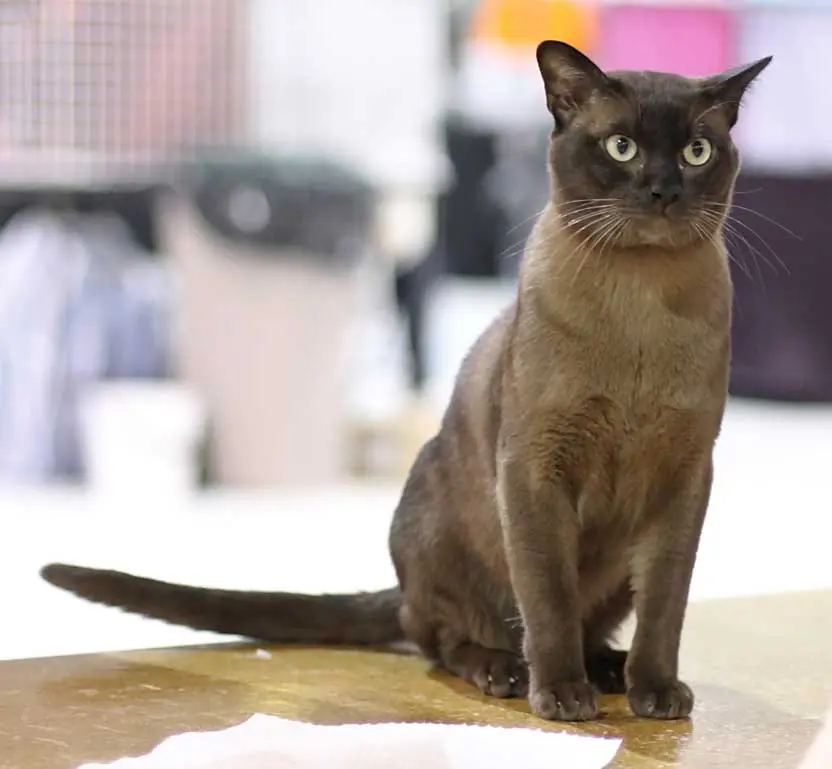
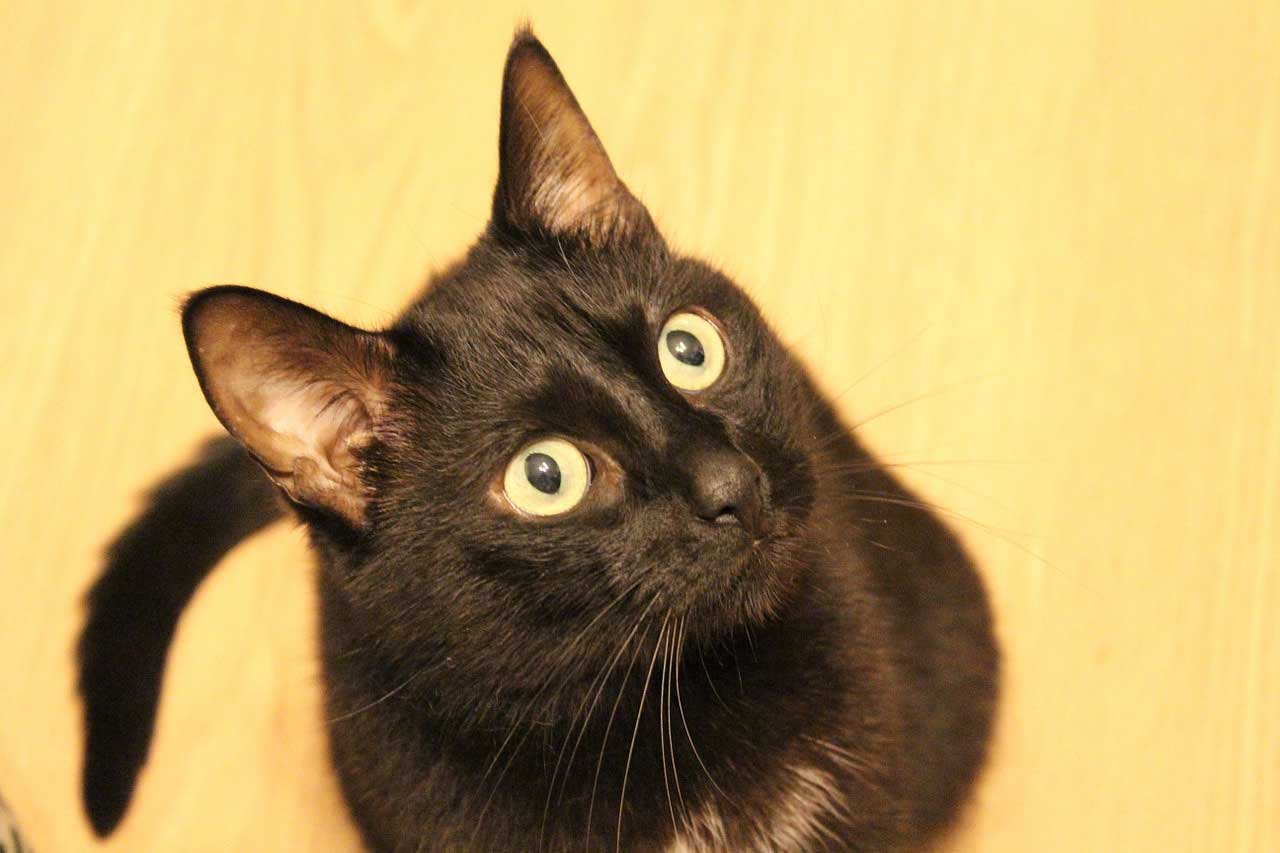
The race Burmese Modern was developed in the United States and Great Britain under different breed standards. Such an unusual breeding program resulted in the development of a number of different characteristics between the two groups., but most cat registries still do not formally recognize them as distinct breeds.
The breed was recognized by the Cat Hobbyists Association (CFA) in 1936, but it was discontinued a decade later due to extensive crossings with Siamese triggered by increased popularity. American breeders continued to refine the single standard of the Burmese cat, and the CFA eventually lifted the suspension in 1954. At the same time, British breeders tried to breed Burmese cats through a distinct breeding program comprised of a variety of cats, including some imported from America.
In 1952, the European Burmes cat was finally recognized by the Governing Council of the Cat Fancy (GCCF) of United Kingdom. The GCCF prohibited crossing with the American Burmese cat In an effort to preserve the "traditional" line. Today, the American and European versions of the breed are kept strictly genetically differentiated.
The European Burmes cat (O Burmes «Traditional» The British) has a long slim body, long legs and oval legs. The head is wedge-shaped with a long snout and almond-shaped eyes.. The tail is usually medium long.
The American Burmese cat (The "contemporary" Burmes) it has a much more robust body and its legs are proportional to the body. The head is much wider, the shorter and flattened muzzle and the eyes are round. The ears are wider at the base compared to the British variant. The shape of the legs and the length of the tail are similar in both groups..
Both the European Burmese cats like americans are small to medium size, and usually weigh between 4 and 6 kg. They are always very muscular and strong, so they often feel heavier when held than they actually are. Hence his nickname "brick wrapped in silk".
The coat is always short, silky and shiny. Originally, all Burmese Cats were deep dark brown (sable en EE.UU., brown in the UK and Australia and seal in New Zealand), but today a wide range of colors is allowed.
The standard sable color is the result of the so-called Burmese gene (cb) causing a reduction in pigment production. This distorts the usual expression of color creating a faded color dot effect. (that is to say, turns black coloring to brown). But, color must always be solid, only with a slight, faint tint towards the lighter underparts. Their eyes are green and gold and no stains are allowed on the coat.
Character and skills
The Burmeses they make excellent companion animals due to their affectionate nature, affectionate and playful. They are considered attention seekers and tend to cling to their human companions whenever they can.. Due to its clingy personality and puppy-like behavior, the Burmeses are often regarded as the dogs of the cat world.
These people-oriented cats tend to maintain their energetic and playful kitty personality into old age as well.. Like their ancestors Siamese, the Burmeses they are very vocal, loving and sweet. They are not independent and do not like to be alone for a long time. They get along very well with children and other pets, including dogs.
Health
Some published studies have recognized that Burmese cats, among other races, are at increased risk of diabetes (Cooper RL et al, 1997-2007 y Ohlund M et al, 2015). Diabetes mellitus (DM) is a metabolic disorder in which blood sugar levels remain high for long periods of time. This occurs when not enough insulin is produced in the body or the body does not respond to it..
It has also been identified and associated with Burmese cats hypokalemia, a recessive genetic disease characterized by low serum potassium levels. Apart of this, the race Burmese it is considered a fairly healthy and strong breed, with a half-life of 10 to 17 years.
"Burmés cat" data
1. The name of the Burmese race in Thai means «beautiful, Fortunate and splendid -looking ». We think these elegant and good-looking cats are worthy of this title.
2. To the Burmeses they love to investigate. Call a Burmese curious would be a bold euphemism. This is the cat that will be attentive to absolutely everything and everyone around him. With a Burmese, you will have the most committed and involved supervisor in almost everything you do.
3. They're the best friends. They are said to look a lot like puppies, and his kindness is definitely one of them. They adore their kittens, other cats and dogs, and they will be happier when you are home. They are known to even comfort their humans when they are sick or sad.
4. They do not adapt well to the outside. This curious cat is overconfident and easily gets into trouble. His survival skills aren't among the best in the feline world, either.. For this reason, in general, it is not recommended to let them roam freely outside.
5. Together with the Siamese, were the founders of the Tonkinese cat. The Tonkinese cat were created in Canada through a crossover program between the Siamese and the Burmese cat, with the aim of creating the perfect combination of the best characteristics of the two breeds. The Tonkinese was officially recognized as a breed in 2001.
▷ The world of Pets: Dogs, cats, birds, reptiles, amphibians
The European Burmes cat has the same origins as the American Burmese cat, that goes back to Wong Man, led cat of Burma to America in 1930. Imported American cats, descendants of Wong Mau, to Great Britain, and the Brown was recognized in 1952, but after the race was divided to take different forms in both sides of the Atlantic. In Europe, breeders preferred a more typically oriental look, and they were also interested in a wider color scale.
The Cat Fanciers Association began registering Burmese in 1936, but suspended records on 1947 because breeders continued to use conjoined twins in their breeding programs. Records resumed in 1953, after this practice was discontinued.
In Europe, However, the development of Burmese took a different path. In Great Britain, where the broodstock shortage was even greater than in the United States, the Siamese Red Point and the British Shorthair cat were used in breeding programs, and his genetic contribution included additional colors: red, cream, brown-turtle, chocolate-turtle, blue-turtle and lilac-turtle. With the time, they met as European Burmes cat.
The color blue, a recessive trait carried by cats imported from America, accepted a few years. The reddish colors and the turtle, It resulted from an accidental crossing, they were recognized in the Decade of 1970. Great Britain cats were exported to Europe, Africa, Australia and New Zealand in the Decade of 1950. Therefore, the breed in these countries follows the European type. The FIFé allows green eyes, but the GCCF considers it a defect.
On both sides of the Atlantic, the Burmese cat still listed among the most popular breeds, but looks better in Europe, where short hair cats prevail over copies of long hair.
Physical characteristics
Share Alois de Arkhitekton, European Burmese male presented at a cat show in Siilinjärvi, Finland – Heikkisiltala, CC BY 3.0, via Wikimedia Commons
The European Burmes cat, as the American Burmese cat, characterized primarily by the sepia pattern of fur, which gradually transforms into dark, uniform tips at the roots, without markings striped cat.
The coat is short and thin, glued to the body and do not need daily care. Thin legs hold a fairly weak body, but muscular, surprisingly heavy for its size.
The head is the feature in which the European Burmes cat differs more than the American type. It has a wedge and the snout is blunt; the eyes are separated, they are round and just ripped.
It is a medium-sized cat that usually weighs between 2 and 3 kg, sometimes more.
Varieties:
Most organizations that recognize the European Burmes cat they do not allow the crossing with other races in the framework of their breeding.
This is the position taken by the Fédération Internationale Féline (FIFé) and the Governing Council of the Cat Fancy (GCCF).
The Livre Officiel des Origines Félines (LOOF) French is an exception, since it authorizes the mating with the Burmilla cat, to expand the genetic background of this breed.
It also, the European Burmes cat is itself the origin of two races:
The European Burmes cat is quite successful in Europe, and this is especially true in the country where it was developed: Great Britain. Since 2004, ranks fifth in the breed ranking based on the number of annual registrations at the country's leading feline institution, the Governing Council of the Cat Fancy (GCCF). But, is in clear decline: while at the end of the 90 more than 3.000 kittens per year in the organization (which allowed him to occupy the fourth position in the ranking), this figure has been divided by three since then, and now around a thousand.
In France, the European Burmes cat not as successful as in Great Britain and ranks 35 (of about 70) in the breed classification of the Official Book of Feline Origins (LOOF) based on the number of births registered each year. This number is around fifty, what, just like in britain, reflects a certain decline: in the decade of 2000, it was rather on the order of 60 to 80. The American Burmese cat not far behind, since it occupies the position 40, nails on 30 or 40 registrations per year.
In Switzerland, the European Burmese occupies the tenth place in the statistics of the Fédération Féline Helvétique (FFH) since the years 90. But, while in the decade of 2000 there were some 70 registrations per year, this figure has dropped in the following decade and is now more of 40.
When it comes to personality, the European Burmese and the Burmese cat are aligned. The European Burmese is energetic and friendly. Has the charm and determination of his ancestors Siamese, and enjoy the conversation as much as that breed, but her voice is soft and sweet, which contradicts his tendency to run the home with an iron paw sheathed in velvety fur. He is very intelligent and seeks human company., so it is not the most suitable for a home where you will be alone most of the day. If there are no humans around to stimulate your intellect, make sure he has another pet for company. Get along well with other cats and dogs, but, of course, other Burmese (of any type) will be your best friend.
The European Burmese he is a very curious cat. It is hoped that you will explore your home thoroughly and get to know all its corners. He is playful and remains so into adulthood. Stimulate their smart mind with interactive toys and teach them tricks that allow them to show off in front of the public. Besides sitting, turn around, say hello and come, can learn to reach for a small toy or walk on a leash. With proper early conditioning, car rides and vet visits will be a breeze.
One European Burmes cat it is a good choice if you are not opposed to total loss of privacy. This cat will want to participate in everything you do, from reading the newspaper and working on the computer to preparing meals and watching television. Of course, will sleep in bed with you and can even snuggle under the covers. When i'm sitting, will be on your lap or right next to you, waiting expectantly for me to caress you. Yes, he ignores them, will scold you. Guests will receive your undivided attention, and those who say they don't like cats are likely to win.
A female of European Burmese is the very definition of queen status. Likes attention and likes to be in command. Males are calmer and are content to fill the lap. Whatever your choice, you may soon find yourself longing for another.
Children and other pets
The European Burmese, active and sociable, It is a perfect option for families with children and for dogs that accept cats.. Play fetch as well as any retriever, learns tricks with ease and loves the attention he receives from children who treat him with politeness and respect. Live peacefully with cats and dogs that respect your authority. Always introduce pets slowly and under controlled circumstances so that they learn to get along.
Health
Both pedigreed cats and catsmixed raceshave different incidences of health problems that may be genetic in nature.The European Burmes cat is generally healthy, although they can be prone to gingivitis and can be sensitive to anesthesia.The following diseases have also been observed in this breed:
Aqueous humor lipemia, a transient milky appearance of the eye during infancy, that usually resolves on its own.
Dermoide corneal, the presence of skin and hair on the surface of the cornea, that can be successfully corrected surgically.
Gangliosidosis, an enzyme deficiency A test has been developed to detect the disease.
Orofacial pain syndrome, indicated by exaggerated licking and chewing movements and pawing the mouth Discomfort may increase when the cat is excited or stressed, and cats are often reluctant to eat because the activity is painful. Some cats must wear an Elizabethan collar and have their paws bandaged to prevent injury. Some cases resolve on their own and then recur. The cause and outcome are unknown. mode of inheritance. Pain relievers and anticonvulsants may help, as well as consultation with a veterinary dentist to rule out dental disease.
Congenital peripheral vestibular disease causing head tilt, lack of balance, rapid eye movements and uncoordinated gait in kittens Some kittens with the condition can also be deaf.
Hypokalemic polymyopathy, muscle weakness caused by low levels of potassium in the blood, sometimes seen in Burmese kittens Signs include general weakness, stiff gait, reluctance to walk and head tremors. Can be treated with orally administered potassium supplements.
Flat chested kitten syndrome, a deformity that can range from mild to severe Kittens that survive to adulthood usually show no signs once they reach maturity.
twisted glue, usually as a result of a coccyx deformity; it does not cause pain or discomfort.
Osteoarthritis of the elbow, an early-onset arthritis in the elbow that limits the cat's activity or mobility.
Endocardial fibroelastosis, a heart condition in which the left ventricle of the heart thickens and stretches the heart muscle. The signs usually develop when a kitty has 3 SA week 4 months of age, a good reason to wait until 4 months to bring a kitten home.
Dilated cardiomyopathy, enlarged heart.
Mellitus diabetes, an endocrine condition caused by a defect in insulin secretion or insulin action that results in high blood sugar levels.
European Burmese
care and grooming
The soft, short coat of the European Burmese easily cared for with weekly brushing or combing to remove dead hair and distribute skin oil. A bath is seldom necessary.
Brush your teeth to prevent periodontal disease. The best is daily dental hygiene, but a weekly brushing is better than nothing. Clean the corners of the eyes with a soft, damp cloth to remove any discharge. Use a different area of ​​the cloth for each eye so as not to run the risk of spreading any infection. Check the ears weekly. If they look dirty, clean them with a cotton pad or soft cloth moistened with a mixture of cider vinegar and warm water at 50%. Avoid using cotton buds, that can damage the inside of the ear.
Keep the litter box spotless. As all cats, the European Burmese they are very demanding with bathroom hygiene.
It is a good idea to keep a European Burmes cat as an indoor cat to protect it from diseases transmitted by other cats, from dog attacks and other dangers faced by outdoor cats, like being hit by a car. The European Burmese who go abroad also run the risk of being stolen by someone who wants to have such a beautiful cat without paying for it.
Characteristics "European Burmes cat"
Coexistence is important that you have with your new friend. Before considering the acquisition of a cat of the breed "European Burmes cat" you know certain factors. You must take into account their character, their need for exercise, their interaction with other pets, their care and if you have small children, their level of tolerance towards them.
Joy
5,0 of 5 stars (based on 1 review)
Activity level
4,0 of 5 stars (based on 1 review)
Friendliness to other pets
3,0 of 5 stars (based on 1 review)
Friendliness to children
3,0 of 5 stars (based on 1 review)
Grooming requirements
1,0 of 5 stars (based on 1 review)
Vocality
4,0 of 5 stars (based on 1 review)
Need for attention
4,0 of 5 stars (based on 1 review)
Affection towards its owners
5,0 of 5 stars (based on 1 review)
Docility
1,0 of 5 stars (based on 1 review)
Intelligence
4,0 of 5 stars (based on 1 review)
Independence
2,0 of 5 stars (based on 1 review)
Hardiness
3,0 of 5 stars (based on 1 review)
Videos "European Burmes cat"
European Burmese cat❤️ Breeding cattery Freya Way*RU