โ–ท The world of Pets: Dogs, cats, birds, reptiles, amphibians

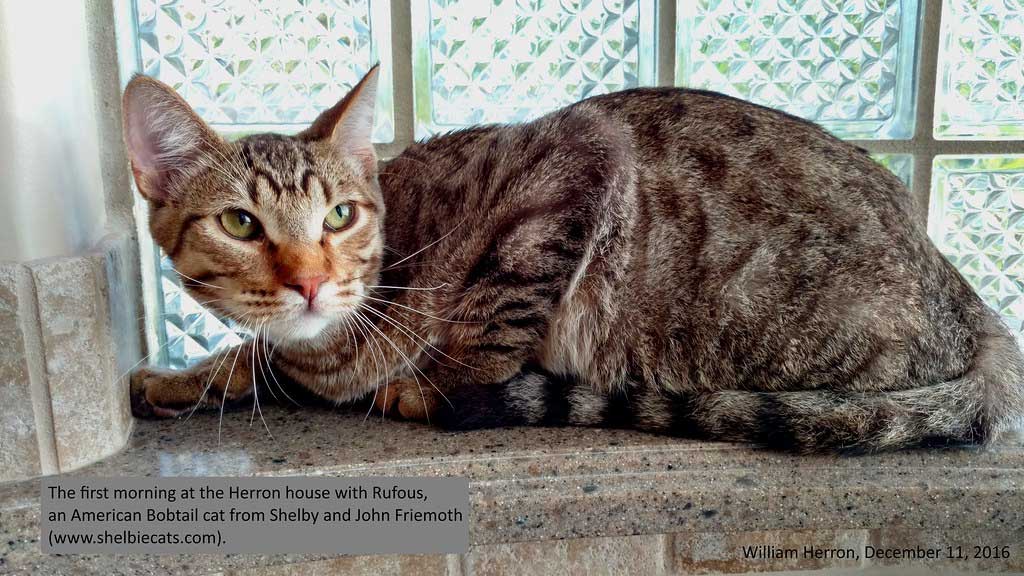
American bobtail cat
Federations: CFA, TICA, ACFA/CAA

The Bobtail americano he is playful and intelligent. Some have dog features, they learn tricks and can retrieve things

American Bobtail

Content

History

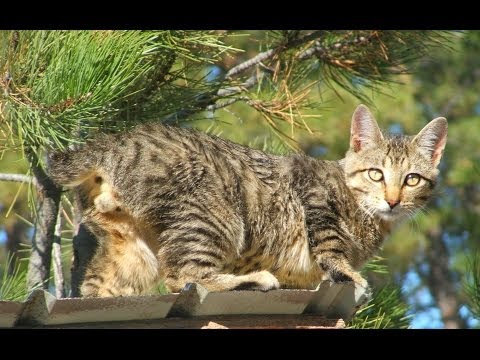
The history of Bobtail americano started with a serendipitous find in the 1960, to Yodie, a street cat wild aspect picked up in Arizona by John and Brenda Sanders, Iowa.

when breeding started, different short-tailed cats were crossed (long and short haired cats with different coat colors) without preferring certain breeds.

From 1980 the goal was to produce a wild looking tabby cat based on the look of the Yodie, and the Bobtail eventually gained acceptance in major North American registries, though it's still weird. The version of long hair was the first recognized as a breed.

Due to the mating of the most diverse animals, the gene pool of Bobtail Americano it is especially wide, which contributes to the fact that cats are largely free from hereditary diseases typical of the breed.

With the recognition of the TICA (International Cat Association) in 1989, breeders achieved their greatest success to date. The American Bobtail is also recognized as a breed in the LOOF standard. (Livre Officiel des Origines Fรฉlines).

Physical characteristics

American Bobtail longhair
American Bobtail longhair by Rachel Daviesfrom Aberystwyth, WALES

The Bobtail americano It is a medium-sized cat and reaches a body weight of about seven kilograms. His body is athletic and muscular with a broad chest.. How the front legs are longer than the back legs, the back curves towards the neck.

The special feature of this cat is the tail, which is due to a spontaneous genetic mutation and is inherited in a dominant way. The cat's tail is not uniform in appearance: may be curved, curled and knotted. The length or shortness of the tail also varies. (as orientation, the length of the tail of the Bobtail americano is about a third of that of other cats).

  • The head is broad with a pronounced cheek line and jawline..
  • The eyes are large, oval in shape and harmonizes with the coat.
  • The ears are medium in size and covered by a small tuft of hair at the tip.

The Bobtail americano he also has hair between his toes.

In general, all coat colors and patterns are recognized. The length of the coat is also left open in the standard and is not defined in a binding way. But, the cat Bobtail americano always has a double and dense coat, which is smooth and shiny.

Character and skills

As with other breeds of cats, the character traits of individuals can vary greatly.

But, there is the following trend in the cat Bobtail americano:

  • Curious
  • Sociable
  • People-oriented
  • Freedom lover
  • Take it easy
  • Active
  • Playful

care and health of "American bobtail cat"

American bobtail cat

The Bobtail americano he is an affectionate cat that does not stay well alone. If the human has no time for him, at least one other cat should be present. However, he will also make friends with dogs if he can gradually get used to the other species..

This cat with velvet paws has no preference for a certain category of people, older people and children alike like it. The only important thing is that there is someone at home with whom you can relate. By the way: the communication of Bobtail americano it is comparatively quiet. Their sounds are less like those of a cat than those of a cooing dove.

Since the genome of Bobtail americano is based on that of common house cats, there is genetic diversity. So, the breed cat rarely sick.

But, can have hip problems due to the difference in length of the legs and in the spine due to its stubby tail. It can also suffer from all the typical diseases of domestic cats throughout its life. The susceptibility to dental problems also appears to be slightly increased in the Bobtail americano.

Indoor or outdoor cat?

Since the Bobtail americano is lively, a large garden or unlimited access to the outside would be ideal for them. Consequently, holding abroad is the recommended way, but with the premise that the cat can enter the protected indoor area in bad weather, at night and in case of danger.

If the apartment is furnished adequately for cats, indoor accommodation can also be considered. But, tickets must be well secured. The Bobtail americano you are curious and smart, making it prone to escape maneuvers. It's lightning fast and smart enough to learn the mechanism of a handle. For security, lock the front door, even if you are present.

How much activity does he need? "American bobtail cat"?

The Bobtail americano has phases in which you like to exercise. But, your desire for physical activity is in a comfortable mid-range.

What he likes are smart toys and scratching posts where he can climb and sharpen his claws. But, in any case, these should not be missing in a home that accepts cats, so it is an absolutely normal cat in this aspect.

Grooming and feeding

The Bobtail americano it is very simple in terms of daily grooming routine. It also has no special food needs or a coat that needs grooming.. But, cats who are overly interested in food get fat pretty quickly, but you can avoid it with an automatic food portioner or a manual allocation of the same. The most important thing is that the food is made up of high-quality ingredients and that it adapts to the characteristics of the cat (depending on your age, your possible illnesses / intolerances and your individual energy needs).

The cat's coat Bobtail americano it is generally very easy to care. But, during the coat change, the effort increases by the minute. You can help the cat change its coat by brushing it daily and removing tangles. Many breeds - especially short-haired cats- can get by without the daily grooming program.

For sale "American bobtail cat"

The cat Bobtail americano is only recognized since 1989. So, it is still a young breed that can only be purchased from selected breeders. Make sure you only buy from people you can visit in person and see for yourself the state of the animals and the living conditions there. Sellers who reject this request are not serious.

Purchase price may vary based on genetic lineage, sex, age and appearance. Expect a minimum price of about 1.000 EUR by a purebred animal.

Although the purchase price is above average, you will spend exactly the same amount on maintenance costs as with other cats. Calculated over the years, high purchasing costs will be reduced.

Characteristics "American bobtail cat"

Coexistence is important that you have with your new friend. Before considering the acquisition of a cat of the breed "American bobtail cat" you know certain factors. You must take into account their character, their need for exercise, their interaction with other pets, their care and if you have small children, their level of tolerance towards them.

Joy

4,0 of 5 stars (based on 1 review)

Activity level

4,0 of 5 stars (based on 1 review)

Friendliness to other pets

4,0 of 5 stars (based on 1 review)

Friendliness to children

4,0 of 5 stars (based on 1 review)

Grooming requirements

3,0 of 5 stars (based on 1 review)

Vocality

3,0 of 5 stars (based on 1 review)

Need for attention

4,0 of 5 stars (based on 1 review)

Affection towards its owners

5,0 of 5 stars (based on 1 review)

Docility

2,0 of 5 stars (based on 1 review)

Intelligence

3,0 of 5 stars (based on 1 review)

Independence

3,0 of 5 stars (based on 1 review)

Robusted

4,0 of 5 stars (based on 1 review)

Videos "American bobtail cat"

Animal Planet : Cats 101 ~ American Bobtail

Animal Planet : Cats 101 ~ American Bobtail
Champion American Bobtail Cat

Champion American Bobtail Cat

โ–ท The world of Pets: Dogs, cats, birds, reptiles, amphibians

Japanese Bobtail
Recognized by the CFA, TICA, CCA-AFC

The Japanese Bobtail he is a smart cat, playful and very curious, that radiates joy for life.
Japanese Bobtail
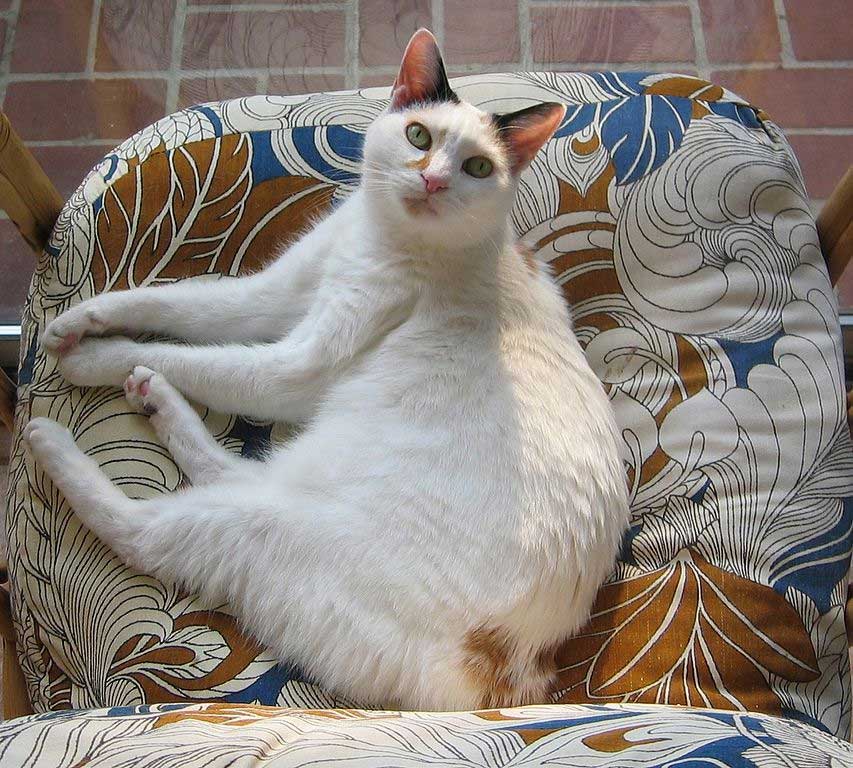
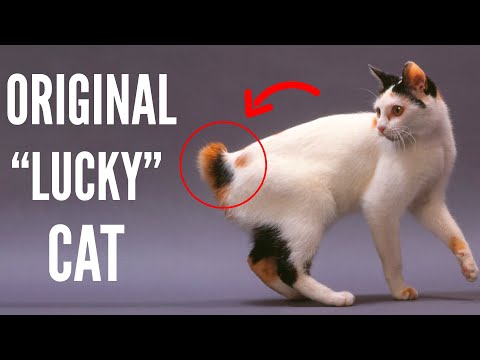
A white Japanese Bobtail cat – Valter Wei, CC BY-SA 2.0, via Wikimedia Commons

Content

Characteristics "Japanese Bobtail"

Coexistence is important that you have with your new friend. Before considering the acquisition of a cat of the breed "Japanese Bobtail" you know certain factors. You must take into account their character, their need for exercise, their interaction with other pets, their care and if you have small children, their level of tolerance towards them.

Joy

5,0 of 5 stars (based on 1 review)

Activity level

4,0 of 5 stars (based on 1 review)

Friendliness to other pets

3,0 of 5 stars (based on 1 review)

Friendliness to children

5,0 of 5 stars (based on 1 review)

Grooming requirements

2,0 of 5 stars (based on 1 review)

Vocality

4,0 of 5 stars (based on 1 review)

Need for attention

4,0 of 5 stars (based on 1 review)

Affection towards its owners

5,0 of 5 stars (based on 1 review)

Docility

4,0 of 5 stars (based on 1 review)

Intelligence

4,0 of 5 stars (based on 1 review)

Independence

2,0 of 5 stars (based on 1 review)

Hardiness

4,0 of 5 stars (based on 1 review)

History

The Japanese Bobtail it owes its name to its very short, pom-pom-shaped tail, breed characteristic. There are two types: the Shorthair japanese bobtail and the Longhair Japanese Bobtail. Most official bodies consider that they are two varieties of the same breed., but the TICA (International Cat Association) consider each to be a breed in its own right.

The oldest records of this breed date back to the 6th century. But, despite its name, it likely actually originated from China or Korea. Some ancient Japanese texts say that the cat was initially gifted to the Emperor of Japan by the Emperor of China or Korea as a sign of friendship.. Another hypothesis is that Japanese Bobtail was brought to Japan by early Buddhist monks (who also came from Korea at the same time), as they used it to control rodents in order to protect the rice paper books and documents stored in the temples.

Whatever its origin, believed to be a natural breed, that is to say, not created or modified by the hand of man.

Originally, the Japanese Bobtail it was especially popular with silkworm farmers in Japan due to its incredible hunting skills. It allowed them to get rid of rodents forever.

The imperial family also quickly fell under the spell of the race, and granted privileges reserved to the nobility: all the care was given. In the 10th century, Emperor Idi-Jo even imported more copies from Korea to protect his manuscripts from small rodents.

In 1602, due to the invasion of rats that destroyed silkworm farms and rice crops, Japanese authorities decreed that cats should no longer be domesticated, they were allowed to roam freely through the farms and streets. Like this, feeding was prohibited, buy or sell cats. The Japanese Bobtail became the "alley cat" of Japan.

Japanese Bobtail
Blue eyed Female Japanese Bobtail – Wikipedia Japanese user ใ‚ˆใ†ใฆใ„, CC BY-SA 3.0, via Wikimedia Commons

It was not until many centuries later that the Japanese Bobtail became known outside of Asia. It was not the Japanese who made the breed official and gave it international recognition, but an American breeder named Judy Crawford, that brought several Bobtails japoneses of his trip to Japan in 1968. So he decided to join forces with Elizabeth Freret, another american breeder, to try to get the cat to be recognized by the different organizations. The breed was officially recognized by the CFA (Cat Fancierโ€™s Association) in 1976, and by FIFe in 1990. Since then it has spread on American soil, and is now also recognized by the other two great American organizations, la American Cat Fanciers’ Association (ACFA) y la International Cat Association (TICA).

In France, owes its arrival to Hรฉlรจne Choisnard, who discovered the breed during a stay in Thailand in 1980. While visiting a Buddhist temple, a monk gave him a young cat Japanese Bobtail tricolor called Sirikit, that had caught your attention. He took her to France and crossed her with another Japanese Bobtail that he had brought from the United States. The first litter of Bobtails โ€œmade in Franceโ€ was born a year later, in 1981. The breed is now recognized by the Livre Officiel des Origines Fรฉlines (LOOF), but it is still little known in Europe, where other short-tailed cats, as the Manx cat, they steal the show.

Physical characteristics

The Japanese Bobtail he is an athletic cat, medium-sized. Its body long and slender and his back straight, raised by legs tall and thin with feet oval, give it an unusual elegance. The neck it is harmonious and the legs strong despite their delicate appearance.

A Japanese Bobtail stares intently at the camera, showing the triangular face that is a characteristic of the breed – jonny-mt, CC BY-SA 3.0, via Wikimedia Commons

The head triangular, with clean lines and ears large, straight and spaced, is characterized by a forecrown rounded and prominent cheekbones, surrounding a nose long with two parallel lines. Its big eyes ovals are slanted and give a soft, tempered look. The eyes are often two different colors.

But what makes this breed special (and gives his name) is your tail short, tall and curled, which forms a kind of pompom. The Japanese see it as a chrysanthemum, good luck symbol according to japanese beliefs. This trait is derived from an autosomal gene. (that is to say, located on a non-sex chromosome; neither X nor Y) recessive and has no negative impact on the animal.

The fur of the Japanese Bobtail can be short or semi-long hair, with little undercoat in both cases. In any case, can be tortoiseshell or tortoiseshell. All cat coat colors are accepted, except for chocolate, the lilac, the cinnamon and the tawny. The tricolor coat, also called Mi-Kรฉ (What does "three hairs" mean in Japanese?), is the most appreciated, as it is said to bring good luck to its owners. Last, to be accepted, color must be solid and deep or, when there are many colors, present pronounced contrasts.

Size and weight

  • Male length: Of 30 – 35 cm.
  • Female length: 30 – 35 cm.
  • Male weight: 5 – 10 kg
  • female weight 2,5 – 4 kg

Varieties

There are two varieties of Japanese Bobtail: the Shorthair japanese bobtail and the Longhair Japanese Bobtail. The latter was not recognized by the CFA (Association of amateurs of cats) until 1993, while the TICA considers it a feline breed in its own right.

Both cats have a silky coat with very little undercoat.

Character and skills

The Japanese Bobtail he is a smart cat, mischievous and very curious that exudes joy of living. very difficult to alter, is constantly alert and ready to discover everything new in the house. His curiosity leads him to explore every corner of his home, and allows you to easily adapt to new environments, which makes it a perfect travel companion.

Their outgoing character helps them express themselves and make themselves understood. It is a very talkative cat and will return the meow to whoever addresses it. It's not especially loud though, has a lot to say, And a whole host of meows and sounds at your disposal to say so!! Attached to its owner, can follow you all day without getting bored, but without showing his excessive meowing or his disturbing behavior.

It is possible to train your cat, since he is quite intelligent and playful by nature: can easily learn some tricks and understand some commands. You can even walk your cat on a leash, if you can make me see it as a game, so that you find it interesting. But, they can be stubborn, so sometimes it's hard to make them change their minds about certain things (for example, what they can and cannot do).

On the other hand, this cat is very laid back and can jump to impressive heights. Providing suitable perches or toys will encourage them to jump and exercise.

You should also make sure to give them a few minutes of play each day., since it is necessary for its development. It is a breed of cat that adapts well to children, whose energy and enthusiasm shares. Also easily accepts the presence of strangers and other animals. In the case of a dog, put them together little by little, if possible when the cat is still young, makes it easier for them to get along and coexist.

Last, the Japanese Bobtail it is one of the few breeds of cats that like water.

Japanese Bobtail
Japanese bobtail and normal-tailed cat – Wikipedia

Health

The Japanese Bobtail you do not have any particular genetic disease. His athletic build makes him one of the most vigorous cats, and has a constitution of iron.

The life expectancy of the cat is approximately 15 years, making it one of the longest-lived cat breeds.

Life expectancy

13 to 16 years

Grooming

Due to its scarce undercoat, the fur of the Japanese Bobtail not prone to knots and, Therefore, requires relatively little maintenance.

In the case of a Shorthair japanese bobtail, a weekly brushing is usually sufficient. In the case of a Longhair Japanese Bobtail, daily brushing of the cat's coat, although it is not essential, will help the coat retain its beauty and shine. For both cases, the Japanese Bobtail seasonally molts, in spring and autumn. The long-haired variety is constantly shedding.

But, the Japanese Bobtail he is very playful when groomed. Unlike some of his peers, This is not usually a moment that I hate, All the more reason not to exempt him from it!!

The coat of the Japanese Bobtail it is waterproof, meaning bathing and shampooing can be difficult. Fortunately, these two tasks are rarely necessary.

It also, to prevent the build-up of tartar and the development of infections such as gingivitis, regular brushing of the cat's teeth is recommended. The ideal is daily brushing, but the weekly is fine.

Last, it is a good idea to check the condition of your cat's ears at regular intervals, and clean them if they look dirty.

For sale "Japanese Bobtail"

The price of adopting a kitten Japanese Bobtail usually oscillates between 800 and 1100 EUR. There is no big difference between the price of a kitten Japanese Bobtail male or female.

If you don't get a "Japanese Bobtail", You will always have the consolation of being able to buy the famous ยซMancki-nekoยซ, or cat who greets, a popular lucky charm very typical in Japan.

Videos "Japanese Bobtail"

Talking cats (cat story)
Talking cats
Japanese Bobtail : Top 10 Facts About Japanese Bobtail Cats That Will Leave You Amazed

Alternative names:

1. Japanese Bobtail (English).
2. Bobtail japonais (French).
3. Japanese Bobtail (German).
4. Bobtail japonรชs (Portuguese).
5. "Bobtail japonรฉs" (espaรฑol).

โ–ท The world of Pets: Dogs, cats, birds, reptiles, amphibians

Russian Blue Cat
Recognized by CFA, FIFe, TICA, ACF, ACFA/CAA, CCA-AFC, GCCF

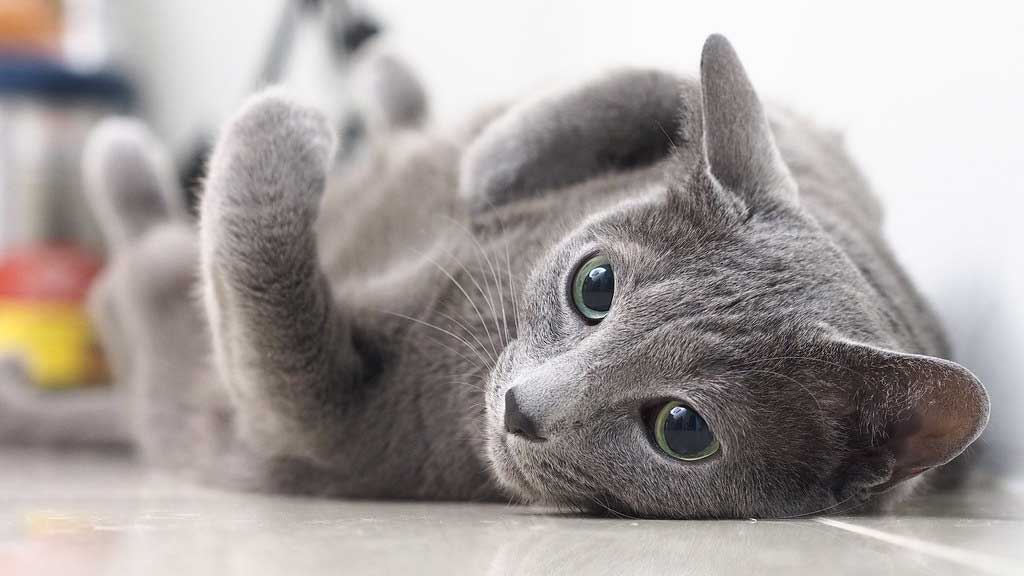
The nature of Russian Blue Cat it is fascinating and versatile. On the one hand he is frugal and calm, but on the other hand it can also be temperamental and wild.
Azul Ruso
Photo: Wilkipedia

Content

Characteristics "Russian Blue Cat"

Coexistence is important that you have with your new friend. Before considering the acquisition of a cat of the breed "Russian Blue Cat" you know certain factors. You must take into account their character, their need for exercise, their interaction with other pets, their care and if you have small children, their level of tolerance towards them.

Joy

3,0 of 5 stars (based on 1 review)

Activity level

3,0 of 5 stars (based on 1 review)

Friendliness to other pets

3,0 of 5 stars (based on 1 review)

Friendliness to children

3,0 of 5 stars (based on 1 review)

Grooming requirements

2,0 of 5 stars (based on 1 review)

Vocality

1,0 of 5 stars (based on 1 review)

Need for attention

3,0 of 5 stars (based on 1 review)

Affection towards its owners

3,0 of 5 stars (based on 1 review)

Docility

4,0 of 5 stars (based on 1 review)

Intelligence

4,0 of 5 stars (based on 1 review)

Independence

4,0 of 5 stars (based on 1 review)

Hardiness

4,0 of 5 stars (based on 1 review)

History

Companion of the Russian Tsars, or from the English sailors?

Was the cat born near the cold waters of the Russian port of Arkhangelsk, or under the Maltese or Spanish sun?

Many legends surround the origin of the mysterious Russian Blue Cat. But, fans and official associations today privilege the Russian track, according to the breed name.

It all started in the 17th century on the shores of the White Sea, in the vicinity of the port city of Arkhangelsk, in northern Russia. Coveted and hunted for its unique thick, bluish fur, this typical cat of the region was quickly adopted by sailors for its qualities to hunt rodents. About 1860, British merchant ships brought this amazing feline to their holds. This allowed the breed to spread, initially in the UK and later in the rest of Europe. But, this diffusion is still quite modest.

The first mentions of him Russian Blue Cat as a whole-part race appear in works published in Great Britain from 1865. They are then evoked there under the name of "blue archangels", russian shorthair or still foreign blue. But, was not up 1871 when the breed really became known to Victorian society under the name "Archangel Cat", after his presentation at the Crystal Palace in London.

As a cultural center that hosted part of the Universal Exhibition of 1851 and as a cabinet of animate and inanimate curiosities open to the public, the Crystal Palace had international fame at the time. Animal exhibits, especially cats, were the most common and popular. But, the Russian Blue Cat did not arouse much interest in this first public appearance. Introduced at the same time as other blue-coated cats like the Chartreux or the British shorthair cat, it blended into the background and only attracted the attention of some rare fans, among them one such Constance Carex-Cox.

Russian Blue
Russian Blue

Then, in charge of a hatchery of Abyssinian cats, British shorthair cats and Manx cats, acquired his first Russian blues, developed the breed and took it upon himself to promote it to the general public. He wrote an article defending the differences between the Russian Blue Cat and the British shorthair cat in one of the first reference books on cat breeding, The Book of cats, de Frances Simpson (1903). His pugnacity was rewarded in 1912, When the Governing Council of the Cat Fancy (GCCF), the main British feline organism, officially recognized the difference between British shorthair cat and the Russian Blue Cat. As a result, a separate class was created for cat shows, which is now registered under the name of ยซForeign Blueยป. This inversion of the terms in relation to the name used previously ("blue alien") underlines that his most important feature is the blue of his eyes, more than its โ€œexoticโ€ appearance.

In 1939, still in the uk, officially received the name of Russian Blue. The other countries will adopt this name as the breed is recognized by the different national organizations..

In fact, its mitigated success among the British public does not prevent the Russian Blue Cat be exported to the United States and Canada between 1888 and 1890. There it also suffered from comparison with other local blue cats, including American shorthair cat. But, careful crossing allowed to develop a Russian Blue Cat finer than original, which was successful until 1940.

In the rest of europe, and in particular in France, the Russian Blue Cat was almost a victim of history, especially after the Bolshevik revolution of 1917. In fact, driven by deep anti-Bolshevik sentiment, the population despised everything that could have a Russian origin. The race had a hard time establishing itself. But, was presented for the first time in France in 1925 with the name of Maltese cat, before receiving the official name of Russian Blue in 1939, like on the other side of the canal.

The fighting and deprivation of World War II also endangered the survival of the Russian Blue Cat. But, after the end of the conflict, the dynamic breeding programs in England and Scandinavia make it possible to stop the extinction of the breed thanks to, in particular, to crosses with other cats, that contribute to the appearance of various morphological varieties of Russian Blue. In the United Kingdom, Marie Rochford, the only breeder that has preserved a pure lineage, decides to cross their specimens with siameses Blue Point. This permanently modifies the morphology of the Russian Blue, that gets thinner, to the point where the breed standard changes in the fifties. But, this trend stops a few years later, in 1965-1966, in particular thanks to the breeding program established by the Association Russian Blue. In 1967, the British Russian Blue had returned to its original more rounded shape and the original standard was back in force.

At the same time, in scandinavian regions, local breeders chose to recreate the breed by crossing Siamese with local blue stray cats. Compared to British lines, these lines of Russian Blue have a shorter, denser coat and smaller body size.

In United States, the Association of amateurs of cats (CFA) recognized the breed in 1949. But, the importation of British and Scandinavian specimens makes it difficult to evaluate cats in competitions, since the representatives of the breed have very different appearances. From 1960, Crossing programs between the different types were launched in order to homogenize the physical, what drove in the years 90 to the disappearance of the Scandinavian type in the country, for the benefit of British and American types only.

Is this the end of the tribulations of the Russian Blue Cat?

Not counting the interventions of Australian and New Zealand breeders who, over the years 60, they launched experiments to create russian blues black and russian blues White. The Australian Mavis Jones thus obtained the first Russian Blue Cat black and white in the years 70, when crossing a domestic cat white and a Russian Blue. But, 50 years later, only a limited number of organizations recognize the White Russian Blue and Black Russian Blue as official varieties of the breed. But, is the case of the Australian Cat Federation (ACF) in Australia, the New Zealand Cat Fancy (NZCF) in New Zealand, the Southern African Cat Council (SACC) in south africa, just like him Governing Council of the Cat Fancy (GCCF) in the UK and the Official Book of Feline Origins (LOOF) in France. In fact, these various feline organisms have gone so far as to change the breed name to eliminate any reference to color: for them, the cat is now simply Russian. The Catโ€™s Fanciers Association (CFA) and The International Cat association (TICA) in United States, as well as the Fรฉdรฉration Internationale Fรฉline (FIFรฉ) and World Cat Association (WCF) in Europe and around the world, disagree and refuse to recognize these varieties.

Last, it is impossible to close the history of Russian Blue Cat not to mention his long haired brother, the Nebelung cat, born in the years 80 and today recognized as a breed in its own right.

In the news, the emerald-eyed blue feline has a following mainly in the UK (located between the 10 Britain's most popular cats), Japan, EE.UU. (it is located just below the post 20 of the most popular cat breeds in the U.S.), Germany and France, where does he occupy the position 25 of the favorite breeds of cats of the French, nails on 150 annual inscriptions in the Official Book of Feline Origins (LOOF)

Physical characteristics

The Russian Blue Cat is an elegant short-haired cat with long legs and a slim complexion..

Russian Blue. American type. The breeder is Brad Kardux, Bluemews Cattery, Pennsylvania – Doug Miller, CC BY 2.0, via Wikimedia Commons

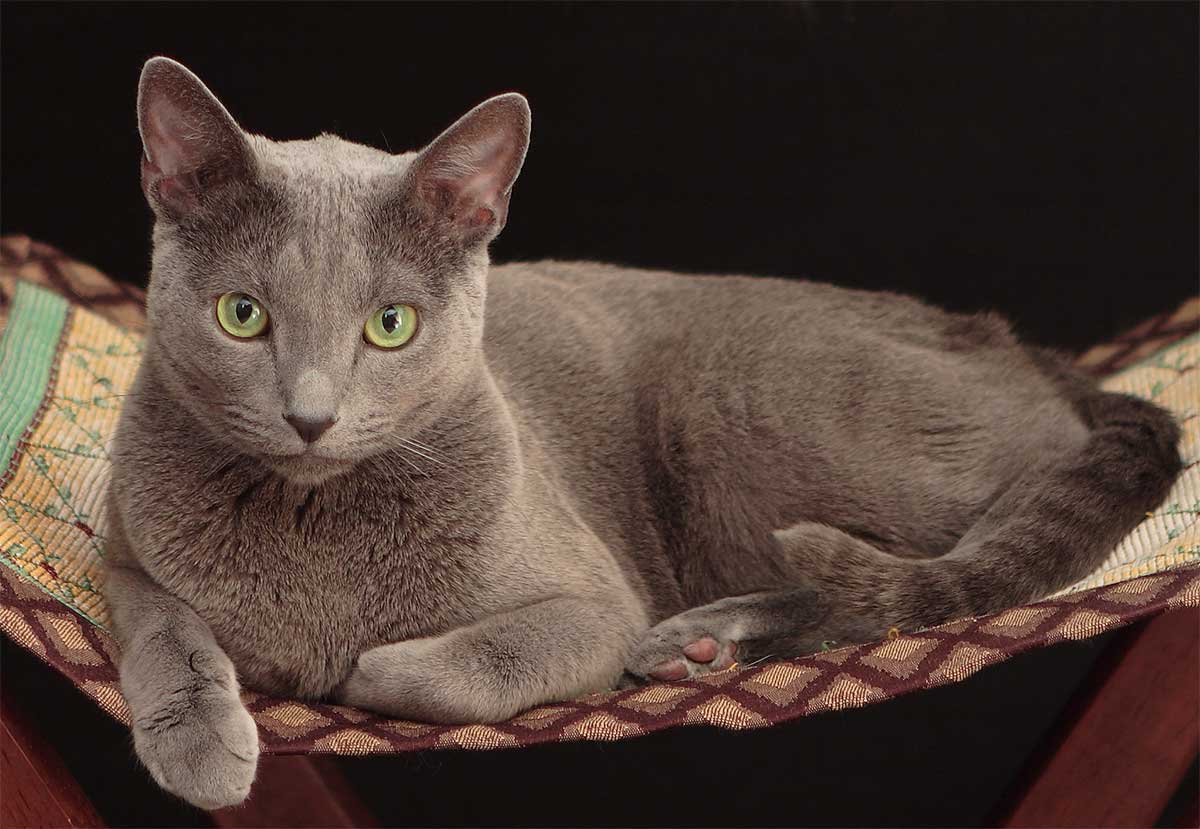
The special feature of Russian Blue it's your calling double fur, in which the outer coat is the same length as the undercoat. This makes the coat stand out and is especially soft and silky.. As the name suggests, the the fur color is always blue or blue-gray. Shading is not allowed, white spots or brindle markings. When they are young, cats may still be slightly tabby.

Although black and white are not recognized by all feline organizations, all agree that the color of the cat's coat must be perfectly uniform throughout the body, including muzzle and paw pads. Shading is excluded, brindle marks or spots. But, kittens can sometimes show ghost markings on their flanks and tail, that disappear at approximately one year of age.

Thanks to the colorless hair ends (tipping), blue fur glows silver in the light.

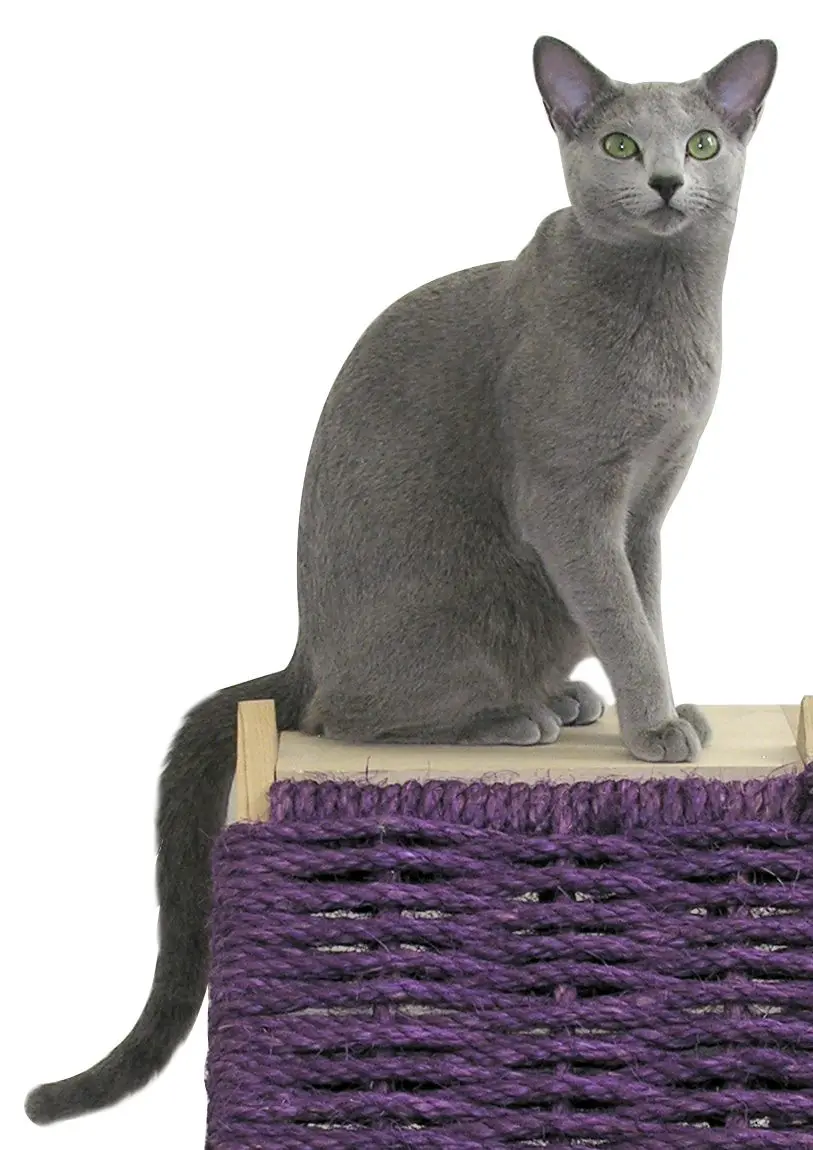
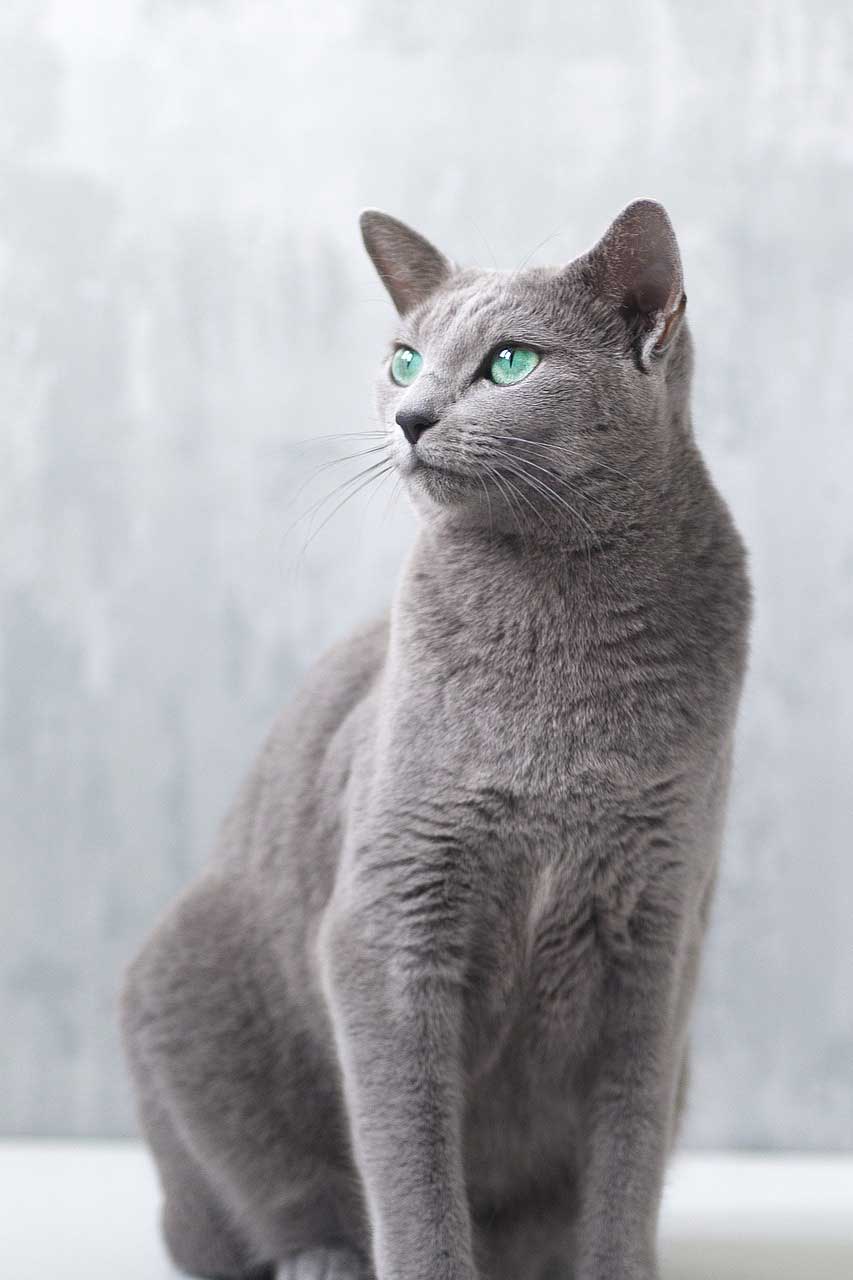
The elegant Russian has a graceful posture and a head angular with a "smiling" mouth. The Greats eyes, almond-shaped, develop an emerald green coloration in adult animals.

Size and weight

  • Male size: 30 cm.
  • female size: 30 cm.
  • Male weight: 3,5 – 4,5 kg
  • female weight: 2,5 at 3,5 kg
  • Varieties "Russian Blue Cat"

    Despite the efforts of the breeders of the Russian Blue Cat for standardizing the physique of the breed, different morphological types still exist, due to its rich history:

  • The type Siberian / Scandinavian, smaller than other representatives of the breed and particularly elegant, with spread ears and a darker color than the other blue Russians;
  • The American type, the most graceful. It is medium in size, with a rather light color and widely separated ears;
  • The English type, the most robust. Visually distinguishable from other varieties by its fine vertically placed spikes.
  • Most big cat associations only recognize the color blue, with a tip of slightly white and gray guard hair, giving the coat a shiny, silver appearance. The nose and pads are gray, charcoal or dark lilac.

    The white variety, which is only recognized by organizations in some countries, has white fur with silver highlights and pink nose and pads.

    Last, the black variety, which is in the same situation as white in terms of recognition, is characterized by shiny jet-black fur from root to tip, and a black or dark brown nose and pads.

    Character and skills

    The nature of Russian Blue Cat it is fascinating and versatile. On the one hand he is frugal and calm, but on the other hand it can also be temperamental and wild. But, in general it is a balanced cat that establishes a strong bond with humans.

    Russian blue
    Russian blue – Flickr

    The russian cats prefer to sleep near their owners or even in bed with them, but they are never intrusive. But, they are quite reserved with strangers and the breed does not tolerate noise very well. To feel comfortable, the sensitive cat prefers a regular daily routine and the company of a sitter.

    These smart cats are curious and playful, allowing them to quickly learn new skills. If they want, jumping animals can open doors and climb tall cabinets. But, Your cautious and considerate nature ensures nothing is broken in the process. In summary, The Russian Blue is an ideal cat for a calm couple or a single person.

    Care "Russian Blue Cat"

    Indoor or outdoor cat?

    The Russian Blue Cat it is a frugal cat breed, that is also satisfied with living only inside. Unexpected situations outside can even be too much for the sensitive cat and strangers can scare it.. Secure access outside in a fenced garden or on the balcony is a better alternative, depending on the possibility. The cat is also one of the breeds that can even be taken for a walk on a leash if it gets used to it.. The russian cat will also get along well with people who work and have many opportunities to scratch and climb. He is happy to have a partner to cuddle and play with. It also, the smart cat wants to be challenged and needs challenging activities without access to the outside.

    How much activity does he need? "Russian Blue Cat"?

    Although the Russian Blue it is a calm and relaxed cat breed, there is also a bit of predator in it. Don't need much, but yes a challenging activity. Most cat intelligence toys are seen more quickly than many other breeds. It is best to alternate between different games and toys so that he does not get bored. Athletic cats also want to exercise their athletic skills regularly.. So, there must be one or more scratching posts and enough room to run. You should not miss the daily pampering sessions with your favorite human. The Russian cat likes to observe the surroundings from a high vantage point and relax in peace and quiet.

    Health and nutrition

    Russian Blue
    Close up of a Russian Blueโ€™s face – Wikipedia

    The Russian Blue Cat it is a long-lived race, with a life expectancy between 15 and 20 years. In fact, this resistant animal does not present any specific health problem, except a predisposition to kidney stones.

    On the other hand, being a big glutton, the risk of obesity in cats is real, especially if they are not active enough or are pampered by their owners. So, it is important to ensure that the cat's daily ration is adapted to its needs, asking the vet for advice if necessary.

    Last, It should be noted that litters of the English type tend to have more kittens than those of other types.

    For sale "Russian Blue Cat"

    If you want to have your own Russian Blue Cat, you will find many breeders of this breed. Unfortunately, More and more Internet scams are selling non-purebred or even sick cats at expensive prices. Thus, make sure the breeder is a member of the Breeders Association of Russian Blue. This is the only way to guarantee a purebred and healthy kitten.. Of course, you will pay much more, with prices that are around 700 EUR, but it's worth it. Most kittens are already house trained, vaccinated, desparasitados and chip. If you want to help an animal in need, you can also find what you are looking for in an animal shelter.

    Videos "Russian Blue Cat"

    Russian Blue (Russian Blue) - Cat Breed
    Russian Blue (Russian Blue) – Cat Breed
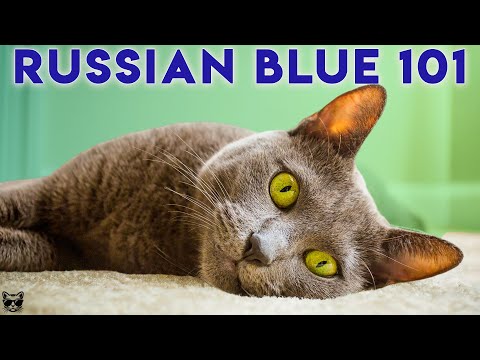
    RUSSIAN BLUE CAT 101 - Watch This Before Getting One!
    RUSSIAN BLUE CAT 101 – Watch This Before Getting One!

    Alternative names:

    Archangel Blue, Archangel Cat.

    โ–ท The world of Pets: Dogs, cats, birds, reptiles, amphibians

    Burmese cat
    Federations: LOOF, CFA, ACF, ACFA, TICA, FIFรฉ, WCF

    Today, you can still find cats similar to the current ones Burmese cats in the Buddhist temples of Southeast Asia
    Burmese cat
    Burmese Cat ยซGamseยป – DPCS.ie, CC BY-SA 4.0, via Wikimedia Commons

    Content

    History

    The first written records of the Burmese cat date back to the 14th century. El Tamra Maew, a manuscript of poems and illustrations found in Ayutthaya, the capital of the Kingdom of Siam (current Thailand), date of this period. This "treatise on cats" describes, among other things, to the Rajah, a round-headed cat, slightly chunky body and very silky chocolate coat: a description that corresponds in all respects to the Burmese what do we know today. According to legend, it was one of the 16 races that lived with Buddhist monks, who considered them sacred.

    For centuries confined to his homeland, the cat began to spread internationally when in 1930 a US Navy medic, Joseph Thompson, brought a chocolate coated female from Thailand, Wong Mau. As the fur of this one was almost black at the tips (ears, legs and tail) and chocolate-colored in the rest of the body, guessed it was a Siamese cat. But, genetic testing disproved this assumption and established that it was a different breed. Fascinated by the beauty of this animal, Joseph Thompson decided to start a breeding program with other enthusiasts. Thus was born the American Burmese cat, a round-headed cat with a slightly chunky body.

    The Burmeses did not arrive in Britain until later. It was not until the end of World War II that soldiers returning from Burma brought some brown cats.. Breeders who learned about the development of the American Burmese cat in the United States and Canada were interested in these cats and started a breeding program.

    They contacted the American breeders so that they could send them some specimens. Among 1949 and 1956 some imports were made that allowed to expand the gene pool, which otherwise risked being insufficient due to the small number of subjects.

    The program was a success: from the third generation, and more specifically in 1952, the breed was recognized by the Governing Council of the Cat Fancy (GCCF), the british feline organization. It was distinguished from Burmese Raised in America for his more triangular head and less stocky body.

    The first standard only specified one layer color: chocolate. But, as time passed and more cats were raised, other colors appeared in the litters and lines. Like this, the first blue guy was born in 1952, and others with red fur followed in the following years, cream, tortoiseshell or even lilac in 1971. Breeders continued to develop the breed incorporating these additional colors, that were recognized in the successive updates of the breed standard.

    But, until the end of the decade 1960, the gene pool of European Burmes cat remained very small, what limited its development. In 1969 imports could be reorganized, this time from canada, that contributed greatly to the development of the breed.

    It also, the breed spread fairly quickly to most of western Europe. so it happened, for example, already in 1956 in France and in 1970 in Germany.

    Burmese
    Male Brown/Sable Australian Burmese Cat – Psypherium, CC0, via Wikimedia Commons
    The controversy between the European Burmes cat and the American Burmese cat

    The breeding of Burmese has developed in parallel, but in a somewhat different way, in the United States and Great Britain, respectively. This explains a certain divergence between the North American and European lines..

    Like this, the American Burmese cat, also called Contemporary Burmese, has a rather round head, a rather short nose and a somewhat stocky body.

    The European Burmes cat, also known as Traditional Burmese, has a more triangular head, a longer nose and slimmer body.

    This heterogeneity divides breeders and institutions. These may include, the Governing Council of the Cat Fancy (GCCF) has refused to register specimens from the United States since 1980, to preserve traditional English lines.

    The controversy is amplified by the existence of serious cranial deformities in some kittens from North American lines. These may include, some have two noses or just one cheek. Most affected kittens are stillborn., and those who are born are immediately euthanized. But, due to the limited size of the breed's gene pool, not even Cat Fanciers’ Association (CFA) not even Asociaciรณn Canadiense de Gatos (CCA) require routine sterilization of breeders with these defects. This decision is left to the discretion of each breeder..

    The English Burmese lines are not entirely free from these problems.. But, the prevalence of these problems is much lower than on the other side of the Atlantic.

    Physical characteristics

    Burmese cat
    Burmese – Flickr

    The Burmese it is a medium size cat, muscular and of strong stature, tending to weigh between 4 and 6 kg.

    The legs they are long and delicate, with delicate oval feet. Overhead wedge-shaped, with one forecrown wide, some settle ears wide and of medium size and a straight nose.

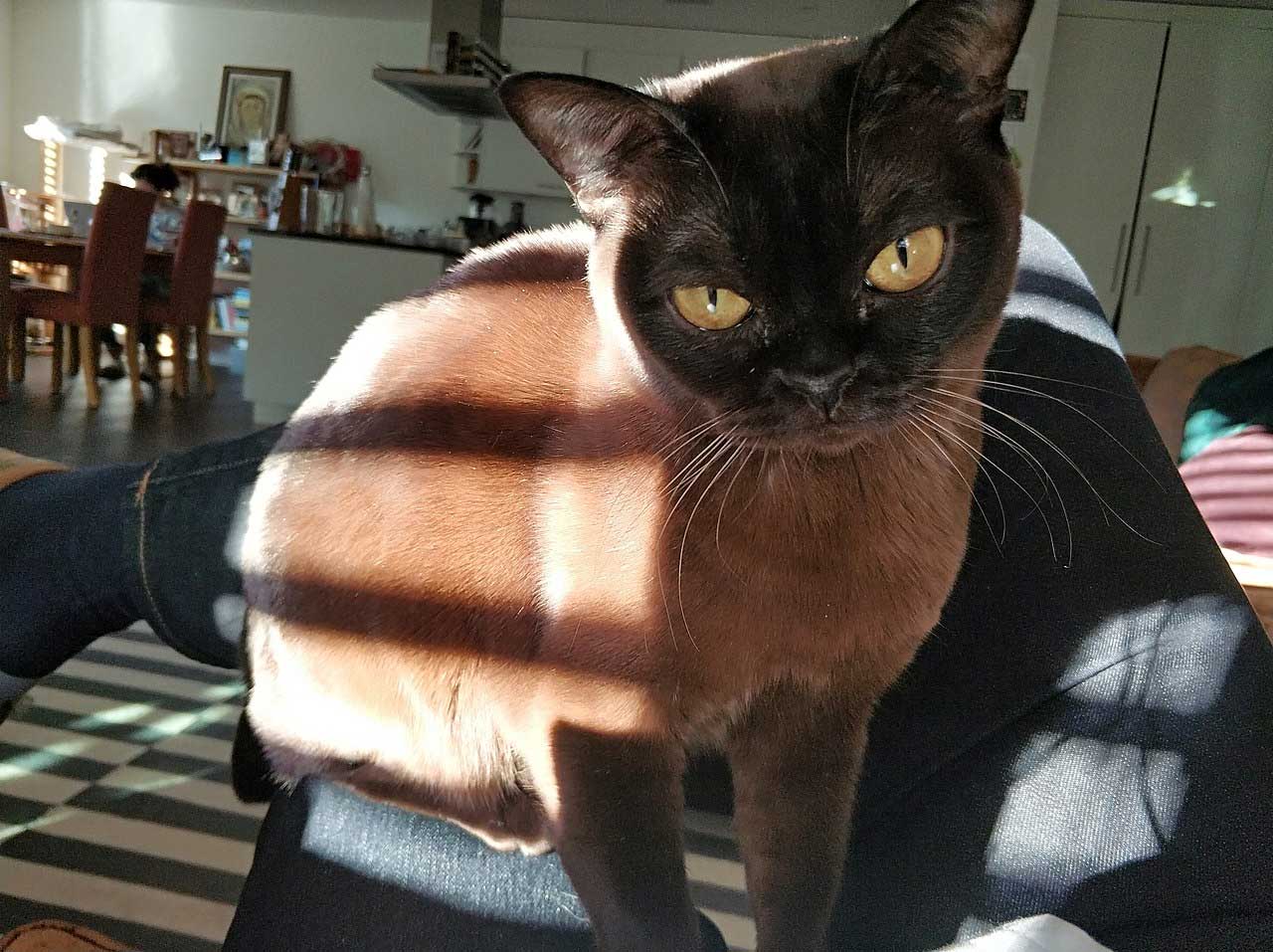
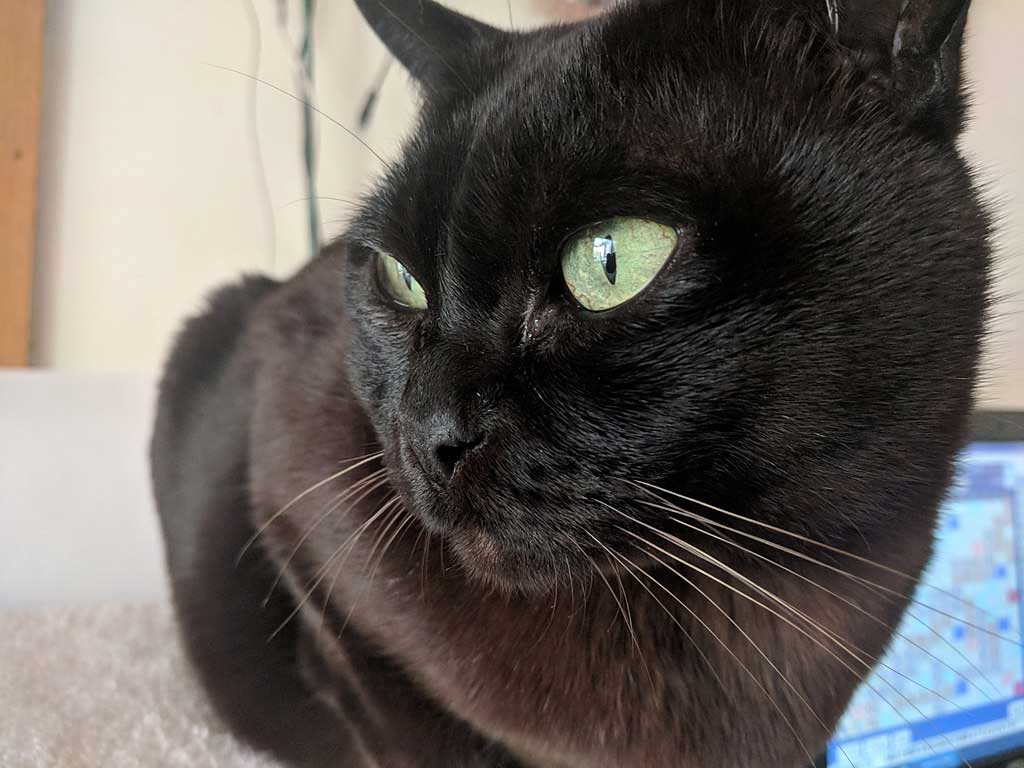
    The Greats eyes are golden yellow to amber in color and have an oriental curved upper eyelid. The fur of the Burmese, dense and silky, has a very fine undercoat, so it is attached to the body.

    Officially, ten different coat colors are recognized, no pattern allowed. The Burmese comes in ten generally recognized colors. As a common feature, they all have so-called spiky coloration, why the face, the ears, legs and tail are darker than the rest of the body. The most common coat color is nut brown..

    Varieties:

    As a result of separate breeding programs, the English Burmese are different from americans. European tends to be more eastern, with a more triangular face, while the American Burmese cat it is plump and rounded in the body, head, eyes and feet; with full cheeks and a short muzzle.

    Character and skills

    The Burmeses they are curious cats, energetic and loving. They especially like to play and are very people-oriented. You should not leave them alone for a long time, as they quickly feel lonely. Not in vain, These affectionate cats are called "people's cats".

    They need close physical contact and cannot do without daily caresses. The friendly cats remain active and attentive until old age. They do not show any fear towards strangers and are usually quite "talkative".

    Indoor or outdoor cat?

    The "Burmese cat" it is an active animal that needs a lot of space. You are not comfortable in a narrow flat. So that they are happy, must have at least one secure balcony or, even better, a fenced garden. If the conditions are good, the Burmeses they can also go abroad. The only problem is that these friendly cats are not afraid of the neighbors or other strangers.. So, They can easily fall victim to "cat thieves".

    How much activity does he need? "Burmese cat"?

    The Burmeses They are great cats for the whole family. They need a lot of activity and are reluctant to be alone. In fact, They consider themselves so affectionate that they would rather come on vacation with you than wait home alone. If you have to leave your loving cat alone more often, you should get a second cat to keep each other busy.

    Especially if cats can't go outside, you must provide them with a suitable substitute occupation. Even outdoor cats are not averse to playing regularly with their humans. With his attentive and curious character, to the Burmese loves to play and chase toys. It is best to provide this clever cat puzzle games or encourage him to seek and chase with hidden treats..

    Burmese cat
    Burmese cat

    Grooming and feeding

    The coat of the Burmese cat it is very easy to care for and does not need any special treatment. Just brush the silky fur from time to time to remove dirt. This will not only guarantee a well-groomed and silky appearance, it will also do your cat a favor with extra petting.

    A varied and healthy diet also contributes to the well-being of the cat.

    For sale "Burmese cat"

    Before buying a Burmese cat, you must be sure that you can dedicate the necessary time. The Burmeses they are considered one of the breeds with the longest life expectancy. You can't leave, often, to this cat only for the next 12 to 18 years and you will have to take care of it daily. If you have discovered this oriental cat for yourself, looking for a trusted breeder. There is currently no independent breeding club for the breed and you will have to turn to amateur breeders.. When you choose a kitten, make sure both the kittens and the parents appear healthy.

    The price of a "Burmese cat" ranges between 800 and 1300 EUR.

    European Burmes cat
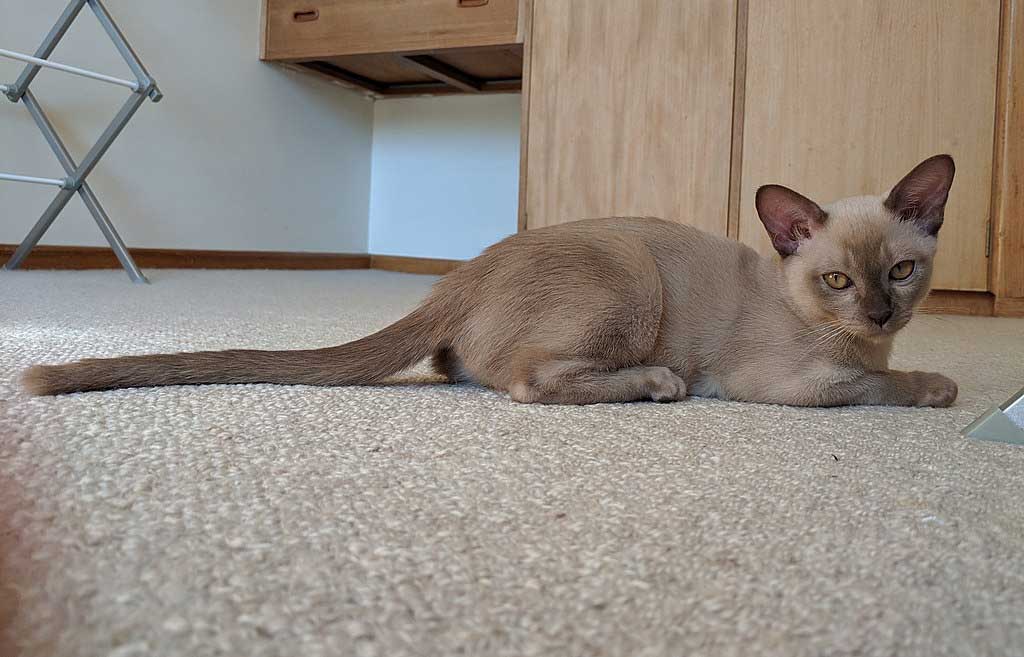
    Chocolate (American ยซChampagneยป) British/European Female Kitten –

    Characteristics "Burmese cat"

    Coexistence is important that you have with your new friend. Before considering the acquisition of a cat of the breed "Burmese cat" you know certain factors. You must take into account their character, their need for exercise, their interaction with other pets, their care and if you have small children, their level of tolerance towards them.

    Joy

    5,0 of 5 stars (based on 1 review)

    Activity level

    4,0 of 5 stars (based on 1 review)

    Friendliness to other pets

    3,0 of 5 stars (based on 1 review)

    Friendliness to children

    3,0 of 5 stars (based on 1 review)

    Grooming requirements

    1,0 of 5 stars (based on 1 review)

    Vocality

    4,0 of 5 stars (based on 1 review)

    Need for attention

    4,0 of 5 stars (based on 1 review)

    Affection towards its owners

    5,0 of 5 stars (based on 1 review)

    Docility

    1,0 of 5 stars (based on 1 review)

    Intelligence

    4,0 of 5 stars (based on 1 review)

    Independence

    2,0 of 5 stars (based on 1 review)

    Hardiness

    3,0 of 5 stars (based on 1 review)

    Videos "Burmese cat"

    Cat Who Lives On A Boat Loves Visiting New Places - MISS RIGBY | The Dodo
    Cat Who Lives On A Boat Loves Visiting New Places – MISS RIGBY | The Dodo
    ๐Ÿฑ Burmese Cat - Characteristics, Behavior and Origin ๐Ÿฑ
    Gato Burmรฉs – Caracterรญsticas, Comportamiento y Origen

    โ–ท The world of Pets: Dogs, cats, birds, reptiles, amphibians

    Balinese cat
    Recognized by the CFA, FIFe, TICA, ACF, ACFA/CAA, CCA-AFC, GCCF

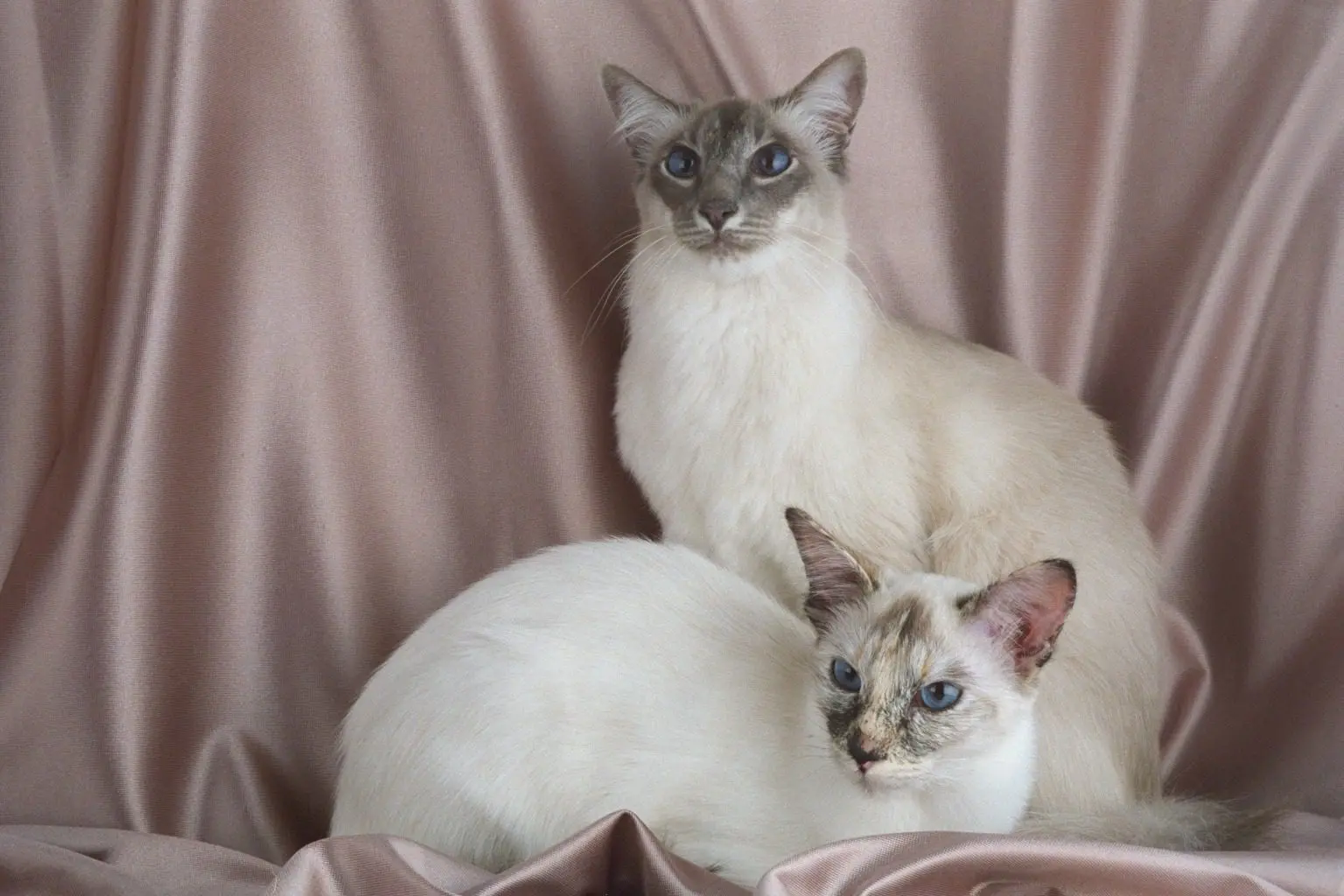
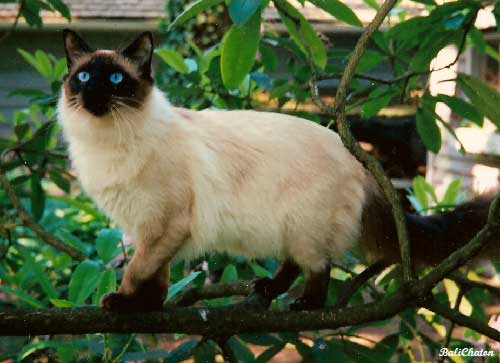
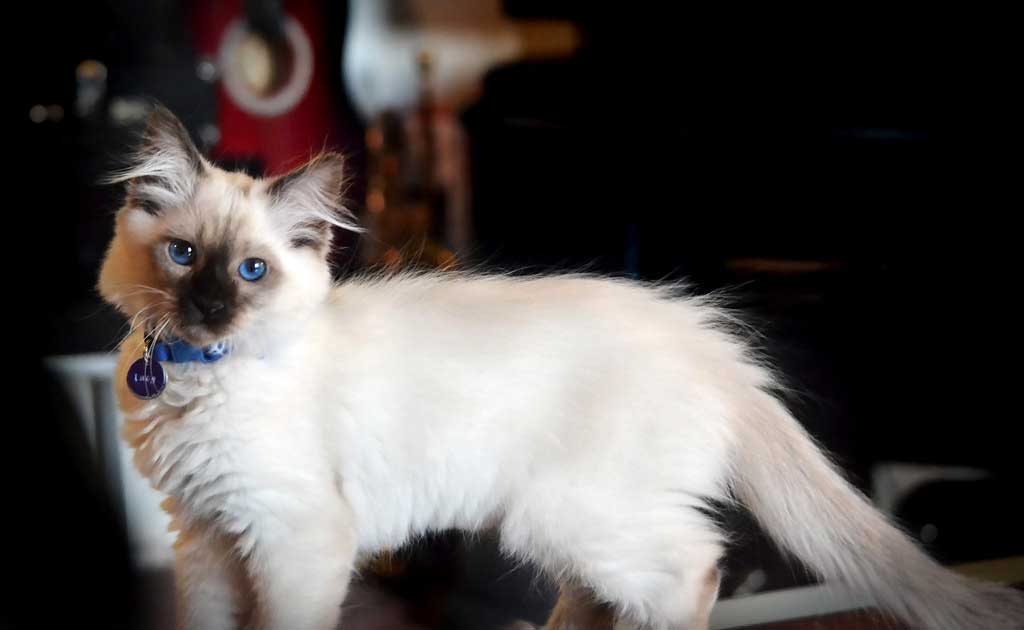
    The Balinese cat can boast of having among his close relatives the famous Siamese cat.
    Balinรฉs
    Photo: aboutpedigreecats.com

    Content

    Characteristics "Balinese cat"

    Coexistence is important that you have with your new friend. Before considering the acquisition of a cat of the breed "Balinese cat" you know certain factors. You must take into account their character, their need for exercise, their interaction with other pets, their care and if you have small children, their level of tolerance towards them.

    Joy

    5,0 of 5 stars (based on 1 review)

    Activity level

    4,0 of 5 stars (based on 1 review)

    Friendliness to other pets

    3,0 of 5 stars (based on 1 review)

    Friendliness to children

    3,0 of 5 stars (based on 1 review)

    Grooming requirements

    2,0 of 5 stars (based on 1 review)

    Vocality

    5,0 of 5 stars (based on 1 review)

    Need for attention

    5,0 of 5 stars (based on 1 review)

    Affection towards its owners

    4,0 of 5 stars (based on 1 review)

    Docility

    1,0 of 5 stars (based on 1 review)

    Intelligence

    5,0 of 5 stars (based on 1 review)

    Independence

    1,0 of 5 stars (based on 1 review)

    Hardiness

    2,0 of 5 stars (based on 1 review)

    History

    The origins of the breed as such are in the United States and go back to the years 50, but the first references to this type of cat are much older. In fact, a Chinese tapestry from several centuries ago already depicted long-haired cats with features Siamese. More recently, in 1871, Penny Illustrated magazine mentioned a long-hair Siamese, and in 1928 the American Federation of Cat Fans (CFF) accepted the registration of a long-hair Siamese.

    In the Decade of 1950, Marion Dorsey and Helen Smith, of the creators of Siamese Americans based in California and New York respectively, they became interested in these long-haired kittens and decided to start a dedicated breeding program. The program was successful and resulted in Balinese cat what do we know today.

    Despite what its name may suggest, the Balinese cat It, in effect, an american cat breed. The name was chosen by Helen Smith to highlight its grace and elegance, similar to that of the ballerinas on the island of Bali

    Already in 1961, the Federation of Cat Fans (CFF) recognized this new breed, and the Cat Fan Association (CFA) did the same in 1970. In 1979, this same CFA set a new standard for a breed called Javanese, whose characteristics were those of Balinese cat, and that it simply allowed covering the coat colors not accepted by the latter's standard. In fact, the Balinese standard had been established by accepting the same colors as the Siamese cat, that is to say, seal, blue, chocolate and lilac.

    That same year 1979, the International Cat Association (TICA) also recognized the Balinese cat, antes de ser seguida for the International Feline Federation (FIFรฉ) in 1983 and, later, por el British Governing Council of the Cat Fancy (GCCF) in 1986.

    Today, but the Balinese cat is present and recognized throughout the world, still a relatively uncommon cat. in your country of origin, United States, the CFA statistics indicate that it is in the second half of the breed table based on the number of annual registrations. In France, each year less than 20 ejemplares en el Official Book of Feline Origins (LOOF). In Great Britain, GCCF figures even show a very steep decline, mainly due to the appearance of new races: Enrollments in the organization went from 150 to 200 per year at the beginning of the decade 2000 less than 50 at the end of the Decade of 2010.

    Physical characteristics

    Balinese cat
    Old-Style Balinese Seal Point – Mary Desmond, CC BY-SA 3.0, via Wikimedia Commons

    Muscular but slim, the Balinese cat seems very delicate and flexible in its movements.

    With a weight between three and four kilos, the Balinese cats belong to the medium-sized breeds.

    Males balinese they can weigh a little more and are around five kilos.

    While the body, face and character are similar to those of the Siamese cat original, coat length differs considerably, which is particularly evident in the bushy tail of the balinese. But, from the start of breeding, the balinese has changed a bit and, with its elongated body and its triangular face, has been adapted to the modern variant of the Siamese cat.

    If you want to buy Balinese cats, nowadays you will only find a few breeders that breed this breed in its original breeding way. In most breeders, cat lovers can buy the modern shape of the Balinese cat, whose body is narrower and its head is more wedge-shaped. A distinctive feature of Balinese cat it's her bright blue eyes, that seem especially alive and vibrant.

    The only coat pattern allowed is colourpoint: the body is one color, but the tips are a darker and different color. Although the only colors allowed in the original CFA standard, written in 1970, are accepted for the Siamese, that is to say, the seal, the blue, the chocolate and lilac, the vast majority of current standards also allow the cream, The candy, red, apricot and other non-traditional colors.

    blue eyes, of a unique beauty, are present regardless of coat color and are characteristic of the appearance of the balinese.

    Last, sexual dimorphism is moderately marked, the male being slightly larger than the female.

    Varieties of "Balinese cat"

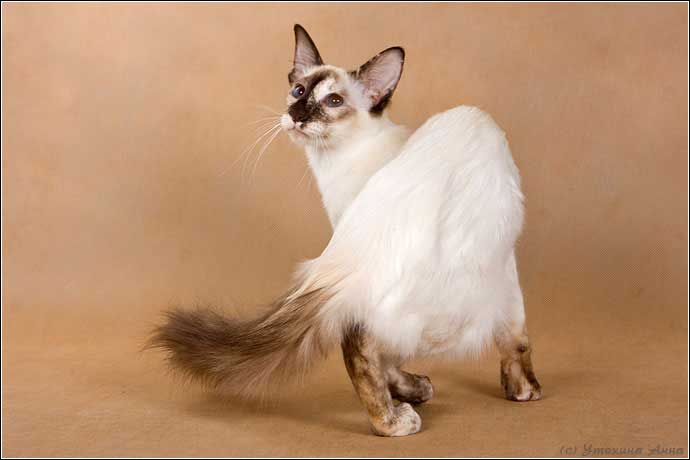
    Balinese cat
    Ghislaine of Chrysanthe, balinese cat, female, chocolate tortie point – Photographer:Anna Utekhina, CC BY-SA 3.0, via Wikimedia Commons

    The case of a Balinese cat with colors other than the seal, the blue, chocolate and lilac divide cat lovers from all over the world, as well as various organizations. While the International Cat Association (TICA) and the British Feline Fantasy Governing Council (GCCF) consider that these cats are indeed balinese, the American Cat Fan Association (CFA) consider from 1979 that all "Balinese" of different colors constitute a different race: that of Javanese cat.

    Despite the official merger in 2008 of the two breeds under the standard balinese of the CFA, the term Javanese still commonly used in the US. to define the balinese different colors from the original standard.

    This term was chosen in reference to the island of Java, neighbor of the island of Bali, in Indonesia: is a nod to the fact that the Javanese its near to balinese.

    Character and skills

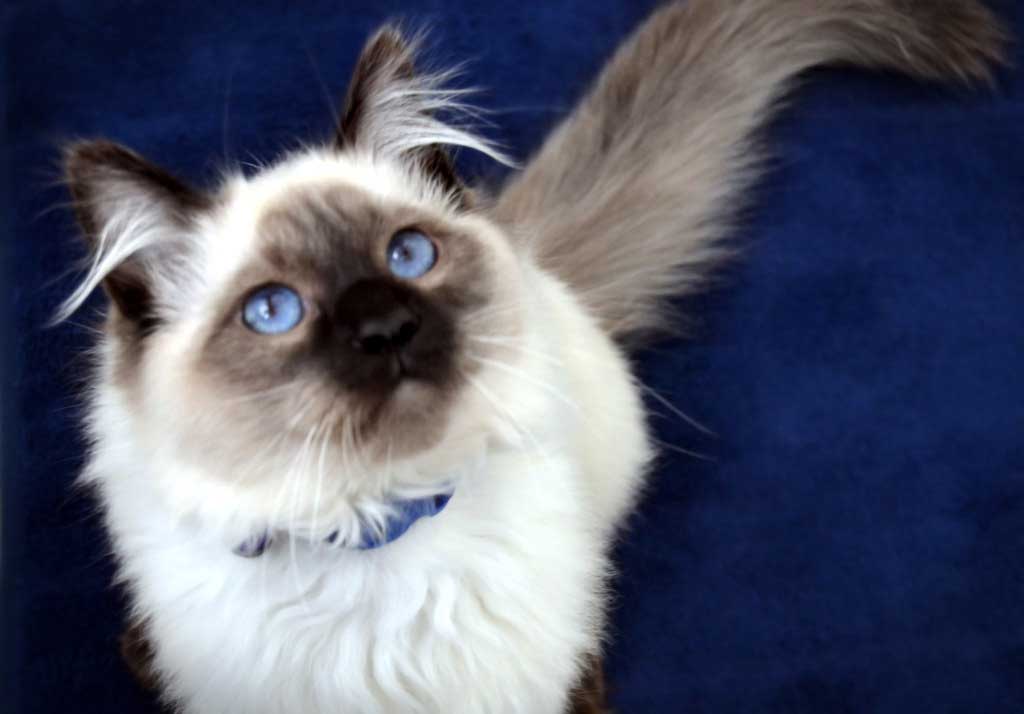
    Balinese cat
    20-week old Balinese kitten – Flickr

    The balinese he is a very cuddly cat, who is lovingly attached to his family and does not leave their eyes. They demand a lot of attention, they follow their owner everywhere and constantly seek to play with him or be petted by him. It is sociable, accepts other pets without difficulty and enjoys the company of children, provided they have been taught to behave with animals.

    His constant need for attention makes him not tolerate loneliness well, and you can quickly adopt destructive behavior if you feel that your family does not give you the attention you deserve. So, not suitable for a teacher who is absent often.

    It is reputed to be sensitive to human emotions, and knows how to comfort a sad man or, on the other hand, share your moments of joy. They also know how to interpret voice intonations, so reprimands can hurt your sensitive nature, while encouragement reinforces the bond they have with their family.

    Activos, agile and curious, to the balinese they love to explore the corners of the house. These may include, you can crawl out from under your bed with a toy you lost weeks ago or find that old photo that fell behind your living room closet years ago. But, one of his favorite activities is to climb on the shoulders of one of the family members.

    He is also very smart and playful, making you an excellent candidate for teaching your cat tricks. It is very possible that he will learn something by himself, and then come proudly show your family what you can do.

    Despite his high energy level, It is a breed of cat that lives very well in an apartment -if the apartment is not tiny- and does not need outer space.

    Last, one of the main characteristics of the Balinese cat is your propensity to be vocal. They seem to have an opinion on everything, and they do not stop making it known, commenting from his food to what is on television or the cover of the book his master wants to read in a low voice. Although he has no problem giving long monologues, you expect to be listened to and risk starting over if you think your family has not paid attention to what you are saying. Both in terms of activity level and volume, they are definitely not one of the calmest cat breeds.

    Care "Balinese cat"

    Balinese cat
    Seal Point Balinese kitten at 13 weeks of age – Flickr

    The Balinese cat it is an easy-care breed of cat, since its long and silky coat does not tend to knot and sheds very little. So, a simple brushing once a week is enough.

    This brushing session is an opportunity to check that your teeth and eyes are clean., and to pay special attention to their ears, which often need to be cleaned with a damp cloth. It also, make sure its claws are not too long, and trim them if necessary.

    Indoor or outdoor cat?

    The Balinese cat not necessarily a cat that should be kept outside, since these graceful animals are sensitive to cold. But, as the balinese it is one of the most active cat breeds, your house should be as big as possible and, above all, be equipped with many climbing possibilities. The ideal is to have a well-protected balcony or garden, that can also be used for running. To the balinese cats they also like to get inspired by climbing trees outdoors, and a small pool of water and other play opportunities are always welcome for this breed of cat.

    How much activity does he need? "Balinese cat"?

    If you decide to have a balinese, it does not matter if it is a puppy or an adult, you should take your time with him. Intelligent breed cats are very affectionate and like to be the center of attention, so they will gladly dispense with the company of other cats, but not from human attention.

    So, the Balinese cat he needs a lot of pampering and you also have to take time to keep him busy. The balinese is very receptive to training and learns very quickly, which is why search games are so easy for him balinese how to learn new tricks or intelligence games. However, in regards to scratching opportunities, climb and play, you should also make sure your cat has quiet places to retreat to, since animals tend to prefer places where they have their favorite humans in sight.

    Health and nutrition

    The balinese is an exceptionally long-lived breed of cats, since many reach or exceed the 20 years of age.

    Despite this overall robustness, are at increased risk for certain diseases:

  • The progressive retinal atrophy (ARP), a retinal disease that causes blindness in cats;
  • The amyloidosis, a disease that causes kidney failure and is often fatal;
  • Achalasia or megaesophagus, a gastrointestinal disorder that can cause food blockages;
  • Squint, a vision disorder without serious consequences for the animal;
  • Acromelanismo, a genetic disease that causes changes in coat color based on skin temperature.
  • Last, obesity is a major risk to the health of the balinese, but can easily be avoided with a vigilant and responsible owner.

    Life expectancy

    15 to 20 years

    Food

    When it comes to feeding, should focus on a protein-rich diet. So, a high-quality cat food with a high meat and protein content is essential. Especially since balinese cats they are very active and need a lot of energy, a good diet is essential. As an alternative, can feed your balinese on a soft diet, but you should thoroughly familiarize yourself with the subject and also seek advice from a veterinarian, because only with the right composition can the needs of the cat be met in a specific way.

    For sale "Balinese cat"

    If you want to get a "Balinese cat", you should know that they are very affectionate and that these intelligent purebred cats want to keep busy. Do not underestimate the necessary care of the coat.. If you are thinking of buying a Balinese cat, should only be done by a reputable and responsible breeder.

    Responsible breeders ensure that the Balinese cats are raised in a family and are well socialized. It also, if you want to buy a cat of this breed, you should know that good breeders do not place their balinese in new homes before the end of the imprinting period.

    If you want to buy a Balinese cat, do not respond to ads from amateur breeders offering purebred cats for sale without papers. The balinese kittens should only be purchased from an experienced breeder who is a member of a breeding club. Since experienced breeders only sell cats that have been vet checked and are healthy, should expect to pay between 900 and 1100 euros for a balinese kitten.

    If you want to give a new home to a Balinese cat adult, with a bit of luck you can also find it in shelters and animal protection organizations. Also in this case you will have to pay a nominal fee.

    Videos "Balinese cat"

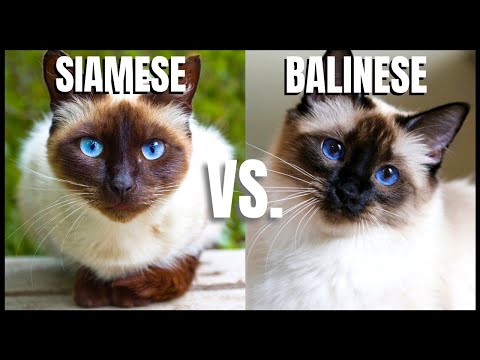
    Siamese Cat VS. Balinese Cat
    Siamese Cat VS. Balinese Cat
    6 things you should know about the Balinese cat
    6 cosas que debes saber sobre el gato Balinรฉs

    Alternative names:

  • Long-haired Siamese
  • Thai Siamese
  • โ–ท The world of Pets: Dogs, cats, birds, reptiles, amphibians

    Bengal cat
    Recognized by the CFA, FIFe, TICA, WCF, ACF, ACFA/CAA, CCA-AFC, GCCF, NZCF

    Despite his wild looks, the Bengal cat it's a domestic cat, affectionate and very attached to humans

    Bengala

    Content

    History

    The Bengal cat is a recent breed of cat that, despite its name, has nothing to do with the Bengal tiger. In 1963, Jean Sugden Mill, an American breeder, managed to cross a Leopard cat (or Felis Prionailurus Bengalensis, a Southeast Asian feline with the appearance of a leopard but the dimensions of a cat) with a domestic cat, who gave birth to two kittens, one of which was a female named Kin Kin. Against all odds, this female was not sterile and was able to interbreed with her father, giving birth to a litter of kittens, some of which were black, while others had a spotted brown fur.

    It was this first crossing, in 1963, the one that marked the true beginning of Bengal cat, by developing a breeding program to create a new breed in its own right. In fact, if there were already in the past crossing experiments between a domestic cat and Leopard cat, following the example of those already documented in 1889 in the book Our Cats and Everything About Them of Harrison Weir, an English artist with a passion for cats, they did not intend to create a new breed of domestic cat.

    For personal reasons, Jean Sugden Mill could not continue with this experiment, and nowadays none Bengal descend from this line. When he wanted to resume this project a decade later, the Endangered Species Ordinance had made it illegal to import the Leopard cat, so I could no longer acquire this animal to resume these crosses. But, in 1971, the Dr. Willard Centerwall, director of the genetics laboratory at Loma Linda University (California), had started a hybridization program between the domestic cat and the Leopard cat for scientific purposes, with the aim of testing the resistance of these hybrids to the virus of the feline leukosis, a disease that does not affect Asian leopards.

    Bengal cat
    Hereโ€™s our crazy little kitten at 5 months – Sean McGrath from Saint John, NB, Canada, CC BY 2.0, via Wikimedia Commons

    At the end of the year 70, Jean Sugden Mill acquired 8 first generation hybrids Dr. Centerwall and a Mau imported directly from India called Millwood Tory de Delhi. A long and difficult selection process began, during which other well-established breeds were used, as the Burmese cat, the Siamese cat, the American shorthair cat, the Abyssinian cat and the Egyptian Mau, to convert to Bengal cat in what is today: a domestic cat with the wild appearance of Felis Bengalensis, from which he inherited his name.

    But, There is another theory that attributes the name of ยซBengalยป a William Engler, zoo keeper and active member of the Long Island Ocelot Club. Interested in these hybrids since the early years 70, it is said that he was the first to speak of Bengal, and the term comes from his own name: Bill Engler.

    Jean Sugden Mill presented his Bengalis in various feline exhibitions in 1985, and the success was immediate. In 1986, the TICA (International Cat Association) officially recognized this new breed. The GCCF (Governing Council of the Cat Fancy) British followed him in 1997, then the FiFe (International Feline Federation) did the same in 1999, while the CFA (Cat Fanciers’ Association) American waited until 2018 to do the same.

    The Bengal cat had a quick success, especially in France. The first specimen was imported in 1989, and the breed was recognized that same year by the Association Nationale des Cercles Fรฉlins de France (ANCFF). Many breeders were quickly interested, to the point that today the breeding of Bengals is flourishing in France (and internationally recognized), with more than 1000 active creators, that is to say, that have registered at least one litter in the last two years.

    Since 2016, in the framework of meteoric growth, the Bengal cat it has even placed itself on the podium of the most popular cat breeds in France, with more than 3.000 kittens registered every year in the LOOF (Livre Officiel des Origines Fรฉlines), versus just over a hundred at the beginning of the years 2000.

    This great popularity of Bengal it is rather a French specificity. In the United Kingdom, for example, where it suffered a legal restriction until 2007, it is rather between the 15th and the 20th position in the ranking of the most popular breeds, with an average of 300 specimens registered annually with the GCCF, that is to say, some 10 times less than in France.

    In United States, the Bengali entered the Top 20 of America's most popular cat breeds when the CFA finally recognized it in 2018, despite its late recognition and the fact that it is prohibited in some places, like New York City or the State of Hawaii.

    Physical characteristics

    The Bengal cat it is a domestic cat that has retained the general appearance of a wild leopard. It is a fairly large cat with a long, muscular body, hind legs slightly larger than forelegs and a thick tail with a rounded tip, all of which gives it a classy look. As such, belongs to the long and powerful morphological type.

    Bengal cat
    Bengal cat – Flickrgailhampshire

    The head is wide, with small rounded ears and large round or oval eyes that express curiosity and intelligence.

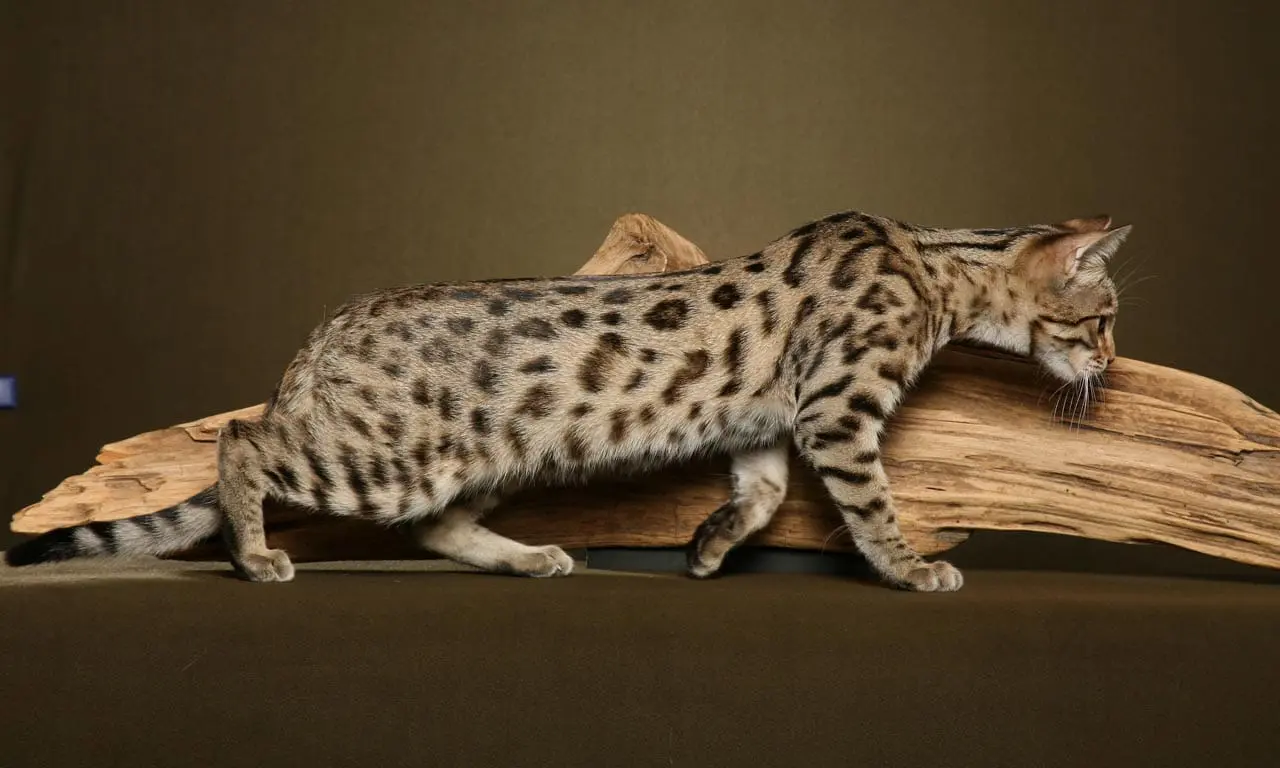
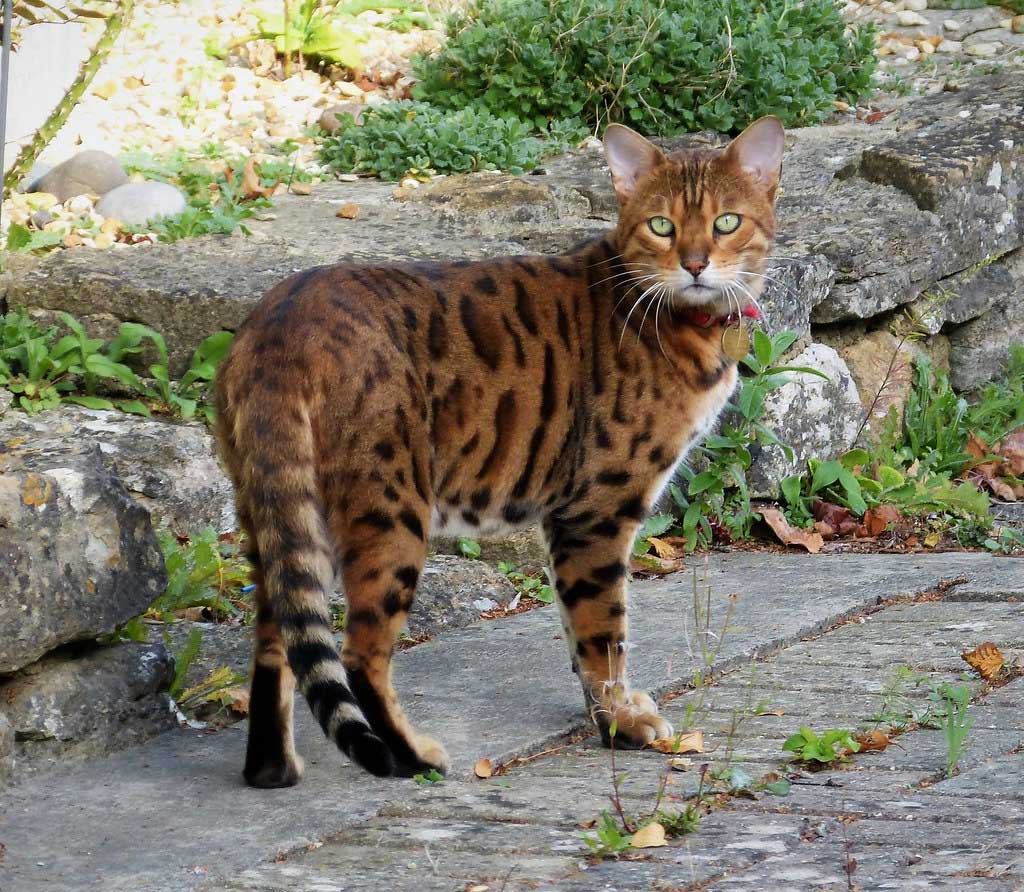
    The fur is short, dense and silky to the touch. Emblematic of the breed, the fur is reminiscent of its wild ancestor, the Leopard cat, with random rosettes or horizontal scrolls. In both cases, these marks are bicolor and well marked.

    Different standards accept many colors, the most common being brown-black, including all gold variations, bronze, copper and mahogany. But, there are also many specimens with an ivory or creamy white color, as well as some rarer ones with a beautiful silver gray.

    Size and weight

  • Size: Of 30 – 35 cm.
  • Male weight: 4,5 – 7 kg
  • female weight: 3,5 – 5,5 kg

  • Varieties "Bengal cat"

    There are two varieties of Bengal: the stained and marbled.

    In the first, rosettes must be large, clear, bicoloured, different and randomly arranged throughout the body.

    The latter has elongated horizontal marks in the form of scrolls that are reminiscent of the veins of marble., bicolor and different.

    There are also specimens with long or semi-long hair, sometimes called Bengal Kashmir. For the moment, only the TICA has recognized this cat as an experimental breed.

    Character and skills

    Bengal cat
    Bengal cat

    Despite his wild looks, the Bengal cat it's a domestic cat, affectionate and very attached to humans, whose company constantly seeks. In fact, he is never far from where his master is, To make sure you don't miss anything that happens!!

    He is also very sociable with other cats and dogs, provided they are also used to cats. But, they may still have some wild reactions, especially towards small domestic rodents, those who can be mistaken for prey and chase.

    It is a very active and curious cat, who spends his time playing, chasing, fucking, exploring… before coming to rest near his master. He especially likes cat trees, that allow you to jump from one platform to another and settle in a high place to observe your environment from the highest. This energy expenditure is not unique to puppies: the Bengali is hyperactive and playful even as an adult, and is not the ideal companion for an older person who wants a quiet animal. Having said that, can be perfectly adapted to life in a flat, as long as you receive the necessary care… and that your family is not offended by the possible mischief you may cause.

    Lively, explorers and playful, they can also be occasionally destructive. This is especially true in the case of females., which tend to be more excessive than males, both in their games and in their displays of affection. To minimize this risk, it is advisable to ensure that the Bengali get all the care you need: if you are left alone too often without occupation throughout the day, it is likely that he will find a way to remind his master of his existence, and this will not necessarily be in a pleasant way for this one…

    The Bengal cat it is also a very intelligent breed, able to adapt and learn quickly. So, if a light turns on by itself at night or if a door that had been left closed is found to be open, there is no reason to believe that it is the work of a ghost: your partner has simply learned to press the switch or turn the handle. This makes him a good candidate for teaching your cat tricks and training.. In fact, it is not uncommon to see a Bengali who has learned to use the toilet or to take things to the owner. But, do not lose sight that it is still a cat, with his independent and stubborn character: although this may give results, training (for example with clicker, which is very suitable) requires a lot of patience.

    It also, it is a breed of cat that loves water. This characteristic has been inherited from its ancestor the Leopard cat, who is an excellent fisherman. Some individuals do not hesitate to follow their master even under the shower!! It is logical that aquarium enthusiasts know that the inhabitants of an open aquarium are likely to end up in the clutches of this experienced hunter.…

    Last, the Bengali It, in general, a pretty talkative cat, with a wide range of sounds, ranging from chirping to a low, hoarse noise reminiscent of certain big cats.

    Care "Bengal cat"

    Bengal cat
    Or is it a tiger? – ReflectedSerendipity from United Kingdom, CC BY-SA 2.0, via Wikimedia Commons

    The BengalIt is an easy-care breed of cats, since it is only necessary to brush the cat's fur to remove dead hair and distribute the oil from the skin once a month. It also, it is seldom necessary to bathe your cat.

    As in the case of all cats, regular check-ups of teeth, the ears and eyes will help avoid the risk of infection.

    Last, its claws may be clipped from time to time, when necessary.

    Indoor or outdoor cat?

    The athletic Bengalis need a lot of exercise to feel comfortable. It is best to offer them a large house with a garden where they can roam.. If you decide to keep them inside, it should also provide them with enough space and opportunities to play and climb.

    These freedom-loving animals don't feel comfortable in small city flats. A sturdy cat tree or climbing track should fit the floor.

    The "Bengal cat" have great jumping ability and no lift is out of reach. Definitely, you should take this into account before bringing a Bengal cat to your house. Especially when they get bored, big cats tend to wreck the floor. In general, it is advisable to maintain a Bengal like a free animal and provide you with enough to do indoors. With outdoor cats, can you be prepared for these cats, otherwise so loving, go for a walk for two days in a row.

    How much activity does he need? "Bengal cat"?

    Due to their offspring from wild cats, the Bengal cats belong to the very active cat breeds. They are persistent climbers and need a lot of exercise. The best place for them to vent is the scratching post., during hunting games or, ideally, in the open air.

    Regular hunting games with a rod, hunting mice or balls along with your human are also a great activity. Mental stimulation with smart toys or learning little tricks is essential so that cats do not get bored.

    If you are often away from home, cats need company. They get along better with other cats. It is one of the few breeds of cats that loves water so it will easily be entertained by a leaky faucet.

    Health and nutrition

    The Bengali has a fairly robust health, having inherited from Leopard cat remarkable longevity for a domestic cat.

    But, have a predisposition to certain diseases:

  • The Hypertrophic cardiomyopathy (MCH), a disease that makes it difficult for the heart to circulate blood;
  • The Chronic anemia, a genetic disease that can be detected by any decent Bengal breeder by a simple test;
  • The Progressive Retinal Atrophy (ARP), another genetic disease that can also be detected by a simple test, allowing carriers to be excluded from breeding;
  • The cataract, an opaque film on the cornea of โ€‹โ€‹the eye that can cause blindness in the most severe cases.
  • It also, being quite large and very active, are prone to Hip Dysplasia.

    Last, it is important to know that, unlike his ancestor the Leopard cat, the Bengal not immune to feline leukosis.

    Life expectancy

    12 to 16 years

    Food

    The Bengal fits perfectly in commercial cat food, both croquettes and canned wet food. But, it is important to make sure your Bengal cat eat a quality food that contains all the essential nutrients necessary for their development.

    There should always be enough food and fresh water. But, no risk of obesity in cats; on the one hand, because they are quite active, and on the other, because they are able to regulate their own weight.

    For sale "Bengal cat"

    Bengal cat
    Bengal cat

    If you want to have a Bengal cat, you should know that this breed is one of the most expensive. For a healthy kitten you will pay between 1000 and 2000 EUR in a serious breeder. The price mainly depends on the type of leopard coat.

    The Bengal cats with pedigree and physical characteristics that make them suitable for breeding are priced between 2000 and 3000 EUR.

    Breeders also differentiate between the three categories of companion animals, breeding and exhibition. as creator, usually only kittens showing small deviations from breeding targets are obtained. In the purchase contract you have to agree not to use the cat for breeding.

    Criticism of the breeding of "Bengalis"

    Critics of breeding "Bengal cat" they believe that it is irresponsible to cross a wild animal with a domestic cat just to obtain a certain coat pattern. According to animal rights advocates, the first mating is even a torture brood, since complications often arise at birth. Many of these wild cat hybrids continue to display the character traits of a wild animal.. So, before acquiring a cat of this type, you must be very sure that, even though you have inherited the activity from your ancestors, will be able to lead a life appropriate to his species.

    Characteristics "Bengal cat"

    Coexistence is important that you have with your new friend. Before considering the acquisition of a cat of the breed "Bengal cat" you know certain factors. You must take into account their character, their need for exercise, their interaction with other pets, their care and if you have small children, their level of tolerance towards them.

    Joy

    5,0 of 5 stars (based on 1 review)

    Activity level

    5,0 of 5 stars (based on 1 review)

    Friendliness to other pets

    2,0 of 5 stars (based on 1 review)

    Friendliness to children

    2,0 of 5 stars (based on 1 review)

    Grooming requirements

    1,0 of 5 stars (based on 1 review)

    Vocality

    2,0 of 5 stars (based on 1 review)

    Need for attention

    4,0 of 5 stars (based on 1 review)

    Affection towards its owners

    4,0 of 5 stars (based on 1 review)

    Docility

    1,0 of 5 stars (based on 1 review)

    Intelligence

    5,0 of 5 stars (based on 1 review)

    Independence

    2,0 of 5 stars (based on 1 review)

    Hardiness

    3,0 of 5 stars (based on 1 review)

    Videos "Bengal cat"

    These Beautiful Bengal Cats Are Incredibly Intelligent | Cats 101
    These Beautiful Bengal Cats Are Incredibly Intelligent | Cats 101
    Benji the Bengal Cat: from Kitten to Adulthood
    Benji the Bengal Cat: from Kitten to Adulthood

    โ–ท The world of Pets: Dogs, cats, birds, reptiles, amphibians

    Kurilian Bobtail
    Recognized by FIFe, TICA, WCF

    Its affinity with water, which undoubtedly results from the nature of its natural habitat, it is a very special character trait, that distinguishes it from many other cat breeds.
    Bobtail de las Islas Kuriles
    Photo: bobkedi.com

    Content

    History

    The Kurilian Bobtail is a breed of Russia. This Bobtail has not undergone genetic modification caused or calculated. No one has tried to change, is the nature which created the race. He lives on the Kuril Islands, in extreme climatic conditions of temperature and humidity.

    These islands are located at the East end of Russia, in the northern Pacific Ocean and extends to more than 1200 km from the Kamchatka Peninsula, on the border of North Japan. It's a chain of volcanoes – hence the name – Kuril. All islands there are 40 active volcanoes. On the one hand, the Islands are bathed by the sea of Okhotsk, on the other side by the Pacific Ocean.

    These short-tailed cats have been known to be found on the Kuril and Sakhalin Islands for at least two hundred years., Although they were discovered only at the end of the 20th century.

    In the Centre of Russia, the Kurilian Bobtail began to appear only in the middle of the last century. The military and geologists, who returned from long trips to the islands, they brought with them the special short-tailed cat. But not too taken into account, Since even did not exist any feline Federation in Russia at that time. In the years 80 Some fans, who already had these amazing cats, they turned their attention to the race.

    Was in the year 1991, when the Soviet Federation accepted the first norm of the Kurilian Bobtail. In 1995, This Bobtail was accepted by WCF. In 2004, they were allowed to participate in the Championships of FIFe.

    We can say that currently the cat Kurilian Bobtail It is one of the youngest breeds and has the sympathy of many cat fans in Russia. But even today, This bred animals are very rare.

    Kurilian Bobtail
    Kurilian Bobtail kitten with its mom – TRUE KURILIANS, CC BY-SA 4.0, via Wikimedia Commons
    The history of the emergence of this breed is purely hypothetical.
    It is possible that they participated in its creation on Siberian cat and the Longhair Japanese Bobtail, who lived for some time on the islands with their Japanese masters.

    But in all likelihood, the mutation of the tail of the cats that inhabit the Kuril Islands was carried out in parallel to the observed in cats of the Japanese islands due to the influence of the mutation and similar climatic conditions. But, to date no one has studied the exact origins of this mutation.

    Even now, It is not uncommon to see cats with low and irregular tail in the islands of Malaysia, Thailand and Burma. In some Southeast Asian countries, It is virtually impossible to find the animal without the tail malformations. In this way, it is possible to assume that all mutations associated with the change in tail structure have a common cause.

    Although the Kurilian Bobtail It, probably, his distant cousin Japanese Bobtail, the difference in the second race is impressive. There is a common characteristic in the two races, the short tail. Other parts of the body differ significantly and surprisingly.

    Physical characteristics

    Kurilian Bobtail
    Kurilian Bobtail Cat Snow – Pixabay

    The Kurilian Bobtail has a compact body, strong and muscular, with slightly raised croup and curved topline. The legs are strong and solid, the average length, the hind legs are longer than the Forelegs .. The feet are round and wide, lined with tufts of hair between the toes.

    Some records divide Kurilian Bobtail in separate breeds of short hair and long hair.

    • They have a large head and trapezoid, with contours rounded in broad cheekbones.
    • The nose is wide, straight, average length, with a light stop.
    • Chin broadband with a slightly rounded profile.
    • Medium-sized ears, well assorted and often adorned with a crest of hair.
    • His eyes are slightly inclined, highly placed, rounded or shaped nut.
    • The queue is full of hair. Tail deformity is not an abnormality associated with healthy cats.
    • The coat can be short and semi-long. The mantle is dense, very fine and silky.
    • In the semilargo hair group, This is considerably longer at the bottom of the body, the stomach and legs.
      Virtually all colors are permitted, except the Siamese pattern, agouti specific to Abyssinia, chocolate, cinnamon, beige, Lilac and all their combinations with white.

    The harsh climate of the Kuril Islands has endowed the Kurilian Bobtail thicker skin, adapting to the wildlife style – does not fall, almost no mess. On the Islands, the climate is very humid and the skin of the animals has acquired an extraordinary property, It gets no wet.

    The Kurilian Bobtail they are big enough. In general, Males weigh in 5 to 7 kg, but it is not extkgรฑo to see larger individuals, reaching a weight of 9 kg. The females are naturally less powerful, and weigh 3,5-5 kg.

    Character and skills

    In the Kuril Islands the Bobtail they usually live at home, but there is also absolutely wild cats, the Kuril Islands are sparsely populated.

    To the Kurilian Bobtail he likes to hunt everything that is in the forest.
    On the streets of the villages of the Kuril Islands, it is not uncommon to see these cats run after dogs they are not afraid of. But, This proximity explains, in part, by how many cats (native cats, imported directly from the Islands) they have scars and torn ears.

    Kurilian Bobtail
    Kurilian Bobtail – Arabescka – Heikkisiltala, CC BY 3.0, via Wikimedia Commons

    This is a faithful animal, sociable, with the agility and developed intelligence. It adapts well to family life with children, with whom they will share endless games. They also adapt well to other animals and dogs.

    At the same time, they are independent, and they are only suitable for those that can respect her strong personality and her need for independence. It also, the Kurilian Bobtail he will show all his affection to a single person, a teacher who chooses his own Bobtail, relations with the rest of the family members can be complicated.

    With the power and the length of its hind legs, the Kurilian Bobtail can easily jump great heights. In a House, a tree would be a great necessity for this cat.

    Another characteristic of the breed is the attraction to water.. Fresh under a faucet or picking up the drops of the same. It is the duty sacred of all the representatives of this glorious race.

    The long struggle of this race due to the severe conditions of the Kuril Islands has been beneficial for the development of their intelligence. This is a very intelligent and thoughtful cat.

    Only once will do need to show what can be done or not. They receive the voice and intonation, it is not difficult to teach them to understand the commands, They even obey them according to personal mood. It can be adapted to all lifestyles, domesticated sport and turn. It is not afraid of cold or heat. Its balanced nature makes it a very quiet cat.

    Health

    The Kurilian Bobtail comes from a very harsh climate and is extremely resistant to all temperature variations. Although they spend most of their time outside and not at home, they are very resistant to the outside environment and almost never get sick.

    Their life expectancy is about 15 years. As in the case of any breed of cat, one of the simplest and most effective ways to keep a healthy Kurilian Bobtail is to ensure that you maintain an ideal weight throughout your life.

    It is not known that this Bobtail are prone to genetic diseases. But, as the breed is rare, there is little data to draw conclusions on this point.

    Life expectancy

    15 years

    Grooming

    Kurilian Bobtail
    Kurilian Bobtail female, black smoke – Frida Nyberg, CC BY 3.0, via Wikimedia Commons

    The naturally silky and waterproof coat of the Kurilian Bobtail does not get tangled.

    A weekly brushing of the cat's coat is enough to take care of it, whether it belongs to the short-haired or long-haired variety. It also, when necessary, you should not hesitate to bathe your cat, since without a doubt he will appreciate this moment. But, your cat's bath should be an exception (a couple of times a year), as repeated use of cat shampoos can damage the cat's skin and coat.

    The Kurilian Bobtail does not require much attention, but the cat's teeth should be brushed regularly with a special toothpaste for cats (ask the vet if in doubt) and the cat should be taken to the vet whenever the cat's teeth need to be cleaned. It is also important to monitor the condition of the cat's nails, that can be trimmed to prevent damage to the house.

    As with all cat breeds, if you accustom your cat to this care from a young age, you will be more likely to accept them later.

    Characteristics "Kurilian Bobtail"

    Coexistence is important that you have with your new friend. Before considering the acquisition of a cat of the breed "Kurilian Bobtail" you know certain factors. You must take into account their character, their need for exercise, their interaction with other pets, their care and if you have small children, their level of tolerance towards them.

    Joy

    5,0 of 5 stars (based on 1 review)

    Activity level

    5,0 of 5 stars (based on 1 review)

    Friendliness to other pets

    2,0 of 5 stars (based on 1 review)

    Friendliness to children

    5,0 of 5 stars (based on 1 review)

    Grooming requirements

    1,0 of 5 stars (based on 1 review)

    Vocality

    4,0 of 5 stars (based on 1 review)

    Need for attention

    4,0 of 5 stars (based on 1 review)

    Affection towards its owners

    5,0 of 5 stars (based on 1 review)

    Docility

    3,0 of 5 stars (based on 1 review)

    Intelligence

    4,0 of 5 stars (based on 1 review)

    Independence

    2,0 of 5 stars (based on 1 review)

    Hardiness

    5,0 of 5 stars (based on 1 review)

    Videos "Kurilian Bobtail"

    PRESENTACION raza KURILIAN BOBTAIL pompom glue cat!
    PRESENTACION raza KURILIAN BOBTAIL gato de cola de pompรณn!
    BARSIK - Kurilian Bobtail
    BARSIK – Kurilian Bobtail

    Alternative names: Kuril Islands Bobtail / Kurilean Bobtail / Kuril Bobtail / Curilsk Bobtail

    Read more…kurilkot

    โ–ท The world of Pets: Dogs, cats, birds, reptiles, amphibians

    Shorthair japanese bobtail
    Recognized by the TICA

    Most official bodies consider that the Shorthair japanese bobtail It is a variety of Japanese Bobtail, but the TICA (International Cat Association) consider it to be a breed in its own right.

    Bobtail japonรฉs de pelo corto

    Physical characteristics

    The Japanese Bobtail looks similar to a domestic cat, but with a very shortened tail.

    Its coat is short and, mostly, bicolor (white-red or white-black); the tricolor variety, less common, is especially popular. Are size medium, but very light. Even the males, that do not weigh much more than females, reach a maximum of just 3 kg.

  • Body: The body is medium in size, elongated, slim and elegant, but muscular.
  • The legs: they are long and thin, oval legs.
  • The tail: must be bent and / or curved and be shorter than 8 cm.. The fur on the tail is longer than the rest of the body (pompom effect).
  • Head: The head is no longer than it is wide and is shaped like an equilateral triangle with smooth contours.
  • The profile: is slightly curved. The muzzle is deviated and slightly rounded.
  • The chin and lower jaw: they are strong.
  • Ears: The ears are large and erect. They are far apart, the tips are slightly rounded.
  • Eyes: The eyes are large, almond-shaped. They are placed slightly obliquely. The color of the eyes corresponds to the color of the coat.
  • Fur: The coat is short and smooth. Has a silky texture and hardly any undercoat.
  • Color variations: The colors chocolate and cinnamon, as well as its dilution (lilac and fawn) are available in all combinations. (Bicolor, Tricolor, Striped) they are not recognized. A pattern with dots is also not recognized. Everyone else
    All other colors and designs are accepted. Any amount of white is allowed.