โ–ท The world of Pets: Dogs, cats, birds, reptiles, amphibians

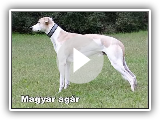
hungarian hound (Magyar Agรกr)
Hungrรญa FCI 240 . Short-haired Sighthounds

Lebrel Hรบngaro

The nature of hungarian hound, like its appearance, It is elegant. Extremely sensitive and smart, friendly sweetie, but never nosy.

Content

History

The hungarian hound is a real specialty among Hungarian dog breeds. But, it is perhaps the least known four-legged Hungarian. It has been threatened with extinction several times throughout its history, although he is a very valuable and lovable companion with an impressive talent for hunting. Due to its rarity, has crossed with other dogs over the years, reason why many people nowadays do not consider that the Greyhound non-hunter kept for hobby purposes is a hungarian hound pure breed.

Its origin

Like all Greyhounds, the ancestor of this Hungarian breed also comes from Egypt. They first appeared around the third millennium BC, the first finds come from that time. Several theories were born about its formation, but the only thing certain is that they reached the Carpathian Basin with the Hungarian conquerors, who used them for hunting. The first memories of hungarian hound go back to the time of San Esteban. At that moment, This Sighthound it was very popular, just like it was a fashionable pastime in the days of Matthias Hunyadi. The king himself often spent his time hunting with them on horseback.. After his death, with the country divided into three parts, the breeding of hungarian hound started to decline.

During Turkish rule, the hungarian greyhound was crossed with oriental type greyhounds. Hunting went from being a real hobby to poaching, since it was the best way to hunt without attracting attention.

The reformist count Istvรกn Szรฉchenyi popularized greyhound racing and the hungarian hound became the national dog. At that time, Greyhound races were considered special and prestigious social events. Almost constantly, associations were formed to deal with the breed and hunting with it. Horse and greyhound racing also attracted foreigners. This is how English thoroughbreds and the โ€œEnglish Greyhoundโ€ were introduced into Hungary.. The resistance of the indigenous race was a rare treasure, but it did not correspond to the speed of the English Greyhound. Thus, the two dogs crossed often and the hungarian hound lost its original character. Thus, many people continue to question the Hungarian character of the greyhound, some say the old character has completely disappeared from current dogs.

After World War II, the breed almost disappeared. In 1963 a movie was made about King Matthias, for which they were needed hungarian sighthounds. But, this dog was so rare that it was almost impossible to find one in the country. For the movie, nature filmmaker and hunter Kรกlmรกn Szigethy found some specimens, bought them and started raising them. Thanks to Szigethy, the hungarian hound revived and in 1966 was officially recognized by the FCI. Since then, it has slowly but inexorably spread throughout Europe and is not in danger of extinction. In 2004, all breeds of domestic dogs, including hungarian hound, were declared a national treasure by the Hungarian Parliament, and in 2017 it was even named hungarian heritage dog.

Physical characteristics

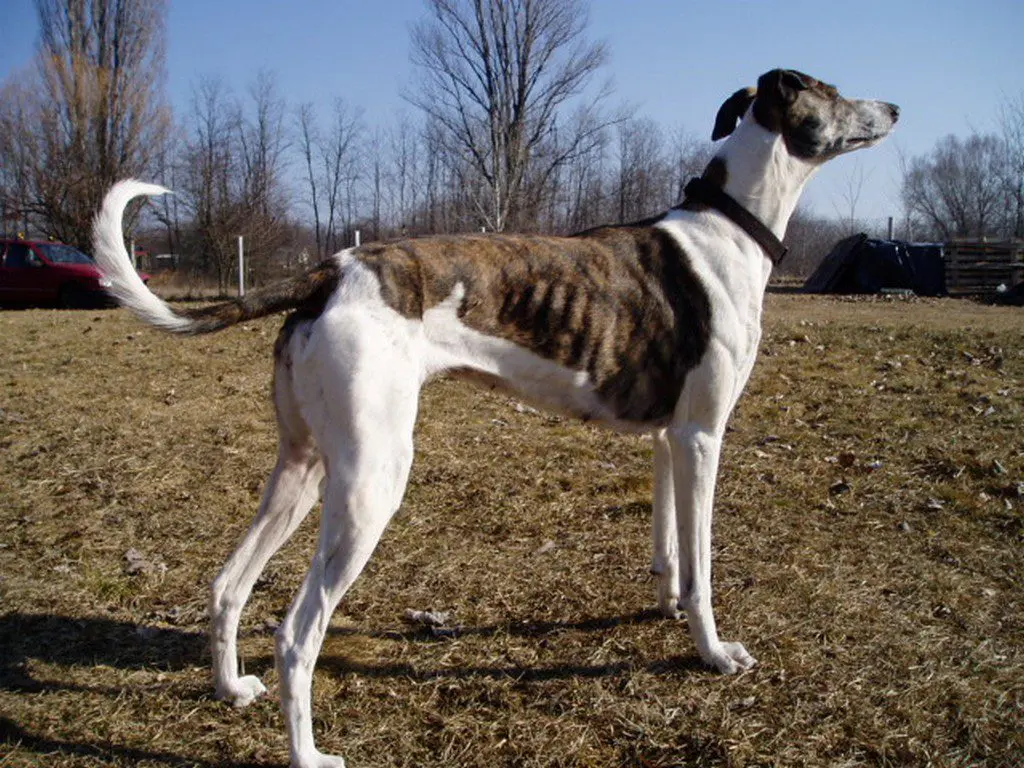
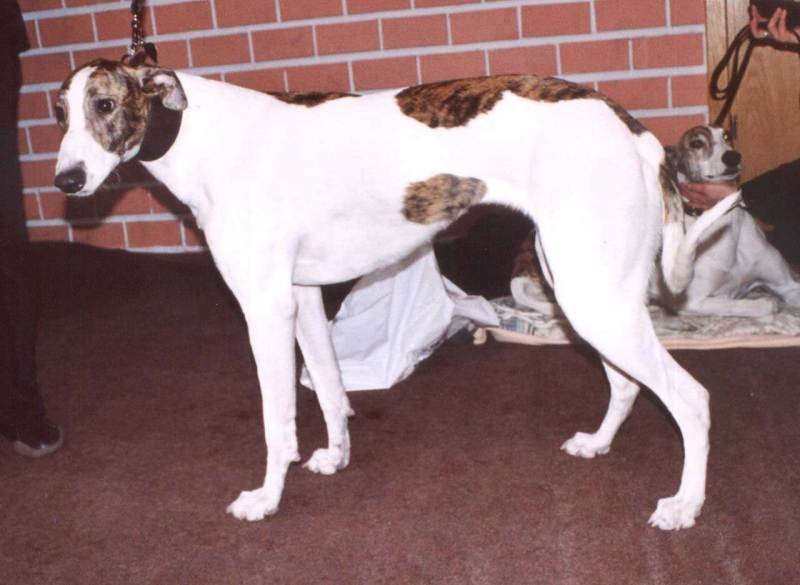
The hungarian hound it is a thin hunting dog, his joints are dry and his musculature is prominent. The chest is flat and deep. The trunk is rectangular. The coat is short and of varied colors, and is bred in most greyhound colors.

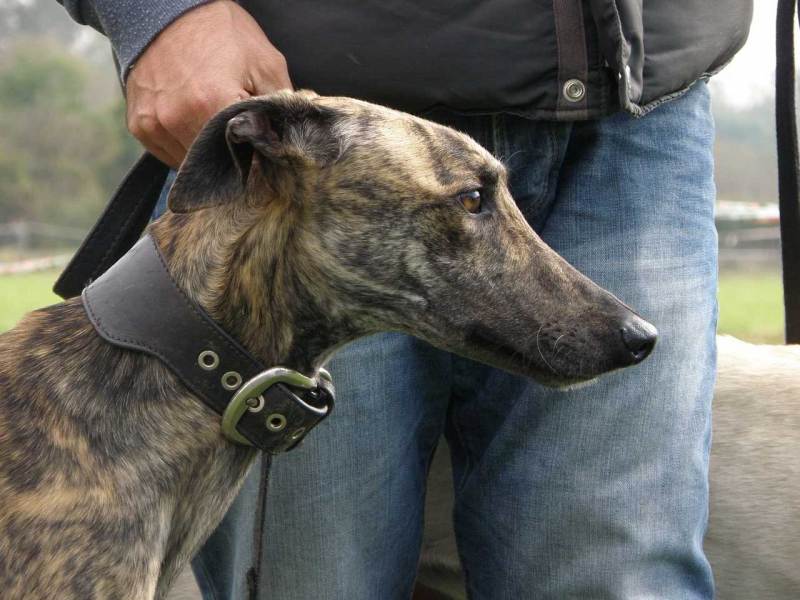
Body weight of 22-31 kg, according to sex, and height at the cross of 62-70 cm.. It has a strong bone structure and a long head with character.. Almond-shaped eyes, dark brown. Black nose. The ears are called rose ears, that are small and bent back. Long tail, fine, regularly screwed. Its movement is flexible, elegant and graceful.

When run, can reach speeds of up to 60 km/h.

Life expectancy is 12-14 years.

Video of the Hungarian Greyhound
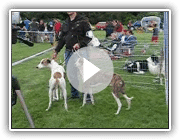
Magyar Agรกr - Agรกrfesztivรกl - Osagรกrd 2008

Character and skills

The hungarian hound has a very persistent and determined character. This is why he is so successful in greyhound racing. Compared to other dogs, can keep fast speed for a long time and, in case of stumbling, will continue on his way with the same vigor. He has a big heart in his deep chest, that helps you gallop with persistence. Radiates strength, elegance and great presence of mind. Although he loves to run, he is not hyperactive. typical of greyhounds, rests relatively frequently but requires a lot of exercise. So, regular daily exercise is important.

Your nature - like your appearance- It is elegant. He's extremely smart and sharp, loving but never intrusive. It is also recommended with children, they love them and a well socialized dog is not aggressive towards them. He is protective of his family but is not a biter and never barks unnecessarily. It is reserved with strangers. Has a balanced temperament, which makes it an ideal family pet. Early socialization and frequent exercise are important, otherwise you may develop behavior problems. This will most likely manifest itself in the flight. It is also excellent for various dog sports, especially greyhound racing, hunting or agility. Its calm nature also makes it ideal as a therapy dog..

Ideal environment

Greyhounds can stay indoors if they get adequate exercise every day. Get plenty of rest and can sleep up to 18 hours a day. Consequently, is very fond of comfort and soft beds. In a garden shed, it is necessary to ensure that a high enough fence is erected around it, since it will easily skip the lowest. He gets along very well with children, if they are treated well. It does not require a particularly active owner and is perfect for a family with an average lifestyle. A great hiking companion.

Grooming

The hungarian hound does not require any special care. You need to bathe him a couple of times a year and clean his eyes and ears at appropriate intervals. Brushing with a brushing glove is recommended once a week. More frequent brushing is recommended during the shedding season.

Health

The hungarian hound it is a healthy breed, does not have any specific disease.

Characteristics "hungarian hound (Magyar Agรกr)"

Coexistence is important that you have with your new friend. Before considering the acquisition of a dog of the breed "hungarian hound (Magyar Agรกr)" you know certain factors. Not all breeds of dogs are apt to live in an apartment, you must take into account his character, their need for exercise, their interaction with other pets, their care and if you have small children, their level of tolerance towards them.

Adaptation โ“˜

4,0 of 5 stars (based on 1 review)

friendly dog โ€‹โ€‹โ“˜

3,0 of 5 stars (based on 1 review)

hair loss โ“˜

2,0 of 5 stars (based on 1 review)

Affection level โ“˜

4,0 of 5 stars (based on 1 review)

Need for exercise โ“˜

4,0 of 5 stars (based on 1 review)

Social need โ“˜

3,0 of 5 stars (based on 1 review)

Home โ“˜

3,0 of 5 stars (based on 1 review)

Toilet โ“˜

2,0 of 5 stars (based on 1 review)

Friendly with strangers โ“˜

2,0 of 5 stars (based on 1 review)

barking โ“˜

1,0 of 5 stars (based on 1 review)

Health โ“˜

5,0 of 5 stars (based on 1 review)

Territorial โ“˜

4,0 of 5 stars (based on 1 review)

Cat friendly โ“˜

2,0 of 5 stars (based on 1 review)

Intelligence โ“˜

4,0 of 5 stars (based on 1 review)

Versatility โ“˜

3,0 of 5 stars (based on 1 review)

Child friendly โ“˜

5,0 of 5 stars (based on 1 review)

Surveillance โ“˜

2,0 of 5 stars (based on 1 review)

joy โ“˜

3,0 of 5 stars (based on 1 review)

Images "hungarian hound (Magyar Agรกr)"

Photos:

1 – hungarian hound Color: of course by Canarian, CC BY-SA 4.0, via Wikimedia Commons
2 – hungarian hound by https://pixabay.com/es/photos/magyar-agar-perro-animal-galgo-5016524/
3 – hungarian hound by Magpie (vitalap / edits), CC BY-SA 3.0, via Wikimedia Commons
4 – hungarian hound at the Katowice dog show (2005) by Pleple2000, CC BY-SA 3.0, via Wikimedia Commons
5 – hungarian hound by Hachieko, CC BY-SA 4.0, via Wikimedia Commons
6 – hungarian hound by http://www.magyaragar.eu/blog/tag/ungarischer-windhund/page/24/

Videos "hungarian hound (Magyar Agรกr)"


Type and recognitions:

  • FCI CLASSIFICATION:
  • Group :
  • Section : . .

Federations:

  • FCI – Group 10: Section 3: Short-haired Sighthounds โ“˜
  • Standard CCC (Canadian Kennel Club / Canadian Kennel Club)
  • Standard KC (The Kennel Club) – Hound โ“˜
  • Standard UKC (United Kennel Club) – Sighthound and Pariah โ“˜

FCI breed standard "hungarian hound (Magyar Agรกr)"

Origin:
Hungary

Date of publication of the valid original standard:
06.04.2000.

Use:

It is a hunting and racing dog that hunts on sight. But, his nose is also remarkable. It is especially suitable for racing and decoy hunting. (coursings) where it is considered by all as highly accredited in long sections. He is a very good companion dog and a faithful guardian..


General appearance:

His appearance radiates strength; bone structure and muscles are well developed. It is elegant.


IMPORTANT PROPORTIONS:

  • The length of the body is slightly greater than the height at the withers.
  • The length of the muzzle corresponds to half the length of the head.


Behavior / temperament:

Tireless, persistent, fast, hardened and resistant. Excellent for racing.
In some distances it is faster than the Greyhound.
He is reserved by nature but not shy, it's sensible, smart and faithful. Is vigilant; your instinct to protect people, houses or farms is highly developed but with no hint of aggressiveness or sharpness.

Head:

Viewed from above and in profile, it is wedge-shaped with a fairly wide base.

Cranial region:
  • Skull: Moderately strong, broad. The forehead is relatively broad.
  • Stop (naso-frontal depression) : Well marked.

facial region:

  • Truffle: relatively large, well pigmented with large wide windows.
  • Snout: Strong, elongated, although as a whole it is not too pointed.
  • Belfos : Closing well, adherents, well pigmented.
  • Jaws / teeth: Strong jaws, powerful. Scissor bite, complete, well developed and according to the dog's dental formula.
  • Cheeks: Strong, muscular.
  • Eyes: Medium size, dark, neither deeply placed in the sockets nor bulging. Lively and intelligent look.
  • Ears: They are quite large and their weave is thick. Inserted at mid-height, they fold back over the neck in the shape of a perfectly worn rose. In attention they get up. Heavy ears are preferred over light ones. Always erect ears are wrong.

Neck:

Medium length but elegant, dry, muscular, without wrinkles.

Body:

  • Cross: Well developed, muscular, long.
  • Back: Wide, straight, firm, very well muscled.
  • Pork loin: Very wide, straight, heavily muscled.
  • Rump: Wide, slightly descending, with strong muscles.
  • Breast : The rib cage is deep and strongly arched to allow enough room for the heart and powerful lungs.. Well sprung ribs well extended back.
  • Belly: Moderately collected.

Tail:

Strong tail insertion, thick and slightly curved is moderately high. It is moderately thinned and reaches the hock. Its underside is covered by wire hair. At rest it falls vertically to the ground; in action it can be raised to the height of the top line

Tips

PREVIOUS MEMBERS: The forelimbs are strong and tendinous. Seen both from the front and the back, they are straight and parallel.

  • Shoulder: Moderately oblique, Mobile, muscular and long.
  • Arm: Long and somewhat oblique, muscular.
  • Elbows: Elastically conform to the rib cage. They are mobile and must not be turned either inwards or outwards.
  • Forearm: Long, straight, strong bone structure and dry muscles.
  • Carpo: Wide and strong.
  • Metacarpus: Short and vertical to the ground.
  • Front feet: Relatively large, elongated. Strong pads, nails kept short.

LATER MEMBERS: The hindquarters are well angulated but not over angulated., strongly muscled and with good bone strength. Seen from behind are parallel.

  • Thigh: powerfully muscled, with rather elongated muscles.
  • Knee: Moderately angled, strong, not turned neither in nor out.
  • Leg: Long, with dry muscles.
  • Hock: Powerful, strong, low placement.
  • Metatarsals: Seen from behind, both standing and moving are parallel.
  • Rear feet: Relatively large, somewhat elongated with strong pads and nails.

Movement:

Good ground coverage, elastic trot, seen from front and back, limbs move in parallel planes.

Mantle

  • SKIN: Relatively thick, well adjusted all over the body, no creases or double chin.
  • HAIR: Short, thick, rough, smooth and well glued. In winter it can present a dense internal fluff in considerable quantity.
  • COLOR: All known colors and color combinations in sighthounds, with the exception of those colors and combinations of colors mentioned as elimination fouls.


Size and weight:

HEIGHT AT THE WITHERS

  • Ideal height for males: 65 until 70 cm..
  • Ideal height for females: 62 until 67 cm..

The height measured in centimeters is not as important as the harmony of the proportions..


Fouls:

Any deviation from the aforementioned criteria is considered as a fault and the severity of this is considered to the degree of the deviation to the standard and its consequences on the health and well-being of the dog..


MISS PLAYOFFS

  • Aggressive or fearful dog.
  • Atypical head shape.
  • Upper or lower prognathism, incisor arcade deviated.
  • Missing one tooth or more than one tooth on the incisors, of the fangs, of the premolars 2-4, and molar 1-2; of more than 2 x PM1; go M 3 will not be taken into consideration .
  • Entropion, ectropion.
  • Colors: blue; blue spotted white white; brown; wolf gray as well as black and tan; tricolor dogs.
  • Any dog โ€‹โ€‹showing clear signs of physical or behavioral abnormalities must be disqualified..


    N.B.:

    Males should have two normal-appearing testicles fully descended into the scrotum..

    Source: F.C.I - International Cynological Federation

    Alternative names:

    1. Magyar agรกr, Hungarian agar (English).
    2. Magyar Agรกr (French).
    3. Magyar Agรกr (German).
    4. Magyar Agรกr, Lรฉbrel hรบngaro (Portuguese).
    5. Galgo hรบngaro, Magyar Agรกr (espaรฑol).

    โ–ท The world of Pets: Dogs, cats, birds, reptiles, amphibians

    Hungarian hound (Transylvanian Scent Hound)
    Hungrรญa FCI 241 - Medium-sized Hounds

    Transylvanian Scent Hound

    It is used in hunting fox and hare; the larger size variety is used in wild boar hunting, deer and lynx.

    Content

    History

    The Transylvanian Scent Hound it is a very old hungarian breed, whose development has been influenced by climatic conditions, the nature of the terrain and hunting methods in this part of the world.

    The breed had its golden age in the Middle Ages, When the Hungarian hound He was the favorite hunting dog of the nobility. The development of agriculture and forestry moved away from hunting grounds, and its use moved to the inaccessible mountains and forests of the Carpathians.

    This change in territory and habit has led to the creation of two different varieties of Transylvanian Scent Hound: one bigger and one smaller.

    • Long-legged variety: height 56-66 cm.; black with white markings on the front, chest, feet and tip of tail. Used for fox and hare.
    • Short-legged variety: height 46-51 cm.; red-brown base color with white markings. Used in bear, deer and lynx.

    Both varieties were always bred together. Originally, the great Hungarian hound it was used to hunt big game: first buffalo, later bear, boar and lynx. The "small tone" were used to hunt minor hunting (foxes, hares) on covered land and to hunt "suede" in rocky areas.

    In the early 20th century, the threatened Transylvanian Scent Hound almost completely disappeared, but it was recovered in 1968. Today there are a large number of dogs of Transylvanian Scent Hound in Hungary and neighboring Romania. The variety of "small size" has been extinguished.

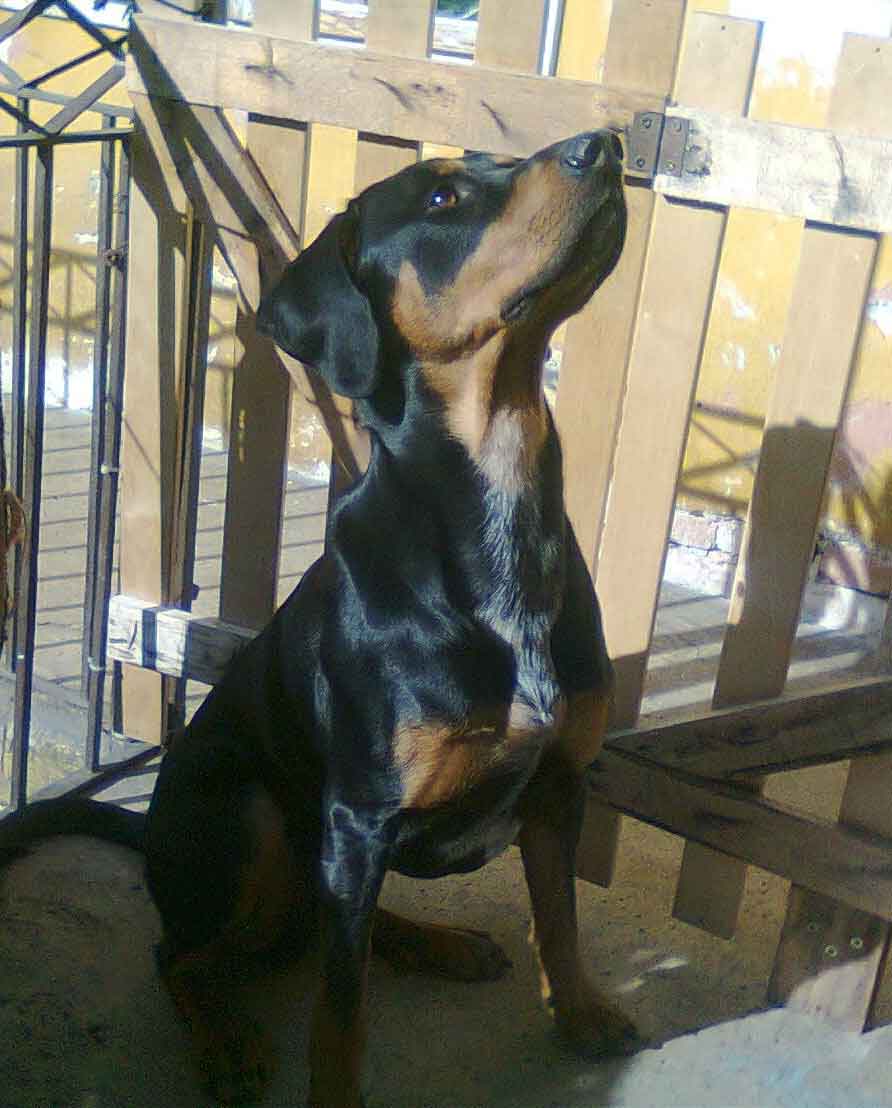
    Photos: Male, 1 year old Transylvanian Hound, in Hungary by Jahnna river, CC BY-SA 3.0, via Wikimedia Commons

    Physical characteristics "Transylvania's hound"

    The dog Carpathian Hound grows up 65 cm and weighs at least 25 kg. Whole body, including lower belly, is covered in short hair, dense, smooth and thick that rests well against the body. The basic color is black with tan on the muzzle and legs. The tail is and is carried above the top line when it wakes up, slightly bent up. The hanging ears, set at mid-height, lie close to the cheeks without wrinkles, put forward barely cover the eyes.

    Character and skills "Transylvania's hound"

    Expressive and loving nature – a dog with very good skills.

    Transylvanian hound female
    Transylvanian hound female by Lnko2323, CC BY-SA 3.0, via Wikimedia Commons

    The Transylvanian Scent Hound adapted perfectly to the extreme climatic conditions of his homeland. Here the robust breed had to contend not only with the cold and snowy winters, but also with the hot summer days. Hunting in the Carpathians was very demanding due to the dense and hardly accessible mountains. To be able to work all year round in these treacherous areas, the Hungarian hound developed not only his physical stature but also his mental abilities.

    With its marked sense of smell, his extraordinary sense of direction, his great resistance and his enormous dexterity, This race, in addition to qualities such as self-confidence and predatory instinct, provides everything an excellent hunting dog needs. They are capable of making smart decisions in almost all hunting situations and communicate their success with a clear voice. Like many hound dogs, the Hungarian hound is a professional at hard work.

    At home, the Transylvanian Scent Hound he is a very friendly and calm dog, that is closely tied to its owner, to children and family members. As it is also highly regarded as a guard dog, behaves suspicious of strangers, at first it tends to be a bit reserved, but it doesn't seem dangerous or aggressive at all.

    If the dog is well socialized and educated at a young age, relaxed demeanor is expressed, obedient and social, also together with the conspecifics.

    The Transylvanian Scent Hound need plenty of exercise, preferably combined with work, such as hunting. Their owners must have an active lifestyle to meet the requirements of keeping a hunting dog.. If sufficient conditions for exercise and employment are met, this breed can be kept in the house or apartment without problems.

    Characteristics "Hungarian hound (Transylvanian Scent Hound)"

    Coexistence is important that you have with your new friend. Before considering the acquisition of a dog of the breed "Hungarian hound (Transylvanian Scent Hound)" you know certain factors. Not all breeds of dogs are apt to live in an apartment, you must take into account his character, their need for exercise, their interaction with other pets, their care and if you have small children, their level of tolerance towards them.

    Adaptation โ“˜

    3,0 of 5 stars (based on 1 review)

    friendly dog โ€‹โ€‹โ“˜

    4,0 of 5 stars (based on 1 review)

    hair loss โ“˜

    4,0 of 5 stars (based on 1 review)

    Affection level โ“˜

    5,0 of 5 stars (based on 1 review)

    Need for exercise โ“˜

    3,0 of 5 stars (based on 1 review)

    Social need โ“˜

    4,0 of 5 stars (based on 1 review)

    Home โ“˜

    4,0 of 5 stars (based on 1 review)

    Toilet โ“˜

    3,0 of 5 stars (based on 1 review)

    Friendly with strangers โ“˜

    4,0 of 5 stars (based on 1 review)

    barking โ“˜

    4,0 of 5 stars (based on 1 review)

    Health โ“˜

    4,0 of 5 stars (based on 1 review)

    Territorial โ“˜

    5,0 of 5 stars (based on 1 review)

    Cat friendly โ“˜

    2,0 of 5 stars (based on 1 review)

    Intelligence โ“˜

    4,0 of 5 stars (based on 1 review)

    Versatility โ“˜

    4,0 of 5 stars (based on 1 review)

    Child friendly โ“˜

    2,0 of 5 stars (based on 1 review)

    Surveillance โ“˜

    5,0 of 5 stars (based on 1 review)

    joy โ“˜

    5,0 of 5 stars (based on 1 review)

    Videos "Hungarian hound (Transylvanian Scent Hound)"

    Transylvanian Hound - Wild boar Dogs [Transylvanian Hound]
    Transylvanian Hounds -Wild boar Dogs
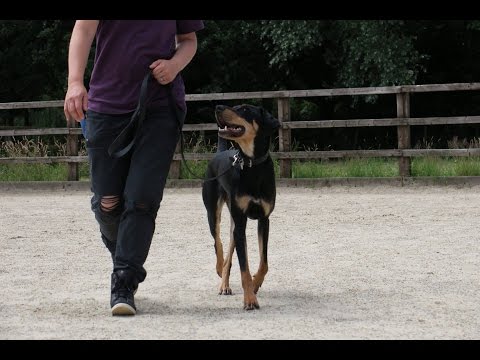
    Hector - Transylvanian Hound - 3 Weeks Residential Dog Training
    Hector – Transylvanian Hound – 3 Weeks Residential Dog Training

    Type and recognitions:

    • FCI CLASSIFICATION:
    • Group :
    • Section : . .

    Federations:

    • FCI – Group 6: Scent hounds, and related breeds. – Section 1.2: Medium-sized Hounds. โ“˜
    • UKCScenthounds โ“˜

    FCI breed standard "Hungarian hound (Transylvanian Scent Hound)"

    Origin:
    Hungary

    Date of publication of the valid original standard:
    06.04.2000

    Use:

    Dog used for hunting (Hound). You are able to hunt a great distance from your guide. He is especially gifted at locating and following a trail. When you discover a fresh trail, emits high-pitched barks in a pitiful tone. During crawl, bark loudly with a resonant sound in the distance. After the beat, for the prey excellently. Usually works alone or with a partner.


    General appearance:

    The shape and bearing of the head, the proportions of the body, The powerful and muscular members and the insertion of the tail correspond to the characteristics of the type of hound of central Europe. It is a medium-sized hound. The structure of the Hungarian hound body adapts to work with long races ; is athletically built, neither heavy nor fine of bone.

    IMPORTANT PROPORTIONS

    โ€ข The relationship between the length of the skull and that of the snout is close to 1:1.
    โ€ข The relationship between the height to the cross and the length of the body is 10:11


    Behavior / temperament:

    Is of good temperament, brave, persistent. Essentially the behavior of the Hungarian hound is still, balanced, also determined and full of temperament. It is able to withstand extreme weather conditions.

    Head:

    The head is that of a hound, elongated but not pointed ; Differences according to sex are marked.

    Cranial region:

    The skin on the head is tight and wrinkle free.

    • Skull : Slightly domed. The occipital protuberance is not marked. Supraciliary arches are poorly developed.
    • Depression links (Stop) : Bit strong.

    facial region:

    • Truffle : The truffle is not cut too abruptly ; its color is black. The wings of the nostrils are mobile. Windows are wide.
    • Snout : The nasal helm is straight.
    • Lips : Dry and firmly adherent. The color of the mucosa is black.
    • Jaws / Teeth : The jaws are strong. Teeth are strong, well developed. Scissor bite, complete and in accordance with the dog's dental formula.
    • Cheeks : Rounded, only underdeveloped.

    Eyes : Medium size, macaroons, slightly oblique cut. Color is dark brown. The eyelids rest firmly on the eyeball.

    Ears : Inserted at medium height, not very heavy. They hang without wrinkles resting next to the cheeks. From their insertion they widen and then along their extension, fine-tune until ending in a rounded end. Put forward they cover their eyes, although in general, its length does not exceed them too much.

    Neck:

    Strongly muscled, long Middle. The skin is slightly wrinkled on the lower face of the neck. A slight double chin is admitted but not desired.

    Body:

    The body is shaped like a lying rectangle.

    • top line : Straight.
    • Cross : Marked Back : From the cross, straight and well developed musculature.
    • Pork loin : A slightly longer loin is allowed in females.
    • Rump : Slightly descending.
    • Breast : The sternum is not protruding. The rib cage is wide, long and not too deep. Sectional, the rib cage is oval, almost rounded, to allow good breathing.
    • Bottom line and belly : The belly is slightly tucked.

    Tail:

    Middle insertion, strong. At rest, the distal third of the tail curves gently upward ; it is desirable that it reaches 1-2 cm.. from tarsal level down. Being excited, The dog carries folded on the dorsal line ; however, it should not be rolled over the back. The tail must not be cut off.

    Tips

    PREVIOUS MEMBERS : The forelimbs support the body as if they were columns. Head on, forelimbs look parallel, depending on the wide thorax correspondingly separated.

    • Shoulder : The scapula is well muscled, correspondingly long and moderately oblique.
    • Elbow : Supported next to the rib cage.
    • Forearm : Straight and symmetrical.
    • Front feet : They are large, with fingers together, strong and arched. The pads are big, firm and well padded. Nails are strong and as black as possible.

    LATER MEMBERS : In stop position, the back is slightly stretched back, good muscular.

    • Thigh : Long.
    • Hock : Low.
    • Metatarsus : Straight and parallel.
    • Rear feet : The fingers are strong and close together. The pads are big, firm and well padded. Nails are strong and as black as possible. Spurs will need to be removed.

    Movement:

    Good range passage and good ground coverage, never with short steps. The trot is wide. During work he is remarkably constant in gallop.

    Mantle

    Hungarian hound skin is average thickness ; particularly around the neck somewhat loose, though never wrinkled. The skin is dark pigmented. Hairless areas of skin are black.

    HAIR : Whole body, including the belly area, it is covered by a short hair, thick, smooth and well supported. In the neck, on the cross, on the back edge of the thighs and on the underside of the tail, hair is slightly longer than the rest of the body. Features swirls and ridges in the hair. The coat feels coarse and is shiny. Under the outer layer of hairs, features internal wool.

    COLOR : The basic color of the Hungarian hound fur is black. Always have a tan brand not too dark, point-shaped, over the orbital arches. Tan markings on muzzle and extremities. Fire color must have well -differentiated limits of black. A white spot may appear on the nose ; It can be continued in line on the forehead, on the neck and button on the chest, under breast, under the limbs and on the feet. There may also be a white spot on the tip of the tail. It is not desirable for the white color to cover more than a fifth of the total surface of the body.


    Size and weight:

    HEIGHT AT THE WITHERS : of 55 until 65 cm..
    The height measured in centimeters, will not be in any way decisive, but the harmony of the whole.

    WEIGHT Minimum 25 kg.


    Fouls:

    Any deviation from the aforementioned criteria is considered as a fault and the severity of this is considered to the degree of the deviation to the standard and its consequences on the health and well-being of the dog..

    MISS PLAYOFFS

    โ€ข Aggressive or fearful dog.
    โ€ข Very narrow skull and facial region, very long or rounded.
    โ€ข Naso-frontal depression (Stop) soft or very marked.
    โ€ข Short snout
    โ€ข Incorrect bite
    โ€ข Light ears, terrier or lebrel.
    โ€ข Wire hair, soft fur, wavy, insufficient.
    โ€ข Brown or blue color with brands.

    Any dog โ€‹โ€‹showing clear signs of physical or behavioral abnormalities must be disqualified..


    N.B.:

    Males should have two normal-appearing testicles fully descended into the scrotum..

    Source: F.C.I - International Cynological Federation

    Alternative names:

    1. Hungarian: (Erdรฉlyi kopรณ), Transylvanian Bloodhound, Hungarian Hound (English).
    2. Hungarian: (Erdรฉlyi kopรณ), Brachet hongrois (French).
    3. Hungarian: (Erdรฉlyi kopรณ), Siebenbรผrger Bracke (German).
    4. Hungarian: (Erdรฉlyi kopรณ) (Portuguese).
    5. Hungarian: (Erdรฉlyi kopรณ), Braco hรบngaro, Cazador hรบngaro, Sabueso de los Cรกrpatos (espaรฑol).

    โ–ท The world of Pets: Dogs, cats, birds, reptiles, amphibians

    Cimarrรณn uruguayo
    Uruguay FCI 353 - Molossoid - Dogo

    Cimarrรณn

    The Cimarrรณn uruguayo also called Cimarrรณn dog or Creole cimarrรณn is the only breed developed entirely in Uruguayan territory.

    Content

    History

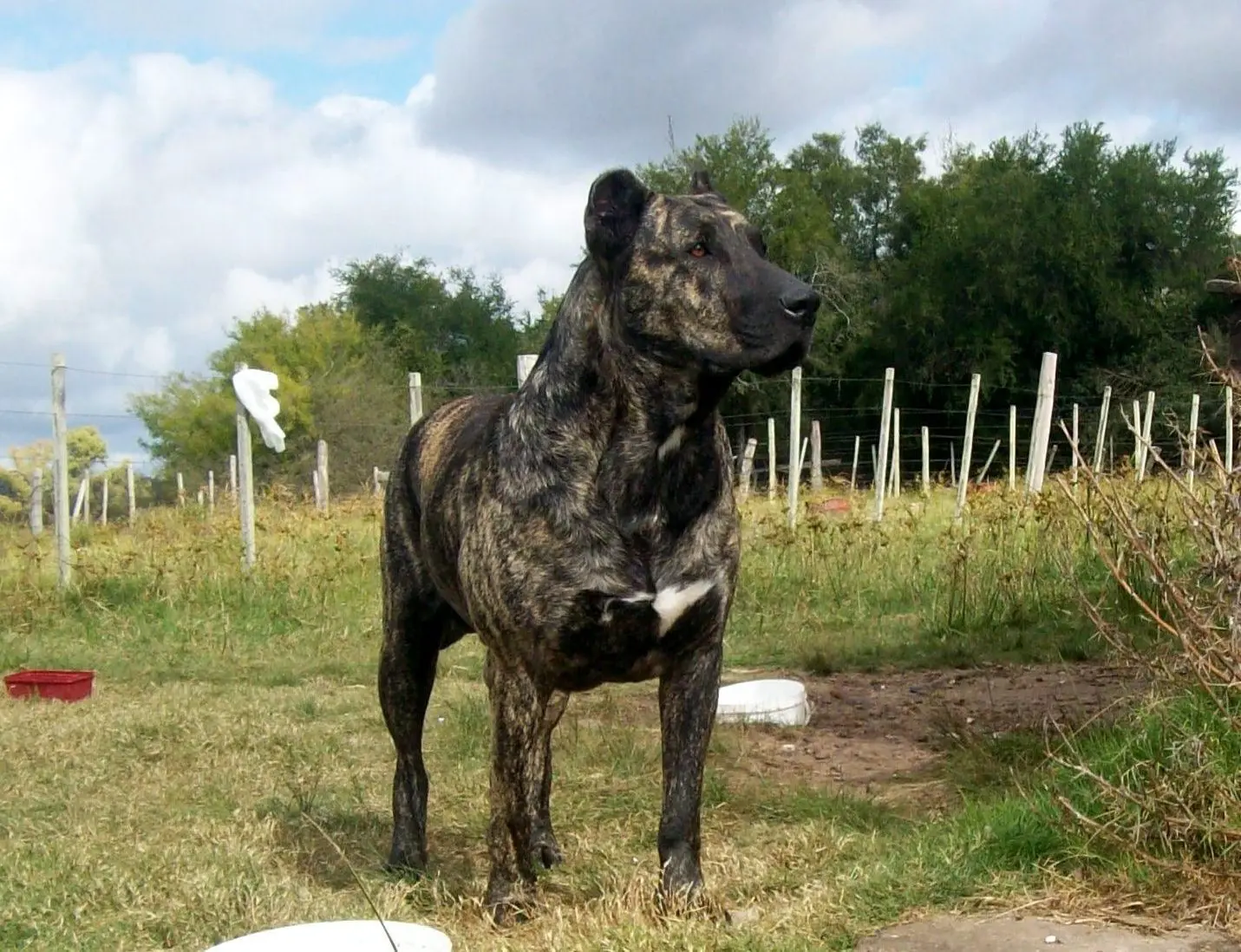
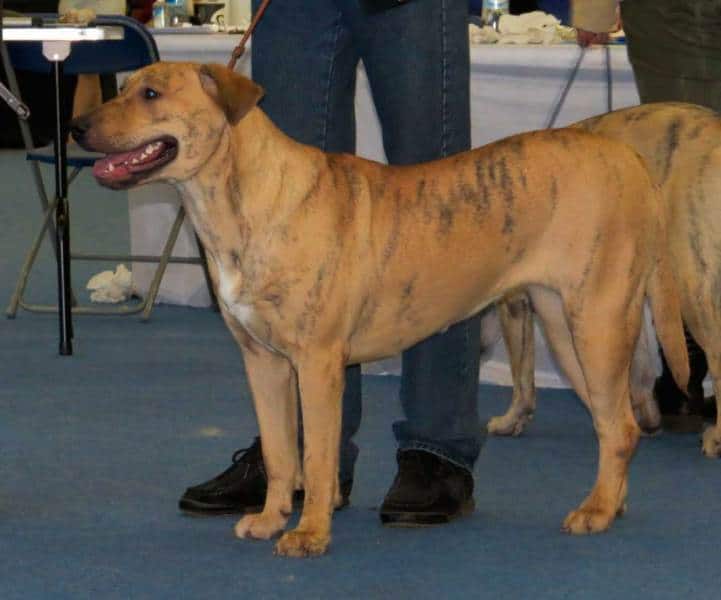
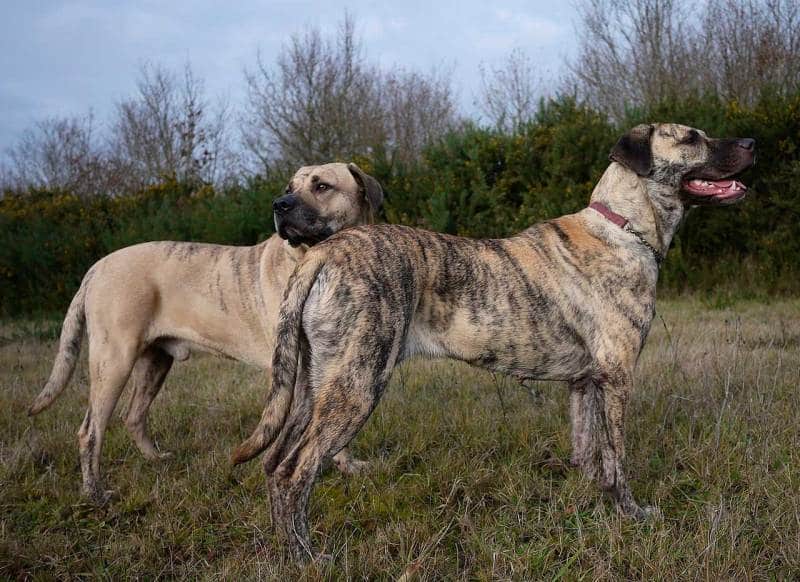
    The Cimarrรณn uruguayo Bulldog is a dog type molosoide, medium-sized, compact and strong, the fur can be striped or also bayo (cream-coloured) and snout black. His temperament is docile, cunning and guardian, ideal for guard, company or big game. It is recognized as a race in Uruguay from 1989 and internationally by the Federation Cynologique Internationale – FCI, from the 21 in February of 2006.

    Etymologically Cimarron is a term applied in America (originally on the island of Hispaniola) to everything that having been domestic or civilized returned to the wild or wild state, by referring in this case to their refuge in the heights (Indeed in the mountains and valleys hidden) Sierras, with which cimarrรณn would be "he who lives on the peaks or hides in them".

    The original specimens of the wild dog descended from the dogs introduced by the Spanish and Portuguese conquerors..
    The natural crosses that were taking place in the wild is that it evolved in the course of two centuries a native variety perfectly adapted to the environment of the Uruguayan Plains.

    ยซTell your master that when I lack men to fight his henchmen, I have to fight them with Maroon dogsยป: Josรฉ Gervasio Artigas to the Gral. Carlos Federico Lecor.

    The dog breed called Cimarrรณn dog or Criollo cimarrรณn is the only breed developed entirely in Uruguayan territory.

    Non-domestic dogs in the world, Whether original species or breeds produced by the feralization of domestic breeds that returned to the natural environment and managed to readapt to it, they show a physical development that is totally different from this one., so it is highly arguable that this breed produced in the Uruguay as a supposed model maroons dogs mentioned in ancient chronicles and documents reflect the natural demeanor of those. All wild dogs of the world, Because of what is known as "convergence" at an evolutionary level, they have long legs, erect ears, slender body, exceptions that occur in extreme climates (enormous ears of certain dogs of African deserts or small ears of Arctic foxes).

    There are detailed chronicles of attacks by packs of these dogs on caravans and people, that led to the authorities of the time (end of the 18th century) they already have and encourage major massacres, reaching count by tens of thousands dead dogs.

    Each dead animal was paid by the authorities of the time, requiring proof of death presented the jaw or the pair of ears of the animal. From this practice would derive the characteristic ear cut that is performed on many newborn pups., in the shape of a "cougar ear".

    Despite these massacres, ยซโ€ฆa good number of mothers with their offspring conquered the mountains of Olimar and especially in the Sierra de Otazo and in the Cerros Largosยป, in what is now known as departments of Cerro Largo and Treinta y Tres, where many ranchers and landowners in this place, they took advantage of the virtues of this breed for working with cattle and defense of his property, beginning to raise it, preserving the mixing.

    Modern traces of the breed begin to become more public in the early 1990s. 1980, When numerous breeders of Montevideo, attracted by the remarkable characteristics some specimens, they begin to develop their parenting and standardization.

    It is in 1989 When this work begins to pay its fruits, to being the Cimarrรณn Uruguayo officially recognized by the Association of the Rural Uruguay (A.R.U.) and the Kennel Club Uruguayo (K.C.U.), 20 years after the first exposure of a specimen of the breed in the K.C.U.
    Thus, the Association of Uruguayan Cimarrones Breeders was created and together with the K.C.U.. It prepares the official roll of the race, selecting the base dogs of the same and registering their pups, being tattooed for the first time with this registration number.

    Today the character attributes of this breed called Cimarrรณn They make it increasingly popular in Uruguay and region, being employed as a companion dog, Guard and hunting, especially the wild boar.

    Physical characteristics

    The Cimarrรณn Bulldog is a dog of medium size type, balanced, strong, compact, with good osatura, muscular, shrewd and great courage. The size and weight of the males is of 58 to 61 cm. of height and 38 to 45 weight kg. And of 55 to 58 cm. of height and 33 to 40 weight kg, in females.

    Character and skills

    It is excellent to work with cattle dog, hunting and guard. Predominant livestock activity of these lands and the consequent abundance of food without great competition with other natural predators, the bighorn reproduced in large numbers becoming – according to historical documents – in a true plague and scourge for the inhabitants of the countryside and the livestock.

    This race since its standardization has attracted a growing interest both within the Uruguay border, having copies of this dog in various countries of America, from United States to Argentina, counting this last country with several breeders of Cimarrรณn Uruguayo.
    Another of the steps achieved for the genetic improvement of the breed called Cimarrรณn Uruguayo is the signing of an agreement between the University of the Oriental Republic of Uruguay, through its Faculty of veterinary medicine with the Maroons breeders society for the study of the zootechnical status and consanguinity of the exemplary enrolled in their rolls.

    This long process of standardization was crowned the 21 in February of 2006 When the International Bureau of the Federation Cynologique Internationale (FCI) gives international recognition to the Uruguayan Cimarron.

    The breed standard states that the dog must have great courage. Like all large dogs, Cimarron Uruguayo should be well socialized when very young if you want to be kept as a companion. It is a very friendly dog รขโ‚ฌโ€นรขโ‚ฌโ€นwith children and other animals.

    Cimarron Uruguayo is sometimes used for surveillance, hunting and all dog sports in his native Uruguay. Being a very intelligent dog has been used for all kinds of jobs, as rescue or grazing.

    A dog is fairly quiet and stable, rarely bark unless the threat is real.

    The primitive Cimarrรณn dog, by its roots in the Uruguayan territory, It has been from the very beginning of the national identity of this town a symbol of the independence struggle, faithfully reflected in the letter sent by General Josรฉ Gervasio Artigas in response to General Carlos Federico Lecor, Count of la Laguna and Governor of the Provincia Cisplatina (current Uruguay) in which Artigas expressed that if it was left without soldiers to fight, I would do it with the Cimarron dog.

    It is because of this tradition that this breed is currently a symbol and mascot of the National Army of Uruguay., having a preferential place in the annual military parades of the 18 July. On this occasion, a soldier of the battalion of Blandengues (the company that Artigas himself knew how to lead at the time) He rides leading the parade carried a Moorish Steed without along rider which is a sheep dog by the flange.

    Images "Cimarrรณn uruguayo"

    credits:

    1. Cimarron Uruguayo – Kennel La Bonfire by Leonardo Botiรฃo Fonseca / CC BY-SA
    2. Cimarron Uruguayo by brindle / CC BY-SA
    3. The Finnish Winner Show, Helsinki, 2015. By Thomas / CC BY-SA
    4. Nbistolfi / CC BY-SA

    Videos "Cimarrรณn uruguayo"

    Type and recognitions:

    • FCI CLASSIFICATION:
    • Group :
    • Section : . .

    Federations:

    FCI โ“˜, UKC โ“˜

    FCI breed standard Cimarrรณn uruguayo

    FCIFCI - Cimarrรณn uruguayo
    Cimarrรณn

    Alternative names:

    1. Cimarron, Uruguayan Cimarron, Cimarron Creole, Maroon Dog, Cerro Largo Dog, Perro Cimarron, Cimarron Dog (English).
    2. Cimarrรณn uruguayo (French).
    3. Cimarrรณn Uruguayo (German).
    4. Cimarron uruguaio (Portuguese).
    5. Perro Gaucho, Perro criollo, Cimarrรณn (espaรฑol).