 FCI 235 - Molossoid - Dogo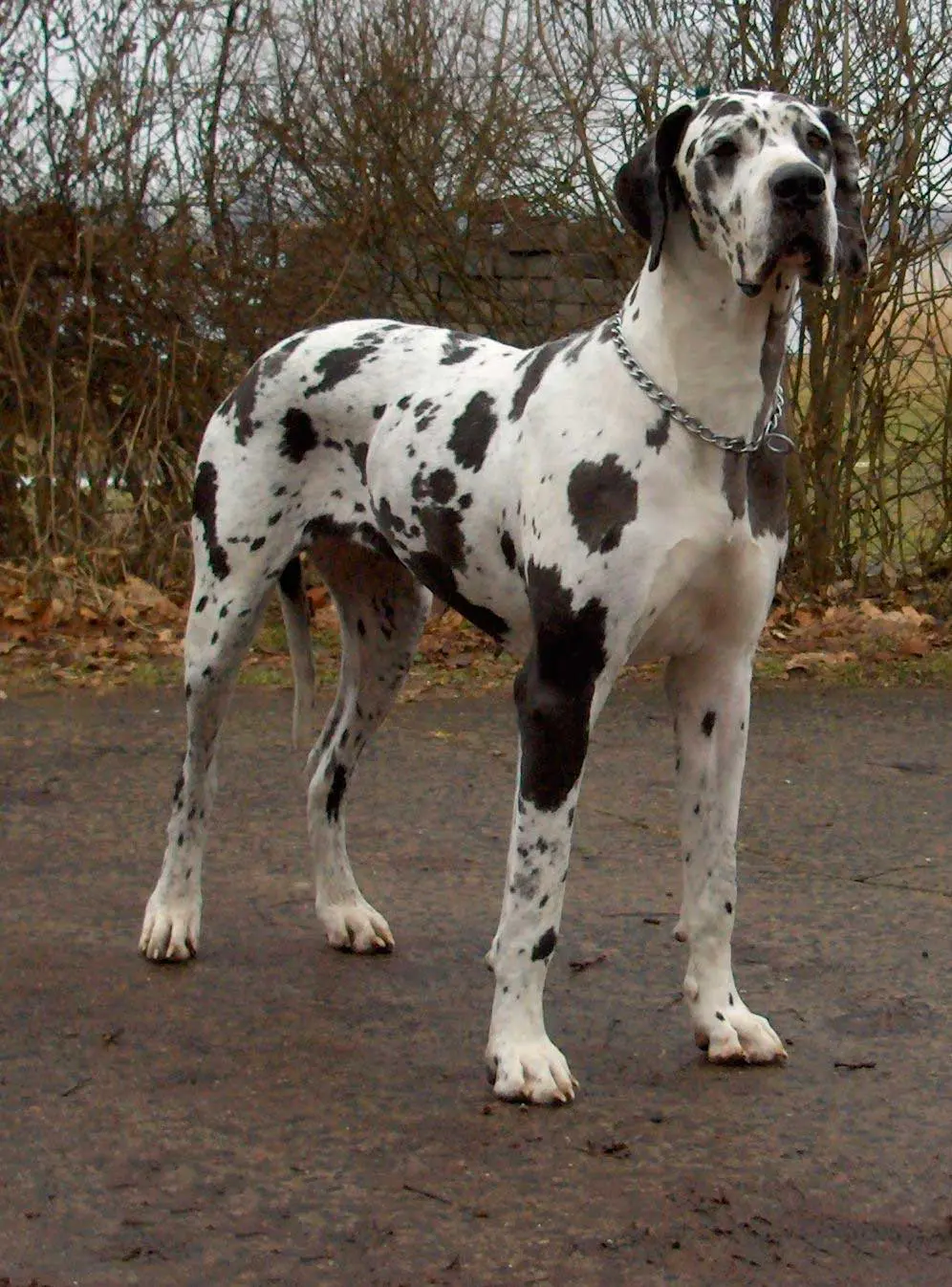
Content |
|---|
Characteristics "Great Dane"
Coexistence is important that you have with your new friend. Before considering the acquisition of a dog of the breed "Great Dane" you know certain factors. Not all breeds of dogs are apt to live in an apartment, you must take into account his character, their need for exercise, their interaction with other pets, their care and if you have small children, their level of tolerance towards them.
Adaptation ⓘ3,0 of 5 stars (based on 1 review)
|
friendly dog ⓘ3,0 of 5 stars (based on 1 review)
|
hair loss ⓘ3,0 of 5 stars (based on 1 review)
|
|---|---|---|
Affection level ⓘ3,0 of 5 stars (based on 1 review)
|
Need for exercise ⓘ2,0 of 5 stars (based on 1 review)
|
Social need ⓘ4,0 of 5 stars (based on 1 review)
|
Home ⓘ5,0 of 5 stars (based on 1 review)
|
Toilet ⓘ1,0 of 5 stars (based on 1 review)
|
Friendly with strangers ⓘ3,0 of 5 stars (based on 1 review)
|
barking ⓘ2,0 of 5 stars (based on 1 review)
|
Health ⓘ4,0 of 5 stars (based on 1 review)
|
Territorial ⓘ5,0 of 5 stars (based on 1 review)
|
Cat friendly ⓘ3,0 of 5 stars (based on 1 review)
|
Intelligence ⓘ3,0 of 5 stars (based on 1 review)
|
Versatility ⓘ3,0 of 5 stars (based on 1 review)
|
Child friendly ⓘ3,0 of 5 stars (based on 1 review)
|
Surveillance ⓘ2,0 of 5 stars (based on 1 review)
|
joy ⓘ5,0 of 5 stars (based on 1 review)
|
History
The Great Dane is the oldest breed in modern dog breeding in Germany. Since then it is considered by many as the Apollo among dogs – after the greek deity. And in fact, the Great Dane it is a dog with a special charm and a unique and impressive charisma and elegance. The origin of this breed is only partially found in Germany. Already in the 16th century the Great Danes are said to have originated in England, as described in historical sources "crossing the mastiff with the Irish greyhounds". The name «Dogge», the old english word for dog, from which the current «Dog», also speaks of a British line of descent. But, this type of dog was already bred in ancient times and was depicted on stone tablets.
Also on the European continent, old bull teethers regularly mated with greyhounds and hunting dogs, since these results of the crosses were perfectly adapted to the great hunts of the boar nobility, bears and wolves. Little by little, a breed of its own with molossi developed., Greyhound and some hunting dog blood. In 1867 the viennese cynologist Leopold Fitzinger distinguished three variants of Great Dane: the common mastiff, english and danish. Even today the great danes They are called "Great Dane» in some languages. Modern analyzes by geneticists confirm the views of ancient cynologists about ancestors, and even assign them to greyhounds instead of molossians.
In 1888 the Club of the Great Dane In Berlin. It is the first and oldest pedigree dog breeding club in Germany.. The Great Dane modern should now become a representative companion and protector. It also, should be even more elegant. So the standard was adapted to these ideas. It was possible to achieve an extremely elegant and harmonious mix of these very different origins.. The Great Dane combines the elegance and speed of hounds with the power and carefreeness of the molossians.
Physical characteristics
The Great Dane it is an extremely large and powerful dog but at the same time very elegant and sensitive. A male dog reaches a height at the cross of 80 cm., often even more. Bitches are slightly smaller. The Great Dane has a unique charisma. The animal painter and dog connoisseur Richard Strebel already betrayed 1914 to the breeders of the Great Dane, the: «… they have created a dog that can be considered without exaggeration as the most successful in size, proportion, strength and elegant movement never created in dogs." Unfortunately, this respect is not always shown in breeding Great Dane. Regardless of your health, are used for extreme breeding, the so-called gigantism, as well as for games with defective genes for rare coat colors; genes that can also cause serious illness.
While around 1900 the height at the withers for males was 76 – 80 cm., The FCI standard valid today says “at least 80 cm» without any clear upper limit. This allows the Great Dane reach the dubious honor of the world's largest dog. According to the Guinness Book of Records, this was the male Great Dane «Gibson» con 108 height cm. That was in August 2004. Gibson still reached an age of almost 7 years, but the last years only in 3 legs. His record was expanded more and more.
«Zeus» the Michigan/EE.UU. reached a height of 112 cm and died with just 5 years, supposedly already in old age – Dubious records at the expense of dog welfare. The Great Dane it's impressive enough even without those dubious extremes. Its sovereign and elegant appearance is also highlighted by its silky coat. It is a very short coat, which is close to the muscular body with a slight shine. Colors are yellow or black, blue, tabby or stained.
- Fur: Satin.
- Color:
- Size: the minimum height for males is 80 cm and for the females of 72 cm.
– Tawny: yellow golden colour with black mask. The eyebrows and edges of the eyes must be black, While the ears and the tail may be clearer.
– Striped: Fawn and black in a striped pattern.
– Blue: Dark steel grey, allowing white markings on chest and legs.
– Negro: Jet Black pure, allowing white markings on chest and legs.
– Harlequin: White with black patches. The Great Dane is the only breed to display this color pattern on its coat..
Character
The Great Dane is often described as a gentle giant, but it is naturally protective when the situation requires it. He is loving and loves people, and those qualities should never be perverted by encouraging aggressive behavior.
In terms of character and size the Great Dane a dog is not for beginners. Belongs exclusively to the hands of experienced dog owners, who can and want to be fully involved with the animal. So there is no more inspiring companion than this dog. El Canciller del Reich Otto von Bismarck, who was accompanied by great Danes all his life, he openly admired the intelligence and abilities of his great danes and is said to have said: «I have great respect for my dog's knowledge of human nature – "He is faster and more complete than me."
Great Danes love children, but they must learn to be nice to them. And a blow from that wagging tail will knock a little boy down, so it's important to monitor their interactions. These large dogs can also learn to get along with other pets., especially when raised with them.
A fenced yard is necessary to prevent the Great Dane go for a walk alone. Not usually a jumper, so a six foot fence should be enough to keep it contained. Note that while adult Great Danes are quite calm, puppies are very active and enjoy digging in gardens..
You might think that the Great Dane it is more suitable for outdoor life due to its huge size, but it's just the opposite. Should be an indoor dog that is part of the family. When that's the case, the Great Dane is loving, learns well and is easily trained. Left to his own fate, the amount of destruction it can do to your home and garden is beyond imagination.
any dog, no matter how pleasant it, detestable levels can develop barking, excavation, counter-browsing and other undesirable behaviors if you are bored, untrained or unsupervised. And any dog ​​can be a test that live during adolescence. In the case of the Great Dane, The "adolescence" years can begin at six months and continue until the dog is about two years old.
Start training your puppy the day you bring him home. Even at eight weeks old, He is able to absorb everything you can teach you. Don't wait until you are six months old to start training or you will have to deal with a stubborn dog. If possible, Take it to a trainer when you have between 10 and 12 weeks, and socializes, socialice, socialice. But, Note that many kinds of training puppies require certain vaccinations (such as kennel cough) stay up to date, and many veterinarians recommend limited exposure to other dogs and public places until puppy vaccinations (including rabies, distemper and parvovirus) They are completed. Instead of formal training, You can start training your puppy to socialize at home and among family and friends until immunizations are completed in the puppy.
Talk to the breeder, Describe exactly what you want in a dog and ask for help choosing a puppy. Breeders see puppies daily and can make incredibly accurate recommendations once they know something about their lifestyle and personality.
The Great Dane perfect doesn't come fully formed out of the puppy box. It is a product of his background and upbringing. Look for one whose parents have good personalities and who have been well socialized since the puppy's young age.
Great Dane fitness
The maintenance of Great Dane it is very complex and expensive. Food in the required quality and quantity, possible veterinary and drug costs, direct and indirect transportation costs and more require a financially wealthy owner. Yes a Great Dane wants to sit on the couch, you need all the two-seater, at least. Furniture made of solid faux leather has proven its worth here. The Great Dane should not be kept in a small apartment, Better is a house with a garden. The ideal would be to live in a rural area. Hectic urban centers are not the place where these big dogs feel comfortable. Also dog and owner are often met with rejection and even open hostility here. This must be considered.
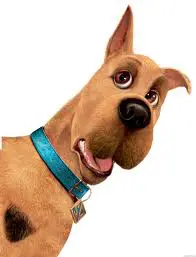
Fiction has made it one of the best-known dogs to the general public.. Scooby Doo character is a Great Dane.
The Great Dane it is a big dog that wants to have a lot of movement. But, he is hardly ever seen on the street, although with 1.200 puppies a year ranks ninth on the VDH bestseller hit list (German Canine Federation), even before dog breeds like the Bernese Mountain Dog or the Chihuahua, they are seen much more often on the streets. Often these giants are only locked up once they are past their puppy age and - poorly socialized and educated.- can no longer be managed by the owner who is not familiar with dogs. The Great Dane not a kennel dog. He is basically a family dog ​​and wants and needs the loving connection with his human family. Is smart and responsive. One should not think about what to do if this big dog, at times of 90 kg, is sick and has to be loaded. So, buying a Great Dane must be carefully considered.
Great Dane Education
The Great Dane a dog is not for beginners. Its strength and potential danger require expert and loving socialization, education and guidance already in the puppies. It is sensitive and intelligent and does not forgive any mistakes of the owner so quickly. She likes to be guided and educated, but not by any means of coercion. Many normal dog training aids do not work with the Great Dane, simply because it is too strong. In case of doubt, even the strongest man will not wear the leash. Due to overexploitation and unilaterally oriented breeding selection towards outward appearances, today there are, although extremely rare, specimens with idiopathic aggressiveness, which then represent practically insoluble problems for an education.
Great Dane Health
Great Danes also suffer from a high incidence of cardiomyopathy, a disease of the heart muscle that causes the heart to enlarge. This is very common in many giant dogs, and when it occurs late in life, can often be controlled with medication. Have your dog's heart checked at least once a year, and that any unusual murmurs or symptoms be investigated by a board-certified veterinary cardiologist. This condition can also be genetic., but currently available tests can only rule out the dog at the moment; a dog could shed one day and develop heart disease the next.
Great Danes can also suffer from hip dysplasia, a crippling malformation of the hip socket that may require expensive surgery to repair and can result in painful arthritis later in life. Another genetic problem with an imperfect screening test, The best prevention for hip dysplasia at this time is to buy only a puppy whose parents have been tested with normal hips and who have very few close relatives with the disease.. Keep your dog slim, especially when young, can also help.
Another painful bone disease is hypertrophic osteodystrophy., that occurs during the puppy's rapid growth phase. Ask Your Vet About Large Breed Puppy Foods. These diets are formulated to help puppies grow slowly., which can help prevent developmental orthopedic problems.
Cancer is another major cause of death in the Great Dane, especially bone cancer. They are also prone to other skeletal problems, visual and neurological, both older and younger.
Not all of these conditions are detectable on a growing puppy, and it is impossible to predict if an animal will be free of these diseases, so you need to find a reputable breeder who is committed to raising the healthiest animals possible. Must be able to produce independent certification that the dog's parents (and grandparents, etc.) have been examined for common defects and considered healthy for breeding. That's where health records come in..
Careful breeders screen their breeding dogs for genetic diseases and breed only the healthiest, best-looking specimens., but sometimes mother nature has other ideas and a puppy develops one of these diseases despite good husbandry practices. Advances in veterinary medicine mean that in most cases dogs can still live a good life. If you are going to have a puppy, ask the breeder about the ages of the dogs in their lines and what they died of.
Remember that after you have welcomed a new puppy into your home, has the power to protect you from one of the most common health problems: the obesity. Keep a Great Dane with a proper weight is one of the easiest ways to prolong your life. Make the most of your preventive skills to help ensure a healthier dog for life.
Great Dane care
The Great Dane has a short coat, thick and smooth. Falls moderately, in other words, more than you might think, but it requires little cleaning. Brush into Danish weekly with a rubber glove or soft bristle brush to keep hair and skin healthy. In spring and autumn, will have a heavy shed, known as "blowing" the coat and will need to be brushed more frequently during that time to get rid of all the loose hair.
Bathe Danish as you like or only when it gets dirty. With the gentle dog shampoos available now, you can bathe a dane weekly if you want without damaging his coat.
The rest is basic care. Cut your toenails every few weeks. Long nails can catch on things and tear off. That is so painful, and bleed much. Brush your teeth frequently for good dental health. To prevent ear infections, keep ears dry and clean, using a cleaning solution recommended by your vet.
Nutrition / Food
The Great Dane consume large amounts of food. At the same time, this food must be of a very high quality and must be selectively composed during the growth phase, which lasts up to two years. When it comes to eating, sometimes it is very rustic. Certainly not all, but some Great Danes don't have the best "table manners". So it may occasionally happen that the dog, as well as the feeding place should be cleaned after eating. How to minimize the risk of stomach torsion in this predisposed breed through proper feeding management is very important.
Life expectancy
Life expectancy Great Dane has increased slightly from the extremely low level of 2004 with 6 years and 6 months to 7 years, according to British Kennel Club statistics. As a general rule: the bigger and more unusual the coat color, less will be the life expectancy. Already at the age of 8 years a Great Dane he's officially considered an old man nowadays. Without gigantism and healthy breeding it could have a life expectancy of 10 to 12 years.
Buy a Great Dane
Only puppies from parents with a maximum height of 80 cm to the cross and have the colors yellow, striped, black, spotted. It also, Care must be taken to avoid inbreeding to get a puppy Great Dane healthy. One should know how old the ancestors of the puppies were. Those interested in dogs can find a Great Dane in one of the emergency initiatives for dogs and offer them a loving home. Maintaining Great Danes is very expensive. Acquisition costs can be negligible compared.
Images "Great Dane"
 Great Dane 6
 Great Dane 5
 Great Dane 4
 Great Dane 3
 Great Dane 2
 Great Dane 1
Photos:
1 – Little Great Dane of 5 months, color negro by Eacampbell14 / CC BY-SA
2 – 07 VICKY TRES MESES by https://flic.kr/ps/H4SaY
3 – Great Dane by https://www.pxfuel.com/es/free-photo-oqedh
4 – Great Dane by https://www.publicdomainpictures.net/es/view-image.php?image=34101&picture=great-dane-dog
5 – Great Dane Dog Close-up portrait of a Harlequin Great Dane dog by public domain
6 – Large size dog standing on woman wearing gray pullover hoodie on green open field at daytime by https://www.wallpaperflare.com/large-size-dog-standing-on-woman-wearing-gray-pullover-hoodie-on-green-open-field-at-daytime-wallpaper-zqizp
Videos "Great Dane"
 Great Danes – Royal Canin Dog Breeds
 Dogo Alemán or Great Danes – All About Race
 Great Danes – CaracteriÌsticas
 Great Danes, one of the biggest dogs that exist
 THE GREAT DANE – THE TALLEST DOG IN THE WORLD / Animal Watch
 Tiny, Scared Puppy Falls In Love With A 120-Pound Great Dane | The Dodo Little But Fierce
 GREAT DANE – The Gentle Giants of the Dog World
 Great Dane Takes the Plunge | National Geographic
Type and recognitions:
- FCI CLASSIFICATION:
- Group :
- Section : . .
Federations:
- – FCI – Pinscher and Schnauzer-Molossoid type dogs – Swiss Mountain Dogs and Cattledogs. Section 2.1 Molossoid, mastiff type. ⓘ
- – AKC – Working dogs ⓘ
- – CKC – ⓘ
- – KC – Working dogs ⓘ
- – NZKC – Non-Sporting ⓘ
- – UKC – Watchdog ⓘ
FCI breed standard "Great Dane"
Use:
Guard and protection dog, service dog
General appearance:
The Great Dane brings together in its aristocratic general appearance a strong body structure combined with pride., strength and elegance. The substance together with its nobility and harmony in its appearance with the layout of its well-proportioned lines, an especially expressive head give the observer the image of a noble statue. It is neither too elegant nor gross. The difference between the sexes is clearly defined. It is the Apollo among the dog breeds.
PROPIMPORTANT ORTIONS: Its structure is almost square, especially in males. Females may have a slightly longer body.
Friendly, love or and devoted to his master. In front of strangers it can be somewhat reserved. A companion dog is required, family, self-confident, not scary, easy to handle and educate with a high stimulation threshold, without being aggressive.
Head:
In harmony with its general appearance, elongated, close, significant but not wedge-shaped. Expressive, finely chiseled (especially in the area under the eyes). The distance from the tip of the nose to the stop and from the stop to the slightly marked occiput should be as much as possible. The top line of the muzzle and skull should definitely be parallel. Viewed from the front, the head should have a narrow appearance and the nose should be as wide as possible..- Craging: Superciliary arches well developed but not protruding.
- Ston: Clearly defined.
facial region:
- Trufa: Well developed, wider than round (nostrils wide open). Must be black except for Great Dane spotted black and white. In these, a black truffle is desired and a truffle with black or flesh-colored spots is tolerated.. In blue dogs the truffle is the color of anthracite (diluted black).
- Horcico: Deep and possibly rectangular. Not pointed or with too little or protruding edges. Well marked lip commissure. Dark pigmented bumps. Black and white spotted Great Dane should tolerate not fully pigmented or flesh-colored gills. The nasal bridge should never be concave, convex or descending forward.
- Jaws/Teeth: Wide and well developed jaws. Scissor bite, strong, healthy and complete. (42 teeth according to dental formula). Lack of P1 of the lower jaw is tolerated. All deviations from a complete scissor bite are absolutely unwanted.
- Cheeks: Cheek muscles only slightly marked and in no way protruding.
- Ojors: Medium in size with a lively expression, Smart and friendly. Where possible dark, almond shaped with well attached eyelids. Their placement not too far apart nor should they be eyes of an elongated shape. Clear eyes are undesirable, stabbing and amber yellow eyes. Slightly clearer eyes are allowed in the Blue Great Dane. Black and white spotted Great Dane should tolerate light eyes or eyes of undefined color.
- Obars: By nature pendants, high insertion, medium size with its front edge resting on the cheeks. They should not have an insert too high or too low or separated or flat on the sides.
Neck:
Long, dry, muscular. It should not be short or thick. Well developed insert, tapering slightly towards the head and its upper line arched. Postage raised, somewhat slanting forward but not forming a deer neck. Too much loose or double chin is unwanted.Body:
- Cruz: It is the highest point of a robust body. It is formed by the scapulae that go beyond the spinal process.
- Dorrso: Short and firm, in an almost straight line with an imperceptible drop backwards. In no case ascending towards the posterior or too long.
- Itmor: Slightly arched, width, good muscular.
- Glikeness: Wide, with strong muscles, slightly falling from the sacrum to the insertion of the tail with which it merges impercepti- blebly. The rump should never fall abruptly or be completely flat..
- Pecho: Reaches up to elbow joint. Well arched ribs extending backwards. Chest of good width and depth with a well developed chest without the sternum being too marked. Ribs should not be flat or barrel-shaped.
- Línlower ea and abdomen: Belly retracted well towards the back, forming a moderate curved line with the lower portion of the thorax. It is not desired in females to keep a loose belly after pregnancy..
Tail:
Reaches up to the tibial-tarsal joint, should not be too long not too short. High and wide insert, it should not be too high or too low nor too thick. Tunes evenly towards the end. At rest it hangs down forming a natural curve. When excited or during movement a slight saber bearing but not in the form of a hook or ring and not considerably above the line of the back or to the sides. A brush-shaped glue is not desired.Tips
PREVIOUS MEMBERS: Well angled with strong bones and musculature.
- Hormbros: Strong musculature. Long and inclined scapula forming an angle of 100º to 110º with the arm.
- Brazo: Strong and muscular, glued to the body, should be a little longer than the scapula.
- Elbows: Without deviations, neither in nor out.
- Antarm: Strong, muscular. Seen from the front or from the side completely straight with vertical stop.
- Carpo: Strong, firm, very little difference from the structure of the forearm.
- Metacarpus: Seen from the front, strong and straight. Profile, shows very slight forward lean.
- Pinis previous: Round, well arched with fingers well together (Jack's foot). Short nails, strong, as dark as possible.
LATER MEMBERS: The entire skeleton is covered by strong muscles that make the rump, hips and thighs have a wide and round appearance. The hind limbs are well angulated and strong, seen from behind are parallel to the forelimbs.
- Thighs: Long, wide and very muscular.
- Rodinllas: Strong, positioned almost vertically below the hip joint.
- PinErna: long, approximately the same length as the thighs. With developed musculature.
- Atibio-tarsal articulation (Hock): Strong, stable, without deviations, neither outward nor inward.Metatarsus: Short, strong, almost perpendicular to the floor.
- Pinis later: Round, well arched with fingers well together (Jack's foot). Short nails, strong, as dark as possible.
Movement:
Harmonious, agile, covering a lot of ground, slightly elastic. The limbs observed both in front and behind must move in parallel. Without taking short steps, no ambition step.Mantle
PIEL: Footprint, well pigmented in dogs with solid colors. In the black and white spotted Great Dane the distribution of pigmentation corresponds mostly to the spots.
Plink: Very short, thick, smooth, flattened and shiny looking. It should never be rough, matte or double layer.
Colorr: The Great Dane is bred in three independent varieties: leonado and tabby, splashed and black, blue.
- Leonado: Pale golden leonado to intense golden leonado. A black mask is never desirable., bluish fawn or a sooty fawn color. No white marks.
- Ayougrado: Basic color pale gold fawn to deep gold fawn with regular, clearly drawn black stripes running in the direction of the ribs. A black mask is desirable. Never with discolored stripes. No white marks.
- Arlequin(Whites with black splattered spots): Pure white base color, if possible, without any mottling, with jet black spots well distributed over the entire body, irregular in shape and with the appearance of being broken.. No gray areas are desired on the stains, blue or brownish as well as a gray-blue splash. The so-called “Grautiger” (have a mainly gray base color on black spots) occur, they are not wanted but they are not disqualified.
- Negros: Azabach Black White markings on chest and feet are allowed. This includes the “Manteltiger” in which black covers the body in the form of a mantle and the snout., neck, chest, belly, Extremities and the tip of the tail can be white as well as Great Danes with a white base color and large black plates. (Record dogs). It is a defect a leonado color, brown or blue black.
- Awithul: Dark steel blue color, indulging in white markings on chest and feet Never tawny or blackish blue.
Size and weight:
Alturto the cross:
- Males: at least 80 cm not exceeding 90 cm.
- females: at least 72 cm not exceeding 84 cm.
Fouls:
Any deviation from the aforementioned criteria is considered as a fault and the severity of this is considered to the degree of the deviation to the standard and its consequences on the health and well-being of the dog..
- Cthey are not coming: Insufficient stop
- Horcico: Rolled lips (lower lips squeezed between the incisors of the upper and lower jaw).
- Jaws / Teeth: Irregular positioning of the incisors individually as long as the correct bite is maintained, teeth too small partial clamp bite.
- Ojors: Protruding or placed too deep
- Hormbros: Loose or overloaded with right shoulder blades
- Elbows: loose
- Antarm: Curved, protruding knuckles on the carpal joint
- Carpo: Outstanding Significantly compromised or inclined.
- Formertlater remities: angulation very open or very closed In the static cow hock, hocks together or crowded.
- PinIt: Plans, open, Long Dewclaws.
FALTAS GRAVES:
- Temperament: Diffidence, shy or nervous.
- Cthey are not coming: Amanzanada, too marked cheek muscles
- Ojors: Loose eyelids, conjunctiva too reddened
- Dorrso: back sunken or soggy.
- Glikeness: too inclined
- Colto: inclined, thickened at the tip or tail amputated
- Movement: Pasuqueo permanent
FALTAS DISQUALIFYING:
- Aggressiveness or extreme shyness.
- Any dog showing clear signs of physical or behavioral abnormalities must be disqualified..
- Temperament: Teether for fear, easily provoked
- Trufa: liver colored truffle, party nose
- Ectropión, entropion or macroblefarian Different color in solid color. Watery blue eyes.
- Jaws / Teeth: Prognathic bite, enognathic the crossed mouth, bite clamp, absence of teeth except two P1 in the lower jaw.
- Colto: Broken tail.
- Colorr:
- Gran Danish Leonado and tabby: silver blue or isabella color, white star on the forehead, white collar around the neck, white feet or sockets and white tail tip.
- Black and White Spotted Great Dane: white without any black spots (albinos) as well as deaf Danes, the so-called Porzellantiger (these mainly show blue spots, leonadas or atigradas).
- Gblue danish ran: white star on the forehead, white collar around the neck, white “dumps” or white tip of the tail.
Tby hand: Below minimum height.
- Males should have two normal-appearing testicles fully descended into the scrotum..
- Only functionally and clinically healthy dogs, with the typical conformation of the breed, should be used for parenting.
TRANSLATION: Mrs. Brígida Nestler.
Technical supervision: SR. Miguel Angel Martinez.
Source: F.C.I - International Cynological FederationAlternative names:
1. Deutsche Dogge, German Mastiff, Boarhound, Apollo of Dogs, Gentle Giant (English).
2. Grand Danois (French).
3. Ulmer Dogge, Englische Dogge, Dänische Dogge, Hatzrüde, Saupacker, Große Dogge (German).
4. Grande dinamarquês, Alano tedesco (Portuguese).
5. Dogo alemán, Alano alemán (español).
 FCI 309 - Molossoid - Dogo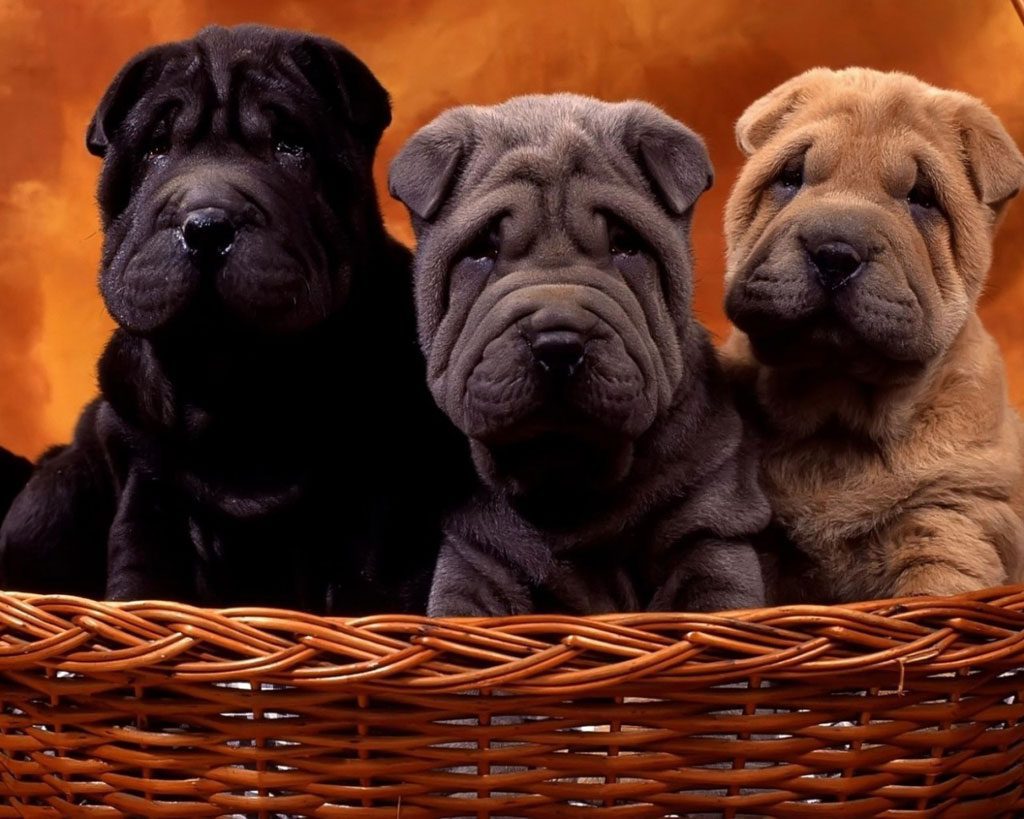


 Shar Pei – Features
 HISTORY OF SHAR PEI
 sharpei pups playing at 6.5 weeks
 Best Of Cute Shar Pei Puppies – Funny Puppy Videos 2018

