FCI 337 - Medium-sized Hounds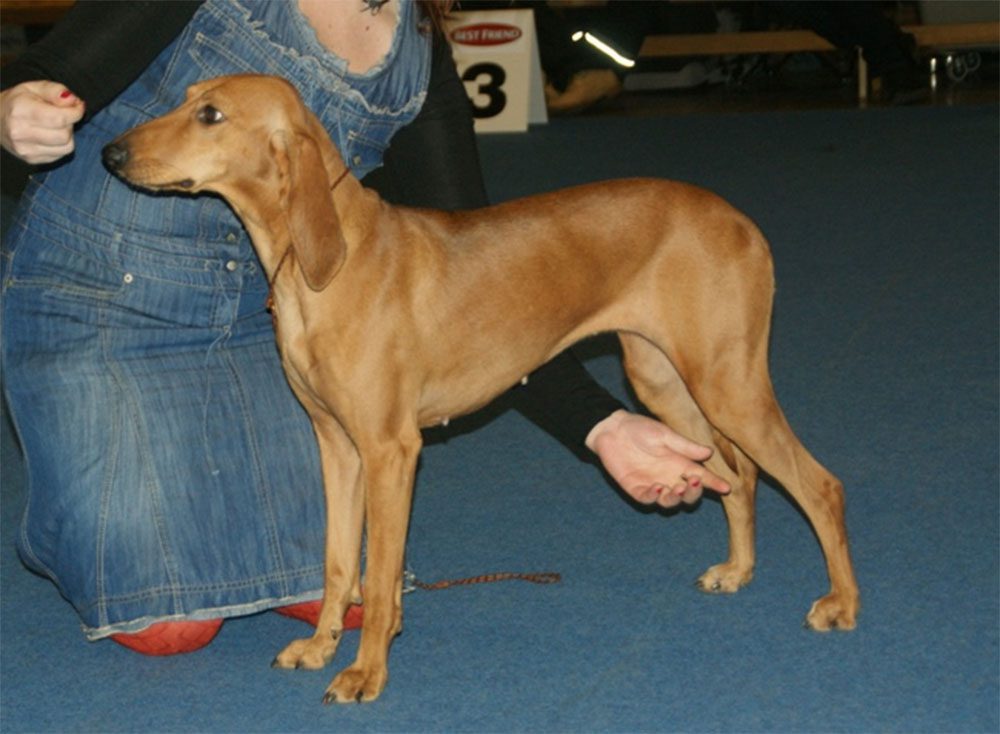
Content |
|---|
History
The Italian hound It, According to the vast majority of authors, a dog with very ancient origins. It is believed, in fact, descended from hunting dogs that lived from ancient Egypt, they reached the shores of the Mediterranean Sea, and therefore also to Italy, thanks to the Phoenician merchants. Many Egyptian drawings dating from the time of the pharaohs show the presence of dogs very similar to the current one Italian hound.
His best period is the Renaissance, when its level was improved and its great diffusion began. The race then underwent a slow and inexorable decline until, from the beginning of the 20th century, the Italian hound it became very popular again.
The modern history of Italian hound started on 1920, year in which the Technical Committee of the Society of Hound Hobbyists drew up the first breed standard that a few years later, in 1929 to be exact, was approved by the Italian Kennel Club. At that time there was only one standard that unified the Italian Rough-Haired Hound y al «Italian short-haired Segugio«; in 1976 came the prohibition of mating between the two varieties; then, in 1989, the ENCI (Ente Nazionale della Cinofilia Italiana) passed two different standards, standards that were later also recognized by the FCI which classified them in the group 6, among hound-type dogs, and related breeds.
The Italian short-haired Segugio It probably has the same origins as the «Italian Rough-Haired Hound«; in fact, both varieties of hounds have always coexisted in almost the entire peninsula.
Physical characteristics «Italian short-haired hound»
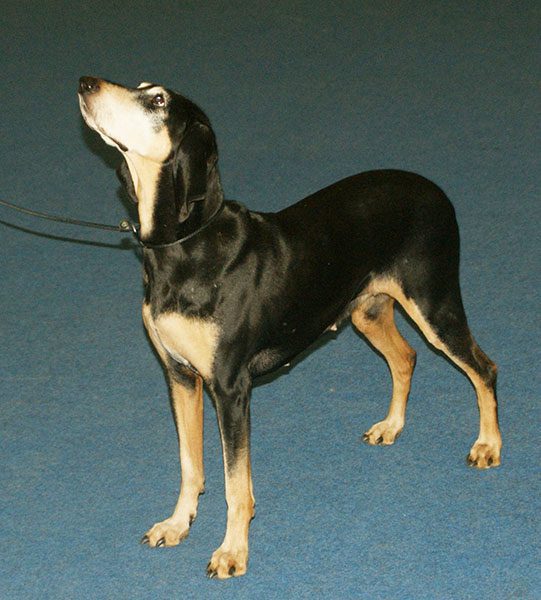
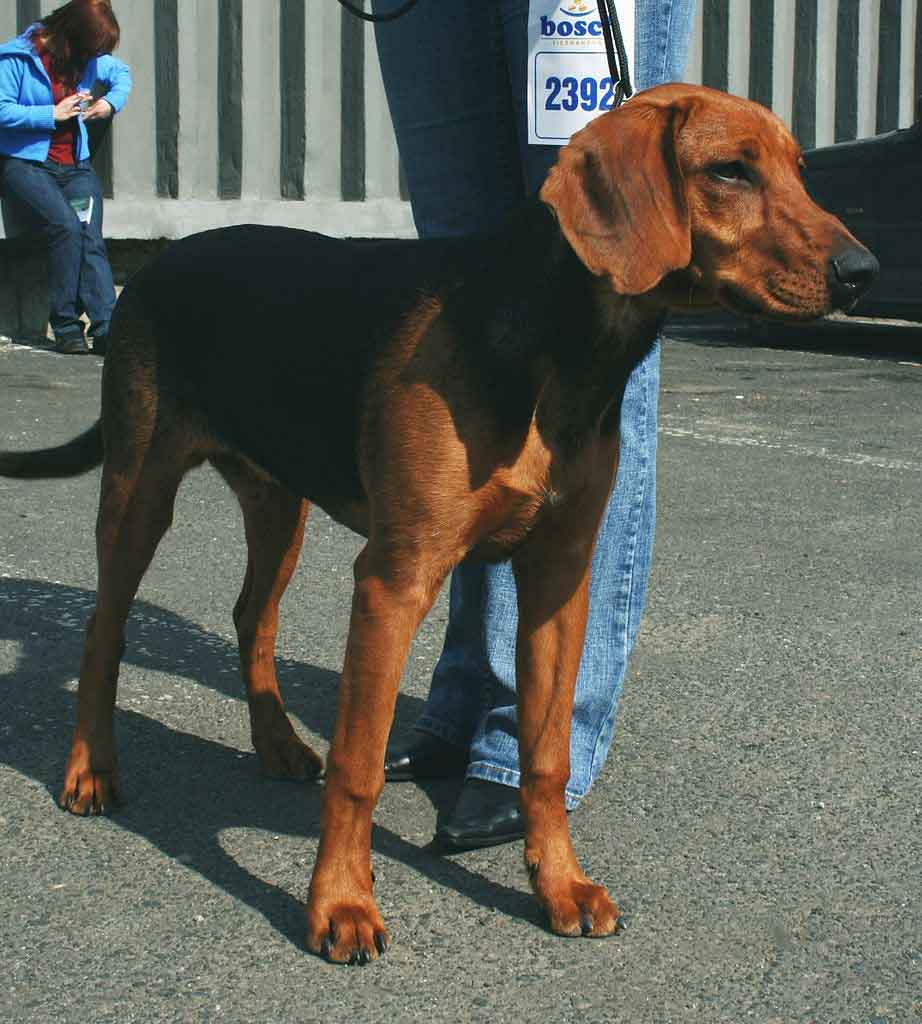
The Italian short-haired Segugio represents perfection for those who care about physical appearance: in fact, has no fat and is very muscular. This physical feature, combined with a regular body, makes it particularly fast and suitable for running. It's not a coincidence, in fact, getting tired only after intense physical activity.
Hair is shaved all over the body, dense, dense and smooth.
The allowed colors are:
– Fawn unicolor in all its gradations.
– black and tan.
Fawn dogs may have a white muzzle and skull, a white star on the chest, white on the neck, metacarpos, metatarsos, feet and tip of tail.
The height of the males ranges from 52 and 58 cm., that of the females between 48 and 56 cm.. The weight can vary between 18 and 28 kg.
Character and aptitudes «Italian short-haired hound»
Alive and bold. Never aggressive towards humans; rarely towards other dogs. It does not bite. Suits austere food and country kennels. Not conspicuously affectionate, but constantly needs the presence and consideration of the owner, who often identifies with the one who accompanies him during the hunt.
If he is well-maintained and has a breed-appropriate lifestyle, the Italian short-haired Segugio You can live up 12 or 13 years. This is because this type of dog is not predisposed to particular diseases derived from its breed.
Those who love them say that…
«I did not choose to live with a «Hound», I mean it was not a choice out of passion for this breed… it happened to me! It turns out that I share my life with a "Hound". It was and still is the most amazing experience of my life. Living with a "Hound" means learning to have time, lots of time to walk “alone” exploring life, silent. It is learning that you can stay in the forest for hours without doing anything other than living and discovering the forest. And that's it. The "Hound" teaches you not to pay attention to appearances, to pursue your passions tenaciously while those who look at you think you are just sniffing. He is an extremely sensitive partner but at the same time proud and independent. Living with Chloe is an adventure, made of constant and subtle balances between sharing and the search for individuality, the desire for freedom and the need to feel close to each other, "It is learning every day to discover and respect yourself.".
Silvia De Cristofaro
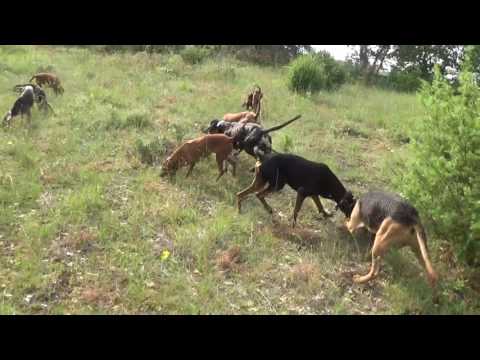
Videos "Italian short-haired Segugio"
|
segugio italiano sofiko evros 2/7/2017 Εκπαιδευτικό
|
Segugio Italiano fulvo a pelo raso (Alexia)-1/1
|
|---|

Type and recognitions:
- FCI CLASSIFICATION:
- Group :
- Section : . .
Federations:
- – FCI – Group 6: Scent hounds, and related breeds. – Section 1.2: Medium-sized Hounds. ⓘ
- – KC – Houndy ⓘ
FCI breed standard "Italian short-haired Segugio"
Use:
Hound, particularly for hare and wild boar hunting.
General appearance:
This is a dog of medium overall proportions and a square body., robust construction, perfectly proportioned and endowed with a well-developed bone structure. He is slim and has strong muscles., without the slightest trace of grease. The head is elongated and the longitudinal craniofacial axes are divergent.. The hair is satin.
IMPORTANT PROPORTIONS
• The length of the trunk is equal to the height at the withers (square appearance).
• The height of the chest is equal to half the height at the withers, or, In other words, is equal to the height of the forelimb measured from the ground to the elbow.
• The length of the nasal shank is equal to half the length of the head.
This is an animal that adapts well to the most diverse types of terrain and is endowed with great resistance and great speed.. Shows great ardor, whether you work alone or in a pack. He has a bold temperament, but not very communicative. His eyes are sweet and his voice is very pleasant..
Head:
---- Skull : Seen from above, Its shape is almost oval. In profile, the axes of the skull and the nasal cannula are divergent. The upper profile is slightly convex. The bizygomatic width is less than half the length of the head. The superciliary arches are not very developed. The frontal furrow is not very marked. The occipital crest is short and apparent, although the relief is not exaggerated.
- Depression links (Stop) : It has an accentuation of about 140°.
facial region:
- Truffle : It is almost in the shape of a six-sided polyhedron.. It is large enough and mobile. The windows are wide open somewhat laterally.. The color of the nose must always be black.
- Snout : Its length is equal to half the length of the head. Its depth (height) It should be a little larger than half its length. The profile of the nasal shank is somewhat convex. Its lateral faces converge forward. The branches of the mandible are almost straight along their entire length and the body of the jaw is poorly developed in its anterior part.. The lower lateral profile of the snout is defined by the upper lip.
- Lips : They are fine and thin. Seen both from the front, as in profile, they are a little high (lying). Seen in profile, its lower edge draws a slight curve. The edges of the lips should always be black.
- Jaws / Teeth : The jaws are shaped like a truncated cone.. The incisors are implanted at right angles to the jaw and the joint is scissor-shaped.. The denture is complete. The teeth are white and set in a regular line.. The correct joint is scissor-shaped, although the pincer-shaped joint is accepted.
- Cheeks : Flat and thin.
Eyes : Almond shaped. They are large, luminous, dark ocher color. Your expression is sweet. They are located in a semi-lateral position. The edges of the eyelids are always black.
Ears : The insertion of the ear is located in the plane of the zygomatic arches or a little below. The ears must be hanging and have a contortion that brings them completely forward and does not even allow them to be sunken., nor twisted. They have a triangular shape, They are flat throughout almost their entire length and are very wide. Its end should end in a narrow point, but never widely rounded; this tip bends slightly inwards. The length of the ears corresponds to a 70% of the length of the head and its width, measured at the widest part, It is a little larger than half its length.
Neck:
• Profile : The upper profile is slightly arched, i.e. convex.
• Length : Its length corresponds or is almost equal to the length of the head; so that, must correspond to 4/10 the height at the withers.
• Form : The neck is shaped like a truncated cone.. Its appearance is thin and light, to the point of giving the impression of being not very muscular.
• Skin : The skin on the neck is thin, well stretched and does not form folds or double chins. The hair is satin.Body:
- top line : It is rectilinear. Descends harmoniously from the withers to the rump, with a slight convexity in the plane of the lumbar region.
- Cross : Does not protrude much above the line of the back. It is narrow due to the approach of the tip of the shoulder blades and joins harmoniously with the root of the neck.
- Back : The upper profile is rectilinear and the muscles are not very apparent.. There is a proportion of 3 to 1 between the length of the back and the length of the lumbar region.
- Pork loin : The length of the lumbar region corresponds to just under 1/5 the height at the withers. The width of the spine is equal to its length. The muscles of this region are well developed.
- Rump : Its upper profile is slightly convex. Its direction has an inclination of about 10 degrees below the horizontal. Its length corresponds approximately to 1/3 from the height to the withers and its width corresponds to half its length. The muscles are well developed.
- Breast : The height of the rib cage is equal to or slightly less than half the height at the withers and its transverse diameter, calculated at half its height, approximately corresponds to 1/3 the height at the withers. The chest should descend almost to the elbows. The ribs are not very tight, therefore they are little convex. Since the chest circumference is more than ¼ of the height at the withers, the pectoral region is not very wide.
- bottom line : It is typical of the breed, since it appears in the form of a straight line throughout its entire length; this line goes up from the sternum to the belly, which is very thin, although not very raised.
Tail:
On the line of the rump the insertion of the tail is high. It is thin at the root and uniform throughout its extension.. It looks like a small flute (breadstick), except at the extremity, where it is very fine. The limb reaches the tip of the hock or barely touches it. The tail is covered with short hair throughout its entire length.. When the dog is at rest the tail hangs; When in action it rises and exceeds the line of the back.Tips
PREVIOUS MEMBERS : Seen as a whole and in profile, the aplombs must correspond to an imaginary vertical line that, starting from the scapulohumeral joint, descends to the ground, touching fingertips. They must also correspond to another imaginary vertical line that, starting from the humero-radial joint, divide the forearm and carpus into two more or less equal parts to end at half the length of the metacarpus. Seen from the front, The positions must correspond to a vertical line that starts from the tip of the shoulder and divides the forearm into two visibly equal parts., the carpus, the metacarpus and the foot. The height from the elbow to the floor is equal to half the height at the withers.
- Shoulder : Shoulder length corresponds to 1/3 the height at the withers. Its inclination below the horizontal is 45 to 55 degrees. Shoulder muscles are long, skinny, apparent and well defined. The opening of the angle of the scapulo-humeral joint is about 110 degrees.
- Arm : The length of the arm corresponds approximately to half the height from the floor to the elbow. In relation to the vertical, the arm is located in a plane more or less parallel to the median plane of the body. Arm muscles are long and thin.
- Elbows : They are located in the plane of the sternum line or a little below and are parallel to the median plane of the body. The end of the elbow should be on the inclined vertical that starts from the tip of the shoulder blade. The humeral-radial angle measures 135 to 145 degrees.
- Forearm : Its length is approximately equal to 1/3 the height at the withers. It is located perpendicular to the ground and has a clearly visible carpo-ulnar groove., which makes him look thin, fleshless and without important bones.
- Carpo : He is thin. Extends the straight line of the forearm.
- Metacarpus : Its length must not be less than 1/6 of that of the anterior limb, measurement from the floor to the elbow. In profile, the metacarpus is wider than the carpus, but flat and thin and slightly oblique from back to front.
- Front feet : They have an oval shape (hare foot); the fingers are well together and arched. The digital tubers are not very fleshy. Center pads are thin, hard, leathery and black. The nails are strong, bent and always black. The presence of some white nails (not pink) does not constitute a fault.
LATER MEMBERS : Seen in profile, The positions must correspond to an imaginary vertical that descends from the tip of the gluteus to the floor, rubbing or touching the tips of the fingers.. Seen from the back, the aplombs must correspond to an imaginary vertical that, from the tip of the gluteus, descends to the ground and divides the tip of the hock into two equal parts, the metatarsus and the foot. The length of the hind limbs is equal to 93 % the height at the withers.
- Thigh : Length and width; its length is not less than 1/3 the height at the withers. thigh width (external face) is approximately equal to ¾ of its length. The muscles are prominent, but they are well separated. The posterior edge of the thigh is slightly convex. The angle of the coxofemoral joint measures 90 to 95 degrees.
- Knees : They must be well plumb and the kneecap must not deviate even inwards, nor out. The angle of the tibiofemoral joint is about 115 degrees.
- Leg : Its length is a little less than the thigh; Its inclination below the horizontal is approximately 40 degrees. The leg muscles are thin even in the upper part; They are solid and differentiate well from each other. The groove on the leg is well marked and apparent.. The external saphenous vein is clearly visible. The bones are rather light and very solid..
- Hock : Its width is approximately one tenth of the height at the withers.. The distance from the ground to the tip of the hock should not be greater than the 27 % the height at the withers (low hock). The bone structure is solid and the contours of the bones are clearly visible., which accentuates the thinness of the region. The opening of the tibiotarsal angle is about 135 degrees.
- Metatarsus : Its length is less than half the length of the forelimb measured from the ground to the elbow. It is less wide than the hock and is presented in a vertical position, that is to say, perpendicular to the ground. No presence of dewclaws.
- Rear feet : They are less oval than the previous ones; for the rest, They have the same characteristics.
Movement:
during the hunt, the dog's movement is the gallop.Mantle
SKIN : It is fine and thin; is well applied over the entire body. Mucosal pigmentation, of the third eyelid, of the nails, of the central pads and digital tubercles should be strictly black. Black palate is not a requirement, but it represents a quality.
HAIR : It is smooth over the entire body. It's stiff, dense, dense and uniformly smooth. Some hard hairs can be found scattered on the trunk, the snout and limbs, but this does not constitute a fault.
COLOR : Accepted colors include the entire range of unicolor fawn, from intense reddish-fawn to washed-out fawn and black and tan. The tan markings are found, as usual, on the snout, the eyebrows, the chest, the extremities, from the carpus to the foot and from the tarsus to the foot, as well as in the perineum. The fawn may have white on the snout and skull (the mask may or may not be symmetrical), a white star on the chest, white color on the neck, the metacarpals and metatarsals, the feet and the tip of the tail. But, the color white is not very appreciated, and it is preferable that it not be very abundant. The black and tan color may have a white star on the chest; In this case it is said that the hound is tricolor. The brown color (coffee, liver) it is not accepted.
Size and weight:
Height to the cross :
- In males : of 52 to 58 cm.,
- in females it is 48 to 56 cm..
Tolerance of more or less 2 cm. (only for excellent dogs).
Weight : The weight of 18 to 28 kg.
Fouls:
Any deviation from the aforementioned criteria is considered as a fault and the severity of this is considered to the degree of the deviation to the standard and its consequences on the health and well-being of the dog., and the dog's ability to perform its traditional task.
• Constant pacing.
MISS PLAYOFFS :
• Aggressive or fearful dog.
• Converging craniofacial axes.
• Depigmentation of all or most of the nose and the edge of the eyelids.
• Concave nasal cane.
• Superior prognathism.
• Gaze eyes, total or most of the edges of the eyelids depigmentation.
• Absence of tail or short tail, both congenital, as artificial.
• Slate or lead color; brindle dog, coffee, liver, the predominant white color.
• Size that exceeds or does not reach the tolerance margin indicated in the standard.
Any dog showing clear signs of physical or behavioral abnormalities must be disqualified..
Males should have two normal-appearing testicles fully descended into the scrotum..
Source: F.C.I - International Cynological Federation FCI 131 - Medium-sized Hounds